TRAVIS TAILWIND


of the a ir force Public a ffairS ARLINGTON, Va. — The Air Force announced an update to its Physical Fitness Readiness Program in a Directive Type Memorandum introducing new standards and scoring models designed to better align with the demands of modern warfare and promote the long-term health of every airman.
The modernized program is anchored in scientifically grounded health measures and a more rigorous assessment model. The goal is to enhance warfighter readiness by encouraging airmen to build durable fitness habits that support sustained, career-long performance.
“Our new standards are designed to help airmen build fitness habits that will serve them throughout their careers and hopefully a long life,” said Air Force Chief of Staff Gen. Ken Wilsbach. “This update is not just about increasing the physical fitness test standards; it’s about ensuring our warfighters are fit, ready, and prioritizing their long-term health.”
In conjunction with the updated program, score charts have been updated with increased minimums for each scored component, as well as separate charts now available for Occupationally Specific

See Fitness, Page 2

BASE — The Travis Exchange is suiting up for Month of the Military Child with sweepstakes to bring big smiles to our smallest heroes, offering more than $22,000 in prizes and Exchange gift cards.
Beginning March 27, Travis Exchange shoppers 18 years and older can test their luck to win one of the 116 prizes and Exchange gift cards through April 30 by visiting ShopMyExchange. com/sweepstakes.
Prizes include:
n Exchange gift cards ranging from $250 to $1,000, $20,500 value (61 winners).
n Trefl Red Roman Forum 1,000-piece puzzle, $14.95 value (five winners).
n Trefl Red The Meglagavi 1,000-piece puzzle, $14.95 value (five winners).
n Trefl Red Color Splash: Cubic Gradient 1,000-piece puzzle, $18.95 value (five winners).
n Exploding Kittens game Bundle, $84.80 value (five winners).
n Little Apps tablet, $22.95 value (five winners).
n Doodle & Draw Learning Center, $27.95 value
(five winners).
n LeapFrog Learning 100 Words book, $24.95 value (five winners).
n LeapFrog Chat and Count Emoji phone, $17.95 value (five winners).
n Droyd Romper Electric Ride-on toy, $119.95 value (five winners).
n Camelbak boys’ bundle, $70.95 value (five winners).
n Camelbak girls’ Bundle, $70.95 value (five winners).
“Military children carry a unique strength that often goes unseen, and the Exchange is proud to honor that,” said Travis Exchange General Manager Cathie Byrns. “These sweepstakes are a small gesture of appreciation for everything they navigate as part of military life.”
Winners will be selected on or around May 15. No purchase is necessary to enter. All authorized Exchange shoppers, including veterans, Department of Defense civilians and Common Access Card (CAC) holders can enter. Veterans can visit https:// aafes.media/paveterans to learn more about their shopping benefit while DoD civilians and other CAC holders can visit https://aafes.media/ cacbenefitspa.

From Page 1
Physical Fitness Assessments. These adjustments are intentional and directly align with the program’s renewed emphasis on longterm health, readiness, and overall warfighter effectiveness.
their region.
Airmen may reference the PFRA Due Date Matrix on MyFSS in the Knowledge Base application to learn more about testing timelines.
level Peer Fitness Leaders and airmen through safe and effective conditioning, reconditioning, and adaptive fitness programs.
n The warfighter fitness playbook: This guide offers detailed guidance on workouts, recovery strategies, sleep optimization, and nutrition – all interconnected elements essential for sustained performance.
Serving

To ensure a smooth transition, the Air Force will implement a baseline window for airmen to take diagnostic tests. This period is designed to give airmen time to understand the new standards, assess their current performance against the updated charts, and adjust their training focus before scoring becomes official on July 1. The baseline period will also provide the data required to assess and refine score charts in advance of full implementation of the new standards. Airmen who complete the Physical Fitness Readiness Assessment during the baseline period may elect to record their diagnostic test score as an official fitness test score. This may be especially beneficial for airmen in cold-weather locations who wish to align their next due-date to a time when weather is more conducive to outdoor testing in
Body composition will return as a scored component assessed in the PFRA. Airmen may elect to take this component of the test up to five duty days before assessing the remaining PFRA components.
Airmen and commanders are encouraged to make full use of diagnostic testing during this baseline period. This phase will provide valuable data to ensure the updated PFRP is implemented in a manner that is fair, accurate, and effective across the force. To support the force through this transition, a robust set of resources will be available:
n Master fitness leaders: These trained experts will be available at installations to guide unit-
n The pregnancy & postpartum performance training guide: To ensure comprehensive support for all airmen, this guide provides tailored physical training and wellness recommendations for pregnant and postpartum airmen.
The certification of the 2-mile run tracks to ensure all Air Force tracks meet official standards is in progress. Final guidance on measurement specifications (e.g. meters, feet, yards, etc.) will be published in AFMAN 36-2905.

“Airmen are the heart of the Air Force, and their readiness is essential to mission success,” said Chief Master Sgt. of the Air Force David R. Wolfe. “Our new standards are designed to prepare them for the demands of today and the future fight. They give every one of our Airmen an opportunity to grow in an important part of their lives.”
Additionally, as previously announced, PFRA scores will become part of an airman’s annual evaluation to incorporate a full picture of an individual’s performance and contributions. Official guidance in AFI 36-2406 released this week for implementation.
This evolution of the fitness program represents a deliberate investment in the force, ensuring that airmen are not only prepared for the challenges of today, but are also physically sustained for a long and healthy career.









SEVENTH AIR FORCE
OSAN AIR BASE,
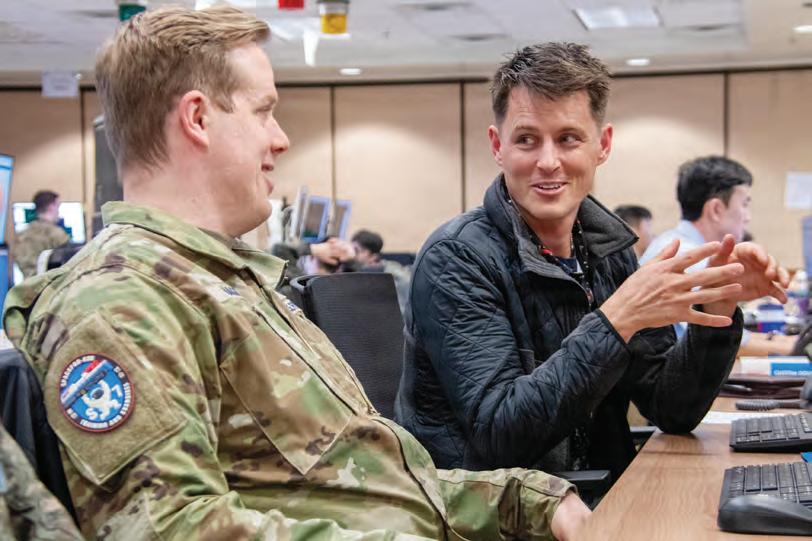
South Korea — While thousands of service members train across multiple warfighting domains during exercise Freedom Shield 26, a small team from U.S. Space Forces – Korea is working behind the scenes to bring the space domain to life.
Freedom Shield 26 is a recurring exercise between the Republic of Korea and the United States, in collaboration with the United Nations Command, ensuring continuous preparedness for military forces on the Korean Peninsula. For SPACEFOR-KOR, the exercise is an opportunity to rehearse theater-relevant operations across all Space Mission Areas, stress-test procedures and sharpen the command’s ability to scale operations rapidly.
A core focus of Freedom Shield 26 is to provide a demanding training environment to enhance combat readiness and response capabilities. Across the warfighting domains –ground, air, naval, space, cyber and information –the space fight is being exercised digitally.
In the months leading up to the exercise, the SPACEFOR-KOR S7 directorate, responsible for force development, training and exercises, worked to develop a robust space environment to meet the command’s objectives.
“Our primary objective is to ensure we’re rehearsing theater-relevant [operational plans],”
said U.S. Space Force Maj. Dillon Hagerty, SPACEFOR-KOR director of force development. He added that additional objectives include validating the space operations planning cycle, testing command and control capabilities, and conducting partnership engagement.
Achieving those objectives was no easy task, with planning beginning long before the exercise started.
Building the scenarios under normal conditions, the S7 directorate operates as a small four-person team responsible for extensive coordination across higher headquarters and supporting commands, as well as detailed planning and scenario development.
Hagerty explained the small team manages a heavy workload that includes administration, logistics, personnel coordination, exercise planning and scenario design.
To develop scenarios and simulated data, the S7 directorate works with the Pacific Air Simulation Center at Osan Air Base, the Korean Battle Simulation Center at Camp Humphreys and other simulation centers in the United States. These partnerships allow the team to create a more realistic and responsive training environment for exercise participants.
“Our role here is a lot of coordination between the different simulation centers to make the space scenario work for these exercises as See Shield, Page 5
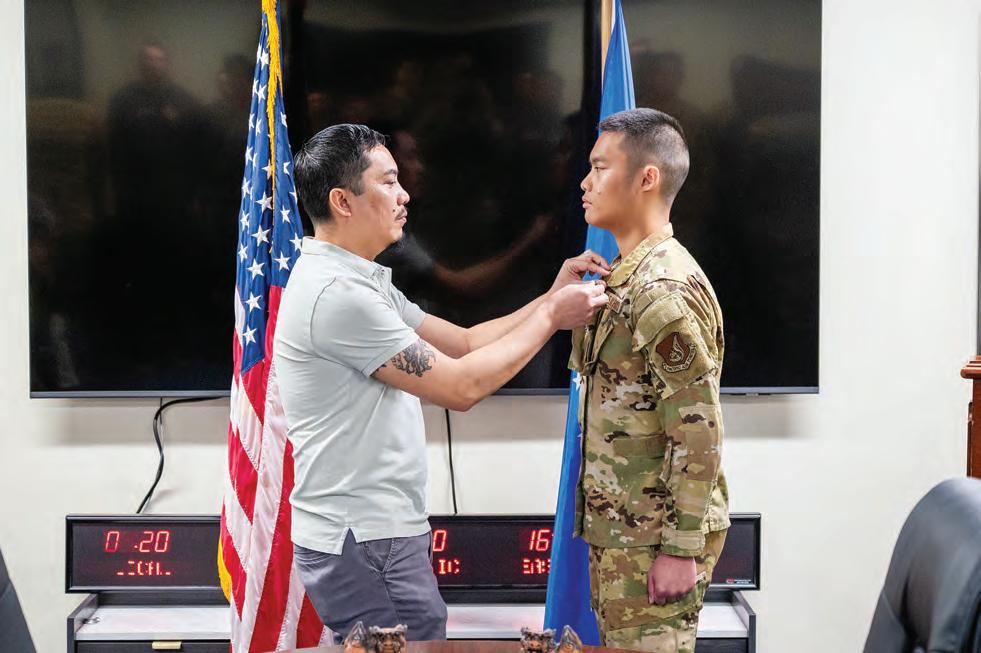
KADENA AIR BASE, Japan — Long before he wore the uniform, U.S. Air Force Senior Airman Angelo Libunao walked the halls of the 18th Aeromedical Evacuation Squadron as a child, watching airmen prepare to launch into the Indo-Pacific skies.
Years later, he returned to those same halls – this time as a flyer.
For Senior Airman Angelo Libunao, serving with the 18th Aeromedical Evacuation Squadron is more than just an assignment, it’s a continuation of a family legacy decades in the making.
He is the third member of his family to serve in the squadron, following in the footsteps of his father and uncle, both former aeromedical evacuation airmen once stationed here.
“I was really young when we were here,” said U.S. Air Force Senior Airman Angelo Libunao, 18th AES AE technician. “I didn’t understand the jobs they were doing until I got older.”
As he matured, the stories began to carry more weight – alert calls in the middle of the night, long missions across the Pacific and the responsibility of caring for patients thousands of feet above the ocean. The mission that once seemed distant became personal.
Although Libunao began his career as a pediatric medical technician at Wright-Patterson Air Force Base, Ohio, he knew he wanted to follow the aeromedical evacuation path.
“It felt surreal,” he said of learning he would
be assigned to Kadena. “I always knew I wanted to be a flyer. I wasn’t expecting the same unit, but I’m very grateful.”
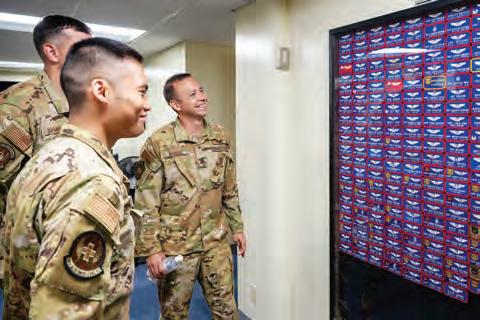
For his father, retired U.S. Air Force Senior Master Sgt. Jose Libunao, the news carried its own significance. Years earlier, he described serving in the 18th AES as the pinnacle of his medical career. Watching his son now wear the same squadron patch brings both pride and reflection.
“It’s surreal. I’m very proud,” Jose Libunao said. “Being back here brings back so many great memories.”
Squadron leadership recognized the multigenerational legacy during a ceremony welcoming Libunao to the unit and presenting him with a decoration earned at his previous assignment.
“He’s the third member of his family to serve in this squadron, so it was important for us to recognize that history,” said Capt. David Madrid, 18th AES training flight commander. “We’re excited to have him and have high expectations for his future in aeromedical evacuation.”
The 18th AES plays a critical role in operations across the Indo-Pacific. As

part of the 18th Wing, the squadron provides rapid global mobility and lifesaving in-flight medical care. Aeromedical evacuation crews stand ready to transport wounded or ill service members, ensuring timely treatment while preserving combat readiness.
For the Libunao family, that mission is more than an operational requirement – it is a shared calling. Years apart, father and son have walked the same
hallways, worn the same patch and answered with the same responsibility to care for others in the air. Now, as he completes mission qualification training, Libunao is focused on building his own reputation within the squadron, one grounded not only in family history but in personal dedication.
“I’ve got big shoes to fill,” he said. “But I’m ready to make my own mark.”
Though the name Libunao may already be familiar within the 18th AES, Angelo’s journey is uniquely his own. With each flight and each patient he supports, he adds another chapter to a story that began long before he understood its significance.
At Kadena Air Base, where readiness and service remain constant, one family’s legacy continues – carried forward by the next generation, ready to answer the call.







AF ReseARch LAboRAtoRy
PubLic A FFAiRs oFFice
WRIGHT-PATTER -
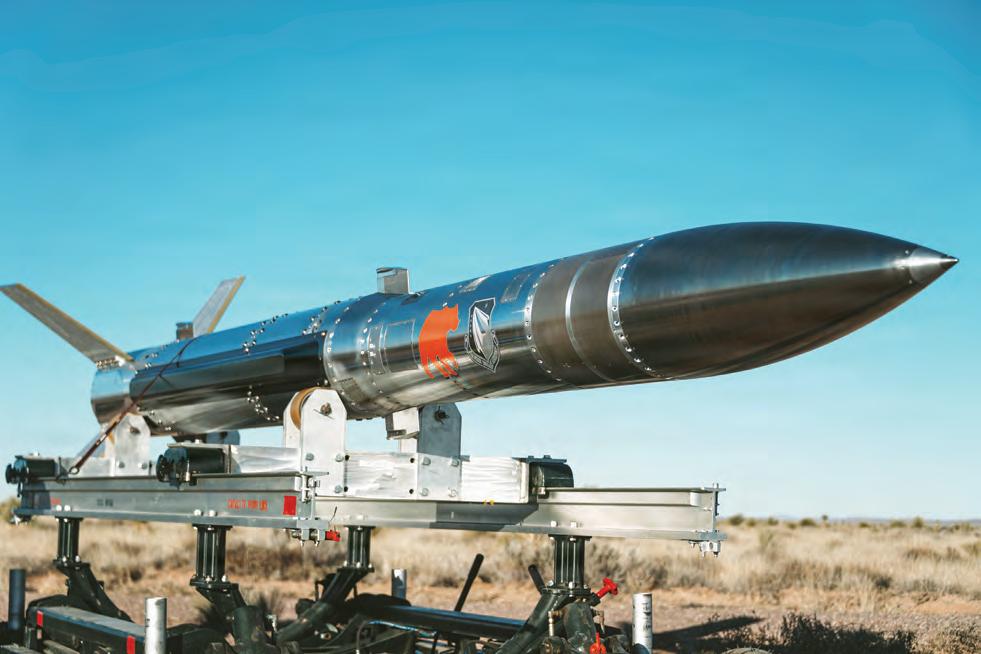
SON AIR FORCE BASE, Ohio — The Air Force Research Laboratory and an aerospace technology and defense systems contractor recently flew the Affordable Rapid Missile Demonstrator, powered by the Draper liquid rocket engine, achieving supersonic speeds and demonstrating key concepts of operations. This flight is an innovative step toward advancing capabilities that strengthen deterrence and provide rapid global strike options.
“This project proves that we can transform and leverage our acquisition models to rapidly deliver critical technology advancements to deter and win in a future conflict,” said Air Force Brig. Gen. Jason Bartolomei, AFRL commander and Air Force technology executive officer. “We are not just
building a single missile; we are forging a new path toward a cost-effective, mass-producible deterrent for the nation.” This sentiment is echoed by the contractor’s leaders, who emphasized
their shared commitment to the ARMD program’s speed and cost-effectiveness. This project
represents a new paradigm for accelerating research and development of critical defense technol-
ogies, rooted in fast-paced, effective public-private partnerships.
“This flight proves that you can get a vehicle with a safe, storable and throttleable liquid engine in the air quickly and affordably,” said Chris Spagnoletti, contractor CEO. “We went from contract to flightready of an all-up round and propulsion system in just eight months.”
This demonstration of the Draper liquid rocket engine leverages several years of the contractor work on their Hadley liquid rocket engine, along with an enduring publicprivate partnership with AFRL to develop these new rocket propulsion technologies.
“ARMD represents a key milestone in our efforts to develop revolutionary, affordable and scalable liquid rocket engine technologies to win the wars of tomorrow,” said Javier Urzay, AFRL rocket propulsion division chief.




Email: o ce@northhillsvv.org
Website: www.northhillsvv.org





Service Times: Sunday morning 10 a.m., Wednesday evening 6:30 p.m.















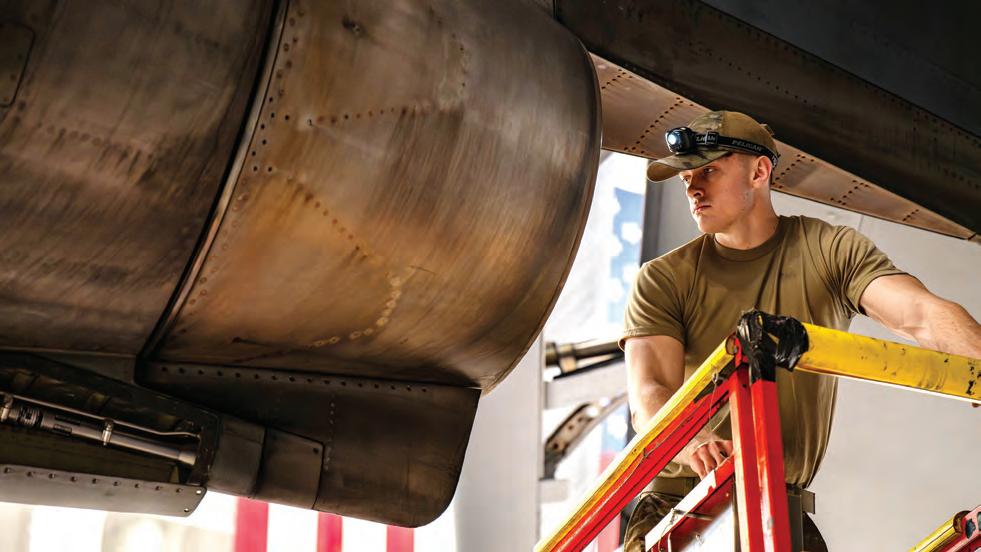
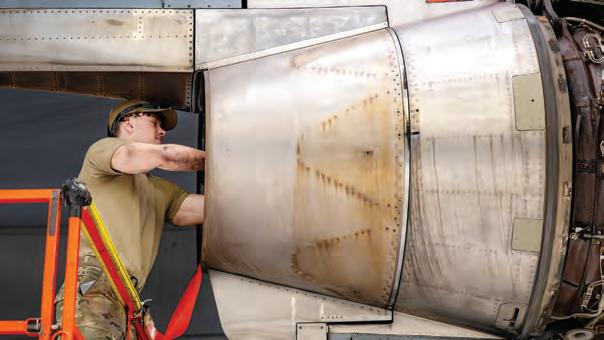
qualified for their tasks prior to the incident.
SCOTT AIR FORCE
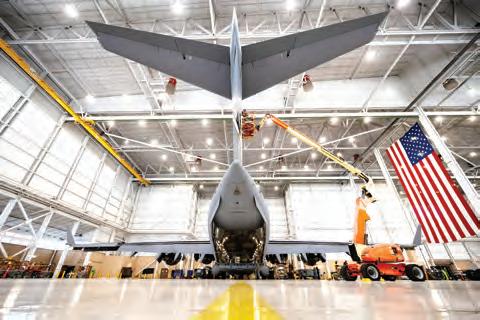
BASE, Ill. — Air Mobility Command has released the report of an accident investigation board involving a U.S. Air Force KC-46A Pegasus aircraft.
The investigation resulted from asphalt damage at Fairbanks International Airport damaged during aircraft maintenance procedures on July 16, 2025.
The mishap did not result in any aircraft damage or personnel injuries. There was damage to the airport’s asphalt during high-power engine-runs that were being conducted by an Air Force maintenance recovery team (MRT).
The investigation found that all MRT members were properly
From Page 3
realistically as possible,”
said U.S. Space Force 1st Lt. Roman Ocampo, SPACEFOR-KOR chief of exercise development.
During exercise execution, the directorate transforms into a 24-hour operation known as the Exercise Control Group, or ECG. This team scales to more than a dozen members, including subject matter experts from across the Space Mission Areas and liaisons from the Republic of Korea Air Force’s Space Operations Group.
Together, the ECG executes and manages the scenarios that drive the space portion of the exercise forward.
“We are the controllers for the entire space domain for the exercise,” Ocampo said.
That responsibility spans a wide range of Space Mission Areas, including Missile Warning, Space Domain Awareness and scenarios involving degraded space-enabled effects that support combined operations. By building those mission areas into the exercise, the group creates a more realistic contested environment for participants.
Much of the group’s operations take place at the Pacific Air Simulation Center, the only center in the Korean theater of operations that provides integrated air and space simulation, wargaming capabilities and continuous simulated data. Inside the center, the
The mishap resulted in an estimated $147,044 of damage at the airport. The AIB president’s statement of opinion stated the mishap was caused by persistent high temperatures in combination with repeated high-speed exhaust from the mishap aircraft’s right engine.
The statement of opinion also listed that, by a preponderance of the evidence, a substantially contributing factor of the mishap was asphalt and sealant condition.
The full versions of the investigation report can be found at https:// www.afjag.af.mil/ AIB-Reports/. For more information, please contact Air Mobility Command Public Affairs at 618-229-0063.
space-focused ECG works alongside its air component counterparts to synchronize efforts and integrate space operations.
But the group’s role does not end once a scenario is launched.
“One of the big jobs that the [exercise control group] has to perform is monitoring player actions in order to keep the scenario running,” Ocampo said, explaining how U.S. members track U.S. forces actions while Republic of Korea counterparts monitor how ROK forces are responding to the space scenarios introduced in the exercise.
As the exercise unfolds, the ECG assesses how U.S. and Republic of Korea forces respond to simulated adversary threats, then adjusts the scenario to allow participants to see the impact of their actions. This process sharpens shared understanding, improves coordination and reinforces how space operations support combined defense in the Korean theater of operations.
As SPACEFOR-KOR continues to grow its role in Freedom Shield, the command is making the space domain a more operationally relevant part of the training environment. For the S7 team, that means continuously expanding the complexity, realism and scope of the space fight so combined forces are better prepared for real-world operations on the Korean Peninsula. In that effort, the space domain is not just represented but fully integrated into the fight.
containerized nuclear power
HILL
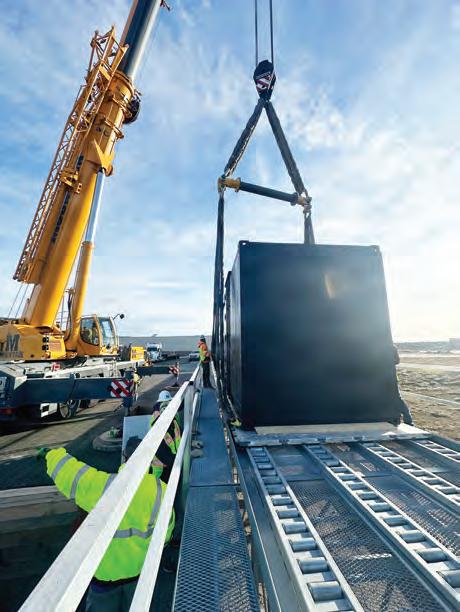
BASE, Utah — When a C-17 Globemaster III touched down at Hill Air Force Base, Feb. 15, it carried more than cargo, it delivered a glimpse of how the military may power future operations.
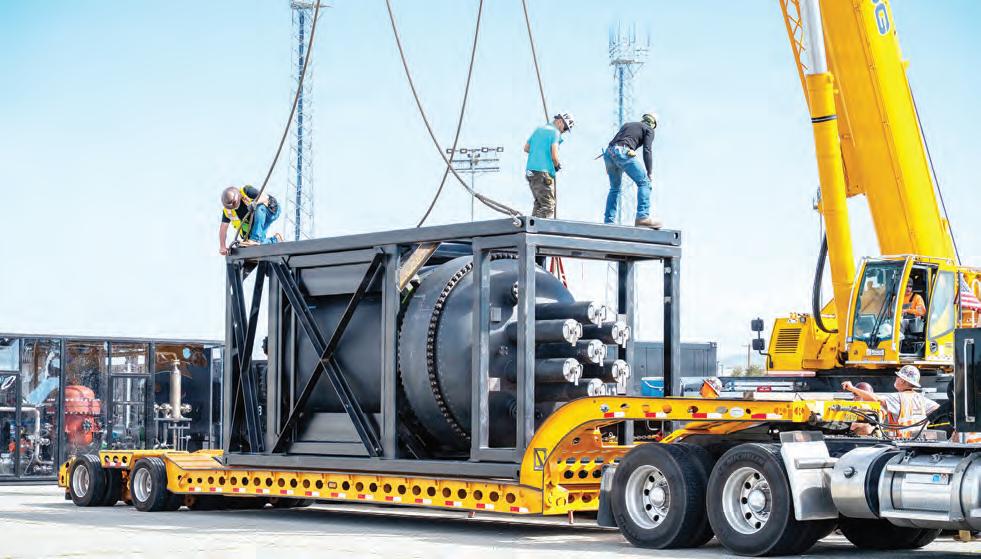
Inside the aircraft sat a transportable micronuclear reactor, part of a groundbreaking Department of War effort to provide reliable energy to military forces operating anywhere in the world.
But before the advanced technology could continue its journey, a team of airmen on the ground, including reservists from the 419th Fighter Wing, had to safely receive and move one of the most unique pieces of cargo ever delivered to Hill AFB.
The historic mission, known as Operation Windlord, marked the first-ever military airlift of a microreactor and demonstrated the Department of War’s ability to rapidly deploy next-generation power systems by air.
At the center of the effort is Project Pele, a Department of War initiative to develop small, transportable nuclear reactors capable of powering remote or austere military installations. The reactors are designed to operate independently of traditional fuel supply chains, reducing reliance on vulnerable and logistically demanding fuel convoys.
Roughly the size of a standard shipping container, the prototype microreactor features modular components and advanced safety systems that allow it to be trans-
Once the C-17 landed, responsibility for
logistics team composed of the 67th Aerial Port Squadron, 151st Air Transportation Flight and



























1St lt. JeSSicA mclAughlin
621ST CONTINGENCY RESPONSE WING
HURST, N.J. — U.S. airmen assigned to the 818th Mobility Support Advisory Squadron trained Djiboutian air force airmen at Camp Lemonnier, Djibouti throughout February.
A team of 11 airmen, representing nine different Air Force Specialty Codes, led the training, which focused on C-208 operations, maintenance, and intelligence gathering. The training also included an airworthiness assessment of the Djiboutian aircraft.
“The Mobile Training Team primarily focused on intelligence, surveillance, and reconnaissance and propeller maintenance, ensuring the air worthiness of the Djiboutian aircraft,” said Tech. Sgt. Mitchell Poppema, 818th MSAS Team Sergeant in upgrade. The air worthiness assessment was conducted so future iterations of this mission series can fly successfully.
In addition to maintenance and ISR, the Air Advisors trained pilots on ground procedures, planning, and preflight inspections.
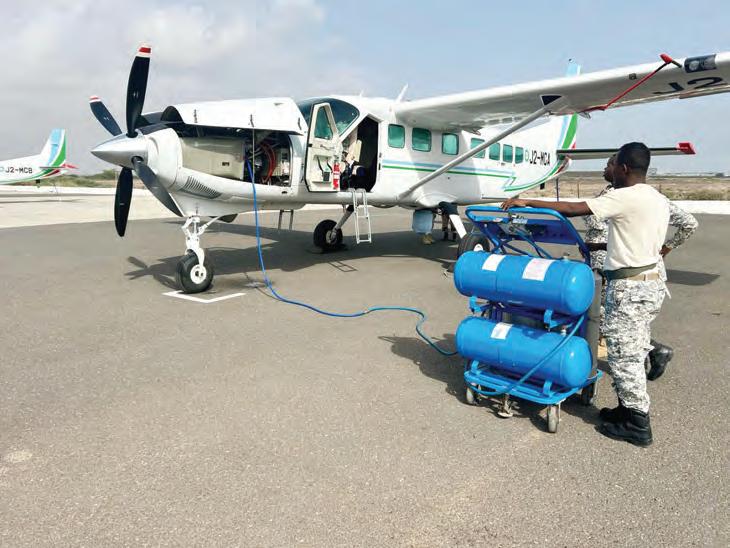
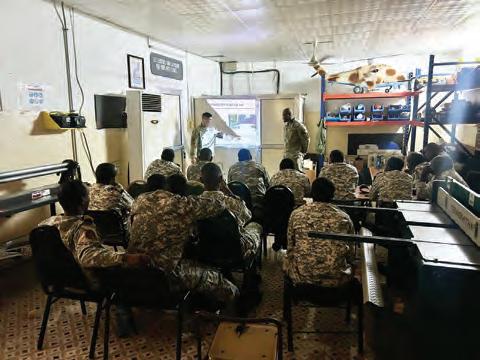
Air Force Air Advisors assigned to the 818th Mobility Support Advisory Squadron and 621st Contingency Response Group train a class of Djibouti Air Force airmen during a mobile training team visit to Camp Lemonier, Djibouti, in February.
“The Djiboutians are a willing and eager partner for U.S. cooperation and engagement with regards to ISR and C-208 operations,” said Tech. Sgt. Mika Pajas, 818th MSAS Team Sergeant Lead. “They effectively demonstrated their knowledge and skills.”
The training allows for further support for future operations throughout the Horn of Africa, enabling bilateral military and humanitarian cooperation.
“The MTT enhances Djibouti’s operational capacity by aligning partner nation proficiency with Global Partnership
Strategy objectives, specifically fostering regional stability through partnership,” said Tech. Sgt. Messan Atayi, 818th MSAS Team Sergeant. “As sole U.S permanent base in Africa, our message is clear: The U.S is present as friend and Partner of choice so we can altogether fight violent extremist





organizations and promote regional prosperity.”
This engagement underscores the strategic partnership between the United States and Djibouti, strengthening the capabilities of a key ally in a critical region. By building partner capacity, the U.S. Air Force helps ensure regional stability and enhances interoperability for future combined efforts.
“The
more information, shoppers can contact the Travis Exchange or visit the Travis Exchange’s social media pages. Military families can visit the Exchange’s community hub for information on Month of the Military Child celebrations throughout April.




























































From Page 5
the reactor, completing the final phase of the historic airlift.
These airmen are specialists in military airlift operations, trained to process and move everything from standard cargo pallets to highly specialized and sensitive equipment.
For the reservists of the 67th APS, the mission highlighted the critical role the Air Force Reserve plays in delivering operational capability across the force.
“This operation is a prime example of how the Reserve is a day-today operational force,” said Tech. Sgt. William McCalmant, cargo processing supervisor with the 67th APS. “We’re not just training for a future conflict. We are delivering readiness and
enabling the military’s lethality now, ensuring groundbreaking technology like this can be fielded safely and effectively.”
While the microreactor represents a major step forward in how the military may power future operations, the success of the mission ultimately depended on the airmen responsible for safely moving it.
From aircraft arrival to cargo transfer, their expertise ensured the reactor could continue its journey without delay.
For the Reserve Airmen involved, the mission was another reminder that strategic capability often begins with logistics done right. By combining advanced technology with the experience and professionalism of the Total Force, the Air Force continues to demonstrate its ability to deliver innovative capabilities wherever the mission demands.
521st A ir Mobility oper Ations Wing
VICENZA, Italy —
A joint inspection is an important part of preparing cargo for transport on military aircraft.
Nearly every day, there are aerial porters in the 521st Air Mobility Operations Wing, spread across multiple areas of responsibility, who inspect pallets of equipment and supplies to confirm proper packaging, weight, balance and preparation, ensuring the cargo can be safely transported via aircraft.
It’s an efficient process, but what if these airmen couldn’t inspect the cargo in person?
That’s the question that the 725th Air Mobility Squadron has been trying to answer since 2021. The HoloLens, an augmented reality headset enabling aerial port experts to aid and guide technicians by looking through their eyes, could be the solution.
The squadron airmen have demonstrated how the augmented reality capability can be used to increase rapid global mobility in a variety of maintenance, air transportation, and command and control scenarios, increasing the speed of maneuver to sustain joint force lethality across the competition continuum.
Stationed at Aviano Air Base, Italy, the 724th Air Mobility Squadron regularly partners with users in the region to prepare their cargo for forward deployment. They received an

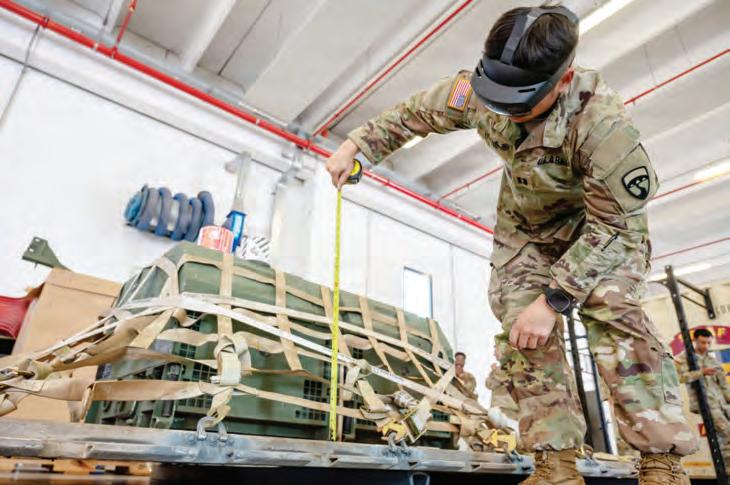
opportunity to work with the Army’s 173rd Airborne Brigade in Vicenza, Italy, to perform a joint inspection remotely using the HoloLens. To best test the utility of the device, the 724th AMS worked alongside the 725th AMS, the operations wings’ foremost authority on the technology.
“We spent a year working with the manufacturer and experimenting with different add-ons to figure out the right software and process we needed to get to where we are today,” said Air Force Chief Master Sgt. Anthony Sewejkis, 725th AMS superintendent. “Now it’s plug and play. We can connect [from] anywhere just using the HoloLens, a Wi-Fi hotspot and a laptop.”
From a conference room back in Aviano,
Airman 1st Class Delaney Boehm, a 724th AMS aircraft services specialist, guided the personnel in Vicenza through the joint inspection, circling areas on her screen that she wanted them to focus on.
“It was a great experience that showcased our squadrons’ innovative approach to conducting routine inspections and allowed a technician in the field to work hands-free while receiving real-time guidance from a remote expert,” said Staff Sgt. Devin Robert, 725th AMS noncommissioned officer in charge of network operations. “The ability to highlight individual objects in the technician’s field of view goes beyond the capabilities of a traditional video call.”
Although the remote inspection was just a proof of concept, it demonstrated
flexibility and ease of use to joint partners and to the headquarters Air Mobility Command staff.
“There is a push in the air transportation career field to explore new ways of accomplishing our mission, irrespective of geographical constraints,” said Lt. Col. Katherine Wilson, 724th AMS commander. “We tried the HoloLens alongside a traditional video call, and the immersive handsfree component of the HoloLens experience streamlined communication and overall speed of the inspection.”
Leveraging this new technology, the 725th AMS is continuing to refine processes and enabling mission execution despite the geographical separation within the operations wing.