TRAVIS TAILWIND

EGLIN
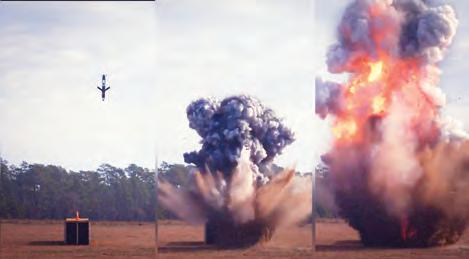
conducting a live-warhead test of a standoff cruise missile, known as Extended Range Attack Munition, on the Eglin Test and Training Range, Jan. 21, less than 16 months from the program’s initial contract award.
The event, which met all primary objectives including a full warhead detonation, gathered critical data to mature a new, cost-effective, longrange strike capability. This accelerated timeline is a proof point for the War Department’s focus on delivering capability to the warfighter at the speed of relevance.
ERAM is a next-generation, air-launched cruise missile designed to provide affordable mass to the fight. It delivers a precision-guided, stand-off capability against high-value fixed targets, meeting a critical operational need by providing a longrange, cost-effective strike capability that can be rapidly producible in large numbers to bolster U.S. deterrence.
“Moving from a contract to a live-fire demonstration in under two years proves we can deliver lethal, cost-effective capability at the speed of relevance,” said Brig. Gen. Robert Lyons III, portfolio acquisition executive for Weapons. “This is how we rebuild our military – by empowering
See Standoff, Page 5
A
TRAVIS
BASE — Military kids at the Travis Exchange can cash in on their grades with the Army & Air Force Exchange Service’s You Made the Grade Program in its 26th year of highlighting academic excellence.
Young scholars in grades first through 12 th, including students in specialized programs, can present their report cards to the BX customer service associate to receive exclusive discounts, prizes and savings.
Students in specialized programs can print a downloadable form and have it completed by their school’s official each grading period in place of a traditional report card.
“Military students have an unconventional educational experience due to the needs of their parent’s service,” said Exchange General Manager Cathie Byrns.
“The You Made the Grade program has successfully highlighted and rewarded our Nation’s youngest heroes’ sacrifices and accomplishments for a quarter century.”
Students with straight A’s will receive a
$20 Exchange gift card while students with a B average will receive a $10 Exchange gift card.
In addition to an Exchange gift card, students will also receive an Exchange coupon sheet with offers including:
n A free small fountain, frozen drink or bubbler beverage.
n A free kid’s meal at a participating Exchange restaurant.
n A free combo meal at a participating Exchange restaurant.
n A free kid’s hair service or $15 off hair service at The Barber Shop or Hair Studios.
n 10% off any pair of headphones (excluding Apple and Beats).
n 10% off apparel and footwear.
n A $5 coupon at Exchange mall concessions or kiosks.
Participating students can also enter the biannual You Made the Grade worldwide sweepstakes for a chance to win a $2,000, $1,500 or $500 Exchange gift card. The spring 2026 drawing will take place in June.
To enter the drawing, students or parents can complete the form on the back of the gift card and mail it to: You Made the Grade, PO Box 227398, Dallas, TX 75222-7398.
Joint bASe mcguire-Dix-

Serving Travis Air Force Base and the surrounding community 1250 Texas St., Fairfield, Calif. 94533 707-425-4646 | Fax 707-425-5924
Publishers: Foy S. McNaughton and T. Burt McNaughton Advertising Manager: T. Burt McNaughton Editor: Todd R. Hansen Layout : Aaron Rosenblatt
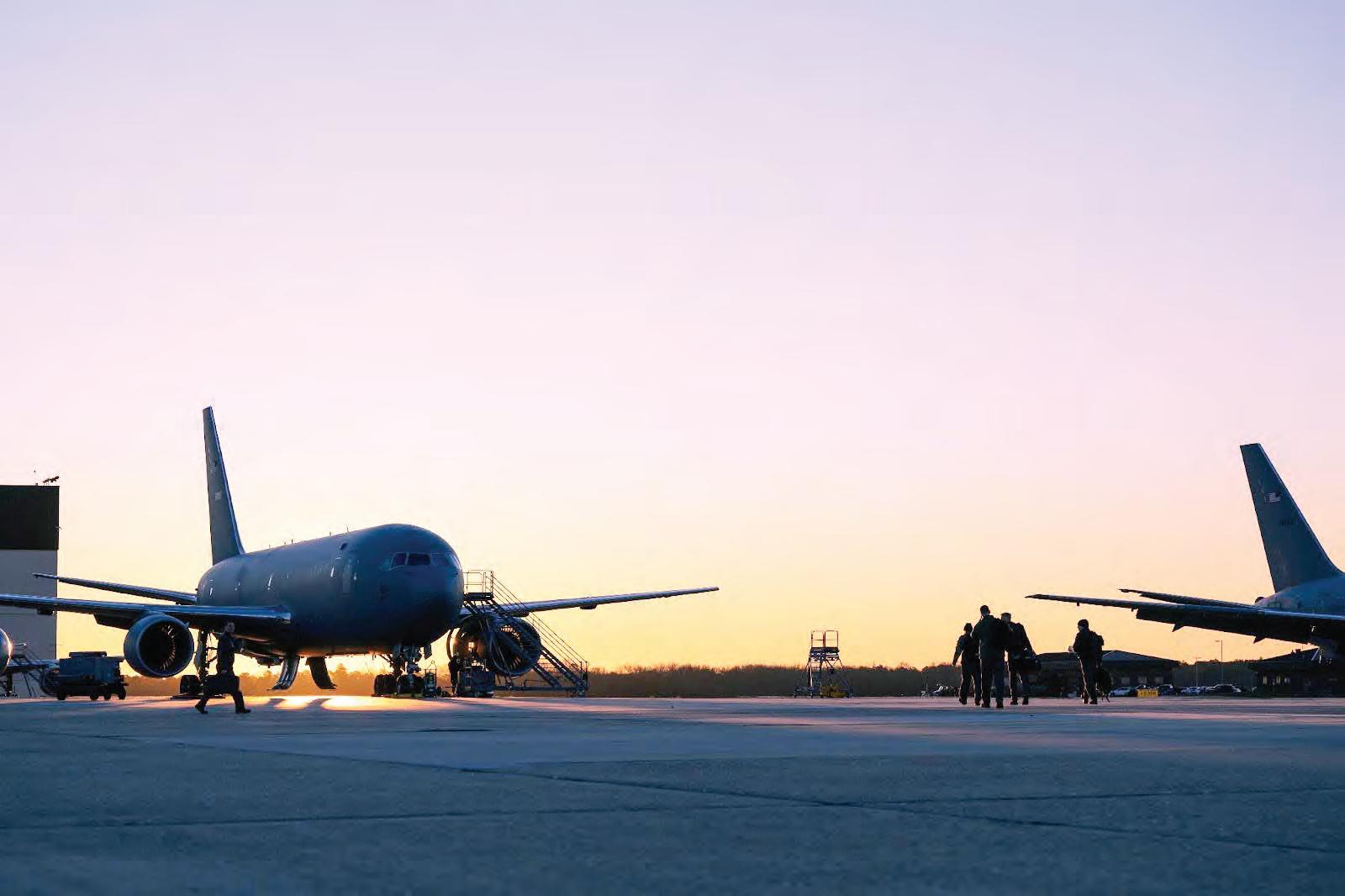
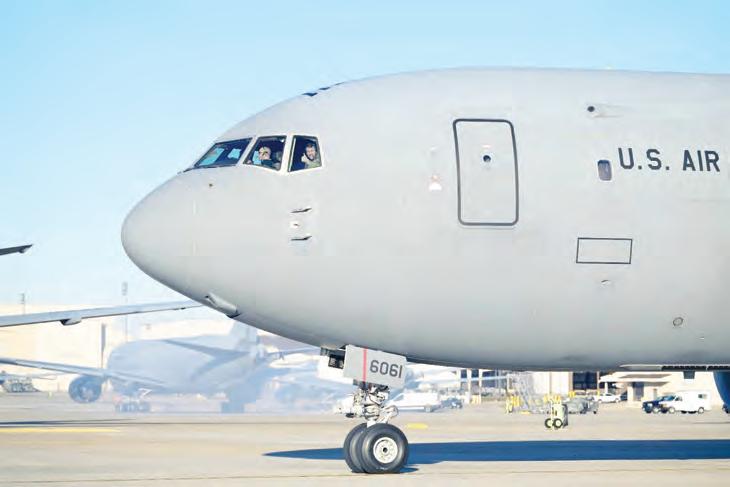
HURST, N.J. — From Dec. 8-10, 2025, the 305th Air Mobility Wing chaired the KC-46 Weapons Systems Council 25-2, hosting senior leaders, subject matter experts and some of the most experienced aircrew, operations support personnel and maintainers who fly and operate the KC-46A Pegasus aircraft from across the U.S. Air Force. In total, 147 KC-46 Weapons Systems Council attendees joined the 305th AMW and 108th Wing at Joint Base McGuire-Dix-Lakehurst, flying in from the 22nd Air Refueling Wing, 931st ARW, 60th AMW, 349th AMW, 916th ARW, 157th ARW, 97th AMW, 509th Weapons Squadron, 21st Air Force headquarters, Air Mobility Command headquarters, Air Education and Training Command headquarters and Air Force Reserve Command headquarters.
The KC-46 Weapons Systems Council meets semi-annually to align the KC-46 enterprise’s strategic focus, resolve operational challenges facing the KC-46 community and collaborate to advance innovations and warfighting tactics, techniques and procedures. It is an opportunity to bring KC-46 operators and maintainers at the unit level together with AMC staff, set the strategic priorities for the airframe and then set actionable objectives





to advance those priorities over the next three to five years.
“The KC-46 Weapons Systems Council provides a comprehensive mechanism for the enterprise to advance the KC-46 as a mobility platform,” said U.S. Air Force Col. Kathleen Hasson, 305th AMW commander and chair for this KC-46 Weapons Systems Council. “By integrating our training and system performance efforts, we are not only enhancing current readiness but also defining the future capabilities of our force.”
This specific KC-46 Weapons Systems Council followed the completion of the largest and longest KC-46 deployment to date, seeing the platform and its personnel deploy together in historic numbers in response
to significant contingency operations in U.S. Central Command and across the globe in 2025. This KC-46 Weapons Systems Council capitalized on the success of that deployment, focusing on a theme of “optimizing enterprise warfighting.”
To that end, KC-46 Weapon Systems Council 25-2 applied the lessons learned from that deployment to improve KC-46 agile combat employment training in the Pacific region and prioritized initiatives to enhance the KC-46’s ability to deliver strategic deterrence for U.S. Strategic Command. To be at the forefront of the National Defense Strategy, this KC-46 Weapons Systems Council also prioritized the future of the KC-46 as a key enabler in the long-range kill chain, collaborating
on innovations that enable the KC-46 to connect the joint force at the forward edge of the next aerial conflict. The KC-46’s ability to connect and relay information between our joint and coalition partners in a denied and degraded environment is just as critical to future warfighting as providing airborne fuel to joint and coalition aircraft. Never missing an opportunity to apply these warfighting initiatives in real time, more than 70 participants of the council’s 147 attendees participated in Exercise Krampus, a complex joint exercise the 305th AMW planned and orchestrated concurrently with this KC-46 Weapons Systems Council. The 305th AMW partnered with the 1st Fighter Wing from JB Langley-Eustis,










Sgt. Spencer tObler
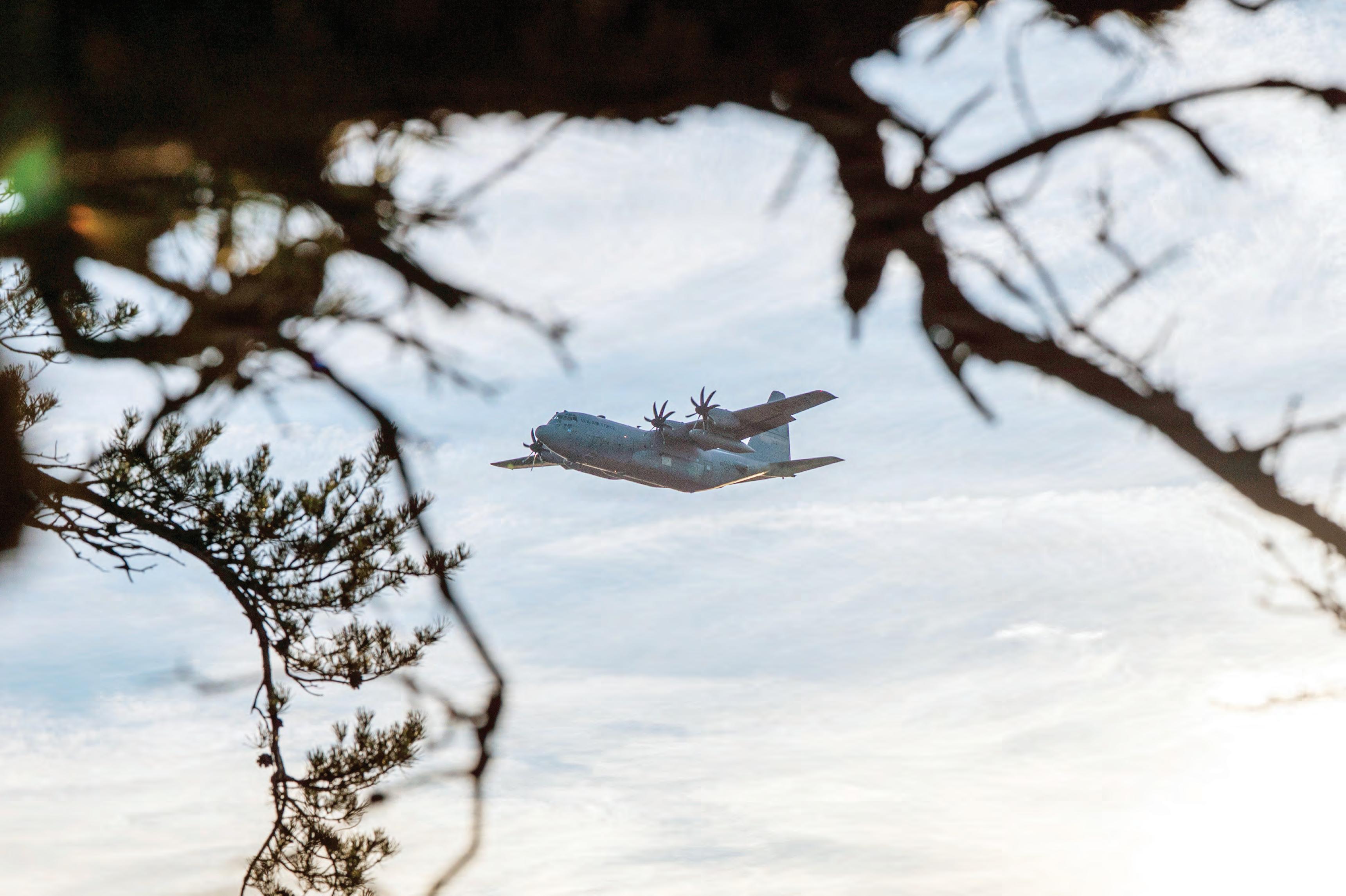
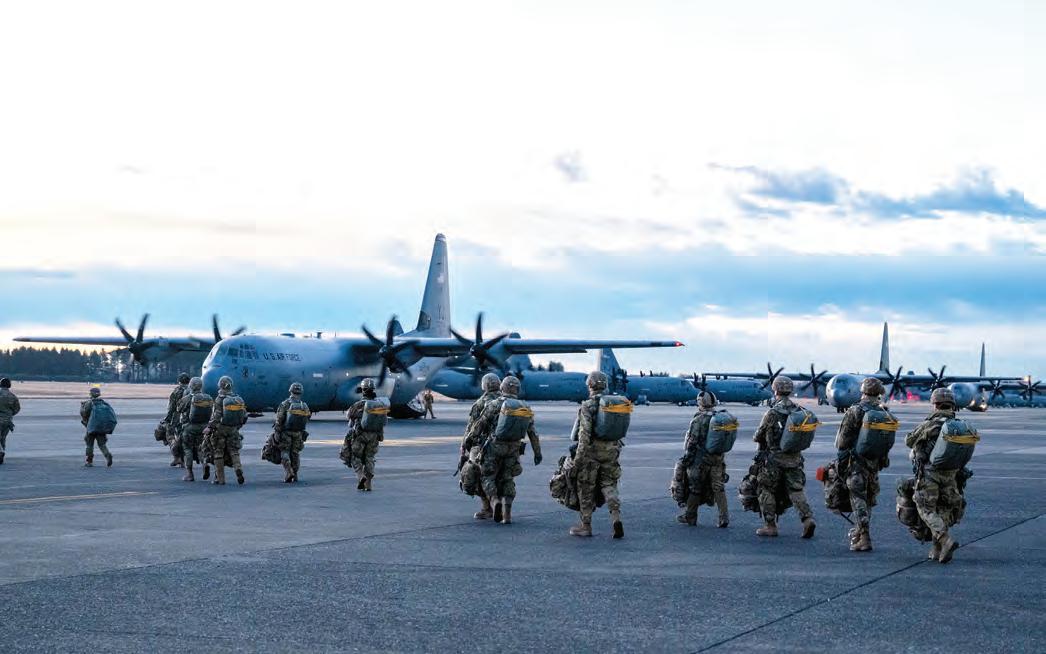
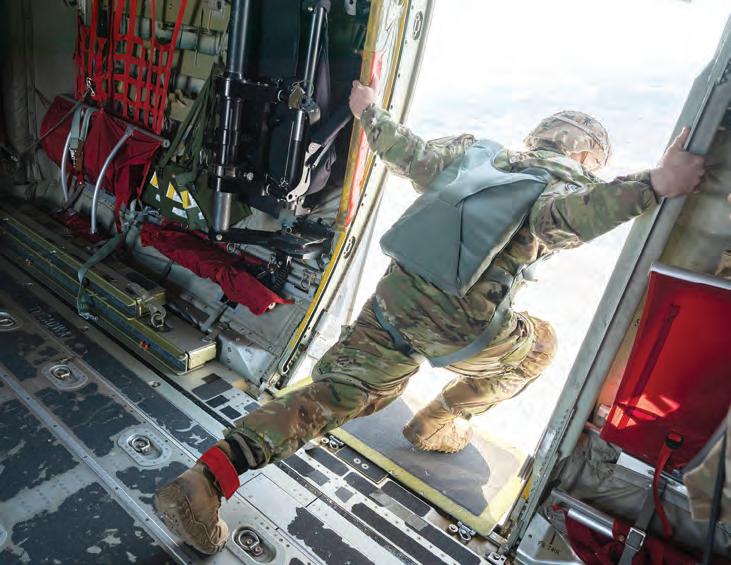
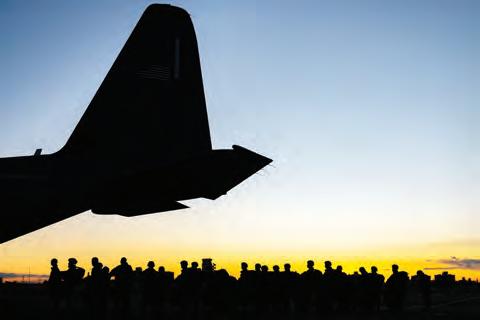
YOKOTA AIR BASE, Japan — Members of the 374th Airlift Wing integrated with U.S. Army and Japan Ground SelfDefense Force personnel to execute a joint forcible entry operation during exercise North Wind 26 in Hokkaido, Jan. 22. Exercise North Wind 26 is a joint and bilateral arctic field training exercise designed to strengthen winter operational capabilities and enhance interoperability between U.S. and Japanese forces. Four C-130J Super Hercules assigned to the 36th Airlift Squadron were tasked to airdrop 106 U.S. Army paratroopers assigned to the 11th Airborne Division, 2nd Brigade, into the Hokkaido Large-Scale Exercise Area. The operation was further integrated with jumpmasters from the JGSDF’s 1st Airborne Brigade.
“This mission was a mini joint forcible entry operation involving an airfield seizure and airborne insertion into an objective area,” said U.S. Air Force Capt. Joshua Osgard, 36 AS C-130J Super Hercules pilot and mission commander for North Wind 26. “The operation began at a designated drop zone in Hokkaido and transitioned into a follow-on airland mission at Chitose Air Base to prevent simulated enemy forces from advancing south.”
The operation required extensive coordination between air and ground forces across multiple services and nations. Planning for the mission spanned more than two weeks to synchronize aircraft, personnel, equipment and timelines.
“Interoperability means working together toward a common goal to succeed as a team,” Osgard said. “We coordinated across the U.S. Army’s 11th Airborne Division, the 36th Airlift Squadron flying C-130Js and Japan Self-Defense Force observers operating out of Chitose Air Base and the drop zone. The execution was seamless from start to finish.” Paratroopers staged at the 374th Logistics Readiness Squadron combat mobility flight building to rig equipment and conduct mission briefs as C-130Js taxied into position. Following the airdrop, the paratroopers assembled on the drop zone and transitioned into extended cold-weather training.
“Once on the ground, they conducted personnel and equipment checks and then moved into five days of cold-weather training,” said U.S. Army
this happen,” McGrete said. “There were challenges, but through communication and collaboration as a multinational team, we accomplished the mission.”
Exercise North Wind 26 reinforced the ability of U.S. and Japanese forces to rapidly integrate, operate in austere cold-weather conditions and execute complex joint missions in support of regional security and alliance readiness.
59th Medical Wing chief ScientiSt’S Office, Science & technOlOgy
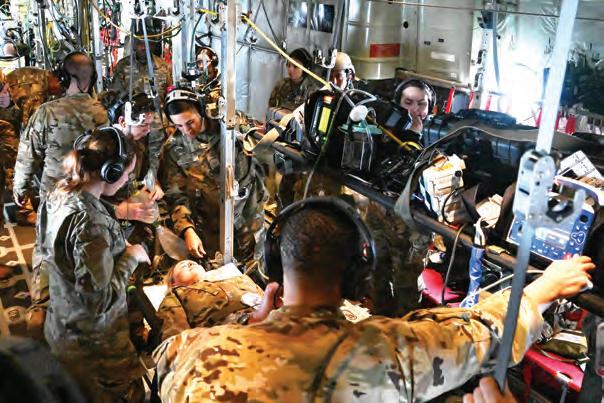
JOINT BASE SAN ANTONIO-LACKLAND, Texas — A recent study published in Military Medicine Journal highlights the critical role of nontechnical skills in improving the performance of En Route Critical Care teams.
As the nature of warfare evolves, the demand for medical care in combat zones is expected to intensify, potentially overwhelming current ERCC capabilities. This has spurred a need for innovative methods to assess and enhance team performance in challenging operational environments.
The primary aim of the study was to evaluate the association between nontechnical team performance and the time it takes to perform critical actions during simulated ERCC missions. Researchers conducted simulations with 14 ERCC teams, each comprising a physician, a nurse, and a respiratory therapist or a second nurse, responsible for transporting two casualties in a static aircraft environment.
Researchers from the 59th Medical Wing’s En Route Care Research Center, in collaboration with several other institutions, conducted simulations to explore the link between nontechnical skills and the efficiency of ERCC teams.
The findings revealed a significant correlation between strong nontechnical skills and faster response times to critical events. Teams exhibiting higher levels of situational awareness and decision-making capabilities demonstrated superior technical performance. Specifically, a higher global nontechnical score was associated with a shorter time to critical action.
This comprehensive study was the result of a collaborative effort, bringing together a diverse group of experts from military, academic, and international institutions. The research team included specialists from the Science and Technology Division of the 59th Medical Wing’s En Route Care Research Center, the Department of Emergency Medicine at Brooke Army Medical Center and the Department of Military and Emergency Medicine at the Uniformed Services University.
Further expertise was drawn from Harvard Medical School’s Department of Emergency Medicine and the STRATUS Center for Medical Simulation at Mass General Brigham. The project also benefited from international collaboration with the Surgical Sabermetrics Laboratory at the University of Edinburgh’s Usher Institute and the Department of Clinical Surgery at the Royal Infirmary of Edinburgh. The team was rounded out by contributions from the Nursing Research Division of the 59th Medical Wing Science and Technology, as well as the Center for COMBAT Research and the Department of Emergency Medicine at the University of Colorado Anschutz Medical Campus and its School of Medicine.
This research provides compelling evidence that nontechnical skills are a crucial component of effective ERCC operations. The study’s conclusions support the need for further development of assessment tools and training programs that focus on optimizing casualty care in field environments. By integrating nontechnical skills training into their protocols, ERCC teams can be better prepared to meet the demands of future large-scale combat operations.
Capt. Spencer McGrete, 36 AS ground liaison officer. “That training was conducted in conjunction with the Japanese Ground Self-Defense Force and culminated in a field training exercise simulating combat conditions where those skills were tested.”
The C-130Js conducted a follow-on airland mission to Chitose Air Base after ground forces were in-place, simulat-
ing an airfield seizure to deny enemy movement and enable continued joint operations. This offered an opportunity to execute fullscale operations beyond simulated training for all participants.
“The level of professionalism was outstanding, from the aircrews and paratroopers to the Japanese Ground Self-Defense Force and everyone at Yokota who helped make



“We wouldn’t be here without the Japan SelfDefense Force,” Osgard said. “This partnership allows us to conduct complex operations in challenging environments in a strategically significant region. That relationship is critical given the pacing threats in the Pacific.





service.
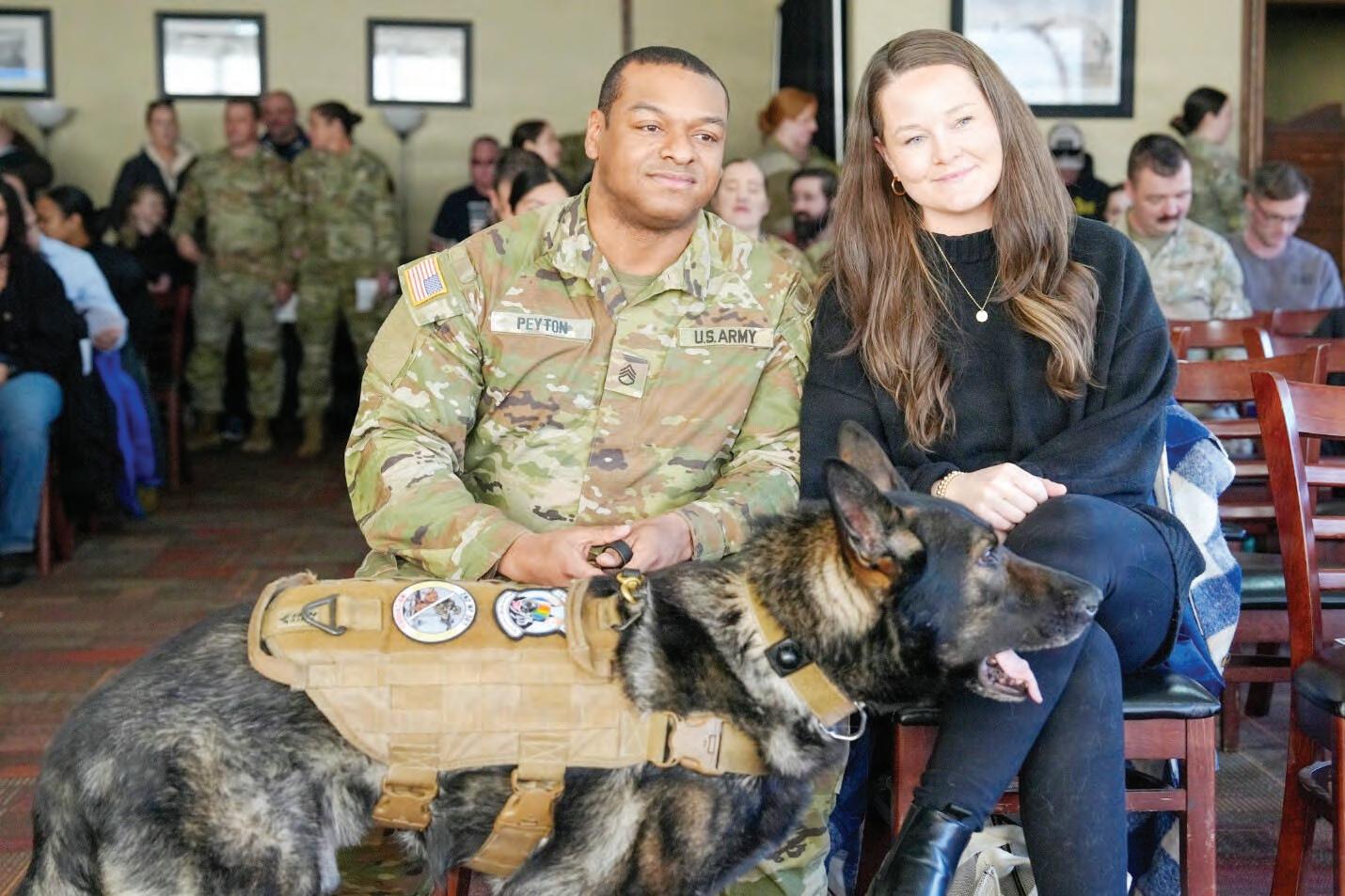
Affectionately called “Doggles,” MWD Nick served eight years in the Army, seven of those at Fort Meade, Maryland. Nick specialized in explosives detection, helping technicians confront and defeat explosives around the world.
Some of the biggest assignments that Nick and handler Army Staff Sgt. Justin Peyton, assigned to the 2nd Military Working Dog Detachment, have worked include 58 Secret Service missions, a North Atlantic Treaty Organization summit, a Democratic National Convention, the Army’s 250th anniversary celebration, state funerals and the United Nations General Assembly.
“My favorite assignment was the United Nations meeting in New York City,” Peyton said. “We got to walk around the city, see sights and meet lots of people.”
The famous photo came from Nick’s nine-month deployment to Al Asad Air Base, with his previous handler, Army Spc. Joseph J. Lane. During the deployment, Lane and Nick supported the 5th Infantry Regiment, 1st Brigade Combat Team, 25th Infantry Division.
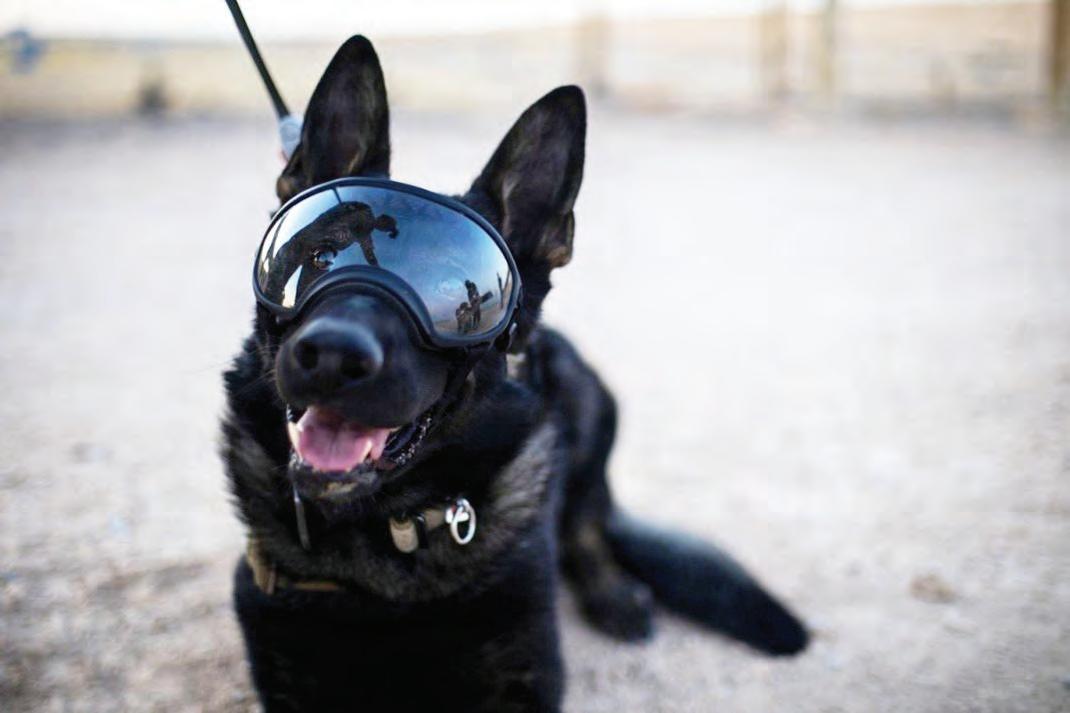

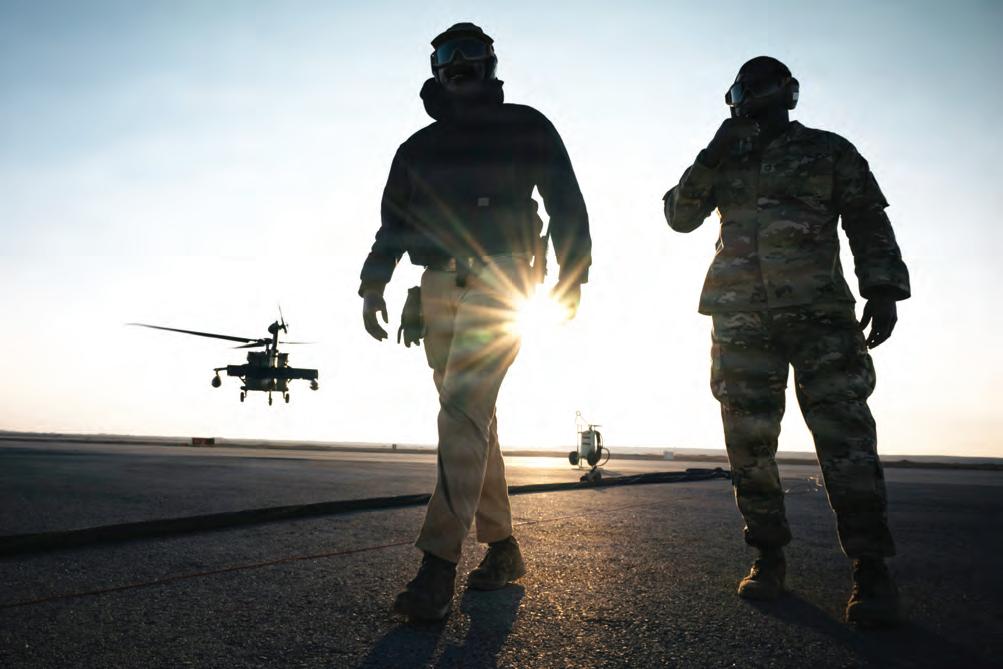
“The goggles are worn to protect MWDs from debris and harsh weather,” Lane said in a 2023 interview. “In that photo, Nick was wearing them at the range for familiarization. We were at the range for
night fire and we flew in [UH-60] Black Hawks with night vision goggles.”
Nick’s photo was selected from among hundreds to be used by the War Department’s global directory.
“When they saw Nick’s photo, the creators knew that was the one they wanted,” Peyton said.
Since becoming the face of the global directory, Nick garnered a cult following among service members and department civilians. A morale patch made by a small artist has been sold thousands of times.
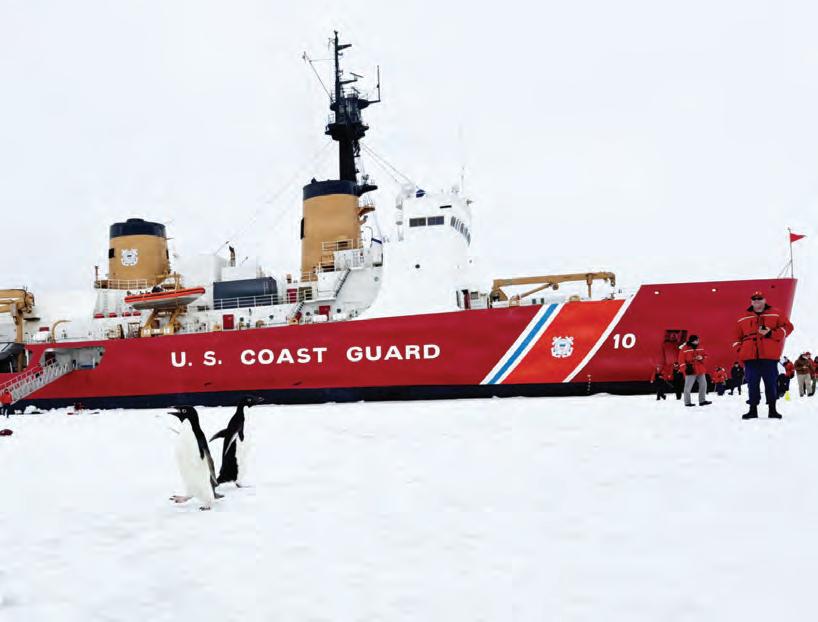
OCEAN — The U.S. Coast Guard cutter Polar Star began icebreaking operations in the Southern Ocean in support of Operation Deep Freeze 26 and marked its 50th year of commissioned service, Jan. 17, by freeing and escorting a cruise ship trapped in a pack of ice.
The Australian-owned cruise ship contacted the Polar Star at approximately 11 p.m., local time, Jan. 16, after becoming beset in a pack of ice roughly eight nautical miles from McMurdo Sound, Antarctica. The Polar Star’s crew conducted two close passes to break the vessel free, then escorted it approximately four nautical miles to open water. The Polar Star departed Seattle in November for its 29th deployment to Antarctica in support of Operation Deep Freeze.
The operation provides logistical support for the U.S. Antarctic Program, which is managed by the National Science Foun-
dation. The mission includes strategic and tactical airlift, airdrop, aeromedical evacuation, search and rescue, sealift, seaport access, bulk fuel supply, cargo handling and other transportation requirements. These efforts enable critical scientific research in one of the most remote regions on earth. The ship’s role in Operation Deep Freeze includes breaking a navigable channel through miles of dense Antarctic ice to allow fuel and cargo deliveries essential for sustaining research stations and operations. Commissioned Jan. 17, 1976, the Polar Star is the nation’s only active heavy icebreaker and has served as a cornerstone of the U.S. presence in the polar regions. For five decades, the cutter has executed missions including Antarctic resupply, search and rescue, environmental protection and national defense.
As the cutter transits the Southern Ocean en route to Antarctica, its crew reflected on a
See Polar, Page 5

“It has been nice to see lots of people take to him and fall in love with him,” Peyton said.




half-century of service defined by resilience, adaptability and dedication.
“I am constantly amazed at this crew’s tremendous energy and enthusiasm,” said Coast Guard Capt. Jeff Rasnake, CGC Polar Star commanding officer.
“Despite the many challenges associated with getting and keeping this ship on mission, they remain eternally positive and committed to meeting the high standards we’ve set for ourselves.”
Throughout its service life, the Polar Star has completed dozens of Operation Deep Freeze missions and numerous Arctic deployments, defending U.S. sovereignty, securing critical shipping lanes, protecting energy and mineral resources, and countering adversarial presence in the polar regions. Despite its age, the cutter continues to demonstrate unmatched heavy icebreaking capability, routinely operating in conditions few vessels can navigate.
“At 50 years old, [the] Polar Star remains the world’s most capable non-nuclear icebreaker,” said Coast Guard Cmdr. Samuel Blase, the ship’s executive officer. “That’s a testament to the crews that have maintained it over the decades. With years of service left to give, [the] Polar Star will continue to guide the way in the high latitudes well into the future.”
As the cutter undertakes another demanding deployment, its 50th anniversary underscores both the ship’s enduring capabilities and the professionalism of its crew.
“While the term ‘historic’ has lost meaning through overuse, there is no doubt that this is an amazing ship,” Rasnake said. “[The] Polar Star’s 50 years of service in the polar regions puts it in the discussion with other great Coast Guard icebreakers.”
As the Polar Star presses south through freezing seas and thickening ice, the crew carries forward a proud tradition of service. The 50th anniversary serves as both a celebration of the past and a reminder of the cutter’s ongoing role at the forefront of U.S. polar operations.
away as an Army UH-60

file
Coast
Operation Deep Freeze.
From Page 4
“This dog’s career is a direct reflection of the high standards and operational lethality we demand from every team in our unit,” said Army Capt. Patricio Quezada, 2nd Military Police Detachment commander, as he reflected on Nick and Peyton’s time with the unit. “Their success was built on the relentless work of a dedicated handler who exercised
From Page 1
patience and translated that into an unbreakable bond between dog and handler.”
When adopting a military working dog after their service, handlers have priority. Nick will spend the rest of his years with Peyton and his family.
“Knowing that Nick kept Justin safe for so long, knowing that he protects my husband, has given me a lot of comfort,” Lauren Peyton said. “We are looking forward to giving him a comfortable life in retirement.”
Secretary of the a ir force Public a ffairS
ARLINGTON, Va. —
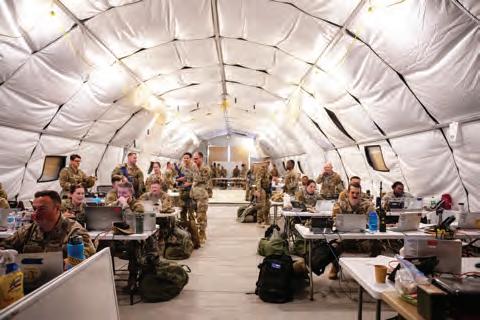
Beginning this year, the Air Force is introducing Air Expeditionary Wing 2.0, an improved version of our legacy deployment construct, as its new wing unit of action. AEW 2.0 will be implemented in fiscal year 2027.
Changes in the global strategic environment over the last several years emphasized a clear need: maintain an elevated state of readiness to deter and win in high-end conflict.
To achieve this, the Air Force has reevaluated its approach to generating and deploying combat airpower. The service evolved its force presentation through different deployment models in recent years, including the Expeditionary Air Base (XAB), Air Task Force (ATF), and Deployable Combat Wing (DCW), to better align with future needs. The outcome of the feedback and lessons learned from previous models is AEW 2.0, a modified version of the Air Expeditionary Wing that reflects updated national priorities and more efficiently uses talent and resources.
train and certify together through the AFFORGEN cycle. It also optimizes the balance in preserving capacity at the host wing to fulfill the in-garrison mission and defend the homeland while the unit of action trains and deploys.
air power in any theater, which improves agility in our operations and preserves decision space for combatant commanders.
The primary difference between the legacy deployed AEW and the AEW 2.0 solution is that the AEW 2.0 forms approximately 18 months prior to deployment so that its teamed, capabilities-based components can train and certify as a cohesive unit. The legacy
AEW model was enabled by crowdsourcing via the AEF process, degrading warfighting capability and making deployed unit cohesion and integration much more difficult. AEW 2.0 is a cohesive wing that arrives in theater maximally ready to fight.
This model preserves the critical wins of previous force presentation concepts: deliberately teamed, capabilitiesbased force packages that
“AEW 2.0 will help us move faster and stay prepared to fight wherever and whenever we’re needed,” said Lt. Gen. Case Cunningham, the Air Force’s deputy chief of staff for operations. “A key strength of this unit of action model is the deliberate training and teaming that improves collaboration and readiness across the service. It’s imperative we continue empowering wings and commanders with necessary resources and guidance to be the agile, decisive force our nation demands.”
Other notable updates to the AEW 2.0 approach include the continuation of group command opportunities at deployed locations and implementation of Wing Operations Centers instead of A-Staffs at deployed locations.
Armament Directorate, the 96th Test Wing and industry partners. Engineers and test conductors from Eglin Air Force Base’s Central Control Facility planned the mission and analyzed the data, leveraging the range’s unique capabilities to execute the complex event.
“The future fight demands we create an asymmetric advantage by developing cost-effective, attritable systems like ERAM that give commanders the ability to generate mass,” said Brig. Gen. Mark Massaro, 96th TW commander. “This test is a critical milestone on that path. The expert teams who executed this complex mission provided the high-fidelity
data we need to validate this system, ensuring that when it reaches the warfighter, it is a proven and ready tool for the right target. This is the cornerstone of building a more lethal and effective Joint Force.”
“AEW 2.0 allows us to present combat ready forces,” said Air Force Chief of Staff Gen. Ken Wilsbach. “It is the next step in evolving our readiness, and it’s based on input from across the total force and feedback from the major commands and wings. This model allows airmen to train at home in a manner consistent with how they will operate when they deploy.”
AEW 2.0 is a modular and scalable wing-level unit of action that provides a standardized, right-sized baseline force package that provides the necessary capabilities to C2 and project platform-agnostic





















Capt. K atherine
NETTUNO, Italy —
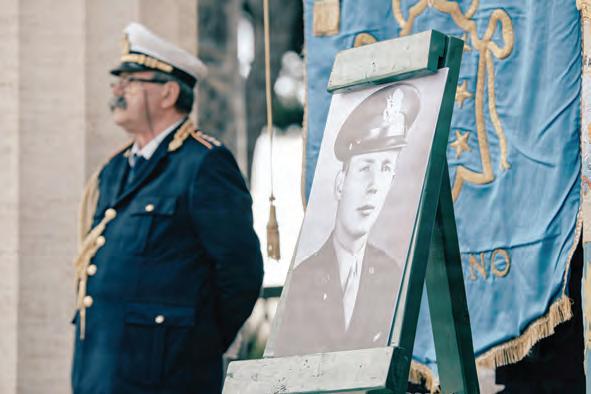
Army Master Sgt. Joshua Van Horn walked through the curved rows of white marble crosses at the Sicily-Rome American Cemetery in Nettuno, Italy, his steps slowing as he searched for a familiar unit.
His eyes settled on the headstones of soldiers from the 504th Parachute Infantry Regiment, 82nd Airborne Division, also known as the “devils in baggy pants,” a name given to them by a German officer during World War II. Van Horn grazed his hand across the smooth marble and paused at the grave of Army Pvt. James Warren, the name etched permanently into the stone.
Van Horn once served in the 504th PIR, deploying with the unit to Afghanistan. Standing among the graves offered a moment to reflect not only on their sacrifice, but on his own service.
“Coming here gives you a sense of purpose,” Van Horn said. “It reminds me why we do what we do.”
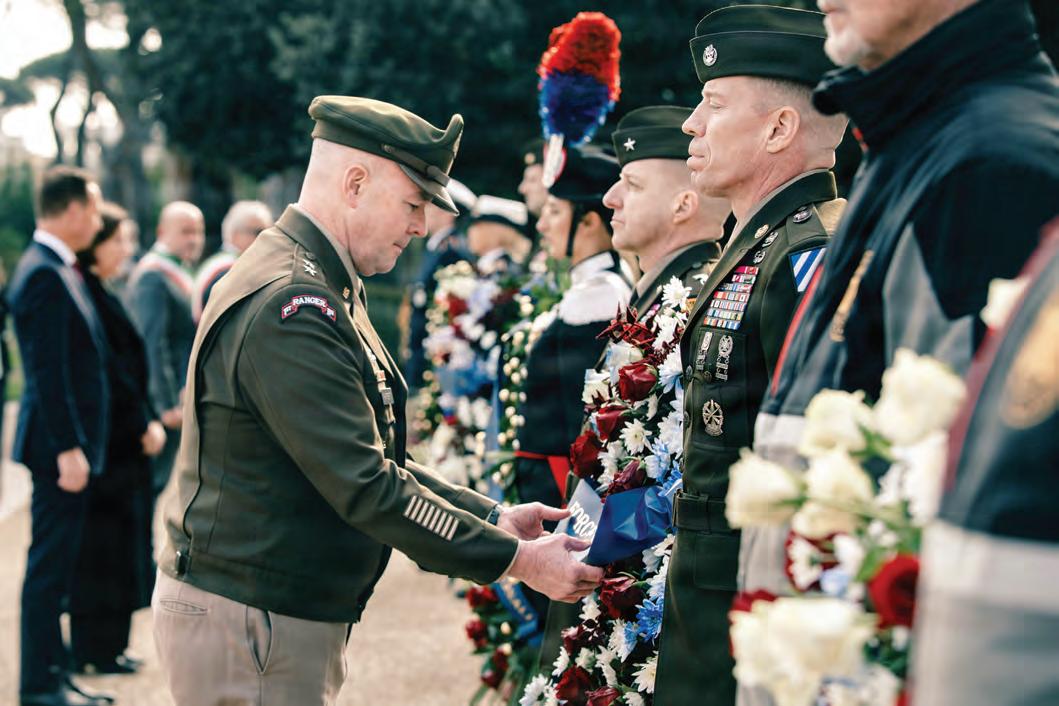
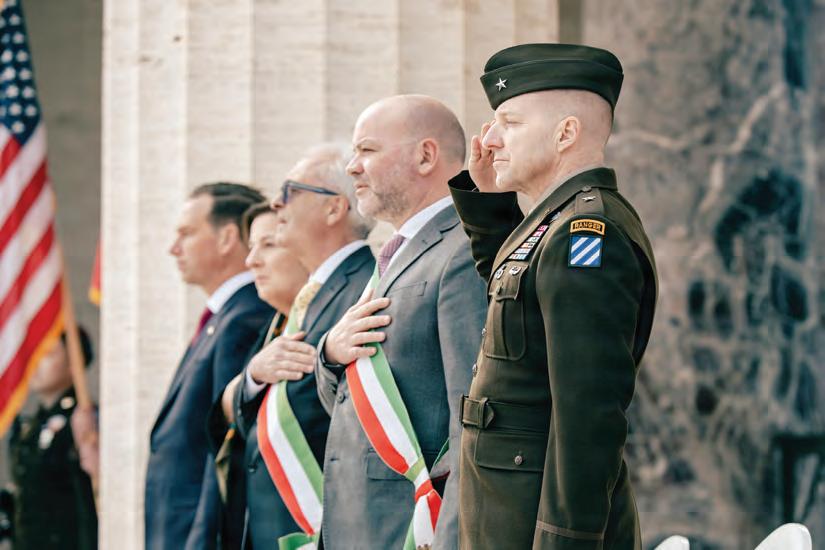
Van Horn participated in the 82nd anniversary commemoration of Operation Shingle at the cemetery in Nettuno, Jan. 22. He led the 173rd Airborne Brigade honor guard during the ceremony, which honored the service and sacrifice of U.S. and Allied forces who fought during the World War II landings at Anzio, Italy, and Nettuno.
“This cemetery is a testament to what makes America great,” Van Horn continued. “Eighty-two years later, these graves are still cared for. What other country does that? Honoring soldiers who died liberating others.”
U.S. and Italian officials delivered remarks
From Page 2
Virginia, integrating seven Total Force KC-46 wings and nine KC-46 aircraft into the 1st FW’s annual combat readiness exercise. Exercise Krampus involved over 80 joint aircraft and was developed to deliver concentrated and coordinated air power in decisive strikes as well as train toward an additional 18 agile combat employment desired learning objectives. The plan had KC-46 aircrew flying in a simulated contested environment, challenging them
a rmy & a ir ForCe exChange ServiCe publiC a FFairS TRAVIS AIR FORCE
BASE — Once again, service members and veterans worldwide will enjoy free access to NBCUniversal’s full coverage of the Milano Cortina 2026 Winter Olympic Games, courtesy of the Army & Air Force Exchange Service and NBCUniversal. Military members can stream all the action from Italy using their personal devices and computers through ShopMyExchange.com. The WinterOlympicstakeplace Feb. 6 through Feb. 22. This longstanding venture will feature more than 2,300 hours of the Olympics across NBCUniversal’s streaming platforms. Throughout the Games, fans can watch more than 3,500 athletes from 93 countries compete for 195 medals. Live streams of select practice and warm-up sessions and extensive video content including event recaps, highlights,
upcoming 250th anniversary of the Declaration of Independence and its continued relevance.
“Two hundred and fifty years of dedication to a universal proposition, grounded in human dignity and fundamental rights, that we continue to strive to live up to,” Burch said. “Marking this day during such a historic anniversary carries even greater significance.”
As the ceremony concluded, Van Horn and others moved quietly through the rows of marble crosses and Stars of David, reflecting on the cost of freedom.
throughout the ceremony, including U.S. Ambassador to the Holy See Bryant Burch, Italian Deputy Premier and Foreign Minister Antonio Tajani and U.S. Army Maj. Gen. John L. Rafferty Jr., U.S. European Command chief of staff.
Local students from Nettuno schools sang, read poetry and laid roses in remembrance of those
to deliver F-22 Raptor aircraft and other coalition aircraft to the forwardmost part of the fight, and then, not only react to adversary aircraft and threats, but coordinate actions over secure communications and tactical datalink.
“It’s an honor seeing our aircrew, operations support personnel and maintainers plan and accomplish a large-force exercise to this scale, as well as teaming up with the very best in the KC-46 community to plot the future trajectory of the air-
buried at the cemetery, followed by a ceremonial wreath-laying. The ceremony also honored the life of Army 1st Lt. Carl Hood, the first service member buried at the cemetery.
Speakers echoed the message that the cemetery is not only a resting place for the fallen, but a space meant to guide the living. Burch and Rafferty also reflected on the
frame,” said Lt. Col. Paul LaSorda, 32nd Air Refueling Squadron commander. “The team is pushing the KC-46 enterprise to be at the leading edge of the Mobility Air Force, delivering not just airborne fuel to the most forward part of the aerial fight, but connectivity, command and control and battlespace situational awareness for the joint force. When you look around the room at the KC-46 Weapons Systems Council and at the personnel (who) planned Exercise Krampus, there is a unified goal: for the KC-46 to lead the Mobility Air Force and win the next fight.”
These cemeteries are not only places of mourning, but also places of memory, meant to remind the living what service demands and what liberty costs.
viral moments, interviews and more are included.
“Few events unify the world like the Olympic Games,” said Travis AFB Exchange General Manager Cathie Byrns. “It is a privilege for the Exchange to offer this Quality-of-Life multiplier so the games can be viewed wherever service members and their families are called to serve.” Viewers can access NBCUniversal’s coverage from their computers or personal devices by visiting NBCOlympics. com (desktop or mobile device) and the NBC Sports App (U.S. only) and choosing the Exchange as their service provider. To verify eligibility, an active ShopMyExchange.com account will be required. Content rights restrictions will also apply to OCONUS locations where on-base residents must subscribe to internet service through an authorized provider. Additional information is available on the Exchange’s Olympic Hub page.

From
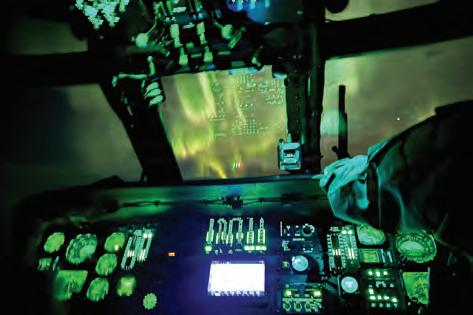
Upon arrival in Dillingham, the patient was transported and released to Kanakanak Hospital staff.
The effort continued the Alaska Army National Guard’s ongoing relationship with western Alaska communities. The Alaska Army National Guard frequently supports emergency response
and
crew, based in Bethel, Alaska, is not a designated rescue asset with hoist capabilities or paramedic teams. Despite that, the crew is crucial in supplementing traditional emergency services that are not often available in western Alaska, an area where rural communities are not connected by roads.











A ir CombAt Comm And
PubliC A ffAirs
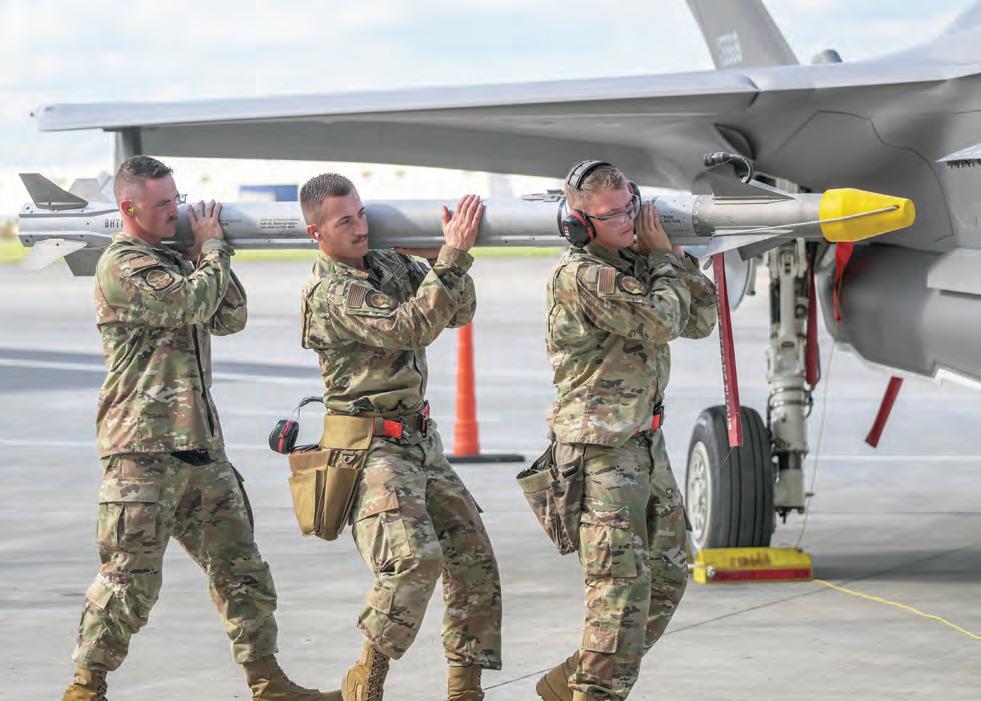
JOINT BASE LANGLEY-EUSTIS, Va. — Air Combat Command’s William Tell Air-to-Air Weapons Meet is scheduled to take place March 6–15, at the Air Dominance Center in Savannah, Georgia. The competition brings together the best fighter and operations teams from across the Total Force – active duty, Air Force Reserve, and Air National Guard.
“Iron sharpens iron” as F-35 Lightning II, F-22 Raptor, F-15 Strike Eagle and the newly added F-16 Fighting Falcon aircrews unite as intelligence, maintenance and command and control airmen are pushed to solve problems quickly, ensuring lethal precision when it matters most.
For more than 50 years, William Tell stood as the ultimate crucible of air superiority excellence, challenging elite teams to push the boundaries of skill, innovation and teamwork in demanding air-to-air combat scenar-
ios. After a two-decade hiatus, the competition was resurrected in 2023 to reinforce the U.S. Air Force’s commitment to modern-
ization, readiness and dominance in the face of emerging threats.
Marking the 80th anniversary of ACC’s direct
lineage from Tactical Air Command, William Tell returns in 2026 to exemplify the U.S. Air Force’s unwavering dedication to
readiness, lethality and the human element that drives air superiority. New to this iteration, WT26 will feature all U.S. Air Force
modern fighter platforms. The addition of the F-16 ensures a seamless partnership of technology and experts, forming a lethal team capable of dominating contested environments.
“Air superiority is inherently human. It is forged by the grit, precision and professionalism of our airmen,” said Brig. Gen. Brian Laidlaw, ACC director of operations.
“William Tell is an opportunity for ‘iron to sharpen iron,’ driving our airmen to evolve, solve problems quickly, strengthen their bonds and demonstrate lethality under pressure in a realistic environment. This competition brings our legacy of risk-taking, innovation and excellence through today, ensuring we remain ready to dominate and prevail.”
By bringing together the unmatched capability, resilience, and precision of Airmen with cutting-edge technology, William Tell showcases how the U.S. Air Force will “fight to the merge and win.”

CA www.1ag .com