TRAVIS TAILWIND


DefenSe HealtH agency communicationS
FALLS CHURCH, Va. — The Defense Health Agency announced 18 military hospitals received an “A” rating in the Leapfrog Hospital Safety Grade assessment for fall 2025. These high grades reflect DHA’s commitment to transparency and continuous improvement in providing high-quality care to its patients.
“These ratings underscore the strength of our integrated Military Health System and the unwavering commitment of our teams to safe, high-quality care,” said Air Force Maj. Gen. Jeannine Ryder, DHA’s acting assistant director for Health Care Administration. “When our hospitals perform at this level, it reinforces trust – trust from our patients, our families, and the service members who rely on us to sustain readiness at home and abroad. This achievement reflects disciplined processes and a continuous focus on improvement across every military treatment facility.”
The Leapfrog Group is a national, independent organization focused on health care quality. The organization evaluates hospitals on a wide range of safety measures, including errors, injuries, and infections. Leapfrog’s grading system uses up to 22 evidence-based measures of patient safety.
connect
world.
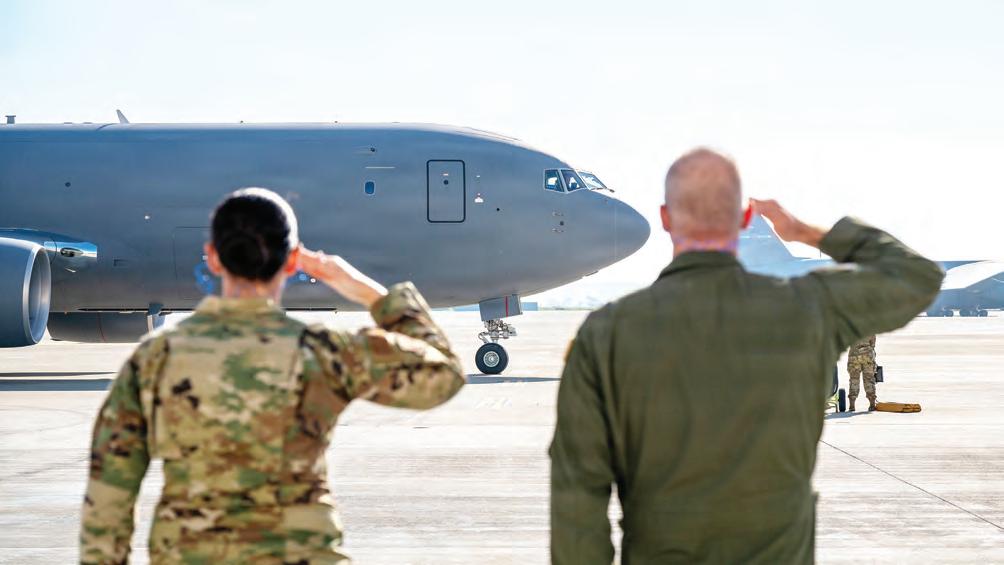
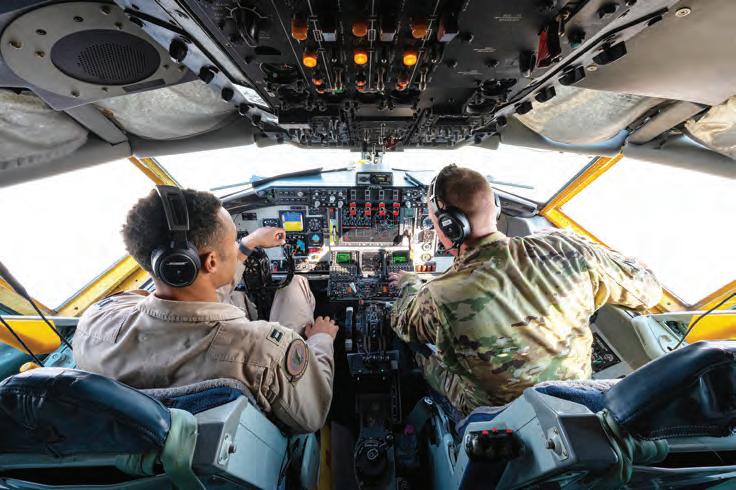
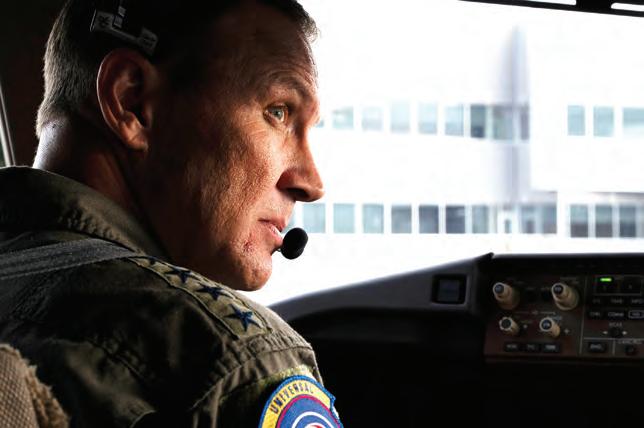
The KC-46A Pegasus is an aerial refueling aircraft capable of performing single and multi-point simultaneous aerial refueling. Designed for versatility and survivability, the aircraft can also support passenger and cargo movement, aeromedical evacuation, and features defensive, self-protection, and communication systems suited for contested environments.
“Today marks not just the arrival of the 100th KC-46 delivered, but the continued strengthening of our nation’s global reach and readiness.
The Pegasus represents a key chapter in air mobility, one built on innovation and unwavering commitment to the mission,” Lamontagne said. “To the airmen who will fly, fix and support this aircraft, you carry forward a proud legacy of excellence.”
The delivery of the 99th and 100th KC-46As is an important milestone marking years of hard work, determination and progress across the mobility enterprise.
Airmen were instrumental in laying this foundation of mission success with arrival of the first two
See KC-46A, Page 5
A hospital must meet specific criteria to be eligible for participation in the Leapfrog safety assessment. In the Fall 2025 ratings, 32% of participating hospitals nationwide received the highest grade. Of the eligible military hospitals participating in the grading assessment, 90% received an “A” grade.
“I am incredibly proud that a record number of our military hospitals have received an A grade this fall,” said Dr. Paul Cordts, DHA’s deputy assistant director for Medical Affairs and chief medical officer. “Participation in Leapfrog’s Hospital Safety Grade program provides a welcome opportunity to evaluate and improve health care across DHA’s global system of military hospitals and clinics.”
DHA’s engagement with Leapfrog began about eight years ago when it sought to incorporate
a
BASE — Military Star is wishing the U.S. Space Force a happy birthday with a lineup of exclusive one-day savings for cardmembers at the Travis Exchange.
On Dec. 20, Military Star cardmembers receive:
n 10 cents off per gallon of gas from Expresses.
n 15% off food purchases at participating Exchange restaurants.
n $10 off concession purchases of $25 or more (coupon required).
n Double points on all purchases made with the Military Star card.
“This special day of savings is a direct thank you to guardians and their families, who carry out the Space Force mission every day,” said Travis Exchange General Manager Cathie Byrns. “It is a privilege for the Travis Exchange and Military Star to provide those who serve with unmatched value.”
Space Force birthday savings on tactical gear can be found in store at the Travis BX and online at ShopMyExchange.com starting Dec. 19. Shoppers can explore all weekly discounts and specials at ShopMyExchange.com/ savings-center/weeklyads.
Travis shoppers who use their Military Star cards are also automatically entered into the “Your Holiday Bill Is
On Us” global sweepstakes through Dec. 31.
Five grand-prize winners will have their card balances paid in full while 35 additional entrants will receive credit statements of $1,000 or $500.
Cardmembers also enjoy everyday savings including:
n 5 cents off every gallon of gas from Expresses.
n 10% off food purchases at participating Exchange restaurants.
n Free shipping on online purchases at ShopMyExchange.com, MyNavyExchange.com and ShopCGX.com.
Shoppers also earn unlimited 2% rewards on purchases everywhere the card is accepted, including commissaries; concessionaires; third-party vendors; and Air Force Services and Army Morale, Welfare and Recreation activities.
Cardmembers also receive an industry-low APR regardless of credit score and no annual, late or over-limit fees. The Military Star card is administered by the Army & Air Force Exchange Service. Eligible active-duty service members, dependents, retirees, Department of War civilians, and honorably discharged veterans who have confirmed their eligibility to shop at ShopMyExchange. com can apply for a Military Star card. For more information or to apply for a Military Star card, visit https://aafes. media/militarystar25.

Gary Edwards 60TH AIR MOBILITY WING
TRAVIS AIR FORCE
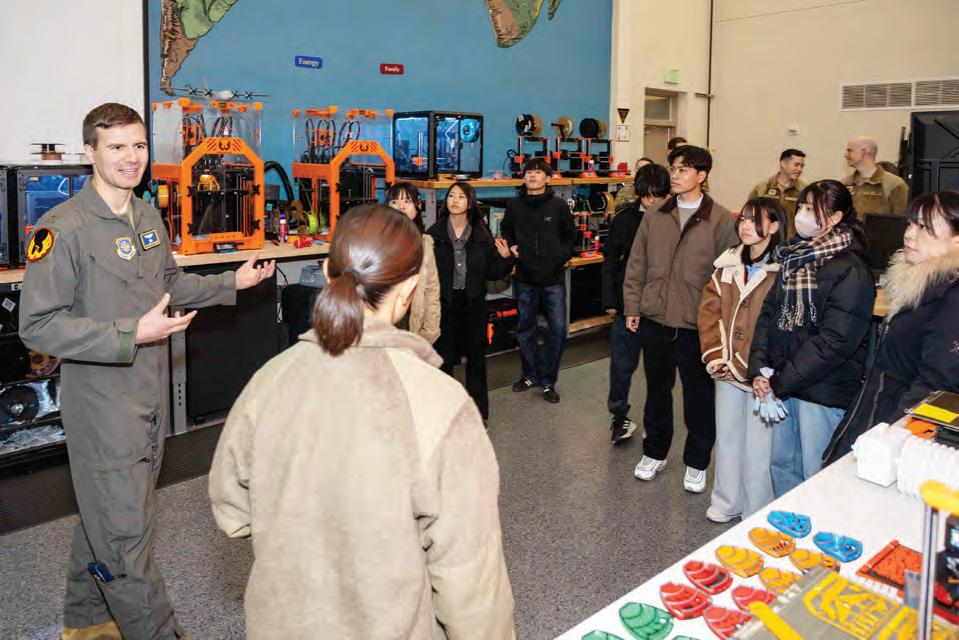
BASE — Nine students and staff from the city of Nirasaki in Yamanashi Prefecture, Japan, located approximately two hours south of Tokyo, toured Travis Air Force Base as part of a Fairfield sister city visit, Dec. 5.
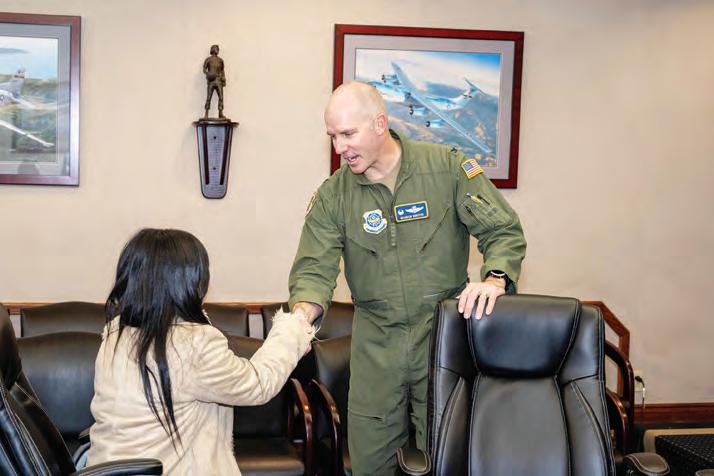
During the visit, the students met U.S. Air Force Col. Brandon R. Shroyer, 60th Air Mobility Wing commander, and toured the Phoenix Spark Lab, where airmen streamline processes and develop innovative solutions using emerging technologies. The lab team demonstrated 3D printing, discussed application development and coding, and highlighted how innovation supports mission readiness.
impressive.”

Serving Travis Air Force Base and the surrounding community 1250 Texas St., Fairfield, Calif. 94533 707-425-4646 | Fax 707-425-5924
Publishers: Foy S. McNaughton and T. Burt McNaughton
Advertising Manager: T. Burt McNaughton
Editor: Todd R. Hansen
Layout : Aaron Rosenblatt
Those
who wish to receive home delivery of Travis Tailwind can call 707-427-6975. For information on paid advertising, call 707-425-4646. Send correspondence to: Travis Tailwind/Daily Republic, 1250 Texas St., Fairfield, CA 94533.
“Innovation can come from any level, and having tools like these available enables anyone to solve problems and develop new solutions,” said Maj. Dustin Wallace, Phoenix Spark director. “There are so many tools that anyone can access to solve problems and innovate no matter where you are from.”
The group also toured a KC-46A Pegasus, the Air Force’s newest tanker and airlift platform. Aircrew members explained how the aircraft supports aerial refueling, airlift and aeromedical evacuation as part of the installation’s role in global mobility operations.
“It was amazing how people are able to do so many different missions,” said Riku Miyagawa, a Nirasaki student. “I thought it must be so difficult; it was very
Following the aircraft visit and Phoenix Spark tour, the group ate lunch at the Monarch Dining Facility. Members of the 60th Force Support Squadron described dining operations and answered questions about how meals are prepared and served for airmen on base.
“It’s completely different from Japan, very American, the way the food is cooked,” said Miku Ozawa, a Nirasaki student. “It was really nice for everyone to have the freedom to choose from many different dishes that were available.”
After lunch, the group visited Travis Bowl and the Outdoor Recreation Center, where they participated in bowling and indoor rock climbing.
Nao Misawa, a teacher from Nirasaki City, commented on how the visit to the base altered her perspective of the military.
“People who work on an Air Force base carry
responsibility for the country and for everyone’s lives, so I feel that it is a very important job and must come with a lot of pressure,” said Misawa. “At the same time, there are entertainment facilities on base, and they can eat many different kinds of food. So, my impression was that I thought it would be a much stricter or more rigid environment, but, I realized it is actually a place where people can live comfortably.” When asked about the
























































U.S. coaST gUard Pacific a
SEATTLE, Wash. —
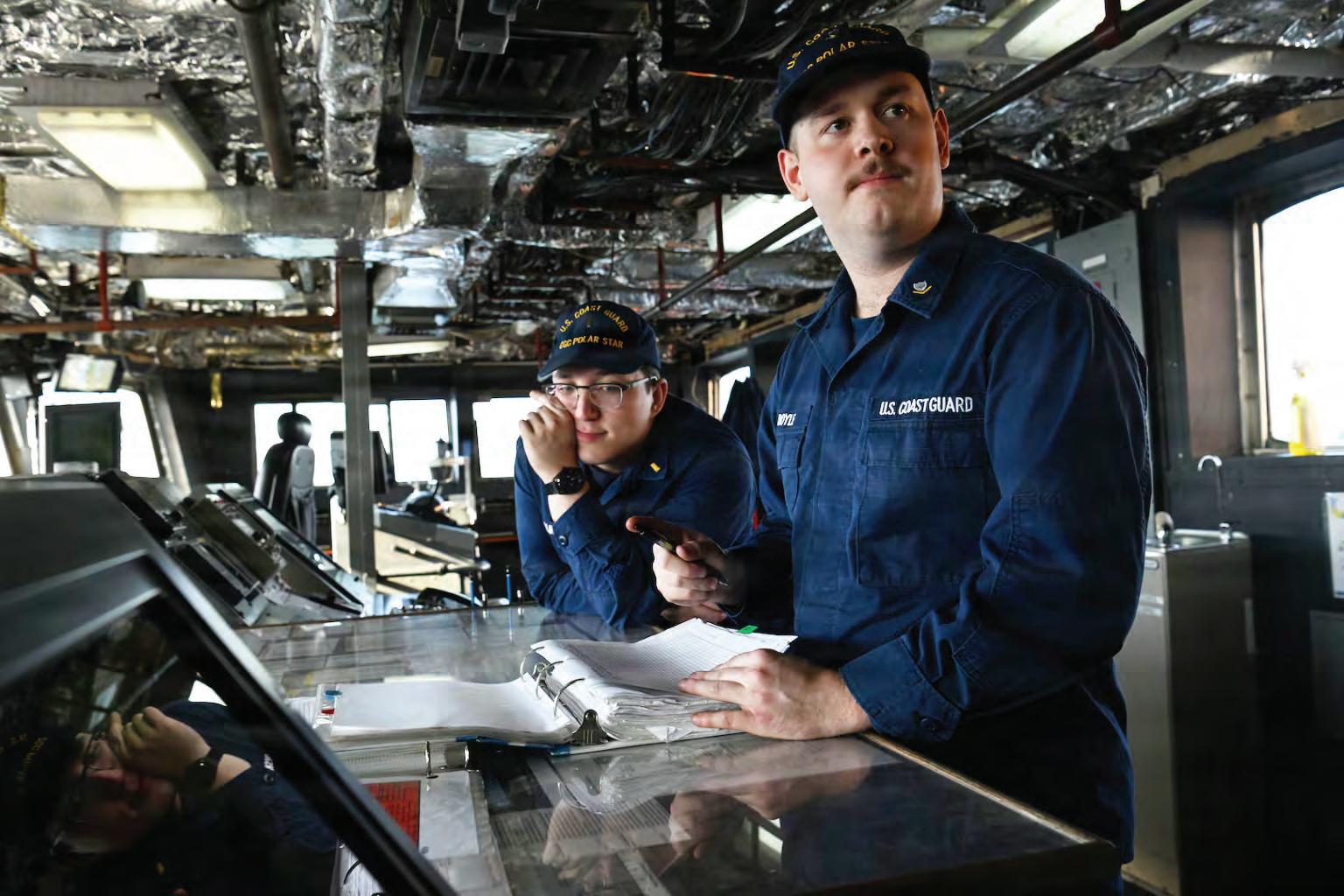
The Coast Guard cutter Polar Star departed Seattle, Nov. 27, commencing its 29th deployment to Antarctica in support of Operation Deep Freeze.
The operation is an annual joint military mission to resupply the U.S. Antarctic stations in support of the National Science Foundation, the lead agency for the U.S. Antarctic Program. Historic investment in the “One Big Beautiful Bill” of nearly $25 billion includes $9 billion specifically for icebreakers and infrastructure in the Arctic and Antarctic. This massive investment in icebreakers will secure U.S. access, security and leadership in the polar regions.
As the Coast Guard prepares to revitalize its icebreaking fleet, the Polar Star remains the only U.S. vessel capable of breaking a navigable channel through the ice to reach McMurdo Station, the largest Antarctic station and the logistics hub of the U.S. Antarctic Program.
Each year, the cutter serves a vital role in ensuring surface access for fuel and supply ships through the Ross Sea to resupply U.S. Antarctic bases. The Polar Star’s mission directly protects the security, freedom and prosperity for the U.S.,
our allies and partners.
“[The] Polar Star’s crew does remarkable work maintaining and operating this ship,” said Coast Guard Capt. Jeff Rasnake, commanding officer of the ship. “Each year brings unique challenges, and I’m proud to say this crew has risen to meet them all. The way we’ve come together over the course of maintenance, and our logistical preparations is exciting as we enter the operational phase of our annual deployment cycle.”
Commissioned in 1976, the Polar Star is 399 feet long and weighs 13,500 tons with a 34-foot draft. Despite reaching nearly 50 years of age, it remains the world’s most powerful nonnuclear icebreaker with the ability to produce up to 75,000 shaft horsepower.
The continuous effort the crew commits to maintaining the aging cutter ensures the nation’s access to the continent and the economic, environmental and national security interests in the polar regions. The Polar Star will continue to support Operation Deep Freeze until new polar and Arctic security cutters enter service in the coming decade.
Since 1955, members of the Coast Guard, Air Force, Navy and Army have proudly supported the U.S. Antarctic Program by providing supplies to McMurdo Station.
Tech. SgT. K riSTen PiTTman 379TH EXPEDITIONARY WING PUBLIC AFFAIRS
U.S. CENTRAL COMMAND — Air, land and naval forces from Qatar, Turkey, Italy, France, the United Kingdom and the United States converged across their respective domains to raise combat efficiency by building integrated command and control systems capable of achieving combat readiness in joint operations during Ferocious Falcon 6, an exercise hosted and led by
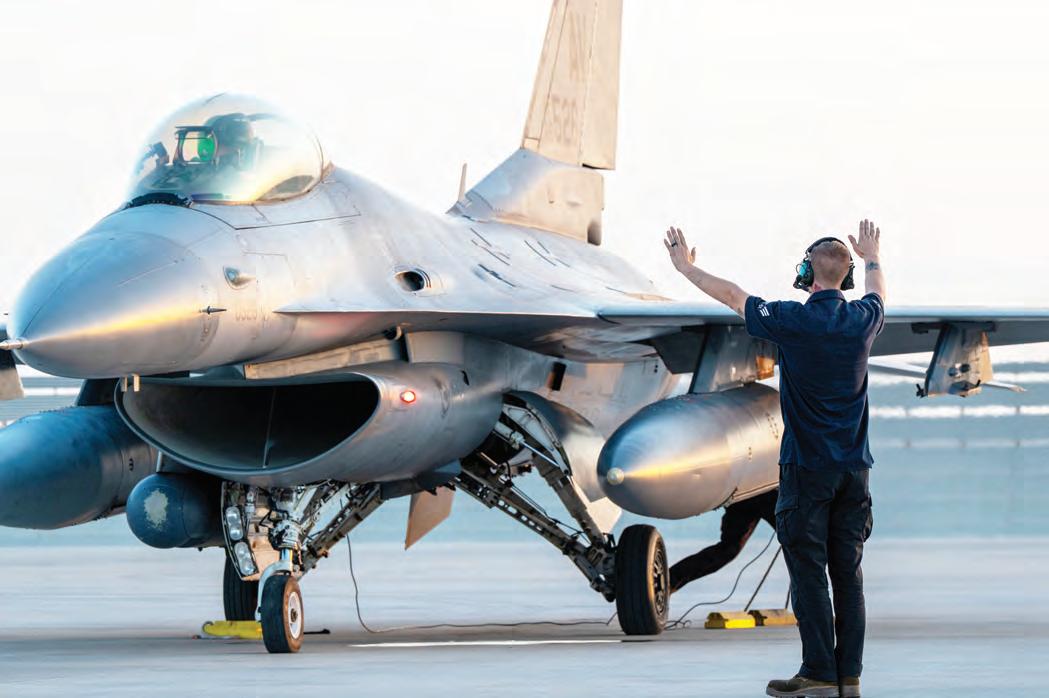
U.S. Air Forces Centralditionary Air Refuelingtotanker aircraft for air refueling capabilities and four F-16C Fighting Falcon aircraft assignedary Fighter Squadron “Triple Nickel” in support of the exercise. In total, 64 AFCENT personnel from the 378th and 379th Air Expeditionary Wings
“This exercise providednity for training as welltion,” said Lt. Col. Kelly Ammon, 174th EARS director of operations. “Our crews supported red and blue forces which included offensive counter air and close air support
Over the course of only three days, the 174th EARS crews offloaded over 189 thousand pounds of fuel in-flight to 35 fighter aircraft from the Qatar Emiri Air Force, the Turkish Air Force and the U.S. Air Force.



The 555th EFS, currently assigned to the 378th Air Expeditionary Wing, participated in the exercise in partnership and adversarial replication capacities, integrating combat techniques with partner nations as well as simulating common enemy tactics during Dissimilar Air Combat Training. This training helps partner nation pilots familiarize themselves with tactics
and loadouts of varying airframes to sharpen their capabilities to respond to and deter threats.
“Ferocious Falcon served as a two-forone for our squadron,” said Capt. Brad Welsh, 555th EFS fighter pilot. “We were able to integrate with our partner nations to increase our combat capabilities while strengthening partnerships with them and other

base support agencies.”
The 555th Mission Generation Force Element directly impacted the combat readiness of one of those supporting units, the 379th Expeditionary Logistics Readiness Squadron, by certifying members on hot-pit refueling. This refueling process promotes agile combat employment, allowing an







aircraft to land, keep its engines running while refueling, and take off in a relatively short time span, increasing power projection capabilities.
“In the event that realworld circumstances require the base to host fighter aircraft, the ability to turn those aircraft with speed is important,” said Capt. Christopher Brown, 379th AEW A4 deputy.
“Having our personnel hot-pit certified enhances how many training and combat missions we can support and enables movement with a smaller footprint.”
In total, 11 379th ELRS airmen were hot-pit certified, doubling the amount within the squadron.
Perhaps the strongest showcase of enhancing combat capabilities and allied integration came with the merging of Ferocious Falcon 6 and another ongoing exercise on Nov. 17 to develop the ability to operate from unfamiliar locations in the CENTCOM AOR.
The 555th EFS flew as part of the forma-
tion alongside two Qatar Emiri Air Force fighter jets and a U.S. Air Force B-52 Stratofortress aircraft. The 174th EARS supported the mission offloading an additional 105 thousand pounds of fuel.
The exercise culminated in a two-day Ferocious Falcon 6 Senior Leader Seminar where military personnel from the participating nations discussed the challenges and future of information warfare and the cyber domain, Nov. 19-20. During the second day, over 30 fighter, mobility, and unmanned aerial vehicle aircraft and rotorcraft showcased allied airpower with a series of flyovers.
“Being able to strategically plan and operate with the host-nation as well as the other partner nations involved creates an invaluable opportunity to understand and share best practices and contribute using generations of lessons learned,” Welsh said. “We appreciate the opportunity to enhance combat readiness among ourselves and our partners, and we commend Qatar for being such accommodating and welcoming hosts.”
Senior A irm An violette hoSAck 375TH AIR MOBILITY WING PUBLIC AFFAIRS
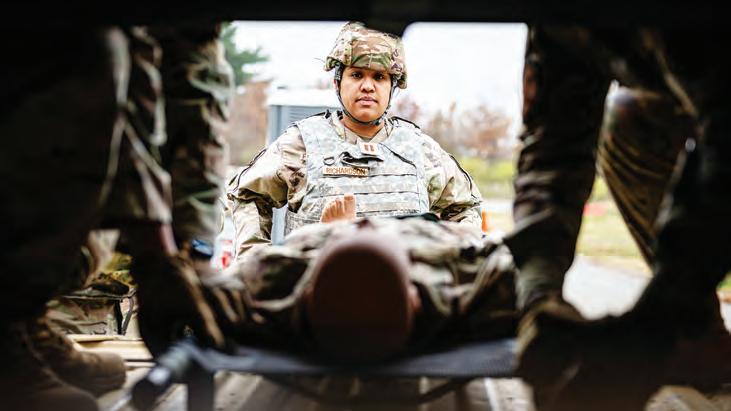
SCOTT AIR FORCE BASE, Ill. — Recently, airmen from the 375th Medical Support Squadron, 375th Operational Medical Readiness Squadron, 375th Healthcare Operations Squadron, and the 375th Aeromedical Evacuation Squadron worked together on a Theater Aeromedical Evacuation System exercise to further their ability to move patients safely and efficiently in contested, deployed environments.
As Scott is the only Air Force installation with a fully integrated TAES Battle Lab, airmen have a rare opportunity to train as a complete system before they are tasked with executing missions downrange.
En Route Patient Staging Systems (ERPSS), Critical Care Air Transport Teams (CCATT), Patient Movement Elements (PME), Aeromedical Evacuation Operations Teams (AEOT), and Aeromedical Evacuation Crew Members (AECM) capabilities were integrated to complete two simulated U.S. Indo-Pacific
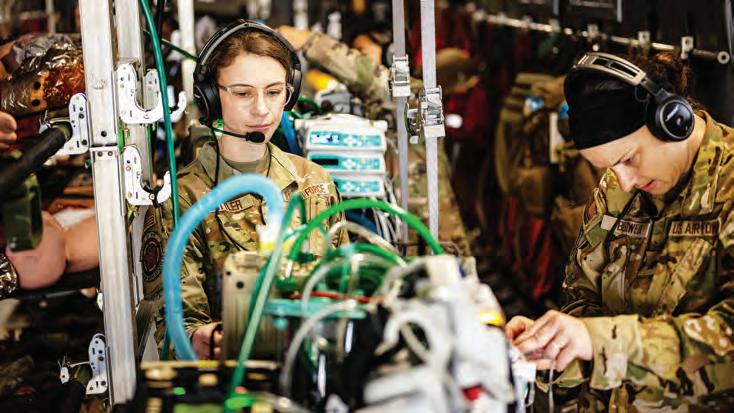
Laura Sattler, 375th Operational Medical Readiness Squadron CCATT doctor, prepares a simulated patient during a TAES exercise at Scott AFB,
worked together for a TAES exercise designed to further advance their ability to move patients safely and efficiently in contested, deployed environments.
Command patient movement missions. A total of 17 simulated patients were moved using a C-130 Hercules, deployed medical equipment, and an entirely
constructed TAES process line. Airmen coordinated patient pick-up at a simulated overseas hospital, transferred them through each TAES component and delivered them to a care facility. This type of training benefits airmen across several Unit Type Codes who support U.S. Transportation Command and Air Mobility Command’s global patient movement enterprise. By practicing as a cohesive TAES team, airmen strengthen the skills they need for realworld operations.













From Page 1
KC-46s to the 22nd Air Refueling Wing at McConnell AFB, Kansas, Jan. 25, 2019.
Through AMC’s development and implementation of the Interim Capability Release process, a risk-informed, data-driven, constraintanalyzed approach to releasing KC-46A operational capabilities to the joint force, the aircraft was certified eligible to support 97 percent of daily joint force air refueling taskings by May 31, 2022. Employment Concept Exercises like ECE 22-03 at Morón Air Base, Spain, demonstrated that the KC-46A was also able to successfully refuel aircraft utilized by allies and partners.
The KC-46A continues to serve as a proving ground for new operational capabilities.
Airmen at the 22nd ARW completed a mission with only a pilot and a boom operator, testing the tanker’s ability to execute its primary mission with a reduced crew. During the mission, a second instructor pilot onboard the aircraft served as a safety observer. The mission demonstrated how the KC-46A could rapidly launch in response to incoming threats and sustain longrange operations using offset aircrews.
Achieving new heights of human endurance, the 22nd ARW also completed a nonstop westbound circumnavigation flight in a KC-46A, June 29-July 1, 2024 – a 45-hour Maximum Endurance Operation that showcased airmen’s ability to extend missions over even greater distances.
Building on these achievements, the KC-46A program has further increased its operational range.
AMC certified the KC-46A worldwide deployable following its first operationally tasked mission in a combat zone when it refueled two F-15E Strike Eagles assigned to the 335th Expeditionary Fighter Squadron on
Sept. 14, 2022.
Following a 72-hour notice to generate and deploy a contingency force, the 305th Expe ditionary Air Refueling Squadron established the first enduring KC-46A squadron within the U.S. Central Command area of responsibility in October 2024. The 305th EARS conducted their first operational sortie in the AOR, marking a sig nificant progression in aerial refueling opera tions across the region. The KC-46A has since been employed in several major operations and contingencies, includ ing Operation Midnight Hammer in June.
“Every KC-46A we deliver has a unique story on its path to joining the operational fleet,” said Col. David Hall, Air Force Life Cycle Management Center KC-46 program manager. “From the spe cific artisans at Boeing and their suppliers cre ating the aircraft, to the Program Office, Federal Aviation Administration, and Defense Contract ing Management Agency teams overseeing the build, test and accep tance, to the Air Mobility Command crews who ferry the aircraft to her new home, many hands are ultimately responsible for this and every delivery. This occasion is a testament to the dedication and hard work of all those who have contributed to the KC-46 enterprise as we modernize the Air Force’s aerial refueling capabilities.”
The Total Force operates the KC-46A at Altus AFB, Oklahoma; McConnell AFB, Kansas; Pease Air National Guard Base, New Hampshire; Seymour Johnson AFB, North Carolina; Joint Base McGuire-Dix-Lakehurst, New Jersey; and Travis AFB, with future announced expansions at March Air Reserve Base; MacDill AFB, Florida; and McGhee Tyson Air National Guard Base, Tennessee. The arrival of the 100th KC-46A marks a key milestone of continued rapid operational reach and readiness, driven by a network of professionals ensuring the fleet continues to be missionready and relevant.
Capt. William Colón Cruz 571ST MOBILITY SUPPORT
ADVISORY SQUADRON
HERNAN ACOSTA
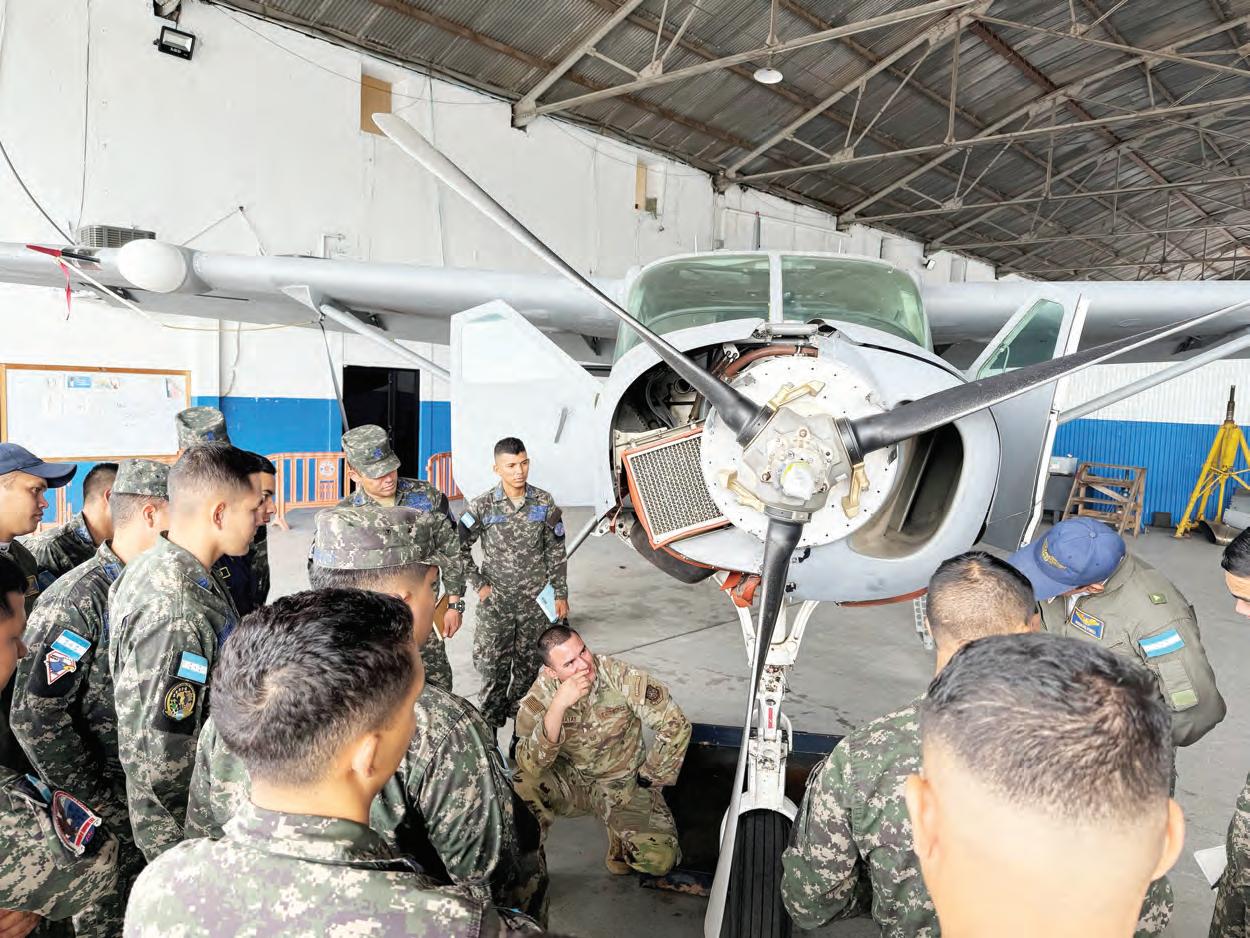
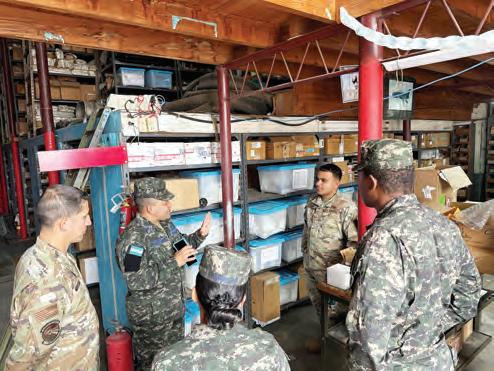
MEJIA AIR BASE, Honduras — A mobile training team from the 571st Mobility Support Advisory Squadron recently concluded a month-long mission to enhance the capabilities of the Fuerza Aérea Hondureña, or FAH. From Sept. 26 to Oct. 24, the six-member team deployed to Hernan Acosta Mejia Air Base, or HAM, to conduct HONDURAS MTT 25-21 with the FAH. The training focused on improving the FAH’s C-208 fixed-wing aircraft maintenance, warehouse operations, and logistics process management.
Staff Sgt. Dalton Williams/U.S. Air Force file
Air
Gen. John
of Air Force Reserve Command, flew the 99th KC-46A in formation alongside Lamontagne.
From Page 2
sister-city program, Lou Briscese, 60th AMW public affairs community engagement chief, discussed the long-standing connection between the two communities.
“The program has been in place since 1971 and strengthens ties and goodwill between the cities of Fairfield and Nirasaki,” said Briscese. “Travis is fortunate that Fairfield views the 60th AMW as an important organization to showcase to visiting students.”
Highlighting the longstanding partnership, City of Fairfield assistant to the city manager, Eliza-
beth Aptekar, emphasized how the relationship extends beyond cultural exchange and reflects a mutual commitment to community support and national defense.
“While Travis Air Force Base helps drive Fairfield’s economy, the city takes great pride in supporting the readiness and well-being of service members, their families and veterans,” said Aptekar. “As a proud American Defense Community, Fairfield plays a vital role in our nation’s strategic defense network and is honored to host this premier national asset, by providing city services, amenities and programs that help sustain its mission and our country’s strength.”
The 571st MSAS team trained 27 FAH personnel, providing them with knowledge and skills necessary to independently maintain their C-208 aircraft and manage their supply chain. This collaborative effort aims to foster long-term operational readiness within the FAH to provide national humanitarian assistance or disaster relief to their 11 million population.
The training encompassed various aspects of aircraft maintenance.
Tech. Sgt. Federick Bomatay led instruction on maintenance philosophy and fundamentals.
Staff Sgt. Dylan Sanchez conducted an immersion with students from other bases at the HAM engine and propeller shop, providing hands-on experience and practical application of learned concepts. Staff Sgt. Sukhpreet Chhina facilitated discussions on warehouse and logistics process management with FAH counterparts, focusing on asset management efficiency and accuracy.
Key objectives of the mission included establishing unified doctrines, procedures, and communi-
and standard operating procedures, or SOPs, for maintenance and supply functions.
cation protocols to improve efficiency, data accuracy, and overall safety within FAH maintenance oper-
ations. The 571st MSAS team also advised on codifying tactics, techniques and procedures, or TTPs,


“This engagement not only strengthened technical skills in maintenance and logistics but also bonds of trust and cooperation that unite Honduras and the U.S. as partner nations,” said Capt. Colón Cruz, mission commander. The 571st MSAS continues to play a vital role in strengthening global mobility partnerships, ensuring effective cooperation and promoting self-reliance amongst partner nations. This mission underscores the Air Force’s dedication to supporting regional stability and security through capacity-building efforts.




















Tech. SgT A
HURST, N.J. — Air Mobility Command forces
achieved several wins toward drone proficiency during Exercise Turbo Distribution in August. In conjunction with Sierra Army Depot, the 621st Contingency Response Wing reached four significant milestones in support of Secretary of War Pete Hegseth’s memorandum from July by integrating both small, unmanned aircraft systems (sUAS) and Counter-sUAS (C-sUAS) operations into their exercise.
First, AMC and the CRW successfully operated and coordinated a simultaneous flight of a mixed fleet of commercial-off-theshelf, government, and Do-it-Yourself sUAS – a feat accomplished without incident, demonstrating the command’s ability to manage complex airspace and diverse platforms.
“We were able to employ our own sUAS
Staff Sgt. Jermaine Brown, 621st Contingency Response Group standards evaluator, observes a drone used for inspecting Hangar 1 at Joint Base McGuire-Dix-

CA www.1ag .com


at AMC with our red cell and utilize adversary tactics, techniques, and procedures (TTPs) to test our friendly forces’ response,” explained U.S. Air Force Tech. Sgt. Cody
Seiber, AMC Security Forces C-sUAS and sUAS program manager. “Once we got approval with other coordinating agencies, we were able to go out there and fly against the con-
Lakehurst, N.J., June 21, 2022. The 621st CRS partnered with the 787th Civil Engineering Squadron to assist in surveilling facilities for
tingency response forces and their equipment, and that’s really what Turbo Distribution was about, trying to get firsthand knowledge and experience with what working
with drones looks like.
These repetitions are critical to enabling the CRW to refine their response to the sUAS threat.”
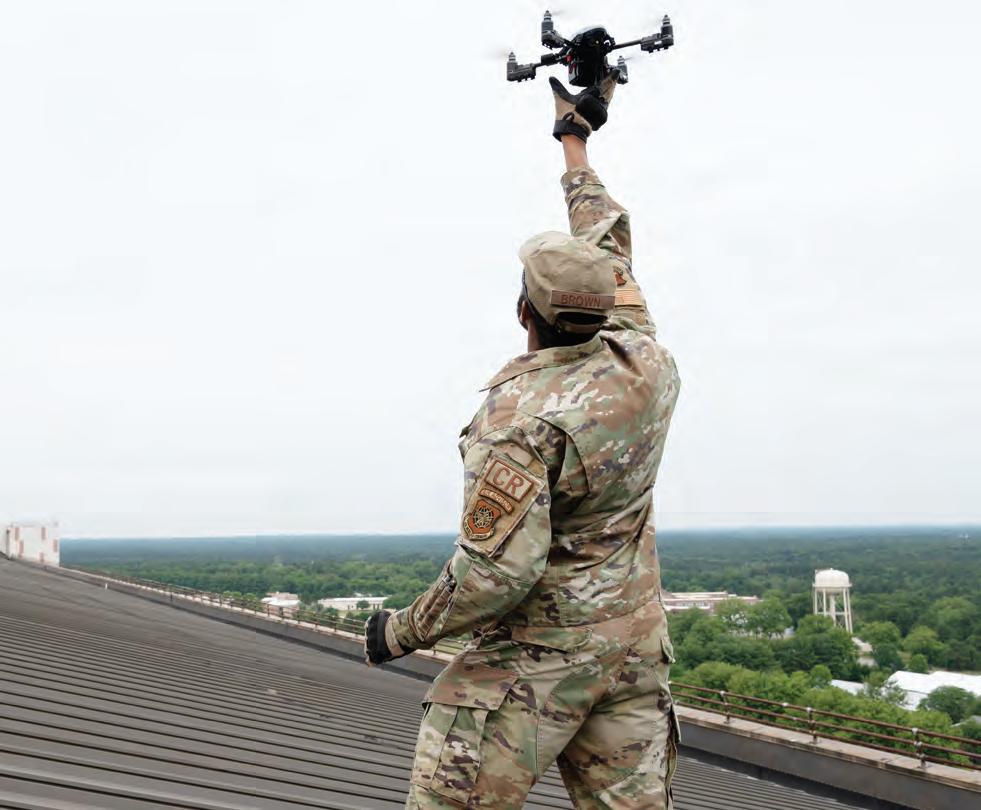
Moreover, the 621st CRW innovation office
enhanced the 821st Contingency Response Group’s operational effectiveness by providing an emerging technology that rapidly accelerates airfield assessments by providing detailed airfield mapping and comprehensive air boss services. This technology helped to ensure the safety and efficiency of aircraft operations during the C-sUAS field test within the U.S. Transportation Command exercise. “sUAS are democratizing local tactical airpower by allowing small units direct access to effects,” U.S. Air Force Lt. Col. Daniel Pool, 621st CRW innovation chief, said. “We are already working to open a sUAS lab at Joint Base McGuire-Dix-Lakehurst in the coming weeks to help the wing quickly identify and implement the most promising technologies and design approaches to solve its problems.”
In a move that expands the toolkit for countering drone threats, the CRW also secured permission to





















Leapfrog’s evaluations into the Military Health System’s Quality Assurance Program. Walter Reed National Military Medical Center was the first military test site for Leapfrog surveys. After seeing positive results, DHA expanded the program across other eligible military hospitals. 2025 marks the first time certain military hospitals overseas qualified to receive an official safety grade.
“We hope these latest Hospital Safety Grades inspire our patients’ confidence in the quality and safety of care they receive,” said Cordts. “This distinction belongs to teams of professionals at these military hospitals, who are dedicated to meeting the highest safety standards in the United States.”
The Leapfrog Hospital Safety Grade program, updated twice a year, evaluates public and private hospitals. Its grades are based on national standards for hospital safety and highlight risks that patients may face in a health care setting, including preventable medical errors and infections. The ratings are available to the public, making it easier for patients to understand the safety standards of their local health care facilities.
The 18 military hospitals that received an “A” grade for Fall 2025 are:
n Alexander T. Augusta Military Medical Center, Fort Belvoir, Virginia.
n Blanchfield Army Community Hospital, Fort Campbell, Kentucky.
n Brooke Army Medical Center, Fort Sam Houston, Texas.
n Carl R. Darnall Army Medical Center, Fort Hood, Texas.
n David Grant USAF
From Page 6
employ active non-kinetic effects against sUAS.
“The amount of interagency coordination was significant, and the wing learned a great deal about the process and how to repeat this for future exercises,” Pool said. “This is key knowledge as the CRW continues to lead the effort on integrating C-sUAS capabilities for expeditionary airfield operations.”
Testing sUAS capabilities during exercises is essential to understand their performance in realistic operational environments and identify and remedy limitations before they become critical. This practical evaluation ensures forces are better equipped, more adaptable, and ready to integrate emerging technologies into combat scenarios.
“The C-sUAS demonstration within an operational context allowed CRW forces to get a hands-on look at the many challenges facing them on this topic,” said Pool. “Field testing is absolutely essential to getting this right the first time. Our homebuilt red sUAS was especially useful in highlighting strengths and weaknesses of these C-sUAS sensors and effectors.”
The purpose of homebuilt systems is to leverage new authorities, and these sUAS benefit from being repairable, low-cost and modifiable in-house.
“Having a background in building drones, I began the process of testing, evaluating, and seeking approvals to fly a drone that uses components similar to what
Medical Center, Travis Air Force Base.
n Eisenhower Army Medical Center, Fort Gordon, Georgia.
n Evans Army Community Hospital, Fort Carson, Colorado.
n Madigan Army Medical Center, Joint Base Lewis-McChord, Washington.
n Mike O’Callaghan Military Medical Center, Nellis Air Force Base, Nevada.
n Naval Hospital Jacksonville, Jacksonville, Florida.
n Naval Medical Center Camp Lejeune, Camp Lejeune, North Carolina.
n Naval Medical Center Portsmouth, Portsmouth, Virginia.
n Naval Medical Center San Diego, San Diego.
n Walter Reed National Military Medical Center, Bethesda, Maryland.
n William Beaumont Army Medical Center, Fort Bliss, Texas.
n Womack Army Medical Center, Fort Bragg, North Carolina.
n U.S. Naval Hospital Guam, Agana Heights, Guam.
n U.S. Naval Hospital Okinawa, Okinawa, Japan.
“DHA’s fall 2025 ’A’ Hospital Safety Grades demonstrate a nationally recognized achievement for prioritizing quality health care and patient safety,” said Cordts. “We are proud that the care provided at these hospitals ranks among the very best in the nation.”
Some military hospitals and clinics were not included in the safety grades this fall because they did not meet the minimum requirements for reporting criteria used by Leapfrog. The DHA has instituted similar criteria internally to track patient safety metrics for all facilities that did not qualify for official Leapfrog grades.
is being used in current conflicts,” said U.S. Air Force Tech. Sgt. Christopher Gilbert, 19th Civil Engineer Squadron explosive ordnance disposal team leader. “It’s an important capability for the Air Force, because it allows us to rapidly iterate on emerging threats at a fraction of the cost of outsourcing red teams.”
Finally, as a crucial step for developing the foundational expertise needed for future, advanced missions, the CRW recently completed its first level-one sUAS operators class, further solidifying its position at the forefront of sUAS integration within the air mobility enterprise.
“Last summer, the CRW moved to a leading, modern platform that provides enhanced capabilities for our teams on the ground,” said U.S. Air Force Master Sgt. Jimmy Vang, 821st CRG Security Forces superintendent.
“When we received these systems, we did not have a formal training program in place to ensure our operators remained compliant with standards while operating within the framework of our unique mission; however, we worked with AMC and Air Force Special Operations Command to build a certification program tailored to our mission.”
This was a major achievement as it provides the CRW with an arsenal of operators capable of providing greater capabilities to friendly forces. Whether it is providing sUAS employment for friendly forces or capitalizing on emerging technologies to counter this emerging threat, the CRW remains committed to pushing the boundary and being on the leading edge of the future fight.

Lt. CoL. M arnee Losurdo 403RD WING PUBLIC AFFAIRS
KEESLER AIR FORCE BASE, Miss. — The 2025 Atlantic hurricane season officially ended Nov. 30, closing another demanding chapter for the Air Force Reserve’s 53rd Weather Reconnaissance Squadron, known as the Hurricane Hunters.
The squadron flew 927.9 hours this year across the Atlantic, eastern Pacific and central Pacific basins, collecting critical data that improved forecasts, saved lives and once again, demonstrated the unit’s no-fail mission.
From their first flight into Hurricane Erick, June 18, to their final mission into Hurricane Melissa, Oct. 30, the 53rd WRS crews faced one of the most intense storm seasons in recent memory. This year’s taskings included three Category 5 hurricanes and the second sub-900 millibar storm the squadron had flown into in as many years.
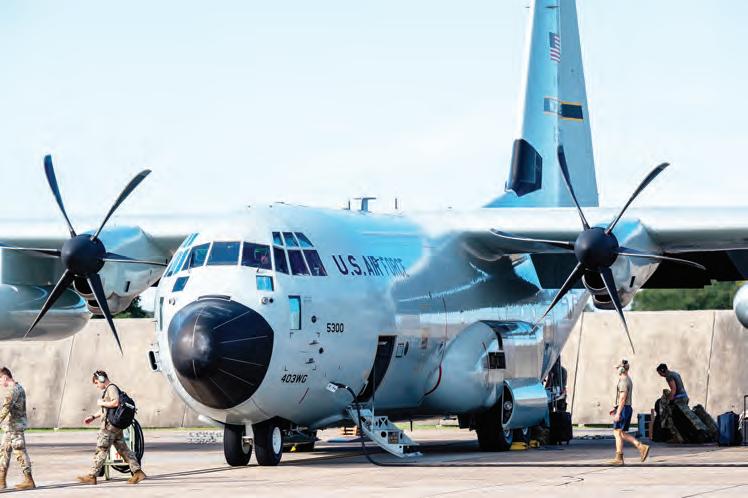
The Hurricane Hunters kicked off the season when a WC-130J Super Hercules aircrew departed Keesler Air Force Base, for Hurricane Erick in the eastern Pacific. That marked the first operational flight of the 2025 season and the start of what forecasters predicted would be an active year for tropical systems.
“Our job is to fly directly into the storm and collect vital information such as wind speeds, pressure, temperature and humidity,” said 1st Lt. Mark McCoy, 53rd WRS aerial reconnaissance weather officer. “While satellites provide a significant amount of information, the data we gather within the storm is unique and cannot be captured from space. That information helps the National Hurricane Center refine forecasts and gives people more time to prepare.”
The squadron, assigned to the 403rd Wing, is the only War Department unit that flies into tropical systems to gather real-time atmospheric data. Using a fleet of 10 WC-130J Super Hercules aircraft, the squadron operates yearround and is prepared to support 24-hour operations during the peak of hurricane season. Data from their flights is transmitted in real time to the NHC and shared with the National Oceanic and Atmospheric Administration, the Navy and other domestic and international forecasting agencies.
“Every time we fly into a storm, we’re collecting data that can directly impact how communities prepare and respond,” said Lt. Col. Steve Burton, 53rd WRS director of opera-
tions and the deployed detachment commander. “We train all year for this. What we do helps save lives and property.”
According to Warren Madden from the National Hurricane Center, the squadron’s 2025 missions were defined not by quantity, but by intensity.
In the Atlantic basin, the squadron flew into Hurricanes Barry, Chantal, Erin, Fernand, Gabrielle, Humberto, Imelda, Jerry and Melissa, as well as an early August flight in the northern Gulf of America and another in late August near the Windward Islands. In the eastern Pacific, crews flew into Hurricanes Erick and Lorena, and in the central Pacific they supported missions into Hurricane Kiko.
“What was unusual this year was the overall lack of activity in both the Gulf and in the Caribbean,” Madden said. “We only flew one named storm in the Gulf – Barry – along with two northern Gulf [flights]. Chantal was the only system that produced direct wind impacts to the continental U.S., and Melissa was the only storm we flew in the Caribbean.”
What did stand out was the strength of several storms.
“Three of the systems – Erin, Humberto and Melissa – reached Category 5 strength, and Melissa became the second sub-900 millibar storm we’ve flown [into] in as many seasons,” Madden said, referencing 2024’s Hurricane Milton. “That level of intensity in consecutive years is rare.”
The Hurricane Hunters’ most demanding mission of 2025 came late in the season, when Tropical Storm Melissa rapidly intensified over the Caribbean. On Oct. 21, the 53rd WRS deployed aircraft to a forward operating location in Curaçao, positioning closer to the system as it strengthened into a Category 5 hurri-
cane. Over a seven-day period, the squadron flew 17 missions and 170 flight hours into Melissa, conducting around-the-clock operations to support National Hurricane Center forecasts.
Flying Super Hercules aircraft at roughly 10,000 feet, the crews penetrated Melissa’s eye two to four times per mission, releasing equipment that measured temperature, humidity, wind speed and direction and barometric pressure from the aircraft down to the ocean surface.
“That information was delivered directly to the National Hurricane Center to improve forecast accuracy as Melissa intensified,” Burton said.
The deployment took place during a federal government shutdown, which complicated travel, funding and coordination.
“Despite the administrative hurdles, our Hurricane Hunters continued operations uninterrupted, ensuring forecasters received the critical data needed to protect lives,” said Col. Jaret Fish, 403rd Wing commander. “Our airmen demonstrated the flexibility and dedication that make the reserve force vital to the nation’s readiness.”
Burton said the shutdown only underscored the team’s professionalism and focus.
“Even with the challenges, our crews stayed focused,” Burton said. “We knew communities were already feeling Melissa’s impact. Every data point we gathered fed into forecasts that helped officials make lifesaving decisions. That’s why we do this mission.”
Hurricane Melissa devastated the Caribbean with 185-mph winds, torrential rain and flooding, with Jamaica being the hardest hit and suffering widespread destruction and infrastructure failures. The United Nations
and U.S. State Department estimate $6 billion to $7 billion in damage to Jamaica, deadly flooding and landslides in Haiti, coastal flooding in Cuba, and at least 90 deaths across the region, including 45 in Jamaica, where Melissa made landfall near New Hope, Oct. 28. By staging out of Curaçao, the Hurricane Hunters reduced flight time to the storm’s center, enabling more frequent eye penetrations and higher-density equipment coverage during Melissa’s peak intensity. That increased cadence provided near real-time data that helped forecasters and emergency managers issue more accurate warnings and evacuation guidance. With the last scheduled hurricane mission completed Oct. 30, the Hurricane Hunters spent November transitioning to winter storm reconnaissance operations in support of the National Winter Season Operations Plan. These atmospheric river missions collect data over the Pacific Ocean to help predict heavy rainfall and flooding events that affect the western U.S.
“The hurricane season may be over, but our mission never really stops,” Fish said. “Whether it’s tropical cyclones or atmospheric rivers, our airmen deliver data that directly supports national preparedness and disaster response.”
From the first flight into Erick to the last eyewall penetration of Melissa, the 53rd WRS’s 2025 season reaffirmed the critical role of manned reconnaissance in weather forecasting.
“Our crews flew nearly 850 hours this season through some of the most intense storms on record,” Fish said. “Their work saves lives, protects property and provides the science that forecasters rely on every day. We’re
what they accomplished.”