Green
Aggie men fall to The Beach
Living
— Page B6
Sports
Lager’s “back”? Where had it gone? — Page A4
UCD researchers figure out what makes a forest resilient — Page A5
enterprise THE DAVIS
WEDNESDAY, FEBRUARY 2, 2022
County seeks input on vote changes
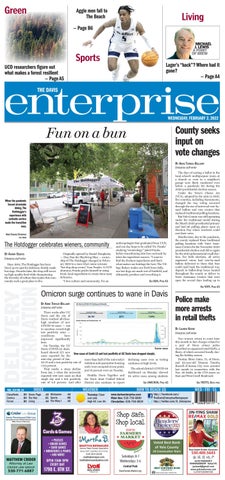
Fun on a bun
By Anne Ternus-Bellamy Enterprise staff writer
When the pandemic forced streetside dining, The Hottdogger’s experience with curbside service made the transition easy. Owen Yancher/Enterprise file photo
The Hotdogger celebrates wieners, community By Aaron Geerts Enterprise staff writer Since 1984, The Hotdogger has been Davis’ go-to spot for delicious, freshly made hot dogs. Decades later, the shop still serves up high-quality food while championing the diversity of culture that makes this community such a great place to live.
Originally opened by Daniel Dougherty — Dan Dan the Skydiving Man — ownership of The Hotdogger changed in February 1994 to a man who’s name screams “hot dog shop owner,” Ivan Franks. A UCD alumnus, Franks prides himself in using fresh, local ingredients to create these tasty delicacies. “I love culture and community. I’m an
anthropologist that graduated from UCD, and one day hope to be called ‘Dr. Franks’ studying ‘wienieology,’” joked Franks before transitioning into how seriously he takes his ingredient sources. “I want to find the freshest ingredients and that’s what makes our hotdogs the best. The Village Bakery makes our fresh buns daily, our hot dogs are made out of Fairfield, and ultimately, produce and everything is
See BUN, Page A3
The days of casting a ballot in the local school’s multipurpose room, at a church or even in a neighbor’s garage were likely numbered even before a pandemic hit during the 2020 presidential election season. Under the Voter’s Choice Act (VCA), adopted by the state in 2016, five counties, including Sacramento, changed the way voting occurred through the use of universal vote-bymail ballots and vote centers that replaced traditional polling locations. But Yolo County was still operating under the traditional model during the March 2020 presidential primary and had 96 polling places open on Election Day where residents could cast their votes. Months later, due to the pandemic, the county replaced those traditional polling locations with Voter Assistance Centers for the November 2020 presidential election and did so again for the 2021 gubernatorial recall election. For both elections, all active registered voters had vote-by-mail ballots delivered to them that they could mail back the traditional way, deposit in ballot-drop boxes located throughout the county or deliver to Voter Assistance Centers that were open for several days leading up to
See VOTE, Page A3
Omicron surge continues to wane in Davis By Anne Ternus-Bellamy Enterprise staff writer Three weeks after UC Davis and the city of Davis reached all-timehigh numbers of new COVID-19 cases — not to mention record-high test positivity rates — conditions have improved significantly here. On Tuesday, the UC Courtesy graphic Davis COVID-19 dashboard showed 271 new New cases of Covid-19 and test positivity at UC Davis have dropped sharply. cases reported for the nine-day period of Jan. more than half of the university’s declining cases even as testing 23-31 and a test positivity rate of isolation and quarantine housing continues at high levels. 1.04 percent. units were occupied at one point, The school district’s COVID-19 That marks a steep decline just 12 percent were on Tuesday. dashboard on Monday showed from Jan. 5 when the university Healthy Davis Together and 64 active cases among students reported 246 new cases on that single day and a test positivity the Davis Joint Unified School rate of 4.6 percent. And after District also continue to report See OMICRON, Page A3
VOL. 124 NO. 14
INDEX
Classifieds ������B3 Green Page ������ A5 Obituaries �������� A3 Comics ������������B4 The Hub ������������B1 Sports ��������������B6 Forum ��������������B2 Living ���������������� A4 The Wary I �������� A2
WEATHER Thursday: Clear and cold. High 62. Low 36.
Police make more arrests in retail thefts By Lauren Keene Enterprise staff writer Two women return to court later this month to face charges related to a pair of Davis crimes police described as organized retail thefts, a flurry of which occurred locally during the holiday season. Destiny Shree Gates, 21, of Davis; and 22-year-old Diamon Tinosha Russell of Suisun City were arrested last month in connection with the Nov. 28 thefts, at the CVS stores on East and West Covell Boulevard.
HOW TO REACH US www.davisenterprise.com Main line: 530-756-0800 Circulation: 530-756-0826
http://facebook.com/ TheDavisEnterpriseNewspaper http://twitter.com/D_Enterprise
See THEFTS, Back page
WED • FRI • $1
Local
A2 THE DAVIS ENTERPRISE
Briefly Cops investigate downtown Davis robbery Davis police continue to seek several suspects in a Friday-night robbery, but say the perpetrators’ use of face masks make a positive identification unlikely. Two men reported being robbed at about 11:30 p.m. after leaving a downtown restaurant. As they walked to their vehicle parked at Second and D streets, a car described as a “newer white sedan” pulled up alongside them, Lt. Ilya Bezuglov said. At that point, three males exited the car, one of whom pointed what appeared to be a black handgun at one victim’s chest while demanding his wallet and cell phone, Bezuglov said. They fled afterward, later ditching the phone.
WEDNESDAY, FEBRUARY 2, 2022
Hey, they want to know what I think
I
don’t know if I am just one of the lucky ones picked to help select the next Superintendent of Schools for the Davis Joint Unified School District or if maybe you have been recruited, too. All I know is that I received a survey “Powered by SurveyMonkey,” and it’s been my experience that when a search firm brings in the monkeys, they mean business. Right off the bat they refer to me as a “Stakeholder,” even if I’d much rather be a “steak holder,” medium rare, if possible. “The Davis Joint Unified School District, Governing Board, is soliciting input in the superintendent selection process,” it begins, tossing unnecessary commas around “Governing Board.” Ah yes, soliciting input. They’re not actually asking me my opinion, they’re simply soliciting my input. So non-judgmental. It is, indeed, the Davis Way. “Numerous meetings have been scheduled with the consultants from McPherson & Jacobson to receive input. We realize not everyone’s schedule allows attendance at one of those meetings. Please provide your input by
answering the questions below.” Will this be at my standard consulting fee of $200 an hour or the state required minimum of $15. If it’s the latter, I’m likely to pad my hours. Heck, even if it’s the former, I’m likely to pad my hours. “Profanity and defamation of character statements will be removed.” So, to be clear, you’re soliciting the clean-and-proper version of my input. Happy talk only. If I don’t like how things are being run, keep it to myself. “1. Tell us the good things about your community. (This information is used to help us recruit quality candidates.)” Yep, I mean what sort of candidate wants to come to a bad town? “2. Tell us the good things about
your schools. (This information is used to help us recruit quality candidates.)” The good thing about our schools is we have a world-class faculty that will walk many extra miles for their students. Keep that in mind when it comes to salary negotiations. “3. What issues should the superintendent be aware of as he/ she comes into the district? (This information is shared with the final candidates.)” Well, for starters, half the town has a PhD and the other half thinks it should. In other words, if you attend a parent/teacher conference, you will not be the smartest person in the room. “4. What skills, qualities or characteristics should the new superintendent possess to be successful here? (This information is used as we screen potential candidates.)”
I
’m glad you plan to use this information as you screen potential candidates. I kind of figured that’s why you were hired. But let me answer your question. The successful candidate should
know the difference between “lay” and “lie,” “affect” and “effect,” “West Davis” and “East Davis,” “its” and “it’s,” “their” and “they’re,” the proper spelling of “judgment,” that “potato” has no “e,” the demographics of Woodland (since that is where many of your teachers and students reside), and understand that a Blue Devil is not a demonic character. She also wouldmnever use a run-on sentence. “5. Please indicate the stakeholder group you represent. (Administrator, Teacher, NonCertified, Student, Parent, Community Member.” Let’s see, I’m a parent and a community member. But when I hit “Parent” first and then “Community Member,” I’m no longer a parent. And when I hit “Parent” again, I’m no longer a “Community Member.” “Thank you for completing our survey! We appreciate your input!” And I appreciate getting two exclamation points. — Reach Bob Dunning at bdunning@davisenterprise.net.
The victims described the suspects as Black males in their early 20s with stocky builds, the armed person wearing a white hooded sweatshirt, another with a dark blue puffy jacket.
Jewelry-store heist leads Foundation hosts vernal-pool programs to chase, Dixon crash
All three wore face masks, however, and both victims said they were unlikely to be able to identify any of them, according to Bezuglov.
Davis police played a role in a three-county pursuit that resulted in the arrests of three suspects in a Sacramento robbery last Friday. A news release from the Sacramento County Sheriff ’s Office described the extensive response, which began at about 3:40 p.m. that day when sheriff ’s deputies received multiple hold-up alarms coming from an unnamed jewelry business in the 1300 block of Howe Avenue. “The employees witnessed one of their customers being robbed in the parking lot. Two male suspects exited a vehicle driven by a third suspect and approached the victim at gunpoint,” the news release said. “One suspect took personal items from the victim while the other took the victim’s briefcase. The victim was not injured and the suspects fled the scene in a vehicle.” Little did the suspects know, however, that the victim’s cell phone remained inside the stolen briefcase, allowing authorities to track the suspects’ getaway. STAR, the sheriff ’s air support helicopter,
However, police still urge anyone with information about this crime or who may have witnessed the confrontation to contact them at 530-747-5400.
About us 2022 Member
California News Publishers Association
Certified Audit of Circulations
The Davis Enterprise is published Wednesdays, Fridays and Sundays by The Davis Enterprise Inc., 315 G Street, Davis, CA 95616. Application to Mail at Periodicals Postage Prices is Pending at Davis, CA. POSTMASTER: Send address changes to to The Davis Enterprise, P.O. Box 1470, Davis, CA 95617-1470. Phone 530-756-0800 ———— R. Burt McNaughton Publisher Taylor Buley Co-Publisher Sebastian Oñate Editor Nancy Hannell Advertising Director Shawn Collins Production Manager Bob Franks Home Delivery Manager
SUBSCRIPTION RATES FOR CARRIER DELIVERY
(plus tax) Home delivery..............$3.69 per week Online..........................$3.23 per week 12 weeks................................. $44.84 24 weeks................................ $89.30 48 weeks............................... $159.79
MAILING ADDRESS Please send correspondence to The Davis Enterprise P.O. Box 1470 Davis, CA 95617-1470 or The Davis Enterprise 315 G Street Davis, CA 95616 HOME DELIVERY If you do not receive your Enterprise by 5 p.m. on Wednesdays or Fridays or 7 a.m. on Sundays, please call 530756-0826. Missed issues will be delivered on the next publishing day.
HOW TO REACH US PHONE, MAIL OR IN PERSON Home delivery: 315 G St., 530-756-0826 Delivery phone hours: Mon.-Fri. 9 a.m.-1 p.m.; Sun. 7-10 a.m. Business office: 315 G St. 530-756-0800 Hours: Mon. - Fri. 9 a.m. - 4 p.m.
FAX
Advertising ������������������530-756-7504 Home Delivery (Circulation) ��756-7504 News ����������������������������������756-1668
EMAIL News �����������newsroom@davisenterprise.net Sports ����������������sports@davisenterprise.net Home Delivery � circulation@davisenterprise.net Classifieds ������ classads@davisenterprise.net Advertising ������������ads@davisenterprise.net Legal Notices ���� legals@davisenterprise.net Obituaries ������������� obit@davisenterprise.net Production ���� graphics@davisenterprise.net
ON THE WEB www.davisenterprise.com Copyright 2022
Special to The Enterprise
By Lauren Keene Enterprise staff writer
soon spotted the vehicle on westbound Interstate 80 near Davis. Davis police attempted a felony vehicle stop, which triggered a pursuit that continued onto the streets of Dixon, sheriff ’s officials said. The suspect driver lost control of the vehicle and crashed, after which all three men bailed from the wrecked car and fled into a nearby apartment complex. With assistance from law-enforcement agencies in Yolo and Solano counties, Davis police set up a perimeter in the area, and all three suspects were located and taken into custody. A search of their vehicle reportedly revealed a semiautomatic handgun with an extended ammunition magazine. Reginald Philanders Soriano, 20, of Antioch; and Fairfield residents Jasoni Darien Davis, 21, and Keishawn Zachary Jones, 20; all were booked into the Sacramento County Main Jail on felony robbery and conspiracy charges, sheriff ’s officials said. All three have since been released on bail. — Reach Lauren Keene at lkeene@davisenterprise .net. Follow her on Twitter at @laurenkeene.
Vernal pools are seasonal wetlands that can fill with water during winter and spring rains. As the water slowly evaporates from these shallow depressions in the land, rings of endemic and rare flowers grow around the depressions out of the clay packed soils below. They are home to a variety of rare and endemic animals that are threatened and endangered. Very few vernal pool habitats exist in California today, and they are a natural treasure that Federal laws and the community help to protect. Yolo Basin Foundation is will continue sponsoring vernal pool programs in partnership with Yolo County Parks, funded by a California Department of Parks and Recreation Habitat Conservation Fund grant. Throughout April and May, will offer tours with vernal pool experts for the community.
Chris Alford/Courtesy photo
Flowers bloom around vernal pools. The foundation will host tours of the restored vernal pool habitats at Grasslands Regional Park. The community can explore these crucial habitats with Yolo Basin Foundation staff and volunteers through a small group tour experience. These areas are protected and off limits to the public due to multiple plants and animals present retaining endangered or threatened status. They can discover
how vernal pools are naturally created and restored, and look closely at amazing wildflowers and small creatures that call the vernal pools home. Registration is free, required, and limited to 20 people per tour. The dates and times are as follows: 4 to 5 p.m. on March 13 and 26; April 3, 10, 16, 17 and 24; and May 8. Register at www.yolobasin.org/vernalpooltours/. Donations are appreciated.
From Page One
THE DAVIS ENTERPRISE
WEDNESDAY, FEBRUARY 2, 2022 A3
VOTE: Comments due on Feb. 14 From Page A1 Election Day as well as on Election Day itself. In Davis, there were four Voter Assistance Centers and four ballot drop-box locations. Now the Yolo County Elections Office is working on fully transitioning to a model of conducting elections under the Voter’s Choice Act and is seeking public comment on a draft Election Administration Plan that will govern voteby-mail voting, vote centers, ballot drop-box locations and the technology that will be used. “Given the tremendous success of our pilot of a VCA-like model in the last two elections, we are excited to fully transition to the VCA model,” said Jesse Salinas, the county’s elected assessor/clerk-recorder/ registrar of voters. “As Yolo County moves to the VCA model, my staff and I are committed to an inclusive process that protects the integrity of the vote and maintains a transparent, accurate and fair election process.” In that vein comes the release of the draft Election Administration Plan released this week and open for public comment through Feb. 14. Following that public comment period, the plan will be adopted by the county and submitted to the California Secretary of State’s Office for final approval. Under the draft plan, the county would have 13 Voter Assistance Centers, with three open for 11 days and 10 open for four days. An additional 14 ballot drop boxes will be placed throughout the county for 30 days leading up to Election Day. All told, a minimum of 28
voting locations, including the elections office in Woodland, would be available for voters, who can also continue to return their ballots via the postal service. “This new way of holding elections has many benefits for voters, as was demonstrated in the elections conducted during the pandemic,” the draft plan states. “The new election model will help the community by increasing voter participation, convenience, and accessibility to voters with disabilities.” The Voter’s Choice Act itself establishes criteria for placement of vote centers and ballot drop boxes, including: n Proximity to public transportation n Proximity to communities with historically low vote-by-mail usage n Proximity to language minority centers n Proximity to communities with low rates of household vehicle ownership n Proximity to communities of eligible voters who are not registered to vote and may need access to same-day voter registration n Access to accessible and free parking n Traffic patterns n A vote center location on university or college campuses During the last two elections, vote centers in Davis were located at the UC Davis Memorial Union, the Veterans Memorial Center, Montgomery Elementary School and Emerson Junior High School. Originally the county had planned to locate a Voter Assistance Center at Harper Junior High School instead of Montgomery, but switched locations following requests from the public for a center in South Davis.
Ballot drop boxes were located in the City Hall parking lot as well as at both Nugget Markets and Westlake Market. Additional voting centers and ballot drop boxes were located throughout the county and any county resident could use any of them. Services available at Voter Assistance Centers were more expansive than were present at traditional polling places in the past. Voters could do a number of things, including: n Get a replacement voteby-mail ballot n Get a vote-by-mail ballot return identification envelope n Drop off a vote-by-mail ballot n Receive language assistance n Mark a ballot privately and independently using an Americans with Disabilities Act accessible device n Register to vote n Update voter registration n Use a provisional or conditional registration ballot. Transitioning to elections under the Voter’s Choice Act expands the timeframe for voting in person significantly, from 13 hours on a single Election Day to 93 hours over 11 days, including weekends and holidays. The county also plans to implement a mobile vote center in order to reach voters in more rural areas. The full plan is online at https://www.yoloelections. org/voters-choice-act. Submit comments to elections@ yolocounty.org; https:// www.yoloelections.org/voters-choice-act/contact; or Yolo County Elections Office, 625 Court St., Room B-05, Woodland, CA 95695. Comments must be submitted by 5 p.m. on Monday, Feb. 14.
Courtesy graphic
The city of Davis has seen a significant decline in new COVID-19 cases.
OMICRON: Pfizer has vax plans From Page A1 and 49 students in quarantine, well below the 500 students in isolation and quarantine just weeks ago. But even with the sharp decline of COVID-19 transmission in Davis, case levels remain higher than they ever were prior to the arrival of Omicron, including during last winter’s surge. In the month of January alone, the school district saw 959 students test positive for COVID-19 and 137 staff members. The district had never had more than 80 student cases in a single month before. For much of January, in fact, Davis had a higher case rate than any other city in Yolo County, though residents here test more than elsewhere in the county. Over the last week, however, the number of cases per 100,000 residents in Woodland, West Sacramento and Winters has surpassed Davis. Since Friday, the county has reported 1,020 new cases, including 317 in Woodland; 266 in West Sacramento; and 252 in Davis, which is the county's largest city. Local hospitalizations,
BUN: Downtown icon Obituaries also a family business Jacqueline Couper
Nov. 1, 1920 — Dec. 30, 2021
From Page A1 found in Sacramento and at the farmers market on Saturday’s.” For Franks, The Hotdogger is not just his business, but his family’s business. He and his wife at the time worked there with their sons, Tad and Max, and instilled a strong work ethic in them. The same work ethic Franks instills in the young employees and interns at the shop now. “I learned what hard workers my sons are because they worked their buns off. They complained, but it was just part of their duty to help the family. Now we have youth that I love to coach, and I have my managers, Gil and my son Tad that do great with the 16-, 17- and 18-year-olds,” said Franks. “It’s fun to teacher them how to work hard and get through life. Some need a little extra help and tutoring in this, and we provide that and love it.” The Hotdogger is not an assembly line of uninspired hotdogs, however. They’re made fresh right in front of the customer with a variety of ingredients to choose from including eight different mustards. To Franks, this process is an exchange of
culture, with every hotdog made symbolically as unique and diverse as the person creating it. “Having the university here is so much fun. We get people from all over the world. Some come in the summer for a few weeks for professorships or internships and it’s even more fun with all the families and children that come in,” Franks talked about why he loves having his headquarters in Davis. “I love figuring out which hot dog I’ll have and how I’ll make it. I love a Chicago dog, but at the end of the day I might go with someone else’s creation, and it feels like the first time having a hotdog again.” The Hotdogger isn’t contained to their location at 129 E Street A-1 in town. These delicious wieners can be found on carts at the Ruhstaller Brewery in Dixon, the Bluenote Brewery in Woodland and the Davis Farmer’s Market on Saturdays at central park. With delicious quality food that would put Coney Island to shame, why not enjoy this ageold food that’s as American — or perhaps more — as apple pie? — Reach Aaron Geerts at aaron.geerts@ mcnaughton.media.
Jacqueline (Jackie) Couper, 92, passed away Dec. 30, 2021, at Sierra Pointe Assisted Care in Roseville. She was born Nov. 1, 1929, in Bend, Ore., to Graydon and Auda McGreer. She graduated from Forest Grove High School in Forest Grove, Ore., where she met her husband Rollin Couper. Rollin and Jackie were married in 1948 and moved to Casper, Wyo., where Rollin worked in the oil industry. They had two children while living in Casper, Robin, born in 1950, and Kevin, born in 1953. Later in 1953, Rollin and Jackie moved to Moses Lake, Wash., to help with a dairy farm that her parents acquired after World War II. Rollin
later started his career in the credit union business in Moses Lake and Jackie started working at the junior high school as the school secretary. In 1964 COUPER they relocated to Davis, where Rollin managed the Retail Clerks Credit Union in Sacramento. Jackie took a job as secretary at Davis Junior High School and later at Holmes Junior High, where she worked until she retired. Jackie was an avid reader and bridge card player. She and Rollin travelled extensively, both before and after retirement. Jackie was also the family historian and authored several papers chronicling the family
David Scott Losa
Nov. 23, 1960 — Jan. 14, 2022 David Scott Losa, born in Brick, N.J., died of complications related to multiple sclerosis in Davis, where he resided for the last 13 years. On behalf of Dave’s family we want to offer a formal thank you to the Davis Fire Department for caring, understanding and treating Dave with so much compassion when your assistance was needed. All of you went above and beyond in helping Dave always. Dave grew up on a lake in New Jersey, just miles from the ocean. As a child he enjoyed swimming, fishing, surfing, sailing and diving. He also loved baseball. Dave was always funny and enjoyed loving and healthy relationships with all members of his family and friends. In his
meanwhile, continue to hold steady, with 23 COVID-19 patients in the county’s two hospitals on Monday, three of them vaccinated. Six were in intensive care and there were no ICU beds available Tuesday. ———— News came Tuesday that Pfizer plans to ask the Food and Drug Administration to authorize a coronavirus vaccine for children between the ages of 6 months and 5 years, something that could come later this month. But while many parents will likely jump at the chance to get their little ones vaccinated, even more may not. Currently just 32 percent of 5- to 11-year-olds in Yolo County are fully vaccinated, the lowest vaccination rate among any age group in the county, according to state data. Even among 12- to 17-year-olds, just 55 percent are fully vaccinated. The age groups with the highest vaccination rates are those 50 to 65 (89 percent fully vaccinated) and 65 and up (88 percent fully vaccinated). Among 18- to 49-yearolds, 70 percent are fully vaccinated. The county continues to
early life David had a landscaping business and tended bar at his fathers restaurant, The Stable. He had a passion for working out, running and cycling. He moved to Italy to pursue a career in fashion modeling where he was very successful . He lived and worked in many countries including Africa, Japan, New Zealand, France, Spain and Switzerland. Dave enjoyed children’s poems and rhymes about things he experienced growing up on a lake. David had a sweet way about him and a joyful spirit, he will be greatly missed. David is survived by his son Daniel Losa-McGee of Canada; sister Sandy and brother in-law Sean Langley
host vaccine clinics, including clinics targeting children. On Tuesday, a clinic was scheduled at Holmes Junior High School in Davis, from 4 to 7 p.m., where all doses were available and walk-ups accepted. The next county clinic is Thursday, from 5 to 7 p.m., at the Health and Human Services Agency, 137 N Cottonwood St., in Woodland. There, too, all doses are available and walk-ups are accepted. For vaccine options and appointments, visit myturn.ca.gov or call toll free 1-833-422-4255. For those ages 12 and up who have yet to receive a first dose, the county will provide in-home vaccinations. The service is also available to seniors, the homebound and those with special needs who need a booster shot. Call to schedule a home vaccination between Monday and Friday from 9 a.m. to 5 p.m. For English, call 530902-3230; for Spanish, call 530-220-6481; and for Russian, call 530-9080721. — Reach Anne TernusBellamy at aternus@ davisenterprise.net.
heritage. She loved to spend time with friends, children, and grandchildren. Jackie will be remembered by the many, many junior high students that she mentored during her career. Jackie was preceded in death by her husband Rollin. She is survived by her brother George McGreer (Margie) of Salem, Ore.; children, Robin Shurtz (Randy), of Cool and Kevin Couper (Beverly) of Grass Valley; grandchildren Diedre Shurtz of Cool, Lesley Williamson of Citrus Heights, Brian Couper (Lesli) of Granite Bay and Michael Couper of Upland; and great-grandchildren Noah Shultz, Tyler Williamson and Evelyn Couper. Graveside Memorial Services will begin at 1 p.m. Saturday, Feb. 19, at the Davis Cemetery, 820 Pole Line Road in Davis.
of Davis; brothers Paul and Matthew of Pt. Pleasant, N.J.; sisters-in-law LOSA Fran and Theresa of N.J.; and 13 nieces and nephews. He is preceded in death by his parents Valentine and Mary Ann Losa of Brick, N.J.; brothers Val and Mark; and sister in-law Colleen Duncan Losa of Florida. On behalf of Dave’s family a special heartfelt thank you goes out to an angel that was sent into our lives six years ago, Manuela
Wilbert Caja. Manuela cared for Dave as if he were her own family member. Never has lived a more giving, loving, and amazing woman who positively changed the course of his life. Manuela and Dave laughed together daily, she improved the quality of his life immensely and remained by his side through all the challenges of MS. Manuela truly touched and enriched all our lives. There are no words to express the love we have for her. We would also like to thank the rest of our Davis Village, including our neighbors and friends who cared for and about Dave for many years.
Living
A4 THE DAVIS ENTERPRISE
WEDNESDAY, FEBRUARY 2, 2022
Sudwerk success and a comeback for lagers
A
n article I read recently by Courtney Iseman (Vinepair.com) suggested that lager was coming back. This was surprise to me as I was not aware lager had gone anywhere. After all, lager is the dominant style of beer on every continent, including our own, where domestic lagers from big breweries account for some two-thirds of all beer sold. The remainder is imports and craft products. However, a closer examination of the article made clear that the perceived comeback was within the craftbrewed segment of beers, where lagers account for only about 9% of off-premise sales. Now there is no doubt that the craft segment is dominated almost to exclusion by ales especially the robust IPA style of beer. These have evolved in comparatively recent times into products that to my old-fashioned mind are overly bold and many have become the dream products of those who grow and sell hops. These beers are sometimes called “hop bombs” and are correspondingly intensely bitter; I imagine a required skill while drinking these beers is to avoid pulling a funny face. We have also seen the evolution of hazy IPAs and juicy IPAs and whatnot; with their unique array of odd appearance and dynamic flavor these may be fascinating displays of the brewer’s art, but they are by no means intended to appeal to a wide audience. Now I suppose it’s a trend of every evolutionary development, wherever we might see the word
evolution applied, for the trend to work its way slowly to the extreme. And these IPAs, if they have not yet reached the extreme development of which they are capable, must be darned close to it. And true to evolutionary principles smaller and simpler versions of these behemoths may slowly appear, in the short grass at first, but with increasing confidence and presence. Hence, as these massive IPAs dominate the beer landscape, there is a real opportunity for beers that are easier to drink to emerge. Frankly, I’ve been whistling in the wind about this for decades and if lagers are indeed making a comeback (as if they ever got anywhere in the craft industry in the first place) it is no surprise to me; indeed, I would call that long overdue. Because there is little or no history of ale-making in the USA since the 19th century we might well ask why the U.S. craft brewing industry adopted ale-making when the craft industry started say in the 1980s. Ales were recommended by early adopters and opinion makers (among whom I include myself, so I bare some blame) for three main reasons. First, the equipment for ale-
making is simple, compact and cheap to build and operate. Second ale-making easily adapts to the small scale and the processes are short which minimizes investment in necessary hardware and maximizing throughput. Third, ales are just different from lagers; they are generally more robust in flavor than lagers and that serves to disguise variations in flavor and even faults. And looking from the other side of the coin why would craft brewers not make lagers? It is as true today as it was two-plus decades ago that, in the mind of ordinary beer drinkers, the word lager is synonymous with beers from Budweiser, Miller and Coors. For those drinkers looking for something a little different why would they choose a beer style they associate with cheaper, well-known and readily available domestic products? And so, the lager style does not carry quite the same cachet in the craft segment as it does in the market as a whole.
C
raft brewers also have a problem with authenticity. By that I mean most craft brewers who call a beer a lager (or any other style for that matter) will feel the need to guarantee they have used truly traditional techniques. No shortcuts or workarounds. The problem with lager is not with raw materials because suitable malts, hops and yeasts for lagers are readily available. The problem is with the length of the traditional process: you can bring an authentic ale to market easily in 10 days. An authentic lager
Fred Gladdis/Enterprise file photo
Sudwerk has never shied away from the work of brewing lager. might take three to four (or even five) times as long, primarily because of the prolonged secondary fermentation and aging (lagering) thought necessary. This does not mean that craft brewers cannot make more easydrinking beers than the dramatic IPAs that garner so much attention. These might be thought of as light ales. My favorite beers manage to achieve the easydrinking, well-balanced and elegant characters I associate with lagers without using that descriptor. For example, I like 805 from Firestone and Walker in Paso Robles and Scrimshaw from North Coast Brewing in Fort Bragg neither of which is identified as a lager or an ale but simply as beer. I have several favorites among beers from our own Sudwerk Brewing Co. Sudwerk’s The Peoples Pilsner recently won a gold
medal at the Great American Beer Festival in the lager category and Sudwerk was named the 2021 Brewery and Brewer of the Year. As GABF is the largest beer and brewing competition on the planet this is a huge achievement by any standard. I should mention that the Sudwerk brewery was established back in 1989 as a lager brewery, which is still a rare thing in the craft industry, by two businessmen with German roots and the present owners have remained steadfast to that original lager-making vision. To quote from the Sudwerk website words that echo comments in this column, “We are not afraid of the time-consuming and difficult nature of lagers …. this is not the dull can of lager beer you think you know.” — Reach Michael Lewis at waleslewis792@gmail.com.
Nine members of the UCD faculty recognized for excellence Special to The Enterprise Nine faculty from UC Davis are among 564 newly elected Fellows of the American Association for the Advancement of Science announced Jan. 26. AAAS fellows are scientists, engineers and innovators who have been recognized for their achievements across disciplines ranging from research, teaching and technology, to administration in academia, industry and government, to excellence in communicating and interpreting science to the public. These are the new fellows from UC Davis. Helene Dillard, dean of the College of Agricultural and Environmental Sciences, “For exemplary contributions to crossdisciplinary academic administration and global public outreach; for research in plant biology, ecology and management of fungal diseases; for agricultural production; and for mentoring and teaching.” Professor Davide Donadio, department of chemistry, College of Letters and Science, “For distinguished contributions to the field of computational and theoretical chemistry, particularly for theoretical modeling of materials.” Professor Fernanda Ferreira, department of psychology, College of Letters and Science, and Center for Mind and Brain, “For distinguished contributions to the psychology of language, most notably articulating the limitations on human language processes and how humans adapt to those limitations.” Professor John Gunion, department of physics and astronomy, College of Letters and Science, “For contributions spanning more than 40 years in research and education, including co-leading the particle physics community toward discovery and understanding of the most fundamental particle interactions in our universe.” Professor Linda Harris, department of food Science and technology, College of Agricultural and
Name Droppers Environmental Sciences, “For distinguished contributions to the field of food safety microbiology especially related to control of salmonella and other pathogens in low-moisture foods and fresh produce.” Professor Johannes Hell, department of pharmacology, School of Medicine, and Center for Neuroscience, “For exceptional advancements of the molecular and functional analysis of postsynaptic mechanisms that govern the strength of glutamatergic synapses, and outstanding contributions to the training and mentoring of junior scientists.” Professor Christine Kreuder Johnson, One Health Institute, School of Veterinary Medicine, “For novel research in global health, data science, epidemiology and zoonotic infectious diseases, for illumination of environmental change impacts, for advanced outbreak preparedness strategies, and for synergies for environmental stewardship.” Professor Jay Stachowicz, department of evolution and ecology, College of Biological Sciences, “For distinguished contributions to the fields of ecology and evolution, particularly for understanding marine ecosystem functioning including the roles of biodiversity, mutualism and facilitation, and community assembly.” Professor Karen Zito, department of neurobiology, Physiology and Behavior, College of Biological Sciences, “For contributions to understanding excitatory synapse formation and the dynamics of postsynaptic density proteins.” An induction ceremony for the new fellows will take place during the AAAS annual meeting, to be held online this year, Feb. 17-20. Founded in 1848, AAAS is the world’s largest general scientific society and publisher of the journal Science and other journals. Its mission is to “advance science and serve society” through initiatives in
science policy, international programs, science education, public engagement and more. ———— Kristy Nguyen of Davis made the Dean’s List for the Fall 2021 semester at the Georgia Institute of Technology. This designation is awarded to undergraduate students who have earned a 3.0 or higher academic average for the semester. Georgia Tech offers business, computing, design, engineering, liberal arts, and sciences degrees. Its nearly 40,000 students, representing 50 states and 149 countries, study at the main campus in Atlanta, at campuses in France and China, and through distance and online learning. As a leading technological university, Georgia Tech is an engine of economic development for Georgia, the Southeast, and the nation, conducting more than $1 billion in research annually for government, industry and society. For more information, visit gatech.edu. ———— Martin Carriere of Davis was one of 20 members of the Bates College class of 2024 to be named a Dana Scholar. Carriere, the son of Michael D. Carriere and Jennifer A. Carriere, is a 2019 graduate of Davis Senior High School. Established in 1965 through the support of the Charles A. Dana Foundation, the Dana Scholars Program recognizes exemplary academic excellence and promise, leadership potential, and community service. The program grants awards to twenty students from each firstyear class. “Being named Dana Scholar is the highest honor that a Bates firstyear student can achieve,” said Malcolm Hill, vice president for academic affairs and dean of the faculty. “We recognize in these students a commitment to academic excellence, informed civic action, and leadership. The Dana Scholarship celebrates promise, and is remarkably predictive of future success.”
Located in Lewiston, Maine, Bates is internationally recognized as a leading liberal arts college, attracting 2,000 students from across the U.S. and
around the world. Since 1855, Bates has been dedicated to educating the whole person through creative and rigorous scholarship in a collaborative
residential community. — Do you know of someone who has won an award or accomplished something noteworthy? Email it to newsroom@davisenter
The Green Page
THE DAVIS ENTERPRISE
WEDNESDAY, FEBRUARY 2, 2022 A5
Supply chains, extremists & leaf blowers, oh my
T
his column is about a few things from the news of late, starting with an article in Bloomberg Businessweek that focused on supply chain disruptions due to the pandemic. For example, factories in China closing in response to government shutdowns, with effects rippling through the manufacture of goods, as well as their transport to consumers. The auto industry closed some of its plants because they couldn’t get enough of the microchips needed to power the electronics of the vehicles. Every step along the way of the supply chain was affected by workers getting sick. No news there, but the Bloomberg article cited an analysis by a British website devoted to climate science of 405 extreme weather events and noted that the supply chain disruptions from these events, when viewed collectively, were perhaps more disruptive of supply chains than was the pandemic. “What it ends up looking like is a set of individual crises in different places at different times. Each hits a different part of the supply chain, and in a somewhat unpredictable way.” The article cites examples. The record low temperatures in Texas hit the petrochemical industry
hard and disrupted the supply of “resins and plastics, as well as that of widely used chemicals such as citric acid and carbon dioxide” with direct effects on industries relying on those “parts” of their supply chain. Further, “No sector is more vulnerable than agriculture. Droughts or floods have claimed a large portion of Brazil’s coffee crop, battered rice production in India, and led California armers to uproot their almond trees. Global crop yields could fall about 30 percent because of climate change in the coming decades and food demand is expected to climb 50 percent, according to estimates from the United Nations.” The subtitle of the article is, “Climate change poses a bigger threat to supply chains long term than COVID-19.” Moving on, there was an article posted in the newsletter from “Utility Dive” with the very scary title, “Extremists have developed ‘credible specific plans’ to attack the U.S. power grid, DHS says in new warning” I guess this shouldn’t come as a shock, coming as it does from what appears to be significant increases in domestic terrorism. The article indicates that utilities have been
thinking about and planning for such assaults for a good long while, at least back as far as the 2003 sniper attack on one of PG&Es substations with $15 million in damage done by more than 100 rifle shots. Perhaps as a result of this attack, in 2015 Congress enacted the “Fixing America’s Surface Transportation Act” which somehow included a requirement that utilities “develop a strategic reserve of transmission equipment.” Just one more thing to worry about but a good reason to support and incentivize distributed solar energy production and storge rather than completely relying on huge, centralized power plants. Lastly, somehow I missed it, but the Ls.A. Times did not, that the state Legislature recently voted to “ban the sale of new gaspowered leaf blowers and lawn mowers starting in 2024 and portable generators by 2028, the
latest step in the state’s aggressive effort to reduce harmful pollutants and transition toward a carbon-free economy.” Whoa. I had to read that three times. I’m no fan of leaf blowers, just the opposite, though I don’t really have it in for leaf blowers, we have one and use it on occasion. It’s just their ubiquity, that they have become so loud, annoying and almost impossible to ignore at virtually any time of day anywhere in the city. So, hurray, but with a bit of a caveat.
T
his brings to mind a critical issue in our transition from a fossil fuel economy. That is, what about those who are most directly affected by the changes, especially when the changes come at you so fast? The coal miners are one example, as are the auto workers. And what about all the people who depend on those workers for their patronage at grocery stores and restaurants? What about all those who work at each of the stops on the supply chain? How does the urgency of the climate crisis get translated into action that both recognizes the scale of the problem as well as the real consequences of solutions on real
people? The ban applies to both individuals and commercial landscapers, and includes weed whackers, chainsaws, and power washers. Put another way, according to the L.A. Times article, citing the California Air Resources Board, “combined, these small gas-powered engines create as much smog-causing pollution in California as light-duty passenger cars.” Our city council has, in my view, taken this into account. The new law does not ban leaf blowers, it bans the sale of gaspowered blowers after some future date. There is time to adapt. And, if I read the article in the Enterprise correctly, the city is going to get the ball rolling by making an example of itself by being the first to change to non-gas-powered means of maintaining our parks and greenbelts. Truthfully, this is long overdue. Still in the end, there are real problems for real people that need to be solved to make this a success. — John Mott-Smith is a resident of Davis. This column appears the first and third Wednesday of each month. Please send comments to johnmottsmith@comcast.net.
What makes a ‘resilient’ forest? By Kat Kerlin Special to The Enterprise What does a “resilient” forest look like in California’s Sierra Nevada? A lot fewer trees than we’re used to, according to a study of frequent-fire forests from UC Davis. More than a century ago, Sierra Nevada forests faced almost no competition from neighboring trees for resources. The tree densities of the late 1900s would astonish most Californians today. Because of fire suppression, trees in current forests live alongside six to seven times as many trees as their ancestors did — competing for less water amid drier and hotter conditions. The study, published in the journal Forest Ecology and Management, suggests that low-density stands that largely eliminate tree competition are key to creating forests resilient to the multiple stressors of severe wildfire, drought, beetles and climate change. This approach would be a significant departure from current management strategies, which use competition among trees to direct forest development. But first, the study asks: Just what does “resilience” even mean? Increasingly appearing in management plans, the term has been vague and difficult to quantify. The authors developed this working definition: “Resilience is a measure of the forest’s adaptability to a range of stresses and reflects the functional integrity of the ecosystem.” They also found that a common forestry tool — the Stand Density Index, or SDI — is effective for assessing a forest’s resilience. “Resilient forests respond to a range of stressors, not just one,” said lead author Malcolm North, an affiliate professor of forest ecology with the UC Davis Department of Plant Sciences and a research ecologist with the U.S. Forest Service, Pacific Southwest Research Station. “‘Resistance’ is about surviving a particular stress, like fire — but there’s a lot more going on in these forests, particularly with the strain of climate change.” For fire-adapted forests in the Sierra, managing for resilience requires drastically reducing densities — as much as 80% of trees, in some cases. “Treatments for restoring resilience in today’s forests will need to be much more intensive then the current focus on fuels reduction,” said Scott Stephens of
UC Berkeley, a co-author on the paper. The study compared large-scale historical and contemporary datasets and forest conditions in the southern and central Sierra Nevada, from Sequoia National Forest to the Stanislaus National Forest. It found that between 1911 and 2011, tree densities increased six- to seven-fold while average tree size was reduced by half. A century ago, both stand densities and competition were low. More than threequarters of forest stands had low or no competition to slow a tree’s growth and reduce its vigor. In contrast, nearly all — 82%-95% — of modern frequent-fire forests are considered in “full competition.” The study indicates that forests with very low tree densities can be more resilient to compounded threats of fire, drought and other climate stressors while maintaining healthy water quality, wildlife habitat and other natural benefits. Forests burned by high-severity fires or killed by drought lose such ecosystem services. The authors say the 2012-2016 drought, in which nearly 150 million trees died from drought-induced bark beetle infestations, served as a wake-up call to the forestry community that different approaches are required to help forests confront multiple threats, not only severe wildfires. A shift away from managing for competitive forests and toward eliminating competition could allow the few to thrive and be more resilient. “People have grown accustomed to the high-density forest we live in,” North said. “Most people would be surprised to see what these forests once looked like when frequent surface fires kept them at very low densities. But taking out smaller trees and leaving trees able to get through fire and drought leaves a pretty impressive forest. It does mean creating very open conditions with little inter-tree competition. But there’s a lot of historical data that supports this.” “We think resilient forests can be created, but it requires drastically reducing tree density until there’s little to no competition,” said Brandon Collins of UC Berkeley, another co-author on the paper. “Doing this will allow these forests to adapt to future climate.” Co-authors include Ryan Tompkins of UC Cooperative Extension, and Alexis Bernal and Robert York of UC Berkeley. — UC Davis News
AdobeStock photo
Rusty orange needles indicate bark beetle damage amid a dense forest where trees compete for space, rain and sunlight.
Local
A6 THE DAVIS ENTERPRISE
School board looks at new music course By Aaron Geerts Enterprise staff writer Topics new and old are on the agenda for the DJUSD’s Feb. 3 meeting. Ranging from health and safety updates to fiscal reports, these meetings yield important insights into the happenings and wellbeing of the district. Near the top of the agenda is the approval of a newly recommended secondary course: Modern Music Lab. This coming from an annual review by the Board of Education on staff-recommended additions to the district’s secondary program for the 2022-23 school year. Also on the docket is the approval of the School Accountability Reports Cards. Per education codes, the Board of Education must annually issue SARC’s for each school site. Collected data encompasses student enrollment, conditions of learning, pupil outcomes, parental involvement, graduation rates, funding, professional development and more. Next will come the annual Parcel Tax Oversight Committee report. Essentially, the committee was formed to ensure local parcel taxes are spent for their authorized purposes. As part of the committee’s duties, an annual report will be given and comes as the district’s commitment to transparency and accountability in all aspects of financial accounting. From that report, the meeting will also hear a Local Control Accountability Plan update. As part of the American Rescue Plan
Act of 2021, significant funding increases were provided to support schools, students, teachers, staff and communities. As a part of this, local educational agencies must provide a budgetary overview which also include expenditure and student outcome data. The January Governor’s Budget update will also be given at the meeting to begin the official state budget planning process. Within the proposed budget includes funding for the Local Control Funding Formula which will cover employee compensation, inflation, deficit reduction and more. Moreover, the report will also touch on the proposed state budget’s impact on the DJUSD’s 2022-23 school year. As always, there will be a health and safety update given on the status of Covid-19 in Yolo County and plans for the safe return of students and staff to campus for the 2021-22 school year. This report may also include information on potential, upcoming vaccination clinics. To attend the meeting in person, it will start at 6:30 PM on Thursday, Feb. 3 at the Community Chambers at 23 Russell Boulevard in Davis. The meeting will also be available on cable TV by switching to the DJUSD Education Channel 17, or one can view it online at http://djusd. davismedia.org/category/ programs/school-boardmeetings. — Reach Aaron Geerts at aaron.geerts@ mcnaughton.media.
THEFTS: Local retail hit by multiple incidents From Page A1 In a Jan. 25 Facebook post, Davis police said the incidents started with the 1550 E. Covell Blvd. theft, where “four suspects entered the CVS Pharmacy … and proceeded to the personal care products section, where they filled up duffel bags and a plastic 50-gallon size bag with items from the shelves.” After taking an estimated $2,000 worth of merchandise, the same four suspects proceeded to the CVS at 1471 W. Covell Blvd. “and again stole large amounts of personal care products,” according to police. “The manager of the business confronted them, at which point they fled the store,” this time with an estimated $5,000 in merchandise, the Facebook post said. A subsequent 2-month investigation by the Davis Police Department’s Community Oriented Policing and Problem Solving Unit led to the identifications of two of the four suspects. Detectives arrested Russell on Jan. 19 and Gates the following day. Police said a search of Gates’ Davis apartment “yielded a large amount of beauty products, cosmetics and other items commonly stolen during retail thefts. Detectives also located ammunition that was illegally possessed.” Both face felony grand theft and organized retail theft charges, according to Yolo Superior Court documents, which show that both women pleaded not guilty to the allegations at their Jan. 21 arraignment hearing. Gates also pleaded not guilty to the illegal ammunition count. They remain on free on bail bonds pending their next court date, which had been scheduled for Friday but was postponed for reasons not specified in online
court documents. Meanwhile, two Antioch teens arrested back in December for their alleged roles in an unrelated theft at the East Davis CVS store return to court Monday for further proceedings in their cases. Taveon Thompson, 18; and Dorian Adams, 19; also stand accused of stealing products from CVS and Walgreens stores in Woodland earlier on the same day, Dec. 9. They face three counts of conspiracy to commit a misdemeanor in addition to the organized retail theft charge. In both cases, the criminal complaints define the organized retail theft crime as “willfully and unlawfully acting in concert with one or more persons to steal merchandise from a one or more merchant’s premises on two or more separate occasions within a 12-month period, and with an aggregate value exceeding $950, with the intent to sell and exchange and return the merchandise for value.” Davis police say the pair had no apparent connection to another four suspects who struck the same CVS store later on Dec. 9, while a detective was inside conducting follow-up investigation on the earlier theft. The detective confronted them as they loaded cosmetics into trash bags, but the suspects — three of whom entered the retailer while one waited outside in a vehicle — fled the area and got away. Deputy Police Chief Paul Doroshov said at the time that the detective “got a little scraped up. He tried to detain one of them and they struggled.” Lacking the protective gear that street officers wear because he was in plain clothes, the detective didn’t pursue the suspects further for safety reasons.
WEDNESDAY, FEBRUARY 2, 2022
DAVIS SENIOR HIGH SCHOOL More every day at BlueDevilHUB.com
B Section
WEDNESDAY, FEBRUARY 2, 2022
Forum Comics Sports
B2 B4 B6
Remembering a mentor
Nina Nero/courtesy photo
Campus Safety Supervisor Dontae Palmer passed away unexpectedly on Jan. 3, leaving behind his fiancée Nina Nero and his seven children.
Coach and campus supervisor Dontae Palmer passes away unexpectedly By Ayisi Ni HUB Staff Dontae Palmer, sitting in his golf cart in a Blue Devils sweatshirt with his arm on the steering wheel, yelling “Morning!” to greet students and staff who passed by. That’s how math teacher Kurt McCormick and so many others remember Palmer, a Davis High staff member who passed away unexpectedly of natural causes on Jan. 3, according to his fiancee. As a campus safety supervisor, Palmer worked to ensure student safety and order at DHS. He was also involved in youth sports, coaching both basketball and track intermittently, as well as being a major part of Junior Blue Devil football camps. Palmer leaves behind his children, fiancée and a community of family, friends and students. Math teacher Kurt McCormick was a friend of Palmer’s and had many conversations with him when they happened to meet one another on campus. “He always called me ‘Big Kurt.’ Even if across the quad, when I’d wave to him, I’d hear his big booming voice,” McCormick said. McCormick said that Palmer’s dedication to DHS and its students was unparalleled. “He deeply cared about all of the students on campus, whether or not he had any contact with them,” McCormick said. Custodian Mo Malik said similar things about his connection with students. “They were magnetized towards him, they would go to him, talk to him,” Malik said. “I’m a custodian, I’m out there, he’s out there … That’s what I observed and that’s what those students lost.” Malik also recalls Palmer’s willingness to help him when he first started to work at DHS. “He personally told me: ‘Hey, Mo. You need any help, any assistance, don’t try to take it on yourself. Some heavy lifting or you
need another hand, please, please ask me,” Malik said. Palmer is also remembered as a champion for Black and other students of color on campus, especially young men. Art teacher and women’s water polo coach Doug Wright met Palmer when he coached Wright’s son in football. Wright also worked alongside Palmer for several years. “He did talk to me about it a number of times. About how he saw his role, his mission, (was) to really help Black students connect while on campus,” Wright said. According to school reports, Black students only account for about 3% of the DHS student population and Palmer was one of the few Black staff members. “(He was) an outstanding person,” said Ty Brown, a DHS staff member who coached youth football camp with Palmer. “(He was) also a great role model for many young men.” Senior Julian Johnson said that Palmer was a role model for him as he entered high school. “It was huge having him as a Black coach, especially being in Davis,” Johnson said. “(He) kept me in check and most importantly, he was a father figure for me away from home.” Campus safety supervisor Tina Saechow, another one of Palmer’s colleagues and friends, believes that Palmer’s loss is considerable for students. She received the news of his passing in a staff meeting on the morning of Jan. 4. “Mr. D was not just a coach, but a parent to the kids,” Saechow said. “On the field and off the field, he puts a reality to them.” Palmer had seven children: Mekhi, Sade, Tony, Elijah, Madison, Taelonnie and Omega. He shared 2-year-old daughter Taelonnie and 7-month-old son
Omega with his fiancée Nina Nero, a vice principal at DHS. Palmer and Nero had planned to marry on April 8 of next year, the date of his late mother’s birthday. The wedding would have been just before their son’s birthday on May 15. The couple went jewelry shopping this past year. Though Palmer meant to buy a necklace for Nero, on a spur of the moment decision, he walked to the ring aisle instead. “And he put it on my finger, and he told me to never take it off. ‘You’re it. You’re it. So don’t you ever take this ring off.’ I’m never going to take this ring off,” Nero said. However, Palmer and Nero already thought of each other as
a “shock,” Nero felt incredibly grateful for the time the family spent together during such a joyous holiday. “I can’t take away anything from our holiday season, because we enjoyed each other as a family and spent time together,” Nero said. “We went to the State Capitol building. Somehow, he had never been.” However, one difficult task she had to face after welcoming in the new year was finding a way to tell her young children about their father’s passing. “I’ve told them that their father is not coming back, but that he loves them very much,” Nero said. “I can’t tell you how much they understand that, but they do know that his presence is missing here.” Shanecca wants to ensure that Dontae’s children receive the same kind of attention she did from her brother. “As an aunt, I want them to be able to come to me and talk to me, just like they would have gone to my brother, their dad,” Shanecca said. Palmer was an avid fan of the Kansas City Chiefs football team. However, Nero is a supporter of the Oakland Raiders. In deciding which team their younger children would root for, Nero proposed a bet: if the Chiefs won a particular game against the Raiders, then Palmer would win, but if the Raiders triumphed, their children would sport Raider merch. “And I lost. So my kids are Chiefs fans. (But, Dontae) being the person he was, he said that he’d give me another opportunity when we played again. So we played them again and we really, really lost,” Nero said. “I told him that once we got married, I might, might, consider crossing over. He said ‘that’s OK, when we
“Here’s to you, Dontae. I’m really glad I got to know you.” Kurt McCormick, Math Teacher spouses without the paperwork. “When he introduced me, he’d say ‘this is my wife,’ and I’d say ‘this is my husband,’” Nero said. “And that’s my sister!” said Shanecca Palmer, Dontae’s sister. She described Dontae as a caring man who constantly fulfilled his role as her older brother. “He was the one I would go to when I incurred issues. He would hear me out, and then, he would just give me the truth. He would give me the truth in love,” Shanecca said. “He’s always been a teacher. He’s always been a nurturer to me.” As Dontae passed away only three days after New Year’s, he was able to spend the holiday season with his family, celebrating Christmas and making sure that all of their children were given gifts. Though his death was
get our house, we can divide the den into halves. One for the Raiders and one for the Chiefs.” “I love him. I love his Kansas City Chiefs. I know they’ve got a game tomorrow, and I’ll be watching in his honor and I’m going to make sure my kids watch,” Nero said on Jan. 7. Brown expressed his condolences to Nero. He said that his religion and faith in God is helping him enormously through his grief. “I’m gonna keep you wrapped in prayer,” he told Nero. Luke Wright, son of Doug Wright, met Palmer when he coached at a football camp years ago. Since then, Palmer had become a person to look up to for Luke in the field of football as well as life. “(His passing) was kind of devastating to me. God has plans for many of us, so I guess that was one of the plans. I’m not really dwelling on it … You have to keep moving forward,” Luke said. Saechow decided to pen a letter to Palmer while working through her grief. “I feel like when I’m writing a letter I’m talking to him,” Saechow said. “(He was) a good listener.” McCormick had a different way to mourn Palmer’s loss. “I’ve raised a toast in his honor,” said McCormick, holding tears in his eyes. “Like ‘Here’s to you, Dontae, I’m really glad I got to know you, the bit that I did.” For Nero and Shanecca, these remembrances mean immensely in honoring Dontae’s memory. “I just got a text from a student who graduated and said that it was because of him,” said Nero, her voice breaking. “Hearing from people like that, that’s something I can share with my kids, that’s what is going to help us get through it.”
Forum
B2 THE DAVIS ENTERPRISE
Our View
California still a political cash cow
Local papers A fighting on uneven ground The issue: Honest reporting is worth saving America’s free press is in crisis. TODAY, LOCAL newspapers around the country are under serious financial pressure and in jeopardy of going out of business because the control of access to trustworthy news online has become concentrated between two Big Tech companies: Facebook and Google. They set the rules for how, where and when we see journalistic content online and how much revenue is made — and by whom — from the hard work of journalists. Big Tech’s dominance over news distribution and the ad sales it drives threatens quality journalism, and the cost of inaction — the decline of local news — is too great to continue to ignore. In recent years, we have all seen how critical the free press is to a functioning democracy, as the spread of dangerous misinformation online has permeated our culture. Big Tech platforms are built to favor content that drive clicks which, in turn, favors extreme and outrageous misinformation. They undervalue quality news content and, as a result, the information ecosystem has become increasingly confusing and unhealthy. As newsrooms across America have downsized or shuttered, Facebook has filled the void with untrustworthy sources, becoming America’s de facto local news source. Additionally, these platforms’ revenue models are structurally built around distributing content that separates us, which could not be more alarming in our highly fractured, partisan environment. The government cannot regulate news under the First Amendment, leaving the duopoly of Facebook and Google free to handle it as they see fit. Ironically, U.S. antitrust laws prevent small and local papers from coming together to negotiate fair compensation from the tech giants for the news content they pay to produce. Though this crisis may seem insurmountable, given the stranglehold Big Tech has on journalism, we have a viable solution. We are asking our members of Congress to support the Journalism Competition and Preservation Act, a bipartisan bill that that is specifically focused on addressing Google and Facebook’s threat to the free press. The JCPA would provide a temporary, limited antitrust safe harbor for news publishers to collectively negotiate with Facebook and Google for fair compensation for the use of their content. It’s narrowly tailored to ensure that coordination by news publishers is only in the interest of protecting trustworthy, quality journalism. OUR FOUNDERS understood that quality journalism is key to sustaining civic society. This is why a free press is enshrined in the U.S. Constitution, and it’s why we must ensure that the people who create journalistic content are compensated for their work. It is imperative to take reasonable and meaningful steps to protect this important institution. With the passage of the JCPA, all news publishers, especially small and local newspapers, would finally be able to ask the tech platforms for the compensation they need, and deserve. We applaud those members of Congress across the country and on both sides of the aisle who have already shown their commitment to local journalism by co-sponsoring the JCPA. But we need support from every member of Congress. We are asking our members of Congress, to support the JCPA, which would give news publishers the ability to seek fair compensation for use of their content, and which would allow them to continue to invest in the critical newsgathering and reporting on which Americans depend. We hope the California congressional delegation will agree that the honest, quality reporting we provide for our community — and the future of all local journalism — is worth fighting for. We urge them to join their colleagues in co-sponsoring the JCPA today.
look at the six national ZIP codes which contributed the most to the presidential campaign fund of President Biden through the summer and fall shows four were in California. Similarly, three California ZIP codes were among the top 10 in contributions to the 2020 reelection drive of President Trump. Contrast this to the total amount of time these candidates spent in the state that was most golden to them during the last two months of their hotly contested contest: three hours. That was how long Trump spent from the moment Air Force 1 — acting as a campaign plane for him — landed in Orange County for a fund-raiser where patrons paid $150,000 apiece. Biden never set foot here during that time. Both men totally ignored Californians without money to contribute. Of course, the sums Trump harvested at the Newport Beach home of a tech mogul didn’t go directly to his campaign, but rather to the national Republican Party, which quickly laundered almost all the cash and relayed it to Trump’s povertystricken operation, which had canceled several advertising buys in swing states like Iowa and Pennsylvania during the preceding week. So California continued as the ultimate campaign cash cow both in 2020 and through last fall. Californians
Manchin and the tyranny of the majority We learn in James Madison’s Federalist 51 and Alexis de Tocqueville’s “Democracy in America,” that a great danger in a democracy like ours is tyranny by the majority over a minority. From comments made on January 18th, Senator Joe Manchin makes clear that his most fundamental concern in protecting the Senate filibuster rules, is protecting minorities against tyranny by the majority. But what Manchin really is protecting is the ability of Democratic senators to resist the looming Republican majority in the Senate beginning with the start of the 118th Congress, in January 2023. His concern is legitimate in this
A McNaughton Newspaper Locally owned and operated since 1897
Foy S. McNaughton
R. Burt McNaughton
Taylor Buley
Sebastian Oñate
Co-Publisher
also kicked in more money to U.S. Senate candidates in Arizona, Maine, Georgia and North Carolina than anyone but residents of those states themselves. Californians also did plenty of national volunteer work, not only for presidential candidates but also in races for the Senate and House. One common tactic: California volunteers bought and handwrote hundreds of postcards addressed to individual voters in states with key races. The parties then shipped those cards to the states involved, where they would be tossed in mailboxes and delivered, looking like personal appeals from neighbors or near-neighbors. No candidate who benefited from those infusions of Californians’ money and time ever said much to those who contributed. It’s a role the nation’s largest state became accustomed to after the anti-illegal immigrant 1994 Proposition 187 passed and spurred 2.5 million Latino immigrants to become citizens and register to vote. Almost all signed up as Democrats, and this onetime swing state quickly
Letters
enterprise President and CEO
WEDNESDAY, FEBRUARY 2, 2022
Publisher Editor
Official legal newspaper of general circulation for the city of Davis and county of Yolo. Published in The Davis Enterprise building, 315 G St., Davis, CA. Mailing address: P.O. Box 1470, Davis, CA 95617. Phone: 530-756-0800. An award-winning newspaper of the California Newspaper Publishers Association.
turned predictably blue. California has been so heavily Democratic since that Hispanic voter registration flood that in 2016, it provided the entire 3 millionplus-vote margin by which Trump lost the national popular vote. That has also produced a political climate in Sacramento where the few elected Republican legislators have zero influence. They can’t stop tax increases that require two-thirds majorities in both the Assembly and state Senate. And their situation figures to grow worse after this fall.
T
his means the only real disputes among lawmakers are over how far to go with liberal policies like easing prison terms and trying to densify housing everywhere in California. It’s almost as if there are three parties in the Legislature, socalled progressive Democrats and moderate Democrats, with Republicans a distant third. It has also meant that California’s 40 million people are ignored by presidential candidates except in the spring primary, when this state’s votes are substantially diluted by the proportional representation rules imposed by national Democrats, which usually preclude clear primary winners. Presidential candidates make promises in Iowa on subjects like ethanol and farm subsidies, trying to win
respect; the Republicans will likely win back the Senate in the November 2022 election, and Manchin and the remaining Democratic senators will once again be in the minority. But Manchin’s cure may well be worse than the disease. The Senate was designed from the outset to be a check against tyranny by the majority. By giving equal representation to each state, a minority of the U.S. populace could in theory resist what it considered to be tyrannical legislation favored by a majority. Thus, Wyoming, with a population of about 580,000, is on an equal footing with California, with a population of nearly 40 million. From this we can see that the existing system adequately takes care of the concerns regarding tyranny by the majority. What is alarming now is the possibility of tyranny by the minority.
Speak out President The Hon. Joe Biden, The White House, Washington, D.C., 20500; 202-456-1111 (comments), 202-456-1414 (switchboard); email: http://www.whitehouse.gov/contact
U.S. Senate Sen. Dianne Feinstein, 331 Hart Senate Office Building, Washington, D.C., 20510; 202-224-3841; email: http://feinstein. senate.gov/public/index.cfm/e-mail-me Sen. Alex Padilla, B03 Russell Senate Office Building, Washington, D.C., 20510;
that state’s paltry six electoral votes. They promise continued fracking and coal mining in Pennsylvania, hoping to grab 20 electoral votes. But they need make no promises to get California’s 54 electoral votes because everyone knows those are going Democratic. The same for New York’s 29 votes, and the combined 21 of Maryland and Massachusetts. Essentially, 100 million Americans are disenfranchised by the current system of voting by state, followed by the electoral college. Smaller states don’t care about that. They correctly say they’d be ignored under a national popular vote system. But California, Illinois, New York and Massachusetts are ignored because they are considered Democratic property by both parties, while Kansas, Nebraska, Oklahoma, the Dakotas, Missouri and most southern states are similarly neglected as immovably Republican. This system makes some Americans more American than others and it must be changed, or someday, somehow, someone or some state or group of states will rebel or secede. — Email Thomas Elias at tdelias@aol.com. His book, “The Burzynski Breakthrough, The Most Promising Cancer Treatment and the Government’s Campaign to Squelch It” is now available in a soft cover fourth edition. For more Elias columns, visit www.californiafocus.net.
The Senate filibuster amplifies this already incredibly large proportional power of the less populous states, with potentially disastrous consequences for everyone. What Manchin refuses to recognize is that the Republican party, as presently constituted, will promptly get rid of the filibuster when they regain control next year. The Republicans will be able to do so because they can be confident of maintaining Senate control going forward due to their ongoing efforts to manipulate voting rights and access in more than 20 states. Manchin should worry more about the tyranny by the minority we will all face if he, and his fellow Sen. Kyrsen Sinema, continue their opposition to ending the Senate filibuster rules. Andrew Majeske Davis
202-224-3553; email: padilla.senate. gov/public/index.cfm/e-mail-me
We welcome your letters
House of Representatives
Addresses and phone numbers should be included for verification purposes; they will not be published. Limit letters to 350 words. Anonymous letters will not be accepted. We reserve the right to edit all letters for brevity or clarity. Mail letters to The Davis Enterprise, P.O. Box 1470, Davis, CA 95617; bring them to 315 G St.; fax them to 530-756-1668; or email them to newsroom@davis enterprise.net.
Rep. John Garamendi (3rd District), 2368 Rayburn House Office Building, Washington, D.C., 20515; 202-225-1880. District office: 412 G St., Davis, CA 95616; 530-753-5301; email: visit https://garamendi.house.gov/contact/ email
Governor Gov. Gavin Newsom, State Capitol, Suite 1173, Sacramento, CA 95814; 916-4452841; email: visit https://govapps.gov. ca.gov/gov40mail/
THE DAVIS ENTERPRISE
Legals@DavisEnterprise.net
Dear Annie: I am a single 70-year-old lady. I just found out I am going to have to wear a CPAP due to breathing issues when I sleep. Those things are so unattractive. I would like to find love again, but would a guy understand if I have to wear one at night? Or should I just give up on finding love? — Dare to Dream Dear Dare: Any man bothered by your sleep setup is clearly not one worthy of lying in your bed. And don’t overlook the silver lining here: The time in which you’re wearing the CPAP is when you’re fast asleep. Presumably, your Mister will be, too.
WEDNESDAY, FEBRUARY 2, 2022 B3
To SUBSCRIBE, please call 530-756-0826 For CLASSIFIEDS, email classads@davisenterprise.net For LEGAL NOTICES, email legals@davisenterprise.net LOBBY HOURS: MondayWednesday 10 a.m. - 1 p.m.
B4 THE DAVIS ENTERPRISE
YOLOlaughs
WEDNESDAY, FEBRUARY 2, 2022
Sports
THE DAVIS ENTERPRISE
WEDNESDAY, FEBRUARY 2, 2022 B5
UCD men’s squad falls to Long Beach State By Bob Dunning Enterprise staff writer Despite watching his UC Davis men drop both games of their Big West basketball home stand, Aggie head coach Jim Les feels good things are in store for his charges. After losing, 74-58, Thursday night to Cal State Fullerton, the Aggies fell to streaking Long Beach State, 70-63, Saturday afternoon before a crowd of 707 at University Credit Union Center. The two losses drop the Aggies to 1-3 in league play and 8-7 overall. Long Beach, now on a sixgame win streak, is 5-1 in the Big West and 10-9 overall. Both games were tied at
halftime, but the Aggies were outscored down the stretch each time. “This team works hard and has great character,” Les offered. “I think we’re playing well in stretches, but our consistency is not there in maintaining it for 40 minutes. We just have to continue to work on getting better and I’m confident good things are going to happen to us.” Early on against Long Beach it appeared UCD was about to right its ship as the Aggies raced away to a 16-9 lead on a put back by Christian Anigwe midway through the opening half. That turned out to be UCD’s biggest lead of the game as Long
Beach rallied to tie things at 34-34 at the break. The Aggies failed to score in the opening three minutes of the second half and never managed to retake the lead as fast-breaking Long Beach quickly built a 49-38 advantage on a bucket and a free throw from guard Joel Murray. At that point, Ezra Manjon put the Aggies on his shoulders and led a charge that cut the deficit to 51-47 with 8:24 left to play. Long Beach, however, didn’t blink as Murray hit nine straight free throws down the stretch to keep The Beach out of range for an Aggie comeback. “We’re grateful to be playing games at this point, so this was
really good for us,” added Les, whose team has had five Big West games canceled that will not be made up. “This will help us get into some game rhythm so hopefully we can build off of this the rest of the way.” Manjon led the Aggies with 26 points, while Elijah Pepper had 16 points and 10 rebounds. One telling difference was that the Aggies were only 3 of 18 from 3-point range and failed to make a trey in the second half despite a number of open looks. “Not only did we have some great looks, but we had the right guys shooting them,” Les said. “Sometimes they just don’t fall and you really can’t fault anyone.
I’ll take those shots any night and if we hit them, we have a great chance of winning.” Long Beach coach Dan Monson, now in his 16th season, was gracious in victory. “That is a great Davis team and Jim Les is one of the best coaches around, but we just had one little spurt there that let us take control,” Monson said. “Davis never really let us get in sync, but we were able to get some key baskets when we needed them.” After a Tuesday night Big West battle at UC Riverside, the Aggies come home Feb. 5 for a 5 p.m. date with Hawaii. — Contact Bob Dunning at bdunning@davisenterprise.net.
BRALY: A Looking for a hum-Dinger of a Valentine gift? great effort by everyone Special to The Enterprise
From Page B6 Thanks to Blaha, who did a great job summarizing Brute Squad results. The one-hour swim ended on Jan. 31. With the redoubtable Leslie Westergaard as my timer, I managed 1,510 yards in the hour. Note this is .85 miles. More results later. n Masters Water Polo: In my last column, I suggested the chilly weather might keep me away from practices at 7:30 p.m. Wednesdays at Schaal Aquatic Center. It didn’t. My attendance for the month has been outstanding. — Mark Braly’s Masters Swimming column is published the first Wednesday of each month. Contact him at markbraly@sbcglobal.net.
WEST SACRAMENTO — Dinger, the Sacramento River Cats’ beloved mascot, is making Dinger Gram house calls, helping loved ones get the River Cats fan in their life something special ahead of the upcoming season. The River Cats, a San Francisco Giants affiliate, are slated to start the 2022 season on Tuesday,
April 5, against Sugar Land, the Houston Astros AAA affiliate, at 6:30 p.m. Following a week on the road, the River Cats will play host to a the Reno Aces (the Los Angeles Dodgers AAA affiliate) in a six-game homestand from April 19 to 24. This Valentine gift is perfect for any die-hard River Cats fan. It comes complete with two River
Cats Senate Level Ticket Vouchers for any April or May home game, a River Cats clear tote bag, two River Cats face masks, a River Cats blanket, two River Cats hats and Mariani Nut samplers. The ticket vouchers provide the public their first chance to select individual game tickets in April or May. Dinger Grams will be available for purchase on
Tuesday through Monday, Feb. 14 online only at www.ondeckshoponline. com. Each Dinger Gram delivered by Dinger must be within a 30-mile radius of Sutter Health Park. The $200 value costs just $149 with deliveries happening on Friday, Feb. 11, Sunday, Feb. 13, or Monday, Feb. 14. There is a limited
number of Dinger deliveries available. Dinger deliveries must be purchased by Feb. 9. In-store pickup and online orders are also available for $119. Shipping not included. To order a package and schedule a Dinger Gram delivery, visit www. ondeckshoponline.com. For more information, call (916) 376-4796.
DEVILS: Shots by DHS boys were just off the mark From Page B6 Jesuit scored the only goal of the game in the 41st minute off a corner kick on the east side of the stadium. In a battle for the ball in the middle of the Blue Devils’ net, Jesuit’s Oliver Black got a hold of the ball, and fired it into the
corner of the net. For 16 minutes in the first half, defense was the story for Davis and Jesuit. Their stellar performance in keeping the ball near the other’s goal and the middle led to not one shot on goal by either team. Two minutes before halftime, Jesuit had a penalty kick attempt,
which was no good and kept the game scoreless. The Blue Devils almost scored a goal less than a minute after the Marauders had their chance. Klineberg hit a line drive, which sailed over the goal and out of bounds. In their first meeting at Ron and Mary Brown Stadium on Jan.
6, Davis scored early and held off a late Jesuit rally to post a 2-1 win. Davis’ home game against Sheldon is scheduled to start at 3:30 p.m. — Contact Mike Bush at mike@davisenterprise.net. Follow on Twitter: @MBDavis Sports.
sports THE DAVIS ENTERPRISE — WEDNESDAY, FEBRUARY 2, 2022
B Section
The Hub Forum Comics Dial-a-Pro
B1 B2 B4 B5
Blue Devils edged by Jesuit
Assemble the Brute Squad
A
n estimated 180-plus swimmers nationwide competed in the 13th annual Ross Yancher Brute Squad in December. The event was named after Yancher in recognition of his service to Davis Aquatic Masters as one its first head coaches. Davis Aquatics Masters, who placed first by age group in the most challenging event (200 fly, 400 individual medley and 1,650 freestyle) were: Peter Blumberg, Avery Krovetz, Jason Matsushino, Ted Krovetz, Vivien Crow, Lindsey Curley, Maria Krug, Gayle Kyhos, Amy Rieger and Cecily Sprouse. DAM swimmers placing first in the Brute Squad Lite (100 fly, 200 IM, and 500 free) were Owen Yancher (Ross’ son who is also the former sports editor for The Enterprise), Steven Ramsay, Ziv Lang, Kevin Waterson, Ted Krovetz, Mark Schwartz, Andrew McPherson, Tom Martens, Mark Braly, Brooke Robb, Emily Ferguson, Lindsey Curley, Marie Krug, Emma Garforth, Kimberly Elsbach, Amy Rieger, Marnelle Gleason, Gayle Bondurant and Roswita Norris. I want to shout out especially to my doctor, Kris Kordana, who placed 10th in the toughest Brute Squad.
D
AM swimmers who came in first in the non-competitive Brute Squad were Ziv Lang, Kevin Waterson, Hendel Almetus, Brad Windsor, Gregg Recanzone, Chris Rock, Andrew McPherson, David Rocke, Kelly GoeddeMatthews, Emma Garforth, Stephanie Koop, Emilia Wisniewski, Judy McDonald, Maggie Larsen, Leslier Westergaard, Julie Langston, Patricia Newman and Susan Munn. Our swimmers who came in first in non-competitive Brute Squad Lite were Liv Lang, Kevin Waterson, Maurice Pitesky, Brad Windsor, Gregg Recanzone, Ted Krovetz, Vince Fong, Chris Rock, David Cross, John Thayer, Michael Webb, Bruce Braly, Anthony Christo, Dave Gilmer, Mark Braly, Karen Shapiro, Emma Garforth, Jennifer Phalen, Julia Langston, Melissa Collier, Barbara Molloy, Ines Ferreira and Judy McDonald. It is called non-competitive because you can use equipment such as fins to improve your speed. This presented a problem for Sharon Blaha to determine who wore fins and who didn’t. She gave the benefit of a doubt to non-fin wearers.
See BRALY, Page B5
Despite loss, Devils still tops in Delta League By Mike Bush Enterprise sports editor CARMICHAEL — Two minutes in a soccer game can seem like a long time. Four Davis High boys soccer players made valiant attempts to get the ball into Jesuit’s net in Tuesday’s Delta League game on the Marauders’ field. But the shots on goal were not to be as Jesuit hung on to post a 1-0 victory. “It was hard,” said Davis head coach Alex Park of the Blue Devils’ chances toward the end of the game. “You try at the last minute. Jesuit tried to defend the last 10 minutes.” Despite the loss, Davis (11-2 overall, 9-2 league) remains alone in first place, and Jesuit (14-2-2, 7-2-1) in second place. The road to Davis winning the league title is simple. If the Blue Devils beat Sheldon on Thursday at Ron and Mary Brown Stadium, they will win the outright crown. Jesuit would need Davis to lose Thursday’s game, plus the Marauders would need to win their remaining two league games against Pleasant Grove on Thursday and Elk Grove on Friday. “I don’t want to talk about it,” said Park about Davis on the begin on Friday, Feb. 10. verge of winning the league title. In the 78th minute of Tues“We have a big job ahead of us.” day’s game, Davis’ Holt KlineShould Davis tie Sheldon on berg, Justin Rager and Simon Thursday and Jesuit win its Vaca-Lorenzi pushed the ball remaining two league games, near the Marauders’ goal. Klinethey would be crowned co- berg had the ball in front of his champions. But Davis would feet, taking the shot that went advance as the league’s top seed out of bounds. based on higher points in wins, A minute later, the Blue Devcompared to the ils’ final shot-onMarauders’ points. goal attempt Davis and Jesuit presented itself. have secured the Zach Anderson league’s playoff took his shot on berths. Battling for Next game: Thursday goal, but the ball the other two vs. Sheldon, 3:30 p.m. rolled on the turf berths — the Delta on the side of the League sends its top four teams net, which also went out of — are Franklin (7-6-4, 5-3-3), bounds. The Blue Devils had an offenPleasant Grove (5-7-4, 4-4-3) sive chance 14 minutes earlier. and Sheldon (4-4-5, 2-4-5). According to Will DeBoard, Davis’ Daniel Jebri took his shot who is the Sac-Joaquin Section from the side of the Marauders’ assistant commissioner, the net. But that ball rolled on the playoff brackets for boys soccer side of the goal and out of are scheduled to be released bounds. next Tuesday on its website — See DEVILS, Page B5 www.cifsjs.org. The playoffs
Left, Davis High’s Zachary Agnew (11) blocks a kick from Jesuit’s Crayton Suder (32) in Tuesday’s Delta League game. Below, Agnew, Zach Anderson (10) and Holt Klineberg (2) battle with a group of Jesuit players. Mike Bush/ Enterprise photos
Marauders 1, Devils 0
DHS, St. Francis soccer game postponed Enterprise staff The Davis High girls soccer team was scheduled to host St. Francis’ squad Tuesday in a Delta League contest at Ron and Mary Brown Stadium. Prior to the game, five seniors on the Blue Devils squad were going to be honored on Senior
Night. But the game did not take place. According to Davis High Athletic Director Jeff Lorensen, Tuesday’s contest was postponed. Lorensen said it was not because of COVID-19 reasons. Lorensen further stated that the game will be played before
Monday. That is because on Tuesday, the Sac-Joaquin Section will be releasing its playoff brackets for the girls and boys. The girls’ playoffs are scheduled to start on Friday, Feb. 11. The five seniors on the Blue Devils team are Harper Burnham, Chloe Barr, Rebecca
Blum, Kiana Bagheban and Samantha Foster. Entering Thursday’s league game at Sheldon, which is scheduled for a 5 p.m. start, Davis is 4-1-5 in league and 5-1-5 overall. St. Francis sits alone in first place at 7-2-1 and 12-4-4.
Aggie women’s squad edged by Highlanders
Driving force
Enterprise staff
UC Davis guard Ezra Manjon (5), seen attacking the paint against Cal State Fullerton on Jan. 27, scored a game-high 19 points in Tuesday’s 65-60 road victory against UC Riverside. The Aggies were coming off a 70-63 loss to Long Beach State on Saturday. Read the game story from the matchup with The Beach on Page B5.
In a game that featured eight lead changes and five ties, there was little time to build momentum. The UC Davis women’s basketball team scratched out an 27-24 halftime lead and then the Aggies watched it slip through their grasp as UC Riverside rallied for a 61-59 Big West Conference win Tuesday at the University Credit Union Center on the UCD campus. Evanne Turner lead the Aggies (9-8 overall, 3-4 BWC) with 16 points. Sage Stobbart had 14 points and seven rebounds, while Cierra Hall had 13 points. UCD was a frigid 4 of 19 from the floor in the first quarter and then the Aggies found their range
and were 7 of 11 in the second. The Highlanders (6-8, 3-4) were paced by Jada Holland, who scored a game-high 24 points. The junior guard hit 5 of 9 from behind the arc, including the game-winning trey with 53 seconds remaining in the contest. Keilanei Cooper had 17 points for UCD, and Daphne Gnago had a game-high 12 rebounds. UCD had little time to process the game. The Aggies are headed to Hawaii for a Thursday game. UCD and the Rainbow Wahines tip off at 9 p.m. Following the whirlwind trip, the Aggies have a week off until they play host to UC San Diego on Thursday, Feb. 10, at 6 p.m.
Mike Bush/Enterprise file photo