2019-20
NH
A GUIDEBOOK FOR PEOPLE WITH DISABILITIES, THEIR FAMILIES, AND THE PROFESSIONALS WHO SUPPORT THEM SPONSORED BY
Fun for everyone Where to find accessible recreation in NH
A SPECIALTY PUBLICATION OF
OUR MISSION:
The NH Council on Developmental Disabilities is dedicated to dignity, full rights of citizenship, cultural diversity, equal opportunities, and full participation for all New Hampshire citizens with developmental disabilities. COUNCIL MEMBERS:
Forrest Beaudoin-Friede Deodonne Bhattarai Karen Blake Shawnna Bowman Jean Crouch Joanne DeBello Carrie Duran John Fenley Peter Fleming Roberta Gallant Tim Houle Sarah Menard Deborah Opramolla Stephanie Patrick Jim Piet Jennifer Pineo Mary Shuh Jan Skoby Nate Webb
OUR BELIEF: We believe that citizens of all abilities are fully able to participate and contribute meaningfully to our society when given the supports and opportunities they need. OUR WORK: We work to give people with disabilities a strong voice and to bring groups together to plan and build a better life for all NH citizens with developmental disabilities.
NH Council on Developmental Disabilities welcomes you to Stepping Stones NH!
COUNCIL STAFF:
Isadora Rodriguez-Legendre, Executive Director Sarah Ahearn Vanessa Blais Kimberly Lampron Mary Lawson Ronnieann Rakoski Patricia Vincent-Piet
www.nhcdd.org • (603) 271-3236 • 2½ Beacon Street, Suite 10 Concord, NH 03301-4447
Table of
CONTENTS
19
4 Welcome 8 Recreation for everyone PLACES EVERYONE CAN GO TO IN NEW HAMPSHIRE
11 SEARCH-ing for opportunity PROJECT SEARCH HELPS STUDENTS PLAN FOR THE FUTURE
14 Alternatives to guardianship LESS RESTRICTIVE CHOICES MAY BE A BETTER
22
FIT FOR AN INDIVIDUAL OR FAMILY
19 Same page, same team COLLABORATION IS THE KEY TO TREATING THOSE WITH CO-OCCURRING DIAGNOSES
8
22 In the spotlight: The NH Family Support Conference FAMILIES TALK ABOUT THEIR EXPERIENCES AT THE ANNUAL EVENT
24 Resource guide
ON THE COVER:
Occupational therapist Kathy Mauzerall OTR/L, MS works with Bodhi Bhattarai of Concord at Back in the Saddle Equine Therapy Center in Hopkinton. Photo taken by Kendal J. Bush of Kendal J. Bush Photography. For more information about therapeutic riding programs at BITS ETC, go to www.bitsetc.org.
OUR SPONSORS New Hampshire Council on Developmental Disabilities 2 ¹⁄₂ Beacon Street, Suite 10 Concord, NH 03301-4447 603 271-3236; www.nhcdd.org
Crotched Mountain Foundation 1 Verney Dr., Greenfield, NH 603 547-3311; www.crotchedmountain.org
The NH Council on Developmental Disabilities is dedicated to dignity, full rights of citizenship, cultural diversity, equal opportunities, and full participation for all New Hampshire citizens with developmental disabilities. The Council initiates activities and projects for and with people with disabilities that create positive, long-term change to participate in all aspects of community life and supports community initiatives that promote full citizenship and inclusion.
For over 50 years, Crotched Mountain School has provided an unforgettable day and residential special education experience surrounded by the natural beauty of New Hampshire. Crotched Mountain’s Ready Set Connect autism centers provide ABA therapy to young children with autism in a fun, supportive group setting, with locations in Manchester, Concord, and Tilton. Crotched Mountain’s goal, with all of its programs, is to create a flexible learning environment where children and students build relationships, discover skills and talents, and attain their highest level of independence. Learn more at crotchedmountain.org.
NH
Dear Stepping Stones NH Readers and Supporters: Welcome to our 2019-2020 edition of Stepping Stones NH! In this issue, we are happy to bring you stories about how individuals and families touched by disabilities live successful and fulfilling lives in their communities. New Hampshire continues to break down barriers for individuals who wish to engage in activities that enrich their lives. This has become
PRESIDENT/PUBLISHER:
Sharron McCarthy, x5117 smccarthy@mcleancommunications.com EDITOR:
Melanie Hitchcock, x5157 editor@parentingnh.com Group advertising SALES director:
Decour and tw cn
Kimberly Lencki, x5154 klencki@mcleancommunications.com
especially true in the pursuit of recreational activities and involvement
creativE SERVICES DIRECTOR:
in team and individual sports. The state’s great outdoors is becoming
Jodie Hall, x5122 jhall@nhbr.com
more and more accessible as advocates express their desire to include recreation as an important part of their lives. There are many people working around the state to ensure that individuals with disabilities and their families have the same access and choices that others have, whether they involve guardianship decisions,
SENIOR GRAPHIC DESIGNER:
Nancy Tichanuk, x5126 ntichanuk@mcleancommunications.com Senior Sales Representative:
the opportunity to pursue competitive employment or be part of a
Barbara Gallaher, x5156 bgallaher@parentingnh.com
community where they feel safe, confident and accepted. We can
MARKETING Representative:
never cease learning from and listening to others, while building a
Melissa George, x5133 mgeorge@parentingnh.com
universally accessible world for all of us to share and enjoy. To celebrate inclusive recreation, the NHCDD has created a new recognition called the Smile Award, which will be presented at the annual Winter Awards Ceremony in December. The Smile Award recognizes a particular New Hampshire initiative, project, or related activity, whose work aligns with the Council’s mission and focuses on recreation as a means of including and integrating people with disabilities into the community. We hope that you will enjoy this issue and share it with your friends, family and colleagues. We also hope that it provides information and resources to help to continue to navigate the path to full inclusion. Sincerely yours,
Isadora Rodriguez-Legendre, MSW Executive Director NHCDD.Director@ddc.nh.gov; 271-1157
Check out our Facebook page, which features information, events, conferences and workshops relevant to the developmental disabilities community in New Hampshire: facebook.com/NHCDD. You can also access our online resource guide at nhddresources.wordpress.com.
4 www.steppingstonesnh.com
Business MANAGER:
Mista McDonnell, x5114 mmcdonnell@nhbr.com EVENT & MARKETING MANAGER:
Emily Samatis, x5125 esamatis@mcleancommunications.com BUSINESS & SALES COORDINATOR:
Heather Rood, x5110 hrood@mcleancommunications.com DIGITAL MEDIA Specialist:
Morgen Connor, x5149 mconnor@mcleancommunications.com
Stepping Stones NH is published each year by
McLean Communications 150 Dow Street, Manchester, NH 03101 (603) 624-1442, fax (603) 624-1310 www.steppingstonesnh.com
Please forward any inquiries or correspondence to 150 Dow St., Manchester, NH 03101. For editorial information, please call (603) 624-1442, x157. For information on how your company can advertise in Stepping Stones NH, or on the Stepping Stones NH website, steppingstonesnh.com, call (603) 624-1442, x154. ©2019 McLean Communications, LLc All rights reserved. Reproduction in whole or part without written permission is not allowed. Articles and advertisements in Stepping Stones NH do not necessarily reflect the opinions of the publisher. We do not assume responsibility for statements made by advertisers or editorial contributors. The acceptance of advertising by Stepping Stones NH does not constitute an endorsement of the products, services, or information. We do not knowingly present any product or service which is fraudulent or misleading in nature.
Group & Private Lessons Summer Camps Birthday Parties Play Dates
DEMENTIA PROGRAMS/ RESTORATIVE THERAPIES
Kensington, NH 603-378-0140 www.carriage-barn.org carriage-barn@comcast.net
Stepping Stones NH • 2019-2020 5
Get out! New Hampshire is leading the way in accessible recreation. Here’s where to go. BY SARAH AHEARN
Max Morrissette, 9, of Bedford, receives equine therapy at Back in the Saddle Equine Therapy Center in Hopkinton.
6 www.steppingstonesnh.com
t!
Photo by Kendal Bush
M
y LEGO guy is in my pocket so I feel brave and strong on my horse, like Superman! I play ‘around-the-world’ and it makes me strong because I’m doing strong things that nobody can do except me,” Bodhi Bhattarai said. Bodhi attends UpReach Therapeutic Equestrian Center in Goffstown and Back in the Saddle Equine Therapy Center in Hopkinton for hippotherapy — using horseback riding as a therapeutic or rehabilitative treatment. Thanks to inclusive places and programs such as UpReach and BITS, Bodhi has grown from a hesitant participant to a playful rider whose strength and stamina continue to progress while he does something that he enjoys and empowers him. “Riding a horsey is my favorite thing! Or playing LEGOs … yeah, that too,” Bodhi said. Being able to access the things you like to do and have fun contributes to a good quality of life. People with disabilities and their families need to be able to explore and experience their communities. Accessing the front door to a place and fully participating in activities that you love are necessary for everyone. Luckily, opportunities for accessible recreation have increased in recent years and New Hampshire is becoming a leader in offering accessible recreation to everyone, everything from sensory-friendly movie times to having access to the outdoors to different ways to travel. The Children’s Museum of New Hampshire’s Exploring Our Way program in Dover is designed for kids on the autism spectrum and their families so they can enjoy the museum just like everyone else. It is held once a month on a Sunday morning when the museum is quieter. A participant said, “This is wonderful! I can’t begin to express what a positive experience it has been for our son. We had tried many times to bring him to the museum during normal hours, but it proved unsuccessful time and time again. This program allows him to enjoy the museum just as his typically developing peers do, and I cannot thank them enough for making it happen.” Paula Rais, Vice President of Development & Community Education for the Museum, said the Exploring Our Way program lets families see what it is like and get comfortable at the museum so they can possibly transition to coming on another day. If yoga is more your thing, Yoga in Action, formerly known as SATYA, Seacoast Area Teachers of Yoga in Action, is a yoga network in the Seacoast area that offers accessible and inclusive yoga classes for all abilities. A father of a participant says his son “…can participate in (yoga) successfully. He loves being with his friends and peers. They not only motivate him to move but he sees how they participate despite their own limitations, which models for him that he can do it, too.” Northeast Passage, Adaptive Sports Partners of the North Country and Crotched Mountain Accessible Recreation & Sports make outdoor sports such as skiing, cycling and kayaking accessible to everyone. Northeast Passage also offers adaptive equipment rentals so you can go where you want and when you want to experience the outdoors. You can also participate in indoor activities such as adaptive climbing and tennis. The possibilities are endless with accessible recreation. Sarah is currently an AmeriCorps VISTA at the New Hampshire Council on Developmental Disabilities. Her interest in accessible recreation stems from her belief that fun is a part of having a good quality of life and that everyone deserves the right to be included. Stepping Stones NH • 2019-2020 7
Where to find accessible recreation Compiled by Sarah Ahearn
Cultural/Educational
New England Disabled Sports: www.nedisabledsports.org
Bookshare: www.bookshare.org/cms Children’s Museum – Dover (including Exploring Our Way program): www. childrens-museum.org/visit/accessibility Cinemagic Theaters: www.cinemagicmovies. com/page/3588/Sensory-and-FamilyFriendly-Showings-Showtimes Currier Museum, Manchester: www.currier.org/visit/accessibility Main Street Art, Newfields: www.mainstreetart.org National Library Service for the blind and physically handicapped at the Library of Congress: www.loc.gov/nls
Northeast Passage, Durham: www.nepassage.org Northern NH’s accessible trails: www.upstatenh.com/ Recreation/Handicapped-Accessible-Trails-in-Northern-NH.html Trail Access Project: www.accessibleparks.org Surfing With Smiles: www.surfingwithsmiles.com
More fun Abilities.com – Resources on inclusive recreation: www. abilities.com/community/inclusive-recreation.html Back In The Saddle Equine Therapy Center, Hopkinton: www.bitsetc.org
O’Neil Cinemas, Epping: www.oneilcinemas.com/ epping-nh/programs/sensoryfriendly
Chuckster’s, Hooksett: www.chuckstershooksett.com
Peterborough Players, Peterborough: www.peterboroughplayers.org
Conway Scenic Railroad for Children on the Spectrum, North Conway: www.conwayscenic.com/blog/s ensory-friendly-fridays
Red River Theatre, Concord: www.redrivertheatres.org Talking Book Services, NH State Library, Concord: www.nh.gov/nhsl/talking-books
Friends in Action, Durham: nwww.friendsinactionnh.org
Sonatina Center, Dover: www.thesonatinacenter.com
Nashua’s Legacy Playground, Nashua: Find on Facebook
Studio 550, Manchester: www.550arts.com
Planet Fitness, various locations: www.planetfitness.com
Outdoors/Sports Adaptive Sports, Franconia: www.adaptivesportspartners.org Athletes Roll: www.athletesroll.com Atlantic Gym, Dover & Portsmouth: www. atlanticgym.com Camping with a Disability: www.camprec.org Crotched Mountain Accessible Recreation & Sports, Greenfield: www.crotchedmountain.org/programsand-services/accessible-recreation/accessible-trails Disabled Hikers: www.disabledhikers.com Great Bay National Wildlife Refuge – Boardwalk hike: www.fws.gov/ refuge/Great_Bay
Storyland’s Sensory-Friendly weekends: www.storylandnh.com/sensoryfriendlyinfo UpReach Therapeutic Equestrian Center, Goffstown: www.upreachtec.org Yoga in Action, Greenland: www.yogainaction.org
Travel resources Autism Travel: www.autismtravel.com Curb Free with Cory: www.autismontheseas.com Disabled World: Travel tips for those with disability: www.disabled-world.com/travel/air-lines Mobility International: www.miusa.org/plan/americansabroad
Hampton Beach: Beach wheelchairs available at Seashell Pavilion at Lifeguard First Aid Station, call 227-8722; first-come, first-served
Spin The Globe: www.spintheglobe.net
National Parks Access Pass: www.nps.gov/planyourvisit/pass.htm
Wheelchairtravel.org: www.wheelchairtravel.org
Nature Conservancy – Ossipee Pine Barrens Accessible Trail: www.nature.org 8 www.steppingstonesnh.com
Trip Buzz: www.tripbuzz.com/wheelchairaccessible-travel-guide
Wheelchairtraveling.com: www.wheelchairtraveling.com
Community Bridges is dedicated to offering exceptional services to individuals living with developmental disabilities or acquired brain injuries. Our approach is person-centered to ensure individuals take the lead in pursuing a good and self-determined life. We look to bridge any potential barriers between those we serve and their community through partnering with individuals needing support and their families. 70 PEMBROKE ROAD, CONCORD, NH 03301 TOLL-FREE: 1-800-499-4153 • PHONE: 603-225-4153 COMMUNITYBRIDGESNH.ORG
Stepping Stones NH • 2019-2020 9
Employment and Post-Secondary Education Grants Available! Up to $1000 for people with developmental disabilities to pursue integrated employment or seconda secondary education.
For more information contact the NHCDD at 603-271-7040
Drivers Education, Interview Clothing/Uniforms, Trade Tools, Coursework/Education/Certiication, Assistance with Resume, Cover letter, Job Applications, Temporary Transportation, Career/College Exploration Consultation, etc.
Unlimited possibilities for students with special needs
monarchschoolne.org 10 www.steppingstonesnh.com
SEARCHing for opportunity Program helps students plan for the future BY BILL BURKE
I Courtesy photo
f the dining room at Panera Bread in Seabrook looks particularly spotless, thank Cameron Martin.
When he’s not working, Project SEARCH graduate Cameron Martin, 21, enjoys cooking, drawing, singing, collecting comic books and traveling. Here, Martin, dressed as a Pokémon character at a recent convention in Boston, takes part in another of his favorite hobbies — attending anime conventions.
Martin, a 21-year-old Hampton resident, keeps the coffee hot, makes lemonade, replenishes the napkins and soda lids and makes sure customers are happy and satisfied with the experience at the Lafayette Road eatery. And thanks to his involvement in Project SEARCH, an innovative program, he’s also learned about what it means to be efficient, financially responsible and how to approach work every day with a sense of pride. “I changed a lot at Project SEARCH,” Martin says. “It helped me become more mature and professional.” Project SEARCH is an employment training and career development program for young adults with disabilities that originated at Cincinnati Children’s Hospital. The program, which has been in New Hampshire since 2008, runs from September through June. The goal, by the end of the program, is employment. “It’s designed ideally for the student who will be staying in school until age 21, and who will then participate in an employment search,” says Tina Greco, transition coordinator at the New Hampshire Department of Education’s Vocational Rehabilitation office. “The goal is that he or she will learn about themselves as a worker — their readiness as a worker, how to hone their soft skills, how to basically manage within the workplace and how to look for employment.” There are five Project SEARCH sites throughout — Cameron Martin the state: Cheshire Medical Center, in Keene; Concord Hospital; St. Joseph Hospital in Nashua; a shared site at Dartmouth Hitchcock in Lebanon; and at Portsmouth Regional Hospital, where Martin became involved. During the course of the program, participants take part in three, three-month long internship rotations in areas that interest them. For Martin, it was a chance to explore his interest in helping others.
‘‘
I changed a lot at Project SEARCH. It helped me become more mature and professional.
’’
Stepping Stones NH • 2019-2020 11
Miracles every day Family support & specialized services for children, 0-21
772-3786
waypointnh.org
“I was a concierge (at Portsmouth Regional Hospital),” Martin says. “I got to greet and count many visitors and patients and deliver flowers.” Martin says he learned about the importance of respecting patients’ privacy and the HIPAA laws. But he also enjoyed coming across familiar faces from Project SEARCH also working in rotations at the hospital. “I really enjoyed delivering flowers to patients because I like the exercise and I get to say ‘hi’ to one of my classmates,” he says. He next explored a rotation at Great Bay Community College, where he maintained facilities, cleaned and even learned to detail the school’s vehicles. His third rotation brought him to two jobs: on Mondays, Tuesdays and Thursdays he’d work as a houseperson at the Fairfield Inn, and on Wednesdays and Fridays he worked the register in the Portsmouth Regional Hospital gift shop. It was during these rotations Martin learned a variety of lessons, including how to live with a newfound freedom. When the time came to move from one job to the next, he thought he’d punch-out early on his last day. “On the day of my third performance review last April, my mom asked me not to leave early,” he says. “She told me I have to watch my spending so I don’t go bankrupt.” It was a valuable lesson Martin took to heart. “(Supervisor) Todd gave me a lesson about not leaving early because you need money to pay your bills or to buy miscellaneous things,” he says. Parents looking for career and employment training opportunities for young adults can turn to Project SEARCH and expect similar results, Greco, who helps coordinate the program in New Hampshire, says. “They’d be looking at Project SEARCH as an avenue to get help for their son or daughter to become employed,” she says. “Another expectation is that from observing from beginning to end, the person we see at the beginning of the program is not the person we see at the end of the program.” That transformation is exactly what Martin experienced during his time in the program. “During my first rotation and during class, I would sing songs and some of my classmates got annoyed with it and told me to stop, so I stopped,” Martin says. It also showed him when to avoid an informal approach to his daily tasks. As Halloween approached and Martin began picking out a costume for work, he decided to instead hang it in the employee breakroom. “The rest of my Project SEARCH year, instead of acting immature, I decided to act more professional,” he says. Those skills, and many others, are transferable to a myriad of employment opportunities, and can be taken with the participant regardless of where their career search leads. “The opportunities Project SEARCH gives them allows them to grow and change and gain experience,” Greco says. “It’s incredible in the way they do it — it’s so fluid and organic. You might’ve known someone coming into the program who was very timid or shy, and by the time they’re done with Project SEARCH, they’ve completely blossomed into this different person.” Bill Burke is the managing editor for custom publications at McLean Communications.
12 www.steppingstonesnh.com
Applying to Project SEARCH Applicants are enrolled through recruitment in local high schools, typically starting in January each year with a September start date.
Helping people live meaningful lives through Advocacy, Innovation and Collaboration
“There is an application process,” Greco says. “The individual will need to complete the application and then be called in for an interview. The process is not via application, but face-to-face … it also gives the Project SEARCH site an opportunity to showcase what some of the activities might be in an internship, and to see what their skill level is.” If someone is accepted into Project SEARCH, they are required to ensure they’re eligible to receive vocational rehabilitation services and long-term funding from their area agency. If the candidate is in high school, the high school would have to agree to pay for the tuition for Project SEARCH. Serving Carroll, Coos and Upper Grafton Counties
www.northernhs.org
ON W O R D S Speech & Language Therapy
Welcoming New Clients Insurance Accepted 114 Bay Street, Manchester 603-867-4240 playonwordsnh.com info@playonwordsnh.com
Stepping Stones NH • 2019-2020 13
Know your options:
Alternatives to Less restrictive choices, such as Supported Decision Making, may be a better fit for an individual or family
14 www.steppingstonesnh.com
guardianship N
BY LYNNE CLAY, ESQ.
ew Hampshire’s Guardianship law requires that before appointing a guardian the court must consider whether there are less restrictive, alternatives to guardianship.
This is because guardianship can result in a significant loss of civil rights and liberties, including the right to decide where to live, the right to marry, the right to vote, the right to bring legal action, how to spend money and whether to accept or refuse medical treatment. In other words, the person loses the right to make decisions about their own life. In looking to protect the interests of a vulnerable person, guardianship is the most restrictive choice. But there are other less restrictive options such as Supported Decision Making, limited guardianships, or representative payee or power of attorney that may be appropriate. In Supported Decision Making (SDM) the person with a disability uses one or more trusted people to support them in making their own decisions. SDM can be informal but it can also be a formal written plan that describes who will provide support, when and how. One of the main benefits of SDM is that the person with a disability does not lose their civil rights and does not lose the ability to make decisions about his or her own life. Through the process of SDM the individual is helped to understand their choices, weigh their options and make an informed choice. Another benefit is that the individual has the opportunity to learn and develop decision making skills while utilizing supports. Limited guardianships are another option where an individual is able to make some decisions on their own, or with support, but they need a guardian to make decisions in specific areas
such as complex medical decisions. Instead of imposing a full guardianship, courts can limit the guardianship to only those areas where the individual is unable to exercise decision making. Under a limited guardianship, the individual retains the right to make choices in all other areas of their life. A representative payee for social security benefits may be a less restrictive alternative for an individual who only needs assistance managing the money they receive from the Social Security Administration (SSA). The representative payee receives the social security payment for the individual with a disability and must use that money for the individual’s needs. The representative payee can be a family member, friend or a professional that gets paid a fee to pay the bills of the vulnerable person. There is a process where the individual with a disability can notify SSA of any concerns they have with their representative payee and/or ask that a different payee be appointed. The Disability Rights Center — NH, as NH’s Protection and Advocacy agency, has also been awarded a federal grant to review representative payees to make sure they are managing their payees’ benefits appropriately. If the individual has the ability to make decisions but wants a parent or other trusted person’s assistance, a less restrictive alternative may be for the individual to sign releases of information to allow the individual’s trusted person to have access to their educational or health care information. Similarly, the individual with a disability could consider signing a power of attorney for med-
ical or educational decisions. A power of attorney could be used to authorize someone to make decisions for the individual in areas like finances, education or health care. One or more of these less restrictive alternatives can be used to meet the needs of the individual. For example, a person might have a representative payee to manage their social security benefits and a durable power of attorney for health decisions but maintain all other decision-making rights such as the right to vote, the right to marry and where to live. Another person might sign releases so a family member can help them make medical decisions and sign a power of attorney for educational decisions. The alternatives selected can be individually tailored to meet the needs of the person yet allow the individual to retain basic civil rights and the right to make choices about their own life. If you are already a guardian or a person under guardianship and you think some less restrictive alternative would be more appropriate, you can go to the court that appointed the guardian and request that the court terminate or limit the guardianship in favor of a less restrictive alternative. For more information on guardianship and alternatives to guardianship, go to www.drcnh.org/issue-areas/ guardianship. Lynne has been an attorney with the Disability Rights Center — NH since 1991. Her years of experience have given her knowledge in many substantive areas of disability practice, including the Americans with Disabilities Act, The Individuals with Disabilities Education Act, Section 504 of the Rehabilitation Act, Juvenile Law, Social Security, Housing and Medicaid.
Stepping Stones NH • 2019-2020 15
ABOUT US
OUR MISSION OUR VISION
COMMUNITY SUPPORT NETWORK, INC. (CSNI) is the association of the ten Area Agencies in New Hampshire providing services to individuals with developmental disabilities and acquired brain disorders. We achieve our mission through a variety of activities including advocacy, education, centralized operational supports to improve efficiency of the Area Agency system, and group purchasing. At the heart of what we do is a core belief that the system of supports and services to individuals with developmental disabilities and acquired brain disorders functions best when all of its elements are working together. It is the mission of CSNI to promote, support and advance the local area agencies in their efforts to maintain and evolve the comprehensive, community-based system of long term supports and services. It is the vision of CSNI that all individuals who experience developmental disabilities or acquired brain disorders will experience a life of full community inclusion.
COMMUNITY SUPPORT NETWORK INC. • 10 Ferry St., 16 www.steppingstonesnh.com
NEW HAMPSHIRE’S AREA AGENCIES NORTH COUNTRY Northern Human Services 87 Washington Street Conway, NH 03818 603-447-3347 northernhs.org
CONCORD AREA Community Bridges 70 Pembroke Road Concord, NH 03301 603-225-4153 communitybridgesnh.org
MANCHESTER AREA The Moore Center 195 McGregor Street, #400 Manchester, NH 03102 603-206-2700 moorecenter.org
CLAREMONT/UPPER VALLEY Pathways of the River Valley 654 Main Street Claremont, NH 03743 603-542-8706 pathwaysnh.org
MONADNOCK REGION Monadnock Developmental Services 121 Railroad Street Keene, NH 03431 603-352-1304 mds-nh.org
SEACOAST REGION One Sky Community Services 755 Banfield Road, Suite 3 Portsmouth, NH 03801 603-436-6111 oneskyservices.org
LAKES REGION Lakes Region Community Services 719 North Main Street Laconia, NH 03246 603-524-8811 lrcs.org
NASHUA REGION Gateways Community Services 144 Canal Street Nashua, NH 03064 603-882-6333 gatewayscs.org
DOVER & ROCHESTER AREA Community Partners 113 Crosby Road, Suite 1 Dover, NH 03820 603-516-9300 communitypartnersnh.org DERRY & SALEM AREA Community Crossroads (formerly Region 10) 8 Commerce Drive, Suite 801 Atkinson, NH 03811 603-893-1299 communitycrossroadsnh.org
, Suite 401, Concord • (603) 229-1982 • www.csni.org Stepping Stones NH • 2019-2020 17
OCCUPATIONAL, PHYSICAL, SPEECH & FEEDING THERAPY
We also offer Aquatic Therapy, Sensory Integration Therapy, Group Therapy and Concussion Rehab.
(603) 882-4500 Nashua & Salem, NH @PEDIATRICTHERAPYCENTERNH
Swing for the Stars is a pediatric therapy center offering occupational, physical and speech therapy services to children with special needs. Our services are offered in a warm, welcoming environment where family involvement in the treatment process is a priority. Our highly skilled therapists have a firm commitment to providing quality therapy services in individual and group sessions.
603.228.7827 swingforthestars.com 2 Pillsbury Street Suite 404 Concord, NH 03301
PEDIATRIC THERAPY CENTER, LLC
18 www.steppingstonesnh.com
Same page,
same team New model aims for agencies to collaborate on whole-person approach to treating co-occurring diagnoses BY BILL BURKE
W
hen Kelly Ehrhart sought help for her intellectual disability, ADHD and depression, she hoped to get assistance from a program designed to treat multiple challenges. Instead, she was turned away. “They said I was doing too well,” Erhart says. “They said I couldn’t be in it.” Ehrhart, who works with a number of advocacy groups, including People First of New Hampshire and Advocate NH, among others, faced these challenges when she previously lived in Illinois and Virginia before receiving help for her autism when she moved to Nashua. “I see a therapist, but even my therapist doesn’t communicate with my service coordinator,” she says. “They need to link together.” Toward that end, a Continuum of Collaborative Care program, which helps agencies collaborate when treating co-occurring diagnoses, is targeting people with challenges similar to Ehrhart’s, and a newly awarded grant — along with efforts from two southern New Hampshire agencies — is making that happen. The New Hampshire Council on Developmental Disabilities recently awarded the grant to the Center for
Life Management and Community Crossroads, allowing the two agencies to replicate their work together to provide intersectional services for people dealing with cooccurring diagnoses. The grant — $50,000 a year for two years and the possibility for another two-year extension — was awarded in July. The result, administrators hope, will be an approach to working with clients that will increase communication, eliminate redundancies and lead to a more efficient way of treating people with more than one challenge. The first step toward that goal, led by the Center for Life Management and Community Crossroads, has been taken. “One of the things we’re trying to do is to focus on better identifying people who need to be diagnosed with co-occurring illnesses,” says Vanessa C. Blais, project assistant at the New Hampshire Council on Developmental Disabilities. “That’s an important part.” “Currently, a doctor who will help with a developmental disability diagnosis may not be talking to the doctor treating a mental health issue. That complicates things for many reasons. Often times, people with mental health issues go undiagnosed because their behaviors or situations are thought to be part of their disability,” she said.
Stepping Stones NH • 2019-2020 19
T
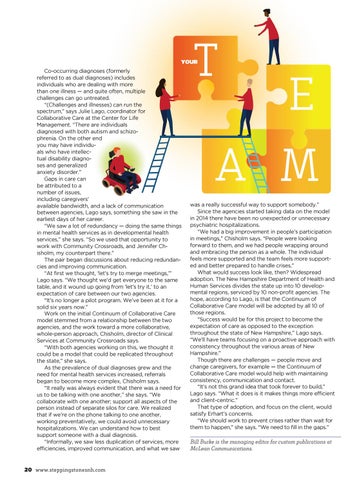
YOUR Co-occurring diagnoses (formerly referred to as dual diagnoses) includes individuals who are dealing with more than one illness — and quite often, multiple challenges can go untreated. “(Challenges and illnesses) can run the spectrum,” says Julie Lago, coordinator for Collaborative Care at the Center for Life Management. “There are individuals diagnosed with both autism and schizophrenia. On the other end you may have individuals who have intellectual disability diagnoses and generalized anxiety disorder.” Gaps in care can be attributed to a number of issues, including caregivers’ available bandwidth, and a lack of communication between agencies, Lago says, something she saw in the earliest days of her career. “We saw a lot of redundancy — doing the same things in mental health services as in developmental health services,” she says. “So we used that opportunity to work with Community Crossroads, and Jennifer Chisholm, my counterpart there.” The pair began discussions about reducing redundancies and improving communication. “At first we thought, ‘let’s try to merge meetings,’” Lago says. “We thought we’d get everyone to the same table, and it wound up going from ‘let’s try it,’ to an expectation of care between our two agencies. “It’s no longer a pilot program. We’ve been at it for a solid six years now.” Work on the initial Continuum of Collaborative Care model stemmed from a relationship between the two agencies, and the work toward a more collaborative, whole-person approach, Chisholm, director of Clinical Services at Community Crossroads says. “With both agencies working on this, we thought it could be a model that could be replicated throughout the state,” she says. As the prevalence of dual diagnoses grew and the need for mental health services increased, referrals began to become more complex, Chisholm says. “It really was always evident that there was a need for us to be talking with one another,” she says. “We collaborate with one another; support all aspects of the person instead of separate silos for care. We realized that if we’re on the phone talking to one another, working preventatively, we could avoid unnecessary hospitalizations. We can understand how to best support someone with a dual diagnosis. “Informally, we saw less duplication of services, more efficiencies, improved communication, and what we saw
20 www.steppingstonesnh.com
E
A M was a really successful way to support somebody.” Since the agencies started taking data on the model in 2014 there have been no unexpected or unnecessary psychiatric hospitalizations. “We had a big improvement in people’s participation in meetings,” Chisholm says. “People were looking forward to them, and we had people wrapping around and embracing the person as a whole. The individual feels more supported and the team feels more supported and better prepared to handle crises.” What would success look like, then? Widespread adoption. The New Hampshire Department of Health and Human Services divides the state up into 10 developmental regions, serviced by 10 non-profit agencies. The hope, according to Lago, is that the Continuum of Collaborative Care model will be adopted by all 10 of those regions. “Success would be for this project to become the expectation of care as opposed to the exception throughout the state of New Hampshire,” Lago says. “We’ll have teams focusing on a proactive approach with consistency throughout the various areas of New Hampshire.” Though there are challenges — people move and change caregivers, for example — the Continuum of Collaborative Care model would help with maintaining consistency, communication and contact. “It’s not this grand idea that took forever to build,” Lago says. “What it does is it makes things more efficient and client-centric.” That type of adoption, and focus on the client, would satisfy Erhart’s concerns. “We should work to prevent crises rather than wait for them to happen,” she says. “We need to fill in the gaps.” Bill Burke is the managing editor for custom publications at McLean Communications.
Mark your Calendar for a Spectacular Weekend Join us for the New Hampshire Family Support Conference on April 24-26 at the beautiful Mt. Washington Omni Hotel! This annual conference attracts individuals, families, and professionals representing the NH populations served by long-term supports and services. Attracting more than 500 families from around the state, you are sure to make new friends at workshop sessions and activities showcasing a variety of possibilities through education, opportunities and shared experiences. Requests for workshop proposals and exhibitor tables begins October 2019. Look for updates at www.fscnh.com or follow us on Facebook@fsconh. Have questions? Email fsconference@communitycrossroadsnh.org
Hope to see you there!
DRC-NH is dedicated to eliminating barriers for people with disabilities across the state. Call us to schedule a free consultation on a disability discrimination issue with an experienced attorney.
· Abuse and neglect · Access and accomodation · Children’s Issues · Employment · Special Education
· Housing · Medicaid and healthcare · Mental health · Traumatic Brain Injury · Voting
603-228-0432 • www.drcnh.org
Expanding opportunities for people with disabilities
Stepping Stones NH • 2019-2020 21
In the Spotlight:
the NH Family Su p
Courtesy photos
Two families talk about their experiences at the annual event
Carrie Duran with twin daughters Marisole and Isabella, and 8-year-old Katie.
A place where you can be you
M
y girls and I have been attending the New Hampshire Family Support Conference for five years. The conference has become a bright beacon for our family. It is something we look forward to every year. What are my girls’ favorite parts of the conference? One would say the anticipation and planning. One would say the road trip up to the beautiful Omni Mount Washington Hotel in Bretton Woods. And another would say the pool. Mom says it is the chance to breathe and have the freedom to unapologetically be you. My 13-year-old twin girls, Marisole and Isabella, are proud big sisters to 8-year-old Katie. My twins are typically developing; Katie was born with Down syndrome. Down syndrome is a genetic condition which involves an extra copy of the 21st chromosome. For Katie, this extra chromosome means frequent doctor visits, therapies, 22 www.steppingstonesnh.com
The Omni Mount Washington Hotel welcomes families and children with disabilities.
by Carrie Duran
specialists and hospital stays. Katie’s sisters often join us in our medical travels and have become experts, along with their Mom, about Katie’s medical needs and how to ensure she stays healthy. With that knowledge is extra worry and concern for their sister’s well-being. Attending the Family Support conference is a welcoming experience from the minute you arrive and are greeted by the staff. They are all well versed in the needs of families touched by disabilities. They understand it may take us longer to disembark from our cars and we may have heavy medical equipment to unload. Everyone is treated as valued guests from start to finish. The conference can be a whirlwind the first time. Thankfully the hotel is full of people who have been in the same situation. Everyone is welcoming and new friends can be made while simply asking for directions. The main lobby is full of informational
tables with vast amounts of disability-related resources and smiling faces hoping to make a difference in your life. You may recognize a family you know from your school district, or a staff member from your area agency, or a committee member from your Family Support Council. You will find the beautiful interior of the hotel lobby, with its high ceilings and antique furniture robust with conversation and laughter. I look forward to seeing friends I have made from all over the state and catching up while our children play in the arcade. I enjoy stopping by a vendor table and learning about opportunities or resources that may be helpful to Katie and our family. Attending the workshops and continuing my education as a parent and advocate builds my confidence year after year. Socializing with families at breakfast and belting out my favorite tunes, quite horribly, at karaoke for the adults are always memorable moments of understanding and connection.
u pport Conference Family of child with autism finds support and connection at conference by Jennifer and Shawn Bertrand
T ore imagine a m It’s difficult to in ge ga ing to en beautiful sett ith w s ie it un port networking op e and servic other families ers. id ov pr
My older girls have stayed in touch with other siblings they have met at the conference, telling me those friendships sometimes come easier than ones at school because they get it. They understand what my girls are going through because they are experiencing the same worries and the same feelings of knowing their brother or sister with the disability usually comes first. I am grateful they have these relationships. At the Family Support Conference two years ago, while checking out of the hotel, my daughter Katie was missing for about 10 minutes. One minute she was standing beside me and the next she was nowhere to be found. Once I calmed down and was able to reflect on the experience, I realized we couldn’t have been in a better place — a hotel full of people who get it. They understood what I was going through and helped me find my daughter. We do not judge. We listen to one another, learn from each other and offer our support. Attending the conference gives me the opportunity to connect with families and grow our circle of friends while learning more about our community. My girls and I have learned we have a place where we will always be accepted and feel comfortable to be ourselves.
he New Hampshire Family Support Conference has been a valuable experience for our family over the last 20 years. The conference provides essential information about the latest developments related to best practices around education, employment, transition, housing, etc. as well as support for individuals with disabilities. Attending is a critical opportunity to network with experts specializing in all areas of disability and with parents who either are experiencing challenges similar to yours or have seen those challenges and can provide support and guidance. Every year, the conference leaves us with renewed energy and vital information to use in supporting our daughter to live a meaningful, inclusive life. Our favorite aspects of the conference are the networking opportunities as they have provided the most important and lasting impact. The sessions provide a solid base for re-energizing advocacy efforts with useful and up-to-date information. When our boys (siblings of our daughter with autism) attended the conference, they enjoyed meeting other kids their age and found some helpful support in talking with them about the challenges they experienced. All conference organizers, speakers, and volunteers aim to provide a welcoming atmosphere for families where sessions are well-balanced across age groups. The conference also balances the education of its attendees and the need for families to have that important time away. For families attending the conference for the first time, we highly recommend introducing themselves to session speakers, who themselves are knowledgeable and well-connected members of the community and who can suggest the next steps and other individuals to contact for more information. The free-time and evening activities are also very important to expand network opportunities and just enjoy the time away. While it may be difficult to find support for your child with autism, it’s been beneficial for our family to have a break from our care-giving responsibilities and devote our full attention to the conference and its many benefits. Stepping Stones NH • 2019-2020 23
NEW HAMPSHIRE COUN C Self-Advocacy Leadership Team
SALT serves as consultants for the NH Council on
Developmental Disabilities and other organizations. Our groups’ members are talented citizens who effect positive change in New Hampshire. We are committed to supporting people who experience disabilities by tackling big issues that increase the quality of life in the communit community.
Find out more about becoming a part of our TEAM! www.nhcdd.org/Advocacy.php
Resour
T
he New Hampshire Council on Developmental Disabilities has compiled this listing to
help people with disabilities and their families find the information, services, and supports they need. A complete version of the resource guide is available online at www.nhddresources. wordpress.com or by calling (603)
603-271-7040 www.nhcdd.org
271-7038.
CONTENTS I. Information and Referral Services, Guidebooks and Online Resources
Providing today’s students with skills for tomorrow’s workforce NHVR aims to prepare students living with disabilities for the workforce — providing specific transition services in schools and in the community. Services are available to all students with disabilities, not just NHVR participants. They are provided on an individual basis or as group workshops. Working together with community partners, we provide skills and experiences so students may successfully pursue their career goals and plan for life after high school.
CALL ONE OF OUR REGIONAL OFFICES TO LEARN HOW STUDENTS CAN PARTICIPATE
Berlin, 752-2271 • Concord, 271-2327 • Keene, 357-0266 Manchester, 669-8733 • Nashua, 889-6844 • Portsmouth, 436-8884 24 www.steppingstonesnh.com
II. Information and Resources on Specific Disabilities or Topics • Advocacy and Self-Advocacy • Assistive Technology • Autism • Blind Resources • Brain Injury • Bullying • Children with Disabilities or Significant Medical Needs • Deaf and Hard of Hearing • Dental Services • Developmental Disabilities and Acquired Brain Disorders • Employment • GED/Adult Education • Government Benefits and Agencies • Housing • Independent Living — Adults with Physical Disabilities • Legal Assistance • Mental Health and Suicide Prevention • Research and Training • Transition • Transportation
N CIL ON DEVELOPMENTAL DISABILITIES
urce Guide Information and Referral Services, Guidebooks and Online Resources MANEUVERING THROUGH THE MAZE
http://www.nhfv.org/Publications.html A comprehensive resource guide of state health and human services agencies, educational resources, private associations and organizations that serve people in New Hampshire with physical, developmental, mental health and chronic illnesses and their families, from birth to adulthood. Produced by NH Family Voices.
NH FAMILY VOICES
(603) 271-4525, (800) 852-3345 ext. 4525 (in NH only) http://www.nhfv.org A “Family to Family Health and Education Center” assisting families of children and young adults with chronic health, physical, developmental and mental health challenges. Provides one-to-one phone assistance, educational materials, online resources, a lending library and quarterly newsletter. Funded by state and federal grants, as well as donations from community partners and supporters.
PARENT INFORMATION CENTER ON SPECIAL EDUCATION (PIC)
54 Old Suncook Road, Concord (603) 224-7005, (800) 947-7005 http://nhspecialed.org Telephone/email support to families with questions about early supports and services, special education and other disability-related concerns, interactive workshops for parents, volunteer advocate training and informational materials (online and printed). Funded in part or whole by the U.S. Department of Education.
DISABILITY RIGHTS CENTER – NH (DRC)
(603) 228-0432, (800) 834-1721 (v/tty) http://www.drcnh.org Information, referral, advice, and legal representation and advocacy to individuals with disabilities on a wide range of disability-related issues. Online resources and materials available on many disability-related topics. Federally funded Protection and Advocacy Center.
SERVICELINK AGING & DISABILITY RESOURCE CENTERS
(866) 634-9412 http://www.nh.gov/servicelink From local offices throughout the state, helps individuals access long-term services, supports and resources, access family caregiver information, explore options and understand and access Medicare and Medicaid. After-hours appointments are available as needed. Callers are automatically connected to the ServiceLink office in their area. Funded by the State of New Hampshire and federal government. Online ServiceLink Community Services and Supports Resource Directory: http://www.referweb.net/nhsl/
BRAIN INJURY ASSOCIATION OF NEW HAMPSHIRE
http://www.bianh.org/resourcedir.html List of resources compiled by the Brain Injury Association of New Hampshire.
GOVERNOR’S COMMISSION ON DISABILITY
121 South Fruit Street, Suite 101, Concord (800) 852-3405, (603) 271-2773 http://www.nh.gov/disability Provides information on the Americans with Disabilities Act (ADA) and accessibility issues, including accessible parking spaces, housing, voting and transportation. Online list of state and federal government benefit programs for people with disabilities. http://www.nh.gov/disability/information/community/benefitsforpeople.htm
NH STATEWIDE INDEPENDENT LIVING COUNCIL (SILC)
121 South Fruit Street, Concord (800) 852-3405, (603) 271-0476 http://www.silcnh.org/ Provides a monthly resource newsletter, archives of past issues and online “tip sheets” on benefits, housing and health care, based on an independent living philosophy. A federally funded, independent, cross-disability council.
NH FAMILY TIES (FORMERLY PARENT TO PARENT OF NH)
Ashlee Fye, Statewide Coordinator (800) 499-4153 ext. 241 http://www.nhfamilyties.org Provides parent matches between experienced parents, who have “been there,” with new or referred parents of children with special needs just beginning to meet the challenges of a disability or chronic health condition. Available through the area agency network as part of their family support services. NH Family Ties provides information and referral to community resources, services, support groups, state support programs, and others.
2-1-1 NEW HAMPSHIRE
http://www.211nh.org Information and referral for general human services including help with food, emergency housing, employment, health care and counseling is available by dialing 211 in NH or (866) 444-4211 from out of state. Operated by United Ways of New Hampshire.
NHCAREPATH
(866) 634-9412 http://www.nhcarepath.org/ Designed as New Hampshire’s “front door” to quickly connect individuals of all ages, abilities and income levels to a full range of community services and supports, including housing, transportation, financial assistance, Medicaid, veterans’ services, mental health, drug and alcohol services. Operated by the NH Department of Health and Human Services.
DISABILITY.GOV
https://www.disability.gov/ A federal inter-agency web portal providing access to comprehensive information about disability-related programs and services. The site contains thousands of trusted resources, updated daily, from the federal government, educational institutions, non-profit organizations and state and local governments.
NH DHHS DIVISION OF FAMILY ASSISTANCE
129 Pleasant St., Concord (800) 852-3345 ext. 9700, (603) 271-9700
Information and Resources on Specific Disabilities or Topics ADVOCACY AND SELF-ADVOCACY ABLE NH
(603) 271-7042 http://www.ablenh.org ABLE (Advocates Building Lasting Equality) advocates for the human and civil rights of all children and adults with disabilities and promotes full participation by improving systems of supports, connecting families, inspiring communities and influencing public policy.
NEW HAMPSHIRE COUNCIL ON DEVELOPMENTAL DISABILITIES
2½ Beacon Street, Suite 10, Concord (603) 271-3236 http://www.nhcdd.org Federally funded agency that supports public policies and initiatives to
Stepping Stones NH • 2019-2020 25
RESOURCE GUIDE Providing quality programs to enhance the lives of adults and adolescents with autism and their families in our community. communit www.greengardcenter.org greengardcenter@gmail.com
95 Brewery Lane Portsmouth, NH 03801 603-501-0686
remove barriers and promote opportunities in all areas of life. Its mission includes “dignity, full rights of citizenship, equal opportunities, and full participation for all New Hampshire citizens with developmental disabilities.” Members are appointed by the Governor and represent people with developmental disabilities, parents, guardians and agencies that serve people with disabilities.
NEW HAMPSHIRE LEADERSHIP SERIES
(603) 228-2084, (800) 238-2048 http://nhleadership.org Intensive 7-session leadership training provides parents and people with disabilities with information and strategies to effectively impact local and state organizations regarding issues related to individuals with disabilities and their families.
PEOPLE FIRST OF NEW HAMPSHIRE
NH Council on Developmental Disabilities 2½ Beacon Street, Suite 10, Concord (603) 271-3236 http://www.peoplefirstofnh.org Statewide self-advocacy organization and umbrella for 17 self-advocacy groups for people with intellectual and other developmental disabilities. Provides resources, training and support. Call for the chapter in your area or how to start one.
• Applied Behavior Analysis (ABA) & Autism Consultation & Direct Services for schools, families & agencies • Special Educational Day School for students with autism • Career Opportunities for clinical instructors, RBTs, BCBAs & other professionals at one of the “Coolest Companies | for Young Professionals in N.H.” (Winner, 2013 Rising Stars Awards) The Birchtree Center admits students of any sex, race, creed, color, marital status, national/ ethnic origin and economic status. EOE.
Seacoast NH • A nonprofit organization www.birchtreecenter.org • 603-433-4192
26 www.steppingstonesnh.com
Antioch University New England 40 Avon Street, Keene (800) 552-8380 admissions@antiochne.edu http://www.antiochne.edu Offers practice-oriented, values-based graduate study. Master degrees in education, environmental studies, management, and psychology; doctoral degrees in environmental studies and psychology. Also offering an Autism Spectrum Disorders Certificate program — a program for teachers, counselors, speech-language pathologists, psychologists, advocates, occupational therapists and others.
ASPERGER’S ASSOCIATION OF NEW ENGLAND
(617) 393-3824, (866) 597-AANE The Asperger’s Association of New England (AANE)’s mission is to foster awareness, respect, acceptance, and support for individuals with AS and related conditions and their families.
BLIND SERVICES
CROTCHED MOUNTAIN ATECH SERVICES
FUTURE IN SIGHT
AUTISM
Autism & ABA Programs
DEPARTMENT OF APPLIED PSYCHOLOGY
ASSISTIVE TECHNOLOGY
57 Regional Drive, Suite #7, Concord (800) 932-5837, (603) 226-2900 atech@crotchedmountain.org https://crotchedmountain.org/ programs-and-services/assistivetechnology/ Formerly NH-ATEC, this highly specialized clinical program provides evaluation and consultation services in the area of assistive technology. Services include augmentative and alternative communications (AAC), seating and wheeled mobility, access and independent living and computer access.
AUTISM PROGRAMS
Provides services at no cost, functioning as a single point of contact for support, information and services for autism-related disorders. Helps families navigate the developmental service system, explore treatment options, identify funding options and advocate for their child.
NH VIRTUAL AUTISM CENTER
Maintained by NH Council on Autism Spectrum Disorders 2½ Beacon Street, Suite 10, Concord info@nhcouncilonasd.org http://www.nhvirtualautismcenter.info Provides a single point of entry to a comprehensive body of information about NH services for those who experience autism spectrum disorders. Also offers best practices guidelines.
AUTISM RESOURCE CENTER
Crotched Mountain ATECH Services 57 Regional Drive, Concord (603) 226-2900, ext. 29, (800) 932-5837 autismresources@crotchedmountain.org http://www.crotchedmountain.org/ Programs-and-Services/ABATreatment-for-Young-Children-withAutism/Autism-Resource-Center/
25 Walker St., Concord (603) 224-4039, (800) 464-3075 http://www.futureinsight.org A nonprofit organization dedicated to transforming the lives of those who are blind or visually impaired and their families. Provides a range of services in education, rehabilitation, and social services for infants and toddlers, children (3-21), adults and seniors.
NH SERVICES FOR THE BLIND AND VISUALLY IMPAIRED
21 South Fruit Street, Suite 20, Concord (603) 271-3537, (603) 271-3471 (v/tty), (800) 581-6881 http://www.education.nh.gov/ career/vocational/blind_visu.htm Provides those services necessary to help people with visual loss to enter, re-enter, or maintain employment. Most services are provided without charge to the referred individual. Services for Blind and Visually Impaired Program is supported by state and federal tax dollars.
BRAIN INJURY BRAIN INJURY ASSOCIATION OF NH
52 Pleasant St., Concord (800) 773-8400, (603) 225-8400 (NH only Information & Resources) (800) 444-6443 (National toll-free Brain Injury Resource Line) http://www.bianh.org Helps people with brain injury-related disabilities live in their own homes and communities. Chartered state affiliate of the Brain Injury Associa-
tion of America (BIAA; http://www. biausa.org). Comprehensive online resource directory at http://www. bianh.org/resourcedir.html
BULLYING NH DEPARTMENT OF EDUCATION
Bullying and Cyber Bulling Resources http://education.nh.gov/instruction/ integrated/title_iv_cyber_bully.htm
STOPBULLYING.GOV
http://www.stopbullying.gov A federal website that provides information from various government agencies about what bullying is, what cyberbullying is, who is at risk, and how to prevent and respond to bullying.
CHILDREN WITH DISABILITIES OR SIGNIFICANT MEDICAL NEEDS YOUR PEDIATRICIAN
Provides the gateway to proper assessment, diagnosis, and initial treatment, services, and supports.
YOUR LOCAL SCHOOL DISTRICT
If you have a child with a disability who is eligible for special education services, your child may receive services from ages 3-21. Contact your school district before your child turns three — the age at which the school district becomes responsible for your child’s education.
NH MEDICAID FOR CHILDREN
Coverage for children up to age 19 and “Katie Beckett” option 129 Pleasant Street, Concord (877) 464-2447 Children’s Medicaid Unit http://www.dhhs.nh.gov/dfa/ medical/children.htm Provides comprehensive health and dental insurance to NH children ages 0-19 for families without access to insurance or for whom it is unaffordable (formerly NH Healthy Kids). Also, Home Care for Children with Severe Disabilities (HCCSD), commonly known as the “Katie Beckett” option, is available for severely disabled children up to age 19, whose medical disability is so severe that they qualify for institutional care but are being cared for at home. Only the income and resources of the disabled child are counted towards eligibility for this program.
IN-HOME SUPPORT (IHS) WAIVER FOR CHILDREN WITH SEVERE DISABILITIES
NH DHHS Bureau of Developmental Services 105 Pleasant St., Concord (800) 852-3345, ext. 5034 Provides assistance for children with the most significant medical and behavioral challenges requiring long-term supports and services, who live at home with their families, are Medicaid eligible, and meet the ICF/ MR level of care and other qualifications of the program. The goal of the IHS waiver is to provide services which are necessary to allow the individual to remain at home with his/
her care-giving family. Services are provided through the Developmental Disabilities Area Agencies.
Call for a FREE phone consult with a Certified Speech Language Pathologist today!
FAMILY CENTERED EARLY SUPPORTS AND SERVICES (FCESS)
• Treating children and adults of all ages • Most insurances accepted
NH Bureau of Developmental Services 105 Pleasant Street Concord (603) 271-5034, (800) 852-3345, ext. 5034 http://www.dhhs.state.nh.us/dcbcs/ bds/earlysupport/index.htm A program designed for children birth through age two who have a diagnosed, established condition with a high probability of delay, are experiencing developmental delays, or are at risk for substantial developmental delays if supports and services are not provided. FCESS are delivered in the family’s home by designated nonprofit and specialized service agencies located throughout the state.
80 Nashua Rd., Building B • Londonderry, NH • 603-548-2188
www.premierspeechtherapy.com
SPECIAL MEDICAL SERVICES
NH Department of Health and Human Services 129 Pleasant St., Concord (800) 852-3345 ext 4488, (603) 271-4488 http://www.dhhs.nh.gov/dcbcs/bds/ sms/specialcare.htm The NH Title V Program for Children with Special Health Care Needs. Administers health programs and services for children ages birth to 21 years, who have, or are at risk for a chronic medical condition, disability or special health care need. Works together with families and their health care providers, community agencies and schools to obtain access to needed health care and related services. Provides care coordination services; support for child development and neuromotor clinics; nutritional and feeding/swallowing consultation; psychological and physical therapy services.
NH PARTNERS IN HEALTH
129 Pleasant St., Concord (800) 656-3333, (800) 735-2964 (TDD) http://www.dhhs.nh.gov/dcbcs/bds/ sms/pih/ Helps families of children with a chronic health condition that significantly impacts daily life. Partners in Health’s role is to advocate, access resources, navigate systems and build capacity to manage the chronic health condition of their child. Locations throughout the state. No income requirements. NH Partners in Health Regional Sites and Towns Served: http://www.dhhs. nh.gov/dcbcs/bds/sms/pih/documents/ towns.pdf
DEAF AND HARD OF HEARING NORTHEAST DEAF AND HARD OF HEARING SERVICES INC.
56 Old Suncook Rd., Suite 6 Concord (603) 224-1850, (603) 224-0691 (TTY) Video Phone (VP): 968-5889 http://www.ndhhs.org New Hampshire’s “one-stop” resource for services specific to the Deaf and Hard of Hearing community and for information about hearing loss.
robert t. bevill, j.d., ll.m. Education Advocate 504s · IEPs · Manifest Determination P.O. Box 1237 Merrimack, NH 03054 TEL: (603) 722-0990 · FAX: (603) 722-0997 bob@bevill.com
Stepping Stones NH • 2019-2020 27
RESOURCE GUIDE DENTAL SERVICES DONATED DENTAL SERVICES
Dental Lifeline Network (800) 292-1531 http://dentallifeline.org/newhampshire/ A statewide program that provides comprehensive treatment by volunteer dentists to elderly, disabled and medically challenged individuals.
EASTER SEALS ORAL HEALTH CENTER, MANCHESTER (603) 621-3482 http://www.easterseals.com/nh/ our-programs/oral-health-center/
Literacy Learning Solutions, LLC Full Service academic testing and tutoring clinic for students of all ages.
Staff evaluates, monitors, and responds to patients with a wide range of disabilities and special medical needs. Medicaid accepted.
DEVELOPMENTAL DISABILITIES AND ACQUIRED BRAIN DISORDERS
www.literacylearningsolutions.com
NH DHHS BUREAU OF DEVELOPMENTAL SERVICES
603-892-0336 154 Broad St. Suite 1524 Nashua, NH
Supporting exceptional children and families toward a successful future.
105 Pleasant St., Concord (800) 852-3345 ext. 5034 http://www.dhhs.nh.gov/dcbcs/bds/ index.htm The NH developmental services system offers individuals with developmental disabilities and acquired brain disorders a wide range of supports and services within their own communities through 10 designated non-profit area agencies that serve specific geographic regions. Supports include: • Service coordination • Day and vocational services • Personal care services • Community support services • Early Supports and Services and Early Intervention • Assistive technology services • Specialty services and family supports (including respite services and environmental modifications) • In-Home Support (IHS) Waiver for Children with Severe Disabilities For area agencies and communities served: http://www.dhhs.nh.gov/dcbcs/bds/ agencies.htm
EMPLOYMENT WORK INCENTIVE RESOURCE CENTER
• Residential Cottages • Day School • Community-Based Programs • ISO Foster Care SpauldingYouthCenter.org
Supporting
Children & Youth From
98 Communities
Around New England
Since 1871
Rural but not Remote Northfield Concord Manchester
Spaulding Youth Center • 72 Spaulding Rd • Northfield, NH 03276 • (603) 286-8901
Spaulding Youth Center is a 501(c)(3) organization.
28 www.steppingstonesnh.com
http://nhwirc.org New Hampshire’s online destination for information about benefits, planning and work incentives for individuals with disabilities.
NEW HAMPSHIRE VOCATIONAL REHABILITATION GUIDE
http://www.education.nh.gov/ career/vocational/cust_guide.htm A description of the vocational rehabilitation process and overview of the NHVR process, from application to post-employment services.
VOCATIONAL REHABILITATION
NH Department of Education Bureau of Vocational Rehabilitation 21 South Fruit St., Suite #20, Concord (800) 299-1647 http://www.education.nh.gov/ career/vocational/ Helps people with disabilities of all ages get jobs. Regional Offices: Berlin .....................(603) 752-2271 Concord .................(603) 271-2327 Keene .....................(603) 357-0266 Manchester ............(603) 669-8733 Nashua ..................(603) 889-6844 Portsmouth ............(603) 436-8884
NHWORKS
(603) 271-7275 http://nhworks.org Information center for job seekers and employers. Lists current job openings, NH economic and labor market information, education and training programs, employment laws, small business resources, and local Works Centers locations. Work Centers provide technical assistance to prepare resumes and cover letters, job search workshops, employment counseling, aptitude and skills testing, and career exploration tools. Sponsored by the NH Workforce Opportunity Council.
GED/ADULT EDUCATION NH BUREAU OF ADULT EDUCATION
GED & Adult Education Information 21 South Fruit St., Suite 20, Concord (603) 271-6698 http://www.nhadulted.org Supports educational services to adults who have not received a high school diploma or GED certificate or who do not read, write, or speak English. Grants to school districts and not-forprofit organizations make it possible for local adult education programs to serve adult learners whose skills range from very basic to high school level.
PARTNERSHIP IN EMPLOYMENT: SUPPORTING ADULTS WITH INTELLECTUAL AND DEVELOPMENTAL DISABILITIES IN THEIR COMMUNITIES
http://www.aucd.org/docs/resource /pie_adults_Nov2014_families.pdf A project of the Institute for Community Inclusion at the University of Massachusetts Boston, and the National Association of State Directors of Developmental Disabilities Services. Overview of day and employment services for people with developmental disabilities and guidance for those assisting them to become employed and part of the community.
GOVERNMENT BENEFITS/ AGENCIES APPLY ONLINE FOR BENEFITS WITH NH EASY
https://nheasy.nh.gov New Hampshire’s Electronic Application System (NH EASY) offers NH residents a fast and easy way to apply online for cash, medical, child care, Medicare savings program and food stamp benefits.
A GUIDE TO BUYING YOUR FIRST HOME • FIND A FOOD TRUCK
NH Department of Health and Human Services
129 Pleasant St., Concord (800) 852-3345 http://www.dhhs.nh.gov Provides services for individuals, children, families and seniors, and administers programs and services for mental health, developmental disabilities, substance abuse and public health. The DHHS website contains a description of programs and services administered by the department and information about how to apply.
DHHS District Offices
http://www.dhhs.nh.gov/contactus/ districtoffices.htm Local offices to apply for Medicaid, financial assistance, food stamps and other benefits.
Social Security
70 Commercial St., Suite 100, Concord (800) 772-1213, (800) 325-0778 (TTY) (603) 228-5206 (FAX) http://www.ssa.gov Applicants for SSDI and SSI can file for benefits online at SSA.gov website, by phone or by visiting a local Social Security Office.
Special Education
NH Department of Education Bureau of Special Education 101 Pleasant St., Concord (603) 271-6693 http://www.education.nh.gov/ instruction/special_ed/index.htm Online reports, data and regulations relative to special education.
NH Circuit Court — Probate Division
1 Granite Place, Suite N400, Concord (855) 212-1234 probateservice@courts.state.nh.us http://www.courts.state.nh.us/ probate/index.htm The Circuit Court Probate Division has jurisdiction over all matters related to wills, trusts and estates, guardianships and involuntary commitment proceedings, adoptions, name changes and partition of real estate. Probate judges preside over these cases from courthouses located in each of the 10 counties in NH.
Housing NH Housing Finance Authority
32 Constitution Dr., Bedford (800) 640-7239, (603) 472-8623 (603) 472-2089 (TDD) http://www.nhhfa.org A self-supporting public benefit corporation. The Authority administers a broad range of programs designed to assist low- and moderate-income people and families to obtain decent, safe and affordable housing. Home ownership programs, multi-family housing programs and rental assistance programs.
Local Public Housing Authorities http://www.hud.gov/offices/pih/pha/ contacts/states/nh.cfm
Provides housing for low-income people and families in local communities.
Brain Injury Association of New Hampshire Housing Assistance Guide
http://www.bianh.org/pdf/Housing.pdf Lists housing assistance resources compiled by the Brain Injury Association.
Disability.gov’s Guide to Housing https://www.disability.gov/resource/ disability-govs-guide-housing Information about government agencies and organizations helping individuals and families find affordable housing. Additional information about rental assistance programs, assisted living facilities and modifying a home to make it accessible.
Granite State Independent Living’s Home Access Modification
http://www.gsil.org/community -based-disability-supports/homeaccess-modification Trained staff assess accessibility needs and provide referrals to licensed vendors in NH. May also assist in establishing a plan and identifying funding sources for accessibility projects.
USDA Rural Development in Vermont/New Hampshire
(802) 828-6080 http://www.rd.usda.gov/nh Works to improve the quality of life in rural areas. Provides technical assistance to communities, and funding and resources for home purchase, apartment rental and repairs.
New Hampshire Community Loan Fund
7 Wall St., Concord (603) 224-6699 http://www.communityloanfund.org Collaborates with a wide range of donors and lenders, and with business, nonprofit and government partners. Provides financing and support to people with low and moderate incomes for affordable housing.
US Department of Housing and Urban Development (HUD)
New Hampshire Programs and Services (603) 666-7510 http://portal.hud.gov/hudportal/ HUD?src=/states/new_hampshire Assistance with home ownership, subsidized apartments, public housing, foreclosure assistance, homeless resources and discrimination. Counseling and other services available.
State of NH Foreclosure Prevention Initiative
For immediate assistance dial 211 (in NH)
www.homehelpnh.org Website with important tips on alternatives to foreclosure as well as other valuable resources. There is also a list of qualified housing counselors who can offer specific suggestions.
Independent Living — Adults with Physical Disabilities
COMPLIMENTARY
JUNE 2019
The
where we live issue
Granite State Independent Living
21 Chenell Dr., Concord (800) 826-3700, (603) 228-9680 http://www.gsil.org New Hampshire’s only Independent Living Center. Provides information, specialized services, and peer support for people with disabilities following the principles of personal choice and direction. Provides home care services, personal care, community-based disability supports and employment services including benefit counseling.
Legal Assistance Disability Rights Center – NH (DRC)
(603) 228-0432, (800) 834-1721 (v/tty) http://www.drcnh.org Information, referral, advice, and legal representation and advocacy to individuals with disabilities on a wide range of disability-related issues. Online resources and materials available on many disability-related topics. Federally funded Protection and Advocacy Center.
Guide to New Hampshire Legal Services Programs
http://www.courts.state.nh.us/ selfhelp/documents/legal_services_ brochure.pdf Produced by the NH Judicial Branch
NH Legal Aid
(800) 639-5290 http://www.nhlegalaid.org/ A cooperative effort of the legal services agencies serving New Hampshire’s low- income population to provide legal information, referrals, and pro se assistance. Online application for legal assistance. Website provides links and contact information to a number of non-profit agencies that provide a range of services across the state. Includes online self-help guides.
ParentingNH, a national award-winning publication, is New Hampshire’s first and only statewide magazine for
parents of children and teens.
NH Judicial Branch Self-Help Center
http://www.courts.state.nh.us/ selfhelp/index.htm Basic, practical information about the New Hampshire court system, how it works, and what the procedures are for bringing a case to court.
NH Bar Association Pro Bono Referral Program
(800) 639-5290, (603) 224-3333 Connects low-income individuals with volunteer attorneys who provide free legal services in family law, bankruptcy, consumer, housing and senior citizen matters.
Pick up your copy of this free publication at 500+ locations in New Hampshire.
New Hampshire Legal Assistance
(800) 562-3174 http://www.nhla.org Provides free legal advice and representation to low–income people and older adults in civil matters involving basic needs, including food, shelter, income, medical care and public benefits.
Available online: parentingnh.com
Stepping Stones NH • 2019-2020 29
RESOURCE GUIDE http://www.dhhs.nh.gov/dcbcs/bbh/ centers.htm Regional agencies provide publicly funded mental health services to individuals and families who meet certain criteria for services. Services include 24-hour emergency services, assessment and evaluation, individual and group therapy, case management, rehabilitation, psychiatric services and specialized programs for older adults, children, and families as well as short-term counseling and support.
Local Offices: Berlin .....................(800) 698-8969 Claremont ..............(800) 562-3994 Concord .................(800) 921-1115 Manchester ............(800) 562-3174 Portsmouth ............(800) 334-3135 Foreclosure Relief Project.....................(877) 399-9995 Senior Citizens Law Project .....................(888) 353-9944 ...............................or (603) 624-6000 THE “LAW LINE” — NH BAR ASSOCIATION (800) 868-1212 Talk to a lawyer free of charge on the 2nd Wednesday of the month, from 6 - 8 p.m.
MENTAL HEALTH PEER SUPPORT
NH DHHS Bureau of Behavioral Health (800) 852-3345 ext.5000, (603) 271-5000 http://www.dhhs.nh.gov/dcbcs/bbh/ peer.htm Local Peer Support Agencies provide services to adults with mental illness who self-identify as a recipient, former recipient, or at significant risk of becoming a recipient of publicly funded mental health services. Provided by and for people with a mental illness. Includes face-to-face and telephone peer support, outreach, monthly educational events, activities that promote self-advocacy, wellness training, afterhours warm line and crisis respite.
UNIVERSITY OF NEW HAMPSHIRE SCHOOL OF LAW CIVIL PRACTICE CLINIC
(603) 225-3350 Assists low-income clients with a variety of issues from consumer protection, collection and foreclosure defense (including Chapter 13 bankruptcy), predatory lending and auto fraud. Will take cases from Merrimack, Belknap, Sullivan and Hillsborough counties.
MENTAL HEALTH AND SUICIDE PREVENTION
DISASTER DISTRESS HELPLINE
(800) 985-5990, (800) 846-8517 (TTY) http://disasterdistress.samhsa.gov/ Website and helpline for those affected by a disaster and in need of immediate assistance, information, support, and counseling. Callers are connected to the nearest crisis center.
SAMHSA BEHAVIORAL HEALTH TREATMENT SERVICES LOCATOR AND TREATMENT REFERRAL HELPLINE
(800) 662-HELP (4357) (800) 487-4889 (TDD) http://findtreatment.samhsa.gov/ Use the Locator to find alcohol and drug abuse treatment or mental health treatment facilities and programs around the country. Or call the SAMHSA Treatment Referral Helpline. Free, confidential information in English and Spanish for individuals and family members facing substance abuse and mental health issues. 24 hours a day, 7 days a week. Sponsored by the Substance Abuse and Mental Health Services Administration (SAMHSA)
DISABILITY.GOV’S EMERGENCY PREPAREDNESS RESOURCES
http://nextsteps-nh.org/ Transition and career development resources for special educators, students, parents and others interested in increasing transition and career development opportunities for youth with and without disabilities.
NATIONAL SECONDARY TRANSITION TECHNICAL ASSISTANCE CENTER’S AGE APPROPRIATE TRANSITION ASSESSMENTS TOOLKIT
http://www.transitionta.org/ toolkit-resources Designed to help with the selection of assessments for students in regards to transition planning.
DISABILITY.GOV’S GUIDE TO STUDENT TRANSITION PLANNING
https://www.dol.gov/odep/ pdf/2013ODEPHealthyReport.pdf Link to Healthy Transitions: A pathway to employment for youth with chronic health conditions and other disabilities.
NHCAREPATH’S TRANSPORTATION WEBPAGE
RESEARCH AND TRAINING UNH INSTITUTE ON DISABILITY
(603) 228-2084 (TTY) (800) 238-2048 (TTY) http://iod.unh.edu Provides a university-based focus for the improvement of knowledge, policies, and practices related to the lives of people living with disabilities and their families. Offers seminars
NH DHHS Bureau of Behavioral Health (800) 852-3345, ext. 5000, (603) 271-5000
NEXT STEPS NH: OPTIONS FOR LIFE AFTER HIGH SCHOOL
SUICIDE PREVENTION LIFELINE
(603) 225-5359, (800) 242-6264 (These are NOT crisis response numbers) www.theconnectproject.org
COMMUNITY MENTAL HEALTH CENTERS
NH Parent Information Center’s Life After High School Toolkit nhspecialed.org/life-after-highschool/ Strategies, tools and resources for families of youth with disabilities to assist in creating successful transition plans.
TRANSPORTATION
NEW HAMPSHIRE SUICIDE PREVENTION AND GENERAL RESOURCES
85 North State St., Concord (800) 242-6264, (603) 225-5359 http://www.naminh.org A statewide network of affiliate chapter support groups, staff and volunteers that provide information, education and support to all families and communities affected by mental illness.
TRANSITION
https://www.dol.gov/odep/topics/ disability.htm
(800) 273-TALK (8255) www.suicidepreventionlifeline.org
NAMI NH
and workshops, webinars, interdisciplinary evaluation and consultation, leadership training, and customized, on-site support in schools.
http://www.nhcarepath.org/ transportation
NH DEPARTMENT OF TRANSPORTATION — PUBLIC TRANSPORTATION INFORMATION
(603) 271-3734 http://www.nh.gov/dot/org/ aerorailtransit/railandtransit/transit.htm Information about public transportation in New Hampshire, including links to regional transit providers.
NATIONAL REHABILITATION INFORMATION CENTER — GUIDE TO FINDING TRANSPORTATION SERVICES
http://www.naric.com/?q=en/FAQ/ where-can-i-find-transportationservices Help finding transportation services.
ADVERTISER INDEX Attorney Robert T. Bevill, LL.M.. . . 27 Birchtree Center, The. . . . . . . . . . . 26 Carriage Barn Equestrian Center, The. . . . . . . . . . . . . . . . . 5 Cedarcrest Center. . . . . . . . . . . . . 12 Community Bridges, Inc.. . . . . . . . . . 9 Community Support Network Inc (CSNI) . . . . . . . . . . . . . . 16-17 Crotched Mountain Foundation . . . . . . 10, back cover Disability Rights Center. . . . . . . . . 21 Easterseals. . . . . . . . . . . . . . . . . . . 27 Gateways Community Services. . . . . . . . . . . . . . . . . 9, 18 Greengard Center for Autism. . . . 26 Lakes Region Community Services Council . . . . . . . . . . . . 18 Literacy Learning Solutions. . . . . . 28 Living Innovations. . . . . . . . . . . . . . . 5 Manchester Community Music School. . . . . . . . . . . . . . . 28 Monadnock Developmental Services. . . . . . . . . . . . . . . . . . . . 9 Monarch School of New England . . . . . . . . . . . . . . 10 NH Council on Developmental Disabilities. . . . . . . 2, 5, 10, 21, 24 NH Vocational Rehabilitation . . . . 24 Northern Human Services. . . . . . . 13 One Sky Community Services. . . . 13 PathWays of the River Valley. . . . 21 Pediatric Therapy Center . . . . . . . 18 Play on Words . . . . . . . . . . . . . . . 13 Premier Speech Therapy. . . . . . . . 27 Richie McFarland Children’s Center. . . . . . . . . . . . . . . . . . . . 21 Seacoast Mental Health Center, Inc. . . . . . . . . . . . . . . . . 26 Spaulding Youth Center. . . . . . . . . 28 Swing for the Stars Pediatric Therapy Center, LLC. . . . . . . . . 18 The Moore Center. . . . . . . . . . . . . . 9
For a complete version of the Resource Guide visit www.nhddresources.wordpress.com or call (603) 271-7038 30 www.steppingstonesnh.com
Waypoint. . . . . . . . . . . . . . . . . . . . 12
Reach those who need you most.
Stepping Stones NH provides businesses and organizations
a direct link to individuals living with disabilities, their families and the professionals who support them. Position your business or organization as a leading provider or resource.
Published by
With sponsorship support from
Call today to reserve your ad space in next year’s edition of Stepping Stones NH:
(603) 413-5154