Couch Pharmacy Finds a Better Way to Fill Prescriptions With Flexible, Reliable Automation
Cody Abbott Operations Manager ~ Couch Pharmacy
A BUSY NEIGHBORHOOD PHARMACY
Couch Pharmacy is a local, independently owned retail pharmacy serving a diverse community in Tulsa, Oklahoma. Located in one of the city’s oldest neighborhoods, their team of pharmacists and pharmacy techs moves fast — filling between 450 and 600 prescriptions a day. This includes a combination of automated and manual hand filling, says Cody Abbott, operations manager for the pharmacy.
No stranger to automation, Couch Pharmacy has relied on a vial-fill robot for nearly two decades. Unlike some pharmacies using this type of automation, Abbott says his team follows a scan-to-fill workflow. They have staff dedicated to inputting and adjudicating prescriptions. Once adjudicated, pharmacists and techs then print out batches of labels, scan the items that can be automated, and hand count the rest. “I know many pharmacies will have their software communicate directly with the robot,” Abbott explains, “but that process just doesn’t fit our multiuser environment.”
THE CHALLENGE: AGING TECHNOLOGY AND INCREASING DOWNTIME
As Couch Pharmacy’s original robot began to sunset, keeping the system running became a challenge. Replacement parts were getting increasingly harder to source and could take weeks to procure. At the same time, the quality of customer service was becoming an issue. “The technicians sent to diagnose an issue weren’t always knowledgeable in the legacy system,” explains Abbott. “It could take several calls to their in-house experts and all day to get to the root of the problem.” As a result, parts of the robot could be down for a month or more — which meant more manual counting and filling by pharmacy staff.
Over time, the process for swapping out canisters also changed. “Canisters needed to be recalibrated all the time for whatever reason,” Abbott says. It could be due to minor changes in the dimension of a pill, onboarding a new manufacturer for an NDC, or simple wear and tear. Early on, Couch Pharmacy just had to request a new canister — but by
CASE STUDY
“There are other machines that can get pills into bottles,” says Abbott.“But it’s the customer service that backs it up that really makes a difference. That’s where McKesson excels.”
Cody Abbott Operations Manager ~ Couch Pharmacy
the end of their relationship with the previous vendor, they were being charged as much as $300 per canister. “It came to a point where I’d spend an hour or more fiddling with a canister we had in stock to try to get it working,” he says. “Before I knew it, everything else was backed up.”
Between the aging technology, customer service issues, and added expenses, Abbott says it just wasn’t worth it anymore. That’s when he began looking for more reliable automation that would fit with their workflow.
THE SOLUTION: COUNTMATE AUTOMATED VIAL-FILL ROBOT
Abbott began evaluating options by visiting other pharmacies. “There are several different styles of robots out there,” he says. Some use air compressors, which can run loud. Others use modular canisters designed to adapt to manufacturer changes easily but can still require some ‘fiddling’. “Neither solution was what I was looking for.”
Couch Pharmacy ultimately chose CountMate from McKesson, a diversified healthcare provider working with pharmacies as well as manufacturers and other stakeholders in the industry throughout North America. “I liked McKesson’s solution the best,” Abbott says. CountMate is a fully automated solution that streamlines the entire prescription counting process. With 84- and 168-cell configurations that support 13- and 30-dram vials, the system features two robotic arms that handle filling and labeling — then drops off prescriptions sorted by patient. An internal camera captures images of each vial for verification and accuracy. Medications in canisters are replenished automatically to reduce incomplete prescriptions. Plus, its front access design allows CountMate to be placed against a wall to maximize workspace.
“I know it’s difficult to call any of these automations ‘simple’ but where CountMate’s hardware is concerned, it seems like a simpler machine to me that is easier to fix if there is a problem,” says Abbott. A big part of CountMate’s simplicity, he adds, is McKesson’s canister swap process. “I can just send in a request for a new canister when I need one, and I have it within a day or two.”
IMPLEMENTATION: A SEAMLESS TRANSITION TO NEW AUTOMATION
According to Abbott, preparation made all the difference when it came to implementing the new system. McKesson gave them a pre-implementation checklist that Couch Pharmacy worked through to identify which medications would be automated. This included setting the 30-dram quantities for each in advance to ensure the robot would not overfill vials.
“I split the list with one of the techs and we just moved through it in whatever downtime we had,” says Abbott. That legwork meant implementation day was all about moving the old system out and installing the new one — not about trying to define the parameters of the process. “I want to say we were up and running the same day, but if it wasn’t we were definitely filling prescriptions the next day.”
CASE STUDY
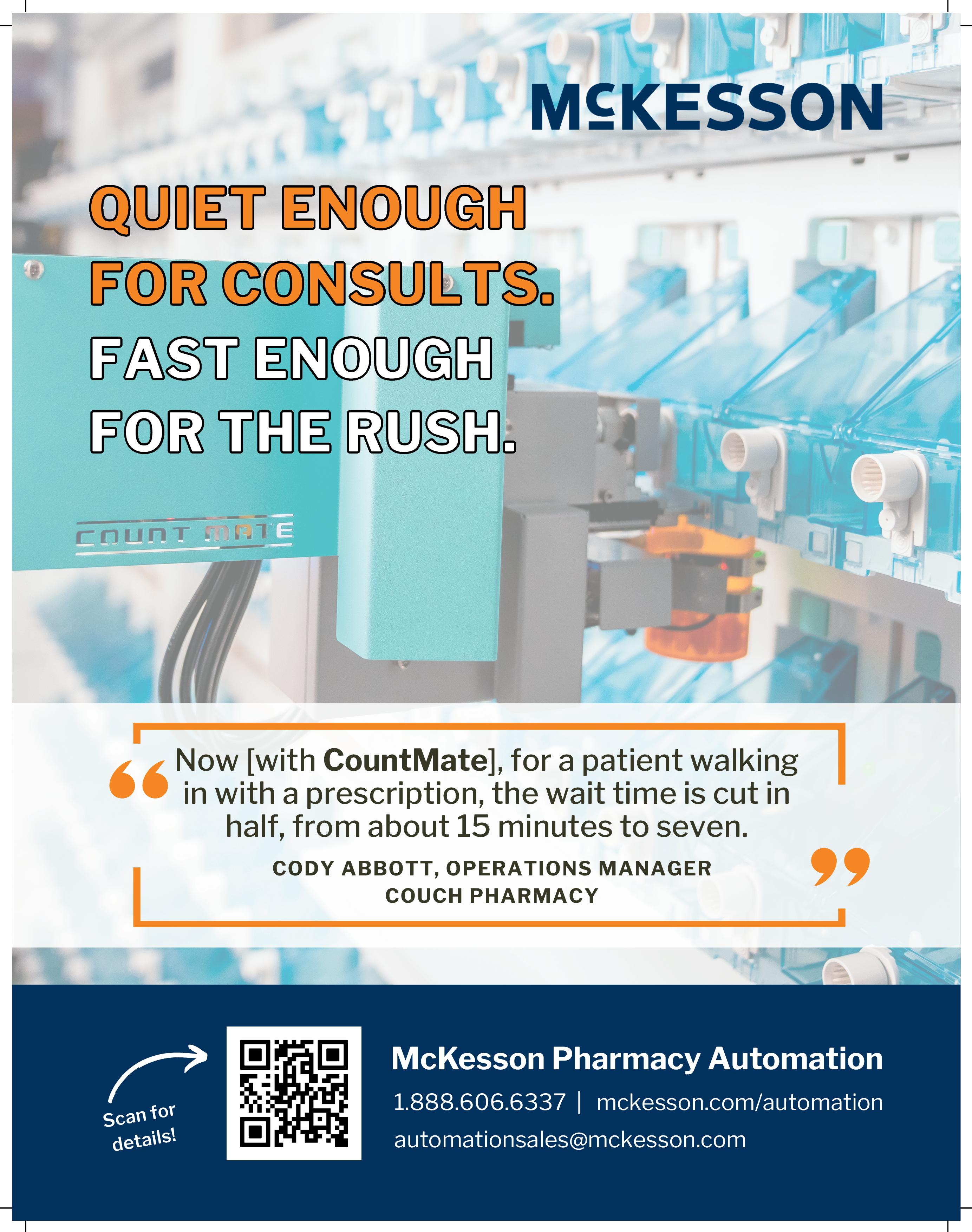
“Now, for a patient walking in with a prescription — the wait time is cut in half, from about 15 minutes to seven.”
Cody Abbott
Operations Manager
~ Couch Pharmacy
“CountMate is remarkably quiet. I think the refrigerator we use to store our cold product is louder.
Cody Abbott
Operations Manager
~ Couch Pharmacy
THE RESULT: SPEED AND RELIABILITY
Today, Couch Pharmacy keeps roughly 150-155 of its top moving medications in the CountMate, leaving about 10 cells open. That buffer gives the team flexibility if a canister needs attention, or they want to automate a new medication. Other than that, Abbott says, their process is the same as it always has been — with one exception: CountMate makes them more efficient. “Now, for a patient walking in with a prescription, the wait time is cut in half, from about 15 minutes to seven.”
“Our normal process is that I’ll print out a batch of labels — say 10, for example” explains Abbott. “Six or seven of them are in the robot, so I scan those for CountMate to fill and fill the rest by hand.” With the older system, Abbott says he was always done with his batch before the robot was. “Now, CountMate is always done before I am.” That’s because each canister is equipped with its own motor for counting combined with two robotic arms for running the vials. The previous system, on the other hand, had only one robotic arm that did everything — counted medication and then filled and delivered the vials. “The robot we were using before could only count one medication at a time,” says Abbott. “Today, there could be two or three of us scanning prescriptions and you can hear all these canisters counting at the same time. It’s pretty cool.” Still, he says, CountMate is remarkably quiet. “I think the refrigerator we use to store our cold product is louder.”
Beyond the uptick in efficiency, Abbott says the customer service experience has been night and day. “If we have a problem, we call and get somebody right away. They work with us on the phone to try to fix it, but if they can’t — they don’t waste time. They go right ahead and dispatch a tech who is typically here the next day.” That reliability keeps the focus on patients rather than workarounds. “There are other machines that can get pills into bottles,” says Abbott. “But it’s the customer service that backs it up that really makes a difference. That’s where McKesson excels.”
While Couch Pharmacy hasn’t seen an increase in prescriptions since installing CountMate, Abbott is confident that they are well-equipped to manage extra volume when it comes.