Washington University in St. Louis
McKelvey School of Engineering
![]()

Washington University in St. Louis
McKelvey School of Engineering


No. 2
School of Medicine NIH funding in Blue Ridge Institute for Medical Research (2024)


PhD in Imaging Science No. 12 Biomedical Engineering graduate program ranking in U.S. News (2024)
BS in Biomedical Engineering
MS in Biomedical Engineering
MS in Imaging Science
PhD in Biomedical Engineering

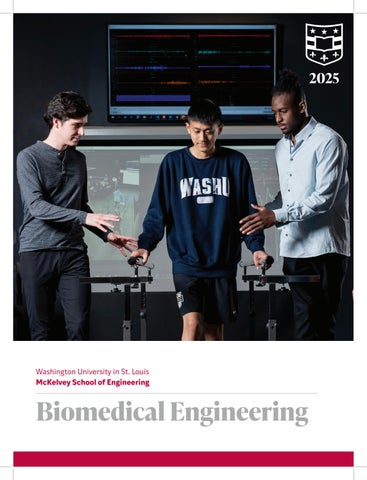
McKelvey’s world-class Biomedical Engineering program prepares students for exciting careers at the convergence of engineering and medicine, surrounding them with cutting-edge facilities, wide-ranging resources and a collaborative spirit that supports the end goal of improving human health.
A hallmark of the program, McKelvey’s collaborations have led to major advances
in positron emission tomography, medical applications of ultrasound, application of computers to hearing research and development of heart valve flow simulators.
Our students take full advantage of the proximity of the Medical Campus, located just across Forest Park and quickly accessible on the MetroLink lightrail system. The new WashU School of Public Health creates opportunities for future collaborations.

Biomedical & Biological Imaging
Cardiovascular Engineering
Cell & Molecular Bioengineering
Neural Engineering
Orthopedic Engineering
Regenerative Engineering in Medicine
Women’s Health Engineering

Top departments for BME student research:
» Biomedical Engineering
» Cell Biology & Physiology
» Computer Science & Engineering
» Electrical & Systems Engineering
» Genetics
» Mechanical Engineering & Materials Science
» Neurology
» Neuroscience
» Neurosurgery
» Obstetrics/Gynecology
» Ophthalmology & Visual Sciences
» Orthopaedic Surgery
» Pathology & Immunology
» Radiation Oncology
» Radiology

What is the focus of your research?
I work in Spencer Lake’s lab, where we study the structure and mechanics of musculoskeletal soft tissues like tendons and ligaments. For my project, I use a model of elbow dislocation to develop better physical therapy techniques and identify potential drug targets to prevent stiffness and fibrosis from occurring after elbow injuries.
What are your plans for the future?
I hope to stay in academia after graduation to complete a postdoctoral fellowship and eventually become a professor with my own research lab.
centers for biomedical research collaboration
» Center for Biomolecular Condensates (CBC)
» Center for Cellular Imaging
» Center for Cyborg and Biorobotics Research
» Center for Engineering MechanoBiology (CEMB)
» Center for High Performance Computing (CHPC)
» Center for Human Immunology & Immunotherapy Programs (CHiiPS)
» Center for Innovation in Neuroscience and Technology (CINT)
» Center for the Investigation of Membrane Excitability Diseases (CIMED)
» Center for Regenerative Medicine (CRM)
» Center for Women’s Health Engineering (CWHE)
» Children’s Discovery Institute
» Genome Engineering & iPSC Center (GEiC)
» Hope Center for Neurological Disorders
» Imaging Sciences Pathway (ISP)
» Institute of Clinical and Translational Sciences (ICTS)
» Institute for Materials Science and Engineering (IMSE)
» McDonnell Center for Systems Neuroscience
» McDonnell Genome Institute (MGI)
» Musculoskeletal Research Center (MRC)
» Siteman Cancer Center

Brain decoder controls spinal cord stimulation
Ismael Seáñez, assistant professor of biomedical engineering at McKelvey and of neurosurgery at WashU Medicine, and members of his lab, including Carolyn Atkinson, a doctoral student, have developed a type of decoder to restore the communication between the brain and the spinal circuits that’s interrupted when a spinal cord injury occurs. Through experiments in their lab with 17 human subjects without a spinal cord injury, they were able to cue movement in the lower leg with transcutaneous spinal cord stimulation.
Results were published in the Journal of NeuroEngineering and Rehabilitation.
The team used a cap fitted with noninvasive electrodes that measure brain activity through electroencephalography (EEG). While wearing the cap, seated volunteers were asked to extend their leg at the knee, then to only think about extending their leg. The team provided the neural activity to the decoder so it could learn how the brain waves act in both circumstances.

A closer look at biomolecular ‘silly putty’
Biomolecular condensates are shifting blobs in our cells that organize cellular matter. They are distinct molecular communities made of DNA, RNA and proteins that “condense” molecules to key locations. Because they are so small, they cannot be measured using traditional microscopes. Researchers in the Center for Biomolecular Condensates at WashU have devised a method to image condensates’ internal organization to explain condensate viscoelasticity.
Rohit Pappu, Gene K. Beare Distinguished Professor of biomedical engineering, Matthew Lew, associate professor of electrical & systems engineering, and colleagues tested computational predictions by peering into condensates via super-resolution microscopy.
In research published in Nature Physics, the researchers show how to employ fluorogens — dyes that only light up in certain chemical environments — to peer into condensates at high resolutions that scientists have previously been unable to achieve.

For success in bioelectronics, build with nature-inspired design
3D printing is being used in health care to print prosthetics, dental implants and surgical models. Now, Alexandra Rutz, assistant professor of biomedical engineering, and Somtochukwu Okafor, a doctoral student in Rutz’s lab, have 3D printed bioelectronic scaffolds that have the properties cells need to form new tissue with a host of potential applications.
Most traditional materials that conduct electricity are stiff, which may negatively impact formation of tissue. Rutz’s lab created their scaffolds from a soft, conducting hydrogel and with pores that are about 150 microns to 300 microns in size that can influence how cells behave within the scaffold, such as how they attach to others, how they move through the scaffold and how they multiply. The pores help to form a structure that grows upward to support the cells. The researchers can also adjust the angle of the pores so that the grid lines are diagonal instead of vertical and horizontal.
In partnership with WashU’s Office of Technology Management, Rutz and Okafor have applied for a patent for the scaffold-printing process.

Grant will fund development of vaccines to prevent dementia
The newest generation of Alzheimer’s therapeutics targets accumulations of the protein amyloid beta with engineered antibodies, but the results have been underwhelming, with some adverse effects.
With a $2.9 million grant from the National Institute on Aging, part of the National Institutes of Health, researchers Jai Rudra, associate professor of biomedical engineering at McKelvey, and Meredith Jackrel, an associate professor of chemistry in Arts & Sciences, will take a new approach, using Rudra’s vaccine platform of peptide nanofibers to design vaccines that generate antiamyloid beta and anti-tau antibodies.
The nanofibers are expected to work better than previous treatments because amyloid beta and tau are presented on the surface of the nanofiber in such a way that the immune system will not generate as much inflammation in its wake.
Jackrel and Rudra will work with WashU Medicine researchers to test their vaccines.

Researchers at WashU have spent the better part of the decade studying the ins and outs of how locusts smell, including how odors affect the insect’s behavior.
In research recently published in eLife, Barani Raman, Dennis & Barbara Kessler Professor of biomedical engineering, starts to map out just how olfactory circuits are altered in driving different behavior in locusts.
Neuromodulator serotonin is a key factor in that behavior including how locusts can go from being a “loner” to “gregarious” — otherwise known as swarming phase.
“The same organism can exist in two different states — one is destructive, and one is shy and introverted,” Raman said.
Raman and PhD student
Yelyzaveta Bessonova wanted to investigate how serotonin affects the part of the neural circuit in the locust brain that senses olfactory cues and drives appropriate behavioral responses. The more researchers understand how sensory signals are processed, the easier it will be to control and prevent locusts from swarming. From an engineering point of view, understanding this biological system can inspire solutions for odor detection in dangerous and toxic environments.

» Association of Graduate Students (AGES)
» The Association for Women in Science (AWIS)
» Biomedical Engineering Society (BMES)
» Biotechnology and Life Science Advising Group (BALSA)
» Biomedical Engineering Doctoral Student Council (BMEDC)
» Future Educators
» Graduate Association of Latin American Students (GALAS)
» Graduate Student Senate (GSS)
» National Society of Black Engineers (NSBE)
» Out in STEM (oSTEM)
» Promoting Science Policy, Education, and Research (ProSPER)
» Sling Health
» Society of Hispanic Professional Engineers (SHPE)
» Society of Women Engineers (SWE)
» Spectra (SPIE and OSA)
» Transcending Gender
city for new grads to start a career (Insurify, 2022)
WashU and St. Louis resources and accelerators:
» 39 North
» Arch Grants
» Cambridge Innovation Center St. Louis
» Cortex Innovation Community
» Office of Technology Management
» Skandalaris Center for Interdisciplinary Innovation & Entrepreneurship
» Sling Health Network
» T-Rex Technology Incubator
Select startups with ties to WashU BME:
» Acera Surgical Inc.
» Armor Medical Inc.
» Datadog Health
» Encodia Inc.
» Epharmix
» Excera
» Geneoscopy
» Mindset
» NeuroLutions
» SentiAR Inc.
» Sparo Labs
» Caeli Vascular
» Osteovantage

WashU awarded up to $20 million to develop high-tech imaging technology

In the United States, more than onefourth of adults over age 40 have an eye disease, including glaucoma, cataracts or age-related macular degeneration, or a chronic health condition that affects the eyes. These conditions are a strain on an individual’s health as well as on the health care system, yet early diagnosis and management can help to prevent more than 90% of severe vision loss.
Chao Zhou, professor of biomedical engineering in the McKelvey School of Engineering, has been working to improve optical coherence tomography (OCT) systems that can conduct high-resolution imaging of the eyes. With an up to $20 million contract from the Advanced Research Projects Agency for Health (ARPA-H), he plans to create a portable OCT system that could offer advanced eye screening to many more patients and at a lower cost.


During a woman’s reproductive years, ovarian follicles containing an immature egg are recruited monthly for development while others stay on reserve for years. More information about this selection process could lead to new understanding of infertility in women due to polycystic ovary syndrome or developing new fertility options for patients experiencing infertility due to cancer treatment and aging and to potential treatments.
With a five-year, $630,000 CAREER Award from the National Science Foundation, Alexandra Rutz, assistant professor of biomedical engineering, will use polymers to create 3D bioelectronic scaffolds that change stiffness in response to applied electricity. This biomaterial platform is expected to show how stiffness in the ovarian microenvironment results in changes to follicle growth rates and cell signaling pathways, said Rutz, who is collaborating with Farners Amargant i Riera, assistant professor of obstetrics & gynecology at WashU Medicine,
Pappu honored by biochemistry group
Rohit V. Pappu, professor of biomedical engineering and director of the Center for Biomolecular Condensates, has received the ASBMB DeLano Award for Computational Biosciences. This award is given for for accessible and innovative developments or applications of computation to enhance research in the life sciences at the molecular or cellular level.
Award of up to $31 million supports development of osteoarthritis treatment
Researchers, including Lori Setton, Lucy & Stanley Lopata Distinguished Professor of Biomedical Engineering and BME chair, aim to create treatment that promotes tissue regeneration, restores joints with ARPA-H award. Read more


Chen, Silva named senior members of National Academy of Inventors
Hong Chen and Jonathan Silva, both faculty members in the Department of Biomedical Engineering in the McKelvey School of Engineering, have been named senior members of the National Academy of Inventors.
Chen and Silva are being recognized as academic inventors who are rising leaders in their fields with success in patents, licensing and commercialization and for producing “technologies that have brought, or aspire to bring, real impact on the welfare of society.” They are among 553 senior members affiliated with NAI member Institutions worldwide.
Chen, associate professor of biomedical engineering and of neurosurgery in the School of Medicine, focuses on medical ultrasound. Her goal is to develop ultrasound technologies for noninvasive diagnosis and treatment of brain diseases, as well as the deepening of our understanding of brain functions.
Silva, professor of biomedical engineering, developed software to provide a holographic display to physicians who perform catheter ablations for arrhythmia. Their system, the first FDA-cleared application of its kind, integrates existing imaging systems to create a real-time 3D holographic interface that provides physicians with a more precise way to deliver cardiac ablation therapy to treat arrhythmia patients.
2024 BME PhD retreat
Students and faculty members took part in the Department of Biomedical Engineering’s annual research retreat at Grant’s Farm. The retreat aims to encourage departmental collaboration and community. All of the department’s doctoral students were invited to take part in the retreat, which included keynote talks from faculty, presentations from senior doctoral candidates and a poster session.
The event brought together students and faculty to discuss achievements in their respective fields while encouraging collaboration. It also served as an opportunity to introduce incoming graduate students to the biomedical engineering community at Washington University in St. Louis. This retreat is a key event in the department’s calendar, aimed at fostering academic exchange and strengthening departmental connections.


Elise M. Brown, a doctoral student in biomedical engineering, has been offered a highly competitive National Science Foundation (NSF) Graduate Research Fellowship. Brown, who is pursuing doctoral research in the laboratory of Jai Rudra, associate professor of biomedical engineering, will study ways to improve vaccine outcomes with novel biomaterials.
The NSF Graduate Research Fellowship program supports outstanding graduate students in NSF-supported science, technology, engineering and mathematics disciplines who are pursuing researchbased graduate degrees at U.S. institutions. The fellowship includes a three-year annual stipend of $37,000, a cost of education allowance, opportunities for international research and professional development and opportunities to conduct their own research.
In 2025, NSF made 1,000 fellowship offers to applicants. More than 3,000 applicants received honorable mentions, which is considered a significant academic achievement. McKelvey biomedical engineering students who also received honorable mentions are:
» Olanrewaju Ibukunoluwa Akande, a doctoral student.
» Elizabeth J. Buzbee, a doctoral student. She earned a bachelor’s in biomedical engineering in 2024 and a master’s in biomedical engineering in 2025.
» Jonathan L. Fascetti, who earned a bachelor’s in biomedical engineering from McKelvey Engineering in 2025.
» Sean J. Wang, who earned a master’s in biomedical engineering in 2025. He earned a bachelor’s in chemistry with a biochemistry concentration and a minor in music from WashU in 2024.

Dennis Barbour Professor dbarbour@wustl.edu
Research interests:
Auditory processing, cognitive neuroscience, machine learning and medical diagnostics

Cory Berkland
Mark and Becky Ruhmann Levin Professor coryb@wustl.edu
Research interests:
Pharmaceuticals and biomaterials with an emphasis on molecular design, drug formulation, and transport in the human body

Song Hu Professor and Director of Master’s Studies in Imaging Sciences songhu@wustl.edu
Research interests: Photoacoustic technologies for high resolution, structural, functional, metabolic and molecular imaging in vivo and their applications in research of a variety of diseases

Rohit Pappu
Gene K. Beare Distinguished Professor pappu@wustl.edu
Research interests:
Protein aggregation and its effects on neurodegeneration; biophysics of intrinsically disordered proteins; proteinnucleic acid interactions; phase transitions in cell biology

Hong Chen Associate Professor hongchen@wustl.edu
Research interests: Ultrasound imaging; ultrasound therapy; image-guided ultrasound drug delivery (IGUDD)

Nathaniel Huebsch Associate Professor nhuebsch@wustl.edu
Research interests: Basic and translational stem cell mechanobiology, with specific focus on hydrogels to control cell-mediated tissue repair, and 3D heart-on-a-chip models derived from human induced pluripotent stem cells

Barani Raman
Dennis and Barbara Kessler Professor barani@wustl.edu
Research interests: Computational and systems neuroscience; neuromorphic engineering; pattern recognition; sensorbased machine olfaction, and bio-robotics

Jianmin Cui
Professor jcui@wustl.edu
Research interests:
Molecular basis of bioelectricity and related diseases in nervous and cardiovascular systems; ion channel function and modulation; discovery of drugs that target ion channels

Abhinav Jha
Associate Professor a.jha@wustl.edu
Research interests: Medical imaging systems and algorithms for optimized performance in clinical tasks using quantitative measures of task performance

Daniel Moran Professor and Director of Master’s Studies dmoran@wustl.edu
Research interests: Motor control; braincomputer interfaces

Jai Rudra Associate Professor and Associate Director of Doctoral Studies srudra22@wustl.edu
Research interests: Design and synthesis of amyloid-inspired supramolecular biomaterials for applications in vaccine development and immunotherapy

Yifan Dai
Assistant Professor dyifan@wustl.edu
Research interests:
Decoding and encoding the physical chemistry of biological soft matter to understand biology and engineer precision medicine

Christine M. O’Brien Assistant Professor c.obrien@wustl.edu
Research interests: Wearable multimodal optical sensor for early detection of postpartum hemorrhage

Alexandra Rutz Assistant Professor rutzalexandral@wustl.edu
Research interests: Engineering of electronic tissues using materials design and fabrication-based approaches. Our goal is to achieve robust biointerfaces and long-lived function in bioelectronics and other medical devices

Lori Setton
Department Chair and Lucy & Stanley Lopata Distinguished Professor of Biomedical Engineering setton@wustl.edu
Research interests: Mechanobiology of osteoarthritis and intervertebral disc disorders, tissue regeneration and drug delivery in musculoskeletal disease

Yan Yu Art Krieg Professor of Chemistry and Biomedical Engineering yuy1@wustl.edu
Research interests: Integrating nanotechnology and advanced optical imaging to understand biophysics of immune functions, to design sensors for immune disease detection, and to develop new strategies for immune and infection therapy

Ismael Seáñez Assistant Professor ismaelseanez@wustl.edu
Research interests: Use of body-machine interfaces (BoMIs) to provide a higher level of control for existing assistive devices and neuroprosthetics, and to improve motor function through rehabilitation

Jin-Yu Shao Professor and Director of Doctoral Studies shao@wustl.edu
Research interests: Cellular and molecular biomechanics; proteinprotein interactions, mathematical modeling of biological processes

Chao Zhou Professor chaozhou@wustl.edu
Research interests: Optical coherence tomography, a growing technology used to perform high-resolution crosssectional imaging using light

Jonathan Silva Professor jonsilva@wustl.edu
Research interests:
Virtual and augmented reality; electrophysiology; molecular spectroscopy; mathematical modeling; cardiac arrhythmia

Quing Zhu Edwin H. Murty Professor of Engineering zhu.q@wustl.edu
Research interests: Cancer detection, diagnosis, treatment assessment and prediction utilizing diffused optical tomography, photoacoustic tomography, optical coherence tomography and ultrasound

Kurt Thoroughman Associate Professor thoroughman@wustl.edu
Research interests: Science and engineering education; human motor control and learning; computational neuroscience

Michael Vahey
Associate Professor mvahey@wustl.edu
Research interests:
Developing imaging methods and microfluidic technologies to understand infectious diseases, with an emphasis on studying how viruses such as influenza A navigate and shape their hosts in order to replicate
research faculty
Kyle Apley Research Assistant Professor kylea@wustl.edu
Quentin R. R. Coquerel De Gracia
Research Assistant Professor Quentincoquerel@wustl.edu
Anastasia Khokhlova Research Assistant Professor khokhlova@wustl.edu
Piyoosh Sharma Research Assistant Professor piyoosh@wustl.edu
Jingyi Shi Research Assistant Professor jshi22@wustl.edu
teaching faculty
Joseph Klaesner Professor of Practice klaesnerjw@wustl.edu
Katie Schreiber
Senior Lecturer and Director of Dual Degree Studies khschreiber@wustl.edu
Patricia Widder
Teaching Professor and Director of Undergraduate Studies pwidder9876@wustl.edu

Why did you pick WashU?
I picked WashU for several reasons, including the proximity of the Danforth campus and Medical Campus, its world-class reputation, and its strength as a pioneer in neural engineering and neurotechnology. Beyond the academic aspects, the students I met both at the WashU booth at the BMES conference and during my interview weekend in St. Louis solidified WashU as the choice for me. I felt confident I would have the ability to conduct exciting research while also getting involved in other aspects of grad student life, and that has proved true throughout my time here.