With excitement and endless gratitude, The Tribune presents our 13th and final issue of the Fall semester. This issue is dedicated to community, and to the people who have built ours.
Many students spend their years at McGill searching for a sense of belonging, and a community of their own. The message that The Tribune hopes to convey in this special issue is simple: Every single one of us is already part of a community. Community is not always something you find; more often, it is something you finally recognize. It is the place you already occupy. Community is built on shared identity, shared responsibility, and shared memory, and all of us belong to more of these communities than we realize.
As campus media, we see ourselves as part of several interconnected and growing communities: McGill, Montreal,
and the broader student world.
As journalists, our community includes heroes—Shireen Abu Akleh, Anas al-Sharif, Samer Abudaqa, and countless other journalists killed in Gaza while reporting on the genocide. Their work makes ours possible, and we are accountable for carrying forward their convictions of fearless truth-telling. The media landscape in which we operate, however, also includes publications whose negligent and oppressive reporting has allowed mass atrocities such as the Palestinian genocide to persist. As members of that landscape, we are responsible for recognizing and rectifying the harm they’ve inflicted.
As students, we are part of a community that has historically driven momentous social change, from the South African Apartheid divestment movement to the Vietnam War protests. Whether we acknowledge it or not, we inherit the legacies of past student activists, and we carry
those legacies forward. Every generation contributes to the groundwork for the next. Simply by being here, we stand in a lineage of radical hope, courage, and resistance.
As members of the Montreal community, we are shaped by the city’s histories, its languages, and its ongoing struggles. To live here is to recognize that we are participants in that story, not bystanders.
To the little, lovely Tribune community: Thank you, thank you, thank you. Our coverage this semester has been limitless, reaching from individual families in Montreal to students trapped in Gaza. It has been a testament to the power, urgency, and range of student media. To our readers: Your engagement makes us sharper, braver, and more accountable. Thank you for staying engaged each week and giving this paper its purpose. To our Board
of Directors: Thank you for anchoring us. So much of your work happens out of sight, but nothing at The Tribune could function without your guidance.
And to the editorial board: You are the heartbeat of this paper—brilliant, imaginative, generous, and endlessly committed. The work you pour into every issue shapes The Tribune far beyond what appears in print. It is an honour to build this paper with you each week.
All semester, we’ve explored what community looks like, whether on picket lines, on playing fields, in cultural spaces, or in our own newsroom. This final issue is our attempt to gather all those threads and fully embody the theme, through and through.
This is what community means to us; we hope you feel a part of it.
Yusur Al-Sharqi, Editor-in- Chief
Behind one eviction notice: A community debate over land,
contamination, and control Kahnawà:ke residents
Yusur Al-Sharqi
Editor-In-Chief Armen Erzingatzian
Photo Editor
Mairin Burke Managing Editor
Eliot Loose
Design Editor
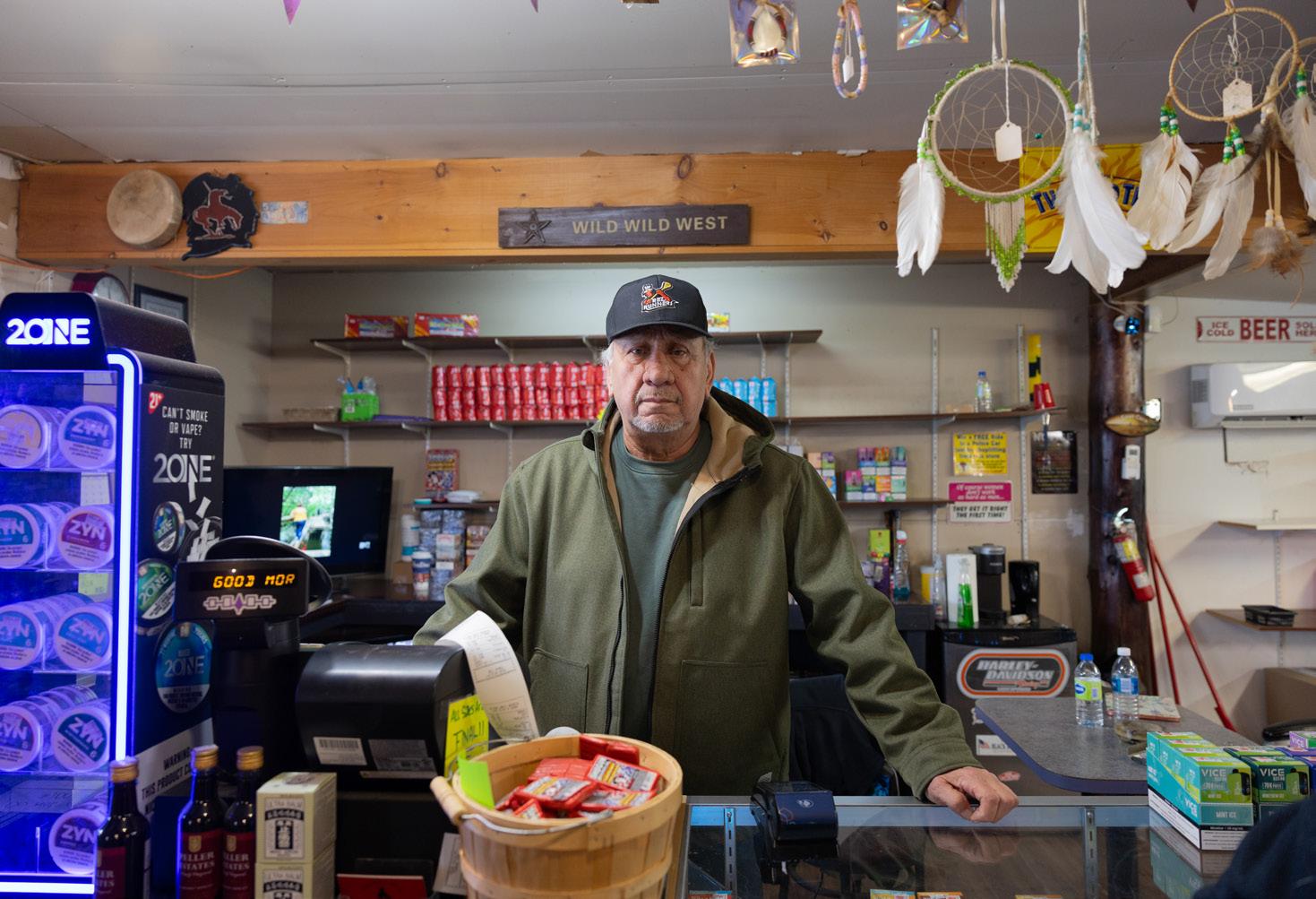
On a strip of land in Kahnawà:ke, where drivers speed through Route 207 toward the Honoré Mercier Bridge, Jason Diabo’s Wild West Smoke & Vape shop now sits boxed in by a newly carved bypass road that diverts traffic from his storefront.
In October 2025, the Mohawk Council of Kahnawà:ke (MCK) issued Diabo an eviction notice. Since then, a rotating group of community members has gathered in his shop daily, prepared to intervene if enforcement arrives.
For those keeping watch, the dispute is part of a concerning pattern in Kahnawà:ke: Years of opaque land deals, an industrial project involving contaminated soil, and the expanding jurisdiction of the MCK—whose authority, community members say, has stretched far beyond its original sphere.
“Do govern yourselves accordingly”: Diabo’s eviction notice
Diabo, who suffered from health issues following his work doing cleanup at Ground Zero, later invested his settlement into his roadside shop, which he has since operated for over 20 years. Diabo originally leased the land from a private owner under a five-year agreement, with the option to renew for an additional five years.
In an interview with The Tribune , he shared that when MCK bought the land in 2013, the former owner stipulated Diabo’s renewal clause must be carried over. Instead, the council allowed his lease to lapse without negotiation.
“They cancelled my contract in 2019. It was supposed to be renewed after five years, [but] they didn’t ask me to renew,” he said. “They said my lease is terminated […] with no just cause.”
The eviction letter, obtained by The Tribune , gave Diabo 30 days to vacate the property or face removal by “any and all remedies available,” at his own cost and expense.
According to Diabo and several residents present during The Tribune ’s visit to Kahnawà:ke, the MCK used community funds of around $2 million CAD to purchase the 17-acre lot on which Diabo’s shop lies, without holding required consultations with the community.
“I invested all my money in this place,” Diablo said in an interview with The Tribune . “I built this whole place with my partner, literally with our hands.”
Diabo’s niece, kwetiio, is one of the Kanien’kehá:ka Kahnistensera (Mohawk Mothers), the group currently in a legal dispute with McGill over allegations of unmarked Indigenous graves on campus. kwetiio has been helping her uncle navigate his potential eviction. She shared that the MCK’s lack of consultation with Kahnawà:ke community members violates Mohawk consensus-based protocol under the Haudenosaunee Great Law of Peace, which the Band Council has pledged to
express concern about overreach by Mohawk Band
uphold.
“[MCK is] buying private places. But the thing is, if the council buys private land, it goes back to the [Canadian] government […] under the certificate of possession of Canada,” kwetiio explained in an interview with The Tribune
Other residents reaffirmed this sentiment in interviews with The Tribune , stating that MCK’s acquisition and eviction procedures in Diabo’s case illustrate a broader pattern of council decisions being made without community consent.
Diabo’s eviction notice itself ended with a final line that some residents described as “threatening”: “Do govern yourselves accordingly.”
Band Council and traditional governance
While the MCK operates as Kahnawà:ke’s official governing body under the Indian Act, its authority remains a subject of contention. The Act imposes a federally designed band council system—accountable to the Canadian government—on Kahnawà:ke’s community, rather than using the consensus structure outlined in the Great Law of Peace, in which clan mothers select chiefs.
Many Kahnawà:kero:non— Kahnawà:ke community members— argue that major land decisions, including purchases, leases, and industrial agreements, must follow these principles of collective choice instead of Indian Act procedures, which they view as colonial administrative structures rather than structures of legitimate governance.
“The Band Council creates the illusion that they can make laws, that they can sign on our [communal] behalf, […] [but] they’re not lawmakers,” kwetiio said. “They don’t have any legislative power. They don’t have power over us as individuals.”
“It sounds like a conspiracy movie”: Residents fear a hidden industrial agenda
MCK has publicly described the highway project built outside of Diabo’s shop as water and sewer infrastructure improvement for residents in the area. However, residents believe the project has an unpromoted purpose: Enabling industrial truck traffic linked to the JFK Quarry company, a gravel and asphalt operation just down the road.
Several residents said they were unaware of any agreement between the MCK and the JFK Quarry company involving contaminated soil until documents suggesting a relationship were circulated at a recent council meeting. Solterra, an environmental services company, lists the JFK Quarry company site in Kahnawà:ke on its website as a “coming soon” contaminated soil facility.
The Tribune could not independently verify the documents pertaining to an alleged contaminated soil agreement between the MCK and the JFK Quarry company, and the MCK did
not respond to request for comment in time for publication.
“Why is this so important, my little spot I have here?” Diabo asked. “It’s because of [MCK’s] highway. They want to modify the highway so over 30,000 trucks can pass here within the next 30 to 40 years to fill the quarry with contaminated soil.”
Concerns about contamination are not isolated to Diabo’s property. In April 2025, The Eastern Door reported that families living near the JFK Quarry company site have suffered rashes, persistent coughing, nosebleeds, and dust coating their houses and yards. Some community members also shared independent testing results in conversations with The Tribune indicating that their groundwater samples showed elevated manganese levels—which pose serious health threats, especially for children.
“[Manganese is] all over this area […] [in] the air, the trees, the water,” Diabo shared, while pointing toward land he remembers playing on as a child. “Vegetation doesn’t grow [anymore] [....] There was all this wildlife, […] turtles that used to lay eggs underneath my porch. No more because of the road.”
The MCK’s selective enforcement and unclear authority
Residents also expressed frustration with what they view as heavy-handed MCK enforcement in Kahnawà:ke land disputes, with MCK relying on Band Councilappointed, police-like Peacekeepers. kwetiio recounted a situation where officers entered her property during a cannabis-related dispute.
“They came in like they were on Spike TV,” she recalled. “Instead of serving us properly, they made an example of us so nobody else would assert their rights [....] When they came on [my mother’s] land […], she [said], ‘I thought you’re supposed to be peacekeeping.’ [They] said, ‘Nope, we’re police’ [....] They train with the RCMP.”
Diabo’s eviction notice stands in uneasy contrast to how other land disputes are handled in Kahnawà:ke.
In a 2020 letter reviewed by The Tribune , the MCK informed resident
Angus Brian Lahache, who was involved in a private encroachment dispute, that the MCK “does not currently have a judicial mechanism” for civil matters, advising him to seek recourse through the external Quebec court system. Residents argue that this inconsistency—strict enforcement in some cases, deference to outside courts in others—leaves individuals feeling both overpoliced and underprotected, with no clear path for resolving disputes.
“My uncle, every day, lives with this [uncertainty],” kwetiio said. “He wakes up wondering, ‘Is today going to be my last day of work?’”
Beyond Route 207
As work on Route 207 continues and community mistrust of MCK lingers, residents say their daily presence at Diabo’s shop is both practical and symbolic: A refusal to let a community member face eviction alone, and a challenge to Band Council decision-making processes that they view as undemocratic. For them, community is not an abstract value, but an active practice that entails mobilizing, showing up, and demanding that major developments reflect collective will.
“[We] don’t have the luxury of not asserting [ourselves],” kwetiio said. “Because then, we would be nonexistent.”
Across the river, McGill’s ongoing legal battle with the Mohawk Mothers has raised similar questions about the sincerity and integrity of Indigenous consultation, and about whose voices are heard and respected in land-related decisions. In both cases, the stakes are about more than one building or one project; they concern the meaning of Indigenous community governance and the obligations of institutions operating on unceded territory.
The Route 207 dispute is one more reminder that community is not something simply invoked at ceremonies or in land acknowledgements, but something negotiated—and defended—every day.
“[The Band Council has] no business to do what they’re doing,” one resident shared. “They have to ask the people, and they didn’t.”
Jason Diabo in his shop, Wild West Smoke & Vape. (Armen Erzingatzian / The Tribune )
New campus food initiatives aim to fill the gap Midnight Kitchen’s closure left
Students report mixed opinions regarding the new SSMU free lunch program’s quality
Malika Logossou Managing Editor
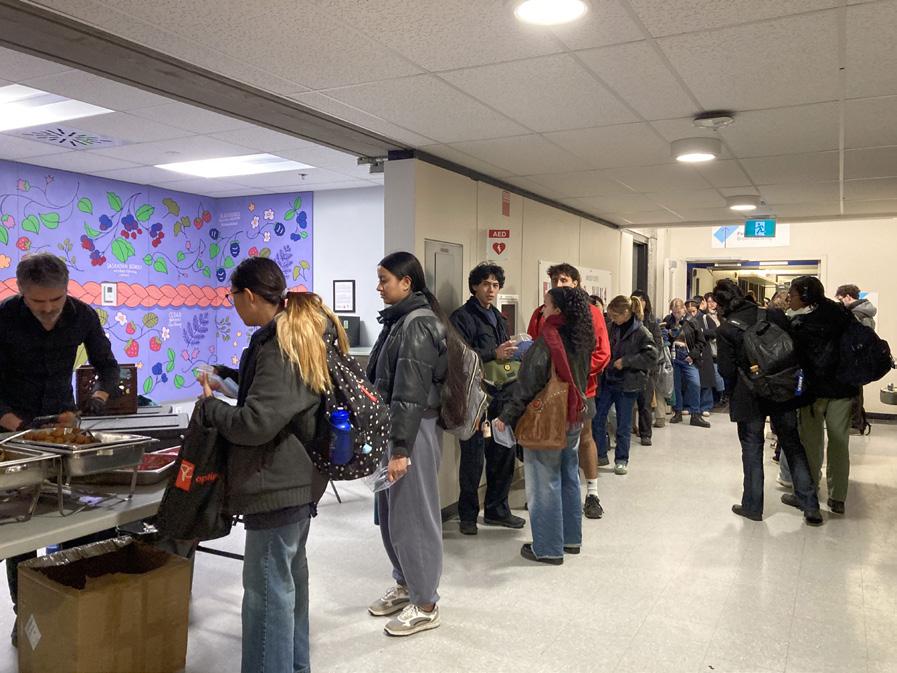
OnOct. 27, the Students’ Society of McGill University (SSMU) launched a free vegan lunch program, offered Monday through Friday from 12:30 p.m. to 2:30 p.m. on the first floor of the University Centre. Students can pick up a meal as part of SSMU’s efforts to address food insecurity on campus. The current program was established after SSMU closed Midnight Kitchen—a student collective known for its free lunch service—on Oct. 1. This semester, meals are prepared by a catering company; SSMU is working towards a permanent lunch service run by a Food Services & Hospitality Manager that would operate out of a kitchen space in the University Centre.
In a written statement to The Tribune//, SSMU President Dymetri Taylorutlined the current program’s timeline and plans, highlighting that it could extend into the Winter semester depending on the success of an alternate plan for replacing Midnight Kitchen.
“[The program will] run until December 12th, as that’s the last day that the University Centre is open for this semester,” Taylor wrote. “It may continue to run during the Winter semester, depending on whether it’ll be possible for 5-meals/week to be served out of the 3rd floor kitchen space [by the Food Services & Hospitality Manager].”
Taylor explained that the SSMU has received frequent feedback on how to improve the current program, whether it be requests for larger serving sizes, or concerns about the ingredients used in meal preparation. One of the most common suggestions—asking that SSMU increase the number of meals offered—prompted the union to expand the program.
“Initially it was 100 meals, increased to 125, and we will now be increasing to 175 meals/day starting next week (total of 875 meals per week),” Taylor wrote. “The frequency is going to remain at lunch servings once per day.”
Taylor added that SSMU evaluates the program’s success by monitoring daily turnout.
“[Our measure of success is] that all the servings each day are gone and there’s no one left at the end of the serving without food,” Taylor wrote.
Student reactions to the program remain mixed. One student who has attended the lunch program several times, who wished to remain unnamed, shared concerns about SSMU’s ability to adequately replace Midnight Kitchen in an interview with The Tribune
“I don’t think [the lunch program] fulfills the needs that Midnight Kitchen once provided [....] I’ve gone [about] four times now, on different days, and the [SSMU] portions are significantly smaller [than Midnight Kitchen’s], and you’re only given one meal option,” they
said. “There’s no […] side salad, there’s no […] dessert.”
The student also emphasized the loss of a sense of community that Midnight Kitchen’s closure has created.
“Midnight Kitchen was great because it was also […] a collective effort of students making [the food served]. Now it’s a catering company that [provides the SSMU meals], and so you kind of lose that sense of community [....] The community and social justice aspect is completely gone.”
Maria Konovalov, U3 Arts, echoed these concerns about the quality of food SSMU is serving through its new lunch program in an interview with The Tribune
“What I do like is that [the program] is daily. However, what I will say is that I have eaten there twice, and I will not go back because the food fully made me nauseous,” they stated. “There’s no dessert, [the food is] unseasoned [....] I really do hope that [SSMU will] improve the quality of their food.”
The Arts Undergraduate Society of McGill (AUS) has
also piloted its own initiative in response to the demand for accessible meals on campus following Midnight Kitchen’s closure. On Nov. 21, the society test-ran its Food Security Program, offering 50 free meals to students in the Faculties of Arts and Arts & Science who registered in advance through AUS Express for pickup from the Arts Lounge.
For more information on McGill’s accessible campus food services, consult SSMU’s Free Lunch Program schedule and menu, and the AUS Instagram @ ausmcgill.
McGill Athletics slashes over half of varsity and club portfolio University cites financial and administrative constraints as causes for cuts
Mairin Burke & Merce Kellner
Managing Editor Staff Writer
Recentprovincial pressures on McGill’s finances—from government limits on how many international students McGill can accept, to government-mandated tuition hikes for out-of-province students—have led the university to cut costs. Most recently, McGill cut 25 McGill Athletics varsity and club programs.
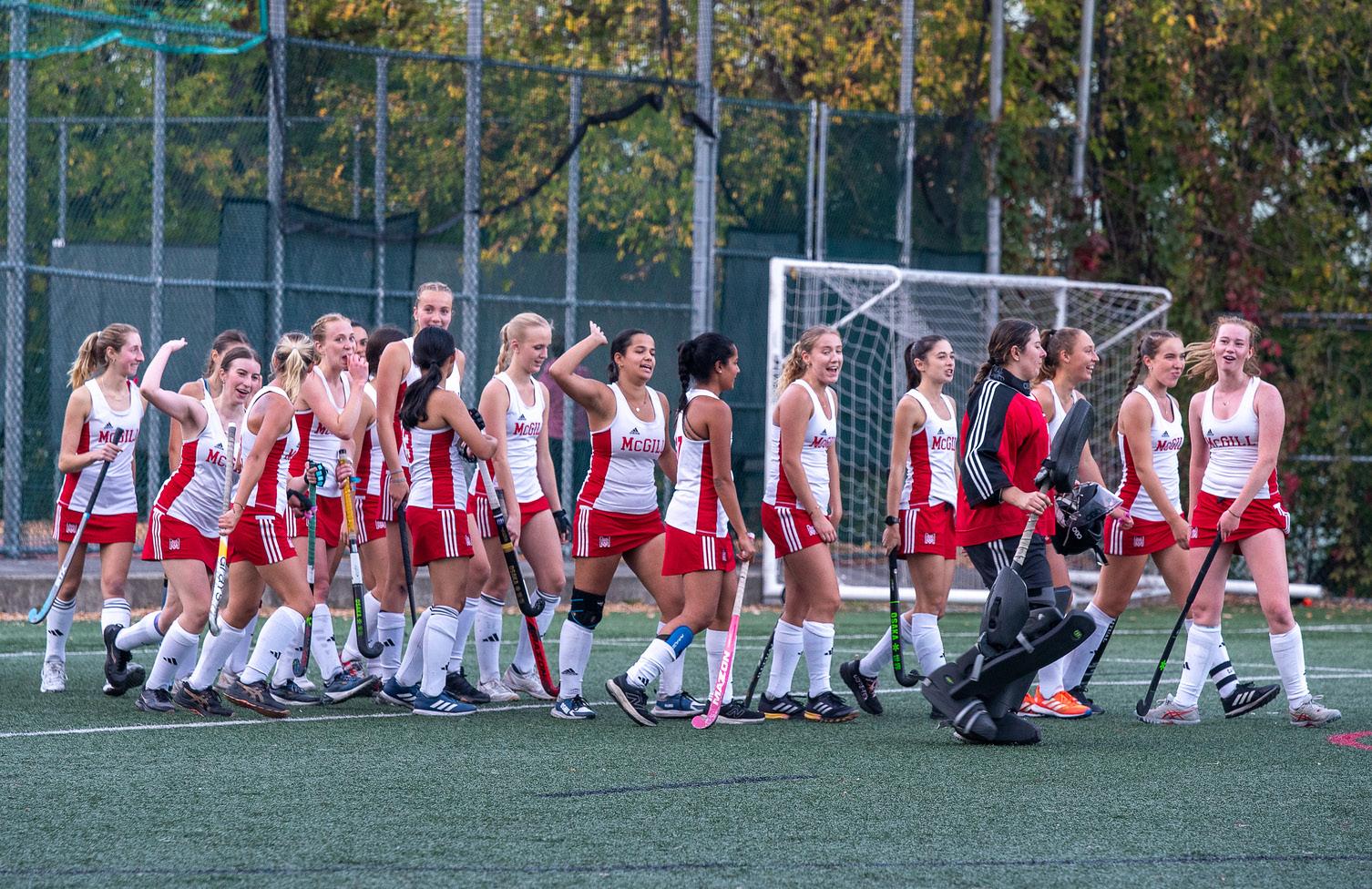
As McGill Athletics announced on Nov. 20, the teams that McGill has cut beyond this season are men’s and women’s varsity Badminton, men’s varsity Baseball, men’s and women’s Fencing, women’s varsity Field Hockey, men’s and women’s Figure Skating, men’s and women’s varsity Golf, women’s Lacrosse, men’s and women’s Logger Sports, men’s and women’s Nordic Ski, women’s varsity Rugby, men’s and women’s Sailing, men’s and women’s Squash, men’s and women’s Tennis, men’s and women’s varsity Track and Field, and men’s Volleyball.
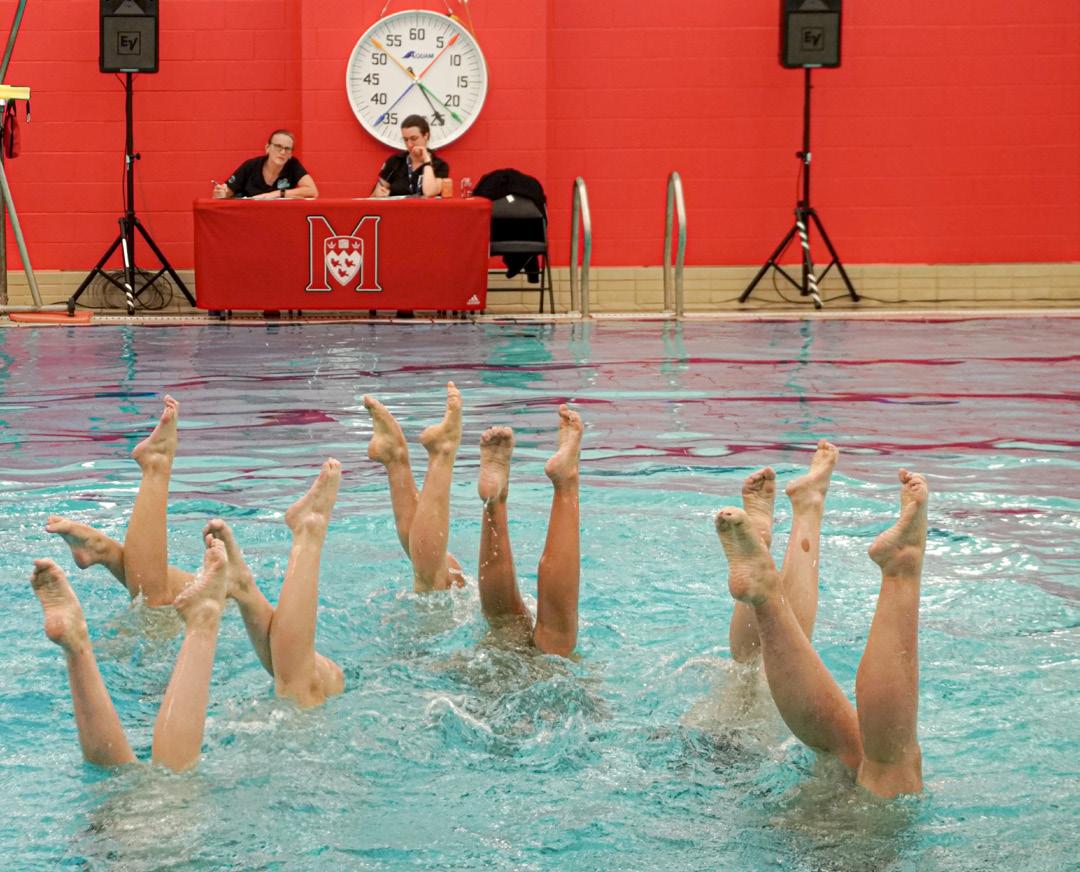
Teams that will still compete beynd the end of the 2025–2026 academic year are co-ed varsity Artistic Swimming, men’s and women’s varsity Basketball, co-ed Cheerleading, men’s and women’s varsity Cross Country, women’s Flag Football, men’s varsity Football, men’s and women’s varsity Hockey, men’s varsity Lacrosse, men’s and women’s varsity Rowing, men’s varsity Rugby, men’s and women’s varsity Soccer, men’s and women’s varsity Swimming, and women’s varsity Volleyball. Community members immediately criticized the university for what they
called an “unbelievable” decision. In an interviewwithTheTribune,varsityTrack and Field Co-Captain Ashleigh Brown, U4 Arts, affirmed being “completely blindsided” by the results of the varsity review.
“To give you an idea of how blindsided we were, our head coach was in the middle of doing tours for [potential recruits when cuts were announced],” she said. “Given the standards that [McGill Athletics] set, we thought that we fit most of [the review] criteria, so most of us were confident that our team would be staying. We were never told explicitly that the Track and Field team was under [any] scrutiny.”
Similarly, Vice President Competitive of McGill’s Nordic Ski Club, Matthew Randall, U3 Science, emphasized in an interview with The Tribune that McGill Athletics warned Nordic Ski they would be restructuring only two weeks prior to the decision’s announcement.
“We still don’t have more information about how teams were compared concretely [when] McGill Athletics went about making this decision very quickly,” Randall emphasized. “Nov. 3 is when [McGill Athletics] first told [Nordic Ski] that they were going to be making cuts [....] They told us the review process was sort of months in the making, but this [was] the first we were hearing formally of it.”
In a written statement to The Tribune, McGill Athletics shared some of the main factors they took into account in their review decisions, emphasizing a potential provincial focus.
“[We looked at] overall competitive performance and future potential, [....] availability and suitability of competition venues, […] financial and administrative requirements, […] [and McGill Athletics’] ability to provide appropriate and sustainable support […] while ensuring compliance with McGill University policies,” McGill Athletics wrote. “Through a rigorous review process guided by the new RSEQ model, [we are] aligning [our] programming with the future of sport in Quebec.”
McGill Athletics also outlined the post-restructuring supports they have offered to impacted athletes.
“Administrators continue to meet with affected sports to […] discuss potential pathways for continued participation, including the possibility of transitioning to SSMU club status,” McGill Athletics wrote. “We continue to encourage our students to seek support through the [Athletics] Local Wellness Advisor.”
However, Martlets Field Hockey vice captain Grace Hodges, U3 Arts, expressed in an interview with The Tribune that the mental health resources recommended by McGill Athletics are inadequate.
“[McGill Athletics has] one therapist on staff who [is] obviously wonderful at their [job], but can’t possibly be expected to account for all the athletes [cut], particularly given that
trying to get an appointment with them [regularly] takes a month [already],” she stated.
Hodges further shared that the reactive measures of support McGill Athletics has provided to impacted athletes feel performative.
“They’ve offered meetings with all the teams that were cut,” she stated. “I think that is a response to the media blowback that there’s been [....] You have Olympians who are talking about how embarrassing this is for McGill, […] [so] I don’t think there’s a genuine concern for the athletes. I think [McGill is concerned] for their image and damage control.”
Sports Editor Clara Smyrski and Sports Staff Writer Jenna Payette are members of the McGill Women’s Field Hockey team. Neither was involved in the writing, editing, or publication of this article.
McGill’s Plate Club offers free reusable dishware in tandem with new free meal initiatives. (Mia Helfrich / The Tribune )
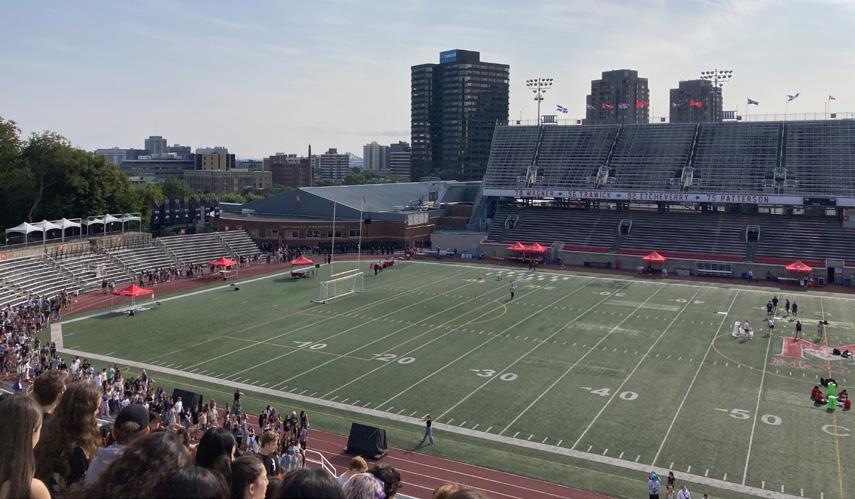
Despite being cut on Nov. 20, McGill’s women’s Track and Field team won four gold medals at their home Martlet Open Classic meet on Nov. 29. (Mia Helfrich / The Tribune )
The Tribune Explains: How Mark Carney’s budget will impact McGill students
2025 federal budget expected to intensify financial pressure on universities
Basil Atari Staff Writer
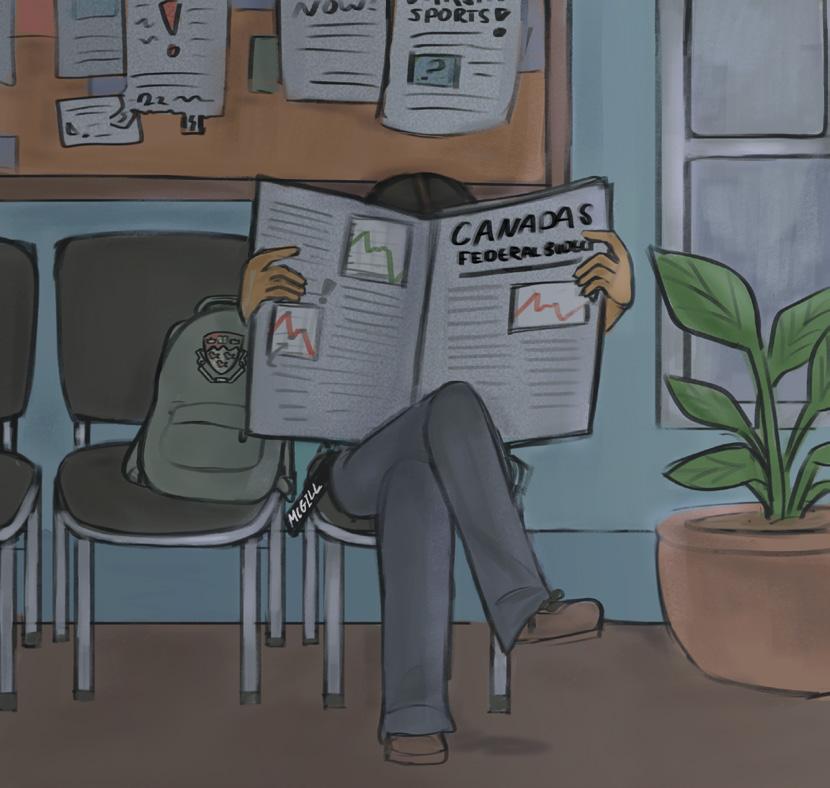
On Nov. 4, Prime Minister Mark Carney released his longanticipated 2025 budget, which has been criticized for projecting a $78 billion CAD deficit—despite Canada’s stated commitments to reduce its deficit—and for cutting public service jobs. Supporters argue that the new budget will contribute to stabilizing the country’s long-term fiscal outlook, and lay the groundwork for a stronger economy. The Tribune explains the contested budget’s student-specific impacts.
How does the budget affect international students?
The budget makes substantial cuts to immigration levels in Canada, including reductions to the number of study permits the country will issue. This will directly affect universities like McGill that benefit from international talent and revenue from higher international tuition rates. The total number of international student permits Canada offers will fall from 437,000 to 408,000—a 16 per cent total drop from the 2024 federal cap of 485,000 study permits.
How will the cuts to international student permits affect McGill?
McGill is projecting a $45 million CAD deficit for the 2025–2026 fiscal year, a shortfall that has already resulted in layoffs and a hiring freeze
expected to amount up to 500 total job losses. The university attributes these financial pressures to declining international student enrolment and the Quebec government’s decision in October 2023 to raise tuition for both international and out-of-province students. The federal budget’s restrictions on international student permits may exacerbate financial strain at McGill.
In April 2025, a Quebec court overturned the province’s planned Canadian tuition hike, which would have increased these students’ fees by $3,000 CAD, or 33 per cent. However, the required minimum $20,000 CAD provincial pricing for international tuition, along with the government’s ability to redistribute some of that revenue from English universities to French universities, remains in place.
How will the budget affect students receiving Canada Student Grants?
Although 586,000 students received $2.6 billion CAD in Canada Student Grants money from 2023–2024, the 2025 budget allocates only $1.2 billion CAD to these federal student aid bursaries, which offer assistance to full-time Canadian students with financial need. The budget projects further cuts to the program until 2030.
According to some experts, it is unclear whether these Canada Student Grants cuts are intentional or the result of errors, as they could reverse
2019 Liberal commitments to expand funding for the program.
What are some benefits in the budget for students?
The 2025 budget earmarks some benefits for students and young Canadians. Over the next three years, the government will allocate more than $1.5 billion CAD to student training and employment initiatives.
The budget will increase funding to help students find jobs through an increase of $594.7 million CAD to the Canada Summer Jobs wage subsidy, which funds youth summer employment. The budget also designates $635.2 million CAD to support roughly 55,000 co-op placements for postsecondary students.
Furthermore, the budget increases funding to help young people receive professional training, allocating an additional $307.9 million CAD to the Youth Employment and Skills Strategy, which offers hands-on training and work experience.
The budget plans to provide $40 million CAD over two years to launch an inaugural Canadian Youth Climate Corps, which will provide paid training for youth to
engage in climate response work and other sustainability-focused career paths.
What are some benefits in the budget for universities as institutions?
There are also some positives to the budget for universities: It allocates $1.7 billion CAD over the next 13 years for universities to recruit international researchers, assist international PhD students settling in Canada, and improve and fund university research infrastructure.
Mark Carney gave an address to university students on Oct. 22 to promote his budget. (Charlotte Bénard / The Tribune )
The Tribune ’s Editorial Board presents its midterm reviews of the Students’ Society of McGill University (SSMU) and Post-Graduate Students’ Society (PGSS) executives. Tribune editors researched and communicated with each executive before leading an Editorial Board discussion on the executives’ work and accomplishments. Editors with conflicts of interest abstained from discussing, writing, and editing relevant reviews.
Dymetri Taylor
SSMU President
In his second term as SSMU President, Dymetri Taylor has attempted to balance the power between SSMU’s executive board and Legislative Council (LC). He has also worked alongside the rest of the executives to provide a new free meal service on campus. Although this is a temporary solution before the next school year to address the closure of food coalition Midnight Kitchen, Taylor would prefer to continue using a catering company in the future.
Into the winter semester, Taylor is interested in the possibility of instituting a new student fee for athletics at approximately $10 CAD per student. This fee would help navigate challenges following recent cuts to McGill’s varsity and club program, and would cushion McGill Athletics with $500,000 CAD in additional funds each school year. Taylor stated to The Tribune that he remains committed to protecting student activism on campus. He has expressed worries about minority groups of students voting on strike procedures and disrupting class during the Shut it Down strikes, but will continue supporting striking students as long as they follow procedure.
SSMU
Internal to provide students the chance to participate in an SSMU event not centred on drinking. He will also continue to manage the SSMU backlog of club applications and focus on making SSMU service evaluations more transparent. In the upcoming semester, Abu Alkhair must ensure that any moves towards internal, administrative transparency are made equally evident to SSMU’s external constituency—such as consulting with and accepting feedback from ISGs about potential upcoming changes to their Internal Regulations.
Jean-Sébastien Leger
SSMU VP Finance
After being hired in mid-October, JeanSébastien Leger has worked quickly to embody the role, focusing on bridging the five-month VP Finance vacancy since last academic year that caused a significant disruption in SSMU’s fiscal operations. What was supposed to be a month-long training process became a week-long onboarding for Leger. He immediately took on important tasks that were left behind during the disruption, such as the revised SSMU budget that will be presented in mid-December.
Moving into the new semester, Leger will continue to dedicate himself to SSMU’s constituency. He will revisit different club services and funding to make sure every dollar is well-spent. He will also develop new strategies for investment and providing services, making sure the student union’s budget is as efficient as possible. In light of the 2025 SSMU Fall Referendum, during which voters rejected the motion of the base fee increase, Leger will have to work to keep SSMU in the zone of a healthy deficit or surplus despite decreased student society funding.
Seraphina Crema-Black SSMU VP External
PMIDTERM
Susan Aloudat SSMU VP University Affairs
Susan Aloudat’s campaign to be SSMU VP University Affairs—which ran uncontested—centred on an open-door policy. In line with this goal, her term has focused on expanding diversity, equity, and inclusion practices on campus. She created and is now working to expand the TLDR series on governance documents, implemented an STM Emergency transportation subsidy during the most recent STM strike, and expanded SSMU’s menstrual health portfolio. Aloudat has also focused on increasing advocacy for Arab and Muslim students, as the SSMU does not have a portfolio dedicated to these communities. With her influence, McGill libraries agreed to make available designated prayer spaces, a resource she hopes will be implemented by December exams.
Looking forward, Aloudat is hoping to exercise the trust she has developed with university administrators in order to further vouch for student interests, such as divestment from Israel’s genocide. During the second half of her term, Aloudat will continue to focus on increasing SSMU resources’ accessibility, developing long-term resources for underrepresented communities, and creating a culture of trust between McGill administrators and students.
Minaal Mirza SSMU VP Internal
MHamza Abu Alkhair
SSMU VP Clubs and Services
Since assuming his role in January, Hamza Abu Alkhair has been focused on reconfiguring the SSMU club portal, the SSMU website, and the mandatory SSMU workshop program for clubs and services—which he has turned into a Udemy course. These projects reflect Abu Alkhair’s commitment to increasing clarity, accessibility, and engagement between the SSMU and both its current and prospective club and service members. Abu Alkhair has also been overseeing the post-Midnight Kitchen transition to a Food Services & Hospitality Manager-run lunch service, and has successfully increased sponsor presence at SSMU’s biannual Activities Nights. on planning a Winter Carnival with the VP
er her goals coming into office, VP External Seraphina Crema-Black has prioritized advocating against Quebec tuition hikes in collaboration with McGill’s administration, political clubs, and other Montreal universities. She also organized a series of hands-on political organizing workshops focused on tenant rights, harm reduction, student strikes, food insecurity, and migrant justice to foster political engagement. Crema-Black helped lead an SSMU lunch distribution program, which has provided students 150 free vegan meals a day. She offered support to groups including Divest McGill, McGill Students for Uyghur Solidarity, Working Alternatives McGill, anti-austerity organizers, Independent Jewish Voices, and Students for Migrant Justice during her term.
Crema-Black reports that she has had “substantive dialogue” with McGill administration on student priorities such as divestment from genocide in Palestine. She is currently working on efforts to make the old Chez Gautier building on av. du Parc into an
inaal Mirza stepped into the role of VP Internal in late October with three immediate goals: Rebuilding the foundation between the Internal portfolio and SSMU staff, increasing the number of events SSMU will host this academic year, and revamping communication with students. To compensate for her late start, Mirza spent her first two weeks in the role meeting oneon-one with every staff member connected to her portfolio to map expectations, understand limitations, and work toward a realistic timeline for the remainder of the year. Her upcoming projects include a Valentine’s Day Ball, SSMU Awards Night, a scaled St. Patrick’s Day event ( not a 4 Floors), and early planning for Faculty Olympics.
A significant portion of Mirza’s early weeks has been devoted to rebuilding the First Year Council (FYC), which has lacked structural continuity over the last two years. She has also initiated communication with the Alumni Engagement team to schedule meetings after the winter break. While the Student Social Programming Network currently has enough active contributors to host events, she encourages additional student involvement to diversify perspectives.
Aware that executives often lack institutional memory due to rapid turnover, Mirza created an exit report document on her first day and updates it weekly with contacts, timelines, and useful information she believes
PGSS
Sheheryar Ahmed PGSS Secretary-General
As Secretary General, Sheheryar Ahmed represents the PGSS to the public and McGill administration, updates the society’s governing documents, and chairs executive committee meetings. Entering this role, Ahmed’s priorities were to increase transparency, pursue election reform, and lower barriers to student involvement in PGSS initiatives.
To increase member participation in executive processes, Ahmed introduced a new Deputy Secretary General position, splitting the Secretary General position into internal and external responsibilities to make the positions more approachable and decrease workload for future Secretary Generals. Ahmed’s accessibility efforts also included organizing executive-led orientation events for new students, hosting a PGSA and Council training event, and creating an interactive organizational chart on the PGSS website to clarify the organization’s composition to students.
Having recently hosted the PGSS’ Annual General Assembly, Ahmed emphasized the underrepresentation of international students and students living in residence in the PGSS, as well as growing food insecurity among postgraduate students, demonstrating an awareness of continued accessibility needs to be addressed in his second term.
Zoe Neubauer PGSS External Affairs Officer
As the PGSS External Affairs Officer, Zoe Neubaur’s top priorities are to address austerity on campus and to mitigate the increased precarity graduate students face as a result of rising costs of living and relatively low bargaining leverage at McGill. To fulfill these commitments, Neubauer meets regularly with representatives from the Quebec Student Union (QSU), the McGill Community Council, and the Association of Graduate Students Employed at McGill (AGSEM).
rebuilding PGSS’ transparency framework “from the ground up”: Tracking monthly spending and developing clearer internal fiscal projections. While the budget is currently available to any PGSS member upon request, she aims to publish more accessible financial summaries and explanations on the PGSS website to improve community understanding.
unused for years. As a member of the McGill Senate, she has worked with student and faculty senators to pass amendments that protect
Regarding McGill’s projected $15-million CAD deficit—and its potential effects on TA hiring and departmental staffing—Lokko explained that PGSS does not expect disruptions to its core services this year, though the executive team remains prepared to adjust its support mechanisms if cuts become impactful. Lokko has also helped PGSS internally absorb part of the inflation-driven increase to the Studentcare health insurance plan, preventing a steeper fee hike for the society’s members.
Looking ahead, her goals include expanding community-based grants and subsidies and continuing to make PGSS’s financial reporting more accessible online.
The Tribune commends Lokko’s efforts to strengthen equitable grant distribution and rebuild financial transparency within the society. As McGill continues to navigate financial instability, it is essential for PGSS to maintain its strong and accessible support to ensure it meets the ever-changing needs of its constituency.
Zeina Seaifan Member Services Officer
As Member Services Officer, Zeina Seaifan is working to expand and address gaps in existing graduate student services. This semester, she collaborated with the society’s Health Commissioner and Mental Health Commissioner to ease the student union’s transition to Digital Doctor, a new healthcare provider. Seifan also introduced paid training for coordinator roles, including the BIPOC Graduate Network Coordinator and the Community Support Coordinator.
Amidst their ongoing advocacy through speaking at anti-austerity rallies and attending QSU caucuses, Neubauer is focused on providing more tangible deliverables for PGSS students. They are working to establish a PGSS mutual aid fund to provide direct monetary support to grad students to offset Montreal’s high cost of living.
Looking forward, Neubauer’s goals are to make the PGSS mutual aid fund a reality, and to advocate for graduate students as both students and workers within the McGill community.
Mandy Lokko PGSS Financial Affairs Officer
Entering the Financial Affairs Officer position, Mandy Lokko has emphasized transparency, financial equity, and responsible management as her key priorities.
This semester, Lokko highlighted the expansion of the PGSS Travel Awards program as her most meaningful accomplishment, ensuring a fairer distribution of funding across master’s, PhD, and postdoctoral applicants. A recurring concern among PGSS members has been the accessibility of the Society’s budget. In response, Lokko has begun
Next semester, Seifan will oversee additions to Indigenous reconciliation initiatives, which will build upon the land acknowledgement at Thompson House to include educational offerings like field trips and Indigenous language courses. She will also further the PGSS Menstrual Equity Initiative by assessing avenues for improved sustainability, such as the provision of reusable menstrual products. This winter, Seifan will also evaluate the health and dental plan based on the results of a health and wellness survey she oversaw this semester.
Amina Bourai University Affairs Officer
As University Affairs Officer, Bourai is responsible for ensuring equitable graduate student representation across McGill’s governance structure. Coming into the position, Bourai aimed to improve PGSS transparency and make the society more responsive to student concerns. Her main accomplishment this semester has been filling over 95 per cent of university committee positions, a significant improvement from past years, when these crucial representative roles sat vacant. Bourai has also successfully chaired the Library Improvement Fund committee, making use of its resources after this committee’s funds sat
CAMPUS CONVERSATIONS: COMMUNITY
Sarah McDonald Science & Technology Editor
IA love letter to the library
f you’d have told me when I first got to McGill that my closest friendships would be forged in a library, there is no way I would have believed you, not even a little bit. Surely I’d make friends through classes, residence, and sports teams—but the library? No way.
Little me simply couldn’t fathom how a library—a space for silent studying and wistful peering out the window, wishing you were at Open Air Pub (OAP) instead of Schulich—could ever lead to anything more than a dutifully earned grade and a fluorescent-lighting-induced headache.
What I didn’t understand is how central the libraries are to community life here at McGill. They are, at least in my experience, more than just academic hubs; they are social epicentres.
When half of my ENGL 311 class agreed to meet to edit one another’s essays last October, I expected to learn a favourite colour or two, fix our essays, and leave. What I didn’t expect is that over
the course of the year, those same people would fill my camera roll, my living room, and my heart so completely.
What began as an editing session in a McLennan library room quickly turned into a Wikipedia deep-dive on our professor. This, in turn, morphed into a conversational spiral only a deadline and a sugar rush could inspire. We left that room with two entire inside jokes—not bad for a bunch of strangers.
For the rest of the semester, we prepped for every assignment—whether it be an essay, a midterm, or a final exam—together. The library rooms in McLennan and Redpath became our second home. Those walls watched as we printed and marked up essays, played and re-played Kahoots, and wrote first drafts. But they also watched as we talked and hugged and snacked and vented and laughed and laughed and laughed so hard someone probably cried.
Even after we had long established ourselves as a real friend group, we still found ourselves returning to the library rooms. After dinner and
ice cream one February night, no one really wanted to go home; our roommates were asleep and it was cold outside. What did we do? We booked a library room.
Now, don’t get me wrong; I will be the very first to say there is more to university than just the library. However, there is also more to the library than just solitary confinement. There is something to be said about the feeling of collective camaraderie that only the environment of a library can truly foster. I don’t care if I’m writing a research paper and you’re solving differential equations; when it’s 2:00 a.m. in a McGill library, we’re in the same boat.
Libraries are the centre of our community for this very reason. Whether you’re studying, crying, or keeled over laughing with those soon-to-be friends from your class, the libraries—or at least their talking floors—will welcome you with open arms. I will forever mourn the day my friends and I stop texting the self-explanatory ‘library?’—a place, a question, and a bid for connection all rolled into one.
Goodbye to McGill’s athletics community
Clara Smyrski Sports Editor
On Nov. 20, McGill Athletics and Recreation announced the decision to cut 25 of their varsity and club sports teams, effectively ending 202 collegiate varsity careers and the entirety of the 18-team club sports program.
For many at McGill, this decision is a mere headline that may catch their eye but will inevitably be pushed to the back of their mind. For others, however, it’s a turning point in their university experience—one that cracks the foundation that has supported them through every challenge university life has thrown their way.
Sports are not just a way to stay active; they teach teamwork, accountability, determination, and perseverance. Sports are arguably one of the most effective community-builders in the world. Sports have the power to bring teammates from completely different backgrounds and contexts onto the same field—and the power to unite entire nations across political and religious divides.
On the McGill Field Hockey team’s Change. org petition, an alumna of the team, Catriona, commented on how field hockey has changed her life beyond university.
“Playing field hockey was what made me finally feel at home at McGill. It has provided academic and professional mentorship and connections that I would never have had otherwise [....] I know employers that have specifically sought out student-athletes because they work hard, balance responsibilities, and commit to being part of a team,” she wrote. “I will seek [a field hockey team] out wherever I live for the rest of my life—but I would not be doing this had I not been given the chance to play in college.”
Similarly, on McGill Track and Field’s petition, one commenter, Nadine, wrote that universities would not be universities without sport.
“My involvement in university athletics had a profound impact on my life. Beyond the medals, memories, and friendships, training and competing taught me how to balance my time, set priorities, and develop discipline and a strong work ethic,” they wrote. “Post-secondary education is far more than what happens in the classroom, it shapes who you become.”
The athletic community at McGill is far from perfect. For years, it has been riddled with unequal resource distribution and tension between teams and their administration. But this decision takes an already crumbling athletics community and rips it down the centre.
Amidst a hiring freeze, Quebec’s new French
proficiency requirements, and a nationwide cap on international study permits, both McGill University and McGill Athletics and Recreation are grappling with a new and harsh reality. But when at a crossroads where McGill Athletics could’ve used their international prestige to stand against the Quebec government for the sake of all its studentathletes, they instead chose to succumb to pressures at the expense of their student-athletes.
McGill has long distinguished itself as an institution that seeks to bring international academic and athletic talent to the province. With this comes a privilege and a responsibility to protect students, professors, and researchers—both current and future. The varsity restructuring decision not only sets a negative precedent for university sports nationwide, but also sows a deep distrust between McGill student-athletes and their administration. McGill Athletics’ continued lack of transparency, their limited and vague communication with teams, and the absence of any accountability mechanisms or appeal processes fracture any sense of trust or community that was previously built.
The athletic community at McGill is invaluable. It is with the heaviest of hearts, a profound agony for a lost future, and a bitter taste in our mouths that we are forced to say goodbye.
Accidental traditions
Rupneet Shahriar Web Editor
People are often puzzled when I describe myself as an optimistic realist, someone who hopes deeply but holds expectations lightly. Growing up, I moved too often to build traditions. I never decorated bedrooms fully, never sat in the same classroom two years in a row, never stayed long enough for rituals to form. I was always a visitor, carrying only a seasonal pass from one community to another. I thought community traditions meant going to church every Sunday or wearing pink on Wednesdays—rituals that stood the test of time. My own immediate family was far more unconventional. Other than wearing new clothes and eating good food on Eid, we didn’t have many annual traditions. But my grandmother did. The night before Eid, her entire house smelled of sugar, saffron, and ghee, each corner steeped in her belief that no one should ever leave her home on an empty stomach. She treated that
responsibility like a badge of honour. These moments are the earliest traditions I remember, even if I didn’t see them that way at the time.
I often found myself feeling as though I had arrived after these traditions were already formed, stepping into inside jokes and routines I had no history with. It made the community feel closed off, like something you earned only by staying in one place for years.
Then something unexpectedly softened: I started noticing moments of belonging I couldn’t explain away. Every Saturday, without fail, I find myself with a warm bowl of food and even warmer company. My friends and I pick a new spot based on the last TikTok we saw, letting our curiosity choose for us. It’s never planned far in advance, and yet it’s become the most reliable part of my week. What matters most to me about this ritual is simple: I am thousands of miles away from home, yet I haven’t spent a single Saturday alone.
And it isn’t just the Saturdays. Every summer, I find myself back within the yellow walls of a Cheesecake Factory, sharing the same Louisiana Chicken Pasta with the same two
friends. Despite twenty other lunch ideas each year, we always return to that same booth—an accidental tradition that has quietly become ours. It took me a while to understand that community and traditions aren’t predictable. They can be as simple as starting a movie with my roommate and falling asleep twenty minutes in—what matters is that we chose to do it anyway. Traditions show up in the 10:00 p.m. library visits, when you sit beside a friend who’s drowning in notes just so they don’t feel alone. And sometimes, tradition looks like your friends turning off the lights and bringing out a birthday cake every single year. Small communities become something steady, even when nothing else is.
My home will never smell as decadent as my grandma’s, but I’ve learned it can be just as full of love and laughter. In building these small traditions, I’ve begun shaping my own definition of community. Community doesn’t appear once you’ve stayed in one place long enough; it’s about choosing people and letting them choose you back.
Montreal’s unhoused population deserves to thrive, not just survive
The Tribune Editorial Board
For Montreal’s unhoused individuals, the earlydescending freezing temperatures and the predicted high-precipitation winter ahead pose fatal risks, including frostbite, hypothermia, and death. Yet, shelters across the city are already struggling at and over capacity.
Although Mayor Soraya Martinez Ferrada has promised to expand housing and healthcare services for the unhoused, the city’s political and institutional apathy towards long-term sustainable solutions to the housing crisis persists. Such inaction upholds a cycle that denigrates the city’s most vulnerable individuals, sustains housing and healthcare insecurity, and fails to properly ensure that humans live with dignity, support, and security.
In Montreal, shelter space for the unhoused population falls far short of growing demand. There are about 1,800 shelter beds available but an estimated 4,690 unhoused individuals, forcing some shelters to offer chairs for the night instead of beds. Just this week, housing rights advocates voiced concerns about the increasing death rate among the unhoused, which had been rising long before the winter months. The persistent occurrence of preventable deaths of those already
most marginalized lays bare the failures of Montreal’s housing and healthcare systems.
In her campaign, Mayor Ferrada promised to end homeless encampments within four years, claiming that they pose risks to the city’s cleanliness and security. However, just weeks after her election, Quebec’s Transport Ministry issued dozens of eviction notices to individuals living in tents along Notre-Dame Street, giving residents only days to vacate. Ferrada’s strategy of dismantling homeless encampments without first prioritizing housing alternatives for their inhabitants effectively criminalizes the unhoused population for circumstances created and upheld by governmental negligence. Instead of supporting crisis measures, the government has put time and money into violently destroying encampments, inhumanely stripping individuals of all their belongings, and leaving them without any place to go. In this way, the Ferrada government has chosen to address a major socioeconomic crisis by displacing a population it considers unpalatable, relocating these groups to areas where they will be less visible instead of confronting the systemic factors that lead to homelessness in the first place.
The housing crisis is just one in a web of interrelated systems
which mutually compound an individual’s risk of becoming unhoused. In Montreal, Indigenous and 2SLGBTQIA+ individuals are disproportionately represented in these systems. The over-policing of Indigenous populations, for example, leads to overrepresentation in incarceration, which then leads to a compounded risk of homelessness after release. Health disparities incurred by unhoused 2SLGBTQIA+ individuals bear similarly cyclical effects, as a lack of access to proper gender-affirming care and social services leads to increased prevalence of poor mental health, further entrenching housing insecurity. For women, domestic violence is the leading cause of homelessness, while children who have been involved in the foster care system are also overrepresented among unhoused youth.
The Montreal municipal government’s support for the homelessness crisis has come largely in the form of seasonal warming centres and temporary housing. While critical for shortterm triage, especially in harsh weather, such temporary fixes must be complemented by equally substantiated commitment to sustainable, year-round housing solutions.
The homelessness crisis is not inevitable—it is curated and
Without redistributing power, repatriation of artifacts remains incomplete
Defne Feyzioglu Staff Writer
Reconciliation should not come with an invoice. The Vatican’s decision to return 62 Indigenous artifacts to Canada is being described as a “concrete sign of dialogue, respect and fraternity.” Yet when the Catholic Church maintains control over the timing, framing, and logistics of the return, even forcing Indigenous communities to pay to bring home what was stolen from them, such gestures reveal how colonial power still sets the terms of reconciliation.
For a century, Indigenous belongings—including an Inuit kayak and a set of embroidered gloves from the Cree Nation—sat in the Vatican’s ethnographic collection. The Church claimed the artifacts, and they were added to the Anima Mundi museum as part of its permanent inventory in 1925. Now, the Vatican has decided to return these artifacts to Canada.
This action, on the surface, is powerful: Indigenous belongings make the long trip home after decades in a European museum. Pope Leo XIV has framed this move as proof that the Vatican is listening to Indigenous demands for justice. Yet, the 62 objects have not been handed directly to Indigenous organizations. Instead, they were formally given to the Canadian Conference of Catholic Bishops, which will then be responsible for working with Indigenous representatives and the Canadian Museum of History to
identify each object and eventually route it back to its community of origin. This bureaucratic process reflects a broader pattern in repatriation work.
Indigenous nations bear a large share of the labour and financial burden in regaining what is theirs: Travelling to museums, documenting claims, hiring researchers and legal experts, and covering transport and ceremony costs.
One recent report on the repatriation of Indigenous items in British Columbia estimated that fully returning heritage objects currently held in museum collections would cost these groups $663 million CAD. This system places the burden on systemically disadvantaged communities to negotiate with government-funded institutions, which are grounded in powerful academic and cultural networks, just to reclaim what belonged to these communities in the first place.
The Vatican has framed the repatriated artifacts as gifts, stating the items were originally sent by missionaries to showcase both Catholic expansion and the “cultural richness” of the peoples they evangelized. Such characterizations of these artifacts fail to reveal the true context in which they entered the museum—as belongings stolen under conditions of profound coercion. For generations, the Catholic Church was a central power in Canada’s role in colonialism. Catholic orders operated the majority of federally funded residential schools, facilitating land dispossession and banning Indigenous ceremonies to systemically eradicate their cultures.
actively upheld through political apathy, hostile urban design, and governmental policy. However, that also means that governments, lawmakers, and institutions have the agency to reverse this crisis.
At the municipal level, Montreal must dismantle its hostile public architecture projects and incorporate cultural sensitivity into police training. The Ferrada government must also set aside funding for housing solutions to supplement provincial funding, instead of relying on the perennial good will of local organizations and shelters. At the provincial level, Quebec must hold itself accountable for pursuing long-term solutions to the housing crisis, as well as seeking improvements to social services and healthcare.
Action need not be limited to government bodies. McGill must commit to conducting comprehensive research aimed at benefitting the unhoused population and ensuring representation in data to best inform future policy.
Above all, Montreal’s unhoused population must be treated with dignity, respect, and support. Mitigating the homelessness crisis must not be a push to meet the low bar of subsistence, but to ensure that every human being has the foundation to survive, and the resources, agency, and respect to thrive.
COMMENTARY
Yet recent moves by the Catholic Church, such as the repudiation of the Doctrine of Discovery and the 2022 papal apology for residential schools, merely distract from the Church’s duty to reconcile for its theft of these objects, instead casting the Church as a morally awakened actor generously choosing to share what it ‘owns.’
Of their roughly 100,000 Indigenous objects, the Vatican Museums retained about 40,000 as part of their permanent ethnographic collection. (Alexa Roemer/ The Tribune )
This framing shapes public understanding of what reconciliation requires. If the return of these belongings is treated primarily as a sign of good will, the underlying question of rightful ownership is softened, and the asymmetry of power involved in both the original removal and the presentday repatriation is obscured.
The return of the 62 pieces is an important step, but incomplete. Tens of thousands of Indigenous artifacts remain in the Vatican’s ethnographic holdings. If institutions continue to control which items are relinquished, on what schedule, and at what cost, they will still retain the most significant form of authority: The power to decide who gets to keep their heritage and who doesn’t.
For reconciliation to move beyond symbolism and colonial
Video Editors Jade Herz Ella Sebok multimedia@thetribune.ca
Web DevelopersRupneet Shahriar Johanna Gaba Kpayedo webdev@thetribune.ca
Copy Editor Ella Bachrach copy@thetribune.ca
Social Media Editor Mariam Lankoande socialmedia@thetribune.ca
Business ManagerCeline Li business@thetribune.ca
TPS BOARD OF DIRECTORS
Simona Culotta, Defne Feyzioglu, Alexandra Hawes Silva, Celine Li, Lialah Mavani, Nour Kouri, Laura Pantaleon
STAFF
Norah Adams, Zain Ahmed, Eren Atac, Basil Atari, Rachel Blackstone, Amelia H. Clark, Defne Feyzioglu, Samuel Hamilton, amuel Hamilton, Merce Kellner, Antoine Larocque, Alexandra Lasser, Lialah Mavani, José Moro Gutiérrez, Talia Moskowitz, Jenna Payette, Julie Raout, Parisa Rasul, Alex Hawes Silva, Michelle Yankovsky, Ivanna (Ivy) Zhang
facilitation, the logic reinforcing repatriation would need to be reversed. The default must become proactive, institutionally funded returns guided by Indigenous priorities, and a willingness to relinquish interpretive control not only over individual objects, but over the stories museums tell about how those objects arrived in their collection in the first place.
This responsibility doesn’t end at the Vatican Museums. McGill, situated on unceded territory of the Kanien’kehà:ka, equips archives, research practices, and institutional structures shaped by the same colonial histories that made the Vatican’s ethnographic holdings possible. Whether in Vatican City or in Montreal, reconciliation must represent genuine efforts to repair damage by colonialism— not strategic efforts to save reputational face.
Max Funge-Ripley, Dylan Hing, Aidan Hotte, Lia James, Sofia Lay, Vittoria Vespoli
Charlotte Bénard
TRIBUNE OFFICE
Shatner University Centre, 3480 McTavish, Suites 404, 405, 406
The Tribune is an editorially autonomous newspaper published by the Société de Publication de la Tribune, a student society of McGill University. The content of this publication is the sole responsibility of The Tribune and the Société de Publication de la Tribune, and does not necessarily represent the views of McGill University. Letters to the editor may be sent to editor@thetribune. com and must include the contributor’s name, program and year and contact information. Letters should be kept under 300 words and submitted only to the Tri- bune. Submissions judged by the Tribune Publication Society to be libellous, sexist, racist, homophobic or solely promotional in nature will not be published. The Tribune reserves the right to edit all contributions. Editorials are decided upon and written by the editorial board. All other opinions are strictly those of the author and do not necessarily reflect the opinions of The Tri- bune, its editors or its staff.
FALL 2025: A Collection of Community
Alexa Roemer
Lilly Guilbeault
Armen Erzingatzian
Eliot Loose
Zoe Lee
Armen Erzingatzian
Gwen Hefffernan
Emiko Kamiya
Lilly Guilbeault
Kate Sianos
Eliot Loose
Mia Helfrich
Dec. 3 marks the United Nations’ International Day of Persons with Disabilities, a reminder that disability—which is composed of functional or social limitations on one’s ability to perform an activity—affects millions worldwide. In Canada, more than 22 per cent of individuals, 6.2 million people, identify as having disabilities, and in Montreal alone, over 740 thousand people aged 15 and older live with a form of disability.
Building community through Unmasking the societal hurdles intellectual disabilities
While disabilities take many forms, individuals with intellectual disabilities and neurodivergence in particular face systemic gaps as they transition from adolescence to adulthood. From housing and financial assistance to recreational programs, the needs of these individuals are often invisible, and the support systems meant to help them can be inadequate. In educational institutions such as McGill, these challenges are mirrored on campus, where students with learning disabilities are confronted with long waits for accommodations or uneven support.
These challenges, which ripple across families and communities, make clear that a community is only as strong as the support it provides to all its members.
A system that abandons you in adult- hood
The transition from adolescence to adulthood is a critical period for change and development, but for many young adults with intellectual disabilities in Quebec, it is fraught with obstacles. Without structured support during the move from high school into independent or semi-independent living, these individuals are often left on their own. This lack of continuity in support systems renders people with intellectual disabilities four times more likely to be unhoused.
Lucyna Maria Lach, associate professor in the School of Social Work, emphasized this lack of transitional systems in an interview with The Tribune
“There’s not always a great, what I call, great ‘transition plan’ from high school into emerging adulthood,” Lach said. “I’ve been very critical of the government not paying more attention to setting up transition hubs, or transition centres of excellence, or something that would help individuals with those kinds of needs to try to find a way to have a meaningful life after they have graduated from high school [....] They’re entitled to that.”
Accessing residential resources is particularly difficult: A person with an intellectual disability must currently wait an average of 1,211 days—which is over three years—for placement. By comparison, in 2013–2014, the wait time was 767 days. Yet even being on the waiting list, there is no guarantee that a person will access an environment that sustains their needs. Only 28 per cent of people receiving intellectual disability and autism services gain access to these housing resources, forcing many to remain dependent on their parents well into adulthood.
“There are young people still living in their 20s, 30s, 40s, sometimes even into their 50s, living with their moms and dads because there is […] no plan for them whatsoever,” Lach said. “We don’t really know how many people are out there needing those services, and the government’s doing very little to try and find out. There are some adult ed programs, but not everybody gets into one.”
Residential resources include: Intermediate resources for individuals who do not need full assistance, often connected to a local community service centre (CLSC); family-type residences where an individual lives with a host family; and residential resources with continuous assistance, which are often the most suitable.
To make matters more complex, housing for people with intellectual disabilities is primarily privatized, leading housing, which is a right, to be treated as a product. The government allocates funds based on individuals’ needs and the number of people, leading certain resource centres to prioritize quantity over quality of care to secure more funding.
Taken together, these gaps reveal a system that leaves too many people waiting and unsupported. Without meaningful public investment and oversight, housing for those with intellectual disabilities will remain a matter of profit rather than dignity.
Independence without adequate infrastructure
Written by Malika Logossou, Managing Editor
guaranteed. In Quebec, the Social Solidarity Program (SSP) is intended for single adults or families in which one or more adults have severely limited capacity for employment, attested by a medical report and validated by the Ministère du Travail, de l’Emploi et de la Solidarité sociale. The SSP grants these individuals financial assistance and promotes their integration into the workforce. Though allocations vary depending on the family’s composition, income, and assets, simply gaining access to the SSP is challenging.
Additional support does exist. People whose disabilities limit their capacity for employment can benefit from the basic income program if they meet the eligibility requirements of the SSP. Having severely limited capacity for employment for at least five and a half years over the previous six years also makes one eligible, but underscores that those who are not on the SSP must wait several years after turning 18 to qualify. The basic benefits are $1,309 CAD per month, which is $15,708 CAD per year. Adjustments can be made for single persons or persons with dependent children, reaching up to $20,000 CAD per year.
However, a single person needs to make around $2,800 CAD to $3,500 CAD to live comfortably in Montreal. With the cost of living increasing and the government entering a budget deficit, housing barriers and insufficient financial aid put people living with intellectual dis abilities at great risk of being unhoused and unable to meet their needs.
In an interview with Samuel Ragot, senior policy ana lyst and advocacy advisor at the Quebec Intellectual Disability Society (SQDI) and doctoral candidate at McGill’s School of Social Work, described the financial struggles these indi viduals often face.
“A lot of people end up with the basic social assis tance […] [and] at this point, we do live in extreme poverty [....] Persons with disability often have additional costs that are re lated to their disability: You could think about mobility aids, […] prescriptions, or […] the assis tive measures, [and] those cost something, and often the cost is not compensated by social assistance programs,” Ragot said.
don’t put the money and the resources the political will to actually implement then […] it’s not something that will ground,” Ragot explained.
Lack of spaces for leisure ties
Housing and income are only Access to recreation and physical activity—essential social, mental, and physical health—is many with disabilities, structured physical are tailored to their needs are hard William James Harvey, associate nesiology & Physical Education, and Gill Choices in Health, Action, Motivation, and Skills Lab (CHAMPS), pointed to that perpetuate this cycle.
He also described how the SSP financial plan isn’t necessarily best for people with intellectual disabilities or other forms of neurodivergence.
Even when housing is secured, financial independence is not
“One of the problems with social assistance is that you can’t work. If you try to work, you can only get $200 CAD per month, plus 25 cents of every dollar that you make. So […] social assistance programs are a poverty trap, they’re designed so that people can’t try to work,” Ragot said.
The result is a system that restricts independence, keeping adults financially vulnerable, socially isolated, and reliant on governmental aid.
“We have well-thought policies on many things [in Quebec], but the problem is in the implementation of those policies [....] You can have the best policy ever written on paper, [but] if you
“Knowledge of how people with think of themselves and how others the stigma that may be related has a huge impact on accessibility. two would be the lack of community grams [....] If there’s no program where in the heck are you going in an interview with The Tribune He pointed to the Physical Activity Program (PALS) at McGill, which runs Children with Attention-deficit hyperactivity (ADHD) from seven to 12 years ents, go to the PALS program mornings for one hour of physical skills training. Parents receive about ADHD and recreational while their children get to be physically active.
“We’ll have ADHD, the children parents saying, they don’t have go, and this is the they feel like it’s where they belong,” shared. In his classes, he incorporate programming that sizes the importance of quality ational and leisure time in Project Challenge, aimed at supporting ple from seven to 50 years old.
“We bring in about 120 ities […] and our students are of their course, […] to create a gram right from assessment to completion to-nine week period […] for them systems challenged about what disability Though many in the field do create physical activity and leisure time for of knowledge and funding remains ing to see how you could get people program and not have people get there,” programs that we can create, but the [....] Who’s going to fund and who has to create those types of programs structure in order to incorporate or to Intersectionality further complicates stigma, coupled with systemic discrimination
through accessibility hurdles affecting individuals with disabilities and neurodivergence
Editor & Designed by Zoe Lee, Design Editor
resources and human resources and implement those policies directly […] that will have an impact [on] the
tudes, can deter individuals with intellectual disabilities from participating in physical activity.
for leisure activi
only part of the picture. physical activity—essential for health—is also limited. For structured physical activities that hard to find.
associate professor in Ki Education, and director of Mc Motivation, Pedagogy, pointed to certain factors people with disabilities others think of them, related to them […] accessibility. Number community pro program for you to go to, going to go?” Harvey said Tribune Physical Activity and Leisure Skills which runs through CHAMPS. Attention-deficit hyperactivity disorder years old, and their par program on Saturday of physical and leisure Parents receive workshops recreational services children get an opportunity active.
have people with children and their saying, you know, have a place to this is the first place like it’s their own, belong,” Harvey
classes, he also tries to programming that empha of quality recre in Project Triple supporting peo years old.
120 people with disabil students are required to as part create a physical activity pro assessment to completion in an eightthem to have their own belief what disability is and it isn’t.” do create programs to encourage time for people with disabilities, lack remains an issue. “The challenge is trypeople in, because you can create a get there,” Harvey said. “There are but the challenge is always funding who has the knowledge to be able programs [....] How would you set up a incorporate or to include people?” complicates participation. Social discrimination and societal atti-
A microcosm of systemic
For people who are neurodivergent, the path to care exposes yet another layer of systemic barriers that carry forward into adulthood and higher education. ADHD has a higher prevalence among children and adults in Quebec than in other provinces, yet receiving a diagnosis remains a long process. This is similar for people with autistic spectrum disorder (ASD). In the public sector, access to assessments is free but requires a medical referral; their wait times often range from six to 18 months before individuals can see a psychiatrist. Accessing assessments through the private sector is faster, but the costs put them out of reach for many.
For people with disabilities, these obstacles are not only bureaucratic—they shape life trajectories.
“Children whose brains are developing need early intervention. Early intervention is a […] stimulation to help them to play, use their hands […] to develop skills around mobility and also develop expressive and receptive language skills,” Lach emphasized. “There are children that are aging out of those early preschool years without having ever received any kind of service, so waitlists are really problematic.”
The problem doesn’t disappear when these children grow up; these systemic barriers and flaws are also embedded in educational institutions such as McGill.
As of April 2023, 8.8 per cent of McGill students identify as persons with disabilities. The most prevalent disabilities students experience are ADHD, learning disabilities, and mental health-related concerns.
Students receive academic accommodations through Student Accessibility and Achievement (SAA), where they must first schedule an appointment with an SAA advisor. After providing an official medical note listing a disability or diagnosis and receiving approval, an advisor helps determine what accommodations are needed to improve their university experience. However, some students report long wait times for assessments, coordination issues, and logistical challenges during exams.
One student, who requested anonymity, realized that they had a learning disability when arriving at university. They explained that the Student Wellness Hub referred them to professionals covered by their insurance since McGill no longer out-
sources diagnostic services. Although covered by insurance, they had to pay an upfront payment of over $1000 CAD before being reimbursed after submitting a request.
The student noted they do see differences academically with the services being provided, but that they sometimes feel like the accommodations—such as smaller rooms for test-taking and more time during exams—are simply the bare minimum.
“I’ve seen the difference that has made in my grades […], but I do find that it is, at times, very much more like […] ‘Because we do this, like that should be enough for you,’” they said in an interview with The Tribune
They recalled further challenges relating to logistics when taking exams.
“There is sometimes poor coordination, and I’ve seen that in the case where I took my first exam with accommodation. I was in a different room and […] two minutes into the exam, they started construction right outside of the room, not even like the building, just right outside of the room, and I remember just tearing up.”
While grateful for the support they did receive and overall positive experiences with staff, the student noted that access remains uneven. When calling the Student Wellness Hub to schedule medical appointments, they recognized that despite calling at the opening hour of the centre, booking appointments is also not guaranteed due to an overflow of requests.
“I’ve been very, very lucky […] [to have] been able to get appointments when I have had friends who are not able to […] [and] I’ve had great experiences with the staff.”
The student’s experience underscores how access is not always consistent, and many face barriers, reflecting a larger societal pattern where systems intended to protect neurodivergent individuals fall short. While staff work hard to accommodate students, limited resources, long waitlists, and monuments of oversight reveal how gaps in support persist even within institutions committed to inclusion. These inconsistencies not only affect academic performance but also shape students’ sense of belonging and trust in systems meant to support them.
What’s next?
As we look ahead, the challenge is not a lack of willingness to help, but more frequently a lack of knowledge, public awareness, and adequate funding from the government. People with disabilities cannot be treated as mere recipients of services; they are vital members of our communities. Their full integration and participation strengthen society as a whole and must be recognized as a collective responsibility, grounded in the fact that they are people with the same rights and dignity as anyone else. Ensuring they have meaningful access to the support they need requires more than good will—it calls for sustained funding and policies implemented by individuals with experiences of living with intellectual deficiencies and forms of neurodivergence.
This action can begin on an individual level: Treating people with disabilities with respect, educating ourselves about their experiences, and challenging the stigma that often isolates them.
“Individuals with disabilities have rights, and we need […] to make them more visible in our society, […] decrease the stigma around, and take on more responsibility for their sup- port and their care. It’s easy to ignore [their needs] if [...] it’s not in your face,” Lach said.
Meaningful inclusion means that people with disabilities are fully supported, valued, and recognized as integral members of our communities.
On campus, students too can play a role. By voicing our concerns to SAA, advocating for inclusive campus policies, supporting peer networks, and volunteering with programs like McGill’s PALS, we can help create a more accessible and welcoming environment for all.
Max Funge-Ripley Contributor
WCutting teaching assistant funding will hurt learning
ith first- and second-year classes averaging 69 enrolled students— and many required classes tallying in the hundreds—McGill must create more opportunities for students to collaborate in smaller sections. The benefits of small-group learning have been widely documented; it is in McGill’s best interest to draw money from its endowment to expand teaching support instead of cutting it.
In 2013, McGill chose to cut 100 seminar-style classes in the Faculty of Arts and redirect the saved funds toward hiring more teaching assistants (TAs). The aim was to offset the cut of smaller courses by dividing larger classes into conferences managed by TAs.
Studies consistently show that people remember information best when they link what they are learning to their own personal experiences. TA-led conferences can best facilitate this process. Often, this format of smaller class sizes and closer instructional attention allows students to engage with material in a more multifaceted and low-risk setting alongside peers.
This year, instead of maintaining its promised expansion plan, McGill has reversed course. With the deficit expected to grow to nearly $200 million CAD by 2028, the administration chose to implement 15 to 20 per cent cuts for teaching support in the Faculty of Arts, shifting TAs into other roles and reducing their hours.
COMMENTARY
Sofia Lay Contributor
OThis is a lose-lose scenario. Costcutting is a short-term solution to a budget shortfall, but it spells demise in the long run. In ten years, will TAs who had their hours cut want to donate money to McGill? What about students who struggled to find classes where their voice was heard and valued, where they could delve deep into topics out of pure interest, not just motivated by a grade?
If McGill wants to receive donations from alumni and preserve its endowment in the long term, it must create positive experiences for its students. More importantly, if students, faced with a tough job market, see that the only programs worth maintaining are those that provide monetary value to McGill, they might apply that logic to their own lives and prioritize performance over learning.
By robbing students of a space to share their thoughts, the administration tells Arts students that their academic contributions are not worth the tuition they pay, even as McGill raises spending on external private security by the millions.
McGill is teaching the wrong lessons. It’s operating like a business and foregoing its primary goal of promoting higher-level learning. If advancing education were truly the administration’s top priority, as President Deep Saini claims, it wouldn’t cut funding for teaching support.
As Quebec lowers funding and slashes caps on international students, fiscal prudence is wise, but McGill still has an impressive cushion. The university’s
endowment sits at $2.2 billion CAD, of which the university spends 4 per cent each year. In contrast, the endowment grosses a ten-year average of 7 per cent per year, a rate that continues to rise. The fund has increased in value by a whopping 41 per cent in the last five years, an astounding number in light of this month’s frantic belttightening.
McGill should raise its distribution rate from 4 per cent to 4.25 per cent, freeing up an extra $5 million CAD to hire more teaching assistants. This small budget increase would allow McGill to hire 300 more teaching assistants for the whole year, expanding the number of TAs by nearly 20 per cent, while still ensuring that the endowment grows over time.
Cuts to teaching support will wind up hurting McGill’s fundraising abilities, reputation, and enrollment in the future, while worsening the experience of current
students. McGill claims it can’t afford to pay for teaching assistants. In the long run, it can’t afford to cut them.
Bill C-3 forces adoptees to reconsider their national identity; Canada should too
n Nov. 20, the House of Commons passed Bill C-3, drastically altering the Canadian citizenship process. The bill, also known as the “Lost Canadians Bill,” expands access to citizenship for over 115,000 people born abroad. Previously, second-generation Canadians born outside of Canada couldn’t inherit citizenship from a naturalized parent. Now, formerly excluded “second-gens” are guaranteed citizenship, contingent on their parent demonstrating a “substantial connection” to Canada—such as having lived in Canada for at least three years. Lawmakers have celebrated Bill C-3 as a crucial step towards citizenship equity. Yet, the bill has a critical flaw: It fails to grant automatic citizenship to international-born children adopted by birthright Canadian citizens. Bill C-3’s reluctance to guarantee international adoptees’ citizenship reflects underlying anti-adoption bias and an exclusive attitude towards Canadian national belonging.
One point of contention in Bill C-3 is its substantial connection requirement, which intends to ensure that prospective citizens have genuine ties to Canada. While domestic adoptees are granted automatic Canadian citizenship, international adoptees to Canadian citizens must meet the same substantial connection criteria as second-generation abroad applicants. It is unsurprising that children adopted from abroad would be subjected to some form of government evaluation before obtaining citizenship. However, international adoptees are already subjected to a thorough and intensive government evaluation as part of the adoption process. In Quebec, for example, prospective adoptees must submit a comprehensive profile documenting their personal histories and special needs before
being admitted to Canada. It is therefore redundant for Canada to require further vetting of adoptees as grounds for their citizenship.
Implicit in Bill C-3’s substantial connection stipulation is the notion that the relationship between adopted children and their parents is of lesser validity than that between biological family members. Even before Bill C-3, citizenship typically passed directly from birthright citizens to their biological children. However, the bill does not afford adopted families this same privilege.
Though proving substantial connection is a formality that does not pose a significant barrier to obtaining citizenship, the requirement draws a discriminatory legal distinction between biological and adopted families. This legislation forces adopted children to earn the right to their parents’ citizenship, a benefit that is freely granted to biological offspring. It is critical to consider how legislation like Bill C-3 reflects societal biases regarding the legitimacy of adopted families.
Additionally, the bill’s double standards regarding who is granted automatic citizenship leave international adoptees in a vulnerable position. The vast majority of children born abroad are adopted in their early youth, thus leaving the matter of citizenship to their parents’ discretion. It is unfair that adopted children are not guaranteed the full rights and protections of the country to which they have been brought without a choice.
Bill C-3’s unequal application of citizenship rights raises a larger question: What does it mean to be a Canadian? If ‘Canadian-ness’ is defined by the amount of time lived in Canada (the government metric used to establish substantial connection), then most immigrants are
more Canadian than nationals who moved abroad as children. Yet, if ‘Canadian-ness’ is defined by country of origin, then millions of immigrants are excluded from claim to national identity.
In Quebec province, similar tensions are emerging regarding regional identity at the nexus of increased immigration and nativist sentiment. The Quebecois government is pushing language preservation policies which, if actualized, would inhibit non-Francophones from fully integrating into society. Yet these policies overlook Quebec’s linguistic and cultural diversity, stubbornly pushing for a homogenized francophone identity. Both Bill C-3 and Quebec’s language policies reflect the same flawed logic: That belonging
can be legislated through requirements and restrictions rather than cultivated through inclusion and shared investment in community.
Senator Mary Coyle lauded Bill C-3 for expanding citizenship opportunities while still “protecting the value”—in other words, exclusivity—of national status. The idea that exclusivity makes citizenship valuable rests on a false belief that accessibility cheapens community. In reality, an individual’s willingness to invest in a Canadian national community—to support it, to respect it, and to protect it— is what makes Canada special. Thus, the House of Commons must amend the bill to rectify Bill C-3’s oversights, moving toward citizenship equity for international adoptees.
McGill’s endowment grew by $157 million CAD last year. (Eliot Loose / The Tribune )
The number of international adoptees in Quebec has steadily declined since the early 2000s. (Emiko Kamiya / The Tribune)
Amnesty McGill panel highlights the urgent need to address Sudan’s ongoing genocide Panellists John Unruh and James Achuli engaged attendees in discussion and reflection
Jenna Durante Features Editor
Nell Pollak Managing Editor
On Nov. 26, Amnesty McGill hosted a speaker panel that brought attention to the ongoing genocide in Sudan—an issue that remains largely absent from mainstream media coverage. The panel featured Professor Jon Unruh from McGill’s Department of Geography and graduate student James Achuli, both of whom study conflict and development in East Africa. Together, they provided important context regarding the history behind the violence in Sudan today, why the conflict has continued, and what makes peace so difficult to achieve.
Amnesty McGill copresident Anna Sophia Everett, U3 Arts, opened the panel, welcoming attendees and introducing the two speakers.
In an interview with The Tribune , Everett explained why a panel like this matters; actively raising awareness about Sudan is crucial because many students simply do not learn about the crisis anywhere else.
Unruh emphasized that the presence and messaging of organizations like Amnesty International can reshape conflict dynamics in unexpected ways. While Amnesty’s reports are directed at international audiences—calling for sanctions or intervention—combatants in the field hear them too.
“Even the presence of Amnesty International, [a] well known and powerful group with a powerful voice internationally, weighed in here,” he said. “Even when the organization is simply present in a conflict
in Yemen.” That relationship, he noted, evolved into an arrangement in which gold flows out of Darfur and weapons flow back in.
The second speaker, James Achuli, began by grounding the conflict in lived experience. He explained how decades of instability in Sudan and South Sudan have shaped daily life for families in the region, especially those who have endured multiple experiences of displacement. He explained that displacement is not just a single event—it fractures communities, interrupts
“There’s not any immediate benefit for a Global North actor to involve itself in a conflict like this,” she said, pointing to how geopolitical interests— rather than dire humanitarian need—tend to drive international intervention.
During the panel, Professor Unruh walked students through the history of conflict in Sudan. He explained how Arab militias’ seizure of land from Black farming communities, government corruption, and the rise of armed groups have all contributed to large-scale violence and displacement. He traced how the genocide is inflicted and targeted upon Black, nonArab ethnic groups, a pattern that began with the Janjeweed militias under al-Bashir and continues today with the Rapid Support Forces (RSF), many of whose fighters were former Janjaweed members. He stated that groups were pushed out of their land, farming communities were neglected, and the interests of colonial powers—including the pursuit of gold and other resources— made the region even more unstable.
Unruh emphasized that stories and messaging play a major role in framing the conflict as militia groups in Sudan seek to justify the acts of violence they commit.
“Narratives prevail in conflict,” he said. “Each group in the armed conflict has a narrative, a story they tell themselves. It’s a narrative of grievance always. They’re the victims, and those people over there are at fault against us.”
zone, its reputation in messaging can influence how combatants frame their own actions.”
While Amnesty International’s messaging was aimed at the international community—calling for sanctions and intervention—it had an unintended effect on combatants in the field who were listening, too. When news of al-Bashir’s indictment for war crimes filtered down to Janjaweed fighters, it disrupted their narrative—suddenly, they questioned whether they would actually keep the land they’d seized through violence. The threat of accountability, even if distant, altered calculations on the ground, he explained. Without mechanisms to hold perpetrators responsible, crimes against humanity fueled by anti-Black racism remain unchecked.
After Unruh’s presentation, the panel opened the floor for questions. Students asked about the role of international actors, how climate and land use shape conflict, and what meaningful intervention could look like. The discussion gave attendees space to connect Unruh’s analysis to other humanitarian issues unfolding today.
When asked about the relationship between the UAE and the RSF, Unruh traced the connection back to Yemen.
“The RSF actually loaned itself out to the UAE in its international conflict,” he explained. “These are Sudanese fighters that ended up fighting at the behest of the UAE
Sudan, leaving communities without the schools, teachers, and resources that were more readily available in the capital. While the British developed government schools in the north, they left education in the south to Christian missionaries with minimal resources. This colonial policy heavily invested in northern Sudan, creating pervasive disparities. By the time Achuli was born, southern Sudan remained one of the country’s most underdeveloped regions. When civil war erupted in 2013, he was just ten years old and found himself internally displaced, separated from his family while trying to continue his education.
His story underscored why events like this panel matter: They connect abstract policy discussions to the real experiences of those affected by conflict. Closing his remarks, Achuli addressed the event attendees directly.
“When you sit in here, I’m wondering, what are you going to do with this information?” The question reframed awareness as a responsibility—not an endpoint, but a call to action.
education, separates families, and forces people to rebuild their lives with very few resources or guarantees of safety.
Achuli also spoke about the difficulty of creating long-term stability. In his opinion, international actors often respond too slowly or focus on short-term relief rather than supporting structures that foster lasting peace. He stressed that real change cannot come from the outside alone—peace requires both global engagement and local leadership to have sustainable results.
“It’s up to the South Sudanese people and an international community coming together to create genuine peace in South Sudan,” he said.
To close, Achuli emphasized the importance of humanitarian aid and how organizations like UNICEF help by providing basic literacy, teacher training, and safe spaces for children in Sudan. After his remarks, the floor was once again open for discussion, giving attendees the chance to ask further questions.
During the question period, Achuli was asked more about his personal story. He shared how he grew up when Sudan and South Sudan were still one country, spending his youth in a southern region where educational infrastructure was severely underdeveloped relative to Sudan’s capital, Khartoum. The disparity was a legacy of colonial-era policies that had systematically marginalized southern
In an interview with The Tribune , Everett shared what makes Amnesty McGill distinct on campus. She explained that the club offers a space where students can engage with human rights issues beyond academic analysis in a class setting.
“I love school, I love academics,” she said. “But I think the best part about Amnesty is really focusing less on putting the perfect spin on something or trying to analyze it.”
She stated that Amnesty’s strength comes from pairing strong research with meaningful advocacy. What matters most, she added, is the commitment of the students who attend.
“The nice part is that people do show up. They really care. It’s more so feeling like you’re taking an action on a day-to-day basis, even if it’s on campus.”
The event elucidates the criticality of keeping conversations about Sudan visible at McGill. By creating space for students to learn, ask questions, and hear from experts, Amnesty McGill aims to highlight a deeply pressing genocide, transforming a conflict that is often ignored by mainstream media into a campus conversation that demands response. As Unruh emphasized throughout his presentation, narratives—including the stories combatants tell themselves, the frameworks international actors use to justify intervention or inaction, the language that shapes whether atrocities are recognized or minimized—determine how conflicts unfold. Keeping Sudan visible on campus is the first step toward holding institutions accountable for their role in perpetuating violence.
The UN warned that 25 million people in Sudan—half the nation’s population—face acute hunger as famine spreads across conflict zones. (Mia Helfrich / The Tribune )
OFF THE BOARD
Leanne Cherry Science & Technology Editor
Late on a Saturday night of St. Laurent bar-hopping, you walk into the dingy bathroom of Bar Bifteck to find a college-aged stranger kneeling over the toilet. They appear to be alone. You go over and ask if they are okay, offering to hold their hair back or to get them some water. Eventually, they recover, and before you part ways with your stranger, you say, “I love you, get home safe!” But what does ‘love’ mean in this context?
Love is traditionally defined as a strong feeling of affection and attachment towards something or someone. Even when used as
Love is a verb
a verb, ‘to love’ is to experience those feelings of affection and attachment, not to communicate some action taken on behalf of the lover. Furthermore, love tends to be reserved for someone (or something) with whom we are intimately familiar—not necessarily romantically, but in the sense that we are presumed to be deeply connected to them.
Under this definition, then, telling your bar stranger that you love them hardly feels justified, for how could you develop such feelings for someone with whom you were only briefly acquainted? It would almost appear to depreciate the value of the word itself, or to misrepresent our socially venerated definition. It is in situations such as the sick solo stranger where our restrictive definition of love fails us. Love should not be defined as merely a feeling that we experience ourselves, but as an action which we can perform, one which demonstrates the unrestricted kindness and care that we carry within us. ‘Love’ functions as a verb in the same way that ‘help’ or ‘listen’ does, in that there must be some recipient: To help someone , to listen to someone ,
to love someone . The closest equivalent to using ‘love’ in this way is to see it as performing an act of kindness—doing something for someone, whether they are your closest friend or a stranger you stumble across, just for the sake of doing a kind thing. By expanding our definition of love, we realize our limitless capacity to pour our hearts into the world.
This alternative definition is not unrelated to the mainstream understanding of love. I believe that our capacity to love as a verb—as I have described it—may be ultimately rooted in love as a feeling. But the action of love is important for precisely this reason: It is through the action of love that we are able to express the feeling of love within us, to share it with the world around us. Of course, there are moments when it is only possible to feel love for someone from afar, without your feelings ever actually reaching the person they are directed towards. However, when the opportunity to act on love presents itself, we must seize it if we want the people who surround us—regardless of our emotional proximity to them—to feel our love as well.
This is especially true in an era
Viewpoint: The cost of community,
basements How obligation resists Western loneliness
Yusur Al-Sharqi Editor-in-Chief
Iwas pulling at the grass on the Lower Field, talking about McGill with all the naïve excitement of a quintessential first-year, when my friend (Canadian, white) said she was scared of “adult loneliness.” Once you graduate, she said, you never really see anyone again unless you really try. The other friend (American, white) nodded instantly, as if this were obvious. I had no idea what they were talking about.
Growing up in the Arab diaspora meant that friendships didn’t disappear when the school year ended or when people moved to another country. Every weekend, you were dropped into some auntie’s basement with thirty kids and no adult supervision, and told, “play.” You hated half of them on principle; someone was always crying, someone tattled, and someone broke something. Repeat the next weekend. Travel didn’t save you either. You’d land in another country, and someone you’ve never met would have already been notified. Suddenly, you were on her plastic-covered couch drinking tea you didn’t want.
Eventually, you learn that showing up isn’t a choice; you inherit community, whether you want it or not. It’s an intergenerational debt you keep paying because your parents once needed someone else to pay it. This is the part that Westerners don’t understand: They view culture as an external container instead
of a system they actively co-create, and that misunderstanding is part of why they perceive adult loneliness as inevitable.
As capitalism begins to lose its shine, 20-somethings in the West have grown hungry for community. They cosplay it in their Plateau apartment ‘friendsgivings’ and their shared grocery lists. But ask them to clean the kitchen and suddenly there’s an hour-long household meeting about who’s responsible for wiping down the counters.
In my world, that conversation would be humiliating. You clean the kitchen because you use it. Because other people use it. Because the space isn’t just yours.
Community, as Arabs practice it, is not gentle. It is surveillance, obligation, and being witnessed in moments you’d prefer to hide. It is unglamorous labour. You don’t get the luxury of pretending your actions don’t affect anyone. If you disappoint someone, you fix it because you will see them again. If you don’t show up, people notice. If you leave a mess, it becomes everyone’s burden. Western individualism, on the other hand, is built on the assumption that you can always leave— the city, the friend group, the relationship. If you’ve spent your whole life believing you are free from obligation, the moment a community requires anything from you, it starts feeling like a constraint. But that’s exactly why diasporic communities survive: People understand they’re accountable to something larger than their own feelings in the moment, something that predates them and that will outlast them by decades. They behave accordingly.
when anti-empathy campaigns run rampant; it feels as though every day I come across yet another self-assured vlogger purporting that we do not owe each other anything, despite our immense ability—and responsibility —to look out for our peers. When loving someone is depicted as a burden, or a duty unfairly shoved upon us, it only becomes more important to love in every sense of the word.
So, yes: When you hold that stranger’s hair back, you are, in fact, loving them. Whether it is love that you are experiencing as warmth inside your heart, love that you are doing as an act of kindness, or some wonderful combination of the two, you are exercising your capacity to care. When you write a thoughtful card, when you hold the door open for someone behind you, when you cook for your friends and family, when you give someone a good, long hug—these are all means by which we demonstrate the true beauty and openness of our souls and how capable we really are of supporting one another. These are all ways in which we love. I implore you to act on the love in your heart, in the things you do, in every little corner of your life.
learned in aunties’
There were years when I wanted nothing more than to escape this inherited debt. To have the clean, quiet, independent adulthood I imagined white Canadians grew up expecting, one where you choose your people and draw boundaries without guilt. Then, my grandmother died. People I hadn’t spoken to in years came to our home to honour her with a khitma , a funeral ceremony where the Qur’an is divided among everyone and read piece by piece until the whole thing is completed. Every auntie showed up: The ones who barely knew us, the ones who didn’t like us, the ones who always kept their distance. They came carrying food, children, plastic bags filled with whatever they thought might help. They lined the walls of our house, Qur’ans in hand, and read until the entire 600 pages were done in less than an hour. There were so many women present that each of them carried
only a sliver of the burden. Moments like this remind me that community isn’t about intimacy or affection; it’s about dependability. You can dislike each other, avoid each other, forget each other, but none of this will absolve you of your obligation to one another. It’s not always pleasant, but it’s how we survive.
The Tribune presents: The best/worst of 2025
The Arts & Entertainment staff present the highs and lows of this year’s pop culture
Malika Logossou
Managing Editor
Annabella Lawlor & Bianca
Sugunasiri
Arts & Entertainment Editors
Norah Adams & Alexandra Lasser
Staff Writers
Best: Music
Deadbeat by Tame ImpalaAlexandra Lasser
Tame Impala’s latest album, Deadbeat, introduces hypnotic beats and bold electronic psychedelia. The album opens with “My Old Ways,” where Kevin Parker, the musician behind Tame Impala, laments his inability to progress and evolve, instead sinking into his old habits and mindset. This song introduces the strange pessimism that pervades the album as Parker emphasizes feelings of loneliness, isolation, and being an outcast. Instead of being ashamed of this, he wears his perceived lowly status as a badge of honour, with the track “Loser,” proudly and repeatedly labelling himself as such. Deadbeat contrasts vulnerable lyrics with Parker’s usual aloof beats and synthesizers, creating his signature, unique effect of distant sensitivity.
In the five years since his last album, Parker produced pop hits for Dua Lipa, wrote for various movie soundtracks, and worked as a DJ. Deadbeat reintroduces Tame Impala as a solo artist and songwriter, delivering an immersive experience of selfaffirmation through Parker’s musical style.
Mark William Lewis by Mark William Lewis - Annabella Lawlor
Have you ever longed for a little more harmonica in your life? With a metallic sharpness and a sonorous hum that resonates loudly atop every melody it encounters, Mark William Lewis’ selftitled record from this September is the record to turn to. The project is both vibrant and mellow, cruising through its jiving soundscapes with tender lyrics and disposition.
London-based Lewis became the first artist signed to A24’s music label in June, marking the artistically ambitious production company’s new ventures into music entertainment. Embedded in London’s sounds of dark, avant-garde grooves, his latest record is a remarkable work that drips in style. You can feel the brisk chill of these English nights on the terrific “Tomorrow is Perfect” and a cavernous hunger for memory on “Silver Moon.” Having had the chance to see Lewis play these tunes at L’Esco on Nov. 12, I’ve never cheered louder for someone playing a little metal box.
Best: Film & TV
Bugonia (Yorgos Lanthimos)Annabella Lawlor
A thrush of symphonic bees looms outside an unassuming American suburbia. Beneath its quaint architecture lies a secret: The kidnapping of pharmaceutical corporation CEO and culturally renowned girl-boss, Michelle Fuller (Emma Stone). Cousins Teddy (Jesse Plemons) and Don (Aidan Delbis) hold Fuller captive in their dank basement,
accusing her of being an Andromedan, an alien occupying Earth to destroy the human race.
Bugonia is a glorious and unflinching film: Disturbing in its moments of torture, heart-wrenching in its exploration of Teddy and Don’s familial past, and startling in its uncompromising vision of our reality. Director Yorgos Lanthimos, known for films like Poor Things and The Lobster, produces a perturbing spectacle of life.
Stone, Plemons, and Delbis deliver stunning embodiments of their characters. Ranging from calculated composure and cruel outbursts to heartbreaking misery, Plemon’s performance is the most unbelievable feat of the film. Bugonia’s marvellous encapsulation of our contemporary cultural anxieties makes it one of the most unforgettable films of the year.
Chainsaw Man — The Movie: Reze Arc - Bianca Sugunasiri
Based on Tatsuki Fujimoto’s manga Chainsaw Man, this animated Japanese film tiptoes the lines of horror and romance in a devastating dance. Chainsaw Man — The Movie: Reze Arc follows Reze and Denji as they are ripped from innocence and mutilated into weapons. Groomed by the Soviet Union to capture his heart, Reze entraps Denji in her affections, only to falter as her own fragmented upbringing is reflected in his gaze. Whilst extorted for their militarized abilities, Reze and Denji flounder in their mislaid affections.
The film’s animation is boundlessly talented, capturing a breathtaking cacophony of explosions at one moment, and the stillness of a quiet pool punctuated by muted laughter at another. However, it was the score that came alive, plunging into my chest and squeezing until my tears flowed freely. Soft, haunting piano keys caressed like whispers of a childhood never to exist beyond moments submerged underneath the rain. Aching pulls at violin strings barely allowed me to take a full breath. Quivering notes held every word unspoken, echoing long after the theatre was empty.
Worst: Popular Culture
First AI artist on the Billboard Charts - Alexandra Lasser
Xania Monet, an Artificial Intelligence (AI) singer created by Telisha Jones, hit No. 30 on Billboard’s Adult R&B Airplay chart in the first week of November with the song “How Was I supposed to Know.” The artist amassed 1.4 million listeners on Spotify and is now signed with Hallwood Media in a $3 million USD record deal. Monet demonstrates the profitability of AI artists, having already released two albums and countless singles since her creation in July. This milestone represents the threat of AI technology to authenticity in the music industry.
Jones insists, however, that there is humanity behind the music, using Suno to create songs around her poetry. Spotify CEO Daniel
Ek defended his decision not to label AI music, noting it makes music production accessible to beginners. Monet’s success signals a new era for music listeners, who will need to be consciously aware of the music they consume. AI as a tool for self-expression or as a profitable alternative to real artists remains a central question in discourse around AI music.
Worst: Music
The Life of a Showgirl by Taylor Swift - Norah Adams
Taylor Swift dropped her 12th studio album this past October. Before the release of The Life of a Showgirl, she teased fans with images of herself adorned in jewels and feathers, her eyes shining pensively with reflection of her life.
The Swiftie community rumbled with anticipation, her longtime listeners eager to receive an album, expressing how both they and Swift have matured over the course of her career. Instead, what Taylor Swift gifted to fans was a disingenuous group of songs wrought with internet lingo and mentions of her meathead football boyfriend.
The pop star’s lyrics sound like an AI-generated imitation of her previously poetic songwriting. In “Cancelled,” she sings, “Good thing I like my friends cancelled / I like ‘em cloaked in Gucci and in scandal.”
What sets this album apart from her others is that it is not just the public who dislikes it—as with her previous album, The Tortured Poets Department—but also Swifties. Her newest album has left us all wondering if maybe the show shouldn’t go on.
Worst?
Best?: Popular Culture
Labubus - Norah Adams
Despite standing just 22 centimetres tall, the Labubu made massive waves this year. Designed by Hong Kong-born and Netherlandsbased artist Kasing Lung, the fluffy keychain monsters gained popularity after Lisa from Blackpink was spotted with one clipped to her bag. Labubu quickly surpassed being a fun toy and reached internet fame.
TikToker Jungle Pops made a viral satirical video claiming to own “the one and only 24k gold Labubu […] the most expensive Labubu in the world.” With a $55 CAD price tag, many wishing to participate in the trend bought knockoff versions, and fast fashion brands began slapping the Labubu face on everything. Mounds of these items ended up in landfills after the trend died down.
Labubu is beneficial to us all this year, as it serves as a reminder of how quickly trends can become harmful. In a world where memes are not just funny jokes among friends, but prompts to consume, Labubu can teach us how to keep memes online and in conversation, and off our credit cards.
Love Island USA - Malika Logossou
Season seven of Love Island, a reality dating show, temporarily became the internet’s obsession this year. Contestants live in a secluded villa under constant camera surveillance and must repeatedly recouple to avoid elimination through viewer votes. Memes, TikTok edits, songs, and host Ariana Madix’s ever-changing outfits made the season a shared cultural experience. However, the premise of finding love was replaced by lust and performative drama, as contestants appeared more focused on winning voter approval than forming genuine connections.
Of the final couples—Huda Mustafa and Chris Seeley, who split during the finale, Pepe Garcia and Iris Kendall, Amaya Espinal and Bryan Arenales, and Olandria Carthen and Nicolas Vansteenberghe—only the last pair remain together. The winning couple, Espinal and Arenales, barely lasted one month in the real world.
Controversies further ruined the season: Producers evicted two contestants after their use of racial slurs resurfaced and circulated online. Fans also worsened the experience, consistently criticizing female contestants while overlooking questionable behaviour by male contestants. Overall, this season delivered some of the most entertaining and toxic moments in recent reality TV history.
(Eliot Loose / The Tribune )
Trust, community, and the burden of leadership take centre stage in “The Grown-Ups”
Fearful leaders look to honesty in a burning world
Dylan Hing Contributor
Whenthe world around you changes in an instant, and you’re responsible for the safety of hundreds of young campers, what kind of leader will you choose to be? Tuesday Night Café Theatre’s production of The Grown-Ups, by Simon Henriques and Skylar Fox, explores how personal decisions feed into or destroy belief in one’s own judgement. The show emphasizes the value of community and the courage it takes to trust others while embracing change.
Set at a youth camp in the United States, the show follows a group of camp counsellors during a major civic conflict as they try to shield campers from the troubling news. Most of the counsellors have grown up together at the camp, but newcomer Cassie (Emma Lee, PhD Biochemistry) enters unaware of their dynamic. Though she bonds with them, tension emerges between Cassie’s bold approach to handling camp issues and the protection tactics of the other counsellors.
Trust remains a constant concern throughout. The camp’s assistant director, Aidan (Johnny Rees), worries that sharing news of the outside tensions will shift the camp’s culture. The counsellors struggle to adjust to changes in both camp activities and their friend group, and this resistance makes it difficult for Cassie to convince the others to embrace her proposed operational changes.
In an interview with The Tribune, director Sol Blanco, U4 Arts, mentioned resonating with the fear characters have of making the wrong choice.
“A lot of people are afraid of saying things or doing things because they think that what they will do or say is wrong,” they said. “But the only way that you can move forward is by doing or saying something, and changing, so there are no wrong answers, only your answers.”
Stage manager Hannah Liben, U4 Science, reflected on the common hardship of letting go, despite understanding the necessity for change.
“It’s all about things changing and things needing to change. And I think that that’s really, really tough for me and a lot of people. But we need to think about it, especially now.”
This conflict between change and continuity, framed through the lens of teenagers grappling with changes to their chosen home, is uniquely touching. Directed in-the-round surrounding a campfire, the production’s communitydriven nature shines through.
Blanco highlighted the show’s collaborative process.
“We are equals every step of the
Hesitant decision-making is at the heart of the show’s
2026 Met Gala theme
way [....] Everybody provides a little bit of insight on everything,” they said.
The bond between cast and crew results in an intricate portrayal of fluctuating relationships, aided by the show’s staging that replicates both distance and intimacy. Audience members have the same perspective of each other as the actors have of their castmates; we remember to choose to be present with our communities for all they are, rather than worrying about leaving behind the past.
Both on and offstage, choosing to step up has been a common thread. Liben expressed her admiration for the unique contributions of the crew and cast.
“Even if everything went wrong and we weren’t able to put this on or anything, these people are like, the best people I’ve ever met, including this one,” Liben said, pointing to Blanco.
As the director, Blanco exemplifies a leader’s trust in others’ judgments, noting their own relationship with Liben.
“Every step of the way, I was like okay, I know that Hannah can do this, I wonder what this will look like, let me consult Hannah. And when I say my vision, I also do mean our vision because […] there is no me without Hannah, right?” they said. “I think that that’s what makes this show so special.”
The Grown-Ups serves as an excellent reminder that compromise and vulnerability bring about a unifying leadership. The bonds of steel the characters share, as well as those of the creatives, are echoed in the warmth evoked in the audience. It feels like a homecoming.
“Costume Art” revives the body in art Exploring the relationship between fashion and human form
Lia James Contributor
On Nov. 17, the Metropolitan Museum of Art announced the 2026 Met Gala theme, “Costume Art,” in honour of the new 12,000 square foot gallery space that will house the Costume Institute’s annual spring exhibition.
The Met Gala has consistently been a spectacle that sparks widespread discussion; the theme is the backbone of the ensembles worn by attendees. This year’s theme, however, is very broad. In an interview with Vogue , Costume Institute curator Andrew Bolton said the exhibition will be on the human body—specifically how the body communicates with costume. “The idea was to put the body back into discussions about art and fashion, and to embrace the body, not to take it away as a way of elevating fashion to an art form,” he explained.
There are many ways designers might interpret the 2026 Met Gala theme, from referencing famous portraits housed in the Met to reimagining other iconic paintings. They could draw inspiration from ancient Greek and Roman marble sculpture. Imagine someone appearing in a dress referencing Winged Victory of Samothrace , a sculpture of the goddess Nike on the bow of a ship. Despite the material being marble, the look of wetness and
wind against her body makes the dress flow as if real. It would be interesting to see a designer experiment with that illusion, transforming a hard material into something that looks soft and fluid.
Bolton mentions in the interview that the exhibit will reference the nude body in art, so perhaps we can expect to see some inspiration from works such as Aphrodite of Knidos , Michelangelo’s David and many more. David was revolutionary in the way it depicted the idea of a ‘perfect body’
during the Renaissance. Designers and attendees can create room for a discussion about the classic ‘idealized body’ and the way nude women have been depicted and perceived by society for centuries.
The Costume Art exhibition will be split into three sections: Overlooked bodies, such as aging bodies; bodies frequently portrayed in art; and universal bodies, referencing the ubiquitous human anatomy we all share. Basing costumes on overlooked bodies is particularly thought-
provoking, especially since many of the celebrities attending the Met Gala regularly use anti-aging procedures, such as Botox and plastic surgery. With a celebrity culture punctuated by Ozempic and unhealthy body standards, plus-sized bodies are also overlooked and stigmatized in visual culture. Ironically, it could be argued that the very celebrities funding and attending the Met Gala are partially responsible for the disregard of these bodies in the first place.
Bolton’s idea of representing the ‘universal body’ in this exhibit also has many intriguing facets. Can we expect to see ideas of the anatomical body, perhaps dresses that are supposed to represent the human muscular structure, skeleton, or different organs essential for living?
The Met Gala itself is highly exclusive, with tickets from past years costing about $30,000 USD and attendees drawn mostly from celebrity or wealthy circles. In this context, this theme of a ‘universal body’ may be an attempt to reach out to the average person viewing this event, who does not share that level of privilege. The message behind the theme may be a gesture towards connection and community, because in the end, we are all humans.
Who will be brave enough to represent the overlooked bodies? And while most of the celebrities have some familiarity with their own bodies as works of art, how will celebrities celebrate the universal?
drama. (The Grown Ups)
Dijon transforms Montreal into a playground of sound
The genre-bending artist delivered a magnetic, improvisational set on L’Olympia
Vittoria Vespoli
Contributor
Halfway through his sold-out tour, Dijon walked out onto the barely lit L’Olympia stage in a sweater and jeans—no opener, no fuss—and somehow transformed a 2,400-capacity venue into a jam session in his living room. Before the stage lights even turned on, he slipped into the first notes of “Many Times,” and the room answered with a shout, the kind where everyone realizes they’re flung into something at the same time.
2025 has been Dijon’s year: The release of his sophomore album Baby to practically unanimous praise, a cameo in Paul Thomas Anderson’s Oscar-bound One Battle After Another, writing credits on Bon Iver’s newest album, and a Grammy nomination for Producer of the Year on Justin Bieber’s best material in years. But in Montreal, all that buzz dissolved, leaving us with something intimate and irreplaceable. Dijon wasn’t playing the part of an artist on a winning run; he was just making music in real time, fully trusting that we’d follow him wherever he took us.
With his seven-piece band, made up notably of Henry Kwapis on the drums, Amber Coffman from Dirty Projectors, and Daniel Aged, who’s previously worked with Frank Ocean and FKA Twigs, Dijon treated the night like a conversation between musicians: Songs weren’t just played, they changed
shape, were remixed and rebuilt in real time. He’d restart mid-verse if the energy felt off, taking suggestions from the crowd. Band members moved around the stage as naturally as if they were rehearsing, tweaking sounds, stepping in and out depending on the track, like they were in a studio session we had the chance to witness.
The set list swerved between pulse-pounding highs and softer sounds. “HIGHER!,” “Talk Down,” and “Yamaha” hit like quick bursts of adrenaline, the lights flashing on the audience, revealing a crowd swaying in unison. He gave a fresh kick to tracks like “rock n roll” by adding drum weight, creating a version that now only exists in that room. “(Referee)” melted seamlessly into “Rewind,” detonating into the night’s most electric mixes. “FIRE!” leaned heavily on production, sometimes swallowing Dijon’s voice. Still, it didn’t shake the energy in L’Olympia. “my man,” unexpectedly, was the vocal masterclass: A song I wasn’t particularly excited to hear, but one he blew right open.
When the tempo slowed down, the room shifted with him. “The Dress,” his best-known and beloved track, pulled the audience into a collective trance, thousands of voices singing along. Its transition into “Annie” made the moment land even harder, the two songs folding into each other so naturally that the crowd leaned forward with them, powerless. He surprised the audience with “TV
Blues,” an older track, previously untouched on this tour. Dijon’s been keeping fans on their toes, switching up the setlist at every stop, so the second the opening notes hit, you could see the crowd trying to place it, followed by smiles of recognition that ran across the audience.
After “Kindalove,” he saluted us and left the stage with his band members, but the crowd wasn’t having it. Their applause dragged him back out for a three-song encore: “Big Mike’s,” sped up, “Nico’s Red Truck,” an old single from his discography that had the
whole room clapping along to the beat, and finally, “Rodeo Clown.” For that last hurrah, his band slipped offstage, leaving him alone in the spotlight, the audience cast in darkness, singing along. Slowly, the musicians drifted back onstage, folding themselves back into the song when needed. The encore cemented the spell, reminding everyone why he’s one of today’s most surprising and magnetic performers. As I walked out, the music still vibated in my chest, quietly humming, as if Montreal hadn’t just heard a concert but had helped build one.
Double, double, Oz is in trouble! Holding space for the thrillifying sequel—Wicked: For Good
Jamie Xie Staff Writer
Thereleasification occurred on Nov. 21 at the 13th hour on the silver screen downstageright of the Time Dragon Clock—the direct result of adaptifying Act One of Academy Award-winning composer Stephen Schwartz’s stage classic into a movie musical. Yes, the second act of Wicked—Wicked: For Good—is officially in theatres. Thank goodness!
I couldn’t be happier. No less than a clock-tick later, the truly wonderful Wicked has us off to see the Wizard once more. Come out, come out, wherever you are, and rediscoverate the death-defying conclusion of Elphaba’s origin story, now soaring to the gravitas of a $150 million USD budget. Audiences everywhere are obsessulated with the indelible blonde of female friendship and the extraordinary brains, heart, and courage required to set the merry old land of Oz back down its rightful yellow-bricked path. Wicked: For Good is an invitation to reinvestigate the poppy-lar understanding of technicolour Oz through new eyes and ruby-tinted glasses.
Wicked: For Good opens with the newly arranged “Every Day More Wicked,” a series of brief first-act song reprises—including “No One Mourns The Wicked,” “The Wizard and I,” “What Is This Feeling?” and “Popular.” They reacquaint audiences with everything that’s transpired since Wicked, making it clear we’re not in Kansas anymore.
It really was no miracle; what happened in the film was just this: Hiding deep in the forest, thick with shadows, Elphaba flies on her broomstick. She tries to warn the Ozians of Madame Morrible’s tricks. MM begins to flip into a Wicked Witch! Fiyero, Gale Force captain, hopes to find Elphaba and ditch. Glinda, now in politics, unveils roads of yellow brick. Lavender-wed Fiyero, Friends of Dorothy click-click-click! Ding-Dong! The Witch has fled! Which old Witch? The Wicked Witch! DingDong! Will Elphaba end up dead?
This opening sets a darker tone while establishing continuity with L. Frank Baum’s The Wonderful Wizard of Oz Wicked: For Good undertakes the unlimited burden of offering narrative resolutions to these dissonant but intertwined stories; it incorporates Dorothy’s arrival and aligns the rainbow trajectory of Wicked author Gregory Maguire’s characters with Baum’s intended fates, without ever feeling contrived—oh my! Wicked: For Good needs to have all the convincing answers and deliver it asbestos it can.
With something oldish, something new, something battered, something askew, Wicked: For Good reveres the integrity of the stage classic while expanding its world through the addition of two original, politically resonant solos. Elphaba’s “No Place Like Home” and Glinda’s “The Girl in the Bubble” honour the intentions of Maguire’s political critique by framing Oz’s authoritarian regime through a dual lens: One of resilience, as Elphaba
searches for hope in times of despair, and one of responsibility, as Glinda awakens from her political apathy to confront the systems of injustice that her privilege upholds.
Elphaba’s central lament in “No Place Like Home”—“Why do I love this place that’s never loved me?”—captures the grief of holding space in your heart for a society beyond redemption. It’s a perseverance born from love, the defiant will to forgive a homeland that has systematically marginalized her since birth. Glinda’s solo marks a pivotal turning point as she awakens to the hollowness of her complicity in an emerging fascist state—a world gone to Shiz enabled by the fragile comforts her willful ignorance affords. In choosing to
become “Glinda the Good,” she sacrifices privilege for principle, illustrating that moral clarity demands personal sacrifice—that in Oz, as in our world, no good deed goes unpunished.
The Wicked duology represents the culmination of a 22-year-long theatrical legacy—a love letter to the generation it raised—crafted by the community that cherished it. It’s a rare milestone: A passion project that celebrates the storytelling tradition and the enduring magic of stagecraft. It’s not just good, it’s great and powerful. It’s a gift to the theatre world that proves pink goes good with green. Who can say whether all its changes have been for the better? One thing is certain: The wonderful world of Oz has been changed—for good.
Following the titular song “For Good,” Elphaba and Glinda exchange a tender “I love you” / “I love you too,” a heartbreaking improvisation unique to this adaptation. (Eliot Loose / The Tribune )
Former Abhi//Dijon member Dijon Duenas went solo in 2017, and now he’s selling out shows. (Alexa Roemer / The Tribune )
Vroom! Reintroducing McGill Formula Electric
Building community on and off the race track
Sarah McDonald Science & Technology Editor
If you’ve walked through the McConnell Engineering Building, you may have wondered why on earth a racecar sits in the centre of the lobby. It seems vaguely fitting—after all, it is the engineering building—but the central questions remain: Who built it, and why?
The answer: McGill Formula Electric (MFE).
MFE is McGill’s Formula One team. It competes in events organized by the Society of Automotive Engineers (SAE), with the season culminating in a key competition each June in Michigan.
At MFE’s workshop, U3 Electrical Engineering student and team captain Raj Kirpalani, and the team’s technical program manager Lora Izambard, U3 Mechanical Engineering, detailed the inner workings of the mysterious team that lurks in the McConnell basement in an interview with The Tribune
“When people think about Formula One within a student context, they think Formula One with a slightly smaller car, which is actually not really exactly how it goes,” Kirpalani said. “It is still a very formula-styled car, especially when it comes down to the engineering of it. Things like the aerodynamics and the vehicle dynamics, they stay very similar.”
However, in Formula SAE events, speed is not the only
important metric.
“The competition’s goal is really to create well-rounded engineers at the end of the university cycle,” Izambard explained. “Because it does teach you about the actual technical engineering, but you also need to have a very strong background in project management, overall organization, managing the budget, managing logistics, [and managing] a lot of business and commercial relationships.”
The competition is split into seven categories, only four of which involve the car actually moving. There is an acceleration event—a 75 metre dash, if you will—and a 22 kilometre endurance event. A ‘Skid pad’ event measures cornering capabilities, and, lastly, teams compete in the traditional ‘Hot Lap’ race around the track.
After months of designing, manufacturing starts with a bang during an intensive, month-long chassis layup session; over these weeks, the team works 24/7 to build the structural frame for the car. While most North American university teams rely on welded steel-tube skeletons, MFE boasts a carbon fibre monocoque. This single-piece frame allows their final design to be lighter with increased torsional rigidity, helping the frame resist twisting under pressure.
Next, each subteam attaches its pseudo-independently constructed systems to the chassis, ultimately creating a functional car. The team then tests the car until competition
season arrives.
By competition season, a central transition has occurred: What starts as a muddle of 400 general members—with disciplines ranging from engineering and computer science to business and history— grows into one cohesive community.
“MFE feels like a very close-knit family where, especially when the workload gets very tough, I think we lean a lot on each other,” Kirpalani explained. “I think a lot of people would think that if you get so involved in the design team, you might lose out a bit on that side of your social life [....] I would almost say it’s the opposite […] [MFE] kind of becomes a friend group in and of itself.”
women.”
Still, MFE works to foster feelings of belonging. They host social events for members, have holiday traditions, and participate in events like Engineering Frosh.
The MFE community, however, is decidedly male-dominated. While women make up 35 per cent of McGill engineering students, they account for 25 per cent of the MFE team leads. They are actively addressing this by implementing women-only workshop sessions and collaborations with groups like POWE McGill.
“It’s one of my personal life battles, getting more girls on the team,” Izambard said. “I want to keep emphasizing that we’re super open, and that […] we actually need more
Uncovering Parkinson’s disease
“We have an award ceremony at the very end of every competition, at the Airbnb, just for us. And it’s cute awards like ‘rookie of the year,’ stuff like that, to really bring us together.” Izambard said.
While many join teams like MFE with their resumes in mind—many of the leads intern at companies like the Canadian Space Agency, Tesla, and Astranis—MFE’s sense of community is what keeps people coming back year after year.
As Kirpalani said, “You come for the CV-building and the technical [skills], but you stay for the family.”
How McGill researchers are studying the proteins behind the disease
José Moro Gutiérrez Staff Writer
Parkinson’s disease (PD) results from the progressive loss of specific brain cells responsible for movement. As these neurons deteriorate, patients experience tremors and difficulty with balance and coordination. Although treatments can alleviate specific symptoms, nothing slows the progression of the disease. Projections estimate that by 2031, approximately 163,000 Canadians will be living with Parkinson’s, emphasizing the necessity of effective therapeutic options.
PD is often associated with aging, as most patients are diagnosed after the age of 60. However, some patients develop symptoms decades earlier. Early-onset Parkinson’s—which develops before age 50—puts patients at a particular disadvantage because they live with the disease for longer and consequently face limitations during important stages of adulthood, often experiencing heavier emotional and economic burdens.
Sabrina Romanelli, a third-year PhD student in Pharmacology at McGill, is currently working in the Trempe Lab to better understand the molecular factors that drive this form of Parkinson’s.
“I really wanted to work in PD research because my grandmother had the disease [....] I saw her go through it, and I understood the toll that it takes on people, and the way that people suffer
with the disorder,” Romanelli said in an interview with The Tribune
The Trempe Lab concentrates on early-onset Parkinson’s by studying two proteins: PINK1 and Parkin. These proteins maintain the health of the mitochondria. Under normal conditions, the mitochondria powers cellular functions; however, when mitochondria become damaged, they generate harmful by-products that can cause neuron death. PINK1 detects the damage, stabilizes on the surface of defective mitochondria, and signals that it must be eliminated. Parkin then follows this signal and clears the defective mitochondria. Mutations in either PINK1 or Parkin disrupt this process, preluding to early-onset Parkinson’s.
McGill researchers are particularly interested in how PINK1 stabilizes on damaged mitochondria long enough to activate Parkin. The TOM complex, a protein structure responsible for transporting proteins into mitochondria, is at the heart of this process. One of its subunits, TOM7, may help hold PINK1 in place when mitochondria are damaged; in the absence of TOM7, PINK1 fails to function.
“I’m trying to better understand how PINK1 is able to interact with this complex,” Romanelli said. “And the reason why this is so important is because the PINK1-TOM complex has become this key therapeutic target for Parkinson’s disease.”
The Trempe Lab currently studies how TOM7 influences PINK1’s
behaviour to determine how this subunit affects PINK1 stabilization.
“One thing that I’m doing is taking wild type cells and cells that have TOM7 not present and running that on mass spectrometry to see if there’s any key differences between the conference composition of the cells,” Romanelli explained.
Studying PINK1 is challenging because the protein is unstable under normal conditions. Cells rapidly degrade it when mitochondria are functioning normally. As a result, experiments require timing and careful manipulation of mammalian cells, which can be unpredictable and sensitive to their environment. Despite this, mammalian cell systems are essential for Parkinson’s research because they are comparable to the characteristics of human neurons.
“I think it’s an important field to study primarily because […] as the population keeps aging, we are going to see more people being diagnosed with neurodegenerative diseases,” she said. “But I think what’s really good about our lab is the fact that we’re focusing on early-onset Parkinson’s, […] because these people have to suffer with the disease for longer periods of time.”
Studying the interactions between PINK1 and the TOM
complex has important implications for future therapies. The PINK1-TOM7 connection is a promising therapeutic target, and drug candidates may already be affecting this pathway. However, without a good understanding of how PINK1 stabilizes on mitochondria and initiates the removal of damaged components, drug design remains challenging. Understanding this mechanism could allow for the development of treatments that act preventively rather than mitigating existing symptoms.
“What I would want people to take away is the fact that basic research could be very powerful. It starts at the lab bench,” Romanelli said. “I won’t find a cure in my PhD, but hopefully my PhD will bring us a step closer to a cure.”
MFE is hosting a competition for its car’s wrap design, with submissions open until Dec. 10. (Roberto Baldea / The Tribune)
From 2022–2023, an average of 38 Canadians were diagnosed with Parkinson’s each day. (Eliot Loose / The Tribune )
The McGill Engine Centre’s 11th annual innovation celebration
Highlighting McGillians’ tech-driven solutions to real-world problems
Leanne Cherry Science & Technology Editor
On the rainy evening of Nov. 27, the McGill Engine Centre hosted its 11th annual celebration of innovation and entrepreneurship at the Redpath Museum. The event highlighted the students, faculty, and researchers who applied innovative tech solutions to real-world problems with the help of Engine.
In an interview with The Tribune , Andromeda Wang—a former undergraduate student in the McGill Desautels Faculty of Management and a current administrative coordinator for the McGill Engine Centre— explained what Engine is all about.
“Engine is an incubator for earlystage tech-driven startups, and what we do is we help students [and] faculty across McGill with their startup ideas […] by giving them training on more of the business side,” she said. “We are primarily tech-driven, so STEM, anything technologically innovative, science, math, […] medicine is a big one, and […] we offer the kind of business support and support for innovation at McGill.”
“It’s essentially your tech idea, and you […] get assigned a mentor [because] you get to talk about your ideas, do the market research, and, you know, create community within the startup and technological innovation space at MGill and even beyond,” Wang said.
The TechAccel Program takes three cohorts of students annually, and each cycle lasts around 18 weeks. For those who are just looking to get their foot in the door without long-term commitment, Engine offers a number of additional resources.
“We also host workshops every week during the school year on prestartup skills. So it covers market research, how to find your customer, Startup Law 101, those are just a couple of the topics we have,” Wang said. “We also have a more in-depth collaboration with McGill SKILLSETS, which again covers kind of the startup skills you need, but it goes a little bit more in depth.”
The McGill Engine Centre also works with McGill engineering students completing their capstone projects. TissueTinker, one of many tech-driven solutions highlighted at the event, began as one of these capstone
The McGill Engine Centre helps dedicated students turn their tech dreams into a reality by providing them with mentorship, funding, and community, among other things. One of the Centre’s key programs is the TechAccel Program, which is open to McGill undergraduate, graduate, and post-doc students interested in launching their own start-ups. This program has granted over $265,000 CAD in funding since 2016 and is an exciting prospect for students looking to bring their ideas to fruition.
projects and is now an operational startup.
“[TissueTinker] is a cancer modelling solution that allows you to 3D print living human tissue to test new drugs on directly without the need for animal studies,” Madison Santos, one of the company’s three co-founders, said in an interview with The Tribune
The company engineers materials that simulate different bodily tissues, such as organs. These serve as a scaffold into which researchers can incorporate their cells of interest, whether they are from patients directly or sourced commercially. From there, the researchers can load the scaffold into TissueTinker’s bench-top 3D bioprinter, enabling them to print living tissue to use for their research.
Not only does TissueTinker’s work facilitate groundbreaking cancer research, but it also does so while lowering some of the environmental and emotional expenditure associated with animal research. Furthermore, TissueTinker employs many students, ultimately allowing the founders to carry forward the community-building initiatives that the McGill Engine Centre helps foster.
“We were all students once. I would never have gotten to this point had somebody not taken a chance on me when I was a student, and I feel we kind of owe that to the next generation to take the chance on people that might also be able to do great things and help them get started, whether it, you know, will long term remain with us or whether they will find their own things and fly off,” Santos said.
The McGill Engine Centre and the companies that it has helped remind us that community-building is essential, as it is these connections which allow us to flourish on academic, interpersonal and societal levels.
Do good, feel good: Volunteering and its potential benefits to youth mental health How engaging in civic activities may improve youth mental health outcomes
Michelle Yankovsky Staff Writer
What if youth engagement in civic activities—volunteering, activism, and advocacy—did more than help communities? What if it also improved the mental health of volunteers? While traditional approaches to mental health include psychotherapy, cognitive behavioural therapy, and pharmacological treatments, some McGill researchers are exploring how civic involvement can contribute to positive mental health outcomes among young people.
In a recent publication in the Adolescent Research Review, Anthony Sciola, a fifth-year PhD student in McGill’s Applied Child Psychology program and member of the Youth Suicide Prevention Lab, examined how civic engagement affects youth mental health outcomes. Sciola’s desire to investigate this topic developed from a broader interest in identifying alternative ways to support and improve individuals’ mental health.
“I always wanted to find something where mental health professionals are not the only source to help people,” Sciola said in an interview with The Tribune. “We always hear about physical activity, therapy, or pharmacological interventions as being something that will help mental health, right? So [I thought], what can civic engagement, getting involved in the community, do for mental health?”
Sciola’s study compiled 13 longitudinal studies—which follow a group of individuals over a substantial period of time—into a systematic review. Volunteering was the most studied
civic activity, and depressive symptoms were the most investigated mental health outcome. He explained that separating civic engagement activities into individual subcategories yielded significant results when assessing their effects on mental health.
“Some studies grouped a bunch of civic engagement activities into one construct, and when they did this, the results were usually not significant,” Sciola said. “It’s really when they were separating the activities, like looking at volunteering, activism, and political engagement [separately that] we really started to see something [significant].”
Sciola found that volunteering seems to be the most beneficial for youths’ mental health, which is not surprising as this type of activity is known to foster a sense of belonging and purpose, and increase positive social interactions.
Sciola also pointed out the bidirectional association between mental health and civic engagement, where a particular state of mental health can impact one’s level of civic pursuit.
“People who had better mental health scores were more likely to engage in civic activities,” Sciola noted. “But again, it really depends on the specific activity you participate in.”
In a follow-up study, Sciola examined five different civic engagement variables—volunteering, charitable actions, political engagement, activism, and community involvement—to further examine this association.
“Our [follow-up] study found that youth at 20 years old who volunteered or participated in charitable actions were found to have less depressive
symptoms three years later,” he said.
However, other activities, such as political engagement or activism, tended to produce more complex results.
“We also found that participating in activism actually produced higher depressive symptoms three years later,” Sciola said.
Sciola explained how activism can affect individual people’s mental health differently.
“It’s not to say that we shouldn’t participate in these activities, it’s just there’s a lot of external factors that go into them, such as discrimination, being viewed a certain way, and putting yourself out there, which could lead to a lot of scrutiny,” Sciola said. “These types of activities have a lot more risk than participating in something like volunteering, where you go to an activity that people are usually in positive spirits for.”
Sciola encourages youth to be intentional about the types of civic activities they pursue.
“The main message I want to give is participate in an activity that you feel closely connected to and that brings value to you, especially if it is something like helping [others],” Sciola said. Overall, Sciola’s study highlights the importance of finding new approaches to improving young people’s
mental health. Since mental health issues have risen globally, becoming the primary cause of disability in youth alongside substance use disorders, it is in McGill’s best interest to explore accessible, innovative, and communitybased strategies that support students’ well-being.
Engine’s team can be found in room 5 of the Frank Dawson Adams building. (Leanne Cherry / The Tribune )
In 2019, more than 80 per cent of eligible youth voted in the Canadian federal election. (Lilly Guilbeault / The Tribune)
Varsity or bust: Inside the fallout of McGill Athletics’ restructuring
Athletes at McGill discuss the problematic results of the varsity and club review with The Tribune
Ivanna Zhang & Merce Kellner Staff Writers
Ethan Kahn Sports Editor
Mairin Burke Managing Editor
An extended version of this article can be found online.
On the evening of Nov. 20, members of varsity and club teams under the McGill Athletics portfolio were informed via email that 25 of 44 varsity and club teams will not have a future at the university upon the conclusion of the 2025–2026 academic year.
Daniel Méthot, McGill Athletics’ Director of Sport Programs, acknowledged in the announcement that the review results “leave some feeling relieved and others disappointed.”
(RSEQ) events—without a McGill team competing, and despite the stadium bearing alumnus and Track and Field Olympian Percival Molson’s name.
Gerstner cited how McGill’s team has garnered media support from Canadian Track and Field Olympians, including Andre Degrasse, Bruny Surin, and Glenroy Gilbert.
“As many Olympians [have] mentioned, university Track and Field is the bridge between recreational sports in high school and becoming a professional or Olympian,” Gerstner stated.
Brown, who is also the president of McGill’s Black Varsity Association, outlined the impact the cut has on athletes of colour at the university.
“The cutdown reduces a [significant] portion of athletes of colour,” she emphasized. “Also, many other sports require considerable money for equipment, [which] depending on your socioeconomic background, is not always accessible. Track
Championships—the team was cut. In an interview with The Tribune , co-captain Sofia Llewellyn, U3 Management, discussed the hypocrisy of McGill cutting a self-funded women’s team.
“It’s ridiculous, especially for a school that prides itself on equity and receives funds for women in sports,” Llewellyn said. “It’s not like this decision sets us back a few steps. It sets us back all the way at the beginning.”
Men’s and Women’s Varsity Golf
In an interview with The Tribune , Men’s and Women’s Varsity Golf team captains, Astoria Yen, U1 Management, and Camden Purboo, U4 Arts, explained the shock they felt after McGill Athletics’ announcement, as they believed the Golf program aligned with McGill’s restructuring evaluation factors.
“We don’t practice much at McGill, and when we do practice, it is in the gym complex and not in the [Tomlinson]
McGill Athletics has been the brunt of media backlash since their review announcement—and “disappointment” does not begin to capture how cut teams are feeling. By sitting down with many members of cancelled varsity and club programs, The Tribune has learned from athletes that, though a varsity review was announced over the summer, the scale and scope of McGill Athletics’ ultimate cuts were understated by such announcements. These cuts have unprecedented implications for the inclusivity, quality, and community that sports at McGill provide.
Women’s Lacrosse Club
Van Heyst commented on the gender bias shown by the cuts.
“The decision they made favoured [men’s] athletics over women’s athletics, and that’s a really hard pill to swallow, especially because the university does have a strong message of [gender] equality,” she said. “At the end of the day, the statistics […] don’t actually match that message.”
Men’s Varsity Baseball
In an interview with The Tribune , Agastya (Gus) Kushari, U3 Arts, starting pitcher for Redbirds Baseball and Baseball’s representative to the Varsity Council, described how the factors leading to his team being cut by McGill Athletics were unclear: At a time when baseball in Canada is surging in popularity.
“We are shocked that we were cut,” he emphasized. “We are financially sustainable. We don’t rely on funding from Athletics. We have a successful culture [....] [McGill Athletics] told us that to remain varsity, we needed to establish a championship pathway […] [so] we created a National Championship.”
In an interview with The Tribune , Women’s Lacrosse co-captain Sarah Sinclair, U3 Arts, expressed her frustration and disappointment over McGill’s sudden choice to axe a program it recently celebrated. As the only university-level women’s lacrosse team in Quebec, McGill Athletics’s decision to cut the team undermines opportunities for women players in the province, according to Sinclair.
Known as the Creator’s Game, lacrosse was created by the Haudenosaunee. The Martlets honour the sport’s Indigenous roots by wearing orange shirts for the National Day for Truth and Reconciliation and learning about Indigenous heritages from their teammates.
“We work to support not only the Indigenous athletes on our team, but also the Indigenous roots of the sport,” Sinclair stated. “It is vital to acknowledge that.”
Men’s and Women’s Varsity Track and Field For Track and Field, the cuts end a 125-year-old program; the varsity team is not even relegated to club status. Cocaptains Ashleigh Brown, U4 Arts, and Robert Gerstner, MSc, discussed the scale of the cut in an interview with The Tribune
“[The program being cut is] going to be like wiping a whole legacy clean,” Brown said.
Despite cutting the Track and Field team, McGill will continue to use its tracks for Réseau du sport étudiant du Québec
and Field is one of the least expensive sports, so this cut sits at the intersection of race, equality, and inclusion.”
McGill Nordic Ski Club
Vice-President Competitive of the Nordic Ski Club Matthew Randall, U3 Science, expressed confusion about McGill Athletics’ decision to cut Nordic Ski, a completely student-funded and largely student-administered club, in an interview with The Tribune
“I just […] can’t imagine how much strain we could be putting on this system that [McGill Athletics needs] to eliminate us,” Randall shared.
Randall highlighted the important community McGill’s Nordic Ski team fosters, which varsity restructuring takes away.
“When you’re going away to university, it can be kind of daunting to be on your own. [It’s important] to find that club or that little niche where you’re able to fit in,” he stated.
Men’s and Women’s Squash Club
Despite the McGill Squash Club’s 100+ years of history—and the women’s squad’s two consecutive Jesters League
Fieldhouse. So we [aren’t] taking up any space,” Yen explained. “Not only are we part of [the] RSEQ, but we are thriving within it. We’re going to Nationals. It doesn’t make any sense.”
“It’s really going to hurt McGill’s reputation because of how they treat their athletes,” Purboo emphasized.
Women’s Varsity Rugby
Captain Raurie Moffat, U4 Education, sat down with The Tribune along with vicecaptain Catherine Murphy, U3 Science, and teammate Sarah Van Heyst, MSc. Moffat explained that Women’s Rugby was notified in January 2025 that they must win at least half of their games to maintain their varsity status.
“[McGill Athletics] basically told us, ‘We will give you less [resources] […] [yet] you guys need to improve everything,’” Moffat stated.
Murphy added context on how the team has felt throughout the last few years.
“[It] feels like they’ve been slowly cutting us. [The] entire time that I’ve played on the team here, our practices stopped right after our season ended, which is really valuable time to keep improving,” Murphy shared.
Women’s
Varsity Field Hockey
Martlets teams are left grappling with the gender disparity evident in McGill Athletics’ restructuring, which has cut over 100 women athletes from the varsity program: Inequity the vice captain of varsity Field Hockey, Grace Hodges, U3 Arts, discussed in an interview with The Tribune.
“Throughout the [restructuring] process, we were reassured that there would be an equal number of men and women’s teams when there is, in fact, not,” Hodges emphasized. “Given McGill is a [university with] 60 per cent women to 40 per cent men, that overrepresentation feels like a glaring oversight.”
Hodges also commented on the “mismanagement” evident in the restructuring, sharing that McGill Athletics has not instated a clear transition plan to support cut teams.
“[The restructuring] shows […] [McGill Athletics] investing in what they consider to be flashy [programs], and not in teams that can really build themselves up,” she shared.
According to athletes, McGill’s varsity restructuring places women on the margins, penalizes clubs that have been self-managed and self-funded for years, interrupts decades-long legacies of success, and erases the communities of support and student life that teams foster.
Many cut teams are circulating petitions community members can sign and share in solidarity. Students’ Society of McGill University members can also vote in the non-binding Special Plebiscite Concerning Cut Varsity Teams and Competitive Clubs until 8:00 p.m. on Dec. 4 to indicate their support for a robust and inclusive McGill Athletics program.
Sports Editor Clara Smyrski and Sports Staff Writer Jenna Payette are members of the McGill Women’s Field Hockey team. Sports Staff Writer Lialah Mavani is co-captain of the McGill Women’s Squash Club. Smyrski, Payette, and Mavani were not involved in the writing, editing, or publication of this article.
156 McGill alumni are Olympians. (Zoe Lee / The Tribune)
Varsity Report Card: Fall 2025
A detailed look into the fall season for Martlets and Redbirds
teams across the board
Zain Ahmed & Alex Hawes Silva Staff Writers
Men’s and Women’s Golf
Redbirds Baseball
A rebuilding year showed in Men’s Baseball’s final record: 11–18, with a tough 3–11 mark on the road and no conference play on the schedule entering fall nationals. The team’s strong 8–6 home record kept the season from slipping further, as did steady pitching flashes and an improved structure. However, inconsistency at the plate and difficulty stringing wins together made it hard for McGill to climb above a .500 win rate. This was not a lost year by any means; the team’s foundation was visible as its members tried to reaffirm their identity after key veterans graduated last season.
Men’s and Women’s Cross Country
McGill’s Men’s and Women’s Cross Country teams delivered a strong and eventful fall. On the women’s side, Sophie Courville captured the individual RSEQ championship with an 8 km time of 28:29, becoming the first McGill women’s athlete to win the conference title since 2016. The women’s team also opened their season by winning the 6 km McGill Invitational out of a nine-team field, led by Sienna Matheson’s silver and a bronze by Courville. On the men’s side, the Redbirds secured third place as a team at the RSEQ championship meet, with a standout performance by the 14th-placing Sean Adams, who completed the 8km course with a time of 25:17. Between Courville’s breakthrough individual title, consistent depth from both the women’s and men’s top - five scorers, and strong showings at key invitationals, the program demonstrates competitiveness and promise.
Martlets Field Hockey
McGill’s Women’s Field Hockey squad faced a challenging fall, finishing with a single win: A hard - fought 1-0 victory over the Queen’s Gaels on Oct. 19. While their season included some heavy losses, the team showed resilience and determination, especially defensively and through competitive moments against stronger opponents. Despite offensive struggles, their late - season win demonstrates that the Martlets have grit to build upon and grow from. Their season was a testament to true dedication and sportsmanship.
Redbirds Football
Men’s Football finished 3–7 in RSEQ play, closing out a season defined by narrow margins and late-game swings. Despite ending with a five-game losing streak, McGill produced its highest number of U SPORTS First Team All-Canadians since 2002; running back Jerry Momo, defensive back Jahnai Copeland-Lewis, and offensive line Domenico Piazza all earned national honours. The talent at the team’s top end is undeniable—but converting that individual success into consistent team results remains Football’s next step. The Redbirds’ season was frustrating but not hopeless, with bright moments such as their upset victory over the Université de Montréal’s Carabins hinting at a stronger 2026 campaign.
McGill Varsity Golf quietly put together a steady fall, as both programs consistently landed in the middle of competitive RSEQ fields. The Martlets finished third at Omnium 1, third at Omnium 2, and fourth at the RSEQ Championship. The Redbirds matched that stability with three straight fourthplace finishes, reflecting the overall team’s solid, but unspectacular, season. While neither team cracked the podium in the final standings, both showed improvement and stayed firmly in contention at every event, bolstered by some gargantuan performances from Astoria Yen—who was
relevance. 2025 was a strong year for men’s Lacrosse, and the goal of winning a championship remains at the forefront of the team’s future aspirations.
Men’s and Women’s Rowing McGill Rowing put together one of its strongest fall campaigns to date, highlighted by their standout performance at the Head of the Rideau Regatta, where the Martlets captured the Kandahar Trophy as the top university program among 10 teams. The Head of the Trent Regatta offered the team valuable racing practice, though without scoring. At the Ontario University Athletics
University Gaiters to close McGill’s season, with the Martlets finally overcoming a 16game losing streak. Behind by 21 at the start of the second half, McGill stormed back with four unanswered tries, capped by Evelyne Desmarais’s game-winning try and conversion in injury time. While the overall results reflect a rebuilding group, the team showed clear improvement in their structure, fitness, and attacking ambition. Ending the year with their first win since 2023 would have given the program genuine momentum moving forward, if not for the unprecedented cuts to the varsity cohort announced on Nov. 20.
Redbirds Lacrosse
The Redbirds delivered another top-tier campaign, finishing 9–3 overall and 8–2 in conference, powered by one of the Canadian University Field Lacrosse Association (CUFLA)’s most balanced offences. McGill looked like a title threat all season, dominating at home 5–1 and earning a semifinal berth at the Baggataway Cup. Their season ended in a gritty 15-12 loss to the Nipissing University Lakers, despite a hat-trick from midfielder Joshua Jewell. Still, the Redbirds saw five of their players make the CUFLA East Division AllStar Team, underscoring the team’s depth and the program’s continued national
Championships, the Redbirds impressed with a fourth-place finish out of 14, while the Martlets battled through a deep field to place 10th. Both the men’s and women’s team seasons peaked at the Canadian University Rowing Association National Championships, where host team McGill held its own against the country’s best. The Redbirds finished 6th of 28 teams, and the Martlets 10th of 28. The rowing program enjoyed a competitive, upward-trending season that showcased depth and national relevance.
Martlets Rugby
Women’s Rugby’s 1–5 record must not obscure one of the best moments of McGill Athletics’ semester: A miraculous 38–35 comeback over the Bishop’s
Redbirds Rugby
McGill’s Men’s Rugby squad had quite a strong season, cruising to an impressive 73 - 3 win over the Carleton University Ravens in their RSEQ opener and finishing with a 5–1–0 record overall—achieving second place in their conference. The season featured several standout performances: A 45 - 19 win over the University of Ottawa Gee-Gees, where the Redbirds scored seven tries and a bonus point, and a powerful 50 - 25 Hardy Cup victory over the Concordia Stingers that sealed McGill’s status as a top team. Notably, players Henry (Harry) Corkum and Brad Hunger both earned first - team All - Canadian honours for their offensive work and consistency.
Martlets Soccer Women’s Soccer had an up - and - down fall season, finishing with an overall record of 5–7–4, and a fourth - place finish in the Réseau du sport étudiant du Québec (RSEQ). The team showed grit with a key 3-1 win on Seniors Day and during a 2-0 victory in their final regular - season match to secure their postseason spot. But offensive struggles held them back for the majority of the season; with just 11 goals scored, their attack lacked consistency. Defensively, the Martlets held together well under pressure, giving themselves chances late in close games. In the end, their playoff qualification and resilience throughout the season impressed, but limited scoring kept the Martlets from notably advancing.
Redbirds Soccer
The Men’s Soccer team had a season of mixed results, finishing 4–4–8 overall to land them just outside RSEQ playoffs. Their highlights included a 3-0 win over Université du Québec à Montréal’s Citadins, and strong individual performances from Lefika Noko, Esteban Roy, and freshman Romain Dallery. But inconsistency took a toll on the team throughout the season, with heavy losses, scoreless draws, and missed goal opportunities limiting their progression. Solid defence and standout players give hope for next year’s prospects, but the Redbirds ultimately did not advance as expected.
Sports Editor Clara Smyrski and Sports Staff Writer Jenna Payette are members of the McGill Women’s Field Hockey team, and Sports Staff Writer Zain Ahmed is a member of the McGill Men’s Rugby team. Smyrski, Payette, and Ahmed were not involved in the writing, editing, or publication of their team’s respective sections of this article.
named Athlete of the Week and came third in the season’s overall rankings.
(Anna Seger / The Tribune )
(Mary Kay Wieler)
HIGHLIGHTS
News
Editorial
Opinion
Features
McGill Athletics slashes over half of varsity and club portfolio
Mairin Burke, Managing Editor, and Merce Kellner, Sports Staff Writer
Montreal’s unhoused population deserves to thrive, not just survive The Tribune Editorial Board
Without redistributing power, repatriation of artifacts remains incomplete Defne Feyzioglu, Staff Writer
Building community through accessibility Malika Logossou, Managing Editor
Student Life
Arts & Entertainment
Science & Technology
Sports
Viewpoint: The cost of community, learned in aunties’ basements
Yusur Al-Sharqi, Editor-in-Chief
Trust, community, and the burden of leadership take centre stage in “The Grown-Ups” Dylan Hing, Contributor