150 Stories From McDonogh School’s First 150 Years
Throughout McDonogh’s 150th Anniversary year in 2023–2024, we shared 150 stories about the people, places, traditions, pivotal moments, and interesting information that make the School unique.
Stories were released in the random order that appears in this compilation, piquing the interest of McDonogh’s regular readers and those who may have stumbled upon them on our social media platforms and 150th Anniversary website.
Enjoy our storied history and discover something new.
LOOK INSIDE
1. Our Benefactor: John McDonogh............................... 4
2. Dedication Hymn 5
3. Doors Open With 21 Boys 6
4. Memorial Court: A Sacred Place to Honor Heroes 7
5. The Spring Fair: A Showcase of Riding, Poultry, and Swine 8
6. Uniform in Appearance: McDonogh’s School Uniform Through the Years 9
7. McDonogh Students “Adopt” a French Boy in the Wake of WWI 10
8. Architect of the School: Colonel William Allan 11
9. John McDonogh Stadium Sees Few Changes in 85 Years 12
10. It’s Sink or Swim at the Annual Cardboard Boat Race 14
11. From Cavalry to Equestrian: A Brief Look at McDonogh’s Riding History 17
12. Students Enjoy Milk, Fresh from the Cow 18
13. Josepha Young: A Mother to Many ........................ 19
14. The Fader Innovation Center: an Outlet for LifeReady Learning ................................. 20
15. From Principal to Headmaster to Head of School: A Title Change at the Top 21
16. Maintaining Connection: The History of McDonogh’s Alumni Association 22
17. Legacy of Eustace Glascock (Class of 1879) ...... 23
18. Let’s Take a Dip: From Swimming Holes to Swimming Pools ............. 24
19. Campus Stream, Pump House, and Water Tower—Essential to Daily Life 25
20. The Cum Laude Society: Celebrating Excellence, Justice, Honor 26
21. Symbolism of the Seal: Connecting Students of Today to Those of the Past 27
22. Howitzer Cannons in Front of Allan Building: A Symbol of Military Heritage 28
23. “Old Man” Lyle: A Favorite of the Young 29
24. The Legacy of McDonogh’s Yearbook 30
25. 1928 New House Fire Destroys Building, Not Spirit 31
26. Orange and Black Variety Show Earns Rave Reviews, Raises Funds 32 27. Childs Memorial Terrace: A Space for Celebration and Ceremony 33 28. Shells Pave the Way to McDonogh 34
29. Inventor of the Gantt Chart, One of the “Original 21 Boys” ......................................... 35
30. Who’s Behind the Wheel?........................................ 36
31. Opening Convocation: Ringing in the New Year 37
32. McDonogh’s Third Principal, Dr. James T. Edwards, Makes His Mark 38
33. The Week: Maryland’s Oldest Scholastic Newspaper 39
34. Principal Sidney Moreland: A Caretaker at the Helm 40 35. Landing on the School Colors and Eagle Mascot 41 36. Officially Enrolling Every Student 42
37. Who Was Jane Bay? 43
38. Foxleigh Estate Becomes McDonogh School
39. McDonogh’s Contribution to the Space Race
40. From Foxleigh Mansion and the Dorms to Marc Village, Campus Housing Creates Community
WPA Workers Make Impact at McDonogh
47. Louis E. “Doc” Lamborn: McDonogh’s Longest Serving Leader
’35:
56. Samuel Tagart: The Key to the School’s Opening
57.
59.
Brass Eagle Snack Bar Keeps Up With Teen Tastes 97
85. Ever-Evolving Finney Building: 1942-2019 98
86. The Legendary Life of Edwards Gymnasium 99
87. A Paycheck Plus Pork: Faculty Salaries Once Included Milk and Meat 100 88. Tagart Bells Evoke
89.
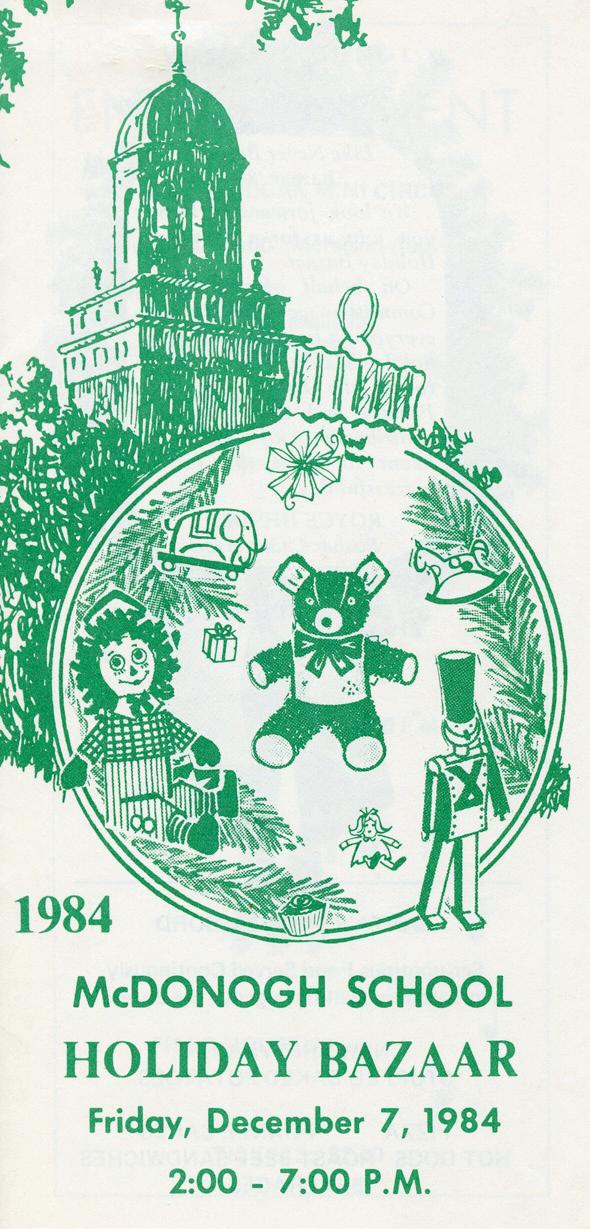
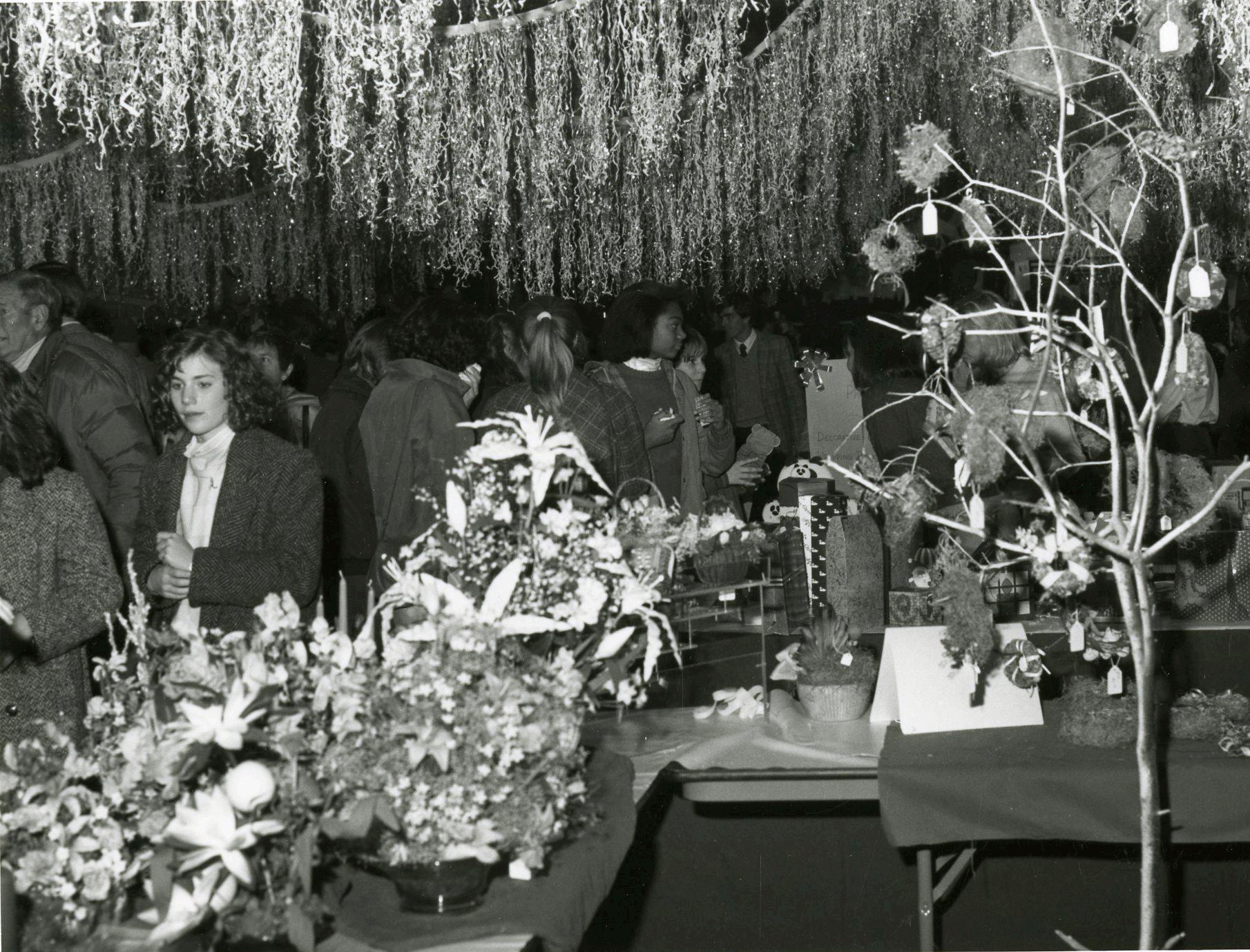
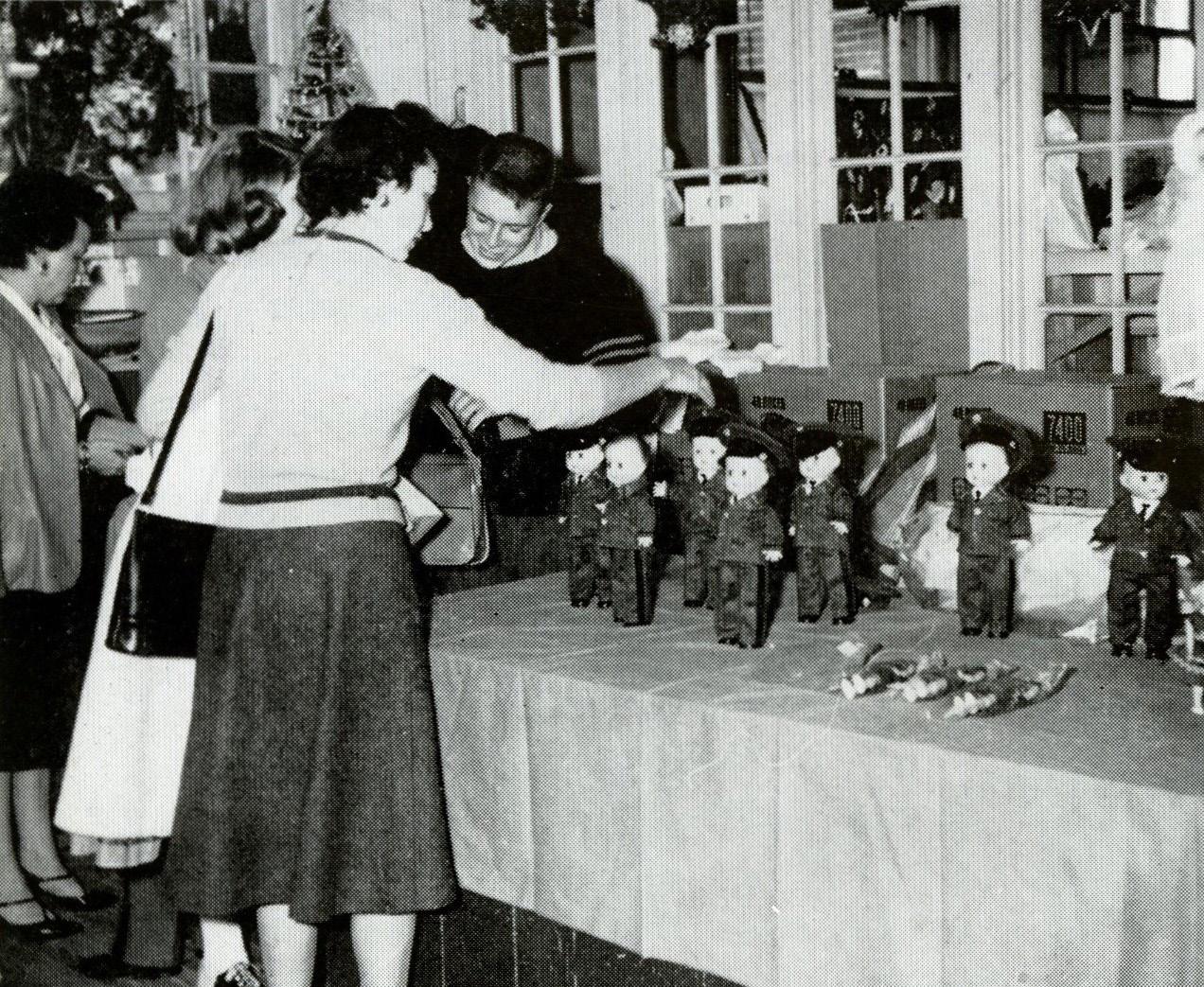
91. Holiday Bazaar
Set a Festive Tone for the Holiday Season ............. 106
96. W. Boulton “Bo” Dixon: Committed to People and Joy 112
97. The Military Provided Structure and Readiness 113
98. Clarence A. Burck Center for the Performing Arts 114
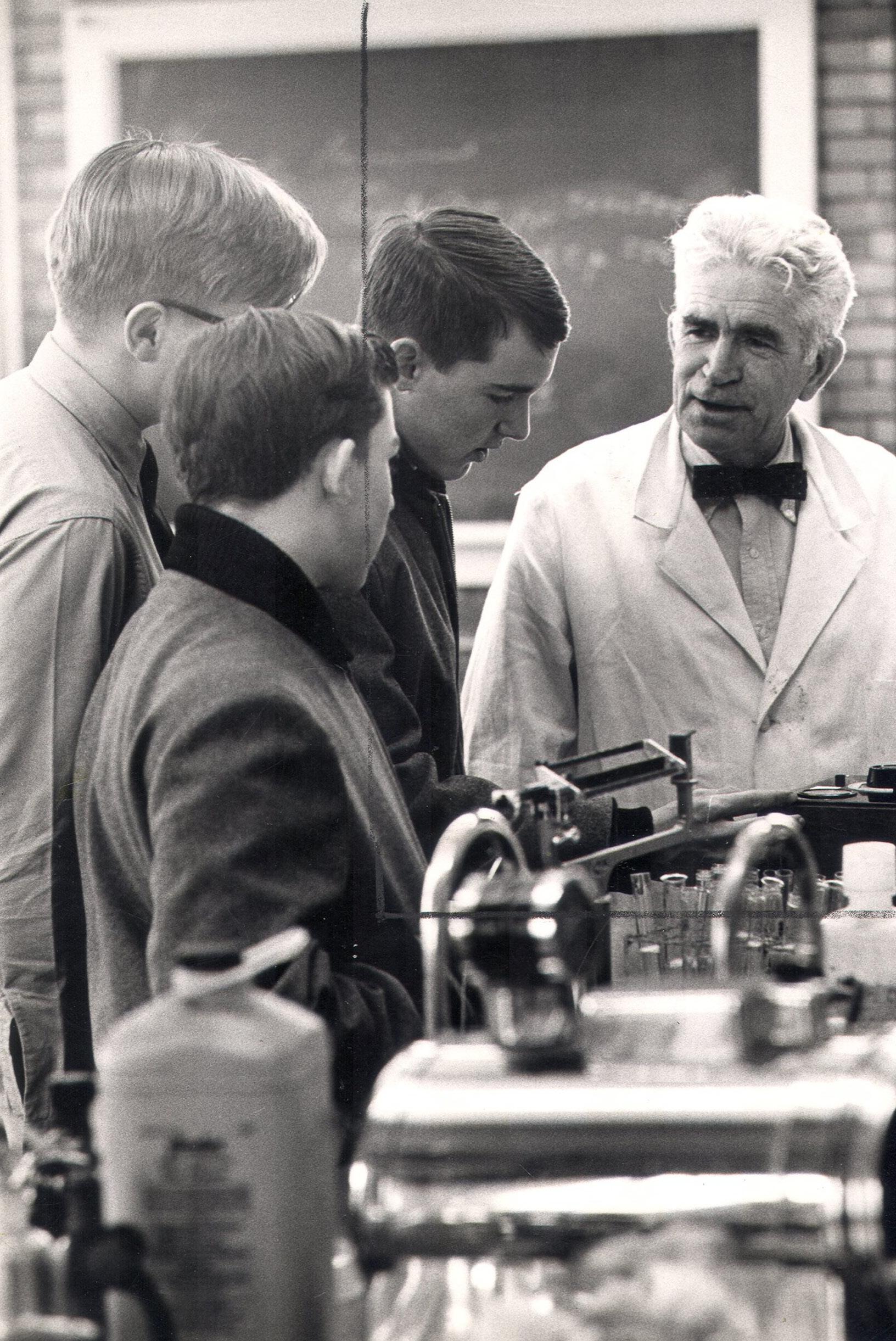
99. Science Teacher “Bugs” Ramsay and His Ducklings 115
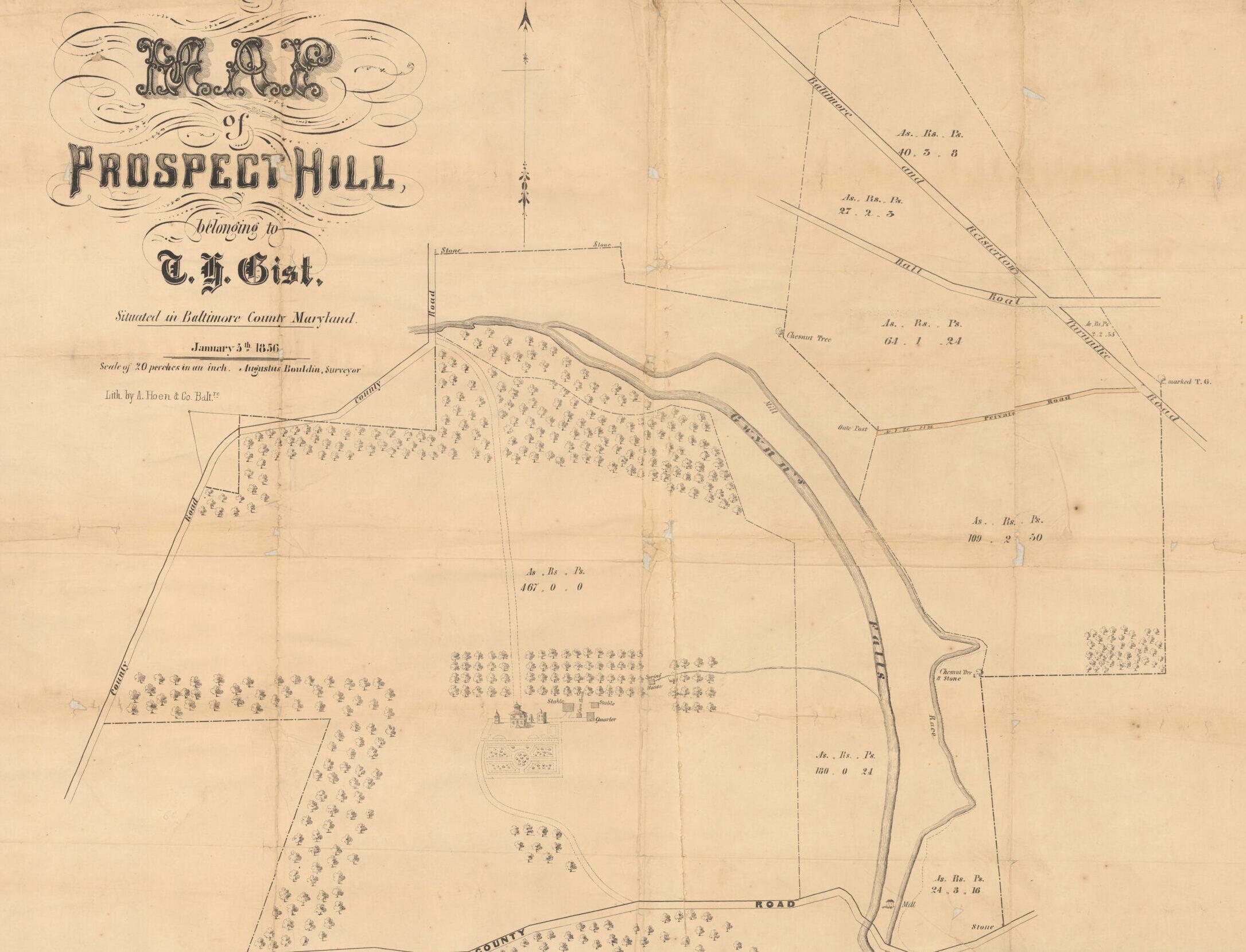
100. Prospect Hill Estate Becomes McDonogh School 116
101. Charles W. “Charlie” Britton: A Journey of Growth and Transformation 117
102. Senior Quad Now Welcomes All 118
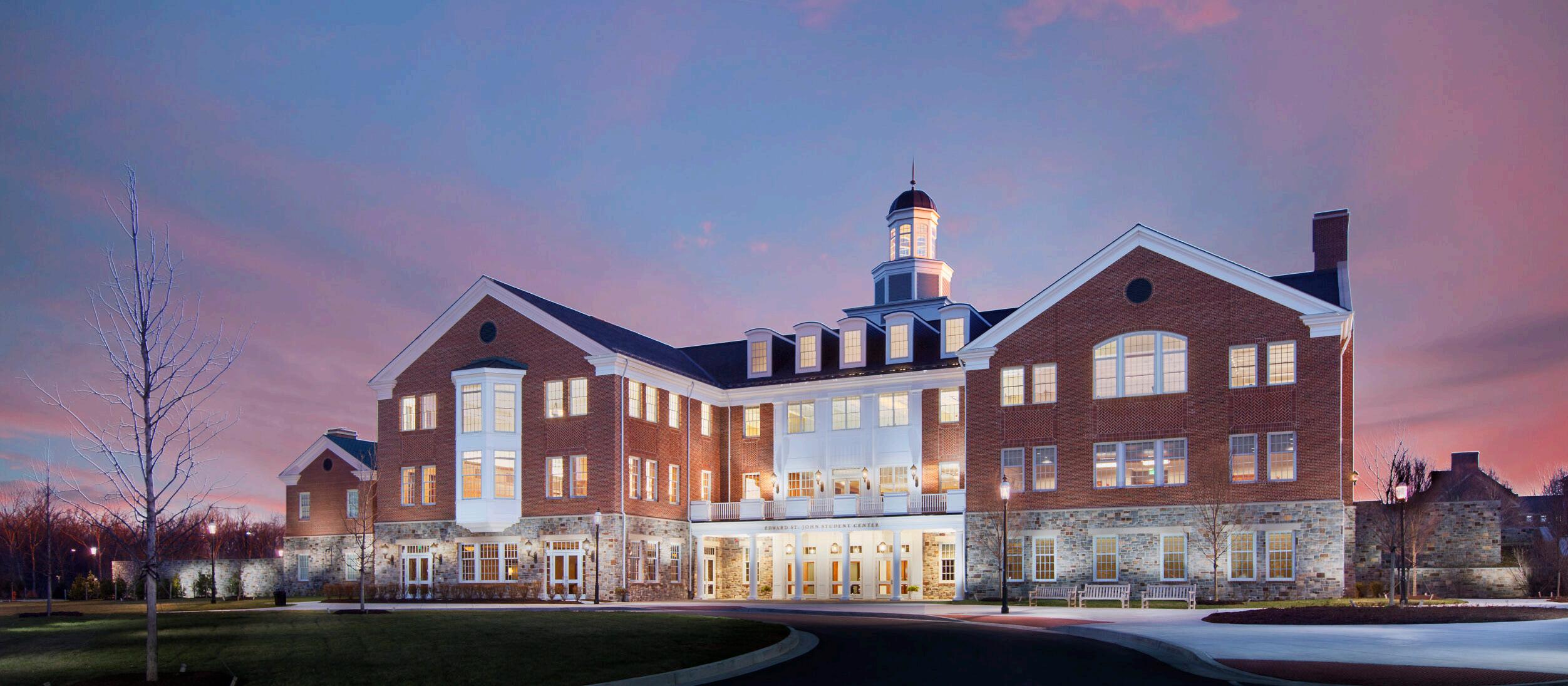
103. Edward St. John Student Center: A Space for the Whole Community 119
104. What’s the Oldest Structure on Campus? It’s not Tagart Chapel. 120
105. Beale Rollins: From Scholarship Student to Philanthropist 121
106. Day Hops Arrive in 1927......................................... 122
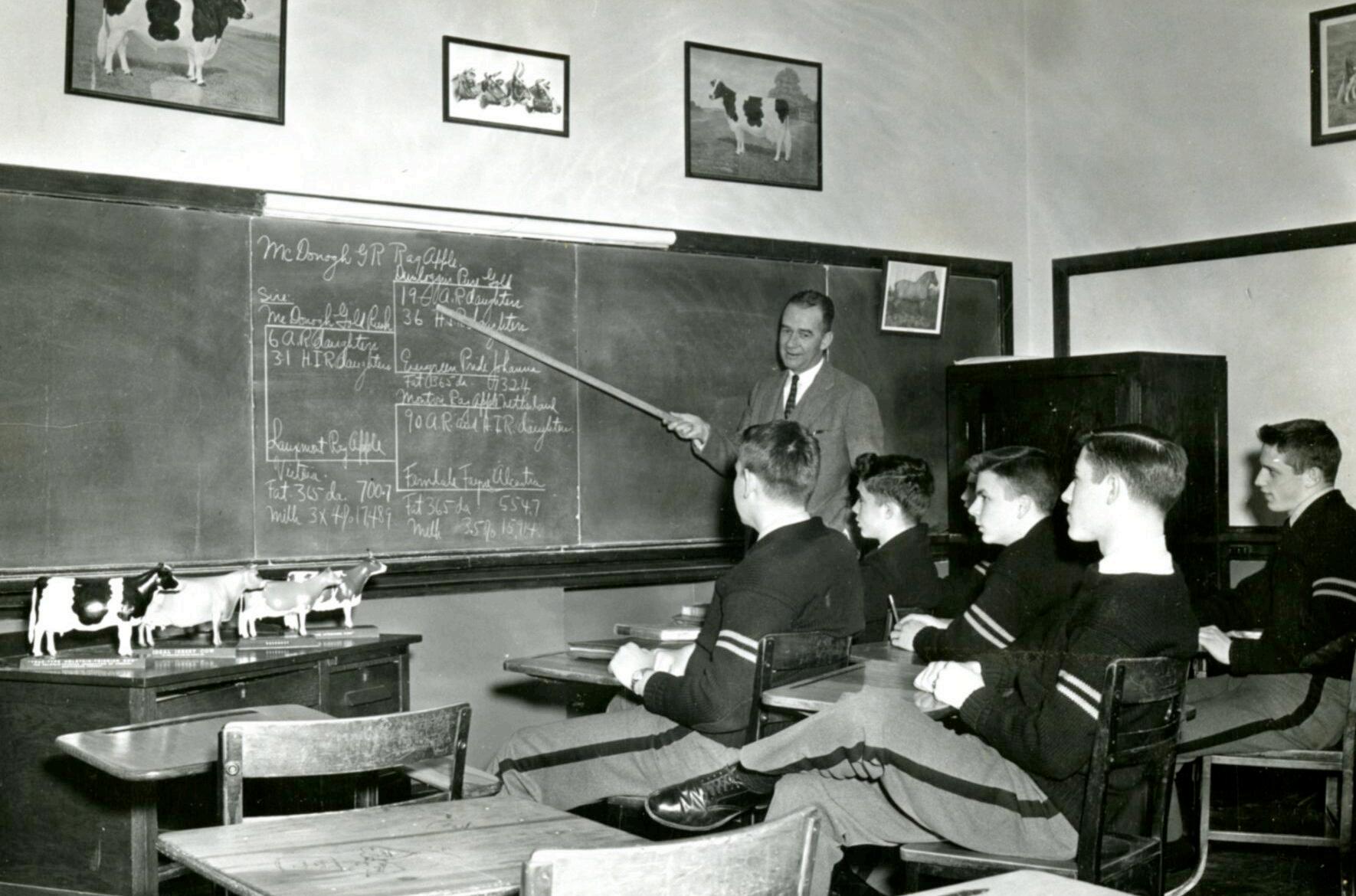
107. Award-Winning Animal Husbandry Program 123
108. McDonogh’s Guiding Principles: Words to Live By 124
109. McDonogh Uniform Poem Has Lasting Impact 125
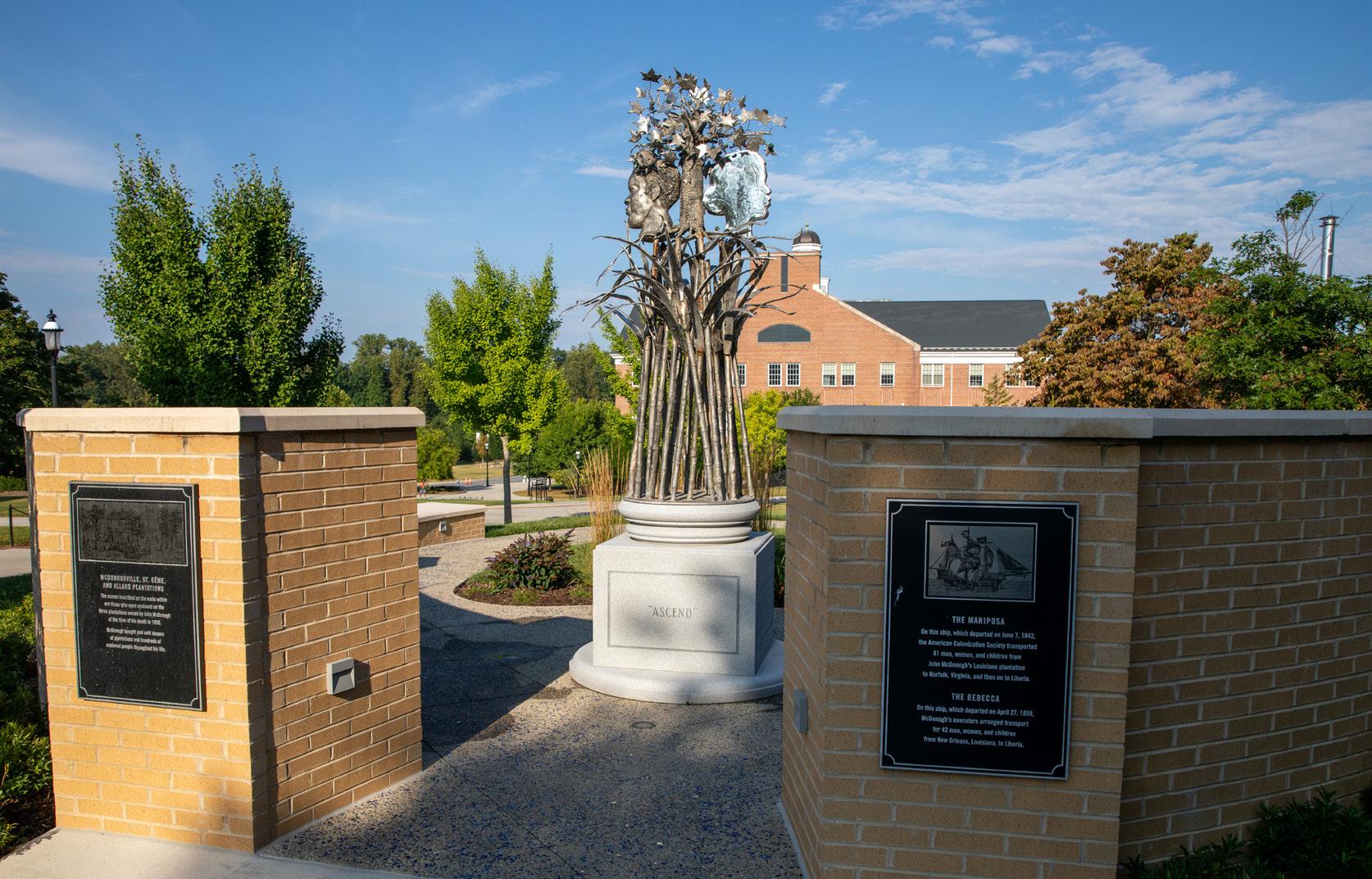
110. Memorial to Those Enslaved and Freed 126
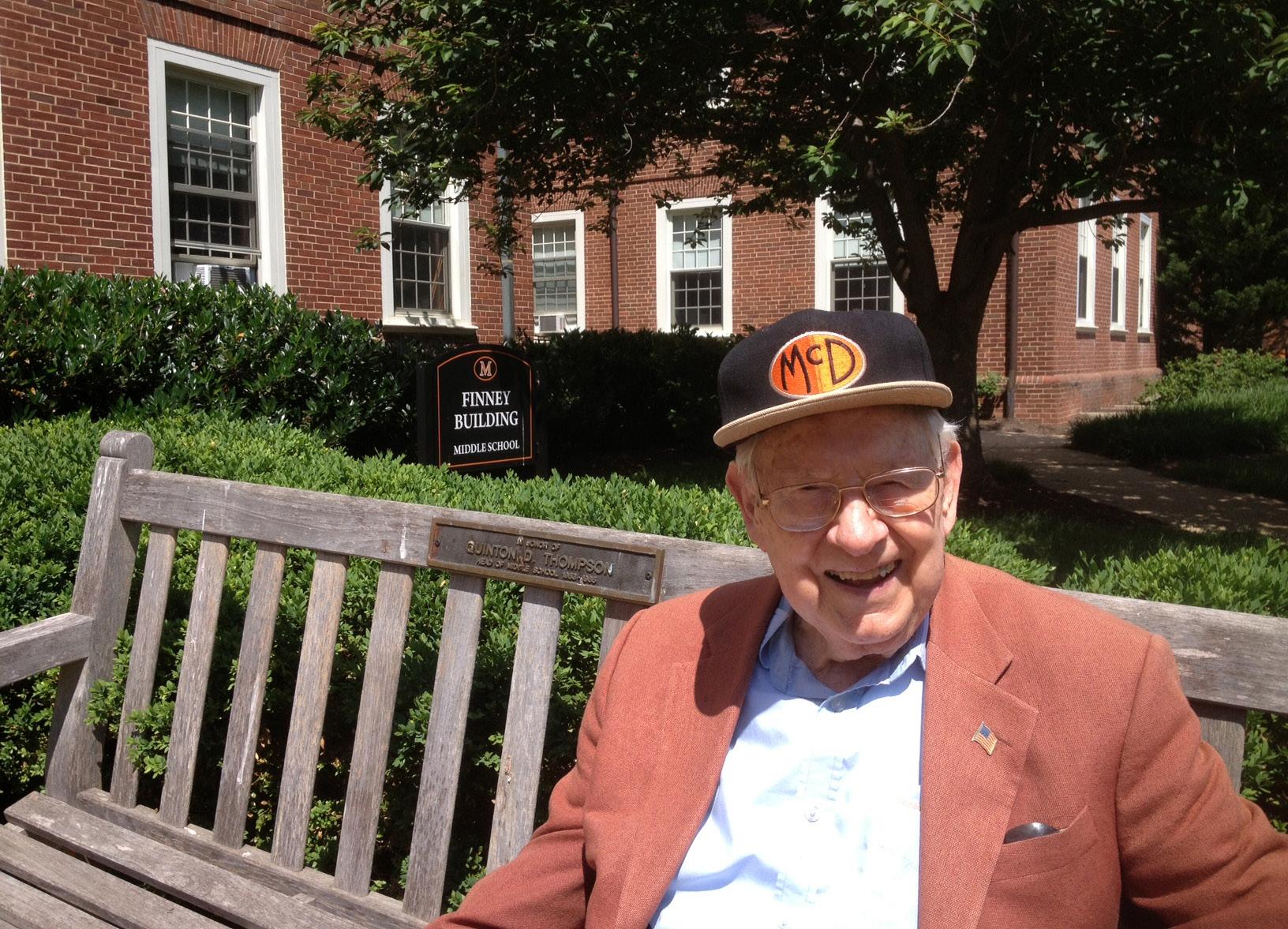
111. Q. D. Thompson 127
112. Cards, Dances, Carnations, and Telegrams: The Heart of Valentine’s Day 128
113. Aquapalooza: An Afternoon of Splashy Fun 129
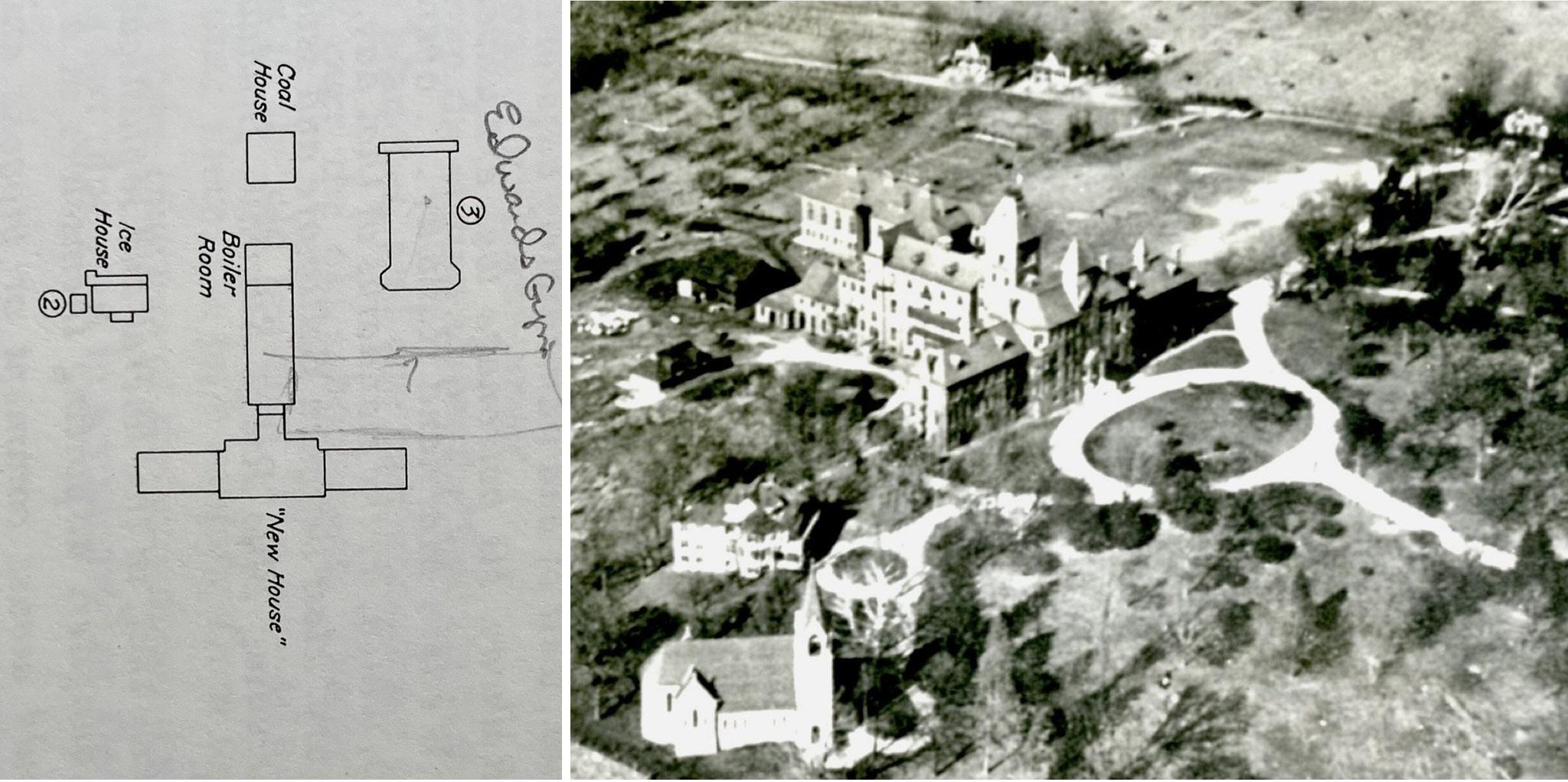
114. Ice Houses Kept it Cool 130
115. Competitive Drill: The Culmination of a Year’s Work 132
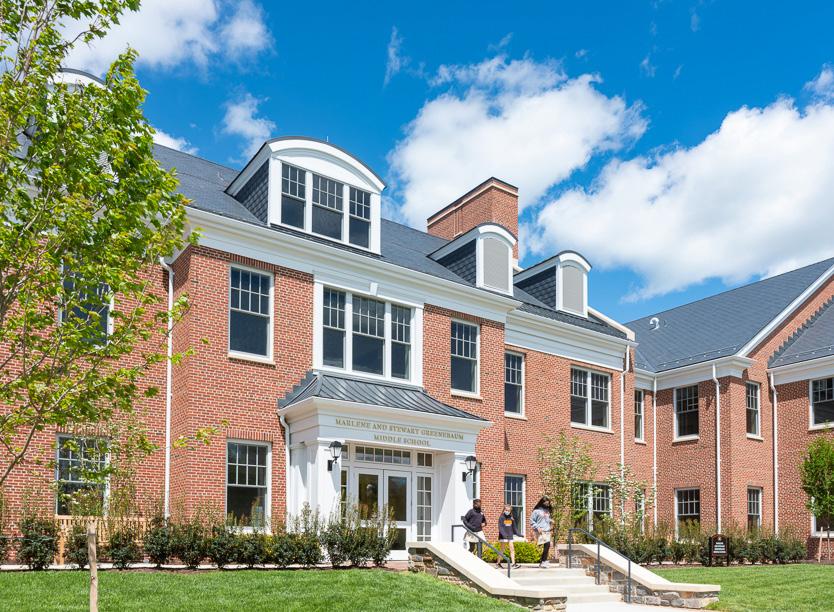
116. The Future of Learning: Marlene and Stewart Greenebaum Middle School 133
117. Illness Shuts Down School..................................... 134
118. Faculty Chairs Recognize Excellence 136
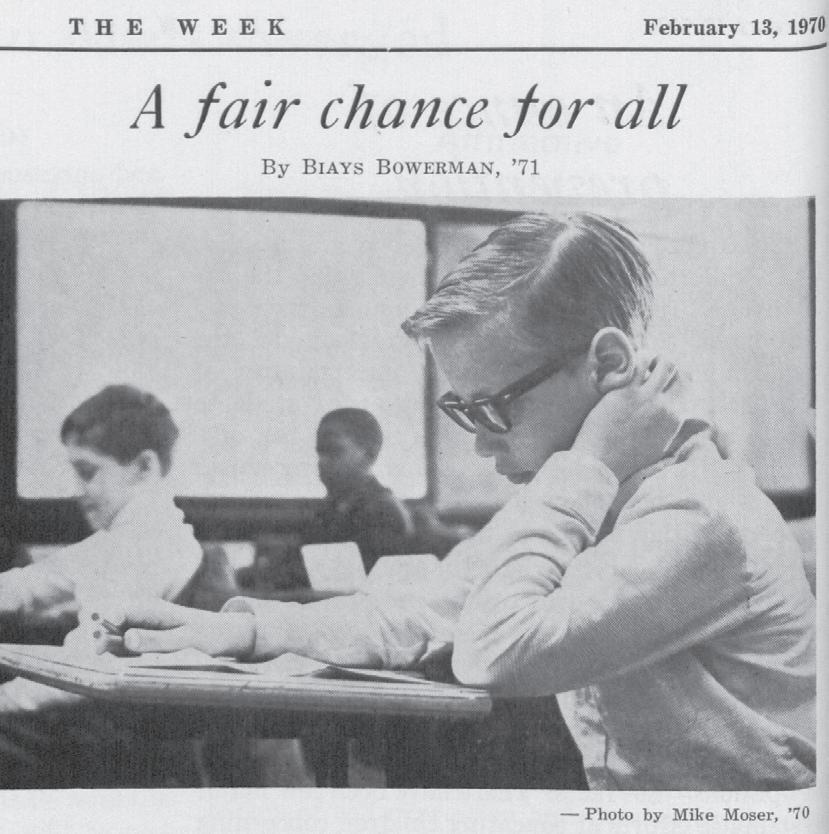
119. What Does It Take to Become a McDonogh Student? 137
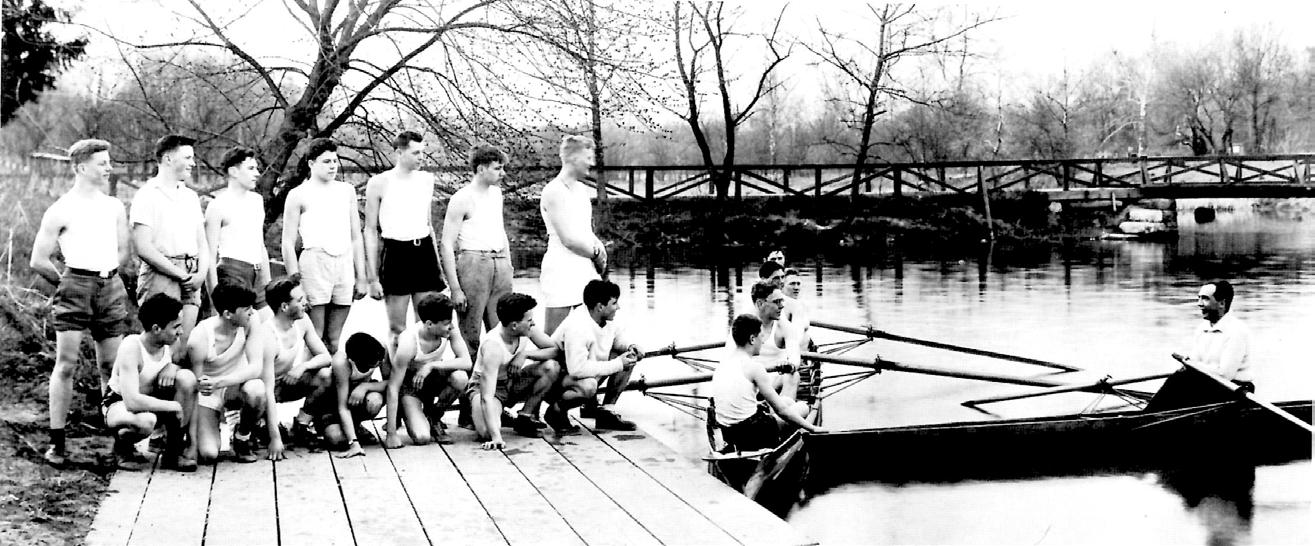
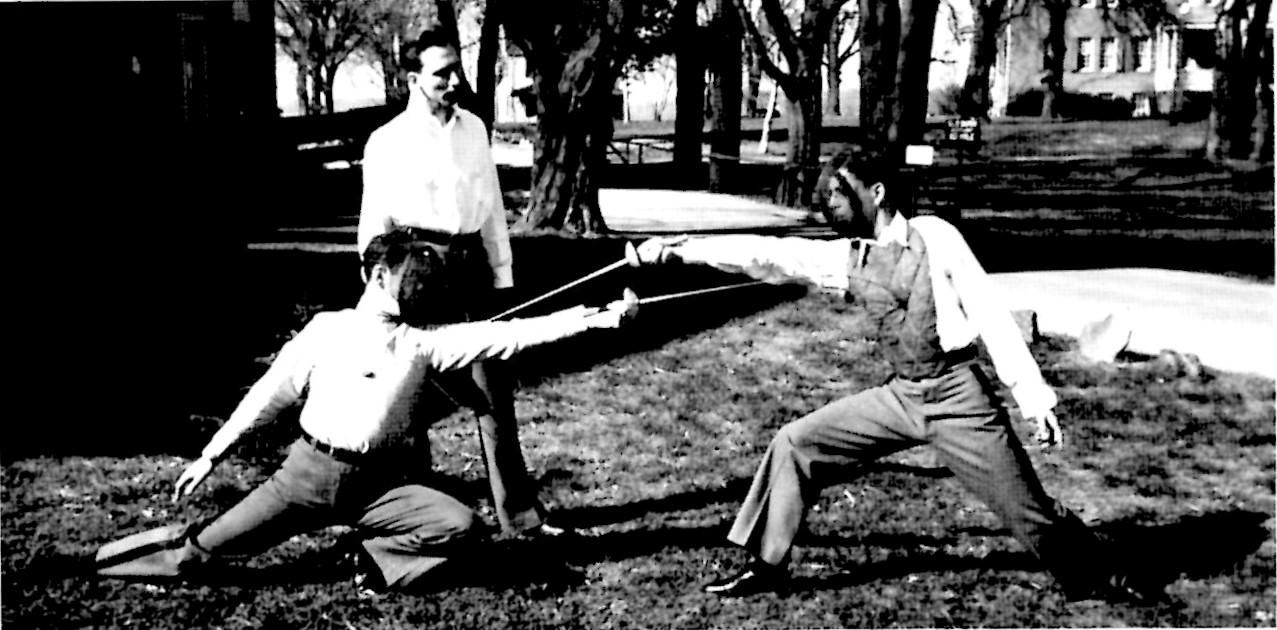
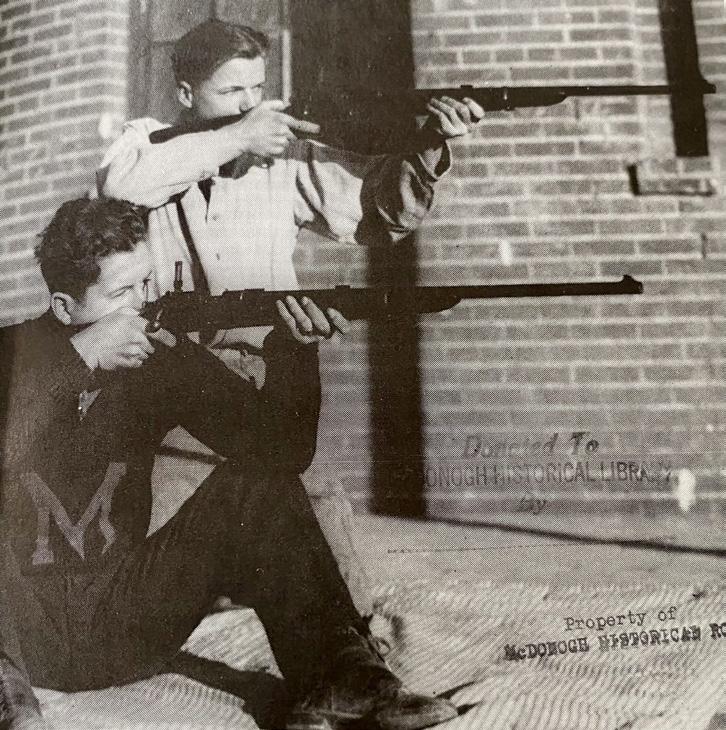
120. Fencing, Riflery, Ice Hockey, and Crew 139
121. David J. Farace ’87: A Career Dedicated to Independent Schools ........ 140
122. Learning How to Think, Not What to Think: Understanding Freedom of Expression and Civil Discourse 141
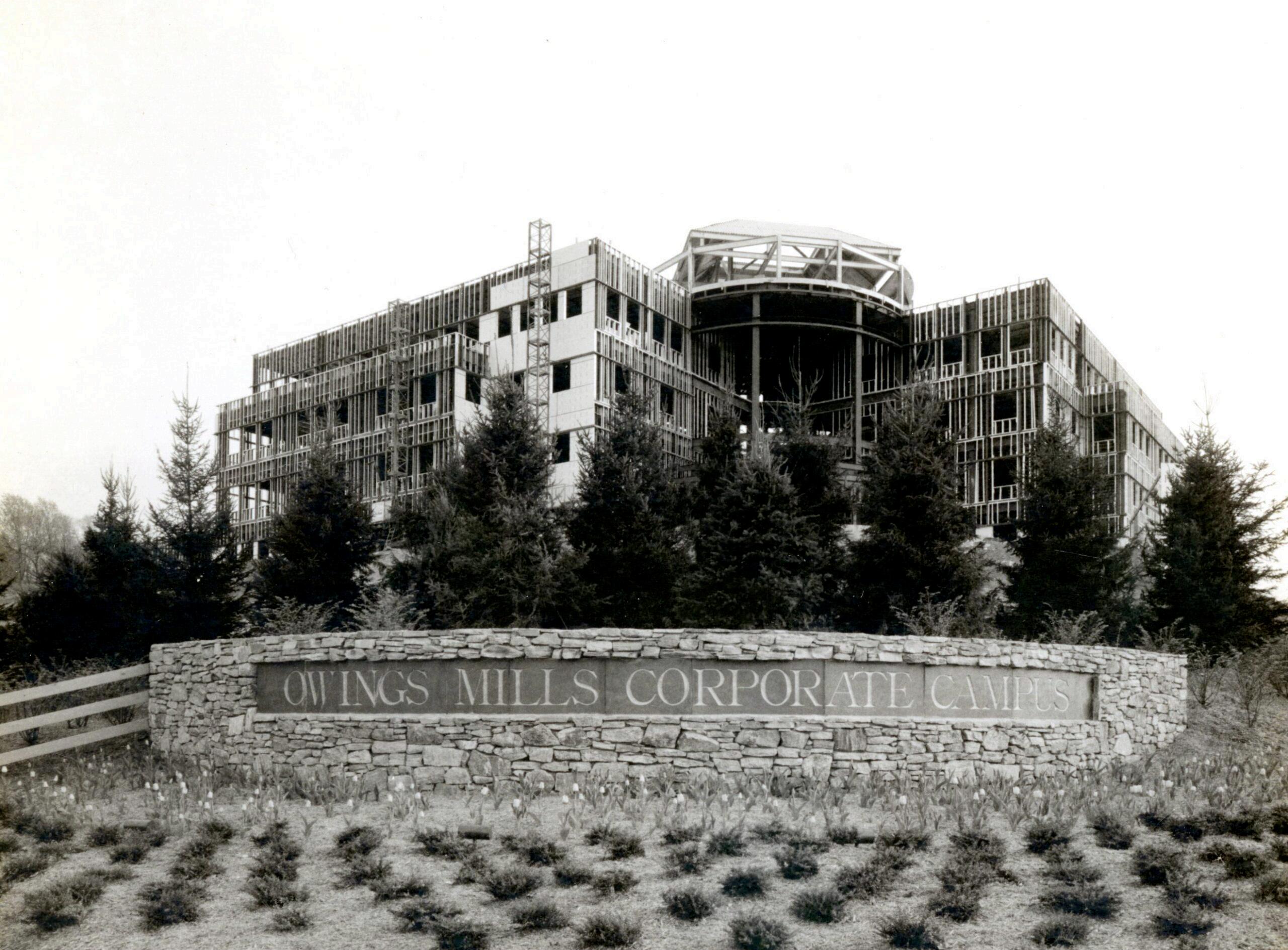
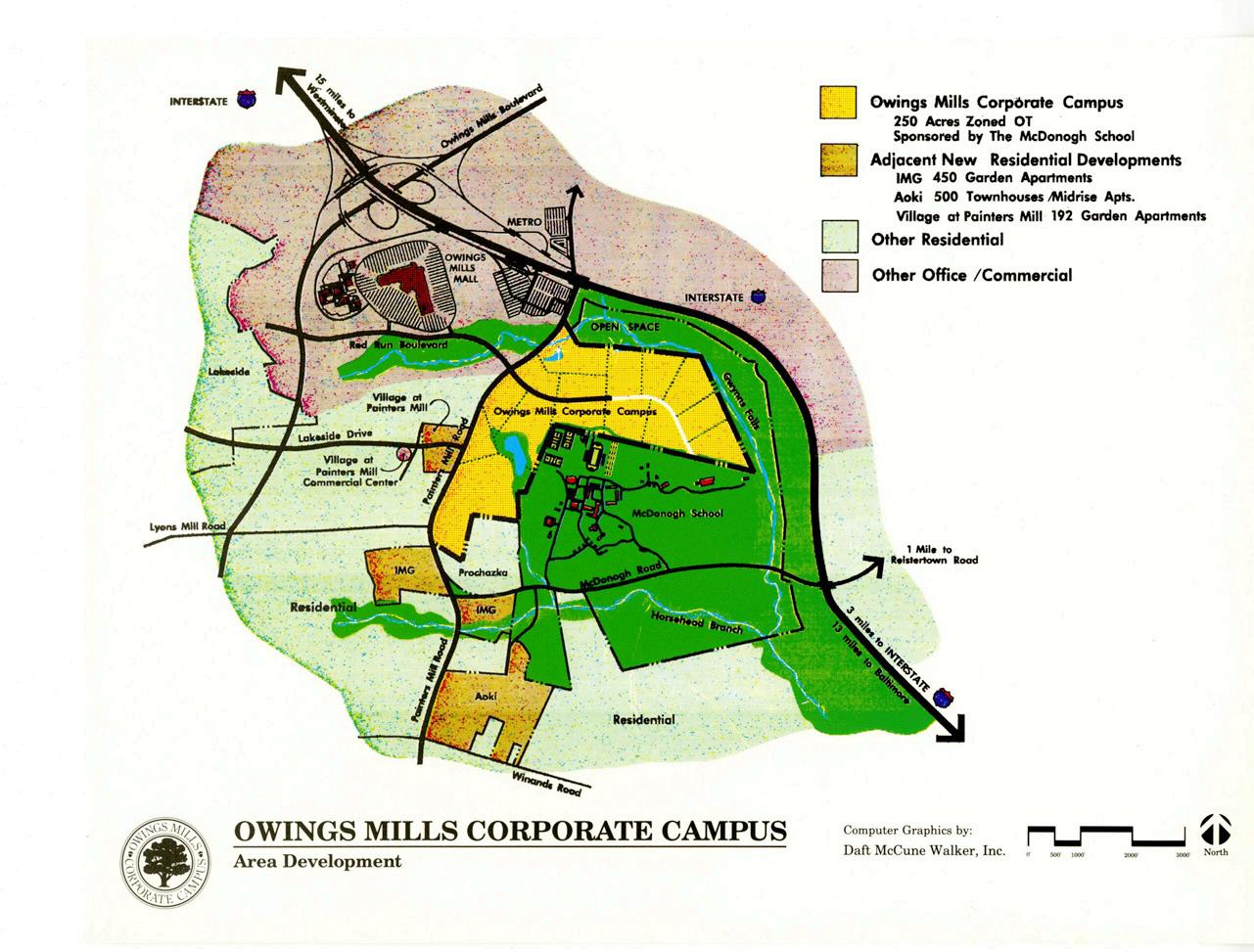
123. Owings Mills Corporate Campus: A Shrewd Business Decision 142
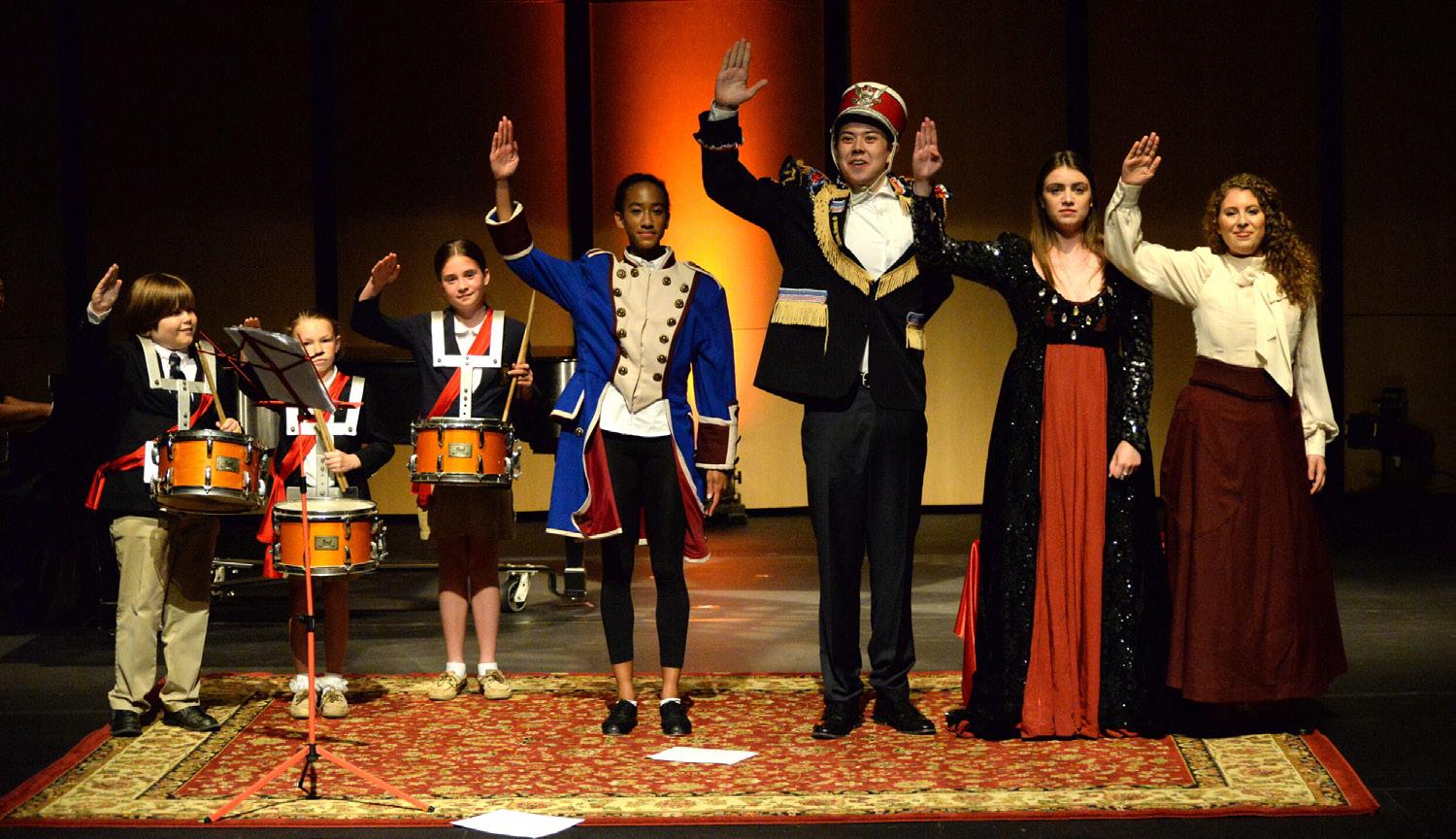
124. Stewart Recital: A Showcase of Performing Arts 144
125. Memories of Gray..................................................... 145
126. Memorial Day Ceremony: One of the Most Solemn Gatherings ..........................147
127. From Typewriting Machines to Computers Technology Has Come a Long Way 148
128. Capital Campaigns: Essential to the Future for McDonogh 149
129. From Camp Red Cloud in the Adirondacks to Camp Red Eagle at McDonogh 150
130. The Joy of Being a
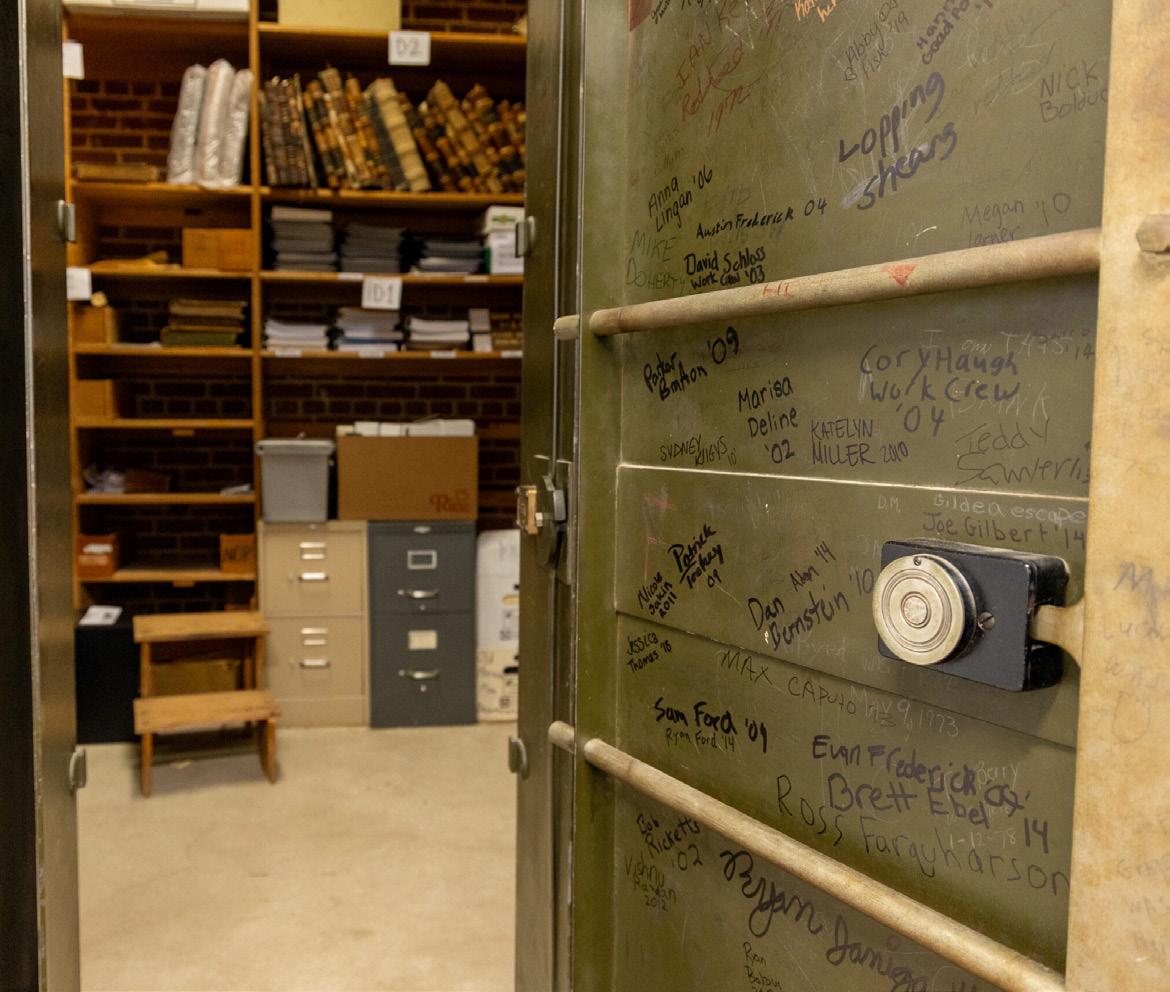
140. Where is the File Room and What’s In It?
142. The Folio Collaborative: How Good Teachers Become Great
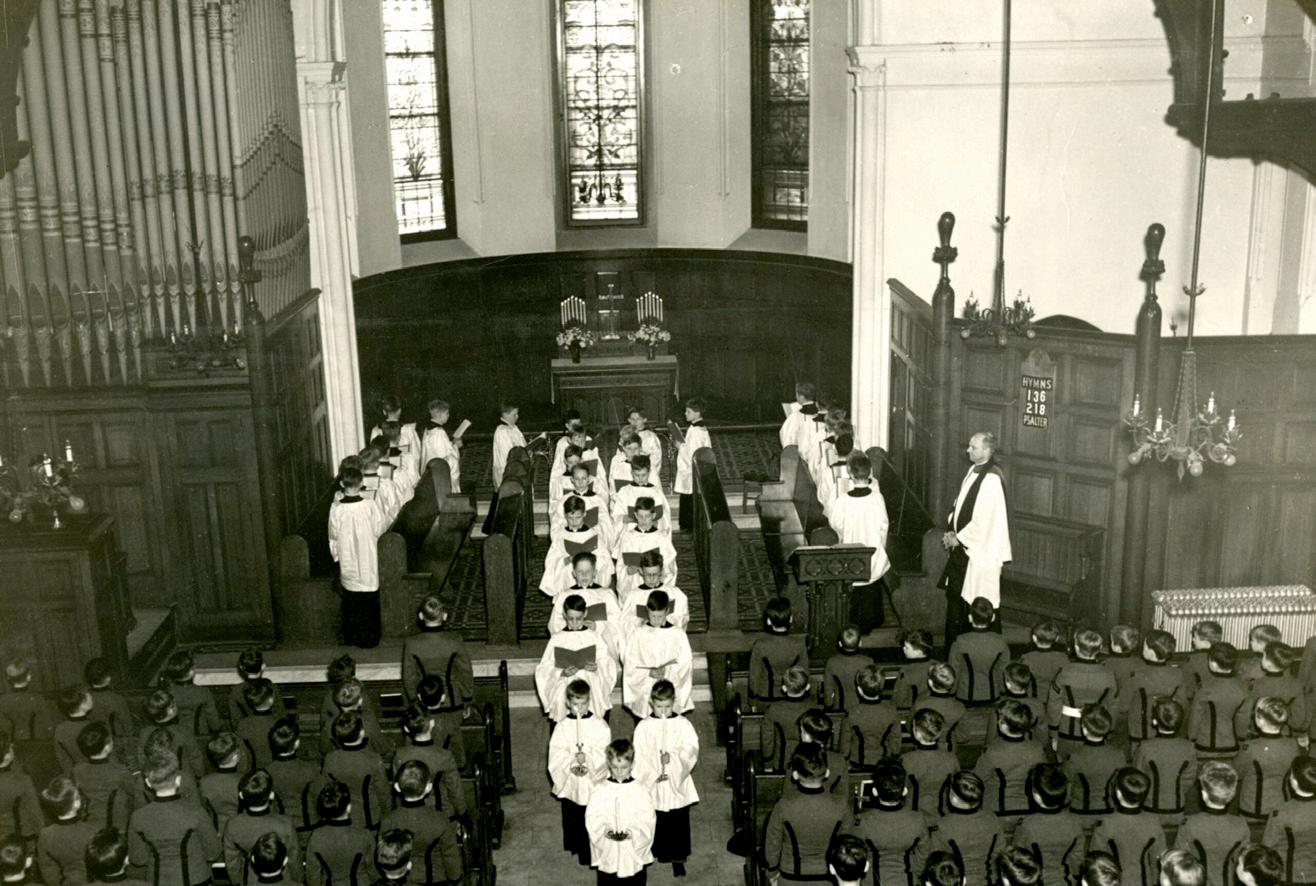
145. Chapel Gatherings: Once a Place for Religious Doctrine, Always a Place for Cultivating Character
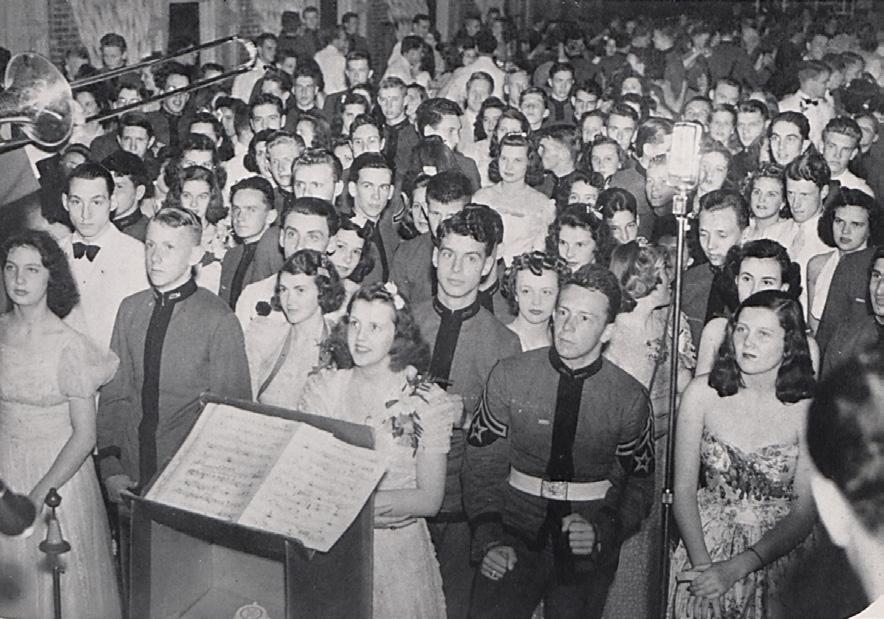
146. Dancing the Night Away
147. Blazer Badges, Buttons, Patches, and Pins
148. A Vacuum Cleaner and Other Firsts
150. Bits and Pieces
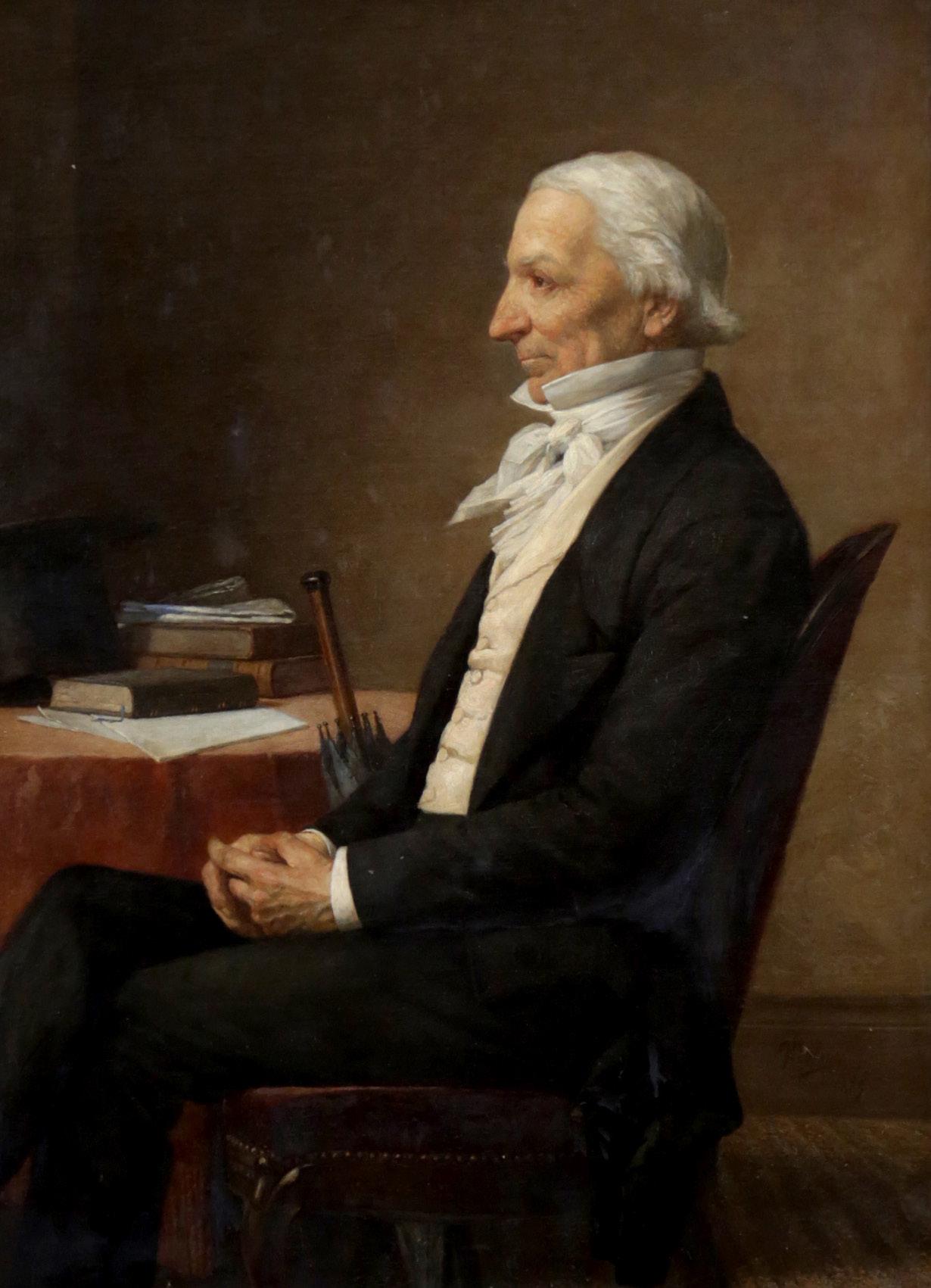
Our Benefactor: John McDonogh
John McDonogh (1779-1850) was born in Baltimore but lived most of his adult life in New Orleans as a businessman, plantation owner, sometime-politician, and supporter of the American Colonization Society. His estate was built through the use of slave labor. McDonogh bequeathed approximately half of his enormous wealth to the City of New Orleans “for the establishment and support of Free Schools.” His will also provided for the establishment of a “school farm” in the city of Baltimore. In 1872, a tract of 835 acres was purchased for $85,000 for the school’s establishment.
John McDonogh was originally buried in a cemetery in New Orleans. In 1865, his body was moved by the City Council of Baltimore, who was acting as trustees for his property, to Green Mount Cemetery. A grave memorial was commissioned by the City Council to honor his directive to create a farm school for underprivileged boys. In 1945, his body and the sculpted memorial were moved to McDonogh School. The cost of moving the monument to its present location was covered by the sale of his plot in Greenmount Cemetery by former Headmaster Louis E. Lamborn.
Visit mcdonogh.org to learn more.
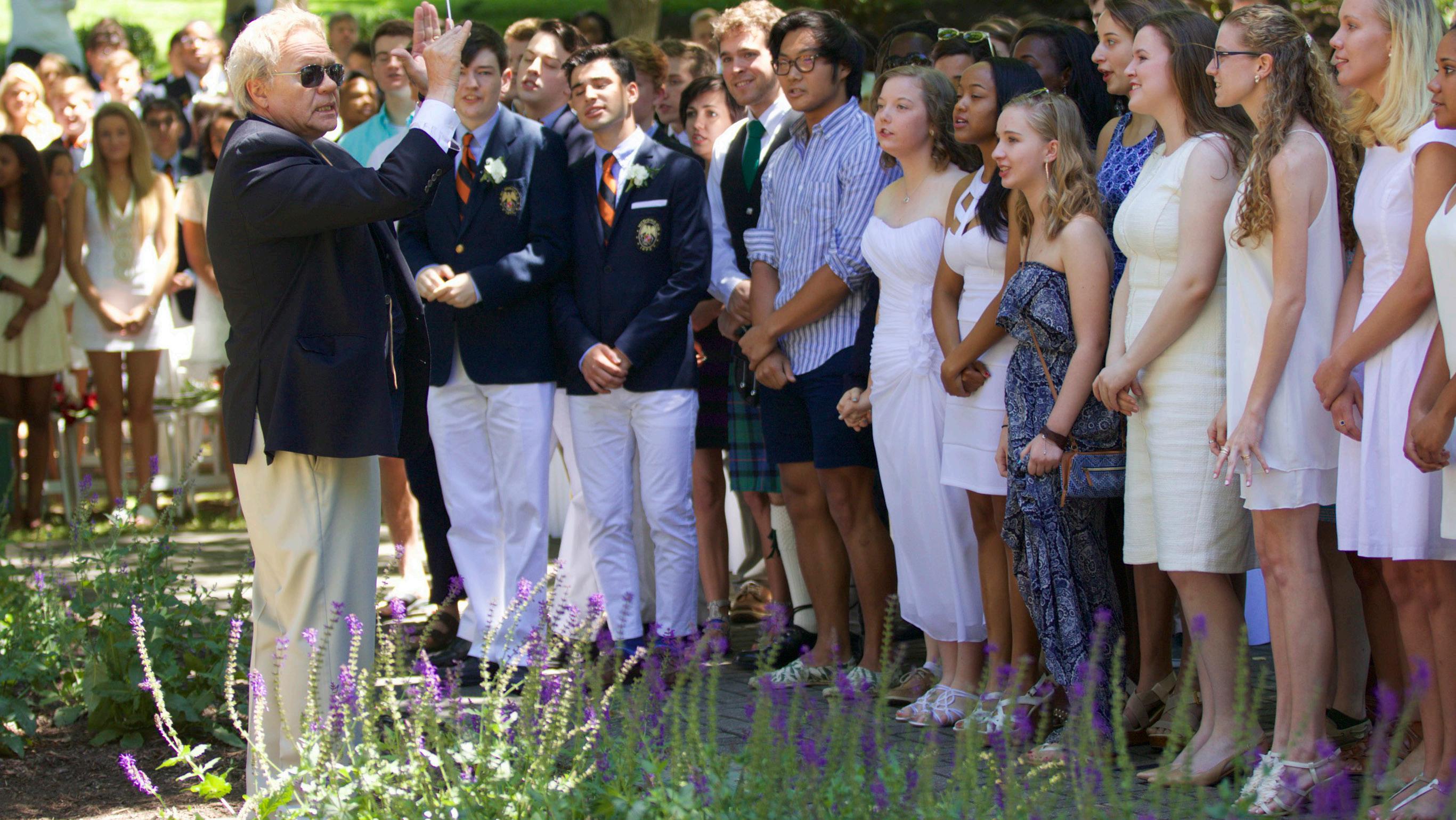
2. Dedication Hymn
The Dedication Hymn has been sung off and on since the 1930s. The beloved school hymn emphasizes gratitude for “all of those who’ve gone before us.” For reasons unknown, the song was lost for a period of time until a curious alumnus from the class of 1937 inquired about it. After some searching, the lyrics were found. With little to go on, the Upper School Choral Music Director at the time, Philip Olsen, created an arrangement that included harmonies, counterpoint, and good voice leading. It debuted at Commencement in 1991 and has been a part of the ceremony ever since.
It was the Dedication Hymn that lifted the school’s heart when the COVID-19 pandemic forced McDonogh’s campus
to close.
Middle School Vocal
Music Director Suzanne Eldridge, knowing the healing power of music, felt that something must be done to help the community feel connected despite being quarantined. Almost 100 students and alumni submitted recordings of themselves singing the hymn. The videos were stitched together for the McDonogh Virtual Choir performance of the Dedication Hymn
The Dedication Hymn is typically performed at the Dedication Day ceremony in the fall and at Commencement when current students and alumni are invited to join in the singing.
Doors Open With 21 Boys
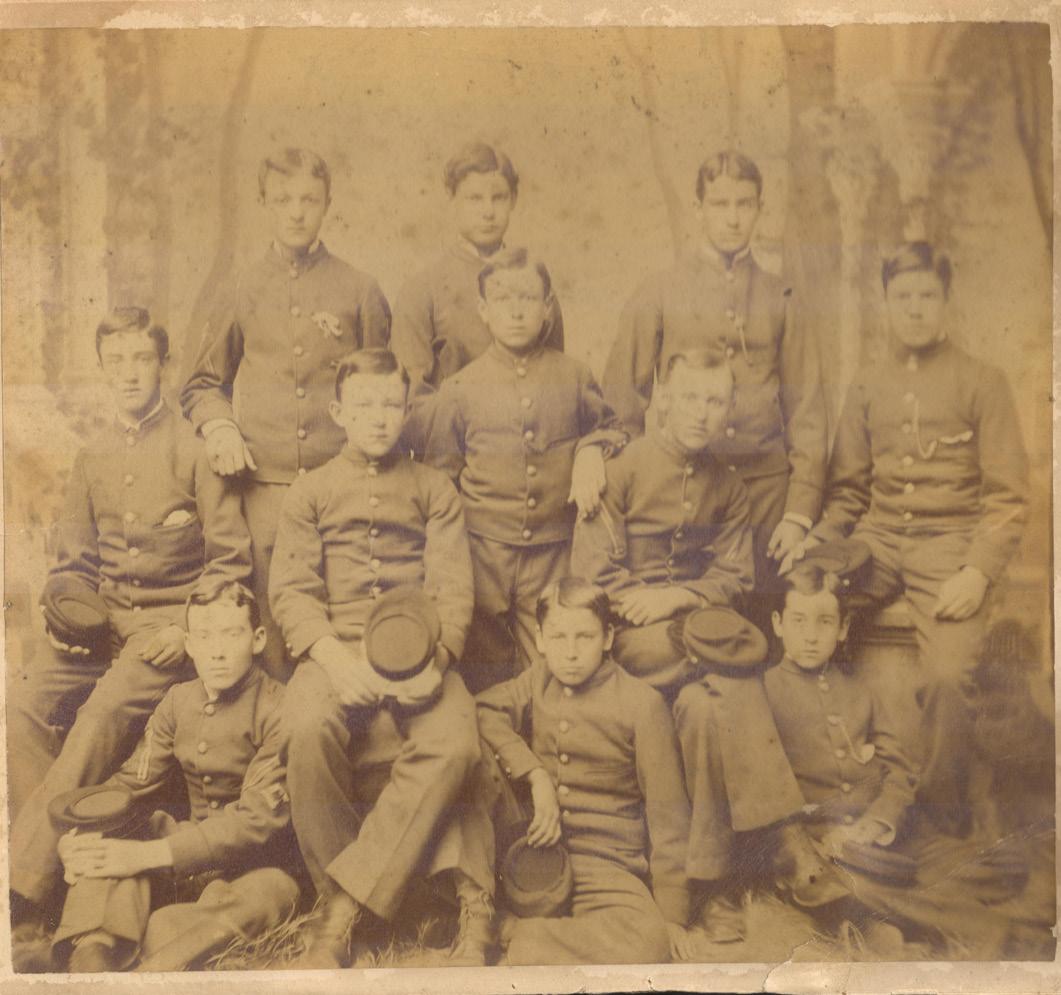
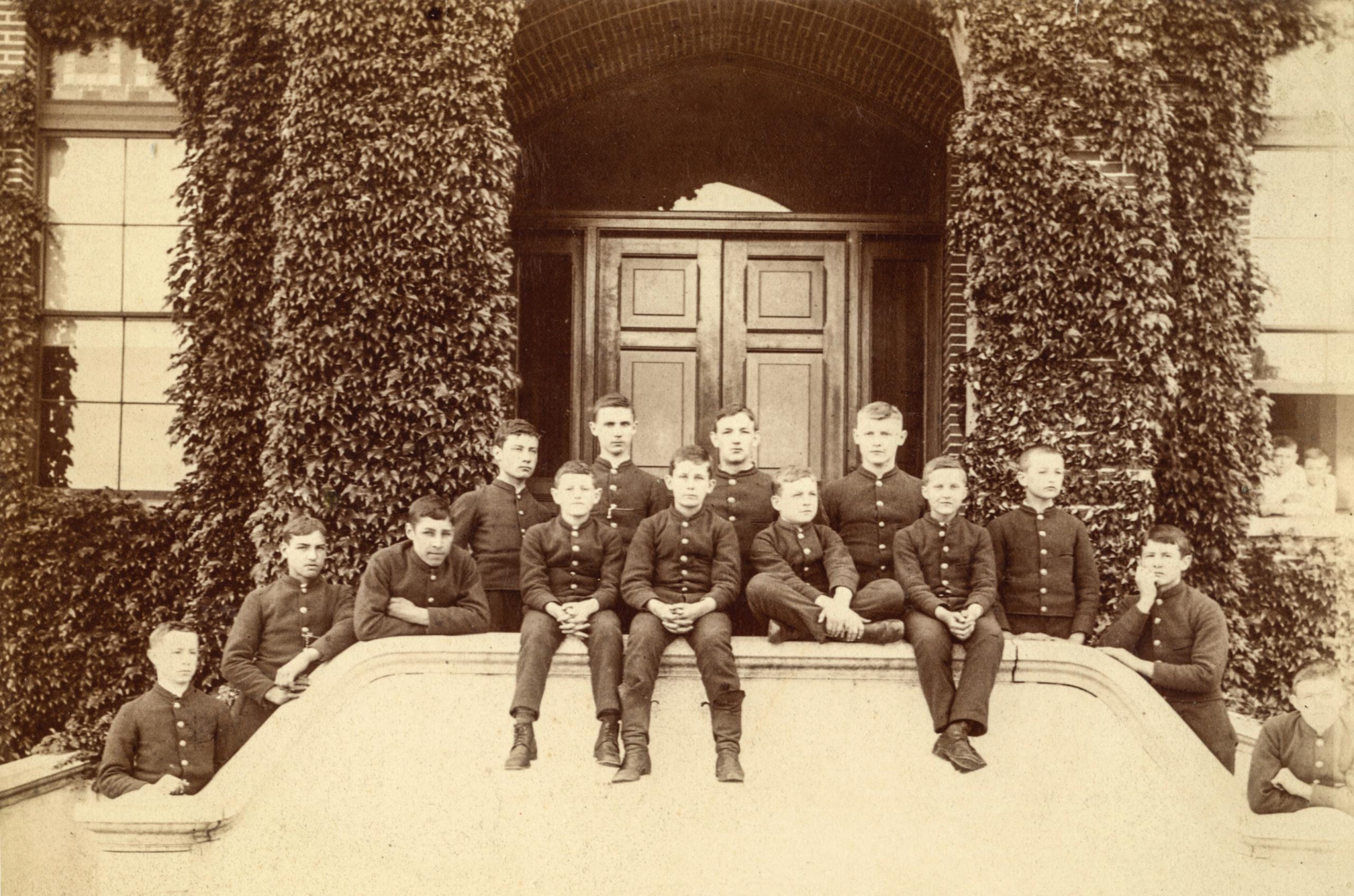
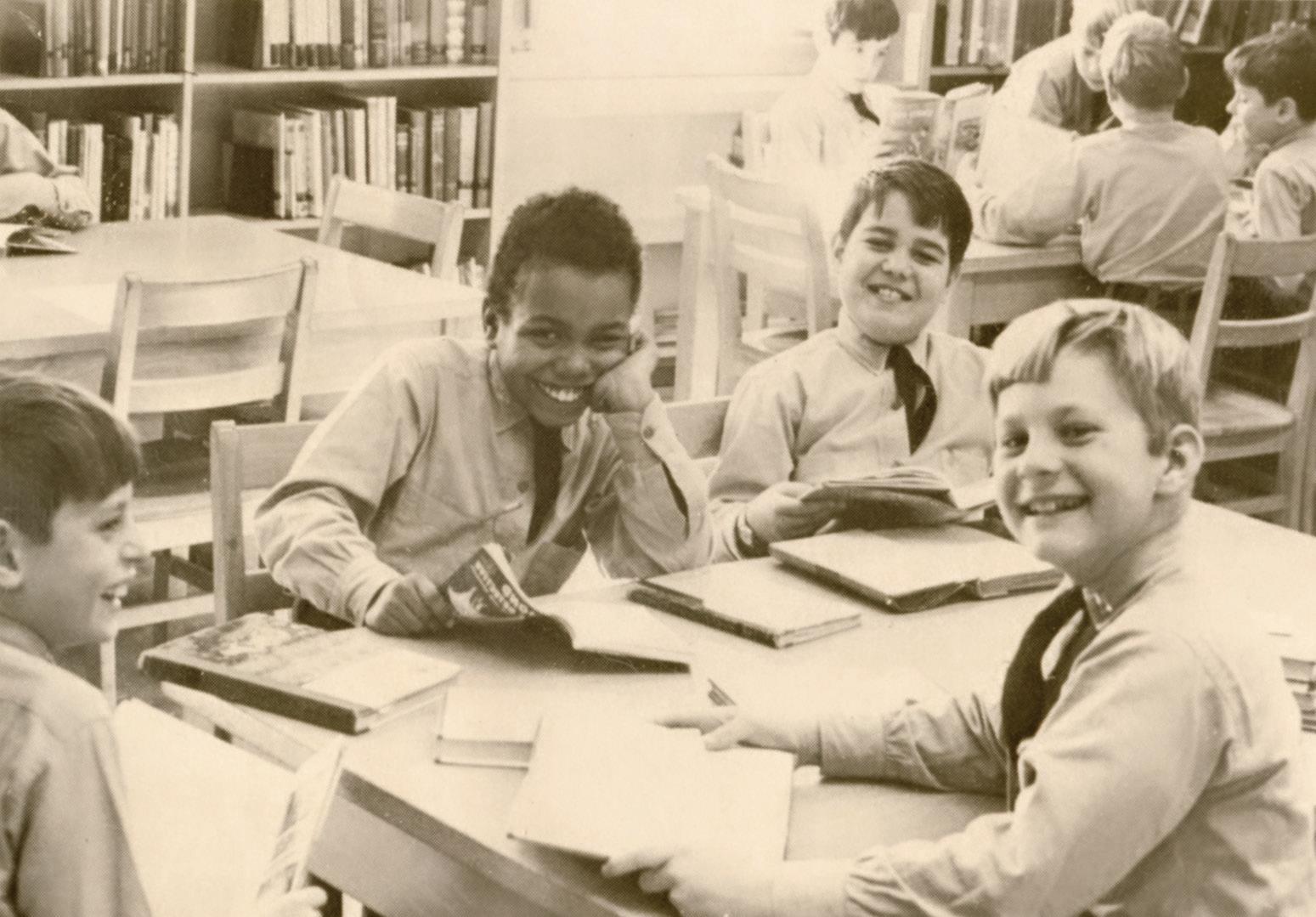
On November 21, 1873, McDonogh School opened its doors to 21 scholarship boys from Baltimore. Enrollment climbed to 50 by early February 1874 and was at 125 in 1891. The 1925 school year began with 100 foundation (scholarship) boys. Four years later, enrollment skyrocketed to 429 with 237 paying tuition and for the first time, pay students outnumbered foundation/ scholarship students. Throughout the war years, the school enrollment continued to increase, and by 1952 it reached 750.
As enrollment steadily grew, it impacted the organization of the School, especially as the number of students in the early grades increased. At first, McDonogh was separated into two divisions of six grades each. It was later reorganized to 6-2-4, and then 6-3-3. Eventually, Headmaster Bob Lamborn instituted the 4-4-4 structure in which the three divisions (Lower, Middle, and Upper School) had four grades each, thus reducing the number of students in each division. This reorganization resulted in the formation of one of the first middle schools in the country and paved the way for the national middle school movement.
Since the school first opened 150 years ago, enrollment has grown from 21 to 1,457
students in prekindergarten to twelfth grade.
Memorial Court: A Sacred Place to Honor Heroes
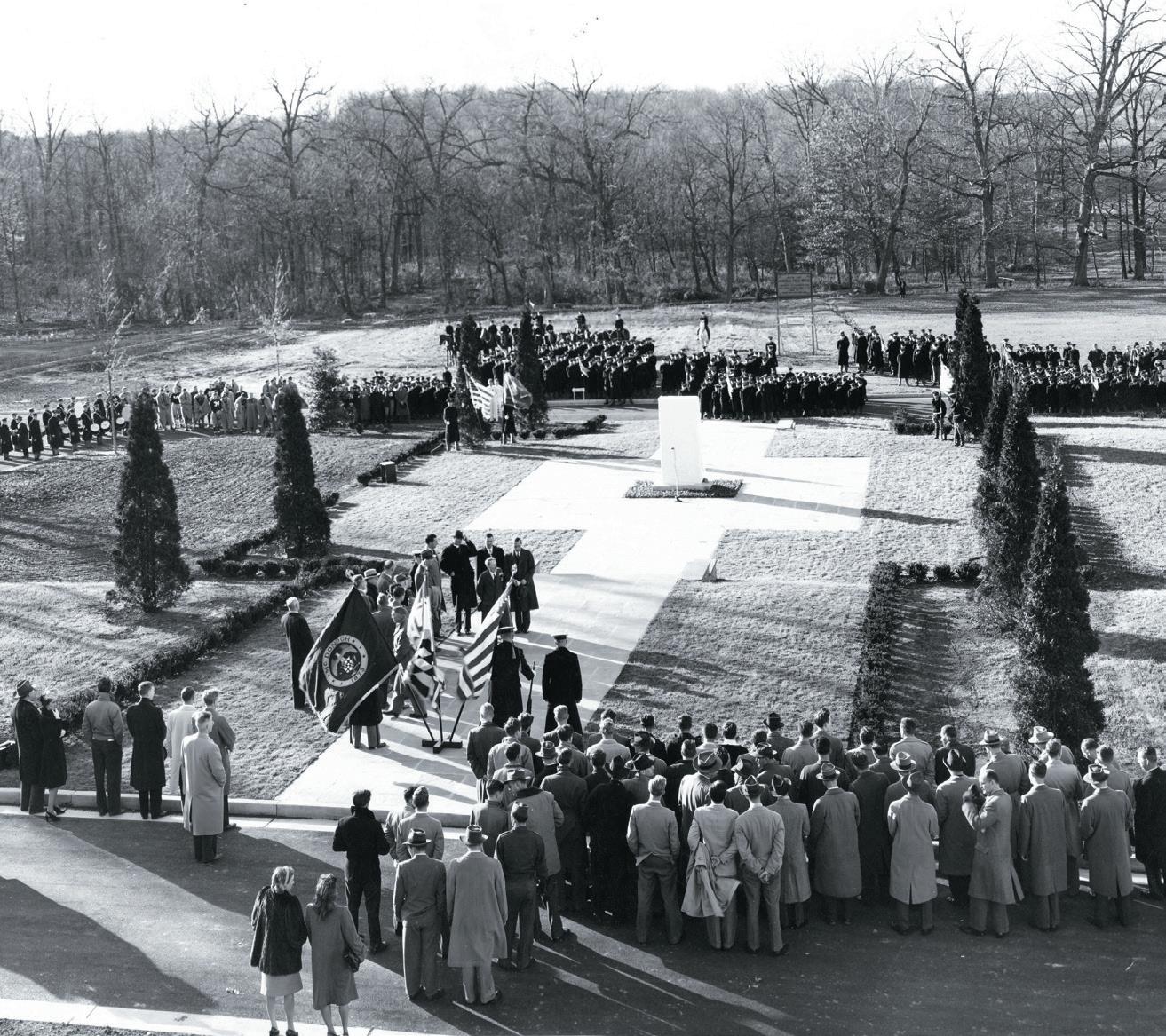
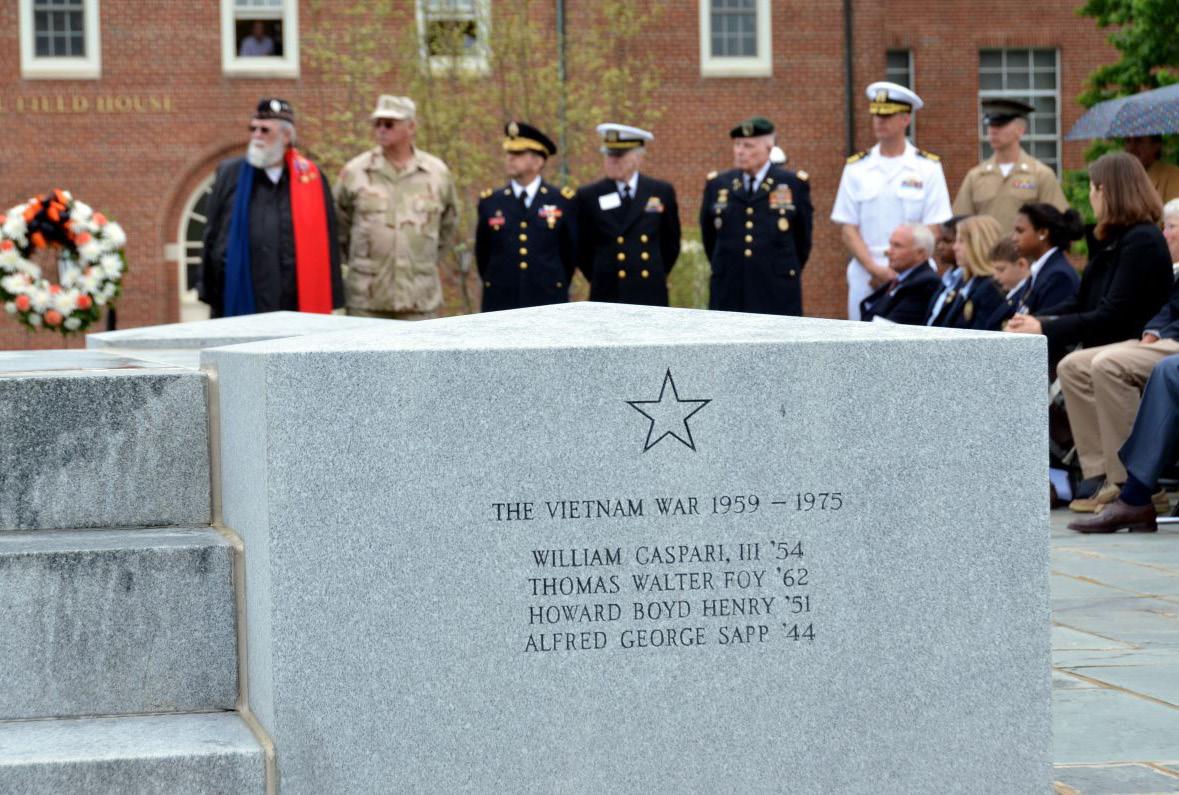
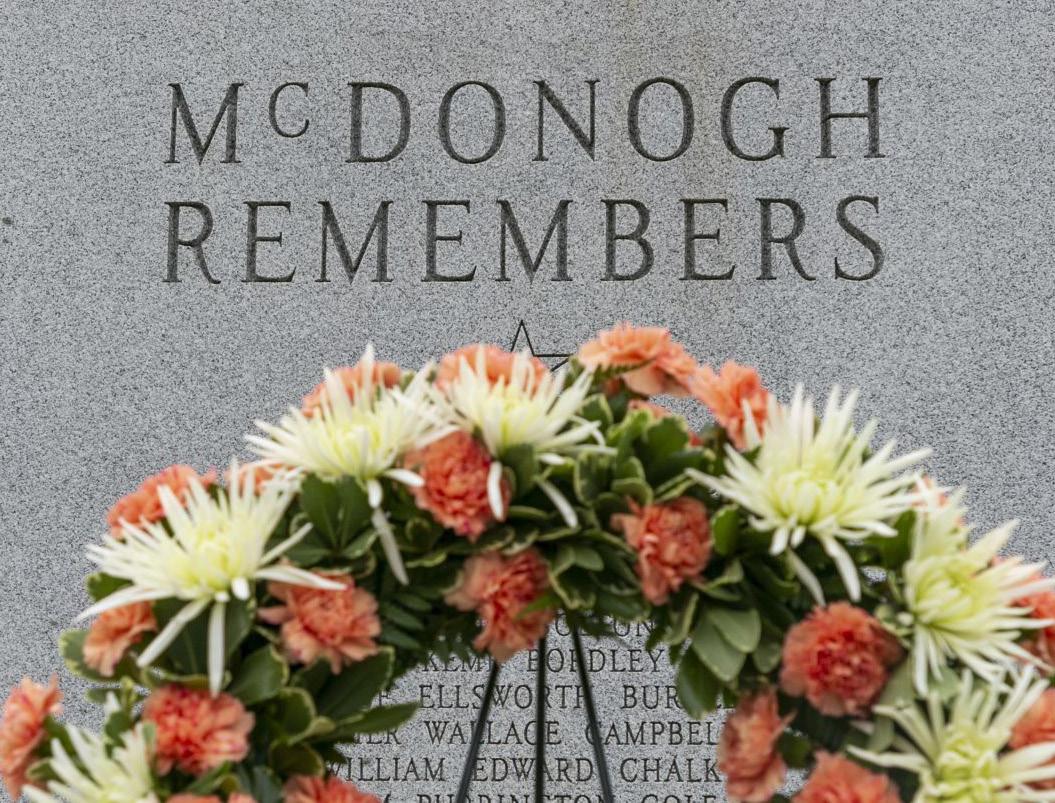
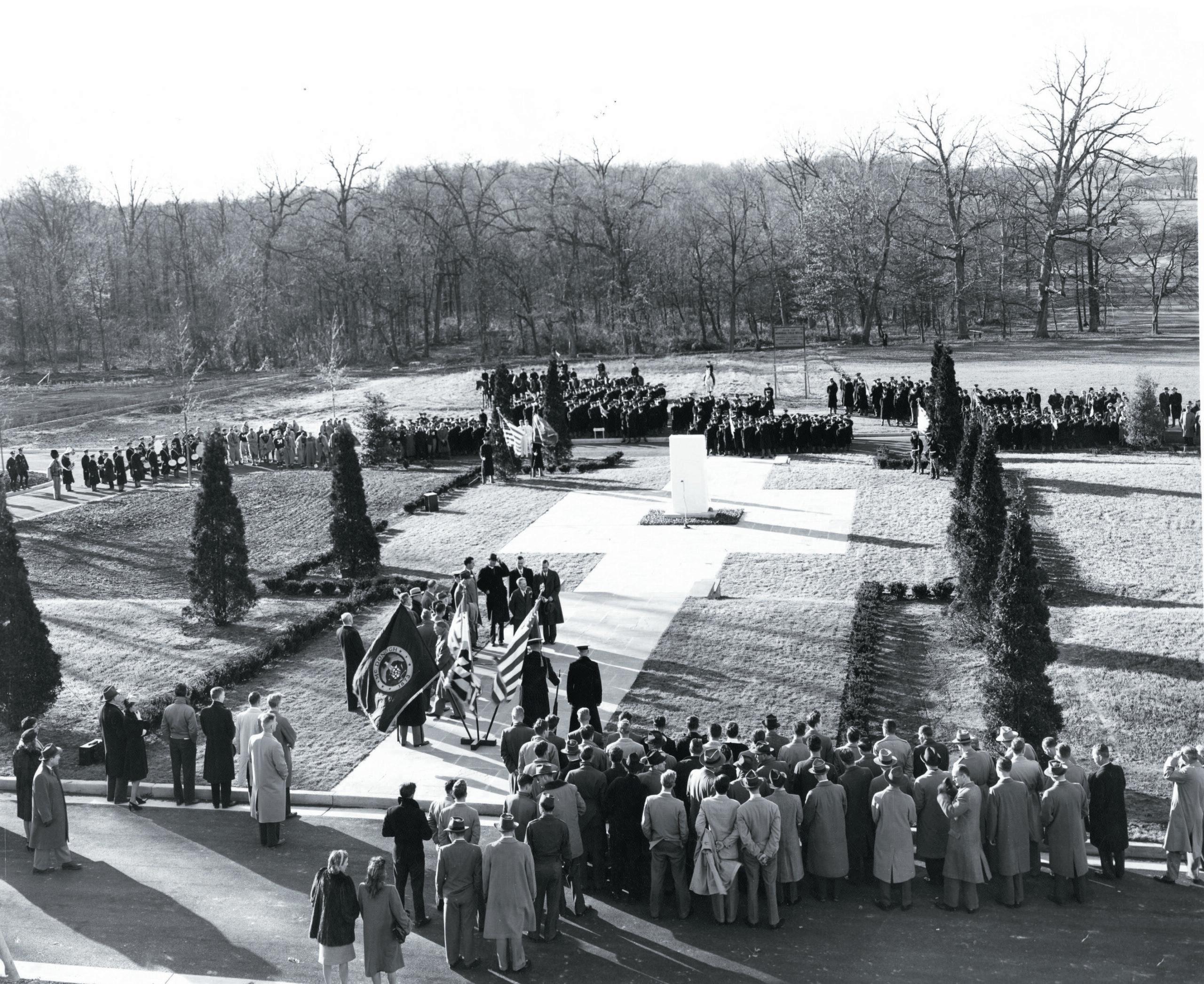
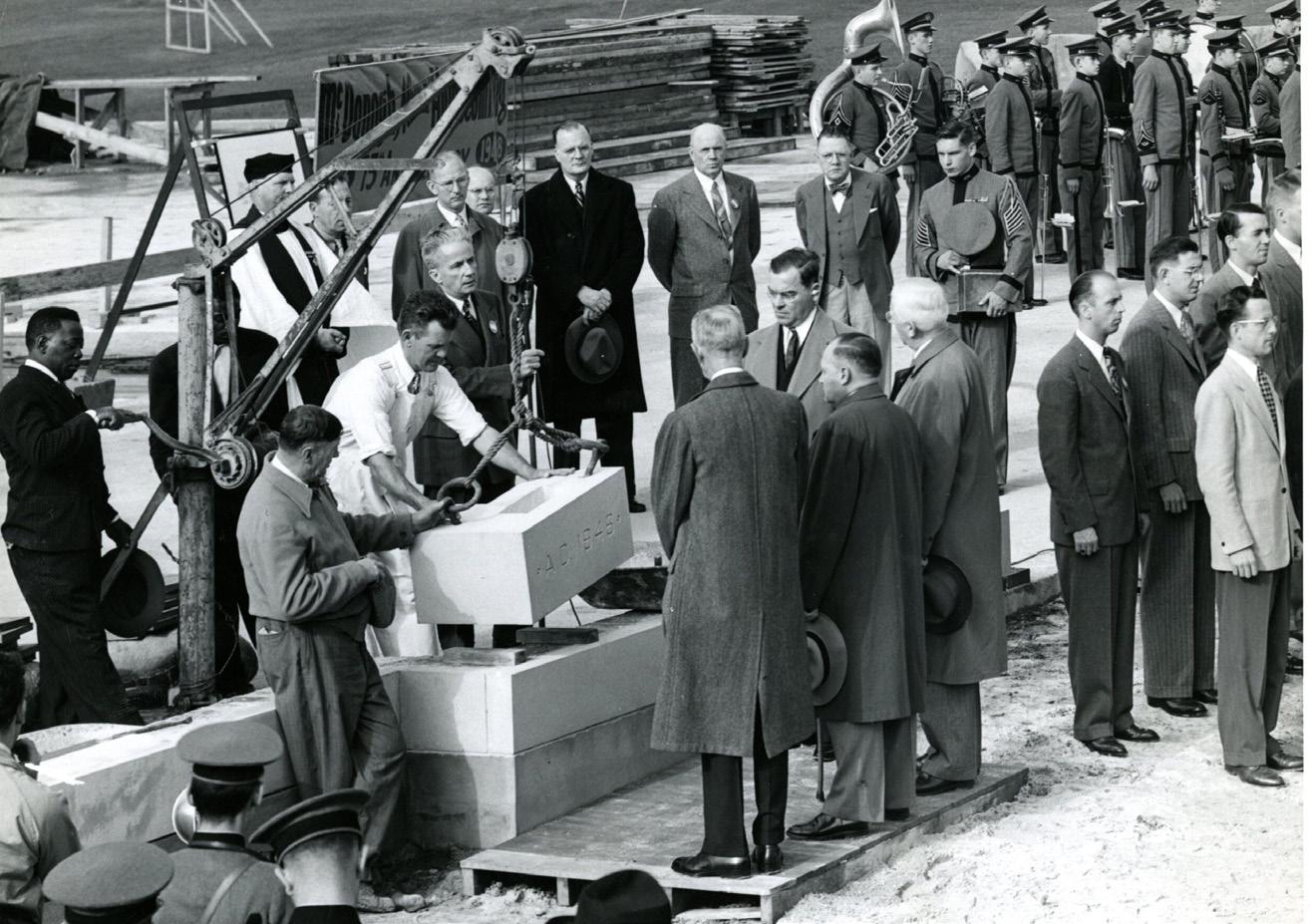
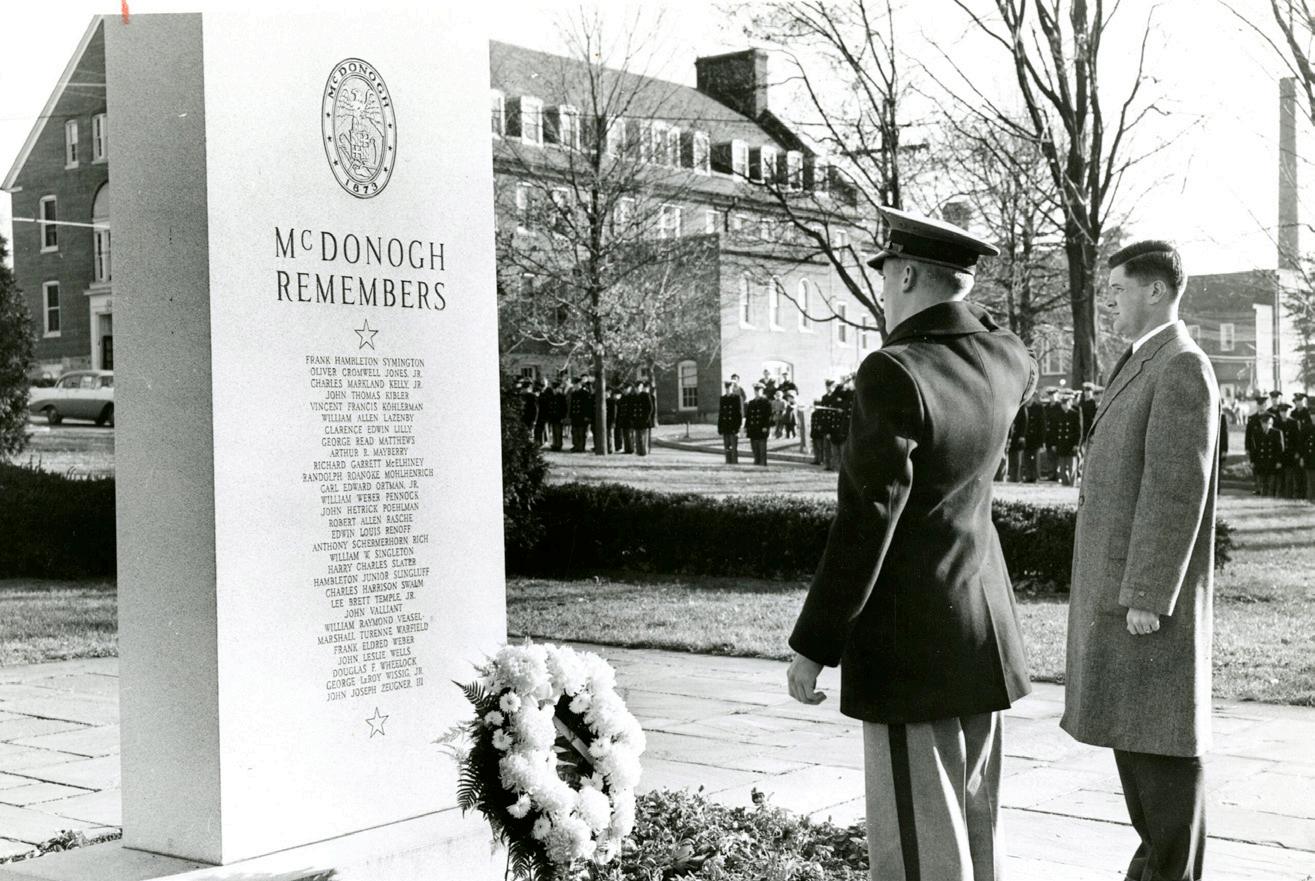
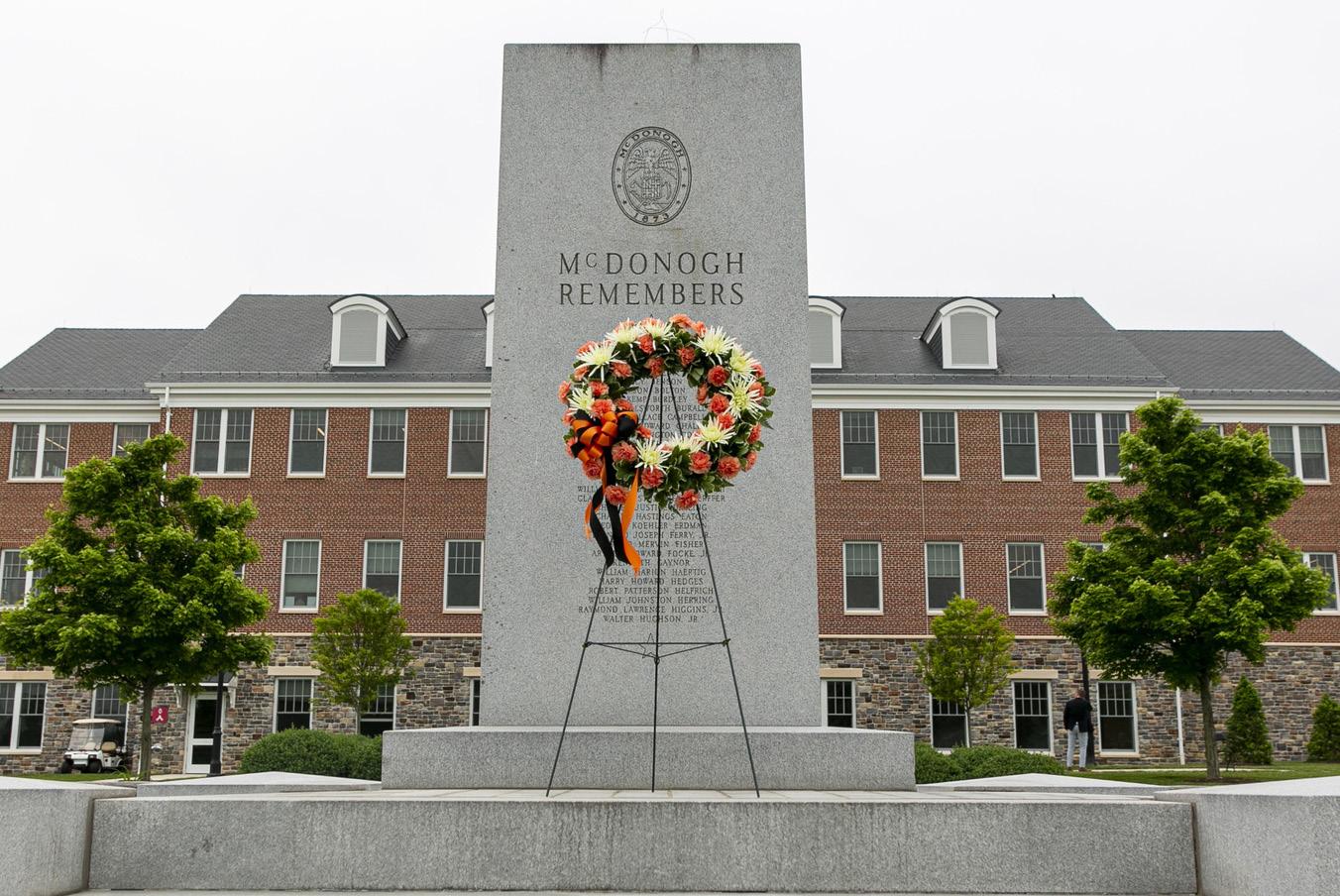
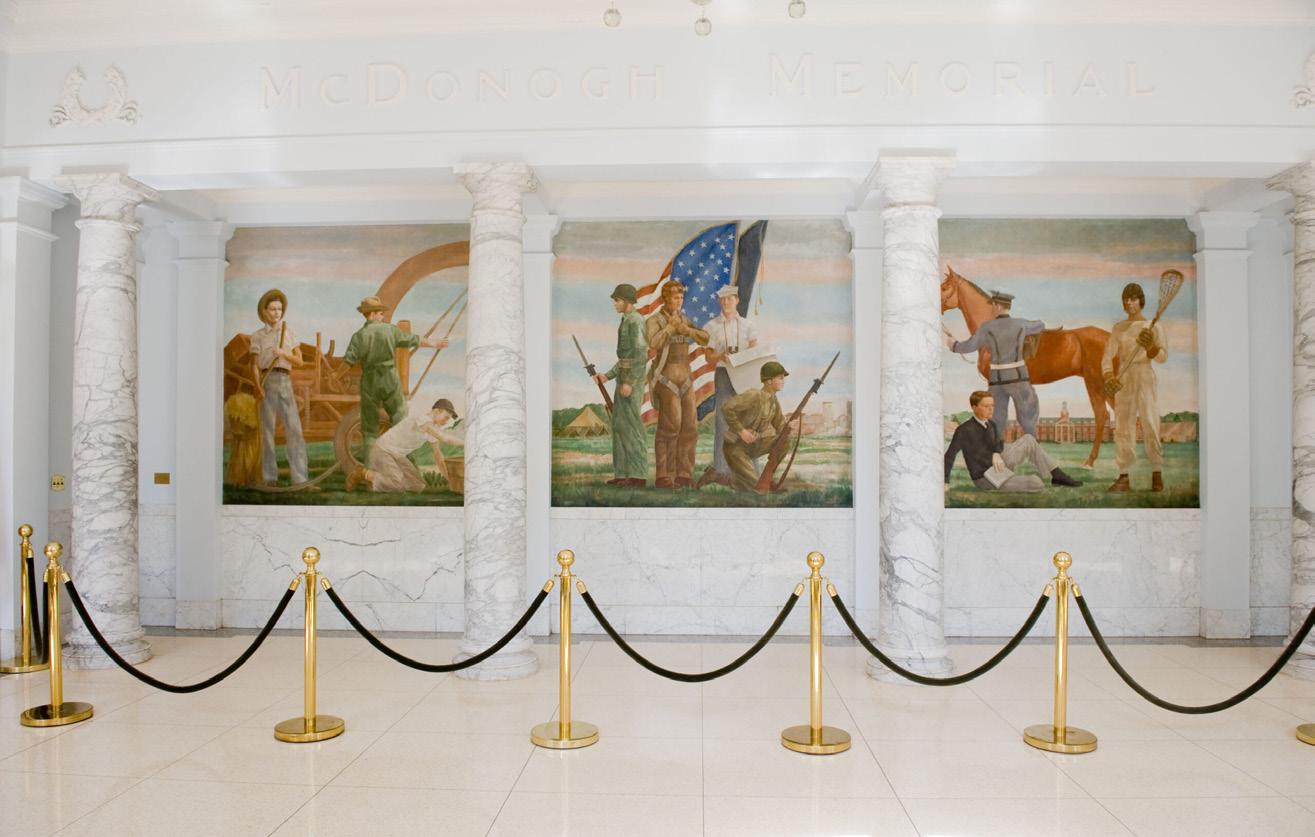
When the memorial to honor McDonogh alumni who lost their lives in service in World War I and World War II was dedicated on November 22, 1946, at half-time of the football game between McDonogh and Severn School (a Naval Academy prep school at the time), it contained 60 names. The sacred space was refurbished and rededicated in May 2015. The monument was moved to align it with the center of the Rosenberg Campus Green, and the names of 10 McDonogh alumni who lost their lives in service to our country in the Korean and Vietnam conflicts were added to the base. The renovation also included the installation of a flag court with special lighting for nighttime illumination, new landscaping, and accessible pathways.
Read more in the Summer 2015 issue of McDonogh Magazine.
The Spring Fair: A Showcase of Riding, Poultry, and Swine
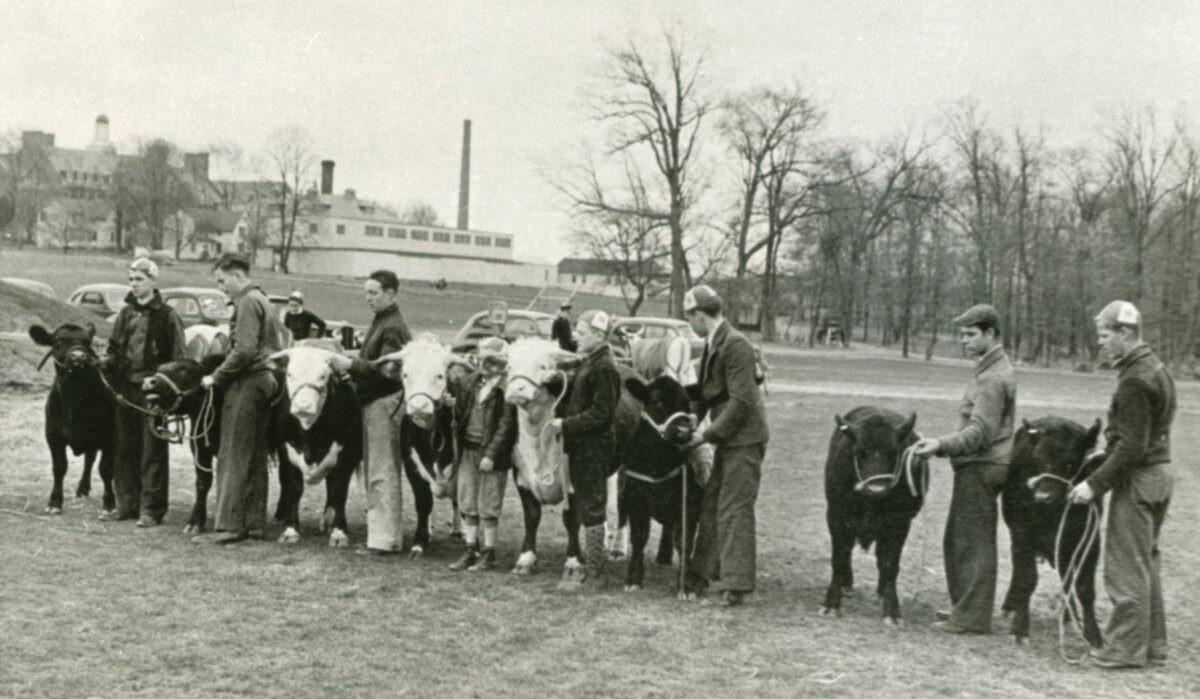
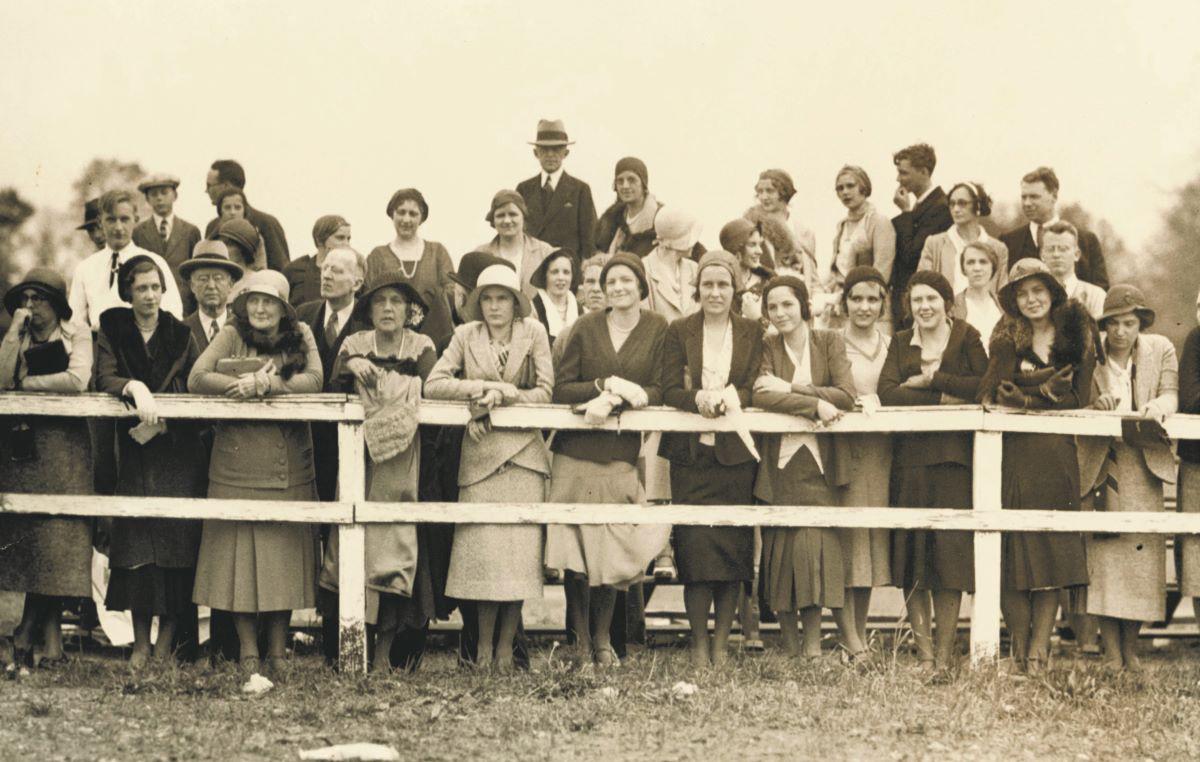
For almost 50 years, beginning in 1929, McDonogh held a Spring Agricultural Fair. An outgrowth of the School’s burgeoning animal husbandry program, the first fair featured 15 entries in the cattle fitting and showing contest, 30 riders in the horse show, and an exhibit of poultry and swine. It quickly grew in popularity. Within five years, attendance had grown to more than 1,000, there were over 100 entries, and it was considered a qualifier for the Maryland State Fair. Additionally, the McDonogh Point-to-Point was regarded by equestrians as the second most important racing event of the week, surpassed only by the annual Pimlico fixture, the Preakness.
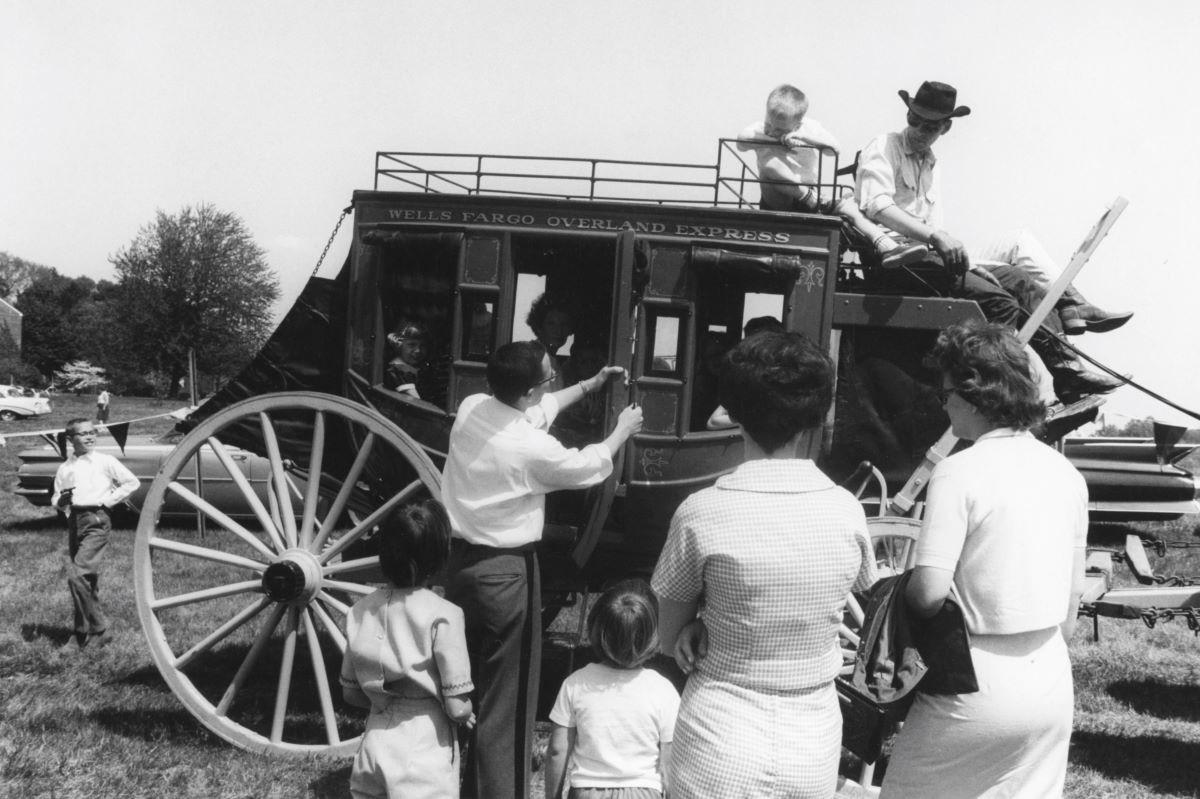
The fair felt the effects of World War II, but interest rebounded by the 1950s, and by the 30th year, highlights included a midway with rides and refreshments. In 1963, faced with declining enrollment in the animal husbandry program, the annual event became the “Alumni Day Fair.” In 1973, it was incorporated into a three-day cultural fair held as part of McDonogh’s Centennial Celebration. Four years later, when hosting the traditional cattle show became cost-prohibitive, McDonogh’s agricultural fair ended.
Read more in the Summer 2019 issue of McDonogh Magazine.
Uniform in Appearance: McDonogh’s School Uniform Through the Years
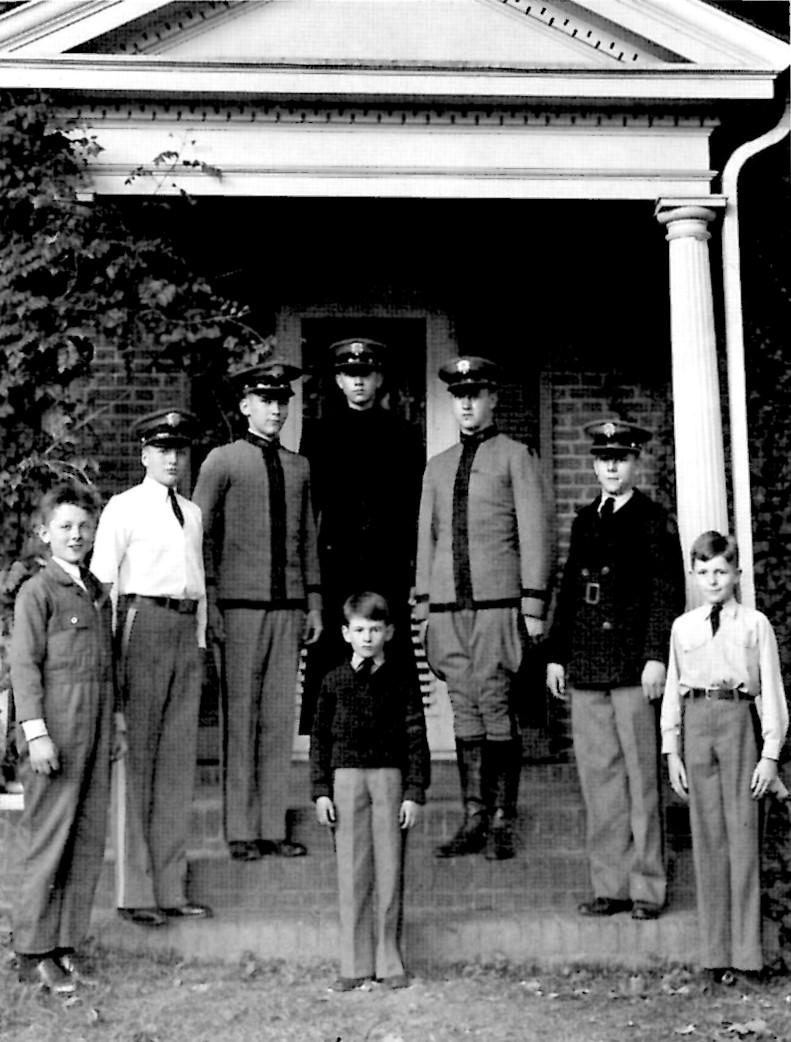
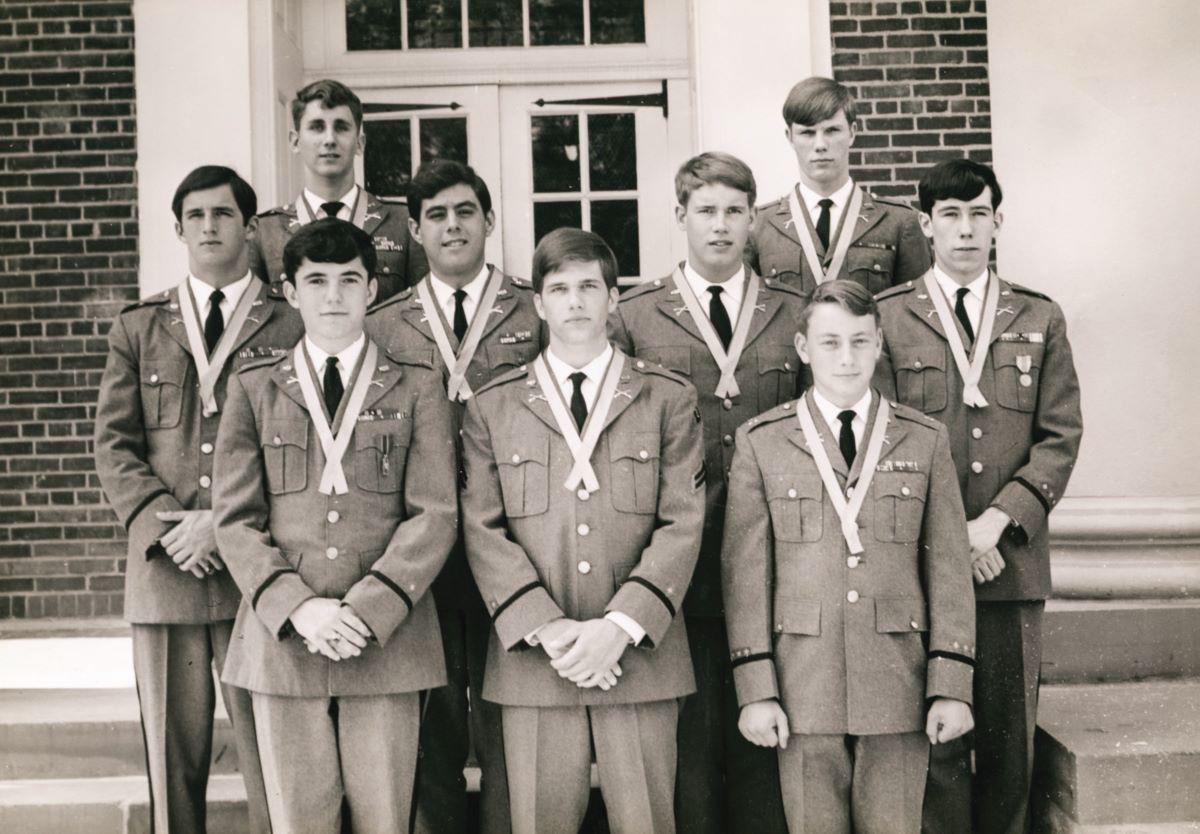
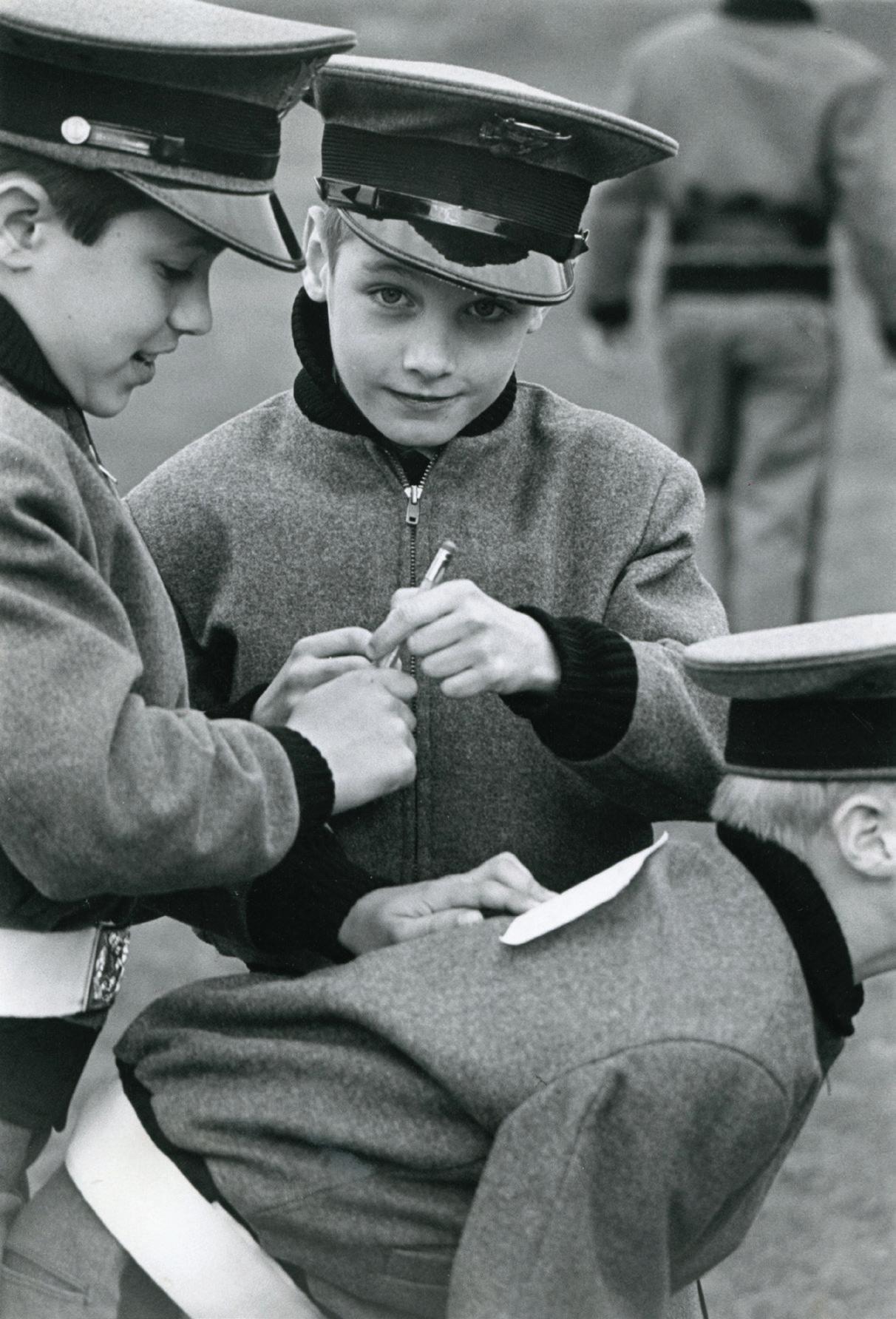
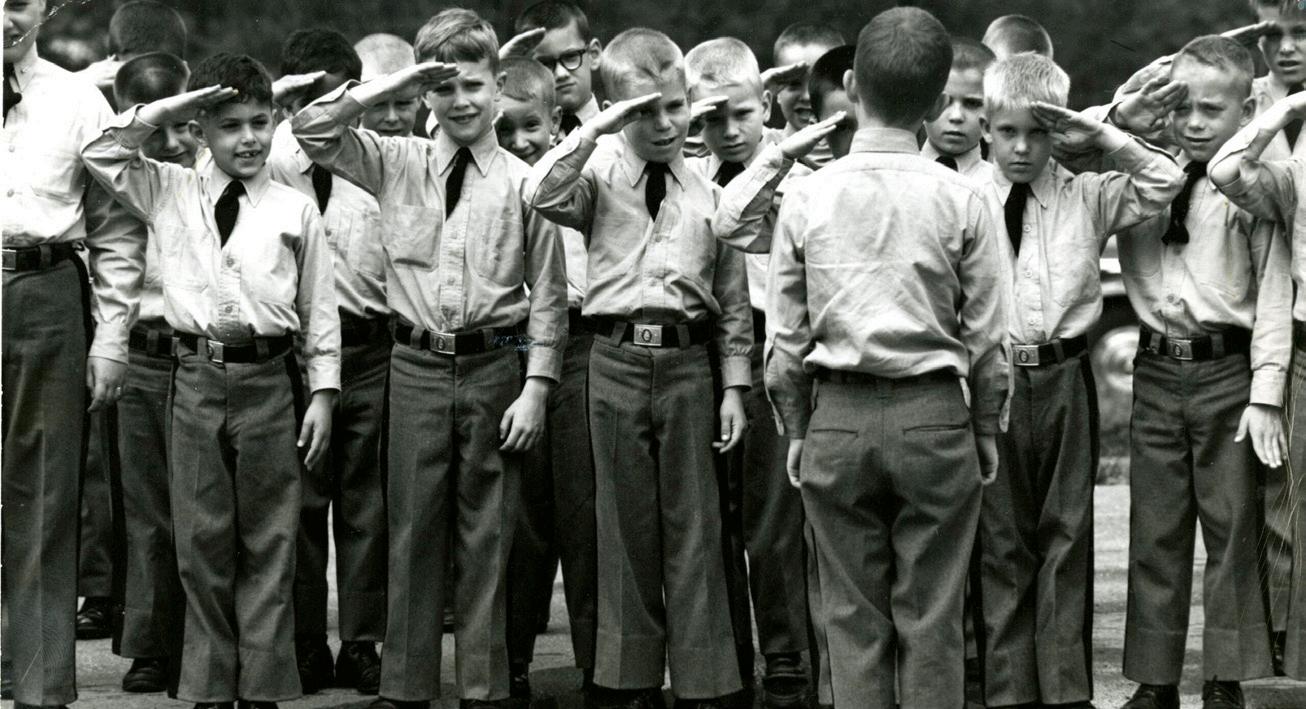
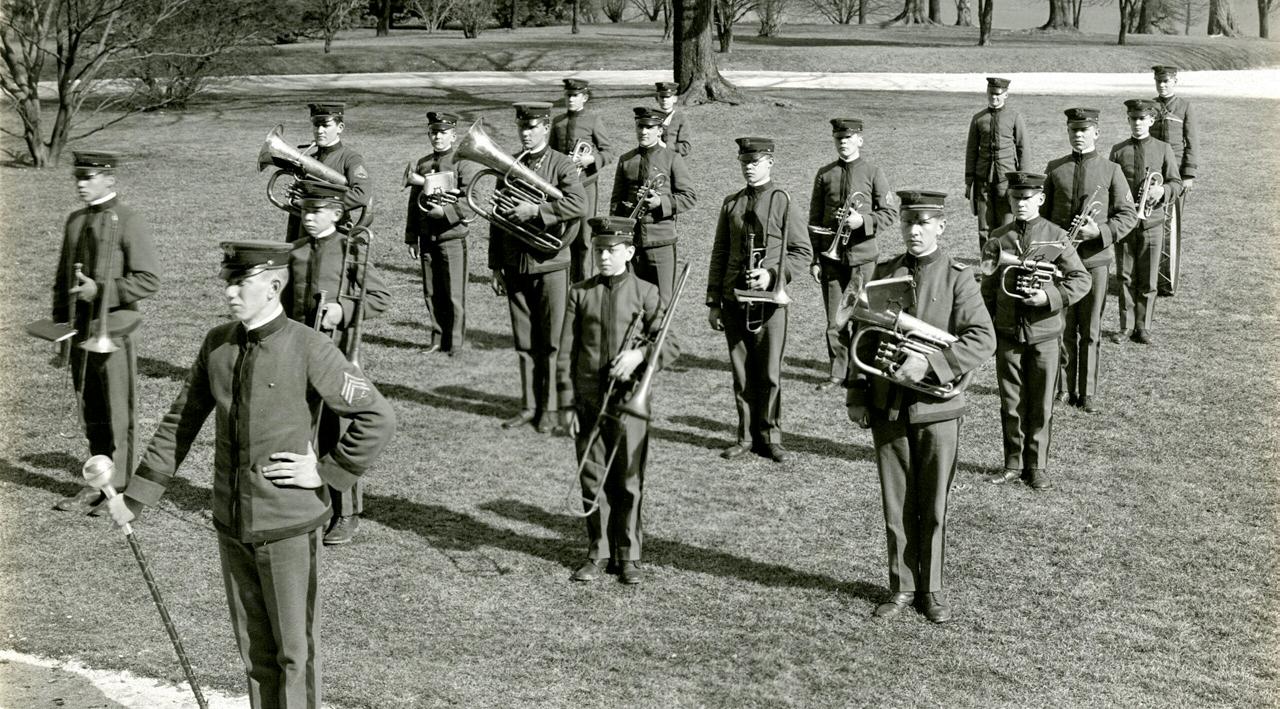
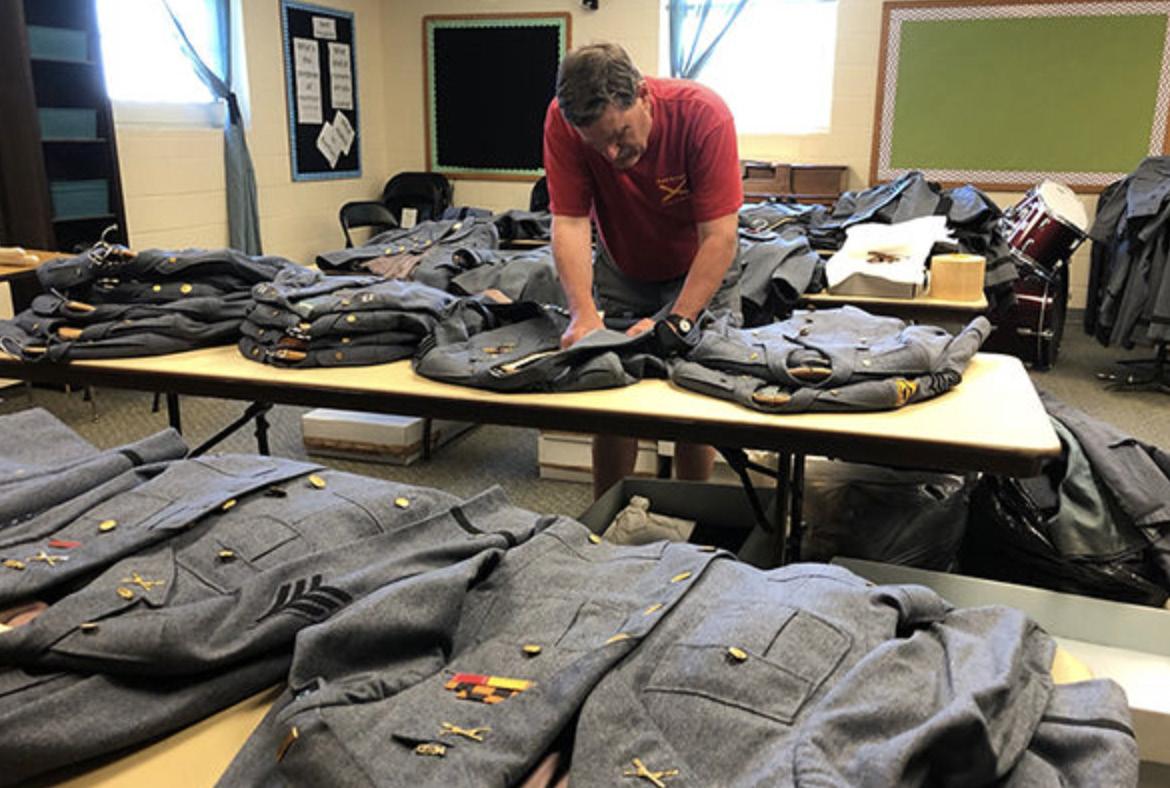
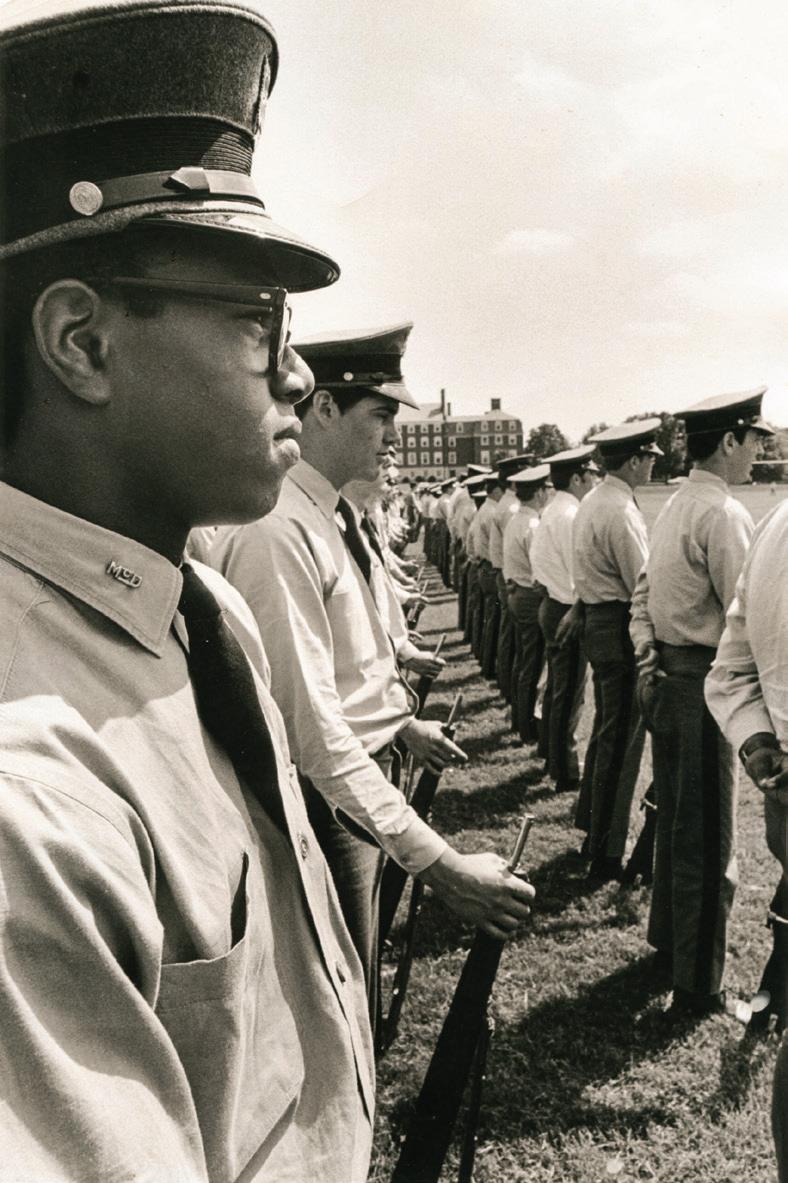
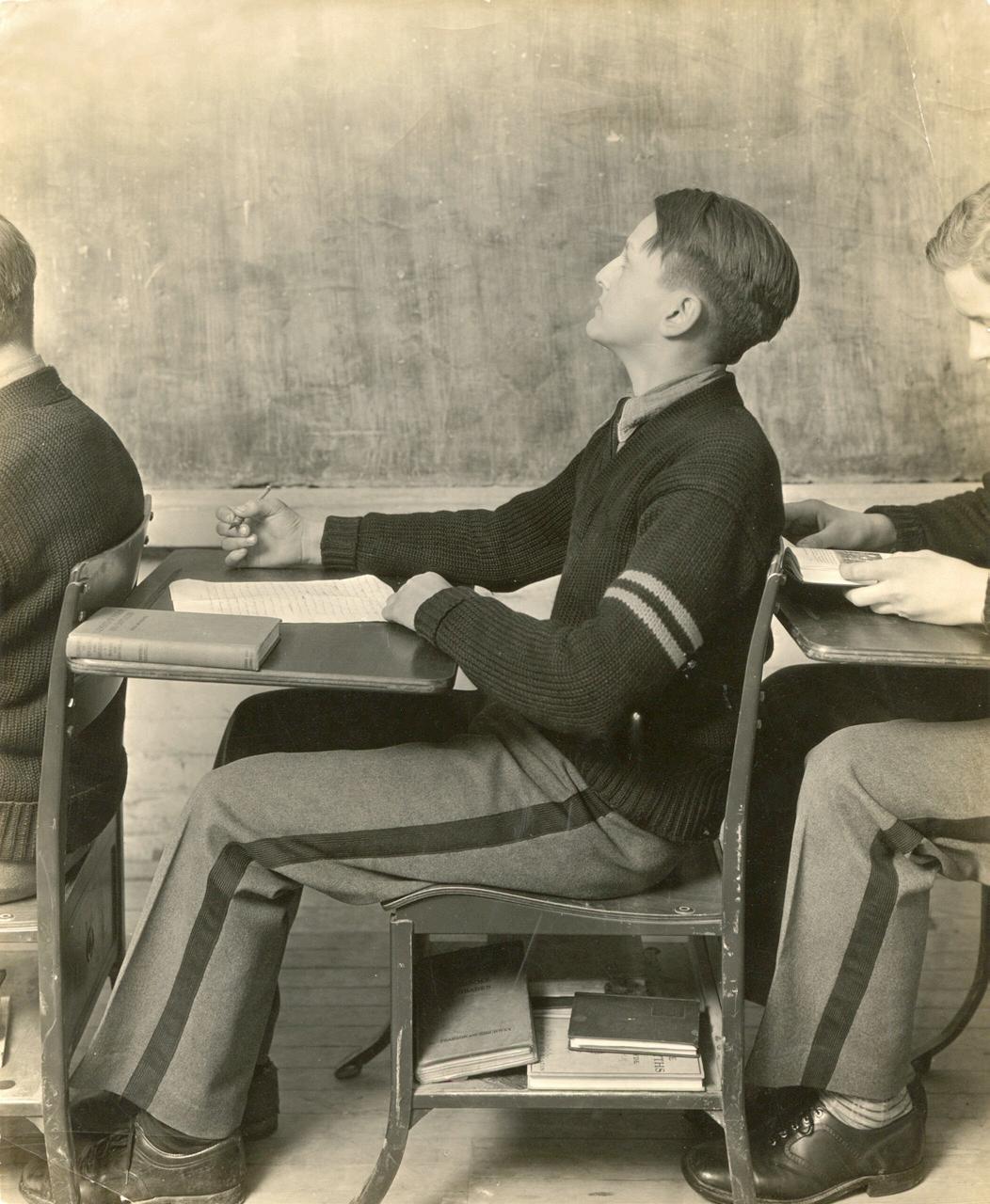
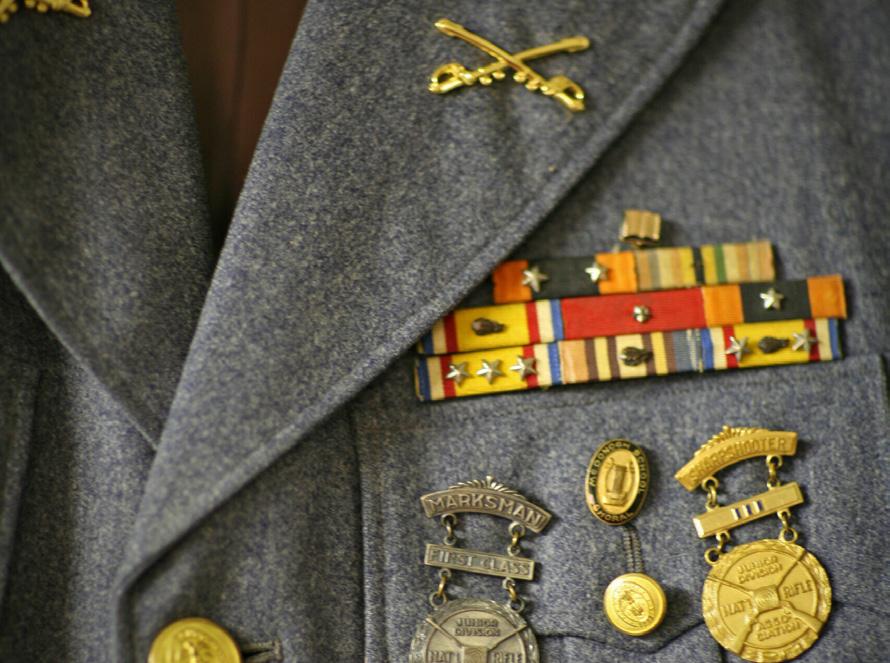
School uniforms have been an integral part of the student experience at McDonogh. Whether military or civilian, the everevolving uniform provided continuity, stability, and a sense of identity for all who wore them. Issued to all boys entering the school beginning November of 1873, military uniforms were required dress until the program was abolished in 1971. During that century, there were many variations of the uniform, and styles changed, overlapped, and/or were occasionally modified. For 45 years beginning around 1904, students wore the West Point pattern jacket. Over the years, minor modifications were made—black trim, sky blue trim, bottom slits, then no slits— until a totally different jacket style was introduced in the fall of 1949, the Eisenhower (or “Ike” jacket). In 1956, the Eisenhower jacket was replaced by what was generically referred to as the “dress jacket,” which was worn by students until the military program ended.
In 1971, a new dress code was introduced. The most noticeable change was civilian dress and the longer, but restricted length of hair, and a school jacket of blue, black, and red plaid, resembling the McDonogh Clan plaid. According to the June 1979 Board of Trustees minutes, girls’ uniforms were addressed for the first time.
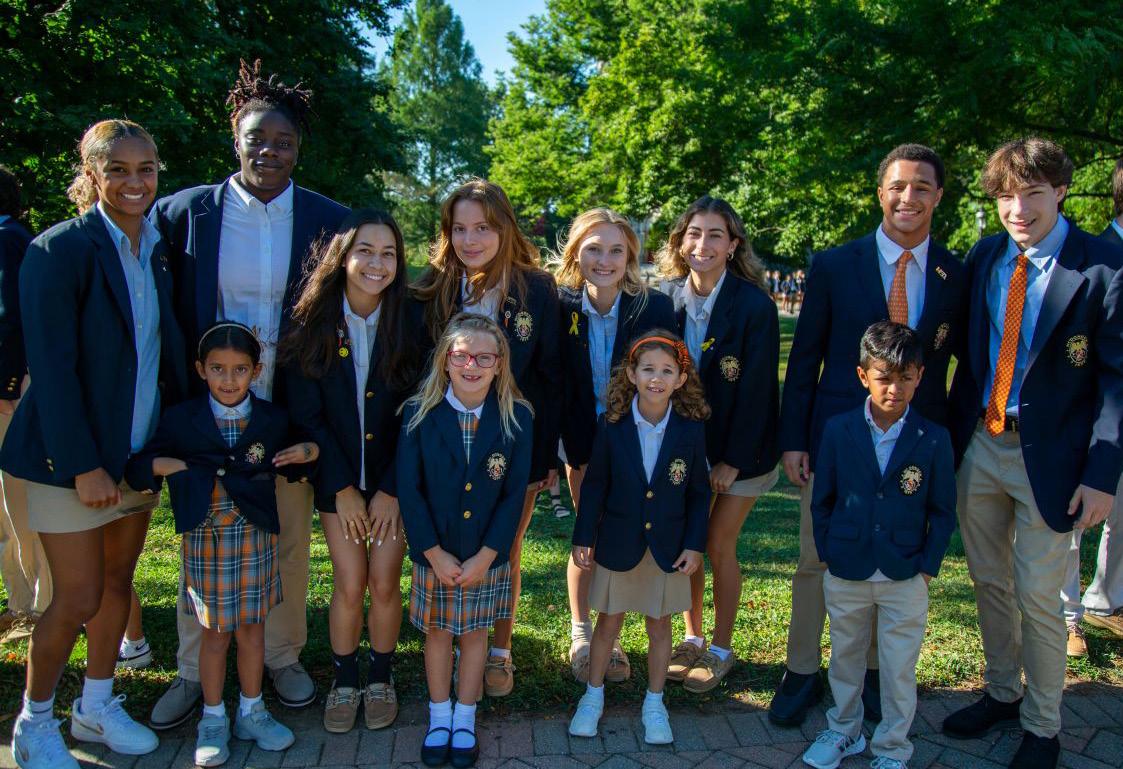
Today, the McDonogh uniform khaki pants and leggings, a custom plaid jumper in McDonogh colors, and school-branded sweatshirts, are variations on past themes and reflect a more modern attitude. The navy blue blazer, however, with the McDonogh seal, continues to give the uniform continuity.
Read more in the Winter 2023 issue of McDonogh Magazine.
McDonogh Students
“Adopt” a French Boy in the Wake of WWI
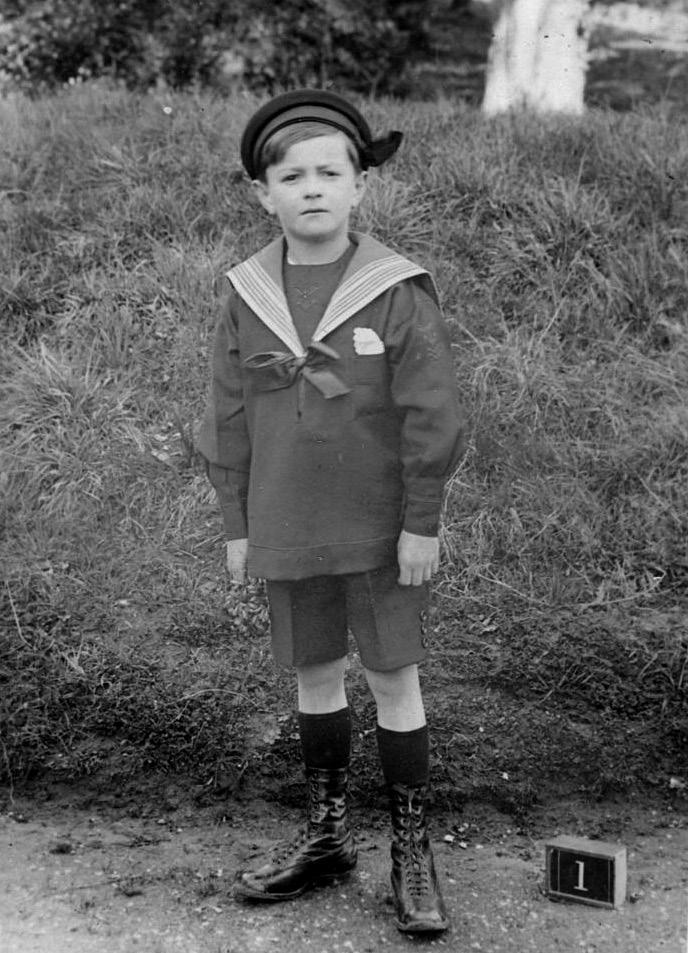
In the aftermath of World War I, a number of relief efforts were established to care for widows and orphans, wounded soldiers, and refugees in Europe. Upon learning of the opportunity to support an orphaned child, the School stepped up and “adopted” a little French boy—Jean Baptiste Engel. Jean had just celebrated his second birthday in 1915 when his father, a shipyard foreman, was killed. The commitment was $50 a year, and the funds came from the School’s Sunday collections. The relationship with Jean and his mother lasted almost a decade until September 1926 when the School, which itself was experiencing financial hardship, made the difficult decision to withdraw its support of Jean Baptiste.
Read more in the Winter 2021 issue of McDonogh Magazine.
Architect of the School: Colonel William Allan
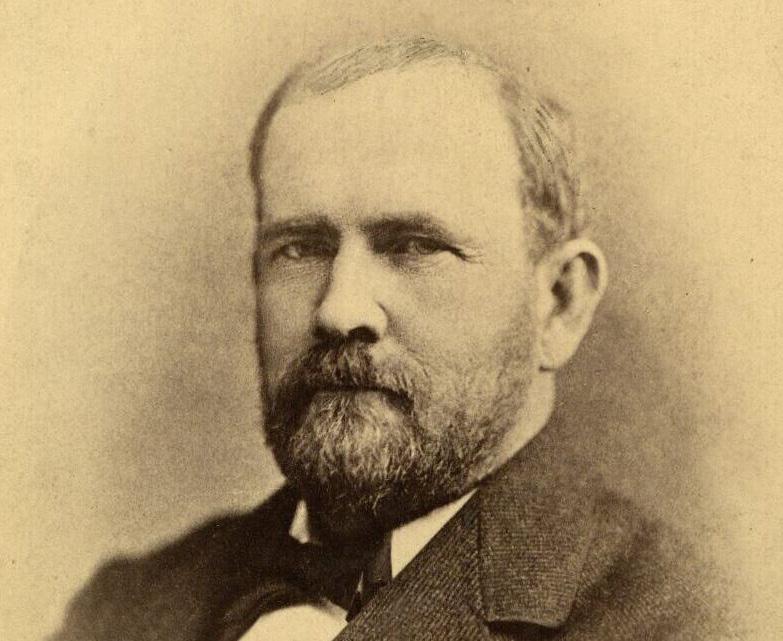
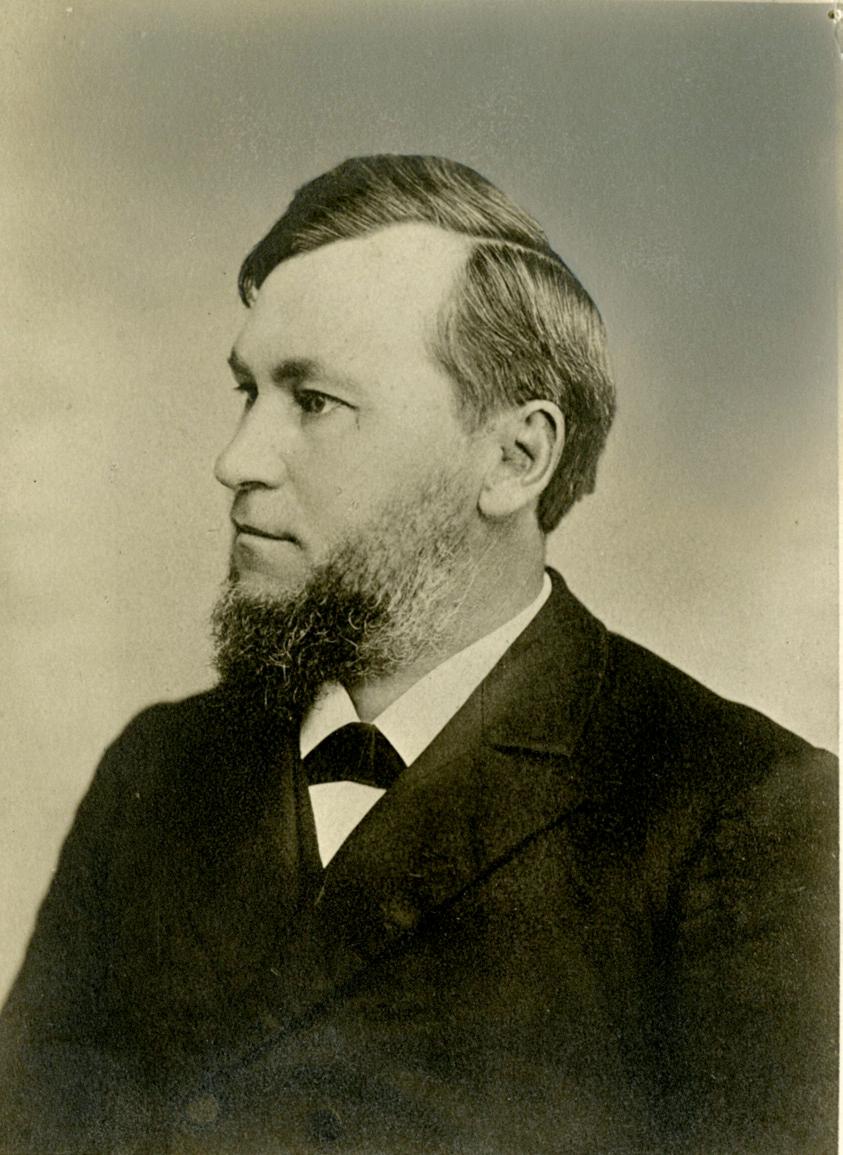
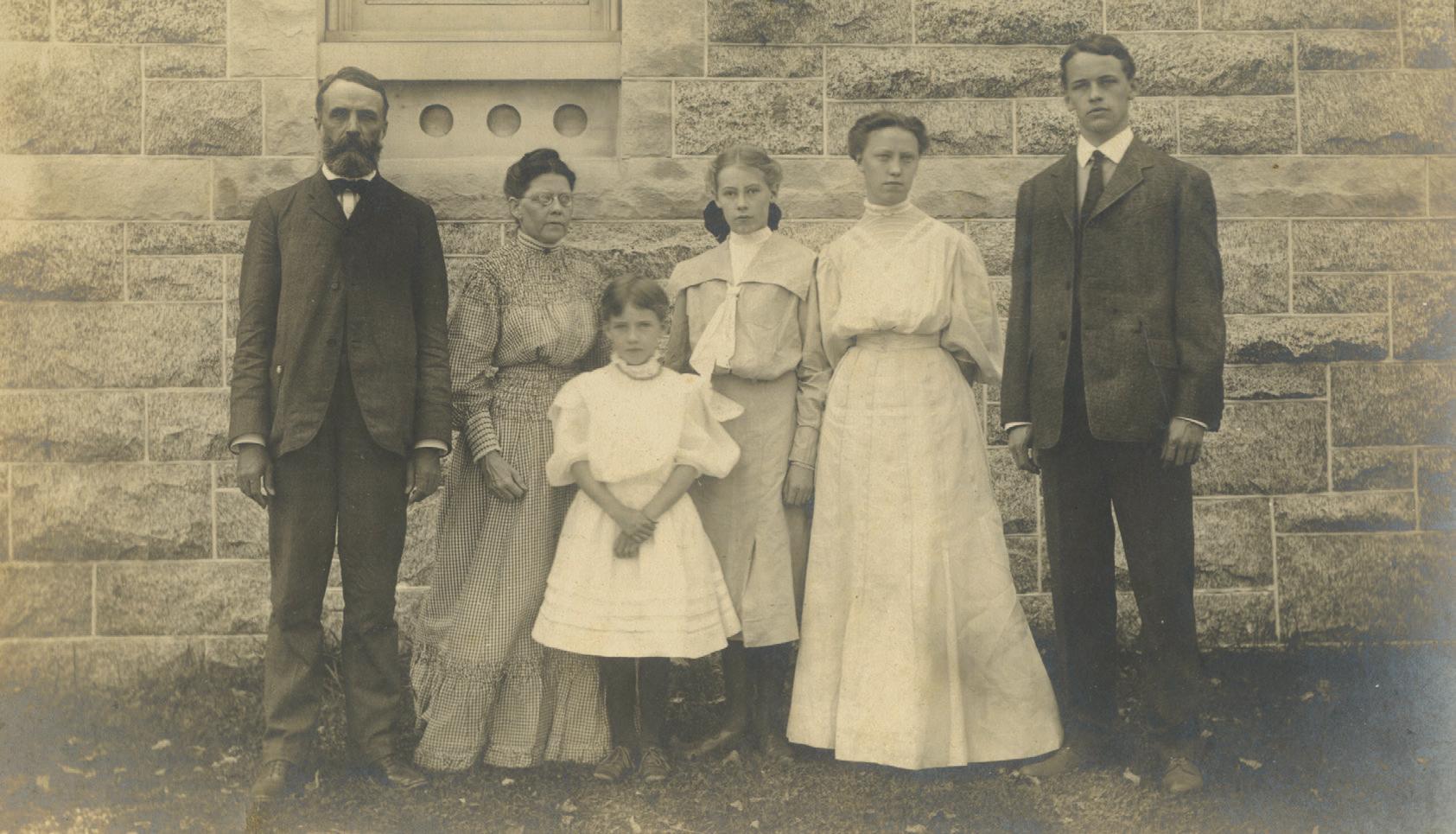
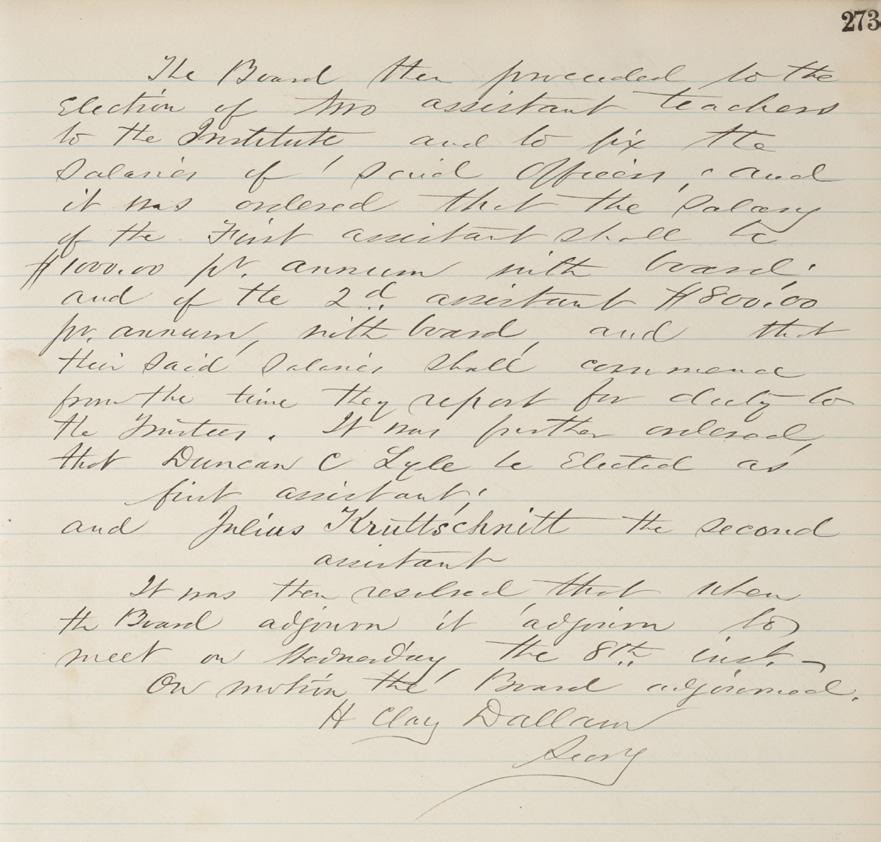
William Allan, a Washington and Lee University applied mathematics professor and former Confederate ordnance officer, was appointed in 1873 the founding Principal of McDonogh School by the Board of Trustees, led by President Samuel H. Tagart. Principal Allan hired a staff including Duncan Campbell Lyle (known as “Old Man” Lyle) as assistant principal and teacher, and Josepha Young as the first matron.
Allan was known as a strict disciplinarian but not a harsh one. He formed the students into military squads with each having a corporal and a sergeant. A main tenet of his educational philosophy was the encouragement of individual interests and skills. Two years after the School opened, he pressed the Board of Trustees for shops and machinery to train students for the working world. In 1885, he submitted a proposal to the Board asking to allow paying students, but trustees refused it. Following a long illness, Colonel Allan passed away in 1889 at the age of 52.
John McDonogh Stadium Sees Few Changes in 85 Years
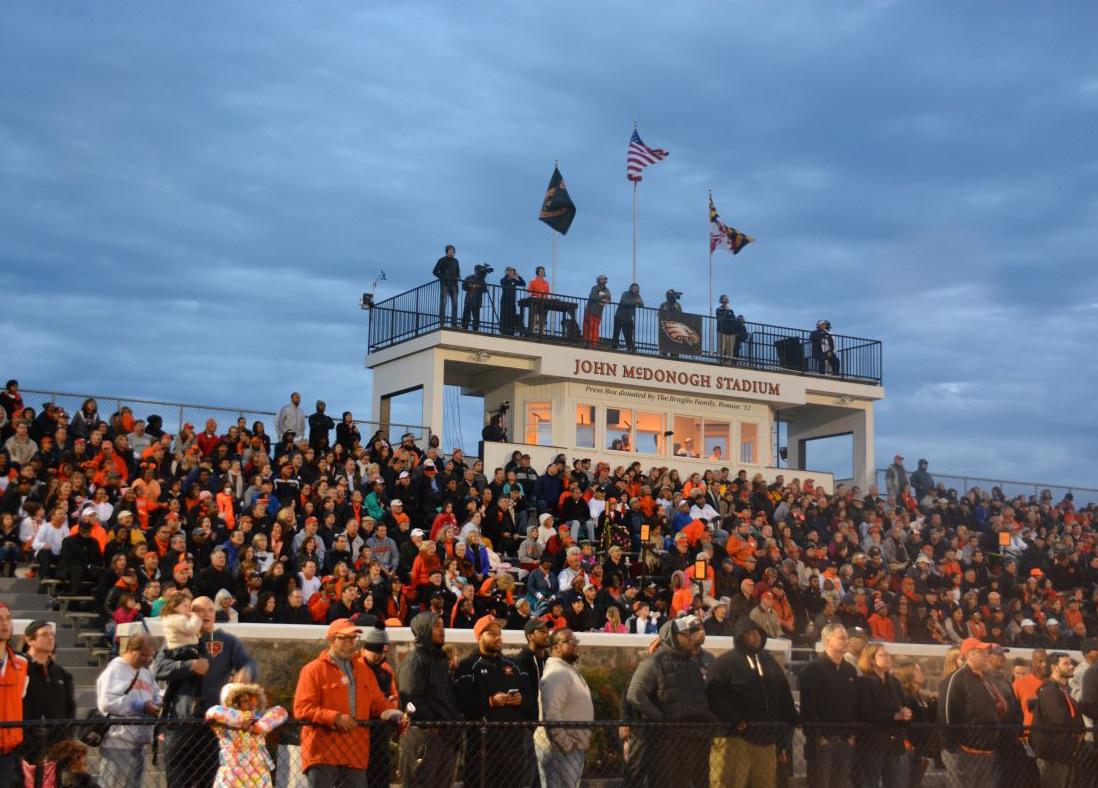
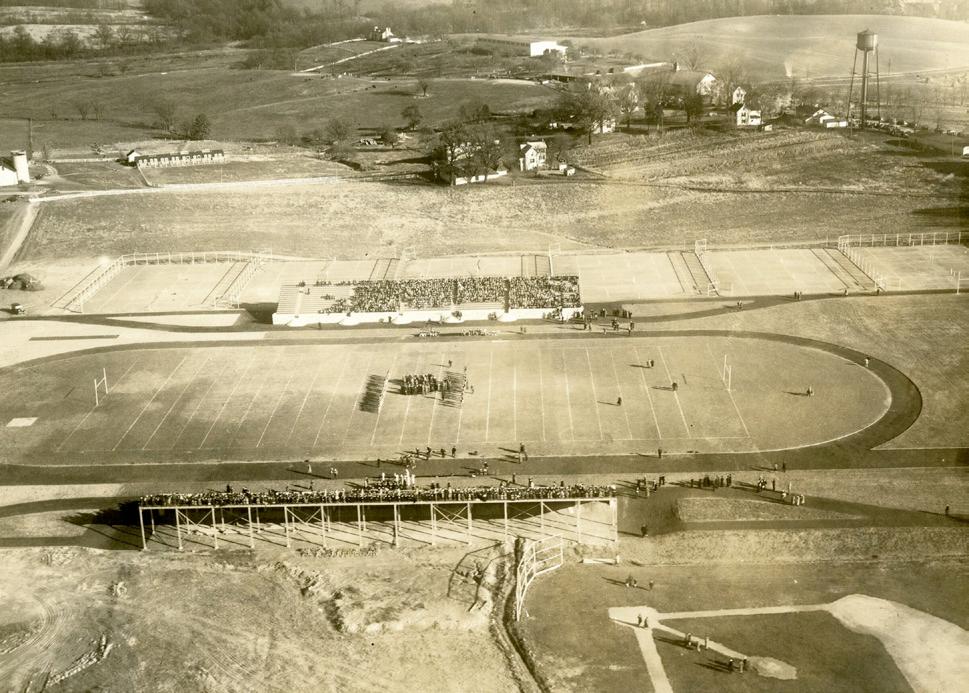
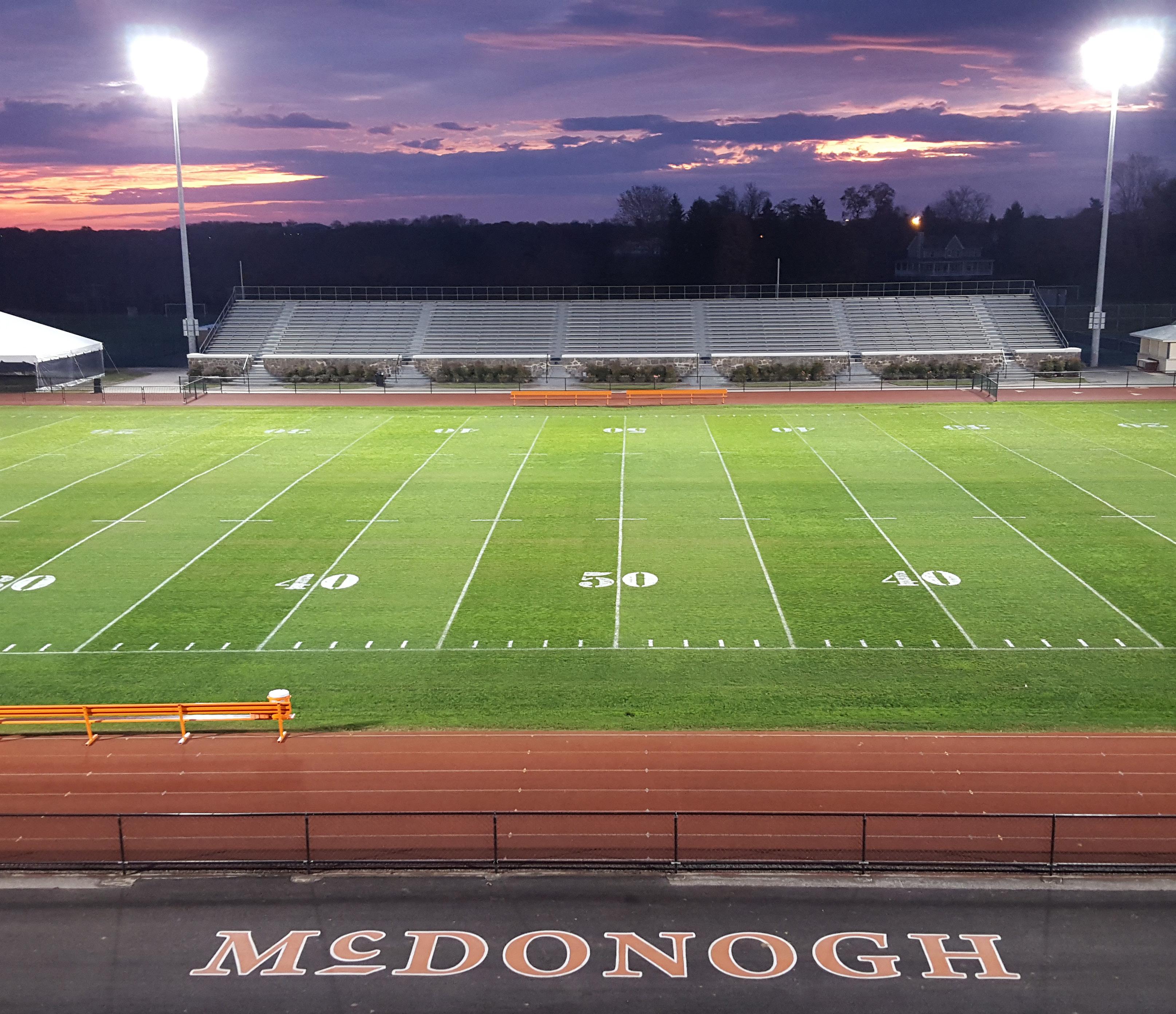
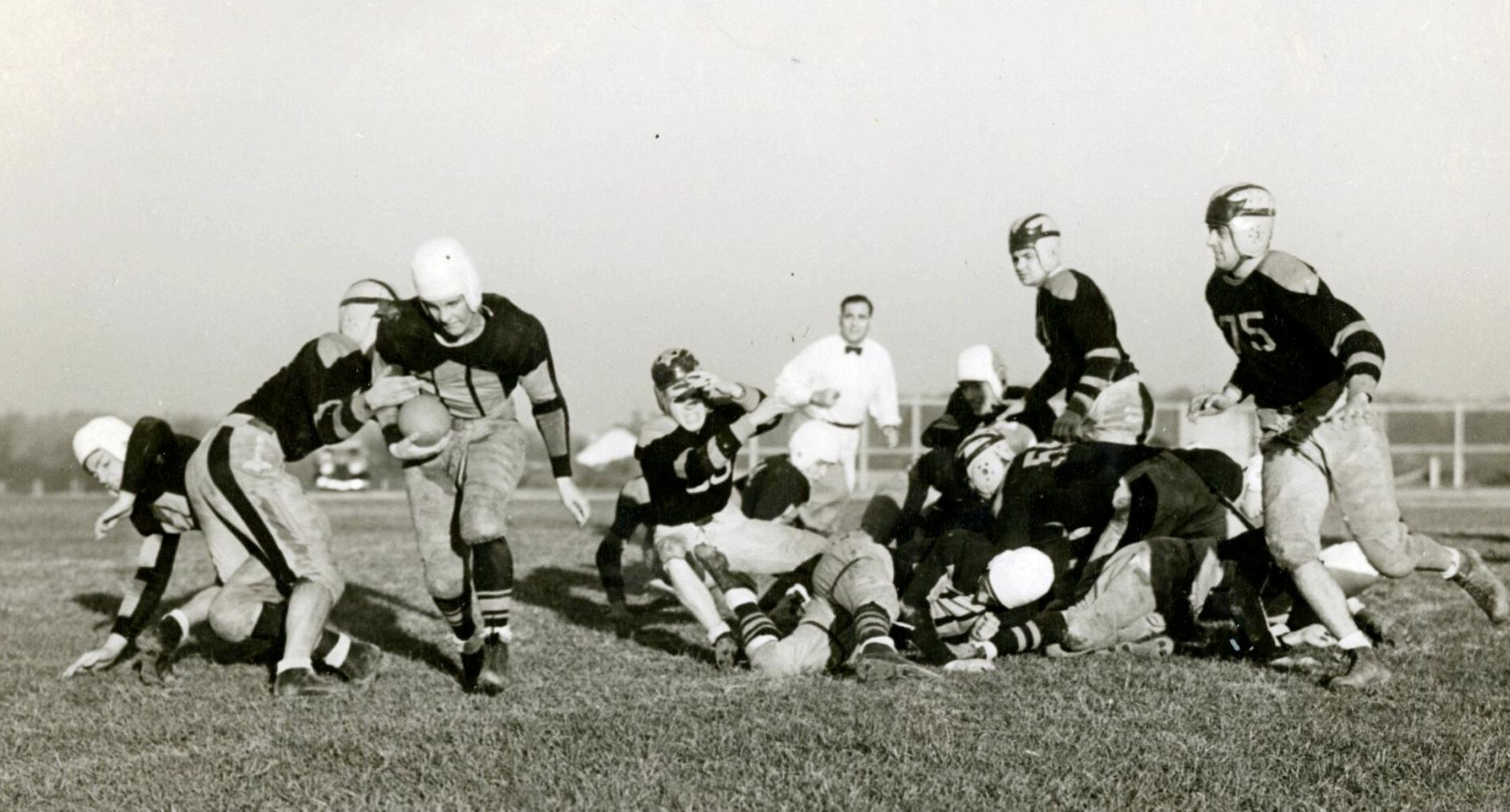
John McDonogh Stadium was constructed under the auspices of the Public Works Administration (PWA). The government contributed 77% of the cost and the Patrons Club contributed the balance. According to former Director of Maintenance Steve Simmers ’70, the original track and field, built by the Works Progress Administration (WPA), is like “a Roman Road” with eight feet of foundation beneath the track and drainage tiles in the field. Dedicated in 1938, some 6,000 people were on hand for the 21st annual football game against Gilman.
Festivities began with a parade led by a pony mascot and ended with a 13-0 victory.
As a student, Darrius Heyward-Bey ’05 dreamed of playing football under the lights in John McDonogh Stadium and promised that if he went “pro” he would donate the funds for lights. “Because,” he said, “night games are what high school football is all about.” He made good on his promise, and in September 2014, McDonogh held its first home Friday night football game in John McDonogh Stadium.
It’s Sink or Swim at the Annual Cardboard Boat Race
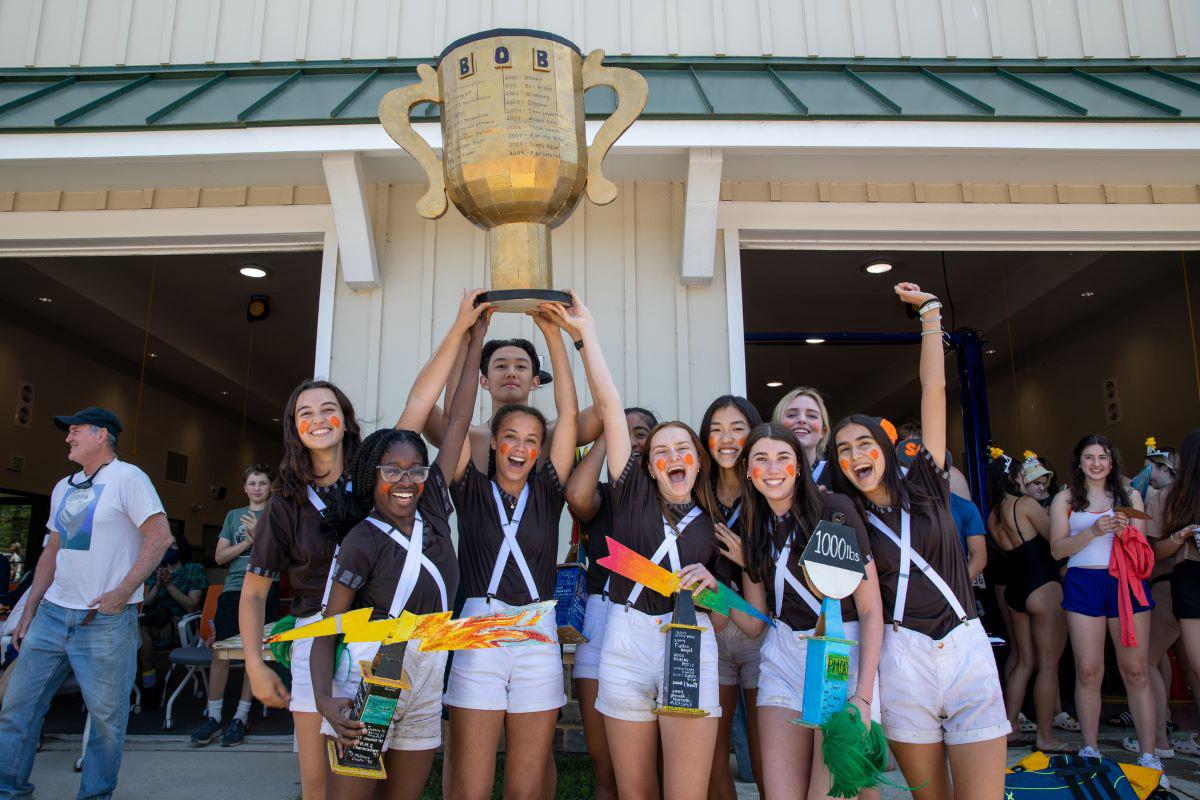
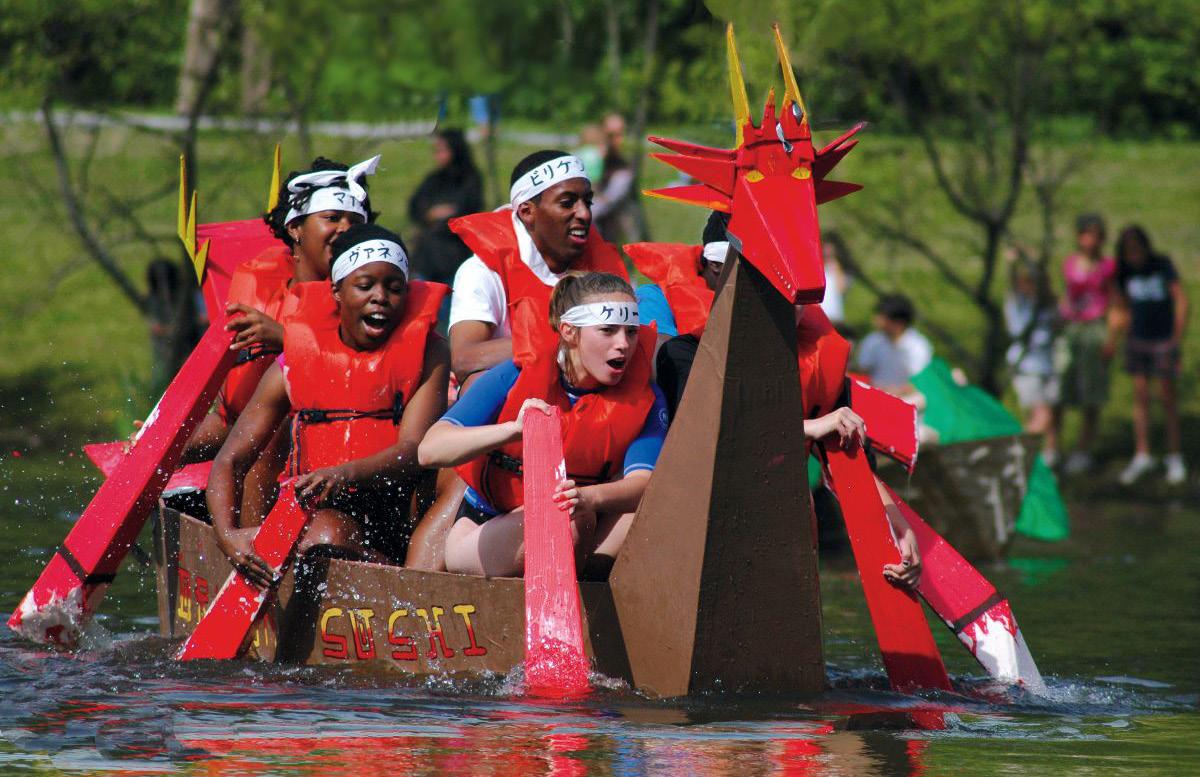
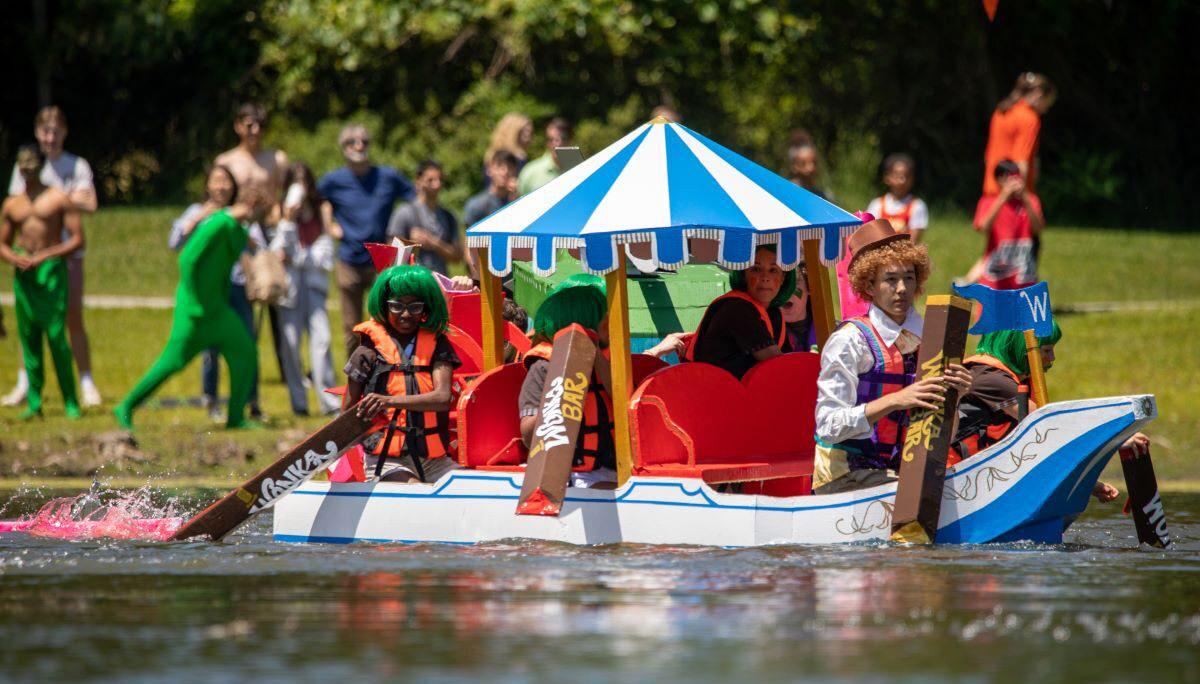
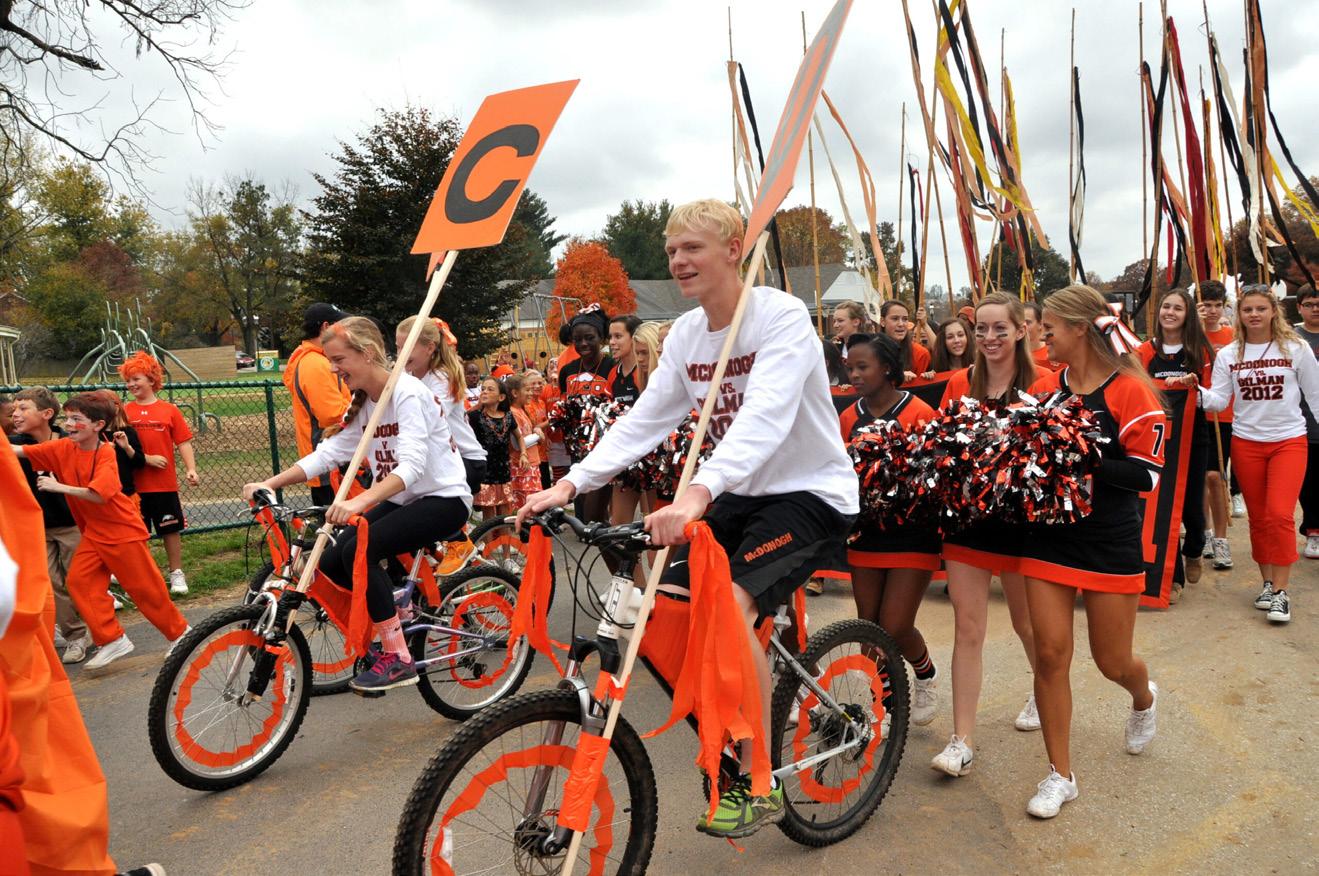
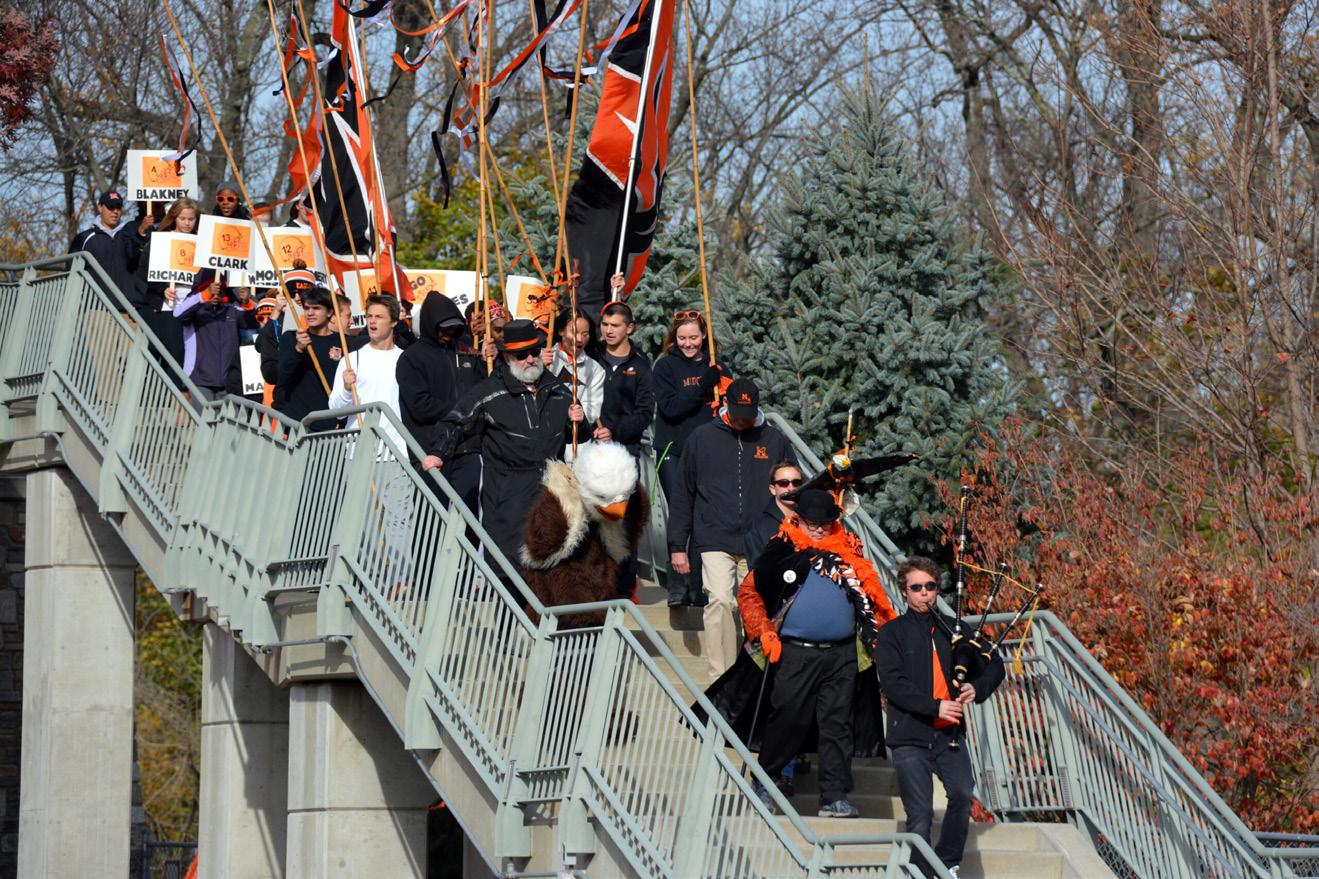
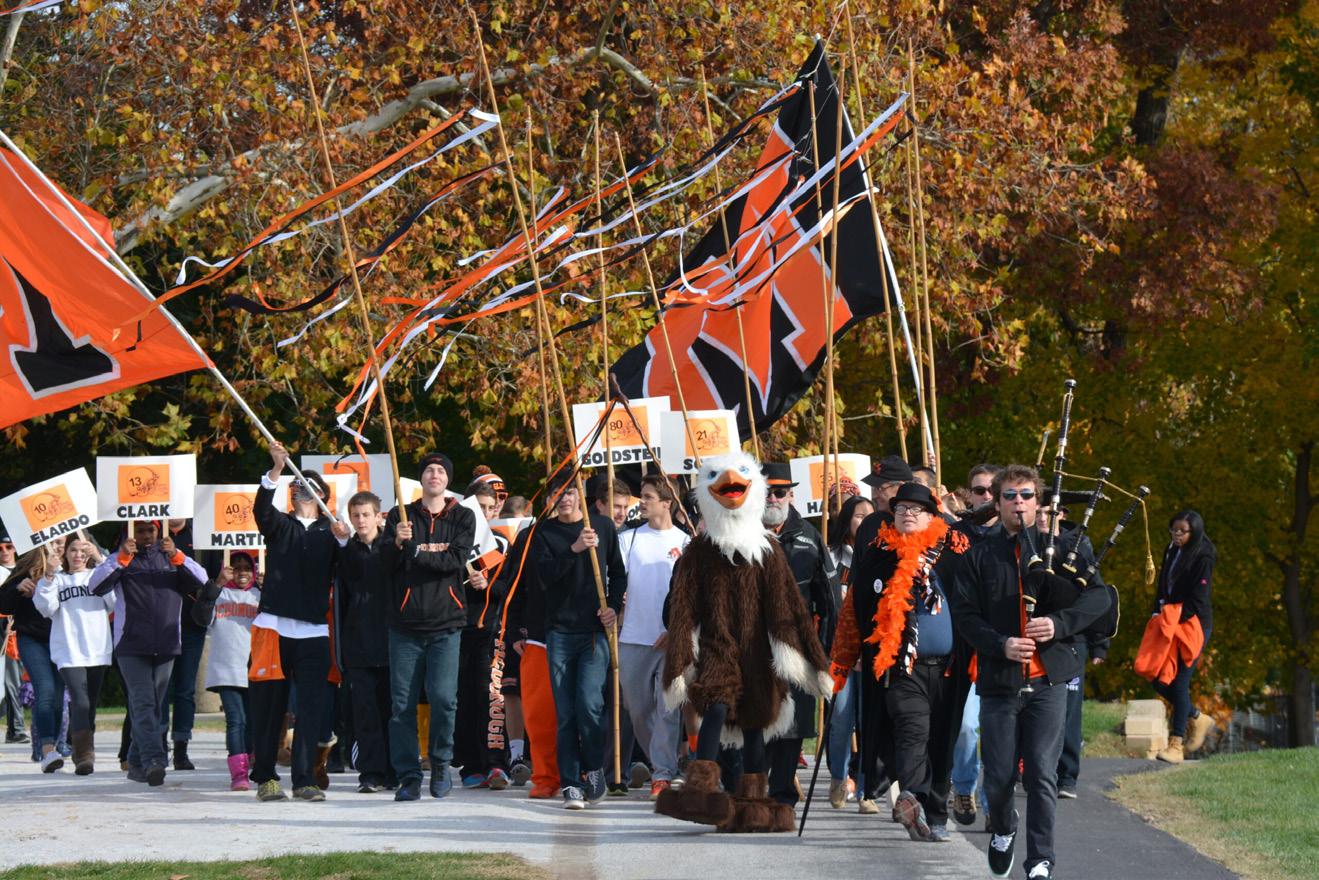
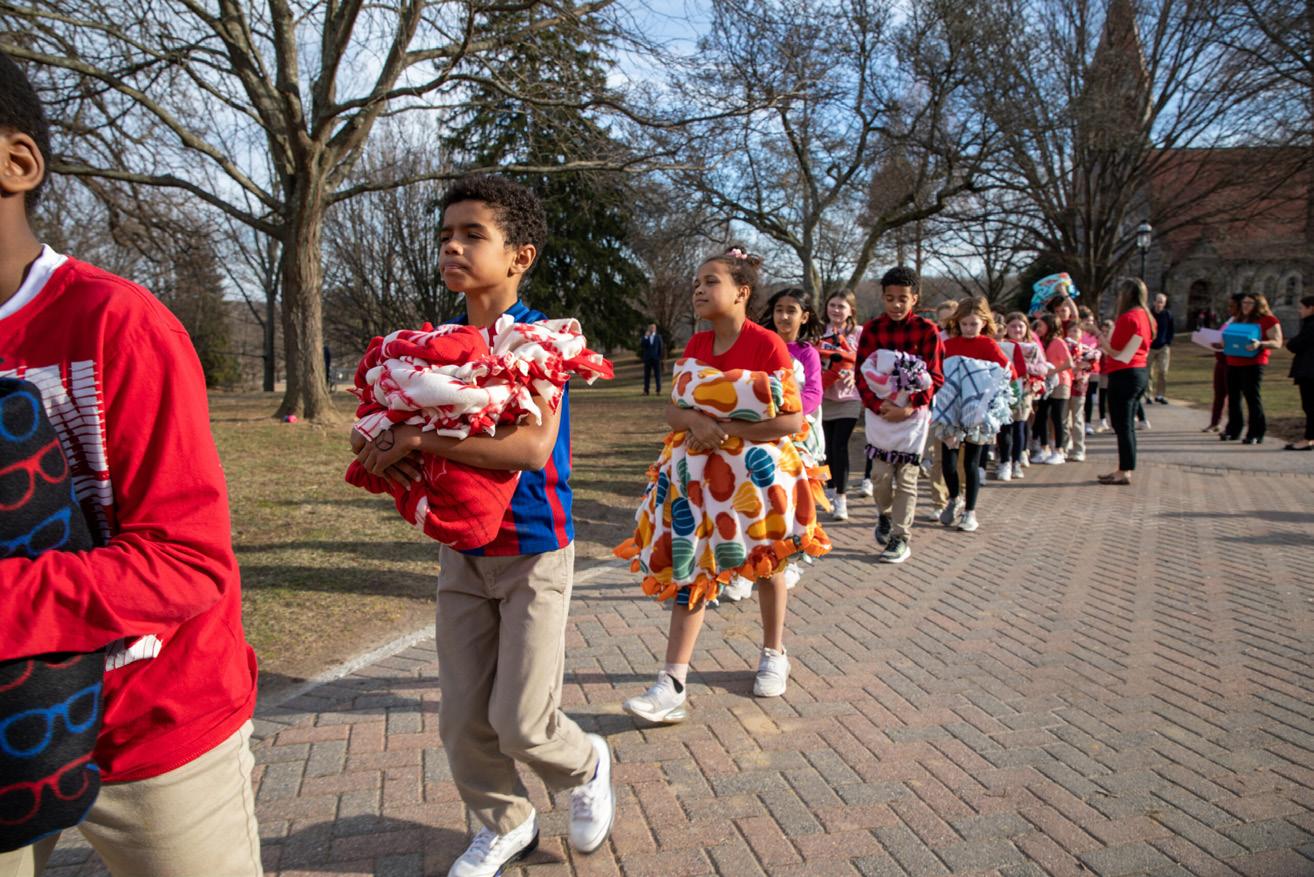
Started in 1988, McDonogh’s Cardboard Boat Race is one of the School’s unique traditions, combining ingenuity, engineering, math, art, leadership, teamwork, problem-solving, and commitment. It’s the consummate learning experience. Participation in the Cardboard Boat Race is voluntary, the hours are long, and team members don’t earn high school or college credit. So, what’s the motivation? The hands-on experience and the joy of the process—a joy that is shared when the costumed, boat-building teams parade their vessels from the construction site to the pond on the edge of the School’s property. When the boats hit the water manned by their construction crews, sink or swim, everyone feels like a winner as they are cheered on by their schoolmates, faculty, and family members gathered on shore. Winners vie for the coveted cardboard B.O.B. trophy for Best Overall Boat.
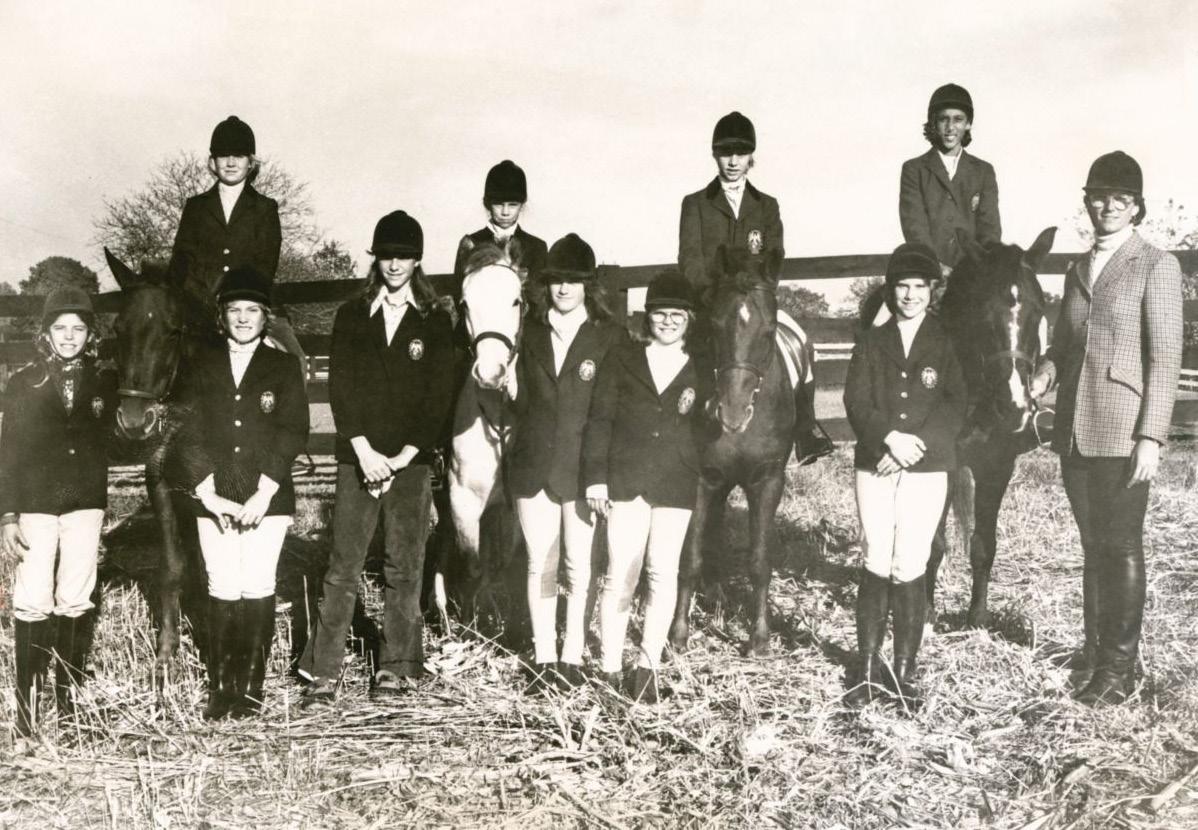
From Cavalry to Equestrian: A Brief Look at McDonogh’s Riding History
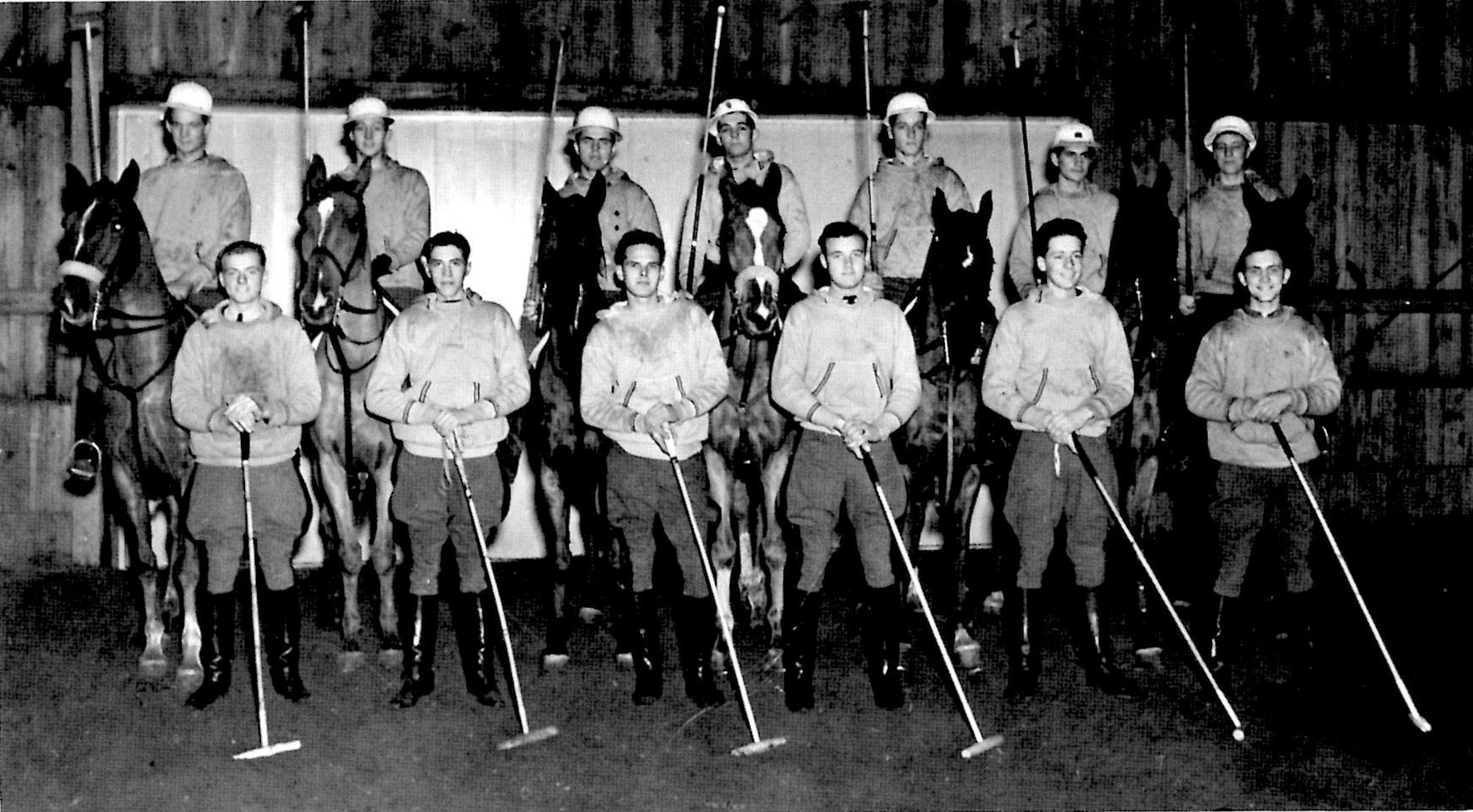
Almost immediately after Louis E. “Doc” Lamborn began his tenure as the seventh head of McDonogh School in January 1926, horsemanship and riding became part of the program. The riding program attracted boys from the “Valley” whose families participated in steeplechases and horse shows, as well as those who never dreamed of riding a horse.
McDonogh’s herd of horses began with four draft horses and two mules. After his arrival, Doc Lamborn loaned the school riding horses from his summer camp and purchased 28 wild horses from a livery stable in Baltimore. During the Depression, some parents bartered horses for tuition fees. The herd also grew by mating stallions and mares. Former Headmaster Bob Lamborn recalled that the boys, who were always responsible for feeding and grooming the horses, “hacked” around campus, participated in steeplechasing and fox hunting, and rode their horses to shows as far away as Towson and Timonium.
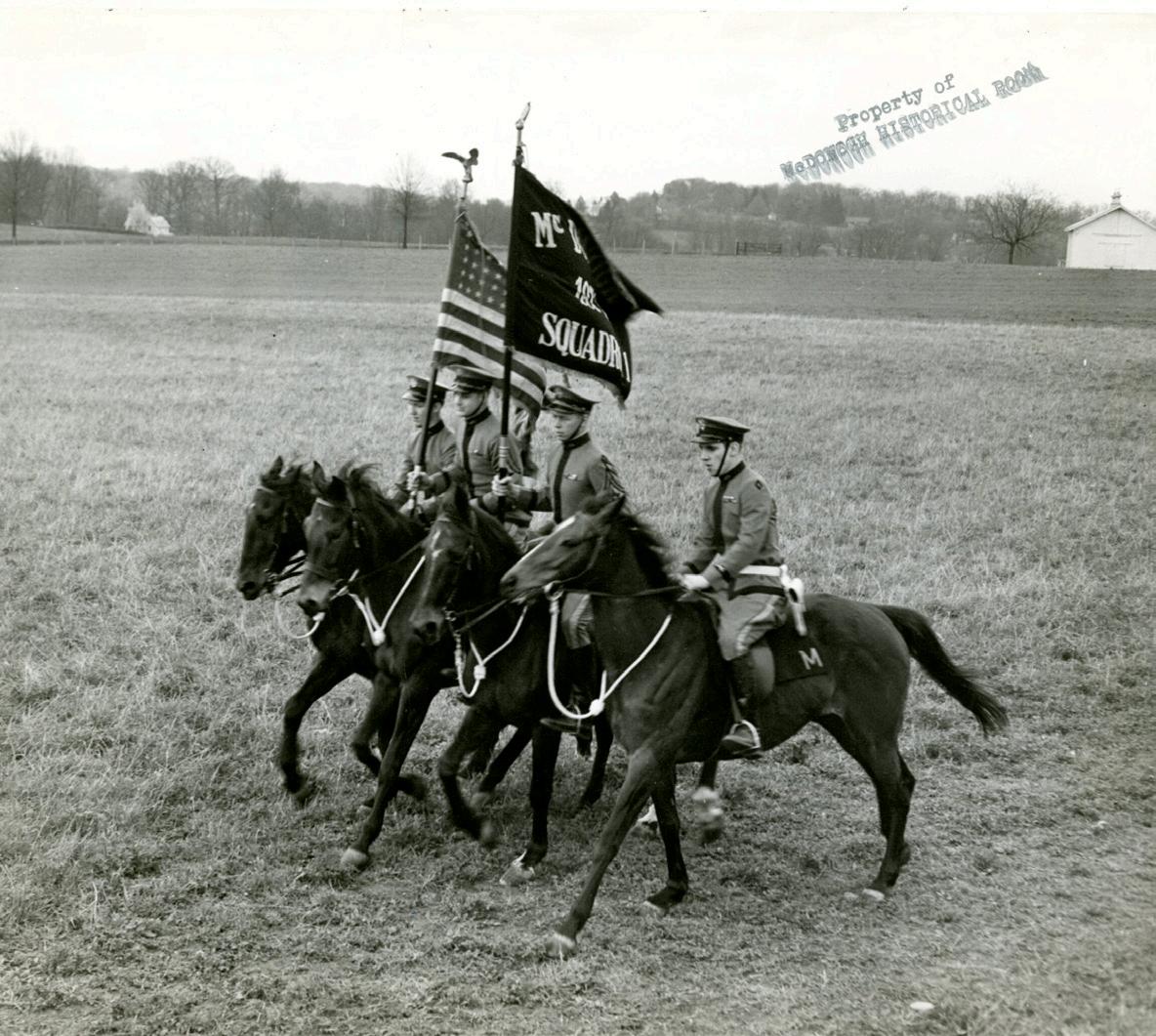
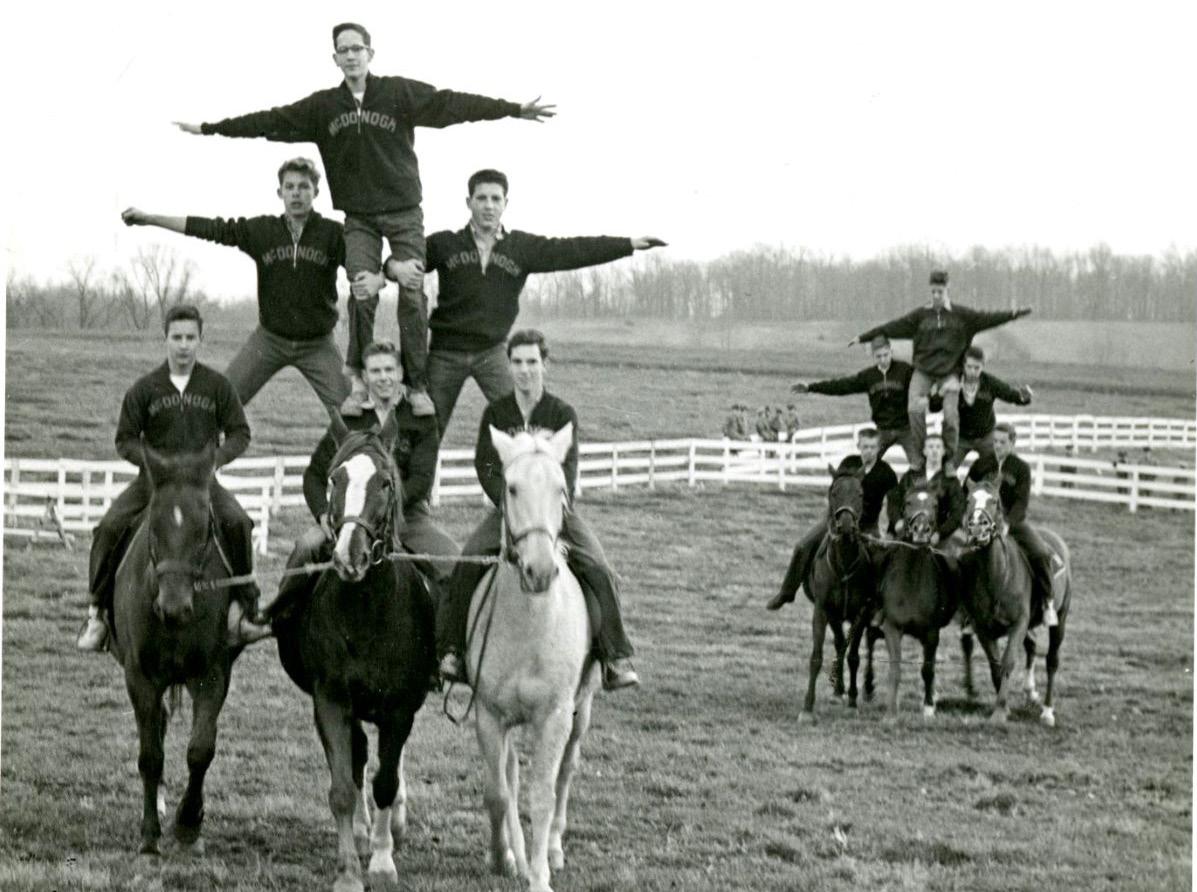
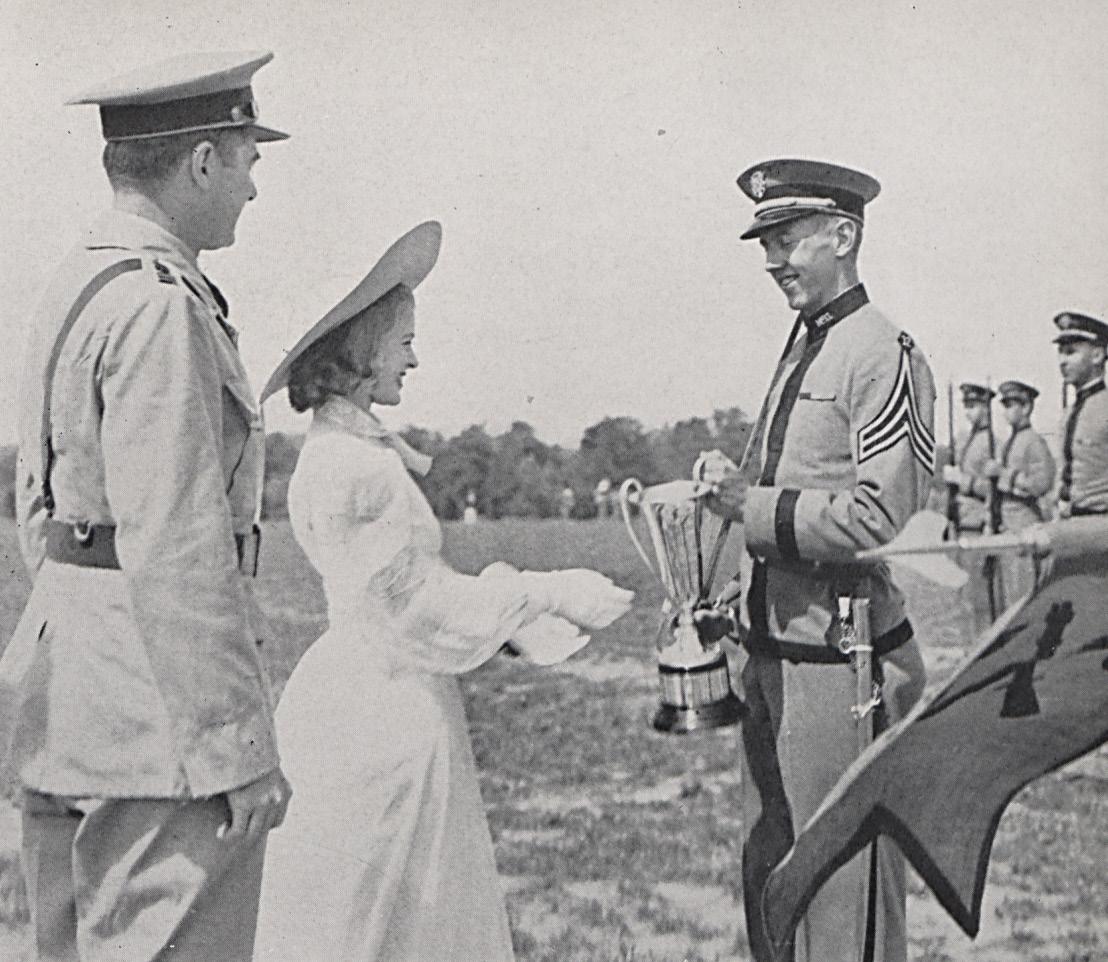
The cavalry troop was established by Doc Lamborn as part of McDonogh’s semi-military program, and by 1939, there were two Upper School and one Middle School platoons. The high point of the year was the annual Competitive Drill (a riding exhibition that included an inspection of each trooper and a series of intricate compulsory maneuvers) between the platoons for the coveted Elderkin Cup, which was awarded at Commencement. The Competitive Drill (see story No. 115) continued during the war years and beyond despite a decrease in the number of equestrians and the elimination of stunt-riding. The cavalry troops maintained high standards of efficiency, and their enthusiasm and camaraderie continued until the unit disbanded when McDonogh transitioned from semi-military to civilian status in 1971.
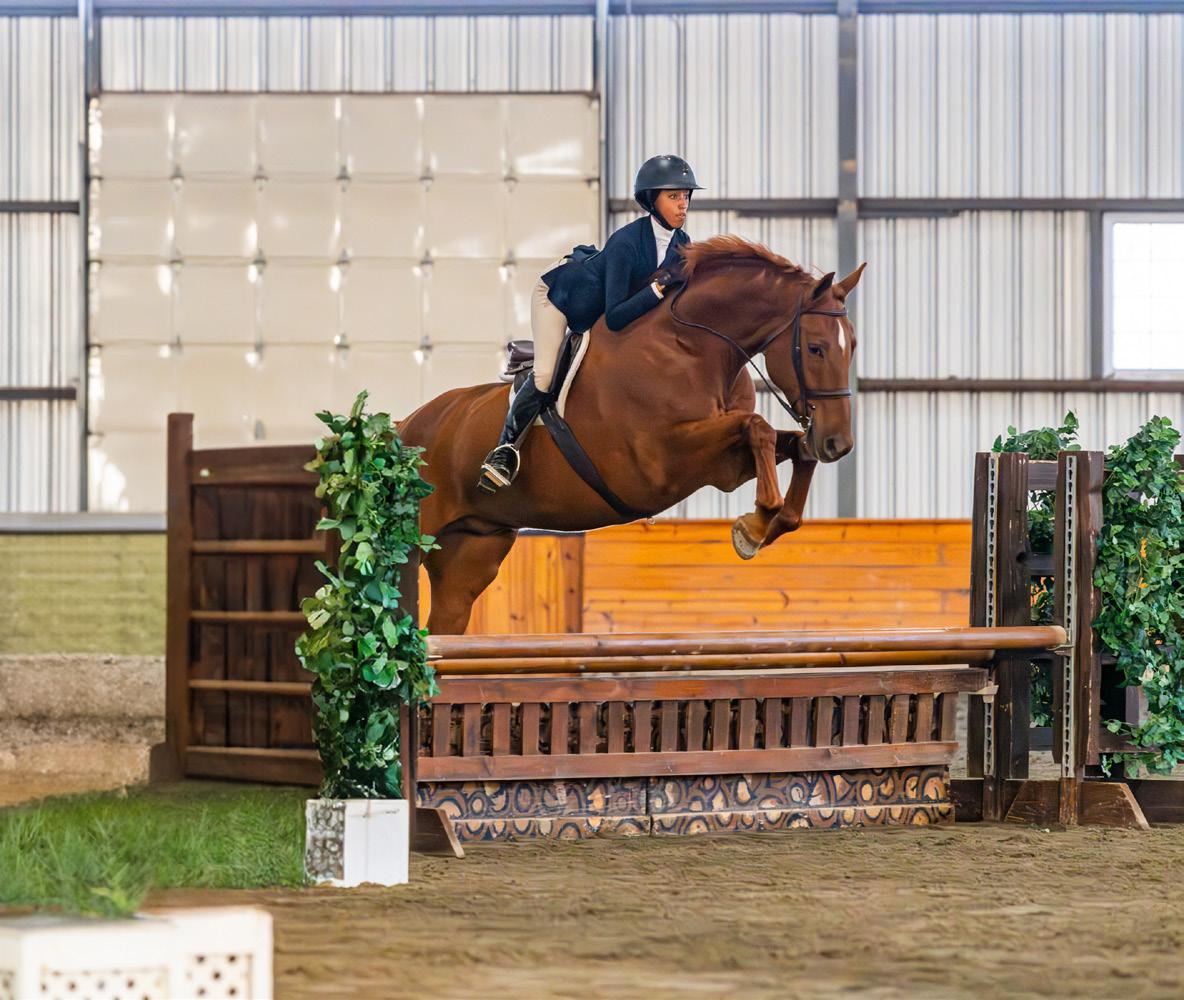
McDonogh’s Equestrian program remains an integral part of the school today. Beginning in prefirst, children are not only exposed to the basics of horse care, but they also take their first rides on McDonogh’s ponies during a unit in PE. In seventh grade, students who develop a passion for the sport may join the Middle School equestrian team, and in Upper School, they may become part of the varsity and junior varsity teams.
Read more in the Winter 2022 issue of McDonogh Magazine
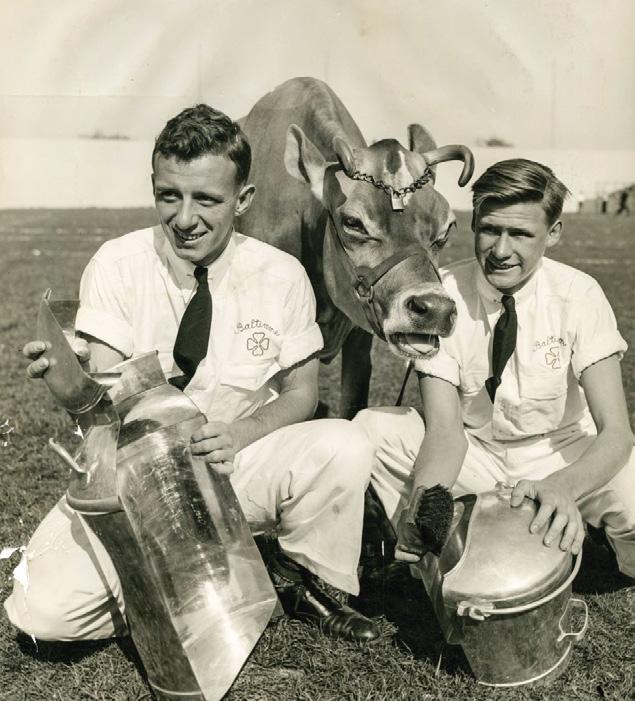
Students Enjoy Milk, Fresh from the Cow
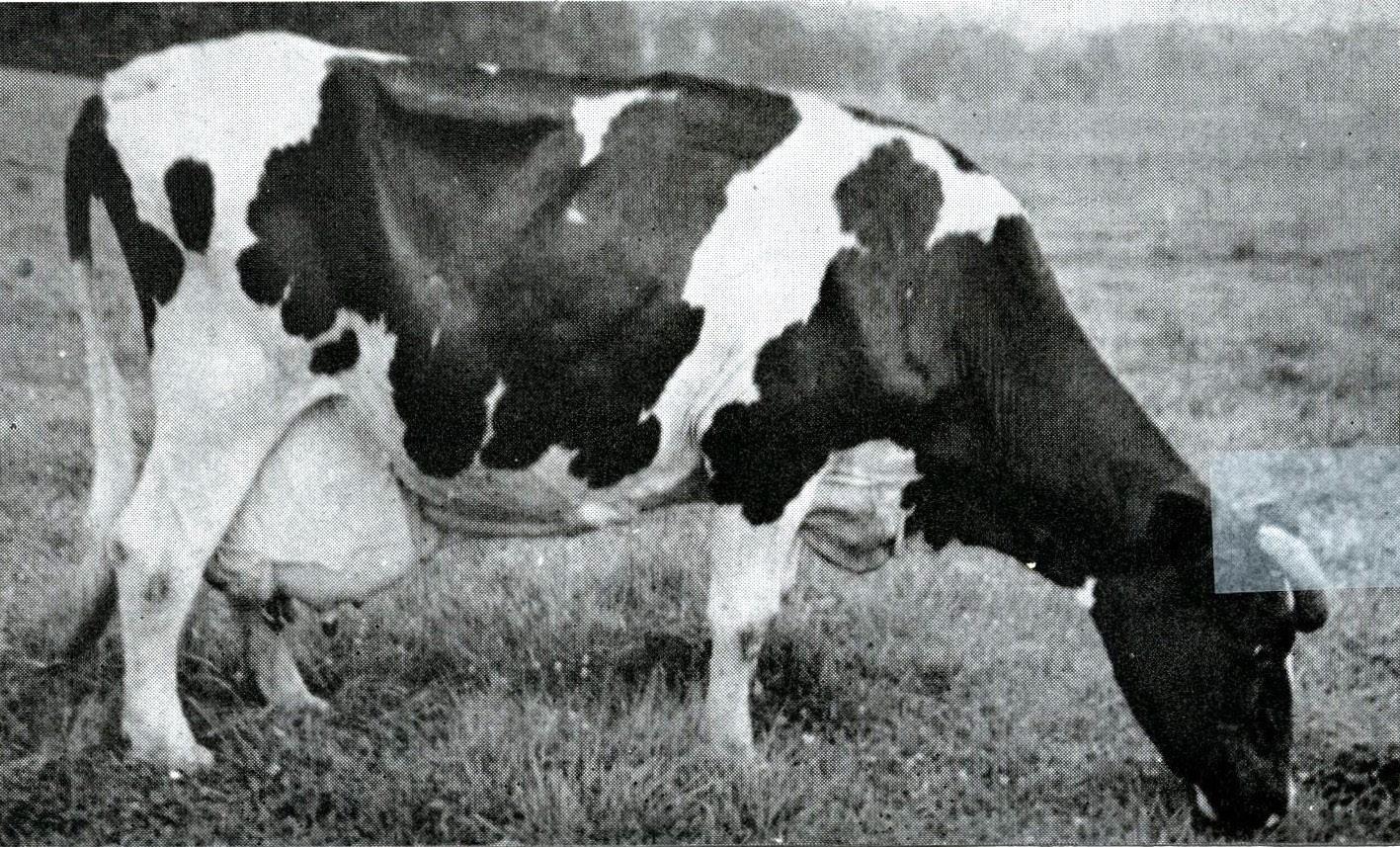
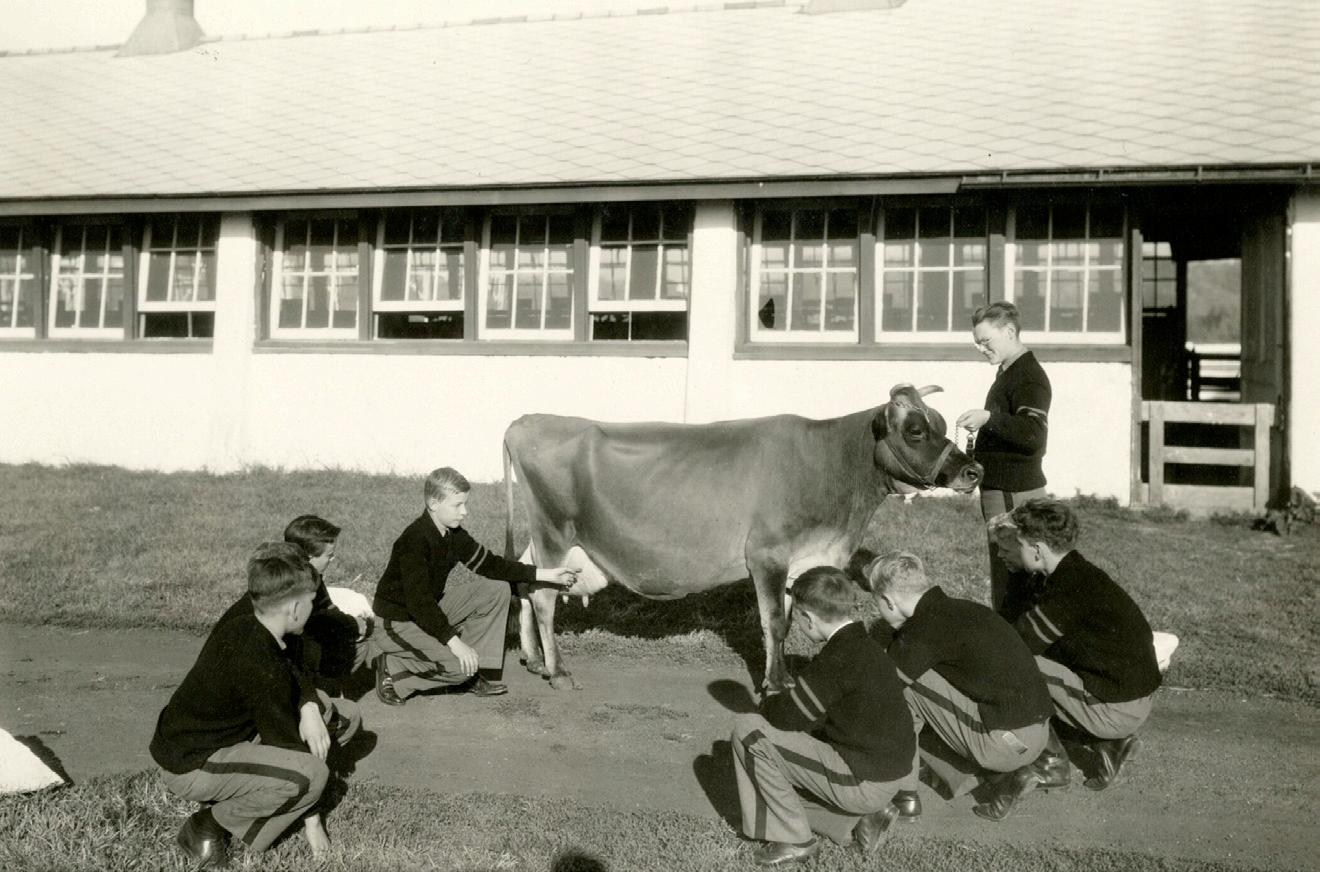
In 1920, the School built a dairy barn, and 125 Holstein Jerseys were purchased. McDonogh’s most famous cow was Ormsby Inca Pontiac Girl, who as an 18-year-old cow set production records and earned national recognition for contributing 13,966 pounds of milk and 564 pounds of butterfat in a year.
According to former Headmaster Bob Lamborn ’35, in the early 1960s, state health officials ruled that the milk—produced by
the School herd, pasteurized in the School dairy, and served in pitchers—did not meet state standards (although it never failed any state inspection). They required that the milk be sent to a plant and put in individual half-pint bottles for personal consumption. This made the milk more expensive than the milk available on the market. The budget could not handle it, so the program was discontinued and the herd dispersed.
Josepha Young: A Mother to Many
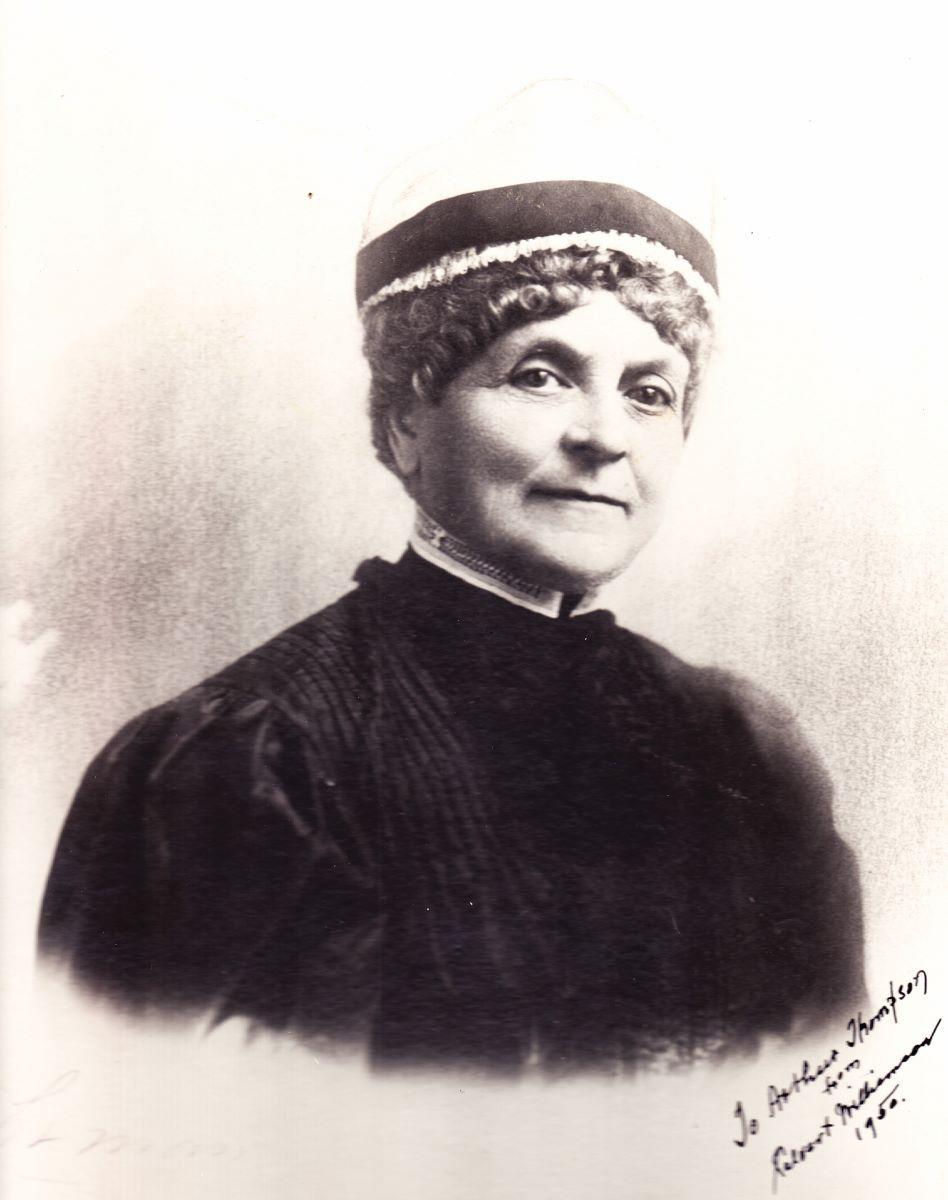
On November 21, 1873, nine days before the official opening of McDonogh School, Josepha Selden Young, dressed in her uniform of a black gown with a little white collar and a white lace cap, took her place at the helm as “Matron of McDonogh.” She was just what the young boys needed as they left their mothers and the city streets to live in the uncharted territory of the farm school.
Young was the mother figure in “Old House.” For 38 years, she cared for her family of boys, teachers, and staff of various kinds. In a tribute to Young, Arthur Dorsey Thompson, Class of 1891, wrote, “It’s not the number of things she did throughout her career, but the importance in the development and successful
growth of the school and in the formative periods of the lives of some 1,300 McDonogh boys to whom she was another mother.”
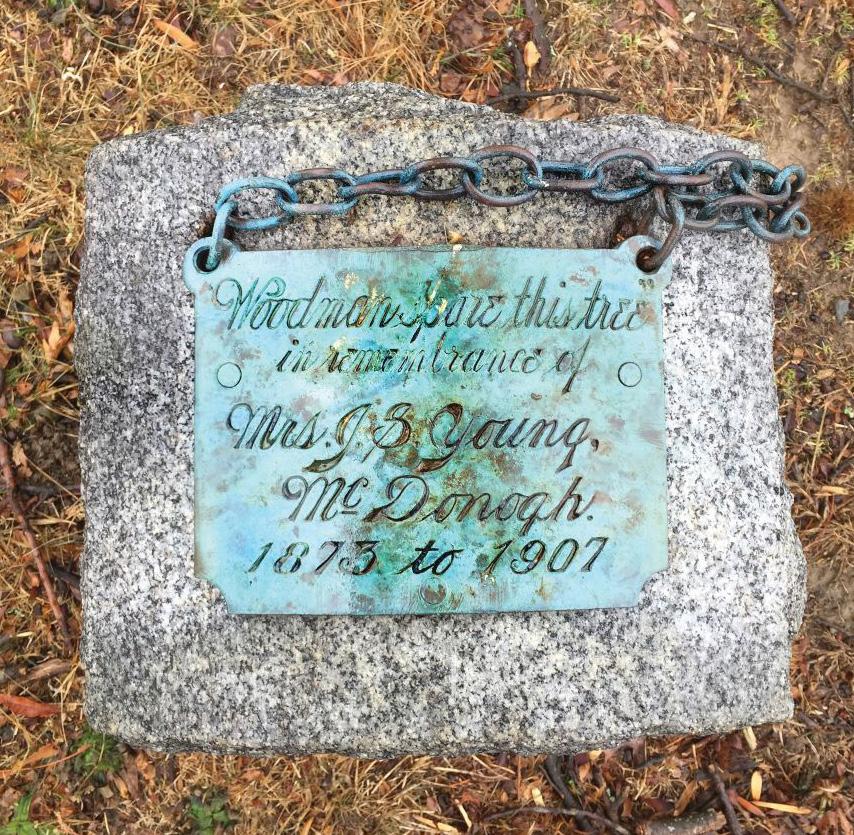
In the 1890s, the Board of Trustees honored Young’s commitment to the school by planting a pin oak tree along Shell Road in the spot where she liked to stand and watch over the boys as they played in the orchard. In 1907, when Mrs. Young’s son, Charles, felt it was time for his mother to retire, he arranged for a plaque to be added to the tree inscribed with the words, “Woodman, spare this tree. In remembrance of Mrs. J.S. Young, 1873–1907.” But Josepha Young had other ideas and remained at the helm until her death in April of 1911 at the age of 81.
Read more in the Winter 2016 issue of McDonogh Magazine.
The Fader Innovation Center: an Outlet for LifeReady Learning
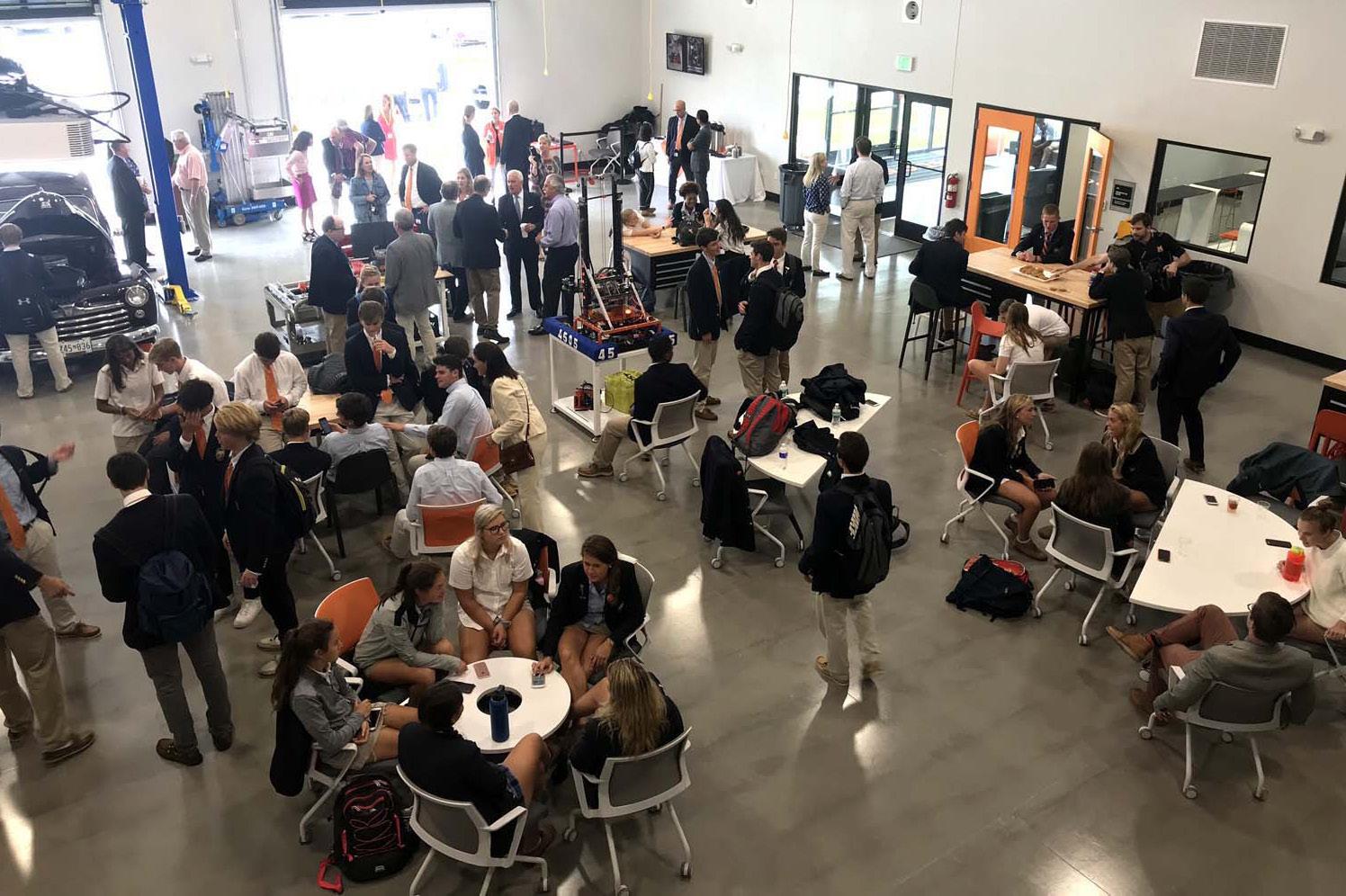
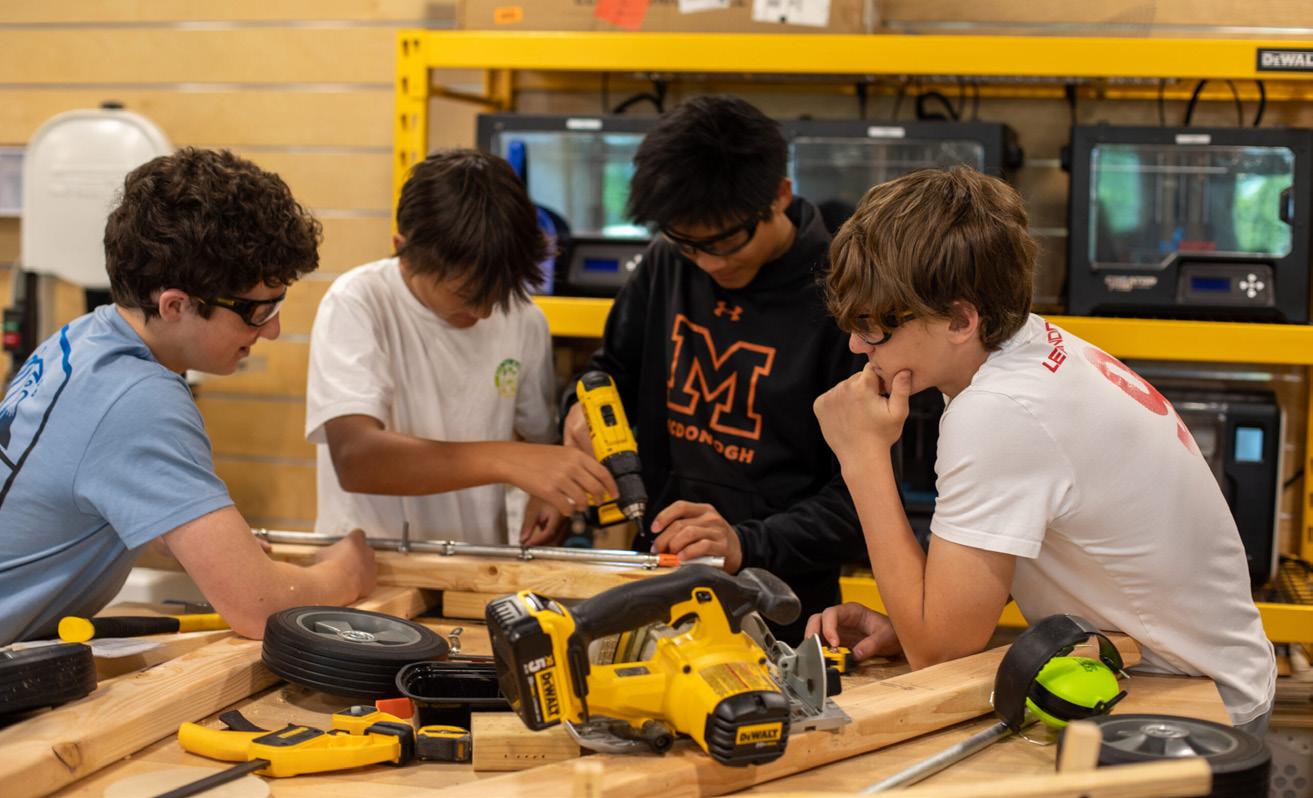
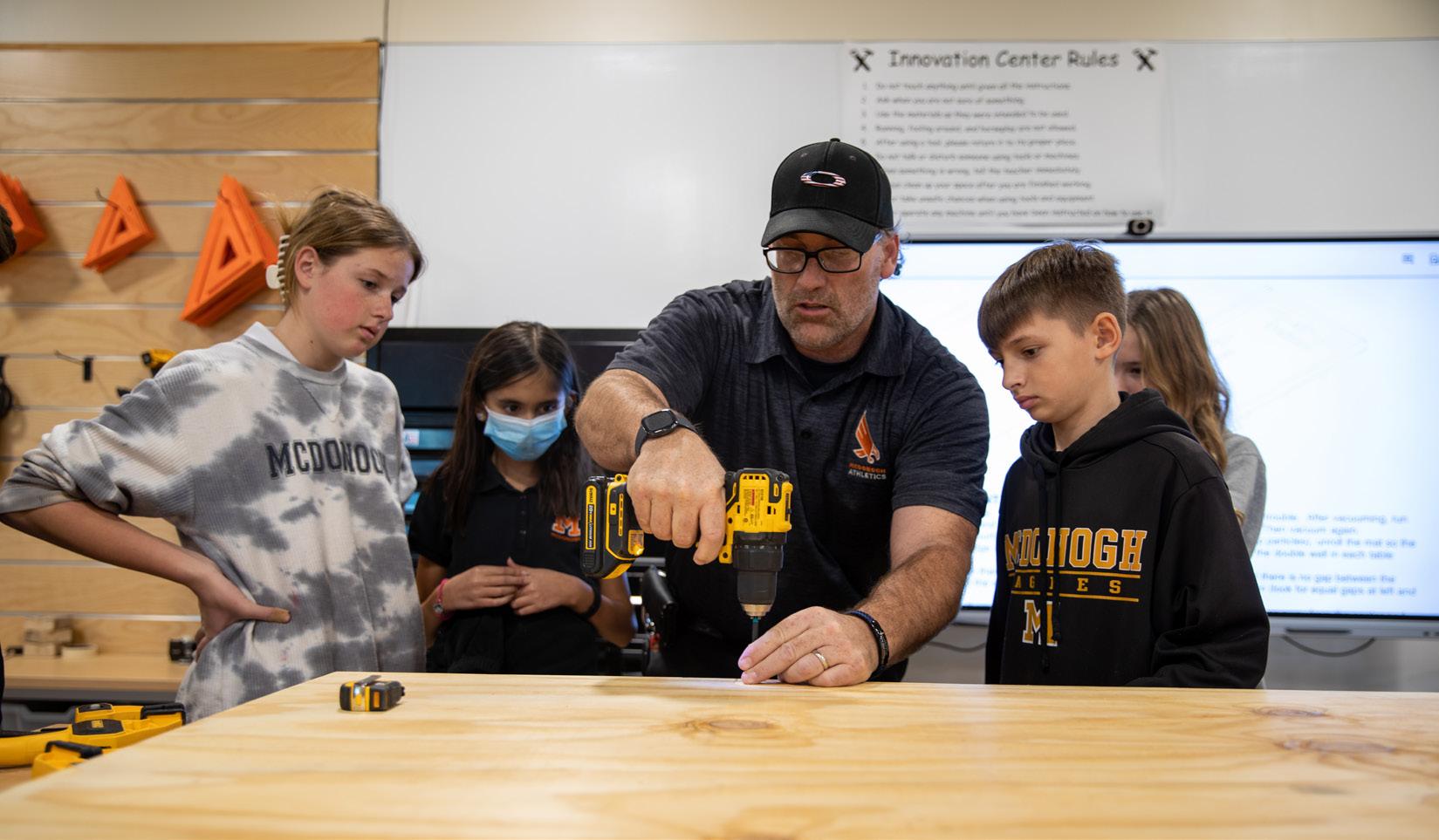
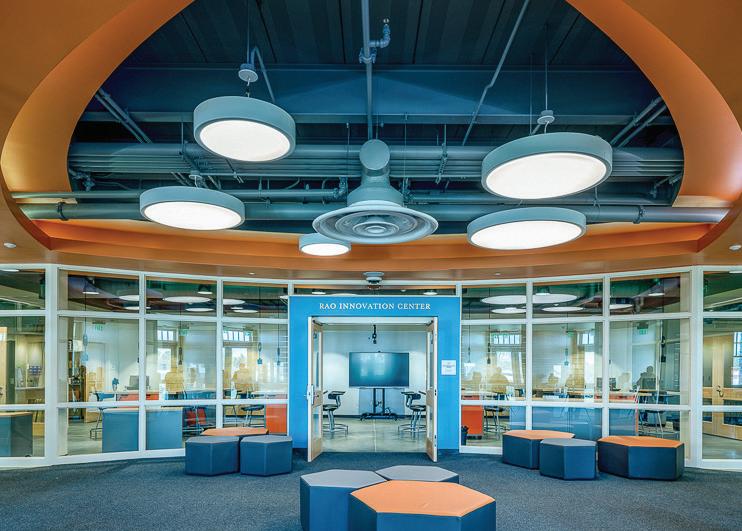
The 7,000-square-foot Fader Innovation Center, which opened in 2018, was designed with flexibility in mind. It houses McDonogh’s robotics and engineering programs as well as an auto bay where students can directly experience the fundamentals of physics, math, and chemistry by working on cars. It is a place where LifeReady experiences unfold each
and every day—a place where students communicate with one another about projects, solve problems alone or in groups, and think in terms of the greater good. Students welcome the challenge to try different ideas, and they feel comfortable going back to the drawing board until they land on a workable solution to a problem.
From Principal to Headmaster to Head of School: A Title Change at the Top
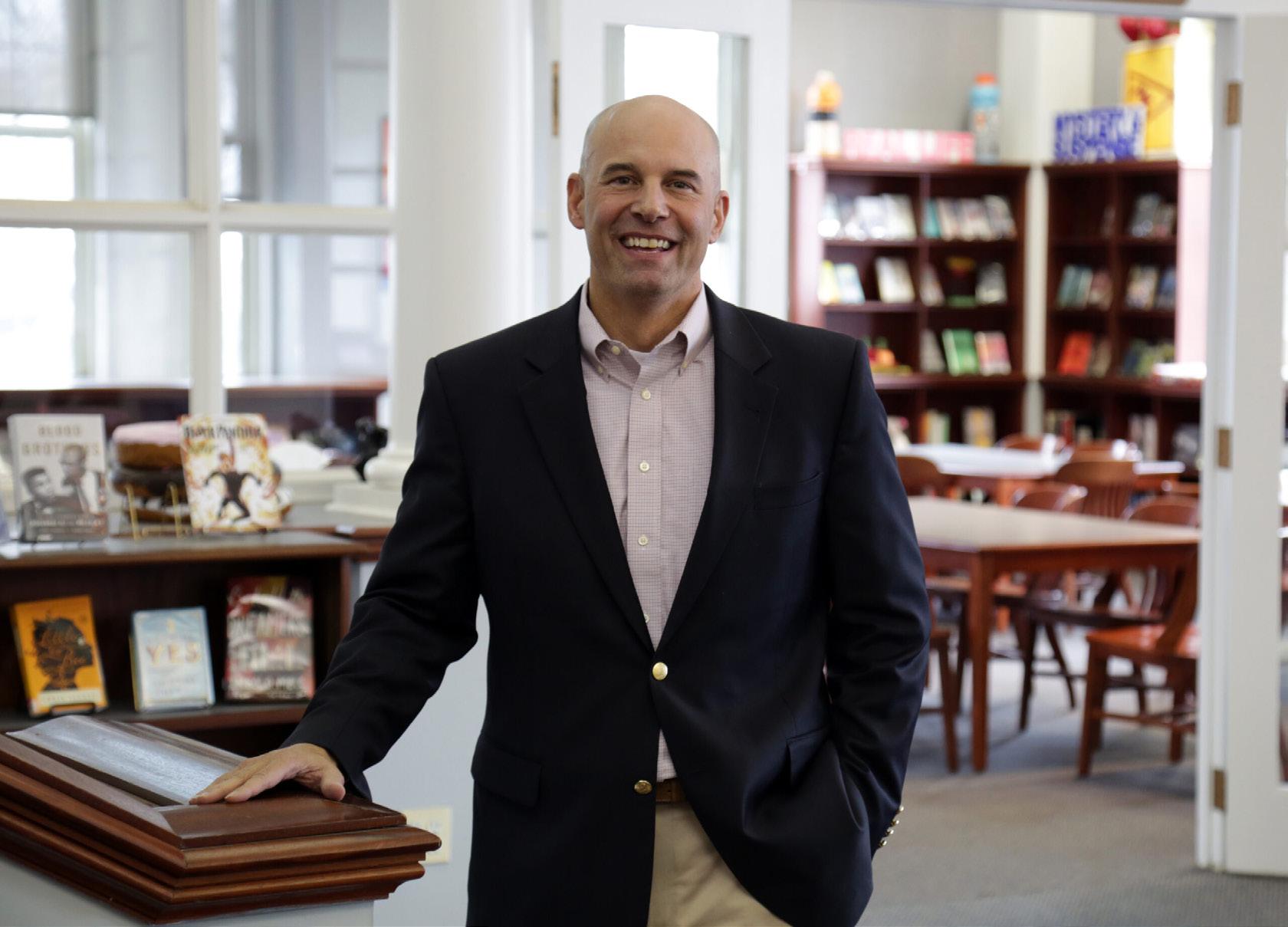
The first six leaders of McDonogh School had the title of principal. According to Bob Lamborn, when his father “Doc” Lamborn was at the helm, the State Board of Education told him he did not have the professional training required to use the title “principal.” So, he changed his title to Headmaster. Over time, the use of the term Headmaster fell out of favor and Dave Farace ’87 became the first to use the title Head of School.
Maintaining Connection: The History of McDonogh’s Alumni Association
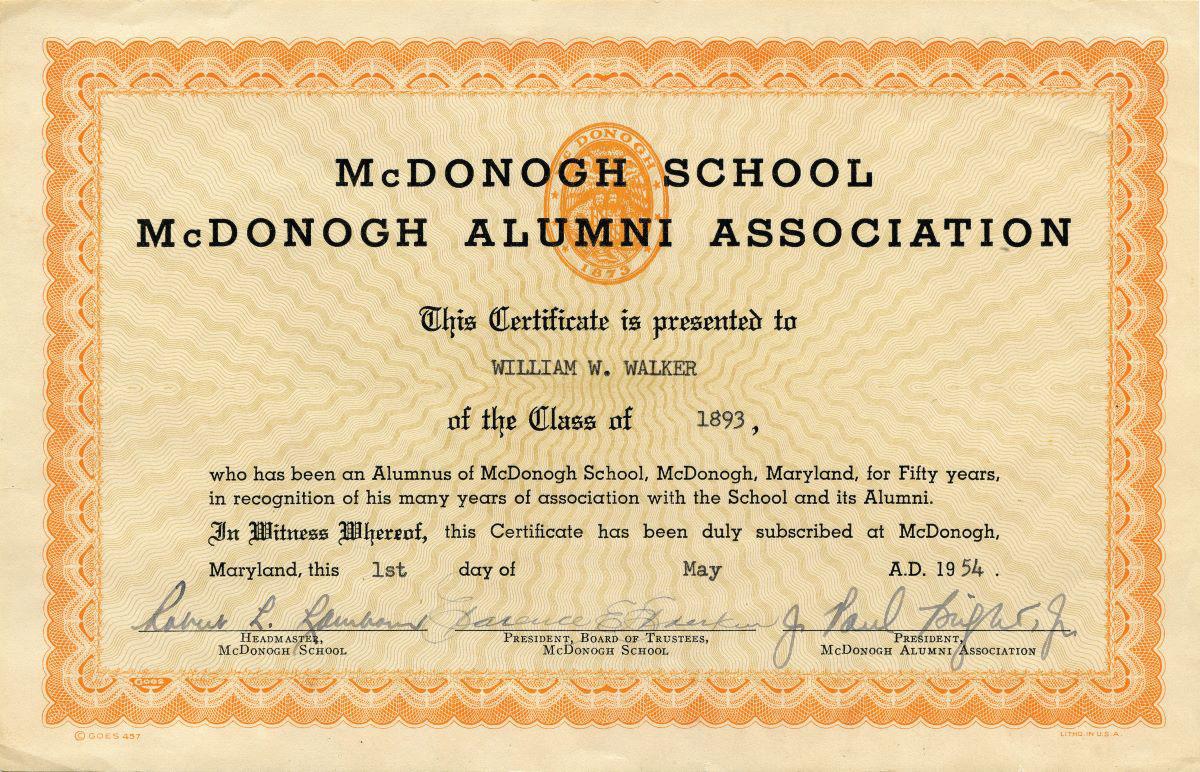
The McDonogh Alumni Society was established in 1880 by a group of alumni whose main objective was “friendship and mutual help.” The Association was crucial in maintaining a connection between fellow alumni, evidenced by the officers’ keen interest in maintaining contact with every alumnus, and, for a time, routinely submitting a death notice upon the passing of fellow alums. Until 1956, members could subscribe to the Association by contributing a nominal fee. In return, they would receive a copy of The Week, the school’s newspaper, to keep them up to date on the events occurring at McDonogh.
financially stable. Even though an annual fund was not established until 1958, smaller targeted funds were occasionally created to fundraise for specific purposes, such as the Memorial Fund, which raised money to build the Memorial Field House and Memorial Court in the late 1940s.
Beginning in the early 20th century (c. 1903), the Alumni Association also undertook various fundraising campaigns in efforts to keep the school
Every student becomes a member of the Alumni Association when they graduate. Today, our more than 7,400 alumni around the world continue to be a part of the McDonogh Family through programs, events, and initiatives including McDonogh Connect (connect.mcdonogh.org), an online platform that can be used to find old friends, make professional connections, post or view job opportunities, and offer mentoring to current students and recent graduates.
Legacy of Eustace Glascock (Class
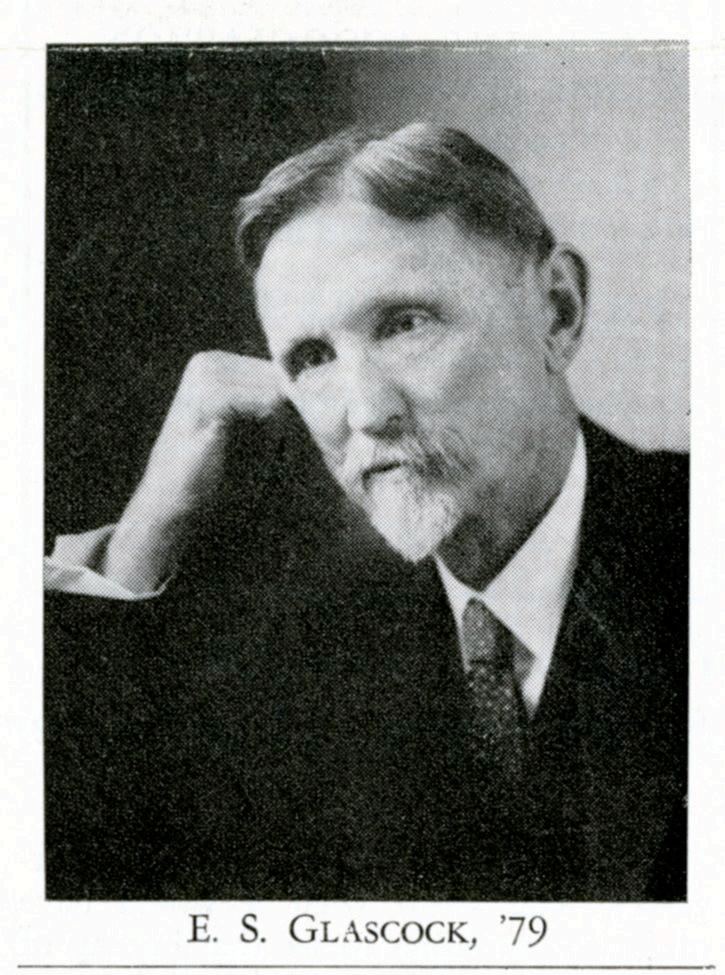
At age 11, Eustace S. Glascock entered McDonogh School in 1874 as “Boy #78.” Upon graduating in 1879, he was admitted to the United States Naval Academy—the second boy to enter a major college upon the recommendation of Principal William Allan. It was not until 37 years later that Glascock wrote his
of 1879)
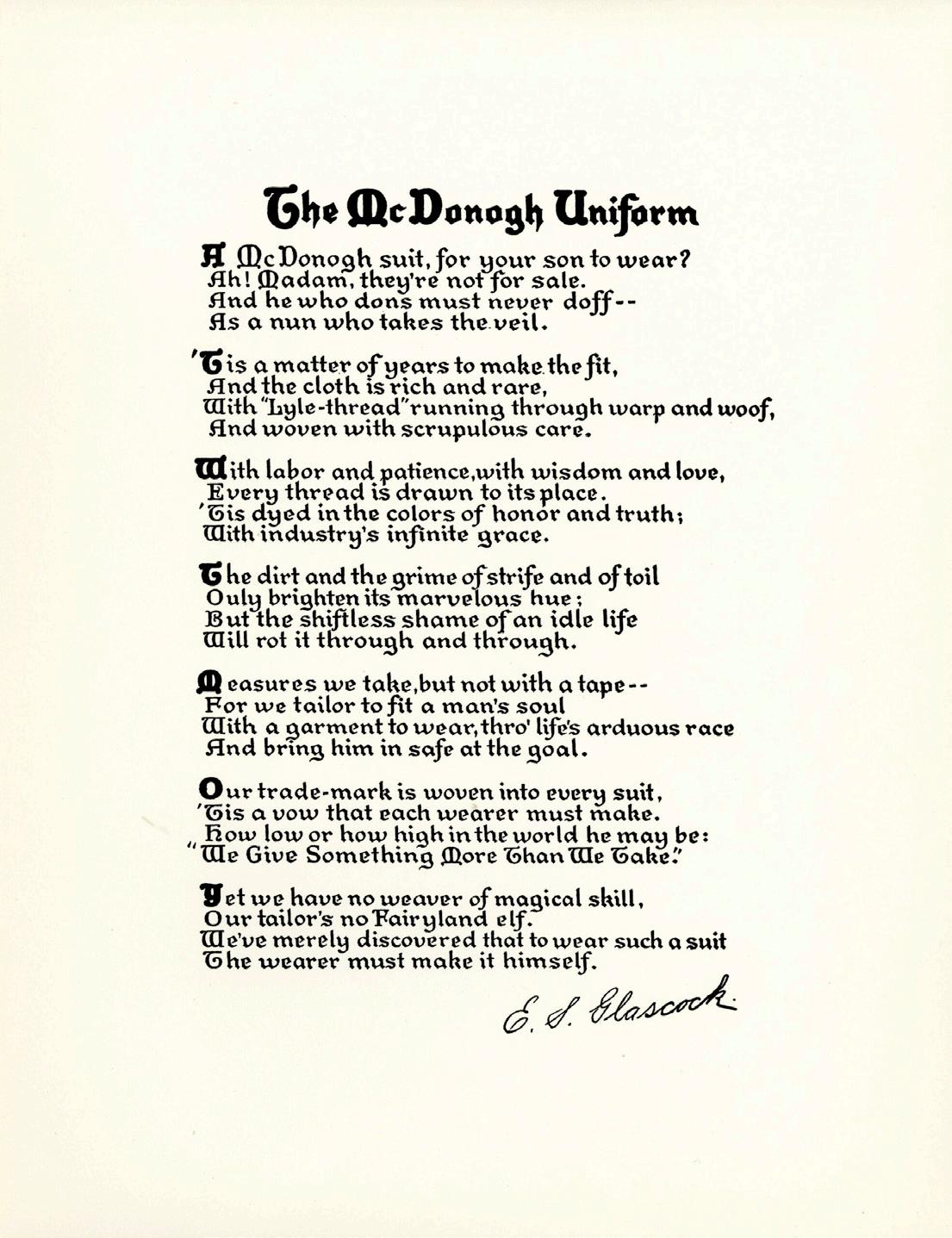
now iconic poem, The McDonogh Uniform (see story No. 109). He was invited to read the poem at the dedication of Memorial Court in 1946. It continues to be part of the ceremony today. The line “we give something more than we take” has become a school motto.
Let’s Take a Dip: From Swimming Holes to Swimming Pools
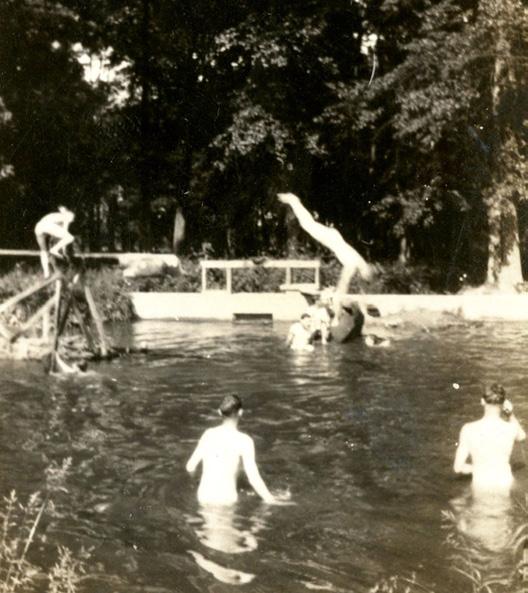
Former Headmaster Bob Lamborn ’35 recalled that the boys enjoyed swimming in the stream more than anything else. He recounted that there were swimming holes all the way down the stream—Turtle Soup Bay above the dam from the mill race, the Horse Trough, and Three Stumps, which was the most popular. It was a deep spot in the stream near the bridge with a big tree overhanging the water. The boys nailed boards to the tree so they could climb up and have high-diving contests. The train ran next to Three Stumps, and ladies in the trains could look out the windows and see the boys having a great time in the pool. The only problem was that the boys didn’t wear bathing suits. The ladies complained to the conductor, who told management, who then reported it to the School. During the Depression, homeless people who rode the rails often camped at Three Stumps because they could jump off the cars that stopped in the nearby station, clean up, sit in the shade, and cook.
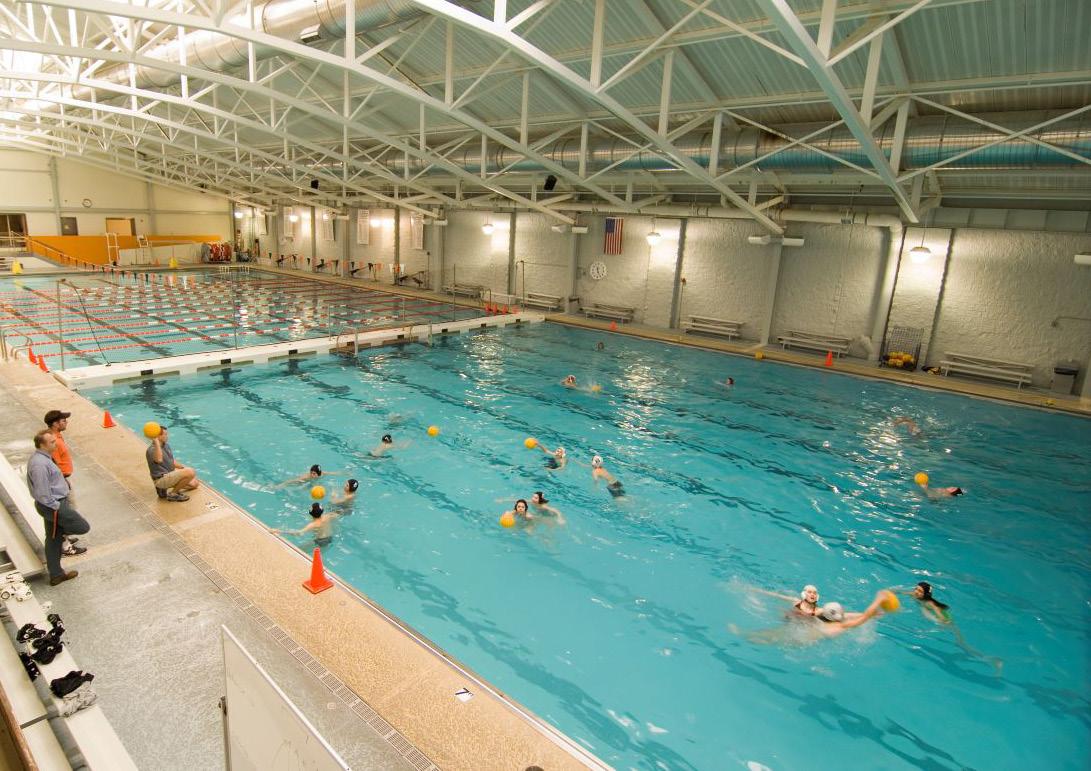
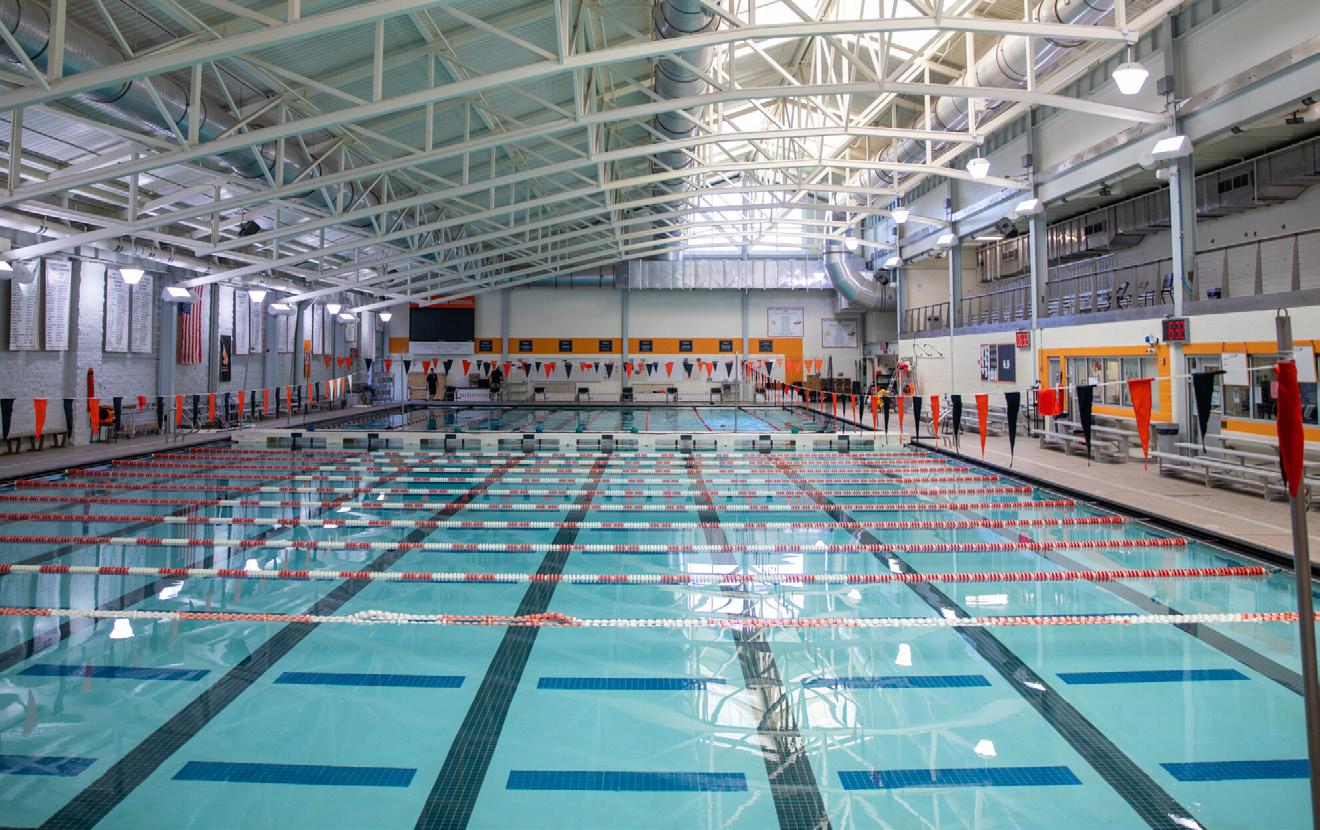
Childs Memorial Swimming Pool, the School’s first formal pool, was located in the meadow by the bridge. The pool opened in 1930 and was essential to the success of Camp Red Eagle, which opened the following summer. In 1954, an indoor swimming pool with the most modern systems (fresh water circulated constantly) was added to Memorial Field House. The 75' x 36' pool, dedicated during the 81st Founder’s Day celebration, featured two springboards at the north end and grandstands for spectators on the east side.
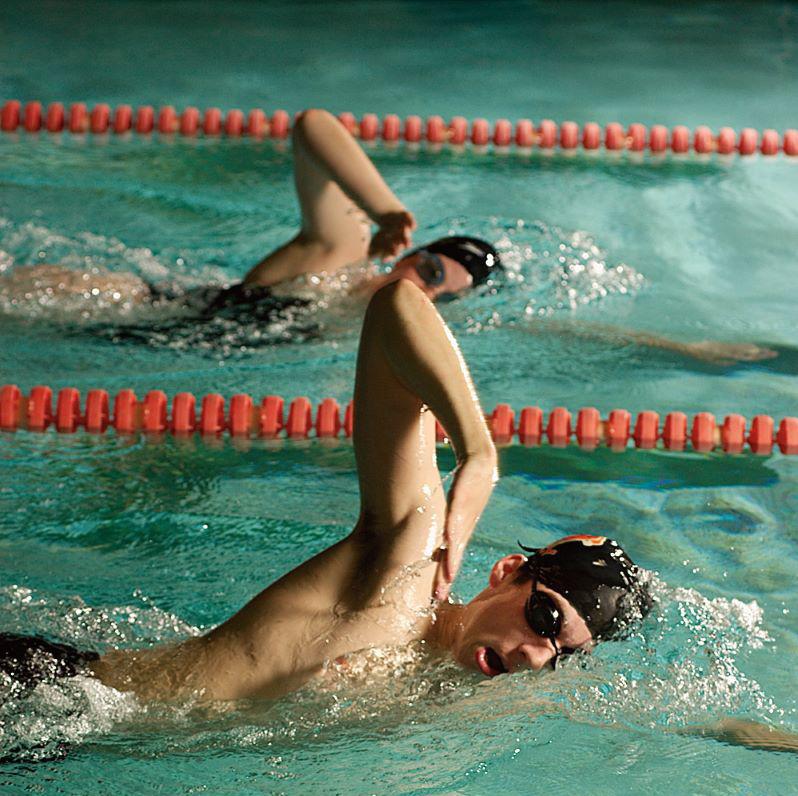
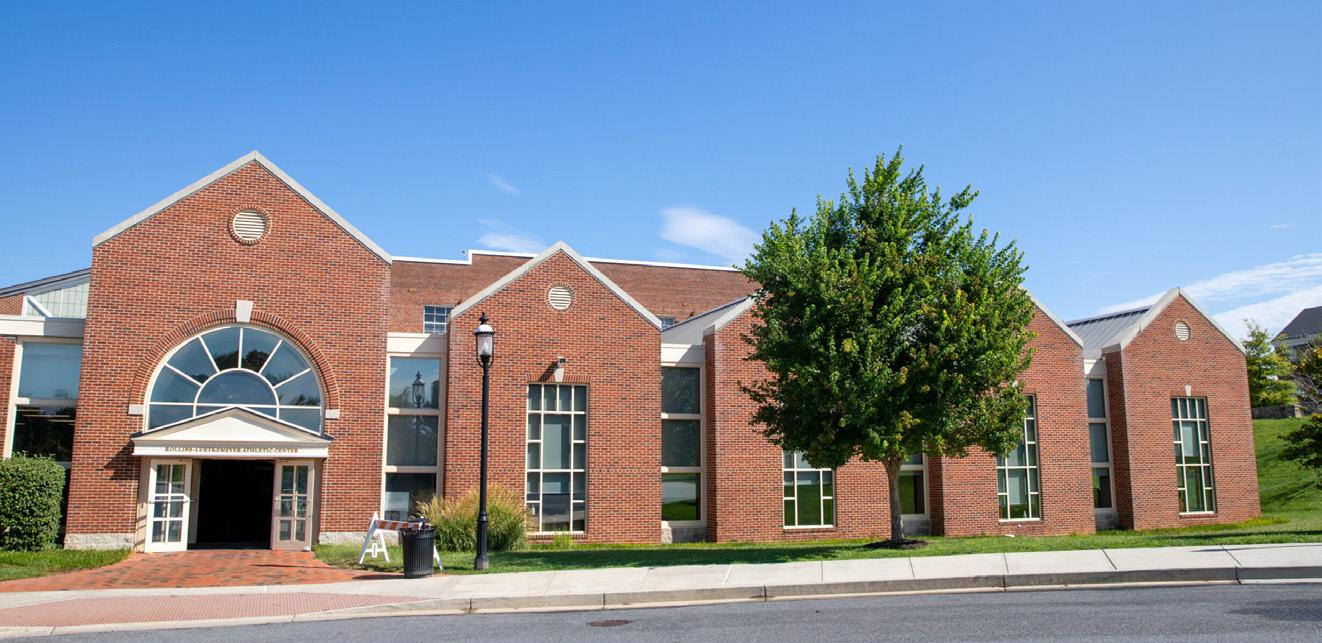
In 2006, the Henry A. Rosenberg, Jr. ’48 Aquatic Center, located in the RollinsLuetkemeyer Athletic Center, opened. It includes an eightlane, Olympic-size pool.
Campus Stream, Pump House, and Water Tower—Essential to Daily Life
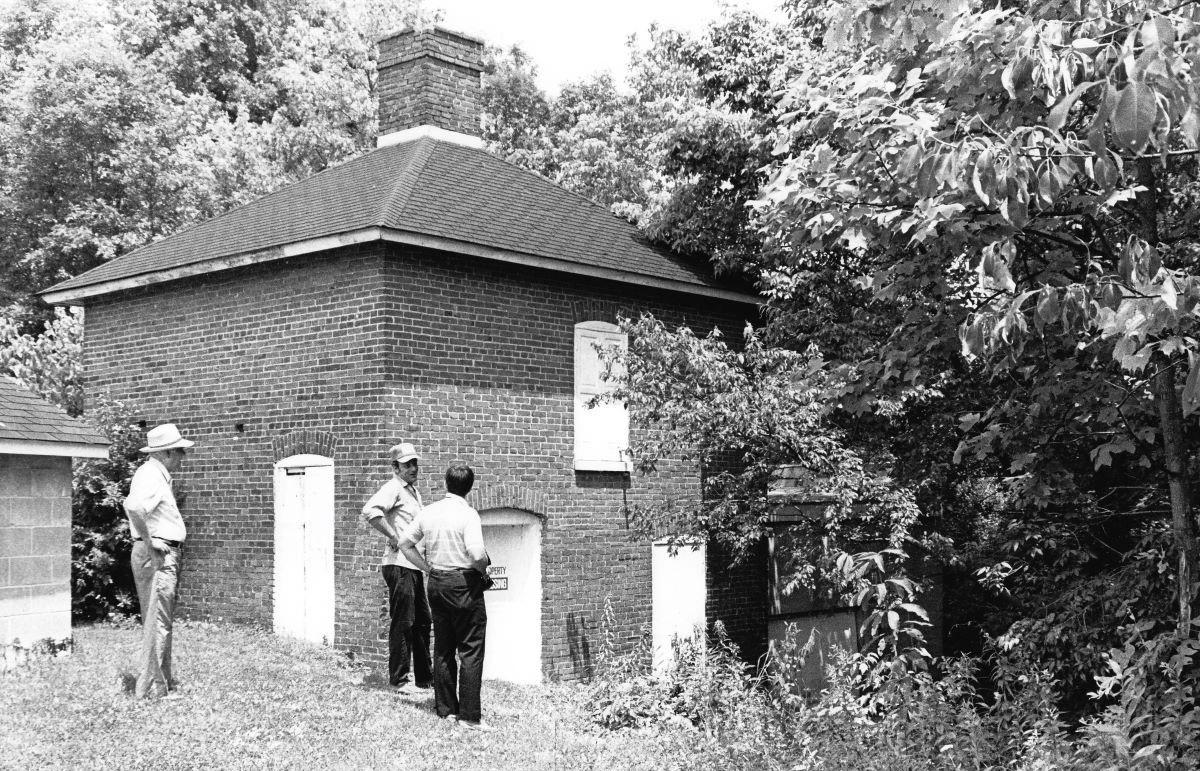
Prior to 1984, McDonogh’s water supply came from a set of underground springs in the north woods. It was hand-piped down to the pump house from the mill race and tail race of the Gwynns Falls. The red brick pump house included a waterwheel that powered the pumping system and provided water for the School. For years, McDonogh relied on a tank in the tower of New House for the storage of water.
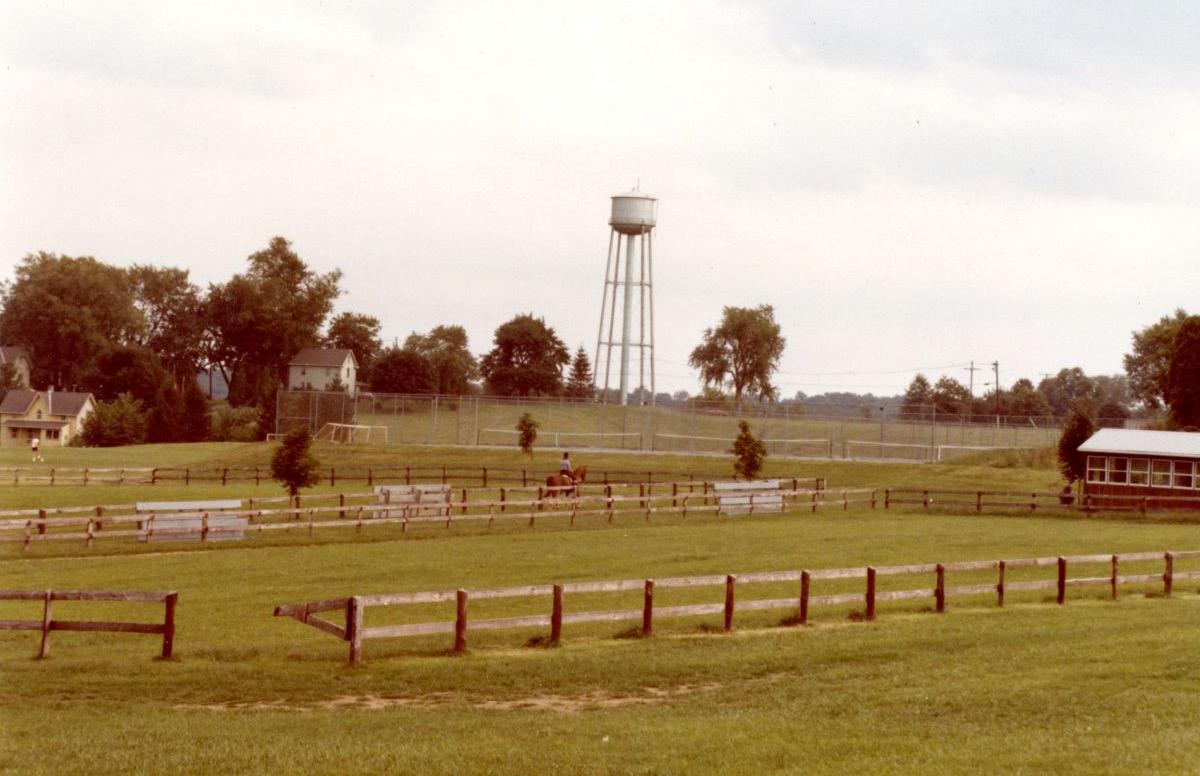
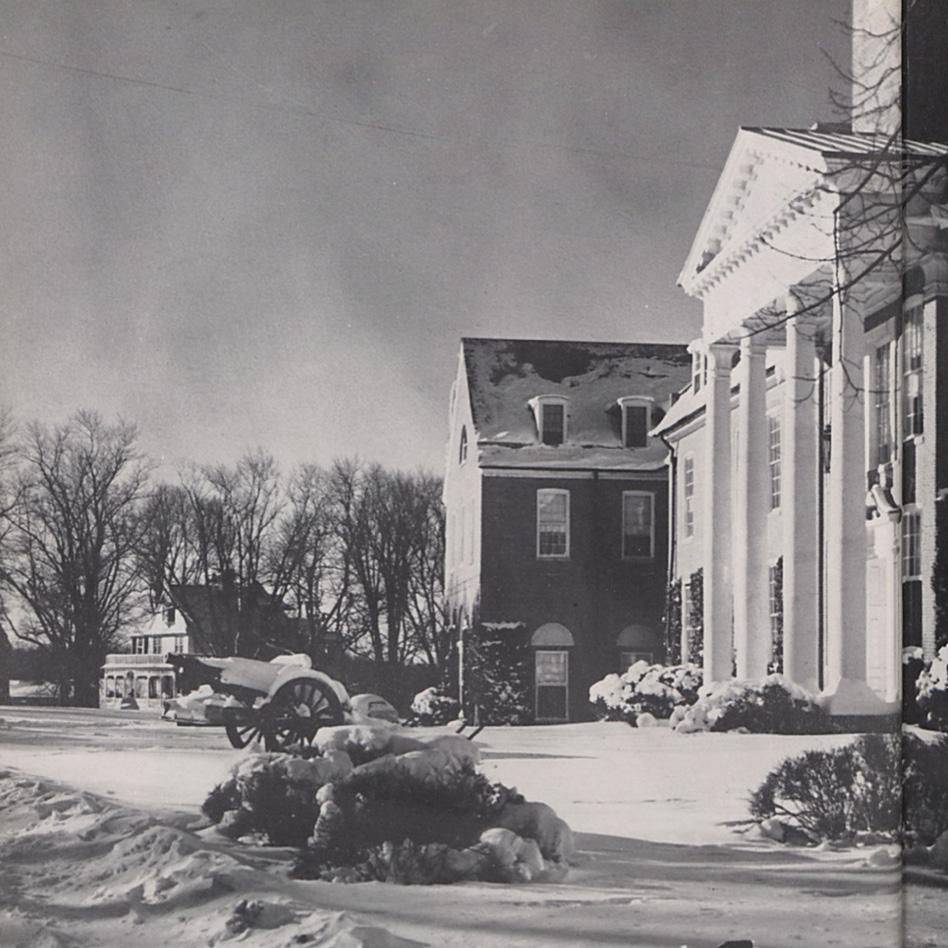
When Allan Building was complete, a water tower was built adjacent to Farm Road, and every building on campus was
gravity-fed off the tower. According to former Director of Facilities Steve Simmers ’70, someone went to the pump house every day to make sure the waterwheel was doing 13 revolutions per minute in order for the right amount of water (30,000 to 40,000 gallons a day) to be pumped up to the top of the tower. In June of 1987, after the transition to city water, the landmark water tower—which stood in the vicinity of what is now the boarder parking lot—was taken down.
The Cum Laude Society: Celebrating Excellence, Justice, Honor
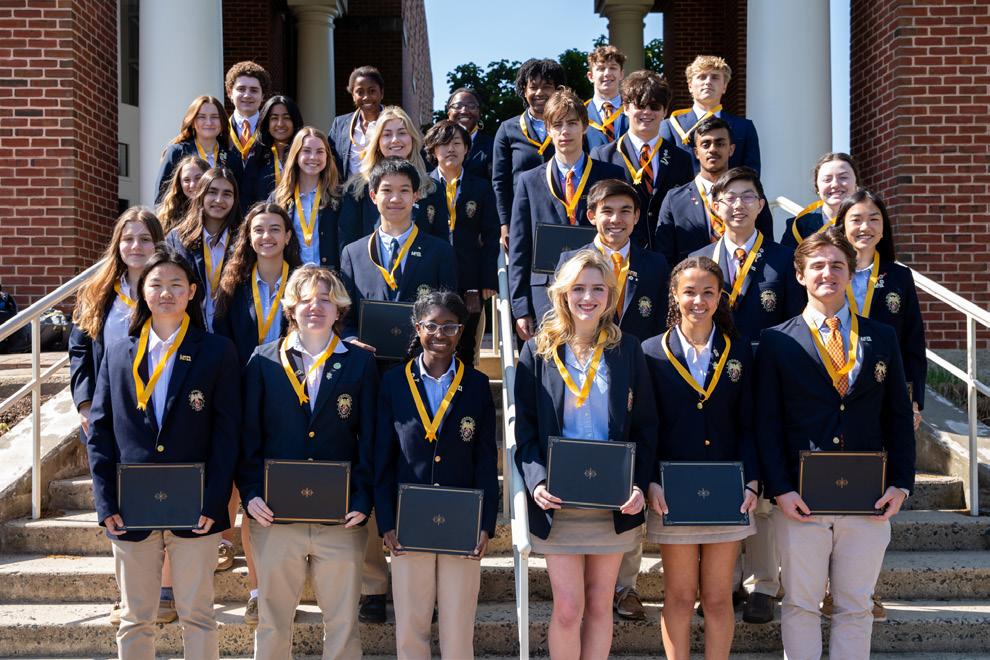
McDonogh joined the Cum Laude Society in 1961. The society, founded in 1906, recognizes the scholastic achievement of juniors and seniors in secondary schools. Chapters elect only those students who have demonstrated good character, honor, and integrity in all aspects of their school life. While the founders of the Society wanted to recognize outstanding scholarship at the high school level, they also underscored their belief that such scholarship needs to be grounded in integrity by thoughtfully choosing the words of the society’s motto, “Arete, Dike, Time—Excellence, Justice, Honor.”
Symbolism of the Seal: Connecting Students of Today to Those of the Past
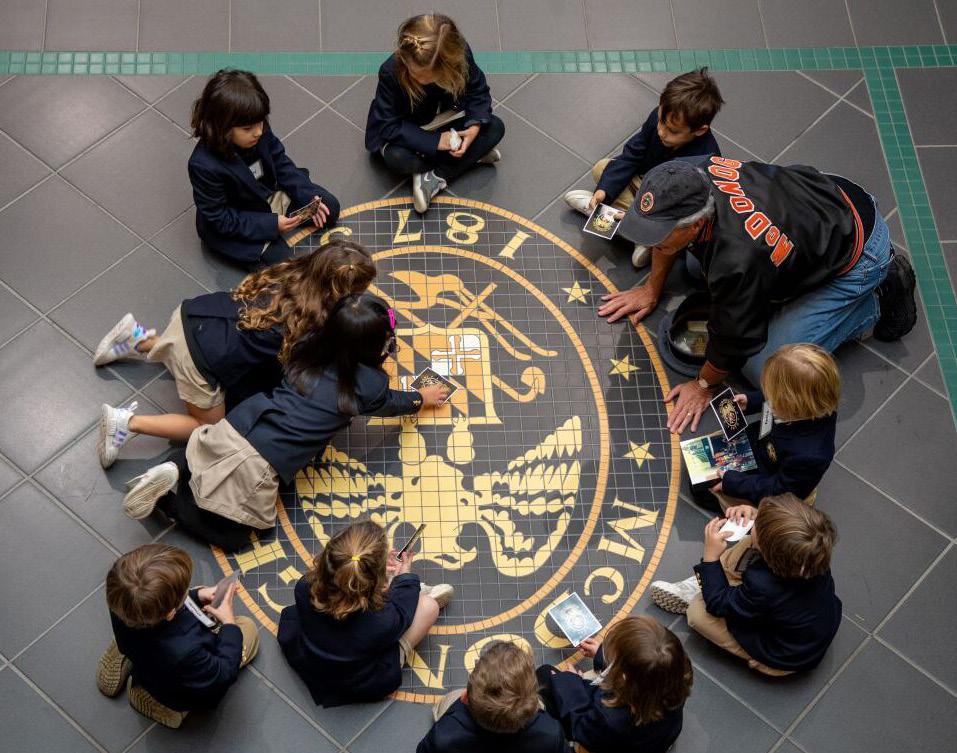
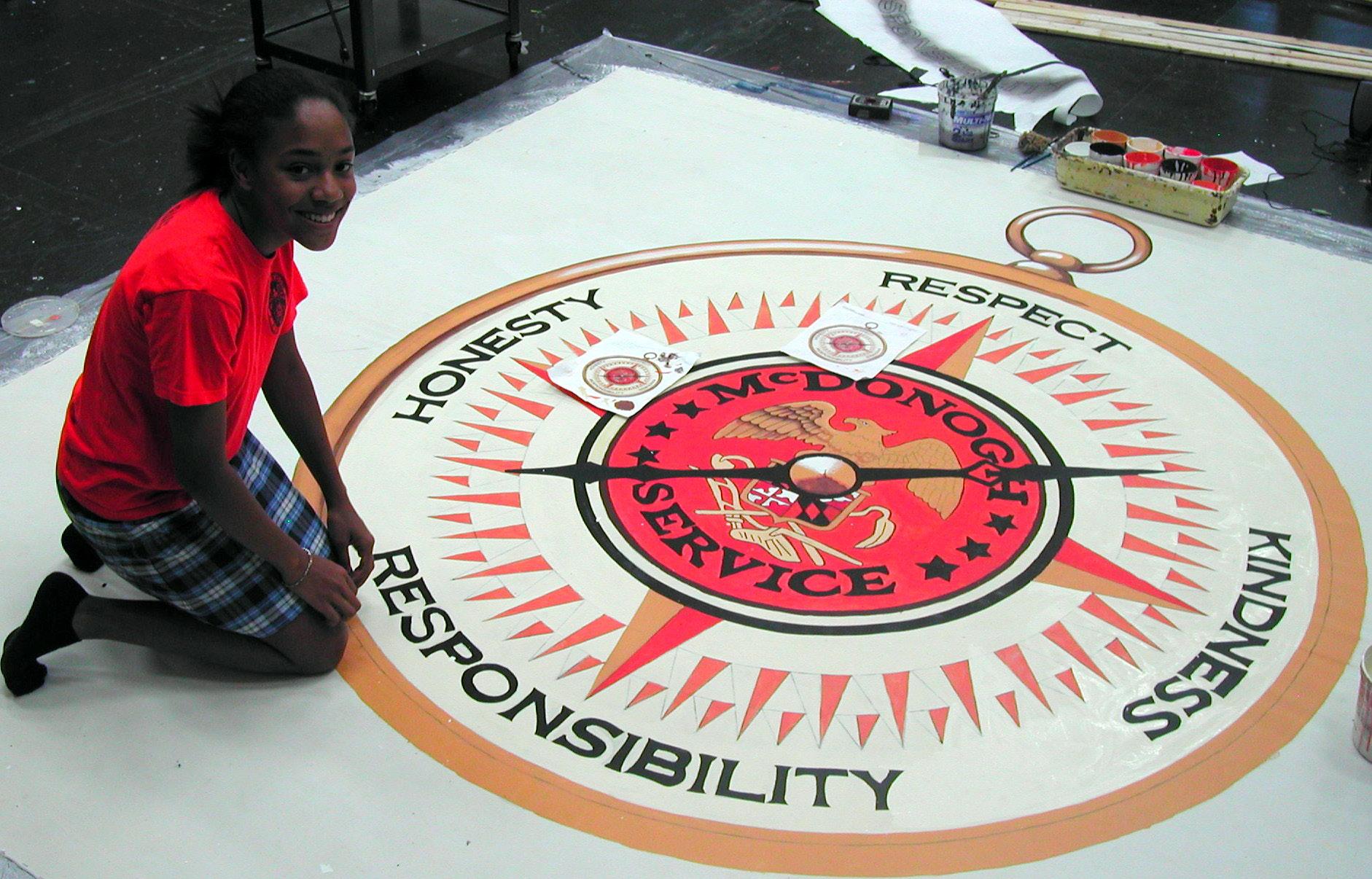
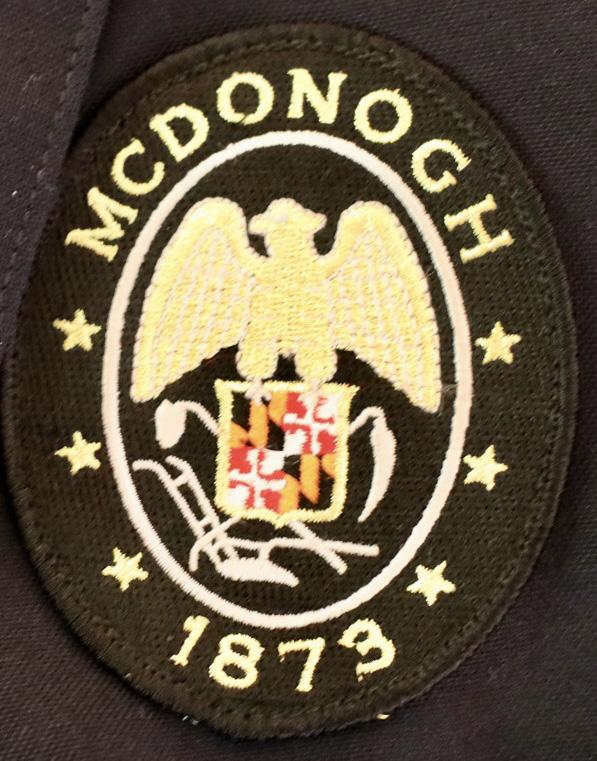
The McDonogh Seal was designed in 1930 by longtime faculty member G. Hall Duncan who taught at McDonogh from 1926 through 1942 and again after World War II from 1946 through 1947. It contains the School’s name and founding date. The eagle, representative of the nation, and the Maryland flag are prominently displayed, along with farm tools that remind us of our school farm beginnings. The six stars symbolize the six virtues—Labor, Patience, Wisdom, Love, Honor, and Truth— noted in The McDonogh Uniform poem written by Eustace S. Glascock, McDonogh Class of 1879. The seal, worn on each student’s blazer, connects every McDonogh student—past, present, and future.
22. Howitzer Cannons in Front of Allan Building: A Symbol of Military Heritage
In 1935, the Daughters of the American Revolution donated two howitzer cannons to McDonogh School. They stood in front of Allan Building until the late 1950s, when they were moved to the front of Memorial Field House. In the mid-1960s, a student who was climbing on one of the cannons fell off and broke his shoulder. Shortly after, they were donated to the local VFW post.
“Old Man” Lyle: A Favorite of the Young
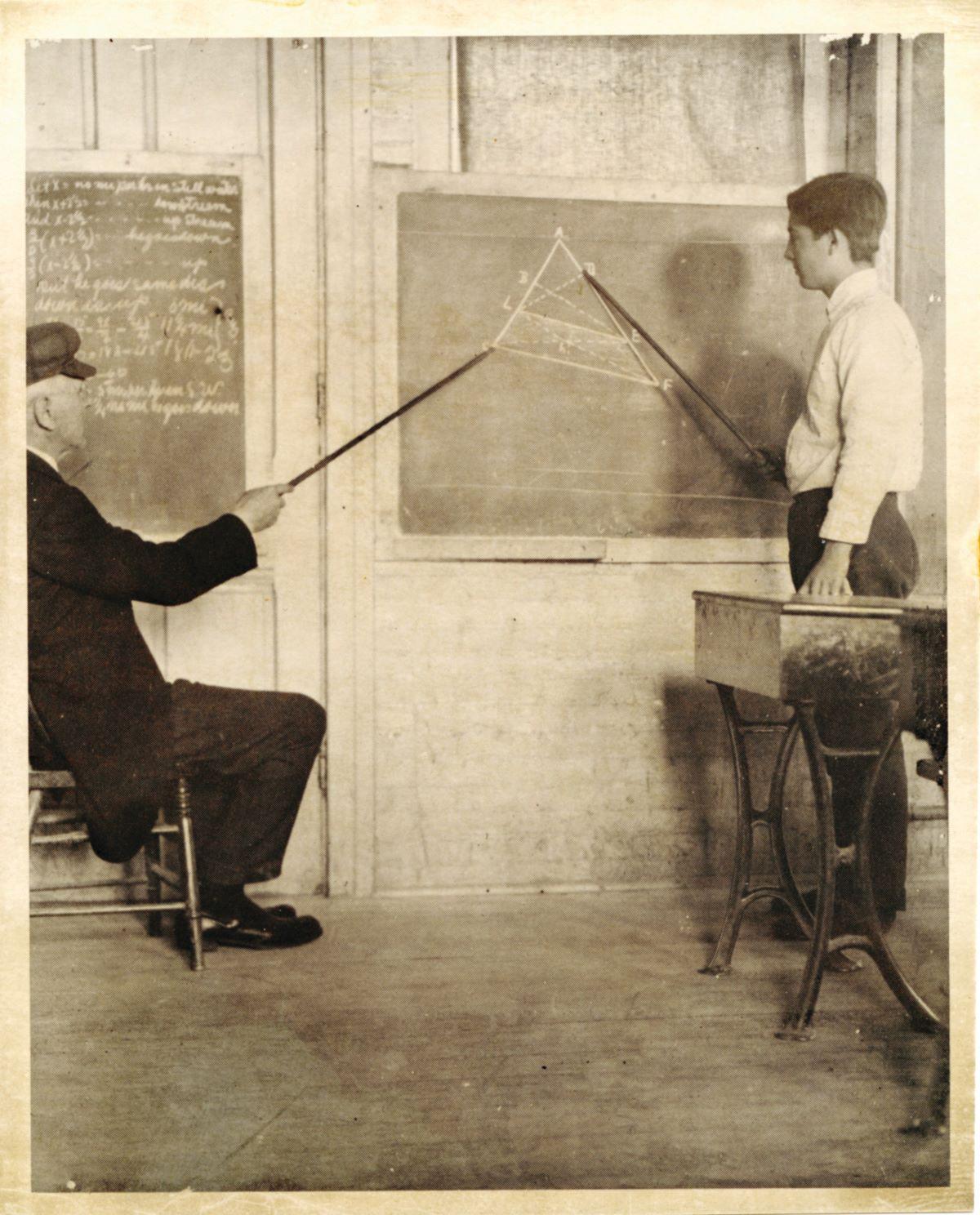
Duncan Campbell Lyle, who served as assistant principal under Col. Allan and was appointed principal upon Allan’s death, paid particular attention to the grounds and the effectiveness of classroom teaching. Lyle, who gave everyone a nickname, earned his moniker “Old Man” Lyle before the age of 40. He was a favorite of the students, and he launched The Week during his tenure.
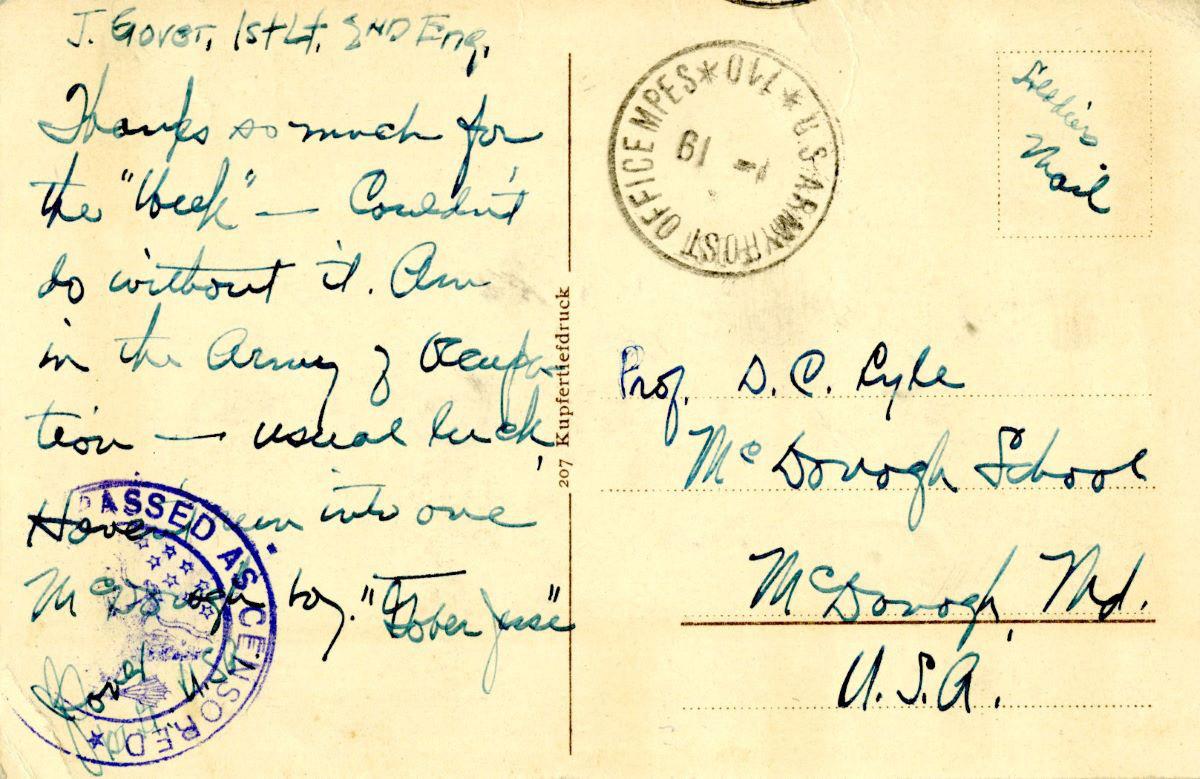
Lyle took a particular interest in the futures and successes of the young men who passed through McDonogh, and as such, he created individual scrapbooks about them filled with academic information, club memberships, and clippings from The Week. After their graduation, Lyle corresponded with many alumni and added their correspondence to their scrapbooks. Those who served in World War I often sent letters from the frontlines detailing the struggles of war, life in the trenches, and the comradery of the McDonogh alumni who were serving. Four years after being appointed principal, Lyle decided to return to teaching. “Old Man” Lyle continued to serve the School faithfully for 46 years as a faculty member. Late in his life, he returned to campus where he died in 1938.
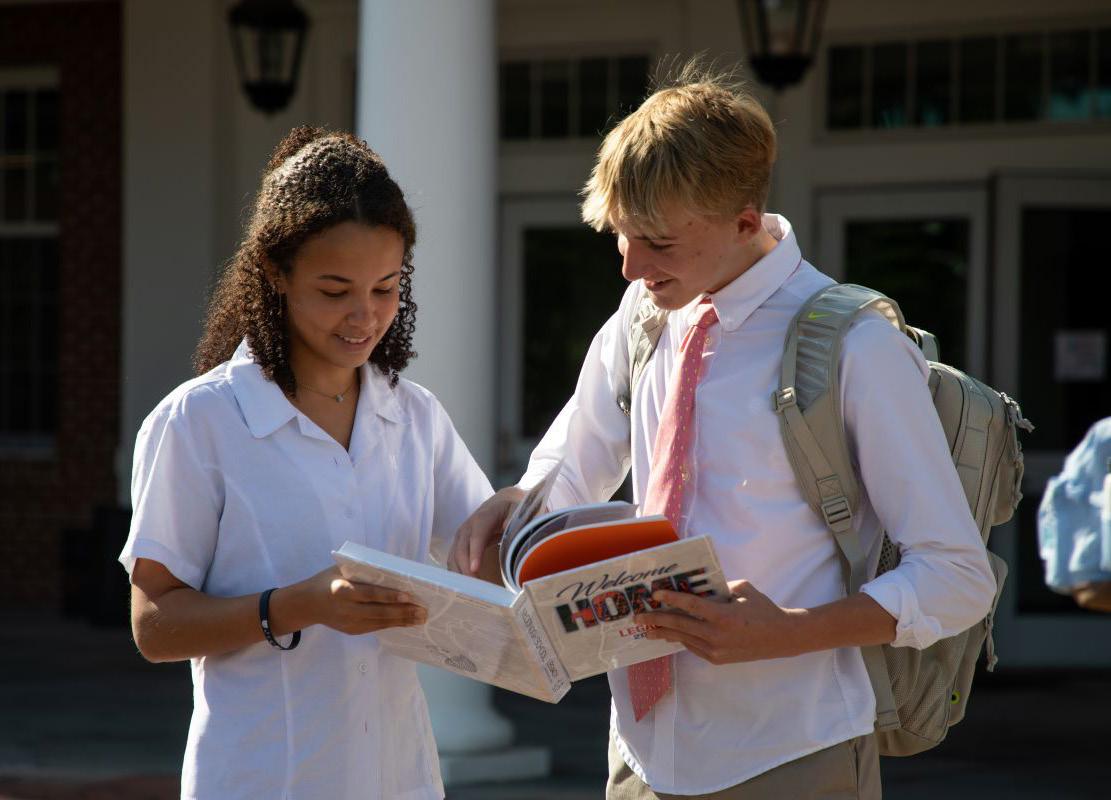
The Legacy of McDonogh’s Yearbook
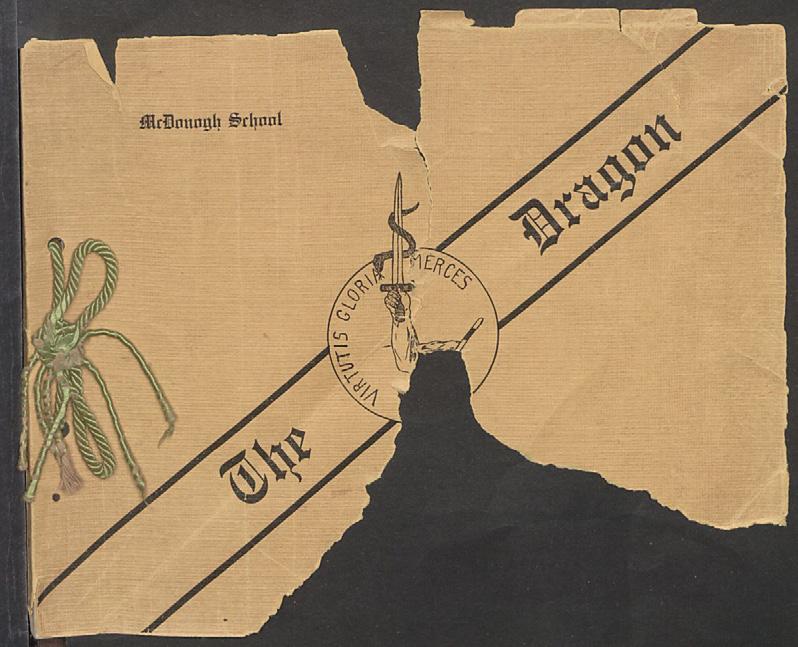
The first yearbook, The Dragon, was published in 1917. In 1935, the name of the yearbook was changed to The Legacy. The 1942 edition of The Legacy, unlike the hardcover and bound yearbooks of other years, was paperback with a plastic spiral binding. A letter on the first page from Headmaster Louis E. Lamborn explained the difference. It read in part, “I would like to express my commendation for—cutting out much of the cost in the production of your yearbook. This Legacy of yours is a unique thing in the annals of the school. It is the “War Legacy.” I hope it will be the only one! You must–—and I know you do—take pride in the fact that the money you saved has put well over $1,000 in Uncle Sam’s coffers for the sole purpose of securing victory.”
Today, The Legacy yearbook is a robust documentation of life at McDonogh. Each fall when the printed copies arrive on campus, the Upper School celebrates with a party. Students pore over the pages and sign each other’s copies.
1928 New House Fire Destroys Building, Not Spirit
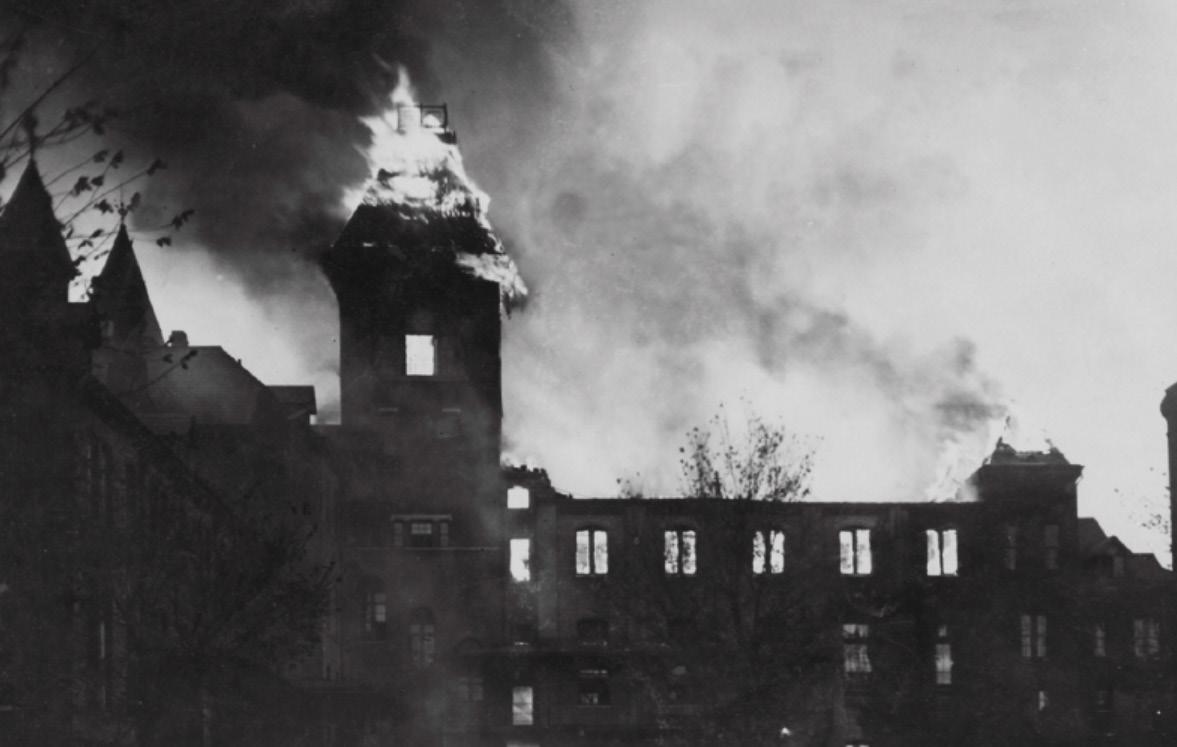
In 1881, construction began on a new brick school building. The three-story structure was completed two years later, and although it was officially called Main Building, was fondly referred to as “New House.” In 1884, a third-floor dormitory annex—the Buzzard’s Roost—was added, and by the following year, all students lived in the building that also included classrooms, a library, a kitchen, a dining room, and a linen room.
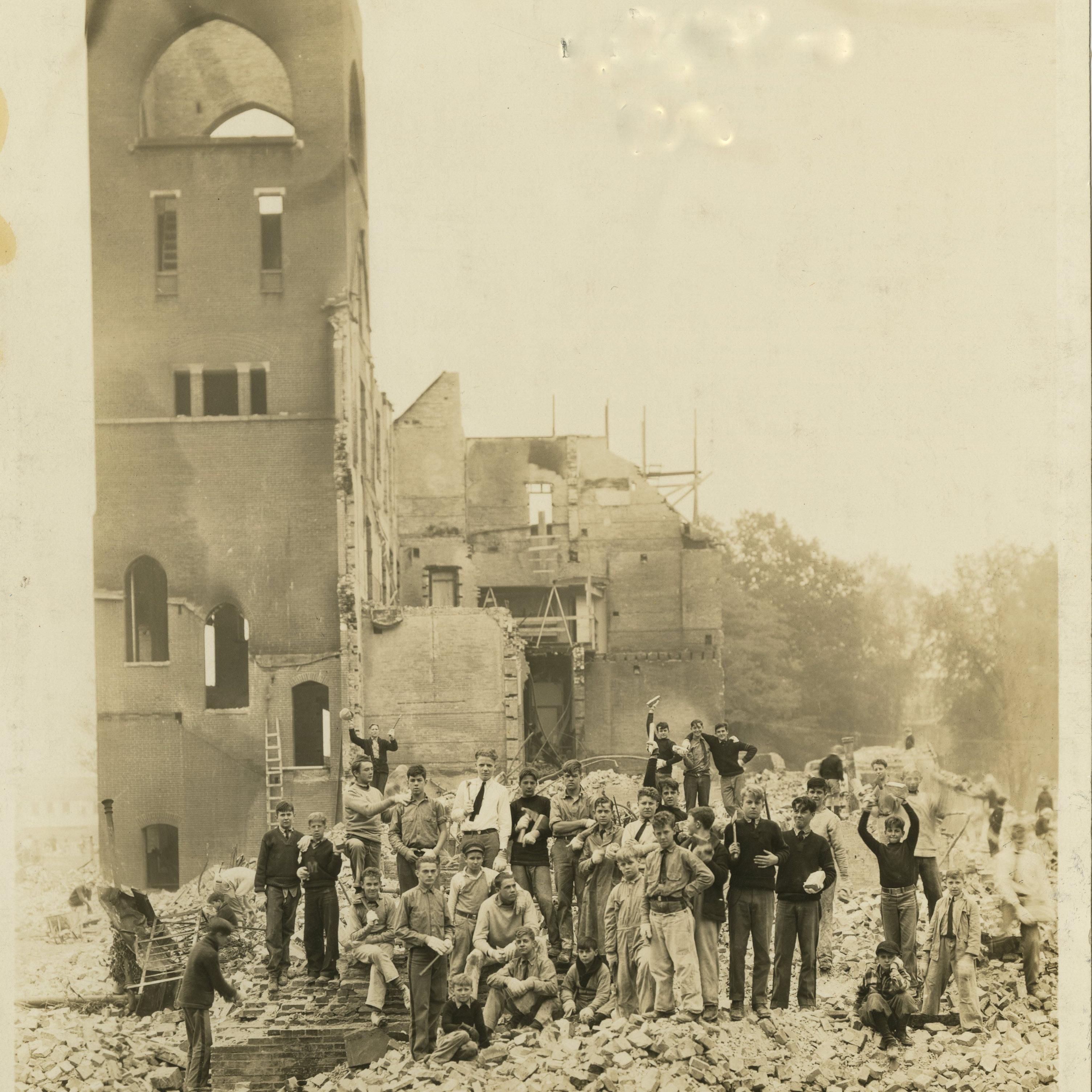
In the early morning hours of October 24, 1928, a fire raged through “New House.” According to numerous newspaper accounts, the fire apparently started in the linen room in the basement of the building’s west wing. Believing the fire was contained to the wing, some faculty and older students entered the other dormitories and salvaged students’ clothing by throwing them out of the second- and third-story windows; other groups saved books from the library, the school papers, the safe, and valuable portraits from the first floor.” However, unbeknownst to all, the basement of the building was ablaze and the flames swept up an air shaft to the roof, engulfing the center of the building. The ceiling caved in and flaming debris rained down. Nine hours after the fire was discovered, firemen were still pumping water into the structure to prevent the blaze from possibly spreading to the gymnasium and cottages surrounding the building. Thankfully, no one was injured, and students did not miss a day of school.
After the fire, Headmaster Doc Lamborn said a new McDonogh would rise phoenixlike from the ashes. But first, funds were needed. In addition to the Depression and the stock market crash, alumni who had been scholarship students were in no sense wealthy. Former Headmaster Bob Lamborn recalls that students marched down Charles Street to City Hall and then seniors walked back up Charles Street making appeals to the shops along the way. Funds were raised, loans were negotiated, and a new McDonogh rose.
Read more in the Winter 2019 issue of McDonogh Magazine.
Orange and Black Variety Show Earns Rave Reviews, Raises Funds
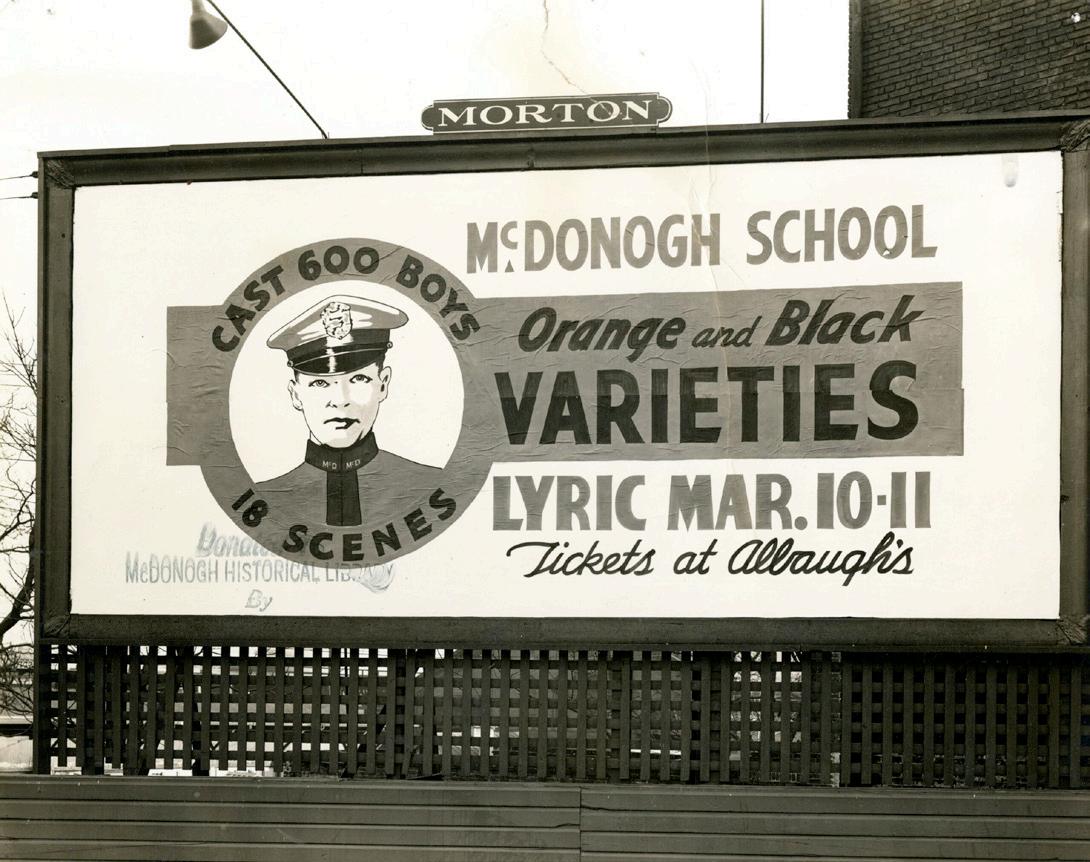
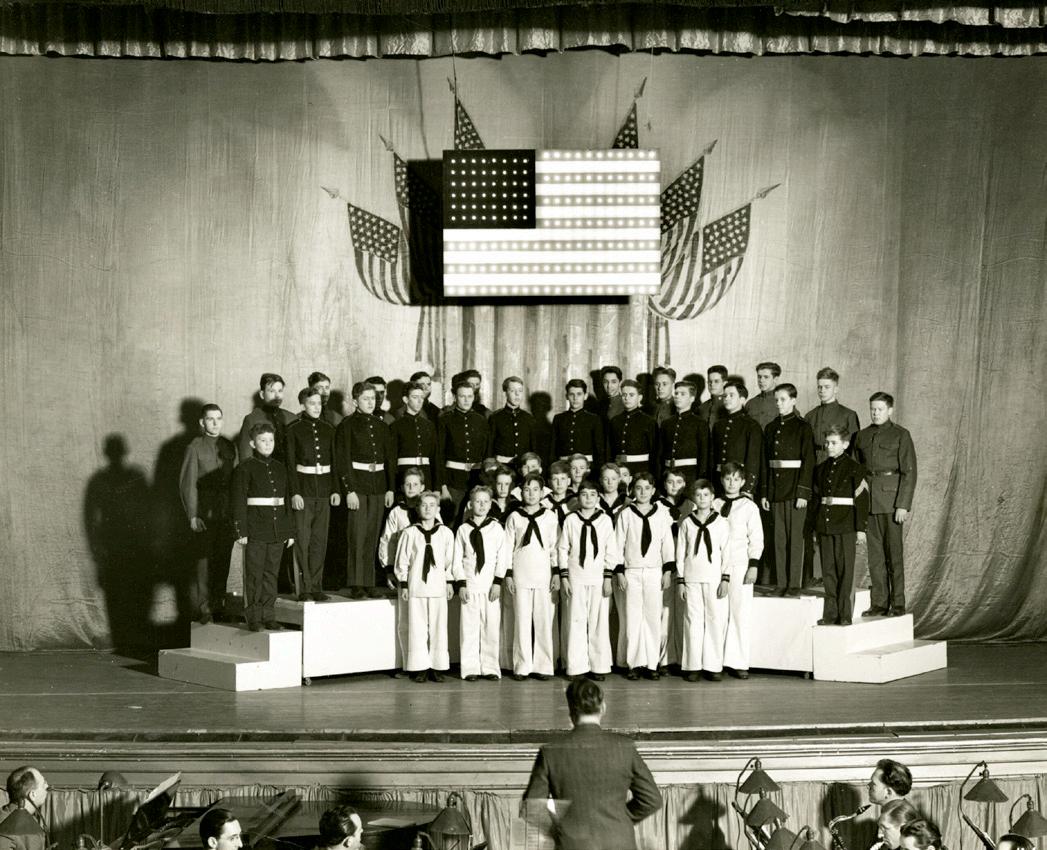
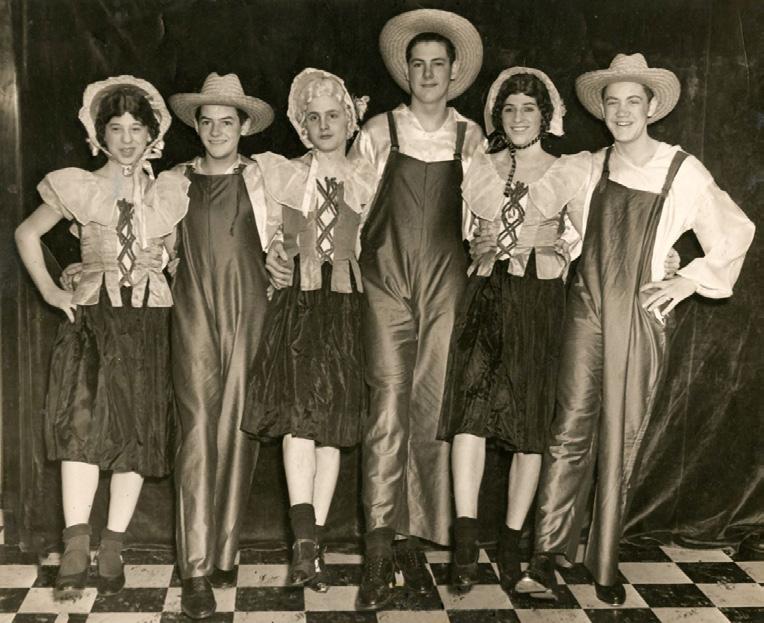
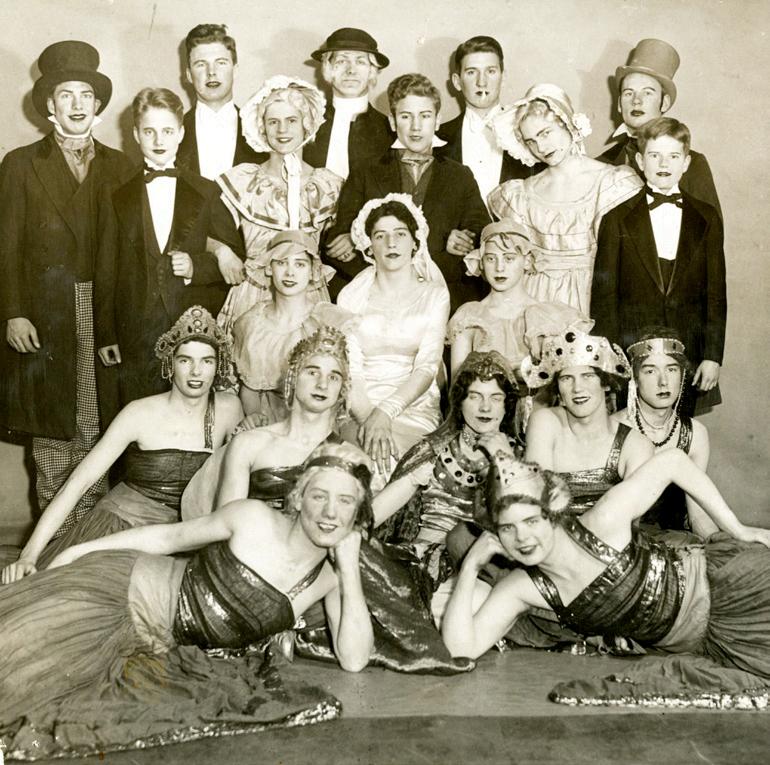
In 1933, the Orange and Black Varieties, sponsored by the Patrons Club, was held at the Maryland Casualty auditorium before an audience of 1,300, including the governor and mayor. The production featured guest artists with 125 McDonogh boys as “background.” At its peak in 1938, the annual show packed the Lyric Theater for two nights, and every boy in the School participated in some fashion. The variety show featured instrumental groups, soloists, choral groups, skits, and more. Full-size billboards announced the event in downtown Baltimore. Six hundred cadets participated in the show in 1942 with proceeds going to war bonds. By 1947, the Orange and Black Varieties became cost-prohibitive and the curtain closed on the once-popular event.
Read more in the Summer 2023 issue of McDonogh Magazine
Childs Memorial Terrace: A Space for Celebration and Ceremony
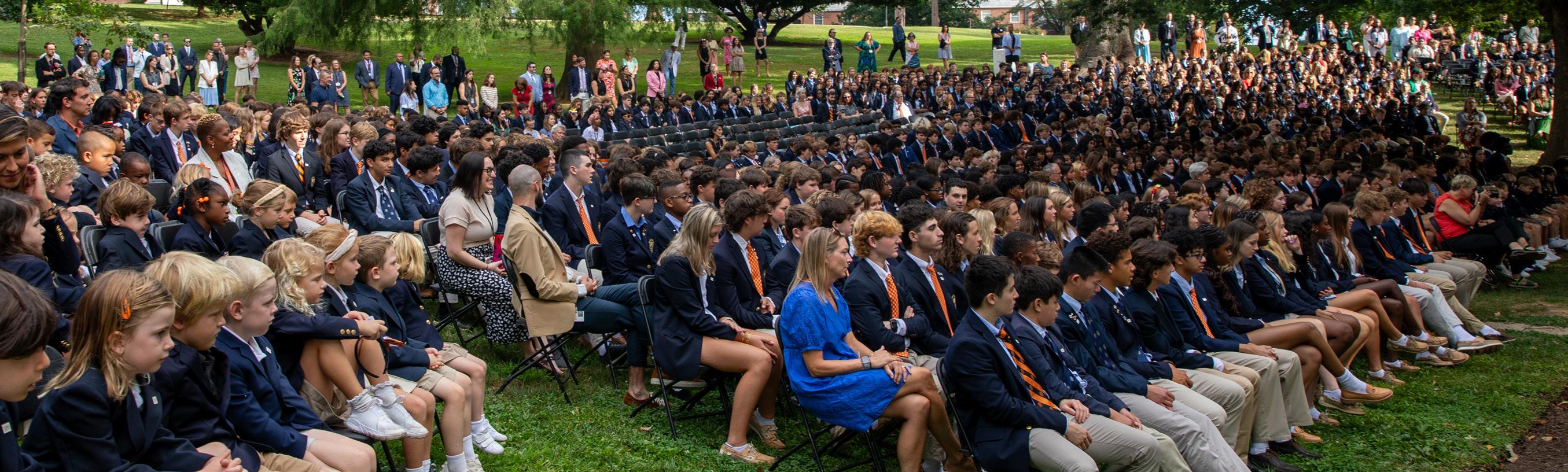
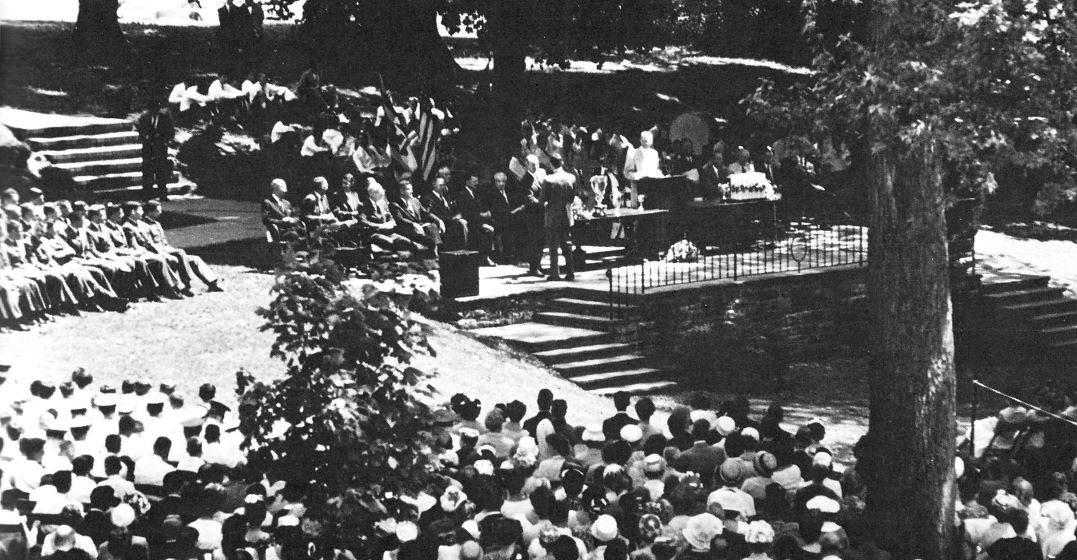
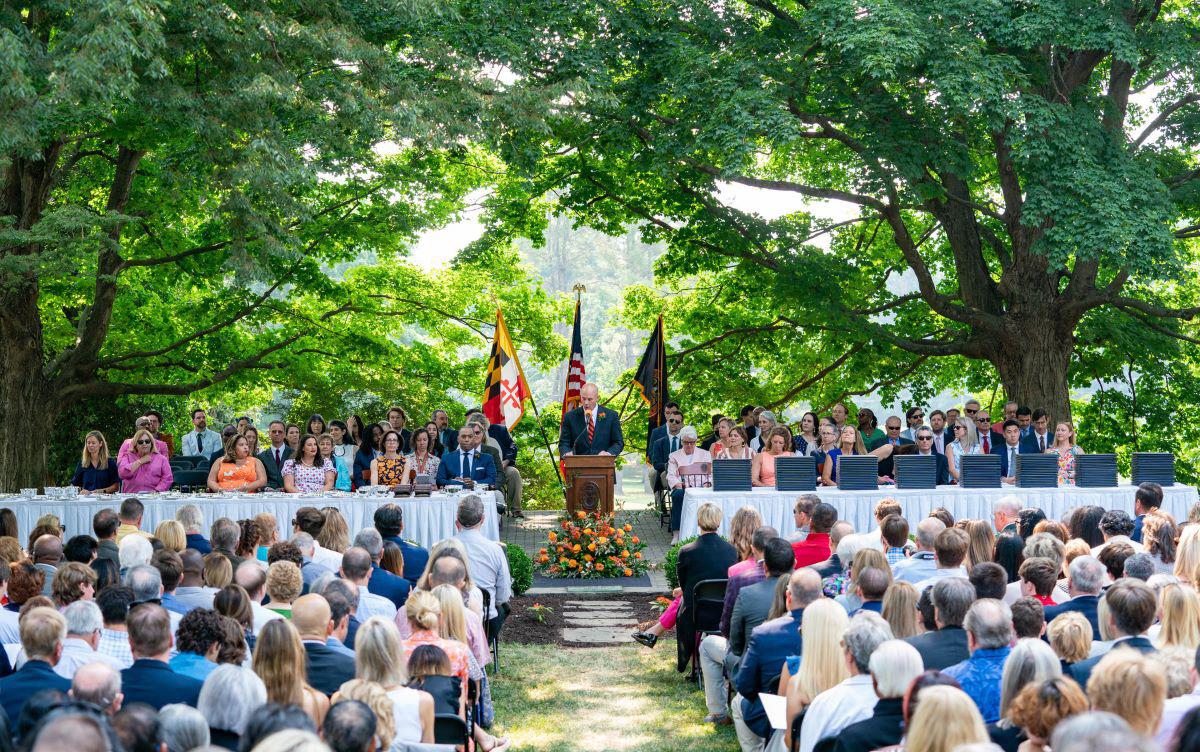
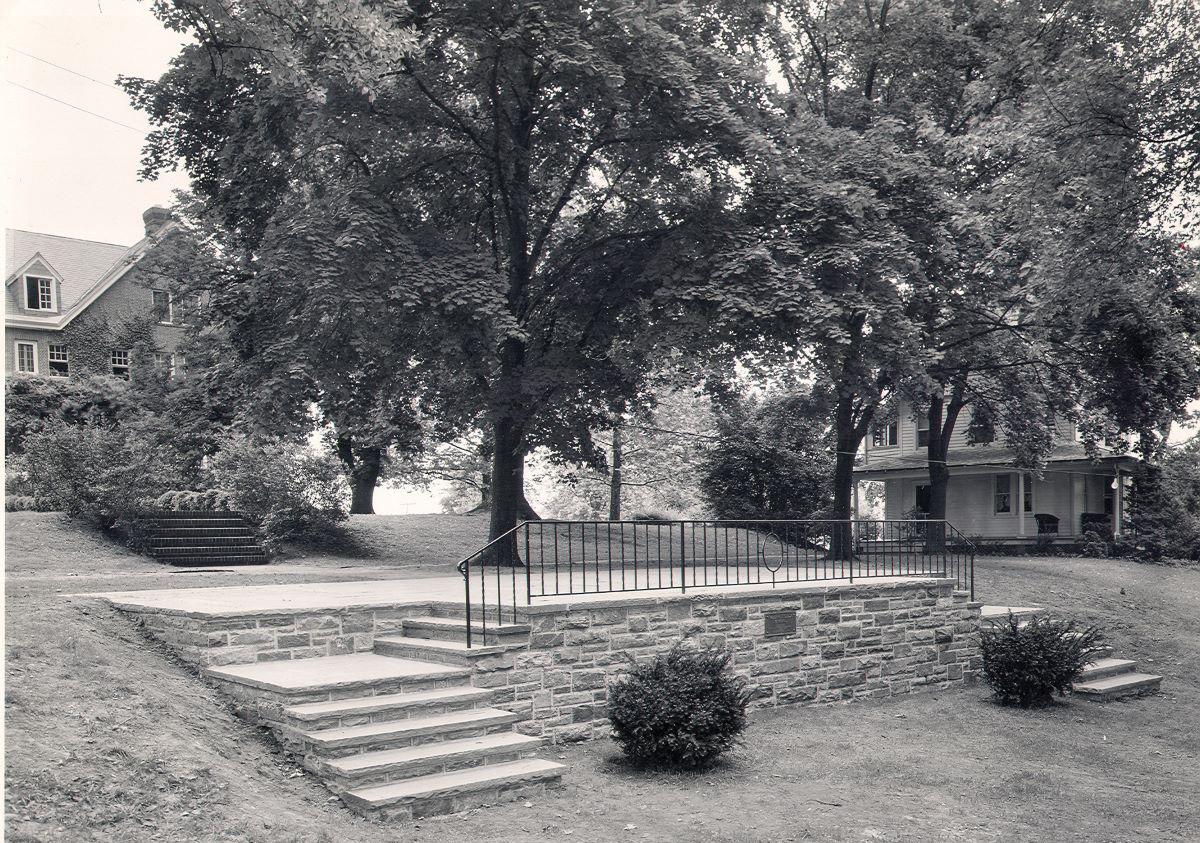
Named for Headmaster William T. Childs, originally the Childs Memorial Terrace was situated in the area where Keelty Hall now stands. A stage-like platform, it sat at the top of a gradual hillside. At Commencement, the graduates and their parents sat on the hill looking up at the terrace. When the diplomas were conferred, the seniors climbed a few steps and processed across the platform. Childs Memorial Terrace was moved in 1969 to a space between Bowman House and Tagart Memorial Chapel—a natural amphitheater. It is used for all-school events including Convocation, Dedication Day, Head of School Day, the Lower and Middle School Closing Ceremonies, and Commencement.
Shells Pave the Way to McDonogh
Beginning in 1887, oyster shells were spread over the road leading to McDonogh’s Main Building from the country road, resulting in the name Shell Road. The surface continued to be covered with shells until 1929 when a law required oystermen to return the shells to the oyster beds. The white shell road was resurfaced with dull black cinders and later macadamized. Even today, one can still find oyster shells along the side of the road.
Inventor of the Gantt
Chart, One of the “Original 21 Boys”
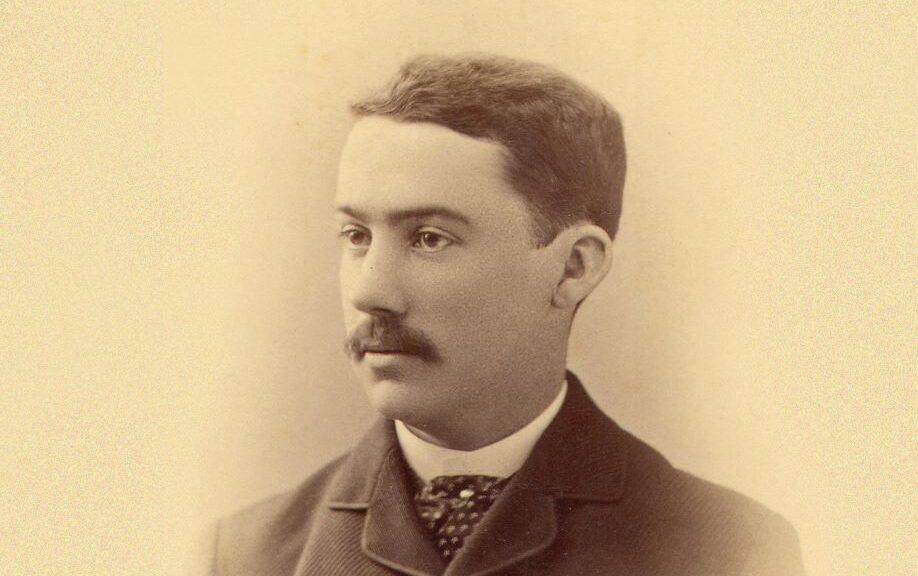
Henry L. Gantt, one of the School’s original 21 boys, graduated in 1878 and became the first alumnus accepted into a major university (Johns Hopkins). He is known for having invented the Gantt chart, essentially an improved and simple method of scheduling. An article in The Week pointed out that Gantt, “as any great genius, [was] generations ahead” of his time. At the time, Gantt’s concept was revolutionary as “many complicated situations which had never been visualized [were now] easily controlled.”
Throughout history, Gantt charts have been involved in the construction of major infrastructure projects such as the Hoover Dam in 1931 and the Eisenhower highway system in 1956. During WWI, the government and thousands of
manufacturing plants used Gantt charts to track progress, plan work, and increase production. Early Gantt charts did not show dependencies between tasks, but modern Gantt chart software allows for such comparisons. Mullan Contracting Company used Gantt charts to track the progress of their work in constructing McDonogh’s Naylor Building and the Edward St. John Student Center.
Read more in the Summer 2015 issue of McDonogh Magazine.
Who’s Behind the Wheel?
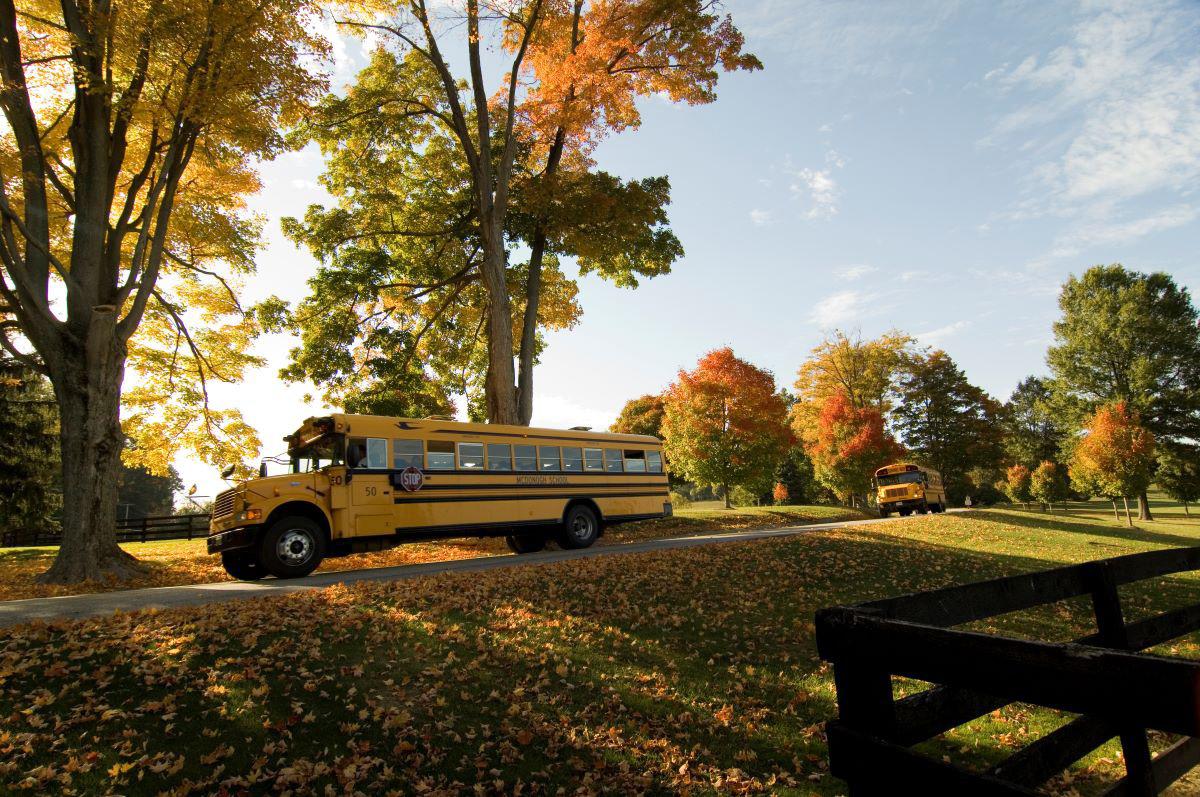
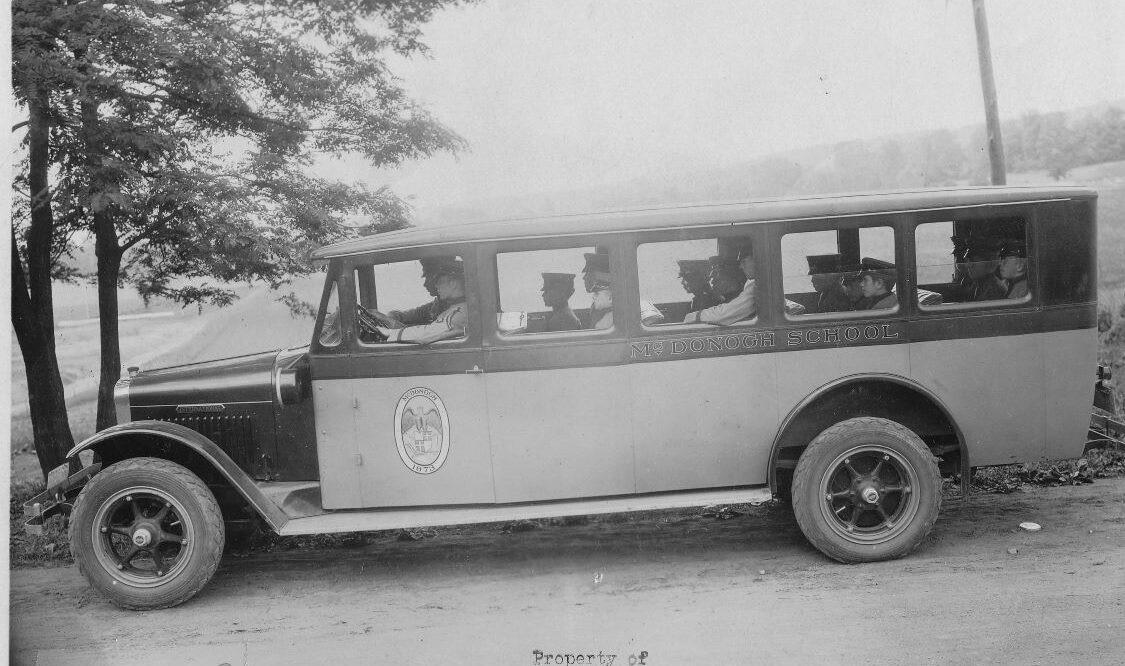
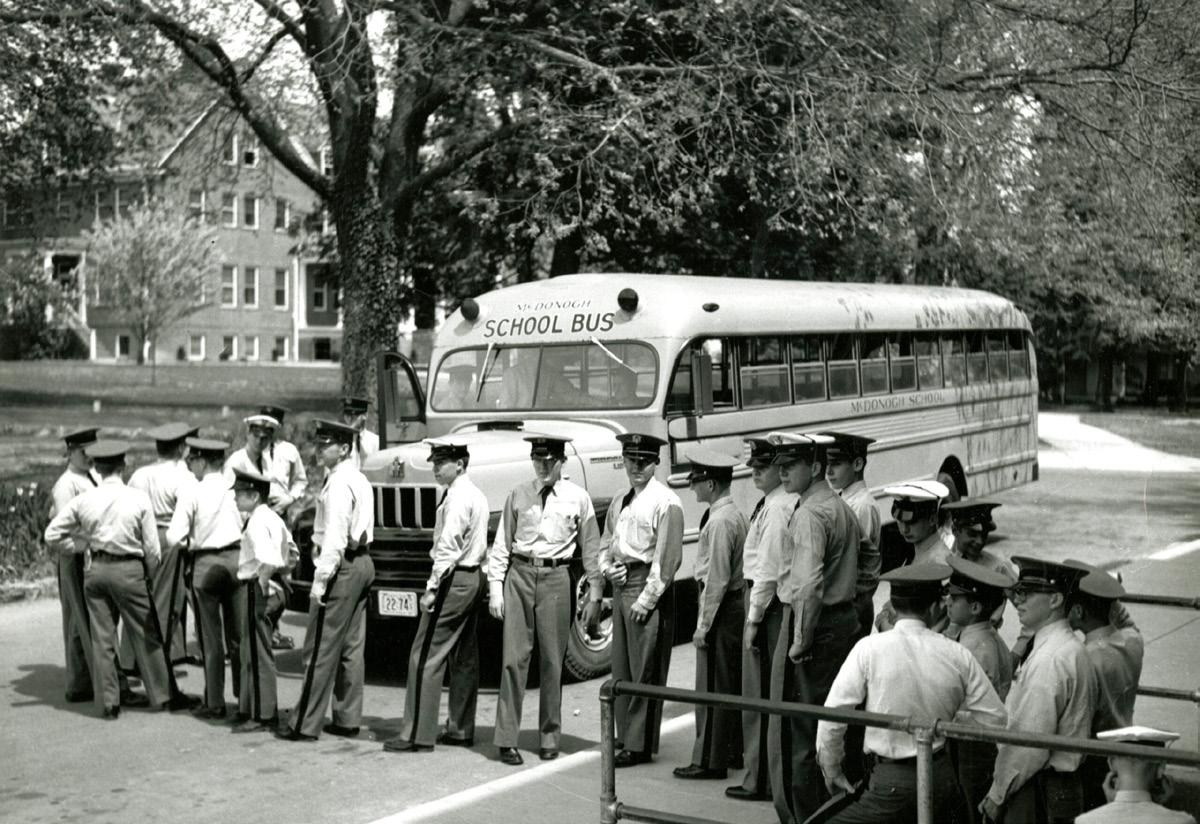
In 1927, a fleet of cars was donated to drive paying day students (Day Hops) to and from School. By the mid-1930s, the School had its own fleet with students often serving as the drivers. Today, McDonogh’s fleet of 20 yellow buses, driven by professionals who gather students from five counties and Baltimore City, is one of the largest privately operated bus fleets in the mid-Atlantic. While the school buses may have changed over time, one thing has remained the same: Kids get a kick out of waving from the windows, especially on the last day of classes.
Opening Convocation: Ringing in the New Year
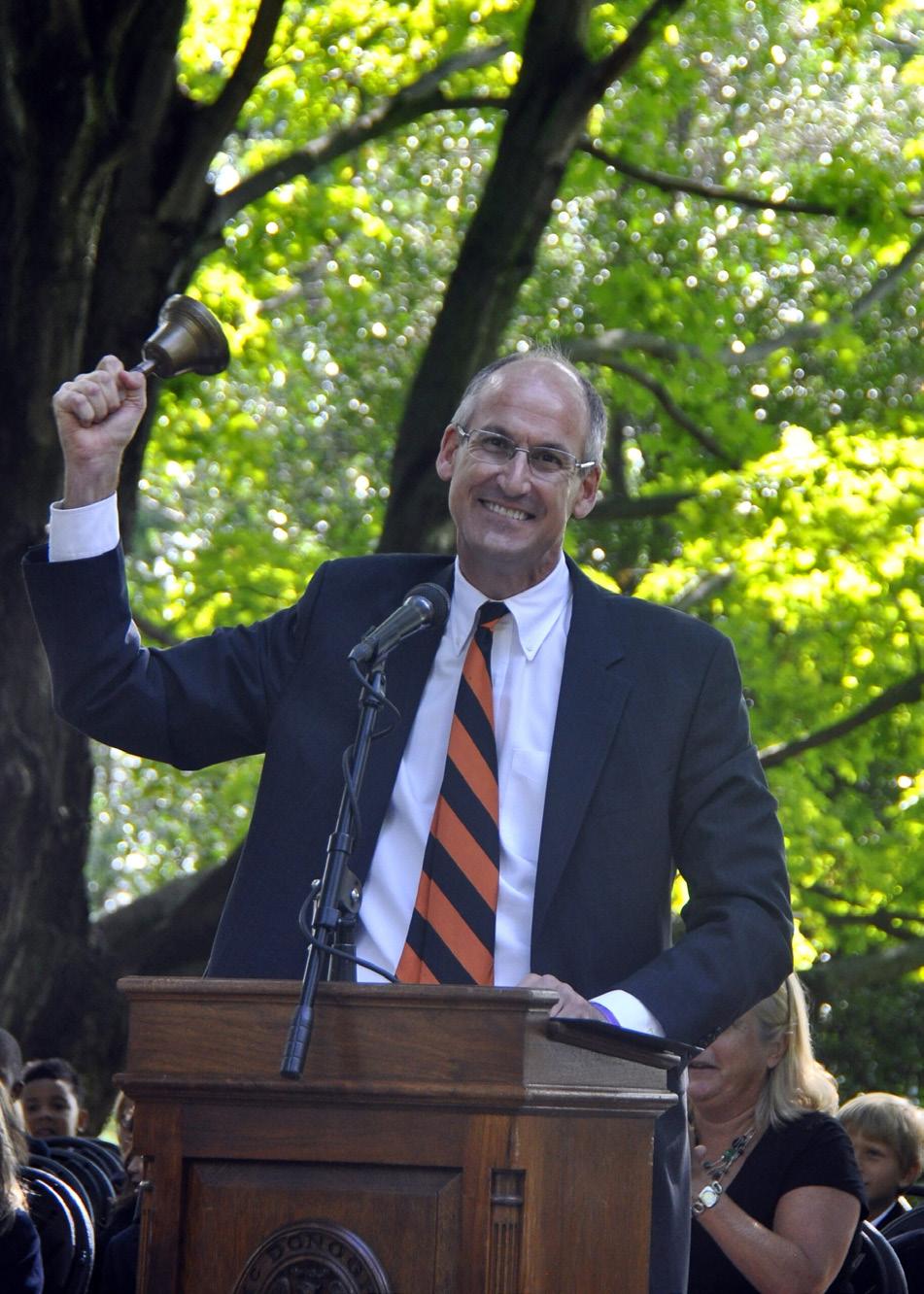
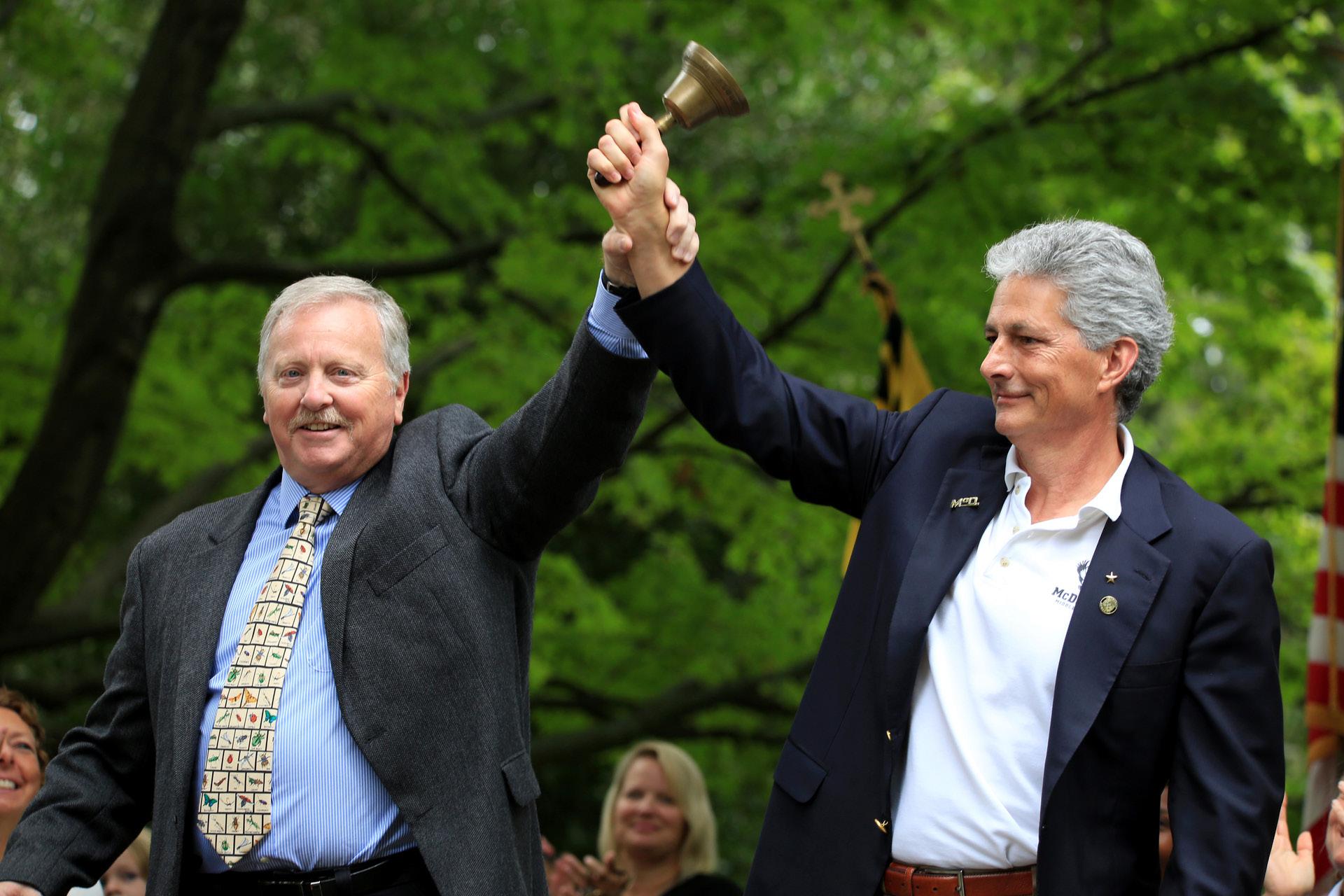
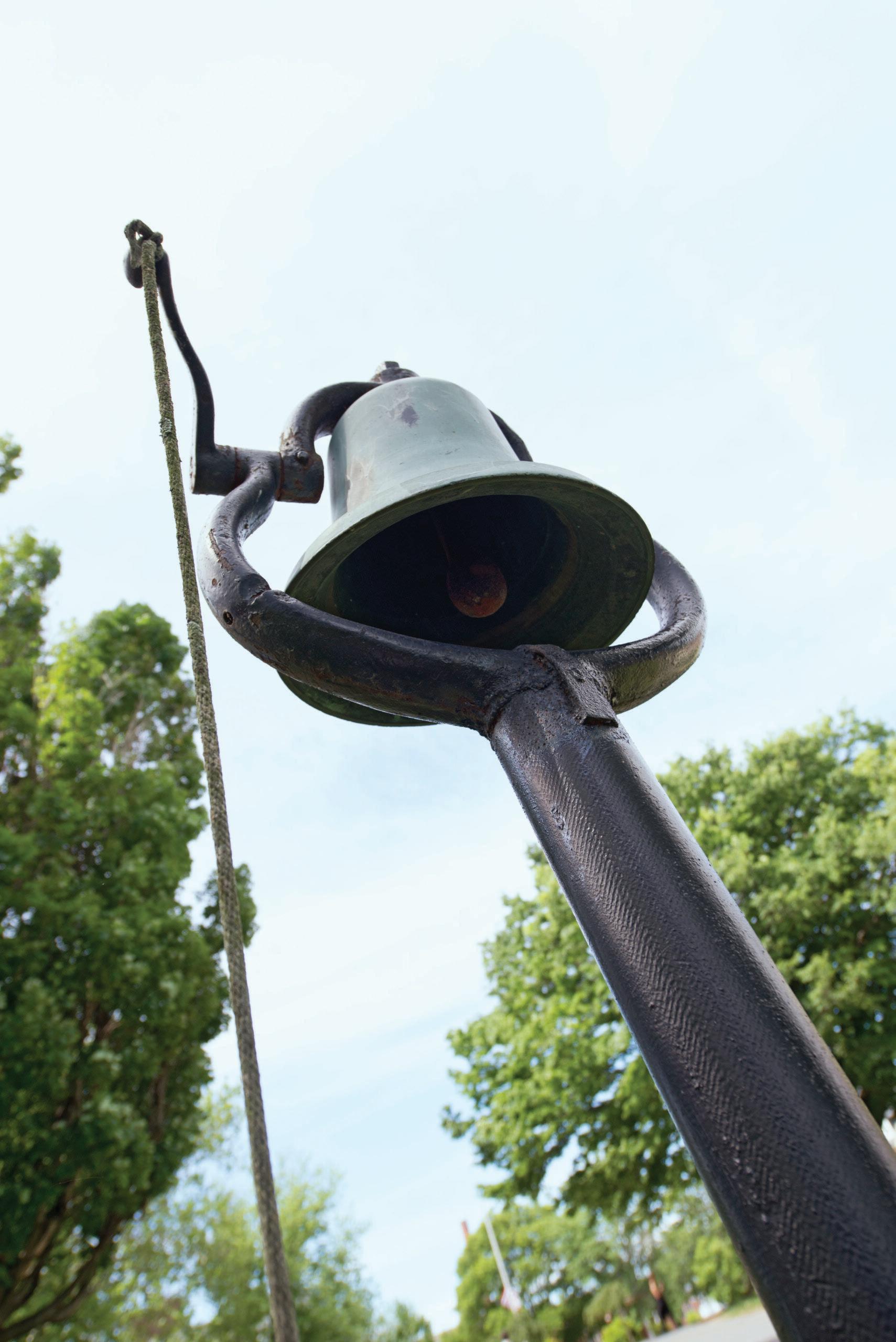
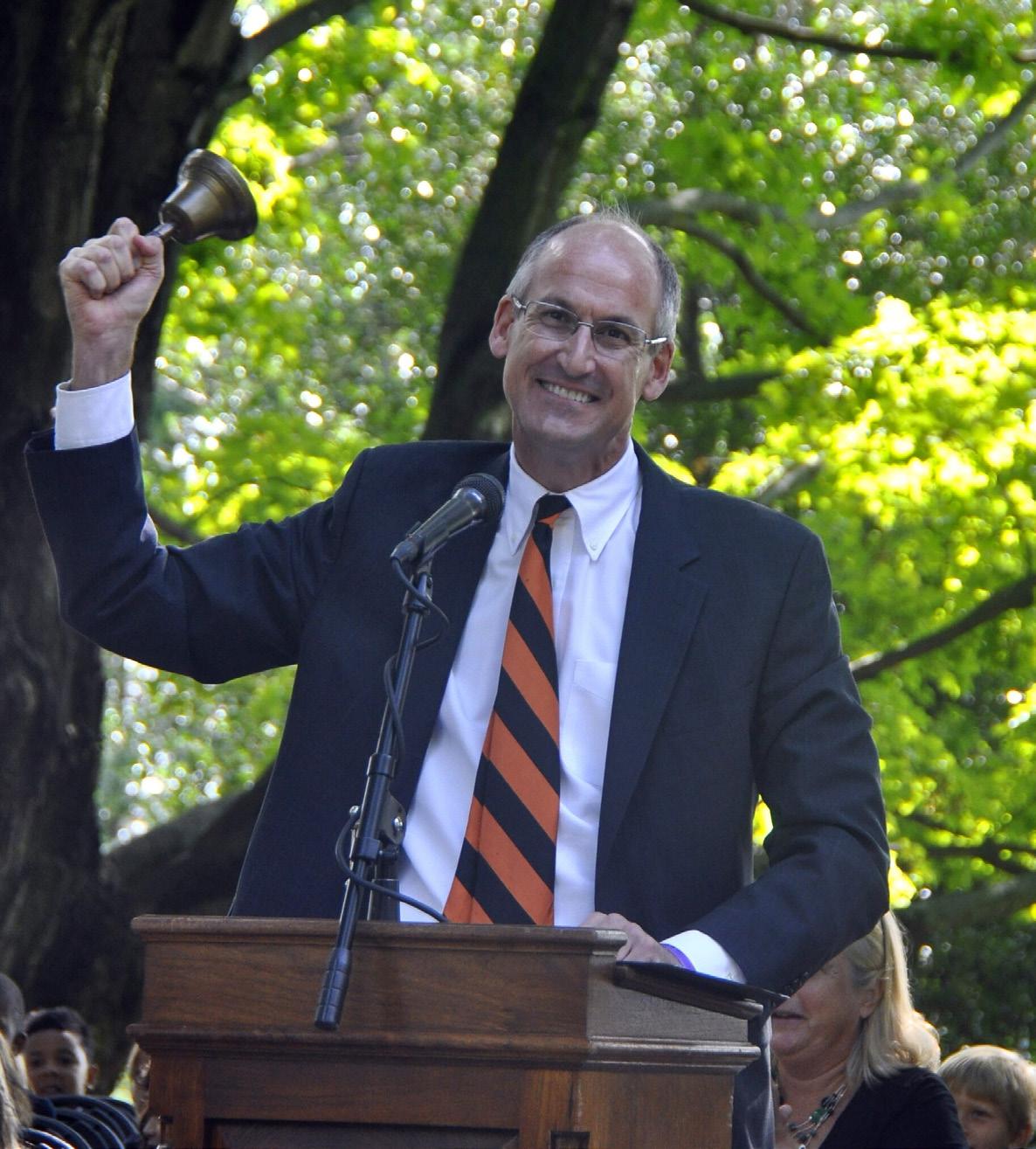
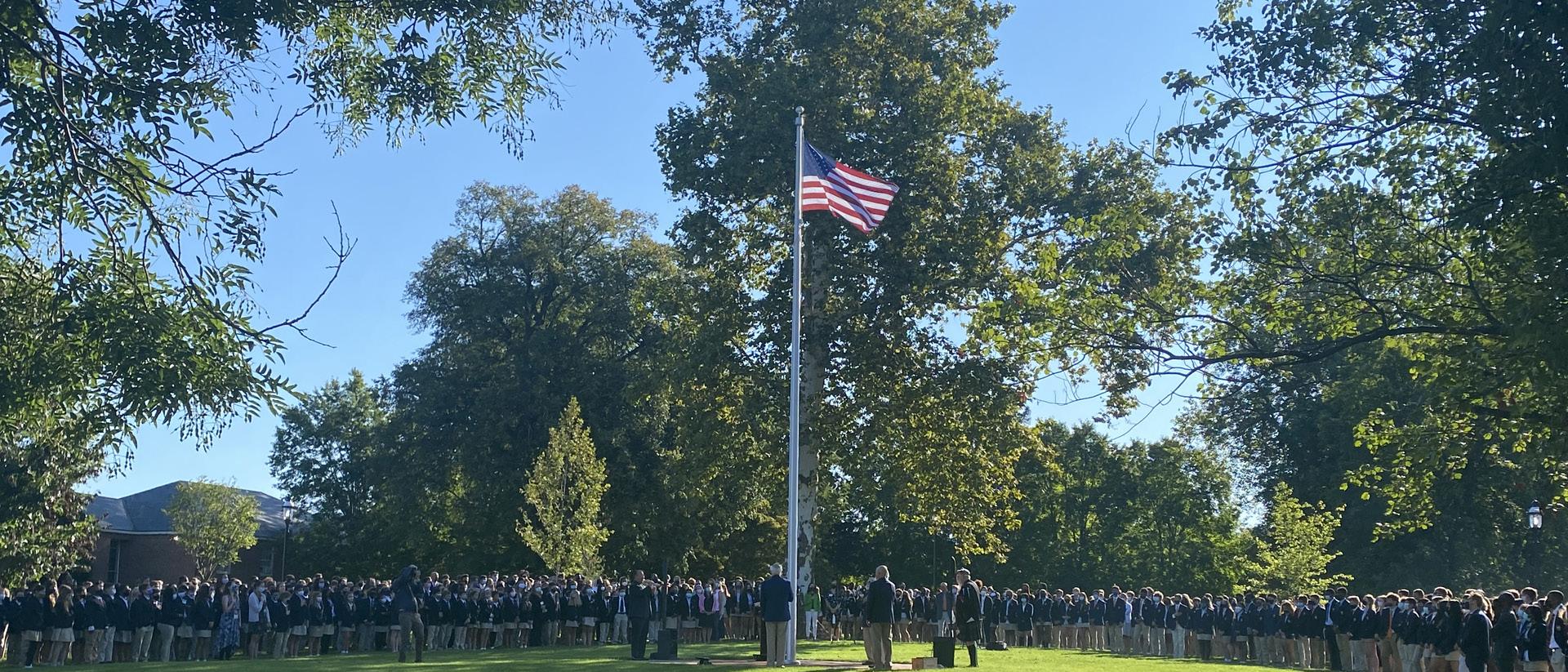
At the beginning of each school year, the entire community gathers at Childs Memorial Terrace for the Opening Convocation. Greetings and well-wishes are given to all, with special attention paid to the senior class. The ceremony concludes, and the year officially begins, with the ringing of a traditional school bell. For many years, the bell ringer was the head of the school. However, in 2019, Head of School
Dave Farace ’87 broke with tradition when he asked longtime faculty members Bob Mahon and Jon Aaron ’72, each of whom had been teaching at McDonogh for 43 years, to ring the school bell and officially start the new school year. The bell used in recent years was a gift to McDonogh School in the late 1980s from our sister School in Odessa, Ukraine.
32.
McDonogh’s Third Principal, Dr. James T. Edwards, Makes His Mark
Following Duncan Campbell Lyle’s brief tenure as principal, Dr. James T. Edwards was appointed to the position in 1893. He was an educator and noted speaker who spent time in the Rhode Island and New York state legislatures. During his time at McDonogh, he increased the student body from 125 to 151 and sought to establish an Annual Fund to aid students in getting a college education. Principal Edwards resigned in 1898 due to a crippling stroke. Later, Edwards Gym, built during his tenure, was named for him. (See story No. 86).
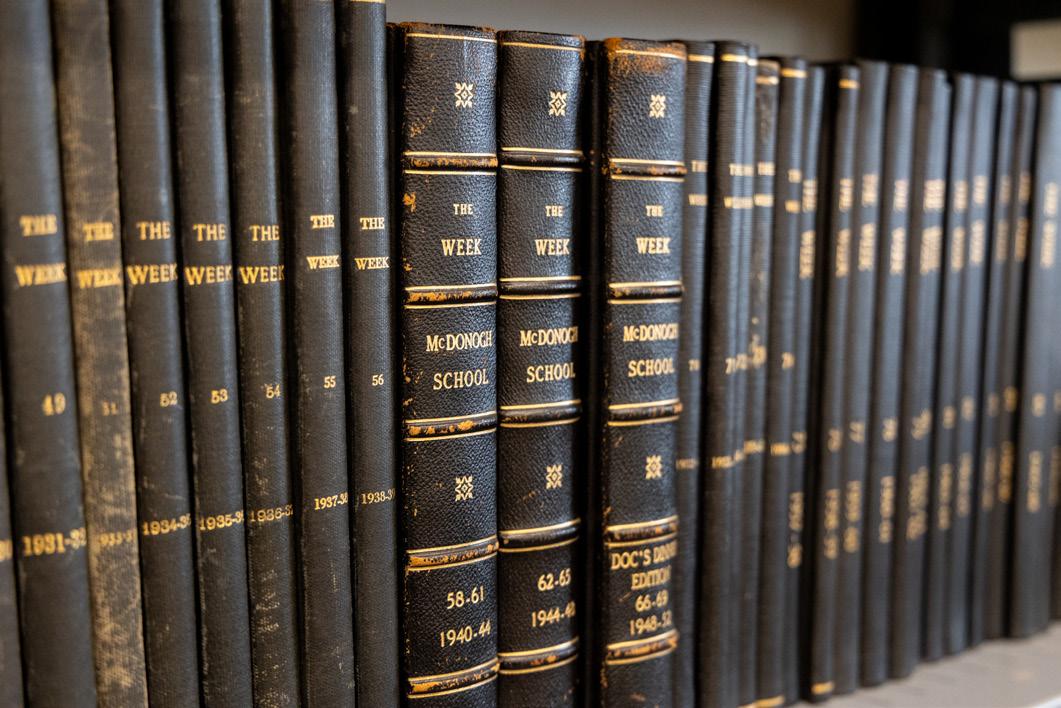
The Week: Maryland’s Oldest Scholastic Newspaper
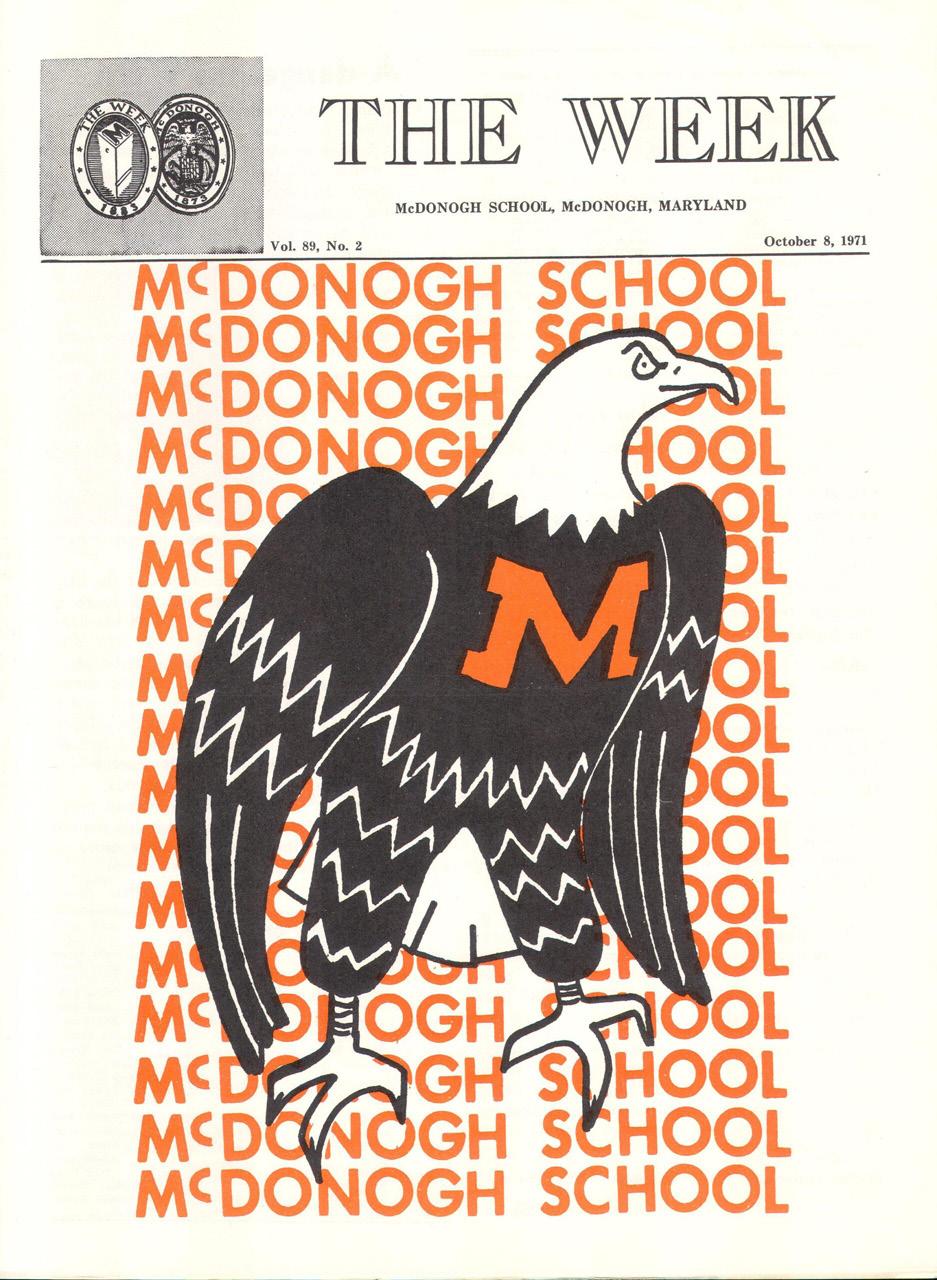
McDonogh’s student newspaper, The Week, debuted in 1883 with the boys publishing it under the guidance of Old Man Lyle. Many of the early articles were English compositions, and the “news” section included mundane information such as what was being planted in the garden. It was clear that the articles were intended to record information for posterity. By 1915, when Lyle was again a faculty member, The Week had doubled in size and was filled with campus and alumni news.
Although it is no longer a weekly publication, the McDonogh community looks forward to The Week hitting the newsstands. Today, students enrolled in journalism classes are the contributing writers and editors of The Week, which is Maryland’s oldest scholastic newspaper.
Principal Sidney Moreland: A Caretaker at the Helm
Sidney T. Moreland was no stranger to McDonogh when he took the helm as principal in 1898. Shortly after the school’s founding, he was tapped by Principal William Allan to develop a course in physiology at McDonogh. From 1876 to 1880, he helped the young School establish a strong tradition of scientific interest and observation. As the School’s fourth principal, he made few changes to the operation of the institution. A report by the Russell Sage Foundation in 1911 suggested that he had not kept in touch with things on the outside. Moreland’s daughter, Elizabeth, had a greater influence on the students serving at times as matron and librarian. She advised her father on School matters and encouraged much of the boys’ social activity. When Sidney Moreland resigned in 1914, the most dominant spirit to leave was Elizabeth.
Landing on the School Colors and Eagle Mascot
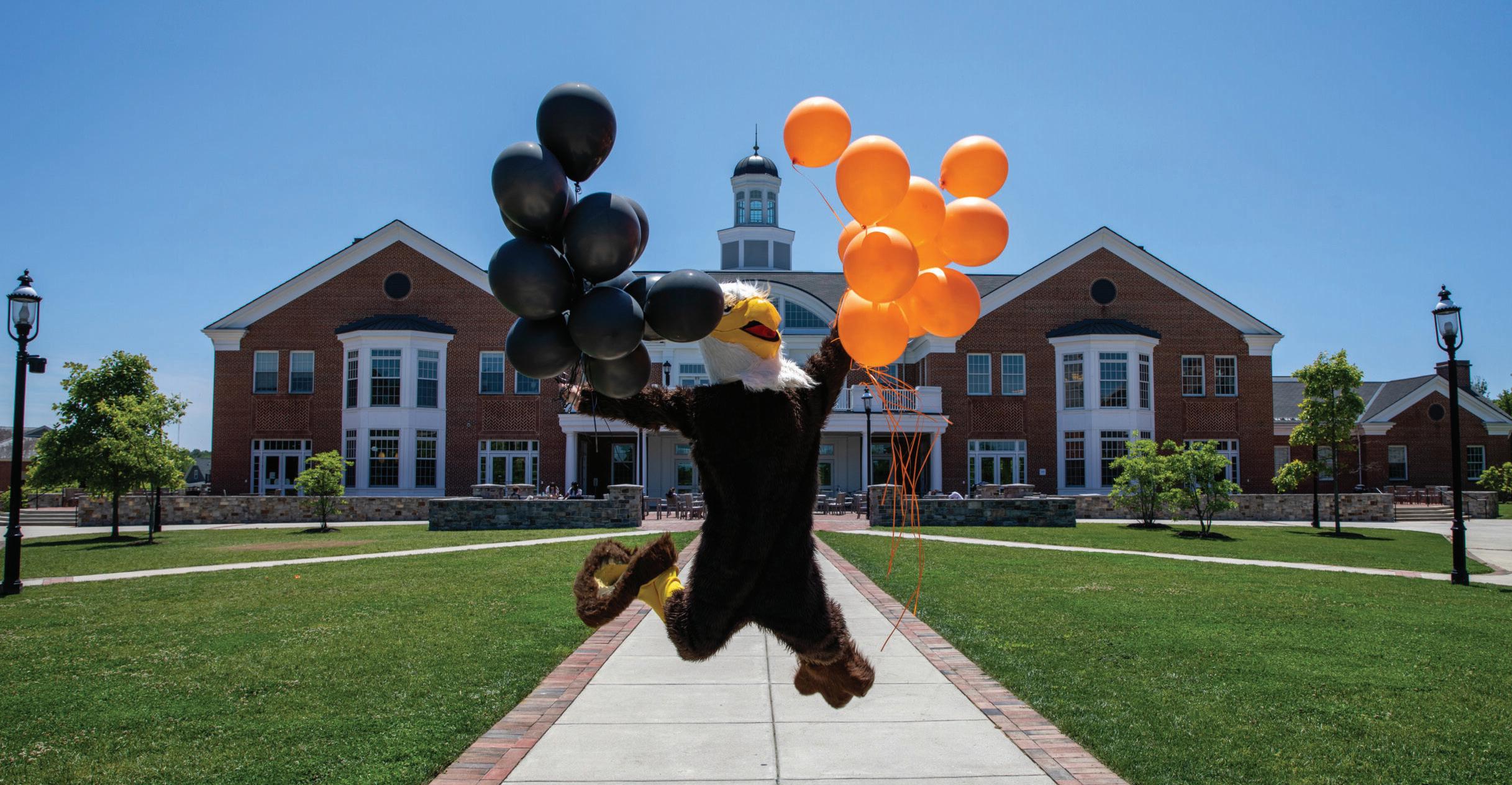
After Daniel Hauer (1888) and fellow student Benjamin A. Franklin (1887) formed the School’s first football team in 1887, they selected orange and black as McDonogh’s colors. Almost 90 years later, when McDonogh School dropped its semi-military program in 1971, the time was right for an official school mascot. For years prior, sportswriters had referred to McDonogh players as the “Farmers” or “The Cadets.”
The student body was tasked with finding a new nickname as part of the overall change for the School, and the “Eagles”
won the popular vote—a tribute to the eagle depicted on the McDonogh School seal and on the cadets’ uniform hat. A coordinating committee got to work designing the new mascot, and E. Carey Kenney, the head of the Art Department, made their ideas a reality. Before long, an Eagle costume was created, and Jeffrey Rogers (1974), a boisterous member of the cheerleading squad, was selected to wear it. Despite the heavy head and the stifling hot, feathered outfit, wearing the Eagle costume was, and still is, a popular duty.
Officially Enrolling Every Student
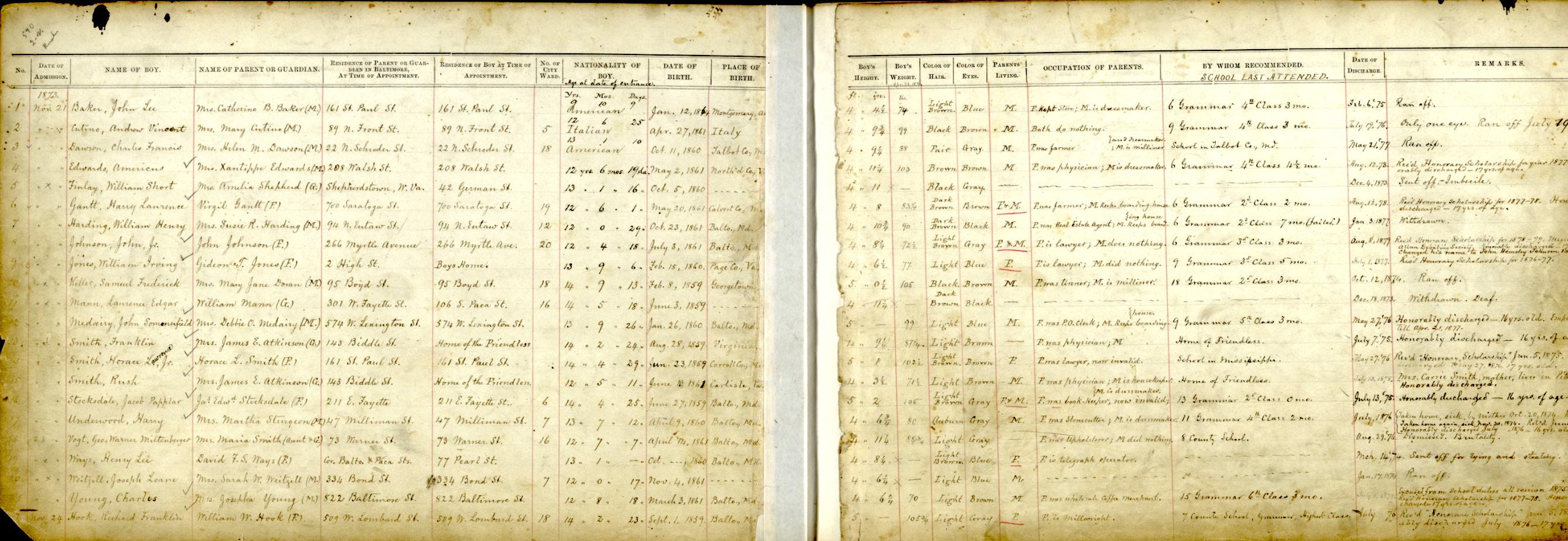
Beginning with the original 21 boys, every student who has enrolled at McDonogh School has been given a number, and their name has been recorded in a ledger book. In November 1873, as part of the process of enrolling the first students, Duncan Campbell Lyle, assistant to Principal William Allan, opened the cover of a new ledger book and began to write. He entered the number one, and beside it, wrote the name of McDonogh’s first student, John L. Baker. On the next line, he entered the name of student number two, Andrew Cutino. Lyle continued to write until he had recorded the names of all 21 boys. After that, as each new student enrolled, Lyle entered the name and number into what became known as the Registry.
The tradition of writing each student’s name and his/her enrollment number in sequence in the Registry has continued
for 150 years. At times, in addition to the students’ names and numbers, the Registry included parents’ names, addresses, and occupations. The student’s date of birth, height, and weight were also included, as well as the grade in which they entered McDonogh and the date on which they left. The final column is titled “Remarks” and contains a word or two describing the circumstances under which each student left the School. Over the years, reasons for leaving have included: “ran off,” “honorably discharged,” and later, “graduated.” Both John Baker and Andrew Cutino are recorded as having “ran off.”
At the time of this writing, 150 years later, 19,859 names have been handwritten in the registry. Read more in the Winter 2017 issue of McDonogh Magazine.
Who Was Jane Bay?
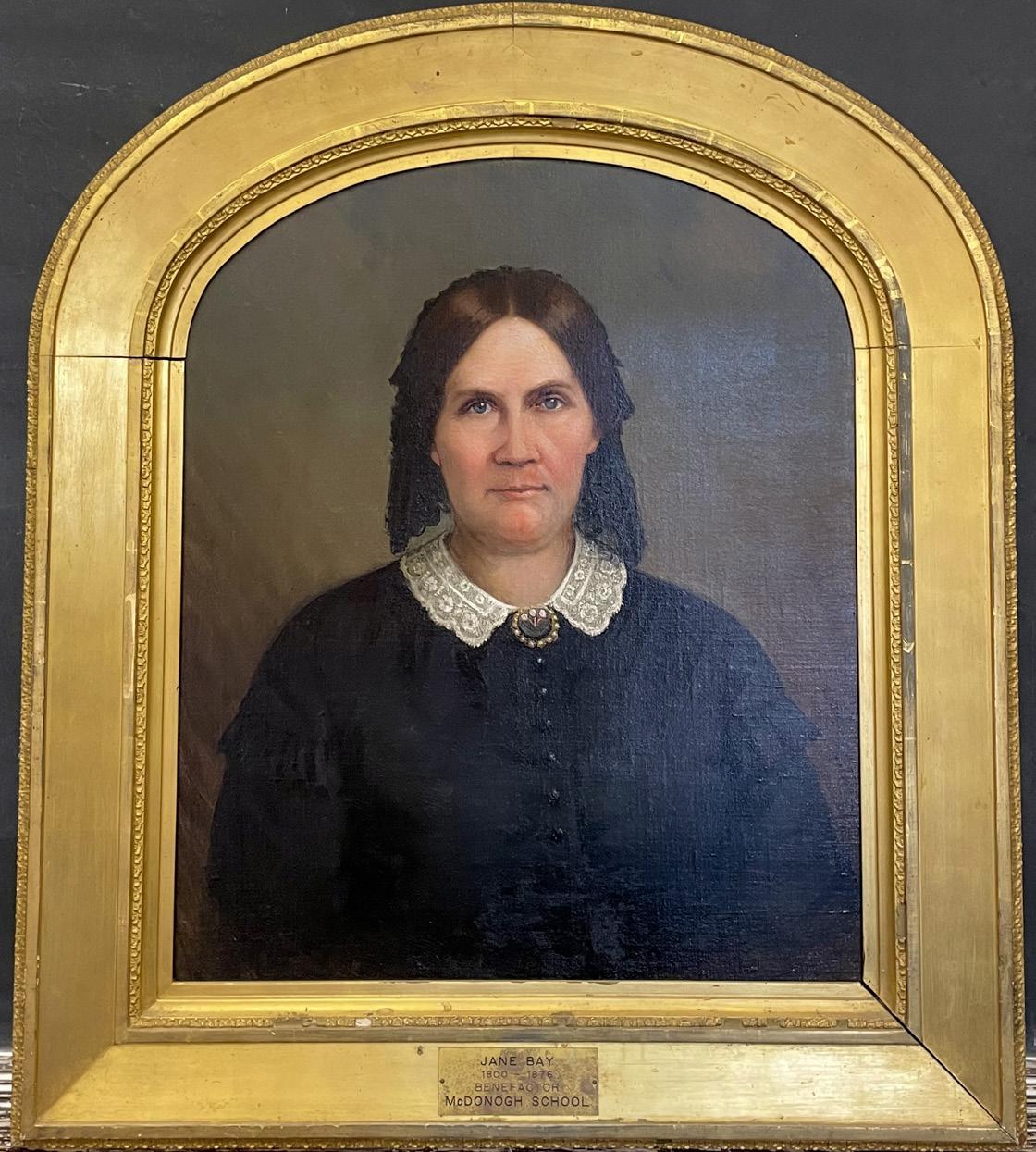
Baltimorean Jane Bay was born in 1800 and died at the age of 76. An article in The Week, more than 85 years after her death, described her “as a tall, rather masculine woman, kindly disposed towards children, but averse to making friends with grown-ups.” The school newspaper reported, “She was a spiritualist, and frequently held meetings in her home. On account of her peculiarity and somewhat isolated life she lived, little was known about her.”
Jane Bay never married and had no children of her own, and when she died, she left her estate for the founding of a
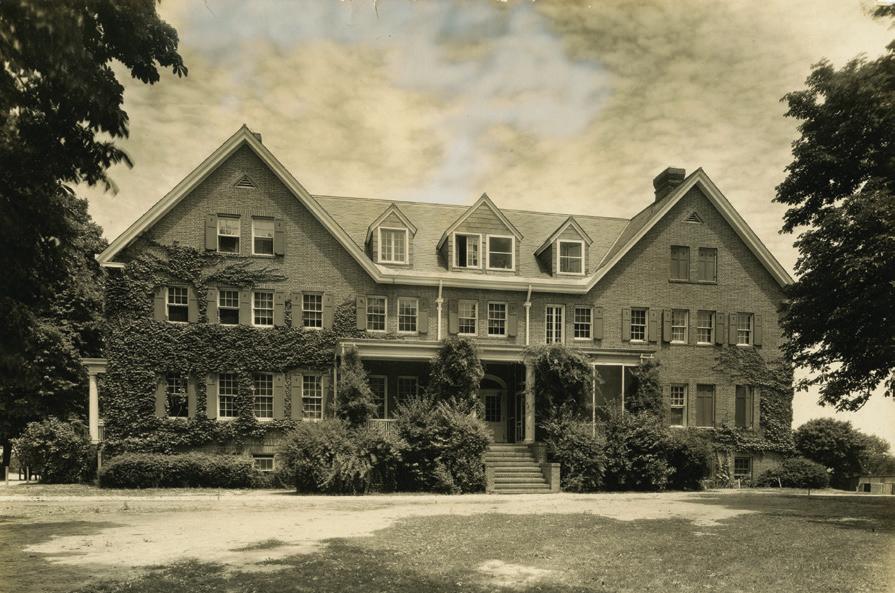
home for boys. In 1915, her trustees partnered with McDonogh and bequeathed the Jane Bay estate, valued at $250,000, to the School. The funds were used to construct a dormitory on the site of the original Foxleigh mansion. It was named for the spinster, and the boys chosen to live there were designated Jane Bay Scholars.
Jane Bay’s legacy lives on in a second Jane Bay dormitory that opened in 1969. Bricks from the original building were covered in blue-gray uniform material and sold as mementos —or doorstops.
Foxleigh Estate Becomes McDonogh School
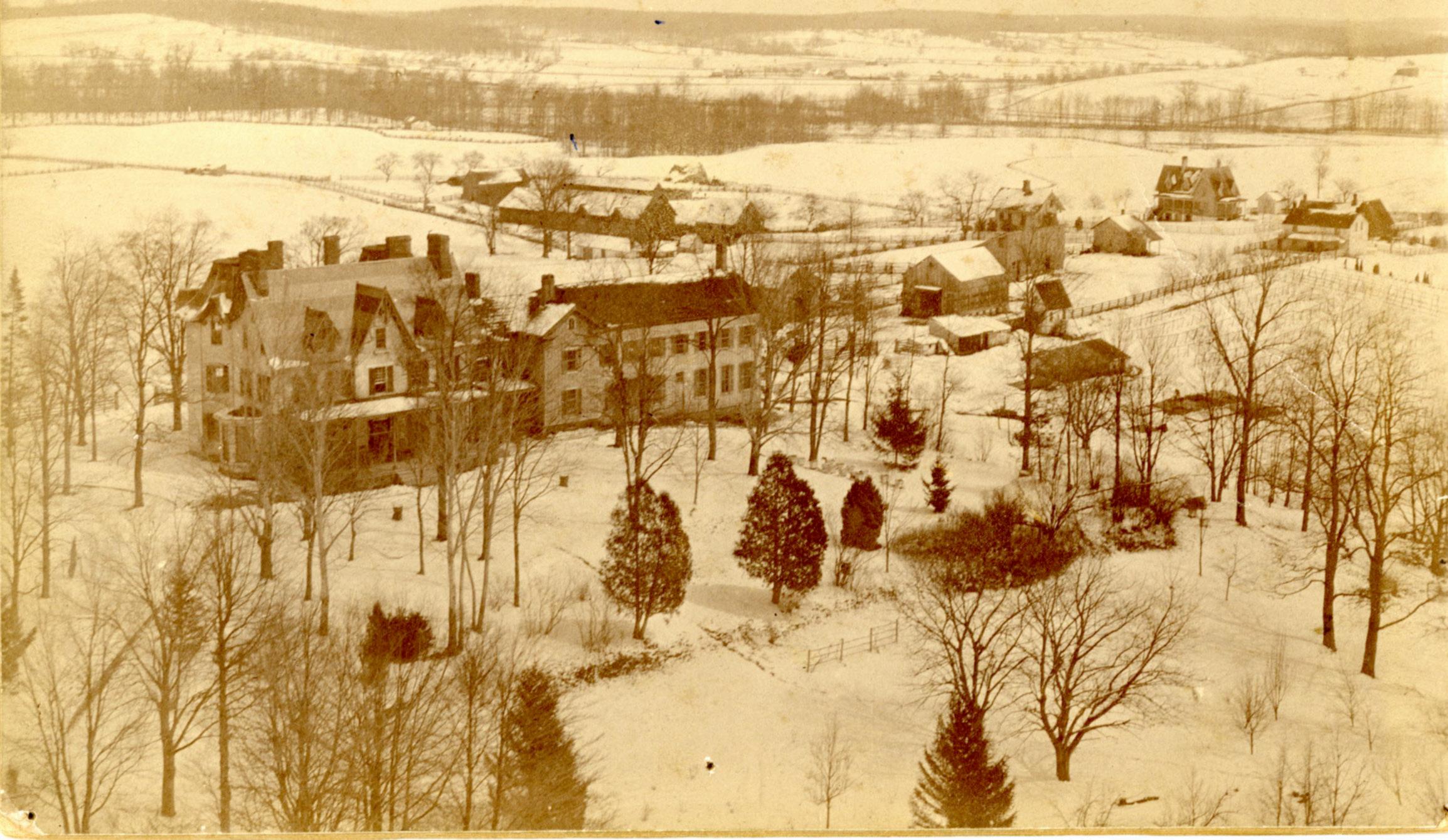
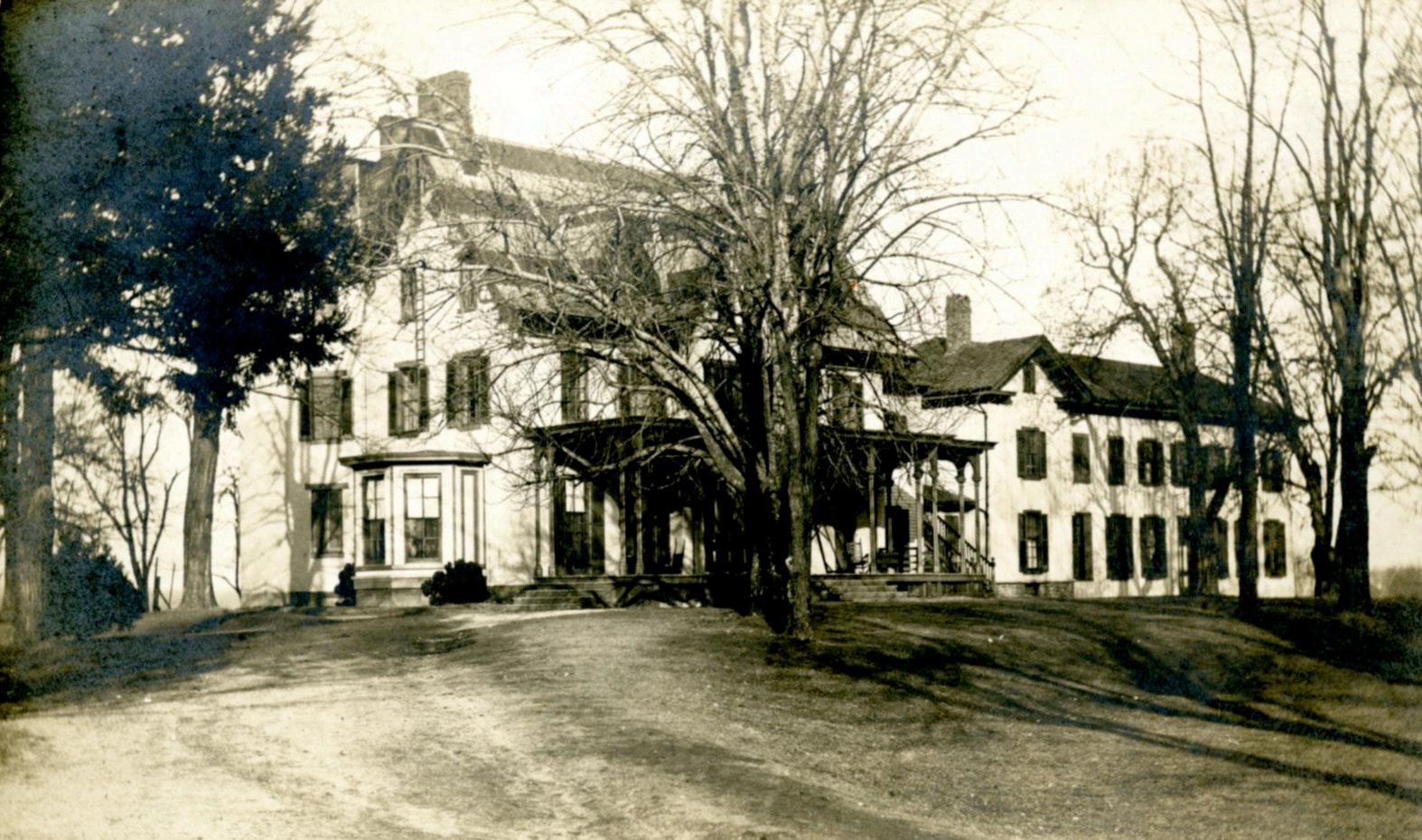
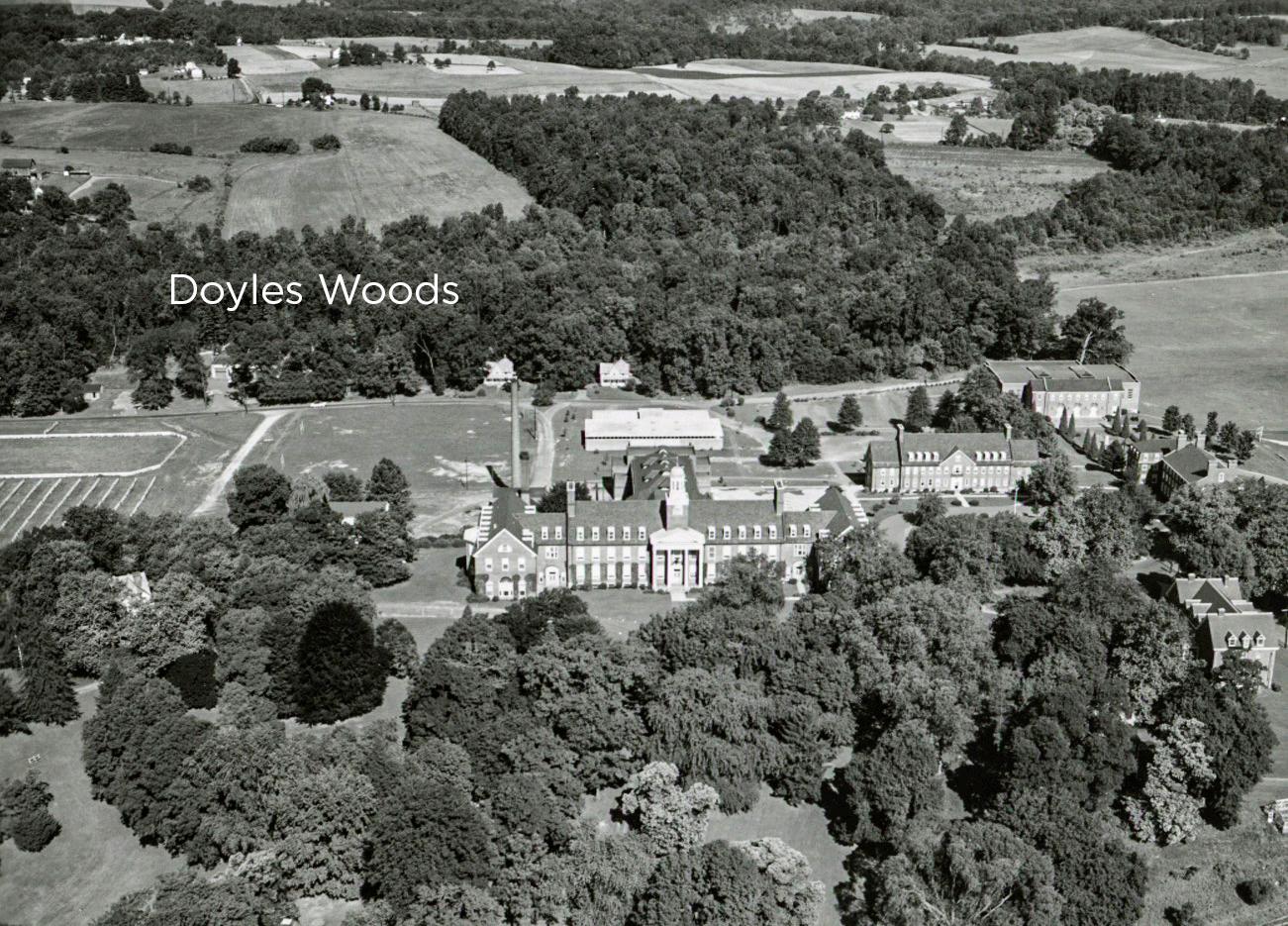
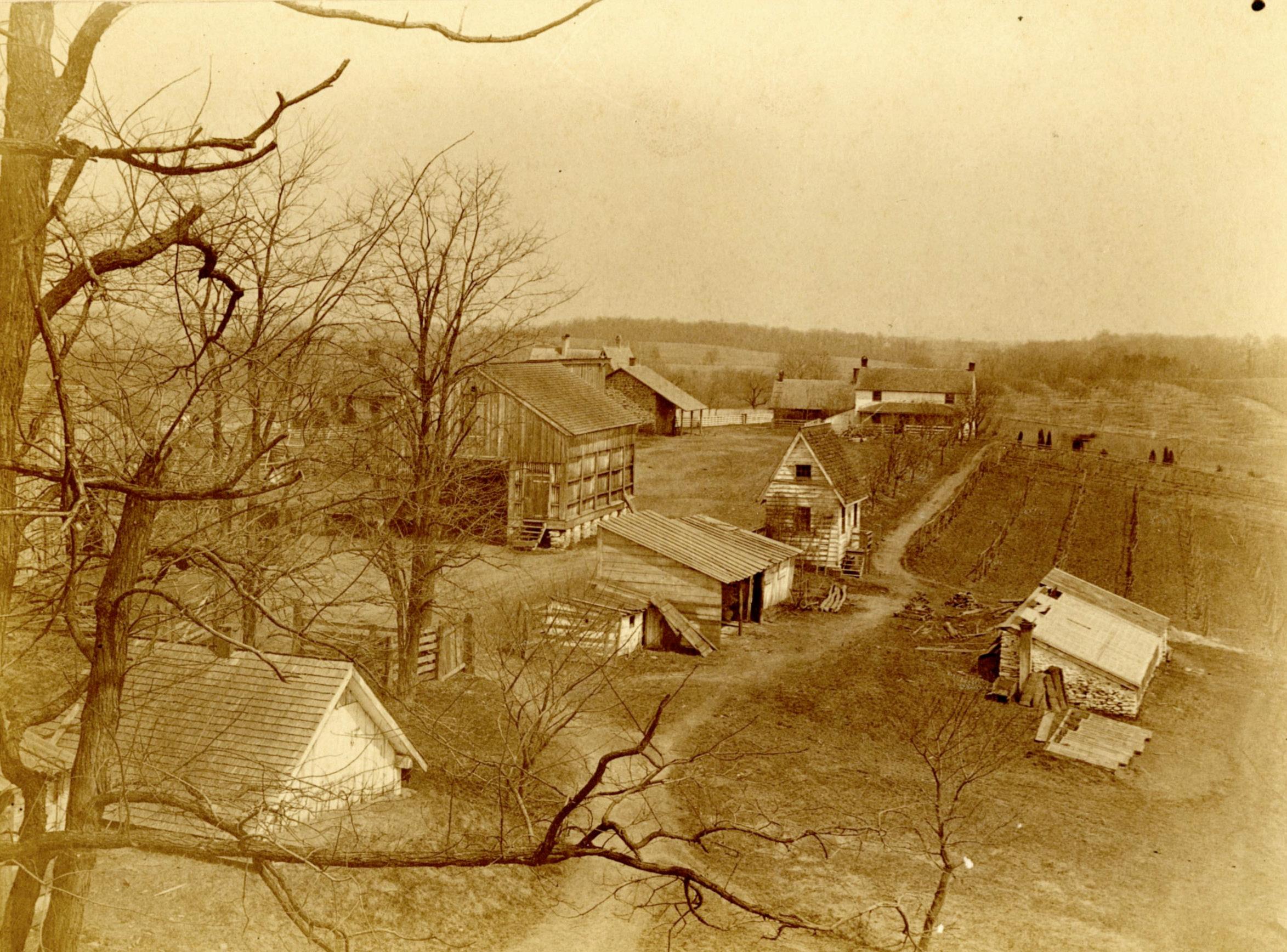
The land on which McDonogh sits, once called Prospect Hill, was renamed Foxleigh by Robert Oliver, who owned the estate from 1857 to 1870. He sold it to William G. Harrison for $70,000 and two years later, Harrison sold the property to the McDonogh Board of Trustees for $85,000.
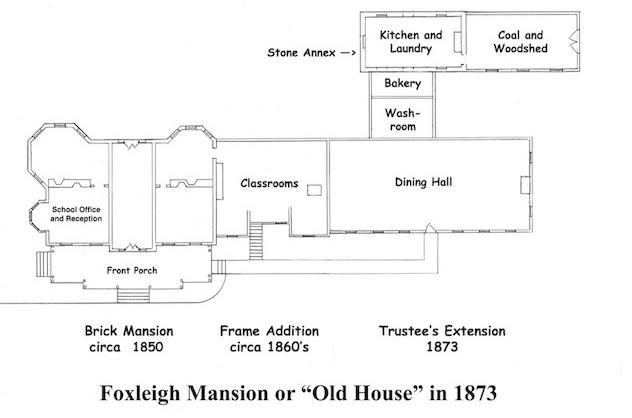
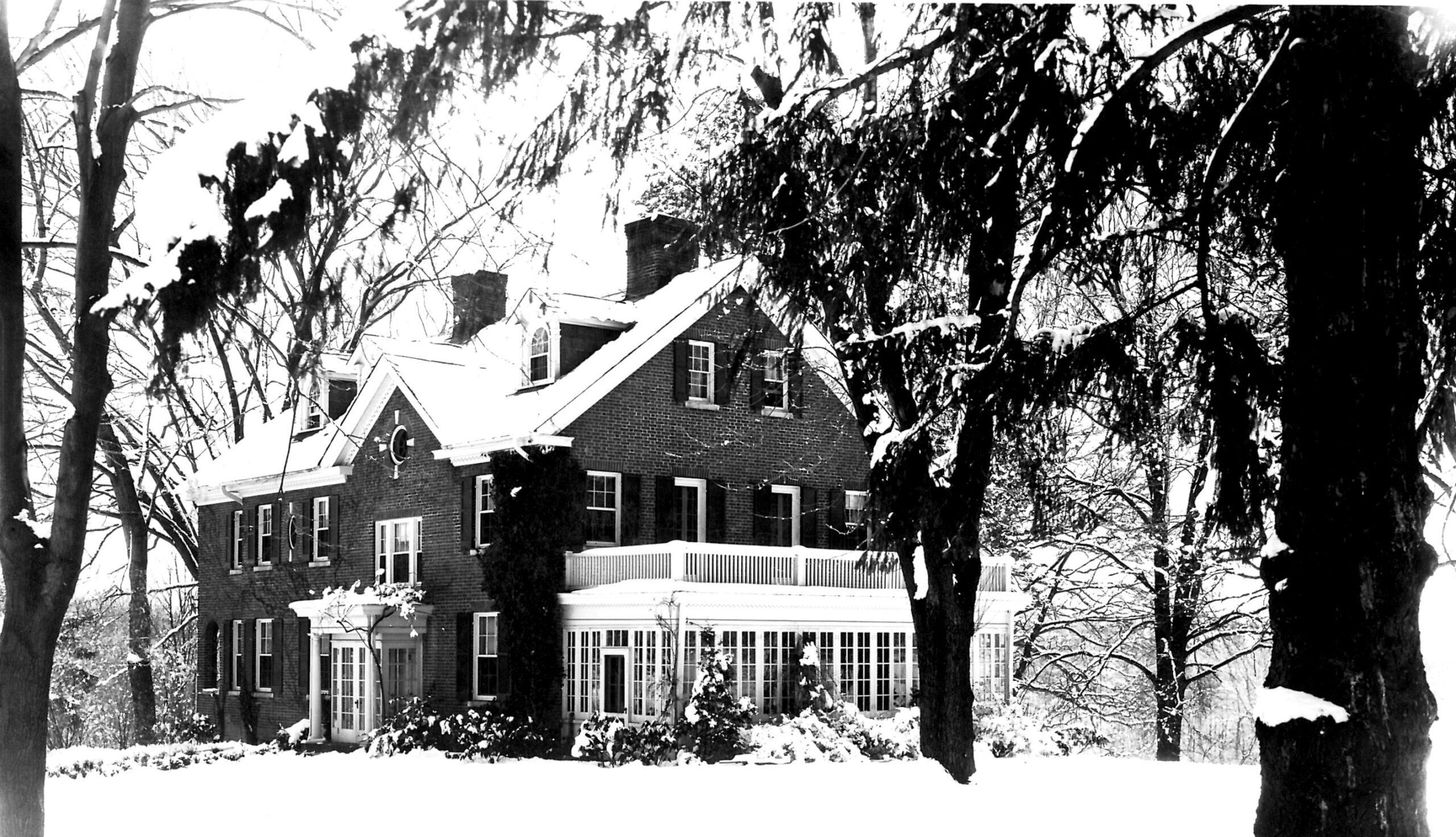
Foxleigh consisted of a brick mansion with a frame extension, an array of outbuildings (smokehouse, ice house, corn house, tool shed, and blacksmith shop), and farm buildings in various states of disrepair. The original brick mansion house (circa 1850), consisted of three stories, as well as an attic and full basement.
As the School, the first floor housed the school office, reception, and most likely the principal’s office. The second floor of the brick section was used for faculty and staff housing, and it is believed the third floor was a dormitory for students. A frame addition on the east side of the original brick mansion became classrooms, one of which had a piano and may have been the music room. The second floor was also used as a student dormitory.
In July 1873, the Building Committee of the Board authorized a frame extension on the east end of the house beyond the frame addition. It became known as the Trustee’s Extension and had a large dining room on the first floor and classrooms on the second level. At the rear of the extension was an L-shaped addition that housed a washroom, bakery, a stone annex with a kitchen and laundry, and a coal and woodshed.
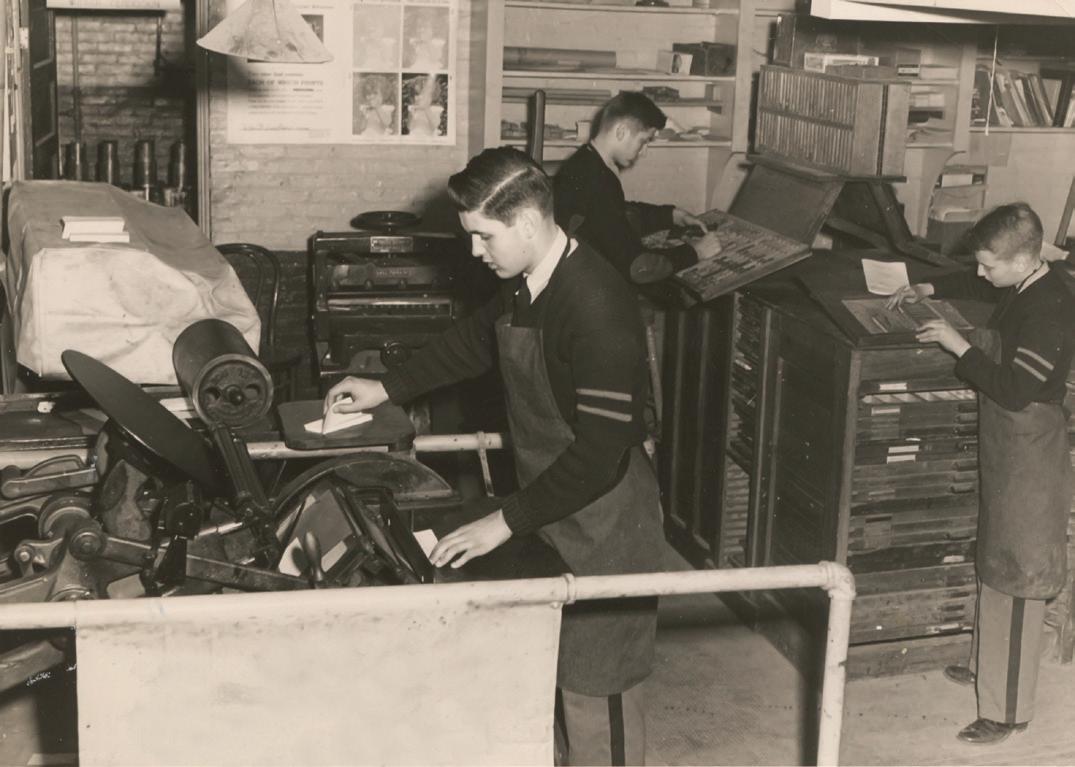
In 1881, construction began on a new Main Building, which opened in 1883, and Foxleigh was nicknamed “Old House.” Col. Allan continued to use Foxleigh as the Principal’s House and he and his wife raised their six children there. After 1885, the dining hall became a commercial-grade woodworking shop, the coal and woodshed became the Barnum Metal Shop, and the old library and classrooms on the second floor became the printing department where The Week was published and mailed. The mansion was destroyed by a fire on July 30, 1914.
McDonogh’s Contribution to the Space Race
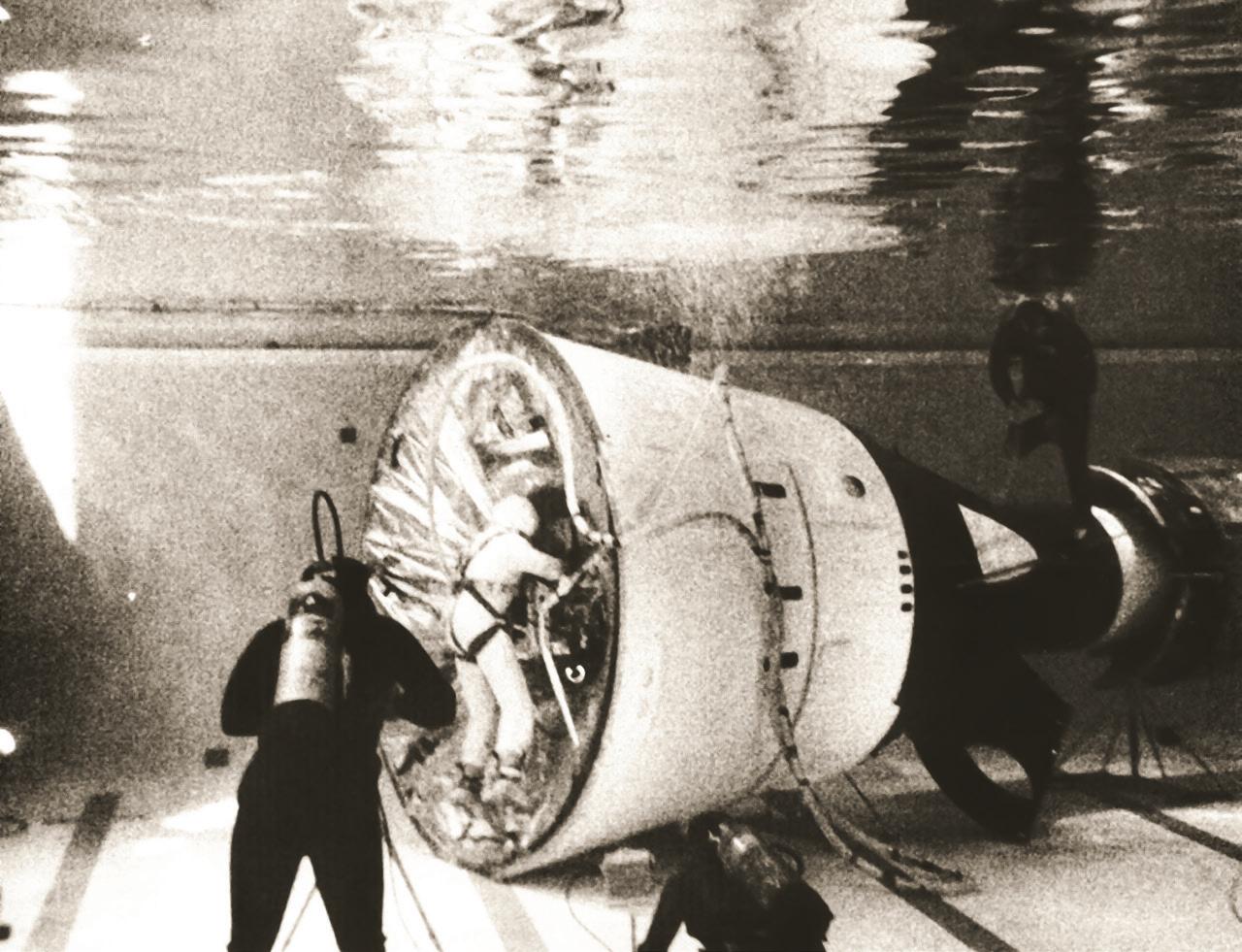
In 1964, NASA astronauts Buzz Aldrin, Scott Carpenter, Jim Lovell, and Gene Cernan dressed in their cumbersome space suits and trained for the weightlessness of outer space in McDonogh’s swimming pool. Five years later, Apollo 11 landed on the Moon, and Commander Neil Armstrong and Lunar Module Pilot Edwin “Buzz” Aldrin left their spacecraft and took man’s first steps on the surface of the celestial body.
Environmental Research Associates (ERA), a small Baltimorearea company working with NASA, believed the extravehicular activities—those that took the astronauts outside of the safety of their capsule—should be tested in an environment that replicated the weightlessness of outer space. They felt underwater training was the best way to simulate the challenges presented by the vacuum in space. Unlike today, when every major space center in the world has multi-million-
gallon underwater training facilities and neutral buoyancy labs, in 1964, there were very few options. ERA contacted Headmaster Bob Lamborn ’35 with the request to use McDonogh’s pool. Lamborn made a “gentleman’s agreement” in which McDonogh charged ERA $10 an hour—the same fee paid by the Red Cross when they leased the pool. Lamborn recalled that high-power lights were installed to allow for filming the experiments in color.
Aldrin later wrote in his book, Return from Space, “What we had done there [at McDonogh] had secured the success of a space walk. That day in Baltimore we were all full of a sense of accomplishment and pride.”
Read more in the Winter 2015 issue of McDonogh Magazine.
From Foxleigh Mansion and the Dorms to Marc Village, Campus Housing Creates Community
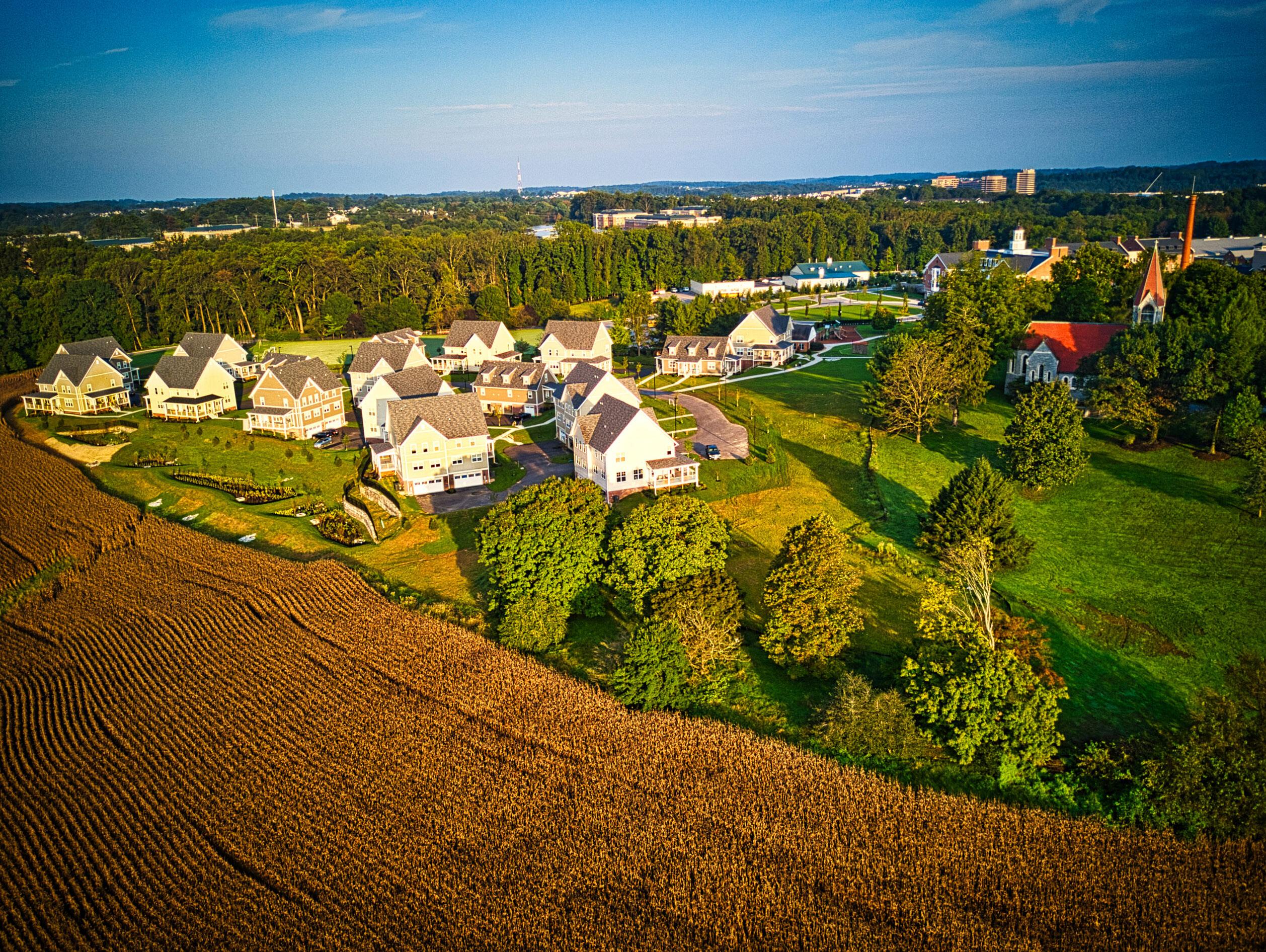
Since the School’s founding in 1873, faculty and staff have lived on campus, first in Foxleigh Mansion and later in Main Building, Allan, Lyle, and Finney buildings, and in various houses scattered across the property. In 1968, the Bird and Hunt faculty apartments, named for benefactor Edward Bird and Board President German Hunt (1899-1907), opened. In 2018, the two buildings, located on Chapel Hill Road on the south end of campus, were replaced by Marc Village.
The Village substantially increased the amount of on-campus housing available to faculty and staff. A total of 38 housing units are contained within 17 structures, including 26 three-bedroom units and 12 one-bedroom units. The houses are grouped in clusters, which adds to the feel of a close-knit community. The neighborhood is named for benefactor Marc Blum ’60 whose vision was of an environment with a small-community feeling, where parents and their children converse and play in their adjoining front yards. The streets and houses in Marc Village are named for well-known and lesser-known members of the McDonogh Family.
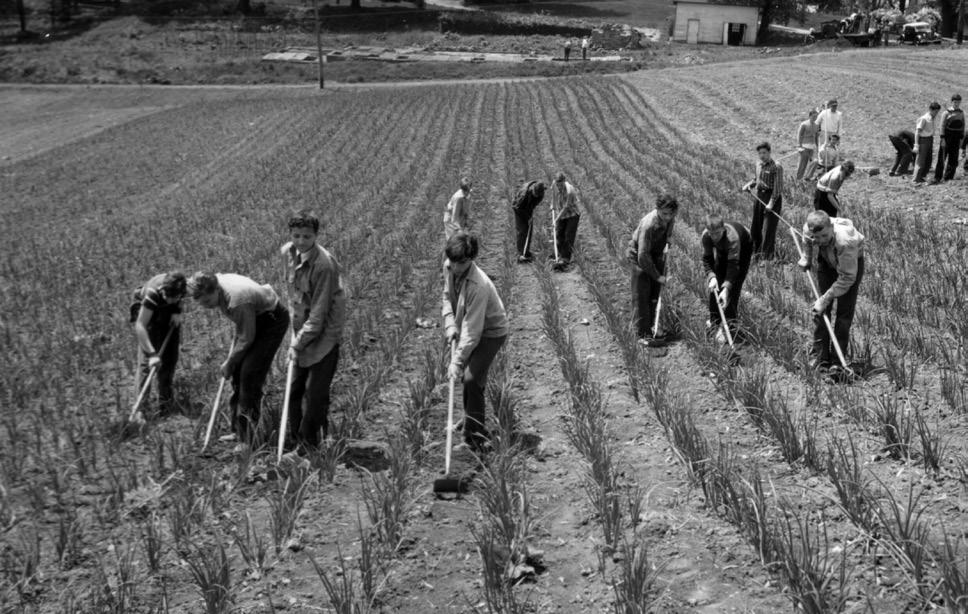
Rooted in Farming
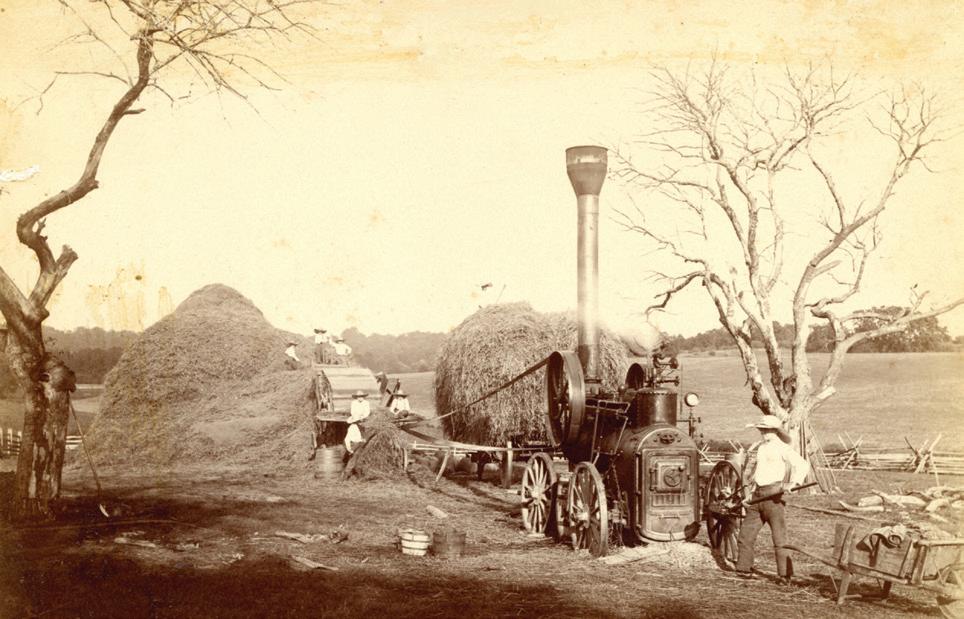
McDonogh was started as a farm school, and from its founding, students have cultivated the fields, planted crops, and harvested the fruit and vegetables for the School’s consumption. Former Headmaster Bob Lamborn ’35 recalls that during his father Doc Lamborn’s tenure, boys also had the responsibility during the harvest season of gathering and preparing vegetables for market. On Saturdays, wagons were loaded with produce, butter, eggs, and chickens and driven to
McDonogh Station where everything was placed on freight cars and taken to Lexington Market. McDonogh had a booth at the market until 1929 when it closed because the goods produced on the farm were needed for the students and staff.
The farm operation was discontinued during Bob Lamborn’s tenure, and all vestiges were removed, including the orchards, barns, hen house, granary, and piggery. The fields were leased to a farmer to produce hay.
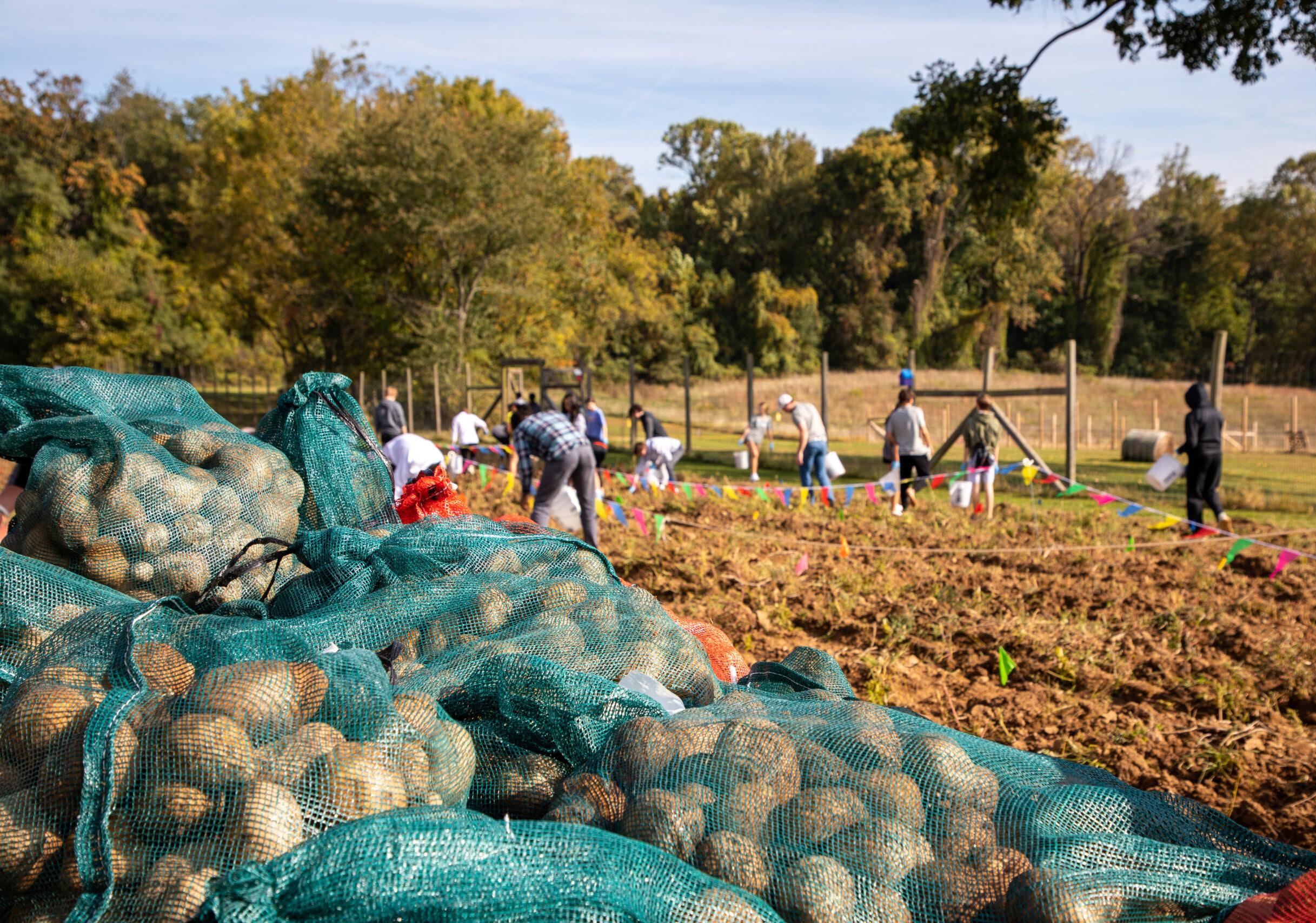
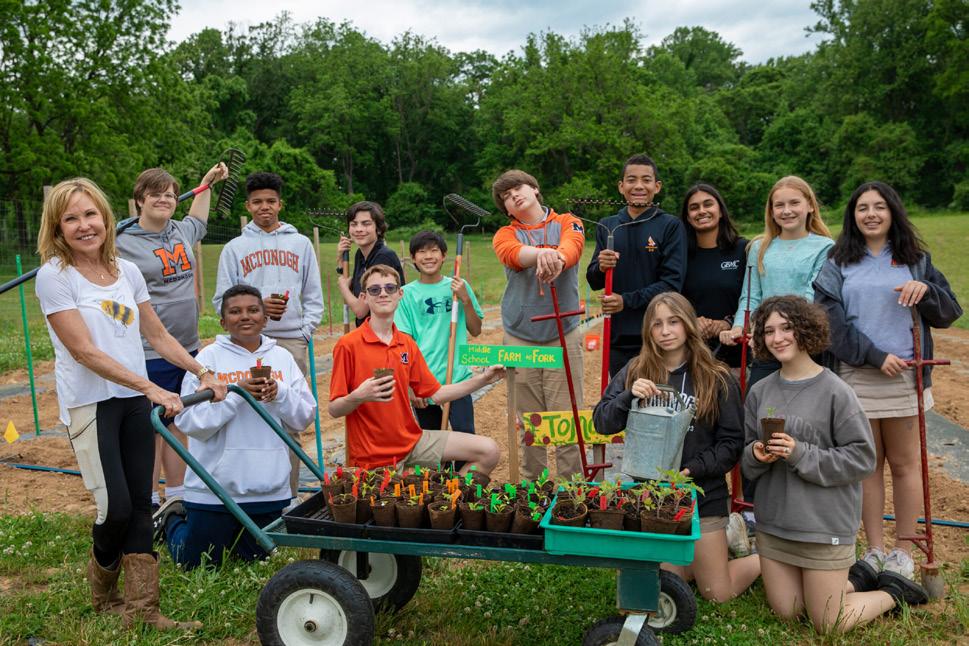
In 2006, the seeds for a communal garden to bring farming back to McDonogh were planted. Referring to the School’s heritage, the idea was, “The things we can do in the future are things we did in the past.” The initial plans to plant a simple acre of potatoes at the end of Barnhill Road on the edge of campus quickly sprouted, and tomatoes and pumpkins were added to the list along with space for a half-acre of individual garden plots. In 2009, Roots’ first year, it is estimated that the farm yielded 4,000 pounds of potatoes, 1,000 pounds of tomatoes, and more than 200 handsome pumpkins.
Over the years, Roots has evolved from a garden to a 10-acre farm with a variety of crops, chickens, turkeys, and beehives. Today, Roots is not only a homage to McDonogh’s first days as a farm school, but it is a vibrant outdoor classroom. The farm provides hands-on educational opportunities for students in every division, fresh produce for McDonogh’s dining service, and food for the Maryland Food Bank. Additionally, Roots helps build a sense of community among McDonogh’s students, teachers, staff, parents, and alumni who eagerly volunteer their time to care for the chickens and plant and pick produce.
Principal Morgan H. Bowman, Jr. Established Academic Standards
Directed by the Board to “tone up” the School, Morgan Bowman (principal from 1914 to 1921) defined the academic and “commercial” programs of study. More lectures on subjects of interest were offered, cultural aspects of literature and music received new impetus, and common preparatory school terms and rituals came into use. Within his first year, McDonogh’s fifth principal had effected a “higher standard of ambition on the part of the boys.”
Athletics became geared to interscholastic competition, and the rivalry with Gilman School became more entrenched. Religious instruction took on a wider moral scope, and John McDonogh’s Rules for Living were hung in each dormitory. He introduced a new schedule of classes, a new order of worship in the chapel, a new look to the landscaping, and a new gentility to the dining room. Morgan H. Bowman, Jr. resigned in 1921 after seven years.
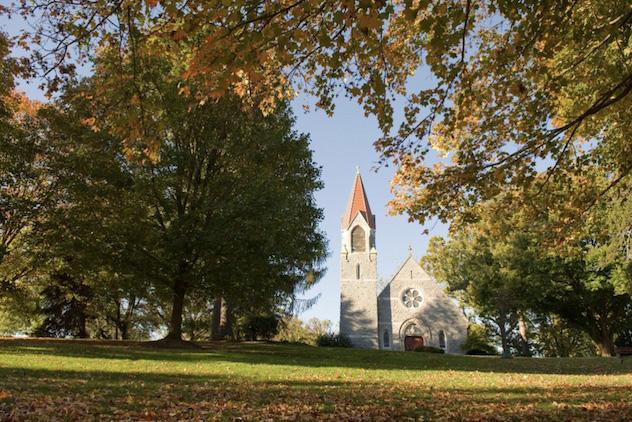
Tagart Memorial: The Chapel on the Hill
Convinced of the importance of religious instruction, it was Colonel Allan’s vision that McDonogh School have a chapel. He imagined that it would sit on a knoll surrounded by land that would be a churchyard. Samuel Tagart, the long-serving President of the Board of Trustees agreed. An article in a May 1899 issue of The Week reported that shortly after Tagart’s death in 1892, the Board of Trustees decided to erect a chapel at McDonogh as a memorial to him. It was paid for out of the revenue derived from Tagart’s bequest to the School. The Building Committee wanted the chapel architecture (French Gothic), mechanical construction, and quality of the appointments to be worthy of the man for whom it was named. When the building was dedicated in 1898, it was outfitted with
gas lights and a steam-operated organ. The altar was filled with pews with a raised pulpit, and students were required to attend services regularly.
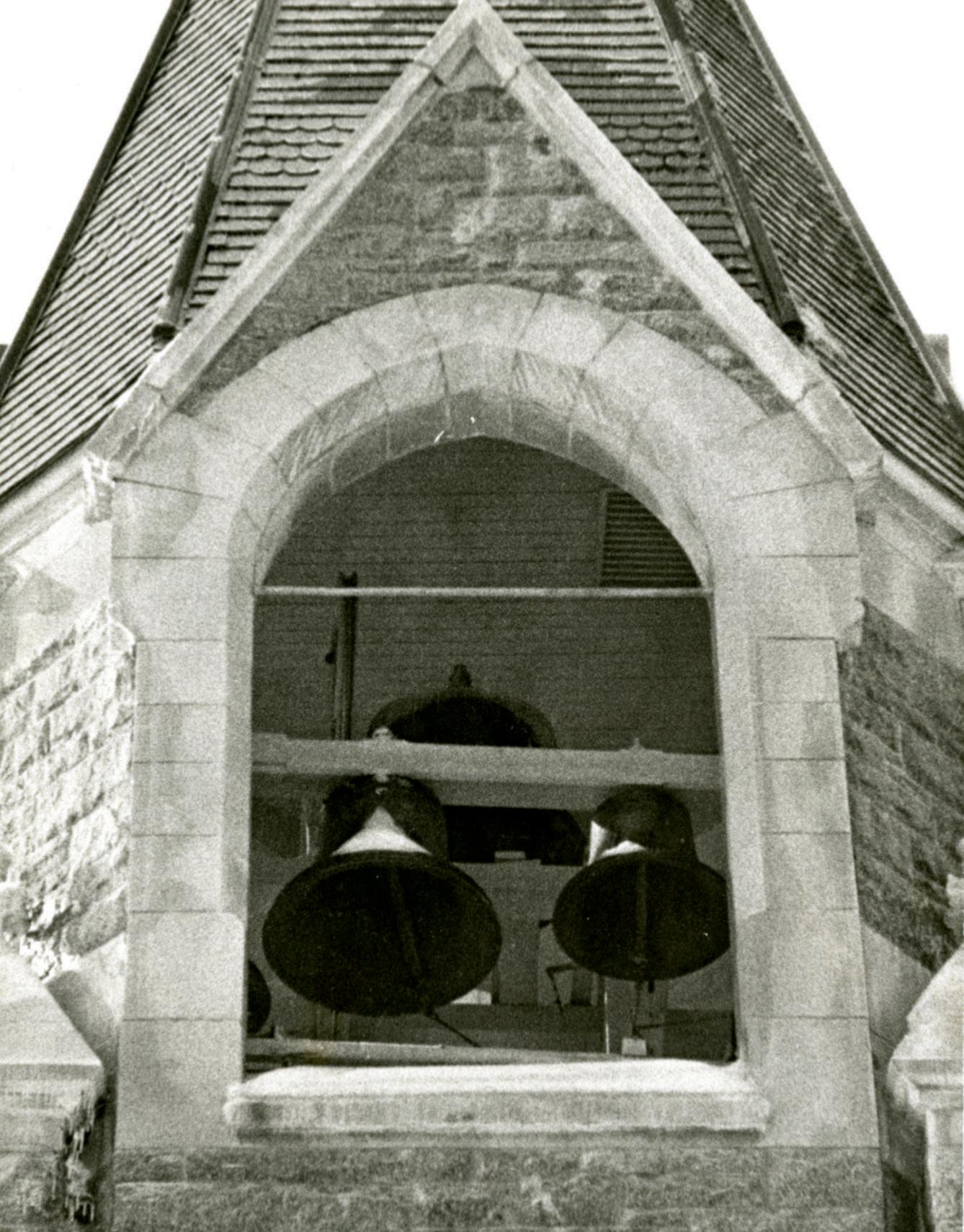
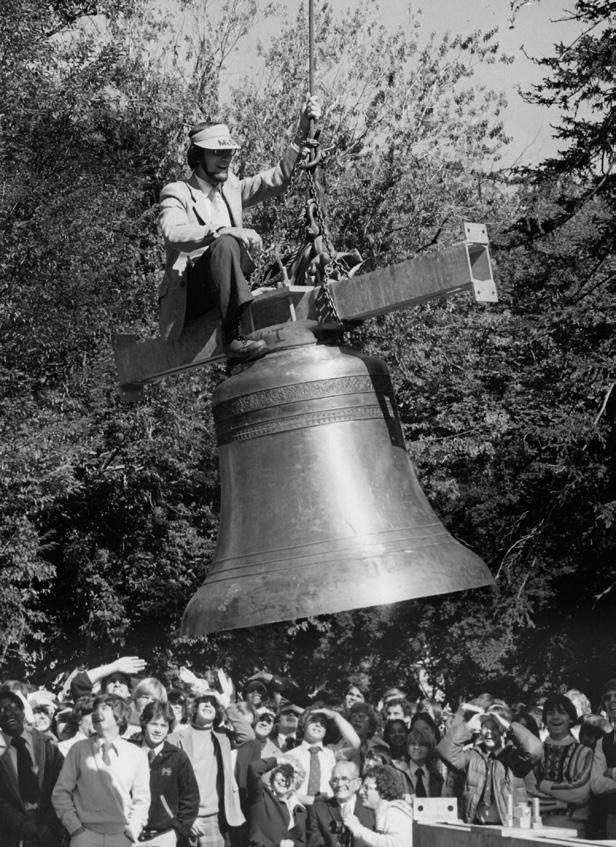
The belfry housed 10 bells, a gift from German H. Hunt, President of the Board of Trustees in 1903. According to an article in The Week on October 29, 1904, each bell was attached to a rope, fastened to a handle, on which the notes were written. The boys learned to play the chimes and on Sundays, they played before the 9:00 a.m. and 4:00 p.m. chapel services. The Carillon was added in 1978 (see Story No. 88). Later, a memorial stained glass window was dedicated to Josepha Young, the School’s first matron who served from its founding in 1873 until her death in 1911.
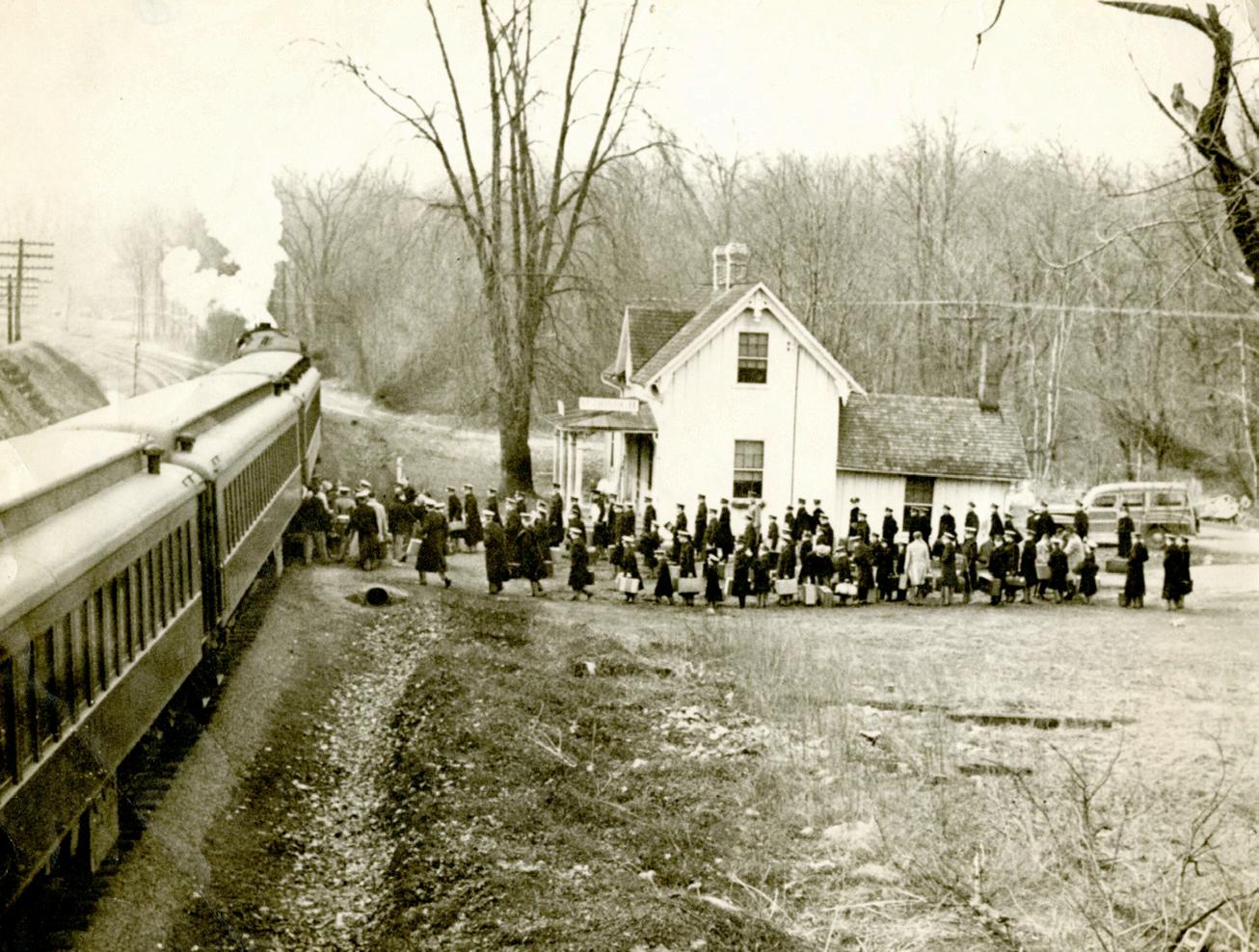
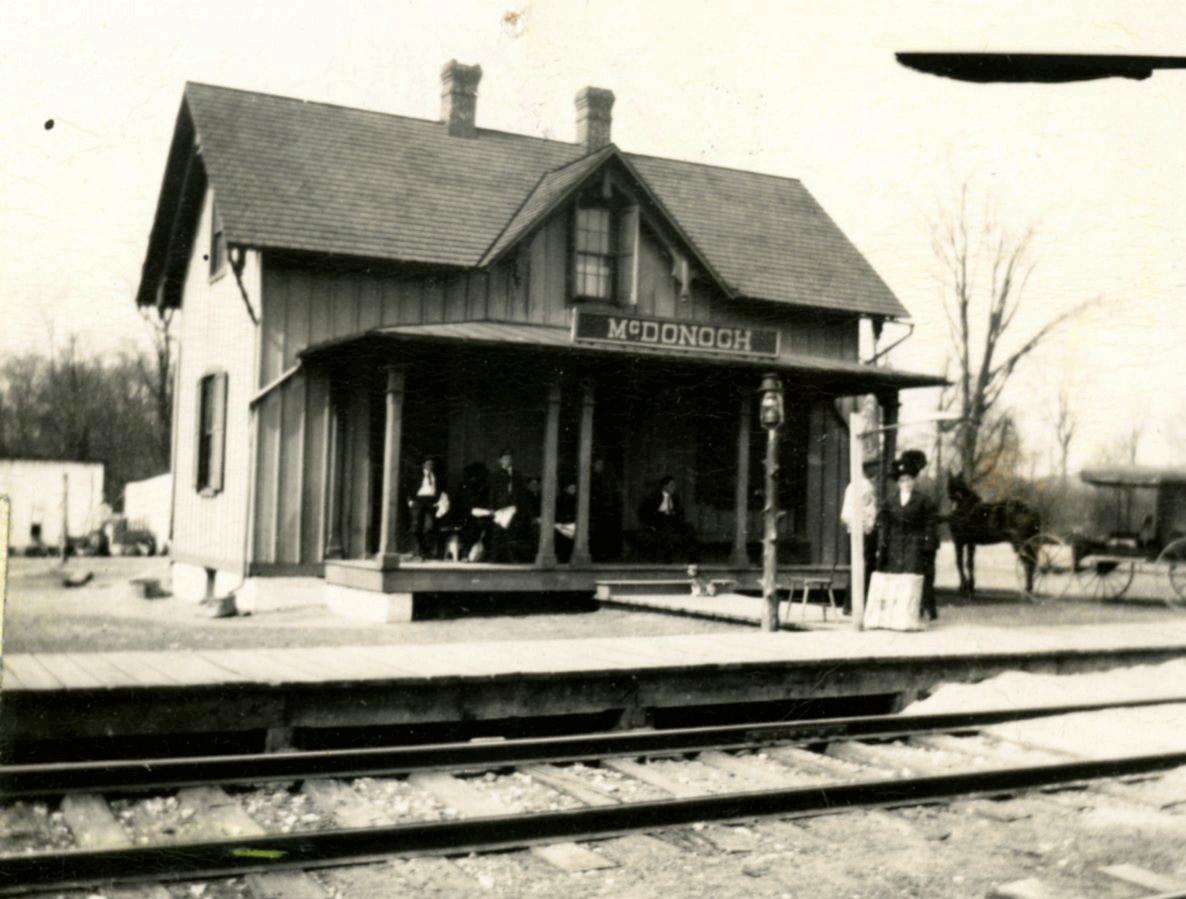
McDonogh Station: A Connection to Home
In November 1873, a group of 20 young boys left their mothers at Fulton Station in Baltimore City on a Western Maryland line train bound for McDonogh School. The station, located about a mile from the School was named McDonogh Station, and the train was the boys’ connection to home. On Visiting Days, it would be filled with family and friends eager to reunite with the cadets at the School. In fact, Visiting Day was so popular that in 1912 a special train was added to bring visitors to campus for the day.
Each year until John McDonogh’s grave and memorial were moved to campus, the student body traveled by train from McDonogh Station to the Hillen or Pennsylvania Stations in the City and then made their way to Green Mount Cemetery where they visited his gravesite.
According to Bob Lamborn, eventually, when the railroad no longer stopped at McDonogh Station, it became a home for the family of one of the bus drivers. It’s believed to have been demolished to make way for I-795.
Principal William T. Childs: Focused on the Finances
An alumnus of the Class of 1895, William Talbot Childs came from the financial community of Baltimore in 1921 to be McDonogh’s sixth principal. He used his skills to keep the School going through a difficult time. During his tenure, the position of farmer was abolished, money from the New Orleans properties was realized, alumni were prompted to contribute more than $50,000 for operating expenses, the newly organized Mothers Club raised $10,000, and a few pay students were admitted. Enrollment climbed from 115 to 140 but began to decline during the last two years of his tenure. In 1925, Principal Childs visited several military academies and promoted an increased level of military strictness and decorum. Although active in civic and church affairs and welcoming of speakers on various career topics, he was considered aloof and kept the boys at a distance. He resigned on January 1, 1926.
WPA Workers Make Impact at McDonogh
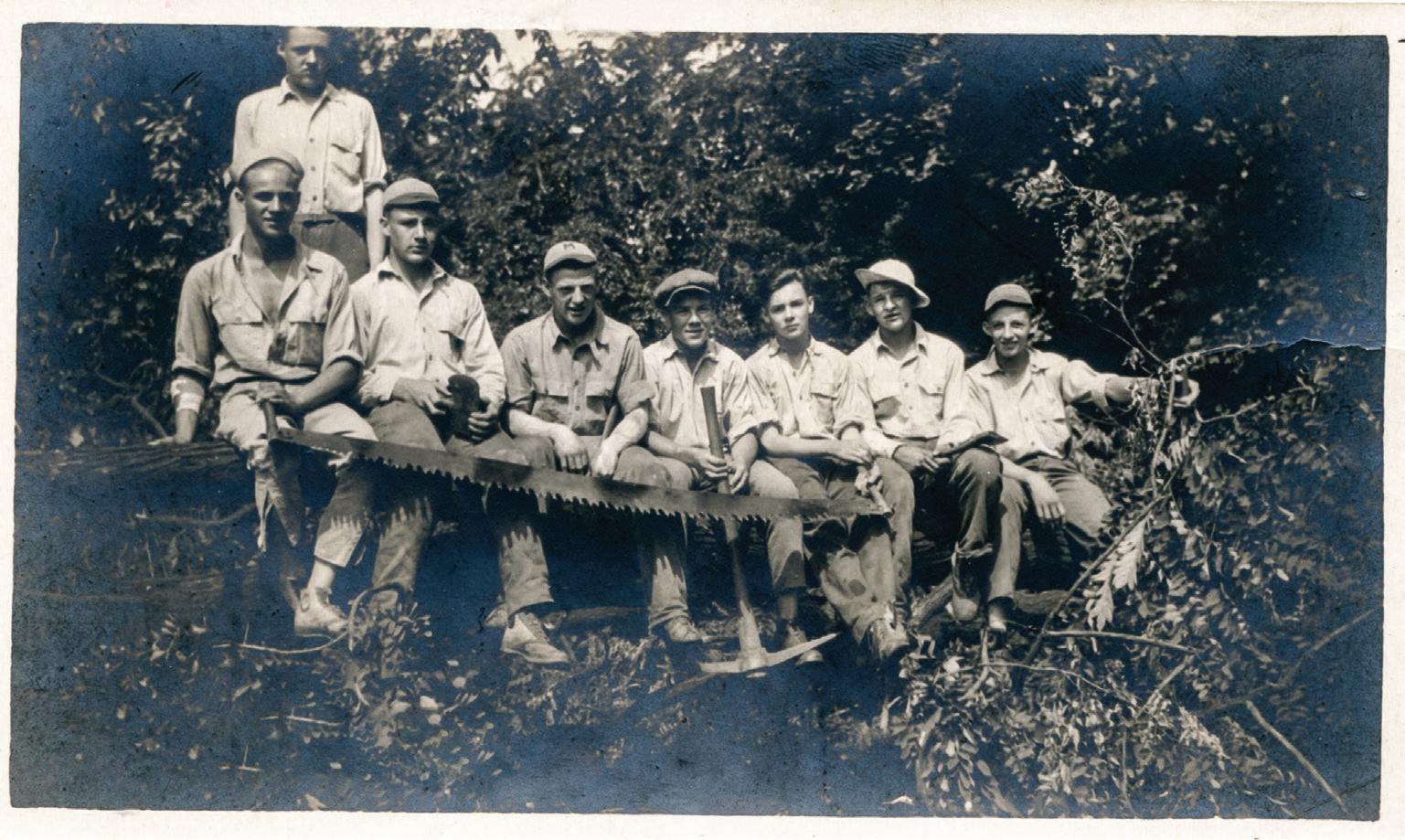
Created in the mid-1930s under Franklin D. Roosevelt’s New Deal, the Public Works Administration (PWA) and the Works Progress Administration (WPA) were an integral part of the development of McDonogh School. For seven years, WPA Project No. 211 provided 48 painters and 321 carpenters, electricians, mechanics, printers, and laborers who worked for the School. It is estimated that through the program, the government contributed more than $100,000 a year in materials plus labor costs for projects at the School.
During this time, Doc Lamborn arranged for the government workers to undertake a number of significant school projects such as the construction of Finney Building and the creation of athletic facilities, including John McDonogh Stadium and
18 tennis courts. The WPA workers were also responsible for cleaning the woods, streams, and swamps and constructing the sewage disposal facility and boiler plants.
They painted just about every surface on campus. Steel beams were painted to look like wood, and classroom walls were decorated with murals depicting images such as a circus parade, scenes from A Child’s Garden of Verses, and a race between a steam train and a horse-drawn Pullman.
The efforts of the workers did not go unnoticed by the students and their parents who, at Christmastime in 1936 and 1937, gave the men working on WPA projects clothes, food for their families, and toys for their children.
Louis E. “Doc” Lamborn: McDonogh’s Longest Serving Leader
Major Louis E. “Doc” Lamborn was elected principal in 1926.
According to his son, Bob, he earned the name “Doc” during the time he was coaching at Friends School. Apparently, one of the boys hurt his leg and doctors said he would never use it again. “With a special concoction of his own and undisclosed techniques that he may have developed as Idaho’s first dairyman, he set out to do the undoable. By the end of the year, the boy was in good shape, and the coach was ‘Doc’ Lamborn.”
Among Doc’s first acts was to add a six-grade Lower School, resulting in all 12 grades being taught at McDonogh for the first time. He also launched the riding program, fought to bring in more paying students, and made athletics compulsory. When “Doc” Lamborn was at the helm, the State Board of Education told him he did not have the professional training required to use the title “principal.” So, he changed his title to headmaster.
Under Doc Lamborn, McDonogh became accredited for the first time by the Association of Colleges and Secondary
Schools of the Middle States and Maryland, allowing graduates to enter colleges and universities without additional training. The curriculum was divided into four tracks: college prep, business training, mechanical arts, and agriculture which included an Animal Husbandry program. Students were trained to become leaders, and faculty duties increased to include coaching athletics.
At Commencement in 1952, Doc’s retirement was announced and it was shared that he was elected Headmaster Emeritus— the first and only in the history of the School. The Collection of Louis E. Lamborn is available in the School Archives.
Boys Did the Bidding at Mealtime
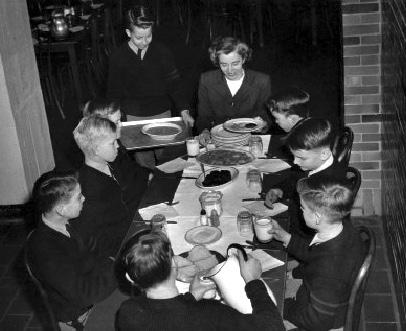
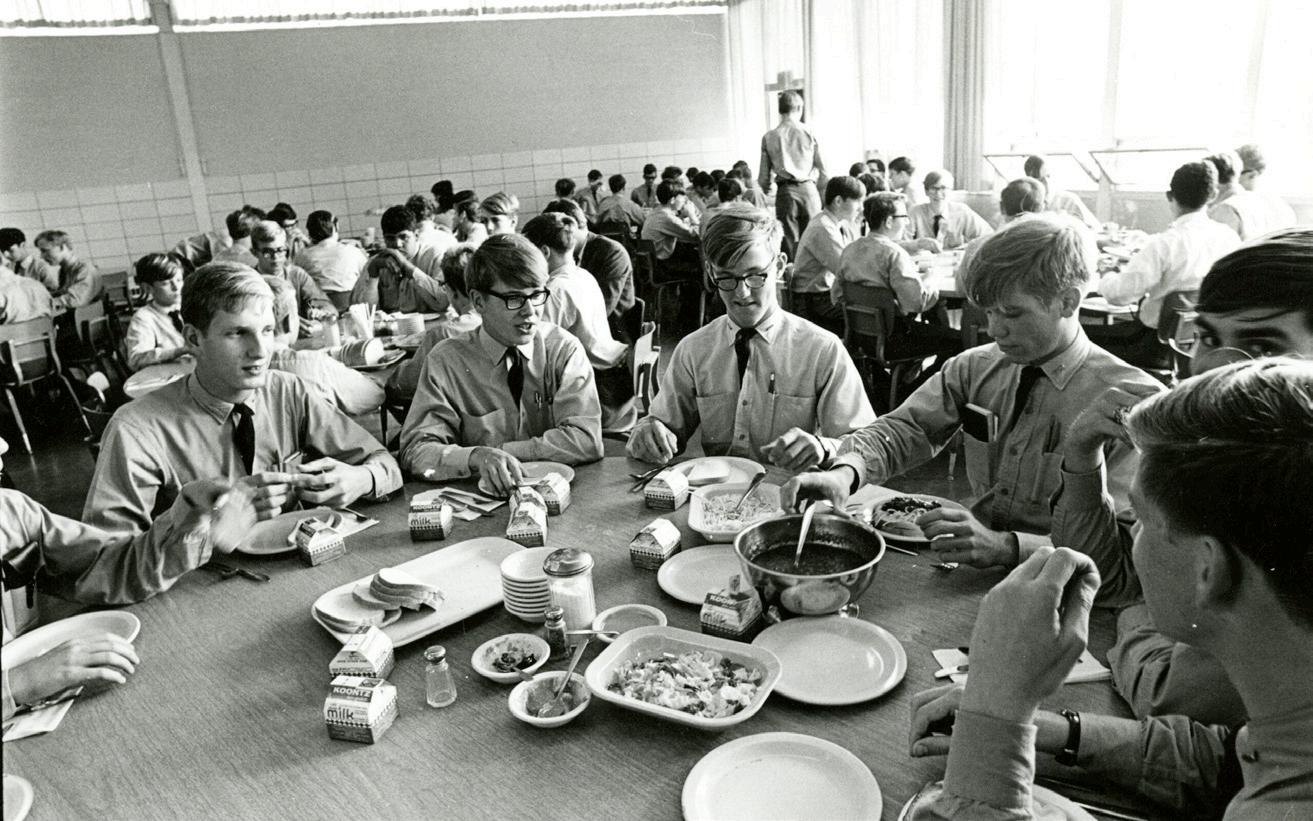
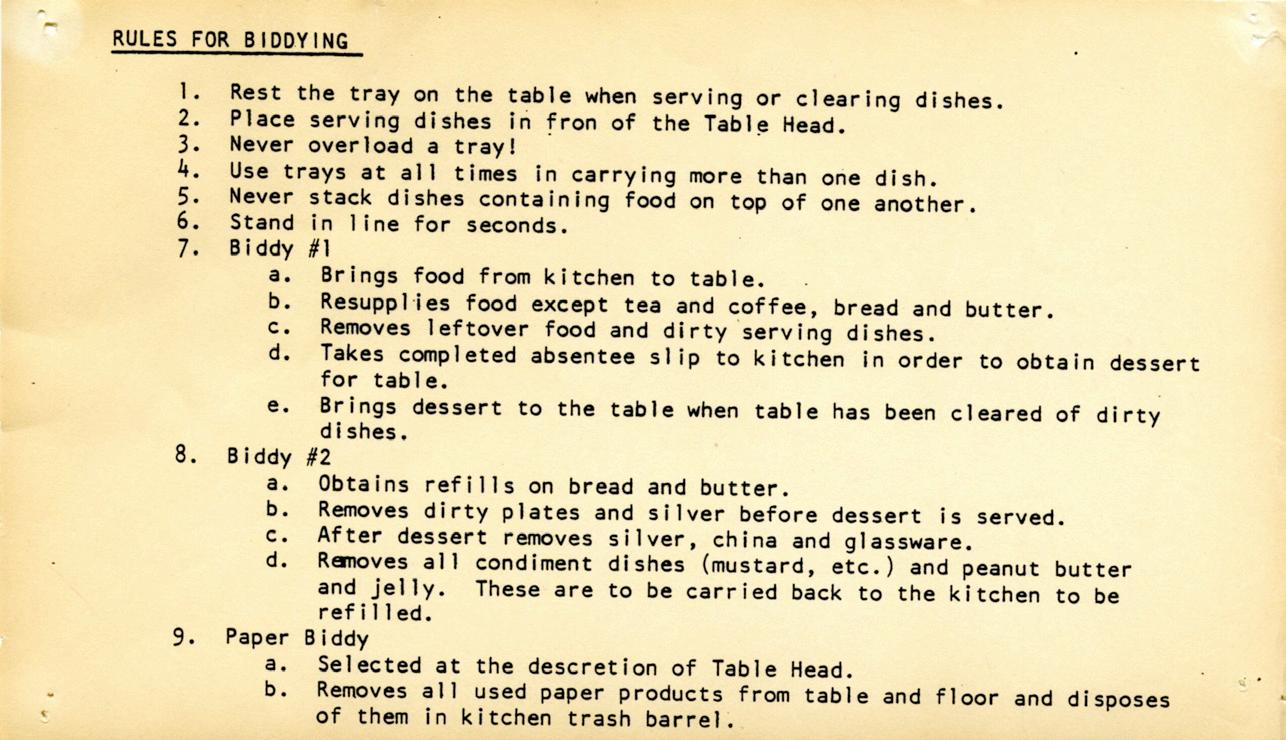
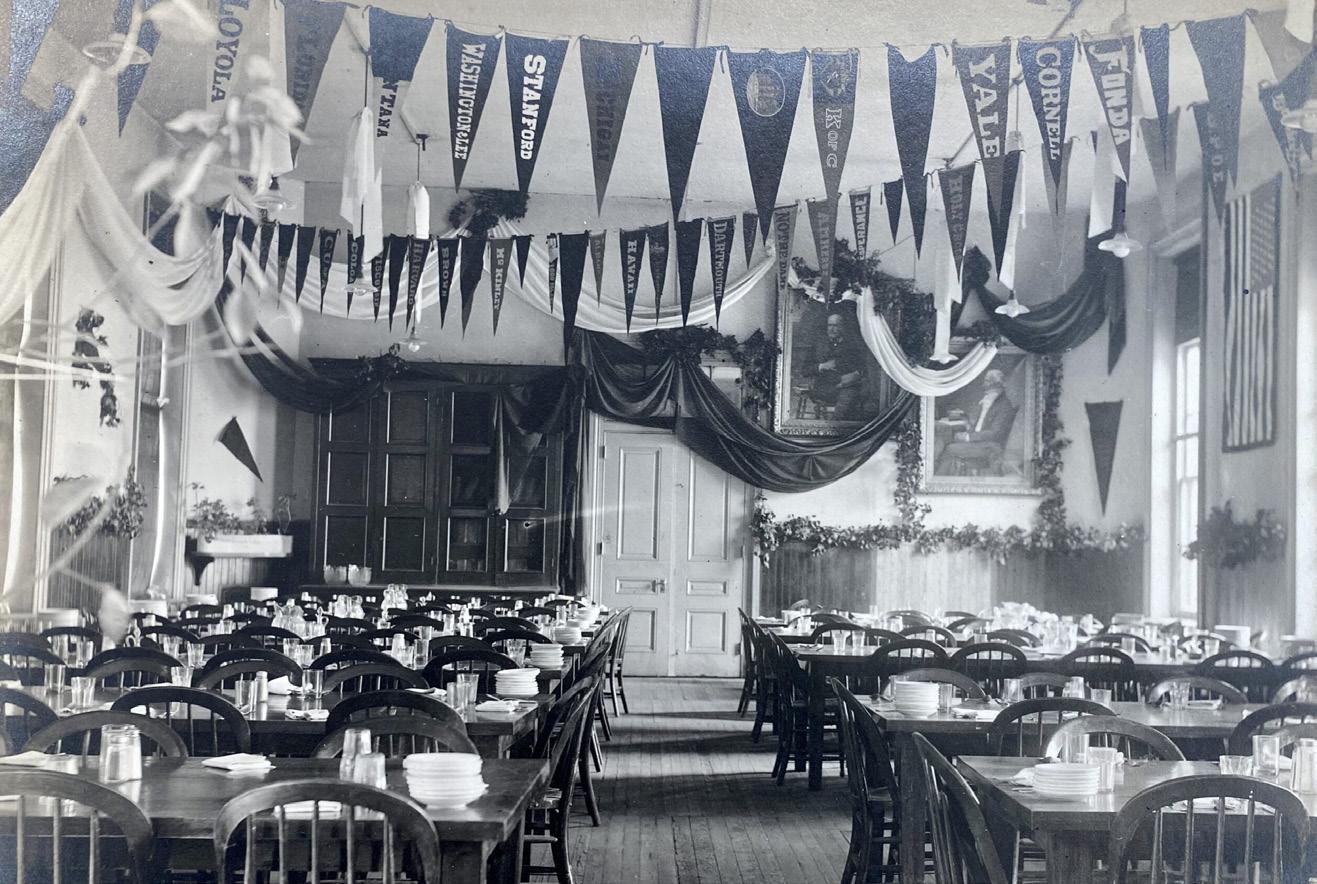
Until 1987, for the sake of efficiency, there was no lunch line in the dining hall, and meals were served “family style” with students as table waiters, known as biddies. Younger students did the “bidding” of older students. Fifth and sixth graders served as Middle School biddies and ninth and tenth graders were the Upper School biddies. The first biddies had the role of getting the food and replenishing empty bowls at the bidding of those at the table. The second biddies were tasked with cleaning up everyone’s dishes and glasses and taking them to the dishwasher. Depending on the dynamics at the table, a first biddy could be treated compassionately or they could endure a workout. Between breakfast, lunch, and dinner, biddies averaged 90 minutes a day serving their table of eight students, bringing trays of utensils and food, and clearing the dirty dishes.
Being a Middle School first biddy when pizza and french fries were on the menu pushed the first biddies unmercifully. Dan Stackhouse ’94 recalled that as soon as he delivered the first tray of pizza and bowl of fries they were gone in seconds, and he was ordered back to the kitchen for more. Because most other biddies had been similarly ordered, the line for seconds was long, and there was little empathy for the biddies who had not received firsts. Biddies learned to put their foot (and tray) down to resist the demands. Jon Aaron ’72 recalled a similar experience although two decades earlier. He said, “A first biddy would take his plate to the kitchen on a second or third run, and on the way back to the table would shuffle a slice of pizza and handful of fries onto his plate!”
Fire Bell Warns of Danger
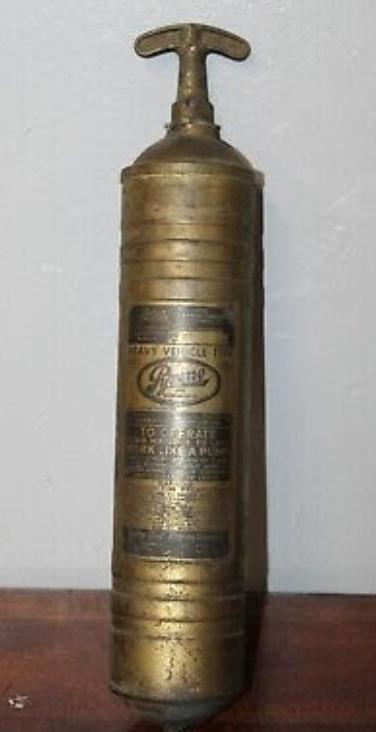
The fire bell, which now sits down the hill from Rollins Hall, was used to alert the students whose job it was to spring into action and fight blazes. When the fire bell sounded, the boarders immediately rushed to retrieve the fire extinguisher to which they were assigned and ran to put out the flames. Donated by the B&O Railroad in 1938, the bell was also used to signal the daily end of athletics.
According to an article in the October 3, 1925, issue of The Week, prior to having the bell, students, faculty, and staff were alerted to a fire by a bugler. The location of the fire determined how many blasts on the bugle. One blast signaled that the fire was in the Main Building or the gymnasium, while seven blasts indicated the blaze was in the cow barn or the piggery.
50.
150 Years of LifeReady
Since its founding in 1873, McDonogh School has had an unwavering commitment to providing students with a comprehensive, well-rounded liberal arts education. For 150 years, hands-on and cognitively demanding learning has been a hallmark of the School. We have witnessed how deep learning occurs when students think critically, apply knowledge and skills, and have opportunities to transfer understanding to novel situations. They use their knowledge and skills to create and discover meaningful connections between disciplines— the way most learning happens in life. We call this LifeReady learning, and our graduates are self-reliant critical thinkers prepared to do good in a diverse and rapidly changing world.
LifeReady grew out of McDonogh’s 2011 AIMS accreditation process and now provides a framework to prepare students for a life of character, civic duty, service, and success. Today, the School’s PK-12 curriculum continues to ensure that students acquire a broad conceptual understanding as well as more specialized knowledge in core disciplines. Teaching students how to think—not what to think—prepares them to continue to learn for the rest of their lives.
Visit mcdonogh.org to learn more.
Honoring Those Who Have Gone Before Us on Dedication Day
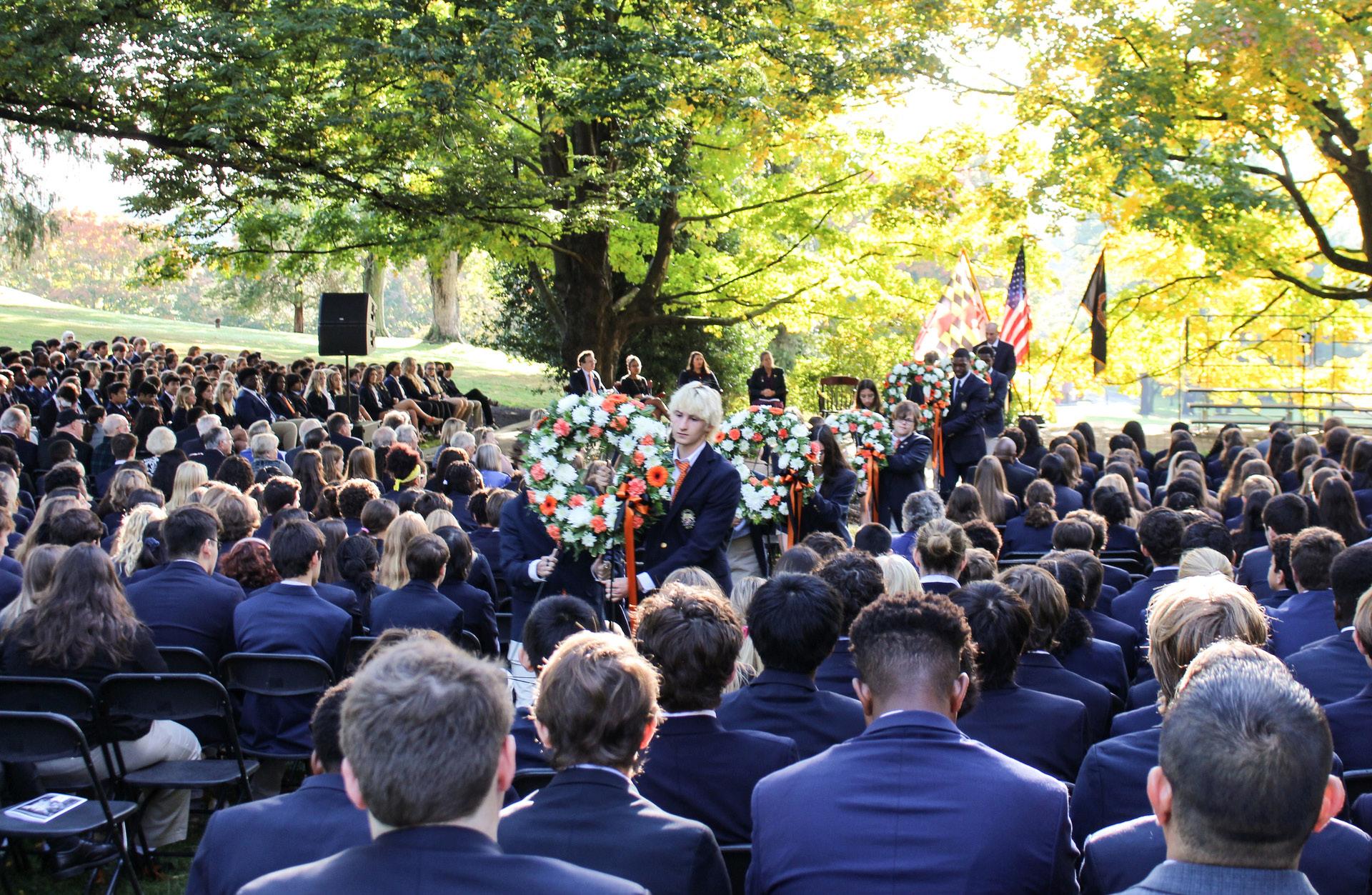
Dedication Day, previously known as Founder’s Day, is an annual schoolwide tradition of gratitude, honor, and remembrance. The first Founder’s Day was held on November 21, 1874—the school’s first anniversary. It was commemorated with a full day of activities including a morning chapel service, a military drill, lectures, and speeches about John McDonogh’s life and the School’s founding. The day concluded with a large turkey dinner in celebration of Thanksgiving.
In addition to Founder’s Day, each spring beginning on May 30, 1884, students participated in the John McDonogh Day ceremony. According to John McDonogh’s wishes, they placed flowers at his grave and sculpted memorial, which was located in Green Mount Cemetery in Baltimore City (the sculpted memorial was commissioned by the City Council of Baltimore to honor McDonogh’s philanthropy to create a farm school for underprivileged boys).
In May of 1946, after John McDonogh’s grave and the memorial were moved to campus, the ceremony was held at the School for the first time. Students laid flowers at his grave and placed a wreath in Tagart Memorial Chapel honoring deceased faculty. When the memorial honoring alumni who died in World War I and World War II was completed in 1946, a wreath was placed there as well. In May of 1954, the School began the tradition of announcing names of alumni, faculty, staff, and trustees who had passed in the previous year—ringing the chapel bell and placing a flower for each on the John McDonogh monument. In the late 1960s, the ceremony became a more somber event and involved
less student participation. In the 1980s, Founder’s Day and John McDonogh Day were combined in a single October ceremony.
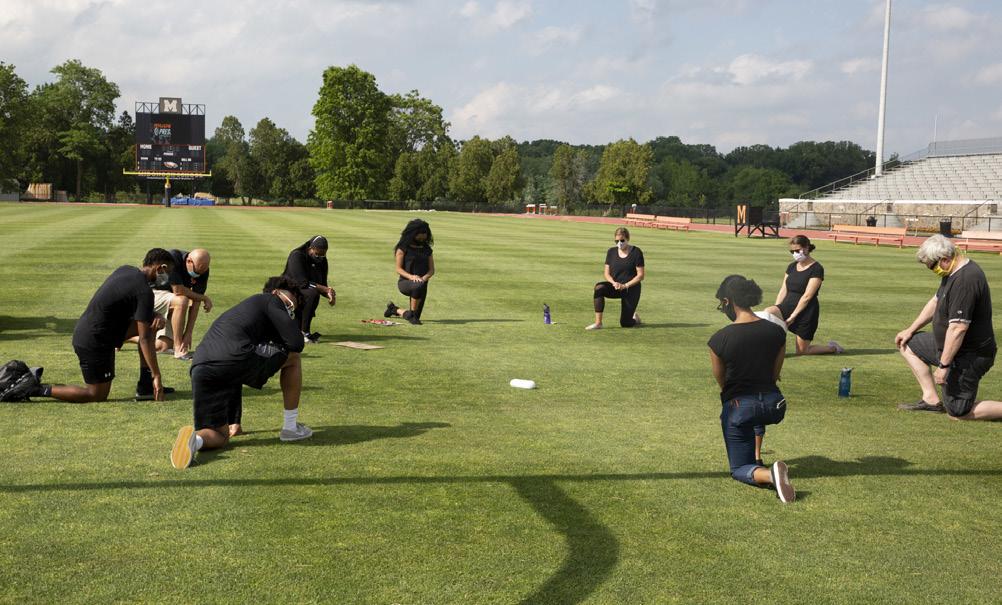
In 2020, the ceremony was renamed Dedication Day. While it maintains the tradition of fostering gratitude by recognizing John McDonogh’s bequest and vision for the School, it also honors the contributions of his enslaved people and the Indigenous people who once lived on the land. Deceased members of the McDonogh Family continue to be remembered on Dedication Day.
52. Headmaster Bob Lamborn ’35: A Legacy of Leadership
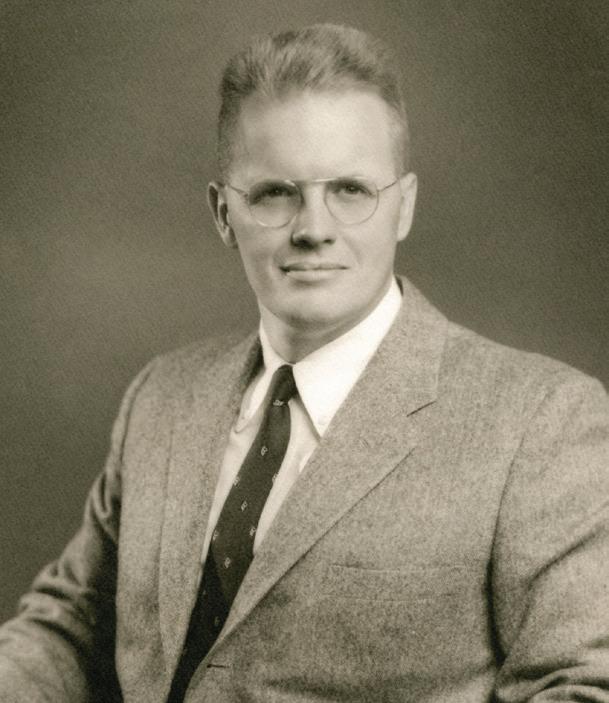
Dr. Robert L. “Bob” Lamborn, a graduate of the Class of 1935 and Headmaster of McDonogh from 1952 to 1972, was a visionary leader who had a profound impact on the life of the School. The son of Louis E. “Doc” Lamborn, Headmaster of McDonogh from 1926 to 1952, Bob arrived on campus at the age of seven. He spent his time exploring and playing, riding his pony, and attending a special class created for him and three other boys who, at the time, were too young to attend regular classes. The young Lamborn demonstrated leadership skills early on, attending meetings of the Board of Trustees at age nine, and serving as the Recording Secretary of the Board by the time he was 14.
served the School as Headmaster until 1972 and led it through turbulent times. All the while, he never lost sight of his goal of making McDonogh “the best place for a young man to grow.”
He graduated from McDonogh in 1935, earning his diploma one year early by skipping his junior year. In his senior year, he took extra courses as well as college coursework at Johns Hopkins University, and by the end of the summer of 1935, he had completed high school and the first year of college. Bob moved on to Stanford University and graduated with an A.B. in Philosophy in 1938 as a member of Phi Beta Kappa. The following year, he enrolled at Harvard University to pursue an M.Ed. in Secondary School Administration.
Under his leadership, the School’s academic program improved significantly and focused primarily on preparing students for college. McDonogh also adopted the “4-4-4 Plan,” creating Lower, Middle, and Upper schools of four grades each, which paved the way for the national middle school movement.
Lamborn also oversaw racial integration at McDonogh as well as the School’s conversion from a military to a civilian model. In addition, he laid the groundwork for the admission of female students. During his tenure, several new buildings, faculty housing, and athletic fields were constructed to support the School’s growth.
Lamborn returned to McDonogh in 1941 and, with the exception of three years in the military (1943-1946), gained experience in various academic and administrative capacities under his father, who he succeeded on Commencement Day in 1952. He
Looking back on his career at McDonogh, Lamborn said, “I am most proud of the fact that my father and I took McDonogh from what it was in 1926 to what it was in 1972. We had, between us, the second halfcentury of the School’s existence. We made a mutual pledge that we would do as much as we could for McDonogh as long as we were permitted to have a chance. Each of us was credited with saving the School once, through three wars and the Depression. I want it to be considered as a joint undertaking between Doc and Bob.”
Read more in the Summer 2016 and the Summer/Fall 2021 issues of McDonogh Magazine.
Pin Ceremony Signifies Higher Status
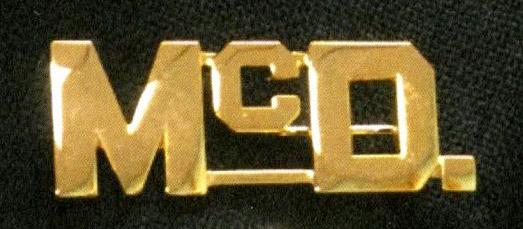
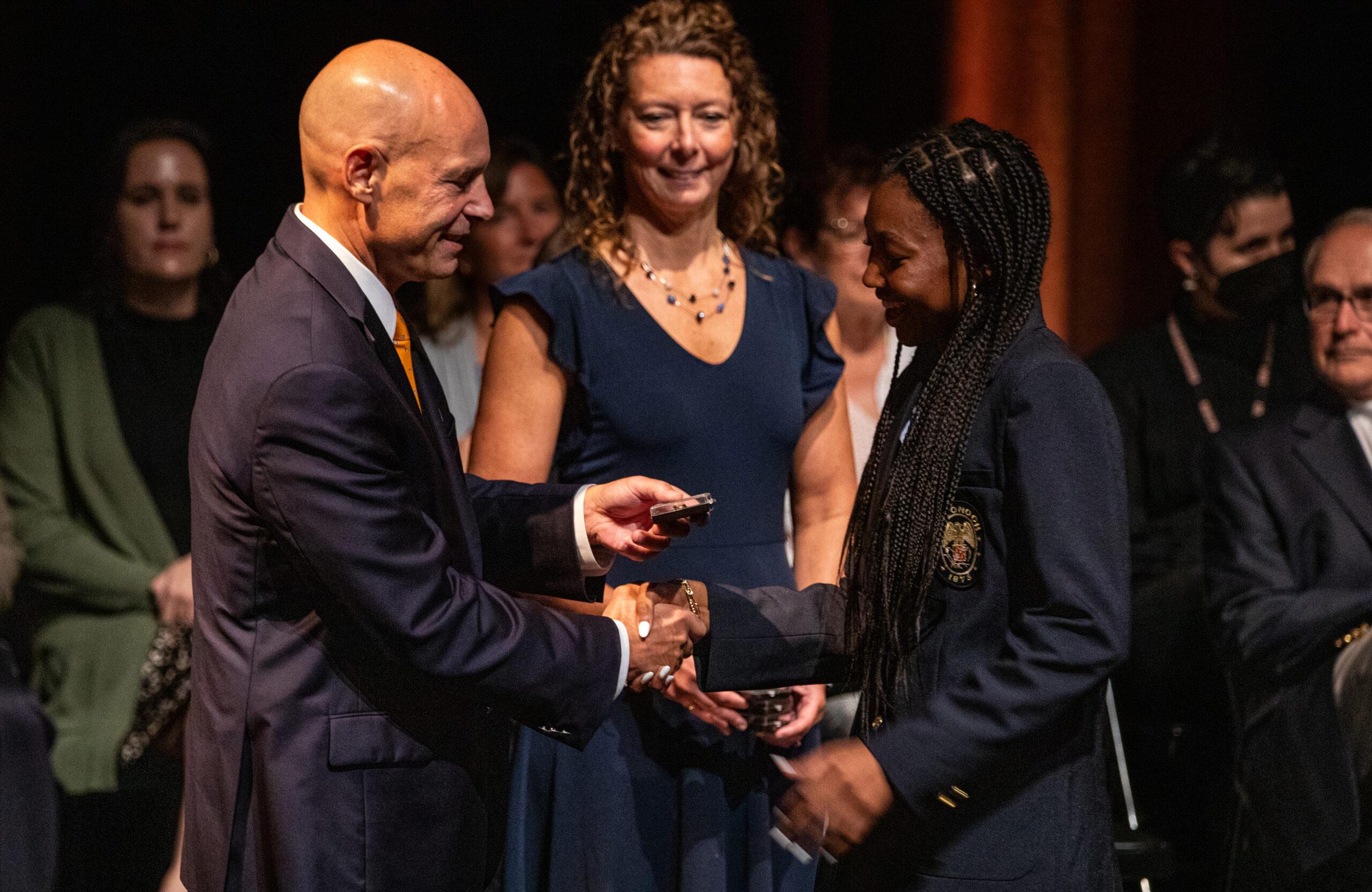
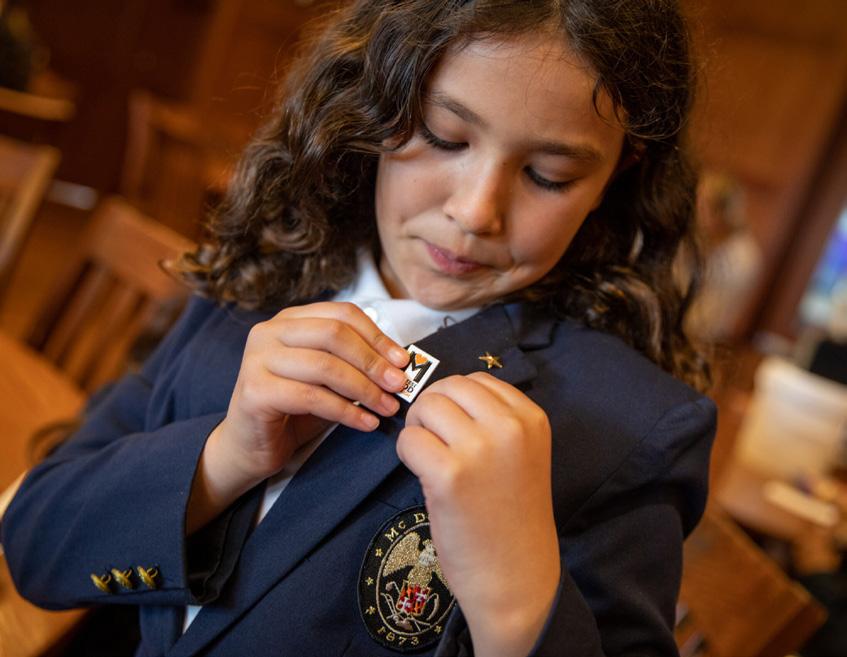
Becoming a McDonogh upperclassman is a rite of passage, signified by the presentation of gold “McD” lapel pins at the annual Junior Pin Ceremony. The tradition grew out of a junior ring ceremony that originated in 1987. Juniors who ordered school rings received them in a ceremony that was followed by a dance. Within a few years, in an effort to be more inclusive, juniors who did not order rings were given pins to mark their status. Soon, the ceremony evolved into the presentation of McD pins only to every member of the junior class. The special occasion also included a dinner in which teachers served their students. While aspects of the juniors’ rite of passage have changed, the Junior Pin Ceremony continues to signify their status as upperclassmen and women.
54. Prekindergarten Welcomes Little Eagles
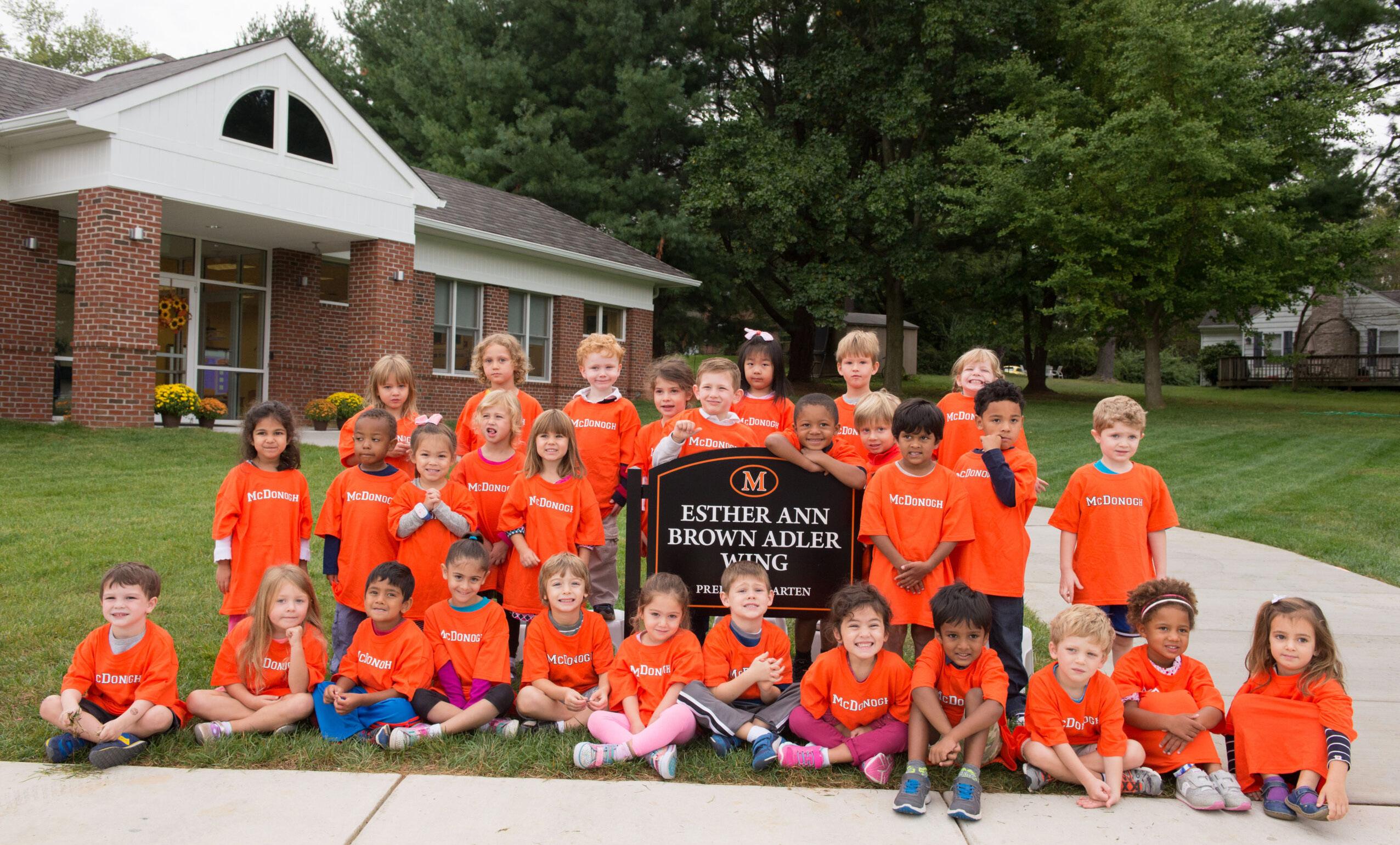
In the fall of 2015, McDonogh’s prekindergarten was born! The decision to expand McDonogh from a K-12 to a PK-12 school was the result of increased interest among current and prospective parents. Lower School teachers and administrators believed four-year-old children would be best prepared for McDonogh’s kindergarten if they were acclimated to our campus and had the opportunity to develop the ”school readiness” needed for future success.
Heating the Older Campus Buildings
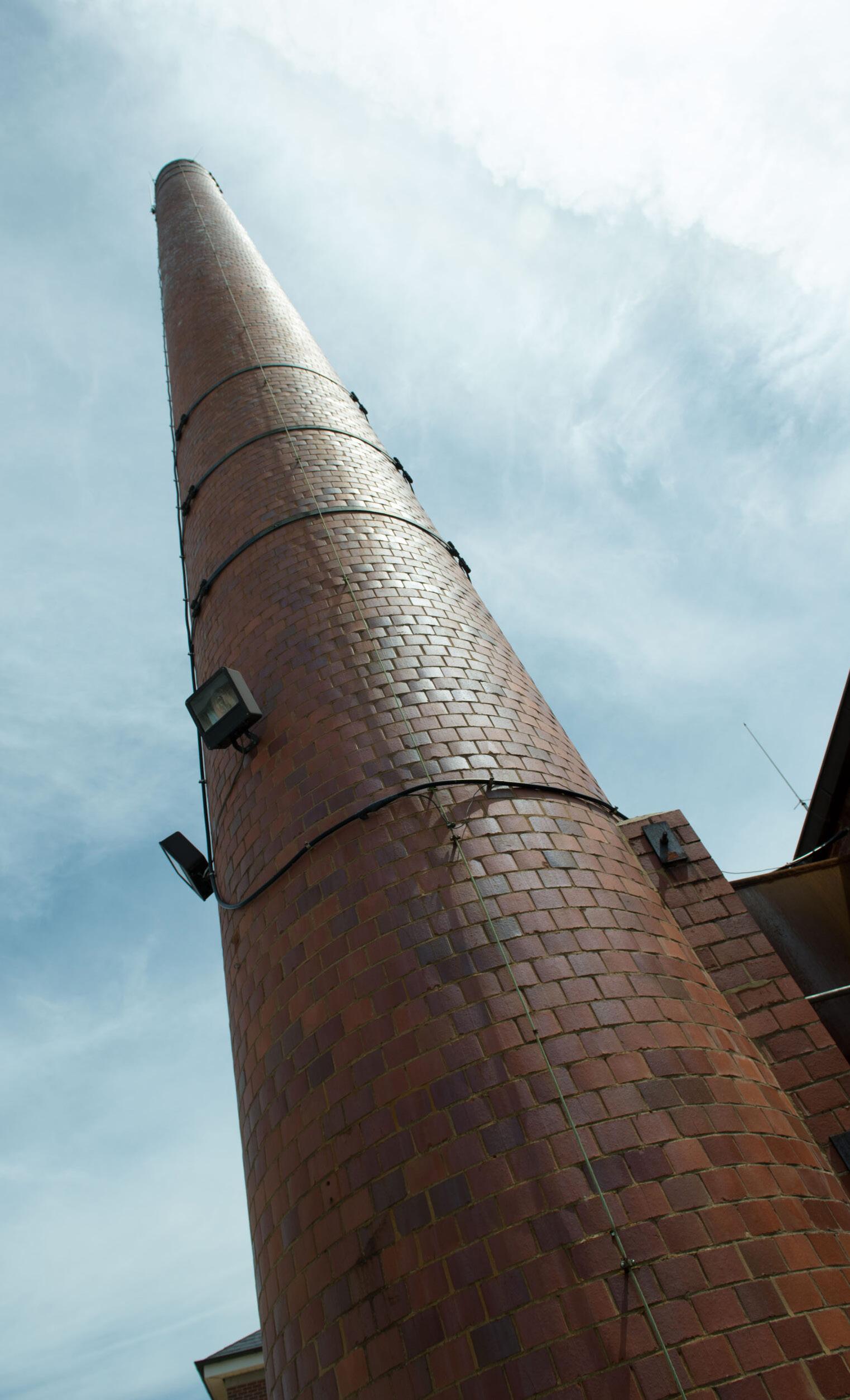
McDonogh’s original boiler room was built in two phases (1937 and 1964) to heat the older buildings on campus. The adjacent smokestack, at 115 feet, was higher than the roofline of Allan Building so that the fumes wouldn’t blow into the dormer windows. Allan Building’s complex heating and ventilation system included fireplaces, wall grates, transom windows, and steam pipes. Together, they allowed air to circulate through the building, keeping it cool in an age without air conditioning.
Students weren’t the only ones who relied on the chimneys and the smokestack for heat. In the winter, turkey vultures often huddled on the tops for warmth. A small door at the base of the smokestack was inscribed with the reminder to “remove all dust once a week.” Occasionally, during the smokestack cleaning, a bird that had been warming itself on the top would be found inside at the bottom.
On September 18, 2019, an explosion occurred in the School’s boiler room while work was being performed by an outside contractor. The explosion caused the partial collapse of the smokestack. The smokestack remnants were removed later in the year.
Samuel Tagart: The Key to the School’s Opening
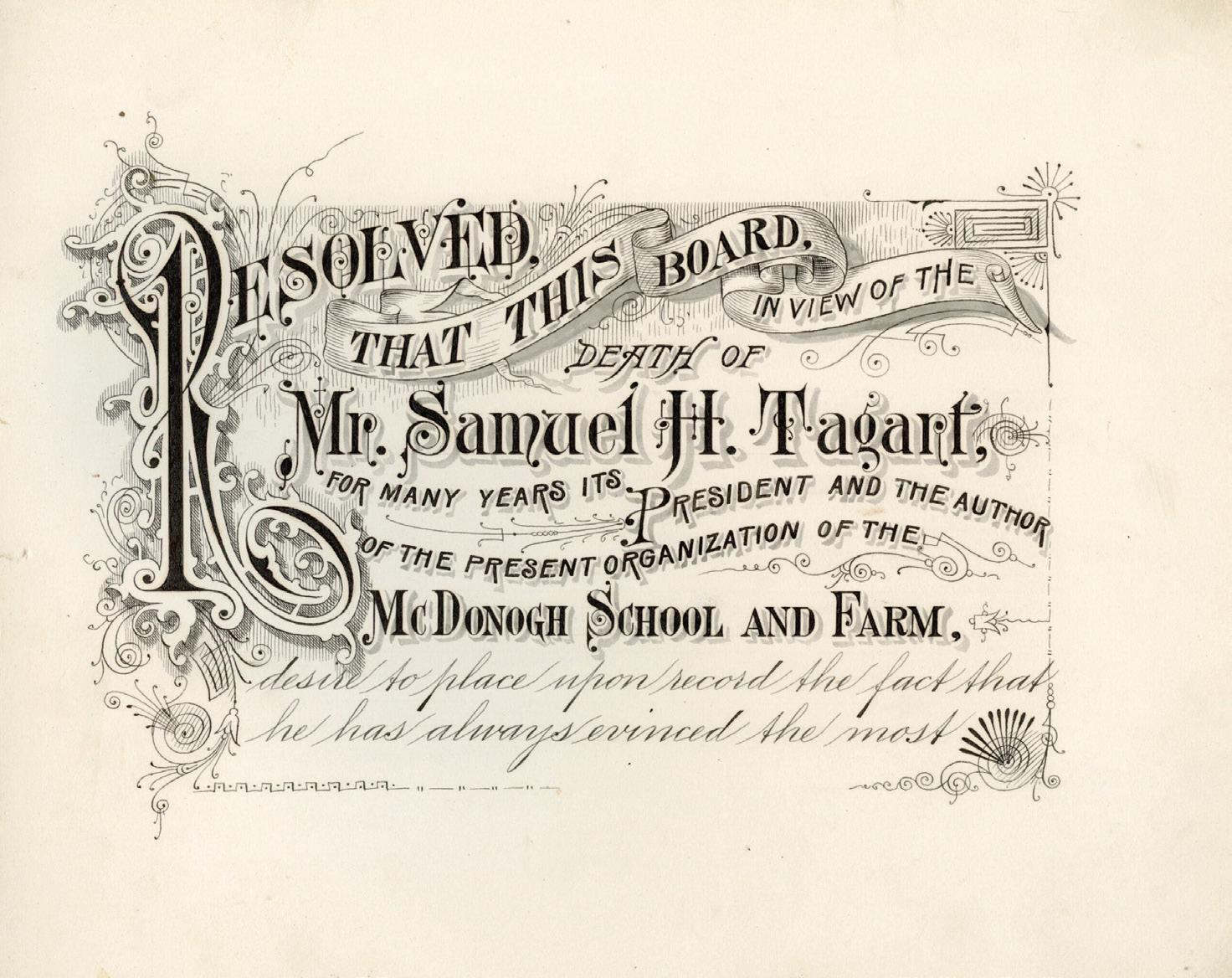
A member of the Baltimore City Council, Samuel H. Tagart was the main catalyst behind the ordinance that resulted in the establishment of McDonogh School. Less than a year after becoming a member of the School’s Board of Trustees, he was elected President, and under his leadership, Colonel Allan became the first Principal. Tagart served on a variety of committees and held the role of treasurer for 19 years. Upon his death in 1892, his entire estate ($80,000) was bequeathed to the School and provided much-needed support. Tagart Memorial Chapel, dedicated in 1898, was named for him.
Hundreds Program Creates Connections Between Older and Younger Students
The Hundreds program is rooted in McDonogh’s early history when each new boy who entered the School was given a number and assigned to the student 100 numbers above him. For example, student 143, who was mentored by student 43, was assigned to look after student 243. The older student would help the younger by supporting many parts of his life as a McDonogh cadet. During World War II, current students and alumni were encouraged to write to those in their hundredth group who were serving in the armed forces as a way to cheer them up. As the School grew in numbers, it became impossible to maintain the tradition which went away in the early 1950s. In 2015, the Hundreds was reinvented as a way to develop positive relationships among freshmen and seniors. Today, rising freshmen are matched with rising seniors who serve informally as big brothers or big sisters.
Students Earn Credits and Debits for Behavior
In 1874, “Old Man” Lyle developed the demerit and credit system called the “worklist.” Infractions included everything from a missing uniform button or dirty hands during military inspection to swiping a piece of fruit from a teacher’s favorite tree. Credits had negotiable value, and students could purchase them from each other until 1925.
Bob Lamborn recalled that the Commandant decided if the infractions were valid and assigned demerits. Boys worked off the demerits by doing menial tasks (raking leaves, sweeping walks and halls) during athletics and on weekends. As the School grew there were more boys and more demerits to be worked off. Instead of doing tasks, boys could work off the demerits by doing “walking tours” around the circle in front of Old Main 15 times. With so many boys running/walking in circles, it was hard to keep track of their laps. The punishment was changed, and the boys were required to run to the railroad station, pick up a slip from the officer stationed there, and present it upon their return to campus.
Demise of the Military Program: The End of an Era
In the 1960s, student recruitment had become more challenging due to the School’s military status. After an exhaustive study, the Board voted on January 21, 1970, to retain the semi-military program to protect the uniqueness of the School. Throughout the next year, the trustees and administration continued to reconsider their decision. After several votes on the military question, on April 6, 1971, the Board voted 9-1 to discontinue the program. Beale Rollins cast the only vote in opposition.
In letters to the alumni and parents, Acting President of the Board of Trustees Dr. Albert Dudley, Jr. and Headmaster Dr. Robert L. Lamborn explained the decision saying, “The military image is presenting an increasingly difficult problem to us in our efforts to recruit students and to maintain a high level of student morale.” According to the letter, “The military image also presented a problem in recruiting suitable instructors and in obtaining college admissions for graduates in areas where McDonogh is not well known.”
An article in the April 30, 1971, issue of The Week reported, “On April 8, 1971, Dr. Lamborn made the announcement of the decision to the Upper School, faculty, and staff. Although the re-evaluation of the military was a surprise to the majority of those in the audience, the initial response to the alteration was not nearly as surprising: The announcement received a standing ovation from an overwhelming majority of those in
59.
attendance. Dr. Lamborn said his reaction was ‘a sense of loss for the end of a long and distinguished tradition’, but when measured against the widespread problems facing independent schools throughout the nation, he felt that the conclusion of McDonogh’s military ‘would be good for McDonogh and strengthen its educational mission.’”
The article in The Week went on to explain what the changes would look like. “Beginning with the 1971 fall term, students will no longer be required to wear military-style uniforms; the cadet corps and military designation for student leaders will be eliminated, the drill sessions in the fall and spring will be discontinued along with special parades, reviews, and military activities, and military formations will be disbanded.”
The article continued, “In his announcement on April 8, Dr. Lamborn stressed that each member of the McDonogh community must support the change, for only through a concerted effort from all factions of the school can such a major change be successfully maneuvered.”
It concluded, “In this ever-changing world, McDonogh solidly feels that this tremendous alteration in the school’s system will aid in maintaining the high traditional standards of McDonogh, benefiting each and every member of the McDonogh Family who commits himself in support of the new McDonogh.”
Walnut Day: An Annual School Holiday
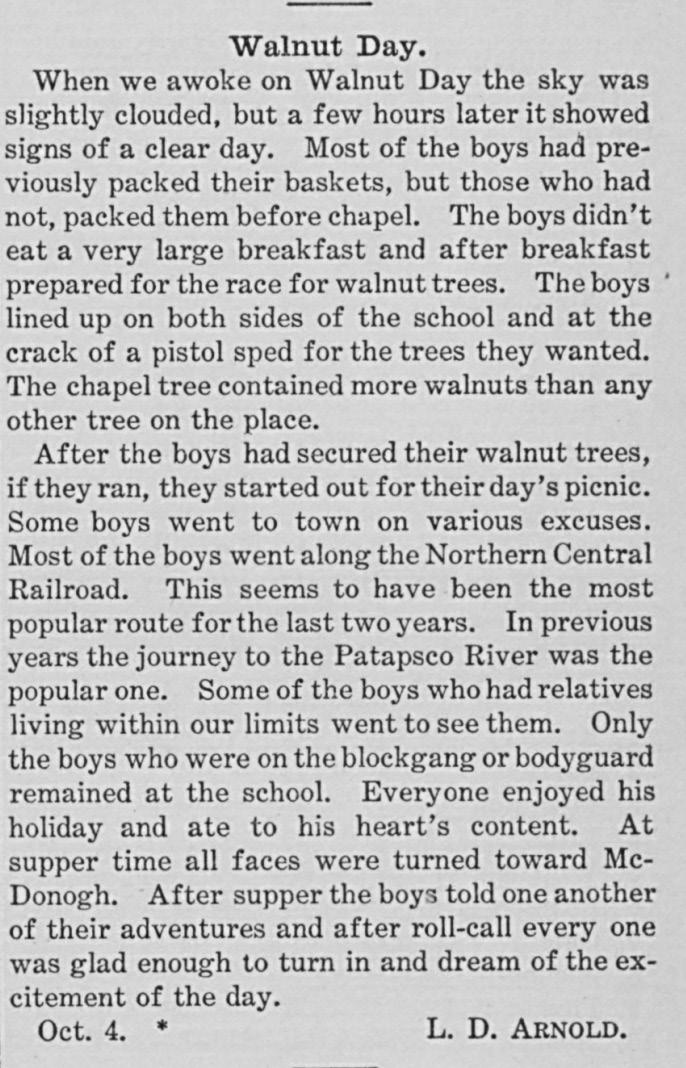
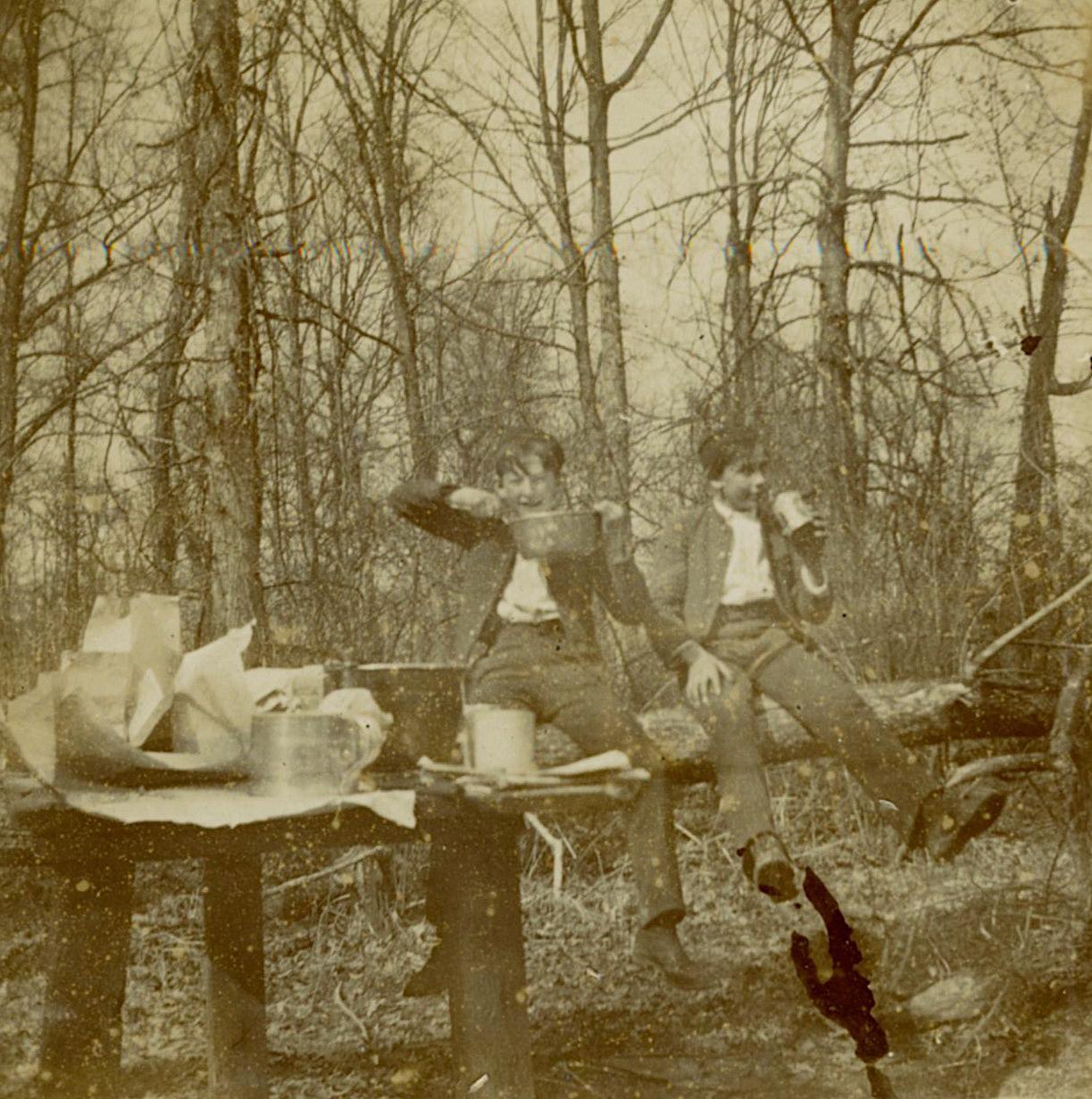
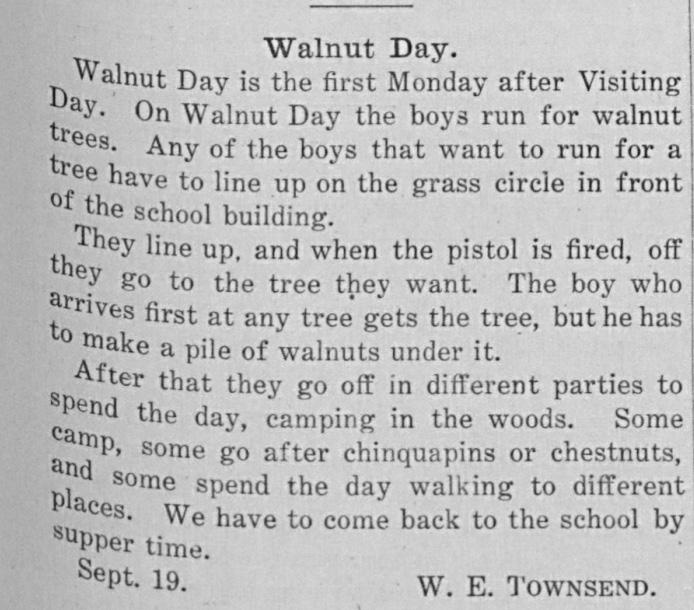
For years, one of the most anticipated days of the year was Walnut Day. A designated holiday each autumn, it was a popular competition to collect the most walnuts from the campus trees. Several weeks before the holiday, the boys hunted for the fullest trees on campus. When Walnut Day arrived, on a signal from the principal, they ran for their trees and collected the ripe nuts by shaking them from the branches.
After gathering bushels and bushels, they hulled them and put them away to dry. The hulling process left the boys with black stains on their hands for days. The walnuts were generally kept until the winter when the boys gave them to the squirrels or used them to make taffy. Because it was a school holiday, after they had collected nuts, the boys spent the rest of the day exploring, camping, and hiking in the woods.
McDonogh vs. Gilman: A Rivalry for the Ages
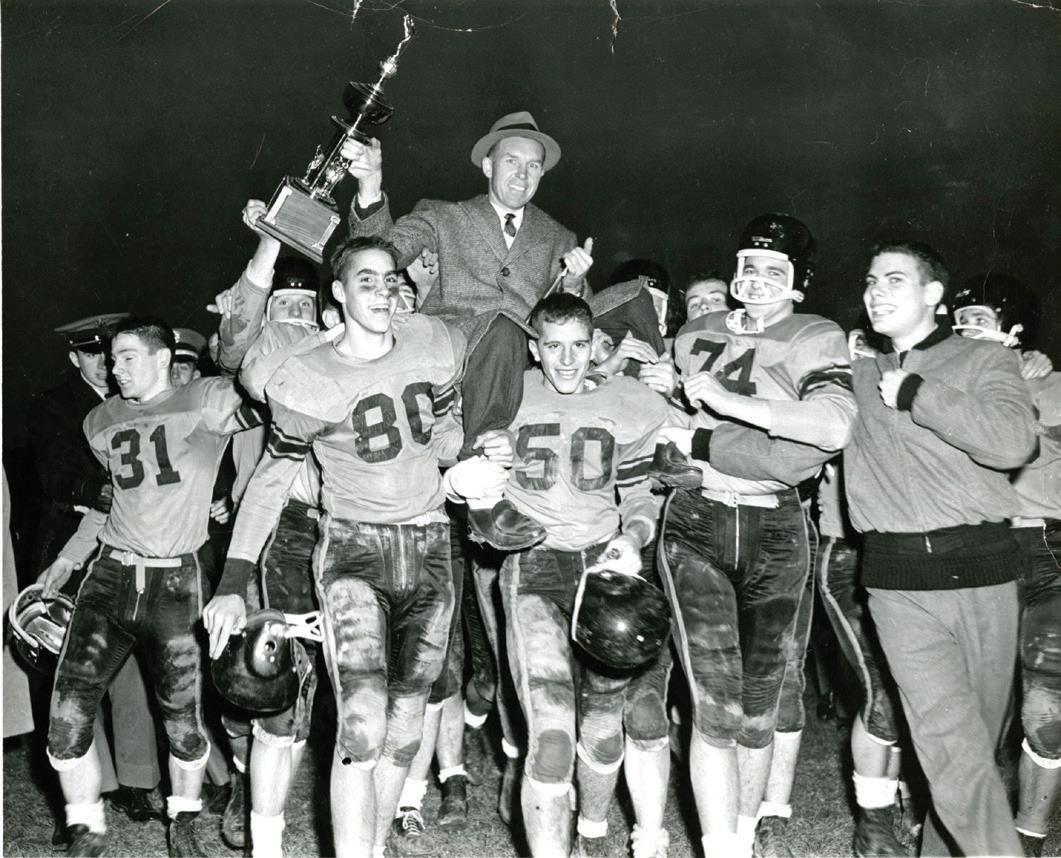
The annual McDonogh vs. Gilman football game, the second oldest interscholastic rivalry in the state of Maryland was first played at Gilman on October 12, 1914. Gilman was victorious that day, 35-0. McDonogh’s first victory came in 1927.
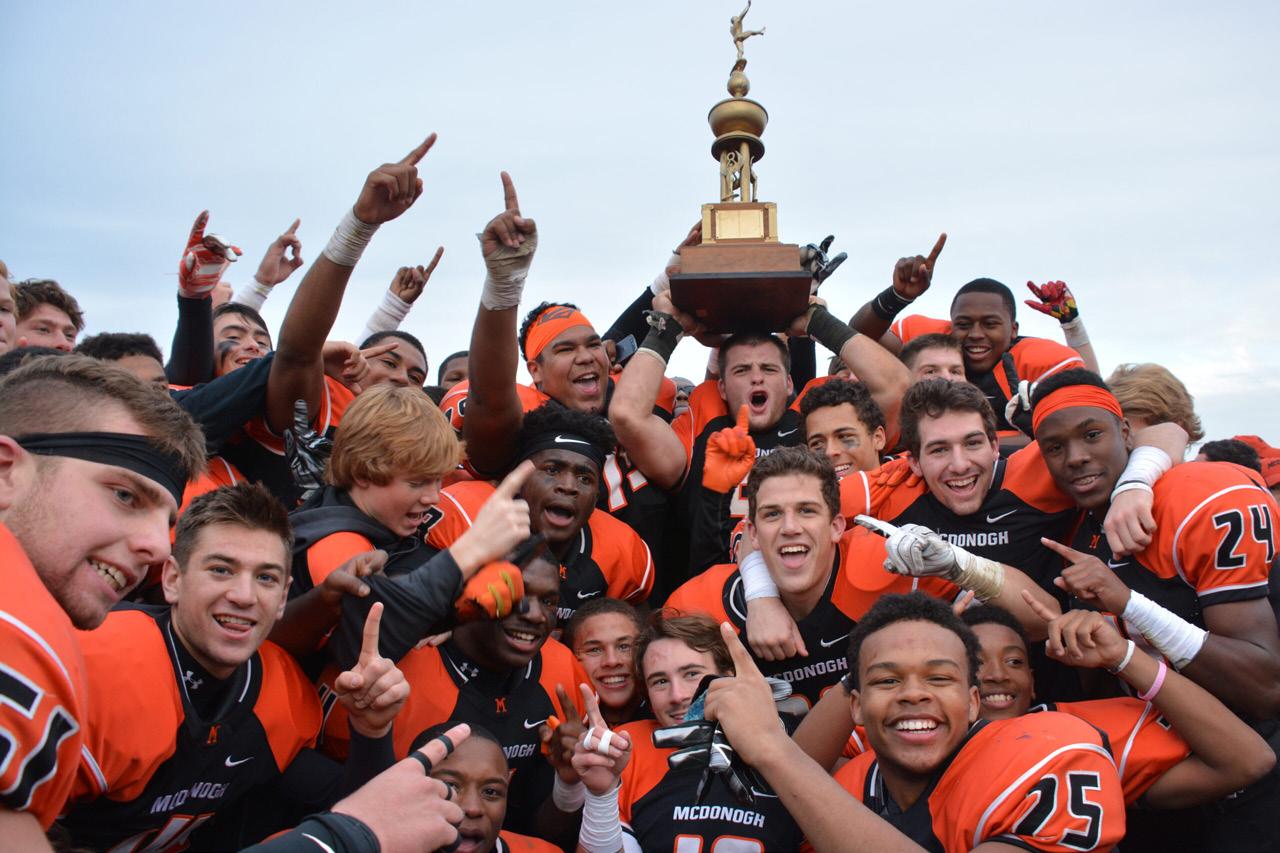
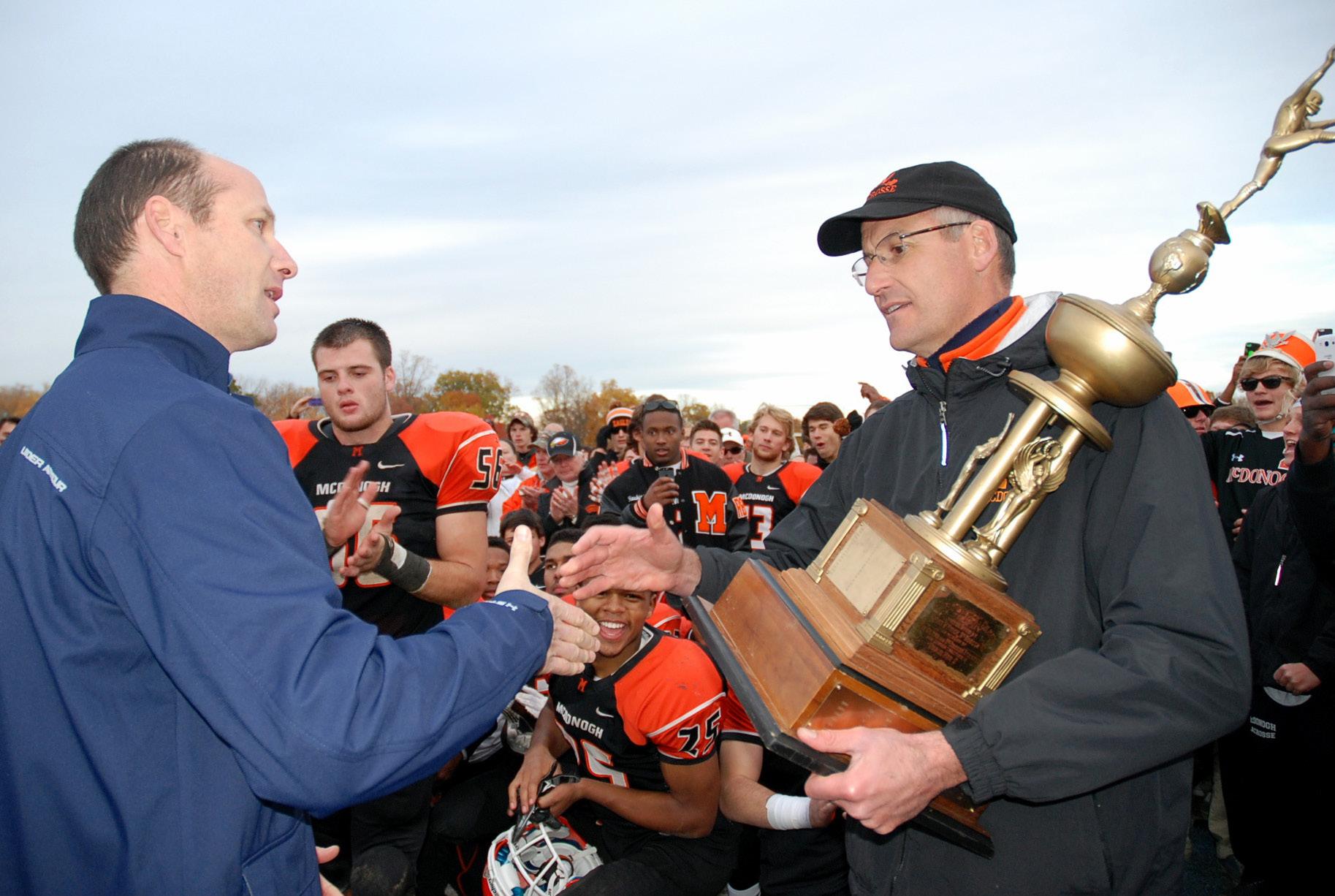
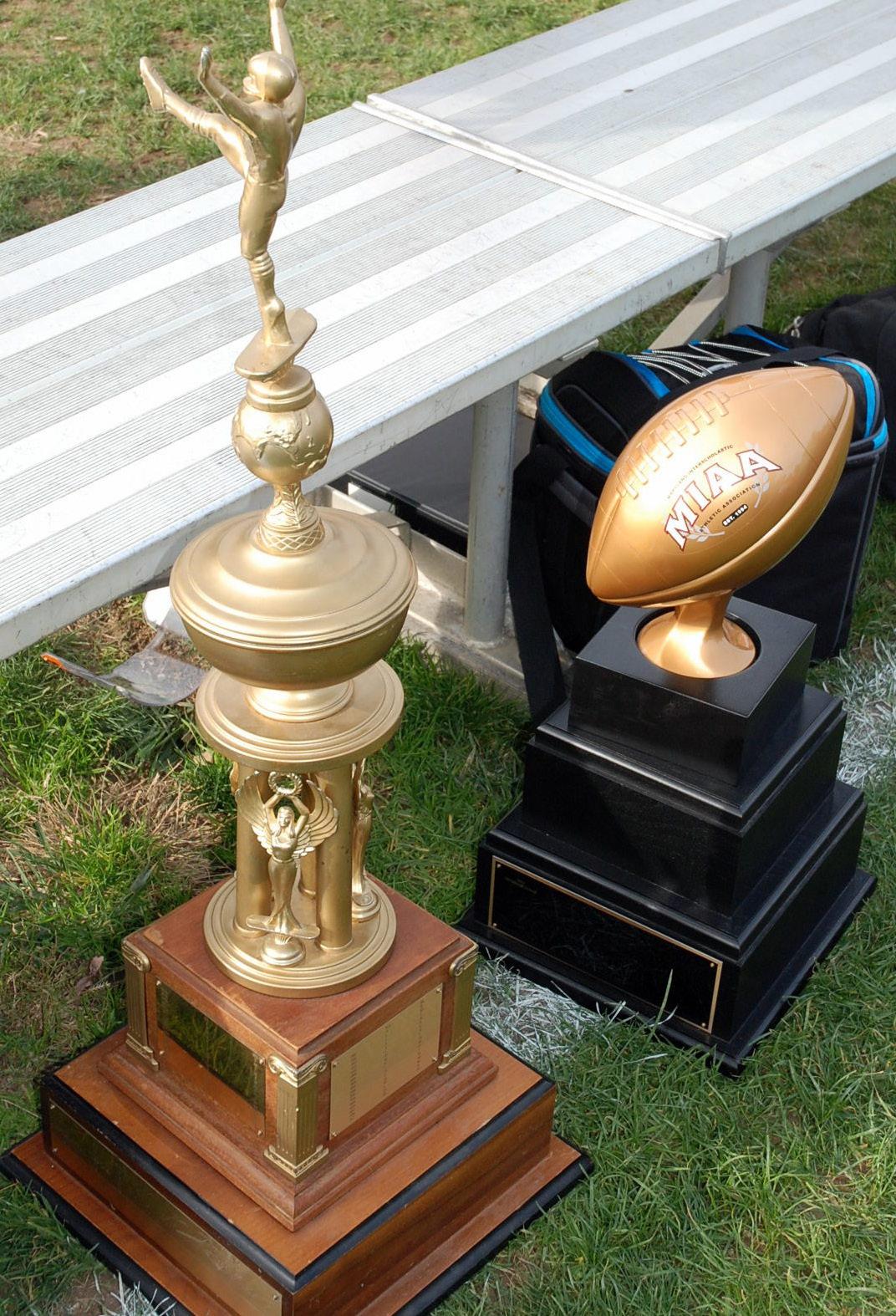
For the thousands of fans who attended the 47th McDonoghGilman game on November 22, 1963, it was a day they will never forget. That afternoon, shortly before kickoff at John McDonogh Stadium, the crowd of 4,000 was learning of the assassination of President John F. Kennedy. Both schools agreed to play the game, and although McDonogh won by a point in the low-scoring game, the outcome felt inconsequential.
Norman Parker ’73 recalled, “Decorating the buses was always a big deal and very exciting when we were young. Everyone competed to win the prize for the best bus decorations leading up to the Gilman game.”
An estimated 1,100 fans filled John McDonogh Stadium for the 100th game of the rivalry on November 7, 2015. While the score of the game was close (35-28) with Gilman earning the victory, the spectacular day-long celebration hosted by McDonogh was most memorable.
62.
We Love a Parade
McDonogh’s annual Spirit Parade, held the day before the football game against time-honored archrival Gilman, isn’t your typical parade. Sure, it has costumes, floats, bands, and more orange and black than imaginable, but it is also one in which spectators are participants and participants are spectators. The one-of-a-kind, double-self-enveloping spirit parade, designed by longtime faculty member Dave Harley, winds its way around campus and ends with an all-school pep rally.
For years, when Gilman hosted the game, the Eagles made their presence known when students, faculty, and alumni—a sea of festive orange and black—marched over the bridge from Bryn Mawr to Gilman led by drums, bagpipes, and, of course, Mr. Harley.
The Price Memorial Trophy
First presented in 1947 by David W. Price ’42 to the winner of the McDonogh vs. Gilman game, the Price Memorial Trophy was a memorial to the graduates of the two schools who fought together in World War II. Henry H. Callard, Gilman’s Headmaster at the time, said, “The two schools have very much in common, even though we fight it out for all we are worth on the athletic field. The War did a great deal to bring boys together, and I
like to think that athletic contests will be followed by a friendly spirit and mutual interests.”
The winning school keeps the Price trophy until the next year. In the case of a tie score, as happened in 1957, each school holds the trophy for half a year, and a coin toss determines which team has the trophy for the first six months.
64.
The Distinguished Service Award
Honors Devotion to McDonogh
Started in 1960, the Distinguished Service Award recognizes members of the McDonogh Family (alumni, parents, grandparents, or retired faculty and staff members) who have devoted their time and effort most generously on behalf of McDonogh students, the School, and/or the Alumni or Parents Association. Particular emphasis is placed on individuals who have made a significant and positive impact on the School, demonstrated exceptional dedication, and consistently go above and beyond the call of duty for the good of the School. From bus drivers and Heads of School to alumni who are heads of industry, there have been more than 160 honorees.
Visit mcdonogh.org to learn more.
Teaching Students to Do the Greatest Good
Greatest Good McDonogh teaches students in all grades the best practices in service-learning, philanthropy, community engagement, and social innovation through integrated coursework and experiential learning. The program is designed to inspire students to find their purpose, grow their empathy, and realize their power and potential to do the greatest good in the world. As a result of the program, the focus of our service efforts has shifted from hours to outcomes, from one-way partnerships to reciprocal relationships, and from transactional to transformational experiences.
Announced in December 2019 and modeled after the Do Good Institute at the University of Maryland, Greatest Good McDonogh aligns with LifeReady, the School’s framework for learning. The program was founded with an endowed commitment and partnership supported by David Rothschild ’82 and the Rothschild Foundations—which are committed to advancing educational initiatives that inspire philanthropic and social engagement.
Visit mcdonogh.org to learn more.
66. Integration at McDonogh
Integration at McDonogh began in 1959 with the admission of the first Black student, John Milton Belcher III, as a first grader. However, the School was not fully integrated until 1971. Over those 11 years, each year the School opened an additional grade to Black applicants.
Following the 1954 Supreme Court decision Brown v. the Board of Education, McDonogh School felt increased pressure to admit Black students. At the time, Headmaster Bob Lamborn spoke about the pros and cons of integration noting, “We will be acting in accord with the sense of our national conscience and the American concept of social justice.” Adding, “It will cost us some support among our patrons and alumni—but it may well be not as great as we are inclined to think.”
In January 1959, the application of John Milton Belcher III brought the matter of integration before the Board, and the Trustees approved “the acceptance of qualified Negro students in the first grade, beginning with the school year 1959-60.”
The next month, on February 12, 1959, after informing the Patrons Club, Alumni Executive Council, faculty and staff, and finally the student body, Lamborn sent a letter to the rest of the community outlining the School’s gradual integration plan. In it, he noted the five principal considerations that led to the Board’s decision. The first was that the decision was “in accord with [John] McDonogh’s will” and second, that the School was “subject to the impact of the Supreme Court rulings on school integration.” The third point was: “In spite of the concerns which we may have as individuals, the Board feels that integration is in accord with the sense of our national conscience and the American concept of social justice.” Next, based on meetings with the Executive Committee and the Patrons Club and the Executive Council of the Alumni Association, the Board agreed that “integration would come in time, that the school should meet the problem in a dignified and constructive manner,
that there were worthwhile educational values to be gained from an experience in a soundly integrated school.” The final consideration was that the gradual integration plan “provides the greatest possible protection for those present patrons and students who may find it difficult to make the adjustment required by the change in policy.”
Lamborn concluded, “The board has made this decision with sympathetic concern for those who will find it difficult to accept but with a firm conviction that the decision is proper and the timing right. It asks the support of patrons, alumni, students, faculty and staff, and friends, as it takes this important step in keeping with the times—a step which many feel will prepare future McDonogh graduates to live more effectively in the world of their generation.”
A few months later, in September of 1959, John Milton Belcher III entered the first grade as the first, and only at that time, Black student. In June of 1971, he graduated and became McDonogh’s first Black alumnus.
Dining Halls Serve Meals and Memories
Throughout the School’s history, the dining halls have not only provided sustenance, they have also been places for faculty and students to connect and forge meaningful relationships. From the Trustees Extension in Foxleigh Mansion to Paterakis Hall in the Edward St. John Student Center, mealtime has always been a highlight of the day.
Prior to the opening of Lamborn Hall in the spring of 1960, students ate their meals in the cramped 362-seat dining room located in the east wing of Allan Building (currently the Kiplinger Library).
Although the brick façade of Lamborn Hall matched that of the other buildings on campus, the use of aluminum, glass, and steel gave the flat-roofed structure a modern feel. With a seating capacity of 500, it was named in honor of Major Louis E. “Doc” Lamborn, Headmaster Emeritus, who was present for the first official meal. The dining hall was dedicated on Memorial Day,
several months after it became operational. By that time, it was already affectionately being called “Doc’s Diner.”
As Lamborn Hall aged and the School began to outgrow the space, its post-war utilitarian design became even more apparent. “There was nothing intentional about the design of Lamborn. They needed to build frugally,” says Jon Aaron ’72 who witnessed the cafeteria’s first and last days. The austere cinder block and steel interior didn’t have what Aaron calls the “Allan effect,” the evocative feeling synonymous with Allan Building.
In 2013, Paterakis Hall, a striking Middle and Upper School dining room opened in the newly constructed Edward St. John Student Center. (Lower schoolers enjoy lunch in Esther Ann Dining Hall on the first floor of the Student Center.) In contrast to Lamborn Hall, architectural elements in Paterakis Hall include a vaulted ceiling, fireplace, and balcony. One of the most unique features of the room is the series of acrylic wall panels featuring the names of alumni dating from 1875 to the present.
Read morea bout Lamborn Hall in the Summer 2014 issue of McDonogh Magazine.
The Evolution of Student Government
At the School’s founding, Colonel Allan organized the student government using the military chain-of-command model he knew well. This worked for a number of years in form, but not in substance. When William Childs became principal, he worked to tighten things up. He visited several well-established military schools, and when he returned, emphasized a “spit-and-polish” military decorum. A Commandant was appointed to head the program, and he was assisted by cadet officers. The officers conducted drills and oversaw all aspects of student conduct (behavior, morning work assignments, uniform, and other matters). According to Bob Lamborn, the officers reported infractions to the Commandant on slips from small pads the boys called “slugging pads.” Boys who were reported were “slugged.”
When the military was dropped in 1971, the student government was restructured. Student officers became proctors and the lead proctor was the President of the Student Government. An article in the March 2, 1973, edition of The Week explained the structure, “At present, the Student Council is composed of proctors, captains of teams in season, and certain activity
heads. Proctors are selected according to student preference, as expressed in an election during the fifth report period.
The ballot is a list of all boarders or day students of a voter’s class, upon which a student numbers his top few choices. In addition, he indicates his choices for those seniors he thinks should receive posts on the Executive Committee. The proctors elected by this method serve as representatives on the council, supervisors of dorms or day buses, and in general help enforce the rules of the school.”
The Student Council has evolved over the years to meet the needs and expectations of the School community. Today, the Student Government Association (SGA) leaders are elected by their peers and are responsible for directing many activities.
The SGA consults with and advises the School administration with regard to the establishment and implementation of operating policy in all areas related to student affairs. In addition, student leaders are expected to be strong role models for the rest of the student body.
Parent Organizations Provide Support
The McDonogh Mothers’ Club was formally organized on October 13, 1923, by a group of McDonogh mothers whose objective was to support the School, mainly through financial contributions. One of their first acts was to present the School with a bus because, according to Bob Lamborn, on Visiting Days they had to take streetcars from downtown to the point on “The Pike” (Reisterstown Road) where it met “The Lane” (McDonogh Road) and then walk to the school. “Eventually, the mothers got tired of walking the lane and bought the School’s first bus,” he said.
Over the years, the Mothers Club provided the School with funds for new band instruments, grandstands for the drill field, and the outdoor swimming pool. It hosted large events, including oyster suppers, card parties, and later the Christmas Bazaar, to raise funds for these projects.
In 1931, when a father was elected president, the club reorganized and was renamed the McDonogh Patrons’ Club. The renaming also provided an opportunity for people with no connection to the School to support the fundraising efforts after the 1928 fire in Main Building. In addition to routinely making significant financial contributions to the School, the Patrons Club Executive Board provided valuable input on important decisions that shaped the School’s policy on coeducation, racial integration, dress code, college counseling, underage alcohol and drug use, the value of athletics, and more.
In 2006, the Patrons Club was renamed the McDonogh Parents Association (MPA). The mission of the group is to foster a trusting partnership between the parents and the School through communication, parent education, and community interaction. The MPA also works to create a warm, welcoming, and inclusive community for all McDonogh families.
70. Milestone Anniversaries: A Cause for Celebration
The founding of McDonogh School on November 21, 1873, has always been a cause for celebration. In the early years, it was marked by Founder’s Day—an opportunity to recognize the official opening of the School, the architects of its structure, and the first students. John McDonogh, who died more than two decades before the School’s founding, was recognized on John McDonogh Day. Later the two events were combined. (See story No. 51 for the evolution of Founder’s Day.)
By the 25th Anniversary in 1898, Founder’s Day was well established and, as was tradition, alumni returned to campus for a day of speeches, reunions, and a turkey dinner. In 1923, the Alumni Association, whose mission was to host events and keep alumni engaged, was tasked with planning the 50th Anniversary celebration. The Week reported that in preparation for the celebration, the boys spent the week before “tidying up the place” in anticipation of the alumni who were expected to attend the celebration. The festivities began at 10:45 a.m. on Wednesday, November 21 with a dress parade by the cadet corps, followed by a Founder’s Day meal. The afternoon was devoted to speeches, a march of the alumni classes, a turkey dinner, songfest, the tapping of a barrel of one-dayold McDonogh cider, and a scoreless tie between two alumni football teams. The Mayor of Baltimore accepted an invitation to attend the celebration and was quoted in the Sunday Sun newspaper saying, “I am deeply interested in educational institutions, and have a warm spot in my heart for McDonogh which has done splendid work for orphan boys.”
The December 1, 1923, issue of The Week hailed the celebration as a “great and glorious day” and reported that William Irvine
James (1877), one of the original 21 students, gave a speech “full of wit and humor” as he made “McDonogh of the 70s actually come alive again.” After dinner, there was a “smoker” during which cigars and cigarettes were available to alumni to enjoy while they talked about old times.
Building on the success of the 50th Anniversary, the Alumni Association planned the 75th Anniversary or Diamond Jubilee. Despite the elegant name, informality was the theme. Several thousand alumni were expected to attend a weekendlong celebration in 1948 and every “old boy” was offered accommodations on campus. For historical purposes, they were asked to bring old uniforms, equipment, and issues of The Week. They were also encouraged to bring a camera to take pictures of the “campus and people they had not seen in a while.”
Among the highlights of the weekend was the laying of the Memorial Field House cornerstone on Saturday, November 20. In attendance were the fathers of two McDonogh alumni who died in World War II. During halftime of the McDonogh vs. Severn football game, alumni filled the field behind their class banners and pennants. That evening, after a buffet dinner in the dining room, the alumni gathered in the gym for a showing of the McDonogh movie, musical routines, group songs with audience participation, and the reading of fictitious letters from boys to their parents. Guests awoke on Sunday morning to the sound of cannons and bugles.
In celebration of McDonogh’s 90th Anniversary in 1963, the Board of Trustees launched a fundraising campaign to support physical improvements to the School, namely the construction of the Lower School building, later named Elderkin Hall, and an addition to Allan Building. The Leadership Committee for this campaign was the foundation for the McDonogh Fund.
The 100th Anniversary of the school in 1973 had elements of past celebrations, including speeches, a ceremony honoring alumni who died in World War II, a football game between McDonogh and Gilman (with a cross country meet at halftime), an alumni reception, and the Founder’s Day Dinner. The Mothers Club produced a cookbook, and other items such as a bumper sticker and a commemorative plate were available for sale.
In 1998, the School marked its 125th Anniversary with a celebration filled with opportunities to honor the past while recognizing progress. The year began with a gathering of the entire community for the dedication of the Clarence A. Burck Center for the Performing Arts. The ceremony featured the
laying of a cornerstone with a time capsule filled with artifacts from each division. Later in the fall, the Burck Center and the Ceres M. Horn Theatre officially debuted at a black-tie event for donors and special guests. The event showcased an alumni art exhibit and a revue starring a talented ensemble of students and performing arts alumni.
The 125th Anniversary is also remembered for the reenactment of McDonogh School’s opening day—November 21, 1873. Dressed in 19th-century garb, the student body, faculty, and staff watched as key figures responsible for the founding of the School—John McDonogh, Colonel Allan, Old Man Lyle, Josepha Young, and the original 21 boys—were brought to life. The day continued with a country fair for the Upper School featuring crafts, games, and food typical of the late 1800s.
A. Ludlam Michaux: Taking on the Role of President
In 1971, Lud Michaux, a former scholarship student from the Class of 1940, was appointed to serve in the newly created position of President. He was responsible for the operations of the School, including business management, budget development, and communications, while Headmaster Bob Lamborn focused on the School’s academic and guidance programs. When Lamborn resigned at the end of the 1971-1972
school year, Michaux assumed Lamborn’s responsibilities, retaining the title of President, and he began a term focused on athletics and discipline. He also worked to improve the financial condition of the School and hired a business manager and a transportation supervisor. On September 1, 1976, stating that he had accomplished the tasks he was appointed to resolve, he resigned.
72. Boarding Program Withstands the Test of Time
Once the only option for all students, McDonogh's boarding program has evolved in 150 years.
McDonogh was a boarding school from day one, and in the early years, students only returned home occasionally. In 1874, there were four Visiting Days—from 2:30 to 6:00 p.m. on the first Saturday of May, August, November, and February. Vacations or “furloughs” were brief and depended on a student’s class standing.
In the late 1800s, the daily schedule for children of all ages was grueling. One account from 1898 describes a typical day starting at 5:30 a.m. The cadets made their beds and took care of their clothing, shoes, trunks, and lockers, and after washing up and morning prayer, they had breakfast at 6:30 a.m. Instruction began at 7:30 a.m. and lasted until a mid-day meal at 1:00 p.m. Afternoon activities included work on the farm, in the garden, at the carpenter shop, or in the printing office. From 4:00 to 6:00 p.m., the boys had leisure time for games before their supper. Later, the time would be filled with sports and military drills.
After supper, they had night school—a time for studying and practicing mathematical problems. At 9:00 p.m., students returned to their dormitories, and lights were turned out at 10:00 p.m. By 1914, the daily schedule and conditions in the
dorms became less stringent. Younger boys were supervised by House Mothers, and everyone got more sleep.
In 1927, the Board formally authorized the admission of day students, and by September of that year, 20 were enrolled. Over the years, as the day student population grew, the number of boarders decreased. In 1961, the Lower School boarding program closed, and by 1978 the Middle School boarding program was phased out. Meanwhile, the 1975 admission of girls boosted boarding enrollment. The program continued to evolve, and in 1989, McDonogh became a five-day boarding school. With the change also came the addition of Rollins-Luetkemeyer scholars (a select group of senior leaders in the dorms) and the Campus Parents program in which campus residents welcome students into their homes for games and informal conversation.
Today, five-day boarding offers the best of both worlds. Upper schoolers enjoy all that the campus has to offer during the school week and enjoy family time at home over the weekend. Students find that living on campus makes it more convenient to participate in McDonogh’s many extracurricular activities and gives them opportunities to study, make new friends, and build community with campus residents. They also develop the independence, self-discipline, and personal responsibility needed in college and beyond.
Visit mcdonogh.org to learn more.
73. McDonogh Archives Houses 150 Years of History
McDonogh’s Archives and Special Collections was established in 1989 by Frayda Salkin and is the official repository for the School’s institutional records. It collects, appraises, preserves, and makes accessible non-current, inactive records of permanent value that document the history, mission, and organization of the School from 1873 to the present day.
Over the past four decades, the archival collection has grown from a random assortment of items stored on the top floor of the Memorial Field House to a state-of-the-art resource center. The premier collection exists because of the wisdom, foresight, and diligence of those who saw value in the historical objects and were willing to advocate for their preservation.
Housed in Jane Bay Dormitory and the former Headmaster’s House on Riding Hall Road over the years, the Archives and Special Collections are now conveniently located in the center of campus on the second floor of Lyle Building.
The renovated space, which officially opened in October of 2023, is now the Wilson | Young Archives and Special Collections. It is named in remembrance of two important figures from the past—Josepha Young, school matron from 1873-1907, and Eddie Wilson, a staff member from 1957-1985. In the words of Jon Aaron ’72, “Josepha and Eddie—decades apart—both cajoled, both consoled, and both helped shape McDonogh not only as our school on the hill but as our home on the hill.”
Within the new space, students, teachers, and alumni engage with McDonogh’s history and extensive collection of institutional records, manuscripts, photographs, art, and artifacts. At the opening ceremony, Head of School Dave Farace ’87 proudly noted, “The scope and depth of our archives and special collections is an asset that is rare in kindergarten to twelfth grade schools. It rivals many collegiate or even corporate environments.”
Students Enlisted to Provide Weather Reports
Soon after McDonogh opened, the newly founded National Weather Service enlisted the School to contribute to its efforts by reporting on the local area. Julius Kruttschnitt, one of the first teachers to come to McDonogh with Principal William Allan, was responsible for forwarding weather reports to the Signal Officer in Washington D.C. He obtained the School’s first instruments (thermometer, barometer, snow gauge, and dry and wet bulbs), and students conducted weather observations three times a day from the north wall of “Old House” on Foxleigh, which was located in front of where Rollins Hall is today.
The weather reports were also featured in early issues of The Week. Initially, students published temperature, rainfall, and wind data, but eventually, the reports included narratives about happenings on campus in various weather conditions. Handwritten notes were added at the bottom of many of the pages of data mentioning phenomena such as sighting aurora borealis, lunar halos, and the first budding of lilacs in January.
75. Industrious Boys Build Bunnyville
In the early 1920s, industrious boys with just enough spare time developed Bunnyville, a line of small, one-room shacks built out of scrap lumber purloined from campus. Bunnyville was located along the edge of Doyles Woods, north of the Bus Maintenance building, not far off the road behind two faculty houses. While no images have been found to date, descriptions in The Week and in the memory of students paint a picture.
• “There has arisen in this commonplace school life a new element; namely, pets. Bunnyville, as it is nicknamed by the fellows, is a bunny village in the true sense of the word. It is situated on the long strip of ground behind the teachers’ garages. It has only one street, and this runs through the very heart of it.” –The Week, September 23, 1922
• “They were constructed with scrap lumber scrounged from around campus. They raised rabbits in them, cooked potatoes they swiped from the kitchen, skinned the animals they found along the steam, and cured the hides so they could sell them and have money if they ever got near a store.” –Bob Lamborn ’35
• “There are a good many varieties of rabbits; Belgian Hares, New Zealand Reds, Checkered Giants and Flemish Giants. There are approximately 18 strong and sturdy hutches, about twenty percent of which contain very large families, of Guinea Pigs. Each fellow’s hutch contains ample room for a good-sized family of his own particular pets.”
–The Week, August 23, 1922
• “The Bunnyville houses have been straightened up. These houses were built a couple of years ago to keep pet rabbits, but the rabbits are no longer in existence. The boys who own the houses use them as a sort of club room.”
–The Week, March 5, 1927
• “Bunnyville is becoming what real estate men call a development. Several new houses have gone up there recently. Bunnvville is the town of miniature houses put up by the boys. It is on the edge of the West Orchard. Some of the houses have running water, and one has electric lights. The village is worth a visit, and stands open to inspection on such days as Commencement, Founder’s Day, and Alumni Day.” –The Week, February 8, 1930
• “Bunnyville has recently undergone a big change. It had always been the custom in the past to have a teacher in charge of Bunnyville, and anyone desiring to build a house would have to get the teacher’s permission. Also, anyone could travel through Bunnyville at will. The times have changed, however, and these things are of the past. At present, there are eleven property owners in Bunnyville and each has a card which is evidence of his ownership. Instead of having a teacher in charge, there is a student officer who acts as Burgomaster. The Burgomaster is in complete charge, and with the help of the property owners makes new laws and such things as need to be done. Boys are allowed to own property in Bunnyville but the property is not at their disposal until they have gone two weeks or more without demerits. Each property owner is given a chance to elect a certain number of boys as his guests. If these boys are approved by the rest of the property owners, they are given a guest card, which entitles them to visit Bunnyville. Only boys with these cards are allowed in Bunnyville, those caught on the property without cards will be dealt with by the property owners. Cadet Lt. Ilerman Berger is the first Burgomaster. At present there are twenty-four boys who have the right to visit.” –The Week, April 30, 1932
• “This year every cadet who wishes to be a property holder in Bunnyville must be on the 75 percent, honor roll.” –The Week, October 1, 1932
• “They also dried walnuts they collected on Walnut Day and perhaps engaged in some activities the administration would not have condoned. Five or 10 years into his tenure, Doc decided there were probably too many of those activities and Bunnyville became a vivid memory to the boys of the era.” –Bob Lamborn ’35
The children of Willis Lynch ’28 grew up in faculty housing next to the site of Bunnyville and heard many stories from their father who was a student in its heyday. They recall:
• “It was along the woods where our house was. The boys had rabbit hutches to make a little money. They would also trap muskrats to sell the fur.” –Pat Lynch ’62
• “What I remember is that it was there where our house was. He did trap animals to sell the skins. Once he caught a mink, but that was down near the millrace, and he made good money for it. Maybe $7.” –Mary Lynch Simmers
Drum Corps Marches On
With shiny orange and white drums resting squarely on their shoulders, members of McDonogh’s Drum Corps have set the tone at important events for decades. Today’s corps, comprised of third and fourth grade girls and boys, are proud participants in the annual schoolwide Spirit Parade, and they lead the fourth graders down Chapel Hill at the Lower School Closing Ceremony.
The Lower School Corps comes from a long line of drummers as far back as 1889. In October 1900, The Week reported, “Instead of having but three small drums, Mr. WIlliamson organized a fife and drum corps. Now there are six fifers, three buglers, three drummers, and one bass drum. The boys can
march by this better than they could with only the drums, and it sounds much better.” The story continues, “As the boys do not know how to play very well, we are not on the drill ground, but practicing in Mr. Williamson’s classroom during drill time. I suppose we will be able to play by Founder’s Day.”
While the Fife and Drum Corps didn’t survive, over the years the music program grew. By the 1930s, it included a marching band that played for drill and at games and an orchestra that played at school dances. The orchestra also performed at the Christmas Bazaar and the Orange and Black Varieties with the Glee Club.
77. Allan Building Rose from the Ashes of New House
The year after the blaze that destroyed New House in 1928 (see story No. 25), a new building rose from the ashes—but it initially wasn’t referred to as Allan Building. When Duncan Campbell Lyle learned the building wasn’t being named in honor of the School’s first principal, he said, “I hate to have to mix with McDonogh officials who fail to do proper honor to Colonel William Allan who literally made the School. I’ve been in the dumps ever since you told me…that the big new building does not bear his name.” By the time the new building opened in 1929, it was named Allan Memorial Building.
Former Director of Facilities Steve Simmers ’70 shared his memories of Allan Building in the Summer 2016 issue of McDonogh Magazine feature story. He recalled Allan Building covered in English Ivy, which was gorgeous from an artistic viewpoint, but from a teacher’s perspective, it was horrendous. “They couldn’t compete with the noisy birds living among the vines,” he said.
When Simmers started at McDonogh in 1964, the basement of Allan Building housed the school store, a barber shop, the post office, the Lower School wood shop, and day and boarding locker rooms. “It was also where we would have formations for boarder breakfast and dinner on rainy days. The first floor was Lower School classrooms and the offices of The Week and The Legacy.” He recalled that the library had recently moved from the north end of the second floor to the former dining room at the south end of the first floor. The space was furnished with maple desks, chairs, and bookshelves, but like the rest of the building it had glazed brick walls and a concrete floor and ceiling. “You couldn’t be in a far corner and whisper to the guy next to you without being told to be quiet. There was nothing to absorb sound,” Simmers said.
He also recalled, “As a boarder, you would know that there are 60 steps from the ground level to the third floor. You needed to know that in case you were asked during senior inspection.”
Simmers said that the third floor of Allan is where it all started for him. After arriving on campus with a trunk filled with the bare necessities, he wondered how he would get it to the top of the building. The football team, on hand to help, lugged it up the 60 steps to room #18, which Simmers would share with five other 13-year-old boys.
He described the 24 rooms from one end of the building to the other with a wall between every dormer window creating rooms no bigger than 12’ by 17’. Inside each room there were three double metal bunk beds with steel springs and a thin continued on next page
mattress, one oak desk and chair, three closets, and three six-drawer dressers that were shared.
“It was toasty up there. The morning sun would roast the guys on the front of the building and in the afternoon we would cook,” Simmer said, noting that the steam radiators were not properly maintained until he began working for the School. With no ability to control the temperature, he said, “The rooms were terribly hot on warm days and terribly cold on cold days. When the boilers came on, the radiators would bang constantly and so you were sleep deprived. By today’s standards, the conditions we lived in were unbearable.”
Simmers added, “There were also five apartments for faculty to keep an eye on us.” But boys being boys, they were full of mischief. He shared an example: “Every day the boys whose morning work assignment was laundry detail had to get the dirty laundry down to the loading dock and drag up a cart full of clean laundry to the third floor where the laundry room was located. We all had a cubicle with our name on it where we could find our clean shirts and underwear. Whenever you had a new kid or a young kid, you’d dare him to ride the cart down the stairs from top to bottom. You could hear him screaming all the way down until it hit a wall or turned upside down with him on the bottom of bushels of dirty laundry.”
Classes Teach Valuable Vocational Skills
Along with classroom learning, McDonogh had an extensive shop program, and students who completed the program often qualified as skilled artisans in many types of jobs. The vocational program also provided a practical background for those who planned to study engineering in college. In addition to craftsmanship, through hands-on learning, boys in the early 1950s practiced “modern industrial production.” For example, in woodshop, after calculating the necessary materials and planning the work in progressive steps, they produced new doors for the School’s book cabinets in an assembly line, as it would have been done in a factory.
Students also learned the basics of auto maintenance by working on second-hand cars and even built a workable farm tractor from old automobile parts salvaged from junkyards. Other practical skills included typing, shorthand, and the preparation of business letters.
Today, students can directly experience the fundamentals of physics, math, and chemistry in the Fader Innovation Center (see story No. 14), home to McDonogh’s robotics and engineering programs as well as in the Rao Innovation Center located in the Greenebaum Middle School. Here, students learn to use bandsaws, table saws, chop saws, grinders, sanders, and lathes to build their projects in the more traditional cut room. They also learn digital fabrication with an 800-pound laser cutter, 3D printers, a heat press, and an embroidery machine.
79.
Calling Pikesville 775
In 1883, the Board agreed, “If a telephone would be useful, one could be installed.” But Principal William Allan felt it wasn’t necessary. Six years later, two telephones were installed in Old House, but they only connected to each other. In 1914, a telephone station was installed for the boys to use “as long as they don’t abuse it.” By the following year, a switchboard was installed. To reach one of the few phones on campus, such as the infirmary, the caller asked an operator to connect them to Pikesville 775.
In 1952, a dial phone was installed at McDonogh, eliminating the need for a switchboard operator. The phones were lighter and had better acoustics. With the change came new phone numbers. To reach Allan Building, one had to call Pikes. 6000. In 1967, the School’s number was changed to 363-0600, and in 1997, the 410 area code was added.
Honor Code Sets the Tone
In April 1990, in response to concerns over the issues of morality and honesty, then-Director of College Counseling Elizabeth Ottinger and student Bridget Collins ’90 were asked to co-chair a special committee charged with examining the issue of honor in the Upper School. The Committee, comprised of almost 30 students and the four Upper School class deans, was directed to focus on issues of honor, as opposed to conduct, in re-establishing the moral foundation of the School. The Committee developed a simple code of honor that not only teaches and reinforces the internal checks and balances
necessary in making ethical decisions in difficult situations but is also a personal commitment to the welfare of the community. The success of the honor code is dependent upon student investment and faculty/administrative support.
More than 30 years since it was defined, McDonogh’s Honor Code has withstood the test of time. “I will not lie, cheat, or steal. I will respect the rights and well-being of myself and others.”
At the beginning of each school year, Upper and Middle School students are reintroduced to the importance of the Honor Code, thus setting a tone and expectation for the months ahead.
81. The Holiday Project
In 1990, John Grega, Director of Religious Studies, Character and Service, introduced the McDonogh community to the Holiday Project. The annual effort supports residents in Baltimore’s Sandtown Winchester through St. Gregory the Great Church. That first year, the School provided groceries and gifts for 25 families. Since then, McDonogh has made the holidays brighter for more than 5,000 families in need.
Over the years, the School became the largest sponsor of the Holiday Project. Advisory groups, sports teams, homerooms, campus departments, and alumni purchased and wrapped gifts that were loaded into trucks and delivered to St. Gregory in time for the holidays. In 2020, the COVID-19 pandemic not only created a high level of need, it also made it unsafe to collect and distribute packages as was done for more than 30 years. Still, the McDonogh community found a way to support families in need by providing them with gift cards.
In doing so, the School learned an important lesson (that has carried on): The gift cards gave parents and grandparents the gift of dignity and choice. They used the cards to get their children what they truly needed and wanted. Gloria Williams, who has coordinated the project since the early 1970s, shares that holiday gifts are impossible for many families to purchase when every penny of their income must go to food and housing. It’s why, she says, “A lot of them just stand there and cry tears of gratitude when they see the gift cards from McDonogh.”
In 2024, McDonogh returned to the tradition of giving gifts and gift cards to families in need. At the end of the year, the parishioners of St. Gregory the Great received the devastating news that the Archdiocese of Baltimore will be closing their church and merging it with a nearby parish.
Going Coeducational Adds a New Dimension to Campus
Breaking a 102-year-old tradition, McDonogh became coed on September 9, 1975. On that day, 138 girls (including eight seniors and five first graders) joined the 768 boys on McDonogh’s campus, exceeding the Board’s goal of 90 female students. The decision to transition to coeducation was not made impulsively. Years earlier, a special committee of faculty, staff, and trustees studied the desirability of coeducation. They thoughtfully addressed a number of broad questions from the legal implications to the adjustments (both staffing and facilities) that would have to be made to accommodate girls on campus. Serious consideration was also given to the costs and the benefits.
In announcing the decision, School President Lud Michaux ’40 and Chairman of the Board of Trustees Dr. Al Dudley ’40 stated, “Coeducation will bring a new social dimension—an enrichment—to our campus. Because most colleges and universities are now coed, we feel that we, at the collegepreparatory level, must also address ourselves to the social environment which our students will face in the future.”
The arrival of girls created little fuss. Aside from news reporters on campus, the first day was rather ordinary. The Baltimore Sun reported, “There’s something new under some of those navy blue McDonogh School blazers this fall: skirts.”
In preparation for the addition of girls, changes were made to the physical plant. Unused dormitory space was converted to instructional space, new locker rooms, and restrooms were built, and $1,000 was spent for library materials that appealed to girls. While the primary goals of McDonogh’s academic program remained largely unchanged, the School integrated coeducation into as many extracurricular activities as possible. Elections were held at the beginning of the academic
year to ensure a representative number of female students served in the student government, and recognizing the shift in the school environment, the School hired staff to specifically address the needs of the incoming female students. Boarding was not available for girls until 1983, and athletic opportunities weren’t equivalent.
In Upper School, girls were able to participate with boys in riding and diving, and girls’ intramural programs were developed in field hockey, basketball, lacrosse, and tennis.
In the years immediately after McDonogh became a coed school, the Board of Trustees, faculty, and administrators continued to evaluate the decision. Was the faculty sensitive to issues such as student self-esteem? Was there gender equity in athletics? How were the male versus female test scores? The goal was—and is—to ensure that the coeducational experience continues to be of the highest quality.
Read more in the Winter 2016 issue of McDonogh Magazine
Lyle Building: From Dormatory to Offices and Archives
Lyle Memorial dormitory, named for Duncan Campbell “Old Man” Lyle, was under construction in 1928 at the same time as Allan Building (see story No. 77). Little changed in the building’s first four decades as a dormitory. Former Director of Facilities Steve Simmers ’70 recalled that the basement was outfitted with lockers and shower rooms, a recreation room with a pingpong table, a pool table, and space for board games. The first floor had a student lounge and a faculty apartment in each corner. The second and third floors featured dormitories in each corner with a central wash and shower room. At the head of each stairwell, there were two single-room faculty apartments. In a 2016 interview, Simmers said, “The second and third floors were all dorm rooms crammed full of cadets. The
cavalry had a separate dorm wing and our own locker room because we used to get up earlier than everyone else and go to the barn.”
From the outside Lyle Building looks much the same as it did when it opened in 1929. On the inside, however, it has been transformed more than once. The Facilities Department, Tuttle Gallery, and the Middle School library have all taken up residence in Lyle Building. Today, the main floor houses the Admission office, the second floor is home to the Wilson | Young Archives and Special Collections (see story No. 73), and the Office of Marketing and Communications is located on the third floor.
Brass Eagle Snack Bar Keeps Up With Teen Tastes
There’s nothing like a snack bar, and the Brass Eagle has been a favorite destination of students for generations—not only for the items on the menu but also as a place for socializing. Originally located in Lamborn Hall, it was supported by the proceeds of the Christmas Bazaar. It earned its official moniker in a 1968 naming contest, over other suggestions such as “Peytron’s Place,” “The Tale of the Foxleigh,” and “Bob’s Beanery and Bakeshop.” Over the years, the Brass Eagle kept up with evolving teenage tastes. In the 1970s, hamburgers, french fries, soda, chips, and candy including Now & Laters were the most popular items, with pizza, frozen yogurt, and a soda machine added in the late 1980s.
Today, the Brass Eagle is conveniently located in the Edward St. John Student Center, and like its predecessor, it is a popular place to hang out. Students, faculty, staff, and families are drawn into the space by the smell of fresh coffee and bagels, a variety of comfortable seating options, a showcase filled with McDonogh memorabilia, and background music, all of which create a coffee shop atmosphere. Among the popular food offerings are smoothies, milkshakes, and quesadillas.
Ever-Evolving Finney Building: 1942–2019
In 1936, board members and administrators began planning for a new building to serve as a dormitory, infirmary, and boiler room. The project was to be supported with funds from the Works Progress Association (WPA), and construction began in 1937. Along the way, changes were made to the original plan; when the new building opened in 1938, Middle School classrooms and faculty apartments filled the space. In November 1942, the new building was officially named for John Miller Turpin Finney, a world-renowned surgeon who served on McDonogh’s Board of Trustees for 41 years, 21 of which he was President.
During its lifetime, the Finney Building interior was reworked, repaired, repainted, and repurposed more than any other building on campus. English teacher Jon Aaron ’72, who taught in Finney for 44 years, was quoted in a 2020 McDonogh
Magazine story (page 36) saying, “The program and pedagogy of the Middle School evolved, but the basic footprint of Finney did not. We pushed the skin of that building so far out that it nearly burst. In a way, it actually did because by 2019, middle schoolers were attending classes in Finney, Naylor, Keelty, Allan, and Lyle. For as long as it possibly could, Finney Building bent to the will of a school that was continually changing, never static.”
Finney Building was demolished in the fall of 2019 to make way for the Marlene and Stewart Greenebaum Middle School Building. In order to continue to honor Dr. Finney’s contributions to the School, the Senior Quad was refurbished and renamed the Finney Senior Quad.
Read more in the Winter 2020 issue of McDonogh Magazine
The Legendary Life of Edwards Gymnasium
Imagine a school gymnasium so iconic that it’s lovingly referred to by a nickname, celebrated when it reaches a milestone birthday, and mourned at the end of its life. That’s Edwards Gymnasium, built in 1893 and named in 1962 in honor of James T. Edwards, the School’s principal at the time of construction.
The gym, designed by Alphonso Bieler, a member of the Class of 1878, cost $25,000 to build and used stone from a quarry at McDonogh. The free-standing, one-story building with a basement had octagonal stair towers at the corners of the front, arched windows on three sides, and an arched brick front entrance (still visible through the Allan Building corridor). The roof was open-timbered, and the interior surface of the walls was finished in red brick. An article in The Week during its construction noted, “The gymnasium will be oiled and varnished and furnished with apparatus for developing the various muscles of the body.” When McDonogh School’s gymnasium opened in 1893, the Baltimore Herald gushed, “It is one of the most complete athletic rendezvous possessed by any educational institution in the country.”
The multipurpose space served the community for more than 100 years and was used for athletics, dances, bazaars, theatre productions (a stage was added later), assemblies, dinners, concerts, festivals, military drills, and even as a dorm with double-decker bunks after the main building fire in 1928. The gymnasium was so beloved that there was a schoolwide celebration on its 100th birthday in 1993 and a New Orleans-style funeral four years later prior to the demolition to make way for the Burck Center. (Transforming Eddie’s into a theater/ gathering space was cost-prohibitive.)
In his 1997 eulogy for the gymnasium, Director of Religious Studies, Character, and Service John Grega said, “Edwards Gymnasium, The Gym, The Old Gym, Eddie’s, has been a
friend on the McDonogh campus for generations. During that time, whenever there was a particular need, Eddie’s was there, ready to help: a welcoming presence, a home, McDonogh’s very first multipurpose center.”
He continued, “Rarely locked, always inviting, Eddie’s served myriad purposes: for Bazaar games and Gong Shows, for rainy day drills and lunch formations, for the solitary juggler practicing his craft and the Upper School librarian practicing hers, for glue guns burning fingers as they desperately transformed cardboard into watertight crafts of beauty, for games of moonlight basketball alone and with others, for Renaissance banquets with lords and ladies and sprightly dancers and courtly choruses, for the contortions and confabulations of Improv, Eddie’s was there.”
“Oh, like many a friend Eddie’s has had its warts—from too-easy access to swooping starlings and sparrows to imminent danger for any hard-charging fast-breaker nearing the end of her drive, from acoustics that absorbed the voice of more than one nervous orator to backstage changing areas that challenged dexterity, ingenuity, and modesty. But, for all the warts, Eddie’s was there.”
He concluded, “And so we gather today to bid farewell, to say goodbye to an old friend, steady and dependable, a friend in good times and difficult ones, a friend who saw us at our best and helped us be our best. Goodbye, Edwards Gymnasium, Old Gym, Eddie’s, and thanks!”
87. A Paycheck Plus Pork: Faculty Salaries Once Included Milk and Meat
In 1873, when William Allan took the job of McDonogh School’s first principal, he earned an annual salary of $3,000 for “the entire authority of the Farm and Farm School and all its operations.” Meanwhile, teachers’ salaries included fixed amounts of milk, eggs, pork, and beef, which were determined by the number of family members. The cows that provided milk for faculty and their families were kept in the Teachers’ Barn, and teachers were responsible for mucking the stalls.
According to Bob Lamborn ’35, later, faculty received financial compensation based on the number of children. He noted, “This
arrangement was abandoned when one family had so many children that the salary vastly exceeded the amount warranted on the school’s pay scale.”
Tagart Bells Evoke Fond Memories
When Buck Lyon-Vaiden arrived at McDonogh to teach German in 1971, Tagart Chapel had a 10-bell chime that was cast in Baltimore in 1898. In a 2012 article in Amerika Woche, a German-language newspaper, Lyon-Vaiden recalled that the chime did not do justice to the beautiful, historic chapel in its bucolic country setting, and he began to dream of replacing it with a carillon, a cast instrument of at least 23 chromatic bells.
During a conversation in May 1976, Lyon-Vaiden and trustee H. Beale Rollins (1915) spoke about the tower and the fond memories chiming bells evoke. Following the conversation, Lyon-Vaiden took steps to generate more interest in a carillon by teaching a group of students to play the 10-bell chime. He took them on short trips to see carillons located in Frederick, MD, Washington, DC, and Valley Forge, PA, and arranged for a traveling carillon—an instrument of 35 bells mounted on a trailer— to visit McDonogh. Following a performance on the traveling carillon at the 1977 Commencement Ceremony, the McDonogh community became convinced of the merit of installing a carillon in the chapel tower. Rollins and his wife agreed to be the benefactors of the entire project, which included the renovation of the tower and the installation of a 48-bell Dutch carillon.
McDonogh. In October 1978, the bells arrived on two trucks and were installed in the tower over a period of two weeks. Today, the McDonogh carillon is one of approximately 180 carillons in North America. It has 48 bells, ranging in weight from 24 pounds to 1.6 tons, with a total weight of more than 9.5 tons.
The cast bronze bells are connected with mechanical wires to a keyboard and a pedalboard. The keyboard is similar to that of a piano; it is split into two rows of spindle-like wooden keys that are struck by half-closed fists. The pedalboard, similar to that of an organ, controls the two lowest octaves. Additionally, there is a practice keyboard in the bell tower that is attached to a set of tuned bars, similar to a xylophone.
In the spring of 1978, the bells were cast and tuned in the Netherlands by the Petit and Fritsen Foundry, which dates back to 1660. They were then shipped across the Atlantic through the St. Lawrence Seaway to the I. T. Verdin Company in Cincinnati, OH, where they were disassembled for transport to
Throughout the year, the carillon chimes the Westminster Quarters and Hours. When school or camp is in session, 23 bells are programmed to play a hymn or familiar tune every weekday in the morning and again in the afternoon. LyonVaiden continues to play for many events during the school year, including Dedication Day, the Alumni Memorial Service, Head of School Day, and Commencement. On Friday evenings in July, McDonogh hosts a Carillon Concert series featuring carillonneurs from across the globe. In December, Lyon-Vaiden gives a concert of winter/holiday music. Guests may enjoy the concert from their car, bring a chair and sit outside of Tagart Chapel, or sit inside. The concerts are also livestreamed via mcdonogh.org/carillon.
The Amenities of Main Street in Allan Building
It makes sense when you think about it. Living on campus for long stretches of time, the cadets corresponded with family and friends by mail and needed a safe space to store what money they may have had. They also needed frequent haircuts since hair length was regulated. Allan Building accommodated these everyday needs and more with a post office, bank, and barber.
In the early days, a student was assigned to the task of cutting hair. Later, a barber would come to campus once a week to do the job. When McDonogh dropped its semi-military status, the school barber was long gone, but hair length remained a big topic of discussion.
There was a bank, where students deposited their money for safekeeping and only used it to buy coupons for haircuts, phone calls, and snacks from the Brass Eagle. The bank was connected to a vault, which is accessible from the business office. Today, the vault contains files, Board minutes, and copies of The Week dating back to 1880.
The McDonogh Post Office was an official agency of the U.S. Postal Service. The Headmaster was appointed the Postmaster and an assistant did all the work. In 1941, McDonogh’s Post Office moved from a tiny space in the basement of the infirmary to the basement of Allan Building. According to an article in The Week, “The post office itself was greatly enlarged and is now a wire cage jutting off from the store proper. It is still furnished in much the same way except the new office allows the occupant to turn around and take deep breaths.”
On a typical day in 1950, the mail was picked up from the 7:15 a.m. inbound Western Maryland train by cadets who worked in the school store. At 7:40 a.m., when all the mail had been sorted, the cadets’ mail was given out; the Post Office closed at 9:00 a.m. At 4:15 p.m., the evening train to Cumberland was met by a cadet who picked up the incoming mail and brought it to the School, where it was sorted and given out until 5:30 p.m. According to an article in The Week, “Occasionally this procedure is disrupted when the train’s mail clerk forgets to push the bags out the door.”
Global Opportunities Broaden Students’ Horizons in the Classroom and Through Travel
McDonogh’s history with student exchange programs began five decades ago in 1973 when a chapter of AFS (American Field Service) was established at the School. As interest in travel abroad evolved, Upper School History teacher Dave Harley, a consummate ambassador for McDonogh, established two exchange programs, one of which carries on today. Participants live with families, attend classes at the host school, and take cultural excursions.
In 1987, while the Cold War was still a fact of international life, Harley started an exchange with School 119 in Odessa, Ukraine, USSR. At the time, McDonogh was only the second high school in the country to have an exchange with a Soviet school. The next year, ever on the lookout for a new adventure, he began an exchange with the Seijo Gakuen School in Japan. The success of the programs was due to Harley’s open-mindedness and genuine respect for foreign peoples and their cultures. He not only endeared himself to them but also served as an example to his traveling companions.
Another opportunity for cultural exchange was through the universal language of music and the Concert Choir trips.
Students performed in Great Britain, Italy, the Czech Republic, Canada, Poland, Croatia, Russia, Spain, France, and Peru.
An article in the February 14, 1990, issue of The Week illustrated the depth of McDonogh’s program at the time. It began, “Everyone at McDonogh is looking forward to the arrival of exchange students from France, Germany, and the Soviet Union in upcoming months. The fifteen Costa Rican students and Sister Luz Maria were the first of many foreign groups that will spend time at McDonogh this year.”
After a brief description of the itineraries and positive impressions of students who traveled or hosted, the article concluded, “The hosts of the Costa Ricans have already said their goodbyes but they are looking forward to seeing their correspondents again when they travel to Costa Rica from June 11 to July 3. When junior Walt Sipe was asked what he got out
of hosting Costa Rican Alvaro Palma, he responded, “A friend.” This seems to be the common theme and one of the greatest advantages to being part of an exchange.”
Today, global learning at McDonogh involves more than travel. McDonogh’s Global Engagement Program, which completed its third year in the spring of 2023, is tailored to meet the needs and interests of students in prekindergarten through twelfth grade. In fact, the name of the program itself varies by division. Lower schoolers learn about Global Connections while middle schoolers examine Global Perspectives. In Upper School, students immerse themselves in Global Issues in various ways.
In each division, students learn and broaden their horizons through history, social studies, science, English, and world languages curricula. Coursework is enhanced by travel
opportunities, student exchange visits, and other enriching experiences. By the end of their McDonogh journey, students have a greater perspective on the world and a better understanding of and appreciation for those in it.
“Global engagement is a critical component of LifeReady learning,” notes Dr. Kevin Costa, Director of Innovation and Learning. “Our students are living—and will go on to lead—in communities near and far. A McDonogh education must help them develop the ‘muscles’ needed to investigate the world, to seek a range of perspectives, to communicate effectively and nimbly across a range of domains, and to take meaningful action when the circumstances necessitate.”
Read more in the Summer 2023 issue of McDonogh Magazine
91. Holiday Bazaar
Set a Festive Tone for the Holiday Season
In its lifetime, McDonogh’s Christmas Bazaar became the Holiday Bazaar and evolved to meet the interests of the students and the greater School community. The first Bazaar was held in 1930 as a Mother’s Club fundraiser for a student who was hospitalized. Five years later, the Bazaar also included a dance in the Trustees Lounge, two one-act plays, a McDonogh table, a sand table, a grab-bag booth, a country store, and special sales of plants, candy, and cakes. Later Bazaars featured carnival games, booths selling homemade items, soft drinks and ice cream, a student variety show, and a full-course Christmas dinner in the dining hall with mothers waiting on the tables. Eventually, the event became the Club’s largest fundraiser, and from 1971-1980, it also included an annual fall fashion show as a preview for the Bazaar. As time went on, it became more difficult for parents to commit to volunteering to coordinate the labor-intensive event. The last Holiday Bazaar was held in 2015.
Snow Day!
Sledding on McDonogh’s hills is always a highlight of winter for children of all ages. Bob Lamborn ’35 shared memories of the thrills of hitting the hills.
“During the winter, sledding was clearly the activity the boys enjoyed most. The favorite places for sledding were Shell Road and Chapel Hill, and by popular acclaim, Flexible Flyers’ RacerRacer model was by far the best of sleds. It was longer, lower, and racier than any other. Sleds were in short supply—sledless boarders were driven to do their sledding on trays borrowed from the dining hall.”
“When there was really good snow, boys could race down Chapel Hill, follow a slight fold in the meadow, and get almost down to McDonogh Road. They thought it was great fun to make a jump out of three sleds stacked on each other with snow packed over and around them. They would race down the hill, launch off the jump, and be airborne for 5-10 yards. Do it by yourself and have fun; do it with another fellow, go further and
share the thrill; be the bottom man of a three-man team, and have the breath knocked out of you and feel as though you’ve broken a couple of ribs.”
“After buses and cars melted the snow on Shell Road and night temperatures froze it solid, boys could start with a running belly-flop near the top of the hill, go down to McDonogh Road, and, if they could make the corner, go on down to Farm Road.”
“In the early days after a snow, the county didn’t plow part of McDonogh Road not far from Reisterstown Road. It fell to the school to clear it if they wanted to get in and out. The solution was to send a truckload of boys with shovels and 10-gallon cans of hot cocoa out to do the job. It was sort of fun; at least it was better than going to class. A boy from Florida, who had never seen snow, decided it would be fun to dive into the drifted snow—he did and went through to the asphalt, got a black eye, but luckily nothing worse.”
93. Student Pioneers: The Firsts
John Baker, Milton Belcher, and Stacey Boyer have more in common than a last name beginning with the second letter of the alphabet. They were trailblazers at McDonogh.
The First Student Enrolled
In the official school registry (see story No. 36) John Lee Baker, son of Mrs. Catherine B. Baker of 161 St. Paul Street is listed as student No. 1. Like the other 20 boys, he enrolled on November 21, 1873. Little is known about John besides his age (9 years, 10 months, and 9 days); height (4’ 4.5”); weight (74 pounds); hair color (light brown); and eye color (blue). It was noted that his father “kept store,” his mother was a dressmaker, and he had completed some grammar school. John did not stay
long at McDonogh. On February 6, 1875, the records show that McDonogh’s first student “ran off.”
The First Black Student
In September 1959, John Milton Belcher III entered the first grade as the School’s first and only Black student. Eleven years later, due to the School’s gradual integration process (see story No. 66), in June 1971, he became McDonogh’s first Black alumnus.
According to the 150th Anniversary commemorative book, Becoming McDonogh School, Belcher’s parents, both educators in Howard County, firmly believed in rising above the many issues of discrimination and segregation they faced as African Americans. They also believed in the uplifting power of education and considered McDonogh the best
college preparatory school in the region for their “extremely well-prepared son.” The authors noted, “Milton characterized his time at McDonogh as multi-layered and transformative, ‘a dynamic of academic and extracurricular opportunity and of social emotional challenge.’ Being the only Black student among some 800 white kids was indeed challenging. Still trying to process his days at McDonogh today, Belcher identifies as a ‘race pioneer’ like his parents and grandparents, a ‘boundary crosser,’ and a lifelong learner.”
Milton Belcher earned a B.S. in math from Brown University, an Ed.M. from Harvard University, and a master’s in mathematics from Boston University. He became an educator.
The First Female Graduate
H. Stacey Boyer was McDonogh’s first female applicant, first female acceptance, and due to the fact that her last name began with the letter “B,” she was also the first female graduate. Stacey was one of eight girls who started at McDonogh in 1975 in their senior year. She first applied to McDonogh two years earlier when it was an all-boys school. Her brothers were already enrolled, so there wasn’t much thought given to the gender of the applicant. But Helen Stacey Boyer’s application was rejected once it became apparent that Stacey was a girl.
After receiving her McDonogh School diploma, Boyer went on to Duke University and then the University of Baltimore School of Law. A devoted McDonogh alumna, she is the longest-standing member of the Board of Trustees, has chaired and served on many committees, and held the role of
secretary for almost 10 years. She has also been a McDonogh Fund volunteer and served as Alumni Association President. In October 2020, Boyer received the Distinguished Service Award. In accepting the Award, she noted that McDonogh gave her so many amazing life experiences and opportunities and that she wants today’s students to experience the same. She said she gives back so that McDonogh can continue to thrive for future generations, adding that her work on behalf of McDonogh is not done and that she plans to “be around for a long, long time.”
While Boyer was the first female student accepted when McDonogh became coeducational, she was not the first girl to attend the School. In the early days, McDonogh was too far in the country for the daughters of faculty and farmworkers to get to public schools, so they attended classes with the boys. Col. William Allan’s daughters, Janet and Margaret, established the practice in the early 1880s.
94.
Be the Best of Whatever You Are
For nearly 100 years, the Lower School has been guided by the motto, “Be the Best of Whatever You Are,” derived from a poem of the same name by Douglas Malloch. The poem was introduced to the Lower School community by Leah Watts Dawson, the first Head of Lower School who held the position for 34 years from 1931 to 1965.
Students memorized the four-stanza poem of encouragement and inspiration, and in 1951, The Week reported: “Headmaster Doc Lamborn admonished, ‘Anyone who has ever spent some time in the Lower School should be in readiness to recite Be the Best of Whatever You Are upon like provocation (the drop of a hat). This stipulation applies as well to boys who are there now or have ever been there.'”
Today, chances are that any current or former Lower School student can still recite or sing the lines that have been a staple at Chapel gatherings for many, many years.
Be the Best of Whatever You Are by Douglas Malloch
If you can’t be a pine on the top of the hill, Be a scrub in the valley—but be The best little scrub by the side of the rill; Be a bush if you can’t be a tree.
If you can’t be a bush be a bit of the grass, And some highway happier make; If you can’t be a muskie then just be a bass— But the liveliest bass in the lake!
We can’t all be captains, we’ve got to be crew, There’s something for all of us here, There’s big work to do, and there’s lesser to do, And the task you must do is the near.
If you can’t be a highway then just be a trail, If you can’t be the sun be a star; It isn’t by size that you win or you fail— Be the best of whatever you are!
Yikkity-Yak, McDonogh’s Back
“One of the main ingredients in the spirit of a school is the cheering of the student body while in the stands,” stated an editorial in the October 29, 1943, issue of The Week. It not only gives every cadet a chance to break bounds vocally, but also goes far toward keeping up the morale of the players.”
This observation was spot-on some 70 years ago, as it is today…although cheerleading and the cheers have evolved over time. From cadets in varsity sweaters with oversized megaphones to girls in skirts with mylar pom-poms, cheerleaders have always been an enthusiastic presence on the sidelines. The physical nature of the sport and the intense practice schedule elevated cheerleading from an activity or club to an athletic program in 1977.
In addition to the changes to the cheerleaders themselves, the actual cheers have also undergone updates. In fact, the 1943 piece in The Week was written to inspire new cheers from the fans in the stands. It read, “For many years McDonogh has been so noted for its cheering, that almost every cheer has become
an institution in itself. It’s not unlikely that a majority of the cheers were founded along with the school.”
Here are some memorable cheers:
Yikkity-Yak, McDonogh’s back!
Hullabaloo, we’re comin’ through!
Try to stop us, if you can—
Will we win?
YEA, MAN!
Sway to the left!
Sway to the right!
Stand up, sit down—FIGHT! FIGHT! FIGHT!
Woo-woo skeewatten dotten
Wah-dotten SSSS!
Elzie-nelzie, eaten skeeten, McDonogh School can’t be beaten!
Woo-woo skeewatten dotten
Wah-dotten SSSS!
W. Boulton “Bo” Dixon: Committed to People and Joy
A lifelong educator and the product of independent schools, W. Boulton "Bo" Dixon came to McDonogh in 1992 after serving as the Head at Columbus Academy in Ohio and the Haverford School in Philadelphia, his alma mater. His tenure at McDonogh is remembered for extensive improvements to campus, a deep commitment to faculty, and genuine interest in students. He was guided by two principles: 1) people come first…especially kids, and 2) find joy in whatever you do.
During his time as Headmaster (1992 to 2007), Dixon was a powerful fundraiser who helped to complete many capital projects including the Rollins-Luetkemeyer Athletic Center, the Clarence A. Burck Center for the Arts, the Ceres M. Horn Theatre, the Dudley Hall kindergarten building, the Kelly Center and Elderkin Hall additions to the Lower School, the Henry A. Rosenberg, Jr. Aquatic Center, the conversion of Finney Building into dedicated space for the Middle School, and the addition of four single-family homes for faculty families. He was motivated by the impact these projects would have on teaching and learning, which was compelling to donors.
Dixon firmly believed that McDonogh was great because of the people who filled the hallways and classrooms. “The teachers, the deans, the coaches, and the housekeeping staff give the school its character, its flavor,” he once said. And he was their number-one fan. He fought hard to increase their salaries and support them in many other ways as well. “What amazed me was how much he knew about me,” former faculty member Mina Wender recalled in a 2007 McDonogh Magazine article. “He made me feel like I was appreciated. He found something special and worthy about every person on campus.
Unwavering concern for students was Dixon’s greatest strength. He always wanted to help students expand their horizons, and he was known to find the resources for them to accomplish this. Creating joy and making a positive difference in a child’s day were the two things that mattered most to him.
The Military Provided Structure and Readiness
McDonogh’s military structure began within days of the school opening in 1873 as a means of organization and discipline. The first military unit of 21 boys was formed with four squads, each having a corporal and a sergeant. Principal Col. William Allan had learned during his service that when young men of varying backgrounds were given responsibilities of non-commissioned officers and told how the chain of command was intended to work, they were successful in handling their assignments. In 1914, the military program was strengthened under the first Commandant of Cadets, and student officers played an increasingly important role as supervisors of student activities on the drill field and in daily life.
In the mid-1930s as conditions in Europe steadily deteriorated, the threat of war was real. Bob Lamborn ’35 recalled that his father, Doc Lamborn, modified course content so boys were better prepared for military life. Seniors were put through the McDonogh version of basic training—an obstacle course, a gas chamber, bayonet drill, and the manual of arms—in preparation for the real thing. Bob Lamborn wrote, “Doc went through the gas chamber with the boys. When the boys choked and complained, Doc responded, ‘Stop complaining. Things will get a lot worse than this.’”
After the U.S. entered World War II, students were prepared for military service through coursework, calisthenics, and other training. In 1945, many seniors left school early to enlist in the military; the School arranged for them to complete their coursework when they returned. It was also arranged with the Draft Board that administrators and staff members would be called up before teachers so the boys’ education would be maintained at a high level. Draft-free faculty members were assigned to military training aspects of the School program to carry the responsibilities of those who were called up. The draft impacted other campus personnel as well. When the number of stable hands dropped from four to two, and the task of caring for the horses became more than they could handle, Doc Lamborn began to show up at 6:30 in the morning to help out.
Bob Lamborn recalled, “During the war years, there was a threat of air raids and there were air raid drills. Instead of clearing the buildings and gathering on the quadrangle, as was practice in fire drills, the gatherings were in the basements, where everyone sat leaning against the walls.”
At the close of the war, returning alumni were offered the opportunity to take any courses they missed or ones they believed they needed as “refresher” courses. Faculty members who had picked up administrative assignments during the war returned to their classrooms, and those who had gone into service returned to their previous positions.
An article in the 1969 Legacy yearbook explained the military this way: “Although the military program may seem far removed from the purpose of a preparatory school, McDonogh, as any school, has more than an academic obligation in preparing its students for college and life. The military system provides a stimulus to the development of character. In this way, McDonogh feels that upon graduation, each student is ready to express himself as a man.”
Clarence A. Burck Center for the Performing Arts
Opened in 1998 and built on the cornerstone of the former Edwards Gymnasium (see Story No. 86), the Clarence A. Burck Center for the Arts is a professional-quality arts facility that includes the Ceres M. Horn Theatre. The following story was reported in the September 30, 1998 issue of The Week.
Burck Center for the Performing Arts a Success
by Adil Qureshi ’00
After six months of designing and fourteen months of construction, students were welcomed back to school with the long-awaited completion of the new performing arts center. The first assembly of the school year was held in the 588-seat theater, during which Mr. Dixon announced to the students that the Board of Trustees had voted to name the facility the Clarence Burck Center for the Performing Arts in honor of the benefactor whose generosity helped make the construction possible.
Prior to his death, Mr. Burck, Class of 1928, named McDonogh his sole beneficiary. When he passed away on November 16, 1994, McDonogh received his gift of more than $6 million. Mr. Dixon also announced during that assembly that the trustees chose to name the theater in honor of Ceres Horn, Class of 1986, who was killed in an Amtrak train accident during her freshman year at Princeton. Mr. Dixon said, “She was energetic, talented, accomplished, but never succumbed to arrogance, smugness, or cynicism. She epitomized humility…The Upper School’s Cornucopia Award is given in her honor.”
Mr. Desmund Corcoran, one of Ceres’ former teachers, commented, “…she was such a special person.” He continued, “Everyone who taught her…she touched their lives.”
The choice of names effectively immortalized two individuals whose contributions to the School could have gone unrecognized.
Mr. Larry Johnston, Vice President for Finance and Administration at the time, said that though the arts center was just recently built, talk of its necessity began half a century ago, with the completion of the Memorial Field House. Plans at that time focused on the possible conversion of Edwards Gym. While the idea was under repeated consideration, the idea didn’t really take hold until the mid-1980s.
Mr. Johnston also pointed out that “there were actually three false starts for the arts center.” At different times in the School’s history, there were plans to build it in a parking lot located next to the Memorial Field House and in the old bus parking lot. There was also a plan to build the center between the dining hall and Edwards Gym, connecting the two.
The Burck Center has a wide array of extraordinary features. The most notable of these is the Ceres M. Horn Theatre and the full-fly stage. The facility also includes an orchestra pit, a scene shop, a band room, a Lower School music room, and an elevator.
Science Teacher
“Bugs” Ramsay and His Ducklings
At one time there were five ponds on campus, some of which were natural and the others created for stormwater runoff. The most well-known pond is the site of the annual Cardboard Boat Race (see Story No. 10). Today, remnants of the Old Duck Pond in Doyle’s Woods, adjacent to the current Eagle parking lot, can sometimes be detected. It was where the idea of imprinting was hatched by science teacher Ogden “Bugs” Ramsay who arrived at McDonogh in 1927. He was considered as much a teacher as a researcher, and his enthusiasm for science was infectious. He earned the nickname “Bugs” because he was known to make microscopic slides of insects he gathered at the pond. But it wasn’t just insects that caught his attention. He gained recognition for his research on imprinting—the critical period early in an animal’s life when it forms attachments to the first thing it perceives to be its protector.
According to Steve Simmers ’70, “Bugs had a federal grant to study imprinting in waterfowl. He would collect eggs from the ducks and geese at the pond and incubate them. When the eggs hatched, he would be waiting and say, ‘come on little fellow.’ Then, you’d see this guy with his white hair and a dozen goslings or a handful of little chicklets following him all around campus because they thought he was their mother.”
Gordon Shelton ’64 also fondly recalls his biology class testing the imprinting theory at the Duck Pond and later walking around the baseball field with Bugs (in his well-worn lab coat and Shelton and his classmates in their crisp military uniforms) followed by ducklings that imprinted on them.
In 2022, Shelton established a Science Fund in honor of A. Ogden “Bugs” Ramsay. It is used by the Science Department to follow in the footsteps of Bugs—to teach students to become self-reliant, critical thinkers who can form, test, and revise their ideas.
Prospect Hill Estate Becomes McDonogh School
From 1737 to 1785, the land on which McDonogh sits had a number of different owners. In 1785, the property owner was John Cockey Owings. He sold his holdings to Mordecai Gist, a Revolutionary War General under George Washington. The property passed through the hands of various members of the Gist Family for the next 72 years. In 1832, when Thomas H. Gist died, he left his land holdings to his as-yet-unborn daughter Thomasina Gist. Until she was 18 years old and began to run the estate herself, Thomasina’s guardians bought and sold parcels of land around the property she called “Prospect Hill.” In 1855, Thomasina married George Thrall, and two years later, she sold “Prospect Hill (813 acres) to Robert Oliver for $40,000. He eventually changed the name of the estate to Foxleigh, and in 1870 sold it to William G. Harrison for $70,000 (read more about Foxleigh Estate in Story No. 38.)
Charles W. “Charlie” Britton: A Journey of Growth and Transformation
When Charlie Britton became McDonogh’s twelfth Headmaster on July 1, 2007, he began leading the School on a journey of growth and transformation. With Britton at the helm, providing direction and inspiration, McDonogh built upon its superb reputation, all the while remaining, as he wished: unpretentious. Whether it was fundraising, creating a campus master plan, facility expansion, faculty development, curriculum innovation, athletic and artistic accomplishment, or a renewed focus on character development and service, his stewardship guaranteed success.
Britton believed his most important responsibility centered on ensuring that each graduate had the foundation to meet the challenges of his or her adult life. He said, “Qualities such as honesty, respect, compassion, and humility may seem old-fashioned, but they are timeless and essential.”
Two years into Britton’s tenure, McDonogh adopted the Character Compass, which emphasized the values of respect, responsibility, honesty, kindness, and service. Britton’s vision and leadership capabilities impacted every aspect of life at McDonogh. He proved to be an effective fundraiser, helping the McDonogh Forever Campaign to exceed its goal by raising more than $80 million a full year ahead of schedule. As a result, the School was able to publicly unveil an ambitious Campus Master Plan and embark on a “building boom” with the addition of the Naylor Building, Edward St. John Student Center, and Rosenberg Campus Green. Other major projects included the Fader Innovation Center and the construction of Marc Village, which provided greater on-campus housing opportunities for faculty and staff.
Britton had an equally powerful effect on McDonogh’s academic program, supporting LifeReady (see Story No. 50), which informs virtually every aspect of teaching and learning at
McDonogh today. He was also instrumental in the establishment of Roots Farm and the creation of Folio, a professional development tool for faculty that is now used by more than 160 independent schools worldwide.
Known for his collegiality, trustworthiness, community engagement, dedication, thoughtfulness, and work ethic, Britton also excelled at building and maintaining relationships, which he believed were at the heart of any great school. Britton retired in 2018 after 11 years as Headmaster.
Read more in the Summer 2018 issue of McDonogh Magazine.
102. Senior Quad Now Welcomes All
During McDonogh’s military years, mornings began with buglers sounding Reveille—the signal for cadets to get in formation for the raising of the flag. The platoons gathered again in the afternoon for retreat and the lowering of the flag. The area off the east wing of Allan Building, where the student body assembled, was officially called Elderkin Quad but became known as the Senior Quad. It was also the starting point when the cadets marched to the John McDonogh monument and compulsory football games. Each platoon gathered in a specific spot around the quad, and three drummers, who helped keep everyone marching in step, led the entire school.
In later years, the quad was accessible only to senior class members, and others who dared walk through it faced the consequences. The October 10, 1959, issue of The Week reported, “Underclassmen who violate some of these [senior]
privileges will be punished by a court composed by seniors elected by the class.”
Upon completion of the Marlene and Stewart Greenebaum Middle School in 2021, the Finney name was preserved with the creation of the Finney Senior Quad, anchored by Flagpole Court, made possible with the generous support of the Class of 1965. Dr. John M. T. Finney, a renowned surgeon and a member of McDonogh’s Board of Trustees from 1901 to 1942 (including 21 years as the President), was devoted to honest, selfless service to his fellow man, and he contributed his time most generously to McDonogh. In 1942, the Middle School was named in memory of Dr. Finney, and it bore that designation until the building came down in 2019.
Today, all members of the McDonogh community are invited to enjoy the serenity and beauty of the space called the Finney Senior Quad.
Edward St. John Student Center: A Space for the Whole Community
Opened at the beginning of the 2013-2014 school year, the Georgian-style Edward St. John Student Center allows the entire school community to mix on a daily basis for the first time in decades.
The Rogers Lobby is the hub of the student center’s lower level, and its openness allows for flexibility of use. Off the lobby is the 170-seat Klein Lyceum—a space for lectures and discussions, and a dance studio. Esther Ann Hall, a kid-friendly dining room designed specifically for the Lower School, is a practical, happy space filled with scaled-down furniture and equipment for children in prekindergarten through fourth grade. The infirmary is also located on this level.
The main floor of the student center features Paterakis Hall, the striking Middle and Upper School dining room with a vaulted
ceiling, fireplace, and balcony. Perhaps the most unique feature of the room is the series of acrylic panels hung on the walls featuring the names of alumni dating from 1875 to the present. This level also features the Aarsand 1873 Room, the Mullan Board Room, Upper School counselors, and the Brass Eagle (see Story No. 84).
The third level of the student center is devoted to the visual arts and features six spacious and bright art studios as well as the Tuttle Art Gallery, with a balcony that overlooks the Rosenberg Campus Green. This level is also home to the offices of Greatest Good McDonogh (see Story No. 65).
Read more in the Summer 2014 issue of McDonogh Magazine.
104. What’s the Oldest Structure on Campus?
It’s not Tagart Chapel.
Do you know what the oldest structure on McDonogh’s campus is? While most people guess Tagart Chapel (see Story No. 43), the answer is actually a remnant of New House, built in the 1880s but destroyed by fire in 1928 (see Story No. 25). The surviving section is between the boiler room and the Upper
School library in Allan Building. It can be identified by the two small copulas on the roof.
Prior to the fire, this section of the building—the only area that survived the blaze—was the cooking area. The dining room was where the library is now.
Beale Rollins: From Scholarship Student to Philanthropist
H. Beale Rollins was a scholarship student who enrolled at McDonogh in 1909 at the age of 10 after his father’s death. He played in the first football game against Gilman School, and he graduated as class valedictorian in 1915. After attending the University of Maryland Law School and serving in the Army, in 1925, Rollins founded a law firm that represented trucking and bus companies. Two decades later, he founded Johnson Motor Lines, a trucking company that at one time had 35 terminals between New Orleans and Boston. According to a 2004 Baltimore Sun article, Rollins attributed his success as a lawyer and trucking magnate to the life lessons he learned in the brick halls of McDonogh School.
During his lifetime, Rollins made significant philanthropic contributions to his alma mater. As early as 1921, before McDonogh had its first official “pay students,” Rollins covered the cost of tuition for a handful of students. Over the years, his generosity and focus on scholarship continued with gifts
of stock holdings and cash. In 1950, he suggested the School establish the Alumni Endowment Fund for scholarship with an annual goal of $50,000.
The generosity of Rollins and his wife, Mary, extended beyond scholarship as they provided funds to build the carillon in Tagart Memorial Chapel (see story No. 88) as well as the Rollins dormitory court. He served on the Board of Trustees for more than 27 years, beginning in 1958. In 1961, he and his banker, former state treasurer John A. Luetkemeyer, established the Rollins-Luetkemeyer Foundation to support education and the arts. The Foundation played a pivotal role in McDonogh’s growth and success. In 1967, Rollins was chosen as the first Fellow of the John McDonogh Foundation (now McDonogh’s Circle of Philanthropy), reflecting his status as the largest benefactor in the School’s first one hundred years as well as his many contributions to the McDonogh community.
In 2001, the Rollins-Luetkemeyer Foundation gave $8 million to help subsidize the tuition of the children of faculty and staff, and in 2004, the School received a $20 million matching gift, which, among other things, was used to provide scholarships to students with need. Other contributions from the Foundation resulted in the construction of the Rollins-Luetkemeyer Athletic Center, the Clarence A. Burck Center for the Arts, and a leadership training program for seniors.
Rollins and his wife, who had no children of their own, regularly attended Christmas boarder dinners, plays, Commencements, Founder’s Days, football games, and other campus events. In 1969, he built a house on McDonogh’s campus where he lived for 16 years until his death in 1985.
106.
Day Hops Arrive in 1927
Shortly after Doc Lamborn arrived at McDonogh in 1926, in a special report to the Board, he argued that the School could both increase its usefulness and substantially improve its financial position by accepting day students. The following school year, 20 students enrolled as day students—they became known as day hops.
Transportation to school was via a fleet of five-passenger cars driven by boarders who picked up the day students from their homes or nearby McDonogh Station (see Story No. 44). Over the years, the number of day hops grew and eventually outnumbered the boarders.
The January 23, 1948, issue of The Week included the following Question of The Week: “What are the advantages of the boarders over the day hops?” Here are some different perspectives offered at the time:
• James Dorsch (1949): A boarder will get his homework done more consistently than a day hop. Because of night school, he is not likely to “let it ride” when he engages in other activities. A boarder also does not spend any of his time riding on the bus every morning and evening.
• Lawson Jump (1948): Although a day hop myself, being a boarder does have advantages. For one thing, the boarder has a better opportunity to use the various facilities of the School. Also, being a boarder keeps you out of trouble, at least while you are out on the “Hill.” Another item; you learn to appreciate home better.
• Joe Ford (1949): Compulsory studies are a main advantage. If you’re a day hop, and the U.M.T (universal military training) goes through, you won’t have the
experience of being away from home as does the boarder. By being a boarder you learn to stand on your own two feet instead of depending on someone else. You learn to appreciate your liberties, what few you have.
• John Bouis (1949): Well, the boarder has the advantage of being out here over the weekend to work his demerits. He also has the service of a fine infirmary 24 hours a day. As boarders, we are allowed to take a weekend; our friends the day-hops can’t do this in one sense.
• Anthony Griffiths (1949): Boarders can stay in condition without much trouble, and we get more sleep. Our meals are better balanced and more regular. We also enjoy a fuller athletic program.
• Shelby Carter (1949): Being a boarder develops a boy’s character and influences his thinking. It enables a boy to learn to think for himself, to distinguish right from wrong. Also, living in a group as we do helps the boys to get along with each other and consequently prepares them for life among their fellow human beings. Also, it gives the boys a sense of values in the respect that whatever privileges a boarder earns, he knows he had to work for.
Award-Winning Animal Husbandry Program
For its entire 35-year run, McDonogh’s outstanding Animal Husbandry program was under the direction of Richard Wills, who joined the faculty in the fall of 1928. In proposing the program to Doc Lamborn, Wills said, “Among the possible dairy and animal husbandry courses to be offered as electives I have thought of a course to be given the first semester covering the characteristics of the four major dairy breeds, outstanding records, and laboratory work in judging dairy cattle. This will serve to give the boys an ‘introduction to the cow’ and the judging will create an active interest in the work because of the competition involved. This work might be followed in the second term by a more technical course in feeding and the use of the Babcock tester (a device used to detect fat content in milk). For those students who are not primarily interested in dairy cattle, a course dealing with swine, cattle, sheep, and draft horses from a judging standpoint
would serve to stimulate interest as well as to give some valuable information on the general subject of livestock.”
Wills further enhanced structured class time and laboratory work with supplemental activities such as field trips to neighboring stock farms and “lectures…delivered by men thoroughly informed with regard to agriculture and stock development.” These courses were instantly popular with boys not inclined toward traditional athletics and could be taken in lieu of such activities.
During its heyday, the Animal Husbandry program was recognized locally, regionally, and internationally. However, in the mid-1950s, interest in the animal husbandry program began to wane, and in 1963, faced with declining enrollment, McDonogh’s Board of Directors made the difficult decision to discontinue it and sell off the dairy cattle and farm operation.
108. McDonogh’s Guiding Principles: Words to Live By
The Character Compass, designed in 2009, symbolizes the foundational tenets of the McDonogh philosophy and provides a shared sense of direction for every child and adult who is part of the McDonogh community.
Mission, Vision, and Values
The four compass points, the values of respect, responsibility, honesty, and kindness, give direction and are emphasized in the daily interactions among the people in our community. Across grade levels, teachers and coaches proactively build learning environments that lead to positive behavior and explicitly teach students to interact in constructive ways. Each division has specific guidelines for behavior that align with the Compass values. Lower schoolers are asked to meet the challenge of the poem, Be the Best of Whatever You Are (see Story No. 94). Middle and Upper School students are asked to sign an honor pledge (see Story No. 80) annually, which states simply, “I will not lie, cheat, or steal. I will respect the rights and well-being of myself and others.”
At the center of the Compass and at the heart of McDonogh’s character development effort is the principle of service. At every grade level, teachers discuss and plan the most effective, age-appropriate ways to teach students the value of service. By actively engaging in service-related activities, students experience the intrinsic rewards that come from assisting those in need (see Story No. 65).
In 2021, the Board of Trustees gave McDonogh’s Mission Statement a fresh look and expanded it to include Vision and Values.
McDonogh is a school that finds joy in work and play. We prepare students to lead in a rapidly changing world. Our mission is to provide life-altering educational experiences that inspire personal and intellectual growth.
Our vision is of a dynamic, inclusive community built on lifelong relationships, the pursuit of excellence, and a shared commitment to do the greatest possible amount of good.
Values
• Integrity. Strong character consists of being true to oneself and honest with others.
• Respect. Empathy and civil discourse help make McDonogh a place where everyone belongs.
• Resilience. The ability to overcome life’s challenges with grace is essential for self-discovery.
• Curiosity. We are lifelong learners in joyful pursuit of knowledge and wisdom.
• Gratitude. “We give something more than we take” because service to others brings meaning and purpose.
The McDonogh Uniform Poem Has Lasting Impact
In 1916, Eustace Glascock (see Story No. 17) submitted a poem, The McDonogh Uniform, to the School newspaper, The Week. In doing so, he said, “I see you’ve been giving us some verse lately. If you print this, leave my name off of it. It is shameful for a man of my years to not leave this species of amusement to the youngsters.” He signed it, “An Old Boy.” His poem appeared in the school newspaper on October 28—without his byline.
His words were appreciated as one letter to the editor read: “Congratulations to “An Old Boy!” Some poet, he. How I should like to know him and shake his hand. Won’t you give us his name? Come, “Old Boy,” your name or your nom-de-plume. The subject is handled skilfully, Mr. Editor. Each verse points a moral. And with what ingeniousness is each moral woven with a symmetrical whole, the salient feature being cleverly veiled till the climax is reached in the last verse. But the best verse, to my mind, is the second. There’s more in that pun than appears on the surface. When you read that verse, old boys, —or new ones either, for that matter, —your effusions will be somewhat risible; but I imagine when that “Lyle-thread was being woven into the warp and woof with scrupulous care,” the effusions were rather of a lachrymose nature. But the fact is, Mr. Old Boy, that the McDonogh uniform would never have had its durability and excellent finish, had the Lyle-thread been’ left out.”
Glascock’s tribute to the uniform captured, in an extended metaphor, the literal and figurative meaning of the cloth that endeavored to wrap each McDonogh boy in honor. In the late
1920s, Hall Duncan, an Upper School teacher, was moved to create the McDonogh Seal (see Story No. 21) and incorporated six stars to represent the six values Glascock enshrined in stanza three of the poem—labor, patience, wisdom, love, honor, and truth.
When Memorial Court was dedicated in 1946 (see Story No. 4), Eustace Glascock, then age 85, recited his poem to begin the ceremony. It continues to be part of the ceremony today, and the line “we give something more than we take” has become a school motto.
110.
Memorial to Those Enslaved and Freed
For nearly two decades, a passionate group of teachers worked to memorialize the men, women, and children whose labor contributed to John McDonogh’s wealth—the very wealth that led to the founding of McDonogh School. Ultimately, The Memorial to Those Enslaved and Freed, designed by retired Art Department Chair Oletha DeVane, was dedicated during a special ceremony on April 19, 2022. It is a place for members
of the McDonogh community—now and in the future—to remember and reflect, learn and question, and gain a deeper understanding of this complex period of history.
Positioned in the center of the memorial garden is a multi-layered sculpture called Ascend. It is approximately 14 feet tall and was forged out of both polished and matte steel. It is not only a singular element in the space but something that draws on the environment by reflecting the colors in the garden and landscaping.
Water, referring to the waterways of Louisiana and the transatlantic slave trade from which free and enslaved people from four continents emerged, is used as an element of transcendence. The wall inside the garden features water cascading over the engraved names of 95 people enslaved on John McDonogh’s three plantations—Allard, McDonoghville, and St. Gem—at the time of his death. The 118 other names are people who were manumitted by McDonogh to the American Colonization Society colony of Liberia. They sailed aboard the Mariposa in 1842 and the Rebecca in 1859.
Read more in the Summer 2022 issue of McDonogh Magazine
Q. D. Thompson
In 1953, Quinton Donald (Q.D.) Thompson was recruited and hired by Headmaster Bob Lamborn to be the first Head of Middle School at a time when, according to Lamborn, the middle school structure did not exist in American education.
Q.D. remained in this pioneering position until 1985.
Throughout his tenure, Q.D. assembled a faculty of distinct personalities who worked well as a team. His character, disposition, and understanding of early adolescents made him a remarkably successful administrator. He expected students to do their best, respect rules, and honor those around them.
Q.D. had the reputation of “running a tight ship,” but his own door was always open. He welcomed any student, teacher, or parent who wanted a word with him. As noted in the spring 2004 issue of McDonogh Magazine celebrating the 50th
anniversary of the Middle School, “For 32 years, the Middle School operated like a close-knit family with Q.D. as the benevolent but strict father figure.”
Although Q.D. truly loved his Middle School students, his greatest joy and fulfillment came from working with their parents. He believed that children in this age group sometimes needed an advocate when dealing with their parents. He explained, “When playing the role of the advocate for the child, if I can in some small way help change a perspective, open a door, shift a responsibility, heal a bruise, create an atmosphere of mutual respect, establish an alternate route, and cry and laugh with (the parents), then, I feel I have served a purpose in the development of the child. A child has only one childhood and he (or she) is entitled to enjoy it.”
112. Cards, Dances, Carnations, and Telegrams: The Heart of Valentine’s Day
“On St. Valentine’s Day the mail boys bring more mail to the school than on any other day in the year,” said a report in the February 23, 1907, issue of The Week. “All sorts of valentines were received by the boys, from the ugliest comic valentines up to a costly and pretty souvenir.” The story continued, “The boys also sent off a great many valentines to their friends, but there were not half as many sent off as received.”
Thirty-five years later, the January 17, 1941, issue of The Week reported that students were looking forward to a dance in honor of the occasion. “St. Valentine’s Day, which incidentally falls on Friday, February 14th, is to be greeted with a gala affair in the form of a Cotillion Club dance, to be held in the School gymnasium from 9 P. M. till 1 A.M. Tickets will cost seventy-five cents per couple in advance and one dollar at the door.” The article added that music would be “furnished by the School dance orchestra, which has attained great prestige and repute because of its recent work.”
By 1999, the celebration had blossomed into more than a day and became known as Love Week. That year, among the articles in the student newspaper were “Romantic Dave Matthews Band Quotes for Your Valentine” and “Books We Love.” Editors’ most loved reads were: The Great Gatsby (F. Scott Fitzgerald), Into Thin Air (Jon Krakauer), The Bean Trees (Barbara Kingsolver), Message in A Bottle (Nicholas Sparks), The Giving Tree (Shel Silverstein), A Tree Grows in Brooklyn (Betty Smith), and The Cider House Rules (John lrving).
Eventually, the sophomore class became responsible for planning the Love Week festivities including enduring traditions such as carnation sales and singing telegrams. In 2005, The Week reported a single carnation was $1, three were $2, and six were $4*. Like the comic Valentines of the past, notes sent along with the carnations also included silly messages such as “Do you have a map? I just keep getting lost in your eyes.”
The student newspaper also promoted the heart-melting singing telegrams delivered by Women of Note and Gentleman Songsters, saying, “These are a great way to embarrass friends or siblings in school or tell someone how much you care!” The much-loved telegram tradition is still popular, as are songs like “Always Be My Baby,” “One Fine Day,” “My Girl,” and “For the Longest Time.”
The Valentine’s Dance tradition has also endured. In 2005, the theme was “Cloud Nine,” and in 2024, the theme was “Leap Year.”
*The cost for carnations in 2024 was one for $2, three for $5, and six for $10.
Aquapalooza: An Afternoon of Splashy Fun
In 1994, then Head of Lower School Noreen Lidston challenged lower schoolers to read a certain number of books before the start of school. If they met the goal, they were rewarded with Aquapalooza—an afternoon of splashy fun on water slides. It was a way for them to make a connection between reading and fun, and they soon discovered that reading is a pleasure in and of itself.
Aquapalooza continues to be a celebration of Lower School success as children enjoy an afternoon of watery fun sliding down the campus hills and running through sprinklers.
Ice Houses Kept it Cool
Before refrigeration, perishable food was kept fresh with ice cut from the campus pond and stored in an ice house. Ice cut in the winter was expected to last through the summer. Once enough ice had been harvested and the ice houses were full, the boys were allowed to skate on the pond.
Accounts from The Week tell the story:
What was kept in the ice house?
January 3, 1885: On Saturday, December 13, the old ice house near the new building was destroyed. For some time after the school was opened this house was used, and when the first boys came it was the only ice house here. Pretty soon the one near the coal bins was built. This did not permit the keeping of large quantities of meat, and when we began to kill cattle for our own use the ice house near the lake was made. The stone walls were there already, and a roof was put over them, and a meat box built inside.
When was the ice harvested?
February 23, 1889: The weather has not been cold enough for any length of time for the water to freeze very much. The thickest ice that we have had was about four or five inches thick. Mr. Clousher has had ice cut several times since Christmas and twice before Christmas. The ice that was cut before Christmas was only about three inches thick. Most of the ice was hauled up to the ice house near the new building, and some was put in the ice house near the Colonel’s house. Last year the boys had to break the ice up when it was put into the ice house, but they have only had to do it once or twice this year. The boys used to skate on the lakes whenever they were frozen over, but Mr. Clousher told them not to do so until after
he had gotten all the ice he wanted. About a week ago he told the boys they could skate whenever they wanted to now, as he had all the ice he wanted. The ice house near the new building is full and the ice house near the Colonel’s house is now also full. This house is old and rickety.
What happens when there is not enough ice?
January 7, 1899: On Tuesday, January 3, Mr. Fringer began to haul ice again. This time it was between five and six inches thick, but not entirely solid, some snow being mixed with it. For all that it was good ice. He finished filling the small ice house that day. The big house had been filled before. So now the ice hauling is over for this season. Only once in the twenty-five years that have passed since the school began have we failed to get ice enough in the winter to last through the following summer. This was in the winter of 1889 and ’90. The following summer the Trustees had to buy manufactured ice enough to last through the summer. It cost over a thousand dollars.
What happened after the ice was cut from the pond?
January 15, 1901: The wagons loaded with ice are brought up the inclined plane to the level of the doors of the ice houses. A chute, or trough, is run from the wagon into the house. Then the men throw the ice into the chute and it slides into the house, where the men break it into small pieces and distribute it evenly around and see that it is well packed. The men work so steadily that as soon as one empty wagon is pushed out of the way a loaded one is ready to take its place. Most of the large house was filled before Christmas, and the small one was filled the second week in January. It remains to finish filling the larger
house. This was not done in the second freeze because the ice became so weak that the men could not work on it, so Mr. Fringer decided to postpone filling it until another freeze.
What was considered a good harvest?
January 12, 1910: On December 20th Mr. Fringer began cutting ice. This ice was of very fine quality, but it averaged only from three to five inches in thickness. He finished this cutting on the following Wednesday. He got seventy-four loads in all. Twenty-four loads were put into the small ice house. The rest, fifty loads, was put into the large ice house. While we were on our vacation the lake froze again. Soon after this it snowed, and the snow froze with the ice. Mr. Fringer did not cut this ice, but preferred to wait. Moreover, it would have been very hard to haul the ice, for the snow was very deep. On Monday, January 10th, Mr. Fringer cut ice again. This time it was about a foot in thickness, and he brought up forty-eight loads. One load was put into the small ice house, forty loads were put into the large ice house, and seven into the reservoir by the blacksmith shop. He could have got a number of loads in addition to what he got from this last freezing, but he did not need it. He
finished on the 11th. There were twenty-two days from the day he started till the day he ended. One hundred and twenty-two loads were hauled, ninety loads for the big ice house, twentyfive for the little ice house, and seven for the reservoir. Mr. Fringer says the ice which he harvested this year is of the best quality he has ever seen.
Where did the ice come from?
January 3, 1927: The “Lake In The Woods,” which is within sight of the Athletic Field, has, due to the cold weather, been transformed to an Ice Pond. The pond, which is kept dry in the summer, was refilled with water some time ago. It is valuable in two ways. First, the boys enjoy about two months of Ice Skating. This is very fine sport for some of the fellows. Second, about the latter part of February, the farm help, with the help of some the of older boys, cut the ice into cakes and haul it up to the ice house. In this way we get our summer’s supply of ice. After the ice is taken up, some of the smaller boys build themselves small “rafts,” which they use to venture to the middle of the pond. In this sport, it is nothing unusual to hear someone “falling in.”
115. Competitive Drill: The Culmination of a Year’s Work
During McDonogh’s military era, Monday afternoons were set aside for preparation for the Competitive Drill—the culmination of the year’s military effort. The year began with an officer training school in September. From fall to spring, cadets were taught the fundamentals of close-order drill, the manual Springfield of arms, and military discipline and courtesy. During the drill, the older cadets carried rifles issued by the U.S. Government. When not in use, the rifles were kept in the dormitories, and each cadet was responsible for the care and cleaning of his piece.
For many years, the Cadet Corps was divided into five main units: the First, Second, and Third Infantry Battalions, the Band, and the Cavalry. In later years, competitive drills also took place between the day and boarder companies of each battalion, and between the platoons of the Cavalry.
An article in the 1969 edition of The Legacy explained, “Led by the officers, the individual companies practice foot drills and the manual of arms, hoping to achieve maximum precision. On the annual Competitive Drill Day, the rival infantry companies and cavalry platoons compete against each other, hoping to win the coveted awards.”
The drill was judged by Army Reserve officers, and the victorious company commanders received celebratory kisses and congratulations from girls (usually a relative or friend) who were part of the ceremony.
A 1965 Legacy story described the importance of the annual exercise: “When Competitive Drill is over, the underclassmen think to the year ahead, but the senior looks to all the years behind. This day is the culmination of his McDonogh military experience. And, reflecting, he knows the advantages which he has gained and which are a part of him. He also knows that there could be no more efficient method of developing discipline and maturity.”
The Future of Learning: Marlene and Stewart Greenebaum Middle School
Designed in the traditional Georgian style, the Marlene and Stewart Greenebaum Middle School seamlessly blends in with McDonogh’s campus architecture. But step inside and it is quickly apparent that the 65,000-square-foot state-of-the-art structure was intended for today’s students and those of the future.
“We were very cognizant that we were planning a building which would be around for quite a while,” says Middle School Science Department Chair Eileen Heady. She and a committee of three other longtime Middle School faculty members were charged with creating the guiding principles that served as the foundation for the building design. To prepare for the task, beginning in 2015, they visited peer schools, studied best practices in which architecture and learning complement each other, and after much brainstorming and discussion came up with a thoughtful framework for Bowie Gridley Architects to consider.
Flexible teaching spaces, fewer hallways, and central locations to allow for greater communication and collaboration were all at the top of the list. In short, their goal was for the long-awaited building to foster LifeReady learning. Additionally, after years of middle schoolers traveling from Finney to the top of Allan Building, over to Keelty Hall, and down to the basement of Lyle Building, it was a priority that all the classrooms, the library, the learning center, and the arts spaces be under the same roof.
After much consideration, the planning committee agreed that it would be best to divide the building by grade rather than by department. Heady explains, “In the Middle School, we operate on a team level and do so many cross-curricular, grade-level projects and activities. We needed the building to be fluid and flexible.”
While the planning committee doesn’t know how teaching will change in the future, they are confident that the Marlene and Stewart Greenebaum Middle School is what McDonogh will need as people become even more collaborative. “We thought about what’s best for kids and how they learn,” Heady says. “This building is innovative and energizing. It makes me really happy to see the things we planned come to life.”
In early 2019, Michael Greenebaum, a longtime McDonogh parent and trustee, pledged $8 million to the project on behalf of the Stewart and Marlene Greenebaum Family Foundation. Marlene and Stewart Greenebaum were Baltimore philanthropists who believed deeply in improving the human condition and making the world a better place. Through their spirit of philanthropy and civic leadership, they touched countless lives both locally and globally.
Read more in the Summer/Fall 2021 issue of McDonogh Magazine.
117. Illness Shuts Down School
Having recently experienced the COVID-19 pandemic, we know that quarantining and social distancing help prevent the spread of disease. While the coronavirus was not the first disease to force McDonogh to close its doors, thanks to advances in technology, it was the first time that students were able to continue to learn while at home.
In 1891, an outbreak of Typhoid fever, traced to a contaminated well, forced the School to shut down for almost a month. Eight years later in 1899, the School closed again when there was an epidemic of what was called cerebro-spinal meningitis.
On Monday, March 27 of that year, the boys left School in two special coaches that were attached to the 11:00 a.m. train to Baltimore. Each boy carried with him a letter from Principal Sidney Moreland. In it, he assured parents that they “may receive their sons without apprehension.” He said there was no danger that the boys would give the disease to any one at their homes because it thrives “only where great numbers live in close association.” He also said if they could not “conveniently have their sons with them,” they could send them back to School.
The Great Influenza of 1918
In 1918 when the influenza epidemic tore through Baltimore, the School’s remote location helped serve as a buffer against the spread of the deadly disease. Nevertheless, the first cases on campus were reported on October 5 — Visiting Day.
According to an article in The Week, in light of the illness, Headmaster Morgan Bowman “thought it best for the people to stay in the open as much as possible” so, to the disappointment of the students there was no dancing or any amusement for the visitors. By October 9, six more cases had developed,
the infirmary was filled to capacity, and the School was closed by order of the health authorities. And as one reporter for The Week noted, “We have our mouths and noses sprayed twice a day as a precautionary measure.”
“School Reopens” was the headline in the October 26, 1918, issue of The Week, but there was more to the story. Reporter Oswald Eden wrote, “The quarantine was lifted on the 20th as far as going to school is concerned. But nobody will be allowed to go off the place, and nobody will be allowed to come on the place, for some weeks yet. No boy will have leave to go to town until the situation in Baltimore has become better.”
The Week also reported that several children of farm employees had a “touch” of the flu. “The most serious outbreak was in the family of Milton, the indispensable dining room and kitchen assistant, who lives in one of the houses at McDonogh Station. His seven young children all had the ‘flu’ and their mother also had double pneumonia and died of it on October 20.”
By the end of October, all the boys who had the flu had been discharged from the infirmary, and the School was hopeful that the epidemic was gone for good and quarantine would be lifted. But another case developed and the “spraying of students” resumed. Finally, after more than a week with no new cases, the quarantine ended on November 9. “Now our people are allowed to come out to McDonogh on Sundays,” proclaimed a report in the November 16 issue of The Week. The report continued, “Following the raising of the quarantine on Saturday there was a throng of visitors at the school on Sunday. Mothers and sisters and cousins and aunts who had not seen the boys for weeks were here in force.”
Sadly, that was not the end of the story. Several months later, the flu took the life of a student, Durbin Billmire. Two weeks after Durbin’s death, William Ballard Smith, a faculty member since 1887, also succumbed to the flu after a 10-day illness.
COVID-19
At the beginning of 2020 when COVID-19 began circulating, McDonogh convened what became known as the Coronavirus Task Force. The group of administrators, medical professionals, and the School’s communications expert met every 48-72 hours and developed a plan to transition more than 1,400 students in prekindergarten to twelfth grade to distance learning. When the pandemic hit, McDonogh was prepared and made sure every student had access to a computer, laptop, or iPad. On Thursday, March 12, students left School with their books, devices, musical instruments, and anything else they thought they may need for the temporary closure. The following day, the United States declared the COVID-19 outbreak a national emergency.
What was anticipated to be a few weeks of virtual school turned into months. As Director of Innovation and Learning Kevin Costa said, “Before too long, we were all getting used to the ‘Brady Bunch’ tiles of Zoom, using tech platforms like Flipgrid, Nearpod, and EdPuzzle, and perfecting how to share screens. We were learning what worked, and we were also experiencing what was hard about virtual school. Nothing could have prepared us for how much we missed each other. We longed for an ordinary day when we’d start class with relationshipbuilding questions like, ‘What’s for lunch?’ or ‘How was your weekend?’—the millions of day-today conversations that make school, well, school.”
School reopened in the fall of 2020 under a hybrid (in-person and virtual) model in which half of the student population was on campus every day, while the remainder learned remotely. By early 2021, the full complement of students, faculty, and staff were back.
Read more in the Summer 2020 issue of McDonogh Magazine.
118. Faculty Chairs Recognize Excellence
Each year, the leadership at McDonogh recognizes a handful of faculty members for their great teaching as well as a commitment to the McDonogh community by awarding faculty chairs. Established through gifts to the endowment, the chairs are often named for a beloved faculty member and are the most prestigious honor an educator can earn. Each recipient, who is selected by the administrative team, holds the chair for three years and receives a stipend over and above his or her salary.
As of Spring 2023, the following chairs had been established at McDonogh.
• The Class of 1952 Charles C. Kinard, Sr. Distinguished Teaching Chair
• The Louis E. “Doc” Lamborn Distinguished Teaching Chair
• The W. Wright Abbot IV Distinguished Teaching Chair
• The Howard C. “Dutch” Eyth Teaching Chair
• The John T. Grega Chair
• The Douglas M. Kolodny, Ph.D. ’70 Distinguished Teaching Chair
• The Paul E. Smith Teaching Chair
• The Raymond B. Oliver ’40 Teaching Chair
• The Rollins-Luetkemeyer Teaching Chair
• The Susan Hillis Newton Teaching Chair
• The Thomas R. Harper ’63 Teaching Chair
What Does It Take to Become a McDonogh Student?
The first call for applicants to McDonogh School was on Monday, October 1, 1873. At the time, the criteria for admittance included the following:
• No application will be considered by the Board of boys under the age of 10 years, and over the age of 15.
• Every application must give the full name and age of the applicant; and state in what part of the city he resides, and for how long a period he has resided in the city.
• The McDonogh Institute being designed as a home and school for the deserving poor boys of the City of Baltimore, every application must be accompanied by testimonials as to the good character of the applicant.
• The pupils who will be received into the Institute will be maintained and educated free of all expenses.
By 1881, the Board was facing an admissions dilemma. According to John McDonogh’s will, the School was intended for the poor, however, as Samuel Tagart noted in a report to the Mayor and City Council, “The most needy have the strongest claims and the best right to admission, but unfortunately they are frequently deficient in the necessary qualifications.” He added, “It is apparent that the amount of knowledge which was sufficient to enable a boy to enter the School when it first commenced, would be insufficient at this time.”
In 1922, the first pay students were admitted, and those being educated under the terms of McDonogh’s will were called foundation boys. In 1929, Headmaster Doc Lamborn faced the same conundrum as Principal Allan did nearly 50 years before. He said he wanted the School to “achieve the greatest good to the greatest amount of worthy boys,” but it is plain that a “worthy boy” must have a certain capacity, both in terms of
character and mental ability if he is to respond to the program in a productive way.
A May 1, 1937, article in The Week projected that 150 applicants would take the scholarship exam the following week. The report said, “Each year in May, examinations in English and mathematics are offered to worthy boys of Baltimore by McDonogh School. The ultimate result is a number of continued on next page
scholarships which are awarded to those boys considered most deserving and who have attained the highest grades on their tests. On Saturday, May 8, approximately 150 young men will arrive at school and take examinations. Later in the year, those whose averages have been highest will hear from some associate of the school and those who are selected will be given a scholarship valued at practically $1,000 per year. It will continue each succeeding year, until the completion of the course, as long as the recipient lives up to the standards of the school. Parents who accompany their sons during the morning, will be present at addresses to be given in Tagart Memorial Chapel by representatives of our Alumni Association and Investigation Committee.”
The upper and lower age range for admission shifted over the years, and in 1944, a resolution was passed by the Board regarding foundation boys. They included:
• Being a citizen of Baltimore (as long as it was possible to do so)
• The minimum age limit was 12 or the completion of sixth grade, and the maximum age limit was 16.
• There was no requirement for an applicant to be an orphan or half-orphan.
• All examinations were to be competitive as a way to rank applicants, and each applicant was considered on his own merits of need and worth.
• Examinations into the personality, scholarship, physical fitness, and previous school record were used to determine acceptability and probable success at McDonogh.
In 1962, the residency requirement for foundation boys was expanded to the State of Maryland. Furthermore, applicants were to have completed sixth or seventh grade, submitted affidavits from their current school, provided personal references, and given evidence of genuine financial need. After fulfilling these requirements and taking an entrance exam, applicants were interviewed by faculty who judged the likelihood of success.
In February 1970, The Week reported, “McDonogh’s annual scholarship examinations were held on Saturday, February 7. These tests were taken by approximately two hundred and
fifty boys this year. Fewer than twenty of these candidates will eventually receive scholarships. At present, there are about 80 boys from grades seven through twelve who are receiving scholarship aid. Several generations of McDonogh students are grateful to the school’s generous program in which deserving boys can receive excellent educations.”
The following year, in addition to radio and television spots and posters announcing the tests, letters were sent to present patrons requesting information about prospective candidates.
The Week reported that for the boys taking the scholarship exam, it would be “a day they will undoubtedly come to remember or regret. For on this day competitive examinations for scholarships to McDonogh School will be taken (quite nervously) by these boys. Taking the test is only the beginning, though. After proving his achievements in several subjects, the boy and his parents are interviewed by faculty members.”
The article described that while parents were being interviewed, the prospective student was asked to write a short essay. It noted that school records, test scores, financial needs, and personal qualifications were also fully taken into account. “The extent of the awards made is demonstrated by the fact that eighty-two scholarship students, in grades seven through twelve, receive a total of approximately $225,000, varying from partial to full tuition grants in excess of $3,000.”
Today, 150 years after its founding, student admission is from prekindergarten to grade twelve, girls and boys live in 127 different zip codes, and $7.1 million in financial aid or scholarship is given to those with need.
Fencing, Riflery, Ice Hockey, and Crew
As the School grew, so did the number of organized sports, some of which are no longer played today. By 1927, winter sports included fencing, soccer, riding, swimming, rifle, basketball, and wrestling. Five years later, ice hockey was introduced.
In December 1932, The Week reported, “Do you know how many championship teams there have been developed in the past six or seven years? There have been eleven championship football teams, nine championship basketball teams, one championship lacrosse team, and ten championship baseball teams.” The writers asked, “How many will be added this year?”
The School hit an athletic milestone in 1936 with 15 different sports on the roster, including football, track, lacrosse, tennis, riding, baseball, crew, golf, and polo. In 1944, numbers were added to jerseys.
For more than 25 years, Leland Graham, a typing instructor and history teacher, photographed McDonogh athletic teams for the Legacy. His photos were also displayed in the game room in Lyle Building, and a 1964 exhibit of his work included all the sports in which McDonogh competed over the years. According to an article in The Week, “Mr. Graham pointed out that some of these groups did have undefeated seasons, but there was no actual league competition in those sports.”
121.
David J. Farace ’87: A Career Dedicated to Independent Schools
When Head of School Dave Farace ’87 says McDonogh is “home,” he’s not being cliche. As a former scholarship student, alumnus, employee, and parent, he knows and loves the School more than most. Farace arrived on campus in 1981—a typical seventh grader who rode the bus. When he was a freshman, he moved to campus and lived on the first floor of Jane Bay Hall for four years.
Farace has dedicated his entire career to independent schools. His professional life started at McDonogh where, over the course of more than a decade, he held various positions including Director of Upper School Admissions, Director of
Alumni Relations, and Director of Major Gifts and Planned Giving. He also directed the Rollins-Luetkemeyer Student Leadership Program, taught and coached in the Middle and Upper Schools, and he and his wife, Becky, served as campus parents to the School’s boarders.
Farace holds a Bachelor of Arts in Economics from Washington and Lee University and a Master of Arts in Liberal Studies from Johns Hopkins University. He is also an NAIS/E.E. Ford Fellow, which is granted to individuals who successfully complete this distinguished leadership development program for independent school leaders. Farace served as Head of School at Montgomery Academy in Alabama and The Bolles School in Florida before returning to McDonogh as Head of School in 2018. Since then, he has made his mark in countless ways from guiding the School through the COVID-19 pandemic to celebrating McDonogh’s 150th Anniversary. He has worked with the Board of Trustees to update the School’s Mission, Vision, and Values (see story No. 108) and established a statement of Freedom of Expression and Civil Discourse (see Story No. 122) and the Greatest Good McDonogh program (see Story No. 65). Farace has built relationships with students, parents, faculty, and alumni through various vehicles and is a familiar face on the bus lot, at games and performances, and in the dining hall. Follow him on Instagram @davefarace87 to see what he’s up to.
Learning How to Think, Not What to Think: Understanding Freedom of Expression and Civil Discourse
McDonogh’s first 100 years, in which the School functioned as a military institution, provided little opportunity for freedom of expression. In the 1970s, as protests over the Vietnam War, civil rights, and women’s rights were taking place off campus, McDonogh students began speaking out about issues that were important to them. A March 3, 1972, editorial in The Week enumerated a handful of student protests that took place the previous year, including the publishing of an underground newspaper called Toilet Paper that callously attacked the administration, teachers, the military, and fellow students; the “Second Effort Movement” in which students painted the water tower and the cannon; and a walk-out on the eve of Fair Day. The editorial then noted that in 1971, the student body “turned from underground and protest tactics to the apparently more successful ones of participation and unity of action.” In the end, the piece predicted that the future would be “of an even freer and healthier McDonogh.”
‘self-reliant, critical thinkers who can form, test, and revise their ideas—for themselves, and in the service of others.’ To develop these abilities and to be truly inclusive and respectful, teachers and students must invite and analyze all debatable ideas and points of view. Critical reasoning remains a core competency for college and career, but just as importantly, the ability to understand, evaluate, and act on ideas responsibly prepares students for healthy democratic participation for life.” In short, today’s students are learning the importance of building an understanding of a disputable issue or concept to form an opinion and/or act.
Over the next five decades, students expressed their opinions in various ways as faculty taught the importance of viewing issues from different perspectives. In 2020, McDonogh released a statement on Freedom of Expression and Civil Discourse and the role of the School. In part, it says: “McDonogh School teaches students how to think and not what to think. As LifeReady, our academic vision, promises, McDonogh graduates
In the spring of 2020, heartbroken and infuriated by the murders of three Black people—George Floyd (Minneapolis, MN), Breonna Taylor (Louisville, KY), and Ahmaud Arbery (Brunswick, GA)—leaders of the Sankofa and Diversity 4 McDonogh (D4M) clubs wanted to provide an outlet for the many emotions their classmates were experiencing under the weight of such cruel injustice. Together, during the height of the pandemic, they organized a peaceful demonstration across McDonogh’s campus on the evening of June 10. More than 100 upper schoolers, faculty and staff, and alumni representatives came to protest the acts of racism and hate. They all came together to kneel in silence—a silence that called for change.
Owings Mills Corporate Campus: A Shrewd Business Decision
In 1977 as the Owings Mills area began to grow, the leadership of McDonogh School realized that they must take action to protect their interests in the rapidly growing area. The School’s unused land was threatened. McDonogh’s Board of Trustees submitted a plan to the county that would allow the School to use excess land for economic purposes. In doing so, the land would be less susceptible to county seizure and protected from encroaching development. The Board had determined that leasing the land rather than selling it would, in the long run, be more profitable. A Land Use Committee was formed, and over the next few years, they created an office park called the Corporate Campus. The plan was to give the School control over the type of tenants who would build in the Corporate Campus office park and eventually become profitable.
Of the more than 250 acres earmarked for the Corporate Campus, over 40% of the land was preserved as open space for the enjoyment of corporate residents. The Corporate Campus was marketed as a planned campus setting with ready-to-develop sites; a place where design controls would ensure that the quality campus environment was maintained. Four well-established local corporations (Manekin Corporation, Baltimore Life, Greater Baltimore Medical Center, and T. Rowe Price) opted in.
The Corporate Campus was considered a success, and in 1996, the School sold 32.5 acres to T. Rowe Price. An editorial in the March 1996 issue of The Week applauded the sale of land to T. Rowe Price and explained the history behind the Corporate Campus. It follows:
Shrewd Land Sale
In December, McDonogh sold a 32.5-acre parcel of land to T. Rowe Price. The land is located on the southwest corner of the school’s property and will not be visible from the school’s campus. The Week feels that the sale of the land was a shrewd, aggressive move, with few drawbacks.
To begin with, the choice of T. Rowe Price is commendable. McDonogh has had a positive experience with T. Rowe Price on the Corporate Campus. T. Rowe Price has plans for a fivebuilding complex that will be in the same style as many of McDonogh’s buildings, a choice it made without prodding from the school. Regarding the sale, Mr. Dixon noted, “It’s a
combination of a really respected neighbor being at the right place at the right time.”
The reason that now is the right time for the sale of the land is the harsh financial realities that McDonogh is facing. As a letter to the faculty and staff noted, “As recently as June of 1995, some 94% of McDonogh’s endowment income was restricted to specific uses.” Currently, a large majority of the endowment is restricted, with much of the money allocated for scholarship use, leaving little of the endowment for day-to-day operations. By selling the land, McDonogh can boost the total endowment,
which will in turn boost the percentage of the unrestricted portion of the endowment.
This will allow the school to defray more of their expenses in everyday operations. It should also be noted that 20 of the acres in the sale were purchased previously for the express purpose of resale at a later date. The idea was that by buying the land, McDonogh could control its own borders, and sell the land to whomever it chose. There are, however, some possible drawbacks to the sale. One, the T. Rowe Price offices will eventually employ over 1,000 people. This will lead to an even greater volume of traffic on Painters Mill and McDonogh Roads. Mr. Dixon said that he doesn’t believe the sale will renew
calls for a road through the campus. He also went so far as to say that if the trustees had believed that the land sale could result in the extension of Red Run Boulevard through the campus, they would have had serious misgivings. He added that the Price complex “may be a further catalyst” for having the county repave or even widen McDonogh Road.
A second possible drawback is the risk that the construction on the land could damage its fragile environment. This doesn’t seem likely, however, because McDonogh has historically been very environmentally sensitive. In fact, the Corporate Campus was originally going to be larger, but plans were scaled back because of environmental concerns.
The land sale has enough positives to far outweigh the possible negatives. The trustees should be commended for their original decision to buy the land surrounding their borders as well as for the land sale to T. Rowe Price.
– The Week, March 1996
124. Stewart Recital: A Showcase of Performing Arts
In the spring of 1993, Caroline Stewart ’93 graced the stage in Tagart Memorial Chapel to perform a senior recital that would start a tradition in performing arts excellence at McDonogh. Her full commitment to a one-woman show, combined with the tireless efforts of choral director Philip Olsen, dance teacher Ilona Kessell, and drama director John Van Meter, inspired her parents, Drs. James and Brenda Stewart, to provide the resources for future graduating seniors to have a similar opportunity to showcase their talent. The following year, McDonogh audiences were treated to the first annual Stewart Recital.
Over the years, the program evolved from a solo performer chosen by the faculty to a selection process in which outside judges determine who will perform. Today, the annual Stewart Recital features students with exceptional talent in and dedication to dance, theatre, and music. Recitalists, who are chosen as juniors to perform in the annual event at the end of their senior year, represent the highest achievement in the performing arts at McDonogh.
Memories of Gray
The story of Memories of Gray, the life-sized statue of a young cadet hugging his pony, is the story of a friendship of two cadets from the Class of 1949—Jim Dorsch and Bill Sunderland and a thoughtful wife.
In February 1944, Jim Dorsch sat for McDonogh’s scholarship exam. He was just 12 years old and his father had recently died. Months passed without word from the School so he enrolled at Baltimore Polytechnic Institute. One September day as he was eating his lunch on the steps of the school, his sister appeared, grabbed his hand, and hurried him home saying, “You’re going to McDonogh.”
That night Jim slept in the Big Wing in Allan Building, and the next day he got his uniform. For the next five years, including two summers, McDonogh was his home. Forty years later, on the morning of his 40th reunion weekend, he married Virginia Pitcher in Tagart Memorial Chapel. Virginia chose the location because in her mind, “McDonogh had taken a boy from the streets and made for her a man.”
Five years later, at a 45th reunion dinner, Virginia was seated beside Jim’s classmate Bill Sunderland. She learned that he
was an asthmatic child who spent much time quietly in bed. To occupy his time, he learned to carve and by age seven, he discovered a new talent…transforming bars of Ivory soap into delicate carvings with a pen knife. Bill recalled that while he often won awards from Proctor and Gamble for his soap carvings, one contest he did not win was in his art class at McDonogh. He had responded to a desperate plea for help from an “all thumbs” classmate to do a carving for him—that piece promptly took first place while his entry came in second!
From fragile soap statuettes, he progressed to larger creations, usually animals, carved out of clay, wood, or stone. For 35 years, carving was a hobby for Bill who was kept busy with a successful carpet cleaning business. In 1989, he sold his business to pursue and perfect his passion. He traveled to Pietrasanta, Italy, to study at the Lynn Streeter Marble and Art Institute and learned to carve marble with pneumatic tools. Virginia learned that he was an accomplished artist who often won awards for the compassion that could be seen in his work.
At the Class of 1949 reunion dinner in the spring of 1994, Virginia asked Bill if he would make a sculpture for her, in continued on next page
secret, to give to Jim at Christmas. She wanted a cadet, not a tall, marching military figure or a confident senior heading for the world, but a young cadet, away from home, finding a home at McDonogh. Bill loved the idea, and a clandestine correspondence of sketches, drawings, and ideas began. On Christmas morning 1994, Jim, to his utter and absolute amazement, unwrapped “Memories” a 40-pound, lovingly carved sculpture of dark Georgia talc stone, fifteen inches high, and fifteen inches long.
In the meantime, Bill had been commissioned by his classmates to replace a long-lost bust of John McDonogh as a gift to the School. At the presentation in the spring of 1995, Virginia and Jim brought along “Memories” to show the class. The sculpture had been a labor of love for Bill, and he hoped to carve a lifesize version for McDonogh for his 50th class reunion, but it was cost-prohibitive. After a conversation with the School, Virginia and Jim decided to commission Bill to do a life-size sculpture of
a cadet and his pony to highlight the McDonogh uniform and all it stood for as part of the School’s heritage.
And so it began. Bill sent for a 10-ton block of light gray Carrara marble from Italy and set up shop at a quarry in Georgia, 60 miles from his home. For more than three years, Bill commuted four times a week to the workshop where he skillfully helped the block shed thousands of pounds as the figures of a young cadet and his pony emerged. On the back he carved Eustace Glascock’s (1879) poem The McDonogh Uniform
The life-size sculpture, “Memories of Gray,” arrived at McDonogh by truck in late March of 1999 in time to be dedicated on the 50th anniversary of the Class of 1949 and the 125th anniversary of McDonogh School. In sharing the story of the origin of Memories of Gray, Jim Dorsch said of his wife, “Virginia Pitcher never wore the McDonogh uniform, but, like Bill Sunderland, she lives the line ‘we give something more than we take.’”
126. Memorial Day Ceremony:
One of the Most Solemn Gatherings
Since its founding in 1873, many McDonogh men, and now women, have felt the call to serve our country as members of the armed forces. Each year, the community pauses for a Memorial Day ceremony to remember those who gave their lives protecting our freedom.
After World War II ended, under the leadership of Headmaster Louis E. Lamborn, a group of trustees and parents who had lost sons in the war led a committee to raise funds for a field house to honor McDonogh boys who died serving our country during World War I and World War II. The plan also included Memorial Court, a special spot in front of the field house which is anchored by the memorial stone, a nine-foot-tall granite monument inscribed with the names of McDonogh’s Gold Star Heroes. On November 22, 1946, during halftime of the McDonogh versus Severn football game, 1,500 students, alumni, faculty, staff, and friends of the School gathered to dedicate Memorial Court (see story no. 4)—one of the most sacred places on campus. At the dedication ceremony, Eustace Glascock, a member of the McDonogh Class of 1879, was
present at age 85 to recite his poem, The McDonogh Uniform (see story no. 109).
In 2015, thanks to the generosity of the Class of 1964 and the leadership of General Joseph Franklin ’51 and Admiral Hank Chiles ’56, Memorial Court was refurbished, including the addition of a beautiful base around the monument with the names of McDonogh alumni who lost their lives in Korea and Vietnam. The renovation also included the installation of a flag court with special lighting for nighttime illumination, new landscaping, and accessible pathways.
Each year, McDonogh’s Memorial Day ceremony includes a remembrance of an alumnus who gave his life in service of our country, and students wear a gold star on their blazers to the ceremony as a reminder of that sacrifice. After the reading of The McDonogh Uniform, a wreath is placed at the memorial, Taps is played, and the School community dismisses in silence. For years, Butch Maisel ’72 a military historian, has displayed an exhibit of photographs as well as original artifacts related to one of McDonogh’s gold star heroes.
127. From Typewriting Machines to Computers Technology Has Come a Long Way
When McDonogh School was founded, correspondence was handwritten using pen and ink. Principal William Allan’s handwritten letters were reproduced using a technique involving parchment copying paper. Before the turn of the century, a handful of students were using the School’s typewriter. They were required to practice three hours a week in the typewriting room—which had a little cupboard in which the paper and (typewriting) ribbons were kept. Their proficiency was tracked based on the number of pages they typed and how long it took. By 1907, the School had eight “typewriting machines for use of the graduates, so they will know how to typewrite when they leave school.”
Fast forward to the 1980s when students had the benefit of using a few clunky, second hand Apple computers with 9-inch, black and white screens. Computer technology quickly took off, and in 2001, under the direction of then-Director of Technology
Tim Fish, four McDonogh students and one alumnus, known as the “Wonder Boys,” built and launched the School’s first website. Today, students of all ages are confident and capable navigators of the everchanging digital universe, and technology such as laptops is simply another tool in their backpack.
Capital Campaigns: Essential to the Future for McDonogh
After the School’s main building was destroyed by fire, the first notable capital campaign was launched in 1929 to raise $750,000 for a new building (the current Allan Building). An article in the April 20, 1929, Issue of The Week described, “On Friday, April 5, we opened our campaign for funds to rebuild McDonogh by a parade of the cadet battalion through the downtown streets of Baltimore.” The cadet corps in their Sunday uniforms and polished rifles paraded down Charles Street and was joined by mounted police, the police band, and the Evening Sun Newsboy Band. Mayor Broening spoke at the City Hall Plaza, and the next day he came out to the School for events and exhibitions, which included an airplane that delivered pledges totaling $14,000.
Since then, McDonogh has embarked on less dramatic but equally significant fundraising efforts primarily in conjunction with the School’s milestone anniversaries. In addition to securing funds to construct and renovate campus facilities, the efforts supported the less visible but equally important professional development, scholarship, and endowment needs. With names like the Centennial Campaign (1973), the Campaign for McDonogh (1998), There’s No Place Like McDonogh: Becoming Our Best (2004), and the McDonogh Forever Campaign (2010) the community has come together to support the School and secure McDonogh’s position among the nation’s leading independent schools.
The $90 million Legacy Campaign, which concluded during McDonogh’s 150th Anniversary year, exceeded expectations by raising $96 million, helping to advance the School’s distinctive educational experience far into the future.
From Camp Red Cloud in the Adirondacks to Camp Red Eagle at McDonogh
Before he became Headmaster, Doc Lamborn established Camp Red Cloud on the shores of Silver Lake in Pennsylvania in 1912. At the time, it was virgin camping country with “unfrequented roads, woods and streams free from abuse or contamination.” But 20 years later the untouched quality disappeared due to better roads, better and cheaper cars, and expanding civilization.
In 1931, Lamborn and the camp directors started a search for a new campsite protected against possible future encroachment. Five years later, they discovered a spot above Plattsburg, New York, with the Adirondack Mountains to the west and the Green and White Mountains to the east. The site, on Lake Champlain, was protected from bad storms and was perfect for boating and water sports. They felt the future of the camp was safe on the property called Long Point. It also allowed for the safety of younger campers and adventurous opportunities for senior campers. “Mountain climbing, canoe trips through beautiful northern New York, Vermont, and Canada, historic pilgrimages—all are possible and right at the door of the camp,” boasted the promotional brochures for Camp Red Cloud for
boys and Camp Red Wing, the sister camp for girls at the other end of the lake.
Doc’s son, Bob Lamborn, who eventually served as a camp administrator, noted that the camps were entirely civilian.
“There was no military structure in them, but they still operated with the same character goals and the same academic, athletic, and recreational goals as McDonogh,” he once recalled. Each summer the campers and horses were transported to the lakeside location on trains that traveled from Washington to Baltimore, Philadelphia, New Jersey, and New York, picking up campers along the way.
The directors of Camps Red Cloud and Red Wing believed “the greatest and most lasting gifts that a camp can give to each of its members are those of an intangible quality.” As such, they worked to “impart to each boy an appreciation and awareness of those fine qualities which make for a healthful, well rounded, considerate life.” They told parents, “Beauty of location, outstanding equipment, well schooled and interested instructors, these we can and do offer. But these alone do not assure a summer of real health and growth in things of the spirit. In the use of the equipment and in the daily association of each camper with another, a Red Cloud Boy is taught generosity, unselfishness, kindly appreciation, and understanding of the other fellow.”
According to an article in the August 19, 2021 issue of the Press-Republican of Plattsburgh, NY, each summer an average of 250 to 300 campers, ages 6-17, attended the camp—even during World War II. Besides mandatory swim classes, activities
included sailing, canoeing, water skiing, boating, horseback riding, tennis, archery, riflery, camp class, Indian lore, arts and crafts, campfires, hiking, mountain climbing, swim meets, and horse shows. Days began with reveille and ended in the evening with the soulful sound of Taps. The flag was raised and lowered, and a huge totem pole towered over the recreational facilities.
The camps in the Adirondacks closed after the 1964 season due to declining enrollment caused by competition, insurance problems, rising costs, and events in the owner’s lives, but that was not the end of the story. In 1934, while operating the overnight camps, Doc Lamborn proposed opening a day camp at McDonogh. The Board thought he already had “sufficient responsibilities” and it would be unfair to burden him. He held the camp anyway and it turned a profit.
Since then, McDonogh has continued to offer traditional day camps including Camps Red Feather and Red Eagle. Today, summer camp options also include sports, academic, and arts camps on McDonogh’s 800–acre campus which features extensive outdoor athletic fields, three playgrounds, two fishing ponds, 18 tennis courts, a state-of-the-art rock climbing tower, and high and low ropes courses. Indoor facilities include an Olympic-size swimming pool, a 54,000-square-foot fieldhouse with seven basketball courts, and a wrestling room. Campers also benefit from McDonogh’s fine arts center, multiple computer labs, art rooms, and dormitory space.
Learn more about McDonogh Summer Camps at mcdonogh.org.
The Joy of Being a Senior
In the second half of the school year, after college applications have been submitted and realizing the reality of their McDonogh career coming to an end, fun for the senior class begins. Since the 1970s, seniors have hosted a night of entertainment to raise funds for a charity. The on-again, offagain event—sometimes called the Senior Follies and more recently McDonogh’s Got Talent—has typically featured silly skits and true talent. In the spring of their final year at McDonogh, the Class of 1970 held a two-hour production that ran for two nights. True to its name, the light-hearted Senior Follies featured magic, music, (belly) dancing, and a wrestling act. In 1971, students were promised, “For the measly price of a buck, you get to view the visionary wonders and partake in the wondrous music which will emanate from the Edwards Gymnasium. The 1979 follies saw the largest attendance and earned the greatest amount of money to date—about $700.
The faculty got into the act in 2011, and an article in the February 28 issue of The Week stated that the Faculty Follies provided students with countless laughs and raised $2,532 for KIPP: Knowledge is Power Program. The article noted that the theater was filled to capacity and audience favorites included Ms. Collins and Mrs. Pearl’s rap, the faculty Step Squad, and many musical performances, especially the School of Rock band.
The story concluded: “Indeed, the high-energy evening for charity was priceless those two hours captured the soul of
McDonogh: a community that ‘finds joy in work and play,’ a place characterized by ‘strong, mutually respectful relationships between students and teachers,’ and a community that aims to inspire its members to ‘do the greatest possible amount of good.’ Teachers having fun on stage, their students cheering them on, all for the betterment of KIPP’s educational mission. Thank you to Mrs. Kriebel and the entire cast and crew of the 2011 Faculty Follies!” For various reasons, COVID among them, the senior performance came and went, and most recently, when it returned in 2023, it was branded McDonogh’s Got Talent.
As the senior class inches toward Commencement, milestones are marked. Their last Love Week is followed by 100 days before graduation, and after spring break, things kick into high gear. In mid-May, the members of the graduating class embark on their Senior Projects. The opportunity to do a senior project was instituted in 1974 to allow seniors to pursue educational opportunities unavailable to them during the regular academic day. When it became evident that a wide range of students were benefiting from the program, participation was broadened, and in 1991, all seniors were freed from the normal daily requirements of the last few weeks of school to pursue projects that would satisfy their special cultural, vocational, and intellectual interests. Today, seniors focus on either career exploration or social impact/ service projects. Using McDonogh’s vast alumni and parent network and the resources of Greatest Good McDonogh, seniors have valuable experiences as they broaden their horizons and fly.
131.
E. Carey Kenney: Artist in Residence
E. Carey Kenney’s paintings depicting the beauty of McDonogh’s campus can be found in offices, libraries, and meeting spaces across campus, but his mural in Memorial Field House is likely the most well-known. The three panels in the foyer of the field house greet visitors and depict life at McDonogh as he saw it—the work program, military service, and the academic program.
Kenney came to McDonogh in 1947 after serving in World War II. An artist, he says he fell in love with the woods, fields, farmland, and intermittent streams on campus and discovered a skill he didn’t know he possessed—teaching. For 33 years, “the Colonel” as he was called, taught students to see the beauty of things.
As his former student, Stiles Colwill ’70, remarked in the forward to the book, E. Carey Kenney’s McDonogh, “The Colonel not only passed on to us his vision, but also molded us to have visions of our own and helped give us strength to carry them out. This is the greatest achievement a teacher can have. For this and his beautiful works, we are grateful.”
132. Rollins-Luetkemeyer Athletic Center
When Bo Dixon took over the helm as Headmaster, among his priorities was facilities improvement. The much loved Eddie’s Gymnasium had done double-duty for more than 100 years as both a gym and performance space. New arts and athletics spaces would propel McDonogh to the head of the class as a top-tier school.
The question was which to build first—an arts or athletic space. In the end, Dixon decided if the athletic facility was built first, it would generate momentum among the arts supporters to ensure that a performing arts space would come soon after. Funded with a lead gift from the Rollins-Luetkemeyer Foundation, the Rollins-Luetkemeyer Athletic Center opened in 1996 with four basketball courts, a wrestling room, a classroom, and a weight-training room. The Henry A. Rosenberg, Jr. ’48 Aquatic Center, which includes an eight-lane, Olympic-size pool was added to the athletic complex in 2006.
Naylor Building: A Calculated Design
The 40,000-square-foot Naylor Building for Upper School science, technology, engineering, and math opened in the fall of 2013 and features state-of-the-art classrooms and labs. Named for benefactor Irv Naylor ’54 and his family, the open and airy three-story building, which anchors the west side of the Campus Green, was purposefully designed for students to achieve their fullest potential.
Science and math faculty who came from Allan Building welcomed their spacious new classrooms and labs, which provided new ways to approach their subject areas. “We were coming out of a building built in 1929. And because we don’t know how science will be taught 20 years from now, we wanted the new space to be adaptable and flexible,” said longtime Science Department Chair Andy Motsko at the time of the building’s opening.
He also noted that mobile instructor tables that can be wheeled to the side when they are not needed give faculty greater physical proximity to the students. “Being able to change the dynamic of the room means a lot. Little things like that can be big things,” Motsko added.
Beyond the classrooms, students are at home in the rooms and niches designed for study and quiet conversation. Small tables tucked in the corners of the first- and second-floor lobbies are rarely empty. But it is the two-story Foucault pendulum, the signature element of the Naylor Building that generates the most conversation. While it demonstrates a basic physics principle: the rotation of the earth, it has become a soothing space for a single student or a whole class to gather and watch the convex ball as it glides back and forth.
Read more in the Winter 2014 issue of McDonogh Magazine.
Horsehead Woods: A Hidden Treasure
Across from Farm and Shell Roads on the south side of McDonogh Road is an open, v-shaped field. At one time, it was thought that the outline of the field resembled the jaw, neck, and shoulder of a horse, and so the woods next to the field became known as Horsehead Woods.
Measuring about 105 acres, Horsehead Woods has been a part of the School property since the land was purchased in 1872, and it includes the Horsehead Branch stream that intersects with the Gwynns Falls. Within the woods are the ruins of an abandoned quarry operation and what appears to be the foundation of an old stone house. Former Headmaster Bob Lamborn ’35, who spent much of his life on campus, once recalled riding horses along the trails in the woods and jumping over the occasional downed timber.
Horsehead Woods was the focus of a special feature in the December 13, 1993, issue of The Week. The articles, written by members of an Upper School course on the land, described the variety of tree species trees and plants and noted that the forest floor had abundant patches of a unique and rare plant called ground pine. One story described: “On the south ridge of the forest there is a stand of Oak and Birch. However, in the flat land, there is a large stand of tulip poplar. Tulip poplar has always been an economically valuable species of tree, but with increased governmental regulations on logging, the demand for this particular tree has skyrocketed, as well as the value. Horsehead Woods also boasts a thriving wetlands that provide an ecological haven for wildlife and vegetation.”
One of the stories looked at the history and considered the future of the woods, noting, “In the past, when McDonogh was a military boys’ school, the woods was a favorite place for
the boys to camp, hunt, and sometimes fish. But except for a small logging operation in the mid-seventies, the woods has remained relatively unused during the past several decades.”
The feature went on to explain that the writer and classmates had been exploring the woods trying to find ways to share its beauty with the rest of the school, and at the same time, considering the possibility of logging the woods. “In deciding whether or not to log, we will try to achieve a balance between ecological safety and economic value. But we have made ecological protection our most important priority. It is our belief that with enough care, Horsehead Woods can be a beneficial place for all: a money maker for the school, an environmentally protected landscape for wildlife, and a place of relaxation and learning for students and faculty alike.”
Libraries Prove Popular
Since 1874, McDonogh’s libraries have provided the resources children want. The year after McDonogh School opened in 1873, a library was established. By 1875 it had 500 volumes; 400 of which were purchased by Principal William Allan. At the time, the library was open from 3:30 to 6:00 p.m on weekdays and again on Sundays. Books could be checked out for a week, and credits were charged if a book was returned late. Later, books could be kept for two weeks, and a penny was charged for each day overdue.
A report in the February 22, 1908, issue of The Week noted that the library was busy on weekends when it was open “after supper until bed time.” In January 1911, The Week reported that magazines such as the Literary Digest, Puck, the Century magazine, and Youth’s Companion were popular among the
boys, but the London Illustrated News was considered to be the most interesting.
When Allan Building rose from the ashes of Main Building in 1929, the library was located on the second floor in the northeast corner. In the early 1960s, it moved to the first floor and occupied the spacious former dining room on the south end of the building. This new space allowed for a browsing and periodical area with a designated spot for magazines and new books. Discarded college catalogs and duplicate magazines such as The Maryland Horse were available in an area called “Help Yourself,” and biography and American History books were arranged in an area called “Reader Interest.” The new library also featured a locked display case to house valuable or semi-valuable collections. Librarian Mrs. Dorothy R. Shaulis explained, “The library will welcome exhibits of hobbies and collections which the boys would like to display.” Bulletin boards kept the boys informed about current television and radio programs, outstanding movies, and cultural activities in Baltimore. The library was renovated and dedicated as the Kiplinger Library in May 1990, and it was rededicated 25 years later in loving memory of Todd L. Kiplinger ’64, McDonogh Trustee (1981-1989).
Today, each division has its own library that aligns with curriculum and reading levels. The Leah Watts Dawson Library in the Lower School, the Rosenstein Library in the Middle School, and the Kiplinger Library in the Upper School are directed by caring, knowledgeable, and trained professionals who understand the needs of students and the range of resources available to them.
136.
Chores Today Are Like Nothing of the Past
Life was not easy for McDonogh students in the early days. Founded as a farm school, students were expected to plant, weed, and gather crops, in addition to devoting four to six hours each day to school work. There were no janitors, so housekeeping was also done by the boys. Furthermore, each teacher (all male at the time) also had a house boy to help his wife with the chores of their house or apartment. Following are accounts of the work performed by squads of students as documented in The Week:
• Work Squads. (May 18, 1901) When the bell rings at half past three the bosses of the various squads read out the boys on their respective squads. We then go to work, which lasts till half past five. This is true only with the outside squad. The printers and carpenters go to work as soon as they have changed to their work clothes and get off earlier. When the boys have finished their tasks they may do what they please around the school till six o’clock. At six o’clock the first bell for supper rings and the boys have half an hour in which to change back to their school clothes and to wash.
• The Yard Squad. (August 14, 1897) The yard squad is composed of two boys. When we go to work in the morning the first thing we have to do is to get coal and
wood. One of us gets wood and the other gets coal. We have to get coal and wood for the laundry. On Friday, Saturday and Monday, we do not have to get coal or wood for the laundry. On Saturdays, we have to fill the wood and coal boxes. After we finish coal and wood we have to sweep the laundry walk south of the school, and then get the baker some wood and empty his ashes. Then we report. In the afternoon we have to sweep the walks around the school, and the basement. When we finish the basement we have to take the dirty towels down to the laundry, and get clean ones. After that, we have to clean the basins and wash the lookingglasses. We have to empty the dirt box once a week. We generally get off about ten o’clock in the morning, and about four o’clock in the afternoon.
• Cleaning Out the Basement. (August 14, 1897) We had to clean the cellar. We went into the room where the soap is kept. There we had to clean out the heater boxes. We crawled through them and brushed all the dirt before us. After we had cleaned the heater boxes in this room we went to the four other rooms and cleaned them in the same way. After we had cleaned out the heater boxes we had to sweep the room and straighten up the things. We then had to wash all the windows except those in
the bakeroom. Then we were told to get some lime and spread it in the rooms and heater boxes. This is a very disagreeable job, as the lime gets in your nose and mouth and chokes you.
• Husking Corn. (October 24, 1891) The corn that was raised at McDonogh this year is in the field east of Mr. Blair’s garden. There has not been much husking done yet, because the corn is not well enough cured. If Mr. Clousher should husk his corn while the weather is so warm and damp the corn would become mouldy and would be of no use. As the weather has been tolerably cold for some time, and as we have had several heavy frosts, he will probably begin to husk this week. All the boys that expect to husk corn are getting husking pegs ready. Some of the boys buy husking pegs, but most of them use the handles of old tooth brushes. The boys do not like husking corn and are always very glad when it is over. Sometimes the corn has ice or frost on it, and then if a boy is not wearing a pair of gloves his hands almost freeze. We generally finish corn before the twenty-first of November.
• The Coal Squad. (March 23, 1912) Every year about the first of October Mr. Miller takes the largest boys off his squad to work on the coal squad. Every day, immediately after dinner, we go down to the engine room, and shovel back the coal left over from the day before. It takes us about fifteen minutes to do this. After we finish we get two carts and load them with coal. If the coal is just outside the engine room we get off in an hour at the latest. If the coal is down near the bin, it takes us about an hour and a quarter. We put in as much coal as Mr. Mitten wants. Then we are off. The coal he burns is bituminous or soft coal. Every Saturday we put in twice as much as on any other day, as it has to last until Monday.
• The Coal Squad. (November 20, 1926) The coal is brought in by carts, the power being furnished by the boys. This work will make you or break you. The present coal squad is very husky and the coal is brought in so fast it is hard to keep count of it. Nobody seems to realize that, if it were not for this all-important squad, we would very soon freeze.
In a 1914 report filed by Dr. Rudolph R. Reeder, the nationally respected head of the Orphanage Asylum Society outside of New York City stated, “McDonogh is not a school farm for a school farm would certainly be a farm used in an educational way.” He concluded that the boys were subject to “menial work” which was exhausting and “very unfavorable for good school work.” Reeder observed, “It was a very long working day, too long even for strong, mature men.”
While their workload eased and more focus was placed on academics, students continued to be responsible for chores from mucking the stables to laundry detail. Steve Simmers ’70 once recalled laundry duty: “Every day the boys whose morning work assignment was laundry detail had to get the dirty laundry down to the loading dock and drag up a cart full of clean laundry to the third floor where the laundry room was. We all had a cubicle with our name on it where we could find our clean shirts and underwear. Whenever you had a new kid or a young kid, you’d bet him to ride the cart down the stairs from top to bottom. You could hear him screaming all the way down until it hit a wall to stop or it turned upside down with him on the bottom of bushels of dirty laundry.”
Through the 1980s, scholarship students were required to live on campus and help with daily chores. Each morning before breakfast, a faculty supervisor assigned the students to one of many tasks including trash removal, sweeping, cleaning, or horse stall mucking—when deserved.
Athletic Hall of Fame is a Win
Begun in 1986, McDonogh’s Athletic Hall of Fame recognizes athletes as far back as the 1920s. The Hall of Fame pays tribute to athletes and coaches who contributed to the life of the School and the athletic program by achieving outstanding records and demonstrating dedication, perseverance, a positive attitude, leadership, and teamwork. Visit mcdonogh.org to learn more.
Allan Building Clock Tower
Sees the Passage of Time
The Allan Building clock tower is officially off-limits all of the time… except under special circumstances. Over the years, the cupola, accessed by a circular metal staircase, has been visited by countless students—at the pinnacle of their senior year—who have been granted the privilege of entering the minute space with sweeping views. The expedition to the peak of Allan Building is the final opportunity for the soon-to-be graduates to make their mark—literally. There, with Sharpie markers in hand, they punctuate the end of their McDonogh career by signing their names (with permission) on the walls, floors, window frames, and anywhere they can find a space. The annual trek truly marks the passage of time.
139. There’s No Argument About the Art of Debate
The Allan Debating Society, formed in the fall of 1878, held regular meetings in which they read and adopted the minutes of the previous meeting, elected or initiated new members, heard reports or lectures from members on a range of subjects, and debated topics that often mirrored the issues of the day on campus or in the wider world. In 1883, the boys in the Allan Debating Society considered topics such as "Which is the better for a man, married or unmarried life?" and "Which deserves the most praise, Columbus for discovering America, or Washington for defending it. For 70 years, the boys tackled a host of topics including:
• 1912 – Resolved: That all the boys ought to have a right to set rabbit traps in the various woods (ayes 4, nays 7, not voting 4). And Resolved: That the boys ought to be allowed to go off the place on Saturday afternoons.
• 1925 – Citing the enviable football record of Gilman School, and noting that every boy there must play football, Robert Lynch ’28 argued before the club that a similar policy is desirable at McDonogh.
• 1929 – The military program was debated, with the negative side winning. Among the arguments: The military is unpopular, it hinders the development of athletic teams, destroys friendships, and is not in keeping with the modern world or John McDonogh’s will.
• 1936 – The use of poisonous gas is justified in warfare (the affirmative side won).
• 1948 – Resolved: That the United Nations Charter should be revised, in order to make the organization stronger and to better safeguard peace.
After disbanding from 1949 to 1961, when the Allan Debating Society reorganized, students began participating in interscholastic debates, and the School joined the Baltimore Catholic Forensic League and the National Catholic Forensic League. In recent years, McDonogh’s Debate team, under the direction of Coach Daryl Burch, has earned a national reputation. In 2017, the duo of Ryan James ’17 and Nishad Neelakandan ’17 won the University of Kentucky Tournament of Champions (TOC), and in 2021, Burch was inducted into the TOC Coaching Hall of Fame as one of the most successful policy debate coaches ever. Since 2009, he has worked toward cultivating a generation of critical intellectuals who are able to think through today’s complex problems with crystal-clear clarity.
Where is the File Room and What’s In It?
Directly below the Head of School’s office on the north side of Allan Building, in a space that was once a locker room for “day-hops,” is the file room. The seldom-used door to the rarely seen room opens with a creek, and at the bottom of a short flight of stairs is a room filled with file cabinets. The grey metal
containers house the records of every student who has ever attended McDonogh, no matter how long they stayed. Drawer after drawer is stacked with each student’s document file from their initial application to their final transcript. If you didn’t know it was there, you wouldn’t know it was there.
141. Commencement Marks End of McDonogh Journey
“We propose to have something in the way of a Commencement,” Colonel Allan wrote to a Trustee in 1875. He then invited the Superintendent of Public Instruction to speak at the event where seven boys were awarded honorable discharges. Five other boys received Prize Scholarships, an honor that gave them an extra year of study. Boys who did not receive either the discharge or scholarship had to leave “after the session in which they reach their sixteenth birthday.”
In 1916, McDonogh’s first Baccalaureate ceremony was held in Tagart Chapel, and at Commencement, the students were designated as graduates for the first time. The age limit for students was still in effect, and in 1922, a story in The Week clarified, “At commencement, students who have completed the full course of study receive diplomas; students who have not completed the full course of study but have reached the age limit receive certificates. A certificate is not to be confused with certification which means they qualify for college admission.”
In an article in The Week about the Class of 1923 Commencement, it was reported that “the most important part of the program was the address by Dr. L. Wardlaw Miles, Headmaster of the Gilman Country School. Dr. Miles did not use as the subject of his talk the usual Commencement address title ‘Success.’ Instead, he talked for a short while on something more vitally important to graduates than success, the helping of ones fellows.”
In addition to their diplomas, the 1923 graduates also received bank books with an initial deposit, presented by a member of the Class of 1901, as an incentive to save.
For many years, Commencement Day also included military drills, and alumni were encouraged to attend. The 54th Annual Commencement of the School in
1927, the largest to date, also included a riding exhibition and horse show as well as “exhibitions of the work in the Manual Training Shops and in Drawing, with a showing as to what may be accomplished in the new automobile shop which will be instituted next fall.” The Week reported, “The boys spent the morning getting the grounds, buildings, and themselves prepared to receive visitors, who will arrive early in the afternoon.”
Today, elements of past Commencement ceremonies can be seen in the celebration that traditionally takes place on a Friday in early June. After the Baccalaureate, the graduates gather in Tagart Chapel and then process through the doors and down the hill to Childs Memorial Terrace to the applause of faculty and staff who have guided them on their McDonogh journey. After senior awards are presented, a member of the graduating class, chosen by their peers, gives the Commencement address and the Head of School offers final words and advice. Once the diplomas have been conferred, along with official Alumni Association membership cards, the Dedication Hymn (see story No. 1) is sung by the graduates and alumni in attendance.
Students moving from Lower to Middle School and Middle to Upper School receive certificates of completion at end-of-year ceremonies.
The Folio Collaborative: How Good Teachers Become Great
In 2009, a group of McDonogh faculty members and administrators, committed to developing the best possible system for enhancing faculty and staff growth and learning, created Folio. The system was designed to track each professional’s goal-setting process and performance and to elicit feedback from peers, supervisors, and students. It allowed for growth opportunities including coaching, workshops and seminars on campus and elsewhere, and graduate education. The Folio web application, developed first by members of McDonogh’s technology department, made it possible to manage the process efficiently and bring all its components together in one easily accessible place.
Soon, Folio attracted the attention of other independent schools looking for a more meaningful process for faculty evaluation and growth. The program blossomed, prompting its founders to create Folio Collaborative, an organization that supports its member schools in the process of adopting Folio and adapting it to their needs. Today, the Folio Collaborative provides members with the myFolio online platform, training and coaching on how to maximize the Folio experience, and a community of like-minded schools and school leaders who inspire and learn from each other.
Learn more at foliocollaborative.org.
143. Bowman House
When Morgan Bowman accepted the role of principal in June 1914, he and his wife moved into Old House. Soon after, Old House was destroyed in a blazing fire that claimed no lives. After its demise, the $12,000 insurance collected from the fire was used primarily to build a new principal’s house. It was designed by the architect Wm. H. Emory, the grandson of former trustee German H. Hunt, and built using stone and bricks salvaged from Old House. In May of 1915, the house was completed, and the Bowmans moved in. From 1930 to 1935, when former Headmaster Louis E. “Doc” Lamborn resided in
the house, it was commonly known as the Headmaster’s House. When he moved into the stone house on Riding Hall Road, the name of Bowman House was given to the Shell Road residence.
During its lifetime, Bowman House has been faculty apartments, a Lower School dorm—as witnessed by the swing set erected behind the building in 1951, faculty apartments (again) in 1958, and the home for the President of the School in 1972. Since 1980, it has served as the Development Office, now known as the Office of Philanthropy.
School Store Offers
Clothing, Candy, and More
An article in the May 5, 1928, issue of The Week described the frenzy that took place when the store opened in the evening. “Most boys feel pretty much lost without a bite of candy now and then. And at the School, they are not allowed to go to the nearest candy store, about a mile away. So the School itself has a small counter. Usually, the end of supper starts a wild rush for the store. A line is no time in forming and it is not usually very quiet. Mr. Davis comes up from the dining room and somehow gets behind the counter. Then the dispensing of the candy begins.”
It’s easy to imagine the boys standing in line behind the student at the front trying to decide how to spend his limit of five cents worth of candy a day. The article continued, “The result is that the line often has to wait impatiently while a boy up at the head tries to decide what investment to make. All the candy is spread out in five-cent bars or packagés. This would simplify matters if it weren’t that just as one decides that a peanut bar is the only buy, the delights of all-day suckers present themselves.”
Over time, in addition to sweet treats and supplies, components of the military uniform were sold in the store in the basement of Allan Building. More recently, the store has been a popular destination for students, alumni, and parents to buy McDonogh-branded clothing and spiritwear. In McDonogh’s 150th Anniversary year, additional items commemorating the
milestone were added and have been flying off the shelves. Among the most popular buys is Becoming McDonogh School, a stunning coffee table book that follows the School’s journey with compelling photography and page-turning narrative written by professional historians.
An online store, open 24/7, has also proven to be a convenient option for customers near and far to stock up on hats, sportswear, ties, hair bows, key chains, and gifts for every member of the McDonogh Family. Students still flock to the School Store for candy or a snack thanks to contests (guess the amount of candy corn in the jar) and promotions (celebrate National Chocolate Day with a discount on chocolate). And although there may be a line at the check-out, the five-cent spending limit no longer applies.
145. Chapel Gatherings: Once a Place for Religious Doctrine, Always a Place for Cultivating Character
In 1874, boys began attending local churches on Sundays and walked to services through the fields and across a narrow wooden bridge to St. Thomas’s Church in Garrison or to Stone Chapel off Reisterstown Road. During the week, chapel services would take place before breakfast and consisted of the singing of two gospel hymns, a Bible reading, and a prayer. Colonel Allan also read from newspapers or recently published books. When Tagart Chapel was built (story No. 43), pastors from St. Thomas came to McDonogh and served as the School’s chaplain. By 1944, the student body was comprised of boys of many different faiths (200 Episcopalians, 150 Methodists, 120 Catholics, 50 Lutherans, 30 Christian Scientists, 25 Jews, and 35 boys of other faiths), so the School arranged for religious instructors from different denominations to teach special classes on Monday afternoons. The special denominational classes ended in 1960 because too many denominations stopped sending instructors and others could
not control their groups. As a result, the School reverted to Monday chapel services.
In 1980, McDonogh established a Department of Religion to offer students the opportunity to learn about all faith traditions. John Grega was hired to teach and to serve in the chaplain role for holidays, celebrations, and memorial services.
Today, Chapel is an integral part of the Lower School Cultivating Character program in which students focus on themes such as Embracing Diversity, Developing Empathy, Advocating for Self and Others, and Expressing Gratitude. The themes are explored during class and featured in monthly chapel gatherings. The annual Blankets of Hope chapel, which focuses on empathy, features poems of hope written and read by students and the presentation of student-made cozy fleece blankets to The Red Devils, an organization supporting breast cancer patients and their families.
Dancing the Night Away
In 1912, some of the 150 boys enrolled at the time expressed a desire to learn how to dance. The August 10 issue of The Week reported, “Mr. Clayton asked the athletic club boys if they wished to learn dancing. The boys got very enthusiastic about it. Mr. Clayton consented to teach the boys how to dance. He began by teaching the two-step and waltz.”
Eventually, an end-of-year senior dance became the tradition. Details of the Class of 1923’s evening celebration were described in the June 9, 1923, issue of The Week. “Due to the efforts of the Seniors, the gymnasium was beautifully decorated for the occasion. Suspended from the center of the ceiling and passing to the different corners were streamers of various colored bunting. Flags and pennants covered the walls, while the Japanese lanterns shed a delightful glow over the entire scene.”
The article continued, “The couples began to arrive about five o’clock and occupied themselves until supper by walking around and viewing the school. About half-past six we assembled on
the front circle and were served a delicious supper which Miss Shrive had prepared for us. The dancing began promptly at eight o’clock and too much praise cannot be given Mills’ Melody Men for the music they furnished. There were 12 dances, two waltzes and 10 foxtrots. During the intermission, refreshments were served to those who had not strolled outside to look at the moonlight.”
In 1927, the Cotillion Club was formed “for the purpose of giving dances for the school.” An article in the January 15, 1927, edition of The Week described: “Due to the fact that a few of the boys are unable to dance, an instruction dance will be held in the lounge, on Saturday afternoon, January 15. Mr. Barger and Mr. Duncan have consented to supply ‘drags’ and we hope the boys will show
continued on next page
their appreciation by a generous turn-out. The first dance of the series under the auspices of the Cotillion Club, will be on Lincoln’s Birthday, Feb. 12. A good orchestra will furnish music. The gymnasium will be decorated by a Club Committee and we can promise a most enjoyable evening for all who attend. Come on boys, let’s all turn out and make this a big success!”
Formal dances were held in the large dining hall or gymnasium to the music of an imported orchestra and more frequent record hops were held in the Allan Building lounge. Music and dance moves changed with the times. On October 10, 1965, The Week reported on the Cotillion Club’s annual informal football dance “featuring the emphatic entertainment of the El Corols. Presented in true James Brown fashion, soulful and screaming Little Wimby, lead singer of the group, shared honors with the El Corolettes in frenzied discotheque pulsations. Edwards Gymnasium resounded with the musical vibrations of Night Train, Dancing in the Street, Please, Please, Oh Baby Don’t You
Weep, Rescue Me, Watermelon Man, Out of Sight, Satisfaction, and a rich assortment of other popular songs. Urging everyone to ‘get in the groove,’ the El Corolettes and company staged a gyrating exhibition of recent teen dances.”
Dances continue to be a social highlight each school year, culminating in the Senior-Junior Prom. In May 1998, The Week offered Prom Dos and Don’ts including the following advice for guys: Do compliment your date on how beautiful she looks. Don’t act surprised that she looks like a princess. Do buy your date flowers. Don’t pick them from her mom’s garden. Do wear a nice-smelling cologne. Don’t bathe in it. And this advice for girls: Do get your hair done. Don’t go for the Marge Simpson look. Do get your nails done. Don’t get fake tips that look like claws. Do wear heels to be as tall as your date. Don’t go for the Spice Girl platform look.
In recent years, promposals (elaborate ways to invite someone to be your prom date) and After Prom (a safe, parentsponsored post-Prom event filled with games, food, and prizes) have become part of the annual fun. Students and their dates continue to look stunning and are always up-to-date on the latest dance moves.
Blazer Badges, Buttons, Patches, and Pins
Since the 1880s, the McDonogh uniform has told the stories of the students who wore them. The 1883 uniform jackets featured six brass buttons on the front and two on each sleeve, there was red braid around the collar and on the outside pocket and sleeves. Throughout the military years, patches and pins added designated rank and awards to the uniform. Today, McDonogh’s Wilson | Young Archives and Special Collections has one of the largest and most significant collections of military insignia from the first 100 years of the School.
Today, each student wears a patch featuring the School seal (see story No. 21) on their blue uniform blazer. It connects them to students of the past and future. Among the other buttons and pins affixed to students’ blazers are:
• Gold Star: On Memorial Day, each student, faculty member, and guest is given a gold star pin to wear in remembrance of those who perished in the conflicts.
• Fourth Grade Pin: Homeroom teachers place a McDonogh pin on each child’s blazer lapel at a special breakfast prior to the annual Lower School Closing Ceremony.
147.
• Eighth Grade Pin: The four linked rings represent each year of Middle School and express that the class is united through the knowledge and values that McDonogh offers. The pin was designed by members of the Class of 2024 when they were in eighth grade.
• McD Pin: Given to juniors at a ceremony (see story No. 53).
• Greatest Good McDonogh Social Impact Pin: Given to students (fourth grade and older) in recognition of their transformational leadership and contribution to a signature Greatest Good McDonogh impact initiative.
• Orange Key Pins: Given to Upper and Middle School tour guides who are an important part of the admissions program.
• “Awesome” Button: A favorite word of Headmaster Charlie Britton, each student wore the button as a surprise on Headmaster’s Day in 2018, when he retired.
A Vacuum Cleaner and Other Firsts
When innovations came to McDonogh, it was big news and The Week was there to cover it. Here’s a sample:
• 1874: The board buys three fire extinguishers.
• 1891: Incandescent lights begin to replace gas lights throughout the School.
• 1905: On October 7 at 5:12 p.m., the first electric lights with power coming from a central power station are turned on.
• 1907: The board insists that every boy receive a new bed at the cost of $3.50 each.
• 1911: Principal Moreland pays $65 for “The Richmond,” the School’s first vacuum cleaner. That same year, the first sanitary drinking fountain is added, and a dentist is hired on a yearly contract.
• 1915: A “refrigerating machine” and large storage box are installed. “Talk about being up-to-date, we are it,” an article in The Week said. “We have eliminated the old sloppy and unsanitary system of using natural ices to cool our food stuffs. The Machine makes about 250 pounds of ice per day. The Storage Box is large enough to take care of our milk, butter, eggs, vegetables and cooked meats.”
• 1915: Principal Morgan Bowman buys a pathescope picture machine and screen from the Green Spring Valley Hunt
Club for $80, using money from the sale of things made by the boys in the wood shop. It costs $1.50 a night to rent five long reels.
• 1915: “Last week the dish washer came. Three plumbers worked all night and had it ready for use in the morning. All you have to do is to put the dishes in a basket, close the top, and they are dry a few minutes after taking them out,” reads an article in The Week.
• 1948: A Coke machine, a senior privilege, is installed in the original Jane Bay dorm.
• 1974: Air conditioning, long-resisted as a symbol of self-indulgence, works its way into the main administrative offices.
• 1983: A computer system, Digital PDP 1134, is acquired for use by the administration and faculty to handle account records, curriculum development, and admissions information. It is also used as a word processor for correspondence and billing. Eventually, it is utilized for scheduling, grading, statistics, and to store data about the student body.
Reunions
When it comes to gathering with old friends, one thing is certain: The same stories will be told year after year, and they will always be enjoyed.
In the early years, all “old boys” were encouraged to attend the Alumni Reunion day which often coincided with annual schoolwide events including the Spring Fair (see story No. 5); Competitive Drill (see story No. 115); Memorial Day (see story No. 126); John McDonogh Day/Founder’s Day (see story No. 51); Commencement (see story No. 141); milestone anniversary celebrations (see story No. 70); and the McDonogh vs. Gilman Football Game (see story No. 61). Class reunion attendees enjoyed time on campus with alumni spanning the decades as well as class parties where they could really catch up.
As far back as 1914, regional alumni gatherings were held for those living out of town. In 1914, one alumnus wrote in The Week, “It was the pleasantest day I’ve spent since leaving McDonogh, I believe, and, although I’ve attended scores of reunions of the alumni of different universities and colleges, as a newspaper reporter, I’ve never found a group of such husky, healthy, well-dressed, prosperous-looking fellows at any of them as were at the reunion of the New York alumni of McDonogh. We’ll have to have several of these occasions every year.”
Young alumni can’t resist visiting their alma mater in the years after their graduation as witnessed by a description in the February 7, 1969, issue of The Week: “One of the nostalgic joys of a student’s graduation from McDonogh is the desire to return in the coming school years for such popular gathering times as the Gilman game, Christmas vacation, and the few days after exams. The returning graduate usually finds occasion to walk down a hall of Allan Building among the many students who watched him there as a senior, leading, graduating. In addition, the returning student looks for the progress of the new senior class, and the changes in the school itself.”
That year, rather than have graduates return to campus at random, an informal gathering was set and invitations were sent. The purpose was to bring together as many former McDonogh students from the last four graduating classes, from as many diverse locations as possible. Today, Young Alumni (members of the alumni community who have graduated within the past 15 years) gather over Thanksgiving weekend for camaraderie, an odds vs. evens lacrosse game, and more.
McDonogh’s Office of Alumni Engagement helps the School’s more than 7,400 alumni around the world stay connected. The many programs, events, and initiatives not only keep alumni connected and engaged but are also a way for graduates from many generations to gather and network. The online McDonogh Connect platform (connect.mcdonogh.org) combines the utility of an alumni directory with the opportunities of a professional network; it can be used to find old friends, make professional connections, post or view job opportunities, and offer mentoring to current students and recent graduates. Visit the Alumni page of the McDonogh website for up-to-date alumni information.
150.
Bits and Pieces
While combing through 140 years of The Week, consulting McDonogh School: An Interpretive Chronology by Hugh F. Burgess, Jr. and Robert C. Smoot III, visiting the Wilson | Young Archives and Special Collections, reviewing past issues of McDonogh Magazine, and more, the following bits and pieces jumped out. These interesting, lesser-known pieces of McDonogh’s 150-year history are too good not to mention.
• 1883 Census: The Week published a census of McDonogh’s population on August 4. The story said, “This may not be of much interest to us at the time but it will be interesting to a McDonogh boy a hundred years from now. The list includes everybody living on the McDonogh Farm on the 15th of July. The total is 121. Of these, 15 are children under ten.” –1883
• Walnut taffy: The taffy business is a very good business. Using their haul from Walnut Day (see story No. 60), industrious boys made and sold walnut taffy. The recipe was: Cook a half gallon of molasses until almost boiling, stir in a half pound of sugar and a half pound of butter. Keep stirring. The molasses is ready when a drop, added to a cup of water, sticks to the bottom. Pour a layer of the molasses mixture onto a pan, spread nuts over it, and pour the rest on top. Allow it to air dry until it becomes hard. –1883
• McDonogh quarry: McDonogh quarried stone found on the property. Some stones were sold for use as anchors for buoys in the Baltimore Harbor, and other stones were used in the construction of Edwards Gymnasium (see story No. 86). Quartz from the quarry was also sent to New Jersey for the production of fine china. –1900
• Pressing needs: The Board presented the Baltimore City Council with a list of “pressing needs” that could not be met by endowment income. They included an increased water supply, improved fire protection, a new dormitory, a new toilet and closet building, an isolation ward, and electric lighting. –1900
• Shoe mender: “The shoes that cannot be mended by the boys are sent to the shoe mender at Owings Mills. If Mr. Grace thinks them too far gone he sells them to the old rag man when he comes around. After the shoes are mended they have to be carried to Mr. Grace, who gives them out to the fellows that need them. Sixty-five cents a pair is the cost of mending.” –The Week, 1909
• Nicknames: “Almost every boy in the school has a nickname. Some of the nicknames are: Lucy, Happy, Chicken, Rosy, Mouse, Donkey, Old Horse, Baby, Sister, Pink Whiskers, Froggy, Shakespeare, Flute, Bones, Bip, Reds, Sherlock, Jake, Tin Can, Dips, Little One, Googles, Dusty, King, Columbus, Egg, Smiley, Caesar, Pig, Snorton, Hash, Trust, Belley, Old Maid, Poodle, Bob, and Spibby. The teachers also have nicknames but these I will not mention.”
–The Week, 1911
• Pet buried with military honors: Mookey, a dog that reportedly came out of the woods to join a Lower School picnic, fell prey to a taxi cab and was buried with full military honors behind the chapel. Tales were told of how he fell asleep on the stage at a Patrons Meeting and how he used to sleep on the mailbags in the Post Office. –1941
• POWs work on the farm: Five German POWS quartered in Pikesville worked on the farm in 1945. They moved potatoes, filled silos, and cut corn. Over the winter, they aided Mr. Horner in the construction of a greenhouse. –1945
• Promotional film on School: A movie about the life of the School was made under the auspices of the State Department. It was narrated by Lowell Thomas (a broadcaster known as the golden voice of radio) and placed considerable emphasis on horses and wholesome meals. –1945 (Watch the movie at vimeo.com/879436270.)
• Bomb shelter: A cement tunnel between Keelty Hall (formerly known as South Hall) and Jane Bay Dormitory is lined with water pipes that carry hot water. The tunnel is believed to have been used as a bomb shelter when air raid drills were a common occurrence. –1968
• Campus fires: The fire that completely destroyed New House in 1928 wasn’t the only fire on campus. Over the years, a number of other fires damaged or destroyed property including: the west wing of New House (1896); Old House aka Foxleigh Mansion (1914); the cow barn and eight other buildings (1919); the linen room in New House (1927); the Teachers Barn (1940); the biology room in Allan Building (1947); the Bank Barn home to horses and farm equipment (1955); and Fringer House (1968), which was the last remaining house that existed when the original Foxleigh Estate became McDonogh.
150 Stories From McDonogh School’s First 150 Years
Stories in this publication were compiled by Director of Communications Meredith F. Bower with the support of the Office of Communications and Marketing and the Office of Philanthropy for the 150th Anniversary of McDonogh School. Sources include:
McDonogh Magazine
McDonogh School: An Interpretive Chronology by Hugh F. Burgess, Jr. and Robert C. Smoot III
McDonogh School, 1972–1997: Years of Challenge and Resolution by Hugh Burgess McDonogh School website