Agora
The Vol. 50, Issue 2
October 2, 2007
MONROE COUNTY COMMUNITY COLLEGE
INSIDE page 2...............................
MySpace and Facebook users battle for popularity
Sport returns unofficially Students form private hockey team, plan to be ready by winter By Charlene Hunt Staff Writer
page 4...............................
Caffeine risks affect addicts
page 6................................
New banned books list hits nationwide library system page 7...............................
Phoenix Theatres comes to Frenchtown Square Mall
M
onroe County Community College (MCCC) will not have a hockey team this fall due to a lack of student involvement within the prospective team. However, the MC3 Husky Hockey Club is currently functioning on a private level, comprised of current and prospective MCCC students. In order for the team to be considered a legitimate American Collegiate Hockey Association (ACHA) league team, each member would need to carry at least nine MCCC credit hours. “We do have enough players who attend MCCC to make a team,” said Greg Paddison, MC3 coach and programs manager for Canlan Ice Sports. “The problem is that because we got the team organized so late, some of these players were unable to get the nine credit hour requirement.” Tryouts were held Sept. 10, 12 and 14 at the Monroe Multi-Sports Complex before any agreement was officially made between Paddison and the administrators at MCCC. The turnout number of hockey team hopefuls was lower than Paddison had anticipated. Sixteen individuals made the team, but only six of the sixteen meet the credit requirement. Paddison said that he wanted the team to be named after the college, even if unofficially linked to it. In the past, huskies were used as mascots for MCCC student activities. “I never received the go-ahead call from [MCCC officials], which is why our team is not the Monroe County Community College hockey team, we are simply the MC3 Husky Hockey Club and happen to be made up of all prospective students from
MCCC,” Paddison said. MCCC is not financially responsible or legally liable for any aspect of the MC3 Huskies at this time. “Hopefully we’ll get it set up next fall in enough time so that players will have the opportunity to sign up for classes,” said Mark Hall, MCCC director of admissions and guidance services. “This year everything came after the semester had already started and people who were interested in playing and being a student weren’t able to.” Randy Daniels, vice president of student information services at MCCC said that students interested in forming a MCCC club or organization must follow College Procedure 3.17, which is titled Procedure for Preparation and Filing of Petition for Recognition of Student Group. Despite the setbacks, Paddison’s team is still active. He has requested waivers from the ACHA to allow his team to participate as a nonmember until December or January, when his team will register for the required amount of credit hours and will become a legitimate collegiate sports team. In the meantime, the team will compete against both ACHA and non-ACHA teams. The games will be played as scrimmages or exhibitions at the discretion of the opposing teams, due to liability concerns. “If we go through the tough times and go through building the program, it’ll be worth it,” said Alex Wohl, assistant captain of the Huskies and MCCC student. “I know the finished product will be good, we have so much talent.” The team faced their first exhibitions of the season in Alliston, Ontario on Sept. 21 and 22 with less than a week’s worth of practice. After a particularly rough start, the Huskies tied their final game against Bradford Rattlers at 6-6.
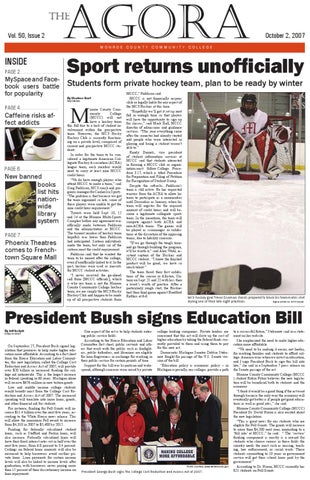
MC3 hockey goal Trevor Eisaman stands prepared to block his teammates shot during one of their late night practices. Agora photo by Jeff Kodysh
President Bush signs Education Bill By Jeff Kodysh Editor-in-Chief
On September 27, President Bush signed legislation that promises to help make higher education more affordable. According to a fact sheet from the House Education and Labor Committee, this new legislation, called the College Cost Reduction and Access Act of 2007, will provide over $20 billion in increased funding for college aid nationwide. This is the largest increase in federal spending in 60 years. Michigan alone will receive $676 million in new tuition grants. Low and middle income college students would benefit most from the College Cost Reduction and Access Act of 2007. The increased spending will translate into more loans, grants, and other financial aid for students. For instance, funding for Pell Grants will increase $11.4 billion over the next five years, according to the White House news release. This will allow the maximum Pell award to increase from $4,310 in 2007 to $5,400 by 2012. Funding for federally subsidized student loans, such as Stafford and Perkin loans, will also increase. Federally subsidized loans will have their fixed interest rates cut in half over the next five years, from 6.8 percent to 3.4 percent. Ceilings on federal loans amounts will also be increased to help borrowers avoid costlier private loans. Loan payments for certain income levels will also be linked to income levels after graduation, with borrowers never paying more than 15 percent of their discretionary income on loan repayments.
One aspect of the act is to help students entering public service fields. According to the House Education and Labor Committee fact sheet, public servants and others that work with the public such as firefighters, public defenders, and librarians are eligible for loan forgiveness in exchange for working in their public service for certain periods of time. Support for this bill was bi-partisan and widespread, although concerns were raised by private
college lending companies. Private lenders are concerned that this act will drive up the cost of higher education by taking the federal funds currently provided to them and using them to pay for this new act. Democratic Michigan Senator Debbie Stabenow fought for passage of the U.S. Senate version of the bill. “Education policy is economic policy – in Michigan especially, our colleges provide a path
Photo courtesy www.whitehouse.gov
President George Bush signs the College Cost Reduction and Access Act of 2007.
to a successful future,” Stabenow said in a statement on her website. She emphasized the need to make higher education more affordable. “We need to be making it easier, not harder, for working families and students to afford college. America wins when we invest in education, and I urge President Bush to sign this bill into law,” she said in a September 7 press release on the Senate passage of the act. Monroe County Community College (MCCC ) student Robin Pykor believes the new legislation will be beneficial both to students and the economy. “I think it would be a good thing if the act went through because the only way the economy will eventually get better is if people get good educations as well as good jobs,” she said. Monroe County Community College (MCCC) President Dr. David Nixon is also excited about the new legislation. “This is great news for our students who are eligible for Pell Grants. The grants will increase to more than $4,500 next year, amounting to a ‘full ride’ at MCCC,” he said. “ The ‘service’ funding component is mostly is a reward for students who choose careers in those fields the country needs the most such as nursing, teaching, law enforcement, or social work. Those students committing to 10 years in government service will get their school loans paid by the government.” According to Dr. Nixon, MCCC currently has 821 students on Pell Grants.