


This is, noncitizen, a project that aims to uplift migrant communities by explaining immigration policy in the United States. noncitizen is guided by a commitment to truth, accessibility, and social awareness.
In this educative journey, we follow noncitizen, an everday hero that supports the storyline. noncitizen takes on many roles, from union painter to college student, he represents the roles of millions of migrants in America.
noncitizen offers an objective documentation of the current social climate in the United States. Through personal accounts of how these legislations have affected the people in their migration journey, to spotlighting current events and overlooked injustices. This editorial changes the current narrative and breaks the stigmas placed on the undocumented community.
Through a blend of visual storytelling, firsthand testimonies, and data-visualizations, noncitizen provides a platform to project migrant voices. The intention is not to speak for migrants, but rather to amplify what has often been silenced.
Each chapter is designed to bridge the gap between policy and lived experiences, effectivley humanizing complex legislation. With facts, reflections, and storytelling, this project offers not only insight but also empowerment. noncitizen echoes the resilience and aspirations that define the migrant experience.
By centering undocumented voices, a more accurate and inclusive portrayal of American life is made possible.

Well, I achieved most of my goals. I’m very happy with my life here. In some ways, I feel American; in others, I don’t- I still feel Spanish. But I feel fulfilled, especially when I think about my son.
- Lola

Local members of the Newark, NJ community were asked to willingly participate in an interview for this editorial. Participants were informed prior to the interview that the purpose of this project is to document their American immigrant experience. There are no right or wrong answers and interviewees were also encouraged to answer honestly, and they should feel free to elaborate as they pleased. The subject matter of the interview questions revolve around how people navigate their lives as immigrants in the United States.
All the people interviewed were born in other countries including community members from Ecuador, Portugal, Spain, and Uruguay. The Newark community is a diverse culmination of many different cultures and ethnic backgrounds. Immigration hubs like Newark and cities alike are vital beacons of hope for those who are trying to realize their American Dream. These kinds of cities provide opportunities and social resources to support those who are trying to make a new life in a sometimes unwelcoming country. The political tides of the United States constant push and pull affect millions, making the process of establishing a secure home and job uneasy to say the least.
The immigrant experience in the United States is a reality shared by millions of people across the country. Many of these stories share similar aspects of hope, perseverance, and sacrifice.
Cindy is an Ecuadorian national, and resident of the US in her mid 20’s. She was rasied in Ecuador until the age of 5. Cindy loves traveling, photography, and her favorite movies are Studio Ghibli titles. Recently, her and her husband Adrian have taken up snowboarding. Currently, she is a marketing coordinator at Paramount.
Immigrant life in the US is often a bittersweet journey of working hard to put one’s family ahead of themselves. This is noted in the testimonies gathered below.
Are you a US citizen? No, I am currently a US resident applying for my citizenship.
When did you come to the US? When I was 6, it was 2005, 20 years ago.
Why did you come to the US? Because my parents were here and my brother. At 6 years old I didn’t have much say in coming or not. My brother was born there and my parents wanted me to have a better education, they did everything they could to get me here.
How did you come to the US? Technically, I came with a false identity. My parents knew a flight attendant and she was willing to pass me off as her daughter. I had no visa or anything, I got a real passport with a fake identity so I came legally but not legally, if that makes any sense.
Are you a DACA recipient? I was a DACA recipient up until I got married in 2021. I was a DACA recipient for about 6 years.
What do you like about the US? I like that there is opportunity for growth.
What do you not like about the US? There’s definitely more that I like. It's a melting pot of cultures and people, but specifically I don't know what I don't like. There’s a lot of stereotypes that affect people that I love, a lot of laws that affect me and my loved ones that I don’t agree with. I think it's a great country with a lot of room for improvement.
Joao is a Portuguese national in his early 20’s, who came to the US at 1 year old. He was raised in Newark and loves soccer, with his favorite player being Cristiano Ronaldo. Joao is an avid shoe collector and loves cars too, having recently purchased a BMW. Currently, he is a manager at a restaurant in Union, NJ.
Are you a US citizen? No.
What is the first thing you would do as a US citizen? I haven’t thought about that yet.
When did you come to the US? In 2003, when I was one year old.
Why did you come to the US? My parents brought me.
How did you come to the US? By plane.
What do you do for a living? Waiter and server.
What do you like about the US? The US offers a different amount of opportunities that other countries can't. One of them being education. In other countries students don't get the same quality education like communication and other social skills.
What do you not like about the US? The problem with the US isn’t about the people themselves or what is going on, it’s more about
What do you do for work? I am a marketing coordinator at Paramount.
What obstacles have you had to overcome? I guess the first obstacle was the language. There’s definitely a language barrier, a cultural barrier. Missing my family when I first got here was hard. As I got older the realization of my legal status became more apparent, especially when I was applying to colleges. That's when it really hit. By then I was under DACA- I knew to be careful with the law because of my parents legal status. Things like (not) having health insurance or helping my mom (translate) that was fine, but when I applied to college that's when it became apparent. I had an internship that I was forced to leave because my DACA expired. This was during Trump’s (first) presidency and he put a halt on DACA renovations, so that was something I had to overcome.
Describe your American Immigrant experience in one word: All and all, it’s been rewarding. There have been a lot of hardships, obviously. I’ve seen my parents go through a lot of hardships, but it's been really good, you know? I have a job, I went to college for free, my brother is getting a great education, my parents have their own house and made things happen for themselves. It’s not all great and they're still trying to overcome obstacles now with their legal status, but they’re happy. I can tell that they’re proud of their choices. I think that makes me happy, it’s rewarding.
Thank you Cindy!
the people in charge. Like our government, I feel like there’s not enough checks and balances being done in this country. In a country as powerful as the US, we would be in a better situation if we just put our assets into play.
What obstacles have you had to overcome? I’d say for an immigrant, financially it's a hard one because we are limited to so many occupations and jobs that we can work. In comparison to the average American who can work whatever job they feel like with a certain amount of requirements. Whereas we could have the requirements but we still wouldn’t be able to work. A lot of companies fail to realize that a lot more people could benefit than just those who are working now.
Describe your American Immigrant experience in one word: Motivating.
Would you care to elaborate? It’s one word.
Cold like Palmer, Thank you Joao!
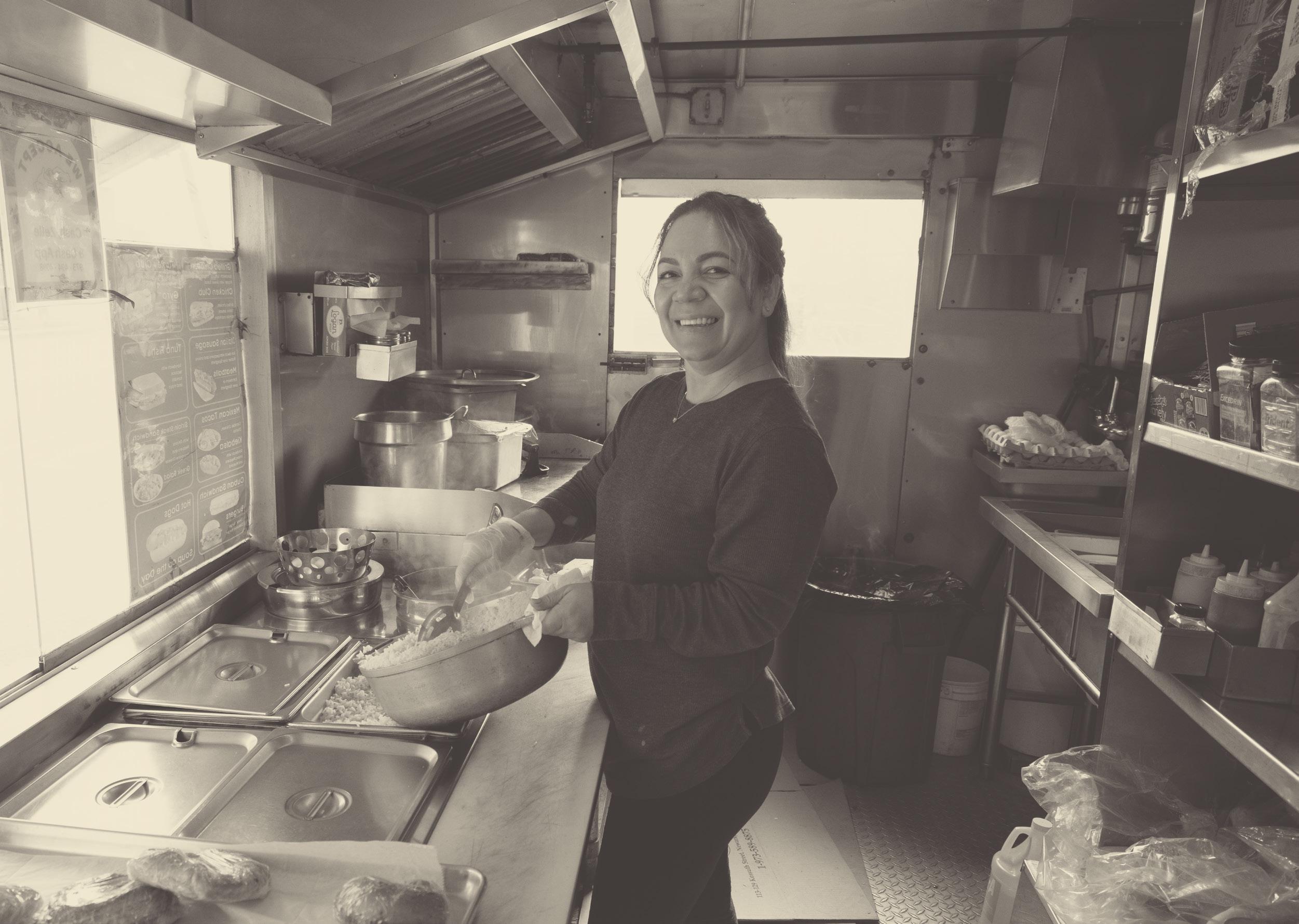
Merci is an Ecuadorian national, and American citizen in her mid 50’s. She migrated to the US in the early 2000’s and worked as a seamstress. Currently, Merci operates a food truck business out of the Newark Ports, Pier Lunch Stop, serving breakfast and lunch to hungry truckers. She has recently purchased her first home as well. Congratulations Merci!
¿Eres ciudadana? Si
¿Cuánto tiempo tardó en ser ciudadana? 5 años
¿Cómo viste a los EE.UU.? Vine con visa, con mis hijos. Obtuve los documentos por matrimonio.
¿Qué te gusta de los EE.UU.? Me gusta la tranquilidad que tenemos, que hay muchas fuentes de trabajo. Me gusta la seguridad en que nos encontramos con relación a nuestros países, y sobre todo para mis hijos, las oportunidades que tienen en estudiar y lo que han conseguido hasta ahora.
¿Qué no te gusta de los EE.UU.? La comida
¿Qué haces para el trabajo? Ahora mismo, por 15 años, tengo mi propia empresa, tengo una compañía de food trucks. Estoy instalada en el puerto, tengo allí dos puestos con dos food trucks. Me he dedicado a eso por 15 años.
¿Qué obstáculos ha tenido que enfrentar?
Bueno, cuando recién vine el primer obstáculo fue no tener documentos. Pero desde cuando obtuve mis documentos realmente no he tenido un solo obstáculo. He podido desenvolverme hasta ahora en todos los ámbitos, gracias a dios hemos tenido suerte. Seguimos con los negocios, no tenemos uno solo tenemos todos negocios, a los que nos dedicamos todo el tiempo. Y hemos habido emprenderlos muy bien gracias a Dios.la única barrera que tuve era no tener documentos.
Gracias Merci!
Marcelo is an Ecuadorian national, and American citizen in his early 60’s, who migrated to the US in the early 2000’s. He currently co-operates a food truck business out of the Newark Ports, Pier Lunch Stop, and does construction as a side job. He has also recently purchased his first home with Merci. Congratulations Marcelo!
¿Eres ciudadano? Si, soy ciudadano Americano.
¿Por qué vino a los EE.UU.? Llegue en busca de una mejor oportunidad, en busca de libertad.
¿Como llego? Hasta México, viajando en avión y entonces cruzando la frontera a los EE.UU.
¿Qué te gusta de los EE.UU.? Me gusta las oportunidades de trabajo, me gusta la organización que hay aquí. Especialmente que no hay corrupción en los niveles que nos deambulamos nosotros.
¿Qué no te gusta de los EE.UU.? No hay nada que no me guste, pero extraño unas cosas de mi país como los productos frescos, orgánicos, y tenemos a la mano naturales en Ecuador que acá no tenemos. Extraño nada más, pero acá también tenemos todo.
¿Qué hace para el trabajo? Me dedico a muchas cosas. Construyó food trucks, hago construcción, y también tenemos food trucks business en el puerto de Newark.
¿Qué obstáculos ha tenido que enfrentar? Al comenzó el obstáculo del idioma. Luego los tipos de trabajo, tomó como dos años para empezar hablar ingles y tambien Portugues porque la mayoria de gente donde vivimos en la área son Portugues es y Americanos. La barrera más grande para mi, fue el idioma, el inglés. Pero una vez que ya aprendí todo se me hizo mejor.
Gracias Marcelo!
Are you a US Citizen? Yes
How long did it take to earn? 5 years
How did you come to the US? I came with a Visa with my kids. I obtained my papers by marriage.
What do you like about the U.S.? I like the peace we have, the work, that there are many job opportunities. I like the security we have compared to our home countries, and especially for my children—the opportunities they have to study and what they have achieved so far.
What do you not like about the U.S.? The food.
What do you do for work?
Right now, for 15 years, I have had my own business—I own a food truck company. I am set up at the port, where I have two stands with two food trucks. I have been doing this for 15 years.
What obstacles have you had to face? Well, when I first arrived, the first obstacle was not having documents. But since obtaining my documents, I haven’t really had a single obstacle. I have been able to thrive in all areas. Thank God, we have been lucky. And yes, we continue with the businesses—not just one, we have several businesses that we dedicate all our time to. And we have been able to develop them very well, thanks to God. I can't say I've had any other barrier besides not having documents.
Thank you Merci!
Are you a Citizen? Yes, I am an American Citizen.
Why did you come to the US? I came in search of opportunites, in search of liberty.
How did you arrive? I traveled by plane to Mexico and then crossed the border into the U.S.
What do you like about the U.S.? I like the job opportunities, and I like the organization here. Especially that there is no corruption at the levels we navigate in our daily lives.
What do you not like about the U.S.? There is nothing I don’t like, but I do miss some things from my country, like fresh, organic products that we naturally have available in Ecuador but not as easily here. I just miss those things, but we have everything here.
What do you do for work? I do many things. I build food trucks, I work in construction, and we also have a food truck business at the port of Newark.
What obstacles have you had to face? In the beginning, the biggest obstacle was the language. Then, adapting to different types of jobs. It took me about two years to start speaking English and also Portuguese, because most of the people where we lived were Portuguese and American. The biggest barrier for me was the language, English. But once I learned, everything became easier.
Thank you Marcelo!
Lucas is a Uruguayan national, and American citizen in his late 20’s. He was raised in Newark, and loves soccer. His most prized possesion is a Uruguayan flag signed by players of the national team. Lucas runs his own digital print start up, Live Creations, making custom apparel for local clients. Currently, he is a sales analyst at Panasonic also based in Newark, NJ.
Are you a US citizen? Yes I am a US citizen.
When did you earn your citizenship? I received my citizenship about 5 years ago.
How long was the process? I had to be a resident for 5 years before I was able to apply for citizenship.
When did you come to the US? I came to the US when I was 3. It was the year 2000.
Why did you come to the US? The way that it was explained to me is that one day I asked my dad to take me to the zoo, but he didn’t have any money. That was the breaking point for him realizing he couldn’t take his son to the zoo, and so he knew he needed to change his situation by coming to the US. Shortly after a couple months my mom and I followed.
How did you come to the US? We came to the US through a visa, and yeah we came on a plane.
What do you like about the US? There’s a lot of things I like about the US. I would say the access to opportunity and education that are given to adults that come here and want to work, right? If you really put your head down and you want to make an honest living you definitely can. For younger Americans you have access to education where in other countries you really don’t have that.
Alejandro is a Uruguayan national, and American citizen in his mid 20’s. He was raised in Newark, and is a huge NJ Devil’s fan. He loves to skate, and his favorite movie is Surf’s Up, with his favorite character being Chicken Joe. Currently, Alejandro is a painter in the Union and does freelance work under his own company, Del Sol Painting
Are you a US citizen? Yes.
When did you earn your citizenship? December of 2024.
How long was the process to earn citizenship? 21 years.
What were some of the requirements? A lot of money to a lawyer, a lot of time waiting, applying for a work visa and residency, then waiting the 5 years to take the citizenship test.
What do you like about the US? There is opportunity to grow yourself.
What do you not like about the US? There is a lot of divide, when in reality this is a country for all types of people.
When did you come to the US? March of 2001. I came with my parents, I was 3 years old. They wanted a better life for me.
What do you do for a living? I’m a painter in the union.
What are some obstacles you had to overcome? Well obviously trying not to get into any legal problems and face deportation.
What do you not like about the US? What I don’t like about the US is that there is too much of a focus on this ‘grind culture’. Working a lot of hours and not taking time off. That was the culture back then but I feel like it’s changing now. Are you a DACA recipient? No, I was actually a DREAMER.
What obstacles have you had to overcome? I would say there are a lot of obstacles. One that comes to mind is having to navigate an education system kind of by myself. I really didn’t have parents that knew too much about colleges and things of that nature. I had to figure out how to navigate that world and what I wanted to do, and how I could get there.
What do you do for a living? So I was raised in Newark for the most part and now I’m working in Newark. I work at Panasonic and I’m a Sales Forecast Analyst there.
Describe your America Immigrant experience in one word: Grateful.
Do you want to elaborate? I would say grateful because I really am grateful for the opportunities I’ve been given as an immigrant. I’ve been able to get ahead in ways that wouldn’t have been possible if I was raised in Uruguay. So I’m just grateful for the things that I’ve been able to accomplish and I’m excited for what’s to come in the future.
Thank you Lucas!
Looking over my parents and them not getting deported. A lot of worrying.
If you could describe your American Immigrant experience in one word: Hard, but worth it. It’s a lot of work and a lot of worry. Its hard in all aspects emotionally, physically, and mentally but it definitely is worth it to be in this country.
Thank you Ale!
Lola is a Spanish national, and resident in the US in her early 50’s. She was raised in Galicia, the Northwestern part of Spain, and makes garlic shrimp like it’s nobody’s business. Lola is currently enjoying retirement from her career as a house cleaner, and she absolutely loves an ice cold Coca-Cola.
¿Eres ciudadana Americana? No.
¿Cuando y porque vino a los EE.UU.? Hace 30 años, en 1995. Para buscar un futuro mejor. Vine como turista, y después de 3 meses me quedé.
¿Qué te gusta de los EE.UU.? Me gusta la independencia. Que puedes trabajar y puedes conseguir tus aspiraciones. A ver me gusta mucho de los EE.UU.
¿Qué no te gusta de los EE.UU.? Ahora mismo, no me gusta como se está tratando a los inmigrantes.
¿Qué hizo para el trabajo? Limpie casas. Como por 20 o 25 años.
¿Qué obstáculos ha tenido que enfrentar? El obstáculo más grande que tuve que enfrentar fue no tener los papeles por 20-pico de años.
¿Puede describir su experiencia inmigrante Americana en una palabra? Realizada.
¿Realizada? ¿Quiere explicar? Puede explicar. Pues, consegui la mayoría de mis “goals”. Estoy muy contenta con mi vida aquí, me siento como en partes como si fuera Americana, en partes no, en partes sigo siendo española y soy realizada con respeto por ejemplo mi hijo. Tiene buena carrera. Consiguió todos los “goals” que esperaba y que yo esperaba de él. Y bueno, en general hay cosas que siempre faltan pero en general, realizada es la palabra después de 30 años.
Gracias Lola!
Javier is a Spanish national, and resident in the US in his early 50’s. He was raised in Galicia, where he met his partner Lola. He is quick with a joke and named his dog ‘Sancho’, after the fictional character ‘Sancho Panza’ . Currently, Javier is a painter in the Union, having painted everywhere from skyscraper interiors in Manhattan, to the walls of Yankee Stadium.
¿Eres ciudadano Americano? No.
¿Qué sería la primera cosa que haría si fuera ciudadano? No mucho, la vida seguirá igual. No va a haber mucha diferencia en mi vida, ciudadano o residente.
¿Cuando vino a los EE.UU.? Hace 30 años atrás, en el ‘95.
¿Por qué vino a los EE.UU.? Vine por trabajo. Para que mi nuestra vida fuera otro nivel, otro step, diferente en España.
¿Cómo vino a los EE.UU.? Vine en avión, de turista y luego me quedé.
¿Qué te gusta de los EE.UU.? Me gusta todo, y no me gusta nada. Me gusta, es un país con oportunidades. Es un país que tienes mucho mucho de lo bueno, y mucho mucho de lo malo. Depende de tu, el lado que tu quieres escoger.
¿Qué no te gusta de los EE.UU.? Realmente realmente, McDonalds.
¿Qué hace para el trabajo? Haber yo aquí soy pintor. Paint and decoration, pintura y decoración. Y llevo ya 28 años, yo creo que ya pinte manhattan como la quinta vez. Del downtown, uptown right?
¿Qué obstáculos ha tenido que enfrentar? Aquí, realmente no muchos. Un obstáculo fue ser me residente en el país, me costó un poquito unos cuantos años.
¿Puedes describir tu experiencia inmigrante americano en una palabra? Excito.
¿Excito?Quieres explicar? Si aver, excito cada año un poquito más. A ver un país que me lo dio todo, realmente yo no le di nada. Si le di mi trabajo. Le di 20 años de mi vida. Éxito y como te lo voy a decir… perseverancia.
Gracias, Javi!
Are you an American citizen? No.
When and why did you come to the U.S.? Thirty years ago, in 1995. To seek a better future. I came as a tourist, and after three months I stayed here.
What do you like about the U.S.? I like the independence—that you can work and achieve your aspirations.
What do you not like about the U.S.? Right now, I don’t like how immigrants are being treated.
What kind of work did you do? I cleaned houses for about 20 or 25 years.
What obstacles have you had to face? The biggest obstacle I had to face was not having legal papers for over 20 years.
Describe your American immigrant experience in one word? Fulfilled.
Fulfilled? Do you want to explain? I can explain. Well, I achieved most of my goals. I’m very happy with my life here. In some ways, I feel American; in others, I don’t—I still feel Spanish. But I feel fulfilled, especially when I think about my son. He has a good career. He achieved all the goals I had hoped for him and that I expected of him. And well, there are always things that are missing, but overall, after 30 years, "fulfilled" is the word.
Thank you, Lola!
Are you an American citizen? No.
What would be the first thing you’d do if you were a citizen? Not much, life would stay the same. There wouldn’t be much of a difference in my life, whether I’m a citizen or a resident.
When did you come to the U.S.? Thirty years ago, in ’95.
Why did you come to the U.S.? I came for work. So that my life—our life—could be at another level, another step, different from Spain.
How did you come to the U.S.? I came by plane as a tourist, and then I stayed.
What do you like about the U.S.? I like everything, and I like nothing. I like that it's a country of opportunities. It’s a country that has a lot—both very good things and very bad things. It depends on you, which side you choose.
What do you not like about the U.S.? Honestly, McDonald’s.
What do you do for work? Well, here I’m a painter, painting and decorating. I’ve been doing it for 28 years now. I think I’ve painted Manhattan for the fifth time—downtown, uptown, right?
What obstacles have you had to face? Here, honestly, not many. One obstacle was becoming a resident—it took me a few years.
Can you describe your American immigrant experience in one word? Success.
Success? Do you want to explain? Yes, well, success—each year, a little more. This is a country that gave me everything, and really, I didn’t give it much. Well, I gave it my work. I gave it 20 years of my life. Success, and how can I put it… perseverance.
Thank you, Javi!


Expedited removal allows immigration officers to quickly remove non-citizens from the United States without a hearing before an immigration judge.
Within American politics there are very few issues as deeply personal as immigration. The United States has in the past, prided itself on being a nation of immigrants, yet the legislation around immigration is outdated and inhumane. This system that currently dictates millions of immigrant lives is a maze of bureaucratic runarounds, time consuming application processes, and policies that do not address the realities of today’s globalized world.
Americans have been divided by political and social redirect; with some arguing for stricter enforcement, and others pushing for a legal reform that balances national security with humanitarian needs. The US has historically been a global safe haven for people seeking asylum. At the turn of the 21st century the attitude towards immigrants in America has shifted drastically. The recent legislation from Trump’s 2025 plan reflect the country’s political divide.
Immigration law in the United States has a complex and exceedingly long history. Since the country’s inception, America has always been a symbol of freedom for those who seek it. Since the 1600’s with the establishment of the 13 colonies when the British came here to exercise religious freedom. To the 1900’s when over 12 million migrants came through Ellis island to escape war torn Europe, the United States has always been a safe haven.
Previous legislation like the INA and following amendments advocated for immigrant rights. Similarly, the Immigration Act of 1990 increased migration quotas and introduced a lottery system to ensure fair opportunity. Over the last few decades, the attitude towards immigrants in America has shifted drastically and taken a retroactive step.
The INA established Title 8, which governs immigration policy including processes of asylum, deportation, citizenship and visa. It defines the roles of federal agencies like U.S. Citizenship and Immigration Services (USCIS) and Immigration and Customs Enforcement (ICE) in these processes.
The INA introduced a system for granting immigrant visas through their 1965 amendments. These revisions eliminated national origin quotas, allowing for more immigration from non-European countries including Asia and South America.
The Development, Relief, and Education for Alien Minors Act, was a proposition for providing a path to legal status for undocumented immigrants who were brought to the U.S. as children, often called “DREAMers”.
The Deferred Action for Childhood Arrivals program, provides temporary protection from deportation and work authorization to undocumented immigrants who were brought to the U.S. as children. DACA recipients are known as “DREAMers,” in refrence to the DREAM act, and have to renew their status every two years.
The Laken Riley Act mandates the Department of Homeland Security (DHS) to detain and deport non-U.S. nationals who have been arrested for burglary, theft, larceny, or shoplifting. Named after Laken Riley, a University of Georgia student murdered by an undocumented immigrant with prior theft charges.
The ITIN program was created by the IRS in July 1996 as a part of the Taxpayer Relief Act (1997). It allows foreign nationals who are not eligible for a SSN to comply with U.S. tax laws.
In January, ICE agents conducted a raid at Ocean Seafood Depot, a business in Newark, New Jersey. This resulted in the detention of undocumented residents and U.S. citizens, including a military veteran who had the validity of their service questioned, all without presenting a warrant. Mayor Ras Baraka denounced the ordeal as a violation of our Fourth Amendment rights.
Rumeysa Öztürk, a 30-year-old Turkish doctoral student at Tufts University, was detained by DHS agents outside her residence in Somerville, Massachusetts. Footage shows six masked individuals in plain clothes handcuffing her and taking her into an unmarked vehicle. DHS stated that her student visa had been terminated due to alleged activities supporting Hamas, based off of an editorial she co-wrote in March 2024.
Title 8 is a bittersweet piece of legislation used to manage immigration at the US border. This act allows for the US to remove those who do not have the right to live in the country.
Under Chapter 12: Section 1158 of Title 8, if a person trying to enter the US without proper documentation can prove they need asylum, they are permitted to stay in the US conditionally. For millions of Americans this is the reality of their legal status; where the individual was not deported, but instead released with an order of deportation. This effectively labeles them as criminals in the US.
Chapter 1 | General Provisions
Sections 1 to 18
Chapter 2 | Elective Franchise
Sections 31 to 32
Chapter 3 | Civil Rights
Sections 41 to 56
Chapter 4 | Freedmen
Sections 61 to 65
Chapter 5 | Alien Ownership of Land
Sections 71 to 86
Chapter 6 | Immigration
Sections 100 to 239
Chapter 7 | Exclusion of Chinese
Sections 261 to 299
Chapter 8 | The Cooly Trade
Sections 331 to 339
Many individuals with criminal records are hard working, tax paying, and law abiding non-citizens that bear the burden of this label. This goes down one of the more controversial slopes of differentiating who is really a dangerous criminal and who is not. How does overstaying a visa, or crossing the US border to work an honest living, earn someone the same legal status as a dangerous criminal. Labeling someone a “criminal” puts a target on their back, allowing for unwarranted harassment from ICE enforcement and marginalized discriminatory practices. Labeling someone as a criminal does not reflect the realities of that person’s life, but that falls secondary to having a criminal record in the first place.
Obataining a decent job becomes a vital challenge, forcing individuals to work exploitative and underpayed jobs. These jobs usually come in the form of hard labor and often times have no social resources to support people who work them. It is a socioeconomic handicap that intentionally makes life harder for those who are allowed to stay in the US. Economic progress comes by slowly in these kinds of situations, and the mental exhaustion of working hard to merely stay afloat is simply demoralizing. The same legislation that gives people an opportunity to stay in the US, also chains them down for their entire time here. It is nearly impossible to climb the social ladder with a ‘criminal record’ weighing someone down.
Chapter 9 | Miscellaneous Provisions
Sections 351 to 416
Chapter 10 | Alien Registration
Sections 451 to 460
Chapter 11 | Nationality
Sections 601 to 907
Chapter 12 | Immigration and Nationality
Sections 1101 to 1537
Chapter 13 | Immigration and Naturalization Service
Sections 1551 to 1574
Chapter 14 | Restricting Welfare and Public Benefits for Aliens
Sections 1601 to 1646
Chapter 15 | Enhanced Border Security and Visa Entry Reform
Sections 1701 to 1778
“Now people who are caught at the border trying to come in, if they're processed through what's known as expedited removal, which is a jumpedup fast track system for deporting people, removing them from the United States, if they're processed under that law, then they could face legal jeopardy, legal bars to be able to return. If they get caught trying to enter again after an expedited removal, they could face jail time, etc. So in that sense we are back to the quid pro quo as it was prior to the Trump administration's vocation of Title 42.
Biden now is imposing or he's trying to impose another set of laws or set of bars known as no transit country and anyone who travels, as the law goes, anyone who travels through another country without applying for some sort of asylum in that place will be categorically barred from winning asylum in the United States This poses a tremendous challenge for the majority populations that are actually seeking asylum in the U.S.
Now, as we know, most of the population, most of the people who are applying for asylum in the U.S are coming from Latin American countries and the primary senders of asylum seekers are in Northern Central America: Honduras, Guatemala, and El Salvador. So almost by definition, those people who are coming through Mexico to the U.S Southern the border the U.S shares with Mexico and trying to apply for Asylum there, according to this law, if they didn't first apply for asylum in Mexico, they would be barred from applying for asylum in the U.S. So, logistically speaking, it makes asylum impossible for the vast majority of people who are pursuing it.”
More than four decades after the passage of the 1924 Reed-Johnson Act, Congress legislated a system of immigration control to replace the discriminatory national origins system. The new system implemented preferences which prioritized family reunification (75 percent), employment (20 percent), and refugee status (5 percent). Spouses, minor children, and parents remained nonquota immigrants. Each country received the same annual cap of 20,000 and
for the first time countries in the American hemisphere faced numeric caps on immigration. This law opened the door to non-European immigration in unprecedented numbers, with many arriving through the employment preferences, which heavily favor highlyeducated workers. This contributed to the image of Asian Americans, who have immigrated predominantly since 1965, as “model minorities.” However, because the law does not provide for
immigration by “unskilled” workers in sectors like agriculture, construction, and domestic service, it has fostered a growing population of unauthorized immigrants who are gainfully employed but lack lawful means to immigrate. A majority of unauthorized immigrants are from poorer countries in the Americas seeking greater opportunity in the wealthier U.S.






The Individual Taxpayer Identification Number (ITIN) program, managed by the IRS, provides tax processing numbers to individuals who are not eligible for a Social Security Number (SSN). ITINs allow non-citizens, including undocumented immigrants and foreign nationals, to fulfill their tax obligations in the U.S. While ITIN holders can file taxes and claim certain credits, the number does not grant work authorization or legal immigration status. The program helps ensure tax compliance and allows individuals to contribute to the economy despite their immigration status.
ITINs are not SSNs. The ITIN is a nine-digit number that always begins with the number 9 and has a range of numbers from 50 to 65, 70 to 88, 90 to 92, and 94 to 99 for the fourth and fifth digits. The ITIN is formatted like a SSN: 9XX-XXXXXX.
Undocumented immigrants pay substantial amounts toward the funding of public infrastructure, institutions, and services.
Specifically, we find that in 2022, undocumented immigrants paid $96.7 billion in taxes at the federal, state, and local levels. More than a third of that amount, $33.9 billion, went toward funding social insurance programs that these individuals are barred from accessing because of their immigration status.
In total, the federal tax contribution of undocumented immigrants amounted to $59.4 billion in 2022 while the state and local tax contribution stood at $37.3 billion. These figures make clear that immigration policy choices have substantial implications for public revenue at all levels of government.
DACA (Deferred Action for Childhood Arrivals) is an Obama administration policy implemented by executive order on June 15, 2012. DACA prevents the deportation of some undocumented immigrants who arrived in the United States as children and allows those immigrants to get work permits.
The undocumented immigrants who participate in the program are called “Dreamers,” a reference to the failed DREAM Act (Development, Relief, and Education for Alien Minors Act) that was first introduced in the Senate on Aug. 1, 2001, by Orrin Hatch (R-UT) but was not approved and passed by Congress. The DREAM Act would have implemented similar policies as DACA but via legislation passed by Congress and not instituted by a presidential executive order. (Executive orders can be more easily reversed than Congressional legislation.)
In order to qualify for DACA, undocumented immigrants are required to meet certain criteria. They must:
- Be under 31 years old as of June 15, 2012
- Have come to the United States before their 16th birthday.
- Have lived in the United States continuously from June 15, 2007, to the present.
- Have been physically present in the United States on June 15, 2012, and at the time of application.
- Have come to the United States without documents before June 15, 2012, or have had their lawful status expire as of June 15, 2012.
- Be in school, have graduated from high school or earned a GED, or have been honorably discharged from the Coast Guard or military.
- Have not been convicted of a felony or “significant misdemeanors” (such as DUI), or three or more misdemeanors of any kind.
- Enrollment in the program requires renewal every two years.
Senator Dick Durbin (D-IL) said that 900 DACA recipients were serving in the U.S. military and 20,000 were schoolteachers, including 190 Dreamers in the Teach for America program.
The Association of American Medical Colleges said in October 2019 that the U.S. health care system would be caught unprepared to fill the void left by deported Dreamers. Lawyers for Dreamers seeking to uphold the program wrote, “Healthcare providers on the frontlines of our nation’s fight against COVID-19 rely significantly upon DACA recipients to perform essential work. Approximately 27,000 DACA recipients are healthcare workers—including nurses, dentists, pharmacists, physician assistants, home health aides, technicians, and other staff—and nearly 200 are medical students, residents, and physicians.”
Furthermore, 21,000 DACA recipients worked in transportation and warehousing, 32,800 in retail including pharmacies and supermarkets, 14,500 worked in manufacturing, and 13,000 in support and waste management services. Along with healthcare workers, that’s a lot of undocumented immigrants who helped the country run during the pandemic and continue to do so years later.
I had an internship that I was forced to leave because my DACA expired. This was during Trump’s (first) presidency and he put a halt on DACA renovations . . . - Cindy
Undocumented immigrants contributed in federal, state, and local taxes.
96.7B
$1.8 Billion in unemployment insurance taxes.
$6.4 Billion in Medicare taxes.
$25.7 Billion in Social Security taxes.
Key:
= $1,000,000,000 contributed to taxes by undocumented immigrants to accesible federal programs.
33.9B
= $1,000,000,000 contributed to taxes by undocumented immigrants to inaccessible programs.
35% of the tax dollars paid by undocumented immigrants go toward payroll taxes dedicated to funding programs that these workers are barred from accessing. Undocumented immigrants paid $25.7 billion in Social Security taxes, $6.4 billion in Medicare taxes, and $1.8 billion in unemployment insurance taxes in 2022.
As of September 2024, there are registered DREAMERS.
537,730
14% Rest of
5%
Mexico - 436,000
El Salvador - 21,260
Guatemala - 14,370
Honduras - 13,230
Peru - 4,850
Brazil - 3,960
Ecuador - 3,700
Colombia - 3,100
Argentina - 2,570
Venezuela - 1,610
Dominican Republic - 1,440
Uruguay - 1,300
Bolivia - 1,120
Nicaragua - 1,060
Costa Rica - 1,010
Chile - 950
Panama - 280
South Korea - 4,700
Philippins - 2,480
Jamaica - 1,770
India - 1,620
Trinidad and Tobago - 1,110
Pakistan - 830
Poland - 820
Nigeria - 730
Guyana - 610
Belize - 530
Indonesia - 520
Canada - 520
Kenya - 450
China - 400
Bangladesh - 330
Mongolia - 320
Ghana - 320
Portugal - 310
United Kingdom - 300
Other - 7,250
Throughout Trump’s 2024 campaign, his team notoriously magnified migrant crime as a tactic to blame the Biden administration. This use of scapegoating would only add fuel to the fire of America’s political divide, and has become the center attention regarding border politics. The Laken Riley Act enforces discriminatory practices and encourages harassment of migrant communities.
On February 22, 2024, while jogging near the University of Georgia, Laken Riley was attacked and killed by José Antonio Ibarra, a 26-year-old Venezuelan national who had entered the United States without documentation. Ibarra had prior encounters with law enforcement, including a shoplifting citation, but was not detained by ICE.
There are many opinions regarding the validity of the act, with some arguing that it strengthens public safety. Critics claim that it infringes upon civil rights and due process. This leads to the detention and deportation of individuals who have only been accused of a dangerous crime, but not convicted before a judge and jury.
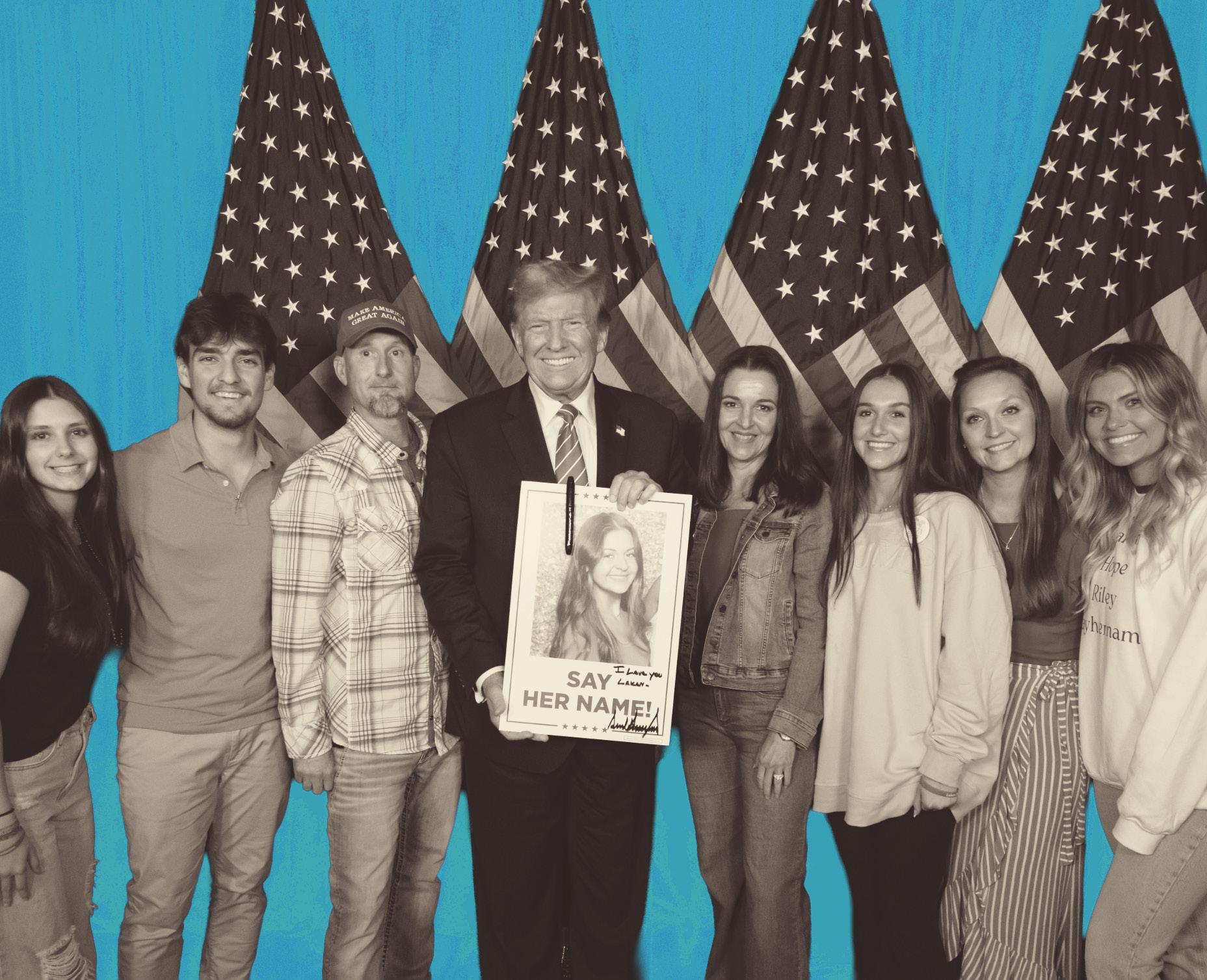
Just days after Laken Riley’s death, Georgia Congressman Mike Collins invited her parents to the State of the Union address, an invitation they declined. Trump’s entire campaign is centered on blaming Biden for "migrant crime," and his team made it a priority to secure the Riley family’s support for their political agenda.
During Trump’s presidency, his Department of Homeland Security released over 1.1 million migrants into the U.S. due lack of resources in detention facilities. Many of the released migrants committed crimes, but these isolated incidents were never mentioned. The Senate actually proposed a border bill to increase funding for detention beds and asylum processing. Trump pressured Speaker Mike
Johnson to block the bill, proving that he doesn't care for solving the systemic issues in America. Chaotic border politics distract the American public from the real issue that is the wealth disparity in America.
At the State of the Union held in Georgia, Trump and Republicans mocked Biden for mispronouncing Riley’s name. Ironically, just days later at a Trump rally in her district, Marjorie Taylor Greene blatantly mispronounced her name as "Lincoln" Riley. During the same event, Trump’s campaign arranged for a photo op with the Riley family and her step dad. Trump signed a photo with "I love you Lakan," misspelling her name while grinning for the camera alongside the Riley family.
It's inciting people who are gonna have a vote in November and I think it is being used politically to get those votes... It makes me angry. She should be raised up for the person that she is.
- Jason Riley, Laken Riley’s father
This law mandates the federal detention of illegal immigrants who are accused of theft, burglary, assaulting a law enforcement officer, and any crime that causes death or serious bodily injury . . . The Laken Riley act is named after a Georgia State University nursing student by the name of Laken Riley, who was killed by a Venezuelan alien who was previously arrested and paroled into the U.S. under the previous administration.
The Fifth Amendment to the United States Constitution protects individuals from abuse of government authority in legal proceedings. It includes several key provisions: the right against self-incrimination (often known as “pleading the Fifth”), which allows individuals to refuse to answer questions that might incriminate them; protection against double jeopardy, meaning a person cannot be tried twice for the same offense after a legitimate acquittal or conviction; and the guarantee of due process, ensuring fair treatment through the system.
It also includes the Takings Clause, which prevents the government from taking private property for public use without providing just compensation. Overall, the Fifth Amendment serves to safeguard individual liberty, ensure fairness in criminal and civil cases, and limit the power of the state. These protections apply in both federal and, through incorporation, state-level proceedings. The amendment is a cornerstone of American legal rights and procedural justice.
“No, I am not supporting the Laken Riley Act. The Laken Riley Act shifts the law which for decades has said that were going to detain and deport people who are convicted of criminal offences like murder, rape, sexual abuse, domestic violence, and it shifts from conviction as the standard, to a mere arrest even if there are no charges brought.”
The Sixth Amendment to the United States Constitution guarantees essential rights to individuals accused of crimes, ensuring fair and public criminal prosecutions. It provides the right to a speedy and public trial by an impartial jury in the district where the crime was committed. The accused has the right to be informed of the charges, to confront witnesses against them, to obtain witnesses in their favor, and to have legal counsel for their defense (U.S. Const. amend. VI).
This amendment is foundational in preventing indefinite detention, secret trials, and government abuse during prosecution. The right to counsel was affirmed in Gideon v. Wainwright (1963), where the Supreme Court ruled that state courts must provide attorneys to defendants who cannot afford one (Oyez, n.d.). The Sixth Amendment reinforces transparency and fairness in the judicial system, protecting the presumption of innocence until proven guilty.

These officers (ICE) came in with guns and getting into people’s faces. They were terrified, as you would be too…
- Amy Torres
On January 25, 2025, an Executive Order to secure the borders was passed and there was an immediate halt on immigration processing. Millions of Americans found themselves in processing limbo as they were left wondering what will become of their legal status. This has left tens of thousands of migrant refugees stranded in Mexico, with the visa lottery system coming to a stand still. These appointments are scheduled months in advance, and those who have been waiting in are in contention of overstaying their visas in Mexico. If this happens they will be barred from receiving a US visa according to Title 8, thus forcing refugees to cross the border illegally or go back to their home countries.

The current administration has let loose ICE and DHS agents into our communities, leaving many people scared to leave their homes. These events are known as ICE raids, and are often done without warning. ICE agents lie to the people they are trying to apprehend, and use aggression tactics to frisk people down of personal information. This is a direct violation of the Fourth Amendment which, “guarantees the right of the people to be secure in their persons, houses, papers, and effects against unreasonable searches and seizures.”
Today, U.S. Immigration and Customs Enforcement (ICE) agents raided a local establishment in the City of Newark, detaining undocumented residents as well as citizens, without producing a warrant. One of the detainees is a U.S. military veteran who suffered the indignity of having the legitimacy of his military documentation questioned. This egregious act is in plain violation of the Fourth Amendment of the U.S. Constitution, which guarantees ‘the right of the people be secure in their persons, houses, papers, and effects,
NEWARK, N.J. - On Thursday, January 23, 2025, agents from U.S. Immigration and Customs Enforcement (“ICE”) conducted a raid on a local business in Newark, New Jersey.
In response, Rep. Rob Menendez (NJ-08) and Rep. LaMonica McIver (NJ-10) led a letter with Reps. Frank Pallone, Jr. (NJ-06), Nellie Pou (NJ09), and Bonnie Watson Coleman (NJ-12) to the Department of Homeland Security demanding answers as to the circumstances surrounding the raid and the wellbeing of those involved.
“In week one of this administration, President Trump has inflicted fear on our communities and attempted to undermine our Constitution,” said Congressman Rob Menendez. “This reality hit home in our district yesterday, as ICE agents raided a business in Newark. In Congress, I will work to conduct the necessary oversight of
against unreasonable searches and seizures….’ Newark will not stand by idly while people are being unlawfully terrorized. I will be holding a press conference in alliance with partners ready and willing to defend and protect civil and human rights. Details to come.
ICE and ensure that they do not violate the constitutional rights of individuals in New Jersey, regardless of their immigration status. In the coming days and weeks, our office will continue to be a resource for everyone who needs it. We are here to help and will not rest until everyone who calls this community home is afforded the rights and the freedoms that they deserve.”
“The ICE raid that unfolded yesterday was despicable. They barged into our city to detain our neighbors, and they held and harassed immigrants, citizens and even a veteran of our military,” said Congresswoman LaMonica McIver. “I want to make it crystal clear to Trump and his administration: we mean business here in New Jersey. I will keep fighting for the protection of immigrants in the 10th District and nationwide.”

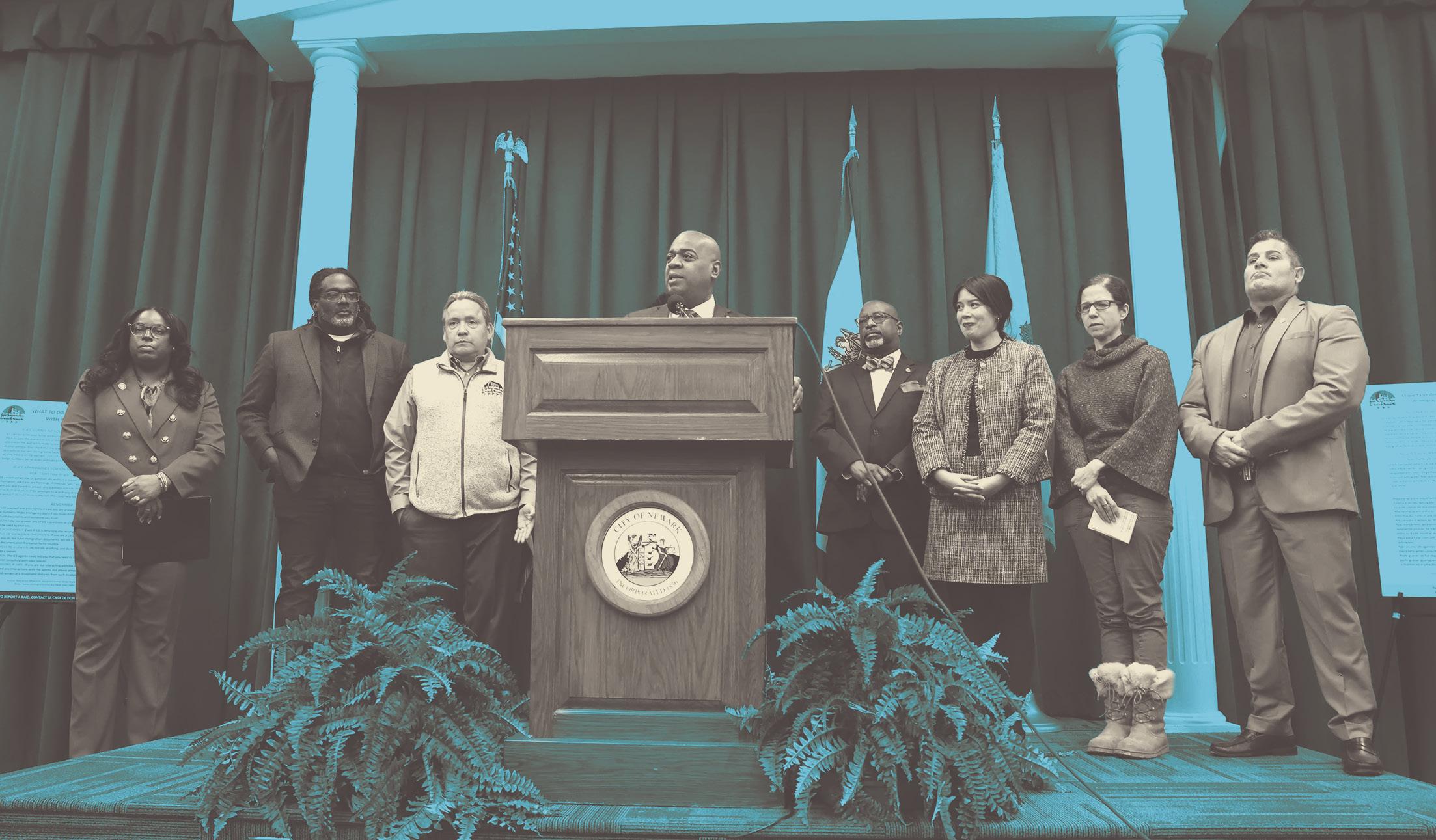
“My name is Amy Torres, I’m the Executive Director with New Jersey Alliance for Immigrant Justice. We are the State's largest immigration coalition… It’s because of the strength and power of the coalition that folks were on the ground yesterday. Let me tell you a little bit about what happened; the alliance works on policies that empower immigrant communities and when we are not fighting for additional protection to keep those communities safe, we are out in the community making sure people are educated and empowered about the rights and protections they do have.
Imagine my surprise, since the election the alliance’s Know Your Rights work has gone into overdrive. Since January alone we’ve provided almost 100 hours of Know Your Rights activities in Newark and across the state. Our online engagement for Know Your Rights materials is up 170%... the demand has been there and this is one of those bitter ‘I told you so’ moments.
Yesterday, you can imagine my surprise when I got a call from our Know Your Rights coordinator Dante. I was not expecting to hear from him… an organizer called saying, “ I just got a call there is an active worksite raid in Newark, we need all hands on deck. People don’t know what to do and they’re scared.” We immediately went into rapid response, calling deportation and defence lawyers through AFC to make sure there was an attorney on the ground. It meant notifying the ACLU to make sure people’s civil liberties were protected, and it meant bringing translated materials and interpreters on the ground to make sure people knew what was going on and they were safe.
What we learned from folks that stayed behind was that ICE walked in like it was their empire's own conquered land. They were heavily armed. There was no prior announcement. They were blocking off entrances and exits. They were scrambling up delivery ramps. They were
You have constitutional rights:
• DO NOT OPEN THE DOOR if an immigration agent is knocking on the door.
• DO NOT ANSWER ANY QUESTIONS from an immigration agent if they try to talk to you. You have the right to remain silent.
• DO NOT SIGN ANYTHING without first speaking to a lawyer. You have the right to speak with a lawyer.
• If you are outside of your home, ask the agent if you are free to leave and if they say yes, leave calmly.
• GIVE THIS CARD TO THE AGENT. If you are inside of your home, show the card through the window or slide it under the door.
banging down bathroom doors to make sure there was nobody inside. And most importantly as the mayor said, they did all of this without being able to provide a single name or warrant. As you heard, there were arrests and interrogations, in ICE’s words this wasn’t a raid… they called this a ‘targeted operation’. This language suggests there was deep intel, so why was a US citizen interrogated? Why was a military veterans' credentials and honor called into question? I’ll tell you how something like this happens, ICE lies. ICE was created in a period of post 9/11 rampant nationalism. They use fear and racism to justify their presence, to justify their profiling, and to justify their power grabs. These officers came in with guns and getting into people’s faces. They were terrified, as you would be to…”
I do not wish to speak with you, answer your questions, or sign or hand you any documents based on my 5th Amendment rights under the United States Constitution.
I do not give you permission to enter my home based on my 4th Amendment rights under the United States Constitution unless you have a warrant to enter, signed by a judge or magistrate with my name on it that you slide under the door.
I do not give you permission to search any of my belongings based on my 4th Amendment rights.
I choose to exercise my constitutional rights.
These cards are available to citizens and noncitizens alike.
1. On Tuesday, March 25, 2025, the University learned that Rümeysa Öztürk, a Tufts doctoral student from Turkey, was taken into custody by the Department of Homeland Security as she was leaving her off-campus apartment in Somerville, Massachusetts. The University understands that she was leaving her home that evening for an Iftar dinner hosted at the Tufts Interfaith Center where she would break her Ramadan fast for the day.
2. At around 6:30 p.m. that evening, the Tufts University Police Department received courtesy notification from the Somerville Police Department that an individual had been detained by federal authorities and that the person in custody might be a Tufts student. We confirmed through our records that the person in question was Rümeysa Öztürk.
3. At 7:32 p.m., Ms. Öztürk’s record in the Student and Exchange Visitor Information System (SEVIS) was updated to note that her visa was terminated. Prior to that, and at the time of her detention, Ms. Öztürk was in “good immigration standing” according to her record in SEVIS, and both Ms. Öztürk and Tufts had followed the governing regulations for students on visas. The University then received a notice, dated March 25, 2025 and received via email on March 26, 2025 at 10:31 a.m., stating that Rümeysa’s visa was cancelled because she was a “nonimmigrant status violator” (citing 237 (a)(1)(C) (i) of the Immigration and Naturalization Act) and/or that the United States believed that her presence in the country would result in “potentially serious adverse foreign policy consequences for the United States” (citing 237 (a)(4)(C)(i)).
4. With her consent, the University can confirm that Ms. Öztürk is a third-year doctoral student in good academic and administrative standing. Her research focuses on how young adults can use social media in positive, prosocial ways and she is described by her faculty as a hard-working student dedicated to her studies and the Tufts
community. The University has no information to support the allegations that she was engaged in activities at Tufts that warrant her arrest and detention. The University has seen an outpouring of support for Ms. Öztürk over the last week from Tufts students, faculty and staff. These individuals have described Ms. Öztürk as a valued member of the community, dedicated to her academic pursuits and committed to her colleagues.
5. The University can confirm that Ms. Öztürk was one of several authors of an opinion piece in the student newspaper, The Tufts Daily, published on March 26, 2024, entitled: “Try again, President Kumar: Renewing Calls for Tufts to Adopt March 4 TCU Senate resolutions.” The University declares that this opinion piece was not in violation of any Tufts policies. Further, no complaints were filed with the University or, to our knowledge, outside of the University about this op-ed. The University maintains that the op-ed was consistent with speech permitted by the Declaration on Freedom of Expression adopted by our trustees on November 7, 2009. For the record, a search of The Tufts Daily will reveal op-eds on multiple sides of the issue with opinions that were shared just as strongly as the op-ed Ms. Öztürk co-authored. The University has no further information suggesting that she has acted in a manner that would constitute a violation of the University's understanding of the Immigration and Naturalization Act.
6. Our international students, faculty, and staff are vital to deliver on the education, teaching, research, and public service mission of Tufts University. The University sponsors 1,818 continuing international students on F-1 visas, alongside 569 alumni who are pursuing postcompletion work authorization in the United States, 24 degree and non-degree students on J-1 visas. This is in addition to the broader community of students, faculty, and staff that hold various immigrant and non-immigrant statuses.

7. The free movement of our international community members is therefore essential to the functioning of the University and serving our mission. The University has heard from students, faculty and staff who are forgoing opportunities to speak at international conferences and avoiding or postponing international travel. In the worst cases, many report being fearful of leaving their homes, even to attend and teach classes on campus.
8. The University declares that many of these students will go on to make significant economic and intellectual contributions to the United States and in countries around the world. They will do so by working in or building new companies, through teaching and research in universities and other academic and healthcare institutions, and through public service in the United States and across the globe. The University is confident in its declaration because thousands of Tufts University alumni have received their education while on F-1 visas and have gone on to make a positive impact to the economic prosperity and intellectual success of the United States and in other countries.
9. The undersigned submits this declaration, on behalf of Tufts University, in support of Ms. Öztürk and asks that she receive the due process rights to which she is entitled. Based on everything we know and have shared here, the University seeks relief so that Ms. Öztürk is released without delay so that she can return to complete her studies and finish her degree at Tufts University.
On behalf of the University, the undersigned declares under the penalty of perjury that the foregoing is true and correct.
Executed on April 1, 2025, at Tufts University.
SUNIL KUMAR
PRESIDENT, TUFTS UNIVERSITY


On March 25, 2025, Tufts University student Rumeysa Ozturk was arrested on her way to a Ramadan dinner event by masked, plainclothes officers. Surveillance video shows officers loading Ozturk into an SUV and departing in three unmarked vehicles. Bystanders observed that the incident “looked like a kidnapping.”
For almost 24 hours, Ozturk’s location was unknown and her lawyer could not locate her.
On the afternoon of March 26, more than twelve hours after a district court judge ordered the federal government not to remove Ozturk from Massachusetts without at least 48 hours’ notice, ICE’s locator system was updated to show that she was being held at the South Louisiana ICE Processing Center.
This arrest appears to be one of the latest examples in a string of ICE arrests of university students with valid green cards and visas, seemingly on the basis of their political views. Ozturk was one of four authors of a 2024 op-ed in the Tufts student paper, which called for the university to “engage with and actualize” Israeland Palestine-related resolutions passed by the university’s Student Senate.
Secretary of State Marco Rubio has stated that the Administration will deny visas to those who “participate in that sort of activity,” referring to protest movements on campuses. Following Ozturk’s arrest, Tufts was informed that her “visa ha(d) been terminated” — similar to other recent cases in which ICE agents have declared, without a judicial or administrative hearing, that they were “terminating” or “revoking” students’ green cards and visas.
The lawmakers asked the Departments of Homeland Security and State, along with ICE, to provide explanations for Ozturk’s arrest and visa revocation; her transportation to Louisiana despite a court order; officials’ use of unmarked vehicles, face coverings, and plain clothing; the federal government’s policies for terminating a student’s visa without a request from a university; and more.



I would like to extend my gratitude to the many people that helped me complete this editorial. This would not have been possible without the support and contributions of family and friends.
To the participants of my interview section, I admire your bravery in allowing me to share your stories, thank you all so much!
Thank you to the Accent Group construction crew and Pier Lunch Stop, for allowing me to document their working experience. I respect the hard work they do and I hope to have reciprocated that same dedication here. This self made collection is titled “The Underdogs”, 2025.
To the wonderful Graphic Design community at Rutgers Newark, you guys are incredible. I’m inspired everyday I walk through those doors, and I’m very proud of the work we have accomplished along side each other. Without your support this project would not have been possible. Thank you GD family!
To my sister, Cindy, you were a beacon of inspiration throughout this project. You set the stepping stones in life for me to follow and took many risks in doing so. Your strength and guidance have made me into the person I am today, thank you for always believing in me!
To my parents, as a witness to your hardships in America, I have nothing but gratitude for the opportunity you’ve created for me. So many years spent quietly working away, supporting my future, with little regard for your own. This project is a response to those hardships. I refuse to be silent anymore, and I hope this project gave you a voice to finally be heard.
To my partner, Shania, you watched me develop this editorial from just an idea to final print. This journey has not been easy, and you’ve been there for me every step of the way. Thank you for bringing out the best in me!
American Immigration Council. “The Facts about the Individual Taxpayer Identification Number (ITIN).” American Immigration Council, 20 June 2009, www.americanimmigrationcouncil.org/ research/facts-about-individual-taxpayeridentification-number-itin.
Cornell Law School. “U.S. Constitution.” LII / Legal Information Institute, Legal Information Institute, 16 May 2018, www.law.cornell.edu/ constitution.
Davis, Carl, et al. “Tax Payments by Undocumented Immigrants.” Institute on Taxation and Economic Policy, 30 July 2024, itep. org/undocumented-immigrants-taxes-2024/.
“Documented Dreamers: An Overview.”
American Immigration Council, 20 Aug. 2021, www.americanimmigrationcouncil.org/research/ documented-dreamers-overview.
“Following ICE Raid in Newark, Reps. Menendez and McIver Take Action.” Representative Menendez, 27 Jan. 2025, menendez.house. gov/media/press-releases/following-ice-raidnewark-reps-menendez-and-mciver-takeaction.
“Know Your Rights Cards.” New Jersey Alliance for Immigrant Justice, 2022, www. njimmigrantjustice.org/know_your_rights_cards. Accessed 10 Apr. 2025.
Migration Policy Institute. “Deferred Action for Childhood Arrivals (DACA) Data Tools.” Migrationpolicy.org, 5 Dec. 2018, www. migrationpolicy.org/programs/data-hub/ deferred-action-childhood-arrivals-dacaprofiles.
“News: MAYOR RAS J. BARAKA’S STATEMENT on ICE RAID on NEWARK BUSINESS ESTABLISHMENT.” Newarknj.gov, 2025, www. newarknj.gov/news/mayor-ras-j-barakasstatement-on-ice-raid-on-newark-businessestablishment.
Offenhartz, Jake, et al. “Turkish Student at Tufts University Detained by Homeland Security, Lawyer Says.” AP News, 26 Mar. 2025, apnews.com/article/tufts-student-detainedmassachusetts-immigration-6c3978da98a8d0f 39ab311e092ffd892.
“OLRC Home.” Uscode.house.gov, uscode.house. gov/browse/prelim@title8&edition=prelim. R-GA-10, Mike. “H.R.29 - 119th Congress (20252026): Laken Riley Act.” Congress.gov, 2025, www. congress.gov/bill/119th-congress/house-bill/29? q=%7B%22search%22%3A%22Laken+Riley+Act %22%7D&s=1&r=1.
School of International Service, AU. “Title 8 Explained with SIS Professor Anthony Fontes.” YouTube, 24 May 2023, www.youtube.com/ watch?v=JSJiOtl4Crg. Accessed 10 Apr. 2025.
The Editors of ProCon. “DACA & the DREAM Act | Pros, Cons, Debate, Arguments, & Immigration.” Encyclopedia Britannica, 12 Feb. 2025, www. britannica.com/procon/DACA-and-the-DREAMAct-debate.
Title 8 Aliens and Nationality. Office of the Federal Register National Archives and Records Administration as a Special Edition of the Federal Register, 1 Jan. 2012, www.govinfo.gov/ content/pkg/CFR-2012-title8-vol1/pdf/CFR-2012title8-vol1.pdf. Accessed 10 Apr. 2025.
U.S. Citizenship and Immigration Services. “Immigration and Nationality Act.” U.S. Citizenship and Immigration Services, 10 July 2019, www.uscis.gov/laws-and-policy/legislation/ immigration-and-nationality-act.
“Yearbook 2022 | OHSS | OHSS - Office of Homeland Security Statistics.” Dhs.gov, 2022, ohss.dhs.gov/topics/immigration/yearbook/2022.
Photographs by Matheus Cueva, from “The Underdogs” Collection, 2025.
This editorial was produced in partial fulfillment of the requirements of Graphic Design 4 in the Department of Arts, Culture & Media, Rutgers University-Newark, under the instruction of Professor Gisela Ochoa, Spring 2025. The text content was culled from multiple sources cited in the Bibliography. The Introduction was written by Matheus Cueva. The type is set in Cocogoose Pro, Courier, and Baloo 2. The paper stock is 11” x 17” Hammermill Premium 24lb. This book was designed, printed, and hand-bound by Matheus Cueva. Includes photography from the author’s personal collection, “The Underdogs”, 2025. In additon to “Pultizer 21st-Century Migration Photography”, and other credited sources mentioned in the Bibliography.