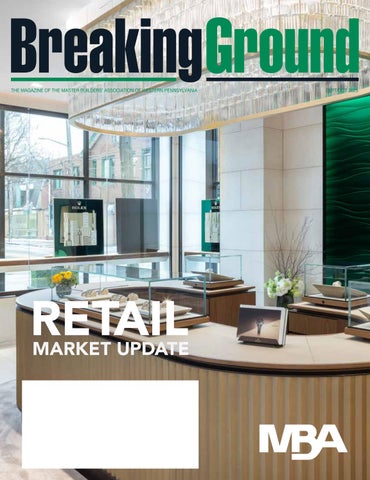

RETAIL
MARKET UPDATE




Building Success Starts with Peoples Natural Gas. Why pay more for temporary site heat? Natural gas is cost-effective, dependable, and always ready. Work with Peoples Natural Gas to plan ahead, install your gas line early and tap into an energy source you can rely on.

Scan here or visit Peoples-Gas.com/constructionheat to prepare your site today.








PUBLISHER
Master Builders’ Association of Western PA www.mbawpa org
MANAGING
EDITOR
Ben Atwood 412-922-3912 ben@mbawpa.com
EDITOR
Jeff Burd jburd@talltimbergroup.com
PRODUCTION
Carson Publishing, Inc.
Kevin J. Gordon
ART DIRECTOR
Carson Publishing, Inc.
GRAPHIC DESIGN
Blink Advertising blinkadvertising.com
CONTRIBUTING PHOTOGRAPHY
American Subcontractors Association of Western PA CREW Pittsburgh
Denmarsh Photography
Henne Jewelers

Mascaro Construction, L.P.
Massery Photography
Master Builders’ Association of Western PA NAIOP Pittsburgh
Nala Marketing
Rycon Construction
Shannon Construction
Turner Construction Co.
DIRECTOR
Mary Chuderewicz mbawpa org
MORE INFORMATION: is published by the Master Builders’ Association of Western Pennsylvania, 412-922-3912 or www.mbawpa.org
Archive copies of BreakingGroundTM can be viewed at www.mbawpa.org
No part of this magazine may be reproduced without written permission by the Publisher. All rights reserved.
Bridging Documents and DesignBuild Warranties: Building Bridges to Avoid Pitfalls
for Safety: How Prevention through Design Can Transform the Built Environment
On the cover: Henne Jewelers












PUBLISHER’S NOTE
After looking at the economics of the retail industry for the past month, I get the uneasy feeling that we are heading towards a shift in consumption that could reset the U.S. economy. The fundamentals of retailing are diverging rapidly. On the demand side, consumers continue to have a strong appetite for goods and services. On the supply side, however, things are less stable.
Retailers are facing some difficult challenges. There is a shortage of desirable space to rent. Construction of new space is a fraction of what it was, and of what is needed. Thus far, rents are not growing faster than normal, but that will not be true for much longer if development remains constrained. The other element of supply, the merchandise, is facing the dual challenge of high tariffs and high cost of sales. The current trend for the cost of retailing is turning higher towards an unsustainable path.
Should these trends continue, there will be a tipping point for consumers. If the cost of goods rises by double digits at the same time rents do, prices will push consumers to keep their wallets in their pockets. We will reach a point of imbalance that will be followed by a rebalancing. We call those periods recessions.
Maybe that is where we’re heading, an old-fashioned correction that causes mild unemployment and lasts less than a year. But when you look at the underlying fundamentals of consumption, it is not hard to see how something more drastic could be on the horizon.
The U.S. economy rides on the backs of consumers. While that has been true since the industrial revolution, the degree to which U.S. domestic output relies on consumption elevated considerably during the late 1980s-1990s. In 1960, when the population was 181 million and GDP was $542 billion, consumers accounted for 62 percent of the economy. That share of the economy is almost eight percentage points higher today, when GDP is $29 trillion. More enlightening is a comparison of the consumer share of GDP per capita. Consumer per capita share of GDP accounted for almost $60,000 per person in 2024. In 1960, consumer spending as a share of GDP was less than $2,000 per person.
There are good explanations for why this need not be a problem. Productivity is dramatically higher today. The taxes we pay are also dramatically lower today, leaving us with more disposable income. The median earner paid 30 percent federal income tax in 1960 compared to today’s 22 percent. Those earning $100,000 – or roughly $1 million today – paid 75 percent in federal tax. Today, that rate is 37 percent. Data on household debt shows Americans pay less than 12 percent of their income for loans of all types. The personal savings rate is lower, about 4.5 percent vs. 10 percent in 1960, but about the same as it has been since 1997. Setting aside the difference in social attitudes about consumption today vs. 65 years ago, Americans do not seem to be out over the tips of their skis.
What looms as a tipping point is the change in attitude about free trade, which has sparked the widespread application of tariffs. There are mountains of data that show that Americans are far better off today because of freer trade policies over the past 30 years. But those policies have also led to a hollowing out of the manufacturing base. Millions of U.S. manufacturing jobs moved overseas. That means millions of voters have good reason to be unhappy about freer global trade. It is easy to see how a trade policy that makes it more expensive to buy goods made overseas would be popular.
Throughout U.S. history, high tariffs have not proven to accomplish the goals of imposing them. But let’s assume they do in 2025. Assume that U.S. companies (and perhaps more foreign-owned firms) move operations back to the U.S. Assuming those companies can find workers willing to work in manufacturing (an assumption that does not have great support in reality today), how will that trickle down to the market? How much will a toaster or television cost that was made in an American factory? How much must an American factory worker be paid to produce a $30 toaster or a $219.99, 54-inch smart TV? How many toasters and smart TVs will be made by robots?
It isn’t hard to see a very different consumption landscape by 2030 if tariffs remain in place and manufacturers move more goods production to the U.S. Things will cost more. Consumers will not be able to purchase as many things. That will mean people who have lower incomes will make do with less, as was the case in 1960. Such an environment will be tough on the category-killer retailers like WalMart, Target, and the like. The shortage of Class A space to rent will no longer be a problem.
This is not necessarily an apocalyptic vision of society, although it will require some painful readjustment. It would not hurt to have Americans consume less and save more. Using tariffs as a tax that brings down government debt would ease that burden on future generations, assuming some federal administration stops increasing spending. U.S. consumers would likely demand better quality and durability out of the more expensive goods they purchase. In some ways it would be more like 1960 again.
But getting back to 1960 should not be the goal. Six decades of progress should not be thrown away, even if some of the effects of progress aren’t desirable to you. Tariffs are a tax on consumption, and a regressive one at that. Progress, even when it was messy, has benefitted American society for almost 250 years. Regress seems like a bad policy goal.



REGIONAL MARKET UPDATE
BY BEN ATWOOD AND JEFF BURD
The combination of higher construction costs, higher borrowing costs, vanishing federal grants and support, and general economic uncertainty made the typical late summer slowdown somewhat slower than usual.
Contractors tend to judge the market by the week’s bidding activity, but the current market conditions are not just leading to fewer opportunities to bid. Requests for qualification and/or proposals have slowed. More ominously, reports of layoffs at architectural and engineering firms are increasing in frequency, raising concerns about the opportunities for construction in 2026.
To a large degree, the concerns about the current market are probably overblown. According to Tall Timber Group, there have been $2.8 billion in nonresidential and commercial starts through August 31. Moreover, a number of the highprofile projects that have been on hold throughout the year, especially multi-family projects, are looking like they will get underway in 2025. But pessimism about the bread-andbutter projects in the Pittsburgh market, particularly in higher education and healthcare, is well founded.
The higher education market is somewhat upside down compared to 2023. The region’s powerhouse research institutions, University of Pittsburgh and Carnegie Mellon University, were in the midst of investing more than $1 billion in capital projects at that time, including half dozen projects over $100 million. The numerous small colleges and public universities were struggling with declining enrollment and under-invested facilities. Many observers expected the failure of one or more small colleges during this decade. The fate of the PA System of Higher Education (PASSHE) institutions was uncertain.
Two years later, PASSHE still faces an uncertain future, but new buildings are underway on two Western PA campuses. Small colleges, notably Allegheny College, Grove City College, and Washington & Jefferson College, have seen a surge in giving from Baby Boomer alumni, unlocking what will be more than $300 million in construction projects built in the latter half of the decade.
Pitt and Carnegie Mellon have seen more than $200 million in federal research funding cuts, leading both to cut overhead
expenses. Two major projects at Carnegie Mellon, the R.K. Mellon Hall of Science and the Robotics Institute at Hazelwood Green, are still in construction, but the next major project has not been identified. Construction is well underway on Pitt’s Student Recreation Center, Sports Performance Center, Fifth and Halket, and the Bioforge at Hazelwood Green; however, the balance of Pitt’s most recent master plan will likely be reevaluated before any new major project begins. The most pressing need at Pitt, more student housing, is being addressed by private developers. Plans for a mid-campus residence hall on Fifth Avenue are again on hold.
Healthcare institutions have been under financial stress since the pandemic, which was limiting the capital budgets at the region’s hospitals. Cuts in research funding by the Trump administration, along with cuts in Medicaid and potential changes to Medicare, have added more financial uncertainty to the outlook for healthcare providers. Construction at the two major healthcare systems in Western PA, Allegheny Health Network (AHN) and UPMC, is limited to smaller clinical renovations, infrastructure modernization, and parking garage modernization.
UPMC’s $1.2 billion flagship Heart and Transplant Hospital is roughly 80 percent complete, although construction will continue through 2026. No other major capital projects are moving forward at UPMC as the third quarter of 2025 ends. At AHN, progress on its new hospital at the Canonsburg General Hospital site has stalled, as new leadership at AHN reviews the project. If given the green light, construction of the new hospital will commence again in spring 2026. A $48 million parking garage at West Penn Hospital is moving into design but no schedule for construction has been approved.
Against this deterioration of education and healthcare activity, there is renewed activity in other sectors that are offsetting the lower construction volume at colleges and hospitals. The energy sector has been one of the most active in the Pittsburgh market all year. Although the summit at Carnegie
Mellon has generated countless headlines, the uptick in power generation applications for natural gas has activated the Marcellus Shale players to expand their operational activities for the first time in a decade. The combination of limited power availability on the grid and an anticipated surge in power demand from industrial and data center development is creating the need to generate electricity on site, which typically involves gas-fired technology.
This increase in demand for energy generation is rippling through Western PA. GE Vernova has announced a $100 million investment to expand its Speers, PA, electrical switchgear capacity. Cumi America, which has businesses in mining, fusion, and renewable energy, agreed to lease a 90,277 square foot building under construction now at Imperial Business Park.
Unlike many of the mega projects receiving headlines in recent months, there is significant progress on the repurposing of the former Homer City power plant site in Indiana County.

The vacancy rate for multi-family properties has fallen steadily since the beginning of 2024, despite increased new construction, in contrast to the national vacancy rate. Source: CoStar
Construction has begun on the $15 billion redevelopment to create 4.5 gigawatts of electricity for future data centers. Homer City Redevelopment awarded the excavation contract and hired Kiewit Power Constructors as engineering-procurement-construction (EPC) contractor. Kiewit intends to selfperform large portions of the project but has been developing scopes of work for major packages, worth billions of dollars, that will bid to regional contractors. Some of these contracts have been awarded, while most will bid as the project develops throughout the balance of the decade.
Pittsburgh-based International Electric Power III LLC has been meeting with local construction companies about its proposed 1,400-acre data center in Greene County. In addition to the multibillion-dollar data center, Essential Utilities recently announced its Aqua unit would design an 18 million-gallonper-day water treatment plant to support the cooling needs of the data center. No construction schedule has been announced but the gas power turbines are reported to be scheduled for delivery in 2028, with a plant opening in 2029.



National Association
Two of the larger projects in Allegheny County Sanitary Authority’s (ALCOSAN) multi-billion-dollar Wet Weather Equalization Program should be under construction by year end. The authority is taking bids on the $325 million Wet Weather Pump Station on October 2 and is scheduled to open bids for the $750 Ohio River Tunnel on November 24. The two major ALCOSAN projects will add $1 billion to the Pittsburgh
Housing Inventory: Active Listing Count In Pittsburgh
Source:
of Realtors, Federal Reserve Bank of St. Louis POWER
BUILDING ABOVE AND BEYOND
Go beyond. Repeat.
Trust your next construction project to PJ Dick.


construction market over the next three years. Similar tunnel projects for the Allegheny River and Monongahela River are scheduled to start in 2029 and 2031 respectively.
In the K-12 market, several larger projects have been or will be advertised for bids in early fall. Carlynton School District has its $16 million Carnegie Elementary School project back out for bid after a reduction in scope from the April bids that were over budget. Likewise, the $20 million Mars Area Elementary School expansion, which originally bid in May, will be re-bid in late September. Massaro CM Services is scheduled to advertise two projects estimated to cost $30 million combined at Lincoln Park Performing Arts Charter School in Midland, PA. The Event Center and Arts and Science Center should go out to bid in mid-October.
Design is nearing completion on two major projects that have been in the pipeline since before the pandemic. Bids on the $90 million Quaker Valley High School building were scheduled to be taken in November, but delays in permitting have pushed bidding into the new year. Hempfield Area School District reviewed the most recent 3-D drawings for its $150 million high school addition and renovation, which the district hopes to advertise for bids after the year-end holidays.
The fundamentals of the Pittsburgh economy continue to outpace those of the U.S. economy overall. Stable employment and wage growth are supportive of commercial real estate, although the environment for new development is still challenging. And supply constraints are keeping new housing construction from meeting demand.
Pittsburgh’s labor market showed signs of both resilience and adjustment in July. The civilian labor force expanded modestly to 1.24 million, up slightly from May, while total employment held steady at 1.18 million. Total non-farm employment stood at 1.22 million, about 1.8 percent higher than a year earlier. The unemployment rate ticked up to 4.2 percent, with the highest year-over-year jumps in unemployment, 0.4 percent, being felt in Westmoreland and Washington counties.
Industry level performance was mixed. Construction continued a steady climb in employment through mid-year, despite showing a year-over-year decline, while manufacturing declined. Government also experienced a notable drop, as employment fell to 113,400, nearly 6,000 below March levels. Growth came from professional and business services, financial activities, and particularly education and health services. Leisure and hospitality also posted solid gains, up three percent year over year.
Over the past two years, manufacturing employment in the Pittsburgh metro has edged lower. As of July 2025, the Bureau of Labor Statistics index stood at 85.6, compared to 87.9 in July of 2023. That represents a decline of roughly 2.7 percent over the 24-month period. The numbers suggest the region has not been able to regain momentum, instead showing a gradual easing of employment levels. For context, the index uses 2017 as its baseline year (set equal to 100), meaning Pittsburgh’s manufacturing workforce is now sitting about 14
percent below that benchmark. Month by month, the series has fluctuated slightly over the past twelve months, but no significant upward movement upsets this broader trend. While the declines have been modest, the lack of sustained recovery underscores the headwinds facing the sector.
Though the data oscillates seasonally, the number of active home listings around Pittsburgh has risen noticeably. As of July, there were 5,101 listings, compared to 3,827 in July of 2023, according to the National Association of Realtors. That’s an increase of roughly 1,274, or 33 percent, signaling an ongoing loosening in housing supply. Month to month, the data shows a steady upward trend through 2024 and into 2025, with listings climbing from the mid-3,000s into the low 5,000s by summer. While still low compared to pre-2019 historic norms, this twoyear increase represents a significant shift.
This is not having much of an impact on pricing, though. In July, the median listing price for homes reached $252,278, compared to $242,950 in July of 2023. This represents an increase of nearly four percent in the two-year span. While the gain is modest compared to the double-digit jumps seen during the pandemic, it signals that prices remain on an upward trajectory, despite the influx of listings.
CoStar reports that office vacancies have ticked up 50 basis points in Pittsburgh year over year, and at 11.7 percent, vacancies are at the highest level since the global financial crisis. Year-over-year absorption, a measurement of office demand, is very slightly in the red. Despite being negative, this is a win for the region’s office owners, who saw millions of square feet hit the market post pandemic and is another sign that office deterioration is slowing. Pittsburgh remains somewhat insulated from the broader office struggles due to limited development, so local vacancies remain under the national rate of 14.1 percent.
Multi-family continues performing well. Vacancies ticked up in time with new deliveries but remain firmly under control at 5.6 percent. Modest levels of construction (there are currently 2,800 units underway) will likely cause vacancies to climb over the next 12 months; however, the amount being built will not cause major disruptions to the supply-demand balance. The uptick in vacancies has had no impact on rents, which climbed by nearly three percent year after year. This compares favorably to the national benchmark of one percent and is in line with the ten-year averages for Pittsburgh.
The fourth quarter of the year is typically a leading indicator for the year that follows. Pittsburgh’s two largest projects, the new airport and the UPMC Presbyterian tower, are nearing completion. Those projects have provided a strong foundation for the construction industry since the end of the pandemic, even as the mainstream of the regional construction market ebbed and flowed. Several opportunities for billion-dollar projects are on the horizon that would support thousands of construction jobs. With the global economy slowing, the start of construction at U.S. Steel, Homer City, or one of the data centers being proposed would keep the Pittsburgh market from feeling the worst effects of economic turbulence in 2026. BG

Construction Experience You Can Build On

Bowles Rice continues to expand its respected construction law practice into Pennsylvania, Ohio, and beyond. Our senior construction attorneys in Pennsylvania have over 90 years of construction experience between them, representing every facet of the construction industry—from general contractors, subcontractors, suppliers, and developers to design professionals and municipal and private owners. We focus on providing responsive, efficient, and cost effective representation for our construction industry clients. We understand the business, and we understand the law that you will be required to navigate and overcome to be successful.
• Contract Negotiation and Formation
• Project Delivery System Analysis
• Project Management Assistance
• Dispute Avoidance and Dispute Resolution
• Payment and Performance Bond Claims
• Mechanics’ Lien Claims
• Delay, Disruption and Acceleration Claims
• Federal and State Prevailing Wage Issues
• OSHA Compliance and Citations
• Bid Disputes
• Prompt Payment Act Claims
• Employment Disputes
• AAA Arbitration/Mediation Panel Members



Brad Mellor bmellor@bowlesrice.com
Damon Thomas dthomas@bowlesrice.com
Tom Weiers tom.weiers@bowlesrice.com
Attorney: Taylor Frankovitch
ENATIONAL MARKET UPDATE
BY BEN ATWOOD
conomic distress signals began flashing this summer, increasing concerns about cooling job growth, economic fallout from President Trump’s sweeping tariffs, and heightened inflation.
The most surprising was the sudden decline in employment growth and downward revision to prior month’s labor figures by the Bureau of Labor Statistics (BLS). The data showed non-farm payroll rose by just 73,000 in July and 22,000 in August, well below expectations. Additionally, prior monthly job data was revised downward and the unemployment rate edged up to 4.3 percent. Broader joblessness, including discouraged and underemployed workers, also climbed to the highest level since early 2022.
Most of the limited hiring came from health care and social assistance, while sectors like professional services and government shed jobs. Wage growth remained steady, but the household survey showed a dip in employment and a drop in labor force participation.
Private payrolls rose modestly in August, according to payroll processor ADP. The September 3 monthly ADP National Employment Report for the U.S. showed a gain of 54,000 jobs, below expectations.
These metrics point to a slow but persistent cooling of the job market, raising concerns about how much longer the broader economy can remain resilient in the face of trade
tensions. The weak data added urgency to political pressure from President Trump, who continues to demand aggressive rate reductions from Federal Reserve Chair Jerome Powell.
Despite headline gross domestic product (GDP) growth showing strength in the second quarter, the Federal Reserve declined to do so. The board’s meeting notes cited concerns that much of that growth was driven by temporary trade distortions and inflation lingering over two percent, suggesting a fragile economic underbelly.
Soon thereafter, an August BLS data release showed an unanticipated rise in the producer price index (PPI). These rose sharply in July, signaling renewed inflationary pressures that further complicate the Federal Reserve’s path forward. Wholesale prices climbed 3.3 percent year-over-year, well above the Fed’s two percent target. The 0.9 percent monthover-month growth was the largest spike in over two years and even when stripping out volatile categories like food and energy, price growth remained elevated.
This suggests inflation is spreading across a broad range of goods and services, and construction related indexes reflect it. Of the 78 main inputs to construction, 11 rose by more than one percent compared to seven in June, while 43 rose by less than one percent. Overall inputs for construction climbed by 0.4 percent, led by a sharp 4.1 percent jump in energy. Subcontractor costs also moved higher, particularly for concrete and roofing work in nonresidential projects. The steepest increases came in diesel fuel, aluminum mill shapes, and copper and brass shapes.
Year-over-year comparisons highlight broader pressures, with 25 indexes up over three percent since July of 2024. Fabricated steel plates, aluminum products, and architectural metal work posted the largest annual gains, suggesting tariff impacts may be filtering into materials.
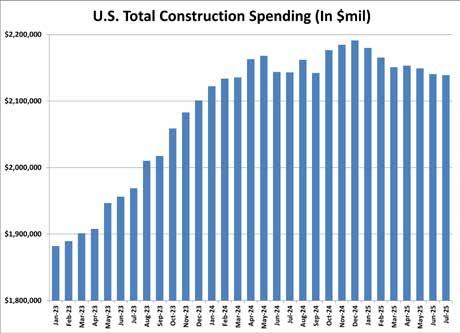
This coincided with another monthly decline in total construction spending. The June release of the U.S. Census Bureau’s construction spending data showed a slippage of 0.4 percent from May to June. That is an annualized rate of $2.14 trillion, and nearly 3 percent lower than a year earlier. Through the first half of the year, spending totaled just over $1.03 trillion, about 2.2 percent below the same period in 2024, reflecting a broader cooling trend in the sector.
Total construction spending in the U.S. has declined in five of the past six months. Source U.S. Census Bureau.
Private construction was the main drag, falling 0.5 percent overall as residential spending declined 0.7 percent and nonresidential dipped 0.3 percent. Public construction was little changed from May, with small increases in education and highway projects.
Intriguingly, broader inflation impacts for consumers remain modest. July’s strong PPI contrasted with a relatively tame consumer price index (CPI), which rose by 0.2 percent from June. Key tariff-sensitive sectors like new vehicles barely moved, suggesting businesses may still be absorbing much of the added costs. This eased some concerns about tariff price pressure on consumers, and reinforced hopes for interest rate cuts. Still, economists cautioned that price increases could build in the months ahead as tariff effects spread more fully through supply chains.
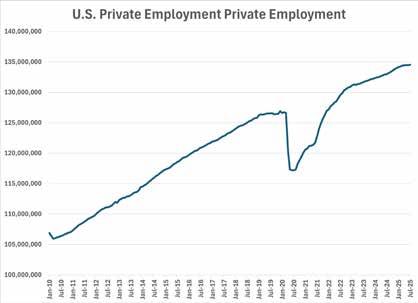
Source: ADP National Employment Report.
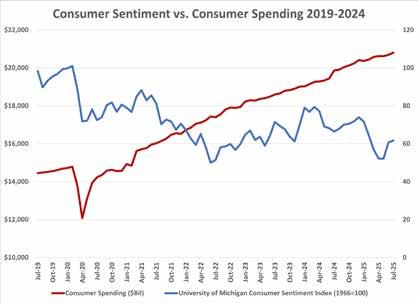
Despite the modest inflation, consumers are getting anxious again. The University of Michigan’s August report on consumer sentiment showed that consumer sentiment slipped for the first time in four months, falling about five percent. The sharpest drop came in buying conditions for durable goods, which plunged 14 percent to their lowest level in a year as households balked at high prices. Assessments of current personal finances also weakened, reflecting unease about eroding purchasing power. By contrast, expectations for future finances improved slightly, supported by modestly firmer income outlooks, though these remain muted overall.
Inflation expectations moved higher on both short- and long-term horizons. Year-end expectations rose from 4.5
percent to 4.9 percent in July, with the increase cutting across demographics and political affiliations. Long run expectations also climbed to 3.9 percent from 3.4 percent. While these levels remain below the peaks recorded earlier in the spring, the reversal ends several months of decline and suggests ongoing anxiety about tariff related inflation seeping into day-to-day life.
Goldman Sachs continues forecasting that this is what will happen in the coming months. In August, their Chief Economist David Mericle defended the bank’s analysis after Trump publicly criticized Goldman and mocked its leadership for publishing a report stating that higher producer prices would filter down to consumers by fourth quarter. The firm’s research suggests U.S. consumers could end up shouldering about two-thirds of the tariff costs, reversing the current trend where companies and exporters have borne the burden.
According to Goldman’s modeling, this shift would push core inflation higher, with CPI expected to reach 3.2 percent by year’s end. That would place it well above the Federal Reserve’s two percent target and raise pressures on households already squeezed by higher living costs. The report also notes that some U.S. producers shielded from foreign competition may take advantage of tariffs by hiking prices further, amplifying the effect on consumers.
Goldman still expects the Federal Reserve to deliver rate cuts later this year, citing the recent weakness in job growth, believing that the labor market will weigh heavily in Fed decision making. Markets are currently betting on cuts at each of the three remaining meetings in 2025, reflecting the expectation that slower growth will outweigh tariff driven price increases in the Fed’s policy calculus.
In early August, Vanguard issued a report indicating that it believes that the Fed’s communication following its July meeting leaned mildly against a September rate cut, but that stance will likely pivot now toward prioritizing employment weakness. With policy rates still roughly one percentage point above what Vanguard considers neutral, the firm expects two rate cuts before year end to cushion the economy against tariff pressures and slowing job growth. They expect the economy to stay on course with modest growth, projecting GDP at around 1.5 percent and core inflation near three percent by the end of 2025.
Vanguard also raised its baseline assumption for the effective U.S. tariff rate to about 17 percent by year-end, reflecting recent trade developments that reduced uncertainty. It cautioned that the ultimate impact would depend on how foreign investment agreements and the delayed pass-through of tariff costs to consumers unfold.
Interestingly, the domestic warning signs coincided with distress signals abroad. June’s trade figures from EuroStat show the European Union (EU) under mounting economic pressure. The EU’s trade posted an $8.7 billion trade surplus that month, down over 60 percent from the surplus a year prior. Imports surged by 6.4 percent while exports remained flat, signaling a structural imbalance. Month to month, the surplus also plunged nearly 39 percent from May to June.
The trade relationship with the U.S. has become particularly strained. Imports from America rose 16.4 percent in June while European exports to the U.S. fell by more than 10 percent, cutting the EU’s surplus with its biggest partner neatly in half. This downturn coincides with President Trump’s escalating tariff strategy, which saw duties raised to 10 percent in April and automotive tariffs reaching 25 percent before the July agreement that imposed a 15 percent blanket tariff on most European goods.
The economic impact is spilling into growth and production figures. Eurozone GDP slowed sharply in second quarter of 2025, expanding only 0.1 percent after 0.6 percent in the first quarter, with Germany slipping into contraction. Industrial output dropped, particularly in capital goods manufacturing, as export orders faltered.
Since April’s sweeping and unprecedented implementation of tariffs, there has been something of a disconnect between the economic fears often expressed in the media and the relative tranquility of each subsequent month’s economic data. Dramatic downward swings in the stock market were quickly negated by rapid growth, while inflation, production, and employment all remained stable.
But the economic data from the past two months indicate a cooling is coming. It’s currently reflected in the upward trajectories of PPI and unemployment figures, as well as in the ongoing decline of total construction spending. Day-today inflation remains under control, but major institutions are forecasting this to rise in the coming months, which would increase the chances that consumption will slow enough to cause a recession. BG
ORGANIC
Rooted in Pittsburgh, our client demand expanded the firm’s reach to 19 offices in 10 states. Call us for construction and surety-related questions.

William D. Clifford & W. Alan Torrance, Jr. Included
412-281-7272


# W e A r e V o l p a t t ustrial institutional

JWHAT’S IT COST?
BY BEN ATWOOD
uly’s Bureau of Labor Statistics (BLS) data indicates that the impacts of President Trump’s sweeping tariffs are potentially appearing in construction pricing.
The most telling sign was the unexpected 0.9 percent month-over-month rise in the Producer Price Index (PPI). This growth significantly exceeded the forecasted 0.2 percent rise and was one of the largest spikes of the past three years.
The PPI series tracks how much prices are changing for the goods and services businesses and suppliers sell and shows how much more (or less) it costs to make or deliver products. When the PPI rises, it typically indicates that upstream costs are heating up and the BLS data shows this happened in July.
Of the 78 BLS indexes related to construction, 11 rose by over one percent from June to July and 43 rose by less than one percent. This is an increase in price hikes from what the data showed for those same series from May to June, when seven indexes climbed by over one percent, and 48 by less than one percent.
Inputs for construction industries climbed by 0.4 percent from June to July, with the largest growth in the energy sector, which saw an upward push of 4.1 percent. Subcontractor prices rose by 2.3 percent for concrete contractors in nonresidential building work, while roofing contractors in that same sector saw month-overmonth change of 1.3 percent.
The largest monthly increases of individual indexes were seen in #2 diesel fuel (11 percent), aluminum mill shapes (seven percent), copper and brass shapes (six percent). Comparing July of 2025 to that same month in 2024 shows 25 indexes have risen by over three percent, with the largest year over year gains experienced in fabricated steel plates (14.3 percent), aluminum mill shapes (13.6 percent) and ornamental and architectural metal work (9.2 percent).
This type of increase hints that the impact of tariffs is on the horizon; however, it remains too soon to tell if this is the start of a trend or just an anomaly. In January of this year, the PPI registered at 0.95 then dropped quickly, declining in April. In 2022, when inflation began heating up, the PPI rose by over one percent in
five of the first six months. Additionally, the consumer pricing index (CPI) remained relatively stable with a month over month change of 0.2 percent, indicating that producers have yet to pass on the costs to consumers.
Price increases are less likely to be passed on to businesses when market conditions are deteriorating. While construction activity has slowed globally and nationally, demand for construction remains elevated. July’s jump in producer prices is certainly a reflection of cheaper, pre-tariff inventories burning off. That may mean that prices will again stabilize between July and August, when global trade deals were set to be completed. It is likely that it will be until the September PPI reading before judging if the construction market is absorbing or passing along tariff-based hikes). BG
Source: Bureau of Labor Statistics. Updated June 12, 2025.
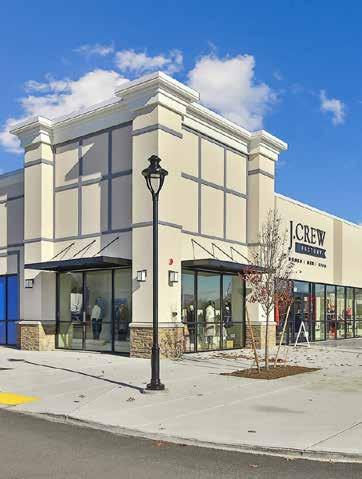
The Dick’s House of Sports at Ross Park Mall was the first of several new expanded stores in the Pittsburgh region.
Retail

By Jeff Burd and Ben Atwood
It was not very long ago that the trouble with commercial real estate was retail. As Amazon (and others) got its distribution network built and its logistics finely tuned in the late 2010s, shoppers began taking advantage of the convenience of purchasing almost all goods online. Within a few years, retailers across the spectrum of products were forced to respond to this new mode of shopping by beefing up their websites, building logistical alliances, and altering their way of going to market.

As might be deduced, this paradigm shift in retail sales led to a paradigm shift in retail real estate. For a time, it seemed like brick-and-mortar retail stores were going to become dinosaurs, extinct even as retail spending soared. But, what emerged was a sort of hybrid approach to retailing, often referred to as omni-channel retail. Brands realized that shoppers still wanted to see and feel some of what they were buying, particularly at the high end of the market. Brick-and-mortar retail was not heading towards extinction after all; however, the retail footprint did change.
This sorting out of the retail industry was happening when COVID-19 turned us all into online shoppers in spring 2020. As stores and restaurants hustled to adapt to sidewalk pickup and outdoor dining, the long-term structural realignment continued.
When the U.S. consumer was liberated from the pandemic’s confinement with the rollout of vaccines in spring 2021, retailing benefitted as much, or more, than any sector of the economy. The inflationary cycle that followed the pandemic recovery led to a steep increase in prime interest rates, which froze commercial real estate transactions and pushed property values lower. While retailing remained healthy, it was impossible for retail real estate to escape the problems of dramatically higher borrowing costs. To some extent, those problems persist today.
All these changes have made a dramatic dent in the supply and demand for retail properties. Some fundamental truths remain intact. Retailers need to be near rooftops. High traffic locations are better than low traffic locations. Triple-net leases still offer reliable income and few hassles for owners. But the makeup of retail property has been fundamentally altered again.
The Retail Market Fundamentals
The root fundamentals that support retailing are again at all-time highs as the third quarter of 2025 winds down. The latest data on retail sales, from July, showed retail spending up 0.5 percent from June and nearly four percent higher than July 2024. Moreover, retail sales were up 4.4 percent yearover-year when spending on automobiles and gasoline was excluded. Despite growing signs of wariness, consumers are maintaining high levels of spending relative to income, as well as higher incomes.
Those higher incomes also support record high levels of consumer borrowing. Consumer debt reached $18.39 trillion at the end of July, according to the Federal Reserve Bank of New York Household Debt and Credit Report. That is nearly 50 percent more debt than consumers were carrying at the peak of the housing bubble; however, household incomes are rising at a similar rate. The Bureau of Labor Statistics reported that median real household earnings rose 0.4 percent from
Posman Books was one of the first of the dozens of retailers occupying the Smallman Terminal developed by McCaffrey Interests. Photo by Massery Photography.
June to July. As a share of disposable income, household debt has remained at 11.2 percent since the fourth quarter of 2023. That is 30 percent lower than in the fall of 2008 and a lower rate than all but five of the past 45 years.
Compared to the durability of consumer spending, however, the physical footprint of retailing remains in flux.
In the 1990s, the big box retailers offered the first hints that the traditional retail delivery system was becoming outdated. Just as massive, covered malls had upended the retail paradigm in the 1960s, big box developments

Source: CoStar
catalyzed a shakeup in shopping malls. That paradigm shift, like the ones before it, was a supply response to the timeless demand from shoppers for the most convenient and least expensive shopping experience. By the 1990s, the so-called category killer – WalMart, Target, Home Depot, Best Buy, Petsmart, etc. – were being developed together as “power centers” to offer open-air shopping centers that allowed consumers the convenience of a mall at better prices.
The size of these power centers, like The Pointe at North Fayette or Trinity Point, were on par with the average covered suburban mall, and those malls were typically on a scale

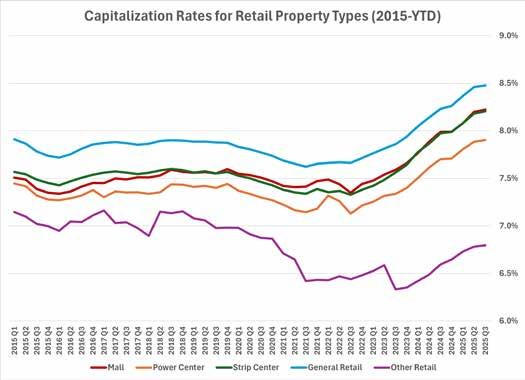
Cap rates for all U.S. retail property types have increased modestly since post-pandemic lows in 2022.
with the large downtown department stores that they replaced. So, while each of these shifts produced pain and opportunity for landlords, the amount of brick-and-mortar space available for shopping continued to increase.
This most recent shift in buying behavior involves shopping convenience and value without a store. The outcome of that shift is still being navigated by both retailers and landlords.
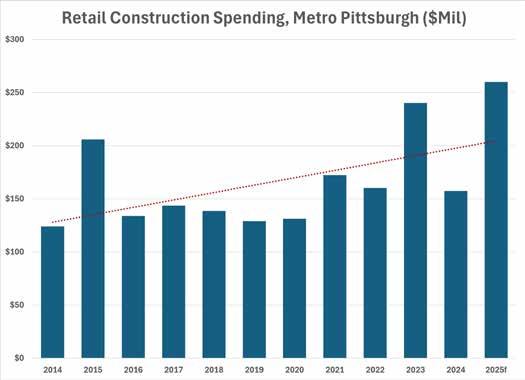
The shift in retail to e-commerce has had a dramatic effect on new retail development in Pittsburgh since the Great Recession. Beginning with 2014, the first year of real economic growth following the recession, new retail construction has fallen consistently, from 590,000 square feet in 2014 to 232,000 square feet in 2019. Aside from the 904,000 square feet started in 2015, when the Block at Northway and Siena in Upper St. Clair got underway, the total square footage of new development topped 500,000 square feet only once (in 2021) since 2014. Last year, less than 145,000 square feet of new retail went under construction.
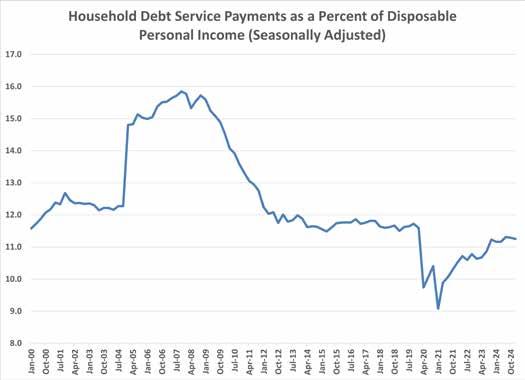
Consumer debt as a percentage of disposable income is lower than during the first 20 years of this century. Source: Federal Reserve Bank of New York Household Debt and Credit Report (Q2 2025).
strong,” she says. “That’s reflected in the occupancy rates, which nationwide are 95 percent. There just hasn’t been any new construction.”
Doug Herold, principal and owner of Herold Commercial Valuation Services, notes that the value of retail properties has been resilient, despite the spike in interest rates.
Compare those totals to the 1.8 million square feet started in the metro area in 2002, during a recession, or the 2.5 million square feet started in 2007, at the peak of that economic cycle. In fact, the 4.834 million square feet started in 20062007 exceeds the total square footage started in Pittsburgh in the past dozen years.
With few exceptions, the decline in new construction experienced in Pittsburgh has been consistent throughout the U.S. As the years have unfolded, the limited growth of new supply has made the market stronger for the existing landlords in desirable locations.
“Our market is still strong. There is a fair amount of demand on both the leasing and acquisition side,” says Mark Anderson, senior vice president, retail brokerage at Colliers | Pittsburgh. “There is not a lot of well-located product that’s available for lease or sale. Retail is all about location.”
Claudia Steeb, senior managing director at JLL Capital Markets, echoes Anderson’s comment about supply.
“In retail, many stores have closed, and properties have been transformed or sold for other use so that what is left is
“I have done several appraisals comparing values from 2022 through 2025. For office buildings the value fell significantly during that time, but for retail buildings the value has been relatively stable,” he explains. “Yes, the cost of capital has it increased, which theoretically increases cap rates, but I haven’t seen that as severe in retail. Retail cap rates have increased by 50 or 100 basis points. That relatively small increase in cap rate is typically offset by increasing rents.”
With brisk leasing activity and less new construction competition, retail property owners are seeing demand from investors and buyers. The market is not back to pre-pandemic activity levels, but there are businesses in the market. As Herold notes, the gap in perception of value between buyer and seller is not wide, but it does exist. Investor interest in retail is growing again, but they are looking at deals more carefully.
“Lenders are looking for places to lend and are looking favorably at retail. Occupancy is high and rents have readjusted. From an investment standpoint, what is left is good so they’re looking for well-located, well-underwritten assets. We’re seeing activity pick up even though rates still aren’t cooperating,” Steeb says. “Cap rates are higher because interest rates are higher. That’s a problem if the

IN A WORLD WHERE RESILIENCY IS NEEDED MORE THAN EVER,
borrowing rate is higher than the cap rate, because buyers won’t buy the property with negative arbitrage. What we’re seeing is that investors are looking at returns and then backing into a cap rate. That’s hard for sellers to understand, especially here in Pittsburgh.”
Nationwide, most institutional investors are now seeking cap rates that are one-to-two percentage points higher than sellers. That is mostly true in Pittsburgh as well, where Steeb says more leases are written without annual rent escalation than are typical in most markets. Fewer large Class A assets are on the market in Pittsburgh, which is why many of the transactions closed over the past year have been small, often stand-alone properties with high cap rates. Steeb explains that what the institutional investors are seeking is infrequently for sale in Western PA.
“Grocery-anchored retail is still the darling, as long as it’s a well-performing grocer. If you have the number four grocer in a four-grocer market it will not do as well as the number one grocer from either a debt or investment perspective,” she says. “The best cap rates go with grocery-anchored properties. In our market that’s Giant Eagle or Whole Foods.”
“The next thing that investors are focused on or what we call essential or e-commerce resistant retail. Those are strips that have Internet-resistant services like a nail salon or quick service restaurant. You can’t go online and get your nails done,” Steeb continues. “Smaller strip centers, which could be only 20,000 to 40,000 square feet, have smaller tenants which is another factor that’s in favor with investors. If you lose a tenant in those centers, you lose a 2,000 or 5,000 square foot tenant, not a big box user.”
“The number of transactions is down from where it had been, but there are still transactions,” Herold says. “Are there transactions for big properties? No. Other than the sale of Monroeville Mall, which was something of an outlier, big sales have fizzled out. For smaller retail properties, there is not a big gap between buyer’s and seller’s expectations.”
Investment sales volume reached $140 million in the second quarter of 2025, the highest level in three years. This was largely driven by two portfolio purchases, the WalMart purchase of the Bethel Park Shopping center for $30.7 million, and Columbus-based Germaine buying the local assets of Babby Rahal Group for $15 million. CoStar forecasts that total investment activity in 2025 will be the highest since before the pandemic. Through August, 471 retail deals have closed. This has already surpassed total retail sales seen in 2023 (384) and is on pace to eclipse 2024’s total of 567.
Leasing seems to be following similar trends in Pittsburgh as the national market. Colliers Pittsburgh reports that vacancies rose in the second quarter, but only by 0.5 percentage points to 4.5 percent. Even with a number of mall anchors and specialty retailers closing, there is sufficient demand to keep absorption strong.
According to CoStar, store closures tied to bankruptcy have weighed on net absorption, with 2.9 million square feet vacated over the past year. That’s a 15 percent increase
“Staffing and cost of operations are





says that all his current tenants with leases expiring are renewing and the outlook for the nine tenants with expiring leases in 2026 is the same. Despite those strong fundamentals for demand, Adventure has no plans to start construction on the retail portion of its McCandless Square project just a mile north of McCandless Crossing.
“It’s hard to make the numbers work. Your site work and utility costs, a lot of which tie back to regulation, are much higher. The government’s interest makes it very onerous,” Dougherty says. “Developers have decided not to do anything because it’s not worth the risk.”
Dougherty, who developed more than two million square feet of retail in Western PA as a partner in Michael Joseph Development in the 1990s, reports that core and shell costs for new construction are nearly double the $65 per square foot that prevailed prior to the pandemic.
With the prospects for new development remaining bleak for 2026, retailers will need to find space in existing properties. Despite the decline in retail construction in Pittsburgh since 2020, there are some pockets of oversupply. In large scale, these exist mainly in closed mall anchors, like Macy’s, J.C. Penney, and Sears stores. On a smaller, but more widespread scale, these are the closed Rite Aid and Dollar General stores. The latter should cause few problems for the market, as there are fewer than 10 stores and the footprint – and rental income – are small. The Rite Aid stores are more of a headache.
Rite Aid estimates that roughly 70 former stores will be on the market for re-use in Pittsburgh. Although they vary in size, most of the closed pharmacy stores are larger than 12,000 square feet. Moreover, Rite Aid typically paid top dollar in rent. Depending upon the location, that could be as high as $40 per square foot. The most widely speculated potential users for the former Rite Aid stores – discount stores or Goodwill stores – would produce income that is half or less of what the drug chain produced.
Thus far, two Rite Aids stores in excellent locations – near the Pittsburgh city limits on Banksville Road and Wenzell and along Route 30 in Hempfield Township – have been announced as locations that Sheetz Inc. will use as sites for new gas station/convenience stores. Sheetz has proposed similar demolition-and-rebuild developments in Chester County and in the Cleveland suburb of Broadview Heights.
The total space vacated by Rite Aid in Western PA approached one million square feet, but its dispersion means that the impact will be isolated. Because many of the stores are in prime locations, the property will be valuable. Some of the Rite Aids in better locations will become Sheetz or GetGo stations, banks, or casual dining locations. Others, particularly those in strip centers or less desirable locations, will remain vacant until the landlords accept the losses that are unavoidable.
During an earnings call earlier this year, Dick’s CEO Lauren Hobart reiterated that the retailer was going to make
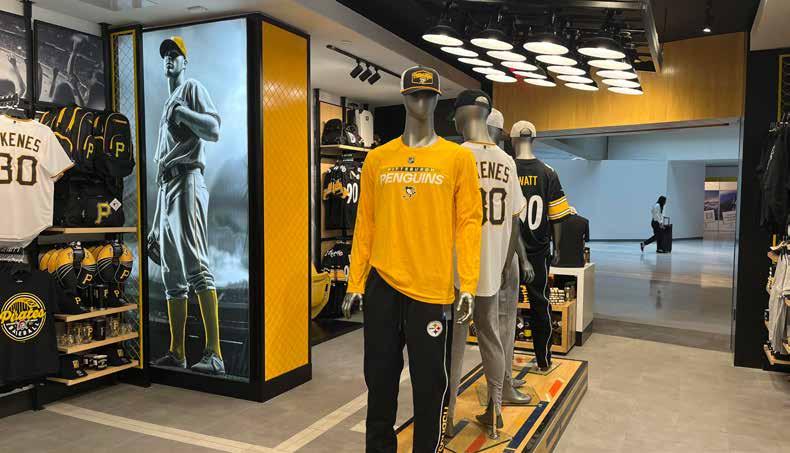
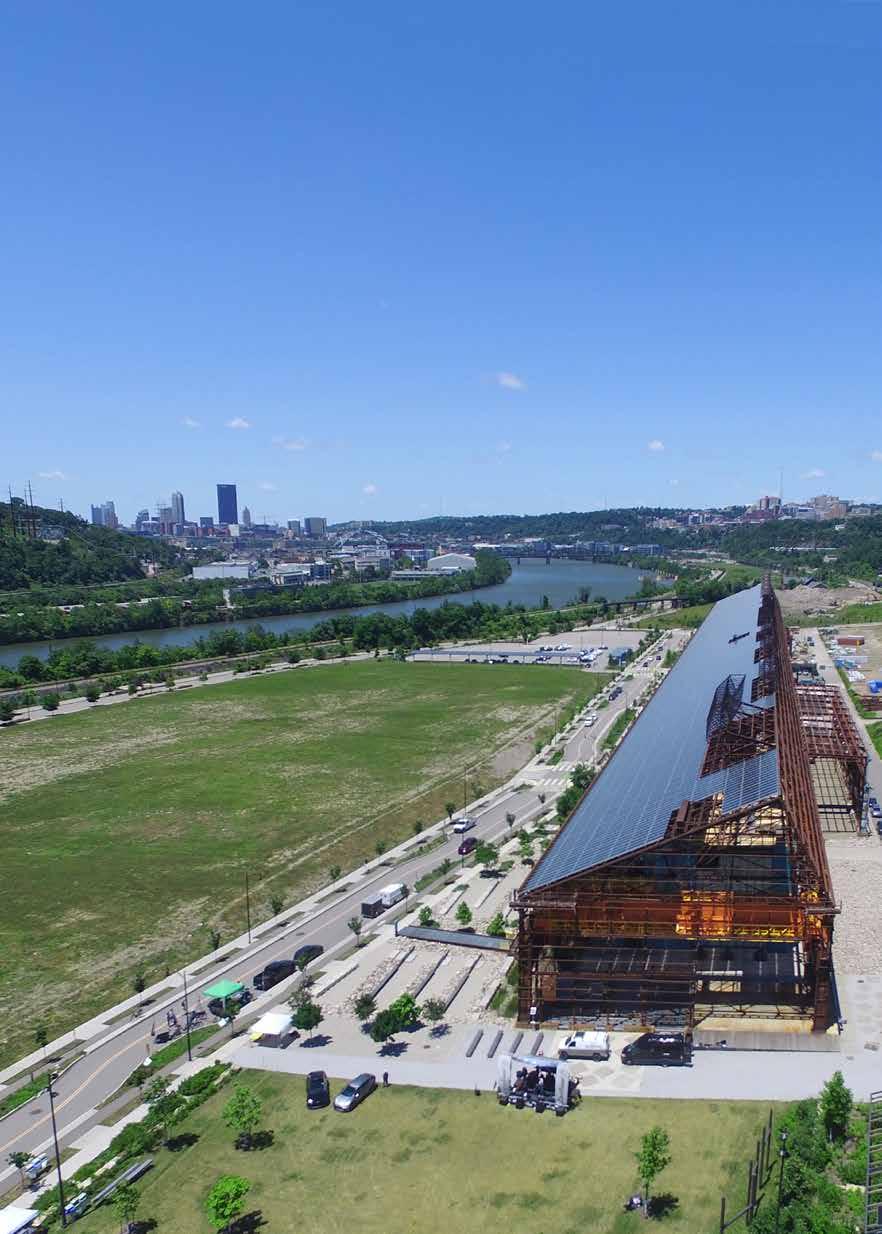
Champion City Sports is one of more than a dozen new retail or casual dining outlets built at the Pittsburgh International Airport in the past year. Photo by Shannon Construction.
“significant investments” in its stores. These would include both digital and physical plant investments, as Dick’s has seen increased demand for its experiential concept stores, “House of Sports” and “Field House,” and a surge in e-commerce. It is investing in this omnichannel approach, in which 80 percent of its online sales are fulfilled at store locations.
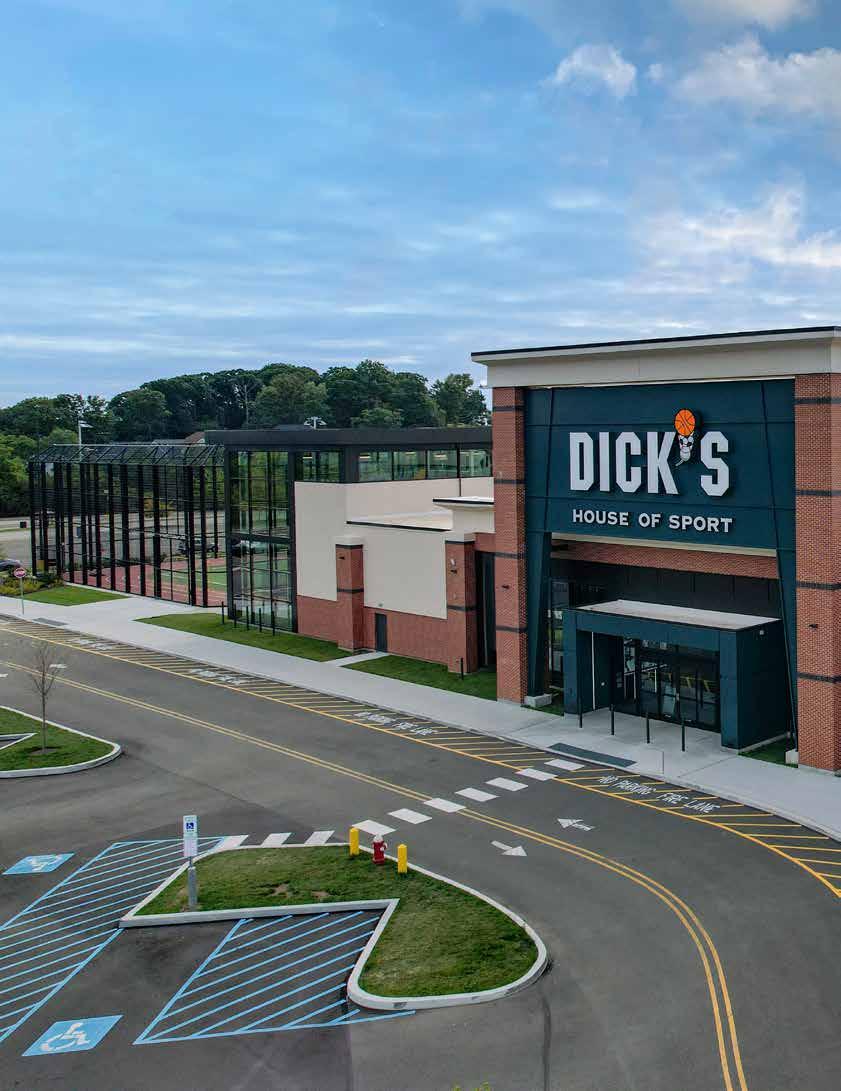
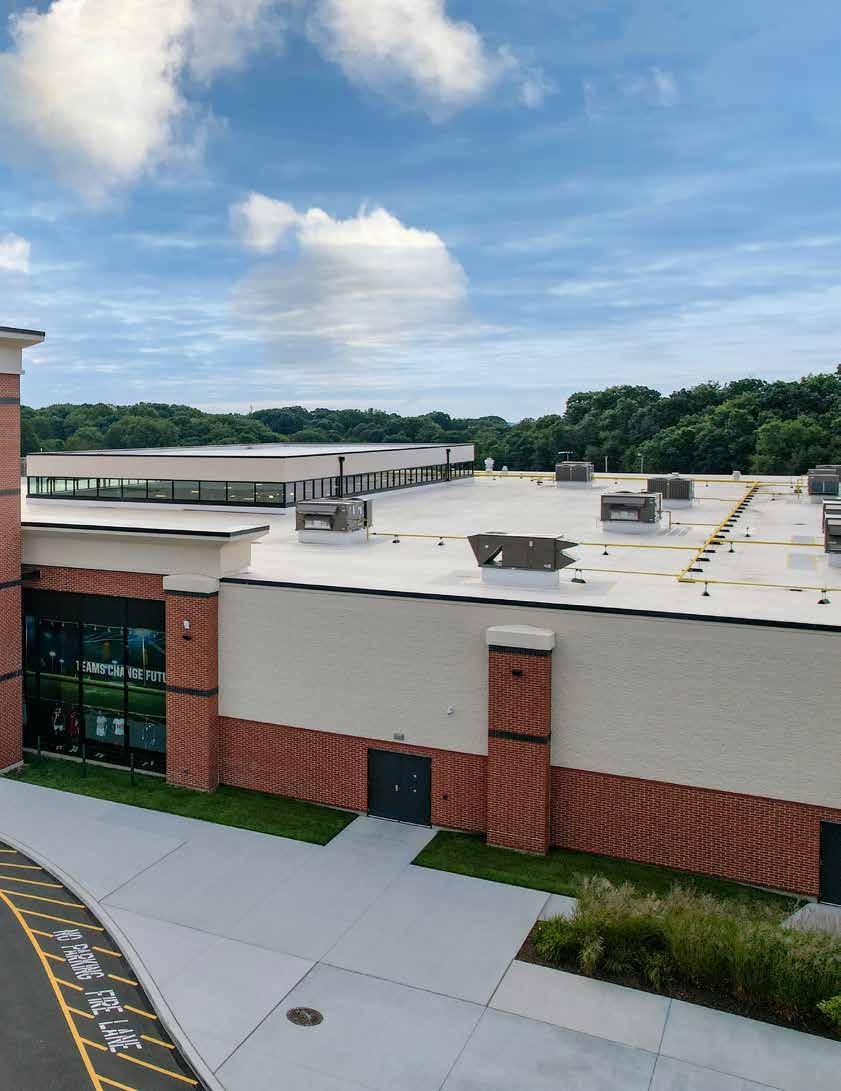
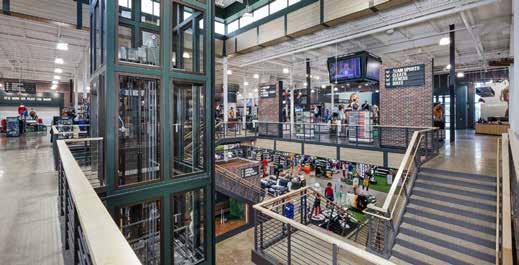
During 2024, Dick’s opened seven House of Sports and 15 Field House locations, 70 percent of which were relocations or renovations to existing stores. It plans to open 16 and 18, respectively, in 2025. The concept stores, especially the House of Sports, include climbing walls, batting cages, indoor tracks, and golf simulators that increase the customers’ time in the stores, and increase sales. The House of Sports concept is larger than the former large-scale Dick’s store, running 125,000 square feet and more in the Pittsburgh market, and has been located in former mall anchor stores.
The largest new current retail projects in the Pittsburgh region are build-to-suit projects like Dick’s. At Newbury in South Fayette Township, Bass Pro Shops is building a new 100,000 square foot store. Wegman’s will be starting construction in the fourth quarter on its first store in Southwestern PA, a 115,000 square foot development in Cranberry Township. The only speculative retail project under construction is an 18,000 square foot multi-tenant outparcel at Village of Pine. Leasing data from CoStar shows that roughly five percent of the total new construction in the Pittsburgh market is available for rent.
“By and large, you just aren’t seeing brand new spec retail construction the same way you are seeing it in other classes. Retailers aren’t adjusting what they can or will pay in rents,” says Cortez.
Dougherty notes that retailers and restaurateurs are facing unusual challenges that may limit expansion, despite the favorable economic and real estate fundamentals. The severe staffing shortages that followed the pandemic have eased only slightly, and staffing costs are dramatically higher than five years ago. Inflation, and the unpredictable fluctuations in costs that are the result of more protective trade policies, are shrinking margins. Retail owners do not see certainty about the economy in the coming 12-to-18 months, so the calculations about store locations are being influenced by the profitability of existing operations. Trendy may be replaced by reliable.
“Staffing and cost of operations are challenges and if the unit is not paying for itself, it won’t be there long. Anything that was a fad is going by the wayside,” Dougherty says. “The drugstore world which has been turned on its head. They were a robust part of the economy just five years ago. The value in the drugstore is the prescription business, but now the grocery stores and large general merchandisers are doing that. We also lost a lot of specialty retailers. It’s almost to the point where I expect that to rebound.”
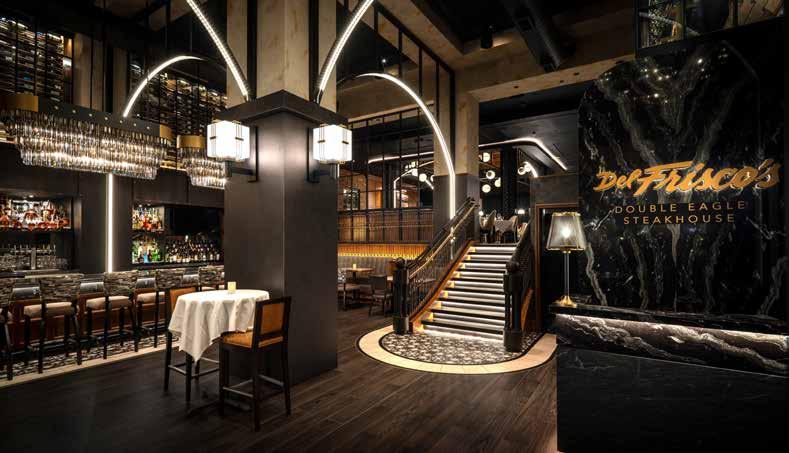
Fine dining restaurants, like DelFrisco’s, remain strong operations, but higher costs and economic uncertainty have slowed new entries into the Pittsburgh market. Photo by Denmarsh Photography. Use courtesy A. Martini & Company.
Until the return of specialty retail, the model for success may look something like Jackson Village Plaza, on Route 19 north of Zelienople in Jackson Township. Buoyed by more than 1,300 new single-family homes built in Jackson Township in a 10-year period, Madison Acquisitions developed a retail plaza of seven free-standing outlets totaling roughly 45,000 square feet. The largest of these was an Aldi’s, which is 19,000 square feet. The balance of the center includes a handful of reliable brands –Starbucks, Taco Bell, Wendy’s, O’Reilly Auto Parts – along with a credit union and GetGo. Given municipal approval in mid-2023, Jackson Village was mostly completed within 12 months. The site, within a mile of the interstate intersection and the Steamfitters Local 449 training center and offices, offers a location that guarantees sufficient traffic with minimal risk for the development. Those kinds of opportunities are difficult to uncover.
Going into 2026, the outlook is for a similar mix of build-to-suit development and free-standing expansion for reliable brands. The largest project in the pipeline is the proposed Menard’s, a 250,000 square foot home improvement store that was approved for construction in Hempfield Township during the pandemic. Menard’s recently negotiated an agreement with the township to extend its expired approval to the end of 2025. The retailer did not share whether the extension signaled an imminent start to construction.
As has been the case since at least 2022, most new retail will be infill leases in existing shopping centers. With available space dwindling, outside of the recently closed national stores, the Pittsburgh market is ripe for new construction; however, there is nothing to suggest that demand is strong enough to push rents high enough to bring the kind of low double-digit returns that investors require for new development. The housing market has proven that shrinking supply and strong demand do not automatically trigger new construction. For retail development, including in Western PA, something more of a reset will be required to kick start activity. BG


Frick Environmental Center LEED Platinum Carnegie Mellon University Cohon Center PNC Tower LEED Platinum



PROJECT PROFILE
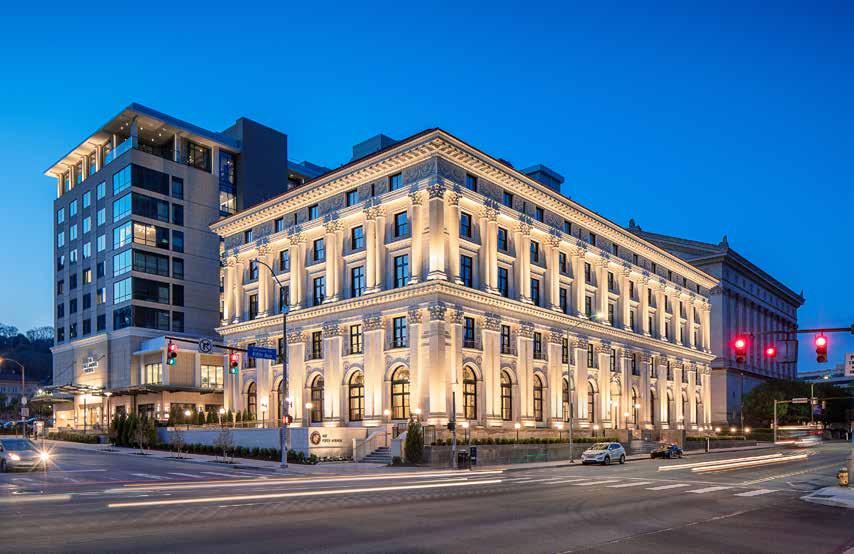
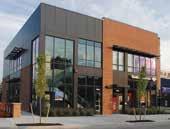
HENNE JEWELERS EXPANSION AND RENOVATION

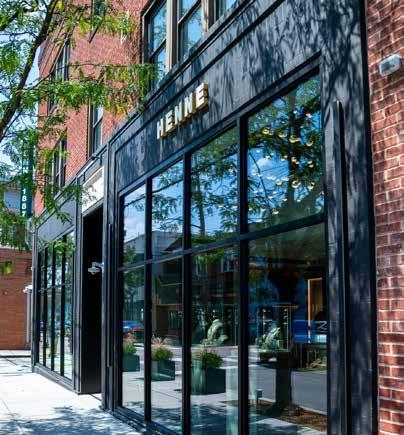
Henne Jewelers is something of a Shadyside institution that has endured two world wars, the Great Depression, and two global pandemics. Following the COVID-19 pandemic in 2022, John Henne, president and fourth generation owner of Henne Jewelers, began planning for a major expansion of Henne’s 5501 Walnut Street location.
“The business has been growing. This is our third expansion. We expanded our Filbert Street location in 1995-1996. We moved down here to a larger location in 2003 and even after the move we realized we needed more space,” says Henne. “I had the opportunity to buy the building nine years ago with the intention of taking over the bar [the William Penn tavern] that was behind us when its lease expired.”
The expansion had been driven by long-term organic growth and the need for more space for two integral pieces of Henne Jewelers’ business: its diamond engagement and Rolex watch sales. As Henne began preparing for the expansion, he brought A. Martini & Company on board as general contractor and shared his plans with Rolex. Those decisions proved crucial to the success of the project.
“Rolex is such an important partner of ours and they suggested some changes to the building to remove the center staircase that went to the second and third floors for tenants. That turned out to be genius,” Henne recalls. “I was expecting the project to be very disruptive, but I credit Angelo Martini Jr. with an idea that changed the direction we were heading. I was looking on the street for a temporary location and he came up with the idea of moving into the bar, renovating that for our temporary location. It made a remarkable difference. It helped in many ways. It allowed our alarm systems and safe to remain in place. We still had access to the basement. We didn’t have to move the merchandise to another location.”
“He was going to rent a place down the street, and it was going to be quite expensive. We came up with the idea of moving the store temporarily into the William Penn space,” explains Angelo Martini, Jr., chief operating officer at A. Martini & Co. “We called that phase one. Henne Jewelers worked in that space while we renovated the rest of the building. Once that was completed, we flipped to the William Penn phase of renovation.”
A. Martini & Co. was the general contractor for the earlier

renovation at Henne Jewelers, but the relationship between the companies was also personal. Angelo Martini reckons that he and John Henne have been friends since they were seven years old, and members of his family have been customers of Henne Jewelers for decades. For John Henne, that kind of personal relationship was important, and helped him make a potentially difficult decision more comfortable.
“I have a lot of clients who are general contractors. Some probably heard about my potential plans and expressed interest. It would have been difficult to choose, putting it out to bid and telling three or four other friends no after the bidding process,” Henne says. “The Martinis had done the last build-out and it went smoothly. I knew this was going to be a very complicated project because of the age of the building and I feared there would be lots of change orders, so I wanted somebody I had worked with in the past and could trust.”
The choice of architect was also relationship driven. Angelo and Anthony Martini suggested Chip Desmone, who was also a friend and customer of Henne Jewelers. Henne also consulted with Rolex to seek input on designers with luxury jewelry and watch experience.
“When I presented the project to Rolex, because they needed to sign off on it, they asked who I planned to hire as architect.
They suggested Eric Lewis [of E/Line Architecture in Baltimore] because he had done some projects recently for them. We interviewed him and just instantly liked him.”
Teaming Desmone Architects with E/Line gave Henne a local architect he trusted with extensive experience working with the City of Pittsburgh and its challenges, plus a designer who was comfortable working with Rolex.
Chip Desmone describes the programming and schematic phase of the project as “having a life of its own,” growing over time as the process unfolded.
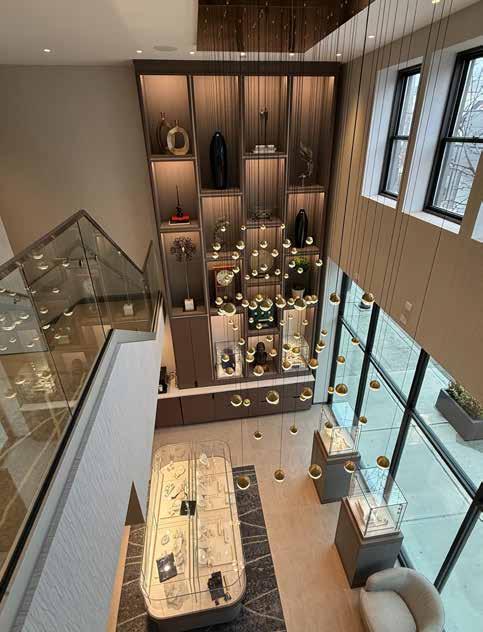
“Originally, John was thinking that they would just expand to the rear, taking the former William Penn bar and part of the second floor. We ran into an issue regarding code and occupancy of the third floor, so we incorporated the offices on the third floor,” Desmone says. “We ended up taking over what was originally the old Rolliers and two apartments above that. That freed up more space on the first and second floors to create the grand staircase in the corner that gave the entire store a lot more daylight, openness, and grandeur.”
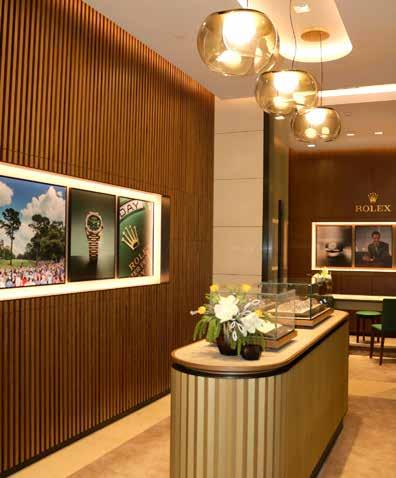
Grandeur was an important goal for the project. Henne had to account for space for five luxury watch brands: Rolex, which was programmed for 1,000 square feet of dedicated space;
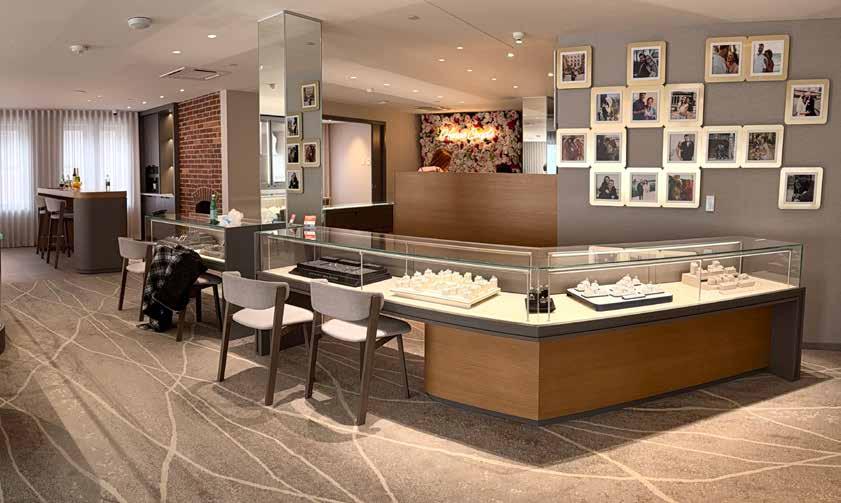
and smaller booths for TUDOR, Mont Blanc, Tag Heuer, and Grand Seiko. During and after the pandemic, Henne’s diamond engagement business boomed. Care was taken to design a space that would optimize that shopping experience, which resulted in a dedicated diamond engagement suite on the second floor. Henne was also intentional about building a destination that would become an anchor for the Walnut Street shopping district, which had seen several major national brands vacate storefronts.
“I am a big believer in Walnut Street. I think this is a unique shopping district with a mixture of local boutiques and national chains. It is the only one in the city that is not on a main road with a bus line going down the street,” Henne explains. “The proximity to Shadyside, Squirrel Hill, Oakland, and Fox Chapel is wonderful for our local customers, and it is a regional draw. We see people coming to Walnut Street from Eastern Ohio, West Virginia, and Erie. There is no place in the city where I would rather be.”
Renovating multiple old buildings proved to be as challenging a task as John Henne feared. The complications created challenges during design and when construction began in early 2024.
“It was a challenge to visually connect all the retail spaces. Henne has multiple watch brands in the store plus it’s a general jewelry store,” says Desmone. “During design the diamond
engagement piece of the project kept growing. We ended up making that entire second floor a bridal engagement experience space. That really helped us connect the design of the first and second floor. We could bring all these separate retail brands together under one store connected by the stairs and elevator.”
“It was one of the hardest projects I’ve built because the structural grid was not square. Imagine a chessboard where every corner where the squares meet was not a 90-degree angle. We didn’t discover that until demolition because there was little opportunity to do exploratory demolition until we were into the project,” Martini says. “We expected a column line to run straight through the building and halfway through it jogged two feet to the left or right. There were a lot of meetings on site with the architect and engineer to figure out how to true it up and make things more in line.”
“There was a ton of bracing and back bracing needed to do the renovations,” he continues. “For example, if we needed to hold up the roof to place a beam, we had to brace it on the second floor, first floor, and the basement to carry that load because the third floor could not carry the load itself. There were miles of temporary shoring involved, which is unusual.”
Martini notes that his company’s early involvement in the planning set the stage for the high level of detailed planning and
The second floor was renovated to be an engagement diamond suite.

Photograph: Central Catholic Brothers’ Residence Photographer: Mike Christ
collaboration that would be needed throughout the project. Once construction started, many of the challenges stemmed from the tight urban site at the corner of Walnut and Bellefonte. Work on the roof, for example, meant shutting down AT&T cellular towers and coordinating those outages. Excavation for the new elevator pit was done with a vacuum excavator, which expedited the digging and eliminated any debris on the street. It was imperative that the project created as few disruptions as possible for Henne’s neighbors, so parking and deliveries had to be managed so that customers from other retailers were not negatively affected.
“The other interesting part was working with the out-of-town architect and designers from Switzerland on the Rolex space,” says Martini. “They dictated the pace of the project. It took about 18 months to get the design out of Rolex.”
The project duration was the biggest challenge John Henne cited, as the phasing still created daily logistical and operational problems for a retail jeweler.
“The biggest challenge was the length of time that we were disrupted. We were in the temporary location for essentially 11 months. To take a business that needs to expand and to shrink it to less than half of its size on a side street location was difficult,” he says. “I am here on the sales floor every day, but my office was moved to a house two blocks away. I would walk back and forth six or seven times a day. It was challenging for the team to operate. We communicated regularly and reminded them that this was temporary pain for long-term gain. Now we almost can’t remember the pain, but at the time it was very challenging.”
Henne Jewelers celebrated its grand re-opening on October 19, 2024, with the fully-renovated 7,500 square feet of retail space on two floors. The participants agree that the success of the project turned on the constant communication between the Henne team and the design and construction teams. Martini gives special credit to Dara Henne, John’s wife.
A balcony and monumental stairs were added to bring more light to the interior of the store and for dramatic effect.
“Dara is the backbone of the operation. She knew what she wanted and worked closely with Desmone,” he says. “I’ve joked with her over the years that I want to hire her as a project manager. She has an eye. If something’s out of level or not square, she picks it up. She picked up things, quite frankly, that I missed.”
“The project was successful because we had a client who was determined to do the best possible project he could, given the physical constraints of the building,” notes Desmone. “It was his desire to stay on Walnut Street and make his building an integral part of the retail fabric there. John wanted to make something that was special for Henne and special for Walnut Street.”
“There was great communication between all parties,” says Henne. That was our internal team, which consisted of myself,
my wife, and Kyle Misour, who was the internal project manager, the Martini team of Joe Perri, Angelo, and Superintendent Sean Lewis, and the architects Katelyn Walsh from Desmone and Eric Lewis. We met weekly to be on top of things.”
“John put a good team together. We made sure we bought the proper partners to the table,” says Martini. “I wanted people sitting around the table at the 11th hour who could push it over the finish line.”
“I will tell you that the reception from our customers and new customers has been exceptional. We regularly hear people tell us they don’t feel like they’re in Pittsburgh or that it is like Madison Avenue,” says Henne. “One thing we really wanted to be sure of was that it was high-end and luxury but, at the same time, warm and inviting. It can be challenging to do both, but we have heard from so many of our customers that we managed that.” BG
A. Martini & Company
Henne Jewelers
Desmone Architects
E/Line Architecture
J.A. Sauer
Hanlon Electric
Cuccaro Plumbing
J&J Fire Protection
Marsa Inc.
Modany Falcone
Easley & Rivers Inc.
A.J. Vater & Co.
Eagle Displays
Otis Elevator
Specified Systems
J.P. Phillips, Inc.
Seech Industries




LEGAL PERSPECTIVE
NEW OSHA RULE ON PERSONAL PROTECTIVE EQUIPMENT
BY WILLIAM S. MYERS, ESQ.
The Occupational Safety and Health Administration (OSHA) published a final rule in December on Personal Protective Equipment (PPE) in the construction industry. The rule took effect on January 11, 2025. OSHA State Plans that did not already have a similar rule must implement their own rule within six months of the publication date. It is a small rule change with potentially significant practical effect, being described by some industry commenters as imposing a “monumental task” on employers.
The rule amends the Construction PPE Standard to require that all PPE “properly fits each affected employee.” The driving force for this amendment is the notion that PPE designed for smaller bodies, particularly for women, is not readily available for workers. One example mentioned in the official comments is the size of work gloves, especially gloves used in dangerous work that require dexterity. The official comments also indicate that “properly fits each affected employee” includes PPE that takes into account “workers’ body changes during pregnancy.”
The likely significant impact derives from multiple factors, including the ambiguity of the term “properly fits,” the requirement that PPE must fit “each affected employee,” the difficulty of proving that a particular item of PPE actually fits a particular employee, and the potential for disagreement between employee and employer over whether PPE properly fits that particular employee—an inherently subjective determination in which the employer is at a distinct disadvantage when it comes to proof.
OSHA rejected calls from experts and stakeholders to define the phrase “properly fits,” including a suggestion from National Institute for Occupational Safety and Health (NIOSH), OSHA’s own research arm. To put that in context, OSHA spent 26 pages of three-column, single-spaced, fine print in the Federal Register to explain a rule that results in a net change of 19 additional words in the standard, but it refused to explain what is meant by what is now the core phrase, “properly fits,” or how employers might go about determining the difference between “properly fits” and “comfortably fits” or “perfectly fits.”
OSHA also refused to make any other suggested revisions to its initial proposed language, opting to finalize the rule in the form first published in July 2023.
An additional ambiguity lies in the core requirement of the amended rule, which is framed by the phrase “selected to ensure.” Does that mean “ensures” that the PPE “properly fits,” or does the inclusion of “selected to” allow some room for more standardized decisions by employers about PPE? OSHA ignored this question in the official comments, but its language throughout suggests it will interpret that
phrase to mean “ensures.” When combined with the phrase “properly fits each employee,” it could be construed to mean “tailor made.”
There will be secondary effects of the rule as well. They include the impact on unrelated enforcement action by OSHA, especially following accidents involving employees who were using PPE at the time (compliance officers will be sorely tempted to tack that on as an almost automatic additional violation), as well as employee relations (an enhanced vehicle for alleging employer retaliation), and labor relations (another ambiguity that can become a point of contention with union representatives). All three of those areas have the potential to loom large as tools that can be misused by different players for strategic reasons that have little to do with workplace safety.
The affected standard is 29 C.F.R. Section 1926.95(c). The old and new versions are shown below:
Old rule:
Section 1926.95. Criteria for personal protective equipment. (c) Design. All personal protective equipment shall be of safe design and construction for the work to be performed.
New rule:
Section 1926.95. Criteria for personal protective equipment. (c) Design and selection. Employers must ensure that all personal protective equipment:
(1) Is of safe design and construction for the work to be performed; and
(2) Is selected to ensure that it properly fits each affected employee.
OSHA has not issued further interpretations or other guidance for the new rule since promulgating it, and neither statistical nor anecdotal data is yet available as to how OSHA is interpreting and applying the new rule. Of course, a further question is whether the change in Presidential Administration will affect the agency’s interpretation of the key phrases discussed above. BG
William Myers is an attorney and member at Eckert Seamans Cherin & Mellott, LLC. He may be reached at wmyers@ eckertseamans.com

FINANCIAL PERSPECTIVE
NAVIGATING THE OBBBA ERA: STRATEGIC TAX PLANNING FOR THE CONSTRUCTION INDUSTRY .
BY RYAN BROZE, CPA
The construction industry stands at a pivotal moment. With the enactment of the One Big Beautiful Bill Act (OBBBA), companies now face a landscape rich in opportunity—but also complexity. From bonus depreciation to revised energy incentives, the new legislation reshapes how construction companies approach capital investment, tax planning, and operational efficiency.
A Sector Built on Resilience
Construction has long weathered economic storms—from supply chain disruptions and labor shortages to rising interest rates and tighter credit. OBBBA introduces new tools to help firms not only survive but thrive. The key lies in translating revenue into sustainable profit while sidestepping growth pitfalls.
Tax Incentives that could impact many construction companies include:
100 percent Bonus Depreciation and Section 179 Expense
OBBBA permanently extends 100 percent bonus depreciation and raises Section 179 limits, allowing construction firms to immediately expense equipment, machinery, and certain building improvements. This accelerates cash flow and supports reinvestment in operations.
Expanded Section 179D deductions reward energyefficient design and construction, especially for firms meeting prevailing wage and apprenticeship standards. These incentives align with broader industry goals around sustainability and workforce development.
Qualified Business Income Deduction Becomes Permanent
The legislation permanently extends the 20 percent qualified business income deduction (QBID), also known as Section 199A, for pass-through business income and REIT dividends. This provision also expands the deduction limit phase-in range by increasing the $50,000 (non-joint returns) and $100,000 (married filing joint returns) amounts to $75,000 and $150,000, respectively. The provision eases the impact of the limitations for both specified service trades or businesses (SSTBs) and those pass-through entities subject to the wage and investment limitation.
Additionally, this provision introduces a new, inflation-adjusted minimum deduction of $400 for taxpayers with at least $1,000 of qualified business income from one or more active trades or businesses in which the taxpayer materially participates. This ensures small business owners with a certain qualified business income level are entitled to an enhanced baseline deduction.
Immediate Expensing of Domestic R&D Costs
Since the 2022 tax year, businesses were required to capitalize and amortize research expenses over five years (or 15 years
for foreign research) causing strain on cash flow when the investment did not align with the tax deduction. OBBBA restores the current deductibility of domestic research and development (R&D) expenses in the year they’re incurred in tax years beginning after December 31, 2024. All taxpayers that previously capitalized R&D costs are permitted to elect to accelerate the remaining deductions over a one- or twoyear period, beginning in 2025. This provision will benefit construction companies that utilize new technologies and are trying to innovate or improve building processes, enabling the entire industry to move forward though innovation.
Accelerated Depreciation for U.S. Manufacturing Facilities
Manufacturers can now fully expense the cost of new or improved U.S. production facilities if construction begins between January 19, 2025, and January 1, 2029, and the property is placed in service before 2031. This is a targeted incentive to encourage domestic manufacturing and infrastructure investment. It allows businesses to deduct the full cost of building or upgrading factories, warehouses and other production facilities rather than depreciating them over 39 years.
That’s a massive acceleration of tax benefits, which can significantly improve the return on investment for large capital projects. It also aligns with broader policy goals to bring more production back to the U.S. This provision can bring many new construction projects to the market.
Business Interest Expense Limitation Expanded
Another key limitation from the TCJA fell under Sec. 163(j) for the deduction of business interest expense, which limited the deduction to 30 percent of adjusted taxable income (ATI). The OBBBA restores a more favorable calculation for 2025 and all future tax years. The Sec. 163(j) limitation now uses EBITDA (earnings before interest, taxes, depreciation and amortization) instead of EBIT (earnings before interest and taxes). A new ordering rule requires applying this limitation before the interest capitalization rules for years starting in 2026.
This change increases the amount of deductible interest for many businesses, lowering the after-tax cost of borrowing. Industries such as manufacturing, real estate, construction and distribution, where interest expense is a major cost, stand to benefit the most. An increase to deductible interest means lower taxable income and improved cash flow.
Additionally, the new ordering rule eliminates a common planning strategy: capitalizing interest to the balance sheet to reduce the amount disallowed under Sec. 163(j). The OBBBA requires the Sec. 163(j) limitation to be considered before the application of other capitalization provisions. This could increase taxable income for some businesses, especially
those with large inventories or long production cycles. The increased ATI limitation for 2025 coupled with the ability to capitalize interest until 2026 may present an opportunity for 2025 tax savings, but careful modeling is essential to maximize your deductions.
1099 Reporting Threshold Increased
The threshold for issuing Form 1099 to independent contractors increases from $600 to $2,000, indexed for inflation.
This reduces the compliance burden for small businesses. However, it doesn’t change the rules around worker classification, so businesses still need to be careful about who qualifies as an independent contractor. It’s a welcome simplification, but not a free pass.
Condominium Construction Method of Accounting Exception Added
There is a new exception to the percentage of completion method of accounting for certain residential construction contracts and extends the construction contract period from two to three years.


Prior law resulted in phantom income from the application of percentage of completion method for condominium developers. Taxpayers should consider making an accounting method change for tax purposes and the impact it will have on taxable income.
Business State and Local Tax Deduction Preserved
The legislation preserves the full deductibility of business state and local taxes.
During the reconciliation process, Congress contemplated everything from eliminating state and local tax deductions — which included real estate taxes — to only allowing 50 percent. Full deductibility was a win for the construction industry. Taxpayers should ensure they are factoring in pass-through entity taxes (PTET) when starting projects in new states and conducting year-end tax planning to generate the biggest tax deduction benefit.
Qualified Opportunity Zone (QOZ) Program Modified, Made Permanent
The legislation establishes a permanent Qualified Opportunity Zone (QOZ) policy that builds off the original program. This provision creates rolling, 10-year QOZ designations beginning on January 1, 2027. The new law maintains the QOZ designation process from the Tax Cuts and Jobs Act (TCJA) and strengthens the eligibility requirements by:
• Updating the definition of a lowincome community tract, and
• Eliminating the ability for contiguous tracts that are not low-income communities to be designated as QOZs.
The definition of “low-income community” is narrowed to census tracts that have a poverty rate of at least 20 percent or a
median family income that does not exceed 70 percent of the area median income. Additionally, a guardrail is added to ensure the term low-income community does not include any census tract where the median family income is 125 percent or greater of the area median family income.
The provision preserves the three taxpayer benefits from the TCJA but modifies them as follows:
1. Deferral Benefit
• This is now a “rolling benefit.” The capital gain that was originally deferred as an eligible investment into a Qualified Opportunity Fund (QOF) is required to be included in income in the taxable year that includes the earlier of: 1) the date the QOF interest was sold or exchanged, or 2) the date marking five years after the QOF investment was made.
2. Reduction Benefit
• A taxpayer who holds their QOF investment for five years will be eligible for a 10 percent basis step-up that would be applied when the taxpayer is required to recognize the original deferred gain into income. Effectively, this causes 10 percent of the original gain that was deferred to no longer be taxed.
3. Exclusion Benefit
• A taxpayer can make an election to have the fair market value (FMV) of their QOF interest equal to the FMV on the date the investment is sold or exchanged if sold within 30 years of the investment date. If sold after a 30-year hold, the QOF interest would equal the FMV of the investment as of the 30-year holding period date.
Additionally, the OBBBA provision establishes a new type of QOF that invests 90 percent of its assets in a QOZ comprised entirely of a rural area. Investment in these qualified rural opportunity funds (QROFs) will receive a 30 percent step-up in cost basis under the reduction benefit (as opposed to the general 10 percent). Additionally, a special rule lowers the substantial improvement threshold of existing structures from 100 percent to 50 percent in rural QOZs.
Lastly, the new law adds more reporting requirements moving forward for QOFs and QOZBs that will require them to provide the following information:
• NAICS code(s) of the businesses in which the QOF and/or QOZB are operating.
• The approximate # of residential units (if any) for any real property held by the QOF and/or QOZB.
• The approximate number of full-time equivalent employees of the QOF/QOZB, or another indication of employment impact.

Penalties will be assessed for failure to comply with the reporting requirements. These penalties increase in amount if the fund meets the definition of a large QOF, which requires gross assets in excess of $10 million.
The first round of QOZs available under the new permanent policy will begin on January 1, 2027.
The fact that this provision has made the QOZ program permanent will provide more construction projects in the designated areas. Rolling 10-year QOZ designations would begin January 1, 2027, and fewer non-rural census tracts are expected to qualify, since the definition of a low-income community is narrowed and contiguous census tracts that previously qualified solely based on their proximity to qualifying census tracts are no longer eligible.
The law included incentives to help drive additional investment to rural QOZs that generally had not seen as much capital infusion under the first round of the program.
Overall, the general tax benefits of the QOZ program remain intact. Taxpayers that experience a capital gain event should consult with their tax adviser on whether it makes sense for them to pursue reinvesting their capital gain into a QOF to take advantage of these benefits.
Strategic Planning in Action
Many successful companies are already leveraging updated advisory services to incorporate the new tax law changes in items like the following:
• Model cash flow and job costing scenarios.
• Evaluate lease vs. buy decisions for equipment.
• Navigate state and local tax complexities.
• Strengthen balance sheets for bank financing and bonding.
• Consider accounting method changes
It Starts with a Conversation
Whether you’re a general contractor, specialty trade firm, or infrastructure developer, now is the time to revisit your tax strategy BG
Ryan Broze is a partner at Cohen & Company. He can be reached at rbroze@cohenco.com.

FULL-SERVICE CIVIL ENGINEERING
MANAGEMENT PERSPECTIVE
BRIDGING DOCUMENTS AND DESIGN-BUILD WARRANTIES: BUILDING BRIDGES TO AVOID PITFALLS
BY STEVE D. GARCIA, ESQUIRE
Design-build has continued its steady ascent in both the private and public spheres, revolutionizing how stakeholders approach construction projects. By melding design and construction responsibilities into a single point of responsibility, design-build can streamline project delivery and reduce administrative inefficiencies. Yet, this consolidated approach does not immunize participants from complex warranty obligations. Rather, warranty issues remain murky as potential owner warranties are implicated by bridging documents, federal and state procurement regulations, and performance specifications. That said, we will explore an owner’s implied warranties in the design-build context—first defining the problem, then describing measures for clarifying risk allocation between the parties. Ultimately, a well-drafted design-build contract will bridge over potential warranty pitfalls.
Defining “Bridging Documents” in Design-Build
In “bridging” or “partial design” situations, the owner furnishes preliminary design documents or performance criteria that the design-builder must finalize and implement. These bridging documents can include site data (e.g., geotechnical studies), conceptual plans, or schematic designs. From a warranty perspective the pivotal question is whether the owner’s partially complete plans inadvertently create an implied warranty as set forth in the landmark Spearin doctrine. Under United States v. Spearin, 248 U.S. 132 (1918), owners who provide defective design specifications can be liable for resulting cost overruns, schedule delays, or rework.
In design-build, however, the design-builder typically has primary responsibility for completing and validating the design; courts and Boards of Contract Appeals frequently hold that Spearin-type warranties are “curtailed” because the contractor ultimately “owns” the design. However, if the owner is truly passing along design documents that are not subject to re-evaluation, the design-builder may still raise a Spearin-like claim or defense if a defect later emerges in the bridging documents. The upshot then is that bridging documents must be approached cautiously.
Owners’ Implied Warranties in
Design-Build
Traditional Spearin Warranty, Modified Traditionally, Spearin ensures that when the owner prepares and provides design specs, it implicitly warrants their adequacy. In design-build, the lines of responsibility shift. Nonetheless, an implied warranty can still arise if:
1. The owner supplies partial or bridging documents containing critical or detailed designs, and
2. The design-builder reasonably relies upon them when finalizing its bid or completing the project scope.
To avoid this, many public and private owners attempt to disclaim any warranty or representation regarding the accuracy of the bridging documents.
Implied Fitness for Purpose
Courts in some jurisdictions have long recognized that an owner may implicitly warrant the “fitness for purpose” of the structure’s design if it provides specialized preliminary designs or site data. Kennedy v. Bowling, 319 Mo. 401, 4 S.W.2d 438 (1928). This risk can be heightened if the owner’s bridging documents reflect specialized knowledge that the design-builder is entitled to rely upon or could not have reasonably come to know without the owner’s disclosure.
N. Harris County Junior Coll. Dist. v. Fleetwood Constr. Co., 604 S.W.2d 247, 254 (Tex.Civ.App.-Houston [14th Dist.] 1980, writ ref’d, n.r.e.).
Key Federal Frameworks: 41 U.S.C. § 3309, 48 C.F.R. pt. 36, § 36.3, and pt. 536
Under 41 U.S.C. § 3309 and the associated regulations in 48 C.F.R. Part 36—especially Subpart 36.3—federal agencies frequently use a two-phase design-build procurement model. In Phase One, the government evaluates potential contractors’ qualifications to form a shortlist. In Phase Two, these finalists submit technical proposals and pricing, relying in part on the government’s preliminary or “bridging” documents. Because the designbuilder is responsible for completing the design, the government typically includes disclaimers to limit its liability for any incomplete or erroneous preliminary information.
Two Federal Acquisition Regulation (FAR) clauses commonly define risk allocation in these contexts:
1. FAR 52.236-21 (“Specifications and Drawings for Construction”
This provision obligates contractors to interpret and follow government-provided specifications and drawings, requiring them to report any inconsistencies or flaws they discover.
2. FAR 52.236-23 (“Responsibility of the ArchitectEngineer Contractor”)
Although initially aimed at architect-engineer services, it clarifies that design responsibility rests primarily with the contractor—thereby reducing the government’s exposure to Spearin-type implied warranty claims.
However, these disclaimers are not absolute. If the government’s bridging documents contain errors that a
design-builder could not have reasonably detected before contract award, the Spearin doctrine (implied warranty of design adequacy) may still apply. Magnus Pacific Corp. v. United States, 133 Fed.Cl. 640 (2017).
State Level Design-Build Considerations
Further, understanding state-level statutes which govern design responsibility is vital to any successful designbuild project. Some states adopted design-build specific
warranty statutes which complicate the calculus. Although disclaimers can mitigate these risks, if the disclaimers conflict with statutory requirements, courts may deem them unenforceable.
For example, many states codify specific requirements for performance or design-criteria packages in designbuild contracts. If an owner furnishes incomplete or inaccurate materials, it may still be exposed to Spearin-type implied warranties—even if the design-builder bears primary responsibility for finalizing the design. And as mentioned, certain states have commercial codes or other rules that carve out owner liability in design-build contracts, shifting verification duties for bridging documents back to the designbuilder. Accordingly, to be enforceable, any disclaimers must be drafted in harmony with any such provisions.

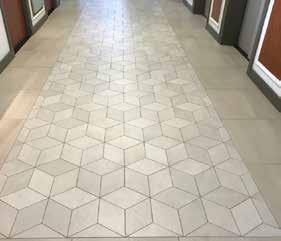


Given these state variations, a design-build team should carefully assess the controlling law of the project before contract execution: document assumptions; request clarifications when bridging documents are unclear; and tailor disclaimers to align with any transparency, disclosure, or carve out statutes. By proactively negotiating risk allocations and adhering to statutory requirements, both owners and designbuilders can minimize disputes and better manage these warranty issues.
Practical Measures for Clarifying Risk Allocation
1. Read All Regulations and Statutes Carefully
Design-builders should confirm whether the contract incorporates clauses such as FAR 52.236-21, 52.236-23, or state-level counterparts that can shift risk. On public jobs, pay close attention to how bridging documents are labeled and whether disclaimers conflict with transparency obligations. Raise those issues with the owner if identified and be sure to address your state’s applicable law.
2. Request Clarifications Pre-Award If bridging documents contain ambiguities or omissions, ask for clarification or additional data. Document these inquiries through Requests for Information (RFIs).
3. Negotiate Express Warranties Thoughtfully
Many design-build agreements include performance warranties that go beyond
typical “standard of care.” Accordingly, a prudent designbuilder will negotiate language that:
a. Limits open-ended liability or consequential damages;
b. Distinguishes between the owner’s bridging documents and the design-builder’s final design obligations; and
c. Includes disclaimers aligning with the relevant federal or state procurement statutes.
Maintain Thorough Documentation
Keep comprehensive design logs, records of design changes, and RFI responses. If a dispute arises, documentation can be pivotal in showing which party had responsibility for what portion of the design.
Monitor Protest Rights and “Transparency” Requirements
Under federal law, disappointed bidders can file protests at the Government Accountability Office (GAO) or the U.S. Court of Federal Claims. Similarly, states and other governmental entities have protest mechanisms. Understand the protest processes and remain vigilant about meeting solicitation requirements, especially on bridging documents.
Conclusion
Design-build contracts bring about integrated responsibilities that can streamline projects, but these arrangements do not eliminate the complexities of implied warranties—especially when owners furnish bridging or partial design documents. Federal statutes (41 U.S.C. § 3309), regulations (48 C.F.R. pt. 36, 48 C.F.R. § 36.3, 48 C.F.R. pt. 536), and state laws underscore that both private and public design-build stakeholders must carefully consider disclaimers—while design-builder contractors should remain keenly alert to potential implied warranties or items where clarification is needed.
By conducting thorough reviews of partial owner designs, negotiating express warranties with clarity, and ensuring documentation of any disclaimers or clarifications, design-builders and owners alike can solidify a shared foundation of trust. Therefore, with proper planning, the challenges posed by bridging documents or partial designs swiftly go from potential pitfalls to little more than water under the bridge. BG
This article originally appeared in ConsensusDocs Construction Law Newsletter Volume 11, Issue 6 - June 2025, and was printed with permission by the Associated General Contractors. Steve Garcia is a senior associate at Peckar & Abramson P.C. in Houston, TX. He can be reached at sgarcia@pecklaw.com.


Seating is Limited SECURE YOUR SPOT BY COMMITTING TO A SPONSORSHIP TODAY! THIS IS A Sell Out Event!
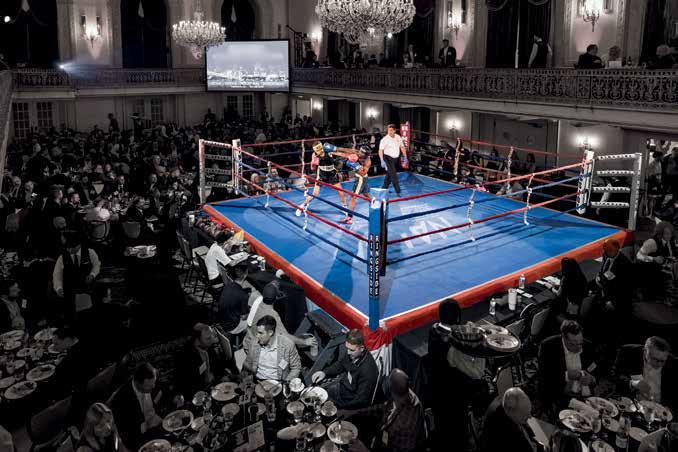
BEST PRACTICE
DESIGNING FOR SAFETY: HOW PREVENTION THROUGH DESIGN CAN TRANSFORM THE BUILT ENVIRONMENT
BY LAWRENCE PAYNE, AIA
In the building industry, design innovation is often measured by aesthetics, technology, or speed. Yet, the most transformative designs are those that begin with a simple, enduring commitment: safeguarding the people who occupy and maintain our built spaces.
Prevention through Design (PtD) is a philosophy and practice that embeds safety into the DNA of a building project. By proactively addressing hazards from the earliest planning phases, PtD transforms safety from a reactive process into a driver of design excellence.
Far from limiting creativity, PtD empowers teams to envision built environments that are flexible, maintainable, and aligned with user needs. Leveraging tools like digital simulation, hazard workshops, and lifecycle risk assessments, the process allows design teams to anticipate potential risks and resolve them before they ever materialize on-site or in operation.
Collaboration as a Design Imperative
A central tenet of PtD is collaboration. Structured workshops and integrated project teams bring together architects, engineers, safety professionals, maintenance staff, and endusers early in the design process. This broad participation ensures that decisions reflect operational realities as well as aspirational goals.
From these discussions emerge tailored safety strategies: identifying hidden risks, evaluating long-term consequences, and prioritizing solutions that reduce or eliminate hazards altogether. Lifecycle thinking is essential because what
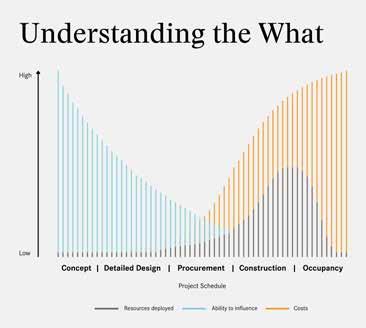
LOW-PROFILE RAISED FLOOR AT THE PATTEE-PATERNO LIBRARY
Flexibility and Long-Term Safety Through Integrated Design
During the renovation of Foster Auditorium, in Penn State University’s Pattee-Paterno Library, the design team implemented a low-profile raised floor system as part of a curved, stepped-floor configuration. Initially selected for its quick installation and minimal disruption to existing structures, the system quickly proved its long-term value by providing both infrastructure flexibility and reduced lifecycle hazards.
This success later informed the design approach for the Tombros & McWhirter Knowledge Commons, where the raised floor was proposed to support future-ready infrastructure: facilitating easy relocation of power and data, supporting modular partitions, and avoiding interference with the floor slab below.
Since its completion, the raised floor has supported rapid technology shifts and flexible space reconfigurations. Its value was especially evident during the COVID-19 pandemic, when powered furniture layouts were swiftly modified to accommodate social distancing guidelines.
Today, the system has become standard across the Pattee-Paterno Library renovations which is evidence of how PtD strategies can establish infrastructure that’s both safe and adaptable.
works well during construction must also support safe operations, maintenance, and future adaptability.
Designing with Risk in Mind
PtD solutions often manifest in simple but powerful ways: selecting materials that are non-toxic and fire-resistant, designing for ergonomic workflows, or
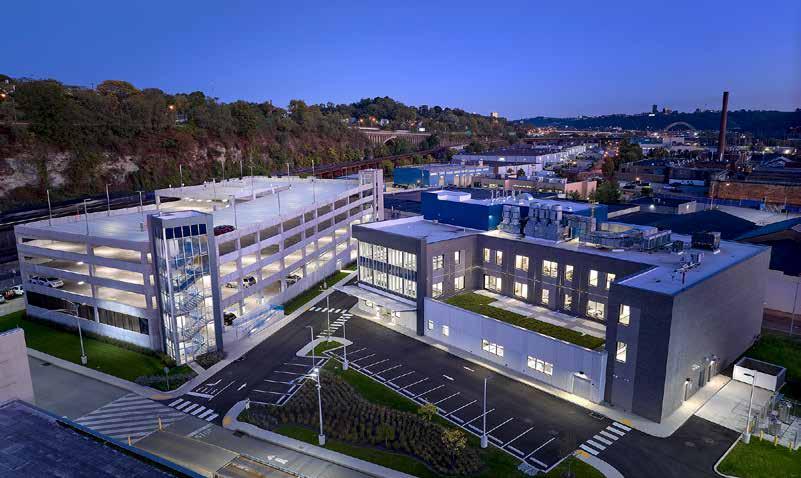
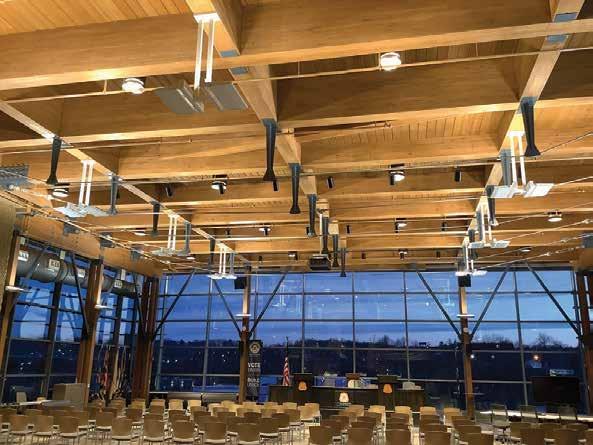



DEMOUNTABLE PARTITIONS AT KNOWLEDGE COMMONS
Vertical Adaptability that Supports Evolving Needs
As part of the design of Tombros & McWhirter Knowledge Commons, at the Penn State University Library, the library’s administration set a clear mandate: flexibility must be embedded into both infrastructure and space planning. With a low-profile raised floor already specified to manage horizontal adaptability, the design team enhanced vertical flexibility by incorporating demountable partitions.
These partitions, which include removable “skins,” allow for safe access to embedded power and data systems which eliminates the need for invasive work when space configurations change. This modular design supports the PtD objective of reducing hazards during system modifications.
An example of this strategy’s success came when a video editing suite was transformed into a 3D printing lab. Even with the need to incorporate additional infrastructure, the room was safely adapted to support 32 desktop 3D printers that now serve students across multiple campuses. The transformation occurred quickly, safely, and without disrupting adjacent systems, demonstrating the power of PtD in creating future-ready environments.
ensuring equipment is safely accessible for maintenance. Risk is mitigated not with reactionary fixes, but with intentional, forward-thinking choices.
These decisions are supported by robust assessment tools like Job Hazard Analysis (JHA), risk matrices, and Failure Mode and Effects Analysis (FMEA). They allow design teams to balance innovation with safety, recognizing that resilient buildings must function safely from day one and through every change ahead.
Building Maintenance into the Blueprint
Safe maintenance access is one of the most overlooked, and most critical aspects of building design. PtD reframes this challenge by ensuring building systems are placed where they can be safely accessed and serviced. This not only improves safety for maintenance
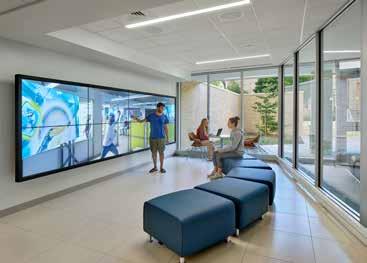
personnel but also extends system longevity and reduces lifecycle costs.
Integrated solutions, such as remote-mounted lighting or equipment located within accessible ceiling zones, reflect the broader PtD commitment: that safety should not be sacrificed for spatial ambition.
A Framework for Long-Term Success
Compliance with OSHA, ANSI, and ISO standards is a baseline, not a ceiling for PtD-driven projects. The real strength of this methodology lies in its culture of continuous learning. PtD integrates training programs, post-occupancy evaluations, and innovation reviews to capture lessons learned and apply them to future work. Safety metrics become key performance indicators, and design teams evolve with each project.

Penn State University Collaboration Commons and Infill, Pattee-Paterno Library. Photos by Halkin Mason Photography.



For over 120 years Local 66 in partnership with our Contractors, have been committed to provide qualified and competent Operating Engineers. The most successful companies are union signatories. We will help you to remain competitive and to gain the marketplace advantage. You will keep your employees and we will work with you to provide skilled training; and as you grow and your needs expand, we can provide you with a qualified workforce. This partnership is a positive approach to doing business. Your company must remain competitive during all economic conditions. We bring positive factors to the relationship – training, reliable workforce, safety, quality and a stronger community presence.
“We partnered with the Local 66 in 2011. Since then, we’ve been able to take on many more clients, more difficult work, due to the contribution of their great staff.”
J.J. Stefanik - President Stefanik’s Next Generation Contracting Co.
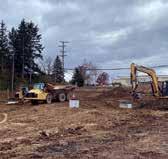


”Mascaro Construction Company is a regional general contractor that’s been around for 33 years. Proud to say that 30 of those years, we’ve had a relationship with the Operating Engineers providing us with skilled craftspeople that run all the equipment that we have.”
John C. Mascaro Jr. - President Mascaro Construction

“Working with Local 66, we have had employees that have been with us 25-30 years.”
Bindy Bucci - Owner Golden Triangle Construction
A Safer, Smarter Future Built by Design
As the building industry confronts increasingly complex demands, such as climate resilience, workforce safety, evolving technologies, and shifting programmatic needs, Prevention through Design offers a clear, actionable path forward. It reframes safety not as a constraint, but as an engine of smarter, more responsible innovation. Whether the project is a college library, hospital, data center, or government facility, PtD provides the structure and mindset to anticipate risk, streamline operations, and extend the useful life of every system within a building.
By embedding safety into the earliest phases of planning, organizations reduce the potential for injuries, operational disruptions, and costly retrofits. More importantly, they create environments where people, whether staff, visitors, technicians, or occupants, can thrive without navigating unnecessary risk. From modular infrastructure that allows space to evolve, to lighting systems designed for safe maintenance access, PtD enhances both the user experience and the bottom line.
Equally powerful is the cultural shift PtD promotes. When architects, engineers, contractors, and owners work in unison to prioritize safety at the design table, they foster a shared sense of responsibility that carries through construction, commissioning, and daily operations. This collaborative ethic results in not only safer buildings, but also stronger project outcomes that are on time, on budget, and built to serve for decades.
As regulatory standards grow more rigorous and sustainability imperatives rise, PtD equips project teams to lead with purpose. It connects the dots between technical excellence, human-centered design, and long-term value. In doing so, it ensures that safety is not something we react to after an incident, but something we design for from the very beginning.
DESIGN FOR SAFE ACCESS AND LONG-TERM VALUE
Maintenance Without the Hazards
As part of a two-story courtyard infill, at Penn State University’s Pattee-Paterno Library, the design team created a bright, welcoming atrium using sculptural pendant lights and high-efficiency LED downlights. While the design enhanced circulation and visual appeal, it also introduced challenges for safely maintaining overhead systems.
To address this, PtD strategies were embedded from the outset. Pendant fixtures were installed on integrated lift systems, allowing safe, floor-level access for cleaning that eliminates the need for ladders or scaffolding. LED lighting and HVAC controls were strategically located in accessible ceiling zones, making routine servicing safer and more efficient.
By prioritizing maintainability alongside aesthetics, the project illustrates how PtD supports both longterm safety and operational performance without compromising user experience.
In every sector, in every building type, the future belongs to those who design with intention. PtD is not just good practice, it’s a new standard of excellence in the built environment. BG

Larry Payne is principal at AE Works. He can be reached at larry@aeworks.com.

Penn State University Collaboration Commons and Infill, Pattee-Paterno Library. Photos by Halkin Mason Photography.

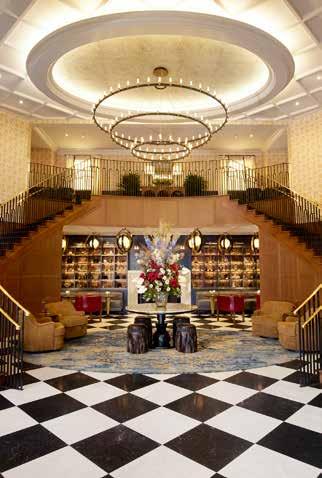




INDUSTRY & COMMUNITY NEWS
Turner’s Pitt Cell and Gene/ElevateBio team packed fully stocked backpacks for a local back-to-school drive benefiting the Hazelwood community. Organized by Turner’s Community and Citizenship team, this effort donated 50 backpacks.
from
are

in

(From left in blue) Josh Cofano, Art Shivani, and Jim Martin from TRE Construction, with the MBA’s Lance Harrell (second from right) at the NAIOP CREW Clays Shoot on June 19.
Pictured
left
Turner’s Megan Corrie, Joel Pitacciato, Greg Komar, Alex Romanchik, Nia Sankofa, Tyrell Minniefield, Hunter Gregory, Jake Zambo, Laura Traczynski, Cameron Wilson, Sage Smith, and Najeeb Hameen from ImbuTec.
(From left) UPMC’s Adrienne Miles and husband George Miles, Tara Connor from Turner Construction, and Rettew’s Paul Ceriani.
Michael Mascaro participated
the annual ALS CEO Soak at the PPG Fountain. Mascaro’s Mike Schoeneman and Kevin Finn stopped over from the Market Square Revitalization project to cheer him on.



The second annual MBA Member’s Intern
was held July 18 at the


The MBA Young Constructors hosted its annual clays shoot on July 31 at Coal Ridge Sporting Clays in Weirton, WV. Pictured from left are, Chelsea
Burton, Brice Koprivnak, Kathleen Kiehl, and Nathan Bota from PJ Dick.
Turner Construction intern, Anthony DeCostello (left), and Rycon Construction intern Garret Crivelli.
Luncheon
Carpenters’ Joint Apprenticeship Training Center. Interns pictured from left are Reese Pallone from DRAW Collective, Olivia Willig from Rycon Construction, Lauren Luppe from PJ Dick, Aidan Bartholomew from UBS Financial Services, and Patrick Loomey from Rocky Bleier Construction Group.
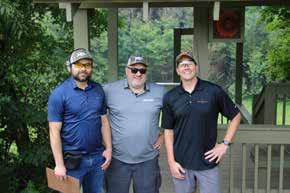
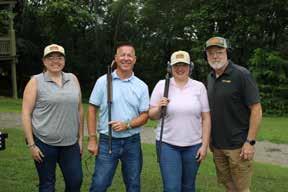




Avison Young creates real economic, social and environmental value as a global real estate advisor, powered by people. Our integrated talent realizes the full potential of real estate by using global intelligence platforms that provide clients with insights and advantage. Together, we can create healthy, productive workplaces for employees, cities that are centers for prosperity for their citizens, and built spaces and places that create a net benefit to the economy, the environment and the community.


(From left) Kevin Wilson from WNA Engineering, Jennefer Bartholemew from UBS, Desmone’s Eric Booth, and WNA’s Heather Grillo.
(From left) Angela Tignanelli, James DeWitt, Jaden Gage, and Jim Hart from FMS Construction.
(From left) Aon’s Charlie Salazar, Ross Allesandro from Schneider Downs, and Kinsey McInturf from DFL Legal.






(From left) Marisa Dascenzo from Workscape, MillerKnoll’s Lindsay Schwotzer, Beverly Shelby from AE Works, and Barbara Pschirer from R3A Architecture.

The American Subcontractors Association of Western PA held its annual golf outing August 18 at Chartiers Country Club. Picture (from left) are W. G. Tomko’s Brian Joyce, Jason Banes, Scott Ruffing, and Dan White from Lighthouse Electric.

(From left) Rycon’s J.R. Bittner, Aaron Reed from Reed Building Supply, Neal Rivers from Easley and Rivers, and Volpatt Construction’s Ray Volpatt.

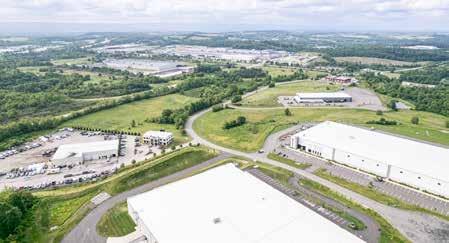


Four industrial parks & RIDC Westmoreland Innovation Center. The PennSTART test track site. Excellent connectivity. Westmoreland Technology Drive Industrial Complex is ready for your site-selection needs.

(From left) Chris Pless from NEXT Architecture, LaFace & McGovern’s Steve Whittingham, Harris Masonry’s Adam Harris, and Greg Heddaeus from Carl Walker Construction at the August 21 NAIOP Pittsburgh Developing Leaders’ Golf Outing at Cranberry Highlands.
(From left) Bill Ferrelli, Matt Westwood, Kara Seebacher, and Mark Westwood represented Mascaro at the Autism Awareness Golf Outing.
(From left) McKamish’s Bob Ward, Dustin Rothrock, Jim Synan, and Tom Farr.
ANNUAL WINE DINNER



Five decades of HARD WORK

50 Years of QUALITY workmanship
•We remain true to our founding values of quality,
Building with INTEGRITY since 1975
•We have worked on many wide-ranging and integrity and hard work. different projects the past 50 year such as
•RAM, as a primary construction company in local schools, colleges, churches, businesses, southwestern PA, has delivered, and will continue banks, restaurants and institutions. to deliver, top-notch quality services to our clients.
•Proud to continue partnering with many •RAM: delivers the highest standard of craftsmanship. top-notch general contractors and architects.
RAM Acoustical: celebrating the past, anticipating the future with even more success!
Southwestern Pennsylvania is our home. Being supportive and active member of our community is a priority and we are committed to strengthening friendships, serving others and investing in our region.
RAM Acoustical Corporation is proud to play an important role in the region’s economy by employing a Union work force generating millions of dollars in wages, pensions, health benefits, and state/local taxes. RAM also participates in a multitude of community projects
RAM Acoustical
•We believe in staying on the cutting edge of building trends & remain committed to excellence and professional management with all our construction partners,
•From start to finish, we are detailed-oriented on all jobs.
•Successfully completing over 3,500 plus projects.
Insert complete/full 50th

AWARDS & CONTRACTS
FMS Construction was the successful bidder on the $2.4 million Morgantown High School Kitchen Renovation for Monongalia County Board of Education. The architect is McKinley & Associates.
Massaro Construction Management Services was awarded a contract for construction management of the $30 million Chestnut Ridge Elementary School expansion and renovation in Bedford County, PA. The architect for the 62,000 square foot new building is EI Associates.
Massaro was recently awarded the UPMC Kane Hospital Air Handling Unit Replacement for the operating room and emergency department via a hard bid. The architect for the $3.3 million project is Hasenstab Architects.
The Center Area Transportation Authority awarded Massaro Corporation the office fit-out renovation located in State College. CDM Smith is the architect.
A groundbreaking ceremony was celebrated in late August for The Neighborhood Academy’s new additions. Massaro Corporation was selected for the $13.1 million addition to the academic building and another for the athletic facility.
Mercy Health Champion Emergency Center recently celebrated a groundbreaking for the new hospital in Champion, Ohio. The much-needed facility was awarded to Massaro Corporation, and the architect of record is GBBN.
Geneva College awarded Massaro Corporation its $8 million Welcome Center project. The architect of record is McKinley Architectural Services, Inc., (doing business as MCF Architecture).
Shannon Construction is doing the renovations for the DRI tenant space on the 53rd floor of 600 Grant Street. NEXT Architecture is the architect.
Shannon Construction is the general contractor for the tenant renovations for Raines Feldman Littrell on the 15th floor of 11 Stanwix Street. The architect for the 22,000 square foot buildout is POH + W Architects.
TEDCO Construction was awarded a $1.8 million contract by Westmoreland County Community College for renovations to its chemistry labs in New Stanton, PA. The architect is DRAW Collective.
Turner Construction has been selected to deliver the nearly 30,000 square foot fit-out of Deloitte’s new office at One PPG Place. Designed by Gensler, the vibrant new workspace will feature flexible meeting areas, hospitality-focused community spaces, and a layout that fosters collaboration across teams.
Turner will deliver the 72,000 square foot K&L Gates office renovation project, with Gensler as the architect. This modern Class A space will support the firm’s future vision with flexible,
collaborative, and client-focused design.
Pittsburgh Parking Authority awarded a $3.7 million contract to CPS Construction Group Inc. for Repairs and Preventive Maintenance at the First Avenue Garage and Station in downtown Pittsburgh. Desman is the architect for the project.
St. Vincent College selected A. Martini & Co. to build its $10 million Rhodora and John Donahue Hall in Latrobe, PA. The new building, which will be home to the School of Nursing, was designed by Kimmel Bogrette Architecture + Site.
Rycon was selected as the construction manager for the new 17,000 square foot giraffe barn at the Pittsburgh Zoo & Aquarium.
Rycon is building the 21,000 square foot pediatric clinic fitout for WVU Medicine at Wheeling Hospital.
Rycon continues to work at the former Jameson Hospital in New Castle, PA, serving as the general contractor for an upcoming MRI renovation.
MillerKnoll selected Rycon to complete an 8,000 square foot retail fit-out for Design Within Reach in Pittsburgh’s Strip District.
Rycon is serving as the general contractor for Café Conmigo, a new food and beverage destination located in the landside terminal of Pittsburgh International Airport.
PJ Dick is managing Duolingo’s 90,000 square foot fit-out across three floors in the Liberty East building.
PJ Dick’s Mid-Atlantic office is the general contractor for the renovation to Grace Hall on Villanova University’s Cabrini campus. The project includes 24,200 square feet of interior renovations and exterior façade upgrades.
PJ Dick began phase three of the Cathedral of Learning second floor classroom renovations for the University of Pittsburgh. The renovation includes nine new classrooms from 12 existing classrooms with finish and mechanical/ electrical upgrades similar to phases one and two.
Landau Building Company is overseeing the Surgery Renovation at WVU Medicine’s Fairmont Medical Center. Designed by Harley Ellis Devereaux Architects, the project involves the renovation of approximately 11,140 square feet on the lower level of the hospital.
UPMC Children’s Hospital has selected Landau Building Company as the general contractor for its upcoming Inpatient Pharmacy project. The 930 square foot renovation will upgrade the 5th and 9th floor pharmacies to meet USP 800 standards. DesignGroup is serving as the project architect.
(Continued on p. 61)








FACES & NEW PLACES
Caliber Contracting Services announced that Luke Heidenreich has been hired as a project engineer.
Caliber Contracting Services announced that Steve Baux has been hired as a superintendent.
Caliber Contracting Services announced that Michelle McNulty has been promoted to director of operations.
Rycon is glad to welcome Western Governors University alumna, Raphael Brothers, as an estimating coordinator.
With over eight years’ experience, David Connell has joined Rycon as a safety coordinator.
Stevenson University alumnus, Daniel Djukic, joined Rycon’s marketing department as a Marketing Coordinator.
Rycon is pleased to welcome Pennsylvania College of Technology alumnus, Elliott Gmiter, as a project engineer.
On June 16, Jake Krawczyk returned to Mascaro as a project engineer after completing two summer internships at Mascaro. He recently graduated from the University of Pittsburgh with a bachelor’s degree in civil engineering.
David Lukac returned to Mascaro as a project engineer on June 16. He recently graduated from Penn State University with a bachelor’s degree in civil engineering and a minor in entrepreneurship and innovation. He completed two summer internships for Mascaro.
RJ Murray returned to Mascaro as a project engineer on June 16. He graduated this spring with a bachelor’s degree in civil engineering from Penn State University. He completed two internship rotations with Mascaro.
On June 16, Madalyn Cerminara joined Mascaro as a Health, Safety & Environmental Manager.
On July 28, Alby Breisinger joined Mascaro as a project engineer. He is a recent graduate from Penn State University with a bachelor’s degree in civil and environmental engineering. He completed two previous internship rotations with Mascaro.
Alex Doe started at Mascaro on July 28 as a project engineer. He recently graduated from Penn State University with a bachelor’s degree in civil engineering and a minor in engineering leadership development. He successfully completed an internship rotation last summer with Mascaro.
Kameryn Snead joined Mascaro as a project accountant on July 28, after successfully completing an internship rotation with Mascaro last summer. She recently graduated from Penn State University with a bachelor’s degree in accounting.
Christopher Cook was hired as a new scheduler for Massaro Corporation. Chris has a bachelor’s degree in construction management and has been in the construction industry since 2008.
Christian Moreland joined Massaro Corporation as a project engineer. He is a Central Catholic alum and a recent graduate of Ohio State University with a degree in civil engineering.
Massaro Corporation hired Jake Mitolo as a newest project manager to join the team. He has a Bachelor of Architectural Engineering degree from Penn State University and has been in the construction industry since 2017.
Clayton Kejas was hired by Massaro Corporation as a project engineer. He graduated with a Bachelor of Architectural Engineering degree from Penn State University.
Eric Shudy was hired as the new business development representative for Massaro Corporation. Eric has more than 20 years’ construction sales experience and is a graduate of Duquesne University.
AWARDS & CONTRACTS
(Continued from p. 59)
Landau Building Company is serving as general contractor for the R/F Rooms 1 and 2 project at UPMC Children’s Hospital. The phased renovation covers approximately 650 square feet on the hospital’s second floor and includes replacing equipment in Fluoroscopy Rooms 1 and 2. LGA Partners is the project architect.
Landau Building Company is overseeing the system-wide nurse call upgrades at UPMC Children’s Hospital. The project spans 10 floors and includes replacing nurse call equipment for patients, staff, head-end systems, and cabling. DesignGroup is serving as the project architect.
Mascaro’s Client Services Group won both the WVU HSC North and the WVU HSC South Elevator Modernization projects. The scopes for each project include labor, materials, equipment, and tools to modernize traction elevators.
DiMarco Construction was awarded the contract to build the $3 million expansion of the Westmoreland County Food Bank in Delmont, Salem Township. Canzian Johnston & Associates is the architect for the 7,700 square foot addition.


These are the hallmarks the region’s union construction trades and contractors bring to the jobsite everyday. Our professional tradespeople and contractors bring the dreams and visions of our fast-growing region to life with a dedication that only those who live here, work here, and raise their families here can commit to. It is, after all, our home, our legacy.
We are also committed to providing opportunity for all who share these values and want to pursue a lifelong, lucrative and satisfying career. For more information on building with our union trades and contractors, or to explore career opportunities, please visit www.buildersguild.org where you will find direct links to our Trade Unions, Joint Apprenticeship Training Centers and Contractor Associations.



MBA MEMBERSHIP
2025 MBA OFFICERS
President
Michael R. Mascaro
Mascaro Construction Company, LP
Vice President and Treasurer
Alexander G. Dick
Dick Building Company
Secretary/Executive Director
David D. Daquelente
2025 MBA BOARD OF DIRECTORS
John P. Busse
F.J. Busse Company, Inc.
James T. Frantz
TEDCO Construction Corporation
Michael Kuhn
Jendoco Construction Corporation
Jennifer P. Landau
Landau Building Company
Anthony F. Martini
A. Martini & Co.
Steven M. Massaro
Massaro Corporation
David P. Meuschke, P.E.
Burchick Construction Company, Inc.
M. Dean Mosites
Mosites Construction Company
Jake Ploeger
PJ Dick Incorporated
Jodi L. Rennie
Turner Construction Company
John Sabatos
Rycon Construction, Inc.
Raymond A. Volpatt, Jr., P.E., Past President
Volpatt Construction Corporation
Neal Rivers (MICA President)
Easley & Rivers, Inc.
GENERAL CONTRACTORS
A. Martini & Co.
AIMS Construction
Allegheny Construction Group, Inc.
Burchick Construction Company, Inc.
Caliber Contracting Services, Inc.
Carl Walker Construction, Inc.
CH&D Enterprises, Inc.
CPS Construction Group, Inc.
Dick Building Company, LLC
DiMarco Construction Co., Inc.
E&G Development, Inc.
Elwood Construction Corporation
F.J. Busse Company, Inc.
Facility Support Services, LLC
FMS Construction Company
Fred L. Burns, Inc.
Gilbane Building Company
Higley Construction
Independence Excavating, Inc.
Jendoco Construction Corporation
Kokosing Industrial Incorporated
Landau Building Company
Mascaro Construction Company, LP
Massaro Corporation
McCrossin
Menard USA
Mosites Construction Company
Nicholson Construction Company
PJ Dick Incorporated
Rocky Bleier Construction Group
Rycon Construction, Inc.
Shannon Construction Company
Stevens Engineers & Constructors, Inc.
TEDCO Construction Corporation
Turner Construction Company
Uhl Construction Company, Inc.
Volpatt Construction Corporation
SPECIALTY CONTRACTORS
2bn contracting
A Crane Rental, LLC
A. Folino Construction, Inc.
A.J. Vater & Company, Inc.
Abate Irwin, Inc.
ABMECH Acquisitions, LLC
ACE Lightning Protection, Inc.
Advantage Steel & Construction, LLC
All Crane Rental of Pennsylvania, LLC
Alliance Drywall Interiors, Inc.
Amelie Construction & Supply, LLC
Amthor Steel, Inc.
BrandSafway Industries LLC
Brayman Construction Corporation
Bristol Environmental, Inc.
Bruce & Merrilees Electric Company
Bryan Construction, Inc.
Build with MD
Burke & Company, LLC dba S.P. McCarl & Company
Burnham Industrial Contractors, Inc.
Buzzelli Group LLC
Casework Installation Company, LLC
CaseWorks Inc.
Centerpoint Painting Systems
Century Steel Erectors Co., LP
Clista Electric, Inc.
Cost Company
Costa Contracting, Inc.
Cuddy Roofing Company, Inc.
Dagostino Electronic Services
D-M Products, Inc.
Dom DeMarco Construction, Inc.
Donley’s Concrete Group
Douglass Pile Company, Inc.
E2 Landscape & Construction
Easley & Rivers, Inc.
EMCOR Services Scalise Industries
Fay, S&B USA Construction
Ferry Electric Company
First American Industries, Inc.
Flooring Contractors of Pittsburgh
Franco Associates
G. Kidd Inc.
Gaven Industries, Inc.
Geo V Hamilton, Inc.
Giffin Interior & Fixture, Inc.
Gregori Construction Inc.
Gumpher, Inc.
Gunning, Inc.
Hanlon Electric Company
Harris Masonry, Inc.
Hatzel & Buehler, Inc.
HOFF Enterprises, Inc.
Howard Concrete Pumping, Inc.
Hunt Valley Environmental, LLC
J.J. Morris & Sons, Inc.
JLJI Enterprises, Inc.
K & I Sheet Metal, Inc.
Kalkreuth Roofing & Sheet Metal, Inc.
KELLER North America
Keystone Electrical Systems, Inc.
Kirby Electric, Inc.
Kusler Masonry, Inc.
L & E Concrete Pumping Inc.
Lanco Electric, Inc.
Lighthouse Electric Company, Inc.
Lisanti Painting Company
Manheim Dellovade LLC
Marsa, Inc.
Massaro Industries, Inc.
Master Woodcraft Corporation
Matcon Diamond, Inc.
Maxim Crane Works, LP
McCrossin Foundations, LLC
McKamish, Inc.
Mele & Mele & Sons, Inc.
Mohawk Construction & Supply Co., Inc
Next 150 Construction LLC
Noralco Corporation
O. Z. Enterprises, LLC
Paramount Flooring Associates, Inc.
Pennsylvania Roofing Systems, Inc.
Phoenix Roofing, Inc.
Pittsburgh Interior Systems, Inc.
Precision Environmental Company
Pullman SST
RAM Acoustical Corporation
Redstone Flooring, LLC
Renick Brothers Construction Co.
Richard Goettle, Inc.
Right Electric, Inc.
Ruthrauff | Sauer, LLC
Saint’s Painting Company, Inc.
Sargent Electric Company
Schindler Elevator
Schlaegle Design Build Associates, Inc.
Schnabel Foundation Company
Solid Platforms, Inc.
Specified Systems, Inc.
Spectrum Environmental, Inc.
SSM Industries, Inc.
Steel City Scaffolding of Pittsburgh, LLC
Swank Construction Company, LLC
T.D. Patrinos Painting & Contracting Company
Tarax Service Systems, Inc.
TRE Construction
Triple 3 Construction, LLC
Tri-State Flooring, Inc.
W.G. Tomko, Inc.
W.O. Grubb Steel Erection, Inc.
Wayne Crouse, Inc.
Wright Commercial Floors
Wyatt Incorporated
AFFILIATE MEMBERS
4CTechnologies
84 Lumber Company
A. L. Harding & Company
A.R. Chambers and Son, Inc.
ADMAR Construction Equipment and Supply
AEC Online Store
African American Chamber of Commerce of Western PA
Allegheny County Airport Authority -
Pittsburgh International Airport
Alliant
American Contractors Insurance Group
American Global
American Producers Supply Company, Inc.
AmeriServ Wealth & Capital Management
Aon
Atlantic Engineering Services
Atlas Wholesale Co., Inc.
AUROS Group
Babst Calland
Baker Tilly Virchow Krause, LLP
BDO USA, P.A.
Beth-Hanover Supply Co., Inc.
Black Diamond Equipment Rental
Bowles Rice
Bronder & Company, P.C.
Building Envelope Consultants and Scientists, LLC
Building Point Ohio Valley
Burns & Scalo Real Estate Services, Inc.
Burns White, LLC
CAD Construct LLC
Cadnetics, Inc.
Case | Sabatini
Chartwell Investment Partners
Chubb Group of Insurance Companies
Civil & Environmental Consultants, Inc.
Clark Hill PLC
Cleveland Brothers Equipment Co., Inc.
CliftonLarsonAllen LLP
Cohen and Company
Cohen Seglias Pallas Greenhall & Furman PC
Computer Fellows Inc.
Cozen O’Connor
CTR Payroll & HR
DesignGroup
Desmone Architects
Dickie, McCamey & Chilcote, P.C.
Dingess, Foster, Luciana, Davidson & Chleboski LLP
Dollar Bank
DRAW Collective Architecture
Eckert Seamans Cherin & Mellott
ECS Mid Atlantic, LLC
EPIC Insurance Brokers & Consultants
EquipmentShare
Fahringer, McCarty, Grey, Inc.
Falk-PLI Engineering and Surveying
FASTSIGNS of Pittsburgh
FDR Safety, LLC
FieldForce Equipment Sales & Rentals, LLC
First National Insurance Agency
Fisher Phillips
GM Equipment Corp.
Graystone Consulting Pittsburgh
H2R CPA
Henderson Brothers, Inc.
Henry Rossi & Co., LLP
HHSDR Architects/Engineers
Highstreet Insurance Partners
Hillis Carnes Engineering Associates, Inc.
HUB International
Huth Technologies LLC
IMA Corp
Interior Supply, Inc.
Intertek - PSI
J.S. Held
JLL
K&L Gates LLP
Karpinski Engineering
Kehm Oil Company
L & W Supply
LaFace & McGovern Associates, Inc.
Langan Engineering & Environmental Services
Liberty Insurance Agency
Liberty Mutual Surety
Lytle EAP Partners/Lytle Testing Services, Inc.
Maiello, Brungo & Maiello
MarinoWare
Marsh
Marthinsen & Salvitti Insurance Group
McKim & Creed, Inc.
McNees Wallace & Nurick LLC
Meyer, Unkovic & Scott LLP
Meyers Company
Michael Baker International
Michael Brothers Companies
Milwaukee Tool
Mobile Air, Inc.
Mobile Medical Corporation
Monster Smash, LLC
Morgan, Lewis & Bockius LLP
MSA Safety
MSW Supply
Multivista
NCI - Nursing Corps
Ohio Valley Drywall Supply
OnPoint Industrial Services
OVD Insurance
PenTrust Real Estate Advisory Services, Inc.
PGH Networks
Philadelphia Insurance Companies
Pietragallo Gordon Alfano Bosick & Raspanti, LLP
Pittsburgh Mobile Concrete, Inc.
ProShare Services LLC
R.J. Bridges Corporation
Reed Building Supply
Repco II
Republic Services, Inc.
RETTEW Associates
RJR Safety Inc.
Roofing & Exterior Products Services
Saxton & Stump
Schneider Downs & Company, Inc.
Scotti Law Group
Security 101 Pittsburgh
Seubert & Associates, Inc.
Solutions 21
Sprague Energy
Stanley Black & Decker
Stephany Associates, Inc.
Steptoe & Johnson, PLLC
STI, Inc.
Suburban Propane
Sunbelt Rentals, Inc.
Susanin, Widman & Brennan, PC
The Gateway Engineers, Inc.
The Reschini Group / Evergreen Insurance
The Sherwin-Williams Co.
T-Mobile
Tom Brown, Inc.
Travelers Bond & Financial Products
Tri-State Reprographics/Signarama Pittsburgh
Triangle Fastener Corporation
Triumph Modular
Tucker Arensberg, P.C.
UBS Financial Services, Inc.
Unified Door & Hardware
United Rentals
UPMC Work Partners
USI Insurance Services
W. R. Meadows of Pennsylvania
White Cap
WNA Engineering, Inc.
WTW - Willis Towers Watson
Zurich NA Construction



2025 BUYER’S GUIDE

AE Works
418 Beaver Street, Sewickley, PA 15143 www.aeworks.com
T: 412.287.7333
Tom White
Vice President of Business Development tomw@aeworks.com
Leverage the power of diverse services delivered by one team. AE Works combines building design and consulting specializations to enhance project value. United by innovation and entrepreneurial spirit, our team focuses on efficiency, ideation, and trust, optimizing your time and money for capital projects.
An award-winning firm, AE Works has been named to the 2025 Architectural Record Top 300. Experience spans commercial, healthcare, science and technology, energy & infrastructure, and higher education projects. Services include architecture, interior design, building systems engineering, and planning + project services.
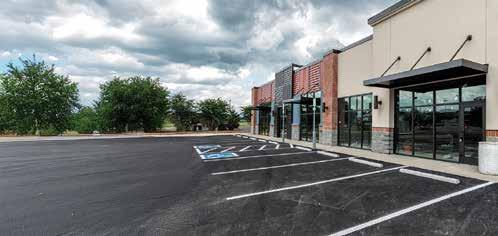
Design 3 Architecture PC
300 Oxford Dr. Suite 120, Monroeville, PA 15146
Anthony Scruppi - tScruppi@d3a.com

Design 3 Architecture has been offering architecture, planning, and interior design services to the Pittsburgh region since 1982. We view inherent project constraints as potential opportunities for innovative design solutions. With a philosophy grounded in team collaboration, providing both personal attention and project leadership, Design 3 Architecture does more than solve problems. We provide solutions that are unique, exciting and affordable.

Desmone Architects
3400 Butler Street, Pittsburgh, PA 15201 412-683-3230 www.desmone.com
Eric Booth, AIA, President ebooth@desmone.com
Great design is inspired by vision. We design buildings and spaces that allow people to thrive – physically, emotionally, and spiritually. Our unique service journey is rooted in effective delivery strategies and informed by principles of health and wellness. Our work reflects the range and diversity of the clients we serve. Each project is informed by a unique set of opportunities and constraints and is inspired by our client’s vision. We design high performing buildings and spaces optimized for the people who live, work and play within. Health and wellness are a consideration on all projects, regardless of size, scale or type. Our work is designed to thrive.

DLA+ Architecture & Interior Design
Foster Plaza 10, Suite 500
680 Andersen Drive, Pittsburgh, PA 15220
412-921-4300
www.DLAplus.com
Christoper Haupt, AIA – President & Chief Operating Officer
CRHaupt@dlaplus.com
Founded in 2008, DLA+ is a full-service Architecture and Interior Design firm headquartered in Pittsburgh, with offices in Morgantown, WV, and State College, PA. We design rewarding experiences by combining our Strategic ArchitectureSM approach with a passion for design excellence and client commitment. Our clients include leading organizations in workplace, higher education, sports, government, healthcare, and retail/hospitality industries. With broad expertise, our team excels in architecture, interior design, sustainability, design/build, and construction administration. We’re dedicated to creating remarkably designed, technically sound, and sustainable projects that are rewarding from inception and for generations to come.


DRAW Collective
470 Washington Road, Pittsburgh, PA 15228
www.drawcollective.com
T: 412.561.7117
Daniel Engen, AIA, President DanielE@drawcollective.com
Sheena Sundin, CPSM, Marketing Director SheenaS@drawcollective.com
DRAW Collective is a full-service architectural firm specializing in projects that matter in the lives of people. For 80 years, our firm has provided thoughtful architecture and design for educational, health + wellness, and community places. DRAW’s talented team of architects, interior designers, and project managers are passionate about elevating the conversation around design and providing empathetic client services. We strive to assemble the best team to meet each individual project’s needs, resulting in long-term relationships that have lasted generations. DRAW Collective designs places that matter, together.

IKM Architecture
Pittsburgh | Cleveland | Columbus HDQ: 11 Stanwix Street #2200, Pittsburgh, PA 15222
T: 412-281-1337
www.ikminc.com
Joel R. Bernard, AIA, NCARB, LEED AP, Principal jbernard@ikminc.com
Since 1911, IKM Architecture has delivered innovative, cost-conscious architecture, interior design, programming, and planning services that create lasting value. With offices in Pittsburgh, Cleveland, and Columbus, we offer regional expertise with the capacity to support projects across a broad footprint. Our work spans healthcare, behavioral health, science and technology, workplace, education, and civic sectors. We align design with client goals - whether optimizing patient flow, advancing research, or enhancing learning environments. Through immersive stakeholder engagement and tools like VR, 3D modeling, and laser scanning, we transform complex ideas into clear, actionable plans.

LGA Partners, LP
Pittsburgh | Cleveland 444 Liberty Avenue, Suite 1500, Pittsburgh, PA 15222 T: 412-243-3430
Paulette Burns, Partner pauletteb@lga-partners.com
LGA Partners is an award-winning, full-service architectural design and planning firm headquartered in Pittsburgh, PA. For over 30 years, we have formed meaningful partnerships with clients, consultants, and stakeholders, producing inspiring and enduring architecture. With specialized studios in Aviation, Education, Healthcare, Housing, Retail, and Workplace, our diverse team of 90+ professionals deliver thoughtful, results-driven design solutions across sectors. Our collaborative approach fuels innovation and ensures every project is tailored to meet real-world needs while advancing our clients’ goals. Renowned both locally and globally for our commitment to Design that Works we are consistently ranked among the region’s largest and fastest-growing firms — and have proudly been named a “Best Place to Work” for seven consecutive years.
HHSDR Architects/Engineers
40 Shenango Avenue, Sharon, PA 16146-1502
130 7th Street, 201 Century Building Pittsburgh PA 15222-3413 T: 412-281-2280 www.hhsdr.com
Andreas Dometakis – adometakis@hhsdr.com
Matthew Franz – mfranz@hhsdr.com
HHSDR helps our clients deliver successful projects, ontime and on-budget, using a 360 degree approach to project planning, design and management. Our approach means detailed, Partner involvement at every phase, from initial studies through the phases of design, construction contract management and post-construction closeout. It means advocacy on our clients’ behalf, through every stage of the project, with the same Partner and team members that started the project with you. It means a facility that is as effective as it is beautiful. It means having the confidence that comes from a firm with more than 70 years of experience. HHSDR looks forward to speaking with you about our 360 degree approach to your project.
NEXT architecture
NEXT architecture
1133 Penn Avenue, Suite 100 Pittsburgh, PA 15222
412-681-1145
www.next-architecture.net
Daniel J. DeLisio, Principal/Owner d.delisio@next-architecture.net
NEXT architecture is a full-service architecture and interior design firm located in Pittsburgh, PA. With a focus on innovation and collaboration, NEXT approaches every project as unique and utilizes talented individuals along with intentional principal involvement to ensure every project’s success.
Our philosophy – no ego, every project is unique, and challenges are opportunities – is the driving force behind everything we aim to accomplish at NEXT. We are steadfast in communication and honest in our work, always ensuring that the final product is the best version. With
innovation and collaboration, NEXT approaches every project as unique and utilizes talented individuals along with intentional principal involvement to ensure every project’s success.
Our philosophy – no ego, every project is unique, and challenges are opportunities – is the driving force behind everything we aim to accomplish at NEXT. We are steadfast in communication and honest in our work, always ensuring that the final product is the best version. With a history of embracing challenges, our team is always evolving to deliver the best product possible.
Perkins Eastman
525 William Penn Place, Ste. 2510, Pittsburgh, PA 15219
Jeff Young AIA
Co-Managing Principal and Executive Director
T: +1 412 894 8308
j.young@perkinseastman.com
Lee Michael Pellegrino AIA, WELL AP Co-Managing Principal
T: +1 412 894 8337
l.pellegrino@perkinseastman.com
Perkins Eastman is a global design firm founded on the belief that design can have a direct and positive impact on people’s lives. Striving for a sustainable and resilient future, and to enhance the human experience through the built environment, our award-winning practice draws on its nearly 1,000 professionals networked across 26 studios worldwide, comprising of work in a wide range of specialized project types. From education, workplace, senior living, and healthcare to mixed-use, residential, civic/ cultural and transit-oriented developments, we are uniquely equipped to tackle the most complex of design challenges. For more information, visit www.perkinseastman.com.

PWWG Architecture + Planning
408 Blvd. of the Allies, Pittsburgh, PA 15219 T: 412.391.2884 | F: 412.391.1657
www.pwwgarch.com
Lisa Carver, AIA, LEED AP, Principal lcarver@pwwgarch.com
Forward-looking clients partner with PWWG for exceptional design and detailing; cost-effective, buildable designs using sustainable principles; our meticulous, ethical approach to professional responsibilities; and the partnerships we nurture. PWWG works throughout the tri-state area from offices in Pittsburgh and Cincinnati. Projects for developers and private clients include multi-family housing, cultural buildings, mixed-use commercial, and adaptive re-use of existing structures. PWWG’s portfolio is 50% new construction and 50% renewal and re-use, creating new value for original buildings. Our turnkey services include: feasibility and space programming, concept studies, forensic assessment, support for funding applications, architectural & interior design, 3D visualizations, and project management.













PITTSBURGH’S INNOVATIVE BUILDER


From extensive facilities focused on tackling some of the world’s most challenging issues to intricate interior projects where the minor details are the most crucial, Turner Pittsburgh has the local expertise to complete the region’s most complex projects, with the national resources to enhance the services we provide to our clients.
Pictured Above: Westinghouse eVinci Technology Hub, University of Pittsburgh BioForge, and Federal Home Loans Bank Office Fit Out

R3A Architecture
48 South 14th St., Pittsburgh, PA 15203
T: 412-431-2480
www.r3a.com
James Sheehan – jas@r3a.com
Deepak Wadhwani – dw@r3a.com
R3A Architecture collaborates closely with our clients and partners to explore and discover each project’s potential to transform and re-energize an existing building or a new site. We are motivated by the opportunity to support and enrich our communities – educational, scientific, workplace, residential, civic, non-profit, and others. Our clients include leading universities, technology enabled workplaces, life science and research institutions, and smart manufacturing environments. Our approach leverages design thinking to reframe the dialogue around our clients’ needs, using a research-driven and iterative process to reimagine solutions. We synergize diverse disciplines such as user behavior, occupant wellness, project economics and the science of buildings, to shape and inspire the eventual outcome.

Wildman Chalmers Design
1622 Lowrie St, Pittsburgh, PA 15212
412.436.9303
wildmanchalmers.com
Chad Chalmers, RA, AIA, NCARB, LEED AP, Partner chad@wildmanchalmers.com
Wildman Chalmers Design is an award-winning mid-size architectural and interior design firm based in Pittsburgh, PA that works collaboratively with clients, regionally and nationally, to transform their goals and visions into creative design solutions. The firm comprises a diverse group of professionals dedicated to delivering high quality design, documentation and execution, and client service. Our experience covers a wide range of new construction and adaptive reuse projects including commercial, institutional, education, hospitality, retail, residential, and workplace.
Our superior craftsmanship and dedication to excellence has made us the leader in door systems for Western PA and the Tri-State Region. Our Red Ribbon trademark is your guarantee for receiving unequaled personalized service and expertise –from assistance with product selection through the timely completion of product installation. We also offer our customers preventative maintenance plans as well 24/7 emergency repair service 365 days a year.
Pellman Electric Associates
1133 Woodward Drive, Greensburg, PA 15601
T: 724-838-7150 or 412-431-5955
www.pellmanelectric.com
Darren Pellman, President Darren@pellmanelectric.com
Pellman Electric Associates LLC was built by a team of professionals who established a reputable and customerpleasing electrical contracting company in Greensburg PA. Our high-level customer satisfaction rate is attributed to our ethical and professional office staff and our firstclass field support team. Pellman Electric is focused on complete design-build services, thorough and competitive bidding, accurate accounting, and an excellent project management group complemented by warehouse “on time” material and tool expediting. Whether the project is a residential call or a large-scale commercial project, we recognize that quality and reliability are essential to our clients’ success. Our clients and community deserve the highest level of service. Our experienced professionals arrive on time with materials needed to complete the project in a timely and efficient manner.
CIVIL ENGINEERS
The Gateway Engineers
100 McMorris Road, Pittsburgh PA 15205
T: 412-921-4030 | F: 412-921-9960
www.gatewayengineers.com
David M. Heath, P.E.
dheath@gatewayengineers.com

Overhead Door Company of Greater Pittsburgh
400 Poplar Street, Pittsburgh, PA 15223
T: 412-781-4000 Ext. 216 | F: 412-781-2446
www.overheaddoorpittsburgh.com
Jason Henze – jhenze@ohdpgh.com
Overhead Door Company of Greater Pittsburgh is a Veteran-owned business specializing in commercial, industrial, and residential door systems, loading dock equipment and operable partitions. Overhead Door has always produced and installed the highest quality products. Our superior craftsmanship and dedication to excellence has made us the leader in door systems for Western PA and the Tri-State Region. Our Red Ribbon trademark is your guarantee for receiving unequaled personalized service and expertise –from assistance with product selection through the timely completion of product installation. We also offer our customers preventative maintenance plans as well 24/7 emergency repair service 365 days a year.
Since 1954, Gateway Engineers and its predecessors have played an active role in the development of this region. The tradition of providing value-added engineering solutions carries on as the company continues to grow and expand its reach into other parts of the United States. Our team of professional engineers, surveyors, construction inspectors, and landscape architects, along with qualified technicians, is ready to provide the expertise and personalized service which every project deserves. Our mission has always been to help our clients reach a higher level of success through knowledge, experience, and responsiveness. This year marks our 70th anniversary, but our brightest days lie ahead. For more information, visit www.gatewayengineers.com.
Mackin Engineers & Consultants
103 Technology Drive, Suite 200 Pittsburgh, PA 15275
T: 412-788-0472
www.mackinengineering.com
& CONSULTANTS INTEGRITY | QUALITY | EXCELLENCE
Bill Harris, PE, CBSI - President wharris@mackinengineering.com
Serving our clients since 1960, Mackin Engineers & Consultants continues to be a leader in the civil engineering field. We offer a wide range of professional consulting services for both public and private sector clients throughout the Commonwealth. Mackin places an emphasis on our staffs’ ongoing professional development to best serve our clients. Our multi-disciplinary staff includes dedicated professionals in the fields of civil, traffic, transportation and structural engineering, landscape architecture, community planning, GIS mapping, and construction inspection/management.

A. Martini & Company
320 Grant Street, Verona, PA 15137
T: 412-828-5500
www.amartinigc.com
Emily Landerman – Emily.Landerman@amartinigc.com
As a fourth generation, family owned and operated General Contracting and Construction Management firm, we are celebrating our 75 years of operation. The principals of A. Martini & Co. continue to provide hands on participation as a commitment to our clients and each of their projects. We believe that building projects as a true partner to the owner, utilizing sustainable building practices, and promoting true diversity in our subcontractor selection are the best practices for our region. As a mid-sized CM/GC, we utilize current technology for project tracking and scheduling coupled with personal attention to details, and our client’s needs. A. Martini & Co. provides construction management, general contracting and design build services for corporate, healthcare, senior living, restaurant, religious, retail, nonprofit, residential, industrial, historic, and education clients.

Burchick Construction Company, Inc.
500 Lowries Run Road, Pittsburgh, PA 15237
T: 412-369-9700
www.burchick.com
Dave Meuschke – meuschke@burchick.com
Burchick Construction is a full-service general contractor founded on the commitment to excellence that Joe Burchick brings to each project. Burchick’s management approach is designed to ensure optimum results for our clients while setting the performance standard for construction services. Our executives and managers have broad-based experience delivering construction to the highest of standards with every delivery method preference. Burchick’s project team and professional engineers on staff are equally comfortable with a completed design or with providing pre-construction assistance at the earliest stages of design. Burchick has managed commercial, institutional, and industrial projects from $1 million to $73 million with equal attention. Burchick Construction – Setting the Performance Standard.

Cuddy Roofing
22 Rutgers Road, Suite 102, Pittsburgh, PA 15205 412-458-3812
Mike Halpin –halpinm@cuddyroofing.com www.cuddyroofing.com
Established in 1991, Cuddy Roofing is one of the largest, premiere union roofing companies in the area. We specialize in difficult, high-end, and sheet metal sustainable applications as well as full-service repair and maintenance. Using stateof-the-art technology, Cuddy Roofing has topped some of the largest and most prestigious buildings in downtown Pittsburgh. We offer our customers superior roofing products that are backed by the best warranties in the industry.

Dick Building Company
46 South Linden Street, Duquesne, PA 15110 http://www.dickbuilds.com/ T: 412.567.8200
Alexander Dick, Chief Operating Officer agdick@dickbuilds.com
Dick Building Company combines the knowledge acquired from four generations of industry leadership with the latest in construction technology to maximize value for our clients. We maintain integrity and an unwavering work ethic at all levels of the company and promote open communication in our relationships with clients, design professionals, subcontractors and vendors. Dick Building Company carries these values across our spectrum of services, which include: pre-construction consulting, construction management, general contracting, designbuild, project management, program management, green building, and construction inspection.
Gilbane Building Company
11 Stanwix St Suite 701, Pittsburgh, PA 15222 T: 412-207-1700
Chris Perez, Business Development Manager CPerez1@GilbaneCo.com | 412-207-1673
Gilbane Building Company provides a full slate of construction and facilities-related services – from preconstruction planning and integrated consulting capabilities to comprehensive construction management, general contracting, design-build, and facility management services – for clients across various markets. Founded in 1870 and still a privately held, family-owned company, Gilbane has more than 45 office locations worldwide. Gilbane first established a presence in the Pittsburgh market in 1987 and has built a wide range of projects in markets such as healthcare, higher education, and commercial in the area.

Mascaro Construction
1720 Metropolitan St, Pittsburgh, PA 15233
T: 412-321-4901
www.mascaroconstruction.com
Michael R. Mascaro - mcclp@mascaroconstruction.com
Mascaro is one of the region’s largest construction firms specializing in design-build, construction management, and general contracting. Founded in 1988 on the simple premise to deliver excellence in construction services, we bring to your project the ‘Mascaro Advantage:’ We are humble, hungry, and smart – not shying away from hard work and complex projects, but tackling each one proactively. We do what we say we are going to do, right, the first time. We will provide a family atmosphere, concentrating on the health and welfare of not only our employees, but also that of our clients and community. Our success is based on our market diversity, superior planning, building relationships, and, most importantly, delivering great experiences.
Restoring the Past Building the Future
Jendoco Construction Corporation
2000 Lincoln Road, Pittsburgh, PA 15235
T: 412-361-4500 | F: 412-361-4790
www.jendoco.com
Michael Kuhn – mkuhn@jendoco.com
JENDOCO Construction, founded in 1957, is located in Pittsburgh’s East End and provides building construction services to the Western Pennsylvania region. Jendoco believes that the built environment should have a NetPositive impact on people, nature, and communities and that designing and constructing the places in which we live, work, worship, learn, heal and play should be collaborative, creative, and fun. Through proactive solution development, sustainable building practices, community engagement, and charitable support, Jendoco continues to demonstrate our commitment to the Greater Pittsburgh Region.

Landau Building Company
4378 Craighead Road, Allison Park, PA 15101
T: 724-935-8800
www.landau-bldg.com
Jennifer Landau, President – jplandau@landau-bldg.com
Landau Building Company, with a legacy spanning 130 years, has established itself as a leading construction management and general contracting firm in Western PA and the surrounding region. As a sixth-generation familyowned and operated company, we have cultivated a diverse portfolio of commercial, healthcare, institutional, and community-based projects, ranging from ground-up construction to major renovations. In 2006, we expanded our services to include northern West Virginia through our subsidiary, Marks-Landau Construction. To learn more about our services and experience, we invite you to visit our website at www.landau-bldg.com.
McKamish, Inc.
50 55th Street, Pittsburgh, PA 15201
T: 412-781-6262 | F: 412-781-2007
www.mckamish.com
John Jordan – jjj@mckamish.com
Serving the mid-Atlantic region with almost fifty years of experience, McKamish is a full-service mechanical contractor specializing in commercial HVAC, plumbing, piping, industrial piping, custom metal fabrication, and 24/7 service and maintenance. McKamish is dedicated to “Building Excellence” on every project that we build. With a dedicated team of employees who are committed to our customers, you can feel confident that your project will be handled with integrity. A family-owned company with deep roots in the Pittsburgh community, our goal is to surpass customers’ expectations and provide top quality service in everything we do.


PJ Dick Inc.
225 North Shore Drive, Pittsburgh PA 15212
T: 412-807-2000
www.pjdick.com
Bernard J. Kobosky | Bernie.kobosky@pjdick.com
PJ Dick provides best-in-class construction management staff to estimate, plan, and build the Mid-Atlantic region’s most prominent projects. Since 1979, PJ Dick has constructed buildings for the commercial, government, hospitality, healthcare, higher education, industrial, K-12 education, multi-family, senior living, and sports and entertainment markets. Consistently ranked among the nation’s top firms, PJ Dick offers unsurpassed general contracting, design/build, construction management, and consulting services while maintaining its values of safety, sustainable building, quality construction and innovative technology.

Rycon Construction
2501 Smallman St., Suite 100, Pittsburgh, PA 15222
T: 412-392-2525
www.ryconinc.com
Stephen Kosmer, Co-President - Pittsburgh
Lou Ferraro, Co-President - Pittsburgh
Founded in Pittsburgh, Rycon Construction is an employeeowned company (ESOP) that provides construction management, general contracting, and design-build services nationwide. An ENR Top 400 Contractor, ENR Top 100 Green Contractor, and BD+C Top 150 Contractor with nine offices, Rycon specializes in new construction, renovations, and adaptive reuse projects. Rycon’s portfolio consists of projects and developments in healthcare, education (K-12 & higher ed), industrial/warehouse, commercial, multi-unit residential, retail, financial, food service, self-storage, governmental, hospitality, and LEED facilities. We have an in-house Architectural Woodwork & Specialty Fabrication Division that ships/installs nationally, and an in-house Service Division offering 24/7 emergency service/restoration and term service work in Western PA.

Shannon Construction Company
3257 West Liberty Ave., Pittsburgh, PA 15216
T: 412-341-1155 F: 412-341-2955
www.shannon1.com
Ken Schultz, President ken@shannon1.com
Shannon Construction is a commercial builder with a rich legacy handed down from generations of family. Our objective is to develop and deliver customized building programs that meet our client’s goals. Shannon utilizes a creative, collaborative project approach to ensure client satisfaction and successful outcomes on every project. Clients benefit from our service philosophy rooted in personalized attention to every detail. We believe the best way to do business is to treat people fairly and do the right thing. Our services include General Contractor, Construction Management, Design & Build, Self-perform Construction, Building Construction Maintenance, and Green Building techniques.



Formed in 2022, TRE Construction focuses on being a high-quality and trusted commercial interiors subcontractor specializing in interior/exterior building systems, doors, frames and hardware, construction specialties, and casework/millwork installations in Greater Western PA, OH, WV, DC, MD, VA.
Family-owned and operated, we provide the highest quality of work and deliver cost-effective projects on schedule by employing and supporting motivated, flexible, and focused teams. Our clients count on our dependability, drive, and integrity. People and Safety are the most important assets to building better with TRE. We are a member of the Master Builders’ Association, Master Interior Contractors Association and NAIOP Pittsburgh.
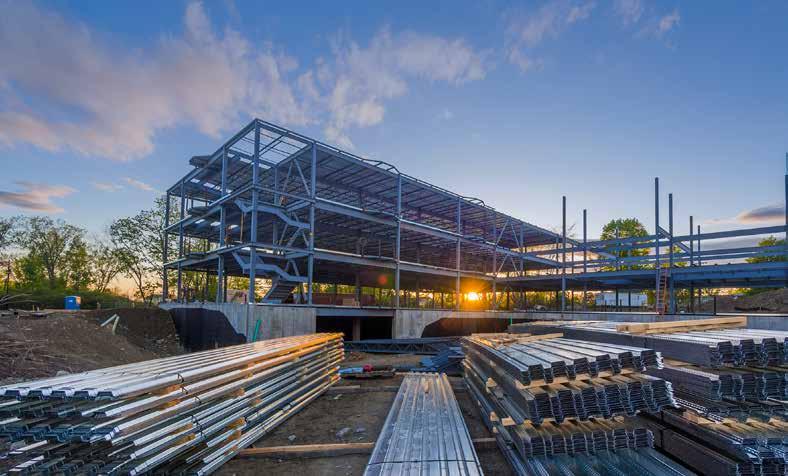

Turner Construction Company
600 Grant Street, Suite 2740, Pittsburgh, PA 15219
T: 412-255-5400
Chris DiLorenzo
cdilorenzo@tcco.com
Founded in 1902, Turner is the leading general builder in the United States, recognized for our unwavering commitment to excellence, innovation, and service. With nearly 50 offices nationwide, Turner combines the strength of a national organization with the responsiveness and insight of a local partner, delivering industry-leading construction solutions tailored to each community we serve. In the Western Pennsylvania region, our roots run deep; for over a century, we’ve helped shape Pittsburgh’s skyline by playing a vital role in the development of many of the area’s most iconic and transformative buildings. Since establishing a full-time office in Pittsburgh in 1976, we’ve become the trusted builder for a variety of clients across the region. Today, our Pittsburgh team—more than 100 strong—continues to build upon this legacy with a forward-thinking approach that embraces technology, sustainability, and collaboration. As Pittsburgh continues to grow and evolve, Turner stands at the forefront, ready to deliver the next generation of innovative, complex projects that will define the future of our region.
Volpatt Construction Corporation
100 Castleview Road, Pittsburgh, PA 15234
T: 412-942-0200
www.volpatt.com
Ray Volpatt, Jr. President – rayjr@volpatt.com
From our first renovation in 1991, to over 900 industrial, commercial, and institutional projects, Volpatt Construction has successfully positioned itself as one of the most respected building contractors in the Tri-State area. With a focus on high quality, hands-on service, competitive pricing, and timely project completion, Volpatt Construction has built and maintained a long list of repeat clients, partnering with the finest businesses and institutions in the area. Today, the family-operated company continues to play an integral role in building the region into a top global destination for healthcare, education, and research.

Ambridge Regional Center and ConAm3PL
2301 Duss Avenue #1, Ambridge, PA 15003
T: 724-266-4661
www.AmbridgeRegional.com
www.ConAm3PL.com
Ric Ford
rford@ambridgeregional.com
The Ambridge Regional Center offers over 1 million square feet of warehouse, distribution, manufacturing, lab and yard space for lease. Our tenants include Fortune 100 firms as well as small private companies.
ConAm3PL offers full third party logistics to international conglomerates as well as regional companies whom all utilize our distribution capabilities to maximize their operational efficiencies.
International Brotherhood of Electrical Workers

its hospitals and its skyscrapers.
Acrisure Stadium, PNC Park, Pittsburgh International Airport, PPG Place, UPMC Children’s Hospital of Pittsburgh and the new FNB Tower. Behind Pitts burgh’s major buildings is I.B.E.W. Local 5.

The Buncher Company
One Waterfront Place
1251 Waterfront Place #201, Pittsburgh, PA 15222
412-422-9900
www.buncher.com
The Buncher Company, headquartered in Pittsburgh, Pennsylvania, is a recognized leader in all phases of real estate development, including site acquisition, construction, brokerage and leasing, and property management. We are experienced in providing innovative solutions to prospective clients and tenants, and we understand what it takes to effectively adapt to the constantly changing real estate business environment. Our highly experienced staff of real estate and construction specialists can help clients navigate the complexities of finding the perfect location to build and lease. They bring in-depth industry expertise and knowledge of every property, and consistently deliver high-level tailored services, unlimited accessibility, and timely results.

Elmhurst Group
One Bigelow Square, Suite 630, Pittsburgh, PA 15219
T: 412 281-8731
www.elmhurstgroup.com
Eric R. Schindler, Director of Leasing eschindler@elmhurstgroup.com
Elmhurst is a 52-year-old Pittsburgh-based organization that invests in, develops, and manages commercial real estate. Elmhurst’s portfolio consists of industrial, office, multifamily, and hotels in the Greater Pittsburgh market area, totaling over 3.6 million square feet, including 2.1 million square feet of ground-up developments. Elmhurst is a vertically-integrated organization that oversees investment acquisition, asset management, accounting, and property management services for its industrial and office properties. Elmhurst’s tenancy includes prominent regional and national businesses, government agencies, and non-profits.
Oxford Development Company
2545 Railroad Street, Pittsburgh, PA 15222
412.261.1500
www.oxforddevelopment.com
For over 60 years, Oxford has stood at the forefront of the marketplace as a developer and full service commercial real estate services provider with experience in the local, regional, and national marketplace. Oxford’s mission is to forge dynamic centers where community thrives alongside commerce, through real estate solutions that uplift and ignite inspiration for our people, partners, and communities alike. We deliver real estate solutions to our clients that are innovative, cost-effective, and sustainable. Our team has the depth of experience to manage, lease and develop all types of facilities. Oxford’s ability to create unique partnerships and complete complex transactions makes us a preferred real estate partner.
ECONOMIC DEVELOPMENT
Indiana County Center for Economic Operations
801 Water St., Indiana, PA 15701-1705
T: 724-465-2662 | F: 724-465-3150
www.indianacountyceo.com
Byron G. Stauffer, Jr., Executive Director byronjr@ceo.co.indiana.pa.us
The Indiana County Center for Economic Operations (CEO) serves as a public-private partnership promoting economic growth, development, and prosperity in Indiana County, PA. The CEO serves as a hub for businesses, government agencies, and community organizations. The CEO provides services and resources for businesses throughout their life cycle. The CEO offers site selection assistance, an array of pad-ready sites and buildings and coordinates financial incentives. The CEO seeks to support the continuous improvement of Indiana County through increased business activity, economic growth, education, tourism and quality of life.

Washington County Chamber of Commerce
1000 Horizon Vue Drive, Suite 1C80, Canonsburg, PA 15317 T: 724-225-3010 | F: 724-228-7337
www.washcochamber.com
Will Thomeier, Director Economic & Tourism Development – will@washcochamber.com
The Washington County Chamber of Commerce is the largest chamber of commerce Southwestern Pennsylvania and leading economic development agency in Washington County. The Chamber focuses on marketing and business development initiatives to expand the economy of Washington County and was one of the first organizations to publicly support the economic benefits and job creation potential of the natural gas industry. Learn more at www.washcochamber.com.

Westmoreland County Industrial Development Corporation
5th Floor, Suite 520, 40 North Pennsylvania Ave., Greensburg, PA 15601
T: 724-830-3061 | F: 724-830-3611
www.WestmorelandCountyIDC.com
Jason W. Rigone, Executive Director WCIDC@westmorelandcountypa.gov
Founded in 1983 by the Westmoreland County Board of Commissioners, Westmoreland County Industrial Development Corporation promotes growth in terms of job creation, economic output and a stable tax base for Westmoreland County. By developing a robust industrial park system, deploying a comprehensive marketing strategy, administering a proactive Business Outreach Program and collaborating in public/private partnerships, WCIDC supports business growth that results in job opportunities for the citizens of Westmoreland County.
ENGINEERS

Civil & Environmental Consultants, Inc.
700 Cherrington Pkwy, Moon Township, PA 15108
T: 800-365-2324
www.cecinc.com
Mike Archer, P.E. – marcher@cecinc.com
CEC provides integrated design, engineering, surveying, environmental, and construction-related services with a tailored approach to address diverse development/ redevelopment requirements. We have the local and national expertise necessary to support developers and architects with cost-effective designs for projects of all sizes. We understand the desire to minimize cost and maximize your return on investment. We will provide objective opinions regarding project feasibility to enable you to make informed business decisions. The complete real estate development life cycle... WE OWN IT.™
KU Resources, Inc.
22 South Linden St., Duquesne, PA 15110
T: 412-469-9331 | F: 412-469-9336
www.kuresources.com
Tysen Miller, PE, LEED AP, CPESC
Tmiller@KUResources.com
KU Resources, Inc. provides a full range of environmental management and site development engineering services to industrial, commercial, and community based clients. The firm specializes in brownfield redevelopment, environmental site assessment, economic revitalization assistance, regulatory permitting and compliance, remediation design and implementation, and environmental risk management strategies. The firm’s engineering and environmental consulting capabilities also include the areas of civil and geotechnical engineering, site development engineering, water resources engineering, mining and quarry services, water quality monitoring, and air quality compliance and permitting.
LSSE Engineers and Surveyors
846 Fourth Ave., Coraopolis, PA 15108 T: 412-264-4400
www.lsse.com
Kevin A. Brett, P.E. – kbrett@lsse.com
A leading provider of civil engineering and surveying services for nearly 40 years. Serves public and private clients in the municipal, commercial, industrial, institutional, residential, and utilities markets. Specializes in wastewater facilities, water facilities, and stormwater/green infrastructure planning, design, and construction phase services. LSSE’s operating plan turns on client satisfaction and corporate and individual career development.
KU Resources, Inc.
22 South Linden St., Duquesne, PA 15110
T: 412-469-9331 | F: 412-469-9336
www.kuresources.com
Dominick Anselmo
danselmo@kuresources.com
KU Resources, Inc. provides a full range of environmental management and site development engineering services to industrial, commercial, and community based clients. The firm specializes in brownfield redevelopment, environmental site assessment, economic revitalization assistance, regulatory permitting and compliance, remediation design and implementation, and environmental risk management strategies. The firm’s engineering and environmental consulting capabilities also include the areas of civil and geotechnical engineering, site development engineering, water resources engineering, mining and quarry services, water quality monitoring, and air quality compliance and permitting.

Terracon Inc.
3280 William Pitt Way, Pittsburgh, PA 15238
T: (412) 426-7034
Bradley S. Reese, Operations Manager
bsreese@terracon.com
Terracon is an employee-owned, consulting engineering firm that provides expertise in environmental, geotechnical, facilities, and materials testing services, including commercial, industrial, and data campus development. Negotiating the complexities of environmental issues can be challenging and time-consuming. Terracon relies upon demonstrated experience and knowledge of local conditions and regulations to deliver solutions that are timely, practical, and make good business sense.
Due Diligence + Transactional Support
Site Investigation + Closure
Remedial Design + Implementation
Brownfields + Site Redevelopment
Building Environmental Sciences
Industrial Hygiene
Environmental Planning + Permitting (Natural Resources and NEPA)
Cultural Resources (Historic Structures and Archaeology)
Regulatory Compliance

American Subcontractors Assn. of WPA
2219 Ridge Road, South Park, PA 15129
T: 724-538-8227
www.asawpa.org
Erin Joyce, Executive Director
erin@asawpa.org
ASA Western PA is the united voice dedicated to improving the business environment and representing subcontractors before all branches of government, other construction industry groups, and the media. We strive to promote quality construction, ethical and equitable business practices, safety in the work environment, and best industry practices. Our scholarship program reaches students interested in the trades through partnerships and school visits. A Mentorship Program is available for all scholarship recipients. ASA’s Emerging Leaders create an environment of young professionals who have the potential to serve in leadership roles and provide networking opportunities that help to expand their careers.


Designed and Built to Get Results
For more than a decade, DFL Legal has provided companies with the most effective solutions in resolving unique construction and engineering disputes.
Our success has been achieved by offering our clients proven, big case experience, along with the efficiencies and flexibility of a boutique firm.
Find out how our experience can be put to work for you.

Builders Guild of Western PA, Inc.
631 Iron City Drive, Pittsburgh, PA 15205
T: 412-921-9000
Jeff Nobers, Executive Director jnobers@buildersguild.org
A unique, non-profit labor/management initiative, representing 16 building trade unions and nine affiliated contractor associations. The Builders Guild is a positive forum for labor, management, and community relationships, and fosters a cooperative and productive climate for regional commercial construction development. Through the Builders Guild, unions and management have forged fair and equitable working partnerships which promote economic and professional growth.
Guild initiatives include:
• Promoting the professionalism, skill, and pride inherent with union construction;
• Training for long-term careers in the construction trades;
• Providing a reliable, skilled and diversified workforce; Facilitating diverse partnerships with like-minded organizations throughout Western Pennsylvania.

CREW Pittsburgh
CREW Network
1201 Wakarusa Drive, Suite D, Lawrence, KS 66049
www.crewpittsburgh.org
Admin@crewpittsburgh.org
Commercial Real Estate Women (CREW) offers unparalleled business development, personal leadership growth, and networking opportunities, both in our local Pittsburgh market and across 80+ affiliates in the US, Canada, France, Mexico, and the United Kingdom with 14,000+ members. The Pittsburgh chapter has 20+ years of providing educational programs and networking events to its members and the CRE community. Whether male or female, join CREW to have a global commercial real estate network at your fingertips and your contact info in that worldwide network.

Ironworker Employers Association of Western Pennsylvania
135 Technology Drive #311, Canonsburg, PA 15317
T: 412-922-6855
www.iwea.org
Danielle Harshman, Executive Director dharshman@iwea.org
The IWEA is a Trade Association of Union Contractors who work in all aspects of the ironworking trade within the construction industry. We are a resource for all owners, developers and contractors who are looking for a qualified contractor with a well-trained workforce. Visit our website or call our office for additional information.
Master Builders’ Association of Western PA, Inc.
631 Iron City Dr., Pittsburgh, PA 15205
T: 412-922-3912 www.mbawpa.org
David D. Daquelente, Executive Director dave@mbawpa.org
Master Builders of Western Pennsylvania, Inc., is a trade association and influential voice in the construction industry, including 301 general contractors, construction managers, specialty contractors, service, and supplier companies. Members are responsible for more than 80 percent of the Pittsburgh area commercial construction. MBA awarded $800,000 in scholarship support to students in industry-related categories, brought nearly 1500 representatives of our industry together to celebrate the MBA Building Excellence Awards, and supports mental health through its acclaimed Yinz Good? campaign. MBA’s affiliation with Associated General Contractors of America affords members with broader access to national resources. For more information visit http://www.mbawpa.org/

NAIOP Pittsburgh
PO Box 100085, Pittsburgh, PA 15233 www.naioppittsburgh.org
Tom Frank, Executive Director info@naioppittsburgh.org
NAIOP Pittsburgh is the regional association of developers, owners, investors, and professionals in commercial real estate. We are the leading industry resource to foster business relationships, promote responsible development and support growth of the region through education, leadership, and advocacy. Visit naioppittsburgh.com for additional information or contact info@naioppittsburgh.org.

Pittsburgh Works Together
631 Iron City Drive, Pittsburgh, PA 15205
Jeff Nobers, Executive Director info@PghWorks.com | www.PghWorks.com
Pittsburgh Works is committed to creating an inclusive vision of economic progress that embraces and respects both traditional legacy industries and emerging ones, while honoring the diversity of cultures and traditions inherent to each, while ensuring a sustainable environment. We seek a Pittsburgh and a region in which the lines between “old” and “new” economy are erased and respect is shown for our work ethic and dedication to community, while building a future for all.
Pittsburgh Works Together knows that we need an economy that works for everybody. Created after meetings of union leaders and officials from the manufacturing, steel, and energy sectors, our organization is committed to working with leaders of tomorrow’s industries by reminding them that without everybody, there is no New Pittsburgh.

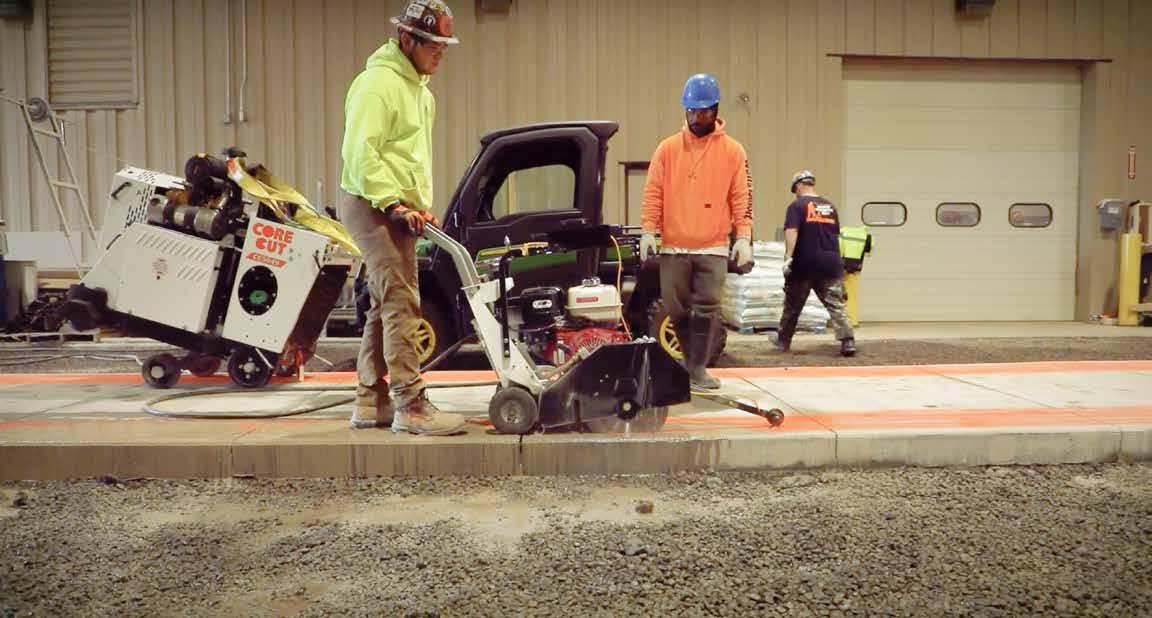

Society for Marketing Professional Services
SMPS – Pittsburgh Chapter
www.smpspittsburgh.org
Tyler Niedzwicki, Chapter President
LGA Partners
444 Liberty Avenue, Suite 1500, Pittsburgh, PA 15222
T: 412-243-3430
The Society for Marketing Professional Services (SMPS) is a diverse community of marketing and business development professionals working together to move the Architecture/Engineering/Construction (A/E/C) industry forward. SMPS is the only organization dedicated to creating business opportunities in the A/E/C industry. Companies large and small are able to tap into our powerful national and regional network to form partnerships, secure business referrals, and benchmark performance. The Pittsburgh Chapter offers educational programs, professional development seminars, and networking opportunities to professionals from architectural, engineering, planning, interior design, construction, and consulting firms serving the Pittsburgh region. SMPS Pittsburgh has over 100 members representing more than 50 firms in the built industry.
INTERIOR DESIGNER

AE7, LLC
2840 Liberty Ave., Suite 403, Pittsburgh, PA 15222
T: 412-932-2044
www.ae7.com
Mark Witouski – Mark.witouski@ae7.com
AE7 Interior Design, part of the globally renowned AE7 Architects, specializes in creating innovative and functional interiors for corporate and commercial clients. With a deep understanding of the unique needs of these sectors, AE7 delivers tailored design solutions that enhance productivity, reflect brand identity, and add value to properties. Our team’s expertise spans office spaces, commercial developments, residential projects, and food and beverage venues ensuring each design is both aesthetically pleasing and highly practical. Committed to excellence, AE7 Interior Design leverages cutting-edge technology and sustainable practices to create environments that inspire and engage. Discover more at www.ae7.com.
Design 3 Architecture PC
300 Oxford Dr. Suite 120, Monroeville, PA 15146
Anthony Scruppi - tScruppi@d3a.com
Design 3 Architecture has been offering architecture, planning, and interior design services to the Pittsburgh region since 1982. We view inherent project constraints as potential opportunities for innovative design solutions. With a philosophy grounded in team collaboration, providing both personal attention and project leadership, Design 3 Architecture does more than solve problems. We provide solutions that are unique, exciting and affordable.
LAND SURVEYORS

Meyer, Unkovic & Scott
Henry W. Oliver Building
535 Smithfield Street, Suite 1300, Pittsburgh, PA 15222
T: 412-456-2800
www.muslaw.com
W. Grant Scott – wgs@muslaw.com
Patricia E. Farrell – pef@muslaw.com
Amanda M. Daquelente - amd@muslaw.com
Understanding each client’s business objectives, we provide timely, creative, and cost-effective solutions. We represent those in the business of real estate and companies who must have real estate in order to do business: our clients include manufacturers and service providers as well as owners, developers, managers, lenders, landlords and tenants, investors, contractors, brokers, and design professionals. Clients rely on us to counsel them on all facets of commercial real estate, retail, multifamily, office, and industrial, working with them on purchases and sales, land use and development, construction, financing, leasing, title insurance, property tax, assessment appeals, zoning, and eminent domain throughout the region and across the US. Our multi-practice firm enables us to ensure time and resources are used wisely and your deal closes on time.
REAL ESTATE BROKERS
Lennon, Smith, Souleret Engineering, Inc. Engineers and Surveyors
846 Fourth Ave., Coraopolis, PA 15108
T: 412-264-4400
www.lsse.com
Kevin A. Brett, P.E. – kbrett@lsse.com
A leading provider of civil engineering and surveying services for nearly 40 years. Serves public and private clients in the municipal, commercial, industrial, institutional, residential, and utilities markets. Specializes in wastewater facilities, water facilities, and stormwater/green infrastructure planning, design, and construction phase services. LSSE’s operating plan turns on client satisfaction and corporate and individual career development.

Hanna Commercial Real Estate 11 Stanwix Street, Suite 1024, Pittsburgh, PA 15222
T: 412-261-2200
http://www.hannacre.com
Michael Connor – mconnor@hannaCRE.com
Hanna Commercial Real Estate (HCRE) is rooted in the history of the Pittsburgh region. Our legacy in Pittsburgh real estate spans nearly 90 years through various companies and names, culminating with the merger of Langholz Wilson Ellis, Inc. and Hanna Commercial Real Estate. HCRE thrives by providing responsive, personalized service. Our disciplines of specialty include retail, office, industrial, and investment commercial brokerage services. We service all Western Pennsylvania and West Virginia. Our greatest asset is our people, who maintain the integrity of HCRE. Our unique structure creates an environment in which our agents and staff are often teamed together to extend both competence and energy to each client’s requirement.

NEWMARK
210 Sixth Avenue #600, Pittsburgh, PA 15222
T: 412-281-0100
www.nmrk.com
Gerard McLaughlin – Gerard.mclaughlin@nmrk.com
Louis Oliva – Louis.oliva@nmrk.com
Since 1970, the Pittsburgh Newmark office has been a key contributor to the firm’s strength in the Midwest. Our services have evolved to address the real estate needs of property investors, multi-market corporations and single-location tenants and landlords. Today, Newmark offers a full range of commercial real estate services, with brokerage professionals specializing in office, industrial, retail and investment product types, and a highly-skilled management services group that provides property, facility and construction management services for a diverse portfolio of properties. In addition, our team handles client accounting and lease administration for property investors and corporations.
SOLAR SOLUTIONS

Scalo Solar
22 Rutgers Road, Suite 101, Pittsburgh, PA 15205
412-458-3888
Mark Heckathorne – Chief Operating Officer heckathornem@scalocopanies.com
www.scalo-solar.com
Scalo Solar Solutions has been helping residential, commercial, and industrial properties gain their energy independence using our expertise in PV design, construction, yield analysis, tax models, and financial engineering. Scalo Solar Solutions provides tremendous expertise and strategic resources for the roofing and sheet metal needs required by PV solar installations. We can install both your roof and solar array, so you won’t have to communicate between multiple contractors. Scalo Solar aims to help businesses, homeowners, institutions, and non-profits take ownership of their energy future.
SPECIALTY CONTRACTORS COMBINED HEAT & POWER PLANTS

LLI Engineering
1501 Preble Ave, Suite 300, Pittsburgh, PA 15233
T: (412) 904-4310
www.LLIEngineering.com
James D. White, PE, LEED AP jwhite@lliengineering.com
LLI Engineering provides mechanical, electrical, architectural, commissioning, and structural engineering services. Since 1910, LLI Engineering has been consistently recognized for providing top-quality engineering design services. We specialize in commercial, critical facilities, education, healthcare, industrial, infrastructure upgrades, green building design, energy conservation modifications,
engineering, and engineering estimates. Located in Pittsburgh, Pennsylvania, LLI Engineering has completed projects in over 20 different




Join Us in Building with Purpose in 2025

DIRECTORY SEARCH
Search MBA's directory to find top general contractors, construction managers, subcontractors, suppliers and service providers for your next project. MBA membership accounts for more than 80% of commercial construction in our region. mbawpa.org/ member-directory

mbawpa.org


SAFETY SERVICES
To assure that the industry maintains its commitment to safety, MBA offers essential training and services. These services include information, interpretation, and consultation on OSHA regulations for member contractors.
mbawpa.org/safety

MBA MEMBERSHIP
Get connected to the largest commercial construction trade association in the region. Learn more about the benefits of MBA Membership at mbawpa.org/join-mba
CLOSING OUT
BY KEVIN DOUGHERTY
The slogan, “Pittsburgh Someplace Special,” coined by KDKA in the 1970s, has remained relevant for the past 50 years because of the city’s enduring charm and resilience.
During my North Catholic High School years in the 1970s, I vividly recall classmates discussing how family members were losing jobs and the high unemployment rates at that time. However, the city’s spirit was lifted when the Steelers began to win for the first time. Light Up Night and the impressive U.S. Steel Tower marked the beginning of Pittsburgh’s real estate renaissance that followed.
In the 1970s, retail development in the Pittsburgh metro area was relatively limited. Monroeville Mall, with its ice-skating rink and diverse shops, catered to the growing residential population in the east. South Hills Village followed, while Century III and Ross Park were still in the planning stages. The north was served by Northway Mall and North Hills Village, while the west had only a few strip retail centers. Downtown retail was a major event, anchored by Kaufman’s, Joseph Horne Co., and Gimbels.
The 1980s brought significant changes in retail, as more malls were built. Big box strip centers anchored by today’s survivors - Walmart, Target, Lowes, and Home Depot – were built. Several category killers also came and went, such as catalog showrooms, various grocers like A&P and Thorofare, and the likes of Hills, Zayre, Ames, Sears, and Kmart.
The 1990s and 2000s brought more retail expansion by some and contraction or consolidation by others. All the while, the Pittsburgh Metro area continued methodically expanding into metro counties like Washington, Butler, Beaver, Westmoreland Indiana, Armstrong, and Fayette.
Western PA’s unique topography limited the number of developable sites which helped the market from ever becoming overbuilt.
Today, retail development faces several challenges, including market demand, building and sitework costs, financing, and governmental regulation. These challenges are consistent across states and communities, but strong leadership is crucial to meeting them. Relationships and teamwork are essential for project success. Proper sitework is critical, as the civil engineer and geotechnical experts form the foundation of the project (pun intended).
Securing financing is crucial in today’s market. It’s important to connect with lenders who share your vision and understand your goals, as well as with equity investors willing to risk capital.
Underwriting tenants who can support valuations and debt coverage ratios is also essential. Pittsburgh is fortunate to have numerous lending institutions and a highly skilled, nationally recognized real estate workforce.
Navigating the permitting process is a significant challenge for developers. Waiting is not in our nature. Time is money and every day adds to a project’s cost. The process involves balancing urgency with caution and risk with safety. This is why consultants, accountants, and attorneys are essential in moving projects from concept to completion.
Why does Pittsburgh work so well? I have been in Raleigh for 21 years and commute back to Pittsburgh twice a month (except December through February). I feel like the luckiest guy on the planet to work in the two best second-tier cities in the U.S. (second tier in size). Pittsburgh works well because of its people, their work ethic, and because it is a winning city with a great history of leading! Pittsburgh is a phenomenal city, and I love the diversity of the economy, the strong financial institutions, great educational institutions, outstanding medical facilities, and a unique friendly culture.
The workforce has a true “can do” attitude and stays till the job is done!
As developers, we do nothing in a vacuum. We need lots of help. I am forever grateful for mentors and leaders who allowed our team to bring projects from an idea to reality, and gave time, treasure, and wisdom unselfishly.
That is what makes “Pittsburgh Someplace Special.”
Kevin Dougherty is president of Adventure Development, LLC in Raleigh, NC. The Pittsburgh native manages commercial real estate portfolios in Western PA and North Carolina. He can be reached at kmd@adventuredev.com.






CELEBRATING 50 YEARS OF
CHALLENGING OURSELVES TO EXCELLENCE AND BEING THE LEADER IN THE MECHANICAL CONSTRUCTION INDUSTRY