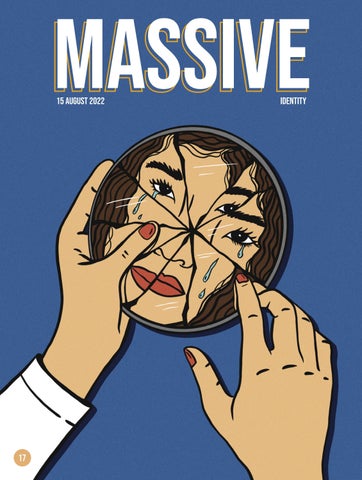
MASSIVE15august2022MASSIVE 17 Identity
Editor - Mason Tangatatai Designer - Marie Bailey News Editor - Elise Cacace Culture Editor - Elena McIntyre-Reet Sub Editor - Jamie Mactaggart Massive is registered under the New Zealand Press Council which allows our readers to reach out to an independent forum for any complaints that can’t be solved by Massive Magazine, or its editorial board. Massive is also a member of the Aotearoa Student Press Association. The views, beliefs and opinions reflected in the pages of Massive do not represent Massey University. Please send any queries or complaints to editor@massivemagazine.org.nz News Reporter - Sammy Carter Feature Writer - Mia Faiumu Feature Writer - Lily Petrovich Feature Writer - Aiden Wilson Illustrator - Kimi Moana Illustrator - Sara Moana Photographer - Amelia Radley insideWhat’s 04 News 10 Features Split Personalities The Eddie Effect I got scammed by Hustler’s University 2.0 so you don’t have to The Intersection of Identity and Language Body Positivity or Body Neutrality? 30 Columns Confessions of a... WorstSexcapadesofthe Worst Solicited President’sTePuzzleSnapchatsHoroscopesAdviceTimeReo&NZSLColumn 2420171410303132333435363839
No matter the variation, the end result is always the same. You don't get anywhere different. Now, I'm not arguing that you don't need a sense of who you are. You do. Psychologists have linked a sense of identity to healthy confidence and group seeking/inclusion for decades. Rather, the argument is against the idea that identity is or should be static.
If you haven’t picked it up already, Massive’s theme for the week is identity. This is a first for our magazine, but we thought identity as a theme would open dialogues on topics that are near and dear to ourselves, and our readers. While brainstorming ideas for this editorial I was stumped. Ironically, in a magazine where I have a reason to blab on about myself, I found that trying to speak frankly about my identity was a painstaking process. I fought with the idea of talking about my cultural identity, but thought as a half cast, I wouldn’t be able to do this justice. You see, identity is a tricky subject to pinpoint, and to prove this to those reading, I ask you to answer this; who are you, really? As you try to answer, you probably have some labels come into your head right away. Role-related labels like "student" or "sibling" for example, or maybe preference and personality descriptors like "fun-loving" or "sensitive". None of those labels are necessarily wrong. But, your sense of identity actually can be a stumbling block. Cling too hard to the definition of who you are and you inadvertently stop yourself from taking positive journeys and having experiences that truly change and develop you. You can get sucked into a pit of "can't" and "not" that keeps you stuck.
Identities are not the fixed markers people assume them to be but are instead dynamically constructed in the moment. Like personality, identity is fluid. We build it slowly through everything we go through, our learnings, interactions and conversations (or lack So,thereof).when you wake up tomorrow and are faced with a day filled with hard decisions, ask yourself what mold you want to press yourself into. The choice belongs to you, not what you perceive yourself to be.
Mason Tangatatai (he/him)
Is our identity holding us back?
How does clinging on too hard to your identity play out in real life? It's rearing its head, for instance, when someone hands you the mic at karaoke and you laugh off the offer because you're "not an artist" or "can't sing". It happens when you tell someone you're a writer rather than a speaker, or that you can't lead just because you've always been a follower.
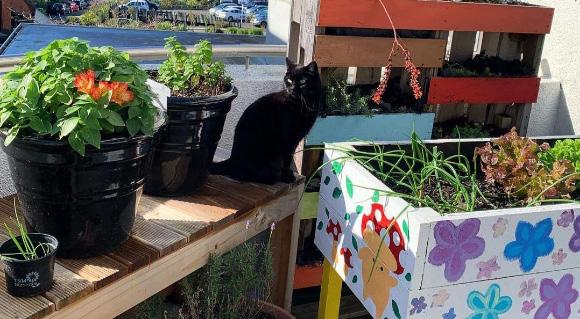
While Harris said Pocket is “such a diva”, she plays an important role in students' wellbeing. “There is a big amount of students who come and look for Pocket everyday … She’s like a stress reliever.”
WHAT’S GOING ON? WEEKLY NEWS UPDATES 15 AUGUST 2022MASSIVE NEWS
Harris said Massey has a history of different cats. “For a while there was a white cat that hung out in the library but now it’s Pocket.” There is a grey fluffy cat lingering around this year as well as another black cat that looks very similar to Pocket.
@pocketmasseycat fan account remains a mystery
staff have speculated who the owner is, suspecting multiple people from the Wellington students’ association (MAWSA). But the owner confirmed she in no way works for Massey. She is a second-year student with a degree that involves cameras. She is short with dyed hair, and her wrists click when she moves them decided to be anonymous 4 • Karere because “Pocket deserves all the attention”. When she graduates, she may hand the account on to someone Studentelse.
Thearound.owner
Team Leader of Student Development, Mags Chalecka-Harris, has known Pocket since she started working in the Co-Lab around 2015. She said no one knows who runs the Pocket account. She described Pocket as such an “enigma”, guessing she was around eight or nine years old.
Groome said, “She’s a good bridge for students’ transition to uni. When you leave your home life and your animals, there's another animal to rely on here.” However, Pocket is very fussy. “Sometimes she wants cuddles so I pick her up and a minute later she is like ‘UGHHH go away’.”
Sammy Carter (she/her) Pocket’s fan account hit 400 followers on Instagram, but no one knows who runs the page. Pocket is Massey Wellington’s campus cat, usually roaming the Co-Lab, on the beanbags or lounging in the sun. But just as the fan account’s owner is a mystery, so is the question of how Pocket came to TheMassey.account’s owner described Pocket as “a little black cat that has the personality of a homeless old [woman]. Sometimes she wants attention, other times she just wants you to fuck off.”
Voice Facilitator, Caitlin Barlow-Groome, is dying to know who runs the account. Having looked after Pocket during lockdown, she felt like she had the right to know. She even messaged the account saying “who even are you,” but the owner wouldn’t tell Groomeher. suspected Pocket must have had a home before Massey as she seemed to be well house trained. “People claim all the time that Pocket is Duringtheirs.”lockdown, Pocket’s wandering habits scared Groome. “I locked her in the house for the first few days and then someone left the door open and I cried because I thought I lost Pocket.” She said, “I was yelling to my neighbours ‘we’ve just moved but I lost a cat and it’s my work cat’. Then my partner took me for a walk and I cried ‘cause I was so worked up that I lost Pocket.” But Pocket came back after nine hours away at 9pm, and did that most days.
“I made a fan account so people could see Pocket everyday even when they weren’t at school.” She said seeing Pocket was love at first sight, “That grouchy little black cat just stole my heart immediately." No one has come close to figuring out who she is, other than one person seeing the account on her phone. “I’ve been in conversations where MAWSA have asked other people that I know whether they run the account and they’ve said no and don’t know that it’s Manyme.”
“I have a lot of medical students, and the day after their exams they always tell me that their stomach hurts. The reason why is likely because of alcohol which directly hurts your stomach and your gastrointestinal lining. Once you stop drinking, the internal lining starts to Althoughheal.” drinking is a large part of student culture, it is always important to understand the risks associated with it. One in every five New Zealanders have a hazardous drinking pattern, which equates to roughly 824,000 people aged 15 or above. Since Dry July launched in 2012, the campaign has motivated over 54,000 Kiwis to give up drinking, even just for a month. In total, Dry July has raised almost $8,000,000 for those living with cancer, and has funded over 170 projects for 15 beneficiary organisations across the country. Donations will remain open for the month of August to encourage those persevering with their sobriety, and you can sign up at any time to take part in next year’s Dry July.
15 AUGUST 2022MASSIVE NEWS 5 • Karere
Massey Students Smash Dry July Elise Cacace (she/her) 85 Ghuznee St, Te Aro, Wellington www.splendid.nz@splendid.nz
Some of the benefits of going alcoholfree include having more energy, better sleep, less brain-fog, healthier skin, weight loss, and a huge sense of achievement.
Gastroenterologist Dr Niket Sonpal says, “If you quit drinking for even just a month, the first thing that will happen is your gut is going to say a big thank you. Your body starts to reset because you’re not getting as many empty calories, and your energy levels go through the roof.”
FILM
It may be the middle of winter, but for many people living in New Zealand, July was the driest month of the year. Dry July is a fundraiser that challenges people to go alcohol-free for the entire month of July to raise money for New Zealanders battling cancer. All money raised by the Dry July campaign will go to a number of charities including Look Good Feel Better NZ, PINC & STEEL NZ and Prostate Cancer Foundation of New Zealand. Over 7,528 people took part in the campaign, and over $1,236,410 has been raised. “I did find it quite challenging for the first week or so. Drinking has become a large part of my weekends so for a while I found it quite hard not being able to join in. I quickly got over that though, and ended up getting way more enjoyment and happiness out of not drinking than I ever thought I would,” says Massey student Daniel “MyBoswell.weekends became far more productive, whereas before they would be dedicated almost entirely to drinking and being hungover. I’ve started gyming and exercising more, and spending more time on my assignments which has been a blessing. I also feel far better in myself, knowing that I don’t have to follow what everybody else is doing.”
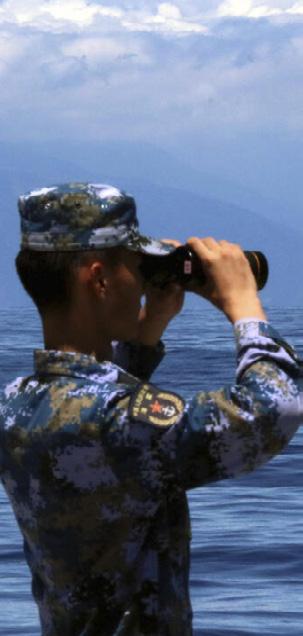
Tensions are rising between China, Taiwan and the United States. China has now halted its cooperation with the U.S. on a range of issues including global warming and military operations due to U.S. House Speaker Nancy Pelosi’s recent visit to Taiwan. China views visits to Taiwan by foreign government officials as an act of recognizing the island’s sovereignty – something China does not agree with. Chinese forces have now started drills focused on land attacks and long-range airstrikes around Taiwan.
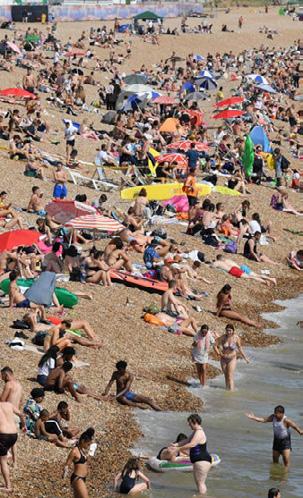
Europeans are feeling the heat Mother Nature has taken to the streets of Europe, and she’s pissed! Extreme heat warnings have been issued across many European countries including the UK, France, Spain, Italy, Greece, Turkey and Portugal. Raging wildfires are also spreading across these countries, but the combination of droughts and heatwaves are making it hard for firefighters to battle the blazes.
The European Forest Fire Information System said 19 countries are in ‘extreme danger’ from the wildfires, while Spain, Portugal and France are at ‘very extreme danger’. Now might be a good time to start taking climate change more seriously...
15 AUGUST 2022MASSIVE NEWS Coming at you with our second Mini Media Mashup, where I, your host, will be serving you bite sized chunks of our latest and greatest news stories. Massive Magazine’s Mini Media Mashup
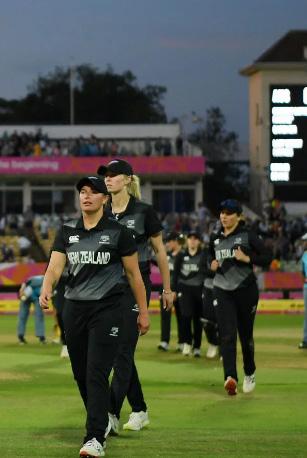
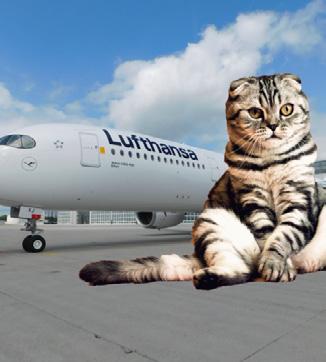
New Zealand has made history at this year’s Commonwealth Games, bringing home 20 gold medals! We finished the games in fifth place, right behind Australia, England Canada and India. Rowdy on the run When a recent Lufthansa flight landed, a four-year-old cat named Rowdy escaped her cage in pursuit of freedom (and birds). She then spent three weeks on the run inside a US airport, dodging all airport staff, animal experts and employees. She has now, finally, been caught and returned to her family.
World War 3?
Elise Cacace (she/her)
Taiwan’s Defense Ministry has said that as of 5pm on 7 August, 66 Chinese warplanes and 14 Chinese vessels were detected operating around the Taiwan Strait.
6
• Karere Kiwis rocking the Commonwealth Games
A huge lie about jam donuts has been recently been exposed. Jam donutsthe classic doughy delight covered in powdered sugar and oozing with that signature raspberry jam… you know the ones? Yeah, well probably not as well as you thought. That signature raspberry jam is often actually apple paste or apple sauce that has been coloured and flavoured. Your life has been a lie, and the world will never be the same again.
7 •
This comment in particular has caused a large uproar among young people and benefit recipients. Luxon received backlash on his blatant lack of concern for the welfare of the unemployed, and his failure to recognize that 54 per cent of all benefit recipients have a disability or health condition. Hawaii is officially deemed ‘awesome’ Hawaii has just received its last shipment of coal before shutting its last powerplant forever. The powerplant is set to close completely by 1 September 2022 after being in work for over three decades. The country is now pursuing renewable energy sources such as solar and wind. I need a Plufl. You need a Plufl! We all need a Plufl!
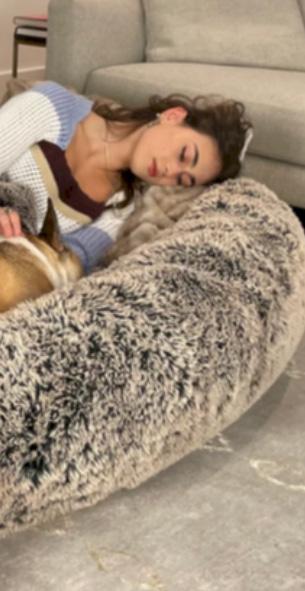
Students from British Columbia University have just invented the ultimate relaxation tool – human-sized dog beds. Students Noah Silverman and Yuki Kinosuta came up with the idea of dog beds for humans, and were thrilled when people pledged $290,657 USD ($449,172 NZD) towards its creation. The business has been named Plufl, and is now going viral on TikTok. Karere
15 AUGUST 2022MASSIVE NEWS
Not so skux de Luxon
Jam donut scandal
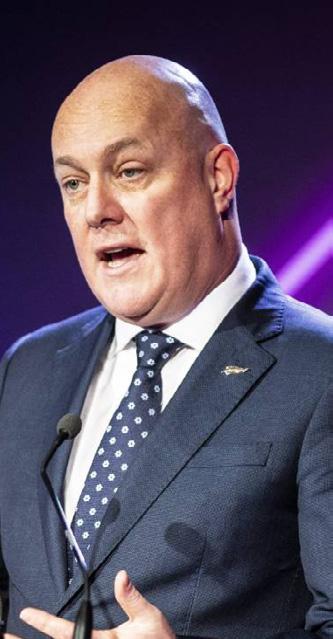
At his latest conference, National Leader Christopher Luxon spoke out against recipients of the unemployment benefit. He said, “To young people who don’t want to work; you might have a free ride under Labour, but under National, it ends.”


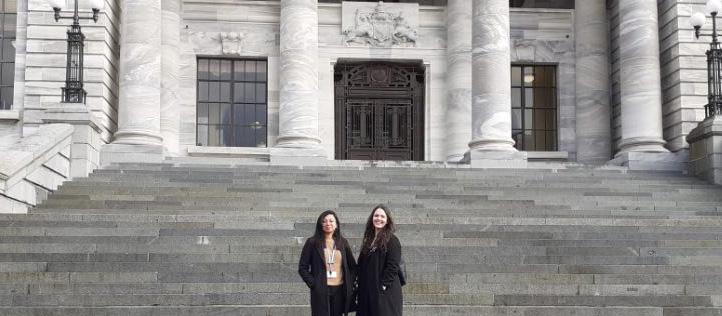
15 AUGUST 2022MASSIVE NEWS 8 • Karere Massey University Student Association (MUSA), has road-tripped down to parliament grounds to file a submission of support to the Employment Relations (Extended Time for Personal Grievance for Sexual Harassment) Amendment Bill. The Bill proposes to provide an extended period of time for employees to lodge a personal grievance in cases of workplace sexual harassment. The current period of time is 90 days, the proposed extension is 12 months. “Given the nature of sexual harassment, we believe that there are very real reasons to extend the personal grievance window. The reality in our society is that often matters such as sexual abuse can remain hidden for years. Often victims feel powerless to act, or sadly ashamed of the actions that led up to their abuse,” a MUSA spokesperson says. “The extension from 90 days to 12 months, goes some way in acknowledging the needs of victims MUSA Policy Unit continues to parliamentarysupportbills to come to terms with what has Deborahoccurred.”Russell, the MP who first presented the Bill, believes the nuances of workplace relationships currently undermine sexual harassment victims. “The difficulty arises with the nature of sexual harassment. People are often reticent about sexual matters; it's not something we discuss particularly openly and we can be embarrassed to admit that something of a sexual nature has happened.”
“As students graduate and move into the workforce, it is important to MUSA that they are provided with a safe workplace environment where there are supportive and robust services in place. Amongst the services we (MUSA) provide for our student community is advocacy and support. We encourage students to approach us with changes they want to see Thismade.”is MUSA’s second parliamentary submission since the Policy Unit’s formation late last year. Earlier this year, support was shown for the Establishment of an Inquiry into the Exploitation of Migrant Labour Bill. This aims to reduce and respond to exploitation of temporary migrant workers, including international students in New Zealand workplaces. After the Select Committee reviews public submissions, the Bill will move to a second reading in the near future.
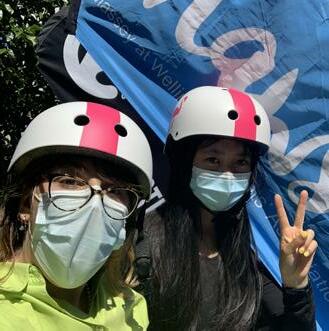
Mason Tangatatai (he/him) Noon Fatima on left, Ani Dreyer on right
MUSA’s newly formed Policy Unit wants to continue supporting bills (like this), and having them passed into law, as it will provide students entering the workforce with a “safer, more inclusive working experience”.
“Our cultural norms of shame and fear can hold us back. The power that another person holds over us can hold us back. We can be so upset and traumatised by the experience that, for a while, all that can be done is to retreat. And that can hold us back. The fear of retaliation can hold us back. Of course, there's still the narrative out there that she must have done something to cause this, which can hold us back,” Russell continues.
“Therein lies the problem that this bill addresses. Ninety days may just not be enough time to raise a complaint in cases of sexual harassment. This is not just a theoretical problem; we know that sexual harassment is a common work problem.”
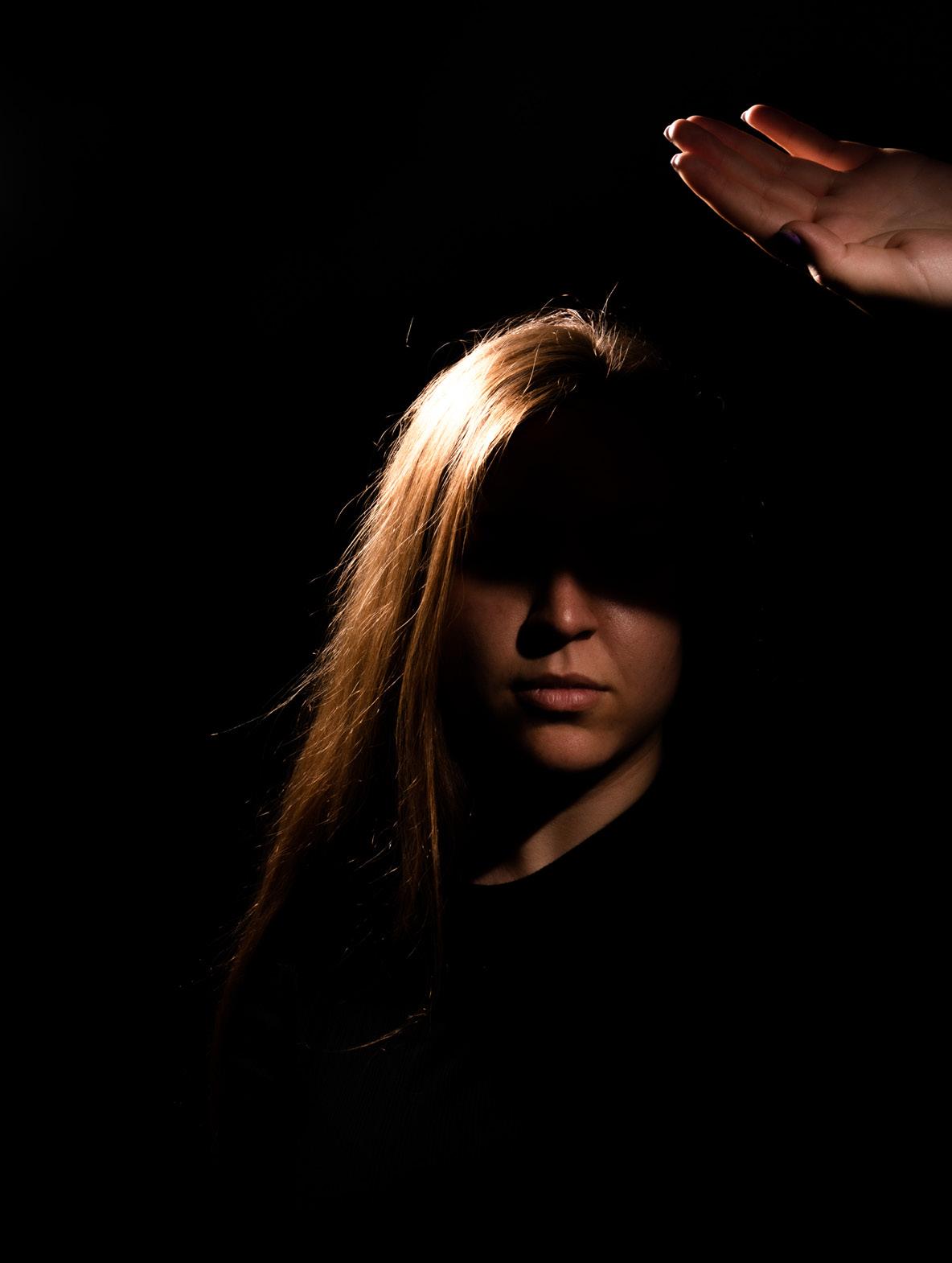
Lily Petrovich (she/they) Illustrated by Kimi Moana Whiting (she/her)
So, how does a DID brain think? Like with anything to do with a brain, everyone is different. Generally, people with DID have an ‘inner world’ they can see when they close their eyes, but it would be wrong to say this is how it is for everyone.
10 • Aronui
Split personalities * Name change
We’ve all heard of DID, just maybe not directly. DID is ‘dissociative identity disorder’; but unfortunately, most people know of it through a warped lens under the name ‘split’ or ‘multiple’ personality disorder. Before ending up in a research rabbit-hole of ‘he-said’, ‘she-said’ type articles, I spoke with Shadow* who was diagnosed with DID early 2021 to help us better understand the realities of what living with DID is like. “It’s basically an identity disorder where a person has experienced severe traumatic events in early childhood. It is a protective device as a result of repetitive childhood trauma,” explains Shadow. “The brain splits into different sections as a way to protect the individual, where you dissociate from yourself to cope with experiences.”
Affecting 1.5 per cent of the population, it’s more common than you’d think: around the same rates as autism, bipolar disorder and BPD (borderline personality disorder). While these disorders feel so much more common, we are just more aware of them. “So many people’s brains are separated, it's just this is more defined,” says Shadow. “Incl[uding] myself, me as the host, there would be 11 at the moment. The host: the person who takes control of the body, is the one who is referred to as the name Jack, will respond to the name Jack the most.”
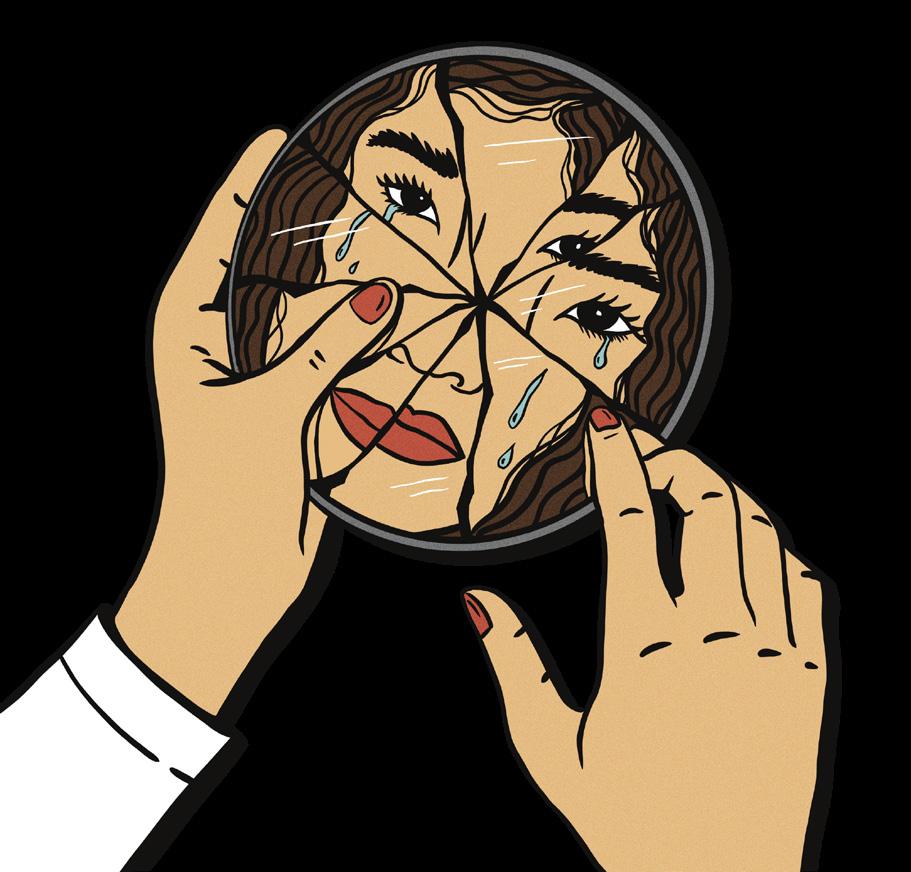
"Then there’s Friday, who is "like a bad bitch, she’s very much a party girl. Loves to drink, talk to people, has a terrible habit where she’ll tell everybody I [have] DID; which I really wish she would stop doing. She’s also the reason I talk kind of American.”
Everyone with DID refers to the people they share a body with differently, but we’ll go over some key words really quickly. A commonly used term for different people is ‘alter’, while the collection of identities can be referred to as the ‘system’. The ‘host’ is the main person in control of the body, usually the one whose name is used to refer to the body (in this case, Shadow is the host of their system). And, to ‘drive’ the body is to be the only one controlling it.
“For starters, there’s Riot. He’s an anxiety holder. While Friday is a sexual protector, he’s an anxiety holder. He comes into a situation when nobody else can deal with how stressed out the situation might make us. The funny thing is he’s really anxious - he can just hold it better than the rest of us. He holds a lot of memories from when I was younger, because he used to host the body. There were several years in my life where I was identifying as a boy when Riot was taking control. I disappeared for several years after something traumatic happened. It wasn’t until I moved to Wellington and had another significant shift in life, when I ‘woke up again’ and Riot let go of control. He’s present a lot; the most annoying thing is I don’t know what I look like when he’s fronting, I’ve been told I man spread and have a man's voice.”
“I’ve heard some people describe it as a TV screen but, for me, it's more like a window screen (like a mosquito net) it’s not really a digital thing, it’s like a see-through curtain or something.”
“The rooms themselves, everybody has a door. If it’s open, I can hear what they’re thinking/talking about, see them, and be aware of what they’re up to. If their doors are closed, they’re blocked off to me.”
Let’s talk about some of Shadow’s alters.
The room is set out in specific places I guess, and I can feel where they are. There’s a screen behind my eyes where people can sit behind the table and watch what's happening, not everybody's always there.”
“I have this game on my phone called Mobile Legends, and my card was attached, and she just bought a bunch of skins. Merge Dragons is another really dangerous game I’ve had to take off my phone because I think she probably spent about $200 on it. I am 22: she's not as simple as that.”
11 • Aronui For Shadow, “They do have their own rooms. I don’t know if this is, like, known about DID. They look like something, I can see them, they're walking around. My head I guess is like a massive living room. There's a table, like an oval shape with a chair for everybody.
"Then after I went through another traumatic event in January, Friday basically was like; ‘Nah, fuck this I’ve had enough.’ When she did that my system was thrown into chaos a bit, I’ve split into a few alters this year, trying to deal with this new trauma that’s been added. Friday basically shut her door and was like ‘I’m not dealing with this anymore’. What she did in those situations, instead of getting out, she experienced the trauma for us. So, Jordan has become the primary protector, her whole thing is ‘fuck this, fuck everybody, I'm taking over’. She knows she won't sit there with it; she’ll say fuck you, fight you and bugger off. She sees life like a game, she plays my life like a video game, in my head watching everything. I swear to God sometimes she's in my head pushing buttons.” A part of having DID is usually also having a child alter. For Shadow, this is Dot “She’s been around for a very, very long time, definitely before I was diagnosed. She’s five and a half, I have to say the half or she gets upset. She was the first in my system to be named, my therapist said, ‘You should start listening to them.’ She was like ‘oh my God I can have a name’, and then said the name in my head for three days over and over and over. I finally told her and she finally shut up, I was like ‘oh my God it is real’. I would say it again and again and again but it’s a trigger, and she will come out. She’s a cutie. Another trigger for her, the crossing sound goes off and she comes out. It’s repetitive, one-syllable sounds.”“Ican’tgo to the super[market] by myself, especially around Easter or Christmas. If I walk past a stuffed animal or reindeer, she will come out and I will get to the counter with arms full of chocolates and stuff[ed] animals, and I come back out because she doesn’t know where my card is. It's actually so difficult, but she doesn’t mean harm.”
Going outside professional treatment, and looking for information independently can still be tricky. “Most of the research done you can only find in court evidence. Almost everything in the psych library that’s accessible from uni was from court cases, and literally for the context of the ‘guilty to be passed as insane’ and that was the main thing, it was ridiculous. So, the only thing I could find was about murderers. [I]t’s just a trauma response before anything else, but it’s always made out as the villains, in movies, court and books. That makes it really dangerous for people like me, say, being involved in an investigation right now. It is not going to play in my favour having this illness, it doesn’t matter that at the end of the day everyone with DID is a victim of something. First and foremost, it’s a persontraumatized .”
Shadow explains how tricky coming back after switching (when the alter driving the body changes) can be. “That’s probably one of the hardest things about having DID is coming back wearing different clothes, at different times, doing different things. The worst is when ... other people are around and you have to figure it out while acting like nothing happened. Sometimes I have to go searching for memories to figure out what has happened, but it’s a bit of a hunt sometimes to find things.”
that uncommon, especially when going back to rates of DID compared to autism and bipolar which are at least known by doctors. “There’s not a lot of people in New Zealand who are equipped, there are a couple of people in Auckland but not practical, there's not enough done.”
12 • Aronui
“Another main issue is what people see of itsuperhero, fantasy, cult: especially in Split. In his system they call it the Horde, they all have this plan for the beast who has to eat all these human girls so he can be super strong which is like; huh? We’re not plotting to end the world; we’re trying to get through a fucking Wednesday.”
notisheredoctorsDIDUnfortunately,isn’tsomethingreallyunderstandinAotearoa.Gettingtreatmentastruggleregardlessofthisdisorderbeing
Let’s talk stigma. When asked about some of the biggest misconceptions about DID, Shadow went straight to the film Split. “I’ve watched that movie maybe four times since getting diagnosed. What the fuck? Child alter walking on knees: no - Dot walks like a normal person. One of the main issues was the therapist, the perspective was that DID was like a ‘superpower’. While it’s a really sweet sentiment, the way that they made that happen was just a little bit disgusting.” Shadow laughed. "[It’s] just a little bit, gross. This alter with these negative traits was bad, I don’t have anyone in my head that wants to hurt anyone. Also, the fact that it says that you can grow in size and scale up walls like a tiger. No, I can't; and I did have somebody ask me that once.”
For visits on any Wednesday PRICE ENTRY * 1 2 WINTER WEDNESDAYS
14 • Aronui The “Munson Moment” if you’re feeling fancy. Aiden Wilson (he/him) Illustrated by @geegebee

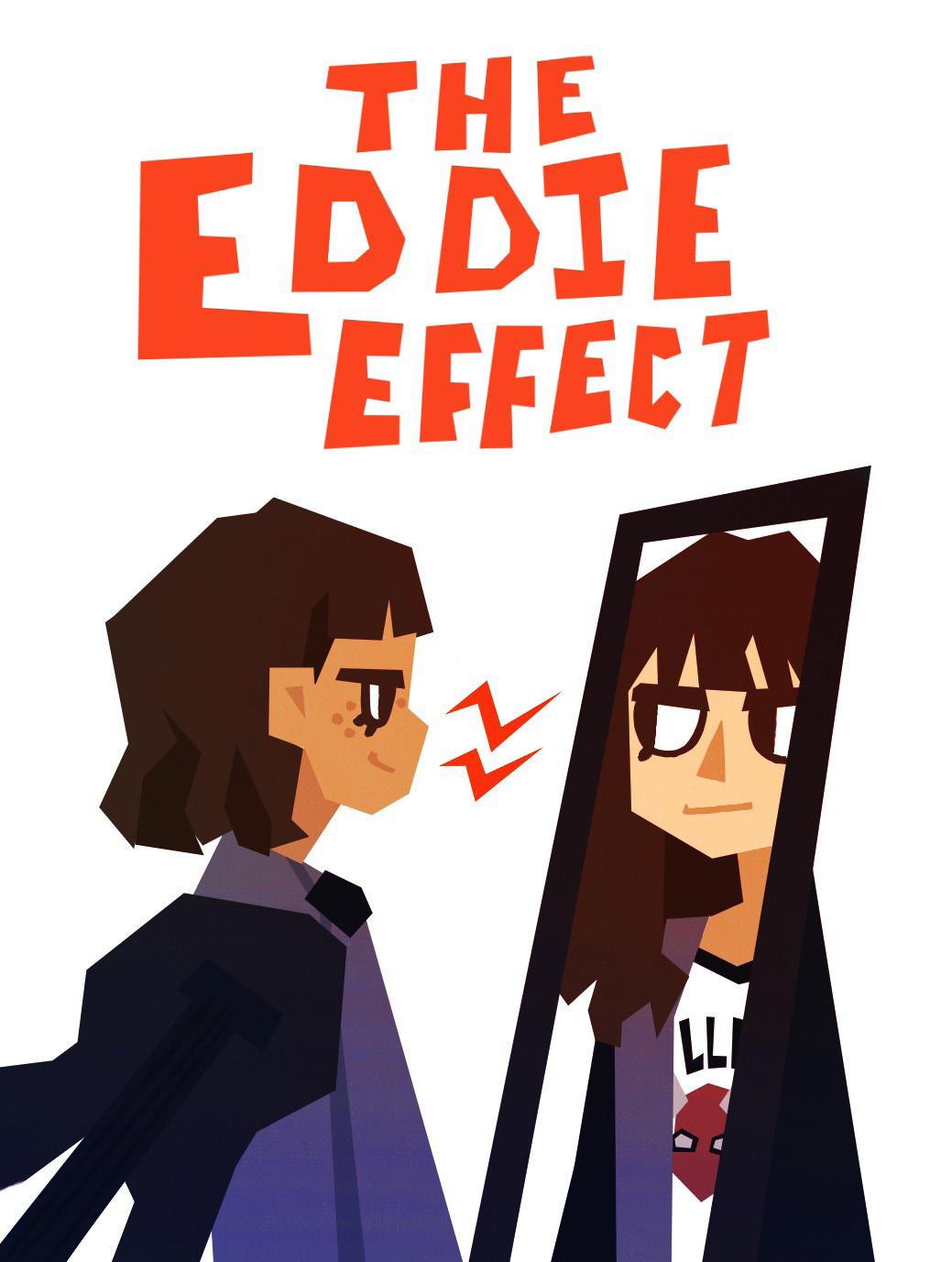
15 • Aronui
With the vast range of media available to consume, there’s a character for EVERYONE to connect with. Over the last few weeks, an incredibly niche and totally underground show on Netflix called ‘Stranger Things’ introduced the world to one man – Eddie Munson.
What we’re seeing is a generation of viewers more receptive and open to the idea of difference amongst their peers, with the media they consume reflecting that. In turn, this new generation of viewers is educating the previous generations, their parents and grandparents, on culture, gender, and identity. Not only is this a way to easily introduce those unfamiliar with certain concepts and ideas to them, but it also allows people to have their views opened or challenged around certain topics and discussions. Stepping away from the whole Eddie angle, mass media consumption has introduced many people to different communities they wouldn’t have any interaction with otherwise, and in turn allowed for those people to gain enlightened perspectives on certain crowds. The biggest example of this that comes to mind is the drag community, through the show RuPaul’s Drag Race and all of its spin-offs. While what is shown is a corporate, catered to the general public piece of mass media, it has allowed for a huge number of people to become more familiar with the drag community, the LGBTQ+ community, and more. We’re seeing so much content made about groups and marginalised identities now that are bringing out real world Again,discussion.thiswhole piece started as “Eddie Munson lol”, but the response to that character further proves my point. In the time period of the show, teens like Eddie were outcasts, alienated by their peers for their differences. So many viewers connected with Eddie and feel a slight bit more representation through this character.
For one reason or another many of us, myself included, have felt some sort of connection with this character. Whether it’s his vibrant and energetic attitude, music taste, or the feeling of being an awkward outcast amongst your peers, many have found a part of themselves within BelovedEddie. characters forming such big connections with audiences and fanbases is nothing new. We all have our own comfort characters we love, who may even shape our identity in same way. While some people view it as ‘cringe’, having a character in your favourite franchise shape the way you act is such an interesting and normal thing that we all do. While there are of course toxic examples (looking at all the guys who wanted to start a fight club after watching Fight Club), a character building a part of your identity and shaping the way you express yourself isn’t the character imprinting on you. It’s not the viewer changing themselves to be more like the character. The way I see it, it’s the viewer finding comfort in an onscreen presence, seeing themselves in some way and allowing this character to help them become more… well, Thethemselves.reasonI’m calling this the “Eddie Effect” is simply because of how recently this example has occurred. Before characters like Eddie, there were certain stereotypes associated with things like heavy metal, DnD, etc etc etc. Pop culture like Stranger Things has brought these forms of entertainment, for the most part, into a broader and more casual space for people to enjoy. The acceptance and love for characters like Eddie have normalised being the energetic weirdo, helping people who identify with such characters to feel the love and acceptance in their social groups.
I know so far this has just been me jumping on the train of “oh my god Eddie is just so cool, right?” but from a more social standpoint, it shows off a really neat aspect about our current mass media culture and the generation consuming it (can you tell I’m a Media Studies major?).


Now think of that but from the lens of a marginalised member of society, for example a person who identifies as gay and non-binary, getting mass representation across different pieces of media. It’s not perfect, and as I said shows like Drag Race are very much a product of corporate entities, only showing what they consider should be seen, but it’s still miles ahead of where we were a few years ago! For all its faults, streaming platforms and mass media have allowed for the normalisation of identities which not too long ago were viewed through a taboo eye, seen as “deviancy”, being promiscuous or just something to be plain frowned upon. Now we have so much more that wouldn’t have been seen available to view at the push of a button. Which brings me round to my next point
For a generation who has access to more content about more groups that would not have seen the light of day on television, we sure as shit have a lot of misrepresentation and stereotyping going on in our media. And yes, we may get up and say “this is not okay”, but that doesn’t seem to stop a lot of writers and directors putting it in. The amount of times people I’ve encountered have made comments on certain aspects of society “because they saw it on television” is appalling. We have so much new positive representation appearing, but despite this we still see so much ableist, racist and stereotypical bile in what we are watching. As we move forward, and more of our generation take the spots in media occupied by people with those views, I think we’ll begin to see less of the old and more of the new. It’s our generation’s job to educate those before us, and help guide those after so we can have more Eddie Effects within our communities.

17 • Aronui I got scammed by Hustlers University 2.0 so you don’t have to Mason Tanagatatai (he/him)
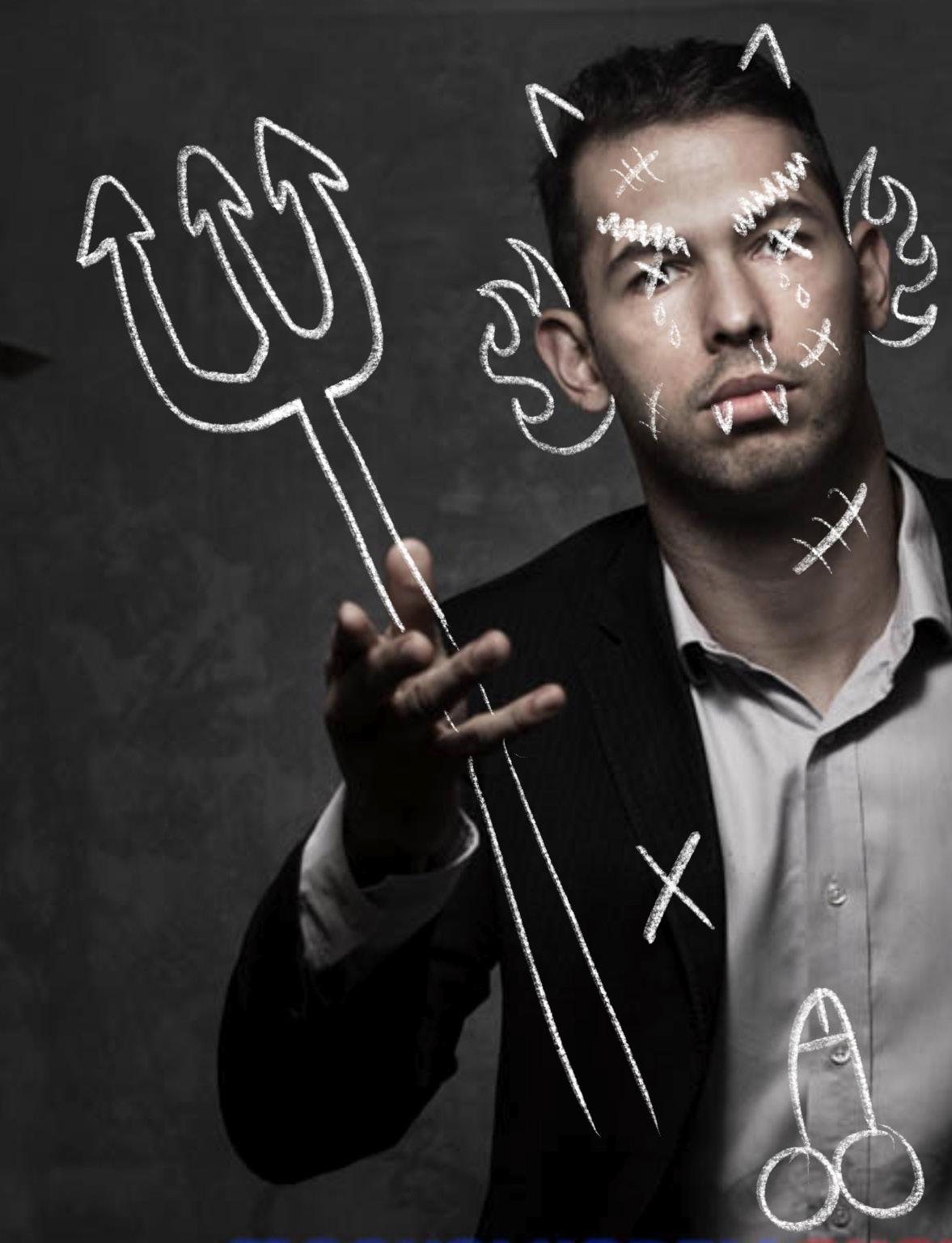
If you haven’t been living under a rock you would have heard of ANDREW TATE. has taken the Internet by storm, but not for good reasons. By spurting vitriol, sexism and utter blasphemy, the Top G has ridden his way to media fame and huge financial gains. What does this have to do with the identity issue you might ask? Unfortunately, this hypermasculine mindset has been making waves among young men. Or in simpler terms, countless impressionable boys are getting sucked into a spiral of shit - and that’s fucked up. So, to stop any more of you bastards from buying into this fad lifestyle, I spent 40 bucks on Tate’s Online business school, Hustler’s University 2.0. Below is a totally unbiased review and a bit of commentary on ANDREW TATE’S “Online domination”. Disclaimer, I understand buying his course may seem counterintuitive, but it is in hope no one else does too. Women shouldn’t be allowed to drive; grown men shouldn’t eat sushi; a girlfriend is a piece of property; always talk about money with your friends; if you’re not talking about money, you're doing it wrong. These are the markedly tamer beliefs of Emory Andrew Tate III, more Internet-famously known as ANDREW TATE. Once a kick-boxing world champion, the Washington, D.C.-born 36-year-old now resides in Bucharest, Romania, where he reigns over an empire that includes a platform called Hustler’s University 2.0. Tates' Online presence has shot him to the top of the influencer ladder. He hosts 4.1 million Instagram followers and has over 50 affiliate TikTok accounts that have gained upwards of 5 million followers. Clips of his appearances on various programs and podcasts have also racked up views in the millions. First, it is important to note why Tate is so infamous on the Internet. Always mired in controversy, Tate is the self-styled "King of Toxic Masculinity" who is allegedly polygamous - has multiple wives - and lives in Romania. According to the streamer, the country has lax sexual assault laws, which is one reason he chose to live there.
I come in. Naive as ever and ready to have my identity re-shaped into what Tate labels as a modern-day man!
18 • Aronui
ABOUT THE COURSE: The Hustler’s University course is based on a simple life goal. To make money. You are placed under the wing of Andrew Tate himself and guided to the land of profit. I should’ve seen the sign of a good ol’ fashioned scam when I entered the website and was greeted with a shirtless Tate telling me to stop being a lazy bastard. But for the culture, I spent what's left of Massive’s budget to fulfill my destiny.
The entire Hustler’s University is a network of separate Discord servers. Yes, you pay 50 bucks to be a part of a Discord server (the thing gamers use). Each channel has its own unique specialisation with dedicated professors allegedly hand-picked by Tate.
WHAT A PIECE OF SHIT. He is also a notorious "red-piller". Much like other financial gurus on the Internet, Tate constantly propagates that the system is working against a person. According to him, one must struggle against 'the system' and unlearn all its messages to Assucceed.anarch marketer, Tate also knows how to capitalise on the nuances of identity formation. People want to be a part of something bigger than themselves – and they also want to stand out. He preaches an ‘us’ versus ‘them’ mentality. For those too afraid, lazy, misinformed or far gone to develop a personality, he’s a one-stop shop: You can get a pose, posture, worldview and character all for the price of your common decency. His graft is simple: He sells himself as the messiah of hustle, a vessel of the get-what-you-want-byany-means-necessary ethos so ridiculous, that it becomes defining, distinguishing and sadly, That'smonetisable.where





SO WHY IS THIS COURSE SO POPULAR?!
With over 120,000 users, paying $50 a month, Tate is roughly making a whopping $6 million from this Modernventure. influencers, like Tate, are quickly learning that we’re living in a post-consequence world. They’re starting to realise the only real currency is attention. The worst thing that can happen to you isn’t going to jail, it’s becoming irrelevant.
“Copywriting is all about selling. There isn’t a big quality difference between copywriters, you just need to be able to find a way to convince buyers that your copywriting is better,” says one of the “Value is created by practising your craft, the more hours you put into this, the better you will get.”
Now, all these points may be true, but when I’m on the front page of Hustler’s University, staring at speeding supercars, yachts, cigars and shiny bald men, my expectation is not to be fed advice my 18-year-old cousin could tell me. But, to make sure I wasn’t missing any snippets of excellence, I charged Iforward.carried on with various videos teaching me the basics of copywriting, how to write catchy titles, how to use grammar effectively. All of the information was relatively useful, but nothing special at all. After almost three hours of watching random lecturers effectively explaining how to write an Instagram caption, my copywriting dream was dashed, and I moved on to a different section. Each time I moved on to a different speciality I realised what they were selling wasn’t groundbreaking advice (which is what you need to make the money promised), but instead, it was the feeling of being involved in a community. In each channel, other beginners would post screenshots of their small profit margins, while professors would continue to encourage us to brag about our mental and monetary growth. This aspect of HU 2.0 was kinda wholesome, but the course is still an outright ruse. After a quick Google search on the basics of copywriting, I found the exact same information I just paid $50 bucks for.
As a journalist, I naturally chose copywriting as my specialisation. After entering the course and being greeted with over 40+ videos at my fingertips my hopes were high. But after watching the intro of the course, the expectations I entered with were
The reality is that Hustler’s University is so bad, but equally popular, because of Tates appeal and the dream he is selling. If you take a step back from the course and take a look at the results being broadcasted, you quickly realise you’ve been caught by the good ol’ bait and switch.
You’ve been told you can escape the matrix, that you're gonna take the red pill, but what you end up doing is making less than minimum wage working at an Amazon drop shipping company for Jeff Bezos. If working for the richest guy in the world isn’t being a part of the matrix, then I don’t know what is. This weird disconnect between what is promised and what is delivered continues throughout the course. Students are posting earnings of anywhere between $200 to $2000 a month. A decent start but hardly the lifestyle proposed when joining.
This brings us back to the reason for Hustler’s University's success, which is Tate himself, but the biggest irony is, once you join the university, you barely see Tate at all. The course gives you some basic skills to go out and make a few bucks, but it’s hardly the motherland we were all promised upon payment. That's when I cancelled my subscription to become $50 richer next month. For many, Andrew Tate is a man at his worst – and for many, he’s the man at his best. The difference is more than skin-deep. Please be on the right side of AND PS, DON’T BUY HUSTLER’S UNIVERSITY 2.0. IT SUCKS.
“You won’t start off making big gains, but once you get confident, the sky is the limit.”



The Intersections of Identity and Language
“A leai se gagana, ua leai se aganu’u, a leai se aganu’u, ua po le nu’u.”
22 • Aronui
When you lose your language you lose your culture, and when there is no longer a living culture, darkness descends on the village.
Mia Faiumu (she/her) Illustrated by Sara Moana (she/her)
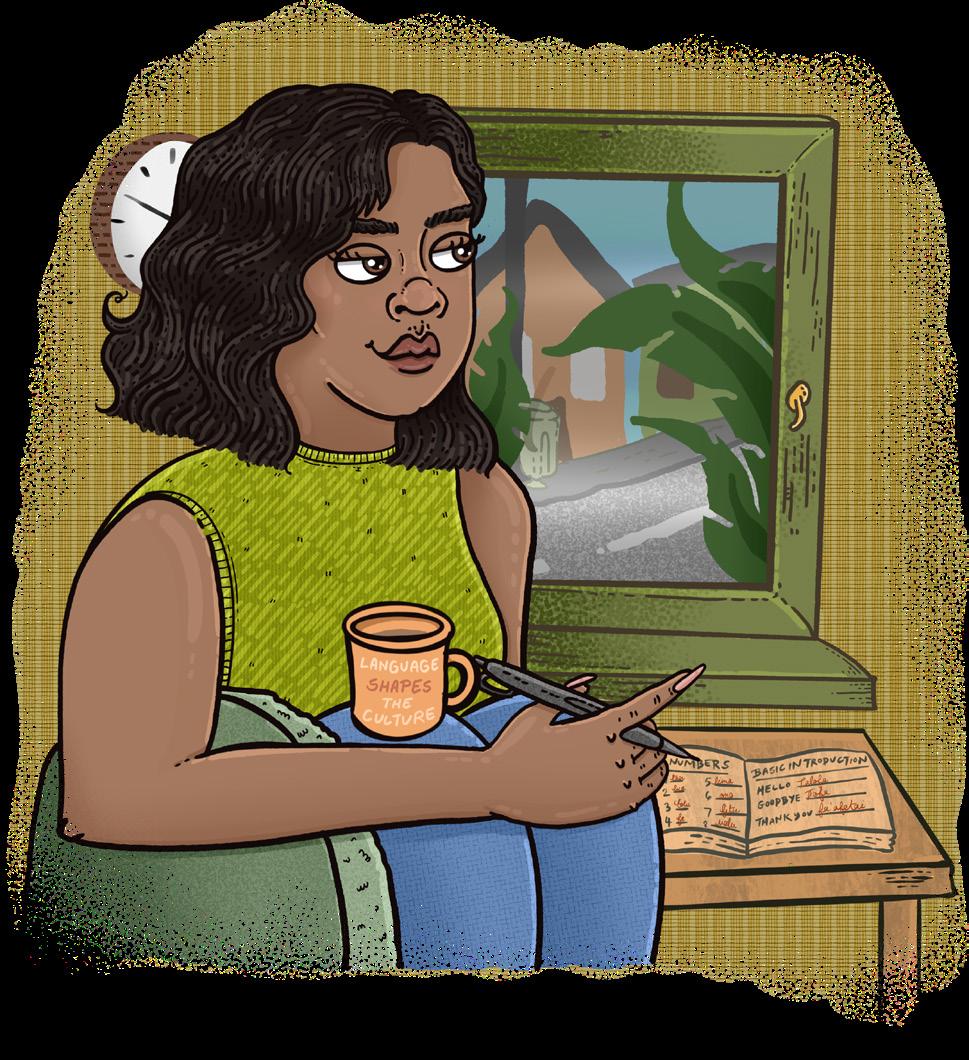
This week I have sat down with friends, Ruth Stowers and Kris Lavasi’i, to unpack this quote and discuss our own journeys with learning Gagana Sāmoa and how this interconnects with our own Learningidentity.
Gagana Sāmoa, for both Ruth and Kris, has been a continuous journey of exploring their cultural understandings and identity. Language is often viewed as a way to solidify our own cultural identities. For those of the diaspora, this can be a difficult and often traumatic experience, where we exist without knowledge of our own language. “It really is a lot more than just learning the words,” Kris explains. It’s a personal journey that we have to take as Sāmoans of the diaspora, to unpack personal trauma and shame and admit to these feelings in open settings. Our loss of language is ever present in our minds and as we move throughout the world. “Our mother tongue, it looms like a ghost in the background of a lot of our experiences,” states Kris.
This quote speaks to the loss of language across the Pacific and the interconnectedness between culture and language.
Kris reflected in our discussion of the reasons behind why so many of us have grown up removed from our language. In his own father’s experience this was deeply connected to assimilation and trying to succeed within a palagi-centred country.
“You’re actively relearning your heritage and there’s a deep sense of personal work and effort that sits beneath just the actual learning of the words.”
23 • Aronui
In this sense, beginning our journey of learning is not as simple as learning a language for curiosity or to learn a new skill. It is deeply personal and unique to each of our experiences as Sāmoan Krispeople.mentions that he recognises that his cultural identity is not purely informed by language but he acknowledges that learning the language helps to strengthen his understanding of the different facets of Sāmoan culture. He says this has occurred through being able to actually name and understand the deeper meanings and significance of aspects within our culture that have always been around him. “What it does help to do is anchor aspects of my experience,” he explains. “It anchors that sense of being.” “I would argue it gives you that sense of foundation – an added sense of firmness to that cultural formation and that formation of your cultural identity.”
Although, this pathway isn’t always easy as acknowledged by both Kris and Ruth. For many, the language journey can be hard and painful. For those of us learning our mother tongue for this first time, this is a very personal journey that can involve a lot of reflection and growth. When your identity or knowledge of your language is questioned in the beginnings of this process it can often be affronting. “It’s not just another language to learn for utility or enjoyment,” explains Kris
.
“It’s a reintegration of your past, it’s an exploration of what your present is and it’s an investment for what your future will look like,” says Kris.
It was also acknowledged throughout our conversation that in taking up Gagana Sāmoa, there comes a sense of responsibility and tautua to your families. “I do see it as a little bit of obligation in my family,” explains Ruth. “I’d love to get it back at least for my sisters because I’m lucky to have the time, the resources and the space to dedicate to this part of my culture,” she continues. “What we have is ours to share,” furthers Kris. “It does introduce that next level of obligation to share what we have especially with our siblings.”
“There’s no sense of recognition for the factors that have led to us being distanced from our culture, led to us being distanced from our language,” Kris continues.
“Things like that can make it extra exhausting when in the first place it’s a lot of emotional uphill to even put yourself in that position to be open to acknowledging that I don’t know it.”
“The language shapes the culture, and the culture informs the language and it’s that reciprocity and mutual affect that underscores, particularly in indigenous contexts, the relationship between language and culture,” Kris states. Both Ruth and Kris acknowledge the feelings of shame that go alongside reconnecting and learning your language.
“It can feel like a real uphill slog and quite alienating, quite ostracising so you feel like you’re working alone but actually the reality is that there are heaps of us.”
In having this discussion, it was also made clear that we need to be weary of prioritising language as the be-all and end-all of understanding our Sāmoan Languageidentity.andculture are interconnected and intertwined in ways that shouldn’t be removed or dislocated from one another.
“There’s no sense being able to speak to the greatest tulafale if you don’t first have a grasp of what it is that you’re saying, of what you’re speaking to, of who you’re speaking to, of how you’re speaking to,” explains Kris.
“Those are cultural understandings that underpin the language but sometimes I think they get lost.”
“It’s a lot more to unpack than just the words.”
Kris notes that he did feel a sense of resentment regarding what he considers to be a lost opportunity for him to be who he truly is and to be truly Sāmoan, especially when you consider the interconnectedness of language and culture.
“The fact that you can have language without culture and culture without language is directly a “It’s the story you often hear with diaspora kids, and children of the movement,” Kris explains, “that my dad grew up in a context where being Sāmoan wasn’t just undesirable, it was actively a challenge."
These feelings can be extenuated when engaging in learning with palagi students, who for many are learning out of curiosity or for a hobby.
Ruth comments that while this is a positive thing, especially for those with Sāmoan relatives, it often makes our journeys more tiring.
“The thought we’ve often had is that maybe for my dad – the idea of us being Sāmoan in itself was a challenge,” Kris continues. “Therefore, speaking the language, something so fundamentally tied to that identification and that sense of identity, would be more of a constraint on our ability to succeed in what is and remains to be a western centric, Eurocentric, palagi-centred world.”
“Just having to unpack it for people who for them it’s just a language can feel quite exhausting where I have to actively make effort just to reclaim something,” Ruth says.
“It’s feelings of shame,” explains Ruth, “like you should know this language.”
There are a multitude of reasons as to why we don’t speak our mouther tongue – many of these reasons being related to traumatic experiences caused by colonisation. It’s therefore a difficult journey that is much deeper than simply learning words and speaking. “It shows that language doesn’t occur in a vacuum, it’s in a context,” comments Kris. “It intersects with so many different things, our lived experience, our cultural norms and expectations.”
“If you weren’t afakasi, if you didn’t have a palagi last name, you didn’t get the same access to education, you didn’t get the same access to opportunities.”
“In some ways that connects to the colonisation process because in a way its forced us to disambiguate and in a sense disconnect things that are intimately interwoven.”
24 • Aronui
“I think the danger of being motivated by fear and shame is that you’re running away from something as opposed to running toward something and soon enough you’ll get exhausted.”
“They both act to reinforce the other and in a way diminishment of one, will diminish the presence of the other.”
“It’s that interconnectedness,” explains Kris.
For Ruth, she implored people to get out there and start trying to engage with their language. “I would just say do it,” she comments. “It’s always better to give it a try then to have always wondered what if I did something.”
“Getting caught by what’s chasing you is far more horrifying then running towards something.”
As commented on by Ruth, knowing our language, while something that we are all striving to learn, does not define whether or not we are Sāmoan or how we identify within our culture.
Although it is difficult, it’s important to make peace with where we are now and go from there.
This is the same case for Sāmoan cultural values, that for many have been instilled within us as children. It’s therefore not essential to be fluent in the language to know and understand these values and the meanings within our communities and own families. “It helps you to perhaps articulate it better,” comments Kris, “it helps you to perhaps explore the meaning and the significance more but I would respectfully argue that those values are inbred long before language takes place.”
“Connect with other people – there’s so many people on the same one,” Ruth finishes. It can often feel lonely going on these personal journeys but forming communities and bonds in these spaces can really function to support our “Yourwellbeing.journey will look like your journey and it’s no one else’s and there’s no onus on you to look or act or behave in a way that’s like anyone else,” advises Kris.
25 • Aronui result of that colonial process because technically they should never be separated because they’re so interwoven,” Kris continues.
Ruth and Kris both spoke to the way in which we are exposed to language simply through engaging in aspects of Sāmoan culture, such as performing or dancing. Therefore, it’s important to be cognisant that sitting in a classroom and engaging in the language isn’t the only way to learn.
He comments that there is a danger in doing this out of fear or a sense of trying to prove yourself.
“They’re the things we’ve learnt from the very beginning and I think what the language enables us to do is be able to name those things.”
“I don’t think necessarily I need to have the language to represent myself as a Sāmoan,” she “Isays.would love to but I don’t need people to second guess that just because I don’t.”
“Even if it’s just an excuse to connect with your family or learn more about your history. You don’t need to become fluent in a year – it’s all about the journey.”
“As much as language is foundational, it’s foundational because of the way it interconnects to our culture.”
When asked what advice they would give to those wanting to start their language journeys, Ruth and Kris both had pieces of knowledge to give. “Don’t start any journey, your cultural journey, your cultural identity journey, your language journey –don’t start it out of a sense of fear that you aren’t enough, obligation that’s there more you should be doing or a sense of shame that you aren’t what you’re meant to be,” advises Kris.
“That’s again the colonial impact, because we’re estranged from one, estrangement from the other follows.”
26 • Aronui
27 • Aronui BODY POSITIVITY OR BODY NEUTRALITY? ELENA MCINTRYE-REET (SHE/HER) PHOTOGRAPHY BY AMELIA RADLEY TW: Mention of EDs
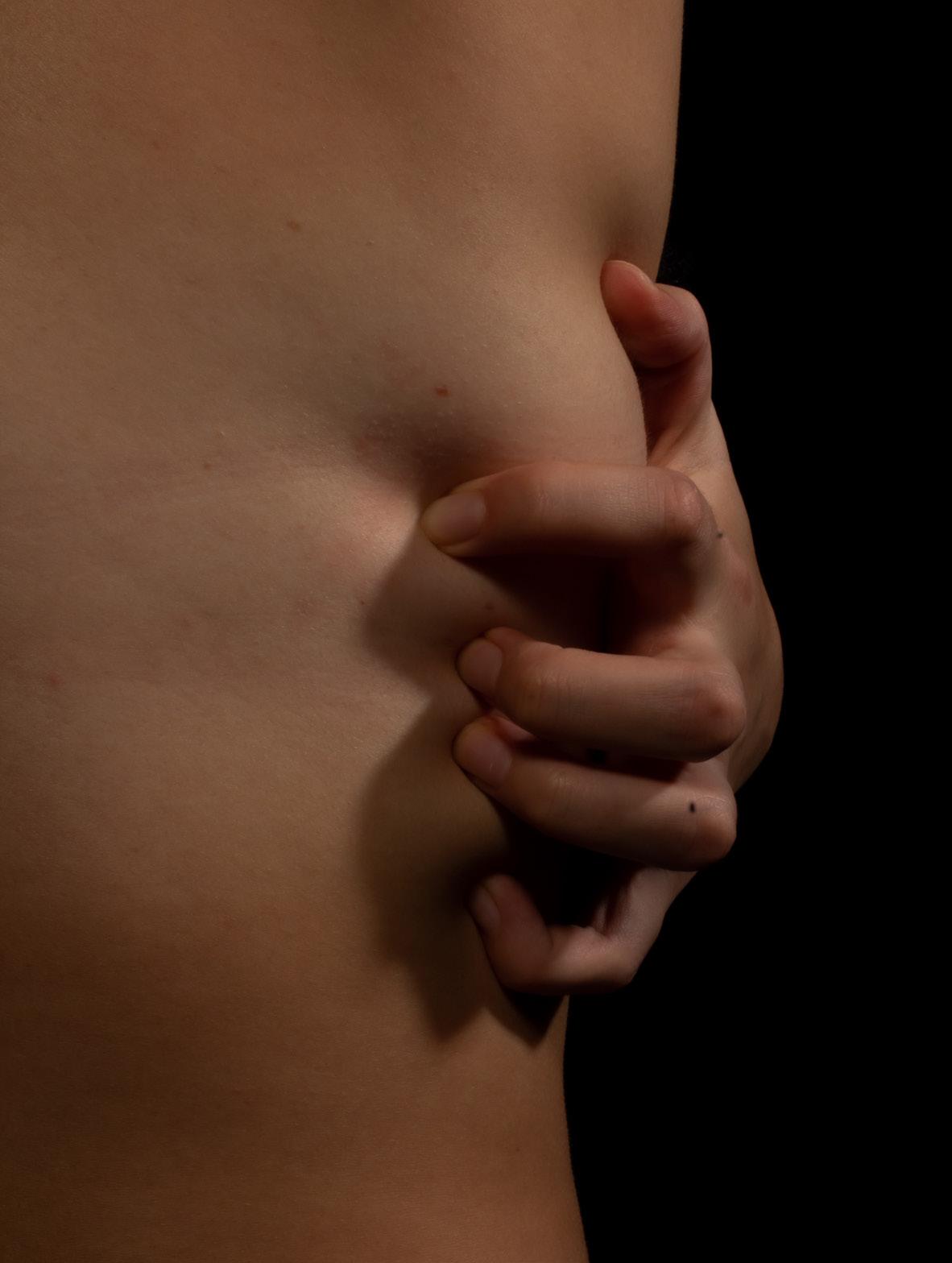
The body-positive movement causes raging debates in Facebook comment sections and sends middle-aged white ladies into a total meltdown. The notion that people might feel confident and happy at any size triggers a deep rage in people who live and die to support diet Thereculture.has been a transition from including a ‘curvy’ woman who is probably a size 12 (and a Glassons size 16) on the front cover of magazines to including bodies of all sizes, not just ones that still manage to fall into conventional beauty standards. There’s debate on whether acknowledging that all bodies are beautiful encourages an unhealthy lifestyle - as if billboards covered in models with completely unattainable bodies don't. Being body positive is not exclusive to those who are plus size, it’s also about challenging the representation that is often centred around small, Eurocentric, and able-bodied people. The body positive movement has made leaps and bounds, especially in the fashion industry. In 2017, Vogue was essentially bragging about their inclusion and wokeness by including Ashley Graham - a plus-size model - on their American Vogue cover. Granted, they included her sandwiched between other Victoria’s Secret supermodels like Kendall Jenner and Gigi Hadid. Regardless, big brands have forced progress in their representation and caused controversy by encouraging people to love their bodies. The term ‘body positive’ encourages people to love their bodies at any size or shape. In 2015, a new term was popularised by author Annie Poirier - ‘body neutrality’. Body neutrality focuses less on physical appearance, and instead on respecting your body as it is, even if you have the desire to change it. Annie Poirier, an eating disorder specialist, defined body neutrality as “prioritising the body’s function and what it can do rather than its appearance”. Not focussing on appearance and instead working to make your body feel good has been praised by a lot of people for taking the focus off of weight and instead listening to your body and respecting it to give it what it needs. Body neutrality is growing, and appears to be a less divisive movement. The body positive movement has an important role to play in addressing the harmful stereotypes that plus-sized people are faced with, dismantling the idea that being thin = being healthy. However, some people don’t want to be seen as body positive icons simply for just existing in larger bodies.
Drew Afualo is known for tearing men to shreds in her TikTok duets and recently tweeted about her dislike for the body positivity movement, saying, “I have never said I was body positive. I don’t believe in body positivity, that movement was co-opted by YT feminism & excludes BIPOC/Trans/Disabled women/ femme presenting people. I believe in body neutrality.”
28 • Aronui
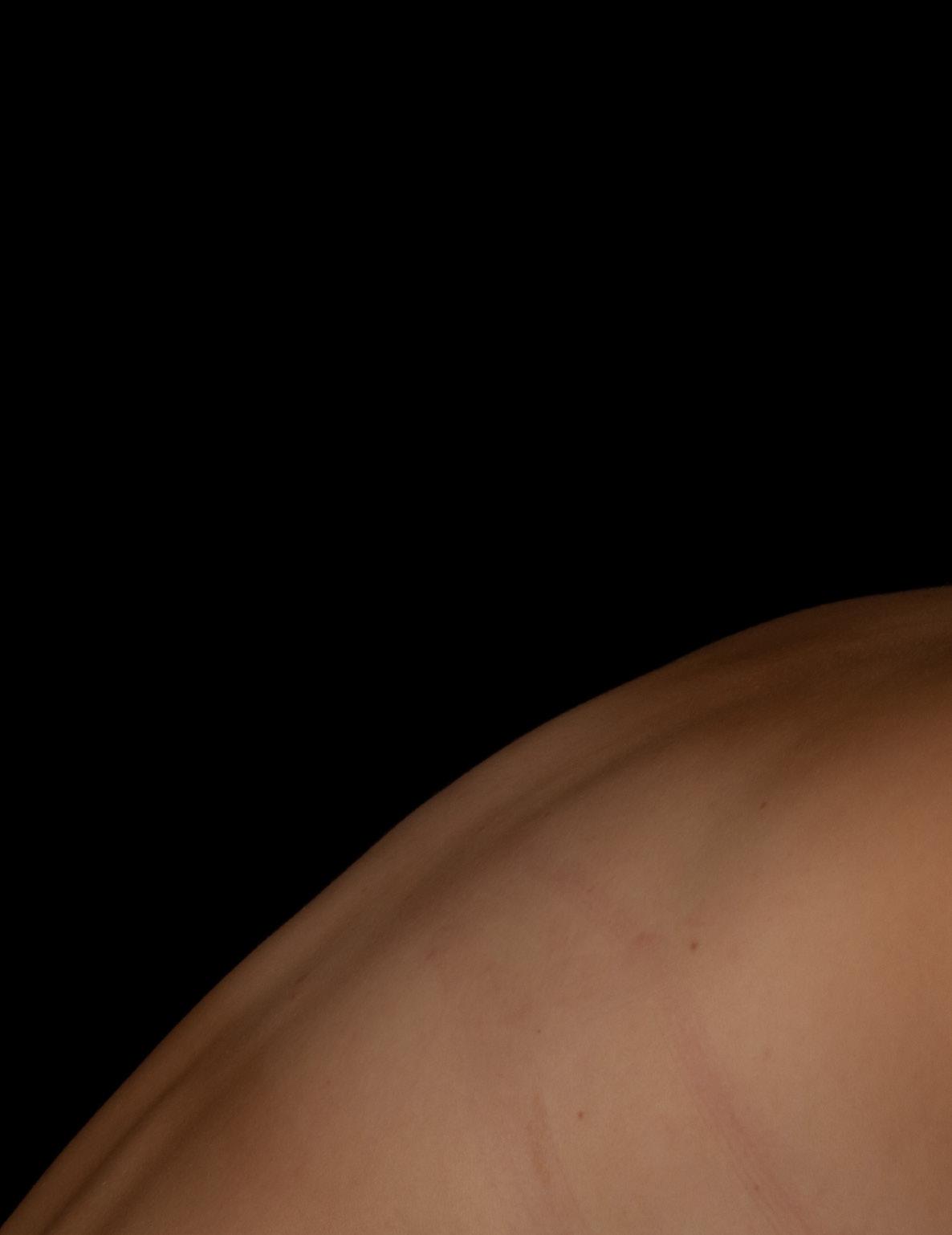
“When I stopped expecting to love my body completely, it got a lot easier to treat it well. Respecting it for keeping me alive and allowing me to do the things I love, meant I focused less on what I thought I should look like, and instead on how I felt,” Sam said.
Identifying with either body positivity or body neutrality is always going to be up to the person.
The idea of body neutrality is to remove the need to determine someone’s worth and value based purely on what they look like. Body neutrality is not apathy, but instead the hope that we can start to accept our bodies as they are, without worrying about if we are attractive to others or Thenot.
Sam* is in recovery from an eating disorder that saw her hospitalised multiple times. Being able to view her body in a middle-of-the-road way, where she wasn’t telling herself it was bad, while also not outwardly loving it, meant that she was able to get healthy again by acknowledging that she didn’t feel entirely comfortable with how she looked but understood that her appearance didn’t need to be the driving force for how she treated herself.
It is true that a lot of the people who use body positivity as a part of their influencer presence still fall inside conventional beauty standards and are unlikely to have faced fatphobia because of this. Identifying people that still have conventionally attractive bodies as ‘plus size’ creates more harm than good by telling people that if they exist in a larger body, then they are only attractive if they are larger in a socially acceptable way.
A lot of commenters on Drew’s tweet mentioned that during eating disorder recovery, viewing their bodies neutrally rather than trying to love their body helped them get healthy again.
* Name change 29 • Aronui
body positivity movement feels like a good start to people accepting themselves and being able to see themselves represented in the same way thin people have constantly seen themselves represented. Normalising bodies looking different is a valuable step in helping dismantle the patriarchal system that tells us we should aim to look a certain way. Body neutrality goes a step further by saying it really shouldn’t matter.
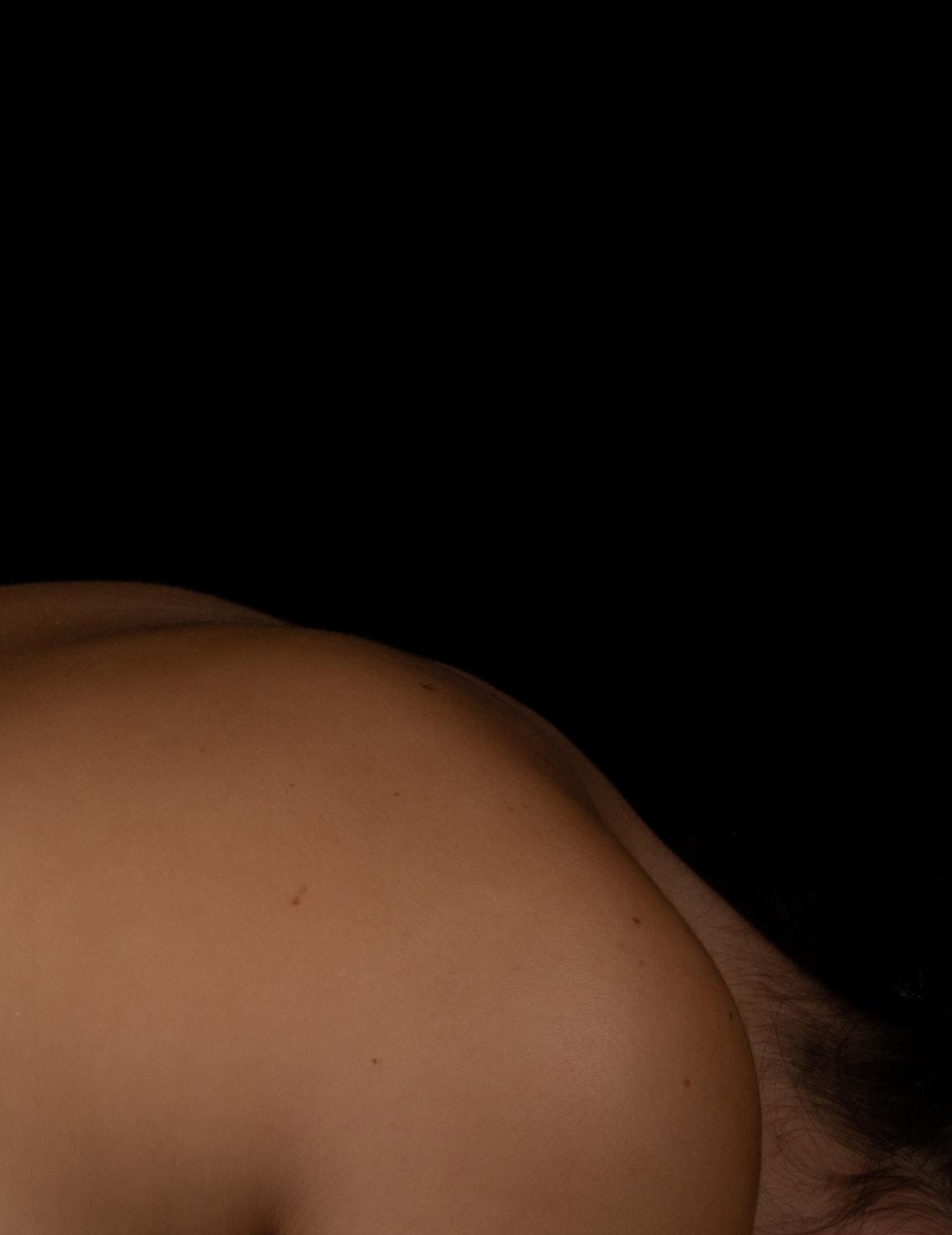
through years of experience, bonding, learning history and attaching yourself to that history. That process occurs in a very condensed fashion when discovering shocking DNA results, so settling into a new identity felt like I had just come out of amnesia. A bit like wearing an ill-fitting dress, I had to keep trying it on and making Inadjustments.theendIdidn’t come back to myself full circle, but I ultimately did come back to embrace some aspects of my original self - it took a journey without a map to rediscover it. Through persistent efforts at learning about my new biological family, (the Scottish ancestry behind my red curls) and forging new family relationships, I created a stronger sense of identity that finally fit. You can call me whatever you want, and now that all my names fit again, I finally know what to call myself again.
A few years ago, I received a commercial DNA result I wasn’t expecting. None of my father’s heritage showed in my profile, but 48% of someone else’s did. I often shared in other people’s puzzlement when they would say, “You’re related to them? Funny, you don’t look brown.” A lifetime of negotiating stories with myself about why I didn’t resemble them in any way, and people had only to look at my red curls and blue eyes amidst my family’s straight dark brown hair and dark eyes, seeing right through my hollow Withfabrications.thetest results I now had hard proof, and the questions that plagued me throughout my life began to fit together like puzzle pieces: they don’t accept me because I am not part of their bloodline. I now came to feel like an imposter in the family narrative I had embraced with the same pride they had. Strangely, I also felt relief at finally knowing why I wasn’t accepted—I could finally build something better than those hollow stories. Learning I was not the biological offspring of the man who raised me threw out the part of myself I had come to understand as part of him. He died suddenly at 50 years of age 17 years prior to this discovery, so I had already lost him physically, and now it felt like that was happening all over again Identity usually takes years to solidify—that’s why adolescence is so hard after all. Midlife crises are the second time your identity takes a hit, changing and stabilizing with expected life stage transitions and many people experiencing the same shocking DNA results. Some talk about not being able to look at themselves in the mirror. Others feel they have no right to participate in family gatherings anymore. For me, it was my names, none of them told me who I was anymore. My birth certificate, my passport, everything was labelled incorrectly. Realigning identity is a turbulent experience, and many people contributed harmfully to the process.
Confessions of a is an anonymous column that looks to unearth viewpoints from unique individuals at Massey University. Each week we will give the spotlight to someone new, so If you think you’ve got an interesting story to tell, please get in touch with Editor@ massivemagazine.org.nz
DNAshockingresult
I’veassessments.talkedwith
30 • Rangitaki
ofConfessionsA...ConfessionsofA...
Dad’s family couldn’t understand why I would pursue any of this, “because it shouldn’t matter, it doesn’t change anything about you” - a cruel and heartless thing to say to keep any embarrassment from their fragile psyches. It changes absolutely everything about a person. My mom felt I was abandoning her heritage and my father. I had a lifetime of bonding with my ancestry as much as we lived it, and learning the truth doesn’t negate the fact that my dad raised me, nor how I feel about him—only I know how I feel about Identitymyself.isforged

SE XCAPADES
This is where I overestimated my skills. I checked the timer when the cake went into the oven and calculated we had just over 12 minutes to be decent and back downstairs. But after being nose to bellybutton on my bf I didn’t realise the 12 minutes had elapsed and my parents were busting into the room, just as my boyfriend was mid nut. It was a scene from my worst nightmare. and I looked up, startled, cum around my mouth and making eye contact with my dear mother. He quickly tried to cover himself up, but it was too late, everything was on display. My parents hurriedly closed the door and went downstairs. I took a quick shower, brushed the teeth, arranged the clothes, but there was no hiding what had passed. In the end, all we could do was go downstairs, make awkward small talk and eat that stupid cake. And let me tell you, dessert is 100x more awkward when your mum has just seen her innocent little girl deepthroating.
Fuck off mum
Let me set the scene. It’s my boyfriend’s first time meeting the parents and we’re both so nervous. My parents are pretty chill, but still a little uptight, in that middle-aged way. We’d never even discussed things like drugs or masturbation, it was a strict ‘don’t ask, don’t tell’ policy. But anyway, did the chit chatting, had a nice dinner, it was all going swimmingly. I could tell that the bf was feeling a bit naughty, his hand was slowly finding his way up my leg. As my parents were making dessert, I snuck upstairs with my bf for a quicky. Unfortunately, we didn’t have time for a full-blown fuck session, but I still wanted to please him, so a blowjob it was. As I always do, I was giving it my absolute all. I wanted him to bust quickly so we could get back down for dessert. I pulled out my finest work, the gluckgluck-9000, fingering his booty, it was a work of art. I could feel him getting closer and closer to climaxing as he was squirming, tensing his body and moaning silently.
31 • Rangitaki
I’d give this movie a 4.5/5, 5 being the worst movie ever.
32 • Rangitaki
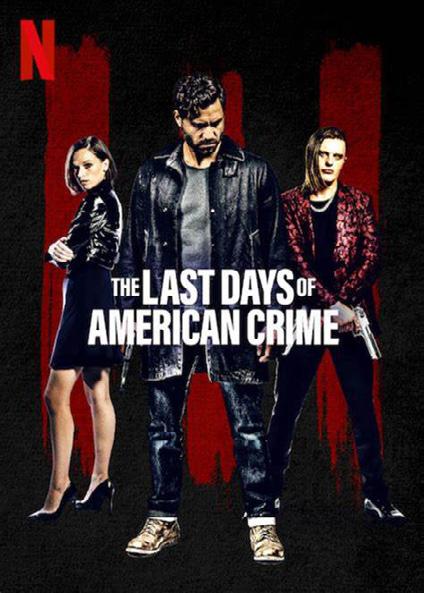
The Last Days of American Crime is also two and a half hours long, which is significantly too long for a film that’s plot summary doesn’t even take up a whole page on Wikipedia. It’s extremely dull, even during supposed ‘action’ scenes. You can’t get invested in a two-anda-half-hour movie where most of the time is spent on violent scenes, because you simply don’t care about the characters or what happens to them.
worst of the worst movie reviews
Every week I’ll be watching the worst rated movies on Rotten Tomatoes so you don’t have to. I’ll be doing one every week until the final issue where I’ll review the worst movie ever made (according to a random article I found). What are my qualifications you ask? I took Introduction to Media Studies in my first year and got a B average, so I think I know what I’m talking about. I’m going to watch each of these movies and decide whether it is rightfully on the worst movies of all-time list, based on my expert opinion. Elena McIntyre-Reet (she/her)
The Last Days of American Crime is a 2020 special, released on Netflix in June. Obviously, it’s a crime movie. Netflix originals are always very hit or miss, they produced the outstanding Kissing Booth trilogy, but also released some random little movie called Don’t Look Up. The timing of this movie release couldn’t have been worse, it depicts a lot of police brutality and came out during the height of protests in response to the murder of George Floyd. Poor taste aside, this movie is really nothing special. It’s essentially a reverse purge idea, where the US government intends to release a tool that will prevent anyone from breaking the law. Of course, people try to break the law before the tool is released, and it turns into a heist film. This movie doesn’t really offer anything unique, it’s just your bog-standard crime movie. There’s a notorious crime family who runs things, and there’s a bunch of entirely unnecessary shoot-out scenes. Even worse, there’s a few scenes that depict police brutality and abuse of power. It just feels very violent to a point where you actually get sick of it.
All in all, this movie sucks. If you see it on Netflix and think ‘oh yeah that looks okay to watch on a Sunday night while eating a takeaway,’ don’t.




33 •
How is Sam Uffindell such an ass? He's a stupid bully who's never had to face the consequences of his actions. Also, the Kings' College attendance says it all really. I think the key here is that he only apologised for his wrong doing for his own gain, not because of a guilty conscience - and that's fugly Also,behaviour.torun on an anti-gang platform, and engage in gang behaviour, that's somehow not gang behaviour because you're white and rich is RANK. How do I tell my flatmate their food kind of sucks? Tell them that your other flatmate feels way too bad to say anything, but thinks your food sucks. Or, take it up a notch and fabricate an entire story framing your other flatmate e.g, James really hates your food and has actually been really unwell - to a point of near hospitalisation - because of it. Voila! Or just have a flat meeting to plan out flat dinners under the guise of budgeting.
Solicited advice is a weekly column where an underqualified anonymous guru answers the questions you want answered. This won’t include the stock-standard, sugar-coated advice you’re used to hearing – we’re talking about the truths that are REALLY on your mind. Do you have a question you’re dying to have answered? DM Massive Magazine on Instagram and look out for next week’s issue. Also, follow us while you’re at it x How do I stop being so sexy?
SOLICITED ADVICE
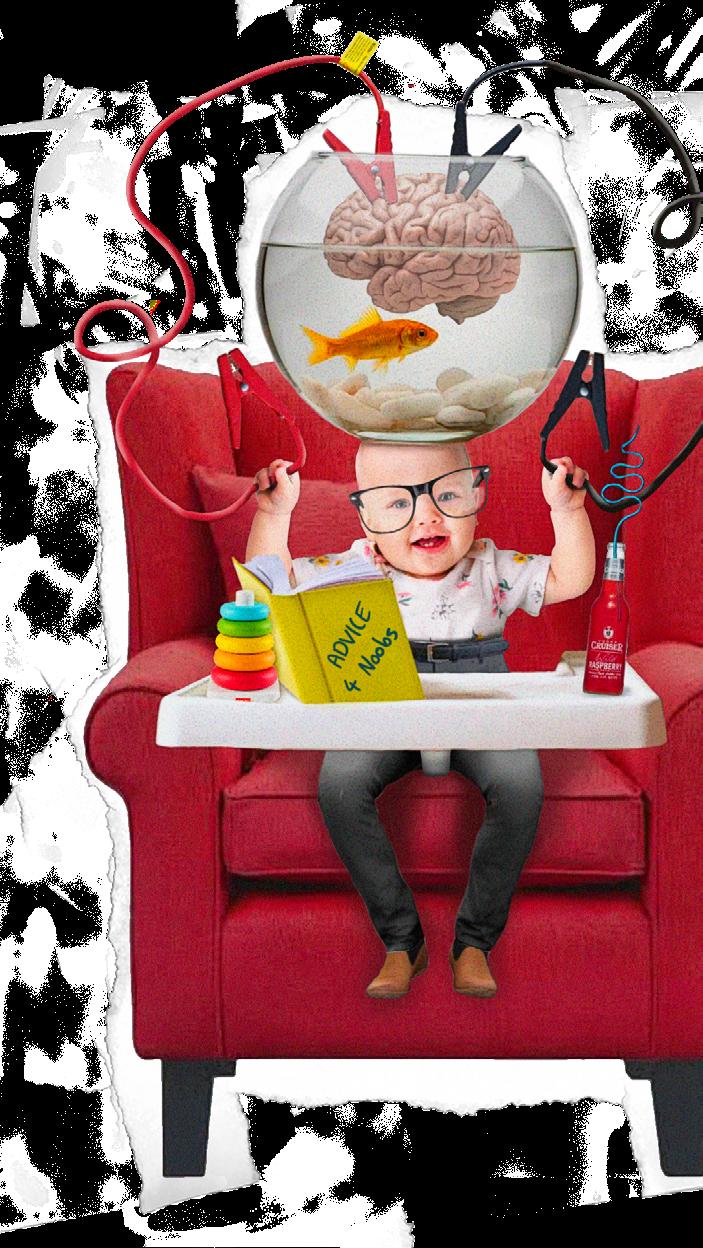
I know this is anonymous, but I do actually know who asked this. And unfortunately, I am afraid there's simply no solution in your case. In such a predicament, there is but a single optionforge on. When the sharpest words wanna cut me down. Gonna send a flood, gonna drown them out. I am brave, I am bruised. I am who I'm meant to be, this is me Look out cause here I come. And I'm marching on to the beat I drum. I'm not scared to be seen. I make no apologies, this is me...This is me. Hope this helps. Rangitaki




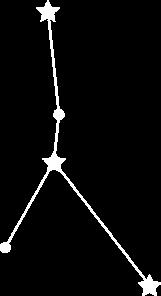
Gemini Gemini, babes, you for real have to stop skipping lectures to go get brunch. Firstly, where’s this income coming from? Secondly, you’re literally paying way too much for your education to be truant.
cAPricorn
You have been for real grinding for the past few weeks Capricorn. I know the grind is not slowing down any time soon but make sure you allow time for some self-care – even if you have to physically schedule it. cAncer
Are you getting suspicious because you haven’t cried in a week? Yeah, so are your friends. I would highly recommend watching a sad love movie (e.g., the Notebook) to reach your monthly tear quota.
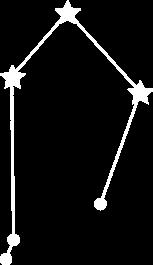
LibrA body Your indecisiveness is cute at the best of times but annoying af at the worst. For some exposure therapy, purchase a stick and poke kit and force yourself to choose a tattoo on your body for life! I think you’ve been forgetting how much of a bad bitch you are and tbh it’s sad to see! To reinvigorate yourself, watch Puberty Blues and then … I’m gonna say it … break up with them. Purr.
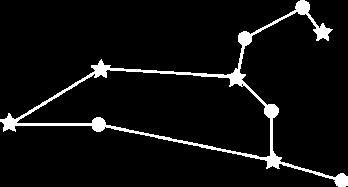
Leo Enjoy the attention while you’ve got it Leo because – thank God – we’re finally nearing the end of Leo season. Start practicing your thirst trap poses for the upcoming lull in attention.
sAGiTTArius
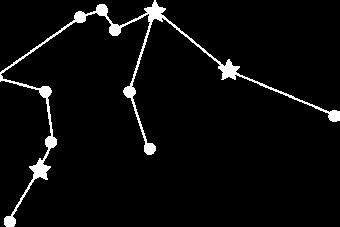
AquArius Assessments, lectures, and working for The Man got you down, Aquarius? Let your creative flair be free and download some sort of special FX app on your phone. Let loose! Get TikTok famous! Then drop out of uni forever!
Aries Charity work of the week: Go through your bedroom and sort all of your clothes, accessories, bits and bobs out. Then return them to all the flatmates you stole them from! Give back to the community <3
TAurus
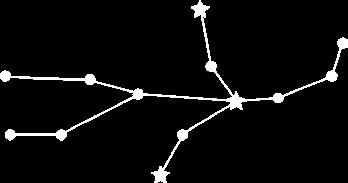
Two can play your mind games, Taurus, and FYI, your fling of the month is catching on to your constant up and downs, preparing to give you a taste of your own medicine. You’ve been warned. You’re feeling a bit attention-deprived this week Pisces, and that’s okay. But try not to let this manifest into becoming one of those people who interrupt everything with something about themselves. Not cute xPisces
VirGo Afterpay is the toxic BFF who hypes you up to your face and talks shit about you behind your back. Cut it off, Virgo. The stars tell me IRD will request receipts of your course related costs purchases in the near future.
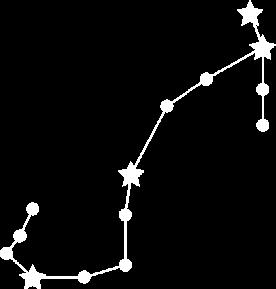
scorPio Don’t let the mid sem slump get you down. It’s time to heal your inner child this week Scorpio. Go buy some Iced Animals, watch some Spy Kids, and stay up ‘til midnight!
Horoscopes
34 • Rangitaki
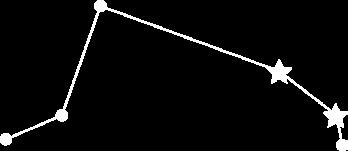
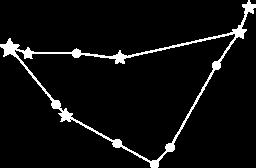
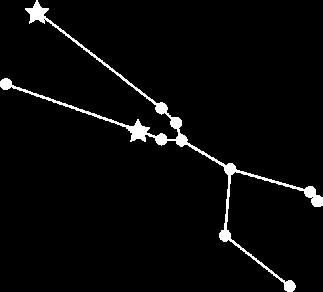
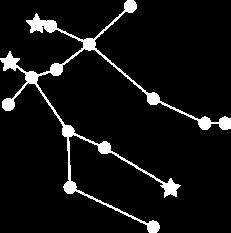






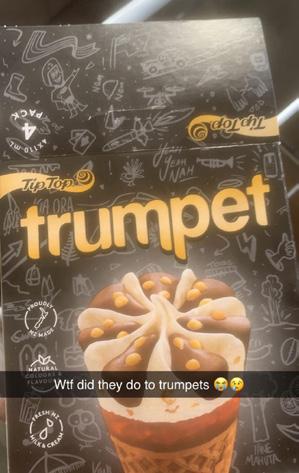
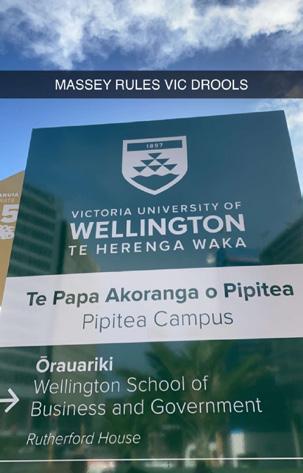
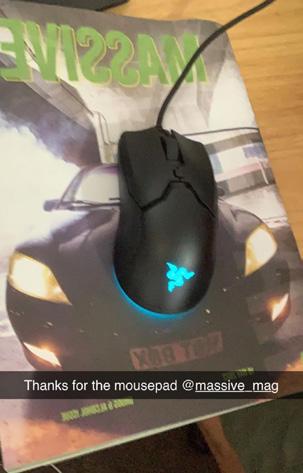
MASSIVE_MAG TODAY MASSIVEMASSIVESendus snaps to get featured in next weeks edition 35 • Rangitaki





Puzzle Ptime uzzle time Across 2. Stunt the growth of (5) 4. Thin walled coking pan (3) 5. Frozen precipitation (4) 6. Which Kardashian welcomed a new baby (5) 9. Green in te reo (8) 11. Wet spot in the desert (6) 15. Tertiary institution (10) 16. Betting ratio (4) 17. How many gold medals did NZ win at the Commonwealth Games? (6) 18. Agreement between two groups (6) Down 1. Tree, dog sound (4) 3. Thin, liqour holding vessel (5) 5. Shut forcefully and loudly (4) 7. Trinket, decoration (9) 8. Female winner of Love Island (4,2) 10. Step-by-step method (9) 12. Living in water (7) 13. The fact of being who or what a person 18.16.14. 36 • Rangitaki 1 2 3 4 5 6 7 8 9 10 11 12 13 14 15 16 17 18




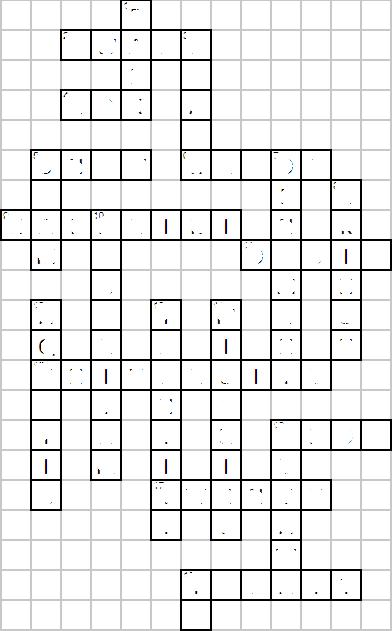
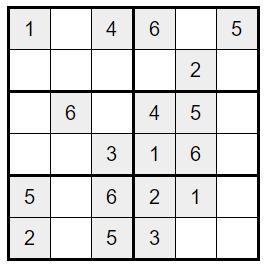
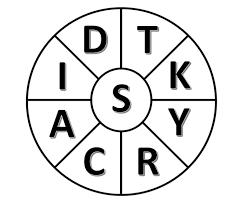
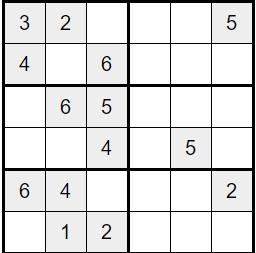
The target is to create as many words as possible from the letters within the Word Wheel. Word Wheel sudoku 37 • Rangitaki mazeorthogonal20by20 https://www.mazegenerator.net/AB,Alance2022©Copyright ANSWERSCROSSWORDWEEKSLAST BAR20HYDROGEN,19PEKE,16NARCISSIST,14BIRMINGHAM,13CITY,VATICAN12DISNEY,WALT11SATURN,9HOMOPHOBIC,7ONE,TWENTY5CHUR,4ACROSS: DELTA18KEBAB,17SCURVY,15ROWING,10SUGARCANE,9LAME,KHABY8AFRICA,SOUTH6HIERARCHY,2KOURA,1DOWN:




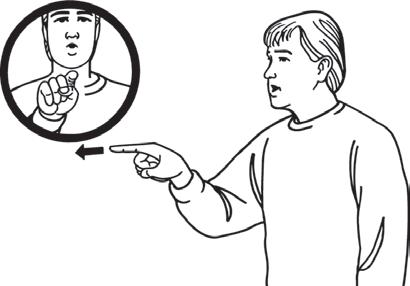
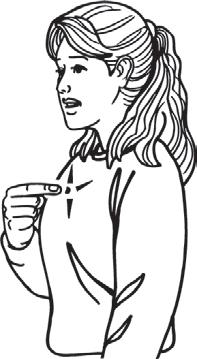
Te Reo and NZSL Words of the week Revitalising Te Reo Māori and NZSL is of paramount importance. Take a few minutes out of your dat to learn and memorise these words. It’s the least we can do. Ahau I Koe Maua YouWe 38 • Rangitaki
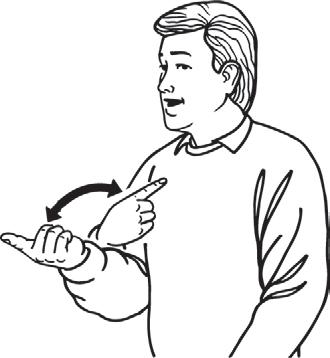
We have Cultural Week coming up from August 15th to the 19th coming up. If you have something you wanna share from your culture let us know! Fiona & Lizzo MAWSA
39 • Rangitaki Presidents Column
All of these labels (along with some less flattering) form a part of my identity. However, even together these labels fall short of representing me and my experiences in their entirety. I’d be lying if I said I hadn’t spent time doubting my ability to fulfill any of these identities. Distance Student’s in particular seem to question their studentship and drift through university feeling like fraudsters. So if you’re feeling a little less student than you thought you would, you’re not alone. Join us on Facebook and Stream to get your fix of student life distance style.
Kelly M@D Jake asa
Who are we? Are we reflections of every person we’ve ever met, synthesised into one identify we call the self? Or are we defined by needs and wants that are innately carried within? Either way, I am excited to announce the Albany Students ball is going ahead, and this year we are partnering with Te Waka and MAPSA to throw a ball that is for students of all diverse identities and backgrounds, so save the date 17th of September! Students, be yourselves, be unique, be weird, be proud, be queer. The world isn’t defined by people who follow norms. Power to you!
Student, parent, partner, employee, graduate, survivor/ victim, mentor, business owner, Mentee, volunteer, neurodiverse, mental health peer, and instructor.