April 2023
PERFORMANCE REPORT 2022
MASSACHUSETTS COLLEGE OF ART AND DESIGN
COLLEGE LEADERSHIP 2022-2023
Board of Trustees
Elisa Hamilton ‘07, Chair
Karen M. Keane, Vice Chair
Daren Bascome ‘93 BFA
Sunand Bhattacharya
Denise Korn
Foundation Board 2022-2023
Executive Committee:
Michelle Ingari, Vice Chair
Charles Jobson, Treasurer
Deirdre Nectow, Chair
Marjorie O’Malley, Executive Director, Clerk
Patricia Rivers, Vice Chair
Directors
Henry Biner
Katie Block
Richard Coffman
Andra Dekkers
Nina Fletcher ‘91
Kristine Irving ‘91
Alison Judd ‘07
Ashley Karger
Wanita Kennedy
Fred Liang
Elizabeth Lowrey ‘19 Hon
Ted MacLean
James Mason ‘81, Associate Provost and Dean of Faculty
Roberta Moore
President’s Cabinet
Dr. Mary K. Grant, President
Lucinda Bliss, Associate Provost and Dean of Graduate Professional & Continuing Education
Ellen Carr, Executive Director of Marketing/Communications
Robert Chambers, Vice President for Strategic Engagement and Chief of Staff
Dr. Jamie Glanton Costello, Associate Vice President and Dean of Students
Dr. Maureen Keefe, Vice President of Student Development
Sandra Knight, Interim Executive Director of Human Resources
Howie Larosee ‘06, Associate Vice President for Facilities and Planning
Peter Nessen
Janice M. Saragoni
Kelly Sherman ‘02 BFA
Linda L. Snyder
Greg Stone
Nicholas “Nick” Thompson, Student Trustee
Emma Pickard
Valentine Talland
Chiara Trabucchi
Designated Directors
Mary K. Grant, President
Brenda Molife, Provost and Vice President of Academic Affairs
Jan Saragoni, Trustee Representative
Honorary Directors
Caroline Collings
Robert S. Gatof
Nicholas Greville
Jennifer Harrington
Katherine “Kay” Sloan, President Emerita
Michael Tarnow
Elissa Warner
Chair Emeriti
Trevania Henderson
William Hicks
Tali Kwatcher
Susan Schechter
Clare Villari
James Mason, Associate Provost and Dean of Faculty
Dr. Brenda Molife, Provost and Vice President of Academic Affairs
Theresa O’Bryant, General Counsel
Patrick O’Connor, Assistant Vice President and Chief Information Officer
Marjorie O’Malley, Vice President of Advancement/Executive Director MassArt Foundation
Dr. Lyssa Palu-ay, Dean of Justice Equity and Transformation
Robert Perry, Vice President Administration and Finance
Lauren Wilshusen, Dean of Admissions and Enrollment Management
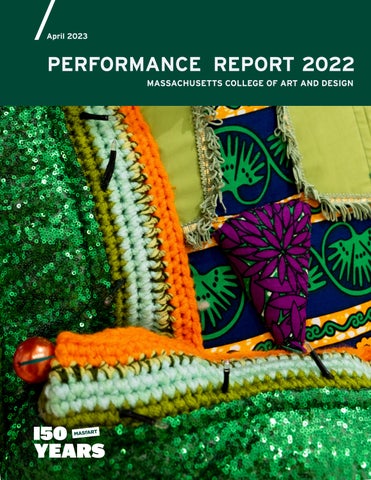
*Cover photography by Daniel Berube ‘21 BFA Communication Design. Featured artwork ‘Valkyrie Mumbet’ by Joana Vasconcelos.
INTRODUCTION
Partnership Renewal Plan
Art College Peer Group
Reporting Periods
Reactivation of Campus
Partnership Renewal Plan
As part of the MassArt Partnership Plan, the College has committed to report on certain criteria to communicate our performance in key operational areas. This report represents our annual report on those criteria and a highlight of College accomplishments.
Art College Peer Group
The peer group to which MassArt is benchmarked, as approved by the Board of Higher Education, is listed below. Peer institutions, approved by the BHE in March 2010, are listed below. This group includes colleges that are up to 50% larger or smaller than MassArt in enrollments, offer different configurations of programs and majors, and have varying financial resources; but when considered in the aggregate, average measures for the group provide valid benchmarks for MassArt on most performance indicators. These institutions are used for benchmarks for the key indicators included in the second section of this report.
Art Center College of Design
California College of the Arts
California Institute of the Arts College for Creative Studies
Columbus College of Art and Design
Maryland Institute College of Art Ringling College of Art and Design
Rhode Island School of Design
School of the Art Institute of Chicago
The University of the Arts
Reporting Periods
ENROLLMENT Final FY2022, preliminary FY2023
ADMISSIONS Fall 2022, Fall 2021 AICAD
FINANCIAL AID FY2022, Fall 2022
RETENTION AND GRADUATION RATES FY2021, FY2022
TUITION AND FEE REVENUE FY2022
PEER FINANCIAL BENCHMARKS FY2021
Benchmarks use the most recent available peer data.
As we look back upon the year there is much to share and acknowledge, as we look ahead to the important work and opportunity for the talented faculty, staff, students, and alumni of MassArt to continue to bring their creative talents, innovative problem solving, and design thinking to making a difference in the world. We were thrilled to host our first in person commencement ceremony in May of 2022. We were deeply grateful to be back together, celebrating the achievements, tenacity and talent of our inspiring graduates and witnessing the strength of our shared values and our commitment to using the power of education, art, design, making, creativity and compassion to strengthen and enrich our communities
Reactivation of Campus
Campus activity has returned to a robust level this year, in classrooms and studios, residences and dining halls, and student activities every day of the week. The MassArt Fall 2022 entering class of 491 represents a strong rebound back to our pre-pandemic incoming class size, and the College residence halls are operating at over 100% capacity. The academic year began with a lively move-in weekend and activities hosting incoming students and their families. Faculty and staff enjoyed a well-attended, fully inperson Fall Opening Day celebration for the first time since 2019. The Academic Resource Center (ARC) hosted its annual “Meet Your Major” event in person, after two years of virtual programming. Students and faculty members from MassArt’s 18 majors and 4 minors met with the first year students as they toured studios and had the opportunity to explore their interests and gain a deeper understanding of each of the majors.
MassArt’s robust summer youth programs had another banner season, hosting a total of 259 students of all ages. Artward Bound served 35 high-school students over six weeks, culminating in an exhibition of their work addressing climate change and sustainable futures. Youth Programs returned to in-person classes for the first time since 2019, with 224 students participating in Creative Studios, Summer Intensives, and Pre-College Studios. In July, we were pleased to welcome Women to Women—a leadership development program for 116 young women leaders ages 15-19 from 21 countries—for a two-week intensive program. The on-campus MassArt Art Museum (MAAM) hosted a new event series, Art on the Plaza, welcoming 3,000 community members with creative, free programming, including artmaking for all ages and outdoor activities and music, as it opened for the first summer since the museum’s February 2020 launch.
Community Engagement
We were pleased to forge several new community partnerships in 2022. In collaboration with Embrace Boston, we hosted the closing
INTRODUCTION
Reactivation of Campus (continued)
day of the Embrace Ideas
Festival, a 5-day festival of programming designed to amplify antiracism and transformative change in the City of Boston. These programs all serve as important reminders of the many ways we engage with the community here in Boston, across the Commonwealth, the country, and the world, and how our mission and dynamic framework of education, art, creativity, design, innovation, equity, and inclusion enable us to have an impact and make a difference.
In December 2022, we launched the Medical Inclusion and Diversity Art Program (MIDAP) lecture series, one component of the MIDAP collaboration between Harvard Medical School, Brigham and Women’s Hospital and MassArt, which is designed to help facilitate students and faculty working together toward making medical illustrations more diverse. Dr. Ellis Monk, Associate Professor of Sociology at Harvard University and Visiting Faculty Researcher at Google, has lectured extensively about his work regarding colorism, skin tone, and machine learning, and their implications for health and medical devices. This project powerfully illustrates the far-reaching impact of art and design and the important role of MassArt in the broader community.
New Leadership
The College leadership team was greatly enhanced by two significant new hires this year. In July 2022, Dr. Brenda Molife joined MassArt as Provost and Vice President of Academic Affairs, bringing a depth of administrative and academic leadership in multiple settings, expertise as an art historian, and a commitment to the MassArt mission. Immersing herself in summer campus activities, Dr. Molife worked closely with Associate Provost James Mason and Associate Provost Lucinda Bliss in their respective roles on the Academic Affairs leadership team. In August 2022, Deborah Crafts joined MassArt as Chief of Police and Director of Public Safety, bringing more than 30 years of public and private higher education experience in law enforcement. Most recently, as the Chief of Police and Director of Public Safety and Risk Management at Northern Essex Community College, Chief Crafts created a department from the ground up that focused on embracing differences through community engagement and transparent conversations.
An Active Summer
Summer was also a very busy time for a full cohort of MassArt graduate students. Low-Residency MFA students spent six
intensive weeks on campus and our third-year students presented their final work in the thought-provoking 2022 MFA summer thesis exhibition Where I’m Coming From at the MassArt x SoWa gallery. Architecture students are nearing completion of the latest project of the Community Build program, now in its 14th year, working in partnership with the City of Newton to produce a multi-use butterfly pavilion and outdoor classroom in Cabot Park for visitors young and old.
In June, we welcomed former MassArt Trustees, along with current board members and President Emerita Kay Sloan. back to campus. This was a wonderful opportunity to reconnect with colleagues who served the college for so many years and to update them on all that is going on, particularly as we looked ahead to our 150th Anniversary. Our guests were delighted to be back on campus for the first time in recent years, and are eager to continue advocating for the College.
In July, we hosted members of the State Legislature’s Joint Committee on Tourism, Arts and Cultural Development, to give them an overview of MassArt and its significance to higher education in the Commonwealth. Representative Mary Keefe (15th Worcester District), a MassArt alumna, was among our honored guests. We were delighted to learn that many of our guests had relatives who are alumni of MassArt – our graduates are everywhere! Many of the legislators had not been on campus in a long time, and for some it was their first visit. They all welcomed the chance to learn more about MassArt, and we look forward to continuing to strengthen and deepen these important relationships.
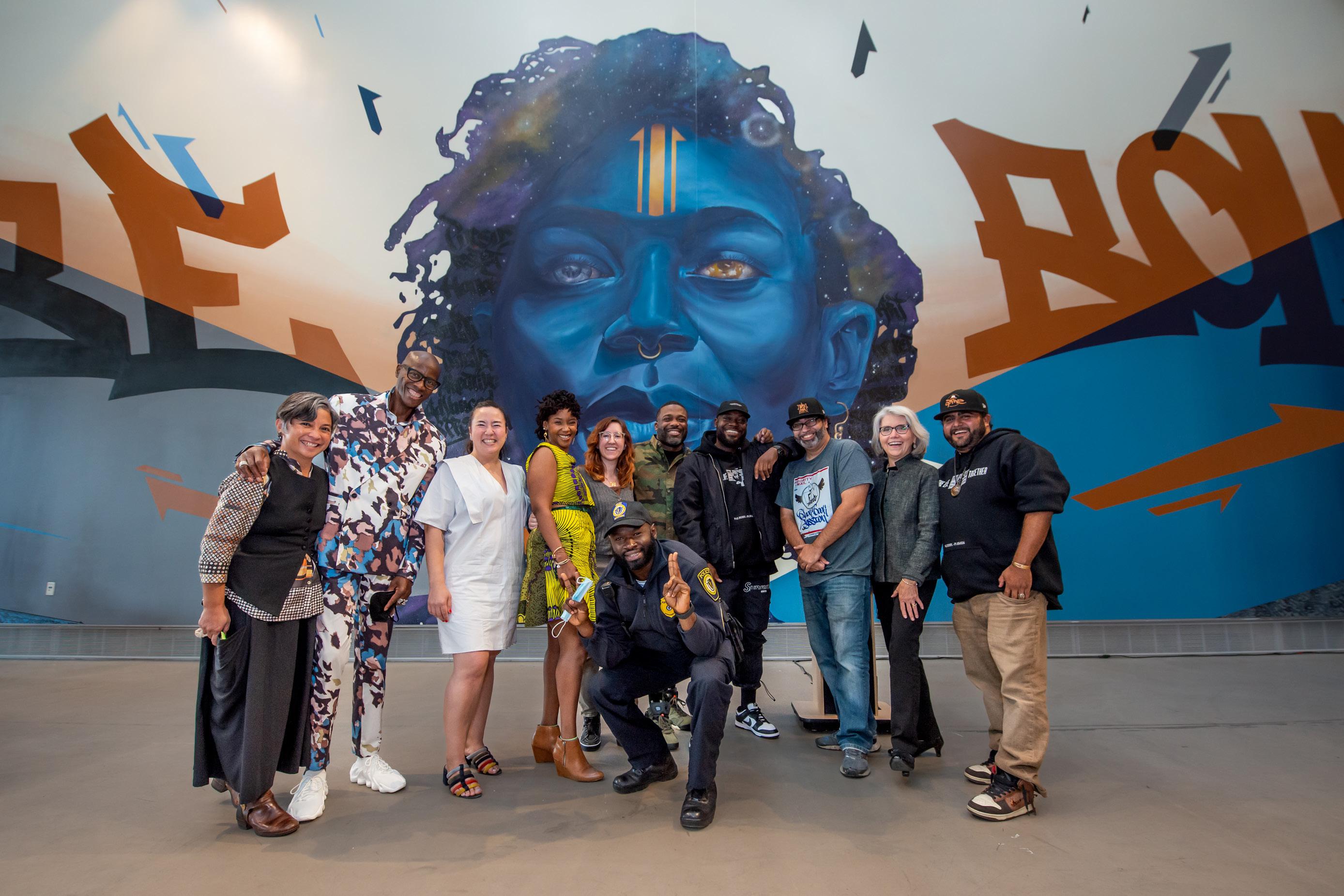
From June through September, many colleagues were hard at work enlivening the MassArt environment with large-scale visuals. The college’s main entrance in the Design and Media Center Atrium now features the stunning mural “Intrepid” produced by GN Crew Boston, the MassArt Adderley Public Artists in Residence. On all 13 floors of the Tower building, the College’s main academic space, there are vibrant murals on the elevator doors, featuring artwork from faculty, staff, and alumni; and in the Tower, South and Kennedy buildings there are new wall-sized murals painted by students, faculty, and staff.
New Initiatives - Academic Year
The Student Government Association (SGA) has seen increased engagement across our student body, particularly among first year students, and there has been a wave of new student organizations, such as the MassArt Sewing Machine, The Sunrise Movement, and the Garment Printing Club, with several more prospective groups currently seeking SGA recognition.
This year MassArt made further progress in building infrastructure to support new teaching, learning, and advising modalities, under the auspices of the Special Committee on Multi-Modal Learning formed in 2022. As a principal initiative of this committee, a Learning Management System (LMS) group was formed, and charged with identifying and selecting a single LMS for college-wide use. To date, the group has been consulting with stakeholders, and researching and reviewing LMS vendors and products, including: Instructure’s Canvas, Blackboard, BrightSpace, and Moodle. The list of potential LMS products was determined following extensive research, and consultation with colleagues at peer AICAD schools and the Massachusetts State University and Community College systems. The LMS group will soon present these vendor options to the campus community, and make recommendations to the President and Provost on the best solution for MassArt that better serves and meets the changing needs of our students, facilitates the work of faculty and staff, and connects MassArt
to a broader community of a continuously changing environment. This initiative was born from rising student demand for a single platform across all classes to help them improve their time management and academic workload, and to reduce the “platform fatigue” that occurs when students are required to switch between a variety of systems and applications that differ from program to program, class to class. The committee will make its recommendation to the President and Provost in May 2023.
Centering on Student Success and Engagement
As MassArt continues to deepen, expand, and strengthen our commitment to supporting students, the Office of Justice, Equity and Transformation (JET) launched the “Thriving Classrooms” initiative to engage the campus community in developing a plan for advancing student success and enhancing our capacity as
INTRODUCTION
a student-ready campus. Co-chaired by the Vice Presidents for Academic Affairs and Student Development along with the Dean of Justice Equity and Transformation, this crosscampus working group has been engaging faculty, staff, and students, assessing data, and researching models to inform the development of an integrated, collaborative, and student centered approach. To support and engage the campus in this work Dr. Tia McNair gave a kickoff lecture, and we distributed 75 copies of her book, Becoming a Student Ready College: A New Culture of Leadership for Student Success, as a foundational text for our work. This campus effort aligns with Department of Higher Education Priorities. https://www.mass. edu/strategic/equity.asp
Creative Economy Business Incubator
In 2022, MassArt significantly evolved our arts incubator program by partnering with the Mayor’s Office of Arts and Culture to create and expand professional development opportunities. Supported by a $70,000 Workforce Development Grant from the City of Boston, MassArt expanded access to the Incubator program beyond the College’s student body and alumni, at no charge, for Boston-based artists and creative entrepreneurs, with priority consideration given to BIPOC artists. Reflecting on the program’s expansion, President Mary K. Grant noted, “We are grateful to Mayor Wu and the Office of
Arts and Culture for their belief in MassArt and the power of art and design. We look forward to the impact that this will have on Boston’s creative economy.”
Led by Sara Hartmann, Assistant Professor of Design Innovation and Fashion Design, the Creative Economy Business Incubator is designed to support arts entrepreneurs with guidance from faculty, industry experts, and visiting entrepreneurs. Participants include MassArt undergraduates, graduate students, and alumni who spend two semesters developing, market testing, and refining a business idea, all while learning foundational principles of entrepreneurship, strategy, marketing, and finance through practice and hands-on experience. The program offers a rich array of resources: participants gain valuable professional networking experience, build connections with current students and alumni, receive one-on-one coaching from creative industry professionals, gain access to manufacturers and suppliers, and have the opportunity to sell their work through MassArt’s booth at SoWa Open Market, one of the largest open-air artist and farmer markets in Boston.
Digital Fabrication Labs
Funded through a $650,000 Massachusetts Skills Capital Grant program, the Digital Fabrication Labs – or FABLABs – are innovative, collaborative learning spaces that give MassArt

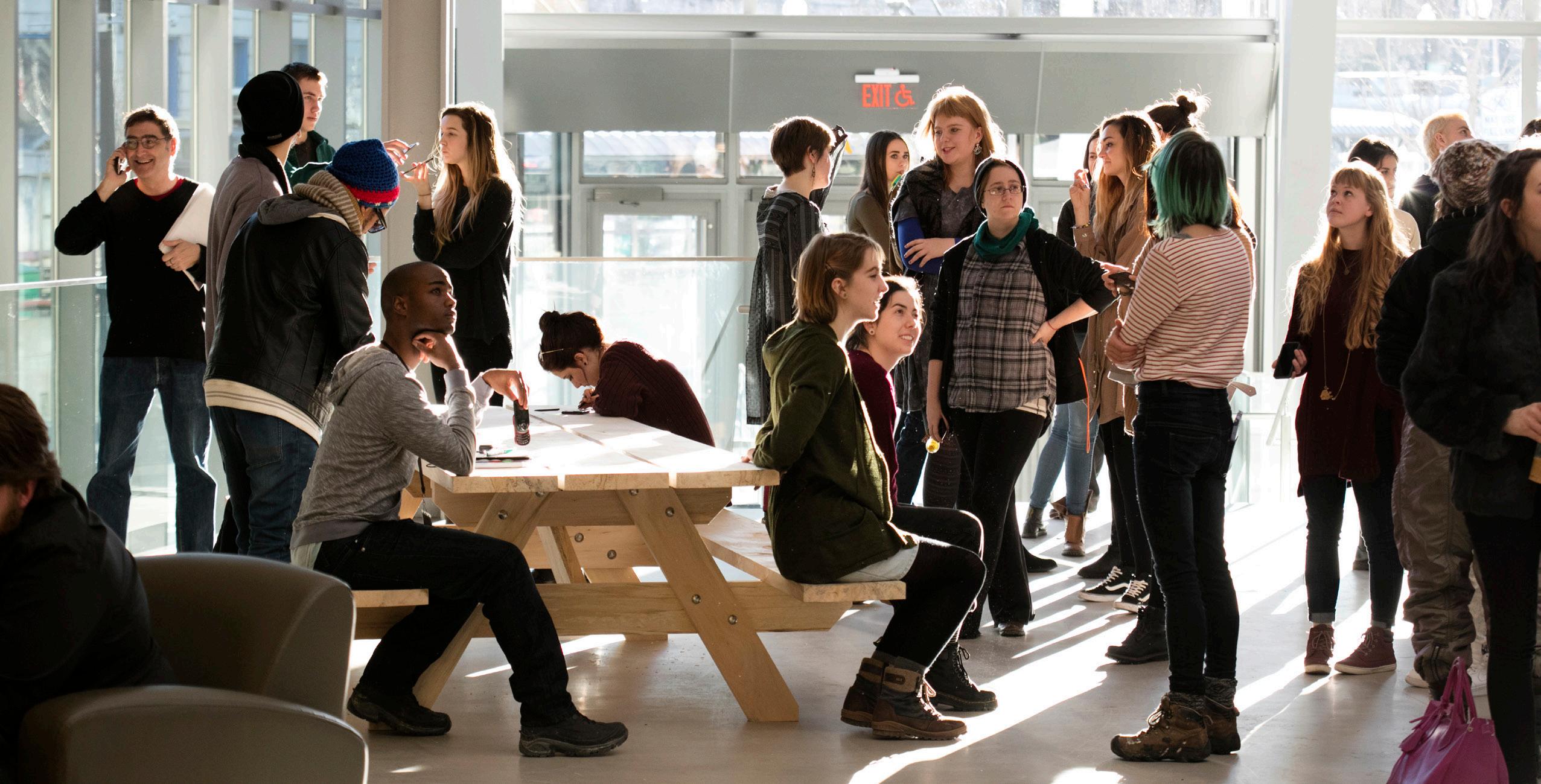
students hands-on experiences with digital tools and emerging technologies. Consisting of the UPLAB with tools for 3D printing and a wire bender; a PCLAB with 3D modeling software; and a BASE LAB equipped with a laser cutter and waterjet cutter, the FABLABs offer students a competitive edge through technical education and training programs that prepare them for highskill, high-demand industry sectors. While many colleges and universities limit access to digital fabrication resources to specific majors, at MassArt all students are encouraged to learn and use these cutting-edge technologies. Across majors, students are exposed to these resources in classes, workshops, and training sessions. Students also learn how to use machines from start to finish, rather than sending models to staff members who handle printing for students – a common practice at other learning institutions.
The design skills learned in CAD (Computer Aided Design) and CAM (Computer Aided Manufacturing), paired with the hands-on experiences with digital tools, will give our students a competitive edge across many industries and the creative economy. The Skills Grants have helped propel MassArt into a position that would otherwise have taken the College years to fund. We are very fortunate to have had this opportunity to propel MassArt into a new era of digital technologies that will help to augment and expand the hands-on and analog learning that we have built our reputation upon.
We inaugurated two Faculty Mentor programs in the academic year 22/23. One program is focused on new faculty and how
they are introduced to the institution, as well as, helping them to navigate through the Human Resources and Technology departments, orient them to the advising structure, and more. The other mentor position is for the ALANA Faculty group, to help organize and give structure around various initiatives presented by ALANA faculty.
Advancing Community Wellbeing
This year we worked to keep the campus community healthy through a variety of measures, evolving our COVID pandemic protocols gradually as public health guidance from the Centers for Disease Control and Prevention, and state and city authorities advised; evolving our COVID Campus Planning group to a Community Health Advisory Group, and hiring the College’s first Director of Community Wellness to oversee these efforts. We continued to work in partnership with our Colleges of the Fenway peers to offer several vaccination clinics and ongoing PCR and rapid testing facilities throughout the year, to emphasize the ongoing importance of vaccination and awareness. As mental health supports have remained a critical need for students, the MassArt Counseling and Wellness Center has returned to full-staffing, offering routine and critical-need counseling, and we implemented a new 24/7 online application called Campus Health.
KEY INDICATORS
Academic Quality Access and Affordability
Student Success and Engagement Service to the Commonwealth and the Economy
Financial Health
ADMISSIONS STANDARDS
First-time First-Year Students
The admission process at MassArt is holistic and considers both academic achievements and artistic potential. For first-time first-year students, the greatest weight for admissions decisions is placed on high school GPA and the quality of the application portfolio. MassArt no longer considers standardized tests as part of its admissions decision process.
3.58 was the average weighted GPA
88% had GPA of 3.0 or higher
94% did not submit standardized test scores
2.5 was the lowest high school GPA reported
Transfer Students
Providing access to transfer applicants, particularly those from community colleges, is an important priority in MassArt's enrollment plan. The transfer admissions process strives to both maintain high standards and minimize time to degree for transfer students. The average college GPA for entering transfer students was 3.21 in Fall 2022, and 66% had a college GPA of 3.0 or above.
ADMISSIONS SELECTIVITY
In Fall 2021, MassArt ranked 7th in our AICAD peer group for admission selectivity, accepting 79% of completed first-time first-year undergraduate applications. The most selective college in the group was Rhode Island School of Design, with a reporting acceptance rate of 19%. The least selective was Columbus College of Art and Design, at 94%. The median acceptance rate was 78%. Fall 2022 data is not yet available for AICAD peers.
FACULTY CREDENTIALS
The current MassArt student to faculty ratio (student FTE to faculty FTE) for the BFA program is 9.11, which is higher than the peer group average of 8.57. In Fall 2021, full-time faculty made up 65% of the faculty FTE for MassArt’s BFA program, which is higher than the AICAD peer average of 57%. Ninetytwo percent of MassArt full-time faculty hold advanced degrees. This is the third highest in the peer group, tied with School of the Art Institute of Chicago.
ENROLLMENT IN THE BFA DEGREE PROGRAM
Enrollment of BIPOC students in the BFA program gained 3 percentage points from 34% in 2021 to 37% in 2022, continuing a decade of steady growth. MassArt has experienced a large increase in multiracial enrollment numbers when those numbers are combined with Native American, Hawaiian and Pacific Islander (25%), followed by Hispanic/Latino/a (12%) and Black/ African American (3%). There was a 2% decrease in Asian American student enrollment. In Fall 2022, BIPOC students constituted 37% of the US citizens and legal permanent residents enrolled in the BFA program who reported their race and ethnicity.
ACCESS AND OPPORTUNITY FOR URBAN AND COMMUNITY COLLEGE STUDENTS
Providing access and opportunity to students attending Massachusetts community colleges and urban high schools is an important value for MassArt. We are striving to be a student ready college for those who have been historically underserved. We consider a holistic approach to our efforts systematizing practices of equity from recruitment to retention effort across our campus.
Enrolled Applicants from Massachusetts Urban High Schools
Massart currently has articulation agreements with Greenfield, Holyoke, Massasoit, and Roxbury Community Colleges; these current articulation agreements are under revision for the 23- 24 academic year. The Admissions and Academic Affairs Offices are also hoping to expand articulation agreements- to Bunker Hill, Cape Cod, Middlesex, and North Shore. These programs were chosen on both application numbers and strength of their art and design programs. Existing community college articulation agreements are being updated with the aim to more effectively recruit and enroll transfer students.
Community College Transfer Students Admitted
Grant Aid Awarded to Massachusetts Undergraduates
ENROLLMENT IN GRADUATE AND CERTIFICATE PROGRAMS
* Total Graduate and Post-baccalaureate Enrollment
** Total Undergraduate Certificate Enrollment (including Communication
Fashion Design and Furniture Design )
MassArt graduate programs provide access to advanced professional degrees in design and fine arts. The market for graduate programs has become increasingly competitive over the past several years, and MassArt graduate enrollment has declined.
Certificate programs offered at the undergraduate and post-baccalaureate levels provide preparation and credentials for professional practice or further education in the visual arts.
Fall 2023 graduate program applications are consistent with last year. We expect to see growth in enrollment through renewed development of graduate and certificate programs as emphasized in our 2018-23 strategic plan, and under new leadership of our Associate Provost.
STUDENT SUCCESS AND ENGAGEMENT
RETENTION RATE FOR FIRST-TIME FIRST-YEAR STUDENTS
MassArt’s first-year to sophomore retention rate for the 2021 entering cohort was 84%. For the most recent comparative data available (fall 2020-2021), we are the fourth highest retention rate of our AICAD peers. It also places MassArt at the second highest retention rate within Massachusetts state universities. The fall 2020-21 and fall 2021-22 rates returned to pre-pandemic levels, a reflection of student confidence in campus health and safety practices and more hybrid and inperson offerings. Maintaining a high first-year retention rate is a critical element in our commitment to increase both the six-year and four-year graduation rates.
SIX-YEAR GRADUATION RATES
MassArt’s six-year graduation rate for the 2015 entering first-year cohort was 74% — the fourth highest of our AICAD peer group and the third highest of the Massachusetts state universities. The college affirms our commitment to maintain an average six-year rate above 70%, and to increase the number of students who complete their degrees in four years. The four-year graduation rate has increased in recent years, and is 59% for the 2015 cohort. For the 2016 entering cohort, the six-year graduation rate was 66%. This lower graduation rate coincides with COVID, the impacts of which were felt especially by international students and students of color. Further analysis showed 12 students left the College after completing more than 100 credits. It is important to note that this is significant with the small cohort size, as 3.74 students graduating is equivalent to one percentage point in graduation rate. No benchmark data is available from the AICAD peer group, but we expect a decrease across the board in graduation rates due to the impact of the COVID pandemic.
Fall 2021 First-Year to Sophomore Retention Rates
MassArt and AICAD Peers
Six-year Graduation Rates, Fall 2015 First-Year Cohort
MassArt and AICAD Peers
MassArt First-time First-Year Graduation Rates
MassArt First-Year to Sophomore Retention Rate
GRADUATION RATE BENCHMARKS
Six-year Graduation Rates, Fall 2015 First-Year Cohorts
MassArt and Massachusetts Public Universities
University of Massachusetts-Amherst
Massachusetts Maritime Academy
Massachusetts College of Art and Design
University of Massachusetts-Lowell
Bridgewater State University
West eld State University
Worcester State University
Massachusetts College of Liberal Arts
Fitchburg State University
Salem State University
University of Massachusetts-Dartmouth
Framingham State University
University of Massachusetts-Boston
Starting in 2017, NCES began to track graduation rates for students who enter their current institution with prior postsecondary enrollments. MassArt's performance agreement, contained in the 2016 renewed Partnership Plan, specifies measuring graduation rates for incoming transfer student cohorts, using first-year graduation rates as benchmarks. Both groups include only students who attended full-time in their first semester. Since the majority of MassArt transfers enter as first-year students, six years is defined as 150% of the normal time to degree completion and graduation was tracked over that period. Students who entered at the sophomore level generally completed in a shorter period. The chart below presents graduation rates for both first-year students and transfer cohorts over the past five years. Transfer students exceed the first-time first-year six-year graduation rate in two of five cohorts.
First-time First-Year vs. Transfer Student Graduation Rates
Entering Cohorts 2012 to 2016
SIX-YEAR GRADUATION RATE FOR BIPOC STUDENTS
Graduation Rate Comparisons, Fall 2015 First-Year Cohorts
MassArt and Massachusetts Public Universities
University of Massachusetts Amherst
Massachusetts College of Art and Design
Massachusetts Maritime Academy
University of Massachusetts Lowell
Salem State University
Bridgewater State University
Worcester State University
West eld State University
University of Massachusetts Dartmouth
Massachusetts College of Liberal Arts
Fitchburg State University
University of Massachusetts Boston
Framingham State University
BIPOC includes Native American, African American, Latino/a, Asian, Hawaiian, Pacific Islander and multiracial students; international students and those who did not report ethnicity are excluded from graduation rate comparisons.
One of MassArt’s performance goals is to achieve graduation rates which minimize observed differences associated with race and ethnicity. For the entering first-time full-time cohort of Fall 2015, the graduation rate for BIPOC students (77%) was three percentage points higher than the overall cohort rate (74%) and four percentage points higher than that of white nonHispanic/Latino/a students (73%).
MassArt’s BIPOC student graduation rate (77%) ranked second among Massachusetts public universities for 2015 entering first-year cohorts, trailing the University Of Massachusetts Amherst. MassArt’s 2015 BIPOC graduation rate exceeds the overall cohort rate for all students at eleven of the other Massachusetts public universities, with the exception of University of Massachusetts, Amherst and Massachusetts Maritime Academy.
Because entering cohorts of BIPOC students are relatively small at MassArt and fluctuate in both size and composition from year to year, single year cohort rates vary significantly and can be unrepresentative. A three-year aggregated cohort rate is a more reliable measure of success for this group of students. There is no difference in the aggregated six-year graduation rate between the BIPOC and white students (70%) for the MassArt entering cohorts of 2014 to 2016; however, it is three points lower than the rate of prior three-year aggregated cohorts of 2013-2015 (73%).
SERVICE TO THE COMMONWEALTH AND THE ECONOMY
DEGREES AND CERTIFICATES
Degrees and Certificates Awarded
Design certificates include Communication Design, Fashion Design, Furniture Design, and Industrial Design. Post-baccalaureate certificates include Teacher Preparation, Dynamic Media, Photography, and Fine Arts.
Degrees Awarded Annually in Design and Media Majors
Degrees Awarded Annually in Teacher Preparation Programs
Graduates of MassArt’s programs in design and media serve the labor market needs of the Commonwealth’s creative economy. In the academic year 2021/2022, 73% of all degrees and certificates awarded were in design and new media majors.
GRADUATE EMPLOYMENT
Thirty-seven Art Education degrees were awarded by MassArt in 2021/2022, representing a decrease from the previous year, but consistent with upward trends over the past decade. Of these degrees, 76% were awarded to Massachusetts residents. Ninety-four percent of licensure track graduates passed the MTEL test.
Summary of BFA Responses to the Spring 2019 Alumni Survey - 1200 responses
Median Annual Salary Range by Years Since Graduation Employment Relation to Major
Location of Alumni Respondents
Eighty-one percent reported that their current employment is related to their major.
Fifty-eight percent of MassArt Alumni live in Massachusetts and 70% live in all of New England.
FINANCIAL HEALTH
STATE OPERATING SUPPORT
The major underlying premises of MassArt's New Partnership Plan were that by gaining authority to set and retain tuition, accepting an equivalent reduction in the state maintenance appropriation, and actively managing enrollment, the college can maintain financial health at a cost savings to the Commonwealth. Achieving this end requires commitments from both parties to the agreement. MassArt must achieve the enrollment and tuition revenue targets set out in the plan's business model, and operating appropriations from the Commonwealth must be consistent with the model's projections.
From the start of the partnership until FY2013, MassArt achieved enrollments within 2% or less of its annual goals (exceeding them in some years), kept student charges affordable for Massachusetts residents, and steadily increased institutional resources allocated to student financial aid. In FY2014, BFA enrollment began to trend downward; this decline continued through FY2015 and FY2016. Enrollment stabilized through FY2019 where fall 2019 saw an entering class of 491 students. COVID-19 impacted student decisions to enroll in college in fall 2020 and 430 students were part of the entering class, a 12% decline from the prior fall. Fall 2021 new BFA students increased back to 476 and the enrollment stayed strong for Fall 2022 with an entering class of 491 students, back to pre COVID-19 numbers.
In FY2014 the legislature recognized the acute funding situation of the state universities. MassArt received an additional $1 million in state funding, allowing the college to freeze student charges for Massachusetts residents at the FY2013 level. In FY2015, the appropriation did not increase enough to hold charges for a second year; tuition and fees for MA students increased 8%. Charges increased by 4% in FY2017, 4% in FY2018, 3.8% in FY2019, 3.7% in FY2020, no change in FY2021 and 2.6% in FY2022.
UNDERGRADUATE TUITION AND FEES
The combination of increases in tuition and fees as well as enrollment growth in the BFA program has resulted in a significant increase in net revenue from undergraduate student charges. The chart at right shows the growth in retained tuition by student residency status since the start of the partnership agreement.
As specified in our performance agreement, the tuition FTE is defined as the full-time student headcount plus 60% of the part-time headcount, which reflects MassArt's allocation of student charges.
Retained
Each year Massachusetts students receive over $100,000 in tuition waivers as financial aid or through categorical programs. The impact of waivers on net tuition revenue is not reflected in the chart above.
FINANCIAL HEALTH
TUITION DEPENDENCY
Core revenues include tuition and fees; federal, state and local appropriations; government grants and contracts; investment income; gifts; and other operating and non-operating sources. Tuition and fees in these charts include revenue from all programs.
The percentage of total core revenues derived from tuition and fees suggests the degree to which an institution's operations depend on annual student charge revenue. The state operating appropriation makes MassArt less dependent on student charges than our AICAD peers, and has allowed the college to remain affordable for Massachusetts residents. As state appropriations decline, the college's tuition dependency will begin to approach that of some of our private AICAD peers.
ENDOWMENT
The endowment was reported at $18.3 million in June 2021, a 17% increase from 15.7 million in June 2020. MassArt’s total endowment is the smallest of our art and design peer group. The average endowment per full-time equivalent (FTE) student of our peers was $83,845 compared to $10,921 for MassArt.
Endowment per FTE, Massart and AICAD Peers, FY2021
MassArt Tuition and Fees as % of Core Revenues
MassArt Endowment and Related Investments
AICAD Peers Tuition and Fees as % of Core Revenues, FY2021
PEER EXPENDITURE BENCHMARKS
Peer financial benchmarks use data from the National Center for Education Statistics (NCES) Peer Comparison system for the FY2021 IPEDS Finance Survey. Total core expenditures (E&G) per FTE at MassArt were $38,614, which is approximately $188 more than the peer median expenditures of $38,448 in FY2021. Core expenditures include: instruction, academic support, research, public service, student services, institutional support, operations and maintenance, and scholarships and fellowships.
In FY2021, MassArt’s FTE expenditures for institutional support are the sixth in the peer group at $7,688. This category includes most administrative costs. Rhode Island School of Design has the highest FTE expenditures for institutional support at $21,601.
Core Expenditures per FTE, FY2021
California Institute of the Arts
The University of the Arts
Ringling College of Art and Design
School of the Art Institute of Chicago
Massachusetts College of Art and Design
California College of the Arts
Art Center College of Design
Maryland Institute College of Art
Rhode Island School of Design College for Creative Studies
Columbus College of Art and Design
Instruction and Academic Support to Core Expenses Ratio, FY2021
Art Center College of Design
Maryland Institute College of Art
Ringling College of Art and Design
School of the Art Institute of Chicago
California Institute of the Arts
The University of the Arts
California College of the Arts
Columbus College of Art and Design
Rhode Island School of Design
Massachusetts College of Art and Design
College for Creative Studies
Institutional Support to Total Core Expenses Ratio, FY2021
Art Center College of Design
Maryland Institute College of Art
School of the Art Institute of Chicago
Ringling College of Art and Design
Massachusetts College of Art and Design
California Institute of the Arts
The University of the Arts
California College of the Arts
College for Creative Studies
Columbus College of Art and Design
Rhode Island School of Design
Institutional Support Costs per FTE, FY2021
Art Center College of Design
Maryland Institute College of Art
Columbus College of Art and Design
The University of the Arts
School of the Art Institute of Chicago
Massachusetts College of Art and Design
Ringling College of Art and Design
California College of the Arts
College for Creative Studies
California Institute of the Arts
Rhode Island School of Design