Fred HC Liang, Professor, Fine Arts 2D & Printmaking
Elizabeth Lowrey H’19
James Mason ‘81, Associate Provost & Dean of Faculty
Emma Pickard
Valentine Talland
Chiara Trabucchi
President’s Executive Cabinet
Dr. Mary K. Grant, President
Denise Korn
Peter Nessen
Jan Saragoni
Kelly Sherman ‘02
Linda Snyder
Greg Stone
Designated Directors
Mary K. Grant, President
Brenda Molife, Provost and Vice President of Academic Affairs
Jan Saragoni, Trustee Representative
Honorary Directors
Caroline Collings
Robert S. Gatof
Nicholas Greville
Jennifer Harrington
Charles Jobson
Katherine Sloan
Michael Tarnow
Elissa Warner
Chair Emeriti
Trevania Henderson
William Hicks
Tali Kwatcher
Susan Schechter
Clare Villari
Robert Chambers, Vice President for Strategic Engagement and Chief of Staff
Dr. Jamie Costello, Associate Vice President and Dean of Students
Dr. Maureen Keefe, Vice President of Student Development
James Mason, Associate Provost and Dean of Faculty
Dr. Brenda Molife, Provost and Vice President of Academic Affairs
Theresa O’Bryant, General Counsel
Dr. Lyssa Palu-ay, Dean of Justice Equity and Transformation
Robert Perry, Vice President Administration and Finance
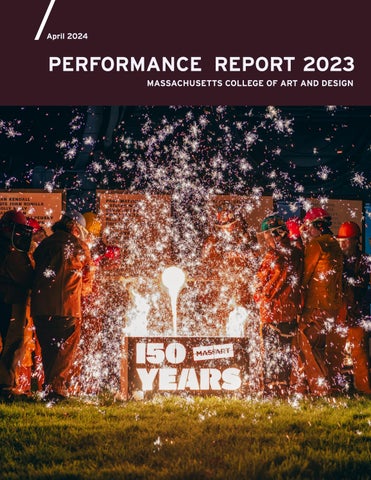
*Cover photography by Amy Fink. MassArt 150th Anniversary Iron Pour on the Greenway. Backpage photography by Jorg Meyer.
INTRODUCTION
Partnership Renewal Plan
Reporting Periods
Celebrating MassArt’s 150 Years
Art College Peer Group
Strategic Plan Refresh
Being a Student Ready College
INTRODUCTION
Partnership Renewal Plan
The first Massachusetts College of Art and Design (MassArt) Plan for a Partnership with the Commonwealth was subnmitted to the Board of Higher Education (BHE) under Chapter 26 of the Acts of 2003, Sections 49, 50, 633, and 634, and approved April 20, 2004. This legislation provided that a board of trustees of a state or community college with the potential to expand its mission, profile, and orientation to a more regional or national focus may submit to the BHE, for its approval, a five-year plan embracing an entrepreneurial model that leverages that potential in order to achieve higher levels of excellence. In 2005, the Legislature approved language to make permanent the provision in Section 633 that allowed MassArt’s trustees to retain all tuition and fee revenue.
This partnership has been renewed several times over the last 20 years and has successfully continued to the present day. MassArt has operated with the flexibility and autonomy to achieve its educational aspirations, fulfill its mission as the only independent public college of art and design in the country, develop new non-state revenues, and strengthen its role as a cultural and educational resource for other public institutions. As part of the agreement, MassArt committed to assessing and sharing the progress of this plan’s proposed goals and objectives and to adapting and implementing strategies to achieve the identified goals and objectives.
Reporting Periods
ENROLLMENT Final FY2023, preliminary FY2024
ADMISSIONS Fall 2023
FINANCIAL AID FY2023, Fall 2023
RETENTION, Cohort Years 2015 to 2022
GRADUATION RATES Cohort Years 2010 to 2017
DEGREES AWARDED, FY2023
TUITION AND FEE REVENUE FY2023
PEER FINANCIAL BENCHMARKS FY2022
Benchmarks use the most recent available peer data.
Celebrating MassArt’s 150 Years
MassArt’s legacy is one of bold thinking, educational excellence, and profound impact. Our students, faculty, alumni and staff are creative powerhouses who for 150 years have made groundbreaking contributions to our economy and our communities. As the nation’s only independent public college of art and design, we are deeply committed to bringing our talent and ideals to the work of creating a better world. Each day, our community does just that by exploring the amazing power and possibility of art and design. That spirit has guided us since 1873, and I am excited to see where it will take us—all of us—in the years and decades to come.
President Mary K. Grant, PhD
Art College Peer Group
MassArt’s peer group, approved by the Board of Higher Education, allows the institution to validly benchmark key performance indicators. This group, on average, is up to 50% larger or smaller than MassArt in enrollment, major offerings, and financial resources. These institutions provide the College an opportunity to track areas of strength and identify areas for improvement. MassArt is committed to using evidence to inform our decision that best supports institutional effectiveness.
Art Center College of Design
California College of the Arts
California Institute of the Arts College for Creative Studies
Columbus College of Art and Design
Maryland Institute College of Art
Ringling College of Art and Design
Rhode Island School of Design
School of the Art Institute of Chicago
The University of the Arts
Photography by Amy Fink
INTRODUCTION
Strategic Plan “Refresh”
The 2023-2024 academic year is the midpoint of MassArt’s ten-year strategic plan, this milestone provides a natural point to check-in on the progress of the plan and to consider the unprecedented and ongoing impact of the Global pandemic. In light of this, President Mary K. Grant convened a Strategic Planning Committee to “refresh” the plan, building upon core strengths while identifying areas of strategic improvement, growth, and opportunity. The Committee is composed of faculty, staff, and students who engaged in a participatory process this academic year to develop a refreshed plan.
This participatory process ensured that the plan:
• Builds on MassArt’s strengths,
• Reaffirms our mission, vision, and values
• Leverages and extends work already in progress,
• Responds to changes in the environment since the 10-year plan was developed, and
• Aligns our Partnership Plan and the BHE Racial Equity Plan.
A key aspect of the strategic planning process was a series of input sessions. The Strategic Planning Committee convened these discussions at important junctures in the process to ensure that the MassArt community could, by design, inform each stage of the plan’s development.
Early discussions focused on broad based information-gathering, while later ones were designed for comment on the emerging plan. Once the preliminary plan was developed, the sessions focused on the various roles that each group would play in bringing the plan to life.
In addition to the work of the strategic planning committee, MassArt Community input to date has included the following:
• Extended Cabinet
• Board of Trustees
• Department Chairs
• Foundation Board
• Faculty and staff input sessions
• Online survey for faculty and staff
• Student sessions
Ongoing discussions have continued into the new year with the Strategic Planning Committee to shape a final refreshed plan and to deliberately connect it to our Partnership Plan so that it serves as an enabler of the Strategic Plan. The next steps in this process are to present a final refreshed plan to the Board of Trustees and Board of Higher Education for approval by the end of June 2024 with an expected summer 2024 launch.
Being a Student Ready College
Center for Student Success
During the academic year 2022-2023 we conducted a detailed study to better understand the opportunities to strengthen services, support, and approaches to centering student success. We are using the framework, Becoming A Student-Ready College (McNair, 2022) to focus us on fostering a culture of inclusive leadership, creating opportunities to better understand who our students are and being intentional about long-term strategies. Upon completion of the study and to ensure that progress would continue, in fall 2023, President Grant formed an interdivisional task force of faculty and staff to focus on:
• Advising;
• Transfer Pathways;
Photography by Amy Fink
• Developing a student ready framework;
• Integrating strategies to the State’s Equity Agenda.
During the 2023-2024 academic year, this group has begun to develop strategies and action plans to move this work forward. The framework for this project is focused on an exploration of centering on student success and engagement in a more comprehensive fashion involving the entire campus as the student experience is complex and multi-faceted. This group will report back to senior leadership about recommendations on how to successfully launch this center in the next couple of years with developed measurable goals.
Center for Teaching and Learning
To address the changing needs of our students, explore deeply the opportunities and challenges of technology (such as AI), and to respond to the strategic priorities of the institution, MassArt is at the early stages of developing a Center for Teaching and Learning (CTL). Course release time has been provided to three faculty members working across disciplines to assess the needs of the faculty and establish a framework to advance this important strategic priority. During the 2023-2024 academic year, this team held several listening sessions to collect a broad perspective of what the MassArt community was thinking/
feeling regarding support for teaching, scholarly pursuits and professional practice. These sessions were conducted as open sessions as well as sessions that focused on specific groups and departments on campus (e.g. Librarians, CACP, ALANNA faculty, staff, etc.). This also included bringing guest speakers to converse with selected faculty, staff, and students. Currently, this team of faculty is developing the following:
• CTL’s mission statement;
• The Center’s structure
• How the CTL is positioned within the university;
• A digital platform for communicating the Center’s activities and resources to university members;
• A physical location;
• A sustainable vision for CTL’s leadership and supporting resources.
This team will provide a complete report about their recommendations with measurable goals in the late spring 2024 semester to the Provost and Vice President of Academic Affairs including a timeline to launch the center in the next couple of years.
Photography by Amy Fink
KEY INDICATORS
Academic Quality
Access and Affordability
Student Success and Engagement
Service to the Commonwealth and the Economy
Financial Health
ACADEMIC QUALITY
ADMISSIONS STANDARDS
First-time First-Year Students
The admission process at MassArt is holistic and considers both academic achievements and artistic potential. For first-time first-year students, the greatest weight for admissions decisions is placed on high school GPA and the quality of the application portfolio. MassArt does not consider standardized tests in its admissions or merit scholarship decision process. These are the Fall 2023 outcomes.
3.56 was the average weighted GPA
86% had GPA of 3.0 or higher
91% did not submit standardized test scores
2.0 was the lowest high school GPA reported
Transfer Students
Transfer students, on average, make up 20% of the incoming class each fall. Providing access to transfer applicants, particularly those from community colleges, is an important priority in MassArt's enrollment plan. The transfer admissions process strives to both maintain high standards and minimize time to degree completion. In Fall 2023, the average college GPA for entering transfer students was 3.41 and 82% had a college GPA of 3.0 or higher.
ADMISSIONS SELECTIVITY
In Fall 2022, MassArt ranked 7th in our AICAD peer group for admission selectivity, accepting 79% of completed first-time first-year undergraduate applications. The most selective college in the group was Rhode Island School of Design, with a reporting acceptance rate of 17%. The least selective was Columbus College of Art and Design, at 91%. The median acceptance rate was 74%. The Fall 2023 data is not yet available for AICAD peers.
FACULTY CREDENTIALS
The Fall 2023 MassArt student to faculty ratio (student FTE to faculty FTE) for the BFA program is 9.77, which is higher than the peer group median of 7.94. In Fall 2022, full-time faculty made up 61% of the faculty FTE for MassArt’s BFA program, which is higher than the AICAD peer average of 58%. Ninetyfive percent of MassArt full-time faculty hold advanced degrees. This is the highest in the peer group, followed by California College of the Arts (94%) and Maryland Institute College of Art (93%).
ACCESS AND AFFORDABILITY
ENROLLMENT IN THE BFA DEGREE PROGRAM
Overall, BIPOC students enrolled in the BFA program represent approximately 31% of the population. This figure has remained constant over the last two years.
BIPOC includes Native American, Black/African American, Latinx, Asian, Hawaiian, Pacific Islander including students who self identify as two or more races. International students and those who did not report a race/ethnicity were excluded from these rates.
ACCESS AND OPPORTUNITY FOR URBAN AND COMMUNITY COLLEGE STUDENTS
MassArt through its Strategic Plan “Refresh” has made intentional focus to be a student-ready college especially for those who have been historically underserved. A high priority for the institution is to provide Massachusetts community college and urban high school students access to attend MassArt and pursue their artistic goals. We apply a holistic approach from recruitment to degree completion and systematize our practices of equity campus-wide.
Enrolled Applicants from Massachusetts Urban High Schools
MassArt is currently reviewing and revising its articulation agreements with Greenfield, Holyoke, Massasoit, and Roxbury Community Colleges. The Admissions and Academic Affairs Offices are also hoping to expand articulation agreements with Bunker Hill, Cape Cod, and Middlesex. These programs were chosen on both application numbers and strength of their art and design programs.
College Transfer Students Admitted
Grant Aid Awarded to Massachusetts Undergraduates
ENROLLMENT IN GRADUATE AND CERTIFICATE PROGRAMS
* Total Graduate and Post-baccalaureate Enrollment ** Total Undergraduate Certificate Enrollment (including Communication
Fashion Design and Furniture Design )
MassArt graduate programs provide access to advanced professional degrees in design and fine arts. Certificate programs offered at the undergraduate and post-baccalaureate levels provide preparation and credentials for professional practice or further education in the visual arts.
The market for graduate programs has become increasingly competitive over the past several years, despite that, there has been a slight increase in the overall Fall 2023 enrollment. Growth in enrollment is promising based on new leadership and engagement in innovative strategies of graduate and certificate programs as noted in the most recent strategic plan.
STUDENT SUCCESS AND ENGAGEMENT
RETENTION RATE FOR FIRST-TIME FIRST-YEAR STUDENTS
MassArt’s new Fall 2022 entering cohort of first-time firstyear students who returned the following fall term, a year later, had an 84% retention rate. MassArt has the second highest retention rate within Massachusetts state universities. Among our AICAD peers, we are 6th in retaining first-time first-year students. As MassArt intentionally focuses on being a student ready college, helping first-year students continue their educational journey through degree completion is a critical priority in the institution’s commitment to increase both the retention and graduation rates metric.
SIX-YEAR GRADUATION RATES
The most recent data available shows MassArt students who entered as a first-year student in Fall 2017 and completed their degree six-years later in 2023 had a graduation rate of 69%. This is a decline from the Fall 2016 Cohort’s six-year graduation rate of 74%. Our AICAD peer comparison group only had data available for entering first-year students in Fall 2016 who graduated in 2022. Among our AICAD peers, MassArt is 7th in graduating first-year students. The comparison data for the State of Massachusetts institutions is not readily available.
MassArt One-Year Retention Rates, Fall First-Year Cohort
MassArt Six-Year Graduation Rates, Fall First-Year Cohort
Retention Rates, Fall 2022
Cohort
and
Peers
Six-year Graduation Rates, Fall 2016 Cohort
and AICAD Peers
GRADUATION RATE BENCHMARKS
Six-year Graduation Rates, Fall 2016 First-Year Cohorts
MassArt and Massachusetts Public Universities
University of Massachusetts-Amherst
Massachusetts Maritime Academy
University of Massachusetts-Lowell
Massachusetts College of Art and Design
West eld State University
Worcester State University
Fitchburg State University
Bridgewater State University
Massachusetts College of Liberal Arts
Salem State University
Framingham State University
University of Massachusetts-Dartmouth
University of Massachusetts-Boston
Starting in 2017, the National Center for Education Statistics (NCES) began to track graduation rates for students who enter their current institution with prior postsecondary enrollments. The Partnership Plan with MassArt specifies measuring graduation rates for incoming transfer student cohorts using first-year graduation rates as a benchmark. Both groups include only students who attended full-time in their first enrolled semester. The chart below presents graduation rates for both first-year students and transfer cohorts over the past five years.
First-time First-Year vs. Transfer Student Graduation Rates Entering Fall Cohorts 2013 to 2017
SIX-YEAR GRADUATION RATE FOR BIPOC STUDENTS
Graduation Rate Comparisons, Fall 2016 First-Year Cohorts
MassArt and Massachusetts Public Universities
University of Massachusetts-Amherst
University of Massachusetts-Lowell
Massachusetts College of Art and Design
Massachusetts Maritime Academy
Massachusetts College of Liberal Arts
Worcester State University
Salem State University
University of Massachusetts-Boston
Fitchburg State University
Bridgewater State University
West eld State University
University of Massachusetts-Dartmouth
Framingham State University
BIPOC includes Native American, African American, Latinx, Asian, Hawaiian, Pacific Islander and multiracial students; international students and those who did not report ethnicity are excluded from graduation rate comparisons.
MassArt intentionally focuses on BIPOC students’ college experiences and tracks if their educational outcomes are disproportionate. BIPOC students on average comprise over 30% of the student population. It is also important to compare these outcomes to other Massachusetts public institutions. Therefore, the chart above displays the most readily available graduation rate data.
MassArt’s graduation rate for BIPOC students who entered as a first-time full-time student in Fall 2016 was 62% vs 67% for their white counterparts. MassArt’s BIPOC student graduation rate ranked third among Massachusetts public universities for the same cohort year.
SERVICE TO THE COMMONWEALTH AND THE ECONOMY
DEGREES AND CERTIFICATES
Degrees and Certificates Awarded
Design certificates include Communication Design, Fashion Design, Furniture Design, and Industrial Design. Post-baccalaureate certificates include Teacher Preparation, Dynamic Media, Photography, and Fine Arts.
BACHELOR OF FINE ARTS DEGREES
Degrees Awarded Annually in Design and Media Majors Degrees Awarded Annually in Teacher Preparation Programs
Graduates of MassArt’s programs in design and media serve the labor market needs of the Commonwealth’s creative economy. In the academic year 2022-2023, 76% (346/456) of all degrees and certificates awarded were in design (e.g., animation, architecture, communication design, fashion design, illustration, and industrial design) and media majors (e.g., film/video and photography).
ALUMNI OUTCOMES
Thirty-six Art Education degrees were awarded by MassArt in 2022-2023, representing a small decrease from the previous year, but consistent with upward trends over the past decade. Of these degrees, 81% were awarded to Massachusetts residents. Ninety-five percent of licensure track graduates passed the MTEL test.
BFA Graduate Results from the Strategic National Arts Alumni Project 2022
Time to obtain full-time employment
How important was each of the following to perform e ectively in your paid work?
Ability to adapt
Artistic technique
Collaboration with other cultures or demographics
Communication skills
Creative thinking and problem solving
Critical thinking
Evaluate multiple approaches to problem solving
Networking and relationship
Project management
FINANCIAL HEALTH
STATE OPERATING SUPPORT
The Partnership Plan agreement ensures the college can maintain financial health at a cost savings to the Commonwealth by MassArt gaining authority to set and retain tuition, accepting an equivalent reduction in the state maintenance appropriation, and actively managing enrollment. Additionally, MassArt must achieve the enrollment and tuition revenue targets set out in the plan’s business model, and operating appropriations from the Commonwealth must be consistent with the model’s projections.
MassArt has sustained enrollment goals over the duration of this agreement and in some years exceeded its annual goal, while keeping student charges affordable for Massachusetts residents, and steadily increasing institutional resources allocated to student financial aid. The pandemic impacted student decisions to enroll in college in fall 2020 and although enrollment patterns have fluctuated over the past few years, MassArt records its largest overall enrollment since prepandemic.
UNDERGRADUATE TUITION AND FEES
The combination of increases in tuition and fees as well as enrollment growth in the BFA program has resulted in an increase in net revenue from undergraduate student charges. The chart at right shows the growth in retained tuition by student residency status since the start of the Partnership agreement. From FY20-FY24 the tuition and fees have grown at an average rate of 2.5% annually
As specified in our performance agreement, the tuition FTE is defined as the full-time student headcount plus 60% of the part-time headcount, which reflects MassArt's allocation of student charges.
Undergraduate Tuition and Fee Revenue FY2023
FINANCIAL HEALTH
TUITION DEPENDENCY
Core expenditures include tuition and fees; federal, state, and local appropriations; government grants and contracts; investment income gifts; and other operating and non-operating sources. Tuition and fees in these charts include revenue from all programs.
The percentage of total core revenues derived from tuition and fees suggests the degree to which an institution’s operations depend on annual student charge revenue. The state operating appropriation makes MassArt less dependent on student charges than our AICAD peers enabling the college to remain affordable and accessible to Massachusetts residents. Although the state appropriations have increased, they have not kept pace with increases due to inflation and expenses (including fringe benefits) associated with the collective bargaining costs
MassArt Tuition and Fees as Percent Distribution of Core Revenues, FY2023
for MSCA, APA and AFSCME personnel. Additionally, Non Unit professionals are not covered by supplemental funding or base increases - expenses not covered through the state appropriation are addressed through tuition and fees, auxiliary revenue, grants and fundraising.
ENDOWMENT
MassArt’s Foundation has the responsibility to raise funds that support scholarships, academic programs, and institutional inititiatives to enhance and advance the mission of the College. Based on a three-year average, the current endowment of the Foundation hovers around $15M. These numbers dipped in 20212022 but saw a substantive growth in the 2022-2023 fiscal year, $13.3M to $15.3M, respectively. The chart below shows the most recent available AICAD peer group (FY2022), where MassArt reports the smallest endowment per FTE (full-time equivalent) compared to our counterparts.
MassArt Endowment and Related Investments, FY2023
AICAD Peers Tuition and Fees as Percent Distrubtion of Core Revenues, FY2022
per FTE, FY2022
AICAD Peers Endowment
PEER EXPENDITURE BENCHMARKS
The peer benchmarking figures reported on this page are based on selected institutions who reported their finance information to the National Center for Education Statistics (NCES) Integrated Postsecondary Education Data System (IPEDS). The Peer Comparison system allows institutions to identify a select group of peers they want to compare certain key indicators. MassArt identified these peer colleges to benchmark and track our progress with like institutions related to core expenditures. The most recent data available for these institutions posted on the NCES site for the IPEDS finance survey is the fiscal year 2021-2022.
Core Expenditures per FTE, FY2022
Rhode Island School Of Design
California Institute Of The Arts
Ringling College Of Art And Design
Massachusetts College of Art and Design
Art Center College of Design
California College Of The Arts
The University Of The Arts
Maryland Institute College Of Art
College For Creative Studies
School Of The Art Institute Of Chicago
Columbus College Of Art And Design
Instruction and Academic Support to Core Expenses Ratio, FY2022
Art Center College of Design
Maryland Institute College Of Art
California Institute Of The Arts
Ringling College Of Art And Design
School Of The Art Institute Of Chicago
The University Of The Arts
California College Of The Arts
Columbus College Of Art And Design
Rhode Island School Of Design
College For Creative Studies
Massachusetts College of Art and Design
Because we are a public institution, the state appropriations are used to offset the cost of education and are not included in the institutional support. The Mass Grants and Mass Grants Plus were increased substantially over the past two years during this period, so students with the most need received additional support to meet the cost of education.
Institutional Support to Total Core Expenses Ratio, FY2022
Rhode Island School Of Design
Columbus College Of Art And Design
College For Creative Studies
California College Of The Arts
Ringling College Of Art And Design
The University Of The Arts
California Institute Of The Arts
School Of The Art Institute Of Chicago
Massachusetts College of Art and Design
Art Center College of Design
Maryland Institute College Of Art
Institutional Support Costs per FTE, FY2022
Rhode Island School Of Design
California College Of The Arts College For Creative Studies