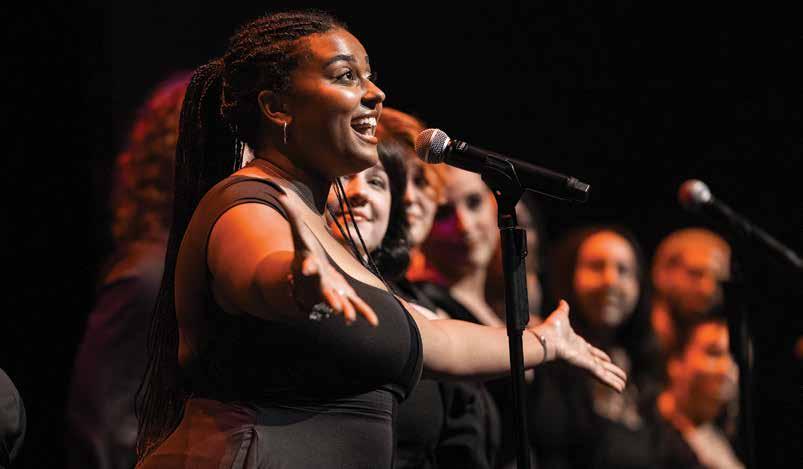
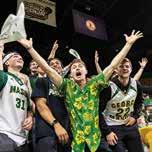
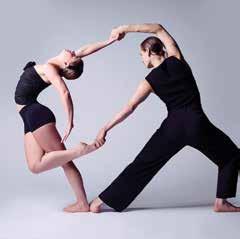
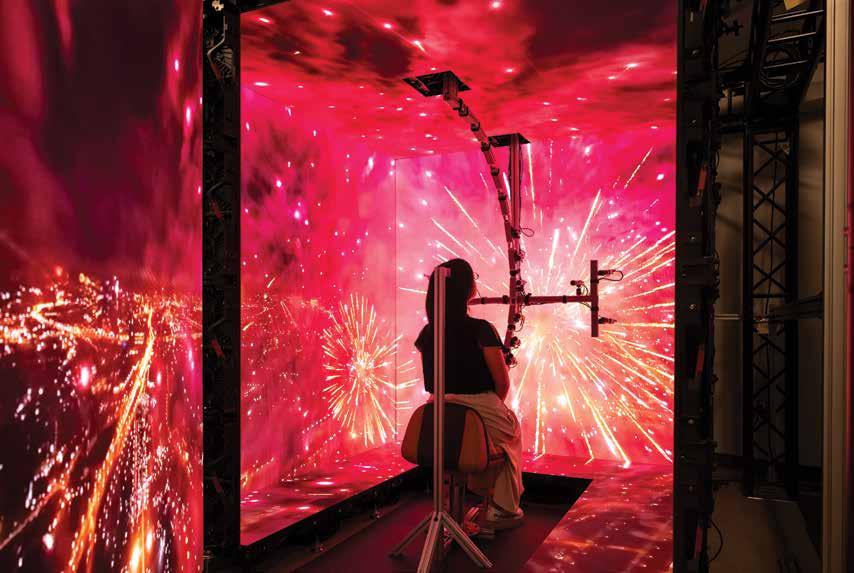
Theater major Jennah Sidiabed, part of the cast of Natasha, Pierre, and the Great Comet of 1812 ,
performs an excerpt from the show during the 20th ARTS by George! The benefit raised more than $285,000 in support for student scholarships in visual arts, dance, music, theater, game design, film, and arts management, as well as for the Mason Community Arts Academy, Green Machine Ensembles, and the Great Performances at Mason season at the Center for the Arts.
MASON WINTER SPIRIT 2026
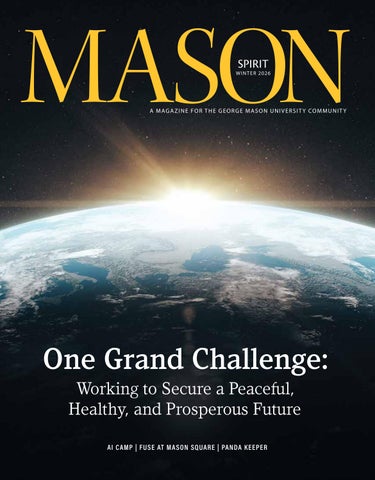
ABOUT THE COVER
George Mason’s Grand Challenge Initiative is a research framework to address “humanity’s ultimate grand challenge”—securing a peaceful, healthy, and prosperous future.
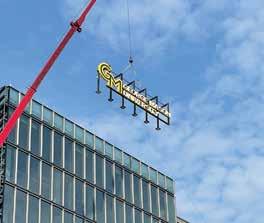
LIGHTING THE FUSE
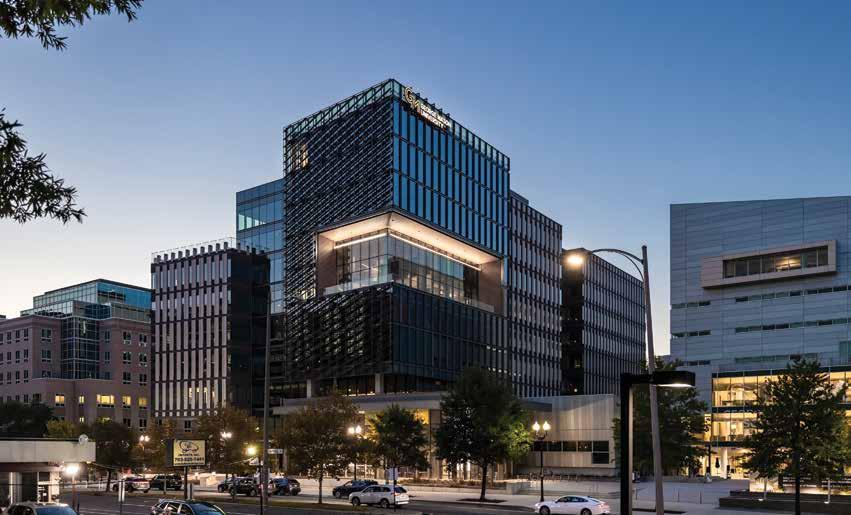
In September, Fuse, George Mason’s hub of innovation at Mason Square, was celebrated in style. See the story on page 12.
CONNECT WITH GEORGE MASON UNIVERSITY
Scan the QR codes you’ll find throughout #MasonNation • gmu.edu the magazine with your smartphone’s camera app for associated websites @georgemason @georgemasonu with more details. @georgemasonu @georgemasonuniversity
PHOTO BY EVAN CANTWELL
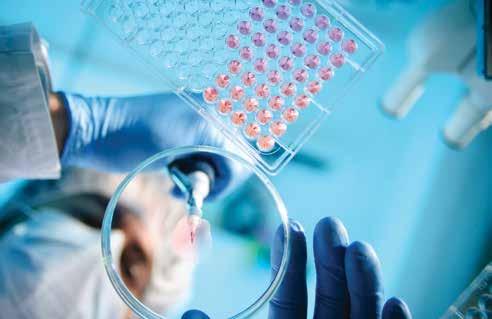
Photo by Getty Images
A Future We Want—One Grand Challenge. Six Grand Solutions. The university’s Grand Challenge Initiative aligns university resources, faculty expertise, and educational programs around six interconnected solution areas focused on securing a peaceful, healthy, and prosperous future.
FUTURE FOCUSED
One of my favorite proverbs is “You don’t dig a well when you’re thirsty.” So when we determined about 18 months ago that securing external research funding was about to become more challenging, we identified ways to align our vast faculty expertise with the pressing issues likely to attract funding in an increasingly competitive research landscape.
I am pleased to share that our faculty are aligned and moving forward in unified pursuit of grand solutions to humanity’s ultimate grand challenge: To preserve and protect humanity’s ability to build the future of its choosing. That ability is very much in question, but our faculty aim to reintroduce confidence in our capacity to solve for it with the Grand Challenge Initiative (GCI).
A committee of faculty, staf, and students from across our schools and colleges, led by Andre Marshall, vice president for research, innovation, and economic impact, completed the first dificult task of the initiative when they narrowed a list of 84 ideas to six interlocking solutions to humanity’s greatest challenge of self-preservation and determination.
The six grand solutions our faculty are now pursuing are: advancing 21st-century education for all; building a climate-resilient society; driving responsible digital innovation and sustainable infrastructure; improving human health, well-being, and preparedness; pioneering space exploration, research, and collaboration; and strengthening peace, trust, and engagement in democracy.
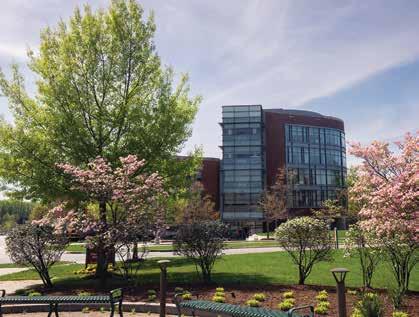
We launched GCI with a $15 million strategic investment through 2030 to fund talent, projects, programming, and infrastructure. Two buildings key to the initiative opened in 2025—Fuse at Mason Square in Arlington and the Life Sciences and Engineering Building on the Science and Technology Campus in Manassas. You’ll read about some of the foundational GCI work in this issue.
Society looks to leading research universities like George Mason to find bold solutions to what appear to be unsolvable challenges and to prepare future problem solvers. Our sponsored research expenditures grew by 64 percent between 2020 and 2025, a rousing endorsement of the groundbreaking work conducted by our faculty across disciplines and an indication of partners across government, industry, and the nongovernmental sector eager to work with us.
As Dr. Marshall says, we aim to build ecosystems around these communities of experts, partners, and networks. Activation of all can lead to innovation, results, and impact. GCI will also integrate global grand challenges into academic programs as we develop the problem solvers of the future.
In this competitive research landscape of fewer resources, we are choosing to invest while others retrench. This is similar to the strategic investments we made during the pandemic. While others stood still, we came out stronger on the other side because of our investments.
We must work together to create the world we want to live in and leave for future generations. If not us, then who? Our faculty’s unity of purpose is inspiring and truly puts the “all together” in All Together Diferent.
We think the wells we’re digging will yield a flow of breakthroughs across disciplines and around the world.
Gregory Washington
President, George Mason University
MASON SPIRIT
A MAGAZINE FOR THE GEORGE MASON UNIVERSITY COMMUNITY
spirit.gmu.edu
MANAGING EDITOR
Colleen Kearney Rich, MFA ’95
ART DIRECTOR
Joan Dall’Acqua
ASSOCIATE EDITORS
Melanie Balog, PhD ‘25
Priyanka Champaneri, BA ’05, MFA ’10
Anne Reynolds
EDITORIAL ASSISTANT
Katarina Benson, BA ‘24
CONTRIBUTORS
Shayla Brown
Paola Duran
Danielle Hawkins, MPA ‘22
Sarah Holland
John Hollis
Rebecca Kobayashi
Buzz McClain, BA ‘77
Amanda Milewski
Katie Pearce
Laura Powers
Lauren Clark Reuscher, MA ’12
Corey Jenkins Schaut, MPA ’07
Preston Williams
GRAPHIC DESIGN
Claire Brandt
Angel Lee
Jeeun Lee Namgoong
Michaela Reilly, BA ’21
PHOTOGRAPHY AND MULTIMEDIA
Ron Aira
Melissa Cannarozzi, MA ’22
Evan Cantwell, MA ’10
Eduardo Macedo
Cristian Torres
PRODUCTION MANAGER
Brian Edlinski
EDITORIAL BOARD
Stephanie Aaronson, BA ‘94
Deputy Vice President for Communications and Digital Strategy
Paul G. Allvin
Vice President for University Branding and Chief Brand Oficer
Trishana E. Bowden
Vice President for Advancement and Alumni Relations
Robin Rose Parker
Associate Vice President for Advancement
Communications and Donor Stewardship
Jennifer W. Robinson, JM ’02
Associate Vice President for Alumni Relations
Mason Spirit is published three times a year by the Ofce of Advancement and Alumni Relations and the Ofce of University Branding. George Mason University is an equal opportunity employer that encourages diversity.
PHOTO
What I Wish I Knew About Job Fairs at George Mason
When I was a student at George Mason University, I never attended a single job fair. I already had a full-time job in IT and had secured an internship with Amazon Web Services. I thought I was set for success—that job fairs were for people still looking for opportunities.
Looking back, I realize that was one of the biggest mistakes of my academic life. Yes, I had a strong start, but success isn’t just about landing a job—it’s about staying ready for the next one. Career growth doesn’t end with employment; it grows through connection, communication, and confidence—skills you sharpen by networking and interviewing, not just working.
Now, as a graduate balancing career and adult responsibilities, I see the value those events could have brought. Job fairs aren’t just about finding a job—they’re about training yourself to stay marketable. They teach you how to tell your story, handle interviews, and connect with professionals who might one day open doors you didn’t even know existed.
If I could go back, I’d tell my younger self this: Opportunity doesn’t always knock— it often sets up a booth at the job fair. To every current student reading this: Show up. Even if you think you’re already “set.” You’ll thank yourself later.
Haseena Saleh, BS Information Technology ’25
Letters to the editor are welcomed. Send correspondence to Colleen Kearney Rich, Managing Editor, Mason Spirit, 4400 University Drive, MS 2F7, Fairfax, Virginia 22030.
Or send an email to spirit@gmu.edu
Need to change your address or update contact information with us? Or prefer not to receive the magazine in the mail any longer?
Just let us know via email at development@gmu.edu
The programs and services ofered by George Mason University are open to all who seek them. George Mason does not discriminate on the basis of race, color, religion, ethnic national origin (including shared ancestry and/or ethnic characteristics), sex, disability, military status (including veteran status), sexual orientation, gender identity, gender expression, age, marital status, pregnancy status, genetic information, or any other characteristic protected by law. After an initial review of its policies and practices, the university afirms its commitment to meet all federal mandates as articulated in federal law, as well as recent executive orders and federal agency directives.
Mason Spirit content may not be reproduced without prior written permission. To request permission for any form of reproduction or reuse, please contact spirit@gmu.edu.
@ MA
STUDENT PROJECT SHOWCASES COMMITMENT TO ENVIRONMENTAL STEWARDSHIP
LEARN MORE.
go.gmu.edu/ oysterreef
THE WORLD’S YOUR OYSTER, AS THE SAYING GOES —but what happens when oysters start disappearing from the world? It’s a real problem that George Mason University students are working to help solve. Oysters are a keystone species in the Chesapeake Bay, and their growth forms the foundation of reef structures that support a wide array of marine life. Take away the oysters, and a lot of other species reliant on those reef structures will start to sufer as well.
“Oysters are critical to water filtration, carbon sequestration, and nutrient cycling,” says alum Camille Larkin, BA Environmental Science ’25. “Unfortunately, their populations have declined due to habitat degradation, disease, and overfishing.”
At George Mason, students saw this problem as an opportunity to help while also translating ecological science into hands-on projects. In spring 2025,
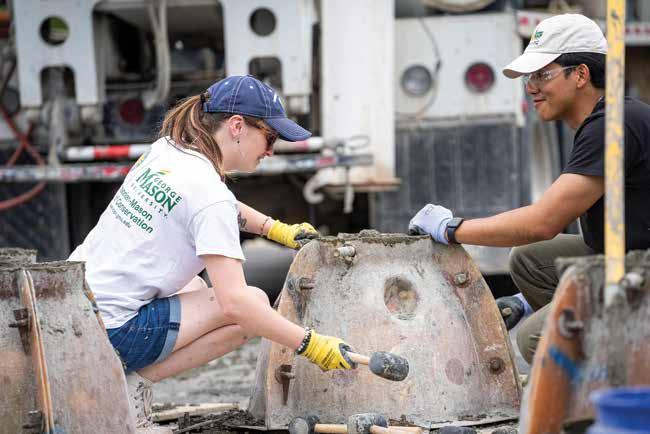
Larkin and her classmates in EVPP 480 Sustainability in Action gave a crucial boost to Chesapeake Bay oysters by constructing artificial reef structures called reef balls.
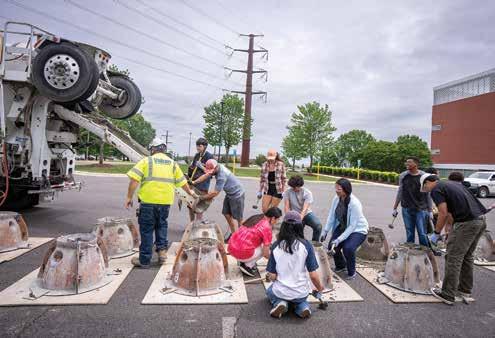
Larkin and classmates Noah Beck, BA Environmental and Sustainability Studies ’25; Erin Dougherty, BA Environmental and Sustainability Studies ’25; and Alex Peterson, BA Environmental Science ’25, worked together to develop the Chesapeake Bay Oyster Restoration Education Project. This interdisciplinary efort focused on habitat creation, environmental education, and community engagement. With support from the Patriot Green Fund, they partnered with Coastal Conservation Association Maryland (CCA) and its flagship initiative the Living Reef Action Campaign (LRAC) to host a two-day event on the Science and Technology Campus that brought together nearly 25 volunteers. Together,
Right and next page, George Mason student volunteers help with the concrete pour on the Science and Technology Campus.
they assembled the molds provided by CCA and assisted in the concrete pouring efort, courtesy of Vulcan Materials, to build 20 oyster reef balls. The reef balls are approximately three feet high and weigh about 250 pounds each.
Department of Environmental Science and Policy professors and George Mason alumni Dann Sklarew, PhD Environmental Science and Public Policy ’00, and Jennifer Sklarew, PhD Public Policy ’15, co-taught the students.
“This project started with four students who asked, ‘Why stop at improving our campus when we could make a diference across the entire Chesapeake Bay?’” says Dann Sklarew, highlighting the students’ bold George Mason approach to thinking in ways that maximize impact.
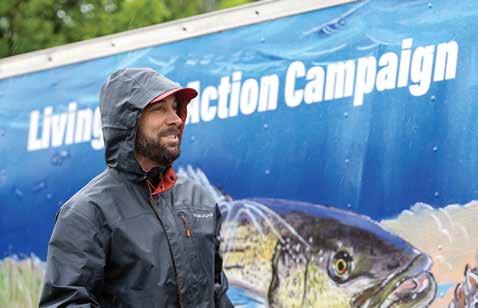
LRAC representative and George Mason alum Jesse Howe, MEd Curriculum and Instruction ’16, who is assistant director of CCA, led the volunteers. Howe has been conducting these reef-building workshops throughout the Washington, D.C., metropolitan area for several years as part of his CCA advocacy work.
Howe says he was happy to hear from the students when they reached out to him about the reef project. “It’s important work,” he says. “These volunteers are helping to create an ecosystem and support life in a spot of the Chesapeake Bay that has been devoid of that life for many decades.”
After graduating from George Mason, Howe taught in Latin America for nearly a decade before turning to conservation work. Those teaching skills serve him well as he regularly talks students of all ages through the steps of building the reef balls.
After the concrete structures cure for more than a year, they will be deployed at sites across the lower Potomac River and middle Chesapeake Bay and are expected to bolster oyster populations and habitat to support diverse marine life. According to Dann Sklarew, “The [reef balls] were designed with rough surfaces to enhance the attachment of oysters and other stationary estuarine organisms, creating
George Mason alum Jesse Howe of Maryland’s Coastal Conservation Association has been leading reefbuilding workshops around the region.
habitats for fish, shellfish, and even dolphins that pass through the bay.”
Miniature versions of the reefs will be displayed on campus, alongside educational materials about oyster ecology and conservation in the Chesapeake Bay.
“We believe giving the George Mason community a hands-on role in this project builds awareness and fosters a sense of personal connection to local environmental challenges,” says Dougherty.
By combining cutting-edge scientific research with community-driven action, George Mason faculty and students are advancing reef science while realizing tangible restoration results.
—Laura Powers
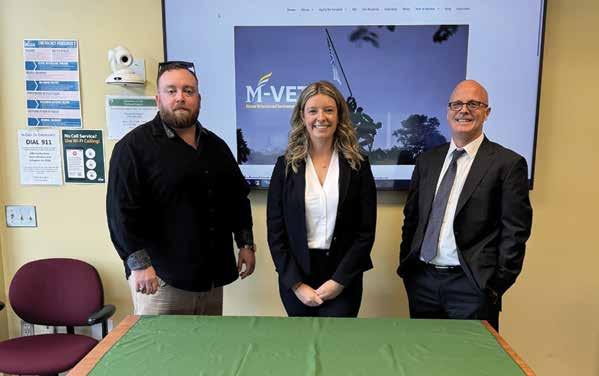
From left, M-VETS client Richard Fahlman, student advisor Samantha Hargis, and M-VETS director Timothy M. MacArthur.
A VOICE FOR THOSE WHO SERVE
IN MAY, ANTONIN SCALIA LAW SCHOOL
Since its inception, more than 178 George Mason law students have enrolled in M-VETS, and several dozen have been accepted into a JAG Corps after graduation.
student Samantha Hargis, JD ’25, advocated for a U.S. combat veteran before an administrative law judge at a hearing before the U.S. Department of Veterans Afairs (VA) Board of Veterans’ Appeals.
She is part of a long George Mason tradition of advocacy via the Mason Veterans and Servicemembers Legal Clinic (M-VETS). Founded in 2004, M-VETS enables law school students to assist veterans, service members, and their dependents with military/veteran/VA administrative matters.
Hargis’s case centered on a veteran’s 2016 claim for an increased rating for a service-connected disability resulting from an improvised explosive device attack in Afghanistan, which led to the veteran’s medical separation from the U.S. Army.
Originally, Army veteran Richard Fahlman received a 20 percent disability rating for his injury, but based on new medical evidence, M-VETS filed a request in 2019 to increase this rating to 40 percent. The VA initially denied the request. Had the 40 percent rating been approved, Fahlman would have been medically retired and received all the benefits accompanying that status, including much-needed health care. In response to the VA’s rejection, M-VETS filed a motion alleging a Clear and Unmistakable Error (CUE).
“I’m glad our client reached out to M-VETS, and we could advocate on his behalf at this hearing,” says M-VETS Director Timothy M. MacArthur. “Our position was that the decision review oficer had made a CUE error, contradicting federal law and regulatory standards.”
M-VETS provides Scalia Law students with the opportunity to put their learning into real-world practice. Many law school students, called student advisors at M-VETS, worked diligently over the years on behalf of Fahlman during case preparations. Hargis was chosen to conduct the hearing under MacArthur’s supervision.
“Working on this matter for our client was an incredible opportunity,” says Hargis, who graduated in May. “I am deeply grateful to the student advisors who came before me and laid a solid foundation for our argument at the hearing, our client for his commitment and collaboration throughout the process, and my supervising attorney for his invaluable guidance and support.”
“[Hargis] did a phenomenal job arguing the motion and presenting evidence during the hearing,” MacArthur says. “She conducted a pre-hearing conference with the judge, delivered an opening statement, conducted a direct examination of our client, and delivered an impactful closing, efectively arguing our position.”
MacArthur says the VA benefits process allows M-VETS student advisors to gain practical experience in a nonadversarial setting, while providing valuable pro bono services to veterans.
“Mr. MacArthur and Ms. Hargis put their heart, time, and soul into developing my defense, and I couldn’t have asked for a better legal team,” Fahlman says. “Without M-VETS, combat veterans like me wouldn’t have a voice.”
M-VETS continues to work with Fahlman while the hearing outcome is pending.
INAUGURAL AI SUMMER CAMP BUILDS CRITICAL TECH SKILLS—AND TINY ROBOTS
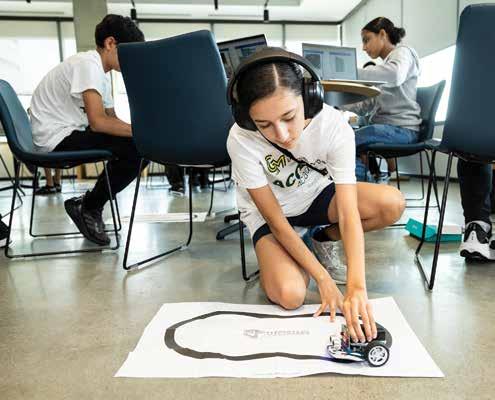
ON THE THIRD FLOOR OF FUSE AT MASON SQUARE , high school students huddle around laptops and inspect the codes on display in their Microsoft MakeCode programs. By their sides are little micro:bit three-wheeled robots. One sings a little 8-bit tune. Another flashes a pattern of colored lights. Another chirps like a bird, as the students at the table share a perplexed look.
These high school students have spent the past week working on their robots, from assembly to coding, to make them do basic tasks like follow a provided track. Now, they’re each trying to do something new: make it go faster or play a song. With every spinout, crash, or odd sound, the students return to their laptops to reprogram the bot and try again. If one student is struggling, they turn to their peers. Together, they’re making the robots work.
This is the inaugural ACCESS Academy Artificial Intelligence Summer Camp. Open to 9th to 12th graders in Virginia, 130 students participated in the sessions at the ACCESS Academy headquarters inside Fuse at Mason Square. Through hands-on exploration of artificial intelligence (AI) and robotics, students can imagine and begin preparing for technology-sector careers.
“The goal of ACCESS Academy is to create a more inclusive pathway to college and high-demand careers for students who may not have previously seen those opportunities as within reach,” says Dean Ingrid Guerra-López of George Mason’s College of Education and Human Development.
“We continue to hear from industries that we are not preparing our high school graduates to be employable,” says Roberto Pamas, professor of education leadership and director of the ACCESS Academy. Prior to his transition to teaching higher education, Pamas served 30 years in Fairfax County Public Schools as both an educator and an administrator. “They want both technology skills and soft skills— how to collaborate, how to communicate. We’re building those skills in these programs.”
Working with faculty from the College of Engineering and Computing, the ACCESS Academy team developed a five-day program to build foundational skills to set students up for success.
“AI represents a cutting-edge field and a dynamic problem space where students can practice
essential skills such as critical thinking, ethical reasoning, collaboration, and problem-solving,” says Guerra-López. “It’s not just about coding, but about asking better questions, evaluating outputs, and imagining new possibilities.”
After each day, students wrote down one word to describe their experience. From the first week, the white board was filled with words like “fun,” “inspiring,” and “fascinating.”
Guerra-López envisions the bootcamp as a launchpad for expanding access to AI education across the region. “The tinkering lab in particular is a powerful way to reduce anxiety around emerging technologies, increase skill and self-eficacy for both students and educators, and foster a stronger sense of community around innovation,” she says.
Plans are underway to explore how this model can scale—both to ofer more advanced learning tracks for students and to engage educators in professional development that supports responsible, inclusive digital innovation.
—Sarah Holland
ACCESS Academy campers learned to program micro:bit three-wheeled robots during their weeklong experience at Fuse.
BY RON AIRA
PHOTO
COWEN NAMED TO INAUGURAL TIME100 PHILANTHROPY LIST
GEORGE MASON UNIVERSITY ECONOMICS
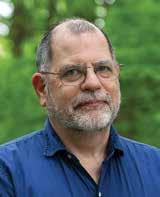
PROFESSOR and alum Tyler Cowen, BS Economics ’83, has been named one of TIME magazine’s 100 most influential people in philanthropy.
Cowen is being recognized for his leadership of Emergent Ventures, a fellowship and grant program housed at George Mason’s Mercatus Center, that backs entrepreneurial thinkers and doers with extraordinary potential. Since its launch, Emergent Ventures has funded more than 1,000 individuals around the world who are advancing work across a wide array of fields, including science, policy, and journalism.
“I’ve focused on trying to mobilize talent that otherwise is not discovered or inspired,” Cowen told TIME, explaining that he screens most of the applications himself.
Emergent Ventures’ successes include funding one of the first COVID-19 saliva tests via its Fast Grants program and a prison reform start-up that used data
analysis to identify more than 150,000 safe candidates for early release. With its overarching goal of positive social change and its inventive approach to funding that bypasses more traditional routes, the program is helping to jumpstart innovation across the globe.
Cowen, who has led Emergent Ventures since 2018, is the director of the Mercatus Center and a faculty member with the Economics Department’s Center for Study of Public Choice. A nationally renowned economist, he is a columnist for The Free Press and contributes daily to the Marginal Revolution blog.
The inaugural TIME100 Philanthropy list recognizes 100 individuals who are reimagining the ways giving can drive meaningful change. Philanthropists from 28 countries made the list, including Warren Bufet and Oprah Winfrey. Cowen was recognized in the innovators category along with Catherine, Princess of Wales, and skateboarder Tony Hawk.
POINT OF
George Mason’s College of Public Health has been awarded accreditation from the Council on Education for Public Health (CEPH), becoming the first and only college of public health in Virginia to earn this designation. CEPH, the leading accrediting body for public health schools and programs, rigorously assesses institutions to ensure they meet the highest standards for academic excellence and realworld impact.
PHOTO BY EVAN CANTWELL
PHOTO BY SHELBY BURGESS
REINVENTING VIRGINIA’S HEALTH CARE FUTURE
AS VIRGINIA FACES GROWING SHORTAGES in the health care workforce, the Claude Moore Foundation and George Mason University have formed a groundbreaking partnership to seek solutions and build a flexible, inclusive, and data-driven workforce pipeline. The efort is one designed not just to meet current needs but to shape a stronger, more equitable future for health care in the commonwealth.
At the center of this partnership is William Hazel, former Virginia secretary of health and human resources and now CEO of Claude Moore Opportunities, the foundation’s arm for strategic partnerships. Hazel’s longstanding relationship with the university—he served as senior advisor for strategic initiatives from 2018 to 2020—helped seed many of the elements that define this collaboration. The Claude Moore Foundation’s guiding philosophy is to open doors and expand opportunity. By investing in innovative models that expand access and strengthen workforce readiness, the foundation is helping to remove barriers and build ladders —a mission that closely matches George Mason’s committment to access.
Through George Mason’s Center for Health Workforce at the College of Public Health, the university plays a leading role as Virginia’s hub for workforce research and strategy. The center’s work has led to the development of statewide data platforms that have shaped policy, informing local pilot programs
in more remote areas of Virginia and driving conversations about behavioral health and early childhood care.
The Claude Moore Career Highway is one pathway to draw more health care workers. This new framework treats the health care workforce not as a single pipeline but as a network, ofering “on-ramps and of-ramps” to support Virginians seeking this career path at any stage of life, whether they’re high school students, career switchers, or adults returning to school after time away. The Claude Moore Scholars Program is another key component of eforts to expand the workforce, introducing high school students to health care careers through hands-on experiences and clear pathways from K–12 to college to career. Already active in 17 Virginia districts and expanding, the program reflects both Claude Moore’s and George Mason’s shared commitment to access, equity, and tangible outcomes.
The impact is immeasurable. Many of the program’s graduates return to serve in their home communities, reflecting a model that’s not just about producing talent—but producing the right talent for Virginia.
As Hazel puts it, “This workforce issue is cresting. The question is how do we attract people, train them, and help them grow?” Thanks to the partnership between Claude Moore and George Mason, Virginia is beginning to answer that question—boldly, equitably, and with lasting impact.
participants in a recent Sources of Strength suicide prevention training.
This partnership is part of Mason Now: Power the Possible, George Mason’s historic $1 billion campaign to advance student success, research, innovation, stewardship, and community engagement.
From left, George Mason PhD student Lucy McClellan, Bill Hazel, and Center for Community Mental Health director Robyn Mehlenbeck (far right) with
PHOTO BY JEROME
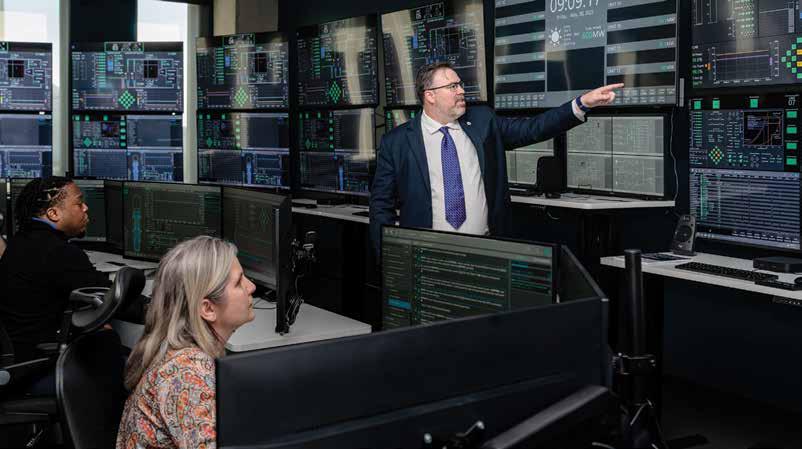
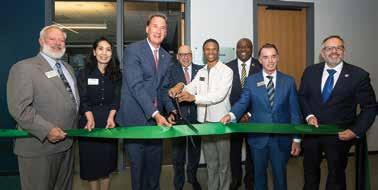
The NuScale E2 Center is one of the many resources available in the new Fuse building, designed to prepare the next generation of industry leaders. Inset, Governor Glenn Youngkin with university and local leaders at the ribboncutting in September.
NEW E2 CENTER POWERS THE NEXT GENERATION
WITH THE OPENING OF THE NUSCALE ENERGY EXPLORATION (E2) CENTER at Fuse at Mason Square, George Mason is now one of 10 locations worldwide where students can work with a state-ofthe-art simulator that replicates a NuScale small modular reactor control room and engage with real-life scenarios that bridge theoretical knowledge with practical application.
Created in partnership with the NuScale Power Corporation, George Mason’s center is the largest of its kind in the United States and designed to engage students in hands-on nuclear science and engineering educational activities. It is funded by a grant from the Virginia Clean Energy Innovation Bank, which is powered by the Virginia Department of Energy, as a strategic investment in the state’s nuclear energy workforce development.
“Partnerships such as this give our students the tools and education they will need to prepare for the future and become part of Virginia’s dynamic workforce,” says Ken Ball, dean of the College of Engineering and Computing at George Mason.
“A reliable and increasingly clean energy future is what the Virginia Clean Energy Innovation Bank is all about,” says Glenn Davis, director of the Virginia Department of Energy. “With this investment alongside world-class higher-education partners at
George Mason and cutting-edge industry leaders at NuScale, we’re ensuring Virginia has the energy to power our thriving economy and the expertise to continue leading the nation in innovation, education, and opportunity.”
“The opening of NuScale’s E2 Center at George Mason reinforces our mission to drive innovation in nuclear energy and inspire the next generation of leaders,” says NuScale President and Chief Executive Oficer John Hopkins. “Together, we are shaping a skilled nuclear-ready workforce and fostering a more informed public, providing a strong foundation for the future of clean, reliable energy in Virginia and around the world.”
The E2 Center, which opened at the end of May, ofers opportunities outside the college curriculum, including practical demonstrations and interactive tours for local leaders and K-12 students, to deepen their understanding of nuclear power and the role it plays in providing reliable, clean energy.
George Mason is invested in solving humanity’s ultimate grand challenge: securing a peaceful, healthy, and prosperous future. As a part of the Grand Challenge Initiative, the simulator demonstrates George Mason’s commitment to advancing 21st-century education for all as well as building a climate-resilient society.
PHOTO BY EDUARDO MACEDO
PHOTO BY EVAN CANTWELL
2025 CELEBRATION OF DISTINCTION HONORS ALUMNI LEADERS
THE GEORGE MASON UNIVERSITY ALUMNI ASSOCIATION’S annual Celebration of Distinction recognizes outstanding alumni, faculty members, and students. Here are this year’s five honorees:
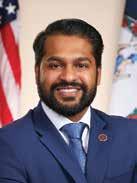
Saddam Azlan Salim, BS Public Administration ’12, MPA ’15, is Alumnus of the Year. A Bangladeshi American immigrant, Salim and his family came to the United States when he was 10 years old after fleeing multiple climate catastrophes. After experiencing homelessness, they moved to Fairfax County, Virginia, where Salim attended Falls Church High School and then George Mason. He now works in federal financial management and consulting. In November 2023, he was elected to the Virginia Senate.
Janis P. Tupesis, BA Biology ’95, received the Alumni Service Award. He is a faculty member in the BerbeeWalsh Department of Emergency Medicine at the University of Wisconsin–Madison School of Medicine and Public Health and vice president of the International Federation for Emergency Medicine. He is recognized for his global work on emergency health care and education and received the 2018 Presidential Lifetime Achievement Award from the Global Emergency Medicine Academy. Among his roles, Tupesis serves as a volunteer technical consultant at the emergency, trauma, and acute care program in the World Health Organization’s Department for Management of Noncommunicable Diseases, Disability, Violence, and Injury Prevention. Merone Hailemeskel, BA Economics ’15, MPP ’17, received the Graduate of the Last Decade (G.O.L.D.) Award. She is the digital director and communications associate for former President Barack Obama and former First Lady Michelle Obama. Hailemeskel
also worked on the first lady’s Reach Higher initiative, where she led research eforts and awarded more than $250,000 in grants to support public school teachers and school counselors, and the Better Make Room campaign, which encourages students to complete their education past high school. She was previously communication and digital director at Common App, supporting their 900 member colleges and universities.
Leeya Mehta, director of George Mason’s Alan Cheuse International Writers Center, is Faculty Member of the Year. She is a prize-winning poet, fiction writer, and essayist whose short fiction and poetry have appeared in publications nationally and internationally. Mehta received the 2024 College of Humanities and Social Sciences Faculty Civic Excellence Award for her work within the classroom and the curation of Baldwin100, a project that celebrated James Baldwin. The project collaborated with 16 Washington, D.C., area organizations to produce 28 events and exhibitions featuring dozens of visual artists, musicians, and writers and received two American Graphic Design Awards.
Haley White, BA Art History; BS Business Management ’25, is Senior of the Year. As a student, the Lynchburg, Virginia, native helped lead the Costello College of Business Day of Service event, which included packing 3,000 pounds of donated food. White was the design lead for the Mason Chooses Kindness Guidebook, served as a teaching assistant, and was the creative mind behind many posters and flyers on campus. She cowrote numerous articles and was featured in the Costello College’s brand launch video. Following her graduation, she plans to spend time working in North Carolina and traveling.
In addition to the five honorees, 18 alumni received Distinguished Alumni Awards from their school, college, or afinity alumni chapter at this year’s September event.
FOR THE FULL LIST, PLEASE VISIT
go.gmu.edu/2025cod
FUSE IGNITES RESEARCH AND INNOVATION
GEORGE MASON UNIVERSITY CELEBRATED THE GRAND OPENING OF FUSE AT MASON SQUARE with the same collaborative spirit that will fuel decades of innovation at the state-of-the-art facility in Arlington, Virginia.
TAKE A LOOK.
go.gmu.edu/ fuseopening
Hundreds of representatives from industry, academia, government, and the community came together for the September celebration, which included Governor Glenn Youngkin speaking at the ribbon cutting for the Energy Exploration (E2) Center (see story on page 10).
“Igniting a fuse signifies the moment where possibility transforms into inevitability,” President Gregory Washington said during the grand opening event.
“It’s that razor-thin instant where preparation meets decision and hesitation gives way to action. What we have done today is strike that initial flame. It will unfold because you dare to set it in motion.”
Fuse, which anchors the Arlington Innovation Corridor that runs from Rosslyn to Ballston, is a “a factory of dreams, factory of ideas,” says Takis Karantonis, chair of the Arlington County Board. Fuse will house research and economic opportunities in emerging areas such as artificial intelligence, cybersecurity, power/energy, next generation communications,
nuclear small reactor control systems, and data center engineering.
Much of that work will support the university’s Grand Challenge Initiative. In addition, Mason Enterprise will support thousands of entrepreneurs in tech and other fields on their path to commercialization and adoption of their ideas and inventions.
The event also included acknowledgment of the key role philanthropy plays at George Mason, giving thanks to Kimmy Duong and Long Nguyen, whose names grace Virginia’s first School of Computing.
“We are celebrating more than a building,” says Trishana E. Bowden, vice president of advancement and alumni relations and president of the George Mason University Foundation. “We are celebrating a bold vision come to life, a place where ideas, partnerships, opportunities will shape our future.”
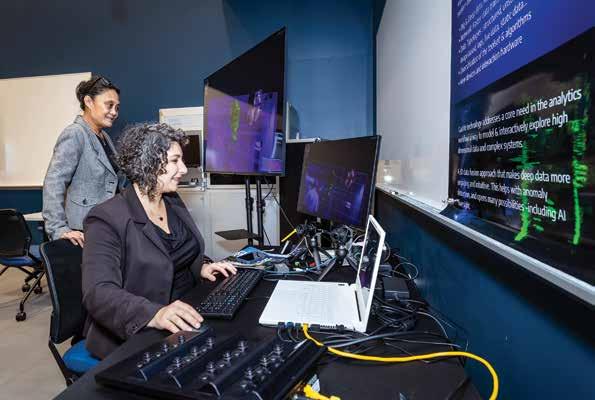
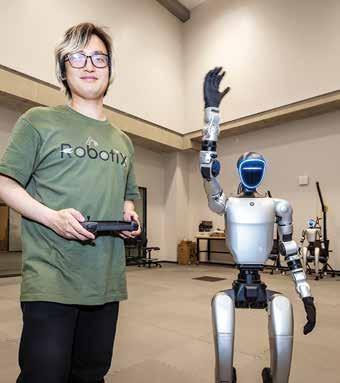
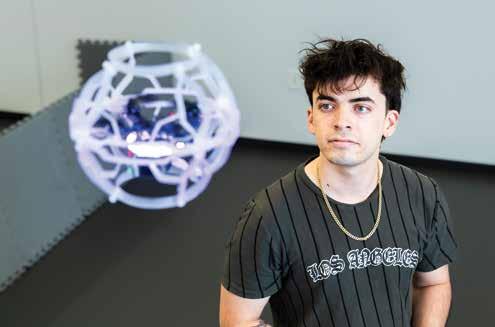
George Mason faculty and students presented interactive demonstrations involving drones, robots, and other tools of technological advancement.
“When the Commonwealth of Virginia, the Northern Virginia community, and George Mason University work together, there is absolutely no limit to what we can achieve and achieve together,” Washington says.
PHOTOS
Lorena Randall and Claire Saxon (seated) of GaiaViz demonstrate the real-time, interactive 3D data-visualization platform that helps teams explore, analyze, and present complex data streams.
Left, a Unitree G1 life-size humanoid robot, operated by computer science major Beichen Wang, greeted visitors to Professor Xuesu Xiao’s Robotixx Lab. Above, mechanical engineering major Luis Anchundia pilots a type of drone designed to swarm like a bee.
GOVERNOR’S SCHOOL AT INNOVATION PARK MARKS 15 YEARS
THE GOVERNOR’S SCHOOL AT INNOVATION
PARK , located on George Mason’s Science and Technology Campus, holds a special distinction: It’s Virginia’s only academic-year Governor’s School located on a four-year college campus.
That means that high school juniors and seniors spend part of each school day experiencing life as George Mason students.
The Governor’s School celebrates its 15th anniversary this year. Located in Manassas, it is one of 19 academic-year Governor’s Schools in the commonwealth. Students earn college credit for their coursework through dual enrollment at their high school and George Mason.
The experience is a powerful opportunity to learn at an R1 research university. These students are also ofered guaranteed admission to George Mason after
they complete the program, just one example of the university’s commitment to creating accessible pathways to becoming a Patriot.
Founded in 2010 through the collaborative eforts of George Mason, Prince William County Schools, Manassas City Public Schools, and Manassas Park Public Schools, the school serves 150 students from 15 high schools across three school divisions. The program’s faculty members are Prince William County Schools employees who are also considered George Mason afiliate faculty. Several also work as part-time faculty members at George Mason.
The STEM-focused curriculum includes real-world research and mentorship opportunities in business, industry, government, and university settings.
“Our students’ access to world-class laboratory facilities has allowed them to participate and thrive in national and international research and STEM competitions,” says Jason Calhoun, director of the school.
Students are selected for the program through a committee review process in their school division. Applicants are evaluated based on a holistic review of their academic performance in high school and must have demonstrated excellence in advanced STEM courses.
Calhoun notes that the program helps students hone skills like time management and organization, which are critical to success in college and beyond.
“There is no better opportunity to prepare our advanced STEM students for the rigors of advanced coursework and research, while still having access to the opportunities and socialization that high school allows,” says Calhoun.
—Lauren Clark Reuscher, MA ’12
BY
The Governor’s School at Innovation Park serves 150 students from 15 high schools across three school divisions.
PHOTO BY EVAN CANTWELL
MEETMASON NATION THE
AMANDA HAYMOND STILL
BY EVAN
Job: Director of Undergraduate Student Research Initiatives and Internships, College of Science
Amanda Haymond Still, BS Chemistry ’13, PhD Biochemistry ’17, came to George Mason University in 2009 as a University Scholar in the Honors College and never left. There are many reasons why she stayed, but she now has a new one: She’s leading the College of Science’s Aspiring Scientists Summer Internship Program (ASSIP).
Founded in 2007, ASSIP provides opportunities for high school and undergraduate students to work one-on-one with faculty researchers across many disciplines. In summer 2025, nearly 400 students participated in the eight-week program.
EMBRACING ONLINE ACCESS: According to Still, ASSIP’s pivoting to online during the pandemic had a plus side—for certain types of research projects, remote works great. Now that people can participate from anywhere, applications have exploded—this year they received more than 3,300—and they have had interns from as far away as Hungary, Kazakhstan, and Mason Korea.
ALL IN A DAY’S WORK: As director, Still conducts a weekly seminar for the interns where they learn how to be a scientist. Most of the topics she covers are basic research information like how to write an abstract or prepare a scientific poster.
AIMING FOR ‘TARGETS’: Still spent her George Mason career pursuing scientific questions in enzymology. “I was looking at enzymes found in bacteria that are not found in us, with the goal of using those as new antibiotic drug targets,” she says. “The field of antimicrobial drug discovery is really exciting. It’s very much like you versus ‘the invaders.’” When Still was defending her dissertation, one of the people in the audience was Center for Applied Proteomics and Molecular Medicine codirector Lance Liotta. “He ofered me a postdoc on the spot.”
AN INVENTOR IN HER OWN RIGHT: Through her work at George Mason, Still has garnered a few patents over the years. Her most recent application is for DNA protein hybrid molecules that Still built with Rémi Veneziano in the College of Engineering and Computing. “We built these really cool hybrid molecules for cancer drugs.”
BEST PART OF THE JOB: One of the things Still loves about running ASSIP is getting to see “kids get the bug for scientific research.” She also has never doubted her decision to remain at George Mason. “It doesn’t grow old, no matter how many years you’re here,” she says. “There’s always something new happening.”
—Colleen Kearney Rich, MFA
PHOTO
CANTWELL
’95
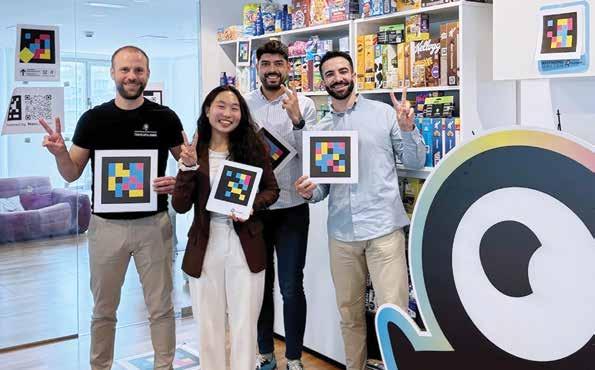
Global afairs major Eunchong Yim traveled to Spain to visit NaviLens, a global leader in assistive technology.
STUDENT LEADER CONNECTS GLOBAL TECH WITH LOCAL ADVOCACY
THIS
SPRING,
ACCESSIBLE, A REGISTERED
STUDENT ORGANIZATION AT MASON KOREA , expanded George Mason’s overall mission of promoting inclusive environments across continents.
Founded by global afairs major Eunchong Yim, who now serves as its president, Accessible began as a group of six students raising awareness about accessibility and disability advocacy in South Korea. It has since grown into a platform for real-world impact.
In April, Yim traveled to Murcia, Spain, to visit NaviLens, a global leader in assistive technology, to produce the first Korean-language introduction to the company’s work. NaviLens’s QR code system enables blind and partially sighted individuals to access location-based information, such as potential physical obstacles or physical descriptions of the environment, with their smartphones. Accessible hopes to help introduce this technology into South Korea’s public spaces.
Accessible is well positioned to link global innovation with local needs. This semester, the group began discussions with the Songdo-based National Museum of World Writing Systems, South Korea’s
second most visited museum, about a collaborative exhibition to enhance accessibility. The museum connection emerged from field trips in courses such as INTS 245 Visual Culture and Society.
Around the same time, George Mason also began testing NaviLens codes on its Virginia campuses. As a result, Yim connected with the Ofice of Access, Compliance, and Community in Fairfax, sharing updates related not only to NaviLens but also to virtual reality games and accessible environments more broadly.
Yim, who completed a remote internship with the NaviLens team this summer, says she will continue working to bridge student advocacy with practical accessibility solutions.
“I’m excited to learn about the team’s ongoing projects with students in America and to gain communication and project management skills,” she says. “Every moment at Mason Korea has become one of my greatest strengths—helping me adapt to new environments and collaborate with people from diverse backgrounds.”
YOUR 2026 ENTERTAINMENT STARTS AT GEORGE MASON
JANUARY 23
ROYAL PHILHARMONIC ORCHESTRA
Ray Chen, violin soloist
Vasily Petrenko, music director
CENTER FOR THE ARTS
JANUARY 30–FEBRUARY 6
GEORGE MASON SCHOOL OF THEATER
MASON CABARET—HEART AND MUSIC: THE SONGS OF WILLIAM FINN
January 30–February 1
HARRIS THEATRE
February 6
HYLTON PERFORMING ARTS CENTER
FEBRUARY 21
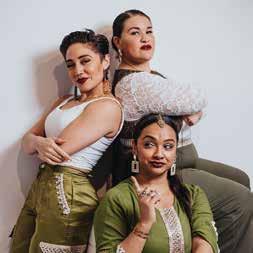
MASON ARTIST-IN-RESIDENCE SOLES OF DUENDE
A multicultural, all-female trio based in the rhythms of tap, flamenco, and kathak classical Indian dance.
HYLTON PERFORMING ARTS CENTER
JANUARY 31 AND FEBRUARY 7
HOMECOMING
January 31
Women’s Basketball Patriots v. Saint Louis
3 P.M. EAGLEBANK ARENA
February 7 Men’s Basketball Patriots v. Saint Joseph’s
12 P.M. TAILGATE, LOT L
4 P.M. EAGLEBANK ARENA
Learn more at homecoming.gmu.edu
FEBRUARY 24
GEORGE MASON DEWBERRY FAMILY SCHOOL OF MUSIC
MASON BANDS CONCERT: DOPE.
CENTER FOR THE ARTS
MARCH 22
MASON ARTIST-IN-RESIDENCE SILKROAD ENSEMBLE WITH RHIANNON GIDDENS
Sanctuary: The Power of Resonance and Ritual
CENTER FOR THE ARTS
MARCH 27 AND 28
GEORGE MASON SCHOOL OF DANCE 2026 MASON DANCE
COMPANY GALA CONCERT
MASON ARTS EVENT CALENDAR
CENTEcvR F paOR THE A .calendarRT.gmu S .edu
cvpa.calendar.gmu.edu
George Mason University has launched its Grand Challenge Initiative (GCI), a comprehensive research framework backed by an initial five-year, $15 million investment. The initiative aligns university resources, faculty expertise, and educational programs around six interconnected solution areas addressing what George Mason President Gregory Washington describes as “humanity’s ultimate grand challenge”—securing a peaceful, healthy, and prosperous future.
“Our world is at a crossroads,” he says. “It is time to either brace for global decline and a future that none of us wants, or seize control of our destiny and work to reverse course. It will take all of us working together on all these solutions at once to alter the trajectory of our future.”
ONE GRAND CHALLENGE GRAND SOLUTIONS SIX
Andre Marshall, vice president for research, innovation, and economic impact, leads the initiative, which was developed through a faculty-driven task force and focuses on six grand solutions:
• Advancing 21st-century education for all
• Building a climate-resilient society
• Driving responsible digital innovation and sustainable infrastructure
• Improving human health, well-being, and preparedness
• Pioneering space exploration, research, and collaboration
• Strengthening peace, trust, and engagement in democracy
“George Mason is driven by discovery,” says Marshall. “This means unleashing our bold ideas from their theoretical and laboratory boundaries, thoughtfully cultivating them as they take shape, and fearlessly deploying them as innovations that will transform our lives.”
GCI will enhance educational opportunities, increase faculty talent and expertise, align current research projects, seed new proposals, and build essential infrastructure across George Mason’s campuses. Working in conjunction with the university’s $1 billion Mason Now: Power the Possible campaign, the initiative seeks partnerships with government, industry, and nongovernmental organizations.
LEARN MORE ABOUT GCI.
ADVANCING 21ST-CENTURY EDUCATION FOR ALL
At George Mason, we believe talent is equally distributed among people, but opportunity is not. Education helps creates more productive ways to participate in civil society, allows more choice in how to contribute to the economy, and prepares people to make more informed choices for a healthy and prosperous life. As Virginia’s largest and most diverse university, George Mason is transforming excellence and access through flexible and scalable learning experiences, accessibility research, focused PreK-12 skill development, and robust STEM and systems-thinking education alongside critical thinking and cooperation skills.
THE GEORGE MASON ADVANTAGE
The ADVANCE Program, George Mason’s highly successful transfer partnership with Northern Virginia Community College, has been recognized as a national model by the U.S. Department of Education. Under an initiative called the Mason Virginia Promise, the university has taken that collaboration a step further and begun partnerships with community colleges throughout Virginia and created pathways that help students save time and money when pursuing a four-year degree.
Research in Action
AI
+ MATHEMATICAL MODELING = NEW TEACHING TOOL
With support from the National Science Foundation, George Mason researchers Ziyu Yao of the College of Engineering and Computing and Jennifer Suh of the College of Education and Human Development are creating a virtual classroom called MathVC where middle school students can work through mathematical modeling problems with artificial intelligence-powered chatbot “students.”
Mathematical modeling creates a mathematical representation of a real-world scenario to help teach students math concepts in context. These can be small-scale scenarios—calculating costs for a party— or global challenges—supplying clean water to a city after a major flooding event.
Within the virtual classroom, the human student can work with generative AI student personas on problems that combine computational skills and soft skills like critical thinking, collaboration, and communication. Once the program is deployed, access will be as simple as logging into a website.
STUDENT RESOURCES
Since 1987, the Early Identification Program (EIP) has been working with Northern Virginia public school systems to bridge the opportunity gaps that motivated and talented first-generation students can face in achieving their goal of higher education. EIP provides year-round academic enrichment, familial support, and leadership training opportunities.
PARTNERSHIPS
The Shenandoah Valley Rural Regional College Partnership Laboratory School for Data Science, Computing, and Applications is the result of the combined eforts of Frederick County Public Schools, Mountain Vista Governor’s School, and Laurel Ridge Community College, among others, to support 10th through 12th grade students through academic programming that fosters data literacy and showcases the latest innovations in STEM.
The Accelerated College and Employability Skills (ACCESS) Academy is an innovative partnership between the College of Education and Human Development, Loudoun County Public Schools, and Northern Virginia Community College for 9th through 12th grade students designed to give students access to the information technology education and skills essential for IT careers.
COMMUNITY ENGAGEMENT
The Tutors-to-Teachers program, developed by the College of Education and Human Development and funded by the U.S. Department of Education, is a Virginia statewide project designed to build tutors’ skills and increase achievement in elementary and middle school students.
FACULTY SPOTLIGHTS
Christan Coogle of the Special Education Program is the principal investigator of the Early Childhood Training and Technical Assistance Center. She is working to expand and improve resources for Virginia teachers to better support students with learning delays and disabilities.
Padmanabhan Seshaiyer of the Department of Mathematical Sciences has been recognized for his contributions to STEM education across the commonwealth. In 2025 he received two “Programs That Work” Awards from the Virginia Mathematics and Science Coalition.
Future-ready skills aren’t just a buzzword—they are a necessity. Skills such as critical thinking, creativity, digital fuency, and environmental stewardship are the currency of tomorrow’s workforce.”
Ingrid Guerra-López, Dean, College of Education and Human Development
ASPIRING SCIENTISTS SUMMER INTERNSHIP PROGRAM (ASSIP)
Founded in 2007, ASSIP provides opportunities for high school and undergraduate students to work one on one with faculty researchers across many disciplines. In summer 2025, nearly 400 students participated in the eight week program.
-
GEORGE MASON AS A LIVING LAB
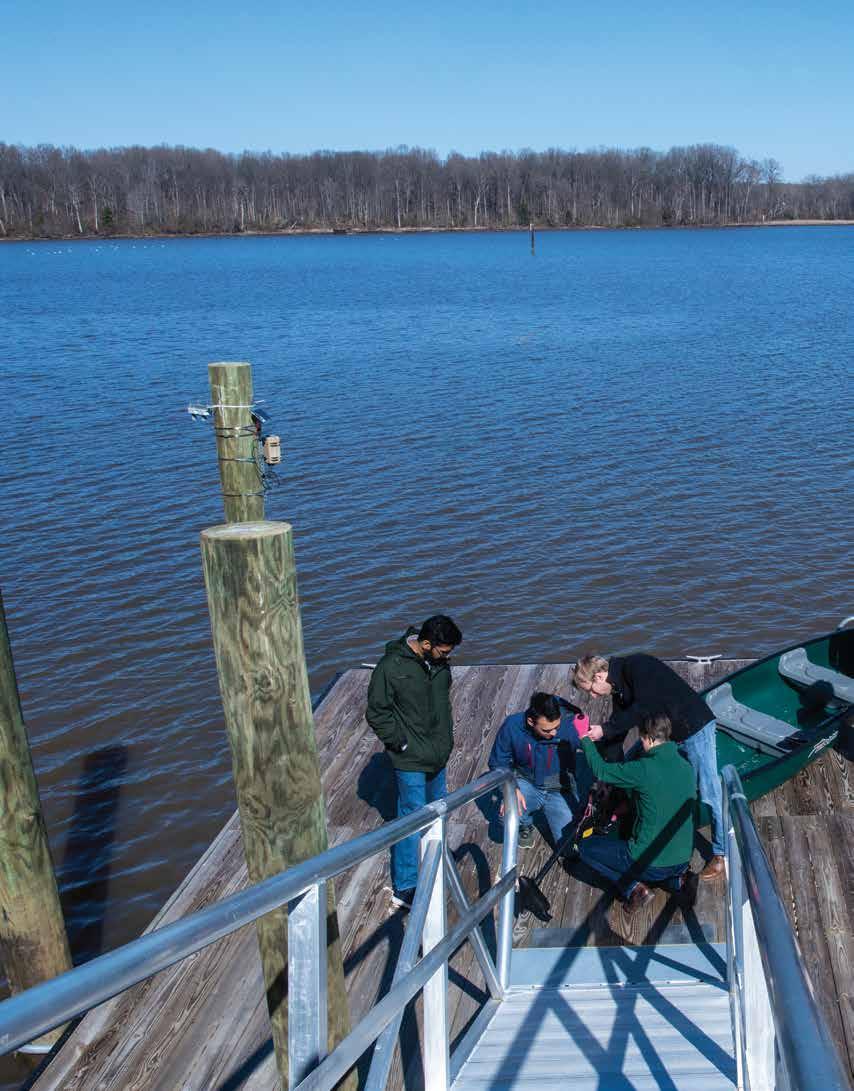
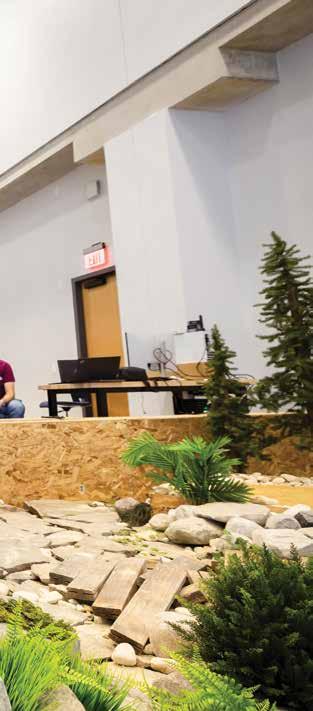
From the canopies of the trees in the accredited Level II Arboretum to the stormwater running into Mason Pond, George Mason’s nearly 1,000 acres of land, waterways, forests, and buildings are being used as a dynamic Living Lab for hands on environmental research that may one day have a global impact.
George Mason, being the largest public university in Virginia, owes it to the residents of the commonwealth to create innovative solutions to increase community resilience."
James Kinter, Director, Center for Ocean-Land-Atmosphere Studies
POTOMAC SCIENCE CENTER
The Potomac Environmental Research and Education Center is a key component of George Mason’s Potomac Science Center in Belmont Bay. The center focuses on Potomac River restoration and local sustainability practices, so that the local ecosystem will be healthy for years to come. They translate research into award winning field programs for K 12 students and the larger community.
PHOTO BY EVAN CANTWELL
BUILDING A CLIMATE-RESILIENT SOCIETY
George Mason is applying science, policy, and innovation to safeguard communities and ecosystems through sustainable practices and infrastructure, real-time weather-related information, and community planning and preparedness training. From a solar-powered greenhouse that allows resilient food production to advanced predictive modeling that identifies weather-related or other natural disasters, the university is developing the leadership and talent to produce solutions alongside partners on a global scale.
THE GEORGE MASON ADVANTAGE
In 2023, George Mason was selected to host the Virginia Climate Center and lead research on tackling climate-related challenges, such as energy, vector-borne illnesses, and extreme weather and flooding in Northern Virginia and throughout the commonwealth. Funded through the National Oceanic and Atmospheric Administration and sponsored by the late U.S. Representative Gerry Connolly, this congressionally directed community project seeks to increase Virginia’s resilience to the impacts of climate changes.
Research in Action
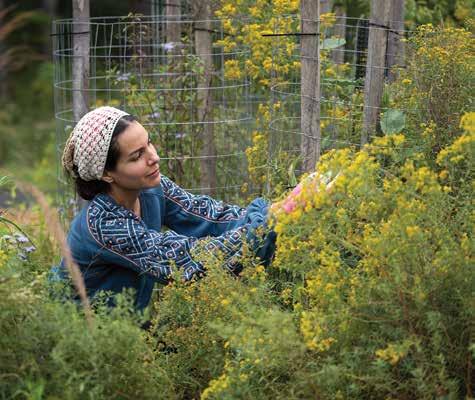
HELPING LOCAL COMMUNITIES IMPROVE FLOOD RESILIENCE
“Flooding is a growing issue across local communities,” says Celso Ferreira, who leads George Mason’s Flood Hazards Research Lab. “It is one part of engineering that’s not well-solved. Communities want to understand and adapt to flood risk, but it’s expensive. That’s where this idea came in—we thought, why not involve students? Not just teach them engineering but help them create useful products for these communities.”
Ferreira recently redesigned the CEIE 445/645 Flood Hazard Engineering and Adaptation course to work with community partners to deliver real projects as part of an Institute for a Sustainable Earth and NSF Accelerating Research Translation Program’s Seed Translational Research Project.
In the course, undergraduate and graduate civil engineering students work together on teams to develop flood risk maps and conduct analyses to help real
Jennifer Salerno, a professor in the Department of Environmental Science and Policy, is helping redefine how we monitor and protect coral reef ecosystems. Salerno is working on a technique to assess coral reef health by analyzing microorganisms in reef water.
clients in local communities improve their flood resilience. For some communities, especially smaller counties or tribes with fewer resources or no engineers on staf, this can provide critical data to help them address areas at higher risk of flooding.
The student teams used recently developed Virginia Department of Conservation and Recreation models, which provided ground elevation surface data (topography), hydraulic friction values, and surface water infiltration values. This served as a common framework for building each project.
STUDENT RESOURCES
George Mason Facilities sets aside $100,000 a year for the Patriot Green Fund, which supports infrastructure improvements and student research projects to make George Mason’s campuses more sustainable. Projects have included smart hives, rain gardens, and the Foragers Forest on the Fairfax Campus.
PARTNERSHIPS
In a unique partnership, George Mason and the Smithsonian Conservation Biology Institute established the Smithsonian-Mason School of Conservation, which ofers hands-on, interdisciplinary programs in conservation where students can work alongside Smithsonian scientists and conservation experts from around the world.
Daniel Tong of George Mason’s Center for Spatial Information Science and Systems is part of the NASA Health and Air Quality Applied Sciences Team working on improvements to the National Air Quality Forecast Capability.
DRIVING RESPONSIBLE DIGITAL INNOVATION AND SUSTAINABLE INFRASTRUCTURE
From artificial intelligence and robotics to digital twins and quantum computing, new technologies are reshaping every aspect of life and culture at a rate faster than most institutions can keep up with. George Mason is researching and applying technologies that improve human life and a peaceful coexistence in increasingly digital societies by enhancing connectivity, economic opportunity, and reducing disparities through public services while also protecting the planet. Through crossdisciplinary collaboration, workforce education, and public–private partnerships, George Mason is helping shape a digital future that is both ethical and advanced.
STUDENT RESOURCES
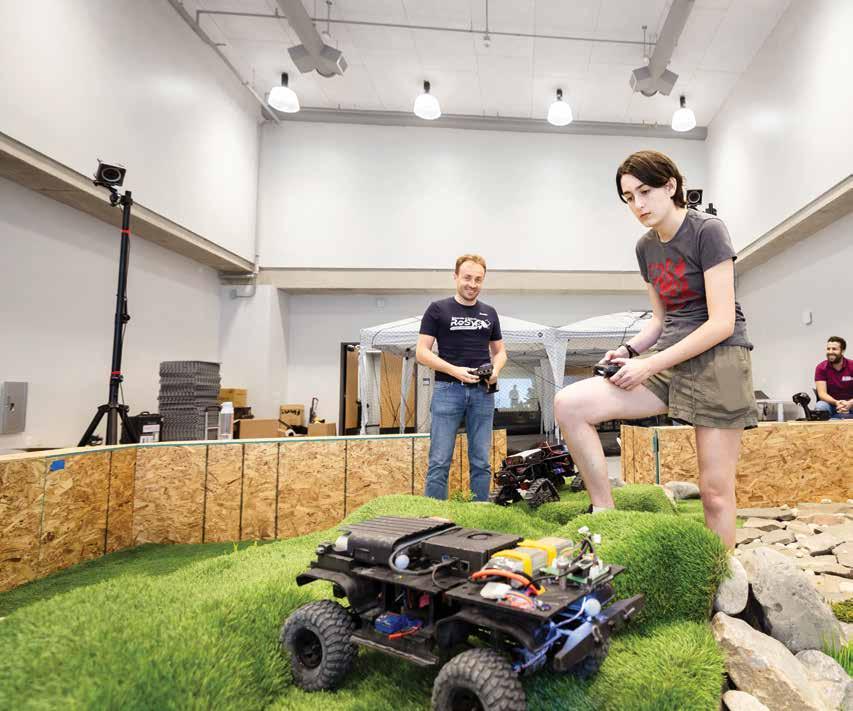
Fuse at Mason Square labs provide students with research and educational opportunities that cross disciplines to address local and global needs in autonomy, embedded AI, and robotics.
We can no longer separate technology from the public good. Innovation must serve society, and at George Mason, we’re doing just that.”
Amarda
Shehu, Chief AI Officer
THE GEORGE MASON ADVANTAGE
As Virginia’s most innovative university, George Mason is a national leader in responsible digital innovation—combining technical excellence, societal commitment, and unmatched regional partnerships. The first public university in the nation with a comprehensive artificial intelligence vision, George Mason collaborates with industry leaders like Google, AWS, and Dominion Energy to build sustainable, secure, and inclusive technologies for the public good.
Research
in Action
MOVING TARGET DEFENSE KEEPS HACKERS IN THE DARK
Cyberattackers are constantly finding new ways to get around defense systems and complex code. But how successful can they be when their target isn’t where they think it is?
College of Engineering and Computing Professor
Kun Sun, associate director of the Center for Secure Information Systems, studies what’s known as Moving Target Defense (MTD) to thwart attempted cyberattacks, among his many projects for the U.S. Office of Naval Research.
“The great thing about MTD is it’s proactive. I’m shifting the target, such as the IP address, from time to time, so it’s hard to know where I’m holding my valuable asset,” he says.
Sun added that attackers can scan quickly to locate targets, so those trying to hide their systems—in this case, the U.S. Navy—can add another layer of protection in the form of a decoy.
“We will build something resembling a real system, such as a server or a website,” he says. “One thing this does is waste their time as the attacker scans and then tries to determine if this is a real or fake system.”
PARTNERSHIPS
George Mason leads the Northern Virginia Node of the statewide Commonwealth Cyber Initiative (CCI), which encompasses 10 Virginia universities, colleges, and community colleges. CCI is Virginia’s access point for cybersecurity research, innovation, and workforce development.
The Tech Talent Investment Program (TTIP) is a statewide program to invest in expanding state computer science, computer engineering, and software engineering degrees over a 20-year period. This program, which started in 2019 and will run until 2039, will see roughly 380 additional degree recipients each year.
Elizabeth Phillips, director of the Applied Psychology and Autonomous Systems Lab and codirector of the Human-Robot Interaction Lab, studies how robots and other technologies are changing the way humans interact with the world and one another.
Massimiliano Albanese, executive director of the Institute for Digital Innovation, is a recognized expert in cyberattack modeling and detection, optimal defense strategies, and adaptive security technologies.
PATRIOT PERFORMANCE LAB
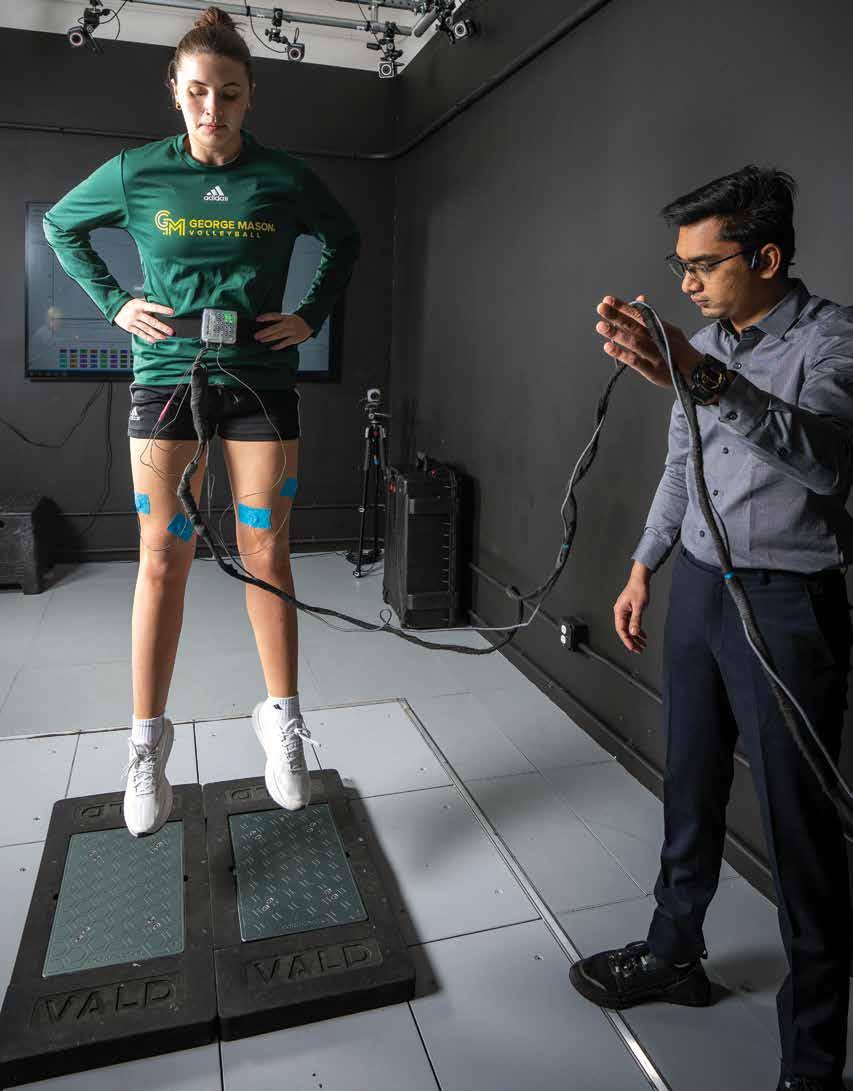
The Patriot Performance Lab works to advance the treatment, care, and performance of athletes through athletic training, sports nutrition, strength and conditioning, and sports science.
POPULATION HEALTH CENTER
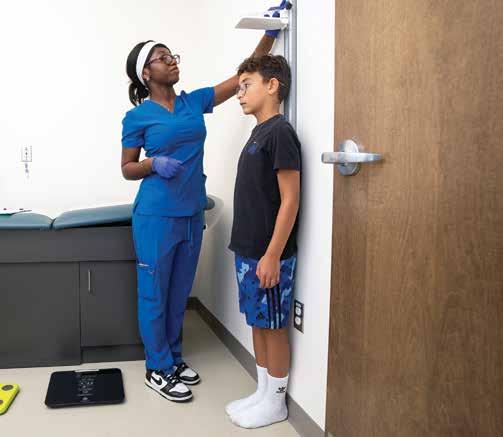
The Population Health Center facilitates partnerships between academia and the community and houses state of the art facilities for telehealth, research, and delivering clinical care. Practitioners and community partners provide referrals for resources to address social determinants of health such as access to housing, food, and prescriptions.
IMPROVING HUMAN HEALTH, WELL-BEING, AND PREPAREDNESS
Healthy populations are less vulnerable to disease and crises and better equipped to contribute to peaceful and prosperous communities. George Mason is actively approaching improvements in health systems, mental well-being, and emergency preparedness to build resilience for the future. With a people-first integrated approach that advances science, develops talent, and strengthens communities, George Mason is modeling scenarios that prioritize access to preventative care while investing in emergency prevention and preparedness scenario training.
THE GEORGE MASON ADVANTAGE
The first of its kind in Virginia, George Mason’s College of Public Health is also the first and only in the state to earn accreditation from the Council on Education for Public Health.
Research in Action
$4.65 MILLION NIH GRANT EXPLORES CHRONIC KNEE PAIN
For millions of Americans, chronic musculoskeletal pain is a daily reality that makes even simple activities like walking across a room, playing with grandchildren, or just getting through a workday feel daunting. Researchers at George Mason’s Center for Advancing Systems Science and Bioengineering Innovation (CASSBI) are leading a new $4.65 million National Institutes of Health-funded R01 study to better understand what shapes those experiences, and how to improve care.
The multidisciplinary team will work to solve this problem by studying how physical, biological, emotional, and social factors come together to shape the daily experience of living with chronic knee pain. They will look at whether analyzing multiple symptoms over time can help identify important turning points in a person’s pain journey, and how each individual’s particular mix of stress, biology, and movement plays a role in achieving maximal potential for function.
Over the next four years, the team will recruit participants with chronic knee pain who are receiving treatment at Optimal Motion, a community-based physical therapy clinic. For one year, participants will be followed closely, with data collected every three
Mikell Paige’s groundbreak s at the interfacfocu ing work in biochemistry i ses on drug discovery, emp lo
ying medicinal chemistry strategies to design and synthesize small molecule modulators of dysfunctional enzymes. development in meaningful and practical ways.
We build strength across the health system by building people.”
months on their biomechanics, physical function, biological health, and psychosocial well-being. A smartphone app will also allow participants to share daily reflections, giving researchers an unprecedented look into the lived experience of chronic pain.
“Chronic pain is not just about an abnormal finding in a single body part,” says the project’s lead investigator Siddhartha Sikdar, director of CASSBI. “It’s an individual, day-to-day experience that cuts across physical, emotional, and social dimensions.”
STUDENT RESOURCES
The College of Public Health is home to the nation’s first Society for Simulation in Healthcareaccredited Lab for Immersive Technologies and Simulation at a public health college. This facility redefines how health professionals practice and reinforces George Mason’s leadership in cutting-edge technology that revolutionizes public health education and workforce development.
Thanks to the Center for the Advancement of Well-Being and a $1.5 million grant from the Clifton Foundation, students in a new peer coaching program are helping others discover their strengths and how to leverage them in everyday situations.
PARTNERSHIPS
George Mason researcher Shane Caswell is executive director of the Virginia Concussion Initiative, which is committed to protecting the brain health of all Virginians. This statewide partnership between George Mason and the Virginia Department of Health is supported by funding from the commonwealth and the Centers for Disease Control and Prevention.
’22, leads a team of scientists who have discovered a way to “eavesdrop” on cellular communications that could revolutionize treatments for cancer and other diseases. in meaningful and practical ways.
Melissa Perry, MBA ’25, Dean, College of Public Health
Chemistry and Biochemistry Department chair Mikell Paige is designing small molecules to enable drug development
PIONEERING SPACE EXPLORATION, RESEARCH, AND COLLABORATION
Space exploration ofers essential tools for life on Earth—fueling technological breakthroughs, enhancing environmental forecasting, and expanding our understanding of the universe. From designing an artificial star with NASA to using satellite data for storm prediction, George Mason is driving space-based discovery that meets real-world needs—connecting knowledge to action and impact.
Research in Action
WORKING ON THE LANDOLT MISSION
George Mason is the home of the $20 million Landolt NASA Space Mission, which will place a satellite that will serve as an artificial “star” in orbit around the Earth by 2029. Peter Plavchan, associate professor in the Department of Physics and Astronomy and the project’s principal investigator, and Peter Pachowicz, associate professor in the Department of Electrical and Computer Engineering, lead the project, and George Mason engineering students are playing an instrumental role in the payload’s construction. It’s an experience that allows them to work on a project from the inception of the mission to the actual launch and operation of the science payload. It’s also an opportunity for the kind of unparalleled experiential learning that George Mason prioritizes.
Graduate student Fatima Bahzad says, “It’s the most fun I’ve ever had in school.” Bahzad, a computer science major, is working on the communication of microchips that make up the artificial star.
The team is building the payload in partnership with the National Institute of Standards and Technology. The artificial star will allow scientists to calibrate telescopes and more accurately measure the brightness of stars that range from those nearby to the distant explosions of supernova in far-of galaxies. By establishing absolute flux calibration, the mission will address several open challenges in astrophysics, including the speed and acceleration of the universe’s expansion.
FACULTY SPOTLIGHTS
An expert in data and computational science, Anamaria Berea, PhD Computational Social Science ’12, has worked closely with NASA on several projects, including NASA’s Decadal Astrobiology Research and Exploration Strategy (DARES) Task Force 1.
PhD student Jay Deorukhkar has been working on testing the individual payload modules. These will later integrate with the satellite bus, which is the core structure and support system that is separate from the specific payload. His dissertation explores the reliability of small satellite buses against radiation efects, making for a particularly relevant bridge between his research and the project.
STUDENT RESOURCES
The Small Satellite Engineering Graduate Certificate in the College of Engineering and Computing prepares students for emerging roles in aerospace and defense.
The Satellite and Earth Systems Studies Program in the College of Science helps enhance students’ understanding of how the natural components of the Earth system—atmosphere, ocean, land, and biosphere—interact with human activities as a coupled system.
FUTURE-READY INFRASTRUCTURE
The CubeSat/SatCom Engineering Lab, under director Peter Pachowicz, focuses on hands-on engineering of ultra-small CubeSats and satellite communications systems by combining research and educational objectives.
Mike Summers is a planetary scientist who has worked on NASA space missions that study the Earth from a space shuttle and orbiting satellites that probe other planetary atmospheres using deep space robotic missions. He played a leading role in the New Horizons mission to Pluto and the Kuiper Belt.
PHOTO BY RON AIRA
Space exploration isn’t just about discovery—it’s about preserving our humanity and values beyond Earth.”
Anamaria Berea, Professor, Department of Computational and Data Sciences
THE NANOFABRICATION FACILITY
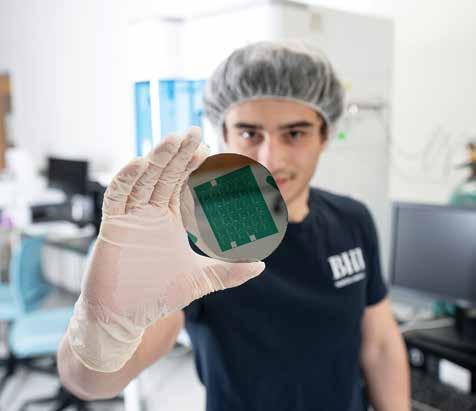
The Nanofabrication Facility, with its Class 1000 clean room and characterization labs, provides the tools necessary for photolithography, etch ing, and deposition processes essential for building microfluidics, micro- and nanoelectron ics, and other devices.
THE GEORGE MASON OBSERVATORY
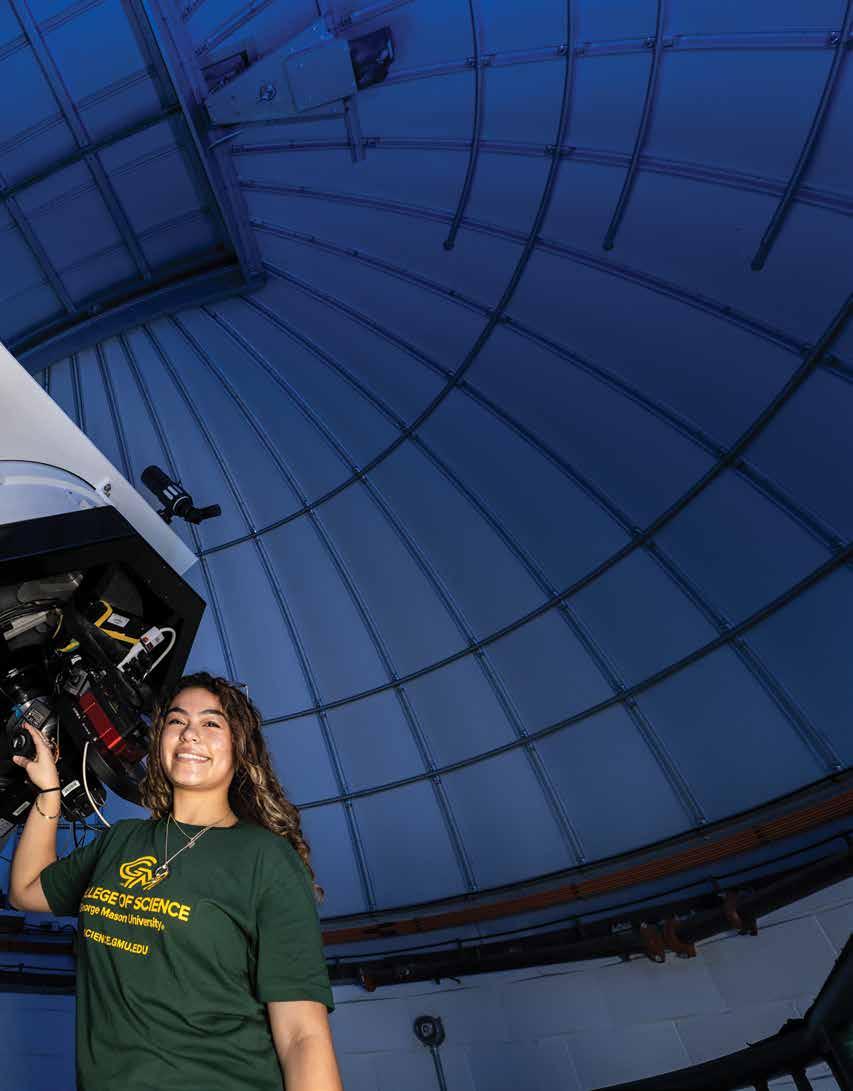
The George Mason Observatory, located on the Fairfax Campus, is where research, education, and public service come together under the stars. Operated by the Depart ment of Physics and Astronomy, the observatory allows students and the community to explore astronomy through hands on experiences with professional grade equipment.
PHOTO BY EVAN CANTWELL
We teach our students to identify the underlying causes of confict and equip them with the theory and practical skills to put their knowledge into action.”
Alpaslan Özerdem, Dean, Carter School for Peace and Conflict Resolution
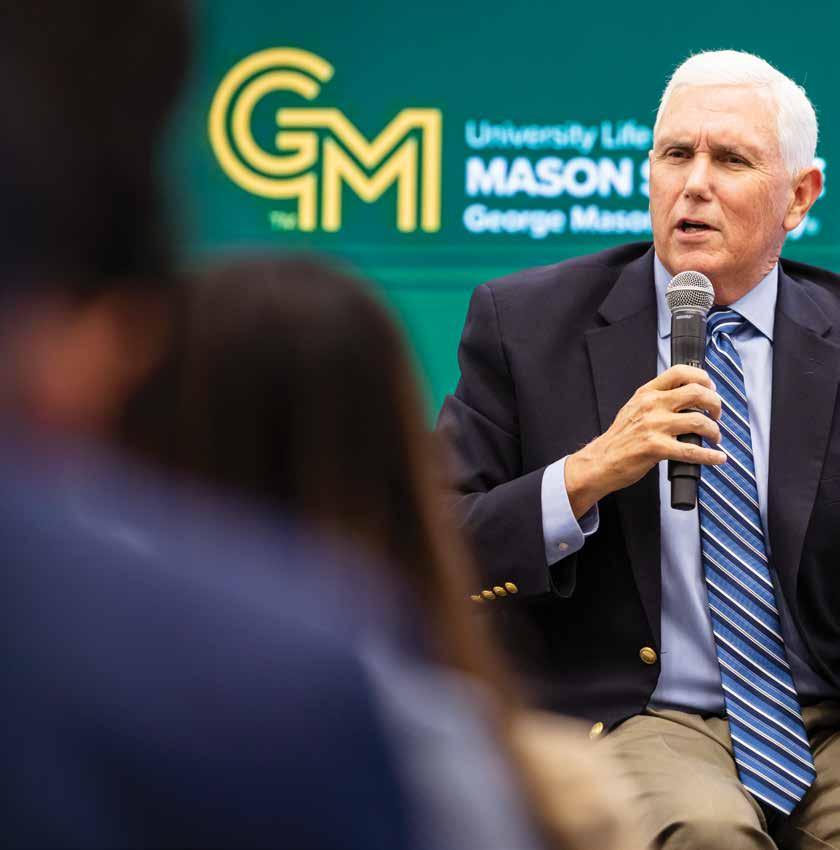
FORMER VICE PRESIDENT MIKE PENCE
A new Distinguished Professor of Practice at George Mason, Pence met with students as a recent guest at University Life’s Pizza and Perspectives at Mason Square. The program is designed to engage the Mason Nation in meaningful dialogue on relevant topics.
STRENGTHENING PEACE, TRUST, AND ENGAGEMENT IN DEMOCRACY
Strengthening peace, trust, and engagement in democracy is vital for creating resilient, inclusive societies where individuals feel empowered to shape their future. George Mason is building civic trust and advancing peace by preparing students to lead, supporting global collaboration, and fostering community resilience. Working with faculty and experts on real-world policy solutions, George Mason equips the next generation to contribute meaningfully to democratic resilience at home and abroad.
THE GEORGE MASON ADVANTAGE
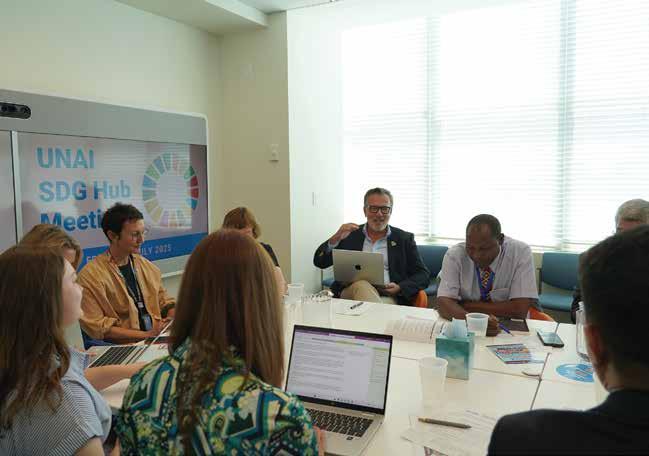
George Mason chairs the United Nations Sustainable Development Goal (SDG) 16 Hub—Peace, Justice, and Strong Institutions, a position it will hold for the next three years. As hub chair, the Jimmy and Rosalynn Carter School for Peace and Conflict Resolution is responsible for education and training, research, community engagement, developing partnerships, and working with other SDG hubs to strengthen and further the United Nations’ mission of peace and justice.
Research in Action BALTIMORE PEACE EDUCATION AND VIOLENCE PREVENTION
Arthur Romano is working to prevent gun violence in Baltimore, Maryland, through proactive peacebuilding initiatives. The Baltimore Peace Education and Violence Prevention project, part of a collaboration between the Carter School and Rotary International, is addressing the problem with a multipronged approach: Peace summits that bring together peace building organizations, ofering services to municipal governments to strengthen their strategic plans in that area, and an international exchange of violence prevention practitioners to share emerging practices.
“Since community-based violence is a result of multiple compounding stressors and structural issues, then the interventions need to be multi-level,” says Romano, an associate professor and founder of the Carter School’s Program on Urban Peacebuilding. “We’re trying to be proactive and build infrastructure that accelerates learning and communication across organizations.”
The research team held a pilot peace summit in Baltimore in April 2025 that brought together practitioners and community organizations on the front lines of violence prevention to share knowledge, identify gaps, and determine areas for collaboration.
A key partner in the project is Carter School alum Nawal Rajeh, MS Conflict Analysis and Resolution ’10, PhD ’24, who organized the peace summit and has been running a peace camp in Baltimore for the past 17 years through her nonprofit By Peaceful Means (see story on page 40).
STUDENT RESOURCES
In partnership with George Mason’s Housing and Residence Life, the Schar School’s Democracy Lab is a learning experience open to all first-year undergraduates living on campus. Through the learning community, students engage with the issues that define the journey of democracy in the United States and around the world.
Founded in 2004, the Clinic for Legal Assistance to Servicemembers and Veterans, called M-VETS, enables Scalia Law School students to assist service members, veterans, and dependent family members in a wide variety of litigation and nonlitigation matters. Since its inception, students have assisted hundreds of clients from all five branches of the armed services (see story on page 6).
FUTURE-READY INFRASTRUCTURE
Carter School Peace Labs identify, test, and enhance existing practices, tools, and models of peace building and reconciliation, assessing their potential and advancing their applications across diferent social contexts.
Over the decades, Marc
has pioneered peacebuilding work and trained thousands of students in conflict healing and peacebuilding through intensive practice courses in conflict zones around the world.
Guadalupe Correa-Cabrera is an expert and frequent commentator on issues related to Mexican politics, U.S.-Mexico border relations, immigration, drug traficking, and other forms of transnational organized crime.
Gopin
Bringing Closure to the Families of Lost U.S. Service embers
THERE ARE CURRENTLY MORE THAN 80,000 UNACCOUNTED-FOR SERVICE MEMBERS from conflicts that range from World War II to wars in the Middle East. George Mason University’s ongoing collaboration with the U.S. Department of Defense POW/MIA Accounting Agency (DPAA) is exploring innovative ways of locating the missing remains of those American service members and bringing closure to their families.
This partnership, which began in December 2020, is just one of the ways George Mason excels as a veteran-serving institution. The project has found success and deeper meaning as it extends learning beyond the classroom to assist the grieving families of prisoners of war (POWs) and missing-in-action (MIA) soldiers.
John C. Winters, MA History ’13, is a DPAA postdoctoral research fellow at George Mason’s Roy Rosenzweig Center for History and New Media (RRCHNM) whose research has covered war, diplomacy, and the 19th and 20th centuries.
“I’ve previously worked on cemetery projects, and my responsibilities were to essentially help not only map the cemetery as it stood but to identify places where
people were not cataloged properly or were forgotten over time,” says Winters, who began his fellowship in January 2025.
Winters also works with the Henry Jackson Foundation for the Advancement of Military Medicine to support and expand DPAA operations, from initial case development to field mission planning.
Digital mapping is a critical tool for the agency’s mission, as it helps researchers visualize where someone was lost and supports investigation and excavation proposals. Winters is currently using ArcGIS Pro software to create maps that track missing or unidentified soldiers.
“The advantage of conducting research at [RRCHNM] is that the people here are experts in using intricate digital mapping tools,” Winters says.
Jesse Stephen, DPAA’s chief of innovation, says the efort has two goals: to search for, locate, recover, and identify MIA personnel, and to communicate about the work.
“These projects are multidimensional and address active casework. They also tell the story of a conflict and of our missing individuals,” says Stephen. “That involves going back into archives and looking for information about a particular case or campaign. It’s organizing, reviewing, and analyzing that information we find, and then putting all these diferent pieces together to build a case.”
It’s a process that takes persistence. Throughout, DPAA staf, personnel from Service Casualty Ofices, and family members meet and review the specifics of a loss. Documentation, including maps, is shared with family members, who can see where the last-known sighting of their loved one happened.
Over the course of the partnership, DPAA has discovered additional information about more than 3,000 unaccounted-for losses. George Mason fellows have reviewed more than 1,000 deceased personnel files of people who served alongside the missing.
—Shayla Brown
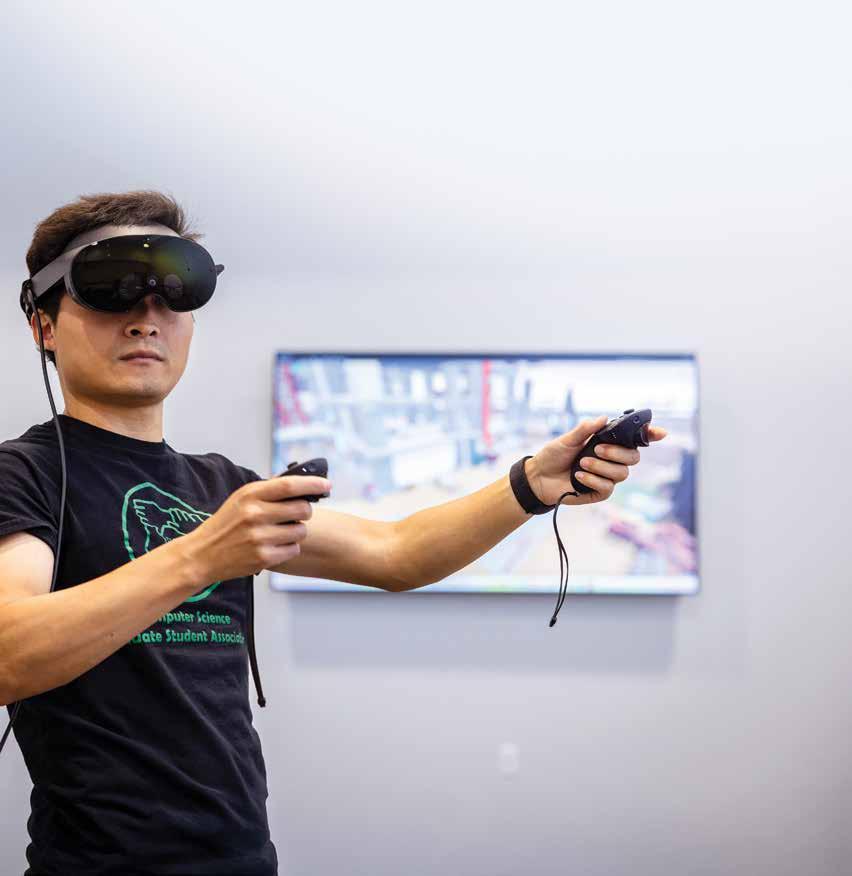
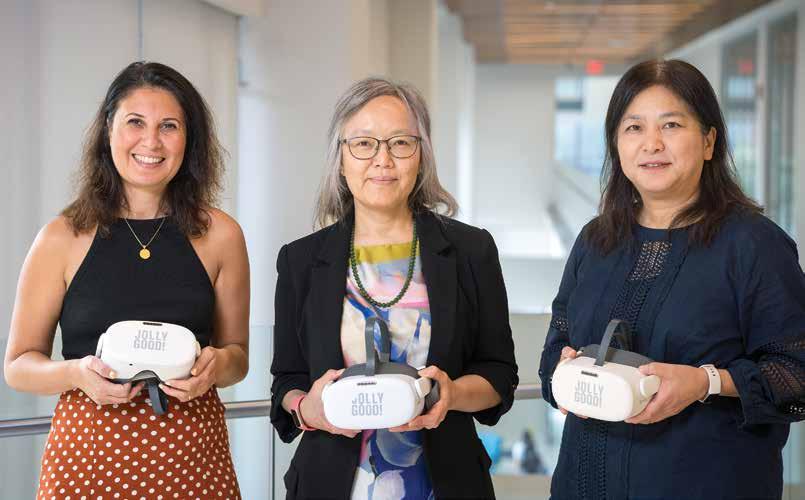
Virtual Reality Adds Empathy to Dementia Care
AT A CONFERENCE ON AGING TWO YEARS
AGO , George Mason researcher Li-Mei Chen slipped on a pair of virtual reality (VR) goggles and found herself inside the mind of a person with dementia.
The simulation cast her as an older adult in the grips of delusion: frozen in fear at the end of a hallway, watching the floor disappear beneath rising water. “There was no actual flooding,” Chen recalls, “but I could feel the panic.”
Chen, a social work professor in the College of Public Health, specializes in aging and dementia and immediately recognized the technology’s potential for nursing home staf. She imagined caregivers seeing what she saw and walking away with a new kind of understanding and empathy for their dementia patients.
Working with Japanese company Jolly Good Inc. to adapt their VR technology and with support from the Virginia Center on Aging, Chen launched a pilot to train certified nursing assistants (CNAs) at a Northern Virginia nursing home. The three-part program combined immersive VR scenarios with online lessons and group discussions.
Chen partnered with fellow social work professor Megumi Inoue to design the educational framework. Wearing headsets, participants stepped into the disoriented minds of dementia
patients—experiencing the confusion, fear, and memory lapses firsthand. For many of the CNAs, the experience marked their first exposure to any dementia-specific training.
Eventually, Chen hopes to help create new VR scenes set in U.S. care settings. But even with cultural diferences, CNAs in the Northern Virginia pilot—many of whom speak English as a second language—found the material relatable.
Master of social work student Zeynep Senturk Mannix, who helped Chen facilitate the sessions, says the pilot also provided the participants with validation. “They said, ‘We have seen this. We’ve experienced these scenarios.’ Their ideas were valuable, and they helped shape the future of this study.”
Chen and her team are now analyzing feedback and will present their findings at the next American Public Health Association conference. They’re also working to refine the VR content and training materials, in hopes of expanding the program in the future to additional care facilities.
Chen sees VR not as a silver bullet but as one tool to support more thoughtful training. “It’s about understanding the person and building a connection that’s beyond client and provider,” Chen says.
—Katie Pearce
PHOTO
From left, Zeynep Senturk Mannix, Li-Mei Chen, and Megumi Inoue.
Finding Low-Cost Solutions to Increase Solved Cases
IT’S A SOUGHT-AFTER “SWEET SPOT,” where efective police response to nonviolent crimes earns public approval and builds community goodwill.
Budget constraints often mean reaching that intersection is no easy task—creative thinking and approaching the problem from diferent angles are both required. George Mason researchers Cynthia Lum and Christopher Koper are leaning on both as they test solutions to help local police departments balance limited resources while strengthening public trust.
Lum, director of the Center for Evidence-Based Crime Policy (CEBCP), and Koper, a nationally recognized expert on firearms policy and policing and CEBCP’s principal fellow, are leading a new initiative supported by an $839,000 grant from Washington, D.C.-based nonprofit Arnold Ventures.
CEBCP’s project emphasizes practical scalable steps that police departments can take, especially when it comes to serious property crime cases, such as burglaries and auto thefts, which are sometimes low priority due to lack of investigative leads, high caseloads, and limited police resources.
“We are testing whether low-cost actions will help victim satisfaction and will possibly help police solve more crimes,” says Lum, a former Baltimore police oficer. “If this works, then I think many police agencies across the country, especially those who don’t have a lot of resources, will have an accessible approach that can lead to real improvements.”
Most crimes in the United States go unsolved. Violent crimes have higher rates of clearance, with homicide cases ranking highest at 58 percent. Nonviolent crimes—which are much greater in number—are solved at much lower rates, frustrating many victims and eroding trust in law enforcement.
To address that, the agencies participating in the George Mason three-year pilot program will send oficers to personally follow up on stalled, low-priority cases that would not normally receive extensive investigation. If this uncovers potential leads, it may increase the likelihood of solving these cases.
Further, by demonstrating continued engagement, the follow-ups could improve victim satisfaction with police services and boost community views of the police. Lum and Koper plan to measure both outcomes. This project also provides graduate students on the research team with experience in carrying out program evaluations and field experiments.
Lum and Koper are currently partnering with two police departments, one in Northern Virginia and one in Maryland. They are setting up logistics, such as data sharing and oficer training, and are both optimistic about the possibilities.
“We’re trying to move the needle with a modest, low-cost change to investigative procedures,” Koper says. “[Police agencies] want to solve more cases and earn a higher level of public confidence and trust, but they also face limits on how intensively they can investigate all cases.”
Should their research prove efective, they plan to disseminate the model and findings to law enforcement agencies nationwide.
—John Hollis
When the osquitos Bite, the BRL Bites Back
MOSQUITOES LOVE VIRGINIA’S INFAMOUS HOT AND HUMID SUMMERS . As the world’s deadliest animal, according to the Centers for Disease Control and Prevention, they’re more than just a nuisance at the family barbeque: They’re a health hazard.
But in a longstanding partnership with Prince William County, George Mason’s Biomedical Research Laboratory (BRL) is working to prevent outbreaks of mosquito-borne diseases.
In a program that began in response to the Zika virus outbreak in 2016, the county and the university partner each year to collect mosquito samples and test them for diseases like West Nile virus.
“West Nile is endemic in the United States, and infections can be lethal,” says Farhang Alem, MS Biology ’15, PhD Biosciences ’19, associate director of the BRL. Alem has led the mosquito testing program since 2019.
“Eighty percent of people will have no symptoms,” he says, “but about one in every 150 cases of West Nile is severe.” Severe cases can damage the nervous system, resulting in high mortality rates and a high likelihood of disability for anyone who survives. Patients with less severe cases, though likely to make a full recovery, could experience symptoms for weeks or months.
“We want to prevent the spread as much as possible,” Alem says.
Testing season starts in late spring and runs through the fall. Each week, samples are collected at more than 60 sites across Prince William County, and the mosquitoes are sorted by species. Vector
species—meaning those that carry disease—are sent to the BRL for testing. Researchers extract RNA from the mosquitos and check for the markers of West Nile virus. They then send their report to Prince William County oficials.
If mosquitoes are positive for West Nile virus, the county will follow spraying protocols to eliminate the threat at the site where the mosquitoes were trapped. “Spraying is definitely working to control the spread,” Alem says.
Alem is in conversation with other counties in Northern Virginia to see if there’s interest in expanding the surveillance program. The BRL team is also hoping to learn best practices on mosquito trapping from Prince William County to implement in other areas.
And there is potential to make an even bigger impact that includes larger populations. George Mason epidemiologist Amira Roess is looking into the possibility of a similar surveillance program in India for dengue fever, for example. If that program is deployed, researchers hope what they learn in India can be useful to their research here.
With almost 10 years’ worth of data from the ongoing testing, Alem hopes the lab can one day look at trends in disease occurrence and correlating environmental factors. This amount of data is just one result of the university’s commitment to consistently putting in the work to create positive changes in its community and beyond.
“This is leading to new avenues of research for us,” says Alem.
—Sarah Holland
Recently published works by George Mason
faculty
Strong Commanders, Weak States: How Rebel Governance Shapes
Military Integration After Civil War
Philip Martin, assistant professor, Schar School of Policy and Government
Cornell University Press, January 2025
In this volume, Martin investigates a fundamental political challenge faced by post-confict states: how to create obedient national militaries from the remnants of insurgent forces.
Reimagining
Citizenship in Postwar Europe
Samuel Clowes Huneke, associate professor, Department of History and Art History, with Rachel Chin
Cornell University Press, February 2025
This book maps the generation and growth of forms of belonging in the years after World War II, crisscrossing the continent from Madrid to Warsaw and from Athens to London. Even as Europe struggled to rebuild, new forms of identity, statehood, and citizenship were beginning to take shape.
Perspectives on Negation: Views from Across the Language Sciences
Cynthia Lukyanenko, professor, Department of English, with Frances Blanchette (Eds.)
De Gruyter Brill, March 2025
Although negation has been studied extensively by philosophers, linguists, and psychologists, it remains an active area of inquiry across the language sciences. This collection will help readers gain insights into the nature of negation.
A
Billion Butterflies: A Life in Climate and Chaos Theory
Jagadish Shukla, Distinguished University Professor, College of Science
Macmillan Publishers, April 2025
In this memoir, Shukla describes growing up amid turmoil: overwhelming monsoons, devastating droughts, and unpredictable crop yields. His ambition brought him from the Indian Institute of Tropical Meteorology to the highest echelons of climate science.
Your Daughters Will Prophesy: Religion and Rhetoric in the Nineteenth-Century Woman’s Movement
Lisa Marie Gring-Pemble, associate professor, Costello College of Business, with Martha Watson
University of South Carolina Press, May 2025
This book analyzes the resources four women used to counter gendered restrictions and gain access to political platform and church pulpit, catalyzing what became known as the women’s movement.
Instructional Design for Teaching Information Literacy Online: A Student-Centered Approach
Jenna Mattson, instruction librarian, David Lemmons, instruction coordinator, and Christopher Lowder, education librarian, University Libraries, with Valerie Linsinbigler Association of College and Research Libraries, May 2025
This book introduces lighthearted tips and advice with author-curated playlists and practical information on rapidly designing online instruction. It ofers scenarios, learning activities, lesson plan examples, rubrics, and more.
Vanishments
Eric Pankey, Heritage Chair and Professor Emeritus of English Slant Books, May 2025
In his 18th collection of poetry, Pankey continues his 45-year investigation into how and what one can know in this world and beyond it.
Introduction to Housing
Katrin B. Anacker, professor, Schar School of Policy and Government, with Andrew T. Carswell and Sarah D. Kirby, 3rd Ed. Routledge, June 2025
This foundational text on housing tenure, housing policy, homelessness, and housing in a global context has been updated to refect changes in the United States during and after the pandemic.
Community Engagement and the COVID-19 Pandemic: Afordances and Challenges of Service Learning in Crisis
Tawnya Azar, associate professor, Department of English
Vernon Press, June 2025
Featuring contributors across a range of disciplines, the collection addresses what graduate students, faculty, independent scholars, and community members did to continue facilitating partnerships between universities and colleges and community organizations and how those experiences have forever changed community engagement work in higher education.
Sleeping in the Courtyard: Contemporary Kurdish Writers in Diaspora
Holly Mason Badra, MFA Creative Writing ‘17, associate director, Women and Gender Studies Program
University of Arkansas Press, June 2025
Featuring poetry, fction, nonfction, and graphic work by emerging and wellestablished writers, this collection shines a light on works by a diverse group of contemporary Kurdish women and nonbinary writers living in Kurdistan and in diaspora.
Joseph Smith: The Rise and Fall of an American Prophet
John Turner, chair and professor, Department of Religious Studies
Yale University Press, June 2025
With insights from newly accessible diaries, church records, and transcripts of sermons, Turner illuminates Smith’s trajectory from his beginnings as an uneducated farmhand to consummate religious entrepreneur and innovator, a man both fawed and compelling.
BY RON AIRA
A GLOBAL VIEW OF MEN’S EXPERIENCE WITH PARTNER VIOLENCE
More than two decades ago, Denise Hines began investigating a topic few others would touch: men as victims of intimate partner violence (IPV). She and collaborator Emily Douglas of Montclair State University were the first in the United States to earn federal funding for this line of research, publishing studies that challenged entrenched gender assumptions and provoked debate in the field. Hines, the Elisabeth Shirley Enochs Endowed Professor of Social Work in George Mason’s College of Public Health, has turned a global lens to the topic with her latest project, The Routledge Handbook of Men’s Victimization in Intimate Relationships (Routledge, May 2025). She and Douglas coedited the volume with Louise Dixon of Glasgow Caledonian University in Scotland.
What makes this book diferent from past work in the field? It’s the international perspective. Most of the research to date on this topic has been centered in the United States, United Kingdom, and Canada. We wanted to take a wider lens from around the world, so we got 31 contributors from five diferent continents, and we also reviewed the worldwide literature on this issue. I think this volume really brings together, for the first time, what’s known globally about men’s experiences of abuse—and what needs to happen next in terms of policy, services, and future research.
Did anything surprise you?
There’s surprisingly a good amount of research coming out of African countries, but there’s very little in Latin America and South America. That gap stood out to me. I also took note of the wide variation in what diferent cultures define as abuse. I think that shows the need to sort out some kind of international standards in this field—as well as cultural sensitivity—because these are currently barriers to more solid research on this issue.
What kind of changes do you think are needed?
We need services and policies that are inclusive, not just in practice, but in language. For example, the Violence Against Women Act does allow male victims to receive help, but many men don’t know that. They assume, based on the name, that it’s not for them. We need to change the name. In general, we need more campaigns and visibility to raise awareness of men as IPV victims. We need to educate service providers—like police, social service agencies, medical providers, courts— about the unique needs of men as IPV victims.
—Katie Pearce
PHOTO
Recently published works by George Mason alumni
The Postpartum Path of Yoga: A Program for Restoration of Body, Mind, Voice, and Spirit
Melissa Hurt, BA Theater ’98
This book (Integrative Studio, 2022) guides new mothers through a yoga-based program using breath work, mindful movement, voice and speech practices, meditations, and journal prompts.
Hurt is a certifed yoga teacher and a certifed trainer in Arthur Lessac’s voice, speech, and movement work. She has a PhD in theatre arts from the University of Oregon. She owns and operates Integrative Studio LLC in Delmar, New York.
Stone Tapestry: A Visual and Historical Guide to the West Point Cemetery
Robert Holcomb, PhD Information Technology ’11
This guide (Schifer Publishing, April 2025) provides a walking tour of the famous cemetery, complete with hundreds of original photographs and the detailed biographies of 180 men and women buried at West Point.
Holcomb is an adjunct staf member in the Institute for Defense Analyses. He lives near Boyce, Virginia, where in his spare time he maintains a small horse farm for his wife’s amusement.
DIORAMA
Sandra Marchetti, MFA Creative Writing ’10
DIORAMA (Stephen F. Austin State University, April 2025) is a full-length book of poems that details various forms of hunger from the perspective of a female speaker in turmoil.
Marchetti is the 2023 winner of the Twin Bill Book Prize for Best Baseball Poetry Book of the Year. She is the author of Aisle 228 (SFA Press, 2023), Confuence (Sundress Publications, 2015), and several chapbooks. She is assistant director of academic support at Harper College.
All the Lands We Inherit
Darby Price, MFA Creative Writing ’14
All the Lands We Inherit (Black Lawrence Press, June 2025) is a formally inventive debut memoir about family, legacy, and identity. The story centers around the increasingly tense relationship between the author and her mother, a deeply religious woman who has become self-isolated and recalcitrant.
Price was born and raised in Southeast Louisiana, a place that infuences much of her work. Her poetry has appeared in No Contact, Beloit Poetry Journal, RHINO, Redivider, and Zócalo Public Square
Death Witness: My Spiritual Memoir
Carla Rollandini, BS Social Work ’75
This memoir (Parson’s Porch Books, July 2025) chronicles Rollandini’s experiences providing end-of-life care.
As a social worker, Rollandini mentored others and ended her career as a senior advisor in her practice, Carla Care. Now retired, she lives in Tampa Bay, Florida, with her husband.
The Bereavement Handbook for Grief Suferers and Support Group Facilitators
William J. Kiefer, CERG Gerontology ’01 When someone close passes away, the emotional wreckage left behind is grief Some sections of this handbook (independently published, 2025) present helpful materials for grief suferers specifcally; the entire handbook, however, aims to assist bereavement support group facilitators and is available at bereavementhandbook.com
Kiefer has facilitated numerous bereavement support groups over the past decade, and that work has culminated in this guide.
JACKSON HERBERT
Spending another summer in Southern California playing beach volleyball isn’t just fun in the sun for George Mason student-athlete Jackson Herbert. The nuances and physical demands of the faster-paced beach game are considerably diferent from indoor volleyball, but he says playing has significantly elevated his indoor game. Now Herbert, a junior and volleyball opposite from Ashburn, Virginia, feels he may be primed for a breakout season with the Patriots.
“When I’m playing indoors, I feel like I’m flying because there’s nothing holding me down,” he says.
TRAINING IS A BEACH: This summer, Herbert trained in the Los Angeles area, where his daily regime involved two to three hours of practice in the sand, followed by a dip in the ocean before grabbing a bite to eat, weightlifting, and recuperative time in the hot tub. Before finishing the day, he might have another dip in the ocean.
DOING IT ALL: Opposites, also known as the right-side hitter, are versatile players who rotate through both the front and back row, with key responsibilities that include hitting, blocking, and occasionally setting. The two-person beach game requires all that, and then some. “You have to be able to pass, set, and serve well,” says Herbert. “You have to be able to do it all.”
ALL IN THE FAMILY: As a kid, Herbert would tag along with his parents who played in a co-ed league for Dulles Beach Volleyball. His mother soon enrolled him in volleyball clinics, and by age 10, he was competing in indoor volleyball. “My love for the sport grew from there,” he says.
YEAR: Junior
MAJOR: Computer Science
HOMETOWN: Ashburn, Virginia
HOME AWAY FROM HOME: When it came time to choose a college, Herbert considered two things: location and brotherhood. As the oldest of three, he wanted to stay close to home so he could be involved in his siblings’ lives, supporting them at their tournaments and games whenever possible. He also values the tight-knit, open-door culture of George Mason’s men’s volleyball team. “I knew some of the guys before committing, and every interaction pulled me closer to George Mason,” he says of the team’s inclusivity. “It made the decision really easy.”
BALANCING PASSIONS: A member of the Honors College, Herbert’s interest in technology comes naturally—his dad is a software developer, which inspired him to take cybersecurity and software development classes in high school. Enjoying what he learned, he decided to pursue computer science as a major.
ALL THE WAY WITH TEAM USA: In October, Herbert, who previously played for the U.S. Beach Volleyball U19 and U21 teams, joined the U21 squad to compete in the 2025 FIVB U21 Beach World Championships in Puebla, Mexico. “It was an amazing experience,” he says.
SETTING HIS SIGHTS: Herbert hopes to earn spots with the U.S. Collegiate and U23 Beach Volleyball National teams next summer. Beyond college, he would like to play professionally on the Association of Volleyball Professionals tour—the premier professional beach volleyball league in the United States. “I’d like to continue doing this at the highest level.”
—John Hollis
Nurturing the Next Generation of Peacemakers
For nearly two decades, Nawal Rajeh, MS Conflict Analysis and Resolution ’10, PhD ’24, has been transforming the way Baltimore’s youth see themselves—shaping them into peacemakers through long-term relationships, hands-on education, and a community-wide commitment to nonviolence. Her work is a testament to the enduring connection between academic training and grassroots action—a connection that has strong ties to George Mason University.
Through her nonprofit, Nawal Rajeh has been running a peace summer camp for 19 years.
When Rajeh first arrived at George Mason in 2008, she was already deeply rooted in the work of peacebuilding. She had just cofounded a peace camp in East Baltimore while serving as a Jesuit volunteer there. The Jimmy and Rosalynn Carter School for Peace and Conflict Resolution had long been on her radar as a place to deepen her understanding of conflict resolution and community-based change.
After earning her master’s, Rajeh cofounded the nonprofit By Peaceful Means, which focuses on youth empowerment and employment and peace education. This year marked the organization’s 19th Peace Camp, a free program serving children ages 5 to 13 and beyond. Some campers return as counselors well into their 20s.
“We see the children’s growth in social, emotional, and conflict skills, and they’re building their own identities as peacemakers,” she says. “Some have
been with us since the very first year, and now their own children are campers.”
Rajeh says her Carter School experience is inseparable from the evolution of her work. “I had a background as a community organizer. Blending that with what I learned [at George Mason] made me feel that being in a community long term and doing peace work was the way to go.”
Courses on peace education and exposure to diferent grassroots models have helped Rajeh shape everything from the camp’s curriculum to how the team measures its impact.
Recently she partnered with Carter School faculty on the Baltimore Peacebuilding Project. Rajeh interviewed more than 20 local organizations working on violence intervention and peace education and convened a Peace Summit, which brought these groups together to share current work, identify gaps, and explore collaborations.
“One participant runs eight Safe Streets sites, and all of them had zero homicides up to that point in the year,” Rajeh says. “It’s incredible—and it’s the kind of work you don’t hear about on the news.”
More than 90 percent of By Peaceful Means’s funding comes from individual donors, underscoring the deep community trust and investment in their mission. For Rajeh, the most meaningful moments come when former campers share how the program shaped them.
“This whole community has been built around Peace Camp,” Rajeh says. “It’s like its own peace ecosystem now, and people feel like they have family here.”
Reflecting on her George Mason roots, Rajeh says, “There’s a kind of wonder in being part of this network of changemakers, scholars, and peacebuilders, all connected by the thread of the Carter School. It’s like belonging to an invisible community—I may not know everyone, but the connection makes anything feel possible.”
—Danielle Hawkins, MA ’22
1970s
Mark Cummings, JD ’78, received the Antonin Scalia Law School Distinguished Alumni Award at this year’s Celebration of Distinction. He is a founding partner of Sher, Cummings and Ellis, where he specializes in wrongful death, personal injury, and civil cases. He also mentors young lawyers and students as an adjunct professor at the Scalia Law School.
1980s
Anthony Grooms, MFA Creative Writing ’84, was inducted into the Georgia Writers Hall of Fame in August. A novelist, poet, and teacher, he has been a Fulbright fellow, a fellow at the writer’s retreat Yaddo, a Hurston-Wright Foundation Legacy Award fnalist, and a National Endowment for the Arts fellow. He is a two-time recipient of the Lillian Smith Award for Fiction. Grooms’s teaching career eventually took him to Kennesaw State University where he taught in the master’s in professional writing program from 1995 until his retirement in 2022. He directed the program starting in 2018.
Kristina Rose, BA Sociology ’84, received the College of Humanities and Social Sciences Distinguished Alumni Award at this year’s Celebration of Distinction. She was director of the Ofce for Victims of Crime at the Department of Justice, overseeing nearly $9 billion in grant funding to support crime victims and improve responses to victimization. She was appointed to the position by former President Joe Biden in 2021.
Jennifer Smith, BS Law Enforcement ’89, retired in December 2023 after a 33-year career with the U.S. Customs Service/U.S. Customs and Border Protection in Washington, D.C. She resides in southwest Virginia.
1990s
Michael VanPatten, MBA ’90, is an adjunct professor of business at Southern New Hampshire University. He also is a digital artist whose work was selected by Governor Brian Kemp for exhibit in the Georgia State Capitol Building this year.
Michelle Robl, JD ’91, is county attorney in Prince William County, Virginia. In 2024, she received the Local Government Attorneys of Virginia’s Edward J. Finnegan Elizabeth D. Whiting Award for Distinguished Service. The award recognizes an individual in the commonwealth who has signifcantly contributed to local government law or the Local Government Attorneys of Virginia.
Sean Danyluk, BS Public Administration ’95, is a detective with the Staford County Sherif’s Ofce in Staford, Virginia.
Janis P. Tupesis, BA Biology ’95, received the Alumni Service Award at this year’s Celebration of Distinction. He is a faculty member in the BerbeeWalsh Department of Emergency Medicine at the University of Wisconsin–Madison School of Medicine and Public Health and vice president of the International Federation for Emergency Medicine.
Class Notes
Alan Brick-Turin, MA History ’97, retired after a 50-year career in civil engineering. He is an adjunct professor of history at Miami Dade College.
Brian van de Graaf, BA Communication ’97, celebrated 25 years as senior broadcast meteorologist with WJLA Channel 7. He has hosted Good Morning Washington since its inception.
Erika L. Alexander, MBA ’99, received the Costello College of Business Distinguished Alumni Award at this year’s Celebration of Distinction. She is recently retired after 35 years with Marriott International, most recently serving as its chief global ofcer.
2000s
Cara Putman, JD ’01, is a clinical associate professor at the Daniels School of Business at Purdue University. She received the 2025 Charles B. Murphy Award, the top undergraduate teaching award from the university. Her research, “How to More Efectively Teach Ethics at the Undergraduate Level,” was selected for presentation at the Society of Business Ethics annual conference in Copenhagen. A prolifc author, her 43rd and 44th books—Justice: A
Christian Romantic Suspense Anthology (Two Dogs Publishing) and The Accused (Kregel Publications)—were released in March and April, respectively.
Bary W. Hausrath, BA Government and International Politics ’02, received the Schar School of Policy and Government Distinguished Alumni Award at this year’s Celebration of Distinction. An attorney in private practice in Richmond, Virginia, his frm, BaryLaw, focuses on estate planning and adoption services. He founded a statewide clinic program that helps clients change their names and update identifcation documents. His work has been recognized by the Virginia LGBTQ+ Bar Association, Equality Virginia, and the Virginia State Bar, which awarded him one of their highest honors, the Lewis F. Powell Jr. Pro Bono Award. He serves on the board of directors of the Virginia Poverty Law Center.
Crysta Fischer, BS Nursing ’03, is an ER/forensic nurse at Atrium Health in Charlotte, North Carolina. She earned a master’s degree in nursing education from East Carolina University in May.
Ane Johnson, MS Confict Analysis and Resolution ’03, is a professor in the college of education at Rowan
What’s New with You?
University in Glassboro, New Jersey. She received a Spencer Foundation grant for her research, “Narratives of Persistence: A Postcolonial Exploration of Black African Refugee Postsecondary Students’ Cultural Heritage Use.”
Thomas Ammazzalorso, MA International Commerce and Policy ’04, MEd Education Leadership ’10, received the College of Education and Human Development Distinguished Alumni Award at this year’s Celebration of Distinction. He is a multi-certifed secondary education teacher with 25 years of teaching experience. Currently, he is an International Baccalaureate and Advanced Placement teacher of the social sciences in Prince George’s County (Maryland) Public Schools.
Tanika Coates, BA Communication ’04, is director of professional development at the American Society for Cell Biology. She was named one of 12 exceptional association professionals as a scholar for the 2025–27 class of the American Society of Association Executives’ Diversity Executive Leadership Program.
Brian Luther, MBA ’04, received the Distinguished Veterans Alumni Award from the Veterans Alumni Chapter at this year’s Celebration of (continued on page 42)
We are interested in what you’ve been doing since you graduated. Landed a new job? Received an award? Started a family? Have a new business? Submit your class notes to alumni.gmu.edu/whatsnew. In your note, be sure to include your graduation year and degree.
VISIT THE ALUMNI ASSOCIATION.
alumni.gmu.edu
Dear Fellow Patriots
Dear Patriots,
As 2025 draws to a close, I am grateful for the impact that you—our diverse and dynamic alumni—make on our current students and the learning they undertake here at George Mason University. Thanks to your dedication and commitment, opportunities for academic and experiential learning abound.
Please consider continuing your commitment to the university by joining in our seasonal giving opportunities in the spring and fall. Whether online or via the enclosed envelope, your gift can support your areas of greatest interest at George Mason.
Our engaged alumni show that the George Mason experience extends beyond their years on campus, and it is worth noting that even after you graduate, opportunities for learning through George Mason still exist.
The Mason Career Academy, in collaboration with Coursera, ofers a wide range of courses available at no cost to alumni, students, faculty, and staf. Visit go.gmu.edu/careeracademy for more information.
I encourage alumni to continue making your mark—particularly with current students and recent graduates—by sharing your considerable experience and expertise throughout the university. There are numerous ways to be involved: mentoring, speaking to a class, helping establish a connection between the university and your industry or company, or serving as an adjunct faculty member, something I have found to be an enjoyable and enriching experience.
I highly recommend that all alumni join the George Mason University Alumni Association LinkedIn group to connect with and grow your alumni network.
As I begin the final year of my two-year term as president of the George Mason University Alumni Association, I am thankful for all we’ve accomplished. Of course, we couldn’t have done any of it without your help! For more detailed information about how you can become involved with the Alumni Association, please scan the QR code—and welcome!
I hope to see many of you at Homecoming 2026 in February, and in the meantime, reach out to me at shine2@gmu.edu or the Ofice of Alumni Relations at alumni@gmu.edu if you have ideas about how to better engage the George Mason community.
If you are in the area, I would be thrilled to take you and your family on a golf cart tour of the campus; simply email me to schedule a day and time.
My best wishes for a joyful holiday season!
Scott Hine, BS Decision Sciences ’85
President
George Mason University Alumni Association
Distinction. He is president and chief executive ofcer of Navy Mutual. Previously, he was a naval aviator in the U.S. Navy; his tours included operational squadrons Sea Control Squadrons (VS) 22 and 24, Carrier Air Wing SEVEN, and as the commanding ofcer of VS-24. After completing the Navy nuclear power training program, he served as the executive ofcer on the USS Nimitz, commanding ofcer on the USS Tarawa and the USS George H.W. Bush, and commander of Carrier Strike Group 2/George H.W. Bush Strike Group.
Michael C. Veneri, PhD Public Policy ’04, received the Schar School of Policy and Government Distinguished Alumni Award at this year’s Celebration of Distinction. He oversees business development and program capture for national security programs at Red Hat. His work focuses on helping intelligence community customers meet federal IT mandates, optimize their IT resources, and enable mission success.
Guido Cervone, PhD Computational Science and Informatics ’05, is director of the Institute for Computational and Data Sciences at Penn State University. He had served as interim director since April 2024. He is a professor of geography, meteorology, and atmospheric science at Penn State and is a member of the geoinformatics and Earth observation laboratory in the geography department. Earlier this year, he was named chair of the American Geophysical Union’s annual meeting program committee.
Jessica McCaughey, MA English ’05, MFA Creative Writing ’11, PhD Writing and Rhetoric ’22, is an associate professor in George Mason’s writing program. She has received a Fulbright Award through which she began teaching and lecturing at
PHOTO BY EDUARDO MACEDO
PHOTO BY RON AIRA
From Persistence to Pandas
When Trish Jarvis, BS Biology ’10, tells people what she does for a living, their eyes usually light up. As an employee at the Smithsonian’s National Zoo and Conservation Biology Institute in Washington, D.C., Jarvis has one of the most coveted—and adorable—jobs around: She’s a panda keeper.
Jarvis was on the zoo team in November 2023 that helped prepare the zoo’s giant pandas Tian Tian, Mei Xiang, and Xiao Qi Ji for their return to China. She was also on the flight in October 2024 that brought the panda pair, Qing Bao and Bao Li, to their new home in the United States.
“It’s literally everything career-wise you would want as a keeper—except maybe holding a panda baby,” Jarvis says. And yes, she’s done that too—holding baby Xiao Qi Ji during vet exams in 2020.
“If I hadn’t already been totally into pandas that probably would’ve been the moment for me,” says Jarvis.
Pandas are her thing, but the journey to her dream job wasn’t an easy one. It took a lot of hard work and initiative. After graduating, Jarvis accepted a job in government contracting and quickly realized it wasn’t for her. That revelation pushed her to volunteer at the National Zoo, where she took on internships working with red pandas and gorillas. “That’s when it all kind of fell into place for me,” she says.
Observing animals up close, designing enrichment activities for them, and managing their environments sparked something in Jarvis. She learned as much as she could about the field, made some connections, and asked professionals for advice.
“And I got some really good advice,” she says. “I decided that I would volunteer and intern until I could apply for the job and be qualified for it. I wanted people to see that I put in the work, and that I’m good.”
In 2018, her persistence paid of, and she landed a two-year appointment at the National Zoo, where she assisted several units and got some quality time working with the giant pandas. At the end of her appointment, a panda keeper position opened up at Zoo Atlanta, and Jarvis was ready. In that position, she was able to further hone her skills. When the opportunity to return to the National Zoo team presented itself, however, she jumped at the chance. “This is home for me,” she says.
Jarvis lives in Northern Virginia with her husband, Christopher Jarvis, BA Economics ’10, whom she met at George Mason in a classical music course, and their young daughter—also an animal lover.
In her work, Jarvis also advocates for red pandas. She currently serves on the steering committee for Saving Animals From Extinction (SAFE): Red Panda. One of the group’s projects involves testing canopy connectors at zoos to inform conservation eforts in red pandas’ native habitats. “It’s incredibly meaningful to see how our zoo-based work can help wild populations,” she says.
To students hoping to follow a similar path, she ofers this advice: “Take every opportunity. Volunteer. Intern. Even if it’s not with your ‘dream’ animal, give it your all. If you stay committed, the dream job can come.”
—Colleen Kearney Rich, MFA ’95
Trish Jarvis (right front) was part of the National Zoo team that traveled to China to accompany the pandas to their new home.
PHOTO BY ROSH PATEL/SMITHSONIAN S
Are you an alum who owns a business?
List it in our alumniowned business directory.
Go to go.gmu.edu/ alumnibiz to fnd out more.
Queen’s University in Belfast, Northern Ireland, in January.
Ramesh Sepehrrad, MA Political Science ’05, PhD Confict Analysis and Resolution ’10, received the Jimmy and Rosalynn Carter School for Peace and Confict Resolution Distinguished Alumni Award at this year’s Celebration of Distinction. She is an author, scholar practitioner, and an executive with more than 25 years of experience at the intersection of technology leadership, cybersecurity, international governance, and public policy. She is a founding member and executive sponsor of the Center for Security Innovation at the University of Connecticut.
Cameron J. Harris, BA Integrative Studies ’06, received the Distinguished Black Alumni Award from
the Black Alumni Chapter at this year’s Celebration of Distinction. He is area chair and associate professor of business foundations in the Costello College of Business at George Mason.
Tom Moore, BA Government and International Politics ’06, received the Innovation and Entrepreneurship Distinguished Alumni Award at this year’s Celebration of Distinction. He is the cofounder of ROCS, a stafng company dedicated to placing top up-and-coming talent into entry- and junior-level jobs. He cofounded the company at age 19 while still a full-time student.
Bridget Flynn Nesko, BS Nursing ’06, posthumously received the College of Public Health Distinguished Alumni Award at this year’s Celebration of Distinction.
She was an accomplished registered cardiac nurse, health care educator, publisher, radio broadcaster, and voiceover artist. She passed away in November 2022 after a courageous battle with ovarian cancer. In her honor and legacy, her family created the Bridget Nesko Ovarian Cancer Foundation, which works closely with George Mason, to among other things, recognize and honor graduating BSN candidates who have overcome hardships to earn their nursing degrees.
Vincent Oppido, BA Music ’08, MM ’10, received the Green Machine Ensembles Distinguished Alumni Award at this year’s Celebration of Distinction. He is a composer, orchestrator, conductor, and rising talent in Hollywood. His works have been performed and recorded in Europe, Japan, and the
United States in venues like Carnegie Hall and the scoring stages of Warner Brothers and Sony Pictures Studios.
2010s
Kate Maxwell, MS Systems Engineering ’10, received the College of Engineering and Computing Distinguished Alumni Award at this year’s Celebration of Distinction. She is an accomplished engineering technology and industry leader supporting public sector customers around the globe. A sought-after speaker, storyteller, and innovator, she holds two patents in the unmanned air domain.
Scott McKenzie, MM ’10, is the director of the U.S. Army Band “Pershing’s Own,” one of the largest bands of the
(continued on page 46)
Scott Hine, BS ’85, President
Christine Landoll, BS ’89, MS ’92, Immediate Past President
Jef Fissel, BS ’06, President-Elect
Andy Gibson, BA ’02, Vice President, Alumni Engagement
Vacant, President, Scalia Law School Alumni Chapter
Erika Laos, BA ’01, President, Schar School of Policy and Government Alumni Chapter
Vacant, President, Veterans Alumni Chapter
If you would like to become involved in the Alumni Association, please contact the Ofce of Alumni Relations at alumni@gmu.edu.
GEORGE MASON UNIVERSITY ALUMNI ASSOCIATION BOARD OF DIRECTORS 2025–26
Meet the Alum Who Probably Made Your George Mason Shirt
If you received George Mason University-branded gear of any sort since 2006—from hoodies and tees to Hawaiian shirts and bucket hats—chances are good that Mike Ickowitz, BA Communication ’03, had something to do with creating it.
Ickowitz is a custom merchandise merchant with a manufacturing complex in his native Knoxville, Tennessee, and a client list that includes universities and businesses around the world. He and his wife, Tanya, are founders of Patdome Promotions.
Ickowitz seems destined to market his alma mater. As a first-year student, he was a tour guide for the Admissions Ofice, where he met his wife. Then he donned a fuzzy green costume for work as the lovable mascot Gunston.
Even the name of his company is a nod to George Mason: It’s an abbreviation of the former name of EagleBank Arena—the Patriot Center, where Ickowitz worked as a student.
“I worked in the parking lot,” he says. “It’s the greatest position from a student’s perspective. I worked before and after events, and in between I saw just about every show.”
The couple started Patdome Promotions in 2006 as an enterprising solution to a sudden rise in demand for George Mason merchandise. During the George Mason men’s basketball NCAA Final Four run, the only place in the world to get a NCAA basketball shirt was the campus bookstore, he says. “And they were sold out because of the demand.”
In fact, after the Patriots knocked of No. 1 seed University of Connecticut in overtime in the Elite Eight game, the line to the bookstore was a mile long, he says. “It snaked out the back of the Johnson Center, around the pond, and around Patriot Circle for a shirt that was sold out.”
So Ickowitz created the online shop GMUGear. “If you didn’t live in Northern Virginia and wanted to buy a shirt, GMUGear was just about the only place to get one,” he says.
And he priced the merchandise accessibly so that the average fan could aford George Mason memorabilia, he says, adding that he always intended to focus on the fan while building a business. That inclusive philosophy still drives the business nearly 20 years later.
Ickowitz finds deeper meaning in selling swag. “I want our product to be on your shelf,” he says. “I
want people to ask you about it. I want you to love it so much that you have it 20 years later. It’s the tangible part of the Mason spirit.”
He’s particularly proud of Patdome’s reach within the Mason Nation. “From the drawstring bag that a student receives on a tour to the graduation stole they wear four years later, and lots of branded giveaways in between, Patdome is a proud silent partner of George Mason, working with professionals on campus who maintain the Mason spirit from admission to graduation and beyond.”
The Ickowitzes are now a two-generation George Mason family. The couple’s daughter, Rachel, is a University Scholar in the Honors College and a junior. She was named the 2025 Outstanding Sociology Undergraduate Student.
—Buzz McClain, BA ’77
PHOTO PROVIDED
Mike and Tanya Ickowitz met while working in George Mason’s Ofice of Admissions.
United States military. Headquartered in Washington, D.C., the band includes more than 200 musicians and performs around the country and internationally. Previously, McKenzie was commander of the U.S. Army Europe and Africa Band and Chorus.
Samim Atmar, BS Biology ’11, BA Foreign Languages ’11, received the Early Identifcation Program Distinguished Alumni Award at this year’s Celebration of Distinction. He is an emergency medicine physician with Inova Health System and a former science and technology policy fellow with the American Association for the Advancement of Science, where he focused on climate change and health at the U.S. Agency for International Development.
Adam Ayash, MS Exercise, Fitness, and Health Promotion ’11, is the owner of Armada Fitness, an Orangetheory Fitness coach, and a functional movement specialist. In June, he was featured in a Fairfax County Times article about his work to increase mobility in the senior citizen population.
Michael Johnson, MAIS ’11, is the new president of the University of West Georgia. Previously, he was chief of staf for the University of Houston and the UH System and also held leadership roles at Purdue University, George Mason, and Northern Virginia Community College. A U.S. Marine Corps veteran, he earned a doctorate in higher education leadership and policy studies from the University of Houston and is a graduate of professional development programs at Harvard University, the Association of Governing Boards, and the American Association of State Colleges and Universities.
Saddam Azlan Salim, BS Public Administration ’12, MPA ’15, received the Alumnus of the Year Award at this year’s Celebration of Distinction. In November
2023, he was elected to the Virginia Senate.
Michael Teferi, BS Psychology ’12, is enrolled in the Master of Professional Studies Program in Industrial and Organizational Psychology at George Mason.
Daniel Pedreira, MS Peace Operations ’14, is visiting assistant teaching professor of political science at Florida International University. His fourth book, Los desaparecidos del castrismo: Cuba desde 1959, explores the cases of disappearances in Cuba that year and the search for the truth about those cases.
Stephanie Ayala, BA Psychology ’15, received the Distinguished Latino Alumni Award from the Latino Alumni Chapter at this year’s Celebration of Distinction. She is the membership manager and a committee liaison at the American College of Gastroenterology. She is a member of the Project Management Institute and the American Society of Association Executives.
Merone Hailemeskel, BA Economics ’15, MPP ’17, received the Graduate of the Last Decade (G.O.L.D.) Award at this year’s Celebration of Distinction. She is the digital director and communications associate for former President Barack Obama and former First Lady Michelle Obama.
Michelle Ryan, PhD Environmental Science and Policy ’15, received the College of Science Distinguished Alumni Award at this year’s Celebration of Distinction. She is an environmental program manager and national practice leader with Tetra Tech, a global frm providing consulting and engineering services in water, environment, and sustainable infrastructure.
Mir Sabrina Sharmin, BS Electrical Engineering ’15, is a systems engineer at NASA, where she supports
spacefight instrumentation and mission development. She recently celebrated the one-year anniversary of PACE, a NASA Earth Science satellite launch, for which she spent almost seven years working on the mission’s primary payload—a hyperspectral ocean color instrument that studies global marine ecosystems and biogeochemistry. Her next assigned mission will head to Titan, Saturn’s largest moon.
John Kotcher, PhD Communication ’16, is interim director of George Mason’s Center for Climate Change Communication and a research associate professor. A nationally recognized scholar, he is one of the principal investigators of the Climate Change in the American Mind project, a collaboration with the Yale Program on Climate Change Communication that tracks U.S. public opinion on climate change and climate policy. The author of more than 50 peer-reviewed publications, his work has been featured in The New York Times, The Washington Post, and The Atlantic
Amanda Patarino, BA Government and International Politics ’16, received the Honors College Distinguished Alumni Award at this year’s Celebration of Distinction. She is the government afairs manager for state capacity at the Niskanen Center, where she is responsible for outreach to the U.S. Congress and federal agencies on eforts to improve the government’s ability to efectively implement policy objectives and rebuild government capacity.
Marcel Mejia, BFA Dance ’19, received the College of Visual and Performing Arts Thomas W. Iszard IV Distinguished Alumni Award at this year’s Celebration of Distinction. Trained in hip-hop, ballet, and modern dance, he performs worldwide with the contemporary dance
company Ballets Jazz Montreal.
2020s
Minhyuk Ko, BS Computer Science ’22, earned a master’s degree in computer science from Virginia Tech, where he also working on a PhD. In his research, he is exploring empirical, interdisciplinary, and automated methods to improve the behavior, productivity, and decision-making of software engineers.
Clarissa Anderson, MS Learning Design and Technology ’23, is manager of course development at OU Education Services, a nonproft afliated with the University of Oklahoma. She received the 2025 Oklahoma Online Excellence Award in Accessibility, established by the Oklahoma State Regents for Higher Education, to honor those whose leadership, innovation, collaboration, and results advance online learning and accessibility throughout the state.
Brenden Powers, BS Recreation Management ’23, is indoor recreation supervisor for Anchorage Parks and Recreation and oversees the Spenard Community Recreation Center in Anchorage, Alaska. In addition to managing daily operations, he also oversees summer camps and has launched citywide youth initiatives, such as partnering with local nonprofts Juanita Strong Forever Project and Hennings Inc. to provide meals to anyone under age 18 at no cost, fve days a week. He credits Outdoor Boys, a YouTube channel created by Luke Nichols, JD ’09, for inspiring, in part, his move to Alaska.
Maggie Mrowka, MS Sport and Recreation Studies ’24, is the head coach of the College of Charleston’s varsity softball team. She is the youngest active head coach
in NCAA Division I college softball. She previously served as an assistant coach and recruiting coordinator for the Cougars and helped the program earn the most conference wins in program history in 2025. She competed on George Mason’s softball team during the 2023 season.
Sandy Pham, BS Sport Management ’24, is an inside service representative with the Washington Nationals. She was previously a ticket sales and service associate.
Steven Zhou, PhD Psychology ’24, is assistant professor of psychological sciences at Claremont McKenna College in California. His frst book, From First Job to Career, features stories about the frst jobs of people in a wide range of industries and with diverse backgrounds. The book includes a comprehensive review of research in vocational psychology and career counseling that provides readers with strategies to navigate a job search and build a fulflling career. George Mason alumni can use code FRFJC25 for a 20 percent discount when purchasing the book from cambridge. org/9781009376976.
Constance Vares-Lum, BA Art and Visual Technology ’25, is a Peace Corps volunteer in Botswana, where she supports literacy as a co-teacher in an elementary school.
Haley White, BA Art History ’25, BS Business ’25, received the Senior of the Year Award at this year’s Celebration of Distinction. While a student at George Mason, she helped lead the Costello Day of Service event, during which volunteers packed 3,000 pounds of food donations, and was the design lead for the Mason Chooses Kindness Guidebook. She worked as a FNAN 303 teaching assistant and co-wrote numerous articles. She was also featured in the Costello College of Business brand launch video.
Obituaries
ALUMNI AND STUDENTS
Beulah Helgeson, BA History ’71, d. June 6, 2025
Leah M. Normann, BSEd Elementary Education ’74, d. June 26, 2025
Ellsworth Ray DeMasters Jr., BS Biology ’75, d. May 29, 2025
Larry E. Hatfeld, BA Psychology ’75, MA ’78, d. June 22, 2025
Steven B. Hellem, JD ’77, d. June 28, 2025
Mary A. Schoultz, BA History ’78, d. May 15, 2025
Edwin L. Beasley, MA History ’79, d. March 16, 2025
Robert J. Flanagan, BIS ’79, MFA Creative Writing ’81, MA English ’83, d. April 8, 2025
Stephen C. LeSueur, MA History ’82, d. July 1, 2025
David C. Engdahl, BS Finance ’83, d. June 17, 2025
Edward R. Fraedrich, BM ’83, d. April 28, 2025
Robert L. Moser, MBA ’84, d. July 4, 2025
Cliford J. Kellett, BS Public Administration ’85, d. June 27, 2025
Joan E. Fries, BSEd Early Education ’86, MA New Professional Studies ’00, d. April 2, 2025
Catherine E. French, BA Music ’87, MA Music ’93, d. March 21, 2025
Charles H. Ashton, JD ’88, d. July 13, 2025
Susan G. Davy, MBA ’88, d. July 4, 2025
William M. Phipps, JD ’88, d. March 30, 2025
Beatrice C. Rife, BA Area Studies ’89, d. March 11, 2025
Christina Van Brundage, BS Decision Sciences ’89, d. June 30, 2025
Francesca A. Deaton, MEd Elementary Education ’90, d. June 13, 2025
Mary R. Harter, BIS ’90, d. June 11, 2025
J. Marshall Catoe, MS Physical Education ’91, d. May 20, 2025
Carmen G. Aponte, BA Government and Politics ’92, d. March 17, 2025
Jacqueline M. Stringer-Sim, MS Information Systems ’93, d. June 27, 2025
Barbara J. Taggart, JD ’93, d. May 25, 2025
Catherine M. Hudgins, MPA ’94, d. May 24, 2025
Mark S. Kenna, BSN ’94, d. June 28, 2025
Kathleen C. Miley, MS Software Systems Engineering ’94, d. March 22, 2025
Jacob P. Miller, BIS ’94, MAIS ’97, d. June 12, 2025
James R. Panatier, BS Psychology ’94, d. March 24, 2025
Laura N. Smith, BA International Studies ’95, d. May 8, 2025
Don R. Faxon, PhD Information Technology ’96, d. June 6, 2025
Nga N. Pham, MA Foreign Languages ’97, d. June 11, 2025
MaryJo Whelan, MEd Curriculum and Instruction ’00, d. April 25, 2025
Robert B. Daidone, BIS ’01, d. June 4, 2025
Lynn C. Chapman, MPP ’04, PhD Public Policy ’09, d. July 7, 2025
Seth K. Weaver, JD ’05, d. February 6, 2025
Richard C. Kitchen, BA Global Afairs ’06, d. March 28, 2025
Jean A. Demshur, MEd Curriculum and Instruction ’09, d. June 26, 2025
Jon K. Samson, MPP ’13, d. July 5, 2025
FACULTY, STAFF, AND FRIENDS
Edwin J. Feulner, a former member of George Mason’s Board of Visitors, passed away on July 18, 2025. He was 83. Feulner, founder and longtime president of The Heritage Foundation, brought a legacy of principled leadership and dedication to public policy during his tenure on the Board of Visitors from 1997 to 2001. His commitment to academic excellence, civic responsibility, and the pursuit of knowledge helped guide the university during a pivotal moment in its growth.
J. Mark Pullen, Professor Emeritus of Computer Science, passed away on July 6, 2025, after a two-month battle with sepsis. He was 77. After a distinguished 21-year career in the U.S. Army, focusing on computer research and systems development for the U.S. Department of Defense, Pullen joined George Mason in 2005 as a computer science professor and director of the Command, Control, Communications, Computing, Cyber, and Intelligence Center until his retirement in 2020. His leadership helped the center grow tenfold in funding and reputation. He led innovative research in simulation interoperability, medical visualization, networked education, and coalition command systems, while contributing to major NATO initiatives and U.S. Army projects. He also
Erick Chiang, MA History ’14, d. April 29, 2025
Yasmine K. Boukhriss, BS Management ’22, d. July 7, 2025
Dani C. Foreman, Student, d. April 25, 2025
Zack S. Menefee, Student, d. May 1, 2025
Kobe M. Robinson, Student, d. May 29, 2025
FORMER FACULTY AND STAFF
J. Wade Gilley, d. July 5, 2025
Sonja E. Hancke, d. May 25, 2025
Winston S. Moore, d. June 3, 2025
Fred J. Ricci, d. July 5, 2025
Paul A. Strassmann, d. April 4, 2025
George H. K. Wang, d. July 11, 2025
developed Network EducationWare, an open-source platform for synchronous online education, and used it to launch accessible graduate programs for students worldwide. He is survived by his wife of 58 years, two children, and one grandchild.
James “Jim” D. Willett, 88, passed away in his sleep on September 3, 2025. During his career at George Mason, which began in 1989 and spanned more than 25 years, he served in many leadership roles, including vice provost for research and graduate studies and director of the School of Systems Biology in the College of Science, among others. He graduated from the University of California, Berkeley, and earned his PhD in organic chemistry at the Massachusetts Institute of Technology. Before coming to George Mason, he taught at Stanford and the University of Idaho and worked at the National Institutes of Health. Willett was one of the early proponents of using computational modeling in biology and made both research and administrative contributions into this area. He is survived by his wife of 40 years, a son, a daughter, six grandchildren, and several great grandchildren.
The Founding of Mason Square, 1979
In 1979, George Mason University acquired a building in Arlington’s Virginia Square that was once a Kann’s department store. Around the same time, the university also acquired the International School of Law, which became the building’s first occupant. Additional academic programs soon followed, and George Mason began ofering classes at what was then known as the Metro Campus in 1981.
go.gmu.edu/ arlingtonmemories
Over the years, the campus’s name changed to the Arlington Campus and then Mason Square as the university’s footprint and stature in Arlington grew. Buildings were added—Van Metre, Hazel, and Vernon Smith Halls—and additional schools and colleges moved in. Eventually the former department store, or the Original Building as it became known, was razed in 2021 to make room for Fuse, an innovation hub that gathers faculty, students, and industry leaders in one collaborative space. Learn more about Fuse on page 12.
You’re already a part of it.
We all share the amazing George Mason journey—from scrappy startup to nationally recognized research powerhouse. We know that our success, like our university’s, didn’t happen on its own. It’s time to honor the shoulders we stood on and say “thank you” to all those who made our success possible. It’s time to pay it forward.
Our power is proven. And—with you—our possibilities are limitless.
Learn about what you can support and how to do it: gmu.edu/masonnow
PUSHING THE BOUNDARIES—The Pixel Cube in the Imaging and Vision Lab at Mason Square comprises 90 LED panels arranged in a cube. The system allows for panoramic simulations and is perfect for applications in virtual production, such as driving simulators.