
�� Agriculture as Economic Infrastructure – Part 2: The Platform Layer
The Coordination Engine in The Pasture, Platform, and the Plate Model™
By Mary P Tate Westman, RN, MBA, JD
The Platform Layer: Where the System Works
Within The Pasture, Platform, and the Plate Model™, the platform layer is where modern economies coordinate, scale, and optimize everything produced and consumed across the system It is not about producing goods; it is about ensuring the system functions efficiently at scale At its core, the platform layer serves as the coordination infrastructure of the economy,
connecting producers, suppliers, service providers, distributors, and consumers through systems that manage the movement of goods, the flow of information, the execution of transactions, and access to markets If the pasture layer creates the product and the plate layer delivers the experience, the platform layer is the mechanism that connects the two.
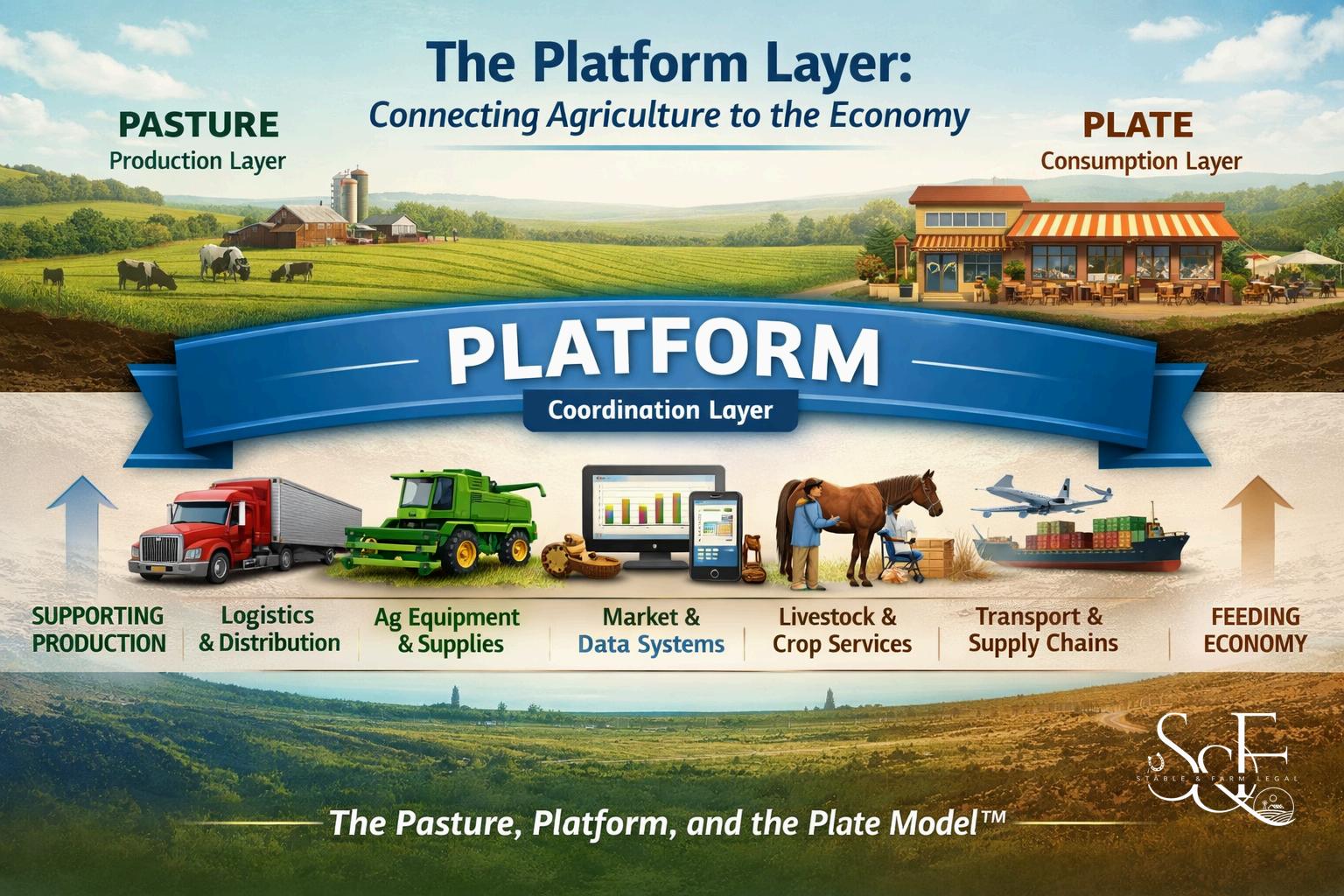
The platform layer operates across several essential functions that enable agricultural output to become scalable economic activity. It governs the movement of goods through logistics, transportation, and storage systems; it facilitates the flow of information through pricing, availability, and demand signals; it enables transactions through ordering, payments, and contracts; and it provides access to markets at local, regional, national, and global levels. Beyond these core functions, the platform layer also includes the industries that make agricultural production possible and scalable in the first place those that supply inputs, equipment, and specialized services necessary to sustain production and move it to market.
A critical component of the platform layer is the system of logistics and distribution that ensures agricultural goods reach their destinations in a predictable and timely manner. Freight networks, cold storage systems, warehouse management, and routing technologies all work together to move products from production to consumption Without these systems, agricultural goods would remain localized, and modern economies would be unable to rely on consistent supply.
Equally important are the market and pricing mechanisms that allow agricultural products to be valued and exchanged efficiently. Commodity markets, auction systems—including equine and livestock sales contracting frameworks, and digital marketplaces determine what products are worth, where they are sold, and who purchases them These systems enable price discovery and allocation, allowing agriculture to function within broader economic systems.
Often overlooked, however, is the role of agricultural equipment manufacturing and input supply industries within the platform layer. These sectors produce the tools and materials that make modern agriculture possible, including farm and ranch equipment, feed, seed, fertilizer, animal health products, irrigation systems, and facility infrastructure While they do not produce agricultural goods themselves, they are indispensable to maintaining production at scale and ensuring operational efficiency
In addition to equipment and inputs, the platform layer includes a wide range of service industries that support both crop and livestock production Crop production depends on agronomy services, soil testing, nutrient management, and pest control expertise Livestock and equine operations rely on veterinary care, training, boarding, breeding services, ranching management, and farrier services These service providers form a continuous support system that sustains agricultural productivity and prepares products and assets for movement into the broader economy.
Modern digital coordination systems further enhance the platform layer by enabling real-time management of agricultural activity. Supply chain software, agricultural data platforms, booking systems for equine services, and event registration systems for livestock and agricultural events all contribute to matching supply with demand, optimizing delivery timing, and managing
operational risk. These systems ensure that both products and services move efficiently through the economic system
Taken together, these elements form an integrated platform ecosystem that connects agriculture to the broader economy. The platform layer links production with equipment manufacturing, service industries, logistics networks, and ultimately retail and hospitality sectors It allows these industries to function as an interconnected system rather than as isolated activities, dramatically expanding agriculture’s economic reach and impact
The importance of the platform layer becomes clear when considering what would happen in its absence. Without it, agricultural production would remain localized, supply chains would be fragmented, markets would be inefficient, and economic output would be significantly reduced The platform layer is what allows agriculture to support modern economies at scale by ensuring reliable availability, stable pricing, efficient distribution, and access to global markets.
The equine industry provides a clear and practical illustration of this expanded platform layer Equipment manufacturers supply trailers, tack, and facility infrastructure; service providers deliver veterinary care, training, and boarding; transportation networks move horses to events; and digital systems coordinate scheduling, entries, and transactions. Each of these elements exists within the platform layer and supports the movement of agricultural assets into economic use While the horse originates in the pasture layer, its economic value depends entirely on the platform systems that support, coordinate, and deliver it.
The central insight is that the platform layer does not replace agriculture it enables and amplifies it It makes agriculture more productive, more efficient, more scalable, and more economically impactful. Yet it remains entirely dependent on the pasture layer. Without agricultural production, the platform has nothing to support, coordinate, or deliver
This understanding carries significant implications for policy and law. When agriculture is viewed narrowly as production, policymakers risk overlooking the extensive network of industries that depend on and support it Regulatory decisions affecting agriculture therefore extend beyond farms to impact equipment manufacturers, input suppliers, service providers, logistics networks, and downstream economic sectors From a legal perspective, this creates a complex ecosystem of interdependent risks involving contractual relationships, supply chain dependencies, and liability exposure across multiple industries
Ultimately, within The Pasture, Platform, and the Plate Model™, the platform layer is the system that enables agriculture to function at scale. It does more than move goods; it supports production, coordinates services, and connects agriculture to the broader economy It is the mechanism that moves products from pasture to plate. But it is not independent. It is built entirely on the foundation of agricultural production When agriculture is strong, the platform thrives When agriculture is disrupted, the entire system is affected This is why agriculture must be understood not as a standalone sector, but as the infrastructure that supports and sustains economic activity
Disclaimer
This article is provided for educational and informational purposes only and reflects the author’s opinion. It is not intended as legal advice, and no attorney-client relationship is formed by its publication or use
About the Author
Mary Westman is an Oklahoma Ag & Equine Law Attorney to include mediation services; Horse Breeder; and Equestrian Boarding Proprietor with an MBA. A native of West Virginia, she now lives with her husband, David, in Norman, Oklahoma She can be contacted at mary@stableandfarm legal
© Mary Westman 2026 All Rights Reserved