
MARTLET THE
UVicsenatorpushesformoreinclusive languageinacademicawards PG. 4
OPINIONS
AttacksonDEIaretheharbingerof morehostilityforourpost-secondarysector PG. 9

ARTS
InconversationwithLeighJarrett,author ofqueerromance series'TheSalishSeaSociety' PG. 10

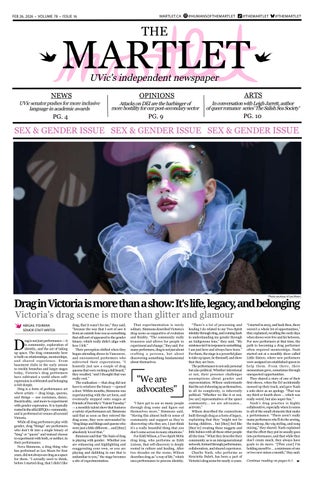
Drag in Victoria is more than a show: It's life, legacy, and belonging
Victoria's drag scene is more than glitter and glamour
Drag is not just performance — it is community, exploration of identity, and the act of taking up space. The drag community here is built on relationships, mentorships, and shared experience. From basement clubs in the early 2000s to weekly brunches and larger stages today, Victoria’s drag performers have cultivated a world where selfexpression is celebrated and belonging is felt deeply.
Drag is a form of performance art where artists — drag kings, queens, and things — use costumes, dance, theatricality, and more to experiment with gender expression. It is typically rooted in the 2SLGBTQIA+ community, and is performed at venues all around Victoria.
While all drag performers play with gender, drag “things” are performers who don’t ft into a single binary of “king” or “queen” and instead choose to experiment with both, or neither, in their performance.
Nova Simmons, a drag thing who has performed as Leo Moon for four years, did not always see drag as a space for them. “I actually used to think, before I started drag, that I didn’t like
drag, that it wasn’t for me,” they said, “because the way that I sort of saw it from an outside lens was as something that still sort of appeared to the gender binary, which really didn’t align with how I felt.”
Their perception shifted when they began attending shows in Vancouver, and encountered performers who subverted their expectations. “I honestly just saw a couple of drag queens that were rocking a full beard,” they recalled, “and I thought that was really cool.”
The realization — that drag did not have to reinforce the binary — opened a door. Within months, Simmons was experimenting with the art form, and eventually stepped onto stages at Friends of Dorothy’s “Talent Tuesday” — a monthly talent show that features a variety of performance art. Simmons said that as soon as they entered the drag scene, they were surrounded by “drag kings and things and queens who were just a little diferent … and [they] absolutely loved that.”
Simmons said that “the basis of drag is playing with gender. Whether you are enhancing and highlighting and exaggerating your own, or you are playing and dabbling in one that is unfamiliar to you,” the stage becomes a site of experimentation.
That experimentation is rarely solitary. Simmons described Victoria’s drag scene as supportive of evolution and fuidity. “The community really treasures and allows for people to experiment and change,” they said. For many performers, drag is not just about crafting a persona, but about discovering something fundamental about themselves.
"We are advocates"
“I have got to see so many people through drag come and figure out themselves more,” Simmons said. “Having this almost built-in sense of community and support as they’re discovering who they are, I just think it’s a really beautiful thing that you don’t come across in many situations.”
For Eddi Wilson, a Two-Spirit Métis drag king, who performs as Eddi Licious, that self-discovery is deeply rooted in culture and healing. After two decades on the scene, Wilson describes drag as “a way of life,” which uses performance to process identity.
“There’s a lot of processing and healing I do related to my Two-Spirit identity through drag, and coming back to understanding my gender through an Indigenous lens,” they said. “My existence isn’t in response to something; I am just here and always have been.”
For them, the stage is a powerful place to take up space, be themself, and show that they are here.
The performance is not only personal but also political. Whether intentional or not, their presence challenges assumptions about gender and representation. Wilson understands that the act of showing up as themselves, in all its complexity, is inherently political. “Whether we like it or not, [we are] representatives of the queer community… we are advocates… activists.”
Wilson described the connections built through drag as a form of legacy, explaining that they “might not be having children… but [they] feel like [they’re] creating these nuggets and little babies with all these other people all the time.” What they describe their community as is an intergenerational network, formed through performance, collaboration, and shared experience.
Charlie Nash, who performs as Henrietta Dubét, has been a part of Victoria’s drag scene for nearly 11 years.
“I started in 2015, and back then, there weren't a whole lot of opportunities,” they explained, recalling the early days when shows were few and far between. For new performers at that time, the path to becoming a drag performer often required mentorships. Nash started out at a monthly show called Little Sisters, where new performers were assigned an established queen to help them. From there, their momentum grew, sometimes through unexpected opportunities. They shared a story of one of their frst shows, when the DJ accidentally messed up their track, and gave Nash a solo show as an apology. “That was my third or fourth show … which was really weird, but also super fun.” Nash’s drag practice is highly collaborative, especially when it comes to all of the small elements that make a performance. “There aren’t really many performers who’ll do the sewing, the makeup, the wig styling, and song mixing,” they shared. Nash explained that the efort they put in usually goes into performance, and that while they don’t create much, they always have goals to do more. “[This year] I’m holding myself to … a minimum of one or two new mixes a month,” they said.
Continue reading on pages 6-7.
Photo courtesy of Leo Moon.


UVIC LIFE
Gender Empowerment
Centre is hosting second annual FEM-EXPO from March 9-13
The GEM's fagship event is a chance to celebrate intersectional feminism, community, and education
SONA EIDNANI VOLUNTEER STAFF WRITER
The upcoming Feminist Empowerment Expo (FEM-EXPO) is a week-long celebration of resilience that features workshops, vendors, panels, art, and movies, hosted by UVic’s Gender Empowerment Centre (GEM).
The events will take place during the week of March 9–13 in the Student Union Building (SUB).
FEM-EXPO is the GEM’s largest annual event of the year, bringing people together to talk about intersectional feminism and provide education for students at UVic and the greater Victoria community.
GEM is one of the fve UVSS advocacy groups. They focus on the needs of selfidentified women, transgender, non-binary, and gender non-conforming individuals.
“We provide free menstrual supplies, safer sex supplies, as well as education, events, [and] support,” Fernanda Solorza, the GEM’s outreach and communications coordinator, said in an interview with the Martlet
FEM-EXPO aligns with International
Women’s Day, which takes place on March 8.
The itinerary for the week is full, and meticulously planned. Every event is free to attend with the exception of the Groovefest, a variety show on March 13 from 7:00–10:00 p.m., featuring drag, comedy, and burlesque performances.
Also featured at FEM-EXPO are the lək̓ʷəŋən traditional dancers, who will either be in Vertigo or the SUB’s courtyard, depending on the weather, on March 9 from 10:00–10:30 a.m., and “The Hands That Build Tomorrow,” an art exhibit showcasing intersectional feminist art on March 11 and 12 from 10:00 a.m. – 4:00 p.m. in the Michèle Pujol Room.
Additionally, FEM-EXPO features a market and community table fair, which will take place at the same time as the exhibit, also in the Michèle Pujol Room.
FEM-EXPO also features 14 educational events happening throughout the week, including a consent, care, and disability workshop on March 9 from 5:00–6:30 p.m. in Vertigo, co-hosted with the Society for Students with a Disability (SSD); an 18+ risk literacy for kinksters workshop on March 10 from 12:00–1:00 p.m. in the SUB upper lounge; and an introduction
to hormone therapy panel in collaboration with the UVic Pride Collective on March 11 from 3:00–5:00 p.m., also in the SUB upper lounge.
Some may remember the SEXPO, an event run by GEM since 2022. GEM decided to change both the name and focus of the event in 2025, Solorza said, because it previously only talked about sexuality.
Solorza said the advocacy group wanted to broaden the event’s reach.
She added that, while the original SEXPO event was successful, fun, and inspired other schools to have their own SEXPO, its narrow focus created a challenge for GEM, as campus community members did not fully understand the event’s purpose.
According to Solorza, some students came away from SEXPO under the impression that GEM was only focused on sexuality, and that community members who weren’t “super sex positive” felt uncomfortable coming into their space.
“The existence of GEM is to be a strong, intersectional feminist voice on campus … our four core values are intersectional feminism, bodily autonomy, sex positivity, and collective liberation. And with those four values, the only value that we were

said. After a year of deliberation within GEM, they changed the event to FEM-EXPO. The FEM-EXPO is planned by its very own committee, which meets every Thursday to address anything that needs


Photo courtesy of Fernanda Solorza.
Bogo By parris
Comic by Kelstitch
Comic by Kelstitch
Comic by freyja zazu
Why are you getting married? Get
UVic Faculty of Engineering and Computer Science hits 24
per cent
female-identifying enrolement while working toward '30 by 30'
The Faculty of Engineering and Computer Science increased enrollment of selfidentifed women by fve per cent in four years
DECLAN SNOWDEN
MANAGING EDITOR
“30 by 30” is a nationwide initiative started by Engineers Canada to increase the number of women graduates in engineering to 30 per cent by 2030.
The UVic Faculty of Engineering and Computer Science (ECS) has endorsed this goal, and UVic as an institution has made endowments toward the goal as early as 2019.
The goal started as a response to the low percentage of newly licensed engineers in Canada who are women, which was only 17.1 per cent in 2014, when 30 by 30 was launched as a national goal. As of 2024, according to Engineers Canada, 21 per cent of newly licensed engineers in Canada are femaleidentifying.
According to Engineers Canada, the average percentage of newly licensed women engineers in British Columbia is 21.2 per cent as of 2023. In 2022, UVic reported that approximately 19 per cent of ECS enrolments self-identified as women. Now, that number has jumped to 24 per cent, according to Caela Mofet, the ECS faculty’s marketing specialist. Jessica Vandenberghe, ECS’ associate dean, community and culture, said there is expected to be some who enrol, but do not continue with ECS. Still, this year marks a 5 per cent increase in enrolment of self-identifed women since 2019.
The faculty was unable to share with the Martlet what percentage of students who graduate from the faculty are selfidentifed women.
According to the University of British Columbia (UBC), enrolment of women in engineering (at the Vancouver campus) was 29 per cent in 2022. The University of Toronto reported that 37.3 per cent of students in the Faculty of Applied Science and Engineering across all undergraduate programs identifed as a woman as of 2025, and the University of Waterloo reports a 33.8 per cent enrolment of women in engineering as of 2025, with 31.8 per cent of graduates that year identifying as women.
At Simon Fraser University, women made up 20 per cent of undergraduate students in 2024-25 and 17 per cent of students enrolled in undergraduate degrees in the Faculty of Applied Sciences. In the same faculty, women made up 28 per cent of graduate students, 30 per cent of master’s degrees, and 22 per cent of PhDs.
“We believe that diversity in engineering equals strength in engineering, and there is a place for everyone in our faculty,” Mofet said in a statement.
While working toward 30 by 30, the faculty has introduced many scholarships and bursaries to help support women in engineering and computer science, such as the Cora Arenas and Carol Artemiw second year retention award, which gives up to 40 students entering
On Gender
By Fin!

their second year $10 000 each, with frst preference for women-identifying students, and a second preference for 2SLGBTQQI students, as well as the Women Continuing in Engineering and Computer Science award, and the 30 by 30 award.
Although the faculty does make eforts to support university-aged women to encourage enrolment, they aim to appeal to younger girls as well.
“We know that a big part of getting to the 30X30 goal is getting people into STEM at a young age, so we do a lot of K-12 outreach via Science Venture.…
They do programs like GoENG Girl, Code Girl, STEMgirls, and more. We also do outreach to many local high schools," Mofet said.
Vandenberghe said the biggest challenge in working toward 30 by 30 is countering internalized bias and stereotypes. She also said that discrimination can be hard to prove and document, and that doing so can be a difcult process, as people must recount and relive their bad experiences.
“Really, one of the biggest challenges right now is trying to counter our unconscious bias [and] challenges associated with identifying some of these barriers and then convincing people that it is an actual barrier and it's not something that is made up or just afecting one person,” Vandenberghe said.
Vandenberghe told the Martlet she

encourages any student, but especially women, to utilize UVic’s wellness supports, as well as clubs and community groups such as Women in Engineering, Science, and Technology (WEST), and Women in Engineering and Computer Science (WECS).
Although the faculty has endorsed 30 by 30, which specifcally aims to increase enrolment for women, it also has equity, diversity, and inclusion initiatives for other underrepresented groups, including a Truth and Reconciliation
framework, an anti-racism framework, and a framework for students with disabilities, according to Vandenberghe.
“I want to make clear that we don't see that goal as an endpoint, just a milestone to even greater representation in [the] future. I don't have a crystal ball but I believe that we'll hit 30 per cent by 2030, and we are pushing for it across the faculty,” Mofet said.


UVic senator pushes for more inclusive language in academic awards
UVic professor and former leader of the BC Greens pushes for updated langauge in academic awards, applauds updates to Indigenous awards policy
DECLAN SNOWDEN MANAGING EDITOR
In recent Senate meetings, the topic of updating the language of UVic academic awards to clarify identity requirements has been a recurring theme. Dr. Andrew Weaver — a UVic professor of earth and ocean sciences who serves on UVic Senate, and is also the former leader of the BC Green party — has been pushing for updates to the language used in academic awards since October 2025.
Historically, Weaver has pushed for more inclusive language in government as well. He introduced bills M208 and M209 to “protect gender identity and expression privacy rights” in 2018, though they were not supported by the BC NDP government, and never received a second reading.
Weaver told the Martlet that, when he initially asked why the language used in certain awards was gendered, he was told it was “historical,” and that the university was working on changing the language used. However, Weaver said that Senate has continued to be presented with new awards and fellowships featuring inconsistent language, such as both “women” and “self-identifed women.” In some instances, senators have reported that gendered awards language has posed a barrier for non-binary students.
During the Nov. 7, 2025, Senate meeting, a senator said they had wanted to nominate
a non-binary student for an academic award specifcally labeled for women. The senator, pushing for more inclusive language, said the gendered language of the award caused noteworthy harm.
At the Dec. 5, 2025, Senate meeting, a member of UVic administration said that updating the language of awards would be a slow and ongoing process, requiring working with the Development Ofce and donors to apply more inclusive language.
“I recognize there are many awards, and I recognize that when a donor approaches the university, they know what they want to give an award for, and you have donors on the entire spectrum of everything under the sun, whether it be gender, whether it be political belief, whether it be environmental belief, whether it be nationality,” Weaver said.
“But they also need to understand [the] institution’s perspective, and if you have rules and policy in place … [and] if you make things clear up front, problems don't arise,” he continued.
Alongside the push for more gender inclusive language comes a new policy that provides updated requirements for Indigenous awards. Efective Nov. 1, 2025, the Indigenous Citizenship Declaration (ICD) policy sets out to ensure Indigenousspecifc awards go to Indigenous recipients.
This policy came after reports of people misrepresenting their identity emerged, UVic’s acting president said, depriving Indigenous students of crucial funding and opportunities intended for them.
The policy, produced through
engagement with members of the səlxʷéyn sqʷél (Elder’s Voices) program and Indigenous communities at UVic, will require those who apply for Indigenousspecifc awards that may result in material gain to declare their Indigenous citizenship, and provide supporting documentation that afrms their documentation. Times Colonist reported that the policy was made by a UVic working group that gathered “hundreds of stories, experiences, and perspectives” through online and in-person sessions, surveys, and consultations.
According to the policy, supporting information “refers to materials and/or evidence that meets the requirements for Indigenous Citizenship as communicated by the Applicant’s Nation(s), People(s) or Community(ies) in an agreement with the University, and/or demonstrates the truth and accuracy of an Applicant’s Declaration in alignment with the Associated Procedures."
Weaver told the Martlet he applauded the updated policy, calling it “very well thought through.”
However, Senate has not yet approved a policy outlining the university’s position on gendered language in awards.
“There's still a lot of work to be done on some of the gendered language, though,” Weaver said. “But what we've heard, and based on the evidence presented at the last meeting, is it's being taken very seriously now, and they're working on coming up with a policy”.
Photo via UVic.ca

Drag in Victoria is more than a show It's life, legacy, and belonging
Drag is not just performance — it is community, exploration of identity, and the act of taking up space. The drag community here is built on relationships, mentorships, and shared experience.
From basement clubs in the early 2000s to weekly brunches and larger stages today, Victoria’s drag performers have cultivated a world where self-expression is celebrated and belonging is felt deeply.
Drag is a form of performance art where artists — drag kings, queens, and things — use costumes, dance, theatricality and more to experiment with gender expression. It is typically rooted in the 2SLGBTQIA+ community, and is performed at venues all around Victoria.
While all drag performers play with gender, drag “things” are performers who don’t ft into a single binary of “king” or “queen” and instead choose to experiment with both, or neither, in their performance.
Nova Simmons, a drag thing who has performed as Leo Moon for four years, did not always see drag as a space for them. “I actually used to think, before I started drag, that I didn’t like drag, that it wasn’t for me,” they said, “because the way that I sort of saw it from an outside
lens was as something that still sort of appeared to the gender binary, which really didn’t align with how I felt.” Their perception shifted when they began attending shows in Vancouver, and encountered performers who subverted their expectations. “I honestly just saw a couple of drag queens that were rocking a full beard,” they recalled, “and I thought that was really cool.” The realization — that drag did not have to reinforce the binary — opened a door. Within months, Simmons was experimenting with the art form, and eventually stepped onto stages at Friends of Dorothy’s “Talent Tuesday” — a monthly talent show that features a variety of performance art. Simmons said that as soon as they entered the drag scene, they were surrounded by “drag kings and things and queens who were just a little diferent … and [they] absolutely loved that.” Simmons said that “the basis of drag is playing with gender. Whether you are enhancing and highlighting and exaggerating your own, or you are playing and dabbling in one that is unfamiliar to you,” the stage becomes a site of experimentation.
That experimentation is rarely solitary. Simmons described Victoria’s drag scene as supportive of evolution and fluidity. “The community really treasures and allows for people to experiment and change,” they said. For many
performers, drag is not just about crafting a persona, but about discovering something fundamental about themselves.
“I have got to see so many people through drag come and fgure out themselves more,” Simmons said.
“Having this almost built-in sense of community and support as they’re discovering who they are, I just think it’s a really beautiful thing that you don’t come across in many situations.”
For Eddi Wilson, a Two-Spirit Métis drag king, who performs as Eddi Licious, that self-discovery is deeply rooted in culture and healing. After two decades on the scene, Wilson describes drag as “a way of life,” which uses performance to process identity.
“There’s a lot of processing and healing I do related to my Two-Spirit identity through drag, and coming back to understanding my gender through an Indigenous lens,” they said. “My existence isn’t in response to something; I am just here and always have been.” For them, the stage is a powerful place to take up space, be themself, and show that they are here.
The performance is not only personal but also political. Whether intentional or not, their presence challenges assumptions about gender and representation. Wilson understands that the act of showing up as themselves, in all its complexity, is inherently political.
“Whether we like it or not, [we are] representatives of the queer community… we are advocates… activists.”
Wilson described the connections built through drag as a form of legacy, explaining that they “might not be having children… but [they] feel like [they’re] creating these nuggets and little babies with all these other people all the time.”
What they describe their community as is an intergenerational network, formed through performance, collaboration, and shared experience.
Charlie Nash, who performs as Henrietta Dubét, has been a part of Victoria’s drag scene for nearly 11 years. “I started in 2015, and back then, there weren't a whole lot of opportunities,” they explained, recalling the early days when shows were few and far between. For new performers at that time, the path to becoming a drag performer often required mentorships. Nash started out at a monthly show called Little Sisters, where new performers were assigned an established queen to help them. From there, their momentum grew, sometimes through unexpected opportunities. They shared a story of one of their frst shows, when the DJ accidentally messed up their track, and gave Nash a solo show as an apology. “That was my third or fourth show … which was really weird, but also super fun.”
Nash’s drag practice is highly collaborative, especially when it comes to all of the small elements that make a performance. “There aren’t really many performers who’ll do the sewing, the makeup, the wig styling, and song mixing,” they shared. Nash explained that the efort they put in usually goes into performance, and that while they don’t create much, they always have goals to do more. “[This year] I’m holding myself to … a minimum of one or two new mixes a month,” they said.
Community is a central part of Nash’s experience. “I love the local scene. It’s seen a lot of change, and I feel like our scene is so inclusive and celebratory… a lot of my closest friends are people I’ve met through drag.” Unlike more traditional “drag families” that take on mothermentor roles, Nash says the Victoria drag scene recognizes it “takes a village to raise someone … We’re all kind of siblings.”
Drag has also been intertwined with Nash’s personal and gender journey. “A lot of my drag journey has been connected to a gender journey. I’ve kind of hit a bunch of diferent gender identities over the last few years,” they said. Nash describes the experience as both expressive and protective — “When I’m Henrietta, I walk in and I scream immediately, you know, I’m kind of a loud ass bitch when I’m in drag,” they said. “There’s a mask mentality


that happens … it’s an extension of yourself, but it’s almost a safety barrier as well.”
Rick Van-Kesteren, who performs as Honey Dew Me, began exploring drag in 2018 after moving to Victoria from the Netherlands. He started out at Paparazzi Nightclub, when they used to do Drag Sundays. “It was a newbie kind of showing. You could just do a debut there. So I did that in March 2018,” he said. The decision to get on stage initially came from a dare — “It started with a bet, actually, from one of my friends … that’s kind of how it just started.”
Van-Kesteren quickly became involved in producing shows, as the city’s drag scene was still small. “We basically started to produce our own shows, and it became bigger and bigger,” he said. As the scene expanded, venues like The Vicious Poodle began hosting drag brunches, giving performers a consistent stage. Community and friendship have been central to Van-Kesteren’s experience. “I think I’ve made a lot of friends through it,” he said. “You kind of have these connections with people already, and they’re kind of forged deep already,” Van-Kesteren said. “I think for me it was really important because at that point I didn’t necessarily have a community.”
Performing as Honey Dew Me is immersive and energizing for VanKesteren. “As soon as I start, I’m
becoming whatever I want.” He explained that drag goes much beyond performance, describing it as a convergence of multiple creative interests. Nash went on to say that he enjoys the combination of being creative with makeup, storytelling, fashion, wig-making, and more. “All of those things separately are already interests of mine,” he said, “so it was all these kind of qualities of drag that made it the total package for me.”
As these performers demonstrate, drag in Victoria is more than an art form — it is a living and breathing community where identity and belonging can be discovered. It is not just about performance, but about building a world where everyone has room to exist fully and unapologetically. The city’s scene has become a place where people can explore who they are, push boundaries, and support one another along the way. Ultimately, the scene is a testament to the power of presence and participation. Whether it’s through the boldness of a drag king, the experimentation of a newbie, or the guidance of a seasoned performer, drag creates space for individuals to be seen, celebrated, and understood. It is through these connections, both on and of stage, that the community continues to thrive.


ABIGAIL FISHMAN
SENIOR STAFF WRITER
Photos courtesy of Leo Moon, Eddi Wilson and Charlie Nash.
Contraceptives
shouldn't require a prescription
Life-saving, life-changing medication shouldn't be locked behind a counter
DECLAN SNOWDEN
In 2023, AccessBC successfully campaigned for free prescription contraceptives in British Columbia, including hormonal and copper intrauterine devices, oral hormone pills, subdermal implants, injections, and Plan B. The campaign was supported by the BC NDP, BC Liberals, and BC Greens, marking B.C. as the frst Canadian province to ofer free prescription contraceptives, with Manitoba following in October 2024, and both P.E.I. and the Yukon in March 2025.
As of June 1, 2023, pharmacists in B.C. have the ability to prescribe contraceptives themselves, as well as medications for minor ailments, reducing barriers like access to a doctor. These policies were important steps in protecting the rights of those who need contraceptive care, and creating a more equitable, safe, and fair society.
Still, there is work to be done to better serve individuals seeking contraception, particularly among individuals with multiply marginalized identities. Medical discrimination is, unfortunately, a very real problem in B.C., and in Canada as a whole. One 2024 study found that Black women in Alberta faced signifcant barriers to accessing healthcare due to intersecting aspects of their identities, such as race, class, and gender, with many participants noting experiences of stereotyping, dismissal of issues, and discriminatory assumptions by health professionals.
A 2020 review of provincial healthcare
in B.C. found that Indigenous women are particularly impacted by stereotyping, discrimination, and prejudice. For a large part of the population, seeing a medical professional can result in discrimination, and locking life-saving, life-changing medication behind a counter only compounds the risk of harm.
Oral contraceptives should be made free and over-the-counter to help eliminate both cost and structural barriers created by discrimination. Reducing barriers to contraceptives is shown to have measurable benefits. One 2025 study found that an increase in the prevalence of contraceptives prevented approximately 77 400 maternal deaths globally in 2023. Canadian federal health guidelines also suggest that a lack of attention to sexual and reproductive health care contributes directly to higher maternal mortality, disenfranchisement, and poor health outcomes.
Importantly, ofering over-the-counter contraception provides greater access to contraception that is difcult to tamper with. Unrestricted access to contraceptives allows individuals to take precautions against pregnancies caused by unwanted sexual contact. According to the United Nations Population Fund, nearly a quarter of all women worldwide cannot say no to sex. The Canadian federal government, on their website on intimate partner violence, reports that , according to a 2018 survey, 12 per cent of women and girls (aged 15-24) have experienced intimate partner violence — which includes reproductive coercion and coercive control.


Other countries, such as Mexico, the United Kingdom, and New Zealand, already have over-the-counter contraceptives, and in 2023, the U.S. Food and Drug Administration approved Opill (norgestrel) as its frst over-the-counter oral contraceptive. Even more conservative countries, such as Türkiye and Saudi Arabia, permit over-the-counter birth control. By not yet ofering contraceptives over-the-counter, Canada is lagging behind many of its global contemporaries. Regarding the safety of over-the-counter contraceptives, there is little to no evidence suggesting they are unsafe. Many health organizations, such as the American College of Obstetricians and Gynecologists, argue some of the most popular prescription contraceptives, such as progestin, are safe and suitable for overthe-counter use.
In the case of Mexico, research shows that knowledge of oral contraceptive use was no worse amongst women who took over-the-counter contraceptives compared to women who took prescription contraceptives. Over-the-counter contraception is generally supported by medical practitioners as a way to potentially lower the number of unintended pregnancies and increase access to efective contraception.
If the purported improvements to health outcomes associated with free contraceptives are not convincing enough, there is an economic incentive to top it all off. Free contraceptives are revenue positive, meaning they save more money than they cost, reduce barriers to access,

and provide fair and easy access to lifesaving medication to those who need contraceptive care. Making these medications widely accessible is a net positive that only makes society more fair and safe.
Critics have rightfully pointed out that making prescription contraceptives overthe-counter could result in residents of provinces without free contraceptives losing their MSP coverage of them, meaning they would have to pay out-ofpocket. I want to be clear that I do not support any action that could result in people losing access to necessary medication. Rather, provincial and federal governments should step up and work together to actually take care of their
citizens by making these medications free across the board — regardless of prescription or over-the-counter status — while also reducing barriers to use. Countries like the U.K. have proven this is possible, ofering free contraceptives whether prescribed or not. The steps the province and Canada have taken to increase access to contraceptives are good frst steps, but they have to be first steps. A fair, equitable, and safe healthcare system must serve everyone, including and especially those whose intersecting identities render their health outcomes the most precarious. Better outcomes for those individuals means better outcomes for everyone; that is the healthcare we all should want.
EDITORIAL
Why the Martlet is asking for a fee increase
This election period, we're asking for a $2 increase per full-time student each semester to support the continued existence of independent journalism on our campus
In 1999, Nunavut separated from the Northwest Territories, becoming Canada’s third territory. In 1999, a total solar eclipse was seen in Europe and Asia. In 1999, The Sopranos premiered on HBO, and at the end of the year, Russian president Boris Yeltsin resigned, leaving the role to the country’s current leader, Vladimir Putin. Also in 1999, the Martlet pushed for its last fee increase.
For those of you who don’t know us yet, we’re UVic’s independent, fact-checked student newspaper.
We’ve been around since 1948 — before UVic was UVic — reporting on stories that matter in our community. We became editorially, financially, and structurally independent from the UVSS in the 1990s. Most of our budget comes from student fees, but neither UVic, the UVSS, nor our own board of directors set those fees. You do.
This election period, we’re asking for a $2 fee increase per full-time student — approximately the price of one cup of cofee or tea at the Munchie Bar when you bring your own mug — and a $1 increase per part-time student to help support the continued existence of factchecked, independent journalism on our campus.
In 1999, students voted via referendum to raise our student fee levy from $2.75 to $3.75 — the same amount it has remained for 27 years, longer than almost anyone on our
Attacks on DEI
are the harbinger of more hostility for our post-secondary
sector
As Canadian post-secondary education implements equity standards and demographic shifts, funding isn't following
RAE DAWSON OPERATIONS MANAGER
Post-secondary institutions in British Columbia are currently under review to address growing fnancial challenges, following federal limits on international students and declining domestic enrolment. Despite the obvious need for more funding, the B.C. post-secondary minister says more provincial funding is currently not an option.
The short timeline of the B.C. postsecondary review has raised concerns for many student organizations, including UVic’s own Graduate Students Society, who say that the four-month review “limits meaningful participation by students, faculty, and staf.” Some groups are concerned that this review is being used to justify “predetermined cuts at the expense of students.”
These fears are not unwarranted. On Feb. 12, the Ontario government announced that they were ending the seven-year freeze on tuition and signifcantly reducing the maximum amount of Ontario Student Assistance Program (OSAP) grants students can receive, from 85 per cent to 25 per cent, with loans making up the remainder of the funding.
In tandem with looming budget cuts, right-wing groups such as OneBC are rallying to further defund postsecondary institutions like UVic and the University of British Columbia, which they’ve called “radical leftist” institutions, and have called for removing “woke” policies like DEI from our post-secondary sector. Unfortunately, threats based on antiequity standards are not toothless. In early February, the University of Alberta moved to scrap DEI/EDI practices in
their hiring process. Through an access to information request, CBC obtained documents exploring the reasoning behind this decision. CBC found that among reasons cited were “burnout from some staf taking on EDI work, a need for more practical resources, and a lack of representation of women and Indigenous faculty and students in STEM felds.”
Ironically, the University of Alberta’s solution to lacking both the resources and staff to make DEI effective — proving the necessity of diversifying their staf and students through these policies — is, apparently, to throw out the program altogether after only six years of it being in place.
The perfect storm for post-secondary education in Canada is brewing. Cuts to funding, limits on international student enrolment, and attacks on equitable practices all contribute to a more hostile post-secondary student experience. In tandem with rising discrimination and attacks on gender diverse people, immigrants, and racialized communities, the nourishing diversity of Canadian higher education is under threat.
According to the 2021 census, Canada leads in education globally, with 57.5 per cent of working-age adults holding a post-secondary degree. While this statistic is a source of pride for the nation, it would not have been possible without diversity and inclusion practices. The history of women’s enrolment in Canadian post-secondary institutions ofers one example.
In 1920, women only accounted for 16 per cent of post-secondary enrolment in Canada. A century later, gender demographics in Canadian higher education have drastically shifted. Since
the 1990s, women have outnumbered men in Canadian post-secondary institution enrolments. In the 2023–24 school year, 1.266 million women were enrolled in post-secondary, surpassing the 1.016 million men enrolled. In B.C., women accounted for 48.2 per cent of enrolled post-secondary students, compared with 43 per cent for men, and the remaining 8.8 per cent being students of an “unknown gender.”
Contributing factors to a rise in women’s enrolment were national equity initiatives that addressed workplace and access disparities based on gender, race, and disability. These include the 1977 Canadian Human Rights Act, the 1982 Canadian Charter of Rights and Freedoms, and the 1986 Employment Equity Act. As employment opportunities became more equitable in Canada, the enrolment of women in post-secondary education followed. Interestingly enough, however, beginning in 1994, Canadian postsecondary institutions went through massive fnancial strains due to reduced federal funding of several billion dollars. This coincided with movements against “political correctness” in post-secondary institutions, the backlash against which de-incentivised institutions from acting on the equity initiatives set over the previous decades. Money invested in controversial (at the time) equity practices was sidelined, as institutions struggled to keep the lights on. Tuition rose up to 8 per cent a year for students, hiring freezes were implemented, student loans were rearranged at the expense of provincial budgets, and the amount of money paid out in student loans increased as provincial grants were reduced.

SOUND FAMILIAR?
As attacks against equity standards are becoming more commonplace across Canada, our post-secondary sector is also under increased strain.
This is not the frst time that the death rattle of exclusionary cultural values has accompanied a lashing-out against post-secondary funding, as a means of controlling who is included in our institutions. In fact, the pushback against DEI policies shows how essential these practices are in Canadian higher education’s growth. If new and diverse perspectives are considered a threat to Canadian postsecondary, it exposes how lacking in diversity our institutions already are.
DEI practices are only the beginning when it comes to addressing issues impacting marginalized communities in Canada. However, they are an integral starting point for Canadian institutions to identify the sites where equity challenges exist, should they choose to listen (I’m looking at you, University of Alberta).
Diversity is both a strength of our institutions and a sign of growth, but it has to start with proper funding for the chance to truly fourish.
current staf has been alive. Our fee has remained the same through major international conficts, global pandemics, the 2008 financial crisis, and the invention of the iPhone.
It should go without saying that $3.75 in 1999 is not the same as $3.75 in 2026, but it can be challenging to visualize exactly how different those numbers are, so we’ve provided a few helpful statistics. According to the Bank of Canada’s infation calculator, $3.75 in 1999 would be roughly $6.76 today, or an 80 per cent increase. Printing costs have also only risen since our last fee increase, meaning we’ve had to reduce both volume and frequency of print copies over time to keep up. In December 2012, we paid just under $1 500 to print 5 500 copies of our newspaper, at 24 pages per copy. Oh, and we were printing it weekly. For this most recent print issue, we paid just over $1 000 — almost the same price, it’s true — but for 3 000 copies, at only half the number of pages. Lastly, the minimum wage in B.C. in 1999 was $7.15 per hour. As of June 2025, the province’s minimum wage is $17.85, a 149.6 per cent increase.
This is why we’re asking for a $2 increase to our fee. Because running even a small newsroom like ours, producing quality, fact-checked local news, providing meaningful paid opportunities to aspiring student journalists, and shedding
light on important stories in our campus community, isn’t cheap. Currently, our fee is among the lowest in the province. The Ubyssey UBC’s independent student newspaper, collects $8.37 per student each year, while The Peak (SFU) collects $4.90 per full time student each semester, and the Capilano Courier (Capilano) collects $1.65 per credit from each student during the fall and spring terms, to a maximum of $24.75 per term. Students at Camosun College pay around $10 per year to fund their newspaper, Nexus. Without a fee increase, we will continue to stagnate, as we have over the last 27 years. It won’t mean the death of the Martlet overnight, but it will mean a continued decrease in the number of staf we can hire, the number of stories we can report on, and the decline of independent journalism when we need it most.
We believe that people do their best work when they are fnancially supported, and aren’t worrying whether they’ll make rent this month or be able to aford groceries. We want to provide more opportunities for student journalists on our campus, and to pay them a fair wage for the work they do. If you are an undergraduate student at UVic, you can help make that possible, by voting “yes” during the UVSS Election period from March 4–6.
It's not 'just pixels': X has become a weapon against women A platform that enables deepfake pornography has no place in a just society
DECLAN SNOWDEN MANAGING EDITOR
It’s Jan. 2, 2026. You open X (formerly Twitter) to fnd a sexually explicit photo of yourself. A photo you never took. Once Grok — X’s built in generative AI model — was updated to be able to edit photos, everything changed for online safety. Everyone with an X account had the ability to ask Grok to edit photos — without the consent of the person pictured. Requests made to Grok included putting users in small bikinis and degrading poses, covering them in bruises or “doughnut glaze,” and placing gags in their mouths, among others. This digital abuse was not limited to adults. Many users also used Grok to edit images of minors, producing child sexual abuse material (CSAM).
Initial reports said “hundreds” or potentially thousands of users had non-consensual images generated of them. Images that were publicly generated for the world to see. But initial reports did not grasp the severity of the issue. Later, a report from the Center for Countering Digital Hate (CCDH) estimated three million sexualized images were generated in just 11 days. The Guardian reported that by Jan. 8, as many as 6 000 requests were being made to Grok every hour to put women in bikinis. One report, published by the European
investigative non-proft AIForensics, found that 53 per cent of all images assessed between Dec. 25 and Jan. 1 were sexualized photos, with 81 per cent of individuals presenting as women.
Eventually, Grok was restricted, so only premium users could ask it to edit photos. The public @Grok X account was also heavily restricted, though the Guardian reports users are still able to generate sexualized images of both women and children through the Grok app.
Elon Musk, CEO of xAI, said the images were caused by lapses in Grok’s safeguards. Even if this is true, it raises the question: should a multi-billion dollar company that cannot implement adequate safeguards to prevent nonconsensual sexual content — including CSAM — be allowed to develop such a tool in the frst place? Is a company that let the issue go on for so long, while leaving open loop-holes, really ft for a just society?
Sweden’s Prime Minister, Ulf Kristersson, called the images “a kind of sexualized violence.” He’s right. But it’s not just sexualized violence, it’s also an ideological weapon that makes digital spaces unsafe for women, while empowering abusers. It’s a tool to strip women of not just their clothes, but of any semblance of online safety. The digital sphere should be a space where women can express themselves, speak up about social issues that afect
them, and feel a sense of belonging, without the threat of real-world violence. Now, many digital spaces are at risk of becoming a safe-haven for incels, while silencing women through intimidation and the constant threat of sexualization and abuse. Experts who study abuse warn tools like Grok give abusers a new avenue for harming and controlling their victims, and victims of such tools report that calling out the bad behaviour only makes it worse, with more users then fooding in, to suggest their own sexualized edits. It’s a zero-sum game where women are deprived of control over their digital presence for the beneft of incels, predators, and abusers. Grok’s photo editing feature quickly drew international response, with discussions of banning X taking place around the globe, however, not all countries have been willing to act on it. Disgustingly, Canada is not currently considering banning X, according to Evan Solomon, Canada’s minister of AI and digital information. Canada’s National Observer reported that Elon Musk is “applauding” the country’s decision not to ban X. Even worse, Canada’s pension plan — which had 15.9 million contributors in 2023 — has invested $416 million in xAI. On Feb. 3, French authorities raided X ofces, following an investigation that began in January 2025. French authorities are investigating X for alleged unlawful data extraction and

alleged complicity in the possession of CSAM. The UK is also investigating X over the sexualized deepfakes created by Grok and shared on the platform. It’s time to ask ourselves, what does X bring to the table? It’s a platform run by a man who has publicly performed what many described as a “Nazi salute,” who has been criticized for pandering to Neo-Nazis, and who fred over 80 per cent of X’s content moderation and safety team, causing hate to run rampant. Communications between Musk and Jeffrey Epstein
Illustration by Sage Blackwell.
Photo by Kelly Sikkema via UnSplash.
ARTS & ENTERTAINMENT
In conversation with Leigh Jarrett, author of queer romance series 'The Salish Sea Society'
The
Vancouver Island-based queer author talks gay narratives, writing sex scenes, and Ilya
Rozanov

queer romance as your thing?
This interview has been edited for clarity and concision.
Can you tell me a little bit about your work, and specifcally about your series, the Salish Sea Society?
Generally, I've been writing in the MM [male/male romance] genre for 16 years now…. I wrote [the Salish Sea Society] with the idea in mind that … there was these four friends that knew each other from high school, that created a support group for each other and met once a week from the time they were in high school, and they just kept it up into their adulthood … and what their lives would look like as each one of them fell in love, and that all unfolded. And I decided to base it here because why wouldn't I? It's beautiful here.
I'm curious what you think is special about Vancouver Island, and if you have anything more to say about why you chose it as the setting for these books?
I wanted to set it in Vancouver Island … because there's a very natural, organic feel to living on the island, and I wanted these guys to be, like, really authentic, earthbound kind of men.
What draws you to writing MM stories?
It's just such a diferent dynamic that I fnd really intriguing to dive into.… It's a completely different dynamic than a hetero-type relationship…. It's just intriguing. And gay male relationships are so misunderstood…. I want to show a diferent side of the community, the real side of the community, where these are real loving, deep relationships. And I just want to spread the word and have more people understand that love really is love.
I'm curious how you landed on
I was partially bedridden for a while, about … 18 years ago. And I was bored. So I started writing this story that had kind of been in my head…. From the time I was a kid, I always had stories foating around in my head. So I decided I was going to write this one down. And it had been in my head for years, but as I started writing it, I noticed that two of the male characters seemed to be really attracted to each other. And I was like, oh, this is something interesting. Maybe I should explore this. And that's how it started. It was just these two characters [that] liked each other. So of we went.
I like how you made it sound like the characters had a life of their own within the story you were writing.
Oh, they do. And sometimes you get into arguments with them. It's like, no, I want you to say this. They're like, no, no. We're going this way.
I'm assuming that there's a lot of really spicy stuf in the work that you write, and I'm curious how you're able to write lots and lots of content and keep it feeling fresh both for you and for your readers.
That is difcult. When you're writing, you see yourself using some of the same phrases, every once in a while, and I'll catch myself, and I'll change it up. I'm constantly doing that. But I have to not be so hard on myself either.… People are not going to pick up on the same things that I'm picking up on. And as for story ideas, you just get these –– what they call plot bunnies — you see something, or you hear something, or some line comes up on a movie, and it just clicks this thing that starts unrolling this whole story…. It's the ‘what if,’ you know?
It sounds like you get a lot of your
inspiration just from living life with your eye trained to pick up on interesting moments. I'm curious, if you don't mind sharing, how do you get inspiration for the sexier stuf?
You want the real answer?
If you're comfortable sharing on the record.
Yeah, no, it's fine…. you've got the mechanical side of things. I am not a man. I don't know what it's like to have sex with another man. So it's a combination of watching the gay porn type stuf, and talking to gay men …. and then Googling things. I write gay erotica as well, so I'm already versed in that type of writing. I got a really good compliment the other day — one of the guys in my [writing] group, he says, … “I usually can tell when a woman has written the gay sex. But I had no idea you were a woman.” So I was like, yay!
What are you working on now?
I am working on my Substack publication [where] I'm doing short stories. I think that's going to be my 2026.... I can make so much more money doing that. And it’s fun.
Have you seen Heated Rivalry? Yes.
Shane Hollander or Ilya Rosanov?
Oh God. I don't know. I like the edginess of Ilya. He would be a more interesting character to write, for sure.

Three songs about sex & love, courtesy of CFUV 101.9FM
An Ofbeat by CFUV artist interview
ZOE BECHTOLD CONTRIBUTING WRITER
For the Martlet’s Sex & Gender issue, I have chosen to review three songs that approach sex and love with unique angles. These songs, in alignment with my music taste, are eclectic and storydriven.
“HIS HANDS” – BLEGH
The frst song on my list is “His Hands” by Blegh, a song flled with delirious yearning, made more potent by repeating lyrics and the many musical stages the song travels through.
The lyrics focus on the overwhelming sensation of crushing on someone, rather than the object of afection — the mysterious “he” who has no physical description — themself. The song highlights moments of perceived connection, despite the suggestion that both parties are involved with other people.
“His Hands” starts with the mention of a party, and progresses to moments of “prolonged eye contact in casual conversation” and “foggy windows,” where the singer’s desire for the subject grows and grows. There are hints throughout the song that the singer’s feelings may be reciprocated, but for the most part it is a song about, as the chorus lines say, “Being unwanted / And wanting too much / Feeding the idea of you / Leaving you starving.”
The whole song is highly evocative, and feels a bit like stumbling around in a daze.
It is a great song for complicated character playlists, or when you need a bit of unrequited pining.
“A FORMIDABLE MARINADE” –MIKELANGELO AND THE BLACK SEA GENTLEMEN
If you’re someone who, like me, thinks that cannibalism in fctional media can have erotic undertones (think vampire media), or enjoy a bit of taboo, then “A Formidable Marinade” by Mikelangelo and the Black Sea Gentlemen may be for you!
“A Formidable Marinade” sounds like it should be played in a smoky, dim room.
Mikelangelo’s baritone, combined with the sounds of accordion, violin, and clarinet, makes for an excellent and sometimes intentionally of-putting mix. The band leans into shrill and sometimes squealing sounds that grate on the ear. Combined
with the visceral nature of the lyrics, the song can be felt as well as heard.
“A Formidable Marinade” takes the desire to become one with someone (for example, through marriage or sex) to the furthest extremes of animalistic, ravenous lust. The desire to fght, consume, or become one seems to stems from a desire to copulate or destroy, as summed up in the chorus:
“I'll feast on your body if you'll feast on mine / Blood is thicker and redder than wine / Lay ourselves out upon the table / Ravish each other till we're no longer able / When juices mix in the heat of the fray / It will make a formidable marinade.”
The chorus is both inherently about sex, and also about feasting and food, making them one and the same. Of the three songs have chosen to talk about, this one is certainly the most fun, provided you don’t take it too seriously.
“FAIR” – THE AMAZING DEVIL
Unlike the other two songs, “Fair” by The Amazing Devil is sweet and romantic. Though still a little strange and melancholic, it is a song about seeing love in the simple yet intimate moments of a long-term romantic partnership, and being surprised at how strong that love still is. The Amazing Devil is a band made up of Joey Batey and Madeleine Hyland, with Batey as the track’s main vocalist. He sings quietly, his voice cracking at times, and is backed by gentle instrumentals, giving the song its melancholic feel.
The lyricism is sweet, but also at times funny, noting how one partner has “so much fucking hair” and “You don’t need to pretend to be someone you’re not / Cos it’s not like I’ve never heard you fart and snore,” showing a real closeness between the parties. References to the less appealing parts of closeness show that the song’s partners aren’t hiding parts of themselves from one another. The song even includes a “that’s what she said” joke, which I love; it feels relatable to my own experience, cracking jokes and being a little bit annoying with my partner, my friends, and my family, which is one of the ways I express that I love them, and they love me in return. Of the three songs I have chosen, “Fair” is the most likely to make you cry, but it’s perhaps the least visually evocative of the three. Still, it’s a beautiful song, and I do hope you choose to give it a listen.


Six fantastic 'sex and gender' themed flms from this year's Victoria Film Festival Read all the reviews at martlet.ca
GABRIEL LUNN
SENIOR STAFF WRITER
RUBY HARRIS
SENIOR STAFF EDITOR
BRIANNA BOCK SENIOR STAFF WRITER
RAE DAWSON OPERATIONS MANAGER
A WOLF AMONG THE SWANS
The 2024 flm, A Wolf Among the Swans, directed by Helena Varvaki and Marcos Schechtman, follows the career of Thiago Soares (Matheus Abreu), a young hip hop dancer from the suburbs of Rio de Janeiro, who is ofered the once in a lifetime opportunity to evolve himself as a competitive ballet dancer.
The flm follows Thiago’s adaptation to ballet and the relationship with his instructor, premier Cuban dancer Dino Carrera. Whereas the protagonist is a young man, strong and full of hubris, his teacher is wise, levelheaded, but sufering in a body that has betrayed him with an AIDS diagnosis.
Thiago’s own resistance towards ballet is the all-too-common trope that it somehow “reduces” him as a man, even while Carrera makes him practice
exhaustively, and condition himself by carrying cement bags overhead with the same amount of care needed to lift female ballerinas — his initial motivation to remain in training.
The central message of the flm is that “a real man will dance anything, including ballet,” as said by Thiago’s hip hop instructor in the frst act. It’s a triumph by screenwriter Camila Agustini, who successfully guides the flm’s audience, along with Thiago, to understand the complex feats by male ballet dancers who leap and poise with a precise combination of strength, balance, and grace — all while holding a smile. The flm is confdent in its statement that ballet is a physical craft that expresses masculine and feminine elements in harmony.
The flm also maintains a balancing act in its attitude towards choreography and framing bodies. Cinematography by Pedro Faerstein gracefully follows the flm’s performers; at times the framing mimics a pirouette in time with the dancer's spins and lifts. Viewers will also notice the striking contrast in locations and lighting throughout the flm, from neon and grafti clad venues of Rio’s barrio dancehalls to the milky white ballet practice rooms and golden concert halls in Paris.
Also worth celebrating is the film’s soundtrack, which features a mixture of careful needle drops, from the classic hip
hop tracks era of Grandmaster Flash to a kalimba rendition of Tchaikovsky's "Dance of the Sugar Plum Fairy." The energy of the flm is not merely formalist, but sincere in its interpretation of contemporary dance and its multitude of expressions.
My only concern with the flm is its use of Carrera’s diagnosis at convenient intervals in contrast to his protégés' successes in international competitions.
While the flm is largely respectful in its representation of the lived experiences of AIDS victims and survivors, Carrera’s diagnosis feels in danger of being overused as a narrative device. The reminder of Carrera’s ailing body does feel at times heavy-handed in illustrating how Thiago grows increasingly strong in his own skin as a dancer, and he moves beyond a bias against ballet as “exclusive” to queer and gay men before eventually submitting to the blunt, and often unsympathetic, support from his teacher.
And for how well the film is paced throughout, its ending rushes somewhat to deliver a poignant end note, after summarizing several years’ of Thiago’s journey, culminating in his earning the position of principal dancer with The Royal Ballet of London. Nonetheless, A Wolf Among the Swans is a deeply afecting flm which acts as a love letter to dance culture, ballet, and the city of Rio de Janeiro.
PILLION
On the fourth night of the 2026 Victoria Film Festival, the Vic Theatre was swelteringly full for their second soldout showing of Pillion, directed by Harry Lighton. Thrilling, heartwarming, and gut-wrenching, Pillion follows naive and awkward barbershop quartet singer Colin (Harry Melling) as he navigates an unusual relationship with stoic biker Ray (Alex Skarsgård).
The pair engage in a kinky relationship that explores consensual but extreme power-dynamics, complete with matching chains around their necks with a lock for Colin, and the key for Ray. As their relationship progresses, Colin’s naivety is slowly stripped away as he discovers his love for being submissive, and Ray begins to dominate every facet of his life.
While the promise of high octane sexual scenes seems to be the draw of the flm (on which it absolutely delivers), Pillion is a heartfelt coming-of-age film that explores how grief is ultimately what makes us mature. Throughout the flm, Colin is miraculously presented with juvenile ideals: the attention of an unbelievably attractive biker and an allconsuming sexual relationship. However, Colin eventually fnds himself craving softness in his relationship, and realizes that fulflled immature desires often end up hollow.
Melling gives a stellar performance, embodying endearing awkwardness in pursuit of authentic desire through stuttered sentences, desperate glances, and tense stillness. Colin’s sexual coming of age is a fipping coin of joy and grief. As his relationship matures and empowers him, Colin must manage


GINA GAEBL SENIOR STAFF WRITER
FUN STUFF

Across 1. "That's ____ news!"
5. Kendrick Lamar's third album; abbr
9. "That's no ____ task."
14. "You could hear _ ___ drop."
15. 2009 US stimulus package
16. Speakers' stands
17. 2004 TV sci-f drama on an island
18. Tara of American Pie
19. ____ footage, horror movie genre
20. Ingress
22. Whitman, star of The DUFF
23. British equivalent of Inc.
24. Closing again, as a Ziploc bag
26. Fall guy in a robbery
28. _____ Sheldon, sitcom
29. ___-fashioned, cocktail
30. Dog sounds
34. Maya Hawke's mother
35. Rhythm
38. Tropical rum cocktails
40. Lisa Simpson's instrument
41. Exit
42. Undercover agent
43. Poker table material
44. :(
:)
47. Guantanamo Bay; abbr.
49. Last Inca emperor
54. Like an uninterested texter
55. Title for a knight
56. Like a fudgy cake
57. Prince in Coming to America
60. Dark cyan
62. "____ we forget"
63. Bakery culture
64. James of jazz music
65. Online craft marketplace
66. Kind of computer memory; abbr.
Down 1. Czech coin
2. Slight advantage, in score
3. General meanings
4. Between, in Paris
5. Sticky road substance
6. Insurance payments
7. Woman's name in "vegetarian nachos"
8. Spoiled one, in a carton of twelve
9. Sunscreen rating
10. Pasture sound
11. Full serving of medicine
12. Pieces of dryer fufs
13. Young boy, to a Scotsman
21. "Wahoo!"
25. Horn player with a strong arm?
26. Word with Sea or Wine
27. Cool and distant
30. Soul, in Lyon
31. Dish towel
32. Freshman
33. Cook, with water vapour
35. Visual mark or character
36. Kilmer of Top Gun
37. Phone number add-on; abbr.
39. "He agrees, __ __ I."
40. Teleport, in Harry Potter
42. Fullness, hunger-wise
45. Make quicker
46. "This tastes really good!"
47. Australian "hellos"
48. Annoyed
50. Old school social media user
51. Don't tell the truth
52. "I'm over hereeeee..."
53. Lawyers, in short
58. NASA, across the pond
59. Male discussion; abbr.
61. Back muscle, in short Visithttps://pondscumgames.blogspot.comformorepuzzleslikethisone!
67. Russian "no"
68. Goes bad, as food

Illustration by Fin!


OPERATIONS
DESIGN
Harris
VOLUNTEER STAFF ILLUSTRATORS Kelstitch, Sona Eidnani
VOLUNTEER STAFF EDITORS Keila Brock, Gillian Fung
CONTRIBUTORS Zoe Bechtold, Atum Beckett, FiN!, Parris MookSang-Forbes, Sarah Roberts, Freyja Zazu
