April 16 Flipbook

Page 1


MARTLET THE

NEWS

Newimmigrationactan'attackon refugeeandmigrantrights,'criticssay PG. 4

FEATURE

Amidvenueclosuresacrossthecity, localartistspushback PG. 6-7

ARTS

Victoria celebrates craft for NationalPoetryMonth2026 PG. 10

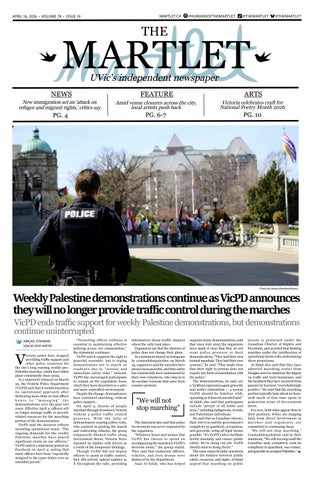
Weekly Palestine demonstrations continue as VicPD announces they will no longer provide traffic control during the marches

VicPD ends traffic support for weekly Palestine demonstrations, but demonstrations continue uninterrupted

Victoria police have stopped providing traffic support and other police resources for the city’s long-running weekly proPalestine marches, which have taken place consistently since 2023.

In a statement released on March 25, the Victoria Police Department (VicPD) said that it would transition its operational approach after dedicating more than 10 000 officer hours to “managing” the demonstrations over the past two years. Effective April 4, officers will no longer manage traffic or provide related resources for the marching portion of the demonstration.

VicPD said the decision reflects mounting operational strain. “The ongoing demands for the weekly Palestine marches have placed significant strain on our officers,” VicPD said in a statement posted on Facebook on April 4, noting that many officers have been “repeatedly assigned to the same duties over an extended period.”

“Protecting officer wellness is essential to maintaining effective policing across our communities,” the statement continues.

VicPD said it supports the right to peaceful assembly, but is urging demonstrators not to march on roadways due to “serious and immediate safety risks.” Instead, VicPD has encouraged participants to remain on the Legislature lawn, which they have described as a safer and more controlled environment.

Despite the change, demonstrators have continued marching, without police support...

On April 4, dozens of people marched through downtown Victoria without a police traffic control presence. With the help of demonstrators wearing yellow vests, who assisted in guiding the march and redirecting vehicles, the group temporarily blocked traffic along Government Street. Victoria News reported no clashes with drivers as a result of the temporary blockage.

Though VicPD did not deploy officers to assist in traffic control, they did actively upload updates to X throughout the rally, providing

information about traffic impacts where the rally took place.

Organizers say that the absence of police does not change their plans.

In a statement shared on Instagram by coastsalish2palestine on March 25, organizers said the marches have always been peaceful, and that safety has consistently been maintained by their own volunteers, who step in to de-escalate tensions that arise from counter-protests.

"We will not stop marching"

The statement also said that police involvement was never requested by the organizers.

“Whatever hours and monies that VicPD has chosen to spend on accompanying the marches is VicPD’s decision alone,” the group stated. They said that numerous officers, vehicles, and even drones were deployed by the department.

Anas Al Salah, who has helped

organize many demonstrations, said that since July 2025 the organizers have made it clear that they do not want police presence at their demonstrations. “They had their own trained marshals. They had their own systems,” he said. “They made clear that their right to protest does not require any form of consultation with the police.”

The demonstrations, he said, are a “political expression again genocide and settler colonialism — a system VicPD should be familiar with, operating as it does on unceded land.”

Al Salah also said that participants include “people of all faiths and none,” including Indigenous, Jewish, and Palestinian individuals.

He said that as Canadian citizens, their role is to end the government’s complicity in apartheid, occupation, and genocide, using all legal means possible. “It’s VicPD’s job to facilitate lawful assembly and ensure public safety. We’re doing our job. VicPD should stick to doing theirs.”

The issue raises broader questions about the balance between public safety, resources, and rights. Al Salah argued that marching on public

streets is protected under the Canadian Charter of Rights and Freedoms, and asserted that limiting marches under the justification of operational strain risks undermining those protections.

Al Salah also said that they have adjusted marching routes from Douglas street to minimize the impact on traffic and local businesses, and the feedback they have received from passers-by has been “overwhelmingly positive.” He said that the marching portion typically lasts about an hour, with much of that time spent in pedestrian areas of Government street.

For now, both sides appear firm in their positions. Police are stepping back from direct involvement in marches and organizers are committed to continuing them.

“We will not stop marching,” Coastsalish2palestine said in their statement, “We will not stop until the Canadian state completely ends its complicity in apartheid, war crimes, and genocide in occupied Palestine.”

Photo by Sabina Mendoza-Brown.

Outgoing campaigns director reflects on his experiences on the board

Michael Caryk, who pushed for provincial supports for student, reflects on his term, plans to keep helping people as a teacher

Michael Caryk, interim director of campaigns and community relations, will not be returning to the UVSS’ board of directors next year. With the end of his term fast approaching, Caryk sat down with the Martlet to reflect on his experiences as a lead director, and impart advice for the incoming board.

During the UVSS’ 2025 election, Caryk ran to be a Director-at-Large (DAL) and was acclaimed to the position, as there were more open DAL positions than there were candidates. Eva Thompson, who was initially elected as director of campaigns and community relations, resigned, and following her resignation, Caryk nominated himself to serve as interim director, and was approved by the board. Caryk told the Martlet he was most proud of his work on the Transit Commission, where he fought against fee increases for youths and seniors.

Throughout his term, Caryk worked alongside the BC3 Coalition, advocating for the creation of a student food bank grant — which would provide $1.50 per student from the province to student union run food banks — and $10 ferry fares for post-secondary students.

These initiatives will be voted on at the Association of Vancouver Island and Coastal Communities (AVICC) conference at the end of the month, which may result in B.C. municipalities advocating for them to the province.

According to Caryk’s report at the Semi-Annual General Meeting (SAGM), he carried on the work of Bunni Williams and Isabelle Easton — the previous directors of outreach and university relations and campaigns and community relations, respectively — pushing for on-campus drug testing (fentanyl test strips can be obtained from the harm reduction centre) and the amendment to the non-academic misconduct policy, which UVic passed in June 2025, meaning students would not face consequences for calling for help after using substances.

A frustrating aspect of the job, according to Caryk, is how long it takes for initiatives like the student food bank grant and reduced fares

for post-secondary students to come to fruition. “Sometimes it's about planting the seed. I think the harsh reality of doing this role is you don’t necessarily see the benefits from what you’re doing right away,” he said. Caryk told the Martlet the biggest challenge he faced during his term was letting “other people’s lack of actions get to [him].”

“When you have some things that are difficult happening around you, it's really easy to get down on yourself and what you're doing but at the end of the day I'm doing my best. I believe every director here is doing their best and within their capacity to just to serve students. And sometimes it honestly doesn't feel like enough,” he said. “I don’t know if it’ll ever feel like enough.”

During the SAGM in February, Caryk gave an emotional speech where he said he would be forever grateful for the opportunity to serve as a director, calling it a “really special opportunity to do something good.” He said he would “take what [he] learnt from this job to make sure that [he] helps people in the future.”

During the interview with the Martlet, Caryk said he loves helping people and that it’s what he wants to do “at the end of the day.” Caryk is pursuing admission to the education program, striving to become a teacher.

“[Teaching] is gonna be a little bit easier than any sort of politics, because I’m gonna see that impact a lot quicker,” he said. “I would love to do whatever I can to help students."

The Martlet asked Caryk what advice he’d give to the incoming director of campaigns and community relations. Caryk said his advice to the incoming board is to remember that “honesty is the best policy.” Caryk then read from a prepared statement.

“Integrity is upholding honesty when no one is looking, when you are alone, when co-workers aren't there to look after you, because continuous improvement is expected of us. No one is perfect, and I don't expect any of you to be. I want you to take a moment and think about what you want to get from this job. Although it might not impact you today, tomorrow or the [next] day, it will have impacts. And I hope that you do what you can to be the best leader you can be for students,” it said. Caryk thanked General Manager Dale Robertson, Human Resources and Administrative Services Manager Laila Casado, and Policy, Research, and Communications Manager Errin Johnston-Watson for all the behind the scenes work they do, and for helping him “learn so much.”

The Martlet requested brief interviews with the other lead directors to reflect on their time on the board as well. Lindsey Andrew, director of events, declined to comment, while Katie King, director of student affairs, was unable to interview. Jonah Arnold resigned from his position as interim director of finance and operations and thus could not be reached, and the director of outreach and university relations position has been vacant since February.

Discover Your Path in Sustainability at UVic

Free Virtual Open House on June 23, 1 to 2 pm

Learn how to advance your sustainability career, or transition into a purpose-driven field, with programs offered through Continuing Studies at UVic.

UVIC LIFE

Springtime is awesome, nasal congestion is not If you feel blindsided by your seasonal allergies year after year,

things you can do to both prevent and

Spring is here, and for many people, so are seasonal allergies. Here are some tips and tricks you may not have thought of to help you navigate these sneezy times, from one allergy queen to all the others out there.

Please keep in mind that none of this constitutes medical advice, and you should consult a doctor or allergist to determine what solutions are right for you!

TAKE ANTIHISTAMINES IN ADVANCE

Antihistamines are a class of medication designed to treat common allergy symptoms. You probably know of a few, like Claritin and Benadryl. What you may not realize, though, is that waiting to take antihistamines until you start experiencing allergy symptoms isn’t the most effective way to treat them.

Antihistamines work best preventatively, and many doctors recommend taking them two to four weeks before you expect your symptoms to start. Dr. Ahmad Sedaghat, an ear, nose, and throat specialist at Harvardaffiliated Massachusetts Eye and Ear Infirmary, says that exposure to allergens kicks off a snowball effect of inflammation in the body, making it harder to treat symptoms once they’ve already come on. Using antihistamines preventatively instead will block reactions before they begin.

GO FOR PRESCRIPTION ANTIHISTAMINES

If you know that your allergies tend to be severe, in B.C., you can ask a pharmacist to prescribe antihistamines. These can come in the form of nasal sprays, oral antihistamines, and eye drops.

USE A NETI POT

The neti pot is a vessel that allows you to flush your nasal passages with a saline solution, either by pouring or squirting the solution up one nostril and letting it drain out of the other. This technique can be traced back to ancient Ayurvedic practices for

treating nasal congestion. Clearing the nasal passages with a saline solution allows pollen and other allergens to be flushed away, rather than becoming trapped. By physically removing the pollen from the nasal passages, the body is prevented from continuously setting off the immune responses that lead to congestion. However, frequent use is shown to increase risk of sinus infection, so use sparingly!

TRY ACUPUNCTURE

Some studies have shown that acupuncture may help relieve allergy symptoms. Acupuncture is a traditional Chinese medicinal practice

that involves placing needles in specific places in the body to restore balance in the body’s flow of energy.

According to GoodRx, research has shown that acupuncture changes levels of certain proteins and hormones in the body, and may change the activity of certain cells involved in producing inflammatory responses.

Lisa Matsuzaki, an Australian acupuncturist, says that acupuncture can be used to treat allergies proactively by helping moderate the body’s immune response before allergens are present, as well as to treat acute symptoms once they have started.

are

Heart and Hands Health Collective and Hemma, two community acupuncture clinics in Victoria, offer acupuncture at

UVic students breathe new life into retired climbing

StokedWorks Outfitters is “building a community of stoked adventurers who believe in sustainability, creativity, and pushing the limits”

While many UVic students work parttime during school, Dylan Gyr and Kathryn Meers had a different idea: starting a business.

In an interview with the Martlet, Gyr and Meers shared how StokedWorks Outfitters evolved from StokedPup, dedicated to pet products, into a brand selling gear like belts, keychains, and camera straps created from retired climbing rope.

In fall 2024, Gyr saw a video of someone creating a belt out of old climbing rope, inspiring him to pivot their business and begin reusing existing materials. After acquiring some rope from a local gym and purchasing a sewing machine, he learned to sew and made prototypes.

“It was at first just dog collars, and then we realized that belts and keychains sell way better, especially with students,” Gyr said.

StokedWorks gained rapid popularity after Gyr posted a YouTube Short in June 2025 that received over 4.4 million views. “We get orders from all over the world now,” Meers said, recalling recently sending an order to Guam.

Climbing rope doesn’t last forever, though its longevity depends on climbing conditions and frequency of use. According to Mountain Equipment Company (MEC), rope retirement varies from up to seven years for the occasional pitch to just three months of almost daily use. Ropes should also be retired if they are damaged by things

with running StokedWorks, Gyr and Meers began outsourcing their manufacturing to another local business, Basecamp Repairs.

The UVic Innovation Centre also played a significant role in starting StokedWorks, helping Gyr secure over $13 000 in grants.

“I’ve been so impressed with the amount of resources that the school has to offer,” he said. “I don't think [we] would be here necessarily if I didn't get that money, because I didn't have any income at the time.”

To help balance full-time studies

like sharp rocks, or if a rope is involved in a significant fall. By breathing new life into this outdated gear, Gyr and Meers seek to uphold their company’s commitment to the environment. “We’re building a community of stoked adventurers who believe in sustainability, creativity, and pushing the limits,” their website says. They get retired rope from various sources, including local gyms, donations from climbers, and purchasing it in bulk. Gyr and Meers’ experiences at UVic have been influential in creating their business. “I study global supply chain systems every day, environmental degradation because of overconsumption, and pollution as a byproduct of industries that create new materials,” said Meers, a double major in environmental studies and geography. Gyr’s civil engineering major has also supported their business, including using his skills to design aspects of their products, like belt buckles.

“Local manufacturing isn’t dead, you just have to find the right person,” Gyr said. But beyond manufacturing — and the occasional collaboration with other students — the pair say they are responsible for everything at StokedWorks, with administration tasks like order fulfillment taking up much of their time.

One highlight of running their business so far has been selling their products at the Valhalla Pure Outfitters in Gyr’s hometown of Nelson, B.C.

“Getting into more stores is definitely a really big [goal] for us because wholesale orders are just so awesome to do,” Meers said. Their other goals include outsourcing more aspects of the business, and hiring an employee. The pair would also like to expand to American stores, but the recent tariffs have almost doubled their shipping costs,

Canada's new immigration act is

an 'attack on refugee and migrant rights,' critics say

Bill C-12, which received royal assent on March 26, puts refugees and asylum seekers at risk of being denied residency, critics argue

On March 26, the Liberal government passed Bill C-12, the Strengthening Canada’s Immigration System and Borders Act, into law. The bill received significant backlash from advocacy and human rights groups, with Amnesty International publishing a joint statement with 28 signatories, including the Canadian Civil Liberties Association (CCLA) and the Canadian Union of Public Employees (CUPE), calling it “egregious” and an “attack on refugee and migrant rights.”

The bill will amend the Immigration and Refugee Protection Act to allow the Governor in Council to suspend or terminate applications for permanent residence visas, temporary residence visas, electronic travel authorizations, work permits, study permits, or any combination of these applications if they deem it in the “public interest.”

Prior to the bill receiving royal assent, the United Nations Human Rights Committee expressed concern over the bill’s potential to weaken refugee protections, and argued that people pursuing international protections should have “unfettered access” to Canada.

The Canadian Bar Association, which represents over 40 000 lawyers, academics, notaries, and students, published a statement saying they are concerned Bill C-12 "undermines principles of accountability, transparency, and fairness that are foundational to Canada's immigration system.”

Elizabeth May, leader of the Green Party of Canada and MP for SaanichGulf Islands, has been a vocal critic of the bill, and has argued that the bill was not properly studied while in the House of Commons.

There was no recorded vote for the final reading of Bill C-12 in the House of Commons on Dec. 11, 2025, as it was ordered that Bill C-12 be deemed “read” a third time and passed on division, with the only noted opposition being from May.

“On division” allows Parliament to pass bills without taking a vote - even when a decision on the bill is not unanimous - potentially saving MPs from having to publicly support or oppose them.

The Martlet reached out to Will Greaves, the Liberal MP for Victoria, for comment regarding his stance on Bill C-12. Greaves did not respond to this request for comment.

According to the bill, an order is in the public interest if “its purpose is to address matters such as administrative errors, fraud, public health, public safety, or national security.”

Ash Forghani, a lawyer who practices in the area of Temporary and Permanent Residence applications, told the Martlet this could create “significant barriers” for those applying for temporary or permanent immigration documents.

“Under clause 72 of the Bill, the government can refuse to accept certain applications for processing, suspend processing of applications already filed,

BC invests $1.9M

terminate those applications, and cancel, suspend, or vary documents that have already been issued,” he said. Forghani said that the bill's definition of “public interest” is vague, and the “such as” wording potentially allows for the government to cancel applications for reasons not listed in the definition, and does not meaningfully limit the government’s discretion.

In a news release, Gary Anandasangaree, minister of public safety, said the bill was “crucial” to provide law enforcement agencies with tools and authority to deal with “increasing complexity of transnational organized crime.” Lena Metlege, minister of immigration, refugees, and citizenship, said Bill C-12 is strengthening Canada’s immigration and asylum systems, keeping them “fair, efficient, and working as intended.”

Dr. Scott Watson, a UVic professor of political science and expert on migration, told the Martlet that there may be "genuine public safety concerns that transnational organized crime is operating in Canada, and likely engaging in human trafficking and human smuggling,” but that Bill C-12 may not be the most appropriate tool to deal with it.

“I don't think denying people access to asylum after a year will have any impact on public safety. I think there's other ways this could be done,” he said.

“I suspect from the government's perspective, it's one more tool that they can use to address organized crime,

in UVic for

but I just don't think it's particularly effective, nor should it be done at the expense of people who need protection.”

Watson believes immigration and asylum are important things for Canada to offer, saying they contribute significantly to success in the country, population growth, innovation, jobs, and education.

“Canada is built on … immigration.

Now, that comes with a complicated history because it also comes with Indigenous dispossession to facilitate that immigration. But when handled properly, immigration contributes greatly to this country,” he said.

Watson is also concerned over how Bill C-12 could contribute to “further stigmatization” of immigration, saying the government has a tendency to “pick an easy scapegoat” for issues such as the housing crisis. “I worry that … if we have a problem, it's just blamed on immigrants, rather than actually dealing with the root of the problem itself,” he said.

Bill C-12 also makes it so those who have been living in Canada for more than one year will have their referral claims to the Refugee Protection Division — which hears and decides claims for refugee protection in Canada — be deemed ineligible. This policy will be applied retroactively to people living in Canada since June 24, 2020 and is intended to “reduce pressure” on the asylum system. CBC reported that this would result in approximately 19 000 asylum claims not being heard.

Forghani had concerns over this one-year deadline, noting that people

may come to Canada under different permits or visas, or that people may come from countries that have had political upheaval since arriving, and may no longer be safe to return to.

Forghani said some may also face delays due to trauma, fear, or stigma, and that making a claim ineligible more than one year after first entry into Canada risks “excluding people with genuine protection needs based on an inflexible timeline rather than the reality of when danger arises.”

Watson believes Bill C-12 is an attempt to address the backlog of refugee and asylum claims, but that it is a “flawed piece of legislation” and is “misguided” in how it attempts to address the issue.

Forghani believes Bill C-12 is partially driven by the government's desire to protect the integrity of Canada’s immigration system, and that it must be able to respond to backlogs, fraud, and pressure on resources.

However, he said Bill C-12 risks "shifting the balance too far away from procedural fairness and access to justice” and that it could have severe consequences.

“Fairness cannot be a secondary concern. It is what protects the system from being perceived as arbitrary. Canada can, and should, pursue an efficient and well-managed immigration system, but not by weakening the very safeguards that promote access to justice and make the system worthy of public trust,” he said.

quantum computing research and breakthroughs

This move supports the province's "Look West" strategy to grow targeted sectors, including technology, AI and quantum, and life science

On Feb. 19, the B.C. government announced an investment of $1.9 million in UVic research infrastructure through the British Columbia Knowledge Development Fund.

Though the funding will support ten UVic projects, the provincial government highlights one project in particular, research in quantum physics, to which $90 800 is allocated. The investment will support achieving a “quantum computing advantage,” the province said, working toward powerful supercomputers with lower energy use.

This quantum investment is part of the government’s larger “Look West Strategy,” which aims to grow targeted sectors, including “technology, AI and quantum, and life science.”

According to a statement from the Ministry of Jobs and Economic Growth, the Look West plan seeks to increase the tech sector’s GDP contribution by 75 per cent, double employment in the sector to 400 000, and double the size of the AI and quantum sectors. They said the Look West strategy emerged as B.C.'s response to U.S. tariff threats, “reducing reliance on the United States by reorienting trade, attracting investment, and positioning B.C. as Canada's economic engine.”

The ministry said the funding will support energy-efficient computing infrastructure for quantum physics research at UVic, led by Dr. Thomas Baker, a UVic professor and Canada

Research Chair in Quantum Computing for Modelling of Molecules and Materials.

In an interview, Baker described quantum research as a general method for solving problems, with applications across many different fields such as climate modelling, machine learning, and many other areas. The field requires interdisciplinary study, with elements of theoretical physics and computer science, and soft skills such as communication.

He said the provincial funding would support quantum computer simulations at UVic’s enterprise data centre, giving researchers across Canada — but particularly at UVic — access to large-scale quantum simulations. Baker added that this marks the first time this kind of research infrastructure is available to Canadian researchers.

Baker said there are few groups at UVic who work in the area of quantum computing, and that the funding may create more opportunities and quantum-related positions for undergraduate and graduate students.

Baker says quantum computing research at UVic could have economywide impacts in B.C., as small improvements can have a large impact and help optimize processes.

According to the ministry, “AI was embedded in Look West from the start,” reflecting the province’s view of AI as a “transformational force” across the economy. The province appointed Rick Glumac as minister of state for AI and new technologies in

July 2025, which tasks him with identifying AI and quantum investment opportunities.

Baker explained that quantum machine learning is involved in training AI models, though he does not anticipate that the funding from B.C. will go directly to supporting advancements in AI at UVic at this time.

In a statement, a UVic representative said that “UVic researchers are exploring AI and quantum machine learning potential,” while emphasizing their ethical, human-centred, and interdisciplinary approach to using these tools.

The university supports the goals and opportunities outlined in the Look West plan, which aligns with their Distinctly UVic commitment to serve the public good through “innovation, partnership and place-based impact.”

“Look West supports UVic’s strengths in AI, quantum technologies, aerospace, oceans, life sciences and clean energy, and recognizes the vital role that universities play in building the highly skilled workforce B.C. needs for its future economy.”

Meet Jack Sandor, the 27-year-old electrician running for Victoria City Council

Jack Sandor wants to tackle housing affordability, community support needs, and improved transit

Jack Sandor, a 27-year-old electrician, is running for a Victoria city council seat. Sandor is the former vice president of Homes for Living — a registered B.C. non-profit society that advocates for affordable housing across the province — and a current board member of BetterTransitYYJ, a grassroots group advocating for improved public transit in Greater Victoria.

Sandor first became involved in politics while volunteering for Homes for Living, which he says taught him about the housing challenges in Victoria and how to face them. He says addressing the housing crisis, which he calls “the everything crisis,” is one of his main priorities.

“I feel like in the West, we're seeing a very large shift to the right, towards authoritarianism, towards fascism.

And I think a large part of the reason that's happening is that the fundamental promise that used to be true for most people, at least in Canada, was that if you got a decent job and you worked hard and you were not [reckless] with your money you'd be able to afford the white picket fence, two kids, that modest but comfortable and stable life … that promise has been fundamentally broken,” he said.

Although housing is largely in the province's jurisdiction, Sandor believes the City of Victoria has a role to play.

Sandor said the city does not have the financial means to solve the housing crisis itself, but he is advocating for streamlined bureaucratic processes, so when provincial funding for housing projects is provided, it is spent on building, rather than getting caught up in municipal red tape.

Sandor believes his experience as an electrician gives him a “unique insight” into how municipal policies could affect building processes. “[There are] complexities to the building process that I think you can only really intuitively understand if you've actually worked with it,” he said.

Sandor also hopes to improve transit, though he acknowledges that many of the challenges facing public transit lie outside of the jurisdiction of the City of Victoria.

“Most of the big bottlenecks that transit faces are actually outside of the borders of Victoria proper, places like McKenzie, [or] the entirety of Esquimalt. So Victoria is actually a little bit more limited than a lot of other places in the region in terms of what they can actually do,” he said.

Sandor believes in expanding the bus lane network in the city and implementing transit signal priority technology, which aims to reduce delays for large transit vehicles at intersections.

Sandor believes transit, housing, and infrastructure also largely affect the climate. “Housing and climate

Trans Day of Visibility

action are inextricably linked. You cannot have proper climate action without proper action on housing,” he said. According to Sandor, suburban sprawl results in clear-cutting trees as well as increased road paving, car use, and related greenhouse gas emissions. Recently, the City of Victoria has seen discourse regarding policing and police budgets, with many opposing the Victoria Police Department's request for more funding in 2026. Sandor, on his website, said: “police play an important role, and their work should be focused where it is most effective.”

Sandor told the Martlet that he believes police should only be used when necessary, and that mental health workers and crisis response teams should be utilized when police are not strictly needed. “Right now, we’re asking police to do traffic enforcement, to solve violent crimes, to be social workers, to be mental health workers.

All of these jobs on their own are pretty difficult. Doing them all at once is impossible.”

Sandor also believes in working proactively to prevent crime. “An ounce of prevention is worth a pound of cure,” he said. “Focusing on investing money in things that reduce the need for police, reduce the need for bylaw, reduce the need for crisis response teams, I think would go a really long way.”

One way of doing this, according to

Sandor, is through funding programs like the Rent Bank, which provides financial assistance such as no-interest repayable loans to individuals at risk of eviction.

Sandor's website also says he is committed to “good governance,” and wants to hold community listening sessions, push for reforms to make engaging with local government easier, and make council meetings more accessible by livestreaming them on platforms like YouTube.

Sandor is in the process of creating a full policy platform, but more details on his priorities can be found on his website. Voting for the City of Victoria’s 2026 Municipal Election opens on Oct. 17,

Rally at legislature calls for action, not just awareness

Advocates urge province to reverse major policy changes and improve access to gender-affirming care

Members of Victoria’s queer community gathered on the lawn of the B.C. legislature on Tuesday, March 31, for a Trans Day of Visibility Rally. The rally blended celebration with protest, calling on the provincial government to reverse recent policy changes and improve access to gender-affirming care.

The rally was organized by groups including the Society for Advocacy for Gender-Affirming Healthcare (SAGAH), the UVSS Pride Collective, and other local organizations.

While Trans Day of Visibility is often an avenue of recognition, this year many attendees and speakers emphasized that visibility without meaningful policy change is not enough.

Liya Tensae, UVSS Pride Collective office coordinator, said that the day carries “a lot of good sentiment,” but stressed that sentiment must be backed by action.

prioritized, having my care prioritized.”

Much of the rally focused on two key provincial policy issues: recent changes to B.C.’s Name Amendment Act and the phased closure of the Montreal surgical pathway for gender-affirming care.

Under the Name Amendment Act (No. 2), all applicants 12 years of age and older must undergo a criminal record check, and individuals convicted of certain offenses are barred from legally changing their names. The province has claimed that these changes are intended to “prevent dangerous persons convicted of serious Criminal Code offences from legally changing their names,” and to ensure accountability.

However, Tensae argues that the policy creates additional barriers for marginalized groups. The changes affect not only trans individuals, but also “Indigenous peoples trying to reclaim their names. It impacts survivors fleeing violence. It impacts people who have been overly criminalized.”

seven years, ten years,” she said. She also noted the serious mental health impacts that delays in accessing gender-affirming care can have.

“I have friends who have been on that wait list for four years, and it’s looking like they’ll be on it for a fifth.

That is unacceptable,” Buchanan said.

“The closing of the Montreal pathway just puts a lot more people at risk and clearly shows the trans community that their health concerns and needs are maybe not being taken so seriously by the government,” Tensae said.

Buchanan also pointed to the timing of the rally, noting that elected officials were attending a FIFA-related event on the front lawn of the legislature.

“They care more about their personal celebrity than they do about our needs, our healthcare, our lives,” she said.

“We were in the back [of the legislature] and David Eby and some other government officials were up front at the FIFA event. We did have a few MLAs joining us out back as well.

But I think that is just quite telling,” Tensae said.

“One of our pride collective members … often will say visibility without protection is just vulnerability,” Tensae said. “You can’t do a performative day of visibility without proper actions and protection to follow it up.”

The BC Knowledge Development Fund investment for the quantum project has already been received by UVic. UVic will provide an annual project progress and financial report to the province, regarding how the funding is being utilized.

They said the B.C. funding will allow students to gain hands-on training with advanced tools through theses, research internships, co-ops, and undergraduate research awards, preparing them for their careers and enhancing their job prospects. UVic noted that the research supported through the funding leads to new discoveries to improve health and well-being, mitigate climatechange impacts, conserve the environment, and more.

“This really does put the University of Victoria on the map as a bit of a leader in terms of providing simulation capabilities that other people can use and making it so that quantum comes to Vancouver Island,” Baker said.

That same sentiment was shared by Sarah Buchanan, a former UVSS events director, who spoke at the rally. “I have a bit of a complicated relationship to this holiday. Honestly it feels a lot of the time like visibility without protection is just vulnerability. It’s just risk,” Buchanan said.

“Frankly, I’m feeling sick of being made visible without having my needs

Concerns about health care access were equally as present, drawing strong concern from speakers. On April 1, the province stopped offering MSP-funded lower surgeries at GrS Montreal, ending routine access to the longstanding clinic pathway. Advocates warned this could significantly increase wait times by concentrating demand into a single system, and will put people’s lives at risk. Tensae said that current wait times in Vancouver already reach four to five years, and could extend even further.

“That is going to increase wait times in Vancouver, possibly up to six years,

B.C. Green Party leader Emily Lowan, who attended the rally, argued that trans communities are often used as scapegoats in larger economic and political narratives. “Trans rights, trans people have been under attack for a very, very long time,” Lowan said.

“Politicians keep our fingers pointed at one another, so that working people avoid looking up at those who truly oppress them.”

Green Party MLAs in attendance also emphasized the importance of visibility and rights protections.

Jeremy Valeriote, MLA for West Vancouver-Sea to Sky, said that “since

people have been on this land we call British Columbia, there have been transgender people … and so it’s really important to stand up for people’s rights and recognize that everybody deserves those rights.”

Rob Botterell, MLA for Saanich North and the Islands, added that he wants to ensure that trans people are “treated with dignity and respect for everything they do.”

Despite the political tensions, the rally was also marked by a strong sense of community. Tensae described the experience as empowering.

“This is my community…. These are the people that will come together and we’re here to uplift each other,” she said. “We will not be ignored.”

Photo via UVic News.
Photo by Rae Dawson.
Photo courtesy of Jack Sandor.
Amid venue closures across the city, local artists, studios, and performers push back with creative and accessible alternatives
"We're going to figure it out. We'd like it to be easier, but try and stop us"

On Mar. 16, The Other Guise Theatre Society announced that they may have to sell their venue at 716 Johnston St after an investor had to back out of the project back in June 2023.

“While we’ve raised a lot of money, we have not raised enough to complete the buy out,” said Matthew Payne, artistic and executive director of the Other Guise Theatre Society, in a media release.

“If we don’t find the majority of the $1.25-million we owe by the end of March this year, we anticipate a for sale sign going up.”

On Mar. 21, Times Colonist reported that Hermann’s Jazz Club would be closing. Al Smith, chair of the Arts on View Society — which operates both Hermann’s Jazz Club and the View Street Social lounge — told Times Colonist the society was in a “financial hole” of $300 000, with an estimated $150 000 needed for maintenance.

distinct cultural identities, like the Portland grunge scene, French New Wave, Harlem Renaissance, they didn’t come from artists creating in isolation, they came from artists creating in community [with each other],” said Dack.

“When we get together and create, in relation to our location, it becomes something new and different and not just a globalized, homogenized representation of where our capitalist society is at right now.”

A stable art hub offers more than space. It offers community.

When Haus of Owl hosted their first photography club, Dack found eight people who “I don’t think knew each other very well before [that] night, they’re all in there with their cameras out, trying different angles, music’s playing, they’re talking about their own techniques and sharing their techniques.”

Dack knew some of these photographers, describing them as “big deal pro photographers” who despite being busy, still came out to share and hang out with other photographers.

Emmi Redlin manages Ollie Quinn in Market Square, a glasses store, which also doubles as an arts venue for “virtually” no cost to rent. Redlin said that people “absolutely love” the Ollie Quinn space and that a low or no cost space is “vital.”

Redlin said that an essential part of Ollie Quinn is its accessibility. “[It’s] so nice to have a space where it’s accessible in that sense, and it’s really important, and we need it.”

“Not everything can [work in an unconventional venue], so we often have black box studios, or opera houses, or dance studios, I think you really need both,” said Guist, Intrepid’s artistic director. “You need third spaces as well as equipped spaces…. I think that’s how you have a healthy artist centred community.”

Working to make art venues more affordable is the Arts & Community Infrastructure Foundation (ACI), who is working to “[address] what could be titled a crisis right now for arts and community spaces.

“What we’re looking to do is create a regional, locally created, nonprofit landlord model, essentially trying to stop the bleed, stop [the] displacement of arts and community spaces, and this constant gentrification that’s happening without any consideration [for] the cultural well being of the community,” said Erin Lannan, one of ACI’s co-founders.

Established December 2024, ACI was born out of grief of the VEC’s closure in October 2024.

“I was really upset when the VEC closed, like so many of us, and it was like, ‘okay, what’s going on here, what is the common denominator to prevent it from happening again?’” said Jenn Neilson, the other co-founder of ACI.

through grants, to buy buildings and lease them to arts and community organizations to ensure that their landlord is someone sympathetic.

“It’s a nonprofit, it’s a charity. And that means we can do things like apply for grant funding ourselves to pay for improvements to the building rather than the tenants having to do that.”

Lannan said ACI has a “legal mandate as a charity to steward that land and to use the building in the best interest of the public.”

Their mandate also includes providing “education to the arts and community leaders around things related to infrastructure,” including teaching people about triple net leases, running seminars on the differences between commercial and residential real estate.

Their mandate also includes providing property management support for their tenants offering services such as pest control and repairs, treating their tenants less like commercial tenants and more like residential ones.

The idea behind ACI is to bring people who are interested in the longevity of the arts and culture community together and help them share tools,resources and information.

“I’ve definitely heard of organizations recently who have been looking for space and who have … spent time and energy and money pursuing options that other folks in the community have previously explored, and would have been able to tell them that they weren’t really viable.”

said Neilson.

Matt Dell, Victoria City Councillor and arts advocate, supports the goals of the ACI, and thinks that Victoria needs to look into creating a coworking space in the city for artists.

Dell also mentioned that the Victoria Foundation is also looking into funding its own building. “So there’s a lot of alignment in that direction,” he said.

As Lannan described, part of the reason finding spaces for the arts is a challenge is the large variety of needs.

“Theatre spaces need black boxes and different audiences, and potential pull out auditorium seating. And then you have visual arts that have big open spaces that they can exhibit their work, and then you need the studios and all the work spaces that are in between.”

said Lannan.

Dell mentioned that musicians face further barriers in finding space, as soundproofing is often a requirement for their rehearsals.

ACI is currently undergoing its feasibility study, which is required to get down payments for potential venues.

Dell thinks that moving forward, a partnership between the city, ACI, the Victoria Foundation, and something like Vancouver Island Visual Arts Society (VIVAS) could work together to identify properties that would fit their needs.

cities in part of many art scenes and haven’t seen the kind of motivation and organization I am seeing in Victoria at this moment in time.” said Dack.

On Mar 25, a fundraiser was launched to raise the money needed to pay off Hermann’s Jazz Club’s costs — the target amount in pledges was exceeded well before the Apr 26 deadline, two days later.

“And so that’s what makes me hopeful.

A group of organized, creative individuals is a pretty powerful thing, and once you get artists organized, anything can happen,” Dack said.

“We’ve seen this trend in Victoria in the last several years of many venues disappearing, and you know the lists are very long,” said Payne. “Everything from Carlton Club over in Esquimalt to the Copper Owl and Logan’s Pub, the Victoria Events Centre (VEC), the list just keeps growing. It’s pretty challenging, the scene right now in Victoria.” Claire Pollock, who performs under the stage name Miss Rita St. Clair, and is the founder and director of Pandora’s Box Cabaret, has also felt the squeeze of fewer venues in Victoria. Pollock teaches comedy and burlesque dancing, and has struggled to find a dance studio for her classes, which frequently reach 90 per cent capacity.

Any established dance studio is usually booked solid during the week, Pollock said, and may have a few nonprime hours on weekends or during the middle of the day.

For the arts community, these two announcements mark the latest in a growing list of disappearing venues and arts spaces.

“When I was first looking at doing classes back in the autumn, the only time slot I could get was 8:45–11:00 p.m., and I was like ‘No one’s going to sign up,’” said Pollock. With the

shrinking of venues, there are fewer and fewer places for Pollock to rent for their lessons.

They did eventually find a space at the satellite Theatre SKAM studio that she also teaches comedy at. But she had to personally install mirrors to make it suitable for a dance studio, which then has the benefit of making the space usable for other companies teaching dance searching for space. Sean Guist, the artistic director of Intrepid Theatre, spoke on the difficulty of finding funding to run a venue. “At Intrepid Theatre, we receive operational funding and that goes towards our programming and festivals, but we don’t receive grants to run venues. Operating these venues comes out of our operating budget, and that’s why we need rental programs and we need these things to keep them afloat.”

Guist explained that when applying for funding, it is possible to write into the grant that money is needed to rent a venue — but if those venues don’t exist, who are you renting from?

“Where’s the funding for operating venues? And I think that’s the critical piece to look at. There’s money to get,

you can write an infrastructure grant to replace some equipment, which is really helpful and really amazing, but it’s really about the venue operations.”

On Aug. 7 of last year, Intrepid Theatre announced that they would be ending their shared lease with the Victoria Conservatory of Music, resulting in the closure of the Metro Studio. Guist said that the reasons for the end of the partnership was the “increased costs, increased insurance, increased rent, increased operating [costs] — things just got more expensive.”

But despite all of this, people are finding ways to fill in these gaps.

The Victoria Fringe, produced by Intrepid Theatre, regularly books unconventional venues during the festival, which includes residential houses, parks, coffeeshops, and downtown alleyways.

Sarah Smith, also known as Ruby Peepshow, is a sex worker’s rights advocate and member of Cheesecake Burlesque Revue, and runs what she calls the "world’s first travelling" peep show.

Ruby’s Pop Up Peepshow, run out of a mobile trailer, was inspired by a

venue in Amsterdam, and was brought to life thanks to a COVID-era grant, as it was COVID safe with the performer being located inside the trailer.

Smith uses the Peep Show as both a promotional tool and a social justice project.

“Knowing that the word ‘peepshow’ is causing some caution . . we had to make a little carnival to go along with it in order to make people understand that this is playful, this isn’t fully nude, it’s burlesque in a box, it’s intimate, it’s radical joy, it’s playful.” Smith said.

“You’re not going to be seeing some sort of weird porn in there or something like that.”

Alongside the trailer, Smith has included a vintage popcorn machine, games and prizes and a kaleidoscope photo booth.

But unconventional venues are not a miracle cure to Victoria’s shrinking art spaces.

“Art, proximity in general, it offers so many profound forces.” says Jordan Dack, founder and executive director of Victoria’s coworking club of creators, Haus of Owl.

Dack explained that proximity to artists helps to build local cultural

“What I saw over and over again in interactions is that the people who would have had the power to prevent those closures, were the for-profit landlords,” said Neilson. The idea of ACI was to take for-profit landlords out of the equation to prevent art venue closures from happening in the future.

ACI plans to obtain funding, primarily

While the initial news of two more venues potentially vanishing from Victoria is distressing, this isn’t the first time, nor will it probably be the last. Guist described it as “a flux of venue crises that happen when [faced with] financial constraints, zoning, [etc].”

Dack, Haus of Owl’s founder and executive director, nevertheless finds reasons to be hopeful of Victoria’s art scene.

“There’s so much movement in the city towards building a sustainable art scene right now, and I've been in many

BRIANNA BOCK
SENIOR STAFF WRITER
Photo by Sabina Mendoza-Brown.
Photos by Sabina Mendoza-Brown, Illustration by Sage Blackwell.

Hermann's Jazz Club and View Street Social

“This purchase demonstrates Council’s commitment to preserving and investing in music spaces downtown as reflected in our 20232026 Strategic Plan,” she said. However, in light of the closure announcement, the city’s efforts feel unsuccessful or insufficient.

“This venue’s importance was also identified during development of the Victoria Music Strategy,” Alto continued, “and I hope it will continue to contribute to Victoria’s vibrant arts and culture scene for years to come.” She’s right, however, hope is often not enough when it comes to rising rents and operational costs in Victoria.

Live music, communal spaces, and performing arts are so important to the quality of life of those living in Victoria — a city which sorely lacks venues for performing arts, with the number of spaces dwindling due to rising costs.

Live music is more than just a fun activity — attending live music events has positive effects on listeners’ wellbeing because it fosters “collective effervescence”, a sense of connection to others that is felt when people engage in a shared experience.

To combat this closure, the Arts on

View Society began a community pledge on March 24, with a goal of raising $450 000 by April 26. On March 26, they announced that their fiscal goal had been met. Of the $537 693 they’ve received in pledges from the community, $464 673 has been verified, and $126 678 has been collected so far.

The pledges that have been made don’t include a monetary contribution until they are verified through emails, so the society is now working towards emailing the people who’ve made pledges to ensure the collection of funds.

Recently, I’ve noticed both View Street Social and Hermann’s Jazz Club have been unusually busy. I went with a few of my friends on Saturday, April 4, for karaoke, and had never seen it so swamped. Before the community pledge, it was easy to secure a spot for karaoke and sing multiple times in one night. Now, it was a challenge just to get a table. This new traffic is amazing for both establishments, and hopefully is a sign of good things to come. If you want these establishments to continue running, it’s important

EDITORIAL

Editorials are opinion essays written by a member of the Martlet editorial staff, and are not necessarily the views of all staff members, nor do they affect how

On March 27, 2003, the Martlet published an editorial, titled “Shock and Awe,” responding to the United States’ invasion of Iraq seven days earlier. The pages before and after it were filled with spirited opinions, impassioned letters, and stories about anti- and pro-war demonstrations, including the erection of a “peace camp” on UVic’s quad by a student group at the time, Students Against War. Sound familiar?

It’s been 23 years, give or take a couple of days, since this editorial was published. That means that 23 years ago, another Martlet Editor sat in our office and tried to think of what to possibly say about a conflict that, despite happening half a world away, touched our campus community. Their conclusion?

“Ultimately, it is important to react, whether it ‘achieves’ anything or not…. So do something. React in your own way.”

Sure, writing an editorial in the

campus newspaper might not

“achieve” anything, but it does give our readers a chance to know where their campus paper stands, and while also doing what good journalism aims to do — holding a light up to the narratives presented by those in power, and presenting our readers with facts they may not otherwise have.

In the 23 years since this editorial was published, it feels in some ways like we’re back at square one — having exchanged Iraq for Iran, but little else. The same pro-intervention arguments circulate now to justify war as did back then, exemplified by a 2003 letter to the editor, urging our readers to “give war a chance”

— “war is evil,” the letter reads, “but permitting a tyrant to dominate his people in so cruel a manner is worse.”

We should make no mistake in acknowledging that the leadership of the Islamic Republic of Iran are cruel and tyrannical — one need look no further back than their murderous response to nationwide protests, beginning in December of last year, with telephone and internet blackouts, machine-gun fire, and the torching of the Rasht bazaar.

While the total number of those

COMICS

killed by government forces is unclear, The Guardian , citing reports from Iranian medical professionals across the country, reported the death toll could exceed 30 000.

That doesn’t mean we should blindly — or even tepidly, as our Prime Minister has — support a war effort from countries we are told time and time again are fighting for the liberation of the Iranian people, even as their own leadership makes no effort to front this position.

Recently, in a series of comments that should disabuse all of us of the notion that the U.S. and Israel are fighting this war to free the people of Iran, Trump threatened to bring the country “back to the stone age,” threatened to bomb civilian infrastructure in the country (a war crime under international law), and more recently threatened the end of a “whole civilization” if Iran did not accept a deal to end the conflict and reopen the strait of Hormuz.

Since the U.S. and Israel began attacks on Iran, strikes have also targeted oil depots and refineries in and around the capital of Tehran, blanketing the skies above the city with a toxic cloud and rain so full of pollutants it turned

black, creating widespread fears of serious health risks for the city’s nearly 10 million residents. Israel took credit for the strikes on March 7. In the earliest days of the “war” — U.S. congress has not approved a declaration of war against Iran, and Trump has chosen to refer to it as “major combat operations” — preliminary investigations show the U.S.’ likely responsibility for the strike on a girls school in Minab, southern Iran, with a Tomahawk missile, killing at least 170 people, the majority of whom were children. Neither Israel nor Iran are believed to possess or use Tomahawk missiles. Now, amid last week’s talks of a ceasefire, Israel has said that a truce with Iran does not apply to Lebanon, where Israeli strikes on the city of Beirut killed more than 300 and injured more than 1 100 in a single day. According to Lebanon’s health ministry, Israeli strikes have killed more than 2 000 people since March 2. The U.S. war in Iraq lasted eight years, and while the death toll varies widely depending on the study, a PLOS Medicine study in 2013 estimated close to half a million Iraqis died as a result of the war and occupation of Iraq,

while the Lancet — one of the world’s highest-impact medical journals — estimated more than 650 000 excess deaths had been caused by the war between the 2003 invasion and 2006, though their findings were not without controversy. In 2023, Brown University researchers estimated between 4.5 and 4.7 million and counting died as a result of post-9/11 wars in Afghanistan, Pakistan, Iraq, Syria, and Yemen. I wonder if, presented with these figures, the author of that letter would still urge us to “give war a chance.” They, writing in 2003, can perhaps be forgiven for their lack of foresight. We in 2026 have no such excuse.

- The Martlet
Photo by Sabina Mendoza-Brown.

Victoria staple FernFest cancelled for 2026

Fernwood Neighbourhood House to replace weekend festival with more regular community events this summer

GABRIEL LUNN

For the first time in 28 years, the FernFest community arts festival and market will not take place this summer.

On March 9, non-profit group Fernwood Neighbourhood House (FNH) announced the local street festival would not be occurring in June.

“We have decided not to host FernFest in 2026 as we explore new ways of celebrating and welcoming neighbours from across the street and throughout our community,” the statement reads.

“This year, Fernwood Neighbourhood House is focusing more on supporting smaller neighbourhood-level events and welcoming new neighbours moving into the community, rather than coordinating a large festival.”

Each summer, locals and visitors flock to Fernwood Square to listen to live bands, watch performers, and check out artisan vendors that extend around William Stevenson park, located behind Fernwood Community Centre and Daycare at 1240 Gladstone Avenue.

The 2025 edition of FernFest featured over 40 musicians across three stages and included more than 85 vendors in its market.

In a statement to the Martlet Bryden Amos, a local musician and performer, said the festival showcased a unique

local energy and that it was “a highlight for the start of the summer.”

Amos performed at FernFest in previous years with bands The Smokestacks and Poppa Don Gernie.

“[B]oth years were very energetic and the crowd was really feeling it too,” he said. “One thing with those bands is that it feels like we’re sharing our energy with the crowd.”

The announced cancellation of FernFest was posted in the r/VictoriaBC subreddit and drew dozens of responses.

“It’s a really big hit to the economy and community, lots of small businesses and vendors rely on it,” said one user.

“But I’m sure it wasn’t an easy decision.”

Another comment said, “This was a highlight day of my summer 2025…. It was a great opportunity to connect with friends and family in public and mingle with the community. I spoke with strangers and made connections with people I never would have met.”

Following the announcement, FNH released a follow up statement on their website.

“Over time FernFest has grown into a very large and very expensive undertaking,” the statement reads.

“Even for a dedicated organization like ours, we simply can’t do everything.”

FernFest weekend was made possible by city and provincial grants, community sponsors as well as the non-profit group coordinating a team of volunteers in

the hundreds.

“What we care most about is the spirit of community celebration that FernFest represents. Fernwood has always been a neighbourhood where people step forward with ideas, creativity, and energy to make things happen together.”

In an emailed statement to the Martlet Chantille Viaud, executive director of Fernwood Neighbourhood House, said the decision was “not taken lightly,” and cited rising costs and staffing issues. “Stepping back this year allows us to focus on our core work and avoid overextending our team,” she said.

In addition to hosting events like FernFest, Fernwood Neighbourhood House serves as a community hub for childcare, youth and family programs, as well as food initiatives such as the weekly community meal and public access gardens.

It is unknown if FernFest will return in the future. However, Viaud said FNH understands “that a community-led group is now organizing something for that same weekend, whether that be under the name FernFest or something new. We’re encouraged by that energy and will continue to support in ways that make sense!”

“This summer, we will see a series of smaller, community-led events in place of a single large festival,” said Viaud, “While different in form, they carry the

same spirit of connection, creativity, and neighbourhood pride.”

A Hand Cut Fashion Market is featured on April 18 and the Strawberry

Ichigo Market at the end of May features over 130 artists, vendors, and chefs.

The Play Streets 2026 series includes events for children and families one

Sunday a month until November.

“[Cancellation] would be very sad for the Victoria community,” said Amos.

“It’s a festival most people I know get

excited for, and the artists really seem to draw in a big crowd every time.”

Community feedback is currently being gathered by an online feedback form. FNH also accepts donations to support regular programming.

“We see this as a pause, but also as an opportunity to reimagine what FernFest can become,” Viaud said.

Victoria celebrates craft for National Poetry Month 2026

Kyeren Regehr, the city's poet laureate, has organized a full month of poetry focused events and readings leading to the end of April

GABRIEL LUNN

SENIOR STAFF WRITER

For National Poetry Month, celebrated every April in Canada, the Martlet spoke to Victoria’s Poet Laureate, Kyeren

Regehr, to learn about some of the events featured at local bookstores and community centres this month.

Regehr has planned and promoted readings, interviews, and open mic events throughout the month featuring a variety of poets from Canada and the United States.

“At the heart of the month's programming, it's about inviting people into a richer relationship with language, with imagination, and each other,” said Regehr.

Regehr is a graduate of UVic’s writing program (BFA ’11, MFA ’13) and is also the artistic director of the reading series Planet Earth Poetry, which entered its 30th year as one of Canada’s longestrunning weekly series.

“My first real poetry experiences — besides reading books — were at UVic. I went to the writing department and fell in love with the city through the eyes of a new poet who's trying to observe everything.”

“When I first discovered Planet Earth Poetry, the regular Friday night readings were an incubator for me, and they transformed me as a writer because we all got to listen to these amazing poets from across Canada and our incredible local scene.”

Regehr praised local writing opportunities such as the Tongues of Fire spoken word series, the Victorious Voices youth poetry festival, which occurred earlier this month, as well as publications like the Malahat Review and the Victoria Writers’ Society’s twiceannual publication, Island Writer Magazine.

For National Poetry Month, Regehr has planned about a dozen events at various libraries, bookshops, and

community centres across the city.

Though many events will have already passed, there are others taking place before the month’s end. All events are free and hosted at accessible venues. Regehr’s goal for the events is not only to celebrate poetry as an art form, but also to create accessible entry points for people who may not yet think of poetry as “something that belongs to them.”

Regehr told Victoria News they pushed for at least half of poets featured at National Poetry Month events to have a background from historically underrepresented communities.

On Friday, April 17 at 7:30 p.m., the weekly Planet Earth Poetry reading series will showcase poetry by Brandi Bird and Leanne Dunic, as well as an open mic sign-up.

On Sunday, April 18, at Russell Books, poet Fatima-Ayan Malika Hirsi will create free typewritten poetry for readers and customers from 1 – 3 p.m. Regehr describes the exchange as creating a memory between the writer and those receiving the poems, rather than a more distanced or institutional relationship.

The first episode of the new season of the Poet Laureate Podcast will launch on Wednesday, April 22, featuring Toussaint St. Negritude, who served as the first Black Poet Laureate of Belfast, Maine.

Friday, April 24, features two events. rob mclennan will be reading at James Bay New Horizons at 2 p.m., which includes an open mic and will be hosted by Anna Cavouras. mclennan will also join Anna Yin and Phoebe Wang at the regular Planet Earth Poetry reading and open mic at Russell Books, hosted by Regehr from 7:30 – 8:45 p.m.

A live studio recording of The Poet Laureate Podcast will take place Saturday, April 25 at Haus of Owl: Creation Lab, and will feature maclennan interviewing Regehr from

Your psych prof isn't your therapist The other 200 students in PSYC101 don't need to hear about your personal problems
ABIGAIL FISHMANN

STAFF WRITER

About three weeks into Psychology 101, first-year psychology students develop a very specific kind of confidence. It isn’t earned, and it isn’t subtle. It’s the kind of confidence you get to discuss a complex topic at dinner after watching a few mildly related Instgaram reels. They hear a few terms — attachment style, defence mechanism — and suddenly they think they understand the entire human psyche, believing that they now comprehend human behaviour at a level that is both advanced and, unfortunately, applicable to everyone they know. That unearned confidence spreads quickly. Conversations stop being conversations and become informal assessments. Normal observations

are replaced with diagnoses. Your boyfriend cheated on you? Well, that’s usually the behavioural expression of unresolved attachment anxiety interacting with rewarddriven enforcement. Your best friend cancelled plans last minute? You know, cancelling plans is basically your unconscious defending against potential social discomfort. Every minor inconvenience becomes evidence of something deeper, and everything deeper must be pointed out and psychoanalyzed. These students cease simply experiencing a situation; they analyze it in real time, out loud, and often without regard for people's feelings. Inevitably, this extends to the one person who seems most qualified to confirm all of these deep insights: the professor.

Your psychology professor isn’t your therapist. They are not a therapist-

adjacent figure. They are not a budget version of a therapist included in your tuition. They are a person whose job it is to teach you psychological theories, not apply them to your personal life, while the rest of the class rolls their eyes.

Part of the issue is that many students assume proximity to expertise equals access to it. If someone can explain why you make bad decisions, surely they should have some interest in helping you stop. But this logic doesn’t apply anywhere else.

No one is asking their biology professor for medical advice, despite the fact that they clearly understand the human body. No one is emailing their economics professor for help with rent, even if they can explain why it keeps increasing.

That’s because most of us understand that knowledge of a system does not obligate someone to

personally intervene in their experience of it. Psychology is the only place where these boundaries feel negotiable. News flash — they aren’t.

Don’t be the guy who puts your hand up in class to share your personal example of anxious attachment. The

200 other students in your class don’t need to hear about your family dog who died when you were six, or the love of your life who got away. I promise everyone will figure out the subject without that extra help.

5:30 – 7:30 p.m. (doors open at 5:20 p.m.)

Lastly, “The Poetry Dispenser,” a gumball-style dispenser with over 150 poems by local writers, will be available to the public at Greater Victoria Public

Library Central Branch on April 30, accompanied by a reading by Nina Mosall from 5 – 6:45 p.m. “[T]here's been so much generosity from other writers as I grew as a writer,” Regehr said. “This city is full of poets.”

Photo by Savannah O'Heany.
Illustration by Sage Blackwell.

FUN STUFF

Across 1. Does simple math 5. Where unread emails live

Detective Nancy 14. "Where ____ you?!"

Tallest member of the deer family

Roof overhang

Seaweed-based thickener 18. Geri's Game studio

Produced offspring

Math comparison 22. Signs up for classes

Final project, sometimes

Put up, as a statue 26. Bicycle Day drug, in short

Votes off the island 33. Egg cells 36. Ire 40. Prefix meaning within

"Ooh, I'll have that..." 45. Video game designer Kojima 46. Liquid mixture used in pottery 47. Rushmore director Anderson 48. French farewell

49. N.Y. congresswoman (abbr)

52. Tiny flying insects

57. Link's counterpart

61. Multi-faced shapes

65. Beer alternative

66. Home of Bhutan and Brunei

67. Complain annoyingly

69. Russian revolutionary, without the second "n"

70. Technique for cutting food safely

71. The Lone Ranger's partner

72. Laughing a lot (abbr)

73. Nu metal band

74. Descendant of a notable family

75. They're mistaken for sweet potatoes

Down 1. Not in the dark

2. French painter Edgar

3. Mildy annoyed cries

4. Repeated and continuous

5. Little demon

6. Black, in Lyon

7. German dog breed

8. Killers of the Flower Moon subject

9. Like a very dry habitat

10. What is owed

11. Banjo-Kazooie studio

12. "Don't ____ give up!"

13. Exchanges vows

21. Mildly annoyed cries

23. Resilient person

27. Some ER workers in short

29. Prefix to sex or brow

30. Put away, on a ship

31. Answer A in many quizzes

32. Cheek

33. Safe working conditions agency

34. Like an unchashable cheque

35. Car company with four rings

37. What YouTube Premium lacks

38. Hair goop

39. Quarterback Manning

42. Word that shows a name change

43. Moolah

44. Strong beer, in short

50. It makes Frodo's sword glow

51. Like brisk weather

53. Water-salamanders

54. Made specifically for a purpose

55. Lead-in to dad and Tobago

56. Caribbean's _____ Domingo

58. Swelling of the feet

59. Time for mid-morning meetings

60. Powerpuff Girls and Charlie's Angels

61. Prepare for a trip

62. Norwegian capital

63. Someone who can't be trusted

64. "I'm bored..."

68. A long, long time

VOLUNTEER

Turn static files into dynamic content formats.

Create a flipbook