WWelcome to another issue of Construction Management Ireland (CMi). We are delighted to present our latest offering as we head into summer 2025.
Again, it’s a full one, complete with our usual items covering areas close to our hearts, such as Training, Technology, Green Building & Sustainability, Construction Management (of course!) and more.
We aim our publication at the widest range of professionals in the industry; our concept of ‘professional’, of course being applied in the widest possible way to encompass all of those who make this vibrant sector their career.
How do we cater for such a wide audience? Well, first we put the professional centre stage. This has always been our starting point and so far, it has resonated with readers far and wide.
In this issue we hear from a host of ‘household’ names in the industry. We also link in for news from organisations such as CIOB, Engineers Ireland, the CIF – and of course the IGBC for our green building updates as usual.
We hear too from suppliers of products and services, as always. There’s a lot on offer once again!
Meanwhile, all of our main areas of interest (and we hope yours too!) are covered. Special features include a visit to LMETB and items on outstanding companies such as Fexillon, as well as leading educational organizations, like Atlantic Technological University (ATU).
We have our usual look at trends in The Lie of The Land plus our Personal & Finance pages and we go out and about at some industry events.
We round it all off on a positive note with The Final Say.
There’s really a lot going on!
We hope you enjoy this issue.
Talk to you soon, Martin & Dermot
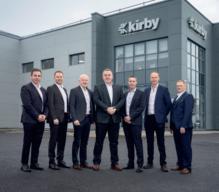
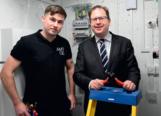
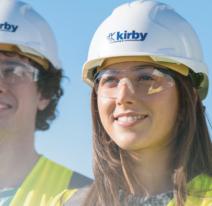
‘Putting the professional centre-stage.’ Kirby Group Engineering. See News.
‘WE AIM
OUR PUBLICATION AT THE WIDEST RANGE OF PROFESSIONALS IN THE INDUSTRY.’
* The articles herein represent a snapshot in time. Always check with those concerned for the latest.
P ublisher Patrick Aylward Editor
Martin Foran
Tel: 01 678 5165
Fax: 01 678 5191
Printed by WG Baird Ltd Antrim
Production Audrey Fitzgerald Construction Management Ireland Published by Ocean Publishing, 14 Upper Fitzwilliam St, Dublin 2
Sales Manager Dermot Casey
Design Niall McHugh
Cmi
10 On The Record - With Fexillon
Catching up with this ground-breaking organisation – there’s a lot happening at Fexillon!
14 The Lie of the Land
Our usual look at trends and developments
19 Tech Talk ‘Invent for the Planet’
27 Spotlight On: Suir Engineering Ltd. ‘Engineering solutions for life, data, and energy’
29 Spotlight On: Dornan ‘Dornan Group: A Turner Company’
30 Out & About Happenings and events – a range of industry occasions
37 Spotlight On: Bennett ‘Bennett Construction: delivering quality projects with care and skill’
39 Spotlight On: MSL Engineering Ltd. ‘Quality delivered…safely, on time, every time’
40 Training & Careers
Official opening of Advanced Manufacturing Training Centre of Excellence in Dundalk
42 Personal & Finance
Want to feel more fulfilled, satisfied, and less stressed? (Well, who doesn’t?)
45 Green Building
As usual we link in with the Irish Green Building Council (IGBC)
49 Spotlight On: Manning Ground Engineering Contractors Ltd.
‘A dynamic and forward-thinking ground engineering contractor’
50 Products & Services What’s caught our eye?
63 The Final Say
Rounding it all off on an inspirational and positive note as always!
NEWS
3D printed homes success spurs interest in 3D construction careers
In response to increased demand, LMETB’s Advanced Manufacturing Training Centre of Excellence (AMTCE) in Dundalk announced monthly courses in Advanced Construction Technologies, which includes 3D concrete printing, to run throughout 2025, with a fully certified programme to follow later this year.
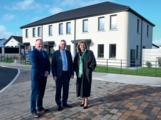
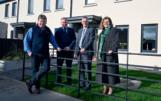
Gerard Smith, director of AMTCE with Martin O’Brien, chief executive of LMETB and Sadie Ward McDermott, director of further education and training, at the official handover of the 3D concrete printed homes at Grange Close in Dundalk.
Success
It follows in the wake of the success of Ireland’s first 3D concrete printed homes at Grange Close in Dundalk, which has received widespread national and international media attention.
The housing development at Grange Close in Dundalk was the result of a partnership between the Louth & Meath Education and Training Board (LMETB), Louth County Council, Irish construction technology company, Harcourt Technologies (HTL), construction firm Roadstone, and Harcourt Architects.
AMTCE was set up by Martin O’Brien, CEO of the LMETB, and was the first to introduce training for 3D concrete printing (3DCP) on the island of Ireland.
Dual challenges
Martin O’Brien said: ‘As the construction industry faces the dual challenges of an ageing workforce and declining interest among the younger generation, LMETB takes a proactive stance in addressing these issues through training focused on 3DCP technology.
The Grange Close project is a testament to what can be achieved when forwardthinking ideas and collaborative efforts come together.
We are proud to play a central role in delivering Ireland’s first 3D printed homes, O’Brien continued.
Justin Kinsella, managing director, HTL Technologies, Gerard Smith, director of AMTCE with Martin O’Brien, chief executive of LMETB and Sadie Ward McDermott, director of further education and training, at the official handover of the 3D concrete printed homes at Grange Close in Dundalk, the first ever to be built in Ireland and the UK.
Martin O’Brien introduced Louth County Council to the idea of using 3D construction printing to deliver much needed social housing faster than a regular build.
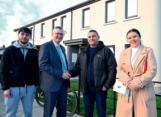
Martin O’Brien, the chief executive of LMETB, with one of the families moving into the first ever 3D concrete printed homes
Martin O’Brien introduced Louth County Council to the idea of using 3D construction printing to deliver much needed social housing faster than a regular build.
Construction of the three houses began in May 2024 and was completed in November 2024, reducing normal construction timelines by 35%.
Already attended Gerard Smith, director of AMTCE, said: ‘Close to 200 people have already attended our 3D concrete printing courses to date and now the global success of the Grange Close project has increased demand yet again.
the first ever 3D concrete printed homes built in Ireland and the UK, at Grange Close in Dundalk.
‘In 2025, we are running monthly twoday courses, providing a comprehensive overview of this technology and aimed at busy contractors, tradespeople, architects, engineers, quantity surveyors and those working in other construction-related or additive manufacturing roles.
‘Furthermore, an educationally certified programme in 3D concrete printing is due to be launched later in 2025 and it will be the first step towards a fulfilling, exciting and well-paid career in this area for many,’ Smith continued.
For more…
Louth and Meath Education and Training Board (LMETB) celebrated the official opening of the Advanced Manufacturing Training Centre of Excellence (AMTCE) in Dundalk recently.
For more see our Training & Careers section in this issue and www.amtce.ie
Martin O’Brien, the chief executive of LMETB with one of the families moving into
built in Ireland and the UK, at Grange Close in Dundalk.
ATU wins Chartered Institute of Building (CIOB) Tomorrow’s Leaders Student Challenge Ireland!
ATU scooped first place in the Chartered Institute of Building (CIOB) ‘Tomorrow’s Leaders Student Challenge Ireland’ competition which took place in Dundalk IT.
Teams
The team from the ATU Galway Dept. of Building & Civil Engineering beat 10 other university teams including from Belfast Metropolitan College, Dundalk IT, Munster Technological University (MTU) Cork, South East Technological University (SETU) Carlow, SETU Waterford, Technological University Dublin (TUD), University of Limerick (UL), University of Ulster and teams from ATU Sligo and ATU Donegal.
The challenge involved coming up with a strategy or methodology for tackling the global housing crisis.
Congratulations
Sarah Hallinan, Regional Manager Ireland at CIOB, says: ‘A huge congratulations to the team from ATU for winning our CIOB Tomorrow’s Leaders Student Challenge competition.
‘This incredibly difficult challenge really puts aspiring construction professionals’ minds to the test, asking them to come up with complex sustainable solutions which they must present to a panel of experts in a very short space of time.
‘I was delighted with the level
of professionalism and awareness of environmental sustainability.’
- Sarah Hallinan, Regional Manager Ireland at CIOB
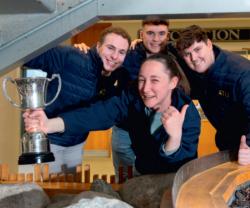
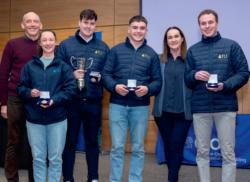
ATU students after winning the CIOB Tomorrow’s Leaders Student Challenge Ireland, L to R: Kevin Kenneally (4th year BSc (Hons) Architectural Technology) from Kilmovee Co Mayo; Dylan Hanley (4th year BSc (Hons) Construction Management) from Tullow, Co Carlow; Tony Conlon (4th year BSc (Hons) Construction Management) from Ballina, Co Mayo; front centre, Kerrie O’Flaherty (4th year BEng (Hons) Civil Engineering) from Knocknacarra, Galway city.
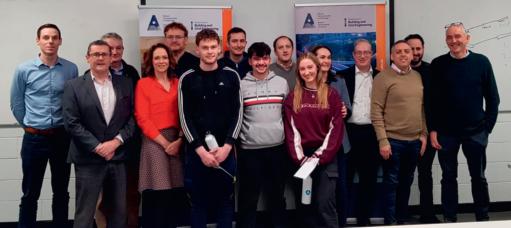
L to R: John Hanahoe, lecturer, Dept of Building and Civil Engineering, ATU Galway-Mayo; Kerrie O’Flaherty (4th year BEng (Hons) Civil Engineering) from Knocknacarra, Galway city; Tony Conlon (4th year BSc (Hons) Construction Management) from Ballina, Co Mayo; Dylan Hanley (4th year BSc (Hons) Construction Management) from Tullow, Co Carlow; Michelle Fahey, lecturer, Dept of Building and Civil Engineering, ATU Galway-Mayo; Kevin Kenneally (4th year B Sc (Hons) Architectural Technology) from Kilmovee, Co Mayo.
‘I was delighted with the level of professionalism and awareness of environmental sustainability on display, as well as how well the students were able to communicate their ideas – these talents will stand them in good stead for their future careers.’
Wonderful
Mary Rogers, Head of Dept of Building & Civil Engineering, ATU Galway-Mayo, says: ‘It is a wonderful achievement and privilege for the ATU team to have won the Chartered Institute of Building (CIOB) “Tomorrow’s Leaders Student Challenge Ireland” competition 2025.
‘This year’s challenge required teams to address the global housing crisis, something that has certainly engaged our students. Congratulations and well done to all concerned.
John Hanahoe and Michelle Fahey, lecturers and mentors to the students, paid tribute to the students:
‘We have competed in this event for many years and have been fortunate to win it on many occasions.
‘We know that our students find working with other disciplines really useful and relish the challenge on the day.
‘They also enjoy meeting and interacting with their colleagues from the other universities.’
Programmes
For further details on programmes in the ATU GalwayMayo Dept of Building & Civil Engineering, see: https://www.atu.ie/faculties/engineering-computing/ building-civil-engineering
Clare, Offaly and Donegal students win ATU Built Environment Student Challenge
Students judged on four tasks associated with development of an 18-apartment building. Adjudication panel made up of 10 industry representatives.
ATU engineering students Shauna Cleary from Birr, Co Offaly, Sean McNamara from Carron, Co Clare and Odhran Quinn from Donegal town, Co Donegal, won first place in this year’s ATU Galway Student Challenge.
Competition
They were among 85 final year Building & Civil Engineering students who took part in the day-long competition in ATU Galway, judged by 10 industry representatives.
The student teams had to consider an 18-apartment development currently under construction in Galway and produce four tasks by lunchtime,
1. A Risk Register with associated cost contingencies
2. A Review of the extent of fit out and finish provided for each apartment to optimise the available sales price and margin
3.A Method Statement showing a clear sequence of activities for the excavation of the basement (including any necessary temporary works) and the construction/installation of new permanent basement structure
4. A Logistics Plan (to include consideration of deliveries, cranage and loading bays
Teams
In the afternoon, the multidisciplinary student teams (in disciplines such as Architectural Technology, Quantity Surveying, Civil Engineering and Construction Management) had to present their work to panels of the expert judges and deal with their questions.
The adjudication panel was comprised of Construction Industry Federation (CIF), Sisk, BAM Ireland, JJ Rhatigan, Coffey, RPS, Simon J Kelly Architects, Eugene Mulcaire Architect, Peter F Costello & Partners (QS) and Linesight (QS).
John Hanahoe, Building & Civil Engineering Dept, says: ‘The students really enjoyed this event as it gets them to work with
their colleagues from other disciplines and also to meet with experts from industry.
‘Many of the judges return year after year as they also really enjoy the event, and we are grateful to them for their continuing support.’
Fantastic opportunity
Michelle Fahey, Building & Civil Engineering Dept, says: ‘The ATU Student Challenge is a fantastic opportunity for students to collaborate in a multidisciplinary environment.
‘The tasks were challenging and reflected the type of issues that they would experience in the workplace.
‘This challenge allowed them to put what they have learnt over the last four years into practice.
‘The students enjoyed showcasing their work to an experienced panel of industry judges, and we are grateful to the judges for giving their time to the challenge again this year.’
Connect
Justin Molloy, director, Western and Midland Region, Construction Industry Federation, says: ‘The Annual Built Environment Student Challenge allowed me to connect with the next generation of construction professionals.
‘The future of the industry is certainly in capable hands. Congratulations to all the students and their lecturers for their hard work and dedication to the challenge.’
For further details on built environment courses in ATU Galway-Mayo, see:
• Construction Management – Atlantic Technological University
• Civil Engineering – Atlantic Technological University
• Quantity Surveying and Construction Economics –Atlantic Technological University
• Architectural Technology – Atlantic Technological University
Mace Consultancy Ireland Awarded Engineers Ireland’s CPD Accredited Employer Standard
Mace Consultancy Ireland, part of the global consultancy and construction firm Mace, has been awarded Engineers Ireland’s Continuing Professional Development (CPD) Accredited Employer Standard.
The company, which has an annual turnover of €2.84bn, employs over 7,400 people globally, and operates two Irish offices, in Dublin and Cork.
Grown considerably
Since entering the Irish market in 2006, Mace has grown considerably in the market as a delivery organisation, supporting key infrastructure and property sectors with project and programme management, cost and commercial, project management office, and advisory services.
With a growing team of more than 130 professionals in Ireland, the company’s focus on equipping its people with the latest knowledge in key sectors such as rail, aviation, healthcare, utilities, energy resilience, commercial property, and renewable energy, has earned its CPD programme the industry-leading recognition provided by the Engineers Ireland CPD Accredited Employer Standard.
Tangible benefits
The Standard is designed to help organisations improve the competence of their engineers and deliver tangible benefits.
The Standard seeks to develop employees who are agile and adaptable and creates a workforce that is encouraged to create and innovate, developing new solutions, thereby creating competitive advantages.
‘Mace Consultancy
Ireland’s impressive trackrecord in supporting the development of its people positions it to continue the successful path it has followed since entering the Irish market almost 20 years ago.’ – Damien Owens, Director General of Engineers Ireland.
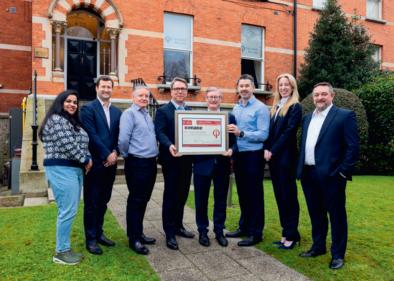
Mace Consultancy Ireland is awarded its Engineers Ireland CPD Accredited Employer Standard at Engineers Ireland’s offices at 22 Clyde Road, Ballsbridge. From left to right: Neena James, Project Manager, Mace Consultancy Ireland; Andy Beard, Managing Director, Mace Consultancy Europe; Derek Byrne, Associate Director, Mace Consultancy Ireland; Frank Randles, Country Director, Mace Consultancy Ireland; Damien Owens, Director General of Engineers Ireland; Tom McDermott, Associate Director, Mace Consultancy Ireland; Jennifer Bradfield, Associate Director, Mace Consultancy Ireland and Eoin O’Mullane, Operations Director, Mace Consultancy Ireland.
Organisations that have achieved the Standard find they are better placed to deal with business change and disruption, while also capable of attracting and retaining better workforce talent.
Director
Speaking, following the award of the Standard, Frank Randles, Country Director at Mace Consultancy Ireland, said,
‘At Mace, we are committed to fostering a culture of continuous learning and development, which is why we fully support CPD as a vital part of our business strategy.
This award is a significant milestone that demonstrates our commitment to delivering the highest standards of professional development within our team in Ireland.
‘The recognition provided by the Engineers Ireland CPD Accredited
Employer Standard will enhance our ability to develop our people, improve the quality of our services, and strengthen our position as a leader across the industry.’
Engineers Ireland
Damien Owens, Director General of Engineers Ireland, added:
‘Mace Consultancy Ireland’s impressive track-record in supporting the development of its people positions it to continue the successful path it has followed since entering the Irish market almost 20 years ago.
‘Joining the more than 170 engineering organisations that have now been awarded the Engineers Ireland CPD Accredited Employer Standard, Mace Consultancy Ireland’s dedication to advancing its teams knowledge and expertise is wellrecognised, better enabling it to deliver for its clients.’
Commercial
construction tender prices increased by 1.5% in the second half of 2024
The Tender Price Index (TPI) published by the SCSI showed the rate of commercial construction inflation increased nationally by 1.5% in the second half of 2024, the same rate as the two preceding six-month periods.
Independent
According to the SCSI’s Tender Price Index, (TPI) ‘which is the
only independent assessment of commercial construction tender prices in Ireland’, the annual median national rate of inflation for 2024 was 3%, down from the 3.9% recorded for 2023 and the 11.5% recorded for 2022.
The report indicated ‘some variation across the regions over the last six months’ with the highest median rate of inflation of 2% recorded in
Connacht / Ulster, in Munster the figure was 1.5% while in Leinster and Dublin the increase was 1%.
That 1% figure was also Dublin’s annual median Tender Price change as it recorded 0% price change in the first half of 2024. Munster has the highest annual increase at 4%, with Connacht / Ulster on 3.5% and Leinster (Excl. Dublin) on 2.5%.
President
The President of the SCSI, Kevin Hollingsworth said that ‘following significant turbulence in the market over the last few years’, price inflation had returned to a steadier pattern.
‘These figures illustrate the dramatic changes we have experienced with commercial construction inflation over the last three years,’ he said at the time of the announcement earlier this year.
‘In the first six months of 2022 inflation reached a record high of 7.5%, while the annual rate of inflation that year was 11.5%.
Welcome
‘The respective figures now are 1.5% and 3%, which is a welcome improvement.
‘The reduction in the rate of increase is due in the main to the continuing competitive commercial construction market and reduced-price volatility for construction materials.’
New board appointments at Kirby Group Engineering
Four longstanding employees join top team at Limerick-headquartered company
Kirby Group Engineering has announced a series of appointments at board level which have taken effect recently.
Elevation
These include the elevation of four longstanding team members to the company’s board, while two existing board members have taken on new roles.
Kirby employs over 1800 people and has developed a firstclass reputation in the life sciences, data centre, industrial, power and renewables sectors.
The Limerick-headquartered company recorded revenue of more than €700m in 2024.
The colleagues joining the company’s board are:
• Donal Lynch, who has been appointed as Group Finance Director.
• Mikey Ryan, who has been appointed as Group Operations Director.
• Ruairí Ryan, who has been appointed as Group Operations Director.
• Michael Murray, who has been appointed as Group Business Development Director and Board Level Director for Power & Renewables.
About Kirby Group Engineering
Kirby Group Engineering is an Irish mechanical and electrical engineering firm, privately owned since its foundation by Tom and Michael Kirby in 1964.
As well as a full range of engineering services the company has a well-deserved excellent reputation for its specialist high- and medium-voltage design and construction work.
Kirby is a values-driven business that takes pride in providing quality and value for its clients, delivering services across the Data Centre, Life Sciences, Industrial, Power and Renewables sectors.
The two existing board members taking on new roles are:
• John Grogan, who has been appointed as Chief Operations Officer, and
• Conor O’Brien, who has been appointed as Chief Commercial Officer
This announcement was made by Henry McCann, who took on the role of CEO in January. He says:
‘I have worked alongside each of these colleagues for many years and I have seen the benefit they have brought to Kirby at each stage of their careers.
Look forward
‘I’d like to welcome our newest board members and look forward to seeing their contribution to the highest level of company leadership.
‘I’m also confident John Grogan and Conor O’Brien will bring their first-class expertise to their new roles to the benefit of Kirby’s future growth.’
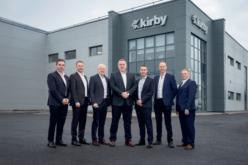
Kirby Board Members.
Engineers Ireland Transportation Society Annual CPD Seminar 2025 ‘Momentum in a Time of Transition: Vision and Learnings in Transportation’
Pictured at the Engineers Ireland Transportation Society Annual CPD Seminar 2025 – Momentum in a Time of Transition: Vision and Learnings in Transportation , were Eamon Ryan, Former Green Party Leader; Damien Owens, Director General, Engineers Ireland, and Ken Spratt, Secretary General of the Department of Transport. The seminar heard from leading experts on the complex challenges facing transportation, such as the decarbonisation of transport, the future role of shared mobility, and insights into the latest trends in the sector.
ON THE RECORD
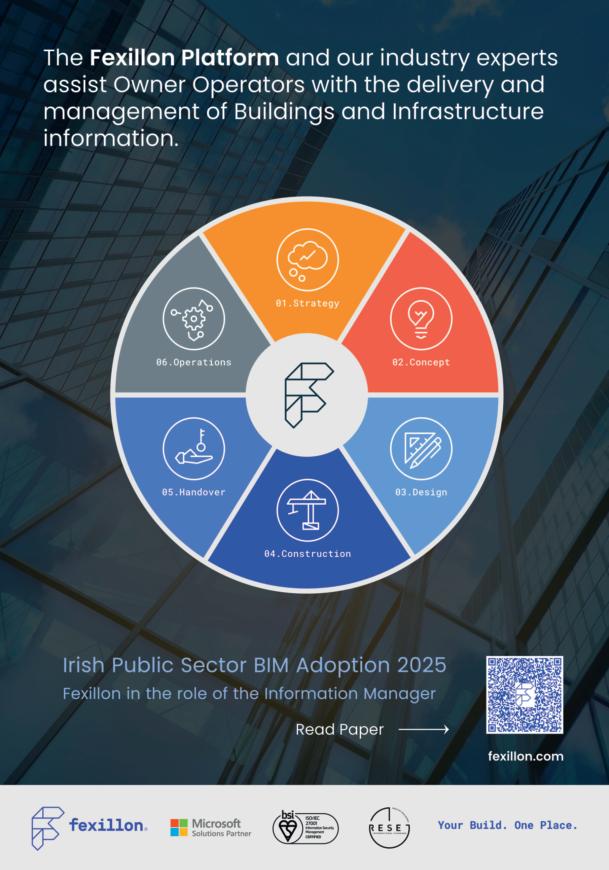
Fexillon empowers Owner Operators in navigating the delivery and management of building and infrastructure, seamlessly bridging Strategy to Operations through a centralised enterprise platform. With over two decades of trailblazing digital transformation in the built environment, Fexillon is a pioneer across various sectors and mission-critical infrastructure. The company has grown from its Irish roots to become a global player in smart building technology, helping real estate owners make data-driven decisions to enhance building performance and meet net-zero targets. We got together recently for a catch up and began with an On The Record overview with one of Fexillon’s founders, George Harold.
Fexillon – a leaner approach to Building Information Management
Cmi: Hi George, and thanks so much for joining us in On The Record! Can we begin at the very beginning? What are your backgrounds and how did Fexillon come about?
GH: The business was co-founded with Kieran Beggan twenty-five years ago, aiming to support owner operators in digital transformation from traditional paper-based processes when handing over buildings and knowledge from construction to operations.
Starting as students of Building Maintenance at the Dublin Institute of Technology, Bolton Street, we saw a gap in the marketplace in how the building asset information was traditionally managed and handed over to building owners in hardcopy formats.
We set up Fexillon to enable the building owner, construction company and Facilities Management teams to take a leaner approach to Building Information Management.
Tell us about that initial vision and what you wanted to achieve when you set out?
We had seen first-hand the inefficiencies and risks caused by paper-based building handovers and set out to improve things by developing technology that would support buildings’ owners with more connected, sustainable and intelligent information management processes.
We collaborated with owner operators and their project teams to develop solutions that provided a single source of truth for their built assets.
How has the company grown?
Fexillon has been going through substantial growth, and we currently have teams in six countries and clients in ten countries across Europe and the US.
We have a diverse team of like-minded
professionals in Digital Technology and Information Management for the built environment.
Over the past twenty-five years, Fexillon has built a strong reputation for quality and innovation, and we have just won a major Facilities Management Award for the third year in a row.
Can you give us an overview of the range of projects you now work on?
Fexillon has built up strong, long-term relationships with blue-chip clients from various sectors.
We have developed significant experience in the Data Centre sector. We support several universities, such us UCD and The University of Strathclyde.
Among our most significant healthcare clients, we are now working with The Mater Hospital And Children’s Health Ireland.
One of the most innovative projects that we are now working on in US is the JE Dunn Construction headquarters in Atlanta. Read on for more!
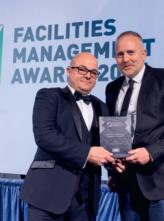
George Harold receiving an award for Innovation in Products & Services in Facilities Management awards.
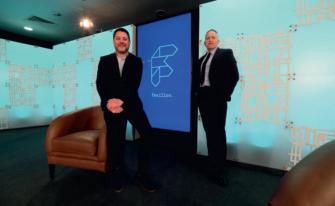
Kieran Beggan and George Harold.
Fexillon in healthy buildings
Fexillon have been putting great efforts into developing digital solutions to support Healthy buildings.
Fexillon Twin is constantly evolving to support better operations, helping improve the quality of life, boost cognitive functions, and achieve a major impact on occupants’ health, comfort and workplace performance. Air pollution is one of the biggest threats to our health today.
The World Health Organization (WHO) has recently recognized air pollution as a global public health emergency.
In addition to government institutions and policy makers, businesses and property owners are beginning to take action as well.
Proactive air quality management
In the scope of a post-pandemic world, building owners and facility managers need
Fexillon Twin is a complete digital twin solution that combines the building’s physical environment with real-time operational data, reporting on elements that can be measured and changed, including indoor air quality, energy, water and building occupancy.
The Twin Air monitoring collects and analyses critical air quality data such as Temperature, Humidity, Air Pressure, CO2, Virus survivability and more. The data are corelated with other relevant environmental factors such us room occupancy to assist the building owner and their Facilities Management team in making data-informed decisions to elevate the healthy building performance.
to regularly monitor air quality and take precautions to reduce the viral transmission and survivability, as well as to mitigate pollution and provide a healthy space for their employees, visitors, tenants, and customers.
The economic loss due to poor indoor air quality has been estimated to be in the tens of billions of euros per year. Even the most modest investment towards improved air quality is sure to produce considerable cost savings.
Standards
Fexillon is a RESET Accredited Data Provider and has a team of Information Managers certified as RESET Accredited Professionals (APs).
These achievements affirm Fexillon’s commitment to delivering validated environmental monitoring solutions and ensuring expert capabilities to assess and support Healthy Buildings, ESG goals and environmental sustainability across building portfolios globally.
RESET (see opposite, for more) is an internationally recognised standard that provides a framework for monitoring and improving the built environment’s performance across key sustainability pillars, including indoor air quality (IAQ), energy efficiency, and water quality.
Poor air quality inside buildings may lead to Sick Building Syndrome, which can cause dizziness, fatigue, eye irritation, and other cold or flu-like symptoms, resulting in higher rates of absenteeism and a decrease in productivity in workplaces.
Healthy Productive People
In 2018, the World Green Building Council published a report that shows a healthier work environment could cut sick leave by 58%, or four days per year per worker.
Studies have found that people are better at reasoning, understanding, and taking decisions when they breathe better air.
Cleaner air was proved to lead to 61% higher scores in cognitive functions, 97% higher scores in crisis response and 182% higher strategic planning ability.
Read more at: www.fexillon.com
Fexillon Twin for Healthy Buildings
Fexillon Partners With US-based global real estate tech firm Aptitude to achieve RESET certification
Highlighting Irish Innovation on the global stage!
Fexillon has partnered with Aptitude: Intelligent IntegrationTM, a global real estate technology firm, to achieve RESET certification for a major office building in Atlanta, Georgia.
Prestigious
RESET is a prestigious international certification focused on improving indoor environmental quality, with a particular emphasis on air quality, water management, and energy efficiency, creating healthier, more sustainable spaces for occupants. This achievement highlights Fexillon’s growing influence in the real estate sector and Ireland’s emerging role as a hub for innovation in sustainable building technologies.
RESET certification is awarded to buildings that meet stringent standards for environmental performance, ensuring that the spaces are healthier for people and more energy efficient.
For Fexillon, this certification represents a significant milestone in its mission to drive global sustainability through cutting-edge digital solutions.
Earned
Fexillon has earned a strong reputation for delivering smart building technologies that help organisations across Europe and beyond enhance their sustainability and operational efficiency.
With a portfolio spanning sectors like healthcare, government, and technology, Fexillon has been rapidly gaining ground in the US since establishing its headquarters in Charleston, South Carolina, in 2024.
This RESET certification for the Atlanta building further solidifies Fexillon’s position as a global leader in digital transformation and sustainable real estate.
Since establishing its US headquarters in Charleston, South Carolina in 2024, Fexillon has rapidly gained momentum in helping real estate owners enhance sustainability, operational efficiency, and occupant health.
Enables
Its RESET-certified IAQ, Energy, and Water monitoring platform enables enterprise real estate teams to manage environmental performance in real time, aligning with global sustainability frameworks.
‘We are immensely proud to be an Irishborn company making such a significant impact on the world stage,’ said Kieran Beggan, CEO of Fexillon.
‘Achieving RESET certification for JE Dunn’s Atlanta HQ is a major milestone, underscoring Fexillon’s ability to deliver value-driven, enterprise-level solutions that push the boundaries of what’s possible in the real estate space.
‘While we continue to grow internationally, Ireland remains the foundation of our success.
‘We are committed to helping Irish enterprises meet their sustainability goals,
ensuring that digital transformation in the built environment delivers real, measurable impact.’
Commitment
Sam Holt, managing director at Aptitude, said: ‘Fexillon’s commitment to digital transformation and sustainability aligns well with our mission to drive innovation in mission-critical real estate.
‘This partnership brings together Fexillon’s cutting-edge technology and Aptitude’s deep industry expertise, creating a powerful ecosystem that delivers real value to building owners and operators.
‘The RESET certification for JE Dunn’s Atlanta office is a testament to the strength of our collaboration and the tangible impact we can deliver at scale.’
Future
Stanton Wong, President at RESET, said: ‘The partnership between Fexillon and Aptitude represents the future of smart, sustainable real estate.
‘Pursuing and achieving RESET certification demonstrates a commitment to healthier, more efficient, and future-ready buildings through measurable performance for indoor air quality, energy, and water.
‘By leveraging Fexillon’s advanced digital infrastructure and Aptitude’s expertise in mission-critical environments, this collaboration is the new standard for sustainability in the built environment.’
Continues
Fexillon’s Irish-led expertise continues to shape the future of sustainable real estate. The company’s platform, which provides real-time data on air quality, temperature, humidity, pressure, light, noise, energy, and water usage, helps building managers proactively reduce operational risks and enhance occupant well-being.
These insights support global certifications like RESET, WELL, LEED, and Fitwel, demonstrating the transformative power of data-driven decision-making. Fexillon’s global expansion is a testament to Ireland’s strength as a hub for innovation in digital transformation and sustainability. As the country advances toward its net-zero targets, Fexillon remains at the forefront, driving progress at home and abroad.
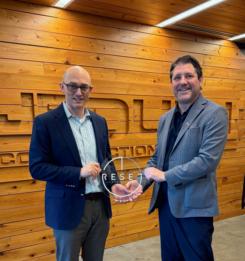
Kieran Beggan (co-founder and CEO of Fexillon), (On Right) Sam Holt (managing director of Aptitude), receiving the RESET award.
As usual we check in with Construction Information Services (CIS) to get an overview of what’s been happening and how the land lies…
The delivery of new housing is intrinsically linked to the development of supporting infrastructure, including roads, utilities, and public services.
Fluctuating
Over the past five years, Ireland has experienced fluctuating housing completion rates, while infrastructure investment has only recently seen an increase.
One of the latest reports (at time of writing, Spring ‘25) from Construction Information Services (CIS Powered by Hubexo), Ireland’s leading provider of construction project data and market analysis, reveals that this misalignment poses challenges to meeting government housing targets and underscores the need for synchronised planning and investment.
Ireland’s housing sector is certainly making strides, with record-breaking construction commencements in 2024 marking a significant milestone in addressing the nation’s housing crisis.
‘Ireland’s housing sector is certainly making strides.’
However, despite the surge, housing completions fell short of critical government targets, exposing persistent challenges in meeting demand and exacerbating the existing housing crisis.
The government’s ambitious Housing for All plan, launched in 2021, aims to deliver 300,000 new homes by 2030.
Progress
While efforts to increase supply have seen progress, the delivery pace has not kept up with rising demand.
Advisory councils have warned that rising infrastructure costs and planning delays post a huge risk to achieving these housing targets and while progress is being made, major roadblocks remain in planning, infrastructure, and financing. CIS data showcased a record 70,412 residential units commencing construction in 2024 – a 111% increase compared to 2023.
This growth was largely attributed to government measures such as the development levy waiver and the Uisce Éireann rebate, which eased some of the financial burdens on developers.
While these figures signalled optimism, CIS data also revealed that housing completions remained a challenge. In 2024, 29,136 residential units were completed, falling short of the 33,000-unit target set by the government and representing a 2% decline from 2023.
Record volume
David Thompson, Vice President (Ireland and UK) at CIS said, ‘The record volume of housing commencements in 2024 is a positive sign for the sector and provides hope for increased completions in the coming years, with a notable impact expected this year and 2026.
‘However, we cannot ignore the ongoing challenges. Rising costs, planning delays, and an imbalance in housing priorities mean that too many Irish families remain locked out of the housing market.’
In public sector infrastructure, spending has increased significantly in the last two years. However, despite this recent growth, infrastructure remains a major bottleneck to housing delivery.
Delayed school and hospital projects have picked up momentum, in line with the government’s efforts to tackle existing backlogs.
Following a 35% decline in education-related project starts in 2024, the sector is set for a 17% rebound in 2025, with a strong pipeline of projects valued at €320 million.
This growth is forecast to continue into 2026, with the total value of education projects reaching €365 million.
Significant
Construction in the medical sector in Ireland has seen significant growth in recent years, driven by increasing demand for healthcare services and infrastructure.
THE LIE OF THE LAND
The medical sector alone saw significant growth in 2024, supported by major projects like the €800m National Maternity Hospital.
The CIS report confirms that while government spending on infrastructure has increased, it has not been sufficiently aligned with housing demand, leading to delays in wastewater connections, roads, and transport links.
This mismatch between housing demand and infrastructure development is a recurring challenge, contributing to slower project delivery and rising costs.
Demand
The data suggests that while infrastructure investment is finally increasing, it is still not keeping pace with the demand for new housing.
The lack of alignment between housing construction and infrastructure rollout remains a significant challenge.
Several key challenges are affecting the alignment between housing development and infrastructure expansion.
Infrastructure deficits remain a major hurdle, with many housing projects delayed due to insufficient wastewater systems, roads, and energy networks.
Bottlenecks
In addition, the planning process remains lengthy and complex, creating bottlenecks that slow down housing delivery.
The sharp decline in planning applications raises concerns about future housing supply, suggesting that constraints will only intensify in the coming years.
Economic pressures, including inflation and financial uncertainty, have further escalated the cost of infrastructure projects, making largescale developments increasingly difficult to finance Rising costs of materials and labour shortages – exacerbated by global supply chain issues – are driving up expenses, forcing some developers to pause or scale back projects.
At the same time, regulatory uncertainty – with developers facing unclear policies and slow approval timelines – has led to project stagnation, preventing much-needed housing from reaching the market.
Align
To ensure that housing completions and infrastructure development align effectively, policymakers and industry leaders must focus on:
• Accelerating Infrastructure rollout: Prioritising essential utilities, transport links, and energy networks in high-demand areas.
• Streamlining planning processes: Reducing bureaucratic delays to enable housing and infrastructure projects to progress in parallel.
• Encouraging private sector investment: Providing incentives for private developers to contribute to infrastructure funding.
• Enhancing regional infrastructure: Ensuring that non-urban areas receive adequate investment to support new housing developments.
Dave Thompson, Vice President of Ireland and Europe at CIS, added:
‘While the construction industry faces significant challenges, the resilience and adaptability of the sector are clear.
‘From record-breaking housing starts to renewed investment in public sector infrastructure, the industry has demonstrated its ability to evolve.
‘Sustained growth will require strategic planning and a commitment to innovation, but the outlook remains positive for those willing to adapt.’
Struggled
The past five years have seen growth in housing completions, but infrastructure development has struggled to keep pace.
While public sector investment in infrastructure has increased, planning delays and infrastructure deficits continue to hinder the housing sector.
If Ireland is to meet its housing targets, there must be a coordinated effort to align infrastructure development with housing needs, ensuring that new homes are built in the right locations with the necessary infrastructure to support them.
Spring 2025.
About CIS
Construction
Information Services
(CIS) is Ireland’s leading provider of construction project data, market analysis, and business intelligence. We provide fully researched and timely insight into Irish construction activity by combining comprehensive information gathering with expert analysis. CIS data spans all construction sectors, stages of planning, and regions of the ROI and NI.
For further details of CIS methodology on counting housing supply in Ireland please contact pmcgrath@cisireland.com or sdelaney@cisireland.com with your query.
CIS figures are drawn directly from the National Building Control Office’s Building Control Management System (BCMS) who’s office, by legislation, records details of the commencement and completion of building works in Ireland. Each week CIS draws down data from the BCMS, links the data to existing planning applications and record details of each new residential development, or phase thereof, started or completed.
As always, this report represents a snapshot in time. (Spring ‘25). Refer to relevant bodies for most up to date statistics and information as always.
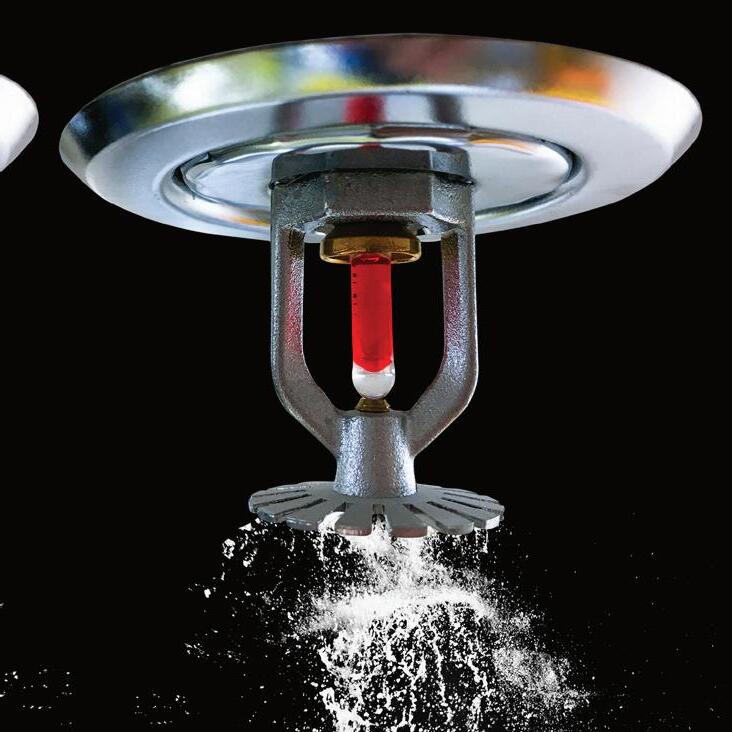
Irish owned and managed, Automatic are exclusively dedicated to the fire protection business. Our engineers and designers are recognised as experienced and respected individuals among their peers within the construction industry. As a Loss Prevention Certification Board (LPCB) Level 4 Certified contractor (highest accreditation level available), we are permitted to design, install, commission and self-certify all of our works on all categories of sprinkler systems, without third-party certification or supervision.
Winners of Invent for the Planet (Ireland) 2025
Create prototype plastic brick for construction of homes in poor countries
A multidisciplinary team of students from colleges across Ireland has won the Irish leg of Invent for the Planet (IFTP) 2025 for their plastic brick prototype solution titled, ‘Creating sustainable housing solutions for expanding poverty areas’.
Team IRIS, named after their prototype (Innovation Recycling Infrastructure Solution), is Joyce Mathew, ATU Galway; Christopher D'mello, DIT; Gabriela Rodrigues, University of Galway; Camillo Murgia, ATU Galway; Harish Sampathkumar, ATU Donegal; Dipshikha Das, ATU Galway and Kajal Bhapkar, ATU Donegal.
The winning prototype collects plastic waste, adds local clay, sand, basalt fibre and coconut fibre, putting them inside a container and melting them, converting them into bricks to use to build houses in the poorest, plastics stricken hot spots in developing countries.
The prototype brick can also store water. The team has developed a kit to enable local people, once trained, to build their homes themselves. The prototype is modular, scalable, and reduces building costs by up to 70%.
Journey
The winning team says: ‘Our Invent for the Planet 2025 journey was more than just an innovation sprint— it was about teamwork, creative problem-solving, and a shared vision for sustainability.
‘Our Replast Kit is designed to empower communities to cultivate self-sufficiency.
‘These 48 hours proved that when technology meets purpose, real change happens. This is more than just technology; it’s about fostering local entrepreneurship, handling environmental impact, and enabling a future where innovation and sustainability go hand in hand.’
Led
IFTP Ireland is led by Dr Jack Saad, Fulbright Scholar, Texas A&M (PhD Robotics, Genova University, Italy) who lectures in industrial and mechanical engineering in ATU Galway.
Dr Saad has been co-managing and co-ordinating the annual event, now in its fourth year, together with co-organisers and mentors from local industry, Damien Toner, Aquatech Business Manager at Bord Iascaigh Mhara – Ireland's Seafood Development Agency; Frank Kane, Senior Scientist, Marine Institute; Derek Thorton Mechanical Lecturer,
ATU; Dr Carine Gachon, Transcend project manager at ATU.
The local competition is sponsored by Thermo King, EU Green, Marine Institute and Ireland's Seafood Development Agency.
Thanks
‘Special thanks to mentors from Thermo king engineering office Ken Gleeson , Peadar Conneely, Guilherme Boratto and Senthil Kumar, to Margaret Mulchrone, Project Manager, EU GREEN University Alliance , EveAnne McCarron, External Engagement, ATU, Grace Latham, Entrepreneur officer, ATU, Mechanical
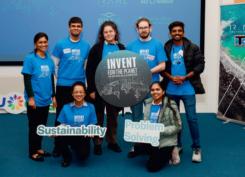
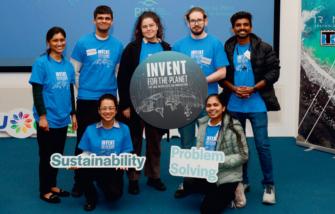
IFTP Ireland 2025 winning team IRIS, L to R, back row: Joyce Mathew, ATU Galway, Christopher D’mello, DIT, Gabriela Rodrigues, University of Galway, Camillo Murgia, ATU Galway, Harish Sampathkumar, ATU Donegal. Front row, Dipshikha Das, ATU Galway, Kajal Bhapkar, ATU Donegal.
Engineering staff Aoife O’Brien, David Keary, Oliver Mulryan, Eathan Mannion and Colin Farrell, and to Catherine Butler, Development and Innovation Executive at Bord Iascaigh Mhara — Ireland's Seafood Development Agency.’
President
Dr Orla Flynn, ATU President, says: ‘The Invent for the Planet weekend is one of those magical events that reminds us all of why we are in education – to see groups of students coming from different backgrounds, disciplines and universities working together to solve huge global problems, having fun, engaging with external mentors and judges – the energy is always truly infectious.
‘This year was no exception, and I want to say a big thank-you to the ATU team who managed this event, led by Dr Jack Saad and supported by Dr Carine Gachon, Prof Frances Lucy and EveAnne McCarron.
‘Go raibh maith agaibh – the future is surely in wonderful hands!’
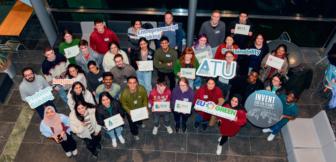
In all, thirty-four students from seven universities participated in the 48 hour intensive competition aimed at finding solutions to global challenges — Dundalk IT, Maynooth University, University of Galway, University of Limerick, TU Dublin, UCC, TUS and several ATU campuses took part in the competition, aimed at solving challenges affecting the planet today.
Presentation
The students did a 10-minute presentation on their prototypes to a panel of judges including Dr Rick Officer, CEO, Marine Institute; Gail Quinn, HR Leader , Trane Technologies; Aine Heffernan, Corporate Vice President, Advanced Micro Devices; Dr Hernani Zao Oliveria, University of Evora, EU Green Alliance, and Máirtín Walsh, Development Executive, Bord Iascaigh Mhara.
Gail Quinn, HR Leader, Thermo King says: ‘It is always such a wonderful few days witnessing the creativity,
‘It was absolutely amazing to witness what the participants were able to achieve in just 48 hours.’
enthusiasm and diversity of thought, that this competition brings.
‘I leave the event knowing that the future of innovation and spirit of doing good for our planet, is very much alive in the generations coming behind us.’
Inspiring
Frank Kane, senior scientist Marine Institute, says: ‘As always, at the Invent for the Planet event, it is inspiring and invigorating to be meeting and working with the brightest of the next generation – the future is in good hands.’
Damien Toner, Aquatech Business Manager at Bord Iascaigh Mhara – Ireland's Seafood Development Agency, says:
‘BIM is delighted once again to participate in Invent for the Planet.
‘Our coastal communities face challenges associated with climate change, depopulation, housing and employment.
‘Seeing students from all over Ireland and globally come together and address these challenges with innovative thinking is inspiring.
‘We know that the event not only provides a platform for their creativity but also builds resilience, tenacity and teamwork.
‘We are privileged to be part of such a unique event.’
Worldwide
Invent for the Planet 2025 took place worldwide. Students from fifty universities competed in the global challenge.
Led by Texas A&M, USA, there are prizes up to 10,000 USD for the final winner.
The other short-listed projects in the Irish leg of IFTP were:
• Innovative solution to mitigate and adapt to climate change
• Advancing marine-based carbon sequestration with algae and seaweed
• Developing lower carbon solutions for the energy sector
• Advancing carbon capture and storage (CCS) technologies
• Improving sanitation in riverine communities
Proud
Professor Frances Lucy, ATU Lead for EU GREEN University Alliance, says: ‘EU GREEN is proud to support the ATU competition for “Invent for the Planet”.
‘This annual event really shows how student teams can provide ground breaking innovative solutions for complex real world sustainability challenges in just 48hrs. Their enthusiasm, energy and enjoyment was truly infectious!’
Dr Rick Officer, Chief Executive Officer, Marine Institute, says: ‘I’m very proud of the Marine Institute’s ongoing participation in Invent for the Planet.
‘The event teams together emerging leaders from Ireland’s universities, focusses their creativity and ingenuity, and delivers constructive solutions to wicked challenges facing our planet.
‘It is a pleasure and a privilege for me, and for the Marine Institute’s mentors, to contribute to such a positive and well-needed initiative.’
Great insight
Ken Gleeson, Engineering Leader –EMEA Truck & Trailer at Thermo Kin, says: ‘Invent for the planet event is a great insight for students into critical project management, project team dynamics and the pressure of live presentation.’
Judge Aine Heffernan, AMD Corporate Vice President, says: ‘The Invent for the Planet event at ATU was truly wonderful.
‘It was absolutely amazing to witness what the participants were able to achieve in just 48 hours.
Head-on
‘The teams tackled real-world problems head-on and came up with creative and feasible solutions that have the potential to address some of the world's most challenging issues. It was a privilege to see their work and be a part of such an inspiring event.’
For further details on this competition see Invent for the Planet | Texas A&M University Engineering
For information on all ATU Mechanical and Engineering programmes see, Atlantic Technological University.
of bonding solutions for the Construction Industry.
• Performance Bonds
• Advanced Payment Bonds
• Road & Sewer Bonds
• Structural Warranty Products
• Maintenance Bonds
• Infrastructure Bonds
• Supplier Guarantee Bonds
COLM MCGRATH
MANAGING DIRECTOR
E: colm@suretybonds.ie
T: +353 (0)71 96 23 228
M: 086 818 9702
DANNY RANKIN
HEAD BOND BROKER
E: danny@suretybonds.ie
T: +353 (0)71 96 23 228 M: 086 028 7513
PAUL WYSE SENIOR BOND BROKER
E: paul@suretybonds.ie
T: +353 (0)71 96 23 228 M: 086 302 2963
Construction sustainability in Ireland: A path towards green development
Sustainability in construction has become a pressing issue in Ireland as the country strives to meet ambitious climate targets while addressing the housing crisis and supporting economic growth. The construction industry, a significant contributor to carbon emissions and environmental degradation globally, plays a critical role in Ireland's efforts to transition to a low-carbon, resource-efficient economy. This essay, by Colm McGrath , explores the current state, challenges, and opportunities of sustainable construction in Ireland.
The Irish government has committed to achieving net-zero carbon emissions by 2050, with intermediate targets to reduce emissions by 51% by 2030.
The construction and built environment sector accounts for approximately 40% of Ireland's total carbon emissions when operational and embodied carbon are combined.
To address this, Ireland has adopted policies and standards aimed at integrating sustainability into the construction process.
Promotes
One key initiative is the Climate Action Plan , which promotes the use of sustainable materials, energy-efficient building designs, and renewable energy integration. The Nearly Zero Energy Building (NZEB) standard, introduced in 2021, mandates that all new buildings have high energy performance and consume nearly zero energy, with most coming from renewable sources. Similarly, the adoption of Building Information Modelling (BIM) is transforming construction practices, enabling more efficient resource management and reducing waste.
Gaining traction
In addition to regulatory measures, voluntary certifications such as the Leadership in Energy and Environmental Design (LEED) and Building Research Establishment Environmental Assessment Method (BREEAM) are gaining traction among developers seeking to demonstrate environmental responsibility.
DIPLOMA IN CONSTRUCTION LAW
• Commencing 11 October 2025
• Flexible learning options
• Lectures available to view on demand
• Workshops featuring problem-based learning Specialised introductory streams for lawyers and non-lawyers
• Fee: €3,050
Our advanced level diploma provides a comprehensive overview of the specialised discipline of construction law and practice in Ireland. The teaching faculty features experienced practitioners from leading law firms and industry experts.
The course covers the following: 1. An introduction to construction law
Procurement – the tendering process
Construction contracts 4. Dispute resolution
Visit www.lawsociety.ie/diplomacentre t 01 672 4802
e diplomateam@lawsociety.ie @LawSocEdu
Completed modular office block
Modular Building.
Despite these advancements, the journey towards sustainable construction in Ireland is fraught with challenges:
1. High embodied carbon in materials: The construction sector heavily relies on materials like concrete and steel, which have high embodied carbon due to energy-intensive production processes. While alternatives such as timber and recycled materials exist, their adoption is hindered by limited supply chains and regulatory constraints.
2. Retrofitting existing buildings: With over 2 million homes and numerous commercial properties, many of which are energyinefficient, retrofitting is critical to achieving sustainability goals. However, the costs and logistical complexities of retrofitting at scale remain significant obstacles.
3. Skilled workforce shortages: The demand for skilled professionals in green construction is outpacing supply. Expertise in sustainable building techniques, energyefficient design, and renewable energy systems is essential to meet the growing demand.
4. Affordability and housing crisis: Sustainable construction often comes with higher upfront costs, creating tension between sustainability goals and the need to address Ireland's severe housing shortage. Balancing affordability with environmental performance is a significant challenge.
Ireland has a wealth of opportunities to promote sustainable construction while addressing its unique challenges:
1.Innovative building materials: Research and innovation in lowcarbon materials, such as crosslaminated timber (CLT), hempcrete, and recycled aggregates, are gaining momentum. Government support for local production and use of these materials can reduce embodied carbon while boosting the economy.
2.Green infrastructure and urban planning: Investment in green infrastructure, such as rain gardens, permeable pavements, and green roofs, can mitigate environmental impacts while enhancing urban resilience. Integrating sustainability into urban planning also supports compact, low-carbon communities.
3.Digital technologies: Digital tools like BIM and the Internet of Things (IoT) can optimize resource use, monitor energy consumption, and reduce waste across the construction lifecycle. Expanding training programs to upskill the workforce in these technologies can accelerate their adoption.
4.Circular economy in construction: Transitioning to a circular economy, where materials are reused and recycled, can significantly reduce waste. Ireland is already seeing examples of deconstruction projects, where materials from demolished buildings are repurposed, but scaling this practice requires stronger policies and incentives.
‘Ireland has adopted policies and standards aimed at integrating sustainability into the construction process.’
5.Policy and incentives:
Strengthening policy frameworks, including tax incentives for sustainable projects and penalties for high-carbon practices, can drive behavioural change across the industry. The introduction of carbon pricing for construction materials and processes could encourage developers to prioritize sustainability.
Ireland boasts several successful examples of sustainable construction. For instance, the University College Dublin Future Campus incorporates green roofs, solar panels, and energyefficient systems.
The C loughjordan Ecovillage in County Tipperary demonstrates how community-led approaches can integrate renewable energy, passive house design, and sustainable land use into construction projects.
Similarly, the Irish Green Building Council (IGBC) has been instrumental in promoting best practices and certifications, such as the Home Performance Index, which measures sustainability in residential developments.
Challenge and opportunity
In conclusion, sustainable construction is both a challenge and an opportunity for Ireland as it seeks to reconcile environmental, social, and economic priorities.
By addressing barriers such as embodied carbon, retrofitting, and skills shortages, and leveraging innovations in materials, technologies, and policy frameworks, Ireland can position itself as a leader in green construction.
Achieving sustainability in construction is essential not only for meeting climate targets but also for enhancing quality of life, creating green jobs, and ensuring long-term economic resilience.
With collaborative efforts from government, industry, and communities, Ireland can build a future where the built environment harmonises with the natural one, setting an example for other nations striving for sustainable development.
Safe construction and the electricity network
A safety message from ESB Networks
Electricity is essential to Ireland’s economy and everyday life. It is so integral to modern living that we often take it for granted.
Electricity is delivered across Ireland using both overhead wires and underground cables.
Powerful and versatile
It’s a powerful and versatile source of energy but can be dangerous unless we use safe systems and procedures.
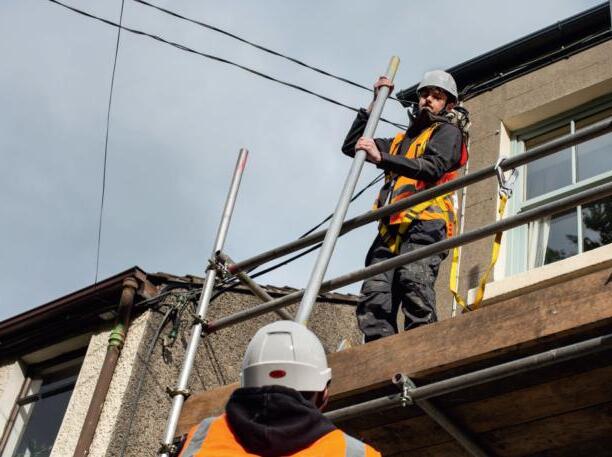
Where safety procedures haven’t been followed, and where construction work has taken place too close to the electricity network, serious accidents have occurred. Sadly, this has included fatalities.
Always stay safe
Michael Murray, Public Safety Manager at ESB Networks, is committed to reminding all construction workers to always stay safe and stay clear of all electricity wires and cables.
AVOIDANCE OF ELECTRICAL HAZARDS WHEN WORKING NEAR OVERHEAD ELECTRICITY WIRES
The instantaneous power of electricity is such that any accidental contact with live overhead wires, or coming too close to the wires, will cause serious injury – and can even prove fatal.
The key to avoiding such accidents is to first take account of the safety implications of overhead wires and then plan to carry out work safely and without incident.
Working directly beneath or close to overhead electricity lines is extremely hazardous and requires that contractors put special controls in place to ensure they never unintentionally breach the Safe Exclusion Zone, this includes requesting ESB Networks to switch out the electricity lines for the duration of the work.
Code of Practice
For more information refer to the ESB Networks Code of Practice For Avoiding Danger from Overhead Electricity Lines.
AVOIDANCE OF ELECTRICAL HAZARDS WHEN WORKING NEAR UNDERGROUND ELECTRICITY CABLES
It is important to always take the essential safety precautions before carrying out digging work, as there often will be buried electricity cables close by.
It is never safe to disturb or handle electricity cables.
Before you start digging:
• Contact ESB Networks’ ‘Dial Before You Dig’ service and obtain the relevant, up-to-date cable maps: dig@ esb.ie or 1800 372 757
• Complete a Risk Assessment Method Statement (RAMS).
• Remember that service cables and public lighting cables may not be shown on the map. Always assume that there are more buried cables present than you have located.
• Look out for any indication of other services such as gas, water, etc.
• Ensure a Cable Avoidance Tool is used by a competent operator to locate all services.
• Mark the positions of the cables using waterproof crayon, chalk or paint and ensure it is visible to the machine operator.
IN THE EVENT OF EMERGENCY, CONTACT ESB NETWORKS IMMEDIATELY ON 1800 372 999.
Remember to always Stay Safe, Stay Clear of Electricity wires and cables.
ESB Networks, delivering the electricity network for everyone’s clean electric future.
See ESB Networks Code of Practice ESB Networks Code of Practice for Avoiding Danger from Overhead Electricity Lines
Irish engineering firm makes landmark acquisition as part of ‘ambitious growth strategy’
Suir Engineering Ltd., one of Europe’s fastest-growing engineering services providers, started 2025 on an ambitious note with the acquisition of a major Scottish engineering firm amongst a number of other exciting announcements.
In January, the company headquartered in Waterford, made a trailblazing move when it announced the acquisition of Taylor & Fraser, a leading mechanical & electrical engineering business operating in Scotland for over 100 years.
CEO of Suir Engineering, John Kelly, described the company’s latest development as being part of their ‘ambitious growth strategy’ – and that strategy certainly appears to be working.
Bolstering
It comes after Suir Engineering launched its first UK offices in London and Manchester, bolstering its ability to serve clients in the UK.
Now, as one of the few Irish engineering contractors with a Scottish entity, it can capitalize on the new business opportunities resulting from the multi-billion-pound market demand within this sector.
‘It’s a game-changer,’ says Kelly. ‘The acquisition strengthens our position in key markets and enhances our ability to deliver innovative solutions to a broader client base.
‘By building on established local relationships and tapping into new opportunities, we’ve created a solid platform for sustained growth across
Europe, setting the stage for long-term success.’
Wide range
Taylor & Fraser, headquartered in Paisley, has been operating as a familyrun business for 114 years, providing mechanical & electrical engineering and construction services across a wide range of public and private businesses and organisations.
Its new parent company, Suir Engineering, reported a turnover of €429m in 2023. The business continued to grow throughout 2024 and is forecasting revenues of €550m for 2025, driven by the Taylor & Fraser acquisition, a strong project pipeline, and a strategic talent acquisition programme.
An €180m in additional revenue is expected to come from data centre projects, which is one of the key areas of growth for the business.
Projects
And by the end of 2025, Suir Engineering projects that it will already be among the top ten mechanical & electrical (M&E) contractors in the UK by revenue.
Data centre projects worth £14 billion (€16.7 billion) have been announced as part of a new AI action plan launched by the UK government.
The plan proposes creating AI growth zones to help encourage data centre developments and pledges to build a new supercomputer to boost UK compute power.
This represents a major opportunity for specialist firms like Suir.
Top five
Reporting 41 percent year-over-year growth and an EBITDA (Earnings-
across Europe
Before-Interest, Taxes, Depreciation, and Amortization) of 5 percent in 2023, Suir Engineering remains a top five mechanical and engineering firm in Ireland – and the firm continues to invest in its recruitment and training processes to support ambitious growth plans.
At the close of last year, the company announced the creation of 200 jobs and the launch of a pioneering Apprentice Centre of Excellence at its Citywest, Dublin location, which will support the state’s SOLAS training programmes.
The apprenticeship jobs, all of which will result in permanent positions with Suir Engineering, are in the areas of electrical and electrical, and electrical and instrumentation.
People
‘Suir Engineering’s success is built on investing in our people,’ says Kelly.
‘Through initiatives like our Apprentice Centre of Excellence, we’re equipping our staff with the skills and opportunities needed to drive innovation and sustain growth in Ireland and Europe.’
The new roles will be phased in over the next 12 months and up the total headcount at Suir Engineering to 1,600, with opportunities to work in Ireland and/or the company’s other hubs in the UK, Germany, Sweden, and Denmark.
Leading
From humble beginnings in 1984, Suir Engineering is one of the leading engineering firms in Europe.
With a clear strategy in place and the emphasis on rigorous training for recruits, this company is Suir to be one to watch this year, both in Ireland and beyond.
Apprentice Adam Haugh from Clare with Bredan Moley COO, Suir Eng
CEO John Kelly; Head of Strategy, Peter Browne; Chief Operating Officer, Brendan Moley; Director of Human Resources, Claire Cusack
Apprentice Cillian Kelly from Kildare with Brendan Moley COO, Suir Eng
Spotlight on Dornan Group: A Turner Company
Dornan Group has established its reputation as a premier mechanical and electrical (M&E) and HVAC engineering and construction firm across Europe.
Growth opportunities
The strong foundation of Ireland's life sciences industry, which has thrived for the past 60 to 70 years, has enabled Dornan to seize numerous growth opportunities.
As it nears its 60th anniversary in 2026, the company demonstrates resilience, adaptability, and a commitment to continuous innovation.
Recognized for its expertise in delivering cutting-edge data centres and life sciences facilities, the company thrives on a culture of diligence, integrity, and teamwork.
With a leadership team that prioritizes vision and strategic foresight, Dornan continues to set benchmarks in the industry.
Substantial
Over the past five years, the company has experienced substantial growth, with annual revenue climbing from approximately €365m to over €700m.
As of early 2025, Dornan's project backlog exceeds €1.6bn, highlighting the company's strong market position and longterm sustainability.
In January 2025, Dornan was acquired by Turner Construction, a New York-based industry leader.
Turner recognizes the strength of Dornan's operations and business model and aims to enhance Dornan's existing framework without disrupting its established practices.
New avenues
The acquisition opens new avenues for Dornan, particularly in expanding its footprint in the general contracting market for data centres.
Additionally, as part of Turner, Dornan is exploring emerging sectors such as electrochemical batteries, hydrogen energy, and green energy solutions.
Dornan has consistently reinvested in its business to drive innovation and sustainability.
A strategic investment some years back in an off-site assembly facility in Coventry established the company as a leader in modular construction.
Since then, Dornan has opened a similar facility in the Netherlands in early 2024 and opened a further facility in Belgium in late 2024.
Numerous
Dornan has successfully executed numerous projects, including a life sciences project in Ireland featuring 380 prefabricated modules.
Additionally, the company collaborates with data centre clients to optimize construction timelines through modularization.
Strengthening its engineering team with expanded workforce and technology, Dornan ensures precision in module design – a key factor in modular construction’s success.
Dornan remains dedicated to making modular construction a core aspect of its operations while extending this expertise to the life sciences and data centre markets.
Sustainability
Sustainability remains a foundation of Dornan’s long-term strategy.
The company has recruited dedicated sustainability experts, including consultants and a Sustainability Manager, to oversee ESG initiatives.
A comprehensive assessment of Dornan’s carbon footprint has been conducted, leading to the implementation of targeted programs aimed at reducing emissions and enhancing overall environmental responsibility.
Exciting
As Dornan Group prepares to commemorate its 60th anniversary, its recent acquisition by Turner Construction marks the beginning of an exciting new chapter.
With Turner's extensive resources and expertise, Dornan is well-positioned for expansion and continues to offer rewarding growth opportunities for those seeking an exciting career.
This milestone not only reinforces Dornan's legacy of excellence but also paves the way for a future defined by innovation, sustainability, and global impact.
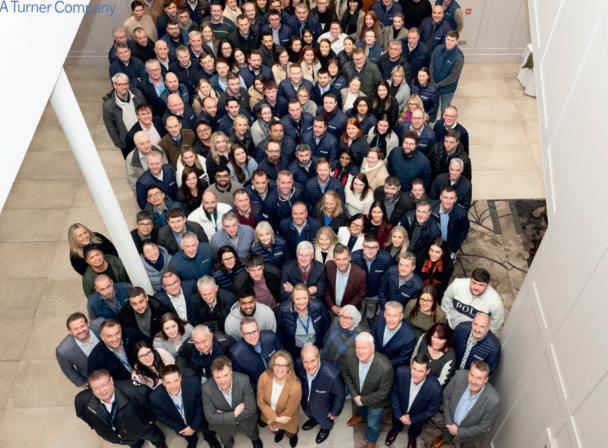
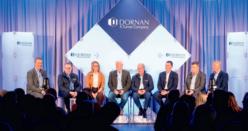
The Dornan team engaging with Turner leadership during the All Hands Town Hall, discussing the exciting acquisition of Dornan and the future ahead.
Life Science Project
Laois company tops all-island awards for builders’ merchants
Other awards go to builders’ merchants in Belfast, Cork, Donegal, Dublin, Galway, Meath and Wexford
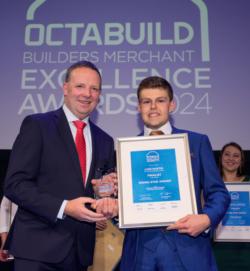
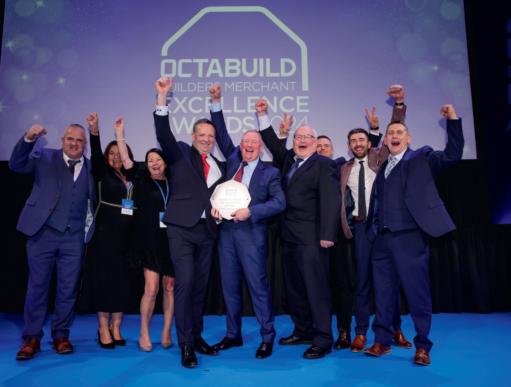
Telfords Portlaoise Ltd. was the winner of the overall Octabuild Award for Excellence at the last all-island Octabuild Builders Merchant Excellence Awards.
Leinster
The company also won the Leinster Regional Award. Other winners came from Belfast, Cork, Donegal, Dublin, Galway, Meath and Wexford. The Octabuild Builders Merchant Excellence Awards ceremony was held at a gala event in the Round Room at the Mansion House in Dublin. It was attended by over 250 guests including shortlisted merchants and representatives of the builders’ merchant trade from across the country.
Hosted
The event was hosted by the eight Octabuild members, Dulux, Etex, Glennon Brothers, Grant Engineering, Gyproc, Irish Cement, Kingspan Insulation and Wavin.
Guest of honour at the awards was then Tánaiste, Minister for Foreign Affairs and Minister for Defence, Micheál Martin, TD.
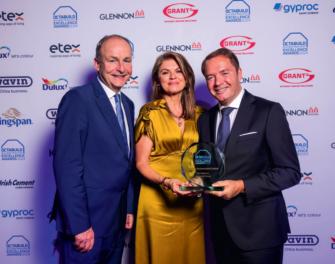
He said: ‘I would like to congratulate all the finalists and winners, particularly Telfords Portlaoise Ltd who won the overall Octabuild Award for Excellence.
‘These awards recognise the vital role of the builders’ merchants industry to the wider construction sector.
‘I want to commend the organisers and Octabuild Chairperson, Declan Conlon for such a great event.’
Builders’ merchants competed for five Individual Category Awards, four Regional Awards and a Rising Star Award, which acknowledged up-andcoming talent in the industry.
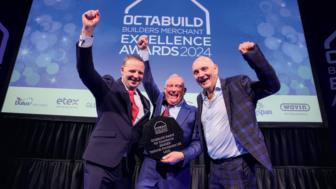
Liam McEvoy with Declan Conlon and Patrick Atkinson
Ian Haldane with award for Lifetime Achievement
‘The
competition is fierce’
Important
Octabuild Chairperson, Declan Conlon said: ‘It’s important for Octabuild that the Awards highlight the excellence of Irish builders merchants to the building and construction industry amidst its ever-changing landscape.
‘Congratulations to all finalists and winners from all over the country who represented absolute excellence in the industry.’
Commenting on the quality of the entries, the judges said: ‘It is evident that the industry is evolving at a rapid pace with merchants across the country leading the way in the continuously changing landscape.
‘The competition is fierce as merchants have embraced the opportunities in staff training, stock portfolio, premises, customer service, promotion, ecommerce and sustainability to develop their businesses.’
Presented
In total eleven awards were presented at the awards ceremony as well as the Octabuild Lifetime achievement Award, which was presented to Ian Haldane, CEO of leading independent supplier to the construction industry, Haldane Fisher.
Telfords Team Octabuild Award
JP Corry Dromore, Luke Martin
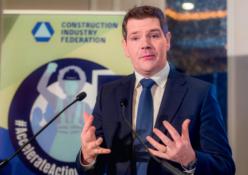
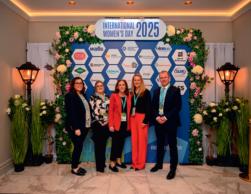
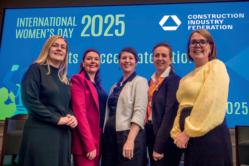
Construction Industry Federation – International
Women’s Day Summit
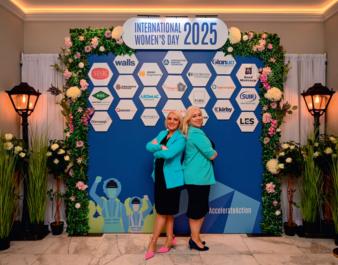
Over 650 women in construction united for the Construction Industry Federation’s International Women’s Day Summit in Johnstown Estate, Enfield.
The Construction Industry Federation urged women to consider a career in construction for its International Women’s Day Summit.
Livestream
And 650 women would attend its annual International Women’s Day Summit in Johnstown House Estate, with hundreds more tuning in on livestream.
This half day summit would bring together some of Ireland’s leading female construction experts from the country’s biggest construction companies to discuss infrastructure, safety on construction sites, careers in construction, sustainability and financial security.
Forty girls who are part of STEM Passport for Inclusion, the
groundbreaking initiative established by Dr Katriona O’Sullivan, academic and author of ‘Poor’, attended, to find out about working in construction.
Statistic
Joanne Treacy, Southern Regional Director with the Construction Industry Federation said:
‘176,000 people work in the construction sector but just 9% are women. This statistic reduces to 1% for women working on building sites.
‘Industry-wide efforts to attract women and girls are gaining momentum, alongside an expanding range of career opportunities, but we need to do more to move the dial.
‘To build a stronger, more diverse workforce, we must ensure construction-related subjects are accessible to girls at second level.
Equal
‘Without equal subject choices and career pathways, we are limiting the potential of future generations before
‘The entire industry has incredible stories to tell. Stories of innovation, expertise and excellence.’
they even reach third level.
‘This year marks the Construction Industry Federation’s 90th anniversary. The face of the industry has changed over the decades, and we want this diversity to grow.
‘We need both women and men in the construction industry and a diverse range of mindsets and skill sets.
‘The beauty of the construction industry is that it can offer rewarding and varied careers for all, from engineering, to plumbing, from human resources to project management, there is an option for every interest.’
Fantastic
Minister for Further and Higher Education, Research, Innovation and Science James Lawless said:
‘Events like this one being hosted by CIF are a fantastic opportunity for everyone in the industry to share their stories, ideas and experiences, while also taking a moment to reflect on where it might make improvements, thereby ensuring that women everywhere know that there is an exciting career open to them in construction.
‘The entire industry has incredible stories to tell. Stories of innovation, expertise and excellence.
Potential
‘Stories that it may take for granted, but which have the potential to inspire a generation of women to consider a career in construction.
‘We need to ensure these stories reach women of all ages so they know about the varied and sustainable careers.
Minister Lawless
H&S Panel
Financial Independence panel
Infrastructure panel
A LEGACY OF CONSTRUCTION EXCELLENCE
Bennett Construction:
Delivering Quality Projects with Care and Skill
Bennett Construction has earned a strong reputation by delivering successful projects year after year.
Trusted
With more than 200 staff across Ireland and the UK, the company is trusted for its reliable work, technical know-how, and focus on people.
Bennett handles complex, large-scale builds on time and within budget, with a commitment to doing things right. The company works across many sectors including residential, commercial buildings, data centres, and hotels. No matter the type of project, Bennett brings the same high standards and consistent results.
Projects that make a difference
Bennett is currently leading several major projects. In Dublin, the ‘East Road’ development includes 554 modern apartments for rent, along with cafés, childcare facilities, a gym, and shops.
This project aims to create a well-connected and comfortable place to live.
Also in Dublin, Bennett is building two hotels on Abbey Street for Marlet Property Group.
With 474 rooms under well-known brands like Courtyard by Marriott and Residents Inn, this development will help meet growing demand for high-quality accommodation in the city.
‘No matter the type of project, Bennett brings the same high standards and consistent results.’
Learning
For the Royal College of Surgeons in Ireland, Bennett is delivering ‘Project Connect’, a new education building that will support students, staff, and research teams with modern learning facilities.
In Coolock, Bennett is working with the Land Development Agency on a 146-home development called ‘An tSrúill’.
Abbey Street Hotels.
The project includes both affordable rental and social housing, and is designed to benefit the wider community.
Technology
In the technology sector, Bennett is completing a large-scale data centre in Grangecastle for a major multinational company, further demonstrating its capabilities in high-spec, secure infrastructure projects.
The company is also continuing its strong relationship with Primark.
It is currently working on the refresh of the iconic Penneys O’Connell Street store in Dublin and is preparing to begin work on the retailer’s Ballymena location.
UK
Bennett is also active in the UK. In Cambridge, it is building 373 new homes at the Present Made of Eddington development and is delivering 147 homes at Strawberry Fields Retirement Village.
In London, work is underway to upgrade a 1930s commercial building at Brook Green.
Other recent projects include a 100 unit retirement village in Surrey and a new microbrewery and event space in Covent Garden for Diageo.
Driven by Strong Values
Bennett’s work is built on four main values: integrity, safety, excellence, and sustainability. These guide every decision the company makes. Safety is always a top priority, with strong policies in place to protect workers and the public.
Bennett is also committed to reducing its environmental impact. Its partnership with Goodbody Clearstream helps the company meet high ESG (environmental, social, and governance) standards while continuing to grow responsibly.
Supporting People and Inclusion
Bennett knows that its people are key to its success. The company promotes a positive, inclusive workplace and has achieved Silver accreditation from Investors in Diversity. Through mentoring programmes, school visits, and support for women in construction, Bennett is working to make the industry more welcoming and diverse.
To learn more about Bennett Construction and its projects, visit: www.bennettconstruction.ie
MSL ENGINEERING LTD .....� �
"Quality Delivered ... Safely, On Time, Every Time"
As a leading Irish mechanical engineering contractor, MSL Engineering Ltd are the partner of choice across many industries including Life Sciences and Semi-conductor.
With over 45 years of construction and engineering expertise and a flexible project management approach, we deliver best in class projects utilising BIM design and off-site modular construction processes to the highest standards of workmanship, safety, quality and reliability.
SERVICES:
• Pipe Fabrication & Installation
• Offsite Modular Assemblies
• Heavy and Process Equipment
• Process Drainage
• Commissioning and Testing
• Mechanical and Design Solutions
• Platforms and Steelwork
Quality delivered…safely, on time, every time
MSL Engineering Ltd. is a full-service mechanical engineering contractor operating across a wide range of industry sectors.
With over 45 years of expertise and a flexible project management approach, MSL delivers best-in-class projects utilizing BIM and modular fabrication processes to the highest standards of workmanship, safety, quality, and reliability.
Founded in 1979, MSL Engineering specializes in the fabrication and installation of process, utility, and highpurity pipework, platforms, steelwork, and equipment installation across many industry sectors.
Service Offerings:
• Modular fabrication and assemblies
• Fabrication and installation of process, utility, and highpurity pipework
• Managing multi-discipline subcontractors including HVAC, scaffold, craneage, insulation, painting, and NDT
• Utilizing BIM and 3D modelling design processes
With a workforce of over 700 people, MSL has grown to become one of the leading players in an industry that has seen parallel growth in the pharmaceutical, biopharma, semiconductor, chemical, oil and gas, energy, data centre, and food & beverage sectors.
Originally established to provide craft support to the fledgling but now defunct NET plant in Marino Point, Cork, the business expanded its client base over time and developed a reputation for reliability, engineering excellence, and the ability to get the job done.
Retaining the roots of the original founders, the company is a wholly owned Irish entity.
It has organically evolved from providing support services to local industry to a position where it now competes successfully for large-scale engineering projects and provides a full range of engineering and constructability solutions to clients throughout Ireland, the UK, Europe, and the US.
Safety commitment
Working in inherently hazardous industries, MSL has always taken an uncompromising approach to safety. This is evident in its high standards and long-standing safety record, its ISO45001-accredited safety management system, and its behavioural safety-based systems of work.
MSL’s desire to continuously improve to stay ahead of the competitive curve has led it to identify and invest in new business processes in recent years.
As a result, the company significantly increased turnover and expanded its area of operation to include Denmark, Belgium, the Netherlands, Switzerland, Sweden, and the UK.
Digital technologies investment
The company’s investment in digital technologies means MSL continuously improves its BIM offering to clients and its digital project delivery (DPD) capabilities.
MSL also encourages and promotes early contractor engagement and an integrated project delivery (IPD) approach by offering modular design and modular construction experience to maximize offsite manufacturing and fabrication (OSM) opportunities for clients.
Recently, MSL has successfully demonstrated its ability to execute an ‘OSM Integrator’ role on significant CAPEX projects of scale, by coordinating between client, designer, and contractor, and capitalizing on any potential value added by OSM and a modular approach.
Reflecting strong growth, MSL has invested in a modern 140,000 sq. foot fabrication facility in Ringaskiddy, Co. Cork.
This new facility, adjacent to the newly relocated Port Of Cork, includes a large-scale modular fabrication workshop, a piping fabrication workshop, and an 8,000 sq. foot clean piping workshop.
It enables MSL to continue to service all their existing clients and allows them to expand and develop relationships with new clients in Ireland and abroad.
Standards
MSL Managing Director Brian McGrath says: ‘Our mission is to set the industry standards for safety, quality, and reliability, consistently exceeding client expectations.
‘Guided by honesty, respect, and integrity, we are dedicated to forging enduring partnerships that deliver mutual benefit and success for our clients, team, and community.
‘Our focus in developing a standard of performance is to ensure all MSL personnel are empowered to achieve their full potential and are recognized for doing so.
‘Our performance standard defines how well each function or task must be performed in order to meet or exceed expectations, thus ensuring our standards are best in class.’
With continued growth, a new modern Fabrication Facility, ISO accredited Management Systems in Safety (ISO45001), Quality (ISO9001) & Environmental (ISO18001), and investment in new innovative business processes, MSL Engineering Ltd continues to challenge itself to deliver the highest standard of service deserved and expected by its clients.
MSL Engineering Ltd.
Ringport Business Park, Ringaskiddy, Co. Cork. P43 RX06
Tel: +353 21 451 3550 www.mslengineering.ie
MSL’s 140,000 sqft facility, Ringaskiddy, Cork.
Official opening of multi-million Advanced Manufacturing Training Centre of Excellence in Dundalk
Louth and Meath Education and Training Board (LMETB) celebrated the official opening of the Advanced Manufacturing Training Centre of Excellence (AMTCE) in Dundalk, marking a significant milestone in the evolution of Ireland’s manufacturing sector.
The state-of-the-art Centre is designed to equip the workforce with the skills and knowledge required to navigate the challenges of modern, high-tech manufacturing.
Invested
Since the establishment of the AMTCE in 2021, a total of €62.4m to date has been invested in it, of which €7m were funds administered by Enterprise Ireland.
SOLAS, under Mr. Andrew Brownlee, and the Department of Further and Higher Education, Research, Innovation and Science (DFHERIS) strongly backed the concept, providing the remaining 20% match funding for both EI grants, which came to €1.4 million.
DFHERIS and SOLAS contributed more than €26m to cover the cost of purchase of the AMTCE building and capital works at Xerox Technology Park in Dundalk.
The annual operational budget of around €7m is also provided by SOLAS which has come to €28m over the past four years.
The AMTCE has catered for 5,000 learners in the past three years and in excess of 5,000 are projected for 2025 and 2026.
Key figures
The event, which was attended by key figures including Mr James Lawless TD, Minister of the Department of Further and Higher Education, Research, Innovation and Science, and distinguished guests from various sectors, highlighted the importance of collaboration between industry, education, and government in driving innovation and workforce development in Ireland.
Minister Lawless said: ‘I am delighted to be in Dundalk today to officially open this magnificent facility and to meet the people
who will benefit from the learning opportunities offered here by LMETB.
‘My Department approved funding for LMETB to acquire and refurbish this building, at a cost of some €26 million, with further investment in leading edge technology and equipment.
‘The provision of technology training at the AMTCE Campus enables LMETB to enhance their range of training and further education programmes, offering exciting new careers and employment opportunities for learners.’
‘A vision for the future of manufacturing’
Martin G. O’Brien, Chief Executive of LMETB, spoke about the journey leading up to the official opening, noting that the AMTCE represents an investment not only in infrastructure but in Ireland’s future competitiveness.
‘We are at a critical point where traditional manufacturing methods are giving way to cutting-edge technologies,’ O’Brien said.
‘AMTCE is designed to ensure that Ireland’s workforce is equipped to meet the challenges of tomorrow’s industries.’
‘We are at a critical point where traditional manufacturing methods are giving way to cutting-edge technologies.’
– Martin G. O’Brien, Chief Executive of LMETB
Mr James Lawless TD, Minister at the Department of Further and Higher Education, Research, Innovation and Science (DFHERIS) with Deirdre Craven, Senior Regional Development executive, Enterprise Ireland, Martin O’Brien, CEO of LMETB and Gerard Smith, Director of AMTCE with ‘Spot’ at the official opening of LMETB’s Advanced Manufacturing Training Centre of Excellence (AMTCE) in Dundalk.
Hub
The AMTCE will serve as a hub for training and innovation, providing world-class education for apprentices, students, and workers at all stages of their careers.
It will offer hands-on experience with the latest technologies, ensuring that learners gain the practical skills required by modern manufacturing businesses.
The centre will also facilitate collaboration between industry leaders and educational institutions, fostering a culture of innovation and research.
‘The Advanced Manufacturing Training Centre of Excellence will play a pivotal role in bridging the skills gap and enabling our workforce to thrive in a fast-changing landscape,’ said O’ Brien.
‘This facility exemplifies our commitment to building an innovative and resilient workforce that will drive Ireland’s future growth.’
Supported
Carol
Gibbons, Divisional Manager for Entrepreneurship, Regions & Local
Mr James Lawless TD, Minister at the Department of Further and Higher Education, Research, Innovation and Science (DFHERIS) with Martin O’Brien, Chief Executive, LMETB and Cllr Nick Killian, chair of LMETB at the official opening of LMETB’s Advanced Manufacturing Training Centre of Excellence (AMTCE) in Dundalk.
Enterprise, Enterprise Ireland said:
‘The AMTCE has been supported by the Government’s Border Enterprise Development Fund administered by Enterprise Ireland, which provides support for collaborative, enterprise capability building projects, to advance entrepreneurship, productivity and innovation in the Border Region.
‘Congratulations to the AMTCE on the official opening today, and in providing tailored space for the delivery of innovative training to address the skills needs in the high value advanced manufacturing and technology sectors, across the Border region and nationally.’
Mr James Lawless TD, Minister at the Department of Further and Higher Education, Research, Innovation and Science (DFHERIS) at the official Opening of LMETB’s Advanced Manufacturing Training Centre of Excellence (AMTCE) in Dundalk.
A national resource for advanced manufacturing training
The AMTCE will cater to a broad demographic, offering training in areas such as robotics, automation, cybersecurity, and 3D concrete printing.
In collaboration with local businesses, the centre will provide upskilling programs for the workforce, ensuring that Irish manufacturers can stay competitive in an increasingly globalized economy.
The centre will also work closely with third-level institutions. This collaboration underscores the centre’s role as a catalyst for innovation and a key player in Ireland’s advanced manufacturing ecosystem.
Building resilience for the future
The AMTCE’s impact extends beyond training. It is designed to support Ireland’s manufacturing sector in adapting to global challenges.
O’Brien emphasized that the centre will enable Irish manufacturers to transition from high-volume, lowvalue production to high-value, low-volume production, positioning Ireland to win market share and attract more foreign direct investment.
‘We are not just celebrating the
TRAINING & CAREERS
opening of a new training facility,’ O’Brien concluded.
‘We are celebrating the future of Irish manufacturing, the people who will drive it forward, and Ireland’s ability to compete with the best in the world.’
Mr James Lawless TD, Minister at the Department of Further and Higher Education, Research, Innovation and Science (DFHERIS) with Cian Askin from Navan, a 2nd year electrical apprentice with Navan company Solstice Renewable Solutions at the official opening of LMETB’s Advanced Manufacturing Training Centre of Excellence (AMTCE).
Mr James Lawless TD, Minister at the Department of Further and Higher Education, Research, Innovation and Science (DFHERIS) with Martin O’Brien, Chief Executive and Sadie Ward McDermott, Director of FET at LMETB, with’ Spot’ at the official opening of LMETB’s Advanced Manufacturing Training Centre of Excellence (AMTCE) in Dundalk.
About Louth and Meath Education and Training Board (LMETB)
Louth and Meath Education and Training Board (LMETB) is a statutory agency responsible for the delivery of further education and training in the counties of Louth and Meath. LMETB is committed to providing highquality education and training services to meet the evolving needs of learners, businesses, and communities.
When you can say yes to any of these 5 questions, you’ll feel more fulfilled, satisfied, and less stressed, backed by happiness science
Expert opinion by Jeff Haden, contributing editor, inc. @jeff_haden
How you're made certainly affects how you deal with stress as well as your overall level of happiness. But considerable research shows so does what you do. Who wants to feel happier and less stressed? Entrepreneurs, for one.
A landmark study – and a viral Inc. article – shows significantly more small-business owners report feeling more stressed and anxious than other workers.
(‘If it is to be, it's up to me’ is both empowering and intimidating.)
Widespread
Even if you're not an entrepreneur, feelings of stress and anxiety are widespread.
One out of three respondents in a study conducted by the Cleveland Clinic ranked their mental health as low.
Forty-five percent said they had dealt with anxiety in the previous week.
Thirty-six percent said they had experienced sadness or depression. Those are problems without ready solutions; for example, a Journal of General Internal Medicine study found that only about a third of people recently found to have depression seek some form of treatment or support.
Other studies show one in four people say they have ‘no idea’ how to improve their level of happiness and
overall emotional well-being.
Let's work on that. There are simple ways to better deal with stress and anxiety, improve your overall outlook, and increase your feelings of happiness.
But before we do, let's talk about the nature of happiness itself.
Everyone has a happiness setpoint
Research shows approximately 50 percent of your level of happiness –what psychologists call your happiness set-point – is determined by hereditary personality traits.
Think nature, not nurture.
While being unable to change a chunk of your happiness baseline sounds less than ideal, the flip side is empowering, because that means half of your subjective well-being (a term psychologists like better than ‘happiness’) is within your control. How you're made? It affects your happiness. But so does what you do. Especially what you do on a regular basis.
Especially if you can say yes to one or more of the following questions.
1. ‘I try to stay positive, not happy’
A 2020 study published in The Journal of Positive Psychology determined most people fall into one of two basic categories:
• Some focus on being happy. Happiness is their goal: They think about happiness – even in moments when they feel happy. When they aren't happy, they think they're failing. As a result, when faced with negative emotions they tend to struggle and rate themselves as relatively unhappy.
• Others focus on staying positive. Positivity is their goal: They look for ways to feel and stay positive. They structure their day around maximizing positives and minimizing or avoiding negatives. As a result, when (stuff) happens, they tend to see negative emotions as part of life.
Why does focusing on staying positive rather than being happy matter?
A 2014 study published in the Journal of Experimental Psychology found that emodiversity – the variety and relative abundance of the emotions that humans experience – is a better predictor of mental and physical health.
Oddly enough, if you want to be happier, sometimes you need to feel a little sad.
And when you do feel sad, the key is to work the problem and determine how to make things better.
The key is to turn feelings of stress or anxiety into action.
‘Even if you're not an entrepreneur, feelings of stress and anxiety are widespread.’
The key is to turn ‘woe is me’ into emotional-neutral and eventually to turn that negative into a positive, if only by finding ways to ensure that whatever happened doesn't happen again.
As the Stoics would say: You can't control what happens to you, but you can control how you respond. Or in this case, ‘I can't always be happy, but I can always try to stay positive’. Because your future is always dependent on your actions in the present.
2. ‘I consistently spend time outdoors’
A 2019 study published in Scientific Reports found that spending two hours per week outdoors can significantly improve overall wellbeing. According to the researchers: Compared to no nature contact last week, the likelihood of reporting good health or high well-being became significantly greater. It did not matter how 120 minutes was achieved (one long versus several shorter outings per week).
Why? Possibly because being outdoors is a proxy for activity.
But then again, a study published in Frontiers in Psychology found psychological benefits can be gained simply from sitting passively in natural (as opposed to urban) settings. Granted, correlation isn't necessarily causation; maybe happier people simply tend to spend more time outdoors.
But then again, a Landscape and Urban Planning study found that women with breast cancer who spent two hours a week in nature experienced ‘restored cognitive resources depleted by the stress of their diagnoses and early treatment’, and experienced lower levels of stress. Bottom line? Spending at least a couple of hours a week outdoors helps improve your overall sense of wellbeing and happiness.
And it's fun.
3. ‘I buy a little time’
Here's a fun one. In a 2017 study published in Proceedings of the National Academy of Sciences, researchers surveyed thousands of people who occasionally paid other people to perform tasks they didn't enjoy or didn't want to do.
Like housecleaning. Yard work. Errands. Things people need to do, but don't always want to do.
The result? People who were willing to spend a little money to buy a little time were happier and felt greater overall life satisfaction than people who did not.
And here's the thing: While relatively wealthy people who spent money to buy a little time were happier than relatively wealthy people who did not, people at the bottom end of the economic spectrum who spent money to buy a little time were happier than those at the bottom end of the economic spectrum who did not.
The researchers then added a twist to the study, giving participants money and a choice: buy things or buy time.
Turns out buying time left people feeling happier, less stressed, and more satisfied than buying things.
In short, having more money can certainly make you happier, but what you do with the money you have matters, too.
The key to buying time is to consciously decide how you will use the time your money frees up. Buying time will make you happier only if it feels intentional and purposeful – not because you don't have the time, but because you want to use your time differently.
Instead of cleaning your house, you might decide to spend that time with family or friends, working on a project you've been putting off, or working out – something you want to do with the time you bought.
That's when money can buy you a little happiness.
No matter how much money you make, or have.
4. ‘I compare myself only with myself’ Comparisons are often happiness killers.
Psychologists call the result of external comparisons relative deprivation: deciding that things other people have are things we should have, even if we don't need them – or, before we noticed, never even thought we wanted.
For many people, relative deprivation significantly impacts their level of happiness.
A 2017 study published in IZA World of Labor determined that relative
deprivation helps explain why average happiness has not increased despite a dramatic rise in average income around the world.
The key to avoiding relative deprivation isn't to avoid seeing things you might want; that's impossible. (Hi, Kawasaki Ninja H2R!)
The key to avoiding relative deprivation isn't to avoid meeting people whose success you might envy; that's also impossible. (Hi, sandwich sharing pal Richard!)
The key is to know what you want. Your goals. Your dreams. Your ambitions. What provides you with the greatest sense of fulfilment and happiness.
And then working to achieve, possess, or become those things.
Because where happiness habits are concerned, only two comparisons matter. The first is who you are today compared with who you were in the past.
Making that comparison will remind you just how far you've come. The second is who you are today compared with who you hope to someday become.
Making that comparison will keep you focused on doing the things that make you feel more fulfilled, grateful, and happy.
5. I think about friends more than connections’ It's easy to focus on building a professional network of partners, customers, employees, connections, etc., if only because there (hopefully) is a payoff.
But there's a bigger payoff to making real and not just professional or social media friends. Increasing your number of friends correlates to higher subjective well-being.
A study published in PLOS One found doubling your number of (real) friends is, in terms of how happy you feel, like increasing your income by 50 percent.
Friendships will make you happier. Being nice to people you don't know will make you happier. Even doing partial favours for people can make you happy.
Science says so.
The opinions expressed here by Inc. com columnists are their own, not those of Inc.com.
The Irish Green Building Council launches a new report
On the transposition of the Energy Performance of Buildings Directive (EPBD) into Irish law
The Irish Green Building Council (IGBC) launched a report aimed to support the transposition of the Energy Performance of Buildings Directive (EPBD) into Irish law.
Tangible
The document makes tangible recommendations on the introduction of Minimum Energy Performance Standards (MEPS) in Non-Residential Buildings by 2030.
The Energy Performance of Buildings Directive has been a cornerstone of the European legislation on sustainable buildings for over twenty years.
The EPBD has played a crucial role in promoting energy efficiency in buildings and has led to the introduction of Building Energy Rating (BERs) and the Nearly Zero Energy Building (NZEB) standard within our building stock.
Passed
An updated version of this important piece of legislation was passed in 2024 to support with the full decarbonisation of our building stock by 2050.
The new EPBD includes a set of
actions to kick-start a renovation wave across the continent, and for the first time, to address embodied carbon emissions.
Embodied carbon covers the entire carbon emissions associated with materials and construction processes throughout the whole lifecycle of a building or infrastructure e.g., the manufacture, transport and installation of building materials themselves.
Ireland and other Member States have until May 2026 to transpose the provisions of the updated EPBD.
Welcomed
Pat Barry, CEO at the Irish Green Building Council said: ‘The IGBC welcomed the adoption of the EPBD 2024 recast as a critical step in the decarbonisation of our built environment, and in improving people’s health and wellbeing.
‘What we need now is an ambitious transposition of the text into Irish law to ensure it delivers to its full potential and provides additionality whilst supporting a just transition.’
A key element outlined in the EPBD
requires member states to establish Minimum Energy Performance Standards (MEPS) for non-residential buildings and ensure the mechanisms are in place to support compliance at the building level.
‘The IGBC welcomed the adoption of the EPBD 2024 recast as a critical step in the decarbonisation of our built environment, and in improving people’s health and wellbeing.
What we need now is an ambitious transposition of the text into Irish law to ensure it delivers to its full potential and provides additionality whilst supporting a just transition.’
Pat Barry, CEO at the Irish Green Building Council
Transposing the Energy Performance of Buildings Directive (EPBD) into Irish law: Article 9.1 Minimum
Performance
(MEPS) in Non-Residential Buildings.
Supporting Actions
GREEN BUILDING
Member states should also establish national trajectories for the progressive renovation of the national residential building stock.
Gather
Under the directive, member States must gather data on the energy performance of their non-residential building stock, to identify the 16% and 26% lowest performing buildings.
All buildings in the 16% batch must be improved by 2030, with buildings in the 26% batch to be improved by 2033.
Paul Kelly, Head of sustainability, Real Estate Finance, AIB added: ‘Clear and early guidance on MEPS would be welcomed by the industry.
‘Both certainty and predictability are necessary to build confidence and drive investment in the sector.’
Comprehensive
Following in-depth research and stakeholder engagement, the report outlines a comprehensive set of recommendations for Government to ensure a successful implementation of MEPS in non-residential buildings.
It is recommended to improve the quality of data through the introduction of mandatory BERs for non-residential properties, and to introduce them alongside multiple financial and technical measures.
More specifically, appropriate
technical support should be made available through the introduction of one-stop-shops made up of independent advisors dedicated to SMEs and/or specific sectors.
Furthermore, improving communication on long-term cost savings, and co-benefits of energy renovation, while also providing the necessary guidance on technical specifications and compliance deadlines, will be key in improving the overall uptake and compliance.
Urgent need
Gearóid Carvill, Climate Change Advisor, RIAI explained: ‘With the new Minimum Energy Performance Standards (MEPS) to improve the worst 16% of nonresidential buildings required by 2030, there is an urgent need to prioritise awareness-raising and education within the built environment industry.
‘Collaborating with other professionals and stakeholders on Climate Action is a key focus for the RIAI and our members.’
The new report will be part of a series of factsheets to be developed by the IGBC to inform industry of requirements, and support the transposition of the EPBD Recast 2024 (Directive (EU) 2024/1275) into Irish law.
The IGBC will be hosting similar open invitation workshops focusing on other articles of the EPBD in 2025 and 2026 to support this process.
This will include work on the National Renovation Action Plan, Renovation Passports, and the life-cycle global warming potential of buildings.
Project
This report was developed as part of a project with the Renovate Europe Campaign, funded by the European Climate Foundation and is available at https://www.igbc.ie/resources/epbdreport-mep
ABOUT THE IRISH GREEN BUILDING COUNCIL (IGBC)
The IGBC is Ireland’s leading authority on green building best practices with a network of over 400 green building organisations spanning the entire built environment industry.
The IGBC is affiliated with the World Green Building Council. This is a network of over 80 national Green Building Councils worldwide with a total membership of over 27,000 of the most progressive international organisations and businesses making it the largest organisation globally influencing the sustainable building market. https://www.igbc.ie/
“Stability you can build on”
Manning Ground Engineering Contractors Ltd.
Specialising in
Soil Nailing • Sprayed Concrete • Rock Fall Protection,
Restricted Access / Low Headroom Mini Piling • Subsidence Repair
Concrete Structural Repairs • Underpinning
Site Investigations • Temporary Works
Factory Hill, Glanmire, Co. Cork, T45 VK16.
Tel: +353 21 435 3082, Mobile: +353 87 225 4007
Manning Ground Engineering Contractors Ltd.
Manning Ground Engineering Contractors Ltd. is a dynamic and forward-thinking ground engineering contractor.
Specialising in soil nailing, sprayed concrete, rock fall protection, Restricted access / low headroom mini piling, subsidence repair and underpinning, site investigations and temporary works solutions dedicated to delivering excellence in construction and engineering projects across Ireland and the UK.
With a commitment to quality, safety, and innovation.
Manning Ground Engineering Contractors Ltd. has established itself as a trusted partner in the construction industry, renowned for its integrity, professionalism, and client-centric approach.
We offer a total solution package from initial concept design to construction and full sign off certification and collateral warranties.
Experience and expertise
With years of experience in the construction sector, Manning Ground Engineering Contractors Ltd. boasts a team of seasoned professionals with diverse expertise in project management, engineering, quantity surveying, and construction supervision.
Our team’s collective knowledge and skills enable us to tackle complex projects and deliver superior results.
Client focus
At Manning Ground Engineering Contractors Ltd., client satisfaction is at the forefront of everything we do. We prioritize open communication, collaboration, and transparency to ensure that we understand and meet our clients’ needs and expectations. By fostering strong client relationships, we strive to exceed project goals and deliver exceptional value.
Safety culture
Safety is a core value at Manning
‘Our team's collective knowledge and skills enable us to tackle complex projects and deliver superior results.’
Ground Engineering Contractors Ltd., embedded in our culture and ingrained in every aspect of our operations.
We prioritize the safety, health, and wellbeing of our employees, subcontractors, and stakeholders, adhering to the highest standards of safety management and compliance with regulatory requirements.
Construction management
Manning Ground Engineering Contractors Ltd. provides comprehensive construction management services, overseeing all aspects of the construction process from planning and design to execution and completion.
Our proactive approach, attention to detail, and commitment to quality ensures successful project outcomes.
Safety and compliance
Safety is paramount at Manning Ground Engineering Contractors Ltd., and we prioritize the implementation of robust safety management systems and compliance with all relevant regulations and standards.
Through comprehensive risk assessments, training programs, and continuous improvement initiatives, we ensure the safety and wellbeing of all stakeholders.
Trusted and dedicated
Manning Ground Engineering Contractors Ltd. is more than just a ground engineering company – we are a trusted partner, dedicated to delivering excellence, innovation, and sustainability in every project we undertake.
With a strong focus on client satisfaction, safety, and community engagement, we strive to exceed expectations and build enduring relationships that stand the test of time.
LET THE LIGHT IN: How FAKRO Roof Windows maximise natural light and ventilation
In the modern era of home design and renovation, the twin goals of increasing natural light and enhancing indoor air quality have become central to both architectural aesthetics and occupant well-being.
Intelligent
Among the solutions available to homeowners and builders alike, FAKRO roof windows stand out for their intelligent design and proven performance in maximising light and ventilation.
Natural light is more than just a design preference – it is essential to human health.
Exposure to daylight regulates circadian rhythms, improves mood, and enhances productivity.
In homes where vertical windows cannot provide sufficient illumination, roof windows offer an ideal alternative.
Positioned to capture daylight from above, FAKRO roof windows can admit up to twice as much natural light as standard vertical windows of the same size.
This capability transforms previously dim and underutilised lofts, attics, and upper-storey rooms into bright, inviting spaces.
Whether it's a residential or commercial project, these windows contribute to a vibrant, airy environment throughout the day.
Optimise
FAKRO’s product line is engineered to optimise light entry through a range of innovative features.
Many models include slim-profile frames, maximising the glazed area without sacrificing structural integrity. This design not only improves aesthetic appeal but ensures minimal obstruction to sunlight.
Their pivot and top-hung options allow users to tailor window positioning to suit the angle of incoming light throughout the day, while laminated and triple-glazed glass units offer excellent thermal insulation without compromising brightness.
Effective
Equally important to the modern home is effective ventilation.
With rising awareness of indoor air quality’s role in health, especially in tightly insulated homes, controlled airflow is crucial.
FAKRO roof windows are designed to enhance passive ventilation, providing a simple yet effective way to flush out stale air, reduce humidity, and regulate indoor temperatures.
The unique topSafe system ensures safe and secure operation, even when windows are left slightly open for airing.
Built-in ventilation flaps on many models allow for a continuous supply of fresh air—even when the window is closed—ensuring homes remain wellventilated around the clock.
Strategic
In summer months, strategic placement of FAKRO windows allows for natural air stratification, where warm air rises and escapes through the roof windows while cooler air enters from below.
This can dramatically reduce the
need for mechanical cooling systems, leading to energy savings and reduced environmental impact.
Conversely, during colder months, FAKRO’s high-performance glazing and airtight seals help retain indoor heat while still offering the option of safe, minimal ventilation to prevent condensation and mould.
In a world where sustainable design and occupant wellness are increasingly prioritised, FAKRO roof windows deliver on both fronts.
Tangible
By seamlessly blending form and function, they offer a tangible improvement in living conditions through enhanced daylight and air quality.
For architects, renovators, and homeowners seeking smarter, healthier spaces, FAKRO proves that the simplest solutions – like a wellplaced window – often make the biggest difference.
‘Natural light is more than just a design preference – it is essential to human health.’
Pillars of Wisdom
A series of CPD seminars being delivered by the Technical Manager for Marmox Ltd., Mark Bowman, have been providing architects and other Irish construction professionals with a fresh dimension on the challenge of addressing heat loss around the ground floor perimeter to various building types, while maintaining structural load-carrying capacity.
Available
Thermoblocks are available in widths of 100, 140 or 215mm and are formed from sections of extruded polystyrene – XPS –encapsulating two rows of high strength, epoxy concrete pillars or mini-columns. These are attached at either end to the top and bottom layers of glass-fibre reinforced polymer concrete, to ensure a good bond with the rest of the structure. Importantly, the columns themselves offer a very low thermal conductivity so do not create a cold bridge, while being able to support a loading of 9N; higher than the typical dense or aerated concrete block.
Crucially
Set within the highly insulating XPS section, the units achieve a combined thermal conductivity of 0.047 W/mK and crucially being able to deliver a very low transmittance, derived by thermal modelling and actual measurement, offer significantly superior performance compared to ‘acceptable construction details’ listed under Part L.
'RIAI recognition of Marmox Thermoblocks offers new solution to cold bridge at floor wall junction.'
Although the insulation manufacturer made Thermoblocks available through its Irish distributors a couple of years ago, the product achieved crucial RIAI recognition in October last year, since then Mark Bowman has been making monthly visits to Dublin to present 60-minute CPD seminars to a growing number of architectural practices, where many of those taking part were being introduced to Thermoblock for the first time.
Reactions though have been very positive as the technical benefits and ease of installation become apparent for both domestic and non-domestic situations.
Additionally, as well as typically being used at the base of the blockwork inner leaf in the UK over the past decade, they are also deployed beneath solid masonry, timber frame and even modular volumetric buildings.
Good feedback
Mark Bowman reports: ‘I have been getting very good feedback from the architects we have delivered the CPD seminars to, within their own offices and we’re currently arranging further sessions.
‘Although the Irish Part L Building Regulations are quite distinct from those in Northern Ireland and the UK mainland, the thermal principles
remain the same – and the values for Thermoblock are able to be used in DEAP and NEAP calculations for domestic and non-domestic projects.
‘We are on the RIAI website as a CPD Network provider and importantly, Thermoblock will help achieve compliance as well as making buildings more thermally efficient overall.
‘Avoiding the risk of a thermal bridge around the floor-wall junction further prevents condensation occurring, which of course can lead to mould growth.’
While Thermoblocks are laid on a bed of conventional mortar around the footprint of the building or in some circumstances beneath internal walls, the stepped overlaps to the 600mm long units are bonded using Marmox 360 adhesive. Data sheets and further technical guidance are available from the company.
For further information, please contact:
Marmox (UK) Ltd. Caxton house 101-103
Hopewell Drive, Chatham, Kent ME5 7NP.
Tel: 01634 835290 Fax: 01634 835299
Email: sales@marmox.co.uk
Web: www.marmox.co.uk
Marmox CPD Presentation
Alpha Facilities Maintenance are Ireland’s leading Contractors, specialising in the design, supply and installation to all sectors, nationwide from concept to completion.
Unit 8, Willsborough Business Centre, Willsborough Industrial Estate, Clonshaugh Business & Technology Park, Clonshaugh, Dublin 17, D17 K193.
Tel: 01 533 4276
Email: info@alphamech.ie
www.alphamech.ie
Keeping the heart of your building beating:
Why M&E maintenance is critical — and why Alpha FM is the right partner
In the world of construction and property management, there is a silent workforce that keeps everything moving – the Mechanical and Electrical (M&E) systems behind the walls, above the ceilings, and beneath the floors.
Heart
From HVAC systems and electrical panels to pumps, lighting, fire alarms, and BMS controls, these critical assets form the beating heart of any building. Without them, even the most beautifully designed structures grind to a halt.
At Alpha Facilities Maintenance, we believe that proactive and expert M&E maintenance is not just a service – it’s a strategic safeguard.
With rising operational costs, increasing regulatory demands, and heightened expectations for sustainability and uptime, the stakes have never been higher.
Unplanned breakdowns in M&E systems can lead to major business disruption, safety risks, spiralling repair costs, and damage to reputations.
Better
On the other hand, properly maintained systems deliver better energy efficiency, fewer reactive callouts, extended asset life, and full compliance with legal standards.
This is not a box-ticking exercise – this is mission-critical infrastructure that demands proper care.
That’s where Alpha FM comes in. Our clients trust us because we understand the technical detail, but also the bigger picture.
We maintain a diverse range of facilities – from missioncritical data centres and pharmaceutical plants to schools, offices, and public buildings – and we tailor our solutions to fit each client’s specific operational needs.
Whether it’s a full PPM (Planned Preventive Maintenance) regime, lifecycle planning, or rapid response to a fault, our integrated team of engineers, project managers, and compliance experts ensure seamless delivery with zero guesswork.
We’ve built our reputation on reliability, responsiveness, and results.
Specialists
But more than that, we’ve positioned ourselves as the M&E specialists that go beyond the spec – identifying risks before they become failures and making sure your building works as hard as you do.
In an industry that often focuses on what’s visible, we take pride in protecting what’s vital.
Alpha Facilities Maintenance – maintaining what matters.
NEXT GENERATION
The Grant Aerona R290
- Innovative Design
- Exceptional Performance
- Ultra-Low Noise Levels
- Outputs from 4kW – 16kW
Grant’s next-generation heating solutions for sustainable new builds
Leading heating technology
manufacturer Grant continues to deliver advanced home heating solutions tailored to the needs of single dwelling new build properties and housing developments across Ireland.
Commitment
With a commitment to sustainability, efficiency, and reliability, Grant’s innovative technologies empower those in the construction industry with the confidence that the heating systems utilised within their projects will ensure long-lasting performance, energy savings, and environmental benefits.
Designed to meet the evolving demands of modern living, Grant heating solutions provide exceptional comfort whilst helping to reduce carbon footprints.
Grant Aerona R290 Air-to-Water Heat Pump
The latest addition to the Grant heating technology portfolio is the new Aerona R290 air-to-water air source heat pump, which has been specifically designed for the Irish and UK climate. This next-generation heat pump provides an even more environmentally friendly, low carbon heating solution as it uses the energy efficient and natural R290 refrigerant, which has an incredibly low Global Warming Potential of 3 – signaling an important advancement in sustainable home heating.
Delivering exceptional performance with ultra-quiet operation, the A+++ rated Aerona R290 range is available in outputs of 4kW, 6.5kW, 9kW, 12kW, and 16kW.
More solutions
Currently the Aerona R290 is the only range of heat pumps to offer this complete range of outputs over five models, which means the range offers more solutions for a wider range of properties.
‘Designed
to meet the evolving demands of modern living, Grant heating solutions provide exceptional comfort whilst helping to reduce carbon footprints.’
All models in the range are recognised for their quiet operation by Quiet Mark.
Each model is easily installed and can be monitored and managed remotely, giving additional peace of mind.
Due to its versatility and ease of installation the new Aerona R290 is already proving to be a popular choice of heat pump for builders and developers.
Integrated heating solutions and supporting technologies
All of Grant’s heating technologies are designed to work seamlessly with a range of integrated technologies to optimise efficiency and performance. These include:
• Pre-plumbed and integrated hot water cylinders
• Uflex underfloor heating system
• Afinia aluminium radiators
• Smart heating controls for tailored comfort and energy savings
Together, these complementary technologies offer a fully integrated solution for modern heating demands, ensuring that residential building projects achieve maximum efficiency and comfort.
Training opportunities
Grant also provides tailored training courses to help builders, developers, and installers gain in-depth knowledge of its renewable heating systems, including the Aerona R290 heat pump. These courses are designed to ensure that professionals have the skills and confidence to install and maintain Grant’s advanced heating solutions effectively.
For details on upcoming training sessions, contact Grant at training@ grant.ie or visit the Grant Eventbrite page.
Visit www.grant.ie for more information on Grant’s range of innovative heating solutions. Follow Grant on Facebook @GrantIRL , Instagram @Grant_IRL and LinkedIn @GrantEngineeringULC. YOu can also subscribe to Grant on YouTube @ GrantEngineeringIE
Think Heating. Think Grant.
Keith Scully, Training Manager
PAT O’DONNELL
Volvo Construction Equipment unveils brand new lineup of its world leading range of Articulated Haulers
The market leader and inventor of the articulated hauler, Volvo Construction Equipment (Volvo CE) unveiled its biggest and boldest articulated hauler launch to date.
Innovation
Delivering superior innovation, the new range is designed to meet the modern-day need for connected solutions, productivity performance, and emission reduction, with the human at the center.
Pat O’Donnell & Co, distributors of the complete range of
Volvo Construction Equipment, in Ireland since 1970 are excited to bring Volvo CE’s new range of articulated haulers to the Irish market.
• Volvo CE’s update represents a complete overhaul of its existing, globally recognized, best-in-class articulated hauler lineup, now ranging in size from A25-A60.
• An entirely new model, the A50, has been introduced, increasing customer opportunities in the demanding hauler segment.
• The range delivers key innovations, such as a new electronic system, upgraded cab for superior operator comfort and safety, and an in-house developed transmission designed to adapt to future drivetrains.
• With over 35% of its total range renewed over the last 12 months (at time of writing), this marks the latest step in Volvo CE´s largest product portfolio renewal in decades.
PAT O’DONNELL
A new range from A25-A60
Volvo CE, the pioneer behind the world’s first articulated hauler 'Gravel Charlie' in 1966, proudly announces the launch of a new lineup of world-class articulated haulers which is set for stepwise introductions on markets globally during 2025.
The updated models mark a significant technological leap forward thanks to key innovations such as a new electronic system and an in-house developed transmission, delivering fuel efficiency improvements of up to 15% depending on model and industrial application.
Furthermore, the machines’ new state-of-the-art design has been constructed in such a way as to adapt over time to fit future drivetrains.
A new member of the family, the A50
A highlight of this launch is the all-new A50 model, which expands customer opportunities in the demanding hauler segment.
This addition, available in selected markets, underscores Volvo CE's commitment to meeting the evolving needs of its customers by enhancing operational capabilities and offering more choices.
The result is cutting-edge, safe, and productive machines that have been purpose-built to lower total cost of ownership and respond to the challenges of today and tomorrow across the toughest of worksites, especially when combined with Volvo CE’s pioneering digital solutions, such as the Haul Assist with onboard weighing.
Leading
Melker Jernberg, President of Volvo CE said: ‘For nearly 60 years we have been leading the way with our range of articulated haulers and now with today´s launch of a new range of outstanding products, including one completely new model, we prove that there are no limits to our capacity for innovation.
‘Our customers know to expect a first-class operation when they get into one of our haulers, but that experience has just got even better with a host of cutting-edge features designed with our customers in mind.’
A circular approach
Developed to be among the most fuel-efficient hauling solutions on the market, the new models have also been built with a focus on sustainability.
This includes the introduction of low carbon emission steel – made from recycled materials and produced using fossil free electricity and biogas – in serial production of haulers manufactured at the Braås site.
‘Like in 1966, the new generation haulers once again set the industry benchmark for innovation and best-in-class operation.’
Given steel is a major component in Volvo CE products – and traditionally generates significant carbon emissions – material circularity is another example of Volvo CE taking action across its operations to achieve net zero greenhouse gas emissions by 2040.
A step towards the future
This launch is part of Volvo CE's most extensive product portfolio overhaul in decades, with over 35% of its range renewed in the past 12 months.
It marks a pivotal step in the company's ongoing commitment to innovation and leadership in the construction equipment industry.
Like in 1966, the new generation haulers once again set the industry benchmark for innovation and best-in-class operation.
Partnership
Pat O’Donnell, Managing Director, Pat O’Donnell & Co. commented:
‘Our partnership with Volvo CE and specifically the Volvo articulated hauler is something we are very proud of.
‘Volvo CE combine all the heritage of the world’s first articulated hauler with world-class innovation to develop this new range of Articulated Haulers which we are delighted to bring to the Irish market.’
Pat O’Donnell & Co.
Head Office
California Heights Chapelizod Dublin D20YH76
Tel: +353 1 616 1000 www.patodonnell.com
Anchor Bay Construction Accessories Ireland Ltd
Anchor Bay Construction Accessories Ireland Ltd was founded in 1992.
We are located in Naas, Co. Kildare just off the M7. We have over 30 Years of experience supplying to the Construction Industry.
Leading
Anchor Bay is a leading supplier of specialist building site solutions for Residential, Non-residential Building Construction, Precast Industry, Civil Engineering, Transport and Infrastructure building projects.
Anchor Bay sells an extensive range of high-quality specialist building site accessories used in reinforced concrete construction, precast and masonry work.
We are at the forefront of introducing the latest innovations and technologies to the market.
Our experienced professional sales and technical support team are here to support your building site requirements.
Key distributors
Anchor Bay Construction Accessories Ireland Ltd. Are key distributors for leading brands such as Halfen, Ancon, Leviat, Fosroc, Kilsaran, Sika, Nevoga, Opus Building Chemicals, Lanxess, K-Form, Visqueen, Rawl, Flexcrete, plus many more.
Our high-quality product range includes, Formwork
Accessories, Precast & Lifting Accessories, Concrete Spacers, Plastic & Wire Spacers, Construction Chemicals, Floor Slab Accessories, Waterproofing, Jointing Materials Non-Shrink Grouts, Concrete Repair Products, Channels & Wall Ties, Masonry Support, Balcony Connections, DPCs, Radon Membranes, to name but a few.
Our highly trained sales team along with our international supplier partners are committed to providing our customers with technical support and solutions throughout all phases of a project.
With our own fleet we offer nationwide delivery.
Trusted
Over the years we have built trusted and long-standing relationships with our customers and suppliers. Customer service is key to our success. Our customers deserve the best and that’s what we strive to do.
Our high-quality product range includes, but is not limited to, Mesh Reinforcements, Concrete, Plastic & Wire Spacers, Construction Chemicals, Waterproofing Products and Concrete Repair Products.
‘Customer service is key to our success.’
IRELAND
How Emotionally Intelligent People Turn Failure into Progress and Despair into Happiness, Backed By Science
The
stories you tell yourself affect you mentally, emotionally, and even physically. Here’s how to tell yourself the right stories.
Expert opinion by jeff haden @jeff_haden
Nearly every highly successful person has failed, most of them numerous times.
Most have failed a lot more often than the rest of us. That’s one of the reasons they’re successful now. Failure, viewed through that lens, is a good thing. But using that lens doesn’t make dealing with failure any easier, especially in the moment.
Unless you tell yourself the right story.
Downfall stories
When you fail – which you inevitably will do as you travel the path to becoming something you are currently not –how you frame that story makes a huge difference.
Generally speaking, there are two ways to view a failure:
• As something to avoid
• As something to learn from Sound too simplistic? It isn’t.
I entered a co-venture and decided I would never have a
business partner (except for my wife) again.
I tried to write a novel, and decided I would never try again. The story I told myself? That sucked, and I will never do it again.
I didn’t learn from those experiences, didn’t grow from those experiences…
I took nothing from them other than having put those experiences into a box from which they will never emerge. (Just writing this makes me feel uncomfortable.)
Where those failures are concerned, I’ve let my emotions work against me, not for me.
Redemption stories
Then there are growth-oriented stories you tell yourself: seeing a failure as a challenge to navigate.
To overcome. To learn from. Even if you decide you will never undertake that particular challenge again.
Do that, and you’ll naturally be more resilient, and you’ll be happier and healthier. Consider the considerable research supporting this:
• A 2015 study published in Journal of Research in Personality found that people who incorporate themes of personal growth into narratives about their own transgressions experienced increased well-being, selfcompassion, and forgiveness towards others.
• Tell yourself you’ll learn from a mistake and not only will you feel better, you’ll be more understanding when other people make mistakes.
• A 2004 study published in Journal of Personality found that people who frame life transitions with personal growth themes tend to experience enhanced well-being and personality development.
When (stuff) happens, if you see those events as opportunities to learn and grow, you’ll feel better about yourself – and your future.
Research also shows that how stress impacts you— because failure always results in some degree of stress –depends not on level or amount of stress you experience, but on how you perceive that stress.
Perspective is everything
As psychologist and Stanford professor Kelly McGonigal describes in her 2013 TED Talk, researchers asked 30,000 adults two questions:
• How much stress have you experienced in the past year?
• Do you believe that stress is harmful for your health? Then they tracked those individuals for the next eight years to find out who died. How’s that for a (literally) morbid research project? The results:
• People who said they experienced a lot of stress in the previous year had a 43 percent greater risk of dying, but only if they also believed that stress was harmful for their health.
• People who said they experienced a lot of stress but who did not view stress as harmful to their health were no more likely to die.
In fact, they were less likely to die than anyone in the study, including people who said they experienced relatively little to no stress.
Estimated
According to McGonigal, the researchers estimated that over that eight-year period, 182,000 people didn’t die prematurely due to stress… but from the belief that stress was bad for them. Other research backs that up.
A study published in Journal of Experimental Psychology found that when people view their stress response as helpful – seeing their body’s natural responses to stress, like increased heart and respiration rate, as signals that their body is rising to the challenge – they don’t ‘vasoconstrict’. In other words, their blood pressure doesn’t rise.
Resembled
In fact, McGonigal says, their physiological profiles resembled what happens in ‘moments of joy and courage.’
Thinking about stress differently, seeing stress as a good thing, changed how their bodies responded.
As with most things, perspective is everything. Viewing how you respond to response – to anything – through the lens of emotional intelligence makes a huge difference.
As so do the stories you tell yourself.
Failure Transformed
When you feel nervous or stressed – when your heart rate rises and your breathing quickens – tell yourself a different story: that your body is rising to a challenge, helping you be more able to step in, or step up, or eliminate a problem.
See stress as a signal that you have the opportunity to make your life better.
The same is true for when you fail. Failure sucks, but failure is also an opportunity: to learn, to grow, to do things differently next time….
See failure as an opportunity to improve.
Maybe not in this moment, but definitely in the future.
Proud
Do that, and the story you will someday look back on is one that will make you proud.
Because the failure you experienced didn’t end the story. The failure you experienced was the start of the best part of the story.
The opinions expressed here by Inc.com columnists are their own, not those of Inc.com.