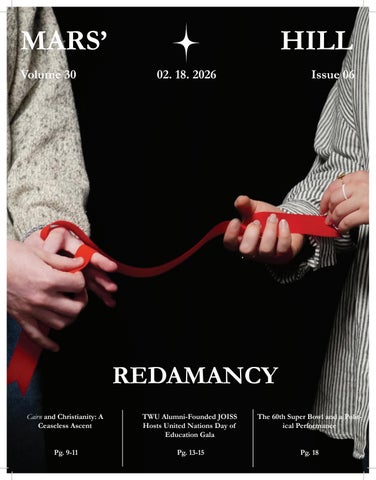
Cairn and Christianity: A Ceaseless Ascent Pg. 9-11


![]()
Cairn and Christianity: A Ceaseless Ascent Pg. 9-11


TWU Alumni-Founded JOISS Hosts United Nations Day of Education Gala Pg. 13-15
The 60th Super Bowl and a Political Performance Pg. 18


, which interpreted difficult or rare terms. As the theme of this issue, redamancy , meaning “to love in return” with the English defined as a loving of someone that loves
Releasing just four days after Valentine’s Day, this online issue celebrates the feelings of love in the air, from romantic to platonic and everything in between. Opinions Editor Cristina Pedraza argues in “Consuming Love” that consumerism has obscured the true meaning of Valentine’s Day and explores what love as resistance looks like. In the creative writing section, contributor Parnika Trivedi sees love through rose-coloured glasses, reflecting on how her understanding of the concept has evolved over time.
Mars’ Hill is a student publication of Trinity Western University located on the traditional ancestral territory of the Stó:lō people. Floated with funds raised by the Student Association, Mars’ Hill seeks to be a professional and relevant student publication, reflecting and challenging the TWU community, while intentionally addressing local, national and international issues.
The mission of Mars’ Hill, as the official student magazine of Trinity Western University, is to inform and entertain its readers, cultivate awareness of issues concerning the TWU community and provide a forum for purposeful, constructive discussion among its members in accordance with the Community Covenant, Statement of Faith and Core Values of the university.

Furthermore, this issue’s Artist Spotlight features singer-songwriter Naomi Jacob as she shares the inspiration behind her latest single, “First Love,” and God’s calling on her life to heal people through music, while Staff Writer Emma Helgason reports on the United Nations Day of Education Gala and the role education plays in peace building.
I am grateful that I love a God who does not simply love me in return, but loves me unconditionally. I hope that as you read this issue, you are reminded that you are loved, regardless of your relationship status or connection with the Lord. So, take the time to sit down and enjoy this issue. The Mars’ Hill team loved making it, and we hope you love it too!
Sincerely,

Mars’ Hill encourages submissions and Letters to the Editor. Mars’ Hill reserves the right to edit submissions for style, brevity, and compatibility with the Mission, the Statement of Faith, the Student Handbook and the Core Values of the University. Anonymous authorship of any material may be granted at the discretion of the Editor-in-Chief. Opinions expressed in Mars’ Hill belong to the individual authors and do not necessarily reflect those of the editorial board, Trinity Western University, its officials or its Student Association.
Caleb Nelson Parnika Trivedi


a curated playlist
When a Man Loves a Woman — Percy Sledge
A Sweet Song — St.Arnaud
We Found Each Other in the Dark — City and Colour
Best Friend — Logic
Forever — The Beach Boys
Baby I Love You — flora cash
Love Is All Around — The Troggs

All of the Stars — Ed Sheeran
Atlas: Heart — Sleeping At Last


The Fault In Our Stars (MMXIV) — Troye Sivan

Emma Helgason


Naomi Jacob is building her music career from the ground up. She sings, writes her own songs, plays multiple instruments and manages the business side of her music. Throughout this interview, it becomes clear that Naomi possesses the talent and determination to stand out in the music industry. Whether experimenting with new genres or collaborating on her latest single, Naomi is dedicated to making music that matters. To hear her music, check out her tracks on any streaming service under the name Naomi Mercy.
MH: Can you introduce yourself and tell us about your background at TWU?
NJ: My name is Naomi Jacob, and I am in my second year at TWU. I am majoring in music with a business minor. Music has always been a big part of my life. If I had to describe its impact, I would say it is like my second oxygen, always [running] through me. I have been a singer since I was three years old. In fact, my preschool teachers told my parents to put me in music lessons.
MH: Was music always going to be your path in life?
NJ: I always knew I wanted to pursue something with music, whether as a career or in church. Also, as a musician, you are basically an entrepreneur, so understanding the business side is important. Job security matters to me, which is why I am completing a business minor along with my studies in music. Yet, along the way, I have discovered a true passion for business.
MH: What was your first instrument and how did you learn it?
NJ: Singing has always been my main thing. I played piano for about 10 or 11 years and learned it classically—which was not my favourite. However, recently I have gotten back into piano through my church’s worship team. I also play acoustic guitar, and I am learning bass, electric guitar and a bit of drums.
“I owe a lot to my teachers, as I am a mosaic of everyone who has poured into me.”
MH: Your speaking style suggests a background in media training. Have you received any formal training in this area?
NJ: I was actually a radio host at Simon Fraser University (SFU) for a year in Grade 11. It was all thanks to a trade program in Burnaby. We produced an album and even got work experience at SFU’s campus radio. That definitely helped me!
MH: What genre do you gravitate towards in your own music?
NJ: My genre is a bit under construction at the moment. Studying classical music at TWU has really opened new vocal possibilities for me. At the same time, I tend to write in a more pop and R&B style. R&B and jazz are where my voice feels most at home.
MH: Have you always been a songwriter?
NJ: Yes, since I was nine. Songwriting is how I vocalize my thoughts. I guess I am decent at poetry, but for me, it always started with singing.


MH: Tell us about your latest single, “First Love.” What inspired it?
NJ: “First Love” is very pop-influenced, with some Tame Impala-esque production and nods to K-pop. I write about love, but in a healthy context. I aim to highlight the human experience without glamorizing bad decisions “First Love” tells a story of a girl whose love interest cannot let go of his first crush. It is not my direct experience, but I have seen it happen to friends and through the media.
MH: What was the recording process like?
NJ: “First Love” had lyrics sitting in my notes for two years. My producer friend showed me an instrumental, and the lyrics just happened to fit perfectly. The recording process itself was collaborative and very spontaneous. The reception was amazing, and so many people supported me.
MH: Where do you see your artistic career going?
NJ: There are two answers: the realistic one and the dream. My dream is to win a Grammy in five years. But the industry can be tough—sometimes you become a product, and I never want to lose my soul for success.
“I believe God has called me to heal people through music, and that is my goal.”
MH: Is there any advice you can give to aspiring artists?
NJ: You are more than capable. It is easy to underestimate yourself, and if you do not take opportunities when they come, you will regret it later. Even if


Rock climbing, more than many other hobbies or sports, relies on the strength of one’s faith, whether in yourself and your ability to endure the hardship of the climb, or in the rock and its capacity to bear your weight as you struggle to reach the summit, where you can, at last, stand in triumph. No work of art, and particularly no video game, I have encountered has ever quite captured the deep connection between faith and climbing quite like Cairn, the most recent title from The Game Bakers. In the game, the enigmatic protagonist Aava undertakes the perilous voyage of a lifetime to conquer the near-mythical Mount Kami, a yet-untouched peak that profoundly tests her resolve, echoing the experience of the Christian faith journey.
The player controls Aava using a very slow, but highly realistic, limb-by-limb climbing system that forces them to think long and hard about the consequences of every decision they make. Players are also required to negotiate and master survival mechanics, preventing Aava from suffering starvation, dehydration or fatal cold exposure. The result is an edgy, immersive experience in which players must display patience, intelligence and resilience, approaching every choice with the vigilance and care necessary for survival in real-life mountain climbing and, as it happens, in the Christian faith journey.
“Therefore, in Cairn, climbing does not just represent an imagined physical challenge but also serves as a powerful metaphor for the life of a Christian, reminding players of the virtues needed to spiritually mature, even when the summit is not in sight.”
In Cairn, climbing Mount Kami, much like authentic spiritual growth, cannot be accomplished simply by travelling from point A to point B. The player does not receive direct guidance on how to reach the mountain peak but is given the autonomy, or perhaps the burden, of prudently choosing their own route, taking into account variables such as Aava’s current stamina, hunger or thirst and the state of the weather on the ascent. Because no map markers are included, players must carefully inspect the rock face to decide the best placement for each hand and foot, keeping in mind how gravity and fatigue might affect the climb. Although they are free to choose any route up the mountain, based on their planning and climbing ability, that route is not guaranteed to reach the summit.

This gameplay might be interpreted as mirroring the Christian understanding of spiritual development, since, like the difficulty involved in reaching the summit of Mount Kami, there are no shortcuts to holiness. Just as Aava must make conscious, intentional movements toward the rocks she needs to hold onto, Christians pursuing personal growth are compelled to intentionally deepen their connection with God through small, daily acts of obedience, discipline and prayer.
“And just as Aava cannot skip any part of the climb to the summit, we cannot avoid the ‘hard parts’ of being a Christian—enduring trials or wrestling with doubt—if we are striving for spiritual maturity.”
As James 1.4 reads, believers must “let perseverance finish its work so that [we] may be mature and complete, not lacking New International Version).
Mount Kami, and the gameplay loop the players must engage in, is unforgiving. Players will often fall. I fell 98 times before even reaching a third of the way up Mount Kami, which hurt more than just Aava’s ego. A single misjudged move or bodily injury can have serious results, from major delays in progress to a fatal injury. These frightening falls remind players that, in both climbing and faith, progress
is born of perseverance and endurance, not evasion, procrastination or shortcuts. Many biblical passages highlight the need for perseverance when we are in the face of adversity. As Paul writes, there is even “glory in our sufferings, because we know that suffering produces perseverance; perseverance, character; and character, hope” (Rom. 5.3-4).
Although Aava is fixated solely on the climb, she, like Christians, cannot triumph in her quest if she fails to address her other needs. She will not survive through expert climbing techniques and having a drive to succeed if she does not pay attention to her bodily needs for food, water, shelter and treatments of injury. She must also have the right climbing gear. Without carefully managing these needs and tools, the climb becomes nearly impossible. For Christians, religious resources are just as vital to satisfying our spiritual needs. Tools like prayer, Scripture, fellowship, rest and collective worship are the pitons and chalk of the Christian soul. Neglect any of these, and a believer’s spiritual stamina can falter, leading one to fall into doubt, temptation or despair. In Ephesians 6.18 and 5.18, for example, Paul encourages believers to “pray in the Spirit on all occasions” and to “be filled with the Spirit.” Ultimately, in the same way pitons secure Aava, prayer steadies Christians, and just as chalk reinforces her grip, Scripture strengthens them.
Though Cairn places players largely in solitude, Aava happens upon remnants of past expeditions, abandoned towns and stories of others who attempted to conquer the mountain, reminding her that no


journey occurs in a vacuum. Even as she spends the first two-thirds of the story trying to escape human interaction, she eventually realizes that isolation, especially from loved ones, slows her progress, increases risk, causes emotional distress and deprives her of helpful advice. Aava’s experience with isolation parallels the Christian experience in some ways: those who isolate themselves from their community often miss the encouragement and guidance that helped them sustain and develop effectively underscores the harsh cost of isolation, as Aava’s internal journey becomes increasingly challenging without relational support, including that of the other climbers, shepherds, miners and even the radio
Fortunately, for Christians journeying up the mountain, even when we cannot access Christian fellowship, we are never alone, as God dwells within us and “we are surrounded by … a great cloud of witnesses” (Heb. 12.1). Therefore, we are spared from the true depths of harm that isolation can do to a human spirit, for as we read in Hebrews 13.5, God will “never leave you” nor “forsake you.” Moreover, reading the stories of notable Christians like Dietrich Bonhoeffer, or recalling the testimonies of friends and family, can provide a believer with wisdom and companionship in a time of need. In Cairn, the lingering presence of others on Mount Kami subtly reminds us that our journeys are shaped by shared struggle, memory and legacy, just as Christian lives are interwoven across generations.
When I reached the summit of Cairn after nearly 19 hours of stressful, punishing gameplay, the profoundness of the journey hit me with incredible intensity. Look ing down upon all that I had conquered was exhilarating, but the moment also in spired deep introspection, as I immediately began reflecting on the challenges I had overcome and all I had done to surmount them. From a spiritual perspective, this summit seems to represent a sacred space, where Christians who have completed part of their spiritual journey can pause to give thanks to God, recognize their growth and find renewed strength and insight. The summit of Mount Kami, in this way, embodies the spiritual truth of 2 Timothy 4.7–8, where it is written that one has “fought the good fight, finished the race, and kept the faith,” reminding us that a “crown of righteousness” is in store for those who persevere through hardships.
Ultimately, Cairn is not just another climbing simulator on Steam or Meta Quest. In my experience, it is not only a challenging and enjoyable game but also a way to contemplate the value of effort and endurance and to celebrate the flourishing of the human spirit. By controlling Aava’s slow, painful and deliberate ascent up Mount Kami, players have a vivid and authentic experience of what it takes to strive toward a goal that demands all their effort, a concept that resonates deeply with Christians. In both Cairn and the Christian walk, the ascent shapes us as much as the summit itself.


Emma Helgason

On January 24, 2026, I attended the JOISS United Nations Day of Education Gala at the Fairmont Hotel Vancouver on behalf of Mars’ Hill. The event, organized by the Journal of International Student Studies (JOISS), brought together students, educators, leaders and alumni, many with ties to Trinity Western University. Its purpose was to recognize the role of education and the impact young people can have in building lasting peace.
Upon entering the gala, there was a strong sense of community and leadership that went beyond celebrating achievements. The evening began with an opening prayer led by Associate Chaplain Christopher Ogundare from the TWU Richmond campus. He thanked everyone for coming together and reminded attendees that the work done in education is more than simply academic—it is also about service, faith and making a difference.
Abisola Oshinusi, chair of the board of directors, continued the program with a review of the year. She spoke confidently
and brought energy to the room, mixing humour with reflection on the challenges and successes of the past year. Oshinusi asked everyone to consider how education had opened doors in their lives and how it could do the same for others.

She further talked about the importance of making education accessible and how JOISS aims to help students share their research with a wider audience. She said that
“peace is not built by shutting down youth spaces; it is built by meeting young people where they are and raising the level of engagement.”
For example, she noted that TikTok did not build short attention spans; rather, it exposed flaws in the classroom. As Oshinusi concluded, it became clear that we all must support youth and continue to find ways to help students grow.
The International Student Commendation Award was given to Zahra Esfandiar, a student from the TWU Richmond campus, in recognition for her quick thinking and compassion. Earlier in the year, she helped save a staff member’s life by performing CPR. After dinner, Esfandiar spoke with me about her experiences as a midwife in Iran and how those skills allowed her to assist without hesitation. She was honoured to receive the award and was joined by her husband and son. Her story was a powerful reminder of how international students bring diverse strengths to our community.
Several other awards were presented throughout the evening. Eme Winifred Familoni received the first scholarship of the night, and Fellowship Awards were given to Chuen Wai Peggy Lo, Hoi Ching Charlotte Wong and Vincent Ng. Each recipient contributed in different ways, whether through research, leadership or supporting others, creating a strong sense of encouragement throughout the room.
After a musical performance, the Thematic Author Award was presented to Professor Kennedy Barasa Wanyonyi, who has taught in the leadership program


“Peace starts in the heart. It starts in the classroom. Lead with purpose and service.”
This message was simple, yet extremely powerful. After all, the responsibility for peace does not rest on seasoned leaders alone. It is the youth, the students, and those just starting out who will build the future. However, he stressed that it is up to all of us to guide them and ensure they have a chance to succeed.
During dinner, I spoke with Dr. HyneJu Huizenga, the founder of JOISS and a TWU alumna. I had the privilege of discussing the remarkable educational work she has been involved in, but she was quick to turn the spotlight onto the staff at JOISS. Dr. Huizenga’s humility was genuine, as she truly wanted the focus to remain on the team rather than herself. This moment further reinforced the theme of thankfulness and unity amongst the gala.
just a gathering of accomplished people. While the JOISS Gala was filled with leaders, scholars and professionals, what truly stood out was their willingness to empower others. One quote that stayed with me came from Busola Shokunbi, creative director and entrepreneur, who said,
“Failure did not come as a second thought, it never crossed my mind.”
She spoke to the determination that filled the room and reminded us that success is not about never failing, but about refusing to give up.
Education alone is not always enough: making what we do with our education matters. The impact of education is determined by leaders who serve others, and the JOISS Gala was a celebration of people who are doing just that. In a room full of leaders, I saw a community that believes in the next generation and in the power of education to ignite lasting


Cristina Pedraza
Love is amazing, right? The joy, the nerves, everything that comes with it brings marvel to our hearts. But why is the holiday dedicated to love all about consumption? With 27.5 billion dollars spent on Valentine’s Day last year in the United States alone, one inevitably wonders whether the holiday has completely lost its original meaning.
While gifts can show love, Valentine’s Day takes it to a different level. Florists are swarmed with bookings. Supermarkets fill with themed choc olates. Jewelry advertisements promise that diamonds prove devotion. Restaurants charge premium prices. The marketing is relentless, suggesting that without the right gift, your affec tion is somehow insufficient. A dozen roses that cost $30 in January suddenly cost $80 in Febru ary.
From movie screens to phone screens, this is all we see during the season: a constant parade of advertisements telling us how much love is worth and how much one should spend. Con sumerism and performance gather together to concoct the scheme.
But Valentine’s Day was not always like this. The holiday originated with the legend of St. Valentine, a third-century Roman priest who defied Emperor Claudius II’s ban on marriag es for young soldiers. It is said that Valentine continued performing secret wedding ceremo nies for young couples in love. Allegedly, when


his defiance was discovered, he was executed on February 14. His act was one of resistance against an empire that sought to control human relationships for its own purposes.


Adriana Feria-Estrada
On February 8, 2026, the popular Puerto Rican artist Bad Bunny performed at the NFL Super Bowl halftime show in Santa Clara, California.
Bad Bunny was Spotify’s top global artist in 2025 and won Album of the Year at the Grammy Awards earlier this month. His music, entirely in Spanish, explores Latino culture along with Puerto Rico’s gentrification.
Bad Bunny’s performance included references to Puerto Rico’s colonial history and culture, such as sugarcane production and typical pava hats. He delivered a dynamic show that many viewers enjoyed because it illustrated “qué rico es ser Latino,” which translates to, “how wonderful it is to be Latin.”
As he neared the end of his performance, Bad Bunny shouted, “God bless America,” a phrase that elicited an enthusiastic response from the crowd. However, he was not simply referring to the United States. Bad Bunny proceeded to list all the countries and territories of North, Central and South America, revealing that “together, we are America.”
the purpose of his performance: to promote unity and love.
The message was not well received by some MAGA supporters, who expressed outrage that a Spanish-speaking artist had been invited to perform at the Super Bowl. In protest, they tuned in to the All-American Halftime Show organized by Turning Point USA, whose lineup of singers demonstrated that, for them, American culture should adhere to rigid standards that exclude performers like Bad Bunny. Ironically, many of these same viewers consume chips and salsa or guacamole every year as part of their Super Bowl celebrations.
For those who do not enjoy Bad Bunny’s style, that is understandable. Everyone has their own musical preferences, and his performance may have made some viewers uncomfortable. However, critics who focus on his singing in Spanish fail to acknowledge that music transcends language. It unites listeners and inspires them to sing and dance along.
While politicians use divisive rhetoric to


Cath de la Rambelje
Students give a lot on campus: time, effort, attention. Not every effort is met in kind. Stu dents often complain about a lack of support from professors or leaders. Assignments pile up, group members miss deadlines and communication breaks down. Extending patience and understanding to peers and professors mirrors the kind of grace many of us are familiar with through faith: a simple but powerful act of reciprocity.
In academic settings, grace takes the form of professional courtesy. Professors balance teach ing, grading and research, alongside their personal lives, while students juggle coursework, jobs and personal commitments. Miscommunications are inevitable. Responding to delays or mis understandings with understanding rather than frustration creates a more constructive rela tionship. Both students and professors are held to their responsibilities, but interactions remain constructive and efficient. Respect and flexibility go both ways.
Shared living provides another opportunity for intentional grace. Roommates negotiate habits and boundaries often. Conflict is normal, but structured patience and clear communication turn friction into manageable situations. Checking in before borrowing items, completing agreed-upon chores and addressing issues calmly prevents tension from escalating. Grace, here, is practical. It does not excuse neglect or abuse, but it allows people to coexist respectfully.
Campus clubs and student organizations also benefit from a grace-first approach. Leaders and members alike make mistakes, miss deadlines or misunderstand instructions. Recognizing effort, offering guidance and forgiving minor lapses are forms of grace that keep organizations functional. Without mutual generosity, participation becomes transactional rather than community-driven.
Grace given is often grace returned. It is not a guarantee of perfect interactions, but it establishes a baseline of mutual care. In faith, God models this behaviour for us. In practice, we model it for one another. Repeated small acts of understanding, patience and generosity quietly, or perhaps not so quietly, shape the social fabric of campus life.
On campus, grace does not have to be extravagant. Choosing to give grace is an active decision, not a passive ideal. Students who practice it contribute to a campus that is functional, fair and humane. The moments when we extend patience and generosity may seem minor, but they create ripples. Over time, they define what community on campus feels like: not transactional, not perfect, but reciprocal, supportive and grounded in care.


MH: What is your year, team, position and major?
CW: I’m a second-year student, first year on the men’s basketball team. I’m a shooting guard, and I’m studying education.
MH: How did you first get involved with basketball?
CW: My dad played basketball, and I have two older siblings who played basketball, so I’ve been involved with basketball from a young age. Back in kindergarten I was playing in the driveway with my family, so they are definitely what got me into basketball.
MH: Tell us about your favourite basketball moment.
CW: My favourite moment is probably one of my best basketball games in high school. I was in Grade 11, and we were playing a home game. I hit 10 three-pointers, which was my best ever personally as well as in the school record.
MH: What are you most looking forward to for next season?
CW: I’m just looking forward to improving. I think that’s a big thing for me. I want to be able to do more in practice and then do more in the game. Hopefully I get more minutes. I’m just looking for a progression of me getting better and stronger, because this is my first year on the team eligibility wise. For school I’m looking forward to more of the hands-on experiences in the education program when we’re going to schools. Overall, I’m just really big on trying to improve and get better every day.
MH: What does your time after TWU look like, both for volleyball and a career?
CW: It would be helpful to do the education program all the way to the end, which will be my last year of school. I’ll be doing six years of school, and my goal is to do the PDP program at the same time. My goal is to become a PE teacher while still playing basketball. I don’t know if going pro is in my cards, but I want to continue playing in a men’s league. Later on, I want to have a family and just enjoy life.


Parnika Trivedi
Love is one of the first few words we hear after we are born, often whispered softly into our earliest consciousness. Long before we understand it, we are taught what love should look like, how it is given and sometimes, how it is withheld. I have seen babies giggle at the sound of the word, their eyes shining as they look up at their caregivers with awe, unaware of the weight of the word. Perhaps I never fully understood it either.
Growing up, the concept of love was first introduced to me through stories. Some end gently, some abruptly and some linger unfinished. Books and movies offer different definitions, grand gestures, quiet sacrifices, dramatic returns.
“They make me wonder: is love universal, or is it shaped by the one who feels it? Can love have one true form, or does it change with every heart it touches?”
Sometimes, it paints love as radiant and reciprocal, as if affection always moves in perfect symmetry. Growing up, I believed in this version
I have learned that love does not belong only to romance. Friendships fade, people drift, seasons change. Was that not love too? Letting someone go can be an act of love, even when it hurts. Love is not always possession; sometimes it is letting go.
To me, love has always felt like weather.
It is a gentle drizzle on a cold winter night, quiet and comforting. A warm summer breeze on a sandy beach, familiar and safe. It is the first bloom of spring, fresh, hopeful, full of beginnings.
And sometimes, it is like autumn leaves falling softly to the ground, marking an ending that is both beautiful and painful. And heartbreak feels like rain falling on pavement scattering, seeping into cracks, leaving traces behind. We walk through it, step by step, carrying the weight of what once was.
Some of the deepest loves that I have experienced are the quiet ones. The people you never got a chance to say goodbye to. Parents who let you go so you can pursue your dreams. Love that is painful, freeing and selfless. Love that exists in absence, yet continues to bloom.
Love, I have realized, is too complex to be defined neatly. It is not perfection. It is courage.


Mars’ Hill Is Hiring!
Are you an artistically-or creatively-minded person? Do you want a place to work on your design skills? Mars’ Hill wants you!
Apply to be on the 2026/2027 Team!
Email marshill@gmail.com for more information or apply using the QR code below! We’d love to have you.