The College of Education to close

by
By Sophia Tiedge sophia.tiedge@marquette.edu
After nearly two years of discussion and revision, the College of Education is closing. Its students, staff and resources will move to the College of Arts & Sciences and will be called the “School of Education” starting fall 2026.
Leigh van den Kieboom, Associate Dean of the college, said the closure has already been approved

University President Kimo Ah Yun, Acting Provost Sarah Feldner and the Board of Trustees. University Academic Senate approved the proposal at its Dec. 8 meeting, finalizing the closure. The university is expected to send out an announcement soon.
The closure will go into effect June 30, 2026. Students currently enrolled in the college will graduate with their College of Education accreditation unless they opt out.
Next year’s first-year class, however, will be enrolled through the College of Arts & Sciences. According to the closure
proposal, no changes will be made to the clinics, centers and other administrative services and personnel in the college.
The primary education, secondary education and educational studies majors will be offered under the new School of Education, as well as existing minors, graduate programs and doctorate programs. However, the counselor education and counseling psychology departments will operate as standalone departments in Arts & Sciences rather than being under the School of Education.
From fiscal years 2020-
2024, The Office of Finance reported a positive financial trend for the college. However, the closure saves money by employing one less dean and cutting other administrative costs. Van den Kieboom said the Office of Finance anticipates a net savings of around $470,000 from consolidating services associated with the college upon closure. There are no expected costs to the university in moving its resources to the College of Arts & Sciences. With undergraduate education students required to double major, van den
By Sophia Tiedge sophia.tiedge@marquette.edu
The College of Business Administration could add a secondary major called Artificial Intelligence for Business. University Academic Senate approved the proposal at their Dec. 8 meeting and once Acting Provost Sarah Feldner, University President Kimo Ah Yun and the Board of Trustees approve it, the major can be offered as soon as Fall 2026.
The College of Business Administration, which proposed the secondary major, currently has courses that touch on AI, but not a comprehensive program. In the new program, students would choose between a specialization in disruptive technology or machine learning and then complete two courses in areas like marketing, finance or supply chain. To finish the major, students would complete a capstone on ethical and responsible AI.
While seven faculty members in the college are already integrating AI into their regular courses, the major proposal explains that graduates are being required to have AI skills that are rapidly evolving. Marquette’s College of Business Administration is hoping to model their program after other schools who offer similar majors.
The concept paper, submitted last winter by Mark Barratt, supply chain and systems management department chair, said they expect to have 40-80 students enrolled in the first cohort. The college is not requesting any further capital expenditures to open the program and plans to have current faculty teach classes. For now, the major would only be offered to students in the College of Business Administration.
The closure will be effective come June 30, 2026 and all students currently enrolled in the college will keep their same requirements.
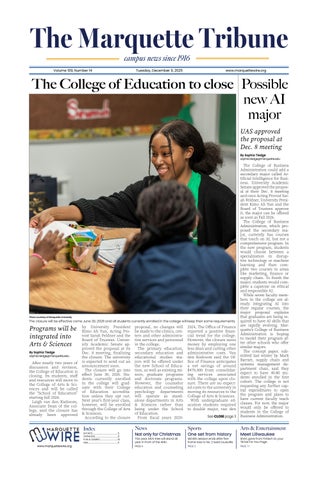
Photo courtesy of Marquette University
Mayor Johnson on issues impacting students
He
touched on housing, parking and graduation
By Sophia Tiedge sophia.tiedge@marquette.edu
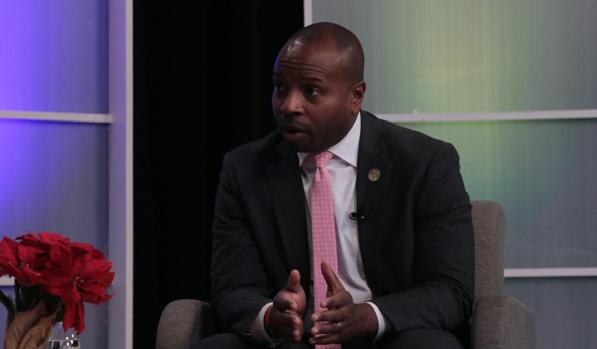
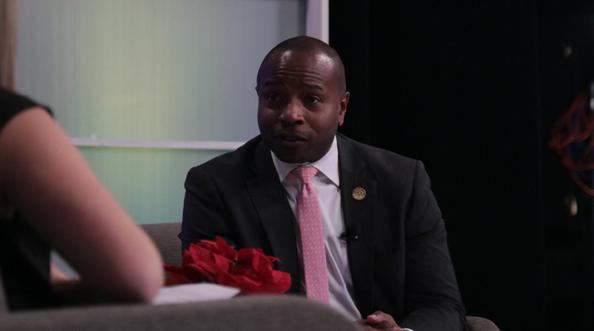
Milwaukee Mayor Cavalier Johnson discussed issues impacting the Marquette community such as parking, housing and reckless driving in a Dec. 4 interview with the Marquette Wire.
Here are some key takeaways from the interview. Advice for Marquette students
Johnson gave two pieces of advice to students entering the workforce.
1. There’s no such thing as a dumb question
“There are too many people that choose not to ask the question, even though there are other people who have the very same question,” he said. “Be willing to learn.”
2. Say “Yes”
“The folks who get the second look, the folks who get the promotion, especially as a young person, are the ones who say ‘Yes, yes, I’ll show up. Yes, I’ll do that. Yes, I’ll put in the extra work,'” he said.
Milwaukee after graduation
This summer, Milwaukee was recognized as the second-best city in the nation for college graduates.
For those graduating from Marquette in the spring, this accolade might make them more inclined to look for their first job in Milwaukee.
“I think that young college graduates are going to be a really critical component to Milwaukee’s future,” Johnson said.
To keep graduates involved in the city, he said it’s essential to make sure there are jobs available and make Milwaukee a place worth laying down roots.
Getting involved in city government
Some students come to Marquette because of its urban location. City Hall is just a little under a mile from campus, while places like the county courthouse are right down the street.
College isn’t too early to get involved in local government. Johnson points out that students can call the alderperson of their district and attend meetings at the county courthouse or City Hall.
“I encourage folks to see what’s going on,” he said. “Obviously, watch and read the news, but then also take the time to go in and be involved in things.”
Parking concerns
Milwaukee’s Department of Public Works has planned to issue 65,000 additional parking tickets next year, with a projected total
of 550,000 given by the end of 2026. New meter times in the Third Ward have increased and habitual parking violators could be towed starting Jan. 1, 2026.
Some students, especially commuters, rely on street parking while they’re in class. Over the summer, parking passes for Marquette’s two garages sold out before first and second-year resident students could purchase them.
Johnson said those parking on the street should start planning ahead for these changes.
“Know where you’re going, know what the rules are,” he said “Make sure you read the signs that we try to make sure are posted there.”
But in addition to driving, Johnson said his administration is also working to make the roadways more accessible through things like bike lanes or more accommodating pedestrian areas.
Reckless driving law
Both Wisconsin and Milwaukee signed laws Nov. 4 to crack down on reckless driving. The new
the influence and has been charged with four counts of homicide.
“The issue from a couple of months ago where some of your fellow students here were killed senselessly on 27th and Clybourn here was tragic,” he said. “It was absolutely tragic.”
Johnson said he came to Marquette’s campus for the remembrance mass at Varsity Theatre.
“It was very moving, and it encouraged me to continue to push forward new methods in order to make sure that our streets are safe for everybody,” he said, “and holding people who drive recklessly or drunk, in the case of the young woman that hit them, accountable for their actions.”
A focus on taxpayers
Johnson made vetos to the proposed 2026 city budget on items like extending library hours, fire department funding and increasing residency incentives for city employees. Common Council overrode the vetos Nov. 25.
Behind Johnson’s vetos,
reason why I raised concerns about the council’s process here.”
When deciding to override a veto, Johnson said, Common Council didn’t address each veto one by one. Rather, they lumped them into one vote.
“Council members voted on things like raising people’s taxes and had no discussion on it,” he said “They had absolutely no discussion on big issues.”
This expansion in services, he said, will produce a larger deficit in the next fiscal year. Even if the city’s revenue is growing, Johnson said it might not increase enough to make up the difference.
“We’ll have to end up cutting those things back even further,” he said.
Marquette’s EMS dispatch program
On Nov. 24, Marquette University Police Department and a Marquette student attended a Public Safety and Health Committee meeting to propose starting an Emergency Medical Services program staffed by
legislation will increase penalties for offenders and tow repeat violators.
On Sept. 5, Marquette students Scott Michaud and Noah Snyder were killed in a car crash near campus.
The driver of the other vehicle was operating under
he cited the importance of reducing the burden on taxpayers.
“I’m always focused on the pocketbook issues of the folks in the City of Milwaukee. I think it’s important for their mayor to be,” he said, “and this is part of the
partners in order to provide better service delivery to my constituents, including those constituents who live on campus here, who live off campus, students at Marquette University, then I want to see that,” he said.
Johnson’s housing plan In 2023, Johnson announced a plan to grow Milwaukee’s population to 1 million people. To do this, he created a plan called housing element to address the city’s housing needs. Their most recent iteration of the plan was approved August 2025.
Johnson said he sees places in the Marquette area where improvements can be made, including “high traffic corridors” like Wisconsin Ave., Wells St. or 27th St.
“There is ample opportunity to build more housing, to build denser housing that is welcoming to the people who live here in Milwaukee presently,” he said. “But then also to those young people who are in college, will graduate from college and are looking to start their careers, families and lives here in Milwaukee.”
Not only a mayor, but a neighbor In 2022, Johnson and his family moved to the Concordia neighborhood in the Near West Side. So, he travels through Marquette’s campus each day on his way to and from City Hall, he said.
“I come to this university, and it’s always a pleasure to see all the new things that are happening here on campus, to see the students that are buzzing about. They remind me how old I am,” he said. “I’m so far away from that age, but I think about their future. I think those things inform some of the decisions that I make as mayor.”
Supporting students’ future
Johnson said there’s still work to do to make housing more affordable and neighborhoods safer.
“This work is always ongoing,” he said. “It’s never finished. The story continues to be written each and every day.”
“You want to make sure that you live in neighborhoods in a society overall where you’re safe and where your kids, or your future kids, are safe, that’s exactly what I want to see for Milwaukee,” he continued.
students who are EMTs.
The patrol area would include campus property and Valley Fields. Johnson said this is the kind of partnership he supports.
“Whenever there’s an opportunity for us to be able to work collaboratively with
While he makes improvements to housing and safety, he knows his work isn’t complete.
“While we’re making improvements in these areas, there’s still a lot more work to do,” he said. “And I’m committed to doing that work for students at Marquette and people all across Milwaukee.”
Photo by Jack Albright jack.albright@marquette.edu
Milwaukee Mayor Cavalier Johnson gave advice to Marquette students to carry into their first jobs.
Photo by Jack Albright jack.albright@marquette.edu Johnson discussed his housing plan to grow Milwaukee's population to one million people.
Tuesday, december 9, 2025
CLOSE: All majors will remain the same
Continued from page 1
Kieboom said 92% of students in the college already have a major in the College of Arts & Sciences. This was outlined as a key reason for the closure in the original 2023 concept paper. Van den Kieboom also explained that faculty in both colleges work closely on teaching and research, so the change would improve efficiency.
In prior discussions regarding the closure, a
director for the School of Education was considered who would report to the dean of the College of Arts & Sciences. Now, van den Kieboom said, the college is planning on transitioning existing faculty rather than adding a director position.
Heather Hathaway, Acting Dean for the College of Arts & Sciences and the College of Education, supports the closure. In her letter of support to
Feldner, Hathaway wrote, “I am confident that, together, we can deliver excellent academic programs that prepare our own Marquette future-educators to benefit the many lives they will go on to influence through their work.”
This would not be a new structure for Marquette’s education programs. From 1971-2008, education was a school instead of a college. The school had its own dean at the time, but
students received a bachelor’s degree from the College of Arts & Sciences.
This change comes as Marquette is facing possible university-wide academic college restructuring. The university has released four possible models three of which move programs out of Arts & Sciences into other potential colleges.
This move was recommended as part of Marquette’s plan to cut $31
million by 2031. Acting Provost Sarah Feldner, who is in charge of the restructuring proposals, is expected to recommend a model to Ah Yun next week. If she decides restructuring is the best option, education programs could be moved back out of Arts & Sciences as soon as 2026 when the implementation is expected to begin.
Provost gives update on college restructuring
She addressed concerns from faculty and staff
By Sahil Gupta sahil.gupta@marquette.edu
Conversations about college restructuring continue across campus after three proposed models were unveiled earlier this semester. The proposal is part of the wider “Securing our Future” initiative, which is seeking to cut $31 million from the university budget by the year 2031.
Amid continuing uncertainty over college restructuring, proposal architect
Acting Provost Sarah Feldner and University Academic Senate chair Paul Gasser sat down with the Marquette Wire Dec. 8 to provide updates and clarity surrounding concerns that faculty, staff and students have about the changes.
Ideas from faculty gathered at listening sessions
As part of the college restructuring initiative, the university hosted three listening sessions to provide faculty the opportunity to provide feedback on restructuring models.
“The goal was to get units that are not currently in the same college — but might be in the same college in a future reorganization —
together to talk about pros and cons,” Gasser said.
Feldner also said the listening sessions included conversations about possible graduate school restructuring, combining duplicate programs and potential changes to grant management, which currently differ between colleges.
“After you receive a grant,
"If we do this right in planning, students will see nothing but improvement "
Sarah Feldner Acting Provost
there’s a lot of paperwork, and the process of how to receive and manage the grants is done at a college level,” Feldner said. “The question was, ‘Is there a way in which we can align so that the expertise is pooled in a particular way?’”
Feldner and Gasser also said there are places for expansion, especially in the fields of computing, environmental studies and
mental health because of their current relevance in the professional world.
Impact on students
Feldner was adamant that there would be minimal changes to students’ academic experiences. She said current major and minor programs and their curriculum requirements would stay the same.
“If we do it right in planning, students will see nothing but improvement in their day-to-day lives,” Feldner said.
Feldner said she intends to meet with MUSG Senate virtually on Teams later this week after cancelling an appearance on Dec. 1, citing personal reasons.
A separate proposal was released earlier this year as part of “Securing our Future” that would cut 15 academic programs on campus. Only one program — medical laboratory science — has officially been terminated. The university has not publicly said what other majors are under consideration for termination. While this is also part of “Securing our Future,” it is not related to the college restructuring initiative and is a separate proposal.
Emphasis on dialogue over siloing concerns
At the Nov. 17 UAS meeting, several faculty members expressed deep
concerns over how the restructuring could cause increased isolation between departments. Feldner said she’s heard these concerns, but said current siloing is a result of a lack of dialogue between departments under the current structure.
“We [as departments] imagine what other units on our campus do, but we don’t always have opportunities to sit and hear how they think about how they work,” Feldner said. “That
"...we live in our offices, we don't get around to other colleges."
Paul Gasser UAS chair
is largely a function of how we are structured.”
This sentiment was echoed by Gasser, who argued that improving collaboration is one of the core purposes of the restructuring initiative in addition to potential cost savings.
“We kind of live in our departments, we live in our offices, and we don’t get around to other colleges,” Gasser said.
When asked about a
potential cost savings figure, Gasser and Feldner weren’t able to provide one.
Next steps and new developments
After completing the listening sessions, Feldner said at the University Academic Senate meeting Dec. 8 that they’ve stopped looking at the gold model for restructuring, but are still exploring other possibilities, including keeping the current structure the same. Feldner said she plans to present a final restructuring proposal to President Kimo Ah Yun next week, on track with the timeline she provided in an earlier interview with the Wire. When asked, she was unable to provide any updates on the permanent provost search. President Ah Yun previously said that while he hopes to find a permanent provost by the end of 2025, he was not putting a mandatory timeline on concluding the search. While the final outcome of the restructuring process remains to be determined, Feldner said she is confident that the university will benefit from the initiative.
“I’m very confident that we did the right thing for Marquette and for faculty,” Feldner said. “There is still a long way to go.”
Feldner cancels meeting with MUSG day of They were meant to discuss college restructuring
By Mina Marsolek-Bonnet
wilhelmina.marsolek-bonnet@ marquette.edu
Marquette University Student Government canceled their Dec. 1 student senate meeting with Acting Provost Sarah Feldner after being made aware the same day that she would not be able to attend. Feldner requested the meeting at the beginning of November to get student feedback on proposed college restructuring models.
University Spokesperson Kevin Conway said Feldner needed to tend to a personal matter, and the meeting will be rescheduled. Feldner seemed eager to get student feedback and was taking notes during her initial Nov. 10 meeting with MUSG President Julianne Browne and Executive Vice President Adam Brzezinski, Browne said. Feldner asked senators to discuss the models and come with questions.
Browne said there was no prior communication between MUSG and the acting provost before scheduling the one-on-one meeting. She said MUSG senators
were only made aware of the university’s restructuring efforts after reading about it in the Marquette Wire.
Despite requesting it herself, Feldner was unable to attend the Dec. 1 student senate meeting due to a last-minute change in her schedule, according to an email sent to Browne and Brzezinski from Kim Patterson, executive assistant to the provost.
Students were made aware of the cancellation by email and a post on MUSG’s Instagram story.
To get feedback from students on college restructuring models, senators created a survey to send out to
their constituents.
The following questions are on the survey:
Were you aware of the Securing Our Future plan before reading the [Wire] article?
Which of the proposed plans do you prefer?
Do you have any concerns about any of these models?
Do you have any questions you wish for your senator to bring to the acting provost?
The data from these surveys has not yet been made available.
Feldner is slated to present restructuring plans to University President Kimo Ah Yun this month.
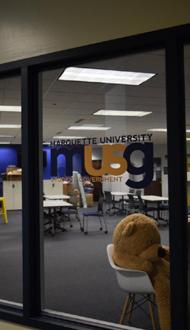
Photo by Claire Gallagher claire.gallagher@marquette.edu The meeting will be delayed.
Tuesday, december 9, 2025
The MarqueTTe Tribune
Managing Editor of The Marquette
Tribune
Sophia Tiedge
NEWS Executive News Editor Mia Thurow
Assistant Editors Lance Schulteis, Lilly Peacock
Reporters Sahil Gupta, Elena Metinidis, Mina Marsolek-Bonnet, Jaylen Hill, Daria Stepanich
ARTS & ENTERTAINMENT
Executive Arts & Entertainment Editor
MaryKate Stepchuk
Assistant Editor Joseph Schamber
Reporters Elise Emery, Allison Scherquist, Annie Goode
OPINIONS
Executive Opinions Editor Rachel Lopera
Columnists Isabella Gruber, Amelia Lerret, Lexi Childers
SPORTS Executive Sports Editor Jack Albright
Assistant Editors Matthew Baltz, Raquel Ruiz
Reporters Benjamin Hanson, Mikey Severson, Sofie Hanrahan, Ben Ward, Eamon Bevan, Conor McPherson
COPY
Copy Chief Emma Fishback
Copy Editors Elizabeth Belmont, Shea Lancaster, Marin Rooney
VISUAL CONTENT
Design Chief Murphy Lealos
A&E Designer Grace Schneider
Sports Designer Amery Thompson
Opinions Designer Evelyn Riordan
Photo Chief Clay Ellis-Escobar
Photographers Lily Wooten, Owen Weis, Leo Stallings
HAVE A TIP FOR US?
Have you seen something that you think should be a story? Do you have a tip about something we should be looking into? Do you have documents or other materials that we should see? We want to hear from you.
If you have documents you'd like to send us, you can send anything to wiretips@marquette.edu.

Wisconsin winter weather outlook
How MU students can prepare for the cold months
By Lance Schulteis lance.schulteis@marquette.edu
When Marquette University students returned from Thanksgiving break, Milwaukee looked a bit different. What were once clear sidewalks and roads became patches of snow and ice — a window into the Wisconsin winter on the horizon.
Those winters are synonymous with the Badger State, where temperatures drop and snowplows trudge through streets from December to February. Though each year brings a different mix of winter weather, the cold, dark days all assimilate students to life in Milwaukee.
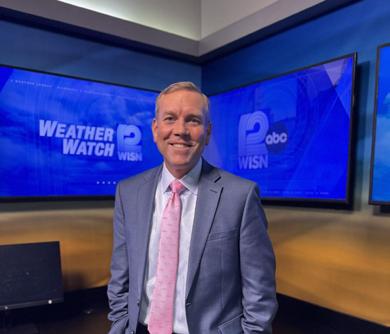
“How can you not like snow?” Mark Baden, chief meteorologist at WISN Channel 12, said. “It snows here. If you’re going to school here, this is part of what we do.”
Baden spoke with the Marquette Wire to preview what students can expect for the coming winter.
For the second consecutive year, a La Niña winter pattern is hitting the United States, which in several southern states creates a warmer season. But in Wisconsin, it leads to slightly below average temperatures and increased snowfall.
La Niña winters result from cooler surface temperatures in the central equatorial Pacific Ocean. Those cooled waters alter the positions of jet streams, shifting wind patterns as
the calendar flips to winter. Typically, La Niñas arise every 3-5 years.
“It’s rare to keep a strong La Niña two years in a row,” Baden said.
While the coming La Niña is expected to be on the weaker side, it is still projected to cause above average precipitation. Of the 12 weak La Niñas recorded by the National Atmospheric and Oceanic Administration since 1954, nine of them brought added snow to Wisconsin.
The National Weather Service’s Nov. 20 model listed most of Wisconsin as 3040% likely to have above average precipitation from January 2026 to March 2026. Temperature-wise, the model gave Milwaukee an equal chance of facing above average, below average or normal conditions
While those conditions are set for early 2026, Milwaukee got a taste of winter with the season’s first snowfall over Thanksgiving weekend. That snow, Baden said, will stick around for a little while, as it spans the Midwest from Missouri to Indiana. However, the blanket of snow — known as a snowpack — is likely to melt before another heavy snowstorm rolls through.
“It’s very rare for Milwaukee, in this area, to start in December with snow on the ground and make it all the way through with a snowpack,” Baden said.
According to WISN 12 data, Milwaukee’s longest stretch with at least an inch of snow on the ground is 112 days, which spanned the entire winter in 1979. In 2021, snow covered the ground
for 68 days, but more recent years have failed to yield a consistent blanket of snow.
That probability makes the late November snowfall a trial run — an opportunity for students to acquainted with a Wisconsin winter before coming back to school in January.
“You definitely have to readjust and remind yourself it isn’t an easy winter,” Moses Vived, a sophomore in the College of Business Administration from Fresno, California, said.
While Vived prepares for his second winter on Marquette’s campus, several first-year students will face a Wisconsin winter for the first time, including fellow Californian Alex Delucchi.
“I had one warm jacket and another thing to keep me warm, but I’m probably going to have to get a little more prepped for what’s to come, especially with the wind that I’ve heard about from upperclassmen,” Delucchi, a first-year in the College of
Health Sciences, said.
Both Vived and Delucchi are looking to enjoy the snow but are wary of the cold days around the corner in January and February. While temperatures in his hometown rarely get below freezing, Delucchi is balancing intrigue with the potential for the snow to quickly get old.
Growing tired of the snow and cold can be natural, Baden said, but the best way to adjust is to make an effort to enjoy winter. Some Marquette students welcomed the season’s first snowfall by building snowmen and having snowball fights. Those moments, Baden said, are opportunities to get acclimated to the cold months in Wisconsin.
“If you don’t embrace it, you’re never going to enjoy it,” Baden said. “If you’ve never gone skiing, go skiing. Do fun stuff in the winter. Go ice skating outside. Yeah, it’s cold — but you get through it.”
2025 tree lighting looked different this year
A permanent one has been planted outside the AMU
By Elena Metinidis elena.metinidis@marquette.edu
As darkness settled over Milwaukee on Dec. 2, shining Christmas lights and the gathering of Marquette University students lit up Marquette’s campus. Students, faculty and community members alike came together at the annual Christmas tree lighting ceremony.
Led by Alpha Sigma Nu, the honors society of Jesuit institutions, the annual tradition brought a crowd to Westowne Square to celebrate the start of Advent — a season of hopeful preparation for Jesus’ birth.
“This is a sacred time when we can find joy in the world,” Rev. John Thiede, S.J., vice president of mission and ministry, said
in his prayer at the event.
“Remember this Christmas tree as a symbol of hope.”
The sounds of Marquette’s pep band and choir rang out across the crowd of bundled-up students, inviting all who were near to join in the celebration.
The Christmas tree lighting, a 20-year-old tradition, is a way to encourage student engagement in campus ministry, Thiede said.
On the surface, it’s a time for students to take a break from studying by delighting in Christmas carols, enjoying hot chocolate and cookies and taking photos with Santa Claus.
Beyond that, though, Thiede said the Christmas tree is a reminder to grow in faith, generosity and joy.
“We pray for light. We pray for wisdom. We pray for calmness in our hearts,” Thiede said at the ceremony.
In between blankets of snow, students packed
tightly on the pavement to admire the newly planted tree, which now permanently stands tall behind the Alumni Memorial Union.
The ceremony used to take place at the St. Joan of Arc Chapel, which required a new tree to be chopped down every year. In an effort to promote sustainability, a tree was permanently planted in its original location directly west of the Alumni Memorial Union. It will stand tall all year round and wear Christmas lights during the holiday season.
Thiede hopes the ceremony and liturgical season can help Marquette students reflect on giving back to the local community and the nation, he said in an interview with the Marquette Wire before the tree lighting.
Thiede wants students to ask themselves, “How can we be a beacon of light?”
Students who attended
the event noticed Thiede’s hope for the community.
“I heard the echoes of people’s voices and I thought, ‘This means community and gathering,’” Anna Heffernan, a sophomore in the College of Communication, said of the tree lighting ceremony. “It’s really special.”
After the COVID-19 pandemic, Thiede said the ceremony picked up more traction. He estimated that the number of attendees grew from 50 people to over 300 in the last three years. This ceremony, in particular, was promoted across campus for weeks, inviting the entire community to join.
University President Kimo Ah Yun believes in student engagement, Thiede said.
In his speech at the tree lighting ceremony, Ah Yun expressed his gratitude for Marquette students, faculty and staff.
“I hope during this time
tree lighting was on Dec. 2.
that you really reflect on everything that brings gratitude to your life,” he said. As people walk by the colorful Christmas tree this Advent season, the university hopes they are reminded of what it truly means: hope in trouble and light in darkness.
Mark Baden explained how students can stay warm this winter.
Photo by Lance Schulteis lance.schulteis@marquette.edu
The
Photo by Lily Wooten lily.wooten@marquette.edu
One set from history
Volleyball's first year under Tom Mendoza ended in a five-frame thriller against No. 2 seed Louisville
By Jack Albright jack.albright@marquette.edu
With one final kill from Cardinal Chloe Chicoine, year one of the Tom Mendoza era of Marquette volleyball ended.
The unseeded Golden Eagles prolonged their 2025 season two sets on Saturday, but did not have enough to upset No. 2 seed and hosts Louisville, losing 3-2 (21-25, 2511, 23-25, 25-19, 15-12) in the second round of the NCAA tournament.
“A phenomenal match that we knew what Louisville was going to be like,” Marquette head coach Tom Mendoza said. “They killed the ball well. We were hoping we were able to slow them down a little bit, but their offense was pretty tough. But overall, just a phenomenal match, and we’re glad to be a part of it.”
Just over 24 hours after its sweep against Western Kentucky, Marquette stuck to its winning ways with a 25-21 first set victory behind a .429 hitting percentage.
The Cardinals started to play like their 2nd-seeded selves in the second frame, when they won 25-11 after hitting .633 to the Golden Eagles’ .143.
The potentially game-defining third frame, with the match tied 1-1, lived up
to the billing. It was 5-1 Marquette when Louisville called its first timeout. Then the Cardinals overcame an atmost seven-point deficit to trail 11-8 and force the Golden Eagles’ hand. Louisville called its final after Marquette made it 22-19, and Marquette used its final after Louisville scored four in-a-row to lead 23-22.
Down to the only players, the Golden Eagles closed the frame on a 3-0 run behind two kills from senior leader Natalie Ring.
"...incredibly proud of our performance all weekend, but all season as well."
Tom Mendoza Marquette volleyball head coach
But Louisville is Louisville. A team that beat Creighton. With their backs to the wall, the Cardinals took the fourth set 25-19 to force a game-deciding fifth to 15 points.
Marquette began the final frame with down 5-1, and Louisville looked poised to take care of business
handily. Then the Golden Eagles scored four of the next five to trail two points, 8-6, when the teams switched sides. This slowthen-fast, up-and-down play continued through the entire set as Louisville went ahead 12-7 — after a potentially match-altering challenge call — before Marquette scored three in a row.
The Golden Eagles called their final timeout trailing 14-11, out of which they got a point after a service error, before Chicoine killed the match, and with it, the blue & gold’s season, dead.
Chicoine led Louisville with 28 kills, and was trailed by Payton Petersen (19), Cara Cresse (13) and Kalyssa Blackshear (11).
“When they’re swinging, the way they were swinging tonight, I think that makes them a pretty complete team,” Mendoza. “When they’re swinging as aggressively as they were tonight with the blocking and defense, I think that would match them up favorably against anybody.”
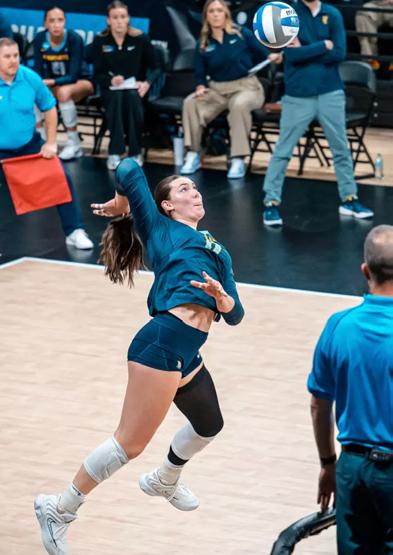
Ring finished the season extending her streak of leading Marquette in kills in every match, posting a career-high 29 kills. Hattie Bray finished with 11 on .310 hitting.
“That’s been an M.O. of my game this season and the past few years and just
wanted to take big swings and go hard,” Ring said.
“And believing that if I take those big swings that people won’t be able to stop me.”
The Cardinals hit .404 as a team compared to the Golden Eagles’ .270.
Marquette ends its first year with Mendoza as head coach one set from
making its second-straight Sweet 16.
“Wish we got to keep going another week or so, because we really like working together and playing together as a group,” Mendoza said, “but incredibly proud of our performance all weekend, but all season as well.”
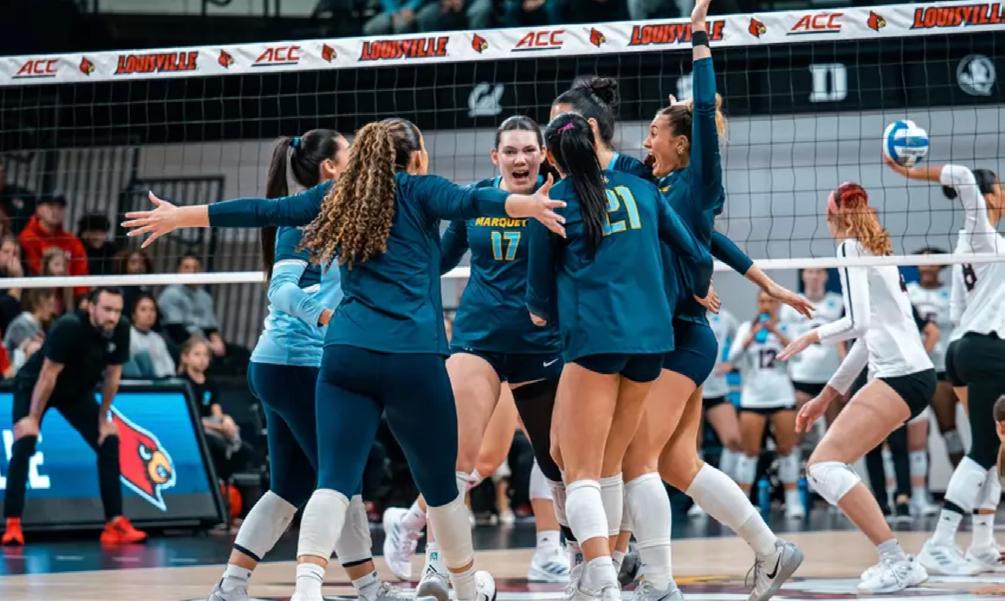
Marquette volleyball lost to No. 2 seed and first weekend hosts Louisville in a hardfought five-set
thriller in the second round of the NCAA tournament Saturday.
Photos by Marquette Athletics
Natalie Ring finished with a career-high 29 kills in the five sets.
WOMEN'S BASKETBALL
MU makes most threes in Consuegra era
By Jake Dale jacob.dale@marquette.edu
Marquette women’s basketball set a record in its Big East home-opener against Butler.
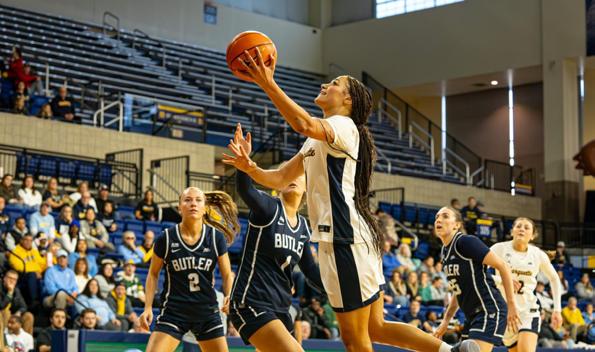
The Golden Eagles (6-3, 2-0 Big East) splashed 13 threes en route to an 80-55 victory over the Bulldogs (4-6, 0-2), the most made by any Cara Consuegra coached team.
“It’s something that we’ve been working on since last season,” Consuegra said about her team’s 3-point shooting. “When they shoot it, they believe it’s going in.”
But before the threes started falling, turnovers posed a serious issue for Marquette, who turned the ball over three times in the first five minutes and trailed 10-7 lead halfway through the first quarter.
“I thought we didn’t start the game great,” said Consuegra. “We knew Butler was going to come out and really pressure us, and we had some turnovers early with allowing them to pressure us.”
The high-tempo Golden Eagles turned the ball over 16 times on the day, right in line with their 16.6 turnovers per game average, but they also forced 15 turnovers from the Bulldogs and scored 16
points off of them.
“I’m okay with some of the turnovers that come with our speed,” Consuegra said. “For me, the turnovers are the easy ones, the careless ones. Those are some of the ones that we have to do a better job taking care of.”
Marquette found its footing and led 19-14 going into the second quarter, the positive momentum swing coming from five straight points from Halle Vice. The third-year guard made her presence felt all day, finishing with 13 points on 67% shooting (6-for-9), nine rebounds and four combined steals and blocks.
“Halle always impacts the game,” said Consuegra.
“I thought she did a really
good job tonight, taking advantage of her matchup and getting to some good spots, and then she played off Skylar really well."
In the second quarter, the Golden Eagles took charge. Although they only held a five-point lead going in, they shot 72.7% from the field and went 4-for-6 from beyond the arc to carry a 16-point lead into the half, 41-25. Three of Marquette’s four second quarter 3-pointers came from graduate student guard Lee Volker, who finished 3-for7 from deep and 5-for-10 overall, scoring 14 points.
A 6-0 Butler run with six minutes left in the third quarter quickly brought the Marquette lead down to 10, forcing Consuegra to
call timeout.
“I thought our kids really refocused and responded,” Consuegra said about the timeout. “We have a lot of experience, and we need to be able to feel those runs that teams are going to make at us and respond.”
The Golden Eagles left the huddle revitalized as a Vice layup and a Jordan Meulemans triple pushed them to a 13-point lead heading into the 4th quarter. Marquette’s fourth-quarter threes reappeared in ubiquitous fashion.
The Golden Eagles missed only one of their six attempts from deep (83.3%) in the final period, two of which came from junior forward Skylar Forbes
and another pair from fourth-year guard Olivia Porter. Forbes tied her career-high on the day with 26 points, also tacking on a career-high six assists and eight rebounds.
“The trust that we have in each other, for them to make the pass or for me to make the shot and vice versa, it makes it all worthwhile,” Forbes said.
Seven of Marquette’s nine made baskets in the fourth quarter came off assists.
In the scope of the entire game, 26 of Marquette’s 32 made shots came via assists.
“That’s how we want to play,” said Consuegra. “We want to play for and with each other.”
On the day, Vice, Volker and Forbes — who posted a team-most 26 points — led the way with 53 combined points. But plenty of help from Jaidynn Mason (seven points, seven assists), Porter (11 points on 4-of-5 shooting) and Jada Bediako (six points and three rebounds) made for a sure-handed Marquette win.
“We believe that we have a lot of weapons on this team, and we don’t just have to rely on one person,” Consuegra remarked. “I thought our kids did a really good job tonight adjusting.”
Mason's game-most assists help offense hum
Senior guard led Marquette with seven dishes
By Raquel Ruiz raquel.ruiz@marquette.edu
Basketball is a team sport.
On defense, the five players on the court are all trying to limit the opponent’s scoring opportunities. On offense, they are passing the ball around, trying to find that perfect shot.
One of the ways Marquette women’s basketball (6-3, 2-0 Big East) was able to dominantly defeat Butler on Sunday, 80-55, and remain undefeated in conference play, was due to its ability to spread the ball around and make the open shots fall. The Golden Eagles finished the game beating the Bulldogs in the assist battle, 26-17, beating their team average of 17.9 per game in the process.
Spurring Marquette was once again senior guard Jaidynn Mason, who tied her season-high with a
team-most seven assists, which also matched the number of points she put up. It was the fourth game this year she led the Golden Eagles in dishes.
“She plays super fast,” junior forward Skylar Forbes said. “She’s our heart and soul on defense in transition; she keeps the pace high. And given that, being able to still slow down and be able to find us and make the right read. I mean, it’s been awesome to play with her.”
The Kansas City, Mo.,
native ranks fifth in the Big East with an average of 3.8 assists per game, but Sunday she proved she is more than capable of increasing that average. She also leads the Golden Eagles with 41 assists so far this season.
“She can be a true playmaker,” Marquette head coach Cara Consuegra said, “which is, ultimately, what she’s best at.”
On Sunday, her in a “true playmaker” role began with the Golden Eagles’ very first basket, when Mason passed the ball to Halle
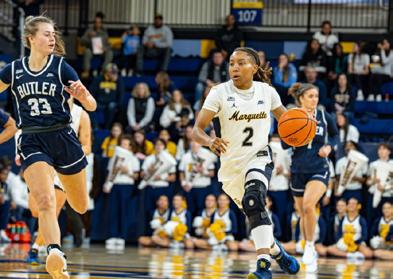
Vice, who scored a driving layup to take a 2-0 lead. She started the second half the same way as well, with a pass to Vice who got the layup. Now in her second season with the Golden Eagles, Mason has improved in her playmaking abilities.
"She can be a true playmaker."
Cara
In 2024-25, she averaged 2.8 assists per game and ended the season with 64 total. Now, only in December with a majority of the season left to play, Mason is already more than halfway to reaching a new season-total high with 34, an average of 7.78 per game. She has finished with multiple assists in seven of the Golden Eagles’ nine games, and she has ended every game with at least one.
Being able to spread the ball around continuously, making sure her team has the opportunity to score has not only made her a better competitor, but her team more efficient.
“Last year, she would just play so fast and not really think about what was always the best play,” Consuegra said. “Now, she’s been able to slow down a little bit, still take advantage of her speed, but she’s thinking the game so much better because of the pace that she’s playing at.”
This new version of Mason was on display from the jump, when she tied for a team-most five assists in the Golden Eagles’ season-opening 89-57 win over Winthrop. She then led Marquette with seven against Bowling Green and followed that up with six at Milwaukee. And on Sunday, she dished another seven.
Mason now has a week off for before she will continue to swing the rock in the Golden Eagles’ matchup against Le Moyne on Dec. 14 at 2 p.m. CST.
Skylar Forbes led Marquette with a season-high 26 points in the Golden Eagles' 80-55 win.
Photo by Clay Ellis-Escobar clay.ellis-escobar@marquette.edu
WOMEN'S BASKETBALL
Jaidynn Mason dished a team-most seven assists on Sunday.
Consuegra Marquette women's basketball head coach
Photo by Clay Ellis-Escobar clay.ellis-escobar@marquette.edu
MARQUETTE vs Butler
MEN'S BASKETBALL
Golden Eagles bested again by rival Badgers
By Matthew Baltz matthew.baltz@marquette.edu
MADISON — There were a pair of plays towards the end of the first half of Marquette’s 96-76 loss to Wisconsin on Saturday that summed up the day — and probably season — perfectly.
First, it was senior guard Chase Ross inexplicably losing control of the ball on the front end attempt of a pair of free throws that he would miss. Then, it was redshirt junior guard Sean Jones tripping over his own feet while racing up the floor with the ball
and turning it over, before he committed a foul 70-feet from the basket.
Most everything that could’ve gone wrong for the blue & gold in its 9676 loss on Saturday at the Kohl Center, did, as the 5-5 Golden Eagles fell to 1-4 against their in-state rivals under head coach Shaka Smart.
“Congrats to Wisconsin,” Smart said. “They really set the tone early in the game with the force with which they played, particularly on the offensive end.”
The blue & gold were torched all day on Saturday by junior guard John Blackwell, who finished with 30 points on 8-of-17 shooting from the field, also nailing
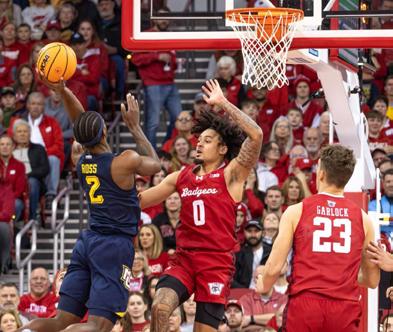
6-of-12 triples.
“It was an honor to beat [Marquette],” Blackwell said. “Because there’s a sour taste in our mouth from them beating us at their crib last year. It’s a good feeling beating them and giving the fans what they deserve.”
All five of Wisconsin’s starters finished with 11 points or more, but the story of the day was Wisconsin’s three guards, who combined for 62 points. Andrew Rhode, a Brookfield, Wisconsin native, had 17, and Nick Boyd chipped in the remaining 15.
“I think the way they move the ball from sideto-side was a huge benefit to them,” Smart said. “Because they threw our guys out of rotation, and made us a little bit late helping each other. Then they capitalized on that.
“It felt like Blackwell made every open three he got, and Rhode, and they did a great job capitalizing when they had opportunities.”
Marquette started the game 2-of-16 from the field, and just 1-of-8 from deep. Despite that, it trailed just 10-5 thanks to slow 3-of-8 shooting for the Badgers. But then Wisconsin would make 9 of its next 15 shot attempts to open up a 13-point lead, and from
MEN'S BASKETBALL
there the Badgers wouldn’t look back.
“I think when we look back at the tape, we’ll see a lot of defensive breakdowns,” first-year guard Adrien Stevens said. “A lot of times where we could’ve had stops. But, it ended up with [Wisconsin] getting an offensive rebound, and I think that kind of fueled them.”
Despite Marquette finishing the first half on a 15-9 run to cut its deficit to 12 heading into halftime, there wasn’t much fire coming out of the break.
Not much from anyone except first-year guard Nigel James Jr., that is. James Jr. — who averaged 20.5 points across MU’s past two games — didn’t make his first field goal until 26 seconds into the second half.
He scored six more points in the next three minutes to raise his total to a teamhigh 11. After his layup at the 16:49 mark of the second half, Marquette trailed 52-40.
Despite the early charge from the first-year guard, the Golden Eagles were unable to keep any sort of momentum heading down the stretch. Wisconsin went on a 30-18 run over the course of the next 10:20, holding a 82-56 lead over Marquette when the run was all said
and done.
Stevens, who made his first career start in place of junior guard Zaide Lowery, showed some promise down the stretch, finishing with a team-high 15 points on 6-of-11 shooting.
“I was just trying to do everything I can to help the team win,” Stevens said. “I wasn’t trying to make it bigger than what it was. It’s just another basketball game, another opportunity to go out there and play.”
However, when the final horn sounded, Marquette once again was left to hang its heads in defeat in the postgame handshake line against a high-major opponent.
A season full of disappointment and despair continues to take a turn for the worst. Up next? A trip to No. 1 Purdue in one week’s time, when the 2025-26 misery train pulls into Mackey Arena.
“We know that there’s a lot of opportunities for us to grow, and we’re just going to take it day by day,” Stevens said.
“Every game is a game, so it's a tough stretch, but that’s just who we are. This is who we play, it’s just what it is. We’re gonna go after it, we’re gonna try to be every team that’s on our schedule, (we’ve) just got to stay with it.”
Stevens is Marquette's lone bright spot in loss
an ever-dimmer year.
By Jack Albright jack.albright@marquette.edu
MADISON — Saturday was a perfect storm for Adrien Stevens.
The Marquette men’s basketball guard made his first career start in his first true road game that happened to coincide with, of all matchups, the Golden Eagles’ biannual trip to the haunting Kohl Center to face in-state rivals Wisconsin.
How did the first-year fare in this uber-important game chock-full of new experiences? Oh, well, he led Marquette in scoring (15 points), baskets made (6) and 3-pointers nailed (3) — and continued to look like a mainstay in the Golden Eagles’ ever-changing rotation.
While the scoreboard at the end was anything but ideal for the blue & gold — 96-76 Wisconsin — Stevens’ 27 minutes were the only potential bright spot on an almost entirely dim day in what continues to become
“I was trying to do what I can to help the team win,” Stevens said. “Wasn’t going to try to make it bigger than it was. It’s just a basketball game.”
Before his career day in his inaugural start, Stevens turned to someone who found himself in his shoes one month ago for advice.
With tip-off ticking ever closer, Stevens talked to his roommate and fellow first-year Nigel James Jr. — who was about to start his seventh straight game — for advice.
“It was good to know that someone else is feeling the same way,” Stevens said. “I was nervous. But we got it out in the first [media timeout].”
Hours after his roommate pep talk, he made his first-ever walk down the pregame line of teammates as his name got announced to the mostly antagonistic 16,838 fans in attendance.
“To be able to start in an environment like that is crazy,” he said. It took Stevens a little while to get going, but once he nailed a 3-pointer at the end of the first half, he kept
making positive impacts — despite the Badgers’ dominant advantage. Stevens scored 12 of his 15 points in the final 20 minutes, with his most eye-opening sequence coming in the dying embers.
Marquette had already lost a chance at winning far before, but with 2:52 remaining, the 6-foot-4 guard caught the ball just outside the arc, took one dribble and leapt to the basket for a one-hand slam over 6-foot10 Badger Aleksas Bieliauskas that sent the Golden Eagles’ bench into a frenzy.
On the next possession, Stevens nailed his third and final 3-pointer of the game.
“The one before, it was a wide open one, I kind of laid it up,” Stevens said of the dunk. “And then the next one, I saw him coming over. So I was like, ‘I have to dunk this.'”
Along with his teamhigh 15 points on 6-of-11 shooting, Stevens grabbed five rebounds and dished four assists.
“I’m really just trying to focus on this stuff that I can control,” he said. “Starting with defensively, trying to be a really high-level
defensive player. And I feel like that allows everything else to open up for me offensively. Trying to get out on fast breaks, make open shots, and try to get my teammates involved.
“Just trying to be a guy that can do everything.”
Marquette head coach Shaka Smart made the decision to start Stevens in Zaide Lowery’s place after
his plays down the stretch helped spur the Golden Eagles to a 75-72 overtime nail-biting win against Valparaiso last Tuesday. That night, he tied his then-career-high nine points — on 100% shooting — in a career-most 30 minutes.
“He really cares,” Smart said. “He really has a competitive desire to him."
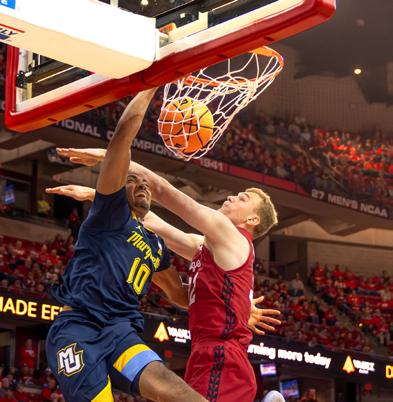
Stevens scored 15 points in his first career start on Saturday.
Guard led team with 15 points in first career start
The Golden Eagles fell to 1-4 against Wisconsin under Smart.
Photo by Leo Stallings leo.stallings@marquette.edu
MARQUETTE vs Wisconsin 96 76
Photo by Leo Stallings leo.stallings@marquette.edu
Smart's efforts to find winning lineup futile
Coach ran new starters in each half on Saturday
By Matthew Baltz matthew.baltz@marquette.edu
Marquette men’s basketball has struggled to beat its in-state rival in the five seasons that head coach Shaka Smart has been atop the program.
Saturday, the Golden Eagles (5-5) fell 96-76 at Wisconsin, dropping to 1-4 against the Badgers since 2021. Marquette is now in danger of falling under .500 for the first time since the 2020-21 season.
Here are some thoughts from the beatdown by Bucky:
The Golden Eagles are trying to find solutions, but nothing is working
From the 2022-23 season to 2024-25 season, the Golden Eagles started just eight different players.
“We’ve had unbelievable continuity in those lineups,” Smart said.
Coming into this season though, Smart knew
that with the departure of guards Stevie Mitchell and Kam Jones, along with forward David Joplin, his lineups were going to look a lot different. And so far, they have — and it hasn’t been pretty.
Smart made the decision to give first-year guard
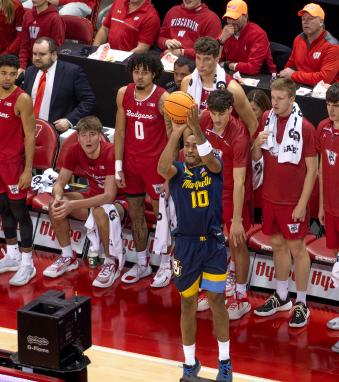
Stevens his
career start on Saturday. Stevens slotted in for junior guard Zaide Lowery, who played just 15 minutes on Wednesday against Valparaiso and finished shooting 0-for-7 from the field with zero points. Lowery played a season-low 13 minutes against the Badgers.
“I told [the team] this year, I have a feeling it’s going to be different,” Smart said. “We’re not doing it different just to be different, but, we just don’t really have a set five that we know for sure is going to be the five we have to have in the game.”
Smart made another lineup change at the start of the second half on Saturday, starting the half with sophomore forward Royce Parham on the floor instead of redshirt sophomore forward Caedin Hamilton.
“I just thought Royce was playing better,” Smart said. “That’s why we made that change.”
Despite the lineup changes, the result wasn’t nearly what Marquette needed it
to be. Even with Stevens’ team-high 15-points and the better play of Parham, not to mention the return of Sean Jones from a shoulder injury after one month, the Golden Eagles once again found themselves defeated in the locker room after falling handily to a high-major opponent.
Marquette’s rotation problem is not that Smart is just neglecting to find answers to his team’s issues, it’s that his options are limited and the solutions have not been working — on either end of the floor.
“We have, as you saw at the end there, a lot of young guys that we believe in, that we need to grow up,” Smart said. “We have been blessed and fortunate to have some really good teams as of late, and this team is behind those teams right now, that’s a fact. We need to get better, and we will.”
Marquette’s
season-worst
day at the charity stripe
The Golden Eagles finished with single-digit free throw makes (9) for
the first time all season on Saturday. MU shot 47.4% (9-for-19) from the line against Wisconsin, also a season low.
“It was at one point in the second half, I think [Wisconsin] got the lead to maybe 11,” Smart said. “and I looked at the stat sheet and I’m like, ‘Man, if we make our free throws, it’d be more like four or five.'”
Getting to the free throw line had been a strength this year for the Golden Eagles — who shot three more free throws per game on average than their opponents. The issue has been pressing that advantage.
MU is shooting 71.9% to its opponents 74.6%. The Golden Eagles had already missed 10 or more free throws twice before Saturday, and those issues from the stripe continued to rear their ugly heads much to the pleasure to almost all of the 16,838 fans at the Kohl Center.
The Golden Eagles have gotten to the foul line more this season than years prior, but only shooting 19 free throws while letting your opponent make 24 isn’t going to cut it often times.
The charity stripe is an especially important for Marquette right now, something Smart has been transparent about, because its offense is continuing to struggle from the field — ranking 254th in the country in 3-point percentage and 218th in 2-point percentage as of Dec. 8.
What’s on tap?
The blue & gold travel to West Lafayette, Indiana to face No. 1 Purdue at Mackey Arena on Saturday. The Golden Eagles have played the Boilermakers in each of the past three seasons, dropping the first two matchups at Mackey and in Maui before snagging a win last season at Fiserv Forum.
Tip-off is at 1 p.m. CST.


Adrien
first
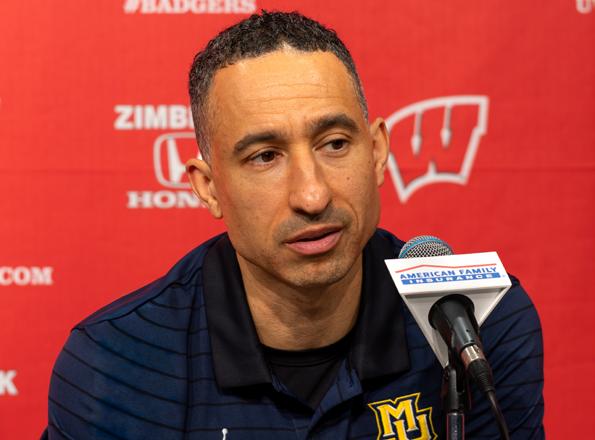
Shaka Smart sits at the postgame press conference following Marquette's latest loss to Wisconsin.
Photos by Leo Stallings leo.stallings@marquette.edu
Stevens made his first career start in Zaide Lowery's place.
Toy safety matters during the holidays
By Amelia Lerret amelia.lerret@marquette.edu
Children’s health and well-being can be damaged using unsafe toys, making it crucial that gift givers are informed about age-appropriate presents.
As the holiday season begins, December marks Safe Toys and Gifts Awareness Month. People buy gifts for family members or make donations, which many organizations execute across the country. Particularly, the Salvation Army Angel Tree program brings presents to over one million children in a typical year. However, those who donate may not know about safe, age-appropriate toys if they do not have experience with kids. It is essential that every gift-giver understands which items may be unsafe because the effects can be detrimental to the well-being of young children.
The United States Consumer Product Safety Commission estimated 159,500 toy-related injuries treated
at a hospital emergency department and 11 deaths from children aged 14 or younger in 2022. Strikingly, 79,800 of those injuries were to children aged 4-14, so hazardous toys impact more than solely infants and toddlers. Still, almost half of the total accidents occurred to those under four, putting that age group at the highest risk.
Some notable dangerous items include bouncy balls, non-motorized scooters and powered riding vehicles, but injuries are not limited to those. Toys with certain features make them more dangerous, such as cords and strings that can put children at risk of strangulation. Anything with sharp edges can cause harm and items that make loud noises can damage hearing.
Seattle Children’s Hospital noted that small pieces from toys are a hazard to kids under age three due to choking risks.
All Injuries Law Firm reported that for adolescents,
ride-on toys are a more common cause of injuries, such as in sprains, fractures or dislocations. Potentially dangerous toys include skateboards, bicycles and scooters for kids under 14.
Since individual features are often more dangerous than the toys themselves, it is important for people to be aware of what traits to steer clear of because the risks can be detrimental.
In addition to parts and pieces, it is also crucial to know what toys are made of. According to Healthcare Highways, exposure to hazardous chemicals or materials like lead and phthalates can cause long-term effects, such as developmental delays, learning disabilities and behavioral issues.
These harmful risks highlight the importance of education on safe and age-appropriate toys as the holiday season approaches.
A helpful resource is World Against Toys Causing Harm, which releases information regarding harmful

toys and things to be mindful of when they are used. It also advises people to inspect items once received and to be wary of potentially dangerous pieces. While some toys can be harmful, they should not be avoided completely. Babies and toddlers are safe with unbreakable gadgets that can withstand chewing, and kids can play safely with toys larger than the size of their windpipe.
Masses of children receive donated presents for Christmas, emphasizing the spirit of the season of giving. These contributions make a real difference in their lives,
which is why it’s important that they are risk-free. Whether buyers are donating or giving to a family member, it is necessary they not only inform themselves about safe toys but use sound judgment to examine and ensure all parts are safe to use. So, as people begin to shop for presents this Christmas, it is vital that they understand the potential harm of unsafe toys to protect children’s health and well-being.
Wisconsin senate must pass Erin's Law

By Lexi Childers alexandria.childers@marquette.edu
The Wisconsin General Assembly wrapped up voting for the year, but it left some critical legislation off the table: Erin’s Law. This was a critical mistake and should be passed as soon as possible come 2026.
“Erin’s Law” is a mandate that would require all public schools in the state to teach their students the signs of grooming and sexual abuse. The curriculum includes what students should do if they see those signs in themselves or their peers. This legislation is more critical than ever right now. Currently, 25% of girls and 17% of boys have been sexually abused before their 18th birthday nationwide. But this curriculum seeks to inform kids how to understand the world around them and how to remove themselves from unsafe situations.
Wisconsin already has something similar with 1985 Act 213. In 1985, a law was passed that required schools to teach stu-
dents protective behaviors against sexual abuse and violence up until the fifth grade. The goals of this preventative action were, and still are, to lower the rate of sexual violence towards children. The expansion of this curriculum through Erin’s Law is essential to the safety of others.
Erin’s Law differs in that it would implement an hourlong teaching program once a year. Erin Merryn, the namesake and author of the law, currently has bipartisan support in the State Assembly for her legislation, but the Senate will prove more challenging. In the overwhelming majority of cases (90%), the perpetrator of this assault is someone these children know and trust, with the median reported age of this abuse being just 9 years old. An estimated 42 million people have suffered childhood sexual abuse nationwide.
This is an epidemic. Marquette’s current undergraduate student body, as of
the 2025 fall semester, is made up of 8,206 people, 55% of which are women. It is more likely than not that every Marquette undergraduate student knows someone who is a victim of sexual violence.
States in which Erin’s Law has passed have seen, for the most part, an increase in reported childhood sexual abuse cases and a decrease in childhood sexual abuse, strongly suggesting that it’s beneficial. Illinois was the first state to introduce it in 2011. Since then, 36 other states have followed suit.
Lawmakers in Wisconsin have been holding off on passing this bill for years, one of just 12 to have not passed some version of Erin’s Law. Merryn herself reports spending a decade alone trying to lobby for this legislation.
One of the limitations to the specific bill being proposed to the Wisconsin Senate is an exclusion of private schools. That exception was a point of contention for the bill’s supporters in the state House of Representatives, who felt that it was inefficient. While it would be most beneficial for this legislation to be applicable to all schools in the state, getting the law passed seems to be the priority for representatives. Here, it seems like the rights of the private school are coming before the safety and security of children.
Roughly 15% of children in Wisconsin attend private schools; these kids deserve the same protections. All kids deserve the same knowledge to arm themselves against the threat of sexual violence regardless of what school they attend. Wisconsin currently ranks 20th in the country for the most sexual violence, with 87 reported incidents per 100,000 people. Over 60% of these cases involved children. In terms of the rape of a child specifically, Wisconsin ranks third, with 44 incidents per 100,000. These are real people who have had their lives permanently altered. We need to raise the question of how those assaults could have been prevented. If Erin’s Law can prevent even one child from being assaulted, it should be passed. Erin’s Law is a needed addition to the Wisconsin state school curriculum. With how highly the state ranks in sexual violence towards children, something needs to change. We must urge lawmakers to discuss this issue first. To ensure that the curriculum and resources can be properly allocated towards schools by the 20262027 school year, Erin’s Law needs to be passed in Wisconsin.
Statement of Opinion Policy
The opinions expressed on the Opinions page reflect the opinions of the Opinions staff. The editorials do not represent the opinions of Marquette University nor its administrators, but those of the editorial board.
The Marquette Tribune prints guest submissions at its discretion. The Tribune strives to give all sides of an issue an equal voice over the course of a reasonable time period. An author’s contribution will not be published more than once in a fourweek period. Submissions with obvious relevance to the Marquette community will be given priority consideration.
Full Opinions submissions should be limited to 600 words. Letters to the editor should be between 150 to 300 words. The Tribune reserves the right to edit submissions for length and content.
Please e-mail submissions to: rachel.lopera@marquette. edu. If you are a current student, include the college in which you are enrolled and your year in school. If not, please note any affliations to Marquette or your current city of residence.
Photo by REUTERS U.S. flag and judge's gavel are seen in this illustration.
Photo by REUTERS
A customer shops for a plush toy at a Pokémon pop-up store.
Lexi Childers is an opinions columnist. She is a sophomore studying political science and international affairs.
Amelia Lerret is an opinions columnist. She is a first-year studying journalism.
Fun & Games
Happy Holidays
Happy Holidays
Across
Candycane
Christmas Movies
Ornaments Presents Reindeer Sled Snowman Wreath
Christmas Classics
15 of 15 words placed.
5. The main character hates Christmas.
6. ___ the Snowman.
8. Bye Buddy, hope you find your dad!
10. Every time a bell rings, an angel gets its wings!
12. Peanuts character with a holiday movie.
Copyright © 2025 Discovery Education. All rights reserved.
Down
1. Rom-com with several storylines.
2. You'll shoot your eye out!
3. Voice actor for Buzz Lightyear stars in it.
4. Tom Hanks is the conductor.
7. Keep the change, ya filthy animal.
9. His heart grew three sizes.
11. ____ the Red-Nosed Reindeer
Arts & Entertainment
This MKE TikToker has 13,900 followers
By Joey Schamber joseph.schamber@marquette.edu

She’s a part-time food blogger and a full-time entrepreneur. Her name is Lillwaukee and you’ve probably seen her on your TikTok For You Page highlighting Milwaukee restaurants.
Lillwaukee is one of the most followed influencers in Milwaukee, amassing over 38,400 and 13,900 followers on TikTok and Instagram respectively. Her TikTok account has over 2.1 million likes, and her videos average thousands of views. She asked the Marquette Wire to leave out her
last name and instead refer to her by her nickname “Lilly.”
She posts lifestyle content featuring local businesses, with a central focus on Milwaukee’s colorful dining scene.
In addition to her successful social media career, Lilly holds a full-time job in the financial technology industry and runs a small catering business called Bleu Sheep that builds large-scale charcuterie boards for events in the Milwaukee area.
Before starting her catering business, Lilly did not have a professional culinary background and instead cites her late mother for her interest in food.
“She was a single mom, so we spent a lot of time together cooking,” Lilly said. “Before she passed away, she always made birthdays and holidays super special through food. I would look forward to those special meals or the Christmas cookies she would make.”
Lilly’s social media fame did not happen overnight. On the contrary, she has been posting food videos since she moved to Milwaukee almost 10 years
ago.
“It takes time, commitment, organization skills,” Lilly said. “I had an Instagram account. It was called Bite MKE, and I did strictly food reviews and it never really popped off; I was focused on my regular job. I didn’t have really the time to commit to it.”
She started posting lifestyle content on her Lillwaukee account as early as 2020 and would not post her first food video until 2023, when she posted videos showcasing the best things she ate each month. However, Lilly’s account did not get much attention until April this year when she started posting food reviews more consistently.
Lilly’s main motivation to start posting was a feeling that there was a gap in the market for Milwaukee dining content.
“I love watching people go to restaurants in bigger cities like New York or Chicago,” Lilly said. “Milwaukee really doesn’t have somebody who goes on TikTok and Instagram, shows their face and eats and describes it through voiceovers.”
Now, dozens of dining influencers have popped up in Milwaukee, and while
many, like Lilly, started posting for fun, they have started to carve out an important role in the industry.
77% of Gen Z and 67% of millennial diners report finding restaurant recommendations through social media, according to a 2025 survey by Eater. The restaurant industry is chaotic and unstable, but a single post from an account like Lillwaukee can guarantee more business.
This naturally leads to businesses reaching out to influencers with a free meal in exchange for a review, a common practice in the industry that Lilly has participated in before but does not want to continue.
“I feel better about just paying for my own food and supporting small businesses, especially small women-owned businesses,” Lilly said.
Lilly also acknowledges the inherent special treatment that can come from having a large following, but at the end of the day, she still believes she receives the same food as everyone else.
“They’re not going to just switch up their recipe just because I walk in there,”
Lilly said.
Despite the potential for bias, Lilly said there are significant advantages to social media food reviews compared to the work of traditional dining critics.
“You can see how the cheese pulls. You can see your food come out steaming hot. You can get live reactions,” Lilly said. “I’m showing you exactly what the restaurant looks like right then and there when I went.”
Her favorite restaurant is Birch, which she recently awarded best burger in Milwaukee according to her personal rankings. Sweet Smoke Barbecue, a Texas barbecue spot located in Hawthorn Coffee Roasters, is another one of her favorites. In early November, the restaurant teamed up with Lilly to make a sandwich called the Not-So-Lil. The sandwich was piled high with brisket, pulled pork and a butterflied jalapeño-cheddar sausage link and was only available for a week.
To follow Lilly’s journey as she builds her personal brand and features the restaurants she loves, you can follow her on TikTok @lilwaukee or on Instagram @lill.waukee.
MU dance group presents their fall show
By Annie Goode annie.goode@marquette.edu
Friends, family and over 70 dancers packed into Helfaer Theatre this past weekend for Marquette’s largest dance organization, Dance Inc.’s, fall semester show titled, “Dancing in the Moonlight.”
The shows took place on Dec. 6 at 4 p.m. and Dec. 7 at 11 a.m. The shows were over two hours, with two acts and a 15-minute intermission. There were 31 dances total plus a game of trivia and a silent auction.
A variety of dance styles were represented in the show, from jazz, contemporary and hip-hop to artistic skating and a guest act from Marquette’s K-Pop dance group, raDIANCE. All dances were choreographed by students in the organization.
Dance Inc. President and senior in the College of Communication Erin Fricker said she works with the other six members of the executive board to put the show together. At the beginning of the semester, this means watching audition, collecting choreography submissions, scheduling spaces for each dance to practice, organizing
lighting and sound design and creating ticket links and costumes.
Unlike other dance organizations on campus, members do not need dance experience to join Dance Inc., and there are no cuts. Each dance in the show program is listed with both the style and the level – beginner, intermediate or advanced.
“We have a really wide range, so we have dancers that have competitively danced their whole life and people that have just started dancing in college,” Fricker said. “It makes for a really great environment, because it’s such a wide variety of people with different areas of expertise and experience.”
Vice President and senior in the College of Arts & Sciences Maggie Lasher emphasized the importance of inclusivity and diversity in Dance Inc.
“I’m just excited to see everyone on stage having fun, that’s what it’s all about at the end of the day, just seeing all of your hard work pay off,” Lasher said. “We have a lot of people that haven’t danced at all, so it’s really special to see them find that love of dance that
everyone else has too.”
The show opened with “Dancing in the Moonlight” by Toploader, a 16-person dance choreographed by sophomore in the College of Arts & Sciences Annie Titterton. All 16 of those dancers were choreographers of one or more dances in the show.
After a short word from Fricker and Lasher, the first act continued with “Jonny” by Faye Webster, an advanced jazz dance piece choreographed by Jada Williams, a graduate student in the School of Dentistry.
“Industry Baby,” a 14-person advanced Hip Hop dance to the song by Lil Nas X and Jack Harlow, choreographed by graduate student in the Clinical Mental Health Counseling program Ryan Lardner, came towards the end of Act 1 and left the audience hyped up for the next dances. Cheers erupted from the audience as each dancer had a solo moment in the number.
The second act opened with “Copacabana" by Barry Manilow, an intermediate jazz piece, also choreographed by Titterton. This dance had 18 dancers and

carried the high energy. Each dance had different costumes, all of which were paid for by the dancers themselves, but Fundraising Chair and junior in the College of Nursing Laurel Bergendorf added that the costumes did have a price cap.
“The main thing is that our dancers don’t pay [dues],” Bergendorf said.
“It’s really accessible to everyone, so we just do a lot with donations and fundraising.”
Bergendorf said they make the most money at
their show, by selling concessions and their silent auction which came halfway through the second act and consisted of several different gift boxes donated by dancers’ family members. The show ended with “Moon Girl,” by Ha Vay, an 18-person advanced lyrical dance choreographed by graduate student in the College of Health Sciences Cari Nelson and followed with bows from the 74 members of the organization.
Lillwaukee is a MKE TikToker.
Photo courtesy of Lillwaukee
Friends and family packed Helfaer Theatre to watch the show.
Photo by Annie Goode annie.goode@marquette.edu