The Marlin Chronicle

BY LILY RESLINK lbreslink@vwu.edu
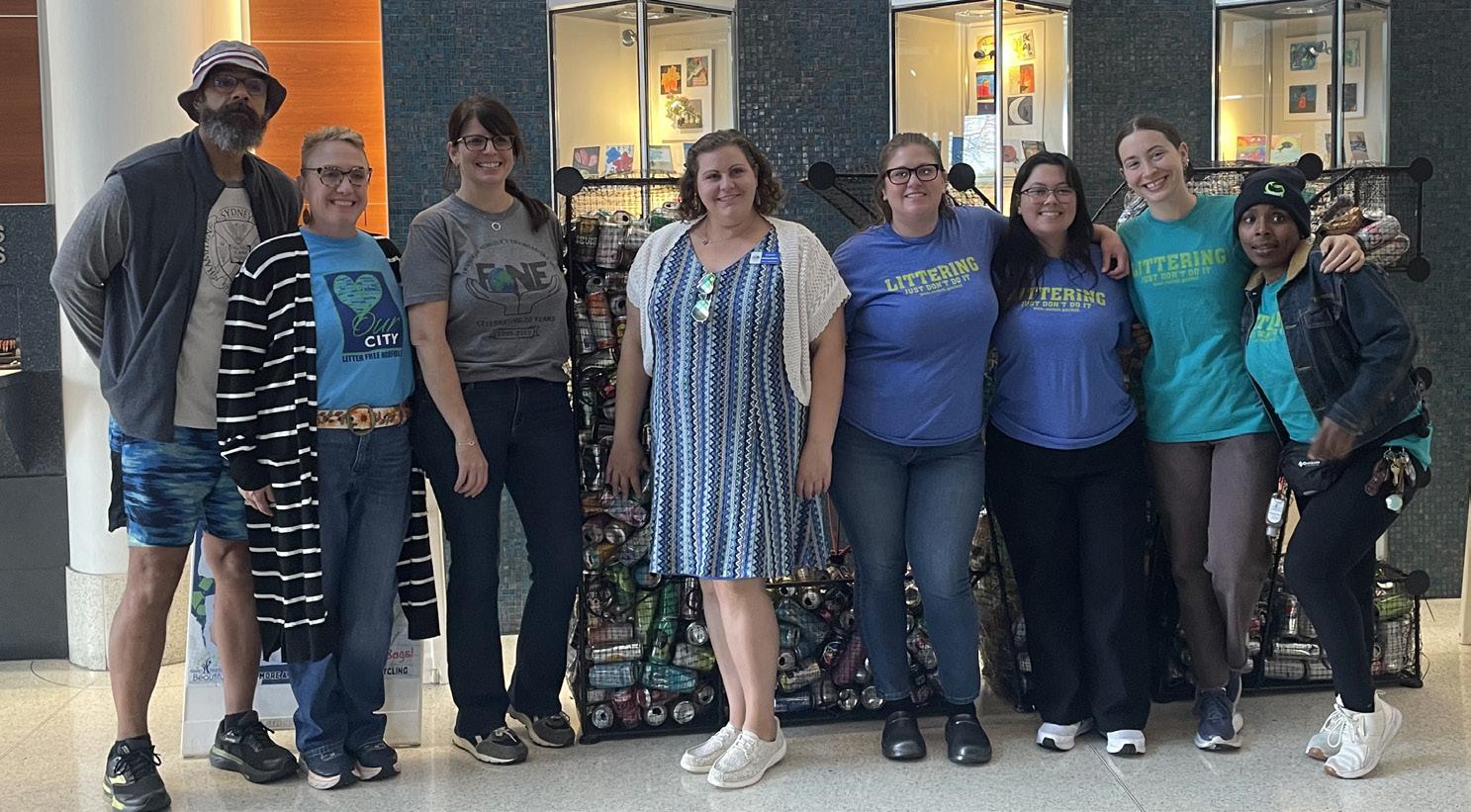
On “America Recycles Day,” Keep Norfolk Beautiful (KNB) and Norfolk Public Libraries partnered to host the UpCycle Festival, meshing artistic creation with civic engagement.
On Nov. 15, patrons and community leaders gathered at the Mary D. Pretlow Anchor Branch Library to reflect and take action on waste-reducing practices.
Some of those involved in the event’s organization have close connections to VWU, including graduate student Sarah Sterzing ’25 and alumna Willow Baker
‘24.
“I was in [VWU’s] newsletter… about the LOVE sculpture that we had at Wesleyan,” Sterzing said. As an artful reminder of recycling’s necessity, the sculpture spells out ‘LOVE’ with melded metal wires that double as containers for recyclables.
Sterzing coordinated with the university to display the sign in the lobby of Greer from Oct. 16 to Nov. 14. Sterzing transported the sign to the Mary D. Pretlow Anchor Branch Library for Upcycle Fest. Graduating this winter with a Masters of Environmental Studies, Sterzing is part of the program’s first cohort.
Baker transitioned from a temp job at KNB to a dedicated volunteer coordinator for waste reduction. Alongside community clean-up events, she is in charge of the “adoptive spots” around the city, which Baker said is KNB’s “long-term volunteer commitment program where you sign up for a section of the street in Norfolk and you dedicate four sections of the year to clean it.”
With her own job at KNB as proof, Baker said students can participate in events like the Upcycle Fest to build not only community connections, but professional ones.
“Networking and just meeting community faces is so important.”
BY BAILEY GRAY bcgray@vwu.edu
Head Track & Field Head
Coach BT Pham, entering his first season as a Marlin, will focus on determination, team spirit and precision in a sport that emphasizes setting new personal records and cultivating a winning mindset.
Pham brings a decade of coaching experience to VWU Track and Field. Before arriving at VWU, he served as an assistant coach at Muhlenberg College and spent several seasons at Capital University in Columbus, Ohio, establishing himself as a dedicated and knowledgeable coach.
Throughout his career, Pham has also held key graduate
assistant roles to further his experience in training, recruitment and program development. His arrival brings new passion and energy to the VWU Track and Field program. Pham said when he enters a new program and new season, he sets academic and athletic goals for the team, such as improving from the previous semester, graduating on time and giving the student-athletes a better experience than they previously had.
“We are always trying to move the needle a little bit year by year, and make sure that each season is better than the previous years,” Pham said.
Marlins feel differing impacts of the university’s name change, but athletes say it should not impact athletic culture.
BY ELI CASEY emcasey@vwu.edu
As Virginia Wesleyan University prepares for its transition to Batten University in 2026, current and former student-athletes process what the change means for the programs, their history and the name they’ve represented for years.
Fifth-year Men’s Basketball guard Omari DeVeaux has spent five seasons wearing the VWU name on the front of his jersey.
“It feels like home,” DeVeaux said. “Wearing it for so long, and then just seeing all the alums who came before me ... there’s a history behind it. Knowing that I’m a part of that history and that culture, it’s amazing.”
Some are uncertain of its impact, while others see the change as an unwanted disruption. Others still say they
“We are monitoring policy developments and keeping our international students well-informed of any changes to ensure continued visa compliance,” Director of Global Engagement Brooke Novkovic said.
feel caught between respecting the institution and wanting space to speak honestly about a decision that impacts them directly.
One alumnus, who asked not to be named, said the name change may complicate how former athletes talk about their achievements. “I feel like this will put a small caveat into every conversation going forward,” the alumnus, who formerly played for the Men’s Lacrosse team, said. “It forces athletes to over-explain something that should really be quite simple.”
The alumnus said some former players feel “betrayed, ignored ... and unrepresented” by the decision, adding that many spent formative years investing in both a name and an institution they believed would carry forward.
Global Engagement creates a ‘home away from home’
BY MARS SMITH mssmith@vwu.edu
Due to cost overruns caused by steel tariffs and planning challenges, Dominion Energy has had difficulty maintaining progress with its Coastal Virginia Offshore Wind project (CVOW).
The project is the second and largest offshore wind project in the nation.
Located 27 miles off the coast of Virginia Beach, Dominion said CVOW will deliver zerocarbon renewable energy for up to 660,000 homes.
According to senior environmental science major Kendall Abercrombie, delays increase boat traffic, which leads to more environmental damage and increased boat strikes on marine life.
“You have a prolonged period of work, vessels coming in and out. Say you were supposed to finish in winter, but now you’re finishing in spring. You may not be accounting for migration and feeding grounds,” Abercrombie said.
“Delays in the development of offshore wind projects will also lead to delays in any expected ecological benefits of said wind energy, such as reduced carbon
emissions and improved habitat quality overall,” senior biology major and marine science minor
Amalia Houff said.
According to Dominion Energy, the goal is to build CVOW in a manner that coexists with the fishing community to ensure it can thrive and continue to contribute to the wellbeing of Hampton Roads, Virginia and the nation. Additionally, the turbines that provide clean wind energy create new habitats for fish.
“On the environmental side, a delay can actually reduce shortterm ecological disturbance, giving marine species more time without construction noise or vessel activity,” senior environmental science major Erin Beaudry said.
“However, in the bigger picture, postponing offshore wind development also delays the long-term environmental benefits that these projects are meant to address,” Beaudry said.
The $715 million installation vessel for the turbines bought by the company, Charybdis, adds to the delays, as it is still not fully prepared. Charybdis can transport the components for four turbines at a time.
Materials such as turbine parts should be produced locally in
order to minimize greenhouse gas emissions and shipping delays, Abercrombie said.
“If you were manufacturing [somewhere local], it wouldn’t take as long to get the product, and less environmental issues would come along with that.”
“Clear planning paired with strong community investments and grassroots funding could reduce costs and delays,” Houff said.
Abercrombie said the public may perceive renewable energy as an unnecessary expense, especially if they see high tax contributions. “If you see a high price tag and you think that’s where your taxes are going, you’re not going to want that to be your energy source.”
Abercrombie said.
“Cost overruns can create skepticism, especially for people who are already unsure about renewable energy,” Beaudry said.
“When prices rise or timelines shift, it can reinforce a narrative that clean energy is unreliable or too expensive.”

Abercrombie said high costs can create a negative stigma around renewable energy, so transparent communication about project costs is important to improve public trust in clean energy.
“Upfront policy can reduce uncertainty about these projects and open up honest discussions about challenges, issues and benefits,” Houff said.
“Public policies also help ensure environmental protections are followed, which reassures residents that ecosystems aren’t being sacrificed,” Beaudry said.
Beaudry said the CVOW contributes to the local economy significantly. “It’s sparked new partnerships between universities, industry and local governments, expanded research opportunities for students, and supported workforce training programs.”
According to Dominion Energy, once in full operation, the wind farm project will support 1,100 jobs.
“Offshore wind farms have been positioned as a major workforce and economic driver,” Beaudry said, “so pushing timelines back can create uncertainty for local planning and workforce development programs.”
An economic-impact analysis by the Hampton Roads Alliance estimates the seven-year impact of the project will generate $5 million in state and local tax revenue. Dominion Energy asserts that clean energy is part of their goals and the project is
BY ISAAC FICK
ihfick@vwu.edu
The Shutdown
The longest government shutdown in U.S. history ended on Nov. 12.
According to the White House website, it lasted 42 days, 22 hours and 25 minutes.
The shutdown occurred because, while both chambers of Congress must agree on a funding bill, the Senate did not clear it initially.
While Republicans control both chambers, the Senate needed 60 votes to pass the bill
and Republicans fill 53 seats, thus requiring the agreement of at least seven Democrats and it ultimately did not meet this requirement, beginning a shutdown on Oct. 1. The Democrats’ motivation for not agreeing to fund the government was a focus on extending subsidies for the Affordable Care Act (ACA).
According to NPR, “ Democrats stood firm during the October shutdown, hoping their resolve, paired with the
devastating impacts of the shutdown on millions of Americans, would bring Republicans to the negotiating table.”
Democrat Virginia Senator Tim Kaine told NPR that “there was no guarantee that waiting would get us a better result, but there was a guarantee that waiting would impose suffering on more everyday people,” which led to the shutdown ending without addressing the ACA concern.
The Supplemental Nutrition Assistance Program (SNAP), which according to NPR, provides
food aid to nearly one in eight Americans, did not receive necessary funding during the shutdown.
University Effects
Along with the national effects of the shutdown, which also included federal employees being unpaid for the duration and airline challenges, Virginia Wesleyan experienced its own concerns.
Vice President for Strategic Initiatives Kelly Cordova said the university is not affected directly as much as public institutions.
Within the university’s operations, Cordova said
“we still feel the impact when a shutdown slows the processing of FAFSAs for our students, delays federal grant awards or interrupts other federally supported activities.”
Assistant Vice President for Student Financial Planning Beth Koroleski said the Financial Aid Office was not affected by the shutdown.
The only way it could have affected the office, Koroleski said, is by delaying the applications’ processing.
She said the office posted fall Financial Aid before the shutdown occurred

“and considering that when a shutdown takes place it is usually resolved quickly, we did not anticipate any long-term effects.”
Cordova said the university also saw how students and families were individually affected, which included delayed financial aid, disrupted federal employment and concerns about essential benefits.
According to BBC, roughly 1.4 million federal employees went without pay for weeks. The funding bill that ended the shutdown included an agreement that guarantees back-pay for all federal workers and reverses the shutdown-related layoffs. The university’s foremost concern, Cordova said, was the students. She said when they saw that SNAP benefits were defunded, they questioned what else could be affected if the shutdown continued: “Could Pell Grants, federal work-study, or other forms of student aid be delayed or reduced?” She added that this is not an abstract consideration for the university.
Cordova said many VWU students rely on these programs and “any interruption would have a direct and immediate impact on their lives, stability and educational progress.”
Overall, the shutdown caused uncertainty, “and uncertainty makes it difficult for any organization or individual to plan, make decisions, and strategize for the future,” Cordova said.
The agreed upon bill funds most of the government until Jan. 30, 2026.

BY BRUCE BLANCHARD bcblanchard@vwu.edu
According to NBC News, international student arrivals in the United States have declined by 19% this August, marking the sharpest drop on record since the 2020 pandemic.
The decline comes as the Trump administration slows visa processing, increases travel restrictions across 19 countries and threatens deportation for any international students expressing pro-Palestinian views.
“We are monitoring policy developments and keeping our international students wellinformed of any changes to ensure continued visa compliance,” Director of Global Engagement Brooke Novkovic said.
In March, the government began detaining and deporting international students in a crackdown on pro-Palestinian activism.
Many of those arrested had been granted the right to live in the US either as permanent residents or through temporary work or student visas for educational

purposes. Their rights, however, have been put into question under new, sweeping immigration orders.
“The U.S. is no longer the central place that students aspire to come to,” said Fanta Aw, CEO of the National Association of Foreign
Student Advisers (NAFSA), to NBC News. Structural barriers that make studying in the U.S. more challenging are furthering this shift in perception.
Although national policies and international tensions continue to shape the context of international
education, their full effect is often better understood at the campus level.
“At this time, most of our students have not been directly affected by recent policy shifts. However, we continue to support them individually as they navigate visa procedures, compliance requirements and travel-related concerns,” Novkovic said.
“The universities here are very different; you get to experience a much better kind of education, and it is easier here than in Germany. I don’t think there are any cons, besides knowing that I have to leave again,” international student Deena Schultz said.
“Being here has helped me meet a lot of new friends, both Americans and international students. The new policies can be scary, but the environment here really helps relieve a lot of my worries,” international student Lora Pavlova said.
The Institute of International Education reported that 96% of higher education institutions identified visa application worries to be a barrier to enrollment.
International students contribute to more than tuition
revenue; they strengthen local economies by their spendings on housing, services, products and health insurance.
According to NAFSA, the presence of every three international students creates or supports one job in the United States.
Hays Post’s Mirka Martel, head of research, evaluation and learning for the institute, said “colleges and universities did absolutely everything in their power to advocate to get these students to the United States.” According to PBS News, at DePaul University, a Catholic university in Chicago, the number of international graduate students declined by almost 62% this fall, a driving factor in recent budget cuts.
DePaul University President Robert Manuel said this is due to student visa troubles and declining interest in studying in the U.S., calling it a “massive” disruption. While universities engage in efforts to support affected students, the impacts are felt on campuses in terms of pressures on budgets, declining enrollment and uncertainty.

Editor-in-Chief
Lily Reslink lbreslink@vwu.edu
Managing Editors
Victoria Haneline vfhaneline1@vwu.edu
Isaac Fick ihfick@vwu.edu
News Editor
Isaac Fick ihfick@vwu.edu
Community Editor
Kami Whisenhunt kjwhisenhunt@vwu.edu
Opinions Editors
Victoria Haneline vfhaneline1@vwu.edu
Elena Lichtenwalner eclichtenwalner@vwu. edu
Sports Editors
Coy Camiscioli clcamiscioli@vwu.edu
Eli Casey emcasey@vwu.edu
Weekender Editor
Calee Lukowski crlukowski@vwu.edu
Photo Editor
Laila Jones ljjones1@vwu.edu
Online Editor
Lillian Glenn adglenn@vwu.edu
Copy Editors
Victoria Haneline vfhaneline1@vwu.edu
Elena Lichtenwalner eclichtenwalner@vwu. edu
Julia Ware jpware@vwu.edu
Tehera Clifton tclifton@vwu.edu
PR Director
Isabella Grosswiler idgrosswiler@vwu.edu
Marketing Coordinator
Bryant Cotterell bccotterell@vwu.edu
Engagement Editor
Sarah Czapp sczapp@vwu.edu
Digital Design Editor
Gabrielle Barnett gabarnett@vwu.edu
Adviser
Dr. Lisa Lyon Payne lpayne@vwu.edu


BY ABIGAIL CULLEY ahculley@vwu.edu
The Global Engagement Office, headed by Director Brooke Novkovic, assists international students with integrating into the VWU community and dealing with the culture shock of being in a new country through various programs and events.
“All of a sudden, everything’s different. If you think about it, even the plumbing is different here than it is in other countries. So something as simple as that is a major adjustment for them to get through,” Novkovic said.
Novkovic said the biggest challenges international students face are the dramatic cultural difference in the United States as well as finding their place and finding comfort in being somewhere far from home.
To ease this transition, the Global Engagement office hosts events and programs with the intention of building a community for these students.
In October, the office collaborated on an event with the Mosaic Project to celebrate the Diwali culture; students from India were able to share their traditional food, arts, crafts and clothes.
Additionally, the office held an International Thanksgiving Potluck on Nov. 20 in the library, where students and faculty enjoyed each other’s home recipes.
Worldly Wednesday also occurs once a month, when recipes recommended by international students are featured at Boyd Dining Center.
By working with Sodexo, students can bring in a recipe from their culture that they normally enjoy at home, so they get a sense of familiarity and can share it with the community.
Novkovic said the hope is the students “start to feel like this is their home away from home.”
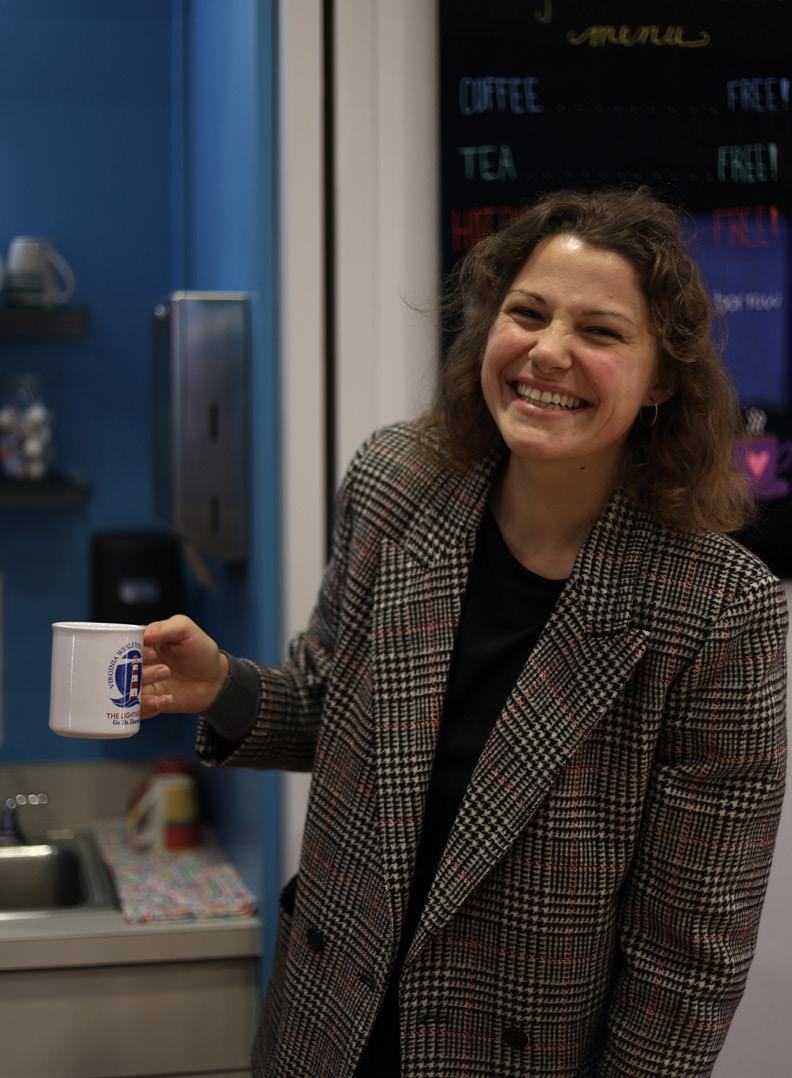
International Coffee Friday, hosted in the Lighthouse, is another weekly event that Global Engagement hosts to spread different cultures.
On Nov. 21, the coffee of the week featured a blend from Bosnia. The office sends out flyers early on Friday mornings informing the campus of the week’s flavor.
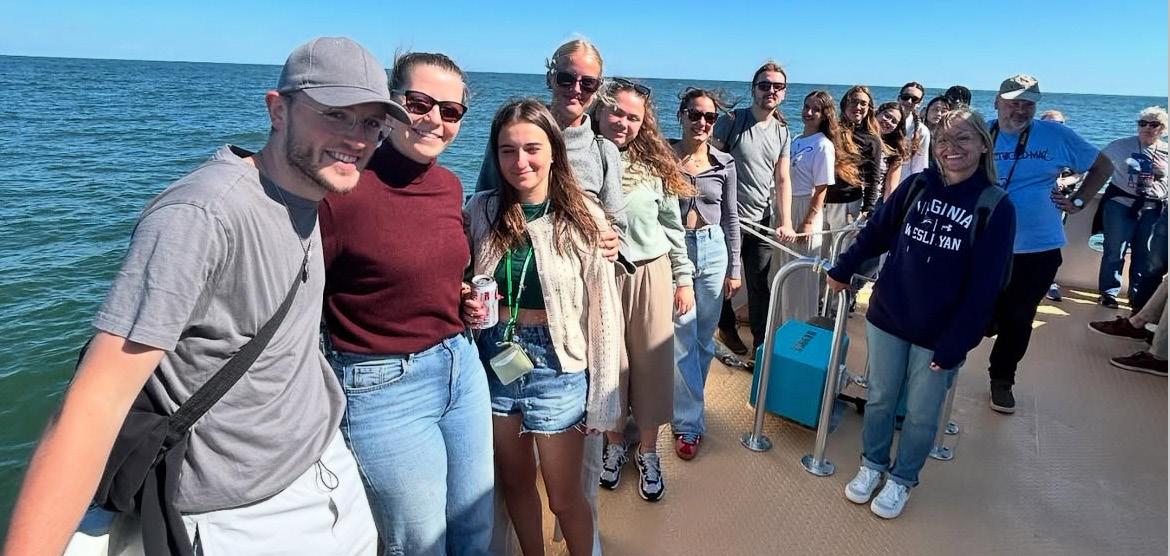
The office also funds off-campus events, such as this semester’s trip to the Virginia Aquarium, where students participated in the dolphin cruise.
Global Engagement also relies heavily
BY KAMI WHISENHUNT kjwhisenhunt@vwu.edu

“As
on sports for this integration process. Many students come to the university to play a sport or join a sport later on to gain a sense of community.
Josh Buckland, a sophomore international student from England, plays tennis with many students from other countries, as the tennis team is largely made up of international students.
“Tennis has helped me integrate into the U.S. by automatically creating a support system and friend group for me,” Buckland said.
Global Engagement is currently working to address concerns that some international students hold, including Frieso Ter Schiphorst, a sophomore from Germany.
“Oftentimes international students make up the majority of the attendees at such events, making it hard to integrate with domestic students,” Schiphorst said.
To combat this, Novkovic said Global Engagement sends out frequent reminders to every student on campus about their events in their weekly newsletter and various flyers around the campus. Through collaborations with Student Engagement and the Mosaic Project, Global Engagement has found an increased participation in events.
Schiphorst said transportation is difficult in the Virginia Beach and Norfolk area.
Every Wednesday night, students who work with Global Engagement, juniors Avery Belisle and Gabrielle Barnett, take turns driving a bus to stores for international students who lack transportation. The office also offers
information to students attempting to get their driver’s license.
After studying abroad in Heidelberg, Germany, Belisle said she experienced how difficult it is to learn in another language, particularly with presenting projects.
She said she has since made it her goal to assist students from other countries in giving presentations and writing essays in English.
Clinical interns, with guidance from counseling staff, started offering support groups such as Mindful Bites, Savoring Senior Year, VetConnect, athletic support groups, support for international students and a sexual assault support group.
“We start each first group that we have with establishing ground rules. Each person in the group can add their concerns or add what their boundaries are,” Michelle De Rosa, director of Counseling and Student Health, said.
De Rosa said this is a clinical structure for establishing what everyone’s boundaries are. She said the clinician leading the group then writes the boundaries on paper, and for each subsequent group, those boundaries and guidelines are upheld.
“Confidentiality, privacy and respect are enforced, but the group members are the ones who formulate those rules,” De Rosa said.
De Rosa said when creating the support groups, she also took her own passions into account and the kinds of support she wanted to offer students, along with gaps
she has noticed in what’s currently available.
Students feedback shapes ideas for new groups or services from counseling. A few students requested the peer-led sexual assault support group and the office has been working to get it started.
De Rosa said not every group ends up taking off right away, but are kept ready to launch as soon as more than one student is interested.
Each support group is led in clinical techniques to ensure safe and productive discussions, but De Rosa said each group is structured differently based on the needs of participants and what they want to see.
The groups vary in format, location and content, with some being more structured and others more open-ended.
“In any group, the group dynamic and the group needs outweigh a clinician’s idea of what the group should be,” De Rosa said.
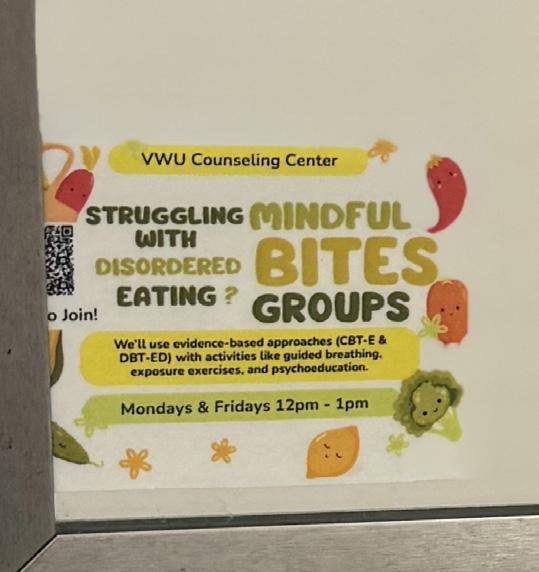
The athletic groups have taken place in the golf area or locker rooms. The Mindfulness Bites support group focuses on relationships with food, body images and pressures surrounding appearance. Its meetings are held in the Boyd Dining Center for a more laid-back setting, where
everyone eats together and has open discussion. Clinical interns Casey Cecere and Dejah NilesBogger created this support group.
“We chose Mindfulness Bites Group to bring awareness to the many types of disordered eating. Eating disorders are not as talked about like other disorders,” NilesBogger said.
De Rosa said there’s going to be evidence-based approaches for this group some days, as well as more open-ended days. For some meetings, the clinicians might come with prepared topics like restrictive eating or breathing exercises.
“It’s a little bit more accessible; it’s more stripped down and comfortable in that community setting. It can also reach more people. Our campus is growing, our campus’ needs are growing and by doing groups, we’re able to meet the needs of more people,” De Rosa said.
The VetConnect group supports veterans in transitioning and adjusting to campus life. It works to connect fellow veterans and allow them to share their experiences to build a stronger support network on campus. It’s held in a more private, enclosed setting where there are not as many people. Structured
around worksheets and handouts, it’s consistent and more structured compared to other groups.
Veteran student Brittany Perry said she hasn’t experienced this group but believes it would be beneficial for personal and educational purposes because transitioning to campus life can be difficult.
“Having someone to either ask for advice or lean on can be beneficial. I think there’s a huge need for it. I have yet to meet a veteran on campus. However, it would be cool to be able to relate to someone and not feel like such an outcast,” Perry said.
Clinician and doctoral student Madison Miller developed the Savoring Senior Year support group. She said her idea behind it is to provide a space for seniors to be able to talk about their concerns, fears or excitement during their last year.
“The Savoring Senior Year group was created to give VWU seniors a dedicated space to slow down, reflect and feel supported during one of the most meaningful and often overwhelming transitions of college life,” Miller said.
Counseling is partnering with Career Development to spread the word of resources that help seniors alleviate concerns of finding a job after graduating.
De Rosa said she will measure the success of each support group by its slow growth and feedback from participants.
Support groups are seen as crucial for meeting the diverse needs of students, according to De Rosa, and she said they offer a more accessible and community-based approach compared to individual counseling.
BY OMARI JONES ozjones@vwu.edu
VWU’s performance of “The Thanksgiving Play,” directed by Professor of Theatre Sally Shedd, blended comedy with a deeper message about how we think about Thanksgiving and the stories we’ve been taught growing up.
The play, written by Native American playwright Larissa FastHorse, follows four white theatre artists who are trying to create a “politically correct” Thanksgiving show for kids.
The problem are that they don’t really understand Native American history and they don’t have any Native people involved in the project.
This leads to one awkward moment after another, and their attempts to fix things only make them look more confused.
That confusion is what makes the show funny, but it also gets the audience thinking about whose voices get included when we tell historical stories.
“The Thanksgiving Play is a satirical comedy. The play centers around a group of four well-meaning but culturally insensitive white theater artists who attempt to create a politically correct elementary school play about the first Thanksgiving while struggling with their own biases and the lack of Native representation,” Shedd said.

Amalia Houff, a senior who played Logan, said she appreciates the show’s wit and absurdity during particular moments.
“It also leaves room for empathy for well-meaning people who may not have all the tools or resources to be as thoughtful as they want to be,” Houff said. Houff said she believes the performance will leave an impact on campus.
Houff said FastHorse’s inspiration for
the play comes from her own experience as an Indigenous playwright who was often told her work required “too much” Native representation.
“It has a larger message that is important for everyone to hear, especially with our current political situation and it being Native American Heritage Month,” Houff said.
Sophomore prop master Jocelyn Rowe played a big role in bringing the show to

life. She was responsible for creating and ordering all the props used on stage, many of which added to the humor and helped highlight the play’s message.
Rowe said she connected with the play because of what it reveals about the traditional Thanksgiving story.
“‘The Thanksgiving Play’ is a play about the complexities, stereotypes and historic injustices revolving around the Thanksgiving holiday from a Native American perspective,” Rowe said.
“Those viewing can expect a good laugh as well as see things from a different perspective,” Rowe said. “I think this play could give students a view different from their own as well as hopefully not only lift the mood but encourage others to get involved in the arts,” Rowe said.
“I thought it was really funny,” freshman Jayla Fields said. “What really stood out to me was how all the actors sold their characters. It was really believable and really made me feel immersed into the whole play.”
The play makes it clear how easy it is to get things wrong when people try to tell stories about cultures they don’t understand.
Because the characters try so hard not to offend anyone, they expose their own stereotypes.
“The Thanksgiving Play had strong acting, clever props and thoughtful direction. The performance offered both entertainment and a chance to view the Thanksgiving holiday from a different angle.
Shedd said using comedy is a helpful way to talk about these tougher topics. VWU’s cast took this approach to heart, delivering a performance that made people laugh while still encouraging reflection.

BY STEPHANIE CLARK
Virginia Wesleyan University’s current attendance policy operates on a simple principle: students are permitted the same number of unexcused absences as weekly class meetings.
For instance, a course that meets twice a week means that a student can have two unexcused absences before it begins to affect their grade.
Students with approved accommodations are allowed the same number of additional absences. Any absences beyond those limits typically result in a full letter grade deduction.
To be excused, students must provide a doctor’s note, a professional notice or special permission from the professor.
Although this policy was implemented with good intention, to promote responsibility and academic engagement, this policy disproportionately harms students living with chronic illnesses and disabilities.
Even the additional absences allowed under special accommodations often fail to reflect the realities and severities of unpredictable health conditions. If a student contracts the flu, it can take them out of class for a week, already doubling the allotted absences for many courses.
Should that student get another illness or need to take a day off, they risk dropping their grade an entire letter regardless of their academic performance in that class.
I speak about this matter not to encourage a new policy that will allow students to skip class without reason, but because I believe that the realities of many individuals on this campus should be recognized, myself
included.
I live with a neurological disorder causing chronic aura migraines that are often triggered by factors as minor as a strong scent or a weather shift. In Virginia’s famously unpredictable climate, this can mean two to three migraines a week.
When I have a migraine, I usually lose vision in one eye and endure intense head pain that makes concentration impossible. Yet under the current policy, I must constantly ask myself if attending class while pushing through the immense pain is worth the risk of academic penalty.
My decision of whether to go to class or not carries long-term consequences, as it does for so many other students. As someone preparing to pursue law school, maintaining a strong GPA is crucial.
A single grade reduction due to absences and not performance could put my long-term goals and years of hard work in jeopardy. What appears to be a simple and tedious attendance rule to some can have life-altering effects for students with disabilities.
To further complicate matters, most

professors require a doctor or professional note when a student is requesting an excused absence. This can be extremely difficult for students who do not have a doctor in the area, like international students.
While some may argue that we have a clinic on campus, the center is not as easily accessible as it is made out to be. The Sentara Student Health Center, although advertised to close at 2 p.m., has been closing earlier than scheduled, often without notice to the student population.
When already physically unwell, walking across campus and then waiting for documentation can be unreasonable and inaccessible. Students are effectively told that their word and their experience is not valid without professional verification.
Similarly, this policy also treats college students as though they are still in high school, despite the fact that Virginia high schoolers receive more permitted absences than we do as paying adults in higher education.
We are responsible for funding our own education, typically through loans we will carry long past graduation. If a student chooses to miss class excessively and their grades suffer, that should be a consequence of their choices rather than a punishment imposed regardless of academic achievement.
Students have proven time and time again that they can excel while occasionally missing class. In these cases, attendance should not overshadow their academic performance.
VWU should acknowledge that students learn in many diverse ways. Many are capable of succeeding even through a disability.
By updating the attendance policy to include increased flexibility and accessibility, and by expanding virtual participation options for those who are contagious or incapacitated, VWU can demonstrate its commitment to equity and student well-being.
We as a university have the opportunity to build a new system that respects student health, supports academic success and upholds the true purpose of higher education.

Clark|Courtesy
is a senior majoring in international studies and Hispanic studies. She spends her time planning events for SGA as the events coordinator, and as president of The Mosaic Project.


Alen Curovic answered questions from Opinions Editor Elena Lichtenwalner regarding data literacy. Data literacy is how to read, analyze and use data.
Lichtenwalner: Should data literacy be taught?
Curovic: Yes. I believe if you don’t know how to work with data, you don’t know how to read it, then that becomes useless to you. Somebody else can see it as a gold mine if they know how to work with data.
L: How does data literacy differ from just regular literacy?
C: Common literacy is what you receive in real life in paper format, in which you didn’t collect it from the internet; you didn’t get it from a database or bank.
In data literacy you can use the internet to compare and find correlations and dependencies between what works and what does not. In common literacy, you yourself would have to read and break down what you read, like determining the reasons for writing in certain ways. With data literacy you get to collect data from the internet. You can create models and you can use other models for comparisons. In data literacy,
you can have columns of different categories, which is basically what you would do on a paper to break it down, but instead somebody can do it with columns on a spreadsheet. The goal in the end is the same. The difference is how you process the different types of information you received and what tools you have available to you.
L: How can learning about data literacy help within the job field?
C: Medically, you have a lot of historical data. You get more research on it so the data keeps increasing. In social work, let’s say you’re trying to help with retirement homes. You see how you gain more and more data on how to treat the elderly better, how they would feel more comfortable. By knowing how to work with current and past data, you’ll be able to give them better treatment, or something you assume to be better treatment, by all the previous knowledge that’s been acquired. Of course, you always have to update data. You still have to keep learning new data, updating or staying informed on how to treat the elderly, such as new medication or methods to care for the elderly that may come out. Thus, it’s always important to be updated on how to read and what methods to use for the betterment of other people.
L: For students who are interested in data literacy, where can they find resources?
C: First, I watched YouTube videos. Google is an old friend of mine, which I can ask. I also do a lot of trial and error in which I see the modeling and the correlation between different features or I cluster them into different categories. But in general, a way to work with data literacy is to get yourself out there. When you try to analyze the data for the first time, it’s better to get your feet wet with it rather than watch somebody else do it. I think hands-on experience is a lot more beneficial than reading how to do it. Rather than just make mistakes, go for it again, just be critical of your own performance. If you don’t get the results you want, go back and see if you did anything wrong.
L: Any other thoughts on data literacy?
C: It seems like a fancy, more advanced term: data literacy. But in the end, it’s just like normal literacy. It’s nothing someone should be afraid to enter into. It’s the same way you learn how to read. The more you do it, the better you become, the more you work with it. It won’t hurt you by knowing how to handle information. It can only bring you benefits.

BY ROMAN FOSTER rdfoster1@vwu.edu
season leading the Women’s Basketball team, and her impact is already evident. Known for emphasizing accountability, work ethic and a team-first mindset, she has shifted the culture in a short period.
Marlins currently hold a 4-1 record and are averaging 71.8 points per game under her guidance, up from 55 points per game last season.
approach to her time with the Dickinson State University coaching staff, which earned national recognition as Coaching Staff of the Year in 2023.
hard work, competitiveness and selfbelief to Virginia Wesleyan, insisting on a culture in which players are accountable and confident in their abilities. “I don’t know any different,” Belo said, adding that when you combine belief effort, good things happen.
Marlins have embraced that mantra, buying into the
high standards Belo sets and demonstrating it through their energy, communication and Sophomore Brianna Long and junior Maesyn Blaylock are two representatives of the culture Belo is building. Long has been the driving force for the Marlins, averaging 28 points and 15 rebounds in key games, over at and all-
tournament honors at the Tipoff Classic, complements Long with her steady playmaking and defensive presence.
Belo said their work ethic and oncourt communication set the tone for the rest of the team, helping to establish the leadership and culture she’s cultivating.
The duo’s early-season performance demonstrates that the Marlins’ success is a result of their hard work and chemistry.
Off the court, their leadership shines through a culture built on believing in one another and staying connected as a team. Blaylock has fully embraced the leadership responsibilities Belo challenged her to take on this season.
Belo said she credits Blaylock for giving the team a mature, steadying presence, and Blaylock said the team is “closer together than ever” and they “do everything together off the court.”
cornerstone of the team’s identity. She leads the team with 3.6 steals per game and averages 3 assists a contest.
Blaylock, who also earned all-

Among current athletes, the reaction is more focused on day-to-day realities. One senior, who chose to speak anonymously due to concerns of repercussions, said the change raises practical questions for teams that already operate on limited budgets.
“For a school that already relies on fundraising to get their athletics through each season, this name change is only going to cause problems,” the senior said. “A lot of teams just got new jerseys. Now they have to do it again ... it seems wasteful.”
“No one I’ve spoken to is advocating for this name change,” the senior said.
DeVeaux also said he feels athletes never had a formal space to express thoughts about the transition. “I don’t think I’ve really had the opportunity to speak my mind about it,” DeVeaux said. “Maybe the athletics department could have put out a survey or something. But at the end of the day, it’s not really the students’ choice.”
DeVeaux believes younger players may not feel the transition as strongly as those who have worn the Virginia Wesleyan name for years. “New people coming in can create their own paths, their own new journey,” he said. “Change isn’t easy. Change is hard.”
The anonymous senior said players feel pressure as representatives of their sport and the university. “As a student-athlete, everybody is watching us,” the senior said. “We are constantly reminded to be on our best behavior all the time.”
As a student-athlete, DeVeaux said, “You represent your coach and your sport.” DeVeaux said athletes are aware of how criticism could reflect on their programs.
“You could potentially get in trouble for it. It’s super tough to really voice how you feel,” DeVeaux said. “Within reason ... there should be space to voice your opinion.”
According to DeVeaux, the name change is not a regular conversation topic for the basketball team.
“We don’t even talk about it at all,” he said. “Our main focus is winning a championship one game at a time.”
The senior echoed that the team is trying to keep the situation from becoming a distraction. “For this coming season, we are trying to overlook this and not let it affect any performance on the field,” they said.
Off campus, the alumni raised concerns about whether longtime donors may pull back, especially considering the reaction from a majority of alumni.
On campus effects, the senior said there are potential challenges in recruiting freshmen unfamiliar with the new name. DeVeaux said he wonders how prospects might react when they learn the school’s identity has recently changed.
“You walk up to a kid and say ‘Batten University,’ they’re like, ‘What’s that?’” DeVeaux said. “Then you tell them you used to be Virginia Wesleyan.”
“The culture is always going to be the culture,” he said. “It’s a good school. The support system here is great,” DeVeaux said. He said he remains confident the name change will not interfere with the culture within the athletics department.
Long leads by example, bringing the same work ethic and humility to the locker room that she shows in games. The duo’s combined leadership — Blaylock with her guidance and Long with her tireless work — has helped unify a roster still
finding its identity, reinforcing the standard of accountability and togetherness that defines Belo’s program.

As the Marlins prepare for ODAC competition, the emphasis on culture, belief and accountability remains at the forefront of the marlins identity.
With Long and Blaylock leading by example and the team buying into Belo’s high standards, the Marlins are poised to build on their strong start. Early success, all-tournament honors and recognition like Long’s ODAC Offensive Player of the Week award are signs that this program is not only competitive but also that people are taking notice.
Belo’s second season is shaping up as a turning point, and the Marlins are proving that the combination of talent and culture can translate into tangible results on the court.
“Without them, I don’t think it would be the same.”
BY BAILEY GRAY bcgray@vwu.edu
The squad is in the early stages of preparation for competition routines that begin in March, and team members have their eyes set on qualifying for Nationals in Florida at the end of the season.
Cherelle Artis, a 2010 VWU alumna, is the head coach of the cheer team and is a former VWU cheerleader. She describes her return to the university to revive the cheer team as a full-circle moment.
“The culture at Virginia Wesleyan has been great. That’s kind of what inspired me to get back involved at the University,” Artis said.
Artis aims to foster a family atmosphere and close-knit bond among the team through team bonding activities and sharing more about herself to encourage openness with her athletes. “If we all can’t work together as a team, and we don’t all know each other and feel comfortable with each other, it’s never going to work and we’re not going to succeed,” Artis said.
Sophomore and Captain Courtney Moore said that the team has been excelling in practices as far as learning new cheers, dances and halftime routines. “I feel like we have a very strong team,” Moore said.
Artis said she wants her athletes to be “bought in” to the program so that everyone’s goals are aligned. “This season is really about the team dynamics and hopefully competing at our first competition in March is one of our goals that we really want to hit this year,” Artis said.
In regards to her coaching style, Artis said she likes to be organized and set a standard to help athletes learn to manage their time and tasks. “I would say I am very relaxed, but also very structured and have a big attention to detail,” Artis said. The team began conditioning in the summer and officially began practicing in late August. In-season practices are held Mondays, Tuesdays and Thursdays in the CMAC from 6-8 p.m.
Freshman Taylor Griffith has enjoyed her experience on the VWU Cheer Team so far because of the commonality she has with other first years navigating through their experience cheering in college.
Griffith said she likes the coaches’ outgoing personalities
and appreciates the amount of effort they put into teaching new skills at practice. “They are strict when they need to be, but they are also able to have fun with us,” Griffith said.
Artis compared the responsibility of being on this team to a job, highlighting that every athlete must be dependable and committed. “I like to have my athletes learn how to take the initiative on their own as well as when it comes to managing tasks and managing all of their activities,” Artis said.
Moore noted that she doesn’t think there could be one coach without the other because of their accountability and family-feel. “They brought back our cheer team to Wesleyan, and without them I don’t think it would be the same,” Moore said.
Moore said that since the team is fairly new they welcome athletes who are new to the sport and help teach and improve their skills. “I think it’s just a very positive community all trying to help build each other up,” Moore said. Although recruitment is complete, alternates are always welcome.
Moore said she feels her leadership role is needed in practices and she counts herself as someone any of her teammates can come to for advice. “I definitely like to lead the team in practice by giving super helpful feedback,” Moore said.
Griffith looks up to the team leaders and is glad to see that the chosen captains were rewarded for their efforts with that role. She thinks it is helpful to have two leaders available for those who have questions.
Moore said she leans more towards a base role in a stunt group and emphasized that each individual role is extremely important to hold up a flyer and execute a perfect stunt. “You definitely need everyone and
everyone is very crucial,” Moore said.
This summer the team purchased new signs to incorporate into their game day routines and get fans more involved. Artis said she wants the crowd to know the team’s cheers. On game days the team is working to choreograph dance routines for timeouts and halftime with the VWU Pep Band. “I think that’s going to help boost team spirit and get the crowd excited,” Artis said.
Moore said she enjoys being part of the halftime performance because it is the closest they come to a competition routine that features a cheer, stunts, a pyramid, throwing flyers into the air and a dance portion.
Since joining the team, Moore said that she has improved the most on her jumps. “When I first joined the team, I could maybe do one jump, and it wasn’t that high. But this year, I am able to do four jumps consecutively,” Moore said.
Moore is looking forward to competition season and facing some top tier teams, since they did not get the chance to last year. “I think it is super exciting to showcase all of our skills that we have been working so hard for,” Moore said.
While the team is still in the early stages of piecing together a competition routine, Griffith has high hopes of making it far. “I definitely want to go to nationals in Florida, so I am hoping that we are able to qualify for that,” Griffith said.
“I am really excited for this year. I am happy with the team we have and I think they are ready to hit the ground running,” Artis said.
The cheer team will showcase their talent at the next Men’s Basketball game vs. Randolph College on Dec. 6.

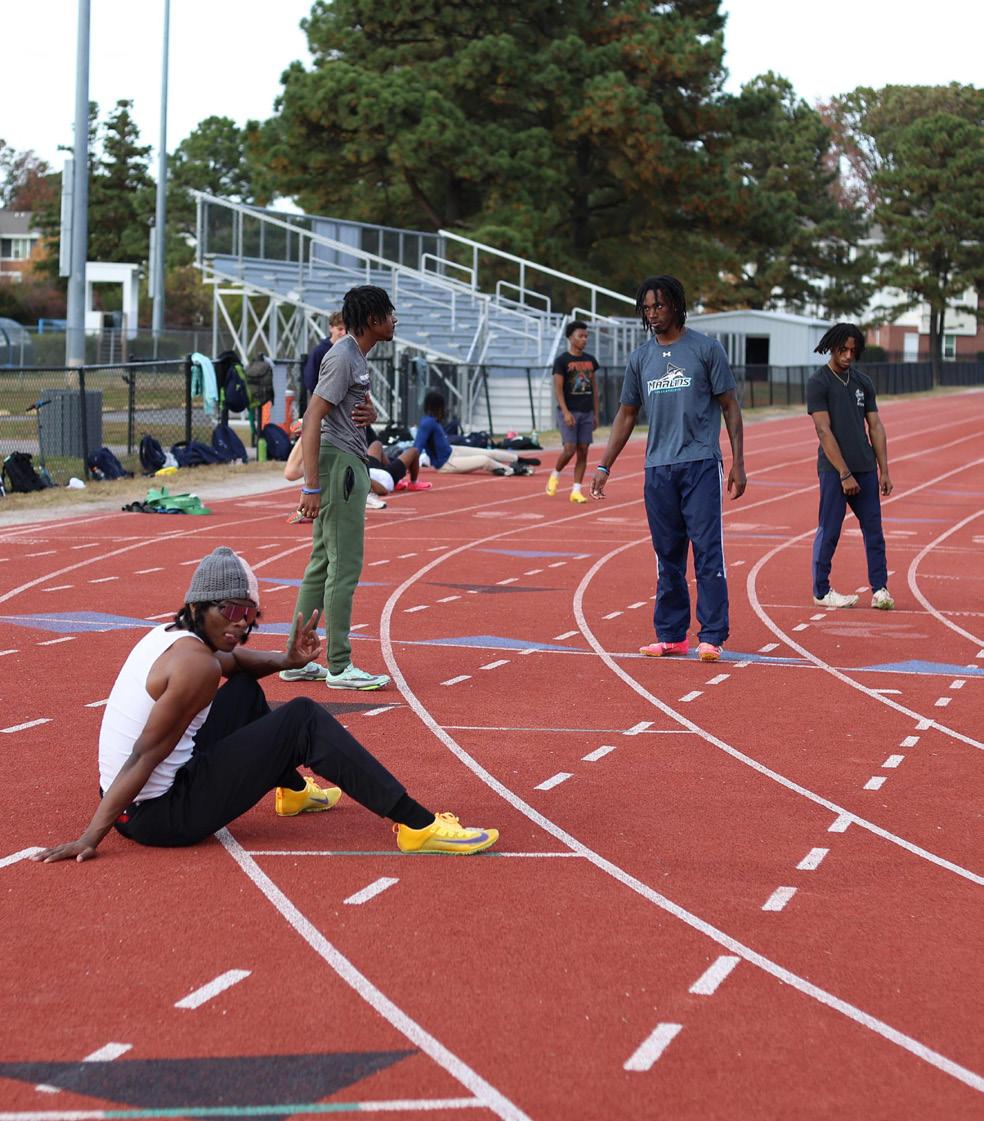
According to Pham, the off-season can be strenuous, but once the winter months come competition is within reach and it is easier for athletes to stay motivated.
Pham said he tries to make practices competitive and simulate race structure to help athletes feel the pressure of competition. “Track is one of those sports where you have to be a little bit more self-motivated,” Pham said.
In addition to it being Coach Pham’s first season, VWU is welcoming Jacob Balot as the new cross country head coach and track and field assistant coach.
Although Balot is on the younger side in terms of coaching experience, Pham said he brings a wealth of knowledge, is a studious coach and always has a yearning to learn something new.
“Coach Balot is a very good distance coach, so he is with all the cross country runners and distance athletes,” Pham said.
Pham said he has already seen significant improvement in the cross country runners in Balot’s program. “They have a couple of top 20 in school history finishes, and they will hopefully get to Nationals for the cross country season,” Pham said.
Senior Ryan Koval, cross country and track and field athlete, mainly competes in middle distances such as the 1500m, 3k and the 800m.
“One thing that Coach Balot is introducing to us this year is that we are going to have specific events that we focus on training,” Koval said.
In a general practice week athletes are split into groups based on their primary events. “Each group has their own individual workouts,” Pham said. Distance runners, sprinters, jumpers and throwers will have separate practices that cater toward their events to train effectively.
Pham said that he primarily works with the sprinters and


breaks down his training in phases depending on the time of the year. In the fall, he focuses on acceleration. In the winter, he works on max velocity. In the spring, he adds in more speed endurance.
“The emphasis depends on the time of the year, and then in terms of what events [athletes] do. Those make a big difference in why and how we train,” Pham said. Overall, the team tries to be as consistent as possible in the weight room.
Koval said he has a minimal off-season due to transitioning directly from cross country to track and avoids burnout due to his love for running. “I just enjoy running and that’s why I do this sport,” Koval said.
Koval said he enjoys having the new coaches because they are knowledgeable in training and mechanics and they tailor practices toward each group’s goals.
“They both know what they are talking about when it comes to training and certain running forms,” Koval said.
“The way we have our staff structured this year, every event group is covered for, so I’m not sitting there coaching something that I am not an expert in,” Pham said.
Pham noted that this coaching structure is very beneficial for the athletes’ progression. He said he is a skilled sprinting and hurdling coach, while Coach K’Vonte Scott is proficient in strength and jumps and Coach Richmond Letterio is a talented throwing coach.
Junior Zantia Durand, a thrower on the team, said she appreciates both Pham and Balot’s personalities and commitment to the team’s success.
“They are very upbeat and motivating. They like to make jokes and light out of every situation, but they are also here to make sure that we are going to be at our top A-game,” Durand said.
Pham said he encourages every athlete, no matter their class, to step into leadership roles, not emphasizing a particular person or grade.
He aims to keep everyone accountable and on board with the goals of the program. “They are able to all work
together and have one common goal,” Pham said.
Pham said he aims for every athlete to leave the track learning something new. He said no matter if they had a good or bad race, the most important thing is that they grow from it.
Before practices, the team will have short meetings to create a sense of team unity. “Success is how we treat each other as a person and how we compete by individual sport, but as a team too,” Durand said.
“I think sometimes people forget that you have to enjoy the process and really enjoy what you are doing in order to actually feel the success that you have,” Pham said.
The Marlins will begin their season on Dec. 8 at the Christopher Newport University Holiday Open.
Players have taken the term ‘betting on themselves’ too seriously.
BY BRYANT COTTERELL
Major League Baseball (MLB) is facing another betting scandal after Cleveland Guardians closer Emmanuel Clase and relief pitcher Luis Ortiz were indicted in a new sports betting investigation.
The league confirmed it is looking into betting activity involving both players, sparking greater concerns about gambling’s growing presence in sports. MLB enforces strict rules regarding player gambling, including a lifetime ban for betting on one’s own team and a one-year suspension for wagering on other MLB games.
However, players are permitted to bet on non-baseball sports. Despite these punishments, players still choose to take the risk. Tucupita Marcano received a lifetime ban last year after betting on Pittsburgh Pirates games while he was on their injured list, underscoring the ongoing challenge the league faces.
The league is cracking down harder on these issues primarily because of how accessible legal sports betting has become, but also to protect the integrity of the game.
Joseph Nocella Jr., the U.S. attorney for the Eastern District, regarding Clase and Ortiz, said “They defrauded the online betting platforms where the bets were placed, and they betrayed America’s pastime.”
Integrity, honesty and fair play are part of the DNA of professional sports. When corruption infiltrates the sport, it brings disgrace to the participants and damages the public trust in an institution that is vital and dear to all of us.
Clase was accused of providing insider information to bettors as early as May 2023 regarding what type of pitch he would throw so the bettor could place a profitable prop bet. Prosecutors say Ortiz joined the scheme in June 2025 by rigging his own pitches too.
Between the two it is estimated that bettors made at least $450,000 with the players receiving a percentage of that for their “efforts.”
The federal charges both players face are severe, including up to 20 years in prison for wire fraud conspiracy, 20 years for honest services wire fraud conspiracy, 20 years for money laundering conspiracy and five years for conspiracy to influence sporting events through bribery.
As legal sports betting becomes more accessible nationwide, MLB is under mounting pressure to protect competitive integrity.
The Clase-Ortiz case may prove to be a defining moment and one that forces the league to take more aggressive steps to safeguard America’s game from the rapidly expanding betting landscape.

BY COY CAMISCIOLI clcamiscioli@vwu.edu
The NBA is facing the effects of gambling becoming more popular in sports as players and coaches are trying to find the loopholes in the system.
Former player Terry Rozier and the head coach of the Portland Trail Blazers entering the season Chauncey Billups are the newest names to get caught.
Rozier was a solid role player during his career and with the Miami Heat last season. He averaged 10.6 points per game in 64 games last year.
Rozier started in 23 games and averaged nearly 26 minutes per game. These stats can make someone wonder why Rozier wanted to risk losing his job making millions of dollars in the NBA for a couple of bets.
As evidence continued to surface it appears that Rozier was purposefully missing shots and faking injuries to leave games early.
Reports have said Rozier told associates that he would exit a game early and they should bet the under on his props, such as less than 10.5 points.
If you add up Rozier’s contracts, his approximate career earnings sit at $160 million and he could have added on by playing more years if it were not for this situation.
Some people suspect that Rozier could
$279 million is how much combined these four earned in their playing careers.
have been caught up with the Mafia, meaning that the Mafia could have blackmailed Rozier into playing like this.
Although it’s not likely, it’s interesting to think about considering Billups was caught up with the Mafia.
Billups was involved with members of the Mafia rigging poker games as himself, along with another former NBA player, who was used as “celebrity bait” to bring in unsuspecting people to the table.
What those people did not know was that there were rigged card-shuffling machines, special sunglasses used by the other players, hidden cameras in chip trays to see other players’ cards and x-ray equipment built into the table to read cards.
There is a possibility that both Billups and Rozier had been blackmailed by the Mafia to get involved in these situations, but money is usually sufficient motivator.
Before becoming a head coach, Billups had a successful career as a player. He was an All-Star five times, along with a 2004 Finals MVP and championship to his name. Billups earned around $107 million as a player and was still a head coach before getting convicted of these crimes.
Professional sports leagues will need to be more cautious than ever to eliminate players and staff members betting on games to ensure the integrity of their sport is not ruined.


anniversary in 2026.
When you think of a café, you may think of white, clean-cut tables, soft music, simple drinks and finger foods offered at high prices. But if you want a new and original vibe, visit Leaping Lizard Cafe.
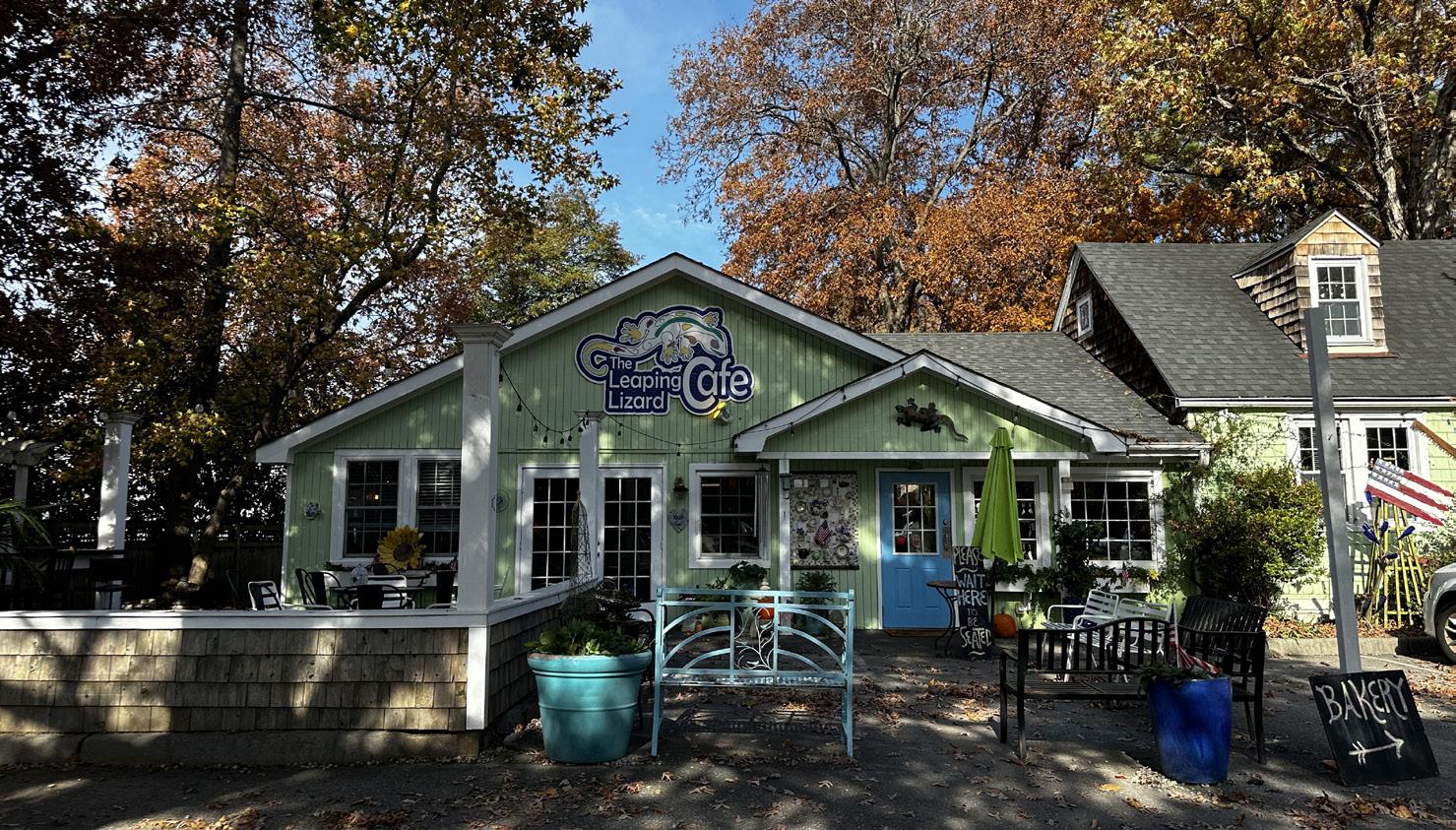
Located on Shore Dr. in Virginia Beach, Leaping Lizard Cafe is a family-friendly café known for its homemade dishes, comforting atmosphere and amazing menu. What began with just five tables and half a bar has grown into a memorable café spot in Virginia Beach.
Owners Amy and Bill Prince had the vision of providing the community with a memorable and comforting dining spot. After 19 years, Leaping Lizard Cafe is still going strong, celebrating its 20-year
This café is based in a cottage-like establishment, which makes it feel as though you have just walked into a home away from home. With the seasons changing, you can enjoy any weather, with indoor seating in the café or porch and outdoor seating in the backyard. Leaping Lizard Cafe also offers vegetarian foods and is pet friendly.
When asked about what Leaping Lizard Cafe’s goal is for their community, it is “making people happy with happy customer service and with happy food,” manager Mary Baldwin said. This goal is widely shown through the menu and community experience of Leaping Lizard Cafe.
In today’s society, it can be a bit difficult finding places that are focused on locally sourced ingredients. Baldwin said that
some of their ingredients (eggs, meats, fish, etc.) are gathered from nearby farms whenever possible.
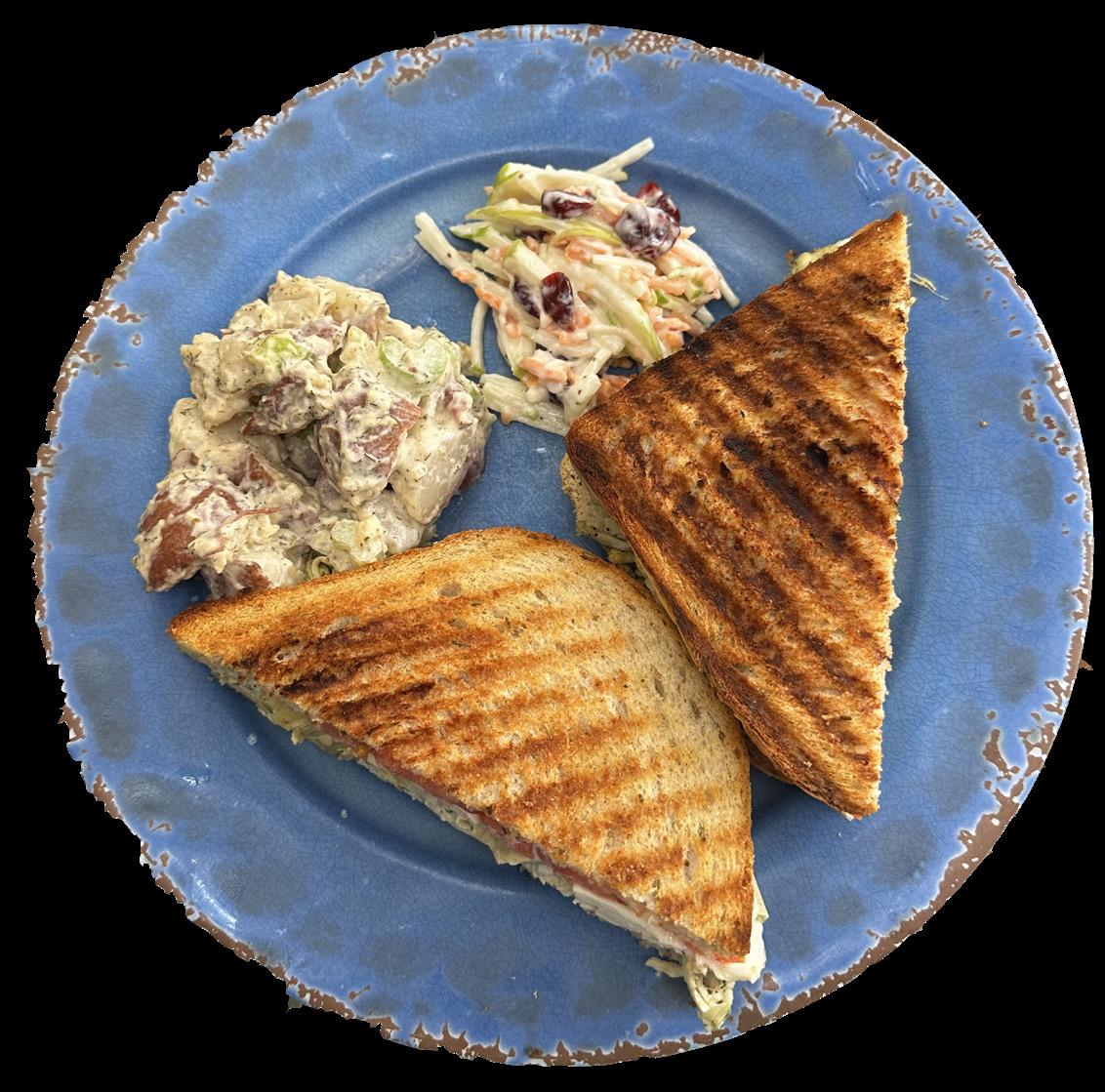
As the seasons change, so does the menu. For example, in the fall you can find sides of apple slaw, coleslaw made with Granny Smith apples and butternut squash. In the summer, Leaping Lizard Cafe offers fresh sides of cantaloupe and seasonal seafood entrees.
Because Leaping Lizard Cafe’s popularity is growing in the area, this means seats and parking spots will fill quickly during peak hours. Parking can be very scarce, so the café recommends that parties of four or more make reservations beforehand. A “parking shepherd” is also on-site to help guests when the lot is packed. “Although busy days can present challenges, the experience is always worth the wait,” Baldwin said.
Regulars and travelers often return to the café because of its amazing cuisine.
“My go-to order is the duck hash on a sweet potato biscuit, it is truly the best thing there,” customer Katie Timmins said.
When asked to describe the vibe in two words, Timmins said Leaping Lizard is “busy but cute.” Leaping Lizard Cafe does not only serve amazing food, but they also have their own bakery directly connected to them.
“The desserts are to die for and it’s run by this wonderful little French lady,” Timmins said. The dessert range is endless, including pies, cakes and cookies. All are homemade and can be smelled as soon as you walk in.
Leaping Lizard Cafe continues to grow while staying rooted in its mission. From homemade recipes to seasonal specials with a focus on community, the café has created a space that has not only character, but also the feeling of family. Whether stopping by for a well-known dish or visiting the bakery, guests can expect an inviting atmosphere built on feeding its community with happy food.
The energetic event combined countries for a fun festival, but long lines and packed premises subdued satisfaction with flavorful food.
BY LILY RESLINK
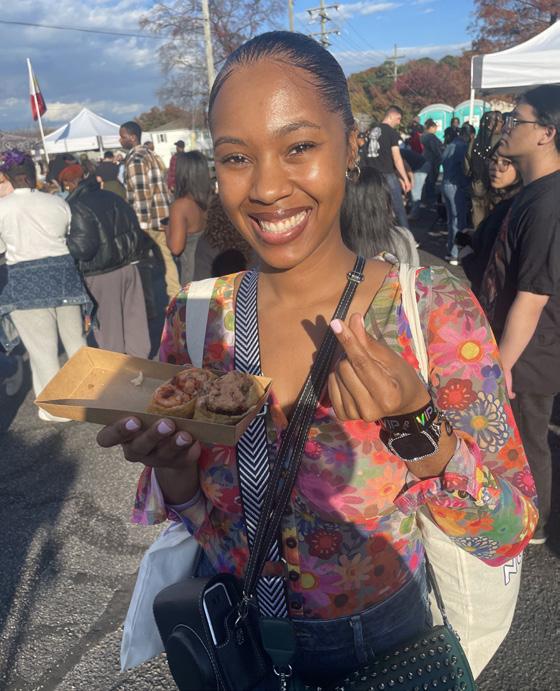
Kopino Fest Vol. 2 brought vendors to Norfolk, VA from far away states to represent the cultures and flavors of even farther away countries: South Korea and the Philippines. Fifteen minutes away from campus, Kitchenfinity hosted the event that fused Korea Fest and Philippines Fest for a weekend celebration Nov. 15-16.
Event attendee Samantha Jackson painted a vivid picture of the festival with observations that she said made it memorable: “color everywhere, sunshine, music in the background, lines of food vendors, the smell of grilled meat and sweet desserts drifting through the air, kids running around, couples exploring, flags waving in the wind.”
Jackson said the energy of the event hit her right away, with “a mix of Korean and Filipino culture coming alive right in front of me.”
I was joined on this adventure by senior Salena Jones, who kindly drove us, and junior Michael Morris.
Morris said that one nonfood experience enhancer was the convenience of the small containers, “which were easy to hold and if I wanted to mix different foods together, I could.”
“It was a great eating experience,” Morris said.
“It truly felt like a foodie adventure,” Jackson said. “Every bite was its own little surprise.”
My first stop was the NYC-
based “Yubu Lab,” serving crisped tofu-wrapped pockets of rice loaded with proteins, sauces, seaweed, and herbs.
I had this several times during my semester abroad in Korea, both prepared at a restaurant and off a convenience store refrigerator shelf. I enjoyed all iterations of the dish and opted to revisit it. It did not disappoint. Each pocket brought a balanced combination of flavors and texture that “Yubu Lab” evidently has down to a science.
Jackson tried shrimp, chicken and beef versions. He said the toppings “had absolutely no business being that good.”
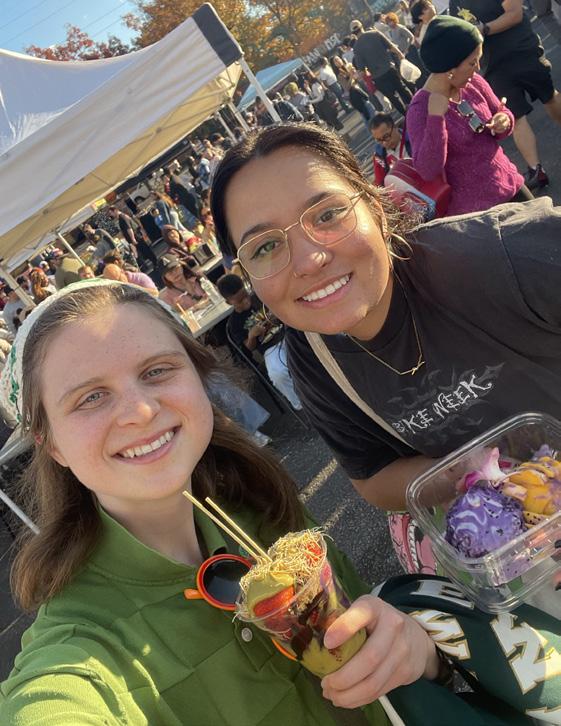
From Sister House, Jones and I tried ube Dubai chocolate strawberries and an ube sticky rice and mango bowl Kopino Fest was my first time trying the Dubai chocolate craze, and I can understand why this flavor combination grew popular. I enjoyed the crunchy toppings and the nutty pistachio flavor. In the cup, I wish the ingredients could have been more evenly distributed. For something with chocolate in the name, I ironically found the highlights to be the non-chocolate tastes. The juicy, voluminous strawberries and the decadent pistachio butter impressed me, but the gloopy chocolate coating overpowered many of the bites.
Jackson, who tried the specialty sticky rice, noted the floral decoration and beautiful presentation. She said the dish “tasted like a vacation.”
Also from Sister House, Morris described his ube lemonade as refreshing and pleasant. “I was
not expecting such a unique taste to it.”
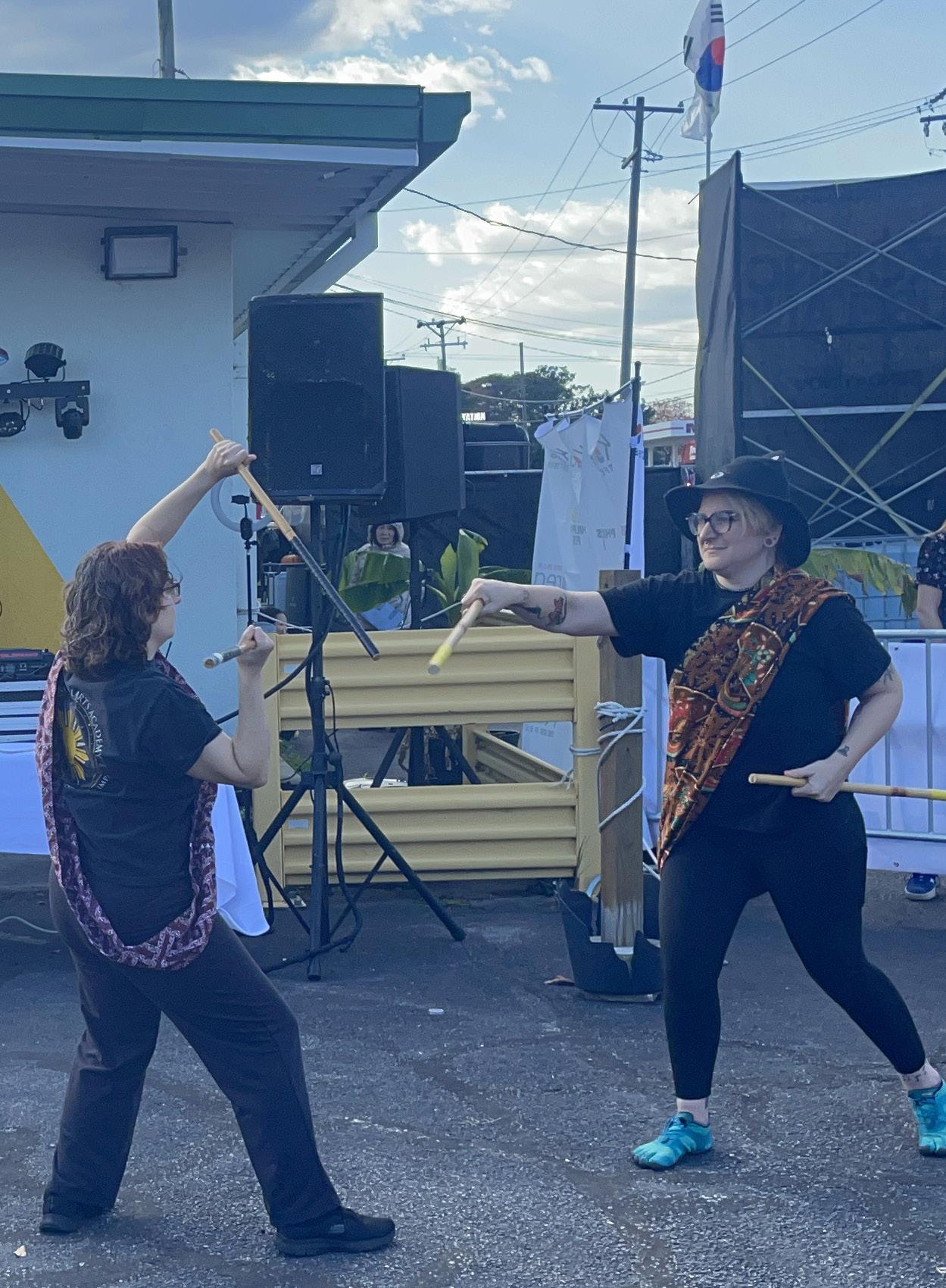
Beyond the bites, Jackson said she enjoyed the beauty of the live martial arts performance. While waiting in line for yubu, I was in a prime position to enjoy the exhibition.
The performance from Impact Martial Arts Academy featured VWU’s own Research & Electronic Resources Librarian, Sarah deRosa. After moving from Maryland to Virginia, deRosa joined the academy to continue her martial arts journey that began at age 14.
The academy got the Kopino Fest gig through an organizer who knew her teacher and asked the group to perform a showcase.
DeRosa said the martial arts group is family-owned and closeknit. “They’re more about the community and having your own personal journey,” deRosa said. These were qualities from her first dojo in Maryland that she was hoping to find again. Instead of just “the belts,” DeRosa said, “it’s about what you’re learning and the journey to get there.”

Event attendees Sean Galante and Charlotte Yagan said they love attending these festivals for the sense of community and ability to try new foods. Although no one I spoke to at the festival complained about anything edible, a few variables brought less-than-ideal circumstances to the experience.
Galante said he hopes that next year, Kopino fest organizers will shoot for a larger venue.
“My biggest thing I wish was different would be more vendors so the lines would be spread out and that there was a bit more variety,” Morris said. “Even so, it was a great place to be.”
Jackson looked at waiting optimistically as “part of the fun.” “The lines were long, but honestly, that’s expected. We made the most of it, helping call out numbers…, dancing to the music and chatting with strangers,” Jackson said.
Kopino 2025 Ratings: Jackson: 10/10
“There’s something special about festivals like this,” Jackson said. She said while the food draws people in, you get to leave with not only new favorites, but new memories.
Morris: 9/10.
“I’d most definitely go again,” Morris said, especially to try items off more menus.
Jones: 8/10
“The food was a 10 out of 10, but the lines dropped it down two points,” Jones said.
Me: 7/10
The vendors and the ube theme were phenomenal. I thought about ube so much that I misunderstood Mikey when he said we had to call an “ube” driver. The event gave me a chance to revisit the foods I grew lovingly attached to while studying abroad in Korea last fall. I just wish the venue gave me more elbow room to
the good food.
CONTINUED FROM PG. 1
Baker said getting people engaged, especially those who don’t already practice environmental consciousness, is a frequent discussion topic in the office.
For some, arts and crafts encourage community engagement regardless of broader environmental themes.
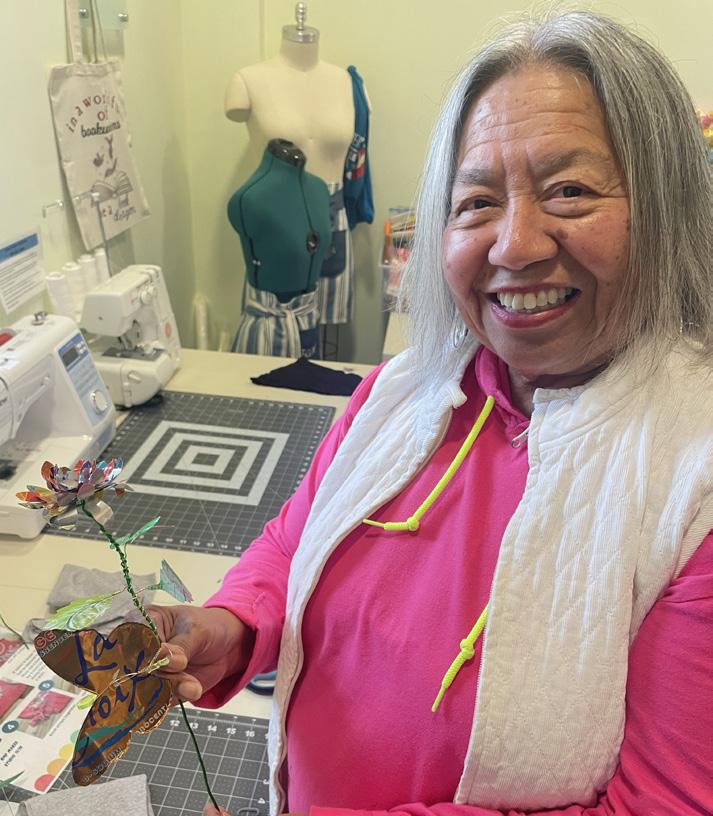
“I love crafts,” Gloria Wood, frequent library patron, said. Wood showed the flower craft she made from repurposed aluminum cans. “I’ve seen them before and I loved them, so I thought ‘I want to make some,’” Wood said.
“Everybody here’s so warm and friendly. They welcome you, so you do feel comfortable,” Wood said.
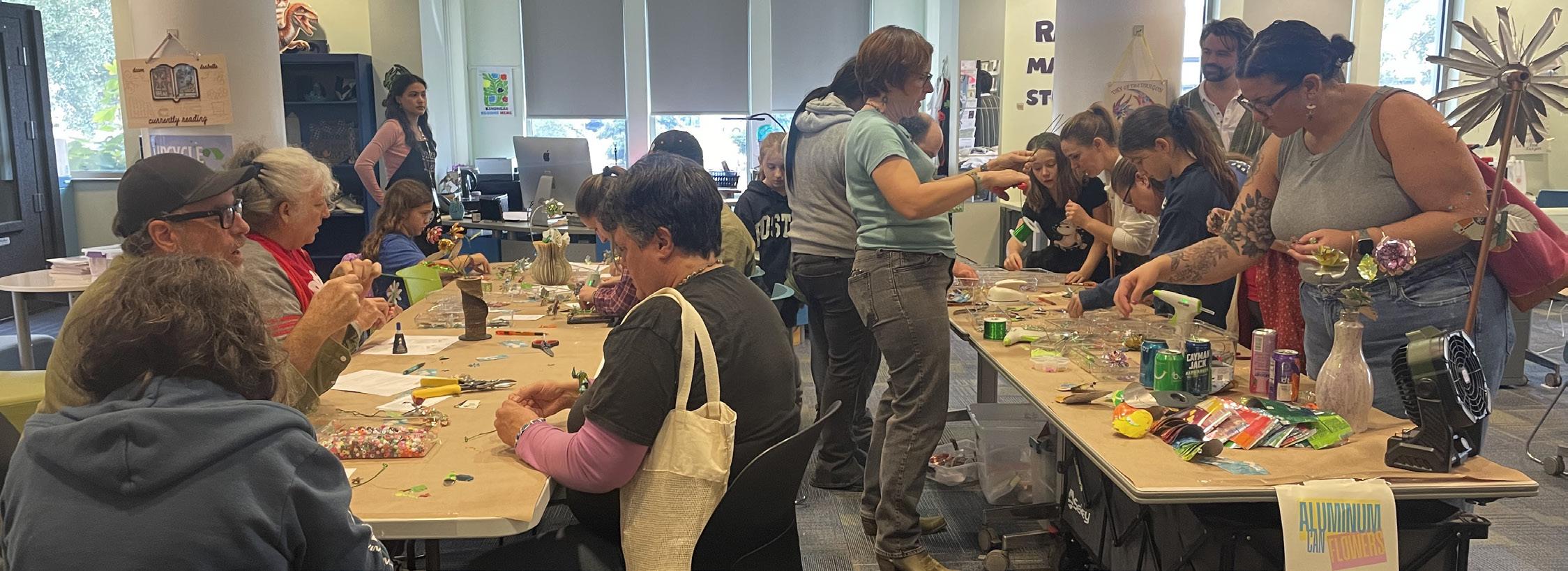
The event invited the community to upcycle with crafts such as making metal flowers, Christmas cards, T-shirt tote bags, journals and jewelry.
Rhasida Bess, jewelry artist and owner of the artisan jewelry shop Alodeuri, instructed patrons on several ways to upcycle materials into bracelets.
“We’re showing people how to make jewelry and other cool accessories out of all-repurposed materials,” Bess said. Bess leads a series with KNB called “Crafted Green,” which she said the next workshop is planned for December.
Bess also teaches workshops in libraries across the region based on demand and season. She said libraries are an ideal host spot for her mission because they work to make things accessible and free. “Working with libraries is a cool way to reach
different people,” Bess said.
Jammica Boone led a compost demonstration at the event. She said one way to get engagement across the age spectrum is having demonstrations where the audience can “touch it, feel it, taste it.”
Regarding the idea of recycling and reusing, Boone said, “I am a tree-hugging earth-lover without question, but also it just makes sense.”
While the library’s maker space bustled with artists at work on their upcycled crafts, Boone said she’s not that creative, but she likes how the earth does it.
At the demonstration, Boone asked the audience: “Should compost stink?” According to Boone, if it does, “that’s how you know something is wrong.” Boone told the audience that this means the compost needs “a little bit more brown,” or organic

matter that produces carbon.
“I live in an apartment, so space is important.” She said that one way she achieves space-constrained composting is using a small container, such as an empty Lysol wipe bottle, to temporarily enclose food scraps before transferring its contents to a larger compost system.
Boone ended the presentation by gifting gummy worms to the row of kids who watched intently from the front of the crowd.
“You got to be able to engage people where they are,” Boone said.
“I always say, ‘you got to make it fun,’” Boone said. “If it’s not fun, it’s not going to work.”
Boon advised that for the goal of organizing collective action, “parties help.”
“Then you kind of get people aware
without them even really knowing,” Boone said.
The Upcycle Fest allotted space for both lighthearted fun and serious conversations.
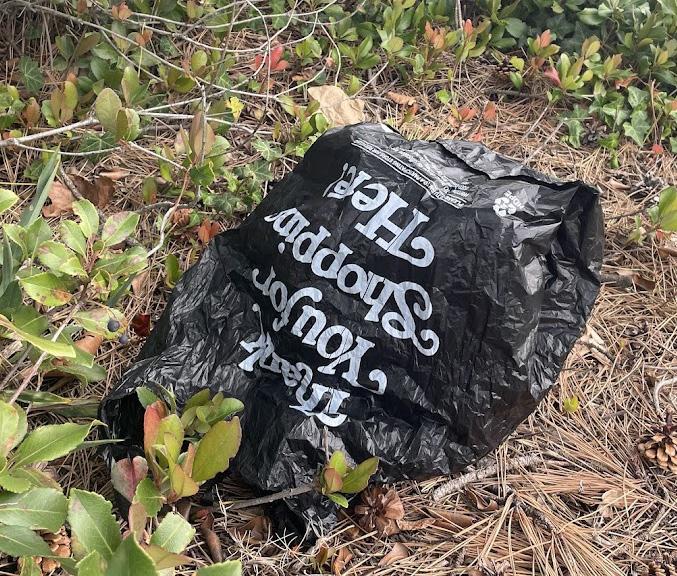
A panel convened to discuss efforts for reducing single-use items, with an emphasis on pollutive plastics.
Executive Director of Lynnhaven River Now Karen Forget said they have been making many attempts to educate the community about legislation for a plastic bag fee.
“We’ve been working really really hard to try to get Virginia Beach to adopt that fee,” Forget said.
Regarding criticism of the policy, Forget said, “We’ve been trying to address the concept that this is going to be hurtful to low-income people by giving out bags, by providing bags for food bank programs, and the feedback we’ve gotten from the food banks is that their clients are really happy to have the bags.
“We’ve met with every city council person more than once to talk about the fee. We met with all 11 of them this fall again in individual meetings,” Forget said.
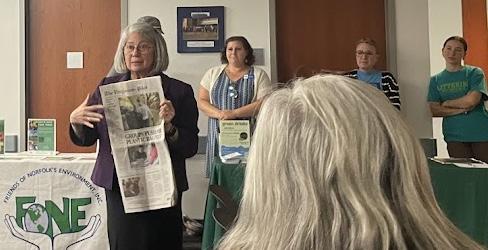
“We are making as much noise as possible,” Forget said. Forget showed the front page of the Nov. 14 Virginian-Pilot to the audience, which had an article on the bag fee legislation.
The Upcycle Fest is one example of a free source of community-based entertainment underscored by a greater cause. Those looking for more events near campus that check those boxes can view the upcoming lineups from local public libraries and organizations such as Keep Norfolk Beautiful.
said.
“Frank and Patty’s is a simple and classic restaurant where they know what they’re good at and stick to it,” junior Madison Mellon said.
Frank and Patty’s might be one of the smallest hamburger and hot dog joints in Virginia Beach, but that doesn’t mean they are anywhere near the bottom of the ranking. With such a small space, it’s hard to resist the charm radiating from every corner of the restaurant.
The converted garage-like building that houses Frank and Patty’s seems like it might make for a cold and uninviting atmosphere. This is classic case of ‘never judge a book by its cover.’ Frank and Patty’s combines wonderful cocktails, craft beer, deliciously greasy smash burgers, hot dogs and hospitality for an inviting atmosphere.
“The atmosphere was so unique,” junior Haley Cummins said. “You feel like a regular even if you’ve never been before.”
The welcoming atmosphere is created mostly by a kind and inviting staff.
“The staff was super friendly, finding any reason to strike up a conversation with you,” Cummins
The small business has become a neighborhood favorite. “Having lived in Virginia Beach my whole life, it’s great to see a small business like this succeed and become so popular,” Mellon said.
“Frank and Patty’s proves that simplicity plus skill equals a smash burger worth obsessing over,” customer Isabelle McGrath said. “It’s the perfect place for a girls night out or a post shift burger.”

Mellon and McGrath would go to Frank and Patty’s after work, as they worked nearby. Even though Mellon and McGrath worked for another small business, the owner of Frank and Patty’s was in no way competitive and was open and willing to make connections, becoming a part of a small business family in the ViBe district.

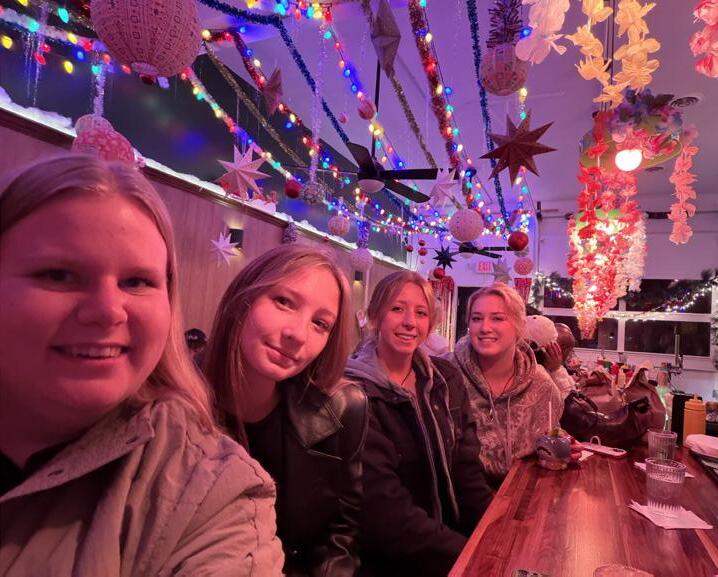
“It was nice to know that another small business was looking out for other small businesses and making an effort to connect with the business owners and employees both. It created a sense of community,” Mellon said.
Frank and Patty’s certainly is a community oriented business, as shown by their most recent collaboration project.
From Nov. 26 until Jan. 1, Frank and Patty’s has been transformed from a retro diner into an island Christmas restaurant as they are partnering with Beachbum Berry’s Sippin’ Santa, a tiki Christmas cocktail pop-up.
Perfectly crafted Christmas themed cocktails come served in adorable and fun tiki Christmas themed cups. Individual cups are available for purchase with designs ranging from a tropically themed Santa Claus to a sweet little shark in a Santa hat.
The Christmas theme doesn’t stop at the cocktails. Frank and Patty’s is decked out in Christmas themed decor, with a
little splash of tiki bar aesthetic. With a mix of Christmas lights and Hawaiian leis, customers don’t step into a winter wonderland, but rather the perfect spot for a Christmas vacation, even if just for an hour.
Although Christmas at Frank and Patty’s is something to see, anytime of year is the best time to visit. With indoor and outdoor seating, it’s the perfect spot for any kind of weather.
“I’ve never had a bad experience there. Between the classic food, kind employees and owner checking in with you and amazing atmosphere, it makes for a great time,” Mellon said.
Tucked away on an unassuming side street in the ViBe district of the Virginia Beach Oceanfront is a building that looks just as unassuming as the street, but Frank and Patty’s is anything but.