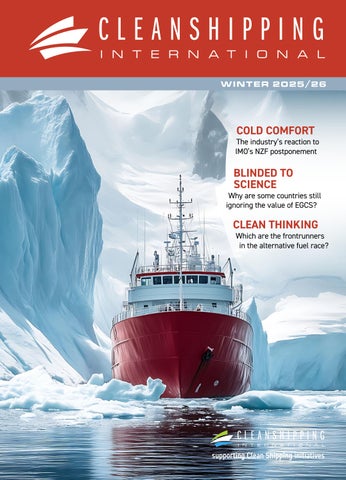
CSI Winter 2025/26

Page 1


COLD COMFORT

The industry’s reaction to IMO’s NZF postponement

BLINDED TO SCIENCE

Why are some countries still ignoring the value of EGCS?

CLEAN THINKING

Which are the frontrunners in the alternative fuel race?

We are problem solvers — in our hearts and minds

At Roodhart, we believe in solutions. Carefully considered, precisely tailored, and always made for what is truly needed. Not just any solution, but the right one. Every single time.

Through our Marine & Offshore Services department, we support the marine and offshore market with a comprehensive range of pumps, separators, electric motors, spare parts, technical support, and engineered solutions. From fleet management challenges to full turnkey engineering projects, we shape the missing piece of the puzzle and make it fit.

Founded in 1982 and overlooking the port of Rotterdam, Roodhart has grown into two specialized departments: Marine & Offshore Services and Emission Control for onshore industry. With over 120 professionals on board, we bring decades of experience to projects of every scale. From small, targeted upgrades to complex, large-scale installations.

For more than 40 years, we’ve approached every challenge with care. As a family-run business, we take the time to make considered decisions, working closely together to combine technical expertise, engineering insight, and reliable equipment into solutions that truly work. It’s about delivering what is needed and understanding the problem behind it.

This mindset is embedded in our Engineering, Procurement & Project Management (EPP) approach, built on the EPC framework. Whether it’s FPSO overhauls, offshore pump skid engineering, BWTS retrofits, or firefighting systems, we provide a complete service. Transforming an initial idea into a fully integrated, installation-ready solution.

Have questions? Or maybe just an urge to chat about the color red? We’re here for both, anytime.

Your reliable partner for pumps, spare parts and engineering services — since 1982

INSIDE THIS ISSUE...

Welcome to the latest edition of Clean Shipping International, packed with all the latest news, views, innovations and initiatives from across the maritime industry that support sustainable shipping.

Whether it’s sabre-rattling or sulking over peace prizes, Donald Trump continues to keep the world on its toes. It was the turn of the maritime industry to come under his spotlight late last year, when he made his opposition to the International Maritime Organization’s Net-Zero Framework very clear. We take a look at the global reaction to the ensuing postponement (page 13).

When it comes to the transition to net zero, innovations in ship design and building are helping to future proof the industry. The Sustainable Shipping Initiative offers an interesting take on this area, explaining why green steel and circular shipbuilding are an untapped pathway to net zero (page 58).

Meanwhile, according to data from Clarksons Research, orders for scrubbers – both for newbuilds and retrofits – are rising sharply, particularly in the tanker and container ship segments. However, some countries are still ignoring the science and banning their use, a topic the Clean Shipping Alliance delves into on page 20.

Elsewhere in this issue, we discover the latest frontrunners in the alternative fuels race (page 25), take a look at a pioneering ballast water treatment system (page 33), learn why companies must meet the global decarbonisation challenge head on (page 38) and examine the latest digital tools aiding decarbonisation (page 46).

Finally, turn to page 63 to discover all the not-to-be-missed industry events.

I hope you enjoy reading this issue.

“Green steel and circular shipbuilding are an untapped pathway to net zero”

S A I L I N G T O W A R D S

Z E R O E M I S S I O N S

Chart a clear course toward zero emissions with advanced monitoring solutions that deliver accurate, real-time insights. Our technology empowers maritime operators to track performance, optimise efficiency, and confidently navigate their sustainability journey.

Editor: Samantha Robinson sam.robinson.journalist@ gmail.com

Project Director: Jonathon Ferris jonathon.ferris@ cleanshippinginternational.com

Publisher: Bill Robinson production@ cleanshippinginternational.com

Designer: Justin Ives justindesign@live.co.uk

Published by Maritime AMC, Clean Shipping International supports Clean Shipping Initiatives.

The views expressed in Clean Shipping International are not necessarily those of Maritime AMC unless expressly stated as such and disclaim any responsibility for errors or omissions or their consequences or for advertisements contained in this magazine and has no legal responsibility to deal with them.

PureServ, the certified service organization of PureteQ A/S, provides maintenance and support for all brands of scrubbers and sensors worldwide. Through our sensor replacement program, you’ll receive advance notification when calibration is due. A newly calibrated sensor is delivered before the old one is returned for refurbishment — ensuring zero downtime and continuous compliance.

Note: pH sensors typically require calibration every three months, while gas analyzers are calibrated annually, depending on manufacturer requirements.

ROUND-UP

The latest high-tech tools aiding the industry’s path to

New regulations and guidelines shipowners and operators need to be aware of

to smart

how modern ship design is future proofing

Tales trawled from the world of

SCIENCE VERSUS ENGINEERING

Recently in the UK, King Charles III hosted a state banquet for German President Frank-Walter Steinmeier at Windsor Castle. In his speech, he specifically highlighted the collaboration between scientists, inventors, business leaders and investors. But what struck me was that he did not mention engineers.

It got me thinking about who and what creates the wealth and the rising standards of living the world has enjoyed over the past 50 years.

Poverty certainly remains endemic in some parts of the world, but on the whole many nations and populations have been taken out of poverty and have enough to eat and have enjoyed, generation by generation, an increasing standard of living – none more so than in China, which has seen spectacular and stellar development of its nation.

The future appears different today. We hear of the rising cost of food, the rising cost of transport, the lack of affordability of housing and many of the other things we need and enjoy. Something has changed. I don’t hear of any serious research and analysis into what is the cause of this global problem.

Countries and nations can be and are destroyed by poor or bad governance. I was talking recently to a Master on a vessel I was visiting for an inspection. He said that if you look at successful and poor nations, it is always the political system that is at the root of the success or failure.

Some political systems are controlled by religion, others by a culture of nepotism; some are authoritarian and some follow a mature democratic governance. No one system always results in poor governance, but we can observe poor governance in all failing nations or nations that simply fail to pull their populations out of poverty.

So, good governance is one element of the story of what creates improving standards of living. It does not answer why that seems to be now going in reverse.

Since the Uruguay round of the World Trade Agreement, global trade has also

played a massive role in driving down poverty and increasing many nations living standards. Poorer nations have been able to gain wealth by exporting goods and raw materials. Richer nations have benefitted from the opportunity for lower cost imports while re-directing their previous activities (goods and services now being imported from abroad) to more value-added activities. Has the globalisation that has won us great leaps forward in the standard of living now reached its sell by date? In other words, the living standard gains that were had through globalisation may now be diminishing and the social impacts of globalisation may now be becoming ever more evident.

Examples include the loss of a variety of jobs and the undercutting of prices of more expensive producers in a race to the bottom of work and reward. The costs to nations includes high welfare expenditure, migration, drug addiction and more. So is the root cause of the recent sudden turnaround in the growth in the standard of living the result of globalisation having reached an end point?

It is also worth saying that, all in all, the trading world has also enjoyed more than 70 years of relative calm and order. It seems that that world order can no longer be guaranteed as we are currently observing. It does not seem obvious that threats of war and conflict would be impacting living standards yet.

But underlying the macro economics and politics, what other causes are impacting the current rise in the cost of living and the steady decline in living standards and aspirations of the next generation?

Fundamentally, humans all need to eat, be warm, be sheltered and we like to have mobility – and, of course, not forgetting good health.

There are numerous reasons why these basic needs are being eroded, but I would like to focus on the area where things are created and problems solved and which specialisms do that and which specialisms

Exhaust Gas Cleaning Systems Association

don’t do that, but seem to be gaining policy influence to the detriment of society.

I return to the fact the King Charles mentioned scientists at his dinner speech, but did not mention engineers.

WHAT ARE SCIENTISTS?

According to the UK Science Council: “A scientist is someone who systematically gathers and uses research and evidence, to make hypotheses and test them, to gain and share understanding and knowledge”. The advances due to scientists in our understanding of all aspects of our existence and our surrounds have been amazing and it continues to expand.

And some examples of sciences advances in our knowledge include:

» The mathematician Euler developed amongst a range of his discoveries the law of buckling strength (or the critical load on a strut), which defines the maximum axial compressive load that a long, slender, ideal column can support without buckling (bending laterally).

» A key application for naval architects was discovered by William Froude who systematically used dimensional analysis and scaling laws to calculate the resistance of a ship’s hull.

» Mario Molina and F Sherwood Rowland published research that demonstrated that CFCs –widely used as refrigerants and aerosol propellant – when released into the atmosphere drift into the stratosphere, where they are broken down by ultraviolet light and have been destroying the ozone layer.

WHAT ARE ENGINEERS?

Michigan Technology College says engineers “are experts in their fields, creating and innovating constantly. Engineers deal with complex systems, structures, devices and materials to fulfil functional requirements while also considering the limitations imposed by regulations, safety, cost and more.”

It goes on to say: “Engineers solve problems using mathematics, science, and technology. As a problem-solver,

every potential answer an engineer devises must be weighed against the realities of the physical world and other concerns such as public safety, a client’s requirements, regulations, available materials, and a finite budget. It takes creativity to get successfully from problem to solution, all while navigating a tangle of constraints.”

I think most importantly Michigan Technology College says: “Engineers are creative problem-solvers. There is never just one way to solve an engineering design challenge; there is no single ‘right’ answer to a problem. Engineers must accept a degree of uncertainty regarding a solution’s endpoint, and creativity helps here, too. Engineering requires a sense of vision that goes beyond constraints to ‘see’ a solution that others might miss or dismiss as farfetched.”

“Is science leading policy development at the expense of engineering and at a significant negative cost to society?”

Engineers use Euler’s laws of buckling every day to design piers to hold up buildings or the lightest possible weight steel struts to support solar panels. This use of Euler’s laws reduces cost, energy and assures safety and longevity – a contribution to the green energy revolution.

Marine engineers use Froud’s scaling laws to design more efficient hull forms which reduces energy consumption and CO2 emissions. Models can be made which can be used to measure and assess different

hull forms and speeds from which a full size ship will be constructed safe in the knowledge that the expected performance will be achieved.

As we move into science that is discovering environmental impacts, engineers have played the role of solving the identified negative effects. This has been witnessed with the phasing out of CFC refrigerant gases. These gases when initially developed gave a leap forward in refrigeration efficiency and cost.

At the beginning of the use of CFCs, it was not expected that there would be many thousands of tonnes released and their negative effect on the ozone layer. Once this was understood action was taken to solve the problem by engineers.

One solution was to minimise the leakage and losses. In hindsight this would have been the most effective solution resulting in less energy consumption than the alternative route that was taken.

Engineers had the ability along with robust controls to curtail CFC leakages and losses. Policymakers did not accept the leakage mitigation solution, which could have reduced CFC leakages faster than developing new refrigeration plant with alternative heat transfer fluids.

The Montreal protocol entered into effect in 1989, but still today there are many systems using CFCs and the leakage and losses remain significant and complete phase out is another five years away.

Humans desire mobility. Henry Ford recognised that when he developed one of the first motor vehicle assembly lines. His cars became affordable to many and the history of the automobile is rich with engineering design and improvements and has remained affordable to many until very recently.

But with the rising cost of living and decline of living standards, is there an underlying causal factor in the balance of policy influence between science and engineering? Has environmental science driven policy that has created the unaffordability?

Clearly it is not the science alone as other factors already mentioned are at

play. King Charles mentioned investors. Investors and finance play an ever more important role in development and growth. In general, investors have poor knowledge of opportunities and are influenced by such things as government policy, taxation – and following the herd.

Science, it appears, has identified that increasing levels of anthropogenic CO2 and other greenhouse gases are changing the global climate. There are some doubters as to the robustness of the science, but on the other hand there is factual and tangible evidence that the global climate is changing. So there are problems to solve.

“It appears that engineers are being ignored in the creation of policy”

I would argue they are engineering problems, which we know engineers can and have created solutions for that are cost effective, robust and long lasting, and at an acceptable cost.

But it appears that engineers are being ignored in the creation of policy and that then leads on to where investments are being made. It seems now to be a world where science is leading policymaking.

As described in the definition of a scientist, science does not take responsibility for their discoveries or convert them into added value benefit for society. Thus, they don’t take accountability for the consequences, yet policymakers believe that it is following the science that enables us to reach the solution.

Science should and must form the source of information of the identified problems to be solved and not how to solve them. The knowledge and information gained by science should

be based on sound science principles of observation and control checks.

Engineering should then lead policy development with solutions and applications.

I shall close by providing an example from the automotive industry, which has taken the brunt of policymaking to reduce CO2 emissions. Accelerating and decelerating mass is expensive and energy costly.

That is why successful passenger transport vehicles have been designed and built as light as physically possible, utilising a high energy density hydrocarbon to provide the vehicles energy.

Instead of setting out policy to reduce CO2 emissions most cost effectively and goal based, nations have instead focused on pre-conceived solutions to set policy. Hence the zero-emission passenger transport policies. The result: a vehicle with at least double the mass of the most efficient internal combustion engine vehicles with a limited range, useability and practicality. The vast expense of electric vehicles development with only a small CO2 reduction benefit has and

is being paid for by society. All those investments in electric vehicles don’t come free!

The alternative approach to reducing anthropogenic CO2 emissions that would have been engineering-led in terms of policy setting. Engineers should have led the problem solving and informed governments of best policies to encourage investment targeted at the most costeffective solutions.

It almost goes without saying the early investments should have been in static-energy consumers and high-energy consumers. Driving down energy costs and abating CO2 emissions in these sectors would have avoided higher costs, inflation and some of the consequences we are now suffering.

We must get back to sound science being tested for veracity and integrity, which informs engineering of the problems to be solved. Government then provides the policy guidance driven by engineering solutions and goals, which then hopefully directs investment to achieve those solutions and goals.

GLOBAL NEWS ROUND-UP

All the latest news, views and partnerships, plus a look at the global reaction to IMO’s NetZero Framework postponement

CORRIDOR GROWTH

The movement to create green shipping corridors – trade routes designed to demonstrate and scale novel zero-emission fuels, vessels, and technologies – has expanded in numbers and geographic scope, according to a new progress report published by the Getting to Zero Coalition and the Global Maritime Forum.

This year’s edition, At a Crossroads: Annual Progress Report on Green Shipping Corridors 2025, identifies 25 new green corridor initiatives, expanding the global total to 84 active initiatives. Initiatives have been launched in major developing economies such as China, India, Brazil, Chile, Ghana and Kenya, reflecting the significant economic opportunities that can be seized through the development of zero-emission marine fuels and bunkering capabilities in these regions.

The news comes only a month after discussions to adopt the International Maritime Organization’s (IMO) landmark Net-Zero Framework, designed to establish a path for shipping to reach net-zero emissions by 2050, were delayed for at least one year.

“The move of major countries like China, India and Brazil into green corridors is hugely promising, as these are markets that will determine whether zero-emission shipping scales fast enough to meet global climate goals,” Jesse Fahnestock, Director of Decarbonisation at the Global Maritime Forum, says. “But even more importantly, we’re seeing recognition from these countries that green corridors are more than just environmental projects – they are strategic economic infrastructure. Countries that move early stand to gain competitive industrial and geopolitical advantages across energy, trade, and technology.”

For the first time since the report’s inception in 2022, four green shipping corridors have now reached the ‘realisation stage’, an important milestone at which the construction and/or operation of vessels, infrastructure, and/or fuel plants

takes place. However, the report cautions that many of the 84 initiatives remain stalled by a ‘feasibility wall’ created by the cost gap between conventional and zeroemission fuels – a challenge that the Net-Zero Framework, delayed until at least next October, could help overcome.

“The move of major countries like China into green corridors is hugely promising”

Despite this delay, the report warns that industry and governments should not surrender the next year to a ‘wait and see’ approach. Instead, corridors should make use of emerging policies and programmes from national governments, such as the EU’s Global Gateway initiative, H2Global and Australia’s Hydrogen Headstart programme – something that would unlock progress ahead of a global framework and put participants among the frontrunners to benefit from future IMO incentives.

“We have at least 12 months before the IMO’s Net-Zero Framework is adopted,” Fahnestock says. “That time can either be spent waiting, or used to build projects that create strategic economic advantages, generate learnings that can influence the IMO’s reward mechanism, and put participants first in line for future global rewards. Those who act now will be best positioned to benefit when regulation catches up.”

To best expand and progress green corridors, the report recommends that the industry:

» Pursue strategies to break inertia and maintain momentum, closing the cost gap and ensuring corridors are advanced enough to qualify

for first mover rewards once they’re available.

» Capitalise on the opportunity to shape IMO policy, like the reward mechanism, and be well-positioned to benefit from eventual regulation.

» Better engage those with ambitious decarbonisation goals that can help scale solutions, particularly cargo owners who may be more willing to pay a premium for cleaner fuels.

» Utilise emerging national policy and adapt it for new geographies to accelerate change and encourage industry buy-in.

» Stay true to original principles, remembering that green corridors’ greatest contribution to maritime decarbonisation comes from fostering collaboration and prioritising harder-to-deploy e-fuels over more readily available solutions.

MERGER TALKS

The UK P&I Club and the TT Club have announced that they are currently engaged in discussions regarding a potential merger between the two mutual insurers.

The Clubs have worked closely together for many years through their common manager, Thomas Miller. At their meetings in November, the Boards of both Clubs agreed to explore the possibility of cementing this existing relationship through a potential merger. The merged Club would have a unique breadth of expertise across the maritime and transport industry and bring together complementary strengths to enable an enhanced and integrated service to members while meeting the evolving needs of the industry.

The strategic visions of the UK P&I and TT Clubs are closely aligned, in each case they are focused on providing exceptional service to members, delivering growth, efficiency and improving financial stability. Both Clubs are highly respected in their own markets and combining the two accelerates progress towards their shared strategic goals. The combined Club will be uniquely positioned to support its members, and the broader

maritime and transport industries, in addressing the challenges and opportunities of the future.

Discussions remain at an early stage and will continue over the coming months.

Jan Valkier, Chairman, UK P&I Club, says: “Exploring a merger with the TT Club reflects our strategic focus on achieving greater scale, diversification and sustainable growth. This merger would create a market-leading maritime and transport insurance mutual, with an exceptional service offering underpinned by enhanced financial strength. As part of our considerations, we remain committed to our membership of the International Group which is a cornerstone of our identity.”

“The TT Club and UK P&I Club already have a strong relationship and operational synergies,” Morten Engelstoft, Chairman, TT Club, says. “Combining our capabilities while preserving our successful independent brands and service offering will deliver greater value to our respective members. We are still in the early stages of our discussions and whilst no final decision has yet been made we are confident that this opportunity creates exciting prospects for both Clubs.”

RESEARCH SHOWS RISKS

European, Chinese and South Korean financiers have over half of their portfolio tied to oil and gas carriers that are most at risk of becoming stranded assets in the global rush to shift to a low-carbon energy system, a new report by UCL’s Energy Institute Shipping and Oceans Research Group suggests.

A substantial portion of ship financing is tied to fossil fuel carriers that face risks of stranding in the global shift to a low-carbon energy system. A comprehensive study by researchers at UCL (University College London) has mapped the global landscape of shipping finance and uncovers the financial arrangements and institutions behind US$378bn of maritime assets, about 30% of the global vessel fleet value.

While most financiers maintain diversified portfolios across various shipping segments, certain institutions show concentrated exposure to specific fossil fuel carrier types. Based on the identified transactions, five financiers have more than half of their shipping portfolio tied to fossil fuel carriers, including China Merchants Group and Korea Eximbank. They are followed by mostly European banks, including Standard Chartered, ABN AMRO, ING Bank, SEB, Nordea and SMBC who have over one-third of their portfolio tied to fossil fuel carriers.

BNP Paribas, the financier with the largest portfolio recorded in the dataset ($9bn), was also found to have almost a quarter of its portfolio invested in fossil fuel carriers ($2bn).

The research, which compiled data from over 3,000 financial transactions – loans, bonds, leases

“A substantial portion of ship financing is tied to fossil fuel carriers”

and equity investments – provides the first detailed assessment of which financiers and economies are most invested in vessels that transport oil and gas. To maintain a liveable planet as stated in the Paris Agreement’s climate goals, demand for these fossil fuels must decline. Vessels that transport these commodities may then be in oversupply and potentially become a ‘stranded asset’. Previous analysis identified gas carriers and oil tankers as segments that are particularly exposed to this demandside risk.

The demand for the transport of coal is also set to decline, but options to switch to carrying other cargoes that will increase in demand, such as grains, and without major conversion

costs, keeps the bulk carrier fleet at a low risk. In contrast, the young fleet of liquefied natural gas (LNG) carriers has a very high newbuild value and a purpose-specific design; repurposing to other commodities, if possible, would require high additional investments, reducing the fleet’s competitiveness and ability to generate profit.

Dr Marie Fricaudet, Senior Research Fellow at UCL Shipping and Oceans Research Group and lead author, says: “To our knowledge, this is the first attempt to map climate risk to shipping financiers’ portfolios. The results show many financiers have a substantial part of their portfolio linked to fossil fuel transportation and highlight that more transparency is needed to properly anticipate and price-in the climate risk carried by shipping financiers.”

Dr Nishatabbas Rehmatulla, Principal Research Fellow at UCL Shipping and Oceans Research Group, says: “The gaps in data highlight an urgent need for much greater transparency in shipping finance. Building this dataset from various sources, while complex and novel, underscores the current failure of disclosure in the sector. While initiatives such as the Poseidon Principles have made an attempt at this, the climate alignment scores are aggregated at the portfolio level, meaning that data cannot be traced back to individual vessels. Furthermore they provide only an annual snapshot on greenhouse gas (GHG) emissions intensity, but to really assess exposure to stranded asset risks, more forwardlooking understanding is needed.”

To date, the Poseidon Principles reporting has focused on the GHG intensity of the financed fleet and have not considered demand-side climate risk, i.e. the exposure to risks in major reconfigurations due to climate policy related energy transition.

Last month UCL Shipping & Oceans Research Group and Kuehne Climate Centre published an interactive online tool ‘Investment Risk Monitor for Fossil Fuel Carrying Ships’, (available at https://shipping-transition.org), which provides users with high-level fleet-wide estimates of the future overall supply and demand balance for

maritime transport services of different fossil fuel carrying ship types under different climate and energy scenarios. The findings show that LNG carriers in particular can be expected to be in oversupply over the next decade and thus face a risk of being written off.

Dr Tristan Smith, Professor of Energy and Transport at UCL Shipping and Oceans Research Group, says: “These risks exist regardless of the IMO’s adoption of the Net-Zero Framework. However, reflecting on the Framework being delayed, this subject has now increased in salience - regulation has not gone away, but is now more uncertain. Understanding and managing that risk will now be of greater importance than ever.”

ALL CHANGE AT IBIA

IBIA, the International Bunker Industry Association, is evolving to effectively support shipping’s energy transition. As the industry transitions to low and zero carbon fuels such as biofuels, LNG, methanol, and ammonia, IBIA is expanding its membership and services to better represent a broader marine fuels supply chain.

As the industry continues its shift toward low- and zero-carbon fuels, IBIA is building on its existing work to address the growing need for reliable bunkering infrastructure, fuel quality standards, and safe delivery processes while remaining committed to supporting transparency, quality and availability of conventional fuels during the transitional period.

Alexander Prokopakis, Executive Director, IBIA explains: “Regulatory targets are encouraging a more sustainable future for shipping. To achieve this, the fuels landscape is evolving rapidly with inherent obstacles to overcome - IBIA’s diverse membership makes it uniquely positioned to play a central role in aiding the industry’s progress.

“The organisation will expand into a more diverse global membership, representing not only the traditional marine fuels sector, but also stakeholders across the new and emerging marine fuels supply chain. This will create more opportunities to

have their voices represented at IMO, to access educational resources, and to benefit from network engagement.”

From shipowners to next-generation fuel providers, IBIA’s membership spans the entire bunker and marine energy supply chain. Its membership extends over 70 countries, ranging across traditional and alternative marine fuels suppliers, traders, brokers, barging companies, ship owners/operators, storage companies, surveyors, port authorities, industry associations, credit reporting companies, lawyers, P&I clubs, equipment manufacturers, shipping journalists and marine consultants.

In line with IBIA’s evolution, the organisation is refreshing its logo and brand identity to represent its more diverse global membership across both the traditional marine fuels sector and new and emerging marine fuels supply chains.

Constantinos Capetanakis, Chair, IBIA Board and Star Bulk Bunker Director, says: “Since 1993, IBIA has acted as the trusted voice of the marine energy supply chain, focused on promoting transparency, quality and high standards in the purchase and delivery of marine fuels to vessels.

“As the industry evolves amid the emerging future fuels landscape, IBIA remains committed to guiding it through the supply challenges facing the marine fuels market. We recognise that, as an organisation, we too must evolve to effectively support shipping’s energy transition.”

WIND AGREEMENT

Hornsea 3 offshore wind farm has signed a lease agreement for up to 100,000 square metres at the Port of Tyne, one of the UK’s major deep-sea ports. Hornsea 3 is being developed by Ørsted, a global leader in offshore wind energy.

The site, located at Tyne Clean Energy Park in South Shields, will be fundamental to the construction and completion of the 2.9GW Hornsea 3 Offshore Wind Farm, which, once complete, is expected to be the world’s single largest offshore wind farm.

The Denmark-headquartered company will use the site to marshal secondary steel components for the project before each unit is loaded on to the Wind Orca, a state-of-the-art jackup vessel owned by Cadeler ahead of setting off to the Hornsea 3 site

Located 160km off the Yorkshire coast, Hornsea 3 is an £8.5bn infrastructure project set to generate enough green energy to power more than three million UK homes, boosting energy security and delivering local and national economic growth through supply chain investment.

Matt Beeton, Chief Executive Officer at the Port of Tyne, says: “Ørsted’s decision to base its marshalling operations at the Port of Tyne represents a clear vote of confidence in the infrastructure, skills and capabilities we have developed at the Tyne Clean Energy Park.

“This partnership is not only about delivering clean energy – it is about securing international investment, driving economic growth and creating the highly skilled jobs that will sustain our communities for generations, anchored by our best-in-class offshore wind base.”

“The construction of Hornsea 3 will greatly improve energy security for the UK, as well as bringing investment into the local and national economy. This means home-grown clean power, skilled jobs and economic growth,”

Jason Ledden, Senior Project Director, Hornsea 3 at Ørsted, says. “Ørsted’s vision is to create a world that runs entirely on green energy and the dedication of skilled workers all over the UK, including at the Port of Tyne, will help make that happen.”

As well as partnering with the Port of Tyne for its efficient marine access to Hornsea 3, 13 metre-deep berths and 24/7 365-day operation during all tide states, Ørsted is working alongside industry-leading partners to deliver the 197 offshore wind turbines needed for the project.

Severfield, a UK structural steel contractor, and Smulders, a multidisciplinary construction firm located on the River Tyne, will fabricate and supply secondary steel components.

REACTION TO IMO’S NETZERO POSTPONEMENT

The International Maritime Organization’s (IMO) Marine Environment Protection Committee (MEPC) voted in October to adjourn discussions on the Net-Zero Framework for one year.

The IMO Net-Zero Framework (NZF) was approved at the MEPC 83 session in April 2025, with the aim of creating the first global carbon pricing mechanism for any industrial sector and delivering a clear path for shipping’s transition to net zero. It comprises a set of international regulations aimed at reducing greenhouse gas (GHG) emissions from ships, in line with IMO’s 2023 Strategy for Reduction of GHG Emissions from Ships. It includes two key elements: a global fuel standard and a global GHG emissions pricing mechanism. The IMO has set a target for shipping to achieve net-zero shipping by or around 2050.

However, the US made its opposition to the framework very clear in the weeks leading up to the MEPC, with President Donald Trump stating: “The United States will NOT stand for this Global Green New Scam Tax on Shipping and will not adhere to it in any way, shape or form.” The US also cautioned that countries backing the NZF could face retaliatory measures including potential tariffs, visa or portaccess restrictions.

The IMO agreed to adjourn the extraordinary session of the MEPC to consider the adoption of draft amendments to MARPOL Annex VI, including the IMO NZF.

Industry associations expressed disappointment at the MEPC outcome and the resulting delay – adoption of the framework can now only happen in late 2026 at the earliest. Leading figures from the industry lined up to express their frustration.

“We regret the postponement of the adoption of the international climate agreement for shipping. The IMO NZF

is essential to give the industry the certainty it needs and to send a strong signal to the market to produce the clean fuels necessary to get to net zero. Shipping is an international industry which requires meaningful global regulations to decarbonise. Global regulation is essential to ensure a level playing field at international level and to deliver the energy transition of international shipping. We will continue to work with our international partners to ensure an agreement on the IMO NZF can be reached”, said Sotiris Raptis, Secretary General of European Shipowners.

The European Sea Ports Organisation, meanwhile, said: “The postponement risks undermining this rare moment of convergence and weakens the credibility of international climate leadership in shipping.”

The International Chamber of Shipping (ICS) commented that the framework would have created the first global carbon pricing mechanism for any industrial sector with the aim of delivering a clear path for shipping’s transition to net zero. Thomas A Kazakos, ICS Secretary General, stated: “We are disappointed that member states have not been able to agree a way forward. Industry needs clarity to be able to make the investments needed to decarbonise the maritime sector, in line with the goals set out in the IMO GHG strategy. As an industry we will continue to work with the IMO, which is the best organisation to deliver the global regulations needed.”

Director of Decarbonisation Jesse Fahnestock at the Global Maritime Forum called the delay “a disappointing setback for shipping, but not the end of this journey. The adjournment for a full year creates serious challenges for meeting the timelines in the NetZero Framework agreed in April and will make delivery of the sector’s decarbonisation targets even more

challenging. We encourage member states that agreed on the framework in April to re-confirm their commitment to multilateralism.”

The World Shipping Council underlined the importance of using the year ahead to clarify and develop the IMO NZF. “A globally agreed framework is needed to provide a level playing field to get there. The liner industry is committed to the goal of net-zero by 2050 and has invested US$150bn in ships designed to run on green fuels. The IMO remains the right place to deliver a global solution. We are committed to continuing work with governments to deliver the necessary regulatory consistency, support renewable fuel production and infrastructure, and keep shipping’s energy transition on track,” it said.

The UK Chamber of Shipping said: “It is disappointing that an agreement could not be reached to adopt the Net Zero Framework at the IMO. As a longstanding advocate of a global carbon pricing mechanism, the UK Chamber of Shipping has consistently championed international collaboration to drive meaningful decarbonisation.”

International Association of Ports and Harbors Managing Director Patrick Verhoeven said: “This is a major setback for the maritime industry. Shipping and ports need a global framework that provides them with legal certainty to make the necessary investments in decarbonisation. Only IMO can provide such a framework. We fear it will simply open the door for more national and regional measures, which will add to an already complex regulatory patchwork resulting in unintended consequences.”

Finally, Tim Wilkins, Managing Director of INTERTANKO, saw the delay as an opportunity: “This gives us time to improve the single regulatory maritime framework to cut maritime emissions. Let’s use this opportunity to work collaboratively to tackle the ambiguities and concerns of the NZF.”

PURETEQ: INSIDE PURESERV’S APPROACH TO MARITIME EMISSION COMPLIANCE

As global regulations evolve and the maritime industry accelerates toward decarbonisation, reliable scrubber operation remains key to both compliance and cost control.

PureServ, the certified global service division of PureteQ, delivers expert maintenance and digital support for all scrubber brands – helping shipowners maintain continuous MARPOL compliance while optimising system performance and fuel efficiency. PureServ’s expert team of certified marine engineers and naval architects has serviced thousands of systems across every major technology, combining deep technical know-how with practical onboard experience.

TRAINING AND KNOWLEDGE SHARING

With service hubs in Europe and Asia, PureServ dispatches engineers anywhere in the world—or connects directly to ships via its secure digital platform, Internet for Remote Assistance Services (IRAS), for remote troubleshooting and guidance.

Competent crews are key to scrubber reliability. PureServ offers practical training covering the full system – from sea chest to overboard discharge. With IRAS enabling wi-fi connectivity in engine rooms, crews can receive live video support from PureteQ engineers. This handson, digitally supported training strengthens crew confidence and ensures consistent operational quality across fleets.

“No matter the brand or location, PureServ ensures your scrubber system stays compliant and operational 24/7

PureServ dispatches engineers anywhere in the world PureteQ’s

TAILORED SERVICE AGREEMENTS

Every vessel operates differently. That’s why PureteQ Service Agreements are custom-built to fit the shipowner’s operational pattern and crew proficiency. Agreements typically include:

» Certified calibration and maintenance of CEMS and WMS

» Crew training, online or onboard

» Spare parts management with 24-hour dispatch

» Remote monitoring and operational guidance

» Performance reporting and optimisation

» Expert hotline support 24/7/365 Working with the PureteQ team makes scrubbing simple and provides peace of mind for owners, managers and operators. It also helps reduce costly breakdowns, enables predictive maintenance, and lowers overall OPEX.

CERTIFIED CALIBRATION AND SENSOR MANAGEMENT

Some type-approved components, such as gas analysers and PAH sensors, require calibration by

certified engineers to maintain MARPOL approval.

PureServ’s sensor maintenance and replacement programme ensures full compliance and zero disruption. Clients receive reminders in advance and newly calibrated sensors are shipped before the old ones are returned, eliminating operational gaps. Refurbished sensors are recalibrated and stocked for reuse, cutting lifecycle costs and environmental footprint.

DIGITAL FLEET OPTIMISATION

PureServ’s web-based platform PureSPOT takes scrubber management into the digital era. It provides fleetwide visibility of performance and compliance, measuring fuel efficiency, and approximate carbon footprint. By assessing the scrubber’s impact on specific fuel oil consumption and comparing heavy fuel oil versus compliant-fuel scenarios, Pure-SPOT helps owners optimise performance and document savings— all while aligning with IMO EEXI and CII requirements.

“Pure-SPOT transforms scrubber data into actionable insights for compliance and cost efficiency”

DRYDOCKING – A STRATEGIC OPPORTUNITY

IMO regulations require regular drydocking to ensure vessel safety, structural integrity, and certification. PureServ supports shipowners with pre-drydocking inspections covering pumps, fans, internal structures and compliance equipment.

The reports define clear drydocking work scopes to reduce risks, delays and extra costs.

Drydocking is also an ideal opportunity to implement retrofitting upgrades that align vessels with future environmental standards. PureteQ engineers assess system performance and advise on potential improvements to enhance energy efficiency, automation, and digital integration, helping shipowners future-proof their fleet and extend the lifecycle of installed scrubber systems.

ONE STOP FOR COMPLIANCE AND CONFIDENCE

With certified engineers, rapid spareparts logistics, and advanced digital tools, PureServ offers a true onestop solution for scrubber service, calibration and optimisation. Whether through remote assistance, onboard service, or predictive maintenance, PureServ provides the operational security and environmental integrity shipowners need in a decarbonising industry.

For more information, visit: pureteq.com service@pureteq.com spares@pureteq.com

CLEAN BILL OF HEALTH

Research shows orders for scrubbers – both for newbuilds and retrofits –rising sharply

INNOVATIVE SYSTEM

Berge Bulk has completed the installation of a carbon capture system on board its 63,000 DWT Ultramax vessel Berge Yotei, marking a key step in its decarbonisation journey under the company’s signature Maritime Marshall Plan for decarbonisation.

The system, developed by Value Maritime, integrates carbon capture into an exhaust gas cleaning system known as the Filtree System. It is designed to capture up to 15 tonnes of CO2 per day, representing a potential 30% reduction in emissions during operations.

Unlike conventional scrubbers, the Filtree System removes both sulphur oxides and CO2 from a vessel’s exhaust. CO2 is absorbed into a reusable amine solution, which can be offloaded in port for regeneration or reuse. Potential applications include use in greenhouses, beverage production and other industrial processes – contributing to a more circular carbon economy.

“Carbon capture is a key pillar of our decarbonisation strategy. While we remain committed to optimising fleet efficiency, installing decarbonisation technology and switching to new fuels, we must also capture carbon at the same time,” says James Marshall, CEO of Berge Bulk. “We’ve been actively capturing carbon through nature-based solutions on shore for many years –now it’s time to also start capturing carbon on board.”

While regulatory frameworks such as MARPOL and the EU ETS are still evolving, Berge Bulk is already contributing practical insights into how onboard carbon capture systems can be implemented, monitored and scaled.

This pilot is part of Berge Bulk’s broader Maritime Marshall Plan – a four-pillar decarbonisation strategy focused on:

» Pillar 1 – Maintain a relentless focus on improving efficiency.

» Pillar 2 – Leverage the latest advances in maritime technology.

» Pillar 3 – Convert to new fuels.

» Pillar 4 – Invest in solutions to capture carbon through technology and nature.

Berge Bulk has also set three key decarbonisation milestones:

» Offset 100% of carbon emissions from 2025.

» Build and operate a zero-carbon vessel by 2030.

» Achieve zero-carbon emissions fleetwide by 2050.

SPECIAL DELIVERY

Global shipping group Performance Shipping has announced the successful naming and delivery of its first LR2 Aframax newbuilding, M/T P. Massport, constructed at Shanghai Waigaoqiao Shipbuilding Co in the People’s Republic of China.

The M/T P. Massport, is a 114,000DWT liquefied natural gas (LNG)-ready Tier III product/crude oil tanker, the first of three LNG-ready, scrubber-fitted LR2 Aframax tankers ordered by the company and scheduled for delivery between the third quarter of 2025 and early 2026.

All three vessels have secured five-year charter contracts with Clearlake Shipping, a subsidiary of the Gunvor Group, one of the world’s largest independent commodities trading houses.

Andreas Michalopoulos, Performance’s Chief Executive Officer, says: “This marks the kick-off of a series of newbuilding tanker deliveries for Performance Shipping, which will see the addition of two further sister LR2 Aframax vessels through early 2026 and an LR1 tanker in early 2027.

Together, these modern vessels form a core part of the company’s strategic fleet expansion and renewal plan. We are proud to introduce this state-of-theart tanker to our fleet and honoured to commence this charter with Clearlake Shipping. We wholeheartedly wish the M/T P Massport and her crew fair winds and calm seas.”

ORDERS RISING

According to data from Clarksons Research, orders for scrubbers – both for newbuilds and retrofits – are rising sharply, particularly in the tanker and container ship segments. As of 1 June, there were 455 tanker scrubber orders, marking a 16% increase since 1 February.

Container ships with scrubbers on order have reached 207, also showing a 16% increase.

At the same time, retrofits on existing vessels are also accelerating. Container ships are leading the trend, with 127 retrofits underway – a 25% increase since February.

Bulk carriers are close behind, with 55 retrofits scheduled – more than double the 25 recorded four months ago.

In total, there are 166 more scrubber installations planned compared to February: 107 on newbuilds and 59 through retrofits.

“Carbon capture is a key pillar of our decarbonisation strategy. We remain committed to optimising fleet efficiency”

TICCO BV: GLOBAL SPECIALISTS IN HIGHALLOY SCRUBBER

WELDING

REPAIRS

The maritime industry operates under increasing environmental pressure, tighter emission regulations, and rising expectations for vessel uptime and reliability. For shipowners and scrubber manufacturers, this creates a clear challenge: ensuring that every exhaust gas cleaning system performs flawlessly under the toughest operational conditions. When corrosion, cracking, improper welds or material failures occur, downtime is costly, off-hire risks escalate, and reputational exposure increases. This is exactly where Ticco BV delivers unmatched value.

Ticco BV is one of the world’s most specialised companies in scrubber high-alloy welding repairs and modifications.

Based in Willemstad in the Netherlands and active worldwide, Ticco BV has built its reputation on executing the repairs that others cannot. We are the organisation that shipowners or scrubber manufacturers call when high alloy maritime scrubber welding is needed. Our welders and fitters work exclusively on high-alloy materials used in EGCS systems, including SMO254, 904L, SuperDuplex (2507), Duplex (2205), Alloy 625, Alloy 31, Titanium and other corrosionresistant grades. Good material expertise is one of the reasons our teams are deployed worldwide for complex and time-critical repairs.

We specialise in welding jobs that involve strict inspection regimes and full documentation packages. Our WPQR and WPS packages are developed for the exact material grades used by the main scrubber manufacturers, ensuring weld integrity, corrosion resistance, and long-term durability. Our engineers

deliver high-quality welds, penetration testing, visual inspections and full class-approved reporting. We work in accordance with the standards demanded by leading OEMs and yards across Europe and Asia.

In many cases we are called by shipowners, technical managers, superintendents, vessel managers and general ship repair yards for scrubber repair issues. Many shipyards subcontract their scrubber repairs to Ticco BV because they lack the highalloy welding capabilities required. Ticco BV bridges this gap and operates as the specialist supporting major scrubber brands. When weld quality matters, or when a repair must be executed right the first time, the above decision makers insist on having Ticco BV on board.

FULL-SERVICE GLOBAL SUPPORT –24/7 RESPONSE

A malfunctioning scrubber is not a local issue – and neither are we.

Ticco BV provides 24/7 global response, including:

» 80% of the jobs on terminal locations

» On-board at anchorage or during sailing operations

» Worldwide deployable 24/7

» Dry-docks world wide

» Coordination with chief engineers, agents, port authorities and terminals

» Hot-work permits, logistics and launch services

» Material sourcing and emergency mobilisations

Ticco BV engineers deliver high-quality welds, penetration testing, visual inspections and full class-approved reporting
#Maritime #Scrubber #Welding #Repairs

Our teams have worked in Spain, Portugal, Italy, Croatia, Malta, Nigeria, South Afrika, Dubai, Seychelles, Sri Lanka, Vietnam, China, Indonesia, Singapore, Japan, Belgium Germany, Sweden, Finland, US, Panama, Norway, Lithianua, Poland, France, Curacao, Aruba, Egypt, Turkey and dozens of other ports worldwide. Where your vessel needs us, we go.

SCRUBBER MANUFACTURERS

RELY ON TICCO BV

We have executed repairs and welding works on scrubber systems from nearly all major brands, including:

» Wärtsilä

» Valmet

» Clean Marine

» Value Maritime

» Ecospray

» Yara Marine

» Pacific Green

» Mantra/Yara

» Hyundai/ HHI

» Alfa Laval

» Panasia

» CR Ocean

» VDL/AEC

» Langh Tech

» ME Production

» Pureteq

» Bilfinger

» Dupont

Each system has its own engineering philosophy, wall thicknesses, internal geometries and material combinations. Ticco BV understands the differences and the best repair methods for each design. Whether the issue concerns corroded welds, leaking joints, cracked internal structures, damaged pipes, thinning walls, or improper OEM welding, we execute the repair with precision.

WHY SHIPOWNERS

CHOOSE TICCO BV

1. We specialise only in scrubber repairs – not in general ship repairs

This narrow focus allows us to master the materials and corrosion mechanisms in EGCS systems at a level unmatched by multipurpose repair yards.

2. Zero tolerance for welding errors. A single pore or improper heat

input can cause galvanic or crevice corrosion inside a scrubber. Our procedures prevent these failures.

3. Short dry-dock windows demand perfection.

Our teams are trained for highpressure, zero-delay situations. We deliver on time, every time.

4. We keep vessels in service. If the repair allows, we execute work during sailing, at anchorage or in parallel with other dock operations — minimising off-hire.

5. OEMs trust us when problems become complex.

Many manufacturers contact Ticco BV directly for warranty-sensitive issues or critical repair operations.

HIGH-ALLOY MATERIAL EXPERTISE – OUR CORE STRENGTH

Ticco BV welders and fitters work daily with high-alloy materials, including:

» SMO254 (UNS S31254)

» 904L (UNS N08904)

» SuperDuplex 2507

» Duplex 2205

» Inconel / Alloy 625

» C-276 (Hastelloy)

» Alloy 31

We follow the correct heat-input ranges, root gas specifications, interpass temperatures and filler metal combinations required for long-term corrosion resistance.

A PARTNER SHIPOWNERS CAN DEPEND ON

“Our welders are trained to recognise corrosion patterns instantly”

UNDERSTAND THE REAL PROBLEM: CORROSION AND MATERIAL FAILURE

Scrubber systems operate in an extremely aggressive environment. Incorrect welding, material mismatch or fatigue can rapidly lead to:

• Crevice corrosion

• Galvanic corrosion

• Pitting corrosion

• Stress-corrosion cracking

• Wall thinning

• Localised erosion

• Chloride-induced attack

Our welders are trained to recognise corrosion patterns instantly. This allows us to identify root causes much faster than typical yard-based welders, ultimately reducing downtime and repair costs.

Ticco BV operates with a simple philosophy: Do it right the first time — anywhere in the world.

This approach has earned us longterm relationships with shipowners operating tankers, bulk carriers, container vessels, cruise ships, ferries, Ro-Ro vessels and PCTCs.

Our clients appreciate that we communicate clearly, deliver what we promise and take full ownership of every project — whether it concerns a minor weld correction or the reconstruction of an entire scrubber chamber.

YOUR SCRUBBER SYSTEM IS A MISSION-CRITICAL ASSET — TREAT IT AS ONE

A single failed weld can jeopardise compliance, performance and safety. Choosing the wrong welding team can cost days of off-hire, class complications and OEM disputes. This is why shipowners and OEMs choose Ticco BV.

We provide the expertise, precision, certification and reliability required to keep your exhaust gas cleaning systems fully compliant and operating flawlessly — anywhere, anytime. For more information www.ticco.nl

FOLLOW THE SCIENCE

Captain M Kaczmarek, Chairman, Clean Shipping Alliance (CSA), looks at how to maintain scientific integrity in a fragmenting regulatory landscape

The maritime industry is still in the early stages of a complex energy transition, where technologies that deliver immediate emissions reductions must coexist with solutions that are still developing. Exhaust gas cleaning systems (EGCS), or ‘scrubbers’, have long been part of this landscape. They were incorporated into MARPOL Annex VI as an approved equivalent method for achieving sulphur compliance and EU legislation, including Directive 2016/802, continues to reflect this by permitting their use in European waters.

Today, EGCS remain in use on approximately 5,800 ships worldwide (a little under 10% of the global shipping fleet). At a time when alternative fuels are not yet scalable or globally available, the EGCS/heavy fuel oil combination continues to deliver well-to-wake CO2 advantages. Despite this clear regulatory basis and a substantial scientific evidence base showing no environmental risk, several national and regional initiatives in Europe have sought to restrict EGCS use. OSPAR members

recently voted to phase out EGCS discharges in North Atlantic ports and internal waters, while Denmark, Sweden and Finland have each initiated bans within their territorial seas.

These actions complicate route planning, add operational cost and create uncertainty for ships transiting these waters. They also take place outside the International Maritime Organization (IMO) process, conflict with existing IMO rules and lack clear justification. To date, there has never been credible evidence of environmental harm caused by EGCS operations.

“Key environmental policy decisions for EGCS in Europe are being shaped by precautionary assumptions”

Risk assessments

What unites recent restrictive initiatives is a shared set of defining characteristics; they are not grounded in robust scientific evidence and none of the OSPAR members conducted their own research or testing. Instead, they relied on a small group of studies from a single source using limited datasets and non-standard methods. Although the IMO recommends that any authority considering restrictions must first conduct an environmental risk assessment using MEPC.1/Circ.899,

none of the OSPAR states followed this guidance.

By contrast, those countries that have performed risk assessments aligned with IMO standards, notably Brazil and Japan, found negligible environmental risk and saw no basis for restrictions.

This divergence highlights a core problem: key environmental policy decisions for EGCS in Europe are being shaped by precautionary assumptions rather than empirical evidence. This conflicts with the EU’s own Science for Policy (S4P) framework, intended to support evidence-based decision-making.

Many of the studies used to justify restrictions rely on small datasets with missing or unqualified values, employ modelling scenarios that do not reflect real-world dilution, or consist largely of literature reviews rather than original sampling, and use different methods, equipment and quality standards.

What the science shows

In contrast, a large body of peerreviewed studies, national research programmes, and industry supported datasets submitted to the IMO paint a consistent picture. Detailed analysis by the Danish Environmental Protection Agency (EPA), Japan’s Ministry of Land, Infrastructure, Transport and Tourism, DNV GL/CLIA, DHI, CE Delft and research teams across Europe, North America and South America, including Brazil’s Port of Tubarão, have concluded that EGCS discharge water presents negligible environmental risk when operated in accordance with IMO guidelines.

A uniquely valuable long-term data source is Norway’s Mongstad refinery, where the same seawater EGCS discharge point has been monitored for more than 30 years. Annual benthic surveys continue to show no detectable

negative impact on local flora, fauna, or sediment chemistry.

These studies follow standardised IMO protocols and analyse large numbers of washwater samples taken from operating vessels across diverse regions. Their conclusions are consistent: EGCS discharges meet IMO discharge criteria and typically comply with major national and international water quality standards, including the EU Water Framework Directive Environmental Quality Standards and, in some cases, even World Health Organization and US Environmental Protection Agency drinking water standards.

Concerns about potential accumulation of washwater constituents in ports have also been addressed. CE Delft’s modelling indicates that even with continuous presence of multiple EGCS-fitted ships, sediment accumulation over 20 years would remain extremely low and far beneath regulatory or dredging thresholds. Similarly, whole-effluent toxicity testing by DHI, performed using internationally accepted methods, found risk characterisation ratios consistently below 1, indicating negligible risk.

Fragmented rules

Regional restrictions on EGCS create a fragmented regulatory environment that makes compliance more complex and less predictable. Instead of operating under a single globally agreed framework, ships must adapt to a patchwork of differing national rules, which complicates voyage planning, fuel management and operational procedures. For some vessels, switching fuels before entering territorial waters can take hours, increasing risk – particularly for single-engine ships, at night, in heavy traffic, or in poor weather – introducing avoidable operational, safety and cost burdens for shipowners.

There is also a broader principle at stake. The industry invested in EGCS technology in good faith based on IMO and EU endorsement, and EGCS remain explicitly recognised under the EU Sulphur Directive as an acceptable

compliance method in EU waters. Penalising early adopters – especially without scientific evidence of harm – risks deterring future investment in transitional technologies essential for decarbonisation.

This is especially relevant given EGCS’ documented well-to-wake CO2 advantages. CE Delft’s 2021 study found that refining marine gas oil (MGO) increases lifecycle CO2 emissions by 10-25%, while operating a scrubber increases CO2 output by only 1.0-1.5%.

EGCS also contribute to improved local air-quality, consistently achieving low sulphur oxide emissions and reductions in Polycyclic Aromatic Hydrocarbons (PAHs), with some studies showing additional reductions in particulate matter compared with very low sulphur fuel oil or MGO. Collectively, this performance supported the IMO’s decision to approve EGCS as an equivalent method of compliance.

“Scrubbers are a mature, wellunderstood system that contributes to improved air quality”

Next generation

EGCS also enable onboard carbon capture systems (CCS), which require a cleaned exhaust stream. Several CSA members are currently testing integrated EGCS-CCS solutions at sea. However, fragmented restrictions introduce uncertainty for these next-generation technologies and risk delaying their development and associated emissionsreduction potential.

The CSA and the wider industry recognise that regulators and the public expect environmental safeguards to be robust, transparent and science-led. This is why we consistently advocate for thorough, IMO-aligned risk assessments and why we continue to gather and develop large empirical datasets, including hundreds of recent washwater measurements provided to inform ongoing GESAMP (Group of Experts on the Scientific Aspects of Marine Environmental Protection) work at the IMO.

Sound environmental regulation must be grounded in evidence, not precautionary assumptions. To date, no IMO-aligned risk assessment has identified unacceptable risks from EGCS discharge water. No credible study has demonstrated environmental harm, and decades of real-world operations have revealed no measurable impact on marine ecosystems.

Science-based regulation

For a global industry reliant on regulatory coherence, regional divergence creates uncertainty at a time when shipping needs clarity to invest, innovate, and decarbonise. Evidence-based policymaking through the IMO remains the most effective path for ensuring environmental protection while supporting technologies that deliver emission reductions today.

Scrubbers are a mature, wellunderstood system that contributes to improved air quality, supports CO2 reduction, and enables future abatement technologies – all without any demonstrated harm to the marine environment.

The Mongstad refinery’s 30-year dataset offers a clear lesson: longterm, large-scale EGCS operation can coexist with healthy marine ecosystems. What the industry now seeks is coherence in global rule-making – grounded in science, delivered through the IMO and informed by consistent, standardised local assessments by coastal states before any restrictions are adopted.

In response to mounting global pressure to reduce greenhouse gas (GHG) emissions, the International Maritime Organization (IMO) has advanced its regulatory framework by proposing a global carbon pricing mechanism for shipping. This initiative forms part of the IMO's 2023 Strategy on the Reduction of GHG Emissions from Ships, which aims to achieve net-zero emissions by around 2050. Central to this strategy is the implementation of an economic instrument, likely a levy-based carbon pricing scheme, intended to internalise the cost of carbon emissions and incentivise decarbonisation within the maritime sector.

The IMO’s carbon pricing scheme is expected to function through a mandatory GHG levy or a market-based measure (MBM), such as a cap-and-trade system. These approaches put a monetary value on CO₂ and potentially other GHG emissions, thereby encouraging ship owners and operators to invest in cleaner technologies and adopt operational efficiencies. A global scheme would also level the playing field, reducing the risk of regional fragmentation caused by disparate national or regional mechanisms like the EU Emissions Trading System (EU ETS), which began applying to shipping in 2024.

To ensure fairness and effectiveness, accurate emissions quantification is paramount. This is where Continuous Emissions Monitoring Systems (CEMS) come into play. CEMS offer realtime, direct measurement of pollutants emitted from ship exhausts, typically including CO₂, NOx, SOx, and particulate matter. Unlike fuel-use-based estimations under the existing IMO Data Collection System (DCS), CEMS provide actual emission data, which is especially valuable for verifying compliance with a carbon pricing regime.

The applicability of CEMS to the new carbon pricing scheme lies in its ability to deliver verifiable, tamper-resistant emissions data that can underpin carbon cost calculations. With CEMS, carbon charges could be based on actual CO₂ emitted rather than theoretical models or fuel consumption estimates. This approach enhances transparency and accountability, particularly for ships using variable fuel blends or operating in dynamic conditions, where standard emission factors may fall short.

Furthermore, CEMS facilitate integration with digital reporting platforms and remote verification systems, supporting the IMO’s push towards data-driven enforcement. As the industry transitions to low- and zero-carbon fuels such as biofuels, hydrogen, and ammonia, the role of CEMS becomes even more critical. These fuels present new combustion characteristics and emission profiles that may not be adequately captured by default emission factors.

However, widespread adoption of CEMS faces challenges, including high installation costs, space limitations on smaller vessels, and the need for regular calibration and maintenance. To overcome these hurdles, the IMO may consider regulatory incentives or funding schemes, especially for ships operating in developing regions.

In conclusion, the IMO’s proposed global carbon pricing scheme marks a significant milestone in aligning shipping with global climate goals. For the scheme to be effective and equitable, robust emissions monitoring is essential. CEMS, as a mature and reliable technology, can play a key role in enabling accurate emissions accounting and ensuring trust in the system. As the industry adapts to a carbon-priced future, CEMS will likely become an integral component of compliance and environmental stewardship in maritime operations.

Accurate and Verifiable Emissions Data

CEMS provide real-time, direct measurements of GHGs like CO₂, NOx, SOx, and particulate matter from ship exhausts Unlike theoretical models or fuel-use-based estimates (e g , under the IMO DCS), CEMS generate actual, verifiable data, which is critical for precise carbon pricing calculations This accuracy enhances trust and credibility in the carbon pricing system

Supports Compliance and Enforcement

CEMS enable tamper-resistant and continuous monitoring, strengthening compliance with emissions regulations They also facilitate remote verification and integration with digital platforms, aligning with the IMO’s vision for data-driven enforcement and reduced administrative overhead

Adapts to Low- and Zero-Carbon Fuels

As shipping transitions to alternative fuels (biofuels, hydrogen, ammonia), standard emission factors may not accurately reflect real emissions CEMS are capable of capturing the unique combustion profiles of these fuels, making them essential for future-proof emissions monitoring

Assists in Preventative Maintenance

In addition to regulatory benefits, certain gases measured by CEMS, such as CO, O₂, and unburned hydrocarbons, can be used to assess the combustion efficiency of individual engines

This data helps identify suboptimal engine performance early, enabling proactive maintenance and reducing the risk of costly breakdowns or inefficiencies

Encourages Decarbonisation Investments

Accurate emissions data make the cost of carbon transparent, incentivising shipowners to invest in:

Cleaner technologies

Fuel efficiency

Operational improvements

This accelerates the shift toward net-zero emissions by 2050

Reduces Fragmentation from Regional Mechanisms

A globally harmonised monitoring standard like CEMS can help unify practices under the IMO framework, mitigating conflicts with regional systems like the EU ETS

Conclusion

Emissions monitoring through CEMS is fundamental to the success of the IMO’s carbon pricing strategy It ensures that the costs of pollution are accurately assigned, compliance is transparent and fair, and industry efforts to decarbonise are appropriately rewarded Despite some implementation challenges, CEMS represent a critical enabler of sustainable and accountable maritime operations in a carbon-constrained future

A unified voice for ethanol & methanol in maritime

Eliminates fragmented advocacy and duplication

Aligns policy, safety and technology across sectors

Builds a credible, liquid low-carbon coalition

Support IMO, ISO, EU Fit-for-55 and FuelEU

www.green-fuels.org/mema mema@green-fuels.org

FUELS FOR THOUGHT

Are front-runners starting to emerge in the alternative fuel race?

ADVISORY SERVICE

Lloyd’s Register (LR) has launched its new Biofuel Advisory service to help shipowners, fuel suppliers and producers adopt biofuels safely and at scale.

Biofuels are emerging as one of the most proven and reliable alternative fuel options for reducing greenhouse gas emissions from shipping. LR’s new service is designed to remove uncertainty for the industry by providing end-to-end support across the biofuel supply chain, from production and certification through to delivery and onboard use.

The initiative builds on two years of groundwork and combines LR’s energy transition advisory with the technical expertise of its Fuel Oil Bunker Analysis and Advisory Service (FOBAS). FOBAS’ experience with biofuels spans more than 20 years, during which it has collaborated with shipowners, suppliers and producers to advance safe and scalable adoption of alternative fuels.

LR has already worked with leading biofuel producers to assess the impact of regulation on market demand, supported major bunker suppliers in producing transparent documentation for buyers, and guided shipowners through the testing and operational steps needed to start using biofuels across their fleets.

James Frew, Director of Lloyd’s Register Advisory, says:“Biofuels represent an immediate and practical solution, but owners need confidence on performance, safety and compliance. Our new Biofuel Advisory service brings together technical expertise and regulatory insight to provide the industry with confidence and clarity at every stage of the biofuel supply and adoption process.”

AMMONIA

ALFA LAVAL MOU

Alfa Laval Korea has signed a memorandum of understanding (MOU) with Hanwha Ocean Ecotech, marking a significant step toward strengthening cooperation in developing safe and

reliable ammonia fuel system solutions for dual-fuel vessels.

The MOU with Hanwha Ocean Ecotech marks a strategic collaboration to leverage Alfa Laval’s technical expertise in ammonia fuel systems, together with Hanwha Ocean Ecotech’s capabilities in marine technology. The joint approach aims to secure early market opportunities and build competitive advantage in the rapidly growing field of alternative marine fuels. It includes cooperation on business co-development and project opportunities, with the ambition to deliver a pilot installation to enable future collaboration.

“Our Biofuel Advisory service brings together technical expertise and regulatory insight”

the classification society American Bureau of Shipping saw Alfa Laval contribute to the design of the entire fuel system, including the ammonia fuel supply system and fuel valves train, with Alfa Laval also adding an Aalborg ammonia dual-fuel boiler system to the project scope.

LNG

ORDERS ON THE UP

According to the latest figures from DNV’s Alternative Fuels Insight platform, 10 new orders for alternative-fuelled vessels were placed in November 2025.

All the new orders were for LNG-fuelled vessels, with six in the container segment, while the tanker segment accounted for four. 232 alternative-fuelled vessels have been ordered in the first 11 months of 2025.

This represents a 53% decrease compared with the same period last year, highlighting a general slowdown in the newbuild market. The container segment remains dominant, comprising 66% of total orders.

SHIP-TO-SHIP STARTS

Alfa Laval will contribute its proven capabilities in ammonia fuel and mitigation technologies through its ammonia fuel supply system and Hanwha will apply its extensive experience in system engineering and integration.

Alfa Laval is engaged in several other key collaborations focused on ammonia as a marine fuel. It has a long-standing research and development partnership with WinGD, which has successfully tested the ammonia release mitigation system and fuel valve trains, laying a solid foundation for its commercial rollout.

Another collaboration between South Korea’s shipbuilder K Shipbuilding, Alfa Laval, WinGD and

Port of Hamburg’s Waltershofer Hafen area has been approved for the bunkering of methanol and LNG by ship-to-ship. Ships can be supplied with these alternative fuels at central container terminals Burchardkai and Predöhlkai.

With this move, the Hamburg Port Authority (HPA) is taking another important step towards more climate-friendly shipping and the implementation of energy and climate targets in the port.

The first methanol-powered vessels are already in service worldwide, as are the first ammonia-ready ships, with more on order in international shipyards.

These new vessel types require the necessary fuelling infrastructure (so-called ‘bunker-ready terminals’) to ensure the availability of alternative fuels and safeguard the port’s future competitiveness.

In close cooperation with RWE Supply & Trading and other local stakeholders, HPA has carried out a comprehensive risk assessment and developed a detailed safety concept. These joint efforts have now paved the way for the official approval of safe bunkering operations at the designated terminal locations.

By enabling methanol bunkering, the port is consolidating its role as a Sustainable Energy Hub and contributing to the implementation of agreed Green Corridor initiatives.

WÄRTSILÄ PROJECT

Wärtsilä Gas Solutions is supplying a range of systems for a new LNG bunkering vessel built at the Jiangnan Shipyard in China for Shanghai International Port Group (SIPG) Energy Shanghai Co.

The scope includes the cargo handling system, the fuel gas supply system and a boil-off gas reliquefaction system. The systems are fully integrated to ensure optimal efficiency.

The Wärtsilä equipment is scheduled for delivery to the yard during 2026, with the ship expected to be commissioned in summer 2027.

METHANE

SINGAPORE LICENCES

The Maritime and Port Authority of Singapore (MPA) has issued licences to supply methanol as marine fuel in the Port of Singapore from 1 January 2026, following the Call for Applications launched in March 2025. This marks an important step towards establishing methanol bunkering at scale and driving Singapore’s ambition to be a sustainable multi-fuel bunkering hub.

Licences will be awarded to Global Energy Trading, Golden Island and PetroChina International (Singapore). The three companies were selected from a total of 13 applicants through a comprehensive evaluation process that assessed supply chain reliability, operational readiness, safety systems

and the sustainability certification of the methanol to be supplied. The strong interest reflects the sector’s growing focus on lower-emission marine fuels.

The licences will be valid for a fiveyear period, from 1 January 2026 to 31 December 2030, subject to successful applicants meeting relevant licensing conditions.

The five-year period supports the early development of methanol bunkering by giving licensees sufficient scope to build capabilities, strengthen supply chains and anchor initial investments as the market develops.

SEA-LNG WELCOMES STIP

Industry collaborative SEA-LNG has welcomed the EU Commission’s new Sustainable Transport Investment Plan (STIP), published last November, which represents a major milestone for the methane decarbonisation pathway.

The plan explicitly recognises LNG, bio-methane and e-methane within the clean-fuel mix, noting that “LNG, with effective methane-slip mitigation technologies, can also reduce GHG emissions” and the trend of “ocean-going ships moving towards methane (LNG, bio-methane and in future e-methane)”.

In clearly recognising the methane decarbonisation pathway, the STIP reflects long-standing calls for fuel and technology neutrality, ensuring methane, biomethane and e-methane compete on equal terms with other clean fuels.

The STIP also aligns with maritime market realities and recognises the importance of infrastructure continuity, says SEA-LNG. More than 70% of alternative-fuel vessel tonnage ordered in 2025 is methane-fuelled, according to DNV data – proof, SEA-LNG says, that the market is already focused on solutions that are delivering practical, realistic decarbonisation.

Importantly, the plan highlights positive steps towards a more integrated fungible market for biomethane. It urges member states to avoid barriers to methane use and harmonise biomethane eligibility. This supports SEA-LNG’s vision for a single, cross-border EU market for renewable methane.

Steve Esau, Chief Operating Officer, SEA-LNG notes: “While there remain areas where further clarification is needed – particularly around investment, funding eligibility, and the practical implementation of neutrality – this moment clearly validates investments in the methane decarbonisation pathway.”

DOUBLE TAKE

Ansuman Ghosh, Director of Engineering, UK P&I, looks at how to navigate the emerging risk of dual-fuelled ships

It has been nearly a year since the introduction of FuelEU Maritime (FEUM) into shipping operations and in that time, the regulation has established itself as one of the maritime industry’s most comprehensive regulatory frameworks to date.

The core focus of FEUM is to incrementally reduce greenhouse gas (GHG) emissions in five-year benchmarks, starting from 2% in 2025, to 6% in 2030 and finally by 80% in 2050. These checkpoints have created an enhanced sense of urgency behind the maritime sector’s need to decarbonise, which has led to an acceleration of the development of alternative marine fuels and clean technologies designed to support these targets.

Although the introduction of new fuels and clean technologies signal a significant shift in the industry’s approach to sustainable operations, they also bring with them new risk profiles for shipowners, operators and charterers.

At the time of writing, alternative marine fuels such as ammonia,

hydrogen, methanol and biofuels remain at a nascent stage of development.

It is within this context that liquefied natural gas (LNG) has emerged as a leading fuel in transition. Where newer alternative fuels continue to pose cost, supply and safety challenges, LNG has the benefit of leveraging decades of operational experience from its use as a viable low-carbon fuel and has seen its global demand grow by 53.8% in 2025, to four million metric tonnes.

Using LNG

LNG provides an immediate reduction in sulphur oxides (SOx), nitrogen oxides (NOx) and particulates. This means that it provides improvements to air quality

“New claims data collated by the UK P&I Club suggests that the operation of dual-fuelled vessels is presenting new operational and contractual risks to both shipowners and charterers”

and has been proven to lower GHG emissions by up to 23%, as modern engine technology has developed.

Despite these emissions benefits, LNG is not without its challenges. The ongoing methane slip issue greatly impacts LNG’s position as a viable, long-term green fuel choice. However, recent innovation in combustion processes have greatly improved engine efficiency and have been found to lower methane emissions. As a result, LNG’s continued use can pave the way for more sustainable variants such as bio-LNG and synthetic LNG, which can both be produced and used more sustainably.

The UK P&I Club has been working with members using LNG as a marine fuel for more than 50 years and continues to support them in scaling its use as standards, regulation and operational requirements evolve. In recent years, dual-fuelled ships have entered into maritime operations at pace, with vessels operating on a combination of alternative lowcarbon fuels, such as LNG, and more traditional marine fuels, such as very low sulphur fuel oil (VLSFO).

However, as these new technologies are integrated into maritime operations, new claims data collated by the UK P&I Club – which has been supported by analysis from specialist law firm Holman Fenwick Willan LLP (HFW) – suggests that the operation of dual-fuelled vessels is presenting new operational and contractual risks to both shipowners and charterers.

Risks of VLSFO

VLSFO is a blended fuel and is composed of distinct hydrocarbon components with a maximum sulphur content of 0.50%. Due to the variety of cutter stocks and distillates that are required in order to achieve this lower sulphur content, VLSFO has been found

to experience stability issues and if left unused for an extended period of time – as is the case when dualfuelled vessels run primarily on lower-carbon fuels such as LNG –VLSFO has been found to degrade within as little as three to six months while onboard.

This is comparatively much quicker than heavy fuel oil (HFO), which on average can remain stable for up to two years.

The presence of fuel degradation is having an impact on the use of the low-sulphur fuel. Some operators have stated that they now avoid using VLSFO, choosing instead to use marine gas oil (MGO) exclusively during nonLNG operations. Whereas others have chosen to continue using VLSFO, with the support of stabilisation additives and better onboard fuel management practices.

However, despite these measures, the operators did report some handling and storage issues, including the buildup of sludge, microbial growth and a reliance on additional filtering and purification technologies.

On an operational level, there are proactive steps that can be taken to mitigate these issues, namely through a more robust approach to fuel management. Visual inspections can give an early sign of fuel degradation, alongside physical measures such as recirculating the fuel where possible, alongside the use of additives approved by the engine manufacturer to extend the fuel’s lifespan.

While VLSFO fuel degradation has the potential to impact the operational capabilities of dual-fuelled engines, shipowners and charterers must be aware of the complications this causes from a contractual viewpoint.

Contractual complexities

Standard time charterparty agreements will include a minimum specification for fuel supplied by a charterer and guarantee that this fuel will function in a ship’s engine. These clauses do not, however, directly state the requirements for monitoring the fuel during operations, and do not contain specific provisions that allocate

“In light of the emerging risk profile that dualfuelled vessels represent, the UK P&I Club recommends that revised charterparty agreements are considered”

accountability for the monitoring of fuel quality in long term storage.

Therefore, if degraded fuels are found to be the cause of an incident on the vessel, the owner may be liable to bailment duties – which require the owner of the vessel to exercise reasonable care over fuel and fuel conditions. A case of this nature has not yet been tested in court, but as dual-fuel ships become

more commonplace, the chance of this occurring is increasing.

In light of the emerging risk profile that dual-fuelled vessels represent, the UK P&I Club recommends that revised charterparty agreements are considered. Agreements that detail, for example, responsibilities for fuel monitoring, the use of additives and regular testing.

This reduces the probability of costly legal disputes between shipowners and charterers and ensures that robust contracts are developed to mitigate loss from evolving operational environments.

Despite the challenges currently facing dual-fuelled vessels, proactive fuel management and robust charter party agreements can mitigate issues that may be faced during the ship’s voyage. From a liability perspective, it is key to explicitly detail the associated risks and proactively amend these agreements to reflect the changing dynamic of fuel use and fuel management.

From an operational perspective, fuel management process must be adapted and crews will require training on how to prevent VLSFO degradation as far as possible alongside more stringent fuel monitoring procedures. As a result, shipowners who invest in the right training, effective monitoring processes and procedural discipline will be able to operate duel-fuelled vessels with confidence.

THE ALCOHOL-FUEL ADVANTAGE: WHY METHANOL AND ETHANOL ARE ANCHORING SHIPPING’S DECARBONISATION PATHWAY

As shipping moves toward the IMO 2050 net-zero framework, the industry must identify fuels that can scale now, fit existing engine pathways, and deliver real emissions reduction.

Among all alternatives, alcohol fuels, ethanol and methanol stand out as the most mature, globally available and operationally ready option.

While ammonia and hydrogen still face vessel redesign, cryogenic storage and complex safety regimes, alcohols offer immediate adoption with familiar handling and proven technology. Methanol’s early fleet momentum is well known, but ethanol, the world’s largest low-carbon liquid biofuel, is rapidly emerging as the strategic accelerator that expands the reach and impact of alcohol fuels for maritime decarbonisation.

“Alcohol fuels are no longer a future vision. They are a present-day solution.”

WHY ALCOHOLS STAND APART

Alcohol fuels deliver advantages that alternatives struggle to match:

Engine readiness today : OEMs MAN, WinGD, Wärtsilä and Maersk support alcohol-fuel platforms today, with more under validation.

Massive global production: Methanol (~110 Mt/y) and Ethanol (~105 Mt/y) are already produced at industrial scale globally.

Multiple and diverse feedstocks: Biomass, municipal waste, agricultural residues, industrial off-gases.

Existing safety frameworks: Decades of experience from fuel, chemical and logistics sectors.

METHANOL : THE FIRST WAVE

Methanol is having a head start, with more than 240 methanol capable vessels are in operation or on order. Major carriers, Maersk, X-Press Feeders, CMA CGM, COSCO, MSC and cruise operators, are committing at scale.

Ports from Singapore to Rotterdam are expanding methanol bunkering corridors, while ISO 6583:2024 now provides a harmonised global methanol specification. A complementary ‘Ethanol as Marine Fuel standard’ is under development.

ETHANOL: THE RISING GIANT

While methanol is the first mover, ethanol is expected to give alcohol fuels global scalability. With large supply, competitive pricing and low CI (20–40 gCO₂e/MJ), ethanol offers shipowners:

• Stable availability today

• Meaningful CI reductions

• Combustion behaviour close to methanol

• Direct compatibility with methanol dual-fuel engines

Crucially, ethanol and methanol are fully miscible, enabling ethanol-methanol blends that cut CI immediately, without waiting for scarce green methanol.

ENGINE PLATFORMS NOW SUPPORT

Testing at leading institutes confirms ethanol’s readiness across 2-stroke and 4-stroke engines. OEMs are progressing ethanol-ready kits that largely mirror methanol systems.

Early results show ethanol–methanol blends can be adopted with minimal-to-zero recalibration, giving shipowners a fast, cost-efficient route to reduce emissions.

“Ethanol

allows the global fleet to double the impact of alcohol fuels, without doubling the cost

.”
ETHANOL

SAFETY, FAMILIARITY & OPERATIONAL CONFIDENCE

Alcohol fuels benefit from decades of safe handling. Methanol has been transported for over 50 years, and ethanol is one of the world’s most widely used fuels.

Key advantages:

Non-cryogenic, ambient-temperature storage

Predictable fire behavior

Mature firefighting protocols

Well establish logistics networks

Both fuels biodegrade far faster than diesel, lowering environmental and marine risks due to full water miscibility.

A GLOBAL ECOSYSTEM TAKING SHAPE

Ports, classification societies, OEMs and charterers are increasingly converging around alcohol fuels.

Bunkering pilots are now routine across Asia and Europe. Fuel producers in Brazil, the U.S., the Middle East, India and China are scaling capacity—with ethanol offering one of the fastest pathways to supplement limited green-methanol supply. Shipowners are integrating alcohol fuels into fleettransition plans, recognising ethanol + methanol as the most practical and scalable near-term route to maritime decarbonisation.

THE MARITIME ETHANOL & METHANOL ALLIANCE (MEMA)

As momentum accelerates, the industry needs a neutral, cross-sector platform to coordinate standards, certification, infrastructure, and technology development.

The Maritime Ethanol & Methanol Alliance (MEMA) established under the Global Centre for Green Fuels brings together.

Shipowners & operators

Fuel producers

Ports & bunkering companies

OEMs & technology providers

Class societies

Governments & regulators

Investors & supply-chain innovators

Advance global standards for methanol and

Support OEM testing, validation and retrofit

Promote safe, harmonized bunkering

Build coordinated global alcohol-fuel

Provide technical guidance & policy alignment

Accelerate scalable, real-world emissions believe in practical decarbonisation, you belong in MEMA.”

Participation is free of charge during the 2025 consultative phase, with future fee structures co-developed with participants by Q1 2026.

our website Email : mema@green-fuels.org | Website : www.green-fuels.org/mema

MEMA’S MISSION

Set it right by turning to Alfa Laval

Have you purchased or acquired a BWMS that doesn’t comply as intended – or isn’t supported as needed? Replacement is the best option in many cases, and you’ll find a proven solution in Alfa Laval PureBallast 3. Having replaced over 300 systems from over 30 different makers, Alfa Laval has expertise you can rely on. Contact us to arrange a free onboard survey, so that we can ensure the right BWMS and the most cost-effective solution for your vessel.

Schedule your free onboard survey at:

www.alfalaval.com/BWMSreplacement

WATER WORKS

A pioneering ballast water treatment system, plus new contracts, rules and regulations

FIRST FOR BIO-UV

BIO-UV Group has completed the first commercial deployment of its containerised BIO-SEA ballast water treatment system (BWTS) at Portla-Nouvelle in southern France, supporting the installation of the Eoliennes Flottantes du Golfe du Lion (EFGL) floating offshore wind project in the Mediterranean.

The pioneering project, operated by EFGL –owned by Ocean Winds and Banque des Territoires –marks the first floating offshore wind development in the French Mediterranean and is a milestone for the integration of marine environmental technologies into the renewable energy supply chain.

BIO-UV’s containerised system was used to treat the water deballasted from three floating wind turbine platforms before their deployment offshore.

The rental agreement, signed with Euroports in May 2025, enabled Euroports to provide compliant deballasting services including the water treatment to EFGL during the assembly and installation phase.

The first platform arrived from Fossur-Mer near Marseille in early July, followed by the second in mid-July and the final unit in August. Over the course of approximately two months, BIO-UV treated the ballast water of all three platforms in full compliance with IMO D-2 standards and local environmental regulations, before safe discharge back into the port basin.

“The completion of the project underscores the growing importance of integrated environmental management technologies”

The 20-foot containerised BIOSEA unit offers a modular and mobile solution for treating ballast water during the construction and deployment of floating wind platforms. Unlike traditional onboard systems, the containerised unit can be positioned quayside, treating water from platform tanks before discharge, with all treated effluent handled locally to avoid the spread of invasive aquatic species.

The EFGL project comprises three 10MW turbines located just off the coast of Leucate-Le Barcarès near Narbonne, representing the first pilotscale floating wind farm in the area.

The successful completion of the EFGL project underscores the growing importance of integrated environmental management technologies in this emerging sector.

BIO-UV believes the successful execution of the EFGL project will pave the way for broader adoption of containerised ballast water treatment solutions in the offshore wind industry. The company is exploring further commercial opportunities to deploy the technology in future floating wind developments across Europe and beyond.

BRAZIL BACKTRACK

The rule requiring ships to present a certificate of compliance with international ballast water discharge inspection standards before docking is back in play in Santos, Brazil’s largest port.

This follows a decision by the Superior Court of Justice, which granted an injunction in favour of the port authority. The ruling upholds an injunction filed by the state-owned company against a decision by the National Waterway Transport Agency, which had declared the rule invalid. The regulatory body argued that the Santos Port Authority had exceeded its powers, claiming it lacked jurisdiction to regulate the matter.

“Only one company has been accredited by the port authority to perform this monitoring”

In Brazil, NORMAM 401 establishes the standards for ballast water management and the penalties for noncompliance. Ships have two options:

» D1 – to discharge ballast water in oceanic waters, at least 200 nautical miles from the coast in areas with a minimum depth of 200m, or at 50 miles from the coast provided that the depth is also equal to or greater than 200m.

» D2 – the performance standard, usually met through the installation of onboard treatment

systems. The most common methods combine filters with ultraviolet lamps or filters with an electrochlorination process.

Before the new rule by the Port Authority, vessel inspections were carried out by sampling, based on information provided by ship captains. Under the reinstated regulation, all vessels must be monitored.

However, only one company has been accredited by the port authority to perform this monitoring. Certification costs an average of about US$1,500 per vessel, which users argue constitutes regulatory overreach.

The company is responsible for verifying compliance based on information provided by ships, such as geographic coordinates, using artificial intelligence, GPS and other technologies to confirm whether ballast water was discharged in authorised areas or whether the filtration systems required by the International Maritime Organization and NORMAM 401 were used.

According to the Port Authority, the rule is essential for local environmental protection, noting that one-third of vessels failed to meet legal obligations while the regulation was in force, highlighting shortcomings in existing inspection mechanisms.

Details of the rule

Prices charged by the sole company authorised to provide the mandatory service at the Port of Santos:

» US$1,700 per certificate for services requested by non-member maritime agencies;

» US$1,390 per certificate for services requested by maritime agencies that

are members of the Association of Shipping Agencies.

Required documentation for vessel certification

To obtain the certificate, vessels must submit the following documents:

1. Annex C – Ballast Water Management Methods, containing a valid/approved international certificate;

2. Appendix II – International Convention for the Control and Management of Ships’ Ballast Water and Sediments;

3. Ballast Water Record Book Report;

4. International Ballast Water Management Plan Certificate;

5. Ballast Water Management Plan –Complete document;

6. Manufacturer’s Certificate of the Ballast Water Treatment System (BWTS);

7. Ballast Water Report – Annex B – Standard format from the Port Captaincy.

PORT CONTRACT

Yixing PACT Environmental Technology Company has recently been awarded a ballast water treatment port reception system contract worth approximately US$1.2m.

The company will be treating the ballast water at the port for a Chinese state-owned petrochemical company in Guangdong province, with a water capacity of 800 cubic meters per hour. This contract covers design, supply, fabrication, installation, and commissioning at the site, and is expected to be completed by January 2026.

ALFA LAVAL PUREBALLAST: SUPPORTING BWMS REPLACEMENT AND LIFECYCLE COMPLIANCE

Alfa Laval recently secured a major order to replace 18 ballast water management systems (BWMS) onboard vessels operated by a major European shipowner. The decision reflects a growing reality across the global fleet: while most ships are now equipped with BWMS, not all installations are proving reliable or supportable over time.

As inspection regimes tighten and tolerance for downtime narrows, shipowners are increasingly reassessing whether their existing systems can continue to deliver compliant operation throughout the vessel lifecycle.

The order is part of a wider trend. Over the past years, Alfa Laval has replaced more than 300 BWMS units from over 30 different manufacturers,

responding to shipowners and managers facing persistent technical issues, limited supplier support or systems that can no longer be upgraded in line with evolving requirements. With the initial retrofit wave largely complete, replacement has become a distinct and growing market in its own right.

“With the consolidation of the BWMS market, we see a growing need for replacing installed systems,” says Tobias Döscher, Head of Global Sales & Customer Support for Alfa Laval PureBallast.

“We are increasingly contacted by shipowners whose current supplier cannot resolve operational issues. Our role is to step in with cost-efficient, sustainable solutions that restore confidence in compliance.”

REPLACEMENT AS A COMPLIANCE DECISION

For shipowners, BWMS replacement is rarely a matter of preference; it is typically driven by operational risk: repeated alarms, reduced treatment capacity in challenging waters, lack of spare parts or uncertainty around long-term support. In many cases, vessels are technically compliant on paper but operationally exposed during inspections or port state control. Alfa Laval’s replacement projects are structured to address these risks directly. Each project begins with a thorough onboard assessment carried out by qualified experts, evaluating the existing installation, operational history and system limitations. Where possible, components are reused, reducing scope, cost and installation time.

“With the consolidation of the BWMS market, we see a growing need for replacing installed systems”
Anna Wieslander, Head of Alfa Laval PureBallast
Tobias Döscher, Head of Global Sales & Customer Support

The replacement process is tailored vessel by vessel, with the objective of restoring reliable compliance while minimising disruption to operations.

Alfa Laval has experience replacing both electrochlorination and ultraviolet-based systems, allowing shipowners to reassess not only the supplier, but also the underlying treatment technology.

WHY OWNERS CHOOSE PUREBALLAST

Alfa Laval’s PureBallast technology includes the latest-generation solution, PureBallast 3 Ultra. The system is a compact, inline BWMS combining mechanical filtration with enhanced UV treatment to neutralise organisms without the use of chemicals. For replacement scenarios, this chemicalfree approach removes the need for handling and storing chemicals and monitoring active substances and their by-products.

PureBallast 3 Ultra is designed to operate across fresh, brackish and marine waters, including challenging conditions with high sediment levels, low UV transmittance or sub-zero temperatures. In International Maritime Organization-regulated areas, it maintains full flow at UV transmittance levels as low as 42%, a key consideration for vessels trading in turbid ports or variable coastal waters.

The system covers ballast water flows from 32 to 3,000m³/h, with higher capacities achieved through parallel installations, making it suitable for a wide range of vessel types. Its compact footprint and simplified

system layout are particularly relevant in replacement projects, where available space and existing piping arrangements often dictate what can realistically be installed.

INSTALLATION AND OPERATIONAL SUPPORT

While replacement demand is growing, newbuilds remain the main part of the BWMS landscape. PureBallast 3 Ultra has therefore been engineered to meet shipyard requirements as well as operational needs. Its ultracompact design and optimised system integration support faster installation and lower total installed cost.

Production at Alfa Laval’s Qingdao facility in China provides proximity to major shipbuilding regions and supports shorter lead times. Deliveries of PureBallast 3 Ultra began in late 2025, with early orders secured from leading shipyards in China, South Korea and Japan.

“We developed PureBallast 3 Ultra through close dialogue with our customers,” says Anna Wieslander, Head of Alfa Laval PureBallast. “By investing in new technology and strengthening our regional footprint, we are ensuring that shipowners have access to both performance and long-term serviceability to support compliance.”

For operators, the system is designed to reduce operational burden. An expanded range of reactor sizes allows closer matching to ballast pump capacity, lowering energy consumption

while maintaining performance in demanding water conditions. Integrated Cleaning-in-Place (CIP) functionality protects UV performance automatically, reducing manual maintenance and helping ensure consistent treatment over time.

LIFECYCLE SUPPORT AS A DIFFERENTIATOR

As replacement activity highlights, BWMS risk is increasingly a commercial issue rather than a technical one. Detentions, delays and off-hire can quickly outweigh the original investment cost of a system. Alfa Laval’s approach places lifecycle support at the centre of its BWMS offering.

Proactive service planning is t he foundation of how Alfa Laval supports its customers, encompassing regular onboard assessments, drydock preparation and service kits aligned with planned yard stays, crew training and connectivity enabling remote monitoring. In addition, Alfa Laval has developed a range of possible upgrades to meet the evolving needs of vessel operations.

With a global service network and long-term commitment to the BWMS segment, Alfa Laval is strongly positioned not as a one-time supplier but as a partner supporting compliance throughout the vessel’s operating life.

For more information, contact: alfalaval.com

Alfa Laval factory, Qingdao China

TIME FOR CHANGE

The maritime industry is taking on board new initiatives and innovations as it moves towards net-zero

PANAMA INITIATIVE

Panama Canal has launched the Net Zero Slot – a new category within its transit reservation system designed to promote the decarbonisation of maritime shipping and to support the canal’s commitment to achieving netzero emissions by 2050.

From November, one weekly slot will be reserved exclusively for ships meeting low-emission criteria.

The benefits of the NetZero Slot for Canal users include:

» Freedom of preferred transit date selection within the assigned week

» Guaranteed transit within 24 hours

» Just-in-Time service inclusion

» Flexibility to exchange, or substitute vessels of equivalent specifications Vessels will compete weekly for a spot under a priority scheme. To be eligible, they must be registered as dual-fuel and capable of operating on at least one fuel with a carbon intensity factor equal to, or less than 75 gCO2e/MJ. Ships must either use low-emission alternative fuels, such as green methanol, green ammonia, bio-LNG, or bio-LPG, or the investment and capacity to operate them once supply becomes available must be apparent to the Canal.

“The NetZero Slot is an unequivocal signal of our commitment to sustainability and the competitiveness of global trade,” says Ilya Espino de Marotta, Deputy Administrator and Chief Sustainability Officer at Panama Canal. “Through this initiative, we aim to support our customers in the transition toward a lowemissions future.”

TRAINING DAY

Lloyd’s Register (LR) has collaborated with Italian ferry operator GNV to deliver the third edition of its training programme dedicated to fleet energy efficiency and decarbonisation.

The three-day course, which took place in November last year at the MSC Training Centre in Sant’Agnello, Sorrento, involved approximately 50 members of the technical and operational staff from across the fleet, including captains,

chief engineers, chief pursers, first engineers and deck officers.

The aim was to strengthen skills in energy management, the use of alternative fuels, and the application of digital tools for consumption monitoring and regulatory compliance.

Jointly developed by GNV’s Energy Efficiency Department and LR technical specialists, the training addressed the main international and EU regulatory frameworks, along with best operational practices, onboard efficiency technologies, and strategies for adopting low-emission fuels such as biofuels and LNG.

The sessions combined theory, workshops and practical activities based on data analysis and performance monitoring systems.

The final day featured presentations from industry partners and stakeholders, including Wärtsilä, Hempel, VARD Fincantieri Group, KROHNE, RINA Digital Solutions and TRADER s.r.l. Worldwide Bunkers & Lubricants Supplier. Gianpaolo Dalla Vedova, Legal Representative and Country Leader for Italy, and Antonio Pollio, Senior Client Relation Manager, at LR, also participated in the session.

This training initiative is part of GNV’s strategy to reduce its environmental impact through

technology upgrades, refitting activities, and crew development, supporting an integrated energy management approach and compliance with IMO and EU regulations.

“The collaboration with Lloyd’s Register represents an important step in our decarbonisation journey,” says Ivana Melillo, Energy Efficiency Director at GNV. “Investing in the training of our crews means valuing our people, strengthening professional skills and addressing the new regulatory and operational challenges with greater awareness.”

LR’s Dalla Vedova says: “This training programme is designed to guide shipowners and operators through today’s complex regulatory landscape and accelerate their decarbonisation pathway.”

START-UP SUCCESS

Rotterdam-based maritime start-up accelerator PortXL has announced its 2025 cohort, marking a significant milestone as it celebrates 10 years of fostering innovation and driving technological advancements in the maritime industry.

Since its inception in 2015, PortXL has been at the forefront of connecting start-ups and scale-ups with industry-

leading corporations, investors and mentors, creating an ecosystem for growth and collaboration. Over the past 10 years, 132 start-ups have been part of PortXL’s acceleration programme, boasting an impressive 83% survival rate. More than €191m of funding has been raised by its alumni.

The 2025 acceleration programme received a high number of applications from around the globe. After a rigorous selection process, PortXL has chosen a diverse group of innovative start-ups poised to tackle some of the industry’s most pressing challenges as it aims for net zero.

“Celebrating our 10th anniversary in 2025 is a testament to the need for innovation and the incredible community we’ve built,” says Christel Pullens, Director a.i. of PortXL. “The

“Our 2025 cohort represents the next wave of pioneers who will shape the maritime industry’s future”

maritime industry is undergoing a profound transformation, and our 2025 cohort represents the next wave of pioneers who will shape its future. We are excited to support them on their journey and connect them with our partners.”

The 2025 cohort will participate in an intensive 100-day programme designed to scale their businesses, refine their solutions, and secure strategic partnerships.

Throughout the programme, the start-ups will benefit from mentorship and tailored support, as opportunities to pilot their technologies with partners in PortXL’s ecosystem, such as the Port of Rotterdam, GTT, Dutch Ministry of Defence and the Municipality of Rotterdam.

IF WE WAIT, WE FAIL

Jari Yli-Tolppa, Vice President, Shipowner services, Elomatic, explains why companies must meet the global decarbonisation challenge head-on

The shipping industry has reached a pivotal turning point in its decarbonisation transition. Despite efforts to improve environmental performance, recent reports show

that maritime carbon emissions have returned to 2008 levels, signifying that the industry is in fact sliding backwards. This is due to growth in trade and fleet activity, combined with the slow adoption of clean technologies and an uncertain regulatory landscape, which collectively outweighs the industry’s decarbonisation efforts to date.

With regulations tightening, the industry faces an urgent need to demonstrate measurable emissions reductions. However, the complexity of decarbonisation – from fragmented supply chains to uncertainty around the choices of alternative fuels – and high CAPEX demands, has encouraged a widespread ‘wait and see’ attitude, which is impacting the industry’s ability to achieve net-zero by 2050.

New regulatory era

The introduction of FuelEU Maritime (FEUM) in January 2025, as part of

the EU’s broader Fit for 55 package, represents a concerted effort to accelerate the development and integration of alternative fuels into maritime operations. Applicable to all vessels over 5,000 GT calling at EU ports, FEUM imposes a mandatory reduction in greenhouse gas (GHG) intensity from ship fuels, starting from 2% and increasing incrementally to 80% by 2050.

While the regulation is ambitious, it also provides pragmatic tools for compliance. The mechanisms for borrowing, banking and pooling emissions have given shipowners and operators critical flexibility to adapt to the regulation’s provisions.

However, early projections from DNV suggest that by the end of the first reporting year, we may see seven times more compliance deficits than surpluses – proof that, in the short term, alternative fuels alone won’t close the gap.

ROODHART MARINE & OFFSHORE SERVICES: WE ARE PROBLEM SOLVERS, IN OUR HEARTS AND MINDS

At Roodhart, we believe in solutions: carefully considered, precisely tailored and always made for what is truly needed. And not just any solution, but the right one. Every single time.

Through our Marine & Offshore Services department, we support the marine and offshore market with a comprehensive range of pumps, separators, electric motors, spare parts, technical support and engineered solutions. From fleet management challenges to full turnkey engineering projects, we shape the missing piece of the puzzle and make it fit.

Founded in 1982 and overlooking the port of Rotterdam, Roodhart has grown into two specialised departments: Marine & Offshore Services and

Emission Control for onshore industry. With more than 120 professionals on board, we bring decades of experience to projects of every scale, from small, targeted upgrades to complex, large-scale installations.

For more than 40 years, we’ve approached every challenge with care. As a family-run business, we take the time to make considered decisions, working closely together to combine technical expertise, engineering insight and reliable equipment into solutions that truly work. It’s about delivering what is needed and understanding the problem behind it.

This mindset is embedded in our Engineering, Procurement & Project Management (EPP) approach, built

on the EPC framework. Whether it’s floating production storage and offloading overhauls, offshore pump skid engineering, ballast water treatment system retrofits, or firefighting systems, we provide a complete service – transforming an initial idea into a fully integrated, installation-ready solution. Have questions? Or maybe just an urge to chat about the colour red? We’re here for both, anytime.

For more information, contact: Waalhaven Zuidzijde 52-66

3088 HJ Rotterdam, Netherlands

Tel: +31 (0)10 428 61 22

E-mail: marine@roodhart.com roodhart.com

PRECISION MONITORING REENGINEERED now accessible to every vessel

Smarter, greener shipping isn’t just for the big players anymore. Every vessel counts on the journey toward a cleaner shipping industry. Smaller vessels shouldn’t have to compromise on precision when monitoring operations, fuel consumption and emissions. With the right technology, everyone can contribute to a greener future.

EcoMATE™ Compact – Vessel Operation monitoring for Inland Vessels

• Fit smaller river-sea vessels with varying engine types, pipe layouts and flow rates

• Quick and easy installation with minimum configuration required

• Personal assistant in monitoring and improving OPEX by providing data insight for analysis

As the industry approaches the IMO’s 2030 checkpoints, owners and operators must combine enhanced operational efficiencies with clean technologies, if they are to achieve compliance.

Collaboration is key Reports from UN Trade and Development (UNCTAD) state that of the 4,870 vessels in the 2024 orderbook, 600 were built as alternative fuel-ready, growing the alternative-fuel orderbook by more than 50% to reach 1,737 vessels. New liquefied natural gas (LNG), methanol, ammonia and hydrogen-fuelled vessels are joining fleets.

However, despite this momentum, progress continues to be hampered by an inadequate global supply of alternative fuels. Without strong onshore investment and governmentbacked infrastructure policies, these green ships could remain underutilised.

As part of its Fit for 55 package, the EU recast the Alternative Fuels Infrastructure Directive into the Alternative Fuels Infrastructure Regulation (AFIR).

The AFIR now requires member states to develop national policy frameworks to expand their fuel supply networks, but progress remains uneven. The maritime industry must advocate for faster policy rules and deeper cross-sector collaboration in order to make meaningful progress in its decarbonisation efforts.

At Elomatic, we understand the scale and complexity of this challenge and are supporting the development of the solutions and infrastructure that will enable the energy transition today.

One example of such collaboration is Elomatic’s role in launching the Green North Energy project, which represents one of Finland’s first large-scale green ammonia production plants in Naantali. Once operational, the facility will produce green ammonia using renewable energy and green hydrogen, with a planned capacity of 280MW and an investment value of €600m. In 2024, the French Benefit Corporation, Meridiam, acquired a majority share to accelerate the project’s implementation. Elomatic continues to support as the owner’s engineering partner.

We are also helping future-proof fleets. Our long-standing relationship with NYK, represented through the Monohakobi Technical Institute, is advancing ammonia-ready, LNG-fuelled vessel concepts, allowing for seamless fuel conversion once green ammonia becomes commercially viable.

Additionally, we recently signed a framework partnership agreement with Mitsubishi Shipbuilding to support the enhancement of energy efficiency, accelerate the adoption of alternative fuels and drive digital innovation across the global maritime sector.

The collaboration aims to advance energy efficiency solutions, including

the integration of Mitsubishi’s Air Lubrication System to reduce fuel consumption, the deployment of modular ammonia fuel supply systems and the use of Elomatic’s Aura APM and Reality Capture Solutions to boost digital vessel management.

When it comes to energy efficiency, solutions such as the Elogrid tunnel thruster grid system reduces fuel consumption by 1-4 % per vessel, while our partnership with Uwira enables advanced 3D scanning for retrofit projects, such as methanol piping installations. We’ve also supported Flexens on Power2AX, a hydrogen-from-wind initiative for the Åland archipelago’s ferry fleet.

Additionally, Elomatic is involved in the AINA project, a joint research initiative funded by Business Finland and coordinated by Wärtsilä and Aalto University. The project aims to explore ammonia as a viable green energy solution for maritime applications.

While alternative fuels are widely regarded as the long-term solution to shipping’s decarbonisation challenge, improvements in energy efficiency are a proven means of unlocking emission reductions. Hull form optimisation, for instance, not only yields immediate efficiency gains, but also reduces future fuel cost burdens.

Investing in computational fluid dynamics supports the detailed analysis of design concepts to support future operational efficiencies, which has been found to optimise machinery, improve performance, reduce energy consumption and ensure the operability of equipment, while also mitigating the impact of vessel operations on the marine environment.

Looking ahead

There is no pathway to maritime decarbonisation without decisive, immediate action. The tools, technologies, and regulations are emerging, but their impact depends entirely on how industry leaders choose to respond. Delaying action risks missing out on market incentives, losing compliance flexibility and falling to prepare for a future that will be defined by green performance.

MIND THE GAP

Dave Lee, Executive Director, e1 Marine, looks at how to bridge the gap between port decarbonisation ambition and infrastructure reality

Across major maritime regions, the long-term direction of travel is clear: emissions from ships and port operations must fall. China illustrates how fast progress can be made. Between 2016-2020, the International Chamber of Shipping reported that major Chinese ports installed more than 400 shore-power connections. Clean Air Asia also cited that by 2022, 81% of berths at China’s 21 coastal ports, and all equivalent berths at its

seven largest ports, were equipped with a level of onshore power supply. Europe’s picture is more uneven. Last year, The European Sea Ports Organisation’s (ESPO) environmental report showed that more than half of European ports provide onshore power supply (OPS) at one or more berths, indicating broad availability across the wider network. However, this does not reflect progress toward the specific berth types required under the EU’s 2030 shore-power mandate.

When examining the required connections for container, cruise and passenger vessels above 5,000 GT at Europe’s 31 largest ports, analysis by the NGO Transport & Environment released in July shows that only around one in five mandated OPS connections have been installed or contracted, and only four have achieved more than half of what is required.

The contrast between broad OPS adoption shared by ESPO and compliance-specific readiness according to Transport & Environment highlights the scale of the gap. Ports are installing OPS, but far fewer are on track to deliver the scale and technical requirements of the 2030 deadline. These disparities underscore

the infrastructure challenges ahead and reinforce the need for flexible, complementary solutions that support port-side decarbonisation while longterm grid upgrades continue.

While shore-power requirements are strengthening, most ports do not have the electrical capacity, either at berth or across the wider grid, to support the level of electrification being asked of them. Relying solely on the grid risks leaving large portions of the industry without a workable route to compliance.

With installation costs of €200,000€6m per berth, coupled with multiyear grid reinforcement timelines linked to the European Commission’s estimated €584bn network upgrade requirements by 2030, ports are facing mounting pressure to identify practical alternatives.

This is especially true for smaller and mid-sized ports, urban terminals with constrained grid supply, and operators of smaller vessels, such as tugs, fishing vessels, inland craft, yachts and service vessels, which require modest hotel loads but remain underserved. The result is a widening gap between policy ambition and operational reality.

Flexible solutions

To maintain momentum, port decarbonisation strategies need flexible, modular alternatives that can be deployed quickly, safely, and costeffectively. Practical solutions should complement, not replace, traditional shore power. But infrastructure shouldn’t dictate ambition; ports need clean energy options that work where the grid cannot.

Containerised methanol-to-hydrogen systems provide low-emission shore power without relying on grid capacity. Using methanol and water to produce electricity on demand, these mobile ISO-container units avoid lengthy

permitting timelines and major capital upgrades. Their quiet, vibration-free operation and resilience to outages and seasonal fluctuations make them suitable for dense urban ports and remote terminals alike.

Importantly, regulations like FuelEU Maritime explicitly allow “equivalent zero-emission technologies” where grid-based OPS is unavailable, and Alternative Fuels Infrastructure Regulation recognises the need for flexible, modular solutions that reflect real-world port conditions, acknowledging wide layout variability, operational demands, and grid constraints.

Practical route

Hydrogen will play an important role in shipping’s low-emission future, but storage and distribution challenges limit direct adoption. Methanol provides a practical hydrogen carrier already available at more than 125 ports and increasingly produced from renewable sources, like at the large-scale Kassø Power-to-X facility in Denmark.

By reforming methanol into fuelcell-grade hydrogen on demand, e1 Marine’s technology removes the barriers associated with compressed or liquefied hydrogen storage and transport.

This enables ports and vessels to access hydrogen’s high efficiency, near-zero local emissions, and quiet operation without waiting for largescale infrastructure. Independent validation by Thetius in 2023 showed that using methanol with e1 Marine’s reformers can deliver greenhouse gas reductions of 10-27% with grey methanol, around 50% with a green/ grey blend, and up to 85% with green methanol, while reducing NOx, PM, CO and HC emissions by more than 99%. These outcomes support local airquality improvements and compliance with tightening emissions regulations.

Real-world solutions

Ports face intense cost, space and operational pressures, and any transition pathway must account for these realities. Flexible hydrogen solutions can support a wide range of portside applications, including shore

power for smaller vessels, reefer loads, electric or hybrid terminal equipment, battery-electric vessel and EV charging, backup power for critical infrastructure, and temporary or mobile supply at terminals and anchorages.

Several deployments are already underway. Element 1’s land-based units have proven the underlying reformer technology, while e1 Marine’s collaboration with STAX Engineering, funded by the California Air Resources Board and South Coast AQMD, will show how methanol-to-hydrogen reformers on an emissions-capture barge can support compliance with California’s At-Berth Regulation.

PowerCell is supplying the fuel cells for this project, completing an integrated methanol-to-hydrogento-fuel-cell power chain aligned with regulatory expectations. This demonstrates that low-emission, grid-independent shore power can be delivered safely and effectively even in highly regulated environments.

Scaling clean-energy technologies requires collaboration across regulators, class societies, equipment manufacturers and operators. e1 Marine is actively involved in several joint initiatives that advance practical deployment pathways while ensuring safety and compliance, including the Hydrogen One project – the world’s first methanol-to-hydrogen fuelcell towboat.

Projects like this, supported by complementary technology providers

such as PowerCell, have refined the integration between reformer and fuel cell, ensuring mechanical, thermal, and control systems work seamlessly within existing energy and safety systems. These insights inform ongoing standardisation and certification work essential to scaling flexible, low-emission systems across shore-side and onboard applications.

Broader collaboration continues to generate valuable operational data that supports robust frameworks for clean, grid-independent power. And policymakers increasingly recognise the need for adaptable solutions, reflected in initiatives such as the Horizon Europe Zero Emission Waterborne Transport project, which funds the development of flexible and mobile OPS technologies suited to diverse port environments.

Ports and vessel operators face urgent decarbonisation requirements, but grid constraints risk slowing progress. A pragmatic combination of traditional shore power and flexible off-grid alternatives offers a realistic pathway to compliance and improved air quality. Clean, deployable technologies like methanol-tohydrogen systems provide an immediately viable, low-emission solution that supports operational resilience while long-term energy systems mature. By embracing technologies that work where the grid cannot, the maritime sector can accelerate progress today.

TOP TECH

The latest high-tech tools to aid the industry’s path to decarbonisation

TWIN TIME

The Industrial Decarbonisation Research and Innovation Centre (IDRIC), based at Edinburgh’s HeriotWatt University, is part of a consortium that has been awarded more than £1m to work on a new digital twin solution to cut shipping emissions.

The technology will enable more efficient navigation and significantly reduce fuel use and environmental impact, paving the way for cleaner, smarter global shipping.

Bringing together world-class expertise in digital innovation, maritime research and industry standards, the consortium is led by the global IT and business consulting services firm CGI (through its Sustainability Exploration and Environmental Data Science (SEEDS) programme), collaborating with IDRIC and Maritime UK, the umbrella organisation convening the UK maritime industries.

The consortium’s MaritimeTwin prototype will integrate real-time satellite data with advanced digital twin technology, a virtual representation of a real-world object, system, or process. This will enable accurate route planning, fuel consumption optimisation and emissions monitoring to help support decarbonisation while strengthening the UK’s position as a clean maritime technology leader, driving economic growth and highly skilled jobs.

MaritimeTwin will provide shipping operators with a powerful tool to simulate various scenarios, with an outcome of allowing data-driven decisions that balance operational efficiency with environmental impact. This features the innovative incorporation of real-time environmental data, including weather patterns, ocean currents, and port conditions. Crucially, it will have the ability to continuously learn and offer more precision through machinelearning algorithms.

Professor Mercedes MarotoValer, IDRIC’s Director says: “The pace and complexity of pathways to decarbonisation for maritime transport demands rigorous and independent research. Over the past four years, IDRIC has united experts

from diverse fields to tackle complex decarbonisation challenges, bridging the gap between academia, industry, and policy and accelerating the translation of research into practical solutions. Leveraging this expertise, the MaritimeTwin consortium will enable rapid development and deployment of a transformative solution for the maritime industry through close collaboration and access to real-world testing to accelerate commercialisation.”

Mattie Yeta, CGI UK’s Chief Sustainability Officer, says: “This award enables the development of a demonstrator that leverages real -time data to deliver tangible impact across the maritime sector. This project addresses the urgent need for maritime decarbonisation but also strengthens the UK’s position as a leader in clean maritime technology, driving economic growth and creating high-skilled jobs in the sector.”

SAPS SOLUTION

Independent ship management organisation Anglo-Eastern Univan Group has launched its innovative Sustainability and Performance Services (SAPS), a digital solution built to help charterers and commercial operators navigate the complexities of maritime decarbonisation and transform vessel performance through intelligent data-driven insights. SAPS integrates artificial intelligence with real-time vessel and voyage data

to provide data-driven intelligence to optimise fuel consumption, improve route planning and ensure compliance with evolving environmental regulations. The comprehensive platform is a direct response to the industry’s most pressing challenges, offering a powerful tool to manage the requirements of the EU Emissions Trading System, FuelEU, Carbon Intensity Indicator and other global and local regulations.

It comprises seven key service categories encompassing crew training and empowerment, vessel performance monitoring, vessel inspection and optimisation, AI-enabled vessel performance forecasting, charter-specific performance contracts, paint performance and advisory, and environmental and compliance audit services.

SAPS has already been rigorously tested across Anglo-Eastern’s managed fleet. From 2023 to 2025, the underlying systems monitored more than 800 vessels across nearly 46,000 voyages, with over 4,300 crew members trained for vessels optimisation and over 739,000 performance reports analysed, achieving a reduction of over 700,000 MT in CO2 emissions and over 225,000 MT in fuel usage. This has translated into cost savings of approximately US$135m.

The SAPS platform’s intelligent analytics empower fleet managers and crews to make informed decisions that reduce costs, enhance safety, and minimise the carbon footprint of maritime operations.

FUEL OPTIMISATION

Manta Marine Technologies (MMT) is supporting chemical tanker operator Chemship BV in slashing its fuel emissions through a new contract to supply and install Manta’s automated propulsion optimisation system, FuelOpt, across nine vessels in the Chemship fleet.

The new deal is the result of a successful trial in which FuelOpt was installed on Chemship’s Chemical Challenger vessel to optimise performance of the main engine and suction wings.

Professor Mercedes Maroto-Valer and Mattie Yeta

The Netherlands-based operator will also benefit from Manta’s performance monitoring, reporting and benchmarking tool, Fleet Analytics.

The installations are scheduled to begin with two Japanese-built multigrade vessels being retrofitted by the end of 2025, followed by the remaining tankers during 2026.

FuelOpt automatically adjusts a vessel’s propulsion in real-time, enhancing operational performance and freeing up crew to focus on other essential tasks, rather than having to focus on making multiple manual propulsion adjustments.

It is fuel-agnostic, working equally well with conventional or alternative fuels, alongside hybrid propulsion solutions, providing significant benefits to shipowners at a time when options such as wind assisted propulsion are growing in popularity. This means that any ship operator can future proof their fleets with a robust and proven technology that delivers auditable results without compromising on safety.

Whatever fuel option is in use, FuelOpt dynamically adjusts propulsion based on predefined operational needs, such as maintaining a target speed or specific fuel consumption limit. Within these pre-defined parameters, the system automatically ensures that the vessel always operates at the most efficient propulsion power output. This results in consistent and measurable efficiency gains, regardless of external factors like weather or hull fouling, and simplifies carbon emission reporting.

When FuelOpt is paired with Wind Assisted Propulsion (WAP) systems, like on Chemical Challenger, it transforms the wind-gained thrust into fuel savings, through automated and precisely executed adjustments of the vessel’s engine propulsion. This offers round-the-clock precision beyond what can be achieved manually.

Fleet Analytics is a real-time, cloud-based, vessel performance monitoring system that collects and analyses high-frequency data from multiple onboard sources. It provides ship owners and operators with actionable insights and allows them to benchmark performance of

single vessels or their whole fleet. It enables fact-based decision-making, reduces administrative workload and integrates with other technologies like FuelOpt and wind assisted propulsion to enhance efficiency and sustainability across fleets. It also comes with a user-friendly, timeline-based reporting feature, aligned with EU-MRV, EU-ETS, FuelEU Maritime, IMO-DCS, and CII.

Commenting on the deal, Richard Engelhart Bjercke, Chief Commercial Officer at Manta Marine Technologies, says: “This contract underscores the critical nature of propulsion control in achieving net-zero targets with FuelOpt and Fleet Analytics, offering guaranteed performance improvements by seamlessly integrating human expertise with automated decision-making.”

Michiel Marelis, Operations Director, Chemship, says, “After decades of relying on manually entered, errorprone consumption figures, we finally have everything digitally available on a single platform. This enables us to eliminate all variables and accurately measure the efficiency of our sustainable investments. We now have full control over our fuel consumption and are achieving optimal savings from our Ventofoils.”

FUNDING BOOST

New Zealand maritime tech company Sea-Flux has secured nearly NZD$3m in investment in a seed funding round led by Punakaiki Fund.

Sea-Flux is cloud-based vessel management software built for seafarers, founded by a skipper wanting to cut through complexity and empower crew with streamlined maritime operations. This all-in-one, mobile-first app provides efficient functionality that reduces risk and cost to commercial vessel operations.

Sea-Flux’s previous milestones include reaching 1,000 vessels in June 2025. It now has more than 1,300 vessels with nearly 9,000 users to date. In 2024, the company won the Innovation Award for Electronic and Electrical Systems at the European Commercial Marine Awards in Southampton, England.

The investment marks a significant milestone in Sea-Flux’s journey and will enable it to accelerate product innovation via customer-centric R&D that enhances the benefits to its users. It also aims to scale internationally, building on its current traction in New Zealand, Australia, the UK and India and expanding even further.

“Partnering with Punakaiki Fund marks an important milestone,” says Tai Ellis, Founder and CEO of SeaFlux. “Its track record investing in and scaling SaaS businesses and deep industry expertise will help us move faster and serve our customers better. We didn’t want just any funding, we wanted smart funding, partnering with people who deeply understand what we do, our vision, and what’s at stake for the maritime world.”

THE DIGITAL ROUTE TO DECARBONISATION

In an environment of high regulatory pressure and alternative-fuel uncertainty, digitalisation is the industry’s most effective lever for near-term operational decarbonisation, writes Alex Caizergues, Founder and CEO of climate tech-specialist Syroco

© Syroco.

As the regulatory landscape shifts to support net-zero emission targets, the pressure for shipping to decarbonise is now both an existential and operational imperative.

Yet, the challenge is clear: while next-generation alternative fuels are one of the long-term solutions, their lack of scale and infrastructure today means digitalisation is the only immediate, deployable path for significant nearterm emission cuts.

The long-term vision for shipping has, for some time, been anchored in zero-carbon fuels such as green methanol, ammonia, and hydrogen. While there is a steady flow of investment – and more than threequarters of new container ship orders are for dual-fuel capability –the industry still faces a major supply problem.

For the existing global fleet running on conventional fuels, the wait for scalable, cost-competitive green bunkers is simply too long to meet regulatory mandates.

With new fuel infrastructure still years away, digitalisation is key to meet immediate regulatory pressure and reduce operating costs. Digital solutions can be deployed quickly across existing fleets, regardless of fuel or vessel type.

They offer a proven, lowcost pathway to major emission reductions, often delivering a fast return on investment, which in turn allows shipowners to meet both tightening emission rules and shifting market demands.

Bridging the gap

Modern data-driven tools provide the efficiency gains necessary to comply with global and regional legislation, such as the CII, EU ETS, and FuelEU Maritime. The International Maritime Organization’s global ambition to achieve 20% greenhouse gas emissions by 2030 remains the ultimate driver, and while the final vote on the adoption of the Net-Zero Framework has faced delays, it remains a crucial aspect of current discourse.

These regulations create an enormous compliance challenge that demands not just new ships, but fundamental changes to how existing vessels operate.

Voyage and speed optimisation is a powerful tool, using advanced artificial intelligence systems to process real-time data on weather conditions (wind, waves and currents), vessel performance and port congestion. This allows the ship’s crew to plan the most fuel-efficient route and speed, using favourable conditions in order to reduce propulsion demand.

For example, with our platform Syroco Live, we have seen fuel savings of 5-25%, averaging 10% per voyage without increasing voyage time.

By leveraging IoT data collected on board, combined with physics, a unique digital twin can be created for each vessel. This provides accurate modelling and prediction of technical performance and voyage optimisation. This real-time data is also essential for monitoring, reporting, and verification required for legislation such as EU ETS and the CII.

Just-in-time arrivals are able to rely on digital ship-to-port communication to ensure a vessel adjusts its speed during the voyage to arrive precisely when the berth is free. This stops the wasteful ‘hurry up and wait’ cycle, where ships rush across bodies of water and anchor outside the port until the berth becomes free. Integrating ship and shore data for accurate, proactive decision-making significantly cuts fuel consumption during the final journey leg.

Leveraging these solutions allows ship owners and operators to reduce overall energy demand quickly and efficiently. This ensures that the inevitable, higher-cost clean fuels of the future will go further when they become widely available.

Not scalable in time

The production of viable green e-fuels is currently hampered by an insufficient global supply of renewable electricity, which significantly increases the cost of clean fuels. Outside of major maritime hubs like Rotterdam, Florida and Singapore, a comprehensive bunkering network is underdeveloped. This shortage creates substantial risk for shipowners, who are reluctant to invest heavily in new vessels without a guarantee of reliable, affordable fuel across global trade corridors. Furthermore, fuels such as ammonia pose significant toxicity risks. Their adoption requires the establishment of

entirely new, rigorous safety protocols, comprehensive crew training, and updated regulatory frameworks for handling and bunkering.

Developing this expertise and achieving regulatory alignment is essential for safe operations and adds considerable time to the full implementation roadmap.

Even the current transitional fuel, liquefied natural gas (LNG), is facing increased scrutiny due to persistent concerns over methane slip (and the fact that it remains a fossil fuel). The EU has focused on mandatory measuring and verifying methane and nitrous oxide emissions, adding a complex layer of compliance for gas-fuelled vessels and further challenging the certainty of any single fuel pathway.

The destination

Ultimately, the immediate adoption of digitalisation offers the current shipping fleet a rapid, cost-effective solution to meet mandated emissions targets. Crucially, it also lays the groundwork for the transparent, data-

driven framework necessary for the long-term, successful verification and widespread use of clean fuels. For all shipowners and operators, embracing this digital

imperative is non-negotiable – it is the single most reliable pathway to ensure commercial viability in a future where high carbon costs are a certainty.

FORWARD THINKING

In an industry long built on seasoned judgement and operational intuition, the maritime sector is entering a period where such instincts – while still valuable – are no longer sufficient on their own. Faced with decarbonisation mandates, complex vessel optimisation choices, and increasing scrutiny on ROI, shipowners are finding that past experience alone can’t address the demands of a more complex, dataintensive future.

At a time when ship specifications are often still based on legacy designs and gut feel, sometimes inherited from sister vessels or previous generations, there is growing concern that operators may be unintentionally locking in inefficiencies. Intuition-

based planning may have delivered acceptable margins in the past, but in today’s environment of tighter regulations and mounting operational costs, it can result in costly oversights. Indeed, an increasing number of maritime stakeholders are recognising the risk of what could be termed ‘dead reckoning’ decision-making: building business cases on what has worked before, rather than on what current data and forward-looking analysis suggest might work best today.

Turning point

For engineering consultancy Houlder, which works across both the shipping and offshore energy sectors, this turning point is clear. Drawing on

expertise in naval architecture, marine engineering and data analytics, the company is helping clients apply evidence-based methodologies to everything from vessel design to operational retrofits.

In one recent case, Houlder was asked to replicate an efficiency improvement made to a vessel’s sister ship. At first glance, the request appeared straightforward – until the team examined AIS data and operational profiles. “We discovered that the second vessel operated under very different conditions,” explains Jonathan Strachan, Houlder’s Chief Technical Officer. “It was consistently running at lower speeds and lighter draughts. The savings were still

Shipping’s future demands data, not just experience, explains Jonathan Strachan, Houlder’s Chief Technical Officer
Digitalisation offers the current shipping fleet a rapid, cost-effective solution to meet mandated emissions targets

there, but not at the same scale, and the payback period was longer.” That insight helped the client make an informed business decision.”

Such examples, according to Strachan, underscore a broader shift in how shipowners must approach technical choices. “There’s too much at stake today to rely purely on what feels right. Fuel costs are high, compliance obligations are rising, and decarbonisation is non-negotiable. To stay competitive, owners need to be asking better questions – and backing those questions with the right analysis.”

A similar pattern emerged in another project involving slow steaming. Houlder’s analysis showed that although a vessel had reduced speed to comply with EEXI targets, the propulsion system configuration – specifically, controllable pitch propellers and a shaft generator were effectively fixing the RPM and therefore limiting the amount of propeller pitch optimisation that could be undertaken at this lower speed. This was actually reducing efficiency.

“By simply reviewing how the propulsion and power systems were interacting, we were able to recommend an operational change that delivered measurable fuel savings,” says Strachan.

Houlder’s experience with windassisted propulsion systems (WAPS)

further illustrates the importance of tailored, data-led validation. In a recent trial, the company designed and managed a full instrumentation programme to measure the performance of a WAPS installation in real time.

“Real-time analysis allowed us to validate the numerical model, deliver a clear performance report and help the owner understand what benefits were achievable under their vessel’s specific conditions,” Strachan explains.

Importantly, this work is not about replacing the role of experience, but enhancing it. “Marine engineering has always combined judgement and knowhow. What we’re doing now is bringing more precision to that process,” he says.

“By working with owners from the early stages – whether it’s concept development, retrofit planning, or operational optimisation – we can identify what data is needed, where it should come from, and how best to use it.”

Strachan adds that many owners today are being asked to make large capital decisions with incomplete information. “That’s where the danger lies. If you’re selecting new technology or investing in clean tech systems without robust modelling and scenario testing, you may end up with something that looks good on paper but doesn’t deliver operationally.”

Powering up

One of the core enablers of this shift is the rapid increase in computing power. “We can now run predictive models in ways that would have been computationally prohibitive even five years ago,” Strachan notes.

“That opens the door to using evidence-based decision support not just after delivery, but right at the earliest design stages.”

As regulations continue to tighten, the margin for error is shrinking. “In the past, you might have been able to absorb inefficiencies or accept longer paybacks. That’s no longer the case,” he says.

“The market, the regulators and increasingly the investors are expecting clarity and accountability on performance. Owners need to know that every aspect of their decision – be it hull form, routing, or retrofit – is defensible and delivers value.”

For Houlder, this is about building a stronger foundation for decision-making – that doesn’t dismiss experience, but neither relies on it alone. “We’re not telling shipowners to throw out their instincts,” Strachan concludes.

“We’re saying: combine them with evidence. Ask the tough questions. Build the business case based on real-world performance. That’s how you achieve sustainable, commercially sound outcomes in today’s shipping industry.”

PLAYING BY THE RULES

The latest regulations and guidelines shipowners and operators need to be aware of

METHANE SLIP

DNV reports on a new EU guideline for reporting and verifying actual methane slip for FuelEU and EU MRV/ETS.

The new EU guideline outlines procedures for verifying actual methane slip emissions from marine diesel engines.

The verified emission factors may already be applied for the 2025 FuelEU Maritime reporting year and offer a strategic opportunity to positively impact compliance calculations –potentially lowering penalties and enhancing the financial viability of LNGfuelled vessels.

FuelEU Maritime, EU MRV/ETS and methane slip

FuelEU Maritime aims to reduce greenhouse gas (GHG) intensity in shipping by promoting renewable and low-carbon fuels. It sets progressive emission reduction targets for ships over 5,000 GT calling at EU ports, covering CO2, methane and nitrous oxide on a well-to-wake basis.

The first FuelEU Maritime reporting period begins in 2025 and includes the GHG impact of methane slip emissions. Given methane’s global warming potential – 25 times that of CO2 – it is essential to assess the actual methane slip performance of installed engines.

Methane slip must also be reported under the EU MRV regulation, and starting in 2026, it will fall within the scope of EU ETS. Shipping companies will then need to surrender allowances not only for CO2 emissions but also for methane and nitrous oxide.

Benefits of reducing methane slip

Standard methane slip factors, as shown in the table, are based solely on the type of engine combustion. However, engine designers and manufacturers have introduced technical improvements that significantly reduce methane slip, with recent advancements – especially upgrade kits – delivering substantial improvements.

For example, slow-speed LNG Otto engines can achieve slip rates as low as 0.7%, compared to a standard factor of 1.7% (see table).

Table: Standard methane factors

While this reduction may appear modest, its impact on compliance is substantial. Over the next decade, as compliance thresholds tighten, applying actual methane slip factors could translate into annual cost savings easily exceeding E1m for a 24,000 TEU container ship, as an example – highlighting the strategic and financial value of accurate methane slip verification.

How to obtain actual methane slip factors for FuelEU Maritime and EU MRV/ETS ?

To apply actual methane slip emission factors under FuelEU Maritime and EU MRV/ETS , the European Commission has issued a guideline detailing the necessary reporting and verification procedures. This guidance is based on the IMO’s MEPC.402(83) ‘Guidelines for test-bed and onboard measurements of methane and/or nitrous oxide emissions from marine diesel engines’, which outlines principles for spot measurements of methane slip.

In addition, the EU guideline mandates continuous engine load monitoring, with load values averaged over 30-minute intervals. These averages are used to interpolate methane slip values from established emission curves. The cumulative data over the calendar year forms the basis for calculating the actual methane slip factor.

Recommendations

Given the potential for substantial cost savings through the application of actual methane slip emission factors – particularly where technical upgrades have been implemented – it is advisable to conduct spot measurements on dual-fuel engines with high default slip factors (e.g. LNG Otto engines) and install appropriate systems for continuous engine load monitoring.

DNV supports clients through onboard and test-bed measurements of methane slip, and provides verification services once all required elements are in place. After completing measurements and continuous engine load monitoring, DNV evaluates and approves the Methane Slip File and issues a formal statement of emission values.

INSURANCE WARNING

Maritime risk and insurance solutions specialist FDR has warned that inland shipping operators face vast financial exposure due to outdated insurance policies that fail to reflect new European Union (EU) climate regulations.

Without swift reform, vessel owners risk significant financial detriment as EU rules are inadvertently placing businesses under pressure.

The EU’s Renewable Energy Directive (RED II) and FuelEU Maritime regulations aim to accelerate the adoption of greener biofuels such as hydrotreated vegetable oil, which can cut emissions by up to 80% compared with traditional fossil fuels.

In parallel, the EU’s Non-Road Mobile Machinery Regulation requires any inland vessel undergoing an engine replacement to install a Stage V-compliant engine, a standard in force since January 2022.

Current insurance policies typically cover only like-for-like replacement of conventional, fossil-fuel engines. This creates a compliance gap: vessel owners are reimbursed for engines that no longer meet EU standards, leaving them exposed to heavy fines,

costly retrofits, or the need to self-fund advanced alternative-fuel engines.

“The insurance industry must urgently evolve to support the transition, not undermine it”

Commenting on the anomaly, Armand Lans, Broking Manager Marine, FDR, says: “Insurance should provide stability in times of uncertainty, but today’s policies are falling behind the pace of regulatory change. Operators are being forced to choose between financial distress and regulatory noncompliance. The insurance industry

must urgently evolve to support the transition, not undermine it.”

Advanced Stage V and alternativefuel engines are significantly more expensive than traditional diesel models and often require significant onboard modifications to accommodate new fuels, resulting in additional retrofitting costs and reduced cargo capacity. With inland shipping already operating on tight margins, these costs could push parts of the fleet toward economic unviability.

FDR is calling for insurers, brokers, regulators and banks to collaborate on a compliance-driven insurance model. This approach would cover the cost of cleaner engines, retrofitting expenses, and operational realities, helping safeguard vessel operators and the resilience of Europe’s inland shipping network.

Inland shipping is a cornerstone of Europe’s logistics network. It transports bulk commodities, agricultural goods, and manufactured products while emitting a lower carbon footprint than road freight. If financing and insurance fail to keep pace with the decarbonisation agenda, Europe risks losing this advantage as it accelerates towards net-zero emissions.

SCOPE 3 EMISSIONS MADE SIMPLE

Shipping companies operating in the EU are facing new requirements when it comes to understanding and reporting their Scope 3 emissions – but there is an automated and consultant-free way to get accurate, compliant and future-proof Scope 3 data directly inside the maritime procurement workflow

Shipping’s efforts to reduce its carbon emissions have remained a hot topic in 2025 as the maritime sector continues to look for ways to make its fleets more sustainable and futureproof.

However, while shipping continues to push for lower emissions, a major part of its wider climate footprint, specifically its Scope 3 emissions,

has remained largely undiscussed and overlooked.

These emissions, tied to the everyday procurement and logistics needs of shipping players, have traditionally been difficult to access and even harder to calculate without consultants, manual spreadsheets, or months of data chasing.

Scope 3 emissions include those that are generated from the products that are brought on board, such as husbandry goods and wider logistics activities.

In contrast, Scope 1 emissions are those generated from burning bunker fuels, while Scope 2 emissions originate from wider energy production.

With EU initiatives tightening reporting expectations under the region’s ‘Fit for 55’ and the current Corporate Sustainability Reporting Directive (CSRD) requirements, shipping players are now increasingly needing fast, transparent and reliable Scope 3 data to meet evolving reporting requirements.

On top of ensuring their Scope 3 emissions are reduced and reported,

shipping companies are also seeking this data to reduce costs, optimise their purchasing capabilities and preparing for greener fleets.

“Certain shipping players operating within the CSRD will be needing Scope 3 data that is automated, accurate and ready at a moment’s notice,” says Mogens Thyssen, Chief Commercial Officer at maritime climate data specialist ReFlow.

“Shipowners, managers and their internal stakeholders need to be prepared and have a greater understanding of their own Scope 3 emissions data throughout their procurement and supply chain over the coming years. The upcoming reporting requirements will be far easier for those who already have a clear view of their procurement-related Scope 3 emissions.”

Accessing data

To provide shipping companies with critical Scope 3 emissions data, ReFlow has partnered with the world’s leading e-procurement platform Procureship to incorporate a climate calculation engine into the platform, which is

currently used by more than 100 shipowners operating in Europe.

This new feature, known as the EmissionPassport and officially launched earlier this year, aligns with Procureship’s entire supplier marketplace, enabling shipping companies to access data related to the carbon footprint of every product and service they purchase throughout their procurement process, without the need to engage with external consultants or manual spreadsheets.

With access to more than 10,000 suppliers through the Procureship platform, the EmissionPassport now gives shipping companies the data they need to comply with the regulatory reporting landscape across the EU.

“Understanding these types of Scope 3 emissions in the marine procurement space is a gamechanger for the maritime sector,” says Carsten Schmidt (pictured), Vice-President of Sales at Procureship.

“Running a big fleet of vessels can involve thousands of suppliers at a time, most of which are not transparent enough about the emissions of what they supply.

“By launching the EmissionPassport, Procureship is giving shipping players the tools and data they have been asking for to measure and compete with one of the leading decarbonisation initiatives in the shipping industry.

“EmissionPassport lets them compare suppliers, understand the climate cost of every purchase, and take

meaningful action without changing how they work. It’s an easy win for the next three to five years of regulation.”

Greener operations

The growing trend of alternatively fuelled vessels comes at a time where shipping executives are also seeking the financial benefits of greener operations.

A typical commercial vessel that runs on heavy fuel oil, for example, will see the vast majority of its emissions come from fuel use or Scope 1.

However, data from ReFlow has shown that throughout the lifecycle of a greener-fuelled vessel, as well as those that have energy saving devices installed onboard, these types of emissions are significantly reduced. This means the impact of Scope 3 emissions are going to become more important as supply chains continue to adapt.

For shipping companies that have their own net-zero ambitions, this means reducing their carbon emissions across their entire supply chain.

It will mean thinking and acting beyond just switching to greener fuels and incorporating decarbonisation strategies into their entire procurement process.

This means using key data points to make more informed decisions, such as accessing more climateconscious suppliers or purchasing greener products.

Using these data points through Procureship’s new EmissionPassport will enable shipping companies to undertake more granular investigations of their Scope 3 emissions and allow them to make alternative procurement-based choices, as well as enhance their wemissions reporting capabilities.

Strategic approach

“By giving shipping players access to this data through Procureship, they are able to see month by month, vessel by vessel, if any decarbonisation strategies they have implemented have worked.,” Schmidt notes.

“Crucially, this new process is not about stopping shipping companies from doing certain things. It’s about empowering them to do things better, having greater clarity on their emissions data and understanding effective and real-world actions that can help them on their decabornisation journey.”

The partnership between Procureship and ReFlow marks the first truly accessible solution to a challenge the industry has quietly struggled with for years.

By making emissions data automated, compliant and supplierintegrated, shipping players can finally take real, measurable steps to reduce Scope 3 emissions and enhance their reporting capabilities without complexity.

DESIGNS ON THE FUTURE

From circular shipbuilding to smarter pumping, modern ship design is ensuring it is future proof

INNER CIRCLE

The Sustainable Shipping Initiative looks at green steel and circular shipbuilding and why it is an untapped pathway to net-zero

For more than a decade, maritime decarbonisation has focused largely on operational emissions, including fuels, propulsion systems and vessel efficiency. This is understandable. Shipping is hard to abate; regulatory mechanisms initially target Scope 1 emissions and investment in alternative fuels continues to accelerate.

Yet the Sustainable Shipping Initiative’s (SSI’s) latest Green Steel Insight Brief highlights a decisive gap. By concentrating primarily on operational outputs, we overlook the emissions embedded in the steel that forms a vessel’s structure.

To achieve net-zero at scale, the maritime sector must advance a different frontier: the circular transformation of shipbuilding and the materials that underpin it.

Major emissions driver

Steel constitutes between 75 and 85% of a vessel’s mass. Its production accounts for 7 to 9% of global greenhouse gas emissions. Maritime and steel are not incidental partners: they are deeply interdependent systems.

When a sector of shipping’s scale depends on a material with such a significant emissions footprint, decarbonisation cannot end at propulsion. It must extend to upstream and end-of-life stages where some of the most powerful levers for reduction exist.

Circular potential

Global shipbuilding and recycling capacity makes this potential particularly compelling. Asia continues to lead in newbuilding activity, with China, the Republic of Korea, Japan and increasingly India shaping new capacity. India’s domestic industrial policy and demand are revitalising its shipbuilding ambitions in

parallel to its existing ship recycling infrastructure. South Asian recycling hubs, including Alang in Gujarat, supply large quantities of recovered steel to domestic and regional markets.

Europe remains an important player. Although production volumes differ from Asia, European yards maintain specialised capabilities and several new recycling facilities are emerging to meet regional demand and compliance requirements. The combination of established building centres, evolving recycling capacity and industrial innovation presents an opportunity to create a circular maritime steel system.

“Maritime and steel are not incidental partners: they are deeply interdependent systems”

Near-term pathway

Virgin green steel often dominates long-term decarbonisation narratives. However, it remains constrained by access to competitively priced renewable energy, the availability of suitable iron ore feedstock and the scale-up of green hydrogen supply. These challenges are solvable, but not immediate.

Recycled steel presents a nearerterm path. Electric Arc Furnace production is mature, widely deployed and capable of delivering high quality steel when the feedstock is well

controlled and supported by low carbon energy sources. The constraint is not the existence of the technology. The constraint is the structure and quality of the supply chain.

From scrap to resource

Today, steel recovered from end-oflife vessels often enters domestic scrap systems without traceability. It is blended with lower grade inputs and loses its potential to return to high-value manufacturing, including shipbuilding. This is a material loss, but more importantly, it is a climate opportunity lost. Marine-grade steel is engineered to demanding specifications. If recovered, documented and processed effectively, it can form a significant secondary raw material stream.

Circularity is not achieved through recycling in isolation. It requires intentional design choices, committed buyers and systems that recognise and reward material value across a vessel’s lifespan.

Moving faster

Here, regulation and industry momentum diverge. Policy frameworks are advancing in multiple regions. The European Union Ship Recycling Regulation establishes clear compliance requirements. The Hong Kong Convention will finally act as a global baseline for safe and environmentally responsible recycling. FuelEU Maritime and the EU ETS create operational decarbonisation incentives.

These measures matter, but they are insufficient on their own. Industry innovation is already moving faster. The sector now requires real demand, not just signals. New vessel procurement must specify recycled or low emissions steel. Shipyards and financiers should integrate lifecycle metrics into contracts and valuations.

Classification societies must support responsible reuse pathways. This is where circularity becomes tangible.

Scale of opportunity

The SSI Insight Brief estimates that up to 150 million tonnes of ship steel could be recovered by 2032. This is not theoretical. It reflects an ageing global fleet entering end-of-life decisions. If captured, verified and reintegrated into newbuilding supply chains, this material could enable substantial emissions reductions before any consideration of alternative fuels. Yet scale will only be unlocked if quality, traceability and recovery are addressed head-on. Mixed scrap undermines strength and corrosion performance. Alloy contamination raises safety concerns. Lack of documentation limits re-entry into high-performance applications.

Unlocking circularity

To unlock the potential of recycled marine-grade steel, the maritime industry should adopt material passports, robust certification and supply chain standards.

Other sectors already do this. Automotive and aerospace manufacturers have proven that closed loop material systems can function at scale. Maritime can follow suit,

informed by its own complexity and regional interdependencies.

SSI’s work on Closed Loop Materials Management began in 2013 with a foundational question: can materials be traced across ship construction and end-of-life? Building on that work, the sector is beginning to explore new approaches to measurement and design.

Frameworks such as a Material Intensity Indicator, which quantifies embodied emissions across a vessel’s lifecycle, and a Lifecycle Design Index, which evaluates circularity including recycled content and recovery potential, provide a basis for aligning decision making with material outcomes.

These tools are not intended to be proprietary. Their value lies in being developed collaboratively and adopted consistently across shipyards, owners, recyclers, financiers and regulators.

Collaborative action

India’s unique position is especially relevant. It combines significant recycling capacity with a growing shipbuilding base, making it one of the few markets capable of closing the loop domestically.

Europe is moving in the same direction, with new compliant recycling facilities being developed and a history

of regulated newbuild and repair yards that could support regional circular steel ecosystems.

Asia remains the centre of global shipbuilding and therefore a critical driver of demand. If Asia, Europe and South Asia commit to standardised recovery, certification and reuse, they will architect a circular model for maritime steel.

Designing for the future

The sector has already proven that when necessity arises, it responds with innovation. Now, necessity is paired with opportunity. Ships are not single-use assets. They are repositories of high-value material. By designing vessels for recovery, specifying low emissions steel and embedding lifecycle measures such as a Material Intensity Indicator and a Lifecycle Design Index into procurement and finance, the maritime industry can unlock a decarbonisation pathway that is mature, scalable and aligned with its long-term climate ambitions.

A circular approach to steel is not an incremental improvement. It is a structural shift. To accelerate the transition, the industry must demand it, design for it and deliver it.

STEERING SHIPPING TOWARDS SUSTAINABILITY

Despite being a hard-to-abate industry, shipping is witnessing an acceleration in the adoption of clean technologies. Nigel Marc Roberts, CEO at Grafmarine, looks at photovoltaic (PV) technology as a sustainable solution for enhancing efficiency, reducing emissions and optimising operations across the industry

Historically dependent on fossil fuels, shipping has contributed significantly to greenhouse gas emissions. However, the maritime industry is undergoing a fundamental transition as it aligns itself with global climate objectives and the urgent need to decarbonise.

As the sector explores solutions that not only reduce emissions, but also offer long-term operational reliability – from adopting alternative fuels to optimising vessel design and implementing advanced energy management systems – PV technology is emerging as a particularly attractive option due to its abundance, reliability, and zeroemission profile.

Despite being well established in terrestrial applications, PV technology’s adaptation to marine environments presents some challenges. However, thanks to recent advancements, it also offers substantial opportunities.

Modular solution

In response to the urgent need for decarbonisation within the maritime

sector, UK-based renewable energy firm Grafmarine has developed a novel approach to clean energy generation and storage – its NanoDeck system is an adaptable, modular energy platform engineered to operate in some of the world’s most challenging marine conditions.

Composed of interlinked tiles made from advanced, non-silicon-based PV materials, it converts flat surfaces, such as vessel decks, port structures, or offshore platforms, into intelligent energy hubs. The interlinked tiles combine high-efficiency PV generation with hybrid storage technologies that include supercapacitors and gridgrade batteries, enabling rapid, reliable power availability across a variety of operational scenarios.

“AI-driven platforms are available to optimise how vessels generate, store and use renewable energy at sea”

It also integrates seamlessly with battery and hybrid propulsion systems, hydrogen, ammonia, and LNG solutions, wind-assist and air lubrication technologies, and other onboard energyefficiency solutions.

Designed with maritime resilience in mind, the tiles are mounted on

conductive mats and are constructed from graphene-based materials, offering exceptional durability, corrosion resistance, and mechanical strength. This makes them particularly well suited for long-term deployment in saltwater environments.

The scalable platform converts and stores energy to provide continuous power at sea, in port or anywhere offgrid up to 600V. It reduces operating costs, optimises energy efficiency and lowers carbon emissions, with digital test showing that NanoDeck could save up to 10% of the fuel on an oil tanker – equivalent to up to 10 tonnes of heavy fuel oil per day –with the potential to increase to 40% through system scaling and continuous technological improvement.

Due to its modular design, the system can easily be retrofitted on existing fleets or seamlessly integrated into the build process of new vessels. Each tile operates as an independent energy node, which can be clustered for greater capacity or replaced individually without disrupting the system. Tiles can also be moved around the ship and individually replaced when damaged or upgraded.

Additionally, the platform is available through lease or purchase, lowering the capital barrier to adoption and enabling operators to upgrade components as technology evolves without significant additional investment.

While vessels attract much of the attention in discussions about decarbonisation, emissions generated during port operations remain a substantial and often overlooked contributor to pollution and greenhouse gases. Research shows that up to 85% of emissions from tankers occur while docked in ports, often within proximity of dense urban areas. As such, attention should be paid to port infrastructure

as an area where transformative sustainability gains can be achieved.

The integration of renewable energy systems, particularly PV technology, offers a viable solution. Platforms such as NanoDeck can be deployed across port surfaces – its solid-state, plug-andplay architecture allows for installation across diverse environments such as buildings, dock structures, or dedicated energy zones – to generate clean, decentralised power. This not only reduces the carbon footprint of port operations, but also allows ships to shut down their engines while docked and draw power from the port’s renewable grid.

Smarter sailing

Artificial intelligence (AI) is being adopted more widely across numerous industries, including the shipping sector. Today, AI-driven platforms, such as Grafmarine’s NanoPredict, are available to optimise how vessels generate, store, and use renewable energy at sea.

Such platforms leverage global weather data across key shipping corridors to forecast environmental

conditions and dynamically adjust energy use. This predictive capability enables vessels to adjust power deployment in real time, ensuring that stored energy is used at the most effective points during a voyage.

For instance, vessels that spend significant time anchored or waiting for port access – estimated at up to 40% of operational time for some ships –can utilise stored PV energy to reduce reliance on auxiliary engines, achieving fuel savings of up to 20%.

When paired with clean energy generation systems, it can reduce total fuel consumption by up to 30%, depending on the vessel type and operational profile.

Central to the success of AI platforms is the use of advanced business intelligence (BI) tools that transform raw, real-time data into actionable insights. Test rigs fitted with these tools autonomously collect and securely transmit data every 30 minutes. Once processed, the data can be visualised through dashboards, allowing users to securely access and monitor energy production, battery

THE SMART OPTION

A recent World Bank report found that improving the energy efficiency of the global merchant fleet could cut the cost of shipping’s green transition by up to $220bn per year and reduce greenhouse gas emissions by as much as 40% by 2030 – well beyond the International Maritime Organization’s (IMO’s) interim target.

While the study highlighted measures such as port call optimisation and wind-assisted propulsion, it reinforced a broader truth: cost-effective decarbonisation depends on optimising every aspect of vessel design, not just the engines that power it.

Without overlooking the importance of propulsion and fuel choice, auxiliary

performance, and environmental conditions through intuitive maps and graphs.

The integration between BI and AI allows for real-time optimisation while providing operators with actionable insights that support voyage planning, energy storage, and maintenance scheduling.

A PV-powered future PV energy, alongside other emerging low- and zero-carbon technologies, is playing an increasingly vital role working towards a more sustainable future. While fully PV-powered ships are still in development, particularly for larger vessels, it can serve as a complementary power source for ships, effectively supplementing existing propulsion systems and onboard power needs.

With the emergence of PV solutions, renewable energy can be practically deployed across vessels and port infrastructure to reduce emissions, enhance energy efficiency and lower operational costs.

systems like cargo pumps, HVAC and ballast handling can account for a significant share of a vessel’s overall energy consumption.

Designing these systems for efficiency from the outset remains one of the most practical and immediately actionable steps shipowners can take to improve both environmental and operational performance.

From hydraulics to electrification Hydraulic cargo-pump systems have long been the go-to in liquid-cargo handling. They are powerful and proven, but inherently inefficient: constant oil circulation through highpressure lines consumes energy even when idle, while leaks, heat loss

Jasper van de Kant, Sales Director at MarFlex, looks at how smarter pumping will produce a more efficient fleet

and maintenance demands add cost and environmental risk. In today’s regulatory environment, that model no longer fits.

Replacing hydraulic transmission with direct electric drive has proven a reliable path to lower energy use, simplified installation, reduced mechanical wear and safer operations. Modern electric-driven pump systems, controlled by variable-speed drives, adjust motor output precisely to cargo-handling requirements. Energy is used only when needed, delivering up to 20% lower consumption than hydraulic systems.

Continuous research and development have since focused on how digital technology can further enhance real-world efficiency and safety.

Efficiency by design

Early digital-twin trials gave engineers new visibility into how pumps perform under operational conditions. Analysis of discharge data from the inland tanker Mts Servus revealed that even efficient electric systems varied in performance depending on manual settings and crew habits. Working alongside operators and ship management, MarFlex identified untapped potential to stabilise efficiency through automation.

This led to the development of Smart Pumping: an intelligent control system that automatically adjusts valve position and motor speed to maintain each pump at its best-efficiency point. The technology prevents cavitation and vibration, protecting cargo tanks from erosion – a critical safety factor for oil and chemical carriers where cavitation can wear down tank walls by several millimetres.

Operational data from Mts Servus confirmed the results. Energy consumption fell by up to 45% compared with manual operation, and the vessel’s ‘Operational Excellence’ zone (the proportion of time pumps run at peak efficiency) rose from 22% to 85%. These results demonstrate that efficiency gains can be achieved consistently in daily operation without increasing crew workload.

Embedding intelligence within electric systems also provides ongoing

insight. Real-time monitoring allows operators and shore teams to track performance, detect anomalies early and inform future software refinements. The interface remains straightforward, ensuring efficiency and safety benefits fit seamlessly into existing routines.

Safety and performance

Efficiency alone cannot justify a design change that compromises safety. Electric-driven systems are therefore designed and certified to meet the most stringent standards for hazardous environments, including full compliance with the EU’s ATEX Directive 2014/34/EU.

This ensures that efficiency improvements are achieved without trade-offs in operational safety or environmental protection.

From a practical standpoint, removing pressurised hydraulic oil lines removes the risk of leaks, fires and contamination, improving both safety and environmental performance. Deck-mounted motors simplify maintenance and reduce noise to 75-83 dB, supporting compliant night-time operations with local port authority noise regulations.

When connected to shore power, these systems can operate entirely on renewable electricity, aligning with frameworks such as FuelEU Maritime and the IMO’s CII requirements while eliminating auxiliary emissions during discharge.

Beyond compliance, data-driven visibility enables operators to benchmark vessel efficiency, identify areas for improvement, and support transparent reporting. As financing institutions increasingly link lending criteria to verified environmental performance, the ability to demonstrate quantifiable, repeatable efficiency gains becomes a clear commercial advantage.

Operational data from intelligent electric systems provides that evidence in practice, showing measurable performance improvements, supporting predictive maintenance, and extending component life. In an industry of tightening margins and

growing accountability, such insight is becoming a key differentiator.

Efficiency, once a design preference, is now operational currency. The next phase of maritime decarbonisation will not only depend on alternative fuels, but on the technologies that make their use economically viable. Intelligent systems such as Smart Pumping bridge this gap, reducing onboard power demand today while ensuring compatibility with tomorrow’s energy systems.

Competitive edge

The World Bank’s findings reinforce what real-world data already shows: optimising existing ship systems can deliver substantial emissions and cost reductions long before alternative fuels reach scale. Incremental improvements, accumulated across equipment and operations, have a compounding impact – reducing power demand, extending component lifespan and improving ROI.

Whatever fuel pathways emerge, ships will continue to rely on robust cargo and fuel transfer systems. Investing in smart, efficient electric solutions today can cut operational energy use, lower fuel requirements, and support the $270bn annual saving in green-fuel costs the World Bank identifies as achievable through efficiency measures.

By combining electrification with intelligent control, modern pump systems translate engineering precision directly into commercial resilience. They deliver measurable reductions in energy consumption, improved crew safety, and verifiable data for compliance and ESG reporting – strengthening competitiveness in a market where transparency and performance increasingly influence finance and charter opportunities.

Efficiency must therefore be treated as a system-wide design principle, not a single-component upgrade. Cargo-handling systems’ influence on a vessel’s lifecycle performance, maintenance burden and environmental footprint adds up. As shipowners and yards look ahead to 2026 and beyond, demand for smart, modular, and gridcompatible systems will continue to grow.

EVENTS 2026

LNG 2026

2-5 February 2026

Qatar lng2026.com

Breakbulk Middle East

4-5 February 2026

Dubai middleeast.breakbulk.com

CMA Shipping

10-12 March 2026

Stamford Connecticut cmashippingevent.com

Asia Pacific Maritime

25-27 March 2026

Singapore apmaritime.com

Shipping Days

8-9 April 2026

La Rochelle shippingdays.com

Singapore Maritime Week

20-24 April 2026

Singapore smw.sg

Sea Japan 2026

22-24 April 2026

Tokyo seajapan.ne.jp/en/

TOC Europe 2026

19-21 May 2026

Hamburg tocevents-europe.com

Posidonia 2026

1-5 June 2026

Athens posidonia-events.com

Green Marine GreenTech 2026

9-11 June 2026

Quebec green-marine.org

BREAKBULK EUROPE

16-18 June 2026

Rotterdam europe.breakbulk.com

SMM

1-4 September 2026

Hamburg smm-hamburg.com

Breakbulk Asia

18-19 November 2026

Singapore asia.breakbulk.com

GREEN LIGHTS

Tales trawled from the world of clean shipping

A FRUITLESS ESCAPADE

It was almost Whisky Galore! on England’s South Coast last November as 16 containers tumbled off the back of a ship and spread their contents across local beaches.

However, unlike the 50,000 cases of spirits that washed up on the shores in the classic British movie, residents discovered more of a banana bonanza.

The incident occurred near the Nab Tower lighthouse off Bembridge, Isle of Wight. As cargo ship Baltic Klipper navigated the busy Solent waters, 16 containers tumbled overboard (no crew were injured in the mishap).

As it was confirmed that eight of the containers were filled with bananas, two with plantains and one with avocados, HM Coastguard swung into action, reiterating the legal responsibilities surrounding recovered wreck material. West Sussex fire and rescue service and Sussex police, meanwhile, put cordons in place and asked people not to go nearby.

However, there was little interest from would-be looters in the plunder as authorities strongly advised the public not to touch or consume any of the fruit that spilled from the containers as it was likely to be contaminated by seawater and potentially hazardous.

The receiver’s office then clarified that because the plunder in this case was perishable, it did not need to be flagged.

The saga did not end there. P&O Cruises ship Iona, which can carry more than 5,200 holidaymakers, ended up stranded in Southampton due to the spill. The ship had been scheduled to depart on Saturday for a two-week voyage to Spain, Portugal and the Canary Islands, but didn’t receive clearance to sail until Sunday lunchtime, causing a significant delay for all on board.

SAIL OF THE CENTURY

Ro-ro Neoliner Origin is causing something of a revolution in the maritime industry.

The world’s largest sail-powered cargo ship took to the seas late last year with the aim of reducing emissions in merchant shipping. It’s a big ask: roughly 80% of goods traded worldwide are transported by ship, and the industry accounts for about 3% of global carbon emissions.

With its carefully optimised design, Neoliner Origin aims to reduce fuel consumption by more than 80% on its North Atlantic route compared with a conventional ship sailing at 15 kts.

Harnessing the wind as its main source of propulsion, complemented by an auxiliary diesel-electric system, the vessel is equipped with two Solidsail masts (designed by Chantiers de l’Atlantique) and anti-drift plans (developed by Fouré Lagadec). It is purpose-built to sail primarily under wind power while maintaining reliable transit times and both rigs can be folded down, enabling access to most ports with ease.

FLYING TO THE RESCUE

The flying ferries have returned to the fjords of Norway’s Trondheim – and this time they’re electric.

The Candela P-12, the world’s fastest electric passenger vessel and first electric hydrofoil ferry, will be whizzing round the waterways to cut commuter travelling times, much to local residents’ joy.

With a cruise speed of 25 knots and an all-electric range of 40 nautical miles, the P-12 is the fastest and longest-range electric passenger vessel in the world. It offers a new solution to Trondheim’s – and Norway’s – commuting challenges. Fjords carve deep inlets into the landscape, making the shortest route directly across the water, but the high operating costs of ferries have meant that residents are often limited to land-based transport only.

Currently, residents of Frosta – a newly built seaside community with sweeping fjord views – must travel by car or bus into central Trondheim, a journey of roughly 1 hour and 30 minutes. With the P-12 crossing the fjord, the trip takes just 30 minutes, saving commuters around two hours per day.

The Candela P-12 thus revives a much missed ferry service on this route, which was discontinued in 1970 – and briefly operated with a dieselpowered PT-20 hydrofoil during its last year. That vessel offered fast travel times, but proved too costly to run.

“We’re bringing flying boats back to Trondheim – but this time they are electric, whisper quiet and vastly more efficient,” says Alexander Sifvert, Head of Candela’s European operations.

The P-12 is not only zero-emission; it is also far more cost-efficient to operate than traditional vessels. Its advantage lies in its efficient C-POD drivetrain and computer-controlled hydrofoils, which lift the boat above the surface, reducing energy consumption by a staggering 80% compared with conventional hulls.

S A I L I N G T O W A R D S

Z E R O E M I S S I O N S

Chart a clear course toward zero emissions with advanced monitoring solutions that deliver accurate, real-time insights. Our technology empowers maritime operators to track performance, optimise efficiency, and confidently navigate their sustainability journey.

Turn static files into dynamic content formats.

Create a flipbook
Issuu converts static files into: digital portfolios, online yearbooks, online catalogs, digital photo albums and more. Sign up and create your flipbook.