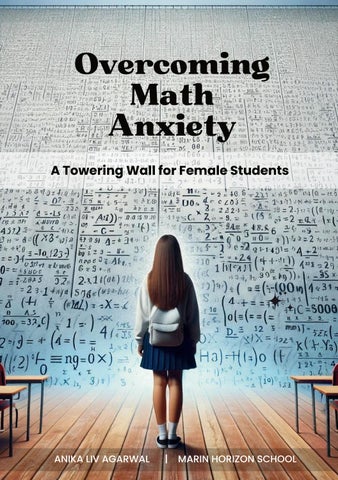

Overcoming Math Anxiety
AToweringWallforFemaleStudents
ANIKA LIV AGARWAL | MARIN HORIZON SCHOOL
Introduction History and Background Link to Developed Countries Math Scores in the United States Gender Sterotypes and Biases Teachers’ Role and Influence Stereotype Threat Parental Expecations and Pressure Impact on San Francisco Bay Area Conclusion Table of Contents 03 04 04 05 06 07 07 08 09 10
Introduction
Imagine standing in front of a towering wall, its height and magnitude stretching far beyond what the eye can see. This wall is not made of brick or stone, but of numbers, equations, and mathematical concepts. For many female students in Kindergarten through 12th grade, math appears to be an insurmountable barrier, a challenge steeped in fear which commonly develops into anxiety; a wall that historically appears taller and more daunting for female students than for their male counterparts. The answer to why lies in a complex web of societal, educational, and familial factors that contribute to math anxiety among female students.

According to the American Psychological Association, math anxiety is a worry or fear that occurs when people try to solve math problems, take tests, or even think cognitively about number relationships. It is a widespread obstacle affecting countless students, but research shows it disproportionately impacts females. Academic math anxiety in earlier years directly correlates with gender inequality in many professional fields pertaining to Science, Technology, Engineering, and Mathematics (STEM). By examining the roles of reinforced gender stereotypes and biases in education, teachers' lower expectations of female students in math, and the high parental performance pressure, we can begin to understand the brickby-brick multifaceted nature of math anxiety among female students, and explore potential pathways to mitigate this challenge.
My goal is to explore the persistent issue of math anxiety among female students, despite decades of gender equality initiatives in education, by examining societal factors contributing to this phenomenon and suggesting concrete steps to overcome it. Weir, Kirsten. “How
to Help Kids Manage Math Anxiety
History & Background
Over the last century, the United States’ educationalplatformhasundergone aprofoundlypositivetransformation towardfemalestudentinclusion,but heightenedexpectationof performancehasledtoincreased mathanxiety. At the beginning of the 20th century, female students had faced considerable barriers in accessing higher education. During the 1950s and 1960s, a push for gender equality in education led to Title IX's enactment in 1972, prohibiting gender discrimination in federally funded educational programs.

Concurrently, the concept of math anxiety, initially termed “mathaphobia”, was officially introduced in the 1970s, signifying an early acknowledgment of this issue. Despite these milestones, persistent stereotypes and biases still impact female students' experiences in math, subtly challenging the progress towards gender equity in math education and underscoring the complexity of fully overcoming the math anxiety barrier.
Link to Developed Countries
Counter-intuitively, research indicates that mathanxietyismoreprevalentin developedcountries. A comparative study published in the Journal of Educational Psychology found that studentsindevelopedcountriesreportedhigherlevelsof mathanxiety compared to their counterparts in less developed nations, despite generally higher performance levels in mathematics.
This is due to various factors, including the high expectations and competitive educational environments in the developed nations. A clear link has been shown between math anxiety and reduced mathematical performance, which underscores the challenge of overcoming these long-standing hurdles.
Foley, Alana E. “The Math Anxiety-Performance Link: A Global Phenomenon,” Association for Phycological Science, 2017
Math Scores in the United States
Nationally, U.S. math scores have been declining for the last decade, with significant drops observed in the critical years of middle and high school – key periods that influence future college and career paths.
Between 2012 and 2022, on the 0 - 500 point scale of the National Assessment of Educational Progress (NAEP), aptly known as the “Nation’s Report Card,” 4th-grade scoresfellfrom244to236,8th-gradescoresfrom285to274,and12th-grade scoresfrom153to150.
These scores show students falling well below established proficiency thresholds, with highschoolerssignificantlybelowbasicexpectations, raising significant concerns about the current state and future of math education in the United States, and establishing an urgency to address increased math anxiety.
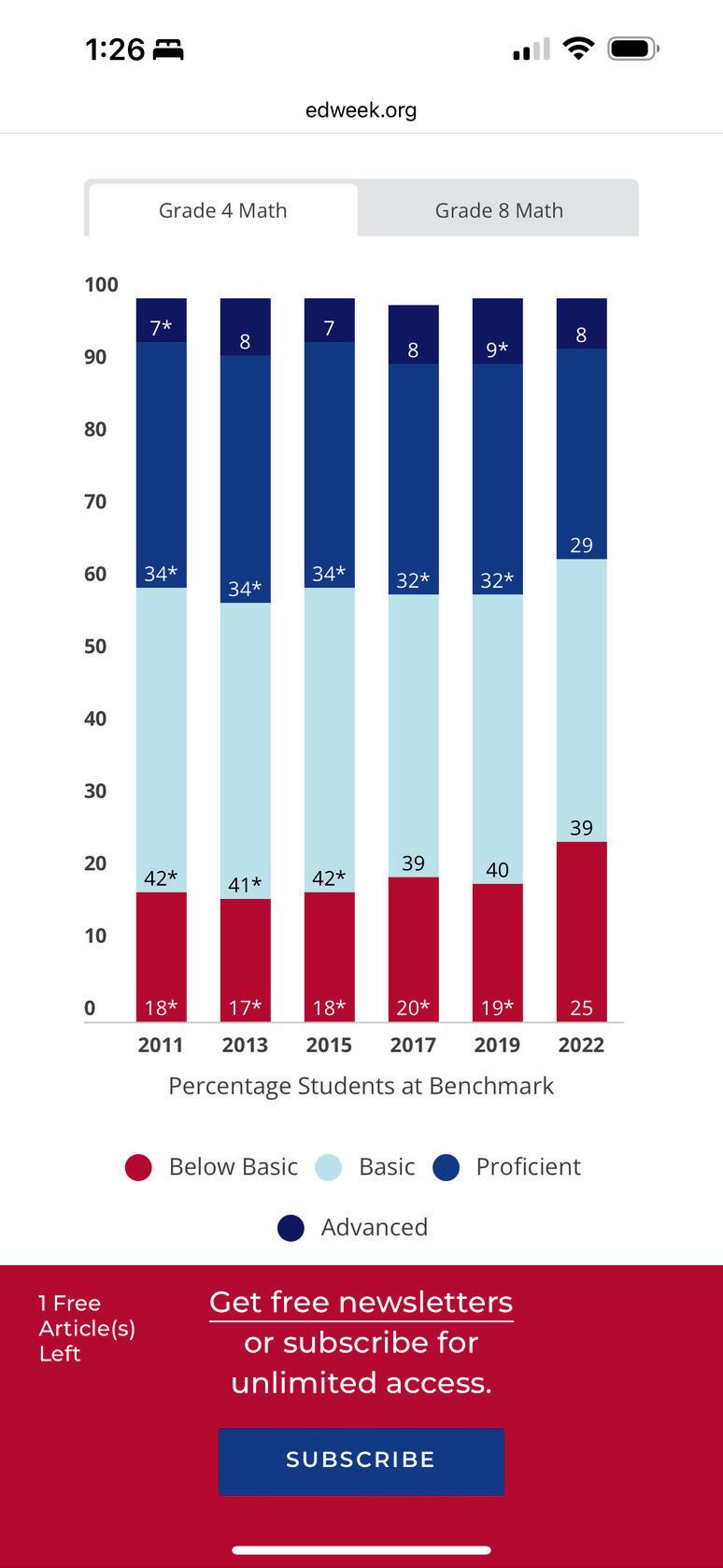
U.S. math scores have been declining for the last decade. 68% of 4th Graders and 55% of 8th graders are less than proficient.
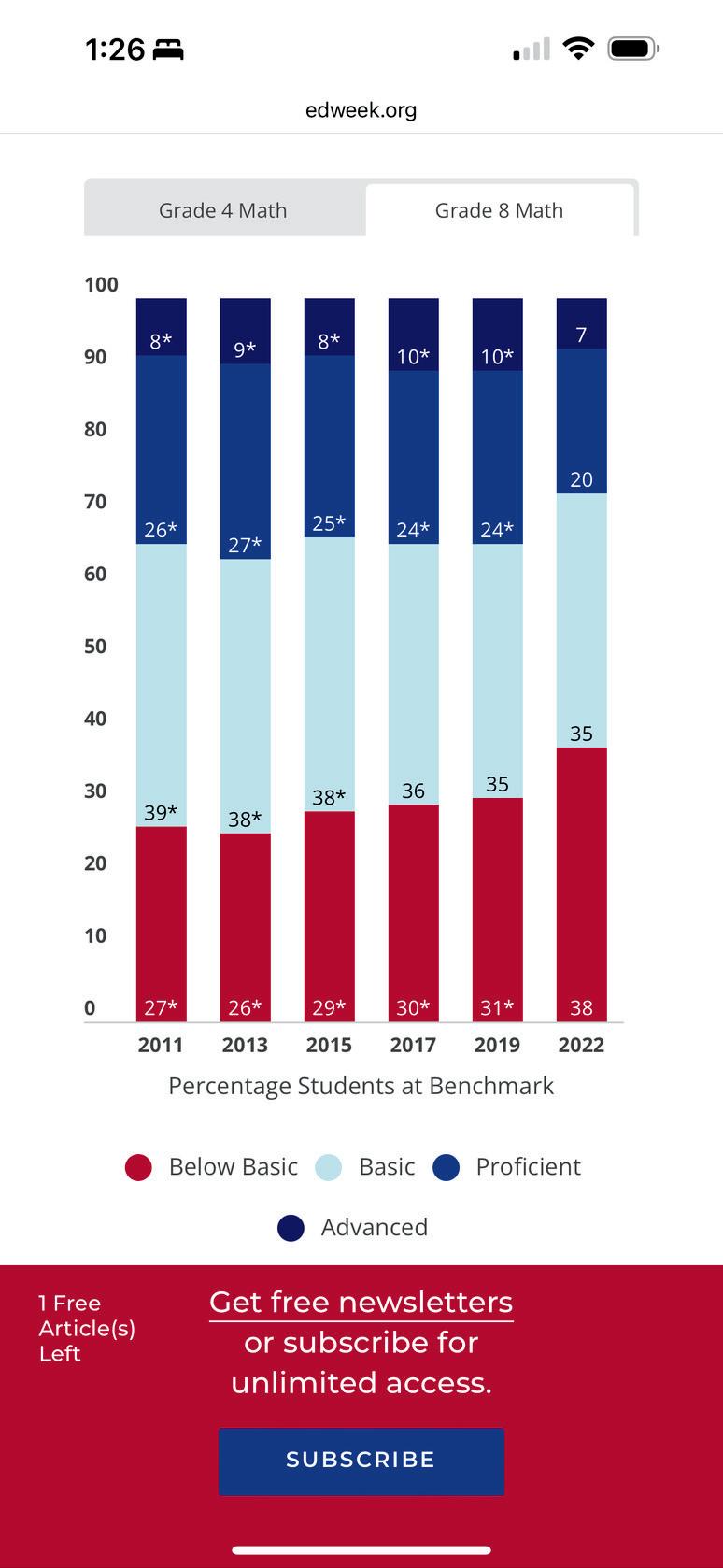
4THGRADE8THGRADE Below Basic Proficient Basic Advanced
NAEP Long-Term Trend Assessment Results: Reading and Mathematics, 2023
Gender Stereotypes and Biases
One prominent contributor to math anxiety in female students is the gender stereotypes and biases in society. These stereotypes suggest that boys naturally excel in math and science, while girls are better at reading and writing. Researcher Sarah Sparks quotes Psychology professor, Sian L. Beilock, “No one walks around bragging that they can’t read, but it’s perfectly socially acceptable to say you don’t like math.” Messages kids hear about math can communicate that math is something to avoid. An offhand comment like “let’s put away our math books now and do something fun” suggests that math is not an enjoyable activity. “Kids learn from the adults around them.”
Female students, detecting these biases, may internalize the belief that they are inherently less capable in math.
When parents and teachers, consciously or unconsciously, endorse these stereotypes, they can inadvertently influence students' self-perception of the subject and ultimately drive them to lose interest in math or build a resistance to the subject. Female students, detecting these biases, may internalize the belief that they are inherently less capable in math, leading to increased anxiety and decreased performance.
Overcoming these stereotypes requires a concerted effort from parents and society in general, but also from teachers. These outdated beliefs still impact education currently, and will continue to do so until gender-neutral expectations are promoted and provide equal encouragement and support to all students, regardless of gender.
“No one walks around bragging that they can’t read, but it’s perfectly socially acceptable to say you don’t like math”
Sian L. Beilock, Psychology Professor
Sparks, Sarah D. “Researchers Probe Causes of Math Anxiety.” McClatchy Newspapers, 18 May 2011 Paquette, Danielle. "Gender Hinder: Dread of Math Hits Girls Hardest." Washington Post, 9 May, 2016
Teachers’ Role and Influence
Additionally, these stereotypes and biases may be unknowingly reinforced by teachers, who play a pivotal role in shaping students' attitudes toward math. There is evidence of a general link between teachers’ attitude and, subsequently, students’ math performance. Approximately 90 percent of U.S. elementary school teachers are female, and a direct correlation between these teachers' math anxiety and their female students' struggles with mathematical achievement is evident. Similar research also indicates that teachers often hold lower expectations of female students in math classes as compared to their male peers.
This expectation gap can create a selffulfilling prophecy, where female students, aware of their teachers' doubts, may become less confident and engaged in math. “Teachers who are anxious about their own math abilities are translating some of that to their kids," said Beilock, who led a study published by the National Academy of Sciences. A majority of these teachers have been innocent victims of the very syndrome they may be unwittingly perpetuating onto other generations.
Stereotype Threat

Teachers who are anxious about their own math abilities are translating some of that to their kids.
Another consequence of this biased mindset is a psychological phenomenon known as "stereotype threat.” This occurswhenstudentsareconsciousof negativestereotypesagainstthem,constantlyfeelingatriskofconfirmingthem. The awareness of lower expectations can instill self-doubt and reduced motivation in female students, resulting in increased anxiety and diminished performance. A study found that “when the majority of students in the test room are men, women tend to achieve lower scores than when the majority are women.” This reinforces the real-world consequences of stereotype threats, where significantly lower women's performance were found to relate to male-dominated environments.
Kaplan, Karen. “Female Teachers May Pass on Math Anxiety to Girls, Study Finds.” Los Angeles Times, 26 Jan. 2010 NCA. “Stereotype Threat and Female Students’ Math Performance.” National Communication Association
Parental Expectations and Pressure

Parental pressures regarding academic performance crucially impact students' attitudes towards their education, with a pronounced effect on subjects in which they feel less confident, such as math.
When parents set high academic expectations of their children, without considering strengths and areas of weakness, it creates worry, anxiety, and fear of failure for the students. The result is a heightened state of stress and anxiety when approaching math. This essential topic becomes not only a subject to learn, but a hurdle to overcome to meet parental expectations. A Johns Hopkins University study reported that of2000mathematicallygiftedstudents,only35%ofthe femaleschosetomajorinmathorscience, compared to 63% of males.
High academic expectations result in a heightened state of stress and anxiety when approaching math.
Parents should adopt a balanced approach to academic performance, prioritizing learning and understanding above perfect grades, while recognizing effort and progress in challenging subjects such as math. Removing the weight of performance anxiety and fostering a positive learning environment is vital, enabling students, particularly girls, to engage with math confidently rather than with apprehension.
Holden, Constance. "Female math anxiety on the wane." Science, vol. 236, 8 May 1987 Stanley, Julian C. “In the Beginning: The Study of Mathematically Precocious Youth (SMPY),” Johns Hopkins University
Impact on the San Francisco Bay Area

The impact of female math anxiety is felt more prominently in the San Francisco Bay Area, the global center for technology, clean energy, biotech, and medical device companies. The need to overcome math anxiety, especially among female students, gains an added urgency. According to the U.S. Equal Employment Opportunity Commission (EEOC), womenholdonly20.44%ofexecutive,senior officials,andmanagerpositionsinhightech,comparedtomen's79.56%. This region, known for innovation, requires a workforce skilled in STEM fields to sustain its leadership, and resorts to hiring skilled immigrants to fill these critical roles due to a domestic talent shortfall. This scenario underscores the critical need to develop talented professionals, starting with addressing the barriers that discourages female students from pursuing STEM careers, notably math anxiety.
Critical need to develop talented professionals, starting with addressing the barriers that discourages female students from pursuing STEM careers.
The challenge is made worse by state policies that limit access to algebra in middle school under the guise of increasing equity. The controversial policiesby theCaliforniaDepartmentofEducationdenyeducationalopportunitiesfor academicallygiftedstudentsandmakeitmorechallengingforstudentsto pursueadvancedmathandsciencecourses essential for STEM careers. Overcoming these stereotypical bias and policy barriers are key to ensuring that all students, regardless of gender, can contribute to the Bay Area's innovative landscape, making the most of the opportunities in STEM careers.
Diversity in High Tech.” U.S. Equal Employment Opportunity Commision, 2023 Schwartz, Sarah. “California Adopts Controversial New Math Framework. Here’s What’s in It.” Education Week, 18 July 2023
Conclusion
In conclusion, the challenge of overcoming math anxiety for female students is like dismantling a barrier constructed from reinforced gender stereotypes, reduced expectations from educators, and undue performance pressure from parents and society. These factors, together, create an environment that not only increases math anxiety but also negatively impacts female students' engagement and performance in this critical subject.
The evidence is clear: societal and educational biases significantly influence the prevalence of math anxiety among female students, negatively impacting their academic paths and potentially hindering their pursuits of careers in STEM.

Addressing this issue requires a multi-pronged approach. Educators must challenge and change their perceptions, fostering an environment where female students are encouraged and supported equally in mathematics. Parents play a crucial role where, by valuing progress and effort over perfection, they can mitigate the anxiety associated with academic performance. Only through concerted efforts to dismantle these barriers can we pave the way for a more gender-equal educational landscape.
I hope my effort not only sheds light on the pervasive issue of math anxiety among female students but also calls for a collective action towards its removal, ensuring that the wall of numbers becomes a bridge to success for all students, irrespective of gender.

ALL IMAGES WERE GENERATED USING DALL-E

THEIMPORTANCEOFMATH, HOWITAFFECTSOURDAILYLIFE, ANDDEALINGWITHSTEREOTYPESANDANXIETY. SCANORCLICKBELOWTOSEEASHORTVIDEO STARRING 2ND THROUGH 6TH GRADERS FROM MARIN PERLA JARDINE (CREDIT AMAZON-TENMARKS) https://youtu.be/7Gb-T8dD7AA