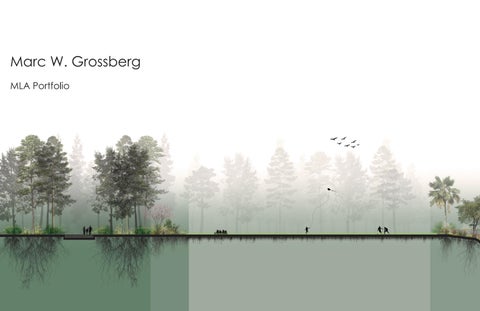
Marc W. Grossberg
Ethos
I approach design through the lens of agronomy, ecology, and anthropology. I view design not as ornamentation, but as the shaping of a substrate upon which processes and experiences unfold. The design is not what exists at the end of construction, but what emerges over time through the recruitment of biodiversity, ecological functions, resilience, and human connection. In each design, and through all its stages, I strive to balance ecological co-existence with cultural context, allowing each to inform the other. My emphasis is on the design of communities, both vegetative and human.
STORMWATER
GROUNDWATER RECHARGE
STORMWATER


The Talaab system of India is an ancient vernacular approach to stormwater management. As India has pushed toward grey infrastructures the Talaab system has become degraded while metropolitan regions such as Raipur face severe issues of flooding. The preservation of these systems is called for, as they are both effective infrastructure, and cultural hot-spots for many communities. This project seeks to situate the Talaab system within the global context of Traditional Ecological Knowledge (TEK), and more specifically as an example of a Vernacular Infrastructural Technology (VIT). By studying Talaabs themselves, and the broader linage of similar cultural landscapes we find recurring themes of design strategies and of cultural support mechanisms which can be integrated into a framework for their revival and expansion as a mechanism to combat contemporary flooding challenges.
Chinampas Palayan
Subak Kihamba
Chinampas Palayan
Root Bridges Quanat
Waitiwina
Root Bridges Biochar
Tropical Homegarden
Wa e Garden
Minapadi
Zhuge Village
Bheri
Waru Waru
Wa e Garden
Totora Reed Milpa Zai Al-Tahla
Waru Waru
Root Bridges Totora Reed
Bheri
Totora Reed
Milpa
Apete
Waitiwina Biochar
Zai
Tropical Homegarden Waitiwina
Apete


sITE sElECTION aND sYNTHEsIs DEsIGN sTRaTEGIEs


Through site analysis we found that Raipur had overtime encroached and built upon the watershed that feeds into the Kharun River, contributing to its current flooding challenges. Informed by the global context of vernacular infrastructural technologies, and inspired by the sponge city concept, which emerged from the stormwater management tradition shared by Zhuge Village identified during the research phase, we devised a suite of design strategies and an implementation plan to daylight the historic watershed of Raipur. The design strategies are a synthesis of other vernacular infrastructural technologies and the techniques utilized in other sponge city precedents. The implementation phasing utilizes the support mechanisms of other cultural landscapes and references other sponge city initiatives in India, ensuring contextual relevance and feasibility.

Bird Migration, the Pacicific Flyway, & India Basin
The India Basin shoreline is known to support foraging by birds such as the American avocet, black-necked stilt, and western gull, as it is a stopover for birds migrating in the Pacific Flyway. Due to the habitat value of the area, and the nearby Heron’s Head Park that sees a diversity of wildlife, this area is likely an important corridor to species of interest and has potential to support additional wildlife as conditions improve.
Bush Monkey Flower [upland] (Diplacus aurantiacus)
A perennial shrub in the Phrymaceae family found in various habitats, including coastal sage scrub and chaparral along the central coast. Identifiable by its tubular orange flowers that resemble the face of a monkey. The leaves produce a protective sticky resin. Its flowers attract hummingbirds and bees.
Colors: Yellow-orange,green Flower Season: Winter, Spring, Summer Host Plant: Variable checkerspot and other lepidopterans
Provides habitat for birds, amphibians, reptiles, and small mammals. it is a “resurrection plant”, it can come back to life after severe drought. It is highly fragrant.
California Hedgenettle [upland] (Stachys bullata)
A perennial evergreen herb in the Lamiaceae family.
A delicate, attractive flowering plant that performs well in damp, partially shaded areas. It tends to grow in wet, swampy, boggy places, at elevations from sea level to 1,600 feet. It has tongue shaped deep green leaves and two-lipped purple-pink flowers.
Colors: White-lavender, green Flower Season: Spring, Summer, Fall Host Plant: Variegated fritillary and other lepidopterans
A valuable nectar source for various pollinators. Its tubular flowers enable its popularity with hummingbirds Its flowers are slightly fragrant.
California Wildrose [upland] (Rosa californica)
A perennial deciduous shrub in the Rosaceae family found throughout California and surrounding regions. Easily recognized by its vibrant flowers and delicate foliage. The plant features compound leaves with typically five to seven leaflets, which are a rich green color and somewhat glossy.
Colors: Yellow-white-pink, green Flower Season: Spring, Summer Host Plant: Gray hairstreak and other lepidopterans
Goes dormant and drops its leaves in the winter. Nectar source for pollinators. Has highly fragrant flowers.
Miniature Lupine [upland] (Lupinus bicolor)
A petite annual wildflower in the Fabaceae family showcasing clusters of blue and white spring blooms that may vary geographically to magenta or purple. It can be found in dry meadows, grasslands, prairies, open or disturbed places.
Colors: White-purple-blue, grey-green Flower Season: Spring, Summer Host Plant: Tiger moth and other lepidopterans
A nectar source for various pollinators. Highly fragrant flowers. A nitrogen fixer helping to maintain soil fertility.
Dunlin SnowyEgretAmericanAvocetAmericanWigeonLeastSandpiperDouble-crestedHouseFinchCormorantGreaterScaupRed-tailedHawkLong-billedCurlewBlackOystercatcherOlympiaOysterBronzeBeetleJapaneseLittleneckMilkSnailBeltedKingsherCommonRaccoonGreatEgretMarbledGodwitSemipalmatedPloverWesternGrebe WetsaltsTigerBeetleArgentineAntBlack-spottedLadyBeetlesCalidrisSandpipersCaliforniaOakMothCaspianTernCommonPeriwinkleCucujiformBeetlesDowitchersEurasianDroneFly Gambel'sWhite-crownedSparrowGolden-crownedSparrowHouseSparrowMantisesMuscoidFliesPaintedLadySandpipersRedAdmiralandAlliesShort-billedGullStripedSweatBeesWesternPygmy-Blue WingedandOnce-wingedInsects Black-neckedStilt Oblique-bandedLeafrollerMoth
INDIa basIN sHORElINE: 900 INNEs REsTORaTION fIElD GuIDE
Contributions to a field guide developed at RANA on the biodiversity of the 900 Innes shoreline restoration in San Francisco, CA. The field guide outlines species profiles for the featured vegetation, and describes the wildlife species richness in association with the sites location within the Pacific Flyway. The field guide aided a bio-blitz with Studio Gang at the project site. Wildlife species observation data geoprocessed, analyzed, and visualized in ArcGIS pro then stylized in Adobe Illustrator. Botanical illustrations stylized in Adobe Illustrator.
Alkali Heath [high marsh] [marsh transition] (Frankenia salina)
A perennial bush in the Frankeniaceae family that forms a twiggy thicket near beaches and estuaries. The leaves are tiny and somewhat succulent. It has the ability to excrete salt as an adaptation for living in saline habitats. The flowers are white, pink or fuchsia in color.
Colors: Pink-blue-green, white Flower Season: Spring, Summer, Fall Host Plant: Plume moth
Summer semi-deciduous meaning it drops its leaves for a short period in the summer. Its foliage is a food source for waterfowl. Valuable for runoff filtration and erosion control.
California Oatgrass [upland]
(Danthonia californica)
A perennial bunch-grass in the Poaceae family that’s useful in many landscaping applications. It is found in moist meadows and open spaces in Central and Northern California. It grows in dense tufts that can reach 3 ft in height.
Colors: White, orange-brown, green Flower Season: Spring Host Plant: Columbian Skipper and other Hesperia species
Seeds serve as a food source for birds and small mammals. Useful for runoff filtration and erosion control. High fire resistance and can be used as a firebreak.


A space for the interaction of earth, water, ecology, and human. Eleven earthen mounds of varying proportion scatter through a zone of ever shifting inundation. The mounds are sharply interjected with a monolithic gabian pier. As the water level fluctuates and the landscape wavers between lake and dry prairie the mounds undergo submersion and exposure allowing the humans, vegetation, and wildlife to shift their patterns of behavior in correspondence. The gabian structure provides a opportunity for human visitors to witness the dynamic ecology and serves as an anchor through the ever changing conditions. Though the gabian form will persevere, it will over time become consumed with vegetation. The grading plan was drafted in Civil3D, the site modeled in Rhino, the landscape rendered in Lumion then edited in Photoshop.


sWIsHER faRM PaRk aND PHOENIX aRTs DIsTRICT
A collaboratively produced development concept which envisions the Springfield Warehouse District in Jacksonville re-purposed as a pedestrian focused, biophilic, and resilient mixed use community. Pedestrian, ecology, and community were prioritized through careful planning of density with walkable circulation, green stormwater, and biodiversity weaved throughout. Swisher Farm Park at the north-eastern terminus of the site was my sole responsibility. The park serves as a public edible and ecological resource capable of meeting the annual produce needs of approximately 40 people through potential production of over 15,000lbs of fruits, nuts, and vegetables. All linework was drafted in AutoCAD, Swisher Farm Park modeled in Rhino, perspectives and plans rendered in Photoshop.

Intra-Corridor Agricultural Land
Conversion Hot-spots 2040

Intra-Corridor Agricultural Land
Conversion Hot-spots 2070


An analysis of conflicting land uses in Florida, and a proposal for achieving balance. How much agricultural land within the Fl Wildlife Corridor will be lost if sprawl continues at its current pattern; where are the areas most at risk to agricultural land conversion; can a more holistic approach to suitability analyses provide a pathway for conservation of both natural areas and working lands. The analysis identifies the counties where critical planning efforts should be focused, indicates that 20% of Florida’s crop land will be converted if such efforts are not initiated, and proposes a tri-fold suitability analysis that can reduce development pressure by 40% a laND REsPECTED


My first original park design, created to honor the life and legacy of Anthony Bourdain, with food, ecology, and community as guiding priorities. Abstracted from the form of a quintessential Parisian streetscape, the design features an alley of canopy trees with pedestrian circulation through the center, and cafes positioned along each side. A shaded plaza for dining and socializing emerges from arcs of the pedestrian paths and overlooks a lowgrass meadow. Along the park’s southern and western edges, plantings inspired by Pine Flatwoods extend outward, with a timber bandshell bridging the pines and meadow. In the northeastern corner, an agroforest provides sustainably sourced food for the cafes and broader community. The linework for the masterplan and section was drafted by hand, while color was added in Photoshop.


A bio-swale and greenspace enhancement for the University of Florida campus in Gainesville. Stormwater flow from the North-East section of campus is daylighted through a biophilic swale design inspired by North Florida Slope Forests. Native vegetation treats the stormwater while creating an amenity for passing students and habitat for local wildlife. Sensory experience is highlighted through sculptural installations embedded within the landscape and a custom bridge featuring a metal grate to allow light to penetrate to the swale, sound to raditate out, and dedicated paths for bikers and skaters who may otherwise dismount due to the texture of the metal grate. Grading plan and linework drafted in AutoCAD, the site was modeled in Rhino, then rendered in Photoshop.


GasWORks PaRk PlaZa YEaR 2379
A plaza addition for Gasworks Park in Seattle. Thinking of how the space would change over time, the site is rendered as it might appear in the year 2379. In this future landscape where we did not step away from “business as usual” the plaza has become overgrown with vegetation typical of the NorthWestern United States. The presence of the central monolith signals to those who remain that this site is a significant vestige of a once great civilization now fallen to ruin. My first foray into 3D rendering, the site and its landscape elements were modeled in Rhino, rendered in Lumion , then edited in Photoshop.