Marbleseed is a nonprofit committed to supporting the Midwest’s organic and sustainable farmers through farmer-led events and educational resources that help your farm grow.
OUR MISSION
Marbleseed educates, inspires, and empowers farmers to thrive in a sustainable, organic system of agriculture.
BOARD OF DIRECTORS
President: Claire Hintz Elsewhere Farm
Vice President: Dan Cornelius Yowela Farms
Secretary: Eliana Pinilla-Rhyal Chicago Food Policy Action Council
The Organic Broadcaster is a quarterly magazine published by Marbleseed. Opinions expressed by the authors do not necessarily reflect those of the publisher. Inclusion of an advertisement does not imply endorsement of a product. Content may be reprinted with permission.
Subscription: Manage your subscription by emailing info@marbleseed.org
SUBSCRIBE HERE
for this bee icon throughout this issue for articles related to our upcoming Organic Farming Conference!
the Midwest’s Fibershed
CHANGES COMING TO THE BROADCASTER!
This is the final free print issue of The Organic Broadcaster. Print subscriptions will be required going forward. Don’t worry — the digital edition remains free. Subscribe via the QR code above or mail the subscription form on the back page.
We value your input! Our Communications team will be hosting a listening session at the Organic Farming Conference to gather feedback about what you’d like to see in upcoming issues.
Cover Photo:
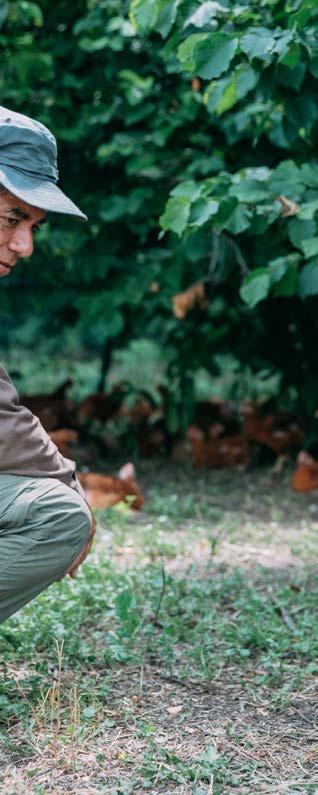
Courtesy of Chris O’Connell of O’Connell Organic Acres.
FROM OUR EXECUTIVE DIRECTOR
Hello readers!
As a yogi, it is often said that winter is the most auspicious time to start a practice. I get it, the cold settles into our bones, muscles stiff from the flurry of farm preparations for winter, darkness squeezes into any sunny levity we can muster. We become less flexible. I am more hesitant to leave the house; the scraping of the car, pulling on all the layers and heavy boots, sometimes feels like too much to do again after the round of morning chores.
I love to read, and have written often myself, about the opportunity of winter as a time of rest and reflection, pouring through seed catalogues and farm infrastructure building designs. But some days the low clouds that seamlessly meet the snow-covered ground match my gaze through scowling eyebrows. I am stiff, chilled, and torture to be around. The nudging by my wife to put on more layers as I am typing away in my office is met with my sullen retort of “when do I get to be warm???”—a passive aggressive reference to her willingness to run the air conditioner in the height of summer’s heat.
Habit versus practice. Rumi’s quote and my half-hearted effort on my yoga mat this morning has my mind turning around these two words. The first, something we do without thinking about it. There is no value of good or bad. Often the goal is to turn something good for you into something you start to do automatically, without effort. Like drinking enough water, brushing your teeth, saying “thank you.” But practice implies failure and imperfection. There is an element of trying before it is a thing that becomes steady. It is not a resolution or promise. It is the effort that matters. The repetitions that lead to improvement. The falling off before you can stay on.
Practice recognizes that we may falter. That success may be a line that keeps moving as we grow stronger and more inwardly motivated. So much of organic farming is a practice. There is fluidity, patience, learning, and even an element of danger some days. Practice makes us braver in our willingness to fail.
My worst habit may not actually be getting tired of winter. But I know it is one of them. A balm for that irritability and house-bound laziness is always Marbleseed’s community gathering in February. The weather is never certain but the learning and meeting other farmers who share the same commitment to soil health, animal welfare, community wellbeing, and mutual care lift me up as we head toward spring.
This year’s conference will kick off on Thursday, Feb 26, with content and our farmer recognitions. Read about this year’s Farmers of the Year on page 4. We also have hands-on workshops, a bustling exhibit hall, and an amazing line-up of featured speakers. Winter is indeed an auspicious time to start a practice. I am deeply grateful for all of you and the opportunity to be together soon.
Lori Stern, M.A. Ed
P.S. Look for this bee icon throughout this issue for articles related to our upcoming Organic Farming Conference!
GROWS IN
F e B. 26-28, 2026 | l A CR osse , WI
Join us in La Crosse this February for three days of inspiration, learning, and community — where
OUR FARMERS OF THE YEAR
By Lori Stern, Marbleseed
ABOUT THE FARMER OF THE Y EAR AWARD
Marbleseed’s Farmer of the Year Award honors certified organic producers in the Midwest who have contributed to the organic farming movement through significant experience. They are leaders who provide mentorship to less practiced farmers, helping the organic movement continue to evolve. They are wisdom keepers who can speak from experience about the persistence and resilience needed to have a full career in farming and the vision and values for good food, fiber, and medicine needed to get through the inevitable tough times. Learn more about our 2026 Farmers of the Year here:
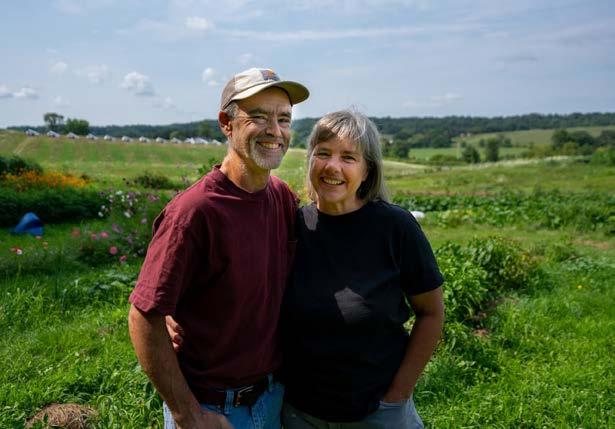
Beth and Steve Albert of Prairie Bluff Farm sell pastured certified organic eggs under the brand name Pasture Patterns Eggs. We’re delighted to recognize them as our 2026 Farmers of the Year, the first pastured egg operation to be honored such. Their connections to the leaders within the Wisconsin organic farming movement, past, present, and future, tell a story of a lengthy commitment to organic management.
S TARTING O UT IN D AIRY
Beth and Steve started their farm journey under the mentorship of Dean Swenson, one of the first organic dairy farms in the Organic Valley cooperative. Their love was for both the cows and their own small team of horses. In 1992, the Alberts were able to buy their own dairy farm outside of Mount Horeb where they milked 20 Jersey cows and began raising their family. Although there was no organic milk pick up available, Steve remained committed to organically managing his herd.
Despite working with Dean and others, they were unable to make the dairy farm viable and were forced to sell the herd and equipment just five years later. Steve turned to carpentry, and Beth, who had studied nursing, worked off the farm to provide the family with access to health insurance. However, the desire to farm was always with them. Over two particularly snowy winters, Steve puzzled over a design for the perfect chicken tractor. They had raised a small flock of meat birds in tractors, and he liked the connection to pasture and rotational grazing that recalled his time raising cattle.
M OBILE C OOPS
The family tried some laying hens in tractors and loved the taste of the eggs. In 2005, their son took on selling eggs locally as an educational project in a homeschool curriculum. It went so well that by 2007, Steve left carpentry to focus on selling pastured, organic eggs. With Millers Local Grocer as their first, and ongoing wholesale account, Pasture Patterns became the farming enterprise that could sustain them.
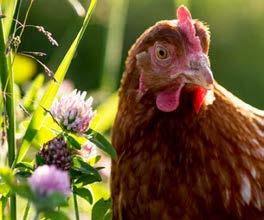
Beth retired from her nursing job at the VA hospital in Madison 2021 in order to join Steve full time. They now have approximately 1,500 hens who spend most of their time in the beautiful mobile coops that Steve designed. They also have access to a large hoop house with outdoor access and bedding for frequent dust baths; its walls and doors can be adjusted to keep them comfortable as the temperatures rise and fall through sunny and cloudy winter days.
A W IDENING W EB
I took a ride out to their farm to chat with them for this article. As we sat in the comfortable living room, warmed by a woodstove with their friendly young dog Cocoa, I was struck less by the retelling of the history of their various farm enterprises, and more by their deep commitment to making organic agriculture their livelihood. Beth, who makes most of their deliveries, spoke about the satisfaction of feeling part of a widening web that forms their local food system.
She explained that the small house adjacent to the one they now occupy was essential in letting them farm. Renting the larger house while they lived in the smaller one made it possible for them to take up farming while renting out the larger house. Eventually, the smaller house became a space for interns and others who came with a desire to learn the farming ropes from the Alberts.
It’s this openness to making connections and participating in their community that has brought them into relationship with beginning farmers like Pat and Sarah of Squashington Farm.
After meeting the younger couple at their small, rural church, the Alberts learned that Pat and Sarah were looking for some land to start their CSA farm. Without hesitation, they offered them some ground.
“Steve and Beth are like a couple friendly native yeasts that help give rise to our farm business. They came into our lives seemingly out of nowhere and gave us land to farm, work to help pay bills, mentorship and knowledge to work on construction, plumbing and electric projects, childcare/love for our children and above all else friendship,” said Pat.
R EADY TO S HARE
So often we think of success in farming as a linear trajectory. Steve and Beth show us the reality of a meandering journey, guided by a commitment to organic stewardship, animal welfare, and the love for community connections and what can be built together. Steve’s curiosity about how things work, his pride in designing the stately, tentlike chicken coops that create the pattern in the pasture as they are moved along, and the farm hacks inspired by roaming the aisles at Home Depot are more often the traits that define a successful farmer.
The Farmer of the Year recognition comes at a time when the Alberts are ready to share what they have learned in more than a decade of a successful laying operation. They have dreams of spending more time working on restoration and conservation on the land previously grazed by cows. Their leadership has been steady, quiet, and by example. Marbleseed is honored to be in partnership with Steve and Beth as they move into this next phase of sharing more broadly what they have learned on their journey. MS
Farmers of the Year Beth and Steve Albert of Prairie Bluff Farm will be honored at the “Farmer of the Year” presentation at the Organic Farming Conference this February, 26 during the opening session.
WHY REGIONAL SEED SYSTEMS MATTER
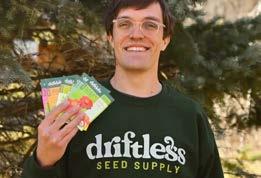
By Dylan Bruce, Driftless Seed Supply
Seed is quite literally foundational to our food system. Yet it is often overlooked in grant programs, policies, and discussions about local food systems, by consumers and farmers alike.
Despite steady growth in organic acreage and consumer demand, the percentage of organic seed used on certified organic farms has remained largely unchanged over the past two decades. The 2022 State of Organic Seed Report (an ongoing project of the Organic Seed Alliance updated every five years) makes this tension clear: Organic farmers overwhelmingly support the idea of organic seed, but structural barriers like availability, scale, price, and varietal fit, continue to limit adoption. As a result, exemptions that allow untreated conventional seed have become routine rather than transitional.
This gap is not simply a supply problem. It reflects how seed has been positioned in modern agriculture, as a standardized commodity rather than a living foundation of agroecological systems. Addressing it requires more than increasing production. It requires re-imagining how seed is grown, governed, and shared.
Across North America, farmers are already doing this work. Regional seed companies, cooperatives, and grower networks are building farmer-centered seed economies grounded in shared knowledge, regional adaptation, and collective responsibility to seed diversity.
O RGANIC SEED AND THE LIMITS OF THE CURRENT SYSTEM
Under USDA organic regulations, certified farms must use organic seed when it is commercially available. In practice, this requirement is softened by exemptions that allow conventional untreated seed when organic options are limited in quantity, quality, or form. While these exemptions were designed as a bridge, they have become a feature of the system.
The State of Organic Seed report notes that this dynamic discourages investment in organic seed production and breeding. Seed companies receive weak demand signals, while farmers remain reliant on varieties bred primarily for high-input or conventional systems. The result is a self-reinforcing loop: limited organic seed supply justifies continued exemptions, and exemptions dampen market pressure to expand supply. Additionally, the proportion of respondents who report pressure from certifiers to use more organic seed has declined over the years.
Organic seed is not simply a regulatory checkbox. Seed grown under organic management experiences the same nutrient limitations, weed pressure, and biological interactions as
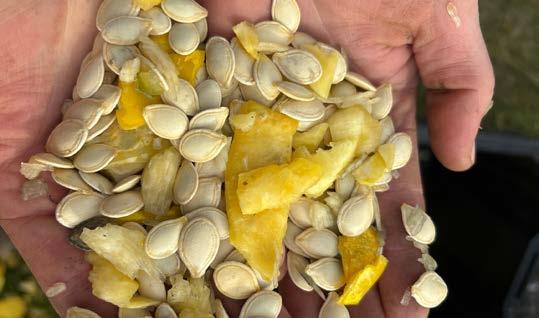
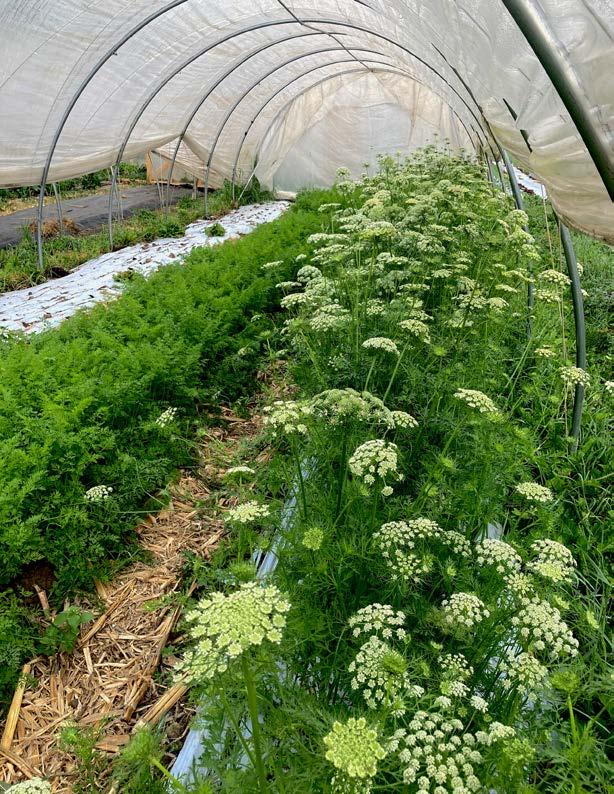
above: Squash seeds and pieces of rind held in hand immediately after mechanical seed extraction. Photo right: First and second year carrots for a breeding project growing in a caterpillar tunnel. Biennial crops require a certain amount of cold exposure before being able to flower, which means they must be dug and replanted in harsh winter climates like the Upper Midwest.
Photo
“
Working with seeds is like time travel, because the seed you hold in your hand is the direct result of countless generations of farmers and seed stewards who domesticated the crop, bred and refined the variety, and maintained it.”
— Dylan Bruce, Driftless Seed Supply
WHY REGIONAL SEED SYSTEMS MATTER (Continued)
improvement. And instead of dependence on hybrids that can quickly fit uniform consumer expectations, it requires a slower, more intentional process of developing open-pollinated varieties for more niche production environments.
As the late, great organic seed breeder John Navazio once told me, “Anything you can do with a hybrid you can do with an open-pollinated variety, it just might take longer.” (OK, I know there are some exceptions like corn, but he proved his point with staples used on vegetable farms across the country like Astro arugula.)
At Driftless Seed Supply, for example, we focus on varieties that perform well in Midwest conditions: shorter seasons, variable moisture, and lower fertility systems. This approach mirrors and was inspired by cooperatives in the Northern Rockies and Pacific Northwest, each responding to their own ecological realities. The result is not a single “best” variety, but a diversified portfolio of seeds shaped by place.
S EED AS AN ADDITIONAL FARM ENTERPRISE
organic crops in the field. Over time, this creates opportunities for selection that can improve performance in low-input systems - particularly when seed is produced repeatedly in the same region.
R EGIONAL ADAPTATION AS AGROECOLOGICAL PRACTICE
One of the clearest benefits of regional organic seed systems is adaptation. Climate variability, erratic rainfall, and new pest and disease pressures are already testing farm resilience. Seed that has been selected under local and organic conditions, rather than bred for broad, uniform environments, can respond more effectively to these challenges. When grown in the region it is intended to be marketed to, it can continue to adapt and ‘roll with the punches’ of climate change. Logically, why would a bell pepper bred for conventional production in California or Florida be the best possible option for organic farms in the Midwest?
In their 2024 master’s thesis, “Seeding Agroecological Economies”, my colleague Elena Bird describes how seed grower cooperatives function as sites of in-situ adaptation, where farmers collectively steward varieties across landscapes rather than relying on centralized breeding pipelines. These systems emphasize learning by doing: shared trials, farmer observation, and iterative selection across seasons and farms.
This kind of regional adaptation and resilience does not require abandoning yield or reliability we have come to expect from our modern seed varieties. It requires shifting where and how those traits are developed. Instead of relying solely on breeding programs geographically distant from farms, regional seed networks integrate farmers directly into the process of
For many diversified vegetable farms, seed production offers a complementary enterprise that aligns with existing skills and values. While seed crops often require longer timelines, isolation planning, and post-harvest handling, they also offer higher value per acre and less vulnerability to short-term market swings. The switch from a CSA farm cadence to seed production was a game changer for my seasonal burnout. For the most part, I now plant and harvest each crop just once, while at the same time having winter work that allows me to support year-round employment!
Bird’s research highlights that many seed growers within cooperatives are also fresh market farmers, and this is certainly true of our grower network for Driftless Seed Supply. Rather than replacing vegetable production, seed growing allows them to layer enterprises, spreading risk while keeping land in food production. Importantly, seed income often arrives at a different point in the year than produce sales, helping smooth cash flow.
Just as importantly, growing seed keeps economic value within organic and regional food systems. Instead of purchasing seed produced overseas or by multinational corporations, farmers circulate dollars among peers, supporting regional infrastructure, and community resiliency. This mirrors the motivations that drive CSA models and farmers markets: keeping food system wealth closer to home.
Collaborative seed companies play a critical role here. By aggregating seed, handling quality control, and managing distribution, they reduce barriers for individual growers. Working together and spreading out seed production also offers resilience to extreme weather events, which can often be very isolated. For instance, in 2023 one of our two home
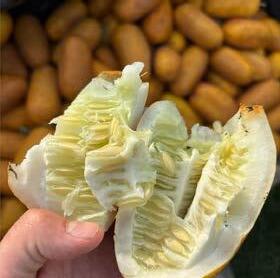
Checking seed maturity of Boothby’s Blonde pickling cucumber. Many crops reach horticultural maturity, the point at which seeds are viable, well beyond their market maturity
Farmers can support change by prioritizing organic seed when it is available, communicating unmet needs to seed suppliers, and exploring seed production as part of diversified farm enterprises”
— Dylan Bruce, Driftless Seed Supply
farms for Driftless Seed Supply, in southwest Wisconsin, experienced almost 70% crop loss due to extreme flooding. Yet our other farm, barely an hour away in Minnesota, had less than half the amount of rain, and a fairly normal season (if our weather can ever be described as ‘normal’ these days).
V ALUES AND THE GLOBAL SEED SUPPLY CHAIN
For farmers serving local and regional food markets, seed sourcing should also be a question of mission alignment and values. A little-known fact is that many hybrid cucurbit and solanaceous crops (squash, cucumbers, tomatoes, peppers, etc.) are produced overseas, particularly in China, where skilled hand labor for hybridization is significantly cheaper.
While this system has delivered reliable seed at scale, it often conflicts with the ethics of farms committed to fair labor, transparency, and local economic resilience. The distance between seed production and food production also limits opportunities for regional adaptation and farmer feedback. When there are trade disruptions that interrupt that multinational seed supply chain - such as during the COVID pandemic - there can also be a cascade of impacts on the local food economy.
Bird notes that seed cooperatives are navigating this tension thoughtfully. Rather than rejecting hybrid technology outright, many seek to disentangle breeding methods from proprietary control and opaque labor practices. The goal is not purity, but alignment: ensuring that seed systems reflect the same social and ecological commitments that organic farmers bring to their fields.
M OVING BEYOND THE ORGANIC SEED STALEMATE
Small vegetable farms (under 50 acres) were the only category of organic farms to see an increase in the proportion of organic seed used in the last decade. The persistent lack of growth in organic seed usage is not due to resistance from small farmers. Rather, stagnation in the industry reflects structural inertia in seed systems built for consolidation rather than collaboration. Breaking this pattern requires coordinated effort and dedication to bringing the farm to table movement full circle, from seed to plate.
Farmers can support change by prioritizing organic seed when it is available, communicating unmet needs to seed suppliers, and exploring seed production as part of diversified farm enterprises. Seed companies and cooperatives can continue investing in regional production, shared education, and transparent governance. Policymakers can refine standards to ensure exemptions remain transitional rather than permanent. Certifiers need to push growers harder on their overuse of loopholes allowing conventional seed.
Seed grower, farmer, and eater collaborations can offer practical pathways forward. As the State of Organic Seed report and agroecological research alike emphasize, organic agriculture cannot fully realize its potential without seed systems that embody its principles.
Seed is not just an input. It is a relationship carried across generations of farmers, plants, and places. As my mentor Heron Breen once said, working with seeds is like time travel, because the seed you hold in your hand is the direct result of countless generations of farmers and seed stewards who domesticated the crop, bred and refined the variety, and maintained it. Then when we plant it, do our own round of selection to adapt it to our region and production methods, and harvest the next generation of seed we have put our fingerprint on that variety, that will in turn be carried into the future and out onto thousands of farms and gardens. MS
Dylan Bruce, Farmer and Chief Executive Officer for Driftless Seed Supply, grew up on a vegetable farm in Wisconsin’s Driftless region. He has been producing certified organic seed on contract for other companies since 2018, and cofounded Driftless Seed Supply in 2023. Dylan serves as Treasurer of the Marbleseed Board of Directors.
This article is supported through the United States Department of Agriculture (USDA) Transition to Organic Partnership Program (TOPP). TOPP is a program of the USDA Organic Transition Initiative and is administered by the USDA Agricultural Marketing Service (AMS) National Organic Program (NOP).
Biodiversity is a big part of our farm... We grow at least 50 different types of organic vegetables, as well as fruits, herbs, and flowers. And it’s really cool to have the birds come along with us through our season... It’s a really beautiful symbiosis.”
— Joy Miller, Keewaydin Farm
By Ashley Chesser, Wild Farm Alliance
BIRD-FRIENDLY FARMING
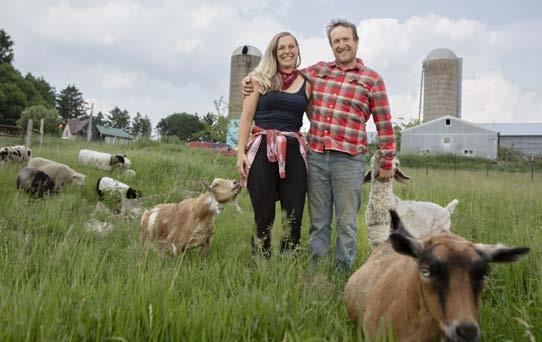
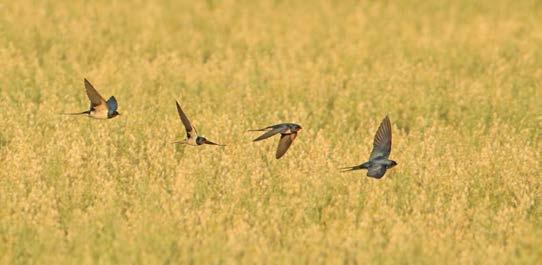
Unlatching the gate to the livestock pen with a bucket of grain in hand, a tapestry of sounds envelops Joy Miller. Sheep and goats punctuate the air with their hungry cries. A soft rush of wind moves through the nearby prairie grasses. In the distance, the hum of a tractor can be heard. And weaving through it all are the calls of Barn Swallows, diving and twisting through the sky as they search for food.
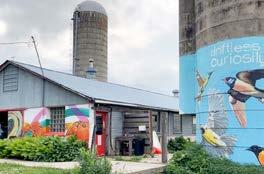
To Joy and her husband, Rufus Haucke, the chorus of swallows is more than a pretty soundtrack – it’s an indicator of a healthy farm. The couple operates Keewaydin Farms in Viola, WI, where the birds play an integral role in their operation. Their appreciation for birds is proudly reflected in the 20-foot-tall avian mural that adorns their silo.
S ONGBIRDS AS N ATURAL P EST M ANAGERS
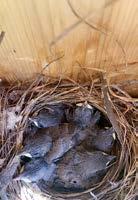
The overwhelming majority of songbirds provide tangible benefits to farms during the nesting season, when adults deliver hundreds of insects each day to their nestlings. At Keewaydin, more than 40 species of birds make their homes on the farm at some point in the year.
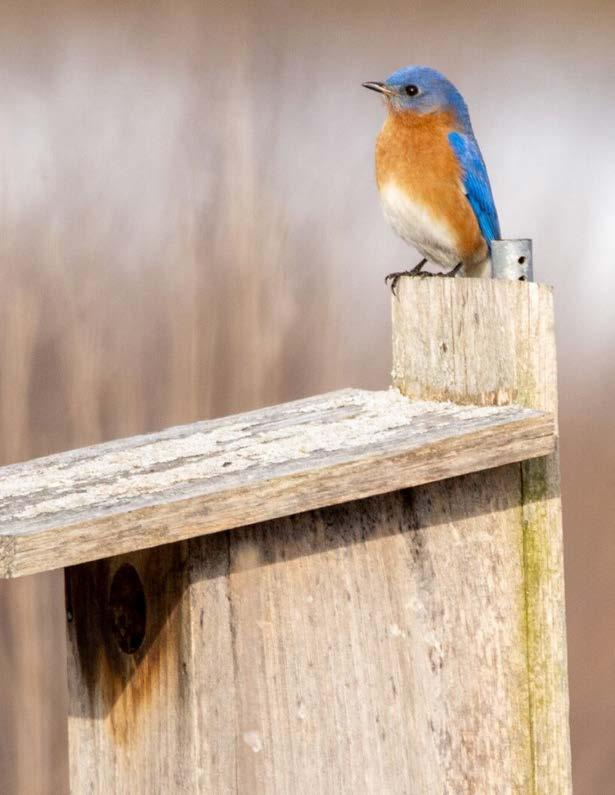
Each one contributes its own ecological service. Common Yellowthroats and Eastern Meadowlarks devour grasshoppers in the pastures. House Wrens and Eastern Bluebirds hunt pest caterpillars and moths. Barn and Cliff Swallows swoop through the livestock areas in constant pursuit of flies, providing relief for the sheep.
Swallows play an important role in reducing fly strike, a painful condition caused when flies lay eggs in soiled wool. By keeping fly pressure low, swallows help Keewaydin’s sheep maintain clean, healthy coats and avoid tail docking, a common management method used on farms when fly populations are too high.
A mural at Keewaydin Farm celebrates local bird species.
BIRD-FRIENDLY FARMING (Continued)
“Biodiversity is a big part of our farm,” Joy says. “We grow at least 50 different types of organic vegetables, as well as fruits, herbs, and flowers. And it’s really cool to have the birds come along with us through our season.” As pests increase during the summer months, bird songs and activity reach their peak. When the season slows, the birds quiet or migrate. “It’s a really beautiful symbiosis,” she adds.
For Rufus (who is a new Marbleseed board member), birds reflect a broader philosophy about farming. “We can perform agriculture out here, feed people, but do it in a way that also enhances wildlife. Instead of trying to work against nature, we’re trying to work with it.”
Working with nature starts with giving birds what they need to thrive—safe shelter, food, water, and habitat. The result is a farm where birds flourish and farmers reap the rewards of natural pest control. Below are five key steps organic growers can take to attract beneficial birds, strengthen farming systems, and support resilient ecosystems.
F IVE W AYS TO M A k E Y OUR FARM M ORE B IRDF RIENDLY AND R ESILIENT
1. Identify the birds you have or want to attract
The best place to begin is simply observing what’s already present. Establishing a baseline of bird species and monitoring them over time can help farmers understand which practices are working and how bird communities shift across seasons. Luckily, you don’t need to be a bird expert to get started. Cornell Lab of Ornithology offers several free, user-friendly tools, including the Merlin Bird ID app and All About Birds, that help identify birds by sight or sound.
“One of the easiest things you can do is just go out into your fields and observe,” Rufus advises. “Then you can start tailoring your farm to the species that are already there.”
These tools also help farmers decide which species they may want to attract through habitat improvements or structures.
2. Put Up Nesting and Perching Structures
Nest boxes and perches give beneficial birds a safe foothold on the farm. But nest structure design matters. Each nest box must be built or selected with the target species in mind, especially the entrance hole size, which determines what birds can enter and what ones are excluded. Eastern Bluebirds and Tree Swallows, for example, use the same hole size, whereas the invasive European Starling needs a larger entrance hole.
Nest boxes are inexpensive, widely available, and provide enormous ecological value. The Wild Farm Alliance (WFA) publication Nesting Structures for Beneficial Songbirds on Midwest Farms includes detailed instructions on spacing, placement, predator guards, and long-term maintenance.
Farmers can also plant living perches, tall annuals like sunflowers, sorghum, or other sturdy plants. Living perches invite insect-eating birds into crops, where they can hunt pests more effectively. These plants may also attract beneficial insects, act as trap crops, or provide marketable flowers.
3. Conserve and Install Bird-Friendly Habitat
Birds move onto the farm more readily when their dietary needs are met close by. The most effective habitat resembles the natural ecosystem a species evolved to use.
For woodland birds, this means providing structural diversity, layers of trees, shrubs, and understory plants, often found in hedgerows, windbreaks, or riparian corridors. Larger, taller, and wider woody plantings offer more nesting and feeding options and attract a broader suite of species.
WILD FARM ALLIANCE
SUPPORTING BIRD-FRIENDLY FARMING
Founded in 2000, Wild Farm Alliance promotes farming systems that protect and restore wild nature while supporting viable agriculture. Through tools, resources, and on-the ground partnerships, WFA helps farmers integrate habitat, strengthen biodiversity, and create landscapes where farms and wildlife thrive together.
Join Wild Farm Alliance at the Marbleseed Organic Farming Conference in La Crosse, WI, Feb. 26-28, for a hands-on learning session about songbirds with an option to build and purchase a nest box to bring back to your farm.
To explore more strategies for supporting beneficial birds and managing pest birds, download WFA’s guide:
www.wildfarmalliance.org/bird-guide
Grassland birds, on the other hand, prefer open fields dominated by grasses and forbs and avoid areas with shrubs and trees. Creating or maintaining habitat strips, restored prairies, or field borders supports many grassland species declining across the Midwest. Isolated habitat patches are most effective when connected to other features, pollinator plantings, riparian areas, wetlands, or larger woodlands, creating a mosaic of feeding and nesting opportunities.
Water is another critical component. Birds need safe places to drink and bathe. Ponds, wetlands, creeks, or even dripping irrigation systems can attract birds and increase nesting success. To select plants that best support birds, farmers can use WFA’s Beneficial Bird Native Plant Chart for the Upper Midwest, which highlights 160 native species that provide various benefits for birds.
4. Create a Safe Environment for Birds
Bird-friendly farms must also avoid becoming an ecological trap—areas that attract birds but expose them to harm. WFA’s resource Protecting Birds in Agricultural Landscapes outlines three areas to consider:
• Pesticide Risks - Both conventional and organic pesticides can pose serious risks to birds, either through direct exposure or by reducing their insect food base. If pesticides are necessary, farmers should select products least harmful to birds, apply only when needed, and follow safety guidelines that reduce drift and contamination.
• Cover Crop Termination - Ground-nesting birds often use cover crops for food and shelter. Terminating cover crops during nesting season can inadvertently destroy nests. Planning termination timing and methods with birds in mind protects wildlife while maintaining farm goals.
• Safe Nest Box Placement - Nest boxes placed near non-farm roads or high-traffic areas can increase risks from noise, predation, and vehicle collisions. Locating boxes away from highdisturbance areas increases nesting success.
Farmers across the country are supporting birds with nesting and perching structures and habitat, and Wild Farm Alliance is helping connect these efforts through the Farmland Flyways Trail. Farmers in this growing network are thinking beyond their individual farms and regions, creating connectivity for migratory birds within the four major migration flyways. The Trail inspires more farmers to support birds and showcases farmers who integrate birds into their operations. Joining the Trail is a powerful way to highlight your conservation efforts and contribute to a larger, landscape-scale impact. Learn more at: https://www.wildfarmalliance.org/trail
T A k EAWAYS
Bird-friendly farming is not just a strategy, it’s a partnership with nature that strengthens organic systems. Joy and Rufus show that when farmers make space for birds, birds repay the favor with pest control, healthier livestock, and a more vibrant farm ecosystem. Whether you manage two acres or two thousand, integrating birds into your farming practices builds resilience, promotes ecological balance, and enhances the long-term sustainability of our food systems. MS
Ashley Chesser, Communications Director of Wild Farm Alliance, is an avid gardener and advocate for creating healthy habitat on farms and in community spaces. She has more than 10 years of previous nonprofit communications, development, and leadership experience. Most recently, she served as a co-director for the Northwest Center for Alternatives to Pesticides.
A DAPTABLE & H ARDY H ERITAGE H OGS
By Sara Mooney, Marbleseed
Grass-fed meats have become a cornerstone of the diet of conscientious American meat eaters. Concerned about animal welfare, soil and water health, as well as the health benefits of eating pasture raised meats, Americans have come to accept pastured meat as a staple at the farmers market as well as the grocery store.
While pastured beef, chicken, eggs, and lamb are gaining traction in the American food landscape, pastured pork is less common outside of direct-to-consumer sales and a downright rarity in grocery stores.
For decades, the hog industry has been trending toward fewer but larger hog operations. According to the USDA’s Economic Research Service, between 1990 and 2022, the U.S. went from exporting 2% of the global export of pork to 26% of pork on the global market. Most American hogs are raised in Concentrated Animal Feeding Operations (CAFOs). These corporately owned operations are now responsible for almost all (99%) American pork production.
Breeds like Duroc, Yorkshires, and Landrace are most often selected for use in CAFO pork production. These breeds
mature quickly and produce a carcass type processors desire. The CAFO system’s ruthless efficiency speeds up growth rates and cuts labor costs at the expense of animal, environmental, and human health. Although the use of subtherapeutic antibiotics to promote rapid growth was banned in 2017, data from the Food and Drug Administration (FDA) shows that the amount of antibiotics fed to swine in this country has risen steadily since then. Antibiotics that were once routinely mixed in feed to promote growth are now fed with a veterinarian’s prescription to prevent disease.
T HERE I S N O O NE -S I z E -F ITS -A LL P IG
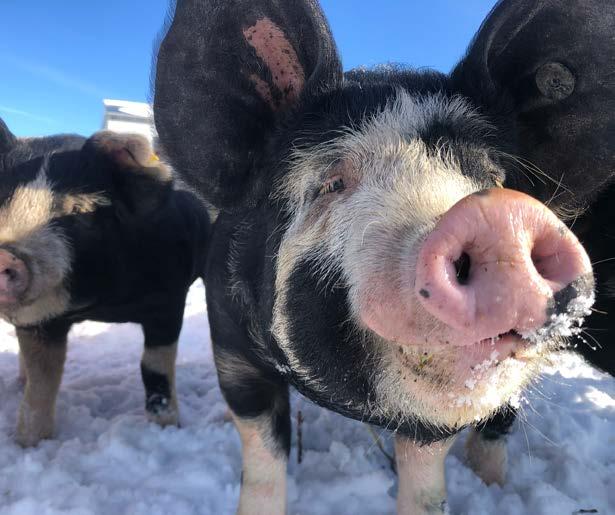
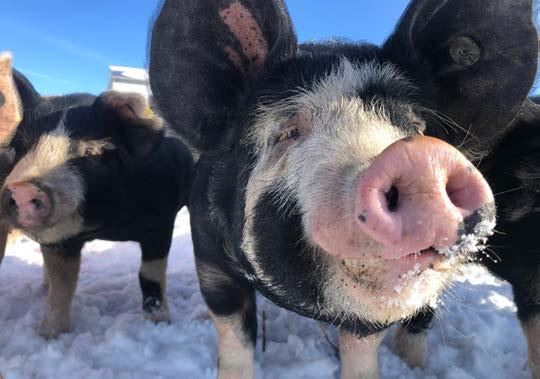
The life of a pastured pig at O’Connell’s Organic Acres in Durango, Iowa, or Dorothy’s Range in Blanchardville, Wisconsin, is a stark contrast to those raised in CAFOs. The hogs produced at these operations are heritage breeds raised on pasture. All the pigs at Dorothy’s Range are Gloucestershire Old Spots, while O’Connell’s cross breads large Black Hogs, Gloucestershire Old Spots, Berkshire, and Herefords. These heritage breeds, brought to North America by European explorers and immigrants, are known for their adaptability and hardiness. Farmers have selected traits over the course of hundreds of years that make hogs successful in their regions and environments.
While industrial hog raising operations utilize breeds that mature quickly and uniformly, these two farms are among the growing ranks of pork producers raising heritage breed hogs that are allowed to graze, forage, move about freely, and experience a natural social structure. These farms have developed systems that address the physical and psychological needs of the pig while working within their farms’ unique landscapes. There is no one-size-fits all approach when it comes to pigs on pasture, and pigs can be destructive to land if not managed well. Success comes from developing systems that embrace the challenges that CAFO systems have eliminated from hogs’ lives, including grazing, rooting, social interaction, injury, parasite pressure, dietary variation that may lead to varying outcomes per animal.
Pasture systems commit to raising healthy, strong animals with striking red flesh that make supermarket pork ill-advised if not inedible in comparison. As a result of young pigs getting more exercise, myoglobin, a protein in skeletal muscles that stores and transports oxygen, is present in higher levels in pasture raised pork. This creates meat that is redder and more beef-like in color and marbling (streaks of intramuscular fat) and improves the flavor and texture of the meat. Chefs and home cooks rave about the rich flavor of pastured pork, which is higher in protein and has healthier omega-6 to omega-3 fats. Research has shown that a lower ratio of omega-6 to omega-3 fats can reduce the likelihood of cardio-vascular disease and cancer.
G O A HEAD AND W ALLOW
Parasite control is an important consideration for all organic pork producers. While synthetic anthelmintics are allowed to treat animals in an emergency, organic pork producers must emphasize smart management to reduce parasite pressure. Here, pastured pork producers can gain an edge as their animals are less contained. O’Connell’s occasionally uses diatomaceous earth for parasite control. In Blanchardville, farmer April Prusia uses apple cider vinegar, garlic, probiotic feed, and black walnuts for parasite control. She relies on fecal egg counts to determine when to treat for parasites.
Rooting and creating wallows for mud bathing are natural instincts for pigs. O’Connell’s has accepted this and manages wallows as needed, occasionally filling one in that occurs in a problematic spot. At Dorothy’s Range, Prusia gives her pigs large tubs of water to create wallows where they are most appropriate.
“I used to think wallows were destructive, but now I see them as miniature ecosystems that certain insects and wildlife utilize,” says Prusia. “I often see or hear chorus frogs using the pigs’ wallows. There are many studies showing that bison wallows create important wildlife habitat, and pigs’ wallows offer similar benefits.”
Both farms are selecting for pigs that work in their farmsteads. Prusia culls gilts (unbred female pigs) that prefer rooting to grazing and has found, over time, that her herd is more likely
to graze. O’Connells alternates between purebred Berkshire GOS and Hereford boars bred to their mixed breed sows.
A common arrangement for grazing pigs is the “wagon wheel.” In this arrangement, animals have access to a central area in which damage is accepted and managed and where they are fed and watered. Several other, larger paddocks open off this central area. However, this arrangement isn’t practical on the hilly terrain of the driftless zone.
S IMPLE F ENCING S OLUTIONS AND A DDED F EED
These two farms have devised systems that work on their landscapes. O’Connell’s utilizes a home base method focused around the foundation of an old hog finishing building with alleyways that lead to paddocks that are fenced with two strands of electric. “Pigs respect the electric,” says Chris O’Connell, “and with sows, often one strand will do.”
Prusia also uses electric to create paddocks for her herd. She trains her pigs in a solid fenced area with a strand of electric just in front of the hard fence. Once the pigs learn that the electric fence is not to be touched, she can subdivide into smaller paddocks. The herd spends their summer grazing a hilltop. Additionally, Prusia trains her pigs to come to a feed bucket and her call. “If they ever escape, hunger and a familiar call make it easy to bring them back.”
As much as pigs enjoy the pasture, additional feed is necessary to raise marketable hogs. Both supply additional mineral blends. O’Connell’s, which also raises beef, lamb, and chicken, grows organic corn, soy (which is roasted), and oats for feed. Prusia adds roasted organic soybeans purchased from a neighboring farm, hay and haylage in cold weather, as well as walnuts from friends and neighbors who are happy to have them off their lawns. The pigs enjoy the nuts, husks and all, which, according to traditional medicine, is a powerful antiparasitic.
These two farms are succeeding in raising hogs without sacrificing the animals’ natural instincts, dietary, physical, and social needs. Their systems, while honoring traditional husbandry, are in no way old-fashioned. Prusia summed this philosophy up by saying, “Agriculture literally contains the word culture. As agriculture changes, so does our culture. Industrial, pharmaceutical-driven farming creates a culture disconnected from soil, seasons, and natural rhythms. But agriculture grounded in stewardship, soil health, and respect creates a culture that is healthier, more resilient, and more connected.” MS
Sara Mooney is Marbleseed’s Conservation Outreach Specialist working on behalf of the Midwest Agriculture network in Wisconsin in partnership with the NRCS.
This work is supported by a Cooperative Agreement with USDA Natural Resource Conservation Service. USDA is an equal opportunity provider, employer, and lender.
R ESTORING THE M IDWEST ’ S F IBERSHED
Q&A WITH Fl AX A DV o CAT e l esl I e sCHR oe D e R
Flax is making a comeback! The plant, which was brought to North America by European immigrants as early as the 1600s, was widely grown as a source of fiber, oil, and food.
Before the rise of petroleum-based products, linseed oil was the most common wood-finishing varnish. It was also used to make linoleum and as a primary ingredient in paints. Its fiber was processed into linen, a soft and durable material that eventually gave way in popularity to cotton and synthetic fibers.
Today, 75% of the world’s flax is grown in northern France, an area known for its linen. A small but growing number of textile artists and designers are dedicated to reviving flax production in the U.S. This movement began in California, when fiber artist Rebecca Burgess challenged herself to create her wardrobe entirely from materials grown and fabricated within a 150-mile radius of her home. The experiment made clear there were many individuals and small businesses working in the fiber sector but there was no infrastructure to bring them together.
A N ETWOR k OF FARMERS , A RTISANS , & M ILLS Burgess introduced the concept of a “fibershed” and started a nonprofit of that same name. More than a decade after it was formed, Fibershed has more than 70 affiliates across the U.S. and beyond, joining farmers, ranchers, designers, sewers, weavers, knitters, felters, spinners, mill owners, and natural dyers, who are deeply connected to and knowledgeable about their local landscapes.
Leslie Schroeder, a Madison-based advocate for locally grown and sewn textiles, believes flax is key to a Midwestern fibershed. She is part of a community of artisans, farmers, and researchers working to revive a flax production and processing network in Wisconsin.
Schroeder is presenting at Marbleseed’s Organic Farming Conference in February along with John Hendrickson from the UW-Madison in the Center for Integrated Agricultural Systems. As a preview to their session, “Fiber & Textile Potential in Agriculture: Flax for linen (and more!) in the Midwest,” Tay Fatke, Marbleseed’s Farmer Education Manager, spoke with Schroeder.
L OC k ING IN A F IVE -Y EAR R OTATION
TF: What are the benefits of flax as far as inputs or resource concerns, especially compared to cotton?
WHY FLAX?
Tay (TF): What brought you to fibersheds in general and flax in particular?
Leslie (LS): I have been a weaver and knitter my whole life – I still have my Fisher Price loom! After I had children, I became more interested in sewing our clothes, which led me to foraging for wild cordage.
We’re so disconnected from where our clothes come from— who grew the materials, who sewed them. Even the fact that clothes come from plants is lost on us. When I learned about the fibershed movement it reminded me of the local food movement that encourages us to eat seasonally and build a relationship with the person who is growing our food.
We can’t grow cotton in the Midwest, but we can grow flax. There are other fibers that grow here – hemp, stinging nettles, and milkweed – but they’re rougher. Linen, however, is a soft, high-quality material that’s been used to make bed sheets and underclothes because it’s soft against the skin.
LS: Cotton requires quite a bit of water and chemicals. It also has a complicated, difficult history – though I’m thrilled to share there are African American farmers and designers in the south who are reclaiming their relationship to cotton.
The actual mechanical processing of flax on an industrial scale requires inputs but the agricultural side doesn’t require irrigation or pesticides. The flax plant hasn’t become dependent on all those inputs that some of our other crops have.
Flax grows relatively quickly and is a pollinator friendly flowering plant. It’s a mycorrhizal super host that supports and boosts beneficial fungi in the soil. It works well in a lot of rotations. When I visited Normandy, I met with farmers who have a lock on their five-year crop rotation. They never deviate from it, and they have a path to sales for each of the crops. For flax to be successful here, we need to figure out the right rotation. It’s something I’m working on with the University of Wisconsin Extension.
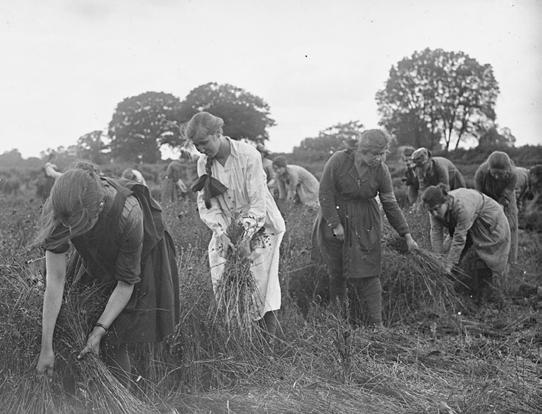
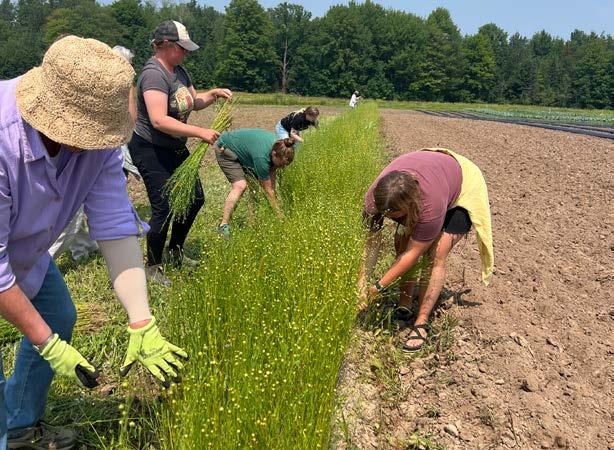
Opposite page: Flax harvesting has always been a communal event. Members of the Women’s Land Army harvest flax in Britain during WWI. Above: Community flax harvest at Red Door Family Farm in Athens, Wisc.
Q&A WITH L ESLIE S CHROEDER (Continued)
TF: How does flax for fiber and flax for seed oil production differ in terms of varieties and management?
LS: They’re the same plant but different varieties. The fiber varieties have been selected to be very tall and not branchy, while the oil seed varieties have been selected to be short and branchy and set heavy seed. The fiber varieties are harvested earlier — younger fibers are finer and softer. You want to let more time pass for the seed to set on the other variety, which degrades the quality of the fiber so that it’s not garment grade.
I’m part of a supply chain feasibility study that’s looking at secondary fiber markets for the stems of the oil seed. There are many worthwhile things it can be used for like carpet backing and erosion control mats. In Europe, there is a lot of research and development for bioplastic composites, something that hasn’t hit its stride yet in North America. But I think there’s real possibility for Wisconsin to play a role in developing flax bioplastics for consumer products, which would create two uses or double cropping.
U.S. N OT Y ET AT A GRICULTURAL S CALE
TF: Walk us through harvesting. What tools or equipment are typically used for harvesting small scale or midsize fiber flax?
LS: Currently, in the U.S. there’s only hand-scale harvesting available. At the larger agricultural field scale found in Europe, there is specialized equipment. The puller removes the plant from the ground and lays them on the ground. The flax is left to “ret” moisture, sunlight, and a concert of microorganisms break down the pectin and gums holding the fibers from the woody inner part of the stem. Next, a turner lifts and flips the flax occasionally to ensure plants are evenly exposed to the elements. Seed collection – called rippling – is done via special threshing machines or large combs.
Farmers familiar with flax develop a feel for the right time to harvest, which is around 20 to 30 days after it’s flowered. Wait too long, and it’s no longer garment grade. This makes it all
the more important to have scalable equipment. Obviously, importing equipment from Europe is costly. There are people around the U.S. working to adapt machinery that we already have here. I’m part of a group that just applied for a SARE grant to use cutters and equip them with really sharp blades to get through the thick fiber.
TF: Do you see potential for collaboration among farmers who are interested in this work? What might it look like to share equipment or processing?
LS: Yeah, 100%! The idea of sharing a single piece of specialized harvesting equipment is part of our feasibility study. This could work if planting and harvesting dates are staggered geographically starting in southern Wisconsin and moving northward, though this would need coordination and organization.
TF: What are problem weeds, pests, or diseases associated with flax?
LS: It’s susceptible to fusarium, which is why it does well on a long rotation. At the garden level, don’t replant it in the same place. Rabbits are the main pest that goes after it. If you plant it densely and consistently, it helps to control weeds and pests. Because it’s planted quite early – I’ve planted mine the beginning of April in recent years – that helps it to get established before a lot of competition pops up.
D EVELOPING S EEDS AND M AR k ETS
TF: Are seeds readily available?
LS: Seeds for oil varieties are readily available in North America, but high-quality fiber seeds are not. You need to source them from Europe. Not only is this expensive but it introduces possible complications — like tariffs or having your seeds stuck in a port in Belgium for a month and missing the planting window. There are intellectual property restrictions on the European seeds, so you’re not going to be saving them and building them out.
An organization in Oregon, Fibrevolution, is working on developing a high-quality fiber seed for North America. Reviving flax and linen here is a long game. It’s part of why I’m focused on developing that secondary fiber market so that we can get farmers experienced with the flax plant. I encourage farmers who are interested in planting it at the garden scale and learning about its growing cycle, identifying when it’s time to harvest, and getting used to retting.
TF: What are the current market opportunities for domestic flax fiber?
LS: Parallel to the farming side, we’re working to develop markets on the fiber side. There’s a lot of enthusiasm for linen right now. Anytime the supply chain is interrupted, whether
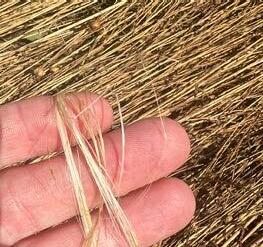
Fiber in retted flax.
I think there’s real possibility for Wisconsin to play a role in developing flax bioplastics for consumer products, which would create two uses or double cropping.”
— Leslie Schroeder, Midwest Linen Revival
through the pandemic or now due to tariffs, people become more interested in where their clothes are coming from.
I recently did a trial project with Ewetopia Fiber Mill in LaFarge, Wisc., to create a wool flax blend. Wool mills understandably don’t want fibers in their facility; they go to great lengths to remove plant material from the wool. It was very generous of Kathryn Ashley, Ewetopia’s owner, to allow me to do this little proof of concept project.
We created a 50/50 wool-flax blend that I hand spun. Because flax is such a long staple fiber, it requires specialized spinning equipment that doesn’t exist in the U.S. — it must be handspun. We used flax tow – the short, stiffer fibers from cleaning long line flax. Kathryn was surprised by the final product, which was softer than she anticipated. It really speaks to the kinds of collaborations that are needed between growers and processors.
TF: How is U.S.-grown linen showing up in the marketplace?
LS: Flax production and linen processing aren’t extensive enough for designers to rely on it. That said, there are many small designers who specialize in linen, including Breathe Clothing in northern Wisconsin. At a larger scale, Patagonia has invested in linen with Fibershed.
I really believe the future of luxury is handmade. As people realize their branded $5,000 bag is made from the same materials and created in the same shop as a $25 bag, the appeal of a brand is waning. Those with financial capacity want quality materials and quality design, not marketing and branding. In the process of reorienting and rebalancing our value chain, we need to emphasize materials grown close to home so that our farmers receive a living wage. MS
RESOURCES
L ESLIE ’ S TOP FLAX RESOURCES
North American Linen Association (NALA): a nonprofit trade association founded and supported by individuals and businesses committed to developing the flax fiber industry across North America. https:// northamericanlinen.org/
Fibershed: the original U.S. leader in creating soil-to-soil regional fiber systems. https://fibershed.org/
Midwest Linen Revival: building a regional flax and linen network to “benefit local farmers and economies, build community, and shorten the journey from seed to shirt.” https://www. wisconsinlinenrevival.org/
University of Wisconsin Extension: information on growing and marketing flax: https:// cropsandsoils.extension.wisc.edu/flax/
FIVE F LAX FACTS
1. The oldest flax fiber dates back 30,000 years and was found in a cave in contemporary Georgia.
2. Flax was cultivated across the ancient world and was used for clothing, sails, mummification, and food.
3. By the 8th and 9th centuries CE, Belgium and northern France were the major centers of the linen industry.
Leslie Schroeder is co-founder of Midwest Linen Revival, which is working to reestablish flax for fiber as an agricultural crop in our region. She will co-lead a workshop at the Organic Farming Conference on Feb. 27, “Fiber & Textile Potential in Agriculture: Flax for Linen (and more!) in the Midwest.”
4. Flax products have long been considered to have healthy qualities. Linen is resistant to dust mites and bacteria and flaxseed is high in omega-3 fatty acids.
5. In 1942, Oregon alone harvested 37,000 tons of flax which was processed in the 14 mills that existed then in the state. Just a decade later, only 3,400 tons were harvested.
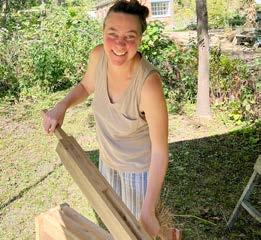
Leslie demonstrates hand processing flax at the Shake Rag Alley Fiber Faire in Mineral Point, Wisc.
Artwork by Nicktae Marroquin-Haslett
G ROWING THE C ANOPY
o F C olle CTIV e CHANG e
By Diane Christofore, Regenerative Agriculture Alliance
There is much unwell in our food and agriculture system. In the name of food, industrial agriculture has degraded soil, polluted water, exploited rural communities, extinguished biodiversity, and reduced food to a commodity extracted from land and labor. Farmers who feed their neighbors are disappearing. Land is being consolidated. Ecological and cultural knowledge holders are being pushed aside.
The question facing all of us is: How do we address these systemic problems – ecological, economic, cultural, and spiritual – all at once? The Regenerative Agriculture Alliance (RAA) community is building an alternative system, one that reflects the vision of our founder, Reginaldo HaslettMarroquin. With the mission of scaling regenerative poultry as a farmer-driven model, the RAA, at its heart, is an invitation to reorganize agriculture around life: the life of the land, animals, and rural communities. It translates Regi’s vision into practice, creating relationships and infrastructure with a goal of system-level transformation.
A R ELATIONAL S YSTEM
Our work is rooted in the belief that regenerative agriculture is a solid strategy to achieve soil health, improve human health, and build and maintain wealth across rural landscapes. Our Poultry-Centered Regenerative Agroforestry (PCRA) ecosystem is built on the core principle that regeneration is not merely a set of agricultural practices, but a way of relating: replacing extraction with reciprocity, isolation with interdependence, commodification with dignity.
RAA creates the conditions for this relational system to emerge or evolve, not through top-down directives, but through mycelial networks of living systems on the land, of people reclaiming and rebuilding their culture, traditions,
and communities. A non-profit 501c3 organization with headquarters in Northfield, Minn., the RAA emerged from decades of work led by Regi.
His early experiences in Guatemala shaped a lifelong commitment to ecological integrity, community governance, and food as a sacred connector. RAA was created to serve as a dedicated entity to develop the infrastructure needed to support a regenerative poultry system and to connect this system to other sectors seeking to also integrate their work into an overall regenerative agriculture system.
Early adopters across Minnesota and Wisconsin have demonstrated that small- and mid-sized farmers can succeed when supported with shared infrastructure and long-term, values-aligned markets. Today the production model has grown into a regional ecosystem made up of farmers, farmerowned businesses, community food shelves, researchers, key operating partners, youth programs, and regenerative agriculture allies across the Midwest.
RAA serves as the backbone organization for this growing ecosystem. We coordinate partners, align capital, develop markets, and ensure that regenerative poultry can scale in a way that honors farmers, land, and culture, and ancestral traditions centered on food as nourishment, medicine, and universal connector.
During 2026, the RAA will support 20 active farms through technical assistance, cohort-based learning, and on-farm demonstrations. While farmers are at the heart of our work, equally invaluable to our ecosystem’s well-being are affinitybased learning communities, food processing workers, veterinarians and researchers, funders, certification partners, buyers, and nonprofit allies like Savannah Institute and Marbleseed. As RAA farms grow in capacity, we expect the number of birds raised within the regional PCRA model to increase. Our short-term goal is to reach 150,000 broilers annually in the coming years.
GROWING THE CANOPY
A DAPTING TO FARMERS
The PCRA ecosystem is a system where poultry is integrated into an agroforestry design, with perennial crops, and silvopasture. Birds fertilize the land, manage pests, and accelerate soil building, while the trees provide shade, carbon storage, and diversification. It is an agronomic model designed from the “jungle-like” geo-evolutionary ecological blueprint of the chicken. Efficiency is measured as energy flows, not mechanical speeds of extraction.
Unlike top-down contract agriculture models that trap farmers in debt and dependency, the PCRA adapts to each farmer’s operation, goals, and context. Enterprise planning is aligned with family needs, land capacity, cultural practices, and financial realities. By owning key middle-of-the-supplychain infrastructure, standardizing regenerative protocols, and helping secure project financing, RAA reduces risk and barriers to participation for emerging farmers.
At the start of every production season, farmers enter into a collaborative commitment process with RAA. Breeds are selected to meet Tree-Range® standards, chosen from approved hatchery partners. Collectively, we schedule flock numbers and processing dates. Farmers can retain up to 10% of their flocks for family and community food sovereignty, or for direct sales in local markets. This process provides structure and processes to meet everyone’s goals, supporting farmer autonomy while ensuring ecosystem-wide coordination.
“As one of the many small Wisconsin dairy farms that had to phase out of dairy in the past decade, we were looking to diversify our farm business and utilize our existing facilities,” says Stephanie Coffman of Wild Apple Meats. “We wanted to make sure whatever enterprise we added would reflect the healthful and regenerative ethics our family tries to live by. RAA provided the support we needed to launch a broiler operation by providing the training for their model and upfront financial support for chicks and feed. In addition, they provided a market for us to sell to. This is huge for a busy farmer that already works off-farm and doesn’t have time to do much direct marketing.”
P
ROCESSING FACILITY P ART OF C
OMPLEX
N ETWOR k
RAA’s ownership of a USDA-inspected poultry processing facility in Stacyville, Iowa, is central to the supply chain’s ability to adapt to market conditions. It ensures farmers have access to processing infrastructure, something that most small farmers across the country lack. This business structure supports farmers as they transition into the system. For many, this represents a pathway out of the extractive, industrial system that’s built for efficiency and volume at any cost.
The facility was purchased in 2020 with grant funding. It completed its first USDA-inspected batches of chicken in 2021. The 2025 production season recently concluded with 75,000 birds processed from 138 farms. Of the total volume, 55% was raised within the PCRA ecosystem. We are proud to share that the facility has been selected for funding through the USDA Local Meat Capacity Grant, which has supported the purchase of equipment to expand our services to include ground chicken, in addition to our current primary and secondary cuts.
Through this facility and the poultry production model, RAA aligns chicken raised in the system with community demand. We work directly with food shelves, co-ops, and local governments to shift institutional purchasing toward regenerative and equitable sourcing. Regionally, we collaborate with groups such as the Nutrient Density Alliance and A Greener World; nationally, we are members of the National Sustainable Agriculture Coalition and engage in the Regenerative Food Systems Investment Forum to shape capital and infrastructure patterns that support farmer-led systems.
During the 2025 production season, RAA brought together a network of service providers who work directly with farmers. These include financial partners, such as Good Agriculture and Compeer Financial, who help producers structure viable businesses; veterinarians and scientific collaborators who collect and share flock-level and ecological data; and animalwelfare certifiers, such as A Greener World, which provides Animal Welfare Approved verification.
C O -D ESIGN A CROSS THE S YSTEM
Researchers and scientific partners gather on-farm data, including soil health indicators, carbon measurements, and poultry performance metrics, to share with farmers who use it to inform system design and make improvements. We are especially excited about the Ecdysis Foundation, which has been supporting regenerative soil mapping and data collection to further optimize both ecological and economic outcomes for participating farms. Two poultry farms in the network participated in their 1,000 Farms Initiative this past year.
Through Minnesota’s Local Food Procurement Assistance (LFPA) Program, partners purchased $545,204 of TreeRange® Chicken over the past two years. Notably, 100% of producers participating meet the state’s Emerging Farmer criteria. Key partners, including The Sanneh Foundation, Open Arms of Minnesota, CLUES, Channel One Regional Food Bank, Northside Grocery & Deli, Community Action Centers, and numerous rural food shelves, are more than distribution points. They are co-designers of the ecosystem in that they help to identify culturally relevant cuts, facilitate educational opportunities at public schools, and inform our delivery systems.
This collaborative design has led to innovations such as exploring halal-certified poultry for Muslim households and offering whole-animal cuts preferred by many Latino families. Regeneration, in this ecosystem, is inseparable from cultural relevance and community voice.
R ECENTERING A GRICULTURE A ROUND L IFE
Each spring, the RAA community meets for the Regenerative Poultry Convergence. The two-day event features breakout sessions that explore ecological data, highlight grant opportunities relevant to the poultry model, share emerging market relationships, and surface both the successes and challenges experienced by ecosystem stakeholders. The Convergence is intentionally designed as a space where participants reflect on the previous season and co-create priorities for the season ahead. Shared outcomes include:
• Establishing baseline pricing and reliable market access for emerging farmers
• Expanding adoption of regenerative agroforestry practices
• Forming affinity groups and defining their shared purpose
• Increasing pounds of chicken delivered to food-access partners
• Tracking measurable improvements in soil health, carbon outcomes, and animal welfare
Diane Christofore, Executive Director of the Regenerative Agriculture Alliance, has formal training in food systems and permaculture. Diane seeks to collaborate on social entrepreneurship ventures that heal our relationships with the land and enrich our shared future.
As the RAA continues to grow and meet our mission of scaling regenerative poultry as a farmer-driven model, we cannot lose sight of the heartbeat at our organizational center. This is our belief in recentering agriculture around life: the life of the land, the life of the animals, and the life of the rural communities most impacted by our food system. Across Minnesota, Iowa, Wisconsin, and the Pine Ridge Reservation, where our key operating partner Makoce Agriculture Development leads deployment, the PCRA ecosystem demonstrates that regeneration is a lived practice. MS
The meditation on the following page, which includes a telling of how things are and how they might be, is offered by RAA founder Reginaldo Haslett-Marroquin, who will expand on these ideas at the 2026 Organic Farming Conference. It is written as a resolution that intentionally establishes the reasoning behind the shared statement; it is not simply a reflection but is meant to be a practical tool for collective governance. Although the structure may feel foreign at first, it is deliberate –modeling how shared understanding can be built, articulated, and used to guide decisionmaking and action.
Reginaldo Haslett-Marroquin, founder of the Regenerative Agriculture Alliance and CEO of Tree-Range Farms, grew up in extreme poverty in Guatemala during the brutal decades-long civil war. He dedicates his entrepreneurial spirit and regenerative vision to restructure the food system. In 2018, he was awarded a lifetime Ashoka Fellowship.
Nicktae Marroquin-Haslett has worked alongside the Regenerative Agriculture Alliance for four years. As Communications Manager, she applies an arts background and expertise in design, social media, storytelling, and writing to amplify the organization’s work.
U NDERSTANDING R EALITY AS A F OUNDATION FOR C RAFTING S TRATEGIES AND A R ESOLVE TO C HANGE
By Reginaldo Haslett-Marroquin, Regenerative Agriculture Alliance
CONSIDERING... A MEDITATION ON CHANGE
That at this time, industrial agriculture expansion has been scientifically proven and field-verified to degrade food quality, pollute our waters, compromise soil and ecological integrity, and harm human health, and has abandoned food and agriculture’s foundational role centered on nourishing life with integrity.
That as a result, the mass-scale destruction of the planet’s ecosystems has led to social disruption and economic deterioration in rural farming communities, compromising not only farmers and solution-builders, but the survival of entire regions – economically, socially, and ecologically.
That the ownership, control, and governance of our food system – from land to capital to policy, regulations, and infrastructure – have been transferred to institutions and actors unwilling to recognize food, clean water, clean air, and individual wellbeing as non-negotiable, inalienable human rights.
That robust and well-established initiatives exist at local, regional, and global levels advancing regenerative, organic, agroecological, agroforestry, permaculture, biodynamic, holistic, silvopasture, and indigenous agricultural systems.
That a global movement of changemakers is committed to building an agriculture system that heals the planet and restores broken relationships among ourselves and with all life on Earth.
That there is a collective awakening to the sacredness of our bodies, minds, and spirits– an understanding that food is central to regeneration across all biochemical and physical functions – making the source, integrity, and pathways of our food essential to health and wellbeing.
That small farmers generate more than 70% of the food that reaches our tables, yet are under constant threat from a global system that seeks only to profit from the exploitation of our land, water, air, and nature itself.
That correcting course requires not reform, but the creation of a new plan and a new system capable of replacing the current system.
That there are many countries, government leaders, institutions, and publicly-supported programs, along with goodwill and capacity in both public and private sectors, genuinely seeking a transition toward a regenerative future.
That technology can accelerate destruction or recovery, and that how we choose to deploy it will determine which path we take.
BE IT THEN RESOLVED...
We commit to being part of a new local, regional, national, and global agriculture movement, aligning our actions and resources to restore the quality and integrity required to regain control of our food system.
We will join forces with all who are willing to restore the planet’s ecosystems and build the social and economic structures necessary to sustain life.
We will engage compatible science, technology, and physical and institutional infrastructure, alongside ancestral wisdom, traditional ecological knowledge, and Indigenous governance practices, ensuring food systems deliver nourishment with integrity so that mental, physical, and spiritual regeneration can be achieved at scale.
We will structure our operations to systemically refuse participation in extractive pathways that undermine living systems, social cohesion, and economic resilience.
We will work collaboratively to build local, regional, and global infrastructure that advances regenerative, organic, agroecological, agroforestry, permaculture, biodynamic, syntropic, holistic, silvopasture, and Indigenous agriculture movements.
We will organize and work with consumer protection institutions, nutrient integrity initiatives, scientific and educational institutions to advance the journey to understand regeneration in all forms of human and ecological functioning.
We will organize at all levels to reclaim ownership, control, and governance of food and agriculture systems, ensuring food reaches our tables in ways that address the current global, climate, health, nutritional, soil loss, and biodiversity crises.
We will collectively build technical and support infrastructure that assists farmers of the world to stay on the land, build viable enterprises, and participate fully in governance systems that secure their futures.
We will build a culture and ecosystems of responsibility and accountability, recognizing that food and agriculture are central to humanity’s survival and the preservation of all life on Earth.
We collectively agree that there are many government leaders, institutions, and private-sector entities who are prepared to engage in this transition and that we will work with everyone who approaches this work with integrity and commitment to a truly regenerative future.
We will use technology to rebuild ecosystems and rural economies; strengthen land-to-market relationships; reduce hardship for workers; monitor and verify outcomes; modernize operations; and support accountability, transparency, and coordination across systems at all levels.
We commit to further understanding and continued development of the intentions expressed in this resolution, and to ensure that at every step, we seek to enhance our collective capacity to envision, express, design, and build a fundamentally different system.
Regi will be speaking at the Organic Farming Conference on February, 26 at the opening session. For more details visit: conference.marbleseed.org.
Photo credit: Leia Vita
Addressing farmer mental health
demands more than awareness, it calls for a structural reckoning”
— Sophia Jasmine Vanderheym
YOU ARE MORE THAN THIS FARM
T H e m e NTA l H e A lTH C RI s I s IN Ru RA l Ame RICA
By Sophia Jasmine Vanderheym
Thank you to MAD Agriculture for allowing us to reprint this article. It was first published on their online journal on June 4, 2025.
Disclaimer: This article is intended for informational and storytelling purposes only. It is not written by a licensed mental health professional and should not be used as a substitute for professional diagnosis, treatment, or advice. If you or someone you know is struggling with mental health, please seek support from a qualified provider or contact a local mental health resource. You are not alone, and help is available.
As society moves deeper into a digitized age, some Americans find themselves daydreaming of farming as an idyllic second career — a life of open skies, self-reliance, and a sense of purpose rooted in the land.
Despite the nostalgic appeal, the lived experience of farming today is often marked by financial strain, long hours, and mounting uncertainty.
Since the 1980s, researchers like Judith and William Heffernan have documented farming as one of the most isolating and financially precarious professions, conditions that have contributed to agriculture having one of the highest suicide rates in the U.S.
Today’s farmers face intensifying pressures: rising climate volatility has led to increasingly unpredictable growing seasons and declining yields in key regions. According to the USDA, extreme weather events now account for a growing share of crop insurance claims nationwide. Simultaneously, political uncertainty has eroded critical support structures, with several federal and state programs facing budget cuts or expiration.
In some cases, farmers have had to mobilize to retain access to essential online resources and platforms that connect them to grants, critical data, technical assistance, and market tools.
As these challenges escalate, farmers — stewards of our food system — urgently need meaningful resources to navigate the compounding pressures of economic instability and social isolation. Addressing this crisis requires more than awareness; it calls for collective action to strengthen and scale the solutions already taking root.
T HE G REEN R EVOLUTION : A N E RA U SHERING IN E FFICIENCY AND E XPLOITATION
“We pulled into a little clearing, and in the middle of it was a log cabin. He pointed and said, ‘My great-great-grandmother was born in that house. I’m the sixth generation on this land. My kids will be the seventh. And I’m not going to be the one to lose it.’”
This story, shared with farmer advocate Scott Marlow, former USDA Senior Policy Advisor and Founder of Long Rows Consulting, reveals just how deeply farming is tied to identity and generational legacy. After more than a decade of helping farmers through their most vulnerable moments, including financial ruin, identity crisis, and profound grief, Marlow explains that the mounting pressure can be traced back to the industrialization of agriculture, a system that was “built to run people out of it [agriculture].” Since the mid-20th century, agricultural policy has prioritized scale and mechanization over farmer well-being.
The push for “efficiency” mechanization, consolidation, and monoculture — wasn’t a fluke; it was an intentional design choice. Industrial ag has created what Marlow calls the Agricultural Hunger Games. In this brutal zero-sum environment, survival means constantly outperforming your neighbors, expanding your acreage, and doing more with less. Farmers today are expected to operate on the bleeding edge of innovation, debt, and exhaustion; for many, the ominous threat of losing the farm is never far away.
Failure to keep the farm and its workers afloat often feels personal and many farmers internalize systemic outcomes as their shortcomings. “You hear it all the time,” Marlow says. “‘I must be the worst farmer you’ve ever seen.’” In a recent Mental Health Community Survey conducted by Mad Agriculture, a farmer (who wished to remain anonymous) echoed this sentiment, reflecting that “sometimes I feel like I’m not a ‘real’ farmer because I don’t own my land.” But most mental health crises in agriculture aren’t due to personal inadequacy — they’re the result of a system designed to concentrate land, minimize labor, and externalize risk. Moreover, Marlow notes that, “the very attributes we admire about farmers (their independence, connection to land, and hard work) become an economic disadvantage, forcing many growers to find off-farm work to finance their farming habit.”
Even those who comply with the system — adopting synthetic inputs, larger equipment, and high-volume production — find themselves locked in an extractive cycle that degrades soil health and minimizes ecosystem resiliency to fight climateinduced weather hazards and damages the surrounding biodiversity and quality of the land. This isn’t independence — it’s a cycle of extraction.
And yet, even within this struggle, the experience is far from monolithic. The toll of systemic pressure hits harder when compounded by racism, sexism, homophobia, and intergenerational trauma. The culture of farming, rooted in stoicism, self-determination, independence, and relentless grit, can obscure the unique challenges faced by underrepresented farmers, whose experiences are often overshadowed by the dominant narrative. Over the last few decades, millions of smallholder farmers have been pushed off the land — particularly Black farmers, women, and LGBTQIA+ growers. USDA data shows that the number of Black farmers in the U.S. has dropped more than 90% in the last century. Meanwhile, land access for new and aspiring farmers has become increasingly competitive and costprohibitive.
A G -s P e CIFIC
m e NTA l He A lTH R esou RC es
CRISIS & IMMEDIATE SUPPORT
AgriStress Helpline:
A 24/7, free, and confidential crisis line staffed by professionals trained in agricultural mental health support. Call: 833-897-2474
988 Suicide & Crisis Lifeline: Nationwide lifeline for mental health crises or suicidal thoughts. Free and confidential, available 24/7. Dial: 988
TOOLS & NETWOR k S
Farm Aid: Offers direct support to farmers through a hotline, mental health resources, and advocacy.
The American Farm Bureau Federation: Farm State of Mind: A national initiative providing mental health resources, stateby-state hotlines, and stories to break stigma.
The Gray Matters Collective: Focuses on mental health advocacy in rural and agricultural communities through storytelling and education.
m ARB lesee D su PP o RT s
G ROW B EYOND THE F IELDS : C OMMUNITY & C ARE FOR FARMERS
As “You Are More Than Your Farm” reminds us, farming asks more of the heart and spirit than most people ever see. Emotional wear is real, but so are the communities of care that exist to support growers. If you’re looking for connection, solidarity, or simply a place to exhale, these farmer-led spaces are here for you. Across Marbleseed programming, farmers are building communities rooted in connection.
MORE THAN THIS FARM (Continued)
A C ULTURE OF S ILENCE : A D OUBLE -E DGED S WORD
When farmers lose their land, they don’t just lose a business, they lose a legacy, a way of life, and a core part of their identity. Grief sets in quietly, and the culture of farming offers little room for emotional vulnerability, and even less for asking for help. Instead, silence becomes a survival strategy — one that cuts both ways.
Farmers who transition into agriculture from other professions quickly confront and battle another sobering reality of the industry: they’re often left to shoulder the bulk of the risk. Despite the volatile nature of weather, pests, and markets, business partners such as lenders, insurers, and distributors rarely share in the consequences of a tough season. Instead, the farmer becomes the shock absorber, carrying the weight of uncertainty largely alone. What’s more, a bad year or financial hardship can seed doubt in the minds of these stakeholders, so farmers learn to mask their struggles, becoming relentless cheerleaders to preserve the appearance of viability. Expressing hardship openly can feel dangerous, especially in rural, tightknit, or competitive communities where rumors spread and reputations can break a business. This performative optimism is exhausting — and precarious.
And while therapy proves helpful for some, it often falls short for others. As Marlow puts it, “Farmers don’t always suffer from clinical depression. It’s demoralization the loss of hope from trying everything and still failing.” When farmers do seek treatment, many discover that health professionals unfamiliar with agricultural realities cannot offer relevant support. The result: they don’t return. This slow erosion of hope can manifest as burnout, substance abuse, chronic illness, or suicide.
U PLIFTING FARMERS : P EER S UPPOR T , P LANNING , AND P URPOSE
Addressing farmer mental health demands more than awareness, it calls for a structural reckoning. Financial support and more flexible, nuanced funding vehicles are crucial, as is ensuring that business partners share more of the financial risk traditionally shouldered by farmers alone. But as Marlow emphasizes, the path forward also begins with connection. Drawing on years of facilitating workshops and farm advocacy programs, he explains: “Communication is everything. You need to feel connected to a support system and have a plan for when things go south.”
P EER S UPPORT G ROUPS AND C OMMUNITY E VENTS
Peer support groups are one proven approach. These spaces offer privacy, empathy, and cultural understanding — elements many farmers find missing in traditional therapy. Similarly, workshops and community gatherings that include honest conversations about failure, especially when led by respected farmers or leaders, can foster trust and normalize vulnerability and failure.
For Ryan Slabaugh, son of a first-generation farmer and who formerly led Acres USA before founding Think Regeneration, a national coalition advancing regenerative food supply projects, failure is an inherent part of farming. “But when we don’t talk about it,” he warns, “that silence can be dangerous.”
But to talk about failure, supporters must understand one critical observation: avoid framing events as “mental health support.” “No one will come if you say it’s to get help with their mental health,” Marlow notes. “But they’ll come if you say, ‘You might need to help someone else.’” Farmers are natural caretakers; they’re far more likely to show up when the goal is supporting others, not spotlighting themselves. This isn’t just about emotional coping. It’s about building durable, decentralized systems of care — where solidarity, not silence, becomes the norm.
This isn’t just about emotional coping. It’s about building durable, decentralized systems of care — where solidarity, not silence, becomes the norm.”
— Sophia Jasmine Vanderheym
Education is another key lever to help inform and steward a more responsible food future. According to Indigenous farmer and educator Adam Uribe, the mental health crisis is inseparable from ecological disconnection. “We call it Nature’s Deficit Disorder being disconnected from the land is making us sick,” he says.
Through his work with youth across five different Indigenous communities in Southern California and a robust consulting practice, Adam teaches farming as a form of healing centered around soil health, native habitat, and relationship to place, echoing ideologies beautifully highlighted in Robin Wall Kimmerer’s Braiding Sweetgrass. His students learn to plant, harvest, and store food not for profit, but for reconnection, and from that, a sense of agency and resilience returns.
Y OU ARE M ORE THAN Y OUR FARM
At its core, addressing farmer mental health begins with a shift in perspective: recognizing that a person’s worth is not measured solely by the yield of their land or the success of their business. The bottom line: You are more than your farm. For farmers, this truth can be a lifeline, an invitation to prioritize well-being, honor the full spectrum of life beyond the fields, and see challenges not as personal failings but as part of the agricultural journey.
Equally essential are education, inclusion, and community pillars that support not just individual resilience, but collective strength. Healing the food system requires healing the people who grow it. And that healing often starts with relationships: checking in on a neighbor, spending time with loved ones, or simply telling the truth about how hard it really is.
For consumers, one of the most powerful acts is also the simplest: offer your gratitude. Say thank you at the farmers market. Acknowledge the hands that harvest your food. Because in a world where so much feels out of reach, connection remains our most powerful tool — for resilience, for change, and for care. MS
MARBLESEED SUPPORTS
(Continued)
A G S OLIDARITY
The Ag Solidarity Network (ASN) is more than a message board; it’s a home for farmers and ag professionals seeking a community grounded in justice and care. Featured groups include:
Growing Wellness:
Share what’s heavy, discuss burnout, and crowdsource strategies.
Farmer Allyship:
Featuring monthly discussions on rotating topics.
Queer Farmer Community: A safe peer space for LGBTQ+ land stewards.
Join at agsolidarity.com. And if you don’t see what you need, consider starting your own ASN group!
C LIMATE C IRCLES
Community-Based Support for Climate Stress:
Marbleseed’s Climate Circles offer a unique kind of support—part peer-to-peer learning space, part emotional grounding, part collective discussion surrounding climate disruption.
Held virtually and rooted in community practice, Climate Circles help farmers and ag professionals process the grief, anxiety, and exhaustion that come with increasingly volatile weather. Each circle invites participants to slow down, breathe, and talk openly about what’s happening on their farms. They’re easy to attend and embrace all experience levels.
W ELLNESS AT OFC
Sophia Jasmine Vanderheym is a Bay Area writer who holds a Master’s in Climate Change Science and Sustainable Food Systems from the Columbia Climate School. She writes about the intersection of climate, society, and food.
The Organic Farming Conference continues to expand its offerings that speak directly to the inner lives of farmers. Alongside production sessions, the conference will include dedicated wellness and mental resilience workshops, recognizing that technical skills alone can’t sustain a farmer.
conference.marbleseed.org
A N I NVITATION TO S TEWARDSHIP
C RAFTING A Ne W sT o RY IN A GRIT ou RI sm
By John Beaton, Fairhaven Farm
Agritourism enterprises come in all shapes and sizes and are embedded within farming operations that raise a variety of crops and animals. Corn mazes, u-pick orchards, fiber workshops, and farm-to-table meals have all become familiar offerings across rural spaces.
According to a nationwide survey conducted in 2024 by Penn State University, most farmers engaging in agritourism have several things in common. More than 50% are operations of 50 acres or less, generating between $1,000 and $99,000, with fresh fruit and vegetable production and livestock as the primary agricultural activity.
Interestingly enough, these statistics paint a pretty accurate picture of the farm my wife Emily and I run about 20 miles north of Duluth in Minnesota. We raise fresh fruits and vegetables and have a small flock of Icelandic sheep on the 27 acres that comprise Fairhaven Farm. Our agritourism enterprise, which centers around hosting weekly wood-fired pizza nights, provides a significant income stream to our farm business. When folks come to visit, they get access to our farm products, plus we feature other locally and regionallyproduced meats, cheeses, and other value-added products, making it a win-win for our farming neighbors.
These weekly events, held May through September, provide an opportunity to connect with visitors in a unique way. While folks wait for their pizza it is my job to give farm tours. I take people through the field space, show them what’s growing, and let them taste the fruits and vegetables that are in season. The sheep are an absolute hit with kids and adults alike. While people come for the pizza and the opportunity to change their routines and see something different, this hands-on experience surprises many of them.
They can get pizza from a dozen different restaurants in our area. It’s not simply the menu item, it’s the story the pizza tells that makes the experience special. The flour for our signature crust, for instance, is sourced from Natural Way Mills in Middle River Minnesota, an organic grain mill that sources its grain locally and regionally. Many people are surprised at the depth of flavor that comes from our 50% whole wheat crust. Or our red sauce, which is made from the tomatoes we grow in our high tunnel; I always get a thrill to see visitors gasp when they walk among the rows of tomato vines that tower over their heads! It’s through these stories and experiences that our customers gain an appreciation for why it’s important to support farms like ours. With the pizza on their plate, I can connect the soil health practices and care that goes into cultivating the ingredients to the tastes they are enjoying.
B EYOND P I zz A
After three seasons of honing our system, we wanted to expand what we were doing in order to bring in more income. The pizza night was great for attracting a lot of visitors, and we were committed to farming. We didn’t want to be an event space in the country and expand into hosting weddings or renting our venue. After seeing people light up on farm tours we wanted to focus on fostering a deeper experience that would offer more meaningful engagement with the land. We wondered if we could share our skills as farmers and lean into our penchant for teaching to offer an educational experience.
We looked at what other innovative farmers were doing for inspiration. We found two examples we really like. Knoll Farm in Vermont offers day-long or multi-day retreat space for organizations focused on positive changemaking. According to the farm’s website: “Many organizations find that the unique combination of the farm’s rich history, a caring staff, delicious communal meals, and inspiring natural settings in which to listen and speak deeply is transformative on many personal and professional levels.” We were also inspired by Jean-Martin Fortier’s program called Canopy—“an advanced certification retreat… designed to best prepare the next generation of farm advocates, consultants, and educators by equipping them with the skills needed to help others successfully manage small-scale farms.”
In both instances, farmers are using their skillsets as educators to affect personal and professional growth in a group setting. Each of these farms have tapped into more than their ability to grow food to generate income. They create or host meaningful experiences while offering access to their farm spaces to intentionally foster positive cultural change.
G ROWING Y OUR G OOD L IFE
With these examples in mind, we launched our new offering in 2025, “Growing Your Good Life.” We led a cohort of nine people through a season-long immersion course that convened at the farm once a month for a full day of programming. The content of these monthly meetings was split between a classroom type setting and bringing participants into the greenhouse and out into the field to perform the tasks of the farming season. Folks got the chance to mix learning styles, share their own story with the group, and, most importantly, put their hands to work as we started seeds, planted the field, and finally reaped the harvest of our work together.
Had the course revolved solely around the practical skills of farming and the science behind soil health it may have only attracted beginning farmers or others in the agricultural sector. We wanted to include people who sensed that the farm had something to teach them, but who weren’t necessarily seeking a new vocation. Over the years, as Emily and I deepened our relationship with the plants and the soil and invested time into defining what a meaningful life looked like, we witnessed our lives transform in a powerful and positive way. While this transformation is surely possible in many contexts, we attribute much of it to being on the farm, taking part in the rhythms of the season, and integrating the lessons that living life close to the earth brings. Those of you that farm know– farming changes you. We wanted to find out if we could foster that change through our course for anyone who was open to it.
Opposite page: Emily and John Beaton among the tomato vines in their high tunnel. Photo credit Scott Streble. This page, left: Fairhaven’s Pizza Night pizzaiolo, Justin Ciletti proudly poses with a wood-fired pizza. Middle: Growing Your Good Life Immersion Course participants dig into their workbooks. Right: Immersion Course participant, Kimberly Johnson going after some weeds among the parsley at Fairhaven Farm.
JOHN’S AGRITOURISM INSPIRATIONS
Insights on Agritourism: Evidence from the 2024 National Agritourism Producer Survey Among U.S. Producers. https://nercrd.psu.edu/wp-content/ uploads/2025/04/2024-NationalAgritourism-Producer-Survey. updated6-4-2025.pdf
Knoll Farm:
A gathering place for social and environmental change makers. https://knollfarm.org/
The Market Gardener Institute & Jean-Martin Fortier: A comprehensive knowledge hub and leader in the education of market gardeners worldwide. https://themarketgardener.com/
Emily and I both have experience as educators and mindfulness practitioners, as well as training in Holistic Management, all of which informed the creation of the course. Growing Your Good Life blends elements of self-stewardship and self-reflection, which helps root participants in an ethic of soil health while cultivating the life they want. The most critical aspect of the course is helping participants define their context. We ask questions such as: What are the most important values that you hold? What is the quality of life that you desire? How and what do you want your life to look like? How does the natural world and growing food intersect with the context you desire?
Participants contemplate these questions and write them down in a custom workbook that we created to guide folks along the way. The formula we defined, simply put, goes something like this: identify your values, define the context that best mirrors a life lived in alignment with those values, and then create a habit of monitoring to ensure that the decisions you make are continually leading in that direction.
The course is centered around the metaphor of the growing season. The same way we learn to care for the soil to receive a good crop is how we can learn about ourselves to grow into our full potential. We define what our landscape needs to look like and how the ecosystem must function to produce a reliable crop year after year. We cultivate a deep understanding of the interdependence that lies at the heart of farming for soil health, and we constantly observe the landscape for signs of function or dysfunction so that we may correct or continue our management decisions.
Unlock Your Soil’s Potential
Naturally restore soil health and fertility with Sea-90’s complete spectrum of minerals and trace elements. Feed soil microbiology, enzymes, and fungi to naturally unlock plant-available nutrition for pastures, row crops, produce, and more.
Plus ask about our brand new, spore-based biological to further amplify soil biologynaturally. OMRI and Organic Approved!
a call to build a custom program today.
The positive effect of this work is enhanced by being in a cohort of supportive individuals who are all committed to growing their own good life. We were successful in attracting a wide range of participants, from college students, newly married couples, young professionals, and a recently retired neighbor. This intergenerational mix lent our inaugural course a diverse mix of perspectives and values.
A GRITOURISM AT M ARBLESEED
Just as every individual farm reflects the farmers’ skills and preferences, our course is no exception. We created Growing Your Good life to intentionally connect with a small group in an interpersonal exchange that blends elements of spirituality, psychology, and soil health. Perhaps this type of offering is relatively rare, but there are many people looking for a deeper connection to the land.
All farmers play an important role as land stewards and as agents of cultural change, but for those that open their farms to the public, this role is even more pronounced. At the heart of what we do as farmers lies altruistic motivation – caring for the environment, community, and our families. There are few individuals better suited to help ground communities in an ethos of love, respect, and stewardship than farmers.
Whether you are interested in doing on-farm dinners, giving tours of your orchard, hosting workshops, or pushing the boundaries of what agritourism means, I hope you’ll join me at the meet up I’m hosting at the Marbleseed Organic Farming Conference. Together, we’ll explore common and innovative forms of agritourism enterprises and discuss the most important factors in creating a positive experience for visitors. MS
John Beaton operates Fairhaven Farm just north of Duluth and works for the Minnesota Farmers Union. Together with his farming partner, Emily, they raise vegetables, starter plants, and Icelandic sheep. John believes that by tending the soil and stewarding the land we can cultivate peace within ourselves and within our communities. John will be hosting an Agritourism Meetup at the Marbleseed Organic Farming Conference on Friday, February 27. Contact John at hello@fairhaven.farm.
MAR. 21-22 , 2026
LANESBORO , MN
BEGINNING FARMERS...
GIVE YOUR FARM A BOOST!
Hit the ground running this growing season with New Farmer U, an early spring mini-academy to boost your farm business skills.
This weekend-long March retreat at Eagle Bluff Environmental Learning Center in Lanesboro, MN is for early-stage farmers — aspiring, beginning, or anywhere in your first decade — no matter what you grow or where you farm.
Expect lively group and breakout sessions, fresh ideas you can put to work right away, hands-on support around farm finances and operations, and plenty of time for connection, conversation, and camaraderie — capped off with a cozy Saturday night bonfire.
LEARN MORE & REGISTER BELOW
Workshop participants gather flowers in the field at Fairhaven Farm. Photo credit: Scott Streble
PROCURING LOCAL FOOD
By Kate Fitzgerald
In July 2025, Representative Rob Bresnahan, a freshman Republican from Pennsylvania, introduced a bill that would give USDA $200 million annually for states to allocate to the purchasing of local food for nutrition and hunger relief programs. What happened next is remarkable. In this year of bitter partisanship, 60 members of the House of Representatives from both political parties joined as cosponsors of the legislation.
While a similar Senate bill does not have as many cosponsors, the broad support in the House may herald a new willingness to consider locally- and regionally-focused production as integral to a healthy domestic food system.
It is wise not to count any policy chickens before they are hatched, but these bills provide the first clear signal that Congress is willing to consider new ways to do USDA procurement. Recent on-the-ground success of the Local Food for Schools (LFS) and Local Food Purchase Assistance (LFPA) programs offered new models popular with both producers and recipients, while USDA’s regular food purchasing system continues to underperform.
L OCAL S UPPLY C HAINS P ROVED E FFECTIVE
The standard orthodoxy has been that smaller scale production is inefficient, but the cataclysmic collapse of the centralized food system during the COVID-19 pandemic, exacerbated by global conflict and ongoing climate disasters, continues to disrupt supply chains. USDA procurement for schools and food banks has not been immune; canceled orders and delayed and incomplete deliveries plague the program.
While it is too soon to say that there is a policy sea change underway, there is ample evidence showing that small and midsize producers, food hubs, and distributors across the country were able to respond effectively in meeting immediate food needs in 2020. The USDA’s program Farmers to Families Food Box (FFFB), for example, provided more than $84 million to 55 contractors that connected local farms, regional businesses, and community organizations. This was just one way in which producers and distributors were able to scale up to meet market demand with high quality food during and after the immediate crisis, sending a powerful signal that the sector can play an important role in a resilient domestic food system.
According to the USDA 2022 Census, “local” sales by producers were more than $14 billion, far exceeding the $6.5 billion in cotton sales and almost as much as the $16.5 billion of U.S. soybean sales to China that year. The fact that the small and midsize producers that power local and regional sales account for this level of sales is a testament to the strength of the sector since it receives a fraction of the funding and attention USDA bestows on cotton and soy. Congressional local purchasing bills can be vehicles to add them to USDA procurement systems, or USDA can use the signal these bills send to embrace these producers administratively.
C RAC k S IN THE B IG -V ENDOR M ODEL
There are powerful and practical arguments for USDA to support local purchasing. Every year, USDA buys about $3.5 billion in food for domestic nutrition programs. This level of purchasing shapes markets for farmers and plays a significant role in what millions of schoolchildren, food bank clients, and tribal communities eat every day. For decades, USDA’s primary purchasing system has relied on large, centralized
contracts with national vendors. The idea has been that this system maximizes efficiency, standardizes products, and minimizes administrative complexity.
But the centralized, big-vendor model comes with the kinds of weaknesses exposed by the pandemic: schools miss deliveries, not every place wants the same products, food can be lower quality, supply-chain breakdowns have massive repercussions, and most USDA purchase dollars flow to a handful of companies. And anyone who has worked with USDA procurement knows that the system is not simple.
In fiscal year 2024, almost half of all USDA food purchases were from 25 companies. Tyson alone accounted for 5% of all USDA spending, earning $240 million in sales to the department. JBS and Cargill, majority foreign-owned companies, accounted for millions more in purchases, meaning that profits from purchases made with these taxpayer dollars did not even stay in the U.S.
USDA is aware of the compromises it makes by purchasing from companies that not only have undue market control, but also have sordid histories of worker safety, health, environmental, and financial violations. During the Biden administration, USDA invested in new, regionally-focused infrastructure development to counter the power of the consolidated meat packing industry and to expand supply chain capacity for other crops. Current USDA leadership continues the critiques of the market power of the big four meat companies, and its small farm agenda may signal continued support for the regional sector.
In addition to the economic opportunity that market concentration stifles, the large companies are not dependable USDA suppliers. School food authorities consistently report major supply chain challenges, and the problem may be getting worse. In school year 2023-2024, 95% of schools reported at least one supply chain issue, and more than half of states missed or received incomplete USDA foods deliveries. The failure of USDA foods was catastrophic in 2024 when hundreds of tribal communities went without complete deliveries for months.
C HILDREN “k NOW WHAT GOOD MEAT TASTES LI k E ”
The argument for choosing the lowest cost bidder has always been that it stretches taxpayer dollars, but the taxpayers are not getting the value they should if a price is paid in food waste and reduced program participation because of low quality. According to USDA, more than 20% of school lunch food is wasted. That number goes down when children are offered local food.
A Montana state agency procurement staffer recently commented that the children they serve “know what good meat tastes like” and do not like the meals made with USDAsupplied beef, leaving more of it on their plates. An Arkansas food service director explained that local meat is higher quality and provides more servings per pound, reducing the
price differential between it and USDA-provided ground beef. It turns out that the way USDA has been doing purchasing is not that much of a bargain after all.
Readers know all the powerful arguments in favor of local purchasing. Money spent locally tends to stay local. The economic multiplier effect is much stronger than dollars that leave the region to pay national packers and distributors. When school systems and food banks buy from local producers, farms pay local labor and buy from local suppliers. Institutional contracts provide predictable cash flow that lets farmers invest in equipment, update infrastructure, and expand production. Local and regional supply chain businesses can add aggregation, cold storage, transport, and processing capacity which strengthens the regional food system as a whole and allows them to compete successfully in other markets.
As the average age of American farmers continues to rise, reliable market opportunities for new producers are also critically important to preserve the domestic food supply. Continued political and climate uncertainty makes reliable, regional food systems a national security imperative as well as good economic policy.
N EXT P OLICY S TEPS
While it is great that there are local purchasing bills in both the House and the Senate with strong policy arguments in their favor, today’s political reality is tough. There are four possible paths forward—two legislative and two administrative—to get USDA funds for local purchasing flowing again.
First, the language from the House and Senate bills could be added to the “skinny” Farm Bill that both the House and Senate Agriculture Committee leadership continue to talk about doing soon. However, there are real questions about whether any type of Farm Bill could pass in this Congress. Last summer’s so-called Big Beautiful Bill sundered the partnership between big ag and antihunger interests that has kept farm bills passing for decades. Commodity farmers won increased payment levels for their crops, paid for with draconian cuts to SNAP and Medicaid. This outraged Democrats, who represent mostly urban districts, and eliminated incentives for them to support any Farm Bill. Without Democrats and fiscally conservative Republicans who object to the high cost of farm programs, there is not a clear path to passage. The extension of the 2018 Farm Bill to next September takes the pressure off to pass a bill fast, leaving the local purchasing provisions on hold.
A second legislative option that could occur more quickly would be to include funding for local purchasing from small and midsize producers as part of any package to compensate farmers for the consequences of the country’s new tariff regime. These producers, who face the same high input costs as large row crop farmers, deserve to be included. The $200 million for states included in the local purchasing bills could be part of this aid package, which would help farmers, fishers,
PROCURING LOCAL FOOD (Continued)
and ranchers, as well as increasing the food flowing to schools, food banks, and pantries that are being squeezed by high prices and high demand.
Thirdly, USDA could act on its own to provide funding for local purchasing. The USDA has an internal “bank,” the Commodity Credit Corporation (CCC), that the last administration used to fund the LFS program and for the second round of LFPA.
Using the CCC could get local programs up and running more quickly than waiting for legislation, but there are serious drawbacks to this approach. CCC rules prohibit using funds for administrative costs, which makes it hard to run the programs well. And using the CCC would be yet another onetime infusion of funding—not a permanent program. Would producers be willing to participate again without certainty?
A possible fourth pathway would be for USDA to permit states to allow schools and food banks to substitute local purchases for some of the USDA commodity foods entitlement dollars they now receive. USDA has never offered states this option, but there may be statutory flexibility that would allow it. This would not increase the total amount of food that schools and organizations receive but would allow recipient agencies to fill
the gaps created by missing USDA deliveries or simply choose local products instead of USDA commodities. Allowing institutions to use food dollars already allocated to them this year would reopen markets for producers immediately and local purchasing authority would be integrated permanently into the USDA food procurement system.
T HE P OWER OF Y OUR V OICE
In March, Secretary Rollins canceled more than $1 billion in local sales for schools, childcare, and food banks. By then, results of the LFPA and LFS programs had been impressive. More than 10,000 small and midsize farmers, ranchers, and fishers were participating in the programs nationwide, selling about $800 million of healthy, fresh, local food for schoolchildren, seniors, and community members. In Wisconsin alone, 253 farmers provided food to 257 schools and 283 producers participated in the state’s LFPA program. Not surprisingly, the recission received wide press coverage.
Republican support for the House and Senate local purchasing bills reflects that LFPA and LFS made a meaningful impact in ways that other local initiatives did not. No policy change will be easy in the coming year, but there may be more
—Kate Fitzgerald “
... the power of individual farmers and constituents is real. You should never hesitate to tell your members of Congress what matters to your farm business.”
opportunity for bipartisan support for including local producers in USDA purchasing than ever before.
While there is much attention paid to the inordinate amount of money big business pays to influence policy, those of us who work in DC know that the power of individual farmers and constituents is real. You should never hesitate to tell your members of Congress what matters to your farm business. Call their office. Send your thoughts on their website comments page. Invite them to visit your farm. Here is a link to find your members of Congress (https://www.congress.gov/ members/find-your-member). They work for you and they do keep track of what their constituents care about.
Kate Fitzgerald works on federal policy that links family farms with consumers and institutions to achieve healthier and more resilient local and regional food systems. Most recently Kate served as USDA’s Senior Advisor for Food Systems, responsible for standing up the 12 Regional Food Business Centers and overseeing initiatives to stimulate new markets for small and midsized producers including the Local Food for Schools and Local Food Purchase Assistance Programs.
FOLIAR SPRAYER OPTIONS
sm A ll - s CA le FR u IT FAR ms
By Chris McGuire, Organic Fruit Growers Association
Large fruit farms generally use expensive tractor-powered air blast sprayers to apply their sprays. How can small or mid-sized fruit farms with diverse fruit crops spray effectively, quickly, and economically?
Many organic fruit growers spray their trees, vines, and bushes with products such as compost teas, foliar nutrients, and commercial pesticides approved for use in organic production. Some of these organic spray materials are difficult to apply because they settle out of solution readily. For example, kaolin clay will settle at the bottom, and the spray won’t be at full potency. Another challenge is that many fruit crops are trees with large, dense canopies that can be difficult to cover with sprays.
There are multiple options available for smaller organic fruit growers. Here is a summary of the main types of sprayers, including advantages and disadvantages, based on my experience and interviews with growers in the Upper Midwest.
B AC k PAC k S PRAYERS
The simplest sprayers are backpacks that hold four to five gallons, with a manual or battery-charged pump and a hand wand with a trigger valve and a single nozzle for application. New hand-powered models cost about $100, while batterypowered models cost up to $400. In my experience, batterypowered sprayers justify their higher cost if you regularly spray
B AC k PAC k S PRAYERS
Simple and cost effective, backpack sprayers allow for precision.
for at least 15 to 30 minutes at a time. Solo has long been a widely available and well-regarded manufacturer of backpack sprayers, both hand and battery-powered. Popular power tool manufacturers such as Milwaukee and Dewalt sell batterypowered sprayers that use the same batteries as their other tools, allowing you to reuse existing batteries and chargers. A few backpack wand sprayers with gas engine-powered pumps are also available, including the Solo 433 and several Tomahawk brand models.
Advantages: These are the simplest to maintain and use the most economical of all choices. Several filters need periodic cleaning, while hoses, nozzles, and valves can be replaced at a reasonable price. Wand sprayers allow for precision spraying, which reduces waste, cost, and harm to non-target organisms.
Limitations: There is no agitation in the spray tank, without which oily (“hydrophobic”) materials separate from the water in the tank and rise to the top, while solids such as kaolin clay can settle out of the water. Deliberately shaking the tank and sloshing the contents around while spraying can provide some agitation. (Some growers, however, report
that “shake-n-slosh” dance moves have negatively impacted both their spinal columns and their public image as fruitgrowing professionals). With limited pressure and a short spray wand, it’s difficult to spray into the center of a large, dense plant canopy, and it’s nearly impossible to spray the tops of taller trees. The small tank size requires frequent refills. Since it’s common to spray 50 or more gallons per acre in berry plantings, up to 100 gallons per acre in dwarf tree fruit orchards, and higher rates in an orchard of full-sized trees, the small tank can be prohibitive.
Variations include a “fogger” or “mister,” which are essentially backpack leaf blowers modified by the addition of a small spray tank and a hose. The Solo 466-Master or Stihl SR200 are examples. A valve opens a slow flow of water from the tank through the hose into the airsteam of the blower. As the water drips into the airstream, it is dispersed into a cloud of tiny droplets that can be aimed into the crop canopy. These sprayers typically do not use a pump; the flow of water from the tank into the airstream occurs via gravity.
Compared to a wand backpack sprayer, a mist sprayer can provide much better coverage in a dense canopy. Mist sprayers require a relatively heavy, bulky gas engine to power the blower. Most backpack mist sprayers have very small tanks (about one to three gallons) that require frequent refills.
TOW S PRAYERS
Tow sprayers have larger tanks and a more powerful range.
I’ve found it nearly impossible to direct the mist spray far upward because this disrupts the gravity flow down from the tank, so these are best suited for spraying low berry plants up to five feet high, not taller crops.
S PRAY W HILE S ITTING
Simple handgun sprayers can be pulled behind an ATV/UTV, riding lawn mower, or tractor. These are basically a spray tank mounted on a wheeled chassis with a pump, valves, and hoses ending in a handheld spray gun with a trigger valve. The pumps on these sprayers are powered by a gas engine mounted on the sprayer, from the vehicle’s battery, or by a tractor PTO. The size of the spray tanks varies widely, from 20 to 100 gallons or larger. Readily available from many manufacturers and at local farm supply stores, some examples are MacKissic’s Mighty Mac and various Fimco or Agri-fab tow sprayers. Prices range greatly and can be as much as several thousand dollars.
FOLIAR SPRAYER OPTIONS (Continued)
Advantages: The physical labor of spraying is vastly reduced; there’s no need to walk through the farm carrying 40 lbs. on your back! Because the spray tanks are larger, fewer refills are required. Many fruit plantings of one- to four-acres could be sprayed with just one or two spray tanks.
Some (but not all) of these sprayers have “hydraulic agitation” that provides constant churning and helps solutions stay mixed. This agitation isn’t perfect, and many growers still take extra precautions. It may be best to pre-strain challenging products, such as plant extracts or compost teas, before adding them to the tank, or to hand stir the tank with a stick or paddle while adding ingredients. Pull-behind handgun sprayers can operate at a much higher pressure than backpack sprayers, which allows you to spray the tops of even largesized trees. As with a backpack wand sprayer, you will still enjoy the benefit of hand-directing the spray where it is needed, reducing waste.
Handgun sprayers can also be mounted directly on an offroad vehicle or on the three-point hitch of a tractor. Compared to trailer pull-behind sprayers, three-point-mounted sprayers are more maneuverable and easier to turn in small areas. The main disadvantage of the three-point sprayer is that the weight of the sprayer and the spray solution is carried by the tractor, which can make the tractor unstable and prone to tipping, particularly on sloped ground.
Many of the components for handgun sprayers are common off-the-shelf parts that can be purchased at a local farm supply store, easing repairs and maintenance. With some plumbing and mechanical aptitude and patience, it is even possible to build your own sprayer – a 55 gallon drum with holes cut and drilled into it can serve as the spray tank, and the remaining components (such as roller pump, tee valve, filter, hoses, and handgun) can be purchased off the shelf. The entire apparatus can be mounted on a small trailer or on a fork attached to the tractor three-point hitch.
A IR B LAST S PRAYERS
The most complex and costly system is an air blast or mist sprayer powered by tractors (see the resources section for non-tractor options). The tractor PTO powers the pump, which moves spray material to the nozzles. The tractor also powers a fan that blows air from behind the spray nozzles toward the crop, creating a fine mist that reaches into the tree canopy. Because the tractor is running both pump and fan, these sprayers require extra horsepower. Most orchard air blast sprayers spray to both sides of the tractor, but some models have “cannon” type volutes that direct the spray in one particular direction. If properly used and configured, air blast sprayers can deliver very uniform coverage, even in large, dense tree canopies. Many air blast sprayers have the option to attach a hose and handgun.
While many manufacturers produce air blast sprayers, they often aren’t readily available locally. Big John Manufacturing and A1 Mist Blowers produce some lower-priced air blast sprayer models. Rears Manufacturing is sometimes recommended to organic growers because of their powerful mechanical agitation system. Many Midwest growers use AgTec sprayers, which have a unique low-pressure system. Air blast sprayers often cost well over $10,000.
Advantages: Most or all air blast sprayers have good hydraulic agitation in the spray tank from recirculated water. Rears Pul-Blast and Pak-Blast models have mechanical agitation from rotating paddles in the spray tank, which is particularly effective and eases mixing kaolin clay or other difficult products.
They are by far the fastest option, with spraying occurring at a tractor speed of 2.5 to 3 mph. When spraying mature fruit trees with a vehicle-towed sprayer and a handgun, ground speed will be much slower; various growers estimated that spraying with a handgun triples or quadruples the time required. Handgun spraying also requires constant aiming of the handgun while driving. Consequently, most growers don’t consider it viable to spray a larger, mature orchard or berry planting this way.
Air blast sprayers provide very consistent spray output and coverage, provided winds are calm. They’re highly configurable–individual nozzles can be turned on and off and appropriate cores and tips can be selected to fine tune the spray rate and distribution. The operator can easily switch between spraying to the right, left, or both directions.
Limitations: It’s not practical to change spray rate and pattern on the fly. Many small organic fruit farms have a mix of crops, varieties, and ages of trees. Growers often configure their sprayer for the largest trees, which wastes some material when they spray smaller or younger ones. Since handguns allow for more directed application, consider spraying young trees with a handgun for the first few years, and then switching to an air blast sprayer as the trees fill in. Handgun sprays may also be less susceptible to wind drift.
Similar to tractor powered handgun sprayers, air blast sprayers are available as both three-point hitch and pull-type models. The former have 50-to-100-gallon spray tanks, with some models up to 200 gallons. Safety and stability are significant concerns with three-point air blast sprayers. A larger-sized compact utility tractor in the 35-50 hp range may be able to manage a 50 or 75 gallon three-point air blast sprayer, particularly if the tractor has a front-end loader to offset the weight of the rear-mounted sprayer. With larger spray tanks, you should be certain to confirm the capacity of your tractor.
The growers I’ve spoken with agree that air blast sprayers are not necessarily high maintenance. Like all sprayers, they
AIR BLAST S PRAYERS
The price may be prohibitive, but air blast sprayers definitely provide the most consistency and largest output.
should be flushed and rinsed thoroughly after use and filters should be kept clean. When air blast sprayers do need maintenance, it’s likely that you’ll need to purchase parts from your dealer or an online supply store. It’s an advantage to have a remote dealer with the willingness and expertise to walk you through repairs over the phone.
C ONCLUSION
What is the size cutoff at which an air blast sprayer becomes the only practical alternative? The answer depends on your personal tolerance for hand spraying, and how often you spray. In my experience with an organic dwarf apple tree orchard that has an intensive schedule of regular sprays, I would not want to use a handgun on more than a half-acre or acre of trees; however, other growers have sprayed up to five acres with handguns. The proper choice for your orchard will depend on your scale, physical capabilities, plant sizes, and budget. Many growers use a series of sprayers as they progress from a small number of young plants to a larger scale farm with mature plants and as sales, tractor size, and mechanical aptitude increase. Whatever your choice, a smooth-running sprayer that allows you to spray quickly and effectively can seem worth its weight in gold! MS
Chris McGuire is coordinator of the Organic Fruit Growers Association (organicfruitgrowers. org), an organization of organic fruit growers, primarily in the Upper Midwest, which shares knowledge and advances research. Chris and his wife Juli also grow organic apples for their community at Blue Roof Orchard in southwest Wisconsin. Contact Chris at ofgacoordinator@gmail.com
FOLIAR
SPRAYER INFO
Airblast 101:
A free, downloadable, book which explains in details the physics, configuration, and use of air blast sprayers. https://sprayers101.com/ airblast101/
Sprayers 101:
A discussion of air blast sprayer options for small growers, including some non-tractor powered air blast sprayers. https://sprayers101.com/smallacreage/
Organic Orchard Equipment: Describes sprayers as well as other equipment used on an organic orchard. https:// www.uvm.edu/d10-files/ documents/2024-06/OrganicOrchard-Equipment.pdf
Assessing Spray Coverage: Video that demonstrates using water sensitive paper to assess spray coverage. https://www.youtube.com/ watch?v=P79fH2VdJic
MOOVING TOWARD ORGANIC
m AR. 26, 2026 | CHIPP e WA FA lls , WI
Join us on March 26 in Chippewa Falls for Organic University: Mooving Toward Organic, a full-day dairy workshop covering certification basics, organic feed strategies, and transitional production practices led by industry experts. Lunch is provided, with plenty of time to connect with fellow farmers and agricultural professionals.
LEARN MORE & REGISTER : https://marbleseed.org/events
This event is supported through the USDA Transition to Organic Partnership Program, a program of the USDA Organic Transition Initiative administered by the USDA Agricultural Marketing Service National Organic Program.
T HE O RGANIC V EGETABLE G ROWERS ’
V IRT u A l Tool KIT F o R Pes T AND D I se A se mANAG eme NT
“Managing vegetable pests and diseases organically can be challenging at times.” Most organic vegetable growers I know would say that’s the understatement of the year.
Trying to manage pests and diseases with all the other aspects of farming can sometimes bring more questions than answers. Is this a disease or nutrient deficiency? Who munched my seedlings down to the ground? Sometimes we might not even know what kind of weird-looking bug we’re looking at. Is it friend or foe?
Specialists at UW-Madison like Dr. Russ Groves, Dr. Amanda Gevens, and Ben Bradford have been creating resources and tools to help tackle these problems, and I could talk about them all day! We’ll share our work and give a tutorial session at the 2026 Marbleseed Organic Farming Conference: “The Organic Vegetable Growers’ Virtual Toolkit for Pest & Disease Management.”
G ROWTH R ATES IN I NSECTS AND P ATHOGENS
The workshop will focus on one particular question: How do I manage pests and diseases when their patterns feel so unpredictable? To get there, we must start with a bit of science. Bear with me!
You and I, like other warm-blooded animals, have an internal temperature that stays relatively constant, even in our cold Midwestern winters. It’s a different story for insects; they’re coldblooded, meaning they can’t regulate their body temperature. This means that insect development (think “caterpillar to butterfly”) depends on the temperature of their environment. They develop more slowly when it’s cold, more quickly when it’s warm, and may not develop at all below certain temperatures. Each insect species will grow at a different rate and will respond differently to changes in temperature.
It’s similar for pathogens the microbes that cause disease on our crops. Different pathogens have different growth rates and unique responses to environmental conditions. Their development can be affected by things like temperature, relative humidity, and leaf wetness.
kNOW T HINE E NEMY
What does this mean? If we understand the relationship between a specific insect and the temperature of its environment, we can use temperature data to estimate how far along it is. Is it a caterpillar? A butterfly? Is it laying eggs? Is it munching on my cabbage? A pest or disease model does just this — it’s a mathematical tool that lets us use environmental data to estimate how far along an insect or pathogen is in its development.
A better question: Why do we care? This is a classic case of “know thine enemy.” By understanding how pests and diseases develop, we can create tools for managing them. This is especially important in organic systems in which prevention, monitoring, and responsive management are key. Pest and disease models help give us pretty concrete answers to questions like “when is the highest risk for onion botrytis at my farm” or “when should I plant my sweet corn to avoid seedcorn maggots.” Because it accounts for year-to-year changes in temperature and conditions, answers are often much more accurate than using a fixed calendar date.
These models were originally calculated by hand — a great activity for math lovers! For folks who would rather do anything else, I have great news. The Vegetable Entomology and Plant Pathology programs at UW-Madison have created a series of online tools that take manual calculations out of the equation.
Ariana Abbrescia, UW-Madison Extension
F REE AND A CCESSIBLE T OOLS
The Vegetable Disease & Insect Forecasting Network (VDIFN) is an online tool that runs a variety of insect and disease models. VDIFN uses gridded weather data across the Upper Midwest to estimate real-time pest and disease risk at your farm, all on a slick map interface. While VDIFN shows us risk in the past and present, the newer Crop Risk Tool will take us into the future by forecasting risk, using hourly weather data and true 14-day forecasts. These tools are fully accessible on computers, tablets, and smartphones. Did I mention that they’re completely free?
If you want to learn more about how to use these tools, or the suite of other online resources and tools available through the UW-Madison Vegetable Entomology program, Vegetable Pathology program, Extension Crops & Soils program, and diagnostic clinics, join us at the Marbleseed Organic Farming Conference, Saturday, February 28th from 9:00 to 10:15 AM for “The Organic Vegetable Growers’ Virtual Toolkit for Pest & Disease Management.” We’ll walk through how to work each tool step-by-step using real-world examples, with plenty of time for questions, troubleshooting, and idea sharing. Bring your laptop, tablet, or smartphone to follow along. If you don’t have a device to bring, no worries, you’ll leave the session with printed guides and access to a pre-recorded VDIFN tutorial video. This year’s conference is looking great. I look forward to seeing you there! In the meantime, please reach out if you have questions, concerns, or ideas.
Ariana Abbrescia is an Organic Transition Outreach Specialist with the UW-Madison Extension. In this role, she specializes in organic transition and organic pest and disease management. Contact Ariana at ariana.abbrescia@wisc.edu.
BIO 520 Beyond Green® is a dilutable, super-concentrate, chemical-free natural liquid mineral solution for plant cultivation. It enables plants to absorb greater amounts of nutrients, promoting faster growth, increased productivity, and enhanced strength.
MEDIA RECOMMENDATIONS
FR om TH e FI el D
Dear Marty, We Crapped in Our Nest: Notes from the Edge of the World by Art Cullen Ice Cube Press 2025
Reviewed By Jennifer New, Marbleseed
Iowa has only a few living treasures. One is Caitlin Clark. Another is Art Cullen. He is the editor of The Storm Lake Times Pilot , a twice-weekly newspaper published in rural northwest Iowa. In 2017, Cullen was awarded a Pulitzer Prize for “editorials fueled by tenacious reporting, impressive expertise, and engaging writing that successfully challenged powerful corporate agricultural interests in Iowa.”
Eight years later, Cullen is more tenacious than ever. His new book, Dear Marty, We Crapped in Our Nest, holds many feet to the fire. Written as a letter to his high school friend Martin Case, the book is never high-toned. Early chapters provide historical context to our current predicament. In “The Corn Gospel” Cullen gives a short but raucous history of the plant that made this part of the country what it is, from its evolutionary origin in Mexico to Henry A. Wallace’s discovery of hybrid seed.
The latter part of the book future casts where we are headed. He interviews the director of the Center for Food Security and Public Health in the College of Veterinary Medicine at Iowa State University, James Roth, who monitors animal-human viruses. After listing several ominous culprits for potential medical disasters, including Ebola in hogs (which I’m not sure I needed to know was a thing!), Roth says it’s imperative to human health that we track these. But we’re not. Funding for swine disease research hasn’t changed for more than a decade and is $220 million less than what researchers requested in the last Farm Bill.
Cullen travels west to see what havoc climate change is causing. What he finds are drained aquifers, no plans beyond the immediate moment, and infighting. “Everyone is suing each other over water while the noose of consolidation tightens on the broken communities awash in rural poverty,” he writes, and then continues, as he does throughout the book, to call out the moral rockiness on which this country is built. “The state of Arizona says it has no obligations to plan for Navajo water despite corralling them into a land without it at the end of a Union soldier’s gun.”
The book is bleak, lifted mainly by Cullen’s wry humor. But toward the end, there is a glimmer of something like hope delivered in the form of organic farming. He visits with Ron Rossman, a longtime organic farmer and co-founder of Practical Farmers of Iowa (and husband of Marbleseed board member Maria Rossman), who tells him that conventional farmers are increasingly showing up at field days featuring cover crops and diversified farming. “They’re looking for answers,” Rossman says. “We already know what we need to know, we just lack the will.”
Many Iowans are finally waking up to what is rotten in their state, largely because of having the fastest-growing cancer rates. Many blame farm runoff, even though health officials cite alcohol abuse as the cause. Despite dealing with his own cancer, Cullen is leading the charge, speaking at ever-larger public events and producing a Youtube docuseries, What’s Eating Iowa?
If you don’t know Cullen’s work, this is a great primer. And if you just need to hear someone speak truth to power, it doesn’t get much plainer.
Jennifer is the Communications & Policy Manager for Marbleseed and a writer with a background in strategic communications, program development, and facilitation. She is completing a graduate-level training in eco-chaplaincy and is passionate about soil and water health. Jen lives in Iowa City, Iowa where she teaches yoga and leads grief support groups.
C l A ss IFI e D s
FORAGES
For Sale: Alfalfa and Alfalfa/Grass Bales: Alfalfa and alfalfa/grass large square bales. Organic certified. Quality tested. Shipping available throughout country. Price varies on cutting. Located in Linton, ND. Dave Silbernagel 208-867-9939.
LAND
New Idea for Farmette:
Approximately 24 acres near Stevens Point, WI. Looking for that person that will take the farmette to the next level of organic farming. Perhaps you want to try farming organic? Email marymschoe@gmailcom
40- Acre Organic Farm for Sale:
40-acre organic farm in N. Wilkesboro, NC for sale. 100 years in family. House, barn, pastures, timber, small springs. City water, land percs. www.ncfarm.freshandalive.com, 386-888-2342, ken@rohla.org www.ncfarm. freshandalive.com
30 acres for lease in Eleva, WI:
Approximately 30 acres for lease near Eleva, WI with new land owner. Last year planted conventional soybeans. Interested in leasing out to someone using sustainable and/or organic farming practices. Email Jleavitt@uwalumni.com or call 608-213-5681
28 Acres for Lease: Approximately 28 acres for lease in West Bend, WI. Interested in leasing to someone following organic farming practices — no pesticides or herbicides. Email jgreichard1@gmail.com or call 262-853-9046.
Onion, leek, shallot plants for spring: Onion, leek, and shallot plants for spring planting. Paterson, redwing, candy, and many others. Print our order form from our website (www.gitsfresh.com/onion-orderform) or call Glen at 563.379.3951 or email gitsfresh@gmail.com.
MEDIA RECOMMENDATIONS
FR om TH e FI el D
The Taproot Project — a podcast initiative of the Midwest Transition to Organic Partnership Program
Reviewed By Maya Deutchman, Marbleseed
Who is a farmer? How does farming connect us with food, land, and each other? How can farming subvert, build, transcend, and innovate? These are just some of the questions explored by The Taproot Project, a podcast. Guided by host Kate Cowie Haskell, the conversations highlighted in each episode compel listeners to think about farming in the Midwest as more than “rows of corn, red barns, and men in overalls.” Each of the guests is a connector in their own right, whether they are integrating regional grain supply chains, building community-led food sovereignty networks, or forging paths for marginalized communities in rural spaces.
A common thread of the episodes – there are six to date – is that farming can be a tool for subverting oppressive or harmful structures; it can also help to build power, community, and self-reliance. In the first episode, “Midwest Grain Chain - Cultivating Relationships and Markets,” Kate speaks with several growers and producers who are part of the artisanal grain movement, each of them dedicated to returning to a smaller grain value chain. Jessica Jones, founder of Giant Jones Brewing, is working to build a system that re-emphasizes relationships. “Everything’s better when you know who you’re connected to,” Jessica shares. “Actual human connection is better than commodity connection.”
In “Digging into Detroit’s Food Sovereignty Movement,” Kate interviews Erin Cole and Shakara Tyler, influential figures in that city’s urban farming and Black food sovereignty movements. Erin, founder and CEO of Nurturing Our Seeds, shares the impact of education efforts and bringing people into connection with seeds and soil: “What it’s doing is creating these small circles that will eventually continue to overlap and will, at least in Detroit, begin to give us meaning …”
Kate, who has worked on vegetable and fiber farms, hopes the podcast will inspire listeners to expand their understanding of farming and food systems. “So much is possible in the way that we think about food and land,” they explain. “So much more is possible than what qualities of relationships around food and land have been allowed to us so far. And there are people who are making that future happen right now.”
Rachel Maya Deutchman has a background in education, farming, advocacy, and communications work, and draws upon these experiences in her work as Marbleseed’s Organic Transition Resources Coordinator.
The Last Cows: On Ranching, Wonder,
and a Woman’s Heart
by Kathryn Wilder, University of Nebraska
Reviewed by Rachel Bouressa
Press, 2025
Rachel Bouressa raises grass-fed beef cattle at Bouressa Family Farm in New London, WI.
Stubborn and determined, these are the words Kathryn Wilder uses to describe herself in her book, The Last Cows: On Ranching, Wonder, and a Woman’s Heart. To be more accurate, these are the attributes that she credits her ex-husbands with bestowing upon her. They also happen to be crucial to being a female rancher. The others being strength and an astute power of observation.
This book blends memoir, history, and ecological reflection in a way that is educational and compelling. Wilder, who is nearly 70-years old, shares her family’s story on the land and her life running a heritage breed of Criollo cattle on nearly 19 thousand acres of public BLM land and private land in southwest Colorado with her sons. She describes the daily labor of running cattle, seasonal rhythms, and challenges. She also provides us with vivid observations and appreciation of the region’s wildlife.
The Last Cows resonated for me as a fellow female rancher who is familiar with the stigma and judgement that comes from being a female in a largely male space. Wilder describes being dismissed even as she believes in her own knowledge and skills; she is confident of her place on the ranch and within the ecosystem.
The joy and sorrow that comes with working with animals and the land are forefront. “The truth I cannot tell is how hard it is,” she writes. “Working with animals and weather and the drought and financial drought and fear. I’m afraid our best intentions as stewards on this land won’t be good enough.” When she writes, “… I had to keep going because that’s what I do,” I was reminded of my own mantra: “You can cuss and you can cry, but you can’t quit.”
This book reveals that alongside the struggles, there is beauty, growth, and strength. Wilder provides a full picture of the kind of dedication and passion ranchers must possess to care for animals, people, and the ecosystem of which we are all a part.
PO Box 339
Spring Valley, WI 54767
SUBSCRIBE
TO k EEP REC EI VING THE B ROADCASTER
PRINT EDITION MOVING TO PAID SUBSCRIPTION
We hope you enjoyed this issue of the Organic Broadcaster as much as we enjoyed making it! Please note that this is the last print issue we’ll be sending without cost. Don’t worry – the online version remains free; but printing and postage costs are making it necessary for us to go to a paid subscription model for paper copies. To keep getting the magazine in print delivered to your mailbox, please use the QR code to subscribe and pay via credit card. Or tear off this form and mail it to us with a check.
SUBSCRIBE HERE
YES , I WANT TO SUBSCRIBE TO THE BROADCASTER PRINT EDITION!
Yes, I’d like to receive four print issues of the Organic Broadcaster. Choose your payment level:
$30 for 4 issues — This amount helps us meet our printing and mailing costs.
$50 for 4 issues — This amount represents the true cost of creating, printing, and mailing the magazine and helps Marbleseed share the Organic Broadcaster and its information with larger audiences.
P.S. If you sent us a donation for the Organic Broadcaster within the last year, we’ll be in touch to let you know how many issues you have remaining. Thank you!