


CITY COUNCIL
Sean P. Kelly, Mayor
Didem Pierson, Deputy Mayor
Les Burberry
Victoria Schroff
Syd Dawson
Dana Parnello
PARKS & RECREATION COMMISSION
Rosemary Boelens, Chair
George Wright, Vice Chair
Steve Thurin
Elk Run Farm
Gaffney’s Grove Disc Golf
Greater Maple Valley Community Center
Kristin Haapasaari
Jennifer Winchester
Alex Villarreal
Lake Wilderness Advisory Committee
Lake Wilderness Arboretum Foundation
Laura Philpot, City Manager
Dave Johnson, Parks & Recreation Director/ Asst City Manager
Allison Scott, Recreation Coordinator
Amanda Halverson, Administrative Assistant I
Ben Danielson, Parks Maintenance Worker II
Bobby Quick, Recreation Coordinator
BERRYDUNN
Chad Snow, Principal
Dannielle Wilson, Project Manager
Adrian Newman
Caylon Vielehr
Dante Cavaz
Jeffrey Milkes
Miranda Hanson
Ryan Hegreness
John Herbert
Erin Gildea
Ben Sjavik
Maple Valley Creative Arts Coalition
Maple Valley Historical Society
Robert Eaton, Parks & Recreation Deputy Director
RECREATION TEAM
Brandyn Winkley, Parks Maintenance Worker II
Brian Wargo, Parks Manager
Karin Taylor, Rental & Facilities Specialist
Mark Hafar, Parks Maintenance Worker II
Matthew Kerns, Recreation Manager
Jennifer Fink, Parks Capital Projects Manage
Rachiah Whipple, Rental & Facilities Manager
Roger Larson, Parks Maintenance Worker II
Roy Wells, Facilities Maintenance Technician
Tracy Kelly, Administrative Assistant III
SITEWORKSHOP
Clayton Beaudoin
Sarah Canepa
Madison Hutchings
SHANNON & WILSON
Merci Clinton
ETC INSTITUTE
Jason Morado
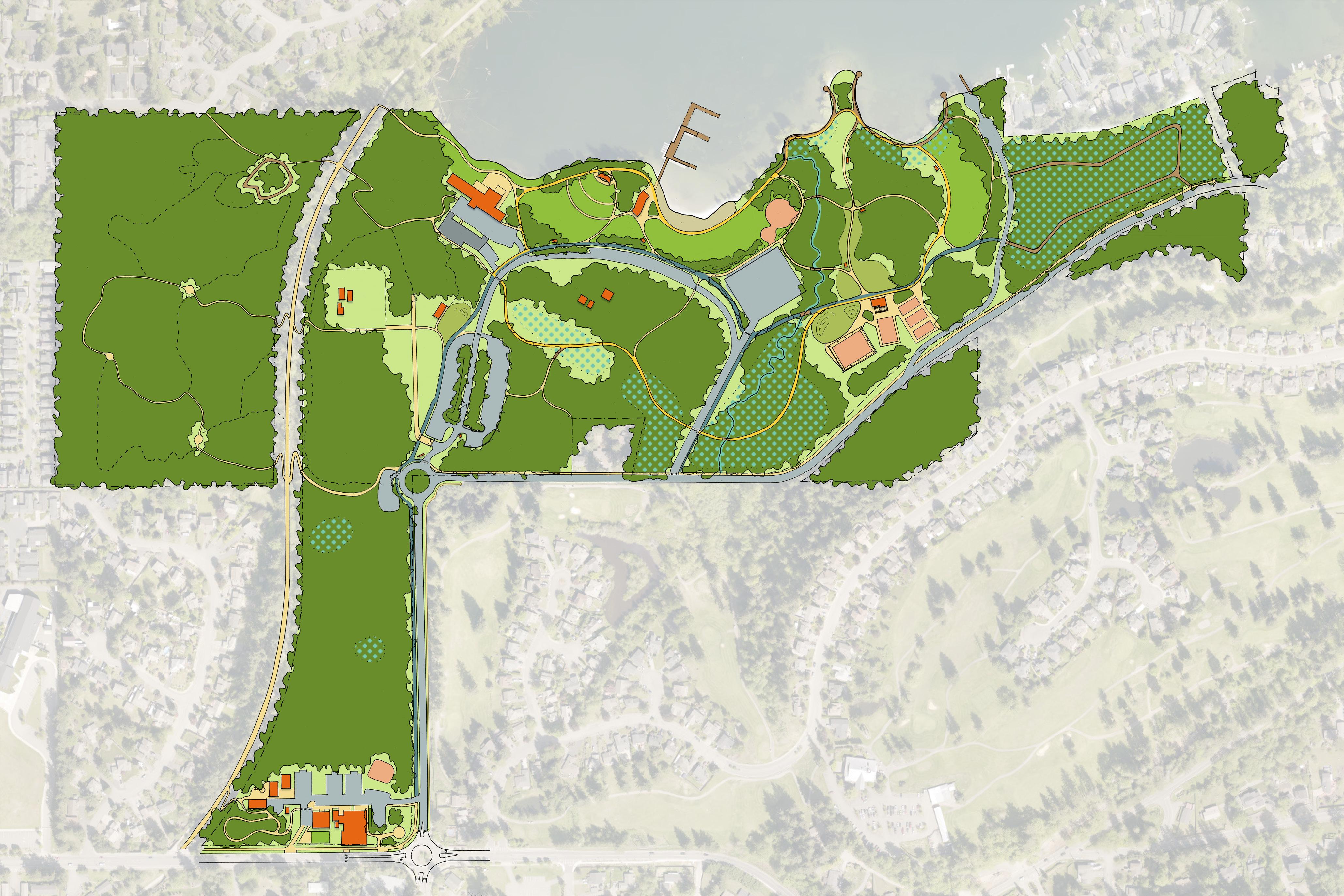
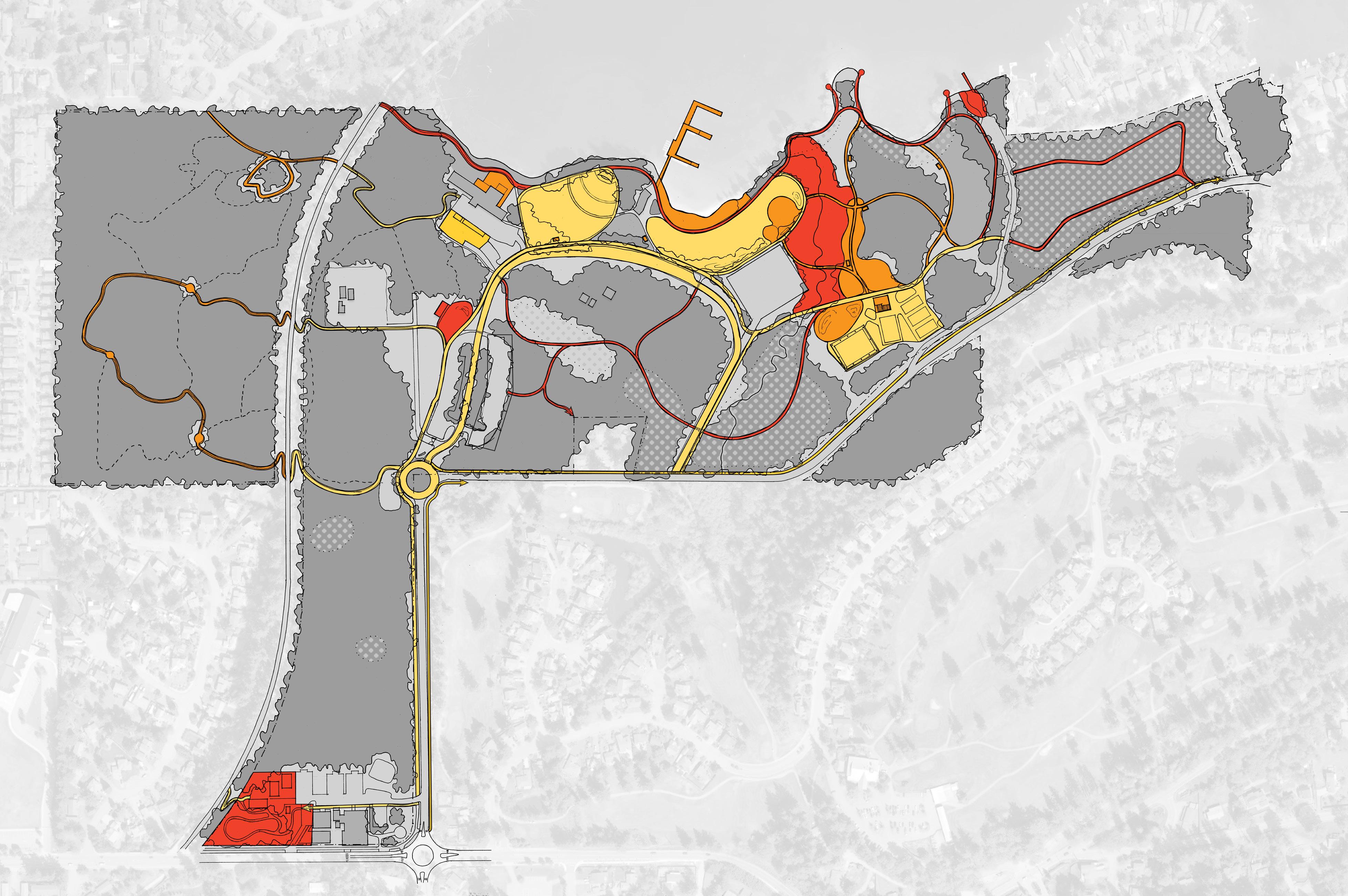
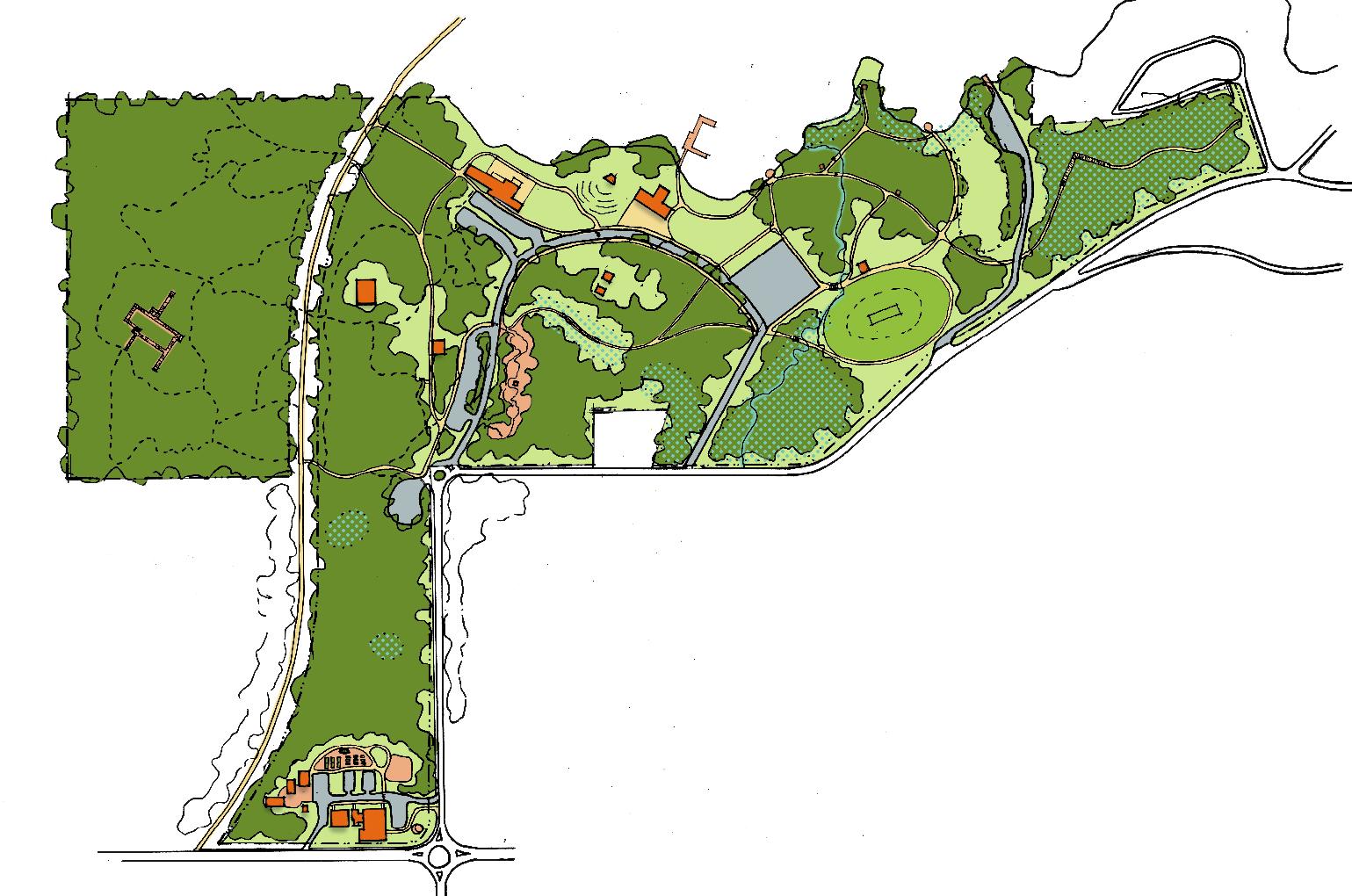
The City of Maple Valley is pleased to present the updated Lake Wilderness Park Master Plan. The map below represents the culmination of a design process that incorporated a series of community engagement opportunities. The subsequent pages describe the project plan and cost estimates, outline future project phasing, depict vignettes and representative imagery, and provides visual representation of the project phasing. Subsequent pages provide contextual information regarding the site map, site opportunities and challenges, parking, habitat, community engagement, and the design process. This visionary, long-term plan will guide the City’s future development of the beloved Lake Wilderness Park.





The following demonstrates how the updated master plan addresses the guiding principles:
Preserve Green Space and Passive Recreation
Recognize the Draw of Lakefront and Water-Based Activities
• New development is focused in areas that are already developed, preserving existing tree canopy to the greatest extent possible.
• Wetland preservation and enhancement, providing rich access through elevated boardwalks.
• Invasive species removal throughout the park.
• Forest enhancement through development of a biodiverse understory and phased tree replacement with climate resilient species.
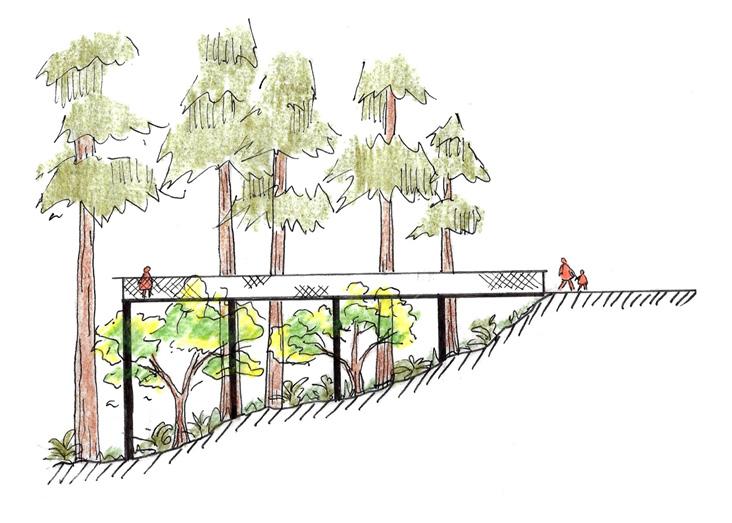
• Demonstration garden development and light recreation in the Forest Reserve, including a “canopy walk” which could connect users directly from the river trail into the canopy, protecting the forest understory from increased use.
• Transition underutilized lawn to biodiverse meadow.
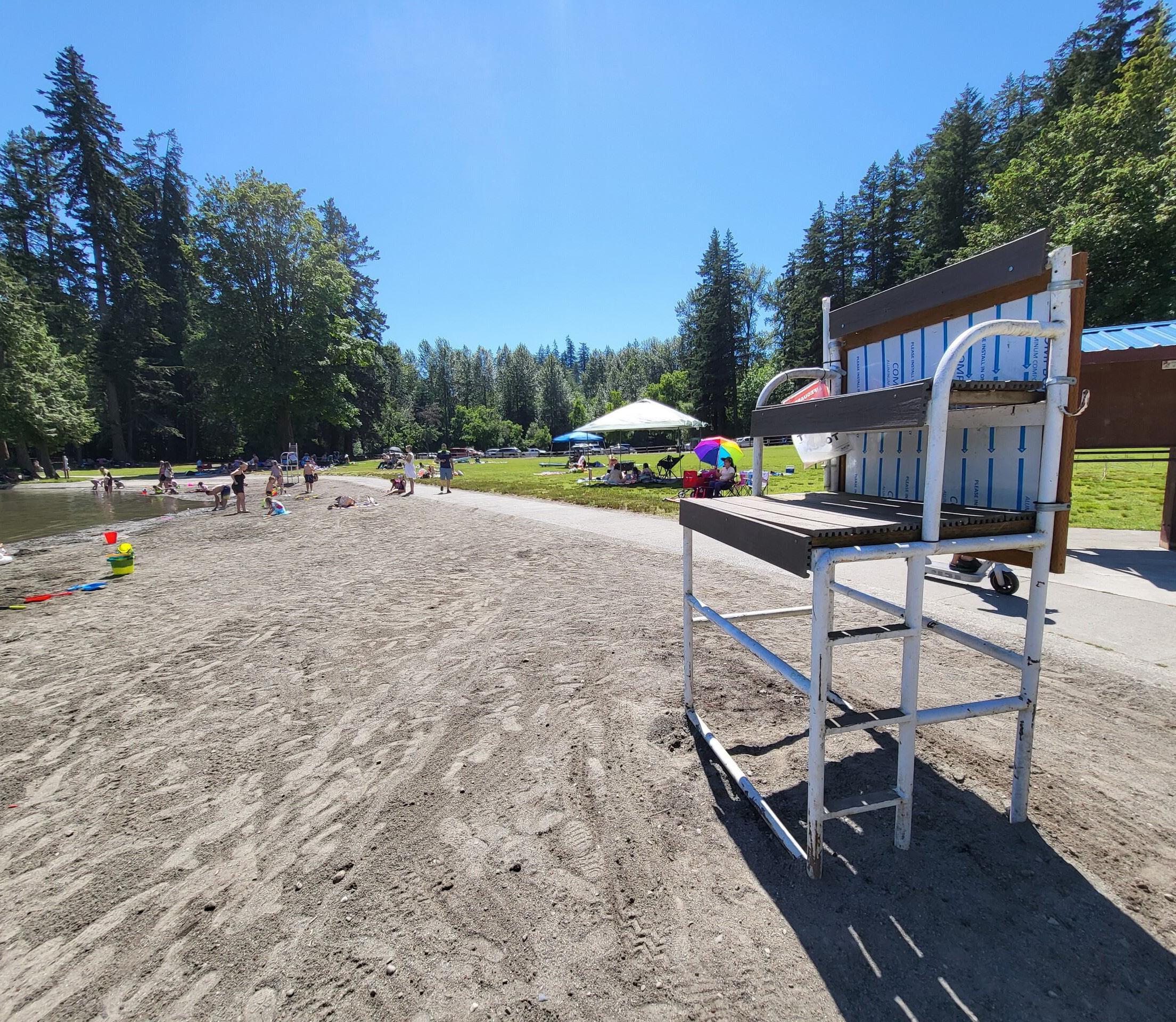
• Expand visitor capacity at the beach area with additional lawn and sand beach area, including hang out space beneath shaded tree canopy.
• Add dock length to facilitate open water pier-to-pier swimming lanes.
• Add playground and spray play near the beach.
• Connect lakefront program areas with waterfront promenade walkway.
• Add shore-based fishing docks and infrastructure away from the swim beach.
• Improve hand powered boat access and parking.
• Manage geese use of the lawn areas.
Address Parking and Vehicular Circulation Challenges
• Parking management strategies including increased enforcement, resident permitting, etc.
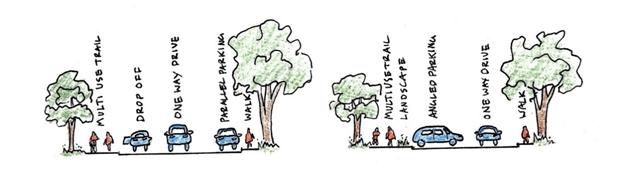
• One-way primary loop road through park that includes drop-off zones and parallel or angled parking.
• Improved entry experience with roundabout.
• Optional structured parking level over the lower Lodge lot.
Improve Pedestrian and Bicycle Connectivity
• Improved accessible connections to the Cedar to Green Rivers Trail.
• New nature trails and boardwalks.
Rethink Park Program/Activities
• Sport courts and shelter replace ball field and playground.
• Reservable “community room” and restroom in southern park.
• Optional adventure play area at arboretum parking area.
• Elevated canopy walk in forest reserve.
• Multiuse trail and sidewalk along the primary loop road.
• Sidewalk along Lake Wilderness Drive.
Provide Refreshed Outdoor Active Recreation
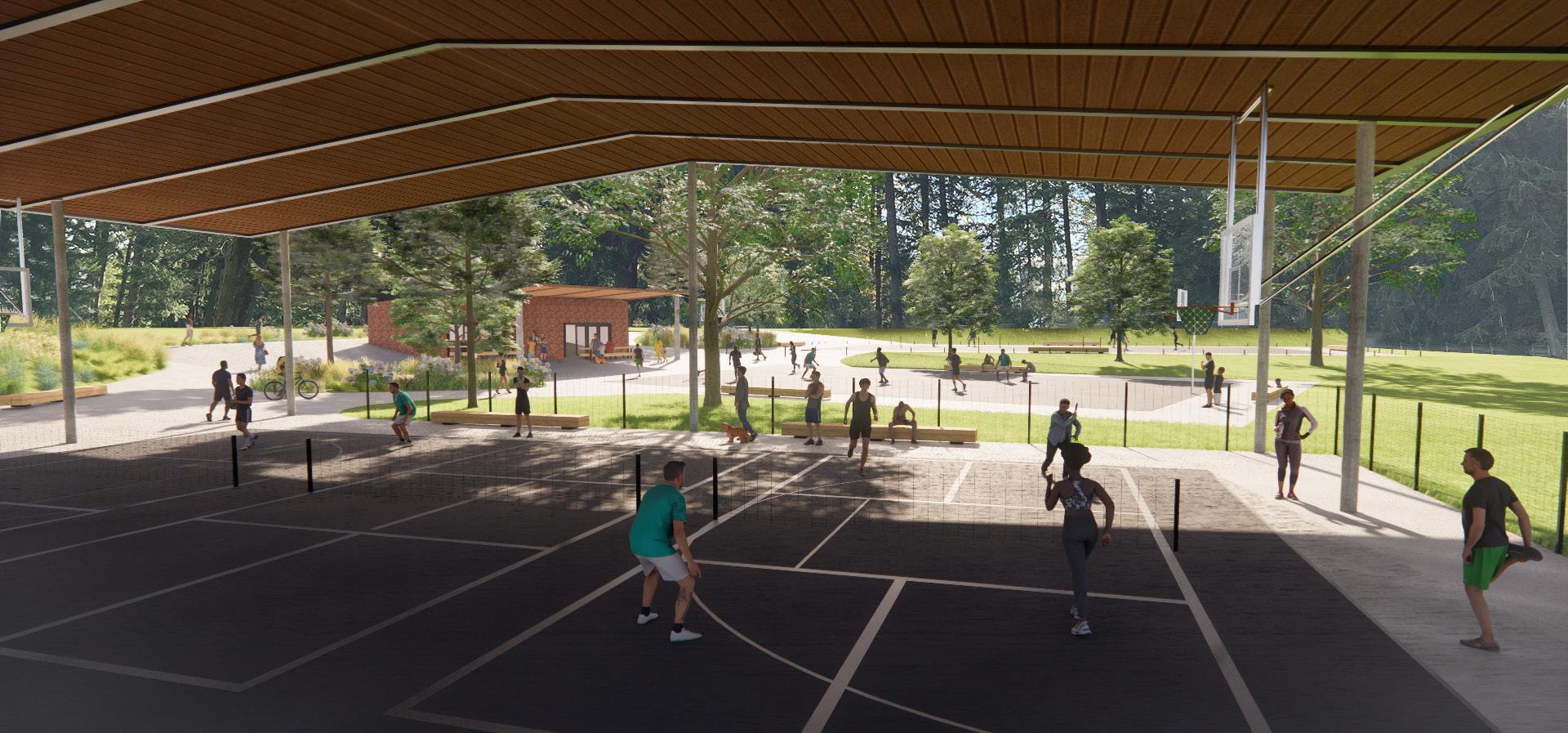
• Covered sport courts including pickleball, tennis and basketball, some of which can be covered.
• Large nature and adventure play zone.
• Multi-generational outdoor space near community center.
• Formalized and accessible performance space including stage/bandshell.
• Formalize the Lodge event courtyard with a series of paved seating areas and event backdrop.
• Covered court space in multipurpose parking garage.
• Structured open water lap swimming.
In 1989, King County owned and operated Lake Wilderness Park (LWP or Park) and approved a master plan for the Park, which they revised in 1995. The City of Maple Valley assumed ownership of the park in 2003 and conducted a master plan in 2007. Although some of the 2007 plan items had been completed, the City wanted to reassess the Park’s needs and subsequently affirm or adjust the plan according to those needs and current resident desires. As the community continues to build and grow—from 22,688 residents in 2010 to 29,320 residents in 2024—the City faces increasing Park use and popularity.
Rather than duplicating previous efforts, this master planning process builds upon previous plans’ work—honoring the past while planning for the future. The planning team and focus group participants used the previous plan as a baseline and focused on what, if any, changes were needed to continue maintaining and preserving the site for public use for the next 20–30 years.
The planning process included focus group conversations with City staff and community partners, targeted questions in the community needs survey, an interactive website, an engagement booth, and a visioning workshop. The consulting team analyzed the LWP’s habitat, current conditions, and amenity quality. Feedback and findings were integrated into three concept plan iterations; these three concepts were vetted in a public open house format as well as on the project website. Continued community feedback helped narrow the three options to a single concept, which staff and City Council refined. The updated 2026 plan captures the community’s desire for a more accessible, enhanced preservation of the beloved space.
MARCH 19
Stakeholder focus groups MAY 19–JUNE 22 Parks and Recreation Needs Assessment Survey
JUNE 13–15 Maple Valley Days Engagement Booth JULY 22 Community Partner Visioning Workshop
AUGUST 12
SEPTEMBER 9
OCTOBER 8
NOVEMBER 3
DECEMBER 8
The total anticipated cost for the full slate of improvements of Lake Wilderness Park is $47.7 million dollars (2026).
A phased project planning plan has been proposed that shows site development over time. The plan is provided to give current and future decision-makers information about the elements of the master plan so that individual projects can be identified and adjusted as needed. It is expected that the actual project implementation will be refined during each budget cycle’s planning process and during grant application development. Projects will be influenced by outside grants and available City funding at the time
of implementation. The complete 20-year master plan is broken out into 10 project types; however, some repackaging of individual projects may be required due to shifting needs and/or funding availability. Specific development should reflect the criteria of the grants being pursued and the priorities of the City. Costs for each planning zone are noted in the plan. It is assumed that priorities may change over time, which could lead to adjustments of the plan.
Lake Wilderness Park has a long history of development as a resort and park. The Park is a valuable amenity for the City and provides fish and wildlife habitats. It is important for the City to care for this amenity and protect sensitive resources such as the lake, forest, wetland, and stream. In some limited areas, trees are nearing the end of their life spans or are affected by disease. Removing these trees and replanting new ones will help ensure that the park has a healthy, vibrant forest and vegetation community. Consistent removal of invasive species should weave through annual investment plans. Recreational, educational, and aesthetic resources should also be maintained and enhanced.
Park implementation is usually spread over time to achieve the desired long-range plan. For Lake Wilderness Park, a 20-year implementation period is assumed, as it is a heavily used existing park. Access and some level of use will need to be maintained during construction. During each phase of construction, project boundaries will need to be established and access must be limited for safety and efficiency. In general, it is most efficient to work area by area through the park. It is important that work constructed in earlier years is not impacted or destroyed in subsequent project execution.
The City’s long-range master plan approach minimizes this type of inefficiency. It will be possible to partially develop an area in one zone and then add low-impact construction items in subsequent years as funding becomes available. Careful consideration must be given to construction access routes to future work sites.
There are several safety and security concerns within the park that should be addressed early in the process. These include vehicular access, entry, and flow improvements as well as pedestrian access enhancements, such as better connections to the park’s surrounding neighborhoods. Because some trail head improvements will need to be coordinated with partner entities, a cooperative, coordinated effort is necessary.
Capital improvements to the park can reduce the amount of future funds spent on park maintenance. Examples of this include improving paved surfaces, lawns, plantings, and irrigation so that fewer resources are spent on maintaining these areas.
Recommended Phasing:
SHORT-TERM PROJECTS
• Amphitheater
• Playground/Splashpad
• Sports Courts (Active Rec)
• Lodge
• Environmental/Habitat/ Restoration
MID-TERM PROJECTS
• Forest trails and replacement of small picnic shelters
• Restrooms + reservable community space/room
• Beach playground
• Splashpad
LONG-TERM PROJECTS
• Waterfront promenade trail and shoreline improvements
• Fishing docks and overlooks
• Boat launch improvements
• Wetlands boardwalks
• Creek and forest restoration
• Beach Lawn
• Trails
• Lake/Dock/Boats/Fishing
• Facilities
• ROW & Civil
• Swim dock expansion + Beach expansion
• Canopy walk
• Establish habitat meadows
• Lodge event courtyard
• Arboretum visitor center and restroom
• Historical Society Museum relocation + peninsula improvements
Connect the Green to Cedar Rivers Trail into the forest canopy, providing elevated access to the unique perspective of the forest. Incorporate a sense of thrill and discovery with artwork, storytelling, and educational elements. Carefully route the path and columns to minimize impact on the trees and facilitate understory enhancement.
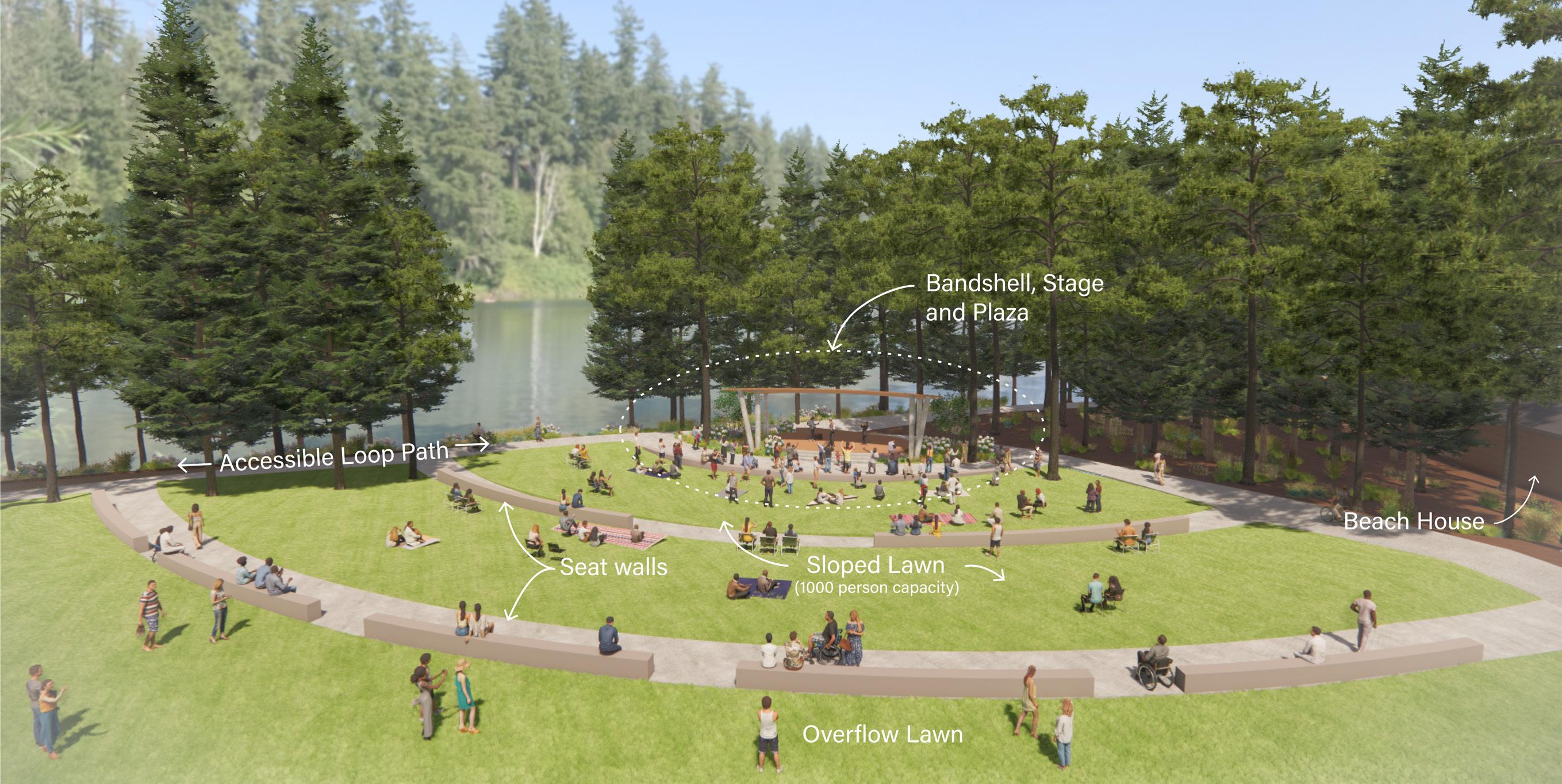
Provide infrastructure to facilitate modest community events for up to 1,000 people. Features could include a stage and bandshell, 50amp event power, accessible seating areas and year-round hang out areas.
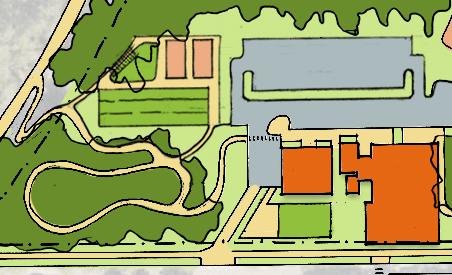
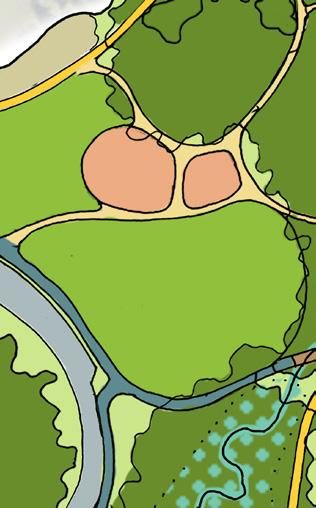
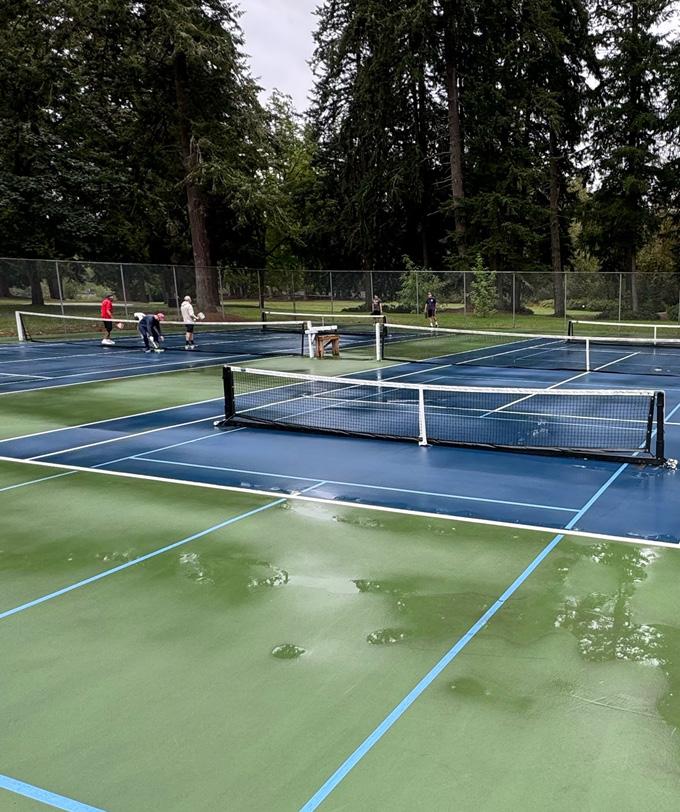
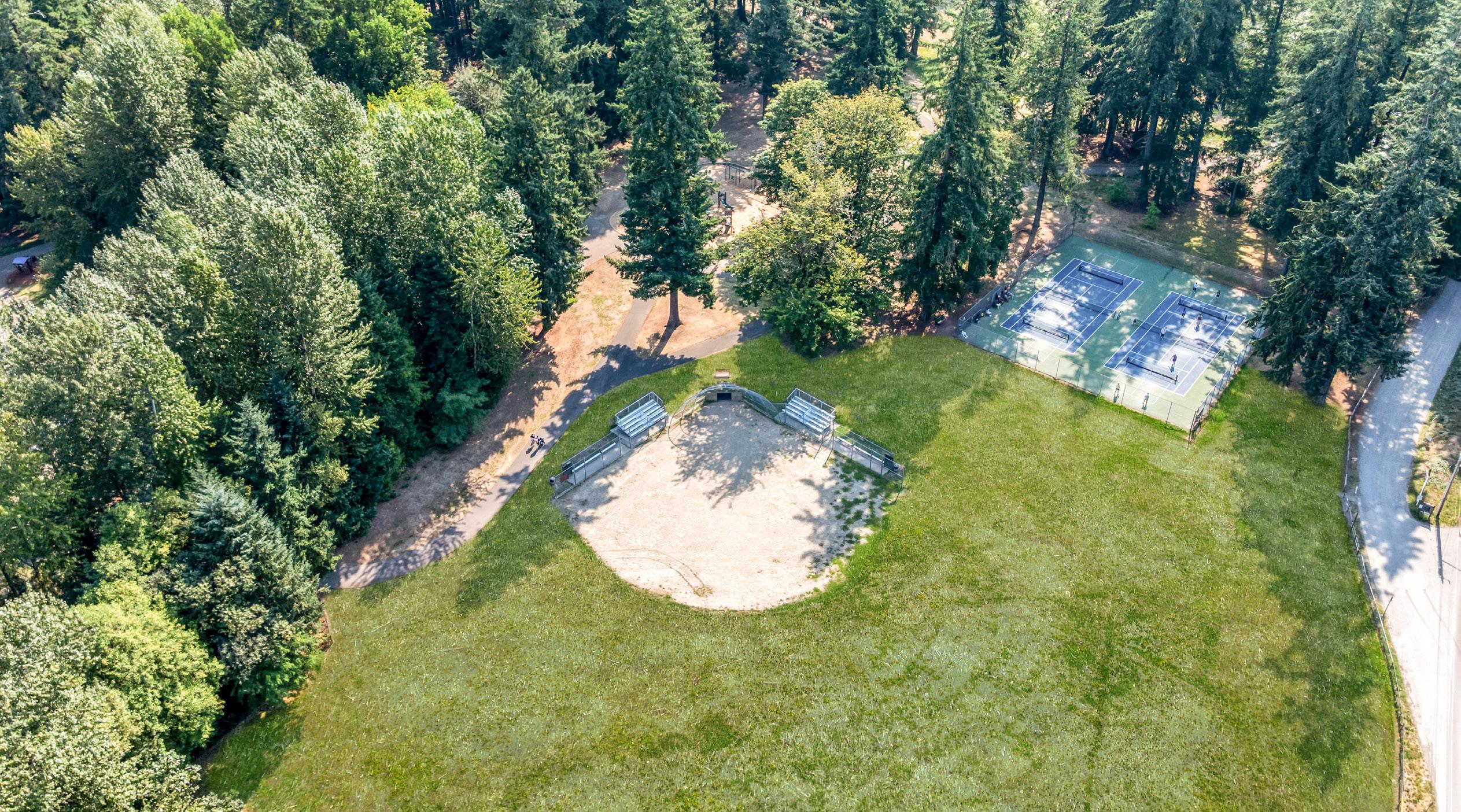
Transition the underutilized softball field to better accommodate a variety of sport court recreation opportunities. Courts could include pickleball, basketball, and tennis, with flexible courts under cover. Include appropriate fencing, seating, and hang out spaces. This area could also include a community building with restrooms and feature a small reservable room with an indoor/outdoor relationship. Landscaping would include a combination of flexible lawn and biodiverse pollinator meadows.
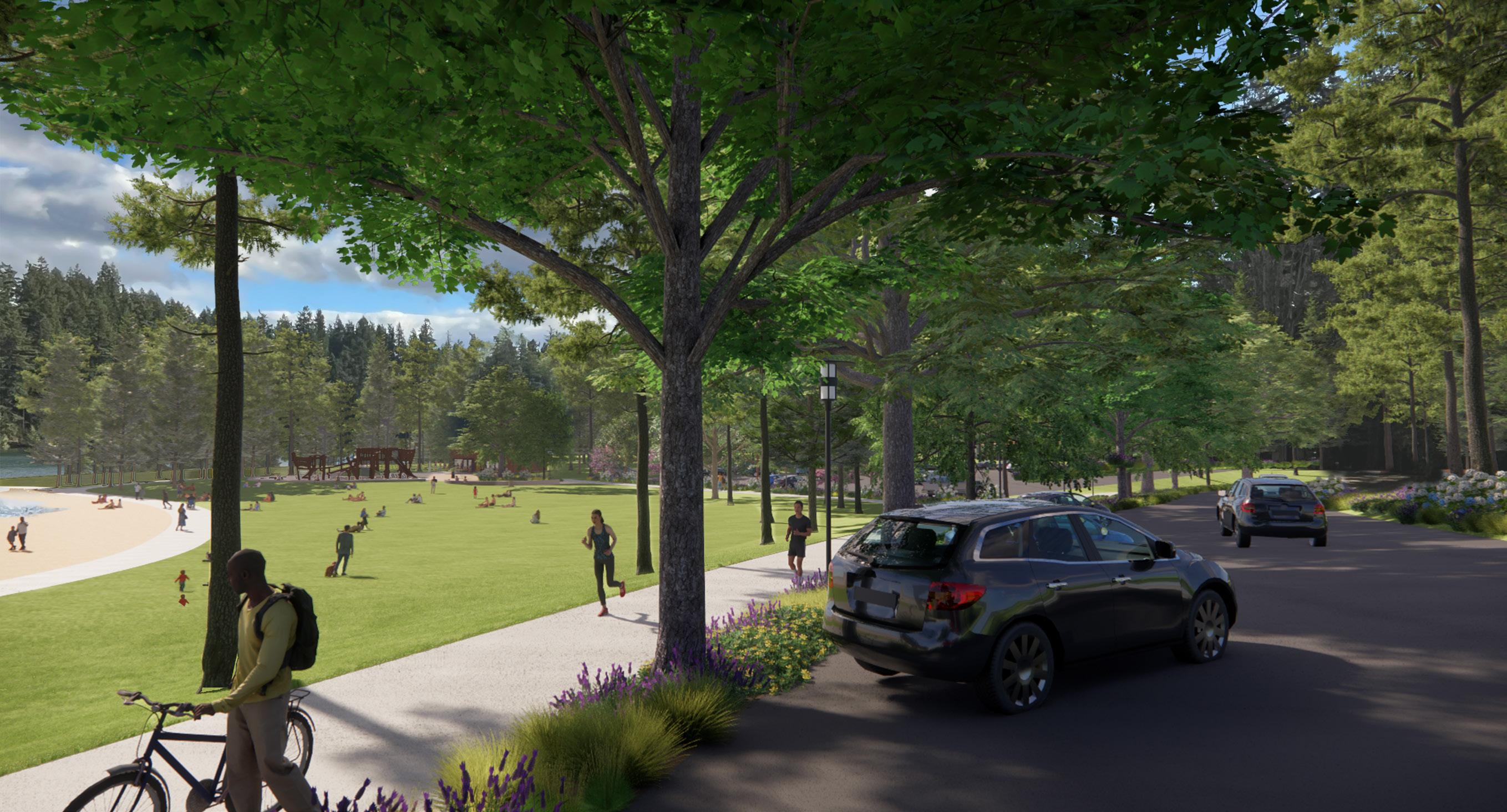
A new, one-way access road creates a loop between parking areas to facilitate improved accessible parking and drop-off. Angled and/or parallel parking adds approximately 50 parking stalls. An adjacent multiuse trail further improves access and safety across the park and between parking areas.
Trail + path connections at park edges$1,400,000
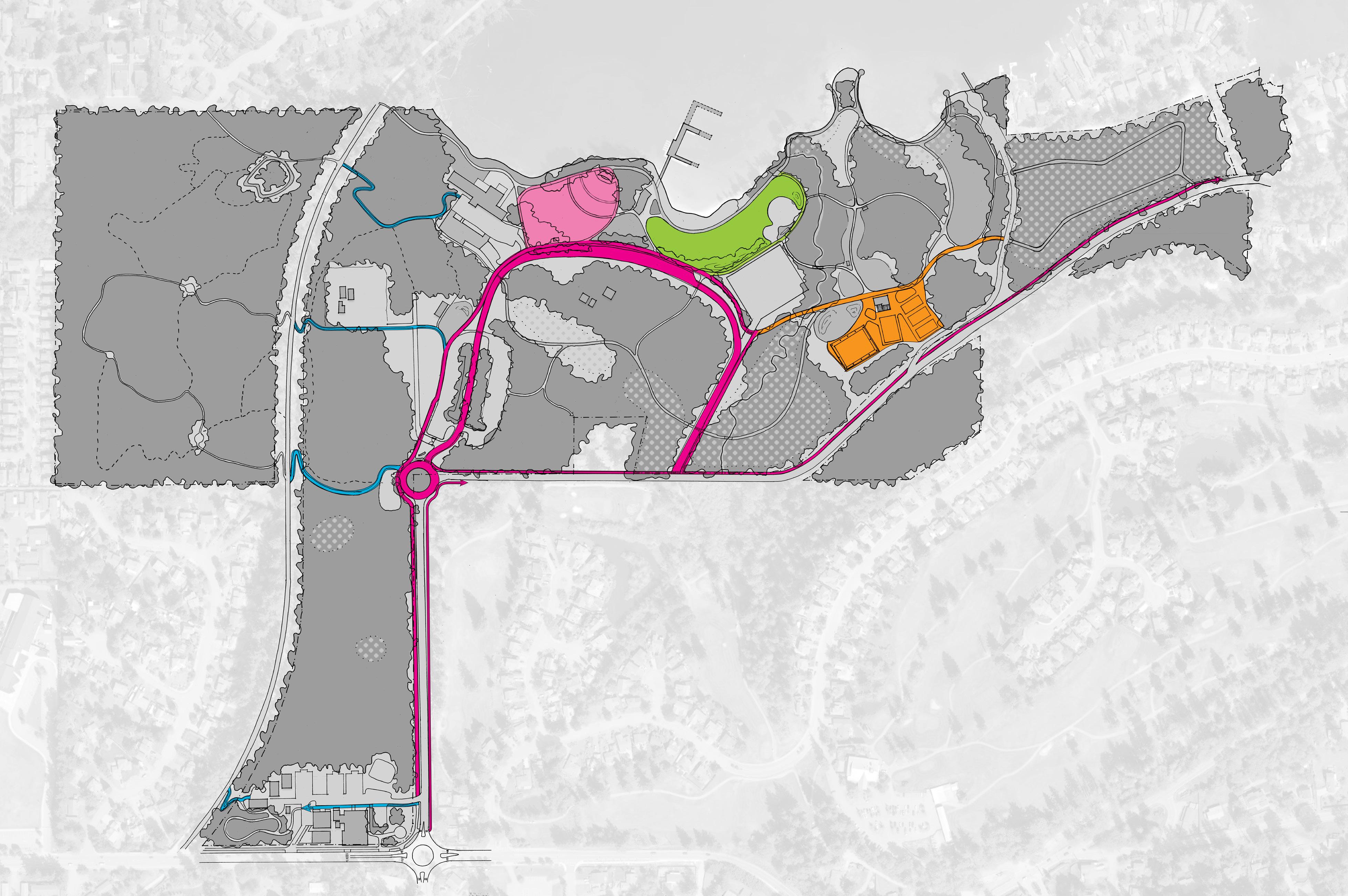
Beach lawn expansion$225,000
Amphitheater$3,500,000
• Small Bandshell
• Access • Lawn
• Seating Sport Courts$5,661,368
• Existing Tennis/Pickleball Courts with added court space
• Basketball Court
• Covered Multi-Use Sport Court
Multi-modal Trail$5,300,000
Park Entry$850,000
Lake Wilderness Park - Updated Master Plan Short Term Projects
Circulation Loop Road$2,800,000
Project Type
Amphitheater
Playground/Splashpad
Sports Court (Active Rec.)
Lodge
Environment and Habitat
Beach Lawn Trails
Lake/Dock/Boats/Fishing
Facilities
ROW & Civil
N 0 65 130 260 FEET

Canopy Walk and Trails$1,825,000
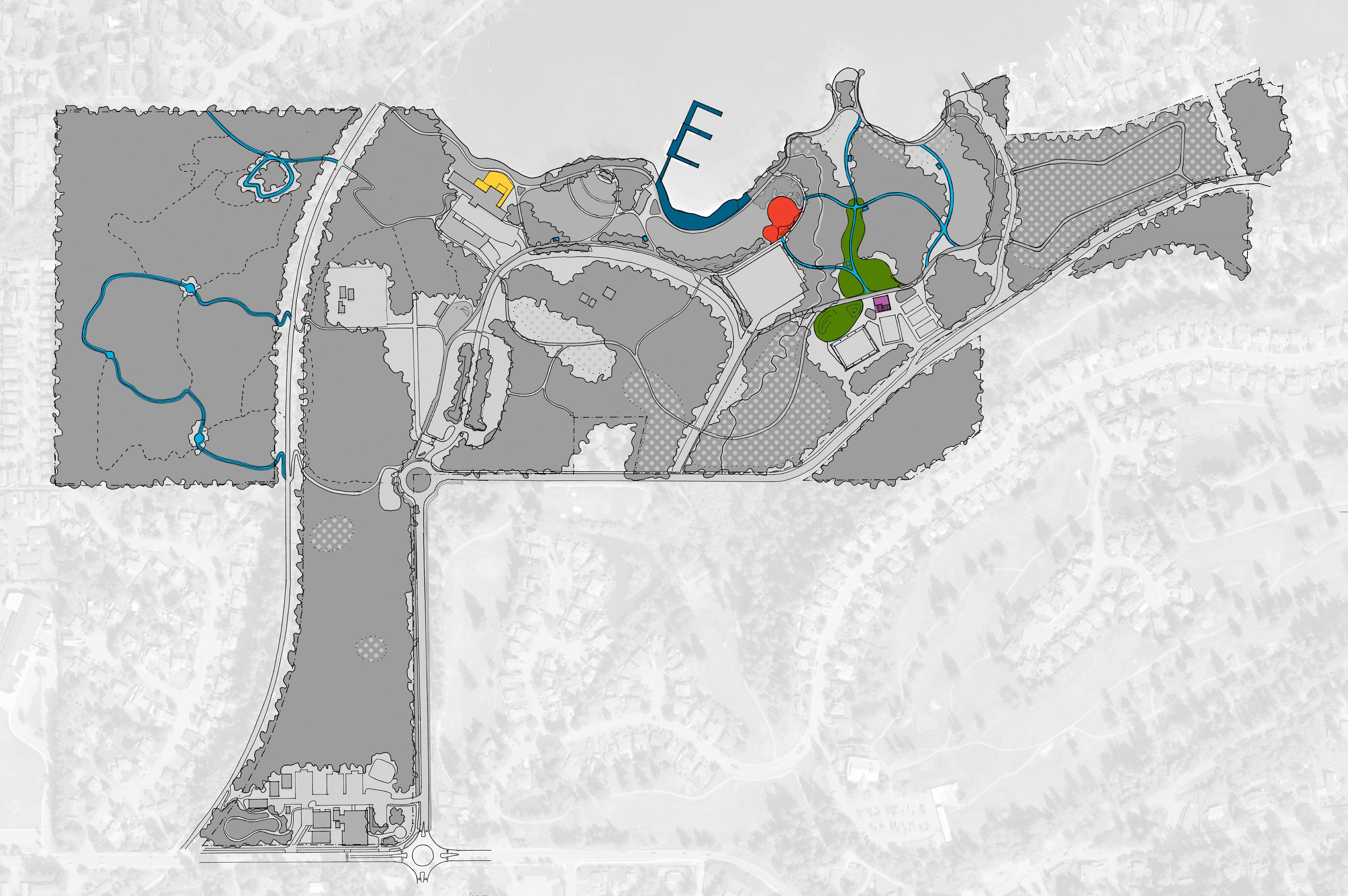
• Beach expansion
• Swim dock expansion
Lodge Event Courtyard$1,325,000 Beach Playground$1,700,000 Splashpad$3,675,000
• Spray features
• Small shelter and restroom Beach Improvements$1,350,000
Habitat Meadow Establishment$1,175,000
Forest Trails + New Picnic Shelters$1,250,000
Restrooms + Reserveable Community Space$2,350,000
Lake Wilderness Park - Updated Master Plan Mid Term Projects
Project Type
Amphitheater
Playground/Splashpad
Sports Court (Active Rec.)
Lodge
Environment and Habitat
Beach Lawn Trails
Lake/Dock/Boats/Fishing
Facilities
ROW & Civil
Waterfront promenade + shoreline improvements$1,325,000
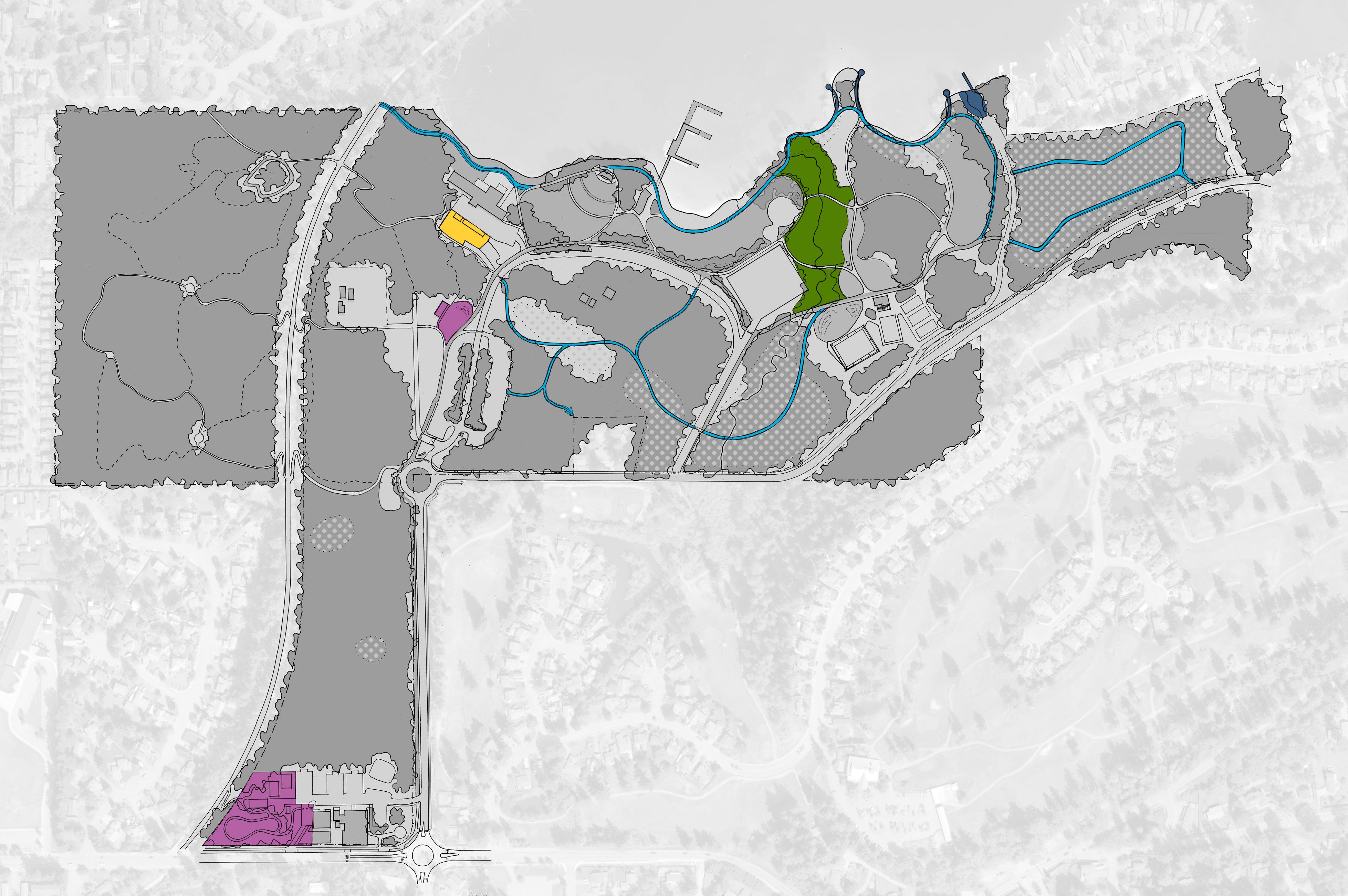
Arboretum improvements$2,370,000
• Restrooms
• Visitor center
Peninsula improvements$2,500,000
• Relocating Historical Society Museum
• Garden walk
• Community space
Lake Wilderness Park - Updated Master Plan Long Term Projects
Creek + forest restoration$1,800,000
Boating and fishing improvements$1,625,000
Wetland Boardwalks$3,715,000
Project Type
Amphitheater
Playground/Splashpad
Sports Court (Active Rec.)
Lodge
Environment and Habitat
Beach Lawn Trails
Lake/Dock/Boats/Fishing
Facilities
ROW & Civil N 0 65 130

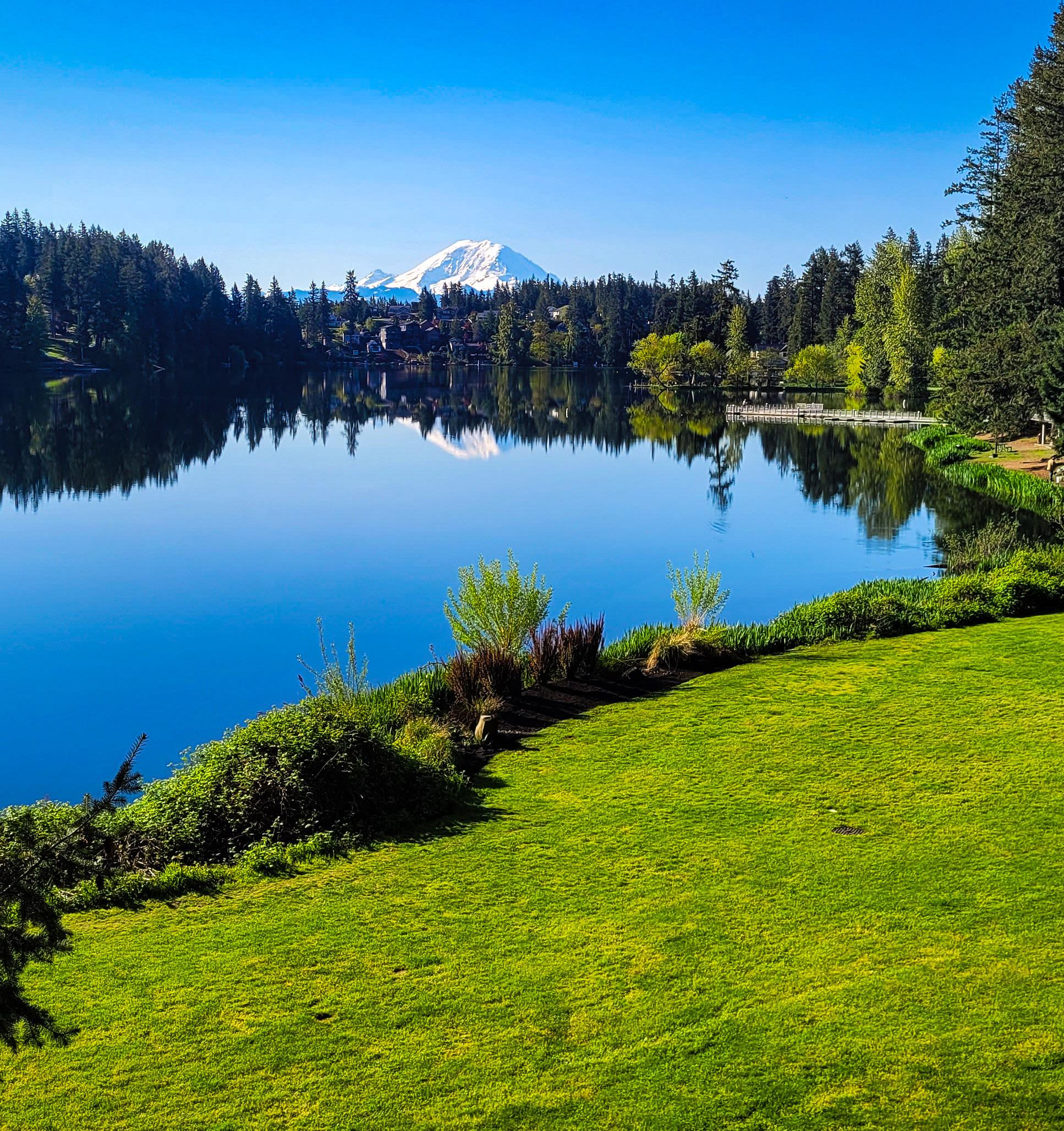
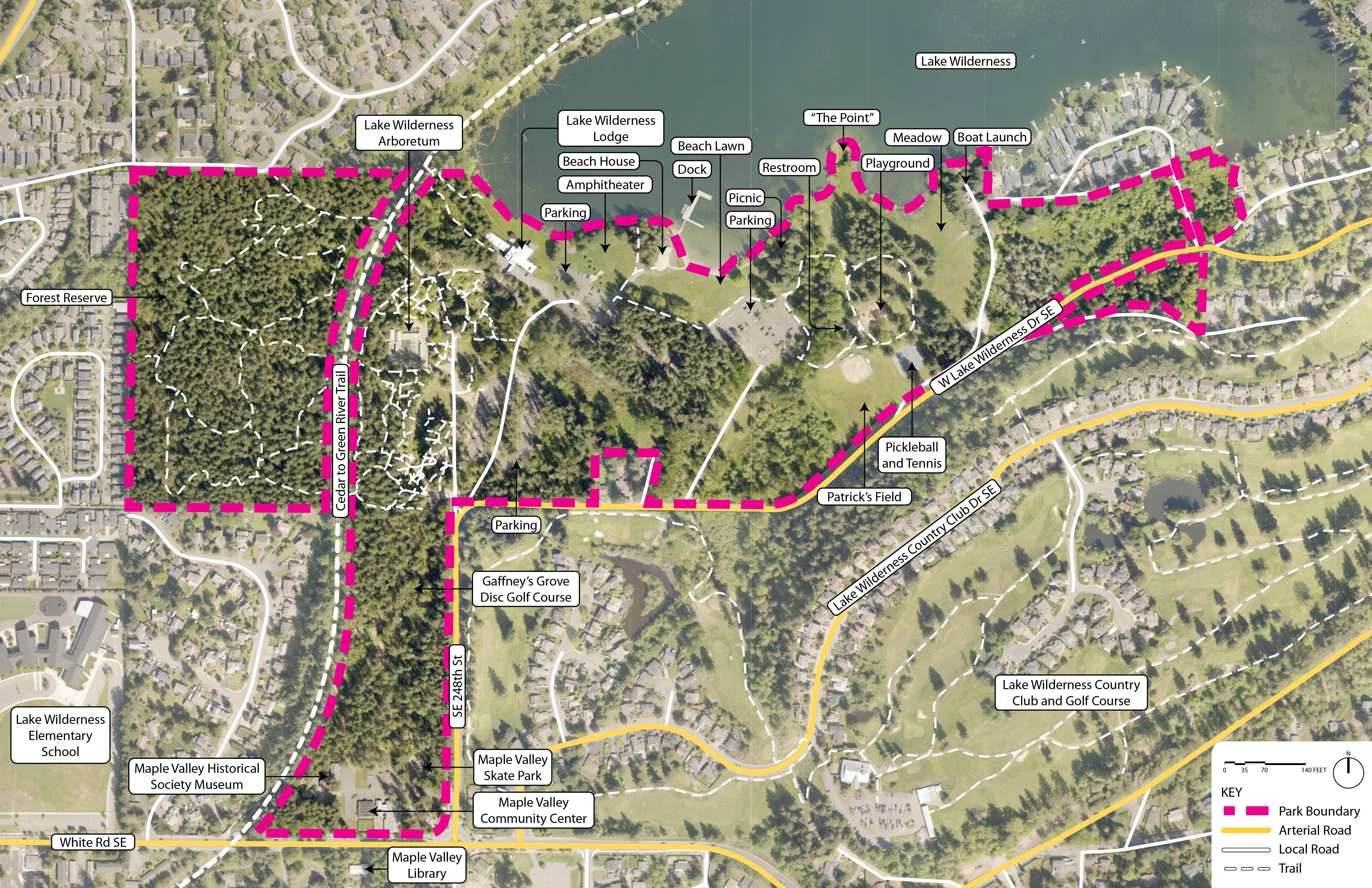
Lake Wilderness Park is a defining public space in the Maple Valley Park system, providing a unique opportunity to enjoy waterfront recreation nestled within a Pacific Northwest forest setting. The Park is beloved by local residents and has also become a popular destination for regional visitors, especially in the summer months. The current master planning process aims to strengthen Lake Wilderness Park as a valuable resource for the Maple Valley community and maintain its strength as a destination where people can experience the region’s natural beauty for many years ahead.
Lake Wilderness Park primarily abuts residential neighborhoods ranging from R-1 to R-6 LowDensity Residential zoning. The R-1 designation refers to one residence per acre versus six residences per acre in R-6 zones. At 111.21 acres, LWP is the largest park within the City’s rapidly growing community. LWP is zoned as public/ open space as well as the two wooded areas on steep slopes southeast of the park. A wooded wetland area south of the park on SE 257th Street is zoned as public/open space but is not an active designated area of the Park.
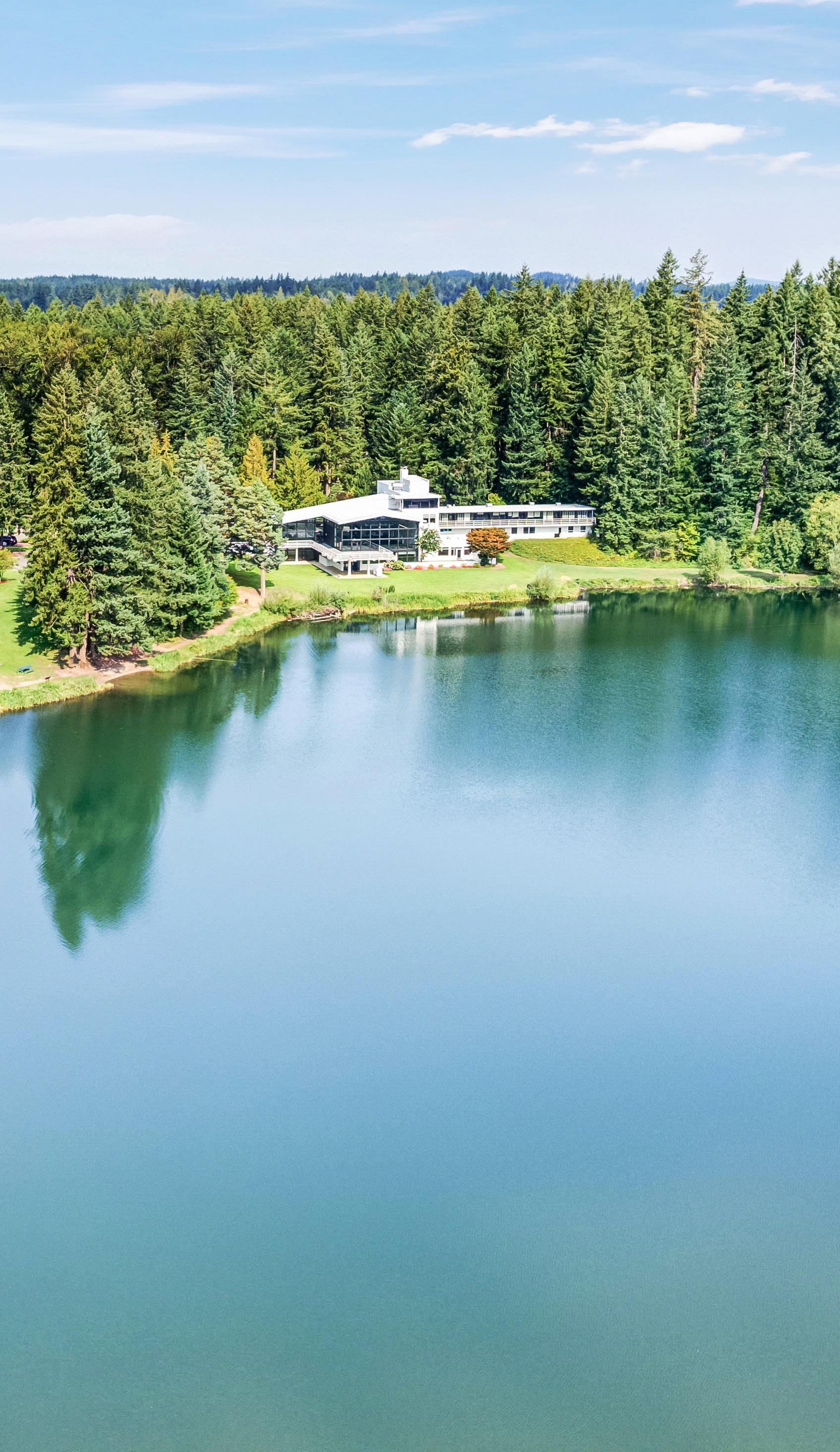
Lake Wilderness Lodge is an important historic resource on the site and a shining example of 1950’s-style architecture. The Lodge was designed by Young and Richardson—a Seattlebased architecture firm that later became the Richardson Associates (TRA). The Lodge won a national American Institute of Architects (AIA) award for high-quality design in 1950 and was designated a King County Historic Landmark in 1995.
Lake Wilderness Park was a King County regional park prior to its transfer to the City of Maple Valley in January 2003.
In 1927, the Lake Wilderness site was developed as “Gaffney’s Lake Wilderness Resort.” The resort included a wide variety of recreational amenities such as a swimming beach, a diving platform and slide, canoes, pedal-powered rafts, cabins, picnic shelters, a playground, a baseball field, lakeshore boardwalks, docks, and horseback riding opportunities. The original resort building included a ballroom and dining room. The current lodge was built as a part of Gaffney’s Lake Wilderness Resort and replaced the original resort lodge building. (The Maple Valley Historical Society website contains more information and several historic photos.) Prior to Gaffney’s Resort, Hanson Mill was located on Lake Wilderness. The mill later became Weyerhaeuser at Enumclaw.
Previous park usage information is captured on interpretive signs in the park.
Existing Active Recreational Uses
• Amphitheater (lawn bowl)
• Baseball (informal youth and adult field)
• Bicycling (Lake Wilderness Trail)
• Boating (non-motorized)
• Fishing (fishing pier; fish cleaning facilities at picnic shelters)
Existing Passive Recreational Uses
• Educational walks (Arboretum)
• Jogging
• Picnicking
• Strolling
Lodge Functions
• City Council Chambers
• City Parks & Recreation Office
• Meetings
• Parties
Events
• Be the Hope Walk
• Bike Rodeo
• Earth Day
• Egg Hunt
• Fishing Derby
• Hometown Holidays
• Independence Day Celebration
• Juneteenth Celebration
• Kids’ Fest
Existing Park Buildings
• Arboretum Office
• Lake Wilderness Beach House
• Lake Wilderness Lodge
• LWP Annex Garage
• LWP restrooms (by playground)
• Lake Wilderness Picnic Shelter #1
• Lake Wilderness Picnic Shelter #2
• Lake Wilderness Picnic Shelter #3
• Gaffney’s Grove disc golf course
• Kayaking
• Paddleboard
• Pedal Boating
• Pickleball/tennis
• Playground
• Swimming (beach house)
• Sunbathing
• Walking
• Wildlife watching
• Receptions
• Recreation programs and activities
• Weddings
• Lake Wilderness Triathlon
• Maple Valley Days
• Music & Movies in the Park
• Pride Event
• Town Hall
• Turkey Trot
• Volunteer & Service Expo
• Zombie Dash
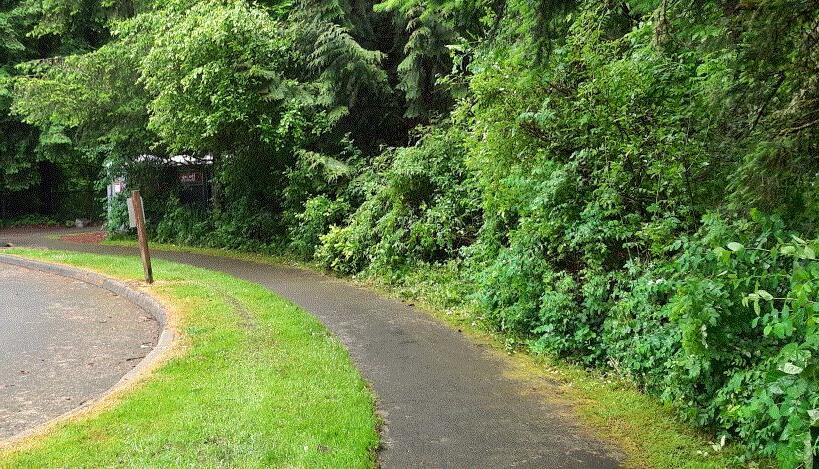
The King County Green to Cedar Rivers Trail runs through the Park creating a connection to the Maple Valley Library, the Veteran’s Memorial, the Greater Maple Valley Community Center and The Den, the Maple Valley Historical Society Museum, Lake Forest Estates Neighborhood Park, the Legacy Site, and Henry Switch Park. The Green to Cedar Rivers Trail runs along the east side of the lake, thereby allowing for public use in a loop around the lake when the park, trail, and neighborhood streets are used. Although there are multiple connection points to the Cedar to Green Rivers Trail, they are not ADA accessible.
• Maple Valley Community Center
• Maple Valley Historical Society storage (2)
• Parks Maintenance Building
• Parks Maintenance equipment shed
• Parks Maintenance tool shed
• The Den
• WB Gibbons Store
Pedestrian Access and Circulation
Parking and Vehicular Circulation
While there are some paved path/small loops connecting core Park programs, the opportunity to formalize pedestrian routes throughout LWP remain. The City’s Non-Motorized Transportation Plan and Transportation Plan demonstrate opportunity to improve vehicular, pedestrian, bicycle, equestrian, and multipurpose trail access to and within the park.
LWP has three surface parking lots and an informal gravel parking area for disc golf and boat launch. Entry drives serve the Arboretum and Lodge, core park areas, and the boat launch, respectively.
Parking at Lake Wilderness Park during the summer season—when events and the popularity of the lakefront draw people from near and far—has been identified as an issue. Parking often overflows into other Park spaces, such as Patrick’s Field, and creates congestion and circulation challenges for visitors and adverse impacts on the environment.
A growing local and regional community, increasingly hot summers, and the attraction of cooling off by the lake have made Lake Wilderness Park a popular destination for visitors near and far. The Park is facing the challenge of overuse and crowding causing adverse impacts on the vegetation and environmental health of the park
The updated master plan provides an opportunity to rethink vehicular and pedestrian/ bike-based circulation in the Park. Entry points and vehicular movement through the Park can be unclear and disjointed with most areas have mixed use of both vehicles and pedestrians. Better pedestrian and bike connectivity, both within the park and to adjacent trail and street systems, is needed.
Lake Wilderness Park is special because it can connect people with beautiful natural spaces. Lake edges, wetlands, Jenkins Creek, and forested areas must be treated with care. There are opportunities for enhanced biodiversity and habitat in these areas, and any impacts to these areas will be mitigated in accordance with local codes and regulations.
The updated master plan provides an opportunity to assess existing programs within LWP, potentially replacing them with other higher priority programs identified by the Maple Valley community.
Due to overuse and crowding issues, Lake Wilderness Park faces seasonal operational and maintenance challenges, which can lead to deferred maintenance of some park amenities and vegetation.
Creative solutions can help address the Park’s parking needs. The City should further explore the benefits and drawbacks of the various operational and physical options to determine which one(s) will best meet the needs of current and future Park visitors.
Operational changes could help address parking needs. Traditional options include a parking permit system and/or access control gates at park entrances. One creative solution is to implement smart parking systems that use sensors and mobile apps to display real-time availability and can integrate dynamic pricing to manage demand during peak hours. Another approach is to establish remote parking areas outside of the park and provide frequent ecofriendly shuttle services, such as electric or solarpowered vehicles, to reduce congestion and emissions.
Additionally, a reservation-based parking system can allow visitors to pre-book spots online and use timed access to help promote
parking stall turnover. Promoting alternative transportation options like secure bike racks, e-bike or scooter rentals, and partnerships with public transit authorities can further reduce parking pressure. Creating shared mobility zones with incentives for carpooling and designated ride-share drop-off areas can also help alleviate congestion.
Adding parking along the circulation loop road can add approximately 50 parking spaces throughout the Park. Parallel and/or angled parking along a one-way drive helps bring users closer to their desired destination. Additionally, this type of access can support accessible parking and drop-off zones.

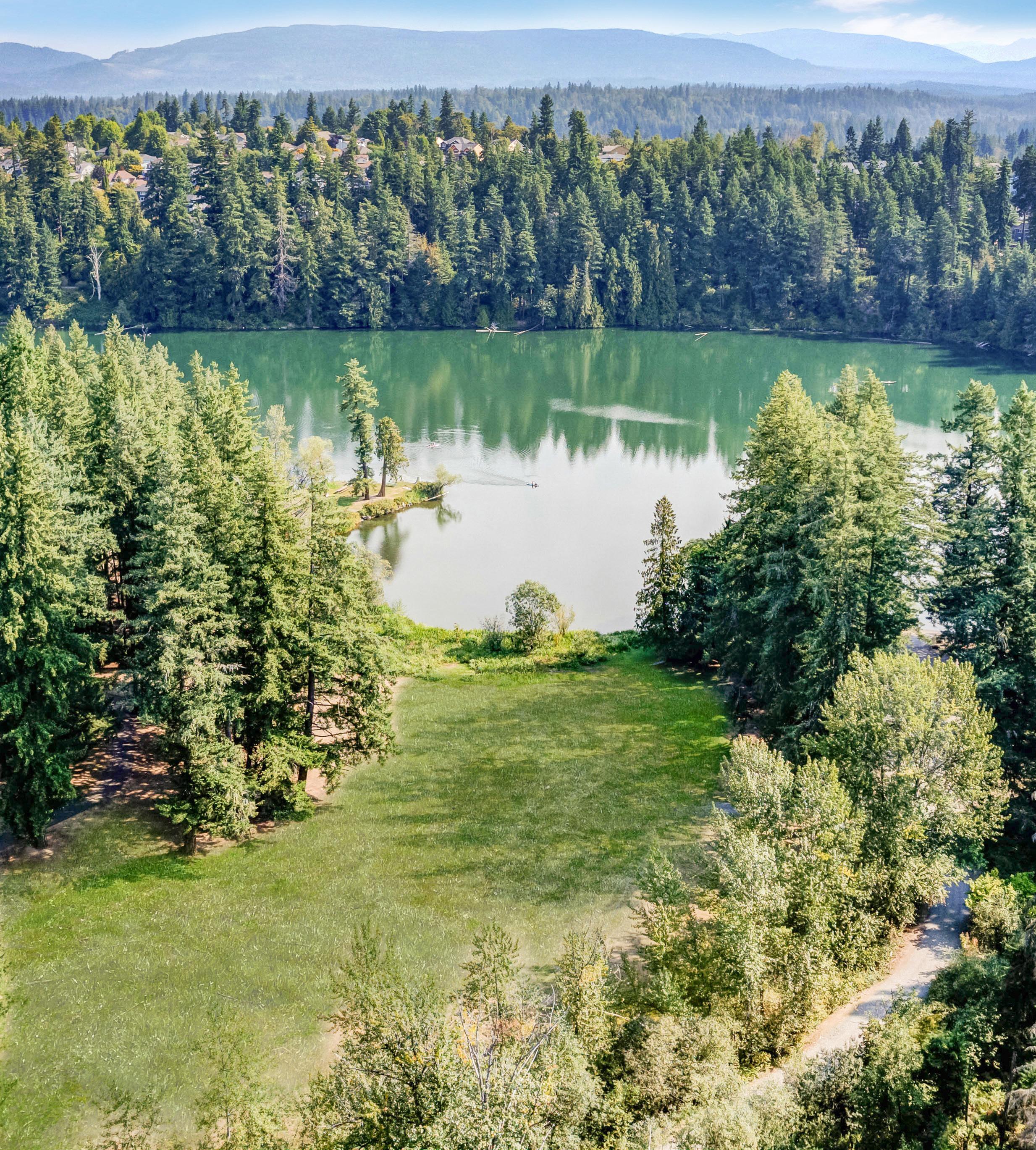
Lake Wilderness Park stands as the City’s premier natural area and most ecologically significant park property. Encompassing approximately 111.21 acres centered around a 66-acre lake, the Park contains the highest concentration and diversity of critical areas within the City’s park system. The park’s mature forest stands, wetland complexes, lake shoreline, and tributary stream create a mosaic of habitats that support numerous fish and wildlife species while providing opportunities for nature-based recreation and environmental education. This concentration of critical habitats makes the park exceptionally valuable for biodiversity conservation; however, it also creates unique challenges for balancing recreation access with habitat protection.
The park’s aquatic and terrestrial systems are connected through Jenkins Creek, the main tributary flowing from Lake Wilderness. This waterway supports a diversity of salmonid species, including documented coastal cutthroat trout and coho salmon, with suitable habitat conditions for fall chinook and winter steelhead. Beyond the aquatic corridor, the park’s expansive upland forests showcase impressive multistory canopy structures that provide essential roosting, nesting, and foraging habitat for numerous avian species. These forest systems simultaneously function as vital wildlife corridors, facilitating the movement of larger mammals, including elk, deer, and black bears, throughout the regional landscape.
Lake Wilderness is the centerpiece of the park’s aquatic ecosystem, providing habitat for waterfowl, amphibians, fish, reptiles, and numerous invertebrate species. The lake shoreline encompasses approximately 1.7 miles of varied habitat types, including emergent wetland areas, shallow zones with submerged aquatic vegetation, and deeper open water areas. The Washington Department of Fish and Wildlife Priority Habitats and Species data designates Lake Wilderness as a critical waterfowl concentration area. More than 100 birders have completed nearly 400 checklists on eBird, documenting an impressive 124 bird species and establishing this lake as a treasured destination for birders throughout the Puget Sound region.
The lake serves as a vital habitat for fish, supporting native Kokanee and stocked rainbow trout populations; however, invasive species pose an ongoing and serious threat to this delicate ecosystem. Eurasian watermilfoil and yellow flag iris, in particular, have established themselves in portions of the lake, forming dense underwater mats that can displace native aquatic vegetation, alter water chemistry, and disrupt the habitat structure upon which fish and wildlife depend. These invasive plants can also impede recreational activities such as swimming, kayaking, and fishing, diminishing the lake’s value for public enjoyment.
Recognizing the critical importance of preserving Lake Wilderness’s ecological integrity, the City maintains collaborative partnerships with key stakeholders. These partnerships include the
Washington Department of Fish and Wildlife, King County, lake associations, and volunteer stewardship groups. Together, these entities monitor invasive species populations and implement targeted management strategies. Through ongoing partnerships, regular monitoring programs, and adaptive management approaches, the City continues addressing these threats while maintaining the lake’s dual role as a crucial wildlife habitat and cherished community resource.
Within the broader regional context, LWP functions as a critical steppingstone in the wildlife corridor network, connecting urban green spaces with larger natural areas. Effective management requires maintaining and improving habitat connectivity within the park by removing barriers to wildlife movement and establishing continuous native vegetation zones linking different habitat types.
Environmental stewardship and ecological restoration are fundamental to this connectivity effort and must address any degraded conditions resulting from historical impacts. Restoration priorities include removing invasive plant species that outcompete native vegetation and reduce habitat quality, particularly in disturbed areas along trails and forest edges. Active revegetation with native species is essential to rebuild forest understory layers, enhance structural diversity, and restore ecosystem functions such as nutrient cycling and water filtration. Soil restoration may be necessary in compacted areas where recreation has degraded soil structure and hydrology,
limiting native plant establishment and reducing habitat value.
This approach must carefully balance public access needs with forest ecosystem integrity, as trail development and user dispersal can fragment the upland forest canopy and disrupt wildlife movement patterns. Strategic trail placement should concentrate recreational use along designated corridors while maintaining large, undisturbed forest blocks that provide interior habitat conditions essential for sensitive species.
Priority should be placed on connecting lake shoreline areas to upland forests through restored riparian buffers and native plant corridors that accommodate seasonal movement patterns of amphibians, small mammals, and birds while helping ensure that access infrastructure supports sustainable recreation without compromising the park’s ecological functions. Riparian restoration requires reestablishing native vegetation communities along stream channels and wetland edges, improving canopy cover to moderate water temperatures, and stabilizing banks to reduce sedimentation. Restored buffers should be protected from trampling and disturbance through strategic fencing, signage, and trail design that guide visitors away from sensitive areas to help ensure that access infrastructure supports sustainable recreation without compromising the park’s ecological functions. Long-term stewardship requires ongoing monitoring, adaptive management, and community engagement to help ensure restoration investments achieve lasting ecological improvements.
A community needs survey was conducted online and through random mail-out samples in spring 2025. The statistically significant survey garnered 403 resident responses.
LAKE WILDERNESS PARK IMPROVEMENTS
MOST IMPORTANT TO HOUSEHOLDS
• Develop new trails and/or connect existing trails
• Add new splash park/ spray park
• Preserve existing natural areas
• Add new covered space
• Swim lessons
• Water fitness programs/lap swimming
• Adult fitness and wellness programs
• Outdoor adventure activities
• Community special events
• Afterschool programs for youth
CITYWIDE FACILITY/ AMENITY PRIORITIES
• Indoor swimming pools
• Splash pads or spray parks • Community
by percentage of respondents who selected the item as one of their top four choices
Develop new trails and/or connect existing trails
Add new splashpad/spray park
Preserve existing natural areas
Add new covered space
Improve access to regional trail
Improve existing pathways and/or trails
Add new playgrounds
Add additional parking
Add new outdoor tennis/pickleball courts
Add new o -leash dog area
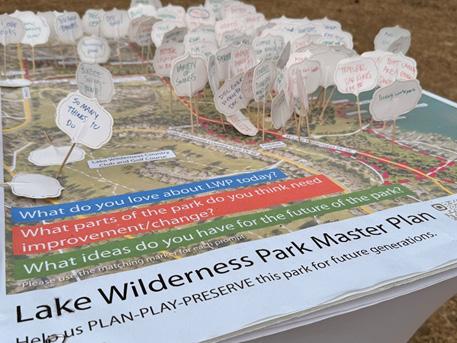
Feedback was collected over two days during the Maple Valley Days festival. Community members spun a wheel, which prompted conversation on certain parks programs or features; feedback was recorded from those conversations.
Splash pads, the playground, and lake and water access were the top amenities discussed at the festival.
▶ The future of the park should focus on fostering community, improving access, and preserving and enhancing nature.
▶ Participants deeply appreciate the “wilderness” aspect of the park. People enjoy walking the trails and spending time in nature.
▶ There is a need for more active and adventure recreation.
Improve existing playground
Add new bandshell/stage at amphitheater
Add new outdoor exercise/fitness areas
Improve existing picnic tables/shelters
Add new picnic tables/shelters
Improve existing outdoor tennis/pickleball courts
Add new rectangular sports fields
Add new basketball courts
Improve existing softball field
Add new diamond sports fields
The Park’s previous vision statement focused on enhancing the Park for public use while preserving its natural and cultural qualities. And although the importance of this core concept still rang true during community conversations, the community desired more emphasis on accessibility. Maintaining figurative (i.e., “open space for all”) and literal (i.e., ADA compliance) access to LWP was important to community members and honored the Park’s heritage as a former King County park.
Staff and community feedback informed the plan’s balance between three objectives: address capacity issues, keep the wilderness, and consider system gaps.
▶ ADDRESS CAPACITY
ISSUES: The new master plan needs to consider how expanding use/ popularity of the park is exceeding the capacity of current infrastructure. The park is reported as being “loved to death.”
▶ KEEP THE WILDERNESS:
Today’s park users place a high value on the quality of the Park’s natural areas (e.g., lake, forest, creek, wetlands). The new master plan will integrate resilience measures for these areas.
▶
The Park’s development presents an opportunity to address program gaps in the larger park system. The updated master plan will consider locating priority programs within the park, including trail connections, athletic fields, and aquatics.
Preserve
Recognize the draw of lakefront and water-based activities
Address parking and vehicular circulation challenges
Improve pedestrian and bicycle connectivity
Rethink park program/activities
Provide refreshed outdoor active recreation
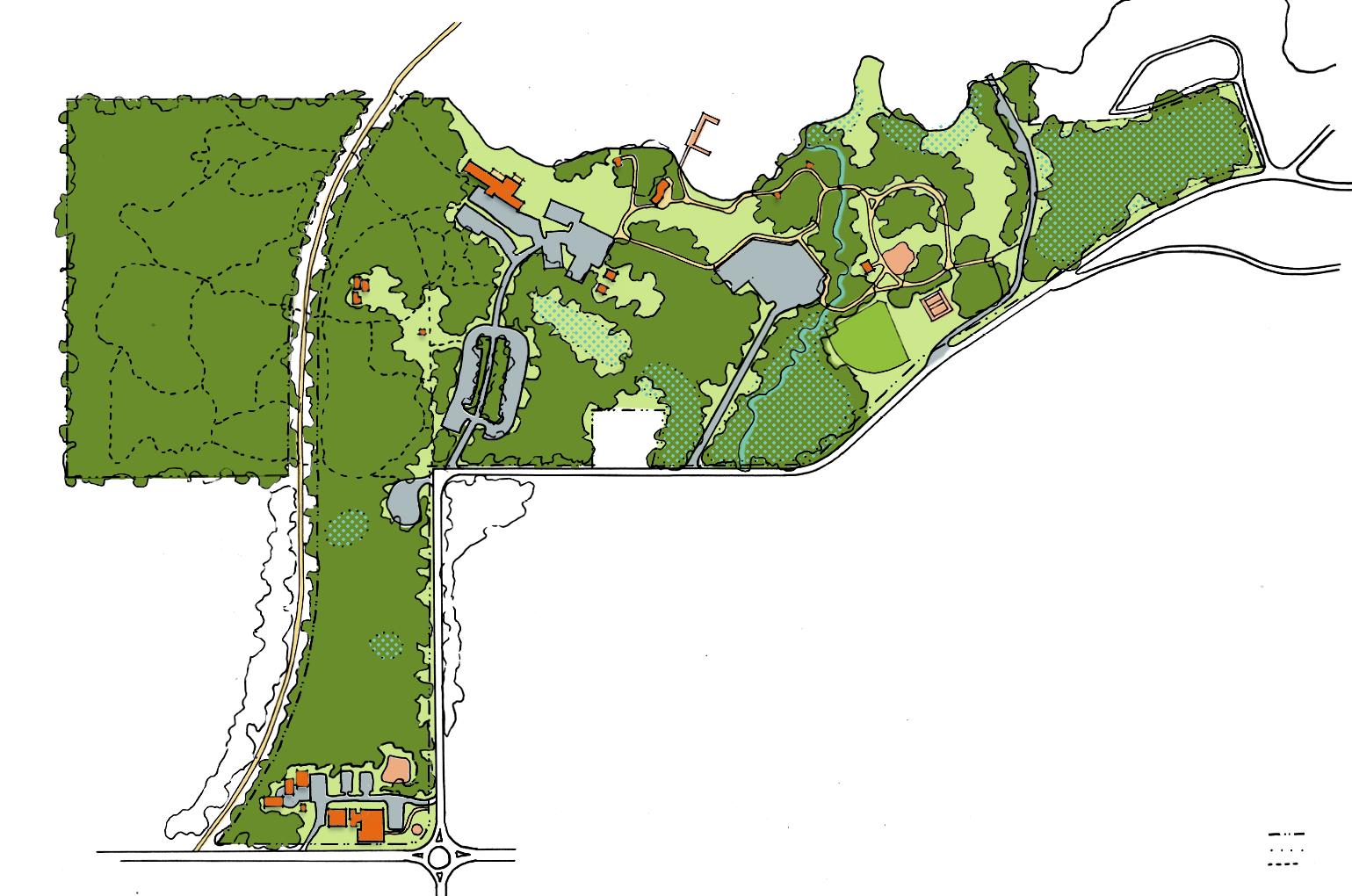
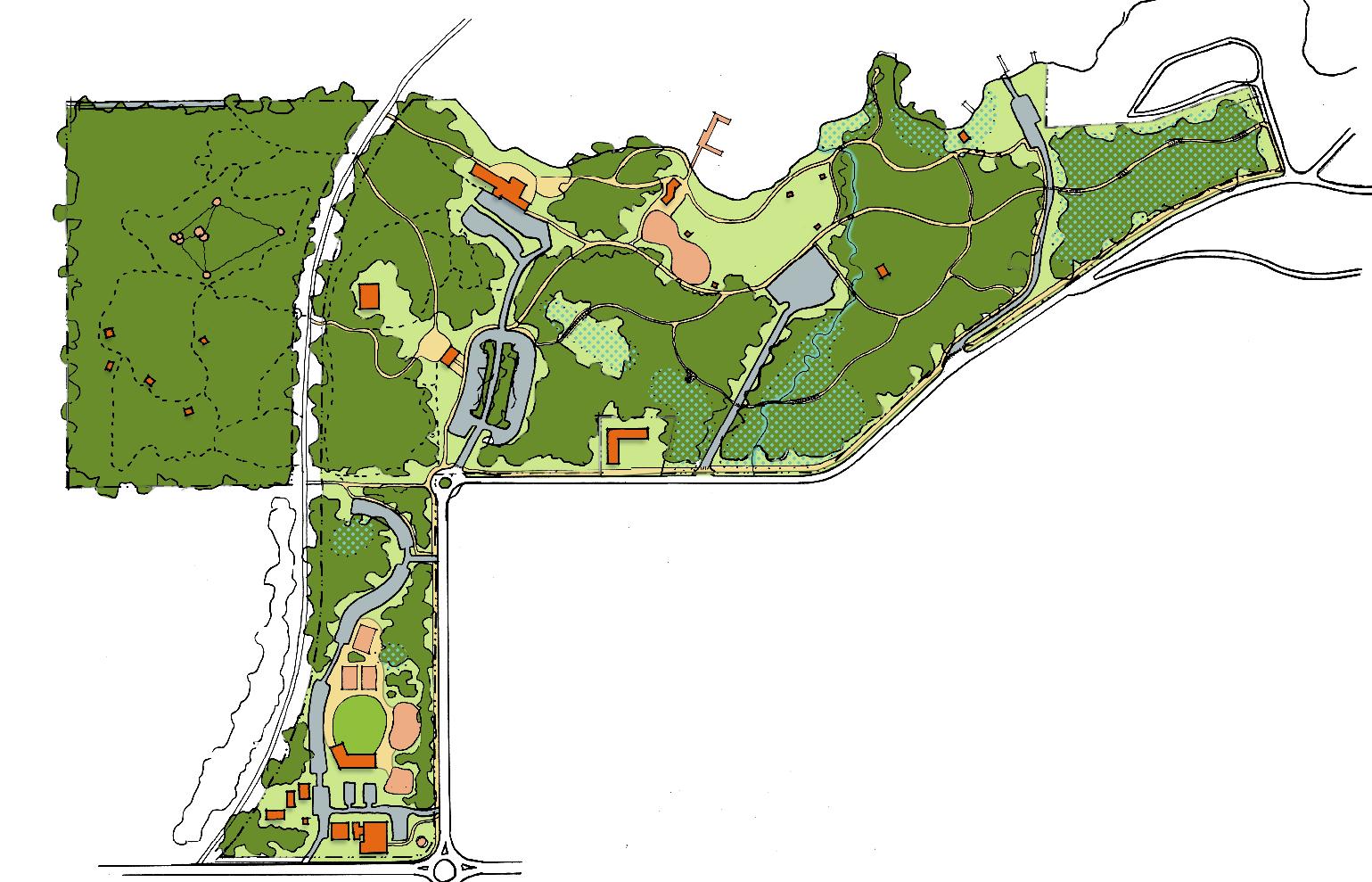
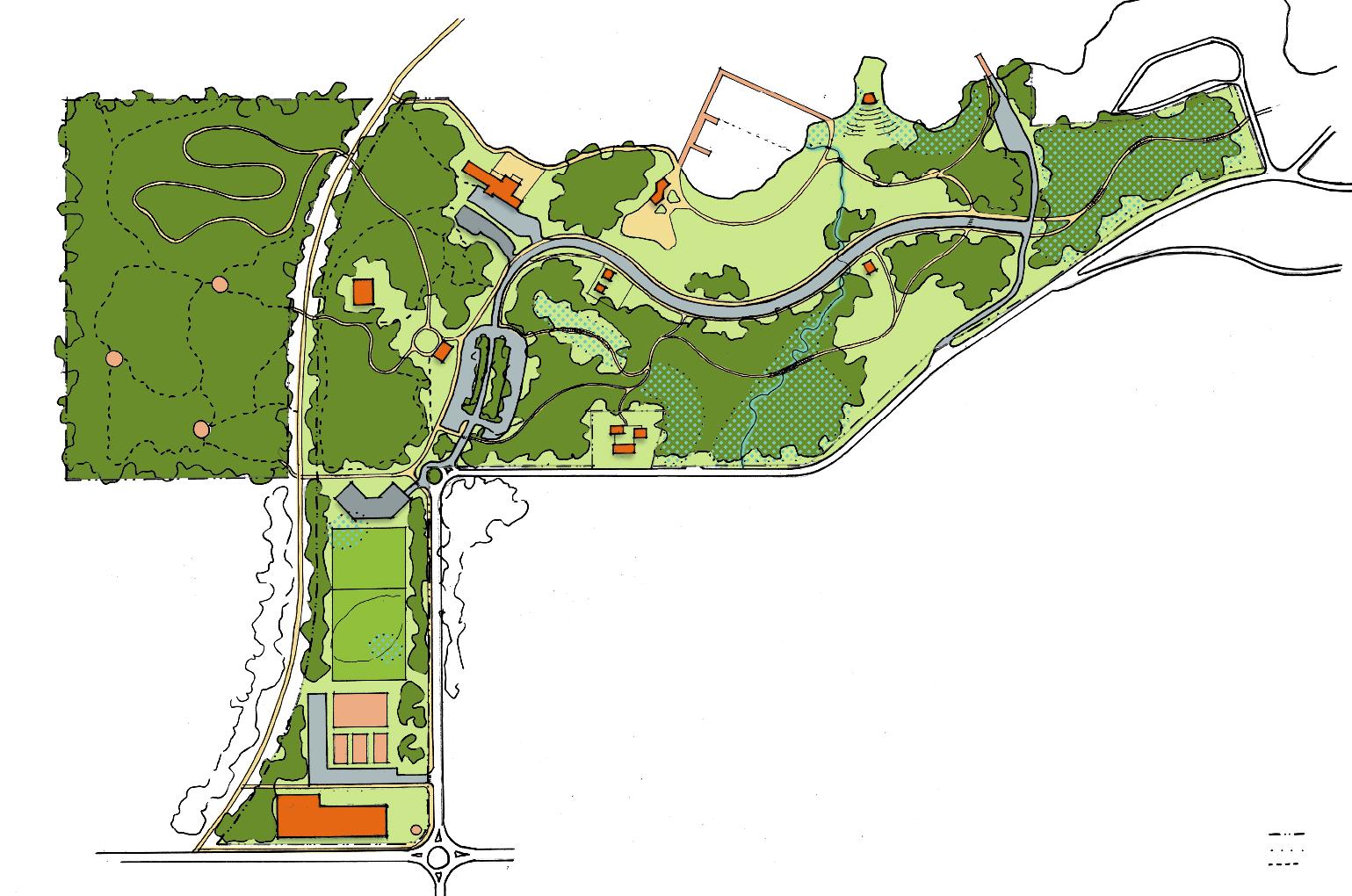
After considering staff, partner, and community feedback, the design team generated three initial concept drawings. The concept titles helped describe the three different approaches to potential changes. The intent was not to select one of the three concepts; rather, the design team aimed to learn what components of each concept resonated the most with community members.
The community had the opportunity to review the three initial concepts and provide feedback in a public open house setting and through an online engagement platform. The following describes the initial concept and the community’s corresponding feedback.
In the LAKE Wilderness concept, lakefront experiences are emphasized with expanded water-based activities. Core park green space is reclaimed by relocating parking, simplifying vehicular circulation, and rethinking programming in the Civic Peninsula to focus on multiuse active recreation.
Concept supporters often commented about how important the park is for the community, emphasizing their desire to keep it as a place for people to gather and enjoy. Many mentioned concerns about parking and how their experience at the park may be affected. There were also comments about protecting natural areas and making sure the park stays a welcoming space for everyone.
In the Retreat and Refocus concept, parking and vehicular access points are focused at program zones, with pedestrian and bike connections between zones. Forested areas are restored at key points along the shoreline. The Civic Peninsula is rethought to focus on active recreation and adventure play.
Those who preferred this concept said the park is central to the community, noting their appreciation of certain plan features and ideas. Parking and access were discussed often, and many brought up the future of the disc golf course, showing strong feelings about keeping it as part of the park.
In the Small Footprint concept, improvements are limited to fit within the footprint of existing developed areas. A multipurpose “green” parking garage reduces the surface parking footprint and provides opportunity for covered courts or other programs. Alternative programs would replace underutilized areas.
Among supporters of the Small Footprint concept, the preservation of the disc golf course stood out as the dominant theme, with many advocating for its continued existence as a valued community asset. The value of disc golf as an activity and the significance of the course itself were repeatedly emphasized. Additionally, respondents highlighted the importance of protecting the park’s natural environment, with concerns about parking solutions and their potential impact on the park’s character also frequently discussed.
The park use program provides guidance for future park development opportunities. The identified opportunities capture a desired future state of individual park components that collectively shape the ideal park vision. The goals of these program opportunities and enhancements help articulate the vision of that desired future state:
• Provide a broad range of recreational opportunities for the greater Maple Valley community and local community visitors.
• Enhance the facilities available for children, youth, older adults, and people with disabilities.
• Allow for community gathering opportunities and events that balance park-carrying capacity.
• Provide a high level of environmental stewardship of the site’s natural resources.
• Restore park ecosystems and the diversity of habitats as well as maximize available wildlife habitat.
• Protect and preserve the water quality of Lake Wilderness and Jenkins Creek.
• Preserve and enhance the historic Lodge.
• Maximize opportunities for environmental education and community stewardship.
• Maximize the natural aesthetics and beauty of the park


Using the community’s feedback from the initial design concepts, the following conclusions were vetted with and confirmed by City staff and the City Council and were used to shape the park use program:
▶ Use the Small Footprint concept plan as a starting point to guide the updated master plan. Maintaining existing natural spaces is a priority for the community.
▶ Maintain the current location of the disc golf course. Consider improvements near the existing Community Center that do not impact the course (could include outdoor community-oriented play, social connection, multigenerational programming to support existing Community Center program).
▶ Address parking and vehicular circulation. Connectivity between spaces is desired. Multimodal parking and a trail loop with drop-off spaces should be considered, and a multipurpose garage could be considered as a last option.
▶ Consider passive recreation enhancements in the Forest Reserve area that are focused on nature-based experiences. Trail/accessibility improvements, restoration, and habitat and wildlife viewing will be supported by a majority of community members. Arboretum staff have confirmed they are comfortable with the idea of an elevated canopy walk.
▶ The following programs have support to be maintained or added to LWP and should be included in the updated master plan: sports courts (support for covered courts), playground (support for adding nature play or splash pad/water play), improved amphitheater/small bandshell, wetland boardwalks, lakefront activities (could be expanded/improved).
▶ Include a main spine trail with connecting loops that improve active transportation (pedestrian/ bike) throughout the park and connect key amenities and program areas. This could be part of a circulation loop road (bullet above) or stand alone.
▶ Improve/expand the dock and swimming beach, including a dock with potential for open swimming lanes.
▶ Acquire property along West Lake Wilderness Drive SE and use to relocate existing parks maintenance/operations facilities or the Historical Society Museum. This frees up space in the park for natural space restoration (similar to the design shown in the Retreat and Refocus concept) or for other improvements in the Civic Peninsula area.
▶ Relocate the playground to another area in the park (i.e., near the beach or main lawn). Be mindful of good activation impacts and relocation of active use from an area.
▶ Include a circulation loop road that connects parking areas and core program zones of the park. The loop includes a multiuse trail, ADA stalls, and drop-off zones, serving as a primary corridor for pedestrian, bicycle, and vehicular circulation.
▶ Consider creative solutions to address LWP parking challenges. Potential solutions include installing circulation loop road parking stalls, operational changes (i.e., parking fees, shuttles), single-layer elevated parking over the existing lower Lodge lot, and/or a multipurpose parking garage (i.e., green roof/walls, covered sports courts) as a last resort.
▶ Convert area occupied by Patrick’s Field to address needs of the park (i.e., additional sport courts, ideally covered).
▶ Consider expanding the lawn area to the south/ east around the lake to accommodate demand (relocate and replace Shelter #2 or remove altogether).
▶ While there is sufficient acreage to redevelop the Civic Peninsula area (relocate the current disc golf course and replace it with a recreation center and additional parking), due to community feedback against the idea and a desire for a larger site footprint, the City concluded a recreation center would not be a program in LWP’s updated master plan.
Table 1 summarizes the 2007 LWP Master Plan program in relation to proposed 2026 LWP Master Plan program updates.
2007 LWP Master Plan (Some Listed Items Were implemented) 2026 LWP Master Plan
FOREST RESERVE: trails, habitat rooms, outdoor classroom
CIVIC PENINSULA: expanded community center with lawn/picnic areas, skate park expansion, climbing walls, playground, restroom, basketball court, nonmotorized BMX bike trails, surface parking, pedestrian connections
ARBORETUM: Interpretive Center
LAKE WILDERNESS LODGE/EVENTS: waterfront promenade, events plaza/ outdoor rooms, amphitheater with bandstand
SWIMMING BEACH AREA: expanded beach house with rentals and concessions, new pier and swim/dive/slide platform, boat rental, fishing area, water quality treatment system
FIELD/PLAY AREA: softball field, tennis courts, play area, spray park, half-court basketball, nature play area, group picnic shelter, surface parking
BOAT LAUNCH AREA: parking, boat launch float
PARKING/VEHICULAR CIRCULATION (GENERAL): surface parking throughout park, spread out to access different program areas. No internal vehicular connections in park (all roads dead end at parking).
PEDESTRIAN/BIKE CIRCULATION (GENERAL): primary loop path and system of trails connecting areas of the program
WETLANDS, CREEK, SHORELINE (GENERAL): enhancements to these natural areas, boardwalk trails/overlooks at wetlands
FOREST RESERVE: Trail/accessibility improvements, restoration, habitat and wildlife viewing, elevated canopy walk
CIVIC PENINSULA: retain existing programs (disc golf, Community Center, Historical Society Museum, skate park) and add small improvements (pedestrian connections, outdoor community-oriented play, and social amenities)
ARBORETUM: Support LWAF’s recommendation of future capital projects that align with City goals
LAKE WILDERNESS LODGE/EVENTS: waterfront promenade, events plaza/ courtyard, pedestrian connections, small amphitheater/bandshell, potential parking improvements (such as second parking deck at existing lot).
SWIMMING BEACH AREA: new dock with swimming lanes, expanded beach, play and spray
FIELD/PLAY AREA: shelter with restroom, sports courts, play and spray relocated near beach or lawn, nature play located at area of reduced surface parking
BOAT LAUNCH AREA: parking improvements, boat launch dock, overlooks or fishing floats
PARKING/VEHICULAR CIRCULATION (GENERAL): existing surface parking reduced and loop road with ADA stalls and drop-off zones.
PEDESTRIAN/BIKE CIRCULATION (GENERAL): primary multipurpose trail connecting core park areas, system of trails connecting areas of the program, improved connections to Cedar to Green River Trail
WETLANDS, CREEK, SHORELINE (GENERAL): restoration of these natural areas, boardwalk trails/overlooks at wetlands, mitigation if any development impacts critical areas
“BerryDunn” is the brand name under which Berry, Dunn, McNeil & Parker, LLC and BDMP Assurance, LLP, independently owned entities, provide professional services in an alternative practice structure in accordance with the AICPA Code of Professional Conduct. BDMP Assurance, LLP is a licensed CPA firm that provides attest services, and Berry, Dunn, McNeil & Parker, LLC, and its subsidiary entities provide tax, advisory, and consulting services.
Berry, Dunn, McNeil & Parker, LLC leases professional and administrative staff to BDMP Assurance, LLP. These individuals work under the direct control and supervision of BDMP Assurance LLP, which is solely responsible for their performance.
The entities falling under the BerryDunn brand are independently owned and neither entity is liable for the services provided by the other entity. Our use of the terms “our Firm” and “we” and “us” and terms of similar import denote the alternative practice structure of Berry, Dunn, McNeil & Parker, LLC and BDMP Assurance, LLP.
This report is the work of Berry, Dunn, McNeil & Parker, LLC.
©2026 BerryDunn | All rights reserved.