
Maharana 5th Revised 2026

Page 1


M AHARANA

THE STORY OF THE RULERS OF UDAIPUR

BRIAN MASTERS studied French and Romance

Philology at University College, Cardiff, where he emerged with a First Class Honours degree, and the University of Montpellier in France.

His first book was a study of Molière, soon followed by similar books in French. He became interested in the aristocracy when his friend the Marquess of Londonderry married the ballerina Doreen Wells and made him the godfather of their son Lord Castlereagh. He then wrote a history of all the dukedoms, called The Dukes, now reprinted. He also wrote several biographies, on Marie Corelli, on Georgiana the Duchess of Devonshire, and on the mass-murderer Dennis Nilsen. This last book, entitled Killing for Company, won the Gold Dagger award for non-fiction in 1985.

His most recent books include two volumes of autobiography, Getting Personal and Second Thoughts, and The Actors—volume one of the history of the Garrick Club, of which he is a trustee.

Mapin Publishing www.mapinpub.com

M AHARANA
The Manek Chowk, City Palace, Udaipur
Print designed by H. Clerget; Photograph by M.L. Rousselet

M AHARANA THE STORY OF THE RULERS OF UDAIPUR

Fifth revised edition in 2026 by Mapin Publishing Pvt. Ltd

706 Kaivanna, Panchvati, Ellisbridge

Ahmedabad 380006 INDIA

T: 91 79 4022 8228

E: mapin@mapinpub.com www.mapinpub.com in association with Maharana Mewar Historical Publications Trust, a unit of Maharana of Mewar Charitable Foundation, The City Palace, Udaipur

© Mapin Publishing 1990, 2012, 2018, 2023

Text © Brian Masters

Photographs and illustrations © Maharana of Mewar Charitable Foundation (MMCF), Udaipur 313001, Rajasthan, India

Courtesy: The City Palace Museum, Udaipur © MMCF pp. 2, 18, 20–21, 26, 33, 66, 68, 74–75, 84, 88, 111, 121, 123, 124, 132, 142, 184

Maharana Mewar Research Institute, Udaipur: pp. 36, 84, 91, 93, 103, 118–119

Media Office, Udaipur:

Front cover, pp. 17, 19, 22, 23, 24, 25, 50, 96–97, 122, 125–128, 129–130, 147, 153, 155–162, 181, 182, 214

All rights reserved under international copyright conventions. No part of this book may be reproduced or transmitted in any form or by any means, electronic or mechanical, including photocopy, recording or any other information storage and retrieval system, without prior permission in writing from the publisher.

The moral rights of Brian Masters to be identified as author of this work are asserted.

ISBN: 978-93-94501-31-7

Editor: Mallika Sarabhai

Copyediting: Suguna Ramanathan, Neha Manke and Marilyn Gore

Design: Gopal Limbad, Nidhi Sah

Production: Mapin Design Studio

Printed at Thomson Press India Private Limited

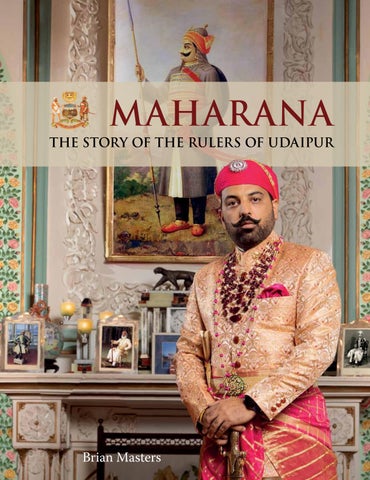
Front cover

Shriji Huzur Dr Lakshyaraj Singh Mewar of Udaipur

77th Custodian of the House of Mewar

The Coat of Arms of Udaipur, Mewar

Page 214

Dosti London coins

Back cover

The Sun Emblem

TO THE MEMORY OF BHAGWAT SINGH MEWAR AND ARVIND SINGH MEWAR

Molière

Sartre

Saint-Exupéry

Camus—A Study

Wynyard Hall and the Londonderry Family

Dreams about H.M. The Queen

The Dukes

Now Barabbas Was A Rotter: The Extraordinary Life of Marie Corelli

The Mistresses of Charles II

Georgiana, Duchess of Devonshire

Great Hostesses

Killing for Company: The Case of Dennis Nilsen

The Swinging Sixties

The Passion of John Aspinall

Gary

The Life of E. F. Benson

Voltaire’s Treatise on Tolerance (translated and edited)

The Shrine of Jeffrey Dahmer

Masters on Murder

The Evil That Men Do

‘She Must Have Known’: The Trial of Rosemary West

Thunder in the Air: Great Actors in Great Roles

Getting Personal: A Biographer’s Memoir

Second Thoughts

The Actors (Vol 1 of Garrick Club History)

ACKNOWLEDGEMENTS

My first debt of gratitude is eagerly made to Lady Selina Hastings, who first suggested I might be competent to attempt a sketch of the Mewar dynasty and thus opened to me a whole area of which I had previously been entirely ignorant.

Undeterred by my novitiate status, Shriji Arvind Singh Mewar generously made available to me documents which he controls and spent many hours discussing his family history with me, as well as making arrangements for me to visit places associated with that history. Further, he and his wife, Princess Vijayraj, permitted me to work in the tranquil surroundings of their home at Shiv Niwas Palace and offered every kind of assistance with unfailing courtesy. No expression of gratitude on my part can possibly match their kindness.

I should like to record my appreciation for the use of letters in the Royal archives at Windsor Castle, England, which are reproduced by gracious permission of Her Majesty Queen Elizabeth II.

In Udaipur, I am especially indebted to Pandit Ghanshyamlal Sharma, who shared his extensive knowledge with me on many occasions and pointed me towards many books of which I had been unaware. I was also given considerable help by Mr Rajendra Singh Kushwaha, Manager of Shiv Niwas Palace; Mr Tulsinath Dhabai of the City Palace Museum; Dr Menaria, Director of the Maharana Mewar Research Institute; Mr Sarin, Manager of the Motor Garage; Mr Sanjay Mukerjee, Private Secretary to Arvind Singh Mewar; Mr Deepak Dutt, Manager of the Lake Palace Hotel; Mr Justice Peri; and Major Raghubir Singh, Manager of City Palace Museum. I trust they will all accept my thanks collectively expressed. In England, I should

like to thank Virginia Fass and Andrew Topsfield, who separately assisted me with much useful information, and Philippa Scott, who offered constant encouragement and listened to the developing text with exemplary patience.

Finally, the staff at Shiv Niwas Palace all willingly came to my aid at every opportunity and helped turn the task into a treasured experience and memorable pleasure.

B.M., 1988

For this second edition, I have been given further valuable assistance in particular by Dr Mayank Gupta, whose experience of the advances made by the House of Mewar in the intervening twenty-three years is indispensable to any scholar. He is Deputy Secretary–Development of the Maharana of Mewar Charitable Foundation and his involvement in all projects undertaken in recent years is profound. I am grateful for his guidance and enthusiasm.

Sir Stephen Lamport, KCVO, DL, Receiver General at Westminster Abbey, has clarified the constitutional position of the British monarchy and helped me avoid some egregious errors, for which I am most grateful.

Shriji Arvind Singh Mewar has once again extended to me his legendary generous hospitality, in response to which mere gratitude will never suffice, and he has allowed me the precious freedom to select, from the vast amount of material available, those subjects which I judge to be most relevant to the scope, style and purpose of this book. I can only hope that I have chosen well.

B.M., 2012

To bring this absorbing and unique story, now part of my own life, up to date to the present has been a joyful task that I could not have accomplished without the solid and enthusiastic support of Lakshyaraj Singh Mewar, whose devotion to family history is exemplary and an inspiration to the growing number of friends who cherish Shiv Niwas Palace and its memories.

B.M., 2023

Bringing this continuing and ever-inspiring chronicle of the House of Mewar to its newest edition has been both a privilege and a profound personal journey. The opportunity to revisit and refine this work for the 2025 edition coincides with a momentous occasion for the Mewar dynasty.

I extend my heartfelt congratulations to Shriji Dr Lakshyaraj Singh Mewar on his formal investiture as the seventy-seventh Custodian of the House of Mewar. His unwavering commitment to heritage, cultural continuity, and public service stands as a shining example of living tradition, breathing new life into an ancient legacy. His support in shaping this updated edition has been generous and insightful, and his stewardship offers inspiration to all who care deeply about the preservation of values, memory, and identity across generations.

I am also deeply appreciative of Dr Mayank Gupta, CEO of the Maharana of the Mewar Charitable Foundation, for his continued encouragement and facilitation throughout this journey. His dedication to scholarship and cultural documentation has been invaluable in bringing this edition to life.

B.M., 2026

PREFACE

I consider it a great privilege to be associated with the illustrious house of Mewar. The house has a glorious historical past, outstanding not only for its valour and chivalry, but also for the spirit of sacrifice it displayed in the cause of the country’s Independence.

My locus standi to write this preface is manifold. The kind request from the author is backed by that of Arvind Singh Mewar, a worthy son of Maharana Bhagwat Singhji. Aside from this, I belong to the Dungarpur ruling family, connected to the Sisodia clan by an interesting episode. The episode dates back to the eleventh century when the then Maharana was on his deathbed. He wanted his younger son to succeed him and not the eldest, as he felt the younger would be a better successor to the gadi of Shree Eklingnath ji. The eldest son came to know of his father’s wishes, expressed on his deathbed. This moved him to act in keeping with the tradition of sacrifice and obedience to the command of the father, the ruler and Maharana of Mewar. He took a solemn vow to abdicate and to move out of the territories of Mewar without ever again eating or drinking water in his ancestral state, to enable the dying Maharana’s wishes to be carried out. The Maharana admired the sacrifice and courage of his son and gave him men and arms to create a separate principality

* President, International Court of Justice; M.A., LLD. (Cantab); M.A., B.Litt., LLD. (Dublin); D.C.L. (Delhi); D.L. (Beijing); D.Sc. (Law; Moscow); DLitt DPhil (Cal); Fellow, St. John’s College, Cambridge; Master Bencher, Gray’s inn, London; Fellow of the British Academy; Member, Constituent Assembly of India, 1947; Member of the U.N. World Commission on Environment & Development; President of the Indian Society of International Law; President of the National Labour Law Association of India; Chancellor of the University of Goa; Freedom of the City of Salta (Argentina); LL.D. Hony. (Cordoba, Argentina). Died 1989.

Punja b

GANGANAGAR

HANUMANGARH

R AJA STHAN

RAMGARH

PHALODI

BIKANER

CHURU SIKAR JHUNJHUNU

NAGAUR

POKARAN

KHETRI ALWAR DAUSA

Uttar Pradesh

BHAR ATPUR

JAISALMER BARMER

JAIPUR SANGANER

R AJA ST HA N

KISHANGARH

MAND OR PIPAR AJMER

JODHPUR

JALOR

Guja rat

SIROHI

MT. ABU

PALI MARWAR

DEOGARH R AJSAMAND

NATHDWAR A

UDAIPUR AHAR

SHAHPURA AMBER

TONK

DHAULPUR

SAWAI MADHOPUR

BHILWARA BUNDI BARAN KOTA

CHITTORGARH

JHAL AWAR

PR ATAPGARH

DUNGARPUR

BANSWARA

District Boundary International Boundary

Based upon Survey of India map with the permission of the Surveyor General of India. ©2012, Government of India Responsibility for the correctness of internal details shown on the main map rests with the publisher.

INDI A

for himself, which the eldest son established just outside the Mewar territories. This is the origin of the Ruling House of Dungarpur, known as the Maharawals of Vagad. My eldest brother was the ruler of Dungarpur from 1918 to 1948, when the State merged in the Union of Rajasthan. Another version of the origin of Dungarpur is as given by the author in Chapter 3. Whatever may be the truth as to details, the fact of the abdication of the eldest son in favour of the youngest is well known in Rajasthani history and cherished as a sacrifice in obedience to the wishes of the father.

Wherever there is a Rajput population, be it in U.P., Bihar, M.P., the Punjab, or even in Europe and the Americas, the name of Mewar is revered. The names of Bappa, Kumbha, Sanga, Pratap and the great Raj Singh are sung not only in the bardic language of Rajasthan but also dramatised in Bengali, and are a source of inspiration throughout India. It is possible to write an entire book on each of the aforesaid giants of Mewar. If Kumbha ushered in a period of renaissance by encouraging art, architecture, music and learning with a spirit of tolerance unknown in his time, it is the mighty Sanga who checked the Mughal onslaughts, in the sixteenth century, and sacrificed all for the independence of the motherland.

Brian Masters has very rightly highlighted all these aspects in this work and made it interesting reading. There are not many books written on the House of Mewar and certainly not in recent times. The classic work on the subject is by Col. James Tod who served the cause of the British Government admirably as the Political Agent at Udaipur to the then Governor General of India. Tod became famous through his Annals and Antiquities of Rajasthan, and would,

I am sure, have been happy to read this narration which brings the facts of history up-to-date and covers more recent times.

History will note the remarkable sacrifice of Maharana Bhupal Singh who offered the territorial integrity of the ancient state of Mewar as the sacrificial golden fruit to bring about the unity of India. Udaipur took a leading part in the unification process by which over 565 princely states sought unity and were integrated with the Dominion of India in 1947 to help to build the present independent nation. Maharana Bhupal Singh appreciated that the fight for the independence of Mewar, spread over centuries of Indian history, had to merge with the fight for the independence of the country, and readily came forward to integrate his state to create a Union of Rajasthan States. He was rightly elected the Maharaj Pramukh i.e. the then constitutional head of the newly federated state. My eldest brother, Maharawal Lakshman Singhji, was elected Upraj Pramukh, under the Maharana’s headship.

Maharana Bhagwat Singh earned a name among the long list of Maharanas by creating trusts to encourage learning and scholarship, and to give assistance to the poor and needy of the country. These trusts which perpetuate the memory of the heroes of Mewar, as well as his valuable efforts towards the economic modernisation of Udaipur, will always remain everlasting contributions to posterity.

It is gratifying to see that Arvind Singh Mewar is sincerely carrying out and maintaining the same high tradition of Mewar, implementing the wishes of his father. He now administers the trust and has brought modern expertise to

augment the tourist industry by his excellent management of the several Palace Hotels of the city, created by his father.

I have no doubt that, as is only right, he is moving in the footsteps of his father and earning the blessings of their protective deity Ekling ji through scrupulous adherence to the motto of Mewar.**

b** “Those who stand steadfast in upholding the law will succeed in perpetuating the glorious traditions of the family.”

Parmeshwaraji Maharaj Shree Eklingnath ji, the Ruler of Udaipur, Mewar

Acc. No. 2012.18.0147 R

Bappa Rawal receiving ‘Mewar’ from his Guru Maharishi Harit Rashi
Painting by Pannalal Parasram Gaud, c. 1934
Inlay mosaic in the Mor Chowk, 19th century engraving

Panorama of Udaipur city seen from the south

Photograph by Herzog & Higgins, Mhow, c. 1930

Acc. No. 2009.09.0260-00058_R

The City Palace, Udaipur, Rajasthan

Photograph by Prashant Lohar, Udaipur, 2026

The City Palace, Udaipur, Rajasthan
Aerial view of the City Palace, Udaipur Painting by Sardar S.G. Thakar Singh, 1930–35
Shiv Niwas Palace, Udaipur
Sabhagaar, the Durbar Hall, Fateh Prakash Palace Convention Centre, Fateh Prakash Palace, Udaipur
Fateh Prakash Palace, The City Palace, Udaipur

Painting by S.H. Pandit, c. 1900, photograph by Bourne & Shepherd Acc. No. 2008.07.0297 R

Maharana Fateh Singh of Udaipur (r. 1884–1930 CE)

MAHARANA FATEH SINGH

Anyone who visits the enchanting city of Udaipur for the first time and finds himself a guest at the serene hill-top Palace of Shiv Niwas or the dream-like floating Lake Palace (properly called “Jagniwas”), will feel around him the spirit of a remarkable ancestry, renowned not only for its extreme antiquity, surpassing that of any European royal house, but, more importantly, for its gentle ideals and correspondingly firm tenacity in upholding them. Indeed, it is fitting that one should regard oneself as a guest at Shiv Niwas rather than a lodger, for it is part of the sacred purpose of the Hindu to bestow selfless hospitality upon the traveller. Equally, it is the solemn obligation of the Hindu ruler to protect and serve the people who depend on him as well as to administer and govern the affairs of the State. There are profound and subtle reasons for this view of the ruler as humble guardian of a trust, reasons that will become clear later. This is a view different in kind, not just in degree, from the European tradition of monarchy. For the moment it is enough to remember that the word “raja”, normally translated as “king” in the original Sanskrit, combines two meanings—“he who rules”, and “he whose duty it is to please”. Nobody embodied the significance of this duality more movingly than the man who built Shiv Niwas Palace at the end of the nineteenth century, Maharana Fateh Singh, the revered seventythird sovereign of the State of Mewar.

To call Fateh Singh an extraordinary man is almost to belittle language. Only superlatives can adequately describe his qualities, yet only simplicity can properly convey his virtue. He was regarded by many as the last true monarch in India, by his people as not only head of all the Rajputs but virtual leader of the Hindus. His spiritual authority was as unassailable as that of the Pope for Roman Catholics, his temporal influence so absolute that successive British

Viceroys, whose power in theory superseded his, were constantly thwarted in their endeavours to undermine him. “Whatever punishment may be meted out to Udaipur,” wrote one British memo, “we can never dethrone him from his position in the hearts of the Rajput people.” Fateh’s determination to resist British interference in the affairs of his people did not derive from mere stubbornness of character, still less from any love of power for its own sake, but from the inherited conviction that he must never allow the dignity of the House of Mewar to be impaired, and that such dignity was expressed by his inalienable responsibility towards his people. Hence a British recommendation would only be entertained by Maharana Fateh Singh if it suited the wishes and increased the happiness of the people he represented. Of that happiness he would be, and had perforce to be, the sole judge.

All of which sounds awesome and forbidding, and Fateh Singh’s place in the history of India would be one among many if it rested solely on the exercise of feudal authority. So too would the respect due to his memory be ordinary if based only on his role as king and spiritual leader. But his personal qualities were such as to inspire love and admiration in all who met him, and the historian will seek in vain for any disparaging remark among those recorded memories which have come down to us. The transparent sincerity of the language used by those British people who knew the Maharana is proof enough that they cannot have been moved by any desire to express sycophantic approval. Here are but a few of them:

“His Highness’s strength and personality are so striking that who knows him or has ever once come into contact with him cannot but feel a deep veneration for him.”

Sir Robert Holland

“His charm of manners and address, his hospitality and perfect courtesy are known beyond the borders of Rajputana. As a private gentleman of unblemished life and character, he is beyond reproach.”

Sir Arthur Martindale

“He had the most perfect manners in the world, gracious and inscrutable alike to all. It was interesting to watch the effect of his wonderful manners on diverse persons. It was a privilege merely to sit with him.”

Sir Walter Lawrence

“He was one of the finest characters I have ever known, the soul of truth and honour, but very slow to decide because of the overwhelming fear of deciding wrongly.”

Wakefield

“I have met royal persons in my life and sometimes been disappointed, but one person I shall never forget was Maharana Sir Fateh Singh of Mewar. I saw him first when he called on the Resident clad in plain and spotless white, with his up-curled Rajput beard (just as white) framing a face like smoothly wrinkled parchment. He moved with such dignity that the slightness of his figure seemed of no account. His gaze defied flattery and deceit, and, though he never raised his voice, every syllable could be heard in the hush which his calm presence created. I thought to myself that, if this was the result of nearly two thousand years of breeding and generations of personal rule, there was clearly something to be said for preserving such qualities for the future well-being of India.”

Sir Conrad Corfield

“He is constitutionally incapable of deviating from the truth as he conceives it, and loyalty is inherent in his very life... quite simple, transparently honest, searching whole-heartedly for truth, but handicapped in coming to a decision by the terrible weight of his responsibilities and ancestry, he never, to my recollection, sought his own advantage in anything.”

Sir Claude Hill

The fortress of Kumbhalgarh

KUMBHA, SANGA, AND PANNA DHAI

The clan name “Sisodia”—denoting the common root of the family’s many branches, who spread the family’s growing influence—dates from the time of Maharana Hamir Singh. “Sisodia” came from a village called Sisoda, close to the family’s original seat of power. Some one hundred and fifty years before Hamir Singh, the thirty-fifth ruler, Samant Singh, had left Mewar following a military defeat and been succeeded by his younger brother Kumar Singh. Samant Singh had meanwhile founded another line of the family, bifurcating the descent, and his genes are now carried by the Maharawal of Dungarpur (technically, therefore, the senior branch of Sisodias in terms of precedence by age). No less than five royal families in Rajasthan are of the Sisodia clan, but only the head of the central branch, of Udaipur, is Maharana.

When Hamir Singh regained Chittor from the Sultan in 1326, he was the only unhampered Hindu king left in northern India. A valiant warrior and stable administrator, he inaugurated a period of relative peace and rebuilding, and for two hundred years afterwards, Chittor enjoyed the recovery and prosperity which his mild paternal government made possible. His grandson, Maharana Lakha Singh (1382–1421), continued the process, erecting wonderful temples and palaces at enormous cost. One is bound to wonder if the people ever resented this lavish expense, fed by their labour, but there is no real evidence that they did. On the contrary, they were proud of their monuments and pleased when the Maharana, on ceremonial occasions, wore “their” jewels. This is another instance of that unusual bond between ruler and ruled, raja and praja, who are deemed to be members of one family.

Maharana Lakha Singh likewise developed the zinc and silver mines which were to remain an important source of revenue to the State for the next five hundred years (and are still mined by the Indian government today). Finally, Lakha’s patronage of the arts laid the foundation for that long tradition of Mewar painting about which we shall hear more in subsequent generations.

As the result of recent excavations and discoveries, the extent and scope of Lakha’s zinc-mining industry are now appreciated far better than ever before. It was centred on Zawar in the Aravalli hills, forty-five miles south of what is now Udaipur, in the abundant pre-Cambrian rock deposits, where massive amounts of physical evidence silently reveal what turns out to be the earliest centre of zinc production in the world, centuries in advance of zinc-mining in modern Europe. One may still see 400,000 tonnes of zinc-smelting debris, abandoned and forgotten at the end of the eighteenth century when production fell into abeyance. There are the remains of mines, with shafts for ventilation and stairways for access, traces of burning in charcoal and ash, and uncountable millions of retorts the clay cones shaped like an aubergine, in which the zinc was smelted. Since each was only used once, there are immense heaps of spent retorts littering the landscape where they were discarded. The site is utterly unique, testifying to the widespread reputation of this quality product when zinc from Zawar was regarded as the finest in the world. The most recent treasure to be uncovered are the remains of seven intact furnaces.

The site also has claim to a historical footnote. When, some two hundred years after Maharana Lakha established the mines, Maharana Pratap Singh was defending the ancestral lands against the Mughal invaders under Akbar (see pages 63–67), it was in one of these mines that he and his household took refuge, and were never discovered. The individual mine is still known locally as “Pratap Khan”.

When Maharana Lakha was an old man, his eldest son and heir, Chunda, was due to be married to a daughter of the neighbouring royal house of Marwar. In accordance with custom, the envoy from Marwar came bearing a coconut

(the symbol of marriage) which he intended to present to Chunda. Chunda, however, was not at court on the day in question, so his father the Maharana accepted the coconut on his behalf, with the light-hearted remark that doubtless no princess would want to accept an old fellow in his dotage, so there was little risk of making a mistake! When Chunda was informed of this repartee, he was outraged. In Tod’s elegant phrase, he was “offended at delicacy being sacrificed to wit” and he declined to accept the symbol. In truth, he was subjecting Hindu scripture to absurdly literal interpretation, holding that the thought of a wrong thing was a sin in itself. Chunda might have been a shade too solemn!

He certainly placed his father in a very embarrassing position. Conscious that the symbol could not be returned without gross insult to the princess and her family, Maharana Lakha Singh took the only way out; he was obliged to turn his jest to serious account by marrying the girl himself. He made the condition that Chunda should renounce his right to the gadi of Mewar in favour of any issue of this new marriage. As far as we know, Chunda readily assented, and was even pleased when a baby boy was born. He thereupon left Chittor in good humour and with good grace, while his little half-brother, Mokal, assumed the role of heir. It is only the second time in the long history of this family that the mantle of Maharana had fallen upon the younger, not the older, son. (The third instance occurs in 1984.) Chunda’s descendants even now talk of his sacrifice with pride.

When Maharana Lakha died, Mokal was still an infant, so the governance of the State passed to a regent, the Queen Hansa Bai’s brother Ranmal, prince of the House of Marwar. To avert the danger of Mewar passing into foreign hands by stealth, Chunda reclaimed his father’s right to Chittor on behalf of his brother Mokal, and Ranmal retired to his own State of Marwar.

Mokal succeeded as Maharana Mokal Singh and ruled from 1421 to 1433. Most evidence of his reign has been obliterated, but there is one fine temple, intact, which the visitor sees in front of the Vijay Stambh at Chittor and often neglects. This splendid building still retains the capacity to speak to us across the centuries and rescues Mokal from being a mere name in the sequence. He also renovated the Shree Eklingnath ji Temple at Kailashpuri. His greatest

Ram Prasad’s death was seen as undermining the Mughal victory: If an elephant of Mewar could resist the Mughal court, what hope was there that Maharana Pratap would submit? Notably, Pratap had already rejected Akbar’s multiple demands for the elephant.

As Badayuni writes, “the people did not accept Mughal victory, as the circumstances in which the battle ended were not conclusive.”

Court historians Badayuni and Abul Fazal both noted that the bravery of Mewar’s war animals and their devotion to their Maharana would be remembered forever.

THE PERIOD OF CONSTRUCTION MAHARANA JAGAT SINGH

Pratap had seventeen sons, of whom the eldest, Amar, succeeded him as Maharana Amar Singh I (1597–1620). The Emperor Akbar was still alive and no less anxious to achieve the homogeneity of his empire, which Udaipur alone stubbornly resisted. It is only fair to point out that Akbar was not merely a conqueror, but an idealist, with a deep and honourable desire to bring a civilising influence to bear upon India. He dreamed of one whole united country ruled by a benevolent imperialism, and even hoped he would be able to synthesise two such disparate cultures as the Hindu and the Muslim. His fascination with metaphysics and philosophy led him to believe that such an ambition was capable of realisation, but he had first to secure the alliance of the recalcitrant and proud Sisodias. To this end, he treated Amar Singh with scrupulous courtesy, making clear his admiration for Amar’s father, his old adversary Pratap. For eight years, Udaipur was left in peace.

Akbar was succeeded as emperor by his son Jahangir, a man far less endowed with either patience or intellect. He renewed the war with Udaipur, launching seventeen pitched battles over the next ten years, until finally Amar Singh accepted the treaty in an honorary manner for peace. He nevertheless secured especial exemption for himself and his successors from personal attendance at the Mughal court, in honour of his father’s pledge (which, of course, his people

following pages

Jagmandir, Lake Pichola, Udaipur (also known as the Lake Garden Palace)

An island palace at the southern end of Lake Pichola, Udaipur, completed and named by Maharana Jagat Singh I (1628–1652)

Print designed by H. Clerget; Photograph by M.L. Rousselet

The name Lake Pichola comes from the nearby small village of Picholi and was originally created early in the 15th century

Print designed by H. Clerget; Photograph by M.L. Rousselet

View of the City Palace from Lake Pichola, Udaipur

THE CITY PALACE

When, in 1988, I began my research into the sublimely rich history of the family which had ruled the state of Mewar and guided its destiny for thirteen centuries, the City Palace, brooding over Udaipur with its massive presence, was a sleeping giant. Its tangle of rooms and spaces were for the most part empty, the walls thick with ghostly memories, rendered resonant only with an effort of imagination. The vast building was open to the public, but on my first day I think I encountered only about twenty visitors. Now, thirty-eight years later, all that has changed dramatically; the place is alive with interest and fascination as never before and attracts close to one million tourists each year.

It is impossible to determine which Maharana was responsible for the design and architecture of the palace, as no fewer than twenty-four of them have added to the structure and gradually enlarged it—all the way from Udai Singh II, who established it in the sixteenth century, to Arvind Singh Mewar, who maintained and treasured it in the twenty-first century. But it is now abundantly clear that the glorious resurrection of this historic building is due entirely to the vision, foresight, and limitless energy of the seventy-seventh custodian of the family, Shriji Huzur Dr Lakshyaraj Singh Mewar, the present Chairman and Managing Trustee of Maharana of Mewar Charitable Foundation. First, he carried forward and developed the charitable foundation established by his grandfather, Maharana Bhagwat Singh and father Maharana Arvind Singh, to mitigate the potential damage inflicted upon the institution of Maharana by the abolition of princely privilege, as described in the previous chapter. Having recovered ownership of the buildings, he set about restoring them.

Even so, there is rarely a courtyard which does not bear the stamp of more than one monarch. Just take one example. The central area known as Mor Chowk (the peacock courtyard) was built by Karan Singh in the seventeenth century,

5th REPRINT

GENERAL Maharana

The Story of the Rulers of Udaipur

Brian Masters

214 pages, 66 photographs and a map

6.7 x 8.7” (170 x 221 mm), hc

ISBN: 978-93-94501-31-7

₹1295 | $29.50 | £20

2026 • World rights

MAHARANA

THE STORY OF THE RULERS OF UDAIPUR

This history of the erstwhile princely state of Udaipur evokes the glory and grandeur of the Rajput courts. Here are tales of honour and chivalry, of magnanimity to enemies, and of a fierce pride that did not bow down before Moghul might or British power. Udaipur is the world’s oldest ruling dynasty, whose antiquity surpasses any European royal line—it spans 76 generations and some 1500 years. There are Maharajas aplenty in Rajasthan, but only one Maharana: Udaipur.

Many interesting episodes enliven this historical account—how Prince Khurram sought refuge in Udaipur, from where he was proclaimed Emperor Shah Jahan; how King George V had to visit the Delhi railway station to meet Maharana Fateh Singh. The book culminates in a description of the palace, a splendid example of Rajput architecture that “combined building with poetry”. This section also offers an insight into the ongoing initiatives of the Maharana of Mewar Charitable Foundation in conservation and planning of the palace spaces and their conversion into a living heritage museum of global significance.  With 66 photographs and a map

Turn static files into dynamic content formats.
Create a flipbook
Maharana 5th Revised 2026 by Mapin Publishing - Issuu