Exploring the Variety of Random Documents with Different Content
But at last the new moon brought a sharp chilly night with it, and the long-awaited signal was given. Coming down with the first grey glint of morning from the little room under the thatch, I found the beegarden in a swither of commotion. A faint smell of carbolic was on the air, and the shadowy figures of the bee-master and his men were hurrying from hive to hive, taking off the super-racks that stood on many three and four stories high. The honey-barrows went to and fro groaning under their burdens; and the earliest bees, roused from their rest by this unwonted turmoil, filled the grey dusk with their high timorous note.
The bee-master came over to me in his white overalls, a weird apparition in the half-darkness.
“’Tis the honey-dew,” he said, out of breath, as he passed by. “The first cold night of summer brings it out thick on every oak-leaf for miles around; and if we don’t get the supers off before the bees can gather it, the honey will be blackened and spoiled for market.”
He carried a curious bundle with him, an armful of fluttering pieces of calico, and I followed him as he went to work on a fresh row of hives. From each bee-dwelling the roof was thrown off, the inner coverings removed, and one of the squares of cloth—damped with the carbolic solution—quickly drawn over the topmost rack. A sudden fearsome buzzing uprose within, and then a sudden silence. There is nothing in the world a bee dreads more than the smell of carbolic acid. In a few seconds the super-racks were deserted, the bees crowding down into the lowest depths of the hives. The creaking barrows went down the long row in the track of the master, taking up the heavy racks as they passed. Before the sun was well up over the hill-brow the last load had been safely gathered in, and the chosen hives were being piled into the waggons, ready for the long day’s journey to the moors.
All this was but a week ago; yet it might have been a week of years, so completely had these rose-red highland solitudes accepted our invasion, and absorbed us into their daily round of sun and song.
Here, in a green hollow of velvet turf, right in the heart of the wilderness, the camp had been pitched—the white bell-tents with their skirts drawn up, showing the spindle-legged field-bedsteads within; the filling-house, made of lath and gauze, where the racks could be emptied and recharged with the little white wood sectionboxes, safe from marauding bees; the honey-store, with its bee-proof crates steadily mounting one upon the other, laden with rich brown heather-honey—the finest sweet-food in the world. And round the camp, in a vast spreading circle, stood the hives—a hundred or more —knee-deep in the rosy thicket, each facing outward, and each a whirling vortex of life from early dawn to the last amber gleam of sunset abiding under the flinching silver of the stars.
The camp-fire crackled and hissed, and the pot sent forth a savoury steam into the morning air. From the heather the deep chant of busy thousands came over on the wings of the breeze, bringing with it the very spirit of serene content. The bee-master rose and stirred the pot ruminatively.
“B’iled rabbit!” said he, looking up, with the light of old memories coming in his gnarled brown face. “And forty years ago, when I first came to the heather, it used to be b’iled rabbit too. We could set a snare in those days as well as now. But ’twas only a few hives then, a dozen or so of old straw skeps on a barrow, and naught but the starry night for a roof-tree, or a sack or two to keep off the rain. None of your women’s luxuries in those times!”
He looked round rather disparagingly at his own tent, with its plain truckle-bed, and tin wash-bowl, and other deplorable signs of effeminate self-indulgence.
“But there was one thing,” he went on, “one thing we used to bring to the moors that never comes now. And that was the basket of sulphur-rag. When the honey-flow is done, and the waggons come to fetch us home again, all the hives will go back to their places in the garden none the worse for their trip. But in the old days of bee-
burning never a bee of all the lot returned from the moors. Come a little way into the long grass yonder, and I’ll show ye the way of it.”
With a stick he threshed about in the dry bents, and soon lay bare a row of circular cavities in the ground. They were almost choked up with moss and the rank undergrowth of many years but originally they must have been each about ten inches broad by as many deep.
“These,” said the bee-master, with a shamefaced air of confession, “were the sulphur-pits. I dug them the first year I ever brought hives to the heather; and here, for twenty seasons or more, some of the finest and strongest stocks in Sussex were regularly done to death. ’Tis a drab tale to tell, but we knew no better then. To get the honey away from the bees looked well-nigh impossible with thousands of them clinging all over the combs. And it never occurred to any of us to try the other way, and get the bees to leave the honey. Yet beedriving, ’tis the simplest thing in the world, as every village lad knows to-day.”
We strolled out amongst the hives, and the bee-master began his leisurely morning round of inspection. In the bee-camp, life and work alike took their time from the slow march of the summer sun, deliberate, imperturbable, across the pathless heaven. The bees alone keep up the heat and burden of the day. While they were charging in and out of the hives, possessed with a perfect fury of labour, the long hours of sunshine went by for us in immemorial calm. Like the steady rise and fall of a windless tide, darkness and day succeeded one another; and the morning splash in the dew-pond on the top of the hill, and the song by the camp-fire at night, seemed divided only by a dim formless span too uneventful and happy to be called by the old portentous name of Time.
And yet every moment had its business, not to be delayed beyond its imminent season. Down in the bee-farm the work of honeyharvesting always carried with it a certain stress and bustle. The great centrifugal extractor would be roaring half the night through, emptying the super-combs, which were to be put back into the hives
on the morrow, and refilled by the bees. But here, on the moors, modern bee-science is powerless to hurry the work of the sunshine. The thick heather-honey defies the extracting-machine, and cannot be separated without destroying the comb. Moorland honey—except where the wild sage is plentiful enough to thin down the heather sweets—must be left in the virgin comb; and the bee-man can do little more than look on as vigilantly as may be at the work of his singing battalions, and keep the storage-space of the hives always well in advance of their need.
Yet there is one danger—contingent at all seasons of bee-life, but doubly to be guarded against during the critical time of the honeyflow.
As we loitered round the great circle, the old bee-keeper halted in the rear of every hive to watch the contending streams of workers, the one rippling out into the blue air and sunshine, the other setting more steadily homeward, each bee weighed down with her load of nectar and pale grey pollen, as she scrambled desperately through the opposing crowd and vanished into the seething darkness within. As we passed each hive, the old bee-man carefully noted its strength and spirit, comparing it with the condition of its neighbours on either hand. At last he stopped by one of the largest hives, and pointed to it significantly.
“Can ye see aught amiss?” he asked, hastily rolling his shirt-sleeves up to the armpit.
I looked, but could detect nothing wrong. The multitude round the entrance to this hive seemed larger and busier than with any other, and the note within as deeply resonant.
“Ay! they’re erpulous enough,” said the bee-master, as he lighted his tin-nozzled bellows-smoker and coaxed it into full blast. “But hark to the din! ’Tis not work this time; ’tis mortal fear of something. Flying strong? Ah, but only a yard or two up, and back again. There’s trouble at hand, and they’ve only just found it out. The matter is, they have lost their queen.”
He was hurriedly removing the different parts of the hive as he spoke. A few quick puffs from the smoker were all that was needed at such a time. With no thought but for the tragedy that had come upon them, the bees were rushing madly to and fro in the hive, not paying the slightest attention to the fact that their house was falling asunder piecemeal and the sudden sunshine riddling it through and through, where had been nothing but Cimmerian darkness before. Under the steady slow hand of the master, the teeming section-racks came off one by one, until the lowest chamber—the nursery of the hive—was reached, and a note like imprisoned thunder in miniature burst out upon us.
The old bee-keeper lifted out the brood-frames, and subjected each to a lynx-eyed scrutiny. At last he dived his bare hand down into the thick of the bees, and brought up something to show me. It was the dead queen; twice the size of all the rest, with short oval wings and a shining red-gold body, strangely conspicuous among the score or so of dun-coloured workers which still crowded round her on the palm of his hand.
“In the old days,” said the bee-master, “before the movable-comb hive was invented, if the queen died like this, it would throw the whole colony out of gear for the rest of the season. Three weeks must elapse before a new queen could be hatched and got ready for work; and then the honey-harvest would be over. But see how precious time can be saved under the modern system.”
He led the way to a hive which stood some distance apart from the rest. It was much smaller than the others, and consisted merely of a row of little boxes, each with its separate entrance, but all under one common roof. The old bee-man opened one of the compartments, and lifted out its single comb-frame, on which were clustered only a few hundred bees. Searching among these with a wary forefinger, at last he seized one by the wings and held it up to view.
“This is a spare queen,” said he. “’Tis always wise to bring a few to the heather, against any mischance. And now we’ll give her to the
motherless bees; and in an hour or two the stock will be at work again as busily as ever.”
CHAPTER IX THE BEE-HUNTERS
“IN that bit of forest,” said the bee-master, indicating a long stretch of neighbouring woodland with one comprehensive sweep of his thumb, “there are tons of honey waiting for any man who knows how to find it.”
I had met and stopped the old bee-keeper and his men, bent on what seemed a rather singular undertaking. They carried none of the usual implements of their craft, but were laden up with the paraphernalia of woodmen—rip-saws and hatchets and climbingirons, and a mysterious box or two, the use of which I could not even guess at. But the bee-master soon made his errand plain.
“Tons of honey,” he went on. “And we are going to look for some of it. There have been wild bees, I suppose, in the forest country from the beginning of things. Then see how the land lies. There are villages all round, and for ages past swarms have continually got away from the bee-gardens, and hived themselves in the hollow trunks of the trees. Then every year these stray colonies have sent out their own swarms again, until to-day the woods are full of bees, wild as wolves and often as savage, guarding stores that have been accumulating perhaps for years and years.”
He shifted his heavy kit from one shoulder to the other. Overhead the sun burned in a cloudless August sky, and the willow-herb by the roadside was full of singing bees and the flicker of white butterflies. In the hedgerows there were more bees plundering the blackberry blossom, or sounding their vagrant note in the white convolvulus-
bells which hung in bridal wreaths at every turn of the way. Beyond the hedgerow the yellow cornlands flowed away over hill and dale under the torrid light; and each scarlet poppy that hid in the rustling gold-brown wheat had its winged musician chanting at its portal. As I turned and went along with the expedition, the bee-master gave me more details of the coming enterprise.
“Mind you,” he said, “this is not good beemanship as the moderns understand it. It is nothing but bee-murder, of the old-fashioned kind. But even if the bees could be easily taken alive, we should not want them in the apiary. Blood counts in bee-life, as in everything else; and these forest-bees have been too long under the old natural conditions to be of any use among the domestic strain. However, the honey is worth the getting, and if we can land only one big stock or two it will be a profitable day’s work.”
We had left the hot, dusty lane, and taken to the field-path leading up through a sea of white clover to the woods above.
“This is the after-crop,” said the bee-master, as he strode on ahead with his jingling burden. “The second cut of Dutch clover always gives the most honey. Listen to the bees everywhere—it is just like the roar of London heard from the top of St Paul’s! And most of it here is going into the woods, more’s the pity. Well, well; we must try to get some of it back to-day.”
Between the verge of the clover-field and the shadowy depths of the forest ran a broad green waggon-way; and here we came to a halt. In the field we had lately traversed the deep note of the bees had sounded mainly underfoot; but now it was all above us, as the honeymakers sped to and fro between the sunlit plane of blossom and their hidden storehouses in the wood. The upper air was full of their music; but, straining the sight to its utmost, not a bee could be seen.
“And you will never see them,” said the bee-master, watching me as he unpacked his kit. “They fly too fast and too high. And if you can’t see them go by out here in the broad sunshine, how will you track
them to their lair through the dim light under the trees? And yet,” he went on, “that is the only way to do it. It is useless to search the wood for their nests; you might travel the whole day through and find nothing. The only plan is to follow the laden bees returning to the hive. And now watch how we do that in Sussex.”
From one of the boxes he produced a contrivance like a flat tin saucer mounted on top of a pointed stick. He stuck this in the ground near the edge of the clover-field so that the saucer stood on a level with the highest blossoms. Now he took a small bottle of honey from his pocket, emptied it into the tin receptacle, and beckoned me to come near. Already three or four bees had discovered this unawaited feast and settled on it; a minute more and the saucer was black with crowding bees. Now the bee-master took a wire-gauze cover and softly inverted it over the saucer. Then, plucking his ingenious trap up by the roots, he set off towards the forest with his prisoners, followed by his men.
“These,” said he, “are our guides to the secret treasure-chamber. Without them we might look for a week and never find it. But now it is all plain sailing, as you’ll see.”
He pulled up on the edge of the wood. By this time every bee in the trap had forsaken the honey, and was clambering about in the top of the dome-shaped lid, eager for flight.
“They are all full of honey,” said the bee-master, “and the first thing a fully-laden bee thinks of is home. And now we will set the first one on the wing.”
He opened a small valve in the trap-cover, and allowed one of the bees to escape. She rose into the air, made a short circle, then sped away into the gloom of the wood. In a moment she was lost to sight, but the main direction of her course was clear; and we all followed helter-skelter until our leader called another halt.
“Now watch this one,” he said, pressing the valve again.
This time the guide rose high into the dim air, and was at once lost to my view. But the keen eyes of the old bee-man had challenged her.
“There she goes!” he said, pointing down a long shadowy glade somewhat to his left. “Watch that bit of sunlight away yonder!”
I followed this indication. Through the dense wood-canopy a hundred feet away the sun had thrust one long golden tentacle; and I saw a tiny spark of light flash through into the gloom beyond. We all stampeded after it.
Another and another of the guides was set free, each one taking us deeper into the heart of the forest, until at last the bee-master suddenly stopped and held up his hand.
“Listen!” he said under his breath.
Above the rustling of the leaves, above the quiet stir of the undergrowth and the crooning of the stock-doves, a shrill insistent note came over to us on the gentle wind. The bee-man led the way silently into the darkest depths of the wood. Halting, listening, going swiftly forward in turn, at last he stopped at the foot of an old decayed elm-stump. The shrill note we had heard was much louder now, and right overhead. Following his pointing forefinger, I saw a dark cleft in the old trunk about twenty feet above; and round this a cloud of bees was circling, filling the air with their rich deep laboursong. At the same instant, with a note like the twang of a harpstring, a bee came at me and fastened a red-hot fish-hook into my cheek. The old bee-keeper laughed.
“Get this on as soon as you can,” he said, producing a pocketful of bee-veils, and handing me one from the bunch. “These are wild bees, thirty thousand of them, maybe; and we shall need all our armour to-day. Only wait till they find us out! But now rub your hands all over with this.”
Every man scrambled into his veil, and anointed his hands with the oil of wintergreen—the one abiding terror of vindictive bees. And then the real business of the day commenced.
The bee-master had strapped on his climbing-irons. Now he struck his way slowly up the tree, tapping the wood with the butt-end of a hatchet inch by inch as he went. At last he found what he wanted. The trunk rang hollow about a dozen feet from the ground. Immediately he began to cut it away. The noise of the hatchet woke all the echoes of the forest. The chips came fluttering to the earth. The rich murmur overhead changed to an angry buzzing. In a moment the bees were on the worker in a vortex of humming fury, covering his veil, his clothes, his hands. But he worked on unconcernedly until he had driven a large hole through the crust of the tree and laid bare the glistening honeycomb within. Now I saw him take from a sling-bag at his side handful after handful of some yellow substance and heap it into the cavity he had made. Then he struck a match, lighted the stuff, and came sliding swiftly to earth again. We all drew off and waited.
“That,” explained the bee-master, as he leaned on his woodman’s axe out of breath, “is cotton-waste, soaked in creosote, and then smothered in powdered brimstone. See! it is burning famously. The fumes will soon fill the hollow of the tree and settle the whole company. Then we shall cut away enough of the rotten wood above to get all the best of the combs out; there are eighty pounds of good honey up there, or I’m no bee-man. And then it’s back to the cloverfield for more guide-bees, and away on a new scent.”
CHAPTER X THE PHYSICIAN IN THE HIVE
IT was a strange procession coming up the red-tiled path of the bee garden. The bee-master led the way in his Sunday clothes, followed by a gorgeous footman, powdered and cockaded, who carried an armful of wraps and cushions. Behind him walked two more, supporting between them a kind of carrying-chair, in which sat a florid old gentleman in a Scotch plaid shawl; and behind these again strode a silk-hatted, black-frocked man carefully regulating the progress of the cavalcade. Through the rain of autumn leaves, on the brisk October morning, I could see, afar off, a carriage waiting by the lane-side; a big old-fashioned family vehicle, with cockaded servants, a pair of champing greys, and a glitter of gold and scarlet on the panel, where the sunbeams struck on an elaborate coat-ofarms.
The whole procession made for the extracting-house, and all work stopped at its approach. The great centrifugal machine ceased its humming. The doors of the packing-room were closed, shutting as the din of saw and hammer. Over the stone floor in front of the furnace—where a big caldron of metheglin was simmering—a carpet was hastily unrolled, and a comfortable couch brought out and set close to the cheery blaze.
And now the strangest part of the proceedings commenced. The old gentleman was brought in, partially disrobed, and transferred to the couch by the fireside. He seemed in great trepidation about something. He kept his gold eyeglasses turned on the bee-master,
watching him with a sort of terrified wonder, as the old bee-man produced a mysterious box, with a lid of perforated zinc, and laid it on the table close by. From my corner the whole scene was strongly reminiscent of the ogre’s kitchen in the fairy-tale; and the muffled sounds from the packing-room might have been the voice of the ogre himself, complaining at the lateness of his dinner.
Now, at a word from the black-coated man, the bee-master opened his box. A loud angry buzzing uprose, and about a dozen bees escaped into the air, and flew straight for the window-glass. The bee-master followed them, took one carefully by the wings, and brought it over to the old gentleman. His apprehensions visibly redoubled. The doctor seized him in an iron, professional grip.
“Just here, I think. Close under the shoulder-blade. Now, your lordship . . . ”
Viciously the infuriated bee struck home. For eight or ten seconds she worked her wicked will on the patient. Then, turning round and round, she at last drew out her sting, and darted back to the window.
But the bee-master was ready with another of his living stilettos. Half a dozen times the operation was repeated on various parts of the suffering patient’s body. Then the old gentleman—who, by this time, had passed from whimpering through the various stages of growing indignation to sheer undisguised profanity was restored to his apparel. The procession was re-formed, and the bee-master conducted it to the waiting carriage, with the same ceremony as before.
As we stood looking after the retreating vehicle, the old bee-man entered into explanations.
“That,” said he, “is Lord H—, and he has been a martyr to rheumatism these ten years back. I could have cured him long ago if he had only come to me before, as I have done many a poor soul in these parts; but he, and those like him, are the last to hear of the physician in the hive. He will begin to get better now, as you will
see. He is to be brought here every fortnight; but in a month or two he will not need the chair. And before the winter is out he will walk again as well as the best of us.”
We went slowly back through the bee-farm. The working-song of the bees seemed as loud as ever in the keen October sunshine. But the steady deep note of summer was gone; and the peculiar bee-voice of autumn—shrill, anxious, almost vindictive—rang out on every side.
“Of course,” continued the bee-master, “there is nothing new in this treatment of rheumatism by bee-stings. It is literally as old as the hills. Every bee-keeper for the last two thousand years has known of it. But it is as much as a preventive as a cure that the acid in a bee’s sting is valuable. The rarest thing in the world is to find a bee-keeper suffering from rheumatism. And if every one kept bees, and got stung occasionally, the doctors would soon have one ailment the less to trouble about.”
“But,” he went on, “there is something much pleasanter and more valuable to humanity, ill or well, to be got from the hives. And that is the honey itself. Honey is good for old and young. If mothers were wise they would never give their children any other sweet food. Pure ripe honey is sugar with the most difficult and most important part of digestion already accomplished by the bees. Moreover, it is a safe and very gentle laxative. And probably, before each comb-cell is sealed up, the bee injects a drop of acid from her sting. Anyway, honey has a distinct aseptic property. That is why it is so good for sore throats or chafed skins.”
We had got back to the extracting house, where the great caldron of metheglin was still bubbling over the fire. The old bee-keeper relieved himself of his stiff Sunday coat, donned his white linen overalls, and fell to skimming the pot.
“There is another use,” said he, after a ruminative pause, “to which honey might be put, if only doctors could be induced to seek curative power in ancient homely things, as they do with the latest new poisons from Germany. That is in the treatment of obesity. Fat
people, who are ordered to give up sugar, ought to use honey instead. In my time I have persuaded many a one to try it, and the result has always been the same—a steady reduction in weight, and better health all round. Then, again, dyspeptic folk would find most of their troubles vanish if they substituted the already half-digested honey wherever ordinary sugar forms part of their diet. And did you ever try honey to sweeten tea or coffee? Of course, it must be pure, and without any strongly-marked flavour; but no one would ever return to sugar if once good honey had been tried in this way, or in any kind of cookery where sugar is used.”
The bee-master ran his fingers through his hair, of which he had a magnificent iron-grey crop. The fingers were undeniably sticky; but it was an old habit of his, when in thoughtful mood, and the action seemed to remind him of something. His eyes twinkled merrily.
“Now,” said he, “you are a writer for the papers, and you may therefore want to go into the hair-restoring business some day. Well, here is a recipe for you. It is nothing but honey and water, in equal parts, but it is highly recommended by all the ancient writers on beemanship. Have I tried it? Well, no; at least, not intentionally. But in extracting honey it gets into most places, the hair not excepted. At any rate, honey as a hair-restorer was one of the most famous nostrums of the Middle Ages, and may return to popular favour even now. However, here is something there can be no question about.”
He went to a cupboard, and brought out a jar full of a viscid yellow substance.
“This,” he said, “is an embrocation, and it is the finest thing I know for sprains and bruises. It is made of the wax from old combs, dissolved in turpentine, and if we got nothing else from the hives bee-keeping would yet be justified as a humanitarian calling. Its virtues may be in the wax, or they may be due to the turpentine, but probably they lie in another direction altogether. Bees collect a peculiar resinous matter from pine trees and elsewhere, with which
they varnish the whole surface of their combs, and this may be the real curative element in the stuff.”
Now, with a glance at the clock, the bee-master went to the open door and hailed his foreman in from his work about the garden. Between them they lifted away the heavy caldron from the fire, and tilted its steaming contents into a barrel close at hand. The whole building filled at once with a sweet penetrating odour, which might well have been the concentrated fragrance of every summer flower on the countryside.
“But of all the good things given us by the wise physician of the hive,” quoth the old bee-keeper, enthusiastically, “there is nothing so good as well-brewed metheglin. This is just as I have made it for forty years, and as my father made it long before that. Between us we have been brewing mead for more than a century. It is almost a lost art now; but here in Sussex there are still a few antiquated folk who make it, and some, even, who remember the old methers—the ancient cups it used to be quaffed from. As an everyday drink for working-men, wholesome, nourishing, cheering, there is nothing like it in or out of the Empire.”
CHAPTER XI WINTER WORK ON THE BEE-FARM
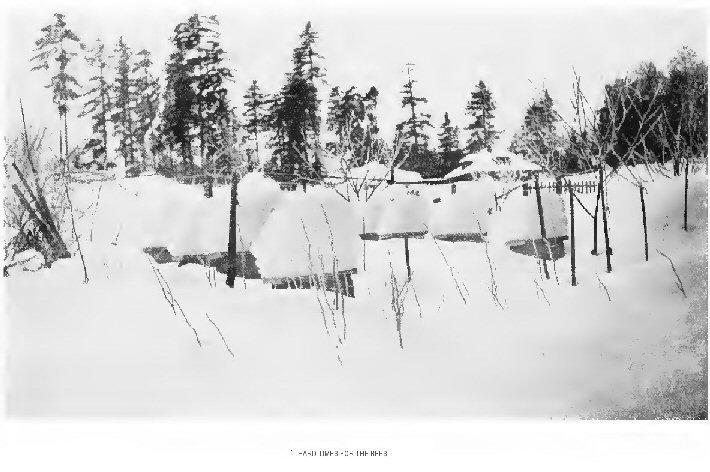
THE light snow covered the path through the bee-farm, and whitened the roof of every hive. In the red winter twilight it looked more like a human city than ever, with its long double rows of miniature houses stretching away into the dusk on either hand, and its broad central thoroughfare, where the larger hives crowded shoulder to shoulder, casting their black shadows over the glimmering snow.
The bee-master led the way towards the extracting-house at the end of the garden, as full of his work, seemingly, as ever he had been in the press of summer days. There was noise enough going on in the long lighted building ahead of us, but I missed the droning song of the great extractor itself.
“No; we have done with honey work for this year,” said the old beeman. “It is all bottled and cased long ago, and most of it gone to London. But there’s work enough still, as you’ll see. The bees get their long rest in the winter; but, on a big honey-farm, the humans must work all the year round.”
As we drew into the zone of light from the windows, many sounds that from afar had seemed incongruous enough on the silent, frostbound evening began to explain themselves. The whole building was full of busy life. A furnace roared under a great caldron of smoking syrup, which the foreman was vigorously stirring. In the far corner an oil engine clanked and spluttered. A circular saw was screaming through a baulk of timber, slicing it up into thin planks as a man would turn over the leaves of a book. Planing machines and hammers and handsaws innumerable added their voices to the general chorus; and out of the shining steel jaws of an implement that looked half printing-press and half clothes-wringer there flowed
sheet after sheet of some glistening golden material, the use of which I could only dimly guess at.
But I had time only for one swift glance at this mysterious monster. The bee-master gripped me by the arm and drew me towards the furnace.
“This is bee-candy,” he explained, “winter food for the hives. We make a lot of it and send it all over the country. But it’s ticklish work. When the syrup comes to the galloping-point it must boil for one minute, no more and no less. If we boil it too little it won’t set, and if too much it goes hard, and the bees can’t take it.”
He took up his station now, watch in hand, close to the man who was stirring, while two or three others looked anxiously on.
“Time!” shouted the bee-master.
The great caldron swung off the stove on its suspending chain. Near the fire stood a water tank, and into this the big vessel of boiling syrup was suddenly doused right up to the brim, the stirrer labouring all the time at the seething grey mass more furiously than ever.
“The quicker we can cool it the better it is,” explained the old beekeeper, through the steam. He was peering into the caldron as he spoke, watching the syrup change from dark clear grey to a dirty white, like half-thawed snow. Now he gave a sudden signal. A strong rod was instantly passed through the handles of the caldron. The vessel was whisked out of its icy bath and borne rapidly away. Following hard upon its heels, we saw the bearers halt near some long, low trestle-tables, where hundreds of little wooden boxes were ranged side by side. Into these the thick, sludgy syrup was poured as rapidly as possible, until all were filled.
“Each box,” said the bee-master, as we watched the candy gradually setting snow-white in its wooden frames, “each box holds about a pound. The box is put into the hive upside-down on the top of the comb-frames, just over the cluster of bees; and the bottom is glazed because then you can see when the candy is exhausted, and the time
has come to put on another case. What is it made of? Well, every maker has his own private formula, and mine is a secret like the rest. But it is sugar, mostly—cane-sugar. Beet-sugar will not do; it is injurious to the bees.
“But candy-making,” he went on, as we moved slowly through the populous building, “is by no means the only winter work on a beefarm. There are the hives to make for next season; all those we shall need for ourselves, and hundreds more we sell in the spring, either empty or stocked with bees. Then here is the foundation mill.”
He turned to the contrivance I had noticed on my entry. The thin amber sheets of material, like crinkled glass, were still flowing out between the rollers. He took a sheet of it as it fell, and held it up to the light. A fine hexagonal pattern covered it completely from edge to edge.
“This,” he said, “we call super-foundation. It is pure refined wax, rolled into sheets as thin as paper, and milled on both sides with the shapes of the cells. All combs now are built by the bees on this artificial foundation; and there is enough wax here, thin as it is, to make the entire honeycomb. The bees add nothing to it, but simply knead it and draw it out into a comb two inches wide; and so all the time needed for wax-making by the bees is saved just when time is most precious—during the short season of the honey-flow.”
He took down a sheet from another pile close at hand.
“All that thin foundation,” he explained, “is for section-honey, and will be eaten. But this you could not eat. This is brood-foundation, made extra strong to bear the great heat of the lower hive. It is put into the brood-nest, and the cells reared on it are the cradles for the young bees. See how dense and brown it is, and how thick; it is six or seven times as heavy as the other. But it is all pure wax, though not so refined, and is made in the same way, serving the same useful, time-saving purpose.”
We moved on towards the store-rooms, out of the clatter of the machinery.
“It was a great day,” he said, reflectively, “a great day for beekeeping when foundation was invented. The bee-man who lets his hives work on the old obsolete natural system nowadays makes a hopeless handicap of things. Yet the saving of time and bee-labour is not the only, and is hardly the most important, outcome of the use of foundation. It has done a great deal more than that, for it has solved the very weighty problem of how to keep the number of drones in a hive within reasonable limits.”
He opened the door of a small side-room. From ceiling to floor the walls were covered with deep racks loaded with frames of empty comb, all ready for next season. Taking down a couple of the frames, he brought them out into the light.
“These will explain to you what I mean,” said he. “This first one is a natural-built comb, made without the milled foundation. The centre and upper part, you see, is covered on both sides with the small cells of the worker-brood. But all the rest of the frame is filled with larger cells, and in these only drones are bred. Bees, if left to themselves, will always rear a great many more drones than are needed; and as the drones gather no stores but only consume them in large quantities, a superabundance of the male-bees in a hive must mean a diminished honey-yield. But the use of foundation has changed all that. Now look at this other frame. By filling all brood-frames with worker-foundation, as has been done here, we compel the bees to make only small cells, in which the rearing of drones is almost impossible; and so we keep the whole brood-space in the hive available for the generation of the working bee alone.”
“But,” I asked him, “are not drones absolutely necessary in a hive? The population cannot increase without the male bees.”
“Good drones are just as important in a bee-garden as high-mettled, prolific queens,” he said; “and drone-breeding on a small scale must form part of the work on every modern bee-farm of any size. But my
own practice is to confine the drones to two or three hives only. These are stationed in different parts of the farm. They are always selected stocks of the finest and most vigorous strain, and in them I encourage drone-breeding in every possible way. But the male bees in all honey-producing hives are limited to a few hundreds at most.”
Coming out into the darkness from the brilliantly-lighted building, we had gone some way on our homeward road through the crowded bee-farm before we marked the change that had come over the sky. Heavy vaporous clouds were slowly driving up from the west and blotting the stars out one by one. All their frosty sparkle was gone, and the night air had no longer the keen tooth of winter in it. The bee-master held up his hand.
“Listen!” he said. “Don’t you hear anything?”
I strained my ears to their utmost pitch. A dog barked forlornly in the distant village. Some night-bird went past overhead with a faint jangling cry. But the slumbering bee-city around us was as silent and still as death.
“When you have lived among bees for forty years,” said the beemaster, plodding on again, “you may get ears as long as mine. Just reckon it out. The wind has changed; that curlew knows the warm weather is coming; but the bees, huddled together in the midst of a double-walled hive, found it out long ago. Now, there are between three and four hundred hives here. At a very modest computation, there must be as many bees crowded together on these few acres of land as there are people in the whole of London and Brighton combined. And they are all awake, and talking, and telling each other that the cold spell is past. That is what I can hear now, and shall hear—down in the house yonder all night long.”
CHAPTER XII THE QUEEN BEE: IN ROMANCE AND REALITY
“QUEENS?” said the Bee-Master of Warrilow, as he filled his pipe with the blackest and strongest tobacco I had ever set eyes on; “queens? There are hundreds of hives here, as you can see; and there isn’t a queen in any one of them.”
He drew at the pipe until he had coaxed it into full blast, and the smoke went drifting idly away through the still April sunshine. We were in the very midst of the bee-garden, sitting side by side on the honey-barrow after a long morning’s work among the hives; and the old bee-man had lapsed into his usual contemplative mood.
“’Tis a pretty idea,” he went on, “this of royalty, and a realm of dutiful subjects, and all the rest of it, in bee-life. But experience in apiculture, as with most things of this world, does away with a good many fine and fanciful notions. Now, the mother-bee in a hive, whatever else you might call her, is certainly not a queen, in the sense of ruling over the other bees in the colony. The truth is she has little or nothing to do with the direction of affairs. All the thinking and contriving is done by the worker-bees. They have the whole management of the hive, and simply look upon the queen as a much prized and carefully-guarded piece of egg-laying machinery, to be made the most of as long as her usefulness lasts, but to be thrown over and replaced by another the moment her powers begin to flag.”
“No; there are no queens, properly so called, in bee-life,” he continued. “All that belongs to the good old times when there were nothing but straw-skeps, and ’twas well-nigh impossible to get at the rights of anything; so the bee-keeper went on believing that honey was made out of starshine, and young bees were bred from the juice of white honeysuckle, which was all pretty enough in its way, even though it warn’t true. But nowadays, when they make hives with comb-frames that can be lifted out and looked at in the broad light of day, folk are beginning to understand a power of things about bees that were dark mysteries only a while ago.”
He puffed at his pipe for a little in silence. Far away over the great province of hives, the clock on the extracting-house pointed to halfpast twelve; and, true to their usual time, the home-staying bees— the housekeepers and nurses and lately hatched young ones—were out for their midday exercise. The foragers were going to and fro as thickly as ever with their loads of pollen and water for the still cradled larvæ within; but now round every hive a little cloud of bees hovered, filling the sunshine with the drowsy music of their wings. The old bee-man took up his theme again presently at the point he had broken it off.
“If,” said he, “you keep a fairly close watch on the progress of any one particular hive, from the time the first eggs appear in the combs early in January, ’tis very easy to see how the old false ideas got into general use. At first glance a bee-colony looks very much like a kingdom; and the single large bee, that all the others pay court to and attend so carefully, seems very like a queen. Then, when you look a little deeper and begin to understand more, appearances are still all in favour of the old view of things. The mother-bee seems, on the face of it, a miracle of intelligence and foresight. While, as far as you know, all other creatures in the world bring forth their young of both sexes haphazard, this one can lay male or female eggs apparently at will. You watch her going from comb to comb, and the eggs she drops in the small cells hatch out females, and those she puts in the larger ones are always males, or drones. More than that: she seems always to know the exact condition of the hive, and to be
able to limit her egg-laying according to its need, or otherwise, of population; for either you see her filling only a few cells each day in a little patch of comb that can be covered with the palm of your hand, or she goes to work on a gigantic scale, and, in twenty-four hours, produces eggs that weigh more than twice as much as her whole body.”
He got up now and began pacing to and fro, as was his custom when much in earnest over his bee-talk.
“Then,” he went on, “to cap all, as the honey season draws on to its height, you are forced presently to realise that the queen has conceived and is carrying through a scheme for the good of her subjects that would do credit to the wisest ruler ever born in human purple. Every day of summer sunshine has brought thousands of young bees to life. The hive is getting overcrowded. Sooner or later one of two things must happen—either the increase of population must be checked, or a great party must be formed to leave the old home and go out to establish another one. Then it is that the mother-bee seems to prove beyond a doubt her wisdom and queenliness. She decides for the emigration; but as a leader must be found for the party, and none is at hand, she forms the resolve to head it herself. From that moment a change comes over the whole hive. Preparation for the coming event goes on fast and furiously, and excitement increases day by day. But the queen seems to forget nothing. A new ruler for the old realm must be provided to take her place when she is gone for ever; and now you see a party of bees set to work on something that fairly beggars curiosity. At first it looks exactly like an acorn-cup in wax hanging from the under-edge of the comb. Perhaps the next time you look the cup has grown to twice its original size; and now you see it is half full of a glistening white jelly. The next time, maybe, you open the hive, the acorn has been added to the cup; the queen-cell is sealed over and finished, and about a week later there comes out a full-grown queen bee, twice the size of the ordinary worker and quite different in shape and often in colour too. But days before the new ruler is ready the excitement in the hive has grown to fever-pitch. If you come out then in the quiet of