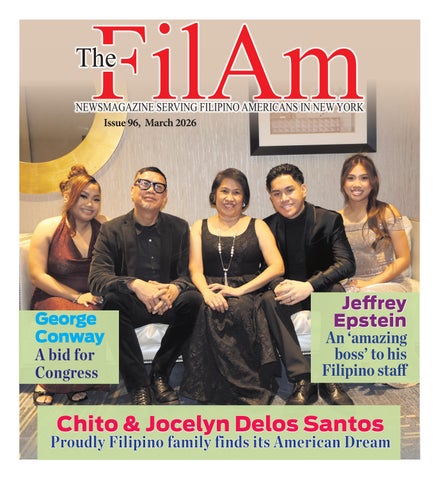
The generosity of Jeffrey Epstein
Filipinos who worked for Jeffrey Epstein spoke appreciatively of the late convicted pedophile in emails contained in the so-called Epstein Files, with one referring to him as an “amazing boss.”
A review of emails currently accessible on the U.S. Department of Justice website shows several Filipino names on Epstein’s payroll: the couple Rosalyn and Jojo Fontanilla, Merwin Dela Cruz, Leo, Tess, Renato Lacson, and Karen. An unnamed Filipino couple was being considered for hiring and was scheduled for an employment interview at the time.
The emails depict a workplace in which Filipino employees sought assistance for family emergencies and travel home, and in multiple instances, Epstein approved paid leave or covered the airfare.
Many of the emails reviewed by The FilAm were dated after 2008, the year Epstein pleaded guilty to “soliciting prostitution,” and was subsequently convicted. Despite being required to register as a sex offender, he continued to move in elite social circles. His plea deal drew widespread criticism as being overly lenient.
In a June 17, 2017 email, Lesley Groff, identified in media reports as Epstein’s longtime assistant, wrote: “Tess and Merwin. Jeffrey says he will pay for Tess and Karen’s tickets home!! So happy he is such a wonderful boss… please do as before—book the tickets and get reimbursed…” Groff was responding to an email where one
Founding Editor
Cristina DC Pastor
Managing Editor Rene Pastor
Address
P.O. Box 8071
New York, NY 10116

Jeffrey Epstein with longtime companion Ghislaine Maxwell
of the employees needed to return to the Philippines due to her mother’s stroke. The email’s subject line reads: “Re: Jeffrey will pay for tickets home to the Philippines.”
The employee replied: “Thank you so much. We really appreciate the help. Mr. Epstein is an amazing boss. Thanks again.”
A September 11, 2013 email described the Fontanilla couple’s roles in the Epstein household: “Lyn and Jojo Fontanilla—House Woman and Man. Jojo is Jeffrey’s driver. They have been with Jeffrey for a very long time. They live in his home when he is in NY. Lyn does light cooking (breakfast). Since
we have no chef at the moment, we order out for any lunch or dinners. Jojo serves. Lyn makes JE’s special bran/flax seed muffins which JE eats every day—he usually travels with these muffins as well. Lyn and Jojo are going home to the Philippines Sept. 30 to Nov. 3. Back to work Nov. 4…”
In a February 23, 2019 email to Renato Lacson, the sender whose name was redacted wrote: “Good morning Renato! Jeffrey has said YES to your vacation days (May 13 to June 10) as well as paying for the trip. Very happy for you.” Lacson had requested emergency leave to visit his ailing father.
In a September 7, 2012 email, Jojo Fontanilla asked if he could “possibly borrow $3,000” for a trip to the Philippines. A one word reply from Epstein: “gift”
Epstein’s alleged accountant, Richard Kahn, informed Lyn Fontanilla: “Jeffrey has kindly said he will purchase your two tickets to the Philippines as a gift.”
It is unclear whether the Filipino employees understood the dark and complex network Epstein had cultivated over decades. Given their close proximity to him and the years they spent living and working in his Manhattan residence, it seems difficult to imagine they were entirely unaware of what was happening around them. One worked as his personal chauffeur, and his wife served as the housekeeper. Were they ever questioned in connection with his crimes against girls and women? And if so, did they tell the full truth or in the case of Lyn Fontanilla, who reportedly passed in 2016, did she take it to her grave?
Contributing Writers
Marissa Bañez
Tricia J. Capistrano
Joel David
Wendell Gaa
The FilAm is a publication of A&V Editorial
Allen Gaborro
Maricar CP Hampton
Ludy AstraquilloOngkeko
Lindy Rosales
Steven Raga announces he is running for New York State Senate
Assemblymember Steven Raga officially announced on February 21 that he is running for New York State Senate District 12. He released the following statement:
“After talking with neighbors across Western Queens and listening closely to what our communities need right now, I’m officially announcing my candidacy for New York State Senate District 12. I’m running to deliver on day one with leadership shaped by this community and accountable to working families in Woodside, Astoria, Sunnyside, Elmhurst, Long Island City, Maspeth, Ridgewood, Glendale, and Jackson Heights.
“I’m grateful to Senator Gianaris for decades of principled leadership for tenants, working families, and progressive change. As he begins his next chapter, we have a responsibility to carry that work forward with urgency and care.
“This race is personal. I was raised in Queens by a Filipina immigrant single mother who was also a proud Teamsters union member. We lived in basement apartments, faced eviction notices, and carried the constant instability of living paycheck to paycheck. I know what it means when your future depends on whether your family can stay in the neighborhood you call home.
“For over two decades, I’ve organized in this community through local organizations and coalitions, and as a member of Community Board 2, long before I ever ran for office. In the Assembly, I’ve proven we can win real results by building strong coalitions, passing impactful policies, delivering resources back home, and showing up every day for constituent services. And as a proud PSC-CUNY union member, I know what it means to fight for educators, students, and a people’s university that working-class New Yorkers can truly count on.


‘This race is personal.’ Raga flanked by Queensborough President Donovan Richards and Assemblywoman Catalina Cruz. Also in attendance was city Council Member Julie Won
“Affordability ties everything together: housing, healthcare, childcare, and economic stability. We will protect and expand rent stabilization, fully fund HAVP, advance social housing through SHDA, pass the New Deal for CUNY, defend immigrants with NY4All and Access to Representation, expand care through the NY Health Act and universal childcare, and pay for it by fighting for Invest in Our NY so that the
ultra-wealthy and corporations finally pay their fair share.
“Western Queens is home, from Little Manila in Woodside to Astoria and Sunnyside, and from rent-stabilized apartments and NYCHA to the street vendors and small businesses that
keep our streets alive. I’m proud of what we’ve delivered together as your Assemblymember, and I’m ready to keep delivering and fight even harder as your next State Senator.”
Meanwhile, Nepali American Somnath Ghimire who is supposed to challenge Raga for the Assembly primary issued this statement: “It was widely known that Steven Raga and I were preparing for the same Assembly race. At the end of the day, we both care deeply about Queens and working families. I respect his continued commitment to public service and wish him the very best as he runs for State Senate. I look forward to working alongside him in Albany and proudly calling him my Senator.”
‘How Can You Forget Me:’ A moving tribute to the ‘manongs’ at the Smithsonian
WASHINGTON, D.C. -- The newly opened exhibition by the Smithsonian Asian Pacific American Center (APAC) and on view at the Smithsonian’s National Museum of American History entitled “How Can You Forget Me: Filipino American Stories”, is a must-see for Filipinos in the Diaspora, especially Filipinos in the United States. Opened in December 2025, we have up to November 28, 2027 to pay our respects to our predecessors.
A group of us, hosted by Rick H. Lee, APAC’s director of External Relations and Strategic Partnerships, visited the exhibition and had a glimpse of the life of Filipino migrants who came to California in the early 1900s.
The background of the exhibition is this. In 2005, when Antonio Somera was looking for space to open a martial arts studio in the basement of the Legionarios del Trabajo building, known as the Daguhoy Lodge, he discovered 26 large steamer trunks owned by Filipinos who found jobs as farm workers in the 1910s and 1920s.
The exhibition features three of those trunks and presents a time capsule of the “manongs”, the term used for the mostly men from the Ilocos Region of the Philippines, initially recruited by American companies to work in their huge farm lands.
Why from the Ilocos Region?
Because the Philippines was annexed as a colony by the United States from Spain by the Treaty of Paris ending the Spanish American War after the famed Spanish Armada was defeated by Admiral George Dewey in Manila Bay in 1898. The American recruiters discovered that the Ilocos Region was hot and arid, just like the farms in California and Hawai’i.
As described in the Smithsonian’s exhibitions page, the recovered trunks and their objects offer “a window into what was once the largest population of Filipinos living outside of the Philippines. These mostly male migrants settled and established a vibrant community in south Stockton, Cali-


The pillowcase that inspired an exhibit
fornia, which became a crucial hub for Filipinos arriving in the United States. There, in what came to be known as ‘Little Manila,’ they thrived—forming families, labor unions, and mutual aid societies.”
“Featuring over 50 artifacts from the trunks, along with objects loaned from the Filipino American community in Stockton, this exhibition helps us remember the people whose labor contributed to the growth of California’s agricultural industry and paved the way for future generations of Filipino immigrants.”
This time at the National Museum of American History, a slice of life of Filipinos working in the fields to harvest asparagus, strawberries, pineapples, grapes etc. are in full display zeroing
on the contents of these well-preserved trunks.
The photos of three young Filipinos— Enrique Andales, Eusebio Maglinte, and Anastacio Omandam—show them in suits and regalia, looking like the Hollywood actors in the early 1920s and ‘30s.
The photo of a Filipino woman dressed in a white sequenced gown shows that in that part of California, the Filipino custom of beauty contests or town fiesta with beauty queens was very much alive.
The contributions of labor leader Larry Itliong are also highlighted in the exhibition, showing that he led the Delano Grape Strike of the 1960s and formed a coalition with Mexican labor leader César Chávez. Their joint efforts brought about better

wages and working conditions for farm workers.
Although the exhibition presents the successful image of the three “manongs”, most trunk owners probably remained single most of their lives due to the low numbers of early Filipina migrants and the anti-miscegenation laws restricting interracial marriages.
I am reminded of Carlos Bulosan’s classic semi-autobiographical “America Is in the Heart”. He depicted stories of the “manongs” who toiled in brutal conditions and faced bigotry, discrimination and prejudice in the farms of California and Hawai’i, as well as in the fisheries of Alaska.
In fact, one of his short stories became an award- winning drama staged by Ma-Yi Theater. Set in California’s Central Valley in the 1930s, “The Romance of Magno Rubio” follows its titular character, Magno Rubio, a four-foot-six-inch-tall, illiterate Filipino migrant worker who falls in love with a white woman from Arkansas named Clarabelle through a “lonely hearts” magazine. While his fellow workers recognize that Clarabelle is scamming Magno for money and gifts, they do not have the heart to tell him, allowing him to hold onto his “American Dream”.
The exhibition title “How Can You Forget Me” comes from a beautifully hand embroidered pillowcase found in Omandam’s steamer trunk. Although the origin of the pillowcase is unclear, a visitor may imagine that Omandam’s sweetheart sent it to him, waiting for her boyfriend Omandam to come back and claim her as his bride.
These are some of the highlights and heartbreaks of the exhibition, “How Can You Forget Me: Filipino American Stories,” in Washington D.C. now on display.
Mamdani: A leader who is not afraid to step up and say, ‘Heck no’
By Arienne Pastor
In January, Zohran Mamdani was sworn in as New York City’s 112th mayor.
Mamdani won the election by nearly 10 percent (over 200,000 votes) after running a campaign based around lowering costs and ensuring that New Yorkers are able to live in a more affordable city. These internationalist and self-professed socialist ideals have a long history— one that begins with his childhood in Kampala, Uganda and continued to his education at Bowdoin College in Brunswick, Maine.
Mamdani was an active member of Bowdoin’s campus. He worked on the school newspaper, The Orient, later contributed op-eds to the paper, founded the school’s Students for Justice in Palestine chapter, and was an academic force on campus.
At Bowdoin, students in their senior year are able to work on an honors, a year-long thesis in a certain subject, with a committee of professors working as advisors, editors, and confidants. Mamdani’s senior honors project surrounded French philosopher Frantz Fanon and the applications of his decolonial theory in African history. Olufemi Vaughan, professor of Black Studies at Amherst College and a former Professor of Africana Studies & History at Bowdoin College, was a part of Mamdani’s honors committee.
“The specifics of the thesis itself, I cannot clearly remember, aside from the fact that I thought it was very well done, really insightful,” Vaughan said when interviewed by The FilAm. “That much I remember, and quite frankly, I think [it was] really innovative, but very much in line with the ways in which he does his work anyway—quite original work.”

'A
Vaughan recalled that Mamdani, from his beginning at Bowdoin as a student of Africana Studies, seemed to already know much of his path.
“In much of what he did… there’s always this very clear sense of direction and purpose. Very much like, ‘This is what I want to do.’ And he would also go in and say, ‘This is how I think I want to do it, and how can you help me achieve my objectives?’ Which is, as I said, a bit unique. That element of clarity is very consistent [in his work],” Vaughan said.
Mamdani’s academic work was notable to both classmates and professors.
Abdullah Hashimi, who wrote a profile of Mamdani’s time at Bowdoin, found that many of Mamdani’s more activist leanings entangled themselves with the academics he took.
“Based on my conversations with his classmates and professors he went to school with, I'd say [he had a] profound impact on them. They talked about him not only as just a friend and a scholar, but just as a person.… There's a reason like the title is ‘activist and academic,’ right? Because he was both of these things while he was at the school,” Hashimi said. Vaughan also found that Mam-
dani’s activism was very present and consistent with his academic work. Mamdani’s strong ideals and sense of selfhood surrounding those ideals, Vaughan noted, were shown in his schoolwork, and later, his political work.
“What was unique, though, about Zohran, which struck me then, is that he had this kind of cosmopolitan, internationalist, expansive worldview that most students and scholars of Africana or Black Studies tend not to have,” Vaughan said.
Zahir Janmohamed, an assistant professor of English at Bowdoin College, interviewed Mamdani for Bon Appétit last March. Janmohamed noted that Mamdani’s cosmopolitan worldview and sincere, strongly held convictions both very much align with his political campaign.
“I find that many students and faculty are enthusiastic about Mamdani because 1) his win was a long shot and yet he still pulled it off; 2) he is addressing the issue of affordability which affects all of us; 3) he is a political and yet somehow, he comes across as genuine and sincere,” Janmohamed wrote in an email to The FilAm.
Hashimi, too, noted that the strong, clear convictions Mamdani holds has garnered him support throughout Bowdoin students, alumni, and faculty.
“(His activist work) was apparent to his professors and apparent to his friends,” Hashimi said. “And now, it’s apparent to all the alumni students and faculty who see that a person who’s from this school gets (to be) the mayor of New York City. I personally saw an immense amount of pride and support coming from people when I was writing.”
Arienne Pastor is an undergraduate at Bowdoin College double majoring in Government & Legal Studies and English. She is an associate editor of the school newspaper, The Bowdoin Orient, and a senior editor of Bowdoin’s literary magazine, The Quill.

Legal Observer Joseph Bolandrina: The ‘eyes and ears’ during protest actions
By Cristina DC Pastor
If Joseph Bolandrina were in Minnesota during the anti-ICE protests that led to the deaths of Renee Good and Alex Pretti, this Legal Observer would have a lot to write about.
But Bolandrina, 62, lives in the northeast -- Athol, Massachusetts to be exact -- where he monitors the actions of law enforcement, including police officers, Immigration and Customs Enforcement (ICE) agents, and sometimes even private security guards. He serves as a Legal Observer for the National Lawyers Guild (NLG), a non-profit organization working in defense of the “rights of protesters…providing legal support for movements for social justice.”
“I monitor law enforcement behavior to ensure the constitutional rights of all participants are protected,” said Bolandrina when reached by The FilAm.
In short, he is the “eyes and ears” during protest rallies, demonstrations or any kind of mass actions. He is supposed to be impartial, detached, and unaffiliated with any police or military organization. In any activity, he is expected to stay on the sideline and should not be taking photos.
He can take notes, like a journalist does: Time when violence erupted, crowd behavior, police badges, vehicle number, and the like.
“We track police activity to deter any wrongdoing. We document what we see on the ground,” he said. In the case of Minnesota, Bolandrina does not believe there was a Legal Observer on the ground because “nobody could have anticipated what was going to happen,” he said.
In one of his assignments, he was sent to the Burlington ICE facility just to “observe and report.” Not to do anything that would put him in harm’s way. A client of NLG alerted them to a planned gathering that had the potential to “turn south,” he said. Joe showed up and filed his report that could be used to document the activity. The event was peaceful and did not end up in court.
In another assignment, he was asked to go to Boston University where a speaker was invited to talk about a “controversial topic.” Joe was unable to attend because of a conflict in schedule.
“Our reports are used in court filings. We document the chronology of events, time of incident, statements from witnesses, type of arrests, charges…We’re there for transparency,” he said. “The client of NLG wants to make sure there is no impropriety, no police brutality, especially now in the current climate.”

Joe is a retired U.S. Army sergeant. He recently completed specialized training to become a Legal Observer. He is often seen at political rallies sporting a neon green hat.
A pillar of the FilAm community in Boston, he is proud of his years of volunteer work for Iskwelahang Pilipino, the longest-running Filipino cultural school in the United States which connects young FilAms with their roots through music, dance, and community outreach.

He had been recognized through the Officer Richard J. McLaughlin Community Service Award (2021), the American Red Cross Heroes Award, Worcester Telegram & Gazette (2006), and Wentworth Institute of Technology’s the Isaiah Thomas Award for his “outstanding contribution and volunteer services” (2004). He views his new role as a continuation of his oath to the Constitution.
“It’s a duty that I am proud to volunteer for and use my military training in the spirit of teamwork and discipline,” he said. In a time of heightened political tension, Joseph’s takes his presence as a Filipino American veteran on the front lines seriously.
His father, the late Ambrosio Bolandrina was from Taganaan, Surigao del Norte while his mother, the late Teotima Barcinas Bolandrina was from Maribojoc, Bohol. He wants the community to be mindful that whether on a bicycle for a cure, in a cultural school for heritage, or on a protest line for justice, the mission to serve is constant.
“I stand up for what is right,” he told The FilAm. “Especially now that I have a grandson who is 13 months old I stand up whatever way I can. I can’t be a spectator, I have to be a participant.”
As immigration enforcement escalates, popular resistance is growing
By Selen Ozturk
While immigration enforcement campaigns intensify nationwide, resistance is growing on both legal and grassroots levels.
This escalation reached flashpoints with the fatal shooting of American citizens Renée Good on January 7, and of Alex Pretti on January 24. Both were shot by federal immigration agents during protests in Minneapolis. In both cases, the Trump administration defended the killing as self-defense by the agent. Officials also denied state investigators access to the shooting scene.
“The killing of Renée Nicole Good illustrated what we have been saying all along: The attacks on immigrants are the tip of the spear on attacks on all Americans. This mass deportation agenda, as much as this administration had said it will only target ‘criminals’ — we are now seeing in real time that they are affecting everyone, noncitizen and citizen alike,” said Vanessa Cárdenas, executive director of America´s Voice, at an American Community Media briefing held one day before Pretti’s shooting amid widespread protests.
| Metro surge
The ongoing protests are in response to Operation Metro Surge. The Department of Homeland Security (DHS) has called it “the largest immigration enforcement operation ever carried out,” involving the arrest of over 3,000 people.
The operation also involved the largest deployment of federal immigration agents in history. Some 3,000 Immigration and Customs Enforcement (ICE) and Customs and Border Protection (CBP) agents are now operating in Minneapolis. That number is five times the size of the Minneapolis Police Department, which has about 600 officers.
“Americans are seeing in real time what an [immigration] enforcement-only agenda looks like, and they’re recoiling from it,” said Cárdenas. “But even though most Americans reject what ICE is doing, that does not mean they support Democrat solutions for reforms


… That’s why we have to navigate this moment carefully in terms of bringing people into our coalition.”
Immigration enforcement, and subsequent clashes between protesters and federal agents, is fracturing even Republican support for the administration’s actions.
A YouGov poll conducted a day after Pretti’s shooting found that “More Americans support than oppose abolishing ICE (46% vs. 41%).” A majority (57%) also “somewhat or strongly disapprove of the way ICE is handling its job. Only 37% approve.”
Meanwhile, a new POLITICO poll shows that one in five voters who backed
Trump in 2024 say the mass deportation campaign is too aggressive. Moreover, 41% of Trump voters say that while they support the administration’s immigration enforcement goals, they disapprove of how the president is implementing it.
| Staying home
On the ground, “I’m seeing tens of thousands of my neighbors organized in local teams, providing rides and food support and rental assistance to families who are afraid to leave their homes and staying home, doing ICE watch and patrolling schools to make sure that our kids can come and go from school safely, and these kinds of initiatives are
happening all across the state,” said Amanda Otero, co-executive director of Take Action Minnesota and a parent of two kids in Minnesota public schools.
“We are seeing catalyzing events every single day,” she explained. “The day before Renee was killed, at my child’s preschool, as parents were arriving, getting their little kids in their little snow suits up to the door and handing them over to the staff, teachers and parents looked up and, not a block away, watched federal agents tear-gassing folks and arresting legal observers. Parents and teachers made eye contact and said, ‘Okay, kids, let’s go,’ and shoveled those kids in a little more quickly.”
Otero is part of a growing network of over 1,000 parents that have built sanctuary school teams in 40 public schools across Minneapolis. The teams are now training parents in other school districts statewide to peacefully ensure kids can safely enter and leave school. They are also offering food, rent aid and transportation to critical appointments for affected families.
“In Minneapolis and in Minnesota, I have never seen this many people get off the sidelines and take action, doing organizing to keep us safe,” she said. “The scale of what I’m seeing makes it very clear that whether you were supportive of ICE before or not, this moment is pushing so many more people to take a new step.”
“One of the most encouraging things about the current situation is precisely the degree of popular opposition,” said Mark Tushnet, professor emeritus at Harvard Law School.
“Elected politicians say, ‘We ran on these programs,’ that ‘People are behind us’ … One way of showing it’s wrong is through popular demonstrations and resistance in the street.”
“It’s not the law in the abstract that solves these problems. It’s people standing behind their particular vision of what the law should be,” Tushnet added.
“From the point of view of a constitutional lawyer: Don’t count on the courts, but go to the streets and the courts will follow.” -- American Community Media
George Conway, whose mother is a Filipino immigrant, is running in N.Y.’s 12th District
By Cristina DC Pastor
George Conway, the son of a Filipino immigrant who worked as an organic chemist, and an American defense contractor, has announced his candidacy for New York’s 12th Congressional District. He is looking to succeed Representative Jerry Nadler, who is retiring.
“I’m running for Congress in NY-12, my home,” Conway said in a Facebook post. “We have a demented, criminal president running the country like a mob operation—government by the boss, for the boss. We need Democratic fighters who will defend the rule of law and deliver government by the people.”
Once a Republican, Conway is now running as a Democrat in a district widely regarded as strongly Democratic.
While many in New York’s Filipino American community know only sketchy details about Conway’s background, they are familiar with his outspoken criticism of the President.
A prominent lawyer, Conway was previously married to Kellyanne Conway, who served as campaign manager for Donald Trump’s 2016 presidential campaign and later as a senior counselor in the White House.
Over the years, Conway has become one of Trump’s most vocal conservative critics. He left the Republican Party and co-founded the Lincoln Project, a group formed by anti-Trump Republicans aiming to defeat Trump at the polls. He has also donated to Democratic causes, including the Biden Victory Fund.
Conway has continued to denounce the administration, citing what he describes as “skyrocketing grocery prices, millions losing health care coverage, breaking international law, masked agents snatching people from the streets, the Department of Justice prosecuting political opponents, pardons handed out to the rich, the connected, and the loyal, and more.”
Though now firmly aligned with the Democratic Party, Conway remains known for his conservative

legal philosophy, particularly on constitutional issues. Earlier in Trump’s presidency, he had been considered for high-level positions in the Justice Department, including Solicitor General, but ultimately declined. The reasons behind his eventual break with Trump have never been fully detailed publicly.
Politics is never a straight line. Conway is expected to face a primary challenge from Jack Schlossberg, a social media commentator who is also the grandson of former President John F. Kennedy. Schlossberg may lack Conway’s legal and political experience, but his youth, likeability factor and being a Kennedy could make him a strong contender.
While Conway’s political positions are well documented, Schlossberg’s policy views remain less defined and are likely to take clearer shape as the campaign progresses. So far, his commentary has focused heavily on personalities, including Vice President JD Vance and his cousin, Health Secretary Robert F. Kennedy Jr.
One FilAm voter in District 12 summed up his choice this way: “What I know is Conway is a brilliant FilAm lawyer who was married to Kellyanne Conway, who served in Trump’s first administration. He was for Trump and


From Batangas to New York
How the Delos Santos family achieved the American Dream by holding tight to its Filipino identity
By Elton Lugay
When the Delos Santos family left the Philippines for New York in 2002, they traded familiar streets and neighbors who spoke their language for a city that moved faster than anything they had known.
“Moving from Talisay, Batangas to New York was one of the biggest transitions of our lives,” said painter Cesar ‘Chito’ Delos Santos, the head of the family. “In Talisay, everything felt familiar and comfortable for us. New York was a huge culture shock because life here is very fast paced, a little overwhelming at times, and we knew we needed to be more independent.”
The Delos Santoses – husband Chito, wife Jocelyn, and their three children, Theia, Cestine and Neeko – have since built a life in Queens that balances their American present with a steadfast commitment to Filipino values.
“In New York, we became more conscious about holding on to our culture,” Jocelyn, an early childhood education teacher, said. “Back home, you don’t have to think about being Filipino, you’re born into it. But here, we make a point to speak Tagalog at home, cook Filipino food, celebrate fiestas and traditions, and stay connected to our community.”
Inside their home, Tagalog mingles with English, and stories of Batangas sit comfortably alongside their children’s New York experiences. Jocelyn said it was important that their children understood “where they came from, especially culturally, understanding the values of respect, hard work, faith, and close family ties.” Those values, she added, have guided them through the uncertainty of migration and the demands of a city is slowly becoming home.
“I’m happy to say that my children grew up confident navigating their everyday American lives but grounded in Filipino values,” she said. “Being Filipino isn’t entirely about where you live… it’s about how you carry your identity in your heart and how we pass it to the next generation.”
The family is a familiar presence at church gatherings, cultural events and community celebrations around the New York area.
As an artist, Chito has carried Batangas with him onto every canvas. He has held more than 100 exhibitions in the Philippines and the United States, each one, he said, a meditation on connection.
“In every painting, I try to capture the emotion


firstly,” he said. “Whether it’s quiet landscape paintings or scenes of everyday Filipino life, I would like my audience to feel something personal when they look at my work.”
He continued: “I often paint scenes inspired by life in the Philippines such as rural landscapes, and glimpses of Filipino daily life.” Those images, coupled with what he calls the Filipino traits of “tiyaga” (patience) and “sipag” (diligence) anchor his art.
“As a Filipino artist living abroad, a big part of my message is about identity and resilience,” he said. His art is also about gratitude for the years of employment, for the community that supports him, and for the family that has stood by him through the transitions.
While Chito’s paintings tell stories of home, Jocelyn carries her heritage into the classroom. A preschool teacher who is also pursuing a master’s degree in Early Childhood Education, she is due to graduate in April in Chicago.
“I’ve always believed that learning doesn’t stop, no matter how long you’ve been teaching,” she said.

The decision has shaped both her teaching philosophy and her parenting.
“As a teacher and a mother, I believe we grow alongside our students and children,” she said. “We can learn a lot from them the same way they learn from us.” She tries to create a classroom that is “nurturing, engaging, and joyful,” hoping her students will “love learning as much as I do.” Education, she said, has always been central to their family life. “Education has always been very important in our family, not just in school but in everyday life,” she said. “My children know that it is acceptable to make mistakes as long as we learn from them. As parents we encourage them to follow their passions, never give up, and to celebrate all their wins regardless if it’s big or small.”
Those lessons show up clearly in their children’s lives.
Eldest daughter Theia found her own path in college through FIND, Inc. or the Filipino Intercollegiate Networking Dialogue, an organization that connects Filipino and Filipino American students across the East Coast through leadership and cultural programs. As a former student leader, she said the role allowed her to serve and represent her community.
“Making my family proud has always meant a lot to me,” she said. “As a former District III chairperson of FIND, Inc., I got to connect with fellow Filipino students, organize events, and support our community. It felt amazing knowing that what I was doing reflected the values my family taught me and that I was making a difference in students’ lives.” The experience, she added, made her “more confident in my Filipino skin” and strengthened her desire to honor where she comes from.
Cestine, the middle child, described growing up in a household of “driven, accomplished people.”
“Growing up as the middle child in a talented and accomplished family taught me how to be independent, adaptable, and motivated,” she said. “I learned early on how to find my own voice and work hard for what I want, rather than relying on comparisons.”
At times, she admitted, it was a challenge “not always being in the spotlight,” but it pushed her to become “resilient and self-aware.”
“I am most passionate about becoming the best version of myself, building a meaningful future, and making my family proud,” she said. “I care deeply about personal growth, helping others, and creating a life where I can be both successful and fulfilled.”
Youngest Neeko, a singer and theater arts student, juggles rehearsals, performances and academics.
“Having to handle both my creative pursuits as well as school requires lots of discipline and time management,” he said. He maps out his schedule and sticks to it as much as possible, but he also leaves room for being with friends.
“Even though I have responsibilities, I still make sure to have fun no matter where I am or who I’m with. I’m also really grateful that my family supports me. They motivate me to give my best in both my studies and my passions.”
Beyond their individual achievements, the family remains deeply involved in the Filipino community in New York. Jocelyn choreographs traditional dances for Filipino events in Queens, including religious celebrations and the annual Filipino parade.
Chito, a former president of the Talisay Association USA (TAUSA), uses art to help plan gatherings and

create props and projects that bring ‘kababayan’ from their hometown together. Those efforts, the family said, are more than just extracurricular activities; they are acts of preservation.
Asked what they would tell other Filipino families pursuing their dreams abroad, they offered advice based on their own journey.
“I would say, never forget your roots, no matter where life takes you,” Jocelyn said. “Make time for family, speak your language at home, and connect with your local Filipino community. All these things help you feel grounded and supported.”
At the same time, she added, migration also means opening oneself to new experiences. “Embrace the opportunities around you and be open to learning from your new environment,” she said. “Holding onto your culture doesn’t mean standing still, it means carrying it with pride while growing and thriving wherever you are.”
For the Delos Santos family, the American Dream is not a departure from who they are, but an extension of it: a family that crossed an ocean, held tightly to its identity and chose to share it with the city they now call home.
Calendar of Events
| Ongoing until September 30, 2027
iRehistro Overseas Voter Registration
Visit website for details: https:// irehistro.comelec.gov.ph/ovf1.
| Ongoing until May 29, 2026
Nominations for the 2026 Presidential Awards
For Filipino Individuals and Organizations Overseas
Download: https:// presidentialawards.cfo.gov.ph/ forms-and-guide/
| Ongoing until March 15
Call for nominations: Presidential Filipinnovation Awards
Award honors individuals, startups, and enterprises with innovations at early-stage commercialization and with strong potential for national impact.


For details visit the official portal at https://bit.ly/4aJsLdV
| February 22 through April 26
(no class March 29 and April 5)
Winter/Spring 2026 Sayawan
Na! Middlesex County
Philippine Cultural Dance Program (a program of The Filipino School of New York & New Jersey)
The Studio Ligaya 16 Jersey Avenue
Metuchen, N.J.
To enroll, contact info@filschool-nynj.org or 774-257-4669
| April 18
PIDCI’s 2026 Mrs. Kalayaan
Astoria World Manor 25-22 Astoria Blvd.
Queens NYC
| April 19 to May 1
Sacred Pilgrimage in Central Europe: Hungary, Poland, Czech Republic and Austria (with Fr JM Manolo Punzalan) Contact Nuovo Tours
to reserve your space nuovotours@gmail.com
| April 19
Formal launch of SAUP Foundation (with Sounds of Manila)
The Grayclift 122 Moonachie Avenue Moonachie, NJ

| April 22
Asian American Federation 2026 Impact Awards
Tribeca 360 10 Desbrosses Street, NYC
| May 24
2026 Santacruzan sa Katedral (by FILCA)
St. Patrick’s Cathedral 5th Avenue, NYC

| June 21
Search for the next Ginang Filipinas Tri-State queens
For information, call or text:
Pia Pascual 551-347-8418
Cecille Maravillas 201-920-1947
Ella Icamina 516-201-8973
Margerie Valencia 201-776-9009
Leah Amadiz 917-930-6129
| July 12 to 21
Very Important Pinoy Tour: Manila, Dumaguete, Cebu Visit: www.VIPtourphilippines.com


| July 22 to 25
FANHS National Conference
Crystal Gateway Marriott 1700 Richmond Hwy Arlington, VA
| August 9
22nd People’s Ball
Newark Liberty International Airport Marriott
1 Hotel Rd, Newark, NJ
| August 14 & 15
NaFFAA National Empowerment Conference 2026
Theme: ‘Harnessing the Power of Community: Starting With Us’
Hyatt Regency Aurora-Denver Conference Center
13200 East 14th Place Aurora, CO
| August 15 to 16
29th Fiesta in America EXPO American Dream
1 American Dream Way East Rutherford, NJ
| September 7 to 18
Central Europe Pilgrimage of Faith
With Fr. Leandro Dela Cruz of the Church of St. Ann, Lawrenceville, N.J.
Contact info@ nativitypilgrimage.com
| 2027
| July 7 to 24
Inter-island cruise in Hawaii


A Filipino community center can be both a blessing and a burden
By Ricky Rillera
For decades, Filipino Americans in the New York–New Jersey region have dreamed of a permanent home — a place where our stories can be told, our elders can gather, our youth can lead, and our culture can breathe without apology.
That dream has flickered, brightened, dimmed, and revived again through generations of community leaders who built organizations from scratch, often with little more than volunteer labor and stubborn hope.
Now, with NaFFAA New York securing an additional $1 million in federal funding for a Filipino American Community Center in Little Manila, Queens, that goal feels closer than ever. It is a milestone worth celebrating — but also a moment that demands sober reflection about what it truly means to own, sustain, and protect a community space.
It is impossible to discuss NaFFAA NY’s achievements without acknowledging the parallel reality: other Filipino organizations in the region have lost, sold, or are in the process of selling their buildings.
The Philippine American Community of Bergen County (PACBC) once owned a beloved building in New Jersey — a hub for events, meetings, and cultural gatherings. It was eventually sold, leaving a void for the community it once anchored. The Philippine Community Center of Jersey City (PhilCom), another historic institution, has also sold its building after years of financial strain and maintenance challenges. Even the Ilocano Center in Queens, long considered a cultural stronghold, has faced its own pressures and is reportedly considering improvements to the property or a sale.
These are not failures of leadership or vision. They are reminders of a hard truth: owning a building is both a blessing and a burden. And for


Filipino American organizations — often volunteer run, underfunded, and stretched thin — the burden can become overwhelming.
The promise and peril of ownership
Owning a community building has always carried a powerful symbolism
for Filipino Americans — a declaration that we are rooted, visible, and invested in the future of our diaspora. A building offers stability that rented spaces can never match. It becomes a permanent gathering place where programs can grow without
fear of eviction or rising rents, where cultural exhibits and archives can be preserved, and where elders, youth, and new immigrants can meet under one roof. For many communities, a building becomes a living testament to identity and belonging, a physical anchor that tells the next generation: we were here, and we built this for you.
But the promise of ownership has always come with a parallel truth — one that has quietly strained Filipino organizations for decades. Buildings are expensive to maintain. Roofs leak, boilers break, insurance premiums rise, and property taxes creep upward year after year. For volunteer run organizations, the burden of upkeep often falls on a small circle of leaders who are already stretched thin. When leadership transitions happen, institutional memory can vanish overnight, leaving new officers to inherit financial obligations they never anticipated. In neighborhoods facing gentrification, even long established community centers can be overwhelmed by rising costs that outpace fundraising.
These pressures are not abstract. They are the very forces that pushed once thriving Filipino institutions in Bergenfield, Jersey City, and Queens to sell their buildings. Their stories are reminders that ownership is not simply a matter of acquiring property; it is a long-term commitment that requires financial planning, operational discipline, and a community willing to sustain the space beyond its opening celebration.
| Learning from success stories
If NaFFAA NY is to succeed where others struggled, it may also need to look beyond the New York-New Jersey region for models of sustainability. Across the country, several Filipino American communities have quietly built and
maintained thriving centers not because they had more money, but because they developed systems that outlasted individual leaders.
In Florida, FilAm organizations have sustained multipurpose community centers through professional management, diversified revenue streams, and strong partnerships with local governments. Their buildings are active, financially stable, and deeply integrated into civic life.
In Virginia, Filipino American groups have created community hubs that function almost like civic campuses, supported by transparent governance, clear bylaws, and leadership pipelines that ensure continuity across generations.
Even in Minnesota, where the Filipino population is smaller, organizations have maintained community spaces through disciplined financial planning and strong volunteer networks. Their success shows that sustainability is
not about size — it is about structure. There are likely other examples in California, Hawaii, Illinois, Washington, and beyond. NaFFAA NY does not need to reinvent the wheel. It can learn from these models, adapt what works, and avoid the pitfalls that have caused other organizations to lose their buildings.
| A call for collective ownership
If NaFFAA NY succeeds, the Filipino American Community Center in Little Manila will not be owned by a single organization. It will belong to the entire Filipino diaspora in New York City — nurses, teachers, caregivers, artists, small business owners, students, and elders who have long deserved a place to call their own. This is a rare moment. A fragile moment. A hopeful moment. And the question now is whether we, as a community, can rise to meet it — not just with celebration, but with commitment. – Philippine Daily Mirror


FILCA attends Mass of Installation for new Archbishop of N.Y. Rev. Ronald Hicks
The Filipino Catholic Apostolate proudly attended the Mass of Installation for the Most Reverend Ronald A. Hicks, the 11th Archbishop of New York. FILCA was represented by its Chaplain, Rev. Fr. Rhey Garcia.
Bishop Hicks is succeeding Cardinal Timothy Dolan.
FILCA was the first Filipino organization to meet with Archbishop Hicks who previously served as an auxiliary bishop for the Archdiocese of Chicago from 2018 to 2020 and later as Bishop of Joliet, also in Illinois, from 2020 to 2026.
“There were a handful of Filipinos who were at the Mass of Installation and even the Solemn Vespers. However, they did not represent FILCA,” said President Sunny Cervantes when reached by The FilAm.
FILCA is “deeply grateful” to the Archdiocese of New York for including the Filipino Catholic Apostolate in its roster of apostolates, affirming the important role of Filipino Catholics within the archdiocese, said the press statement.
“The Filipino Catholic Apostolate remains steadfast in its mission to support the spiritual life of Filipino Catholics through liturgical celebrations, cultural traditions, and community outreach.
“FILCA looks forward to working closely with Archbishop Hicks in fostering faith, service, and fellowship within the diverse communities of the Archdiocese of New York.”
FILCA is the oversight body of all Filipino Catholic events in the archdiocese. All Filipino Catholic events under the Archdiocese of New York must be endorsed by Fr. Garcia (through FILCA) to the Cultural Diversity Apostolate before it can be approved for implementation. Fr. Garcia is the pastor of the Church of the Sacred Heart on Staten Island.
“FILCA is still very young so not a lot of people in the Filipino Catholic community are aware of its existence or its functions,” said Cervantes.
In essence, FILCA does not have individual members. Once incorporated, it will have all Filipino organizations -- whether religious or not -- under its umbrella.
“That way, if they want to do a Catholic event, FILCA can review and endorse it to the Archdiocese via the Cultural Diversity Apostolate. Example, a parish would want to hold a Simbang Gabi. That event goes through FILCA for


endorsement and approval. Any event that uses the name of the Archdiocese of New York in general and. St. Patrick's Cathedral in particular must go through FILCA,” shared Cervantes.
To date, FILCA has done two events in 2025: The San Lorenzo Ruiz mass on September 14 and the Simbang Gabi Sa Katedral on December 6. Both of these events will be annual events in the FILCA calendar, she said.
An upcoming event is on May 24, 2026, the first Santacruzan of the Archdiocese of New York and St. Patrick's Cathedral. It will be the first major Filipino Catholic event under the new leadership of Archbishop Hicks. -- Cristina DC Pastor
Mita Quiogue: From skin care to desserts to health technology
Ever since Mita Valentino Quiogue discovered the thrill of entrepreneurship, she has never stopped creating and investing.
“I don’t know how to stay still,” she said with a laugh. “If I see potential, I go into it.”
In 2009, she launched Glossy Skinnovation, a spa dedicated to pampering hardworking women in the heart of Manhattan. Located near Madison Square Garden, the clinic became a sanctuary in New York City’s relentless jungle with women exhausted from long office hours seeking refuge in Mita’s treatment rooms for beauty and relaxation.
But Mita is not one to cling to old ways.
As the beauty industry evolved, so did she. Glossy Skinnovation transitioned from a physical spa into a tech-based skincare line. The treatment beds and equipment? They’re now languishing in her house, she said with a laugh when interviewed by The FilAm.
“I need to let go of things that do not serve my business goals,” she said.
| A sweet pivot
Mita’s entrepreneurial appetite didn’t stop at skincare. She entered the grab-and-go food business, becoming a distributor of pre-packaged snacks available at kiosks. She spotted trends early — Tanghulu sweets and Dubai chocolate, for instance — and proudly calls herself a pioneer in introducing them to her market.
Her concept focuses on aesthetically pleasing, easy-to-assemble treats that travel well and are accessible. She envisions affordable, oven-baked or air-fried items, similar to Jamaican patties — an empanada-style pastry — convenient but not expensive.
“I like grab-and-go food,” she explains. “Not too expensive, but delicious.”
Yet even sweets were only part of the bigger picture.
| Enter medical technology
Today, Mita’s latest and most ambitious venture is in healthcare technology.
She is now the CEO of a 20-year-old medical technology company operating both in the Philippines and the United States. She acquired the practice after purchasing a medical clinic in Elmhurst during the COVID-19 pandemic.
The company called AKA Medical is a system that allows doctors to monitor patients with chronic conditions such as diabetes and hypertension without requiring frequent in-person visits.
“It’s like telehealth,” she explained. “But more comprehensive.”
Her company introduced a service called Remote Patient Monitoring. It serves as the back office for medical clinics. They manage billing, insurance verification, compliance, and patient monitoring

‘If I see potential, I go into it.’

allowing doctors to focus solely on patient care.
“We make money for doctors through reimbursements and volume,” Mita said. “They don’t need to hire additional staff. We handle everything.”
Here’s how it works:
-Patients are sent FDA-approved devices — blood pressure monitors, glucose meters, pulse oximeters, weighing scales, and oxygen monitors. The devices connect to the company’s HIPAA-compliant platform.
--Caregivers and family members are trained to use

the equipment.
--Data is transmitted directly to the system. The medical team monitors readings and reports to physicians.
“We don’t go to the patient’s house,” she clarified. “We train them and their caregivers. We monitor remotely. We report to the doctors.”
The service is covered by Medicare, Medicaid, and private insurance, she said. Her company bills insurance providers directly.
“It saves money for the government,” she explained. “We prevent hospitalization. We take care of patients before it gets worse.”
Currently, AKA operates nationwide, with strong coverage in Los Angeles, Las Vegas, New York City, and New Jersey. The company is only six months old but growing rapidly, she said. It employs 15 staff members, including a Fifth Avenue office team, though much of the operation remains remote.
| A personal drive
Mita balances her ambitious ventures with mothering. A mom of two, her eldest, Angela is 21, is in her third year of college studying Business Administration while her youngest, Angelus is 14, and still in high school.
“My kids see my business,” she said. “They understand hard work.”
Her path hasn’t been without setbacks. She openly shared that she was deceived in a previous business deal.
“Niloko ako,” she said candidly. “But that’s business. You learn.”
Still, she keeps moving forward. She remains guided by one instinct: to create and evolve, and to reinvent if the business is going nowhere.
She said, “If there’s a problem to solve, there’s a business to build.” -- Cristina DC Pastor
Journalist Ricky Rillera: ‘Ethnic media should have a spot in the White House press pool’
By Cristina DC Pastor
Ricky Rillera’s path to journalism began in fifth grade. He and a seatmate in school would watch beloved TV shows such as “Dick Tracy,” “The Jetsons,” “The Man from U.N.C.L.E.” and retell those stories to their classmates.
In sophomore high school, he became the literary and feature editor; by senior year, he was editor-in-chief. In college, he stepped into more demanding roles: first as news editor, then managing editor, and eventually editor for two terms.
Even as a student, he joined a mainstream Philippine media as a cub reporter assigned to the education beat. He was covering students and schools during a period of intense activism.
This passion for news reporting did not waver even when he immigrated to the United States. He became a reporter quietly, almost sideways, through the small openings that community life offered. His earliest assignments were freelance entertainment pieces — cultural events, community celebrations, and sports.
“I wrote wherever I could, for whoever would take my stories,” he mused.
Over time, he moved into a hybrid role as a marketing and community reporter. That shift changed everything. Suddenly, he wasn’t just writing stories — he was learning how a publication survives. He saw how advertising kept the lights on, how relationships with small businesses mattered, how community trust was earned one issue at a time. He learned that journalism, especially in ethnic media, is never just about the byline. It is about sustaining the platform that allows the story to exist at all.
“But as I moved from one outlet to another, I began to notice the gaps. There were stories no one was telling — stories about workers, immigrants, families navigating two worlds, communities overlooked by mainstream newsrooms. I saw how fragile our media ecosystem was, how easily important narratives could disappear simply because no one had the time, staff, or resources to pursue them.”
That realization became a turning point.
“I understood that if I wanted to see the kind of journalism our community deserved, I couldn’t wait for someone else to build it. So, I took the leap. With limited resources, no corporate backing, and more determination than certainty, I founded my own publication. It wasn’t easy. It still isn’t. But it is necessary.
“Every step of my journey — from freelancing, reporting, marketing, hustling between roles — prepared me for this responsibility. I learned that ethnic media

survives not because it is well funded, but because it is deeply needed. And sometimes, when the stories matter enough, you build the platform yourself.”
Today, Rillera is possibly the longest-serving journalist covering the Filipino American community in the New York metropolitan area. He wrote a column for the Filipino Express in the 1980s and is now the editor in chief of the Philippine Daily Mirror news site.
After nearly two decades as a procurement officer at the United Nations, he opened a private practice in
business management consultancy while continuing his editorial leadership. He became president of the Filipino American Press Club in New York in 2017 to 2018. Through it all, he has remained the ‘eyes and ears’ of his community — attending gatherings, listening closely, interviewing personalities and crafting reflective pieces.
For Rillera, reporting never grows old. It evolves, adapts, and persists much like the community he serves.
The FilAm: What is the state of community/ ethnic media today?
RR: Community and ethnic media today are both indispensable and endangered. It remains the primary source of trusted information for millions of immigrants and diaspora communities, yet it operates with shrinking budgets, skeletal staff, and increasing pressure to do more with less. These outlets continue to fill the gaps left by mainstream newsrooms — telling stories of migration, identity, labor, discrimination, and local civic life that would otherwise go uncovered.
Despite these constraints, I think ethnic media remains one of the most resilient sectors in journalism, sustained by mission-driven reporters who see their work not just as news, but as cultural stewardship and civic service.
TF: What is the state of the FilAm media in the NY area?

RR: FilAm media in New York is vibrant but vulnerable, essential but under -resourced, deeply trusted but structurally overlooked. It remains one of the most important information lifelines for immigrant communities, yet it operates in an environment that makes sustainability increasingly challenging.
TF. Are FilAm journalists actively covering their community? In what areas?
RR: Yes. We remain deeply embedded in the daily life of our community, even with limited staff and shrinking resources. We are covering our community with depth, cultural fluency, and consistency focusing on immigration, labor, culture, politics, public health, homeland news, and identity in ways mainstream outlets rarely match. We cover not just events, but identity, survival, and belonging.
TF. How are they covering immigration?
RR: We cover immigration with a mix of service, advocacy, and accountability, shaped by the lived realities of the community we serve. Our approach is distinct from mainstream outlets in several important ways.
TF. Can one become a full-time ethnic media reporter? Or does one have to keep a day job?
RR: The short answer: Yes, it's possible -- but for most people, it's extremely difficult without additional income. I think full-time media reporting is rare because the revenue base in too small. Most ethnic outlets operate on limited advertising, inconsistent sponsorships, community goodwill, and small grants. These are not enough to support a full newsroom, let alone competitive salaries. Many publishers themselves don't take a full salary, mostly rely on volunteerism or passion labor. We often wear five to seven hats. That's not a job, that's a mission. And missions rarely pay full-time wages.
Ethnic media journalists don't keep day jobs because they lack talent. They keep day jobs because the system undervalues the communities we serve.
TF: How does the ethnic media get access to mainstream events, for example the inauguration of the president at the White House?
RR: Ethnic media outlets can and do get access but it’s not automatic. Mainstream institutions (e.g., the White House, Congress, UN, City Hall) often require circulation numbers, proof of regular publication, editorial independence and a track record of political coverage. Small ethnic outlets struggle to meet these metrics, even if they serve tens of thousands of readers.
Most often, we can do this through relationship building. We gain access through persistent requests, partnerships with larger outlets, participation in press associations and direct outreach to communications staff. It’s rarely a level playing field, but access is possible with sustained effort.
During major events — inaugurations, state visits, and briefings, we may be invited to represent specific communities. But these invitations are inconsistent and often symbolic rather than structural.


TF: Do you feel that sometimes the ethnic media is treated like second-class reporters?
RR: Many journalists would say yes, and not out of bitterness but out of lived experience. Patterns include being placed at the back of press rooms, being skipped during Q&A, receiving fewer one - on- one interview opportunities, being excluded from embargoed briefings, being told to “coordinate with mainstream outlets” instead of being given direct access.
This isn’t always intentional discrimination sometimes it’s bureaucratic inertia but the effect is the same: we are often treated as peripheral rather than essential.
TF: With limited resources, can ethnic media undertake investigative journalism?
RR: Yes, ethnic media can undertake investigative journalism but not without major structural challenges. Investigations require time and time is the one thing ethnic media doesn’t have. Investigative work demands weeks or months of reporting, doc -
ument analysis, interviews, verification, and legal review. We are already stretched thin covering daily community news; investigations become a luxury. Investigations require money — and ethnic media budgets are razor -thin. Ethnic media budgets are often just enough to keep the lights on. Investigations require financial runway, and most outlets simply don’t have it.
Investigations also require legal protection which many ethnic outlets lack.
TF: Do you think the ethnic media should have a spot in the White House press pool?
RR: From a democratic standpoint, absolutely. Why it matters: Ethnic communities are a major part of the American electorate, we deserve direct access to federal information, we ask different questions — about immigration, discrimination, remittances, foreign policy, diaspora issues — that mainstream reporters often overlook. And more importantly, for me, representation in the press pool ensures that the concerns of immigrant communities are not filtered through someone else’s lens.
TF: Has the ethnic media remained largely reticent, not too critical of the administration unlike those in the mainstream outlets?
RR: In many cases, yes but not because of lack of courage or professionalism. It’s because ethnic media has historically been tasked with survival journalism, not just watchdog journalism. Its mission has been to defend the community, uplift the community, inform the community, help immigrants navigate systems, and maintain relationships with institutions that provide resources.
That mission sometimes conflicts with the adversarial posture expected of mainstream political reporting. How to explain it simply: Ethnic media is caught between two responsibilitiesbeing a watchdog and being a lifeline.
Mainstream outlets can afford to burn bridges. Ethnic media often cannot.
TF: Do you think those in the ethnic media should organize beyond industry trainings to create a more formidable voice in society?
RR: Yes, and not just for professional development but for power. Right now, most ethnic media support systems revolve around workshops, grants, newsroom trainings, digital skills programs, or occasional convenings.
These are helpful, but they don’t address the structural issues that keep ethnic media on the margins. What’s missing is collective power, not just professional skill-building. A unified ethnic media coalition could negotiate group advertising deals, create shared ad networks, pool resources for digital infrastructure, and build community- owned revenue models.
No single outlet can solve this alone.
This is not about advocacy; it’s about visibility and equity. Trainings make journalists better. Organizing makes journalists powerful. Ethnic media has mastered survival. The next step is collective influence.
Issue 96, March 2026

‘How can you forget me’ A moving tribute to Filipino ‘manongs’
State of the ethnic media: Essential but endangered