Paperjam Extra Wealth Management & Private Banking
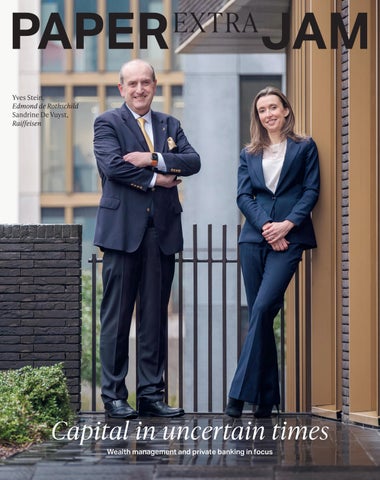
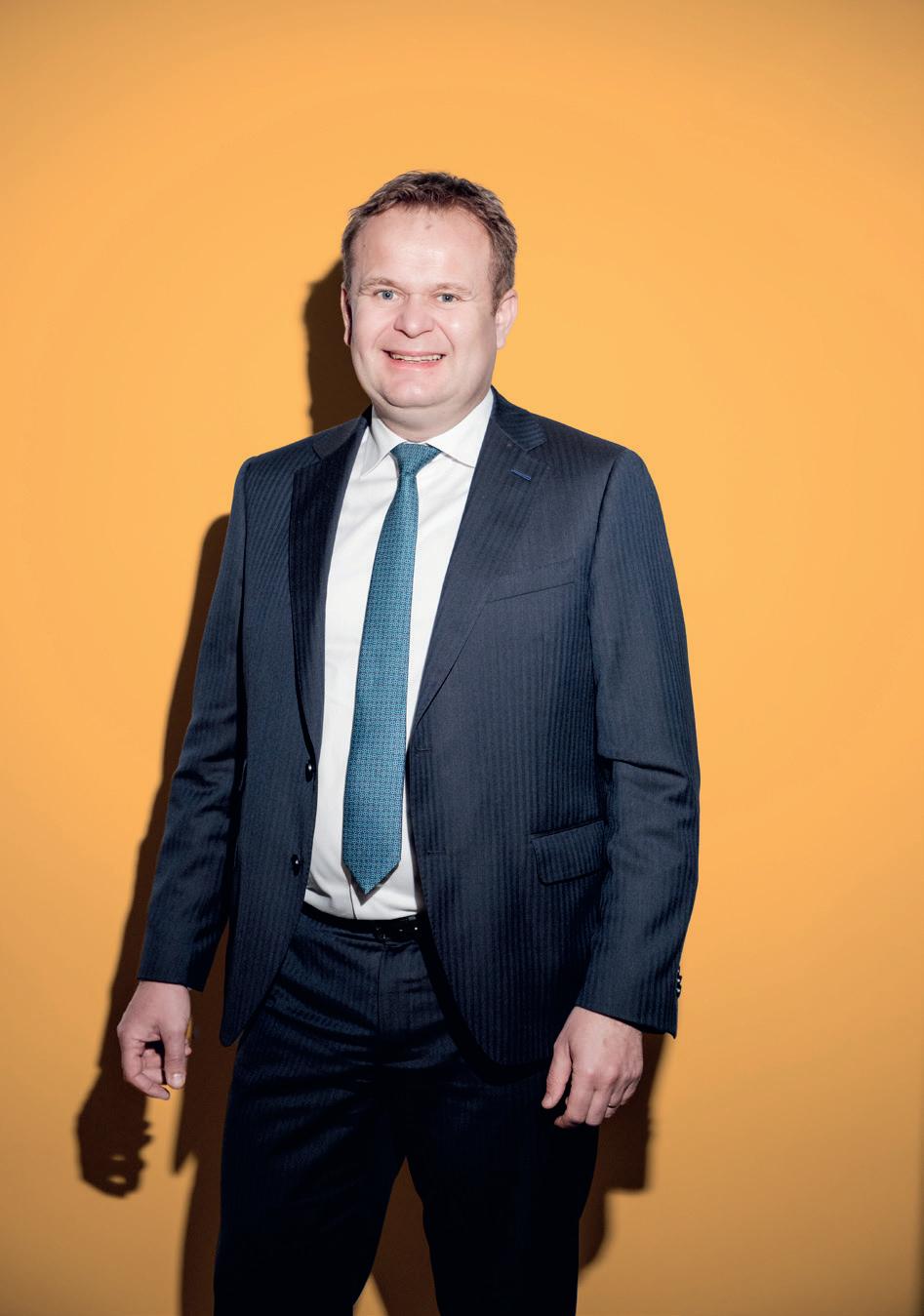
Yves
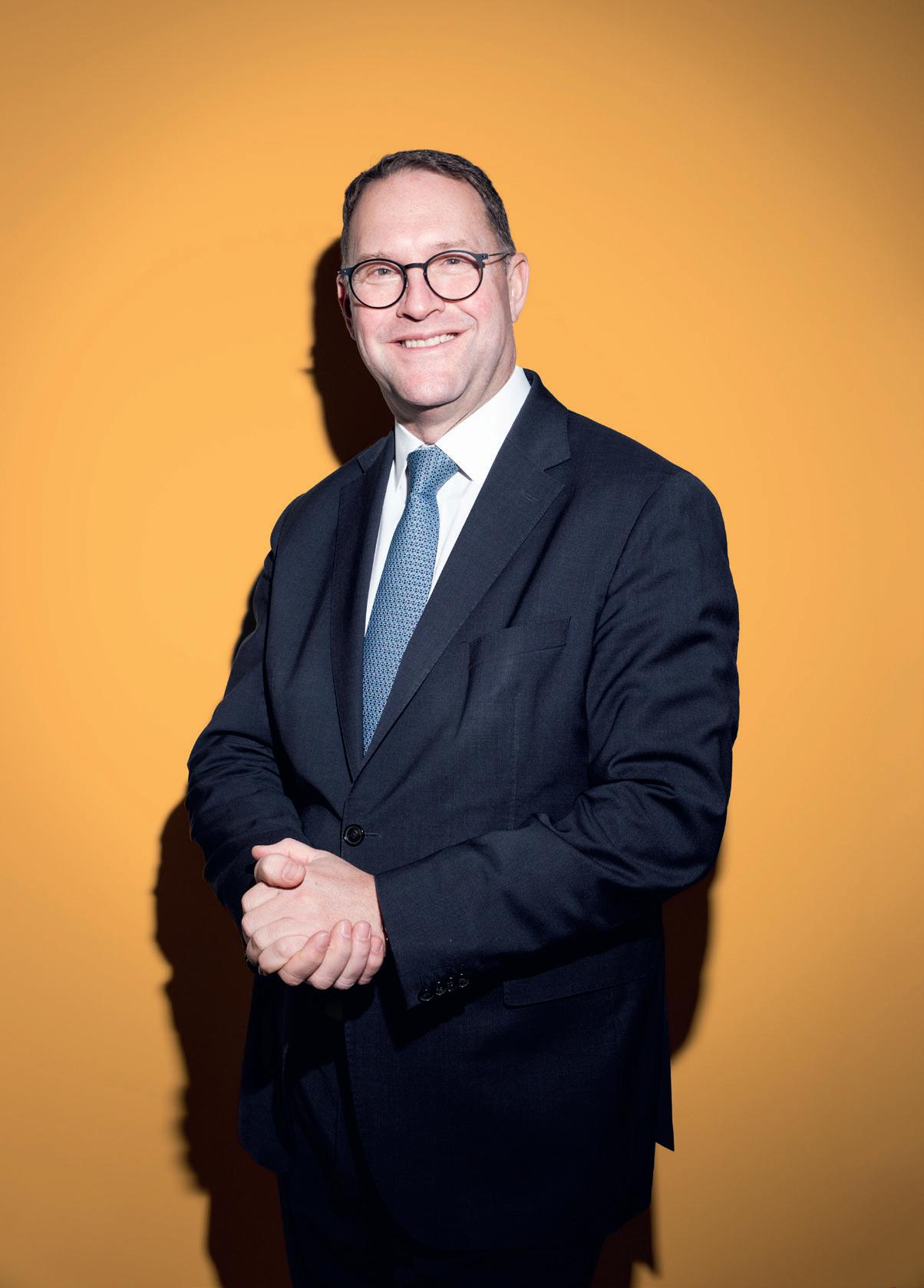
Sandrine De Vuyst, Raiffeisen
Capital in uncertain times
Wealth management and private banking in focus
Stein, Edmond de Rothschild
wealins.com
Since 2000
www.WeArePaperjam.lu
www.Paperjam.lu
Postal address
PO Box 728, L-2017 Luxembourg
Offices 10 rue des Gaulois, Luxembourg (Bonnevoie)
Phone (+352) 20 70 70
E-mail Firstname.name@paperjam.lu
Founder, CEO and Paperjam News Director Mike Koedinger
Chief Growth and Strategy Officer José Campinho
Chief Operations Officer Etienne Velasti
Editorial Director Mike Koedinger
Editor in Chief Guillaume Meyer
Art Director Cassandre Bourtembourg
Designer Juliette Noblot
Based on Paperjam’s visual identity developed by Reza Kianpour (Kianpour & Partners).
Journalists Sylvain Barrette, Alix Bellac, Louise Braibant, Marc Fassone, Émilie Gline, Mike Gordon, Kangkan Halder, Maëlle Hamma, Hugo Hirsch, Thierry Labro, Emilio Naud, Ioanna Schimizzi, Rebeca Suay, Pierre Théobald
Desk Editor Cédric Haumont (-321)
Contributeurs Sébastien Lambotte, Lydia Linna, Audrey Somnard
Photographes Jan Hanrion, Julian Pierrot, Patricia Pitsch
Photographe Cover Jan Hanrion
Director Francis Gasparotto (-301)
Client Media Operations Florence Saintmard (-310)
Paperjam Studio Téléphone : (+352) 20 70 70-300
Head of Paperjam Studio Sandrine Papadopoulos (-220)
Deputy Head of Studio David Johannsen (-265)
Layout Louna Mayer
All rights reserved. Any reproduction or translation, in whole or in part, is strictly prohibited without prior written permission from the publisher. (c) Paperjam S.A. ISSN 3088-599X
In accordance with the law of 8 February 2004 on freedom of expression in the media, the following statement is mandatory “once a year, in the first issue distributed.” We have chosen to publish it every month. The publishing company is 100% directly owned by Mike Koedinger, publisher, residing in Luxembourg. He is also responsible for the general management and day-to-day operations.
Editorial
Awakening the sleeping giant
The past decade has confirmed a structural shift in private banking in Luxembourg: the sector is increasingly orienting itself towards ever-wealthier clients. Ultra-highnet-worth individuals account for a growing share of assets under management. This strategic positioning reflects the very nature of the offering—sophisticated, bespoke and difficult to industrialise. Institutions therefore prioritise the most profitable segments.
But this refocusing has created a blind spot: the mass affluent. These well-off clients—who have between €50,000 and €1m in investable assets—represent, according to Deloitte, a sleeping giant. Their pool of assets exceeds that of the wealthiest segments, yet they remain underserved. Neither traditional universal banks nor private banks have developed a fully tailored proposition for clients who do not constitute their core target market.
Several developments are now reshaping the equation. First, regulatory changes are in the pipeline. Through its Savings and Investment Union, the EU aims to provide citizens with better opportunities to enhance their wealth while supporting companies in accessing financing. Technological advances, meanwhile,
are making it possible to industrialise certain services.
Fideuram Direct provides a compelling case study: Intesa Sanpaolo Wealth Management is preparing to roll out in Luxembourg the digital wealth management platform, which is centred on goals-based investing and complemented by ad hoc access to an advisor. By partnering with Blackrock to offer a taste of private banking to affluent clients—rather than ignoring them in the name of rigid client segmentation—the Italian banking group is pointing the way forward. Awakening the sleeping giant means opening a new chapter of growth.
Editor-in-chief
Guillaume Meyer
Wealth Management & Private Banking
006 Yves Stein & Sandrine De Vuyst
The new rules of private wealth
016 Tanguy Kamp
Private markets: open, but not equal
020 Ananda Kautz & Dave Sparvell
Private banking faces digital stress test
006
028 Karen O'Sullivan & Suzanne Weber
AML rules and crypto as seen by the regulators
032
034
Jonathan Prince, Yves Stein & Sandrine De Vuyst
Open finance : cinq freins majeurs
Deloitte & KPMG
Radar
036 Marc Flammang
Comment capter la Next Gen
042
046
052
056
Thierry André, Julien Renkin & Enrico Cristalli
Three pressure points, three regtech answers
Jessica Rabut & Xavier Bonna
La Suisse, rivale et partenaire en Europe
Christiane Schon, Olivier Reisch, David Alexandre & Jan Paffenholz
Confidentialité des données : une question de dosage
Hélie de Cornois, Lucienne Andring & Claude Medernach
Cinq tendances clés en gestion patrimoniale
062 Patrice Fritsch & Laetitia Carroz
064
Getting tax refunds Faster
Loïc Le Foll & Jurgen Vanhoenacker
Life insurance: Ireland's edge under scrutiny
070 Emilie Takla & Marvin Gläsner Forecast
Conversation with Yves Stein and Sandrine De Vuyst
The new rules of private wealth
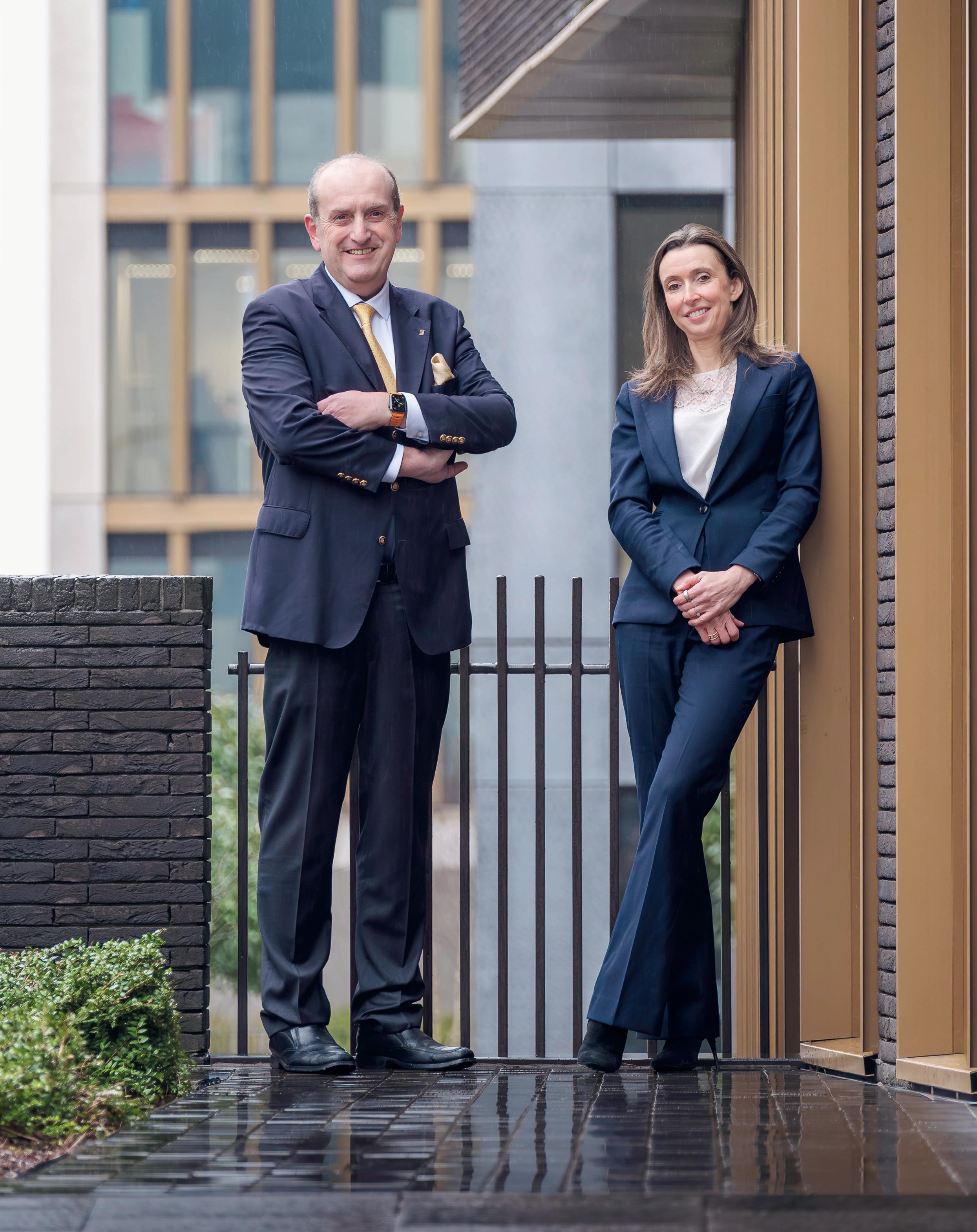
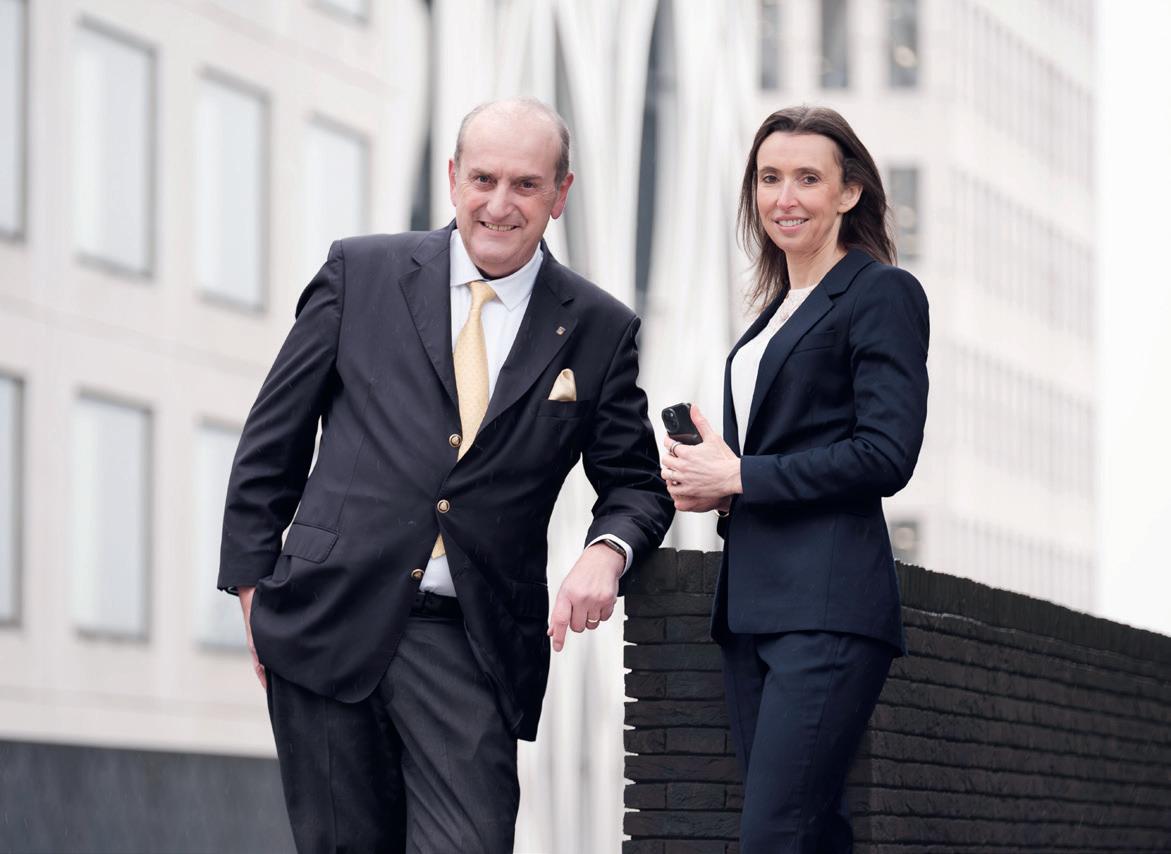
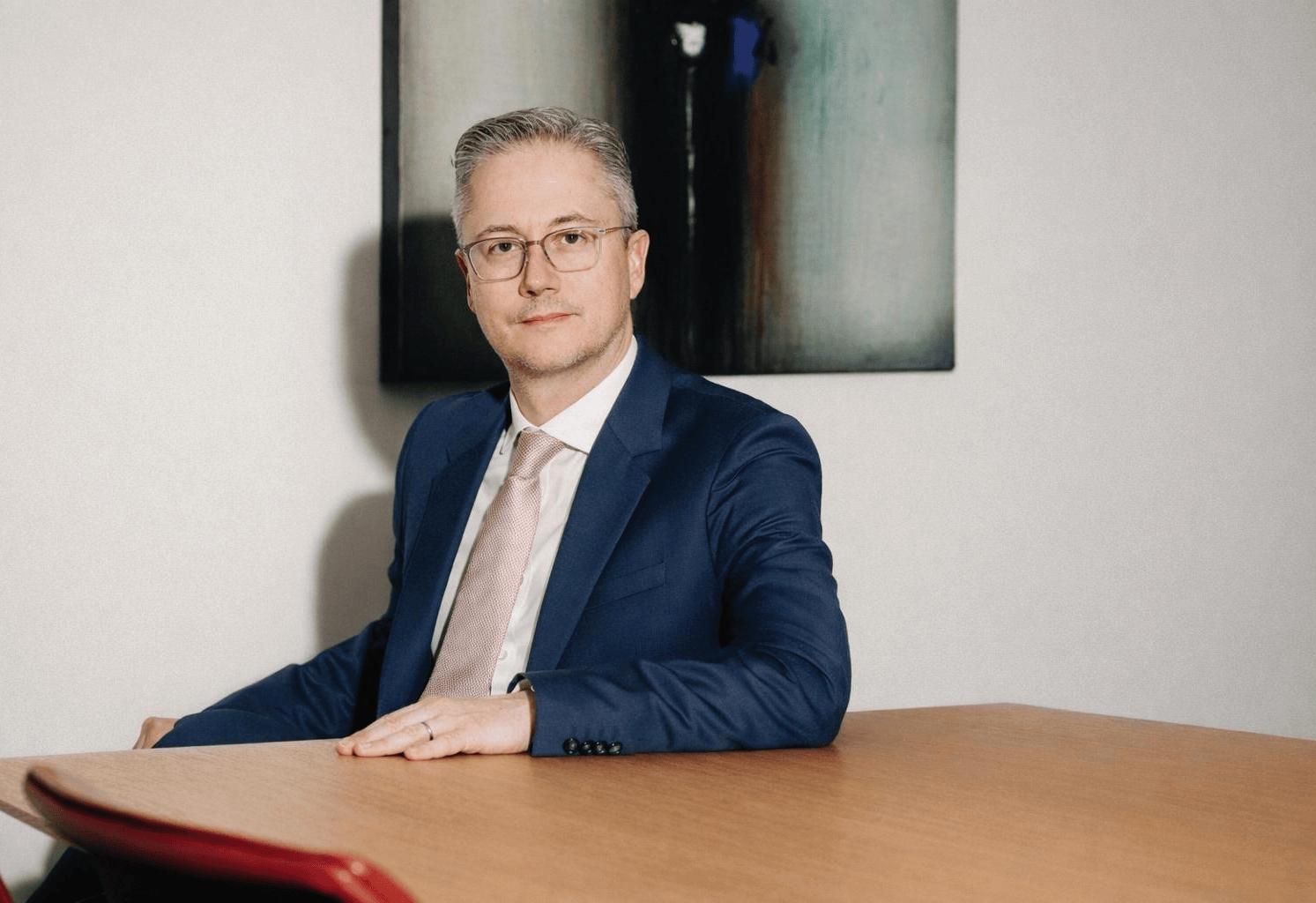
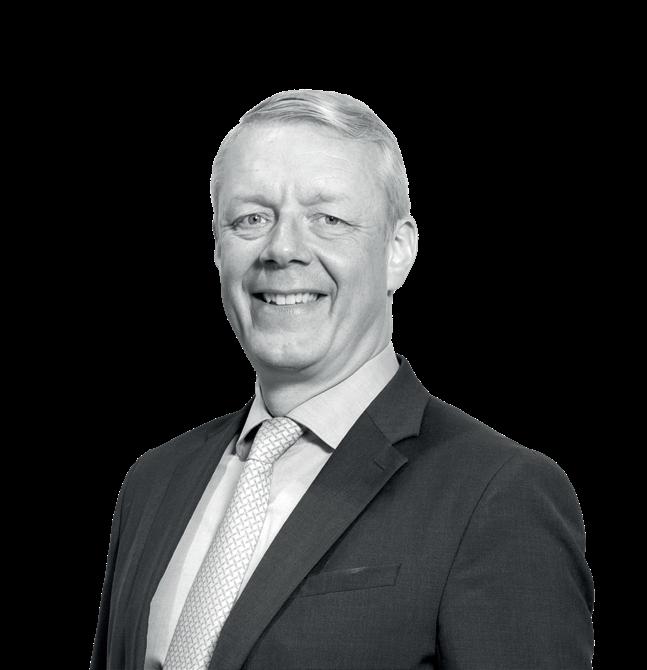
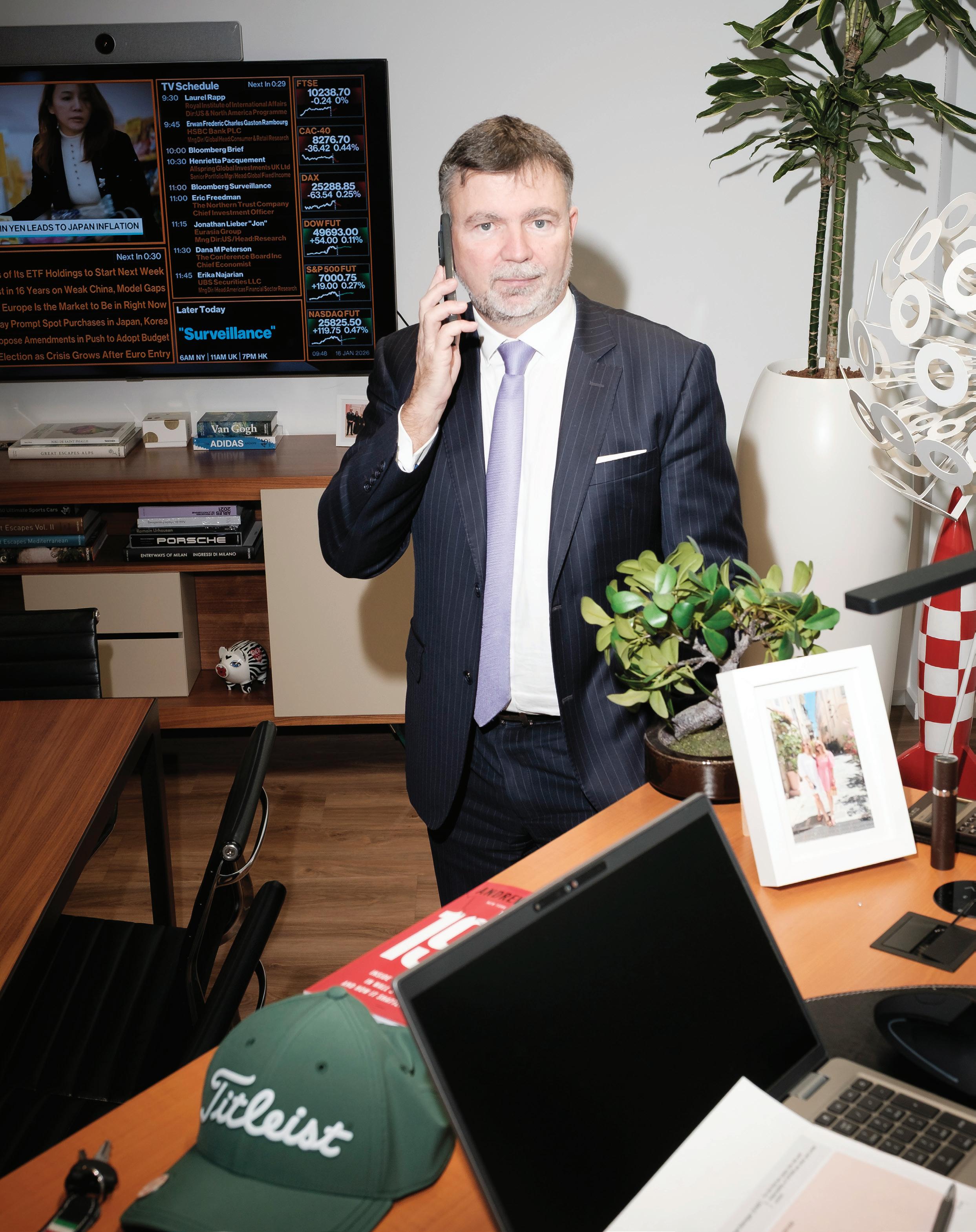
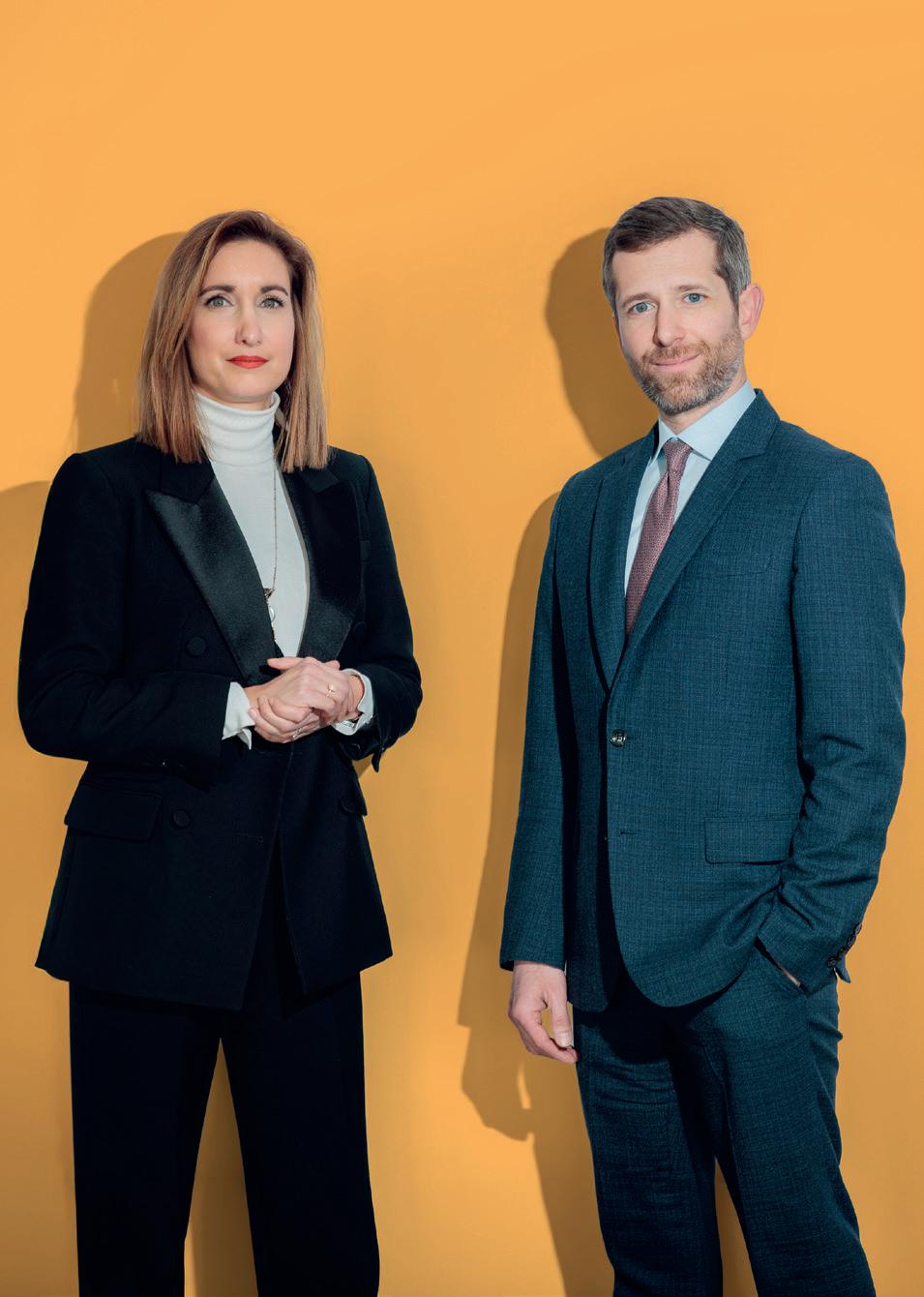
Yves Stein (Edmond de Rothschild) and Sandrine De Vuyst (Raiffeisen), chair and vice-chair of ABBL’s Private Banking Group Luxembourg (PBGL), unpack the year ahead: frothy markets, AI hype, rate cuts, rising fees—and the rising tensions driving the mobility of wealth.
Guillaume Meyer, Journalist, in collaboration with Marc Fassone Jan Hanrion, Photographer
Equity markets are looking expensive. How do you assess the risk of a correction in 2026?
Yves Stein: We’re not in a “run for cover” mindset. Corporate fundamentals and earnings are not that stretched. The main risk lies in market emotion. More often than not, a correction is triggered by something nobody saw coming. In the current macroeconomic environment, a “crisis” driven purely by sentiment would, in our view, represent a buying opportunity.
That said, there are very significant points of attention around the valuation of certain pockets—artificial intelligence being the obvious one— which have grown to an extraordinary scale. The question is whether companies will be able to deliver results that sustain investor confidence at such lofty valuations. More than ever, you need a team advising you in this environment: it is complex.
From a European economic perspective, the key question remains whether nations will manage to bring the war in Ukraine to an end. If they do, it would be a genuine windfall for Europe economically. We saw periods in 2025 when European markets outperformed US markets. Over the long cycle, that is not the usual reality. So far, so good… but vigilance remains essential.
Sandrine De Vuyst: On the fixed income side, we believe the decline in European rates is now well under way. We do not expect major surprises in 2026, with the yield curve likely to remain steep and short-term rates broadly around current levels.
How did assets under management (AUM) at Luxembourg private banks evolve in 2025?
Y.S.: 2024 was an excellent year, with double-digit market performance and +4% in net new money (NNM).
The latter is traditionally what private banks aim to achieve, because it implies growth rates above the underlying economic growth of our economies.
For 2025, markets evolved rather favourably. Above all, we expect the gradual compression of net interest margins to be offset by higher fee income. Markets were supportive of active management: there were many decisions to be made, so we anticipate stronger transactional revenues. We will need to see where the “interest” component ultimately lands, but technically, in terms of AUM, performance should once again be very positive. As for net new money, the constructive environment, the international visibility of the financial centre and the arrival of new players make us optimistic for 2025.
S.D.V.: Adding to that is the sometimes uncertain political situation in certain neighbouring countries, which also allows us to attract capital thanks to Luxembourg’s political stability.
Do you have a sense of what proportion of that NNM is coming from neighbouring countries?
S.D.V: The bulk of NNM does indeed come from European countries. While we do not yet have statistically precise figures for 2025, our sentiment surveys within the PBGL suggest that the objective achieved in 2024 will be maintained—and may even be slightly exceeded—in 2025.
What is the typical profile of the private client who came to Luxembourg in 2024–2025?
Y.S.: In 90% of cases, the typical client is European. Their wealth has generally been built through international business activity, and they are either looking for wealth planning and structuring solutions, or they
A collective voice for private banking
Yves Stein, CEO of Edmond de Rothschild (Europe), and Sandrine De Vuyst, member of the executive committee at Banque Raiffeisen, serve respectively as chair and vice-chair of the Private Banking Group Luxembourg (PBGL). The PBGL promotes the financial centre’s strengths, opportunities and challenges, channels proposals via the High Committee of the Financial Centre and helps shape the tools needed for structured wealth transmission. It also tackles talent, digitalisation and regulation, supporting members of all sizes.
“ There is currently a very specific Latin American wave.”
Yves Stein
in 2024: highest annual AUM increase since 2007
are drawn by the country’s triple-A rating and its political stability.
We also see many Latin American fortunes—particularly Brazilian— taking a renewed interest in their roots and, more broadly, in Europe. They often choose Portugal or Spain as a first step. Once there, they think: “I also need a hub for my financial activities, for my investments in Europe, and to set up my base in Portugal.” Very often, they either come across a Luxembourg bank branch locally, or they conclude that Luxembourg is Europe’s most international country—and, by the way, with Portuguese residents making up more than 30% of the population, they can even find cultural familiarity. For us, this is a priority. There is currently a very specific wave, largely Latin American and especially Brazilian, that we are following with great interest.
In the face of competition from Singapore or Hong Kong, what is Luxembourg’s distinguishing strength for wealthy non-European clients? Y.S.: Let’s remain humble: 90% of our clients are European. I can imagine the heads of banking associations in the UK and Switzerland wake up at night thinking about these questions more often than we do—we have so much to do in Europe. We remain present and visible in Asia, particularly in Singapore, to learn and take inspiration, but it remains a distant market for us.
The Middle East is another dynamic region, torn between East and West. For now, many still choose Singapore as their financial partner. We are monitoring this closely to seize opportunities where we can. For us, international markets are a source of inspiration—and also of partnerships: for instance, the ABBL had a strong presence at the fintech forum in Singapore.
%
In 2024, 90% of AUM in Luxembourg’s private banking sector came from European clients, according to a recent ABBL-KPMG-CSSF survey. Clients from Belgium, Germany and France accounted for 20% of AUM.
Raiffeisen’s private banking push
Raiffeisen is best known as a local, independent universal bank—and not instinctively associated with private banking—yet its wealth business “has seen strong growth in recent years.” Sandrine De Vuyst says the ambition is to build private banking from the domestic base: deepen corporate relationships, upscale retail clients and acquire new clients through “a truly human approach.”
We’ve spoken about the inflow of new clients. Is there a reverse movement—people leaving Luxembourg? And what would their profile be?
S.D.V.: Naturally, there are always inflows and outflows. We also know Luxembourg attracts people who come here sometimes for a limited period. But, generally speaking, around 70% of people who move to Luxembourg end up staying. Now, ultra-wealthy individuals also tend to diversify globally, so capital can clearly move from one location to another. But this is not something we monitor with particular precision. Y.S.: I can confirm that we do not observe any relevant outflow of private banking clients leaving Luxembourg, other than isolated cases linked to relocation or transfer to the next generation. It does happen that money leaves the bank balance sheet for direct investments, particularly in property, but this is not a cause for concern. What we do need to watch is that banks themselves do not leave. One or two banks have exited Luxembourg in recent years, but the declining number of private banks is almost entirely a consolidation phenomenon. That is why the number of banks is falling while AUM continue to rise.
Is the consolidation under way in private banking beneficial for Luxembourg in terms of substance?
S.D.V.: In any case, at ABBL level we don’t see any particular threat on that front. Some groups are streamlining their footprint, but we don’t think this is necessarily for or against Luxembourg. What is clear is that Luxembourg must continue to position itself as a centre with its full ecosystem and stay competitive. We very often talk about property constraints—it is difficult for people arriving here, and for those already here—but on the other
hand we remain an extremely multicultural, multilingual country, with many advantages that should not be overlooked. These are also factors that can tip the balance when it comes to maintaining the attractiveness of Luxembourg for banks.
In other words, you don’t see Luxembourg becoming a mere branch office…
Y.S.: Each group is a bit like a multigeography family, and has to choose its organisational model. The drivers are not always the same. You can identify a dozen drivers that justify a given setup, then develop the top three for your group and assess how financial centres stack up against those drivers. Fortunately, Luxembourg’s stability, predictability and robustness means that we’re bound to have at least one driver among the top three.
Players will continue to position themselves. We will see new entrants coming to Luxembourg—thankfully— and we will also see activities or institutions remain and even grow in Luxembourg without necessarily having their headquarters here, because their key drivers may favour another financial centre.
How is the new political landscape in the US influencing the strategy of US banks present in Luxembourg? Are you sensing any shift?
Y.S.: We do not observe any fundamental shifts. Banks are economic actors: they follow their clients’ needs and the markets. North American players are extremely important for the Luxembourg financial centre. If you look at our business clusters, Americans represent an exceptionally large share of, for instance, the depositary business in Luxembourg. In European UHNWI private banking,
US players are very present. These institutions are also deeply involved in real assets. So if Luxembourg is today Europe’s leading hub for private equity you can expect many American firms to be active here, because they are the key players in that field.
As for movements, the only one we can reasonably point to—and which has in fact been rather favourable for Luxembourg—was Brexit. Since Brexit, we saw many non-European players strengthen their presence, because access to the European continent could no longer be channelled through London. Economically, that was very beneficial.
Yves Stein, you recently appeared smiling on social media alongside the US ambassador. In 2026, can one publicly highlight links with Trump’s US without risking offending Beijing—or even Brussels, in the midst of tensions between Luxembourg and the EU over the possible centralisation of asset manager supervision by the Esma?
Y.S.: Our approach has been consistent and long-standing—we defend the interests of the banking sector. Topics, issues or challenges faced by banks are linked to the nature of their activity, not where the institution comes from. In Luxembourg, banks from different
regions operate in a shared environment. They collaborate on practical, sector-wide initiatives through professional structures, such as our working groups, particularly on regulatory, operational and market-related topics. This collective approach supports stability and Luxembourg’s philosophy of openness.
International finance has always operated across borders and Luxembourg’s financial centre has long played a central role in facilitating this.
Is Luxembourg’s ecosystem sheltered from major tectonic and geopolitical shifts across the world?
Y.S.: Luxembourg is not sheltered from global geopolitical shifts, and no international financial centre can be. The question is how the systems in place can operate in these periods of uncertainty.
In this case, dialogue and cooperation with all stakeholders remain essential. Having the right people around the table at the right time is where Luxembourg excels. This is in the interest of the financial centre, the country and, ultimately, its people.
How do private banks integrate geopolitics into client management today? Do you ever end up having to choose between Chinese and American clients?
S.D.V.: In Luxembourg, the question of choosing between American and Chinese private banking clients simply does not arise. The private banks operating here do not serve these types of clients. Providing investment advice to US private clients requires a licence from the Securities and Exchange Commission (SEC). As for Chinese banks, their activities in Luxembourg are more focused on corporate and institutional clients rather than private banking.
Capital Markets Expert Banking Personality ESG Champion Insurance Personality
Fintech Entrepreneur Visionary
Funds Personality Private Equity Executive
Every two years, Paperjam and Luxembourg for Finance join forces to honour the visionaries and leaders shaping Luxembourg’s financial sector.
This prestigious event shines a spotlight on individuals whose expertise, leadership, and forward-thinking contributions are helping to define the future of the Financial Centre.
The 8 winners will be revealed at a gala dinner.
Sponsored content by Eurobank Private Bank Luxembourg
Global expertise, personalised touch
Theofanis Mylonas, Head of Wealth Management Eurobank. CEO Eurobank Private Bank Luxembourg
Eurobank Group is refreshing its presence in Luxembourg, having chosen the country as a main pillar in its European private banking and wealth management strategy. Theofanis Mylonas, Head of Wealth Management Eurobank, CEO Eurobank Private Bank Luxembourg shares his insights.
What does Eurobank Private Bank Luxembourg bring to the market?
Eurobank Private Bank Luxembourg combines the strength of a large international group with a highly personalised approach. As part of one of Europe’s leading banking groups, with more than €100 billion in total assets, we benefit from scale, balance-sheet strength, and deep expertise across multiple markets.
With a strong footprint in Greece, Cyprus, Bulgaria, Luxembourg, and London, and an expanding international presence through representative offices and strategic hubs in key financial centres, we act as a natural bridge between Europe and selected international markets. At Group level, Eurobank continuously monitors and selectively evaluates financing and investment developments in regions such as the Middle East, India, and Israel, in line with its broader international strategy.
This international reach allows us to support clients with complex cross-border needs, whether related to wealth structuring, financing solutions, or investment diversification, while maintaining a strong European anchoring.
Despite being part of a group with more than 12,000 employees, we deliver a highly personalised client experience. Our clients work with a limited number of dedicated experts who understand their personal and professional situations in depth. We take a holistic view, offering flexible solutions that address both private wealth and business ambitions. This approach is particularly attractive for entrepreneurs and internationally
Photo : Julian Pierrot / Paperjam
minded business leaders seeking growth, while also preserving and structuring substantial private wealth.
Clients benefit from a single point of coordination for managing assets across jurisdictions, financing growth initiatives, and structuring investments globally.
Why did you choose Luxembourg as the centre of your restart?
Luxembourg was a natural choice thanks to its stable regulatory framework, deep cross-border banking expertise, and highly developed financial ecosystem. This environment provides a high level of security, transparency, and confidence.
While regulatory standards are rigorous, authorities understand the realities of entrepreneurship and complex wealth structures. There is a constructive dialogue with financial institutions, combining high standards with accessibility — a balance that is particularly attractive for private banking.
Today, we are fully established in Luxembourg, with approximately €25 billion in assets under management. Our focus lies on sophisticated wealth structuring, discretionary portfolio management, and openarchitecture investment solutions. At the same time, Luxembourg serves as a central hub for our private banking clients, coordinating assets, financing needs, and complex situations in close collaboration with our international network.
How do you differentiate the client experience in private banking today?
Clients are not won over by a few
basis points. They are won over by trust and experience — which ultimately comes down to people, processes, and systems.
Many banks operate with a fixed menu of products, while others offer à la carte services. Our philosophy goes one step further. We take our clients into the kitchen and design solutions together, from the ground up. This means closely analysing the full spectrum of their private and professional objectives and tailoring solutions accordingly.
We operate under an open-architecture model, working in strategic partnerships with leading global asset managers such as J.P. Morgan and Eurizon. This allows us to offer access to best-in-class investment solutions while remaining fully independent in our advice.
For entrepreneurs, corporate clients, and private investors seeking a reliable European partner, this combination of flexibility, balancesheet strength, and long-term vision is essential.
Delivering an enhanced client experience requires continuous evolution. Wealth management and private banking are at the core of Eurobank’s overall strategy, and we continue to invest in human capital, digital transformation, and IT infrastructure to support that ambition.
What lies at the core of your strategy in Luxembourg?
On the human side, we continue to build a diverse, international team with complementary backgrounds and perspectives. This diversity fosters constructive challenge and
Total assets of the Eurobank Group €100 billion+
Assets under management at Eurobank Private Bank Luxembourg €25 billion
continuous improvement. Recent appointments reflect this ambition, with a management team bringing experience from multiple financial centres.
On the systems side, we are investing in advanced digital capabilities, including a new CRM platform, to further enhance client servicing and internal efficiency.
Combined with the strength of a leading European banking group and strategic partnerships with global asset managers, this positions Eurobank Private Bank Luxembourg for sustainable, long-term growth, with the ambition to significantly expand assets under management in the coming years.
Private markets: open, but not equal
Democratisation is widening access to private markets, with smaller tickets and new fund structures reshaping wealth management. Yet liquidity constraints and the gatekeeping power of elite GPs mean the playing field is far from level.
Tanguy Kamp Head of investment management CA-Indosuez Wealth Management
Sylvain Barrette, Journalist
Julian Pierrot, Photographer
A panoramic view of the markets
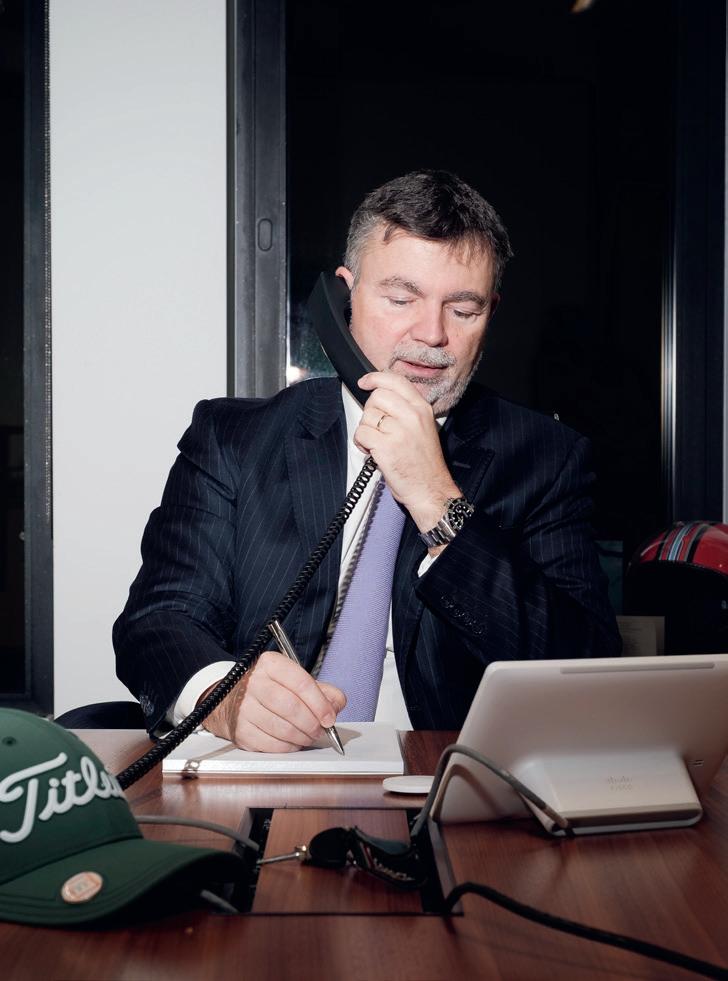
Tanguy Kamp, head of investment management at CA-Indosuez Wealth Management, oversees approximately €3.4bn in assets under management for Luxembourg as well as branches in Italy, Spain and Portugal. The investment management (IM) division is organised into three pillars: wealth management solutions (discretionary management), public markets (selection of funds and securities) and private markets. Kamp also has responsibility for sustainable finance.
“ Entrepreneurs are generally risk takers.”
A pivotal theme in today’s wealth management market is the democratisation of private markets—an asset class that was historically the exclusive domain of ultra-high-net-worth individuals (UHNWIs), with entry tickets often exceeding €1m.
Tanguy Kamp, head of investment management at CA-Indosuez Wealth Management, notes that this landscape has shifted dramatically over the last decade. Access is now available to a much broader client base through digital platforms and specialised vehicles that allow entry with commitments as low as €50,000. Indosuez uses structures such as European long-term investment funds (Eltifs) and “evergreen” funds—semi-liquid vehicles offering limited liquidity.
Client profiles
Indosuez’s largest clients are often entrepreneurs. “They are generally risk takers,” Kamp says. These UHNWIs hold portfolios in which private assets increasingly complement public holdings, which are generally the starting point for the relationship. A client with €3m, for example, may allocate €1m to private markets to enhance long-term returns, diversify the portfolio and reduce exposure to daily public market volatility.
Much of this activity is channelled through Indosuez’s Tiera Capital platform, a fund-of-funds structure that has used reserved alternative investment funds (Raifs) for over 25 years to provide diversified private equity solutions. In terms of performance, Indosuez points to an internal track record, with private market investments generating annual returns of 12.5% to 13% on “called capital” (i.e., funds that have been committed by investors but not yet deployed).
In a typical discretionary private market portfolio, the bank targets
a diversified allocation of roughly 60% to 70% in primary funds (with US, European and Asian exposure), 20% in secondaries and 10% in co-investments. However, a client can also adopt a pure-play strategy within a Raif— one focused solely on secondaries, for example.
Balancing primaries and secondaries
Following recent private equity exit challenges—driven by muted valuations and, in some cases, weaker internal rates of return (IRR)—Indosuez often prioritises secondaries and co-investments to “optimise the client experience and return profiles,” Kamp says. The bank’s upcoming “Secondary Opportunities IX” fund represents the ninth iteration of a strategy that acquires existing stakes in various funds from other investors (LP-led) or participates in manager-led restructurings (GP-led).
The primary allure of the secondaries market is the ability to acquire assets at a discount to their net asset value (NAV). It also allows investors to enter portfolios that are already generating cash flows and effectively bypass the “J-curve phase” (i.e., the early stage of a fund where returns are typically negative before improving). “This option often improves the IRR for the client,” he notes.
Co-investments, meanwhile, are increasingly favoured because they allow clients to invest directly alongside a lead GP in specific companies, often resulting in lower fee structures and offering the benefit of “dual expertise” from both the lead manager and the bank’s internal specialists. Investors with €10m or more can also establish a dedicated fund structure. This enables direct investments in private market funds, bypassing the Tiera platform. Assets are held with a custodian bank and managed by
the manco, Crédit Agricole Investment Funds Solution (CAIFS).
To improve the efficiency of primary funds, Indosuez tackles an inherent challenge: “cash drag,” where a client’s capital remains unproductive while waiting to be “called” by a fund manager. The solution is Lombard lending, or pledging: the client invests their full capital in liquid public markets and opens a credit line—typically with a loan-to-value ratio of between 65% and 85%—to fund private equity commitments as they arise.
A gateway with exit gates
This structure ensures that the client’s total wealth is productive from day one, earning returns in public markets while simultaneously building long-term exposure to private equity without the need for large idle cash reserves.
Despite these opportunities, investing in private markets remains complex and involves several inherent constraints. “Semi-liquid” funds often employ “gates” that limit redemptions to 10% of a fund’s NAV during periods of stress—meaning that “an investor may have to wait six to 15 months to fully exit a position,” Kamp explains.
Regulatory constraints under Mifid II also require clients to be “well-informed” and to maintain a “balanced” or “dynamic” risk profile; those with defensive profiles are generally excluded from such structures.
Ultimately, Kamp underlines that the most critical factor in private equity success is manager selection, as the dispersion between top-tier and bottom-tier performers is vast.
A “psychological shield”
To clarify the challenge of accessing elite managers, he draws an analogy with fine wine. One cannot simply walk into a prestigious estate and buy a rare bottle of RomanéeConti without a decades-long relationship as a loyal buyer. Similarly, the most oversubscribed and successful private equity funds—such as Sequoia— are closed to those who have not consistently supported the manager’s previous “vintages” over many years. Access to top-tier performers is a privilege earned through longstanding institutional relationships and a proven track record.
Beyond pure financial metrics, Kamp stresses that private assets can provide a “psychological shield” for investors because “you are committed over the long haul.”
Valued quarterly rather than daily, these assets help protect clients from the urge to “panic sell” during shortterm market turbulence, such as the volatility seen during the covid pandemic or the 2022 downturn. Both open-ended and closed-end funds offered to European wealth investors
Survey question: “How do you currently or intend to deliver private markets to your clients?”
2 3
Private banking faces digital stress test
Generational change, digital tools and regulatory drag are forcing private banks to review how they operate today. Figures argue the model is still not disappearing, but its assumptions are under sustained pressure.
Change is coming Augmented advice
Cautious crypto
Skills shift Governance gap
Mike Gordon, Journalist
1
Change is coming
Private banking is still anchored in relationship-led advice, but the claim to relevance increasingly rests on complexity. Cross-border assets, family governance and succession planning are problems that digital mass-market players tend to avoid, argues Ananda Kautz, head of innovation, payments and sustainability at the Luxembourg Bankers’ Association (ABBL).
Luxembourg’s historic strengths meant “market forces… haven’t pushed as hard to force them to digitise as fast as in other areas of financial services,” argues Dave Sparvell, chief executive of Swissquote Bank Europe. That changes with the inheritance cycle: “millennial and Gen X get hold of the money… investment priorities, risk appetite, personal values… are going to change.”
Eighty-one percent of wealthy inheritors in a US survey by Capgemini reported that are prepared to dismiss their parents’ wealth advisors. With more than $100trn expected to change hands globally over the next 25 years, banks are being forced to rethink how they communicate, advise and retain trust.
2
Augmented advice
Digitalisation is becoming a structural requirement rather than a competitive add-on. “For a long time, private banks were not pushed as hard to digitise as other parts of financial services,” says Sparvell. “That changes when the next generation takes over and expects digital access, involvement in decisions and faster information.”
Seven out of ten Luxembourg private banks identify digitalisation as a top strategic priority in the ABBL/KPMG Digitalisation Survey 2024. Improving the client experience ranks first, followed by internal efficiency gains in onboarding and KYC. The preferred model is augmented advice: AI supports
human advisors, while accountability for investment decisions remains with the advisor. In practice, most early AI use is internal, aimed at document handling and process control rather than client-facing automation.
The challenge is not speed alone but judgement, notes Hélène Lange, head of business coordination at the ABBL. Documentation can be analysed faster with automation and optical character recognition (OCR), but interpretation still requires human oversight when legal and cultural contexts differ. The ABBL estimates that up to 80% of current KYC procedures could be automated.
Cautious crypto
Client expectations around digital assets are shifting faster than product supply. “They’re not just looking for stocks and bonds,” says Sparvell. “They want crypto, private markets and international exposure, and they want to be involved in the decisions.”
Swissquote survey data underline how wide the gap remains: in 2024, 98% of surveyed private banks did not offer crypto-asset services. The default response is therefore staged—meeting demand without importing unnecessary operational and reputational risk.
Rather than direct exposure, banks are testing intermediate routes such as crypto-linked exchange-traded funds, tokenised instruments and infrastructure-led blockchain projects. The logic is operational as much as commercial, centred on faster transfers, settlement and reconciliation.
Stablecoins and tokenisation sit in the same experimental space. For many institutions, the prize is not trading volume but credible participation in payment rails that could reduce friction in cross-border flows.
For private banks, the gating issues remain governance, custody, suitability and disclosure. Digital assets may enter portfolios gradually, but only where controls meet
the same standards applied to traditional instruments— and where the client experience is clear enough to sustain trust.
In Luxembourg, interest links to stablecoin settlement and tokenised instruments, where blockchain infrastructure could shorten cycles and reduce checks. Private banks watch these projects because they touch core plumbing— cash movement, custody
and record-keeping. Under regimes such as Mica, the work sits in custody, suitability and disclosure, alongside reputational risk.
For affluent clients, Sparvell says the question is rarely “free or very low cost.” “It becomes a story of… are my investments safe,” he says, “rather than, is it free.” That pushes banks towards controlled wrappers, not open access today.
“ There is a real risk that mandatory regulation consumes all the capacity banks have to innovate.”
Ananda Kautz, ABBL
Photo: Romain Gamba
Paperjam Together Le rendez-vous des PMEs
Robert
Goeres,
les clés du luxe retail, entre tradition familiale et expérience client
Chaque mois, le Paperjam Club ouvre un nouveau chapitre dédié à celles et ceux qui façonnent l’économie du terrain.
Un format matinal où entrepreneurs et dirigeants de petites et moyennes entreprises se retrouvent pour apprendre, partager leurs expertises et s’inspirer de pratiques concrètes. Partenaires
Vendredi 27 mars 2026
08:30 - 11:00
Spuerkeess Luxembourg-Ville
Exposants
Business Mentoring Luxembourg, Lalux, Luxembourg AI Factory, Paperjam Club Academy, SD Worx, Spuerkeess et Verbalius.
Inscription Programme
Pour cette édition, nous recevrons l’entrepreneur Robert Goeres, CEO de Goeres Horlogerie et commerçant engagé au sein de nombreuses organisations professionnelles.
Il nous parlera d’expérience client, de commerce en ville, des défis du retail de luxe, des entreprises familiales, et partagera ses principales lessons learned au fil de son parcours. Robert sera en conversation avec Mike Koedinger, fondateur de Paperjam.
Un format dynamique, conçu pour apprendre ensemble et faire circuler l’intelligence du terrain.
Robert Goeres, Goeres Horlogerie
41%
Forty-one percent of Luxembourg banks’ investment spend is absorbed by regulatory compliance ( ABBL/EY Cost of Regulation Survey ).
4
Skills shift
Technology is reshaping roles more than hollowing them out. Automation targets repetitive work, pushing staff towards analytical and client-facing roles, while exposing employees unable to adapt to new tools.
From the ABBL’s perspective, the response is upskilling. Recent collective bargaining agreements increased budgets and dedicated hours for continuous training, including AI literacy programmes for staff and executive-level training. Digitalisation is also driving selective hiring: operations and IT roles recorded a 10% increase in full-time equivalents between 2023 and 2024, reflecting operational resilience and compliance demands. Back-office work shrinks, but control work grows too.
5
Governance gap
Regulatory pressure is shaping cost structures and strategic sequencing. “There is a real risk that mandatory regulation consumes all the capacity banks have to innovate,” says the ABBL’s Kautz, pointing to the cumulative drag created when governance, budgeting and delivery pull in different directions.
The Luxembourg Private Banks Digitalisation Survey 2024 found that 70% of banks lack a dedicated head of digital transformation or equivalent role, a shortfall also highlighted by the financial regulator. Mandatory programmes absorb investment budgets and IT capacity, crowding out discretionary projects even when the strategic case is clear.
An ABBL and EY study estimates that Luxembourg banks spend an average of €548m per year on compliance. Regulatory investments account for roughly 41% of total investment expenditure, limiting the room for modernisation that is not strictly supervisor-driven. That constraint matters because digital change is sequential: data foundations, tooling, process redesign and governance need to land in the right order. When regulatory deadlines dictate the calendar, banks risk modernising in patches rather than building coherent capability.
In response, the ABBL has created an innovation cluster bringing together C-level executives across member institutions to anchor digital topics at governance level rather than treating them as isolated IT projects. Swissquote Bank’s Sparvell has been appointed chair of the new cluster.
The ABBL banking organisation treats EU-level simplification as a priority because mandatory projects can consume budget and IT capacity, explains Kautz. The risk is that banks meet mandates yet still fall behind on the tools clients will judge them by.
The governance question is practical: who owns the roadmap, controls the budget and arbitrates tradeoffs when a deadline collides with a strategic build?
Across all five pressures, the direction is consistent. Digitalisation does not dilute private banking’s relevance, but it tightens the conditions under which the model can continue to function.
Finance is undergoing a profound transformation, driven by digital innovation, regulatory shifts, and evolving customer expectations. This Paperjam 10×6 event brings together ten thought leaders to explore how financial institutions are adapting to this new landscape.
Topics include the rise of embedded finance, the impact of ESG considerations, and the integration of AI in financial operations. Join us to gain insights into the strategies shaping the future of finance in Luxembourg and beyond.
Tuesday 13 October 2026
18:30
Learn more Program Kinepolis Kirchberg
Finance is changing fast.
Sponsored content by WEALINS
More flexibility & clarity for global investors
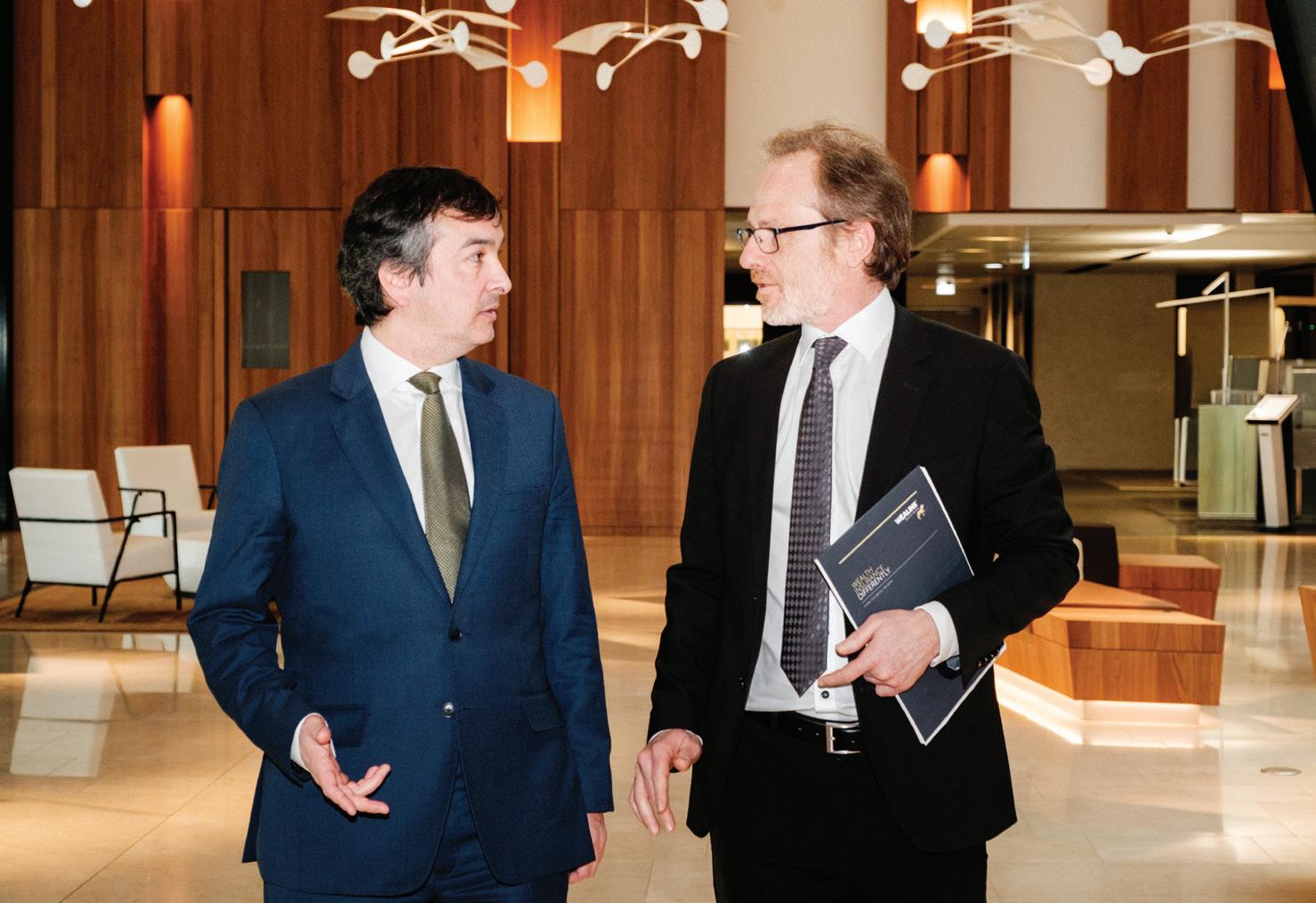
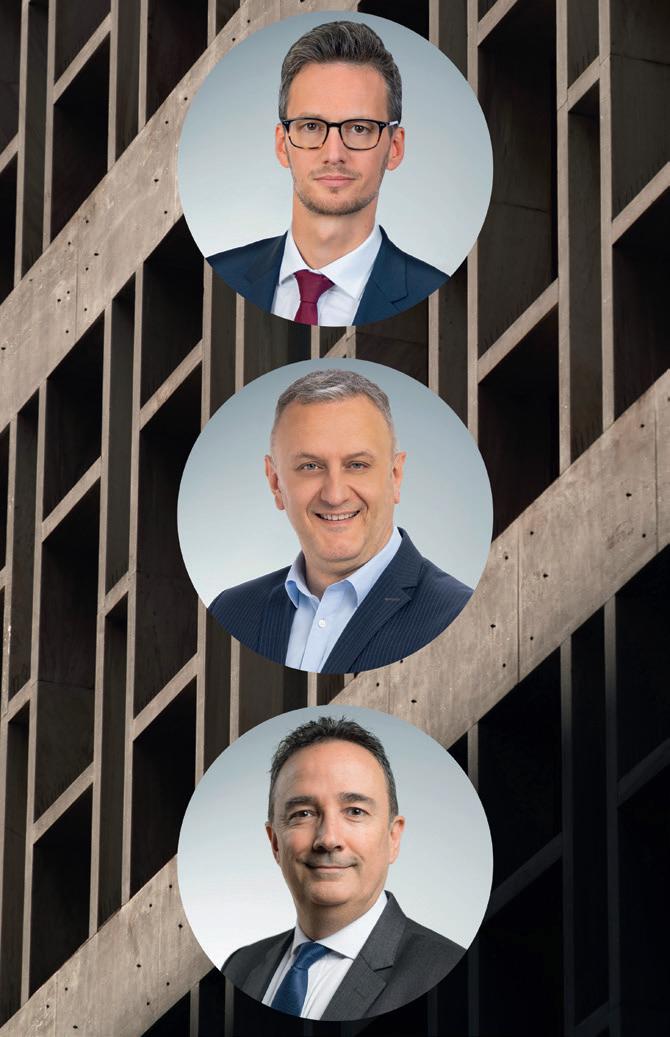
Pablo Peciña, Head of Wealth Planning and Mathieu Mancini, Head of Investments at WEALINS eyeing new Circular 26/1 opportunities
International life insurance clients now have more flexibility in how they link their policies with investment funds. WEALINS sees the new Circular Letter 26/1 from the Luxembourg regulator Commissariat Aux Assurances, as a positive development.
How do recent regulatory changes improve your ability to support your partners and clients?
Pablo Peciña: The new Circular Letter 26/1 enables life insurance companies such as WEALINS to operate with even more flexibility, clarity and harmonization, when designing solutions for clients with complex wealth, family and geographical profiles. At WEALINS, we have always been committed to offering tailor-made wealth structuring solutions that meet the challenges of succession, investment and mobility for a demanding clientele in a constantly changing international environment.
Which changes will be the most significant?
Mathieu Mancini: These are quite technical in nature, but fundamentally our clients will appreciate that since the start of February they have greater choice about the types of investment fund that can be linked to their life insurance policies. They can, for instance, gain direct exposure to structured products, which is particularly valuable for accessing private market assets. Several previously ambiguous regulatory notions have also been clarified, making it easier for our experts internally and our partners to explain and implement strategies in a consistent and transparent way. Important grey areas and key terms have been clarified which makes it easier for us and our partners to explain these strategies.
P. P.: Certain regulatory procedures have also been streamlined, which allows us to implement solutions more rapidly—without compromising the strong regulatory framework that defines Luxembourg’s life insurance model. This balance between efficiency and security is essential for
Photo : Patricia Pitsch
our international clientele, who expects seamless wealth support combined with robust protection.
Essentially this is about offering clients broader investment choice?
M. M.: Indeed. Another noticeable improvement is the increased flexibility available for “internal collective funds” linked to life insurance policies. While maintaining the advantages of their collective nature, these funds can now offer some of the benefits of “internal dedicated funds”, particularly direct investment into structured products. When dealing with private assets, care is needed to balance the liquidity constraints of private assets with the need to provide effective life insurance cover. We are looking forward to exploring these opportunities with our partners and their clients.
What does this mean for the Luxembourg life insurance ecosystem?
P. P.: This further strengthens the role and competitiveness of the Luxembourg life insurance sector as a hub for structuring investments in private assets. The added regulatory clarity enhances confidence in our model, which in turn strengthens the positioning of players like WEALINS who specialize in crossborder cases and sophisticated wealth structuring.
“ The new
Circular Letter 26/1
enables life insurance companies to operate with even more flexibility, clarity and harmonization.”
Pablo Peciña, Head of Wealth Planning, WEALINS
“Another noticeable improvement is the increased flexibility available for “internal collective funds” linked to life insurance policies.”
Mathieu Mancini, Head of Investments, WEALINS
Our credibility relies on several pillars: a wealth planning team experienced in managing complex family structures; extensive experience in supporting mobile and multi-jurisdictional clients; the ability to design secure and effective intergenerational transfer strategies; and a long-standing ability to integrate private assets. Thanks to our expertise, we ensure compliance, consistency in investment solutions and optimal protection, while offering support to our partners and their clients by taking full advantage of the new opportunities offered by the Luxembourg framework.
Is client appetite for private assets continuing to increase?
M. M.: Definitely. The last two years we have seen a 15% annual average increase in private asset allocation, and there is no sign of that tendency weakening. Over the past five years, the private equity portion of investment has more than tripled, helped by our organisational unit at WEALINS dedicated to this asset class. The impact of the revision of the ELTIF — the European Long Term Investment Fund — is also playing into this trend, as it gives investors greater liquidity than other private asset funds. P. P.: Obviously there are a variety of trends and appetites in different
countries and between different types of investors. In France, our largest market, typically the clientele seeks to invest more in private debt, with this often related to real estate, and there is also substantial appetite for private equity funds. This compares to the Nordic countries where there tends to be greater interest in private equity, particularly in areas such as AI, bio technologies, or even startups. However, overall, there is a clear evolution towards clients having greater understanding and willingness to engage with more sophisticated strategies. In our life insurance policies, we have the expertise to tie this all together to achieve tax efficiency while easing succession planning.
AML rules and crypto as seen by the regulators
Karen O’Sullivan, head of the innovation, payments, market infrastructure and governance department at the Financial Sector Supervisory Commission (CSSF), and Suzanne Weber, deputy head of the department, discuss AML legislation, red flags and cryptocurrency risks.
Lydia Linna , Journalist
Patricia Pitsch, Photographer
Conversation with Karen O’Sullivan and Suzanne Weber
24,000 cryptos
“The regulatory framework is designed in a way that crypto-asset services are regulated rather than regulating the underlying assets per se.
As such, there is no product specific regulation,” say Karen O’Sullivan and Suzanne Weber.
“Having said this, AML/CTF legal regulations require professionals to consider all relevant risk factors before determining the level and type of appropriate measures to apply to manage and mitigate money laundering and terrorism financing risks. Professionals shall adapt their AML/CFT measures to the type of cryptocurrency they serve.”
Interest in cryptocurrencies is on the rise, both in Luxembourg and around the world. How does the licensing process work?
With the entry into force of the Markets in Crypto-Assets Regulation (Mica), the EU has adopted a harmonised regulatory framework for the crypto-asset market which applies to both traditional financial sector institutions and emerging crypto actors. These entities must meet a set of specific requirements to obtain their licence and thereby benefit from a regulated status recognised at European level. The licensing process applied by the CSSF to crypto-asset service providers (Casp) follows largely the same approach as any other financial entity licensing process, even if the level and nature of information required may vary in accordance with the applicable industry legal requirements.
The increased interest in cryptocurrencies has been accompanied by a rise in their use in criminal schemes like money laundering or fraud. Broadly speaking, why are cryptocurrencies an attractive medium to launder money?
The global rapid acceptance of cryptocurrencies, their use cases particularly as innovative, rapid and flexible payment methods, the anonymity or security features of some cryptocurrencies and the cross-border nature of transactions can make this sector more vulnerable to money laundering and terrorism financing.
Although cryptocurrencies are not new, comprehensive regulation as well as application of anti-money laundering and counter terrorism financing (AML/CTF) requirements to this sector is relatively new and emerging. In Luxembourg, the sector has been subject to AML/CTF regulations since March 2020.
What legislation covers cryptocurrencies and AML measures?
From an AML/CTF perspective, Casps are subject to the same legislative and regulatory requirements as other financial sector professionals. This means that a Casp shall comply with the professional obligations arising from AML/CFT texts (i.e., customer due diligence obligations, scrutiny of transactions, cooperation requirements with the authorities, etc.).
Beyond AML/CTF, Casps—as well as issuers of electronic money tokens and asset reference tokens commonly referred as stablecoin issuers—are subject, under Mica, to strict requirements on, namely, own funds, internal control and governance, safekeeping of clients’ assets, outsourcing or management of conflicts of interest. These requirements are reinforced in the related implementing measures. Finally, such entities are also subject to EU requirements for stringent cybersecurity and operational resilience.
Which entities in Luxembourg are concerned by these regulations? In accordance with the Mica text, any person providing one or more crypto-asset services to clients on a professional basis, as well as issuers of certain cryptocurrencies, are subject to these regulations.
What are some red flags that financial supervisors keep an eye out for when it comes to money-laundering risks and cryptocurrencies?
There are numerous red flags and none of them are applicable to every situation. They just represent one out of many pieces of an overall picture representing a money laundering or terrorism financing scheme. These indicators should not be considered in isolation.
“ Understand the asset in which one is investing.”
Some main red flags identified refer to the following indicators:
• Transaction patterns/size, which may refer to indicators such as high-value transactions sometimes in a short period of time; transferring of cryptocurrencies to multiple Casps operating in several jurisdictions related, or not, to where the customer lives or conducts their business; depositing cryptocurrencies and often immediately withdrawing, transferring or converting them, etc.
the value drivers but also the risks of each cryptocurrency they intend to invest in.
Given the high volatility of crypto-assets, investors must be prepared to withstand significant depreciation. Retail investors in particular should only allocate capital they can afford to lose or tie up over a longer period.
These are the key considerations for retail investors. Additional factors become especially relevant when allocating larger amounts of capital, including punctual liquidity constraints (temporary, ad hoc, or specific, non-continuous limitations in a bank’s or entity’s ability to access cash), taxation, regulatory consideration, custody and security arrangements. Crypto and money mules
“Money mules are, unfortunately, also not rare,” say the CSSF experts.
“As reported in a FATF publication, an institution identified that its customer appeared during the first years of the business relationship to be a young individual, but suddenly the customer received deposits of a commercial nature from different companies. Shortly after the deposits, the cryptocurrencies were transferred to another Casp. The investigation revealed that the customer appeared to be a money mule recruited by criminals using social media.”
• Technological features increasing anonymity, such as transactions involving several types of cryptocurrencies including those providing higher anonymity or the use of decentralised wallets to move cryptocurrencies across borders, etc.
• Clients’ behaviour, such as customers suddenly changing their investment/payment behaviours. This change could reveal persons unfamiliar with cryptocurrencies being recruited and used as money mules or investment scams by criminals.
• Geographical risks , including links with high-risk jurisdictions.
• Source of wealth or funds , including the lack of transparency or insufficient information thereon. These red flags constantly evolve as criminals constantly seek new opportunities and techniques to launder money and finance illicit activities.
What are the main risks that individual investors (including HNWIs) should keep in mind when investing in cryptocurrencies?
The most important point before investing in cryptocurrencies is to understand the asset in which one is investing. All types of investors—be they retail, professional or HNWI— should understand the purpose,
DPAM: nouvel élan stratégique dans la gestion actions
DPAM renforce son expertise actions avec l’intégration d’une équipe Quantamental et déploie une stratégie innovante sur l’Europe, les États-Unis et l’Asie.
Dans le cadre de la transformation du pôle Investment Management d’Indosuez, DPAM franchit une nouvelle étape dans son développement. Suite à la nomination d’Eric Grandjean en tant que Branch Manager, l’équipe Quantamental Equity située à Luxembourg rejoint officiellement DPAM depuis Indosuez Fund Solutions. Placée sous la direction de Nicolas Gazin, CIO Quantamental Equity, cette intégration renforce significativement les capacités de gestion actions du groupe. Pour DPAM, cette initiative ouvre un nouveau levier de croissance : la stratégie Quantamental est désormais déployée à l’échelle européenne, américaine et asiatique, apportant une dimension supplémentaire à l’offre existante. Elle traduit la volonté de DPAM de doter ses clients d’approches d’investissement plus diversifiées, fondées sur l’innovation, la responsabilité et une lecture fine des marchés mondiaux.
Le Quantamental : une approche au croisement de l’humain et de la data L’approche « Quantamental » combine la discipline de l’analyse quantitative (modèles, scoring, filtres systématiques), avec la profondeur de l’analyse fondamentale fondée sur la connaissance des entreprises. Cette méthode hybride vise à renforcer l’objectivité et
la robustesse des décisions tout en conservant l’agilité nécessaire face aux marchés.
Elle complète les expertises déjà présentes chez DPAM et permet d’offrir une gamme plus large et différenciante aux investisseurs. Les stratégies sont déployées sur trois zones géographiques, couvrant l’Europe, les États-Unis et l’Asie.
Une plateforme internationale au service des clients
Depuis le 1er janvier 2026, DPAM
Succursale Luxembourg a élargi son périmètre à la gestion de portefeuilles institutionnels et d’OPCVM, en complément des activités de distribution pilotées par Olivier Terras. Cette évolution, validée par les régulateurs, s’accompagne d’une gouvernance renforcée et d’une efficacité opérationnelle accrue.
L’intégration de l’équipe
Quantamental Equity marque une étape clé : DPAM se positionne désormais comme un centre d’excellence actions au Luxembourg, un positionnement rare sur la place financière. En combinant innovation, rigueur et présence internationale, DPAM affirme sa capacité à accompagner durablement les investisseurs.
Nicolas Gazin, CIO Quantamental Equity
Eric Grandjean, Branch Manager DPAM
et Olivier Terras, Head of
Thierry Labro, Journaliste
Dans la banque privée, la qualité des données, la sécurité, la confiance et les coûts freinent le déploiement de l’ open finance , qui vise une meilleure circulation des données financières.
Réglementation
Un projet de règlement européen, Fida, doit impulser la transition de l’open banking – soit le partage sécurisé des données bancaires avec des tiers, via le consentement du client – vers l’open finance, qui inclut d’autres secteurs comme les assurances et les fonds d’investissement.
« Nous restons sceptiques face à l’approche européenne qui consiste à vouloir aborder ce sujet d’abord par la réglementation », déclare le président de l’ABBL, Yves Stein. Le risque serait « d’imposer à l’ensemble du secteur un cadre très complexe pour répondre à une question qui ne concerne qu’une partie bien spécifique de la clientèle bancaire ». En uniformisant les obligations, « on réduit la marge de manœuvre des banques pour travailler sur d’autres sujets de digitalisation qui leur semblent prioritaires », abonde la membre du comité de direction de Raiffeisen Sandrine De Vuyst.
880 signs
Open finance : cinq freins majeurs
2
Complexité
Au-delà de la réglementation, l’open finance pose un problème d’architecture. « Plus un système est complexe, plus il devient vulnérable », avertit Yves Stein. Le cofondateur de Finologee, Jonathan Prince, pointe un autre risque : le single point of failure. Si les données sont mutualisées via quelques plateformes centrales, une défaillance pourrait avoir des effets systémiques. Cette perspective explique la réticence des acteurs du wealth management , pour qui la robustesse opérationnelle et la maîtrise des flux restent des priorités absolues.
Fiabilité
Pour Yves Stein, la promesse de l’open finance reste conditionnée à un préalable encore fragile : la donnée. « Aujourd’hui, la limite majeure des outils basés sur l’intelligence artificielle reste la fiabilité et la qualité des données », souligne-t-il.
« Depuis longtemps, les familles qui gèrent un patrimoine diversifié souhaitent disposer d’une vue d’ensemble couvrant tous leurs actifs, quel que soit le dépositaire ou le type d’investissement. Cette attente légitime a pourtant généré une complexité technologique considérable. Beaucoup de solutions logicielles existantes sont nées d’initiatives isolées, des projets informatiques interminables et coûteux ont ainsi vu le jour, au point de devoir parfois créer des structures dédiées. » Sans données robustes et cohérentes, l’open finance peine à répondre aux exigences du wealth management 3
4
Confidentialité
Les grandes fortunes « acceptentelles que des données sensibles circulent davantage ? », s’interroge Sandrine De Vuyst. Pour Jonathan Prince, le wealth management repose sur une relation de long terme : « on ne souscrit pas un produit complexe en trois clics ». Si le digital n’est pas perçu comme moins sécurisé, « le vrai risque est peut-être la confidentialité », dans un univers où la discrétion constitue un pilier de la proposition de valeur.
Rentabilité
La capacité de l’open finance à générer de la valeur reste discutée. Jonathan Prince souligne que l’open banking « n’est pas largement adopté et n’a pas réellement construit de services extrêmement novateurs », au point d’avoir « accouché d’une souris ». Les mécanismes de sécurité, comme l’authentification forte ou le renouvellement fréquent du consentement, créent des frictions qui « risquent de détruire l’expérience client », estime l’expert. 5
Jonathan Prince
Radar
While Luxembourg’s private banks increasingly focus on servicing UHNWIs, Deloitte highlights the mass affluent segment as a major strategic opportunity insufficiently targeted by the sector.
Guillaume Meyer, Journalist
Looking at the distribution of AuM by client type, Luxembourg’s private banking sector has evidently shifted toward wealthier clients
Mass affluent customers represent by far the largest pool of private capital in Europe
18:30
Philharmonie Kirchberg
Registrations
Entrepreneurs, C-level and policy makers only
Lëtzebuerg fir d’Zukunft stäerken?
Luc
Frieden en conversation
Le gouvernement Frieden-Bettel arrive à mi-mandat. L’accord de coalition 2023-2028, présenté par Luc Frieden sous le titre « Lëtzebuerg fir d’Zukunft stäerken », fixait une ambition claire : renforcer le Luxembourg pour l’avenir.
Mais où en sommes-nous aujourd’hui ?
Lors de ce fireside chat, les journalistes de Paperjam interrogeront le Premier ministre sur le bilan de cette première moitié de mandat, ainsi que sur les priorités et ambitions du gouvernement à l’horizon 2028.
Au cœur de l’échange : logement et pouvoir d’achat, attractivité économique et Place financière, modernisation de l’État, digitalisation et fonction publique, transition climatique et mobilité.
Conversation avec Marc Flammang
Comment capter la Next Gen
Avec le lancement prévu de sa plateforme « phygitale » Fideuram Direct, Intesa Sanpaolo Wealth Management se place en pole position pour séduire une clientèle plus jeune. Pour son CEO, Marc Flammang, le digital ouvre de nouvelles possibilités d’autonomie pour le client fortuné.
Guillaume Meyer, Journaliste Jan Hanrion, Photographe
«
La Next Gen est habituée à une logique de pay-as-you-go. »
Les plus de 60 ans détiennent la moitié des actifs du private banking luxembourgeois
Répartition des clients par génération, 2024
Baby-boomers (60 ans et plus)
Génération X (44 à 59 ans)
Millennials (28 à 43 ans)
Génération Z (jusqu’à 27 ans)
Comment se présente la pyramide des âges de votre clientèle ?
Une proportion significative de notre clientèle a plus de 60 ans, ce qui reflète la nature même de la création de richesse sur le long terme : en général, on ne devient pas multimillionnaire over night. L’âge des clients est à voir également dans un contexte d’allongement de l’espérance de vie. La complexité croissante des enjeux de transmission renforce la profondeur et la durée des relations clients. La relation de banque privée s’inscrit sur un horizon long, souvent multigénérationnel.
Le plus important, à mes yeux, est d’avoir accès non seulement au bénéficiaire économique, mais aussi à son entourage : ses conseillers et sa famille. Cela se fait très souvent dans le cadre de la planification successorale. Les enfants ne doivent pas seulement connaître les relevés bancaires, ils doivent aussi connaître les personnes derrière la banque.
Les statistiques montrent que, lorsque le client principal disparaît, les héritiers changent très souvent de banque dans les deux ou trois ans, soit parce qu’ils souhaitent faire autre chose, soit parce qu’ils estiment que leurs parents ont été mal conseillés. Si l’on n’entre en contact avec eux qu’à ce moment-là, il est souvent déjà trop tard.
En quoi consiste votre approche ? Il ne s’agit pas uniquement de placer face au client un relationship manager senior, accompagné d’un conseiller plus jeune, mais aussi d’adapter la relation aux attentes des différentes générations. Nous constatons que la génération plus âgée privilégie davantage le contact relationnel, tandis que la génération suivante recherche surtout de l’information claire et accessible sur les frais, le reporting, la performance des portefeuilles ou des transactions. Elle souhaite davantage
11 %
Les moins de 43 ans représentaient 11 % des actifs de la clientèle bancaire privée au Luxembourg en 2024, selon le Private Banking Report 2025 , réalisé par KPMG avec l’ABBL et la CSSF. Un chiffre qui souligne l’émergence d’une jeune génération d’entrepreneurs technologiques.
Un parcours ancré au Luxembourg
Le Luxembourgeois Marc Flammang évolue dans le secteur bancaire local depuis plus de trente ans. Passé par l’asset management , il a cofondé en 2006 la Compagnie de Banque Privée avant d’intégrer le groupe Intesa Sanpaolo. Depuis janvier 2024, il est le CEO de la banque Intesa Sanpaolo Wealth Management, basée à Luxembourg, dont les activités sont axées sur le conseil individualisé et l’expertise transfrontalière.
d’autonomie et a besoin de moins d’interactions régulières. Nous cherchons donc à être présents aux moments clés, notamment en période de forte volatilité des marchés, lorsque les questions se multiplient : que fait-on avec le portefeuille, a-t-on pris des mesures de protection, pourquoi agit-on – ou pas – dans tel ou tel sens ? C’est dans ces phases que l’interaction reprend toute son importance.
Faut-il, d’une certaine manière, approcher la clientèle Next Gen en opposition à ses parents ? Je vois beaucoup de transmissions qui se passent très bien, avec des parents qui sont eux-mêmes ouverts à cette démarche. Lorsqu’il y a cette volonté de part et d’autre, il n’y a pas d’opposition fondamentale et la transition se fait naturellement. Mais cela suppose d’avoir construit une relation avec la Next Gen sur plusieurs années, et pas seulement sur quelques mois.
Peut-on capter la Next Gen de manière totalement indépendante ?
C’est possible, mais cela demande soit une forte renommée dans une expertise précise, soit des canaux de distribution qui lui correspondent. Une banque peut, par exemple, se distinguer par une valeur ajoutée reconnue en matière d’ESG, de private equity ou de private debt . Dans ce cas, elle peut attirer cette clientèle, à condition de s’exprimer aussi via des canaux adaptés, notamment digitaux.
Un jeune qui utilise Revolut ou N26 et n’a jamais mis les pieds dans une banque a-t-il besoin d’un banquier privé ?
La nouvelle génération est très à l’aise avec les outils digitaux, mais je n’ai jamais rencontré un membre de la Next Gen réellement fortuné qui
décide de confier l’ensemble de son patrimoine à une néobanque sans relation de conseil. Le digital est excellent pour réduire l’asymétrie d’information, améliorer la transparence et fluidifier les opérations transactionnelles. Mais les décisions structurantes, comme la succession, nécessitent du conseil.
Où se situe la limite de l’autonomisation du client wealth ?
L’autonomie a sa place avant tout sur le terrain transactionnel. Tout ce qui peut être digitalisé de manière utile doit l’être. Les clients doivent pouvoir effectuer un onboarding simple, suivre les frais prélevés, comprendre les décisions prises sur leur portefeuille, mesurer leur impact sur la performance et comparer avec un benchmark Autrefois, le client découvrait sa performance en rendez-vous. Aujourd’hui, le client arrive en connaissant déjà les chiffres, ce qui permet d’avoir une discussion plus approfondie sur les choix effectués et leur rationalité.
De la même manière, certaines démarches simples peuvent être traitées de façon autonome : mise à jour de documents, exécution de certains ordres, consultation détaillée des portefeuilles.
La limite apparaît dès que l’on entre sur le terrain de la confiance, dans les périodes de stress de marché ou lorsque des décisions importantes structurantes doivent être prises. Lorsqu’il y a de fortes turbulences, des interrogations sur la solidité d’acteurs financiers ou des projets nécessitant un financement, les clients recherchent une relation établie. Mieux vaut être connu de son banquier lorsque l’on a besoin d’un crédit pour financer un projet que d’arriver sans historique en cherchant uniquement la meilleure offre du moment.
Plateforme digitale « accompagnée »
Pour toucher les investisseurs mass affluent, Intesa Sanpaolo Wealth Management déploiera en 2026 Fideuram Direct au Luxembourg et en Belgique, en partenariat avec BlackRock. Actuellement en phase pilote, cette plateforme digitale permet in fine aux clients d’investir selon une approche basée sur leurs objectifs ( goal-based investment ), tout en ayant accès, à une fréquence plus limitée, à un conseiller. Le lancement de Fideuram Direct en Belgique et au Luxembourg constitue une évolution naturelle de la plateforme, déjà lancée en Italie il y a plus de deux ans.
Lire aussi sur paperjam.lu
Comment le rôle du conseiller patrimonial devrait-il évoluer vis-à-vis de la Next Gen ?
Le rôle du conseiller est d’abord de comprendre à quoi sert l’argent. Y aura-t-il un besoin de liquidités à court terme ? S’agit-il d’une épargne pour la retraite, pour un projet d’acquisition ou pour une transmission ?
Selon l’objectif, la stratégie d’investissement et la structuration seront très différentes. Ensuite, le conseiller doit affiner sa compréhension des aspirations du client, et c’est particulièrement vrai pour la Next Gen.
On évoque souvent l’ESG à ce sujet… C’est une réalité, même si ce n’est pas toujours le premier sujet abordé en rendez-vous. Au sein du groupe, la stratégie ESG est très présente, avec une grande partie des nouveaux produits classés Article 8 ou Article 9 SFDR (règlement sur la publication d’informations en matière de durabilité dans les services financiers). Les jeunes générations ne sont effectivement pas indifférentes à la manière dont leur argent est investi. Mais elles restent aussi attentives à la performance. Si des investissements ESG devaient sous-performer durablement, il est probable que ce critère seul ne suffirait pas.
La nouvelle génération est-elle disposée à payer les mêmes commissions que ses parents ou ses grands-parents ?
Le défi pour les banques traditionnelles est de démontrer clairement leur valeur ajoutée. La Next Gen n’a pas de problème de principe à payer, mais elle veut comprendre ce qu’elle paie. Elle est habituée à une logique de pay-as-you-go : je consomme un service, j’en perçois l’utilité, je le rémunère. Le modèle bancaire n’est pas encore totalement structuré de cette
façon, avec une facturation à l’acte pour chaque conseil donné.
Sur tout ce qui relève de l’exécution pure, les marges resteront sous pression car ce sont les acteurs digitaux qui dictent en grande partie les prix. En revanche, sur la gestion et le conseil, la situation est différente. Si la banque démontre une réelle valeur ajoutée, le client est prêt à payer, et même à confier davantage d’avoirs.
Par exemple ?
Prenez les services comme la structuration patrimoniale. Les banques ont accumulé une grande expérience dans ces domaines et peuvent souvent proposer des solutions à un coût inférieur à celui de spécialistes externes, ce qui est suffisant pour de nombreux clients. Les familles fortunées sont aussi prêtes à payer pour des services de consolidation patrimoniale. Les banques jouent parfois un rôle proche de celui d’un family office pour des clients dont la fortune ne justifie pas la création d’une structure dédiée.
Time to broaden horizons
Global fragmentation, a weaker dollar and rising geopolitical risks are pushing investors toward diversification and offering a brighter outlook through income, absolute‑return and EM opportunities.
2026 began with a supportive macro backdrop, marked by resilient growth and accommodative policy. Several concerns have eased—core inflation is moderating and tariff‑related risks have receded—though challenges remain. Labour‑market weakness, an inflation rebound, questions over Fed independ ence, and the durability of AI‑driven capex and earnings cycles still warrant attention. These risks seem manageable for now, but the longer‑term outlook is clouded by rising global fragmentation.
US trade policy has become its most restrictive in decades, alongside efforts to weaken the dollar. President Trump has sought to lower the US trade deficit, breaking the cycle of foreign capital recycling back into US dollar assets and shifting capital toward more productive assets like factories and infrastructure. The dollar is now a strategic policy tool, and we expect depreciation over the coming years, especially as debates around Fed independence intensify when Jerome Powell steps down.
These shifts will require investors to rethink their US‑dollar exposure. With geopolitical volatility likely to remain high in 2026, gold seems a use ful hedge. The euro is becoming more attractive, supported by expected Fed cuts, fiscal easing, and higher German defence spending.
Income strategies can provide an added buffer for portfolios. Their more stable cash flows and dividend‑focused approaches help broaden allocations
beyond the growth‑heavy tech exposure many investors rely on.
Over the long term, given the domi nant weight of US equities in global indices, non‑US investors should reassess hedge ratios as dollar pressure builds. Structurally higher inflation also implies stronger equity‑bond correlations, rein forcing the need for alternative diversifi ers such as real assets, currencies, and absolute‑return strategies.
Dollar depreciation should offer a tailwind for emerging markets, making EM assets one of our key convictions for 2026. Equity markets in countries such as South Korea and South Africa are already re‑rating on improving funda mentals and attractive valuations versus global peers. China also appears well‑ positioned with ongoing policy support creating targeted opportunities.
Fidelity International refers to the group of companies which form the global investment management organisation that provides information on products and services in designated jurisdictions outside of United States of America. Unless otherwise stated all views expressed are those of Fidelity International. Views expressed may no longer be current. Fidelity, Fidelity International, the Fidelity International logo and F symbol are registered trademarks of FIL Limited.
2 3
Three pressure points, three regtech answers
European regulation is tightening, unevenly applied and costly to implement. Three regtech firms in Luxembourg target pressure points: AML documentation, suitability evidence and cross-border regulatory automation.
Anti-money laundering: Maqit
Duty of advice: Sopiad
Automation and governance: Aptus
Mike Gordon, Journalist
1
Anti-money laundering
Anti-money laundering is getting harder to execute, not because the rules are unclear, but because the same information is collected, checked and refreshed again and again. Clients are repeatedly asked for identical documents, while banks try to keep controls tight without exhausting the relationship. Maqit, a Luxembourg-based regtech and advisory firm, focuses on the operational layer: structuring AML and KYC workflows and data so documentation can be reused, audited and updated across processes.
A recurring friction point is what the firm calls “data provision fatigue,” where clients are asked for the same papers by different professionals who are all subject to the same AML law. “We call this data provision fatigue, because you have to provide the same data again and again,” says Thierry André, partner at Maqit. “Clients don’t understand why four professionals involved in the same transaction all ask for the same documents.” In property deals, it can mean the bank, the notary and the agent each request the same identity evidence in parallel.
The burden is not only client-facing. Relationship managers often act as buffers
between compliance teams and clients and can be reluctant to chase missing documents too aggressively. Maqit’s pitch is that better-structured data reduces that tension: it makes requests easier to explain, reduces duplication and leaves a clearer audit trail.
Automation is part of the answer, but the firm frames AI as assistance rather than autonomy. “I often compare AI to junior staff,” André says. “If you want sharp results, you need to train it and explain clearly what you expect.” Maqit uses AI-assisted document analysis to flag anomalies and potential fraud, while keeping human review central where context and judgement still matter.
2
Duty of advice
Duty-of-advice rules increasingly require banks to demonstrate not only why a recommendation fits a client at the point of sale, but also how that fit holds up as products, preferences and data inputs change. Sopiad, a regtech spin-off from the FM4F research centre at HEC Liège Management School, builds suitability tools that translate dense frameworks into documented, explainable scores advisors can show to clients. “We document and we evidence how good the financial advice is by really using that scoring system and really demonstrating why that financial advice is better than another one or very adequate for the client,” says Julien Renkin, chief commercial officer at Sopiad. It targets ESG suitability, where methodologies diverge and rationales need updating over time. The company positions this as support for advisors, not their replacement, and as a way to make monitoring feel like a client touchpoint rather than a compliance afterthought.
Thierry André, Maqit
3
Automation and governance
Automation and governance pressures increasingly come from the cumulative weight of cross-border rules rather than any single regulation. Aptus is a regtech firm that converts legal and tax texts into machine-readable obligations, so compliance teams can track what applies, spot updates and route action to the right owners inside a business. The aim is to reduce reliance on ad hoc interpretation, shorten reaction times and create an audit trail that can be defended to boards, clients and supervisors.
Enrico Cristalli, vice-president of growth at Aptus, links the problem to the gap between a unified market for deals and a fragmented market for rules. “The mix of more international business and more complexity makes everything quite tough to deal with,” he says. “It’s not always super clear what source of truth applies where and at what moment.”
He argues that the complexity is structural: Europe adds layers of hierarchy (regulations, directives, national implementations and guidance), and effective dates can diverge by country. That creates timing risk as well as interpretation risk for groups operating across multiple jurisdictions and business lines. In practice, teams can
end up spending precious time reconciling versions of the same obligation, rather than assessing materiality and implementing controls.
Aptus positions its platform as a way to highlight the “delta” in regulation: what is new, what is uncertain and what needs action now. Instead of long memos, the output is designed to be operational: alerts, applicability flags and traceable decisions. Cristalli also notes that companies historically treated compliance as a cost, but that the risk profile has
changed. “Ten or fifteen years ago, compliance teams were seen mainly as a cost,” he says. “Today, the risks are reputational, financial and operational, which changes how seriously these topics are taken.”
For regulated firms, the governance question is how to keep decision-makers on top of moving obligations without flooding them with noise. The regtech bet is that structured regulatory data can be filtered, assigned and evidenced, so boards see options and compliance teams avoid fire-drills.
“ Today, the risks are reputational, financial and operational.”
Enrico Cristalli, Aptus
Photo: Aptus
This Paperjam 10×6 brings together 10 voices to explore how Europe and Luxembourg are reinventing industry.
Tuesday 3 March 2026
18:30
Kinepolis Kirchberg
Registration Program
From green tech to smart factories, talent shifts to digital sovereignty, the event decodes the transformations reshaping our industrial future. As global competition intensifies, innovation, sustainability, and resilience are becoming critical assets. Join us for a fast-paced evening of bold insights and new perspectives to understand, and shape, the next industrial era.
OUR SPEAKERS Pierre Thein Hein Group
Philippe Strebler Ceratizit
Julie Mouzon Circuit Foil
Jean-Philippe Hildebrand LuxScan TechnologiesWeinig Group
Olivier Vassart Arcelor Mittal
Veronique Martin-Lang Goodyear
Dr. Levent Kirkayak LIST
Pedro Nunes DuPont de Nemours
Paul Ribus FANUC Europe
Benoît Scholtissen Aperam
La Suisse, rivale et partenaire en Europe
Avec leur tradition bancaire et leur cadre réglementaire attractif, la Suisse et le Luxembourg jouent à la fois la carte de la concurrence et celle de la complémentarité, en combinant stabilité, expertise transfrontalière et accès au marché européen.
Jessica Rabut et Xavier Bonna Lombard Odier
Sébastien Lambotte, Journaliste
Julian Pierrot, Photographe
« Les deux places n’ont pas le même niveau de maturité. »
La Suisse comme le Luxembourg figurent aujourd’hui parmi les places privilégiées par les grandes familles internationales en quête de solutions de gestion de fortune. Au service d’une clientèle ultra high net worth, les deux centres financiers sont concurrents, mais agissent aussi régulièrement de manière complémentaire. De nombreuses banques aux racines suisses ont développé une présence à Luxembourg au fil des trois ou quatre dernières décennies. Le gestionnaire de fortune et d’actifs mondial Lombard Odier, basé à Genève, est actif au Grand-Duché au travers de trois entités. « L’activité de banque privée au Luxembourg existe depuis une quinzaine d’années. Cela paraît anecdotique comparé à la longévité de notre maison mère, qui célèbrera son 230e anniversaire en 2026 », souligne la CEO de Lombard Odier Europe, Jessica Rabut. L’entité bancaire du groupe, positionnée au Luxembourg pour servir le marché européen, « se développe en parallèle à nos offres distinctes de gestion d’actifs et de plateforme technologique bancaire, au service d’autres banques ». L’effectif total des trois entités luxembourgeoises se monte à environ 300 personnes (sur les quelque 3.000 collaborateurs que compte le groupe).
Deux places, mêmes clients
Si ces banques suisses ont décidé de mettre un pied en Europe, c’est avant tout pour se rapprocher des familles et des entrepreneurs, et pouvoir mieux les accompagner. « Prenant conscience du potentiel du Luxembourg, Lombard Odier a décidé de faire du Grand-Duché une plateforme européenne pour organiser toute notre activité à travers le marché unique, d’Anvers à Milan, en passant par Paris, Londres ou encore
Madrid », explique l’associé-gérant du groupe, Xavier Bonna.
Pour servir les clients et, plus spécifiquement, entreprendre des démarches commerciales vis-à-vis des familles fortunées résidant dans l’Union européenne, les banques suisses doivent disposer d’une entité établie au sein du marché unique. « Le Luxembourg s’est révélé plus dynamique dans son approche que d’autres places, en raison notamment d’un dialogue fluide et constructif avec les autorités, mettant en œuvre une approche pragmatique », poursuit Jessica Rabut.
Ce positionnement « pro-business », que l’on retrouve aussi en Suisse, a fortement contribué à la dynamique luxembourgeoise autour de la banque privée. La Place a su tirer avantage du cadre réglementaire en vigueur pour développer une offre à haute valeur ajoutée, orientée vers les personnes les plus fortunées, et notamment celles qui se seraient volontiers tournées vers la Suisse jusqu’il y a peu.
« Les deux places, à bien des égards, partagent d’importantes similarités, constate Xavier Bonna. D’abord, le Luxembourg comme la Suisse se démarquent par leur ouverture internationale, une capacité à servir des clients de différentes cultures, dans leurs langues respectives. L’une et l’autre places peuvent aussi faire valoir une expertise solide dans les domaines financiers et bancaires, notamment vis-à-vis d’une clientèle transfrontalière. » La stabilité politique, juridique et fiscale de la Suisse et du Luxembourg, en outre, en fait des havres pour une clientèle fortunée évoluant dans un monde particulièrement incertain.
Banques suisses en Europe
Si le Luxembourg et la Suisse sont proches, sur quels points se
Rentrées nettes de capitaux (croissance médiane)
Coûts/revenus (ratio médian)
distinguent-ils ? « Les deux places n’ont pas le même niveau de maturité », observe Jessica Rabut, soulignant la longévité de l’activité bancaire suisse, vieille de 200 à 300 ans, alors que la place financière luxembourgeoise n’existe que depuis une soixantaine d’années. « L’orientation internationale de la Suisse est aussi plus marquée, alors que notre clientèle luxembourgeoise demeure principalement européenne », poursuit-elle.
Au fondement de la proposition de valeur des deux places, on peut aussi pointer des notes divergentes dans la manière d’accompagner les clients. « La Suisse attire principalement pour son offre de gestion discrétionnaire, pour le conseil et la planification patrimoniale, à travers une approche personnalisée, estime Xavier Bonna. Sans faire de généralités, c’est avant tout pour l’ensemble des services en matière de gestion d’actifs, de structuration, son éventail de véhicules d’investissement ou encore son offre en assurance vie que le Luxembourg a suscité l’intérêt d’une clientèle fortunée. Ce sont ces éléments qui ont fait la marque de fabrique de la Place. »
Modèles en rapprochement
Ces différences, toutefois, s’estompent avec le temps, le jeu de la concurrence faisant que les deux places s’alignent – la Suisse se dotant de véhicules flexibles, le Luxembourg développant une offre d’accompagnement patrimonial robuste.
Le Private Banking Report 2025, réalisé par KPMG avec l’ABBL et la CSSF, montre que les deux places continuent de prospérer : le volume d’actifs sous gestion (AuM) a poursuivi sa progression en 2023 et en 2024. L’activité au Luxembourg, représentant 756 milliards d’euros d’AuM, n’est qu’une fraction de celle de sa grande
Le régulateur suisse « a musclé son discours »
La place luxembourgeoise entretient un rapport assez fluide avec son régulateur, la CSSF. Son homologue suisse, la Finma, est réputée moins ouverte au dialogue. Après la débâcle de Credit Suisse et sa reprise par UBS en 2023, le gendarme helvétique « a récemment musclé son discours », observe Xavier Bonna. Malgré cela, « au regard de l’importance de la banque privée pour l’économie suisse, il est essentiel que le régulateur soit aussi à l’écoute du marché, ouvert au dialogue avec ses acteurs, dans l’optique de préserver l’attractivité de la place », insiste l’associé-gérant.
sœur suisse, qui veille sur 3.352 milliards de francs suisses (soit environ 3.634 milliards d’euros).
Selon l’enquête, si l’on compare les rentrées nettes de capitaux (net new money ), la dynamique de croissance est plus favorable à la place luxembourgeoise (+4,2 % en 2024, +2,6 % pour la Suisse). Pour Xavier Bonna, ce léger avantage du Luxembourg peut s’expliquer par la maturité. « Au regard du niveau d’actifs sous gestion déjà atteint en Suisse, grappiller des points de croissance supplémentaires s’avère plus complexe. Le Grand-Duché, de son côté, profite d’une dynamique entrepreneuriale européenne qui a eu tendance à se renforcer ces dernières années », précise-t-il.
Pour les dirigeants de Lombard Odier, les deux places sont appelées à continuer à grandir ensemble, en proposant communément un ensemble de services adaptés aux besoins de chacun. « Aujourd’hui, le client a la possibilité de choisir librement parmi nos dix booking centers implantés à travers le monde, selon ses besoins ou sa situation géographique. Nous agissons, comme d’autres de nos pairs, comme un acteur global. Entre Genève et Luxembourg, nous pouvons leur offrir le meilleur des deux mondes », explique Jessica Rabut.
Talents et coûts sous pression
Et pour continuer à performer à l’avenir, les deux places sont appelées à relever de nombreux défis. Leur développement futur dépendra notamment de leur capacité à renforcer leurs équipes.
« Si les deux pays ont beaucoup d’atouts, avec des cadres de vie attractifs et des environnements fiscaux favorables, attirer des talents durablement implique aussi le renforcement de l’offre de formation académique, la présence d’écoles avec une orientation financière forte, insiste la CEO
de Lombard Odier Europe. Au Luxembourg, la création d’un master en wealth management au sein de l’Université du Luxembourg est une opportunité. Mais celui-ci est encore peu connu des étudiants. Les parcours académiques suisses sont sensiblement plus étoffés. »
La maîtrise des coûts constitue un autre défi majeur. Selon l’enquête de KPMG, qui analyse le ratio coûts/ revenus des banques suisses et luxembourgeoises, le Luxembourg est légèrement plus performant en la matière. « Dans l’ensemble, nous sommes tous confrontés à cette situation, avec une hausse des charges liées aux ressources humaines, aux licences informatiques et, ces dernières années, à la conformité, commente Xavier Bonna. À cet égard, si l’on peut penser que la réglementation suisse est plus souple que celle de l’Europe, on constate que la Finma (l’autorité de supervision suisse) a tendance à aligner ses exigences sur ce qui se fait à l’échelle du marché unique, à s’inspirer du cadre européen. Il est important de trouver des solutions, notamment technologiques, pour répondre à ces exigences en cherchant à mutualiser les coûts. »
Private banking that understands your need for continuity. YOU VALUE PERSONAL CONNECTION. WE CULTIVATE LASTING RELATIONSHIPS BUILT ON TRUST, DISCRETION, AND EXCELLENCE.
Confidentialité des données : une question de dosage
Transparence fiscale, échange automatique de renseignements, RGPD : le cadre de la confidentialité s’est complexifié. Comment transmettre ce qui est requis sans basculer dans la surcommunication ? Acteurs et experts décrivent cette nouvelle ligne de crête.
Christiane Schon DPO Bil
Audrey Somnard, Journaliste
Jan Hanrion, Photographe
« Nous ne pouvons pas collecter des données parce qu’on a envie de les collecter. »
La difficulté n’est pas tant de transmettre des informations que de savoir lesquelles transmettre, à qui et jusqu’où. « Le risque aujourd’hui, ce n’est pas de ne pas communiquer, c’est de communiquer trop », préviennent Olivier Reisch et David Alexandre, avocats spécialisés en protection des données chez DLA Piper. Une phrase qui résume bien la ligne de crête sur laquelle évoluent les banques : répondre aux obligations réglementaires sans basculer dans la surcommunication, qui peut elle-même devenir source de non-conformité.
Cela dépasse donc le simple secret bancaire, qui reste appliqué dans une certaine mesure : « Le secret bancaire n’a pas disparu. Il a été levé vis-à-vis de certaines autorités, mais il continue de s’appliquer à l’égard des tiers », rappellent les deux avocats. Une précision qui peut sembler évidente au Luxembourg, mais qui reste fondamentale pour comprendre la logique actuelle : la confidentialité ne repose plus sur l’opacité, mais sur un cadre juridique strict et assumé. Cette logique s’illustre notamment dans l’application de dispositifs comme le Foreign Account Tax Compliance Act (Fatca). Si les banques sont tenues de transmettre certaines informations aux autorités américaines, cette obligation ne justifie pas pour autant un transfert élargi de données client. Toute information communiquée au-delà de ce qui est strictement requis par le texte peut faire basculer l’établissement d’une conformité Fatca… vers une nonconformité au Règlement général sur la protection des données (RGPD).
Un millefeuille réglementaire
La multiplication des règlements s’apparente donc quelquefois à un casse-tête. « Chaque réglementation
a sa logique propre, mais elles s’appliquent toutes en même temps », observent Olivier Reisch et David Alexandre. Le danger, selon eux, est de traiter ces textes en silos, sans vision d’ensemble de chaque situation particulière, notamment pour de la gestion de fortune avec des biens dans plusieurs juridictions. « Il faut constamment se demander quelle est la base légale, quelle est la finalité et si la donnée transmise est réellement nécessaire. » Sans cela, le risque est d’enfreindre la loi sans le savoir, en donnant trop ou trop peu d’informations.
Cette exigence se traduit très concrètement dans l’organisation interne des banques. La confidentialité ne relève plus d’une culture implicite ou d’un réflexe professionnel, mais d’une gouvernance formalisée, documentée et contrôlée. À la Banque internationale à Luxembourg, cette évolution est pleinement intégrée. « Nous ne pouvons pas collecter des données parce qu’on a envie de les collecter. Il faut une base légale, une finalité, une durée de conservation et une transparence vis-à-vis du client », explique Christiane Schon, data protection officer de la Bil.
La confidentialité ne se définit donc plus par ce qui est tu, mais par la capacité à expliquer ce qui est fait.
« Le client doit comprendre pourquoi on lui demande certaines informations et ce que la banque en fait », insiste-t-elle. Dans un contexte où les volumes de données explosent, cette pédagogie devient un élément central de la relation de confiance.
La relation d’abord
Sur le terrain, cette transformation est rarement perçue comme une rupture. Pour Jan Paffenholz, senior private banker à la Banque de Luxembourg, la confidentialité reste avant tout une
Un enjeu financier et réputationnel
La protection des données représente aujourd’hui un risque financier et réputationnel majeur pour les banques. Selon plusieurs études internationales, le coût moyen d’une violation de données dans le secteur financier dépasse 5 millions d’euros par incident. Le secteur bancaire figure également parmi les plus exposés aux sanctions liées au RGPD, en raison de la sensibilité des informations traitées. Cybersécurité, gouvernance des données et formation des équipes sont désormais des investissements structurels pour les banques privées.
question de confiance institutionnelle. « La confiance dans la banque et dans le système interne doit rester le plus important pour nos clients », souligne-t-il. Les procédures, les contrôles ou les obligations réglementaires existent, mais ils ne doivent pas parasiter la relation.
La banque privée n’en est pas moins confrontée à un autre défi : celui de la connaissance client. La relation repose sur une proximité forte, parfois sur plusieurs générations, mais cette proximité ne justifie plus une accumulation d’informations personnelles. Le banquier privé doit donc avoir une excellente mémoire. « Tout ce qui n’a rien à voir avec la relation professionnelle n’a pas vocation à être consigné », rappelle Jan Paffenholz. Notes informelles, détails de vie privée ou informations sensibles constituent aujourd’hui des zones de risque, tant en cas de fuite que lors d’un contrôle.
La discipline des données Du point de vue des avocats, cette discipline est devenue incontournable. Il n’y a pas d’exception à la règle : rien de personnel ne doit être consigné. « La confidentialité n’est plus un principe abstrait, c’est une mécanique très concrète », résument Olivier Reisch et David Alexandre. Sécurité personnelle des clients fortunés, exposition liée à certains registres, multiplication des prestataires et des flux de données : les enjeux se déplacent, mais ils restent bien réels.
La confidentialité est sousentendue dans les banques privées. Non pas par la promesse d’un secret absolu, mais par la qualité des processus, la sobriété dans la collecte des données et la capacité à expliquer clairement les règles du jeu. Un contrat tacite, en somme. « Le Luxembourg dispose d’une vraie
maturité sur ces sujets », estiment les avocats de DLA Piper, évoquant à la fois l’héritage du secret professionnel et la structuration progressive de la gouvernance des données.
La confidentialité en banque privée ne se joue ni dans les slogans, ni dans la nostalgie d’un secret bancaire idéalisé. Elle se construit au quotidien, dans des arbitrages très concrets : quelles données collecter, lesquelles transmettre, lesquelles ne pas conserver. Pour les banques comme pour leurs clients, l’enjeu n’est plus de cacher, mais de maîtriser. Et dans un environnement réglementaire dense, cette capacité à faire juste, ni trop ni trop peu, est devenue un marqueur de professionnalisme et de confiance.
1 2 3
4 5
Cinq tendances clés en gestion patrimoniale
Entre transmission des grandes fortunes, exigences de la nouvelle génération, mobilité internationale et diversification des placements, la gestion patrimoniale change d’ère. Les acteurs réinventent leurs pratiques.
Le défi de la transmission Héritiers et exigence d’impact
Mobilité familiale accrue
Une clientèle en évolution
Nouveaux actifs à intégrer
Sébastien Lambotte, Journaliste
1Le défi de la transmission
D’ici 2048, la génération X (44 à 59 ans en 2025), les milléniaux (28 à 43 ans en 2025) et la génération Z (12 à 27 ans en 2025) devraient hériter de 83.500 milliards de dollars. Il s’agit du plus grand transfert de richesse jamais connu. Pour les familles, la transmission patrimoniale représente un défi majeur, afin de veiller à la préservation du patrimoine au fil des générations.
« La transmission induit un risque significatif de dilution de la richesse, explique Hélie de Cornois, associé de Stonehage Fleming Group et responsable de la division Family Office au Luxembourg. L’un des enjeux, au sein des familles, est d’établir, en amont de l’héritage, les conditions de maintien et de valorisation du patrimoine, en évitant de nombreux écueils liés à la mésentente entre les parties concernées, à la structuration des biens ou encore à l’organisation familiale. »
Dans cette optique, les familles veillent à impliquer la génération suivante dans ces enjeux de plus en plus tôt, et à rassembler leurs membres autour d’une gouvernance robuste.
Les aspirations des milliardaires pour leur(s) enfant(s)
L’enquête s’est déroulée du 10 juillet au 25 septembre 2025 et a réuni 87 clients milliardaires.
de manière autonome
Poursuivre leurs propres passions
Être heureux et à l’aise dans la gestion du patrimoine familial
Utiliser leur fortune pour avoir un impact positif sur le monde
Continuer à développer l’entreprise, la marque et/ou les actifs de la famille
2
Héritiers et exigence d’impact
Les priorités et aspirations des personnes fortunées, qu’elles aient hérité ou constitué seules leur patrimoine, évoluent d’une génération à l’autre. Les conseillers en gestion patrimoniale doivent comprendre et satisfaire ces nouvelles attentes : plus de huit membres de la Next Gen sur dix envisagent de changer de gestionnaire dans les deux ans suivant un héritage.
« Parce qu’elle a été sensibilisée plus tôt aux enjeux de gestion patrimoniale et parce qu’elle est mieux informée, la jeune génération est d’autant plus impliquée et valorise davantage
la transparence », commente Lucienne Andring, responsable des grands clients à la Banque de Luxembourg. « La nouvelle génération développe un rapport renouvelé à la richesse, marqué par une sensibilité accrue aux enjeux de responsabilité sociétale et par l’émergence de nouvelles manières de contribuer positivement à la société ou à l’environnement », ajoute Hélie de Cornois. Il s’agit pour les familles d’identifier la démarche qui leur correspond le mieux, par exemple un engagement philanthropique visant à redistribuer une partie des gains.
Réussir
Mobilité familiale accrue
Au fil des années, et plus encore dans un contexte d’accélération de la transmission, la composition des patrimoines et des familles tend à se complexifier. « Les membres de la famille comme les actifs détenus peuvent se situer sur plusieurs continents, dans une multitude de juridictions, explique Claude Medernach, legal counsel grands clients à la Banque de Luxembourg. Notre rôle est de permettre à nos clients d’appréhender cette complexité. Plus que jamais, les familles fortunées souhaitent bénéficier d’une prise en charge globale incluant, au-delà de la gestion d’actifs, une expertise juridique et fiscale, ainsi que des compétences en matière de gouvernance, d’organisation et de planification patrimoniale. Chaque famille est différente : c’est à chaque fois un nouveau puzzle à composer. »
Illustrant ces enjeux, l’édition 2025 de l’UBS Billionaire Ambitions Report indique que les milliardaires continuent de se déplacer : 36 % déclarent avoir déjà changé de pays de résidence au moins une fois et 9 % envisagent de le faire. Une meilleure qualité de vie (36 %), des préoccupations géopolitiques majeures (36 %) et la possibilité d’organiser plus efficacement leur fiscalité (35 %)
figurent parmi les principales motivations citées.
Au-delà de la mobilité géographique, la diversité croissante des parcours de vie, de moins en moins linéaires, ainsi que les tensions géopolitiques actuelles renforcent encore cette complexité.
« Chaque changement de cap soulève son lot de questions. Notre rôle, en tant que partenaire des familles que nous accompagnons à travers le monde sur plusieurs
générations, est de leur permettre d’aborder au mieux les risques associés à chaque décision — ou non-décision », explique Hélie de Cornois, qui accompagne des familles en Belgique, en France, au Luxembourg, au Royaume-Uni ou encore aux États-Unis. « Dans un monde marqué par de fortes incertitudes géopolitiques, ces enjeux sont exacerbés et invitent à reconsidérer tant la localisation des actifs que celle des membres de la famille. »
« Plus que jamais, les familles fortunées souhaitent bénéficier d’une prise en charge globale. »
Photo : Banque de Luxembourg
Claude Medernach, Banque de Luxembourg
Découvrez le programme 2026 de l'Academy
Learn faster , learn smarter .
by Paperjam Club, organisme de formation agréé par l’Etat.
Formats traditionnels
70 WORKSHOPS
Sessions de 3h, interactives, en petits groupes et en présentiel.
+20 WEBINARS
1h de contenu + 15 min de Q&A, en direct
4 BUSINESS MENTORING
Coaching individuel à la demande
6 MASTERMINDS
Partage confidentiel entre pairs
Nouveaux formats
2 EXECUTIVE SESSIONS
Masterclass premium mêlant expert, panel, client et atelier immersif
4 HOT SEAT CHALLENGES
Un•e participant•e expose un défi, l'audience questionne sans conseiller
3 REVERSE MENTORING
De jeunes talents partagent leurs clés avec des décideurs expérimentés.
ACADEMIC PARTNERSHIPS
Co-certification et valorisation avec des institutions de référence.
36 %
Plus d’un milliardaire sur trois, parmi ceux sondés par UBS, cite des préoccupations politiques majeures comme motivation pour changer de pays de résidence.
4
Une clientèle en évolution
Les gestionnaires de fortune doivent aujourd’hui servir une clientèle beaucoup plus hétérogène. « Aux côtés des entrepreneurs, la clientèle compte de nombreux autres profils : de jeunes porteurs d’innovations, des femmes qui se sont imposées dans le monde des affaires, mais aussi des héritiers impliqués dans la gestion du patrimoine familial », indique Lucienne Andring. Les conseillers ou gestionnaires doivent ainsi faire preuve d’une grande flexibilité pour s’adapter à la diversité des profils. « Nous avons, par exemple, été amenés à accompagner des sportifs professionnels, dont la gestion de fortune nécessite une anticipation accrue compte tenu de la durée limitée de leur carrière », illustre Hélie de Cornois.
5
Nouveaux actifs à intégrer
Dans le contexte actuel, les dynamiques d’investissement évoluent. Si l’ancrage territorial des familles est de moins en moins marqué, l’allocation d’actifs s’opère, elle aussi, dans un environnement résolument international. « La gestion d’actifs répond à des logiques de diversification, explique Lucienne Andring. Les familles établies sont attentives aux opportunités comme aux risques, investissant aussi bien aux États-Unis qu’en Europe ou en Asie. »
Mais la diversification n’est pas uniquement géographique. On observe un attrait croissant pour les investissements alternatifs, tels que les actifs privés : private equity, infrastructures ou encore immobilier. « Depuis quelques années, ces actifs ne sont plus l’apanage de quelques très grands family offices. Leur démocratisation offre de nouvelles perspectives à une clientèle privée fortunée, en quête de nouveaux leviers de diversification et de solutions offrant des rendements plus élevés », précise Hélie de Cornois.
La gestion de ces actifs spécifiques, à la liquidité restreinte, implique, pour les gestionnaires, de renforcer leurs équipes afin de mieux apprécier les opportunités du marché et de conseiller les familles de manière adaptée.
Les approches en matière d’allocation d’actifs peuvent varier considérablement d’une famille à l’autre, selon les attentes des parties prenantes. Quand certains privilégient la performance financière, d’autres souhaitent maximiser l’impact sociétal ou environnemental de leurs investissements. Les membres de la nouvelle génération souhaitent, de plus en plus, jouer un rôle actif dans ces choix, en bénéficiant d’une réelle autonomie. « Si la diversification se renforce, nos clients souhaitent plus que jamais que l’ensemble de leurs actifs soit logé et géré depuis une seule et même plateforme — au Luxembourg, par exemple — afin de garantir des approches cohérentes. Cela passe par des solutions sur mesure, couvrant l’ensemble des classes d’actifs et plaçant l’intérêt des familles au cœur des préoccupations », conclut Claude Medernach.
Getting tax refunds Faster
Investors have long had to wait months, sometimes years, to recover excess tax paid on dividends or interest earned in another member state. Faster is the EU initiative designed to simplify and accelerate the process.
When investment income such as dividends or interest from securities is paid across borders, it is typically subject to withholding tax in the country where the security was issued. This can result in double taxation, as the beneficiary must also declare the income in their country of residence.
While mechanisms exist to mitigate this—namely relief at source (predocumentation to obtain an exemption) or tax reclaims based on bilateral treaties and European Court of Justice (ECJ) rulings—the current procedures are “highly inefficient,” says Patrice Fritsch, tax partner at EY Luxembourg.
According to the expert, recovering overpaid tax is hindered by legal complexity, language barriers and high administrative costs. Given the time and effort required to deal with foreign tax administrations, only a “small portion” of eligible tax is reclaimed.
This gap mainly affects individual investors, for whom reclaiming a few dozen euros is not worth the cost, while institutional investors can justify the effort for larger sums.
Harmonisation and digital tools
To address these issues, the European Commission introduced the Faster directive (Faster and Safer Tax Excess Relief). The EU’s main objectives are to harmonise and digitise reclaim procedures, making them quicker and more accessible to a wider range of beneficiaries—thereby boosting the purchasing power of European citizens. Member states must transpose the directive by 2028, with full application from 1 January 2030.
The directive introduces two tools intended to streamline the withholding tax landscape. First, the Electronic Tax Residence Certificate (eTRC) will require member states to set up automated online systems enabling certificates of tax residence to be
requested and issued within a short timeframe—a development welcomed by the Luxembourg Banker’s Association (ABBL). Second, the directive establishes certified financial institutions (CFIs), allowing financial institutions to obtain certification to manage the entire reclaim process and document the payment chain.
The challenge of implementation
Participation as a CFI is mandatory for large entities, such as those with more than €30bn in deposits or central securities depositories, but remains voluntary for smaller players. Fritsch expects this status to become a major competitive advantage, as investors may prefer institutions that can help prevent double taxation efficiently. “In the absence of a registered CFI acting on their behalf, clients will have to rely on the traditional refund procedures,” adds Laetitia Carroz, senior tax advisor at the ABBL.
The EY expert expects that full harmonisation of documents, timelines and processes will not happen immediately. Each country may retain “local flavours” in documentation requirements or refund delays, which can range from weeks to several months.
For CFIs, implementing Faster represents a significant logistical and technological challenge. Acting as the main point of accountability vis-à-vis tax authorities, “the practical allocation of liability is complex, and multi-layered payment chains remain insufficiently detailed at this stage,” says Carroz. As a result, CFIs will need to invest in systems to manage investor data, consolidate sub-accounts and industrialise information flows across the payment chain.
Luxembourg well positioned Luxembourg is particularly well positioned to benefit from Faster, given its
status as a global hub for investment funds. Fritsch suggests that the country is already more “industrialised and operational than many other jurisdictions,” owing to its long-standing involvement in funds and private banking. As a result, it is expected to have both a higher proportion and a higher absolute number of CFIs than other member states.
Ultimately, while the directive entails high upfront costs, Fritsch emphasises that it should increase assets under management as reclaimed funds are reinvested—delivering a longer-term benefit for asset managers, depositary banks and individual investors alike.
ABBL warns of fragmentation risk
The ABBL cautions that “the directive contains a certain number of carveouts and options that might lead to fragmentation in its implementation and reduce its effectiveness.” The association also notes that CFIs will have to manage relief at source and the Faster refund system alongside national procedures that may fall outside Faster rules, urging “greater proportionality and simplification as regards the obligations placed on financial intermediaries under Faster.”
Life insurance: Ireland’s edge under scrutiny
Competition from Irish providers is intensifying in the high-end life insurance market, particularly in the Italian market. Faced with attractive rival offerings, Luxembourg players are doubling down on advisory services, international structuring and digitalisation.
Guillaume Meyer, Journalist
Patricia Pitsch & Jan Hanrion, Photographers
“We are losing market share to Ireland. This is already the case in Italy, which is the second-largest market for Luxembourg’s international life insurance.” Nicolas Limbourg, president of the Luxembourg insurers and reinsurers association (Aca), names the rival: Ireland. And the battleground: Italy.
Ireland is a familiar rival to Luxembourg in the field of investment funds, particularly when it comes to exchange traded funds (ETFs). It is also a well-established competitor in the high-end life insurance segment. Ireland’s strengths are well established. The country benefits from a more flexible asset custody framework than Luxembourg’s model, which is built around a tightly regulated depositary agreement. Above all, the cost of living and taxation are lower in Ireland than in Luxembourg—differences that are reflected in pricing.
“Irish products are often promoted by distributors because of their extremely attractive pricing,” says Loïc Le Foll, global head of AG2R La Mondiale Épargne Patrimoniale and CEO of La Mondiale Europartner. He confirms: “Ireland is more competitive on price. According to the information I have, pricing—particularly on unit-linked products—is on average lower on the Irish side than in Luxembourg.”
Unit-linked products, which are tied to investment funds and where the policyholder bears the full investment risk, have grown in popularity in 2025, supported by buoyant financial markets and lower interest rates. This is true in France as well as in Italy. “Luxembourg players usually achieve strong inflows in Italy thanks to the euro fund, a capital-guaranteed product that Irish providers do not offer. The growing appetite for unitlinked business is therefore moving us onto more competitive ground,” Le Foll notes.
In Italy, he believes the balance of power between Dublin and Luxembourg now clearly favours the former. But, in his view, the game is far from over.
The bespoke bet
Faced with pricing pressure from Dublin, the French executive refuses to reduce the debate to a simple cost comparison. “It’s not exactly the same offering, nor the same level of support. Luxembourg is positioned more around advice, service quality, bespoke solutions, wealth structuring and a genuinely cross-border approach,” he insists.
Le Foll, who is also head of highend wealth solutions for the AG2R La Mondiale Group, describes an organisation built around wealth planning expertise made available to distribution networks. “We are used to handling complex cases,” he says, pointing to families spread across several countries, sophisticated beneficiary clauses and structures involving split ownership. All of these, in his view, form “the strength of Luxembourg.”
More broadly, he describes an ecosystem in which private banks, business lawyers, wealth planners and brokers work closely together. This cooperation turns Luxembourg
“ Our objective is clear: to compete with Ireland in the Italian market.”
Loïc Le Foll CEO
La Mondiale Europartner
“ The competition with Ireland is not the most relevant debate for Luxembourg.”
Jurgen Vanhoenacker CEO Utmost Luxembourg
life insurance into “a comprehensive wealth solution.” Many policyholders use only part of its capabilities, but the structure preserves strategic flexibility: multiple custodian banks, a range of asset managers and multi-currency management.
In this context, “pricing is an important factor, but it has to be weighed alongside several others,” Le Foll says. “Life insurance is a consumer product, but a long-term one: with us, a policy stays on the books for an average of 15 years. That can encourage clients to prioritise service quality over the cheapest offer.”
For that reason, he does not see a race to the bottom against Ireland as relevant in the high-net-worth segment. For clients primarily seeking simplicity and lower costs, however, the insurer is considering a more digital and standardised offering—“not low cost,” he stresses, but a solution tailored to different needs.
Digital shift in Italy
In Italy, La Mondiale Europartner’s strategy is designed as an extension of what France has rolled out. “The aim is to extend the existing Luxembourg-based wealth life insurance solutions focusing today on HNW clients to an affluent client base, with digitalised processes,” says the chief executive. The technical developments are complete. “The only real limitation at this stage is more on the side of Italian distributors,” he notes, suggesting that not all of them have yet reached the final stage of their own digital transformation.
Le Foll also challenges the perceived lead often attributed to Dublin in this area. In his view, while some Irish players still rely on legacy administration systems, several Luxembourg insurers have recently equipped themselves with modern, automated tools.
Luxembourg’s business, financial center, and political news.
4 PM 7 AM
Subscribe to our twice-a-day newsletter, available in English and French.
£500m
In Italy, Utmost wrote just over £500m of new business in H1 2025, an outperformance vs H1 2024, with Ireland and Luxembourg writing very similar volumes across the market.
Utmost stays the course in Italy
The Italian market is costly, with tax prepayments on mathematical reserves, and pricing levels are lower. However, Utmost does not plan to modify its presence in Italy as part of its regular market review. “If I look across all our markets, pricing pressure exists everywhere. We have a branch in Milan and we will continue to invest there,” says Jurgen Vanhoenacker. “For us, our presence in Italy is clearly long term.”
In an ideal setup, policies can be taken out entirely online, data transmitted automatically, checks carried out by systems and ongoing monitoring supported by AI.
Such an organisation would also have economic implications. If distribution becomes fully digital, “the costs linked to the distribution become very low,” he argues. That could partly offset higher overheads and help strike “a good balance”: remaining profitable while offering “the right product at the right price, with the right level of service.”
With this in mind, Le Foll sees no reason why Ireland should maintain a lasting edge. “Our objective is clear: to compete with Ireland in the Italian market,” he says—relying on technology to narrow cost differences and make Luxembourg’s offering more attractive to a broader base of wealth clients.
Expanding the pie
Jurgen Vanhoenacker, a Belgian executive, for his part believes that “competition with Ireland is not the most relevant debate for Luxembourg.” He heads the Luxembourg entity of the Irish group Utmost, a European leader in unit-linked life insurance. In his view, whether Ireland is more competitive “depends on what you look at and what clients and partners consider a priority.” Investment flexibility, pricing, asset protection: each criterion can shift the perceived ranking between jurisdictions.
Vanhoenacker, who took the helm of Utmost Luxembourg in May 2025, says he is in a “comfortable” position, as business remains within the same group whichever centre is chosen. But he believes the industry sometimes focuses too heavily on the rivalry between financial centres, “like a rabbit caught in the headlights,” without seeing the wider picture.
For him, the real issue is the penetration of unit-linked life insurance within overall private wealth. “We are talking about only a few percentage points at most,” he says. A large share of the potential market may not even be aware that such solutions exist. “Our main competitor is ignorance,” he adds.
The Utmost Luxembourg chief executive would rather concentrate on expanding the market than on dividing what is seen as a fixed pool. Europe’s stock of private assets, along with the wave of intergenerational wealth transfers expected in the coming years, represents a significant opportunity. “An increase of just one percentage point in penetration would be far more meaningful than a few billions gained or lost between jurisdictions,” Vanhoenacker says.
According to a study conducted by Utmost with the consultancy NMG, the upper affluent and high-net-worth segment represents around €28tn in financial assets in Europe, of which only 2% is held in cross-border life insurance. “The pie we are looking at today is only a fraction of what the potential market could be in a few years,” he concludes.
However, Vanhoenacker rules out lowering the entry threshold for wealth management below €500,000 in financial assets. “That is not my position, nor Utmost’s strategy,” he stresses. “If you move down towards the lower affluent segment, or even the retail market, you enter a completely different value proposition. That also implies a very different operating model.”
PEOPLE PROFILES POWER
Forecast
“Clients go to banks for trust. They don’t come just for the services… when there is professional and banking secrecy, they return.”
Emilie Takla
Trust before tools
Emilie Takla, a 25-year-old student from Egypt, is currently pursuing her master’s in wealth management at the University of Luxembourg. She envisions a future where AI is a “positive aspect” that helps make the banking industry “more efficient” and “faster.” However, she is certain that “the human touch will never be replaced” because “humans need humans to interact.”
Takla emphasises that “clients go to banks for trust; they don’t come just for the services,” noting that they return when they feel there is “professional
and banking secrecy.” In this context, she believes the most critical skills for future wealth managers will be “integrity,” “perfect communication skills,” and “digital and technical knowledge.”
To keep up with a “fastpaced” society, she adds, wealth managers must “expand their knowledge beyond their home countries into more international waters” to include “risk management, compliance, legal and insurance aspects.”
To connect with new generations of clients, bankers must also “understand their language, which might be digital.”
A profession built around people
Marvin Gläsner, 24, from Germany, is also a student in the master’s in wealth management at the University of Luxembourg. He views the profession as “sustainable” because high-net-worth and ultra-high-net-worth individuals will always need a “special service that cannot be brought by retail banking.”
Gläsner suggests using AI as a “second eye” to make background work more productive, but warns that one should “never just blindly rely on something that has been put out by AI.” In his view, wealth management involves a level
of service delivered in a certain manner—one that, for now, “cannot be given by AI.”
As clients increasingly use AI to research laws and products beforehand, they will arrive “well prepared,” increasing expectations for human expertise. The key skill of the future, he argues, is the ability to ask “critical questions” to validate information. He ultimately envisions a “complementary” relationship, where technology improves efficiency and preparatory tasks, leaving the wealth manager to provide judgment and personal validation.
“This is
a job that’s not threatened by AI—it’s about understanding the client and serving them in the best way.”