Part 1 // Articles
360 degrees of culture. Once upon a time, the rotundas near Luxembourg’s railway station were used as workshops for the railroads. They are now experiencing a revival and are being transformed in a tried and tested formula into a vast cultural centre aimed to a large scale public. EN
T
ransforming old industrial buildings into cultural spots is certainly not a new idea. Across Europe, many derelict industrial sites have been converted, into theatres, exhibition spaces, cultural centres, concert halls… Luxembourg’s rotundas project is no exception to the rule. The architectural and heritage value of the location was highlighted a long time ago, since the rotundas were listed as a national monument back in 1991. After the start of the refurbishment work carried out by Luxembourg’s Service des Sites et Monuments in 1997, the rotundas were handed over to act as the nerve centre for the city’s celebrations of its designation as European Culture Capital in 2007. The site’s cultural concept, which focused on activities aimed at children (theatre, dance and music) and youngsters (concerts, bar, exhibitions) was fine-tuned at that time. While awaiting a longer-term, more comprehensive refurbishment of the site, the organisations that had operated the site during Luxembourg’s capital of culture year moved to another former industrial site in Hollerich, which enabled them to perpetuate and develop their concept. In 2010, Luxembourg’s Administration des Bâtiments Publics conducted a feasibility study into redeveloping the site completely. Decontamination work then began on the underlying plot of land and Rotunda 2. Once the
requisite surveys had been completed and all the necessary authorisations had been obtained, tenders were issued and work on the infrastructure began in 2013. The refurbishment work was entrusted to Teisen-Giesler Architectes, an architect’s practice which works in partnership with Luxembourg’s Service des Sites et Monuments Nationaux and Administration des Bâtiments Publics. After several delays, budget cuts, etc., the work is about to be completed and the team that runs the site is planning to move in and hold a huge inauguration celebration on 13 and 14 June. Rotunda 1 had already been for the most part refurbished for Luxembourg’s year of culture in 2007. A few changes had to be made to it, with modular facilities built to enable it to be operated in keeping with the requirements of the cultural centre. “Thanks to an additional subsidy from the City of Luxembourg, we are now able to build mobile, semi-circular tiered seating for use in shows aimed at young people,” says Robert Garcia, the site manager. This vast indoor space, at the heart of the rotunda, is designed to host shows for children, adults and families. Its capacity has been increased to 360 seats, versus around 180 seats beforehand. “This new hall will enable us to host shows of a larger format and to meet the demand which is very high, since we currently have to turn away nearly 70% of requests…,” says the manager. There are also plans for the new venue to host conferences, debates, round tables and film projections. To that end, the large wooden structure created for Serre Bleue, a restaurant that operated during the 2007 cultural season, has been reassembled. This space, which can be partitioned off, is comple-
“This new hall will enable us to host shows of a larger format and to meet the demand, which is very high” Robert Garcia
38
FLYDOSCOPE // 2015 — \2
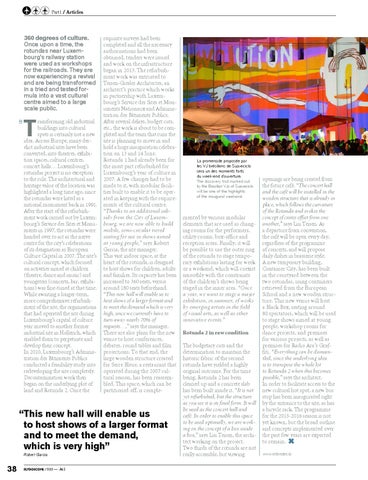
La promenade proposée par les VJ brésiliens de Suaveciclo sera un des moments forts du week-end d’ouverture. The discovery trail marked out by the Brazilian VJs of Suaveciclo will be one of the highlights of the inaugural weekend.
mented by various modular elements that are used as changing rooms for the performers, utility rooms, box-office and reception areas. Finally, it will be possible to use the outer ring of the rotunda to stage temporary exhibitions lasting for week or a weekend, which will coexist smoothly with the constraints of the children’s shows being staged in the inner area. “Once a year, we want to stage a major exhibition, in summer, of works by emerging artists in the field of visual arts, as well as other innovative events.” Rotunda 2 in raw condition The budgetary cuts and the determination to maintain the historic fabric of the second rotunda have yielded a highly original outcome. For the time being, Rotunda 2 has been cleaned up and a concrete slab has been built inside it. “It is not yet refurbished, but the structure as you see it is its final form. It will be used as the concert hall and café. In order to enable this space to be used optimally, we are working on the concept of a box inside a box,” says Lisi Teisen, the architect working on the project. Two thirds of the rotunda are not really accessible, but viewing
openings are being created from the future café. “The concert hall and the café will be installed in the wooden structure that is already in place, which follows the curvature of the Rotunda and evokes the concept of crates offset from one another,” says Lisi Teisen. As a departure from convention, the café will be open every day, regardless of the programme of concerts, and will propose daily dishes in brasserie style. A new temporary building, Container City, has been built in the courtyard between the two rotundas, using containers retrieved from the European School and a new wooden structure. This new venue will host a Black Box, seating around 80 spectators, which will be used to stage shows aimed at young people, workshop rooms for dance projects, and premises for various projects, as well as premises for Radio Ara’s Graffiti. “Everything can be dismantled, since the underlying idea is to transpose the whole lot to Rotunda 2 when this becomes possible,” says the architect. In order to facilitate access to the new cultural hot spot, a new bus stop has been inaugurated right by the entrance to the site, as has a bicycle rack. The programme for the 2015-2016 season is not yet known, but the broad outline and concepts implemented over the past few years are expected to remain. . www.rotondes.lu