Part 1 // B2B
Banking
Software to make a difference The banks are continuing to invest in IT and banking software applications, although their spending is lower than a few years ago. Nowadays, the investments that are made are designed above all to improve their knowledge of the client in order to increase customer loyalty. Text: Sébastien Lambotte | Photo: Olivier Minaire
Français, lire page 68...
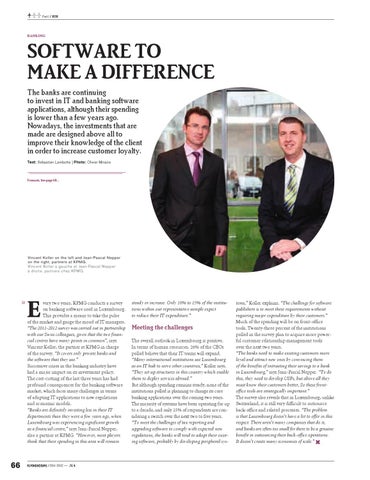
Vincent Koller on the left and Jean-Pascal Nepper on the right, partners at KPMG. Vincent Koller à gauche et Jean-Pascal Nepper à droite, partners chez KPMG.
eN
66
E
very two years, KPMG conducts a survey on banking software used in Luxembourg. This provides a means to take the pulse of the market and gauge the mood of IT managers. “The 2011-2012 survey was carried out in partnership with our Swiss colleagues, given that the two financial centres have many points in common”, says Vincent Koller, the partner at KPMG in charge of the survey. “It covers only private banks and the software that they use.” Successive crises in the banking industry have had a major impact on its investment policy. The cost-cutting of the last three years has had profound consequences for the banking software market, which faces many challenges in terms of adapting IT applications to new regulations and economic models. “Banks are definitely investing less in their IT departments than they were a few years ago, when Luxembourg was experiencing significant growth as a financial centre,” says Jean-Pascal Nepper, also a partner at KPMG. “However, most players think that their spending in this area will remain
steady or increase. Only 10% to 15% of the institutions within our representative sample expect to reduce their IT expenditure.”
Meeting the challenges The overall outlook in Luxembourg is positive. In terms of human resources, 26% of the CEOs polled believe that their IT teams will expand. “Many international institutions use Luxembourg as an IT hub to serve other countries,” Koller says. “They set up structures in this country which enable them to deploy services abroad.” But although spending remains steady, none of the institutions polled is planning to change its core banking applications over the coming two years. The majority of systems have been operating for up to a decade, and only 15% of respondents are considering a switch over the next two to five years. “To meet the challenges of tax reporting and upgrading software to comply with expected new regulations, the banks will tend to adapt their existing software, probably by developing peripheral sys-
tems,” Koller explains. “The challenge for software publishers is to meet these requirements without requiring major expenditure by their customers.” Much of the spending will be on front-office tools. Twenty-three percent of the institutions polled in the survey plan to acquire more powerful customer relationship management tools over the next two years. “The banks need to make existing customers more loyal and attract new ones by convincing them of the benefits of entrusting their savings to a bank in Luxembourg,” says Jean-Pascal Nepper. “To do this, they need to develop USPs, but above all they must know their customers better, So these frontoffice tools are strategically important.” The survey also reveals that in Luxembourg, unlike Switzerland, it is still very difficult to outsource back-office and related processes. “The problem is that Luxembourg doesn’t have a lot to offer in this respect. There aren’t many companies that do it, and banks are often too small for there to be a genuine benefit in outsourcing their back-office operations. It doesn’t create many economies of scale.”
FlYdoscope // 2011-2012 — \4
07_66-68_logiciel_bancaires_B2B.indd 66
06.12.2011 14:59:07 Uhr