
Maine Farms 2015

Page 1


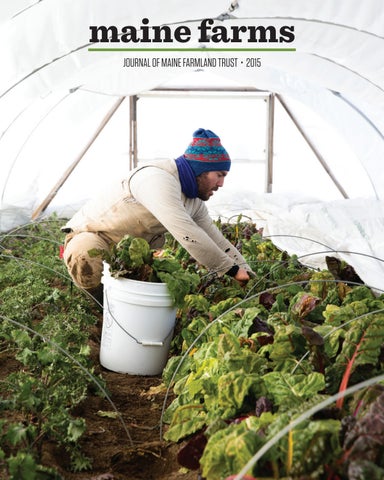
maine farms

JOURNAL OF MAINE FARMLAND TRUST • 2015

Last spring, we took a leap of faith, publishing the inaugural issue of maine farms. We shipped copies to every Maine Farmland Trust member, and then waited, holding our breath. To our great relief, this experiment was met with a flood of praise.

Of the many notes, emails, and phone calls that we received, the ones that really stood out were from farmers and food champions who are the inspirations behind our work. Three examples:

"A superlative effort inside and out, right down to the heavy card stock cover and perfect-binding."

jim gerritsen, wood prairie farm

"In recent visits with farmers and exchanges with others, I’ve sensed a general ‘buzz’ about the periodical, and I am excited about sharing it further to ‘ground’ people to food and farm issues in Maine.”

bonnie rukin, slow money maine

“I am so impressed with this publication...the links to art, the content, the bringing together of diverse farming groups, and of course, a vision.”

john krueger, mofga board member

This year’s journal offers important new stories about Maine’s farmers and food community— from the tricky business of reclaiming farmland, to spring's fleeting bounty, to the farmers on the frontlines of four-season innovation, to a sneak peek of a new food access photo exhibit.

Putting maine farms together is no simple task. We count ourselves lucky to be working with a sharp editor, a highly-creative design team, and talented contributors—who all go above and beyond because they believe wholeheartedly in MFT's mission. We extend our sincere thanks to everyone who makes this journal possible—including you, our readers.

maine farms

3 field

Snippets from the farming landscape

4 poem “The Lavatera Tips Its Hat”

AMANDA LABELLE

5 art

Jacinda Martinez does not just make art about agriculture, but with it

BRITTA KONAU

7 future

More farming creates both a need and an opportunity to farm differently JOHN PIOTTI

15 business

The avant-garde is growing year-round; gaining ground, stability, and good results in the process

KIMBERLY RIDLEY

25 food

The taste of spring in Maine and a recipe for asparagus risotto

NANCY HARMON JENKINS

31 people

Food insecurity is a growing problem in our state, but there's also a growing movement to fight it

ANNIE MURPHY

37 land

A fourth-generation dairy farmer creates a lasting legacy

CHELSEA HOLDEN BAKER

editor

Chelsea Holden Baker

design

Might & Main

writing

Chelsea Holden Baker

Nancy Harmon Jenkins

Britta Konau

Amanda LaBelle

Annie Murphy

John Piotti

Kimberly Ridley

photography

Bridget Besaw

Brendan Bullock

Stacey Cramp

Winky Lewis

Graham Mallory

Jacinda Martinez

Greta Rybus

artwork

Sheep Jones

Amanda LaBelle

publisher

Maine Farmland Trust 97 Main Street, Belfast, Maine 04915 (207) 338-6575 mainefarmlandtrust.org info@mainefarmlandtrust.org

Printed on 80# Finch Opaque Bright White Smooth by J.S. McCarthy Printers, Augusta, Maine

Maine Farmland Trust protects farmland, supports farmers, and advances the future of farming.

All material ©2015 Maine Farmland Trust

decreasing farmland the field

snippets from the farming landscape

In Growing Local (Seedlight Pictures, 2014), filmmaker Bridget Besaw explores the growing pains of Maine's local food movement, and the tenuous fate of the farmers and farmland that keep it alive. Three vignettes demonstrate hope and success, but also reveal the ever-present challenges facing farmers and local food entrepreneurs. A recurring refrain through the film is that public and consumer awareness— while so much greater now than ten years ago— is still not all it needs to be, not if farming in Maine is to realize its full promise. | growinglocalfilms.org

hops pickers

Farmland, at present Farmland in 1939 (forested at present)

River

In the early 20th century, Norridgewock (like neighboring central Somerset towns Skowhegan, Madison, and Cornville) was an agricultural hub, producing dairy for the Boston market and corn for Maine’s canneries. In 1939, there were almost 11,000 acres of open farm fields in Norridgewock— almost a third of the town’s total area. Between 1939 and now, field acreage decreased by over 50%. There are now about 5,000 acres of cleared fields in Norridgewock, but thousands more could be reclaimed for regional food production once again.

Hops are a traditional Maine crop seeing a current resurgence spurred by Maine's robust craft beer scene. In W.H. Bunting's classic book, All in A Day’s Work: A Sampler of Historic Maine Photographs 1860-1920 Part II (Tilbury House Publishers, 1997), the author offers up an explanation of why female hops harvesters were preferred in the 19th century: “In 1882 twenty-five tons of hops were harvested in Aroostook; the leading grower has nine acres in hops, picked by a force of thirty girls...Market standards were very strict, and ‘slovenly picking of immature fruit’ halved the value of a bale—it is not surprising that nitpicking female harvesters were preferred."

Kennebec

maine by numbers: food access

1 in 7

Mainers turn to their local hunger relief organization for food assistance

2,051,031 lbs.

Maine grown or caught food purchased by or donated to Good Shepherd Food Bank in 2014

18%

Mainers who use SNAP/EBT (food stamps)

30+

Maine farmers markets currently accepting SNAP/EBT cards

$744,366

incentive funds recently granted to Maine organizations through the new USDA Food Insecurity Nutrition Incentives (FINI) program that will make local food more accessible at farmers markets, farm stands, and grocery stores for Mainers who use SNAP/EBT

$1+ million

the estimated increase of local food sales leveraged by the new incentive funding

Sources: Maine Federation of Farmers Markets, Maine Local Foods Access Network, Good Shepherd Food Bank, Feeding America, USDA

the lavatera tips its hat

seasons with graceful silence repeat but saturn returns like a house afire inconvenient, undeniable but welcome and wholly unaware

of the things we have made nearly obsolete with our insistence that the earth turn just so for us

but here i am left unable to shake the smell of a freshly dug carrot a fennel bulb cut or the steady hum of bees working with diligence and detail

and the orb spider wraps her eggs for a spring she won't see the lavatera tips its hat and the wind bears its weight on me same as the birds

Amanda LaBelle spends the growing season with her hands deep in the dirt at Hope’s Edge Farm. Most days she splits her time between being in awe of the hums, creaks, and colors of life, and cracking up at who-knows-what.

Jacinda Martinez: dressing up with nature

Jacinda Martinez does not just make art about agriculture, but with it. Her alignment of human and vegetable forms shows a fine sensitivity to character and the aesthetic potential of both.

Since 2009, Jacinda Martinez has been creating her series Fashion in the Raw, sewing or braiding chard, radicchio, celery, cabbage, and much more, into complex dress forms. Parsley sprigs line up into a skirt; radishes form a bikini top, their tips threaded into a necklace; prickly layers of leaves and vines sweep dramatically around a model’s nude body. It is important to Martinez that these vegetables have bolted, come from a compost pile, or are otherwise unsuitable for consumption. “I don’t want to waste food but give it a second life,” she states. In her earliest photographs the models pose in nature, intensifying the suggestion of fecundity and growth. Martinez’s creations act as nurturing armor of abundance and generosity.

These are not just vegan versions of Lady Gaga’s raw meat dress or its 1987 feminist precursor by Jana Sterbak. Other artists creating plant-based dresses generally adhere to a standardized dress format and don’t subscribe to Martinez’s recycling impulse or put their creations to the test of wearability. Martinez’s motivation and artwork eloquently speak of her personal journey. She was born in Brooklyn to a health-conscious Danish mother who ran a fabric and craft shop, and a father from the Dominican Republic who worked with highfashion trimmings in Manhattan’s garment district. “My parents are fabric people,” Martinez says. “There was always fabric around when I grew up.”

As a young adult, she expanded the range of her interests and artistic expressions by studying psychology and art (“with a hint of feminism”), taking weaving classes and apprenticing with a Scottish basket weaver who grows her own willows, and by working on organic farms, including three years as head farmer at Rockland’s award-winning restaurant Primo.

These transformative experiences have inspired Martinez to work in circles: growing, making, recycling. Although she feels closest to the creative dressing part of her process—“I crave making the dresses,” Martinez admits, “it’s like a catharsis to me”—the photography is increasingly important too.

Four years ago she began photographing inside barns and now shoots in a studio—a far cry from the plein air of earlier work where lighting control was limited. Current dress pieces are also more sculptural and the images themselves more deliberately composed. Each image is proof of Martinez’s attunement to the plants’ properties and growth patterns, and the models’ body type and appearance. Martinez feels female bodies offer creative possibilities; that women convey greater intimacy and vulnerability than men. A willingness to become vulnerable is certainly required from the models. Wearing cucumber and squash vines on your naked body provides questionable comfort. It is probably not obvious to the non-gardener that the plants are beyond their prime. The lush images still evoke nature’s fertility and may bring to mind painter Sandro Botticelli’s barely clad, willowy maidens in his Allegory of Spring (ca. 1482). It may be more appropriate though to think of Martinez’s works as vanitas, reminders of mortality. In fact, Martinez is now combining fresh and desiccated materials and just started to rephotograph a particular dress and model while the plant is decaying. However, the works are always gorgeous, inventive, and respectful of the women, their privacy and individual form, as well as the vegetables. These images capture a primal interconnectedness of all things natural in which humans can take on a nurturing and sustaining role. | jacindamartinez.com

artwork

Top Garlic Scapes 1, 2014, photograph, 24 x 34 in.

Lower Right Broccoli, Amaranth and Orach 1, 2014, photograph, 24 x 16 in.

Lower Left Tatsoi 1, 2010, photograph, 24 x 16 in.

Reclaiming Maine’s Lost Farmland

and rethinking how we farm

Philip and Heather Retberg of Quills End Farm in Penobscot have a lot in common with other young couples I’ve seen repopulate old farms: a clear commitment to good farming practices and good food, to improving their community, and through it, our planet.

Yet different farmers take different paths. A decade ago, when I first met the Retbergs, they were doing something that was rare in those days: reclaiming former farm fields that had grown up in trees. Pioneers in more ways than one, the Retbergs were staking a claim on their future.

It’s easy to forget the vastly different perception of farming’s future held by most Mainers—including many farmers—just a few years ago. When I began working with farmers in the mid 1990s, conventional wisdom held that farming in Maine was dying.

The first statistics that hinted at farming’s potential re-birth appeared in the Federal Agricultural Census of 1997, with stronger signs

evident in 2002. From 2002 to 2007, the number of farms in Maine increased by almost a thousand, from 7,199 to 8,136. By 2012, the value of farm production was up 24 percent over 2007, showing that new operations were not all small hobby farms, as some had suspected. Meanwhile, from 2007 to 2012, the number of beginning farmers jumped nearly 40 percent. Clearly, something positive was happening.

Yet these statistics, as informative as they are, can’t capture the complexities undergirding farming’s renaissance. A deeper look at farm operations would reveal that some farms are thriving, while others are struggling, and many more only remain in business because the farmers are willing to work exceptionally hard for little money.

While there is more to the issue, it is safe to say that farming in Maine is growing, if unevenly, and that public perception is more positive than it’s been in generations. There’s a newfound conviction that farming is here to stay.

farming more land

The idea that farming in Maine is poised to expand is nothing new, but it was thrust into the spotlight last spring with the release of A New England Food Vision. The widely-circulated study showed how New England could produce as much as twothirds of its own food by the year 2060, but only if the region expands its agricultural production by 3-4 million acres. A good chunk of that land will need to come from Maine, simply because it isn’t available anywhere else in New England.

But just because something could happen, doesn’t mean that it will—or that it will in a way that serves Maine well. As history shows, Maine farmers do not always benefit more from growing more. And clearing millions of acres of woodland for local food production could either help the environment or hurt it, depending on how it’s done.

The bottom line is that it will take real effort to get this right. And we won’t get it right unless we think differently and act smartly. We can’t expect that expanded farming will necessarily benefit farmers, unless we address some of the underlying issues that prevent farmers from making a decent living. Beyond this, we can’t think about expanding farming simply by returning overgrown woodland into farm fields. For one thing, we can’t afford to cut trees without paying attention to carbon emissions and water quality. For another, we can’t succeed at any of this unless we see the big picture—how fields and woods can each play a role in food production, and how any sustainable food system relies on the health of the broader ecosystem.

Reclaiming former fields is clearly central to the future of farming in Maine. But we also need to move beyond our current thinking that fields are the only places where we can raise crops or livestock.

why reclamation ?

Unlike a decade ago, today I know many farmers who are reclaiming former fields from woodland, and many more who are thinking of it. Farmland reclamation is driven by both current economics and future possibilities. The market for biomass (i.e., the woody fiber that comes from cut trees and brush) is now such that a landowner can often clear a swath of land for no cost—even a swath of low-value species like alder or pasture pine. Overgrown fields also appeal to a subset of farmers: those who can’t outlay enough cash for an open parcel, but are willing to invest sweat

returning woodland to agricultural production. Meanwhile, the broader factor driving farmland reclamation is that Maine boasts millions of acres of once-farmed land that could be farmed again.

In the 1880s, 6.5 million of Maine’s 20 million acres was cleared land used for farming—either for growing crops or grazing livestock. Today, only about 700,000 acres of land are used in this way. Of the remaining 5.8 million acres, some has been lost to development, but probably not much more than a million acres or so. Over 4.5 million acres of once-farmed land has reverted to woods—and very little of that land is part of Maine’s great northern forest, on which our paper mills rely. Here is a way that Maine could contribute millions of acres to the emerging vision that New England might someday grow most of its own food.

Still, the goal should not be to simply transform millions of acres of woods into fields, but rather, to utilize that land for food production in new ways. There is a subtle yet important difference here, stemming from the fact that open fields are not the only way to grow food.

growing food in woods

Most of us acknowledge that woods are good places to collect maple sap and perhaps pick a few wild berries, but we seldom think of woods as a potential source of staple food products. And yet, many of the fruits and nuts we eat—though now harvested from orchards and fields—come from trees and woody shrubs with forest origins. Likewise, we may gather mushrooms or fiddleheads in the woods, but never think of raising traditional vegetable crops under a forest canopy. Yet many vegetables grow well in partial shade—including garlic, peas and greens. We could utilize our woodlands to grow more fruit and nuts, while cultivating vegetables in the understory. This concept of intermixing food-bearing trees with understory crops is the idea behind “forest farming.” Rooted in practices that stretch back centuries, forest farming was formally advanced in the 1930s, and more recently embraced by some of the advocates of permaculture. Though still rare in Maine, forest farming fits well with our soils and growing conditions.

Woods can also feed livestock, which can thrive off the shoots of many trees, including poplar, locust, and beech. At one time in the South, mulberry was common fodder for pigs; while in Europe, pollarded willows were once customary winter feed for cattle. (In fact, the product was called “pollard hay.”) Slowly,

We can’t succeed at any of this unless we see the big picture—how fields and woods can each play a role in food production, and how any sustainable food system relies on the health of the broader ecosystem.

By the 1880s, the vast bulk of southern and central Maine had been cleared for farming.

these practices are beginning to return. Here in Maine, I’ve had one experimenting farmer tell me that her goats thrive on spruce, which in turn gives their milk a distinct flavor that makes awesome cheese. Beyond this, thinned woods are often suitable for pasturing, as many grass species grow well in partial shade. The trees that remain in a sparse wood provide livestock with winter shelter and summer shade, while capturing water during dry spells in ways grass cannot. Increasingly, farmers are both pasturing livestock and growing woody forage on forested parcels that they also manage for lumber and firewood. “Silvopasture” is the modern term for this collection of ancient practices. As Maine considers how it should once again

grow food on once-farmed land, both silvopasture and forest farming have a role to play. It’s not that using partially cleared woodland for these purposes is somehow superior to farming open fields, as is commonly done, but rather, that these practices use the resources differently and form a different imprint on the land. As such, they have a place in any overall system that aims to improve efficiency and reduce negative impacts.

thinking broader

We also need to re-think how we pasture animals. Regardless of whether livestock are grazed in open fields or in woods, the ecosystem can benefit

Past farming practices often depleted soil and polluted waterways.

greatly by using “management-intensive grazing,” in which animals are frequently rotated from one small area to another. This reduces runoff, while retaining nutrients and building soil carbon. It’s a smart practice, even if it does run counter to the romantic image of a farmer releasing sheep or cattle into a large pasture for the summer.

Another common notion we need to move beyond is that a field, once cleared, should stay a field. Farmers have become accustomed to the idea of raising crops on a rotating cycle of, say, three years; but there is also value in thinking about far longer rotations of a hundred years or more, during which the very use of the land would change, not just the crops. During such a long period of time, a suitable woodland parcel may be either partially or fully cleared for livestock and/or crop production. (The decision of how much to clear would be driven by many factors, including soil qualities.) The parcel could then be managed to revert back to a wood, though perhaps one containing more fruit and nut trees than it had before. Perhaps 50 years in the future, this land could be cleared in some fashion again, starting the cycle anew.

Such a system would bring with it some of the same kinds of benefits of short-term crop rotations, including reducing soil erosion and increasing organic matter, only on a whole different level. It could also serve to sequester large amounts of carbon, since neither land clearing nor farming, if done right, need result in net carbon emissions.

In this light, the new wave of Maine land clearing that is now beginning could be viewed as the beginning of something much broader, and far more beneficial, than just creating new farm fields. Here is an opportunity to craft a dynamic and innovative system for sustainably producing more food.

Maine should never have been farming 6.5 million acres in the 1880s—or at least not those particular 6.5 million acres in that manner. The landscape across much of southern and central Maine during that period was basically devoid of trees, except for orchards. Land was often cleared right up to the banks of rivers and streams. Pastures were often over-grazed and crops worked with little regard for soil conservation. As a result, we depleted our topsoil and despoiled our waterways. It’s a common story for our species: We push things beyond where they can be sustained, until the point where they collapse. But it doesn’t need to be this way.

from “ best practices ” to “ next practices ”

As Maine now moves to farm more, we need to learn from past mistakes. For instance, if we are to clear more land—whether fully or partially— it’s critical that we do so in ways that prevent soil erosion. Loss of topsoil not only constrains farming’s future, but results in the silting of brooks and streams, destroying spawning habitat for critical fish species. And if we are farming more, we need to be far more conscious of any fertilizers and pesticides we use, because their harmful residuals invariably end up in our waterways.

This makes good sense on more than environmental grounds: After all, if a major reason to expand farming in Maine is to grow more food, it’s foolhardy to grow more food on land at the expense of food that could be harvested from our waters.

Yet as we expand farming, we don’t know exactly what practices to follow to ensure that we are doing things smartly. Consider, as just one example, how we can’t say with any certainty what size buffer strip is required to maintain water quality downstream from a newly cleared farm field. It depends on so many factors, such as the vegetation in the buffer, the way the farm field is managed, the nature of the terrain, and more. Beyond this, it's critical to design any buffer strip to not only meet the needs of today, but the needs of the future, when extreme weather events are likely to be more dire and more frequent. No standards of this sort have yet been developed, because the research has not yet been done.*

Farmers are used to the notion of “best agricultural practices,” various operational standards articulated in farm publications and, at times, in law. But when it comes to farmland reclamation, the standards that exist are insufficient, either because they weren’t designed to take the full ecosystem into account, or because they don’t respond to the realities of a changing climate. We need to move beyond our current “best practices” to what I call “next practices.”

One of many reasons to step up our game is that we can no longer ignore the impact of carbon emissions. It may seem that clearing woodland would result in a net increase in atmospheric carbon, but

* This is a focus of a PhD dissertation now being undertaken by Amanda Beal, a long-standing food systems advocate who serves as Maine Farmland Trust’s Policy and Research Fellow.

that need not be the case. Any wood that is suitable for lumber could be utilized in a way that ties up that carbon for 100 years or more. Some of the other wood could be converted into bio char, a soil amendment that sequesters carbon while increasing the fertility of the new field. And any remaining biomass could be used as heating fuel or to generate power, replacing fossil fuel now used for those purposes. In addition, there’s a range of ways in which to clear land, each with a different carbon footprint. For instance, pigs can be pastured on partially cleared land as an alternative to using heavy equipment to remove roots. Beyond all this, any newly-created field could

be farmed in a manner that sequesters more carbon than did the pre-existing woodland by utilizing no-till methods, aggressive cover cropping, and other regenerative practices.

Simply put: There are many different ways to prepare land for farming and to then farm it— all with different impacts.

restoring our planet

If we are smart about it, Maine could simultaneously advance local food production and environmental health, while also making strides to reduce carbon

More and more farmers are working with nature to grow food. Shown here Philip Retberg and son Alexander

emissions. The strategy would involve clearing land—both fully and partially—in accordance with forward-looking environmental standards, and then pursuing production practices that wisely steward that land. Partially cleared parcels would become laboratories for forest farming and silvopasture. Fully cleared parcels would be farmed in ways that both produce high yields and sequester carbon. And wherever livestock are pastured, we’d see widespread use of management-intensive grazing. The whole system would be managed on a multi-generational rotation of 100 years or more.

Of course, that is only part of what’s needed. Despite increased demand for local farm products, there is not yet sufficient demand to support significant increases in production at prices that work for farmers. For an assortment of reasons, often political, many of our farmers don’t make enough money to cover their true costs of production. To abridge my extensive writing on this topic I’ll simply say that I’m confident that more economically viable markets will develop over time. But until that happens, the last thing that makes sense is for those farmers to grow more.

Still, perhaps it’s good—in a way—that we have time to think things through before we reclaim millions of acres of former farmland, time to further study and refine “next practices.”

Maine has the chance to do something truly significant, something that is powerful on its own and even more powerful because it could be a model for others. Maine can do far more than feed itself and help feed New England: Through our farmers, Maine can lead the way to restoring our planet.

Heather and Philip Retberg were among the farmers featured in From the Land: Maine Farms at Work, my 2009 collaboration with photographer Bridget Besaw. In it, Philip offered these thoughts:

The farm itself is an ecosystem. Our crop is grass. Our harvesters are chickens and cattle and pigs and lambs and all the microbes and earthworms that live off what we do as we rotationally graze our animals. The entire ecosystem benefits… It increases the fertility of the soil, increases its ability to capture sunlight and do that incredible photosynthesis thing that feeds all life. Our job is to steward the land with the resources we are given: sunlight, water, earth, and photosynthesis.

Our future lies in farms like this. 

In 2013, young farmers Graham and Emily Mallory purchased about 200 acres of what had been “The Great Farm” in Jackson. Though entirely wooded when they bought it, this property had once been an expansive stretch of open land, worthy of the name given to it by Boston tycoon Israel Thorndike. In 1806, Thorndike established the farm, which was once over a thousand acres in size. The story of The Great Farm’s demise is a familiar one, common throughout central and southern Maine. By the late 19th century, a lot of Maine farmland was farmed too intensively, depleting the soil and polluting the water. The outcome was collapse. Graham and Emily had previously raised grassfed livestock on leased land in the nearby town of Monroe. In purchasing The Great Farm, their goal was not only to expand their livestock operation, but to “reclaim and restore” this historic property, returning it to a sustainable form of agriculture. With some help from their animals, they have created 100 acres of forest pasture that intermixes trees and grass. The initial cut of wood went to biomass. Cattle followed, feeding off round bales that returned organic matter to the soil. Next came pigs, turning over the soil between the stumps and tilling the earth for a grass crop. The transformation is astounding—on multiple levels. The couple’s operation, aptly named Pastures of Plenty, utilizes “management-intensive grazing” that works with the natural ecosystem, not against it. Their grassfed beef and woodland pork can be purchased on their website | popgrazing.com

Cattle graze, and help restore, a newly reclaimed field at Pastures of Plenty.

FOUR-SEASON FARMING

Sustainable Agriculture's Growing Edge

By November, most vegetable growers in Maine have put their fields to bed and headed indoors to catch up on paperwork and repairs or take a break.

A handful of farmers around the state, however, continue through winter, growing a bounty of fresh spinach and salad greens, chard and kale and other cold-hardy crops in high tunnel greenhouses—often without using a drop of fossil fuel for heat. Not so long ago, there were only a handful of people who thought this was possible.

“When we started, everyone said it was impossible,” says Eliot Coleman, laughing. “Well, it wasn’t.” Coleman, who has written extensively on organic gardening, pioneered ingenious ways to grow cold-hardy vegetables in the frigid Maine winter by using plastic-covered high tunnel greenhouses heated only by the sun. His approach in a nutshell: grow only cold-hardy crops, plant them in succession in late summer through early fall, and protect them with an inner layer of floating row cover.

In 1995, Coleman and his wife—fellow gardening guru Barbara Damrosch—began using these techniques to grow winter crops commercially at Four Season Farm on Cape Rosier, based on years of research and experimentation in their home

greenhouse. They’ve been at it ever since, and Coleman has shared his secrets in meticulous detail in his books, including The Winter Harvest Handbook—inspiring farmers around the country and sowing the seeds of a revolution.

No one knows precisely how many farms are doing winter production in Maine—estimates run from about a dozen to twenty—but the flowering of this revolution is evident at winter farmers markets around the state. The Maine Federation of Farmers Markets now lists 32 winter markets, a growing number of which are featuring fresh spinach, greens, and other greenhouse crops alongside storage crops such as winter squash, potatoes, and onions.

Four-season farming is still new here and there are plenty of challenges: short days and frigid temperatures, mastering the intricate temporal choreography of using moveable high tunnels, marketing, and the sheer physical rigors of farming in winter, to name a few. But checking in with farmers growing crops in winter offers an intriguing glimpse of the possibilities. Welcome to the growing edge of sustainable agriculture in Maine.

A Hundred Percent Sun-Powered: Two Farmers and Six Rivers

Kelsey Herrington and Dominic Pascarelli discovered their shared passion for farming as graduate students at Clark University. Pascarelli helped organize the university’s composting system and mentored youth in an urban gardening program, and Herrington studied sustainable meat production on a local farm. After earning their master’s degrees in environmental science and policy, they apprenticed at a farm in Vermont and then Paul and Sandy Arnold’s Pleasant Valley Farm in Upstate New York, where they learned four-season farming, and got “hooked” right away. Looking to start a year-round organic farm of their own, they began farming on land Pascarelli’s parents own in Durham in 2011 and relocated their Two Farmers Farm to ten acres of leased land in Scarborough in 2013. Smack dab between Route One and the Scarborough Marsh, they grow more than fifty certified organic crops on about 2.5 acres, including three 96-foot-long solar high tunnels filled with flourishing winter greens.

“We learned how to do winter farming in a system that didn’t use supplemental heat, and that’s the system we’re comfortable with and know how to use successfully,” Herrington says. “We don’t add heat because we don’t think we need it.”

“Some people might say, ‘you’re crazy, just add heat,’” Pascarelli adds. “But what we’ve heard from some growers is that heating a greenhouse is a mixed bag. Some of your crops like extra heat, but so do some diseases and pests.”

A blustery afternoon in late fall finds Herrington and Pascarelli buttoning up tunnels bursting with luxuriant beds of rainbow chard, lettuce, mustard greens, and other cold-hardy crops. They’ll harvest them weekly through most of the winter to sell at farmers markets in Saco, Brunswick and southern New Hampshire, and a few restaurants in Greater Portland.

“It might seem like we’re giving up our break for the year by farming in winter, but our goal is to sell 48 to 50 weeks a year so we don’t have to cram earning all of our income into 25 or 30 weeks,” Pascarelli says. “We’re trying to avoid the extreme stress of July through September. We haven’t quite

achieved that, but we did a lot better than last year.”

Two Farmers’ dazzling winter beds make what they do look deceptively easy, but, of course, it isn’t. Winter crops in unheated tunnels must be covered every cold night or they’ll freeze, and uncovered to maximize light and stimulate growth later in the winter when the days lengthen. Then there is harvesting—on one’s knees for hours cutting tiny leaves with a knife in finger-stinging cold, not to mention meticulous washing and packaging. On top of the intense labor of farming are the challenges of running any small business: marketing, sales, budgeting, accounting, and myriad other tasks.

Herrington and Pascarelli intend to keep Two Farmers small to earn a sustainable living for themselves and their employees (currently two part-timers). “Our vision is to have a business that can fairly support us and our employees without us ever having to work off the farm,” Herrington says. She adds that sustainability also means “time off, enough money for some sort of recreation, and a business that’s not excessively stressful.”

The two farmers are quick to point out that they had help in getting started. Affordable grants from Slow Money Maine assisted with start-up costs for the tunnels. Pascarelli’s contractor father and a friend helped build the tunnels, his mother helps wash and pack produce, and the original farmer who connected them with the landowner did the heavy tractor work. Other farmers pitched in as well. New Leaf Farm in Durham grew their first seedlings, and Six River Farm founders Nate Drummond and Gabrielle Gosselin of Bowdoinham mentored Herrington and Pascarelli through MOFGA’s Journeyperson Program, which pairs new farmers with established ones. Drummond and Gosselin apprenticed a few years before Herrington and Pascarelli at Pleasant Valley, where the Arnolds introduced the young farmers. Through Maine Farmland Trust’s FarmLink Program, which connects prospective farmers with available land, Drummond and Gosselin leased 25 acres of land in Bowdoinham, where they started Six River Farm in 2007. They began winter farming in 2010, and now grow about a dozen winter crops in ten unheated tunnels totaling 21,120 square feet, or just under a half-acre. These crops represent about a third of their winter offerings, which also include storage crops such as potatoes, cabbage and winter squash. Dominic Pascarelli of Two Farmers Farm in Scarborough harvests kale in a winter hoop house heated only by the sun. Kelsey Herrington, Pascarelli’s partner at Two Farmers and in life, makes notes at a desk improvised from a tailgate. Two Farmers sells organic spinach and other greens at winter farmers markets in southern Maine and New Hampshire.

"It

might seem like we’re giving up our break for the year by farming in winter, but our goal is to sell 48 to 50 weeks a year so we don’t have to cram earning all of our income into 25 or 30 weeks."

DOMINIC PASCARELLI, TWO FARMERS FARM

Drummond says winter farming accounts for about 20 percent of Six River’s income, but the benefits go beyond dollars and cents. “Winter farming is great for us. It keeps our loyal farmers market customers in Brunswick supplied with fresh produce through the winter. Overall, it doesn’t represent a huge percentage of our total sales, but the cash flow through the winter is nice. And the customer retention really sets up our summer and fall farmers markets.”

Winter farming also helps Six River retain employees—all seven of whom are staying on to work at the farm this year. “All of our farm crew lives locally, and work in the winter—when there are few other employment options—is important to them,” Drummond says. He adds that the opportunity to work year-round means that many crew members stay at Six River for several years. “It’s invaluable to have an experienced, hard-working crew when the farm reaches its busiest season in the summer,” Drummond says.

Turning Up the Heat a Notch

While the farmers at Six River and Two Farmers raise all of their winter crops in high tunnels warmed only by the sun, other Maine growers add supplemental heat to boost winter production. Using conventional and alternative fuels and heating systems, they are constantly experimenting, evolving techniques and growing the potential of year-round farming in Maine.

Lisa and Ralph Turner started Laughing Stock Farm in Freeport in 1997 with surplus produce from their home garden and greenhouse, where they were inspired to grow cold-hardy crops after reading one of Eliot Coleman’s books. They now manage 15 acres, including 12 acres of organic vegetables and six hoop houses, with total winter production covering about a third of an acre. The Turners have about 250 members in their summer CSA and about 110 members in their twice-a-month winter CSA, and they also sell to local restaurants and retail outlets. The bounty of their farm inspired Lisa to write The Eat Local Cookbook: Seasonal Recipes from a Maine Farm. On a cloudy December afternoon, Lisa Turner tromps across her snowy driveway in flowered

Farm workers at Six River Farm in Bowdoinham plow snow and cover greens with floating row cover to protect them from freezing at night.

rubber boots and rolls up the metal door to a greenhouse. Follow her inside and you find yourself transported to spring. Verdant rows of mesclun and scallions, two of the winter crops the Turners grow, glow in the afternoon light, along with arugula, lettuce, bok choi, hakurei turnips, radishes, baby spinach and kale and cilantro. Redolent of fresh earth and plant life, the air is moist and much warmer than outdoors.

The Turners decided to use supplemental heat to promote faster growth and raise more crops in less space at Laughing Stock, where winter growing generates about one sixth of the farm income. Ralph, a mechanical engineer, pioneered a technique to heat Laughing Stock’s greenhouses with used cooking oil and animal fat that he collected from Freeport restaurants. For about ten years, the Turners used this fuel for about 80 percent of their greenhouse heating needs, with the other 20 percent coming from propane.

Federal subsidies on biodiesel for transportation, however, have driven up the cost of used cooking oil, resulting in their farm losing between $15,000 and $20,000 per year, according to Lisa Turner. “We

didn’t have that money to lose, so we had to increase the business by finding more land and hiring more employees to cover it,” says Turner, a forthright woman in her fifties. The Turners now heat their greenhouses with about 25 percent used cooking oil and 75 percent propane, but that could change. “We’re keeping all our options open for heating,” she says. “It’s an ever-changing market, which the price changes in heating oil this winter proves.”

A bumblebee pings against the plastic walls of the greenhouse and a fine, light snow begins to fall outside. Lisa Turner reflects on the ups and downs of growing Laughing Stock Farm, which employs two year-round and six seasonal workers. The Turners clearly are succeeding: they received the 2014 Commissioner’s Distinguished Service Award from the Maine Department of Agriculture, Conservation and Forestry. “The puzzle of how to do this and make a living is actually fun,” she says.

Lettuce and kale seedlings thrive in a winter hoop house. Jeff Marstaller of Cozy Acres Greenhouses in North Yarmouth weighs microgreens, a mix of tiny beet, lettuce and arugula seedlings, for delivery to Portland area restaurants.

Into the Future

Laughing Stock Farm was among the stops on a 2014 Maine Farm Bureau tour of year-round growers, along with Olivia's Garden, a hydroponic outfit in New Gloucester, and Cozy Acres Greenhouses in North Yarmouth. Cozy Acres co-owner Jeff Marstaller is happy to show visitors his brainchild: a new “zero-emissions” greenhouse heated with geothermal energy and powered by solar electricity.

Marstaller decided he wanted to burn less propane and add a sustainable greenhouse to the wholesale seedling nursery he and his wife Marianne started in 1995. His research and project planning netted more than $80,000 in grants from a combination of Maine’s Farms for the Future Program, the USDA’s Rural Energy for America Program, and the Natural Resources Conservation Service’s Environmental Quality Incentives Program.

The 18-month project was completed in December, 2013: a 96 x 30 polycarbonate and acrylic greenhouse heated by a 10-ton geothermal system powered with 102 solar panels. In its first year of operation, the solar panels generated about 39,000 kilowatt hours of electricity—less than the system used—and the geothermal heating system kept temperatures above freezing on the coldest nights, and hit 55 to 65 degrees during the day.

The Marstallers grew lettuce to test their new system and have since switched to organic microgreens, which have a short growing cycle that lets them stay ahead of aphids. On a December afternoon, the only sound in the greenhouse is the snip of scissors as the Marstallers harvest fresh microgreens—a mix of tiny beet, arugula, and lettuce seedlings. They sell to a handful of local restaurants and retailers and hope to develop a larger local market for their baby greens, which meld earthy-tangy-sweet-flavors. In addition to using their new greenhouse to grow microgreens ten months of the year, they will also use it for some of their wholesale seedling business in spring.

While the final price tag for the project is admittedly high—more than $200,000—Marstaller says that the grants and tax savings and credits help offset more than 50 percent of costs. He thinks the new greenhouse will add value to the Cozy Acres brand and his property. “To the best of our knowledge, this is the only heated yearround greenhouse this far north that is totally powered with zero-emission sources,” he says.

Growing New Solutions

More than 20 years after harvesting his first winter crops, Eliot Coleman is still refining and innovating four-season farming techniques, as are a growing number of farmers, university researchers, seed companies, greenhouse manufacturers, and others. “There are so many improvements we can make,” Coleman says. “We just need to keep our eyes open and see who might be doing something interesting.”

One of the many interesting things Coleman is doing is experimenting with ways to keep high tunnels warmer on the coldest nights without using costly supplemental heat. This year, he’ll be testing Solawrap, a greenhouse plastic that resembles bubble wrap and is a better insulator than sheet plastic. Used in Europe for 30 years, it’s newly available in the U.S. and Coleman will evaluate how well it performs in Maine’s frigid winters. At the same time, he will test a new system to insulate the north wall of a greenhouse with vertical plastic tubes of water heated by the sun.

High tunnels are springing up all over the state, some through a USDA Natural Resources Conservation Service cost-sharing program, but growing winter crops in them is still a tricky business. Through Four Season Farm Consulting, Clara Coleman—Eliot Coleman’s daughter— aims to help a new generation of year-round farmers succeed. In one project, she is partnering with Maine Farmland Trust to provide free consulting services to farmers associated with the new Unity Food Hub, slated to open this spring. The goal, she says, “is to have many of the farmers supplying the hub with fresh produce year-round.”

Coleman, who moved back to Maine after running her own successful year-round organic vegetable farm in Colorado, is among observers who see significant potential for the growth of four-season farming in her home state. She notes growing demand from institutions such as hospital and schools, as well as larger grocers and nearby markets in Boston, all of which would allow year-round farmers to expand into markets beyond Maine.

It remains to be seen how year-round farming will grow and evolve in Maine, but there are abundant good reasons for pursuing it, from crop failures due to droughts and floods in farming areas out West, to fluctuating fuel costs, to food

safety, to supporting Maine’s local farmers, to the vast difference in flavor and quality between local produce and vegetables shipped thousands of miles. And, of course, it’s also common sense.

“If more fresh produce can be grown here in Maine during the winter months, then we don’t have to rely on costly imports from across the country,” Clara Coleman says. “We can produce and sell more of our own products locally and employ more people locally, all of which contributes to food security.”

To that end, many Maine innovators continue to grow the roots of the year-round farming revolution.

“It’s like any new thing,” Eliot Coleman says. “The more you look into it, the more you can do.” 

Potted flowers for the wholesale market and microgreens ready for harvest flourish at Cozy Acres. Gabrielle Gosselin and daughter Alice inspect newly planted flats at Six River Farm.

The Greens of Spring and a recipe for asparagus risotto

When you write about spring in Maine it’s almost obligatory to begin by saying, “Spring comes slowly. . . .” But that isn’t entirely true. Spring, in fact, comes to Maine in frustrating fits and starts. I recall balmy weekends in late February back when I was in high school in Bethel and my pals and I would go off in our Fair Isle sweaters and Bermuda shorts to spend the day skiing in the Sunday River sunshine. And I also recall a spring evening years later, beating my way down Route 17 in a blizzard—not a snow flurry, but a blinding, all-out, day-long blizzard—trying to get from Augusta back to South Thomaston where I had a fearful ten-year-old waiting at home alone. That was on April 15th and it was the first time I heard the phrase “poor man’s fertilizer,” meaning those late spring snows that carpet the plowed fields and drive nutrients deep down into the soil where the plants’ roots will fix.

So when does spring begin in this motley state where on any one day the temperature can vary by 30 degrees, where it can be blowing snow in the mountains and sailing weather on the coast? We have had to develop other ways than the weather of knowing when spring is upon us.

Among the reliable harbingers of spring are robins, though nowadays they stay year-round, grubbing on greening lawns, red-winged blackbirds darting over farm ponds, and what we call phoebes, but are actually black-capped chickadees singing for spring with their two-stroke call: phoebe, phoe-be, feeee-bee. And then, one magical evening toward the end of March or early in April, we hear in the near distance the first tentative peep of spring peepers, the tiny frogs that inhabit vernal pools and river banks and peep-peep-peep frantically, males calling to females with desperate urgency, we can then relax at last

because we know now that, come what may—rising water, late frosts, sudden snowstorms—it is spring.

But spring is not all sound and fury, birdsong and flooding streams. It’s also about what we eat and why. Take dandelion greens, for instance. Back in the old days (I’m thinking almost a century ago when my parents were young), folks were sick to death of winter diets by March: salt fish, salt pork, dried beans, sprouting onions and potatoes, squashes and apples that were showing their wear. What could be more appetizing than a bowl of fresh greens, newly harvested, dressed with a splash of vinegar and bacon sautéed in its own fat?

My mother said we needed greens in springtime for iron to bulk up our thinning blood. Is that true? Close enough for me not to want to discount it. She gathered dandelion greens with a sharp little paring knife, cleaned them of soil, steamed them for a very long time, and served them with a splash of vinegar to cut the bitterness.

One of the best-loved greens for early foragers are fiddleheads, the tightly furled fronds of ostrich ferns, just as they emerge from the ground, looking like the curled tops of miniature bright-green fiddles. We never knew of fiddleheads when I was growing up in the Midcoast and a letter to Kenneth Roberts, Maine’s great novelist, quoted in Marjorie Mosser’s Good Maine Food, explains why: Fiddleheads, according to the President of the Bangor & Aroostook Railroad, were well known in northern Maine but unrecognized, he avowed, south of Unity. Today all that has changed and fiddleheads are a beloved kind of folk food all across the state. Unlike dandelions, which pop up with the first green grass, fiddleheads emerge around the end of April in southern Maine, their harvest gradually moving north until they arrive in the St. John Valley in late May. They’re sold at farm stands and in farmers’ markets. (If you forage for fiddleheads, make sure you know what to look for. Bracken ferns, which are similar but not identical, contain a carcinogen that can be dangerous if over-consumed.)

Look for glossy green fronds, tightly furled, with a pearly freshness to them. They should be cleaned of the papery covering, which can simply be rubbed off, and steamed for 10 to 15 minutes. As soon as they’re tender, they’re ready to serve with melted butter, a spritz of lemon, a sprinkle of Maine sea salt, and several twists of the pepper mill. I’ve also been known to sauté fiddleheads, steaming them for just 5 minutes, then sizzling them in a mixture of butter and olive oil, again with a spritz of lemon on top at the very end.

But spring is not all sound and fury, birdsong and flooding streams. It’s also about what we eat and why.

No matter which way you do it, fiddleheads should be cooked until very tender.

I know there is wild asparagus out there in the woods but frankly I’ve never been able to find it. In any case, nothing, to my mind, beats asparagus fresh from the garden, the green spears snapped off just moments before cooking. My father was a champion asparagus grower and he especially loved it for breakfast—steamed and served on buttered toast with more melted butter poured over the top. He liked the cultured butter he got when he visited his relatives down in Jonesboro, with its slight taste of the barn, and I’m happy to say that, after years of subsisting on Land O’Lakes, that kind of butter is being produced once more in Maine, from venerable producers like Kate’s in Ogunquit to Casco Bay Butter in Portland and Pleasant Acres in Livermore Falls.

Asparagus season is usually seen as a reason to consume the green spears until your pee smells grassy, morning, noon, and night. If you get tired of plain boiled asparagus, there are loads of other things to do with it, from soup to salad (cold asparagus with a vinaigrette sauce); asparagus is delicious grilled over charcoal and almost as good baked in a gratin dish with a cheesy sauce and buttered breadcrumbs on top. And if you want to go fancy for dinner, you would not go wrong with risotto. The one thing you must keep in mind is the right kind of rice to use: Arborio rice is widely available; Carnaroli or Vialone Nano, if you can find them, are even better. But don’t use ordinary long grain rice, which lacks the starchiness a good risotto needs.

Asparagus Risotto

Risotto recipes usually call for grated Parmigiano-Reggiano, but it’s fun to use an aged Maine-made cheese instead. Try Hahn’s End’s Ragged Island, made from cow’s milk, for instance, or York Hill’s Capriano goat cheese, aged anywhere from 5 months to a year.

For 6 servings

6 cups chicken (preferred) or vegetable stock

2 tablespoons butter

2 tablespoons extra-virgin olive oil

2 medium yellow onions, halved and very thinly sliced

2 cups Arborio, Carnaroli, Vialone Nano, or similar short-grain rice

¾ cup dry white wine

1 Heat the stock to a bare simmer and keep it simmering gently while you make the risotto.

2 In a heavy kettle or saucepan large enough to hold all of the rice when cooked, melt the butter in the oil and add the sliced onions. Sauté them gently over medium-low heat until they are thoroughly softened but not browned, about 15 minutes. Add the rice and stir well with a wooden spoon, until coated with oil. Cook the rice for about 5 minutes or until it appears translucent. Raise the heat slightly and add the wine. Cook, stirring gently—just a couple of strokes—until the wine has evaporated or been absorbed by the rice.

3 While the rice is cooking, snap off the extreme tips, the blossom ends, of the asparagus and set aside. Cut or snap the tender stalks into one-inch pieces. When the wine has been fully absorbed, add the asparagus pieces, minus the tips, and stir into the rice. Add a ladle or two of simmering stock, along with a small pinch of salt, and stir. (Keep in mind the saltiness of your stock and also the fact that the cheese added at the end will add salt to the dish.)

4 When the rice has absorbed the liquid, add more, along with the grated zest and juice of the lemon. Continue adding simmering liquid, ladle by ladle,

1 ½ pounds trimmed asparagus*

Sea salt and freshly ground black pepper

Grated zest and juice of half an organic lemon

½ cup ricotta cheese

2 or 3 tablespoons finely minced chives or flat-leaf parsley

¾ cup freshly grated aged cheese

stirring as you add. There should always be liquid visible in the pan but it shouldn’t be soupy. Do not add all the liquid at once; this will produce boiled rice instead of risotto. After about 10 minutes, stir in the reserved tips of the asparagus, and continue adding the liquid.

5 The rice will be done when it’s soft but with a bit of bite in the center—what Italians call al dente. Each grain should be well coated with the asparagus sauce, which should be dense and almost syrupy. The risotto should be thick enough to eat with a fork and not soupy. (You may not need to use all the stock.) Total cooking time varies from 20 to 30 minutes, depending on the degree of doneness that you're looking for.

6 While the rice is cooking, combine the ricotta and chives or parsley (or both) and beat with a small wire whisk or a fork until thoroughly incorporated.

7 When the rice is done, remove the pan from the heat and immediately stir in the ricotta-parsley mixture along with 1/4 cup of grated cheese. Add a few grinds of pepper, cover the pan, and let it sit for 5 minutes to settle the flavors. Taste before serving and add more salt if you wish. Serve immediately, passing the rest of the grated cheese at the table.

*Want to be sure you’re using Maine asparagus and not something grown in Mexico? Look on Mainelocavore.org for a growing number of farms that can supply vegetables, especially asparagus. Or check with your farmers market: Often even if farmers don’t grow asparagus themselves, they will know someone who does.

Feeding

Ifyou see the phrase “food insecurity,” you might picture scenes from distant places hit by the global food crisis: barren fields marked by drought, families fleeing wars, or people waiting in long ration lines. You might not picture Maine.

Yet more than 200,000 Mainers are food insecure. The term means hunger and scarcity; it also means lack of access to food that’s fresh and healthy.

Meeting that need for good food is where Maine’s farmers, workers, and volunteers come in. Our state already has the elements required to feed everyone who lives here: farmland, farmers, and people who are invested in forging ties between farms and low-income Mainers. By making fresh ingredients accessible to those who need them most, the projects featured here are also creating new opportunities for local farms— by opening up markets, diverting waste through farm donations and gleaning, and creating new customers by helping people learn to keep home gardens and cook with fresh ingredients.

This series is part of a larger photo project that seeks to document some of the many people working for change in their communities, with the hope that these efforts will continue to grow into a resilient food system that serves all Mainers. A joint collaboration between Maine Farmland Trust and Good Shepard Food Bank, the photo project will be shown around the state beginning in September 2015.

Maine:

GROWING ACCESS TO GOOD FOOD

veggies for all volunteer

Sarah “Sass” Linnekin brandishes a new beet. Veggies For All is a food bank farm that grows crops on four acres of land in Unity; it’s quickly becoming a model for other organizations across the state. A May 2015 graduate of the Environmental Writing and Media Studies program at Unity College, Sass herself was once food insecure and relied on hunger relief programs to feed her family. She now gives back by volunteering.

at green earth gardens in unity, Veggies For All volunteers join in the harvest. They come from all over: this group includes Unity College students, volunteers from local food pantries, and VFA staff. From left to right: John Hoeltzel, Tim Libby, Anna Mason, and Trevanna Grenfell.

jim buckle of buckle farm in unity lugs a crate of beets to a truck during the Veggies For All Harvest Party. This past spring, Jim gave CSA members a special deal on share prices if they donated $25 to VFA; during the harvest party, he and his farm crew helped kick-start the event by donating their time to work with volunteers. Also pictured in the background are: Kelsey Schrey, a member of Jim Buckle’s crew, and Sara Trunzo, VFA director.

good shepherd food bank runs the Mainers Feeding Mainers program, which partners with farms across the state to purchase fresh, locally grown food; that food is then distributed to pantries, meal sites, and directly to families who might otherwise go without fresh produce. “The food bank doesn’t care if the tomato isn’t the right shade of red, or if the carrots aren’t perfectly straight,” says Kristen Miale, President of Good Shepherd. “We’ll take whatever they have… All that matters to us is that we get fresh produce for people in need.”

Mohamed Abdullahi makes burritos as part of job training through the Youth Powered Catering program (YPC) run by St. Mary’s Nutrition Center. Abdullahi is a senior at Lewiston High School, and plans to attend college after graduation. At YPC, he enjoys learning to prepare dishes from all over the world. “Before, I didn’t really know that healthy food could also be delicious,” he says. “And learning how to cook is handy because everyone needs to eat.” Abdullahi also participates in St. Mary's urban farming program, and works at the year-round farmers market in Lewiston, which St. Mary’s helped create.

Most mornings Wayne Hapworth, 69, is at the Flatlanda’ Diner in Fairfield by 9 a.m. It’s a routine that gives him a reason to get cleaned up; in a farmer’s life, a fresh change of clothes only lasts so long. By the time Wayne arrives for breakfast he has already milked one hundred cows after catching his usual four or five hours of sleep.

Wayne’s wife Linda always said she didn’t want their farmhouse to smell like a barn and Wayne has continued to honor that request in the four years since her passing, leaving his boots and barn clothes by the door when he enters, and keeping up his morning routine of shaving and showering for breakfast.

But the visit to the Flatlanda’ is an homage to Linda too. In their 45-year marriage Wayne and Linda spent many mornings at Bonnie’s Diner, a farmhouseturned restaurant that stood close to Hapworth Farm in Winslow, sandwiched between the mighty Kennebec and its smaller tributary, the Sebasticook. Although the restaurant is now out of business, the signs are still up; Wayne passes the ghost

FOREVER FARM: Hapworth

Farm

of Bonnie’s on his way to the Flatlanda’ in Fairfield.

Now Wayne meets up with Sheila Pepoli, the woman who nursed Linda between cancer treatments, the woman Wayne called when, after Linda died, he was staring at a washing machine, wondering how to use it. For 41 years, Linda managed the Hapworth home, put three kids through school, and ultimately returned to school herself, earning an associate degree and taking up a job at the Maine Board of Overseers of the Bar in Augusta, all while running the dairy, keeping the books, and—for twenty years—milking beside her husband every morning.

Of course, when there is a death in the family of a farmer, the chores don’t stop. Wayne and Linda’s daughter Suzanne picked up the books and farm management tasks where her mother left off. Wayne’s righthand man—his partner— is his son Kevin, who was there working alongside him, haying, and milking and maintaining while grieving Linda’s death. The farm has two other parttime milkers: one for the

morning, one for the evening. The Hapworths do the work of many men on a farm of 400 acres, plus additional leased fields. And now they have Sheila too, who jokes that she’s parttime because she doesn’t work on Sundays. Her reverence for the Hapworth clan is clear as she describes father and son, tearing up in the process: “I’ve never worked with two kinder and more honest men in my life, than these two guys.” Sheila tends to the calves—born continuously throughout the year—and provides some social sustenance for Wayne as well. They meet at the diner to strategize and plan their day, peppered with interruptions and friendly jabs from friends, neighbors, fellow farmers, and family members. Wayne introduces his cousin by saying: “Sandra spent a lot of time on the farm growing up. We used to saddle up the heifers and go for a ride!”

But on this November day, much of the talk is about football, not farming. One of Kevin’s sons is an athletic prodigy, currently a football star leading his team to the

from top

clockwise
left: inside the largest barn; Lee Hapworth holds a photo of himself as a young man, standing in front of the round bales that were remarkable for their time; Kevin Hapworth; on the other side of the post supporting the Forever Farms sign is one that reads, Hapworth Dairy Farm Est. 1897

state championships. The call of farming holds no sway for the grandkids. After Kevin, 48, there is not another Hapworth to pick up the fifth-generation legacy.

Back at the dairy, taking refuge from the cold, Wayne jokes that his ancestors must have broken a wagon wheel on their way south. He shares a picture of his great-great grandfather Zelotes Hapworth—born in 1844—standing in the spot where the driveway is now. Wayne says, “Every generation you manage to add a little bit to the equation.”

Now the question is: Who will do the adding? “The hard work is done,” Wayne says. “The barns are built, the land is there, the account numbers are there; whoever comes behind us doesn’t have a free ride, but the hard work is done.” Wayne makes it

clear that while farming still isn’t “yard work” the physical labor is easier than it used to be thanks to advances in the industry and improvements in equipment.

Hapworth Farm itself has often been a site of quiet innovation. Wayne’s father built a milking pit in their parlor—an ergonomic design that puts the milker at shoulder level with the cows’ udders—that was ahead of its time. And Wayne’s Uncle Lee recalls that Hapworth Farm had the first round hay baler in the state, which turned out to be something of a roadside attraction; cars lined up along the field to watch the action.

People in the dairy industry like to say that there are only two people in the country who understand milk pricing and they’re never allowed to fly

together. The work of the farm is not just labor, but finance, management, marketing, and even advocacy. It is a remarkably complex industry, but Wayne has never shied away from that complexity. For many years, he was the president of the Boston Milk Producers. Wayne has worked on farming legislation between milkings, he has tried joining coops and diversifying with beef and hay products; he has been always ready to experiment and pivot. The Hapworths are nothing if not resourceful. Wayne says that the secret to success is simply repairing everything yourself. And he means everything, from fences to engines. Everyone laughs when Wayne says, “If you want something fixed you just tell Uncle

Lee it can’t be repaired!” Uncle Lee Hapworth is 86-years-old. When he was growing up on the farm with Wayne’s father, there was one tractor, one car, and one engine between the two. The brothers used to swap out the engine from the tractor to their cut-down Model F Ford on Saturdays; a couple hours of work was worth the weekend joyride.

In recent years, Wayne and Kevin erected two new fabric barns (another forward-thinking choice that others are now following) to house both cattle and hay. The distinctive semicircles striped in white and green echo the colors of the new Forever Farm sign. Linda’s parting message to Wayne was that he could not let the business fail and forsake the

work they’d done together or the work done before them. It is clear Wayne does not want to be the family member who breaks the chain. Houses and barns have come and gone, but the Hapworth ethic lives on. While the next owners likely won’t share his name, Wayne hopes they’ll share his and Kevin’s commitment. In honor of Linda, Wayne placed an agricultural easement on 160 acres of his land, ensuring that the land will always be available for farming; he closed the deal with Maine Farmland Trust in May of 2014. Wayne says he’s amazed how often people say they’re glad the land won’t become a housing development or a box store. The hope is that the farm will offer a viable life

for a new couple to take on, in the spirit of Wayne and Linda.

At 69, Wayne is the age at which both his father and grandfather passed away. The generations seem to live with him, and within him. As a dairy farmer, Wayne tends to mothers daily, now without the mother of his children by his side, but with their son. Each day the Hapworth’s gentle stewardship of land and life is a tribute to Linda and what they all built together, now carried on as a Forever Farm. 

an update: Before this piece went to print, the Hapworth family made the difficult decision to cease dairy operations due to a confluence of factors, including the plummeting price of milk. The family continues to farm, focusing on beef and hay, and has not ruled out a return to milking if conditions improve in the future.

Turn static files into dynamic content formats.
Create a flipbook
Maine Farms 2015 by Maine Farmland Trust - Issuu