![]()


By Jimmy Briseno


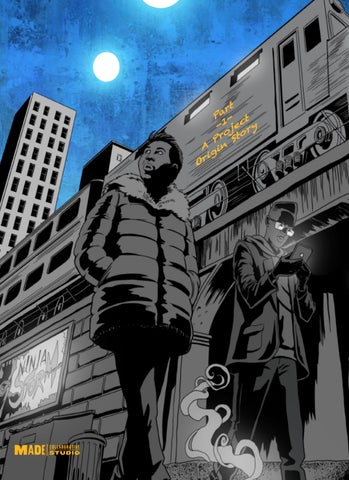
See that guy on the left? I guess that’s me, Jimmy Briseno, some time just before this project started, as illustrated by participating artist John Golden. Looks like I may be deep in thought. About what, you ask? Who the hell knows.
I could be contemplating just how incredible it is that each one of the individuals on this bus, all with our own unique ancestral journeys through the ages, somehow find ourselves sharing this fleeting moment in time with one another, against all conceivable odds…
Or, I could be wondering why my hometown NBA basketball team, the Chicago Bulls, don’t try to run more motion offense. I mean, they need to make more space for their perimeter shooters, I would implore to … well, myself. And by freeing up space for their perimeter shooters, they then also give Derrick Rose more space to drive the ball to the basket (circa 2012).
Both thoughts (and others) every bit as likely to be occupying space in my mind at any given moment, and sometimes seemingly at the same time, to be sure.
And that’s me in a nutshell. My mind is a complete mess. And unfortunately, I spend a lot of time there.

Back then, taking those bus rides home in Chicago, I was consumed by my job as a corporate attorney. And not because I loved my job. Rather, it was because my company at the time had been involved in a series of corporate acquisitions and divestitures for a stretch of years. As a result, I think I was just desperately looking for some sort of work-life balance in general, which resulted in even more daydreaming than usual.
And of course, during that time and beyond, Chicago’s crime rate, corruption and budget woes would often be the subject of national headlines. There was just a lot of negative energy to consume, and I guess that also occupied some space in my mind periodically on those many bus rides home.
Yet even as I would think about it back then, I didn’t view these problems as necessarily unique to Chicago. These are shared problems among many of our increasingly complicated urban centers. They are issues that went beyond nice and easy political soundbites, and issues that couldn’t be addressed by any one particular solution or dogma. And I guess in that context, I would often wonder what someone like me, a guy with no particularly noteworthy skill whatsoever, could even do to help?


It was this line of introspection that would often lead me to think more about my rather ordinary life. Although I may not have been exactly passionate about my work at the time, nor have accomplished anything of particular note, I was nonetheless self-aware enough to know that I was lucky. Particularly when I would look back and think about my own childhood.
Purely as a statistic, my odds for any kind of measurable success out of the gate probably weren’t great. My dad was an absent and a somewhat volatile figure who would end up ultimately losing his soul to drugs and mental illness. And as a kid, I grew up in a neighborhood fairly similar to some of the neighborhoods that generated many of the headlines in Chicago.
But that’s where my journey along any statistical probability path abruptly ends because the lucky part for me is that I had an extraordinary Mom who worked tirelessly to provide a comfortable life for the two of us, along with the love and support from Grandparents and Godparents. Thus, ultimately, I would find myself experiencing an entirely different set of life circumstances.
Nonetheless, it’s also in that context that I could remember what it felt like as a young kid to be shaped in large part by the external expectations of my old neighborhood and early circumstance, particularly when those external expectations were often negative.


And, conversely, I also knew what it meant for me personally when I became exposed to others that helped me think a bit more creatively later in my adolescent life. They helped to expand my own internal set of expectations.
I experienced firsthand how being exposed to others’ ideas and creative thoughts can be incredibly empowering. It’s those little external sparks that allow you to begin to envision a world that transcends your own reality, whatever that reality may be; and that’s when new possibilities can truly begin to emerge from within.
And that’s when it would eventually hit me on one of those many bus rides home. Why not try to develop some sort of youth outreach initiative that could help to facilitate those little creative sparks, however modest? I’d always felt that creativity was very much undervalued. Even in the corporate world that I was immersed (trapped) in, where being able to think a little outside of the box could quite literally lead to big dividends. And I was even more convinced that creativity was essential in fields like public service and science.
And the irony of all of this, of course, is that programs promoting creativity within our urban centers always seem to be the first in line when it came to budget cuts. So, as I would continue to think about it over those many bus rides home, there just had to be an opportunity to do something.


Perhaps more than anything, beyond youth empowerment, budget cuts and Chicago’s headlines, I thought doing something that facilitated creativity could be fun. Maybe I could light a few much-needed creative sparks of my own. And as my mind would wander on those many bus rides home, whether contemplating the serendipity of life or the starting lineup for the Chicago Bulls, it became more and more apparent that I just needed a little more fun in my life.
Armed with this motivation on one of those many bus rides home in the winter of 2012, I finally decided I was going to give it a go. I didn’t have a specific plan in mind other than to recruit some local artists to collaborate with urban youth the following summer. I figured we could just see what came out of that collaborative process and then take it from there.
Little did I know, as I walked off the bus that fateful winter’s evening with this very basic premise in mind, the origin story for this little comic-based collaborative project had just begun.


The room looks like any other ordinary high school classroom with a high table counter extending in front for the teacher to use for various presentations, and corresponding rows of single desks lined up parallel with one another from the front of the room to the back for youth to sit. I stand in front of the classroom.
With me are a small group of initial participating youth who had been given a prior description of the project. I can feel their scrutiny as I bring my initial presentation to a close.
“So, that’s the idea in a nutshell. Basically, we’re going to develop comics stories based on your ideas. And you’ll be able to participate in the development of those comic stories from beginning to end, so long as you’d like to participate in the project.”


The youth remain silent. I try to gauge the reaction. Surely, they see through me. I mean, I’m no teacher. Hell, I’m barely a lawyer, apart from the degree I somehow fleeced from my law school. So, what am I doing here at this afterschool program on the West Side of Chicago, working with these kids to develop comic stories based on their interests and ideas? I’m not even an artist! They must know that I have no idea what I’m doing. Surely.

It is then that one of the youth, a stout male named Nehemiah finally raises his hand.
“So, like, these stories can be about anything we want them to be? I mean, can we just make stuff up or do they have to be true stories?”
“They can be about whatever you want them to be about – made up or based on real experiences. It’s entirely up to you.”
Another youth, a young African American female named Tamia then raises her hand.
“Can they be about relationships?”
“Yep, relationships. Friendships. School. Family. Or they can be completely made up and based on some sort of alternative reality. Anything you want.”

I look around to see if the other youth seem engaged. I recall a prior conversation with one of the participating project artists who was also a former teacher, and he advised me that no matter what, fight against silence. Even if you must repeat yourself. Fight silence in the room. Any interaction is better than no interaction.
“So … like I said, anything you want. Anything.”
“The only limit is your imagination.”
Good god, did I just that? I promised myself that I would not that. Such a lazy cliché! These poor kids.
Yet somehow, despite ineptitude, I notice one the youth, a tall angular named Russell sitting in back of the room, appears just on the verge offering a thought.


And just as suddenly, another youth – an animated young man named Andre sitting in the front row, proclaims boldly, “I’ve got an idea. I know what story I want to tell. And it’s going to be great!”

Holy s@#&, I think to myself. Is that genuine interest I hear? It can’t be.
The kid is setting me up. Brace yourself, here it comes.
It is then when Nehemiah quickly responds, “damn, that was all sudden man – so what’s your idea? All passionate and stuff.”

Andre, smiling coyly, “well, that’s because it’s a great idea if I do say so myself.”
He then collects himself and proceeds, “alright, so there’s a lot to it, but it all starts with me walking to a party that me and my friends heard about. You know, just a small house party down a few blocks from my place. No big deal. And we being teens, you know, we’re thinking we’ll just head down there and have a little fun and hang out.”
I listen attentively as Andre’s hand gestures become more animated. Like me, Andre tends to talk with his hands. I don’t know this kid from Adam, but I already like him.
“So, we go to this party, and it’s cool. Me and my boys arrive, and we see some people we know, and some we don’t, but everyone is hanging out, and the vibe is cool.”
“And then, out of nowhere we hear this commotion from outside.”
“Commotion?” I ask. “What kind of commotion?”


Andre thinks about it for a moment, “I don’t know, something like a ringing bell, maybe. But it’s something different. It’s a sound that immediately draws me and two other guys outside to the alley, where the sound is coming from.”
To my modest surprise, as Andre speaks, I begin to envision what the comic story might look.

“So, we go out there, this alley, and we see these stairs – like translucent, glowing stairs – rising up out of nowhere and going up towards the sky.
And me and these two dudes, who I don’t really know, but who were at the party, we are looking at each other in amazement and like, holy #$^%!”
“And I am kind of scared, but at the same time, I see those two guys that came out to the alley with me start going up the stairs, and I immediately follow them. I am thinking that I’ve GOT to see what is up there at the top of these stairs!
“So, we go up to the top of these stairs, and that’s when we see this godlike figure, he kind of looks like Zeus and he’s got this long staff, and we’re looking at each other, not sure what is happening. And I am thinking to myself: is this a dream? But it’s so vivid and real, I am just going out of my mind!
Andre goes on to explain his vision for the story emphasizing that it will not only action based, but also about his own internal struggle of dealing with the morality of having so much power and using that sudden power for both good and evil. All of which would occur in the context of his West-side Chicago neighborhood, and with other people still viewing him as just another teenage boy growing up.
“I mean, there’s a lot to it. There’d be a counsel of elder gods that will advise me as I develop my powers.”

“And I want death to be a central theme in my story. Actually, I want death to be a character in my story that I will have to confront. I know that probably doesn’t make sense right now, but I can explain as we get more into it.
The main thing is that this story will have a lot of different elements. It’s going to be deep. But I also want it to be fun. Kind of like me. I mean, like I said, I’d still be me in this neighborhood with the same family and friends.”

So, there’s always going to be that normal stuff that I got to deal with as a kid in this neighborhood. I’d just be A GOD at the same time!”
Nehemiah is the first to respond, “yeah, that’s pretty good. I like that. You can do a lot with a story like that. Lots of action, too. ”Greg responds, “action and romance!”
“Romance? What, you in love with yourself? I didn’t hear any romance.”
“Yeah, I forgot to mention that one of the fellow gods I encounter later in this story is a young woman that I happen to fall in love with.”
Nehemiah shakes his head, “Of course. And she probably looks like Beyonce.”
Andre lights up, “Now that’s not bad! Maybe I should introduce her at the beginning of my story!” The boys laugh.


With that, I wrap things up with the youth. They gather their bags and other belongings and make their way out on their treks home within the neighborhood.
And it was at that time, after the kids left the room and I was going through my project notes, I thought to myself for perhaps the first time since starting this project that maybe, just maybe, we might actually have something here. Something that could bring real value to the participating youth and artists alike, just as we had set out when we first started this modest project that we were calling Made Collaborative.
But I needed to figure out how to create a comprehensive story based on these ideas. On on that score, I knew a lot of work and uncertainty lied ahead…

Yet a few more months later …


I had a dream. And this is the honest-to-god truth. I had a dream the other day that Paul Simon … you know, Paul Simon from Simon & Garfunkel?
Paul who, some of you may ask? Okay, if you need a very quick snapshot summary of Paul Simon …


Paul Simon is a treasured American musical icon loved by virtually all. He boasts a career that has spanned 7 decades, countless musical hits (61 total billboard hits actually … yes, 61 Billboard top hits, including songs Bridge Over Troubled Water, Still Crazy after all These Years, Mrs. Robinson, Fifty Ways to Leave Your Lover, etc.). He also has 18 Saturday Night Live appearances among his many television and movie credits.

So … in my dream, that Paul Simon was trying to fight me.
And not a young man version of Paul Simon. No, the current nearly 80-yearold, 5’3”, 140-pound version Paul Simon. Yeah.
And I mean like a real fight.
There he was, Paul Simon, taunting me as a pack of onlookers crowded around like some sort of bizarre school playground scene, all presumably waiting to see Paul Simon kick my ass. For what reason, only the dream gods know.
I remember waking up at some point after Paul Simon poked my chest and asked me if I was “feeling froggy.” I immediately nudged my then-fiancé-now-wife to tell her about the dream while I could remember it. Just so damn random.
Thoroughly unimpressed, she turned away and muttered something unintelligible to me … I can only assume it was for me to go back to sleep … with perhaps a colorful word or two in Polish for emphasis...
But I couldn’t shake it. Paul Simon wanting to go fisticuffs? What the hell is that about? How do you even begin to psychoanalyze something like that?


Dreams, they’re a funny thing, right?
Of course, many articles and books have been written about the phenomena of dreams. Some say they are a window into our subconscious those repressed needs and fears that lie just beneath our proper exterior.
Others say they may be a more practical mechanism that allow us to process our thoughts and problems of today, whatever those may be at any given moment.
And still others say that they aren’t anything at all, apart from random brain impulses that are ignited when our brains finally enter that ultimate REM sleep state, when we come as close as possible to separating ourselves from the reality that is our everyday lives.

In short, who the hell really knows? Dreams are a mystery. And, it is perhaps because they are such a mystery, that they were a constant theme during our initial collaborations with the participating youth. Time and time again, just about every youth we initially worked with during those early collaborations would reference dreams as part of their story or character ideas. No other theme was as prevalent.
It was in that context that I would begin to think perhaps there was a way to use the mystery of dreams to connect each of these youths’ seemingly disparate ideas into one common narrative? And by doing so, maybe create a storyline that we could continue to build upon with other youth?
But how to do that exactly … well, that’s where I would struggle.
By that time, I had conducted countless interviews with the initial participating youth. I worked with professional artists to produce corresponding concept sketches and illustrations based on those interviews and collaborations. And I had even developed some initial working scripts.
But something was most definitely missing. And creatively, I had hit a creative impasse.


And as I would think about it more, perhaps that’s what Paul Simon represented in my dream? This creative giant (figuratively speaking of course) mocking my own creative ineptitude? And the youth that surrounded us during our showdown? Well, perhaps they represented the participating youth on my own collaborative project as I struggled to bring their ideas to some sort of project reality.
Of course, alternatively, the dream could have just been a product of those random brain impulses right before I entered some much-needed REM sleep. But, regardless, what was clear, as I was dreaming about getting my ass kicked by Paul Simon, is that I needed help.
Okay, let me be more specific. I needed help on the project.
And on that score …
Enter Len Kody.


By Len Kody
The magic of creativity begins with inspiration, but it can only be sustained by unwavering dedication and tireless grinding. Project founder, Jimmy Briseno, has since recruited others to grind with him on the Made Collaborative journey (and we’re so glad he did!) but the journey began with him, all by himself, in front of a classroom of kids waiting for what he was going to say next.
It took a little coaxing, at first, to get things started, but once the kids caught the storytelling bug they were off and running. It only made sense to bring a small team of artists into the collaborative process to add greater depth and legitimacy to all that Jimmy had documented from his afterschool creative sessions with the youth.
Together Jimmy, the artists and the youth had refined and expanded upon a number of narrative threads. All of them fresh, original ideas from the kids, based on their lives and heightened by their favorite pop culture. Jimmy and his collaborators had compiled a “series bible,” of sorts, with model sheets, storyboards, descriptions of plot and characters. There were even some preliminary scripts that Jimmy had worked out with the youth.
It all amounted to the ingredients of a great comic book story. It had elements of romance, adventure and that all-tooelusive authenticity that came straight from the kids. But it wasn’t a comic book yet. Only the ingredients of one.


The first round of collaborations had produced a wide variety of narrative content. Which was wonderful. That’s exactly what the kids had been encouraged to do: tell whatever story they felt was worth telling. But it also presented a challenge in bringing all the disparate elements together into a harmonious whole. That was the challenge presented to the comics production team seeking to make “Back of Yards’” very much a reality.
An anthology of disconnected storylines would have been easier, but not nearly as engaging. We, on the comics production team, were inspired. We were inspired by the kids’ authentic, original stories and driven to produce something worthy of their courage. Because it takes courage to nurture the creative impulse and make something new in Chicago’s harsh urban environment. We wanted to reach a little higher.
But how?
Eureka!
We’d frame the Back of the Yards series in a context that mimics the one in which it was created! (Are you still with me?) In other words, the teenaged characters in kids’ stories would all go to the same school. And they would all be familiar with each other, too, because they are all part of the same afterschool arts program led by the same mysterious

INTRODUCING CARL CASTANEDA!


Presenting the comic book this way created two opportunities for the production team. First, it allowed us to incorporate elements of Made Collaborative’s amazing genesis into the comic itself. Because, as fascinating as the kids’ stories are, just as appealing is the story behind the story. That is, the story of the kids who created the stories.
On a deeper level, structuring Back of the Yards in this way forced the production team to search for the common themes influencing all the kids’ stories. They were by no means obvious. The stories ranged from heartwrenchingly real to mind-blowingly fantastic. But the search, indeed, bore fruit, and it led us a journey starting on the Southside of Chicago and taking us to places beyond space and time.
So, how does a story of young love and betrayal connect to a story of secret chiefs from a higher dimension? How do the video game fantasies of two young cousins play into it? And how is the magic of creativity and storytelling somehow responsible?
Read on! …


Andre Davis is based on an intelligent and charismatic young man from Phase One of Made Collaborative’s youth outreach, and hence, he takes the lead role in our initial story arc of the Back of the Yards comic. Like the Chicago youth who inspired him, he is a curious and creative character, inclined to question, rather than take things at face value.
Andre finds himself the recipient of mysterious superpowers as a result of an amazing encounter with one of the inscrutable secret chiefs of all space and time. He learns that he has a certain mastery over the strange world that we all go to when we dream.
“You can make your dreams real,” he is told.
But does that mastery carry over into the waking world too?


In the dream dimension, Andre’s formidable intellect is given regal form when his whole essence is enhanced to resemble a lion-themed superhero with heightened powers of strength, agility and perception.
The question posed by the Back of the Yards comic story arc is whether Andre’s superhero adventures are simply an escapist power fantasy or a representation of his highest, truest self.
And that’s just the start of the tale as Andre’s story will ultimately become intertwined with Tamia’s story of first love and betrayal


The Back of the Yards comic character of Tamia Parker was also inspired from the first round of youth collaborations in the West Side of Chicago. During those initial collaborations, Jimmy Briseno met with a number of youth who shared initial ideas for comic characters and storylines. One of those youth was a young African American girl from that West-Side neighborhood.
Tamia’s story is surely relatable, but it’s also based on the true-life experiences reported to us by participating urban youth. And, like many of the kids in our program, Tamia turns to creativity as both an outlet and an escape from her daily struggles. She is an avid artist and journaler. Her perspective gives the story emotional depth and balance.
Tamia is a powerful young woman still in search of her voice. Will she ever realize the heights of her potential, or will she continue to be stifled by those who seek to take advantage of her?
In the dream dimension, Tamia’s efforts to find her own voice are personified by a tiny fairy with a siren call that reaches beyond the boundaries of linear time.

Her potential is great, but still not fully realized, as the fairy form she inhabits is small, undeveloped and not yet a true agent in her own destiny.
Cousins Russell and Draymond share a fraternal bond that is cemented by the fantastic world they both share. It’s a world inspired by the manga and video games so popular in today’s youth culture. The stories they create make them feel powerful when they are so often made to feel powerless by neighborhood bullies and other stressors.
Many of our Phase One participating youth had similarly intricate imaginary worlds, worlds they would create with others. Made Collaborative has provided a structured outlet for these stories and we’ve developed them into real comic books with the help of professional artists and writers.


In the dream dimension, Russell and Draymond are Teshue and Shiro, powerful ninjas forever locked in mortal combat. They collaborate on an intricate storyline that incorporates both elements of the real world and the dream dimension. Their imagination is powerful, but, unlike Andre’s abilities, their shared narrative is not yet “self-aware” enough to have evolved beyond the potential for escape.
Give them time. They’re still young.
Interestingly, Teshue, Russell’s alter ego, is capable of summoning Tamia’s fairy from for assistance. But the process is difficult for Russell to master. And since the fairy has a developing will of her own, she isn’t always helpful to Russell. At not helpful in ways that are immediately obvious.


And as we previously described, to tie all of the youth characters together as part of a common comic story narrative, we developed the character of Carl Castaneda.
Mr. Castaneda, that is.Mr. Castañeda has the poise and bearing of a seasoned teacher.
But nobody knows who he is. Mr. Castañeda may or may not be a real teacher, but his afterschool arts program is ardently attended by those in the know. Their regular meetings in Room 23 are no secret, nor are they what one would call common knowledge. By all appearances, Mr. Castañeda handpicks young people of promise and extends them a personal invitation.
His recruitment efforts have been fruitful. Tamia and Russell are both already in the program. Andre was recently invited. And from there, a special bond between Andre and Mr. Castaneda begins formation from which we will build through future collaborations with participating youth.


And last but certainly not least, central to the Back of the Yards comic narrative are the Elders. Created by Jimmy Briseno and Len Kody to help provide further context for both the fictional Back of the Yards fictional neighborhood and the younger comic characters, the Elders are three wisecracking wise guys man a permanent post around a pickle barrel in front of Kozlow’s General Store
They are Peaches, Dex and Big Earl. Although these distinguished gentlemen of the neighborhood are officially retired from whatever eclectic ventures kept them occupied (and mostly out of trouble) in their storied youth, the Elders, as we call them, continue to serve an important purpose in their community and in our story!


The intertwining threads of fate, Back of the Yards, all intersect at the Elders’ humble pickle barrel. In ancient mythology, the Fates weren’t just observers and commentators but also tailors in life’s grand pageantry. Similarly, Peaches, Dex and Earl color the happenings of their Southside Chicago block with their piercing insight and cutting humor. They provide context, gravitas and perspective, reminding the reader and our younger characters that the world is big and history is long.


Armed with the initial characters flushed out and more fully developed, Len and Jimmy began developing a working manuscript along with a team of artists that had been recruited by Jimmy, including John Golden, Dan Dougherty, Manny Dominguez, Eric Nyamor, Andrew Dimitt and Kanila Tripp. It was this group that would work together to bring those original comic ideas to life in the form of one single comic narrative that we would eventually name as “The Back
Production of Issue 1 would begin in 2018 and final edits to scripts and illustrations were completed by 2019. The issue was largely self-funded and was, more or less, a proof of concept for the project team.
The comic issue itself is divided into two parts. The first part is the actual comic script panels, 25 pages in length. The second part of the comic is a supplement that


essentially tells the “story behind the story,” i.e., the underlying collaborative process that led to the comic itself. We felt this underlying context was essential to provide a framework for future collaborations with other participating youth.
And the plan all along was, indeed, to build upon this comic foundation by working with other participating after school programs to create new comic characters within this Back of the Yards storyline, and with that, new comic storylines. In that way, this Back of the Yards comic series would be a living collaborative project.
And that remains the creative goal of this project, and that where the new virtual studio platform comes in, which you can learn more about here. But now we present to you the following comic content below for your reading pleasure, including Issue #1!