
DegreeOptions
Students can enrol directly into Economics I. Entrance requirements to this program for Ontario students: ENG4U, MCV4U, and MHF4U Completion of three additional U or M courses to total six courses For students wishing to enter Level II of an Economics program from a Level I program other than Economics I, it is highly recommended that MATH 1MM3 (or MATH 1LS3 or MATH 1A03) be completed in Level I
At the end of Level I, students who meet the requirements outlined below can pursue one of the following degree options:
Honours Economics B A *
Grade Point
Average of 5 0 (C) including an average of at least 5 0 (C) in ECON 1B03 and 1BB3 and completion of one of ECON 1ME3, MATH 1MM3, 1A03, 1LS3 (Co-op option available. Enrolment is limited).
Combined Honours B.A. in Economics & another subject
Grade Point
Average of 5.0 (C) including an average of at least 5 0 (C) in ECON 1B03 and 1BB3 and completion of one of ECON 1ME3, MATH 1MM3, 1A03, 1LS3 Satisfaction of admission requirements for the Honours program in the other B A subject
Honours Economics B.A. Specialist Option*
Grade Point
Average of 5 0 (C) including an average of at least 5.0 (C) in ECON 1B03 and 1BB3 and completion of one of ECON 1ME3, MATH 1MM3, 1A03, 1LS3.
Honours Economics (Dual B A Specialist and M A Option)
Streamlined academic pathway to graduate studies in Economics No application to the M A program after completion of Honours B A Limited Enrolment – Possession of the published minimum requirements does not guarantee admission Grade Point Average of at least 5 0 including an average of at least 7.0 in ECON 1B03, 1BB3, and 1ME3.
Honours Economics & Mathematics B.A.
Grade Point
Average of at least 5 0 including an average of at least 5 0 in ECON 1B03 and 1BB3; and successful completion of one of MATH 1A03, 1LS3 or 1X03 and one of MATH 1AA3, 1LT3, or 1XX3 with a grade of at least C+; and MATH 1B03
B.A. Economics
Grade Point
Average of 3.5 (C-) including an average of 4.0 (C-) in ECON 1B03 and 1BB3 and completion of one of ECON 1ME3, MATH 1MM3, 1A03, 1LS3.
Minor: Economics
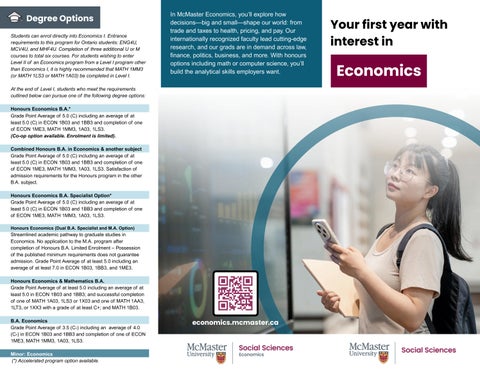
In McMaster Economics, you’ll explore how decisions big and small shape our world: from trade and taxes to health, pricing, and pay. Our internationally recognized faculty lead cutting-edge research, and our grads are in demand across law, finance, politics, business, and more. With honours options including math or computer science, you’ll build the analytical skills employers want.
Economics





LevelICourses BeyondFirstYear
Economics 1B03: Economics 1B03:
Choose from a variety of courses, such as:
Introductory Microeconomics
Introductory Microeconomics
Microeconomics is the study of how individuals
Microeconomics is the study of how individuals and companies interact in the markets for goods, and companies interact in the markets for goods, services and labour. Explore: services and labour. Explore:
Demand and supply Demand and supply
Consumers and producers Consumers and producers
International Trade
Financial Economics
Health Economics
Environmental Economics
Monetary Economics
Statistics
Concurrent Certificate in Applied Social Sciences Research:
For students interested in broader exposure and competencies in applied research methods
Economics students only need one extra credit in SOCSCI 1RM3 to be eligible!
Market structure and policy implications
Market structure and policy implications
Economics of Trade Unionism and Labour
Economics of Aging
Concurrent Certificate in Social Innovation:
Students learn how to analyze the consequences of various economic policies. of various economic policies.
Students learn how to analyze the consequences
Economic Growth and Development
Public Sector Economics
Industrial Organization Honours Economics
This certificate is designed for students to develop an academic focus in the development and implementation of solutions for effective, longterm social impact.
Economics 1BB3: Economics 1BB3:
Introductory Macroeconomics
Introductory Macroeconomics
Macroeconomics considers total economic Macroeconomics considers total economic activity rather than individuals and companies. activity rather than and companies
Discover the computation of economic variables
Discover the computation of economic variables including the inflation rate, interest rates, and including the inflation rate, rates, and unemployment rates Macroeconomic models are unemployment rates. Macroeconomic models are developed to analyze: developed to analyze:
SpecialistOption
AcceleratedEconomics
The health of the economy in both short run and long run and long run
The health of the economy in both short run
The Honours Economics Specialist Option is a 4-year program designed for students who are considering graduate work in economics. This option requires an additional econometrics course, necessary for studying at the graduate level
Fiscal and monetary policy options
Fiscal and monetary policy options
The Accelerated Honours Economics option caters to students who aspire to expedite their careers in economics and graduate in three years This option is available to all Economics I students Students will still need to apply to a Level II program at the end of their first year and must maintain a minimum cGPA of 5.0.
The role of the government in the economy
The role of the government in the economy as a whole as a whole
Developing analytical and problem solving skills is a key outcome of this course. is a key outcome of this course.
Developing analytical and problem solving skills

All course prerequisites must be successfully met and requirements must be completed in a set sequence. Successful completion will allow for Fall graduation in November of the respective year.
Economics 1ME3: Economics 1ME3:
Introduction to Mathematical Economics
Introduction to Mathematical Economics
This course is an introduction to mathematical This is introduction to mathematical and statistical methods applied in economics. It and statistical methods applied in economics It will improve the mathematical skills required to will improve the mathematical skills required to study intermediate economic theories and study economic theories and analyze economic data Topics include partial analyze economic data. Topics include partial derivatives, optimization, basic probability and derivatives, optimization, basic probability and statistics, and linear algebra The mathematical statistics, and linear algebra. The mathematical results are illustrated through fundamental results are illustrated through fundamental economic applications. economic applications.
“AsanEconomicsmajoratMcMaster University,Igainedadeeperinsightinto thefactorsdrivingeconomicconditions invariouscountriesandtheways peoplerespondtothesesituations This knowledgehasbeeninstrumentalin shapingmyunderstandingoffuture economictrendsandtheimpactof individualactionsonthebroader economiclandscape.”
-KenchoniO.(EconomicsAlum)
PotentialCareers
Financial Planner
Banking/Financial Services
Lawyer
Policy Researcher
Market Researcher
Manager (Government/Business)
Economic Analyst
Statistician
Budget Analyst