Environmental Product Declaration

In accordance with ISO 14025:2006 and EN 15804:2012+A2:2019/AC:2021 for:
Spirit shower enclosures from Macro Design AB

Programme: The International EPD® System, www.environdec.com
Programme operator: EPD International AB
EPD registration number: EPD-IES-0005144
Publication date: 2024-12-18
Valid until: 2029-12-17
EPD of multiple products, based on a representative product. The included products are described in production information.
An EPD should provide current information and may be updated if conditions change. The stated validity is therefore subject to the continued registration and publication at www.environdec.com



General information
Programme information
Programme: The International EPD® System
Address: EPD International AB Box 210 60 SE-100 31 Stockholm Sweden
Website: www.environdec.com
E-mail: info@environdec.com
Accountabilities for PCR, LCA and independent, third-party verification
Product Category Rules (PCR)
CEN standard EN 15804 serves as the Core Product Category Rules (PCR)
Product Category Rules (PCR): Construction Products PCR 2019:14 version 1.3.4
PCR review was conducted by: The Technical Committee of the International EPD@ System Life Cycle Assessment (LCA)
LCA accountability: Fanni Végvári, CarbonZero AB
Third-party verification
Independent third-party verification of the declaration and data, according to ISO 14025:2006, via:
☒ EPD verification by individual verifier
Third-party verifier: Vladimír Kočí, LCA Studio s.r.o
Approved by: The International EPD® System
Procedure for follow-up of data during EPD validity involves third party verifier:
☐ Yes ☒ No
The EPD owner has the sole ownership, liability, and responsibility for the EPD.
EPDs within the same product category but registered in different EPD programmes, or not compliant with EN 15804, may not be comparable For two EPDs to be comparable, they must be based on the same PCR (including the same version number) or be based on fully-aligned PCRs or versions of PCRs; cover products with identical functions, technical performances and use (e.g. identical declared/functional units); have equivalent system boundaries and descriptions of data; apply equivalent data quality requirements, methods of data collection, and allocation methods; apply identical cut-off rules and impact assessment methods (including the same version of characterisation factors); have equivalent content declarations; and be valid at the time of comparison For further information about comparability, see EN 15804 and ISO 14025.
Company information
Owner of the EPD: Macro Design AB
Adress: Sven Hanssons gata 1, 312 96 Laholm
Contact: Louise Ulf
E-mail: info@macrodesign.se
Website: www.macrodesign.se
Description of the organisation:
Macro Design is a Swedish bathroom supplier with 40 years of experience in the bathroom industry and has established a strong and esteemed brand for the mid- and premium segments. We offer one of the widest ranges of shower solutions in the Nordic region, providing a comprehensive selection of showers, bathroom furniture, washbasins, taps, lighting, toilets, and bathtubs.
Innovation, attractive design, and functionality are the cornerstones of Macro Designs product development. Our ambition is to always stay one step ahead and create products with that extra touch, without losing focus on user-friendliness and quality. We prefer to work with classical materials in the manufacture of our products, such as tempered glass, moisture-resistant wood, and solid oak and ash.
Our commitment lies in delivering timeless and sustainable designs of elegant bathroom furniture. Developed by Macro Design to withstand daily wear and maintain its high quality for many years to come.
Product-related or management system-related certifications: The products are CE-marked, and the installations are according to Säker vatten.
Name and location of production site: Laholm, Sweden
Product information
Product name: Spirit shower enclosures
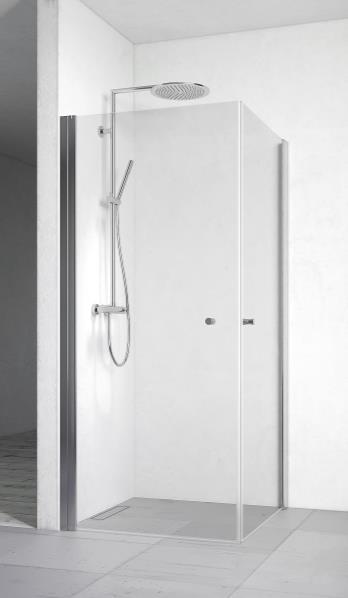
Product description: The Spirit shower enclosure combines a simple, modern design with great functionality. The seamless glass wall, with no visible hinges, gives the shower a clean and stylish look, creating a calm atmosphere in the bathroom. The Spirit shower enclosure is made of 6 mm tempered glass and has a height of 197 cm. The large glass surfaces allow plenty of light to enter, making the space feel larger both inside and outside the shower. The shower is easy to install and offers flexible installation with multiple customization options. It features reversible doors and walls, providing even more choices. CE-marked product.
Description of production process: The shower enclosure’s components are manufactured in China, Spain, Germany, Denmark and Sweden and delivered to the manufacturing site in Laholm, Sweden. The manufacturing process mainly involves assembling the components into a final product, which requires electricity. The final product is packed into the desired packaging before being delivered to the customer
UN CPC code: 37112 Unworked cast, rolled, drawn or blown glass, in sheets
Geographical scope: Sweden
Products included:
This EPD covers the entire Spirit series of shower enclosures. Due to the large variety of shower enclosures and the high difference in sales volume between them, a representative product is declared in the EPD. The representative product is the one with the highest sales volume. The included variants are presented in the table below.
Spirit Shower Enclosure Fixed
Dusch Skärmvägg Fast
Spirit Shower Corner J Spirit Duschhörna J
Spirit Niche Shower
Spirit Shower Corner Straight
Spirit Shower Enclosure Straight
Spirit Shower Corner Round
Spirit Shower Enclosure Round
Spirit Niche Shower Saloon
Spirit Niche Shower Swing
Spirit Shower Corner Swing
Spirit Shower Corner U
Spirit Niche Shower Folding
Spirit Shower Corner Folding Straight
Spirit Bathtub Wall
Spirit Nischdusch
Spirit Duschhörna Rak
Spirit Duschdörr Rak
Spirit Duschhörna Rund
Spirit Duschdörr Rund
Spirit Nischdusch Saloon
Spirit Nischdusch Swing
Spirit Duschhörna Swing
Spirit Duschhörna U
Spirit Nischdusch Vik
Spirit Duschhörna Vik Rak
Spirit Badkarsvägg
Spirit Dusch Skärmvägg Fast
- Spirit Duschhörna J
- Spirit Nischdusch
- Spirit Duschhörna Rak
Macro Design - Spirit Duschdörr Rak
Macro Design - Spirit Duschhörna Rund
Macro Design - Spirit Duschdörr Rund
Macro Design - Spirit Nischdusch Saloon
Macro Design - Spirit Nischdusch Swing
Macro Design - Spirit Duschhörna Swing
Macro Design - Spirit Duschhörna U
Macro Design - Spirit Nischdusch Vik
Macro Design - Spirit Duschhörna Vik Rak
Macro Design - Spirit Badkarsvägg
LCA information
Declared unit: 1 kg of shower enclosure
Reference service life: Not applicable
Time representativeness: 2023
Database(s) and LCA software used: The calculation was completed in LCA for Experts v. 10.7, with the database version 2024.1 and with some eco-invent datasets (version 3.8). The characterization factors used in this study refer to PCR 2019:14 and EN 15804+A2 (based on EF 3.1).
Description of system boundaries: Cradle to gate with options, modules C1–C4, module D and with optional modules (A1–A3 + C + D and additional modules A4+A5).
System diagram:

More information – methodology and assumptions:
A1 – Raw material supply
This module considers the extraction and processing of all raw materials, energy, and transportation that occurs upstream of the studied manufacturing process. The products are made from glass and aluminium, with minor parts made of steel and plastic.
A2 – Transport to the manufacturer
This module includes the transportation of raw materials to the manufacturing site. Specific information from the manufacturer was obtained regarding the transportation distance between the suppliers to the manufacturing factory
A3 - Manufacturing
This module includes all resources used to produce Spirit shower enclosures, mainly electricity and biogas. This also includes the production of packaging material in which the products are transported to customers. The manufacturer has collected data from the production year of 2023 As there’s only one manufacturing site, no variation in production sites occurs
A4 – Transport
This module includes the transportation from the manufacturing in Laholm to costumers in Sweden; 500 km was assumed to represent the Swedish customer base.
Transport to the building site
A5 – Construction installation
The product’s installation is manual, so it does not contribute to any environmental impact. Furthermore, this module includes the waste treatment of packaging since this is where the packaging leaves the product system.
The following disposal routes were used for packaging, based on Swedish statistics (2020)
B1-B7 – Use stage
This stage is not declared.
C1 Deconstruction/Demolition
This stage includes the deconstruction and/or demolition of the product. It is assumed that the deconstruction is done manually, and therefore it has a negligible impact.
C2 Transport
This module represents the transport distance to the waste processing facility. It is assumed that the transportation distance to the waste processing facility is 50 km.
C3 Waste processing
This module includes any waste treatment needed Swedish statistics is used to assign the different materials to the appropriate waste treatment process.
The following waste treatment rates were used.
C4 Disposal
This module includes any material that is landfilled.
Process
Collection process specified by type 1 kg collected separately 0 kg collected with mixed construction waste
Recovery system specified by type 0 kg for re-use
0.926 kg for recycling
0.0074 kg for energy recovery
Disposal specified by type 0.0666 kg material for final deposition
Assumptions for scenario development, e.g. transportation
The transportation is modelled with the same specification as the truck transportation in module A2, except for the transportation distance that is set to 50 km.
D Benefits and loads beyond the system boundary
This module includes loads and benefits obtained from energy recovery and or recycling materials. For this product it is mainly the recycling of glass and metals that leads to recovered materials so that the production of virgin materials is avoided, or the energy recovered from incineration removes electricity and heat being produced elsewhere.
Swedish electricity grid mix and process steam from natural gas is used for crediting the heat produced.
Infrastructure
Plants, machine production and transportation systems are excluded from the calculations. However, electricity is one such input for which it is not possible to exclude the impact from infrastructure already included in the dataset, but no data on infrastructure has been manually added to the product system.
Cut-off criteria
The following procedures were followed for the exclusion of inputs and outputs
• All input and output flows in a unit process were considered i.e., taking into account the value of all flows in the unit process and the corresponding LCI where data was available
• Processes of infrastructure or capital goods are excluded from this study (except when it is already included in a dataset used)
• Generic national data was used for modules C1-C4 and D as no specific data was able to be collected
• The use of cut-off criterion on mass inputs and primary energy at the unit process level (1%) and at the information module level (5%) was not applied as all inputs were included
No hazardous and toxic materials or Substances of Very High Concern (SVHC) according to REACH are included in the inventory and the cut-off rules do not apply.
Allocation
Allocation criteria are based on mass
Modules declared, geographical scope, share of specific data (in GWP-GHG results) and data variation (in GWP-GHG results):
Content information
The content declaration shows the content of the representative product, as suggested in PCR.
Dangerous substances from the candidate list of SVHC for Authorisation
Not relevant.
Results of the environmental performance indicators
The estimated impact results in this section are only relative statements, which do not indicate the endpoints of the impact categories, exceeding threshold values, safety margins and/or risks. Furthermore, the results of the end-of-life stage (module C) should be considered when using the results of the production stage (modules A1-A3).
Mandatory impact category indicators according to EN 15804
Acronyms
GWP-fossil = Global Warming Potential fossil fuels; GWP-biogenic = Global Warming Potential biogenic; GWP-luluc = Global Warming Potential land use and land use change; ODP = Depletion potential of the stratospheric ozone layer; AP = Acidification potential, Accumulated Exceedance; EPfreshwater = Eutrophication potential, fraction of nutrients reaching freshwater end compartment; EPmarine = Eutrophication potential, fraction of nutrients reaching marine end compartment; EP-terrestrial = Eutrophication potential, Accumulated Exceedance; POCP = Formation potential of tropospheric ozone; ADP-minerals&metals = Abiotic depletion potential for non-fossil resources; ADP-fossil = Abiotic depletion for fossil resources potential; WDP = Water (user) deprivation potential, deprivation-weighted water consumption
* Disclaimer: The results of this environmental impact indicator shall be used with care as the uncertainties of these results are high or as there is limited experience with the indicator.
Additional mandatory and voluntary impact category indicators
* The results of this environmental impact indicator shall be used with care as the uncertainties on these results are high or as there is limited experienced with the indicator.
** This impact category deals mainly with the eventual impact of low dose ionizing radiation on human health of the nuclear fuel cycle. It does not consider effects due to possible nuclear accidents, occupational exposure nor due to radioactive waste disposal in underground facilities. Potential ionizing radiation from the soil, from radon and from some construction materials is also not measured by this indicator.
Resource use indicators
1 This indicator accounts for all greenhouse gases except biogenic carbon dioxide uptake and emissions and biogenic carbon stored in the product. As such, the indicator is identical to GWP-total except that the CF for biogenic CO2 is set to zero
Acronyms
PERE = Use of renewable primary energy excluding renewable primary energy resources used as raw materials; PERM = Use of renewable primary energy resources used as raw materials; PERT = Total use of renewable primary energy resources; PENRE = Use of non-renewable primary energy excluding nonrenewable primary energy resources used as raw materials; PENRM = Use of non-renewable primary energy resources used as raw materials; PENRT = Total use of non-renewable primary energy re-sources; SM = Use of secondary material; RSF = Use of renewable secondary fuels; NRSF = Use of non-renewable secondary fuels; FW = Use of net fresh water
Waste indicators
Output flow indicators
Variation between products
Since the product group is wide and covers many variants, the variation in LCIA results is presented for the best, worst and representative product. The variation in percentage is calculated both between the representative product and the best and worst within the product series.
Indicator
Additional requirements
Electricity mix from the use of electricity in manufacturing.
In the manufacturing step, a specific electricity mix is used by contractual instrument (Guarantee of Origin). Macro Design purchases electricity from hydropower. The climate impact (GWP-GHG) of the used electricity mix is 0.014 kg CO2-eq per kWh. The reference year is 2020, and the source is the Sphera database.
References
Construction Products
PCR 2019:14 version 1.3 4
EN 15804:2012+A2:2019
GPI 5.0
ISO 14020:2000
ISO 14025:2010
ISO 14044:2006
LCA report
EPD International (2024) PCR 2019:14 Construction products and construction services, version 1.3 4
Sustainability of construction works - Environmental product declaration - Core rules for the product category of construction products
General Programme Instructions of the International EPD® System. Version 5.
Environmental labels and declarations General principles
Environmental labels and declarations - Type III environmental declarations - Principles and procedures
Environmental management - Life cycle assessment - Requirements and guidelines
LCA report for Spirit Shower Enclosures (Végvári, Liljenroth, Stockwell), Dec 2024.
SCB – Swedish Statistics (2020) Treated waste by treatment category and waste category. Every second year 2010 - 2020 https://www.statistikdatabasen.scb.se/pxweb/en/ssd/START__MI__MI03 05/MI0305T003/ Assessed 2024-12-11
Contact Information
EPD owner:
Email: info@macrodesign.se
Address: Sven Hanssons gata 1, 312 96 Laholm
LCA author:

Fanni Vegvari
Email: fanni.vegvari@carbonzero.se
Address: Tåstrupsgatan 2, SE-262 63 Ängelholm, Sweden
Third-party verifier:

Vladimír Kocí
Email: vlad.koci@vscht.cz
Address: LCA Studio, Šárecká 1962/5, 160 00 Praha 6, Czech Republic
Program operator:
EPD International AB
Email: info@environdec.com
Telephone: +46 (0)73 311 30 20
Address: SE-11427 Stockholm, Sweden