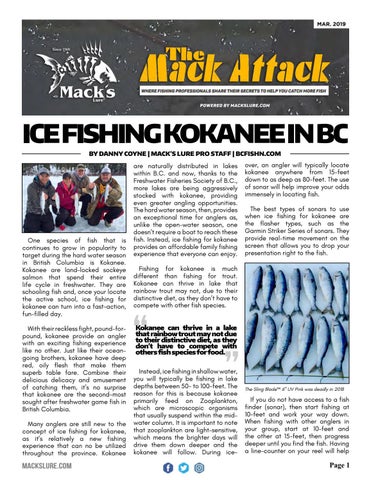
ICE FISHING KOKANEE IN BC BY DANNY COYNE | MACK’S LURE PRO STAFF | BCFISHN.COM
With their reckless fight, pound-forpound, kokanee provide an angler with an exciting fishing experience like no other. Just like their oceangoing brothers, kokanee have deep red, oily flesh that make them superb table fare. Combine their delicious delicacy and amusement of catching them, it’s no surprise that kokanee are the second-most sought after freshwater game fish in British Columbia. Many anglers are still new to the concept of ice fishing for kokanee, as it’s relatively a new fishing experience that can no be utilized throughout the province. Kokanee
MACKSLURE.COM
over, an angler will typically locate kokanee anywhere from 15-feet down to as deep as 80-feet. The use of sonar will help improve your odds immensely in locating fish. The best types of sonars to use when ice fishing for kokanee are the flasher types, such as the Garmin Striker Series of sonars. They provide real-time movement on the screen that allows you to drop your presentation right to the fish.
Fishing for kokanee is much different than fishing for trout. Kokanee can thrive in lake that rainbow trout may not, due to their distinctive diet, as they don’t have to compete with other fish species.
“
“
One species of fish that is continues to grow in popularity to target during the hard water season in British Columbia is Kokanee. Kokanee are land-locked sockeye salmon that spend their entire life cycle in freshwater. They are schooling fish and, once your locate the active school, ice fishing for kokanee can turn into a fast-action, fun-filled day.
are naturally distributed in lakes within B.C. and now, thanks to the Freshwater Fisheries Society of B.C., more lakes are being aggressively stocked with kokanee, providing even greater angling opportunities. The hard water season, then, provides an exceptional time for anglers as, unlike the open-water season, one doesn’t require a boat to reach these fish. Instead, ice fishing for kokanee provides an affordable family fishing experience that everyone can enjoy.
Kokanee can thrive in a lake that rainbow trout may not due to their distinctive diet, as they don’t have to compete with others fish species for food.
Instead, ice fishing in shallow water, you will typically be fishing in lake depths between 50- to 100-feet. The reason for this is because kokanee primarily feed on Zooplankton, which are microscopic organisms that usually suspend within the midwater column. It is important to note that zooplankton are light-sensitive, which means the brighter days will drive them down deeper and the kokanee will follow. During ice-
The Sling Blade™ 6” UV Pink was deadly in 2018
If you do not have access to a fish finder (sonar), then start fishing at 10-feet and work your way down. When fishing with other anglers in your group, start at 10-feet and the other at 15-feet, then progress deeper until you find the fish. Having a line-counter on your reel will help
Page 1
The schools of kokanee will cruise throughout the lake, but will tend to stay in areas that provide plenty of food. Even though there is ice cover, lakes still ahve current in them, which can push the zooplankton to a specific end. Points and ledges that reach out into the lake can also provide good forage areas for kokanee, as the plankton will be pushed up against these zones. When approaching a new body of water, simply look around for other signs of anglers — the locals tend to find the best-producing areas for kokanee and they don’t change much throughout the year. Once of the great benefits of targeting kokanee during the hard water season is the extended season. Due to these fish residing in deeper areas of the lake, they don’t become as deprived of dissolved oxygen as other fish species. Later in the ice fishing season, such as midto late-February, the fish are not as lethargic and willing to strike a wellpresented lure.
Gorgeous BC Kokanee caught on a Sling Blade and Sonic BaitFish™ combination.
MACKSLURE.COM
TECHNIQUES & TERMINAL TACKLE The most productive way to catch kokanee through the ice is by jigging. These little critters are attracted to flash and lots of it! With this in mind, jigging techniques consist of using 4- to 6-inch attrators, such as the Mack’s Lure Sling Blade™. Run a 6-lb. leader between 14- and 16-inches from the attractor of choice to your lure. Having a variety of colors of attractors will increase your odds immensely throughout the day. UV Pink, Silver, Glow and Gold or Copper Sling Blade™ dodgers tend to be the best producing colors.
“
“
recognize the depths in which you are fishing. If your reel doesn’t have a line counter, simply count out the amount of line in 1-foot pulls that you are using. When you discover the fish, you will want to repeat that same depth. A good tip is to add a threaded bobber stop every 20-feet on your fishing line so you can quickly mark how much line you let out.
Mack’s Lure Glo® Hooks in red and chartreuse produce, hands down, the best results.
The technique in which you want to jig is to jig up-and-down slowly from between 6- to 20-inch pulls — just enough to get the flasher fluttering to attract these curious kokanee. When there are no fish around, make longer swift jigs to get the attractor to reflect light to help attract the fish from a far. Once the school of kokanee move in, you’ll want to shorten up the amount in which you are moving the lure. Not only will the flash bring in the fish, but also the attractor will transfer erratic action to your lure that will encourage the kokanee to strike. The key is to always keep moving your presentation as kokanee wil strike very subtly — it’s the constant jigging that will set the hook before you even know you have one on.
The hook can consist of a plain hook or small jigs. Mack’s Lure Glo® Hooks in red and chartreuse produce, hands down, the best results. The added glow appearance aids the kokanee to key in on the lure and encourages them to strike. If you are using a regular hook, choosing colors such as chartreuse or red will sometimes help entice the bite. If the hook is tangling with the flasher, add a small split shot weight to the middle of the leader.
Some anglers prefer to use small spoons or jigs, such as the Mack’s Lure Sonic BaitFish™ or Mack’s Lure Hum Dinger® spoon. The small jigs and spoons provide that extra bit of action that invites the kokanee to strike. It is best to try multiple presentations until you find a pattern that is working. What is working one day doesn’t necessarily mean it’s going to work the next. No matter what lure you’re using, it is best to tip the hook with some sort of bait. Popular baits that work great for kokanee includes pink maggots (live or synthetic), krill, shrimp or cured and dyed white shoepeg corn. Take your presentation to the next level by adding Pro-Cure Bait Scents, such as Krill, Shrimp or Trout and Kokanee Magic, as it will attract fish from a far and get them to strike on the slowest days. It is possible to “still fish” for kokanee, which involves suspending the bait with no movement. When using this method, scent and bait are a must or the fish will not strike. Be sure to hold the rod in your hand and not resort to a rod holder — you will need to set the hook the moment the kokanee bites. The use of bobbers is not recommended, as the bite is so light that it will usually not pull it down. The most effective way to identify a bite is to hold the line between your fingers. Still fishing can be effective when the fish are somewhat less active and not willing to chase your jigging presentation. The bait needs to be directly in front of the kokanee, as most of the time, they won’t swim upwards to strike a suspended still presentation.
Page 2
The fishing rod type isn’t as important as the presentation, however a softer rod will help you recognize the subtle strikes and land more kokanee, as they have soft mouths. A small 5-foot casting rod or an ice fishing rod is adequate — really it’s up to you and what you have within your fishing arsenal.
WATCH THIS!
The Northwest Outdoorsmen heads to BC to target kokanee with the Mack’s Lure Pro Staff
If you have any questions, you can contact the author, Danny Coyne, on Instagram or Facebook, or visit his website, BCFishn.com. Danny has appeared on several television programs and has been extensively invovled with growing the kokanee fisheries in British Columbia.
SONIC BAITFISH™ (SBF)
TIPS & TECHNIQUES
VERTICAL JIGGING VS. CASTING & TROLLING BY CAPT. PETE ROSKO For my first 35 years of recreational fishing, I cast and trolled. I had no idea what vertical jigging truly meant and why it was so effective. That education process began when I relocated from Lake Erie walleye country to Port Angeles, Wash. in 1979.
presentation. That all changed in the waters off Port Angeles where I could see down to at least 23-25 feet. During the 1980’s, we were blessed with huge schools of near-surface feeding chinook salmon. That top 25 feet of marine water became my visual laboratory for learning and testing how salmon reacted to their prime forage base of Pacific herring and candlefish. The wiser and larger salmon positioned themselves under this bait mass to lazily pick-off the injured ones, created by smaller salmon crashing through the bait. All predator fish are opportunistic and, as with all predators, will never refuse an easy meal. The primary strike-triggering action, that cause fish to strike, is an erratic action. Most fishing lures are built on that premise. However, it is a properly-designed metal jig that separates itself from the rest of the field. It is a unique lure-type that is so versatile that it can fish the world. That was said about the leadhead jig prior to the creation of metal jigs. When I created the Crippled Herring back in the early 1980’s, it was the first metal jig that looked like a real bait fish, a Pacific herring. Prior to that, they were generally referred to as “slab spoons” that had little to no resemblance of a bait fish.
The next 35 years dramatically changed my approach to sport fishing forever! I quickly learned that a buck-tailed leadhead was not the same as a metal jig, frequently referred to as a “jigging spoon.” Because of low visibility water conditions in the Midwest part of This is what I look for in a metal the country, it was impossible to see jig that qualifies as a premier fish how fish reacted to a particular lure catcher..
MACKSLURE.COM
1) The jig is equipped with a single siwash-style tail hook. a) But, it can also have an optional nose hook attached. After years of catching over two thousand fish, on the metal jig, rigged with a nose and tail hook, almost every fish was hooked on the tail hook. b) The Sonic BaitFish is an exception because of its hybrid design in which the hook(s) can be attached to the tail or nose or to both. c) A jig, with an attached nose hook, is limited to vertical jigging. Its action as a trolled, or cast, lure is poor compared to a tail-hooked metal jig. Reason... the single tail hook acts as a rudder, similar to that of a plane or boat. The free-swinging tail hook causes a lively darting action when cast or trolled. The larger the hook, the greater the darting action. A jig with “nose-assist” hooks is incapable of this action. Do not confuse the versatile Sonic BaitFish with the limited function of metal jigs with hooks on the nose, commonly referred to as speed jigs. The Sonic BaitFish is a finesse jig with built-in action that requires little rod movement for lively action. Because of its versatility, you can add a nose hook when finesse jigging but I personally favor only a single tail hook. 2) The jig can be effectively fished whether cast, jigged or trolled.
Page 3
Back in 1987, A Lake Michigan salmon charter Captain, by the name of Ed Ruck, called me to share a remarkable experience. That call opened my eyes to trolling metal jigs. His client came on board with a 2 oz pearl white Crippled Herring that he recently purchased in California. It was still in its package. Capt Ruck thought it was a joke since he exclusively trolled with conventional trolling spoons as did 100% of the rest of Lake Michigan salmon trollers. The client persisted for almost four hours, especially since not a single strike was experienced in all that time.
6-year old Finn Rodger with a Lake Sutherland cutthroat trout on her very first cast with a 1/6 oz. Sonic BaitFish™. Finn’s dad is a PhD scientist at Florida State University.
Capt Ruck had enough with his pestering client and had an idea to silence him. He attached the bare Crippled Herring three feet behind the downrigger ball and without any attractor. At the end of the day, (9) keeper chinook salmon were caught. The score was (8) for the Crippled Herring and (1) for the spoon. My eyes were opened! Since then, I never underestimate the value of the metal jig. There is no other lure type that can be fished in so many different ways as the Sonic BaitFish! An example is the 1/10 oz Sonic BaitFish rigged for casting to bass in very shallow water, especially parallel to a shoreline. By attaching a single hook and a free-swinging #0 or 00 Indiana blade to the split ring, the result is extra flash, vibration and
a slower fall. Cast to near-surface feeding fish and it should be a hookup on every cast as it’s skipped over the surface with the rod held at a 12 o’clock position. 3) Never overlook ways where the Sonic Baitfish can be vertically jigged. This is the purest form of creating strikes... it’s the flash, flutter and vibration of a falling lure that creates most strikes. For example in trolling, it’s the rod on the inside turn that results in the most strikes because the line tension on the lure relaxes. This causes the lure to hesitate and momentarily fall before line tension is restored. For shoreline jigging, any vertical shoreline depth greater than five feet will work, especially around culverts, docks and along walls in marinas. Off bridges, jig the deeper holes near bridge supports. Normally, boat channels are the deepest and most favorable spots. When jigging from a boat on rivers, lakes and ocean, your electronic fish locator is critical to your jigging success. Start jigging only after fish are located. There is no more-effective technique, at catching great numbers of fish, than bottom-bouncing a Sonic BaitFish to fish near bottom! This is pure joy for a family with children. It is so simple and so deadly-effective for just about anything that swims. TIPS: SCENT... Very seldom is adding scent to the jig necessary. However, at times, tipping may be necessary for certain species like walleyes where a nightcrawler piece added to the jig will increase strikes. JIG SIZE... Select the smallest jig to effectively reach your target species. However, deeper water and stronger water movement will require a heavier jig to reach where the fish are located. Download the Sonic BaitFish Tech Guide for more information.
In closing, I hope to eventually write a book on metal jig fishing to cover its wide range of versatile ways to fish. From albacore tuna to walleyes and everything in between, a metal jig is so versatile that it can replace a closet full of tackle boxes filled with different lures. It truly can fish the world and is an exciting way to fish for the entire family. See photo (left) of 6 year-old Floridian Finn Rodgers with her first Pacific NW trout caught on a Sonic BaitFish™ on her very first cast. The fish was quickly released by Finn. Thank you for taking your time to visit this month’s edition of the Mack Attack. So long until next month!
UPGRADE YOUR GEAR Highlighting new Mack’s Lure gear.
SCENTFLASH™ UV TRIANGLE FLASHER
The ScentFlash™ is an 8” high UV in-line spinning flasher featuring a patented scent release system. Simply unsnap the ScentFlash™, apply scent to the premium pad, and snap into place. The ScentFlash™ will release scent through the water, attracting fish with scent and flash. Each flasher includes one (1) ScentFlash™ Pad. Pad packs are available as a four-pack. MSRP: $15.99
BALL TROLL DOWNRIGGER ATTRACTOR
This long, 26” rotational flasher is designed to snap to your downrigger ball. It’s made of large nickel willowleaf blades and high UV beads, which will attract fish from further away by combining tremendous amounts of flash and vibration, bringing the fish right up to your gear. Includes one (1) Ultra Release. MSRP: $12.99
Page 4
QUESTION
HOT DEAL OF THE MONTH
OF THE MONTH Have a question? We’d love to answer it for you! Shoot us an email at media@ mackslure.com with your question and you may see it featured in an upcoming issue of the Mack Attack Magazine! Q: How do you rig a night crawler to a Smile Blade® Slow Death or Super Slow Death Hook or crawler harness? A: There have been many people asking about this, so Mack’s Lure Pro Staff Ted Beach made a video about it! But we’ll answer it here, as well.
PHOTO OF THE MONTH
Mack’s Lure Pro Staff Jesse Lamb and his team recently won the Griggs Winter Shootout on the Columbia River. This 13-plus pounder was the catalyst to their win.
A nightcrawler is an effective bait for many species of fish, but particularly walleye. Although they come in many sizes, using these worms can be extremely effective and add to your movement. For example, when using a Smile Blade® Slow Death or Super Slow Death Rig, start threading the night crawler up the hook and all the way to the eye. Make sure the hook itself is not exposed and the barbs on the hook make the crawler stick in place. Once the crawler is threaded, bend it so it’s perpendicular to the hook, then pinch off the crawler an inch from the back of the hook. This is only a preference. Click the on the video below to view how Ted rigs up his Slow and Super Slow Death Hooks.
VIDEO OF THE MONTH
Mack’s Lure Pro Staffer Ted Beach joins Northwest Fishing Reports on the Columbia River to share tips on how to effectively rig a bottom bouncer for walleye fishing.
Follow Mack’s Lure on Facebook and Instagram and tag us with #MacksLure. Facebook.com/MacksLure @macks_lure To submit your catch, send us an email at media@mackslure.com or tag us on social media using #MacksLure.
MACKSLURE.COM
Page 5