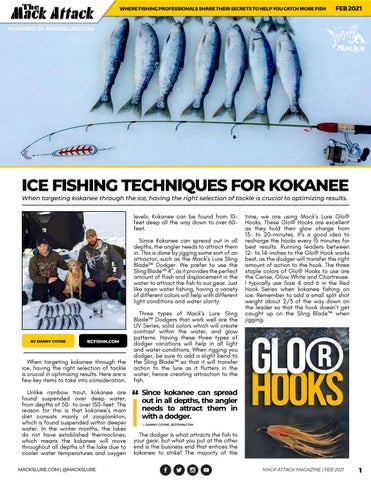
ICE FISHING TECHNIQUES FOR KOKANEE When targeting kokanee through the ice, having the right selection of tackle is crucial to optimizing results.
levels. Kokanee can be found from 10feet deep all the way down to over 60feet. Since Kokanee can spread out in all depths, the angler needs to attract them in. This is done by jigging some sort of an attractor, such as the Mack’s Lure Sling Blade™ Dodger. We prefer to use the Sling Blade™ 4”, as it provides the perfect amount of flash and displacement in the water to attract the fish to our gear. Just like open water fishing, having a variety of different colors will help with different light conditions and water clarity.
BY DANNY COYNE
BCFISHN.COM
When targeting kokanee through the ice, having the right selection of tackle is crucial in optimizing results. Here are a few key items to take into consideration. Unlike rainbow trout, kokanee are found suspended over deep water, from depths of 50- to over 150-feet. The reason for thsi is that kokanee’s main diet consists mainly of zooplankton, which is found suspended within deeper water. In the winter months, the lakes do not have established thermoclines, which means the kokanee will move throughout all depths of the lake due to cooler water temperatures and oxygen
Three types of Mack’s Lure Sling Blade™ Dodgers that work well are the UV Series, solid colors which will create contrast within the water, and glow patterns. Having these three types of dodger variations will help in all light and water conditions. When rigging you dodger, be sure to add a slight bend to the Sling Blade™ so that it will transfer action to the lure as it flutters in the water, hence creating attraction to the fish.
time, we are using Mack’s Lure Glo® Hooks. These Glo® Hooks are excellent as they hold their glow charge from 15- to 20-minutes. It’s a good idea to recharge the hooks every 15 minutes for best results. Running leaders between 12- to 14-inches to the Glo® Hook works best, as the dodger will transfer the right amount of action to the hook. The three staple colors of Glo® Hooks to use are the Cerise, Glow White and Chartreuse. I typically use Size 4 and 6 in the Red Hook Series when kokanee fishing on ice. Remember to add a small split shot weight about 2/3 of the way down on the leader so that the hook doesn’t get caught up on the Sling Blade™ when jigging.
kokanee can spread “ Since out in all depths, the angler
needs to attract them in with a dodger. — DANNY COYNE, BCFISHN.COM
The dodger is what attracts the fish to your gear, but what you put at the other end is the business end that entices the kokanee to strike! The majority of the
MORE ARTICLES FOR HARRINGTON
1
EP. 7: TARGET WINTER KOKS
When ice fishing for kokanee, it’s imperative to constantly jig your gear. This is done for multiple reasons; first, so that the fish are attracted in by the dodger and secondly, so that you can detect the subtle bites. There are 2 jigging motions which you will need to master. When the fish aren’t around, pull your gear up 12- to 24-inches, then quickly drop your rod tip. This will create a pulsating action to your dodgers that will attract the fish in from afar. Once you detect a bite or notice a fish on the sonar, slow the jigging down and create a smoother motion — just like a smooth paint brush stroke. In all cases, jig a couple times, then stop, wait a couple seconds, and repeat. It is imperative to add bait onto your gear to give the fish a reason to strike. Popular baits when ice fishing for kokanee are live pink maggots, synthetic pink maggots, shrimp and cured white shoepeg corn. Adding Mack’s Lure UV Bait Scents, such as Bloody Tuna, Krill, Shrimp or Garlic scent can make the difference between the fish just checking out your gear to the fish attacking your lure! Garlic scent is an excellent irritant to kokanee, so using this scent in the afternoon between feeding periods will help encourage that lethargic “lookieloo” kokanee to bite out of anger instead of just cruising by. Fishing for kokanee is an excellent late ice fishing season option, as these fish are suspended in deeper water where the oxygen levels are still high. The kokanee remain active until the ice starts to melt. Be sure to always check ice conditions before going out, as they can change from day to day on these deeper lakes. To read more articles from Danny Coyne, visit BCFishn.com or follow him on social media @BCFishn.
On Ep. 7 of the WAO Podcast pres. by Harrod Outdoors & Mack’s Lure, Richy, Bob and Britton discuss winter kokanee fishing tips and tactics, including ice fishing, jigging, trolling and more.
SBF TIPS & TECHNIQUES
I quickly discovered the unique advantage of metal jigs in their ability to consistently catch vast numbers of a large variety of fresh and saltwater fish. It began with the development of my first metal jig, the Crippled Herring. It was the first metal jig in the industry that was designed to resemble a live bait fish in both appearance and function. It was also the first metal jig to be rigged with a metal spinner blade, attached to its tail, for extra flash and vibration when trolling. Prior to receiving a U.S. mechanical patent in 1986, over six years were spent in its development.
KNOWLEDGE WITH AGE
Initially, I made many costly mistakes in the production of the Crippled Herring. For a time, during those earlier days, my wife thought I lost my mind in my determination to achieve success. Nothing seemed to matter except that lure! In 1981, I spent every single day on the water, except Christmas — most days from sun-up to sun-down. Watertesting, in its development stage, primarily took place in coastal waters off my home port of Port Angeles (Wash.). Its protected harbor, and open waters, proved to be a perfect laboratory for testing the Crippled Herring prototypes on chinook salmon. The prototypes were crude metal alloy castings without any paint or bright electroplated finishes.
BY PETE ROSKO
SBF TECH GUIDE
First, and foremost, I hope our country can return to being a united society in conquering the rampage of the COVID-19 virus and overcoming the past of political turmoil. I think we can all agree that our passion for sport fishing provided a sense of refuge from the seriousness and craziness of the world. I think if the entire world fished, it would be a kinder and gentler place. Back to fishing and this months article — There are very few advantages in growing old. Many functions that worked amazingly well, earlier in life, become a distant memory later in life. Even though our physical capabilities progressively become impaired with time, there is an incomparable and valuable asset that is gained in their place. That is knowledge gained through experience. It separates fact from fiction. Over forty of my eighty-four years were spent in professionally developing a variety of fishing lures. However,
With a calm surface, I could see how my prototypes were working almost 30feet down. During those days, there were plenty of salmon off Port Angeles swimming at 25- to 30-feet down. This is what I consistently experienced during those testing years by vertical jigging to those fish that I could see. These observations eventually led to the creation of the Sonic BaitFish™: 1) A chinook salmon will make a —
2
maximum of four attempts to strike the jig before swimming away. 2) The harder you jig, the more fish you will miss... a) uncontrolled jigging often spooks fish ... b) It’s more difficult for a fish to zero-in on a wildly-erratic jig. 3) “Dead sticking” (fishing with a mtal jig, without working the rod). This can actually create more strikes. This is particularly true with kokanee, especially, with the metal jig being held in a horizontal position as when the line is attached to the top of the back of the Sonic BaitFish™. 4) Downsizing to the smallest jig possible will ignite a bite that has gone dead. Changing colors is a distant second choice. 5) The deadliest strike-triggering action in all of sport fishing is the downward flash, flutter and vibration of a falling metal jig. 6) To “fish the world” my No. 1 color selection is a higly fluorescent chartreuse back with a pearl white belly. With the SBF, it would be the “Glow Chartreuse” finish. 7) Rod and reel is what works best for you as long as the rod has a stiff butt section for better hook sets. The shorter the rod, the better its control and feel of the jig working over structure. I am most proficient with 5 1/2 to 6-foot rod lengths. Rig with braided mainline, 2-3 feet of fluorocarbon leader with a snap for attaching to the lure. 8) Round bend snaps. Attaching this snap design permits the metal jig to function with the least interference. Anything attached to the jig will diminish its action. That even occurs when adding its hook. Tying the leader directly to the jig will adversely affect its action especially on smaller sizes like a 1/16 and 1/10 oz. Sonic BaitFish. The snap, enclosed within its package, increases your success on the water.
EXPERIENCE THE ULTIMATE ICE FISHING RIG The Mack’s Lure Ice Rig Value Pack includes a Sling Blade™ 4” and a Hum Dinger® or Glo® Hooks — a deadly combination for jigging on ice for trout, kokanee or panfish. Simply attach your Hum Dinger® or Glo® Hook to the Sling Blade® with a short leader and start catching through the hard stuff. It’s that easy. Click here to shop the Mack’s Lure Ice Rig Value Pack.
9) Versatility. There is no other lure-type that is more versatile than a metal jig that can be cast, jigged, swimmed or trolled. This especially includes the Sonic BaitFish™. In closing, sometimes “small things come in big packages.” This is particularly true of the Sonic BaitFish™. Although its sizes range from 1/16 to 1 oz., many times it is its smallest size that have saved the day for me. Earlier in this article, I mentioned downsizing to the smallest lure when the “bite dies.” It follows the eating habits of human nature. Even when we swear that we are so stuffed that we cannot eat another bite, that often changes when a small helping of desert catches our eye. That desert also comes in the form of a 1/10 oz. Sonic BaitFish™. In all sincerity, I cannot recall an outing that I could not reverse a dead bite when vertical jigging this mini SBF in a large variety of fresh and saltwater environments. Thank you for subscribing to the monthly issue of the Mack Attack and for your confidence in its products. It is our sincere hope that its information adds to your success and enoyment on the water. - Pete
GUEST COMMENTARY
LOCATE PERCH ON ICE BY DANNY COYNE
PRO STAFF
One of the most enjoyable fish to target during the ice fishing season has to be the yellow perch. Once the schools are located, these fish are plentiful and they make some of the best table fare to be had. Perch are found throughout the interior Pacific Northwest in many freshwater lakes that are accessible during the winter months. Perch fishin is a great species of fish to take newcomers or young anglers ice fishing as it can offer non-stop action. The key to a good day of ice fishing 3
for perch is to locate the schools. These fish tend to school up tight during the winter months, so once you locate one, you will locate others. Early ice season offers some of the best fishing for perch and they will tend to bite anything you throw at them. In the first month of fishable ice, you’ll find perch hanging around in shallow bay areas feeding on insects nestled among the weeded bottom. As the season progresses the fish will move out to a bit deeper water, holding on points and drop off ledges. Unlike its distant relative the walleye, perch don’t just hug the lake floor. They can vary from one foot off the bottom to suspending within a few inches from the ice surface. Start by targeting near the bottom and then work your way up the water column until you locate the school. A good tactic in locating the school of perch is to drill multiple holes in a crisscross pattern that covers an area of approximately 40 yards. Start fishing the hole closest to the shallow water first. I like to begin the day by jigging a small spoon such as a Sonic BaitFish™ jigging spoon from Mack’s Lure, tipped with maggots, meal worms or even regular cocktail shrimp. Using a small spoon will help locate the active aggressive fish you’ll want to keep the school from leaving, this is when you should slow down your presentation. Once I get on top of an active feeding group of perch, I switch from a spoon to a Mack’s Lure Glo® Hook, or plain hook tipped with bait. If the fish are near the bottom, slap your presentation on the bottom to stir up silt, as this will attract the fish even more, thinking its a feeding frenzy! In no way are perch trophy size fish, but they do provide a lot of enjoyment to catch, especially during ice-over. Once you get a grasp on the basic understanding on how to locate the active fish, you will be in for an enjoyable day of non-stop ice fishing action. Not to mention, the fish tacos at the end of the day!
WATCH: JIGGING UP WALLEYE
Learn the basics of vertical jigging for big, winter walleye on Banks Lake with JRod Rodrigues and his daughter, Haley, being guided by well known local angler, Eric Braaten. Sonic BaitFish with Mack’s Lure scents are the hot jigs in a shallow bay loaded with baitfish and walleye.
COOK YOUR CATCH
mix throughly. Dredge walleye filets in egg, coat with dry coating mixture, and place on a greased pan. Cook for 15-20 minutes or until fish flakes. remove and enjoy!
BAKED PARMESAN WALLEYE VIEW MORE FISH RECIPES ONLINE
Pull that walleye out of the freezer and let’s make some delicious walleye parmesan. Ingredients - 8 oz. walleye filets - 2 eggs - 1/3 cup Panko - 1/3 cup potato flakes - 1/3 cup parmesan cheese - 1 tsp. garlic powder - 1 tsp. cracked black pepper - 1 tsp dried chives Start by pre-heating the oven to 450 degrees. Beat two eggs in a flat bowl. Combine dry ingredients and
EP 12: FISH RECIPES
WALLEYE, KOKANEE, SALMON
LISTEN
SUBSCRIBE
Page 4
4
QUESTION
HOT DEAL : USE CODE GLOX20
OF THE MONTH
Have a questions you want answered? Send your inquiry to us and yours may be featured! Simply send an email to media@mackslure.com or reach out to us on social media.
Q: I’ve heard a lot about Glo® Hooks, especially for ice fishing. How would you recommend rigging them?
PHOTO OF THE MONTH Check out this massive 6-lb. Brookie caught by Mack’s Lure Pro Staff Ken Kineshanko on a Sling Blade™ 4” and Glo® Hook through the ice in British Columbia. Well done!
A: That’s a good question! And the Glo® Hooks are an awesome ice fishing tool that an be used in conjunction with other products or as a standalone lure for various panfish. Attach a Glo® Hook with a 2-inch leader to the tail of a Sonic BaitFish™ or rig a Glo® Hook with a Double D™ Dodger or Sling Blade™ to increase your attraction. Be sure to rig your dodger backwards, however, as this will provide the Glo® Hook with more action on the rise and fall. Simply attach a 14- to 16-inch leader toa Glo® Hook in the color of your choosing. In between the dodger and the hook, attach a couple of split shot weights to help keep the presentation vertical, then slowly jig up 4- to 6-inches, then drop and repeat until your rod starts dancing.
VIDEO OF THE MONTH Fileting kokanee often results in lost meat, so skinning is a great alternative. Bob Loomis of Mack’s Lure shares how he skins kokanee on the Northwest Outdoorsmen.
SHOP ICE RIGS Follow Mack’s Lure on Facebook and Instagram and tag us with #MacksLure. Facebook.com/MacksLure @macks_lure To submit your catch, send us an email at media@mackslure.com or tag us on social media using #MacksLure.
5