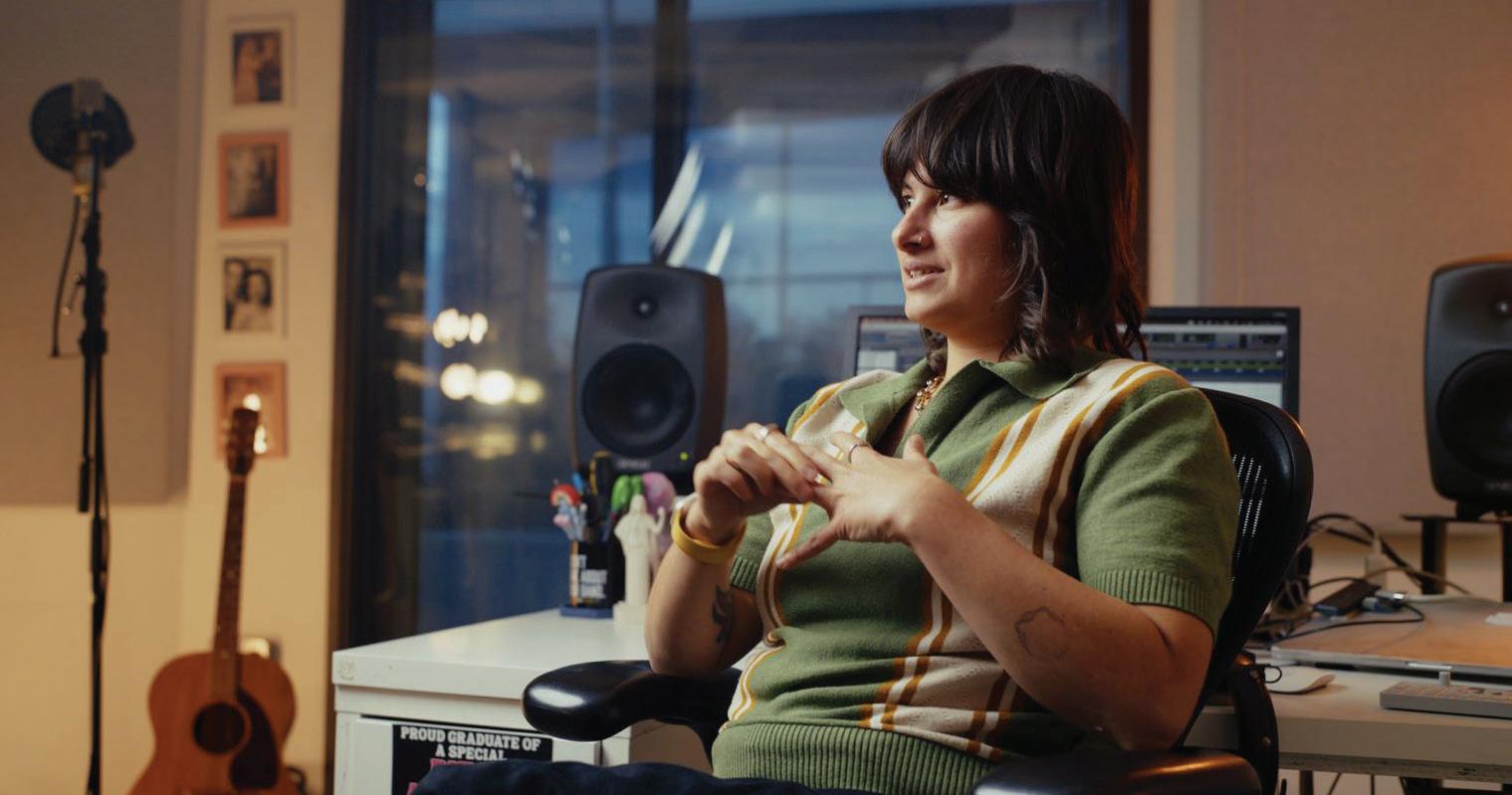
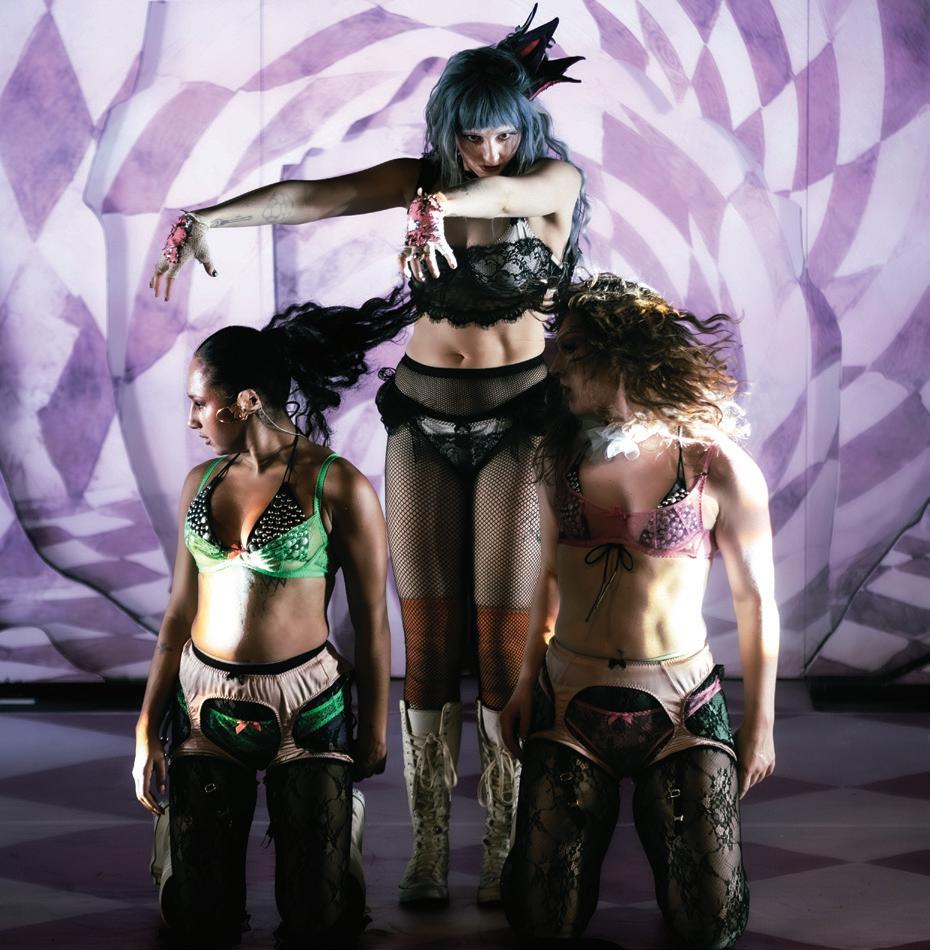
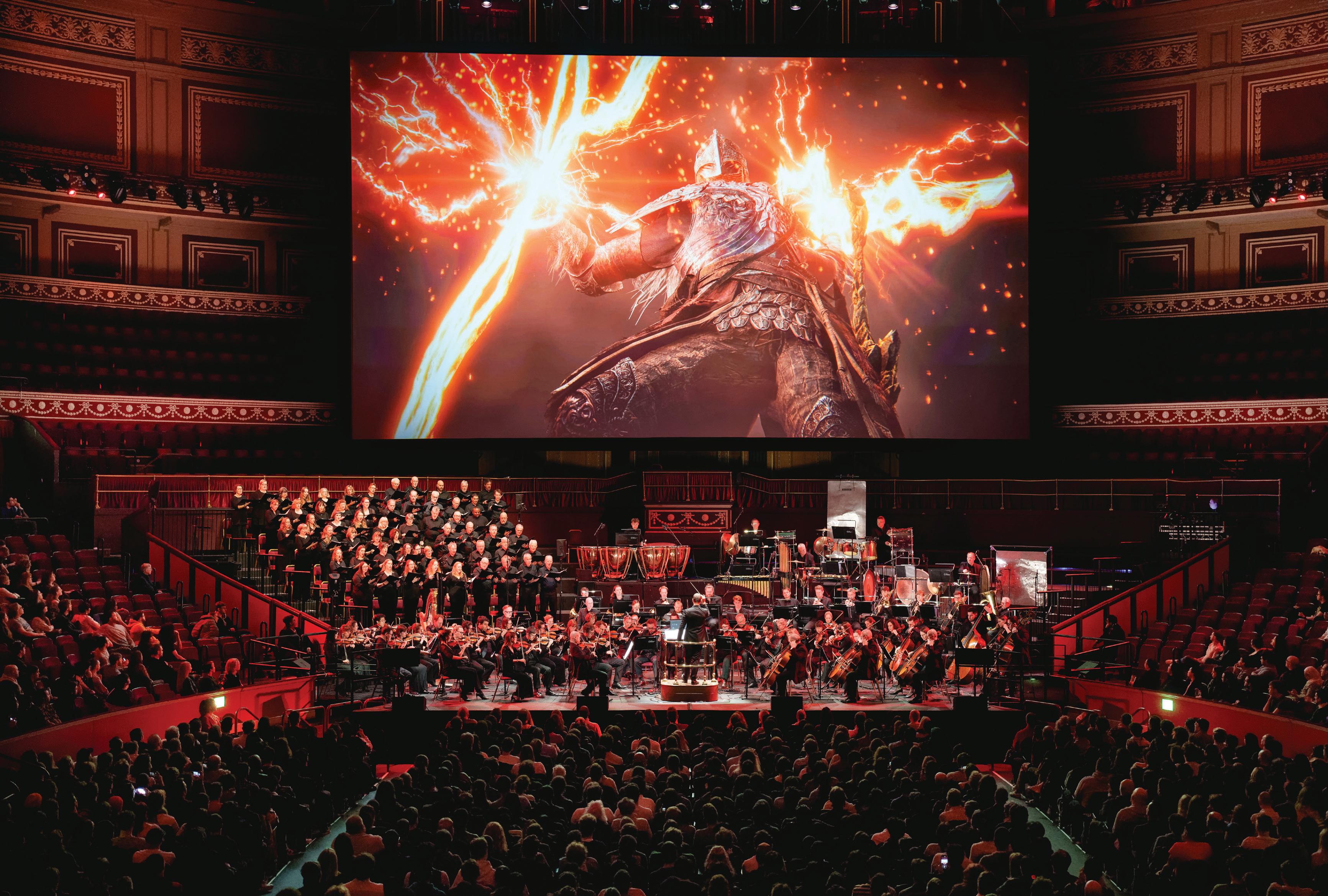
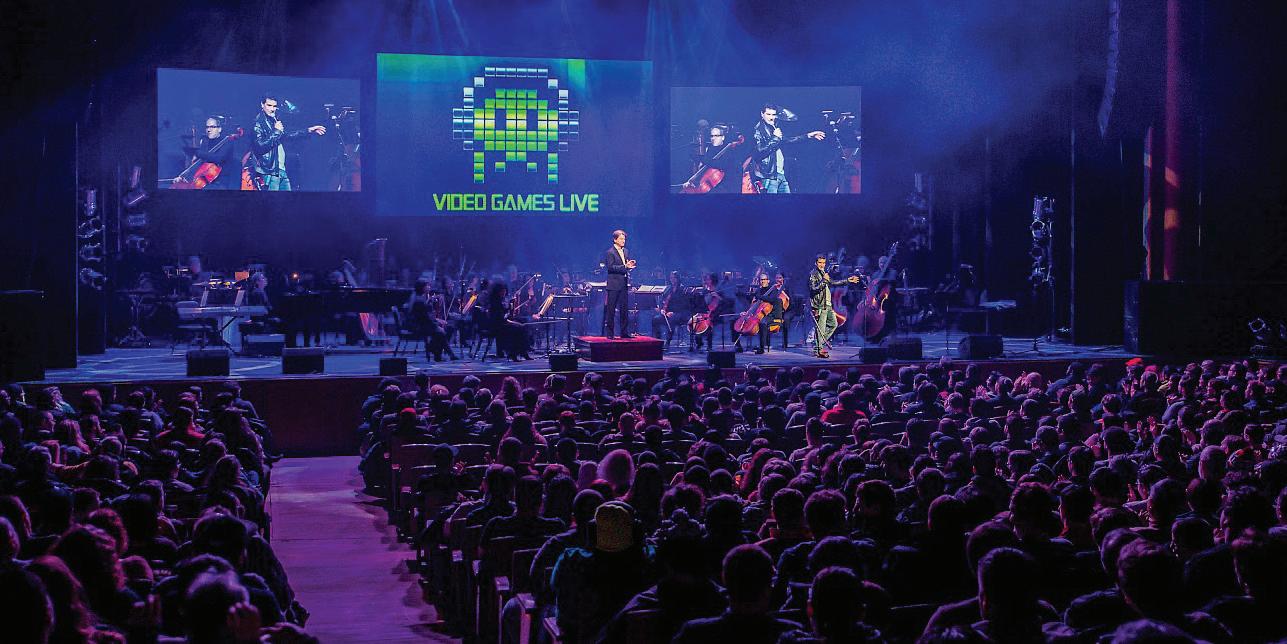
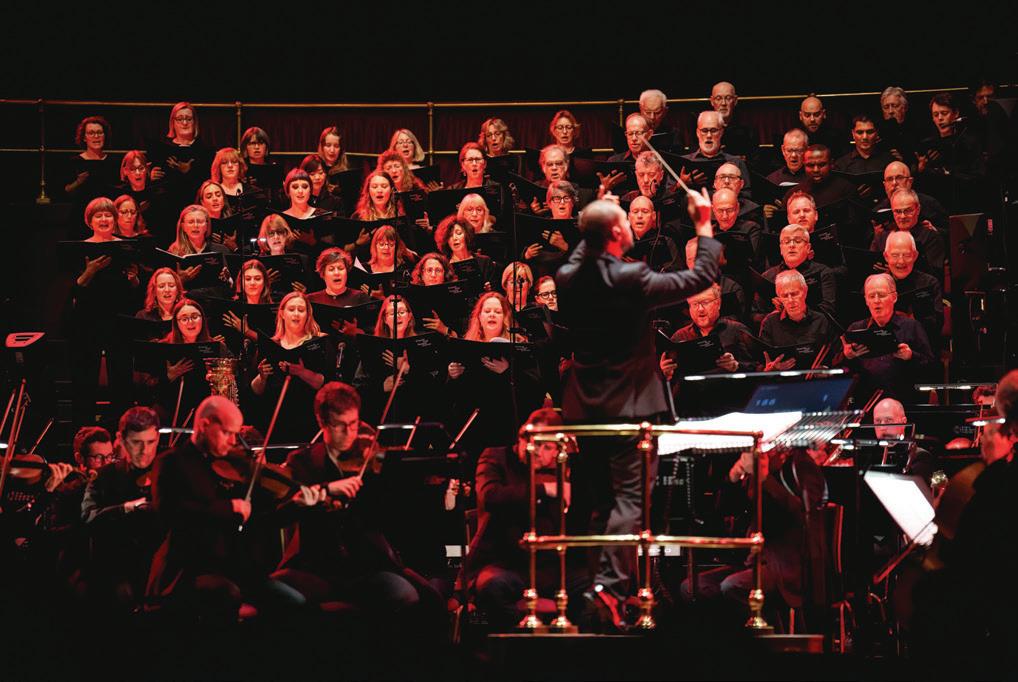
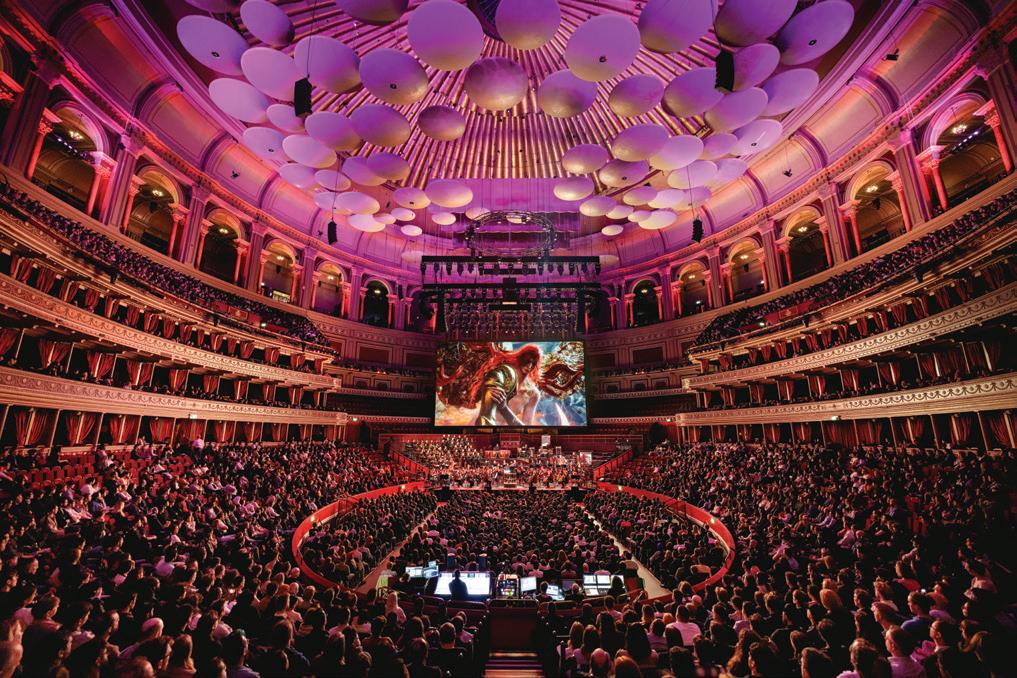
Scores on tour: video game music in the live arena
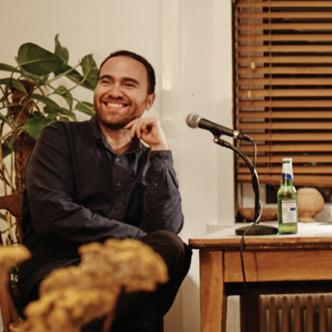
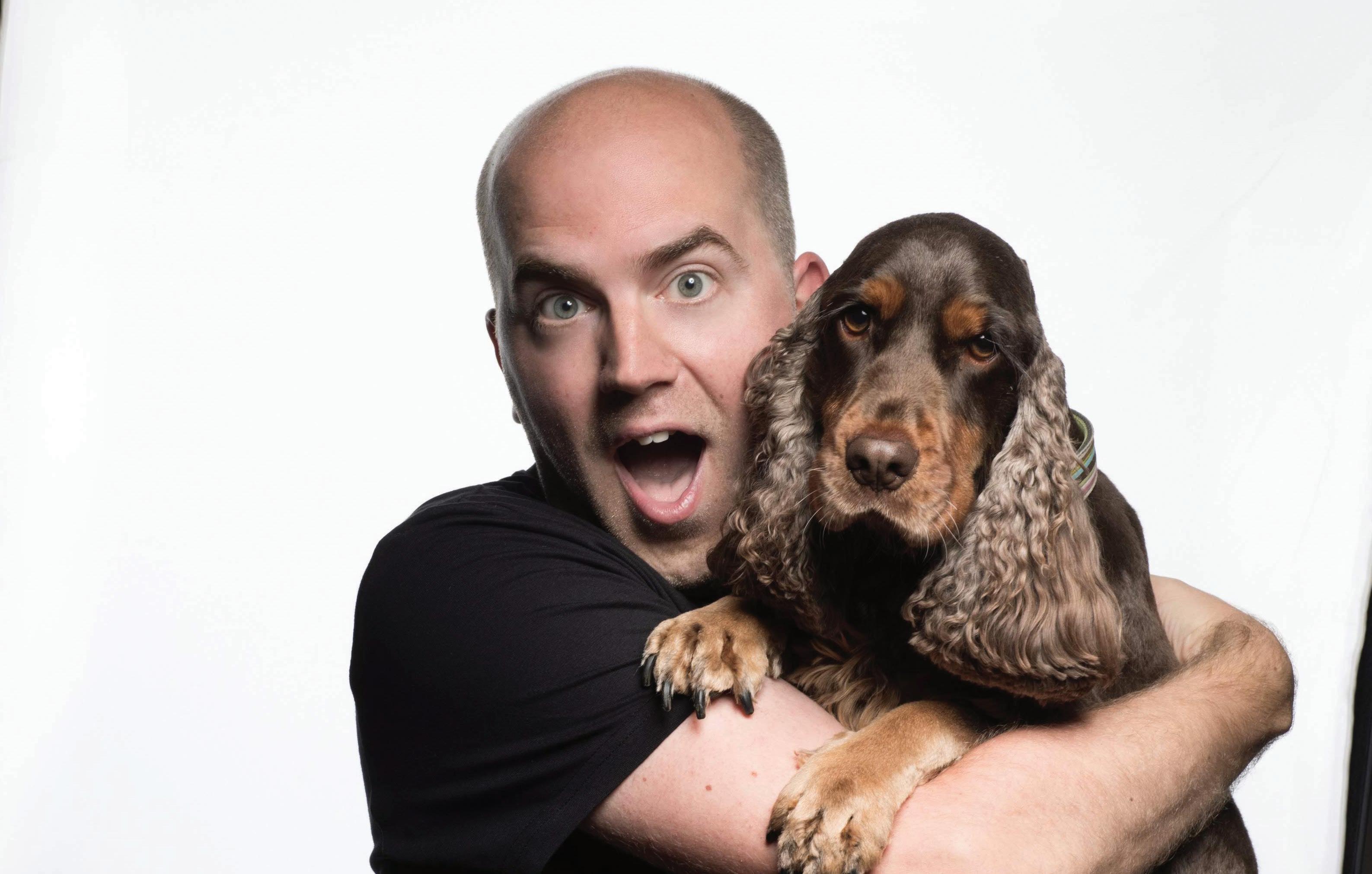
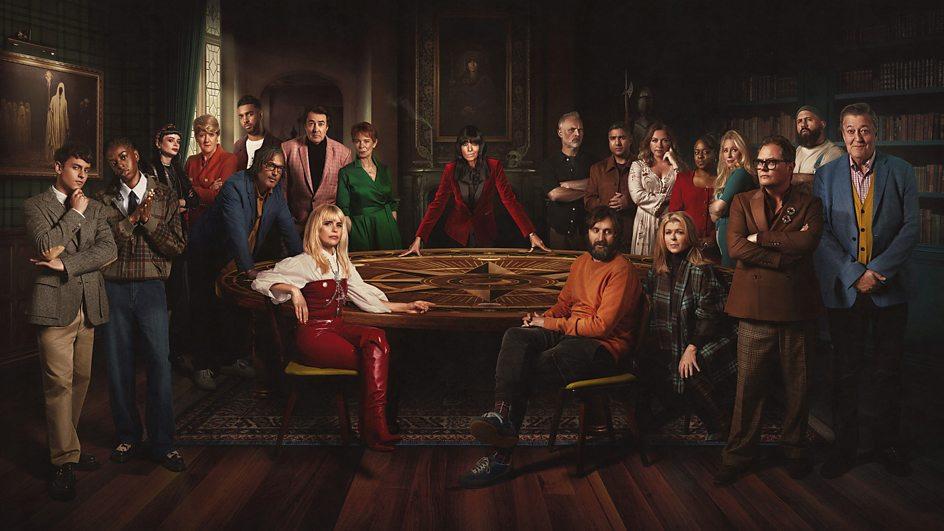
Sam Watts: scoring The Traitors Sound
Editor: Maya Radcliffe
Content Editor: Sam Harteam Moore
Art Director: Carl English
Creative Manager: Paul Nichols
Cover photography: Jules Moskovtchenko
The modern music industry can feel less defined by where a song begins than by how far it travels — from stages and screens to airwaves and arenas.
This latest issue of M captures an ecosystem in motion. The pace of change in the music industry is accelerating, and the implications for songwriters and composers have rarely been more significant.
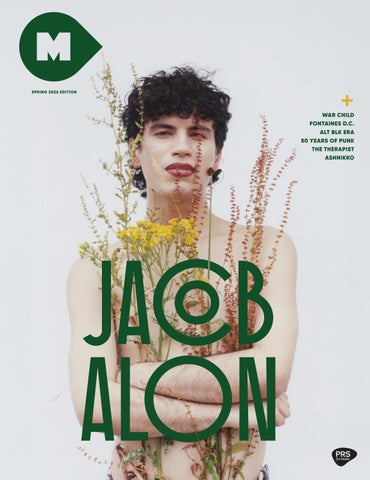
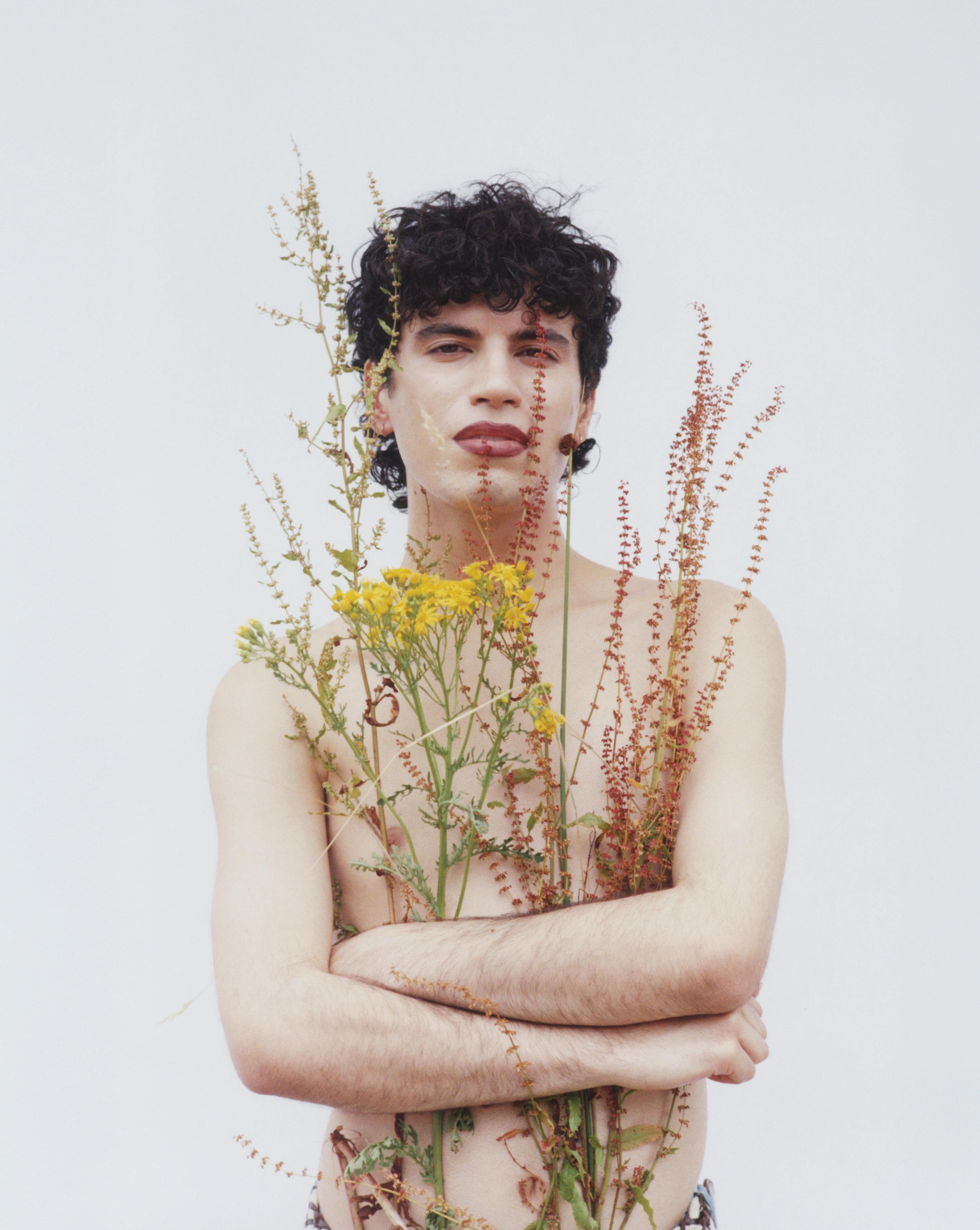
As we mark the 50th anniversary of punk, we’re reminded of the surge of perspective and personality that defined it. When music moves through periods of upheaval, distinctive voices shape the moments that matter. Jacob Alon is part of that lineage: in an industry growing ever more complex, originality and perspective remain music’s most powerful currency. When songwriting like Jacob’s resonates, it rarely stays in one place.
Across this issue we see how songs now live multiple lives. A theme written for television becomes national shorthand, video game scores move from living rooms to packed arenas, and tracks become stadium anthems. Each new context adds another layer of cultural and commercial value.
At the same time, the industry continues to grapple with where music appears and how its value is recognised: from the questions AI raises about authorship, to the royalties generated when songs are performed live and the technologies that help identify music wherever it’s heard. Taken together, the stories here point to a common truth: the value songs create begins with the people who write them.
Maya Radcliffe
Photography: Joshua Halling
Words: Stephanie Phillips
Fifty years ago, Gina Birch found herself at the Sex Pistols’ first-ever gig at St Martin’s School of Art. An aspiring young artist from Nottingham, she had been in London scouting art schools. But that November 1975 show — featuring a set that lasted only 15 minutes — changed the course of her life.
‘At that time, punk felt like it belonged to the young people,’ Gina explains to M now. ‘It was ours and our way to belong.’
Packing up her things, Gina moved into a west London squat and began hanging out at shows by the likes of The Clash, The Slits and Buzzcocks. Suitably inspired by the spirit of punk, she formed the experimental postpunk band The Raincoats with fellow artist Ana da Silva in 1977. The group would go on to influence the likes of Nirvana’s Kurt Cobain and Sonic Youth’s Kim Gordon.
Punk gave Gina a kind of freedom she hadn’t felt before.
‘To me, punk meant that if you had the desire and the guts to do something — however inexperienced you were — as well as a creative brain and a little courage, now was the time to give it a go,’ she adds.
Punk has endured in the five decades since it first emerged from the bars and squats of New York and London, though attitudes have changed with the times. In 1975, you could easily terrify your nana by showing her a gang of punks swearing on live TV. Fifty years on, though, that same contrarian shock value has faded.
The original definition of punk has, in many ways, merged with the establishment, and is more readily associated now with nostalgia-driven anniversary tours and retrospective events at the London Museum and British Library.
Photography: Stephen Daly
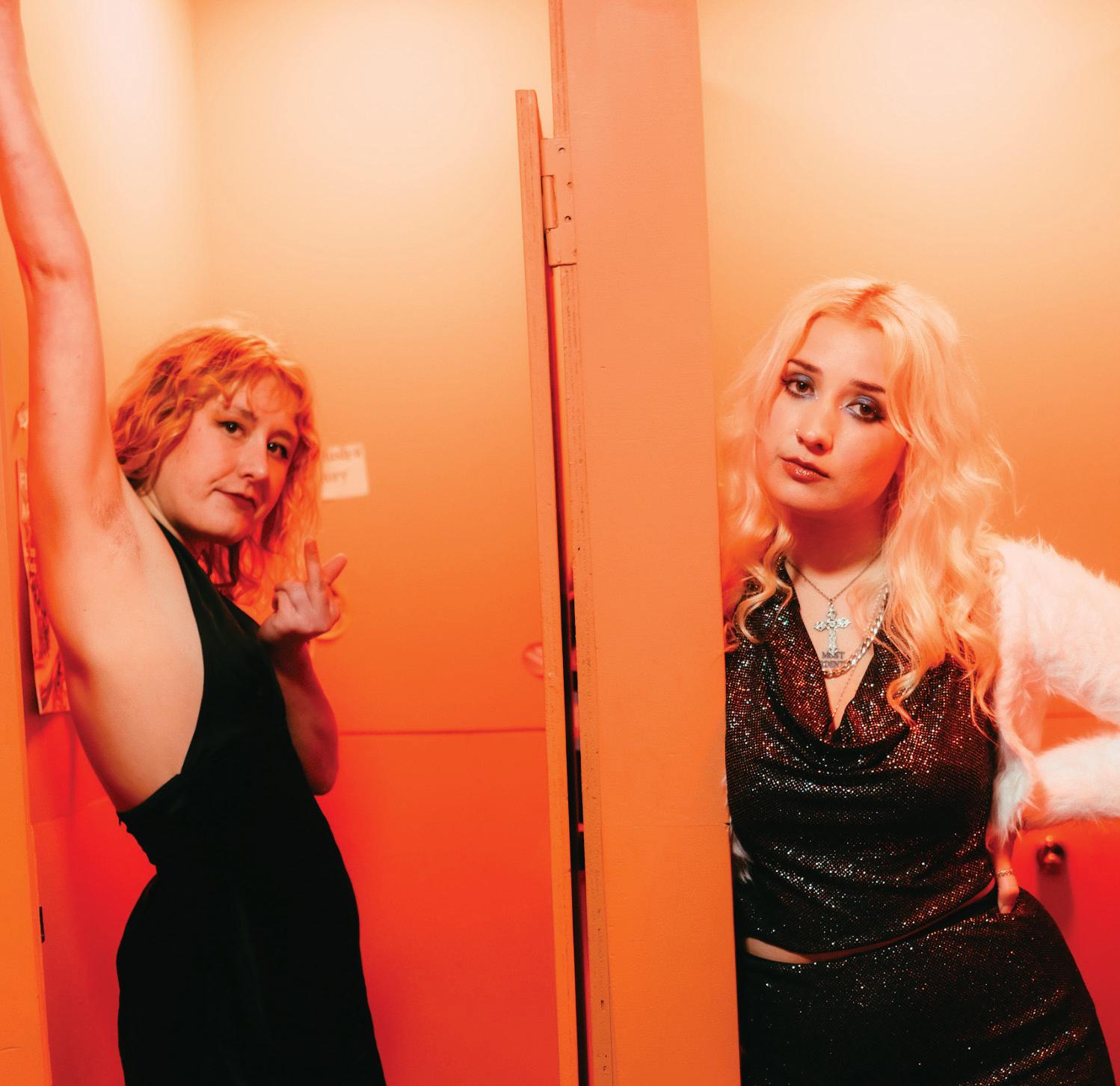
Pink Suits
Yet punk lives on, with a new generation of music creators and creatives maintaining its anarchic spirit and political might. Who Let The Dogs Out, the debut album by Brighton’s Lambrini Girls, broke into the UK top 20 in January 2025, while Australian pub rock rousers Amyl and the Sniffers played their biggest-ever headline gig at London’s Alexandra Palace in October and earned their first Grammy nomination at this year’s ceremony.
But this kind of wider recognition inevitably raises questions about what punk is meant to resist. Although bands like Margate-based Pink Suits enjoy seeing their punk contemporaries experience this kind of success, they are wary of what happens when the genre edges towards more general audiences. ‘A lot of what I think of as punk is very anti-mainstream,’ says drummer Ray Prendergast. ‘It’s cool to see bands break through, but then you’re like, “Oh, this isn’t an underground thing any more.”’
Present-day punk certainly isn’t defined by a singular sound. From pop-punk — which stretches as far as recent Glastonbury headliner Olivia Rodrigo — to its high-energy collisions with hip hop, rap and grime (such as Bob Vylan), the genre is more elastic than ever. For creators like Hyphen, who blends UK rap with raw punk energy, that hybridity simply reflects how artists and audiences are engaging with music today.
‘Nostalgia is a very current thing,’ Hyphen tells M, emphasising how many artists are currently referencing music from the nineties or noughties in their work. ‘Punk is more fluid than it used to be, but then so is everything.’
This fluidity is so pronounced that some contemporary artists in the UK scene didn’t even intend to start a punk band when they formed. Pink Suits’ Ray explains how, when their band started, they were solely motivated to make music about politics and social issues. It was only when other people in the scene identified them as punk that the duo began to see themselves that way.
‘Initially we used to backcomb our hair and think we were glam rock,’ they add. ‘Then we were like, “Let’s stop wearing leotards, it’s kind of weird.”’
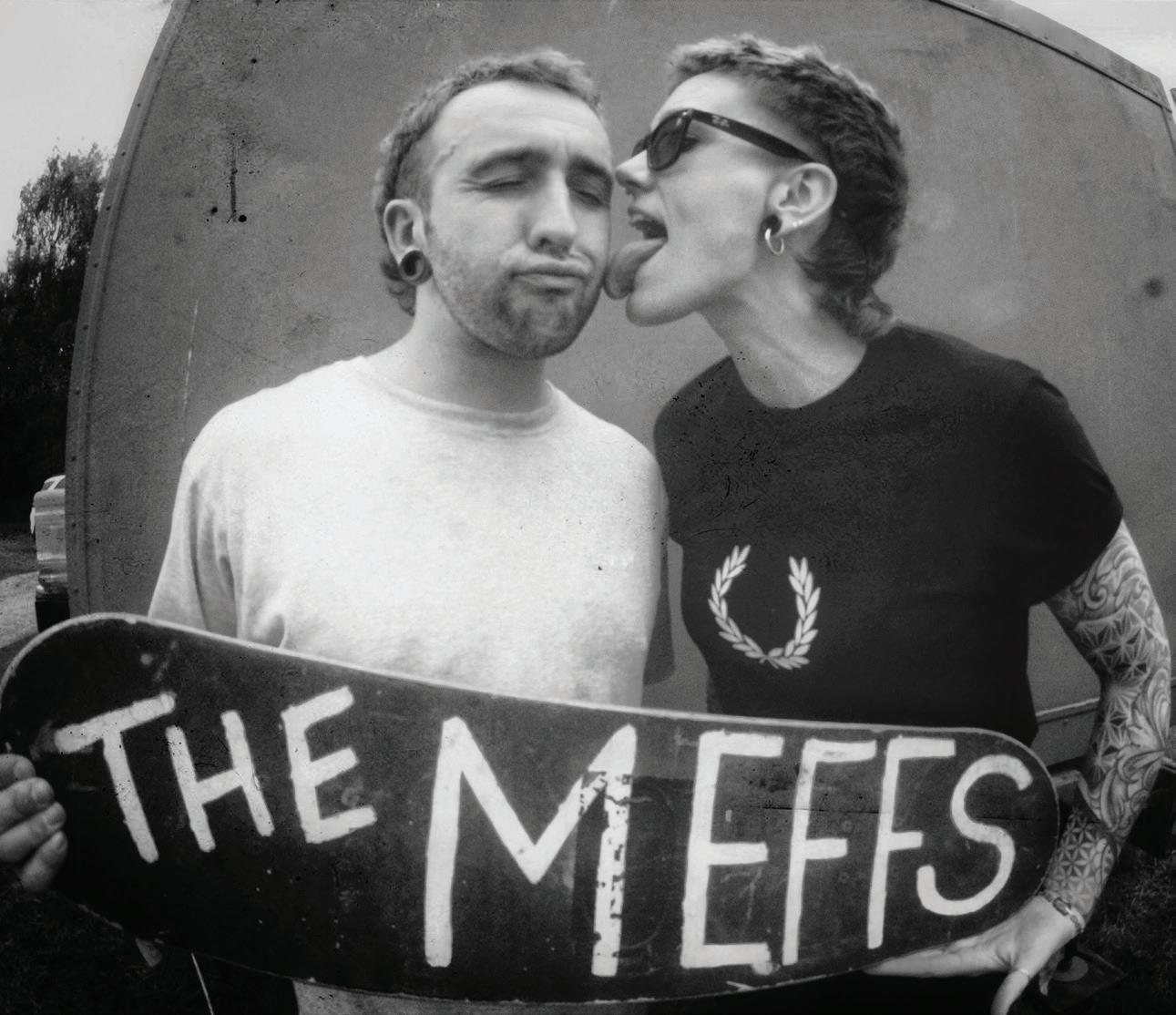
There are still some punk bands who draw direct influence from that first wave of punk. Essex duo The Meffs, for instance, have been openly inspired by the likes of Buzzcocks, Sham 69 and UK Subs when formulating their own ‘Britpunk’ aesthetic. But, for Meffs vocalist and guitarist Lily Hopkins, some aspects of that original era remain difficult to relate to.
‘When I look back at that time, there weren’t particularly many people [involved about] who I could say, “Oh, they’re like me,”’ Lily tells M. ‘They were just men playing 4/4 punk, singing about topics that I don’t know about.’
Punk foremothers The Raincoats, The Slits and X-Ray Spex’s Poly Styrene — one of the few Black women to operate in that original punk era — were notable exceptions to that norm. Today’s punk scene, however, features far more bands fronted by women, people of colour and queer artists. That shift reflects generations of artists who have pushed the genre to evolve, alongside a DIY community that has increasingly sought to create space beyond the straight, white male archetype long associated with punk.
For bands like the Bristol-based Menstrual Cramps, who take their cues from the nineties riot grrrl and anarcho-punk subgenres, the close-knit nature of the DIY punk community allows bands — particularly those from marginalised communities who would struggle to make it in the homogenous music industry — to share information, find new opportunities and work together.
‘The music industry likes to keep a lid on it and keep quiet,’ singer Emilia Elfrida opines. ‘I think that sort of community space, where you’re all sticking together and looking after each other, is really important.’
London-based Brazilian punk duo Yur Mum, meanwhile, say community is the most important part of the punk scene. ‘It’s something that’s beyond the music,’ drummer Fabio Couto explains. ‘It gives you a reason to stay.’
Photography: Jessie Morgan
Lambrini Girls
The Meffs
Photography: Andy Christ
Political activism remains one of punk’s defining principles, with the music itself giving creators a platform to challenge the establishment.
‘Punk is about standing up against the norm,’ Emilia declares. ‘It’s about being very vocal about what’s going on in the world; being a community, a voice and a space for the otherness of ourselves, our friends, the world and the possibilities of what that could be like.’
Today’s fraught political climate — not unlike the bleak landscape from which the original punk scene emerged — may also explain why younger artists continue to gravitate towards the genre. As Hyphen deftly summarises: ‘When you feel like you can’t do anything else, what do you do? You shout, you jump, you dance and you march.’
Over five decades, punk has evolved as an ethos while continuing to reject conforming to a set, commodified sound. It is exactly what the genre was meant to be, Gina notes: ‘[Punk] is constantly changing because it is about the voices that are vital, honest and direct. Each of us has our own way of expressing that.’
The future of punk is in the hands of those who have already adapted the genre to meet modern-day needs. For artists like Gina — who was present at the original eruption of punk — there is no concern that it will become obsolete any time soon.
‘I think each new generation finds a way to deal with the issues that confront them in dynamic and brave ways,’ she says. ‘That’s the punk spirit.’
Photography: Dory Valentine
Menstrual Cramps
Since launching in 2000, PRS Foundation has awarded more than £50m in funding to over 9,000 music initiatives. But the story of its first 25 years is as much about scale as it is about timing, stepping in at the point a music creator’s next move becomes possible — whether that’s touring, exporting work internationally or simply taking the time to focus on their craft. Over time, that backing has become more collaborative and increasingly shaped by the needs of the artists it serves.
‘We’ve been able to come together and collaborate with the wider music ecosystem [over the past 25 years],’ Becci Scotcher, senior grants and programmes manager at the Foundation, tells M. ‘We’ve always made sure that we are bolstering and supporting new music talent.’
The Foundation’s impact is visibly evident in the trajectories of artists like Little Simz, Ezra Collective and Sam Fender. ‘You can really see the journey those artists have gone through and how important [the Foundation’s funding] programmes are,’ says Becci.
When it comes to elevating those careers, Becci says it’s all about recognising each creator’s specific needs and intervening at the perfect moment: ‘What we’ve seen over the past 25 years is how those needs have changed. We may have previously focused solely on funding, whereas now it’s much more about collaboration and working with our industry partners, or with the creators themselves, to make the support as impactful as possible.’
That evolution is embodied by initiatives such as POWER UP, which supports Black music creators, industry professionals and executives and aims to address anti-Black racism and racial disparities in the music sector. Becci points to POWER UP as a key example of how the Foundation now operates and the support it provides.
‘It’s about doing things in the right way, making sure we’re bringing people together and supporting all of these creators who most deserve it,’ she adds. ‘We’ve always been an organisation that’s inclusive, intentional and collaborative — that’s something we hold dear to our hearts. In terms of collaboration, whether it’s with smaller companies, non-profits or the commercial sector, it takes all of us to really ensure we can support these creators to the best of our ability.’
For electronic music producer and audiovisual artist Halina Rice, that backing opened doors internationally. ‘Keychange was the first big thing that really happened to me,’ she enthuses about the global movement, which is ‘working towards a total restructure of the music industry in reaching full gender equality’.
‘Seeing creators like Halina Rice achieve their goals is one of the best things in the world.’
– Becci Scotcher, PRS Foundation
‘It’s brilliant that PRS Foundation is part of that wider internationalised cohort,’ Halina adds. ‘It made me think of myself in a more internationalised way and helped me connect with not just other artists but the wider industry like bookers, promoters and managers.’
Through Keychange, Halina was able to perform at Montreal’s celebrated MUTEK festival: ‘For audio-visual, you can’t get higher than that — it was like starting out and then getting to play on the main stage at Glastonbury. It was nerveracking, but I had all the support I needed because there was a whole group of us out there. The Foundation provided all the tools we needed, so there was definitely a community element to it. To have that network to help support you as an artist is invaluable.’
PRS Foundation
BACKING THE BREAKTHROUGH
How PRS Foundation’s support lands at critical career moments — and why those moments matter more than ever.
Words: Rhys Buchanan
Photography: Michael Robert Williams
Pictured: Halina Rice
‘We’ve always been an organisation that’s inclusive, intentional and collaborative – that’s something we hold dear to our hearts.’
–
Becci Scotcher, PRS Foundation
Beyond the opportunities it created, the experience also shifted Halina’s understanding of the industry: ‘It’s interesting because you don’t realise it day to day, but the figures and stats are there for all to see around gender diversity. The Foundation enabled me to stand alongside other world-class talent and to understand the environment that I’d suddenly started to move in. It was like a fish being let out of a tank into the ocean.’
The Foundation sees international exposure as central to long-term career development. ‘Seeing people like Halina perform and achieve their goals is one of the best things in the world,’ Becci tells M. ‘We’ve also supported her via the International Showcase Fund. Listening to creatives and hearing what they need to export their work internationally is crucial. We have really ambitious plans for that now that it’s 20 years in, and how it can grow moving into the future.’
For many creators, backing from the Foundation doesn’t just change their circumstances — it changes their sense of what’s possible. That was certainly the case for Grammy-nominated songwriter and producer Steph Marziano, who received the Writer Producer Fund (now Hitmaker) to support her growth internationally.
‘The Foundation grant proved that someone else believed in what I was doing, and that was so powerful,’ Steph tells M. ‘I really took belief from the fact that this organisation that listens to music all the time has said that I’m good at what I do. It made me really want to go for it.’
Steph, who has co-written and produced tracks such as Hayley Williams’ Parachute, says that the funding came at a pivotal moment in her career.
‘I’d just written my first songs with Hayley, so I was on the verge of things happening,’ she recalls. ‘But I was struggling financially: the first time I went out to Nashville to work with her I was staying on someone’s sofa to be able to afford to do it. The Foundation money meant that I’d never have to do it at that level again. I could sustain myself at the level I needed to.’
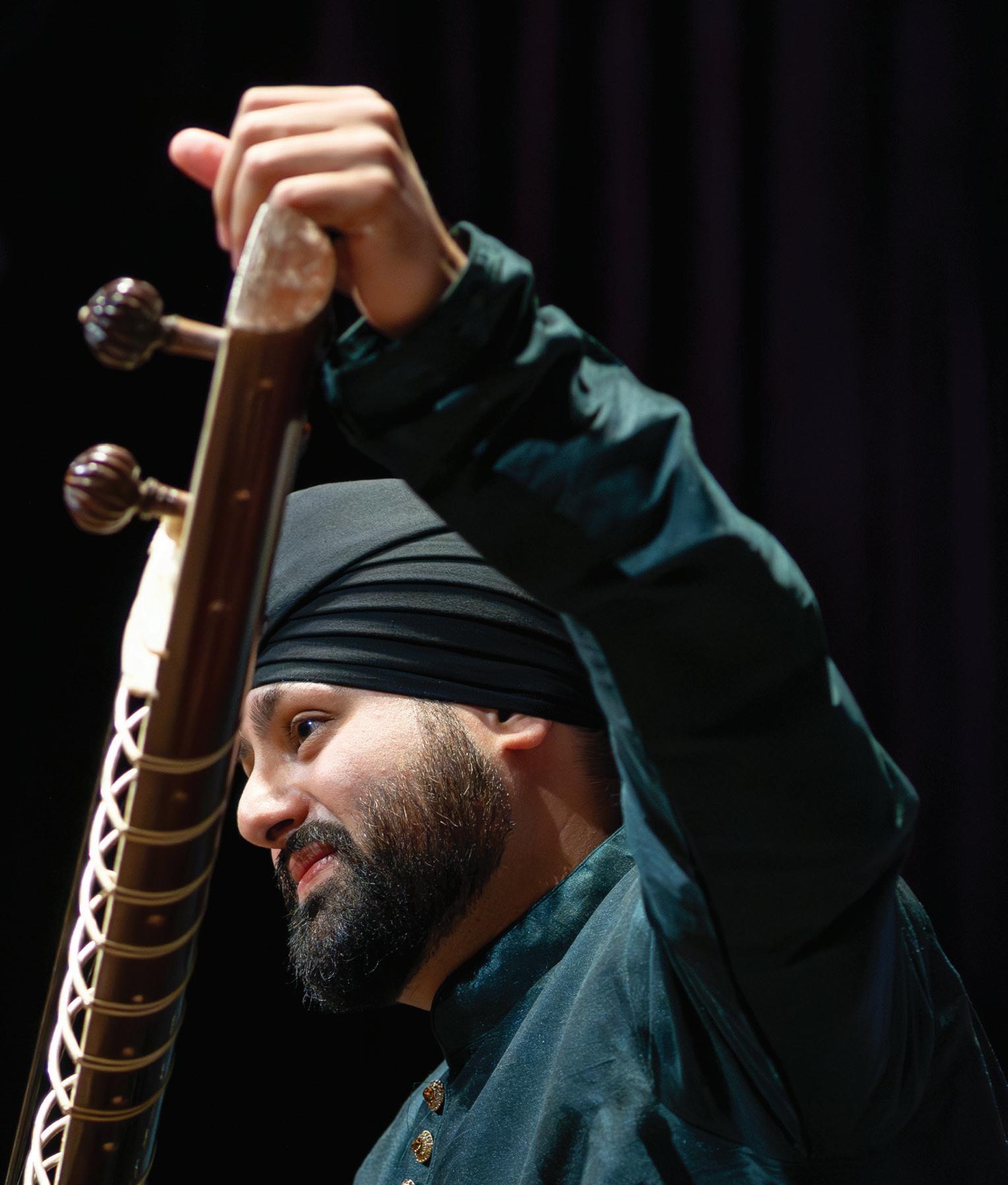
The timing was equally crucial for Leeds-based sitarist and composer Jasdeep Singh Degun, who used funding from the Open Fund for Music Creators to support his live plans for his album Anomaly. ‘That came along just after lockdown when all artists were struggling financially,’ Jasdeep says. ‘It was incredibly helpful in enabling me to tour.’
Photography: Alex Green
Pictured: Sam Fender
Steph Marziano
‘The Foundation has always come in at really pivotal moments throughout my career.’
– Jasdeep Singh Degun
The Foundation also enabled Jasdeep to attend Classical:NEXT in Budapest, the largest international event for classical and art music professionals. ‘At that point I was signed to a label, but I didn’t have any representation in terms of management or publishing,’ he recalls. ‘Attending that event really opened things up in terms of networking with industry people I wouldn’t have otherwise met. The Foundation has always come in at really pivotal moments throughout my career, even when I was unsigned and needed that extra support.
‘With the Foundation, there’s no judgement on style of music,’ he continues. ‘They don’t define a composer as a Western classically trained composer. I’ve been funded to work on various different projects, such as my contemporary album Anomaly. You don’t usually get that kind of cash injection to just focus on your own craft. This is the only place that I’ve actually had funding [from] just to work on my sitar, so it doesn’t matter what kind of musical form you play or do.’
From underrepresented communities to composers working outside the mainstream, the Foundation’s scope is deliberately broad. Becci says catering to creators from all genres and backgrounds will continue to be central to the Foundation’s vision.
‘PRS Foundation has always been at the forefront of identifying what creators require, particularly those from underrepresented backgrounds and from parts of the UK’s nations and regions where support can make a real big difference to people,’ she explains. ‘Whether that’s through something like our Open Fund or via our Next Steps programmes like PPL Momentum, the Hitmaker Fund and our Composers’ Fund. We also have targeted action programmes, which goes back to knowing, understanding and responding to the challenges that [creators] face.’
One ongoing challenge is capacity: demand continues to outstrip available funding. ‘There are more talented people out there than we have funding for and that has always been the case,’ Becci acknowledges. ‘I don’t want people to be put off by that, though. It shows that we have so much incredible talent.’
The application process, she adds, is designed to be constructive in itself: ‘It’s about thinking, “What am I trying to achieve? What are my career goals? Where do I want to be?” In some ways, part of the application process is designed to help you think about these questions in a more structured way and to identify the steps you need to take.
‘We understand that people are pouring their heart and soul into their music beyond it being a business, so it can be easy to be disheartened or put off if you’re not successful. But I would always encourage people to come and see us. We go to lots of events across the country and we try to get out there as much as we can, plus there are lots of tools like how-to-apply videos.’
Looking ahead, the focus is on how the Foundation builds on that track record. For Becci, consistency will be key: ‘I think we will continue to do what we’ve always done so well and are known for. We’ll continue to strive for and advocate for creators and those in the ecosystem who support them. We’re always learning and modifying like any good organisation should. That’s exactly what we’ll be doing to help creators for the next 25 years and beyond.
‘It’s about all coming together to support the current talent we have and the talent of the future,’ she adds. ‘We have equity and inclusivity at our heart, and we can be really reactive and agile when it comes to making creative support mechanisms for people who need it the most.’
Photography: Govert Driessen (govertdriessen.com)
Jasdeep Singh Degun
Words: Arusa Qureshi
Having capped off a whirlwind 2025, the sibling duo reflect on their successes, solidarity and soaring ambitions.
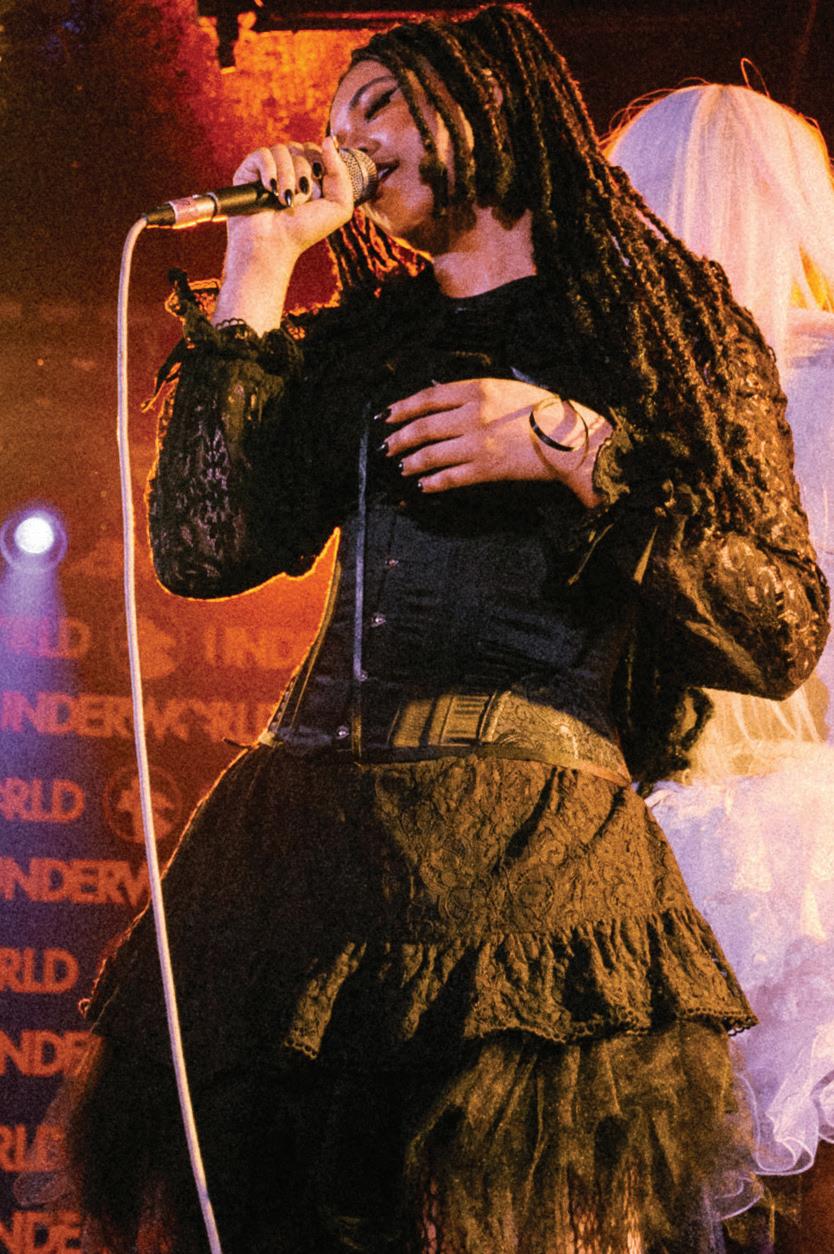
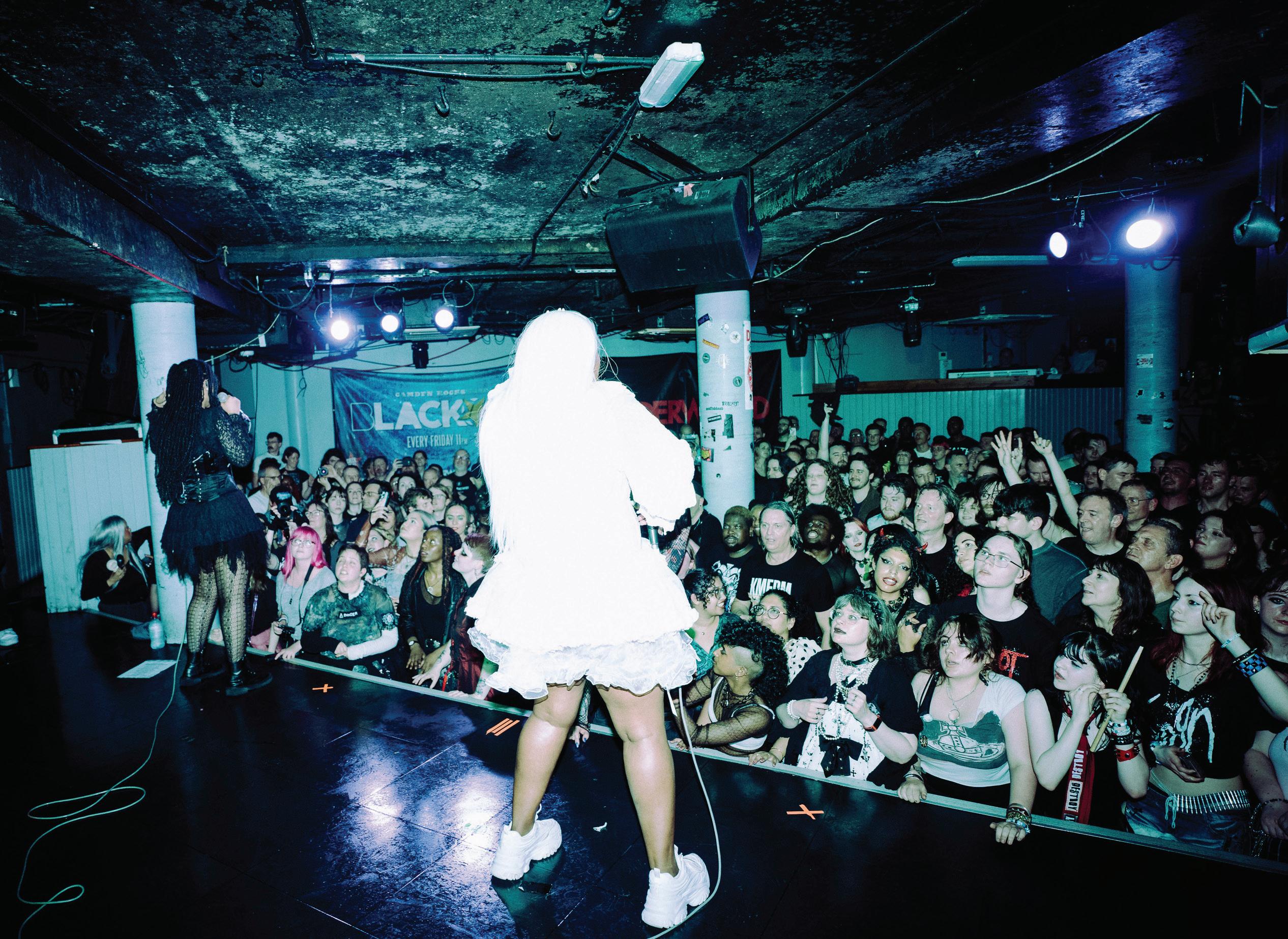
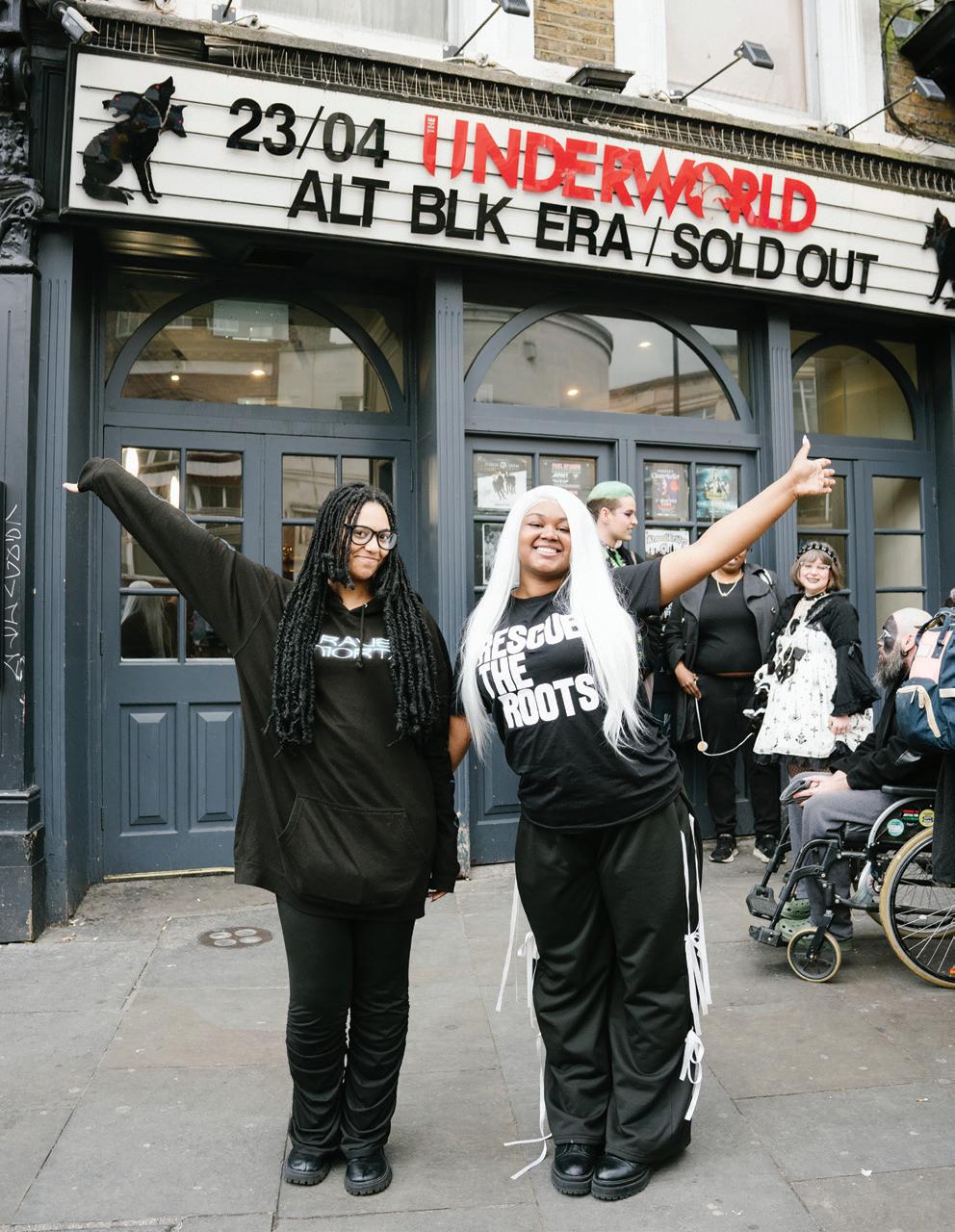
Usually found tearing up the UK’s alt rock scene, ALT BLK ERA are taking a well-deserved breather as they chat with M during a stop on their European tour with Pendulum. 2025 was that kind of year for siblings Nyrobi and Chaya Beckett-Messam, though — a blur of relentlessness, self-discovery and triumph.
Their debut album Rave Immortal, which dropped in January last year, announced the duo as one of the most defiantly original new acts in the country, thanks in part to their fusion of heavy riffs with pop drama and electronic soundscapes. It’s a record that amalgamates genre in a way that feels both cathartic and confrontational, pulling listeners into an unrestrained and sonically rich world.
‘Rave Immortal was a very personal album for us,’ Nyrobi explains. ‘It was about my struggle with a chronic illness that led to me being registered with a disability. It was about lost friendships and loneliness, but also rebellion — transcending into a world beyond pain.’
Last year, Nyrobi spoke publicly for the first time about living with chronic fatigue syndrome, a revelation she admits was ‘terrifying’ to share: ‘I remember when we were in the studio writing one of the songs and never imagining it leaving the hard drive. Then, suddenly, release day came, and I realised: “Holy cow, now everybody knows.”’
Her honesty has made ALT BLK ERA a lightning rod for representation in rock, a space still often dominated by narratives that centre on able-bodied experience. ‘I think the one reason that I actually felt comfortable coming out with my disability was so I could empower other people,’ she says. ‘I’m hoping that others aren’t going to feel like they have to hide like I did.’
If Rave Immortal is a record about finding strength through suffering, the former is often derived from family. Chaya, Nyrobi says, has been instrumental. ‘I would not be where I am today without my little sister,’ she admits, glancing over at Chaya, who is playfully making a face at her. ‘I was totally reliant on her, especially in those early few years when I was really, really sick. Our mum is our manager, so she makes sure I’m looked after.’
Photography: Chiara Ceccaioni
The sisters’ dynamic underpins their sound: a collision of angst and affirmation powered by an experimental and forward-facing approach. Chaya notes the band have ‘grown into’ themselves since their early days.
‘Since 2022 we’ve been experimenting with a lot of different genres, from heavy metal to dark pop,’ she explains. ‘With this album, and going forward, we know where we are musically. In terms of our performance and what we wear, I feel like we’re pretty confident in ourselves. We’re still blending genres as we did back in 2022, but I feel really comfortable where we are right now.’
ALT BLK ERA’s rise has been blessed with ample accolades and milestones, from a MOBO Award to a Later… with Jools Holland appearance. In October, the duo took home the New Artist trophy at Music Week’s Women in Music Awards 2025.
‘It was incredible,’ Nyrobi says of the ceremony. ‘To be celebrated by women who’ve been trailblazing in the industry for years was so inspiring. I said this in the speech, but we just really, really want to pay these kinds of moments forward to other artists coming up. Since we’ve been putting out music, we’ve dreamt of making an impact in the way that the women who we were in the room with have. I think even just chatting to everyone afterwards and learning more about them, having a bit of a laugh talking about experiences, was just so empowering.’
Even with the trophies stacking up and the industry clearly taking note of their commanding energy, both sisters are wary of declaring they’ve ‘arrived’.
‘We’ve got a long way to go,’ says Chaya. ‘It’s just the beginning.’ Nyrobi nods in agreement: ‘I think the things that we cherish the most have been connecting with people, and our fanbase are so special to us. They’re what fuels us to keep going.’
For all the accolades, it’s evident that the sisters are most moved by this idea of connection. Nyrobi recalls one notable acoustic set they played earlier this year: ‘I remember performing Come On Outside, and there were more disabled people there than I’ve ever seen at one of our shows. They all sat in the front row, and I was holding back the tears of all the oceans in the world. As I sang, I was looking into their eyes and they were tearing up, and I was tearing up. That moment reminded me why I do this.’
In addition to their successes, ALT BLK ERA remain fiercely independent in spirit and have learned to protect their creative freedom. ‘Have a strong team,’ Nyrobi replies when asked for their advice for young musicians. ‘People who believe in your vision, not five people telling you five different things. Be firm in who you are. Say no when something doesn’t align. Everyone’s going to try to push a boundary — you have to say, “Hell no.”’
That sense of self has also shaped their relationship with PRS, which has helped the duo build their career from a financial perspective.
‘Streaming doesn’t pay enough, so PRS royalties fill the gap,’ Nyrobi explains. ‘But beyond money, it’s the network — the mentors, the friendships, the collaborations. PRS is so much more than I think people believe it to be. I think we’re so privileged that we’ve been able to tap into so many aspects [of PRS support], such as PRS Foundation funding.’
Even as Rave Immortal continues to find new ears, ALT BLK ERA are already deep into their next phase with the recent release of their single Tissues . ‘It’s still definitely, undeniably ALT BLK ERA,’ Nyrobi notes.
‘We know where we are musically. I feel really comfortable where we are right now.’ – Chaya
‘It’s got the rock element. It’s got a little bit more of a pop-rap situation going on, with the electronic vocals from Chaya as well. I think it’s really exciting.’
Photography: Chiara Ceccaioni
A.Vassell
‘Our fanbase are so special to us. They’re what fuels us to keep going.’ – Nyrobi
The duo will no doubt have a full and fruitful 2026, with Nyrobi hinting: ‘I think one thing that we’ve always really wanted to do is collaborate with some of our favourite artists. Whether that’s with rappers, DJs, pop artists, whatever — we’re just looking forward to exploring our sound that way.’
For a band barely three years into their career, ALT BLK ERA already feel like a seismic force in the alternative scene. Not just in terms of their loud, ambitious and anthemic sound, but in their emphasis on breaking barriers, as Nyrobi affirms: ‘We’ve broken a few stigmas just by existing in this space. People say, “Oh, I didn’t know disabled people could do that,” and honestly, I didn’t either, because I grew up in a society that showed disability one way.
‘Disability is a spectrum,’ she continues. ‘Hidden, visible, everything in between — and we’re showing that you can’t box it, or us, in.’
Photography: Chiara Ceccaioni
Photography:
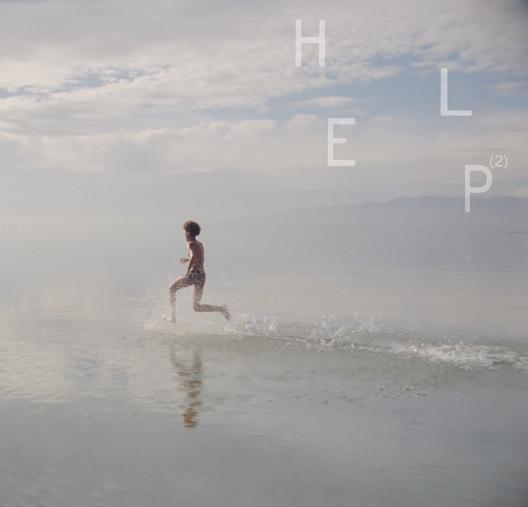
HELP (2)
Inside the recording of War Child’s star-studded new charity compilation
Words: Thomas Smith
Boasting a cast list that includes Arctic Monkeys, Damon Albarn and Kae Tempest, HELP(2) stands to have an even bigger impact than the original 1995 album. War Child’s Rich Clarke and Transgressive Records’ Toby L talk collaboration, choirs and the camera-wielding kids that shaped the sessions.
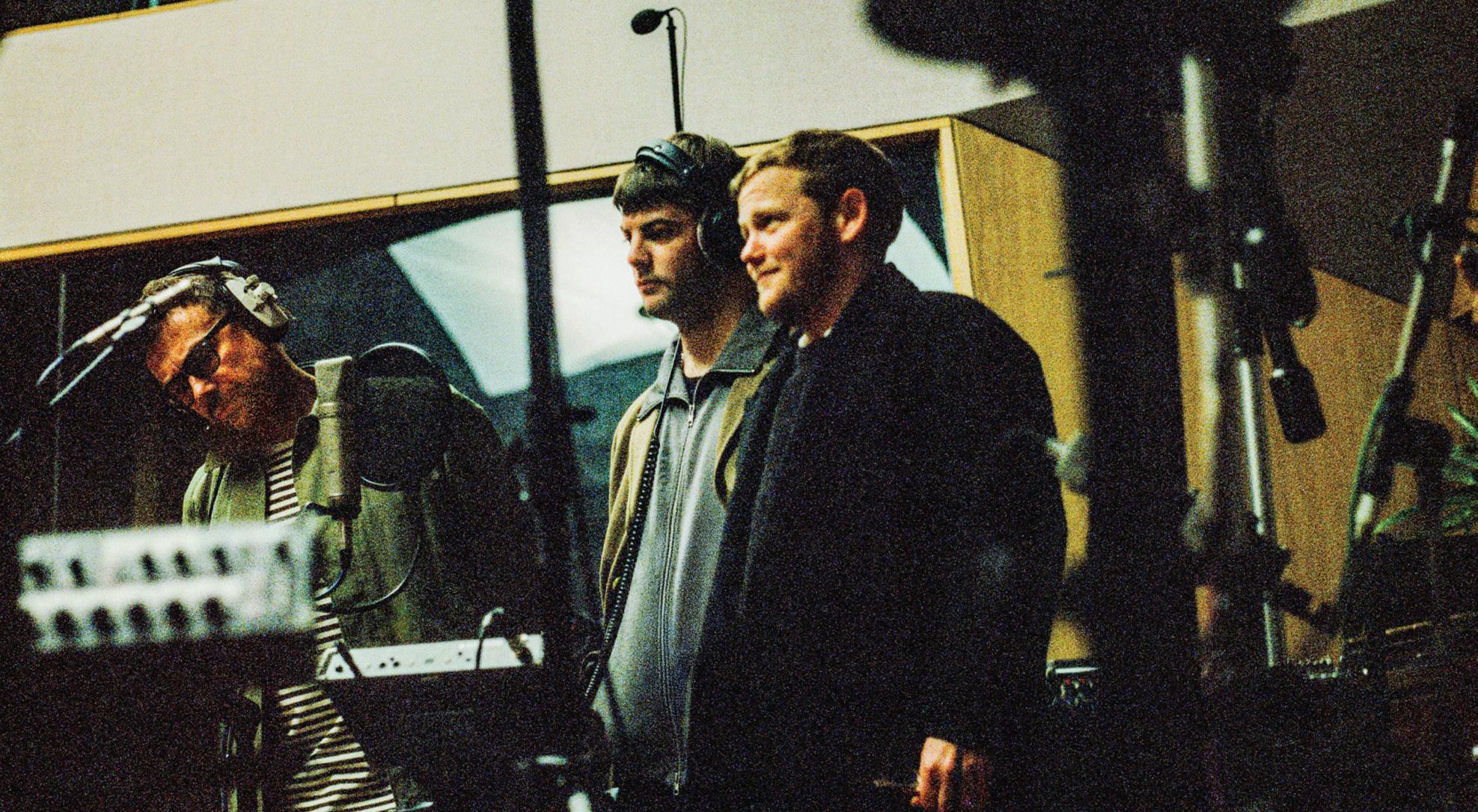
The potential stress of managing a revolving door of rockstars in a recording studio pales in insignificance to when a bunch of excitable children descend on a session. This scenario played out at London’s Abbey Road Studios during the recording of War Child’s new charity compilation album HELP(2), as Toby L, Transgressive Records co-founder and one of the album’s executive producers, tells M: ‘Assembling a children’s choir is actually a logistical nightmare, it transpires!’
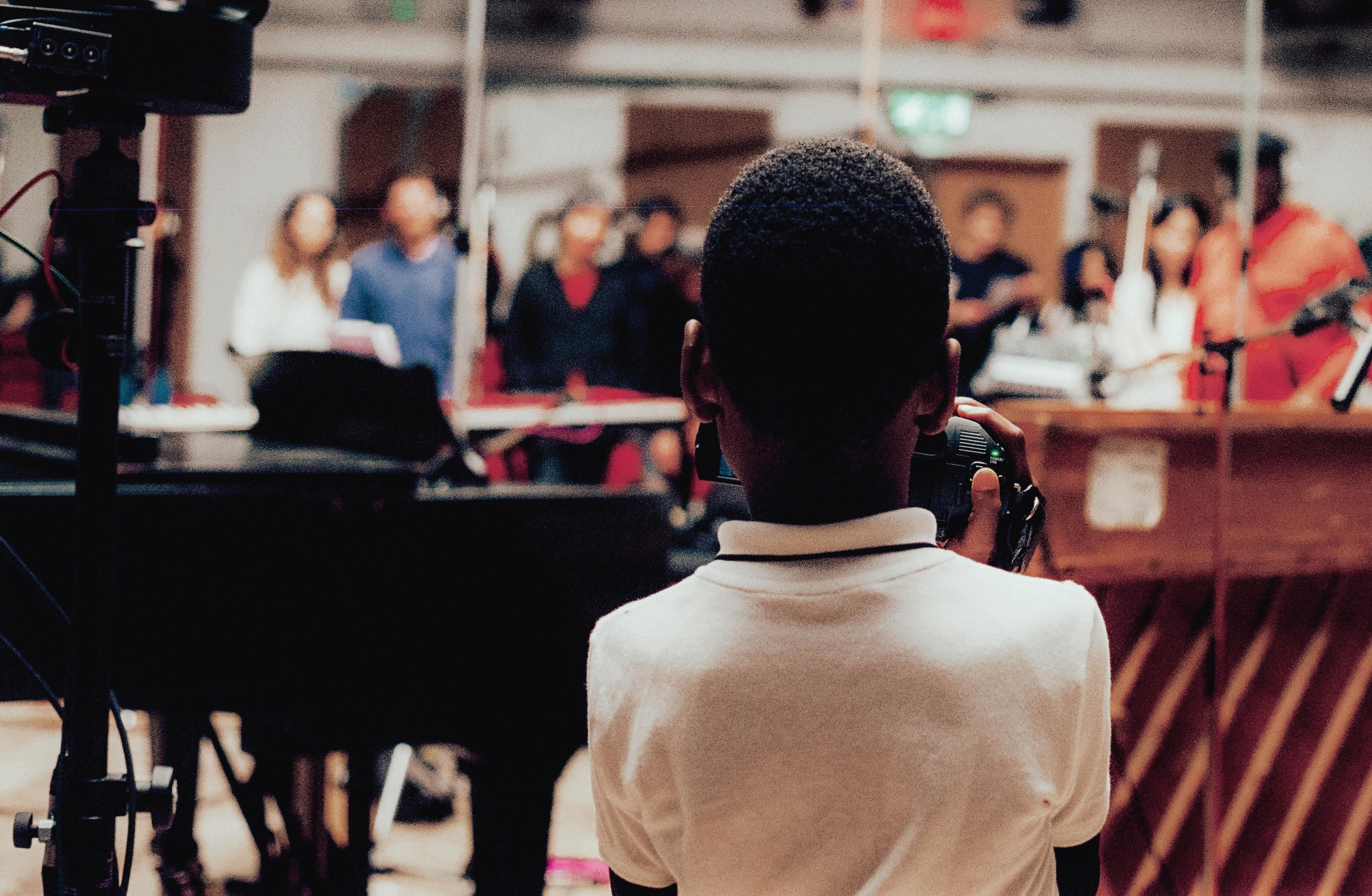
The Zone of Interest director Jonathan Glazer further embraced the unpredictability of youth by handing handheld cameras to a gaggle of children to capture footage from the sessions for a behind-thescenes documentary.
‘There’s nothing more disarming than an eight-year-old with a camcorder,’ Rich Clarke, head of music at War Child, adds. ‘But they made the session feel really celebratory, triumphant and full of joy. The tension just dissipated.’
This levity also reminded all involved about the important cause at hand. HELP(2) is the sequel to the landmark 1995 HELP album, which raised over £1.2m to support children caught up in areas of conflict and aid them with their recovery. Three decades on, the humanitarian situation in many regions of the world remains desperate, with War Child estimating that 520 million children worldwide — almost one in five — are currently being affected by conflict.
Photography: Charlie Barclay Harris
That’s why projects like HELP(2) are vital to helping fund War Child’s important work. The desire to replicate the huge success of the 1995 compilation, which sold 70,000 copies on its first day of sales, is also understandable. Led by Brian Eno and recorded across a single day, the tracklist featured the likes of Radiohead, Paul Weller and Massive Attack. Oasis and Blur even put aside their rivalry to come together for the cause (albeit on separate songs), while Sir Paul McCartney assembled a supergroup for a cover of The Beatles’ Come Together
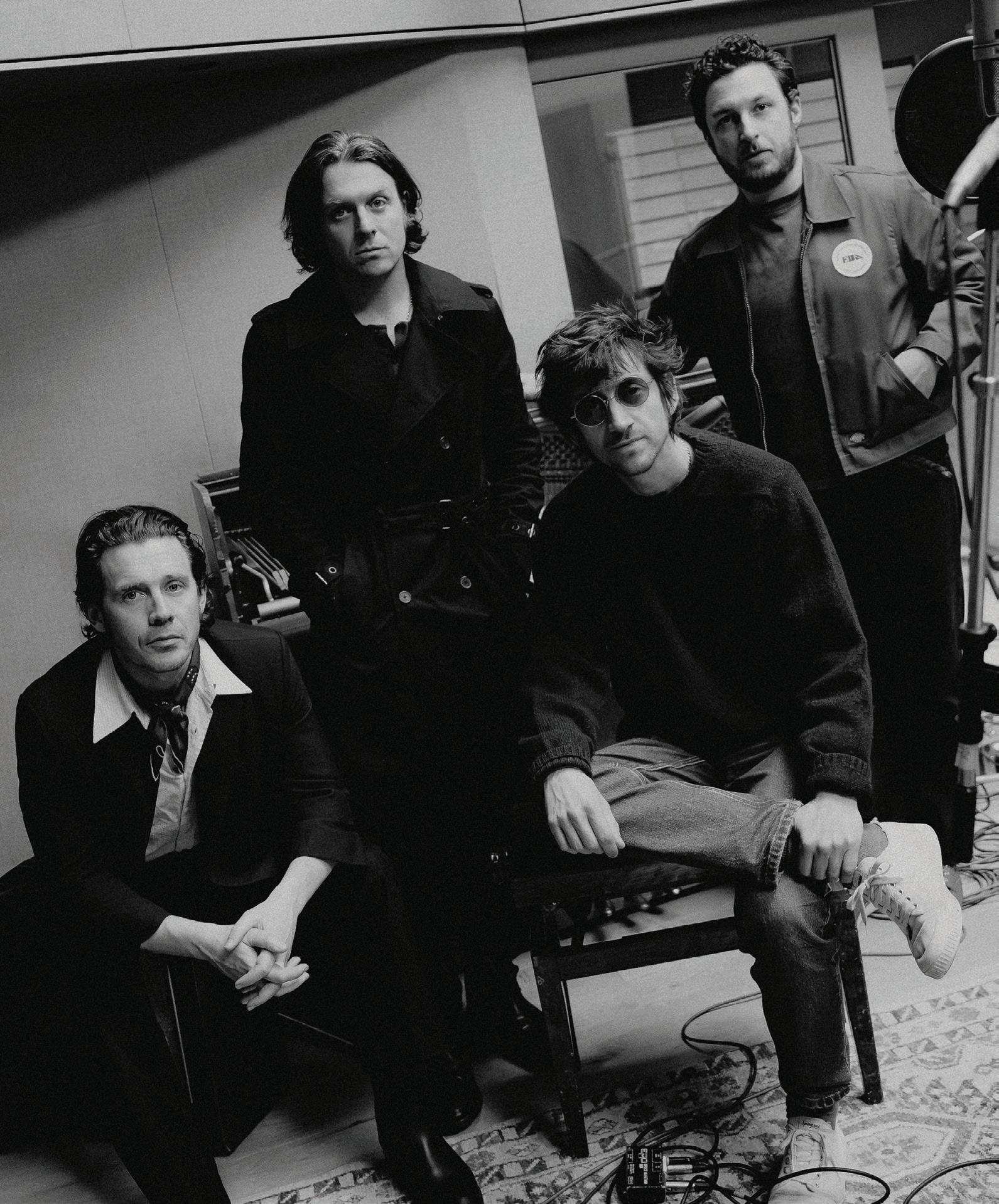
HELP(2) is similarly star-studded, bringing together a diverse array of essential voices from the realms of indie, pop and alternative music. Arctic Monkeys have contributed their first new song in four years for the LP’s opening track, while Olivia Rodrigo, Fontaines D.C., Beabadoobee, Pulp, Wet Leg, Foals and Depeche Mode also make appearances.
Damon Albarn returns, as does his Blur bandmate Graham Coxon, who performs as a backing musician on several songs. Oasis, meanwhile, have contributed an exclusive live version of their song Acquiesce, which was recorded on the final night of their seven-show run at Wembley Stadium last year.
At the core of this album is James Ford, the British producer who has already worked with most of the music creators on the collection during his career. His prestige resonates, making him the perfect choice to be behind the mixing desk during these sessions. ‘We totally handed over the keys to James,’ Rich says. ‘We knew we wanted to work with him, but that we would also have to trust him because we knew he would curate something amazing.’
Photography: Phoebe Fox
Pictured: Arctic Monkeys
James’ involvement is all the more remarkable given that he was diagnosed with leukaemia in January 2025, prompting the postponement of the HELP(2) sessions while he began treatment. Though he wasn’t physically present at every session, cutting-edge technology helped him remain a part of the recordings. Olivia’s session, for instance, took place while James was in hospital receiving a blood transfusion, but the producer was still able to contribute virtually and even speak into monitors in the studio. For a record shaped by urgency, it was a striking image of commitment.
‘We've made friends and creative partnerships for life off the back of this project.’ – Toby L
Elsewhere, other major players in the indie scene rallied to the cause, with Wildlife Entertainment (Arctic Monkeys, Fontaines D.C.) assisting in project management and Beggars Group helping distribute the album. Abbey Road gave the run of their studios over to James and the HELP(2) creators, waiving their usual fees owing to their full belief in the project. This selfless, collaborative spirit permeated every part of the record, much like it did the original.
By incorporating such genres as indie, jazz, R&B and beyond, HELP(2) is a more sonically broad listen than the original. To make the album resonate musically, Rich implored the invited artists to bring their finest material to the table. He cited Radiohead’s Lucky as an example: the band contributed that track to the original HELP album during a five-hour recording session, and its quality later ensured its place on their 1997 album OK Computer. ‘We were all really clear that the creative bar couldn’t be lowered,’ Rich tells M. ‘I feel like every act gave the best track they could.’
Arctic Monkeys, for example, revived a songwriting idea they first had during the sessions for their 2009 album Humbug. In a recent interview with Apple Music’s Zane Lowe, drummer Matt Helders said that their track Opening Night — stuffed with sublime harmonies and a sinister feel — was a track they ‘couldn’t have done 10 to 15 years ago’ but now felt capable of completing.
Creators Damon, Foals and Pulp, meanwhile, wrote new material that captured the LP’s narrative arc. Flags features Damon, Fontaines D.C. frontman Grian Chatten and Kae Tempest, and sees that trio pitch a message of hope amid uncertainty: ‘The flags are breezing with a brand new feeling,’ Grian sings.
Covers, often a feature of charity compilations, are used sparingly but with intent. Depeche Mode tackle Buffy Sainte-Marie’s 1964 track Universal Soldier, while Fontaines D.C. offer a stirring rendition of Sinéad O’Connor’s Black Boys on Mopeds, meeting the original’s emotional intensity. Olivia Rodrigo’s take on The Magnetic Fields’ The Book of Love, meanwhile, brings the LP to a tear-jerking finale. Despite the hardships the LP touches on, a universal truth emerges: love conquers all.
Photography: Adama Jalloh
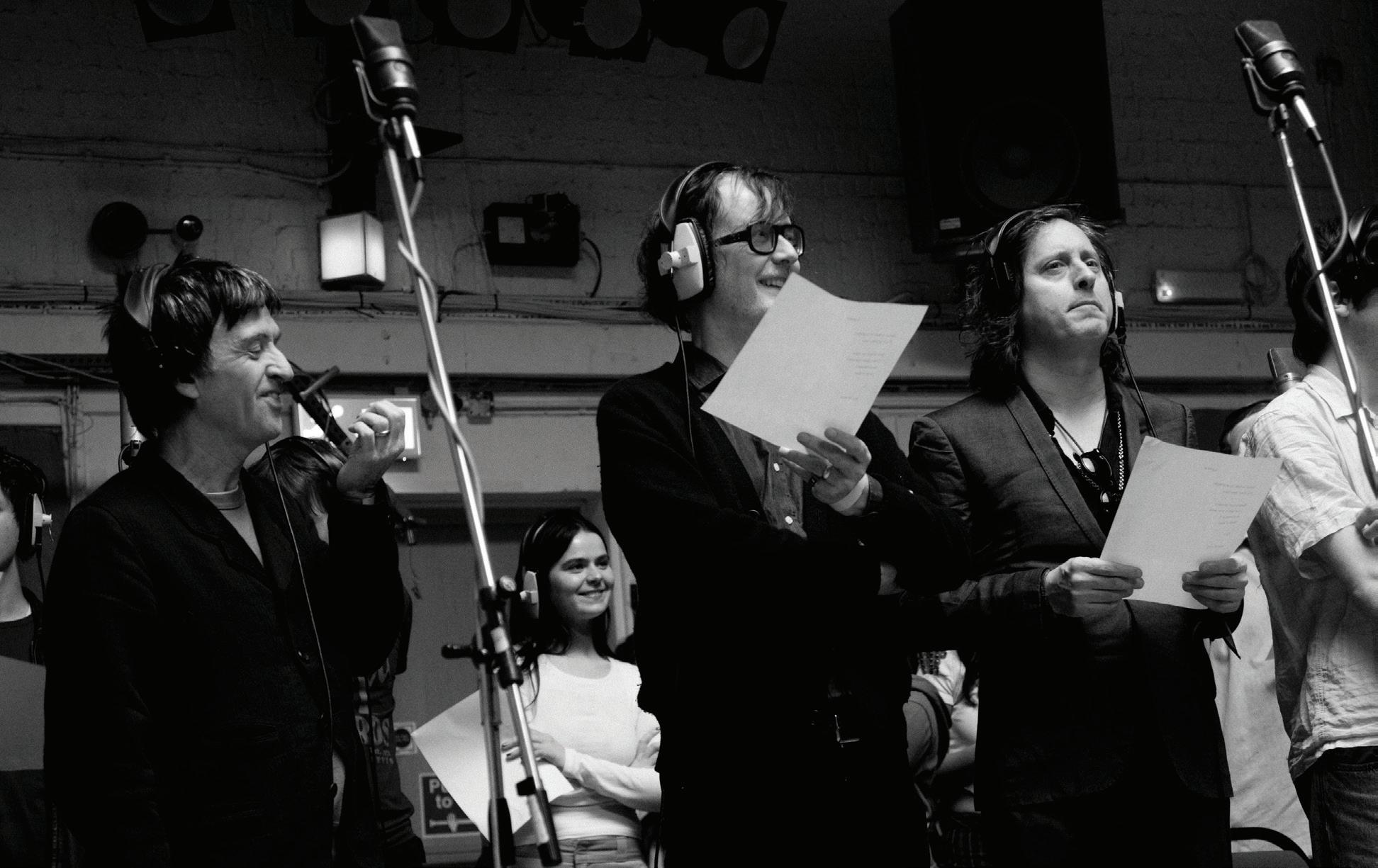
Pictured L-R: Johnny Marr, Jarvis Cocker and Carl Barât
The recording sessions at Abbey Road back in November were freewheeling by design. Mark Robertson, director of marketing and creative at Abbey Road, recalls how a sense of ‘momentum’ powered the sessions. Add to that the unconventional film crew: ‘Jonathan’s genius idea to let a group of eight- and nine-year-olds run free throughout our house with cameras added a fresh perspective and sense of hope, reminding everyone of the project’s purpose.’
This convivial studio environment meant that collaboration flowed freely. Graham Coxon helped Leeds’ English Teacher record Parasite before appearing on Olivia’s take on The Book of Love. Grian and Kae’s turn on Flags was a spur-of-the-moment decision, while the use of an adult choir on that track (to accompany the excitable children’s choir) was swiftly assembled by Toby L.
‘I feel like HELP(2) isn’t a product of helplessness, but a means to take positive action.’ – Rich Clarke
‘I only had two hours to pull that together!’ he recalls with a laugh. ‘I thought the kids’ choir would be enough, but Damon asked, “Are we still doing the adult choir, then?” and that hadn’t been arranged.’ Pulp’s Jarvis Cocker, The Libertines’ Carl Barât, Declan McKenna and members of Black Country, New Road were all then corralled into the recording booth to do their bit.
‘When you went to the canteen to get a cup of tea, it was full of famous people,’ Kae told The Guardian about the recording sessions. ‘You know when you’re a kid and you dream about what life would be like if you made a record? It was like that.’
For Rich and War Child, the sessions went above and beyond their expectations. Raising funds is, of course, the priority for HELP(2), but curating a charity LP that honoured the legacy of the original while standing up in its own right was equally important.
‘I feel like HELP(2) is not a product of helplessness, but a means to take positive action,’ Rich tells M. ‘These artists are writing songs and using their craft as a vessel for good. If people decide to buy the whole record or just stream songs by their favourite artist, they’re helping to contribute — which is an amazing thing.’
While the campaign will continue through 2026, Rich isn’t ruling out revisiting the HELP album series in the years to come should this be a success and raise much-needed funds. Toby concurs, saying the creative process — something that was fiercely protected throughout the project — is something that he will cherish forever.
‘We’ve made friends and creative partnerships for life off the back of this project,’ he says. ‘It all came about because people wanted to get together and share their ideas and skills. I could never have foreseen that. I hope that it can inspire and educate people in different ways to work and collaborate.’
In these often troubling times, the human spirit can still endure. Music can be an integral part of that battle for freedom and respect. HELP(2), it appears, isn’t about helplessness — it’s about action.
www.warchild.org.uk/help2
Photography: Lawrence Watson
Pictured L-R: Damon Albarn, Grian Chatten and Kae Tempest
Words: Sophie Williams Their soul-baring performances and storytelling mastery propelled Jacob Alon into the mainstream. The 2026 BRITs Critics’ Choice winner talks to M about identity, emotional exhaustion and the importance of staying optimistic.
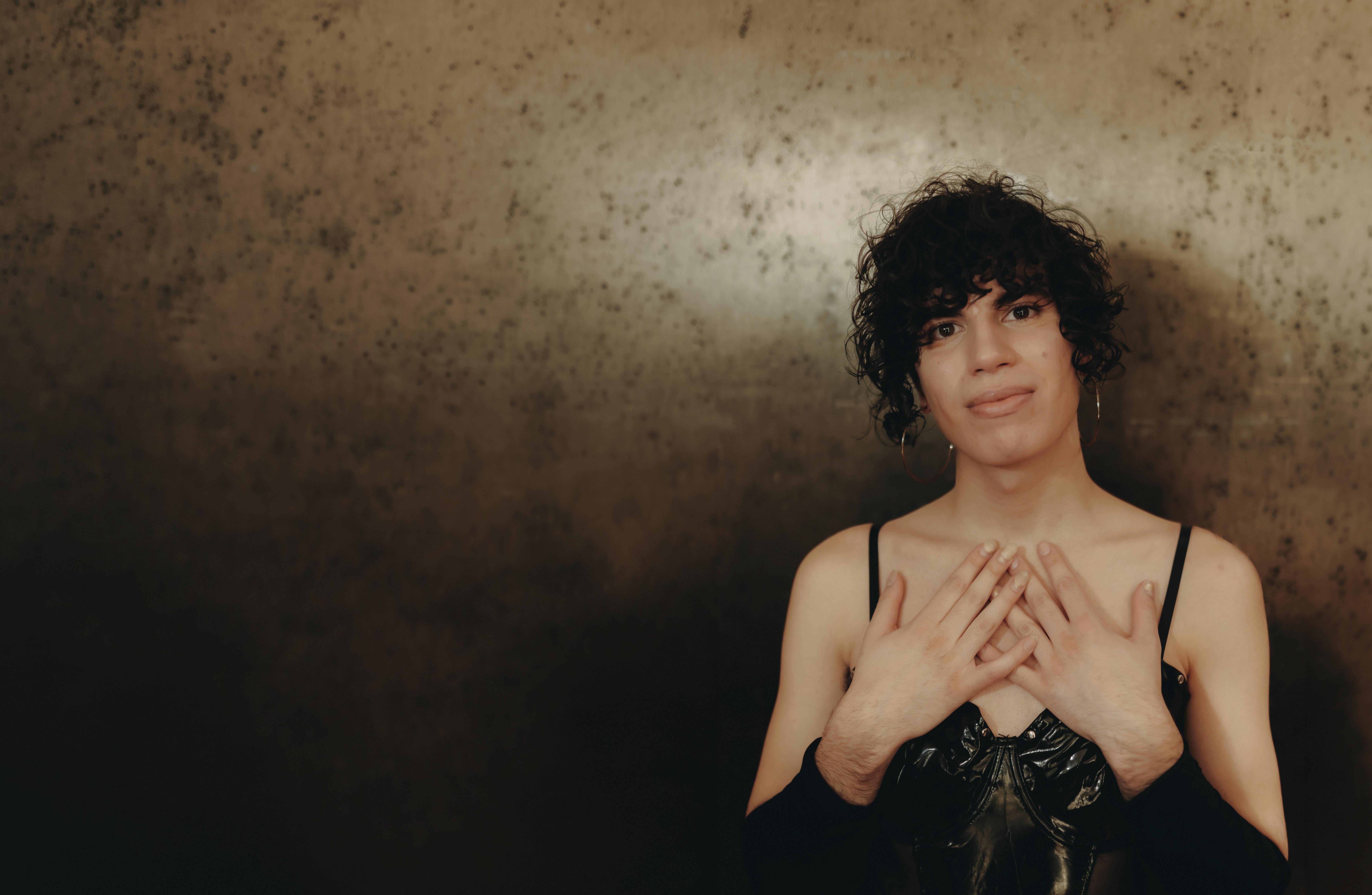
About six years ago, Jacob Alon was forced to start over. Heartbroken and artistically lost, having just dropped out of university, they became immersed in an Edinburgh folk community, where a group of ‘kind, beautiful outsiders’ encouraged the Dunfermline-raised artist to look inwards and start taking songwriting seriously.
Having plunged into a depression, Jacob roamed the Scottish capital’s streets most nights, eventually coming to the historic Captain’s Bar near the Royal Mile. The pub’s many characterful regulars nurtured Jacob back to health, and the latter’s fearlessness proved contagious. As they began to play ‘countless’ jam sessions on the local circuit, a life in music no longer felt out of bounds.
‘I’d buried so much of myself for so long, and I was living a life that made me deeply unhappy,’ Jacob recalls to
M. ‘I realised that if I didn’t say some of the things that I needed to say, then it would kill me. I needed a way to understand how I was feeling. This group opened their arms to me and offered me a guitar.’
Jacob’s sumptuous 2025 debut LP In Limerence (produced by Fontaines D.C. and Wet Leg collaborator Dan Carey) touched on reinvention, queer magic, substance issues, grief and ruptured familial ties, earning a Mercury Prize nomination and widespread critical acclaim. Their pure, intimate vocals, exceptional storytelling, distinct artist identity and ability to find humour and optimism in almost everything has since taken Jacob to the mainstream. This year alone, they’ve appeared on The Graham Norton Show and scooped the BRITs’ Critics’ Choice prize, following in the footsteps of Adele, Florence + The Machine and Sam Fender.
Along the way, Jacob has become increasingly open about their imperfections, their melodic and lightly psychedelic folk songs often exposing emotional wounds rather than concealing them. They stare trauma in the face without flinching. Much of their work reflects the different selves they’ve had to inhabit: as an outsider, a nonbinary person and a classically trained musician drawn equally to pop music.
Even now, Jacob isn’t sure where this crossover moment truly began. ‘There’s so much that’s happened in my life and in the wider world in the past year that, sometimes, it almost feels like too much,’ they say. ‘I don’t even know where to start when it comes to talking about it all.’
When we speak over Zoom, Jacob is at home in Glasgow and playing catch-up after a few weeks of promotion.
Photography: Jessie Morgan
Wearing a T-shirt printed with artwork inspired by their song Liquid Gold 25, they pause often when reflecting on how quickly things have moved, pushing loose curls back from their face as they search for the right words.
For most of their early life, Jacob made music without any expectation of recognition. At secondary school, they remember gritting their teeth to get through the days, turning to music in order to escape the bullying they faced. Writing songs ‘from a place of silliness’ became a way to combat the ‘toxic masculinity and cruelness’ of pupils in the year above — often in the form of diss tracks.
‘When I was younger, songwriting was only ever something I’d thought of as a semi-ironic way to make people laugh,’ they explain. ‘There was a lightheartedness and a playfulness in the music that I still try to preserve to this day. Music was a way for me to get my power back, and it brought me so much joy when I needed it.’
‘I have to remind myself and anyone that’s listening that it’s worthwhile to have ourselves in the world, and that our voices do matter.’
Like their late, creatively ambidextrous heroes Nick Drake and David Bowie, Jacob has an uncanny ability to shapeshift. With fact and fiction woven into its ballads, In Limerence is populated by doomed lovers and disenfranchised teens. On tracks Elijah and Don’t Fall Asleep, Jacob’s lyrics drift between the mystical and the deeply personal, drawing loosely on their formative years.
Over time, Jacob stepped further out of the shadows and on to bigger stages. In 2024, they began performing at industry showcases like Eurosonic in Groningen and The Great Escape in Brighton, collecting a small but devout fanbase including key radio and press tastemakers. A deal with Island Records soon followed.
Jacob says they are now more alert to patterns from their youth whenever they resurface in their songwriting. There is also the risk of emotional overexertion, something that is especially difficult to manage while on the road. Performing with such openness night after night can be emotionally exhausting, and they are still learning how to protect their energy while giving audiences the vulnerability they expect.
‘It can feel really draining, having to revisit old memories while performing,’ they explain. ‘Some of my songs have taken on new meanings, which I think is the result of how difficult the world feels right now. I have to remind myself and anyone that’s listening that it’s worthwhile to have ourselves in the world, and that our voices do matter — even in the face of such depravity that makes us feel like we don’t count and it’s all hopeless.’
Raised by a single mother, Jacob does not come from a family of people who made money from art. In a post-Brexit landscape, current social and political inequities make choosing creative paths increasingly difficult for young artists, let alone for gender nonconforming people like Jacob, who has consistently spoken out against policies that restrict transgender people’s access to healthcare in the UK. It takes a certain kind of resolve to pursue your ambitions when the world around tells you to do the opposite.
‘When I was younger, songwriting was only ever something I’d thought of as a semi-ironic way to make people laugh.’
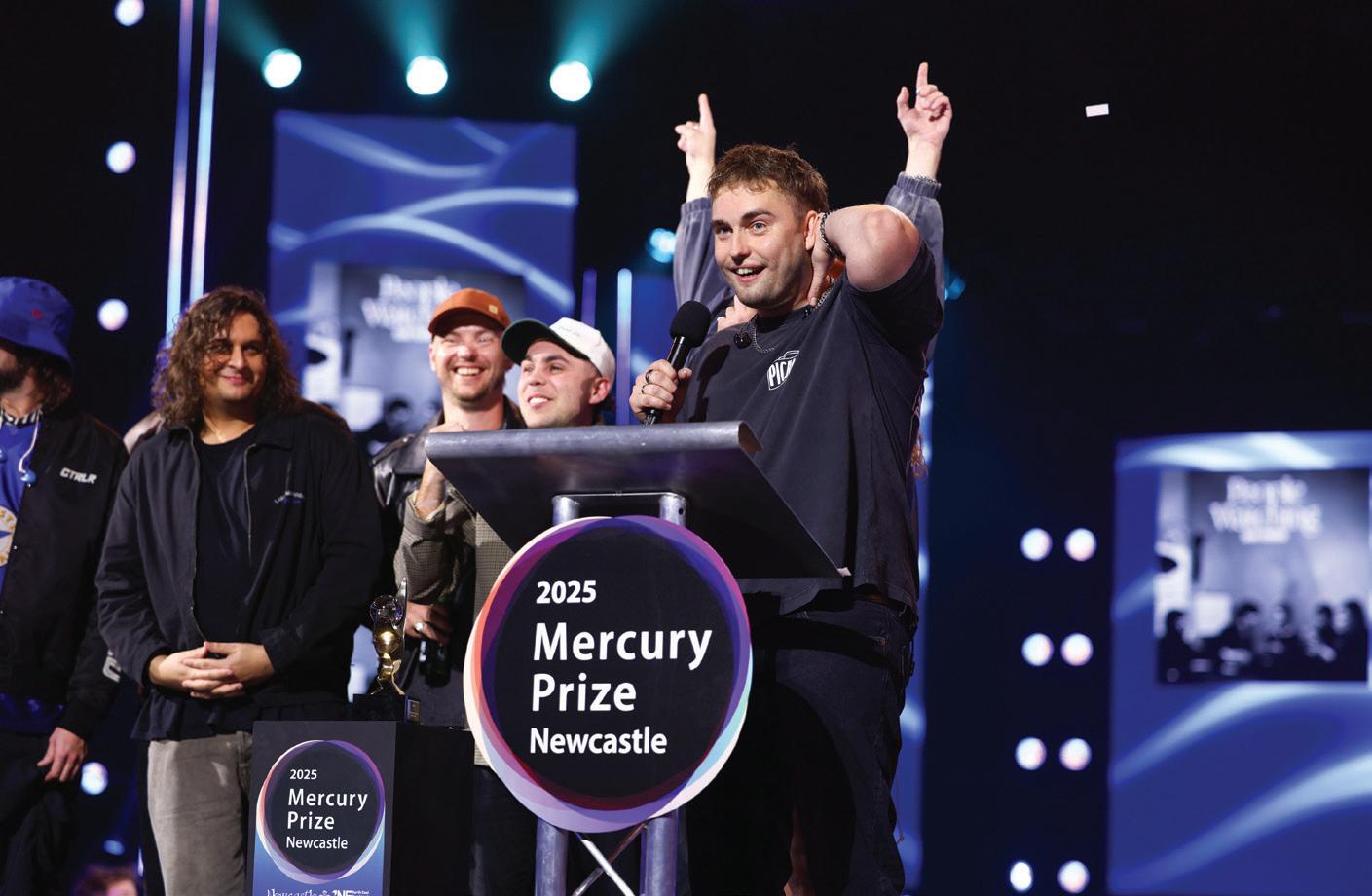
For Jacob, live performance is an act of community building. At the Mercury Prize ceremony in Newcastle last October, they weaved a refrain of ‘free Palestine’ into a breathtakingly moving rendition of their song Fairy In A Bottle, their voice trembling. In Jacob’s hands, the spotlight became communal rather than individual, reaffirming their belief that music’s real power lies not in spectacle, but in shared feeling.
Reflecting on that star-making night, Jacob remembers feeling overwhelmed by the scale of the performance and ‘trying not to fall apart’, before reaching a point halfway through where they could ‘just let go’.
‘I felt very, like, inspired by what all of us held in that moment, the stillness in the room; that’s an example of such deep connection in a world that feels so fucked,’ Jacob tells M. ‘It made me believe a bit more that we can still come together.’
That same spirit of generosity and optimism is shaping Jacob’s mindset going forward. They hope to embrace a state of stillness and find a ‘fresh creative fire’ — a reset that feels both necessary and earned. After 12 months of momentum, saying ‘yes’ and moving at the speed opportunity demands, the intention now is to slow down long enough to hear what’s actually waiting beneath all the external noise.
It’s a perspective rooted in staying grounded. Jacob beams as they describe how several of their former teachers have reached out to them with words of pride and encouragement, while they are excited to perform a sold-out show at London’s Roundhouse in April, meeting their fans eye to eye in an in-theround setting.
Before then, Jacob remains on a journey of making peace with their past. The outside world may be in a perilous state and Jacob says they have no idea when they’ll find time to finish album two, let alone truly switch off. But they close out our interview by quoting drag pioneer RuPaul, only half-joking: ‘If you can’t love yourself, how in the hell you gonna love somebody else?’ At that, Jacob allows themselves a small, satisfied smile.
From cutting their teeth on Dublin’s live circuit to headlining 40,000-capacity outdoor gigs, Fontaines D.C. have become one of the most compelling bands of their era. M charts the ambition and momentum behind the ascent of the five-piece, who recently joined PRS.
Photography:
Words: Sophie Williams
Since breaking out of the Dublin live circuit in the late 2010s, Fontaines D.C. have made ambition look easy. The five-piece first outlined their signature, potent mix of bravado and tenderness on Big, the opening track of their Mercury Prize-nominated 2019 debut Dogrel. ‘My childhood was small / But I’m gonna be big,’ frontman Grian Chatten emphatically declared during the song’s rumbling chorus, as though he was practising a form of manifestation.
The band — completed by Conor Curley (guitar), Conor Deegan III (bass), Tom Coll (drums) and Carlos O’Connell (guitar) — have enjoyed a singular trajectory ever since, continuing to defy commercial and critical expectations with each new release. Their four studio albums to date have each been raging successes, winning Fontaines a BRIT award, earning Grammy and Mercury Prize nominations and, in the case of 2024’s Romance, elevating their status to being one of the world’s biggest guitar bands.
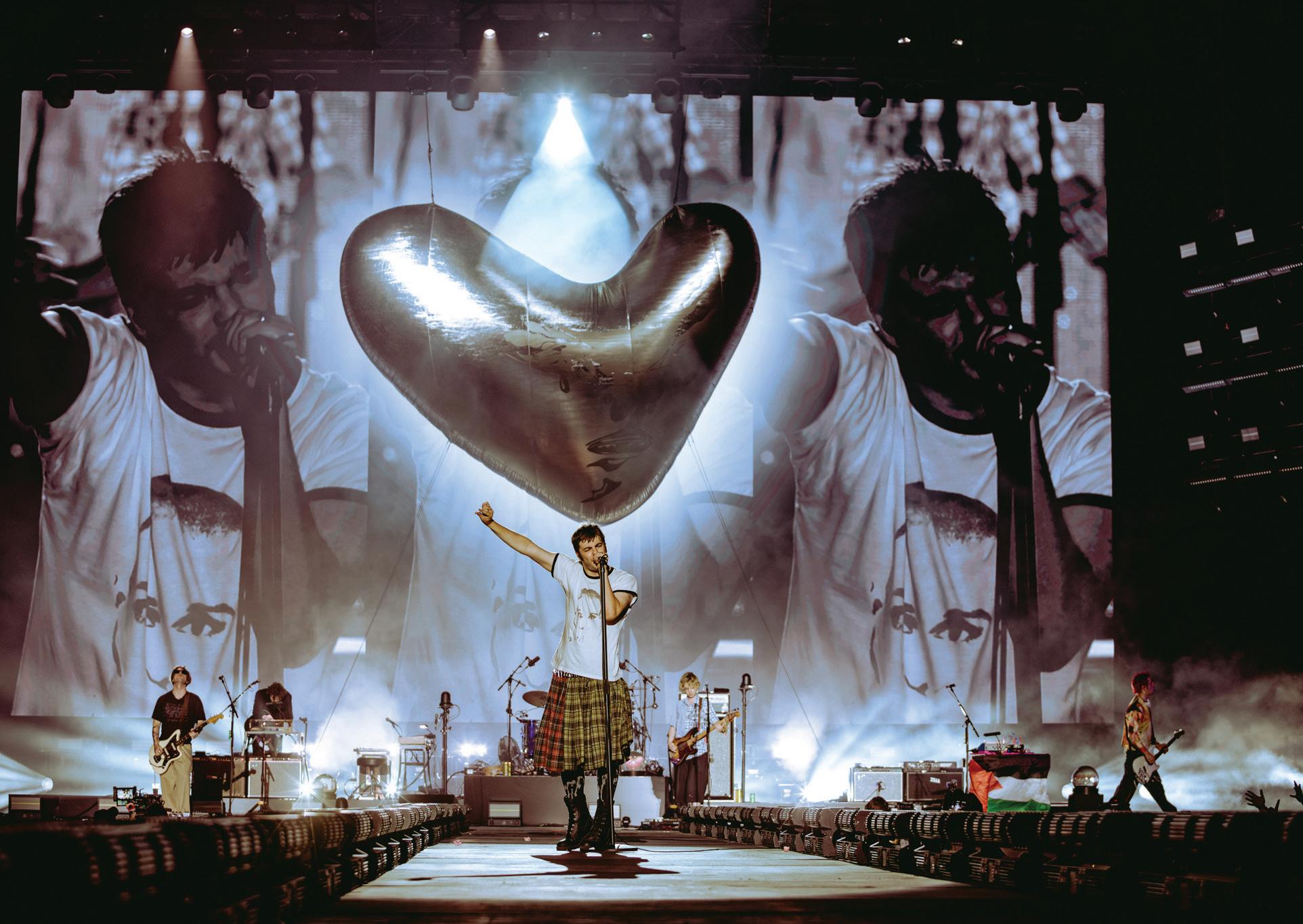
The position was solidified in July 2025 when the band took over London’s 40,000-capacity Finsbury Park for their biggest headline show to date. While their earliest gigs were defined by a tinderbox-like atmosphere where Grian, seemingly unable to hold eye contact with the crowd, would pace around anxiously, that night in north London the frontman strode down a specially installed runway, owning his stature with sublime confidence.
‘That type of staging is usually reserved for the likes of Dave Grohl or Taylor Swift,’ music journalist Rishi Shah tells M. ‘Fontaines’ runway was a sign of dominance, strength and bravery. They didn’t need to add one to the stage, but the fact that they did demonstrates a desire and ambition to play with the tools that, normally, only the big dogs are allowed to use.’
This summer will see Fontaines tackle more big stages, with headline slots at Reading & Leeds and Electric Picnic in their native Ireland already booked. As they prepare to begin this next chapter, the band have made a major move by joining PRS for worldwide music royalty collection (except Ireland). Having racked up over a billion Spotify streams to date, Fontaines join over 190,000 songwriters, composers
Georgina Hurdsfield /tinyraindropphotography
Photography: IFUCKTOKYO @ifucktokyo
and music publishers who comprise the PRS membership collective. Their music is also being used for sync: breakout hit Starburster, the lead single from Romance, is currently being used as the theme music for the Paramount+’s MobLand in the US, while album track Bug featured in the soundtrack for Bird.
As Tony Barton, Director of Writer Relations at PRS for Music, concurs: ‘Fontaines D.C. have been one of the most exciting guitar bands to break out in the last decade, with each subsequent release showcasing the calibre of their outstanding songwriting. We’re delighted that they have joined PRS, and look forward to supporting them as they continue to write incredible songs, headline the biggest festivals and conquer the music world.’
Joining PRS at this stage in their career also suggests that Fontaines want to double down on the long-term legacy of their songwriting. Its influence is already being recognised, with the band picking up three Ivor Novello nominations (including a nod in last year’s Best Song, Musically and Lyrically category for In The Modern World) in recent years.
Grian’s lyrics are frequently cited as one of Fontaines’ greatest strengths. From referencing Ireland’s often traumatic political history to addressing the ongoing climate crisis and wider political and social tumult, the singer’s words give their songs a poetic tension in how the past informs the present. As an already uncertain future further disintegrates, it’s perhaps no surprise that Grian centres these subjects in the band’s work.
Their songs don’t achieve their desired impact with sloganeering, but instead by dealing in impressionistic, often wonderfully strange language. I Love You, the beating heart of their 2022 LP Skinty Fia, serves as a passionate lament for Grian’s home country, while Romance track In The Modern World captures feelings of ennui and everything being in flux.
Intriguingly, the band’s rich storytelling, aided by their atmospheric production style, is defying For You page-addled attention spans. Fontaines have become a quiet TikTok phenomenon post-Romance and are embracing a more stylised image (bright hair colours, striking fashion), which bodes well on a
platform where visuals matter above all else. Their increasing popularity with Gen Z has come in part through their ability to operate in so many different spaces, from appeasing their core audience with a prolific work ethic (four studio albums in five years) to sharing footage of their spectacular live performances across the world.
‘Young people in particular are discovering and treating Fontaines in the same way they’d discover a “current” act like Charli xcx or Chappell Roan,’ Rishi says. ‘That’s a clear distinction from the narrative around their first three albums that they were “the next big thing”. They are the big thing of the here and now.’
Pierce Callaghan, drummer in the firebrand Irish punk band Gurriers, concurs: ‘I can see why Romance has opened up Fontaines to so many new fans. Not only is the songwriting more expansive, but the record is full of great hooks across all instruments and little earworm-y stuff that will stick in your head all day.’
Having had a front-row view of Fontaines’ journey since the beginning — he befriended bassist Conor as a teenager after crossing paths at a gig in Dublin, before then going on to work for the same restaurant chain — Pierce has seen the band forge ahead with an unrelenting drive: ‘They work really hard, they are incredibly ambitious about what they want to achieve and they keep making really great albums.’
Against the odds of a music industry that seems increasingly apathetic about bands — thanks to a mix of ever-rising touring costs, algorithmic preferences and the individualist nature of social media — Fontaines’ is a success story worth shouting about. As 22-year-old superfan Darci Jackson puts it, their young fanbase is proof that there remains an innate desire for the collective experience; for music to provide a sense of community.
‘I remember going to Leeds Festival the day Romance came out in 2024. The first question on everyone’s lips was, “Have you listened to Romance?”’ she recalls. ‘I know so many young people who have been moved by that album, or have tattoos or jewellery related to it. It’s so special when one body of work can bring people together.’
Fontaines’ future feels wide open. A concentrated run of headline festival gigs in the summer points to a potential setting of the stage for their fifth studio album. Could Glastonbury’s Pyramid Stage come calling in 2027? Or could they even level up to stadiumfilling heights? With such momentum on Fontaines’ side, both prospects feel in the realm of possibility.
UP IN
THE NEW ERA OF TECH-DRIVEN LIVE MUSIC
As live shows become ever more immersive, technology is reshaping the typical concert experience. But does the spectacle risk eclipsing the music itself? Producers talk to M about the transformative power of visuals and why the audience always comes first.
Words: Matt Charlton
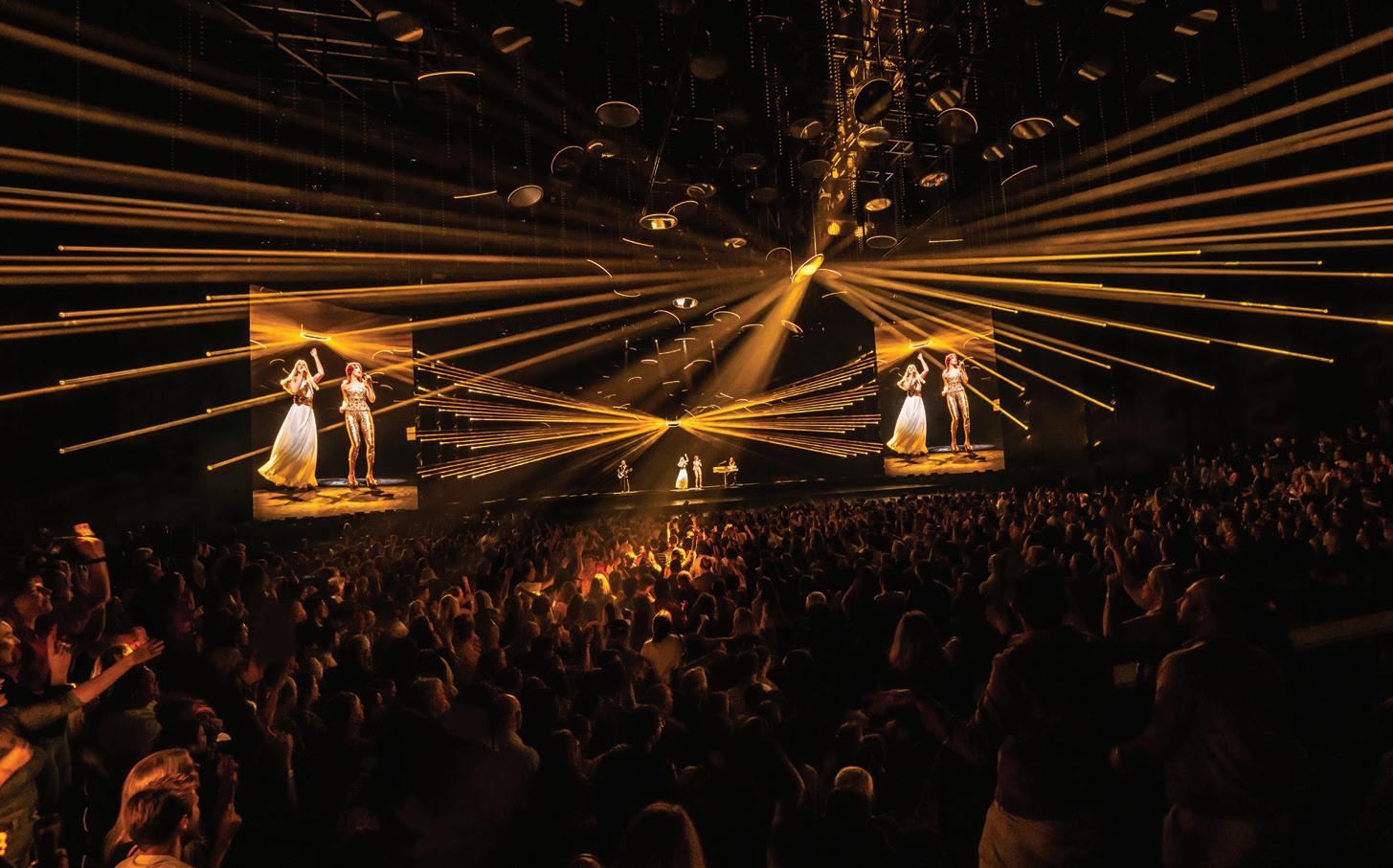
Since opening in east London’s Queen Elizabeth Olympic Park in 2022, the frankly spectacular ABBA Voyage has become a shining example of how technology is being integrated into live music. Featuring a dynamic live band and virtual avatars of ABBA’s four members, the hugely popular concert residency — which will continue until at least June 2026 — has understandably raised the expectations for gig-goers of what a live show can be.
Each concert takes place in the 3,000-capacity, purpose-built ABBA Arena, which houses 291 speakers (producing 870,000 watts of audio amplification throughout) and over 500 moving lights which are mapped to 30,000 points. How, then, do Svana Gisla and Ludvig Andersson, the producers of ABBA Voyage, inject all the hallmarks of a typical live show into such a techheavy environment?
‘It is a live show!’ the pair tell M. ‘We have a live band, and we operate the show entirely live with a full control room filled with the best professionals in the business. The audience is also a huge part of the concert: even those people who come time and again say they’ve never had the same experience twice. The joy and emotion in the audience is an elixir that is completely addictive, and the togetherness in the room is always heartwarming and special.’
Tech-governed music spectacles aren’t an entirely new phenomenon — take Pink Floyd’s immersive The Wall shows, or Mötley Crüe’s Tommy Lee and his spinning drum roller coaster as notable past examples. But in recent years, thanks to the likes of ABBA Voyage and the spellbinding gig footage from the Las Vegas Sphere that often pops up on social media, a tipping point seems to have been reached. Is tech becoming the star of the live show?
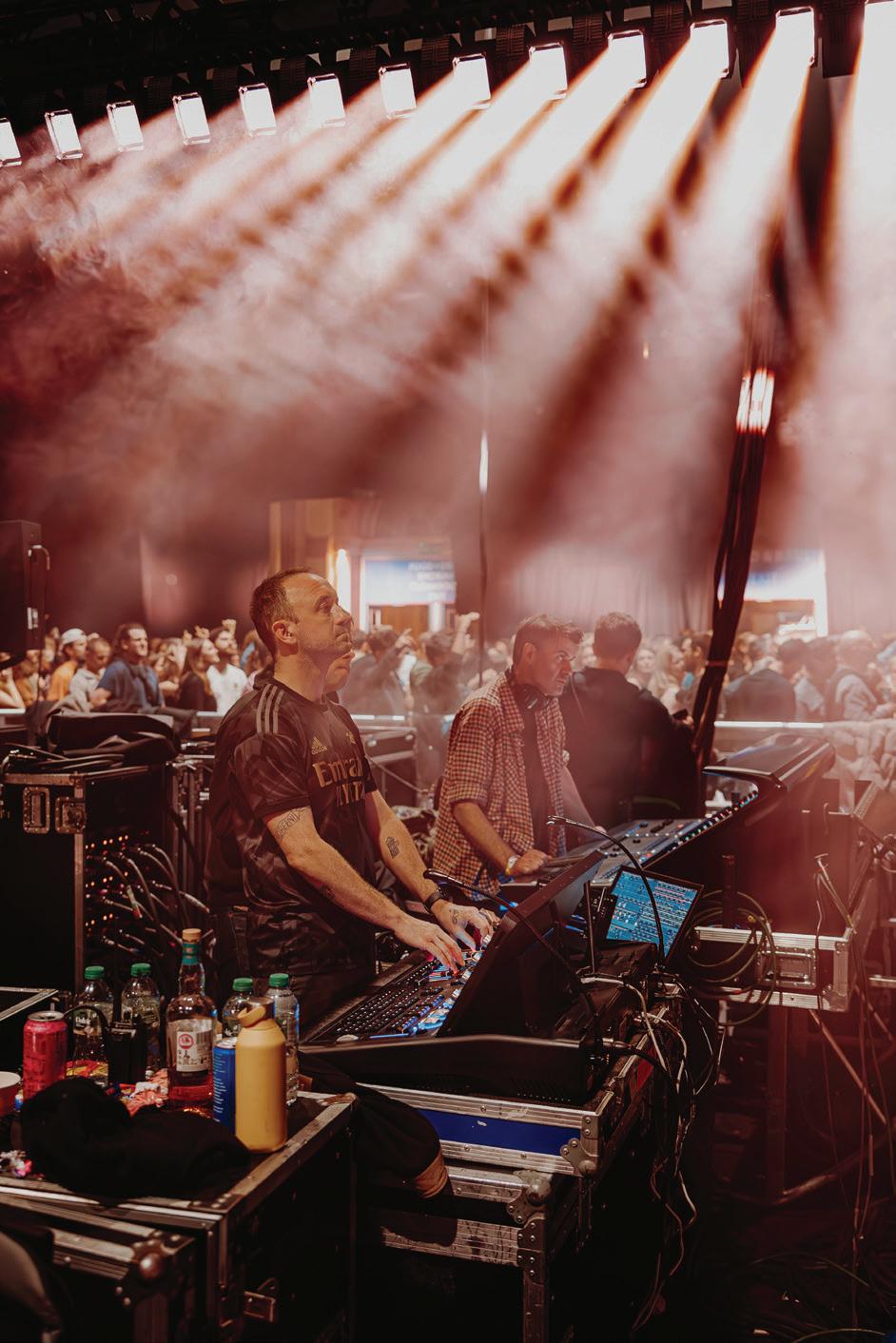
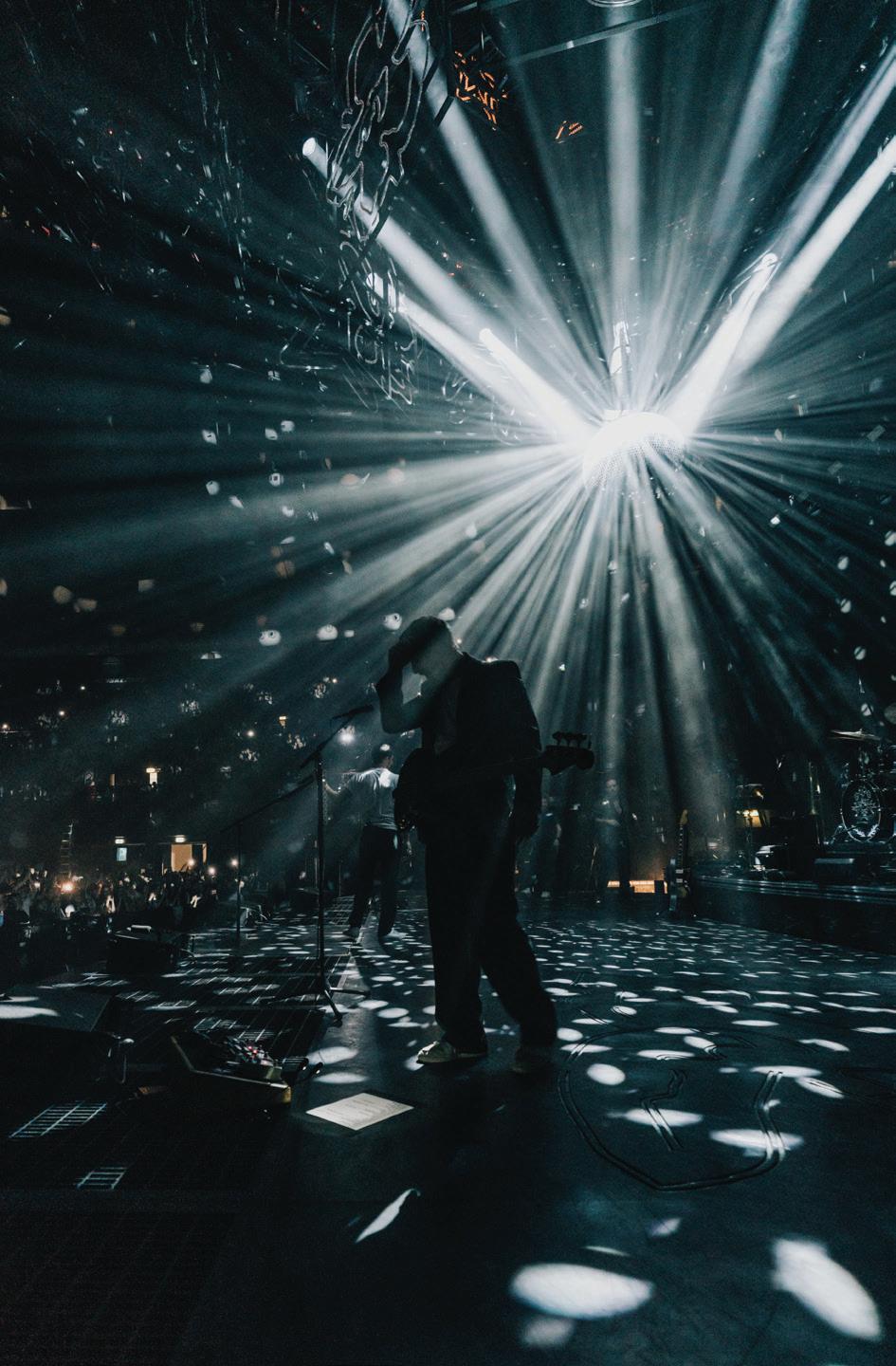
Photography: Luke Dyson
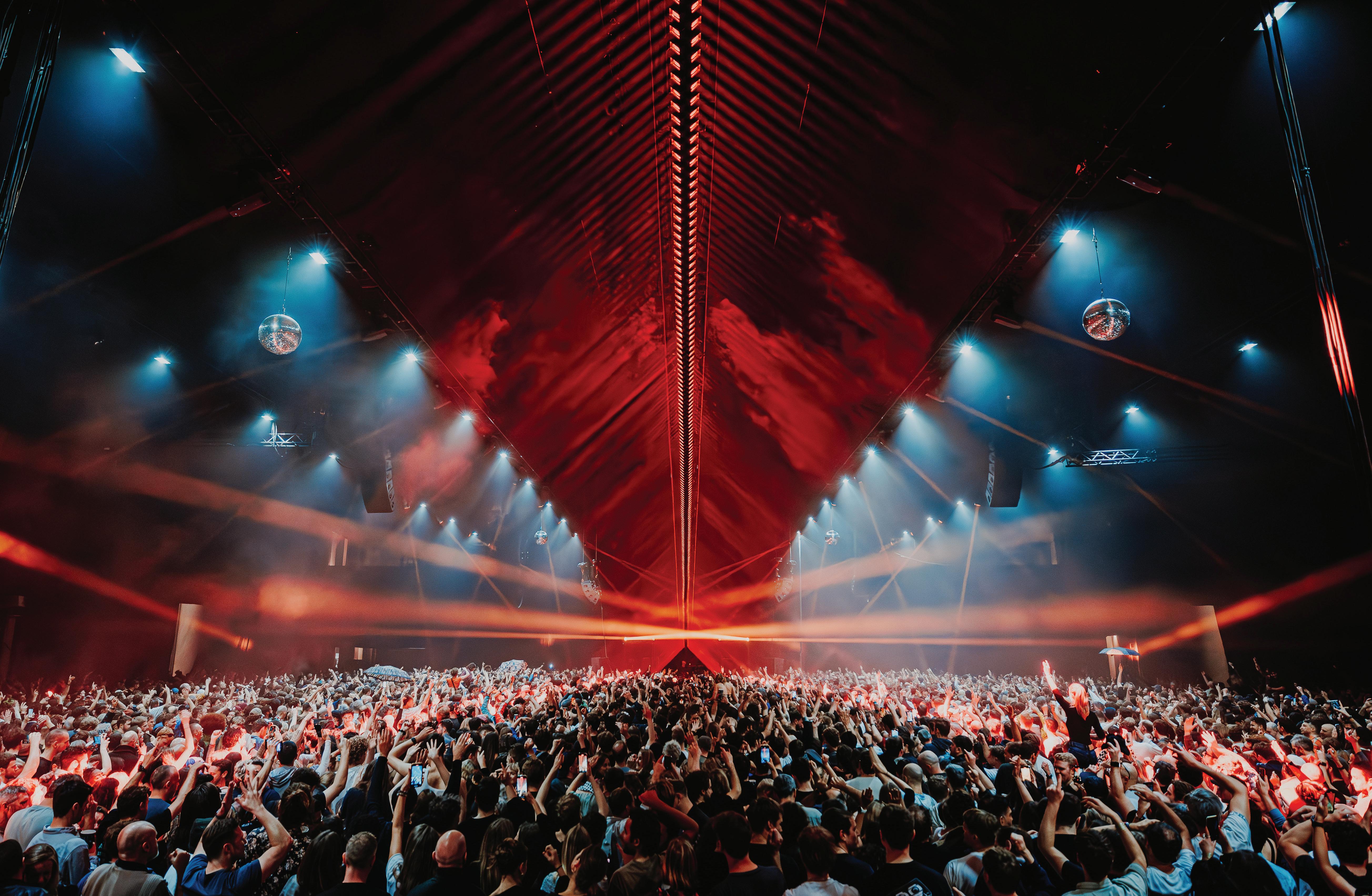
Four Tet performing at Alexandra Palace
‘Every single audience member deserves to get the best possible experience, and we don’t cut any corners to ensure that happens.’
– Svana Gisla and Ludvig Andersson
‘Visualisation in live music has come a long way in the past 10 years,’ acclaimed production and lighting designer Ed Warren tells M. ‘The software is more powerful, the renders are far more realistic and the tools have become genuinely accessible. You can now build and preview a full show from a home office.’
Having recently worked with the likes of Mumford & Sons, Sugababes and Four Tet on their live shows, Ed explains of his typical creative approach: ‘Sometimes the right call is to keep the focus entirely on the music and let everything else sit quietly in the background. Other times you’re expected to support, lift or even exaggerate what’s happening sonically. The art is knowing when to step forward and when to step back, and riding that line with intention.’
While new visual technology is being embraced by many performers and their stage crew, the tried-and-trusted timecode — which provides an exact timestamp so each part of a production occurs when it’s meant to — has become ‘a huge part of modern production’, as Ed notes.
‘It lets an entire show — lighting, video, choreography, pyro — be locked to the music, down to the millisecond,’ he adds. ‘When you have the prep time, that level of precision can be transformative.’
Photography: Luke Dyson
Photography: Deanie Chen
Four Tet
Ed Warren
Mumford & Sons
Despite all this exciting technology on offer, though, it’s important to remember that live music is still inherently a shared human experience between a performer and their audience. With so many big, techfuelled moments now being factored into a typical arena, stadium or even club show — the lighting cues, the special effects, Charli xcx’s striking rain dance — is live performance being robbed of a sense of spontaneity for the sake of choreographed spectacle?
‘The show is under continuous review and cycle of improvements, mostly in terms of hardware and processes,’ producers Svana and Ludvig tell M about how they continually assess ABBA Voyage. ‘We recently added more songs to the setlist, and those creative changes are carefully thought out and take a long time to implement due to the complexity of the show. We operate a no-fail show: every single audience member deserves to get the best possible experience, and we don’t cut any corners to ensure that happens.’
For Ed, there’s ‘always a risk’ that a gig can be too reliant on visual technology. ‘But it comes down to the type of show you’re making,’ he continues. ‘A raw rock’n’roll set shouldn’t feel as locked-in as a high-gloss pop production. There is a time and a
‘The art is knowing when to step forward and when to step back, and riding that line with intention.’
place for precision and a time and a place for looseness. The real craft is knowing which one your audience is coming for.’
Katie Boyle, one half of the London electronic dance duo Koven, agrees. ‘This is where you have to stay honest with yourself,’ she tells M. ‘It’s all about using production to your advantage and amplifying the moments that lean into your USP as an act. For us, that’s me singing. When I first started performing, tech felt like something you added to a show when you could afford it: a few visuals, some lighting, maybe a couple of synced cues. Now it’s become almost inseparable from the performance itself. It genuinely shapes how we build our shows.’
Given the proliferation of smartphones at gigs, the fact that any show can have a shelf life that extends way beyond its encore can add extra pressure for music creators when it comes to designing their live performance.
‘People film everything: even in a 300-capacity room, what’s captured on someone’s phone becomes part of your global image,’ Katie acknowledges. ‘[But] the production of our show isn’t just an add-on for us, it’s another form of storytelling. We’ve spent a lot of time and effort investing in our live visuals and it’s
developed a lot over the years. I subjected myself recently to eight hours in a water tank to capture just one of the eight “looks” within our new show package, so l would say we’re pretty invested!’
As a vastly experienced lighting designer operating in the live music industry, what new tech developments are exciting Ed? ‘The lines between departments have blurred,’ he replies. ‘Lighting and video now speak to each other seamlessly; you can trigger video from lighting systems and vice versa. Lasers and pyro live in the same universe as well. That integration has made shows feel more cohesive and avoided many of the old clashes between the creative disciplines.’
As ever, though, live performance should always prioritise the music. ‘If your production is the only thing people talk about after the show, something’s off,’ observes Katie.
As ABBA Voyage concludes, you're unlikely to hear anyone overly dissecting the tech aspect of the show as they make their way out of the venue. Instead, the air will be abuzz with discussions of the emotions conjured by the music in the show they’ve just witnessed. Thank you for the music indeed.
– Ed Warren
Photography: Johan Persson
Photography: Maisy Pratt
ABBA Voyage
ON THE ROAD WITH
The US alt-pop creator on bringing Smoochies to the world and why playing live is ‘awe-inspiring’.
Having spun the wheel of weird-pop to create Smoochies, her most personal body of work yet, Ashnikko is relishing the prospect of taking her raucous second album on the road throughout 2026.
‘I kind of word-vomit all my wild ideas, but the people around me are really dedicated,’ she tells M while on the way to another eight-hour tour rehearsal.
‘It’s been an absolute dream. It’s been a huge challenge, switching my brain from album mode into tour mode. It engages
a completely different part of my creative brain — I feel like a little fairy playing in my little imagination tree house. Being a [performing] artist nowadays, you have to be this true multi-hyphenate while creating a whole new world for people to see.’
Ashnikko has amassed a dedicated international fanbase since her music career began in earnest just under a decade ago, with numerous sold-out shows and big festival slots at the likes of Coachella, Primavera and Reading & Leeds under her
Words: Zoya Raza-Sheikh
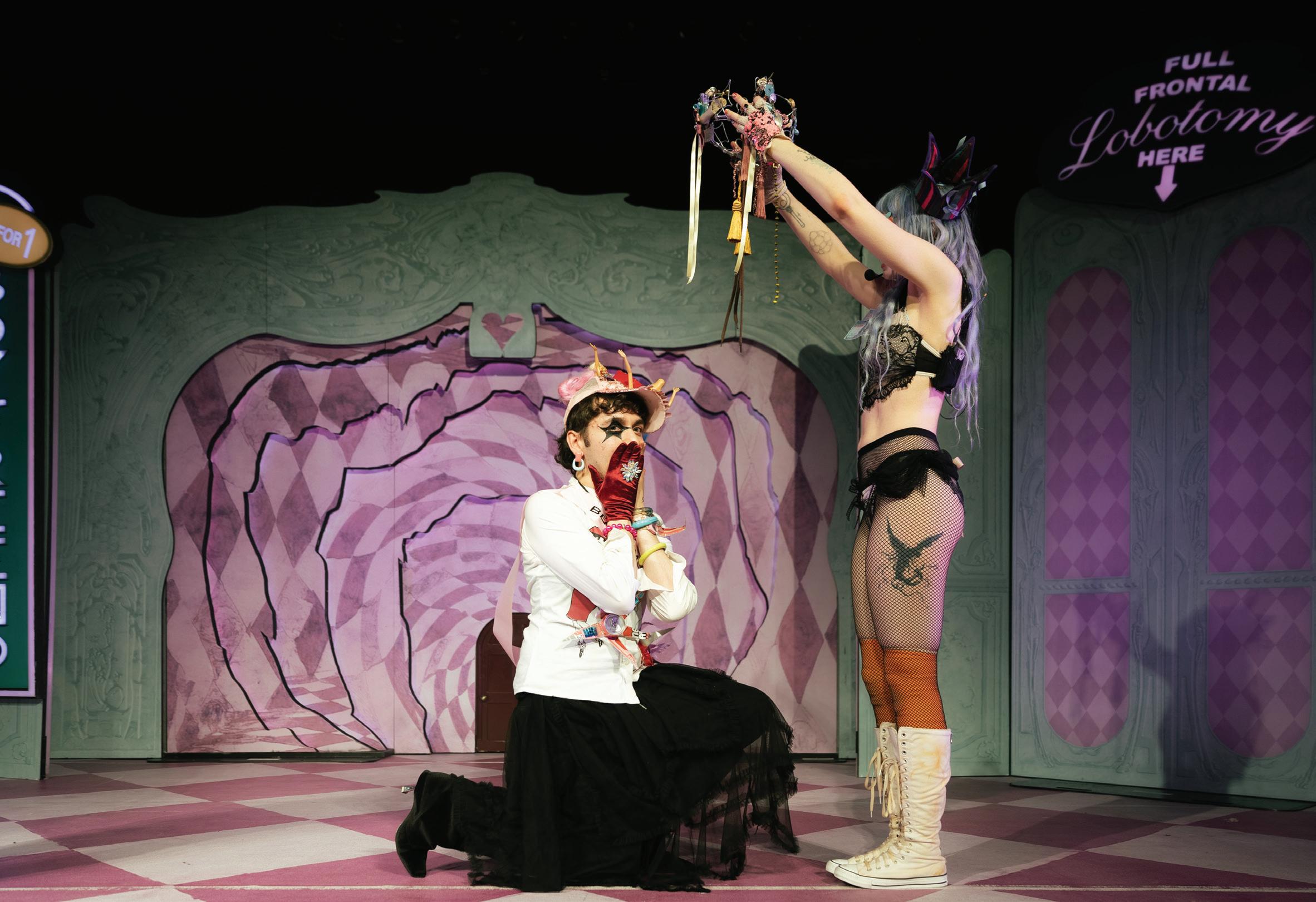
belt. With the Smoochies tour, the alt-pop artist has created a ‘school-like play for people to get swept up in and feel a little disturbed [by]’.
‘We’ve been working super-hard on the set-up,’ she adds. ‘It’s very whimsical and absurd, with more storytelling than I’ve done in the past.’
M caught up with Ashnikko ahead of her UK and Ireland shows to hear, in her own words, what it’s like to tour in 2026.
ASHNIKKO
ASHNIKKO
Photography: Maroun Zakhia
‘MY ADVICE FOR SONGWRITERS? DON’T PLAY THE ALGORITHM MORE THAN YOU INVEST IN CREATING YOUR OWN ART.’
Ashnikko: ‘The Smoochies tour is visiting North America, Europe, Australia and New Zealand in 2026, as well as six shows in the UK and Ireland. I love playing live in London. I’ve spent a decade in the UK and London is my favourite city in the entire world, so it always feels like a hometown show for me. I’m playing two gigs at O2 Academy Brixton, including one on my birthday and another that sold out really quickly — [the latter] is really affirming, as it makes me feel like a Londoner. I also really enjoying playing in Scotland — those crowds can be feral.
‘[With the Smoochies live show] I want people to feel sexy and like they can be a little creature. Honestly, the show is so cool: there are so many gags, cute moments and drama. The most important thing for me is that there is a sense of community and safety — I want people to feel comfortable making friends and talking to new people.
‘I used to be concerned with how I looked and how I was being perceived, but now I don’t give much of a fuck. I’m having more fun on stage: I’m going full hyena, or broken zombie, just sprawling on the floor. I get into a real flow state when I’m performing, which is one of my favourite parts [of playing live]. Sharing music in a live space is really magical and awe-inspiring — it’s such an incredible experience. I always cry when I’m at other people’s gigs!
‘I’m feeling so confident in myself to be this ever-evolving artist who’s able to take my fans, who I call my Demidevils, on a journey with me and build real-life experiences. My Demidevils are with me for the long haul. I’m really proud of myself, and of my team, for being able to translate the internet frenzy [that greeted Ashnikko’s 2019 breakthrough with TikTok smash STUPID] into something that’s real and tangible. That’s really hard to
‘SHARING
MUSIC IN A LIVE SPACE IS REALLY MAGICAL AND AWE-INSPIRING — IT’S SUCH AN INCREDIBLE EXPERIENCE.’
do as it’s so ephemeral; internet frenzy is not even real. It’s about finding out who you really are, and remaining a steady, constant person and artist. The past six years have been a massive test for me, particularly with learning to be grounded.
‘I’m feeling happy and content, and that I can pull inspiration from this very peaceful moment in my life. In the past I was relying solely on chaos and stormy seas for me to write anything, which is neither an incredible place to be mentally nor very sustainable. But now I’m feeling very grateful, and that’s affecting my work in a very positive way.
‘I’m writing from a more authentic place too. I’m really allowing myself the freedom to play with my work while putting the blinkers on a little bit — not watching the outside world or my peers, and trying not to be influenced by the internet, which is impossible. I’m constantly trying to feed my creative mind and the whole world around it to create a very weird, dimensional experience for myself.
‘My advice for songwriters? Don’t play the algorithm more than you invest in creating your own art. You see people putting way more energy into reaching new audiences than they actually invest in the art itself, and I think it’s a damn shame that the modern world is forcing artists into that. The landscape for music creators has changed drastically in the past few years: I feel like I wake up every day and something new has changed. It’s like having to bend yourself into a brand new shape when you’ve just learned the previous shape.
‘There’s no set formula for building your career. The one thing I’ve done in the past few years is create a workflow that works for me and my brain, which makes me feel comfortable and safe. I’m not going to work myself to burnout any more — that’s not something I want to do. I want to be happy and have friends — that’s good advice that I had to learn the hard way.
‘I’ve been so grateful for PRS support, particularly how I’m able to take money [from royalties] and invest it straight back into my business — like building these really strange shows with tentacles, crows and tiny portal doors. I get to actualise my dreams, and for that I’m eternally grateful.’
Photography: Vasso Vu
Photography: Maroun Zakhia
From his viral breakthrough to his upcoming debut album, Jacob Evangelista is ready to become his home country’s biggest breakout star.
Words: Joey Akan
Jacob Evangelista still lives in the same hilly suburb of Freetown, the Atlantic port city where he grew up. The view of the Sierra Leone capital from his balcony is so familiar: corrugated roofs, palm trees, the distant roar of okada motorcycle taxis. But Jacob’s outlook on the world beyond Freetown has never been more expansive and exciting.
Since his first official release as The Therapist in 2022, Jacob’s music career has been on a sharp upward trajectory. The first Sierra Leonean to crack a million streams on a single track, he now commands 3.2 million followers on TikTok and carries his country’s flag in the global Afrobeats arena.
It all began with an impulsive recording session and a prayer — delivered on his knees in his mother’s church — that the resulting song, Nack, would reach 500,000 streams. A gleeful Afro-Fusion banger about a night spent in a Lagos strip club, its hook is built on a single pidgin phrase (‘My head, my neck, my waist, but I still wan nack’) delivered with such breezy conviction it feels less like provocation than reportage.
Within weeks of its release in March 2022, it took off on TikTok. Nigerian superstar Wizkid and Madonna’s children were among the millions who shared videos of themselves dancing to Nack, and Jacob’s mother — a pastor who had given her son a one-year ultimatum to make a music career work or return to university — started fielding congratulatory calls from her parishioners.
Photography: Fawaz Aro
‘I went to church and begged God,’ he recalls to M, laughing at the memory of that first prayer. ‘I said, “Even 500,000 streams total, I’ll be happy”. Then Madonna’s kids posted it. My mom called me: “Jacob, you are big now!”’
Jacob grew up in a household where the soundtrack was Nigerian pop (he cites the likes of P-Square, D’banj and Don Jazzy) that was piped in from satellite music channels. Despite being over 1,500 miles away, the Lagos music scene eclipsed anything going on in Sierra Leone at the time. ‘We didn’t really have [local] heroes we could see on TV living the life,’ he recalls. ‘Nigeria showed us the life.’
Taking a two-week break from his architecture degree, Jacob flew to Lagos to join Wizkid’s studio boot camp at the city’s EKO Hotel. Inspired by a trip to the Secret Palace strip club, Jacob freestyled Nack in its entirety in a single take — all in the presence of several incredulous Nigerian music stars, who kept wandering into the studio to see which ‘small boy’ was talking like that.
Nack expanded the horizons of Sierra Leonean pop ambition. Where previous generations typically looked to the UK or the US for inspiration, Jacob unapologetically looked to West Africa. The backlash at home was immediate: Why are you trying to be Nigerian? Why pidgin? Why Afrobeats? His reply was mathematical: ‘Sierra Leone has 8 million people. Nigeria has 250 million. I’m a businessman.’
Jacob spent much of the next two years in Lagos, absorbing rhythms, studio politics and Nigerian slang, returning home only when the criticism grew too loud or the wi-fi failed. A string of singles followed, including the wellreceived 4x4 with South African producer Tyler ICU, while a record deal was struck with the Sony Music UK-backed 5K Records.
This momentum has culminated with Therapy Sessions, the 14-track debut album from The Therapist that’s due to land in May. Recorded between Freetown and Lagos with such producers as Magicsticks, Black Culture and Ragee, the project is deliberately borderless: Afrobeats rubs shoulders with dancehall, soca and highlife alongside a slew of introspective singer-songwriter moments.
When it comes to his creative process, Jacob’s default remains off-the-dome spontaneity — sometimes producing 20 tracks in five hours.
‘Writing can make me too vulnerable,’ he admits. ‘I start thinking about real things and I get emotional. Freestyling keeps it fun.’ The tension between those two modes — reckless joy and careful excavation — is what gives his best work its spark.
‘Every song puts you in a different mood,’ Jacob explains about Therapy Sessions ‘Some make you dance, some make you cry, some make you call your Jamaican friend. It’s therapy.’
Live performance is the next frontier for The Therapist. Jacob has only played a handful of shows so far, but 2026 is already filling up with bookings across Africa and Europe. This growing international exposure is only fuelling his ambition and pride in his background.
‘I want to be the biggest artist to ever come from Sierra Leone. I feel the pressure of a whole nation,’ he tells M. It’s not a boast, though — it’s a statement of intent. ‘When people google “Sierra Leone music”, I want my name to be there.’
Making that ambition viable means getting paid properly for his music. Jacob joined PRS in 2025, a decision he says was equal parts practical, symbolic and transformative.
‘They collect royalties everywhere,’ he explains, crediting Jacqueline PelhamLeigh, PRS for Music’s Senior Membership and Development Lead in Africa, with helping seal the deal. ‘They actually care about who I am as a person, not just the numbers. Most [creators] in Africa still think you can only make money from music through shows and [guest] features. But when the streams start hitting in the likes of Brazil, Japan and Germany, somebody has to collect that money and send it home. PRS does that.’
Jacob is acutely aware he is a test case. If a kid from Freetown with no industry godfather can build a music career that pays royalties for decades, that blueprint can exist for thousands more creators.
‘I want parents to stop telling their children, “Music? Are you mad?”’ he says. ‘I want them to see you can feed your family, build a house, get a master’s degree if you want one — all from doing what you love.’
On a humid evening in Freetown, Jacob plays M a few unreleased album tracks from a portable speaker on his balcony. The city lights flicker below; Nigeria feels both far away and entirely present in every kick drum. He is still the same polite, affable architecture dropout who prayed for 500,000 streams. The difference now, though, is that he is entrenched in the music industry. It can be brutal — even home can turn its back on you until the numbers arrive. None of it, though, broke The Therapist.
‘I took the biggest bet on myself,’ he says. ‘And I’m still here.’
Photography: Fawaz Aro
Photography: Harriet T K Bols, Joshua Halling, Big Brother Recordings
BIBLICAL
ASSESSING OASIS’ MONUMENTAL LIVE ’25 TOUR
Words: Jordan Bassett
Experts, insiders and fans look back on the cultural event of 2025, which had a massive — and still unfolding — impact on the live sector and British music scene.
In October 2024, the three members of Cast received a phone call that changed everything. Oasis’ longawaited reunion tour had finally been announced three months previously, sending the rumour mill into overdrive over who the Gallagher brothers would choose to be their support acts.
‘We thought we might have a chance with one [date],’ Cast drummer Keith O’Neill tells M a year later. ‘We thought, “If we can do one gig, then that’d be great.”’
Just after they finished soundcheck at The Lemon Tree in Aberdeen, frontman John Power’s phone buzzed with a call from a withheld number. ‘John’s very private,’ Keith explains. ‘He’s like, “I’m not gonna answer — it’s an unknown number.”’
After the drummer encouraged the singer to take the call (‘You can always tell them to fuck off’), they learned it was none other than Liam Gallagher on the other end of the line. Keith and guitarist Liam ‘Skin’ Tyson listened impatiently to one side of the conversation before a clearly awestruck John finally put down the phone. Cast, John finally revealed, had been asked to support Oasis on their entire run of UK and Ireland tour dates.
‘We were just jumping up and down,’ Keith recalls. ‘I was in tears. That’s how crazy it got. Later that night, before we were about to go on stage, I threw up in the cuff of John’s trouser. I’d just had a shot of tequila, but I think it was the excitement.’
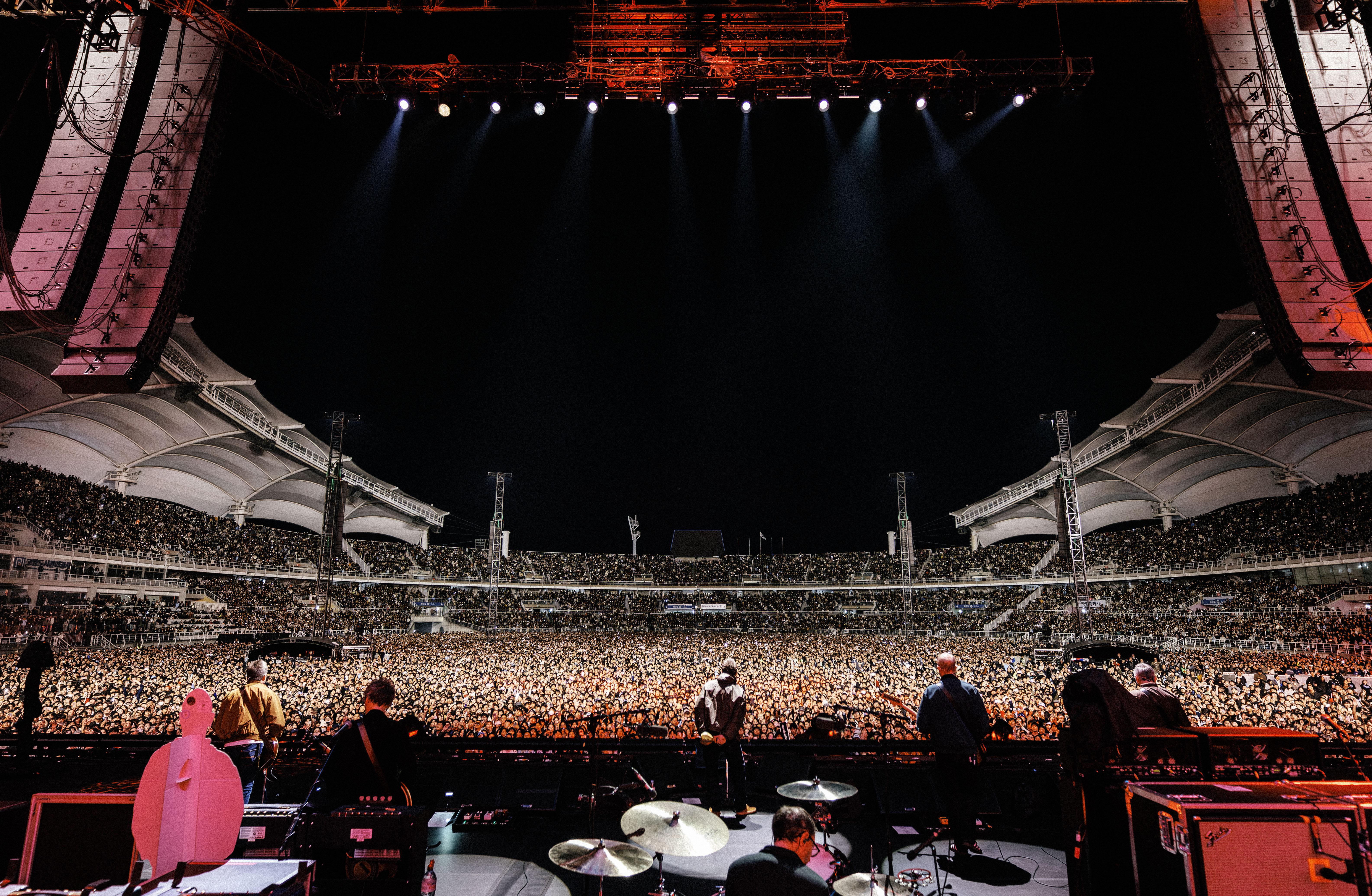
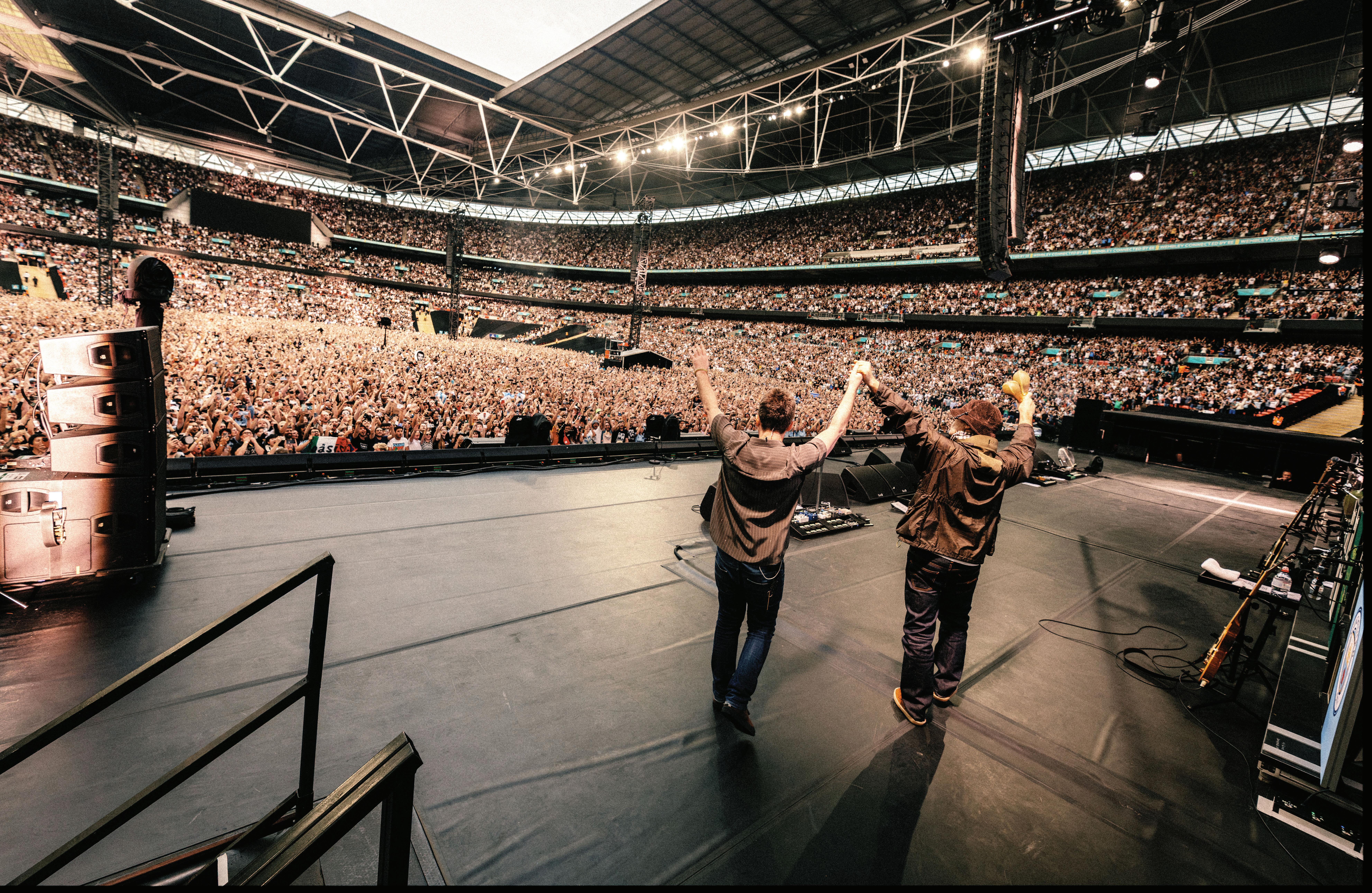
Screaming, crying, throwing up: it was the only reasonable response to a coveted slot on the event of 2025, which kicked off at Cardiff’s Principality Stadium on 4 July. Oasis’ Live ’25 tour was gargantuan in every sense: numerically (14 million fans reportedly vied for 1.4 million tickets in the UK and Ireland alone), financially (the University of Salford estimated its total economic impact on the UK to be just shy of £1bn) and commercially (Oasis sold in excess of one million albums in 2025 alone — the only UK artist to achieve such a feat — while Noel Gallagher picked up Songwriter of the Year at the BRITs 2026).
It’s slightly harder to quantify this from a cultural standpoint, although you need only to have taken a cursory glance at the news and social media to know that the Gallaghers have dominated the cultural conversation in this country since the reunion was confirmed.
‘I think everyone — Noel and Liam included — has been blown away by the sheer success of the Live ’25 reunion tour,’ says Thomas Smith, editor of Billboard UK. ‘These shows cemented the fact that live experiences are so sought-after by fans. The Oasis team were canny by opting for a limited run of shows, rather than extending their residencies to meet demand. It made every show feel like a unique, can’t-miss-this event.
‘Pairing that with local initiatives [such as Manchester City Council’s decision to funnel nearly £250,000 of income from the gigs into its grassroots venues] and their knockout Adidas campaign meant that against a busy summer of shows, they stood out against names like Beyoncé, Kendrick Lamar and SZA.’
In the dying days before Oasis’ acrimonious split in 2009, the band’s crowds had a reputation for being distinctly male and middle-aged. While that’s not an inherently bad thing, it was refreshing to see fans old and young, male and female coming together to celebrate the Gallaghers’ incredible legacy during the Live ’25 tour.
Many of them, too, donned official merch from Adidas’ Original Forever collection. Referencing the cross-generational appeal of the tour, its announcement video featured a young fan heading into a show before melding archive footage with new visuals — all soundtracked by Live Forever, of course. The grand reveal comes at the end as Liam and Noel are seen peering down the camera, ready for business. The accompanying clothing line was similarly simple but effective, consisting of classically styled, football-inspired attire adorned with subtle band logos.
‘It was important from the outset that we didn’t ignore nostalgia, but we also didn’t want to get stuck in it,’ says Steve Marks, senior director of brand communications at Adidas. ‘The archive was key, as it showcases the historic relationship between Adidas and Oasis, but the real magic came from how we were able to recontextualise that heritage for today.
‘THE OASIS TOUR CEMENTED THE FACT THAT LIVE EXPERIENCES ARE SO SOUGHT-AFTER BY FANS.’ – THOMAS SMITH
‘We wanted to create something timeless — a piece of work that resonated just as much with fans who grew up with Oasis in the nineties as it did with a new generation discovering this cultural moment for the first time.’
The Gallaghers infamously never cracked the US the first time around, yet roughly half a million fans snapped up tickets for Live ’25’s North American leg. Oasis last played the continent as part of 2008’s Dig Out Your Soul tour, which opened at Seattle’s WaMu Theater; according to Pollstar, they shifted just 4,593 tickets to sell out the venue. When the band returned to the US for Live ’25, they packed out Pasadena’s 90,000-capacity Rose Bowl twice, with the likes of Sir Paul McCartney, Billie Eilish and Leonardo DiCaprio in the audience. The lads’ intervening 16 years of bickering clearly only intensified their legacy.
Erin McGee, a 48-year-old who hails from the San Francisco Bay Area, travelled to London for two Wembley shows over the summer. Although she was aware of the band back in their nineties heyday, she didn’t officially become a convert until January 2024
Photography: Joshua Halling
when the Apple Music algorithm played her Some Might Say. Cue a ‘deep dive’ into the Gallaghers’ back catalogue. Eight months later, as amazed by the reunion as the rest of us, she scrambled for tickets to her first-ever Oasis gig.
She was ‘a bit concerned’ about the band’s aforementioned ‘blokey’ reputation (‘I’m still horrified that piss-throwing was really a thing that happened back in the day!’). On 25 July, though, McGee was struck not just by the gender split in the audience, but by its wholesome vibe: ‘Everyone I encountered was in a good mood and I didn’t witness any bad behaviour in my sections. People just seemed really thrilled to be there and were happy to have a chat.’
Azizi Abd Rahman, who is from Kuala Lumpur, Malaysia and has lived in Bristol for the past seven years, also attended his first Oasis show this summer, having bagged a ticket for the second of the two Cardiff dates. ‘This is my first year of going to concerts,’ the 23-yearold says. ‘Of all the concerts I’ve been to, Oasis is the best one.’
Azizi was just seven years old when Liam and Noel split in 2009. When he learned to play guitar at the age of 14, he incorporated Don’t Look Back In Anger into his repertoire; the song later became the first song he performed in front of an audience. The reunion, he says, ‘is a full circle moment for me, as Oasis have influenced me to write my own songs and aspire to a career in the music industry. I’m trying to write songs in the vein of The Beatles, Oasis, The La’s and Arctic Monkeys.’
Is Azizi an anomaly, or might we see a generation of musicians inspired by Oasis’ sound and, crucially, confidence? ‘A close friend of mine who’s a big manager in the industry came to Heaton Park [in Manchester, where Live ’25 touched down for five glorious nights],’ Cast’s Keith tells M. ‘I met him after the show and he was like, “Keith, this has changed my whole fucking attitude with the bands I am going to try and get signed up and develop. I’m just gonna focus on guitar music again now.”’
‘PEOPLE JUST SEEMED REALLY THRILLED TO BE THERE.’
– ERIN MCGEE
Thomas suggests that, on a wider scale, the success of Live ’25 will have a knock-on effect across the entire UK live sector: ‘The fact that Oasis are a British band who are being exported globally should give the UK industry a real boost. Our local stories still translate internationally and have real commercial opportunities.’
Ultimately, the Oasis reunion brought a serious feel-good factor to an otherwise tough financial and political climate (it’s worth noting that young Brits have known only economic stasis throughout the band’s entire 16-year absence). Even if you’re not a fan, surely everyone can relate to two brothers settling their differences to perform a crowd-pleasing set for an audience that spans generations.
‘There’s a great sporting analogy I would use,’ says Adidas’ Steve. ‘Being at the Oasis gigs was like being at the World Cup finals, where both sides are winning and every song is a goal. I don’t think I’ve experienced anything that came close to the euphoria that was experienced this summer.’
Besides any impact on the live industry or guitar music in general, it’s this euphoria that may prove to be Live ’25’s legacy (especially if there are more shows to come this year, as has been rumoured).
‘It was history in the making, wasn’t it?’ Keith concludes. ‘It felt to us like we were part of something a lot bigger than what we had to deal with — on a sort of fucking spiritual level, d’you know what I mean?’
‘IT WAS HISTORY IN THE MAKING, WASN’T IT?’ – KEITH O’NEILL
Photography: Joshua Halling
Photography: Harriet T K Bols
Photography: Big Brother Recordings
HOW LIVE ROYALTIES SUSTAIN THE SONGWRITERS BEHIND THE HITS
Words: Hollie Geraghty
Photography: Parkwood Entertainment
Three hitmakers lift the lid on the live royalty income stream that powers songwriters’ careers and the unmatched rush of seeing their lyrics come to life on stage.
Many music creators dream of seeing their work being performed on the biggest stages. For songwriters who typically work behind the scenes with performers, sometimes the greatest reward can come from watching on with pride as their collaborators bring their songs to life in the live arena.
This should also serve as a timely reminder that the craft of songwriting doesn’t begin and end in the studio. Nor do the potential benefits: earning live royalties might sound like an opportunity that’s reserved for touring artists, but songwriters can be in line to receive those royalties whenever their music is performed live.
‘I’ve always been quite businessminded, so knowing my income streams is really important.’
-
Tre Jean-Marie
‘It needs to keep getting talked about, because musicians really need to find money these days.’
- Jack Allsopp
When a gig takes place in a licensed music venue, setlists can be reported to PRS by the PRS member or to PPL PRS by either the venue, the promoter or the performer, along with such details as the name(s) of the songwriter(s), song titles and duration. Once a licence fee is collected from the venue or promoter by PPL PRS, the setlist is then matched with the registered works in the PRS database and royalties can be calculated. These calculations are based on three sets of criteria: how many acts performed at the gig, how long the show was and how many writers are registered on each track.
In short, you don’t need to be a stadium-conquering star in order to receive live royalties.
London-based songwriter and producer
Tre Jean-Marie is one artist who has reaped the benefits of his lyrics reaching stages around the world, having written for the likes of Little Mix, Olivia Dean and Tom Grennan. While he tends to work within the creative confines of studio walls, Tre has been clued up on the importance of live royalties since the early days of his career.
‘I’ve always been quite businessminded, so knowing my income streams is really important,’ he tells M. ‘It’s important to go out of your way to do your research and know every aspect of your business. Because that’s exactly what it is: it’s a business. I think people tend to forget that sometimes.’
The first significant live royalties Tre received came after working as a writer and producer on Craig David’s 2016 comeback album Following My Intuition, which the singer followed with an arena tour. ‘Because quite a huge part of the setlist was my songs, I soon realised the value,’ Tre recalls. ‘That was definitely the first time my eyes were really opened wide [to live royalties].’
‘I saw Beyoncé perform Freedom at Wembley, which I co-wrote. I was like, “Wow, seeing her actually bring it to life is amazing.”’
- Carla Marie Williams
Along with the financial benefits, Tre says it’s always an ‘incredible’ experience watching his songs being performed live: ‘Taking my kids to the [Capital] Summertime Ball and not only seeing them sing their heart out to everybody else’s songs, but seeing them know my songs, it’s like watching your ideas and songs come to life in ways that you can never imagine when you’re in the studio. It’s probably my favourite part of the job.’
For Grammy-nominated west London songwriter Carla Marie Williams, her first live royalties marked a significant moment of career validation. After joining the hitmaking songwriting team at Xenomania, she co-wrote Girls Aloud’s BRIT Award-winning track The Promise. The song has since earned live royalties for its songwriters whenever the girl group have performed it on tour. ‘I remember my mum’s reaction. All of a sudden, my job was a proper job!’ she remembers with a laugh.
Carla has previously written for such artists as Beyoncé, Britney Spears and Kylie Minogue, but estimates that she was in the industry for a decade before she was in a position to claim significant royalties. Since then, she’s seen her work transcend the space it was conceptualised in.
‘I saw Beyoncé perform Freedom at Wembley Stadium and I was like, “Wow, seeing her actually bring it to life is amazing,”’ she remembers. Carla also got to share in the pride of the US star making history in 2018 as the first Black woman to headline California festival Coachella. During that set, Freedom was elevated to new heights with an all-singing, all-dancing marching band ensemble. ‘It was phenomenal,’ she says now.
‘I’m really proud when I see that.’
This sense of achievement is something that also resonates with Jack Allsopp, the north London artist better known by his stage name Just Jack. Admitting to M that he initially had ambitions ‘not to play live’ in the early days of his career as a bedroom artist, he was first introduced to the concept of live royalties when writing down his DJ setlists that sampled other artists, for the purpose of submitting to PRS.
Eventually, though, he was persuaded to bring his own material to the stage, including his career-defining 2007 hit Starz In Their Eyes, which spent 26 weeks on the UK singles chart. Now, nearly 20 years later, he’s watched that track receive a new lease of life after PinkPantheress sampled the chorus on her song Stars. Watching the Gen Z superstar reignite his lyrics on stages across both sides of the Atlantic has been heartening, as a new generation is resonating with his words in a live setting.
‘I got to play with Pink at Glastonbury, which was quite mind-blowing for a lot of young people. My daughter, my son and all their friends would have been like, “Oh, it’s all true about you!”’ he tells M with a laugh. ‘I’m quite surprised that the song still has relevance to people after nearly 20 years.’
Still, that ‘icing on the cake’ moment for Jack has only underscored the importance of being business savvy by ensuring things like live royalties don’t ‘fall through the cracks’.
‘It definitely is something that needs to keep getting talked about, because musicians really need to find money these days,’ he adds.
Carla, who founded the organisation Girls I Rate to support young women in the music and creative industries, agrees that it’s essential that songwriters stay on top of their admin.
‘We must educate ourselves enough to ensure that our songs are registered with PRS, so that when they’re being performed live we’re collecting money for it — no matter how small or big a venue is,’ she says. ‘I think that’s really important.’
Tre’s own advice for emerging songwriters chimes with this, as he emphasises the need to learn about every income stream while ‘knowing your rights as a writer’. As priceless as those live moments may be, he insists that chasing those stadium-sized highs should never interrupt the quiet work ethic of real, authentic songwriting. Instead, it should motivate you to pick up the pen.
‘Seeing your songs out in the real world is so inspiring,’ he tells M. ‘For me, it gives the extra drive to go and make more music.’
Photography: Charlie Denis
Lily’s first album in seven years dominated the discourse upon its release in October. M speaks to three of the artist’s co-writers to uncover the process behind the record.
Words: Laura Molloy
On the title track of West End Girl, Lily Allen paints an ostensibly idyllic picture of married life. Over bouncy bossa nova, a rosetinted recollection of a fresh start in a big city plays out. While working with a high-profile interior designer on their brownstone townhouse apartment — in a neighbourhood with a good school, of course — Lily receives news of an exciting professional opportunity abroad. Cracks, however, start to emerge: a strange, eyebrow-raising remark about that job offer causes feelings of unease and awkwardness to descend, puncturing this mirage of domestic bliss.
Since its release in late October, West End Girl has been the subject of countless headlines over the way it brutally autopsies Lily’s marriage to Stranger Things actor David Harbour in a format mirroring a West End musical. Listening to such a cleverly constructed concept record that guides the listener through pain, paranoia and even a Pussy Palace, it’s astonishing to learn that the entire project was written and recorded in just 16 days.
A regular subject of discussion between Lily and her co-producer Blue May, the follow-up to 2018’s No Shame only began in earnest at the end of 2024. This time, Lily asked Blue about the prospect of working with her on new music in the immediate aftermath of her marriage to David falling apart. Given the sensitivity of the topic, Blue assembled a team of trusted songwriters and producers in Los Angeles. The intention, Blue tells M, was to make Lily ‘feel comfortable by the notion that she could still make some of her best work and step back into mainstream culture in a musical way’.
‘Blue understood the feeling of community that was necessary to build this record,’ continues songwriter Violet Skies, who was among the collaborators to be briefed on Lily’s personal life ahead of recording. ‘Usually, I would find that so many people in the room would be too much or too intimidating. But I must emphasise that this album is unusual, because the way we all got on musically was unusual. Everybody came in with a compassionate understanding of what they needed to do.’
Lily came to that first session with 18 song titles and a clear narrative arc in mind, referencing The Streets’ seminal A Grand Don’t Come For Free as inspiration for the record’s framework. ‘That full stop on the end of that period of her life was immediately followed by us being in the studio,’ Blue explains. ‘The beginning was the beginning, and the end was three days ago.’
Sonically, Blue wanted to capture the essence of Lily’s brilliance — namely the sharp wit that catapulted her to household-name status upon the 2006 release of her debut album Alright, Still. To do so, he sought to harness the juxtaposition that runs through so many of Lily’s cultfavourite tracks.
‘The music she’s famous for is generally quite bright and punchy,’ he says. ‘There’s a lightness to it that’s pretty much always balanced by her incredible sharpness of tongue: [equal parts] brutal, vulnerable and self-deprecating.’
West End Girl draws from an eclectic mix of genres, mirroring how Lily’s upbringing in London shaped her earliest music. ‘You’re surrounded by dancehall, garage, indie rock,’ says Oscar Scheller, a fellow London songwriter who worked on the album. ‘You’re going to record shops and you’re hearing all these different sounds. We wanted to tap into that and have it feel like a return to form, in a way that is also very elevated.’
That feeling of elevation comes through in flourishes across the album. The use of live instrumentation — in particular the string arrangements — give West End Girl a theatrical flair without compromising on the angst and humour that is so integral to Lily’s songwriting.
‘When you’ve got lyrics that are so dense in content, even though they’re so conversational, you don’t then want it to be too dense melodically,’ Violet explains to M. ‘Lily has formed a classic sound. Her melodies are
Photography: Charlie Denis
Photography: Press
inherently catchy and simple, but they serve as this really clean base to showcase her important — and sometimes devastatingly sad, or devastatingly funny — lyrics.’
As the concept was determined prior to the songwriting sessions, Lily’s co-writers were able to carve out a sound for each song by dissecting its lyrical content beforehand. Madeline, for instance, is a ‘spaghetti Western showdown between two people’, as Violet puts it — fittingly so, given that it features both a spokenword monologue and gun sound effects. Ruminating, meanwhile, dwells on being trapped in a cycle of overthinking, mirrored by claustrophobic, chaotic chords and footwork drums. ‘It’s like you’re dancing through the pain,’ Oscar offers.
This logic also results in West End Girl’s most harrowing moments becoming its most danceable. Relapse, an intrinsically British two-step record, sees Lily struggle to maintain a five-year streak of sobriety while dealing with immense stress and heartache.
‘Lily’s such an incredible wordsmith; that’s always been her sharpest tool as an artist,’ Oscar says. ‘In her own life, the rug was pulled from under her feet. In a way, it all just poured into the art.’
This juxtaposition between sunnier sounds and this devastating lyricism is maintained until the final two tracks — the soft, acoustic guitar-led Let You W/In, (‘a really triumphant ode to the power of songwriting,’ Violet says) and the trip-hop imbued Fruityloop. Oscar describes the latter as a ‘radical acceptance’ and ‘surrender’ to the pain that consumes the album: ‘That feeling is reflected in how spacious and ethereal the music is.’
In the aftermath of West End Girl’s release, the lyrical content predictably became tabloid fodder. While this particular reaction was entirely predicted by those who worked on the record, the overwhelmingly positive response to the album’s vulnerability was a surprise — particularly in an era where albums can struggle to make a cultural impact.
‘We weren’t thinking, “Oh yeah, people are going to love this”. We were thinking, “This is crazy. Should we say this?”’ Violet remembers. ‘In the end, we as writers had to be as brave as Lily was being. It was truly an education in songwriting.’
Violet also points out that an integral aspect behind West End Girl’s brilliance — outside of Lily’s genius, a pop culture landscape primed for her return and even the collaborative nature of recording sessions — was how the album afforded equity for all the songwriters and producers involved.
‘There was full transparency about how everyone was getting paid and what they were getting paid, both on a split side and on the master fee side,’ she explains. ‘That was totally spearheaded by Blue and Lily, and that’s really, really important.’
Moving forward, Lily’s co-writers hope the overwhelming success of the record will help to instigate change in the music industry, leaving a positive impact that will outlast the pain that served as its muse.
‘Labels, artists, managers or teams that say it’s not possible for songwriters to be rewarded on the master side, or that they can’t receive equal splits or fair compensation for their work, are lying, because it is possible,’ Violet says. ‘I do believe that if you want an album to do well, pay the people who made it.’
Photography: Leroy Clampitt
Photography: Freddie Stisted
Oscar Scheller Lily Allen and Blue May
Sir George Benjamin
'The UK has some of the best orchestras, many of which have a wonderful attitude to new music.'
After picking up the Contemporary prize at the Gramophone Classical Music Awards 2025, the acclaimed composerconductor opens up about his process, collaboration and inspiring a new generation of musicians.
Words: Claire Jackson
[Sensitivity warning: Picture a day like this deals with infant mortality, self-harm and suicide]
Beautifully lit selfies; immaculate interiors — the artfully arranged flowers are coincidental, you understand; cute pets; reluctant children on doorsteps. New things, personal bests and achievements are the stories we tell. Does a memory exist if it’s not digitised, documented or disseminated? These depictions, we are led to believe, encapsulate happiness: a state of being acquired through love, wealth, artistry or power — or, ideally, a combination of all.
But, as we are reminded through Sir George Benjamin’s coruscating opera Picture a day like this, appearances can be deceiving. The talented are riddled with selfdoubt; a passionately entwined couple are set to split; that outwardly positive person is dangerously depressed. When our social barometer cracks, our perceptions become unreliable. Sir George’s opera
follows a bereaved mother as she searches for a happy person from whom she can ‘cut one button from their sleeve’, which she has been told will return her child to life. Scenes unfold into a series of meetings with a pair of lovers, a craftsman, a composer and a wealthy collector — none of whom, despite appearances to the contrary, are content.
The story, written by Sir George’s long-term collaborator Martin Crimp (with whom he has created three other operas: Into the Little Hill, 2006; Written on Skin, 2012; Lessons in Love and Violence, 2018), is taut (‘No sooner had my child started to speak in whole sentences than he had died’) and uncompromising (‘all your fucking polyamory’). After its 2023 premiere at the Aix-en-Provence Festival, the production came to the Royal Opera House’s Linbury Theatre, where, over the course of repeated viewings, new aspects of this modern-day fable revealed themselves.
Photography: Matthew Lloyd
The following year, a much-anticipated audio recording from Aix was released via Nimbus. Featuring the Mahler Chamber Orchestra, conducted by Sir George, they sound pearlescent performing the dissociative, dream-like score. That record won in the Contemporary category — sponsored by PPL and PRS for Music — at the Gramophone Classical Music Awards 2025.
‘Picture a day like this has just been performed in Naples and some of the cast members were on the original recording — we are all thrilled,’ Sir George tells M about the accolade. The collaboration with Martin is central to his operatic creativity. ‘We must have considered 30 or maybe 40 stories,’ he says of Picture a day like this, which takes inspiration from traditional European fairytales and Buddhist folklore. Grittier aspects — the jovial, button-clad artisan rolls up his sleeves to reveal self-made cuts; a lowered shirt collar shows rope burn from an attempted hanging — bear Martin’s astute understanding of humanity’s darker side. A writer of opera plots and lyrics is usually referred to as a ‘librettist’, but, as Sir George explains, Crimp — a playwright by trade — eschews the term ‘libretto’ for ‘text’.
‘I searched for three decades to find the right writer, so I value my working relationship with Martin Crimp all the more strongly.’
Photography: Chris Christodoulou
‘Once we’ve agreed on a story — that can take a year! — there will be some discussion about the nature of the piece and the number of singers,’ Sir George reveals about their creative process. ‘Then, there might be six months, maybe more, with almost no contact, as agreed. Then one day, plop! A brown A4 envelope arrives through the letterbox. I open it, knowing that the next three years of my life will depend on my reaction to this text.’
With four successful projects now under their belts, Sir George knows he can be confident about this collaboration. Such long-term artistic partnerships are rare in the opera world: ‘I searched for three decades to find the right writer, so I value this working relationship all the more strongly.’
Rather like the central character in Picture a day like this, Sir George’s broader creative quest has relied on labouring self-development. It’s a process that has been formally recognised: he was made CBE in 2010 before being knighted in 2017. Perhaps more importantly, his instrumental music is increasingly being programmed and appreciated by the next generation of musicians. Earlier this year, pianist Mishka Rushdie Momen delivered an entrancing performance of Sir George’s 2001 solo piece Shadowlines at Aldeburgh Festival in Suffolk. Its six canonic preludes are intensely varied and virtuosic, yet economical in their melodic material, and Mishka’s articulate, shimmering interpretation captivated ears and minds.
At the other end of the textural spectrum is Ringed by the Flat Horizon, Sir George’s breakthrough orchestral work that was performed by the BBC Symphony Orchestra (conducted by a youthful Sir Mark Elder) at the 1980 Proms. The London Philharmonic Orchestra (LPO), under principal conductor Edward Gardner, recently revived the work to celebrate Sir George’s appointment as the ensemble’s composer-in-residence. As part of the residency, he will mentor five participants from the LPO’s Young Composers programme as they each create a new work for chamber orchestra that will be performed at a public showcase concert at the Southbank Centre’s Queen Elizabeth Hall.
Teaching has always been important to Sir George. Having enjoyed a privileged education himself (Westminster School; tutelage with composer Olivier Messiaen in Paris; studying under Alexander Goehr at Cambridge), he’s devoted decades to giving back.
‘I’ve been teaching at King’s College London for a quarter of a century now!’ Sir George, who is the Henry Purcell chair of musical composition at KCL, says with a smile. ‘There have been long sequences of amazingly gifted students.’ One example is Dai Fujikura, whose opera The Great Wave — which tells the story of the artist Hokusai and his emoji-preserved seascape — will be premiered by Scottish Opera next year.
The next three years of my life can depend on my reaction to an opera text.’
As some classical music professionals, particularly in the opera space, are openly advising young musicians to seek careers abroad, how does Sir George feel about the state of the UK’s classical music industry?
‘In terms of being a young composer, the orchestral schemes are probably better here than anywhere else in the world,’ he tells M. ‘The UK has some of the best orchestras, many of which have a wonderful attitude to new music. But all the same, there seem to be great dangers for classical music. Our insularity has worsened after Brexit; we need to be part of the international arts scene as it changes and transforms. There are far fewer opportunities for composers to get their work commissioned, broadcast and performed, and rampant populism is damaging essential structures. However, I do believe there’s still time to reverse these issues.’
Asked about his 2026 plans, Sir George is politely firm about which of his own compositions might be in progress: ‘Forgive me; I’ve never been able to talk about the future. I can’t discuss work until it exists.’
Given the carefully crafted nature of Sir George’s scores, this is understandable. With our curiosity tamed, we can at least be safe in the knowledge that whatever comes next will be worth the wait.
Photography: Matthew Lloyd
KEEPING AN EYE ON
PRS for Music’s latest survey on artificial intelligence has uncovered how members are feeling about the rise of AI, particularly in terms of the creative risks posed by generative AI.
Words: Sam Harteam Moore
A new survey commissioned by PRS for Music has found that there are mounting concerns around generative AI in music, with four in five creators expressing their worries about AI-generated music competing with humancreated music.
Building on the CMO's August 2023 survey on the subject, the new results come from responses that were provided by over 2630 PRS members.
Here’s a breakdown of the key findings from the survey:
say they are worried about AI-generated music competing with human-created music
‘AI should be a partnership where both creators and technologists can flourish.’ – Crispin Hunt
The creative industries are hugely important to the UK economy, contributing over £120bn each year. PRS is continuing to urge policymakers to prioritise a robust regulatory framework for AI which safeguards copyright protections, meaning creators can earn a living from their work and reinvest in future creative endeavours.
John Mottram, Chief Strategy Officer at PRS for Music, said: ‘It is clear why creators are concerned. Tech firms train models on copyright works without permission or payment building commercial services designed to compete with or replace the human creators.
‘Music creators are already using AI to find new ways to enhance their creativity, but it is up to policymakers to make sure that livelihoods are protected, not diminished to cater to big tech.
‘We will continue to champion the value of songwriters’ and composers’ works and advocate for a future where innovation and artistry can thrive together.’
AI principles
Following the 2023 AI survey, the PRS Members’ Council developed a set of guiding principles on AI PRS engages with the AI sector and policymakers. Those principles are based on:
‘Music creators are not anti-technology, but we are anti-exploitation by technology. Songs, lyrics, melodies and compositions, created through a labour of love and hard work, must not be ingested by developers to their train AI tools without our permission or remuneration.
‘PRS will only pay royalties for works created by human creators. Members may register works where AI has been used as a helpful tool, but a human mind must be the creative force behind the work.
‘We call on the Government to safeguard British creativity and will continue to work closely with policymakers to ensure there is a robust and respectful regulatory framework for AI.
‘AI shouldn’t be a battle between the copyright industries and Silicon Valley; it should be a partnership where both creators and technologists can flourish.’
Protection of human creativity
Global cooperation
Crispin Hunt
PRS Members’ Council President and songwriter
Words: Jake Tucker
SCORES ON TOUR
Winifred Phillips, Kenny Young and Mac Quayle explain how live performances and orchestral tours are unlocking new audiences — and new revenue streams — for video game composers.
Back in November, the members of the Royal Philharmonic Concert Orchestra took their places on the Royal Albert Hall stage in front of an expectant audience. As they began playing, it quickly became clear that this wasn’t going to be your typical RAH orchestral affair — particularly as the first piece to be performed was the main theme from the Metal Gear Solid video games.
Metal Gear in Concert, which featured music and songs from the longrunning franchise, is just one shining example of video game music’s foray into the live music space. A touring orchestra is currently celebrating 10 years of The Witcher 3: Wild Hunt with a world tour. Wholesome farm life simulation Stardew Valley is also receiving the orchestral treatment this year with a tour, including sold-out dates in London and Manchester. Both follow the 2025 debut of PlayStation: The Concert, which paired music from several fan-favourite Sony titles with cutting-edge visuals in arena venues in the UK, Europe and the US.
While gamers’ nostalgia has played a significant role in the popularisation of these concerts, it also marks a victory lap for the composers behind the music. Hearing these familiar scores being performed by a live orchestra — with their soaring strings, roaring brass and rib-rattling percussion — has given these composers the chance to have their music appreciated in a whole new medium. Music that, until recently, might have just been in the background of a boss fight is now reverberating around sold-out concert halls and arenas across the world, reshaping the opportunities on offer for video game composers.
Photography: Andy Paradise
Elden Ring Symphonic Adventure at the Royal Albert Hall
Video Games Live
Photography: Press
Photography: Andy Paradise
Photography: Andy Paradise
Royal Philharmonic Concert Orchestra
Elden Ring Symphonic Adventure
‘It’s a great thing!’ Grammy-winning composer Winifred Phillips, who has worked on the likes of God of War, Assassin’s Creed III: Liberation and the LittleBigPlanet series, tells M. ‘People discover new music by attending concerts, so it’s exciting to see so many events now celebrating game music. I remember when Video Games Live held its first event at the Hollywood Bowl in 2005 which, at that time, was seen as audacious and revolutionary. Now these sorts of concerts are numerous, touring around the world and drawing huge audiences.’
Winifred has had her music performed in globally renowned venues like London’s Eventim Apollo, Paris’ Palais des Congrès and the Dolby Theatre in Los Angeles. She first witnessed it in person during the Assassin’s Creed Symphonic Adventure World Tour stop in Montreal in April 2025, an experience she describes as ‘mindblowing’: ‘I could definitely feel the excitement in the audience. I’ll never forget being brought up on stage during the standing ovation at the end of the concert.’
In addition to the added recognition, Winifred has also benefited from the extra revenue that these concerts have generated in the form of live royalties.
‘I’m not sure that aspiring composers are aware of the potential income from these concerts, but I’m sure it would appeal!’ she says. ‘I’ve seen royalty payments for concert performances of my music in my PRS statements, and I’m very pleased to have more diverse avenues of income as a game composer. I’m grateful that PRS is supporting game composers by collecting these royalties.’
‘THESE CONCERTS CAN EXPOSE THE MUSIC TO A WHOLE NEW AUDIENCE.’ – MAC QUAYLE
BAFTA-nominated composer and sound designer Kenny Young has worked on such titles as The Getaway: Black Monday, Astro’s Playroom and Astro Bot. Tracks from the latter two featured on the PlayStation: The Concert setlist, and Kenny says it’s ‘an out-of-body experience’ to hear his music being performed in a live setting.
‘I always find it surreal,’ Kenny tells M. ‘This thing originated with you trying to channel it into existence, and now it’s happening over there [on a stage]! It takes me a few minutes to get over that feeling before I can actually ease into it and start enjoying the performance. But once I do, I love watching the musicians playing and responding to the music and each other — that’s electric. It heightens my emotional response, whether it’s my own music or someone else’s.’
The real draw of any concert, Kenny adds, is the ‘experience of people connecting over a shared passion’. Games music concerts, then, are helping deepen people’s appreciation for the composers behind the music.
‘There’s no question that they help inform folks who may be ignorant about gaming and game music culture, so they can start to understand that it is a “thing”,’ he continues. ‘But I find the virtue signalling around game music being performed in concert halls by orchestras to be slightly desperate. That messaging fights against perceptions, and that’s really powerful — I get it. But the reality is that gaming and game music is a much broader church — that breadth is one of the things I love most about the medium and the industry.
‘It would be great if the cultural conversation about game music was more representative of that. It does help to demystify game music somewhat. Surprise: it’s just music.’
Much like Winifred, Kenny says that the additional income of live royalties from these concerts is particularly welcome, particularly given the tough financial times that the video game sector is continuing to weather.
‘I’M VERY PLEASED TO HAVE MORE DIVERSE AVENUES OF INCOME AS A GAME COMPOSER.’ - WINIFRED PHILLIPS
Photography: GRAMMYs / Press
Winifred Phillips
‘My primary focus is to create an amazing music experience that’s part of a wider player experience,’ Kenny says of his role as a composer. ‘Historically, I’ve always viewed my music going on to have any kind of life of its own outside of the game as a privilege and an added bonus. But now that the games industry is waking up to the importance of its music to its audience, the exploitation of that music is increasing. Games have not been immune to the wider macroeconomic problems that we’re all currently facing.
‘While the royalties I’ve received from live performances have been modest, they, alongside all the other performance revenue streams that PRS collects on my behalf, are part of an increasingly important buffer that helps make my career sustainable.’
The success of bringing video game music from the small screen to the concert stage is in tandem with film and TV soundtracks also being performed live to delighted audiences. Mac Quayle, who has worked on music for such games as Far Cry 4 and The Last of Us Part II, notably staged one such concert in West Hollywood back in 2017, where he performed music he composed for the acclaimed TV series Mr. Robot
‘It was a lot of fun,’ he recalls about the show. ‘I love performing: I’ve been performing for pretty much my whole music career, so it’s thrilling to go up and be on stage in front of a big audience. If people didn’t sit down and listen to the soundtrack album of a video game, TV show or film, then these concerts can expose that music to a whole new audience.’
Mac describes his contribution to the best-selling The Last of Us Part II as ‘pretty out there’ compared with lead composer Gustavo Santaolalla’s main score. But, he notes, his work ‘struck a nerve’, with many gamers reaching out to him afterwards to say how much they’d enjoyed his work on the score.
‘I LOVE WATCHING MUSICIANS PLAYING AND RESPONDING TO THE MUSIC AND EACH OTHER — THAT’S ELECTRIC.’ – KENNY YOUNG
‘It’s not mainstream music by any stretch of the imagination,’ Mac reflects. ‘It’s quite weird; it’s not dark or particularly melodic. But people have really enjoyed it despite that.’
Would he want to explore his video game music in a large-scale concert setting? ‘For sure,’ he replies. ‘It’s become quite popular in the past decade, so I’d love to participate.’
As long as gaming concerts continue to grow in their scale and ambition, doors will keep opening for both intrigued audiences and ambitious composers, whose work powers these experiences. From fresh revenue streams to new listeners discovering their music for the first time, these performances demonstrate the increasing value and visibility of game composition within the wider musical ecosystem.
For PRS, it’s a chance to champion that growth — ensuring these creators are recognised, supported and fairly rewarded as their music reaches new stages and audiences. It’s also a reminder that the work of the gaming composer doesn’t only need to accompany the on-screen gameplay. It can stand tall in concert halls, enabling gamers and the game-curious to see the music they love come to life.
Photography: Press
Kenny Young
Photography: Hannah Couzens
Scoring the suspense of The Traitors
Sam Watts, the composer behind The Traitors’ unforgettable theme, reveals how a Saturday morning-recorded demo became one of the BBC’s most recognisable scores.
Words: Jim Ottewill
Would you be a traitor or a faithful? Three years ago, this question would have made little sense. But with The Traitors being one of the BBC’s biggest recent hits, it’s now a guaranteed conversation starter.
‘I’m a bit of a control freak, so I think I’d like to be a traitor,’ Sam Watts, the composer behind the show’s main theme, tells M. ‘But I don’t think I’d be very good! I’m not a great liar. If I was a traitor, I’d be off by episode two.’
The Traitors (based on the Dutch series De Verraders) has swiftly become a cultural phenomenon since its 2022 UK launch, pulling in millions of viewers, dominating social media and spawning the muchtalked-about Celebrity Traitors. There was even a special Traitors-themed Prom at the Royal Albert Hall in the summer, during which Sam encountered the show’s sharply dressed host Claudia Winkleman (‘she’s everything you’d hope her to be — and more!’ Sam exclaims).
Sam, who has also worked on music for the likes of Planet Earth, Doctor Who: Tales of the TARDIS and The Sarah Jane Adventures, believes the popularity of The Traitors is on another level.
‘Initially, we had no idea about the reception it would get,’ he says. ‘Series one had good, but not brilliant, viewing figures, then over the Christmas period 2022 it just caught the population’s imagination. It’s the most bizarre thing to be part of a show like this.’
With over 20 years of media composing under his belt, Sam can trace his formative musical beginnings to Yorkshire. At home, he would listen to the likes of Pantera and Carly Simon — as well as his fair share of opera music — as his creative curiosity was piqued.
‘I used to sit and hit [the family piano]. My mum used to get really annoyed, so she sent me to lessons,’ Sam recalls. ‘But it was this exposure to so many different types of music as a kid that really excited me.’
‘THE SCORE IS ABSOLUTELY PHENOMENAL. IT FEELS LIKE YOU’RE WATCHING A MARVEL MOVIE OR SOMETHING. IT IS JUST CLIFFHANGER, SUSPENSE, RELEASE, TENSION — ALL THE EMOTIONS.’
– NICK MOHAMMED SPEAKING ON THE CELEBRITY TRAITORS: UNCLOAKED
Going on to study music at GCSE level (‘I had some great teachers who encouraged me to start writing my own music’), Sam became aware of the ample possibilities that can come with media composing: ‘As a teenager, I realised there were scores in what I was watching on TV. I started to really enjoy music by John Williams, Wendy Carlos and Anne Dudley. I remember watching Wilde and being blown away by Debbie Wiseman’s brilliant score.’
While studying composition under musical experts Nicholas Sackman and Mervyn Cooke at the University of Nottingham, he was introduced to acclaimed film and TV composer George Fenton (Gandhi, Groundhog Day, The Blue Planet) after the latter visited as a guest lecturer.
‘George was very generous, and I ended up badgering him until he gave me a job,’ Sam recalls with a laugh. ‘I worked for him as a music assistant for three years on projects like Mrs Henderson Presents and Hitch. But I became too comfortable, and George wanted me to write my own music, so I stopped. I wasn’t sure how to move
forward, but he then called me a few months later for a TV show he was working on. It turned out to be Planet Earth.’
Sam was tasked with writing the music for the segment in each episode of the David Attenborough-narrated nature series in which the production team share how they captured the action we see on screen.
‘It was trial by fire as it all had to be made electronically. There was no budget for orchestras,’ he says. ‘But rather than becoming concerned about this being a flagship BBC documentary, I just got on with it. I put my bravery down to the folly of youth!’
With such a significant credit in the bank, Sam’s next break came after he sent a CD of his music to Russell T Davies, the showrunner and writer behind the 2005 revival of Doctor Who. ‘I’d always been a Doctor Who fan, so I sent Russell a showreel and a note which said something like: “I’m not going to kiss your ass, but you make great TV and I’d love to work with you.”
‘Weeks later, I got a call from producer Julie Gardner asking me to meet them. After being given a script and asked to come up with a pitch, I was offered [Doctor Who spin-off] The Sarah Jane Adventures. That just shows how you have to put yourself out there, network and forge connections with people to get the job.’
Sam first heard about The Traitors gig in 2020 from his friend Abi Lambrinos, a producer at the show’s Studio Lambert. ‘I was asked to put together a reel of music that might fit The Traitors,’ he recalls. ‘Instead, I decided to write something new to show them what I could do. I spent a few hours on a Saturday morning working on a demo, then sent it over, saying: “This is really rough, but will give you an idea of what I’m thinking.” They loved it, and it became the Traitors theme.’
As nothing had been filmed at that point, Sam had to work without any clear visual references. Studio Lambert’s producers described the format and shared a few references to paint a picture of what they were after.
Photography: Hannah Couzens
Sam Watts
‘I HAD SOME GREAT TEACHERS WHO ENCOURAGED ME TO START WRITING MY OWN MUSIC.’
‘When working like this, you have to hone in on specific wording,’ Sam explains. ‘They loved the Game of Thrones music, which is an epic score. I listened to it and asked myself what they liked about it. It’s got this driving, repetitive feel; it’s primal; there’s a lot of percussion and aggression. I then sat at the piano and tried to create my own version of that emotion.’
Despite its bombast, the final version of the Traitors theme wasn’t recorded with an orchestra. Instead, Sam made use of the music production software Cubase while his brother Dan added some synth lines and guitars for ‘a shiny, more programmed version’.
‘The fact that my initial idea somehow stuck is very strange,’ Sam says now about his theme. ‘Given the ubiquity of the series, it’s bizarre how the music is everywhere.’
Never was this more apparent than at the aforementioned BBC Prom, where his Traitors theme was performed by the BBC Scottish Symphony Orchestra conducted by Karen Ní Bhroin.
‘I’ve been to the Royal Albert Hall many times, so to hear my own music played there by world-class musicians was a dream,’ Sam tells M. ‘I got a text from Russell when [the Traitors Prom] was announced, saying: “This Prom has been years in the making!” It was always something I said I wanted.’
While The Traitors’ appeal keeps growing, with versions now screening in such countries as Poland, India and New Zealand, Sam hasn’t written any further music for the show since 2022.
‘Everyone thinks I’m constantly working on it as it’s such a big thing, but I’m always looking for more opportunities,’ he says. ‘I’m looking forward to working with Russell again on his upcoming Channel 4 series, Tip Toe.’
While Sam remains, to borrow a Traitors phrase, ‘100 per cent faithful’ to the craft of composition, he’s keen to advise the next generation of media composers about the realities of making it in this highly competitive industry.
‘Anyone wanting to do this needs to know that a career is not linear,’ he says. ‘You need some resilience, and you have to keep going. I will pass on advice I was given by George Fenton: “Work hard, and be nice.” It’s always stood me in good stead.’
How very faithful…
Image: BBC/Studio Lambert/Cody Burridge/Artwork - BBC Creative
The Celebrity Traitors
Words: Jim Ottewill
Born from the Windrush generation and built on bass, UK sound system culture has shaped communities, fuelled protest and left a lasting mark on the UK’s live music scene.
‘Without sound system culture, we wouldn’t know who we are as a people,’ DJ Kat, a member of the Coventry collective Sisters In Dub, tells M. ‘Sound systems are where we gathered to get our education — not just in music, but in life.’
Sound systems have become one of the defining pillars of contemporary UK music. Brought to Britain by Caribbean migrants in the mid-20th century, they swiftly evolved beyond a means of playing records into a distinct cultural movement — one that has shaped live performance, influenced generations of creators and fostered a lasting sense of community. As DJ Kat notes: ‘Many of the genres you hear today, such as grime, wouldn’t have developed without the foundation of sound system culture.’
Professor William ‘Lez’ Henry, a writer, poet and researcher who also DJs under the moniker Lezlee Lyrix, agrees with this view: ‘Without the sound system, there would be no “rave” culture in the UK,’ he says. ‘These are derivations of what used to occur in the Black dancehall. These spaces were moulded on African and African Caribbean musical patterns for partying, dancing, “liming”, consumption and live performance for enjoyment and catharsis.’
Photography: Tom Platinum Morley Sisters in Dub
Initially a means of bringing music to socially deprived neighbourhoods in Jamaica in the forties, the UK’s first sound system is believed to have been established by Duke Vin in Ladbroke Grove, west London, in 1955. The set-up may be simple — speakers, a carefully curated selection of records (ranging from reggae and rocksteady to ska and dub) and a strong sense of community — but its impact remains unshakable. Sisters In Dub’s Cherelle Harding recalls attending one event hosted by the late dub and reggae pioneer Jah Shaka at Birmingham’s Irish Centre.
‘It was a full-body experience,’ she remembers. ‘The vibrations coming from the speakers were healing; the sirens were hypnotising; Shaka’s humble-yet-militant command on the mic — it was liberating to witness. It was more than just music. It was divine reverence — the closest thing to a true church I’ve ever felt.’
The sound system has also served as a form of protest, triggered by the inherent racism this new Black community experienced as they settled in the UK. Denied entry to traditional clubs and bars, they instead held their own private blues dances in homes and community halls. This sense of demonstration has been adopted by Sisters In Dub, particularly when it came to inserting themselves into what is traditionally a male-dominated space.
‘We were invited to take part in a sound clash during Coventry’s UK City of Culture celebrations in 2021, but we heard through the grapevine that there were doubts about our capability,’ DJ Kat recalls. ‘Not only because we’re women, but also because we were brand new. But we went ahead with it anyway and proved them wrong by winning the event. From there, people became interested in booking us to perform as a sound system crew.’
Notting Hill Carnival is Europe’s largest street party, attracting more than two million people every year to its three-mile parade route. It also serves as one of the most enduring visual celebrations of the scene in the UK and beyond, with over 30 static sound systems — including Channel One and the renowned selectors Aba Shanti-I and Gladdy Wax — operating every year.
After first setting up a sound system at Carnival in 1992, Rampage Sound have shaken up the scene by becoming ‘the first multi-genre sound system’, as its DJ Treble T explains: ‘We play everything that Black people listen to. When new genres have come along, from garage to jungle, we’ve played them. We reflect how the culture is moving.’
This fluid approach is also being embraced by DJ AG, who has gained a huge following on social media in recent years thanks to his livestreamed street DJ sets — the likes of Skepta, JME, Ed Sheeran and even Will Smith have all made surprise appearances on his streams as his popularity has grown. AG’s focus on community and bringing music lovers together, both online and in person, is a fresh reinterpretation of the roots of sound system culture.
‘I’m just having fun, doing what I love,’ AG tells M ‘Being outside is fundamental [to my sets] as this is music for bringing people together, regardless of where they come from. Music brings happiness. From the streets to schools and even care homes, I want to bring it to as many places as possible.’
London is understandably a focal point for the UK’s sound system scene, but the music can still be heard well outside the capital. The likes of west Yorkshire’s Iration Steppas, Glasgow’s Mungo’s Hi Fi and, more recently, Leeds’ Nightmares on Wax are among the operators keeping the spirit of sound systems alive and well on these shores.
‘We first came across sound systems outside of standard venues,’ explains Mungo’s co-founder Doug Paine. ‘We’d see them at free parties, raves and protests across Scotland, and Mungo’s Hi Fi grew out of these experiences.
‘We wanted to do more ourselves: building our own sound system, making tunes, working with MCs, promoting events, collecting records. We put on a few events in the nineties, but having our own speakers [as Mungo’s Hi Fi] meant that we could move into more unusual spaces and pull in a crowd looking for an authentically underground experience.’
The demand for the sound system experience has also crossed into the UK’s festival circuit, with London’s Wireless Festival perhaps the clearest example, as Treble T notes: ‘Perhaps even 10 years ago, festivals weren’t embracing our sound and the wider culture. But that’s totally changed [now]. Look at Wireless Festival: when that started [in 2005] it was guitar bands, but now it’s an integral date in the calendar for Black artists.’
The influence of sound systems has even started to filter into the hospitality sector. Established by Rhythm Section founder Bradley Zero and The Colours That Rise’s Nathanael Williams, Jumbi is a Peckham bar and restaurant centred around a hi-fi system and one-turntable set-up that is built into a bespoke booth. Guests are invited to select music from Bradley’s extensive record collection in an effort ‘to encourage deep listening and prioritise selection above mixing’.
While the locations in which these sound system speakers might find themselves in 2026 have changed, our appetite for their sounds — the bass vibrating through us — remains a vital, almost primal urge. It’s a
view that Bradford-born soul singer Sinead Campbell — who led a performance of Love. Unite. Freedom., celebrating decades of Black British music and culture, as part of Bradford’s UK City of Culture 2025 celebrations — shares.
‘From our research, we found that these spaces have offered a sense of sanctuary in often hostile environments,’ she tells M. ‘Sound systems offer people spaces where they can come after a hard working week to unite, spread positivity and feel uplifted.
‘It’s so important to acknowledge the history of sound systems in the UK, but it’s equally important to see how they continue to have this role as a tool for good in what feel like polarised times.’
Mungo's Hi Fi
Rampage
Photography: ReCompose
Words: Daniel Cave
Whether it’s local nightclubs or internationally renowned venues such as London’s Ministry of Sound and Manchester’s Warehouse Project, Music Recognition Technology (MRT) is continuing to revolutionise how music usage is being tracked and reported to collective management organisations (CMOs) for royalty collections.
Typically housed in a discreet device, MRT identifies recorded music that is played in a particular setting — such as during a DJ set at a nightclub or music festival — and matches it with results from a comprehensive database of works. Data reports are then generated and sent to CMOs like PRS for Music, ultimately increasing the accuracy of royalties that are paid to music creators for the use of their work.
As of February 2026, there are 62 MRT devices permanently installed in 36 venues across the UK, with plans to expand already in place. MRT is also used at up to a dozen music festivals every year to monitor DJ stages.
‘Where we sometimes experience a lack of setlist information, MRT provides us with comprehensive and accurate data,’ Ashley Howard, relationship manager for dance music at PRS, explains to M. ‘MRT therefore helps facilitate royalty payments to the creators whose music is played by DJs at licensed events.’
Producer, DJ and PRS Council Member John Truelove believes the introduction of MRT has been ‘an absolute game-changer for the electronic music community’.
‘Prior to its implementation, we knew our music was being played but it simply wasn’t being reflected in royalty distributions,’ he tells M. ‘The impact [of MRT] has been transformative: thousands more unique songs are being identified, countless creators’ works are finally being acknowledged, and performance income is appearing in their PRS statements.
‘The next step is expanding MRT into more clubs, specialist music venues and festivals nationwide so the data can be ever more representative of what’s being played.’
Praise for the technology has also come from BBC Radio 1 DJ Jaguar, techno legend Alan Fitzpatrick and DJ/producer Dave Seaman, who in 2024 said: ‘I’m a keen supporter of technology that helps DJs to support the producers making the music we spin and depend on. It’s the lifeblood of the scene, but it’s getting increasingly harder to earn a living… Hopefully we’ll see more clubs adopting this technology and ensuring [creators and] producers get the remuneration they deserve.’
Global MRT market leader DJ Monitor, which first partnered with PRS and PPL on the use of the technology back in 2016, monitors and processes over a million DJ sets with its end-to-end service each year. The online DJ and mixing platform Mixcloud, meanwhile, has implemented granular track-level reporting for music within its catalogue of radio shows, DJ mixes and podcasts.
‘With our unique label licensing agreements and “Mixcloud Select” monetisation program, we make sure that not only a channel owner, but the underlying artists and tracks who get played, get paid,’ Nico Perez, Mixcloud co-founder and CEO, recently remarked about the platform’s embrace of MRT.
Despite these positive steps forward, there is still more to be done. While acknowledging that nightclubs and festivals have been operating in particularly challenging circumstances in the past few years, Greg Marshall, product consultant at DJ tech firm AlphaTheta, says the evident benefits of MRT still need to be widely communicated.
‘We need to win the hearts and minds of venues and overcome their concerns, as MRT can be low on their priority list,’ he tells M. ‘But creators are the foundation on which the music ecosystem is built, so we have a cultural responsibility to ensure they’re supported. This is the same for venues, as they’re the cultural spaces that bring people together.’
As Greg notes, it ‘shouldn’t solely be on a DJ to submit a setlist’ to a CMO. Simplifying the process of music reporting is one potential solution, and initiatives like KUVO Powered by DJ Monitor — the outcome of a 2024 partnership between the AlphaTheta-owned KUVO and the MRT specialists — are leading the way. Enabling DJs to support creators without needing to do anything more than play their tracks, KUVO Powered by DJ Monitor sees the latter’s MRT work in tandem with the former’s ability to capture the metadata of music (also known as Direct Metadata Collection) that is played through AlphaTheta’s popular Pioneer DJ units.
Photography: Carl English / PRS for Music
PRS took part in a successful trial of this service from late 2024 to 2025, with a long-term agreement subsequently being struck to utilise the technology and expand its reach. The natural ‘synergy’ between KUVO and DJ Monitor’s respective functions, as Greg points out, ‘can help solve the longstanding problem of gathering data from clubs and venues, and getting accurate information on what’s played’.
Collectively, venues that buy music licences from CMOs like PRS and PPL — enabling DJs and creators to perform in these spaces — can help generate significant royalties for songwriters and artists. That’s why PRS is working with influential music organisations such as the NTIA and AFEM to help venues realise the widespread benefits of MRT. Not only does it generate enlightening data on what music is being played in these venues, but adopting the technology can even play a part in the certification of operational and sonic excellence.
‘The International Nightlife Association has a Triple Excellence Seal that requires venues to use MRT,’ explains Greg. ‘That can shift the dial.’ Furthermore, as Ashley notes, there’s no extra cost to venues: ‘This data is used solely to help make accurate royalty payments and will not impact the cost of music licences for a venue in any way.’
Plans to roll out MRT on a wider scale are continuing at pace. KUVO Powered by DJ Monitor has already secured the support of the NTIA, while international messaging about the benefits of MRT is set to be distributed in countries such as Australia, the Netherlands and Spain. In Malta, the introduction of MRT at a single venue in 2025 resulted in the identification of more than 11,000 tracks by over 1,300 artists, spread across 500 hours of monitored performances — illustrating the scale of repertoire that can be captured when venues embrace the technology.
PRS, meanwhile, is looking to expand its collaboration with clubs and festivals to deploy MRT more widely.
‘Our goal at PRS is to maximise members’ royalties,’ Ashley explains. ‘This requires collaboration across the ecosystem, all the way from the DJ booth to the CMO. Venues must facilitate technology, rights holders must provide clean data and CMOs around the world must utilise MRT in a cost-effective manner.
‘We need to achieve greater awareness, understanding and participation across the industry so that a fairer system becomes reality.’