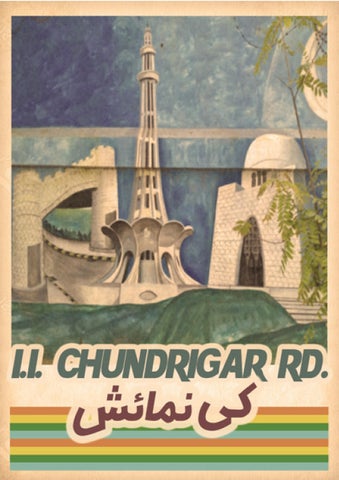

I.I. Chundrighar Rd. Art Catalogue
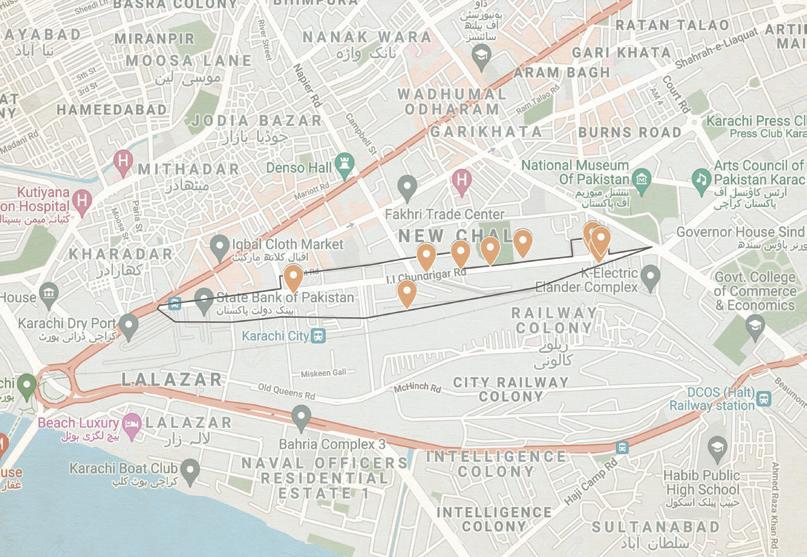

Picture 3
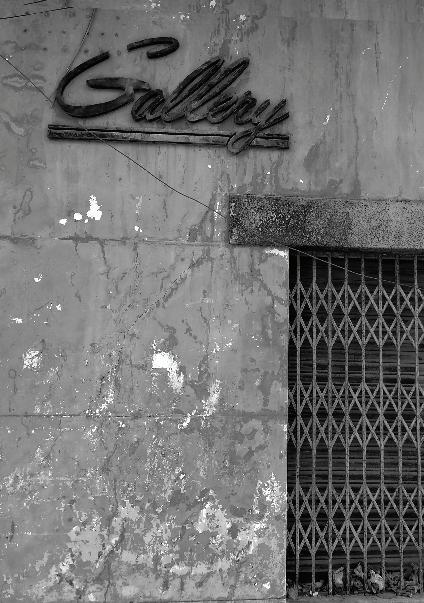
Picture 2
Ka Islam - Ishtiaq
Sakina
(1992)
Down Your Hair - Shakeel and Mir Bhai
Streets Aur Kitaab - Rashid Mujahid
Ke Usool - Begum Lohawala
Ki Kaan -
Tayyun - Saadia Hassan Manto
Z. H. Bhutto
(1965) (1980) (1980) (1990) (1990) (1982) (1982) (1971) (1932)
1. Bachon
Ahmed 2. Sakina
Let
3. Puraani
4. Fitrat
5. Khatt-e-Manzil-e-Ghair
6. Untitled - Anonymous 7. Matti
Fatima Shah 8. House No. 27 - Quttoshi 9. Rung Barse - Saadia Hassan 10. Dabba-e-sarmaya Daari -
11. Manhole - KMC List of Artworks
(1939)
Appreciation
pieces, and accompanying artist's statements. The concept of these Chundrighar Road for odd places, unusual visual, unexpected art forms, which would seem very negligible or even ugly to a random passerby.
An artist's gaze is a powerful tool. When you walk on a Karachi then you decide to take pictures of a pole whose bunch of wires seem aesthetic to you, people around will look at you weirdly. Sometimes people will approach you too and inquire what you are doing there. They will soften up a little when they hear you are an artist and inquire about your project, assume you are a student, and occasionally share their own stories as an act of generosity. Other times, you come face to face with a bully who will try to intimidate you, ask you why you are taking pictures, restrict your access to an otherwise public space. Still, you stand your ground in those times and see that those bullies are just little scaredy cats inside. All of this is part of your adventures.
Our project I.I. Chundrigar Road ki Numaish went through several developing stages, but the baseline was always to create a subjective map of the space we chose. The area that we ended up selecting was I.I. Chundrigar Road which stretches from Shaheen Complex to Tower. It was a unique area for us to explore with the eyes of two wanderers because the street is primarily a commercial
go. Among these people, two of us stood out as we roamed aimlessly and photographed things that others passed by without a second glance.
There was an underlying feeling of despair within us during our to by its inhabitants. Karachi is much of an image as its beaches, it was grand and beautiful once, and now it’s a picture of abuse and despair. Karachi is also like its old bazaars, where little beautiful things can be found in any corner if you have that eye. This is where our project comes in. We wanted to translate our wonder into a form that seems as if it is only accessible to the elite of the city. Looking at Karachi as an art gallery is a way of re-imagining
I.I. Chundrigar Road ki Numaish is a conception of our gazes as we roamed around I.I. Chundrigar Road and photographed scenes which many gazed over. We thought like two artists who made up stories within the ordinary but fascinating objects and scenes we came across. I.I. Chundrigar Road ki Numaish is an expression of that sentiment where we have conceptualized I.I. Chundrigar Road as an art gallery, with many paintings and installations in its premises. statement under pseudonyms and narratives around them.
I.I. Chundrigar Road ki Numaish serves as a scavenger hunt or a tourist guide for curious explorers like us who can visit the place and see it through our eyes.
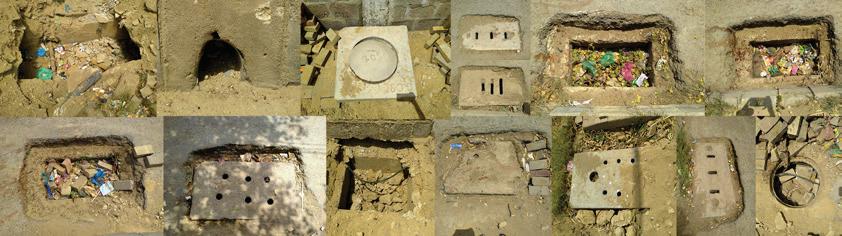

Artist: KMC, Karachi Metropolitian Coporation Material: Concrete, metal | Sculpture MANHOLE Picture 4
Manhole was commission by Krachi Muncipality Coporation to a team of artists who work with conctre mediums. Manhole systems of our reality. These systems are concepts of honestly, responsibility, truthfulness. When these systems are ignored, forgotten or abused, it can have devestationg results. These can be associated to the drainage systems which exist to keep the city clean and working. Mismangement of drains in a city like karachi, where all holes exist as a diseases, destruction of public and private properties etc.
Destruction of ideals of systems of virtue can lead to diseases such as currently uprooting the fabic of Karachi.
About the Artist Commision: This series of sculpture was commissioned by KMC which overlooks and is responsible for running of Karachi.
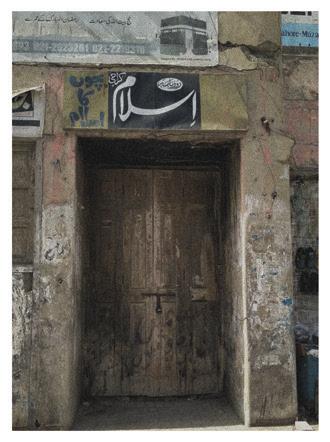
Bachon ka Islam
Artist: Ishtiaq Ahmed
Material: Wood and concrete mixed medium, limestone, iron, paint, posters | Installation
Size: 36in x 80in
A door named Bachon ka Islam. A door which is locked and is inaccessible. The state of Muslims in the world is sad. War mongering, spilling innocent blood, oppression of minorities and women are all being done under the name of being a good Muslim. Why is the state of the world like this?
Bachon a Islam is a commentary on how the Muslim thought and philosophy has been on decline with rising movements which are extremist in nature. These movements condemn philosophy, thought, questioning and spirituality. The true face of Islam is locked behind doors ever since childhood when children are raised on words of fear and caution instead of worlds of love. Children are only ever taught to hate sins but never to enjoy virtue. Children are only ever taught to fear Allah’s Wrath, never to appreciate Allah's Mercy and Compassion.
About the Artist: Ishtiaq Ahmed was born in India in 1941 and migrated to Pakistan with his family after the Partition in 1947. He is primarily a writer but also story telling but he is widely known for the interwoven narratives that are present in his stories. For this reason, his children’s storybook series was awarded as the Best Children’s Author in 2002 by Jhang Magazine. He also is a sculpturist and self-taught in this area of work.
Sakina Sakina Let Down Your Hair
Artist: Shakeel and Mir Bhai
Material: Short story | Fiction Writing
Sakina Sakina Let Down Your Hair- it's a love story between a city dwelling boy who fell in love with a girl named Sakina.
In a think jungle, Shakeel calls out to his true love. The short story is an allegory for a city boy’s love for nature.
Characters: Shakeel - Shakeel Sakina - Nature Jungle - City Hair - Unexpected instances of nature thriving in concrete.
About the Artist: Shakeel and Mir Bhai are a drama writing duo from Lahore who have completed their degree in English Literature from Royal School of Dramatic Arts (RADA). They began their co-writing journey when they shared a dorm room in RADA. Some of their other well-known works include: Darminderella, Safeed Gulabo aur Saath booney, Tinker bell aur Saif-ul-Muluk.
Puraani streets aur Kitaab
Artist: Rashid Mujahid
Material: Wood, paper | Installation, Performance
Size: 12ft x 12 ft
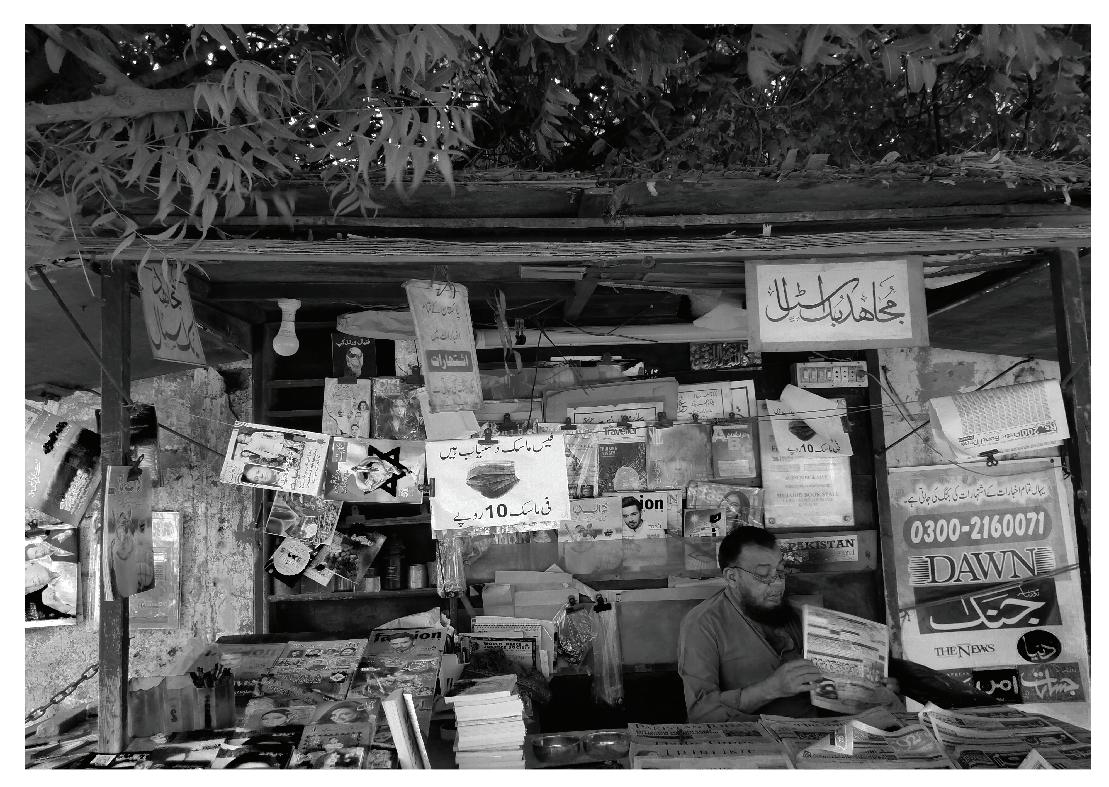
Puraani streets aur Kitaab is an unusual installation cum performance by the curator Rashid Mujahid in Chundrigarh Gallery. Shabby and old-looking, the installation is a handmade, wooden, street-corner bookshop, named ‘Mujahid Bookstall’. Rashid, who has been performing this art everyday from 8AM to 4PM since the last 60 years, named his artwork Mujahid to honor the soldiers and martyrs of the war of 1971.
Like clockwork, he comes to his cabin at around 8AM and seats himself under its patchy roof, covered with leafy branches springing out from a neem tree behind. When he is done arranging his stack of magazines, nonheaal, and newspapers on all the sides, Rashid gives himself a break and stares into the wide and busy road before him, reminiscing about older days when he would play cricket with his friends on the same road without any vehicle disturbing them for hours.
Rashid, his performance, and this area have grown old together and lived through each other’s inescapable changes. Despite him seeing tech and gadgets taking over people’s lives and predicting its unrelenting and unkind effects on his own performance, he stood his ground and remained loyal to his artwork, and hence to himself. And now he and his art stand out as the odd, stubborn children who refuse to assimilate into the rough, techy and fast-paced norms of the world they reside in. Mujahid Bookstall that was once Rashid’s lucrative business is now nothing but a collection of memorabilia that lets him hold onto the days he thought would never end
that was once Rashid’s lucrative business is now nothing but a collection of memorabilia that lets him hold onto the days he thought would never end. About the Artist: Rashid Ahmed is a 55 year old performance artist that has dedicated his entire life to one single performance. His practice deals with themes of time, nostalgia and mundane living. It is a documentation of the everyday as well as our historical and collective histories. It takes an investigative approach towards art and life. He and his art offer a visual record of a constantly evolving landscape and thus it embodies a compressed beacon - a time capsule defying time.
Fitrat ke Usool
Artist: Begum Lohawala Razia
Material: Tractor, seeds, water, sunlight| Installation
Size: 6ft x 9 ft
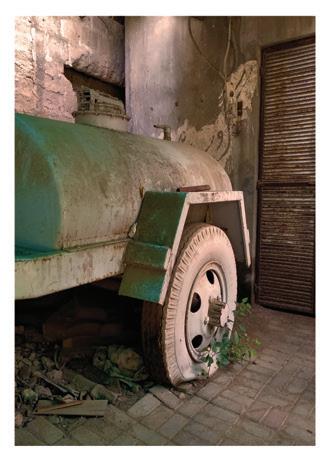
Fitrat ke Usool is an installation by the artist Mrs. Lohawala which was materialized over a period of 6 months. Her tractor was installed on
Meanwhile the natural wear and tear of the tractor was allowed to naturally take place.
Fitrat ke Usool is a commentary on the man vs. nature debate which has been happening since the age of European colonization and the suppression of natives within the colonies. This piece shows that even unaided, wild weeds were able to grow out of nothing and they are thriving, meanwhile the abandoned tractor has been worn out over time. Man’s glory may seem mighty, but it is very temporary. The Earth is nature itself, and it will reclaim itself. This is a sign of hope for those who cherish Nature and warning of destruction for those who chase the temporary pleasures of technology.
About the Artist:
Begum Lohawala is an experiential artist whose work explores the relationship between man and nature. Her works are based on her academic research projects centering on the subject of Anthropocene, a subject in which she is currently pursuing a Masters from New York University. She is more well-known as a socialite and philanthropist alongside her husband Mr. Murtaza Lohawala
Artist: Saad;ia Hasan Manto
Material: Writing, oil paints, metal | Sculpture
Size: 140mm x 130mm x 350mm
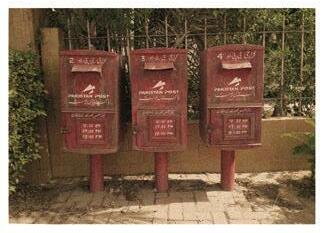
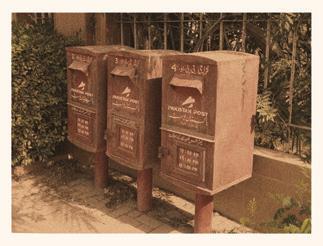
Khatt-e-manzil-e-gair tayyun is an installation by Zarina Hashmi who laments a home lost to the terrors of 1947 Partition. Saadia recalls a childhood home and a loving family she left behind as she migrated to Lahore with her newly wedded husband.
she remembers she has but has lost contact with. She also laments the loss of her husband who she lost to another war with India in 1965.
In her letters for Khatt-e-Manzil-e-Gair Tayyun she describes her life before partition as well as a short lived marriage with her beloved husband. posted in the three letter boxes dedicated to her late parents, late husband and a lost best friend.
About the Artist: Saadia Hassan Manto is a writer and artist from Lahore. Her work is internationally acclaimed however, she has received much criticism from the sub-continent for the narrative she supports around the partition. While her work can be considered controversial, he stories are very personal to her life. She was a professor at Habib University until she died in 1975.
Khatt-e-Manzil-e-Ghair Tayyun
Untitled
Artist: Anonymous
Size: 12ft x 12 ft
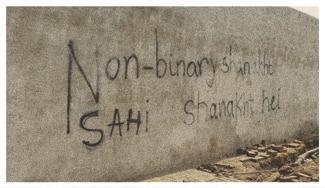
Non-Binary Shanakht
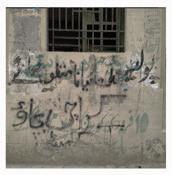
Anonymous artist that boldly declares 'Non-Binary shanakht sahi shanakht hai.' Sloppy and unkempt, it depicts the abruptness and speed the phrase was written in. Artist's anonymity doesn't reveal much about the story of the art; however, the art alone stands as a unique sight for the passers-by.
In a world where one is boxed down to mere two genders and their roles, this art becomes the voice of a dissent who defy the reductive structural norms of the day. However, in a city where loiterers aren't much familiar with the English language and words like 'non-binary,' is the art able to speak to such people; the ones who see it the most? Was it ever intended for them? Was it ever intended for anyone? Did the artist have a rush of emotion and expressed their feelings as is, without wanting to explain themselves or their art?
While these questions remain unanswered, these black words on a bare, white wall appear screaming in the air, with enough indifference to not bother who’s turning their heads, who’s not, who’s agreeing, who’s not, who’s frowning, and who’s not.
Matti ki Kaan
Artist: Fatima Shah
Material: Photographs
Size: 8.5in x 11.7in
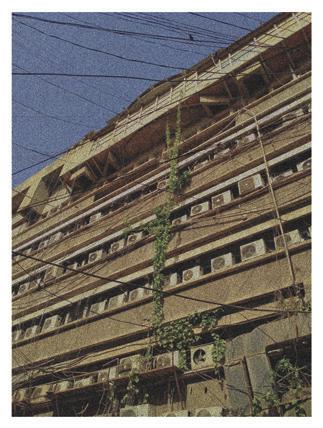
Matti ki Kaan is a photograph of the iconic Variawa Building by Fatima Shah, taken in 1967. It is said that Shah took this photograph to acknowledge her amusement for the building that poses a visual paradox for the eyes. Shah, doing justice to the reality, captures this paradox very well. Matti ki Kaan shows that while the building appears quiet and empty the ‘quietness’ of the building and makes itself heard the loudest. for the nation’s most well-known tech house, Variawa Building, provided employment and security to hundreds of its workers. As the tech required fewer people for manual operations. People got replaced with robots and their brains with AI. And one day in 1955, it was announced by the CEO that this company requires no more human power to function. Every system and department had been interlinked with each other on the cloud, and all the programming has been done to coordinate with each other.
In case there is a need for a new code, the system has turned so powerful that the AI can also look after those needs. And within the blink of an eye, ventures are now asked to get off the stage. They are pushed off from the scene. Adios, the show is over, see you never.
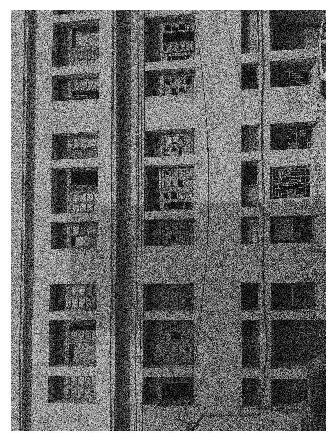
bewildered and then furious. After hours of resisting with the ‘management’ and trying to make them revert, having no choice, they things and clearing out. Coming out of the building one by one, they didn’t know how to feel. They had no words to exchange. There was nothing left. They had silence spread all over them, but their hearts were crying out. They embodied the very paradox that Matti ki Kaan captures. It is said that helplessness and frustration got the best of them, and they grabbed stones, bottles, sticks lying around them on the ground and started smashing them onto the windows of the building that employed them until now.
Knowing the rich as well as tragic history of the place, Shah reveals Variawa Building in its whole essence, making her viewers pause for the silence that it embodies and then wonder for the invisible noise it engenders.
About the Artist:
Born in 1948, Fatima Shah is a Karachi-based artist cum photographer whose interests lie in untold stories present in our everyday surroundings but are unexplored by the laymen. With a camera always in her hand, she is constantly searching for histories that never came to light, for values that once were part of our society, and for realities that did not affect many people but changed the entire lives of certain groups.
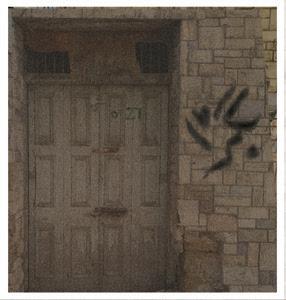
House No. 27
Artist: Quttoshi
Size: 12in x 12 in
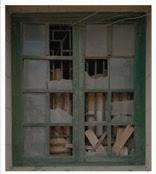
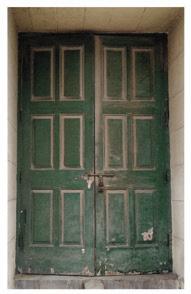
House no. 27 displays a rusty, old-fashioned, wooden locked door with the number ‘27’ marked over it and the Urdu word ‘bigra’ sprayed on the outer wall next to it.
of those shunned by society for not complying with their norms and standards. They are frowned upon for not living up to the others’ expectations and having their unique and creative recipes to life. As a result, they constantly hear words like bigra, behaya, beghairat ascribed to them.
such hurls reclaiming these words back and subtly replying to society. House no. 27 is an artwork of this series where he, in perfect Urdu script, spray paints these insults outside random, abandoned locked doors. The locked doors here have multi-layered meanings. They represent the bi-directional relationships between society and dissents. The former slam their doors at the latter, and they eventually soundlessly close their dissents to this dialogue. open access to his art. It allows them to come and engage with it, to ponder over the bizarre occurrence of these words on random walls, and
to question themselves who’s the bigra here? Who’s the behaya here? And who’s the beghairat here?
About the Arist: Karachi in 2017. Graduate of NCA, he has learned the skills of traditional and explore his style with experimental, performance, and shock art as well. Being a dissent himself, through his art, he wants to awaken the consciousness of people with regards to the atrocities occurring in our everyday lives, politicizing their thoughts and voices.
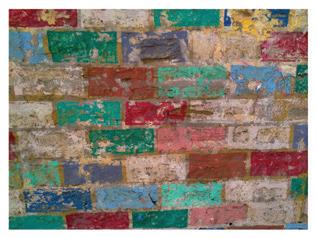
Rung Barse
Artist: Sadiqa Hasan
Material: Paint, Wall| Acrylic Painting
Size: 12ft x 7 ft
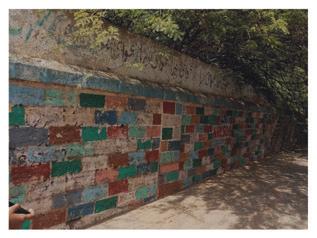
Sadiqa Hasan’s masterpiece, Rung Barse, is a vibrant artwork on one of the walls at I.I Chundrigarh Gallery. Located in the most diverse city of Pakistan, it mirrors the space it is inhabiting. Different colors symbolize the different genders, religions, ethnicities of people manifesting their lives here and learning to cohabitate with one another.
Commenting on the reality of Karachi, Rung Barse serves as an interesting and attractive sight at the economic hub of the city, reminding its viewers of the individual and the communal at once. Simple and yet subtle, Sadia’s works always tend to motivate her audience to do better and to be kinder. Similarly, Rung Barse asks us to not forget our roots, to sprout and befriend the other, to build stronger bridges, to appreciate the difference, and to celebrate the similarities.
About the Artist: Sadia Hassan is an established conceptual artist originally from Lahore. Have traveled to 6 countries and 15 cities, she does not believe in the physical boundaries imposed on ordinary people by nation-states. tries to capture the feelings, behaviors, and values of intrapersonal and interpersonal relationships.
Dabba-e-Sarmaya Daari
Artist: Z.H. Bhutto
Material: Wood and concrete mixed medium, iron, paint, posters | Installation
Size: 20in x 25 in
Dabba-e-Sarmaya Daari is an architectural plan constructed by the artist Bhutto of an ideal building for a capitalist organization which is a large institution with quintessential features such as division of labour, underpaid wages, long working hours and jarring hierarchy. It is based on the plans of the infamous ‘Radiant City’ by Le Corbusier.
Beneath its brutalist image, there is a commentary on capitalism where everyone is compelled to dream of becoming a disposable part of large machine which only takes and barely gives. This they call stability.
Capitalism produces homogeneity which may appear pleasing from far from outside, but zoomed in, its hundreds of cubicles inhabited by shells which pass of as human. There is no joy in the work they do, there is only ever the next paycheck. Referring to Heidegger and his philosophy on work. About the Artist:; Z.H. Bhutto graduated with a degree in Political Science in 1962. He later started his own art practice which is experimental in nature and explores the politics of Pakistan. His work as been displayed internationally. He was recognized by the Government of Pakistan in 1973. While he interested in pursuing political subjects for his art, he is also recognized by his works based on the culture of Sindh.
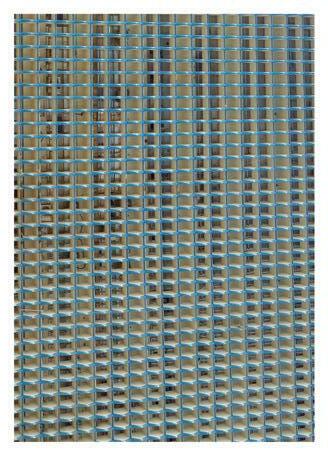
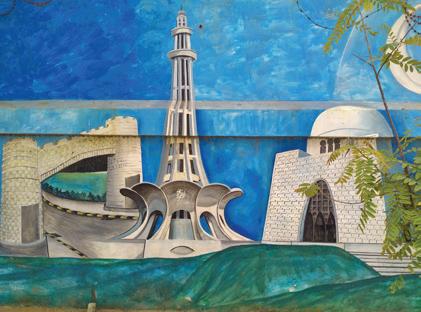
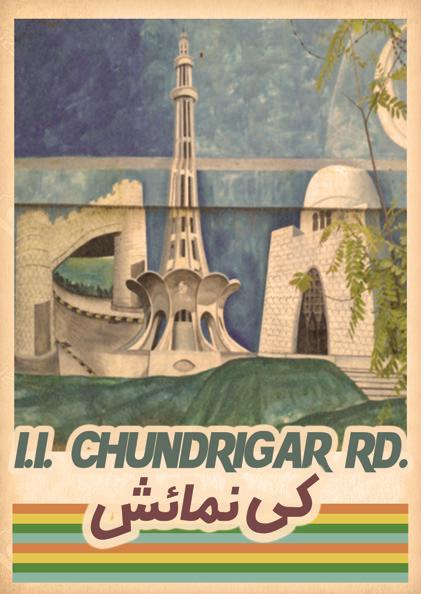
LIST OF ILLUSTRATIONS 1. Cover Image: Mural on I.I. Chundrighar Road tuned into a Vintage Poster. Mural shows famous monuments of Pakistan: 2. Picture 2: Building on I.I. Chundrighar Road. 3. Picture 3: Map demarking I.I. Chundrighar Road 4. Picture 4: KMC logo