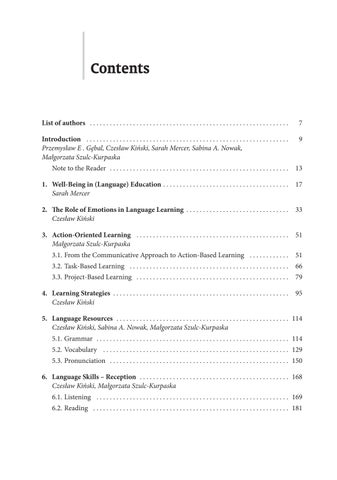
Przemysław E Gębal, Czesław Kiński, Sarah Mercer, Sabina A Nowak, Małgorzata Szulc-Kurpaska
1. Well-Being in (Language) Education
Sarah Mercer
2. The Role of Emotions in Language Learning
Czesław Kiński
3.
4. Learning Strategies
Czesław Kiński
5. Language Resources
Czesław Kiński, Sabina A Nowak, Małgorzata Szulc-Kurpaska
5.1. Grammar
5.2. Vocabulary
5.3. Pronunciation
6. Language Skills – Reception
Czesław Kiński, Małgorzata Szulc-Kurpaska
6.1. Listening
6.2. Reading
7. Language Skills – Production
Czesław Kiński, Sabina A . Nowak
7.1. Speaking
7.2 Writing
8. Language Skills – Interaction and Mediation
Małgorzata Szulc-Kurpaska, Sabina A . Nowak
8.1.
8.2.
9. Course Design and Lesson Planning
Czesław Kiński
10. Classroom Management
Sabina A Nowak
Sabina A . Nowak, Małgorzata Szulc-Kurpaska 12. Content and Language Integrated
Sabina A . Nowak
13. Creativity Training
Małgorzata Szulc-Kurpaska
Szulc-Kurpaska 15. Roles of Language Teachers
Czesław Kiński 16. Reflective Teaching Practice
Przemysław E Gębal, Czesław Kiński
Introduction
Przemysław E . Gębal, Czesław Kiński, Sarah Mercer, Sabina A. Nowak, Małgorzata Szulc-Kurpaska
− The teaching of English is perceived as one of the more important elements of modern education. The English language is a compulsory school subject and its learning begins as soon as in preschool. It usually precedes the teaching of another foreign language (or other foreign languages) for several years, thus forming the first and most important experience for the learners – it determines and influences the whole linguistic development path of young people. From the academic perspective, the teaching and learning of English is arguably the most developed area within foreign language education. In addition, its didactics is given the most attention in Central European countries.
Unfortunately, the reality outlined above does not translate into the publication of synthetic academic textbooks that present the whole range of aspects related to the teaching and learning of the English language, addressed to TEFL specialization students. Scholars who research this area only rarely decide to compile their findings with the view of encapsulating the current state of development of this academic field. Their attention is usually focused on devising studies of a more specialized character; discussing specific aspects connected with the process of learning and teaching the English language. To a significant extent, these studies form the substantive basis for the current education of future teachers and the professional development of those teachers and practitioners who are interested in their own further education. They are supplemented by the few Polish studies which treat the didactics and methodology of foreign language teaching in a comprehensive manner, as well as by foreign publications (mostly British), addressed to future teachers of the English language throughout the world. The European standardization of language education and vocational education of language teachers, present in these materials, supports such practices. However, it is necessary to bear in mind that in its practical and curriculum-related dimension they do not fully account for specific local educational conditions while assuming that the solutions developed and presented in those materials provide an attractive offer for all those who are preparing to become teachers of the English language in various regions of the modern, increasingly globalized world.
This is the context in which our publication makes an appearance. On the one hand, it aspires to position itself in the global stream of the discussion on learning and teaching the contemporary lingua franca, on the other hand, it attempts to fill the gap left by the lack of regional academic textbooks within this ever-more developing academic and didactic domain.
Teaching and Learning English. Education for Life is developed in the form of a multi-authored monograph covering the theoretical and methodological framework of the contemporary teaching and learning of English in an exolingual environment. The topics it contains embrace the present state of development of academic ideas, as well as recognized curriculum solutions and methodologies. It is our intention to offer a publication which forms a bridge connecting, on the one hand, a theoretical foundation based on current research and, on the other hand, specific didactic and methodological solutions which, following critical reflection from the reader, might contribute to their professional skills and techniques. Our academic textbook forms a part of the glottodidactic series published since 2018 by the Polish Scientific Publishers PWN, and to a significant extent it is in keeping with the series’ concepts.
Our monograph is designed for:
students (undergraduate and graduate) of English Studies wishing to qualify to teach the English language at all levels of language education, especially upper-primary, secondary and adult education;
students (undergraduate and graduate) of applied linguistics (with English Studies) who often aim at becoming teachers of two foreign languages;
post-graduate students, supplementing their earlier philological or linguistic education with teacher training modules;
students of other foreign languages who – as a part of their training as teachers – are interested in solutions adopted in the teaching of the contemporary lingua franca;
teachers and instructors of English who are interested in acquiring the current knowledge and improving their didactic skills to support and continue their professional development;
educators and teacher-trainers conducting such forms of professional development for teachers and instructors of English in which theoretical considerations are introduced;
academic teachers who educate future teachers of English and other languages.
As a textbook which is meant as a teacher training tool, Teaching and Learning English. Education for Life refers to the emancipatory-critical model of teacher training oriented at supporting the reflectivity of the students. It aspires to encourage students’ critical self-reflection concerning their own professional and academic development. With the help of the suitably designed activities which accompany the textbook’s reasoning in its expository character, we attempt to release students from the dogmatic thinking which forms a significant obstacle both to introducing novel solutions into the teaching process and from the informed planning of the professional development and career of future teachers.
In its conceptual dimension, the subject matter presented in our volume is related to the contemporary Common European Framework of Reference for Languages (CEFR 2011, CEFR-CV 2018) and the constructivist-oriented activity approach to the learning and teaching of foreign languages which it promotes. The theoretical, curriculum-related and methodological reflections contained in this book, as well as the activities which integrate them into the practice of teaching, draw directly on this approach.
In the context of teaching philosophy, we represent the trend of humanistic pedagogy and the pedagogical well-being developed within its framework and frequently referred to as ‘positive education’ (Mercer et al. 2018, Gębal 2018, MacIntyre et al., 2019; Mercer et al., 2019). This orientation, connected with positive psychology, assumes teachers and learners will shape relationships which will rely on their strong points, their belief in their own capabilities, and their readiness to undertake action and assume autonomous responsibility for their development and well-being. By the same token, the process of learning and teaching a language acquires a psycho-social orientation within which the linguistic abilities developed are supplemented by a whole set of other soft skills, which are useful in everyday life and communication with others while supporting lifelong, conscious, personal, social and cultural development (education for life). The teaching strategies which foster such an educational process turn it into a specific act of artistic creation due to its unique and singular character. The teachers who are prepared to discover and introduce this in their daily work are people who are aware of their professional competences and the value of their personalities.
The innovativeness of the monograph which we entrust to the readers is also manifested in its interactive character. This consists in the manner in which individual chapters refer Students and Instructors to the materials available on the Internet, in combination with the suggested tasks and questions regarding these materials. This format extends the scope of the monograph to include new possibilities offered by multimedia, giving voice to authorities in the theoretical issues discussed and to
teachers demonstrating and discussing the examples of good practice. It prompts an in-depth reflection on the relevant content as well as, we hope, encourages the Readers of our textbook to self-reflect on the creativity that language teaching and learning facilitates.
Our publication consists of 16 chapters in which we discuss the current theoretical orientations and contexts of English language teaching, demonstrate methods and techniques of work which enable the development of specific linguistic abilities, and present considerations which are aimed at supporting the vocational development of teachers.
This volume is the work of five specialists in the area of English language teaching and foreign languages didactics. In every chapter of the book, we have provided a note on its author. The authors represent various academic centres, both Polish and foreign. This fruitful cooperation symbolizes their wish to demonstrate unity in the diversity of their academic pursuits; diversity which results from different interests and research experiences. Much as the authors have endeavoured to maintain the unity of thought, it also has to be remembered that subtle variations of style and expression may be found.
The modern standards for language teacher education also encompass a broad range of diverse concepts, approaches, and educational practices worked out together, but at the same time respecting the autonomy of the individual institutions involved in such activities. They also form a collection of solutions and strategies which have interdisciplinary roots. This interdisciplinarity is also visible in our reflections, which go far beyond the traditionally understood didactics and methodology of English language teaching.
We are very much indebted to Professor Melanie Ellis, Professor Joanna Rokita-Jaśkow and Professor Michał B. Paradowski for the critical reading of our work and for preparing an insightful and favourable review. The constructive suggestions we received had a significant impact on the final form of the present volume.
We would also like to express our gratitude to all scholars active in the area of learning and teaching of the English language and other foreign languages. Without their achievements and commitment to the development of our field of research, this textbook would not have come into being.
All of us are grateful to our students who participated in the academic classes we conducted for TEFL courses. The concept of this textbook greatly benefited from our encounters and discussions.
Note to the Reader
As academics and practising teachers, we hold these truths to be fundamental to our profession: education needs to stem from a scientific foundation, allowing for a deep understanding of the learner and the learning process. Second, it ought to test scientific theories, notions and hypotheses in daily teaching practice, for without this step, it risks remaining detached from the world of the classroom. Finally, it should encourage reflection on various aspects of the learning process to establish good patterns, and subject unwanted results to critical revision and modification in the future.
The format used in every chapter of this book reflects this attitude. Our intention is to present a solid, research-based framework that will provide teachers with advice and guidance and allow members of the teaching community to re-examine and reflect on their teaching practice. Understanding the complexity of contexts in our profession, we wish to encourage the reader to experiment with the ideas presented in this book, contemplate the outcomes, and disseminate their experience among their fellow teachers. We hope that the format used in every chapter of the book will be conducive to fostering reflective teaching practice in pre- and in-service teacher professional development. The authors trust that the implementation of the model in this publication will help the reader on the path of teaching development and successfully prepare them for the demands of their profession.
The chapters are based on Kolb’s reflective model and begin by referring to the Reader’s experience, continue with an invitation to reflective observation and abstract conceptualization, and conclude with a call for active experimentation. Throughout the book, an icon navigation system has been used to guide the reader throughout the contents. The following key explains the meaning of each icon and outlines the structure of each chapter.
Lead-In
This short section provides a general introduction to the subject of the chapter by inviting the reader to preliminary, topic-related contemplation.
The aim of this section is to provide the Reader with a deeper reflection on the topic by activating their background knowledge, thus helping them gain a more specific sense of expectation regarding the content of the chapter.
Input
This section of the chapter focuses on delivering a summary of the theoretical considerations and research results related to the content of the chapter, thus establishing a solid academic foundation for subsequent considerations. The reader is encouraged to consult the references quoted to gain a deeper understanding of the issues discussed.
Know-How Activities
The aim of this section is to offer a database of practical activities that the reader may use in their teaching practice. The tasks presented in this part of the chapter range from those with a very specific focus to more general ones, which may be flexibly adapted to fit a particular learning context.
Reflection
In keeping with the role of the teacher as a reflective practitioner, this section aims at encouraging self-reflection, especially in terms of the theoretical and practical input presented and its relationship to the reader’s educational background, both as a learner and a teacher.
Experimentation
The purpose of this section is to provide ideas that will allow the reader to experiment with new ideas and challenge their own deeply held beliefs, as well as test those presented in the chapter. Understanding the complexity of teaching environments, we are humbly aware that the success and effectiveness of the solutions presented may depend on some variables.
Dissemination
This section aims at encouraging the reader to reach out and share their newly gained knowledge and experience with other teachers, both within their educational institutions as well as in wider teaching communities, such as Facebook groups.
Apart from this, Dissemination invites the reader to take advantage of their colleagues’ professional expertise by asking them to share their ideas on the topics discussed in the chapter.
Key Terms
This section provides the reader with the definitions of some of the terms and concepts used in the chapter.
Recommended Reading
The last section of every chapter provides a short selection of sources that may be used to supplement or expand the reader’s perspective on the subject. A full bibliography may be found at the end of the book. Much as we have endeavoured to refer both to sources with established reputations in the field as well as recently published materials, we realize that any reference list is subject to certain limitations. For this reason, we strongly recommend that the reader stay informed of the latest publications related to the teaching profession.