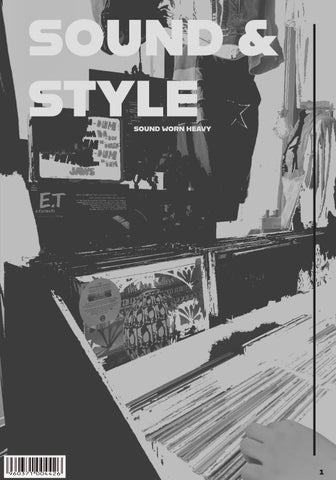
SOUND & STYLE

SOUND WORN HEAVY

GEMI ON IDENTITY AND THE POWER OF MUSIC
MUSIC INFLUENCES AND ENERGY
“I would describe my music taste as quite eclectic; I can go from listening to funk to heavy metal but a consistent favourite throughout my life has always been genres surrounding rock (grunge, emo, alternative). My favourite band is My Chemical Romance, their music holds so many memories for me.”
“I feel that music influences my personality as I get energy from listening to certain songs. It can affect how I express my emotions and give me an outlet to show others what I relate to. I think my music taste affects how others perceive me due to the genres I favour. People often group genres in with their stereotype and while I think these stereotypes are lessening, they are still present.”
THE CONNECTION AND COMMUNITY
Gemi’s connection to rock, emo and alternative music gave them more than just playlists, it gave them perspective. In a world where pop culture often feels surface-level they found their place in community with fellow rock lovers. Their story is proof that the music we love isn’t just what we hear, it’s how we see ourselves.
“I USED TO LISTEN TO MY CHEMICAL ROMANCE ON THE WAY TO PRIMARY SCHOOL AND WAS ALWAYS SEEN AS ‘WEIRD’ FOR IT BECAUSE I WASN’T LISTENING TO THE CHARTS LIKE OTHERS WERE”


THE MYTH OF THE MUSIC
FAN
Music has always been more than just something to listen to it’s something people live in and live for. From band tees to boots, the genres we love and associate ourselves with often shape how we dress, who we hang out with, and how others perceive us. However, for many, these genre-based identities come with outdated assumptions and gatekeeping.
While fashion and fandom have helped build rich and vibrant subcultures, they’ve also created harmful stereotypes, especially for fans of genres like emo, punk, and metal. Now, in an age of genre fluidity and digital connection, are these stereotypes still relevant?
THE IMPACT OF FIRST IMPRESSIONS
For Joe, whose teen years were spent immersed in the alternative scene, music taste wasn’t just a personal preference it was a public statement. A statement that often came at a cost. He remembers being shouted at on the street for wearing alt clothing and feeling isolated at school because of his music interests. “It definitely made me stand out in a way that wasn’t always comfortable,” he says.
The clothing he wore, and his signature emo fringe became an opportunity for others to make assumptions, both positive and negative. Although his style and taste have evolved, Joe notes that the influence of stereotypes still lingers. “People often assume
they know who I am just because of the music I listen to,” he says. Gemi agrees with this sentiment. As someone drawn to the aesthetics of the New Romantics and relates to goth rock themes, they also have experiences of how easily music taste can shape first impressions. “People sometimes assume I’m a certain way or that we won’t have anything in common just because I dress a bit differently or like certain bands,” they explain.
COMMUNITY
Stereotypes can be both limiting and unifying. Daniele sees them as a doubled-edged sword “Stereotypes can have negative connotations” she says, “but they can also be used to rebel against the mainstream and build a shared sense of identity” While subcultures build strong communities, Joe highlights the gatekeeping that can come with them such as backlash against new fans after Stranger Things boosted Metallica’s popularity. Gemi agrees that the intense loyalty can create rivalries, reminding us that all genres of music express similar emotions and themes, just in different forms.
Leila reflected on the class-based assumptions people sometimes make about music fans: “I think there is a preconcieved notion about how you’ve grown up, for example, classical music, people might assume you grew up with more money.
LETTING GO
With age, fans like Joe and Gemi have become more open to different music tastes. Joe no longer worries about judgment, embracing a broader taste. Gemi, once defensive about trends, let go of gatekeeping especially after working in the music industry and realising that all genres share similar roots. “Studying music showed me that, at its core, it’s all the same, it’s just presented differently” Gemi says.
THE ROLE OF SOCIAL MEDIA
Social media has also completely altered genre stereotypes by connecting fans on a global scale and broadening exposure. Daniele sees more diversity in once very closed off communities, while Gemi acknowledges it offers both tension and growth, helping break down barriers while being informative.
STEREOTYPES TO SELFEXPRESSION
Stereotypes around music genres may never fully disappear, but they’re certainly being reshaped. As listeners become open to more genres and communities the space for self-expression is growing. “People just want to be understood and appreciated for what they choose to do,” Gemi says. “No one wants to feel judged for being happy.”The point is, is that at the heart of every stereotype is someone who just wants to be heard.
DANIELE ON MUSIC MOODS
AND HER STYLE
FEELING EMOTION THROUGH MUSIC
Daniele’s connection to music runs deep. “I wouldn’t say that music has influenced my personality, but it has played a role in shaping my mood and emotions”, she says.
Especially with a love for ‘90s and ‘70s classic rock and indie anthems, she finds comfort in tunes that feel nostalgic. “When I started primarily listening to music from the ‘90s, I was immediately obsessed. I think it was the slight nostalgia because it was something I heard when I was younger.”
FINDING IDENTITY THROUGH MUSIC
Alongside her music taste, her style has also evolved over the years. Growing up on ‘80s post-punk particularly influenced her style choices. She found herself leaning towards dark colours, dramatic makeup and bold fashion choices however “As my taste has shifted, I’ve started wearing a lot of earthy tones and vintage pieces. It’s evolved to being more relaxed.”
She also states that artists such as Stevie Nicks and Hope Sandoval as icons, especially for their individual aesthetics and fashion choices.
IDENTITY AND COMMUNITY
For Daniele, music-based subcultures aren’t just about taste, they’re about community. “I think that any stereotype can have negative connotations, but especially within subcultures, it can be used to rebel against the mainstream and build community.”
For Daniele it is apparent that she sees music as mirror, reflecting how she feels.
SOCIAL MEDIA AND BREAKING STEREOTYPES
THE ROLE OF SOCIAL MEDIA
The internet has become a safe space for niche music communities, especially for those who may not have access to like-minded people in their area.
“Social media has certainly played a role in both intensifying and breaking down stereotypes,” Joe shared. “It has allowed people from smaller or niche subcultures to find like-minded individuals, particularly for those living in areas where their community is limited. However, with the rise of influencers and trends, social media has also amplified certain subcultures’ popularity, while sometimes spread misinformation and reinforced stereotypes.”
CONNECTING THROUGH SOCIAL MEDIA
For many, social media platforms like tiktok, reddit, instagram and tumblr are the first step into discovering a subculture. They offer both education and community to people outside of the scene.
These digital spaces have helped people express themselves without necessarily “looking the part” or live in a major city. The representation online shows that anyone can be part of a scene, no matter their background or location.
BREAKING DOWN STEREOTYPES
“I believe social media has been a positive force in breaking down stereotypes associated with music subcultures, like punk or metal,” Daniele said. “These communities have become more inclusive and diverse, challenging the old-fashioned ideas of what it means to belong to those groups. It’s interesting because music, once a form of protest, has now evolved to the point where not everyone who enjoys a genre feels the need to be political anymore, which is a big shift.” Leila shared her own exoerience “I guess I fit the stereotype so I don’t really mind it, I almost feel a bit flattered.”
It’s less about proving your authenticity and more about shared appreciation for a genre.
INTENSIFYING TENSIONS
However, not everyone has embraced these changes. Some diehard and older fans worry their genres are losing depth or being misrepresented.
“For some people, particularly those who feel protective over their genre, social media has definitely heightened tensions within music-based subcultures,” Gemi noted. “However, it has also made it easier to access these communities and has opened the door to more learning and understanding, which I wish had been available to me earlier.”
It’s clear more people are finding acceptance and understanding through shared music interests, something that once felt so distant.
JOE ON TEEN ANTHEMS AND ANGST
THE KICKSTART
From emo fringes to punk, Joe’s journey through music isn’t just about playlists, it’s about identity, community. We spoke to him about all thing’s subcultures, scene, community and how Green Day started it all.
“My music taste is super mixed I’ll listen to just about anything. That said, punk, rock, metal, and hip-hop are the ones that stick. I usually say Green Day is my favourite band because they were the first band that really pulled me into music. They started it all.”
TEEN ANGST
For a lot of people, being a teenager is part of our most formative years and it’s all about finding ourselves.
“During my teens, I pretty much lived inside alternative and rock music every subgenre you could imagine. Back then it wasn’t cool to be into that stuff, so I felt like a misfit. Which, let’s be honest, fit the whole teenage angst vibe. I also struggled with mental health, and music became an outlet. I remember hearing “Clear the Air” by Off With Their Heads and just… feeling understood. That song said things I didn’t know how to.”
STYLE INFLUENCE
“During my alt-only phase, I wore all black, band tees, skinny jeans, the whole look. The most
iconic part was probably my full emo fringe at sixteen. Now that my taste is more diverse, my style’s chilled out a bit. It’s more casual these days, but I still nod to those roots.”
“I got a lot of grief for being into alternative music, people used to shout stuff at me in the street just because of how I dressed. At school, it made me feel like an outsider. But it also helped me find people who got it. So yeah, it cut both ways.”
“I used to find it frustrating, seeing people wear band tees without knowing the band. But I
don’t really care anymore. People can wear what they want. I’ve mellowed out with age, I guess.”
THE NOW
Music still plays a huge role in my life. It helps me process emotions, understand myself, and connect with others. It’s been a lifeline during tough times and a way to stay politically engaged. Fashion’s been influenced too, but less so as I’ve gotten older.”
GATEKEEPING
While social media has helped open the door to more inclusive music spaces, one issue continues to hold some communities back. Gatekeeping remains a problem in many subcultures, especially in the more alternative ones. The constant pressure to “prove” your authenticity can make the welcoming spaces feel exclusive.
GATEKEEPING AND EXCLUSION IN THE ALTERNATIVE SCENE
“One issue I’ve noticed, especially within the alternative community, is the tendency to gatekeep,” Joe shared. “A notable example of this was the backlash when people criticized others
when people criticized others for listening to Metallica after it became popular through Stranger Things. The scene’s dominance by straight white males also doesn’t help the situation.”
This mentality creates a hierarchy, where only certain people are seen as “real fans,” based on how long they have been a part of the scene, reinforcing that exclusion.
Leila added, “It’s a difficult question because it shouldn’t be a case of people being excluded, however on the other hand, it helps like-minded people find each other
THE TOXIC RIVALRY IN MUSIC
Instead of celebrating diverse tastes and welcoming new fans, some areas of the music world have a competitive mentality.
“This type of mentality creates a toxic rivalry that goes against what music should be about,” Gemi explained. “People simply want to be understood and appreciated for their choices without facing judgment.”
PERSONAL GROWTH
The need to gatekeep can feel intense, especially for teens looking for a place to belong. “While this bothered me as a teenager, I realize now it was mostly just an outlet to be angry at the world,” Joe said. “Over time, with my tastes and style diversifying and personal growth, it no longer affects me.”
It seems that as people mature, they often realise that music is about connection than competition.
UNDERSTANDING COMMON GROUND THROUGH EXPERIENCES
“There was a time when I, too, was gatekeeper-like,” Gemi admitted. “But as I began working in the music industry and talking to people, I realized we had more in common than I had wanted to admit. Music is fundamentally the same, no matter the genre.”
In conclusion, music thrives when it’s shared, and when everyone feels welcomed.
LEILA ON MUSIC, FASHION AND SELF EXPRESSION
For Leila, music isn’t just noise, its part of who she is. “Artists like Mario, Beyonce, Drake and Munii Long are always on” she says. Working in an envormnent that plays R&B has only strengethened her conncetion to the genre further. “A lot of my friends love the same music, so it becomes part of our identity.”
FASHION INFLUENCED BY SOUND
Leila sees a clear connection between the music she listens to and how she dresses. “I often look to artists for makeup and outfit inspiration when I’m going out,” she shares. She especially connectes with ‘90s breakup anthems focoused on female empowement. “They remind me of my self-worth and have shaped how I view
relationships, she explains.
STYLE REVIVAL
She’s also noticed a resurgence of Y2K fashion, both in mainstream trends and through new artists. “I think the ‘90s and Y2K looks have really come back, and FLO is a great example of an artist embracing that.”
SELF-EXPRESSION AND STEREOTPES
Leila acknowledges that music taste of ten comes with assumptions., though she doesn’t mind the stereotypes tied to R&B. “I guess I fit the stereotype, so I almost feel a bit flatted,” she explains.
CONNECTION THROUGH SOUND
She also belives that social media had helped break down genre boundaries and connect fans worldwide. “It’s made it easier for people to discver new music and find others who feel the same,” she says. Still, she notes, “It can be harder to have a varied music taste, it’s like you need to ‘belong to one genre.”
ICONS AND INSPIRATION
The symbiotic relationship between music and fashion is undeniable. Across decades, music has not only provided iconic tunes to our lives but also acted as a mirror for our identities, something expressed through what we wear.
In a society where self-expression is important for many, music becomes something more than just a sound, it’s an aesthetic, community and a wardrobe.
THE BEAT BEHIND THE LOOK
“Music is an incredibly diverse and expressive medium and it plays a huge part in my life,” says Joe, who reflects on the impact that the alternative scene had on his style as a teenager. “It’s something that helped me through hard times, helped me understand myself and connect with others.” For Joe, fashion was once an extension of his love for alternative music, black clothes, band tees, and his iconic emo fringe at 16.
While his current style has softened into something he calls a more “casual and normal” look, he still acknowledges how was the catalyst for his exploration of his identity through clothing. “The influence is still there, but it’s lessened as I’ve gotten older.”
EVOLVING SOUNDS AND EVOLVING STYLES
For Daniele, her music and fashion tastes have evolved side by side. “When I was younger, I was mainly listening to 80s post punk and I wore darker colours,
dramatic eyeliner, there was a lot of gothic influence,” she shares. However, like many her style evolved with time. “As my taste has shifted, I’ve started wearing a lot of earthy tones and vintage pieces. It’s evolved to being more relaxed.”
For Daniele artists like Stevie Nicks and Hope Sandoval are more than just voices on a track, they’re style icons and her inspiration. “Naturally, I would try and imitate the style and look for pieces that the musicians I was listening to were wearing.”
Leila too, finds fashion inspiarion through music, especially when preparing for nights out. She often looks to artists for makeup and outfit ideas, reflecting how deeply perfoemance aestheticsn influence her personal style . As her taste in genres broardens, she sees herself blending more music-influenced pieces into her own style over time.
Gemi speaks about the evolution of their personal style via financial freedom and discovering new areas of the music world. “As I’ve had more freedom and money to spend on clothes, I’ve found that as my music taste has evolved into more goth rock, I have been drawn towards more gothic fashion.”
Their wardrobe now leans into the layering and the dramaticness of the New Romantics. “Artists such as Adam and the Ants, Siouxsie and the Banshees, and The Cure are key influences. When I began doing makeup, I was heavily inspired by Robert
Smith and Gerard Way, I pretty much copied their styles as much as I could.”
Gemi doesn’t separate music from fashion they view them as part of all the same ecosystem. “Music plays a massive role in how I dress. For casual wear, I pretty much exclusively wear band tees and baggy jeans. When I’m dressing up, it’s still based on gothic and emo fashion.”
A UNIVERSAL LANGUAGE
For Leila, music doesn’t just inform how she dresses, it also shapes how she feels. She credits many ‘90s breakup songs centred on womens empowerment with reminding her of her self-worth and shaping her outlook on relationships. It’s a beautoful example of how music-influenced fashion can be both emotional and expressive.
Music’s influence on fashion continues to reflect through cultures and communities. It’s clear that what we listen shapes our styles and identities, providing us with a guide for self-expression.
IN A WORLD OF EVERCHANGING TRENDS, MUSIC REMAINS A CONSTANT MUSE.
SOUND & STYLE