
President’s Message

Welcome to 2026!
A new year, with challenges, successes, surprises and, hopefully, feelings of accomplishment and pride.
I truly hope everyone had a wonderful festive season and enjoyed spending time with family and friends. Please accept our best wishes for good health, happiness and the achievement of your goals in 2026.
Of course, 2026 is a very significant year for IHM – our 50th Anniversary. I can assure you we are all very excited and proud of what has been accomplished since our inception. What an incredible experience of developing educational materials for those in the housing profession. We have expanded the delivery methods for all our courses to provide alternatives for our students. We expanded into a new Accreditation Program for all our friends in the co-op housing sector, and are now developing our own elective courses to provide the complete requirements for those seeking accreditation. We are becoming the one-stop education resource for many in the housing sector.
Our expansion has included other groups, such as Peel Region and the Casa Group in Alberta, and we have instructed our core courses to both groups. There are opportunities for IHM to deliver programs for other regions and organizations. It is a fascinating time for IHM.
We are putting the final touches on the Annual Educational Conference in Oshawa – (June 1stgolf), June 2nd and 3rd, educational conference. As I have said, there will be lots of surprises and fun times at both the golf tournament and the conference. We have lined up some fantastic speakers and great topics this year, and we hope attendance to be a record-breaker. There are options to attend the full conference or for one day. If you have special requests or a group attending, please get in touch with the office and let’s see what we can do to accommodate you.
At our Annual General Meeting, we recognize newly accredited members, we honour those who have been members for several years and we express our thanks to the many directors, instructors and volunteers who make IHM’s success possible.
I want to take this opportunity to express our sincere thanks to two retiring board members. Philip Eram, FIHM, and Kevin McCann, FIHM, will not be standing for election this year and have decided to retire from the Board of Directors. Our sincere thanks to both of these long-term members of IHM and the Board of Directors. Their contributions, dedication and commitment to IHM will be remembered, and we are so grateful to both of them.
Are we excited about 2026 – simply stated – YES WE ARE. We look forward to celebrating IHM’s 50th Anniversary with our members.
Jimmy Mellor, FIHM IHM President

Future Property Management Job Prospects in Uncertain Times
By: Kevin McCann, FIHM
During the past year, a great deal of economic uncertainty has arisen in Canada due to the introduction of a wide range of tariffs, extreme weather events, high cost of housing in most larger municipalities, rapidly rising costs of food and construction materials and a downturn in real estate sales among other things. This leaves many Canadians very concerned about current and future employment opportunities.
Fortunately, there are a number of unique factors involving the field of property management that actually suggest that there may be some significant growth in job opportunities over the coming decade.
One of the key factors is the recognition by all levels of government that the development of purpose-built rental housing stock in Ontario and other parts of Canada has not kept up with population growth over the past twenty-five years, leaving a huge deficit of rental units. In addition, private investors who purchased and rented condominiums or houses are finding the increasing interest rates and lengthy delays at the Landord Tenant Board a signifi-
cant deterrent, with many ending up selling their properties and investing elsewhere.
In response to these serious issues, a host of incentive programs have recently been introduced by all levels of government to promote the development of new rental housing over the next decade. These incentives include tax rebates (GST/HST), deferral of development charges,
property tax reductions, low-cost loans, expedited approval processes, use of government owned land, etc. Current projections suggest that as many as 174,000 new purpose-built rental housing units will be constructed across Canada in the coming decade with 69,000 being in the Province of Ontario. The last two years (2024/25) alone have seen a significant increase in the number of purpose-built rental housing
...a host of incentive programs have recently been introduced by all levels of government to promote the development of new rental housing over the next decade.

units constructed. While these estimates can be impacted by many factors that are yet unknown, the overall forecast is for rapid growth in the rental housing sector.
In addition to the new construction estimates, the Government of Canada Job Bank Projections suggest that new job openings in the PM field are expected to average about 2,610 per year over the next decade. This figure considers both retirements and industry growth. Statistics reports that 49% of workers in the property management field are 50 years of age and over with a median retirement age of 65. Approximately 70% of the job openings will be due to retirement while 30% will be related
Overall, the property management industry is in a fortunate position with respect to employment opportunities in the long term and the IHM will continue to prepare their members for the challenges ahead.
Kevin McCann has over 40 years of experience in the social housing field having held several management positions in the areas of property management, housing administration, housing development and technical services within the public and private sectors. He is a Certified Engineering Technologist as well as a long term member and supporter of the Institute of Housing Management. u
UPCOMING IHM COURSES

MORNINGS: Thursdays - February 5 to March 12, 2026
9:00 am to 12:00 pm - Zoom Session
Asynchronous Learning between sessions
EVENINGS: Tuesdays - February 3 to March 10, 2026
6:15 pm - 9:00 pm - Zoom Session
Asynchronous Learning between sessions
Are You a Supervisor or a Manager? How to Be the Best at Both!
Marcia O’Connor, AM FM Consulting Group Inc.
In property management, the line between supervising and managing is rarely clear. Most days, we’re doing both—sometimes within the same conversation. We oversee work, guide people, make decisions, resolve issues, and keep operations moving under tight timelines and emotional pressure. The challenge isn’t choosing between being a supervisor or a manager. It’s learning how to integrate both roles with intention, without losing sight of the people and the purpose behind the work.
Supervision is where we stay closest to the day to day realities of our teams and the communities we serve. It’s the space where expectations are clarified, issues are addressed in real time, and support is offered when things don’t go as planned. Effective supervision requires presence. It means noticing when someone is overwhelmed, stepping in during conflict, and ensuring work is done safely, fairly, and consistently. In people centred environments, supervision extends far beyond tasks—it involves navigating emotions, responding to crisis, and setting the tone for how people are treated.
Management, on the other hand, asks us to step back and look ahead. It’s about planning, prioritizing, allocating resources, and making decisions that support long term outcomes. It requires balancing budgets, policies, risk, and account-
ing but rarely planning. Those who lean too heavily into management may unintentionally lose touch with the realities on the ground. The most effective leaders I’ve worked with and had the privilege to develop, understand that strong leadership

ability while keeping service delivery stable. Across residential, public, and non profit settings, these decisions carry real weight. They shape not only asset performance and compliance, but the lived experience of residents and the well being of staff.
Challenges arise when one role overshadows the other. Leaders who focus only on supervision may become reactive—constantly respond-
lives in the space between the two.
Being effective at both requires intention. It means setting clear expectations while remaining approachable. It means holding people accountable while also recognizing effort and growth. It means making difficult decisions with transparency and explaining the “why,” especially when those decisions affect people’s homes, workplaces, or livelihoods.
When expectations are clear and leadership is fair, teams become more resilient, engaged, and confident.
Trust is built not by avoiding hard conversations, but by handling them with consistency, honesty, and respect.
In our profession, we often meet people at moments of stress—emergencies, disputes, financial strain, or uncertainty. Our teams absorb much of that pressure. As leaders, how we show up matters. When staff feel supported and understood, they are better equipped to provide calm, professional service. When expectations are clear and leadership is fair, teams become more resilient, engaged, and confident.
Over the years, I’ve come to be-
lieve that the strongest leaders are those who can move fluidly between roles—coaching when guidance is needed, directing when clarity is required, and stepping back when trust has been earned. This balance isn’t always easy, especially in environments with limited resources and high demand. But it is essential. Supervision and management are not competing responsibilities. They are complementary disciplines that, when aligned, create stability, accountability, and care. When we lead with clarity, empathy, and purpose, we strengthen not only the systems we oversee, but the people and communities who rely on them every day.
The future of our profession depends on leaders who can navigate complexity with both compassion and discipline. IHM members are uniquely positioned to model this balance. I encourage you to continue investing in your leadership practice—not only for your own growth, but for the resilience of our sector and the well being of the communities we serve. When we strengthen our ability to lead with clarity, empathy, and purpose, we elevate the standard of care across the entire housing and property management landscape.
Marcia O’Connor is an inspirational Leader, Educator, and Mentor at AM FM Consulting Group Inc.
E: marcia.oconnor@amfmconsulting.com
Text/Mobile: 416-433-3565
Linked In: https://www.linkedin.com/in/ marciakoconno u
UPCOMING IHM EVENT

Build Confidence and Speak with Impact
February 18, 2026
12:00 pm - 1:00 pm - Zoom Session
Speaker: Barb Day, Speak Technique
Certified World Class Public Speaking Coach
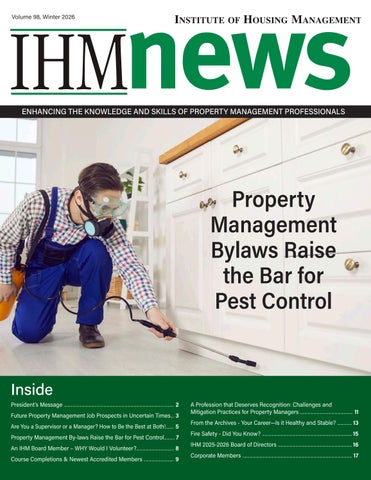
Property Management By-laws Raise the Bar for Pest Control
Why That’s Good News for Both Residents and Landlords
By: Simon Leith, HomePro Pest Control
Across Ontario, municipalities are introducing property management by-laws that are reshaping how pest control is managed in multi-unit residential buildings. Toronto set the precedent with RentSafeTO. Mississauga and Ottawa followed suit a few years later. Now, Hamilton has joined the fray with the enactment of the Safe Apartment Buildings By-law on January 1, 2026.
While the specifics vary by municipality, these by-laws share a common objective: higher standards for pest control in the apartment industry.
Municipalities are no longer satisfied with a reactive approach where action is taken only after a tenant complaint. These by-laws align pest control with other essential building systems such as fire safety, elevators, and HVAC - areas where proactive oversight has long been the norm.
At first glance, these by-laws may appear to introduce additional obligations for apartment owners and property managers. In reality, they reinforce best practices that protect both residents and the bottom line.
A proactive pest management program identifies pest issues early, when they are easier and less costly to resolve. Early intervention limits treatments to source units, reduces the risk of spread to neighbouring units, and minimizes disruption for residents. Over time, this approach lowers overall pest control costs and
control has evolved from a routine maintenance task to a critical component of a successful property management strategy.
More municipalities are expected to adopt similar by-laws in the coming years. Apartment owners who adopt a proactive pest control approach

avoids the compounding expenses that come with widespread infestations.
Equally important, pest-free buildings experience fewer tenant complaints, lower turnover, and stronger resident satisfaction. In an increasingly regulated environment, pest
will be better positioned to reduce enforcement risk, improve their residents’ experience, and protect the long-term value of their assets.
Simon Leith is the President of Homepro Pest Control, which specializes in servicing multi-unit residential buildings across Ontario. u

An IHM Board Member –WHY Would I Volunteer?
By: Jimmy Mellor, FIHM IHM President
An excellent question to ask oneself. Let’s see if I can give you some reasons why you should consider being part of the IHM Board of Directors:
Networking:
This is an excellent opportunity to connect with housing industry professionals, build valuable relationships, access resources, receive support, expand your career prospects, and help advance IHM’s education programs.
Accomplishment:
Serving on the Board and contributing to our programs, events, and training initiatives brings a strong sense of pride, knowing you supported an organization that delivers educational value to those in the housing industry.
Experience: Board service is a valuable addition to your resume, demonstrating your commitment to supporting others in the property management sector.
Knowledge: You will have the chance to learn from other professionals by sharing experiences, new ideas, and build-
ing sector best practices. You will learn how others have met various challenges head-on in their communities.
Personally, serving on the IHM Board has enabled me to connect with a wide range of industry professionals, including property managers, contractors, and experts in law, engineering, and regional administration. I have learned from knowledgeable colleagues, participated in our Annual Educational Conference, and expanded my network. As an IHM Board-approved, accredited member, I have also had the opportunity to teach and share knowledge with those entering the industry or pursuing accreditation.
educational materials for our industry. We have consistently updated our core courses and created a new program for the cooperative sector

to achieve accreditation. You can take pride in being part of IHM’s growth and accomplishments.
The Board also offers valuable social opportunities through meetings, conferences, and our annual Golf Tournament, helping you expand your professional network.
If I had to choose one reason, it would be the pride of contributing to a team that develops high-quality
I hope these points encourage you to volunteer for the Board of Directors and join our dedicated team committed to education and opportunities for our members.
You will soon receive a Call for Nominations to serve on the IHM Board. I encourage you to consider this opportunity and join the dedicated volunteers who advance IHM’s success. u
Course Completions in Property Management
Administration
Tamara Coombs
u u u
Human Relations
Susan Drakes
Alicja Gzowska
Vasilina Mir Mostafa
Sarah Piercey
Yasmina Polovina
Paul Tavi
Eugene Tolentino
u u u
Maintenance
Surabhi Patel
u u u
Tenancy Law
Lisa Bowden
Shanise Collins
Susan Drake
Chelsea LaJoie
Tracy Legros
Daniela Luiceanu
Vasalina Mir Mostaf
Karin Musgrove
Karla Orozco
Sarah Piercey
Yasmina Potovina
Paul Tavi
Megan Thompson
Eugene Tolentino
u u u
Finance
Rachel Dagenaus
Lucas Divittorio
Bogdan Holovach
Leanne James
Anthony Mammoliti
Kim Myhre
Kate Nwojo
Brock Powell
Lisa Roy
Taylor Van Oorschot
Virginie Viau
Kristen Wilson
u u u
Accredited Members
Akintunde (Teekay) Akinyemi, AIHM
Petr Bakus, AIHM
Dick Tse, AIHM
Fernando Garcia, AIHM


We know that a Property Manager’s job can be both challenging and interesting. How often have you come to work with your day all planned in your head only to have something unexpected come along?
We are looking for some stories to share with your colleagues in the Property Management field. If you have an interesting story that you would be willing to author, please contact the Newsletter Committee at info@ihmcanada.net

IHM’s 50th Annual Educational Conference
Celebrating 50 Years!
Join us for two action-packed days at the premier event for housing and property management professionals in Ontario. The IHM Conference brings together over 100 industry leaders and practitioners to share their expertise, discuss emerging trends, and tackle the challenges facing the housing industry today.
Our engaging and informative program is designed to inspire and empower attendees, offering a dynamic keynote session, interactive and thought-provoking panel discussions. Whether you are looking to gain fresh insights, advance your career, or explore cutting-edge solutions, this conference is your gateway to growth and success.
Beyond the sessions, attendees will have the opportunity to build meaningful connections through unparalleled networking opportunities. Share ideas, collaborate with peers, and connect with leaders from across the housing and property management landscape.
Together, we will explore strategies, share success stories, and set the stage for advancements that will elevate the industry and improve communities across Canada.
Don’t miss this opportunity to be part of the conversation that drives the future of housing management. We look forward to welcoming you to the IHM Conference 2026!

By: Carola Mittag
A Profession that Deserves Recognition: Challenges and
Mitigation Practices for Property Managers
Property managers play a vital yet often underappreciated role in maintaining housing stability and community well-being. Acting as the bridge between property owners and residents, they ensure that housing remains safe, functional, and compliant with regulations. However, the profession comes with significant challenges, many of which involve personal risk, emotional strain, and operational complexity.
Key Challenges Faced by Property Managers
1. One of the most prominent challenges property managers face is personal safety. Their responsibilities frequently require them to interact with residents during high-stress situations such as evictions, lease violations, rent disputes, or emergency maintenance calls. These interactions can escalate quickly, exposing managers to verbal abuse, threats, or even physical harm. Late-night property visits, emergency repairs, or responding to alarms further increase vulnerability, especially in high-crime or poorly lit areas.
To address personal safety risks, property management organizations should prioritize clear safety protocols. These include conducting site visits during daylight hours when possible, implementing buddy systems for high-risk interactions, and using technology such as security cameras, access control systems, and panic buttons. Training in conflict de-escalation and situational awareness equips managers with skills to defuse tense encounters before they escalate.
2. Another major challenge is emotional and mental strain. Property managers often serve as the frontline recipients of tenant frustrations, financial distress, and personal crises. Balancing empathy with enforcement of rules can lead to emotional exhaustion and burnout. Over time, constant conflict management and pressure to satisfy both owners and tenants can negatively impact mental health.
Mitigating emotional and mental strain requires both organizational support and individual
strategies. Employers can promote reasonable workloads, provide access to mental health resources, and encourage regular time off to prevent burnout. Peer support groups and professional counseling can also help property managers process stress and build resilience. On an individual level, setting boundaries, practicing self-care, and developing effective communication skills are critical.
3. Property managers also face operational and legal complexities. They must stay current with changing housing laws, fair housing regulations, safety codes, and local laws. A single mistake such as improper notice or inconsistent enforcement can result in legal disputes, fines, or reputational damage. Additionally, managing multiple properties, vendors, and stakeholders simultaneously increases the risk of errors and oversight.
To manage legal and operational risks, ongoing education is essential. Regular training on housing laws, documentation standards, and ethical practices helps reduce

Property managers are essential guardians of housing stability, yet their work often occurs behind the scenes and under challenging conditions.
liability and builds confidence. Utilizing property management software can streamline record-keeping, maintenance tracking, and communication; thereby, reducing
errors and improving efficiency. Clear policies, standardized procedures, and consistent enforcement further protect both managers and property owners.
Property managers are essential guardians of housing stability, yet their work often occurs behind the scenes and under challenging conditions. From ensuring personal safety to navigating emotional and legal complexities, the demands of the profession are substantial. By recognizing these challenges and implementing best mitigation practices such as safety protocols, mental health support, and continuous professional development, the industry can better protect property managers and enhance the quality of housing management. Ultimately, acknowledging and supporting this profession is not just a matter of recognition, but a necessary investment in safe, stable, and well-managed communities.
Carola Mittag is a Consultant to Langlois Safety Training & Consulting Services. She has been providing health and safety insights for IHM since 2013. u


IHM - 50 th year Celebration in 2026
In celebration of this journey, we will be featuring a few past newsletter articles. Here’s a look at an article, reprinted from the August 1995 issue – but still relevant today.
Your Career—Is it Healthy and Stable? Microscoping Your Career and Improving Weaknesses
By: Stephen M. Ryan
We need to focus on our careers as much as we do our own health in order to ensure that they both flourish. Neglect either one and we are setting ourselves up for failure.
Take a hard look at the weaknesses with your career. Take care not to attribute these weaknesses to stress, heavy workloads, midlife crisis or burnout. In many cases, these symptoms are self-inflicted and have a negative impact on your performance, thus your ability to advance in your career.
Take into account your psychological status and any organizational changes and consider the following.
A shift in personal values.
Early in our careers there is an urgency to prove ourselves to others. Challenging yourself to take on satisfying and inspiring work can take second place as we get older. This means performing beyond the limits of your present job to take on more significant projects, even if it means that you transfer departments, change companies, or switch
Challenging yourself to take on satisfying and inspiring work can take second place as we get older.

careers. The point is to assess your feelings, drive ambitions and accomplishments.
Career goals that are beyond your reach.
With downsizing common in the workplace today, senior positions are few and far between. Even the hardest working managers find these positions unattainable. Adjust your expectations and accept the fact that you are not going to reach the front office, or move to an organization with greater opportunities. Start your own company or look at
the opportunity for gaining more power in your present position.
Your current position has become a trap.
You’ve been in your position so long that you have become passive in your performance. You do not feel that you will ever be promoted, you are not challenged and thus are setting up a psychological barrier to your own career progress. If this is the case, identify what it is you would most like to do, and start taking small steps to get you there. Take educational courses, talk to
your peers and your supervisor about projects that would help you reach your objectives.
Your organization is downsizing. Read for what is not being written and listen for what is not being said. Keep in touch with what the organization is planning, and where you fit into the plan. Ensure that you and your position add value to the organization and lobby hard to management as to the value you can add to the newly configured company.
Managing change.
The following comment appeared in the Atlantic Journal in 1837. “The world is too big for us. Try as you will, you get behind the race in spite of yourself. Science empties its discoveries on you so fast you stagger
beneath them ... the political world witnesses new scenes so rapidly you are out of breath trying to keep up ... every thing is high pressure ...” Be aware of the changing environment, stay current with technology, stay plugged into the grapevine and initiate change yourself that will help you adapt to organizational changes.
Promotions are moving you up the wrong career ladder.
As flattering as promotions can be, they can create a negative impact on your career if they are taking you in a direction you do not wish to go. Fatter pay cheques and increased job status will not leave you fulfilled. Let senior management know gracefully that you appreciate their confidence, but feel that your talents would benefit the company more if
you were put on a different career track.
Office politics wear you down. Don’t let the politics in the office wear you down. It’s a game we must play to survive and advance. Take care to protect your professional integrity, doing the right things, the right way. Stay plugged into what is going on around you and protect the integrity of the organization first and foremost.
You are the only person responsible for your career. Put that responsibility into someone else’s hands and you will not get to where you want to go. u


Fire Safety
Did You Know?
Under the Ontario Fire Code, the primary directive for tenants upon discovering a fire is to evacuate the building immediately and activate the fire alarm. Using a fire extinguisher is a voluntary measure, not a required action for tenants.
Fire safety plans required by the Ontario Fire Code are designed to ensure occupant safety through orderly evacuation.
Key steps for tenants in case of a fire include:
• Leave the fire area immediately, closing all doors behind you to help contain the fire and smoke.
• Activate the nearest fire alarm pull station.
• Use exit stairwells to leave the building. Never use elevators during a fire.
• Call emergency services from a safe location outside the building (do not assume it has already been done).
• Do not return to the building until fire officials declare it safe to do so.
Using a fire extinguisher should be considered only under very specific, safe conditions and is neither an expectation nor a legal requirement for an untrained tenant.
• It is voluntary: The use of a portable fire extinguisher is strictly voluntary.
• Only if trained and safe: Only persons who are trained and familiar with an extinguisher’s operation may attempt to fight a small fire.
• Never block your exit: You should only attempt to extinguish a fire if it is small, the fire alarm has been sounded, and, most importantly, the fire is NOT between you and your only exit route.
• L imited capacity: Most portable fire extinguishers only last for 10 to 20 seconds of continuous use.
Fire officials emphasize that the production of toxic smoke and fumes in modern building fires makes any firefighting attempt extremely dangerous for untrained, unequipped individuals. The primary goal is to ensure all occupants escape safely.
IHM - 50 th year Celebration in 2026
In celebration of IHM 50th Anniversary, we will be presenting some highlights of our accomplishments over the past years.


IHM introduced its monthly Chat Room Sessions in 2020 when Covid prevented us from meeting in person. Since then, we have been bringing experts together to present on topics such as legal issues/requirements, maintenance and tenant challenges, new regulations and an array of other topics that are of vital interest and importance to our members. With over 55 successful Chat Room Sessions offered since 2020, members have had an opportunity to learn, engage and share. We record all sessions and keep them on the IHM website in the members only section. We are excited to offer a link to these recordings for our members as an important resource for future reference. Enjoy – we look forward to presenting many more Chat Room Sessions in the years to come.
2026
n Ontario Fire Code 2026: What Property and Facility Managers Need to Know - January 21, 2026
2025
n Managing Difficult Tenant Conversations: A Key Skill for Property Managers - October 15, 2025
n Staying Ahead of the Curve: Mastering Capital Planning for Long-Term Success - June 18, 2025
n Bill c45 - April 16, 2025
n Safety & Security in Residential Communities: A Collaborative Approach - March 19, 2025
n Finance 101 - February 19, 2025
n Do’s & Don’ts of Unit Inspections - January 15, 2025
2024
n Let’s Talk - December 11, 2024
n Preventing and Managing Crises: Insurance & Risk Management Supports - November 20, 2024
n Harnessing AI for Transformation in the Non-Profit SectorOctober 16, 2024
n Emergency Preparedness/ Business Continuity - September 18, 2024
n Legal Matters - Landlord & Tenant Board Human Rights –Mitigating While Waiting for a Hearing - June 19, 2024
n Let’s Talk Personalities and Behaviour - April 17, 2024
n Mental Health - March 20, 2024
n Reducing Building Maintenance Costs - February 21, 2024
n Crime Prevention Through Environmental Design - January 17, 2024
2023
n Let’s Talk - December 13, 2023
n Best Practices in Rooftop Safety & Compliance - November 15, 2023
n Efficient Building Systems/Grant Availability - October 18, 2023
n Radon Gas - September 20, 2023
n Be Aware…Take Care - June 21, 2023
n Managing Life Events - April 19, 2023
n Effective Renovation Management Strategies - March 15, 2023
n Mould Assessment & Abatement - February 15, 2023
n Mold Awareness - January 18, 2023
2022
n Let’s Talk - December 14, 2022
n Stress Management - November 9, 2022
n Duty To Accommodate - October 19, 2022
n Tenant Engagement in Environmental Issues - September 14, 2022
n Creating a Safe, Inviting and Economical Laundry FacilityAugust 17, 2022
n Electric Vehicles Are Here – How Can Property Managers Accommodate - July 13, 2022
n Privacy Matters in Housing Management - June 15, 2022
n Dispute Resolution - May 18, 2022
n Electrical-Life Safety-Mechanical - March 16, 2022
n Deep Energy Retrofit - February 16, 2022
n Pest Infestations – From Bad to Worse - January 19, 2022
n The Practical Side of Risk Management - December 7, 2021
n Gaps in Workplace Health and Safety: Identifying Effective Solutions - November 30, 2021
n Asset Management Strategy - November 16, 2021
n Project Management Approach For Capital Projects - October 26, 2021
n Enhanced Building Revenues - October 13, 2021
n Looking After Our Seniors - September 28, 2021
n COVID Recovery (re-opening strategies, filter changes, operating equipment, managing employees) - September 14, 2021
n Fireside Chat - July 13, 2021
n Contract Administration (negotiation, managing contractors, long-term contracts, contractor vs employee) - June 29, 2021
n Asset Management & Portfolio Regeneration - June 15, 2021
n Hoarding Disorder - May 11, 2021
n Mental Health Matters - April 22, 2021
n Crime Prevention Through Environment Design - April 13, 2021
n L awyers, Landlords, & Money – Pandemic Legal Outcomes
Property Managers Need To Know! - March 24, 2021
n Zero - 12 hours After Fire Disaster - March 16, 2021
n Let’s Talk Maintenance! - February 18, 2021
n Key Tactics Pros Use for Fire Safety Preparation - February 4, 2021
n Lockdown Lowdown - January 21, 2021
2020
n Open Mic - December 17, 2020
n Day-To-Day Challenges – The COVID Complication - November 26, 2020
n Day-to-Day Challenges - October 29, 2020
CLICK to access all the recordings

2025-2026 IHM Board of Directors
EXECUTIVE
President
CHMA Committee, Conference Committee
Jimmy Mellor, FIHM
Property Management Consultant
Tel: 902-943-9919
Vice President
Ed Cipriani, FIHM, MAATO, Dipl.T., COQ, CET
Mohawk College
Tel: 905-719-0674
Secretary-Treasurer
Conference Committee
Lynn Alexander, FIHM
Region of Durham Housing Service
Tel: 905-666-6239 Ext 2450
DIRECTORS
Communications Committee
Kevin McCann, FIHM
K.J. McCann and Associates
Tel: 647-323-4921
Communications Committee, Conference Committee
Deborah Filice, MEd, FIHM, CIHCM, CMMIII, RSSW
IHM Education Director
DAF Property Management Services
Tel: 289-244-8269
Communications Committee Chair
Francesca Filice, B.A., FIHM
Victoria Park Community Homes
Tel: 905-527-0221
Conference Committee Co-Chair
Tracy Geddes, AIHM
Niagara Region, Housing Services Division
Tel: 905-980-6000
Conference Committee Co-Chair
Stacey Sanelli, AIHM
Precision Property Management Inc.
Tel: 416-887-1251
Office: Carolyne Vigon, Executive Director Beth McKenzie, Program Manager 2800 14th Avenue, Suite 210, Markham, Ontario L3R 0E4 Tel: 416-493-7382 / 1-866-212-4377 • Fax: 416-491-1670 • Email: info@ihmcanada.net
n Participate on the various committees
n Help with the Annual Educational Conference
n Submit relevant articles for the IHM quarterly newsletter
n Mentor a Candidate member (FIHM/AIHM Members only)
n Become an Instructor (FIHM/ AIHM Members only)

the IHM office for more information on how you can help.
IHM
Thank You to Our Corporate Members


