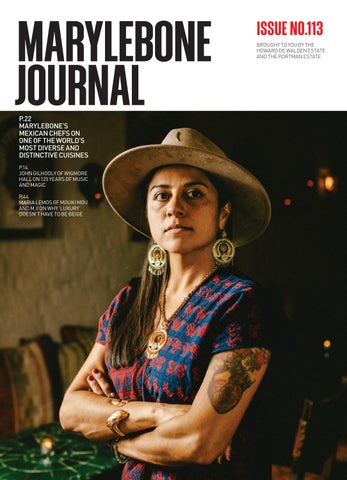
MEXICAN CHEFS ON ONE OF THE WORLD’S MOST DIVERSE AND DISTINCTIVE CUISINES
P.14
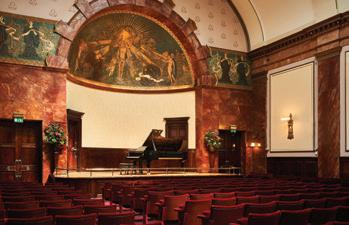
JOHN GILHOOLY OF WIGMORE HALL ON 125 YEARS OF MUSIC AND MAGIC
P.44
MARIA LEMOS OF MOUKI MOU AND M.II ON WHY ‘LUXURY’ DOESN’T HAVE TO BE BEIGE
BROUGHT TO YOU BY THE HOWARD DE WALDEN ESTATE AND THE PORTMAN ESTATE
Marylebone Journal marylebonejournal.com
Marylebone Village marylebonevillage.com
Instagram: @marylebonevillage
Twitter: @MaryleboneVllge
Portman Marylebone portmanmarylebone.com
Instagram: @portmanmarylebone
Publisher LSC Publishing lscpublishing.com
Editor Mark Riddaway mark@lscpublishing.com
Advertising sales
Donna Earrey 020 7401 2772 donna@lscpublishing.com
Contributors
Jean-Paul Aubin-Parvu
Lauren Bravo
Ellie Costigan
Clare Finney
Orlando Gili
Viel Richardson
Design and art direction Em-Project Limited mike@em-project.com
Owned and supported by The Howard de Walden Estate 23 Queen Anne Street, W1G 9DL 020 7580 3163 hdwe.co.uk
annette.shiel@hdwe.co.uk
The Portman Estate 4th Floor, One Great Cumberland Place, W1H 7AL 020 7563 1400 portmanestate.co.uk rebecca.eckles@portmanestate.co.uk
MARYLEBONE JOURNAL ISSUE NO.113
BROUGHT TO YOU BY THE HOWARD DE WALDEN ESTATE AND THE PORTMAN ESTATE
Published February 2026
3
HAPPENINGS IN MARYLEBONE
Events, exhibitions, film, music, shopping, talks, theatre and walks
8 Q&A: JAMES BRETT
The founder of The Gallery of Everything on storytelling, inclusiveness, and championing unusual work by u nusual people
14 IN PROFILE: JOHN GILHOOLY
The director of Wigmore Hall on the venue’s 125th anniversary, the joys of self-sufficiency, and the upbeat impact of the Covid years 22
MANY MEXICOS
Marylebone’s stellar Mexican chefs on the kaleidoscopic nature of one of the world’s most diverse and distinctive cuisines
Food, style, home, wellbeing a nd healthcare
Q&A: MARK BLOOM
The general manager of Fischer’s on the art of hospitality and the importa nce of locals
Q&A: MARIA LEMOS
The Mouki Mou and M.II founder on the art of the shopkeeper, and why ‘luxury’ doesn’t have to be beige
ANATOMY OF A DESIGN
Irish ceramic artist Sara Flynn on her scented candle holder for Tekla
TEST OF TIME
Dr Khurum Khan on how genomic testing is changing the face of cancer treatment
Karen Walker, ambassador for The Marylebone Project
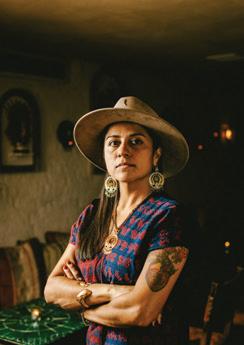
Cover: Adriana Cavita by Alberto Zamaniego
Psychotherapy can uncover both familiar and hidden issues, leading to a deeper understanding of yourself. This understanding goes beyond merely solving problems; it’s an investment in your personal growth and well-being. Engaging in psychotherapy can facilitate meaningful and lasting change.
People often engage in short-term psychotherapeutic experiences yet continue to suffer, unable to achieve satisfying relief. Psychotherapy is a valuable option for those seeking a deeper understanding and resolution of complex emotional challenges.
19 FEBRUARY, 1pm COMPOSER IN RESIDENCE: CHRISTIAN MASON
Royal Academy of Music Marylebone Road, NW1 5HT ram.ac.uk
This free performance showcases the work of three composers: Helena Tulve, Saurabh Shivakumar, and the Academy’s composer in residence, Christian Mason, winner of last year’s Grawemeyer Music Composition Award.
FILM & TALK
19 FEBRUARY, 7pm MARY, MARIANNA, MARIA: THE UNSUNG GREEK YEARS OF CALLAS
The Hellenic Centre 16-18 Paddington Street, W1U 5AS helleniccentre.org
This new documentary explores the great diva Maria Callas’s formative years in wartime Athens and her return after 1957. A Q&A with the fim’s directors and producer follows the screening – its UK premiere.
1. Everybody Loves
Our Dollars by Oliver Bullough, Daunt Books
2. Christian Mason, Royal Academy of Music
3. Mary, Marianna, Maria, The Hellenic Centre
4. Face of Christ by Claude Mellan, Quirkiness & the Printed Image, The Brown Collection
MUSIC
21 FEBRUARY, 6pm
COUPERIN’S LEÇONS DE TÉNÈBRES
St Marylebone Parish Church 17 Marylebone Road, NW1 5LT stmarylebone.org
Scored for sopranos and organ, French Baroque master Francois Couperin’s refined, intimate Trois Leçons de Ténèbres offer a focal point for an evening of reflection, featuring organ improvisation, plainchant and candlelight.
TALK
Critic and art historian Nigel Ip explores the unique and unexpected features of printed images since the 16th century, from cracked printing plates to masterful manipulations of line, and explains how these quirks contributed to major innovations in printmaking.
24 FEBRUARY, 6pm QUIRKINESS AND THE PRINTED IMAGE
The Brown Collection 1 Bentinck Mews, W1U 2AF glenn-brown.co.uk
MUSIC
21 FEBRUARY, 11.30am, 3pm, 7.30pm
JAMES BAILLIEU Wigmore Hall 36 Wigmore Street, W1U 2BP wigmore-hall.org.uk
Across three concerts, one of the UK’s leading pianists shows off the breadth of his repertoire, performing Mahler and Wolf with baritone Henk Neven, Bach, Mozart and Hayden with violinist Tamsin Waley-Cohen, and English songs with soprano Sophie Bevan.
TALK
24 FEBRUARY, 7pm OLIVER BULLOUGH IN CONVERSATION
Daunt Books
84 Marylebone High Street, W1U 4QW dauntbooks.co.uk
Oliver Bullough, author of Moneyland and Butler to the World, discusses his latest book, Everybody Loves Our Dollars, which shines a light on global money laundering networks and the inability of governments to counter them.
THEATRE
26 – 28 FEBRUARY
ANYTHING IS POSSIBLE IF YOU THINK ABOUT IT HARD ENOUGH
The Cockpit Gateforth Street, NW8 8EH thecockpit.org.uk
Named Best New Play at the 2022 Off West End Awards, Cordelia O’Neill’s play tells the story of a young couple forced to navigate their grief and the resulting ruptures in their relationship after their baby is stillborn.
THEATRE
UNTIL 28 FEBRUARY
CABLE STREET
Marylebone Theatre 35 Park Road, NW1 6XT marylebonetheatre.com
Fresh from two sold-out runs at the Southwark Playhouse last year, the musical Cable Street takes us back to October 1936, in the heart of the East End, when Oswald Mosley’s fascists started to march and hundreds of Jews, Irish workers and communists united to block the road.
MUSIC
27 FEBRUARY, 1pm
SIR MARK ELDER CONDUCTS THE ACADEMY SYMPHONY ORCHESTRA
Royal Academy of Music Marylebone Road, NW1 5HT ram.ac.uk
Conductor Sir Mark Elder leads the Academy Symphony Orchestra through a programme of Sibelius’ Sixth Symphony and Elgar’s Falstaff, which portrays Shakespeare’s buffoonish character in the style of a symphonic poem.
EXHIBITION
This mini retrospective honours the late, great French - American photographer Ell iott Erwitt, who died in 2023. It celebrates the warmth, wit and humanity of his work, from u nforgettable dog portraits to wry street scenes, to candid shots of historical figures.
Royal Academy of Music Marylebone Road, NW1 5HT ram.ac.uk
As part of Resounding Shores series celebrating 17th century English music, leading interpreter of Baroque repertoire Rachel Podger leads Academy students in works by Purcell and Lawes that relate to the English Civil War.
MUSIC
Presented by Opera Rara, which promotes the lost operatic heritage of the 19th and early 20th centuries, Colombian soprano Julieth Lozano Rolong performs a selection of rare songs, including works by Gaetano Donizetti, accompanied by pianist Anna Tilbrook.
26 FEBRUARY, 7pm
JULIETH LOZANO ROLONG
Bechstein Hall
22 Wigmore Street, W1U 2RH bechsteinhall.com
MUSIC
5 MARCH, 7pm ARCHILOCHUS’ FRAGMENTS
The Hellenic Centre 16-18 Paddington Street, W1U 5AS helleniccentre.org
This new work by composer Costas Kafouros blends ancient Greek poetry with modern sound. Performed by Katerina Mina, Rami Sarieddine, Mariana Parás and Marios Nicolaou, the piece offers an enduring dialogue between past and present.
TALK
5 MARCH, 7pm ROBERT MACFARLANE IN CONVERSATION
Daunt Books 84 Marylebone High Street, W1U 4QW dauntbooks.co.uk
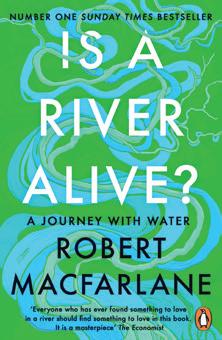
Robert Macfarlane discusses his latest book, Is A River Alive?, an examination of the idea that rivers are not merely landscape features but living entities in their own right and should be recognised as such in imagination and law.
MUSIC
7 MARCH, 7.30pm BACH CELEBRATORY CANTATAS
Wigmore Hall
36 Wigmore Street, W1U 2BP wigmore-hall.org.uk
London Handel Players presents a programme of works that span Bach’s career, from sublime chorale cantatas, sung by one voice per part, to the irresistible pairing of the Second Orchestral Suite with Er-schallet, ihr Lieder, erklinget, ihr Saiten.
1. Japan, Mount Fuji, 1977by Elliott Erwitt, Atlas Gallery
2. Music for Rebels and Royality, Royal Academy of Music
3. Sir Mark Elder, Royal Academy of Music
4. Is a River Alive? by Robert Macfarlane, Daunt Books
5. Julieth Lozano Rolong, Bechstein Hall
1. Barbara Hannigan, Wigmore Hall
2. Jean Rondeau, Wigmore Hall
3. Muslim Europe by Tharik Hussain, Daunt Books
4. Rinaldo, Royal Academy of Music
5. Through the Surge by Peter Wileman, Spring Exhibition, Thompson’s Gallery
MUSIC
11 MARCH, 7.30pm
LOUIS COUPERIN SERIES
Wigmore Hall
36 Wigmore Street, W1U 2BP wigmore-hall.org.uk
Harpsichordist Jean Rondeau presents the latest in a series of concerts marking the 400th anniversary year of French Baroque composer Louis Couperin. Here, he’s joined by Philippe Pierlot’s Ricercar Consort, among today’s finest interpreters of Baroque repertoire.
TALK
12 MARCH, 6.30pm
THARIK HUSSAIN IN CONVERSATION
Daunt Books
84 Marylebone High Street, W1U 4QW dauntbooks.co.uk
Tharik Hussain discusses his ambitious new history book, Muslim Europe, which explores in depth how Islam has been integral to the development of European culture, science and medicine over 1,400 years.
MUSIC
Soprano Barbara Hannigan joins the Belcea Quartet to perform Schoenberg’s ethereal setting of Stefan George’s influential Symbolist poem Transcendence, along with Hindemith’s Melancholie, composed in memory of a friend killed in the First World War.
17 MARCH, 7.30pm
BARBARA HANNIGAN & BELCEA QUARTET
Wigmore Hall
36 Wigmore Street, W1U 2BP wigmore-hall.org.uk
MUSIC
16 MARCH, 6.30pm RIOT ENSEMBLE SIDE‑BY‑SIDE
Royal Academy of Music Marylebone Road, NW1 5HT ram.ac.uk
Musicians from the Composition Department’s ensemble in residence, Riot Ensemble, join with Academy students to perform Hans Werner Henze’s Chamber Concerto 05, followed by the premieres of three new student works.
EXHIBITION
This mixed exhibition brings together a vibrant collection of new works by some of Thompson’s Gallery’s bestknown artists, including Stephanie Rew, Peter Wileman and Paul Wright, as well as pieces by some of the gallery’s more recent discoveries.
Royal Academy Opera performs Handel’s Rinaldo, the first Italian-language opera written specifically for the London stage, which debuted in 1711. It marked the beginning of the composer’s prolific career in England and features some of his most famous arias.
TALKS
19 – 20 MARCH
DAUNT BOOKS FESTIVAL
Daunt Books
84 Marylebone High Street, W1U 4QW dauntbooks.co.uk
One of the highlights of the year for literary London, the Daunt Books Festival returns for its usual two-day extravaganza of talks, readings and Q&As, featuring some of the biggest names in fiction and nonfiction. Look out for more details in the coming weeks.
MUSIC
20 MARCH, 7pm
TONY YIKE YANG
Bechstein Hall
22 Wigmore Street, W1U 2RH bechsteinhall.com
Hailed as one of Canada’s finest young musicians, pianist Tony Yike Yang rose to international acclaim after becoming the youngest-ever laureate in the history of the International Chopin Piano Competition in 2015. Here, he performs a programme of works by Chopin, Scriabin and Kapustin.
Q&A: JAMES BRETT
The founder of The Gallery of Everything on storytelling, inclusiveness, and championing unusual work by unusual people
Interview: Vi el Richardson
Portrait: Ale xander Coggin
Q: When did you first develop a connection with art, either positive or negative?
A: I neither grew up in a home with art, nor was I educated in art. Perhaps the most defining moment was when, out of the blue, my father brought home an oversized painting of Princess Margaret in a limousine and placed it in the family living room. It was a Superhumanism artwork from the Nicholas Treadwell Gallery, also on Chiltern Street ironically, but it lasted less than 24 hours before being consigned to the garage for eternity.
Q: What drew you towards more unconventional, self-taught or margin al practices?
A: It was an evolving process, starting with vernacular art and objects, notably those by African American makers, and then expanding to include the neurological, the spiritual and
eventually all forms of alternative manufacture. It wasn’t an intentional journey. It’s a path that seemed to choose me – and continues to do so to this day. I still find this kind of material and its authors more inspirational and profound than art which is primarily intentional, conceptual or historical.
Q: Before founding The Gallery of Everything, what did you feel was missing from the way the art world presente d creativity?
A: Sadly, what was missing then is also missing now. As human beings, we are not represented in our full breadth and depth by museums and galleries, which have always been structured to privilege those who cohere to the narrow rules of art history. Most arts organisations are underpopulated by those without formal arts education or training, let alone access to the pathways into museums. These
people are denied the right to cultural equivalence. Although many organisations have added the word ‘diversity’ to their mission statements, they often approach this more as a process of boxticking than actual enthusiasm for the work itself. This year’s Turner Prize could represent a turning point, as it was won by Nnena Kalu from the progressive arts studio Action Space. We have to see if that is simply a drop in the ocean or the start of a major sea change.
Q: The term ‘outsider art’ is often used to describe the work you show. How do you feel about that label?
A: It was helpful once upon a time, and conceived innocently, but today it reads as pejorative and misinformed. At the start of my journey, I had a bee in my bonnet about the way it was used by art ‘professionals’ to dismiss and negate the material’s validity.
only one aspect of a wider, more complex personality. In short, while biography informs how we consider the art, the art comes first.
Q: The gallery is housed in a converted barber’s shop. What drew you there?
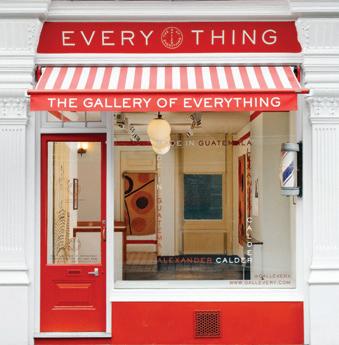
A: I have spent time in and around the Baker Street neighbourhood since I was a child. When the owner of Mario’s – the old barber’s shop –passed away, I contacted the family because I thought it would make a suitable space for a commercial extension of our existing non-profit museum project. I was right. It has been a wonderful home since 2016.
Q: How important is it to you that visitors feel at ease in the space?
Today, advocacy has helped this term fall from general usage, and people are more careful and aware. If someone asks me what we sell at the gallery, I tend to describe it as unusual material by unusual people, and I leave it at that. Or I talk about Outsiderism as a concept rather tha n a movement.
Q: How important is storytelling and biography in your approach to pre senting work?
A: I come from filmmaking, which is all about storytelling, and I regularly apply this to our installations and exhibitions. Who the person is, where they come from, how and what they think, how they make the work: these all are key to engagement. But we avoid relying too heavily on the biography, especially if an artist has a complicated background. There is no point over-emphasising a pathology – schizophrenia or autism, for example – when it is
A: Don’t you hate galleries that make you stand to attention? Or make you feel like you’re too scruffy or unintelligent to belong? We show modest, meaningful and accessible material, so we present ourselves similarly. The shop is a bit of a Tardis, with secret rooms and cavities, so we take advantage of that drama to present work in the most dynamic way possible. It’s also good for visual jokes. After all, the people who like the work we show tend to be welcoming and informal too.
Q: What would you like The Gallery of Everything to be perceived in the years to come?
A: I would be thrilled if the art world took a little more notice of what we do and gave a little more credence to material created outside the narrow confines of art history. The work we represent is a critical part of visual culture, and it always has been. If we’re remembered as cracking open a few more doors for the under-represented and undervalued many, then we will have done our job.
THE GALLERY OF EVERYTHING
4 Chiltern Street, W1U 7PS gallevery.com
2. The Gallery of Everything
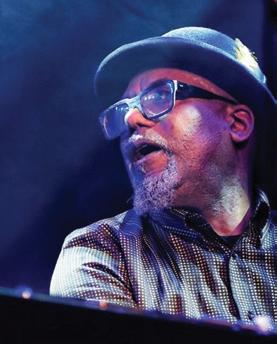
3. Tunde Jegede of NOK Orchestra, African Concert Series, Wigmore Hall
3. 1. James Brett of The Gallery of Everything
MUSIC
21 MARCH, 11.30am, 3pm, 5pm, 7.30pm AFRICAN CONCERT SERIES Wigmore Hall
36 Wigmore Street, W1U 2BP wigmore-hall.org.uk
This ongoing series places the spotlight on musicians from Africa and the African diaspora. A full day of performances includes music from Kenya and Uganda, a journey through African song, and NOK Orchestra’s fusion of Western and African classical traditions.
EXHIBITION
UNTIL 22 MARCH
SWORDS OF LUCKNOW
The Wallace Collection Manchester Square, W1U 3BN wallacecollection.org
This impressive collection of five northern Indian swords, all of them adorned with intricate enamel and goldwork, offers a unique window into the splendour of 18th and 19th-century Lucknow, a vibrant centre of power, artistry and cross- cultural exchange.
2.
EXHIBITION
4 – 26 MARCH
MICHELLE BAHARIER: FILLING IN THE GAPS
St Marylebone Parish Church 17 Marylebone Road, NW1 5LT stmarylebone.org
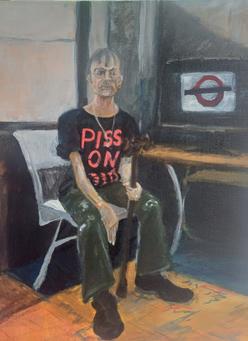
Commissioned by London Transport Museum, this exhibition by London-based artist Michelle Baharier brings together painted portraits of disability rights activists whose interventions have transformed the UK’s public transport system.
EXHIBITION
13 – 29 MARCH
GEORGE POL. GEORGHIOU: TIMELESS CYPRUS
The Hellenic Centre 16-18 Paddington Street, W1U 5AS helleniccentre.org
To mark Cyprus’s presidency of the Council of the European Union, the AG Leventis Gallery presents an exhibition of works by painter George Polyviou Georghiou – the most extensive selection ever shown outside of his home country.
1.
1. Filling in the Gaps by Michelle Baharier, St Marylebone Parish Church
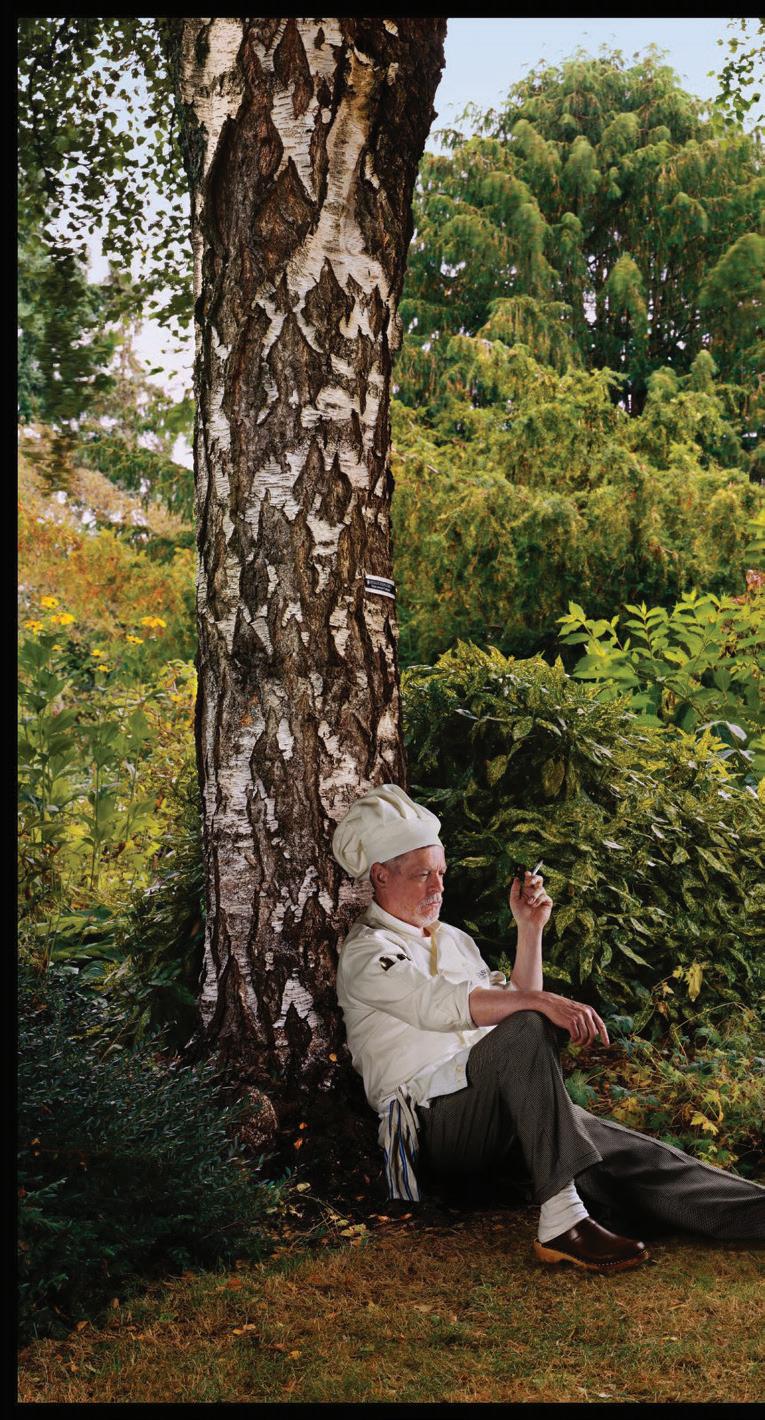
2. Betula Pendula Fastigiata (Sous-Chef on Smoke Break) (2011) by Rodney Graham, Lisson Gallery
3. Orphy Robinson, Jazz in the Round, The Cockpit
EXHIBITION
This exhibition explores Rodney Graham’s relationship with the natural world through two major bodies of work related to trees: the large-format photographs of upside-down Oxfordshire Oaks (1990) and a twoscreen, immersive video environment entitled Edge of a Wood (1999).
18 FEBRUARY – 11 APRIL
RODNEY GRAHAM: WHO DOES NOT LOVE A TREE?
Lisson Gallery
27 Bell Street, NW1 5BY lissongallery.com
MUSIC
This five-night takeover by The Cockpit’s regular Jazz in the Round strand features a compelling blend of big names and new talents from London’s thriving jazz scene, with performers including Urvashi, Orphy Robinson and Thomas Edwards Noble.
30 MARCH – 3 APRIL
JAZZ IN THE ROUND: EASTER UPRISING
The Cockpit Gateforth Street, NW8 8EH thecockpit.org.uk
THEATRE
29 MARCH, 7pm MIRRORS
The Cockpit Gateforth Street, NW8 8EH thecockpit.org.uk
Written as a conversation between three women in three different cities – New York, Rome and Thessaloniki – this award-winning play by Ada Tsesmeli Edwards explores the inner landscapes of women whose voices have been muted, distorted or dismissed.
MUSIC
3 APRIL, 6.30pm
STAINER’S THE CRUCIFIXION
St Marylebone Parish Church 17 Marylebone Road, NW1 5LT stmarylebone.org
The Choir of St Marylebone Parish Church presents the 138th annual performance of John Stainer’s Good Friday oratorio, which was written for the parish church in 1887. The congregation is invited to join in the singing, which mirrors how the work was originally performed.
EXHIBITION
18 FEBRUARY – 11 APRIL
SEAN SCULLY & LEIKO
IKEMURA
Lisson Gallery
67 Lisson Street, NW1 5DA lissongallery.com
Sean Scully’s drawings, watercolours, photographs and written works on paper, all inspired in some way by the natural world, sit alongside paintings and scuptures by Leiko Ikemura, in which the human body and the landscape morph into one another.
2.
3.
4.
EXHIBITION
MUSIC
25 APRIL, 7pm
BACH’S MASS IN B MINOR
St Marylebone Parish Church
17 Marylebone Road, NW1 5LT stmarylebone.org
Bach’s magnificent mass was one of the last pieces completed by the composer and one of his greatest works. The Choir of St Marylebone Parish Church is joined by soloists and orchestra from Waterperry Opera Festival under the baton of Bertie Baigent to tackle this monumental work.
TALK
Hikaru Fujii is one of Japan’s most prominent contemporary artists, working primarily with film. This exhibition, his first solo show in the UK, brings together several works, all of which examine moments in Japanese history when empire and disaster appeared side by side.
5 MARCH – 18 MAY
HIKARU FUJII: LINES, GAZES, LANDSCAPES
Daiwa Anglo-Japanese Foundation 13/14 Cornwall Terrace, NW1 4QP dajf.org.uk
THEATRE
6 MARCH – 12 APRIL
YENTL Marylebone Theatre
35 Park Road, NW1 6XT marylebonetheatre.com
When a young woman defies Orthodox law by disguising herself as a man to study Jewish scripture, she steps into a world alive with possibility and conflict. Based on a story by Isaac Bashevis Singer, Kadimah Yiddish Theatre’s production arrives after a triumphant run at Sydney Opera House. 1.
MUSIC
14 APRIL, 7pm
JULIAN LLOYD WEBBER
75TH BIRTHDAY GALA Wigmore Hall 36 Wigmore Street, W1U 2BP wigmore-hall.org.uk
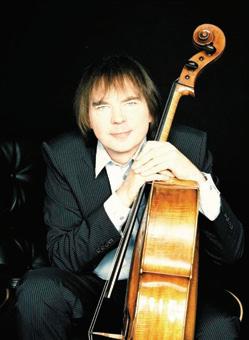
Legendary cellist Julian Lloyd Webber is joined on stage by a stellar roster of musical guests as he celebrates his 75th birthday with a charity concert exploring his remarkable career and the works and people who have shaped it.
30 APRIL
MYTH VS NATURE
The Brown Collection
1 Bentinck Mews, W1U 2AF glenn-brown.co.uk
Art historian Leslie Primo explores how Low Country painters responded to new ideas in Italian art after the unveiling of the Sistine Chapel frescoes, resulting in the idealised visions of nature and paradise summoned up by the likes of Jan Brueghel the Elder and Peter Paul Rubens.
EXHIBITION
UNTIL 8 AUGUST
HOI POLLOI
The Brown Collection 1 Bentinck Mews, W1U 2AF glenn-brown.co.uk
Curated by Glenn Brown, this exhibition brings together paintings, drawings, prints and sculptures from the 16th century to the present day, including his own distinctive works. It explores how artists through the ages have represented, resisted or reimagined the ordinary man.
1. Southern Barbarian Screens by Hikaru Fujii, Daiwa AngloJapanese Foundation
Yentl, Marylebone Theatre
The Hoi Polloi by Glenn Brown, The Brown Collection
Julian Lloyd Webber, Wigmore Hall
IN PROFILE JOHN GILHOOLY
The director of Wigmore Hall on the venue’s 125th anniversary, the joys of self-sufficiency, and the surprisingly upbeat impact of the Covid years
Words: Mark Riddaway Images: Kaupo Kikkas, Hug o Glendinning
JOHN GILHOOLY
It will begin this time like it began the first, with God Save the King. Back then, on 31st May 1901, the anthem’s recent change of lyric – from ‘Queen’ to ‘King’, in honour of Edward VII – would have jarred the ears of an audience still mourning the passing of Queen Victoria. But from that point on, there was nothing discordant about the opening night at Bechstein Hall, a beautiful new concert venue built by the eponymous Berlin-based piano brand and described in one newspaper review as “London’s most sumptuous temple of music”.
On 25th May this year, the venue – renamed Wigmore Hall in 1917 after a wartime requisition order forced it from the hands of its German owners – kicks off a twoweek celebration of its 125th anniversary with a reimagining of that historic first night. After commencing once again with the national anthem (a rare note these days of Edwardian formality) a cast of world-class musicians will revisit the original programme. Or most of it. There will be, says John Gilhooly, Wigmore Hall’s director, “a few judicious edits. Programming meandered a bit back then, whereas now people probably don’t want to be here all night.”
His well-honed instinct for the appetites of a modern audience has been one of the hallmarks of John’s long, successful stint at the venue’s helm, which you can now read about in a format far longer and deeper then this one. Although he claims not to have read the relevant chapters yet, John is a major character in a new biography of Wigmore Hall by the historian Julia Boyd, the launch of which coincides with the anniversary series. He is one of only five people to have run the Hall since 1901, a period that has seen six British monarchs and a dozen popes. With one director having departed after just two years, the average incumbency of the others exceeds three decades. John, 20 years deep, is, in historic terms, just settling into
the role. “We do tend to do very long tenures,” he says with a wry smile. “There’s something about the place that draws you in and makes it very hard to leave.”
Right now, leaving Wigmore Hall is the very last thing on his mind. “We’re at a peak artistically, in sales, in international profile,” he says. “The balance sheet has never been better. Attendances have never been better.” Last year, a fundraising appeal by the trust that runs the Hall brought in £10 million, a cash injection that has enabled it to become fully self-sufficient. Like most cultural institutions, Wigmore Hall had previously relied on an annual grant from Arts Council England. In recent years, though, the conditions attached to this state funding had become increasingly onerous – wellintentioned, says John, but “dictated in a schoolmaster-ish way”. Freedom from those constraints gives him the latitude to be more creative with both the programming and the Hall’s vital community work. “Everything now is at our own risk.”
That means, he says, “a parade of the greatest artists in the world performing the greatest repertoire.” Wigmore Hall may not be the largest of venues or the grandest, but great artists cannot stay away. Partly, John says, that’s down to the acoustic – a miraculous marriage of proportions and materials that gives the sound a rare sparkle and clarity. “Musicians thank me, but they should be thanking the building.” From that very first performance in 1901, word of the acoustic spread rapidly through Europe’s musical elite. “You had people like Fauré coming here on the basis of its reputation. It was word of mouth through musicians: there’s something magic there.”
The responsiveness of the sound, the intimacy of the space and the attentiveness of the audience tempt even the most restrained and precise of performers to shake off the shackles. “They find themselves
What the trust didn’t know when I started was that I was so interested in contemporary music. If I’d told them, ‘I’m going to commission over a thousand new works,’ what would they have said?
125TH ANNIVERSARY FESTIVAL
25 MAY – 7 JUNE
To celebrate its 125th anniversary, Wigmore Hall is hosting 24 concerts across 14 days. A stellar vocal lineup includes Lise Davidsen, Asmik Grigorian, Carolyn Sampson, Ian Bostridge and Christian Gerhaher. Instrumentalists include pianists Thomas Adès, Yunchan Lim, Igor Levit, Alexandre Kantorow and Angela Hewitt and violinists Alina Ibragimova and Christian Tetzlaff. Group performances include the Belcea, Modigliani and Leonkoro Quartets, cellist Abel Selaocoe appearing with Bantu Ensemble, multi-instrumentalists Rhiannon Giddens and Francesco Turrisi with Crash Ensemble, Les Arts Florissants with William Christie, and Hespèrion XXI with Jordi Savall.
taking risks they don’t take anywhere else,” says John. “There’s something that cocoons them, encourages them – it’s a living, breathing hub. They’ll take risks, and they’ll bounce off each other, and something magical will happen. It always does.”
It was a belief in musical magic that first drew John into the sector. Hailing from a small town in County Limerick in the west of Ireland, he had grown up with a love of music and a genuine talent for singing but chose to channel his passions behind the scenes rather than on the stage. In 2000, at the age of 27, he joined Wigmore Hall in the role of executive director, responsible for some of the more
operational aspects of running the venue, including oversight of a large, complex refurbishment project.
Five years later, he was invited by the trustees to step into the shoes of the departing artistic director, John Kildea, becoming in the process the youngest head of a major classical music venue anywhere in the world.
Back then, Wigmore Hall was blessed with a knowledgeable and highly invested cohort of regulars but relied on this same small faction to repeatedly fill its seats – a crowd narrow in age and demographics, a little clubbish and conservative, protective of the classical Viennese repertoire that dominated the programming. “Everybody seemed to know each other,” says John.
To sustain itself deep into a second century, the Hall needed to reach new audiences, but it couldn’t risk alienating those dependable old-timers. Despite his youth, John wasn’t seen as a thrusting young radical who would shake things up overnight. Quite the opposite. His predecessor – the single exception to the long-serving director rule –tried to go too far too fast, sparking ire in the aisles. John, meanwhile, had proven himself a steady, astute administrator. “I think over those five years as executive director, I’d gained the trust of the audience and the board,” he says. “I was only 32, so I was a risk, but a known risk.”
And yet, while gradual and graceful in their implementation,
Opposite top: The Wigmore Hall stage
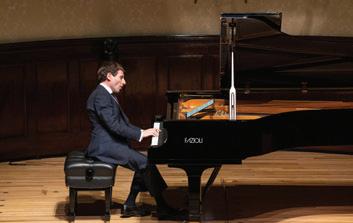
Opposite bottom: Pianist Boris Giltburg
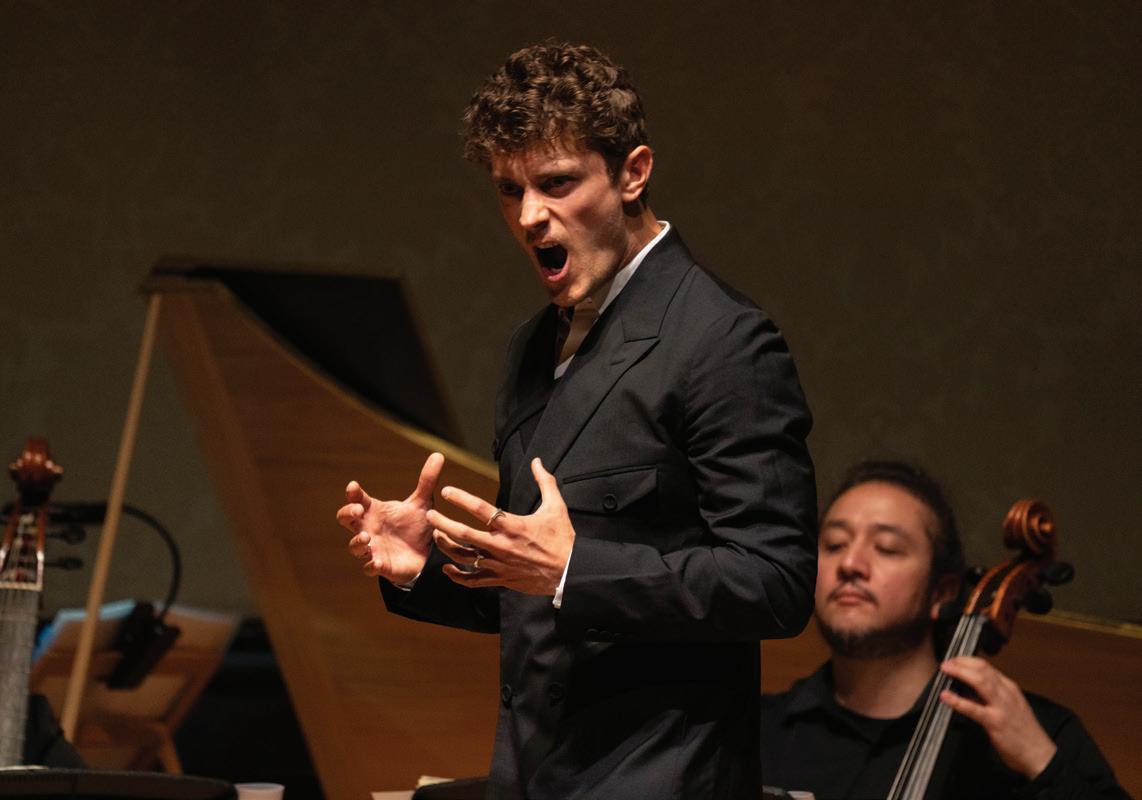
Above: Polish countertenor Jakub Józef Orliński
the changes wrought by John over the years have proved genuinely radical. “What the trust didn’t know back then was that I was so interested in contemporary music. If I’d told them, ‘I’m going to commission over a thousand new works over the next two decades,’ I wonder what they’d have said!” he laughs. “If anything, I’ve become more radical as I’ve got older. I’m empowered by a good board, by a receptive audience, by incredible artists, and by success.”
When somebody stops me to say hello, a regular, that’s great, but when somebody stops me, has no idea who I am, and asks, ‘Where are the loos?’ that’s even better.
As a result of John’s actions, today’s crowds are drawn from a far broader spectrum of society. A long-running £5 ticket scheme for under-35s has, he affirms, “completely changed the complexion of the audience. The atmosphere at the end of a concert now is amazing, with the youngsters on their feet, cheering. It’s vibrant, it’s alive.”
While there’s always room for Haydn, Mozart and Schubert, visitors are now drawn to a far more diverse repertoire. One of John’s core beliefs is that, even within the relatively tight confines of chamber music and song, there existed in London’s vast sprawl a multitude of underserved appetites. “That was a very early lesson: not thinking of the audience as a monolithic whole,” he says. “You’ve got an audience for string music, an audience for singers, an audience for contemporary music, an audience for jazz. There’s such variety now. Not everything’s for everybody, but then it’s not meant to be.”
As an example, he enthuses about this year’s concert series devoted to the composers and musicians of Africa and the African diaspora, the response to which has been spectacular. “If we focus on Nigeria for a day, the Nigerian community in London, which is huge, will come out to support it. At 11.30 on a Saturday morning, we had a packed hall for Ethiopian piano music.” Every
JOHN GILHOOLY
Jeneba Kanneh-Mason performing at Wigmore
Hall’s Autumn International Piano Festival
attendee who comes for the first time is a person who might leave knowing this really is a place for them. “When somebody stops me to say hello, a regular, that’s great, but when somebody stops me, has no idea who I am, and asks, ‘Where are the loos?’ that’s even better.”
It helps that you no longer have to come in person to get an allimportant first taste. One of John’s most ambitious – and, it turned out, prescient – innovations began with his belief that the Hall should be a broadcaster as well as a venue. The BBC has for decades regularly broadcast its concerts on Radio 3, but rapid changes to the way music is consumed, added to a culture war in which the license fee crouches under constant bombardment, led John to conclude that having more than one basket for the Hall’s eggs might be prudent. “I always worry about the BBC,” he explains. “They’re a wonderful partner, but what happens if the licence fee is abolished? What happens to those niche channels? Providing this kind of music is one of the things the BBC should absolutely be doing, and they’re doing it brilliantly, so hopefully it doesn’t ever come to that – but we have to be prepared.”
From 2015, the trust invested heavily in the technology and expertise needed to stream performances live over the internet in a manner that does justice to the sound and spectacle. Then, in the spring of 2020, the UK’s music venues were forced to go suddenly silent, and every penny of investment proved well spent. “The concert we streamed on 1st June 2020, the Stephen Hough concert, was the first live music heard in this country, heard anywhere really, since the Covid lockdown started. It broke the silence,” says John. “We were in the empty hall, just me, the presenter and the artist; we couldn’t even interact. I remember sitting there thinking, is anybody listening? But I could feel something in the air. Maybe I’m a bit cracked, but I just knew something special was happening. And then when I went out, they said: ‘Thousands tuned in and the radio’s going mad and social media’s going mad.’ It was incredible.”
Throughout the pandemic, millions of people enjoyed those streams. A fortune was lost in ticket revenues, but the Hall won massive new audiences and a deep well of goodwill from the music world. “We were effectively handing out fees to every musician we could get here,” says John. “Some performers told me we were their only work in that first year and a half. We felt a huge responsibility.”
Since then, online audiences have remained vast, with one concert, the 2023 Wigmore Hall debut of 19-year-old South Korean pianist Yunchan Lim’s, drawing a staggering 1.2 million viewers to the venue’s YouTube channel. Thanks in part to that increased exposure, ticket sales have also boomed. This year, the Hall will host over 600 concerts – a record. “In a way, I think if Covid hadn’t happened, we wouldn’t be in the position we’re in now,” says John. “We wouldn’t have developed that
international profile.”
Such is his current reputation, John could probably walk into any job he wanted, anywhere in the world, but the immutable law of the long- serving Wigmore Hall director keeps him firmly entrenched. Part of the appeal, he says, is how tied to the music he’s been able to remain. “As director here, you get closer to the artists than you would anywhere else. It makes the job far more creative. I could go and run a much bigger hall on a different continent, but I wouldn’t be as close to the artists because there’d be so many layers. We’re very careful here about not having layers of bureaucracy and instead spending everything we can on music and communit y projects.”
Now, more than ever, he’s able to enjoy the pure, diverting joy of the performances he commissions. “It was much harder at the start. I would go into a concert and it would be impossible to focus straight away, particularly if I’d had a difficult day. Now, it’s what I look forward to most. Sometimes, I go in with a problem bouncing around in my head, I put it to one side and somehow by the end of the concert it’s been solved.”
“I go back to Bach,” he concludes. “That was the beginning.” Bach was one of the composers, together with Beethoven, Schubert and Brahms, whose works were played on that opening night 125 years ago and will be played here again on 25th May. “He was a colossus. His music is among the greatest triumphs of human imagination and innovation. There’s a kindness to it. That’s our start point and our end point. Whatever we do today, we must have the same ethos, whether that’s commissioning new music or working in the community, how we treat our audiences or how we treat each other. There’s not enough kindness in the world.”
WIGMORE HALL
36 Wigmore Street, W1U 2BP
wigmore-hall.org.uk
Composer and singer Caroline Shaw with Kamus String Quartet
MANY MEXICOS
Marylebone’s stellar Mexican chefs on the kaleidoscopic nature of one of the world’s most diverse and distinctive cuisines
Words: Clare Finney
Images: Alberto Zamaniego, Adam Wiseman, Anton Rodriguez
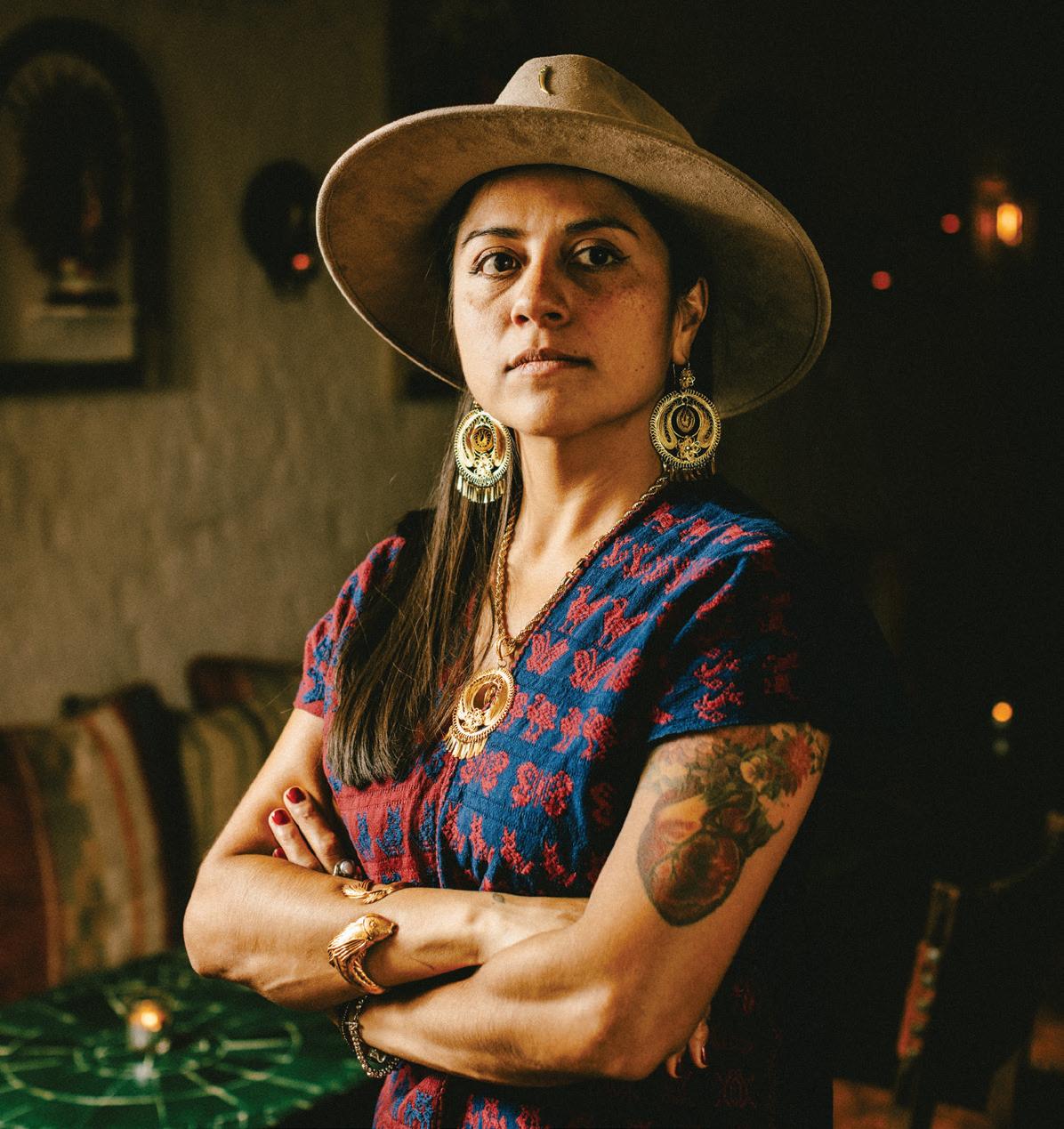
The first time I met the Mexican chef and author Adriana Cavita she had just opened her eponymous restaurant in Marylebone. In a softly lit dining room slung with tapestries and ferns, I asked her how she felt about opening just down the road from KOL, Santiago Lastra’s Michelin-starred Mexica n restaurant.
Smiling patiently, she asked me if I’d ever put a similar question to someone launching a new Italian restaurant in Marylebone – of which there are, at last count, about 20. I confessed, shamefully, that I hadn’t. Italy’s cuisine is renowned for its regionality; for dishes that are unique to their province, even to their village. Italian food can be either high or low, posh or cucina povera, drawn from the fields, the seas or the mountains.
And yet Mexico is roughly seven times the size of Italy, Adriana gently pointed out. It’s one of the most biologically diverse countries in the world, containing more than 10 percent of the world’s biodiversity across a staggering array of ecosystems. Historically, it has been home to over 100 languages, she continued, “though sadly now there are more like 50 or 60 today,” and with each language there comes a culture, a community and a unique cuisine which reflects the specific produce, history and people of the region.
So, in answer to my foolish question, no: she didn’t think twice about opening a second Mexican restaurant in Marylebone. Nor did Edson Diaz-Fuentes think twice about opening a third, Santo Remedio, just around the corner. “There aren’t many Mexican restaurants in the UK – and Santiago cooks so differently to me, with a different view and feel,” says Adriana. And three years, many conversations and a six-week trip around Mexico later, I cringe at my for mer naivety.
In Mexico – a country, as Santiago reminds me, where the northern and southern borders are as far from each other as Morocco is from Finland – the cuisine varies dramatically from state to state, from city to countryside. One need only visit any of the country’s bustling metropolitan markets to get a sense of this abundance. “For me, they are the epicentre,” says Edson. “I love the exploration they offer. I love the energy.” In Oaxaca City, there’s a market called Mercado 20 de Novembre, where you’ll find a smoky aisle filled with an array of meat, vegetable, tortilla vendors. You build your own tacos from all the produce, and eat them there, immersed in the market’s vibrant colours, sizzles and shouts. Regulars will have strong views about which stall serves the best meat, vegetables, tacos – even the best edible grasshoppers, beetles and
People in many different areas of Mexico put so much creativity into their recipes. The more uniform the world is, the less creative.
Adriana Cavita, Cavita
Left: Crab infladita and hamachi tostada
Above left: Adriana Cavita in the kitchen
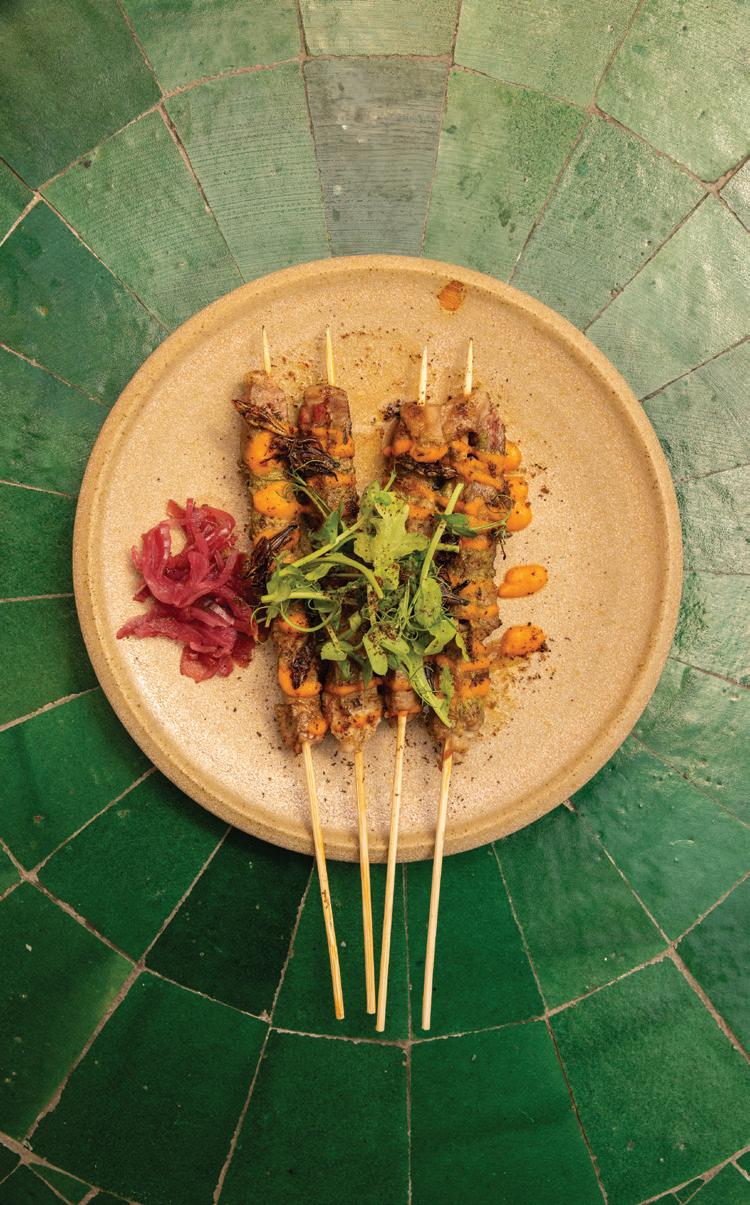
Above right: Chicken skewers with grasshoppers, habanero sauce and pickled red onion
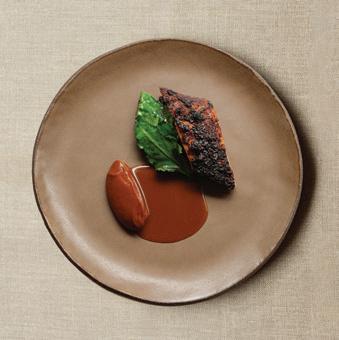
Above: Girasol, KOL’s nod to guacamole, made with British ingredients rather than avocado Far right: Duck mole
The general spirit of Mexican food is the same wherever you go, because what links it is not geography or climate, but people.
Santiago Lastra, KOL
maguey worms, which you’ll see piled in crunchy, desiccated mounds on the market’s fringes as you wander in.
Even small, rural municipalities have their own markets, where you can feast on specialities unheard of even in the next town along. In a town called Tepotzlan, my husband and I bought ‘itacates’ off a nondescript stall, cooked by a mother and daughter while kids – theirs, their regulars’ – played under the tables. It was one of the best snacks I’ve ever had: a hot, nutty, slightly crumbly parcel of blue maize, shaped a little like a Cornish pasty and stuffed with fried fungi and stringy local cheese. A rainbow of fiery salsas came served alongside. “We’ll have to have these again,” we said to each other as we left, confident that we’d have no more problem finding them in Mexico City than we would Cornish pasties in London.
How wrong we were. Though Mexico City was just an hour’s drive away, we couldn’t find itacates anywhere, not even in the large markets of Centro. When I tell this to Santiago, he isn’t in the least bit surprised. “Regional food doesn’t get mixed up that much. If you’re in Mexico City, it’s difficult to find Yucatan food. If you’re in Yucatan, you won’t find Oaxacan. That’s why when people ask me where in Mexico they should eat, I say it really depends on what you want to
experience,” he continues. “It’s the same in Japan: if you’re in Kyoto it’s hard to get sushi; in Tokyo it’s hard to f ind kaiseki.”
Santiago grew up in Cuernavaca, south of Mexico City. Adriana spent her childhood between Mexico City and the village of San Felipe Ixtacuixtla in Tlaxcala state. Edson was raised in the capital. All three, though, have travelled far and wide, giving them a rare sense of their homeland’s culinary diversity. Before opening KOL, Santiago organised research trips around the country as part of René Redzepi’s Noma in Mexico project – an experience that opened his eyes to the breadth of its cuisine.
One of the formative moments in Edson’s life was a meal in a Mexico City restaurant called Los Danzantes, which serves authentic Oaxacan cuisine. “I was young, and the memories I have of those flavours are completely different to my memories of other meals,” he recalls. “That’s where I discovered the country’s amazing culinary diversity.” Edson is not a trained chef, he explains, but as a young adult he spent many hours at the side of Alejandro Ruiz of Casa Oaxaca, a titan of Oaxacan cuisine often credited for revitalising the region’s culinary traditions. There, he learned the power of precision; how a few specific ingredients,
For me, city food markets are the epicentre of Mexico. I love the exploration they offer. I love the energy.
Edson Diaz-Fuentes, Santo Remedio
handled with knowledge and respect, can recreate the taste of a dish that has been passed down through generations, even in a more modern context.
“The more you explore, the more you can find inspiration,” Adriana says of the trio’s enviably regular research trips. “A lot of people in many different areas of Mexico put so much creativity into their recipes, and I want to share those ways of seeing and creating. The more uniform the world is, the less creative.” Just last year, Edson was in Los Cabos on the Baja California Peninsula, researching baja fish tacos. “I tried so many, and I particularly liked one I found on a random stall near the motorway, where the prawns were topped with grilled pineapple mixed with pico de gallo. That is what I’ve tried to recreate here,” he says.
Until recently, most Londoners’ understanding of ‘Mexican’ food was confined to fajitas and burritos, which are Tex-Mex not Mexican. Thomasina Miers’ restaurant chain Wahaca had started to rewrite the narrative, but until this new wave of Mexican chefs began to make their mark, we’d never been exposed to the likes of Edson’s poblano chili relleno, a speciality of the city of Puebla, or barbacoa, a roasted meat dish commonly associated with the central state of Hidalgo, let alone sopes, a typical antojito (street
food) of masa (ground heirloom corn) pinched at the edges to contain fillings like black bean purée, crunchy hibiscus flowers and chipotle chilli. “I feel lucky to put such dishes on a menu in the UK,” says Edson.
The phrase ‘produce-led’ is over-used in restaurant writing these days, but it’s genuinely pertinent in the case of Marylebone’s triumvirate of Mexican restaurants. Geography, cost and climate-consciousness forbid them from importing fresh ingredients. Instead, all three embrace the beauty of British seasonal produce while sourcing from their homeland the unique, long-lasting ingredients that root their cuisine in Mexican regional cultures. Different varieties of cacao, chilli, corn and agave spirits encapsulate the nuances of their source. It is this specificity that prevents their menus, however wide-ranging they are, from ever straying into the realm of generic ‘Mexican food’.
“In European cooking, a lot of similar ingredients can be found in Spanish, French and Italian food, but what makes each country distinct is the people and the culture. In Mexico, it’s a little different because it’s such a huge place,” explains Santiago. “Some of the ingredients are the same, but local ingredients can also change a lot depending on where you are.”
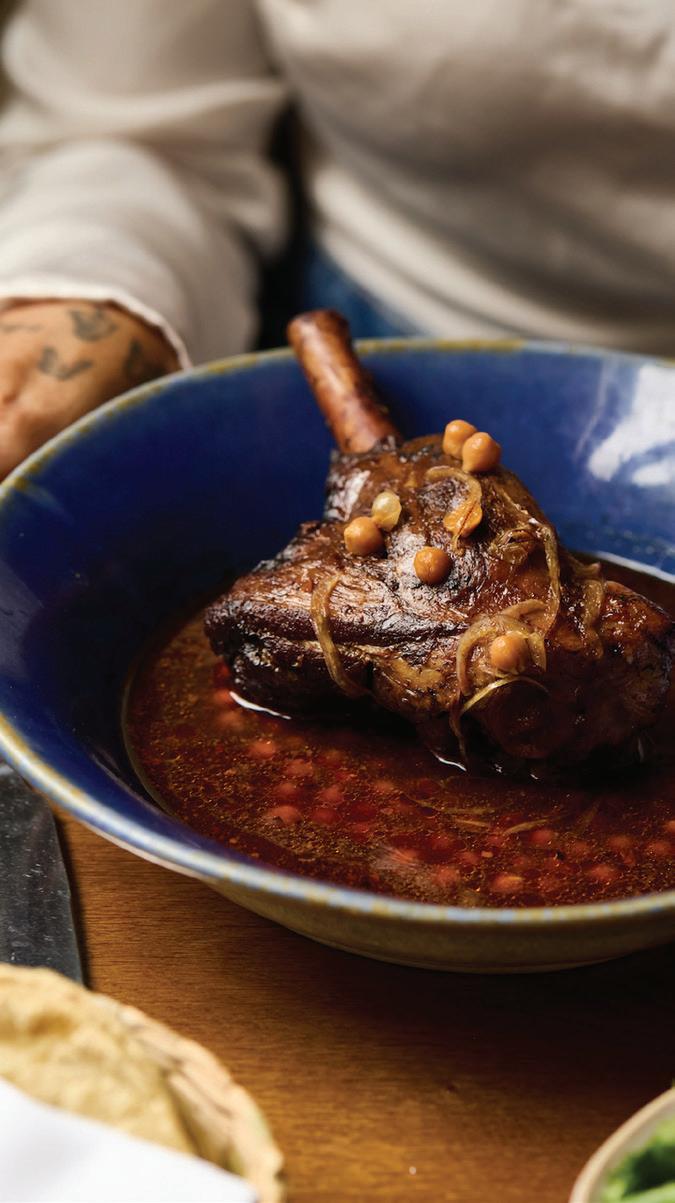
Above: slow-cooked barbacoa lamb shank
Moles are a classic example of how these local differences manifest. “It’s like a curry,” Edson points out. “Not just every region, but every family has its own recipe.” The region of Oaxaca has seven famous moles, each with endless iterations. “I lived with a Oaxacan woman for eight months, and for those eight months we cooked different recipes from that one area of Oaxaca,” Adriana recalls. “It would take me another eight months of my life to understand another area, because the ingredients are so local. The flavour is connected to the soil.”
Here in the UK, you’d be lucky to find seven types of dried chilli, even in a specialist store. “In Mexico, there are hundreds and hundreds,” she continues, each changing not just according to their variety but the soil and climate in which they grow. The same is true of pulses, limes – even corn, of which there are currently 59 heirloom varieties in an array of sizes and hues.
It took almost a decade for the United Nations Educational, Scientific and Cultural Organization (UNESCO) to deem Mexican cuisine sufficiently diverse, historic and embedded in community and culture to be officially recognised as a piece of ‘intangible cultural heritage of humanity’. Mexican delegates argued for years that their country’s corn, beans, chillies and
cocoa, and the many and ancient ways in which they are grown and prepared, represent “a complex cultural system of agricultural practices, traditions and symbolism imbued with religious meaning and steeped in ritual.”
“They had to apply twice for the recognition. The second time, they had researched a specific area, to show just how diverse it was; that the techniques and even utensils dated back hundreds of years,” Adriana explains. Faced with such impressive evidence, UNESCO relented, and Mexico became the first country in the world whose whole cuisine was deemed worthy of such status, and the protection it – theoretically at least – af fords them.
This was a game-changer for national pride, Adriana says, but it’s not international organisations that preserve time-honoured techniques and ingredients for posterity – it’s farmers, producers, traders and chefs, at home and abroad. Marylebone’s Mexican chefs feel this keenly; it’s why they import what they can directly from small - scale producers, despite the cost and inconvenience. “I think it’s key to sustainability,” Adriana explains. “I know our importing kilos of corn from Mexico might not seem ‘sustainable’, but when it comes to the traditions of our country, and supporting them and our producers, it makes sense to me.”
Like language, food needs to be spoken to survive. It needs its orators, its writers, its young, linguistically playful generations. “To cook is an artform for me, and each artist has their own way of doing things,” Adriana goes on. “That’s why diversity is so positive.” It is positive for Mexico. It is positive for humanity at large, which needs to support biodiversity wherever it can. And in the shorter term, it’s positive for Marylebone to have a roster of quite different Mexican chefs, united by their principles and philosophy.
“Mexico is such a big country; it’s 7,000km long. Yet the general spirit of Mexican food is the same wherever you go, because what links it is not geography or climate, but people,” Santiago explains, passionately. “We live to eat; and if you live to eat, you need to eat amazing food.” And that remains true whether you’re eating in Baja California at a roadside stall or on Seymour Street in a Michelin - starred restaurant.
Introducing the people behind central London’s vital charities and community organisations: Karen Walker, ambassador for The Marylebone Project
Interview: Jean-Paul Aubin-Parvu
Images: Orlando Gili
It was 2020, between the first two Covid lockdowns, and I was sitting in my car outside the doctor’s surgery, waiting to be called in for an appointment. On Radio 5 Live, Naga Munchetty was talking about The Marylebone Project. I’d never heard of the charity, but the work they were doing sounded incredible. I decided there and then that I needed to know more. My husband and I were in the process of selling our business and had already decided that we wanted to give some money to a charity. That charity had to fit very specific criteria: it needed to be small enough for us to see exactly where the money was going; I wanted it to be supporting women in some way; and my husband wanted it to have a focus on homelessness. The Marylebone Project seemed to tick all those boxes. When the surgery phoned to tell me it was time to come in, I explained that I was listening to this piece on the radio and needed to get the details. I missed my appointment!
Straight away, I contacted the charity saying that my husband and I would love to meet everybody and learn more about their work. When we did, we were blown away. We gave them some money, but I wanted to do more. I said to the team: “What else do you need? I’ve worked in fashion. I’m an artist. I’ve grown a family business with my husband, focussing on the HR side, on special projects and on buying. I have all these skills which you can tap into for free. What do you need?”
The Marylebone Project, which has been in existence for 90 years, is the country’s longest established centre for homeless women. We have 112 beds for women who wouldn’t otherwise have a safe place to sleep, many of whom are escaping abusive relationships. These women have been through extremely traumatic experiences. They come to us at their lowest ebb, and we give them the tools they need to rebuild their lives and become active members of society again. We don’t just provide a roof over their heads, hot meals and showers; we also provide as many different services as possible to help them process their trauma, find a direction and move on. The charity is run by women and the staff are all female, so it’s women supporting women. There is an amazing feeling of sisterhood throughout, just a miraculous energy, and such kindness and understanding.
On my first visit to The Marylebone Project, I told the manager that I hadn’t really seen many homeless women on the streets of London and didn’t realise it was much of an issue. She said to me: “Think about it. If you were a homeless woman on the streets, how would you >
The Marylebone Project really is an inspirational place and the work they do here is just incredible. Tragically, it’s now facing closure. It will break my heart if it all disappears.
feel?” I told her I’d be very frightened, because I might get attacked. “So, what would you do?” she asked. I told her I would hide. “Exactly,” she said: “And that’s why you don’t see them. They have no choice but to hide.” I then spoke to one of the residents, an amazing woman with an incredible backstory. She told me that when she was homeless, she’d go into a shop every day to do her makeup. She needed to make sure she didn’t look vulnerable, because otherwise she’d be taken by the gangs. I remember thinking, oh my god, all these things you don’t think about.
The charity has never had an ambassador before, and I feel so grateful and privileged to hold that position. I’ve done many exciting things in my life but I can honestly say that I’ve never felt as passionate about anything else. The first project I got involved with was looking at the fundraising brochure that goes out to m ajor donors. I could see it needed a major revamp. My initial idea was to spend a few days interviewing the women who were using the service and then photograph some of them for the brochure. But it became obvious that, quite understandably, nobody really wants to be the poster girl for homelessness or abuse. These are things you really don’t want the rest of the world to know. I had to pivot to something more abstract. I wanted the women to feel that they’d come along on the journey and could be proud of their part in the fundraising effort, but I needed to make very sure that no one was easily identifiable. In the end, it worked really well. The first donor to receive the new brochure had already pledged a certain amount of money; when they saw it, they immediately doubled their contribution.
I’m so proud of every single person who works here. They’re all incredible. Two years ago, I stood up and made a speech about the staff at the charity’s Christmas party. I said to them: “You could all work anywhere else, earn more money and have a lot less stress. But you don’t. You really love what you’re doing and you love the impact you have on the women by helping them. You’re angels.” Some of the staff spoke to me afterwards, saying that nobody ever talked about their roles in that way. That was another lightbulb moment for me. I started to think about a photographic project where I’d take staff and major donors onto the streets of London and shoot them wearing an enormous pair of angel wings (which I just happened to have, bizarrely – that’s another story in itself!). I wanted to see whether people would notice the angels among us. As a society we tend to hero-worship sportsmen and actors, but we don’t appreciate the people who do truly incredible things to help others.
My idea was to have an exhibition where we’d sell
the prints to raise money for the charity. I approached some top London galleries asking if they’d give us their space for free. The Yield Gallery said yes – an incredible gallery in central London. They offered the space for two weeks at the end of November 2024 and didn’t take a single penny from any sales, which wa s incredible.
That meant I had only nine months to produce a body of work worthy of the women I was trying to represent. I lost so much sleep during those months of shooting. We had to battle the weather. We had to battle security cameras. The charity very kindly gave each member of staff an hour off work, but I had to get them to a location, get them happy walking around in giant angel wings, photograph them and then get them back to work. I usually only had about five minutes to actually shoot each person. Luckily, I had help from a good friend of mine, the wonderful photographer Paul Sanders, who used to be the picture editor for News International. I asked him to be my second pair of eyes, somebody who understands what makes an image truly impactful and could help me cull thousands of photographs down to the final 21. We called the series Are You Next To An Angel? To date, print sales have raised £80,000, and prints are still available to buy, with all proceeds going to the charity.
We invited Naga Munchetty along to see the exhibition. She came down and interviewed me, which gave me the chance to say thank you to her. I said to her: “As a journalist, very often you don’t see the impact your story has. I really want to say thanks to you and your team, because you changed my life. Your story allowed me to engage with this charity, and it’s meant so very much.”
Tragically, The Marylebone Project charity is now facing closure. We sit under the umbrella of Church Army, which owns the properties that look after the 112 women. Church Army is running out of money and has no choice but to sell the properties. As a result, we’re now looking for a buyer. Westminster Council doesn’t want to lose 112 beds from the borough, but after months of negotiation they’ve concluded that they don’t have the funds to take on the buildings. As things stand, these beds will be gone by the end of September 2026 and the women who rely on them will be back out on the streets.
I’ve spent the last six months trying to find somebody with a lot of money who wants to create a genuine legacy. We need another angel, a guardian angel for the charity, and we need to find them quickly. The Marylebone Project really is an inspirational place and the work they do here is just incredible. It will break my heart if it all just disappears.
THE MARYLEBONE PROJECT maryleboneproject.org.uk
A CLOSER LOOK
FOOD » 36
STYLE » 44
HOME » 56
WELLBEING » 58
HEALTHCARE » 60
FOOD »39
FOOD PHILOSOPHY
Liana Kazaryan of Avobar on finding balance, sourcing ingredients and recognising perfect ripeness in an avocado
STYLE »44
Q&A
Maria Lemos of Mouki Mou on the art of the shopkeeper and why ‘luxury’ doesn’t have to be beige
HOME »56
ANATOMY OF A DESIGN
Irish ceramic artist Sara Flynn on a beautiful candle holder created in collaboration with Tekla
Q&A: MARK BLOOM
The general manager of Fischer’s on the art of hospitality, the importance of locals, and how you keep a restaurant comfortingly consistent without ever stagnating
Interview: E llie Costigan
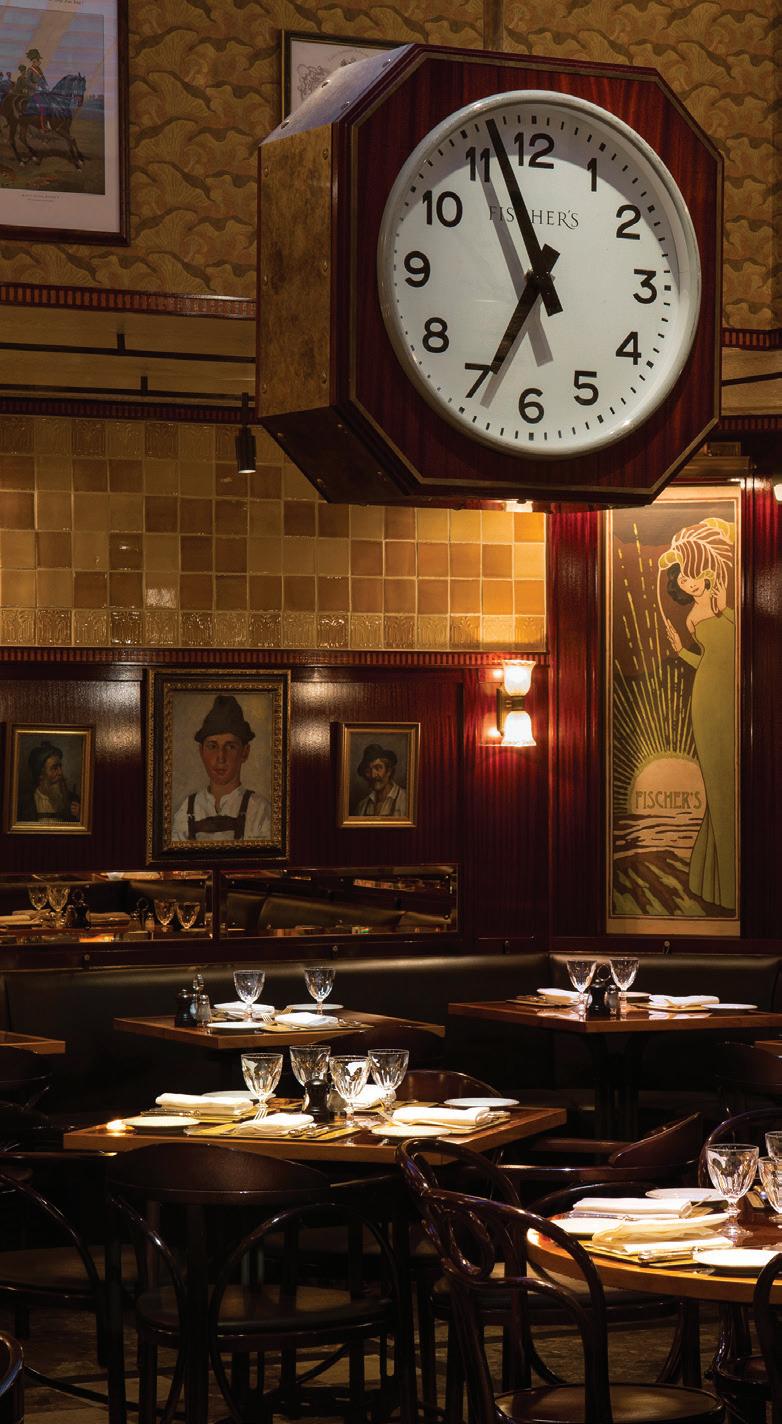
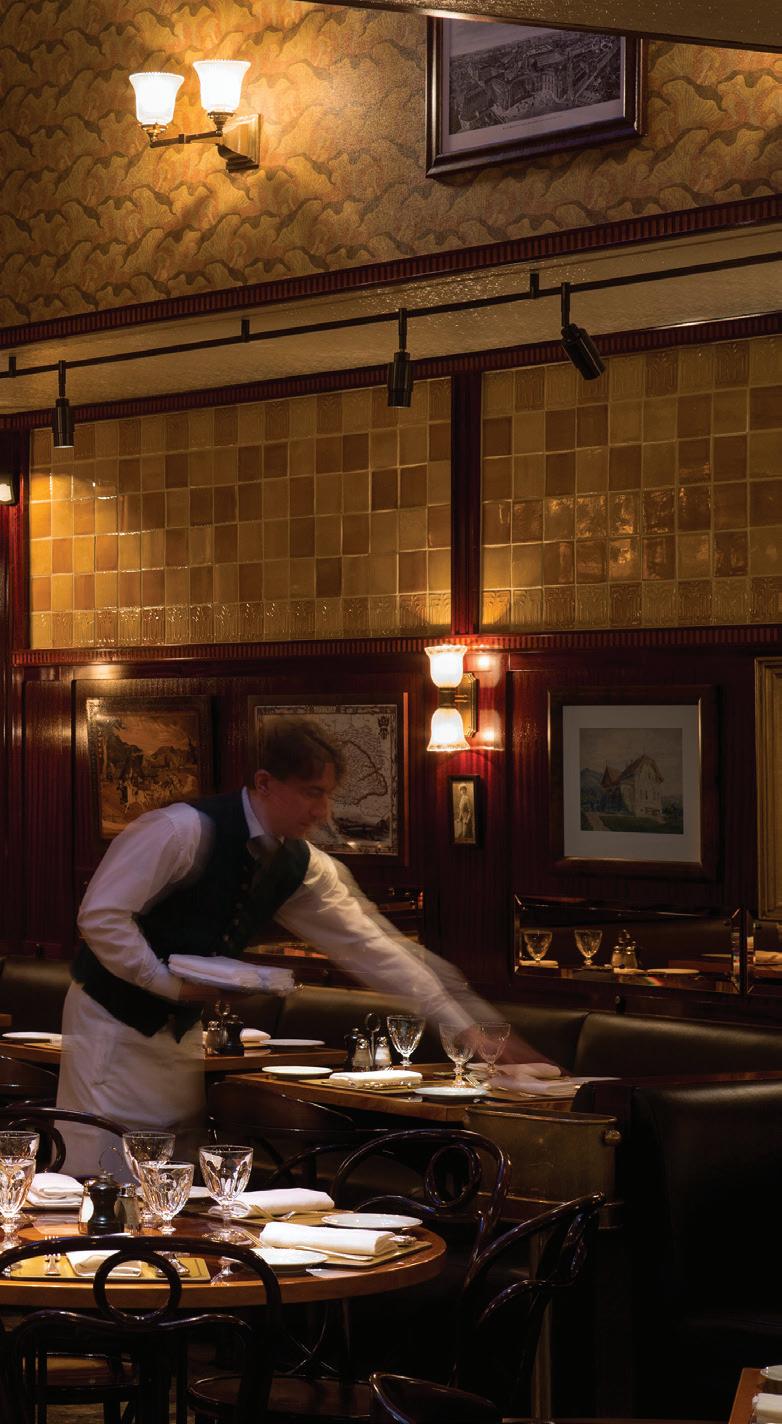
Some restaurants arrive with a bang. Others settle in quietly, becoming part of the fabric of a place so completely that eventually, it becomes hard to imagine the neighbourhood without them. Fischer’s sits firmly in the latter camp. Since opening its doors on Marylebone High Street in 2014, the Viennese-inspired café - restaurant has grown into one of the area’s most recognisable and enduring institutions – a constant in an area of London that has in many ways cha nged at pace.
Created by legendary restaurateurs Jeremy King and Chris Corbin and now run by The Wolseley Hospitality Group, Fischer’s was conceived in homage to the great Middle European cafés of Vienna. From the dark wood panelling and tables to the whipped-cream-topped coffees and deeply comforting menu, it proved both transportive and reassuring. At a time when Marylebone was rapidly becoming one of London’s foremost dining destinations, Fischer’s made a quietly confident statement: this would be a place led not by trends, but by tradition, generosity and impecc able service.
More than a decade later, Fischer’s remains a destination restaurant for those seeking a taste of old-world elegance, while simultaneously functioning as a true neighbourhood local –somewhere residents drop in weekly, even daily, to do everything from simply reading the paper over coffee to celebrating life milestones. It’s this balance that has cemented its status as a Maryleb one mainstay.
At the helm is general manager Mark Bloom, whose career with the group spans more than 14 years – and almost every conceivable front-of-house role. Having worked across The Wolseley, Colbert and The Delaunay before stepping away to run his own restaurant, Mark returned to the fold to lead Fischer’s through its next
chapter. His approach is shaped by experience, empathy and a deep belief that hospitality, at its core, is about people.
We sat down with Mark to talk about longevity in an unpredictable industry, what it means to be a neighbourhood restaurant, and why respect – for guests and teams alike – remains the cornerstone of great hospitality.
Q: You’ve spent a long time with The Wolseley Hospitality Group, and before that Corbin & King, in various roles and restaurants. Tell us a bit about that journey – and what’s kept you here so long.
A: I started as a waiter and I’ve done just about every front of house job you could possibly do, right up to being general manager. Even in an industry that has a lot of challenges – and those are well publicised – it’s always been a place where I’ve genuinely looked forward to coming to work.
I came to Fischer’s bang in the middle of Covid. Before that, I’d been with the company on and off for about 14 years. Over the years, I’ve seen the company go through name changes and evolutions, but the core of it has always stayed the same: how focused we are on people. The team and our guests are treated with an equal level of importance. For me, that’s always made it a very positive place to work.
Q: Does your background shape the way you lead the restaurant?
A: Massively. There’s nothing I’ve ever asked anybody to do that I haven’t done myself. Before restaurants, I worked in nightclubs, hotels and events, so I’ve done all sorts within hospitality. I’ve always felt that if I wasn’t willing to do something, I shouldn’t really be asking anybody else to do it. I’ve stuck to that throughout my career. It helps to have that empathy, especially in an industry
“From the moment you walk through the door, there’s a suspension of disbelief. It should feel like you’re in a little slice of Vienna, right up until the point you walk back out onto the street.”
that can feel quite intense and h igh pressure.
Q: It sounds like hospitality is as much a personal calling as a ca reer for you.
A: Yes, absolutely. At its most basic level, there aren’t many things nicer in life than talking to people, having a good conversation, giving them great food and drink and watching them leave happy. You can’t really ask for much more than that. I’m quite a social person. My background and my degree aren’t in hospitality – I fell into this, like many people do – but I fell in love with it. It’s not just who I am at work, it’s who I am outside of work as well. Hospitality has completely shaped who I am as a person.
Q: Fischer’s has become such a fixture in Marylebone. Why do you think it has endured when so many restaurants come and go?
A: I think there are a few reasons. First and foremost, it’s different. When Fischer’s opened, London had lots of Italian, French and pan-Asian restaurants, but there weren’t many Middle European ones – apart from The Delaunay, which is one of ours. We’ve also never stepped away from the fact that we’re a neighbourhood restaurant first and foremost. We
AVOBAR
Liana Kazaryan, founder of Avobar, on finding balance, sourcing ingredients and recognising perfect ripeness in an avocado
Interview: Ellie Costigan
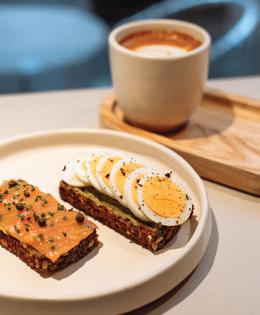
Travelling really opened my eyes to how much variety there can be in everyday eating. In other cities, you find markets, cafes and street vendors that cater to different dietary needs and lifestyle choices – and it feels effortless. At the time in London, that sense of variety was missing. I wanted to create a place that filled that gap.
I want Avobar to be a space where people can find food that feels nourishing and thoughtful, without it being complicated or intimidating.
Balance is something I think about a lot, but it’s not universal – everyone has their own version of it. For me, it’s about what you feed your body, and your habits and routines. But balance isn’t about obsessing or overthinking. It shouldn’t be another source of stress. It should be something that
becomes almost second nature, so you don’t have to constantly measure or calculate it.
Our menu is versatile so that no matter what your day looks like, there’s something here for you. That’s the philosophy behind everything we do.
Avocado is such a recognisable symbol for wellness, but it’s playful and versatile too. But it’s just one ingredient among many. Avocado represents the ethos, not the entirety of it. It’s a reminder that wellness can be fun and flexible.
With a simple, focused menu, the quality of each ingredient becomes incredibly important. We spend a lot of time sourcing, building relationships with farmers and suppliers, making sure the produce, the dairy and the bread meet our standards. It’s not just about
love welcoming people who come as a destination, from all over London and all over the world, but the people who live and work in Marylebone are always at the forefront of our minds.
Q: How does that neighbourhood focus manifest in practice?
A: It’s about being part of the area rather than just operating within it. We do the Christmas lights, we always did the Summer Fayre, and I spend a lot of time walking up and down the high street, meeting residents, chatting to other businesses. As a result, we have a really lovely and varied
taste – it’s about sustainability, consistency and respect for everyone involved in bringing the food from farm to plate.
Avocados have a big environmental footprint if they aren’t sourced carefully. They require a lot of water, and the conditions in which they’re grown really matter. We look for growers who rely on natural rainfall wherever possible –typically those planted at high altitudes – and who treat their workers fairly. It’s about being responsible at every step, from the tree to the kitchen.
Finding peak ripeness of an avocado is an art. It takes practice and attention, a sense of feel and timing. You have to learn to recognise when it’s just at that sweet spot between underripe and overripe. But if the flesh is slightly brown, it’s not wasted. There are ways
group of guests. Some people come once a year, others come once a week – some come every single day. Coming back at all is what matters, because it means we’re doing something right.
There’s nothing like walking through the door and someone saying: “Hello, Mr Smith, how are you? How are the kids?” –that feeling of being recognised and welcomed is everything, particularly in a big city like London. In hospitality, it’s become more difficult over the last few years to retain that level of personal touch, but we’ve worked incredibly hard to do so. We try
to use it in recipes where the colour doesn’t matter but the flavour and texture are perfect.
With coffee, it’s not just the bean that matters – it’s about the entire journey, from sourcing to roasting to handling. We’re lucky to work with fantastic roasters and we’re excited to be launching an in-house micro-roastery for small, limited-edition batches soon. It’s a learning process, but it’s one of the things I love most – coffee is about precision, care and respect for the craft.
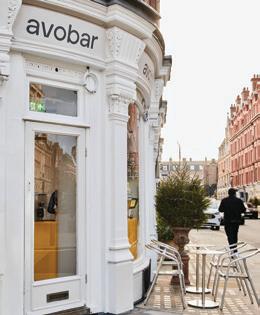
Chiltern Street is the perfect place for us – not just because we know it well, having lived around here – but because it has a real sense of community. It’s a neighbourhood where people live and work, where they spend their day-to-day lives. We wanted Avobar to fit naturally into that rhythm – a little pit stop that feels part of your routine. It’s a space for connection, woven into the neighbourhood fabric.
I love that so many of our guests are repeat visitors: about 80 percent of them come back regularly. That creates a warmth and atmosphere that can’t be manufactured.
AVOBAR
60 Chiltern Street, W1U 7RB avobar.co.uk
to create places where people feel they belong – and that applies just as much to the team as it does to the guests.
Marylebone is a fascinating area because you’ve got long-term residents, people who work locally and people who come through for business or pleasure. Fischer’s has to work for all of them.
Q: How do you strike a balance between staying reassuringly consistent but never gett ing stagnant?
A: It’s not always easy. There’s a core of the menu that simply doesn’t change, because if it does,
there’d be a mutiny! The schnitzels – chicken and wiener – and the sausages as well. The mushroom stroganoff is another one. I took it off the menu once about four years ago and I’ll never make that mistake again! For desserts, apple strudel is essential, as is kaiserschmarrn – the caramelised chopped pancake with cherry compote and crème fraîche. The starters, too: herring, salmon, chopped liver. It’s hearty, proper food done in a classical, nonpretentious way.
We’re consistent, but about a third of the menu changes seasonally and we also run specials to keep things interesting. We’ve got a new head chef, Jensen, who’s been an absolute revelation. He’s taken what was already there and really added to it, building on an already fa ntastic base.
A lot of people eat vegetarian or vegan food now, sometimes for health reasons rather than lifestyle ones. Years ago, vegetarian options were often a real after-thought and I didn’t think that was good enough. So, we introduced a vegan schnitzel using courgette, and we took our most popular dessert – the apple strudel – and made it vegan and dairy-free, without sacrificing flavour or quality. We spent a lot of time working on it. Now, anyone can come to Fischer’s, whatever their dietary requirements.
Q: How authentically Viennese does Fischer’s aspire to be?
A: I’d say we’re probably the most authentic Viennese restaurant in London, possibly even the UK. That extends to everything, including the coffee – wiener coffee and einspänner, which are both types of strong coffee with whipped cream on top. That said, we’re not a museum. We make subtle adaptations for our audience. Austrian guests will sometimes remind me that certain accompaniments – like the jus, for example – aren’t traditionally
NEW
Lírica & Hell’s K itchen London
It’s a big year for The Cumberland hotel with the arrival of two new and very different restaurants. January saw the launch of Lírica, a vibrant Spanish tapas restaurant (pictured above). This will be followed in the spring by the opening of Hell’s Kitchen London, Gordon Ramsay’s global restaurant brand based on the hit TV series. Designed as a high-energy spectacle set around an open kitchen, it will serve up a menu of luxurious classics including wagyu tomahawk, lobster risotto and beef wellington.
THE CUMBERLAND
Great Cumberland Place, W1H 7DL thecumberland.com
served with schnitzel in Austria. That’s more of a German thing. But we’re willing to make those changes if it makes things more accessible. The important thing is that from the moment you walk through the door, there’s a suspension of disbelief. It should feel like a little slice of Vienna, right up until the point you walk back out onto the street.
Q: Guest experience is clearly really important. How do you build a team that delivers that consistently?
A: It’s absolutely crucial, especially now when the choice of restaurants is so wide. Guest experience isn’t negotiable. From how we answer the phone to how someone is greeted at the door, everything is about making their experience as good as it can be.
We’ve worked really hard to retain our team over the last four or five years and that stability makes a huge difference. At the heart of it all
is respect. Those old-school, shouty kitchens should be long gone. It certainly isn’t tolerated here. Everyone deserves respect – guests, team members, cleaner s, everyone. What really motivates me is seeing people develop. There are people all over London now, in different restaurants, bars and hotels, who once worked here. If I can be even one per cent of the reason they went on to succeed, that’s enough for me. I spend a lot of my time trying to bring people up to a level where they don’t need me anymore. I’m essentially trying to make myself redundant.
Q: Finally, what does the next 10 years look like for Fischer’s?
A: Consistency. Slow, considered evolution. And making sure that it’s always about the people. That’s all that really matters.
FISCHER’S 50 Marylebone High Street, W1U 5HN fischers.co.uk
NEW ARRIVALS
A GLASS APART
Nicola Swift of The Ginger Pig on a French red wine chosen to be a perfect match for their dry-aged steak
Interview: Vi el Richardson
At The Ginger Pig, we’ve recently introduced a small collection of wines designed to pair perfectly with our meats. The one we’ve chosen to go with steak is a Lirac from the southern Rhône Valley. It’s a serious, characterful red with real presence, but it’s not showy for the sake of it. There’s depth, spice and weight, without it ever feeling heavy-handed. From the very first tasting, it felt like a wine that really understood food. Choosing this wine took longer than any of the others in the range. There are countless wines traditionally described as steak wines and we tried many of them: Barolo, Bordeaux, cabernet sauvignon, as well as a wide selection of Rhône reds. Working with wine expert Simon Thorpe, we tasted them side by side, always with a steak. Some were delicious but overwhelming, others were technically impressive but too smooth or polished. The Lirac stood out because it struck the balance we were looking for: enough structure and savoury complexity to stand up to a properly dry-aged, well-marbled steak without dominating it. It enhances rather than competes. When paired with our steak, it feels less like a classic ‘big red’ and more like an extra layer of seasoning. Insisting on tasting everything with the food really mattered. Our meat isn’t generic and we didn’t
want a generic match. We’re butchers before anything else and we really care about the meat we sell. We have a very clear set of specifications for how we source and process our meat: animals reared to full maturity, properly dry aged and with a good amount of fat – because fat is flavour. The resulting richness demands something a little different from a pairing; wines that might work beautifully with leaner steaks lacked gusto when tasted alongside our beef. The Lirac has a rugged, peppery edge, dark fruit at its core, and a subtle savoury note that feels almost mushroomy. That combination cuts through the fat, refreshes the palate and still allows you to taste the meat itself.
The aim of our wine collection isn’t to say “you must drink this with our steak” or suggest there’s only one right answer. It’s about fostering confidence and pleasure. If you pick up this bottle together with one of our steaks, you can trust that the pairing works. It simplifies a decision, but it also makes the meal feel more considered, possibly sparking a bit of conversation at the table. In the end, the aim here isn’t to sell more wine; it’s to make the experience of eating our wonderful meat even better.
THE GINGER PIG 8-10 Moxon Street, W1U 4EW
thegingerpig.co.uk
ANATOMY OF A DISH
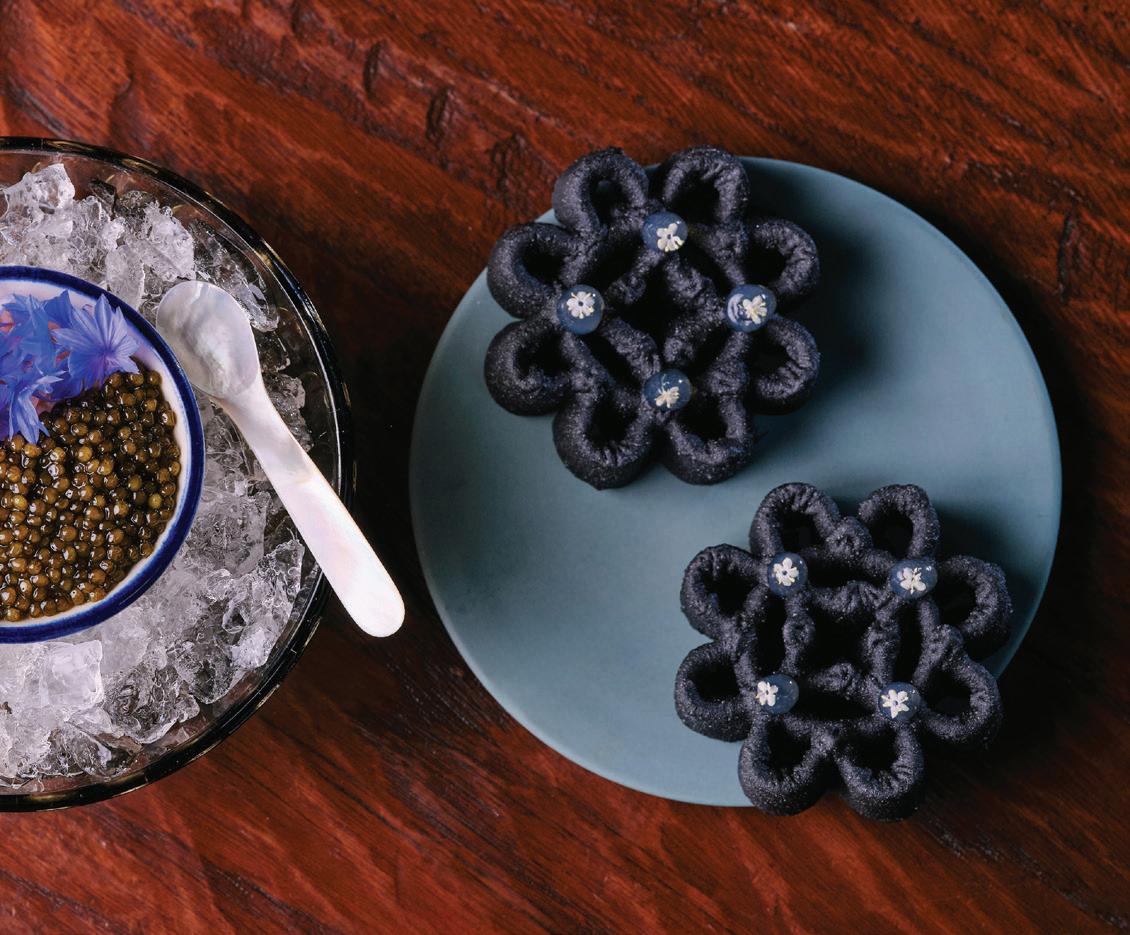
BRIXHAM CRAB, EXMOOR CAVIAR & COCONUT ASH CRACKER
John Chantarsak of AngloThai on a unique interpretation of a traditional Thai snack
Interview: Clare Finney
In a nutshell
This dish is centred on three core ingredients: crab, caviar and coconut. The idea is to highlight both the versatility that exists in Thai cuisine and the creativity of the dishes at AngloThai.
The inspiration
It’s loosely based on a chilli dip found in central and southern Thailand, called lon bpu. Lon is a rich relish that involves ingredients being simmered in fresh coconut milk, then seasoned using flavourings such as fish sauce, citrus juice and sugar. Traditionally this would be spooned onto various crudites, giving contrasting flavours and
texture. At AngloThai, the crab and caviar are paired with a traditional lotus-shaped cracker (khanom dtok jok), stained black with coconut ash powder. This dish sums up what we do at AngloThai, as the flavours, techniques and ingredients mirror those in Thailand but the final dish is an interpretation unique to our restaurant.
The purpose
Served after our opening snack course, the dish is designed to invigorate and tantalise the palate with its combination of rich and fresh flavours. It combines bold flavours and striking presentation while upholding our ethos of working
with the very best ingredients we can source.
The technique
It starts with brown coconuts that we process into coconut milk by extracting, milling and pressing the flesh. We use this to form a sauce with makrut lime, prik kii nu chillies, galangal and local honey, which we use to dress the hand-picked white crab meat. The crab is topped with Exmoor caviar, flavoured with Welsh seaweed and Thai long peppercorns. Served alongside is the jetblack lotus-shaped cracker, filled with an emulsion of brown crab meat and coconut cream. We top the cracker with dots of
elderflower vinegar gel to give brightness and acidity against the other rich flavours.
The secret
This dish showcases the skill of our chefs while also making elevated ingredients accessible to all our guests. I probably didn’t try caviar as an ingredient until I was into my thirties, and I wish more people had the chance to enjoy it without worrying about the cost. Hopefully, we achieve this on our set menu by using it as a key ingredient in this dish.
ANGLOTHAI
22-24 Seymour Place, W1H
Q&A: MARIA LEMOS
The Mouki Mou and M.II founder on her globetrotting style, the art of the shopkeeper, and why ‘luxury’ doesn’t have to be beige
Interview: Lauren Bravo
Q: Tell us about your early life. Where was home?
A: I was born in London, but both my parents are Greek. After they divorced, I moved to Athens with my mum and sister, where we were taught many languages and had an English education as well as Greek. My mother wanted me to be an interpreter; she thought fashion was a waste! It’s very enriching to live between two cultures. It makes you adaptable, less narrow-minded, so I’m grateful for that. We used to drive from Greece to England every summer, and every time we’d take a different route. I remember those trips vividly. It was the biggest education.
Q: Do globetrotters make the most stylish people?
A: “The eye has to travel,” as Diana Vreeland said, and it’s true. The most satisfying part of having a store is travelling to find the beautiful things that you’re going to sell. We go to Japan twice a year and that is
the highlight. It’s so refreshing, to visit another world where quality is key. We live in a world where it’s all about speed and quick money, and Japan is the complete opposite of that.
Q: Did you always have an eye for design?
A: I’ve been obsessed with fashion since my teenage years. It started with music, and pivotal magazines like The Face and iD. My mum took me for an interview at an interpreter’s school in Geneva –trying to lure me! – and I dragged her to Bongénie, the department store, and said: “Please buy me these Gucci shoes.” The university careers advisor knew nothing about fashion. They were like: “Um… Marks and Spencer?” So I went to Paris and got a job for a Greek designer, hanging clothes on racks. I wasn’t even getting paid, but I loved it. I was so happy to be in that world.
Q: You got paid eventually though, working for Sonia Rykiel and John Galliano in the 1980s. What was the industry like back then?
A: It was a magical moment in fashion. The designer world was elitist and inaccessible, but the creativity of those shows was unbelievable, sometimes on a shoestring. It was independent designers – there was no LVMH, no Kering; no monopoly. And oh, the talent! Alexander McQueen, Hussein Chalayan, John Galliano, Issey Miyake, Commes de Garcon, Yohji Yamamoto... the independent stores too, Browns in London, Maria Luisa in Paris, Linda Dresner in New York. It was such an exciting time. Maybe I sound old by saying this, but I often feel that fashion has become commerce. That’s not what drew me in.
Q: You’ve been nurturing emerging designers through your fashion showroom and agency, Rainbow Wave, since 2002. What’s
the piece of advice you find yourself giving most often?
A: It’s definitely much harder to launch a brand today than it was 20 years ago. Big brands dominate the landscape and provide very little room for young talent. And the young talent can’t survive without awareness, but they can’t fund a massive marketing machine – it’s a vicious circle. The most important thing is understanding who your customer is. Who are you trying to reach? When I started the showroom, I used to have to lock myself in the shed to force myself to do all the bookkeeping. I hated it so much! But now, I find it the most interesting part of the business. I think it can be really creative, figuring out what to do differently next time. I love going into the stockroom at the end of the season and saying: “These are my mistakes, staring me i n the face.”
Q: What do your mistakes look like?
A: Sometimes the customer I thought existed just didn’t arrive. But, you know, they might still come a year later. What’s difficult in fashion is the short shelf life the industry gives to these beautiful things. If someone’s made the most beautiful coat, why does it have to sell in only two months? I love brands like Extreme Cashmere, which never goes on sale, or Arts & Science, which makes classics that endure. The world is not rewritten every six months, so our customers are not going to come here and find a totally new store. Wardrobes shouldn’t be renewed every six months. It should be a lot more thoughtful, rather than “bin that, buy new”.
Q: In our increasingly visual, digitally driven world, is there a disconnect between what looks good online and what feels good to wear?
A: One hundred percent. Of course we’re drawn to brands
with an amazing image, but the proof is in the store. When our customers try things on, they’re so knowledgeable. They can tell if something is well-cut, if that fabric is nice to touch, if it washes well. We have to be stringent in our selection. There’s a brand – I’m not going to say which one! – whose imagery I love, but we’ve stopped buying it because the clothes only look amazing on one body type. So yes, online presence can help, but it has to come back to the actual product: the cut and the cloth. The biggest part of our business is the physical stores, because you can’t replace human contact. Our customers come in for the team and their expertise, as well as for the beauty of the shop.
Q: You opened Mouki Mou in Marylebone in 2013. What inspired the jump from wholesale to retail?
A: There were all these designers from overseas that I loved and I couldn’t understand why they weren’t being sold in London. So it grew organically from the things I always bought when I travelled, giving them a physical presence here. And the shop was very small, which was good because it meant we could grow slowly. It wasn’t too terrifying. Working in retail made me better at the wholesale side of the business, and knowing the wholesale side definitely helped the reta il side too.
Q: What made Chiltern Street the perfect fit?
A: I first visited to go to the Trunk boutique – and it was instant love. I was like, oh my god, it’s central London but this street feels like a village! I loved the buildings, I loved the feeling. So I went to The Portman Estate to ask if there was anything available. They had number 29, which was a very difficult store to rent because it’s tiny upstairs and has a warren of rooms below. I said yup, I’ll take it!
Q: How has the neighbourhood c hanged since?
A: It’s amazing. It’s changed a lot in the last couple of years particularly. Marylebone High Street is the anchor – it has such a good mix of bigger brands and smaller brands. Then you have the villagey atmosphere with La Fromagerie, The Ginger Pig, Flowers Flowers Flowers. They’re my daily go-tos. And the like-minded stores: Perfumer H, Niwaki, Labour and Wait, Shreeji News, CaseleyHayford… so many! I love everyone on Chiltern Street – it’s a real community of shopkeepers, which is invaluable. We all help each other.
Q: You love the street so much that last year you opened a second store, M.II , just a few doors down from Mouki Mou. But it’s not exactly a menswear counter part, is it?
A: The idea developed to be more about younger people, and about unisex dressing. Quite a few of our brands don’t use gendered sizing in the traditional sense, and I find that liberating. Just try the clothes on, look at your body and understand what works for you. But in the beginning, people found it very confusing. Men particularly were like: “Where is the men’s section?”
“What’s difficult in fashion is the short shelf life the industry gives to these beautiful things. If someone’s made the most beautiful coat, why does it have to sell in only two months?”
Q: Because the worst thing men can imagine is accidentally wearing women’s clothing…
A: It really is! We’ve changed our mix gradually, but we have given this store more of a masculine edge and the original store more of a feminine edge. It encourages people to shop both. It’s more fluid; the dark and the light.
Q: How do you want people to feel when they step into your stores?
A: Comfortable. That’s what I tell my team, everyone is welcome. There are very expensive, beautiful items, but someone can also walk away with a Greek soap or a
£20 shower gel. And I don’t care if people just browse and buy nothing. That’s what we’re here for – inspiration, a beautiful moment. I hate a hard sell, it’s the most off-putting thing a shopkeeper can do. But I do think we need to be storytellers, sharpening our knowledge of every single product. We’re ambassadors for all these craftspeople. We’ve hosted special trunk show days, and it’s amazing seeing our customers interact with the makers. That’s what people want! They want to be involved in the process, and then they can understand how something is made and why it’s expensive. >
The original Mouki Mou store on Chiltern Street
Q: Do you identify with the cult of quiet luxury, or can great style somet imes be loud?
A: I think fashion’s about to jump off quiet luxury, which I’m very happy about. I don’t think that ‘tasteful’ needs to mean beige. How we dress is the biggest statement about who we are, and playing with our clothes is how we renew ourselves and express ourselves to other people. I’m quite a minimalist myself, but I believe luxury can mean so many things, like the luxury of the handmade. We sell hand-embroidered shawls by Yaser Shaw that are made in Kashmir, and they cost between £1,500 and £2,000 – but it takes one man
more than a year to make one. I’d rather my money goes to them than somewhere else, and I can play a part in preserving that skill.
Q: Tell us a few more stories…
A: We’ve recently sta rted selling the British jeweller Shola Branson – he’s a real talent, creating something unique. The Japanese brand Taiga Takahashi is incredible, inspired by vintage Americana, and another called Niceness that takes American references and reworks them with incredible fabrics. It’s casual dressing, but not as we know it. Another is Diffar, which makes natural scented hair oils in
beautiful colourful bottles, each label printed with the number of tries it took to perfect the fragrance blend. Then there’s Unkruid, a duo from Antwerp, who are working with incredible textiles. A lot of our young designers now are using vintage cloth, ends of lines, or weaving their own in very small batches. That’s the future. That’s what we’re excited about.
MOUKI MOU
29 Chiltern Street, W1U 7PL
M.II
17 Chiltern Street, W1U 7PQ moukimou.com
The new M.II boutique, which has a focus on unisex dressing
TARTAN ARMY
A striking suit from agnès b. inspired by punk and new wave
Agnès b. returned to the Paris catwalk in January with a strong menswear collection for Winter 2026. Agnès is known for her timeless chic and elegant designs, creating clothes that don’t go out of fashion and can be worn forever. She takes inspiration from many different cultures, with Anglo-Saxon music, especially the punk and new wave eras, being a particular influence. Music is such a big part of the agnès b. culture that the company even has its own r adio station.
Designed at the atelier in Paris this suit is classic agnès b. The tartan look has always been very important to Agnès. She has used it in collections in the past and it’s always popular with customers and musicians. Here the checked pattern fabric, rooted in punk but with a nod to the Rastafarian culture she loves so much, is styled in a modern way to create a truly contemporary look. It can work either as a suit or as separates – the jacket with a pair of black skinny jeans or just the trousers with a simple black shirt. It would suit somebody who likes to look cool while making a little statement about their personality.
AGNÈS B.
40-41 Marylebone High Street, W1G 6PS agnesb.com
FLORAL SILK SCARF SANDRO, £149 sandro-paris.com
NOVA RING KIMAI, £2,995 kimai.com
DOSA FRAULEIN DRESS MOUKI MOU, £895 moukimou.com
BAG LA PORTEGNA, £605 laportegna.com
CREPE DE CHINE BLOUSE BRORA, £225 broraonline.com
HELGA SHORT WOOL COAT SOEUR, £495 soeur.uk
JON WHITE CHELSEA BOOTS TRACEY NEULS, £425 traceyneuls.com
SILK
ISABELA
SPECIALISTS IN
FREEHOLD MANAGEMENT
TALL BUILDING COMPLAINCE
PRIVATE GARDEN MANAGEMENT
MANAGEMENT “LITE”
SERVICE CHARGE ACCOUNTING
SALES & LETTINGS
RUNNING TOPS
Winter is melting away –in theory, at least – and with it, any remaining excuses not to lace up your trainers and get outside for a run. Yet where to find that final incentive? For some, it’s the pursuit of a personal best or support for a particularly worthy cause. For the more superficial among us, it’s a new bit of kit to add to our collection. Fortunately, you’re in the right place in Marylebone, which is as replete with running gear as it is beautiful places to run. Here’s our pick of the most motivational r unning tops.
EATON DAISY WATER RUNNING JACKET SEALSKINZ, £150 sealskinz.com
’Tis the season of showers and flowers, and you can relish both sides of that coin with this daisy-covered running jacket – as technically sound as it is stylish. The daisies aren’t just for show: they’re reflective too, while the material is water -repellent, breathable and sweat-wicking, keeping you dry both outside and in. Last but by no means least, for those who take pleasure in such details, it can be packed away into its own pocket and the sleeves have thumbholes.
CASPER SEAMLESS TEE VARLEY, £70 varley.com
In the hope that at least some days will warrant short sleeves this spring, it’s worth having a comfortable, stylish t-shirt in your running wardrobe. Available in black or white, the soft, slightly textured material that makes up the Casper boasts an impressive-sounding four-way stretch and is crafted without seamlines to prevent chafing. It is perfectly fitted, being tight and long without being clunky, making it perfect for styling with leggings on a cloudy day, and shorts at the first glimpse of sunshine.
3.
VAN CORTLANDT LONG SLEEVE TRACKSMITH, £90 tracksmith.com
Look like a winner before leaving the house with Tracksmith’s Can Vortlandt Long Sleeve, named after a park in the Bronx, which now comes complete with victory-like sash across the front. As a running top, it ticks all the boxes: lightweight, antimicrobial and loose enough to allow freedom of movement. Perfect as a single layer or as a base, so ideal for those ‘in-between’ days that are as much a hallmark of spring as the bounding hare with which the top is endearingly embroidered.
ANATOMY OF A DESIGN
TEKLA SCENTED CANDLE HOLDER
Acclaimed Irish ceramic artist Sara Flynn on a beautiful, reusable candle holder created in collaboration with Tekla
Interview: Viel Richardson
Requirement
When Tekla invited me to collaborate with them on creating a functional object designed for large-scale production, it required a bit of a shift in my thinking. My skills as a ceramicist have been developed through decades of making one-off sculptural forms. However, this object needed to be not only expressive and beautiful but work flawlessly as a candle holder. Function therefore became the grounding force of the design.
From the outset, there were some non-negotiable parameters: the internal dimensions required for a clean, even burn; the size of the candle; and the ease with which the candle could be inserted, removed and cleaned. These constraints dictated the scale, proportion and internal structure of the piece. I treated these requirements as the foundation from which the form of the piece would grow. Our aim was to create a candle holder in which function and form are inseparable, resulting in an object that is easy and intuitive to use but still beautiful in its own right.
Inspiration
In my sculptural work, the process is driven by my relationship with the material. The core shape is made on the potter’s wheel. That initial form provides the grounding structure, from which the work is then cut, pushed, pulled and altered by hand. It is in that moment of manual
intervention, when a simple vessel becomes something more sculptural, that my language as a maker emerges. For this project, the same approach applied, with the functional requirements acting as the fixed points from which the imagination could grow. Once the internal parameters were clear, the outer form was free to develop around them. Another important source of inspiration came from scent. The three different fragrances chosen by Tekla anchored ideas around tone, colour and surface texture, helping steer the visual language – a genuinely collaborative part of the process.
Process
Each piece began as a hand-thrown object in my studio. These originals were refined, tested and adjusted before the process was moved to the factory. Once a form was agreed upon, it was scanned and then 3D-printed to create a physical object. This allowed
“There is sometimes a perception of hierarchy within clays, with porcelain positioned at the top, but the choice here was never about that.”
close examination and precise adjustments, sometimes by just a millimetre or two. After this, moulds were produced and the pieces slip-cast in porcelain. The object then moved through many hands and departments, from casting and fettling to glazing, firing and finishing. Each stage required clarity and shared understanding to ensure the integrity of the original form was maintained.
Glaze development was particularly intensive, and the surface quality, colour depth and surface feel were refined through repeated trials, allowing us to achieve finishes that balanced depth of colour with a tactile softness. The result is an object shaped not by a single moment of authorship, but by an ongoing dialogue between hand, material, technology and collective expertise.
Materials
Porcelain was the perfect material for this project because of its combination
of fine structure and strength, which allows for real precision of design. Fired at high temperature, it vitrifies, becoming dense and non-porous. This gives the object a level of durability suited to repeated use and allows for sharp definition, particularly at the rim where the interior vessel meets the exterior sculptural form. Achieving a clean, accurate junction at this point was critical to both function and visual resolution. There is sometimes a perception of hierarchy within clays, with porcelain positioned at the top, but the choice here was never about that. Porcelain was simply the right material for this object, offering the clarity, precision and longevity the design demanded.
Philosophy
From early on, it was clear that Tekla and I shared similar values: a commitment to quality, respect for materials and a willingness to take time over a project. The focus was
on creating something that would last, something that would sit naturally in people’s lives. The collaboration felt comfortable and supportive. I was trusted to bring my own language as a maker, while Tekla brought their expertise in scent, tone and atmosphere. Decisions were made through conversation and testing, allowing my very personal, handmade practice to be translated into an object that could be produced at scale without losing its integrity.
Ultimately, the scented candle holder is intended to become part of people’s lives, part of their daily environment, rather than existing as a fixed sculptural object. That sense of connection – of an object finding its own place over time – sits at the heart of both my approach and Tekla’s. That’s why this project felt so right.
TEKLA 10 Marylebone High Street, W1U 4BT teklafabrics.com
FACIAL CARE
OH MY CREAM SKINCARE PLUMPING OIL OH MY CREAM!, FROM £15 ohmycream.co.uk
UNSCENTED LIP BALM LE LABO, £18 lelabofragrances.com
FENTY SKIN FAT WATER HYDRATING MILKY TONER ESSENCE SPACE NK, £29 spacenk.com
EXALTED EYE SERUM AESOP, £83 aesop.co.uk
BOTANICAL CLEANSING BALM ANATOME, £38 anatome.co
INSIUM BEAUTY MASK JOHN BELL & CROYDEN, £85 johnbellcroyden.co.uk
Personalised,
CLINIC 80 HARLEY STREET
The One-to-One Dental Clinic offers a concierge-style service, combining top-tier dentistry with a 5-star experience With the ethos
“We don’t treat teeth, we treat people,” the practice features modern facilities including f iltered air, a CBCT scanner and an in-house dental lab to enhance patient care
The team’s expertise spans all areas of dentistry - from prevention and routine care to full mouth rehabilitation and jaw reconstruction for implant placement
The clinic emphasises holistic, conf idence-boosting care, offering a full range of routine and complex treatments such as implants, invisible braces, bridges, crowns, veneers and complete smile makeover
From the initial consultation, every procedure is delivered with precision, using the latest technology and premium materials to ensure exceptional results
TEST OF TIME
Dr Khurum Khan, consultant medical oncologist at The London Clinic, on how genomic testing is changing the face of cancer treatment
Interview: Vi el Richardson
Q: Many people will have heard of genetic testing. How are genomic tests different from the ones patients are more familiar with?
A: The term ‘genetic testing’ usually leads people to think in terms of inherited conditions that are passed down through families. But that is actually a relatively small part of cancer genetics. What we’re talking about here is somatic mutations – changes that develop over time in the cancer tumour itself. These account for around 95 percent of the genetic abnormalities we see in cancers.
Our normal genetic tests tend to focus on a limited number of well-known mutations that are common in a particular cancer and have an approved treatment attached to them. Extended genomic testing goes much further. It looks at a much larger number of genes, including rare mutations that may not usually be associated with that cancer type but could still be clinically important. The key difference is scope. Extended genomic testing asks: what is really driving this indiv idual cancer?
Q: When in a patient’s cancer journey would you typically recommend this kind of testing?
A: I think about extended genomic testing at two key stages. The first is right at the start, when someone is diagnosed with advanced or metastatic cancer. At that point we want to understand as much as possible about the biology of the cancer. The test is usually carried out alongside the initial planning and it does not delay therapy. The aim is to have that genomic information available from the outset, even if it doesn’t immediately change what we do. The second point is later on. If a cancer stops responding to standard treatment, or behaves in an unexpected way, we may test to see whether the tumour has changed at a genetic level. Some cancers acquire new mutations over time, and occasionally
those changes open up different treatment options. The common thread is usefulness. The test is done when the information it provides has the best chance of guiding our decisions.
Q: Are there other benefits to extended genomic testing, even if the results do not immediately change the course of treatment?
A: One of the most important benefits is that it gives us a far more complete picture of what is driving that person’s cancer. Even if the test doesn’t identify a mutation that changes treatment straight away, it still adds valuable information about the tumour’s biology, which may become relevant later, if the cancer changes or new treatments become available. There is also a broader benefit: each time we do this kind of testing, we add to the collective understanding of cancer genetics. Many cancers are described in terms of a handful of common mutations, but that is partly because we simply haven’t looked widely enough. By using extended tests, we identify rare mutations that may turn out to be important for fut ure patients.
Q: How do you help patients understand the potential benefits and the realistic limitations?
A: I think honesty and transparency are essential. When I discuss extended genomic testing with patients, I’m very clear that there’s only around a 20 percent chance that the results will directly change their treatment, so I don’t set unrealistic expectations. At the same time, I explain why we still consider the test worthwhile. For a small number of patients, identifying a rare mutation can make an enormous difference, sometimes completely changing their outlook. And for the rest, the test still helps confirm that the current treatment approach is appropriate. I also make it clear that doing the test does not mean
putting everything on hold or pinning all hope on the result. Treatment plans are made as they normally would be, and this genomic information is there to support decisions, not replace them.
Q: These tests involve complex science. How do you ensure patients feel confident rather than overwhelmed?
A: I try to explain things in clear, straightforward language and be very open about what the test may or may not tell us. I also break the discussion into manageable parts. We talk separately about whether the test might affect treatment, whether it has any implications for inherited risk, and what it means if nothing actionable is found. Even when the test does not lead to a change in treatment, patients often feel more settled knowing that no important options have been missed. Just as importantly, I try to shield patients from unnecessary stress. Much of the administrative and insurance process happens in the background, so patients can focus on their treatment.
Q: In these tests, you make use of liquid biopsies. How do they compare with traditional tissue biopsies?
A: A liquid biopsy is a blood test that looks for fragments of tumour DNA circulating in the bloodstream. Traditionally, to analyse a cancer’s genetics we would need to take a tissue sample directly from the tumour, which can involve highly invasive procedures. From a patient’s point of view, the main advantage of a liquid biopsy is that it is far less invasive. It’s simply a blood test, which carries minimal risk. When used at the right moment, they offer a safe, effective and much more patient-friendly way of understanding the genetic makeup of a cancer.
Q: You were involved in research validating the efficacy of >
“In the future, it may matter less whether a cancer began in the bowel, pancreas or lung and more whether it carries a particular mutation that can be targeted. That is truly personalised medicine.”
reason to believe the cancer may have changed genetically. Used at the right time, it is a very effective test, but used at the wrong time, it may not give useful information.
Q: Extended genomic tests can be expensive and are not routinely available on the NHS. How do you approach discussions about cost and fairness when advising patients?
Q: Could wider access to genomic testing help patients who may not be able to afford private treatment?
liquid biopsies. How did that contribute to their use in routine cancer care today?
A: Earlier in my research career, liquid biopsies were still largely experimental. At that time, we were taking solid tumour biopsies while also analysing blood samples from the same patients. The aim was to see whether the genetic information from blood matched what we found in tissue. That work helped show that liquid biopsies could provide comparable information without the need for invasive procedures. Although many of those early patients did not benefit directly, the research was essential in establishing liquid biopsies as a reliable tool. Today, that evidence means we can use a simple blood test to gain important genomic information in routine cancer care.
Q: Are there situations where a liquid biopsy may not be suitable?
A: The main limitation of a liquid biopsy is timing rather than safety. If the test is done after chemotherapy has started, the amount of tumour DNA in the blood can be temporarily reduced, which increases the risk of a negative or misleading result. That’s why we usually aim to do the test before treatment begins. Repeating a liquid biopsy later is only done selectively, when there is a clear
A: It’s very important to be open and realistic about cost from the outset. These tests can be expensive and usually have to be paid for through insurance, so they are not equally accessible to everyone – it would be wrong to gloss over that. When I discuss genomic testing with patients, I explain clearly what the test costs, what may or may not be covered by insurance, and how likely it is to influence their care. I also try to be fair in weighing up the potential benefit. I would not encourage a patient to pursue an expensive test unless there was an extremely strong rationale. Ultimately, my responsibility is to help patients make an infor med decision.
Q: What is The London Clinic doing to improve access to genomic testing?
A: At the moment, The London Clinic is able to offer most of the available commercial genomic panels, allowing patients access to the same tests used internationally. However, these are largely run by external laboratories, often overseas, which adds to cost, legal complexities and turnaround time. I am privileged to be working in partnership with Northwestern University in Chicago to develop in-house genomic testing at the London Clinic, which could significantly reduce costs. It would also shorten turnaround times and allow us to build our own genomic database, improving continuity of care and helping guide future treatment and research.
A: Yes, even if patients cannot afford private treatment, having access to genomic testing can still be extremely valuable. The test may identify a mutation that makes them eligible for a clinical trial, either within the NHS or at another centre. Without that genomic information, those opportunities might never be identified. In some cases, patients who are treated privately may move into the NHS specifically to take part in a trial. The test gives patients knowledge about their cancer that they can carry with them, regardless of where they ultimately receive treatment. In that sense, access to genomic testing can open doors, even when treatment itself is not privately funded.
Q: Looking ahead, how do you see genomic testing shaping the future of cancer care?
A: Cancer care is gradually moving away from treating disease purely based on where it starts in the body, towards treating it based on the genetic changes that are driving it. In the future, it may matter less whether a cancer began in the bowel, pancreas or lung and more whether it carries a particular mutation that can be targeted. That is truly personalised medicine. We are already seeing this in a small number of cases, where patients with a specific genomic abnormality benefit from the same treatment regardless of cancer type. As genomic testing becomes more accessible and affordable, this personalised approach is likely to expand. Ultimately, it allows us to match the right treatment to the right patient more precisely, increasing the chance of a positive outcome.
THE LONDON CLINIC 20 Devonshire Place, W1G 6BW thelondonclinic.co.uk
Premium Shor t-Let Management & Lo cal Exp er tise
Pass the Keys is the UK’s leading shor t-let management company, of fering a discreet, fully managed ser vice across the UK and Spain Combining national scale with bespoke local exper tise, each proper ty is overseen by a dedicated local par tner From beautifully curated listings and dynamic pricing to diligent guest vetting and immaculate care, Pass the Keys delivers ef for tless ownership and exceptional stays, setting a new benchmark for luxur y shor t-let living
Ref ined Management Remarkable Results
As the dedicated local par tner for Mar ylebone and Mayfair, Anastasiia Kokoshynska brings unmatched exper tise and personal care to ever y proper ty she oversees With deep knowledge of the area ’ s heritage, lifestyle, and international clientele, she ensures each home is positioned and managed to the highest standard maximising returns while preser ving the integrity of the proper ty She brings a ref ined, results-driven approach that protects your asset and maximises returns
Beyond daily operations, the ser vice is designed to protect and enhance each proper ty’s long-term value Professional photography, compliance guidance, seamless guest communication, housekeeping, linen management, and proactive maintenance coordination are all handled with precision and care Performance is continuously monitored and optimised, giving homeowners complete transparency, conf idence, and peace of mind
In prime central London, this local approach is especially indispensable Mar ylebone, one of the most prestigious neighbourhoods, demands meticulous precision, absolute discretion, and a deep, nuanced understanding of both market dynamics and the discerning guest prof ile
Eff iciency and Excellence
End-to-end short-let management
Professional listings creation and dynamic pricing
Guest screening, check-ins, and 24/7 support
Hotel-quality cleaning, linen & essentials
Maintenance, compliance, and local regulation support
MARYLEBONE MEWS, MARYLEBONE VILLAGE, LONDON W1G
A rare opportunity to acquire a virtual freehold Mews building in prime Marylebone Village.
The property comprises an attractive period building arranged over lower ground, ground and first floors, enhanced by the rare benefit of an integral garage. This versatile space could readily be reconfigured as additional office or medical accommodation, subject to the necessary consents, offering excellent flexibility for a wide range of occupiers and is located between Welbeck Street and Wimpole Street.
Brochure available on request.
Leasehold £4,000,000
This unique top floor two bedroom apartment located on Marylebone High Street.
A bright newly refurbished two-bedroom apartment located on the top floor with lift in the heart of Marylebone Village. The accommodation comprises of two double bedrooms, reception room, bathroom and separate kitchen.
The building is ideally located on Marylebone High Street with its fabulous restaurants, bars and high end boutiques. Bond Street Underground Station is a short walk away with Regents Park also nearby.
feel at home with us.
we’re here when you’re ready.
Thinking of selling or letting?
With nine offices across central London, from Marylebone to Barnes, our local experts are ready to help. Pop into your nearest branch or scan the QR code to discover the value of your home.
Private Health & Fitness Studio in the
Private Health & Fitness Studio in the heart of Marylebone
& Fitness Studio in the heart of
Look, feel and perform at your best with science led, coaching based training in a discreet gym environment, minutes from your office or home. Tailored to the schedules of London's busiest professionals.
Look, feel and perform at your best with science led, coaching based training in a discreet gym environment, minutes from your office or home. Tailored to the schedules of London's busiest professionals.
Look, feel and perform at your best with science led, coaching based training in a discreet gym environment, minutes from your office or home. Tailored to the schedules of London's busiest professionals.
Look, feel and perform at your best with science led, coaching based training in a discreet gym environment, minutes from your office or home. Tailored to the schedules of London's busiest professionals.
Look, feel and perform at your best with science led, coaching based training in a discreet gym environment, minutes from your office or home. Tailored to the schedules of London's busiest professionals. Transform Your
Look, feel and perform at your best with science led, coaching based training in a discreet gym environment, minutes from your office or home. Tailored to the schedules of London's busiest professionals.
Look, feel and perform at your best with science led, coaching based training in a discreet gym environment, minutes from your office or home. Tailored to the schedules of London's busiest professionals.
Look, feel and perform at your best with science led, coaching based training in a discreet gym environment, minutes from your office or home. Tailored to the schedules of London's busiest professionals.
Transform Your Body with Personal Training, Yoga & Pilates.
Transform Your Body with Personal Training, Yoga & Pilates.
Transform Your Body with Personal Training, Yoga & Pilates.
Transform Your Body with Personal Training, Yoga & Pilates.
Fix What Hurts with Physio, Osteopathy and our Recovery Zone.
Fix What Hurts with Physio, Osteopathy and our Recovery Zone.
Transform Your Body with Personal Training, Yoga & Pilates.
Fix What Hurts with Physio, Osteopathy and our Recovery Zone.
Increase Your Energy with Nutrition & Sleep Coaching.
Fix What Hurts with Physio, Osteopathy and our Recovery Zone.
Increase Your Energy with Nutrition & Sleep Coaching.
Increase Your Energy with Nutrition & Sleep Coaching.
Transform Your Body with Personal Training, Yoga & Pilates. Fix What Hurts with Physio, Osteopathy and our Recovery Zone. Increase Your Energy with
Fix What Hurts with Physio, Osteopathy and our Recovery Zone.
& Sleep Coaching.
Increase Your Energy with Nutrition & Sleep Coaching.
Support Your Team with a Corporate Membership.
Support Your Team with a Corporate Membership.
Support Your Team with a Corporate Membership.
Increase Your Energy with Nutrition & Sleep Coaching.