Design That Takes Flight

Page 1


AVIATION & TRANSPORTATION

Design That Takes Flight

Designing for aviation means solving complex, multifaceted challenges with interdisciplinary insight. While practical functionality is the foundation of every successful project, we believe great design also delivers exceptional service, seamless coordination, and the flexibility to meet future needs—all without compromising the traveler’s experience.

Every journey deserves a remarkable beginning.
Brian Bresg AIA Aviation + Transportation Sector Leader

excellence since1963

LS3P is an architecture, interiors, and planning firm celebrating more than 60 years of design excellence. LS3P operates from its 12 offices in North Carolina, South Carolina, Georgia, and Florida, providing its clients the expertise and resources of a large firm with the local knowledge and personal connections of a small firm. We are deeply committed to the communities we serve, with over 675 design awards in diverse practice areas.

At our core, we are a design firm, dedicated to contributing our best to our projects, our clients, and each other with integrity and passion. We engage people in the process of architecture to create outstanding places to live, work, and play. Our broad range of expertise allows us the ability to create innovative solutions, and to provide expertise to address the complex programs of today’s design projects.

40+ Years

Aviation Design & Planning Experience

14M SF

Aviation Infrastructure Work Last 20 Years

75+ Projects

Aviation Projects Nationwide

engage

Transportation is about creating opportunities — opportunities for work, pleasure, excitement, discovery, and connection. We believe that aviation and transportation design should embrace these possibilities, enabling efficient, seamless, and welcoming travel experiences for journeys of any distance. Every project is unique, and we are committed to working closely with you to deeply understand your goals, vision, and parameters — long before we draw the first line.

design

We bring deep expertise, proven experience, and cutting-edge tools to create environments that balance operational efficiency with an enjoyable passenger experience. We understand that every project is unique, which is why we collaborate closely with you to fully understand your goals, vision, and constraints before putting pen to paper. Designs for aviation and transportation must be multimodal, interconnected, and highly functional — but we believe they should also inspire.

transform

We understand that airports often serve as the “front door” to a region — and that first impressions matter. Design excellence influences not only how we feel within a space, but also our mindset upon arrival.

That’s why we create environments that elevate the traveler’s experience — transforming a journey from simply “getting from point A to point B” into something memorable and meaningful.

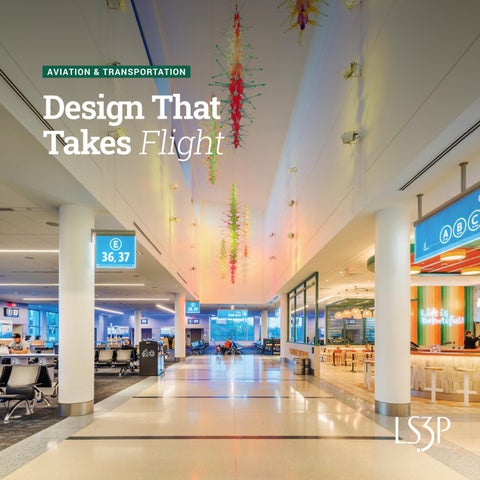
Charlotte’s Concourse E, completed in 2003 with 19 gates, has grown through three LS3P-led expansions over 12 years, adding 12 gates for a total of 31.

The final Phase 9 expansion introduced a 38,000 SF node with 10 more gates, two concession spaces, American Airlines offices, and an employee breakroom. Completed in November 2021, it marked nearly 15 years of successful collaboration between the Airport and LS3P.

With the completion of Phase 9, Concourse E stands as a fully realized destination — marking the end of a long journey of growth and transformation. What began as a modest regional terminal has evolved into a vibrant, modern concourse that reflects Charlotte Douglas International Airport’s commitment to passenger comfort, operational efficiency, and architectural excellence.

The design features 12-foot metal ceilings with integrated lighting, efficient HVAC, powered seating, and a central feature bar. Clerestory light wells bring natural light into circulation areas, while soft seating with charging stations and workstations enhances comfort. These upgrades expand capacity and create a welcoming space that feels like a destination.

The Concourse C Interior Renovation was part of a multi-phase terminal modernization program across all five concourses at CLT. Floor, wall, and ceiling finishes were updated with modern materials, while new technology amenities were introduced to enhance accessibility for travelers. Additional features were also integrated to promote passenger safety.

Designed in association with The Wilson Group Architects, these stateof-the-art finishes and amenities supported intuitive wayfinding and functional identification within the airport environment. They were designed to be low-maintenance, highly durable, and cost-effective. Renovations were completed while the terminal remained fully operational.

As a precursor to this project, LS3P collaborated with two other design firms to develop CLT’s design guidelines and finish standards that are currently being used to renovate all existing facilities and on future concourse developments.

The West Gate Expansion at Charleston International Airport was led by a collaborative design team from LS3P and Corgan, working in close partnership to deliver a strategic enhancement to the Terminal Development Program (TDP). This initiative was developed to increase gate capacity and elevate the passenger experience, aligning with the Charleston County Aviation Authority’s long-term vision for sustainable growth and modernization.

At its core, the expansion introduced temporary West Gates to accommodate rising passenger volumes while maintaining uninterrupted airport operations. The project demanded precise coordination, active stakeholder engagement, and thoughtful design execution.

LS3P and Corgan focused on four key goals: fast-tracked delivery using proven strategies, phased construction to ensure operational continuity, design excellence that reflects Charleston’s regional character, and a stakeholderdriven approach that meets the needs of travelers, tenants, and airport staff.

This renovation of a 1980s-era Federal Inspection Services (FIS) facility at Charleston International Airport involved an accelerated schedule, strict security requirements, and a constrained footprint. With less than five months from design to Substantial Completion, the project was fasttracked to accommodate a new direct international flight between Charleston and London. Post-9/11 security regulations prohibit partial renovations of FIS facilities, so the building was fully updated to meet current regulations and the detailed requirements of each space. LS3P validated the program’s feasibility within the existing footprint and worked closely with Customs and Border Protection (CBP) to align the program with all regulatory standards.

Key functions include primary and secondary processing, detention facilities, and office space. The design modernized the facility with Charlestoninspired artwork spanning tall columns, strategic lighting to brighten enclosed areas, and interior finishes that add texture and visual interest in a serene color palette.

Terminal Capacity Enhancement

MYRTLE BEACH, SC

Myrtle Beach International Airport

Growing aviation demand in the Grand Strand area led to the need for expanded capacity and improved service at Myrtle Beach International Airport. LS3P, in partnership with Giuliani Associates Architects, led the design and delivery of a comprehensive capacity improvement program.

Key upgrades included a new 240,000 SF terminal and concourse—doubling the number of gates from 7 to 13— along with renovations to the existing terminal façade, a new passenger boarding bridge, terminal apron reconstruction, Taxiway ‘A’ expansion, a rental car customer service facility with canopy, and a covered exit plaza with employee amenities.

Design priorities focused on intuitive passenger flow, clear wayfinding, system upgrades, code compliance for wind and seismic criteria, and secure separation between passengers and the public.

Blue and green glass and metal panels reflect the coastal and golf-rich character of South Carolina’s Grand Strand.

Trident Technical College

Aeronautical Training Center

NORTH CHARLESTON, SC

The new Training Center is a 164,000 SF facility on a 67-acre site at the school’s Enterprise Campus, offering specialized training for the future aeronautics workforce and continuing education for industry professionals. Each of its three floors serves a distinct purpose: the first floor features academic and hands-on avionics training, including aircraft assembly,

mechatronics, and automation engineering, alongside a 60,000 SF aircraft ramp, two high-bay hangars, and a full-scale Boeing 787 barrel section. The second floor includes 25 specialty labs and six flex-space labs for advanced skills in metrology, CNC machining, aeronautics, additive manufacturing, and nondestructive testing, serving both students and

the current workforce. The third floor is dedicated to Boeing and readySC training programs, including aircraft maintenance re-certification. Inspired by cutting-edge aeronautics, the building’s sleek, streamlined design uses monochromatic neutrals with bold accents, dynamic floor patterns, and upward-sweeping ceilings that evoke jet trails and wing tips.

Pensacola International Airport

Project Titan Hangar 3

PENSACOLA, FL

Project Titan MRO Hangar 3 involves the construction of a state-of-theart aircraft maintenance hangar, designed to enhance the operational capacity of the MRO complex. The hangar will provide additional space for maintenance activities, thereby improving efficiency and reducing

turnaround times for aircraft servicing. MRO Hangar 3 features two bays specifically designed for wide body aircraft, equipped with advanced maintenance tools and technology. The facility will also include administrative offices, support services centers, and necessary infrastructure such as

Confidential Client

Corporate Hangar

CONCORD, NC

This high-profile design-build project at Concord-Padgett Regional Airport, developed by LS3P for a corporate client, showcases our ability to deliver complex aviation facilities under tight timelines and high design standards. A thorough site analysis led to a phased construction approach, evaluating both pre-engineered and traditional steel

systems. The final design included a steel frame with precast cladding, storm shelters, and enhanced security for executive transit and emergencies.

To meet the aggressive schedule aligned with the client’s campus opening, the team fast-tracked delivery by splitting the project into multiple permitting packages, enabling

early site work and rapid vertical construction.

Although construction was halted, the project remains a strong example of strategic planning and execution.

Confidential Client

Corporate Hangar

CHARLOTTE, NC

This single-story, 45-foot tall hangar designed for a confidential corporate client accommodates four Citation

Latitudes in 37,200 SF of space. The building also includes 7,326 SF of storage and support space, and 8,945

SF of office space - totaling 53,471 SF. The public areas of this hangar have a higher design aesthetic and level

of finishes to create a memorable passenger experience. 51 surface parking spaces support this single-story hangar, with additional covered parking available to offer a premium experience.

Confidential Client

Corporate Hangar

CHARLOTTE, NC

This single-story, 21,000 SF hangar designed for a confidential corporate client accommodates a Gulfstream 5 aircraft. The building utilizes a preengineered metal structure and features insulated metal panels on the exterior walls and roof for energy efficiency.

The building is protected from fire hazard by way of a high expansion foam and wet sprinkler system.

Confidential Client

Corporate

Hangar

CHARLOTTE, NC

This new 51-foot tall pre-engineered metal building (PEMB) accommodates two Falcon 900s and one Falcon 7X in 38,814 SF of space. This two-story space offers an additional 6,092 SF of ground-floor storage and support space, alongside 9,700 SF of office space.

Roughly 9,500 SF of office space rounds out the second floor for a building total of 64,419 SF.

North Carolina National Guard

AASF-1 Aviation Maintenance Hangar

MORRISVILLE, NC

The current design of the 125,000 SF Aviation Maintenance Hangar includes the renovation of existing facilities at the Army Aviation Support Facility (AASF) to include resolving current issues of inadequate space by providing suitable facilities for maintenance bays, supply facilities, allied trades space, and quality control.

Design also includes all necessary utility services, information systems, fire detection and alarm systems, as well as roads, walks, curbs, gutters, storm drainage, parking areas, and site improvements to ensure a complete and functional project. Renovations to the existing maintenance hangar as part of this project will also allow the

NCARNG to better protect and maintain their fleet of Apache airframes that call Morrisville home.

North Carolina National Guard

AASF-2 Aviation Maintenance Hangar

SALISBURY, NC

The new hangar facility for the NC Army National Guard Blackhawk fleet includes 60,000 SF of maintenance bays, and 32,000 SF of enclosed storage bays. The project also includes supply facilities, allied trades spaces, and quality control areas. These facilities are directly related to the operation and maintenance of aircraft,

component and assembly rebuilding, and quality control of aviation maintenance requirements for the NCARNG. This project also constructs 6,000 SF for specialty equipment storage, and renovates 28,000 SF of existing Administrative and Ground Support Equipment facilities.

As part of the 2010 CLT Master Plan by LS3P, this seven-level, 3.2M SF garage combines premium parking for 7,700 vehicles with a full-service rental car facility. Strategically positioned in front of the main terminal, it supports future expansion of roadways, infrastructure, and terminal development.

Level 1 is future-ready, designed to accommodate an automated people mover and transfer station. Levels 1-3 house rental car operations, including a quick-turnaround (QTA) facility with 56 fuel dispensers, eight car wash bays, and a 30,000 SF customer service center with direct terminal access.

Double-stranded helices provide efficient vertical circulation, separating rental and hourly traffic and requiring just three rotations from ground to roof.

The garage features fiber-reinforced glass column enclosures and LED lighting for enhanced visibility and navigation. Twelve stair and elevator towers, reinforced with cantilevered concrete beams and translucent ceiling panels, offer clear sightlines and a floating architectural effect — prioritizing safety, security, and design elegance.

Charlotte

This multi-phased facility offers 6,200 total parking spaces and a 6,000 SF customer service center for airport patrons.

Phase 1 features a four-story parking garage constructed with posttensioned cast-in-place concrete. Completed in 2011, it provides 3,200 parking spaces accessed via separate cast-in-place helices designed to optimize circulation and wayfinding. Open stairwells and glass-enclosed elevator cores further enhance accessibility and navigation.

Conveniently located on Level 2, the 6,000 SF customer service center includes airport shuttle stations, transaction counters, and public restrooms. A second-story mezzanine houses valet management offices, while an adjacent office area is reserved for future amenities such as dry cleaning and concessions.

Completed in 2015, Phase 2 added 4,000 parking spaces within a new five-story garage adjacent to the original structure. The new facility is expandable by an additional 1,500 spaces to accommodate future demand.

Charlotte

Serving Charlotte Douglas International Airport (CLT), the daily parking garages accommodate up to 6,500 vehicles.

Multiple design iterations were explored to optimize the facility’s placement, taking into account aircraft circulation, ramp layouts, taxiway access, runway utilization, a potential second terminal, hotel development, consolidated rental car facilities, future interstate expansions, and access to a light-rail transit system.

These garages go beyond conventional parking design. Perforated stainless steel panels, backlit in blue to reflect the airport’s brand, provide visibility while revealing the underlying truss structure. These panels also support natural ventilation, eliminating the need for mechanical fans and ductwork.

The façade evolves throughout the day — by daylight, the metal panels evoke the profile of an airplane wing, symbolizing innovation and technology. At night, accent lighting creates a more theatrical effect. The underside of each level is painted white to enhance safety, reduce the need for artificial lighting, and lower energy costs.

This design reimagines the airport entry experience to deliver a positive journey for travelers. A new parking garage, surface lot, roadway enhancements, and thoughtfully designed walkways streamline arrival and create a strong sense of place. The layout supports intuitive navigation — helping passengers find the correct lane, identify available parking, and enjoy a short, comfortable walk to the terminals.

Equally, the return journey is simplified, with clear paths back to vehicles and a smooth exit and payment process. Drawing from a materials palette, scale, and form inspired by Charleston’s built environment, the design emphasizes natural, human-scale elements. From a well-lit, quiet, and visually appealing garage interior to landscaped processional routes, the experience serves as an inviting gateway between the city and the airport.

Integrated technology reduces traveler stress and enhances convenience. In addition to clear signage and graphics, creative lighting at stairwells highlights vertical circulation to support intuitive wayfinding. The design preserves the airport’s friendly, accessible character while accommodating future growth in capacity and parking demand.

LS3P partnered with the Charleston Regional Aviation Authority to design a state-of-the-art Consolidated Rental Car Facility (ConRAC) and Public Parking Garage at Charleston International Airport. This transformative project enhances airport infrastructure with modern amenities and expanded capacity for travelers and rental car users.

The facility includes 5,164 private vehicle spaces and 2,036 rental car spaces. The ConRAC streamlines the rental process by centralizing pick-up and drop-off, while the garage features enhanced lighting, EV charging stations, and sustainable design elements.

A new elevated pedestrian bridge connects the garage to the terminal, offering seamless access. An electronic parking management system will guide patrons to available spaces, improving efficiency and convenience.

This development is a key component of the airport’s expansion, designed to meet growing regional demand and elevate the travel experience. LS3P remains committed to delivering innovative, sustainable solutions that enrich the community and enhance mobility.

This state-of-the-art parking garage and rental car facility will serve GreenvilleSpartanburg International Airport (GSP), offering over 760 premium parking spaces alongside rental car operations and support services.

The 7,600 SF integrated customer service building reflects the clean design aesthetic of GSP’s existing terminal and brings abundant natural light into the lobby through extensive curtainwall glazing. Elevator towers are clad in translucent glass panels, which will serve as illuminated wayfinding beacons at night.

The precast concrete frame and double-tee parking garage includes a quick-turnaround (QTA) facility with fueling, cleaning, and wash stations. Two vertical helices provide direct connections between the QTA, rental car return, and two levels of private vehicle parking.

During the design process, LS3P evaluated multiple façade options to transform the deck’s appearance while establishing a new architectural language for the airport. The resulting design is flexible and responsive to future development, aligning with the airport’s long-term expansion plans.

The new surface lot Rental Car (RAC) Canopies at Myrtle Beach International Airport provide weather protection for 650 vehicles while visually breaking up the expanse of the large site. The design thoughtfully considers perspectives from both above and below, utilizing a stepped module to interrupt the long spans.

The single, center-supported cantilevered canopies reflect the Lowcountry aesthetic through lowslope surfaces, planked materials, and generous overhangs. Sloped and tapered cantilevered beams echo the rooflines of the adjacent terminal and RAC pedestrian canopy, reinforcing a cohesive design language across the airport campus.

Subtle use of airport-branded colors on each canopy row aids intuitive wayfinding for passengers locating their vehicles. All exposed structural elements are hot-dip galvanized, ensuring a durable, maintenance-free finish.

Turn static files into dynamic content formats.
Create a flipbook
Issuu converts static files into: digital portfolios, online yearbooks, online catalogs, digital photo albums and more. Sign up and create your flipbook.