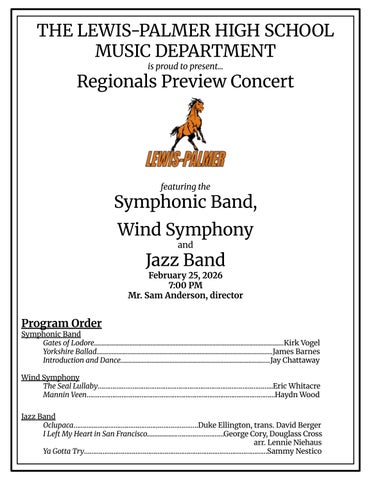
Introduction and Dance………………………………………………………………………………….…Jay Chattaway
Wind Symphony
The Seal Lullaby…………..….…………………………………………………………………...Eric Whitacre Mannin Veen………………………..………………………………………………..………………Haydn Wood
Jazz Band
Oclupaca……………………..………………….…………….….Duke Ellington, trans. David Berger I Left My Heart in San Francisco………………..………….…………George Cory, Douglass Cross arr. Lennie Niehaus Ya Gotta Try…………………………………………………………………….…………………Sammy Nestico
Flute
Eleanor Flinn
Katelyn Jones*
Andrew Kandrak
Jodi Mayfield
Oboe
Camille Apineru*& Finn Jones
Clarinet
Mirabel Barr*
Mylee Bemis (bass)
Olivia Johnson
Zoe Johnson
Lila Knapp
Flute
Max Keener
Erin O’Connors*
Oboe
Ivy Evans
Michael Nunez @ Lily Sobers*!&@
Bassoon
Madelyn Friesen*@
Lewis-Palmer High School Symphonic Band
Saxophone
Lilly Bolton, alto*
Bryce Harris, alto
Chia-Hsuan Yu, tenor
Trumpet
Corey Cinalli
Silas Ewer
Isaac Grosjean
Grant Hamershock
Samuel Hunt
Hosanna Kirkbride
Horn
Tessa Berthelotte*
Brooke Tuck
Trombone
Jack Bucheit
Grace Guerra*
Michael Hollist
Milo Ribaudo
Euphonium
Connor Antenor
Tuba
Viktor Soucek*
Percussion
Trajon Bruce
Brodie Davis
Bodie McNeill*
Wind Symphony
Clarinet
Ella Armstrong, bass clarinet*!@
Abigail Meggett!
Leah Robarge
Greysen Stevens
Cooper Wentworth*!&@
Saxophone
Emelia Dukes, alto
Brekkan Kelly, bari*!@
Blake Stolley, tenor
Julianna Wainright, alto
Trumpet
Audrey Armbruster
Brian Hawkins
Evan Marsh*^#%
Jaxson Warman
Horn
Noelle Garcia*
Trombone
Elsa Conley
Grace Kovar, bass
Erich Lambrech*
* principal player
^ All City Jazz Band
@ All-City Honor Band
# All State Jazz Band
% All-State Band
! CU Honor Band
& CSU Honor Band
Euphonium
Nicholas Berthelotte
Mallory Rowe*
Tuba
Charles Scott*
Percussion
Brianna Chester*!&@
Elle Ruth Adams
Saxophones
Ella Armstrong, alto
Mirabel Barr, alto
Andrew Kandrak, alto
Cooper Wentworth, alto
Jodi Mayfield, tenor
Abigail Meggett, tenor
Brekkan Kelly, bari
Michael Nunez, bari
Jazz Band
Trombones
Nicholas Berthelotte
Elsa Conley
Grace Kovar, bass
Piano
Brianna Chester
Drums
Elle Ruth Adams
Trumpets
Sam Hunt
Evan Marsh
Tyler Smith
Jaxson Warman
Bass
Camille Apineru
Chia-Hsuan Yu
Vocals
Noelle Garcia
Lewis-Palmer High School Administration
Jeffery Zick, Principal
Brooke Mendez, Assistant Principal
Richard Thiele, Assistant Principal
Nick Baker, Assistant Principal / Athletic Director
Stacy Roshek, Assistant Principal / Activities Director
Amber Whetstine, Superintendent
Lewis-Palmer High School Performing Arts Faculty
Kris Lilley, Theater
Madeline Douthit, Choir
Sam Anderson, Band
Gates of Lodore:
Symphonic Band Program Notes:
The Gates of Lodore is a rock formation at the mouth of the Canyon of Lodore along the Green River in Northwestern Colorado. The canyon walls rise up to 3000 feet as the Green River descends through the canyon. The area was first mapped by John Wesley Powell in his famous river voyage of 1869. Powell and his party had considerable difficulty navigating through the Canyon of Lodore. Place names such as Upper and Lower Disaster Falls and Hell’s Halfmile bear witness to their adventures. A bold main melody gives way to a lyric middle section as this piece musically depicts a trip through the incredible canyon.
-Program note by Kirk Vogel
Yorkshire Ballad:
Composed in the summer of 1984, James Barnes’ Yorkshire Ballad was premiered at the Kansas Bandmasters Association Convention in Hutchinson, Kansas, by the late Claude T Smith, who was serving as the guest conductor for the Kansan Intercollegiate Band. Since being published in 1985, it has become one of the composer’s most popular works. It has been arranged for full orchestra and string orchestra by the composer, for marimba and piano by Linda Maxey, for flute choir by Arthur Ephross, and for trombone or tuba/euphonium ensemble by John Bohls. The composer writes, “...over the years, many conductors and teachers have called me to ask about the work, and whether the tune itself is in fact a folksong. Yorkshire Ballad is not a folksong, but it is written in that style. I composed this little piece so that younger player would have an opportunity to play a piece that is more or less in the style of Percy Aldridge Grainger’s Irish Tune from County Derry. Even Grainger’s easier works are too difficult for most younger players to do them musical justice, so I thought I would write a little piece that might emote some of the feelings and colors of Grainger’s wonderful music, but, at the same time, was technically much more accessible to the younger player.” “People always ask me what I was trying to portray when I wrote Yorkshire Ballad. All I can say is that I was thinking of the beautiful, green Yorkshire dales of Northern England; the rolling hills and endless stretch of beautiful pasturelands that my wife and loved so much when, a year before, we had driven through this most marvelous spot in the world.“
-Program note by publisher
Introduction and Dance:
Introduction and Dance is a significant work which expertly explores the varied resources of the modern concert band. Its form is based upon the skillful and inventive handling of contrasting melodic and rhythmic motives. The powerful and contemporary harmonic structures are, for the most part, derived from combinations of perfect 4th and 5th intervals.
The Introduction begins with fanfare-like statements in the brass followed by woodwind responses. These musical ideas are then developed and combined to logically lead into the Dance section which follows. The Dance section is characterized by vigorous and persistent rhythms in the lower brass and percussion over which a strong, soaring melody is introduced by the cornets and later restated in the high woodwinds. Several contrasting sections then follow before the piece returns to the exciting Dance section, which served to propel the work to its powerful conclusion.
-Program note by publisher
Wind Symphony Program Notes:
The Seal Lullaby:
In the spring of 2004 I was lucky enough to have my show Paradise Lost: Shadows and Wings presented at the ASCAP Musical Theater Workshop. The workshop is the brain child of legendary composer Stephen Schwartz (Wicked, Godspell), and his insights about the creative process were profoundly helpful. He became a great mentor and friend to the show and, I am honored to say, to me personally. Soon after the workshop I received a call from a major film studio. Stephen had recommended me to them and they wanted to know if I might be interested in writing music for an animated feature. I was incredibly excited, said yes, and took the meeting.
The creative executives with whom I met explained that the studio heads had always wanted to make an epic adventure, a classic animated film based on Kipling’s The White Seal. I have always loved animation, (the early Disney films; Looney Tunes; everything Pixar makes) and I couldn’t believe that I might get a chance to work in that grand tradition on such great material. The White Seal is a beautiful story, classic Kipling, dark and rich and not at all condescending to kids. Best of all, Kipling begins his tale with the mother seal singing softly to her young pup. (The opening poem is called The Seal Lullaby).
Oh! Hush thee, my baby, the night is behind us, And black are the waters that sparkled so green. The moon, o’er the combers, looks downward to find us, At rest in the hollows that rustle between. Where billow meets billow, then soft be thy pillow, Oh weary wee flipperling, curl at thy ease!
The storm shall not wake thee, nor shark overtake thee, Asleep in the arms of the slow swinging seas!
Rudyard Kipling, 1865-1936
I was struck so deeply by those first beautiful words, and a simple, sweet Disney-esque song just came gushing out of me. I wrote it down as quickly as I could, had my wife record it while I accompanied her at the piano, and then dropped it off at the film studio. I didn’t hear anything from them for weeks and weeks, and I began to despair. Did they hate it? Was it too melodically complex? Did they even listen to it? Finally, I called them, begging to know the reason that they had rejected my tender little song. “Oh,” said the exec, “we decided to make Kung Fu Panda instead.”
So I didn’t do anything with it; just sang it to my baby son every night to get him to go to sleep. (Success rate: less than 50%.) A few years later the Towne Singers commissioned the choral arrangement of it, and in 2011 I transcribed the piece for concert band. I’m grateful to them for giving it a new life, and to the schools, colleges and directors listed who have believed in this new transcription. And I’m especially grateful to Stephen Schwartz, to whom the piece is dedicated. His friendship and invaluable tutelage has meant more to me than I could ever tell him.
- Program Note by Eric Whitacre
Wind Symphony Program Notes,
Mannin Veen:
Douglas, the capital of the Isle of Man, was a holiday mecca in Victorian times for people from Northern England. Even before Haydn Wood (1882-1959) was born, his family had regularly journeyed there from Slaithwaite, Yorkshire. At the beginning of the 1885 tourist season, Haydn's elder brother Harry was hired as leader and soloist of the large orchestra at the Falcon Cliff Castle in Douglas. That summer, Sabra Wood brought the entire family, including her little son Haydn, age 3, to proudly watch and listen to Harry and the orchestra. From the age of 7, Haydn studied the violin with Harry. He loved being a member of Harry's Students Orchestra and performed regularly on the Isle of Man.
By the late 1920s, Haydn Wood was becoming known as a conductor of his own music, and he conducted concerts at the Palace from then and throughout the 1930s. On June 19, 1927, in a huge Manx (the common demonym for the Isle of Man) Celtic Concert in which Harry was greatly involved, he conducted the Palace Orchestra in A Health to All Who Cross the Main for baritone, chorus and orchestra, with lyrics by Manxman Henry Hanby Hay, which he had composed expressly for the Manx Homecoming Celebration.
It was not until 1931 that Haydn Wood started composing his large-scale Manx orchestral pieces. The first of these to be played in Douglas was Mannin Veen, on July 9, 1933, conducted by the composer in an exciting concert which included the second and third movements of his new Concerto for Violin, performed by the Spanish violinist Antonio Brosa with the Palace Grand Orchestra. Mannin Veen was eventually published in 1937 and is a classic band work of the post-Holst, pre-Hindemith era of band works; it draws on the composer’s experiences of Manx culture when his family lived on the Isle of Man, this autonomous island situated between Ireland and the English mainland in the Irish Sea. The composition exhibits both symphonic grandeur and Celtic tunefulness, often featuring the principal clarinet.
On the occasion of the first BBC broadcast in February 1933 of Mannin Veg Veen, Haydn Wood was quoted as saying to the Isle of Man Times: “The critics were struck by the beauty of the national airs. I feel very proud and gratified that our tunes are so appreciated … It was my original intention to call the work Mannin Veg Veen (Dear Little Isle of Man) but I found that people would insist on pronouncing ‘veg’ as a waiter does in a cheap restaurant when he bawls down the lift for ‘meat and a couple of veg.’ I decided to abandon the ‘potatoes and peas’ portion of the title.”
- Program Note from University of North Texas Wind Ensemble concert program, 8 October 2019