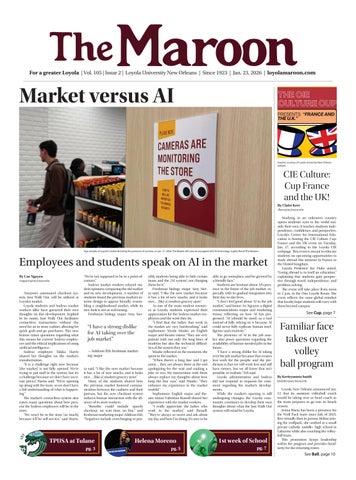
Amazon’s automated checkout system, Just Walk Out, will be utilized at Loyola’s market.
Loyola students and Sodexo market workers alike have garnered their own thoughts on this development. Implied in its name, Just Walk Out facilitates contactless transactions without the need for an in-store cashier, allowing for quick grab-and-go purchases. This new feature raises questions regarding what this means for current Sodexo employees and the ethical implications of using artificial intelligence.
Sodexo employee Talaka Harris shared her thoughts on the market’s transformation.
“It is a challenge right now because [the market] is not fully opened. We’re trying to put stuff in the system, but it’s a challenge because we don’t have accurate prices,” Harris said. “We’re opening up along with the store, so we don’t have a full understanding of what is happening.”
The market’s contactless system also raises many questions about how present the Sodexo employees will be in the store.
“We won’t be in the store [as much] because it’ll be self-service,” said Harris.
“We’re not supposed to be in a point-ofcontact.”
Sodexo market workers relayed student opinions comparing the old market and its new development. A number of students found the previous market’s interior design to appear friendly, resembling a neighborhood market, while its new look is not as welcoming.
Freshman biology major Amy Sier-
“I have a strong dislike for AI taking over the job market” —Addison
ra said, “I like the new market because it has a lot of new snacks, and it looks nice… [like a] modern grocery store.”
Many of the students shared how the previous market fostered communication between the cashiers and their patrons, but the new checkout system reduces human interaction with the absence of in-store workers.
“Benefits could include speedy checkout, no wait time, no line,” said freshman marketing major Addison Eth. “Negatives include overcharging or pos-
sibly students being able to hide certain items and the [AI system] not charging them for it.”
Freshman biology major Amy Sierra said, “I like the new market because it has a lot of new snacks, and it looks nice… [like a] modern grocery store.”
As one of the main student resources at Loyola, students expressed their appreciation for the Sodexo market employees and the work they do.
“I find that the ladies that work in the market are very hardworking,” said sophomore Nicole Mauke, an English major and theatre minor. “They are very patient with not only the long lines of students but also the technical difficulties of the system they use.”
Mauke reflected on the moments she spent in the market.
“When there’s a long line and I get antsy… they are always there at the end apologizing for the wait and making a joke or two. My interactions with them always replace my thoughts about how long the line was,” said Mauke. “They enhance my experience in the market tenfold.”
Sophomore English major and theatre minor Valentina Russell shared her experience with the market workers.
“I really appreciate the ladies who work in the market,” said Russell. “They’re always so sweet and ask about my day and how I’m doing. It’s nice to be
able to go someplace and be greeted by a friendly face.”
Students are hesitant about AI’s presence in the future of the job market, especially with its gradual integration into their day-to-day lives.
“I don’t feel good about AI in the job market,” said Junior An Nguyen, a digital communications major and marketing minor, reflecting on how AI has progressed. “AI [should be used] as a tool instead of fully relying on it because AI could never fully replicate human intelligence and creativity.”
The presence of AI in the job market also poses questions regarding the availability of human-needed jobs in the future.
“I have a strong dislike for AI taking over the job market because that creates less work for the people, and the prediction is that we will work less and still have money, but we all know that isn’t possible, or realistic,” Eth said.
Loyola administration and Sodexo did not respond to requests for comment regarding the market’s developments.
While the market’s opening is still undergoing changes, the Loyola community continues to develop their own thoughts about what the Just Walk Out system will entail for Loyola.
CIE Culture: Cup France and the UK!
By Claire Kerr clkerr@my.loyno.edu
Studying in an unknown country opens students’ eyes to the world outside their own. It teaches students independence, confidence, and perspective. Loyola’s Center for International Education is hosting the CIE Culture Cup: France and the UK event on Tuesday, Jan. 27, according to the Loyola CIE webpage. This event is meant to educate students on upcoming opportunities to study abroad this summer in France or the United Kingdom.
Loyola Professor Joe Duke stated, “Going abroad is in itself an education,” explaining that students gain perspective through travel, independence, and problem-solving.
The event will take place from noon to 2 p.m. in the One Loyola Room. The event reflects the same global mindset that faculty hope students will carry with them beyond campus.
Familiar face takes over volley ball program
By Kerieyaunta Smith klsmith1@my.loyno.edu
Loyola New Orleans announced Jan. 12 that its assistant volleyball coach would be taking over as head coach as the team prepares to go into its beach season.
Jenna Ibieta has been a presence for the Wolf Pack team since July of 2025, first virtually then in person. Before joining the wolfpack, she worked at a small private catholic middle/ high school in Lafayette while also coaching the volleyball team.
This promotion keeps leadership within the program and provides familiarity for the returning roster.
See Cup, page 7 See Ball, page 10
Graphic courtesy of Loyola University New Orleans website
Sign outside of Loyola’s market dictating the presence of cameras on Jan. 21, 2026. The Market will soon be equipped with AI technology. Sophia Renzi/The Maroon. pg. 7
Leading Toward Justice: Loyola, New Orleans, and the Struggle for Civil Rights.
Historic New Orleans Collection in partnership with Loyola University
New Orleans J. Edgar and Louise S. Monroe Library present The Trail They Blazed traveling exhibit in conjunction with Leading Toward Justice: Loyola, New Orleans, and the Struggle for Civil Rights at Loyola University New Orleans Monroe Library January 22 – April 19, 2026.*
*Leading Toward Justice will exhibit all of 2026
EXHIBITS ON THE FIRST, SECOND, AND THIRD FLOORS OF THE LIBRARY.
Opening reception
◦ January 22, 2026
◦ 5 p.m. – 7 p.m.
◦ Monroe Library, First Floor
Featured speaker
Dr. Ronnie Moore, Fr. Louis J. Twomey, SJ Legacy Scholar in Residence, Jesuit Social Research Institute, 2024 Loyola Honorary Degree Recipient.
Update: The Future of Turning Point USA on Loyola’s Campus and Beyond
By Nicholas Parrella nrparrel@my.loyno.ed
According to The Tulane Hullabaloo, Tulane University's student paper, an article published on Jan. 14 by Tulane’s
News Editor, Ryann Goldberg, expressed that after a four-month pause on organization application approvals (which was said to be implemented after Tulane’s TPUSA initially applied), the organization was officially acknowledged last
week.
With a lack of certainty on the future position of the organization on Loyola’s campus and the recent news on Tulane approving Turning Point USA, Loyola student Isa Crownover, a junior criminology and psychology major, opted to share her thoughts and feelings on the matter.
Crownover stated that she was “very disheartened and disappointed…” upon hearing that TPUSA was approved on Tulane University's campus and “would be outraged if Loyola even thought about doing the same.”
When asked about the possibility of a TPUSA on Loyola's campus, Crownover claimed that “They (TPUSA) may say that they want to foster civic engagement, or even spread the Jesuit mission… this would all be attainable through clubs that already exist on campus…” she said. “There is a new group that was established last year dedicated to political discourse that everyone has had the opportunity to join.
If Loyola were to ever override our SGA's decision, I know that it will not be easy, as none of us will remain silent nor compliant.”
Aariel Charbonnet, vice president of marketing and communications, in response to Tulane’s decision, reiterating that Loyola’s Student Government Organization is responsible for reviewing and voting on student organizations.
"Loyola remains committed to upholding its established policies and supporting the student-led process ."
“Loyola supports the integrity of the student governance process, including the ability to appeal, and remains committed to fostering a campus environment grounded in fairness, inclusion, and respect for differing viewpoints as part of its Jesuit mission,” she said.
Alan Mills, Conductor and coordinator of bands
Additionally, Charbonnet explained that the students who submitted a chartering application for TPUSA have been informed of their right to pursue an additional appeal through the court of review, as stated in the SGA bylaws.
“Loyola remains committed to upholding its established policies and sup-
porting the student-led process,” Charbonnet said.
President and co-charter of TPUSA chapter attempting to charter at Loyola, Vivianna Capasso, stated that currently speaking, the organization is “not looking into doing interviews…” claiming that after their second attempt to charter, they had interviewed with other correspondents and hadn’t seen anything published.
She went on to say that while they don’t have a “game plan,” the organization is “Waiting to hear what TPUSA headquarters…” tells them to do.
“If something moves, then we’ll absolutely be able to interview,” Capasso said.
Anistin Murray, a co-founder of the Loyola charter, weighed in as well in an opinion piece on Americafest, stating that her “motivation to charter a Turning Point USA chapter now comes from a deeper place; the belief that real dialogue matters, that courage is learned, and that campuses should be places where students are challenged rather than silenced.”
SGA president Nicholas Keen was inquired about the organization’s response to Tulane’s charter of TPUSA, but he did not respond.
Loyola Spring Concert Band prepares for consortium
By Lily Bordelon lmbordel@my.loyno.edu
Loyola’s two semesterly concert band programs are presenting Loyola students and other participants with the opportunity to develop their skills with various instruments at different skill levels. However, unlike past programs, the Wind Ensemble has been granted the chance to be the first band in the United States to perform Kevin Poelking’s Sounds, Voices, and Dreams from Ukraine.
These two concert bands are divided by skill level, according to Alan Mills,
conductor and coordinator of bands at Loyola. He explained that students, regardless of their major, go through a blind audition before being sorted into the more accessible University Concert Band, or the more challenging University Wind Ensemble.
“It's a healthy situation for students to have two different ability levels as far as having one band that has a little bit more accessible music and one that is a little bit more artistically challenging for our advanced students,” Mills said. “And so that's always good; it's a good thing every semester we go through an audition process.”
Starting the second week of the semester, they have begun rehearsals for the upcoming concerts: a combined concert between the two bands occurring on March 11 and two additional separate concerts. The Concert Band will be held on April 22, and the Wind Ensemble will be held on April 23.
According to Mills, the Concert Band acts as an educational experience, not only for students who are trying to develop musical skills, but also for music majors who want the opportunity to learn a second instrument, which is especially important for music performance and music education majors.
“This is really important for professional musicians, like performance majors who might want to go play in a pit orchestra. A lot of times pit orchestras [have] few people, but the book that they get will have multiple instruments on it,” Mills said.
The Concert Band is also a new opportunity for advanced students to conduct band rehearsals themselves instead of Mills taking the lead.
"I'm really proud of the Concert Band ."
Alan Mills, Conductor and coordinator of bands
Mills described the Concert Band as a place where one can see experiential learning, which is “where you take a lot of different kinds of learners and learning situations, and you put them all into one classroom, and you have all of these
different interwoven outcomes that come through.”
With the blend of performers in the band, Mills expressed his excitement regarding how the rehearsals and performances will go.
“I'm really proud of the Concert Band,” Mills said. “I'm proud of what they've been able to accomplish this year. We've actually grown in membership from fall semester to spring semester, which means that they're enjoying it. And this year we've also opened it up, so we have a lot of non-enrolled students participating in it.”
The Wind Ensemble, on the other hand, consists of the students who placed highest in the audition process, Mills explained. It is a symphony orchestra that also requires string players who perform in a separate audition as well as in the Wind Ensemble audition.
“It's great, and I'm coming in and finding ways to find music that will serve those students well, that is advanced but is still attainable,” Mills said.
This semester, Loyola University was invited to be part of a consortium, where a group of people work together to find financial support to commission a supporter to write them a piece of music.
The Academic Symphonic Band of Ukraine reached out to Chicago composer Kevin Poelking to write a piece of music. According to Mills, Poelking agreed to the commission without knowing if he’d get paid or not, working on and producing Sounds, Voices, and Dreams from Ukraine as a gift for Ukraine in light of the recent hardships the country has faced after the Russian invasion.
After the Ukrainian band did a premiere of the piece, Loyola received the opportunity to perform the United States premiere of the piece.
"There are a lot of professional bands in the United States. Loyola University got that first one."
Alan Mills, Conductor and coordinator of bands
“That's actually a really big deal. I mean, we are the first,” Mills said. “There are a lot of universities. There are a lot of professional bands in the United States. Loyola University got that first one.”
Mills added that Loyola students were not the only participants in the band. Students have come in from Tulane University to perform in the band alongside community members. Since the practice times do not work for people who work 9-to-5 careers, the community members who do perform either have space in their schedule or are retired.
“The people who show up usually do so because they love it,” Mills said. “I'm really excited and proud for that.”
Man plays trumpet at the Jazz Education Conference on January 8, 2026. Sophia Renzi/The Maroon
Graphic by Lily Bordelon/The Maroon.
PUZZLES
ACROSS
1. Oval, orange-colored fruit
7. “Yes” in Spanish
9. Metal that is wound into a coilshape
10. Socially awkward, boring, unfashionable person
12. “Pencil” in Spanish
14. Pre x usually meaning “back” or “again”
15. To burn ercely
16. South Africa abbr.
18. to consider, judge, or regard something in a particular way
19. To decay
20. Paul Simon’s song: “You Can Call Me __”
22. Liberia abbr.
23. Opposed to smile
26. Rest in Peace, abbr.
28. Opposed to wet
29. 1993 song by Janet Jackson
30. Staten Island, abbr.
31. 1986 horror novel by Stephen King about seven children in Derry
33. e coin worth 10 cents is called a __
34. Adult Swim, abbr.
35. One might say this to scare somebody
36. Slope of Regression, abbr.
37. Dodge and __
40. Author _. _. Stein
41. Land Rover, abbr.
43. Greece, abbr.
45. a hard-shelled, edible fruit or seed, rich in protein and healthy fats
46. Executive Order, abbr.
47. Rhode Island, abbr.
48. Occupational erapy, abbr.
50. Popular phrase, “Get the hell outta ___”
53. American Eagle, abbr.
55. Big X a Plug claims himself to be, “ e biggest, the __”
60. Bugs Bunny’s famous saying, “What’s up __”
61. Adult Protective Services, abbr.
62. A deep, rich, vivid red
64. To be honest, abbr.
65. red, spherical, approximately one-inch diameter devices packed with ash powder
DOWN
1. It keeps the doctor away
2. e last king of Troy during the Trojan War
3. Modern slang for charm
4. Opposed to “Out”
5. Visual e ects in lm and media, abbr.
6. “Special Agent __-O” (2009)
Disney Cartoon
7. A strawberry is the only fruit to have this on the outside
8. Latin abbreviation for “id est.”
9. ___ -toothed cat
11. Popular smartphones (1999) with a tangible keyboard (L-O-L)
12. Serving soup spoon
13. Peanuts comic strip character, Peppermint ___
16. “Bartender, I want ve whiskey ___ please!”
17. Sour, tangy
19. Rapper __ Wave
21. Longitudinal Employer-Household Dynamics
24. e largest and oldest all-female krewe in New Orleans
25. A two-dimensional diagram; alignment chart
26. “He has ___” Easter greeting
27. March 14, 2026 is __day!
30. Jigsaw exclaims, “I want to play a game”, in this 2001 lm
32. e best pasta shape is bow-__
35. An oxygenated, non-Newtonian uid
38. Atomic symbol for gold
39. U.S. state where Ben and Jerry’s ice cream company was founded, abbr.
40. e color of clue #35
42. __ V. Wade (1973) courtcase
44. “__ de Janeiro”
49. AKA Soviet Union, abbr.
51. Antonym of “don’t”
52. “You guys made a whole __ without me ;(“
56. Radio resource control, abbr.
57. Grantmakers in Health, abbr.
58. Radio communication that involves re ecting radio signals o the moon, abbr.
59. A free overlay network for enabling anonymous communication
61. Core exercises are focused on these types of muscles, abbr.
63. Yankees are based in this state, abbr.
64. Equal to 1,000 gigabytes, abbr.
For weekly puzzle answers, download e Loyola Maroon
STAFF LIST
Editorial Board
Editor in Chief - Eloise Pickering
Managing Editor - Mary Ella Hastings
Pre-Content Director - Alana Frank
Post-Content Director - Callie
Honeycutt
News Editor - Lily Bordelon
News Editor- Stella Perdue
Worldview Editor - Pablo Pineiro
Asst. Worldview Editor - Angelica
Pineda
Life & Times Editor - Elise Beck
Asst. Life & Times Editor - Olivia
Sanyal
Sports Editor - Keri Smith
Opinion/Editorial Editor - Imad
Siddiqui
Breaking News Editor - Natalie
omas
Copy Editor- Mark Michel
Senior Sta Writer - Dominique
Campbell
News Consultant - Mark Michel
e Wolf Director - Laura Welles
Senior Sta Photographer - Sophia
Renzi
Photo Editor - Ashlyn Bobb Collins
Asst. Photo Editor - Pharrell Every
Social Coordinator - Mabel RegaladoHernandez
Social Coordinator - Carlos Andrade
Newscast Producer - Cecilia Calderin,
Lead Anchor - Dessadra Tezenzo
Design Chief - Makayla Parker
Newsletter Writer - Rodrigo Delgato
Distribution Manager - Sophia Renzi
Contributors
Alyvia Pierson, Christopher Pouncy, Alyssa Jones, Fin Jones, Qemyne Barnes, Katherine Leslie, Cae Nguyen, Nicholas Parrella, Sabrina Huynh, Nikolai Huilgol, Claire Shmidt, Gaby Conway, Maria Touzard, Athalie Dore, Amari
Winchester
Student Media Adviser: Michael Giusti
Assistant Student Media Adviser: Gabriella Killett Vargas
CONTACT US
Main O ce - (504) 865 - 3535
Business O ce - (504) 865 - 3536
Adviser’s O ce - (504) 865 - 3295
Correspondence - maroon@loyno.edu
Letters to the Editor - letter@loyno.edu
Advertising - ads@loyno.edu
Website - www.loyolamaroon.com
Twitter - @loyola_maroon
Facebook - e Maroon
Instagram - @loyola_maroon
Our o ce is in the Communications/ Music Complex, Room 328.
Send mail to: e Maroon, Loyola University, Campus Box 64, 6363 St. Charles Ave., New Orleans, LA 70118
e Maroon is published every Friday. Unless otherwise noted, all content is copyrighted by e Maroon. All rights reserved. First copy free to students, faculty, and sta . Every additional copy is $1.00.
e Maroon is printed on 30 percent post-consumer recycled content.
Crossword by Kira Phillips and Olive Riley/ e Maroon
By Angelica Pineda acpineda@my.loyno.edu
Prior to Helena Moreno’s inauguration on Jan. 12, she led a successful campaign that focused on the two basic issues that have plagued New Orleans and its citizens for years: potholes and streetlights.
Moreno’s promise to x New Orleans’ poor city infrastructure has been imperative to her success during the past election. is promise caught the attention of citizens as the broken lights and beaten down streets have been a looming safety concern.
Michelle Tran, a business analytics major at Loyola and New Orleans native, was skeptical about Moreno’s plans as failure to act has been common throughout New Orleans.
“ e city infrastructure in New Orleans is really really bad. We have not seen change in this city in decades, and the only time we did see change is when the mayor decided to play face and try to change up everything when the Super Bowl came around. Even then it was the biggest inconvenience to the locals,” Tran said.
Moreno hopes to resolve these concerns as she has launched two projects centered around “Super Bowl progress” across New Orleans and into the New Orleans East area. e two projects were based on the e cient improvements that were made on city infrastructure in anticipation for the Super Bowl.
“I promised to enhance routine street maintenance and also provide Super Bowl-level coordination for infrastructure repairs,” Moreno said at a public
Tulane admin approves TPUSA chapter
By Mary Ella Hastings mlhastin@my.loyno.edu
Tulane's Turning Point USA chapter is now o cially recognized as a student chapter at Tulane.
According to Mike Strecker, the assistant vice president for news and media relations at Tulane, Turning Point had an active chapter for seven years at Tulane until the 2023-2024 academic year. In the 2024-2025 academic year they had the option to renew and chose not to.
Strecker states that students a liated with Turning Point reapplied for o cial recognition this fall, although at the time Tulane had paused new and pending applications.
“In light of recent federal guidance regarding civil rights and anti-discrimination laws, Tulane temporarily paused new and pending Recognized Student Organization (RSO) applications while it conducted a comprehensive review of student organization policies, like
universities throughout the country,” Strecker said.
Strecker emphasized that “this review applied to all student organizations, including those a liated with national or international partners, to ensure compliance with university policies.”
e pause ended in November therefore student organizations applications began being reviewed again.
“At the time of the pause, there were 21 student organizations with pending recognition requests; all were subject to the same review process and timeline,” Strecker said.
Strecker added that Tulane is committed to fostering open discussions.
“Tulane University is committed to fostering an environment that supports open and vigorous dialogue across a wide range of issues and a variety of perspectives,” he said.
event.
Joseph Luu, a psychology major, English writing education major, and New Orleans native, voiced his safety concerns with the current state of city infrastructure.
“ ere’s a lot of improvements that need to be made, especially in the New Orleans East area. I’m in district E and there’s no lighting in a certain portion of the interstate, which is where a lot of people go through. ere’s potholes galore in one section of the street that’s right next to a school, which is very dangerous,” Luu said.
Initiative “Lights On” addresses this issue of New Orleans East’s lighting shortage. Moreno plans to repair the lights along the I-10 service road which has been known for the lack of lighting, as Luu mentioned.
“We recognize this is a public safety issue, and we’re taking the rst of many steps to address crime in New Orleans East,” said Moreno said at a press event. “New Orleans East has been ignored for way too long. Not anymore!” e “Lights On” initiative is accompanied by the newly instated Infrastructure Coordinating Council. e council would function similarly to the Super Bowl group in the way that street and sidewalk maintenance would become a priority and a goal for the council. e council is focusing on one of New Orleans’ most dreaded occurrences, potholes.
“Even in the richest parts of the city there are terrible streets, terrible potholes, and cobblestone cracking up,” Tran added.
Even with the projects being put
into place, the doubts of action have been weighing on students, giving them mixed feelings of hope and uncertainty.
“I de nitely believe in Helena Moreno because she has taken action before. I just hope that her action on a city level as mayor will have as much of an impact,” Luu added.
Tran shares a similar hope for Moreno’s future as New Orleans’ new mayor despite previous doubts.
“I do have a lot of hope she’ll make good changes, but you know, growing up with seeing so many failures you also have lots of doubts. However, I would love to see what she has in store for the city of New Orleans,” Tran said.
Loyola students give their opinions on the killing of Renée Nicole Good by an ICE agent
By Pablo Piñeiro Ramy ppineiro@my.loyno.edu
Following Renee Nicole Goodman’s killing by an Immigration and Customs Enforcement o cer in Minneapolis, Loyola students are expressing concern over federal deployments in American cities.
Her killing that morning was recorded by witnesses, and the shooting quickly drew a large crowd of angry protesters. By evening, hundreds were there for a vigil to mourn her death and urge the public to resist immigration enforcers.
Emilio Rodríguez criticized ICE’s presence in American cities and what this could mean for Latinos in New Orleans.
“It makes me feel scared, especially since I’m Latino and my family is Latino. A lot of their operations are based on a lot of people’s color of skin or what they perceive," Rodriguez said. “ ey’ve been acting recklessly and hateful to communities across the country, especially with
Nicole Good.”
Homeland Security Secretary Kristi Noem described the incident as an “act of domestic terrorism” carried out against ICE o cers by a woman who “attempted to run them over and rammed them with her vehicle. An o cer of ours acted quickly and defensively, shot, to protect himself and the people around him.”
Rodriguez said he believes this should not be a partisan issue.
“Everybody should see death as a horrible thing, especially a murder,” Rodriguez said. “People who see Renee Good’s death as justi able are victim[s] of a culture war between two sides. is is not a political, left-or-right thing, this is just a horrible tragedy.”
Graphic design major Maximilian Campbell also expressed worry over people who hold Good responsible for her own death.
“ at’s absurd,” Campbell said. “ ere could have been better ways to deescalate the situation. Mind you, this is a
woman who had a kid, and now the kid is parentless.”
e Associated Press contributed to this report.
Mayor Helena Moreno delivers her inaugural address after being sworn in as New Orleans' 63rd mayor, outlining her vision for the city's future before a crowd of more than 2,500 guests at the Saenger eatre on Monday, Jan. 12, 2026 in New Orleans. (Tyler Kaufman/AP Content Services for Inauguration Fund of Mayor-Elect Helena Moreno)
Protestors gather in Kenner calling for justice for Renee Good. Sophia Renzi/ e Maroon.
COLUMN: The first week of spring semester brings meetings, bakeries, and parties
By Katherine Leslie kaleslie@my.loyno.edu
Returning for the spring semester as a freshman feels even more daunting than the fall. While fall was about discovering new possibilities and independence, spring signals higher expectations and real commitments.
Now, clubs are official, classes begin to align with your major, and it feels like your college journey truly begins. Thankfully, the first week at Loyola has never been boring.
Being in New Orleans, a city rich in culture and life, I spent the first week reacquainting myself with what drew me here in the first place. I returned to my fall semester obsession, Wishing Town Cafe and Bakery on Magazine, where the dumplings never disappoint.
After a month apart, I reunited with my friends, people I’d grown accustomed to being just down the hall. We spent a chilly afternoon in Audubon Park, lying in the grass and sharing sto-
ries from our hometowns.
My roommate and I went thrifting in the city, which we both agreed is much better than back home. It felt like I was hitting all of the cliche hotspots. But through these, I realized the reason school never felt as intimidating while here wasn't necessarily because of the city, but the support I had found in it.
One of these moments of realization was the first chapter meeting of my sorority, Delta Gamma.
Being back in that room, with these girls who’d held me up and supported me during the tumbles of the fall semester, felt like a relief. The first few days of classes were as one would expect. Finding friends to sit next to, going over the syllabus, and classes that seem to drag on forever because you haven't started any material.
Further into the week, my sorority had its first spring recruitment event. Being a social person, getting to be surrounded by people I not only know but also new faces was another step in helping me feel I was fully back.
One of my favorite things about Loyola is the vast opportunities, no matter your major.
Not only did I get the chance to write for The Maroon, but I also got to help out on a project one of my roommates was working on. I had the pleasure of working the album launch party for a Loyola artist, Azure Skyz. Not only was the music great, but you could tell the passion everyone put into the event.
As a business major, these are creative opportunities I never thought I would be able to work on, especially as
a freshman, but Loyola fosters so many outlets for individuality in a way that encourages me to look outside of my major.
I know returning to school can be stressful for anybody, but community is what makes that change feel lighter. And of course, here of all places, there's never a dull moment.
REVIEW: "People we meet on vacation" explores the friends to lovers trope
By Callie Honeycutt cbhoneyc@my.loyno.edu
I am a huge fan of romance books. I have been a member of Booktok for longer than I have been in college, and I have had to replace my Kindle twice from overuse.
Those reasons, plus my reading hours logged and volume of romance books read, make me a qualified book-to-movie adaptation critique, and today I will
be using those talents on Emily Henry's bestselling 2021 novel turned 2026 movie, The People We Meet on Vacation. This review is not based on book accuracy, because come on, so many things have changed, but strictly on my enjoyment when watching this movie. So starting now… SPOILER WARNING.
First things first, this is a Netflix adaptation. That means it's only going to be filmed one way, with glossy visuals and
pretty locations, with a preferred bright aesthetic and something to hook you within the first 10 minutes to support retention. That's not me complainingtrust me, I love my Hallmarks as much as the next guy - just an observation.
Our two main characters are extroverted Poppy and type A Alex, being stuck in a quirky roadtrip back to their hometown in Ohio as strangers who turn into friends.
I love Tom Blyth, who plays Alex, from
The Hunger Games: The Ballad of Songbirds and Snakes, and Emily Bader, who plays Poppy, from her show My Lady Jane. That's why I am so disappointed that they fell short for me.
I'm not saying they ruined the movie, I'm just saying I would have preferred actors I don’t know to play Alex and Poppy, only because I have a much easier time getting wrapped up in a movie if I don’t associate the actors with other previous characters I loved. But I digress.
With the actors we got, I think they did a fabulous job of capturing how overzealous Poppy is, and how much Alex absolutely hates it. I prefer my book boyfriends broody and quiet, only opening up for their girl, and that is exactly how Alex is. I loved that they kept that in the movie and didn’t rewrite him as a positive sunshiney guy, as that is Poppy's role in the relationship.
See A FEW, page 8
Teriyaki Chicken at Wishing Town Bakery and Cafe. Katherine Leslie/the Maroon
Crowd at the launch party enjoying Azure Skyz’s performance of his new song ‘DYT’ on Jan. 16, 2026. Photo courtesy of Alina Paiz.
Katherine Leslie and Maggie Morrish assisting in the launch party of Azure Skyz new album on Jan. 16, 2026. Photo courtesy of Makeda Is Ra El Ali Bey.
LIFE AND TIMES
A FEW:A Netflix film that checked all of my romcom boxes
A few months after their traumatic road trip home, they go on a camping trip together, their bond sparks, and the plot of the movie is born: a vacation-a-year pact that takes them all over the world, together.
I would like to add, for my non-watcher/readers who are just reading this review for fun, Alex has an on-and-off girlfriend this entire time. Like literally start to finish.
If that turns you off from the movie because you like to stay loyal in your relationships, that detail isn't in the books, so go read those.
“The idea of going on an annual intimate trip with someone other than my partner is just.. wrong"
— Callie Honeycutt
It turns me off personally because I am in a relationship and my dream is to be a fashion/travel journalist, so the idea of going on an annual intimate trip with someone other than my partner is just… wrong. Not that we are comparing the book to the movie here, I’m just saying
the girlfriend addition to the movie is an odd move.
After the tradition becomes their thing, the movie cuts to a montage of them jet-setting around the world on Poppy's work card (she is a travel journalist - dream job!) and making memories that quietly cement their places in each other's lives.
My favorite aspect of their love story is that, although we, the viewer, always see their chemistry, Alex and Poppy’s love sneaks up on them, innocent and scared of what it means for these friends who never want to lose each other.
As the movie moves through, you are reminded of the difference between Poppy and Alex, and how they want completely different things in life.
Alex wants stability, living in Ohio with a plan and a wife, while Poppy never wants to be in the same place for long, constantly discovering the world.
This is why their love story is so important: they choose each other and the life they can make together, instead of dropping their dreams for love.
That is also why it takes them so long to get together, but I digress, again.
The main tension from the book comes from Poppy and Alex’s attachment to each other.
Alex is the only real thing in Poppy's
life, as she spends her time jumping from location to location and partner to partner, while Poppy is the only thing keeping Alex from settling down and starting his life.
When Poppy realizes this, she suppresses her feelings and throws herself into her spontaneous life. When Alex realizes his feelings, he does what most men do: lie to themselves.
Alex fights to convince his heart and brain that he is happy. Spoiler alert: he fails.
Another spoiler alert: Alex’s relationship fails. (After he gets engaged on a trip with Poppy and their significant others). A lot happens on that double date trip, but I think you should just go watch the movie and find out!
Now our (Poppy and Alex’s) obstacle is just fear and miscommunication. Poppy doesn’t know Alex, and his fiancée broke off the engagement, and Alex doesn't know that he is about to see Poppy and has conveniently forgotten to tell her about his empty ring finger.
At this point, the movie follows the romcom checklist:
Both characters misunderstand the relationship: check
The characters realize they can't live without the other: check
There is a big love declaration: check
Everyone lives happily ever after: check
Bonus points if one of them fights the big love declaration (go watch the movie), but overall a predictable and satisfying ending.
Alex admitting he has always loved Poppy is my favorite trope, and I am happy Poppy gets the security that she is not crazy and unlovable; she just wasn't looking in the correct places.
The movie works because it knows exactly what it is: a fast-paced Netflix romcom, with beautiful locations (shoutout NOLA), laugh-out-loud moments, and swoony tension that leaves you thinking about the characters until you go to bed.
Watching romance heroes in their day jobs as journalists is nothing new to me, as I fell in love with journalism through fictional women, specifically those in the fashion journalism field.
From Andie Anderson to Carrie Bradshaw, I am always going to connect to the female protagonists when they are journalists, and Poppy is now a part of this list. I see the same shared love in Poppy that I see in my previous journalist heroes, reminding me in this light-hearted romance why I love jour-
nalism - something that feels important to hold onto during my second semester senior year, when it feels easy to lose sight of why I started this degree in the first place.
The reason I feel so connected to Poppy’s character is that she is facing a reality that has quietly become a future fear of mine: the idea that achieving your dream job does not automatically mean you have built a life you love.
Poppy spends the entire movie chasing her dream, only to realize in the end that what she needed the whole time for happiness was right in front of her.
That fear feels uncomfortably real and relatable as I am on the edge of my own future, measuring my success on milestones achieved rather than moments and memories I should cherish as my college career passes before my eyes.
In the end, the story People We Meet on Vacation is a story of relatable characters we all wish to be: people who chase their dreams, but not at the expense of love. Reminding the watcher that happiness comes from multiple facts of life, and that your best friend by your side can always make it a little easier.
A Loyola Junior reminisces on her time and family in dance ensemble
By Alyssa Jones
aejones@my.loyno.edu
Dance ensemble is a place where passion, art, and love are formed into one thing, it is called community. My experiences in dance ensembles were always about those three things.
The three things that brought me to love dance growing up. Since the age of three, I have been dancing, and when I got to college, I continued my passion with the dance ensemble.
I heard about Loyola’s dance ensemble in my freshman year on the Theater
Arts and Dance Instagram page, and joined the ensemble my freshman year. Freshman year of the dance ensemble was the best.
The people who were on it before me welcomed me and the other new members and me with open arms. That year, I met a community of people that changed my life and continues to do so.
A community that shared the same dreams and passion for dance and the art of storytelling through our emotions and bodies.
Being in a dance ensemble, you are introduced to so many styles of dance,
from ballet, jazz, contemporary, lyrical, and African.
The styles of dance are special because that is how most communities gather and celebrate, and most of all, the dance ensemble is so special to the Loyola community because of the community.
We are all different artists in different majors, creating something that we all share. The dance ensemble created something in my life where I felt a sense of belonging and support from everybody on the team. The people in the dance ensemble were always there for
each other and made the experience of dancing more than just dancing; it made it feel as if we were family. Dance is a sense of community to me, and family is your community, so dancing everywhere at any place and anywhere felt to me like a community coming to support and just wanting to have fun.
A family that stuck together on hard nights and days, and where any talk we had together was on the studio floor or trying to sneak snacks on long tech nights.
With the dance ensemble practicing on Thursday night and performing once
every semester, we work hard for everything to come together.
Our teacher, Mama Kia, who runs the dance ensemble, has always been there to share her passion and to help us grow. I appreciate her, her work ethic and the way she always pushes us to be the best we can be.
This organization is special, but most of all, this organization always gave me a place where I could get away from the craziness of college and keep doing something I love.
CUP: Professors Collins and Duke encourage students to study abroad
Continued from page 1
Events like the Culture Cup share new opportunities for students to explore their options.
This will teach students about programs such as the Mass Communication program in London, which is open to everyone regardless of major, as the courses are general electives for non-majors. The program stretches over three weeks from June 1 to 21, according to Journalism Professor Lisa Collins and Duke. Students will not only earn six credits but also have the opportunity to visit newsrooms, travel to unknown places, and learn more about media through the lens of a new culture.
“The program is designed so that it’s three intensive weeks, but you still come back and have time to intern or work,” Collins said.
Students gain more than work skills. Being in a foreign country means learning to adapt.
“You build self-confidence, you build street smarts," Duke stated.
Students who attend the Culture Cup:
France and UK may find themselves inspired to take their learning further, from campus to England or France and beyond.
“It's never a bad idea to travel."
— Lisa Collins Communications professor
“It’s never a bad idea to travel,” Collins said.
Graphic courtesy of the Loyola Center for International Education website
Familiar face
Continued from page 1
BALL : New coach takes over volleyball program
She played a key role in helping the indoor team win the Southern States Athletic Conference last semester and her goals stay the same this semester.
“I always want to win the conference championship, but the biggest thing is seeing growth within the girls whether it is on or off the court,” Ibieta said.
With the new position comes taking on more responsibilities and changing her mindset that she had for the team last semester.
“I think being an assistant you’re more trying to figure out how not only to support the girls but also the head coach, being that middle person for them. Being head coach is more fig-
uring out game plans and logistics and also reflecting on what my team needs as a leader,” she said.
While serving as an assistant she helped Loyola remain competitive in conference plays while working closely with several students who earned all-conference and SSAC recognition.
“I value their determination, persistence, preserence. We have a handful of girls who have never played beach volleyball before; when things get tough and the drills are hard or frustrating or new they are dedicated enough to keep learning,” Ibieta said.
With new players coming for the upcoming season and an amount of girls
Men's Swimming Women's Swimming
returning for the beach season, Ibieta wants to build on what they learned from previous coach Robert Pitre.
“I want to chase more success by building on what was already built before and to continue growing,” Ibeita said.
This upcoming season will not only be new for some returning players Ibieta as well since only being a predominantly indoor coach and playing indoor when she was younger.
“I am lucky to have two part time people on for beach season who really know the game, so getting to learn a different style of the game is really cool,” she said.
The team started last week with prac-
tices beginning at 6:30 a.m. to prepare for the upcoming season starting in mid-February.
“We actually started practice last week. It has been chilly out there, but the girls have not complained which has been great,’’ Ibieta said.
While being thankful for her part time assistant coaches she is also thankful for the university and the other departments for being there for the players supporting them through every game.
“I want to thank the other athletic departments, we always saw the men and women's basketball team in the stands cheering for the girl. Also the university for having other opportunities for the girl outside of athletics,” she said.
Women's Basketball
Even through early morning practices in the cold she wants her players to enjoy the time that they have in the game.
“As a former player, I would say that the time flies quickly; enjoy every moment because there's going to be a point where you don't have the opportunity to put that jersey on again and you’re going to miss the morning workouts and practices,” Ibeita said.
Women's Swimming
Jenna looking that the indoor volleyball team accepting their SSAC trophy. She has taken a promotion as head coach from assistant coach. Courtesy of Jenna Ibieta.
Point shaving scandal rocks college basketball
By Keri Smith klsmith1@my.loyno.edu
A federal investigation into alleged point shaving in college basketball has brought national attention to multiple National Collegiate Athletic Association Division I programs, including several universities in Louisiana.
According to reporting by CBS News and CBS Sports, federal prosecutors have charged more than two dozen individuals in connection with an alleged betting conspiracy involving players from at least 17 Division I programs.
Men's Swimming
Jan. 24
Authorities allege that the scheme occurred over multiple seasons and involved players manipulating game margins in exchange for payments from illegal gambling operations.
Reporting identified five Louisiana universities in connection with the investigation: Tulane University, Nicholls State University, Northwestern State University, the University of New Orleans and McNeese State University. The investigation centers on former players and specific games rather than athletic departments. Multiple games involving
those programs were flagged as part of the inquiry.
Point shaving refers to actions in which players influence the final score of a game without changing the outcome. Examples cited by authorities include missed free throws, intentional fouls or reduced scoring late in games to affect betting spreads. Because these actions can resemble typical in-game play, point shaving can be difficult to identify.
Federal court documents allege players were offered payments totaling thousands of dollars per game. Investi-
gators claim illegal wagers were placed through domestic and international gambling networks and that at least 29 games across several conferences were affected.
Universities named in reporting have acknowledged the investigation and stated they are cooperating with authorities. No current players from the cited programs have been publicly charged, and all allegations remain unresolved in court.
Loyola University New Orleans was not named in the investigation and
Upcoming matches and games
Swimming
Women's Basketball
Men's Tennis
Men's Basketball
Jan. 26 vs William Carey The Den at 7:30 pm.0
competes at the National Association of Intercollegiate Athletics level. The investigation has prompted discussion within college athletics as sports betting continues to expand in the United States.
The federal case remains ongoing.
Men's Basketball
Jan. 24
vs. Brewton Parker Christian The Den at 2:00 pm.
Women's Tennis
Jan. 29
Mississippi Gulf Coast CC Perkinston, Miss.
Jan. 29 vs Dalton state Dalton, Ga at 6:00 pm.
Graphic depicting NCAA basketball surrounded by money. 17 universities are under investigation after point shaving scandals. Keri Smith/The Maroon
The global reach of U.S. politics in South Korea
By Sabrina Huynh sthuynh@my.loyno.edu
During my semester abroad in Seoul, South Korea, I was often asked “Why did you go abroad?” “Why did you choose Korea?” My usual response was something along the lines of wanting to find myself and learn more about the culture – something that admittedly felt
Politics of comparison
By Finian Jones ffjones@my.loyno.edu
Ten years ago, any comparison made between Trump’s America and Hitler’s Germany may have seemed hyperbolic.
But now, in his second term, the dictatorial nature of the Trump administration seems to have glaring issues. Perhaps the most unprecedented example of this is how Immigration and Customs Enforcement is being used in America’s cities. A quick scroll on any major social media site and you will see what a lot of people are saying–that ICE, the federal agency formed to protect this country’s borders, is now behaving like the Gestapo–the primary force for control within Germany during the Third Reich.
Why, among all possible comparisons, is this one being made? With a history so intense and sensitive as Nazi Germany, its invocation will either be blatant slander, or real fear of an uncanny resemblance. But does ICE really resemble the Gestapo? In a few ways it does; first and foremost, in its purpose. The fact of the matter is, this administration has taken a page out of the fascist playbook. The demand for control and obedience.
It does not take a scholar of political
very cliche. However, being in South Korea also meant experiencing the United States from the outside, where it became apparent that the chaos of American politics doesn’t stop at national borders.
When I first found out about Charlie Kirk’s assassination, I was in my Democracy Theory class at Chung Ang university. One of my classmates, who was also American, informed me of his death. This sparked a conversation in the classroom. The class demographic was roughly 50% Korean students and 50% exchange students from countries including the United States, France, Germany, and Taiwan. To my surprise, nearly everyone in the class was familiar with Charlie Kirk and his controversial debate style. A majority of the discussion focused on the irony of his positions, especially regarding gun policy, which many joked had ultimately contributed to his death.
This conversation from class lingered in my mind all week, but the streets of Seoul had a very different perspective. That weekend, after leaving my hair appointment, the streets of Hongdae had transformed. The usual scene—tourists wandering in circles, drunk businessmen with cigarette ash smudged on their suits—was replaced by clusters of protesters waving American flags and
Charlie Kirk posters, chanting slogans that echoed across the streets. At first, it didn’t compute—why would strangers on the other side of the world be so consumed by the death of an American political commentator. Later that night I met with my Korean friend and asked him about it and our conversation opened my eyes to how deep American Influences runs in South Korea. He informed me that the U.S. intervention during the Korean war (1950-1953) was not only a political response to the North Korean Invasion but also played a crucial role in influencing South Korea’s political institutions, military development and industrialization. American military presence, economic aid, and political backing helped stabilize the regime while accelerating postwar reconstruction and industrialization.
These conditions embedded anti-communism, nationalism, and pro-American alignment deeply into South Korea’s political culture—ideological legacies that persist today. Contemporary far-right movements draw on this Cold War inheritance, often framing themselves as defenders of national security against external threats, particularly China and North Korea. In this context, American political figures and debates are not seen as distant specta-
cles, but as ideological reference points. U.S. conservative rhetoric, protest tactics, and media strategies are absorbed and re-purposed, allowing American political conflicts to resonate within South Korea’s own political landscape. Standing in Hongdae, watching fragments of American politics reappear thousands of miles from home, I was struck by how porous political borders have become—and by how deeply American intervention has shaped the political landscapes beyond its own shores. Experiencing American politics from abroad made clear not only the enduring reach of the United States, but the extent to which its military, economic, and ideological influence continues to structure political life elsewhere. America’s internal conflicts do not simply travel through global media; they are absorbed into societies historically shaped by U.S. intervention, refracted through local histories, and mobilized in ways that give foreign political debates a distinctly American imprint
AmericaFest and building TPUSA
history to see what ICE is being used for right now. Every president since the agency’s inception has used it to capture supposed illegal immigrants. The main difference now, alongside the volume of arrests, is the theatrical nature of them.
The Trump administration wishes to strike fear into those they have deemed undesirable, and those who do not agree can easily get caught in the crossfire. Unmarked vans and masked agents of ornery temperament and dubious morals are Trump’s ideal symbol of control.
This is far from the first time the word ‘gestapo’ has been used in American politics. Both sides have in the past used the term for one reason or another. What is different this time around is the tangibility that American people have when grappling with this issue. We are used to the government operating squarely within the confines of Washington, so when we see armed federal agents on the streets of our cities, the image smacks of authoritarianism. But are Americans right to continue making this comparison?
So long as ICE is in American streets, scooping up immigrants and threatening dissenters, it is inevitable that we will continue hearing the word ‘gestapo’. While historical comparison can be a strong tool for any critic of an administration, it is worth looking at the present moment–the circumstances surrounding what is happening and what led up to it. That is not to say all the critics are simply the boy who cried Nazi, so to speak. Regarding the past and its mistakes, look but don’t stare. It can be very easy to use the pain and sensitivity of 1930s Germany as ammunition for your fight; but just as WWII was an immensely complex moment socially and geopolitically, so too is our moment.
Unlike ninety years ago, we today have a frame of reference for meteoric authoritarianism and all that surrounds it. This reference should provide us with a better understanding of ourselves and our issues; not simply loaded terminology, however accurate it may seem.
By Anistin Murray apmurray@my.loyno.edu
Attending AmericaFest was more than just a conference for me, it was a defining moment that clarified why I believe what I believe and strengthened my resolve to act on those convictions. I went into AmericaFest expecting inspiration and political insight. I left with something far more lasting: a renewed commitment to stand firm in my values, even when the odds are against me, and a clearer vision for building a Turning Point USA chapter on my campus.
One of the most powerful lessons I took away from AmericaFest was the importance of choosing sacrifice over comfort and truth over conformity! Speaker after speaker emphasized that meaningful change does not come from slogans or surface-level engagements, but from digging deeply into ideas and
living them out daily. I was especially struck by the consistent message that courage is not loudness, it is consistency. That small, faithful actions taken everyday can ultimately shape culture more effectively than any institution.
Many of the speakers challenged me to think more deeply about where our values come from and why they matter. There was a strong emphasis on the Christian foundation of this country and how the Bible shaped the men who founded it, quotes like “The duty is ours, the result is God’s” and “You cannot be the land of the free if you are not the home of the brave,” spoken by Ben Carson, a world-renowned neurosurgeon and former U.S. Secretary of Housing and Urban Development, reinforced the idea that freedom requires moral courage. Christianity does not suppress individual liberty, it elevates it, and that the
truth felt especially relevant as a young lady navigating today's cultural climate.
My favorite speaker at America Fest was Nik Freitas, a combat veteran, conservative commentator, and elected official! When asked what Americans should do moving forward, his response cut through all the noise: “I will be the husband my wife deserves, I will be the father my children deserve, I will be the servant my God deserves, and I will be the patriot my country deserves.”
That answer defined activism for me. It reminded me that political engagement begins with personal responsibility and integrity long before it shows up in public debate.
AmericaFest also clarified my understanding of political organizing on college campuses. I was reminded that when people stop talking to those they disagree with division hardens, and history shows that silence and isolation are what allow violence to take root. Truth is not discovered through echo chambers. It is sharpened through honest, respectful disagreement. That idea stayed with me throughout the conference and has deeply shaped how I think about what TPUSA can and should be on all campuses.
Reflecting on last semester and looking ahead into the spring, AmericaFest didn’t just energize me, it gave me direction. It strengthened my desire to create an environment on campus where truth can be spoken openly, where ideas are examined with nuance, and where students are not afraid to engage across differences. My motivation to charter a Turning Point USA chapter now comes from a deeper place; the belief that real dialogue matters, that courage is learned, and that campuses should be places where students are challenged rather than silenced.
AmericaFest reminded me that courage is contagious, conviction is powerful, and the future is shaped by those willing to stand when it would be easier to sit down. This spring, I intend to do exactly that.
Protest in South Korea taken by Sabrina Huynh / The Maroon
ICE agent walking to vehicle AP Photo/ Adam Gray
Courtesy of Anistin Murray one of the co-founders of TPUSA Loyola
The Maroon
Jan. 23, 2026
Preparing students for an AI future at Loyola
Arti cial intelligence has gone from novelty to necessity in a remarkably short amount of time. What once felt like a futuristic concept reserved for Silicon Valley labs is now embedded into everyday life: algorithms curate our news, assist in writing emails, recommend what we watch and even help us learn. At Loyola, that shift is no longer a theory. It’s visible and increasingly unavoidable.
Yet this growing acceptance of AI introduces a tension that Loyola has not fully reckoned with: the double standard between how students and professors are expected to engage with arti cial intelligence.
In the upcoming months, Loyola will transition its campus market into a grab-and-go system powered by arti cial intelligence. Students can scan their ID, pick up items and walk out trusting AI to process their purchases seamlessly. It’s e cient, modern and undeniably convenient. But while the university is embracing AI structurally, the academic and ethical conversation surrounding its use remains incomplete, and in some cases, contradictory.
Editorial Board
Editor in Chief
Eloise Pickering
Managing Editor for Print
Mary Ella Hastings
Pre-Content Director
Alana Frank
Post-Content Director
Callie Honeycutt
Campus News Editor
Lily Bordelon
Campus News Editor
Stella Perdue
World View
Pablo Pineiro-Ramy
In classrooms, especially within business-related disciplines, AI is becoming a normalized part of learning. Some students report that lecture modules, videos and supplementary materials in certain courses are largely AI-generated. ese tools are often framed as references rather than replacements for instruction, and many professors encourage students to use AI responsibly on assignments. In some cases, the goal is not to avoid AI, but to learn how to train it, question it and integrate it into real-world decision-making, such as budgeting or nancial planning.
On the surface, this approach feels progressive. AI literacy is undeniably a valuable skill, particularly for students entering elds where automation and data analysis are already standard. Teaching students how to use AI thoughtfully, rather than pretending it doesn’t exist, is arguably more responsible than enforcing blanket bans.
Students are often warned about over-reliance on AI. In many classes, using AI improperly can still be considered academic dishonesty, even as its use
Assistant World View Editor
Angelica Pineda
Life and Times Editor
Elise Beck
Assistant Life and Times Editor
Olivia Sanyal
Sports Editor
Kerieyaunta Smith
Opinion and Editorial Editor
Imadnisa Siddiqui
Breaking News Editor
Natalie omas e Wolf Editor
Laura Welles
is encouraged elsewhere. Meanwhile, AI-generated content is increasingly present in course materials themselves. When students are asked to critically engage with material produced by AI while simultaneously being told to limit their own use of it, the line between ethical and unethical use becomes blurry. is inconsistency creates confusion. If AI is a legitimate educational tool, then the conversation should be transparent and reciprocal. Students should not be expected to navigate evolving norms alone while faculty use AI behind the scenes without clear acknowledgment or discussion. Authentic education requires honesty about how knowledge is produced, whether by humans, machines or some combination of the two.
More broadly, the rise of AI on campus raises an important question: what role should technology play in a university that prides itself on connection, critical thinking and dialogue?
AI excels at e ciency. It can generate summaries, analyze data and automate transactions with impressive speed. e grab-and-go market shows this strength.
Senior Sta Photographer
Sophia Renzi
Assistant Photo Editor
Pharrell EVery
Design Chief
Makayla Parker
Social Media Manager
Mabel Regalado-Hernandez
Social Media Manager
Carlos Andrade
Copy Editor
Mark Michel
But education is not just about e ciency. It’s about mentorship, debate, interpretation and the process of learning through interaction. No algorithm can replicate the experience of a professor challenging a student’s argument in real time, or a class discussion that shifts perspectives through disagreement.
at’s where concern begins to emerge. When AI is used to supplement learning, it can be empowering. When it starts to replace engagement, whether through automated lectures or depersonalized systems, something essential is lost. Students do not come to college to interact with machines. ey come to learn from people.
is does not mean Loyola should reject AI. In fact, the opposite is true. Ignoring it would be irresponsible. But embracing AI without fully addressing its implications is equally risky.
Loyola has an opportunity to lead not just in adoption, but in ethical integration. at means setting clear, consistent standards across departments. It means openly discussing when and why AI is used in coursework. It means
HOWLS & GROWLS
HOWL to FASFA ready
GROWL to hazing
HOWL to 2016
GROWL to mud
HOWL to fetty wap
GROWL to plastic waste
HOWL to thri tng
GROWL to Arti cial intelligence
HOWL to ASAP rocky new album
ensuring that AI complements, rather than replaces, human instruction. And it means acknowledging that if students are expected to use AI responsibly, faculty must model that responsibility as well.
Most importantly, it means remembering that technology should serve education, not rede ne it entirely.
e AI-powered market is a glimpse into the future Loyola envisions: fast, automated and forward-looking. But the classroom should not become another checkout lane. Education thrives on curiosity, conversation and human presence, elements no algorithm can replicate.
As Loyola continues to adapt to an AI-driven world, the question isn’t whether arti cial intelligence belongs on campus. It already does. e real question is whether the university is willing to have an honest, campus-wide conversation about how far its role should go and what should remain unmistakably human.
EDITORIAL POLICY
The editorial on this page represents the majority opinions of The Maroon’s editorial board and does not necessarily re ect the opinions of Loyola University.
Letters and columns re ect the opinions of the authors and not necessarily those of The Maroon’s editorial board.
The Maroon does not represent the opinion of administration, sta and/or faculty members of Loyola.
Letters are subject to editing for length, grammar and style. Please limit submissions to 400 words. Submissions are due no later than 4 p.m. the Sunday before publication.
Please send all submissions —
The Maroon, 6363 St. Charles Ave., Box 64, New Orleans, LA 70118.
Email us your letters — letter@ loyno.edu.
Submissions may also be made online at www.loyolamaroon.com.