Financial aid gets new staff, hopes to improve
By Mary Ella Hastings mlhastin@my.loyno.edu
As the new financial aid staff makes themselves at home in Thomas Hall, the administration hopes that the shake up will result in students getting their financial aid packages earlier.
The financial aid staff has been replaced by a consultant called Higher Education Assistance Group. Administrators said the former financial aid staff did not have the resources to navigate the modern financial aid system.
The new staff members will be in person in Thomas Hall available for students who need help; the staff started in the office last week.
Anthony Jones, Loyola’s vice president of enrollment, said that the university needed a company that understands how to work with the student body and the enterprise software system the university’s adopted.
“The institution did not have the resources necessary in order to help that staff, or an additional four people, to get what they needed in order to be able to affect the system and the change that the system needed. The university just wasn’t resourced,” he said.
Jones said the system needs constant attention to ensure that it is programmed correctly.
“This group, we wanted to ensure, had good or rather solid Colleague knowledge,” Jones said.
Student impact
Jones said he wanted to make certain that the interaction with the financial aid office remained the same. The phone number and email for the office will stay the same.
With these updates, Jones feels confident that financial aid packages and billing statements will be sent out to students sooner.
“We believe that we are on track to start getting those out as early as April with the help of this new team,” he said.
But Jones emphasized the importance of students completing their FAFSA in order to receive their financial aid in a timely manner.
“Right now, as I look at the FAFSA completion rate of the institution, our student body is only at 44%,” Jones said.
The lone financial aid employee Loyola retained is Kimberly Renkins, an administrative assistant.
Staffing changes
Jones said the administration had to make the change to grow efficiently and improve their ability to process aid and respond to students. So that meant increasing the capability of the staff.
“You cannot make a decision with the lives of individuals, like staff members that were involved in this. Without ensuring that it is done with a full comprehension and view of our Jesuit understanding and principles,” Jones said.
Jones said they spent a lot of time talking about what the transition would look like, and how they would do that in the most humanistic way possible.
“As you read in the email we wanted to give the team as much support as we could, as they were making this transition. Helping them to land on their feet as best as possible going forward,” he said.
Jones said his office did not tell the former staff a change was coming even as he was shopping for a new option. He said they were not trying to be “nefarious” but
needed to go that route to ensure continuity of operations.
“One of the challenges that we had with financial aid here at Loyola is the ability to be as accurate and clear about the financial aid accounts of our students, and that has come through some of the challenges that we’ve had with our data here on campus,” Jones said.
Jones said these changes should reduce these issues. He added that the consultants specialize in the system Loyola uses.
“I think that this team is going to help us to be able to help our students know more about financial aid options they might have,” Jones said.
Jones added that making the needed changes would not be possible within the former structure.
“If we had decided that we wanted to invest in a number of staff, and upgrade the staff, we still had the issue of the system. And that staff’s ability to be able to do all of the kinds of things in the system that was needed in order to get it where it needed to be,” Jones said.
Jones said ultimately the institution did not have the resources necessary.
“The most economical way that we could get all that we needed to get done, without spending the money of doubling the staff, was to outsource,” Jones said.
Jones said the new system will cost the university more.
“We are looking at this as an investment institution, not a quick fix,” Jones said.
Student reaction
While Jones feels confident this change will benefit the university, students are unsure about how the change
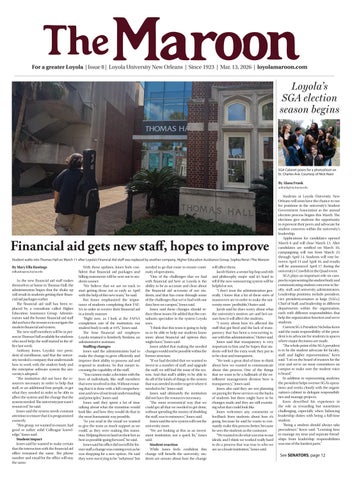
Loyola’s SGA election season begins

By Alana Frank anfrank@my.loyno.edu
Students at Loyola University New Orleans will soon have the chance to run for positions in the university’s Student Government Association as the annual election process begins this March. The elections give students the opportunity to represent their peers and advocate for student concerns within the university’s leadership.
will affect them.
Jacob Hutter, a senior hip hop and r&b and philosophy major said it’s hard to tell if the new outsourcing system will be helpful or not.
“I don’t trust the administration generally. I know that a lot of these sorts of maneuvers are in order to make the university more ‘profitable’, Hutter said.
Jacob said he does worry about what the university’s motives are and he’s unsure how it will affect the students.
“I worry about how it’s affected the staff that got fired and the lack of transparency that has been a reoccurring issue with this administration,” Hutter said.
Jones said that transparency is very important to him and he hopes that students will feel the extra work they put in to be clear and transparent.
“We took a great deal of time to think about how we wanted to communicate about this process. One of the things that we want to be a hallmark of the enrollment management division here is transparency,” Jones said.
Jones also said they are not planning on paying for these services on the backs of students but there might have to be changes made and they are still examining what that could look like.
Jones welcomes any comments or feedback from students about how it’s going, because he said he wants to constantly make this process better, because he sees the students as the customer.
“We wanted to do what was true to our ideals, and I think we worked really hard to do a process that was true to who we are as a Jesuit institution,” Jones said.
Applications for candidates opened March 6 and will close March 13. After candidates are notified on March 16, campaigning will run from March 23 through April 14. Students will vote between April 13 and April 16, and results will be announced April 17 during the university’s Crawfish in the Quad event.
SGA plays an important role on campus by representing the student body and communicating student concerns to faculty, staff, and university administrators. Leadership positions include president, vice president,senators at large (SALs), Chief of Staff, and leadership in different departments within the organization, each with different responsibilities that help the organization function and serve students.
Current SGA President Nicholas Keen said the main responsibility of the president is to advocate for students in spaces where major decisions are made.
“The whole point of the SGA president is to be the student advocate for faculty, staff, and higher representation,” Keen said. “I sit on the board of trustees for the year and serve on most committees on campus to make sure the student voice is heard.”
In addition to representing students, the president helps oversee SGA’s operations and works closely with the organization’s cabinet to delegate responsibilities and manage projects.
Keen described his experience in the role as rewarding but sometimes challenging, especially when balancing leadership duties with being a full-time student.
“Being a student should always take precedence,” Keen said. “Learning how to manage my time and separate friendships from leadership responsibilities was one of the hardest parts.”
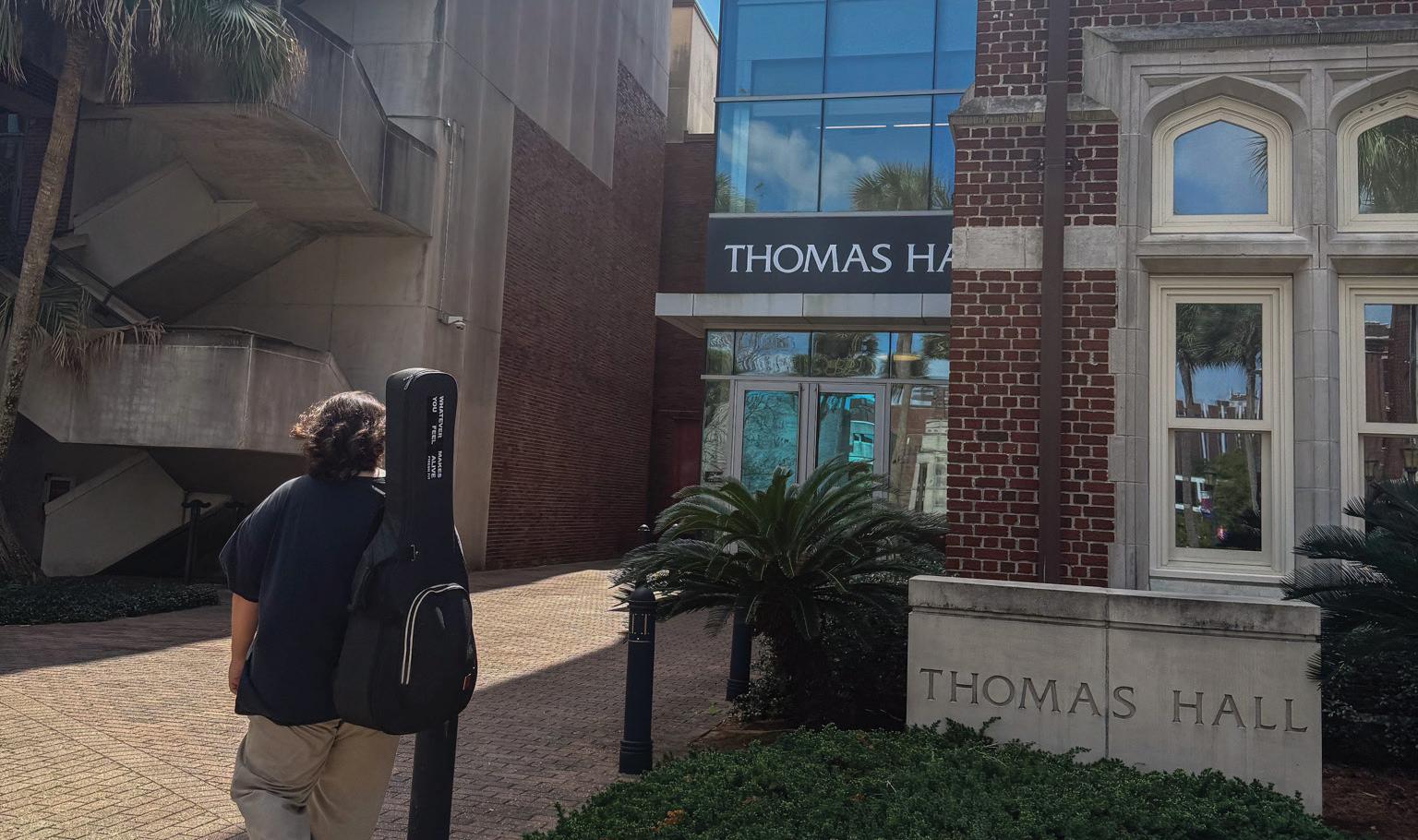
Student walks into Thomas Hall on March 11 after Loyola’s Financial Aid staff was replaced by another company, Higher Education Assistance Group. Sophia Renzi /The Maroon
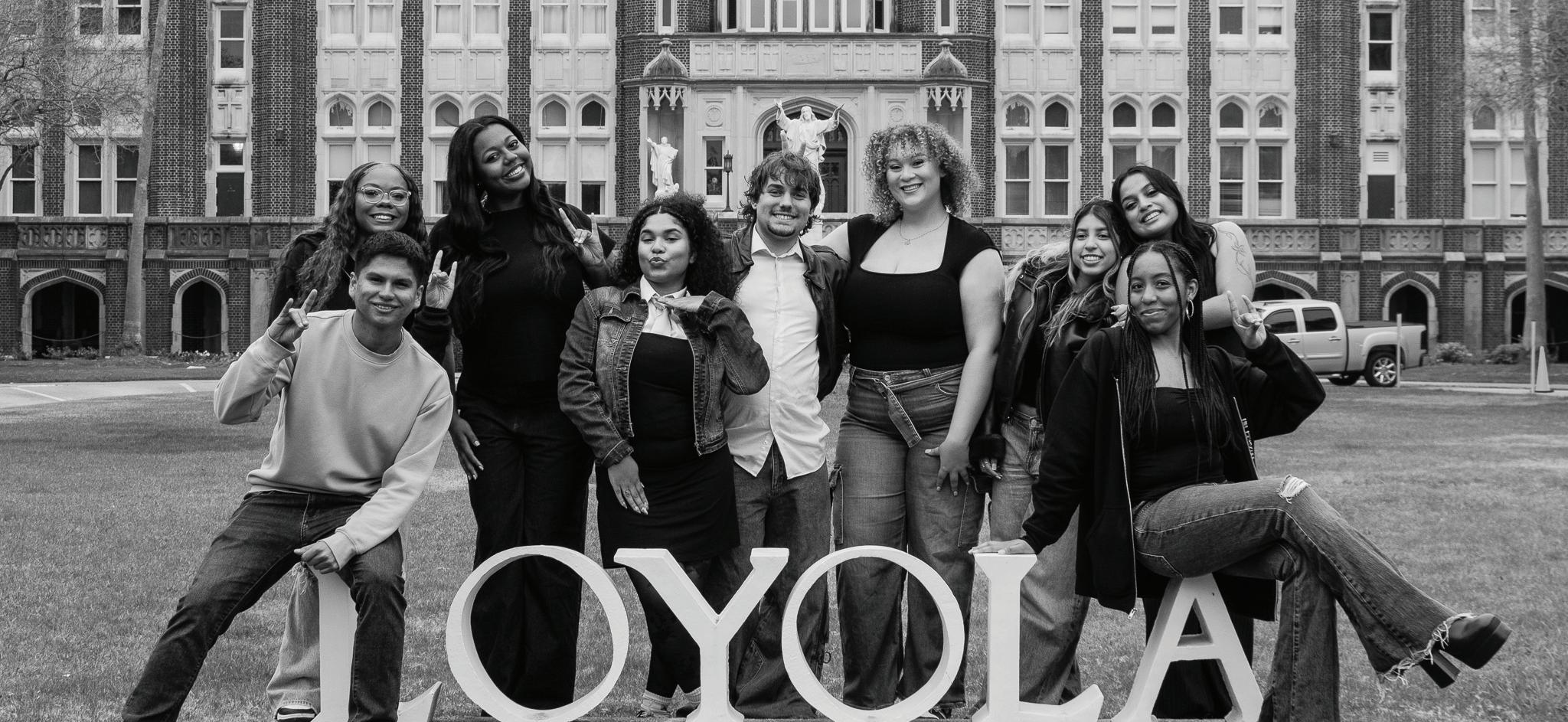
SGA Cabinet poses for a photoshoot on St. Charles Ave. Courtesy of Nick Keen














SGA election season ramps up
By Alana Frank anfrank@my.loyno.edu
Students at Loyola University New Orleans will soon have the chance to run for positions in the university’s Student Government Association as the annual election process begins this March. The elections give students the opportunity to represent their peers and advocate for student concerns within the university’s leadership.
Applications for candidates opened March 6 and will close March 13. After candidates are notified on March 16, campaigning will run from March 23 through April 14. Students will vote between April 13 and April 16, and results will be announced April 17 during the university’s Crawfish in the Quad event.
SGA plays an important role on campus by representing the student body and communicating student concerns to faculty, staff, and university administrators. Leadership positions include president, vice president,senators at large (SALs), Chief of Staff, and leadership in different departments within the organization, each with different responsibilities that help the organization function and serve students.
Current SGA President Nicholas Keen said the main responsibility of the president is to advocate for students in spaces where major decisions are made.
“The whole point of the SGA president is to be the student advocate for faculty, staff, and higher representation,” Keen said. “I sit on the board of trustees for the year and serve on most committees on campus to make sure the student voice is heard.”
In addition to representing students, the president helps oversee SGA’s operations and works closely with the organization’s cabinet to delegate responsibilities and manage projects.
Keen described his experience in the role as rewarding but sometimes challenging, especially when balancing leadership duties with being a full-time student.
“Being a student should always take precedence,” Keen said. “Learning how to manage my time and separate friendships from leadership responsibilities was one of the hardest parts.”
Senators at large play another key role within SGA by representing specific colleges and helping students communicate with university leadership.
Paris Hayes, a junior criminology major and current Speaker of the Senate,
said senators at large often work directly with deans and administrators.
“The responsibility of an SAL is to serve as the liaison between the deans of your particular college and the student body,” Hayes said. “We also chair senate committees and act as a resource for students who want to voice concerns, share ideas, or seek guidance.”
Hayes said one of the most rewarding parts of the role has been working with university administrators to improve student engagement.
“One of my favorite parts was connecting with the dean and assistant dean of the College of Arts and Sciences,” Hayes said. “Sharing ideas on how we can help better student engagement helped us come up with several ideas we hope to collaborate on in the future.”
However, Hayes said representing
such a large student population can sometimes be difficult.
“One of the hardest parts is knowing it may be hard to ensure every single student voice is heard,” Hayes said. “But we try our best to make sure students, faculty, and the surrounding New Orleans community feel heard and represented.”
Senior Heaven Haney, a popular and commercial music major with a marketing minor, said her experience as a senator at large has been meaningful both professionally and personally.
“My experience as an SAL was very positive,” Haney said. “I was able to work and collaborate with such an amazing group of individuals who were hardworking and made the experience fun and inviting.”
Haney said teamwork within SGA helped make the role easier to manage.
“The responsibilities can be challenging at times, but it’s a collaborative effort with the vice president and the other SALs that makes the workload easier,” Haney said.
For Haney, the relationships she built were the most valuable part of the experience.
“My favorite part of being an SAL is definitely the connections I have made,” Haney said. “I was able to strengthen friendships with people already in SGA and meet new friends along the way.”
Students interested in running for office were invited to attend information sessions on March 2, March 3, and March 5. The sessions explained the roles available, how campaigning works and what SGA expects from potential candidates.
Current members of SGA encourage students who are interested in leadership to consider running.
“One piece of advice I would give students who are running is to stay active and be open,” Hayes said. “Not just with students but with faculty and staff also because their voice matters.”
Haney offered similar advice to future candidates.
“Just be yourself,” Haney said. “People look for authenticity, and as long as you stay true to who you are, everything will fall into place.”
New Orleans Entrepreneur Week returns to Loyola
By Christopher Nesbit cwnesbit@my.loyno.edu
New Orleans Entrepreneur Week is closing out its second year at Loyola University New Orleans, further establishing the university as a central gathering point for the city's innovation and startup community.
The weeklong event, known as NOEW, featured more than a dozen events across the city from March 9-14, culminating in a two-day flagship summit at Loyola's Danna Center on March 12 and 13.
The summit included more than 100 speakers and over 50 sessions ranging from workshops on legal challenges to keynote addresses.
"New Orleans Entrepreneur Week is a weeklong gathering and connection point for the intersection of innovation, community and culture here in New Orleans," said Sam McCabe, director of the Center for Entrepreneurship and Community Development at Loyola.
NOEW has been a fixture in the city's entrepreneurial calendar since 2009. For its first 13 years, the event was produced by the Idea Village, a local startup support organization. Last year, the Idea Village partnered with Loyola to co-produce the event on campus for the first time, McCabe said.
"That event went pretty well. We were happy with how it went and decided
to continue doing it here on campus," McCabe said. "We learned a lot. There's nothing more entrepreneurial than figuring out how to pivot and solve a problem on the spot".
This year, organizers fully centralized summit operations in the Danna Center based on lessons from last year's inaugural hosting, McCabe said.
New Orleans Mayor Helena Moreno encouraged residents to attend the event, framing it as part of the city's broader economic development agenda.
"One of the things I talk about all the time and that we're working hard on is to increase economic development opportunities and support businesses here in New Orleans. And that also includes supporting and encouraging our entrepreneurs," Moreno said in a video posted to social media ahead of the event.
Moreno described NOEW as "a great opportunity to be able to learn from those who've been able to take some big ideas and turn them into multimillion dollar companies.”
Programming extended well beyond traditional business topics. Sessions covered the music industry, independent media, social media marketing and healthcare innovation. Panels featured local figures including Andrew Campanelli of The Revivalists and Robert Mercurio of Galactic and Tipitina's, McCabe said.
"While it may seem like it's just the business community that's part of this, really anybody that's on this campus that is looking to stay in New Orleans and be a part of this community, there's something for you at NOEW," McCabe said.
Anna Claire Gee, a junior business administration major at Loyola, said she volunteered and attended sessions on healthcare innovation.
"You can gain so many tools just by going and experiencing and just even looking at what we have to offer," Gee said.
Registration for the summit was free, and students could obtain a badge in under 30 seconds at the Danna Center, McCabe said.
The Center for Entrepreneurship and Community Development plans to continue programming after NOEW. Wolfpack LaunchU, the center's annual pitch competition with more than $35,000 in funding for Loyola community entrepreneurs, follows the event. The center also hosts the Side Hustle Expo in the fall, where students showcase creative ventures.
"You don't have to have some grandiose idea that's going to solve some major problem in the world to be an entrepreneur and to be a part of that community," McCabe said.
For more information, visit NOEW. org or startup.loyno.edu.

SGA Cabinet poses for a photoshoot outside of Marquette Hall. Courtesy of Nick Keen for the Maroon.
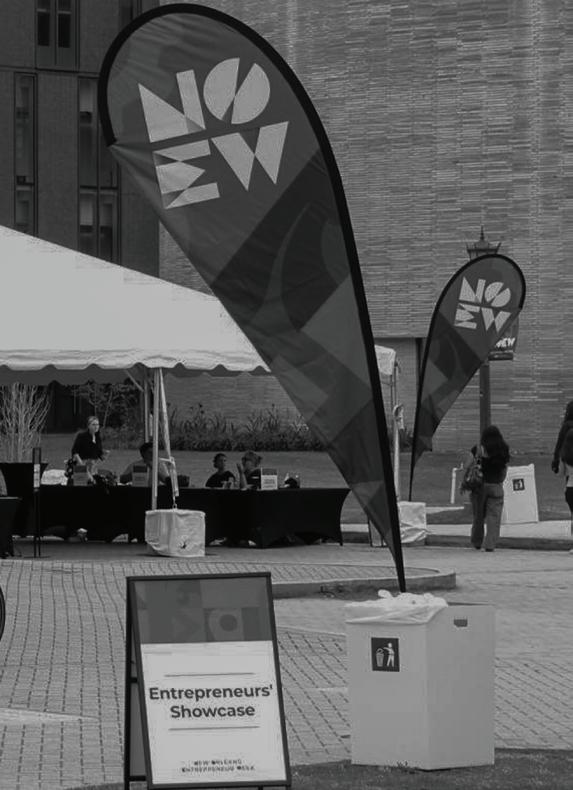
NOEW sign and tent outside of the Chapel of St. Ignatius in 2025. Rodrigo Delgado/The Maroon.
Danna Center exterior is decorated ahead of NOEW. Christopher Nesbit/ The Maroon.
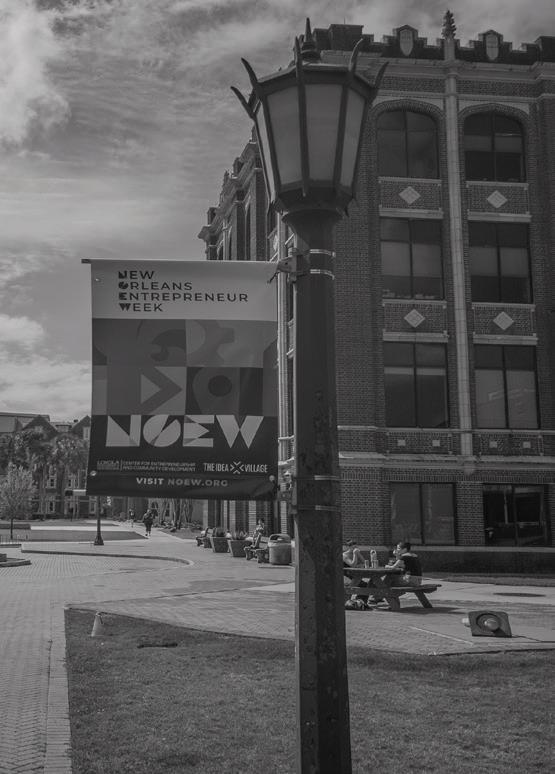
NOEW banner in the Peace Quad. Christopher Nesbit/The Maroon.
PUZZLES
ACROSS
1. Fly agaric's scienti c name: 2 wds.
7. ___ Cooper (car brand)
8. "___ and behold!"
9. Deep-fried French rolls
14. International Health Plan, Abbr.
15. Body spray brand that's also a tool
16. "___ upon a time ..."
18. Chile, Abbr.
20. R&B singer ___ (Gabriella Wilson)
21. A, E, ___, and sometimes Y
22. Black Student Union, abbr.
23. 1980s TV Drama: Magnum __
25. Live Role Play, Abbr.
26. Magician's feat
28. Cannabis, informally
30. Watchtower, Abbr.
31. Pizza place on Freret: __ Dough
32. Barbie's beau
34. Exclamation of surprise
35. Sound of realization
36. *NSYNC hit, or a farewell
38. “Tea” in Spanish
39. Log Out, Abbr.
40. Teacher’s Assistant, abbr.
41. Hospital drama
43. “Yes” in Spanish
44. Dwayne Johnson’s ring name
47. Bottom's opposite
50. " e Princess and the ___"
52. Time-traveling Doctor
53. Killer whales
55. Our nearest star
56. Wet dirt
57. "Kung Fu Panda" protagonist
59. Youtube's ___ and Phil
60. Existential boredom
DOWN
1. Before noon, Abbr.
2. Michigan, Abbr.
3. Inde nite article before vowels
4. Specialized market segment
5. "Madagascar" lion
6. Rose plant fruit used in tea
10. Role Play, Abbr.
11. Technical Assistance, Abbr.
12. Flask-shaped fungal fruiting body
13. ___ advisory
14. Kids' spelling prank
17. South's opposite
18. Crime lab TV franchise, Abbr.
19. Fortunate
22. Baton Rouge, Abbr.
24. Fashionable, slangily
26. Toilet Paper, Abbr.
27. Young guinea fowl
29. Cereal grain
31. Morning moisture on grass
33. Pro basketball org, abbr.
36. Burnham of "Inside"
37. Episode, Abbr.
42. Spreadsheet horizontals
45. Unattractive egoist, in slang
46. ___ Ice (sno-ball brand)
47. eater Resourced Unlimited, Abbr.
48. Repetitive-behavior disorder, Abbr.
49. Pennsylvania, Abbr.
51. Sports channel, Abbr.
53. Yoga chant
54. Signi cant Figures, Abbr.
58. Opposite of o
For weekly puzzle answers, visit our Website via the QR code:

STAFF LIST
Editorial Board
Editor in Chief - Eloise Pickering
Managing Editor - Mary Ella Hastings
Pre-Content Director - Alana Frank
Post-Content Director - Callie
Honeycutt
News Editor - Lily Bordelon
News Editor- Stella Perdue
Worldview Editor - Pablo Piñeiro
Life & Times Editor - Elise Beck
Asst. Life & Times Editor - Olivia
Sanyal
Sports Editor - Keri Smith
Opinion/Editorial Editor - Imad
Siddiqui
Breaking News Editor - Natalie omas
Copy Editor - Mark Michel
Senior Sta Writer - Dominique
Campbell
News Consultant - Mark Michel
e Wolf Director - Laura Welles
Senior Sta Photographer - Sophia Renzi
Photo Editor - Ashlyn Bobb Collins
Asst. Photo Editor - Pharrell Every
Social Coordinators - Mabel
Regelado-Hernandez, Carlos Andrade
Broadcast Producer - Cecilia Calderín
Lead Anchor - Dessadra Tezeno
Newscast Editor - Christopher Nesbit
Design Chief - Makayla Parker
Newsletter Writer - Rodrigo Delgato
Distribution Manager - Sophia Renzi
Contributors
Alyvia Pierson, Keily Martinez Pereira, Chandler Giallo, Dutch Buckley, Katherine Leslie, Claire Kerr, Alyssa Jones, Cae Nguyen, Nicholas Parrella, Angelica Pineda, Anistin Murray, Sabrina Huynh, Finian Jones, Erin Lovato, Valentina Russell, Claire Schmit, Joshua Fletcher, Lonniesha Carroll, Patricia Boyett, Amari Winchester, Nikolai Huilgol, Maria Touzard, Vaishnav Desabhatla, Xavier BuckleyWilson, James Wyrtzen, Claire Kerr,
Sales Manager: Emily Keller
Sales Representative: Carrie Adams Olsen
Student Media Adviser: Michael Giusti
Assistant Student Media Adviser: Gabriella Killett Vargas
CONTACT US
Main O ce - (504) 865 - 3535
Business O ce - (504) 865 - 3536
Adviser’s O ce - (504) 865 - 3295
Correspondence - maroon@loyno.edu
Letters to the Editor - letter@loyno.edu
Advertising - ads@loyno.edu
Website - www.loyolamaroon.com
Twitter - @loyola_maroon
Facebook - e Maroon
Instagram - @loyola_maroon
Our o ce is in the Communications/ Music Complex, Room 328.
Send mail to: e Maroon, Loyola University, Campus Box 64, 6363 St. Charles Ave., New Orleans, LA 70118
e Maroon is published every Friday. Unless otherwise noted, all content is copyrighted by e Maroon. All rights reserved. First copy free to students, faculty, and sta . Every additional copy is $1.00.
e Maroon is printed on 30 percent post-consumer recycled content.

Crossword by Kira Phillips and Olive Riley/ e Maroon
Loyola Jazz Fest draws in potential students
By Lily Bordelon lmbordel@my.loyno.edu
Loyola’s annual jazz festival introduced high school students to the talents of faculty, the student Jazz Ensemble, and other New Orleans musicians, including guest star Aubrey Logan and the Crescent Collective.
According to Gordon Towell, Coordinator of Jazz Studies, who directed this year’s Loyola Jazz Festival, this event is not only an inward opportunity for students to perform and work with creative professionals, but it is also a chance for Loyola to share its education to the community while also presenting what it has to offer to students in high school.
“We get quite a few students who come to our school because they get a chance to see the institution, see what's going on energy-wise, meet our students, hear our students, so I think it's a great event for Loyola and I'm just so happy to be part of it and get a chance to organize it,” Towell said.
This year, Towell explained, most of the attending students outside of Loyola were high schoolers, meaning Loyola was able to “show off” what it’s doing for jazz studies and other music majors.
The 57-year-old festival was established by Joey Baer, who ran the jazz Program. Baer started the festival to be an educational event to bring groups in and out of state together. The event has expanded since to include other areas.
“I get a chance to hear a lot of groups from other places. Some groups from Nashville and Atlanta this year so I get to hear jazz education from other places,” Towell said.
The festival has three main concerts: the first one is sponsored by Connie and Elaine Jones as a gift to the community, the second is the faculty concert, and the third is the guest stars and student jazz ensembles together.
“Connie was a fantastic traditional trumpet player here in town. They've left us a beautiful gift of money. So we have a New Orleans traditional jazz concert on a Thursday night, opening the festival,” Towell said.
The faculty concert, according to Towell, is one of the two opportunities that the faculty has to perform together in a school setting. He explained that many of them perform together outside of school, but other than the Jazz Underground Series, this event’s faculty concert is the only other time they collaborate and perform for their students
“We have a wonderful jazz faculty. We have about 14 people in our jazz faculty. It's a matter of who's available to perform this concert and then putting the concert together,” Towell said.
Meryl Zimmerman, an adjunct professor of jazz voice, performed in the faculty concert as one of the lead vocals. She sang Beauty of Birds by Stevie Wonder, in which saxophone instructor Jason Mingledorff did an arrangement based on Don Braden; she also performed I Didn’t Know What Time it Was, which was arranged by John Mahoney. Zimmerman explained that the process before the concert was incredibly relaxed, and staff only needed to meet once or twice before the concert.
“The beauty of this art form is that when you play this music a lot, you just kind of know the typical conventions of
how the music works,” she said. “So if you know the song, you know the key, you have a chart with all the chords and all of the information, the basic information you need, you don't necessarily need much rehearsal.”
Zimmerman believes that the concert is a great opportunity for faculty to connect through their talents after teaching separately throughout the semester.
“It's just a lot of fun to get to sing with really good musicians who are also my friends,” she said. “And usually, we're kind of busy doing our own thing, teaching, and so it's nice to have that opportunity.”
Logan, the star guest for this year’s event, gave Loyola students and the students visiting clinicals, specializing in trombone and vocals. She is focused on Postmodern Jukebox and is aware of social media, according to Towell.
“She's a wonderful performer, a wonderful artist. So we brought her in and featured her on Saturday. So that was really, really, really fun,” he said.
Towell believes that the event was a success after having worked on it since the last festival ended.
“At the end of the festival I feel wonderful that we've been able to share the stuff groups have learned, the performance of our student musicians. It's really a good feeling at the end of the festival. There's a lot of preparation up to it,” Towell said.


Marketing professional talks personal branding

By Alana Frank ewpicker@my.loyno.ed
When Olivia Scott talks about personal branding, she is not just referring to a polished LinkedIn profile or a carefully curated Instagram feed. For Scott, personal branding begins with authenticity. Scott, founder of Omerge Alliances and an instructor in the College of Business at Loyola University New Orleans, spoke to students during the university’s annual Media Day about how they can build a professional identity while still staying true to themselves. Her talk, “Building Your Personal Brand with Authenticity,” addressed how students can navigate the growing pressure to market themselves online
while also maintaining a genuine sense of who they are.
As internship and job applications approach for many Loyola students, Scott said understanding personal branding is becoming more important than ever.
“Your personal brand is how people perceive you before they even meet you,” Scott said. “It’s the way you communicate your values, your skills, and what you stand for.”
Scott founded Omerge Alliances, a marketing and branding company that focuses on helping individuals and organizations clarify their messaging and connect with audiences in meaningful ways. Her professional background in marketing and communications shaped
how she approaches personal branding, especially when working with students preparing to enter the workforce.
During her talk, Scott emphasized that branding is not about creating a completely new persona online. Instead, she encouraged students to focus on consistency between their digital presence and their real-life values.
“Authenticity is what makes a brand sustainable,” Scott said. “If you try to create a version of yourself that isn’t real, it becomes difficult to maintain.”
The topic resonated with many students in attendance, particularly those studying communication, marketing, and business who are preparing for internships and post-graduate careers.
Sophomore public relations major Fabiola Marrero-Bravo said personal branding is important for students who want to stand out in a competitive job market.
“Personal branding means a lot to me because it’s how I show what is unique about me compared to other people,” Marrero-Bravo said. “It shapes everything I do, including how I present myself on social media and professionally.”
Marrero-Bravo said that because many students share similar experiences and platforms online, creating a unique approach to personal branding can help someone stand out.
“There are so many students apply-
ing for the same opportunities,” Marrero-Bravo said. “Having a unique approach to your personal brand can make you different from everyone else.”
Another Loyola student, sophomore communications public relations major Lorenzo Barbegelata Miller, said he also sees personal branding as an important part of standing out professionally.
“In our generation, everyone is on social media,” Miller said. “When you apply for internships or jobs, employers can see what you post and how you present yourself online.”
Miller said personal branding helps students communicate what makes them different from others applying for the same opportunities.
“Your personal brand is how you show what makes you unique,” Miller said.
Students also said Loyola classes often encourage them to think about how employers may view their online presence.
“In a lot of media classes, we talk about how employers look at your social media,” Marrero-Bravo said. “Teachers even suggest searching your own name online to see what comes up.”
With platforms like LinkedIn, Instagram, and digital portfolios playing a larger role in hiring decisions, Scott said students should start thinking intentionally about how they present themselves
professionally.
“Employers often look at your online presence before they even schedule an interview,” Scott said. “So it’s important that what they see reflects the type of professional you want to be.”
However, Scott also stressed that personal branding should not feel overwhelming or artificial.
Instead, she encouraged students to start with simple steps: identifying their strengths, understanding their career goals and communicating those qualities clearly through their online presence and professional interactions.
“Your brand grows with you,” Scott said. “It evolves as your experiences and skills evolve.”
For Loyola students attending Media Day, Scott’s message highlighted the increasing connection between identity, professionalism, and digital presence in today’s job market.
As students prepare for internships, networking opportunities and future careers, Scott hopes they leave with a clearer understanding of how authenticity can guide their professional journeys.
“People connect with honesty,” Scott said. “When you lead with authenticity, your brand becomes something that represents you, not just something you’re trying to sell.”
Loyola's faculty performs in the Faculty and Guest Showcase for the Loyola Jazz Fest. Loyola's annual Jazz fest was held from Mar. 5 to Mar. 7. Courtesy of Jonathan Hernandez for the Maroon.
Meryl Zimmerman and other music professors perform in the Faculty and Guest Showcase for the Loyola Jazz Fest. Loyola's annual Jazz fest was held from Mar. 5 to Mar. 7. Courtesy of Jonathan Hernandez for the Maroon.
Photo of Olivia Scott courtesy of Olivia Scott for the Maroon.

Baseball Coach Kennedy reaches 600 career wins
By Keri Smith klsmith1@my.loyno.edu
At most programs, reaching 600 career wins would be marked by ceremonies, trophies and statistics. But for Loyola Wolf Pack baseball head coach Jeremiah Kennedy, the number itself carries less importance than the people and lessons behind it.
“To be perfectly honest, it’s kind of a weird number to think about,” Kennedy said, adding that the milestone was never a goal in itself. Instead, he said he became a coach to build a strong culture and help young players live principled lives.
While the achievement reflects years of success on the field, Kennedy sees the number as more of a byproduct of time spent in the game.
“I guess the 600 number just means I’ve been at it for a while,” he said. More important to him, he added, is using baseball as a way to help players grow into leaders, husbands and men of character.
When Kennedy looks back on his career, he doesn’t think first about box scores or championship runs. He remembers the people who helped shape his path.
He credits former coaches at Dallas Baptist University for encouraging him to pursue coaching and says assistant coaches throughout his career have played a major role in his development.
One moment that stands out came during a brief step away from the profession.
“I was actually out of coaching for a year,” Kennedy said. “The opportunity and decision to get back into coaching at Loyola was obviously significant for me.”
Over more than two decades, Kennedy’s leadership philosophy has become more refined. The program now operates around five guiding principles: earned respect, personal responsibility, maximizing individual potential, creating value and resilience.
“These are the things I’ve landed on as essential after leading for 20-something years,” he said, explaining that the team constantly works to align its culture with those values.
Kennedy believes those principles apply well beyond baseball.
“I believe if more people operated on

principles like these, we would have a much better society,” he said, noting that accountability and self-reflection are often missing in today’s culture.
Though the milestone is tied to his name, Kennedy quickly shifts the credit to the players and staff who have built the program alongside him.
Players, coaches, trainers and administrators all contribute to a team’s success, he said, but the athletes themselves remain the most important part.
“My players are the best,” Kennedy said. “They are high-character young men who are going to and already are great husbands, leaders and contributors to society.”
Across hundreds of games, the lessons of coaching have extended beyond
the diamond.
“I’ve learned that life is hard,” Kennedy said. “You have to move, grow and take responsibility especially when you don’t want to.”
He believes the most difficult moments often provide the greatest opportunities for growth.
“Life is tough, and it’s supposed to be tough,” he said. “The growth we all need happens through the tough times.”
For young athletes or future coaches considering a similar path, Kennedy offers simple advice.
“If you want to get rich, find something else to do,” he said. “If you want to make an impact on people, then coaching is a great way to do it.”
Even after 600 wins, Kennedy says the
mission of the Loyola baseball program remains the same: focus on the process and develop players to their fullest potential.
“Work to maximize individual and team potential through the process of college baseball,” Kennedy said. “Wherever that takes us, so be it.”
For the Wolf Pack, the milestone represents more than a number in the record book; it reflects years of mentorship, leadership and a commitment to shaping players both on and off the field.
Upcoming games
Mar. 13
March Madness begins
March
Madness runs from March 15 to April 6
By Keri Smith klsmith1l@my.loyno.edu
Every spring, sports fans across the country fill out brackets and make bold predictions for the NCAA Division I Men’s Basketball Tournament. Known as March Madness, the tournament has become one of the most exciting events in sports because of its unpredictability.
The single-elimination format means that anything can happen. A lower seeded team can defeat a powerhouse program in just one game, instantly becoming the story of the tournament. Every year, fans look forward to those unexpected “Cinderella” runs when smaller schools make deep pushes in the bracket.
Part of what makes March Madness so exciting is the emotional energy of college basketball. Many players are competing on one of the biggest stages of their careers, which makes every possession feel intense. Buzzer-beaters, last-second defensive stops and dramatic upsets create moments that fans remember for years.
The tournament is also about more than just basketball. Friends, families and classmates come together to watch games, compare brackets and argue over predictions. Even people who rarely watch college basketball suddenly become invested in the outcomes.
That shared excitement is what makes March Madness special. For a few weeks every year, the unpredictability, drama and passion of the tournament bring fans together in a way few sporting events can.
Men's Baseball Women's Basketball
Mar. 13 at Tennessee Southern Pulaski, Tenn 1:00 pm
Men's Baseball
Mar. 13 at Tennessee Southern Pulaski, Tenn 4:00 pm.
Men's Basketball
13
Mar. 13 vs. Georgetown, Ky NAIA women's basketball national championship Men's
Track &Field
Mar. 14
The Andy Thiel Season Opener Hammon,La
Track&Field Men's Baseball
Mar. 14
The Andy Thiel Season Opener Hammon,La
Mar. 14 NAIA National Championship Pulaski, Tenn
Jeremiah Kennedy outside during a baseball game. He has recently received 600 career wins at Loyola. Courtesy of Abigail Smith/ Loyola New Orleans Athletics.
From storytimes to self-re ection: Tana Mongeau talks growth at Tulane
By Imadunisa Siddiqui isiddiqu@my.loyno.edu
Some people are in uencers. Some people are celebrities. And then there’s Tana Mongeau: a full-blown internet time capsule from the golden age of YouTube.
When Tulane University Campus Programming Direction x Comedy brought Tana to Tulane, I was hoping it would like the 2016 YouTube videos I watched growing up, when storytimes were unhinged, Facetune was aggressive, and the internet was held together by drama between people like Shane Dawson, Je ree Star, and James Charles.
Mongeau didn’t disappoint.
She immediately launched into stories about growing up in Las Vegas, which honestly explains a lot. Vegas is a city built on bad decisions, so it makes perfect sense that one of the internet’s most chaotic storytellers would come from there.
Back in the early YouTube days, Mongeau admitted she basically never thought before she spoke. Her channel was built on chaotic storytimes that felt like they had no lter at all: stories about bleaching her hair in ways that went horribly wrong, the infamous night she said she was roo ed while visiting New Orleans, and the internet spectacle of her whirlwind wedding to Jake Paul. She just said whatever came to mind and let the internet deal with it later. And somehow, that reckless honesty is exactly what made her so iconic.
While other creators carefully crafted perfect online images, Tana leaned into being completely un ltered. She didn’t worry much about what people thought, and strangely, that honesty made audiences connect with her even
more. Now that she’s older, she says she’s learned to pause and think a little more before speaking, not because she’s trying to become polished, but because she’s found something she never really had before: peace.
I think that is impressive for someone who grew up online with millions of people watching every decision she made.
Most people get to leave their bad relationships in the past. Mongeau can’t avoid hers completely, as old clips of videos with her exes are often recirculated on the internet. Breakups, friendships, mistakes, scandals, it’s all there.
internet may never forget, but people are still allowed to grow.
e way she talked about relationships now felt noticeably di erent from the chaotic dating storytime videos many people associate



Naturally, this led the moderator into asking her questions about Cancelled, her podcast where she continues her long-standing tradition of refusing to lter herself and honestly, that’s part of what makes Mongeau interesting. Her refusal to stay quiet. She pointed out that society often expects women to tone themselves down and avoid saying things that might make people uncomfortable.

Mongeau built an entire career doing the opposite.
Mongeau isn’t as messy as she used to be, turning down questions about celebrity drama to instead rave about her friendship with youtuber Trisha Paytas, explaining how watching Paytas completely reinvent her life showed Mongeau that people aren’t stuck in their worst moments forever. e
videos







with her. Mongeau’s romantic life has played out publicly for years from marrying Jake Paul, to the countless storytimes that turned bad dates into YouTube history. ose moments were messy, loud, and very much part of the 2016 internet ecosystem.
Mongeau spoke about her current boyfriend, Makoa Ho, who was backstage at the show, in a way that felt calmer and more grounded. e chaos that once de ned her dating life has clearly softened into something more stable. She talked about wanting
peace and a relationship that actually supports the person she’s trying to become. She explained that she and her current boyfriend were friends rst, which she says helped build a healthier foundation. Mongeau also noted that he has been a supportive part of her sobriety, encouraging the calmer, more established version of herself she’s trying to grow into.
Listening to Mongeau describe her past, you could see the growth in real time. e same internet personality who once turned relationships into viral storytimes now talks about partnership in a way that feels thoughtful and intentional. She also re ected on how many friendships in the in uencer world can become transactional - more about meeting up to lm content together than actually spending time as real friends. at contrast made the way she described her current relationship feel even more grounded, built less around the internet and more around genuine connection.
One of the most honest moments of the interview came when she discussed sobriety. Mongeau said that in the past, she used alcohol as a coping mechanism and was constantly drunk. She was concerned that others wouldn’t nd her funny or entertaining if she wasn’t drunk. Now she’s trying to live di erently, and she says she doesn’t think she’ll ever go back (though she emphasized that she is California sober!)
Mongeau explained that she wants to take herself seriously now and actually be proud of what she’s doing. She even mentioned how supportive her boyfriend has been during this stage of her life.
Mongeau also revealed that she’s writing a book, promising there’s a huge
part of her story that the internet hasn’t heard yet, especially her childhood-she gave the audience a sneak peek into one of the stories, which, simply put, includes her dad and a little bit of re Of course the book will also include iconic internet chapters like Tanacon, the time she married Jake Paul, and the many chaotic moments that somehow became part of YouTube history.
Mongeau also touched on struggling to nd brand sponsorships earlier in her career, due to her not-brand-safe party girl image. She mentioned only getting opportunities from sex toy and alcohol brands-a far cry from Medicube and Evryjewels, two of her more recent brand collaborations. One thing she made clear: she never wants to be a sellout. Even as her career evolves, she doesn’t want to lose the personality that made people follow her in the rst place.
A highlight of the night was when she talked about some of her favorite viral moments, including the legendary toothbrush story, which still remains one of the most unhinged pieces of YouTube lore ever created. She also joked about paparazzi moments and internet drama.
Tana also explained why she started making videos in the rst place. When she was younger, she watched YouTubers because it allowed her to escape into someone else’s life for a while. Eventually she realized she wanted to create that same kind of escape for other people.
By the end of the night, one thing was clear. Tana Mongeau is still exactly what she’s always been: loud, honest, a little chaotic, and incredibly funny. e only di erence now is that she’s a little more re ective and apparently a lot less hungover.
Checking in with students halfway throughout Lent: re ecting on growth
By Pharrell Every pjevery@my.loyno.edu
Catholic students on campus are celebrating Lent in their own ways, with students opting to add something to their lives whereas most opt to take something out.
Lent is the forty-day season in which Catholics throughout the world partake in di erent forms of prayer and fasting leading up to the celebration of Christ’s resurrection at Easter.
Political science sophomore Sam McMahon added some opportunities for prayer into her Lenten ritual.
“I took on going to adoration three times a week on Mondays, Wednesdays, and Fridays at Holy Name of Jesus Adoration Chapel and the Ignatian Chapel on campus. It has been really nice spending signi cant, dedicated time with Jesus, but it's been a little bit di cult making the time to actually go,” McMahon said.
McMahon rst decided to go on Monday, Wednesday, and Friday at 8 o’clock in the morning, but found di culty with waking herself up so early on Fridays. Instead, she elected to go to adoration on Wednesdays in the Chapel of St. Ignatius.
“It's been worth it so far; I've increased dedicated prayer and my understanding of my relationship with Jesus,” McMahon said.
Since Lent began McMahon has noticed some personal changes,
observing that she’s a lot calmer and introspective. She attributes these changes to the dedicated prayer time she’s implementing, as a form of guided meditation.
Biological science freshman Alonna Lujan also opted to add time for meditation into her Lenten journey for this year.
“For Lent I decided to add at least twenty minutes of reading/listening to scripture. It has been a little trickier than I anticipated to t in focused quiet time while classes are requiring more and more of my attention, but I always appreciate that time a lot,” Lujan said.
Despite the trickiness that she anticipated, keeping up with this dedicated time for scripture is going well, which she expected from the beginning.
“I feel more grounded since Lent began. It’s de nitely a time to re ect on the sacri ces Jesus made for us, and to be grateful for services others have done for us as well. at’s always very humbling,” Lujan said.
For the rest of the season, Lujan hopes to be able to recommit herself to doing service for others, including her friends, professors, and even strangers.
Freshman political science major Saige Berthelot wanted to make her Lenten journey about pouring into herself spiritually instead of strictly giving something up.
“I've taken on praying the rosary at least once a week and going to confession at least once during this lent season. With school and obligations, this can be tricky. However, God always nds a way for you to nd him and come back to your intentions,” Berthelot said.
As a student at a Catholic university, Berthelot expected her Lenten journey to be very ful lling, and it is matching up just how she thought it would. e reason in large part is because of the supportive community and sta around her to help her in strengthening her spiritual life.
With that guidance, Berthelot has noticed that she’s become a lot more patient this Lenten season.
“I've noticed I have become more patient with others. Being in touch with yourself and your relationship with God really helps you to be a better person to your peers,” she said.
rough the rest of Lent, Berthelot wants to commit herself to resetting and maintaining the positive mindset she gained from mass on Ash Wednesday.
“Mentally, I was in a good headspace in the beginning of Lent and I want to continue to commit to that to be a better Catholic this Lent[en] season,” Berthelot said.

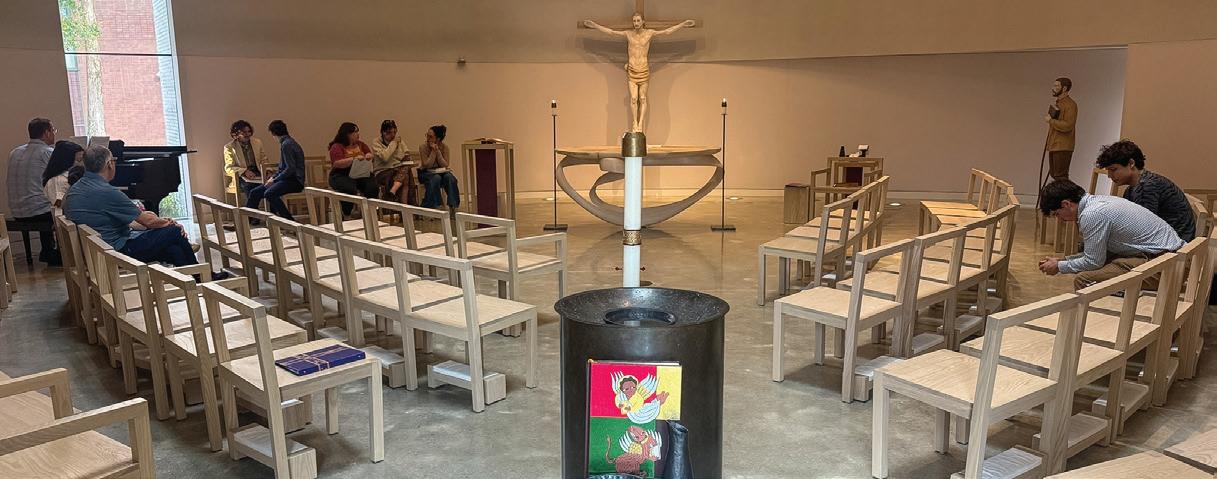
Congregants gather in St. Ignatius Chapel for 5 P.M. Mass Sunday March 8. Taken by: Pharrell Every.
Photo of Saige Berthelot. Courtesy of Saige Berthelot.
graphic by Kate Dalyrmple



LIFE AND TIMES
Loyola students in Frozen perfom a stellar show
By Ella Bozeman mbozema@my.loyno.edu
Frozen is an exciting musical that brings the beloved animated film to life.
It tells the story of Queen Elsa who possesses powers she can’t contain, after she can no longer conceal her powers, she creates an eternal winter. Her sister Anna then goes after her, making new friends along the way and figuring out how to bring summer back. Getting to experience Frozen Live was definitely a fun time.
The production opened March 6 at the Jefferson Performing Arts Society, with 2 shows remaining, Saturday, March14 at 7:30 p.m., and Sunday, March 15 beginning at 2 p.m.
JPAS has a season of many musicals, plays, and more that often feature local talent from all around Louisiana. This season they put on many shows, including Waitress, Jagged Little Pill, Our City of Saints, and Rudolph!
Speaking of local talent, the Frozen cast includes a few of Loyola’s musical theatre and opera students! Sophomores Emy Farber, Alyssa Daigle, and Colin Richard, can be found in this spectacular production.
Farber and Daigle both can be found in the ensemble as townsfolk, the fixer uppers, and more. Richard plays Kristoff. Richard explained that the audition process had numerous steps and preparation involved.
“When arriving at auditions you are given a number and you sing a 32 bar cut version of a song of your choosing! All the directors for the whole season watch as you perform for them, then you may be called for a call back where they have you read and sing for certain characters. There also is a dance call where the choreographer teaches those auditioning a short dance, you then do it in groups,” Richard said.
Daigle has found the experience rewarding. She’s enjoyed working with people she cares about and building new connections.
“The best part of being in this show is being able to be in a show with my best friend for the first time, and also fostering new relationships with other actors and learning from them in time,” she said.
Daigle also explained that the most difficult part of being in the show is “how physically and emotionally demanding it is.”
Being a soprano in the show, Daigle has to sing super high while dancing all around the stage, which she finds challenging.
Richard explained that being in a cast with a wide range of ages makes this show very different from his experience in any of his vast high school productions. Additionally, working with so many different age groups has helped him become a better actor.
“Working with older actors has already helped me learn so much about my craft. It can be so much fun working with kids, and getting to watch the older actors help them learn new skills,” he said.“Every single person brings something to the show.”
Richard said he would like to continue like them for the future of his career.
Farber explained that she got involved with JPAS last summer through referrals from friends. She’s been having a great time with the production, despite how much time it requires.
“[I’ve] had so much fun with this show,
though it's certainly been challenging navigating rehearsals, schoolwork, and my busy schedule, but that's what makes it so much more rewarding,” she said.
Farber expressed that it is so incredible to be able to be a part of a professional production while still being in school.
Local theatre productions can be found everywhere, and JPAS certainly puts on many vast shows and productions throughout the year. Soon they will be announcing next year's shows. This information will be provided on their website. Going to the theatre can be a fun outing for families and friends. Who knows you may even see a familiar face or two! Getting to listen to live music and watch stories and dances unfold can be exciting and fun. At Loyola there are so many ways to get involved whether it be the theatre department, vast ensembles, sports teams, choirs, and more there’s always something waiting for you. If JPAS is what you're looking for, auditions will be held over the summer, but you can check https://www.jpas.org/ for more information!

Castmates Emory Farber and Alyssa Saige pose with their scripts at the Jefferson Performing Arts Center on March 8, 2026. Courtesy of Avery Geros
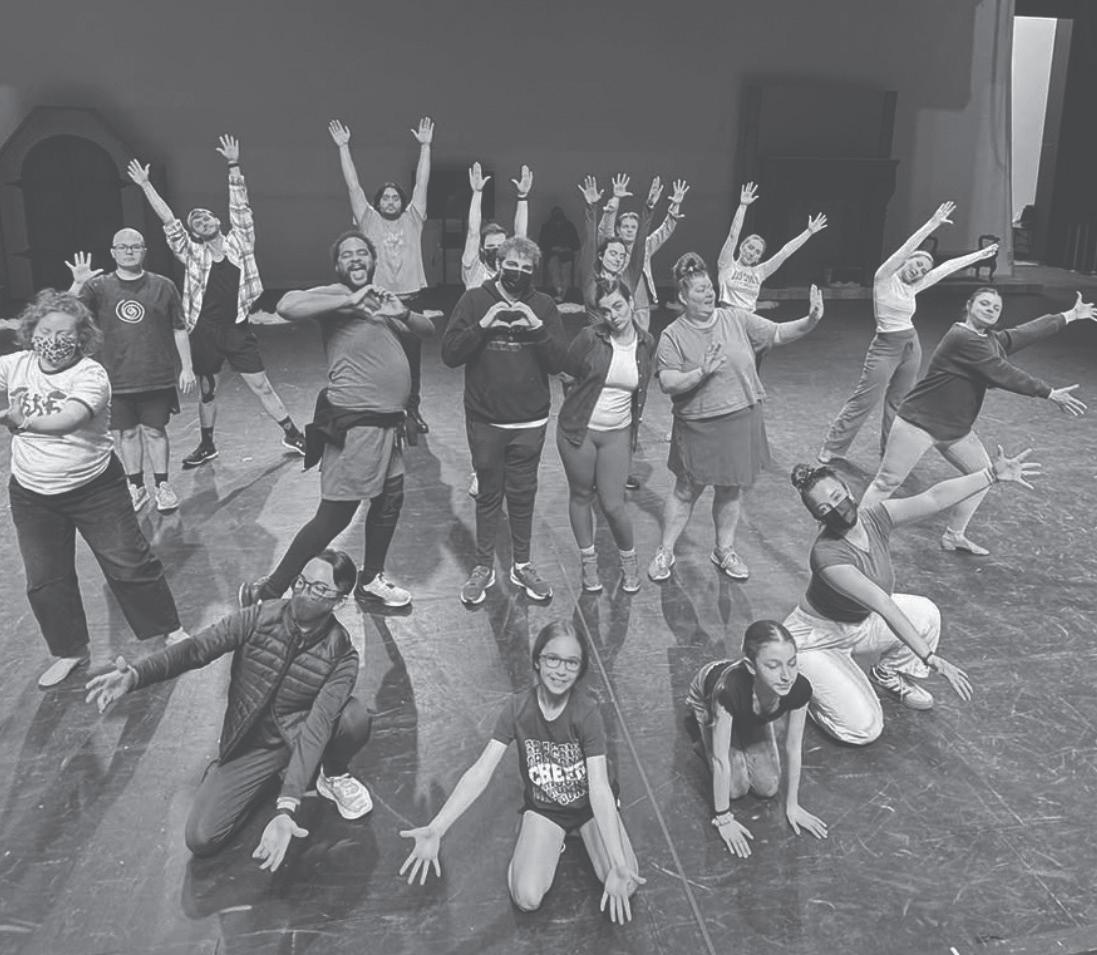
The Frozen cast poses during rehearsal at the Jefferson Performing Arts Center on March 8, 2026. Courtesy of John B. Barrios.
SENATOR: SGA members advise future candidates
ideas, or seek guidance.”
Senators at large play another key role within SGA by representing specific colleges and helping students communicate with university leadership.
Paris Hayes, a junior criminology major and current Speaker of the Senate, said senators at large often work directly with deans and administrators.
“The responsibility of an SAL is to serve as the liaison between the deans of your particular college and the student body,” Hayes said. “We also chair senate committees and act as a resource for students who want to voice concerns, share
Hayes said one of the most rewarding parts of the role has been working with university administrators to improve student engagement.
“One of my favorite parts was connecting with the dean and assistant dean of the College of Arts and Sciences,” Hayes said. “Sharing ideas on how we can help better student engagement helped us come up with several ideas we hope to collaborate on in the future.”
However, Hayes said representing such a large student population can sometimes be difficult.
“One of the hardest parts is knowing it may be hard to ensure every single stu-
dent voice is heard,” Hayes said. “But we try our best to make sure students, faculty, and the surrounding New Orleans community feel heard and represented.”
Senior Heaven Haney, a popular and commercial music major with a marketing minor, said her experience as a senator at large has been meaningful both professionally and personally.
“My experience as an SAL was very positive,” Haney said. “I was able to work and collaborate with such an amazing group of individuals who were hardworking and made the experience fun and inviting.”
Haney said teamwork within SGA helped make the role easier to manage.
“The responsibilities can be challenging at times, but it’s a collaborative effort with the vice president and the other SALs that makes the workload easier,” Haney said.
For Haney, the relationships she built were the most valuable part of the experience.
“My favorite part of being an SAL is definitely the connections I have made,” Haney said. “I was able to strengthen friendships with people already in SGA and meet new friends along the way.”
Students interested in running for office were invited to attend information sessions on March 2, March 3, and March 5. The sessions explained the
roles available, how campaigning works and what SGA expects from potential candidates.
Current members of SGA encourage students who are interested in leadership to consider running.
“One piece of advice I would give students who are running is to stay active and be open,” Hayes said. “Not just with students but with faculty and staff also because their voice matters.”
Haney offered similar advice to future candidates.
“Just be yourself,” Haney said. “People look for authenticity, and as long as you stay true to who you are, everything will fall into place.”
The Maroon Mar 13. 2026
Bruno's Tavern, popular bar at Maple Street, is up for sale
By Pablo Piñeiro Ramy ppineiro@my.loyno.edu
Bruno's tavern, owned by Tim Spratt, is up for sale.
Spratt has owned Bruno's since 2019 and said he is moving on to focus on other things.
“I bought the bar in 2019 and am moving on to focus other businesses and investments,” Spratt said. “I'm very grateful for everyone who has supported Bruno's over the years - managers, staff, and patrons.”
The bar, which requires patrons to be over 19 years old, has been located at the corner of Maple and Hillary Street since its opening in 1934. It has long been a favorite for both Loyola and Tulane University students.

Louisiana public colleges under review by U.S. Department of Education
By Dominique Campbell ddcampbe@my.loyno.edu
The Louisiana Public College System is under review by the United States Department of Education for a possible violation of civil rights.
Records released to the public from the Department of Education included certain performance goals, requiring that schools specifically prioritize “all other races other than white, Asian.”
The Louisiana Board of Regents stated that their goal was to “increase the unduplicated number of underrepre-
sented minorities (all races other than white, Asian)”.
The wording presents conflict with anti-discrimination laws and any concept of equity. The state Board of Regents has received a letter from the federal authorities and is willing to fully cooperate with the investigation.
The Department of Education's Assistant Secretary for Civil Rights
Kimberly Richey said, “The Louisiana Board of Regents’ objective to prioritize recruitment and graduation efforts for ‘all races other than white [and] Asian’ appears to blatantly vio-
late not only America’s antidiscrimination laws, but our nation’s core principles. Title VI guarantees all students equal access to educational programs and opportunities regardless of race and OCR is committed to preserving these rights,” Richey said. “[The Office for Civil Rights] will fully enforce Title VI to ensure our education programs are defined by equality, not exclusion.”
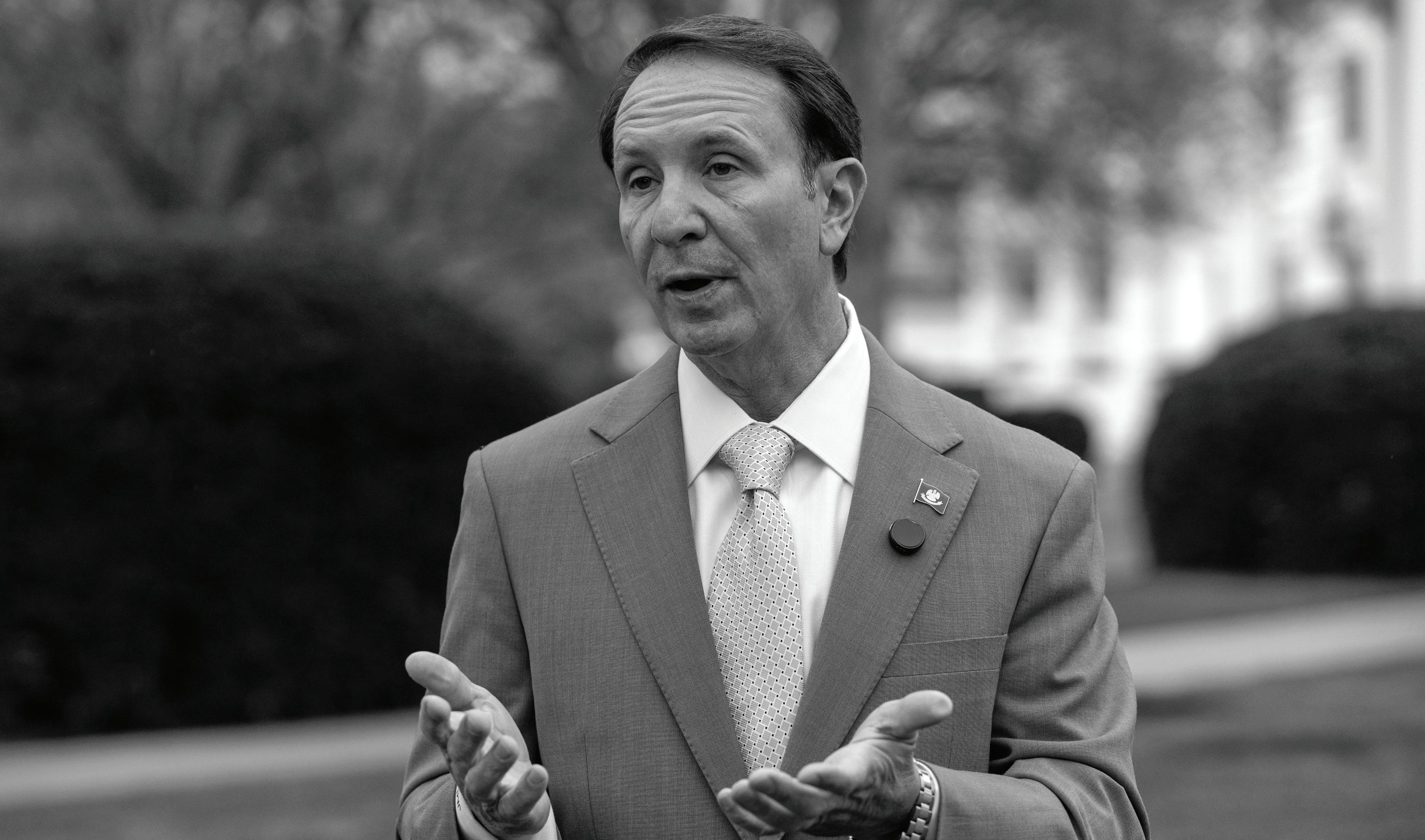
Louisiana Governor Jeff Landry has since released an official statement in which he approved of the investigation.
“Harmful diversity, equity, and in-
clusion policies have no place in Louisiana,” Landry said.
Landry reiterated his commitment to ending DEI positions & requirements at various levels in the state.
He also emphasized that any discrimination based on sex, color, or gender “will not be tolerated.”
The investigation also reaches the state’s historically Black colleges and universities.
The state of Louisiana now waits for the findings of the federal investigation. Any findings in the investigation by the Department of Education could
restructure policy in higher education across the state if their findings unearth such a violation of federal civil rights by using the concept of race to possibly discriminate against students of different ethnicities.
Bouncer sitting in front of Brunos on Tueday night as the company prepares for a new landlord. Sophia Renzi/The Maroon
Louisiana Gov. Jeff Landry records a social media video outside the White House, March 24, 2025, in Washington. AP Photo/Mark Schiefelbein
'The Backyardigans'': when nostalgia turns uncanny

By Kerieyaunta Smith klsmith1@my.loyno.edu
For a lot of people who grew up in the early 2000s, "The Backyardigans" wasn’t just a kids’ show, it was part of our childhood. The bright colors, simple animation, and catchy songs made it feel
comforting and imaginative. That’s why the recent redesign of the characters has been so upsetting. Instead of feeling excited about a beloved show returning, many fans feel strangely uncomfortable looking at the new version.
When people talk about the redesign

By Finian Jones ffjones@my.loyno.edu
feeling “off,” what they’re really describing is something similar to the uncanny valley effect. The original show had a very specific style. The characters were smooth, simple, and cartoonish in a way that matched the playful backyard adventures they went on every episode. They weren’t supposed to look realistic. That simplicity was part of the charm. The new designs, however, add extra texture and detail that make the characters feel almost realistic but not too much. That middle ground is where things start to feel weird. Instead of looking like the characters we remember, they look like a slightly distorted version of themselves.
The uncanny valley is a term used in psychology and robotics to describe the uncomfortable feeling people experience when something looks almost human but not quite right. Instead of feeling familiar or comforting, the small differences in appearance can make characters seem eerie or unsettling. When applied to animation or character redesigns, even slight changes in facial features, proportions, or expressions can cause viewers to feel uneasy because the characters no longer match the versions
Following its founding on the banks of the Puget Sound, Amazon.com has gone on to form a vast net of tributaries spanning sea to shining sea–which have recently snaked down to Louisiana. Much like America’s great waterways, Amazon has a reputation as an economy-boosting force, and many states that have opened facilities have seen overall positive gains.
Amazon, however, is not a biodiverse waterway–and most metrics of success for regions where operations have been placed only count the economic benefits, turning a blind eye to the array of possible detriments. When considering the downsides of Amazon’s operations, one can’t help but wonder about the infrastructural implications. In a rapidly growing state like North Carolina, this particular problem might seem less worrying. But for Louisiana, these massive facilities could easily affect an already struggling power grid. Amazon requires a preponderance of electricity; and for rural areas in North Louisiana, it is bold to assume that local energy can keep up with the demand, especially when it has shown to have trouble even sustaining
they remember. The problem is that the redesign seems to miss the point of why the show worked in the first place. The original animation style was simple for a reason. It made the show feel warm and imaginative, like a child’s backyard fantasy brought to life. Adding more detail doesn’t necessarily make it better. In this case, it actually takes away from what made the show special.
If you look at social media, it’s clear that a lot of people feel the same way. Memes, reaction posts, and side by side comparisons of the old and new characters have been everywhere. Fans are joking about how the characters look like “AI-generated versions” of themselves or saying they feel slightly creepy. Even people who loved the show and wanted it to come back are questioning why the designs had to change so much. The reaction isn’t just people being overly nostalgic; it’s people recognizing that something about the update doesn’t match the spirit of the original.
What this situation really shows is how delicate nostalgia reboots are. When networks like Nickelodeon bring
its small populace. The environmental concerns of Amazon’s presence are very real. Whatever sustainability Amazon may attempt to implement in their practices will be a drop of water compared to the size and scope of an objectively unsustainable model. Amazon is not getting better on this front, they are only getting worse.
As of 2024, the company has seen a 6% increase in carbon emissions, largely brought on by AI expansion–as reported by the Pacific Northwest Center of Excellence for Clean Energy. As long as these carbon-emitting, water-guzzling data centers are built by Amazon, the company has no business pretending to be sustainable.
Additionally, Caddo and Bossier Parishes are home to wetlands which are of extreme importance to local and migratory wildlife, and they are already very sensitive to human interference. The main problem here, amid many, is AI’s aforementioned water usage, which would obviously affect the delicate balance of the nature in the area.
What has arguably made Amazon the most infamous is the relationship with
back a beloved show, they’re not just reviving characters, they’re reviving memories. Fans have a deep emotional connection to the way those characters looked, sounded, and felt. If the reboot changes too much, it stops feeling like the same show.
Modernizing animation isn’t automatically a bad thing. Technology improves, and new generations of viewers grow up with different visual expectations. But when a redesign makes a beloved show feel unfamiliar or unsettling, it raises an important question: Who is the reboot actually for? If longtime fans feel disconnected and the new version loses the charm that made the original memorable, the update starts to feel unnecessary.
At the end of the day, nostalgia works because it reminds people of something they loved. A reboot should bring back that feeling, not replace it with something that feels slightly wrong. The new “Backyardigans” redesign may be trying to update the show for a modern audience, but right now it mostly reminds fans of one thing: sometimes the original version was already perfect.
its workforce. Amazon has had many scandals related to poor treatment of its employees, and whatever these workers are making does not seem worth the mistreatment and union-busting. Many Amazon employees at these facilities see as little as 15 dollars an hour, according to recent job listings; substantially less than the $69,000-per year average income of Bossier Parish, as measured by the U.S. Census Bureau. Amazon is ultimately not a force for good in Louisiana. What they bring is more parasitic than symbiotic. They rake in the dough with tax incentives, while draining the area dry of its precious resources and polluting the environment. It doesn’t matter if Amazon might make the economy better on paper if everyday people aren’t benefitting. And the increase in jobs means nothing if worker’s rights are considered a suggestion and a living wage is treated like a fairy tale. This deal helps Bezos and the politicians in Baton Rouge with their lucrative pacs–and helps everybody else just enough to where you forget how negative the realities of it really are
Dear Loyola, we’re sick of the ice cream shenanigans
By Stella Perdue swperdue@my.loyno.edu
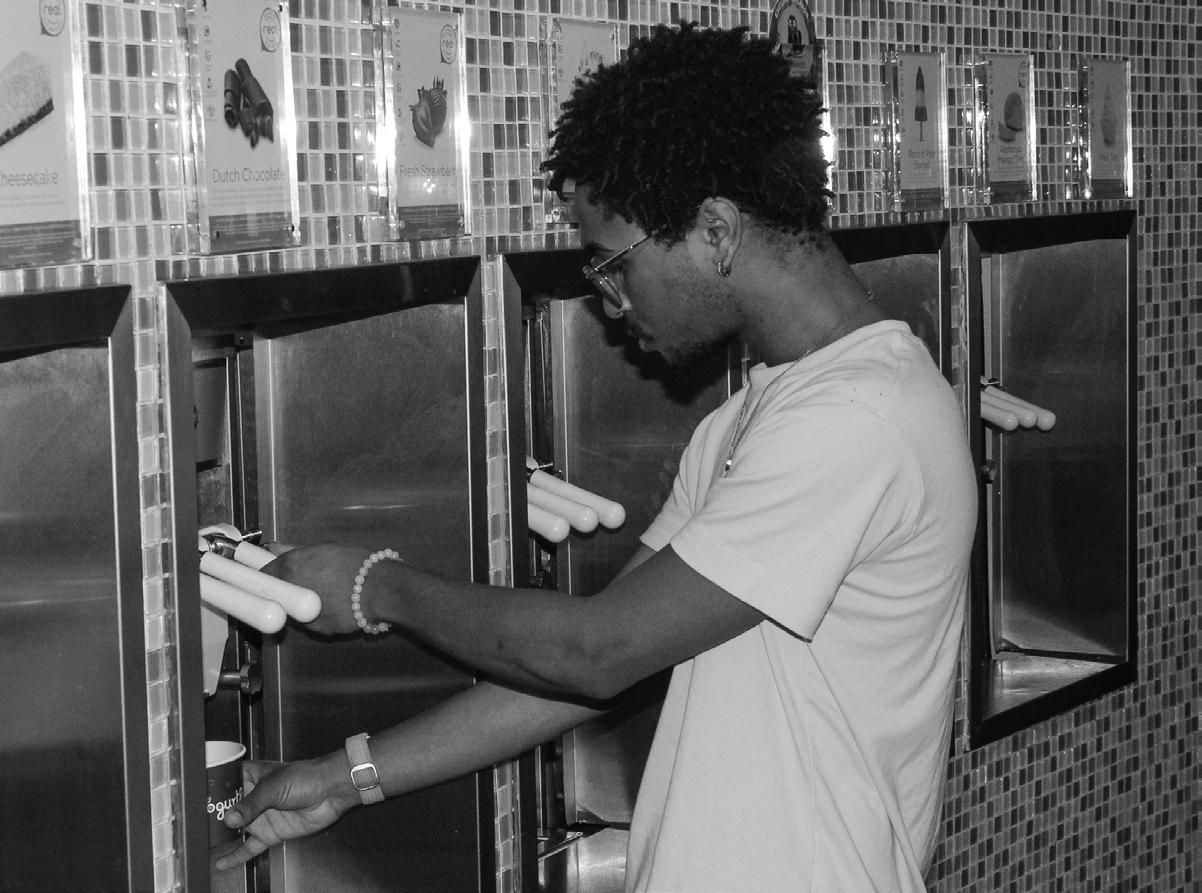
Between numerous university dining halls across the country, there is one common denominator: a soft-serve machine.
I know Loyola prides itself on uniqueness, but in this instance I think we should follow the herd for once.
You’ll notice that the Orleans Room is lacking this seemingly universal delicacy. Instead, Sodexo invests in tubs of vanilla and chocolate ice cream that come with dirty scoopers, always swimming in murky brown water.
It’s obvious that improper sanitization is a huge drawback when it comes to the ice cream situation in the OR - who knows how long that water sits for? What if people use their unwashed hands to pry ice cream off of the scooper because its consistency isn’t tactile enough?
The gross water residue can drip into the ice cream tubs, releasing god knows
what kinds of bacteria.
If we switched to soft-serve, the process would be contactless and thus way cleaner. No icky brown water, no student germ interference.
Efficiency is another thing. It’s a pain in the ass to wait for people to scoop ice cream when you’ve been dreaming of a sweet treat all day.
I’ve been on both sides of this situation–I’ll admit that I get crazy anxiety when someone’s behind me, causing me to forget my motor functions & internally freak out. Soft-serve would eliminate both of these problems.
Soft-serve is also fun and whimsical.
It’s an experience. You can adjust your toppings, choose swirl, and get creative–like dipping french fries in it.
It’d vastly improve OR traffic as well. I’d be willing to bet all of my dining dollars that people’d use meal swipes just to get soft-serve. I can attest that I’d do the same.
Undergraduate life can be stressful,
it’s a stark contrast to childhood and forces you to make an effort to develop important life skills. Sometimes all we need is a sweet treat at the end of the day to brighten our spirits.
It breaks my heart when I finish exams and want ice cream in the OR, only to discover that the containers are totally empty. Soft-serve is a way smaller serving size, on the other hand.
It’s also cost effective: Sodexo probably spends more money filling up the ice cream freezer and fixing the freezer when the handles break.
Long term, if Sodexo invested in a soft-serve machine, its durability would justify the cost. Loyola spends thousands of dollars making random renovations that aren’t even necessary (i.e., Danna Center skinny doorhandles), so what’s the harm if a small sum of that money went towards revolutionizing the OR dining experience?
Loyola ought to give the people what they want: better ice cream.
Gabrielle Conway /The Maroon
Student Joshua Fletcher gets frozen yogurt at Yogurtland. Taken on: March 10, 2026. Taken by: Pharrell Every/The Maroon
Amazon by the Mississippi
An Amazon logo appears on an Amazon delivery van in Boston, Oct. 1, 2020. (AP
Photo/Steven Senne, File)
Loyola owes students clarity on Financial Aid outsourcing
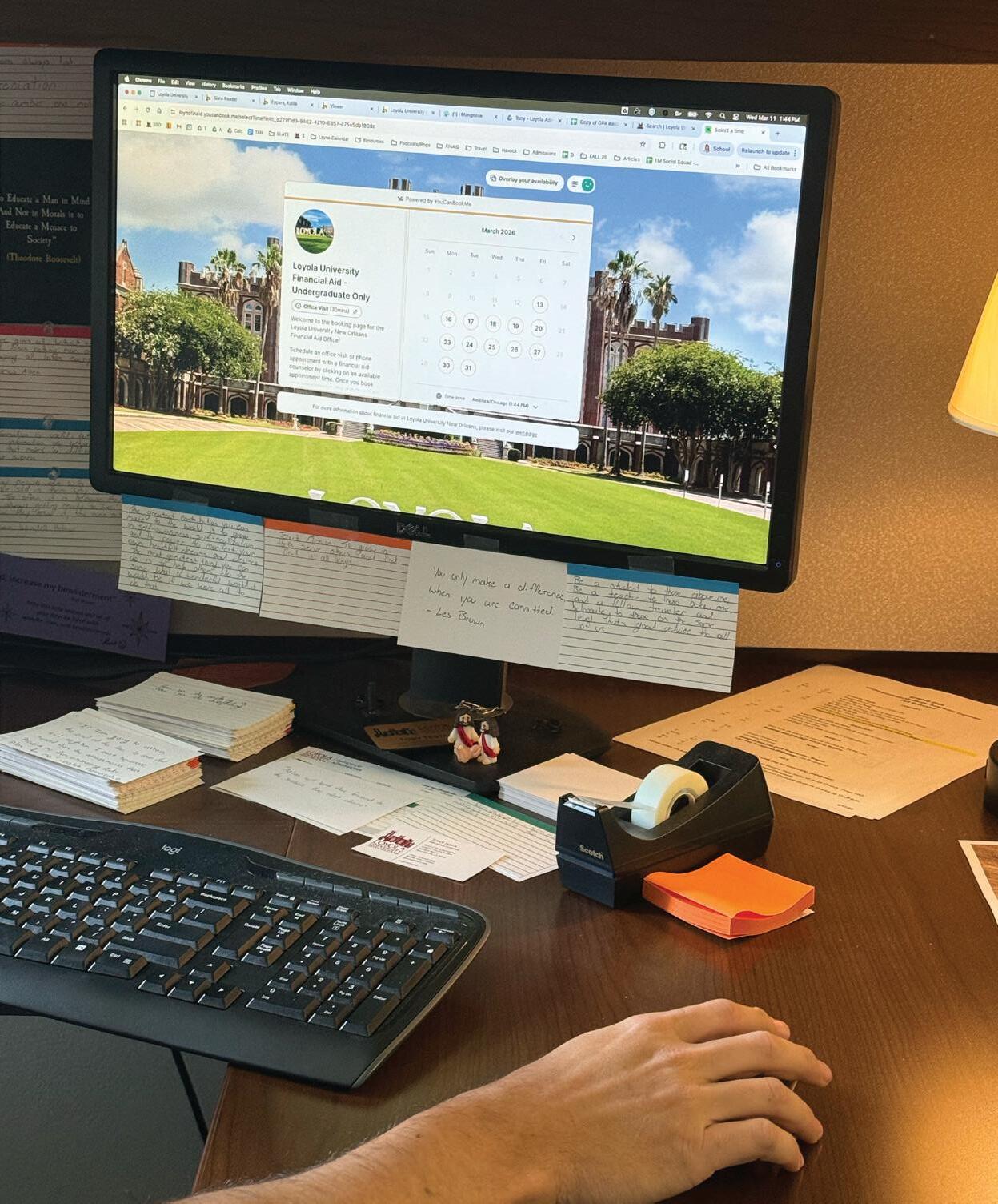
Loyola University New Orleans announced that it will outsource allnancial aid operations to a third-party consulting rm, the Higher Education Assistance Group. At the same time, the sta page for the university’s nancial aid department disappeared from Loyola’s website, signaling that the switch had occurred.
According to Vice President of Enrollment Anthony Jones, the partnership is meant to provide “more proactive support as students move through theirnancial journeys.”
If that goal is truly the motivation behind this change, students should welcome it. But for many on campus right now, the announcement has created more uncertainty than reassurance.
Financial aid is not just another administrative o ce. For many Loyola students, it determines whether they can remain enrolled at all. It is where students go when tuition bills arrive and something does not add up. It is where families call when scholarships change, loans fall through, or paperwork becomes overwhelming. It is one of the most important points of contact between the university and the students it serves.
Because of that, replacing the entire department is not a minor administrative adjustment. It is a major institutional decision, and one that deserves careful explanation.
While students may not always have had smooth experiences with the nancial aid o ce, the people who worked there were still part of Loyola’s community. ey helped students navigate complex nancial systems, often during moments of real stress. When a department disappears almost overnight, the university owes those employees recognition and transparency about how they were treated during the transition.
who they should contact, or how this new system will function. Brief emails cannot substitute for clear, consistent communication when the issue at hand a ects whether students can a ord their education.
“If Loyola leadership believes out sourcing financial aid will improve the system then the results must be visible quickly.”
The Editorial Board The Maroon
e current moment raises a more immediate concern: communication.
Many students say they are still unsure about what exactly has changed,
If Loyola leadership believes outsourcing nancial aid will improve the system, then the results must be visible quickly. Students should expect faster responses, clearer guidance, and stronger support than before. A third-party organization stepping into this role should not simply maintain the status quo. It should raise the level of service students receive.
Right now, however, the most noticeable change has been confusion. Questions are circulating across campus, and many students feel like they are trying to piece together what is happen-
ing without a clear explanation. at is not how a decision of this scale should unfold.
Loyola often speaks about cura personalis, the Jesuit commitment to care for the whole person. at value should not exist only in mission statements. It should guide decisions that a ect students’ nancial security and their ability to remain in school.
Outsourcing an entire department is a signi cant move. Now Loyola must show that the decision was made to strengthen support for students, not simply to streamline internal operations.
Students deserve transparency. ey deserve consistency. And above all, they deserve a nancial aid system that works and leadership willing to explain how it will.

HOWLS & GROWLS
HOWL to March Madness
GROWL to Pipe bursting
HOWL to Neuty the nutria
GROWL to Cancer
HOWL to Lent
GROWL to Parking tickets
Editorial Board
Editor in Chief
Eloise Pickering
Managing Editor for Print
Mary Ella Hastings
Pre-Content Director
Alana Frank
Post-Content Director
Callie Honeycutt
Campus News Editor
Lily Bordelon
Campus News Editor
Stella Perdue
Worldview Editor
Pablo Pineiro-Ramy
Assistant Worldview Editor
Angelica Pineda
Life and Times Editor
Elise Beck
Assistant Life and Times Editor
Olivia Sanyal
Sports Editor
Kerieyaunta Smith
Opinion and Editorial Editor
Imadnisa Siddiqui
Breaking News Editor
Natalie omas
e Wolf Editor
Laura Welles
Senior Sta Photographer
Sophia Renzi
Assistant Photo Editor
Pharrell Every
Design Chief
Makayla Parker
Social Media Manager
Mabel Regalado-Hernandez
Social Media Manager
Carlos Andrade
Social Media Manager
Maria Touzard
Copy Editor
Mark Michel
Newscast Editor
Christopher Nesbit
Lead Anchor
Dessadra Tezeno
EDITORIAL POLICY
The editorial on this page represents the majority opinions of The Maroon’s editorial board and does not necessarily re ect the opinions of Loyola University.
Letters and columns re ect the opinions of the authors and not necessarily those of The Maroon’s editorial board.
The Maroon does not represent the opinion of administration, sta and/or faculty members of Loyola.
Letters are subject to editing for length, grammar and style. Please limit submissions to 400 words. Submissions are due no later than 4 p.m. the Sunday before publication. Please send all submissions — The Maroon, 6363 St. Charles Ave., Box 64, New Orleans, LA 70118.
Email us your letters — letter@ loyno.edu.
Submissions may also be made online at www.loyolamaroon.com.
Landing page to book appointments for the Loyola's Financial Aid Department. The sta was replaced by another company, Higher Education Assistance Group. Sophia Renzi/The Maroon









Endless possibilities —just down the street.


The same personalized support. The same hands-on learning experience. All new possibilities for your career.

Explore versatile programs at Loyola College of Law.









Juris Doctor – full time, part time, and evening programs


Master of Arts in Environmental Law



Master of Arts in Health Law & Administration






























Zachary